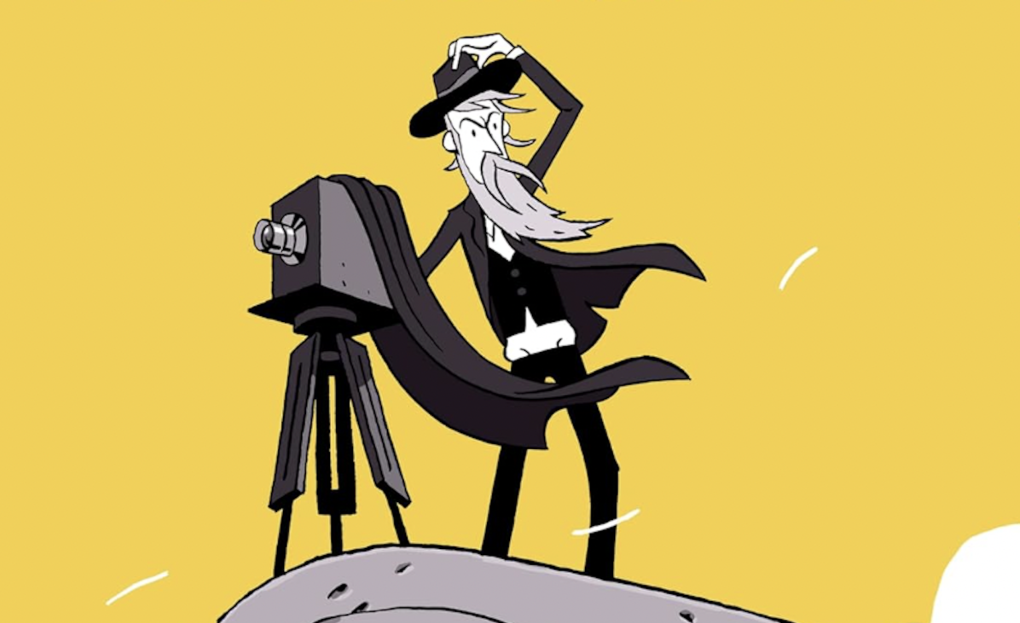
A New Graphic Novel Explores the Life and Strange Times of Eadweard Muybridge
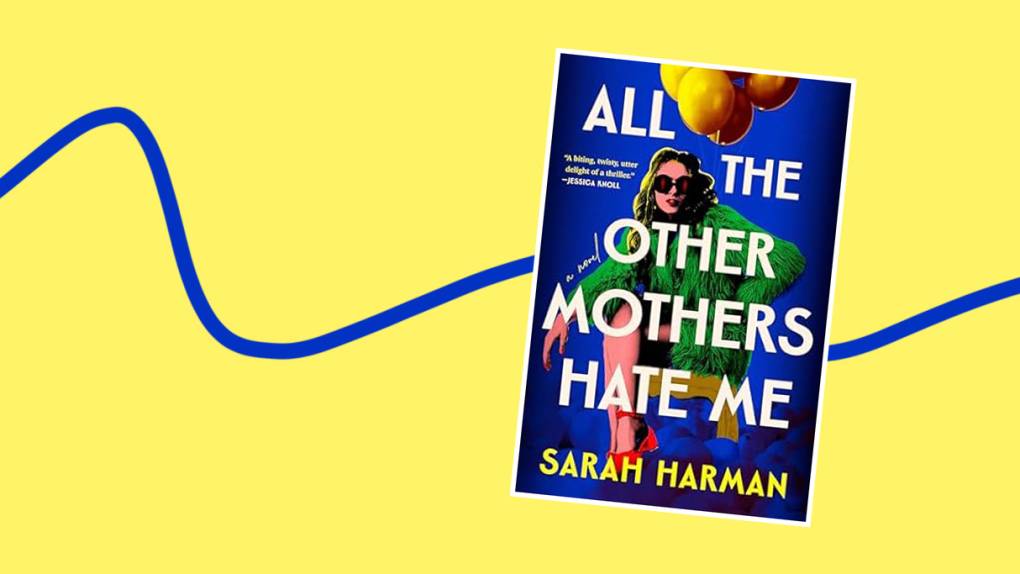
‘All the Other Mothers Hate Me’ Is a Breezy Read from Sarah Harman
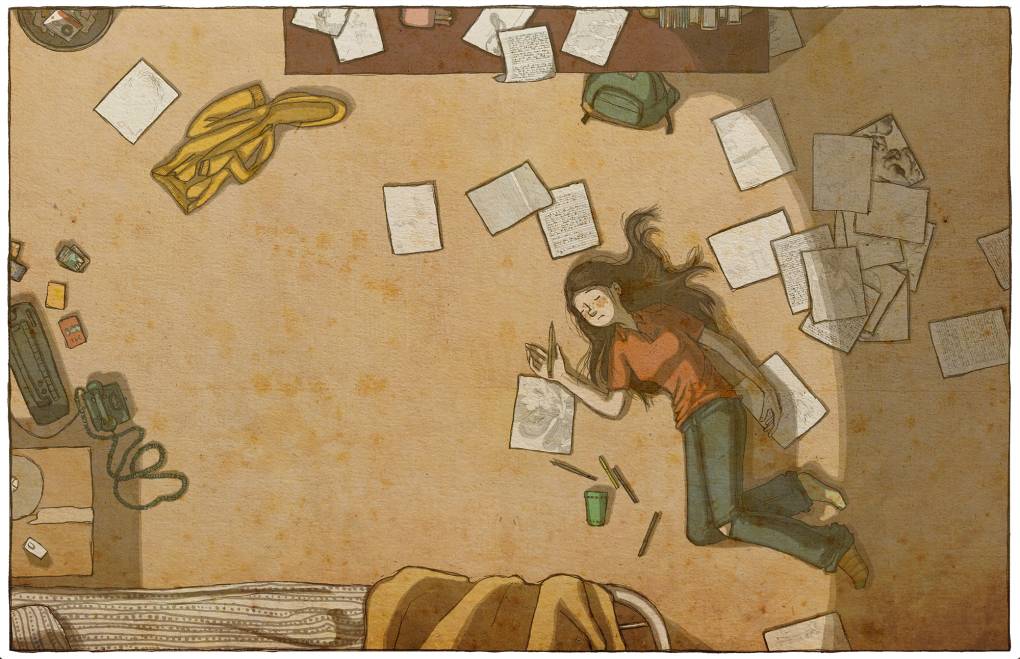
This East Bay Graphic Novel Celebrates the Magic of Passing Notes With Friends
‘Soft Core’ Takes Readers on a Delirious Ride Through SF’s Kinky Underground
Bianca Mabute-Louie’s ‘Unassimilable’ Reframes Immigration and Belonging
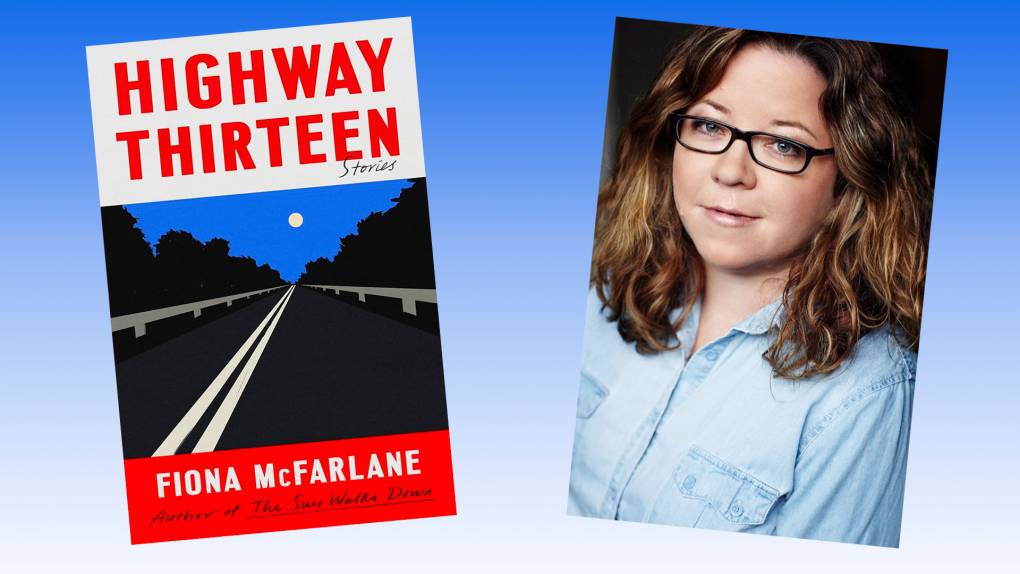
A Serial Killer Looms Over Albany Author’s New Story Collection
In ‘Parade,’ Rachel Cusk Once Again Flouts Traditional Narrative
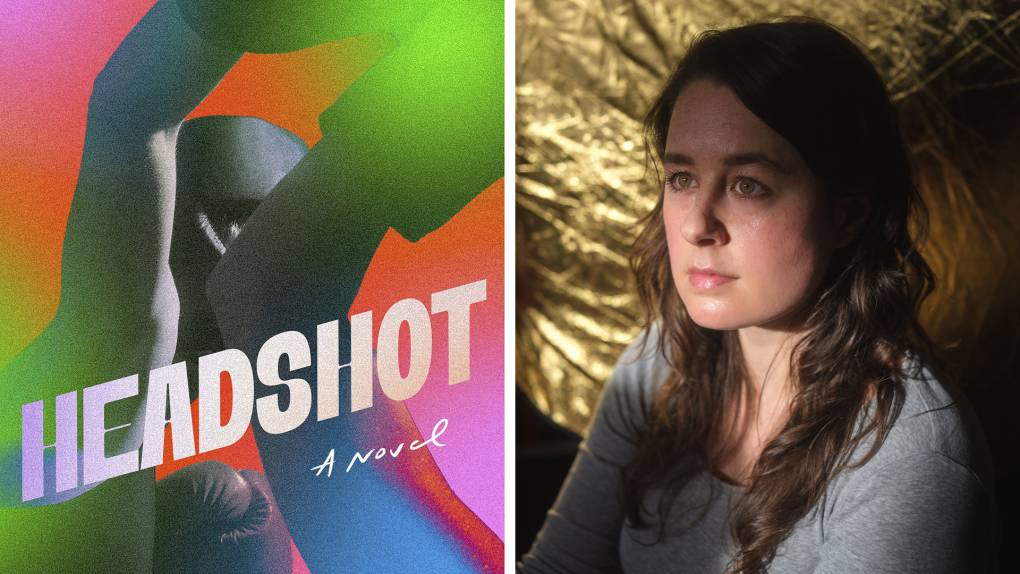
Rita Bullwinkel’s Novel About Teen Girl Boxers Packs a Punch
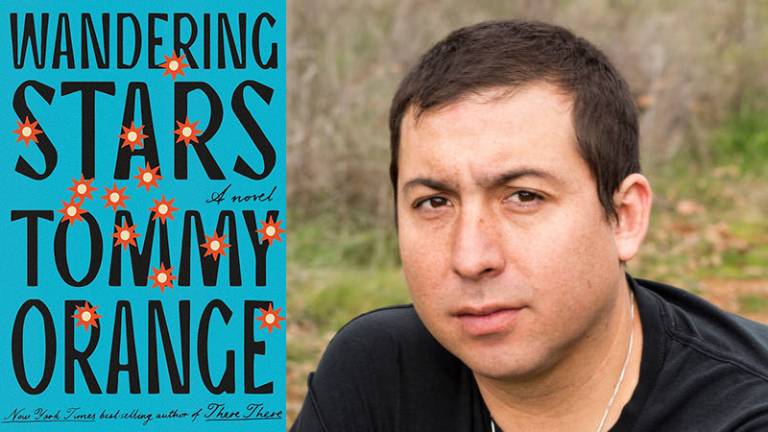
Tommy Orange’s ‘Wandering Stars’ Traces a Family's Scars Across Six Generations
Sponsored
Player sponsored by
window.__IS_SSR__=true
window.__INITIAL_STATE__={
"attachmentsReducer": {
"audio_0": {
"type": "attachments",
"id": "audio_0",
"imgSizes": {
"kqedFullSize": {
"file": "https://ww2.kqed.org/news/wp-content/themes/KQED-unified/img/audio_bgs/background0.jpg"
}
}
},
"audio_1": {
"type": "attachments",
"id": "audio_1",
"imgSizes": {
"kqedFullSize": {
"file": "https://ww2.kqed.org/news/wp-content/themes/KQED-unified/img/audio_bgs/background1.jpg"
}
}
},
"audio_2": {
"type": "attachments",
"id": "audio_2",
"imgSizes": {
"kqedFullSize": {
"file": "https://ww2.kqed.org/news/wp-content/themes/KQED-unified/img/audio_bgs/background2.jpg"
}
}
},
"audio_3": {
"type": "attachments",
"id": "audio_3",
"imgSizes": {
"kqedFullSize": {
"file": "https://ww2.kqed.org/news/wp-content/themes/KQED-unified/img/audio_bgs/background3.jpg"
}
}
},
"audio_4": {
"type": "attachments",
"id": "audio_4",
"imgSizes": {
"kqedFullSize": {
"file": "https://ww2.kqed.org/news/wp-content/themes/KQED-unified/img/audio_bgs/background4.jpg"
}
}
},
"placeholder": {
"type": "attachments",
"id": "placeholder",
"imgSizes": {
"thumbnail": {
"file": "https://cdn.kqed.org/wp-content/uploads/2024/12/KQED-Default-Image-816638274-2000x1333-1-160x107.jpg",
"width": 160,
"height": 107,
"mimeType": "image/jpeg"
},
"medium": {
"file": "https://cdn.kqed.org/wp-content/uploads/2024/12/KQED-Default-Image-816638274-2000x1333-1-800x533.jpg",
"width": 800,
"height": 533,
"mimeType": "image/jpeg"
},
"medium_large": {
"file": "https://cdn.kqed.org/wp-content/uploads/2024/12/KQED-Default-Image-816638274-2000x1333-1-768x512.jpg",
"width": 768,
"height": 512,
"mimeType": "image/jpeg"
},
"large": {
"file": "https://cdn.kqed.org/wp-content/uploads/2024/12/KQED-Default-Image-816638274-2000x1333-1-1020x680.jpg",
"width": 1020,
"height": 680,
"mimeType": "image/jpeg"
},
"1536x1536": {
"file": "https://cdn.kqed.org/wp-content/uploads/2024/12/KQED-Default-Image-816638274-2000x1333-1-1536x1024.jpg",
"width": 1536,
"height": 1024,
"mimeType": "image/jpeg"
},
"fd-lrg": {
"file": "https://cdn.kqed.org/wp-content/uploads/2024/12/KQED-Default-Image-816638274-2000x1333-1-1536x1024.jpg",
"width": 1536,
"height": 1024,
"mimeType": "image/jpeg"
},
"fd-med": {
"file": "https://cdn.kqed.org/wp-content/uploads/2024/12/KQED-Default-Image-816638274-2000x1333-1-1020x680.jpg",
"width": 1020,
"height": 680,
"mimeType": "image/jpeg"
},
"fd-sm": {
"file": "https://cdn.kqed.org/wp-content/uploads/2024/12/KQED-Default-Image-816638274-2000x1333-1-800x533.jpg",
"width": 800,
"height": 533,
"mimeType": "image/jpeg"
},
"post-thumbnail": {
"file": "https://cdn.kqed.org/wp-content/uploads/2024/12/KQED-Default-Image-816638274-2000x1333-1-672x372.jpg",
"width": 672,
"height": 372,
"mimeType": "image/jpeg"
},
"twentyfourteen-full-width": {
"file": "https://cdn.kqed.org/wp-content/uploads/2024/12/KQED-Default-Image-816638274-2000x1333-1-1038x576.jpg",
"width": 1038,
"height": 576,
"mimeType": "image/jpeg"
},
"xxsmall": {
"file": "https://cdn.kqed.org/wp-content/uploads/2024/12/KQED-Default-Image-816638274-2000x1333-1-160x107.jpg",
"width": 160,
"height": 107,
"mimeType": "image/jpeg"
},
"xsmall": {
"file": "https://cdn.kqed.org/wp-content/uploads/2024/12/KQED-Default-Image-816638274-2000x1333-1-672x372.jpg",
"width": 672,
"height": 372,
"mimeType": "image/jpeg"
},
"small": {
"file": "https://cdn.kqed.org/wp-content/uploads/2024/12/KQED-Default-Image-816638274-2000x1333-1-672x372.jpg",
"width": 672,
"height": 372,
"mimeType": "image/jpeg"
},
"xlarge": {
"file": "https://cdn.kqed.org/wp-content/uploads/2024/12/KQED-Default-Image-816638274-2000x1333-1-1020x680.jpg",
"width": 1020,
"height": 680,
"mimeType": "image/jpeg"
},
"full-width": {
"file": "https://cdn.kqed.org/wp-content/uploads/2024/12/KQED-Default-Image-816638274-2000x1333-1-1920x1280.jpg",
"width": 1920,
"height": 1280,
"mimeType": "image/jpeg"
},
"guest-author-32": {
"file": "https://cdn.kqed.org/wp-content/uploads/2025/01/KQED-Default-Image-816638274-1333x1333-1-160x160.jpg",
"width": 32,
"height": 32,
"mimeType": "image/jpeg"
},
"guest-author-50": {
"file": "https://cdn.kqed.org/wp-content/uploads/2025/01/KQED-Default-Image-816638274-1333x1333-1-160x160.jpg",
"width": 50,
"height": 50,
"mimeType": "image/jpeg"
},
"guest-author-64": {
"file": "https://cdn.kqed.org/wp-content/uploads/2025/01/KQED-Default-Image-816638274-1333x1333-1-160x160.jpg",
"width": 64,
"height": 64,
"mimeType": "image/jpeg"
},
"guest-author-96": {
"file": "https://cdn.kqed.org/wp-content/uploads/2025/01/KQED-Default-Image-816638274-1333x1333-1-160x160.jpg",
"width": 96,
"height": 96,
"mimeType": "image/jpeg"
},
"guest-author-128": {
"file": "https://cdn.kqed.org/wp-content/uploads/2025/01/KQED-Default-Image-816638274-1333x1333-1-160x160.jpg",
"width": 128,
"height": 128,
"mimeType": "image/jpeg"
},
"detail": {
"file": "https://cdn.kqed.org/wp-content/uploads/2025/01/KQED-Default-Image-816638274-1333x1333-1-160x160.jpg",
"width": 160,
"height": 160,
"mimeType": "image/jpeg"
},
"kqedFullSize": {
"file": "https://cdn.kqed.org/wp-content/uploads/2024/12/KQED-Default-Image-816638274-2000x1333-1.jpg",
"width": 2000,
"height": 1333
}
}
},
"arts_13976211": {
"type": "attachments",
"id": "arts_13976211",
"meta": {
"index": "attachments_1716263798",
"site": "arts",
"id": "13976211",
"found": true
},
"title": "muybridge cover",
"publishDate": 1747171740,
"status": "inherit",
"parent": 13976156,
"modified": 1747171810,
"caption": "‘Muybridge’ by Guy Delisle.",
"credit": "Drawn & Quarterly",
"altTag": null,
"description": null,
"imgSizes": {
"medium": {
"file": "https://cdn.kqed.org/wp-content/uploads/sites/2/2025/05/muybridge-cover-1-800x488.png",
"width": 800,
"height": 488,
"mimeType": "image/png"
},
"large": {
"file": "https://cdn.kqed.org/wp-content/uploads/sites/2/2025/05/muybridge-cover-1-1020x623.png",
"width": 1020,
"height": 623,
"mimeType": "image/png"
},
"thumbnail": {
"file": "https://cdn.kqed.org/wp-content/uploads/sites/2/2025/05/muybridge-cover-1-160x98.png",
"width": 160,
"height": 98,
"mimeType": "image/png"
},
"medium_large": {
"file": "https://cdn.kqed.org/wp-content/uploads/sites/2/2025/05/muybridge-cover-1-768x469.png",
"width": 768,
"height": 469,
"mimeType": "image/png"
},
"1536x1536": {
"file": "https://cdn.kqed.org/wp-content/uploads/sites/2/2025/05/muybridge-cover-1-1536x938.png",
"width": 1536,
"height": 938,
"mimeType": "image/png"
},
"post-thumbnail": {
"file": "https://cdn.kqed.org/wp-content/uploads/sites/2/2025/05/muybridge-cover-1-672x372.png",
"width": 672,
"height": 372,
"mimeType": "image/png"
},
"twentyfourteen-full-width": {
"file": "https://cdn.kqed.org/wp-content/uploads/sites/2/2025/05/muybridge-cover-1-1038x576.png",
"width": 1038,
"height": 576,
"mimeType": "image/png"
},
"full-width": {
"file": "https://cdn.kqed.org/wp-content/uploads/sites/2/2025/05/muybridge-cover-1-1920x1172.png",
"width": 1920,
"height": 1172,
"mimeType": "image/png"
},
"kqedFullSize": {
"file": "https://cdn.kqed.org/wp-content/uploads/sites/2/2025/05/muybridge-cover-1.png",
"width": 2000,
"height": 1221
}
},
"fetchFailed": false,
"isLoading": false
},
"arts_13972871": {
"type": "attachments",
"id": "arts_13972871",
"meta": {
"index": "attachments_1716263798",
"site": "arts",
"id": "13972871",
"found": true
},
"title": "Harman",
"publishDate": 1741635554,
"status": "inherit",
"parent": 13972870,
"modified": 1741635597,
"caption": "‘All the Other Mothers Hate Me’ by Sarah Harman.",
"credit": "Putnam",
"altTag": "A yellow background with a book cover showing balloons and a woman in sunglasses",
"description": null,
"imgSizes": {
"medium": {
"file": "https://cdn.kqed.org/wp-content/uploads/sites/2/2025/03/Harman-800x450.jpg",
"width": 800,
"height": 450,
"mimeType": "image/jpeg"
},
"large": {
"file": "https://cdn.kqed.org/wp-content/uploads/sites/2/2025/03/Harman-1020x574.jpg",
"width": 1020,
"height": 574,
"mimeType": "image/jpeg"
},
"thumbnail": {
"file": "https://cdn.kqed.org/wp-content/uploads/sites/2/2025/03/Harman-160x90.jpg",
"width": 160,
"height": 90,
"mimeType": "image/jpeg"
},
"medium_large": {
"file": "https://cdn.kqed.org/wp-content/uploads/sites/2/2025/03/Harman-768x432.jpg",
"width": 768,
"height": 432,
"mimeType": "image/jpeg"
},
"post-thumbnail": {
"file": "https://cdn.kqed.org/wp-content/uploads/sites/2/2025/03/Harman-672x372.jpg",
"width": 672,
"height": 372,
"mimeType": "image/jpeg"
},
"twentyfourteen-full-width": {
"file": "https://cdn.kqed.org/wp-content/uploads/sites/2/2025/03/Harman-1038x576.jpg",
"width": 1038,
"height": 576,
"mimeType": "image/jpeg"
},
"kqedFullSize": {
"file": "https://cdn.kqed.org/wp-content/uploads/sites/2/2025/03/Harman.jpg",
"width": 1214,
"height": 683
}
},
"fetchFailed": false,
"isLoading": false
},
"arts_13972138": {
"type": "attachments",
"id": "arts_13972138",
"meta": {
"index": "attachments_1716263798",
"site": "arts",
"id": "13972138",
"found": true
},
"title": "raised by ghosts - spread",
"publishDate": 1740099272,
"status": "inherit",
"parent": 13972135,
"modified": 1740099368,
"caption": "A spread from Briana Loewinsohn's new graphic memoir, 'Raised by Ghosts.'",
"credit": "Fantagraphics",
"altTag": "Illustration: teenage girl sprawls on the floor of her bedroom surrounded by sketches and handwritten notes",
"description": null,
"imgSizes": {
"medium": {
"file": "https://cdn.kqed.org/wp-content/uploads/sites/2/2025/02/raised-by-ghosts-spread-800x517.jpg",
"width": 800,
"height": 517,
"mimeType": "image/jpeg"
},
"large": {
"file": "https://cdn.kqed.org/wp-content/uploads/sites/2/2025/02/raised-by-ghosts-spread-1020x659.jpg",
"width": 1020,
"height": 659,
"mimeType": "image/jpeg"
},
"thumbnail": {
"file": "https://cdn.kqed.org/wp-content/uploads/sites/2/2025/02/raised-by-ghosts-spread-160x103.jpg",
"width": 160,
"height": 103,
"mimeType": "image/jpeg"
},
"medium_large": {
"file": "https://cdn.kqed.org/wp-content/uploads/sites/2/2025/02/raised-by-ghosts-spread-768x497.jpg",
"width": 768,
"height": 497,
"mimeType": "image/jpeg"
},
"1536x1536": {
"file": "https://cdn.kqed.org/wp-content/uploads/sites/2/2025/02/raised-by-ghosts-spread-1536x993.jpg",
"width": 1536,
"height": 993,
"mimeType": "image/jpeg"
},
"post-thumbnail": {
"file": "https://cdn.kqed.org/wp-content/uploads/sites/2/2025/02/raised-by-ghosts-spread-672x372.jpg",
"width": 672,
"height": 372,
"mimeType": "image/jpeg"
},
"twentyfourteen-full-width": {
"file": "https://cdn.kqed.org/wp-content/uploads/sites/2/2025/02/raised-by-ghosts-spread-1038x576.jpg",
"width": 1038,
"height": 576,
"mimeType": "image/jpeg"
},
"full-width": {
"file": "https://cdn.kqed.org/wp-content/uploads/sites/2/2025/02/raised-by-ghosts-spread-1920x1241.jpg",
"width": 1920,
"height": 1241,
"mimeType": "image/jpeg"
},
"kqedFullSize": {
"file": "https://cdn.kqed.org/wp-content/uploads/sites/2/2025/02/raised-by-ghosts-spread.jpg",
"width": 2000,
"height": 1293
}
},
"fetchFailed": false,
"isLoading": false
},
"arts_13970684": {
"type": "attachments",
"id": "arts_13970684",
"meta": {
"index": "attachments_1716263798",
"site": "arts",
"id": "13970684",
"found": true
},
"title": "soft core brittany newell",
"publishDate": 1737672187,
"status": "inherit",
"parent": 13970682,
"modified": 1737672531,
"caption": "Brittany Newell's second novel 'Soft Core' hits shelves Feb. 4.",
"credit": "Farrar, Straus and Giroux",
"altTag": "On the left, a book cover that features a hand in a silky, hot pink glove suggestively lifting up a skirt. On the right, a photo of the author wearing heavy black eyeliner with her tongue sticking out.",
"description": null,
"imgSizes": {
"medium": {
"file": "https://cdn.kqed.org/wp-content/uploads/sites/2/2025/01/soft-core-brittany-newell-800x481.jpg",
"width": 800,
"height": 481,
"mimeType": "image/jpeg"
},
"large": {
"file": "https://cdn.kqed.org/wp-content/uploads/sites/2/2025/01/soft-core-brittany-newell-1020x613.jpg",
"width": 1020,
"height": 613,
"mimeType": "image/jpeg"
},
"thumbnail": {
"file": "https://cdn.kqed.org/wp-content/uploads/sites/2/2025/01/soft-core-brittany-newell-160x96.jpg",
"width": 160,
"height": 96,
"mimeType": "image/jpeg"
},
"medium_large": {
"file": "https://cdn.kqed.org/wp-content/uploads/sites/2/2025/01/soft-core-brittany-newell-768x462.jpg",
"width": 768,
"height": 462,
"mimeType": "image/jpeg"
},
"post-thumbnail": {
"file": "https://cdn.kqed.org/wp-content/uploads/sites/2/2025/01/soft-core-brittany-newell-672x372.jpg",
"width": 672,
"height": 372,
"mimeType": "image/jpeg"
},
"twentyfourteen-full-width": {
"file": "https://cdn.kqed.org/wp-content/uploads/sites/2/2025/01/soft-core-brittany-newell-1038x576.jpg",
"width": 1038,
"height": 576,
"mimeType": "image/jpeg"
},
"kqedFullSize": {
"file": "https://cdn.kqed.org/wp-content/uploads/sites/2/2025/01/soft-core-brittany-newell.jpg",
"width": 1447,
"height": 870
}
},
"fetchFailed": false,
"isLoading": false
},
"arts_13970285": {
"type": "attachments",
"id": "arts_13970285",
"meta": {
"index": "attachments_1716263798",
"site": "arts",
"id": "13970285",
"found": true
},
"title": "unassimilable bianca mabute-louie",
"publishDate": 1736889176,
"status": "inherit",
"parent": 13970282,
"modified": 1736891097,
"caption": "In 'Unassimilable,' sociologist Bianca Mabute-Louie encourages readers to rethink the idea that immigrants should seek validation from predominantly white institutions. ",
"credit": "Left: Harper Collins, right: courtesy of the author",
"altTag": "A composite image. On the left, a bright yellow book cover with pink text that reads 'Unassimilable.' On the right, a photo of the author smiling.",
"description": null,
"imgSizes": {
"medium": {
"file": "https://cdn.kqed.org/wp-content/uploads/sites/2/2025/01/unassimilable-bianca-mabute-louie-800x463.jpg",
"width": 800,
"height": 463,
"mimeType": "image/jpeg"
},
"large": {
"file": "https://cdn.kqed.org/wp-content/uploads/sites/2/2025/01/unassimilable-bianca-mabute-louie-1020x590.jpg",
"width": 1020,
"height": 590,
"mimeType": "image/jpeg"
},
"thumbnail": {
"file": "https://cdn.kqed.org/wp-content/uploads/sites/2/2025/01/unassimilable-bianca-mabute-louie-160x93.jpg",
"width": 160,
"height": 93,
"mimeType": "image/jpeg"
},
"medium_large": {
"file": "https://cdn.kqed.org/wp-content/uploads/sites/2/2025/01/unassimilable-bianca-mabute-louie-768x444.jpg",
"width": 768,
"height": 444,
"mimeType": "image/jpeg"
},
"1536x1536": {
"file": "https://cdn.kqed.org/wp-content/uploads/sites/2/2025/01/unassimilable-bianca-mabute-louie-1536x888.jpg",
"width": 1536,
"height": 888,
"mimeType": "image/jpeg"
},
"2048x2048": {
"file": "https://cdn.kqed.org/wp-content/uploads/sites/2/2025/01/unassimilable-bianca-mabute-louie-2048x1185.jpg",
"width": 2048,
"height": 1185,
"mimeType": "image/jpeg"
},
"post-thumbnail": {
"file": "https://cdn.kqed.org/wp-content/uploads/sites/2/2025/01/unassimilable-bianca-mabute-louie-672x372.jpg",
"width": 672,
"height": 372,
"mimeType": "image/jpeg"
},
"twentyfourteen-full-width": {
"file": "https://cdn.kqed.org/wp-content/uploads/sites/2/2025/01/unassimilable-bianca-mabute-louie-1038x576.jpg",
"width": 1038,
"height": 576,
"mimeType": "image/jpeg"
},
"full-width": {
"file": "https://cdn.kqed.org/wp-content/uploads/sites/2/2025/01/unassimilable-bianca-mabute-louie-1920x1111.jpg",
"width": 1920,
"height": 1111,
"mimeType": "image/jpeg"
},
"kqedFullSize": {
"file": "https://cdn.kqed.org/wp-content/uploads/sites/2/2025/01/unassimilable-bianca-mabute-louie.jpg",
"width": 2429,
"height": 1405
}
},
"fetchFailed": false,
"isLoading": false
},
"arts_13962622": {
"type": "attachments",
"id": "arts_13962622",
"meta": {
"index": "attachments_1716263798",
"site": "arts",
"id": "13962622",
"found": true
},
"title": "HighwayThirteen",
"publishDate": 1723573621,
"status": "inherit",
"parent": 13962615,
"modified": 1723573661,
"caption": "Fiona McFarlane’s ‘Highway Thirteen’ probes the lives upended by a string of roadside murders.",
"credit": "Andy Barclay",
"altTag": null,
"description": null,
"imgSizes": {
"medium": {
"file": "https://cdn.kqed.org/wp-content/uploads/sites/2/2024/08/HighwayThirteen-800x450.jpg",
"width": 800,
"height": 450,
"mimeType": "image/jpeg"
},
"large": {
"file": "https://cdn.kqed.org/wp-content/uploads/sites/2/2024/08/HighwayThirteen-1020x574.jpg",
"width": 1020,
"height": 574,
"mimeType": "image/jpeg"
},
"thumbnail": {
"file": "https://cdn.kqed.org/wp-content/uploads/sites/2/2024/08/HighwayThirteen-160x90.jpg",
"width": 160,
"height": 90,
"mimeType": "image/jpeg"
},
"medium_large": {
"file": "https://cdn.kqed.org/wp-content/uploads/sites/2/2024/08/HighwayThirteen-768x432.jpg",
"width": 768,
"height": 432,
"mimeType": "image/jpeg"
},
"1536x1536": {
"file": "https://cdn.kqed.org/wp-content/uploads/sites/2/2024/08/HighwayThirteen-1536x864.jpg",
"width": 1536,
"height": 864,
"mimeType": "image/jpeg"
},
"post-thumbnail": {
"file": "https://cdn.kqed.org/wp-content/uploads/sites/2/2024/08/HighwayThirteen-672x372.jpg",
"width": 672,
"height": 372,
"mimeType": "image/jpeg"
},
"twentyfourteen-full-width": {
"file": "https://cdn.kqed.org/wp-content/uploads/sites/2/2024/08/HighwayThirteen-1038x576.jpg",
"width": 1038,
"height": 576,
"mimeType": "image/jpeg"
},
"kqedFullSize": {
"file": "https://cdn.kqed.org/wp-content/uploads/sites/2/2024/08/HighwayThirteen.jpg",
"width": 1920,
"height": 1080
}
},
"fetchFailed": false,
"isLoading": false
},
"arts_13960122": {
"type": "attachments",
"id": "arts_13960122",
"meta": {
"index": "attachments_1716263798",
"site": "arts",
"id": "13960122",
"found": true
},
"title": "‘Parade’ by Rachel Cusk.",
"publishDate": 1718993864,
"status": "inherit",
"parent": 13960115,
"modified": 1718993896,
"caption": "‘Parade’ by Rachel Cusk.",
"credit": "Farrar, Straus and Giroux",
"altTag": null,
"description": null,
"imgSizes": {
"medium": {
"file": "https://cdn.kqed.org/wp-content/uploads/sites/2/2024/06/Screen-Shot-2024-06-21-at-11.16.46-AM-800x467.png",
"width": 800,
"height": 467,
"mimeType": "image/png"
},
"thumbnail": {
"file": "https://cdn.kqed.org/wp-content/uploads/sites/2/2024/06/Screen-Shot-2024-06-21-at-11.16.46-AM-160x93.png",
"width": 160,
"height": 93,
"mimeType": "image/png"
},
"medium_large": {
"file": "https://cdn.kqed.org/wp-content/uploads/sites/2/2024/06/Screen-Shot-2024-06-21-at-11.16.46-AM-768x448.png",
"width": 768,
"height": 448,
"mimeType": "image/png"
},
"post-thumbnail": {
"file": "https://cdn.kqed.org/wp-content/uploads/sites/2/2024/06/Screen-Shot-2024-06-21-at-11.16.46-AM-672x372.png",
"width": 672,
"height": 372,
"mimeType": "image/png"
},
"kqedFullSize": {
"file": "https://cdn.kqed.org/wp-content/uploads/sites/2/2024/06/Screen-Shot-2024-06-21-at-11.16.46-AM.png",
"width": 826,
"height": 482
}
},
"fetchFailed": false,
"isLoading": false
},
"arts_13953743": {
"type": "attachments",
"id": "arts_13953743",
"meta": {
"index": "attachments_1716263798",
"site": "arts",
"id": "13953743",
"found": true
},
"parent": 13953731,
"imgSizes": {
"twentyfourteen-full-width": {
"file": "https://cdn.kqed.org/wp-content/uploads/sites/2/2024/03/rita-bullwinkel-headshot-1038x576.jpg",
"width": 1038,
"mimeType": "image/jpeg",
"height": 576
},
"thumbnail": {
"file": "https://cdn.kqed.org/wp-content/uploads/sites/2/2024/03/rita-bullwinkel-headshot-160x90.jpg",
"width": 160,
"mimeType": "image/jpeg",
"height": 90
},
"post-thumbnail": {
"file": "https://cdn.kqed.org/wp-content/uploads/sites/2/2024/03/rita-bullwinkel-headshot-672x372.jpg",
"width": 672,
"mimeType": "image/jpeg",
"height": 372
},
"kqedFullSize": {
"file": "https://cdn.kqed.org/wp-content/uploads/sites/2/2024/03/rita-bullwinkel-headshot.jpg",
"width": 1920,
"height": 1080
},
"large": {
"file": "https://cdn.kqed.org/wp-content/uploads/sites/2/2024/03/rita-bullwinkel-headshot-1020x574.jpg",
"width": 1020,
"mimeType": "image/jpeg",
"height": 574
},
"1536x1536": {
"file": "https://cdn.kqed.org/wp-content/uploads/sites/2/2024/03/rita-bullwinkel-headshot-1536x864.jpg",
"width": 1536,
"mimeType": "image/jpeg",
"height": 864
},
"medium": {
"file": "https://cdn.kqed.org/wp-content/uploads/sites/2/2024/03/rita-bullwinkel-headshot-800x450.jpg",
"width": 800,
"mimeType": "image/jpeg",
"height": 450
},
"medium_large": {
"file": "https://cdn.kqed.org/wp-content/uploads/sites/2/2024/03/rita-bullwinkel-headshot-768x432.jpg",
"width": 768,
"mimeType": "image/jpeg",
"height": 432
}
},
"publishDate": 1709923791,
"modified": 1709924005,
"caption": "In her debut novel 'Headshot,' Rita Bullwinkel zeroes in on an intense, insular world inside the boxing ring. ",
"description": null,
"title": "rita bullwinkel headshot",
"credit": "Left: Penguin Random House; right: Jenna Garrett",
"status": "inherit",
"altTag": "The 'Headshot' book cover features abstracted forms of boxers, next to a portrait of the author.",
"fetchFailed": false,
"isLoading": false
},
"arts_13952722": {
"type": "attachments",
"id": "arts_13952722",
"meta": {
"index": "attachments_1716263798",
"site": "arts",
"id": "13952722",
"found": true
},
"parent": 13952713,
"imgSizes": {
"thumbnail": {
"file": "https://cdn.kqed.org/wp-content/uploads/sites/2/2024/02/Tommy-Orange-Wandering-Stars-160x90.jpg",
"width": 160,
"mimeType": "image/jpeg",
"height": 90
},
"post-thumbnail": {
"file": "https://cdn.kqed.org/wp-content/uploads/sites/2/2024/02/Tommy-Orange-Wandering-Stars-672x372.jpg",
"width": 672,
"mimeType": "image/jpeg",
"height": 372
},
"kqedFullSize": {
"file": "https://cdn.kqed.org/wp-content/uploads/sites/2/2024/02/Tommy-Orange-Wandering-Stars.jpg",
"width": 800,
"height": 450
},
"medium_large": {
"file": "https://cdn.kqed.org/wp-content/uploads/sites/2/2024/02/Tommy-Orange-Wandering-Stars-768x432.jpg",
"width": 768,
"mimeType": "image/jpeg",
"height": 432
}
},
"publishDate": 1708558452,
"modified": 1708558707,
"caption": "Tommy Orange's 'Wandering Stars' traces how trauma cascades through a family descended from a Sand Creek Massacre survivor. ",
"description": null,
"title": "Tommy Orange Wandering Stars",
"credit": "Left: Knopf, right: Elena Seibert",
"status": "inherit",
"altTag": "The cover of 'Wandering Stars' juxtaposed with a portrait of the author.",
"fetchFailed": false,
"isLoading": false
}
},
"audioPlayerReducer": {
"postId": "stream_live",
"isPaused": true,
"isPlaying": false,
"pfsActive": false,
"pledgeModalIsOpen": true,
"playerDrawerIsOpen": false
},
"authorsReducer": {
"byline_arts_13972870": {
"type": "authors",
"id": "byline_arts_13972870",
"meta": {
"override": true
},
"slug": "byline_arts_13972870",
"name": "Rob Merrill, Associated Press",
"isLoading": false
},
"byline_arts_13970682": {
"type": "authors",
"id": "byline_arts_13970682",
"meta": {
"override": true
},
"slug": "byline_arts_13970682",
"name": "Naomi Elias",
"isLoading": false
},
"byline_arts_13962615": {
"type": "authors",
"id": "byline_arts_13962615",
"meta": {
"override": true
},
"slug": "byline_arts_13962615",
"name": "Naomi Elias",
"isLoading": false
},
"byline_arts_13960115": {
"type": "authors",
"id": "byline_arts_13960115",
"meta": {
"override": true
},
"slug": "byline_arts_13960115",
"name": "Heller McAlpin, NPR",
"isLoading": false
},
"byline_arts_13953731": {
"type": "authors",
"id": "byline_arts_13953731",
"meta": {
"override": true
},
"slug": "byline_arts_13953731",
"name": "Naomi Elias",
"isLoading": false
},
"ralexandra": {
"type": "authors",
"id": "11242",
"meta": {
"index": "authors_1716337520",
"id": "11242",
"found": true
},
"name": "Rae Alexandra",
"firstName": "Rae",
"lastName": "Alexandra",
"slug": "ralexandra",
"email": "ralexandra@kqed.org",
"display_author_email": true,
"staff_mastheads": [
"arts"
],
"title": "Reporter/Producer",
"bio": "Rae Alexandra is a Reporter/Producer for KQED Arts & Culture, and the creator/author of the \u003ca href=\"https://www.kqed.org/arts/program/rebel-girls-from-bay-area-history\">Rebel Girls From Bay Area History\u003c/a> and \u003ca href=\"https://www.kqed.org/bizarrebayarea\">Bizarre Bay Area\u003c/a> series. Her debut book, \u003ca href=\"https://citylights.com/politics-current-events-history/unsung-heroines35-women-who-changed/\">Unsung Heroines: 35 Women Who Changed the Bay Area\u003c/a> will be published by City Lights in Spring 2026. In 2023, Rae was awarded an SPJ Excellence in Journalism Award for Arts & Culture. Rae was born and raised in Wales and subsequently — even after two decades in Northern California — still uses phrases that regularly baffle her coworkers.",
"avatar": "https://secure.gravatar.com/avatar/d5ef3d663d9adae1345d06932a3951de?s=600&d=blank&r=g",
"twitter": null,
"facebook": null,
"instagram": null,
"linkedin": null,
"sites": [
{
"site": "arts",
"roles": [
"editor"
]
},
{
"site": "news",
"roles": [
"editor"
]
},
{
"site": "pop",
"roles": [
"editor"
]
},
{
"site": "bayareabites",
"roles": [
"editor"
]
},
{
"site": "science",
"roles": [
"editor"
]
}
],
"headData": {
"title": "Rae Alexandra | KQED",
"description": "Reporter/Producer",
"ogImgSrc": "https://secure.gravatar.com/avatar/d5ef3d663d9adae1345d06932a3951de?s=600&d=blank&r=g",
"twImgSrc": "https://secure.gravatar.com/avatar/d5ef3d663d9adae1345d06932a3951de?s=600&d=blank&r=g"
},
"isLoading": false,
"link": "/author/ralexandra"
},
"nvoynovskaya": {
"type": "authors",
"id": "11387",
"meta": {
"index": "authors_1716337520",
"id": "11387",
"found": true
},
"name": "Nastia Voynovskaya",
"firstName": "Nastia",
"lastName": "Voynovskaya",
"slug": "nvoynovskaya",
"email": "nvoynovskaya@kqed.org",
"display_author_email": false,
"staff_mastheads": [
"arts"
],
"title": "Editor and reporter",
"bio": "Nastia Voynovskaya is a reporter and editor at KQED Arts & Culture. She's been covering the arts in the Bay Area for over a decade, with a focus on music, queer culture, labor issues and grassroots organizing. She has edited KQED story series such as Trans Bay: A History of San Francisco's Gender-Diverse Community, and co-created KQED's Bay Area hip-hop history project, That's My Word. Nastia's work has been recognized by the Society of Professional Journalists and San Francisco Press Club. She holds a BA in comparative literature from UC Berkeley.",
"avatar": "https://secure.gravatar.com/avatar/310649817772dd2a98e5dfecb6b24842?s=600&d=blank&r=g",
"twitter": null,
"facebook": null,
"instagram": "https://www.instagram.com/nananastia/",
"linkedin": null,
"sites": [
{
"site": "arts",
"roles": [
"administrator"
]
},
{
"site": "news",
"roles": [
"editor"
]
},
{
"site": "pop",
"roles": [
"administrator"
]
},
{
"site": "bayareabites",
"roles": [
"editor"
]
},
{
"site": "podcasts",
"roles": [
"editor"
]
},
{
"site": "hiphop",
"roles": [
"editor"
]
}
],
"headData": {
"title": "Nastia Voynovskaya | KQED",
"description": "Editor and reporter",
"ogImgSrc": "https://secure.gravatar.com/avatar/310649817772dd2a98e5dfecb6b24842?s=600&d=blank&r=g",
"twImgSrc": "https://secure.gravatar.com/avatar/310649817772dd2a98e5dfecb6b24842?s=600&d=blank&r=g"
},
"isLoading": false,
"link": "/author/nvoynovskaya"
},
"edayu": {
"type": "authors",
"id": "11391",
"meta": {
"index": "authors_1716337520",
"id": "11391",
"found": true
},
"name": "Eda Yu",
"firstName": "Eda",
"lastName": "Yu",
"slug": "edayu",
"email": "eda.cyu@gmail.com",
"display_author_email": false,
"staff_mastheads": [],
"title": "KQED Contributor",
"bio": "Eda Yu is a freelance writer and arts and culture journalist born and raised in Los Angeles, California. Her work centers the intersection of culture and identity, and her writing has appeared on platforms like VICE, Paper Magazine, and Complex. Follow her latest on Instagram and Twitter @edacyu.",
"avatar": "https://secure.gravatar.com/avatar/6dac2abe6c01e7b538d29f9c902136eb?s=600&d=blank&r=g",
"twitter": null,
"facebook": null,
"instagram": "https://www.instagram.com/edacyu/",
"linkedin": null,
"sites": [
{
"site": "arts",
"roles": [
"contributor"
]
}
],
"headData": {
"title": "Eda Yu | KQED",
"description": "KQED Contributor",
"ogImgSrc": "https://secure.gravatar.com/avatar/6dac2abe6c01e7b538d29f9c902136eb?s=600&d=blank&r=g",
"twImgSrc": "https://secure.gravatar.com/avatar/6dac2abe6c01e7b538d29f9c902136eb?s=600&d=blank&r=g"
},
"isLoading": false,
"link": "/author/edayu"
},
"ltsai": {
"type": "authors",
"id": "11743",
"meta": {
"index": "authors_1716337520",
"id": "11743",
"found": true
},
"name": "Luke Tsai",
"firstName": "Luke",
"lastName": "Tsai",
"slug": "ltsai",
"email": "ltsai@kqed.org",
"display_author_email": true,
"staff_mastheads": [
"arts"
],
"title": "Food Editor",
"bio": "Luke Tsai is KQED's food editor and resident stinky tofu connoisseur. Prior to KQED, he was an editor at Eater SF, \u003cem>San Francisco \u003c/em>magazine, and the \u003cem>East Bay Express\u003c/em>, and his work has also appeared in TASTE, the \u003cem>San Francisco Chronicle\u003c/em>, and the \u003cem>Best Food Writing\u003c/em> anthology. When he isn't writing or editing, you'll find him eating most everything he can get his hands on.",
"avatar": "https://secure.gravatar.com/avatar/d1ff591a3047b143a0e23cf7f28fcac0?s=600&d=blank&r=g",
"twitter": "theluketsai",
"facebook": null,
"instagram": null,
"linkedin": null,
"sites": [
{
"site": "",
"roles": [
"editor"
]
},
{
"site": "arts",
"roles": [
"administrator"
]
},
{
"site": "bayareabites",
"roles": [
"editor"
]
},
{
"site": "food",
"roles": [
"editor"
]
}
],
"headData": {
"title": "Luke Tsai | KQED",
"description": "Food Editor",
"ogImgSrc": "https://secure.gravatar.com/avatar/d1ff591a3047b143a0e23cf7f28fcac0?s=600&d=blank&r=g",
"twImgSrc": "https://secure.gravatar.com/avatar/d1ff591a3047b143a0e23cf7f28fcac0?s=600&d=blank&r=g"
},
"isLoading": false,
"link": "/author/ltsai"
}
},
"breakingNewsReducer": {},
"pagesReducer": {},
"postsReducer": {
"stream_live": {
"type": "live",
"id": "stream_live",
"audioUrl": "https://streams.kqed.org/kqedradio",
"title": "Live Stream",
"excerpt": "Live Stream information currently unavailable.",
"link": "/radio",
"featImg": "",
"label": {
"name": "KQED Live",
"link": "/"
}
},
"stream_kqedNewscast": {
"type": "posts",
"id": "stream_kqedNewscast",
"audioUrl": "https://www.kqed.org/.stream/anon/radio/RDnews/newscast.mp3?_=1",
"title": "KQED Newscast",
"featImg": "",
"label": {
"name": "88.5 FM",
"link": "/"
}
},
"arts_13976156": {
"type": "posts",
"id": "arts_13976156",
"meta": {
"index": "posts_1716263798",
"site": "arts",
"id": "13976156",
"score": null,
"sort": [
1747256400000
]
},
"guestAuthors": [],
"slug": "eadweard-muybridge-graphic-novel-review-san-francisco-photography-history-leland-stanford",
"title": "A New Graphic Novel Explores the Life and Strange Times of Eadweard Muybridge",
"publishDate": 1747256400,
"format": "aside",
"headTitle": "A New Graphic Novel Explores the Life and Strange Times of Eadweard Muybridge | KQED",
"labelTerm": {},
"content": "\u003cfigure id=\"attachment_13976210\" class=\"wp-caption aligncenter\" style=\"max-width: 1489px\">\u003cimg loading=\"lazy\" decoding=\"async\" class=\"size-full wp-image-13976210\" src=\"https://cdn.kqed.org/wp-content/uploads/sites/2/2025/05/muybridge-cover.png\" alt=\"A graphic novel cover depicting a thin man with long, white beard standing on the edge of a cliff with a camera, holding onto his hat in the breeze.\" width=\"1489\" height=\"2000\" srcset=\"https://cdn.kqed.org/wp-content/uploads/sites/2/2025/05/muybridge-cover.png 1489w, https://cdn.kqed.org/wp-content/uploads/sites/2/2025/05/muybridge-cover-800x1075.png 800w, https://cdn.kqed.org/wp-content/uploads/sites/2/2025/05/muybridge-cover-1020x1370.png 1020w, https://cdn.kqed.org/wp-content/uploads/sites/2/2025/05/muybridge-cover-160x215.png 160w, https://cdn.kqed.org/wp-content/uploads/sites/2/2025/05/muybridge-cover-768x1032.png 768w, https://cdn.kqed.org/wp-content/uploads/sites/2/2025/05/muybridge-cover-1144x1536.png 1144w\" sizes=\"auto, (max-width: 1489px) 100vw, 1489px\">\u003cfigcaption class=\"wp-caption-text\">‘Muybridge’ by Guy Delisle. \u003ccite>(Drawn & Quarterly)\u003c/cite>\u003c/figcaption>\u003c/figure>\n\u003cp>Depending on who you ask, groundbreaking photographer Eadweard Muybridge was either an eccentric, a genius or a total psychopath. What is not in dispute is the impact he had on the earliest days of photography and, by sheer ripple effect, moviemaking.\u003c/p>\n\u003cp>[aside postid='arts_13974647']Now, a new graphic novel about the photographer seeks to retrace the Englishman’s life in \u003ca href=\"https://www.kqed.org/arts/tag/san-francisco\">San Francisco\u003c/a>, his work with Leland \u003ca href=\"https://www.kqed.org/arts/tag/stanford-university\">Stanford\u003c/a>, and the legendary images he captured of \u003ca href=\"https://www.kqed.org/quest/tag/yosemite\">Yosemite\u003c/a> more than 20 years before the expanse became a national park. In telling his story, Guy Delisle’s \u003cem>Muybridge \u003c/em>also breaks down the earliest days of commercial photography and how so many technical innovations came about in the latter half of the 19th century. Spanning the years between 1850 and 1904, the book acts as a handy glimpse into Bay Area culture during the \u003ca href=\"https://www.kqed.org/arts/13931210/san-francisco-bay-shag-arch-blossom-rock-dynamite-exploded\">Victorian era\u003c/a>.\u003c/p>\n\u003cp>Delisle successfully captures Muybridge’s downright dogged pursuit of images that might enlighten the world — particularly those of animals and humans in motion. Famously, Muybridge was the first photographer to prove that horses lift all four hooves off the ground while galloping. Stanford was the person who tasked Muybridge with proving that fact, and the book documents their friendship, as well as various other projects the two collaborated on.\u003c/p>\n\u003cfigure id=\"attachment_13976209\" class=\"wp-caption aligncenter\" style=\"max-width: 1434px\">\u003cimg loading=\"lazy\" decoding=\"async\" class=\"size-full wp-image-13976209\" src=\"https://cdn.kqed.org/wp-content/uploads/sites/2/2025/05/muybridge-stanford-1.png\" alt=\"A graphic novel page of panels depicting a conversation between two men about photographing horses.\" width=\"1434\" height=\"2000\" srcset=\"https://cdn.kqed.org/wp-content/uploads/sites/2/2025/05/muybridge-stanford-1.png 1434w, https://cdn.kqed.org/wp-content/uploads/sites/2/2025/05/muybridge-stanford-1-800x1116.png 800w, https://cdn.kqed.org/wp-content/uploads/sites/2/2025/05/muybridge-stanford-1-1020x1423.png 1020w, https://cdn.kqed.org/wp-content/uploads/sites/2/2025/05/muybridge-stanford-1-160x223.png 160w, https://cdn.kqed.org/wp-content/uploads/sites/2/2025/05/muybridge-stanford-1-768x1071.png 768w, https://cdn.kqed.org/wp-content/uploads/sites/2/2025/05/muybridge-stanford-1-1101x1536.png 1101w\" sizes=\"auto, (max-width: 1434px) 100vw, 1434px\">\u003cfigcaption class=\"wp-caption-text\">Leland Stanford also features prominently in ‘Muybridge’ due to the friendship and working relationship he fostered with photographer Eadweard Muybridge. \u003ccite>(Drawn & Quarterly)\u003c/cite>\u003c/figcaption>\u003c/figure>\n\u003cp>Making all of these history lessons more compelling, the author never once forgets about the idiosyncrasies, recklessness and fits of short-tempered rage that also shaped Muybridge’s life and work. He was a man who seemed to have no qualms about committing both child neglect and, rather notoriously, murder. The story sticks closely to events in Muybridge’s life, but, outside of suggesting that a head injury may have impacted his personality, the book doesn’t really explain why Muybridge was such a peculiar character. Understandable: there may not be a definitive answer to that question.\u003c/p>\n\u003cp>[aside postid='arts_13972135']While the graphic novel is alive with expressive characters and delightfully detailed depictions of the architecture of the period, the thing that really elevates \u003cem>Muybridge\u003c/em> is its use of historical photography. The first photograph ever taken by Nicéphore Niépce in 1827 is here. As is a French street scene captured by Louis Daguerre in 1838. Then, of course, there’s the work of Muybridge himself. These include an image of him defying death while sitting precariously at the end of a cliff in 1872. There are images he captured of \u003ca href=\"https://www.kqed.org/arts/13883118/a-grim-history-of-nob-hills-mansions-and-the-horror-novels-they-inspired\">Stanford’s famously doomed Nob Hill mansion\u003c/a>. And, of course, those famous shots of the horse in motion — as well as a plethora of other animals — are included. These real images serve as a reminder of Muybridge’s lasting impact on photography and the moving image.\u003c/p>\n\u003cp>[ad fullwidth]\u003c/p>\n\u003cp>There are already other fascinating accounts of Muybridge’s life, of course, like 2022’s \u003ca href=\"https://www.kqed.org/arts/13912887/doclands-exposing-muybridge-film-photography-truth\">\u003cem>Exposing Muybridge\u003c/em>\u003c/a> documentary and \u003ca href=\"https://www.kqed.org/arts/13876710/in-recollections-of-my-nonexistence-rebecca-solnit-once-again-tackles-gender-bias\">Rebecca Solnit\u003c/a>‘s 2003 book, \u003cem>River of Shadows: Eadweard Muybridge and the Technological Wild West. \u003c/em>There’s also 2015 movie\u003cem>\u003ca href=\"https://www.youtube.com/watch?v=ZrMLJwNBqtE\"> Eadweard\u003c/a> \u003c/em>and 2010 BBC documentary\u003cem>, \u003ca href=\"https://www.youtube.com/watch?v=5Awo-P3t4Ho\">The Weird World of Eadweard Muybridge\u003c/a>. \u003c/em>But a Muybridge graphic novel represents a truly novel way of telling his life story — one that’s only fitting for such an unusual human.\u003c/p>\n\u003chr>\n\u003cp>\u003cem>\u003ca href=\"https://drawnandquarterly.com/books/muybridge/\">‘Muybridge’ by Guy Delisle is out now\u003c/a>, via Drawn & Quarterly.\u003c/em>\u003c/p>\n\u003cp>\u003cem>\u003ca href=\"https://app.gopassage.com/events/28242\">Guy Delisle will be appearing in conversation with John McMurtrie at The Booksmith\u003c/a> (1727 Haight St., San Francisco) on May 28, 2025 at 7 p.m.\u003c/em>\u003c/p>\n\u003cp>\u003c/p>\n\u003cp>\u003cem>\u003ca href=\"https://www.eventbrite.com/e/guy-delisle-at-books-inc-palo-alto-tickets-1291800874189\">Delisle will also be in conversation with Scott Bukatman at Books Inc.\u003c/a> (74 Town & Country Village, Palo Alto) on May 29 at 7 p.m.\u003c/em>\u003c/p>\n\n",
"blocks": [],
"excerpt": "Guy Delisle's book explains how the eccentric Englishman became the father of modern photography in Victorian-era SF. ",
"status": "publish",
"parent": 0,
"modified": 1747362689,
"stats": {
"hasAudio": false,
"hasVideo": false,
"hasChartOrMap": false,
"iframeSrcs": [],
"hasGoogleForm": false,
"hasGallery": false,
"hasHearkenModule": false,
"hasPolis": false,
"paragraphCount": 11,
"wordCount": 644
},
"headData": {
"title": "Graphic Novel Review: ‘Muybridge’ by Guy Delisle | KQED",
"description": "Guy Delisle's book explains how the eccentric Englishman became the father of modern photography in Victorian-era SF. ",
"ogTitle": "A New Graphic Novel Explores the Life and Photography of Eadweard Muybridge",
"ogDescription": "",
"ogImgId": "",
"twTitle": "A New Graphic Novel Explores the Life and Photography of Eadweard Muybridge",
"twDescription": "",
"twImgId": "",
"socialTitle": "Graphic Novel Review: ‘Muybridge’ by Guy Delisle %%page%% %%sep%% KQED",
"schema": {
"@context": "https://schema.org",
"@type": "Article",
"headline": "A New Graphic Novel Explores the Life and Strange Times of Eadweard Muybridge",
"datePublished": "2025-05-14T14:00:00-07:00",
"dateModified": "2025-05-15T19:31:29-07:00",
"image": "https://cdn.kqed.org/wp-content/uploads/2020/02/KQED-OG-Image@1x.png"
}
},
"source": "The Do List",
"sourceUrl": "https://www.kqed.org/thedolist",
"sticky": false,
"nprStoryId": "kqed-13976156",
"templateType": "standard",
"featuredImageType": "standard",
"excludeFromSiteSearch": "Include",
"articleAge": "0",
"path": "/arts/13976156/eadweard-muybridge-graphic-novel-review-san-francisco-photography-history-leland-stanford",
"audioTrackLength": null,
"parsedContent": [
{
"type": "contentString",
"content": "\u003cdiv class=\"post-body\">\u003cp>\u003cfigure id=\"attachment_13976210\" class=\"wp-caption aligncenter\" style=\"max-width: 1489px\">\u003cimg loading=\"lazy\" decoding=\"async\" class=\"size-full wp-image-13976210\" src=\"https://cdn.kqed.org/wp-content/uploads/sites/2/2025/05/muybridge-cover.png\" alt=\"A graphic novel cover depicting a thin man with long, white beard standing on the edge of a cliff with a camera, holding onto his hat in the breeze.\" width=\"1489\" height=\"2000\" srcset=\"https://cdn.kqed.org/wp-content/uploads/sites/2/2025/05/muybridge-cover.png 1489w, https://cdn.kqed.org/wp-content/uploads/sites/2/2025/05/muybridge-cover-800x1075.png 800w, https://cdn.kqed.org/wp-content/uploads/sites/2/2025/05/muybridge-cover-1020x1370.png 1020w, https://cdn.kqed.org/wp-content/uploads/sites/2/2025/05/muybridge-cover-160x215.png 160w, https://cdn.kqed.org/wp-content/uploads/sites/2/2025/05/muybridge-cover-768x1032.png 768w, https://cdn.kqed.org/wp-content/uploads/sites/2/2025/05/muybridge-cover-1144x1536.png 1144w\" sizes=\"auto, (max-width: 1489px) 100vw, 1489px\">\u003cfigcaption class=\"wp-caption-text\">‘Muybridge’ by Guy Delisle. \u003ccite>(Drawn & Quarterly)\u003c/cite>\u003c/figcaption>\u003c/figure>\n\u003cp>Depending on who you ask, groundbreaking photographer Eadweard Muybridge was either an eccentric, a genius or a total psychopath. What is not in dispute is the impact he had on the earliest days of photography and, by sheer ripple effect, moviemaking.\u003c/p>\n\u003cp>\u003c/p>\u003c/div>",
"attributes": {
"named": {},
"numeric": []
}
},
{
"type": "component",
"content": "",
"name": "aside",
"attributes": {
"named": {
"postid": "arts_13974647",
"label": ""
},
"numeric": []
}
},
{
"type": "contentString",
"content": "\u003cdiv class=\"post-body\">\u003cp>Now, a new graphic novel about the photographer seeks to retrace the Englishman’s life in \u003ca href=\"https://www.kqed.org/arts/tag/san-francisco\">San Francisco\u003c/a>, his work with Leland \u003ca href=\"https://www.kqed.org/arts/tag/stanford-university\">Stanford\u003c/a>, and the legendary images he captured of \u003ca href=\"https://www.kqed.org/quest/tag/yosemite\">Yosemite\u003c/a> more than 20 years before the expanse became a national park. In telling his story, Guy Delisle’s \u003cem>Muybridge \u003c/em>also breaks down the earliest days of commercial photography and how so many technical innovations came about in the latter half of the 19th century. Spanning the years between 1850 and 1904, the book acts as a handy glimpse into Bay Area culture during the \u003ca href=\"https://www.kqed.org/arts/13931210/san-francisco-bay-shag-arch-blossom-rock-dynamite-exploded\">Victorian era\u003c/a>.\u003c/p>\n\u003cp>Delisle successfully captures Muybridge’s downright dogged pursuit of images that might enlighten the world — particularly those of animals and humans in motion. Famously, Muybridge was the first photographer to prove that horses lift all four hooves off the ground while galloping. Stanford was the person who tasked Muybridge with proving that fact, and the book documents their friendship, as well as various other projects the two collaborated on.\u003c/p>\n\u003cfigure id=\"attachment_13976209\" class=\"wp-caption aligncenter\" style=\"max-width: 1434px\">\u003cimg loading=\"lazy\" decoding=\"async\" class=\"size-full wp-image-13976209\" src=\"https://cdn.kqed.org/wp-content/uploads/sites/2/2025/05/muybridge-stanford-1.png\" alt=\"A graphic novel page of panels depicting a conversation between two men about photographing horses.\" width=\"1434\" height=\"2000\" srcset=\"https://cdn.kqed.org/wp-content/uploads/sites/2/2025/05/muybridge-stanford-1.png 1434w, https://cdn.kqed.org/wp-content/uploads/sites/2/2025/05/muybridge-stanford-1-800x1116.png 800w, https://cdn.kqed.org/wp-content/uploads/sites/2/2025/05/muybridge-stanford-1-1020x1423.png 1020w, https://cdn.kqed.org/wp-content/uploads/sites/2/2025/05/muybridge-stanford-1-160x223.png 160w, https://cdn.kqed.org/wp-content/uploads/sites/2/2025/05/muybridge-stanford-1-768x1071.png 768w, https://cdn.kqed.org/wp-content/uploads/sites/2/2025/05/muybridge-stanford-1-1101x1536.png 1101w\" sizes=\"auto, (max-width: 1434px) 100vw, 1434px\">\u003cfigcaption class=\"wp-caption-text\">Leland Stanford also features prominently in ‘Muybridge’ due to the friendship and working relationship he fostered with photographer Eadweard Muybridge. \u003ccite>(Drawn & Quarterly)\u003c/cite>\u003c/figcaption>\u003c/figure>\n\u003cp>Making all of these history lessons more compelling, the author never once forgets about the idiosyncrasies, recklessness and fits of short-tempered rage that also shaped Muybridge’s life and work. He was a man who seemed to have no qualms about committing both child neglect and, rather notoriously, murder. The story sticks closely to events in Muybridge’s life, but, outside of suggesting that a head injury may have impacted his personality, the book doesn’t really explain why Muybridge was such a peculiar character. Understandable: there may not be a definitive answer to that question.\u003c/p>\n\u003cp>\u003c/p>\u003c/div>",
"attributes": {
"named": {},
"numeric": []
}
},
{
"type": "component",
"content": "",
"name": "aside",
"attributes": {
"named": {
"postid": "arts_13972135",
"label": ""
},
"numeric": []
}
},
{
"type": "contentString",
"content": "\u003cdiv class=\"post-body\">\u003cp>While the graphic novel is alive with expressive characters and delightfully detailed depictions of the architecture of the period, the thing that really elevates \u003cem>Muybridge\u003c/em> is its use of historical photography. The first photograph ever taken by Nicéphore Niépce in 1827 is here. As is a French street scene captured by Louis Daguerre in 1838. Then, of course, there’s the work of Muybridge himself. These include an image of him defying death while sitting precariously at the end of a cliff in 1872. There are images he captured of \u003ca href=\"https://www.kqed.org/arts/13883118/a-grim-history-of-nob-hills-mansions-and-the-horror-novels-they-inspired\">Stanford’s famously doomed Nob Hill mansion\u003c/a>. And, of course, those famous shots of the horse in motion — as well as a plethora of other animals — are included. These real images serve as a reminder of Muybridge’s lasting impact on photography and the moving image.\u003c/p>\n\u003cp>\u003c/p>\u003c/div>",
"attributes": {
"named": {},
"numeric": []
}
},
{
"type": "component",
"content": "",
"name": "ad",
"attributes": {
"named": {
"label": "fullwidth"
},
"numeric": [
"fullwidth"
]
}
},
{
"type": "contentString",
"content": "\u003cdiv class=\"post-body\">\u003cp>\u003c/p>\n\u003cp>There are already other fascinating accounts of Muybridge’s life, of course, like 2022’s \u003ca href=\"https://www.kqed.org/arts/13912887/doclands-exposing-muybridge-film-photography-truth\">\u003cem>Exposing Muybridge\u003c/em>\u003c/a> documentary and \u003ca href=\"https://www.kqed.org/arts/13876710/in-recollections-of-my-nonexistence-rebecca-solnit-once-again-tackles-gender-bias\">Rebecca Solnit\u003c/a>‘s 2003 book, \u003cem>River of Shadows: Eadweard Muybridge and the Technological Wild West. \u003c/em>There’s also 2015 movie\u003cem>\u003ca href=\"https://www.youtube.com/watch?v=ZrMLJwNBqtE\"> Eadweard\u003c/a> \u003c/em>and 2010 BBC documentary\u003cem>, \u003ca href=\"https://www.youtube.com/watch?v=5Awo-P3t4Ho\">The Weird World of Eadweard Muybridge\u003c/a>. \u003c/em>But a Muybridge graphic novel represents a truly novel way of telling his life story — one that’s only fitting for such an unusual human.\u003c/p>\n\u003chr>\n\u003cp>\u003cem>\u003ca href=\"https://drawnandquarterly.com/books/muybridge/\">‘Muybridge’ by Guy Delisle is out now\u003c/a>, via Drawn & Quarterly.\u003c/em>\u003c/p>\n\u003cp>\u003cem>\u003ca href=\"https://app.gopassage.com/events/28242\">Guy Delisle will be appearing in conversation with John McMurtrie at The Booksmith\u003c/a> (1727 Haight St., San Francisco) on May 28, 2025 at 7 p.m.\u003c/em>\u003c/p>\n\u003cp>\u003c/p>\n\u003cp>\u003cem>\u003ca href=\"https://www.eventbrite.com/e/guy-delisle-at-books-inc-palo-alto-tickets-1291800874189\">Delisle will also be in conversation with Scott Bukatman at Books Inc.\u003c/a> (74 Town & Country Village, Palo Alto) on May 29 at 7 p.m.\u003c/em>\u003c/p>\n\n\u003c/div>\u003c/p>",
"attributes": {
"named": {},
"numeric": []
}
}
],
"link": "/arts/13976156/eadweard-muybridge-graphic-novel-review-san-francisco-photography-history-leland-stanford",
"authors": [
"11242"
],
"programs": [
"arts_140"
],
"categories": [
"arts_1",
"arts_73",
"arts_7862",
"arts_75",
"arts_22313"
],
"tags": [
"arts_7446",
"arts_10278",
"arts_10629",
"arts_822",
"arts_1146",
"arts_585"
],
"featImg": "arts_13976211",
"label": "source_arts_13976156"
},
"arts_13972870": {
"type": "posts",
"id": "arts_13972870",
"meta": {
"index": "posts_1716263798",
"site": "arts",
"id": "13972870",
"score": null,
"sort": [
1741635783000
]
},
"guestAuthors": [],
"slug": "book-review-all-the-other-mothers-hate-me-sarah-harman",
"title": "‘All the Other Mothers Hate Me’ Is a Breezy Read from Sarah Harman",
"publishDate": 1741635783,
"format": "standard",
"headTitle": "‘All the Other Mothers Hate Me’ Is a Breezy Read from Sarah Harman | KQED",
"labelTerm": {
"term": 140,
"site": "arts"
},
"content": "\u003cp>What do you do if you’re an American ex-pat living in London who loses your job reporting for NBC News? Write a mystery/comedy about a bumbling amateur detective searching for the 10-year-old bully who has gone missing from her son’s posh English private school, natch.\u003c/p>\n\u003cp>That’s the outline of Sarah Harman’s first novel, \u003cem>All the Other Mothers Hate Me\u003c/em>, and while it’s not going to win any publishing prizes, it’s a breezy read with more than a few lol moments.\u003c/p>\n\u003cp>[aside postID='arts_13972113']The narrator is Florence Grimes, the 31-year-old single “mum” of Dylan. A former singer in a band called Girls’ Night, she left the group (to her eternal regret) before it became famous and is now delivering balloon arches to Londoners who can afford them. The tone of the book is established with the opening sentence: “The missing boy is 10-year-old Alfie Risby, and to be perfectly honest with you, he’s a little shit.”\u003c/p>\n\u003cp>While the police investigate Alfie’s disappearance, Florence starts to find troubling signs that maybe Dylan had something to do with it. And so in an effort to clear her son’s name, she teams up with another single school mom, a high-strung corporate attorney named Jenny, to play their own version of Keystone Kops.\u003c/p>\n\u003cp>[aside postID='arts_13972308']Harman has fun throughout needling British high society. Here’s her description of the home of a teacher where an emergency parents’ meeting is held: “The walls are lined with oil paintings of fruit and dead-eyed children… A truly posh English person has no need for House & Gardens; the scruffiness is its own quiet boast.” And of one of her sister’s bridesmaids: “The same features that make her brother blandly handsome — the strong jaw, the dark hair, the haunted-owl eyes — render Pandora’s face disconcerting, like a cubist painting, or one of the lesser royal cousins.”\u003c/p>\n\u003cp>[ad fullwidth]\u003c/p>\n\u003cp>But while Florence is a fun hang throughout the book, the plot doesn’t hold readers’ attention like more tightly crafted mysteries by the likes of Paula Hawkins or Ruth Ware. To be fair, it has a much lighter tone than those literary thrillers, but by the denouement, it would be nice to feel more dread. There’s never a sense that Florence is really putting her life in danger, despite the presence of a kidnapper and a gun.\u003c/p>\n\u003cp>\u003c/p>\n\u003cp>There is a conclusion though, and Harman writes eloquently about motherhood in the story’s final pages. She’s created a character in Florence that readers will like spending time with, so who knows, if enough of them buy the book, maybe this is the start of a No. 2 Ladies’ Detective Agency.\u003c/p>\n\n",
"blocks": [],
"excerpt": "Sarah Harman’s first novel centers around a single mom’s bumbling efforts to clear her son’s name.",
"status": "publish",
"parent": 0,
"modified": 1742248164,
"stats": {
"hasAudio": false,
"hasVideo": false,
"hasChartOrMap": false,
"iframeSrcs": [],
"hasGoogleForm": false,
"hasGallery": false,
"hasHearkenModule": false,
"hasPolis": false,
"paragraphCount": 9,
"wordCount": 495
},
"headData": {
"title": "Book Review: ‘All the Other Mothers Hate Me’ by Sarah Harman | KQED",
"description": "Sarah Harman’s first novel centers around a single mom’s bumbling efforts to clear her son’s name.",
"ogTitle": "‘All the Other Mothers Hate Me’ Is a Breezy Read from Sarah Harman",
"ogDescription": "",
"ogImgId": "",
"twTitle": "‘All the Other Mothers Hate Me’ Is a Breezy Read from Sarah Harman",
"twDescription": "",
"twImgId": "",
"socialTitle": "Book Review: ‘All the Other Mothers Hate Me’ by Sarah Harman %%page%% %%sep%% KQED",
"schema": {
"@context": "https://schema.org",
"@type": "Article",
"headline": "‘All the Other Mothers Hate Me’ Is a Breezy Read from Sarah Harman",
"datePublished": "2025-03-10T12:43:03-07:00",
"dateModified": "2025-03-17T14:49:24-07:00",
"image": "https://cdn.kqed.org/wp-content/uploads/2020/02/KQED-OG-Image@1x.png"
}
},
"sticky": false,
"nprByline": "Rob Merrill, Associated Press",
"nprStoryId": "kqed-13972870",
"templateType": "standard",
"featuredImageType": "standard",
"excludeFromSiteSearch": "Include",
"showOnAuthorArchivePages": "No",
"articleAge": "0",
"path": "/arts/13972870/book-review-all-the-other-mothers-hate-me-sarah-harman",
"audioTrackLength": null,
"parsedContent": [
{
"type": "contentString",
"content": "\u003cdiv class=\"post-body\">\u003cp>\u003cp>What do you do if you’re an American ex-pat living in London who loses your job reporting for NBC News? Write a mystery/comedy about a bumbling amateur detective searching for the 10-year-old bully who has gone missing from her son’s posh English private school, natch.\u003c/p>\n\u003cp>That’s the outline of Sarah Harman’s first novel, \u003cem>All the Other Mothers Hate Me\u003c/em>, and while it’s not going to win any publishing prizes, it’s a breezy read with more than a few lol moments.\u003c/p>\n\u003cp>\u003c/p>\u003c/div>",
"attributes": {
"named": {},
"numeric": []
}
},
{
"type": "component",
"content": "",
"name": "aside",
"attributes": {
"named": {
"postid": "arts_13972113",
"label": ""
},
"numeric": []
}
},
{
"type": "contentString",
"content": "\u003cdiv class=\"post-body\">\u003cp>The narrator is Florence Grimes, the 31-year-old single “mum” of Dylan. A former singer in a band called Girls’ Night, she left the group (to her eternal regret) before it became famous and is now delivering balloon arches to Londoners who can afford them. The tone of the book is established with the opening sentence: “The missing boy is 10-year-old Alfie Risby, and to be perfectly honest with you, he’s a little shit.”\u003c/p>\n\u003cp>While the police investigate Alfie’s disappearance, Florence starts to find troubling signs that maybe Dylan had something to do with it. And so in an effort to clear her son’s name, she teams up with another single school mom, a high-strung corporate attorney named Jenny, to play their own version of Keystone Kops.\u003c/p>\n\u003cp>\u003c/p>\u003c/div>",
"attributes": {
"named": {},
"numeric": []
}
},
{
"type": "component",
"content": "",
"name": "aside",
"attributes": {
"named": {
"postid": "arts_13972308",
"label": ""
},
"numeric": []
}
},
{
"type": "contentString",
"content": "\u003cdiv class=\"post-body\">\u003cp>Harman has fun throughout needling British high society. Here’s her description of the home of a teacher where an emergency parents’ meeting is held: “The walls are lined with oil paintings of fruit and dead-eyed children… A truly posh English person has no need for House & Gardens; the scruffiness is its own quiet boast.” And of one of her sister’s bridesmaids: “The same features that make her brother blandly handsome — the strong jaw, the dark hair, the haunted-owl eyes — render Pandora’s face disconcerting, like a cubist painting, or one of the lesser royal cousins.”\u003c/p>\n\u003cp>\u003c/p>\u003c/div>",
"attributes": {
"named": {},
"numeric": []
}
},
{
"type": "component",
"content": "",
"name": "ad",
"attributes": {
"named": {
"label": "fullwidth"
},
"numeric": [
"fullwidth"
]
}
},
{
"type": "contentString",
"content": "\u003cdiv class=\"post-body\">\u003cp>\u003c/p>\n\u003cp>But while Florence is a fun hang throughout the book, the plot doesn’t hold readers’ attention like more tightly crafted mysteries by the likes of Paula Hawkins or Ruth Ware. To be fair, it has a much lighter tone than those literary thrillers, but by the denouement, it would be nice to feel more dread. There’s never a sense that Florence is really putting her life in danger, despite the presence of a kidnapper and a gun.\u003c/p>\n\u003cp>\u003c/p>\n\u003cp>There is a conclusion though, and Harman writes eloquently about motherhood in the story’s final pages. She’s created a character in Florence that readers will like spending time with, so who knows, if enough of them buy the book, maybe this is the start of a No. 2 Ladies’ Detective Agency.\u003c/p>\n\n\u003c/div>\u003c/p>",
"attributes": {
"named": {},
"numeric": []
}
}
],
"link": "/arts/13972870/book-review-all-the-other-mothers-hate-me-sarah-harman",
"authors": [
"byline_arts_13972870"
],
"programs": [
"arts_140"
],
"categories": [
"arts_1",
"arts_73"
],
"tags": [
"arts_7446",
"arts_5221",
"arts_769",
"arts_585"
],
"featImg": "arts_13972871",
"label": "arts_140"
},
"arts_13972135": {
"type": "posts",
"id": "arts_13972135",
"meta": {
"index": "posts_1716263798",
"site": "arts",
"id": "13972135",
"score": null,
"sort": [
1740101614000
]
},
"guestAuthors": [],
"slug": "raised-by-ghosts-east-bay-graphic-novel-review-teenagers",
"title": "This East Bay Graphic Novel Celebrates the Magic of Passing Notes With Friends",
"publishDate": 1740101614,
"format": "standard",
"headTitle": "This East Bay Graphic Novel Celebrates the Magic of Passing Notes With Friends | KQED",
"labelTerm": {
"term": 140,
"site": "arts"
},
"content": "\u003cp>The epigraph for Briana Loewinsohn’s wonderfully nostalgic new graphic memoir \u003ci>Raised by Ghosts\u003c/i> reads, “This is not a love story. It is a love letter.” Set during the author’s middle and high school years in Berkeley, Oakland and \u003ca href=\"https://www.kqed.org/arts/tag/el-cerrito\">El Cerrito\u003c/a> in the 1990s, the book is a coming-of-age story about the deep loneliness of being a teenager, and also the transformative power of friendship and art.\u003c/p>\n\u003cp>It’s also, as much as anything, about the magic of handwritten letters and notes.\u003c/p>\n\u003cp>Reached by phone, the Oakland cartoonist explains that this was actually the impetus for the whole book: “First and foremost I wanted to write about notes,” she says.\u003c/p>\n\u003cp>Over the course of the graphic novel’s 200 pages, Loewinsohn’s adolescent self is constantly writing notes to her friends. She folds them up into little triangles and passes them when the teacher isn’t looking, and marvels at how good and funny and weird a certain friend’s notes always are.\u003c/p>\n\u003cfigure id=\"attachment_13972139\" class=\"wp-caption alignnone\" style=\"max-width: 2000px\">\u003cimg loading=\"lazy\" decoding=\"async\" class=\"size-full wp-image-13972139\" src=\"https://cdn.kqed.org/wp-content/uploads/sites/2/2025/02/raised-by-ghosts-notes.jpg\" alt='Four panels from a graphic novel: A girl dozes off at her desk in class. Then, a hand reaches out to hand her a piece of paper folded up into a triangle. \"Briana\" is written on the outside of the note.' width=\"2000\" height=\"2012\" srcset=\"https://cdn.kqed.org/wp-content/uploads/sites/2/2025/02/raised-by-ghosts-notes.jpg 2000w, https://cdn.kqed.org/wp-content/uploads/sites/2/2025/02/raised-by-ghosts-notes-800x805.jpg 800w, https://cdn.kqed.org/wp-content/uploads/sites/2/2025/02/raised-by-ghosts-notes-1020x1026.jpg 1020w, https://cdn.kqed.org/wp-content/uploads/sites/2/2025/02/raised-by-ghosts-notes-160x161.jpg 160w, https://cdn.kqed.org/wp-content/uploads/sites/2/2025/02/raised-by-ghosts-notes-768x773.jpg 768w, https://cdn.kqed.org/wp-content/uploads/sites/2/2025/02/raised-by-ghosts-notes-1527x1536.jpg 1527w, https://cdn.kqed.org/wp-content/uploads/sites/2/2025/02/raised-by-ghosts-notes-1920x1932.jpg 1920w\" sizes=\"auto, (max-width: 2000px) 100vw, 2000px\">\u003cfigcaption class=\"wp-caption-text\">Handwritten notes are a through line in this coming-of-age story. \u003ccite>(Fantagraphics)\u003c/cite>\u003c/figcaption>\u003c/figure>\n\u003cp>The book also features what has become one of Loewinsohn’s signature devices (debuted in her KQED series on old East Bay \u003ca href=\"https://www.kqed.org/arts/13930727/comic-lost-cafes-coffee-shops-the-med-au-coquelet-gaylords-oakland-berkeley\">coffee shops\u003c/a> and \u003ca href=\"https://www.kqed.org/arts/tag/movie-theaters-we-have-lost\">movie theaters\u003c/a>), wherein she includes a handwritten note — something like a diary entry — every few pages, between scenes. Like her \u003ca href=\"https://www.kqed.org/arts/13926136/poignant-graphic-novel-ephemera-explores-an-oakland-artists-lonely-childhood\">debut memoir, \u003ci>Ephemera\u003c/i>\u003c/a>, about her early childhood, \u003ci>Raised by Ghosts \u003c/i>has a quiet beauty, and many of the panels have little to no dialogue whatsoever. Against that backdrop, the handwritten interludes give deeper insight into what she’s thinking.\u003c/p>\n\u003cp>[ad fullwidth]\u003c/p>\n\u003cp>“[The other kids] all seem to understand how to be in the world in a way that I do not,” she writes in one note. “They punch each other and laugh. Then they punch someone else. They get it.” In another, about her dad: “He will never ask how my day was or how school is going. But he will also never bother me. … Some days, though, I wouldn’t mind being bothered.”\u003c/p>\n\u003cp>Loewinsohn says she’s kept every single note that her friends ever gave her. As research for the book, she went back and reread all of them — along with her high school journal and every email she wrote in 1997 — to put herself back into that “cringeworthy” mode of teenage self-expression.\u003c/p>\n\u003cfigure id=\"attachment_13972145\" class=\"wp-caption alignnone\" style=\"max-width: 2000px\">\u003cimg loading=\"lazy\" decoding=\"async\" class=\"size-full wp-image-13972145\" src=\"https://cdn.kqed.org/wp-content/uploads/sites/2/2025/02/raised-by-ghosts-walkman.jpg\" alt=\"Panels from a graphic novel: Each panels progressively zooms out, showing teens sprawled in a field, each listening to their own Walkman.\" width=\"2000\" height=\"2000\" srcset=\"https://cdn.kqed.org/wp-content/uploads/sites/2/2025/02/raised-by-ghosts-walkman.jpg 2000w, https://cdn.kqed.org/wp-content/uploads/sites/2/2025/02/raised-by-ghosts-walkman-800x800.jpg 800w, https://cdn.kqed.org/wp-content/uploads/sites/2/2025/02/raised-by-ghosts-walkman-1020x1020.jpg 1020w, https://cdn.kqed.org/wp-content/uploads/sites/2/2025/02/raised-by-ghosts-walkman-160x160.jpg 160w, https://cdn.kqed.org/wp-content/uploads/sites/2/2025/02/raised-by-ghosts-walkman-768x768.jpg 768w, https://cdn.kqed.org/wp-content/uploads/sites/2/2025/02/raised-by-ghosts-walkman-1536x1536.jpg 1536w, https://cdn.kqed.org/wp-content/uploads/sites/2/2025/02/raised-by-ghosts-walkman-1920x1920.jpg 1920w\" sizes=\"auto, (max-width: 2000px) 100vw, 2000px\">\u003cfigcaption class=\"wp-caption-text\">The book is a nostalgic trip for readers who grew up in the ’90s, listening to Walkmans and talking on landline telephones. \u003ccite>(Fantagraphics)\u003c/cite>\u003c/figcaption>\u003c/figure>\n\u003cp>Now, Loewinsohn thinks back on all the notes she exchanged with her friends as an early form of social media.\u003c/p>\n\u003cp>\u003cspan style=\"font-weight: 400\">\u003cspan style=\"color: #2b2b2b;font-weight: 400\">[aside postID='arts_13968201,arts_13930727,arts_13926136']\u003c/span>\u003c/span>“It was a cure for boredom, definitely, and a conduit for gossip,” she says. “But I think it really just made you feel connected to people even when you maybe weren’t with them, because you were like, ‘Oh, I’m writing a note to this person, or I’m waiting to get a note.’ There was that serotonin bump when you would get a note.”\u003c/p>\n\u003cp>As Loewinsohn’s teenage self explains in one of the handwritten notes that are interspersed throughout the book, “Notes make us feel … like we have a friend with us when really we are surrounded by zombies. … I can’t imagine how lonely I’d feel without them.”\u003c/p>\n\u003cp>\u003ci>Raised by Ghosts \u003c/i>will resonate with Gen Xers and elder millennials who went to high school in the ’90s, watched the same \u003ca href=\"https://www.kqed.org/arts/tag/movie-theaters-we-have-lost\">movies\u003c/a> and TV shows, and made mixtapes with the same bands (Tupac, Green Day, The Smashing Pumpkins). Readers who grew up in the East Bay, in particular, will get a heavy dose of nostalgia from Loewinsohn’s lovingly rendered drawings of the old haunts where she and her friends spent their nights and weekends: Moe’s Books, Amoeba Music, Albany Bowl, all ages shows at Berkeley Square.\u003c/p>\n\u003cfigure id=\"attachment_13972142\" class=\"wp-caption alignnone\" style=\"max-width: 2000px\">\u003cimg loading=\"lazy\" decoding=\"async\" class=\"size-full wp-image-13972142\" src=\"https://cdn.kqed.org/wp-content/uploads/sites/2/2025/02/raised-by-ghosts-moes-books.jpg\" alt=\"Illustration: A young woman strolls down a downtown street. The signs on the storefronts read, "Shambhala Publications" and "Moe's Books."\" width=\"2000\" height=\"2008\" srcset=\"https://cdn.kqed.org/wp-content/uploads/sites/2/2025/02/raised-by-ghosts-moes-books.jpg 2000w, https://cdn.kqed.org/wp-content/uploads/sites/2/2025/02/raised-by-ghosts-moes-books-800x803.jpg 800w, https://cdn.kqed.org/wp-content/uploads/sites/2/2025/02/raised-by-ghosts-moes-books-1020x1024.jpg 1020w, https://cdn.kqed.org/wp-content/uploads/sites/2/2025/02/raised-by-ghosts-moes-books-160x161.jpg 160w, https://cdn.kqed.org/wp-content/uploads/sites/2/2025/02/raised-by-ghosts-moes-books-768x771.jpg 768w, https://cdn.kqed.org/wp-content/uploads/sites/2/2025/02/raised-by-ghosts-moes-books-1530x1536.jpg 1530w, https://cdn.kqed.org/wp-content/uploads/sites/2/2025/02/raised-by-ghosts-moes-books-1920x1928.jpg 1920w\" sizes=\"auto, (max-width: 2000px) 100vw, 2000px\">\u003cfigcaption class=\"wp-caption-text\">The book takes place at popular teen hangouts in the East Bay of the 1990s — including stores like Amoeba Music and Moe’s Books in Berkeley. \u003ccite>(Fantagraphics)\u003c/cite>\u003c/figcaption>\u003c/figure>\n\u003cp>But the book was really written with a teenage audience in mind, says Loewinsohn. On the one hand, she thinks many pages in \u003ci>Raised by Ghosts\u003c/i> will read as fun objects of curiosity for teens today, who might not talk on the phone at all anymore or at least not in the same way we Olds did — for six hours sometimes, twisting the long cord around our fingers, until our parents kicked us off the line or we literally fell asleep. They may have never known what it was like to fold up a handwritten note during a time when social media didn’t exist in the same way. (One of the most fun outcomes of the book, Loewinsohn says, would be if it helps spark a resurgence in note-writing among teens — which is why she included detailed origami diagrams for three different note-folding techniques in the appendix.)\u003c/p>\n\u003cp>\u003cimg loading=\"lazy\" decoding=\"async\" class=\"wp-image-13972147 alignright\" src=\"https://cdn.kqed.org/wp-content/uploads/sites/2/2025/02/Raised-by-Ghosts_Loewinsohn_SOLIC-160x206.jpg\" alt=\"Cover for the book 'Raised by Ghosts.'\" width=\"240\" height=\"309\" srcset=\"https://cdn.kqed.org/wp-content/uploads/sites/2/2025/02/Raised-by-Ghosts_Loewinsohn_SOLIC-160x206.jpg 160w, https://cdn.kqed.org/wp-content/uploads/sites/2/2025/02/Raised-by-Ghosts_Loewinsohn_SOLIC-800x1028.jpg 800w, https://cdn.kqed.org/wp-content/uploads/sites/2/2025/02/Raised-by-Ghosts_Loewinsohn_SOLIC-1020x1311.jpg 1020w, https://cdn.kqed.org/wp-content/uploads/sites/2/2025/02/Raised-by-Ghosts_Loewinsohn_SOLIC-768x987.jpg 768w, https://cdn.kqed.org/wp-content/uploads/sites/2/2025/02/Raised-by-Ghosts_Loewinsohn_SOLIC-1195x1536.jpg 1195w, https://cdn.kqed.org/wp-content/uploads/sites/2/2025/02/Raised-by-Ghosts_Loewinsohn_SOLIC-1593x2048.jpg 1593w, https://cdn.kqed.org/wp-content/uploads/sites/2/2025/02/Raised-by-Ghosts_Loewinsohn_SOLIC-1920x2468.jpg 1920w, https://cdn.kqed.org/wp-content/uploads/sites/2/2025/02/Raised-by-Ghosts_Loewinsohn_SOLIC-scaled.jpg 1991w\" sizes=\"auto, (max-width: 240px) 100vw, 240px\">\u003c/p>\n\u003cp>Even more than that, though, Loewinsohn hopes young readers will take the book’s message to heart. “The intention of the book is really just to acknowledge how hard it is to be a teenager and how big the feelings are — whether they’re founded or unfounded is inconsequential. It is \u003ci>hard\u003c/i> to be a teenager,” she says. “And the book is to acknowledge that and to tell you, I see you. You’re doing great. Keep going, and look for things in your life that help you feel connected.”\u003c/p>\n\u003cp>It’s fitting, then, that one of Loewinsohn’s very first events promoting \u003ci>Raised by Ghosts\u003c/i> will be geared specifically for a teen audience. Her Feb. 22 reading at the Oakland Public Library will feature a Q&A led by fellow Oakland graphic novelist (and frequent \u003ca href=\"https://www.kqed.org/arts/tag/the-midnight-diners\">KQED contributor\u003c/a>) \u003ca href=\"https://www.kqed.org/arts/13930458/thien-pham-family-style-graphic-novel-food-memoir-vietnamese-refugee-san-jose-hella-hungry\">Thien Pham\u003c/a>, and Loewinsohn will also spend some time talking about how she got into drawing comics to begin with.\u003c/p>\n\u003cp>When asked about the challenges of catering a book event for a younger crowd, Loewinsohn noted that she talks to teenagers every day. She’s worked as a high school art teacher for the past 20 years, after all.\u003c/p>\n\u003chr>\n\u003cp>[ad floatright]\u003c/p>\n\u003cp>\u003ca href=\"https://www.fantagraphics.com/products/raised-by-ghosts?srsltid=AfmBOoopc3MlFgJFoIITS5LmDU5g4a8f1WbR0yb-b4RBpyvW2iQ2Tskv\">Raised by Ghosts\u003c/a> \u003ci>is available at all booksellers now. The \u003c/i>\u003ca href=\"https://www.instagram.com/p/DF_v8bSPsZH/\">\u003ci>Oakland Public Library event\u003c/i>\u003c/a>\u003ci> will take place on Saturday, Feb. 22, at 4 p.m., in the TeenZone at the main branch (125 14th St., Oakland). Follow Loewinsohn on \u003c/i>\u003ca href=\"https://www.instagram.com/brianabreaks/\">\u003ci>Instagram\u003c/i>\u003c/a>\u003ci> for details on other upcoming events.\u003c/i>\u003c/p>\n\n",
"blocks": [],
"excerpt": "Briana Loewinsohn’s ‘Raised by Ghosts’ is a nostalgic coming-of-age story set in the ’90s, but it’s really aimed at today’s teens. ",
"status": "publish",
"parent": 0,
"modified": 1740177054,
"stats": {
"hasAudio": false,
"hasVideo": false,
"hasChartOrMap": false,
"iframeSrcs": [],
"hasGoogleForm": false,
"hasGallery": false,
"hasHearkenModule": false,
"hasPolis": false,
"paragraphCount": 19,
"wordCount": 1127
},
"headData": {
"title": "Review: Briana Loewinsohn's Graphic Novel 'Raised by Ghosts' | KQED",
"description": "Briana Loewinsohn’s ‘Raised by Ghosts’ is a nostalgic coming-of-age story set in the ’90s, but it’s really aimed at today’s teens. ",
"ogTitle": "This East Bay Graphic Novel Celebrates the Magic of Passing Notes With Friends",
"ogDescription": "",
"ogImgId": "",
"twTitle": "This East Bay Graphic Novel Celebrates the Magic of Passing Notes With Friends",
"twDescription": "",
"twImgId": "",
"socialTitle": "Review: Briana Loewinsohn's Graphic Novel 'Raised by Ghosts' %%page%% %%sep%% KQED",
"schema": {
"@context": "https://schema.org",
"@type": "Article",
"headline": "This East Bay Graphic Novel Celebrates the Magic of Passing Notes With Friends",
"datePublished": "2025-02-20T17:33:34-08:00",
"dateModified": "2025-02-21T14:30:54-08:00",
"image": "https://cdn.kqed.org/wp-content/uploads/2020/02/KQED-OG-Image@1x.png"
}
},
"sticky": false,
"WpOldSlug": "raised-by-ghosts-east-bay-graphic-novel-review-briana-loewinsohn",
"nprStoryId": "kqed-13972135",
"excludeFromSiteSearch": "Include",
"articleAge": "0",
"path": "/arts/13972135/raised-by-ghosts-east-bay-graphic-novel-review-teenagers",
"audioTrackLength": null,
"parsedContent": [
{
"type": "contentString",
"content": "\u003cdiv class=\"post-body\">\u003cp>\u003cp>The epigraph for Briana Loewinsohn’s wonderfully nostalgic new graphic memoir \u003ci>Raised by Ghosts\u003c/i> reads, “This is not a love story. It is a love letter.” Set during the author’s middle and high school years in Berkeley, Oakland and \u003ca href=\"https://www.kqed.org/arts/tag/el-cerrito\">El Cerrito\u003c/a> in the 1990s, the book is a coming-of-age story about the deep loneliness of being a teenager, and also the transformative power of friendship and art.\u003c/p>\n\u003cp>It’s also, as much as anything, about the magic of handwritten letters and notes.\u003c/p>\n\u003cp>Reached by phone, the Oakland cartoonist explains that this was actually the impetus for the whole book: “First and foremost I wanted to write about notes,” she says.\u003c/p>\n\u003cp>Over the course of the graphic novel’s 200 pages, Loewinsohn’s adolescent self is constantly writing notes to her friends. She folds them up into little triangles and passes them when the teacher isn’t looking, and marvels at how good and funny and weird a certain friend’s notes always are.\u003c/p>\n\u003cfigure id=\"attachment_13972139\" class=\"wp-caption alignnone\" style=\"max-width: 2000px\">\u003cimg loading=\"lazy\" decoding=\"async\" class=\"size-full wp-image-13972139\" src=\"https://cdn.kqed.org/wp-content/uploads/sites/2/2025/02/raised-by-ghosts-notes.jpg\" alt='Four panels from a graphic novel: A girl dozes off at her desk in class. Then, a hand reaches out to hand her a piece of paper folded up into a triangle. \"Briana\" is written on the outside of the note.' width=\"2000\" height=\"2012\" srcset=\"https://cdn.kqed.org/wp-content/uploads/sites/2/2025/02/raised-by-ghosts-notes.jpg 2000w, https://cdn.kqed.org/wp-content/uploads/sites/2/2025/02/raised-by-ghosts-notes-800x805.jpg 800w, https://cdn.kqed.org/wp-content/uploads/sites/2/2025/02/raised-by-ghosts-notes-1020x1026.jpg 1020w, https://cdn.kqed.org/wp-content/uploads/sites/2/2025/02/raised-by-ghosts-notes-160x161.jpg 160w, https://cdn.kqed.org/wp-content/uploads/sites/2/2025/02/raised-by-ghosts-notes-768x773.jpg 768w, https://cdn.kqed.org/wp-content/uploads/sites/2/2025/02/raised-by-ghosts-notes-1527x1536.jpg 1527w, https://cdn.kqed.org/wp-content/uploads/sites/2/2025/02/raised-by-ghosts-notes-1920x1932.jpg 1920w\" sizes=\"auto, (max-width: 2000px) 100vw, 2000px\">\u003cfigcaption class=\"wp-caption-text\">Handwritten notes are a through line in this coming-of-age story. \u003ccite>(Fantagraphics)\u003c/cite>\u003c/figcaption>\u003c/figure>\n\u003cp>The book also features what has become one of Loewinsohn’s signature devices (debuted in her KQED series on old East Bay \u003ca href=\"https://www.kqed.org/arts/13930727/comic-lost-cafes-coffee-shops-the-med-au-coquelet-gaylords-oakland-berkeley\">coffee shops\u003c/a> and \u003ca href=\"https://www.kqed.org/arts/tag/movie-theaters-we-have-lost\">movie theaters\u003c/a>), wherein she includes a handwritten note — something like a diary entry — every few pages, between scenes. Like her \u003ca href=\"https://www.kqed.org/arts/13926136/poignant-graphic-novel-ephemera-explores-an-oakland-artists-lonely-childhood\">debut memoir, \u003ci>Ephemera\u003c/i>\u003c/a>, about her early childhood, \u003ci>Raised by Ghosts \u003c/i>has a quiet beauty, and many of the panels have little to no dialogue whatsoever. Against that backdrop, the handwritten interludes give deeper insight into what she’s thinking.\u003c/p>\n\u003cp>\u003c/p>\u003c/div>",
"attributes": {
"named": {},
"numeric": []
}
},
{
"type": "component",
"content": "",
"name": "ad",
"attributes": {
"named": {
"label": "fullwidth"
},
"numeric": [
"fullwidth"
]
}
},
{
"type": "contentString",
"content": "\u003cdiv class=\"post-body\">\u003cp>\u003c/p>\n\u003cp>“[The other kids] all seem to understand how to be in the world in a way that I do not,” she writes in one note. “They punch each other and laugh. Then they punch someone else. They get it.” In another, about her dad: “He will never ask how my day was or how school is going. But he will also never bother me. … Some days, though, I wouldn’t mind being bothered.”\u003c/p>\n\u003cp>Loewinsohn says she’s kept every single note that her friends ever gave her. As research for the book, she went back and reread all of them — along with her high school journal and every email she wrote in 1997 — to put herself back into that “cringeworthy” mode of teenage self-expression.\u003c/p>\n\u003cfigure id=\"attachment_13972145\" class=\"wp-caption alignnone\" style=\"max-width: 2000px\">\u003cimg loading=\"lazy\" decoding=\"async\" class=\"size-full wp-image-13972145\" src=\"https://cdn.kqed.org/wp-content/uploads/sites/2/2025/02/raised-by-ghosts-walkman.jpg\" alt=\"Panels from a graphic novel: Each panels progressively zooms out, showing teens sprawled in a field, each listening to their own Walkman.\" width=\"2000\" height=\"2000\" srcset=\"https://cdn.kqed.org/wp-content/uploads/sites/2/2025/02/raised-by-ghosts-walkman.jpg 2000w, https://cdn.kqed.org/wp-content/uploads/sites/2/2025/02/raised-by-ghosts-walkman-800x800.jpg 800w, https://cdn.kqed.org/wp-content/uploads/sites/2/2025/02/raised-by-ghosts-walkman-1020x1020.jpg 1020w, https://cdn.kqed.org/wp-content/uploads/sites/2/2025/02/raised-by-ghosts-walkman-160x160.jpg 160w, https://cdn.kqed.org/wp-content/uploads/sites/2/2025/02/raised-by-ghosts-walkman-768x768.jpg 768w, https://cdn.kqed.org/wp-content/uploads/sites/2/2025/02/raised-by-ghosts-walkman-1536x1536.jpg 1536w, https://cdn.kqed.org/wp-content/uploads/sites/2/2025/02/raised-by-ghosts-walkman-1920x1920.jpg 1920w\" sizes=\"auto, (max-width: 2000px) 100vw, 2000px\">\u003cfigcaption class=\"wp-caption-text\">The book is a nostalgic trip for readers who grew up in the ’90s, listening to Walkmans and talking on landline telephones. \u003ccite>(Fantagraphics)\u003c/cite>\u003c/figcaption>\u003c/figure>\n\u003cp>Now, Loewinsohn thinks back on all the notes she exchanged with her friends as an early form of social media.\u003c/p>\n\u003cp>\u003cspan style=\"font-weight: 400\">\u003cspan style=\"color: #2b2b2b;font-weight: 400\">\u003c/p>\u003c/div>",
"attributes": {
"named": {},
"numeric": []
}
},
{
"type": "component",
"content": "",
"name": "aside",
"attributes": {
"named": {
"postid": "arts_13968201,arts_13930727,arts_13926136",
"label": ""
},
"numeric": []
}
},
{
"type": "contentString",
"content": "\u003cdiv class=\"post-body\">\u003cp>\u003c/span>\u003c/span>“It was a cure for boredom, definitely, and a conduit for gossip,” she says. “But I think it really just made you feel connected to people even when you maybe weren’t with them, because you were like, ‘Oh, I’m writing a note to this person, or I’m waiting to get a note.’ There was that serotonin bump when you would get a note.”\u003c/p>\n\u003cp>As Loewinsohn’s teenage self explains in one of the handwritten notes that are interspersed throughout the book, “Notes make us feel … like we have a friend with us when really we are surrounded by zombies. … I can’t imagine how lonely I’d feel without them.”\u003c/p>\n\u003cp>\u003ci>Raised by Ghosts \u003c/i>will resonate with Gen Xers and elder millennials who went to high school in the ’90s, watched the same \u003ca href=\"https://www.kqed.org/arts/tag/movie-theaters-we-have-lost\">movies\u003c/a> and TV shows, and made mixtapes with the same bands (Tupac, Green Day, The Smashing Pumpkins). Readers who grew up in the East Bay, in particular, will get a heavy dose of nostalgia from Loewinsohn’s lovingly rendered drawings of the old haunts where she and her friends spent their nights and weekends: Moe’s Books, Amoeba Music, Albany Bowl, all ages shows at Berkeley Square.\u003c/p>\n\u003cfigure id=\"attachment_13972142\" class=\"wp-caption alignnone\" style=\"max-width: 2000px\">\u003cimg loading=\"lazy\" decoding=\"async\" class=\"size-full wp-image-13972142\" src=\"https://cdn.kqed.org/wp-content/uploads/sites/2/2025/02/raised-by-ghosts-moes-books.jpg\" alt=\"Illustration: A young woman strolls down a downtown street. The signs on the storefronts read, "Shambhala Publications" and "Moe's Books."\" width=\"2000\" height=\"2008\" srcset=\"https://cdn.kqed.org/wp-content/uploads/sites/2/2025/02/raised-by-ghosts-moes-books.jpg 2000w, https://cdn.kqed.org/wp-content/uploads/sites/2/2025/02/raised-by-ghosts-moes-books-800x803.jpg 800w, https://cdn.kqed.org/wp-content/uploads/sites/2/2025/02/raised-by-ghosts-moes-books-1020x1024.jpg 1020w, https://cdn.kqed.org/wp-content/uploads/sites/2/2025/02/raised-by-ghosts-moes-books-160x161.jpg 160w, https://cdn.kqed.org/wp-content/uploads/sites/2/2025/02/raised-by-ghosts-moes-books-768x771.jpg 768w, https://cdn.kqed.org/wp-content/uploads/sites/2/2025/02/raised-by-ghosts-moes-books-1530x1536.jpg 1530w, https://cdn.kqed.org/wp-content/uploads/sites/2/2025/02/raised-by-ghosts-moes-books-1920x1928.jpg 1920w\" sizes=\"auto, (max-width: 2000px) 100vw, 2000px\">\u003cfigcaption class=\"wp-caption-text\">The book takes place at popular teen hangouts in the East Bay of the 1990s — including stores like Amoeba Music and Moe’s Books in Berkeley. \u003ccite>(Fantagraphics)\u003c/cite>\u003c/figcaption>\u003c/figure>\n\u003cp>But the book was really written with a teenage audience in mind, says Loewinsohn. On the one hand, she thinks many pages in \u003ci>Raised by Ghosts\u003c/i> will read as fun objects of curiosity for teens today, who might not talk on the phone at all anymore or at least not in the same way we Olds did — for six hours sometimes, twisting the long cord around our fingers, until our parents kicked us off the line or we literally fell asleep. They may have never known what it was like to fold up a handwritten note during a time when social media didn’t exist in the same way. (One of the most fun outcomes of the book, Loewinsohn says, would be if it helps spark a resurgence in note-writing among teens — which is why she included detailed origami diagrams for three different note-folding techniques in the appendix.)\u003c/p>\n\u003cp>\u003cimg loading=\"lazy\" decoding=\"async\" class=\"wp-image-13972147 alignright\" src=\"https://cdn.kqed.org/wp-content/uploads/sites/2/2025/02/Raised-by-Ghosts_Loewinsohn_SOLIC-160x206.jpg\" alt=\"Cover for the book 'Raised by Ghosts.'\" width=\"240\" height=\"309\" srcset=\"https://cdn.kqed.org/wp-content/uploads/sites/2/2025/02/Raised-by-Ghosts_Loewinsohn_SOLIC-160x206.jpg 160w, https://cdn.kqed.org/wp-content/uploads/sites/2/2025/02/Raised-by-Ghosts_Loewinsohn_SOLIC-800x1028.jpg 800w, https://cdn.kqed.org/wp-content/uploads/sites/2/2025/02/Raised-by-Ghosts_Loewinsohn_SOLIC-1020x1311.jpg 1020w, https://cdn.kqed.org/wp-content/uploads/sites/2/2025/02/Raised-by-Ghosts_Loewinsohn_SOLIC-768x987.jpg 768w, https://cdn.kqed.org/wp-content/uploads/sites/2/2025/02/Raised-by-Ghosts_Loewinsohn_SOLIC-1195x1536.jpg 1195w, https://cdn.kqed.org/wp-content/uploads/sites/2/2025/02/Raised-by-Ghosts_Loewinsohn_SOLIC-1593x2048.jpg 1593w, https://cdn.kqed.org/wp-content/uploads/sites/2/2025/02/Raised-by-Ghosts_Loewinsohn_SOLIC-1920x2468.jpg 1920w, https://cdn.kqed.org/wp-content/uploads/sites/2/2025/02/Raised-by-Ghosts_Loewinsohn_SOLIC-scaled.jpg 1991w\" sizes=\"auto, (max-width: 240px) 100vw, 240px\">\u003c/p>\n\u003cp>Even more than that, though, Loewinsohn hopes young readers will take the book’s message to heart. “The intention of the book is really just to acknowledge how hard it is to be a teenager and how big the feelings are — whether they’re founded or unfounded is inconsequential. It is \u003ci>hard\u003c/i> to be a teenager,” she says. “And the book is to acknowledge that and to tell you, I see you. You’re doing great. Keep going, and look for things in your life that help you feel connected.”\u003c/p>\n\u003cp>It’s fitting, then, that one of Loewinsohn’s very first events promoting \u003ci>Raised by Ghosts\u003c/i> will be geared specifically for a teen audience. Her Feb. 22 reading at the Oakland Public Library will feature a Q&A led by fellow Oakland graphic novelist (and frequent \u003ca href=\"https://www.kqed.org/arts/tag/the-midnight-diners\">KQED contributor\u003c/a>) \u003ca href=\"https://www.kqed.org/arts/13930458/thien-pham-family-style-graphic-novel-food-memoir-vietnamese-refugee-san-jose-hella-hungry\">Thien Pham\u003c/a>, and Loewinsohn will also spend some time talking about how she got into drawing comics to begin with.\u003c/p>\n\u003cp>When asked about the challenges of catering a book event for a younger crowd, Loewinsohn noted that she talks to teenagers every day. She’s worked as a high school art teacher for the past 20 years, after all.\u003c/p>\n\u003chr>\n\u003cp>\u003c/p>\u003c/div>",
"attributes": {
"named": {},
"numeric": []
}
},
{
"type": "component",
"content": "",
"name": "ad",
"attributes": {
"named": {
"label": "floatright"
},
"numeric": [
"floatright"
]
}
},
{
"type": "contentString",
"content": "\u003cdiv class=\"post-body\">\u003cp>\u003c/p>\n\u003cp>\u003ca href=\"https://www.fantagraphics.com/products/raised-by-ghosts?srsltid=AfmBOoopc3MlFgJFoIITS5LmDU5g4a8f1WbR0yb-b4RBpyvW2iQ2Tskv\">Raised by Ghosts\u003c/a> \u003ci>is available at all booksellers now. The \u003c/i>\u003ca href=\"https://www.instagram.com/p/DF_v8bSPsZH/\">\u003ci>Oakland Public Library event\u003c/i>\u003c/a>\u003ci> will take place on Saturday, Feb. 22, at 4 p.m., in the TeenZone at the main branch (125 14th St., Oakland). Follow Loewinsohn on \u003c/i>\u003ca href=\"https://www.instagram.com/brianabreaks/\">\u003ci>Instagram\u003c/i>\u003c/a>\u003ci> for details on other upcoming events.\u003c/i>\u003c/p>\n\n\u003c/div>\u003c/p>",
"attributes": {
"named": {},
"numeric": []
}
}
],
"link": "/arts/13972135/raised-by-ghosts-east-bay-graphic-novel-review-teenagers",
"authors": [
"11743"
],
"programs": [
"arts_140"
],
"categories": [
"arts_1",
"arts_73",
"arts_22313"
],
"tags": [
"arts_1270",
"arts_7446",
"arts_19985",
"arts_5569",
"arts_19355",
"arts_10278",
"arts_10629",
"arts_9054",
"arts_1143",
"arts_5658",
"arts_585"
],
"featImg": "arts_13972138",
"label": "arts_140"
},
"arts_13970682": {
"type": "posts",
"id": "arts_13970682",
"meta": {
"index": "posts_1716263798",
"site": "arts",
"id": "13970682",
"score": null,
"sort": [
1737673212000
]
},
"guestAuthors": [],
"slug": "soft-core-takes-readers-on-a-delirious-ride-through-sfs-kinky-underground",
"title": "‘Soft Core’ Takes Readers on a Delirious Ride Through SF’s Kinky Underground",
"publishDate": 1737673212,
"format": "standard",
"headTitle": "‘Soft Core’ Takes Readers on a Delirious Ride Through SF’s Kinky Underground | KQED",
"labelTerm": {
"term": 140,
"site": "arts"
},
"content": "\u003cp>In \u003ca href=\"https://rattywrites.com/\">Brittany Newell\u003c/a>’s new novel, \u003ca href=\"https://us.macmillan.com/books/9780374613891/softcore/\">\u003cem>Soft Core\u003c/em>\u003c/a> (out Feb. 4 via Farrar, Straus and Giroux), a sex worker searches for her missing ex-boyfriend in San Francisco’s kinky underbelly. Though it’s about a missing person, Newell professes that the book actually tells a love story.\u003c/p>\n\u003cp>“Every love story is inherently a mystery,” the author muses in a recent interview, “because the nature of being in love is being hounded by questions and what-ifs, and never truly knowing the other person that you’re trying so hard to crack the code of.” [aside postid='arts_13970554']\u003c/p>\n\u003cp>Newell is a writer and performer who lives in San Francisco with her wife, the scholar Maria Silk. For the book, she pulled from her experiences as a sex worker and dominatrix in the Bay Area. “I had been trying to find the right format to write about all of my funny and tragic and tender sex work stories,” Newell says.\u003c/p>\n\u003cp>She was awarded a grant from the San Francisco Arts Commission that allowed her to rent office space in North Beach in 2022 and work on the book. (That year, an \u003ca href=\"https://www.nplusonemag.com/online-only/online-only/baby/\">excerpt appeared in \u003cem>n+1\u003c/em>\u003c/a>.) Enter: Ruth.\u003c/p>\n\u003cp>“I am not Ruth,” Newell clarifies to avoid the typical and undermining author-character slippage that occurs when women write fiction.\u003c/p>\n\u003cp>[ad fullwidth]\u003c/p>\n\u003cp>“But,” she continues, “every dungeon session — and the description of the dungeon that Ruth eventually starts working at — is thinly veiled nonfiction.”\u003c/p>\n\u003cp>In addition to her job as an exotic dancer, Ruth begins to work at a dungeon located between Berkeley and Richmond that she refers to as Dream House. It’s based on Fantasy Makers, a real-life dungeon Newell worked at in El Cerrito.\u003c/p>\n\u003cp>“It was in this old family house in the suburbs, and that’s where I learned everything,” Newell recalls. “Once I started doing that, I stopped doing the other types of sex work and was just like, ‘Oh, this is the perfect job for a writer, because it’s literally people telling me their deepest fantasies.’ As a writer, I am already obsessed with fantasy so it felt really fortuitous.” [aside postid='arts_13970569']\u003c/p>\n\u003cp>\u003cem>Soft Core\u003c/em> takes its title from Ruth’s signature scent, a perfume that smells of “liquorice and orchids, leather and plums, [and] borrowed cigarettes.” For much of the book she goes by her stage name: Baby. It’s a generic endearment bartenders call everyone, but when they started calling her that at the club, the character explains, “I felt hailed.”\u003c/p>\n\u003cp>She and her significantly older ex, Dino, a ketamine dealer who used to cook at Zuni Café, share a cozy Victorian in the Mission. When he suddenly disappears without a trace, her thoughts scatter into a million directions and timelines, including their romantic past, for clues. The story is “a non-normative” mystery because the plot isn’t driving the narrative as much as the book’s aura, which Newell characterizes as “a riff on those sleazy, erotic, thriller-noir movies that are often set in San Francisco from the ’90s.”\u003c/p>\n\u003cp>Newell’s vision of the city is swathed in fog and trap doors. Her writing offers no glamourising or softening touch. It’s both raw and literary. Ruth’s fellow dominatrixes and dancers are empoweringly self-aware and their voices feel authentic, like they’re being relayed by someone who knows them, and knows aliases and artifice and troubles are occupational prerequisites.\u003c/p>\n\u003cp>“That sort of atmospheric mistiness was something that I tried to harness not just to describe San Francisco as a setting, but also to describe Ruth’s fractal mental state as she wanders around and loses touch with reality,” Newell explains. [aside postid='arts_13970352']\u003c/p>\n\u003cp>Dino’s disappearance is the kind of sinkhole mystery that eats up questions without spitting out answers. And the longer he’s missing, the more eerie and dangerous his absence seems to Ruth. She begins to unravel, which takes the form of accepting more and more risks — including entering into a game of “erotic tic-tac-toe” with a mysterious stranger, corresponding with a client who wants her to kill him, and plunging herself deeper into San Francisco’s kink scene. Newell writes about Ruth’s sessions with clients and their myriad kinks with unabashed detail. Though Ruth is insecure about her looks, body and ability to perform, she’s refreshingly nonjudgmental towards her clients.\u003c/p>\n\u003cp>Newell smartly crafts Ruth as deeply curious about her profession. Useful, not only because she is an amateur sleuth with a case on the backburner, but because she is curious about lust and desire themselves, leading to stimulating philosophizing about the social function of sex work, taboo and intimacy.\u003c/p>\n\u003cp>“I love to write about nightlife and margins and the things that people do to make life bearable, whether that’s parties or hiring sex workers or having these fantasy worlds,” Newell shares. Her writing about those subjects appeared in a regular column for \u003ca href=\"https://www.dazeddigital.com/user/brittanynewell\">Dazed Digital from 2017–’18\u003c/a>.\u003c/p>\n\u003cp>“San Francisco has a storied history and a relationship with kink that is different from anywhere else,” Newell reflects. “When I’ve talked to friends in Paris or Berlin, their eyes always light up when I say I’m from San Francisco. … There’s just an embodied history of fetish and leather and sexual deviancy in San Francisco that may be paler now, but you can still feel it if you know where to go or know the right people.” [aside postid='arts_13970407']\u003c/p>\n\u003cp>As she accumulates sessions, Ruth realizes that all of the men who visit her have secrets, which she keeps “like hickeys hidden under a scarf,” Newell writes. To the lonely, searching men of the Bay Area, she is a therapist, a part-time lover, “a cross between a booty call and a suicide hotline.”\u003c/p>\n\u003cp>\u003cem>Soft Core\u003c/em> is a cross too, between a mystery and a love story. Though it reaches a satisfying resolution, the larger gift is the journey — through Ruth’s memories and through San Francisco. In this way, it is Newell’s love letter to the city that helped her become who she is today. At 19 years old, she and her now-wife fled the isolation they felt at Stanford for gay bars in San Francisco like Aunt Charlie’s Lounge, the last queer bar in the Tenderloin. There she was exposed to “weird drag” that changed her life, and began performing as her alter ego, Britney Smearz.\u003c/p>\n\u003cp>“You’re still unjaded when you’re 19, so even a shitty performance to Celine Dion can really wow you,” she jokes, before getting serious and explaining that the venue “is where I started to feel like a real person and to learn a lot about the things that would later structure my art, my aesthetic [and] worldview.”\u003c/p>\n\u003cp>She, her wife and their friend Myles Cooper now host Angels, a monthly party at Aunt Charlie’s that is an offshoot of Cooper’s former High Fantasy parties there. Attendees, Newell notes, are “a very San Francisco mixture” of “street queens and art kids and ancient alcoholics and leather daddies from the bath house across the street.”\u003c/p>\n\u003cp>Like the San Francisco in her book, it’s a haven for kink.\u003c/p>\n\u003chr>\n\u003cp>[ad floatright]\u003c/p>\n\u003cp>\u003cem>On Jan. 30, Brittany Newell will read from ‘Soft Core’ at The Stud (1123 Folsom St., San Francisco), along with readings by Brontez Purnell and Cornelius and DJ sets by Josh Cheon and Chuck Gunn. \u003ca href=\"https://www.studsf.com/calendar/2025/1/30/soft-core-presented-by-fsg-x-dark-entries\">Details here\u003c/a>. \u003c/em>\u003c/p>\n\n",
"blocks": [],
"excerpt": "Brittany Newell’s new novel follows a sex worker searching for her missing ex-boyfriend.",
"status": "publish",
"parent": 0,
"modified": 1741451664,
"stats": {
"hasAudio": false,
"hasVideo": false,
"hasChartOrMap": false,
"iframeSrcs": [],
"hasGoogleForm": false,
"hasGallery": false,
"hasHearkenModule": false,
"hasPolis": false,
"paragraphCount": 24,
"wordCount": 1336
},
"headData": {
"title": "Book Review: ‘Soft Core’ by Brittany Newell | KQED",
"description": "Brittany Newell’s new novel follows a sex worker searching for her missing ex-boyfriend.",
"ogTitle": "‘Soft Core’ Is a Delirious Ride Through SF’s Kinky Underground",
"ogDescription": "",
"ogImgId": "",
"twTitle": "‘Soft Core’ Is a Delirious Ride Through SF’s Kinky Underground",
"twDescription": "",
"twImgId": "",
"socialTitle": "Book Review: ‘Soft Core’ by Brittany Newell %%page%% %%sep%% KQED",
"schema": {
"@context": "https://schema.org",
"@type": "Article",
"headline": "‘Soft Core’ Takes Readers on a Delirious Ride Through SF’s Kinky Underground",
"datePublished": "2025-01-23T15:00:12-08:00",
"dateModified": "2025-03-08T08:34:24-08:00",
"image": "https://cdn.kqed.org/wp-content/uploads/2020/02/KQED-OG-Image@1x.png"
}
},
"sticky": false,
"nprByline": "Naomi Elias",
"nprStoryId": "kqed-13970682",
"templateType": "standard",
"featuredImageType": "standard",
"excludeFromSiteSearch": "Include",
"showOnAuthorArchivePages": "No",
"articleAge": "0",
"path": "/arts/13970682/soft-core-takes-readers-on-a-delirious-ride-through-sfs-kinky-underground",
"audioTrackLength": null,
"parsedContent": [
{
"type": "contentString",
"content": "\u003cdiv class=\"post-body\">\u003cp>\u003cp>In \u003ca href=\"https://rattywrites.com/\">Brittany Newell\u003c/a>’s new novel, \u003ca href=\"https://us.macmillan.com/books/9780374613891/softcore/\">\u003cem>Soft Core\u003c/em>\u003c/a> (out Feb. 4 via Farrar, Straus and Giroux), a sex worker searches for her missing ex-boyfriend in San Francisco’s kinky underbelly. Though it’s about a missing person, Newell professes that the book actually tells a love story.\u003c/p>\n\u003cp>“Every love story is inherently a mystery,” the author muses in a recent interview, “because the nature of being in love is being hounded by questions and what-ifs, and never truly knowing the other person that you’re trying so hard to crack the code of.” \u003c/p>\u003c/div>",
"attributes": {
"named": {},
"numeric": []
}
},
{
"type": "component",
"content": "",
"name": "aside",
"attributes": {
"named": {
"postid": "arts_13970554",
"label": ""
},
"numeric": []
}
},
{
"type": "contentString",
"content": "\u003cdiv class=\"post-body\">\u003cp>\u003c/p>\n\u003cp>Newell is a writer and performer who lives in San Francisco with her wife, the scholar Maria Silk. For the book, she pulled from her experiences as a sex worker and dominatrix in the Bay Area. “I had been trying to find the right format to write about all of my funny and tragic and tender sex work stories,” Newell says.\u003c/p>\n\u003cp>She was awarded a grant from the San Francisco Arts Commission that allowed her to rent office space in North Beach in 2022 and work on the book. (That year, an \u003ca href=\"https://www.nplusonemag.com/online-only/online-only/baby/\">excerpt appeared in \u003cem>n+1\u003c/em>\u003c/a>.) Enter: Ruth.\u003c/p>\n\u003cp>“I am not Ruth,” Newell clarifies to avoid the typical and undermining author-character slippage that occurs when women write fiction.\u003c/p>\n\u003cp>\u003c/p>\u003c/div>",
"attributes": {
"named": {},
"numeric": []
}
},
{
"type": "component",
"content": "",
"name": "ad",
"attributes": {
"named": {
"label": "fullwidth"
},
"numeric": [
"fullwidth"
]
}
},
{
"type": "contentString",
"content": "\u003cdiv class=\"post-body\">\u003cp>\u003c/p>\n\u003cp>“But,” she continues, “every dungeon session — and the description of the dungeon that Ruth eventually starts working at — is thinly veiled nonfiction.”\u003c/p>\n\u003cp>In addition to her job as an exotic dancer, Ruth begins to work at a dungeon located between Berkeley and Richmond that she refers to as Dream House. It’s based on Fantasy Makers, a real-life dungeon Newell worked at in El Cerrito.\u003c/p>\n\u003cp>“It was in this old family house in the suburbs, and that’s where I learned everything,” Newell recalls. “Once I started doing that, I stopped doing the other types of sex work and was just like, ‘Oh, this is the perfect job for a writer, because it’s literally people telling me their deepest fantasies.’ As a writer, I am already obsessed with fantasy so it felt really fortuitous.” \u003c/p>\u003c/div>",
"attributes": {
"named": {},
"numeric": []
}
},
{
"type": "component",
"content": "",
"name": "aside",
"attributes": {
"named": {
"postid": "arts_13970569",
"label": ""
},
"numeric": []
}
},
{
"type": "contentString",
"content": "\u003cdiv class=\"post-body\">\u003cp>\u003c/p>\n\u003cp>\u003cem>Soft Core\u003c/em> takes its title from Ruth’s signature scent, a perfume that smells of “liquorice and orchids, leather and plums, [and] borrowed cigarettes.” For much of the book she goes by her stage name: Baby. It’s a generic endearment bartenders call everyone, but when they started calling her that at the club, the character explains, “I felt hailed.”\u003c/p>\n\u003cp>She and her significantly older ex, Dino, a ketamine dealer who used to cook at Zuni Café, share a cozy Victorian in the Mission. When he suddenly disappears without a trace, her thoughts scatter into a million directions and timelines, including their romantic past, for clues. The story is “a non-normative” mystery because the plot isn’t driving the narrative as much as the book’s aura, which Newell characterizes as “a riff on those sleazy, erotic, thriller-noir movies that are often set in San Francisco from the ’90s.”\u003c/p>\n\u003cp>Newell’s vision of the city is swathed in fog and trap doors. Her writing offers no glamourising or softening touch. It’s both raw and literary. Ruth’s fellow dominatrixes and dancers are empoweringly self-aware and their voices feel authentic, like they’re being relayed by someone who knows them, and knows aliases and artifice and troubles are occupational prerequisites.\u003c/p>\n\u003cp>“That sort of atmospheric mistiness was something that I tried to harness not just to describe San Francisco as a setting, but also to describe Ruth’s fractal mental state as she wanders around and loses touch with reality,” Newell explains. \u003c/p>\u003c/div>",
"attributes": {
"named": {},
"numeric": []
}
},
{
"type": "component",
"content": "",
"name": "aside",
"attributes": {
"named": {
"postid": "arts_13970352",
"label": ""
},
"numeric": []
}
},
{
"type": "contentString",
"content": "\u003cdiv class=\"post-body\">\u003cp>\u003c/p>\n\u003cp>Dino’s disappearance is the kind of sinkhole mystery that eats up questions without spitting out answers. And the longer he’s missing, the more eerie and dangerous his absence seems to Ruth. She begins to unravel, which takes the form of accepting more and more risks — including entering into a game of “erotic tic-tac-toe” with a mysterious stranger, corresponding with a client who wants her to kill him, and plunging herself deeper into San Francisco’s kink scene. Newell writes about Ruth’s sessions with clients and their myriad kinks with unabashed detail. Though Ruth is insecure about her looks, body and ability to perform, she’s refreshingly nonjudgmental towards her clients.\u003c/p>\n\u003cp>Newell smartly crafts Ruth as deeply curious about her profession. Useful, not only because she is an amateur sleuth with a case on the backburner, but because she is curious about lust and desire themselves, leading to stimulating philosophizing about the social function of sex work, taboo and intimacy.\u003c/p>\n\u003cp>“I love to write about nightlife and margins and the things that people do to make life bearable, whether that’s parties or hiring sex workers or having these fantasy worlds,” Newell shares. Her writing about those subjects appeared in a regular column for \u003ca href=\"https://www.dazeddigital.com/user/brittanynewell\">Dazed Digital from 2017–’18\u003c/a>.\u003c/p>\n\u003cp>“San Francisco has a storied history and a relationship with kink that is different from anywhere else,” Newell reflects. “When I’ve talked to friends in Paris or Berlin, their eyes always light up when I say I’m from San Francisco. … There’s just an embodied history of fetish and leather and sexual deviancy in San Francisco that may be paler now, but you can still feel it if you know where to go or know the right people.” \u003c/p>\u003c/div>",
"attributes": {
"named": {},
"numeric": []
}
},
{
"type": "component",
"content": "",
"name": "aside",
"attributes": {
"named": {
"postid": "arts_13970407",
"label": ""
},
"numeric": []
}
},
{
"type": "contentString",
"content": "\u003cdiv class=\"post-body\">\u003cp>\u003c/p>\n\u003cp>As she accumulates sessions, Ruth realizes that all of the men who visit her have secrets, which she keeps “like hickeys hidden under a scarf,” Newell writes. To the lonely, searching men of the Bay Area, she is a therapist, a part-time lover, “a cross between a booty call and a suicide hotline.”\u003c/p>\n\u003cp>\u003cem>Soft Core\u003c/em> is a cross too, between a mystery and a love story. Though it reaches a satisfying resolution, the larger gift is the journey — through Ruth’s memories and through San Francisco. In this way, it is Newell’s love letter to the city that helped her become who she is today. At 19 years old, she and her now-wife fled the isolation they felt at Stanford for gay bars in San Francisco like Aunt Charlie’s Lounge, the last queer bar in the Tenderloin. There she was exposed to “weird drag” that changed her life, and began performing as her alter ego, Britney Smearz.\u003c/p>\n\u003cp>“You’re still unjaded when you’re 19, so even a shitty performance to Celine Dion can really wow you,” she jokes, before getting serious and explaining that the venue “is where I started to feel like a real person and to learn a lot about the things that would later structure my art, my aesthetic [and] worldview.”\u003c/p>\n\u003cp>She, her wife and their friend Myles Cooper now host Angels, a monthly party at Aunt Charlie’s that is an offshoot of Cooper’s former High Fantasy parties there. Attendees, Newell notes, are “a very San Francisco mixture” of “street queens and art kids and ancient alcoholics and leather daddies from the bath house across the street.”\u003c/p>\n\u003cp>Like the San Francisco in her book, it’s a haven for kink.\u003c/p>\n\u003chr>\n\u003cp>\u003c/p>\u003c/div>",
"attributes": {
"named": {},
"numeric": []
}
},
{
"type": "component",
"content": "",
"name": "ad",
"attributes": {
"named": {
"label": "floatright"
},
"numeric": [
"floatright"
]
}
},
{
"type": "contentString",
"content": "\u003cdiv class=\"post-body\">\u003cp>\u003c/p>\n\u003cp>\u003cem>On Jan. 30, Brittany Newell will read from ‘Soft Core’ at The Stud (1123 Folsom St., San Francisco), along with readings by Brontez Purnell and Cornelius and DJ sets by Josh Cheon and Chuck Gunn. \u003ca href=\"https://www.studsf.com/calendar/2025/1/30/soft-core-presented-by-fsg-x-dark-entries\">Details here\u003c/a>. \u003c/em>\u003c/p>\n\n\u003c/div>\u003c/p>",
"attributes": {
"named": {},
"numeric": []
}
}
],
"link": "/arts/13970682/soft-core-takes-readers-on-a-delirious-ride-through-sfs-kinky-underground",
"authors": [
"byline_arts_13970682"
],
"programs": [
"arts_140"
],
"categories": [
"arts_1",
"arts_73"
],
"tags": [
"arts_7446",
"arts_10342",
"arts_10278",
"arts_4330"
],
"featImg": "arts_13970684",
"label": "arts_140"
},
"arts_13970282": {
"type": "posts",
"id": "arts_13970282",
"meta": {
"index": "posts_1716263798",
"site": "arts",
"id": "13970282",
"score": null,
"sort": [
1736891118000
]
},
"guestAuthors": [],
"slug": "bianca-mabute-louie-unassimilable-book-review",
"title": "Bianca Mabute-Louie’s ‘Unassimilable’ Reframes Immigration and Belonging",
"publishDate": 1736891118,
"format": "standard",
"headTitle": "Bianca Mabute-Louie’s ‘Unassimilable’ Reframes Immigration and Belonging | KQED",
"labelTerm": {
"term": 140,
"site": "arts"
},
"content": "\u003cp>\u003cem>Unassimilable\u003c/em>, \u003ca href=\"https://biancaml.com/book-unassimilable/\">Bianca Mabute-Louie\u003c/a>’s debut book, opens with a scene in the San Marino Library — a quiet, wealthy suburb in the San Gabriel Valley (known to locals as the SGV). The scholar and activist recounts a visit to the library the summer after college, when she overheard an older white woman mutter, staring at her, “My ancestors were immigrants too, but they assimilated. Unlike them — they come over, take over, don’t even bother learning the language…They’re everywhere now.”\u003c/p>\n\u003cp>This scene felt familiar to me. I’d attended San Marino High School my freshman year, and experienced firsthand how the longstanding white population grappled with the town’s \u003ca href=\"https://www.bloomberg.com/news/articles/2012-08-27/how-an-exclusive-los-angeles-suburb-lost-its-whiteness\">relatively recent shift\u003c/a> into an Asian majority. But reading the scene in \u003cem>Unassimilable\u003c/em> brought up questions I hadn’t considered before. Many Asian Americans in the SGV, especially those whose families arrived within the last 60 years, might not be interested in assimilating into white America. But what if we didn’t see that as a bad thing? What if, instead of something to be ashamed of, our refusal to assimilate could be a source of pride?\u003c/p>\n\u003cp>A mix of poignant memoir, intensive research and sharp socio-political commentary, \u003cem>Unassimilable\u003c/em> follows Mabute-Louie’s journey of racial reckoning. Born to immigrant parents from Hong Kong in Monterey Park, the author describes the pressure she felt to prove herself at “Predominantly White Institutions” (or PWIs, as she calls them) throughout her adolescence. She found pockets of belonging in her Chinese immigrant church community, but truly came of age in the Bay Area — where she found empowerment in her identity while earning her master’s degree in Asian American Studies at San Francisco State University. Through these experiences, \u003cem>Unassimilable\u003c/em> offers a window into the many different ways people navigate assimilation in this country. Yet it encourages us to reject traditional narratives of belonging through acceptance and achievement at PWIs.\u003c/p>\n\u003cp>Mabute-Louie interweaves moving personal anecdotes with compelling statistics and quotes from writers like Audre Lorde and Frantz Fanon, which makes \u003cem>Unassimilable\u003c/em> an approachable read for anyone interested in race and immigration. In the first chapter, she establishes SGV’s position in America, painting a vivid picture of how the area (and Monterey Park specifically) transformed into the nation’s first and largest “ethnoburb.” By tracking the ebbs and flows of U.S. immigration policy, Mabute-Louie reports how the landmark Hart-Celler Act of 1965 led to a rapid influx of socioeconomically diverse Chinese and Vietnamese immigrants and refugees. They created a self-sustaining ecosystem of Asian grocery stores and businesses in the greater Los Angeles area, where one could easily survive — if not thrive — without ever learning English. [aside postid='news_12021150']\u003c/p>\n\u003cp>But Mabute-Louie’s feelings towards her hometown shifted as she started attending predominantly white private schools in Pasadena, which she skillfully captured throughout the second chapter. Without the “safety and comfort of the ethnoburb,” as Mabute-Louie put it, she started to code switch, develop internalized racism and — the thing I related to the most — feel embarrassed by her family’s lack of assimilation. (Mabute-Louie recounts a specific experience when her Popo haggled loudly in Cantonese at Saks Fifth Avenue that perfectly illustrates these feelings.)\u003c/p>\n\u003cp>[ad fullwidth]\u003c/p>\n\u003cp>For me, the book hit close to home — I also went to predominantly white private schools, and discovered my passion for Asian American community advocacy at UC Berkeley. Through my many drives from San Gabriel to Pasadena for school, I distinctly remember a shift occurring in me. Despite the fondness with which I thought of 99 Ranch, or the fact that I really didn’t learn English until first grade, I began to view the ethnoburb that raised me, which I now hold in the highest regard, with shame and distaste. [aside postid='arts_13970148']\u003c/p>\n\u003cp>Reading \u003cem>Unassimilable\u003c/em> finally allowed me to put into words how attending PWIs spurred my assimilation. Mabute-Louie astutely captured this unique dichotomy when recounting her refusal to attend the majority-Asian UC Irvine, or any UC in general. “I arrogantly thought of myself as above it,” she writes. In high school, I similarly dreaded going to UC Berkeley — my backup school, despite its reputation as one of the best universities in the world — when my first choices rejected me.\u003c/p>\n\u003cp>Ironically, UC Berkeley’s history of Asian American activism allowed me to finally unlearn these ideals. Mabute-Louie had a similar racial reckoning during her undergraduate studies at Mills College — where she began to understand the intersections of race, class and privilege throughout the Black Lives Matter movements of the 2010s — as well as at San Francisco State University. During the protests, Mabute-Louie noticed a pronounced “silence, which I perceived as apathy, among many of my East Asian friends in Asian ethnoburbs,” she recalls. From there, Mabute-Louie began exploring themes of anti-Blackness, building cross-cultural solidarity and rejecting U.S. imperialism and colonialism — all focal points in her research today as a PhD candidate at Rice University.\u003c/p>\n\u003cp>From beginning to end, \u003cem>Unassimilable\u003c/em> is a formidable read that pushes us to reject acceptance in this country as “aspirational.” Instead, the work envisions a future — and a present — where we define ourselves, our belonging and our power in its unabashed entirety.\u003c/p>\n\u003chr>\n\u003cp>\u003c/p>\n\u003cp>\u003cem>On Feb. 5, Bianca Mabute-Louie will be in conversation about ‘Unassimilable’ with Michelle Mijung Kim at the UC Berkeley Ethnic Studies Library, with a poetry reading by Terisa Siagatonu. \u003ca href=\"https://biancaml.com/tour/\">Details here\u003c/a>.\u003c/em>\u003c/p>\n\n",
"blocks": [],
"excerpt": "In her debut book, the sociologist rejects the idea that immigrants should seek validation from white institutions.",
"status": "publish",
"parent": 0,
"modified": 1736891118,
"stats": {
"hasAudio": false,
"hasVideo": false,
"hasChartOrMap": false,
"iframeSrcs": [],
"hasGoogleForm": false,
"hasGallery": false,
"hasHearkenModule": false,
"hasPolis": false,
"paragraphCount": 12,
"wordCount": 954
},
"headData": {
"title": "Bianca Mabute-Louie’s ‘Unassimilable’ Reframes Immigration and Belonging | KQED",
"description": "In her debut book, the sociologist rejects the idea that immigrants should seek validation from white institutions.",
"ogTitle": "",
"ogDescription": "",
"ogImgId": "",
"twTitle": "",
"twDescription": "",
"twImgId": "",
"schema": {
"@context": "https://schema.org",
"@type": "Article",
"headline": "Bianca Mabute-Louie’s ‘Unassimilable’ Reframes Immigration and Belonging",
"datePublished": "2025-01-14T13:45:18-08:00",
"dateModified": "2025-01-14T13:45:18-08:00",
"image": "https://cdn.kqed.org/wp-content/uploads/2020/02/KQED-OG-Image@1x.png"
}
},
"sticky": false,
"nprStoryId": "kqed-13970282",
"templateType": "standard",
"featuredImageType": "standard",
"excludeFromSiteSearch": "Include",
"articleAge": "0",
"path": "/arts/13970282/bianca-mabute-louie-unassimilable-book-review",
"audioTrackLength": null,
"parsedContent": [
{
"type": "contentString",
"content": "\u003cdiv class=\"post-body\">\u003cp>\u003cp>\u003cem>Unassimilable\u003c/em>, \u003ca href=\"https://biancaml.com/book-unassimilable/\">Bianca Mabute-Louie\u003c/a>’s debut book, opens with a scene in the San Marino Library — a quiet, wealthy suburb in the San Gabriel Valley (known to locals as the SGV). The scholar and activist recounts a visit to the library the summer after college, when she overheard an older white woman mutter, staring at her, “My ancestors were immigrants too, but they assimilated. Unlike them — they come over, take over, don’t even bother learning the language…They’re everywhere now.”\u003c/p>\n\u003cp>This scene felt familiar to me. I’d attended San Marino High School my freshman year, and experienced firsthand how the longstanding white population grappled with the town’s \u003ca href=\"https://www.bloomberg.com/news/articles/2012-08-27/how-an-exclusive-los-angeles-suburb-lost-its-whiteness\">relatively recent shift\u003c/a> into an Asian majority. But reading the scene in \u003cem>Unassimilable\u003c/em> brought up questions I hadn’t considered before. Many Asian Americans in the SGV, especially those whose families arrived within the last 60 years, might not be interested in assimilating into white America. But what if we didn’t see that as a bad thing? What if, instead of something to be ashamed of, our refusal to assimilate could be a source of pride?\u003c/p>\n\u003cp>A mix of poignant memoir, intensive research and sharp socio-political commentary, \u003cem>Unassimilable\u003c/em> follows Mabute-Louie’s journey of racial reckoning. Born to immigrant parents from Hong Kong in Monterey Park, the author describes the pressure she felt to prove herself at “Predominantly White Institutions” (or PWIs, as she calls them) throughout her adolescence. She found pockets of belonging in her Chinese immigrant church community, but truly came of age in the Bay Area — where she found empowerment in her identity while earning her master’s degree in Asian American Studies at San Francisco State University. Through these experiences, \u003cem>Unassimilable\u003c/em> offers a window into the many different ways people navigate assimilation in this country. Yet it encourages us to reject traditional narratives of belonging through acceptance and achievement at PWIs.\u003c/p>\n\u003cp>Mabute-Louie interweaves moving personal anecdotes with compelling statistics and quotes from writers like Audre Lorde and Frantz Fanon, which makes \u003cem>Unassimilable\u003c/em> an approachable read for anyone interested in race and immigration. In the first chapter, she establishes SGV’s position in America, painting a vivid picture of how the area (and Monterey Park specifically) transformed into the nation’s first and largest “ethnoburb.” By tracking the ebbs and flows of U.S. immigration policy, Mabute-Louie reports how the landmark Hart-Celler Act of 1965 led to a rapid influx of socioeconomically diverse Chinese and Vietnamese immigrants and refugees. They created a self-sustaining ecosystem of Asian grocery stores and businesses in the greater Los Angeles area, where one could easily survive — if not thrive — without ever learning English. \u003c/p>\u003c/div>",
"attributes": {
"named": {},
"numeric": []
}
},
{
"type": "component",
"content": "",
"name": "aside",
"attributes": {
"named": {
"postid": "news_12021150",
"label": ""
},
"numeric": []
}
},
{
"type": "contentString",
"content": "\u003cdiv class=\"post-body\">\u003cp>\u003c/p>\n\u003cp>But Mabute-Louie’s feelings towards her hometown shifted as she started attending predominantly white private schools in Pasadena, which she skillfully captured throughout the second chapter. Without the “safety and comfort of the ethnoburb,” as Mabute-Louie put it, she started to code switch, develop internalized racism and — the thing I related to the most — feel embarrassed by her family’s lack of assimilation. (Mabute-Louie recounts a specific experience when her Popo haggled loudly in Cantonese at Saks Fifth Avenue that perfectly illustrates these feelings.)\u003c/p>\n\u003cp>\u003c/p>\u003c/div>",
"attributes": {
"named": {},
"numeric": []
}
},
{
"type": "component",
"content": "",
"name": "ad",
"attributes": {
"named": {
"label": "fullwidth"
},
"numeric": [
"fullwidth"
]
}
},
{
"type": "contentString",
"content": "\u003cdiv class=\"post-body\">\u003cp>\u003c/p>\n\u003cp>For me, the book hit close to home — I also went to predominantly white private schools, and discovered my passion for Asian American community advocacy at UC Berkeley. Through my many drives from San Gabriel to Pasadena for school, I distinctly remember a shift occurring in me. Despite the fondness with which I thought of 99 Ranch, or the fact that I really didn’t learn English until first grade, I began to view the ethnoburb that raised me, which I now hold in the highest regard, with shame and distaste. \u003c/p>\u003c/div>",
"attributes": {
"named": {},
"numeric": []
}
},
{
"type": "component",
"content": "",
"name": "aside",
"attributes": {
"named": {
"postid": "arts_13970148",
"label": ""
},
"numeric": []
}
},
{
"type": "contentString",
"content": "\u003cdiv class=\"post-body\">\u003cp>\u003c/p>\n\u003cp>Reading \u003cem>Unassimilable\u003c/em> finally allowed me to put into words how attending PWIs spurred my assimilation. Mabute-Louie astutely captured this unique dichotomy when recounting her refusal to attend the majority-Asian UC Irvine, or any UC in general. “I arrogantly thought of myself as above it,” she writes. In high school, I similarly dreaded going to UC Berkeley — my backup school, despite its reputation as one of the best universities in the world — when my first choices rejected me.\u003c/p>\n\u003cp>Ironically, UC Berkeley’s history of Asian American activism allowed me to finally unlearn these ideals. Mabute-Louie had a similar racial reckoning during her undergraduate studies at Mills College — where she began to understand the intersections of race, class and privilege throughout the Black Lives Matter movements of the 2010s — as well as at San Francisco State University. During the protests, Mabute-Louie noticed a pronounced “silence, which I perceived as apathy, among many of my East Asian friends in Asian ethnoburbs,” she recalls. From there, Mabute-Louie began exploring themes of anti-Blackness, building cross-cultural solidarity and rejecting U.S. imperialism and colonialism — all focal points in her research today as a PhD candidate at Rice University.\u003c/p>\n\u003cp>From beginning to end, \u003cem>Unassimilable\u003c/em> is a formidable read that pushes us to reject acceptance in this country as “aspirational.” Instead, the work envisions a future — and a present — where we define ourselves, our belonging and our power in its unabashed entirety.\u003c/p>\n\u003chr>\n\u003cp>\u003c/p>\n\u003cp>\u003cem>On Feb. 5, Bianca Mabute-Louie will be in conversation about ‘Unassimilable’ with Michelle Mijung Kim at the UC Berkeley Ethnic Studies Library, with a poetry reading by Terisa Siagatonu. \u003ca href=\"https://biancaml.com/tour/\">Details here\u003c/a>.\u003c/em>\u003c/p>\n\n\u003c/div>\u003c/p>",
"attributes": {
"named": {},
"numeric": []
}
}
],
"link": "/arts/13970282/bianca-mabute-louie-unassimilable-book-review",
"authors": [
"11391"
],
"programs": [
"arts_140"
],
"categories": [
"arts_1",
"arts_73"
],
"tags": [
"arts_4672",
"arts_7446",
"arts_10278",
"arts_769"
],
"featImg": "arts_13970285",
"label": "arts_140"
},
"arts_13962615": {
"type": "posts",
"id": "arts_13962615",
"meta": {
"index": "posts_1716263798",
"site": "arts",
"id": "13962615",
"score": null,
"sort": [
1723575616000
]
},
"guestAuthors": [],
"slug": "review-thirteen-highways-fiona-mcfarlane",
"title": "A Serial Killer Looms Over Albany Author’s New Story Collection",
"publishDate": 1723575616,
"format": "standard",
"headTitle": "A Serial Killer Looms Over Albany Author’s New Story Collection | KQED",
"labelTerm": {
"site": "arts"
},
"content": "\u003cp>In Fiona McFarlane’s new book, \u003cem>\u003ca href=\"https://us.macmillan.com/books/9780374606268/highwaythirteen\">Highway Thirteen\u003c/a>\u003c/em> (Farrar, Straus and Giroux; $27.00), twelve stories are artfully connected by one serial killer.\u003c/p>\n\u003cp>The author, who lives in Albany and is currently an Associate Professor of English at UC Berkeley, won the 2017 Dylan Thomas Prize for her first short story collection, The High Places. This second collection is loosely inspired by the real-life serial killer behind the infamous “backpacker murders” that rocked her home country of Australia in the 1990s.\u003c/p>\n\u003cp>“When those bodies were first discovered and he was tried, the discourse around it was very much, ‘But this is an American thing. What’s happening here? Why do we have an American serial killer right here in Australia?’” McFarlane recalls over Zoom.\u003c/p>\n\u003cp>[aside postID='arts_13960115']“There was that sense almost of a lost innocence. Even though we’ve had plenty of other serial killers in Australia before, there was something about the combination of the highway and the serial killing that felt very American and like a new frightening thing that had infiltrated our culture.”\u003c/p>\n\u003cp>The arrest of Ivan Milat, the murderer responsible for the backpacker murders, and the unveiling of the volume of his crimes and their specific target — tourists — instantly became a defining cultural moment that altered Australia’s self-image and its image around the world as an idyllic tourist destination. It was a reminder that one man could impact many. “He is sort of like our Bundy or our Dahmer,” McFarlane says, offering comparison for his cultural significance. \u003c/p>\n\u003cp>[ad fullwidth]\u003c/p>\n\u003cp>Paul Biga, the fictional killer in \u003cem>Highway Thirteen\u003c/em>, shares some similarities with Milat — they both cruised highways for victims and used a local state forest as their dumping grounds — but the book isn’t really about him in the way fiction about killers tends to be. “I’m really interested in criminal psychology,” McFarlane shares, but, “it was important to me that the book itself wasn’t especially interested in it.” We do not get inside of his head, or receive flashbacks that may shed light on his pathology, or even directly hear him speak.\u003c/p>\n\u003cp>[aside postID='arts_13953731']“I really wanted to write a book in which the serial killer himself was an absence,” McFarlane says, “and it was everyone else who was affected by him that we spent time with.”\u003c/p>\n\u003cp>Each of the twelve stories — some of which have previously appeared in literary magazines like \u003cem>The New Yorker\u003c/em> and \u003cem>The Paris Review\u003c/em> — follows a different protagonist and takes place in time periods ranging from the 1950s to 2028. The book’s final story is a look at the childhood of Biga’s mother. In the other stories, we meet a nun chaperoning a school trip, a politician seeking election who has the misfortune of sharing the Biga surname around the time of his arrest, a comedy actor playing the role of Biga in a television adaptation of his life, a girl who hears about the then-active backpack murderer on the news and begins to suspect her boyfriend, and a lesbian cop obsessing over her work on the Biga case years later.\u003c/p>\n\u003cp>They are all connected — directly or indirectly — by Biga’s acts of violence and the poison they released into Australia’s atmosphere. As McFarlane weaves in and out of their daily lives and untangles their varying degrees of separation from Biga and the evil he embodies, she impressively captures a somewhat abstract feeling: the way something tragic that happened to a friend of a friend can haunt you. \u003c/p>\n\u003cp>[aside postID='arts_13952713']McFarlane’s dexterous writing offers sharp, evocative descriptors, as when she lyrically describes a yellow skirt hanging in a tree as a “limp flame,” or succinctly characterizes Biga’s pitiful nature describing a misogynistic letter he once wrote: “how lonely that seemed, to spell ‘cunnilingus’ right and ‘specific’ wrong.”\u003c/p>\n\u003cp>While the book explores the ways ordinary people attempt to make sense of evil, McFarlane also works through our relationship to true crime. In the standout story “Podcast,” the chapter’s text is formatted as the transcript of a true crime comedy podcast.\u003c/p>\n\u003cp>“I find our fascination with and addiction to them really interesting,” McFarlane says of true crime podcasts. The fictional podcast is called Miss Demeanor, and, notes McFarlane, “it’s a self-avowed feminist podcast” much like the ones she listens to that “are really conscious of the uneasy line that they might walk between sensationalism and respect and responsibility.”\u003c/p>\n\u003cp>[aside postID='arts_13959155']This sense of responsibility is evident in McFarlane’s work as well. Though he lurks behind every chapter, Biga is not a mythic Boogeyman in the book. He is just a man who did terrible things. The story, McFarlane confidently assures us, lies in the lives of those who lived under the shadow he cast and are dealing with the unwelcome inheritance you received as a result: loss, paranoia, obsession, curiosity. \u003c/p>\n\u003cp>Biga’s strategic narrative absence suffuses the book with a sense of unease that is aided by McFarlane’s decision to tell these stories out of chronological order. With each passing page of each chapter, tension ramps up as the reader anticipates how each new character will wind up being related to or impacted by Biga. We enter their homes, join them on vacation, and drop into conversations with friends. And just as we become accustomed to their ordinariness, their daily routines and stray thoughts, we are reminded of their link to something sinister. We see how radically that darkness infiltrates and changes them.\u003c/p>\n\u003cp>\u003c/p>\n\u003cp>McFarlane opens the book with an apt quote from Richard II: “Each substance of a grief hath twenty shadows.” In \u003cem>Highway Thirteen\u003c/em>, she examines grief’s painfully long half-life.\u003c/p>\n\n",
"blocks": [],
"excerpt": "Fiona McFarlane’s ‘Highway Thirteen’ probes the lives upended by a string of roadside murders.",
"status": "publish",
"parent": 0,
"modified": 1727756058,
"stats": {
"hasAudio": false,
"hasVideo": false,
"hasChartOrMap": false,
"iframeSrcs": [],
"hasGoogleForm": false,
"hasGallery": false,
"hasHearkenModule": false,
"hasPolis": false,
"paragraphCount": 17,
"wordCount": 1013
},
"headData": {
"title": "Review: Fiona McFarlane's 'Highway Thirteen' Is a Study of a Serial Killer's Scars | KQED",
"description": "A series of highway murders looms over the Albany author’s new story collection.",
"ogTitle": "A Serial Killer Looms Over Albany Author’s New Story Collection",
"ogDescription": "Fiona McFarlane’s ‘Highway Thirteen’ probes the lives upended by a string of roadside murders.",
"ogImgId": "",
"twTitle": "A Serial Killer Looms Over Albany Author’s New Story Collection",
"twDescription": "Fiona McFarlane’s ‘Highway Thirteen’ probes the lives upended by a string of roadside murders.",
"twImgId": "",
"socialTitle": "Review: Fiona McFarlane's 'Highway Thirteen' Is a Study of a Serial Killer's Scars %%page%% %%sep%% KQED",
"socialDescription": "A series of highway murders looms over the Albany author’s new story collection.",
"schema": {
"@context": "https://schema.org",
"@type": "Article",
"headline": "A Serial Killer Looms Over Albany Author’s New Story Collection",
"datePublished": "2024-08-13T12:00:16-07:00",
"dateModified": "2024-09-30T21:14:18-07:00",
"image": "https://cdn.kqed.org/wp-content/uploads/2020/02/KQED-OG-Image@1x.png"
}
},
"sticky": false,
"WpOldSlug": "a-serial-killer-looms-over-albany-authors-new-story-collection",
"nprByline": "Naomi Elias",
"nprStoryId": "kqed-13962615",
"templateType": "standard",
"featuredImageType": "standard",
"excludeFromSiteSearch": "Include",
"showOnAuthorArchivePages": "No",
"articleAge": "0",
"path": "/arts/13962615/review-thirteen-highways-fiona-mcfarlane",
"audioTrackLength": null,
"parsedContent": [
{
"type": "contentString",
"content": "\u003cdiv class=\"post-body\">\u003cp>\u003cp>In Fiona McFarlane’s new book, \u003cem>\u003ca href=\"https://us.macmillan.com/books/9780374606268/highwaythirteen\">Highway Thirteen\u003c/a>\u003c/em> (Farrar, Straus and Giroux; $27.00), twelve stories are artfully connected by one serial killer.\u003c/p>\n\u003cp>The author, who lives in Albany and is currently an Associate Professor of English at UC Berkeley, won the 2017 Dylan Thomas Prize for her first short story collection, The High Places. This second collection is loosely inspired by the real-life serial killer behind the infamous “backpacker murders” that rocked her home country of Australia in the 1990s.\u003c/p>\n\u003cp>“When those bodies were first discovered and he was tried, the discourse around it was very much, ‘But this is an American thing. What’s happening here? Why do we have an American serial killer right here in Australia?’” McFarlane recalls over Zoom.\u003c/p>\n\u003cp>\u003c/p>\u003c/div>",
"attributes": {
"named": {},
"numeric": []
}
},
{
"type": "component",
"content": "",
"name": "aside",
"attributes": {
"named": {
"postid": "arts_13960115",
"label": ""
},
"numeric": []
}
},
{
"type": "contentString",
"content": "\u003cdiv class=\"post-body\">\u003cp>“There was that sense almost of a lost innocence. Even though we’ve had plenty of other serial killers in Australia before, there was something about the combination of the highway and the serial killing that felt very American and like a new frightening thing that had infiltrated our culture.”\u003c/p>\n\u003cp>The arrest of Ivan Milat, the murderer responsible for the backpacker murders, and the unveiling of the volume of his crimes and their specific target — tourists — instantly became a defining cultural moment that altered Australia’s self-image and its image around the world as an idyllic tourist destination. It was a reminder that one man could impact many. “He is sort of like our Bundy or our Dahmer,” McFarlane says, offering comparison for his cultural significance. \u003c/p>\n\u003cp>\u003c/p>\u003c/div>",
"attributes": {
"named": {},
"numeric": []
}
},
{
"type": "component",
"content": "",
"name": "ad",
"attributes": {
"named": {
"label": "fullwidth"
},
"numeric": [
"fullwidth"
]
}
},
{
"type": "contentString",
"content": "\u003cdiv class=\"post-body\">\u003cp>\u003c/p>\n\u003cp>Paul Biga, the fictional killer in \u003cem>Highway Thirteen\u003c/em>, shares some similarities with Milat — they both cruised highways for victims and used a local state forest as their dumping grounds — but the book isn’t really about him in the way fiction about killers tends to be. “I’m really interested in criminal psychology,” McFarlane shares, but, “it was important to me that the book itself wasn’t especially interested in it.” We do not get inside of his head, or receive flashbacks that may shed light on his pathology, or even directly hear him speak.\u003c/p>\n\u003cp>\u003c/p>\u003c/div>",
"attributes": {
"named": {},
"numeric": []
}
},
{
"type": "component",
"content": "",
"name": "aside",
"attributes": {
"named": {
"postid": "arts_13953731",
"label": ""
},
"numeric": []
}
},
{
"type": "contentString",
"content": "\u003cdiv class=\"post-body\">\u003cp>“I really wanted to write a book in which the serial killer himself was an absence,” McFarlane says, “and it was everyone else who was affected by him that we spent time with.”\u003c/p>\n\u003cp>Each of the twelve stories — some of which have previously appeared in literary magazines like \u003cem>The New Yorker\u003c/em> and \u003cem>The Paris Review\u003c/em> — follows a different protagonist and takes place in time periods ranging from the 1950s to 2028. The book’s final story is a look at the childhood of Biga’s mother. In the other stories, we meet a nun chaperoning a school trip, a politician seeking election who has the misfortune of sharing the Biga surname around the time of his arrest, a comedy actor playing the role of Biga in a television adaptation of his life, a girl who hears about the then-active backpack murderer on the news and begins to suspect her boyfriend, and a lesbian cop obsessing over her work on the Biga case years later.\u003c/p>\n\u003cp>They are all connected — directly or indirectly — by Biga’s acts of violence and the poison they released into Australia’s atmosphere. As McFarlane weaves in and out of their daily lives and untangles their varying degrees of separation from Biga and the evil he embodies, she impressively captures a somewhat abstract feeling: the way something tragic that happened to a friend of a friend can haunt you. \u003c/p>\n\u003cp>\u003c/p>\u003c/div>",
"attributes": {
"named": {},
"numeric": []
}
},
{
"type": "component",
"content": "",
"name": "aside",
"attributes": {
"named": {
"postid": "arts_13952713",
"label": ""
},
"numeric": []
}
},
{
"type": "contentString",
"content": "\u003cdiv class=\"post-body\">\u003cp>McFarlane’s dexterous writing offers sharp, evocative descriptors, as when she lyrically describes a yellow skirt hanging in a tree as a “limp flame,” or succinctly characterizes Biga’s pitiful nature describing a misogynistic letter he once wrote: “how lonely that seemed, to spell ‘cunnilingus’ right and ‘specific’ wrong.”\u003c/p>\n\u003cp>While the book explores the ways ordinary people attempt to make sense of evil, McFarlane also works through our relationship to true crime. In the standout story “Podcast,” the chapter’s text is formatted as the transcript of a true crime comedy podcast.\u003c/p>\n\u003cp>“I find our fascination with and addiction to them really interesting,” McFarlane says of true crime podcasts. The fictional podcast is called Miss Demeanor, and, notes McFarlane, “it’s a self-avowed feminist podcast” much like the ones she listens to that “are really conscious of the uneasy line that they might walk between sensationalism and respect and responsibility.”\u003c/p>\n\u003cp>\u003c/p>\u003c/div>",
"attributes": {
"named": {},
"numeric": []
}
},
{
"type": "component",
"content": "",
"name": "aside",
"attributes": {
"named": {
"postid": "arts_13959155",
"label": ""
},
"numeric": []
}
},
{
"type": "contentString",
"content": "\u003cdiv class=\"post-body\">\u003cp>This sense of responsibility is evident in McFarlane’s work as well. Though he lurks behind every chapter, Biga is not a mythic Boogeyman in the book. He is just a man who did terrible things. The story, McFarlane confidently assures us, lies in the lives of those who lived under the shadow he cast and are dealing with the unwelcome inheritance you received as a result: loss, paranoia, obsession, curiosity. \u003c/p>\n\u003cp>Biga’s strategic narrative absence suffuses the book with a sense of unease that is aided by McFarlane’s decision to tell these stories out of chronological order. With each passing page of each chapter, tension ramps up as the reader anticipates how each new character will wind up being related to or impacted by Biga. We enter their homes, join them on vacation, and drop into conversations with friends. And just as we become accustomed to their ordinariness, their daily routines and stray thoughts, we are reminded of their link to something sinister. We see how radically that darkness infiltrates and changes them.\u003c/p>\n\u003cp>\u003c/p>\n\u003cp>McFarlane opens the book with an apt quote from Richard II: “Each substance of a grief hath twenty shadows.” In \u003cem>Highway Thirteen\u003c/em>, she examines grief’s painfully long half-life.\u003c/p>\n\n\u003c/div>\u003c/p>",
"attributes": {
"named": {},
"numeric": []
}
}
],
"link": "/arts/13962615/review-thirteen-highways-fiona-mcfarlane",
"authors": [
"byline_arts_13962615"
],
"categories": [
"arts_1",
"arts_73"
],
"tags": [
"arts_22265",
"arts_7446",
"arts_769"
],
"featImg": "arts_13962622",
"label": "arts"
},
"arts_13960115": {
"type": "posts",
"id": "arts_13960115",
"meta": {
"index": "posts_1716263798",
"site": "arts",
"id": "13960115",
"score": null,
"sort": [
1718998595000
]
},
"guestAuthors": [],
"slug": "in-parade-rachel-cusk-once-again-flouts-traditional-narrative",
"title": "In ‘Parade,’ Rachel Cusk Once Again Flouts Traditional Narrative",
"publishDate": 1718998595,
"format": "aside",
"headTitle": "In ‘Parade,’ Rachel Cusk Once Again Flouts Traditional Narrative | KQED",
"labelTerm": {
"term": 140,
"site": "arts"
},
"content": "\u003cfigure class=\"wp-block-image size-large alignright\">\u003c/figure>\n\u003cfigure id=\"attachment_13960116\" class=\"wp-caption aligncenter\" style=\"max-width: 810px\">\u003cimg loading=\"lazy\" decoding=\"async\" class=\"size-full wp-image-13960116\" src=\"https://cdn.kqed.org/wp-content/uploads/sites/2/2024/06/untitled-design-73.jpeg\" alt=\"A book cover featuring an illustrated obelisk. \" width=\"810\" height=\"1080\" srcset=\"https://cdn.kqed.org/wp-content/uploads/sites/2/2024/06/untitled-design-73.jpeg 810w, https://cdn.kqed.org/wp-content/uploads/sites/2/2024/06/untitled-design-73-800x1067.jpeg 800w, https://cdn.kqed.org/wp-content/uploads/sites/2/2024/06/untitled-design-73-160x213.jpeg 160w, https://cdn.kqed.org/wp-content/uploads/sites/2/2024/06/untitled-design-73-768x1024.jpeg 768w\" sizes=\"(max-width: 810px) 100vw, 810px\">\u003cfigcaption class=\"wp-caption-text\">‘Parade’ by Rachel Cusk. \u003ccite>(Farrar, Straus and Giroux)\u003c/cite>\u003c/figcaption>\u003c/figure>\n\u003cp>In her latest novel \u003cem>Parade\u003c/em>, Rachel Cusk once again flouts traditional narrative to probe questions about the connections between freedom, gender, domesticity, art, and suffering in a series of fractured, loosely connected, quasi-essayic fictional episodes.\u003c/p>\n\u003cp>But\u003cem> Parade\u003c/em> is a more abstract and less inviting construct than Cusk’s \u003cem>Outline\u003c/em> trilogy and her 2021 novel \u003cem>Second Place.\u003c/em> However unconventional, each of those books features a woman writer who provides a narrative through-line: Faye, in the celebrated trilogy, seeks to find her footing after a bitter divorce by eliciting others’ revelatory confidences, while the writer dubbed “M” in \u003cem>Second Place\u003c/em> recounts her obsession with a famous painter dubbed “L.”\u003c/p>\n\u003cp>[aside postid='arts_13959775']Cusk’s 12th book of fiction offers no such centralized narrative maypole, repeatedly shifting direction and leaving readers in the lurch. \u003cem>Parade\u003c/em> is divided into four sections, whose titles — “The Stuntman,” “The Midwife,” “The Diver,” and “The Spy” — could be read as thumbnail descriptors for how multiple artists, all called G, produce their art. The fact that Cusk’s parade of deracinated seekers are all identified by the same initial is obviously meant to suggest a connection between them. But the deliberately obfuscating shared initial, combined with erratic jumps between first- and third-person narration, struck me as not just off-putting but pretentious. While Cusk’s aim is apparently a sort of Cubist group portrait of her artists, she has taken her experimental abstraction too far this time.\u003c/p>\n\u003cp>“The Stuntman” begins boldly, with a line that made me think of another G man, the satirical Ukrainian Russian writer Nikolai Gogol. Cusk writes: “At a certain point in his career the artist G, perhaps because he could find no other way to make sense of his time and place in history, began to paint upside down.” We’re told that while no one knows whether G actually painted upside down or simply inverted his finished canvases, he was careful to establish the painting’s preferred orientation with his signature.\u003c/p>\n\u003cp>In a remark that could apply to her own artistic trajectory, Cusk notes that after being “savagely criticised” for his early work, G’s new approach garnered “a fresh round of awards and honours that people seemed disposed to offer him almost no matter what he did.”\u003c/p>\n\u003cp>[ad fullwidth]\u003c/p>\n\u003cp>More parallels with Cusk’s own creative arc emerge in her account of G’s development. The painter, she writes, deeply affected by his poisonous early reception, “had found a way out of his artistic impasse, caught as he had felt himself to be between the anecdotal nature of representation and the disengagement of abstraction.” Cusk, who was vilified for her harsh take on motherhood and domesticity in her early books, also shifted gears to emerge triumphant with her innovative Outline.\u003c/p>\n\u003cp>[aside postid='arts_13959868']But not everyone approved of the “new reality” reflected in G’s upended canvases. “His wife believed that with this development he had inadvertently expressed something disturbing about the female condition.”\u003c/p>\n\u003cp>The stuntman of this tale is not just the artist G but also his wife, inverted in her husband’s unflattering portraits. And it is also the woman — who may or many not be the artist’s wife — who, disoriented after an unprovoked attack by a deranged woman while walking in an unnamed city, describes her sense of an alternate self in which she is “a kind of stuntman.” In a way, all of Cusk’s female characters — artists, writers, wives, gallerists — are stuntmen fighting what one of them calls the “quicksands of female irrelevance.”\u003c/p>\n\u003cp>“The Stuntman” ends with G and this woman traveling to another unnamed city to see a retrospective exhibition of works by a female sculptor, also called G. This exhibit, shut down on its opening day by a suicide at the museum, figures again in the novel’s third section, “The Diver,” in which the museum’s director and the artist’s biographer gather with other art professionals to discuss the day’s upsetting events over dinner, noting how the suicide mirrors the “power of disturbance” in the featured sculptor’s work.\u003c/p>\n\u003cp>Their wide-ranging conversation evokes the sort of earnest intellectual exchanges that people have in French movies. It is classic Cusk, touching on questions about art’s relationship to morality and the challenges of combining art with marriage and motherhood. These issues are also raised in the novel’s dark, fairy-tale-like second section, “The Midwife,” in which another female artist named G is trapped in a horrible marriage to a man who seizes control of their daughter and disapproves of his wife’s work, though not the money it generates.\u003c/p>\n\u003cp>[aside postid='arts_13959993']The last section of the novel, “The Spy,” is a bit of an outlier, evoking the sad impossibility of resolution after the death of parents with whom one has had a contentious relationship (as Cusk did with hers). It is about a filmmaker — called G, of course — who broke away from his loveless childhood by adopting a pseudonym. This anonymity gave him freedom, but also led to a sense of detachment, with “no investment in the game of life. He is a spy; his ego is exiled, at bay.”\u003c/p>\n\u003cp>In \u003cem>Parade\u003c/em>, as in all her recent work, Cusk strives toward what she has lauded in Italian writer Natalia Ginzburg’s writing: “a more truthful representation of reality” through “a careful use of distance that is never allowed to become detachment.” But this novel, intermittently intriguing but mostly alienating, asks too much of readers.\u003c/p>\n\u003chr>\n\u003cp>\u003c/p>\n\u003cp>\u003cem>‘Parade’ by Rachel Cusk is out now, via Farrar, Straus and Giroux.\u003c/em>\u003c/p>\n\n",
"blocks": [],
"excerpt": "In her latest work, Cusk probes questions about the connections between freedom, gender, domesticity, art and suffering. ",
"status": "publish",
"parent": 0,
"modified": 1726701172,
"stats": {
"hasAudio": false,
"hasVideo": false,
"hasChartOrMap": false,
"iframeSrcs": [],
"hasGoogleForm": false,
"hasGallery": false,
"hasHearkenModule": false,
"hasPolis": false,
"paragraphCount": 15,
"wordCount": 1020
},
"headData": {
"title": "Book Review: ‘Parade’ by Rachel Cusk | KQED",
"description": "In her latest work, Cusk probes questions about the connections between freedom, gender, domesticity, art and suffering. ",
"ogTitle": "In ‘Parade,’ Rachel Cusk Once Again Flouts Traditional Narrative",
"ogDescription": "",
"ogImgId": "",
"twTitle": "In ‘Parade,’ Rachel Cusk Once Again Flouts Traditional Narrative",
"twDescription": "",
"twImgId": "",
"socialTitle": "Book Review: ‘Parade’ by Rachel Cusk %%page%% %%sep%% KQED",
"schema": {
"@context": "https://schema.org",
"@type": "Article",
"headline": "In ‘Parade,’ Rachel Cusk Once Again Flouts Traditional Narrative",
"datePublished": "2024-06-21T12:36:35-07:00",
"dateModified": "2024-09-18T16:12:52-07:00",
"image": "https://cdn.kqed.org/wp-content/uploads/2020/02/KQED-OG-Image@1x.png"
}
},
"sticky": false,
"nprByline": "Heller McAlpin, NPR",
"nprStoryId": "nx-s1-5008700",
"nprHtmlLink": "https://www.npr.org/2024/06/17/nx-s1-5008700/parade-rachel-cusk-book-review",
"nprRetrievedStory": "1",
"nprPubDate": "2024-06-20T12:02:36.698-04:00",
"nprStoryDate": "2024-06-20T12:02:36.698-04:00",
"nprLastModifiedDate": "2024-06-20T12:02:36.698-04:00",
"templateType": "standard",
"featuredImageType": "standard",
"excludeFromSiteSearch": "Include",
"showOnAuthorArchivePages": "No",
"articleAge": "0",
"path": "/arts/13960115/in-parade-rachel-cusk-once-again-flouts-traditional-narrative",
"audioTrackLength": null,
"parsedContent": [
{
"type": "contentString",
"content": "\u003cdiv class=\"post-body\">\u003cp>\u003cfigure class=\"wp-block-image size-large alignright\">\u003c/figure>\n\u003cfigure id=\"attachment_13960116\" class=\"wp-caption aligncenter\" style=\"max-width: 810px\">\u003cimg loading=\"lazy\" decoding=\"async\" class=\"size-full wp-image-13960116\" src=\"https://cdn.kqed.org/wp-content/uploads/sites/2/2024/06/untitled-design-73.jpeg\" alt=\"A book cover featuring an illustrated obelisk. \" width=\"810\" height=\"1080\" srcset=\"https://cdn.kqed.org/wp-content/uploads/sites/2/2024/06/untitled-design-73.jpeg 810w, https://cdn.kqed.org/wp-content/uploads/sites/2/2024/06/untitled-design-73-800x1067.jpeg 800w, https://cdn.kqed.org/wp-content/uploads/sites/2/2024/06/untitled-design-73-160x213.jpeg 160w, https://cdn.kqed.org/wp-content/uploads/sites/2/2024/06/untitled-design-73-768x1024.jpeg 768w\" sizes=\"(max-width: 810px) 100vw, 810px\">\u003cfigcaption class=\"wp-caption-text\">‘Parade’ by Rachel Cusk. \u003ccite>(Farrar, Straus and Giroux)\u003c/cite>\u003c/figcaption>\u003c/figure>\n\u003cp>In her latest novel \u003cem>Parade\u003c/em>, Rachel Cusk once again flouts traditional narrative to probe questions about the connections between freedom, gender, domesticity, art, and suffering in a series of fractured, loosely connected, quasi-essayic fictional episodes.\u003c/p>\n\u003cp>But\u003cem> Parade\u003c/em> is a more abstract and less inviting construct than Cusk’s \u003cem>Outline\u003c/em> trilogy and her 2021 novel \u003cem>Second Place.\u003c/em> However unconventional, each of those books features a woman writer who provides a narrative through-line: Faye, in the celebrated trilogy, seeks to find her footing after a bitter divorce by eliciting others’ revelatory confidences, while the writer dubbed “M” in \u003cem>Second Place\u003c/em> recounts her obsession with a famous painter dubbed “L.”\u003c/p>\n\u003cp>\u003c/p>\u003c/div>",
"attributes": {
"named": {},
"numeric": []
}
},
{
"type": "component",
"content": "",
"name": "aside",
"attributes": {
"named": {
"postid": "arts_13959775",
"label": ""
},
"numeric": []
}
},
{
"type": "contentString",
"content": "\u003cdiv class=\"post-body\">\u003cp>Cusk’s 12th book of fiction offers no such centralized narrative maypole, repeatedly shifting direction and leaving readers in the lurch. \u003cem>Parade\u003c/em> is divided into four sections, whose titles — “The Stuntman,” “The Midwife,” “The Diver,” and “The Spy” — could be read as thumbnail descriptors for how multiple artists, all called G, produce their art. The fact that Cusk’s parade of deracinated seekers are all identified by the same initial is obviously meant to suggest a connection between them. But the deliberately obfuscating shared initial, combined with erratic jumps between first- and third-person narration, struck me as not just off-putting but pretentious. While Cusk’s aim is apparently a sort of Cubist group portrait of her artists, she has taken her experimental abstraction too far this time.\u003c/p>\n\u003cp>“The Stuntman” begins boldly, with a line that made me think of another G man, the satirical Ukrainian Russian writer Nikolai Gogol. Cusk writes: “At a certain point in his career the artist G, perhaps because he could find no other way to make sense of his time and place in history, began to paint upside down.” We’re told that while no one knows whether G actually painted upside down or simply inverted his finished canvases, he was careful to establish the painting’s preferred orientation with his signature.\u003c/p>\n\u003cp>In a remark that could apply to her own artistic trajectory, Cusk notes that after being “savagely criticised” for his early work, G’s new approach garnered “a fresh round of awards and honours that people seemed disposed to offer him almost no matter what he did.”\u003c/p>\n\u003cp>\u003c/p>\u003c/div>",
"attributes": {
"named": {},
"numeric": []
}
},
{
"type": "component",
"content": "",
"name": "ad",
"attributes": {
"named": {
"label": "fullwidth"
},
"numeric": [
"fullwidth"
]
}
},
{
"type": "contentString",
"content": "\u003cdiv class=\"post-body\">\u003cp>\u003c/p>\n\u003cp>More parallels with Cusk’s own creative arc emerge in her account of G’s development. The painter, she writes, deeply affected by his poisonous early reception, “had found a way out of his artistic impasse, caught as he had felt himself to be between the anecdotal nature of representation and the disengagement of abstraction.” Cusk, who was vilified for her harsh take on motherhood and domesticity in her early books, also shifted gears to emerge triumphant with her innovative Outline.\u003c/p>\n\u003cp>\u003c/p>\u003c/div>",
"attributes": {
"named": {},
"numeric": []
}
},
{
"type": "component",
"content": "",
"name": "aside",
"attributes": {
"named": {
"postid": "arts_13959868",
"label": ""
},
"numeric": []
}
},
{
"type": "contentString",
"content": "\u003cdiv class=\"post-body\">\u003cp>But not everyone approved of the “new reality” reflected in G’s upended canvases. “His wife believed that with this development he had inadvertently expressed something disturbing about the female condition.”\u003c/p>\n\u003cp>The stuntman of this tale is not just the artist G but also his wife, inverted in her husband’s unflattering portraits. And it is also the woman — who may or many not be the artist’s wife — who, disoriented after an unprovoked attack by a deranged woman while walking in an unnamed city, describes her sense of an alternate self in which she is “a kind of stuntman.” In a way, all of Cusk’s female characters — artists, writers, wives, gallerists — are stuntmen fighting what one of them calls the “quicksands of female irrelevance.”\u003c/p>\n\u003cp>“The Stuntman” ends with G and this woman traveling to another unnamed city to see a retrospective exhibition of works by a female sculptor, also called G. This exhibit, shut down on its opening day by a suicide at the museum, figures again in the novel’s third section, “The Diver,” in which the museum’s director and the artist’s biographer gather with other art professionals to discuss the day’s upsetting events over dinner, noting how the suicide mirrors the “power of disturbance” in the featured sculptor’s work.\u003c/p>\n\u003cp>Their wide-ranging conversation evokes the sort of earnest intellectual exchanges that people have in French movies. It is classic Cusk, touching on questions about art’s relationship to morality and the challenges of combining art with marriage and motherhood. These issues are also raised in the novel’s dark, fairy-tale-like second section, “The Midwife,” in which another female artist named G is trapped in a horrible marriage to a man who seizes control of their daughter and disapproves of his wife’s work, though not the money it generates.\u003c/p>\n\u003cp>\u003c/p>\u003c/div>",
"attributes": {
"named": {},
"numeric": []
}
},
{
"type": "component",
"content": "",
"name": "aside",
"attributes": {
"named": {
"postid": "arts_13959993",
"label": ""
},
"numeric": []
}
},
{
"type": "contentString",
"content": "\u003cdiv class=\"post-body\">\u003cp>The last section of the novel, “The Spy,” is a bit of an outlier, evoking the sad impossibility of resolution after the death of parents with whom one has had a contentious relationship (as Cusk did with hers). It is about a filmmaker — called G, of course — who broke away from his loveless childhood by adopting a pseudonym. This anonymity gave him freedom, but also led to a sense of detachment, with “no investment in the game of life. He is a spy; his ego is exiled, at bay.”\u003c/p>\n\u003cp>In \u003cem>Parade\u003c/em>, as in all her recent work, Cusk strives toward what she has lauded in Italian writer Natalia Ginzburg’s writing: “a more truthful representation of reality” through “a careful use of distance that is never allowed to become detachment.” But this novel, intermittently intriguing but mostly alienating, asks too much of readers.\u003c/p>\n\u003chr>\n\u003cp>\u003c/p>\n\u003cp>\u003cem>‘Parade’ by Rachel Cusk is out now, via Farrar, Straus and Giroux.\u003c/em>\u003c/p>\n\n\u003c/div>\u003c/p>",
"attributes": {
"named": {},
"numeric": []
}
}
],
"link": "/arts/13960115/in-parade-rachel-cusk-once-again-flouts-traditional-narrative",
"authors": [
"byline_arts_13960115"
],
"programs": [
"arts_140"
],
"categories": [
"arts_1",
"arts_73"
],
"tags": [
"arts_7446",
"arts_5221",
"arts_585"
],
"affiliates": [
"arts_137"
],
"featImg": "arts_13960122",
"label": "arts_140"
},
"arts_13953731": {
"type": "posts",
"id": "arts_13953731",
"meta": {
"index": "posts_1716263798",
"site": "arts",
"id": "13953731",
"score": null,
"sort": [
1709924854000
]
},
"parent": 0,
"labelTerm": {
"site": "arts"
},
"blocks": [],
"publishDate": 1709924854,
"format": "standard",
"title": "Rita Bullwinkel’s Novel About Teen Girl Boxers Packs a Punch",
"headTitle": "Rita Bullwinkel’s Novel About Teen Girl Boxers Packs a Punch | KQED",
"content": "\u003cp>In \u003cem>Headshot\u003c/em>, \u003ca href=\"https://ritabullwinkel.com/\">Rita Bullwinkel\u003c/a> makes an electrifying claim: “Each girl born has the ability to be activated into a boxer.” Her debut novel is an absorbing study of eight teen girl boxers competing in the 12th Annual Daughters of America Cup in Reno, Nevada. It is about female potential — a small community of girls who harvest it in themselves and learn to communicate in a secret language of fists.\u003c/p>\n\u003cp>Though she doesn’t have a boxing background herself, Bullwinkel — an English professor at University of San Francisco— has always wanted to write a book about teen girl boxers because of how “inherently theatrical” she finds the sport. “The ring looks like a stage; the lighting looks like a stage; and it is one human in conversation with one another,” she explains. [aside postid='arts_13953653']\u003c/p>\n\u003cp>The narrative and emotional core of \u003cem>Headshot\u003c/em> lie in the ring, and each bout is weighty and intense. The book opens on a tournament bracket that teases each pending match up, with chapters named after the fighters. Instead of getting dialogue, we live inside each fighter’s mind, and each mind is a universe.\u003c/p>\n\u003cp>Bullwinkel plays with time by moving comfortably backwards and forwards, allowing us to exist in the present while simultaneously bobbing and weaving through the girls’ life experiences — childhood trauma, insecurities, girlhood milestones, careers. This sprawling bird’s-eye view should be dissatisfying; it tells us ahead of time that their efforts on this day will not translate to a lifetime of professional boxing or any fancy accolades. But it’s a winning narrative strategy that makes the book hum with urgency.\u003c/p>\n\u003cp>Bullwinkel’s first book, \u003cem>Belly Up\u003c/em>, was a surreal story collection that explored the material strangeness of having a body. In many ways this book is a sister to it. The girls we meet are all learning to live inside their bodies, to care for, wield and rely on them to communicate their needs and dreams. \u003c/p>\n\u003cp>[ad fullwidth]\u003c/p>\n\u003cp>“I wanted the book to be a book of portraiture,” Bullwinkel shares. Like all successful portraiture, the fighter snapshots in \u003cem>Headshot\u003c/em> offer detailed likenesses that swiftly but succinctly tell us who each girl is. One girl romanticizes the red indentations her gym shorts left on her stomach because “they seemed like evidence of work she’d done.” Another imagines her opponent punching her head so hard and “the center of her brain becoming a bloody flower.” Another uses a break to kiss her palms together in fake prayer so people can’t see she’s really assessing her surroundings like a seasoned war veteran. [aside postid='arts_13833865']\u003c/p>\n\u003cp>Bullwinkel’s sentences have well developed musculature; each builds onto the other, generating enough torque and power to land like a finely choreographed punch.\u003c/p>\n\u003cp>Like these girls, the author spent her teen years in competitive youth athletics. She sacrificed twenty hours a week to train as a water polo player, overcame a broken nose and fingers and eventually co-captained a Division I team. The experience — grueling, unheralded — served as fertile research for this book. \u003c/p>\n\u003cp>“I happened upon this trove of YouTube training videos that young women would take of themselves so they could watch the way their form changed over time,” Bullwinkel shares. “These were long, unedited videos that had two or three views. They were not meant for mass consumption. It was a way to document in a very small community the way your right hook was getting better or atrophying, for instance.”[aside postid='arts_13952713']\u003c/p>\n\u003cp>These virtual artifacts unlocked a memory and a connection to her own past: “I have these memories of watching hours and hours and hours of footage of myself. … I saw a lot of parallels in the insular, claustrophobic nature of that world and my own experience.”\u003c/p>\n\u003cp>This insularity — which Bullwinkel defines as a world where “the stakes of everything are only known by the other people you’re competing against” — is key to the novel’s success. At the boxing gym where the Daughters of America Cup is held, the audience is bare. The local reporter sent to cover the event usually covers obituaries. The novel squeezes everything into tight focus: eight specific girls, a centralized location, a single tournament. Even the realization of boxing’s eventual irrelevance to their adult lives lends heat to the spotlight illuminating the action in the ring and shapes \u003cem>Headshot\u003c/em> into a stunningly empathetic work of portraiture. [aside postid='arts_13953389']\u003c/p>\n\u003cp>Bullwinkel’s debut novel is a dynamic ode to girlhood and its insatiable stamina. She hopes the book “is about what it means to be human and have a memory regardless of your gender,” but notes that it is also, specifically, “about the experience of doing something as a young woman that society at large just is not interested in.” “I think my question is, why do these young women do it?,” she says. “And I think it’s because I asked that question of myself: Why did I do it? My confusion about that is part of what interests me.”\u003c/p>\n\u003cp>\u003cimg loading=\"lazy\" decoding=\"async\" class=\"aligncenter size-medium wp-image-12127869\" src=\"https://cdn.kqed.org/wp-content/uploads/sites/2/2016/09/Q.Logo_.Break_-800x78.jpg\" alt=\"\" width=\"800\" height=\"78\" srcset=\"https://cdn.kqed.org/wp-content/uploads/sites/2/2016/09/Q.Logo_.Break_.jpg 800w, https://cdn.kqed.org/wp-content/uploads/sites/2/2016/09/Q.Logo_.Break_-400x39.jpg 400w, https://cdn.kqed.org/wp-content/uploads/sites/2/2016/09/Q.Logo_.Break_-768x75.jpg 768w\" sizes=\"(max-width: 800px) 100vw, 800px\">\u003c/p>\n\u003cp>\u003c/p>\n\u003cp>\u003cem>Rita Bullwinkel will be in conversation with with Oscar Villalon at \u003ca href=\"https://citylights.com/events/rita-bullwinkel-and-friends/\">City Lights Bookstore in San Francisco on March 13\u003c/a>. Music by Theresa Wong, readings by Venita Blackburn, Jennifer Cheng and Ashley Nelson Levy.\u003c/em>\u003c/p>\n\n",
"stats": {
"hasVideo": false,
"hasChartOrMap": false,
"hasAudio": false,
"hasPolis": false,
"wordCount": 925,
"hasGoogleForm": false,
"hasGallery": false,
"hasHearkenModule": false,
"iframeSrcs": [],
"paragraphCount": 16
},
"modified": 1709924854,
"excerpt": "'Headshot' zeroes in on a small community of girls who communicate in a secret language of fists.",
"headData": {
"twImgId": "",
"twTitle": "Rita Bullwinkel’s Novel About Teen Girl Boxers Packs a Punch",
"socialTitle": "Book Review: Rita Bullwinkel's 'Headshot' Packs a Punch %%page%% %%sep%% KQED",
"ogTitle": "Rita Bullwinkel’s Novel About Teen Girl Boxers Packs a Punch",
"ogImgId": "",
"twDescription": "",
"description": "'Headshot' zeroes in on a small community of girls who communicate in a secret language of fists.",
"title": "Book Review: Rita Bullwinkel's 'Headshot' Packs a Punch | KQED",
"ogDescription": "",
"schema": {
"@context": "https://schema.org",
"@type": "Article",
"headline": "Rita Bullwinkel’s Novel About Teen Girl Boxers Packs a Punch",
"datePublished": "2024-03-08T11:07:34-08:00",
"dateModified": "2024-03-08T11:07:34-08:00",
"image": "https://cdn.kqed.org/wp-content/uploads/2020/02/KQED-OG-Image@1x.png"
}
},
"guestAuthors": [],
"slug": "headshot-rita-bullwinkel-review",
"status": "publish",
"templateType": "standard",
"nprByline": "Naomi Elias",
"excludeFromSiteSearch": "Include",
"featuredImageType": "standard",
"sticky": false,
"showOnAuthorArchivePages": "No",
"articleAge": "0",
"path": "/arts/13953731/headshot-rita-bullwinkel-review",
"audioTrackLength": null,
"parsedContent": [
{
"type": "contentString",
"content": "\u003cdiv class=\"post-body\">\u003cp>\u003cp>In \u003cem>Headshot\u003c/em>, \u003ca href=\"https://ritabullwinkel.com/\">Rita Bullwinkel\u003c/a> makes an electrifying claim: “Each girl born has the ability to be activated into a boxer.” Her debut novel is an absorbing study of eight teen girl boxers competing in the 12th Annual Daughters of America Cup in Reno, Nevada. It is about female potential — a small community of girls who harvest it in themselves and learn to communicate in a secret language of fists.\u003c/p>\n\u003cp>Though she doesn’t have a boxing background herself, Bullwinkel — an English professor at University of San Francisco— has always wanted to write a book about teen girl boxers because of how “inherently theatrical” she finds the sport. “The ring looks like a stage; the lighting looks like a stage; and it is one human in conversation with one another,” she explains. \u003c/p>\u003c/div>",
"attributes": {
"named": {},
"numeric": []
}
},
{
"type": "component",
"content": "",
"name": "aside",
"attributes": {
"named": {
"postid": "arts_13953653",
"label": ""
},
"numeric": []
}
},
{
"type": "contentString",
"content": "\u003cdiv class=\"post-body\">\u003cp>\u003c/p>\n\u003cp>The narrative and emotional core of \u003cem>Headshot\u003c/em> lie in the ring, and each bout is weighty and intense. The book opens on a tournament bracket that teases each pending match up, with chapters named after the fighters. Instead of getting dialogue, we live inside each fighter’s mind, and each mind is a universe.\u003c/p>\n\u003cp>Bullwinkel plays with time by moving comfortably backwards and forwards, allowing us to exist in the present while simultaneously bobbing and weaving through the girls’ life experiences — childhood trauma, insecurities, girlhood milestones, careers. This sprawling bird’s-eye view should be dissatisfying; it tells us ahead of time that their efforts on this day will not translate to a lifetime of professional boxing or any fancy accolades. But it’s a winning narrative strategy that makes the book hum with urgency.\u003c/p>\n\u003cp>Bullwinkel’s first book, \u003cem>Belly Up\u003c/em>, was a surreal story collection that explored the material strangeness of having a body. In many ways this book is a sister to it. The girls we meet are all learning to live inside their bodies, to care for, wield and rely on them to communicate their needs and dreams. \u003c/p>\n\u003cp>\u003c/p>\u003c/div>",
"attributes": {
"named": {},
"numeric": []
}
},
{
"type": "component",
"content": "",
"name": "ad",
"attributes": {
"named": {
"label": "fullwidth"
},
"numeric": [
"fullwidth"
]
}
},
{
"type": "contentString",
"content": "\u003cdiv class=\"post-body\">\u003cp>\u003c/p>\n\u003cp>“I wanted the book to be a book of portraiture,” Bullwinkel shares. Like all successful portraiture, the fighter snapshots in \u003cem>Headshot\u003c/em> offer detailed likenesses that swiftly but succinctly tell us who each girl is. One girl romanticizes the red indentations her gym shorts left on her stomach because “they seemed like evidence of work she’d done.” Another imagines her opponent punching her head so hard and “the center of her brain becoming a bloody flower.” Another uses a break to kiss her palms together in fake prayer so people can’t see she’s really assessing her surroundings like a seasoned war veteran. \u003c/p>\u003c/div>",
"attributes": {
"named": {},
"numeric": []
}
},
{
"type": "component",
"content": "",
"name": "aside",
"attributes": {
"named": {
"postid": "arts_13833865",
"label": ""
},
"numeric": []
}
},
{
"type": "contentString",
"content": "\u003cdiv class=\"post-body\">\u003cp>\u003c/p>\n\u003cp>Bullwinkel’s sentences have well developed musculature; each builds onto the other, generating enough torque and power to land like a finely choreographed punch.\u003c/p>\n\u003cp>Like these girls, the author spent her teen years in competitive youth athletics. She sacrificed twenty hours a week to train as a water polo player, overcame a broken nose and fingers and eventually co-captained a Division I team. The experience — grueling, unheralded — served as fertile research for this book. \u003c/p>\n\u003cp>“I happened upon this trove of YouTube training videos that young women would take of themselves so they could watch the way their form changed over time,” Bullwinkel shares. “These were long, unedited videos that had two or three views. They were not meant for mass consumption. It was a way to document in a very small community the way your right hook was getting better or atrophying, for instance.”\u003c/p>\u003c/div>",
"attributes": {
"named": {},
"numeric": []
}
},
{
"type": "component",
"content": "",
"name": "aside",
"attributes": {
"named": {
"postid": "arts_13952713",
"label": ""
},
"numeric": []
}
},
{
"type": "contentString",
"content": "\u003cdiv class=\"post-body\">\u003cp>\u003c/p>\n\u003cp>These virtual artifacts unlocked a memory and a connection to her own past: “I have these memories of watching hours and hours and hours of footage of myself. … I saw a lot of parallels in the insular, claustrophobic nature of that world and my own experience.”\u003c/p>\n\u003cp>This insularity — which Bullwinkel defines as a world where “the stakes of everything are only known by the other people you’re competing against” — is key to the novel’s success. At the boxing gym where the Daughters of America Cup is held, the audience is bare. The local reporter sent to cover the event usually covers obituaries. The novel squeezes everything into tight focus: eight specific girls, a centralized location, a single tournament. Even the realization of boxing’s eventual irrelevance to their adult lives lends heat to the spotlight illuminating the action in the ring and shapes \u003cem>Headshot\u003c/em> into a stunningly empathetic work of portraiture. \u003c/p>\u003c/div>",
"attributes": {
"named": {},
"numeric": []
}
},
{
"type": "component",
"content": "",
"name": "aside",
"attributes": {
"named": {
"postid": "arts_13953389",
"label": ""
},
"numeric": []
}
},
{
"type": "contentString",
"content": "\u003cdiv class=\"post-body\">\u003cp>\u003c/p>\n\u003cp>Bullwinkel’s debut novel is a dynamic ode to girlhood and its insatiable stamina. She hopes the book “is about what it means to be human and have a memory regardless of your gender,” but notes that it is also, specifically, “about the experience of doing something as a young woman that society at large just is not interested in.” “I think my question is, why do these young women do it?,” she says. “And I think it’s because I asked that question of myself: Why did I do it? My confusion about that is part of what interests me.”\u003c/p>\n\u003cp>\u003cimg loading=\"lazy\" decoding=\"async\" class=\"aligncenter size-medium wp-image-12127869\" src=\"https://cdn.kqed.org/wp-content/uploads/sites/2/2016/09/Q.Logo_.Break_-800x78.jpg\" alt=\"\" width=\"800\" height=\"78\" srcset=\"https://cdn.kqed.org/wp-content/uploads/sites/2/2016/09/Q.Logo_.Break_.jpg 800w, https://cdn.kqed.org/wp-content/uploads/sites/2/2016/09/Q.Logo_.Break_-400x39.jpg 400w, https://cdn.kqed.org/wp-content/uploads/sites/2/2016/09/Q.Logo_.Break_-768x75.jpg 768w\" sizes=\"(max-width: 800px) 100vw, 800px\">\u003c/p>\n\u003cp>\u003c/p>\n\u003cp>\u003cem>Rita Bullwinkel will be in conversation with with Oscar Villalon at \u003ca href=\"https://citylights.com/events/rita-bullwinkel-and-friends/\">City Lights Bookstore in San Francisco on March 13\u003c/a>. Music by Theresa Wong, readings by Venita Blackburn, Jennifer Cheng and Ashley Nelson Levy.\u003c/em>\u003c/p>\n\n\u003c/div>\u003c/p>",
"attributes": {
"named": {},
"numeric": []
}
}
],
"link": "/arts/13953731/headshot-rita-bullwinkel-review",
"authors": [
"byline_arts_13953731"
],
"categories": [
"arts_1",
"arts_73"
],
"tags": [
"arts_7446",
"arts_10278",
"arts_769"
],
"featImg": "arts_13953743",
"label": "arts"
},
"arts_13952713": {
"type": "posts",
"id": "arts_13952713",
"meta": {
"index": "posts_1716263798",
"site": "arts",
"id": "13952713",
"score": null,
"sort": [
1708627792000
]
},
"parent": 0,
"labelTerm": {
"site": "arts"
},
"blocks": [],
"publishDate": 1708627792,
"format": "audio",
"title": "Tommy Orange’s ‘Wandering Stars’ Traces a Family's Scars Across Six Generations",
"headTitle": "Tommy Orange’s ‘Wandering Stars’ Traces a Family’s Scars Across Six Generations | KQED",
"content": "\u003cp>Anyone who’s lived with someone experiencing addiction — or dealt with it themselves — knows how it can plunge entire families into chaos. The damage feels personal. While experts agree that addiction often stems from other types of suffering, we have yet to contend with how collective trauma might factor into today’s overdose epidemic.\u003c/p>\n\u003cp>In Oakland author Tommy Orange’s capable hands, addiction that stems from the United States’ violent past and present comes into sharp focus. Orange’s new novel, \u003ca href=\"https://www.penguinrandomhouse.com/books/656310/wandering-stars-by-tommy-orange/\">\u003ci>Wandering Stars\u003c/i>\u003c/a> (out Feb. 27 via Knopf), tells a story, a century-and-a-half long, of a family descended from Jude Star, a survivor of the \u003ca href=\"https://www.nps.gov/sand/index.htm\">Sand Creek Massacre\u003c/a> of 1864. After most of Star’s community is brutally murdered, white colonizers imprison him and subject him to violent, forced assimilation. He ends up drinking to cope with a psychic wound so deep that it ripples through six generations.\u003c/p>\n\u003cp>Orange himself is an enrolled member of the Cheyenne and Arapaho Tribes; his ancestors also survived the Sand Creek Massacre. He chose addiction as the throughline of \u003ci>Wandering Stars\u003c/i> because of its impact on his own family. [aside postid='arts_13952372']\u003c/p>\n\u003cp>“The things that affect your life are what you end up writing about or obsessing over,” he says. “I also wanted to write it in a way … that would make the reader understand and have compassion for the characters, and where addiction comes from. Sometimes it’s treated as this moral failing. … But the way that I approach it is much more medicinal — a way to cope that sort of gets out of control.”\u003c/p>\n\u003cp>Part One of \u003cem>Wandering Stars\u003c/em> arrives in short, dreamlike dispatches from the past, where Orange switches perspective, from first to second to third person, as he gives us glimpses into characters such as Star’s son Charles, an aspiring writer. Hope glimmers throughout \u003ci>Wandering Stars\u003c/i> when characters use art and storytelling to process tragedy — in Charles’ case, the unspeakable abuses at Carlisle Indian Industrial School. He eventually winds up in Oakland, where his descendants stay rooted for generations to come.\u003c/p>\n\u003cp>[ad fullwidth]\u003c/p>\n\u003cp>Orange’s world-building is somewhat sparse as he covers three generations across the first 100 pages. With experimental writing both poetic and poignant, it doesn’t read as straight-ahead historical fiction. The reader often ends up piecing facts together hazily, as if through clouds of smoke. [aside postid='arts_13950449']\u003c/p>\n\u003cp>Orange’s universe becomes more vivid when we arrive in 2018 for Part Two, called “Aftermath.” There, we meet the youngest of Star’s descendants, Orvil, Lony and Loother Red Feather. (The three boys first appeared in Orange’s 2018 Pulitzer-nominated debut, \u003ci>There There\u003c/i>, in which 14-year-old Orvil survives a senseless act of violence.)\u003c/p>\n\u003cp>In \u003ci>Wandering Stars\u003c/i>, Orvil gets hooked on opioids while in treatment. It turns out the opioids also soothe the buried pain of surviving his mother’s heroin addiction and suicide, and Orvil keeps chasing the high. [aside postid='arts_13952460']\u003c/p>\n\u003cp>About two-thirds of \u003ci>Wandering Stars\u003c/i> is spent with these adolescent boys, their newly sober grandmother Jacquie — who’s just re-entered the picture after multiple disappearances — and Opal, the great-aunt who raised them. Orange gives their household so much texture that it’s easy for the reader to feel like they’re a part of this dysfunctional, lovable family. The brothers’ adolescent foolishness lends occasional comic relief, and the grandmothers’ fragile hope as they rebuild their relationship brings an anxious tenderness.\u003c/p>\n\u003cp>Poignantly, each character harbors inner struggles that — given Orange’s long view of history — feel as if they’ve cascaded down from the events of 1864, whether the characters consciously realize it or not.\u003c/p>\n\u003cp>It’s impossible to read \u003ci>Wandering Stars\u003c/i> and not think about our relationship to this stolen land, and that the United States is built upon despicable violence that most of us have been conditioned to at best ignore, and at worst to glorify. Even though the subject is deeply personal for Orange, writing about it, he says, was cathartic.\u003c/p>\n\u003cp>“Working the language to more clearly express certain kinds of pain and weight,” he says, “frees energy, or it transforms things, in a way that feels liberating.” [aside postid='arts_13951752']\u003c/p>\n\u003cp>\u003ci>Wandering Stars\u003c/i> brings clarity to how atrocities — historical and present-day — can scar an entire lineage. That theme has the power to resonate with readers of all backgrounds, and invites us to reexamine the bigger context of our own lives. This is a book that will change you: I sobbed, unable to put it down, for the final 100 pages.\u003c/p>\n\u003cp>Some of Orange’s characters, like the author himself, eventually move from surviving towards healing.\u003c/p>\n\u003cp>“I think I’m still figuring it out,” Orange admits. “I think the way to heal is thinking about harm. How much harm are you bringing to yourself? How much harm are you bringing to others? And trying to reduce that until it’s not there anymore. And transforming that into helping yourself, helping other people. I think that’s the path of healing.”\u003c/p>\n\u003cp>\u003c/p>\n\u003cp>\u003cimg loading=\"lazy\" decoding=\"async\" class=\"aligncenter size-medium wp-image-12127869\" src=\"https://cdn.kqed.org/wp-content/uploads/sites/2/2016/09/Q.Logo_.Break_-800x78.jpg\" alt=\"\" width=\"800\" height=\"78\" srcset=\"https://cdn.kqed.org/wp-content/uploads/sites/2/2016/09/Q.Logo_.Break_.jpg 800w, https://cdn.kqed.org/wp-content/uploads/sites/2/2016/09/Q.Logo_.Break_-400x39.jpg 400w, https://cdn.kqed.org/wp-content/uploads/sites/2/2016/09/Q.Logo_.Break_-768x75.jpg 768w\" sizes=\"(max-width: 800px) 100vw, 800px\">\u003c/p>\n\n",
"stats": {
"hasVideo": false,
"hasChartOrMap": false,
"hasAudio": false,
"hasPolis": false,
"wordCount": 892,
"hasGoogleForm": false,
"hasGallery": false,
"hasHearkenModule": false,
"iframeSrcs": [],
"paragraphCount": 18
},
"modified": 1709057327,
"excerpt": "The Pulitzer-nominated author's new novel follows descendants of a survivor of the Sand Creek Massacre.",
"headData": {
"twImgId": "",
"twTitle": "In 'Wandering Stars,' Tommy Orange Traces a Family's Scars Across Six Generations",
"socialTitle": "Review: Tommy Orange's 'Wandering Stars'%%page%% %%sep%% KQED",
"ogTitle": "In 'Wandering Stars,' Tommy Orange Traces a Family's Scars Across Six Generations",
"ogImgId": "",
"twDescription": "",
"description": "The Pulitzer-nominated author's new novel follows descendants of a survivor of the Sand Creek Massacre.",
"title": "Review: Tommy Orange's 'Wandering Stars' | KQED",
"ogDescription": "",
"schema": {
"@context": "https://schema.org",
"@type": "Article",
"headline": "Tommy Orange’s ‘Wandering Stars’ Traces a Family's Scars Across Six Generations",
"datePublished": "2024-02-22T10:49:52-08:00",
"dateModified": "2024-02-27T10:08:47-08:00",
"image": "https://cdn.kqed.org/wp-content/uploads/2020/02/KQED-OG-Image@1x.png"
}
},
"guestAuthors": [],
"slug": "tommy-orange-wandering-stars-review",
"status": "publish",
"templateType": "standard",
"audioUrl": "https://traffic.omny.fm/d/clips/0af137ef-751e-4b19-a055-aaef00d2d578/ffca7e9f-6831-41c5-bcaf-aaef00f5a073/d6e4277d-2dad-4256-bc06-b12301136277/audio.mp3",
"excludeFromSiteSearch": "Include",
"featuredImageType": "standard",
"sticky": false,
"articleAge": "0",
"path": "/arts/13952713/tommy-orange-wandering-stars-review",
"audioTrackLength": null,
"parsedContent": [
{
"type": "contentString",
"content": "\u003cdiv class=\"post-body\">\u003cp>\u003cp>Anyone who’s lived with someone experiencing addiction — or dealt with it themselves — knows how it can plunge entire families into chaos. The damage feels personal. While experts agree that addiction often stems from other types of suffering, we have yet to contend with how collective trauma might factor into today’s overdose epidemic.\u003c/p>\n\u003cp>In Oakland author Tommy Orange’s capable hands, addiction that stems from the United States’ violent past and present comes into sharp focus. Orange’s new novel, \u003ca href=\"https://www.penguinrandomhouse.com/books/656310/wandering-stars-by-tommy-orange/\">\u003ci>Wandering Stars\u003c/i>\u003c/a> (out Feb. 27 via Knopf), tells a story, a century-and-a-half long, of a family descended from Jude Star, a survivor of the \u003ca href=\"https://www.nps.gov/sand/index.htm\">Sand Creek Massacre\u003c/a> of 1864. After most of Star’s community is brutally murdered, white colonizers imprison him and subject him to violent, forced assimilation. He ends up drinking to cope with a psychic wound so deep that it ripples through six generations.\u003c/p>\n\u003cp>Orange himself is an enrolled member of the Cheyenne and Arapaho Tribes; his ancestors also survived the Sand Creek Massacre. He chose addiction as the throughline of \u003ci>Wandering Stars\u003c/i> because of its impact on his own family. \u003c/p>\u003c/div>",
"attributes": {
"named": {},
"numeric": []
}
},
{
"type": "component",
"content": "",
"name": "aside",
"attributes": {
"named": {
"postid": "arts_13952372",
"label": ""
},
"numeric": []
}
},
{
"type": "contentString",
"content": "\u003cdiv class=\"post-body\">\u003cp>\u003c/p>\n\u003cp>“The things that affect your life are what you end up writing about or obsessing over,” he says. “I also wanted to write it in a way … that would make the reader understand and have compassion for the characters, and where addiction comes from. Sometimes it’s treated as this moral failing. … But the way that I approach it is much more medicinal — a way to cope that sort of gets out of control.”\u003c/p>\n\u003cp>Part One of \u003cem>Wandering Stars\u003c/em> arrives in short, dreamlike dispatches from the past, where Orange switches perspective, from first to second to third person, as he gives us glimpses into characters such as Star’s son Charles, an aspiring writer. Hope glimmers throughout \u003ci>Wandering Stars\u003c/i> when characters use art and storytelling to process tragedy — in Charles’ case, the unspeakable abuses at Carlisle Indian Industrial School. He eventually winds up in Oakland, where his descendants stay rooted for generations to come.\u003c/p>\n\u003cp>\u003c/p>\u003c/div>",
"attributes": {
"named": {},
"numeric": []
}
},
{
"type": "component",
"content": "",
"name": "ad",
"attributes": {
"named": {
"label": "fullwidth"
},
"numeric": [
"fullwidth"
]
}
},
{
"type": "contentString",
"content": "\u003cdiv class=\"post-body\">\u003cp>\u003c/p>\n\u003cp>Orange’s world-building is somewhat sparse as he covers three generations across the first 100 pages. With experimental writing both poetic and poignant, it doesn’t read as straight-ahead historical fiction. The reader often ends up piecing facts together hazily, as if through clouds of smoke. \u003c/p>\u003c/div>",
"attributes": {
"named": {},
"numeric": []
}
},
{
"type": "component",
"content": "",
"name": "aside",
"attributes": {
"named": {
"postid": "arts_13950449",
"label": ""
},
"numeric": []
}
},
{
"type": "contentString",
"content": "\u003cdiv class=\"post-body\">\u003cp>\u003c/p>\n\u003cp>Orange’s universe becomes more vivid when we arrive in 2018 for Part Two, called “Aftermath.” There, we meet the youngest of Star’s descendants, Orvil, Lony and Loother Red Feather. (The three boys first appeared in Orange’s 2018 Pulitzer-nominated debut, \u003ci>There There\u003c/i>, in which 14-year-old Orvil survives a senseless act of violence.)\u003c/p>\n\u003cp>In \u003ci>Wandering Stars\u003c/i>, Orvil gets hooked on opioids while in treatment. It turns out the opioids also soothe the buried pain of surviving his mother’s heroin addiction and suicide, and Orvil keeps chasing the high. \u003c/p>\u003c/div>",
"attributes": {
"named": {},
"numeric": []
}
},
{
"type": "component",
"content": "",
"name": "aside",
"attributes": {
"named": {
"postid": "arts_13952460",
"label": ""
},
"numeric": []
}
},
{
"type": "contentString",
"content": "\u003cdiv class=\"post-body\">\u003cp>\u003c/p>\n\u003cp>About two-thirds of \u003ci>Wandering Stars\u003c/i> is spent with these adolescent boys, their newly sober grandmother Jacquie — who’s just re-entered the picture after multiple disappearances — and Opal, the great-aunt who raised them. Orange gives their household so much texture that it’s easy for the reader to feel like they’re a part of this dysfunctional, lovable family. The brothers’ adolescent foolishness lends occasional comic relief, and the grandmothers’ fragile hope as they rebuild their relationship brings an anxious tenderness.\u003c/p>\n\u003cp>Poignantly, each character harbors inner struggles that — given Orange’s long view of history — feel as if they’ve cascaded down from the events of 1864, whether the characters consciously realize it or not.\u003c/p>\n\u003cp>It’s impossible to read \u003ci>Wandering Stars\u003c/i> and not think about our relationship to this stolen land, and that the United States is built upon despicable violence that most of us have been conditioned to at best ignore, and at worst to glorify. Even though the subject is deeply personal for Orange, writing about it, he says, was cathartic.\u003c/p>\n\u003cp>“Working the language to more clearly express certain kinds of pain and weight,” he says, “frees energy, or it transforms things, in a way that feels liberating.” \u003c/p>\u003c/div>",
"attributes": {
"named": {},
"numeric": []
}
},
{
"type": "component",
"content": "",
"name": "aside",
"attributes": {
"named": {
"postid": "arts_13951752",
"label": ""
},
"numeric": []
}
},
{
"type": "contentString",
"content": "\u003cdiv class=\"post-body\">\u003cp>\u003c/p>\n\u003cp>\u003ci>Wandering Stars\u003c/i> brings clarity to how atrocities — historical and present-day — can scar an entire lineage. That theme has the power to resonate with readers of all backgrounds, and invites us to reexamine the bigger context of our own lives. This is a book that will change you: I sobbed, unable to put it down, for the final 100 pages.\u003c/p>\n\u003cp>Some of Orange’s characters, like the author himself, eventually move from surviving towards healing.\u003c/p>\n\u003cp>“I think I’m still figuring it out,” Orange admits. “I think the way to heal is thinking about harm. How much harm are you bringing to yourself? How much harm are you bringing to others? And trying to reduce that until it’s not there anymore. And transforming that into helping yourself, helping other people. I think that’s the path of healing.”\u003c/p>\n\u003cp>\u003c/p>\n\u003cp>\u003cimg loading=\"lazy\" decoding=\"async\" class=\"aligncenter size-medium wp-image-12127869\" src=\"https://cdn.kqed.org/wp-content/uploads/sites/2/2016/09/Q.Logo_.Break_-800x78.jpg\" alt=\"\" width=\"800\" height=\"78\" srcset=\"https://cdn.kqed.org/wp-content/uploads/sites/2/2016/09/Q.Logo_.Break_.jpg 800w, https://cdn.kqed.org/wp-content/uploads/sites/2/2016/09/Q.Logo_.Break_-400x39.jpg 400w, https://cdn.kqed.org/wp-content/uploads/sites/2/2016/09/Q.Logo_.Break_-768x75.jpg 768w\" sizes=\"(max-width: 800px) 100vw, 800px\">\u003c/p>\n\n\u003c/div>\u003c/p>",
"attributes": {
"named": {},
"numeric": []
}
}
],
"link": "/arts/13952713/tommy-orange-wandering-stars-review",
"authors": [
"11387"
],
"categories": [
"arts_1",
"arts_73"
],
"tags": [
"arts_7446",
"arts_10278",
"arts_769"
],
"featImg": "arts_13952722",
"label": "arts"
}
},
"programsReducer": {
"all-things-considered": {
"id": "all-things-considered",
"title": "All Things Considered",
"info": "Every weekday, \u003cem>All Things Considered\u003c/em> hosts Robert Siegel, Audie Cornish, Ari Shapiro, and Kelly McEvers present the program's trademark mix of news, interviews, commentaries, reviews, and offbeat features. Michel Martin hosts on the weekends.",
"airtime": "MON-FRI 1pm-2pm, 4:30pm-6:30pm\u003cbr />SAT-SUN 5pm-6pm",
"imageSrc": "https://cdn.kqed.org/wp-content/uploads/2024/04/All-Things-Considered-Podcast-Tile-360x360-1.jpg",
"officialWebsiteLink": "https://www.npr.org/programs/all-things-considered/",
"meta": {
"site": "news",
"source": "npr"
},
"link": "/radio/program/all-things-considered"
},
"american-suburb-podcast": {
"id": "american-suburb-podcast",
"title": "American Suburb: The Podcast",
"tagline": "The flip side of gentrification, told through one town",
"info": "Gentrification is changing cities across America, forcing people from neighborhoods they have long called home. Call them the displaced. Now those priced out of the Bay Area are looking for a better life in an unlikely place. American Suburb follows this migration to one California town along the Delta, 45 miles from San Francisco. But is this once sleepy suburb ready for them?",
"imageSrc": "https://cdn.kqed.org/wp-content/uploads/2024/04/American-Suburb-Podcast-Tile-703x703-1.jpg",
"officialWebsiteLink": "/news/series/american-suburb-podcast",
"meta": {
"site": "news",
"source": "kqed",
"order": 19
},
"link": "/news/series/american-suburb-podcast/",
"subscribe": {
"npr": "https://rpb3r.app.goo.gl/RBrW",
"apple": "https://itunes.apple.com/WebObjects/MZStore.woa/wa/viewPodcast?mt=2&id=1287748328",
"tuneIn": "https://tunein.com/radio/American-Suburb-p1086805/",
"rss": "https://ww2.kqed.org/news/series/american-suburb-podcast/feed/podcast",
"google": "https://podcasts.google.com/feed/aHR0cHM6Ly9mZWVkcy5tZWdhcGhvbmUuZm0vS1FJTkMzMDExODgxNjA5"
}
},
"baycurious": {
"id": "baycurious",
"title": "Bay Curious",
"tagline": "Exploring the Bay Area, one question at a time",
"info": "KQED’s new podcast, Bay Curious, gets to the bottom of the mysteries — both profound and peculiar — that give the Bay Area its unique identity. And we’ll do it with your help! You ask the questions. You decide what Bay Curious investigates. And you join us on the journey to find the answers.",
"imageSrc": "https://cdn.kqed.org/wp-content/uploads/2024/04/Bay-Curious-Podcast-Tile-703x703-1.jpg",
"imageAlt": "\"KQED Bay Curious",
"officialWebsiteLink": "/news/series/baycurious",
"meta": {
"site": "news",
"source": "kqed",
"order": 3
},
"link": "/podcasts/baycurious",
"subscribe": {
"apple": "https://podcasts.apple.com/us/podcast/bay-curious/id1172473406",
"npr": "https://www.npr.org/podcasts/500557090/bay-curious",
"rss": "https://ww2.kqed.org/news/category/bay-curious-podcast/feed/podcast",
"google": "https://podcasts.google.com/feed/aHR0cHM6Ly93dzIua3FlZC5vcmcvbmV3cy9jYXRlZ29yeS9iYXktY3VyaW91cy1wb2RjYXN0L2ZlZWQvcG9kY2FzdA",
"stitcher": "https://www.stitcher.com/podcast/kqed/bay-curious",
"spotify": "https://open.spotify.com/show/6O76IdmhixfijmhTZLIJ8k"
}
},
"bbc-world-service": {
"id": "bbc-world-service",
"title": "BBC World Service",
"info": "The day's top stories from BBC News compiled twice daily in the week, once at weekends.",
"airtime": "MON-FRI 9pm-10pm, TUE-FRI 1am-2am",
"imageSrc": "https://cdn.kqed.org/wp-content/uploads/2024/04/BBC-World-Service-Podcast-Tile-360x360-1.jpg",
"officialWebsiteLink": "https://www.bbc.co.uk/sounds/play/live:bbc_world_service",
"meta": {
"site": "news",
"source": "BBC World Service"
},
"link": "/radio/program/bbc-world-service",
"subscribe": {
"apple": "https://itunes.apple.com/us/podcast/global-news-podcast/id135067274?mt=2",
"tuneIn": "https://tunein.com/radio/BBC-World-Service-p455581/",
"rss": "https://podcasts.files.bbci.co.uk/p02nq0gn.rss"
}
},
"californiareport": {
"id": "californiareport",
"title": "The California Report",
"tagline": "California, day by day",
"info": "KQED’s statewide radio news program providing daily coverage of issues, trends and public policy decisions.",
"imageSrc": "https://cdn.kqed.org/wp-content/uploads/2024/04/The-California-Report-Podcast-Tile-703x703-1.jpg",
"imageAlt": "KQED The California Report",
"officialWebsiteLink": "/californiareport",
"meta": {
"site": "news",
"source": "kqed",
"order": 8
},
"link": "/californiareport",
"subscribe": {
"apple": "https://podcasts.apple.com/us/podcast/kqeds-the-california-report/id79681292",
"google": "https://podcasts.google.com/feed/aHR0cHM6Ly9mZWVkcy5tZWdhcGhvbmUuZm0vS1FJTkM1MDAyODE4NTgz",
"npr": "https://www.npr.org/podcasts/432285393/the-california-report",
"stitcher": "https://www.stitcher.com/podcast/kqedfm-kqeds-the-california-report-podcast-8838",
"rss": "https://ww2.kqed.org/news/tag/tcram/feed/podcast"
}
},
"californiareportmagazine": {
"id": "californiareportmagazine",
"title": "The California Report Magazine",
"tagline": "Your state, your stories",
"info": "Every week, The California Report Magazine takes you on a road trip for the ears: to visit the places and meet the people who make California unique. The in-depth storytelling podcast from the California Report.",
"airtime": "FRI 4:30pm-5pm, 6:30pm-7pm, 11pm-11:30pm",
"imageSrc": "https://cdn.kqed.org/wp-content/uploads/2024/04/The-California-Report-Magazine-Podcast-Tile-703x703-1.jpg",
"imageAlt": "KQED The California Report Magazine",
"officialWebsiteLink": "/californiareportmagazine",
"meta": {
"site": "news",
"source": "kqed",
"order": 10
},
"link": "/californiareportmagazine",
"subscribe": {
"apple": "https://podcasts.apple.com/us/podcast/the-california-report-magazine/id1314750545",
"google": "https://podcasts.google.com/feed/aHR0cHM6Ly9mZWVkcy5tZWdhcGhvbmUuZm0vS1FJTkM3NjkwNjk1OTAz",
"npr": "https://www.npr.org/podcasts/564733126/the-california-report-magazine",
"stitcher": "https://www.stitcher.com/podcast/kqed/the-california-report-magazine",
"rss": "https://ww2.kqed.org/news/tag/tcrmag/feed/podcast"
}
},
"city-arts": {
"id": "city-arts",
"title": "City Arts & Lectures",
"info": "A one-hour radio program to hear celebrated writers, artists and thinkers address contemporary ideas and values, often discussing the creative process. Please note: tapes or transcripts are not available",
"imageSrc": "https://ww2.kqed.org/radio/wp-content/uploads/sites/50/2018/05/cityartsandlecture-300x300.jpg",
"officialWebsiteLink": "https://www.cityarts.net/",
"airtime": "SUN 1pm-2pm, TUE 10pm, WED 1am",
"meta": {
"site": "news",
"source": "City Arts & Lectures"
},
"link": "https://www.cityarts.net",
"subscribe": {
"tuneIn": "https://tunein.com/radio/City-Arts-and-Lectures-p692/",
"rss": "https://www.cityarts.net/feed/"
}
},
"closealltabs": {
"id": "closealltabs",
"title": "Close All Tabs",
"tagline": "Your irreverent guide to the trends redefining our world",
"info": "Close All Tabs breaks down how digital culture shapes our world through thoughtful insights and irreverent humor.",
"imageSrc": "https://cdn.kqed.org/wp-content/uploads/2025/02/CAT_2_Tile-scaled.jpg",
"imageAlt": "\"KQED Close All Tabs",
"officialWebsiteLink": "/podcasts/closealltabs",
"meta": {
"site": "news",
"source": "kqed",
"order": 1
},
"link": "/podcasts/closealltabs",
"subscribe": {
"apple": "https://podcasts.apple.com/us/podcast/close-all-tabs/id214663465",
"rss": "https://feeds.megaphone.fm/KQINC6993880386",
"amazon": "https://music.amazon.com/podcasts/92d9d4ac-67a3-4eed-b10a-fb45d45b1ef2/close-all-tabs",
"spotify": "https://open.spotify.com/show/6LAJFHnGK1pYXYzv6SIol6?si=deb0cae19813417c"
}
},
"code-switch-life-kit": {
"id": "code-switch-life-kit",
"title": "Code Switch / Life Kit",
"info": "\u003cem>Code Switch\u003c/em>, which listeners will hear in the first part of the hour, has fearless and much-needed conversations about race. Hosted by journalists of color, the show tackles the subject of race head-on, exploring how it impacts every part of society — from politics and pop culture to history, sports and more.\u003cbr />\u003cbr />\u003cem>Life Kit\u003c/em>, which will be in the second part of the hour, guides you through spaces and feelings no one prepares you for — from finances to mental health, from workplace microaggressions to imposter syndrome, from relationships to parenting. The show features experts with real world experience and shares their knowledge. Because everyone needs a little help being human.\u003cbr />\u003cbr />\u003ca href=\"https://www.npr.org/podcasts/510312/codeswitch\">\u003cem>Code Switch\u003c/em> offical site and podcast\u003c/a>\u003cbr />\u003ca href=\"https://www.npr.org/lifekit\">\u003cem>Life Kit\u003c/em> offical site and podcast\u003c/a>\u003cbr />",
"airtime": "SUN 9pm-10pm",
"imageSrc": "https://cdn.kqed.org/wp-content/uploads/2024/04/Code-Switch-Life-Kit-Podcast-Tile-360x360-1.jpg",
"meta": {
"site": "radio",
"source": "npr"
},
"link": "/radio/program/code-switch-life-kit",
"subscribe": {
"apple": "https://podcasts.apple.com/podcast/1112190608?mt=2&at=11l79Y&ct=nprdirectory",
"google": "https://podcasts.google.com/feed/aHR0cHM6Ly93d3cubnByLm9yZy9yc3MvcG9kY2FzdC5waHA_aWQ9NTEwMzEy",
"spotify": "https://open.spotify.com/show/3bExJ9JQpkwNhoHvaIIuyV",
"rss": "https://feeds.npr.org/510312/podcast.xml"
}
},
"commonwealth-club": {
"id": "commonwealth-club",
"title": "Commonwealth Club of California Podcast",
"info": "The Commonwealth Club of California is the nation's oldest and largest public affairs forum. As a non-partisan forum, The Club brings to the public airwaves diverse viewpoints on important topics. The Club's weekly radio broadcast - the oldest in the U.S., dating back to 1924 - is carried across the nation on public radio stations and is now podcasting. Our website archive features audio of our recent programs, as well as selected speeches from our long and distinguished history. This podcast feed is usually updated twice a week and is always un-edited.",
"airtime": "THU 10pm, FRI 1am",
"imageSrc": "https://cdn.kqed.org/wp-content/uploads/2024/04/Commonwealth-Club-Podcast-Tile-360x360-1.jpg",
"officialWebsiteLink": "https://www.commonwealthclub.org/podcasts",
"meta": {
"site": "news",
"source": "Commonwealth Club of California"
},
"link": "/radio/program/commonwealth-club",
"subscribe": {
"apple": "https://itunes.apple.com/us/podcast/commonwealth-club-of-california-podcast/id976334034?mt=2",
"google": "https://podcasts.google.com/feed/aHR0cDovL3d3dy5jb21tb253ZWFsdGhjbHViLm9yZy9hdWRpby9wb2RjYXN0L3dlZWtseS54bWw",
"tuneIn": "https://tunein.com/radio/Commonwealth-Club-of-California-p1060/"
}
},
"forum": {
"id": "forum",
"title": "Forum",
"tagline": "The conversation starts here",
"info": "KQED’s live call-in program discussing local, state, national and international issues, as well as in-depth interviews.",
"airtime": "MON-FRI 9am-11am, 10pm-11pm",
"imageSrc": "https://cdn.kqed.org/wp-content/uploads/2024/04/Forum-Podcast-Tile-703x703-1.jpg",
"imageAlt": "KQED Forum with Mina Kim and Alexis Madrigal",
"officialWebsiteLink": "/forum",
"meta": {
"site": "news",
"source": "kqed",
"order": 9
},
"link": "/forum",
"subscribe": {
"apple": "https://podcasts.apple.com/us/podcast/kqeds-forum/id73329719",
"google": "https://podcasts.google.com/feed/aHR0cHM6Ly9mZWVkcy5tZWdhcGhvbmUuZm0vS1FJTkM5NTU3MzgxNjMz",
"npr": "https://www.npr.org/podcasts/432307980/forum",
"stitcher": "https://www.stitcher.com/podcast/kqedfm-kqeds-forum-podcast",
"rss": "https://feeds.megaphone.fm/KQINC9557381633"
}
},
"freakonomics-radio": {
"id": "freakonomics-radio",
"title": "Freakonomics Radio",
"info": "Freakonomics Radio is a one-hour award-winning podcast and public-radio project hosted by Stephen Dubner, with co-author Steve Levitt as a regular guest. It is produced in partnership with WNYC.",
"imageSrc": "https://ww2.kqed.org/news/wp-content/uploads/sites/10/2018/05/freakonomicsRadio.png",
"officialWebsiteLink": "http://freakonomics.com/",
"airtime": "SUN 1am-2am, SAT 3pm-4pm",
"meta": {
"site": "radio",
"source": "WNYC"
},
"link": "/radio/program/freakonomics-radio",
"subscribe": {
"npr": "https://rpb3r.app.goo.gl/4s8b",
"apple": "https://itunes.apple.com/us/podcast/freakonomics-radio/id354668519",
"tuneIn": "https://tunein.com/podcasts/WNYC-Podcasts/Freakonomics-Radio-p272293/",
"rss": "https://feeds.feedburner.com/freakonomicsradio"
}
},
"fresh-air": {
"id": "fresh-air",
"title": "Fresh Air",
"info": "Hosted by Terry Gross, \u003cem>Fresh Air from WHYY\u003c/em> is the Peabody Award-winning weekday magazine of contemporary arts and issues. One of public radio's most popular programs, Fresh Air features intimate conversations with today's biggest luminaries.",
"airtime": "MON-FRI 7pm-8pm",
"imageSrc": "https://cdn.kqed.org/wp-content/uploads/2024/04/Fresh-Air-Podcast-Tile-360x360-1.jpg",
"officialWebsiteLink": "https://www.npr.org/programs/fresh-air/",
"meta": {
"site": "radio",
"source": "npr"
},
"link": "/radio/program/fresh-air",
"subscribe": {
"npr": "https://rpb3r.app.goo.gl/4s8b",
"apple": "https://itunes.apple.com/WebObjects/MZStore.woa/wa/viewPodcast?s=143441&mt=2&id=214089682&at=11l79Y&ct=nprdirectory",
"tuneIn": "https://tunein.com/radio/Fresh-Air-p17/",
"rss": "https://feeds.npr.org/381444908/podcast.xml"
}
},
"here-and-now": {
"id": "here-and-now",
"title": "Here & Now",
"info": "A live production of NPR and WBUR Boston, in collaboration with stations across the country, Here & Now reflects the fluid world of news as it's happening in the middle of the day, with timely, in-depth news, interviews and conversation. Hosted by Robin Young, Jeremy Hobson and Tonya Mosley.",
"airtime": "MON-THU 11am-12pm",
"imageSrc": "https://cdn.kqed.org/wp-content/uploads/2024/04/Here-And-Now-Podcast-Tile-360x360-1.jpg",
"officialWebsiteLink": "http://www.wbur.org/hereandnow",
"meta": {
"site": "news",
"source": "npr"
},
"link": "/radio/program/here-and-now",
"subsdcribe": {
"apple": "https://itunes.apple.com/WebObjects/MZStore.woa/wa/viewPodcast?mt=2&id=426698661",
"tuneIn": "https://tunein.com/radio/Here--Now-p211/",
"rss": "https://feeds.npr.org/510051/podcast.xml"
}
},
"hidden-brain": {
"id": "hidden-brain",
"title": "Hidden Brain",
"info": "Shankar Vedantam uses science and storytelling to reveal the unconscious patterns that drive human behavior, shape our choices and direct our relationships.",
"imageSrc": "https://ww2.kqed.org/radio/wp-content/uploads/sites/50/2018/05/hiddenbrain.jpg",
"officialWebsiteLink": "https://www.npr.org/series/423302056/hidden-brain",
"airtime": "SUN 7pm-8pm",
"meta": {
"site": "news",
"source": "NPR"
},
"link": "/radio/program/hidden-brain",
"subscribe": {
"apple": "https://itunes.apple.com/us/podcast/hidden-brain/id1028908750?mt=2",
"tuneIn": "https://tunein.com/podcasts/Science-Podcasts/Hidden-Brain-p787503/",
"rss": "https://feeds.npr.org/510308/podcast.xml"
}
},
"how-i-built-this": {
"id": "how-i-built-this",
"title": "How I Built This with Guy Raz",
"info": "Guy Raz dives into the stories behind some of the world's best known companies. How I Built This weaves a narrative journey about innovators, entrepreneurs and idealists—and the movements they built.",
"imageSrc": "https://ww2.kqed.org/news/wp-content/uploads/sites/10/2018/05/howIBuiltThis.png",
"officialWebsiteLink": "https://www.npr.org/podcasts/510313/how-i-built-this",
"airtime": "SUN 7:30pm-8pm",
"meta": {
"site": "news",
"source": "npr"
},
"link": "/radio/program/how-i-built-this",
"subscribe": {
"npr": "https://rpb3r.app.goo.gl/3zxy",
"apple": "https://itunes.apple.com/us/podcast/how-i-built-this-with-guy-raz/id1150510297?mt=2",
"tuneIn": "https://tunein.com/podcasts/Arts--Culture-Podcasts/How-I-Built-This-p910896/",
"rss": "https://feeds.npr.org/510313/podcast.xml"
}
},
"hyphenacion": {
"id": "hyphenacion",
"title": "Hyphenación",
"tagline": "Where conversation and cultura meet",
"info": "What kind of no sabo word is Hyphenación? For us, it’s about living within a hyphenation. Like being a third-gen Mexican-American from the Texas border now living that Bay Area Chicano life. Like Xorje! Each week we bring together a couple of hyphenated Latinos to talk all about personal life choices: family, careers, relationships, belonging … everything is on the table. ",
"imageSrc": "https://cdn.kqed.org/wp-content/uploads/2025/03/Hyphenacion_FinalAssets_PodcastTile.png",
"imageAlt": "KQED Hyphenación",
"officialWebsiteLink": "/podcasts/hyphenacion",
"meta": {
"site": "news",
"source": "kqed",
"order": 15
},
"link": "/podcasts/hyphenacion",
"subscribe": {
"apple": "https://podcasts.apple.com/us/podcast/hyphenaci%C3%B3n/id1191591838",
"spotify": "https://open.spotify.com/show/2p3Fifq96nw9BPcmFdIq0o?si=39209f7b25774f38",
"youtube": "https://www.youtube.com/c/kqedarts",
"amazon": "https://music.amazon.com/podcasts/6c3dd23c-93fb-4aab-97ba-1725fa6315f1/hyphenaci%C3%B3n",
"rss": "https://feeds.megaphone.fm/KQINC2275451163"
}
},
"jerrybrown": {
"id": "jerrybrown",
"title": "The Political Mind of Jerry Brown",
"tagline": "Lessons from a lifetime in politics",
"info": "The Political Mind of Jerry Brown brings listeners the wisdom of the former Governor, Mayor, and presidential candidate. Scott Shafer interviewed Brown for more than 40 hours, covering the former governor's life and half-century in the political game – and Brown has some lessons he'd like to share. ",
"imageSrc": "https://cdn.kqed.org/wp-content/uploads/2024/04/The-Political-Mind-of-Jerry-Brown-Podcast-Tile-703x703-1.jpg",
"imageAlt": "KQED The Political Mind of Jerry Brown",
"officialWebsiteLink": "/podcasts/jerrybrown",
"meta": {
"site": "news",
"source": "kqed",
"order": 18
},
"link": "/podcasts/jerrybrown",
"subscribe": {
"npr": "https://www.npr.org/podcasts/790253322/the-political-mind-of-jerry-brown",
"apple": "https://itunes.apple.com/us/podcast/id1492194549",
"rss": "https://ww2.kqed.org/news/series/jerrybrown/feed/podcast/",
"tuneIn": "http://tun.in/pjGcK",
"stitcher": "https://www.stitcher.com/podcast/kqed/the-political-mind-of-jerry-brown",
"spotify": "https://open.spotify.com/show/54C1dmuyFyKMFttY6X2j6r?si=K8SgRCoISNK6ZbjpXrX5-w",
"google": "https://podcasts.google.com/feed/aHR0cHM6Ly93dzIua3FlZC5vcmcvbmV3cy9zZXJpZXMvamVycnlicm93bi9mZWVkL3BvZGNhc3Qv"
}
},
"latino-usa": {
"id": "latino-usa",
"title": "Latino USA",
"airtime": "MON 1am-2am, SUN 6pm-7pm",
"info": "Latino USA, the radio journal of news and culture, is the only national, English-language radio program produced from a Latino perspective.",
"imageSrc": "https://ww2.kqed.org/radio/wp-content/uploads/sites/50/2018/04/latinoUsa.jpg",
"officialWebsiteLink": "http://latinousa.org/",
"meta": {
"site": "news",
"source": "npr"
},
"link": "/radio/program/latino-usa",
"subscribe": {
"npr": "https://rpb3r.app.goo.gl/xtTd",
"apple": "https://itunes.apple.com/WebObjects/MZStore.woa/wa/viewPodcast?s=143441&mt=2&id=79681317&at=11l79Y&ct=nprdirectory",
"tuneIn": "https://tunein.com/radio/Latino-USA-p621/",
"rss": "https://feeds.npr.org/510016/podcast.xml"
}
},
"marketplace": {
"id": "marketplace",
"title": "Marketplace",
"info": "Our flagship program, helmed by Kai Ryssdal, examines what the day in money delivered, through stories, conversations, newsworthy numbers and more. Updated Monday through Friday at about 3:30 p.m. PT.",
"airtime": "MON-FRI 4pm-4:30pm, MON-WED 6:30pm-7pm",
"imageSrc": "https://cdn.kqed.org/wp-content/uploads/2024/04/Marketplace-Podcast-Tile-360x360-1.jpg",
"officialWebsiteLink": "https://www.marketplace.org/",
"meta": {
"site": "news",
"source": "American Public Media"
},
"link": "/radio/program/marketplace",
"subscribe": {
"apple": "https://itunes.apple.com/WebObjects/MZStore.woa/wa/viewPodcast?s=143441&mt=2&id=201853034&at=11l79Y&ct=nprdirectory",
"tuneIn": "https://tunein.com/radio/APM-Marketplace-p88/",
"rss": "https://feeds.publicradio.org/public_feeds/marketplace-pm/rss/rss"
}
},
"masters-of-scale": {
"id": "masters-of-scale",
"title": "Masters of Scale",
"info": "Masters of Scale is an original podcast in which LinkedIn co-founder and Greylock Partner Reid Hoffman sets out to describe and prove theories that explain how great entrepreneurs take their companies from zero to a gazillion in ingenious fashion.",
"airtime": "Every other Wednesday June 12 through October 16 at 8pm (repeats Thursdays at 2am)",
"imageSrc": "https://cdn.kqed.org/wp-content/uploads/2024/04/Masters-of-Scale-Podcast-Tile-360x360-1.jpg",
"officialWebsiteLink": "https://mastersofscale.com/",
"meta": {
"site": "radio",
"source": "WaitWhat"
},
"link": "/radio/program/masters-of-scale",
"subscribe": {
"apple": "http://mastersofscale.app.link/",
"rss": "https://rss.art19.com/masters-of-scale"
}
},
"mindshift": {
"id": "mindshift",
"title": "MindShift",
"tagline": "A podcast about the future of learning and how we raise our kids",
"info": "The MindShift podcast explores the innovations in education that are shaping how kids learn. Hosts Ki Sung and Katrina Schwartz introduce listeners to educators, researchers, parents and students who are developing effective ways to improve how kids learn. We cover topics like how fed-up administrators are developing surprising tactics to deal with classroom disruptions; how listening to podcasts are helping kids develop reading skills; the consequences of overparenting; and why interdisciplinary learning can engage students on all ends of the traditional achievement spectrum. This podcast is part of the MindShift education site, a division of KQED News. KQED is an NPR/PBS member station based in San Francisco. You can also visit the MindShift website for episodes and supplemental blog posts or tweet us \u003ca href=\"https://twitter.com/MindShiftKQED\">@MindShiftKQED\u003c/a> or visit us at \u003ca href=\"/mindshift\">MindShift.KQED.org\u003c/a>",
"imageSrc": "https://cdn.kqed.org/wp-content/uploads/2024/04/Mindshift-Podcast-Tile-703x703-1.jpg",
"imageAlt": "KQED MindShift: How We Will Learn",
"officialWebsiteLink": "/mindshift/",
"meta": {
"site": "news",
"source": "kqed",
"order": 12
},
"link": "/podcasts/mindshift",
"subscribe": {
"apple": "https://podcasts.apple.com/us/podcast/mindshift-podcast/id1078765985",
"google": "https://podcasts.google.com/feed/aHR0cHM6Ly9mZWVkcy5tZWdhcGhvbmUuZm0vS1FJTkM1NzY0NjAwNDI5",
"npr": "https://www.npr.org/podcasts/464615685/mind-shift-podcast",
"stitcher": "https://www.stitcher.com/podcast/kqed/stories-teachers-share",
"spotify": "https://open.spotify.com/show/0MxSpNYZKNprFLCl7eEtyx"
}
},
"morning-edition": {
"id": "morning-edition",
"title": "Morning Edition",
"info": "\u003cem>Morning Edition\u003c/em> takes listeners around the country and the world with multi-faceted stories and commentaries every weekday. Hosts Steve Inskeep, David Greene and Rachel Martin bring you the latest breaking news and features to prepare you for the day.",
"airtime": "MON-FRI 3am-9am",
"imageSrc": "https://cdn.kqed.org/wp-content/uploads/2024/04/Morning-Edition-Podcast-Tile-360x360-1.jpg",
"officialWebsiteLink": "https://www.npr.org/programs/morning-edition/",
"meta": {
"site": "news",
"source": "npr"
},
"link": "/radio/program/morning-edition"
},
"onourwatch": {
"id": "onourwatch",
"title": "On Our Watch",
"tagline": "Deeply-reported investigative journalism",
"info": "For decades, the process for how police police themselves has been inconsistent – if not opaque. In some states, like California, these proceedings were completely hidden. After a new police transparency law unsealed scores of internal affairs files, our reporters set out to examine these cases and the shadow world of police discipline. On Our Watch brings listeners into the rooms where officers are questioned and witnesses are interrogated to find out who this system is really protecting. Is it the officers, or the public they've sworn to serve?",
"imageSrc": "https://cdn.kqed.org/wp-content/uploads/2024/04/On-Our-Watch-Podcast-Tile-703x703-1.jpg",
"imageAlt": "On Our Watch from NPR and KQED",
"officialWebsiteLink": "/podcasts/onourwatch",
"meta": {
"site": "news",
"source": "kqed",
"order": 11
},
"link": "/podcasts/onourwatch",
"subscribe": {
"apple": "https://podcasts.apple.com/podcast/id1567098962",
"google": "https://podcasts.google.com/feed/aHR0cHM6Ly9mZWVkcy5ucHIub3JnLzUxMDM2MC9wb2RjYXN0LnhtbD9zYz1nb29nbGVwb2RjYXN0cw",
"npr": "https://rpb3r.app.goo.gl/onourwatch",
"spotify": "https://open.spotify.com/show/0OLWoyizopu6tY1XiuX70x",
"tuneIn": "https://tunein.com/radio/On-Our-Watch-p1436229/",
"stitcher": "https://www.stitcher.com/show/on-our-watch",
"rss": "https://feeds.npr.org/510360/podcast.xml"
}
},
"on-the-media": {
"id": "on-the-media",
"title": "On The Media",
"info": "Our weekly podcast explores how the media 'sausage' is made, casts an incisive eye on fluctuations in the marketplace of ideas, and examines threats to the freedom of information and expression in America and abroad. For one hour a week, the show tries to lift the veil from the process of \"making media,\" especially news media, because it's through that lens that we see the world and the world sees us",
"airtime": "SUN 2pm-3pm, MON 12am-1am",
"imageSrc": "https://ww2.kqed.org/radio/wp-content/uploads/sites/50/2018/04/onTheMedia.png",
"officialWebsiteLink": "https://www.wnycstudios.org/shows/otm",
"meta": {
"site": "news",
"source": "wnyc"
},
"link": "/radio/program/on-the-media",
"subscribe": {
"apple": "https://itunes.apple.com/us/podcast/on-the-media/id73330715?mt=2",
"tuneIn": "https://tunein.com/radio/On-the-Media-p69/",
"rss": "http://feeds.wnyc.org/onthemedia"
}
},
"pbs-newshour": {
"id": "pbs-newshour",
"title": "PBS NewsHour",
"info": "Analysis, background reports and updates from the PBS NewsHour putting today's news in context.",
"airtime": "MON-FRI 3pm-4pm",
"imageSrc": "https://cdn.kqed.org/wp-content/uploads/2024/04/PBS-News-Hour-Podcast-Tile-360x360-1.jpg",
"officialWebsiteLink": "https://www.pbs.org/newshour/",
"meta": {
"site": "news",
"source": "pbs"
},
"link": "/radio/program/pbs-newshour",
"subscribe": {
"apple": "https://itunes.apple.com/us/podcast/pbs-newshour-full-show/id394432287?mt=2",
"tuneIn": "https://tunein.com/radio/PBS-NewsHour---Full-Show-p425698/",
"rss": "https://www.pbs.org/newshour/feeds/rss/podcasts/show"
}
},
"perspectives": {
"id": "perspectives",
"title": "Perspectives",
"tagline": "KQED's series of daily listener commentaries since 1991",
"info": "KQED's series of daily listener commentaries since 1991.",
"imageSrc": "https://cdn.kqed.org/wp-content/uploads/2025/01/Perspectives_Tile_Final.jpg",
"officialWebsiteLink": "/perspectives/",
"meta": {
"site": "radio",
"source": "kqed",
"order": 14
},
"link": "/perspectives",
"subscribe": {
"apple": "https://podcasts.apple.com/us/podcast/id73801135",
"npr": "https://www.npr.org/podcasts/432309616/perspectives",
"rss": "https://ww2.kqed.org/perspectives/category/perspectives/feed/",
"google": "https://podcasts.google.com/feed/aHR0cHM6Ly93dzIua3FlZC5vcmcvcGVyc3BlY3RpdmVzL2NhdGVnb3J5L3BlcnNwZWN0aXZlcy9mZWVkLw"
}
},
"planet-money": {
"id": "planet-money",
"title": "Planet Money",
"info": "The economy explained. Imagine you could call up a friend and say, Meet me at the bar and tell me what's going on with the economy. Now imagine that's actually a fun evening.",
"airtime": "SUN 3pm-4pm",
"imageSrc": "https://ww2.kqed.org/radio/wp-content/uploads/sites/50/2018/04/planetmoney.jpg",
"officialWebsiteLink": "https://www.npr.org/sections/money/",
"meta": {
"site": "news",
"source": "npr"
},
"link": "/radio/program/planet-money",
"subscribe": {
"npr": "https://rpb3r.app.goo.gl/M4f5",
"apple": "https://itunes.apple.com/us/podcast/planet-money/id290783428?mt=2",
"tuneIn": "https://tunein.com/podcasts/Business--Economics-Podcasts/Planet-Money-p164680/",
"rss": "https://feeds.npr.org/510289/podcast.xml"
}
},
"politicalbreakdown": {
"id": "politicalbreakdown",
"title": "Political Breakdown",
"tagline": "Politics from a personal perspective",
"info": "Political Breakdown is a new series that explores the political intersection of California and the nation. Each week hosts Scott Shafer and Marisa Lagos are joined with a new special guest to unpack politics -- with personality — and offer an insider’s glimpse at how politics happens.",
"airtime": "THU 6:30pm-7pm",
"imageSrc": "https://cdn.kqed.org/wp-content/uploads/2024/04/Political-Breakdown-2024-Podcast-Tile-703x703-1.jpg",
"imageAlt": "KQED Political Breakdown",
"officialWebsiteLink": "/podcasts/politicalbreakdown",
"meta": {
"site": "radio",
"source": "kqed",
"order": 5
},
"link": "/podcasts/politicalbreakdown",
"subscribe": {
"apple": "https://podcasts.apple.com/us/podcast/political-breakdown/id1327641087",
"google": "https://podcasts.google.com/feed/aHR0cHM6Ly9mZWVkcy5tZWdhcGhvbmUuZm0vS1FJTkM5Nzk2MzI2MTEx",
"npr": "https://www.npr.org/podcasts/572155894/political-breakdown",
"stitcher": "https://www.stitcher.com/podcast/kqed/political-breakdown",
"spotify": "https://open.spotify.com/show/07RVyIjIdk2WDuVehvBMoN",
"rss": "https://ww2.kqed.org/news/tag/political-breakdown/feed/podcast"
}
},
"possible": {
"id": "possible",
"title": "Possible",
"info": "Possible is hosted by entrepreneur Reid Hoffman and writer Aria Finger. Together in Possible, Hoffman and Finger lead enlightening discussions about building a brighter collective future. The show features interviews with visionary guests like Trevor Noah, Sam Altman and Janette Sadik-Khan. Possible paints an optimistic portrait of the world we can create through science, policy, business, art and our shared humanity. It asks: What if everything goes right for once? How can we get there? Each episode also includes a short fiction story generated by advanced AI GPT-4, serving as a thought-provoking springboard to speculate how humanity could leverage technology for good.",
"airtime": "SUN 2pm",
"imageSrc": "https://cdn.kqed.org/wp-content/uploads/2024/04/Possible-Podcast-Tile-360x360-1.jpg",
"officialWebsiteLink": "https://www.possible.fm/",
"meta": {
"site": "news",
"source": "Possible"
},
"link": "/radio/program/possible",
"subscribe": {
"apple": "https://podcasts.apple.com/us/podcast/possible/id1677184070",
"spotify": "https://open.spotify.com/show/730YpdUSNlMyPQwNnyjp4k"
}
},
"pri-the-world": {
"id": "pri-the-world",
"title": "PRI's The World: Latest Edition",
"info": "Each weekday, host Marco Werman and his team of producers bring you the world's most interesting stories in an hour of radio that reminds us just how small our planet really is.",
"airtime": "MON-FRI 2pm-3pm",
"imageSrc": "https://cdn.kqed.org/wp-content/uploads/2024/04/The-World-Podcast-Tile-360x360-1.jpg",
"officialWebsiteLink": "https://www.pri.org/programs/the-world",
"meta": {
"site": "news",
"source": "PRI"
},
"link": "/radio/program/pri-the-world",
"subscribe": {
"apple": "https://itunes.apple.com/us/podcast/pris-the-world-latest-edition/id278196007?mt=2",
"tuneIn": "https://tunein.com/podcasts/News--Politics-Podcasts/PRIs-The-World-p24/",
"rss": "http://feeds.feedburner.com/pri/theworld"
}
},
"radiolab": {
"id": "radiolab",
"title": "Radiolab",
"info": "A two-time Peabody Award-winner, Radiolab is an investigation told through sounds and stories, and centered around one big idea. In the Radiolab world, information sounds like music and science and culture collide. Hosted by Jad Abumrad and Robert Krulwich, the show is designed for listeners who demand skepticism, but appreciate wonder. WNYC Studios is the producer of other leading podcasts including Freakonomics Radio, Death, Sex & Money, On the Media and many more.",
"airtime": "SUN 12am-1am, SAT 2pm-3pm",
"imageSrc": "https://ww2.kqed.org/radio/wp-content/uploads/sites/50/2018/04/radiolab1400.png",
"officialWebsiteLink": "https://www.wnycstudios.org/shows/radiolab/",
"meta": {
"site": "science",
"source": "WNYC"
},
"link": "/radio/program/radiolab",
"subscribe": {
"apple": "https://itunes.apple.com/us/podcast/radiolab/id152249110?mt=2",
"tuneIn": "https://tunein.com/radio/RadioLab-p68032/",
"rss": "https://feeds.wnyc.org/radiolab"
}
},
"reveal": {
"id": "reveal",
"title": "Reveal",
"info": "Created by The Center for Investigative Reporting and PRX, Reveal is public radios first one-hour weekly radio show and podcast dedicated to investigative reporting. Credible, fact based and without a partisan agenda, Reveal combines the power and artistry of driveway moment storytelling with data-rich reporting on critically important issues. The result is stories that inform and inspire, arming our listeners with information to right injustices, hold the powerful accountable and improve lives.Reveal is hosted by Al Letson and showcases the award-winning work of CIR and newsrooms large and small across the nation. In a radio and podcast market crowded with choices, Reveal focuses on important and often surprising stories that illuminate the world for our listeners.",
"airtime": "SAT 4pm-5pm",
"imageSrc": "https://ww2.kqed.org/radio/wp-content/uploads/sites/50/2018/04/reveal300px.png",
"officialWebsiteLink": "https://www.revealnews.org/episodes/",
"meta": {
"site": "news",
"source": "npr"
},
"link": "/radio/program/reveal",
"subscribe": {
"apple": "https://itunes.apple.com/us/podcast/reveal/id886009669",
"tuneIn": "https://tunein.com/radio/Reveal-p679597/",
"rss": "http://feeds.revealradio.org/revealpodcast"
}
},
"rightnowish": {
"id": "rightnowish",
"title": "Rightnowish",
"tagline": "Art is where you find it",
"info": "Rightnowish digs into life in the Bay Area right now… ish. Journalist Pendarvis Harshaw takes us to galleries painted on the sides of liquor stores in West Oakland. We'll dance in warehouses in the Bayview, make smoothies with kids in South Berkeley, and listen to classical music in a 1984 Cutlass Supreme in Richmond. Every week, Pen talks to movers and shakers about how the Bay Area shapes what they create, and how they shape the place we call home.",
"imageSrc": "https://cdn.kqed.org/wp-content/uploads/2024/04/Rightnowish-Podcast-Tile-500x500-1.jpg",
"imageAlt": "KQED Rightnowish with Pendarvis Harshaw",
"officialWebsiteLink": "/podcasts/rightnowish",
"meta": {
"site": "arts",
"source": "kqed",
"order": 16
},
"link": "/podcasts/rightnowish",
"subscribe": {
"npr": "https://www.npr.org/podcasts/721590300/rightnowish",
"rss": "https://ww2.kqed.org/arts/programs/rightnowish/feed/podcast",
"apple": "https://podcasts.apple.com/us/podcast/rightnowish/id1482187648",
"stitcher": "https://www.stitcher.com/podcast/kqed/rightnowish",
"google": "https://podcasts.google.com/feed/aHR0cHM6Ly9mZWVkcy5tZWdhcGhvbmUuZm0vS1FJTkMxMjU5MTY3NDc4",
"spotify": "https://open.spotify.com/show/7kEJuafTzTVan7B78ttz1I"
}
},
"science-friday": {
"id": "science-friday",
"title": "Science Friday",
"info": "Science Friday is a weekly science talk show, broadcast live over public radio stations nationwide. Each week, the show focuses on science topics that are in the news and tries to bring an educated, balanced discussion to bear on the scientific issues at hand. Panels of expert guests join host Ira Flatow, a veteran science journalist, to discuss science and to take questions from listeners during the call-in portion of the program.",
"airtime": "FRI 11am-1pm",
"imageSrc": "https://cdn.kqed.org/wp-content/uploads/2024/04/Science-Friday-Podcast-Tile-360x360-1.jpg",
"officialWebsiteLink": "https://www.wnycstudios.org/shows/science-friday",
"meta": {
"site": "news",
"source": "npr"
},
"link": "/radio/program/science-friday",
"subscribe": {
"apple": "https://itunes.apple.com/WebObjects/MZStore.woa/wa/viewPodcast?s=143441&mt=2&id=73329284&at=11l79Y&ct=nprdirectory",
"tuneIn": "https://tunein.com/radio/Science-Friday-p394/",
"rss": "http://feeds.wnyc.org/science-friday"
}
},
"snap-judgment": {
"id": "snap-judgment",
"title": "Snap Judgment",
"tagline": "Real stories with killer beats",
"info": "The Snap Judgment radio show and podcast mixes real stories with killer beats to produce cinematic, dramatic radio. Snap's musical brand of storytelling dares listeners to see the world through the eyes of another. This is storytelling... with a BEAT!! Snap first aired on public radio stations nationwide in July 2010. Today, Snap Judgment airs on over 450 public radio stations and is brought to the airwaves by KQED & PRX.",
"airtime": "SAT 1pm-2pm, 9pm-10pm",
"imageSrc": "https://cdn.kqed.org/wp-content/uploads/2024/05/Snap-Judgment-Podcast-Tile-703x703-1.jpg",
"officialWebsiteLink": "https://snapjudgment.org",
"meta": {
"site": "arts",
"source": "kqed",
"order": 4
},
"link": "https://snapjudgment.org",
"subscribe": {
"apple": "https://podcasts.apple.com/us/podcast/snap-judgment/id283657561",
"npr": "https://www.npr.org/podcasts/449018144/snap-judgment",
"stitcher": "https://www.pandora.com/podcast/snap-judgment/PC:241?source=stitcher-sunset",
"spotify": "https://open.spotify.com/show/3Cct7ZWmxHNAtLgBTqjC5v",
"rss": "https://snap.feed.snapjudgment.org/"
}
},
"soldout": {
"id": "soldout",
"title": "SOLD OUT: Rethinking Housing in America",
"tagline": "A new future for housing",
"info": "Sold Out: Rethinking Housing in America",
"imageSrc": "https://cdn.kqed.org/wp-content/uploads/2024/04/Sold-Out-Podcast-Tile-703x703-1.jpg",
"imageAlt": "KQED Sold Out: Rethinking Housing in America",
"officialWebsiteLink": "/podcasts/soldout",
"meta": {
"site": "news",
"source": "kqed",
"order": 13
},
"link": "/podcasts/soldout",
"subscribe": {
"npr": "https://www.npr.org/podcasts/911586047/s-o-l-d-o-u-t-a-new-future-for-housing",
"apple": "https://podcasts.apple.com/us/podcast/introducing-sold-out-rethinking-housing-in-america/id1531354937",
"rss": "https://feeds.megaphone.fm/soldout",
"spotify": "https://open.spotify.com/show/38dTBSk2ISFoPiyYNoKn1X",
"stitcher": "https://www.stitcher.com/podcast/kqed/sold-out-rethinking-housing-in-america",
"tunein": "https://tunein.com/radio/SOLD-OUT-Rethinking-Housing-in-America-p1365871/",
"google": "https://podcasts.google.com/feed/aHR0cHM6Ly9mZWVkcy5tZWdhcGhvbmUuZm0vc29sZG91dA"
}
},
"spooked": {
"id": "spooked",
"title": "Spooked",
"tagline": "True-life supernatural stories",
"info": "",
"imageSrc": "https://cdn.kqed.org/wp-content/uploads/2024/10/Spooked-Podcast-Tile-703x703-1.jpg",
"imageAlt": "",
"officialWebsiteLink": "https://spookedpodcast.org/",
"meta": {
"site": "news",
"source": "kqed",
"order": 7
},
"link": "https://spookedpodcast.org/",
"subscribe": {
"apple": "https://podcasts.apple.com/us/podcast/spooked/id1279361017",
"npr": "https://www.npr.org/podcasts/549547848/snap-judgment-presents-spooked",
"spotify": "https://open.spotify.com/show/76571Rfl3m7PLJQZKQIGCT",
"rss": "https://feeds.simplecast.com/TBotaapn"
}
},
"tech-nation": {
"id": "tech-nation",
"title": "Tech Nation Radio Podcast",
"info": "Tech Nation is a weekly public radio program, hosted by Dr. Moira Gunn. Founded in 1993, it has grown from a simple interview show to a multi-faceted production, featuring conversations with noted technology and science leaders, and a weekly science and technology-related commentary.",
"airtime": "FRI 10pm",
"imageSrc": "https://cdn.kqed.org/wp-content/uploads/2024/04/Tech-Nation-Radio-Podcast-Tile-360x360-1.jpg",
"officialWebsiteLink": "http://technation.podomatic.com/",
"meta": {
"site": "science",
"source": "Tech Nation Media"
},
"link": "/radio/program/tech-nation",
"subscribe": {
"rss": "https://technation.podomatic.com/rss2.xml"
}
},
"ted-radio-hour": {
"id": "ted-radio-hour",
"title": "TED Radio Hour",
"info": "The TED Radio Hour is a journey through fascinating ideas, astonishing inventions, fresh approaches to old problems, and new ways to think and create.",
"airtime": "SUN 3pm-4pm, SAT 10pm-11pm",
"imageSrc": "https://ww2.kqed.org/radio/wp-content/uploads/sites/50/2018/04/tedRadioHour.jpg",
"officialWebsiteLink": "https://www.npr.org/programs/ted-radio-hour/?showDate=2018-06-22",
"meta": {
"site": "news",
"source": "npr"
},
"link": "/radio/program/ted-radio-hour",
"subscribe": {
"npr": "https://rpb3r.app.goo.gl/8vsS",
"apple": "https://itunes.apple.com/WebObjects/MZStore.woa/wa/viewPodcast?s=143441&mt=2&id=523121474&at=11l79Y&ct=nprdirectory",
"tuneIn": "https://tunein.com/radio/TED-Radio-Hour-p418021/",
"rss": "https://feeds.npr.org/510298/podcast.xml"
}
},
"thebay": {
"id": "thebay",
"title": "The Bay",
"tagline": "Local news to keep you rooted",
"info": "Host Devin Katayama walks you through the biggest story of the day with reporters and newsmakers.",
"imageSrc": "https://cdn.kqed.org/wp-content/uploads/2024/04/The-Bay-Podcast-Tile-703x703-1.jpg",
"imageAlt": "KQED The Bay",
"officialWebsiteLink": "/podcasts/thebay",
"meta": {
"site": "radio",
"source": "kqed",
"order": 2
},
"link": "/podcasts/thebay",
"subscribe": {
"apple": "https://podcasts.apple.com/us/podcast/the-bay/id1350043452",
"google": "https://podcasts.google.com/feed/aHR0cHM6Ly9mZWVkcy5tZWdhcGhvbmUuZm0vS1FJTkM4MjU5Nzg2MzI3",
"npr": "https://www.npr.org/podcasts/586725995/the-bay",
"stitcher": "https://www.stitcher.com/podcast/kqed/the-bay",
"spotify": "https://open.spotify.com/show/4BIKBKIujizLHlIlBNaAqQ",
"rss": "https://feeds.megaphone.fm/KQINC8259786327"
}
},
"thelatest": {
"id": "thelatest",
"title": "The Latest",
"tagline": "Trusted local news in real time",
"info": "",
"imageSrc": "https://cdn.kqed.org/wp-content/uploads/2025/05/The-Latest-2025-Podcast-Tile-703x703-1.jpg",
"imageAlt": "KQED The Latest",
"officialWebsiteLink": "/thelatest",
"meta": {
"site": "news",
"source": "kqed",
"order": 6
},
"link": "/thelatest",
"subscribe": {
"apple": "https://podcasts.apple.com/us/podcast/the-latest-from-kqed/id1197721799",
"npr": "https://www.npr.org/podcasts/1257949365/the-latest-from-k-q-e-d",
"spotify": "https://open.spotify.com/show/5KIIXMgM9GTi5AepwOYvIZ?si=bd3053fec7244dba",
"rss": "https://feeds.megaphone.fm/KQINC9137121918"
}
},
"theleap": {
"id": "theleap",
"title": "The Leap",
"tagline": "What if you closed your eyes, and jumped?",
"info": "Stories about people making dramatic, risky changes, told by award-winning public radio reporter Judy Campbell.",
"imageSrc": "https://cdn.kqed.org/wp-content/uploads/2024/04/The-Leap-Podcast-Tile-703x703-1.jpg",
"imageAlt": "KQED The Leap",
"officialWebsiteLink": "/podcasts/theleap",
"meta": {
"site": "news",
"source": "kqed",
"order": 17
},
"link": "/podcasts/theleap",
"subscribe": {
"apple": "https://podcasts.apple.com/us/podcast/the-leap/id1046668171",
"google": "https://podcasts.google.com/feed/aHR0cHM6Ly9mZWVkcy5tZWdhcGhvbmUuZm0vS1FJTkM0NTcwODQ2MjY2",
"npr": "https://www.npr.org/podcasts/447248267/the-leap",
"stitcher": "https://www.stitcher.com/podcast/kqed/the-leap",
"spotify": "https://open.spotify.com/show/3sSlVHHzU0ytLwuGs1SD1U",
"rss": "https://ww2.kqed.org/news/programs/the-leap/feed/podcast"
}
},
"the-moth-radio-hour": {
"id": "the-moth-radio-hour",
"title": "The Moth Radio Hour",
"info": "Since its launch in 1997, The Moth has presented thousands of true stories, told live and without notes, to standing-room-only crowds worldwide. Moth storytellers stand alone, under a spotlight, with only a microphone and a roomful of strangers. The storyteller and the audience embark on a high-wire act of shared experience which is both terrifying and exhilarating. Since 2008, The Moth podcast has featured many of our favorite stories told live on Moth stages around the country. For information on all of our programs and live events, visit themoth.org.",
"airtime": "SAT 8pm-9pm and SUN 11am-12pm",
"imageSrc": "https://ww2.kqed.org/radio/wp-content/uploads/sites/50/2018/04/theMoth.jpg",
"officialWebsiteLink": "https://themoth.org/",
"meta": {
"site": "arts",
"source": "prx"
},
"link": "/radio/program/the-moth-radio-hour",
"subscribe": {
"apple": "https://itunes.apple.com/us/podcast/the-moth-podcast/id275699983?mt=2",
"tuneIn": "https://tunein.com/radio/The-Moth-p273888/",
"rss": "http://feeds.themoth.org/themothpodcast"
}
},
"the-new-yorker-radio-hour": {
"id": "the-new-yorker-radio-hour",
"title": "The New Yorker Radio Hour",
"info": "The New Yorker Radio Hour is a weekly program presented by the magazine's editor, David Remnick, and produced by WNYC Studios and The New Yorker. Each episode features a diverse mix of interviews, profiles, storytelling, and an occasional burst of humor inspired by the magazine, and shaped by its writers, artists, and editors. This isn't a radio version of a magazine, but something all its own, reflecting the rich possibilities of audio storytelling and conversation. Theme music for the show was composed and performed by Merrill Garbus of tUnE-YArDs.",
"airtime": "SAT 10am-11am",
"imageSrc": "https://cdn.kqed.org/wp-content/uploads/2024/04/The-New-Yorker-Podcast-Tile-360x360-1.jpg",
"officialWebsiteLink": "https://www.wnycstudios.org/shows/tnyradiohour",
"meta": {
"site": "arts",
"source": "WNYC"
},
"link": "/radio/program/the-new-yorker-radio-hour",
"subscribe": {
"apple": "https://itunes.apple.com/us/podcast/id1050430296",
"tuneIn": "https://tunein.com/podcasts/WNYC-Podcasts/New-Yorker-Radio-Hour-p803804/",
"rss": "https://feeds.feedburner.com/newyorkerradiohour"
}
},
"the-sam-sanders-show": {
"id": "the-sam-sanders-show",
"title": "The Sam Sanders Show",
"info": "One of public radio's most dynamic voices, Sam Sanders helped launch The NPR Politics Podcast and hosted NPR's hit show It's Been A Minute. Now, the award-winning host returns with something brand new, The Sam Sanders Show. Every week, Sam Sanders and friends dig into the culture that shapes our lives: what's driving the biggest trends, how artists really think, and even the memes you can't stop scrolling past. Sam is beloved for his way of unpacking the world and bringing you up close to fresh currents and engaging conversations. The Sam Sanders Show is smart, funny and always a good time.",
"airtime": "FRI 12-1pm AND SAT 11am-12pm",
"imageSrc": "https://cdn.kqed.org/wp-content/uploads/2025/11/The-Sam-Sanders-Show-Podcast-Tile-400x400-1.jpg",
"officialWebsiteLink": "https://www.kcrw.com/shows/the-sam-sanders-show/latest",
"meta": {
"site": "arts",
"source": "KCRW"
},
"link": "https://www.kcrw.com/shows/the-sam-sanders-show/latest",
"subscribe": {
"rss": "https://feed.cdnstream1.com/zjb/feed/download/ac/28/59/ac28594c-e1d0-4231-8728-61865cdc80e8.xml"
}
},
"the-splendid-table": {
"id": "the-splendid-table",
"title": "The Splendid Table",
"info": "\u003cem>The Splendid Table\u003c/em> hosts our nation's conversations about cooking, sustainability and food culture.",
"imageSrc": "https://cdn.kqed.org/wp-content/uploads/2024/04/The-Splendid-Table-Podcast-Tile-360x360-1.jpg",
"officialWebsiteLink": "https://www.splendidtable.org/",
"airtime": "SUN 10-11 pm",
"meta": {
"site": "radio",
"source": "npr"
},
"link": "/radio/program/the-splendid-table"
},
"this-american-life": {
"id": "this-american-life",
"title": "This American Life",
"info": "This American Life is a weekly public radio show, heard by 2.2 million people on more than 500 stations. Another 2.5 million people download the weekly podcast. It is hosted by Ira Glass, produced in collaboration with Chicago Public Media, delivered to stations by PRX The Public Radio Exchange, and has won all of the major broadcasting awards.",
"airtime": "SAT 12pm-1pm, 7pm-8pm",
"imageSrc": "https://ww2.kqed.org/radio/wp-content/uploads/sites/50/2018/04/thisAmericanLife.png",
"officialWebsiteLink": "https://www.thisamericanlife.org/",
"meta": {
"site": "news",
"source": "wbez"
},
"link": "/radio/program/this-american-life",
"subscribe": {
"apple": "https://itunes.apple.com/WebObjects/MZStore.woa/wa/viewPodcast?s=143441&mt=2&id=201671138&at=11l79Y&ct=nprdirectory",
"rss": "https://www.thisamericanlife.org/podcast/rss.xml"
}
},
"tinydeskradio": {
"id": "tinydeskradio",
"title": "Tiny Desk Radio",
"info": "We're bringing the best of Tiny Desk to the airwaves, only on public radio.",
"airtime": "SUN 8pm and SAT 9pm",
"imageSrc": "https://cdn.kqed.org/wp-content/uploads/2025/04/300x300-For-Member-Station-Logo-Tiny-Desk-Radio-@2x.png",
"officialWebsiteLink": "https://www.npr.org/series/g-s1-52030/tiny-desk-radio",
"meta": {
"site": "news",
"source": "npr"
},
"link": "/radio/program/tinydeskradio",
"subscribe": {
"rss": "https://feeds.npr.org/g-s1-52030/rss.xml"
}
},
"wait-wait-dont-tell-me": {
"id": "wait-wait-dont-tell-me",
"title": "Wait Wait... Don't Tell Me!",
"info": "Peter Sagal and Bill Kurtis host the weekly NPR News quiz show alongside some of the best and brightest news and entertainment personalities.",
"airtime": "SUN 10am-11am, SAT 11am-12pm, SAT 6pm-7pm",
"imageSrc": "https://cdn.kqed.org/wp-content/uploads/2024/04/Wait-Wait-Podcast-Tile-300x300-1.jpg",
"officialWebsiteLink": "https://www.npr.org/programs/wait-wait-dont-tell-me/",
"meta": {
"site": "news",
"source": "npr"
},
"link": "/radio/program/wait-wait-dont-tell-me",
"subscribe": {
"npr": "https://rpb3r.app.goo.gl/Xogv",
"apple": "https://itunes.apple.com/WebObjects/MZStore.woa/wa/viewPodcast?s=143441&mt=2&id=121493804&at=11l79Y&ct=nprdirectory",
"tuneIn": "https://tunein.com/radio/Wait-Wait-Dont-Tell-Me-p46/",
"rss": "https://feeds.npr.org/344098539/podcast.xml"
}
},
"weekend-edition-saturday": {
"id": "weekend-edition-saturday",
"title": "Weekend Edition Saturday",
"info": "Weekend Edition Saturday wraps up the week's news and offers a mix of analysis and features on a wide range of topics, including arts, sports, entertainment, and human interest stories. The two-hour program is hosted by NPR's Peabody Award-winning Scott Simon.",
"airtime": "SAT 5am-10am",
"imageSrc": "https://cdn.kqed.org/wp-content/uploads/2024/04/Weekend-Edition-Podcast-Tile-360x360-1.jpg",
"officialWebsiteLink": "https://www.npr.org/programs/weekend-edition-saturday/",
"meta": {
"site": "news",
"source": "npr"
},
"link": "/radio/program/weekend-edition-saturday"
},
"weekend-edition-sunday": {
"id": "weekend-edition-sunday",
"title": "Weekend Edition Sunday",
"info": "Weekend Edition Sunday features interviews with newsmakers, artists, scientists, politicians, musicians, writers, theologians and historians. The program has covered news events from Nelson Mandela's 1990 release from a South African prison to the capture of Saddam Hussein.",
"airtime": "SUN 5am-10am",
"imageSrc": "https://cdn.kqed.org/wp-content/uploads/2024/04/Weekend-Edition-Podcast-Tile-360x360-1.jpg",
"officialWebsiteLink": "https://www.npr.org/programs/weekend-edition-sunday/",
"meta": {
"site": "news",
"source": "npr"
},
"link": "/radio/program/weekend-edition-sunday"
}
},
"racesReducer": {},
"racesGenElectionReducer": {},
"radioSchedulesReducer": {},
"listsReducer": {
"posts/arts?tag=book-review": {
"isFetching": false,
"latestQuery": {
"from": 0,
"postsToRender": 9
},
"tag": null,
"vitalsOnly": true,
"totalRequested": 9,
"isLoading": false,
"isLoadingMore": true,
"total": {
"value": 23,
"relation": "eq"
},
"items": [
"arts_13976156",
"arts_13972870",
"arts_13972135",
"arts_13970682",
"arts_13970282",
"arts_13962615",
"arts_13960115",
"arts_13953731",
"arts_13952713"
]
}
},
"recallGuideReducer": {
"intros": {},
"policy": {},
"candidates": {}
},
"savedArticleReducer": {
"articles": [],
"status": {}
},
"pfsSessionReducer": {},
"subscriptionsReducer": {},
"termsReducer": {
"about": {
"name": "About",
"type": "terms",
"id": "about",
"slug": "about",
"link": "/about",
"taxonomy": "site"
},
"arts": {
"name": "Arts & Culture",
"grouping": [
"arts",
"pop",
"trulyca"
],
"description": "KQED Arts provides daily in-depth coverage of the Bay Area's music, art, film, performing arts, literature and arts news, as well as cultural commentary and criticism.",
"type": "terms",
"id": "arts",
"slug": "arts",
"link": "/arts",
"taxonomy": "site"
},
"artschool": {
"name": "Art School",
"parent": "arts",
"type": "terms",
"id": "artschool",
"slug": "artschool",
"link": "/artschool",
"taxonomy": "site"
},
"bayareabites": {
"name": "KQED food",
"grouping": [
"food",
"bayareabites",
"checkplease"
],
"parent": "food",
"type": "terms",
"id": "bayareabites",
"slug": "bayareabites",
"link": "/food",
"taxonomy": "site"
},
"bayareahiphop": {
"name": "Bay Area Hiphop",
"type": "terms",
"id": "bayareahiphop",
"slug": "bayareahiphop",
"link": "/bayareahiphop",
"taxonomy": "site"
},
"campaign21": {
"name": "Campaign 21",
"type": "terms",
"id": "campaign21",
"slug": "campaign21",
"link": "/campaign21",
"taxonomy": "site"
},
"checkplease": {
"name": "KQED food",
"grouping": [
"food",
"bayareabites",
"checkplease"
],
"parent": "food",
"type": "terms",
"id": "checkplease",
"slug": "checkplease",
"link": "/food",
"taxonomy": "site"
},
"education": {
"name": "Education",
"grouping": [
"education"
],
"type": "terms",
"id": "education",
"slug": "education",
"link": "/education",
"taxonomy": "site"
},
"elections": {
"name": "Elections",
"type": "terms",
"id": "elections",
"slug": "elections",
"link": "/elections",
"taxonomy": "site"
},
"events": {
"name": "Events",
"type": "terms",
"id": "events",
"slug": "events",
"link": "/events",
"taxonomy": "site"
},
"event": {
"name": "Event",
"alias": "events",
"type": "terms",
"id": "event",
"slug": "event",
"link": "/event",
"taxonomy": "site"
},
"filmschoolshorts": {
"name": "Film School Shorts",
"type": "terms",
"id": "filmschoolshorts",
"slug": "filmschoolshorts",
"link": "/filmschoolshorts",
"taxonomy": "site"
},
"food": {
"name": "KQED food",
"grouping": [
"food",
"bayareabites",
"checkplease"
],
"type": "terms",
"id": "food",
"slug": "food",
"link": "/food",
"taxonomy": "site"
},
"forum": {
"name": "Forum",
"relatedContentQuery": "posts/forum?",
"parent": "news",
"type": "terms",
"id": "forum",
"slug": "forum",
"link": "/forum",
"taxonomy": "site"
},
"futureofyou": {
"name": "Future of You",
"grouping": [
"science",
"futureofyou"
],
"parent": "science",
"type": "terms",
"id": "futureofyou",
"slug": "futureofyou",
"link": "/futureofyou",
"taxonomy": "site"
},
"jpepinheart": {
"name": "KQED food",
"relatedContentQuery": "posts/food,bayareabites,checkplease",
"parent": "food",
"type": "terms",
"id": "jpepinheart",
"slug": "jpepinheart",
"link": "/food",
"taxonomy": "site"
},
"liveblog": {
"name": "Live Blog",
"type": "terms",
"id": "liveblog",
"slug": "liveblog",
"link": "/liveblog",
"taxonomy": "site"
},
"livetv": {
"name": "Live TV",
"parent": "tv",
"type": "terms",
"id": "livetv",
"slug": "livetv",
"link": "/livetv",
"taxonomy": "site"
},
"lowdown": {
"name": "The Lowdown",
"relatedContentQuery": "posts/lowdown?",
"parent": "news",
"type": "terms",
"id": "lowdown",
"slug": "lowdown",
"link": "/lowdown",
"taxonomy": "site"
},
"mindshift": {
"name": "Mindshift",
"parent": "news",
"description": "MindShift explores the future of education by highlighting the innovative – and sometimes counterintuitive – ways educators and parents are helping all children succeed.",
"type": "terms",
"id": "mindshift",
"slug": "mindshift",
"link": "/mindshift",
"taxonomy": "site"
},
"news": {
"name": "News",
"grouping": [
"news",
"forum"
],
"type": "terms",
"id": "news",
"slug": "news",
"link": "/news",
"taxonomy": "site"
},
"perspectives": {
"name": "Perspectives",
"parent": "radio",
"type": "terms",
"id": "perspectives",
"slug": "perspectives",
"link": "/perspectives",
"taxonomy": "site"
},
"podcasts": {
"name": "Podcasts",
"type": "terms",
"id": "podcasts",
"slug": "podcasts",
"link": "/podcasts",
"taxonomy": "site"
},
"pop": {
"name": "Pop",
"parent": "arts",
"type": "terms",
"id": "pop",
"slug": "pop",
"link": "/pop",
"taxonomy": "site"
},
"pressroom": {
"name": "Pressroom",
"type": "terms",
"id": "pressroom",
"slug": "pressroom",
"link": "/pressroom",
"taxonomy": "site"
},
"quest": {
"name": "Quest",
"parent": "science",
"type": "terms",
"id": "quest",
"slug": "quest",
"link": "/quest",
"taxonomy": "site"
},
"radio": {
"name": "Radio",
"grouping": [
"forum",
"perspectives"
],
"description": "Listen to KQED Public Radio – home of Forum and The California Report – on 88.5 FM in San Francisco, 89.3 FM in Sacramento, 88.3 FM in Santa Rosa and 88.1 FM in Martinez.",
"type": "terms",
"id": "radio",
"slug": "radio",
"link": "/radio",
"taxonomy": "site"
},
"root": {
"name": "KQED",
"image": "https://ww2.kqed.org/app/uploads/2020/02/KQED-OG-Image@1x.png",
"imageWidth": 1200,
"imageHeight": 630,
"headData": {
"title": "KQED | News, Radio, Podcasts, TV | Public Media for Northern California",
"description": "KQED provides public radio, television, and independent reporting on issues that matter to the Bay Area. We’re the NPR and PBS member station for Northern California."
},
"type": "terms",
"id": "root",
"slug": "root",
"link": "/root",
"taxonomy": "site"
},
"science": {
"name": "Science",
"grouping": [
"science",
"futureofyou"
],
"description": "KQED Science brings you award-winning science and environment coverage from the Bay Area and beyond.",
"type": "terms",
"id": "science",
"slug": "science",
"link": "/science",
"taxonomy": "site"
},
"stateofhealth": {
"name": "State of Health",
"parent": "science",
"type": "terms",
"id": "stateofhealth",
"slug": "stateofhealth",
"link": "/stateofhealth",
"taxonomy": "site"
},
"support": {
"name": "Support",
"type": "terms",
"id": "support",
"slug": "support",
"link": "/support",
"taxonomy": "site"
},
"thedolist": {
"name": "The Do List",
"parent": "arts",
"type": "terms",
"id": "thedolist",
"slug": "thedolist",
"link": "/thedolist",
"taxonomy": "site"
},
"trulyca": {
"name": "Truly CA",
"grouping": [
"arts",
"pop",
"trulyca"
],
"parent": "arts",
"type": "terms",
"id": "trulyca",
"slug": "trulyca",
"link": "/trulyca",
"taxonomy": "site"
},
"tv": {
"name": "TV",
"type": "terms",
"id": "tv",
"slug": "tv",
"link": "/tv",
"taxonomy": "site"
},
"voterguide": {
"name": "Voter Guide",
"parent": "elections",
"alias": "elections",
"type": "terms",
"id": "voterguide",
"slug": "voterguide",
"link": "/voterguide",
"taxonomy": "site"
},
"guiaelectoral": {
"name": "Guia Electoral",
"parent": "elections",
"alias": "elections",
"type": "terms",
"id": "guiaelectoral",
"slug": "guiaelectoral",
"link": "/guiaelectoral",
"taxonomy": "site"
},
"arts_7446": {
"type": "terms",
"id": "arts_7446",
"meta": {
"index": "terms_1716263798",
"site": "arts",
"id": "7446",
"found": true
},
"relationships": {},
"featImg": null,
"name": "book review",
"description": null,
"taxonomy": "tag",
"headData": {
"twImgId": null,
"twTitle": null,
"socialTitle": "Bay Area's Literary Lens: KQED Unpacks Top Reads & Hidden Gems",
"ogTitle": null,
"ogImgId": null,
"twDescription": null,
"description": "Bay Area's literary scene comes alive on KQED! Dive into reviews of local authors, uncover regional voices, and explore themes that resonate with the Bay Area.",
"metaRobotsNoIndex": "index",
"title": "Bay Area's Literary Lens: KQED Unpacks Top Reads & Hidden Gems",
"ogDescription": null,
"imageData": {
"ogImageSize": {
"file": "https://cdn.kqed.org/wp-content/uploads/2020/02/KQED-OG-Image@1x.png",
"width": 1200,
"height": 630
},
"twImageSize": {
"file": "https://cdn.kqed.org/wp-content/uploads/2020/02/KQED-OG-Image@1x.png"
},
"twitterCard": "summary_large_image"
}
},
"ttid": 7458,
"slug": "book-review",
"isLoading": false,
"link": "/arts/tag/book-review"
},
"source_arts_13976156": {
"type": "terms",
"id": "source_arts_13976156",
"meta": {
"override": true
},
"name": "The Do List",
"link": "https://www.kqed.org/thedolist",
"isLoading": false
},
"arts_140": {
"type": "terms",
"id": "arts_140",
"meta": {
"index": "terms_1716263798",
"site": "arts",
"id": "140",
"found": true
},
"relationships": {},
"name": "The Do List",
"slug": "the-do-list",
"taxonomy": "program",
"description": null,
"featImg": "https://cdn.kqed.org/wp-content/uploads/sites/2/2015/11/The-Do-LIst-logo-2014-horizontal-015.png",
"headData": {
"title": "The Do List Archives | KQED Arts",
"description": null,
"ogTitle": null,
"ogDescription": null,
"ogImgId": null,
"twTitle": null,
"twDescription": null,
"twImgId": null
},
"ttid": 141,
"isLoading": false,
"link": "/arts/program/the-do-list"
},
"arts_1": {
"type": "terms",
"id": "arts_1",
"meta": {
"index": "terms_1716263798",
"site": "arts",
"id": "1",
"found": true
},
"relationships": {},
"featImg": null,
"name": "Arts",
"description": null,
"taxonomy": "category",
"headData": {
"twImgId": null,
"twTitle": null,
"ogTitle": null,
"ogImgId": null,
"twDescription": null,
"description": null,
"title": "Arts Archives | KQED Arts",
"ogDescription": null
},
"ttid": 1,
"slug": "arts",
"isLoading": false,
"link": "/arts/category/arts"
},
"arts_73": {
"type": "terms",
"id": "arts_73",
"meta": {
"index": "terms_1716263798",
"site": "arts",
"id": "73",
"found": true
},
"relationships": {},
"featImg": null,
"name": "Books",
"description": null,
"taxonomy": "category",
"headData": {
"twImgId": null,
"twTitle": null,
"ogTitle": null,
"ogImgId": null,
"twDescription": null,
"description": null,
"title": "Books Archives | KQED Arts",
"ogDescription": null
},
"ttid": 74,
"slug": "literature",
"isLoading": false,
"link": "/arts/category/literature"
},
"arts_7862": {
"type": "terms",
"id": "arts_7862",
"meta": {
"index": "terms_1716263798",
"site": "arts",
"id": "7862",
"found": true
},
"relationships": {},
"featImg": null,
"name": "History",
"description": null,
"taxonomy": "category",
"headData": {
"twImgId": null,
"twTitle": null,
"ogTitle": null,
"ogImgId": null,
"twDescription": null,
"description": null,
"title": "History Archives | KQED Arts",
"ogDescription": null
},
"ttid": 7874,
"slug": "history",
"isLoading": false,
"link": "/arts/category/history"
},
"arts_75": {
"type": "terms",
"id": "arts_75",
"meta": {
"index": "terms_1716263798",
"site": "arts",
"id": "75",
"found": true
},
"relationships": {},
"featImg": null,
"name": "Pop Culture",
"description": null,
"taxonomy": "category",
"headData": {
"twImgId": null,
"twTitle": null,
"ogTitle": null,
"ogImgId": null,
"twDescription": null,
"description": null,
"title": "Pop Culture Archives | KQED Arts",
"ogDescription": null
},
"ttid": 76,
"slug": "popculture",
"isLoading": false,
"link": "/arts/category/popculture"
},
"arts_22313": {
"type": "terms",
"id": "arts_22313",
"meta": {
"index": "terms_1716263798",
"site": "arts",
"id": "22313",
"found": true
},
"relationships": {},
"name": "The Do List",
"slug": "the-do-list",
"taxonomy": "category",
"description": null,
"featImg": null,
"headData": {
"title": "The Do List | KQED Arts",
"description": null,
"ogTitle": null,
"ogDescription": null,
"ogImgId": null,
"twTitle": null,
"twDescription": null,
"twImgId": null
},
"ttid": 22325,
"isLoading": false,
"link": "/arts/category/the-do-list"
},
"arts_10278": {
"type": "terms",
"id": "arts_10278",
"meta": {
"index": "terms_1716263798",
"site": "arts",
"id": "10278",
"found": true
},
"relationships": {},
"featImg": null,
"name": "featured-arts",
"description": null,
"taxonomy": "tag",
"headData": {
"twImgId": null,
"twTitle": null,
"ogTitle": null,
"ogImgId": null,
"twDescription": null,
"description": null,
"title": "featured-arts Archives | KQED Arts",
"ogDescription": null
},
"ttid": 10290,
"slug": "featured-arts",
"isLoading": false,
"link": "/arts/tag/featured-arts"
},
"arts_10629": {
"type": "terms",
"id": "arts_10629",
"meta": {
"index": "terms_1716263798",
"site": "arts",
"id": "10629",
"found": true
},
"relationships": {},
"featImg": null,
"name": "graphic novels",
"description": null,
"taxonomy": "tag",
"headData": {
"twImgId": null,
"twTitle": null,
"ogTitle": null,
"ogImgId": null,
"twDescription": null,
"description": null,
"title": "graphic novels Archives | KQED Arts",
"ogDescription": null
},
"ttid": 10641,
"slug": "graphic-novels",
"isLoading": false,
"link": "/arts/tag/graphic-novels"
},
"arts_822": {
"type": "terms",
"id": "arts_822",
"meta": {
"index": "terms_1716263798",
"site": "arts",
"id": "822",
"found": true
},
"relationships": {},
"featImg": null,
"name": "photography",
"description": null,
"taxonomy": "tag",
"headData": {
"twImgId": null,
"twTitle": null,
"ogTitle": null,
"ogImgId": null,
"twDescription": null,
"description": null,
"title": "photography Archives | KQED Arts",
"ogDescription": null
},
"ttid": 840,
"slug": "photography",
"isLoading": false,
"link": "/arts/tag/photography"
},
"arts_1146": {
"type": "terms",
"id": "arts_1146",
"meta": {
"index": "terms_1716263798",
"site": "arts",
"id": "1146",
"found": true
},
"relationships": {},
"featImg": null,
"name": "San Francisco",
"description": null,
"taxonomy": "tag",
"headData": {
"twImgId": null,
"twTitle": null,
"ogTitle": null,
"ogImgId": null,
"twDescription": null,
"description": null,
"title": "San Francisco Archives | KQED Arts",
"ogDescription": null
},
"ttid": 701,
"slug": "san-francisco",
"isLoading": false,
"link": "/arts/tag/san-francisco"
},
"arts_585": {
"type": "terms",
"id": "arts_585",
"meta": {
"index": "terms_1716263798",
"site": "arts",
"id": "585",
"found": true
},
"relationships": {},
"featImg": null,
"name": "thedolist",
"description": null,
"taxonomy": "tag",
"headData": {
"twImgId": null,
"twTitle": null,
"ogTitle": null,
"ogImgId": null,
"twDescription": null,
"description": null,
"title": "thedolist Archives | KQED Arts",
"ogDescription": null
},
"ttid": 590,
"slug": "thedolist",
"isLoading": false,
"link": "/arts/tag/thedolist"
},
"arts_21866": {
"type": "terms",
"id": "arts_21866",
"meta": {
"index": "terms_1716263798",
"site": "arts",
"id": "21866",
"found": true
},
"relationships": {},
"featImg": null,
"name": "Arts and Culture",
"description": null,
"taxonomy": "interest",
"headData": {
"twImgId": null,
"twTitle": null,
"ogTitle": null,
"ogImgId": null,
"twDescription": null,
"description": null,
"title": "Arts and Culture Archives | KQED Arts",
"ogDescription": null
},
"ttid": 21878,
"slug": "arts-and-culture",
"isLoading": false,
"link": "/arts/interest/arts-and-culture"
},
"arts_21868": {
"type": "terms",
"id": "arts_21868",
"meta": {
"index": "terms_1716263798",
"site": "arts",
"id": "21868",
"found": true
},
"relationships": {},
"featImg": null,
"name": "California",
"description": null,
"taxonomy": "interest",
"headData": {
"twImgId": null,
"twTitle": null,
"ogTitle": null,
"ogImgId": null,
"twDescription": null,
"description": null,
"title": "California Archives | KQED Arts",
"ogDescription": null
},
"ttid": 21880,
"slug": "california",
"isLoading": false,
"link": "/arts/interest/california"
},
"arts_21879": {
"type": "terms",
"id": "arts_21879",
"meta": {
"index": "terms_1716263798",
"site": "arts",
"id": "21879",
"found": true
},
"relationships": {},
"featImg": null,
"name": "Entertainment",
"description": null,
"taxonomy": "interest",
"headData": {
"twImgId": null,
"twTitle": null,
"ogTitle": null,
"ogImgId": null,
"twDescription": null,
"description": null,
"title": "Entertainment Archives | KQED Arts",
"ogDescription": null
},
"ttid": 21891,
"slug": "entertainment",
"isLoading": false,
"link": "/arts/interest/entertainment"
},
"arts_21874": {
"type": "terms",
"id": "arts_21874",
"meta": {
"index": "terms_1716263798",
"site": "arts",
"id": "21874",
"found": true
},
"relationships": {},
"featImg": null,
"name": "Peninsula",
"description": null,
"taxonomy": "interest",
"headData": {
"twImgId": null,
"twTitle": null,
"ogTitle": null,
"ogImgId": null,
"twDescription": null,
"description": null,
"title": "Peninsula Archives | KQED Arts",
"ogDescription": null
},
"ttid": 21886,
"slug": "peninsula",
"isLoading": false,
"link": "/arts/interest/peninsula"
},
"arts_21859": {
"type": "terms",
"id": "arts_21859",
"meta": {
"index": "terms_1716263798",
"site": "arts",
"id": "21859",
"found": true
},
"relationships": {},
"featImg": null,
"name": "San Francisco",
"description": null,
"taxonomy": "interest",
"headData": {
"twImgId": null,
"twTitle": null,
"ogTitle": null,
"ogImgId": null,
"twDescription": null,
"description": null,
"title": "San Francisco Archives | KQED Arts",
"ogDescription": null
},
"ttid": 21871,
"slug": "san-francisco",
"isLoading": false,
"link": "/arts/interest/san-francisco"
},
"arts_5221": {
"type": "terms",
"id": "arts_5221",
"meta": {
"index": "terms_1716263798",
"site": "arts",
"id": "5221",
"found": true
},
"relationships": {},
"featImg": null,
"name": "fiction",
"description": null,
"taxonomy": "tag",
"headData": {
"twImgId": null,
"twTitle": null,
"ogTitle": null,
"ogImgId": null,
"twDescription": null,
"description": null,
"title": "fiction Archives | KQED Arts",
"ogDescription": null
},
"ttid": 5233,
"slug": "fiction",
"isLoading": false,
"link": "/arts/tag/fiction"
},
"arts_769": {
"type": "terms",
"id": "arts_769",
"meta": {
"index": "terms_1716263798",
"site": "arts",
"id": "769",
"found": true
},
"relationships": {},
"featImg": null,
"name": "review",
"description": null,
"taxonomy": "tag",
"headData": {
"twImgId": null,
"twTitle": null,
"ogTitle": null,
"ogImgId": null,
"twDescription": null,
"description": null,
"title": "review Archives | KQED Arts",
"ogDescription": null
},
"ttid": 787,
"slug": "review",
"isLoading": false,
"link": "/arts/tag/review"
},
"arts_1270": {
"type": "terms",
"id": "arts_1270",
"meta": {
"index": "terms_1716263798",
"site": "arts",
"id": "1270",
"found": true
},
"relationships": {},
"featImg": null,
"name": "Berkeley",
"description": null,
"taxonomy": "tag",
"headData": {
"twImgId": null,
"twTitle": null,
"ogTitle": null,
"ogImgId": null,
"twDescription": null,
"description": null,
"title": "Berkeley Archives | KQED Arts",
"ogDescription": null
},
"ttid": 1282,
"slug": "berkeley",
"isLoading": false,
"link": "/arts/tag/berkeley"
},
"arts_19985": {
"type": "terms",
"id": "arts_19985",
"meta": {
"index": "terms_1716263798",
"site": "arts",
"id": "19985",
"found": true
},
"relationships": {},
"featImg": null,
"name": "Briana Loewinsohn",
"description": null,
"taxonomy": "tag",
"headData": {
"twImgId": null,
"twTitle": null,
"ogTitle": null,
"ogImgId": null,
"twDescription": null,
"description": null,
"title": "Briana Loewinsohn Archives | KQED Arts",
"ogDescription": null
},
"ttid": 19997,
"slug": "briana-loewinsohn",
"isLoading": false,
"link": "/arts/tag/briana-loewinsohn"
},
"arts_5569": {
"type": "terms",
"id": "arts_5569",
"meta": {
"index": "terms_1716263798",
"site": "arts",
"id": "5569",
"found": true
},
"relationships": {},
"featImg": null,
"name": "east bay",
"description": null,
"taxonomy": "tag",
"headData": {
"twImgId": null,
"twTitle": null,
"ogTitle": null,
"ogImgId": null,
"twDescription": null,
"description": null,
"title": "east bay Archives | KQED Arts",
"ogDescription": null
},
"ttid": 5581,
"slug": "east-bay",
"isLoading": false,
"link": "/arts/tag/east-bay"
},
"arts_19355": {
"type": "terms",
"id": "arts_19355",
"meta": {
"index": "terms_1716263798",
"site": "arts",
"id": "19355",
"found": true
},
"relationships": {},
"featImg": null,
"name": "El Cerrito",
"description": null,
"taxonomy": "tag",
"headData": {
"twImgId": null,
"twTitle": null,
"ogTitle": null,
"ogImgId": null,
"twDescription": null,
"description": null,
"title": "El Cerrito Archives | KQED Arts",
"ogDescription": null
},
"ttid": 19367,
"slug": "el-cerrito",
"isLoading": false,
"link": "/arts/tag/el-cerrito"
},
"arts_9054": {
"type": "terms",
"id": "arts_9054",
"meta": {
"index": "terms_1716263798",
"site": "arts",
"id": "9054",
"found": true
},
"relationships": {},
"featImg": null,
"name": "memoir",
"description": null,
"taxonomy": "tag",
"headData": {
"twImgId": null,
"twTitle": null,
"ogTitle": null,
"ogImgId": null,
"twDescription": null,
"description": null,
"title": "memoir Archives | KQED Arts",
"ogDescription": null
},
"ttid": 9066,
"slug": "memoir",
"isLoading": false,
"link": "/arts/tag/memoir"
},
"arts_1143": {
"type": "terms",
"id": "arts_1143",
"meta": {
"index": "terms_1716263798",
"site": "arts",
"id": "1143",
"found": true
},
"relationships": {},
"featImg": null,
"name": "Oakland",
"description": null,
"taxonomy": "tag",
"headData": {
"twImgId": null,
"twTitle": null,
"ogTitle": null,
"ogImgId": null,
"twDescription": null,
"description": null,
"title": "Oakland Archives | KQED Arts",
"ogDescription": null
},
"ttid": 692,
"slug": "oakland",
"isLoading": false,
"link": "/arts/tag/oakland"
},
"arts_5658": {
"type": "terms",
"id": "arts_5658",
"meta": {
"index": "terms_1716263798",
"site": "arts",
"id": "5658",
"found": true
},
"relationships": {},
"featImg": null,
"name": "teenagers",
"description": null,
"taxonomy": "tag",
"headData": {
"twImgId": null,
"twTitle": null,
"ogTitle": null,
"ogImgId": null,
"twDescription": null,
"description": null,
"title": "teenagers Archives | KQED Arts",
"ogDescription": null
},
"ttid": 5670,
"slug": "teenagers",
"isLoading": false,
"link": "/arts/tag/teenagers"
},
"arts_21872": {
"type": "terms",
"id": "arts_21872",
"meta": {
"index": "terms_1716263798",
"site": "arts",
"id": "21872",
"found": true
},
"relationships": {},
"featImg": null,
"name": "Berkeley",
"description": null,
"taxonomy": "interest",
"headData": {
"twImgId": null,
"twTitle": null,
"ogTitle": null,
"ogImgId": null,
"twDescription": null,
"description": null,
"title": "Berkeley Archives | KQED Arts",
"ogDescription": null
},
"ttid": 21884,
"slug": "berkeley",
"isLoading": false,
"link": "/arts/interest/berkeley"
},
"arts_21871": {
"type": "terms",
"id": "arts_21871",
"meta": {
"index": "terms_1716263798",
"site": "arts",
"id": "21871",
"found": true
},
"relationships": {},
"featImg": null,
"name": "East Bay",
"description": null,
"taxonomy": "interest",
"headData": {
"twImgId": null,
"twTitle": null,
"ogTitle": null,
"ogImgId": null,
"twDescription": null,
"description": null,
"title": "East Bay Archives | KQED Arts",
"ogDescription": null
},
"ttid": 21883,
"slug": "east-bay",
"isLoading": false,
"link": "/arts/interest/east-bay"
},
"arts_21870": {
"type": "terms",
"id": "arts_21870",
"meta": {
"index": "terms_1716263798",
"site": "arts",
"id": "21870",
"found": true
},
"relationships": {},
"featImg": null,
"name": "Events",
"description": null,
"taxonomy": "interest",
"headData": {
"twImgId": null,
"twTitle": null,
"ogTitle": null,
"ogImgId": null,
"twDescription": null,
"description": null,
"title": "Events Archives | KQED Arts",
"ogDescription": null
},
"ttid": 21882,
"slug": "events",
"isLoading": false,
"link": "/arts/interest/events"
},
"arts_21860": {
"type": "terms",
"id": "arts_21860",
"meta": {
"index": "terms_1716263798",
"site": "arts",
"id": "21860",
"found": true
},
"relationships": {},
"featImg": null,
"name": "Oakland",
"description": null,
"taxonomy": "interest",
"headData": {
"twImgId": null,
"twTitle": null,
"ogTitle": null,
"ogImgId": null,
"twDescription": null,
"description": null,
"title": "Oakland Archives | KQED Arts",
"ogDescription": null
},
"ttid": 21872,
"slug": "oakland",
"isLoading": false,
"link": "/arts/interest/oakland"
},
"arts_10342": {
"type": "terms",
"id": "arts_10342",
"meta": {
"index": "terms_1716263798",
"site": "arts",
"id": "10342",
"found": true
},
"relationships": {},
"featImg": null,
"name": "editorspick",
"description": null,
"taxonomy": "tag",
"headData": {
"twImgId": null,
"twTitle": null,
"ogTitle": null,
"ogImgId": null,
"twDescription": null,
"description": null,
"title": "editorspick Archives | KQED Arts",
"ogDescription": null
},
"ttid": 10354,
"slug": "editorspick",
"isLoading": false,
"link": "/arts/tag/editorspick"
},
"arts_4330": {
"type": "terms",
"id": "arts_4330",
"meta": {
"index": "terms_1716263798",
"site": "arts",
"id": "4330",
"found": true
},
"relationships": {},
"featImg": null,
"name": "sex work",
"description": null,
"taxonomy": "tag",
"headData": {
"twImgId": null,
"twTitle": null,
"ogTitle": null,
"ogImgId": null,
"twDescription": null,
"description": null,
"title": "sex work Archives | KQED Arts",
"ogDescription": null
},
"ttid": 4342,
"slug": "sex-work",
"isLoading": false,
"link": "/arts/tag/sex-work"
},
"arts_4672": {
"type": "terms",
"id": "arts_4672",
"meta": {
"index": "terms_1716263798",
"site": "arts",
"id": "4672",
"found": true
},
"relationships": {},
"featImg": null,
"name": "Asian American",
"description": null,
"taxonomy": "tag",
"headData": {
"twImgId": null,
"twTitle": null,
"ogTitle": null,
"ogImgId": null,
"twDescription": null,
"description": null,
"title": "Asian American Archives | KQED Arts",
"ogDescription": null
},
"ttid": 4684,
"slug": "asian-american",
"isLoading": false,
"link": "/arts/tag/asian-american"
},
"arts_21878": {
"type": "terms",
"id": "arts_21878",
"meta": {
"index": "terms_1716263798",
"site": "arts",
"id": "21878",
"found": true
},
"relationships": {},
"featImg": null,
"name": "Immigration",
"description": null,
"taxonomy": "interest",
"headData": {
"twImgId": null,
"twTitle": null,
"ogTitle": null,
"ogImgId": null,
"twDescription": null,
"description": null,
"title": "Immigration Archives | KQED Arts",
"ogDescription": null
},
"ttid": 21890,
"slug": "immigration",
"isLoading": false,
"link": "/arts/interest/immigration"
},
"arts_22265": {
"type": "terms",
"id": "arts_22265",
"meta": {
"index": "terms_1716263798",
"site": "arts",
"id": "22265",
"found": true
},
"relationships": {},
"name": "albany",
"slug": "albany",
"taxonomy": "tag",
"description": null,
"featImg": null,
"headData": {
"title": "albany Archives | KQED Arts",
"description": null,
"ogTitle": null,
"ogDescription": null,
"ogImgId": null,
"twTitle": null,
"twDescription": null,
"twImgId": null
},
"ttid": 22277,
"isLoading": false,
"link": "/arts/tag/albany"
},
"arts_137": {
"type": "terms",
"id": "arts_137",
"meta": {
"index": "terms_1716263798",
"site": "arts",
"id": "137",
"found": true
},
"relationships": {},
"featImg": "https://ww2.kqed.org/app/uploads/sites/2/2014/04/logo-npr-lg1.png",
"name": "NPR",
"description": null,
"taxonomy": "affiliate",
"headData": {
"twImgId": null,
"twTitle": null,
"ogTitle": null,
"ogImgId": null,
"twDescription": null,
"description": null,
"title": "NPR Archives | KQED Arts",
"ogDescription": null
},
"ttid": 138,
"slug": "npr",
"isLoading": false,
"link": "/arts/affiliate/npr"
}
},
"userAgentReducer": {
"userAgent": "Mozilla/5.0 AppleWebKit/537.36 (KHTML, like Gecko; compatible; ClaudeBot/1.0; +claudebot@anthropic.com)",
"isBot": true
},
"userPermissionsReducer": {
"wpLoggedIn": false
},
"localStorageReducer": {},
"browserHistoryReducer": [],
"eventsReducer": {},
"fssReducer": {},
"tvDailyScheduleReducer": {},
"tvWeeklyScheduleReducer": {},
"tvPrimetimeScheduleReducer": {},
"tvMonthlyScheduleReducer": {},
"userAccountReducer": {
"user": {
"email": null,
"emailStatus": "EMAIL_UNVALIDATED",
"loggedStatus": "LOGGED_OUT",
"loggingChecked": false,
"articles": [],
"firstName": null,
"lastName": null,
"phoneNumber": null,
"fetchingMembership": false,
"membershipError": false,
"memberships": [
{
"id": null,
"startDate": null,
"firstName": null,
"lastName": null,
"familyNumber": null,
"memberNumber": null,
"memberSince": null,
"expirationDate": null,
"pfsEligible": false,
"isSustaining": false,
"membershipLevel": "Prospect",
"membershipStatus": "Non Member",
"lastGiftDate": null,
"renewalDate": null,
"lastDonationAmount": null
}
]
},
"authModal": {
"isOpen": false,
"view": "LANDING_VIEW"
},
"error": null
},
"youthMediaReducer": {},
"checkPleaseReducer": {
"filterData": {},
"restaurantData": []
},
"location": {
"pathname": "/arts/tag/book-review",
"previousPathname": "/"
}
}