It was hard to find parking near the corner of Evans Avenue and Third Street on Oct. 22, when San Francisco’s new Southeast Community Center officially opened. The assembled crowd — made up of local families, elected officials, city representatives and artists — counted down with Mayor London Breed as she snipped a red ribbon with oversized scissors, the final bit of ceremony before the three-story center’s glass doors swung open to the public. After two years of construction, the day had arrived; people surged in to inspect their new community center.
The 45,000 square-foot building, built by the San Francisco Public Utilities Commission for $100 million, is the result of generations of environmental activism. The original community center at 1800 Oakdale Ave. opened in 1988 to offset the effects of the Southeast Wastewater Treatment Plant on the neighborhood. (Current construction on the plant, the city’s largest, promises to increase efficiency and reduce odors.) Rather than refurbish the original Brutalist complex, southeast San Francisco residents voted to build an entirely new center at 1550 Evans Ave.
Set back from its busy corner, the new building is fronted by a wide expanse of native plantings, grassy areas, picnic tables, swing benches and a rocky playground. It also boasts three large-scale pieces of public art, all made in response to the site, its purpose and history.
The most visible is Mildred Howard’s majestic Promissory Notes, an 18-foot-tall bronze sculpture made of three oversized representations of West African currency, positioned to resemble ship sails and providing — the day of the opening block party, at least — the perfect backdrop for drum performances.
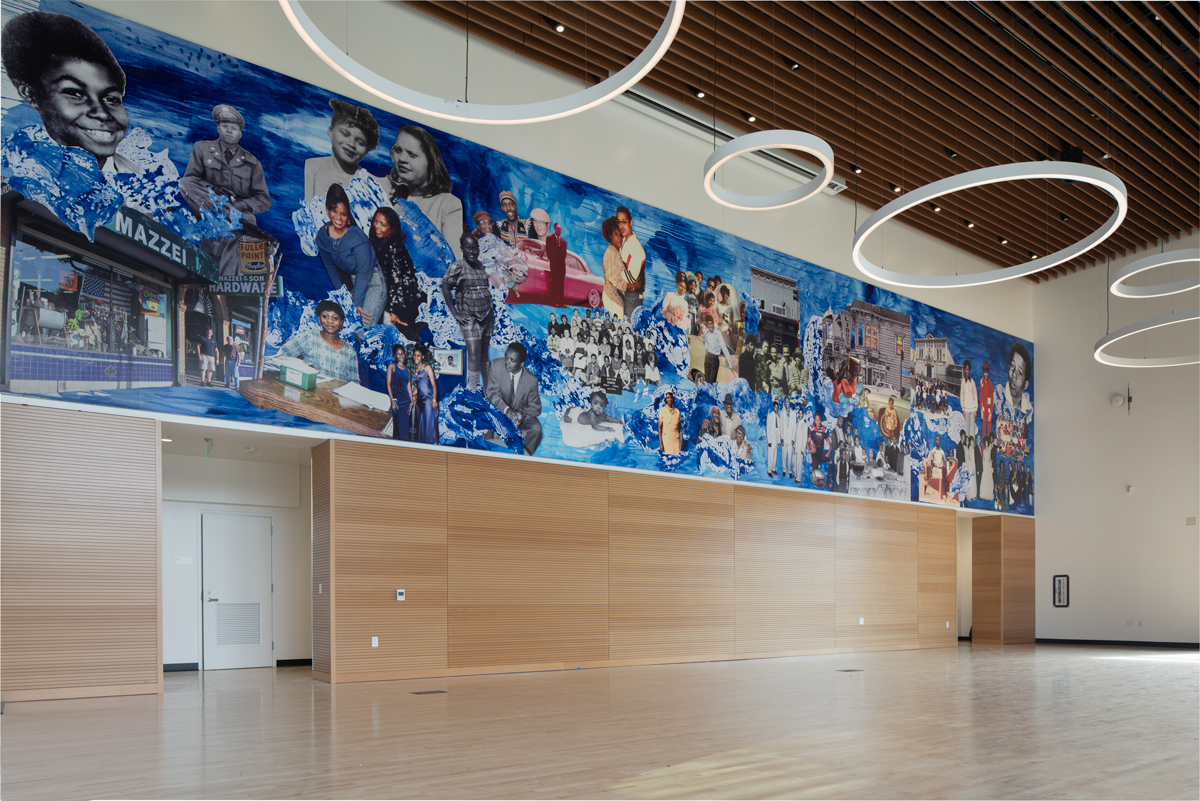
Inside the standalone Alex Pitcher Pavilion is Kenyatta A.C. Hinkle’s Navigating The Historical Present: Bayview-Hunters Point, a hall-wide mural that collages washes of indigo paint with photographs from the neighborhood’s past and present. The images are a mixture of formal portraits and candid snapshots: a smiling sixth-grade class from 1954; a football player posing in his Junior 49ers uniform; a view of Sam Jordan’s Bar on Third. Scrapbook-like, the mural will preside over community events that can open up onto an outdoor amphitheater, where even more celebratory, smiling pictures will be taken.
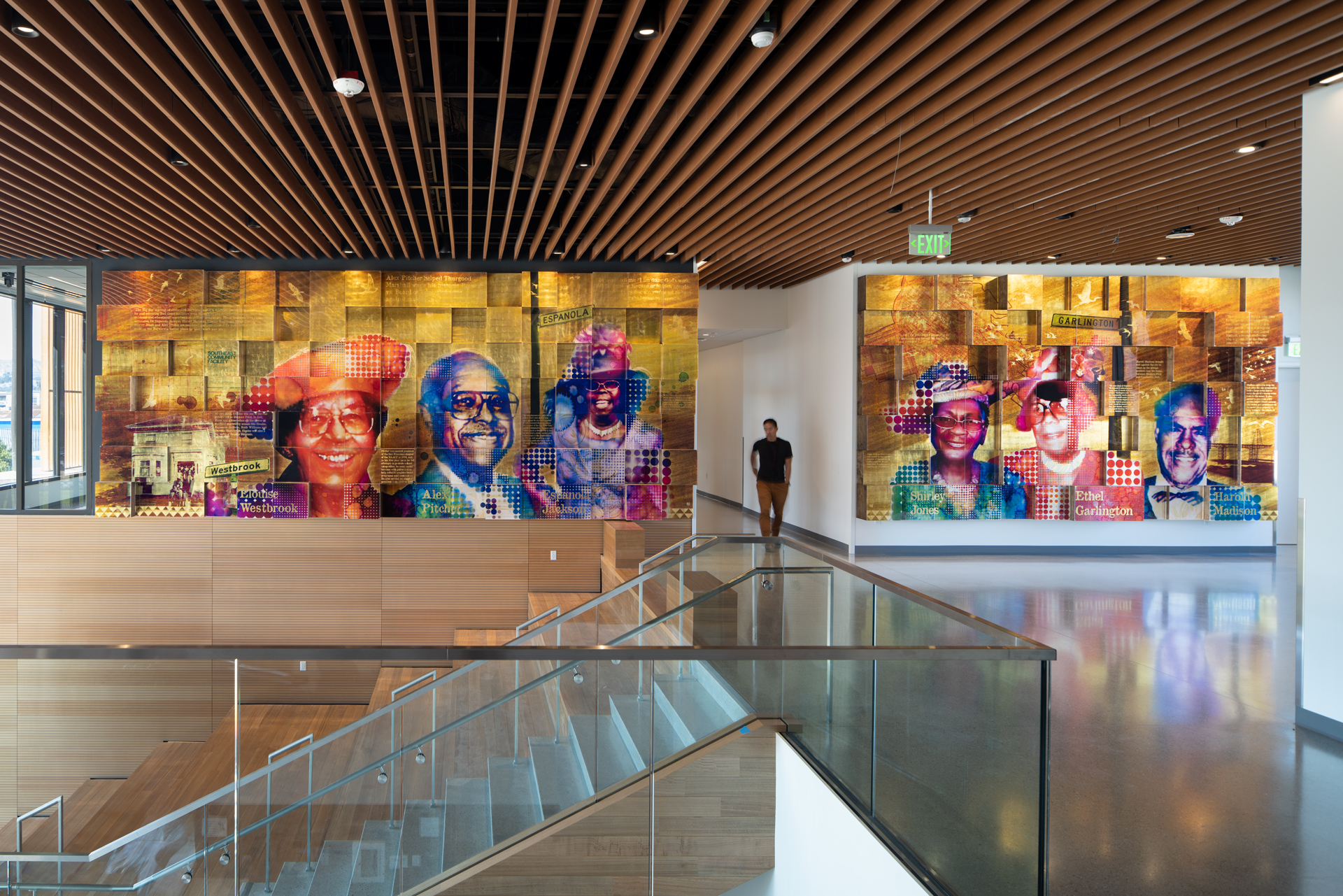
The third (and most glittery) of the public art pieces comes from Phillip Hua, whose wall-mounted 3D mural Building a Better Bayview pays homage to “The Big Six” (Alex Pitcher, Harold Madison, Ethel Garlington, Dr. Espanola Jackson, Shirley Jones and Elouise Westbrook), the community activists who originally founded the Southeast Community Center. While streets in Bayview are named after Westbrook, Jackson and Garlington, Hua puts images to these names, rendering their faces in rainbow hues. (The artist worked closely with the founders’ families to select these representative images.) Covered in gold leaf, the mural glows across blocks of varying depth, creating a sense of “in progress,” a reference to the ongoing community activism taking place both inside and outside the center’s walls.