Sponsor MessageBecome a KQED sponsor
upper waypoint

At Burning Man, the Weather Can Feel Biblical. Will Climate Change Make It Even Worse?

Save ArticleSave Article
Failed to save article

Please try again

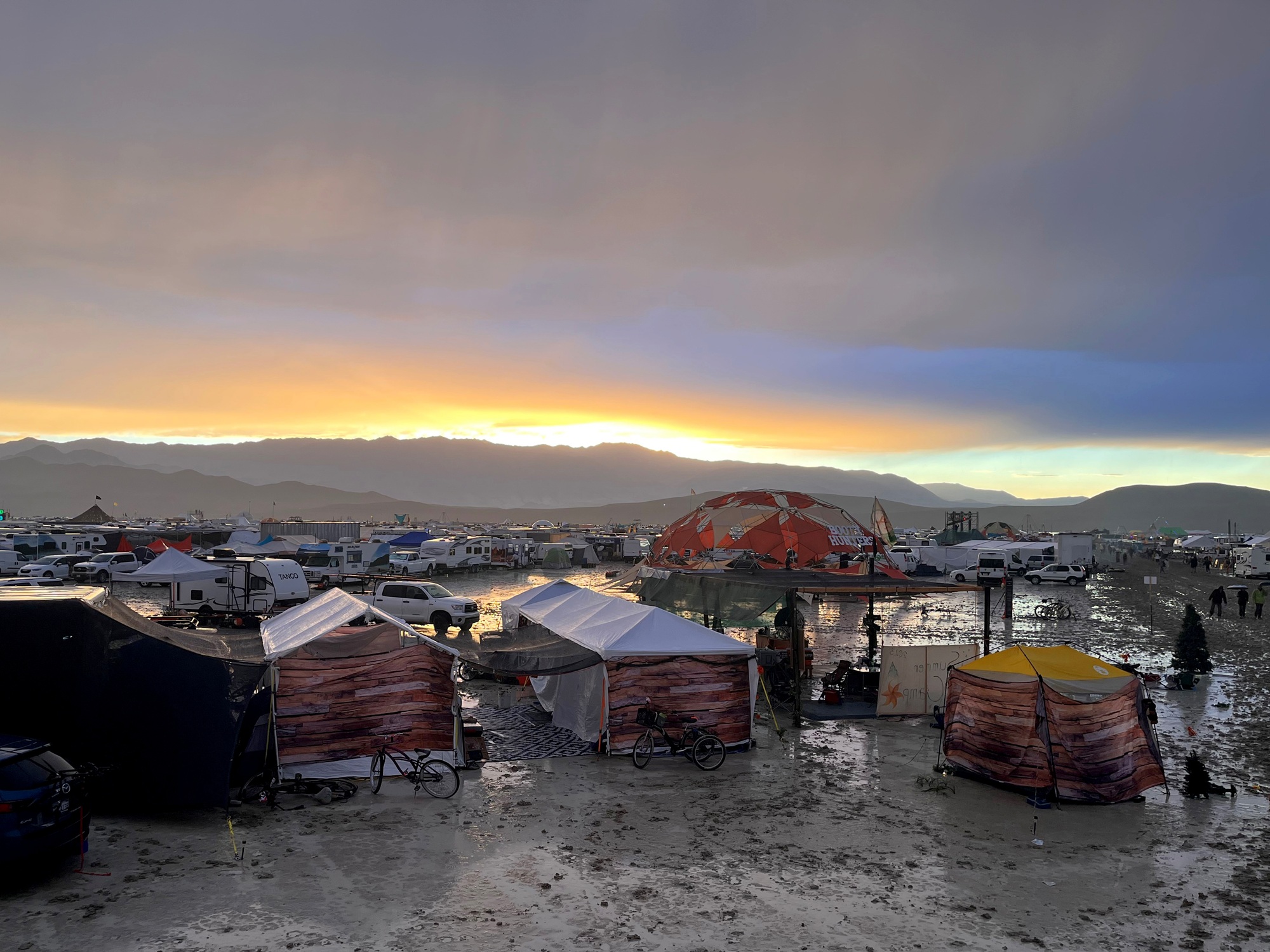
Tents between puddles and mud on the grounds of the Burning Man festival on Sept. 4, 2023. Extreme events like this year’s rain, heat and hours-long sandstorm could get more common on the playa as the world gets warmer.  (Photo by Kathy Baird/The Washington Post via Getty Images)

Mariska Keasberry and her crew of builders got to Burning Man in Nevada early this year. As they finished setting up camp — in anticipation of more than 100 people joining their setup in the coming days — they felt proud of their efforts.

But then, from a distance, they saw a wall of white approaching them — fast.

For the next two hours, as the sandstorm enveloped them, they tried to save what they had just built. But the raging dust “ended up taking out about 70% of our infrastructure,” Keasberry said.

Over the course of the week, they would rebuild their camp again and again.

Sponsored

“In some ways, this felt a little bit like ‘Building Man,’” said Keasberry, an Oakland resident who has been going to the festival since 2016 and now co-leads a camp called The Heart Collective.

This year, the sandstorm was followed by several days of rain and near-triple-digit heat. And multiple years of this kind of extreme weather on the playa — including the torrential rain that created a “mudpocalypse” in 2023 — have caused some attendees to question whether to return to Black Rock Desert. They’re also wondering if human-caused climate change is threatening the viability of future burns.

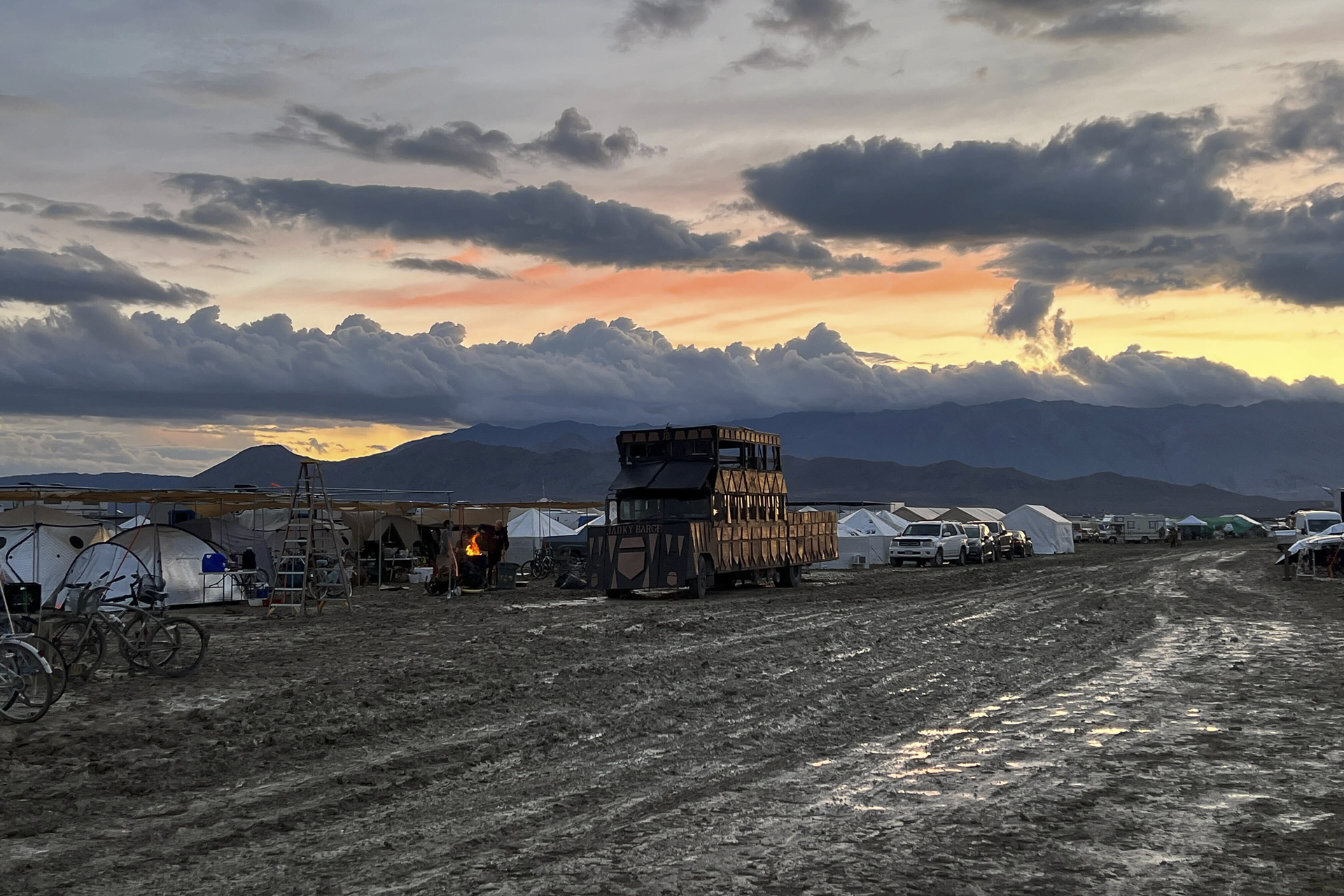
Tents between puddles and mud on the grounds of the Burning Man festival on Sept. 4, 2023. (David Crane/picture alliance via Getty Images)

From the outside in — or even the inside out — the weather at this year’s burn sure looked biblical. Burning Man officials state clearly on their website to “be prepared for volatile extremes,” including excessive heat, freezing temperatures, swift thunderstorms, up to 70 mph winds and intense dust storms. The Burning Man Project, the nonprofit that organizes the festival each year, did not respond to KQED’s request for comment.

Online, the organization wrote: “In Nevada, there is a saying: if you don’t like the weather, stick around for five minutes and it will change.”

“Only one thing is completely predictable about the weather in the Black Rock Desert: Unpredictability,” they added.

So, how standard is this kind of extreme weather for Burning Man and how much do scientists think climate change could impact (or even cancel) this festival in the coming years?

Jump straight to:

How typical was this year’s wild weather for Burning Man?

Daniel McEvoy, a climatologist at the Desert Research Institute in Reno, said the wind, rain, dust and heat Burners experienced this year were not out of the ordinary for late summer.

“It wasn’t all that unusual,” McEvoy said. “It was just sort of the timing of everything that seemed to happen to coincide right with the first few days of Burning Man.”

The Black Rock Desert is a barren lake bed — and during late August, this place often witnesses a wide range of weather, McEvoy said.

Typically, this part of the Black Rock Desert is extremely hot in August, but McEvoy said excessive heat wasn’t an issue this year. Instead, multiple days of rain pelted attendees, along with strong winds and a dust storm. But those events were by no means the strongest that Burners have lived through in recent years. In 2023, as much as an inch of rain fell within a 24-hour period, swamping the camps and trapping tens of thousands of attendees in an impassable playa — a situation that drew international attention due to videos posted by high-profile attendees like Diplo.

McEvoy views that muddy year as “much more of an anomaly” than the 2025 burn. However, he said the effects of anthropogenic climate change are likely slowly altering weather patterns on the playa. A warming climate can mean a “juicier” atmosphere — so when storms occur, especially thunderstorms, they can be more intense and cause major flooding.

In general, for the Great Basin area, which houses Burning Man, summertime rainfall is expected to increase by around 10 to 15% by the mid to late century, McEvoy said. He also noted that future Burns could be significantly hotter.

However, understanding how weather patterns are changing on the playa is challenging because of the lack of long-term weather stations there. The closest are in places like Reno, about 100 miles to the south, and Winnemucca, about 70 miles to the east.

What about the dust storms Burning Man is famous for?

McEvoy said it’s hard to quantify whether human-caused climate change is intensifying the winds that cause the festival’s legendary dust storms. But he notes that winds increase during the formation of a thunderstorm, picking up dust, which loosely suggests that if there are more or stronger thunderstorms, the sandstorms that precede them could also worsen.

There are other factors that can determine the intensity of a sandstorm, too. For instance, long-term droughts, exacerbated by a warming planet, supply more dust for winds to carry.

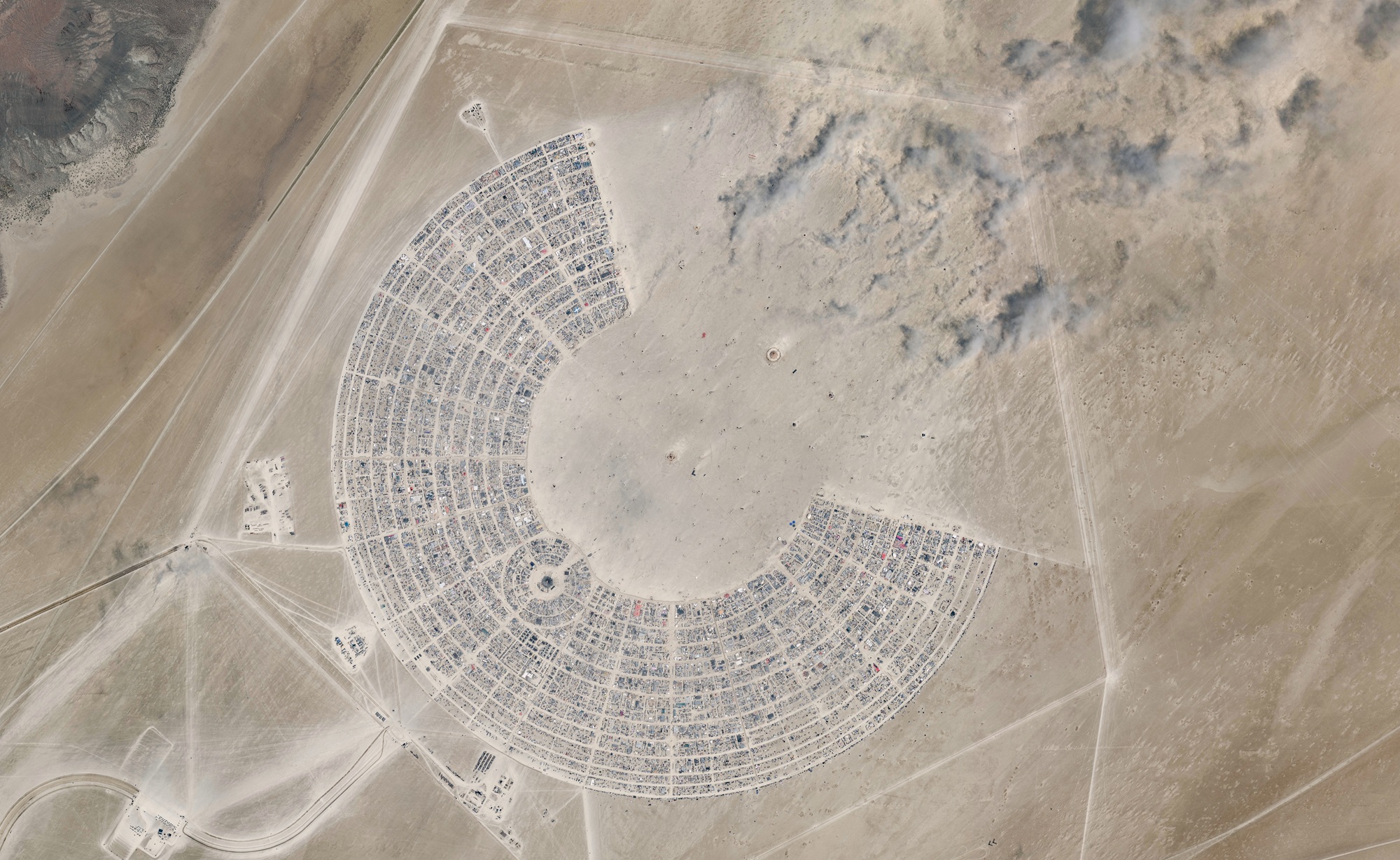
Maxar satellite imagery of the 2023 Burning Man Festival held in the Black Rock Desert, about 100 miles north of Reno, Nevada. (Satellite image (c) 2024 Maxar Technologies via Getty Images)

“There are places on the planet that are so good for providing dust to the atmosphere, and the Black Rock Desert is one of those,” said Mike Kaplan, professor emeritus at the Desert Research Institute.

But it’s not just the Great Basin where sandstorms are downright nasty. Kaplan said Northern Mexico is going through a severe drought and is having “one of the busiest dust storm years in history.”

For Kaplan, what Burners lived through this year mirrors more natural climate variability than a “man-made signal,” he said.

“If Burning Man didn’t exist, nobody would know what even happened,” Kaplan said. “It would have just been another dust storm in the Black Rock Desert.”

So, climate change is not canceling Burning Man anytime soon?

Climate scientists, like McEvoy, suggest that if Burning Man organizers push the event back by a few weeks or even a month “to the end of September, the chances for a lot of these extremes would go way down.”

“It’s just a cooler time of the year,” McEvoy said.

But by contrast, Kaplan isn’t so sure that moving the event would decrease the probability of poor weather, because the desert is already the land of extremes and is influenced by “very complicated” global systems. As a result, it can be “hard to sort out the relationship between these very massive circulation systems and one fairly localized weather event.”

For many Burners, including Keasberry, the festival taking place around a holiday weekend is a key practicality for being able to make the trip. Stephen Wade, who is from San Francisco and participated in the Beardhaus camp this year — which provides beard care and hosts drag shows on the playa — also wondered if other issues, like bugs or wet weather, might become a problem later in the season.

But will climate change eventually phase out Burning Man’s viability in the coming years?

“I don’t see any reason to believe that climate change would eliminate Burning Man,” McEvoy said, “at least not in the next few decades. I do think it will increase the likelihood of these extreme events becoming more common.”

Isn’t the inclement weather kind of the point?

For many Burners, including Keasberry, the high highs and low lows are part of what makes Burning Man so transformative.

While “all forms of going to Burning Man are valid,” she said, “if you’re not getting humbled, are you doing Burning Man right? I don’t think we go to Burning Man for it to be easy.”

Commenters on a recent Reddit thread echoed Keasberry: “Burning Man is at its BEST when the weather is at its WORST,” the main author wrote.

@steelandfeelsBurning Man is a protest of convenience culture. Break everything and then figure it out. Or find someone who can teach you how. After 9 years, I’ve become a generalist in electronics, welding, CAD, LEDs, automotive, batteries, solar, plumbing and team building. Necessity is the mother of figuring it the f*ck out, and convenience and self doubt prevents us from taking the first steps.♬ original sound – David Date

Rachel Nuwer, a Brooklyn resident and first-time co-lead of the camp Burning Sensation, agreed that this year’s burn felt especially cathartic after enduring the wind and rain.

“I don’t want the lows to go too low, but I think having that juxtaposition of hardship and joy really helps to heighten the significance of the experience,” Nuwer said.

But ultimately, she said, there is a point at which it’s no longer worth it.

“I had moments on the playa [this year] where I said, ‘this is a one and done for me,’” she said. “I remember thinking, when I was lying there crouched in this collapsed shift pod, ‘someone is gonna lose their life during this storm.’”

The weather hasn’t stopped Nuwer from going yet, but she said that could change. Black Rock City is a massive conglomeration of camps, each offering something different — from techno dance parties to smoothie stations to enormous art displays — and a huge part of the appeal for many Burners is exploring the site beyond their own camps and getting lost amid it all.

Nuwer said if the bad weather was too constant to leave her camp, “it would no longer be worth it.”

Even so, some Burners are reassessing their future Burns. Wade said most camps already put tons of effort into creating a safe environment for participants. Now, it’s about informing campers about emergency procedures and adapting on the fly — like when his camp transformed their Budget rental truck into a mini club during the rain.

“You can either wallow in the fact that we have set up and take down our camp three times in three days, or we can learn how to adapt our structures to make them easier to take down,” he said. “And then also learn how to socialize and party in that space.”

Following this year’s weather debacle, Keasberry said, after many years of camping, she might finally make an upgrade.

“I finally feel like I’m one of those Burners who’s like, ‘it might be really nice to have an RV,’” she said.

This article has been updated to correct the term “shift pod,” which is a type of shelter.
Sponsored

lower waypoint
next waypoint