The California Legislative Analyst’s Office released a report Monday on how well the state’s energy policies are working in terms of reducing greenhouse gas emissions.
Energy
California Energy Policy Has Reduced Carbon Emissions. By Exactly How Much, Nobody Knows
The Legislative Analyst's Office found that the state requirement for utilities to continually increase their renewables portfolio is a significant driver of greenhouse gas reductions. But the lack of peer-reviewed research on the specific effects of the policy is a problem, the LAO says.

PG&E's Vaca-Dixon PV array generates 2 megawatts of power. (Craig Miller/KQED)
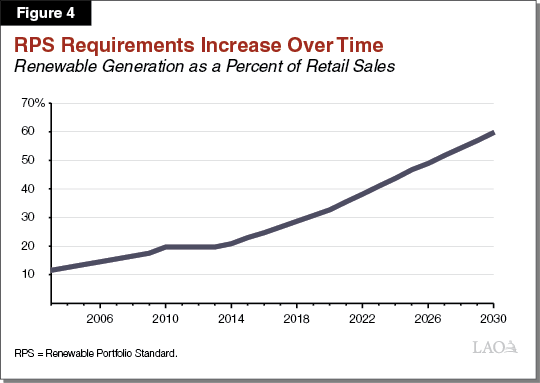
The analysis found that the state requirement that utilities continually increase the amount of renewable energy they provide has been a “significant” driver in curbing emissions.
The LAO, however, was not able to determine exact figures for how much the cut in emissions is attributable to state law versus other factors, and the agency cited as problematic a lack of specific research that evaluates California climate policy.
The LAO couldn’t find a robust, peer-reviewed study on the effect of the state’s clean energy requirement for utilities, called the renewables portfolio standard. Instead, the agency’s analysts developed their own estimate based on “back-of-the-envelope” calculations, said Ross Brown, a policy analyst for the LAO.
“In many cases, there’s not a lot of great information evaluating either the suite of policies or a specific policy,” Brown said. “We think that this is an important thing from a public policy perspective, as well as thinking about California as a leader for other jurisdictions.”
Due to the dearth of specific research, the LAO study had to rely heavily on a review of existing academic literature, as well as on data from state agencies and interviews with researchers.
Energy Sector Drives Emissions Reductions
The LAO, a nonpartisan advisory agency for the state Legislature, was still able to estimate that in 2018 the requirement that utilities increase their portfolio of renewable energy reduced emissions by “the low tens of millions of tons,” at a cost of an additional $60 to $70 per ton over nonrenewable energy.
The cost of renewable resources continues to plummet. That lower cost as well as federal policies also played a role in reducing the state’s annual emissions, according to the LAO.
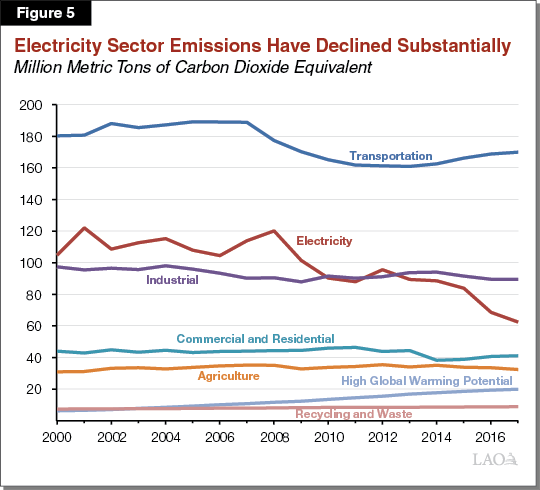
“The electricity sector and specifically the kind of megaresources that we used to provide electricity has been a key driver of the state’s emission reductions over the last number of years,” said Brown.
Since 2006, the state’s annual emissions from the energy sector have dropped by about 40 million metric tons, a reduction of 40%. These big cuts were the primary reason California reached its overall 2020 emissions target four years ahead of schedule.
Meanwhile, California’s power use has remained relatively constant, even as in recent years the state’s economy has grown.