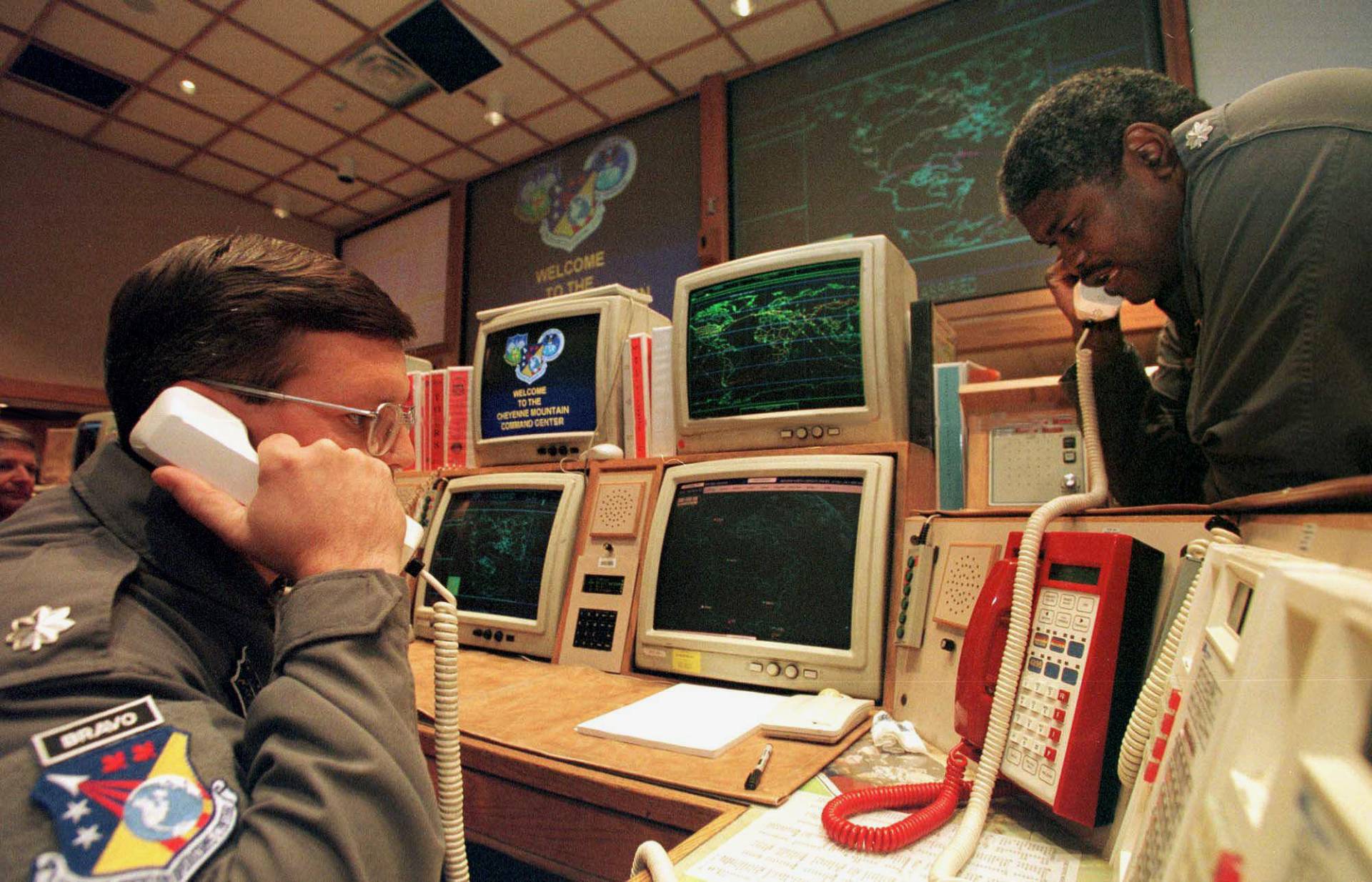
Twenty years ago on New Year’s Eve, I and other employees of the No. 1 Internet company in the world partied like it was 1999. That meant gathering at our Silicon Valley headquarters to stand watch, in case, at the stroke of midnight, civilization as we knew it came to a crashing halt.
Technology
20 Years Ago, Waiting for the Collapse of Civilization
While this may sound like the beginning of some sort of alternate history series from Netflix, it’s actually a literal description of my end-of-the-millennium plans.
The company was Yahoo!, which at the time was the darling of the nascent internet sector — if you said the word “Google” back then, most people thought you were trying to imitate a baby. It was also a time when the economy boomed, the stock market sizzled, and September 11 was just another date on the calendar.
Yet, as the countdown to the new millennium grew shorter, the specter of a global glitch in the technological revolution that had spawned so much prosperity loomed on the other side of midnight.
Surely you’ve heard of the Y2K Bug.
The problem stemmed from the lack of foresight coded into computer systems created in the 1950s and ‘60s. Programmers back then made an allowance for the passage of time by noting only the last two digits of any year, as opposed to the full four. Thus, 1971 was represented by a byte-saving 71, 1995 by a 95, and so on.
But that digital shorthand would only work so long as the human race remained bound to the 20th Century. When clocks around the world ticked from 11:59 p.m., Dec. 31, 1999 to 12:00 a.m., Jan 1, 2000, those foundational computer systems, now woven into critical applications used by banks, air traffic controllers, nuclear power plants, the Social Security Administration and countless other entities you really wanted to function, would do what they were programmed to: read the two zeros, assume the 19, and recognize the date as 1900.
Yeah, so?
This August, 1998 piece from Wired explains what some apocalyptic-minded computer programmers thought would happen after the most anticipated tick-of-the-clock in history:
On January 1 (or shortly thereafter), the electricity grid will go dead. Groceries in America’s refrigerators will go bad. Food distribution systems will crash and store shelves will go bare within days. … As losses mount and companies go under, the stock market will plummet. Banks will calculate interest for negative 100 years. The government will stop issuing entitlement checks to gray-haired senior citizens when their age suddenly clicks back to -35. Panic will set in. …
The article included some ominous nonspeculative stats: A poll found 44 percent of U.S. companies had already experienced Y2K failures. A hundred and eighty billion lines of computer code had yet to be vetted. A House committee warned that 37% of federal agencies would not be ready upon the zero hour.
The story also had the head of President Clinton’s Year 2000 Conversation Council poo-pooing the doomsayers, and an academic attributing the panic to “secular millennialism.” (Me, I thought the fear was numerical: Nobody wanted to see those three fulsome nines overridden by a trey of zeroes.)
On the other hand, Wired pointed out, “the people who are taking Y2K most seriously are not lay people or neophytes – they are specialized technicians who approach the situation with a sophisticated understanding of society’s hidden machinery.”
What to make of it? A web developer at work gave me his take: How you feel about the Y2K bug depends upon your faith in humanity. If you think decisionmakers and leaders are responsible and competent, your only necessary New Year’s Eve plans involved champagne. But if you assume those in charge are complacent or inept, skip the champagne and head straight for the bottled water.
By late December 1999, the consensus seemed to be one of cautious whatever, even though some problems were already on the books. In Brazil, for instance, thousands of customers received a letter stating they would be charged fees as of Jan. 4, 1900. And many people were taking no chances: Airlines canceled thousands of flights over the new year due to low demand.
But a New York Times editorial on Dec. 30, citing the $100 billion American companies and governments had spent to correct the problem, predicted disruptions of the noncatastrophic variety, but with several caveats, including lack of preparation in countries such as Russia and China, and “potential stoppages and delays” in the “vital functions” of “local schools, hospitals, nursing homes, transit systems and small or medium-sized businesses.” The editorial concluded that we would end the millennium listening “expectantly to the news, hoping for the best.”
Which is where I came in. As the editor of a Yahoo! News service called Full Coverage, I had been preparing for Y2K all year. This was the era when newspapers and magazines all over the world had rushed to put their stories online, and (in an orgy of shortsightedness) made them available for free. That allowed aggregators like Yahoo to subsume thousands of articles and organize them by topic-based web pages. As the clock counted down, while the general public may have been somewhat blasé about the possibility of two little absent digits finally doing us in, online readers — at the time, a vastly smaller and more technologically oriented percentage of the overall population than it is today — appeared less sanguine, as evidenced by the growing tsunami of pageviews our Y2K section registered from all over the world.
So, in anticipation of what I thought would be the biggest online news event to date, I had organized our coverage by geographical categories and subcategories, in order to accommodate the massive global flow of stories that would surely come pouring in as problems emerged. I mean, if an Albanian government agency went down, my Albania section was ready. If the Sydney Morning Herald reported problems at a bank, into the Australia bucket it would go. From an online news angle, at least, I was prepared.
In order to catch the very earliest midnight on the planet, in the South Pacific, I started work in Sunnyvale the night of Dec. 30. I figured no matter how small the initial surge of problems, it would still be of big interest to Yahoo! News users. And if the problems turned out to be worse than anticipated, it was going to require 24-7 coverage. I reported in for this marathon web surfing session carrying an overnight bag containing a change of clothes, a toothbrush and snacks.
The year 2000 first hit the tiny island nation of Kiribati, right on schedule. Just a titch overeager, I scoured the wires for signs of trouble. Next came Tonga, Fiji, parts of New Zealand. What did the New Zealand Herald have to say? Not much. Papua New Guinea? Nothing. Australia, Japan, South Korea? All clear. China, India, Iran? No snags. Yet, it was still the middle of the night. What would happen when the new day dawned? Anything yet, New Zealand? How about you, oh longitudinally endowed Russia? The country had nine time zones — at least one of them had to be generating some news.
But the midnights came, the midnights went, and nobody seemed to wake up in the year 1900. The Y2K bug did not bite in Asia; it did not bite in Europe; it did not bite in the U.S. As the sun came up on a succession of slow news days around the globe, I realized I was not going to need that change of underwear after all. So I went home.
Was I disappointed? To state the obvious, dirty little not-so-secret that most people in my profession grapple with, we like it when there’s actual news. Sure, as a human being, I was thrilled — 24 hours later. But on New Year’s day, as my reservoir of adrenaline emptied, I have to admit, I felt let down.
For a long time I thought the coda to the Y2K story really consisted of the series of unforeseen disasters visited upon the country in the years following, exhibiting once again the human capacity for focusing on the wrong problem. After Y2K happily fizzled, the already bloated stock market ratcheted higher in what one analyst called “panic buying.” But in March, the bubble popped, disappearing trillions of dollars from investment portfolios. In the November election, the Bush-Gore tie devolved into a constitutional crisis. Not a year later, September 11. Followed by a war in Afghanistan and one in Iraq, a recession, a global financial crisis, a much worse recession, and the accelerating pace of climate change.
Now, however, I don’t really think that’s the meaning of Y2K at all. Here’s a Time magazine piece paying homage to all the people who worked behind the scenes to fix the Y2K bug so that Jan 1, 2000, could be a slow news day. In revisiting this episode, there’s a danger of learning the wrong lesson: that nothing needed to be done in the first place. (Some problems actually did manifest.) Instead, you can potentially view the Y2K nonevent as one of the great problem-solving achievements of the last century.
It could, maybe, have gone another way. What if, for example, the Clinton administration had dismissed Y2K as a “Chinese hoax”?