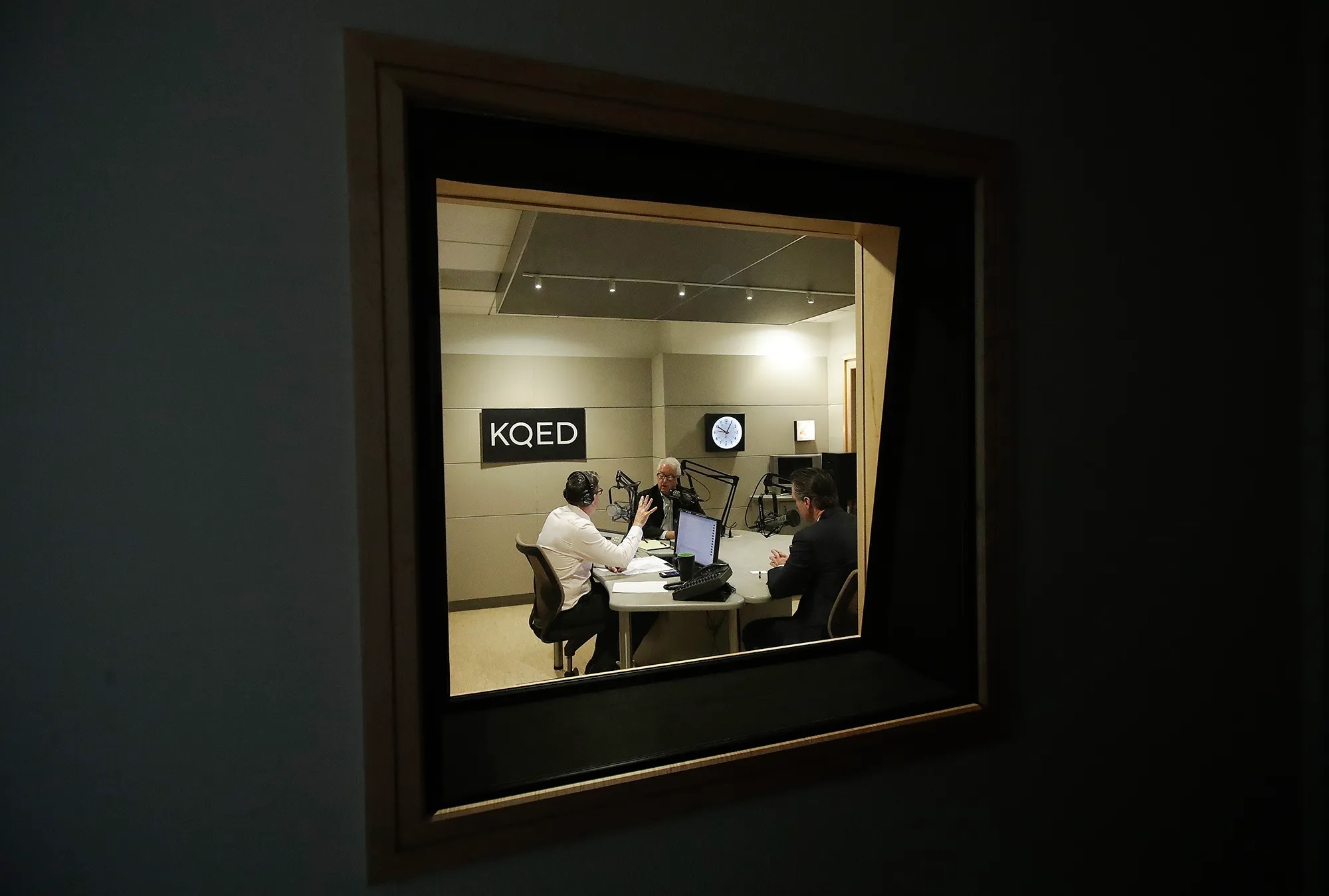
California’s NPR and PBS Stations Will Cut Staff and Programs After Funding Slashed
‘No One in Public Media Is Safe’: KQED Layoffs Underscore Peril of Federal Defunding
KQED to Slash Workforce by 15%, Cutting Dozens of Jobs in Latest Round of Layoffs
Will Congress Cut Funds to NPR/PBS and Foreign Aid This Week?
House Votes to Claw Back $1.1 Billion From Public Media
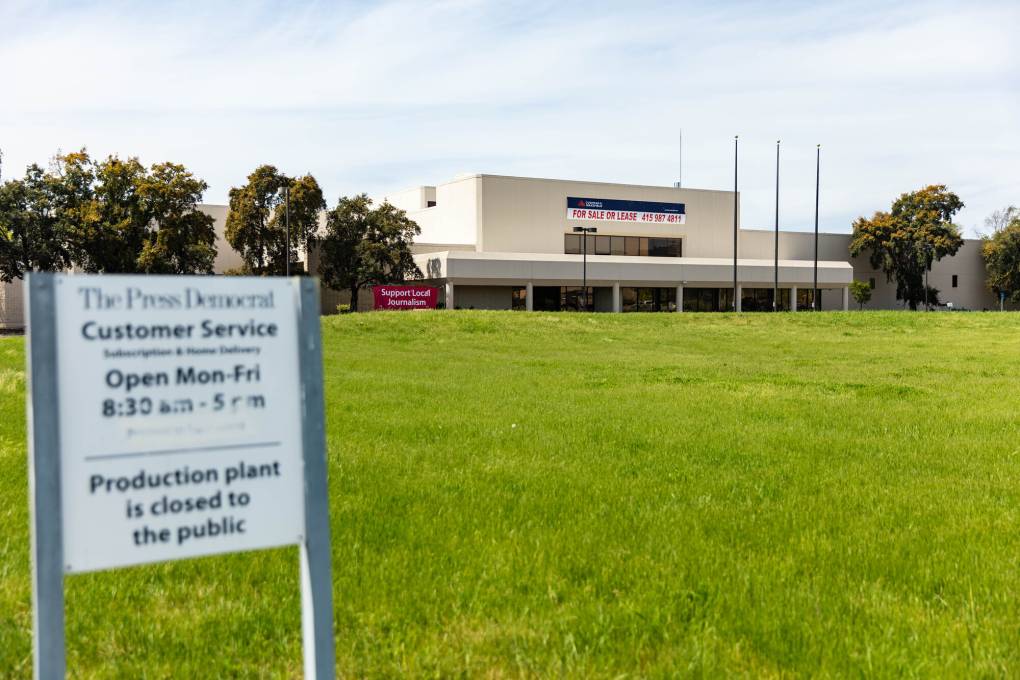
Santa Rosa’s Press Democrat Was Just Sold. Locals Are Concerned For the Paper’s Future
As Trump Targets NPR and PBS Funding, Small Local Stations Brace for Fallout
Press Democrat Union Waives Contract, Leaving Newspaper’s Sale Imminent
Here’s Why KQED Is Latest Public Media Outlet to Face Layoffs
Sponsored
Player sponsored by
window.__IS_SSR__=true
window.__INITIAL_STATE__={
"attachmentsReducer": {
"audio_0": {
"type": "attachments",
"id": "audio_0",
"imgSizes": {
"kqedFullSize": {
"file": "https://ww2.kqed.org/news/wp-content/themes/KQED-unified/img/audio_bgs/background0.jpg"
}
}
},
"audio_1": {
"type": "attachments",
"id": "audio_1",
"imgSizes": {
"kqedFullSize": {
"file": "https://ww2.kqed.org/news/wp-content/themes/KQED-unified/img/audio_bgs/background1.jpg"
}
}
},
"audio_2": {
"type": "attachments",
"id": "audio_2",
"imgSizes": {
"kqedFullSize": {
"file": "https://ww2.kqed.org/news/wp-content/themes/KQED-unified/img/audio_bgs/background2.jpg"
}
}
},
"audio_3": {
"type": "attachments",
"id": "audio_3",
"imgSizes": {
"kqedFullSize": {
"file": "https://ww2.kqed.org/news/wp-content/themes/KQED-unified/img/audio_bgs/background3.jpg"
}
}
},
"audio_4": {
"type": "attachments",
"id": "audio_4",
"imgSizes": {
"kqedFullSize": {
"file": "https://ww2.kqed.org/news/wp-content/themes/KQED-unified/img/audio_bgs/background4.jpg"
}
}
},
"placeholder": {
"type": "attachments",
"id": "placeholder",
"imgSizes": {
"thumbnail": {
"file": "https://cdn.kqed.org/wp-content/uploads/2024/12/KQED-Default-Image-816638274-2000x1333-1-160x107.jpg",
"width": 160,
"height": 107,
"mimeType": "image/jpeg"
},
"medium": {
"file": "https://cdn.kqed.org/wp-content/uploads/2024/12/KQED-Default-Image-816638274-2000x1333-1-800x533.jpg",
"width": 800,
"height": 533,
"mimeType": "image/jpeg"
},
"medium_large": {
"file": "https://cdn.kqed.org/wp-content/uploads/2024/12/KQED-Default-Image-816638274-2000x1333-1-768x512.jpg",
"width": 768,
"height": 512,
"mimeType": "image/jpeg"
},
"large": {
"file": "https://cdn.kqed.org/wp-content/uploads/2024/12/KQED-Default-Image-816638274-2000x1333-1-1020x680.jpg",
"width": 1020,
"height": 680,
"mimeType": "image/jpeg"
},
"1536x1536": {
"file": "https://cdn.kqed.org/wp-content/uploads/2024/12/KQED-Default-Image-816638274-2000x1333-1-1536x1024.jpg",
"width": 1536,
"height": 1024,
"mimeType": "image/jpeg"
},
"fd-lrg": {
"file": "https://cdn.kqed.org/wp-content/uploads/2024/12/KQED-Default-Image-816638274-2000x1333-1-1536x1024.jpg",
"width": 1536,
"height": 1024,
"mimeType": "image/jpeg"
},
"fd-med": {
"file": "https://cdn.kqed.org/wp-content/uploads/2024/12/KQED-Default-Image-816638274-2000x1333-1-1020x680.jpg",
"width": 1020,
"height": 680,
"mimeType": "image/jpeg"
},
"fd-sm": {
"file": "https://cdn.kqed.org/wp-content/uploads/2024/12/KQED-Default-Image-816638274-2000x1333-1-800x533.jpg",
"width": 800,
"height": 533,
"mimeType": "image/jpeg"
},
"post-thumbnail": {
"file": "https://cdn.kqed.org/wp-content/uploads/2024/12/KQED-Default-Image-816638274-2000x1333-1-672x372.jpg",
"width": 672,
"height": 372,
"mimeType": "image/jpeg"
},
"twentyfourteen-full-width": {
"file": "https://cdn.kqed.org/wp-content/uploads/2024/12/KQED-Default-Image-816638274-2000x1333-1-1038x576.jpg",
"width": 1038,
"height": 576,
"mimeType": "image/jpeg"
},
"xxsmall": {
"file": "https://cdn.kqed.org/wp-content/uploads/2024/12/KQED-Default-Image-816638274-2000x1333-1-160x107.jpg",
"width": 160,
"height": 107,
"mimeType": "image/jpeg"
},
"xsmall": {
"file": "https://cdn.kqed.org/wp-content/uploads/2024/12/KQED-Default-Image-816638274-2000x1333-1-672x372.jpg",
"width": 672,
"height": 372,
"mimeType": "image/jpeg"
},
"small": {
"file": "https://cdn.kqed.org/wp-content/uploads/2024/12/KQED-Default-Image-816638274-2000x1333-1-672x372.jpg",
"width": 672,
"height": 372,
"mimeType": "image/jpeg"
},
"xlarge": {
"file": "https://cdn.kqed.org/wp-content/uploads/2024/12/KQED-Default-Image-816638274-2000x1333-1-1020x680.jpg",
"width": 1020,
"height": 680,
"mimeType": "image/jpeg"
},
"full-width": {
"file": "https://cdn.kqed.org/wp-content/uploads/2024/12/KQED-Default-Image-816638274-2000x1333-1-1920x1280.jpg",
"width": 1920,
"height": 1280,
"mimeType": "image/jpeg"
},
"guest-author-32": {
"file": "https://cdn.kqed.org/wp-content/uploads/2025/01/KQED-Default-Image-816638274-1333x1333-1-160x160.jpg",
"width": 32,
"height": 32,
"mimeType": "image/jpeg"
},
"guest-author-50": {
"file": "https://cdn.kqed.org/wp-content/uploads/2025/01/KQED-Default-Image-816638274-1333x1333-1-160x160.jpg",
"width": 50,
"height": 50,
"mimeType": "image/jpeg"
},
"guest-author-64": {
"file": "https://cdn.kqed.org/wp-content/uploads/2025/01/KQED-Default-Image-816638274-1333x1333-1-160x160.jpg",
"width": 64,
"height": 64,
"mimeType": "image/jpeg"
},
"guest-author-96": {
"file": "https://cdn.kqed.org/wp-content/uploads/2025/01/KQED-Default-Image-816638274-1333x1333-1-160x160.jpg",
"width": 96,
"height": 96,
"mimeType": "image/jpeg"
},
"guest-author-128": {
"file": "https://cdn.kqed.org/wp-content/uploads/2025/01/KQED-Default-Image-816638274-1333x1333-1-160x160.jpg",
"width": 128,
"height": 128,
"mimeType": "image/jpeg"
},
"detail": {
"file": "https://cdn.kqed.org/wp-content/uploads/2025/01/KQED-Default-Image-816638274-1333x1333-1-160x160.jpg",
"width": 160,
"height": 160,
"mimeType": "image/jpeg"
},
"kqedFullSize": {
"file": "https://cdn.kqed.org/wp-content/uploads/2024/12/KQED-Default-Image-816638274-2000x1333-1.jpg",
"width": 2000,
"height": 1333
}
}
},
"news_12049847": {
"type": "attachments",
"id": "news_12049847",
"meta": {
"index": "attachments_1716263798",
"site": "news",
"id": "12049847",
"found": true
},
"title": "100818-KQED-Radio-AP-CM-01",
"publishDate": 1753479972,
"status": "inherit",
"parent": 12049836,
"modified": 1753485773,
"caption": "Radio host Scott Shafer (left) moderates a California gubernatorial debate between Republican candidate John Cox (center) and Democratic candidate Gavin Newsom at KQED Public Radio Studio in San Francisco, on Oct. 8, 2018. The NPR station is among many in California hit by Republican congressional cuts to the Corporation for Public Broadcasting. ",
"credit": "Jeff Chiu/AP Photo Pool",
"altTag": null,
"description": null,
"imgSizes": {
"thumbnail": {
"file": "https://cdn.kqed.org/wp-content/uploads/sites/10/2025/07/100818-KQED-Radio-AP-CM-01-160x108.jpg",
"width": 160,
"height": 108,
"mimeType": "image/jpeg"
},
"1536x1536": {
"file": "https://cdn.kqed.org/wp-content/uploads/sites/10/2025/07/100818-KQED-Radio-AP-CM-01-1536x1036.jpg",
"width": 1536,
"height": 1036,
"mimeType": "image/jpeg"
},
"post-thumbnail": {
"file": "https://cdn.kqed.org/wp-content/uploads/sites/10/2025/07/100818-KQED-Radio-AP-CM-01-672x372.jpg",
"width": 672,
"height": 372,
"mimeType": "image/jpeg"
},
"twentyfourteen-full-width": {
"file": "https://cdn.kqed.org/wp-content/uploads/sites/10/2025/07/100818-KQED-Radio-AP-CM-01-1038x576.jpg",
"width": 1038,
"height": 576,
"mimeType": "image/jpeg"
},
"kqedFullSize": {
"file": "https://cdn.kqed.org/wp-content/uploads/sites/10/2025/07/100818-KQED-Radio-AP-CM-01.jpg",
"width": 2000,
"height": 1349
}
},
"fetchFailed": false,
"isLoading": false
},
"news_11987511": {
"type": "attachments",
"id": "news_11987511",
"meta": {
"index": "attachments_1716263798",
"site": "news",
"id": "11987511",
"found": true
},
"title": "240522-KQEDheadquarters-10-BL_qut",
"publishDate": 1716487818,
"status": "inherit",
"parent": 11987509,
"modified": 1716487863,
"caption": "A KQED sign in the lobby of the organization's headquarters in San Francisco.",
"credit": "Beth LaBerge/KQED",
"altTag": null,
"description": null,
"imgSizes": {
"medium": {
"file": "https://cdn.kqed.org/wp-content/uploads/sites/10/2024/05/240522-KQEDheadquarters-10-BL_qut-800x533.jpg",
"width": 800,
"height": 533,
"mimeType": "image/jpeg"
},
"large": {
"file": "https://cdn.kqed.org/wp-content/uploads/sites/10/2024/05/240522-KQEDheadquarters-10-BL_qut-1020x680.jpg",
"width": 1020,
"height": 680,
"mimeType": "image/jpeg"
},
"thumbnail": {
"file": "https://cdn.kqed.org/wp-content/uploads/sites/10/2024/05/240522-KQEDheadquarters-10-BL_qut-160x107.jpg",
"width": 160,
"height": 107,
"mimeType": "image/jpeg"
},
"1536x1536": {
"file": "https://cdn.kqed.org/wp-content/uploads/sites/10/2024/05/240522-KQEDheadquarters-10-BL_qut-1536x1024.jpg",
"width": 1536,
"height": 1024,
"mimeType": "image/jpeg"
},
"post-thumbnail": {
"file": "https://cdn.kqed.org/wp-content/uploads/sites/10/2024/05/240522-KQEDheadquarters-10-BL_qut-672x372.jpg",
"width": 672,
"height": 372,
"mimeType": "image/jpeg"
},
"twentyfourteen-full-width": {
"file": "https://cdn.kqed.org/wp-content/uploads/sites/10/2024/05/240522-KQEDheadquarters-10-BL_qut-1038x576.jpg",
"width": 1038,
"height": 576,
"mimeType": "image/jpeg"
},
"kqedFullSize": {
"file": "https://cdn.kqed.org/wp-content/uploads/sites/10/2024/05/240522-KQEDheadquarters-10-BL_qut.jpg",
"width": 1920,
"height": 1280
}
},
"fetchFailed": false,
"isLoading": false
},
"news_12048133": {
"type": "attachments",
"id": "news_12048133",
"meta": {
"index": "attachments_1716263798",
"site": "news",
"id": "12048133",
"found": true
},
"title": "240522-KQEDheadquarters-12-BL_qed",
"publishDate": 1752605240,
"status": "inherit",
"parent": 12048122,
"modified": 1752605252,
"caption": "A KQED sign in the entrance way to the organization's headquarters in San Francisco on May 22, 2024.",
"credit": "Beth LaBerge/KQED",
"altTag": null,
"description": null,
"imgSizes": {
"thumbnail": {
"file": "https://cdn.kqed.org/wp-content/uploads/sites/10/2025/07/240522-KQEDheadquarters-12-BL_qed-160x107.jpg",
"width": 160,
"height": 107,
"mimeType": "image/jpeg"
},
"1536x1536": {
"file": "https://cdn.kqed.org/wp-content/uploads/sites/10/2025/07/240522-KQEDheadquarters-12-BL_qed-1536x1024.jpg",
"width": 1536,
"height": 1024,
"mimeType": "image/jpeg"
},
"post-thumbnail": {
"file": "https://cdn.kqed.org/wp-content/uploads/sites/10/2025/07/240522-KQEDheadquarters-12-BL_qed-672x372.jpg",
"width": 672,
"height": 372,
"mimeType": "image/jpeg"
},
"twentyfourteen-full-width": {
"file": "https://cdn.kqed.org/wp-content/uploads/sites/10/2025/07/240522-KQEDheadquarters-12-BL_qed-1038x576.jpg",
"width": 1038,
"height": 576,
"mimeType": "image/jpeg"
},
"kqedFullSize": {
"file": "https://cdn.kqed.org/wp-content/uploads/sites/10/2025/07/240522-KQEDheadquarters-12-BL_qed.jpg",
"width": 1999,
"height": 1333
}
},
"fetchFailed": false,
"isLoading": false
},
"news_12048109": {
"type": "attachments",
"id": "news_12048109",
"meta": {
"index": "attachments_1716263798",
"site": "news",
"id": "12048109",
"found": true
},
"title": "npr.brightspotcdn copy",
"publishDate": 1752601677,
"status": "inherit",
"parent": 12048108,
"modified": 1752601711,
"caption": "Sun shines on the U.S. Capitol dome on Capitol Hill in Washington, D.C., in 2022.",
"credit": "Patrick Semansky/AP",
"altTag": null,
"description": null,
"imgSizes": {
"thumbnail": {
"file": "https://cdn.kqed.org/wp-content/uploads/sites/10/2025/07/npr.brightspotcdn-copy-8-160x107.jpg",
"width": 160,
"height": 107,
"mimeType": "image/jpeg"
},
"1536x1536": {
"file": "https://cdn.kqed.org/wp-content/uploads/sites/10/2025/07/npr.brightspotcdn-copy-8-1536x1024.jpg",
"width": 1536,
"height": 1024,
"mimeType": "image/jpeg"
},
"post-thumbnail": {
"file": "https://cdn.kqed.org/wp-content/uploads/sites/10/2025/07/npr.brightspotcdn-copy-8-672x372.jpg",
"width": 672,
"height": 372,
"mimeType": "image/jpeg"
},
"twentyfourteen-full-width": {
"file": "https://cdn.kqed.org/wp-content/uploads/sites/10/2025/07/npr.brightspotcdn-copy-8-1038x576.jpg",
"width": 1038,
"height": 576,
"mimeType": "image/jpeg"
},
"kqedFullSize": {
"file": "https://cdn.kqed.org/wp-content/uploads/sites/10/2025/07/npr.brightspotcdn-copy-8.jpg",
"width": 1800,
"height": 1200
}
},
"fetchFailed": false,
"isLoading": false
},
"news_12044023": {
"type": "attachments",
"id": "news_12044023",
"meta": {
"index": "attachments_1716263798",
"site": "news",
"id": "12044023",
"found": true
},
"title": "npr.brightspotcdn copy",
"publishDate": 1749760599,
"status": "inherit",
"parent": 12044021,
"modified": 1749760626,
"caption": "Legislation in Congress would claw back 2 years of funding for the public media system, along with money for foreign aid programs.",
"credit": "Bonnie Cash/Getty Images",
"altTag": null,
"description": null,
"imgSizes": {
"thumbnail": {
"file": "https://cdn.kqed.org/wp-content/uploads/sites/10/2025/06/npr.brightspotcdn-copy-5-160x107.jpg",
"width": 160,
"height": 107,
"mimeType": "image/jpeg"
},
"1536x1536": {
"file": "https://cdn.kqed.org/wp-content/uploads/sites/10/2025/06/npr.brightspotcdn-copy-5-1536x1024.jpg",
"width": 1536,
"height": 1024,
"mimeType": "image/jpeg"
},
"post-thumbnail": {
"file": "https://cdn.kqed.org/wp-content/uploads/sites/10/2025/06/npr.brightspotcdn-copy-5-672x372.jpg",
"width": 672,
"height": 372,
"mimeType": "image/jpeg"
},
"twentyfourteen-full-width": {
"file": "https://cdn.kqed.org/wp-content/uploads/sites/10/2025/06/npr.brightspotcdn-copy-5-1038x576.jpg",
"width": 1038,
"height": 576,
"mimeType": "image/jpeg"
},
"kqedFullSize": {
"file": "https://cdn.kqed.org/wp-content/uploads/sites/10/2025/06/npr.brightspotcdn-copy-5.jpg",
"width": 1600,
"height": 1067
}
},
"fetchFailed": false,
"isLoading": false
},
"news_12038622": {
"type": "attachments",
"id": "news_12038622",
"meta": {
"index": "attachments_1716263798",
"site": "news",
"id": "12038622",
"found": true
},
"title": "20240411_PressDemocratFile_GC-4_qed",
"publishDate": 1746224391,
"status": "inherit",
"parent": 12038583,
"modified": 1746224407,
"caption": "The Press Democrat’s former printing facility in Rohnert Park on April 11, 2025.",
"credit": "Gina Castro/KQED",
"altTag": null,
"description": null,
"imgSizes": {
"medium": {
"file": "https://cdn.kqed.org/wp-content/uploads/sites/10/2025/05/20240411_PressDemocratFile_GC-4_qed-800x533.jpg",
"width": 800,
"height": 533,
"mimeType": "image/jpeg"
},
"large": {
"file": "https://cdn.kqed.org/wp-content/uploads/sites/10/2025/05/20240411_PressDemocratFile_GC-4_qed-1020x680.jpg",
"width": 1020,
"height": 680,
"mimeType": "image/jpeg"
},
"thumbnail": {
"file": "https://cdn.kqed.org/wp-content/uploads/sites/10/2025/05/20240411_PressDemocratFile_GC-4_qed-160x107.jpg",
"width": 160,
"height": 107,
"mimeType": "image/jpeg"
},
"1536x1536": {
"file": "https://cdn.kqed.org/wp-content/uploads/sites/10/2025/05/20240411_PressDemocratFile_GC-4_qed-1536x1024.jpg",
"width": 1536,
"height": 1024,
"mimeType": "image/jpeg"
},
"post-thumbnail": {
"file": "https://cdn.kqed.org/wp-content/uploads/sites/10/2025/05/20240411_PressDemocratFile_GC-4_qed-672x372.jpg",
"width": 672,
"height": 372,
"mimeType": "image/jpeg"
},
"twentyfourteen-full-width": {
"file": "https://cdn.kqed.org/wp-content/uploads/sites/10/2025/05/20240411_PressDemocratFile_GC-4_qed-1038x576.jpg",
"width": 1038,
"height": 576,
"mimeType": "image/jpeg"
},
"full-width": {
"file": "https://cdn.kqed.org/wp-content/uploads/sites/10/2025/05/20240411_PressDemocratFile_GC-4_qed-1920x1280.jpg",
"width": 1920,
"height": 1280,
"mimeType": "image/jpeg"
},
"kqedFullSize": {
"file": "https://cdn.kqed.org/wp-content/uploads/sites/10/2025/05/20240411_PressDemocratFile_GC-4_qed.jpg",
"width": 2000,
"height": 1333
}
},
"fetchFailed": false,
"isLoading": false
},
"news_12038580": {
"type": "attachments",
"id": "news_12038580",
"meta": {
"index": "attachments_1716263798",
"site": "news",
"id": "12038580",
"found": true
},
"title": "US-POLITICS-MEDIA-PROTEST",
"publishDate": 1746211740,
"status": "inherit",
"parent": 12038576,
"modified": 1746222740,
"caption": "People participate in a rally to call on Congress to protect funding for U.S. public broadcasters, Public Broadcasting Service (PBS) and National Public Radio (NPR), outside the NPR headquarters in Washington, D.C., on March 26, 2025. ",
"credit": "Saul Loeb/AFP via Getty Images",
"altTag": null,
"description": null,
"imgSizes": {
"medium": {
"file": "https://cdn.kqed.org/wp-content/uploads/sites/10/2025/05/GettyImages-2206434879-800x534.jpg",
"width": 800,
"height": 534,
"mimeType": "image/jpeg"
},
"large": {
"file": "https://cdn.kqed.org/wp-content/uploads/sites/10/2025/05/GettyImages-2206434879-1020x680.jpg",
"width": 1020,
"height": 680,
"mimeType": "image/jpeg"
},
"thumbnail": {
"file": "https://cdn.kqed.org/wp-content/uploads/sites/10/2025/05/GettyImages-2206434879-160x107.jpg",
"width": 160,
"height": 107,
"mimeType": "image/jpeg"
},
"post-thumbnail": {
"file": "https://cdn.kqed.org/wp-content/uploads/sites/10/2025/05/GettyImages-2206434879-672x372.jpg",
"width": 672,
"height": 372,
"mimeType": "image/jpeg"
},
"twentyfourteen-full-width": {
"file": "https://cdn.kqed.org/wp-content/uploads/sites/10/2025/05/GettyImages-2206434879-1024x576.jpg",
"width": 1024,
"height": 576,
"mimeType": "image/jpeg"
},
"kqedFullSize": {
"file": "https://cdn.kqed.org/wp-content/uploads/sites/10/2025/05/GettyImages-2206434879.jpg",
"width": 1024,
"height": 683
}
},
"fetchFailed": false,
"isLoading": false
},
"news_12035731": {
"type": "attachments",
"id": "news_12035731",
"meta": {
"index": "attachments_1716263798",
"site": "news",
"id": "12035731",
"found": true
},
"title": "20240411_PRESSDEMOCRATFILE_GC-3-KQED",
"publishDate": 1744406823,
"status": "inherit",
"parent": 0,
"modified": 1744406883,
"caption": "The Press Democrat’s former printing facility in Rohnert Park on April 11, 2025.",
"credit": "Gina Castro/KQED",
"altTag": null,
"description": null,
"imgSizes": {
"medium": {
"file": "https://cdn.kqed.org/wp-content/uploads/sites/10/2025/04/20240411_PRESSDEMOCRATFILE_GC-3-KQED-800x533.jpg",
"width": 800,
"height": 533,
"mimeType": "image/jpeg"
},
"large": {
"file": "https://cdn.kqed.org/wp-content/uploads/sites/10/2025/04/20240411_PRESSDEMOCRATFILE_GC-3-KQED-1020x680.jpg",
"width": 1020,
"height": 680,
"mimeType": "image/jpeg"
},
"thumbnail": {
"file": "https://cdn.kqed.org/wp-content/uploads/sites/10/2025/04/20240411_PRESSDEMOCRATFILE_GC-3-KQED-160x107.jpg",
"width": 160,
"height": 107,
"mimeType": "image/jpeg"
},
"1536x1536": {
"file": "https://cdn.kqed.org/wp-content/uploads/sites/10/2025/04/20240411_PRESSDEMOCRATFILE_GC-3-KQED-1536x1024.jpg",
"width": 1536,
"height": 1024,
"mimeType": "image/jpeg"
},
"post-thumbnail": {
"file": "https://cdn.kqed.org/wp-content/uploads/sites/10/2025/04/20240411_PRESSDEMOCRATFILE_GC-3-KQED-672x372.jpg",
"width": 672,
"height": 372,
"mimeType": "image/jpeg"
},
"twentyfourteen-full-width": {
"file": "https://cdn.kqed.org/wp-content/uploads/sites/10/2025/04/20240411_PRESSDEMOCRATFILE_GC-3-KQED-1038x576.jpg",
"width": 1038,
"height": 576,
"mimeType": "image/jpeg"
},
"full-width": {
"file": "https://cdn.kqed.org/wp-content/uploads/sites/10/2025/04/20240411_PRESSDEMOCRATFILE_GC-3-KQED-1920x1280.jpg",
"width": 1920,
"height": 1280,
"mimeType": "image/jpeg"
},
"kqedFullSize": {
"file": "https://cdn.kqed.org/wp-content/uploads/sites/10/2025/04/20240411_PRESSDEMOCRATFILE_GC-3-KQED.jpg",
"width": 2000,
"height": 1333
}
},
"fetchFailed": false,
"isLoading": false
},
"news_11987200": {
"type": "attachments",
"id": "news_11987200",
"meta": {
"index": "attachments_1716263798",
"site": "news",
"id": "11987200",
"found": true
},
"title": "KQED_Expansion_web_3_1000x600.jpg",
"publishDate": 1716328792,
"status": "inherit",
"parent": 11987176,
"modified": 1716328857,
"caption": "KQED's renovated headquarters in San Francisco.",
"credit": "Courtesy Jason O'Rear",
"altTag": null,
"description": null,
"imgSizes": {
"medium": {
"file": "https://cdn.kqed.org/wp-content/uploads/sites/10/2024/05/KQED_Expansion_web_3_1000x600.jpg-800x480.png",
"width": 800,
"height": 480,
"mimeType": "image/png"
},
"thumbnail": {
"file": "https://cdn.kqed.org/wp-content/uploads/sites/10/2024/05/KQED_Expansion_web_3_1000x600.jpg-160x96.png",
"width": 160,
"height": 96,
"mimeType": "image/png"
},
"post-thumbnail": {
"file": "https://cdn.kqed.org/wp-content/uploads/sites/10/2024/05/KQED_Expansion_web_3_1000x600.jpg-672x372.png",
"width": 672,
"height": 372,
"mimeType": "image/png"
},
"twentyfourteen-full-width": {
"file": "https://cdn.kqed.org/wp-content/uploads/sites/10/2024/05/KQED_Expansion_web_3_1000x600.jpg-1000x576.png",
"width": 1000,
"height": 576,
"mimeType": "image/png"
},
"kqedFullSize": {
"file": "https://cdn.kqed.org/wp-content/uploads/sites/10/2024/05/KQED_Expansion_web_3_1000x600.jpg.png",
"width": 1000,
"height": 600
}
},
"fetchFailed": false,
"isLoading": false
}
},
"audioPlayerReducer": {
"postId": "stream_live",
"isPaused": true,
"isPlaying": false,
"pfsActive": false,
"pledgeModalIsOpen": true,
"playerDrawerIsOpen": false
},
"authorsReducer": {
"byline_news_12049836": {
"type": "authors",
"id": "byline_news_12049836",
"meta": {
"override": true
},
"slug": "byline_news_12049836",
"name": "Maya C. Miller and Cayla Mihalovich, CalMatters",
"isLoading": false
},
"byline_news_12048108": {
"type": "authors",
"id": "byline_news_12048108",
"meta": {
"override": true
},
"slug": "byline_news_12048108",
"name": "Deirdre Walsh, NPR",
"isLoading": false
},
"byline_news_12044021": {
"type": "authors",
"id": "byline_news_12044021",
"meta": {
"override": true
},
"slug": "byline_news_12044021",
"name": "\u003ca href=\"https://www.npr.org/people/617095374/deirdre-walsh\">Deirdre Walsh\u003c/a> and \u003ca href=\"https://www.npr.org/people/4459112/david-folkenflik\">David Folkenflik\u003c/a>, NPR",
"isLoading": false
},
"vrancano": {
"type": "authors",
"id": "11276",
"meta": {
"index": "authors_1716337520",
"id": "11276",
"found": true
},
"name": "Vanessa Rancaño",
"firstName": "Vanessa",
"lastName": "Rancaño",
"slug": "vrancano",
"email": "vrancano@kqed.org",
"display_author_email": false,
"staff_mastheads": [
"news"
],
"title": "Reporter, Housing",
"bio": "Vanessa Rancaño reports on housing and homelessness for KQED. She’s also covered education for the station and reported from the Central Valley. Her work has aired across public radio, from flagship national news shows to longform narrative podcasts. Before taking up a mic, she worked as a freelance print journalist. She’s been recognized with a number of national and regional awards. Vanessa grew up in California's Central Valley. She's a former NPR Kroc Fellow, and a graduate of the UC Berkeley Graduate School of Journalism.",
"avatar": "https://secure.gravatar.com/avatar/f6c0fc5d391c78710bcfc723f0636ef6?s=600&d=blank&r=g",
"twitter": "vanessarancano",
"facebook": null,
"instagram": null,
"linkedin": null,
"sites": [
{
"site": "arts",
"roles": [
"editor"
]
},
{
"site": "news",
"roles": [
"editor"
]
}
],
"headData": {
"title": "Vanessa Rancaño | KQED",
"description": "Reporter, Housing",
"ogImgSrc": "https://secure.gravatar.com/avatar/f6c0fc5d391c78710bcfc723f0636ef6?s=600&d=blank&r=g",
"twImgSrc": "https://secure.gravatar.com/avatar/f6c0fc5d391c78710bcfc723f0636ef6?s=600&d=blank&r=g"
},
"isLoading": false,
"link": "/author/vrancano"
},
"ebaldassari": {
"type": "authors",
"id": "11652",
"meta": {
"index": "authors_1716337520",
"id": "11652",
"found": true
},
"name": "Erin Baldassari",
"firstName": "Erin",
"lastName": "Baldassari",
"slug": "ebaldassari",
"email": "ebaldassari@KQED.org",
"display_author_email": true,
"staff_mastheads": [
"news"
],
"title": "Staff Writer",
"bio": "Erin Baldassari covers housing for KQED. She's a former print journalist and most recently worked as the transportation reporter for the \u003cem>Mercury News\u003c/em> and \u003cem>East Bay Times. \u003c/em>There, she focused on how the Bay Area’s housing shortage has changed the way people move around the region. She also served on the \u003cem>East Bay Times\u003c/em>’ 2017 Pulitzer Prize-winning team for coverage of the Ghost Ship Fire in Oakland. Prior to that, Erin worked as a breaking news and general assignment reporter for a variety of outlets in the Bay Area and the greater Boston area. A Tufts University alumna, Erin grew up in the foothills of the Sierra Nevada mountains and in Sonoma County. She is a life-long KQED listener.",
"avatar": "https://secure.gravatar.com/avatar/660ce35d088ca54ad606d7e941abc652?s=600&d=mm&r=g",
"twitter": "e_baldi",
"facebook": null,
"instagram": null,
"linkedin": null,
"sites": [
{
"site": "news",
"roles": [
"edit_others_posts",
"editor"
]
},
{
"site": "science",
"roles": [
"editor"
]
},
{
"site": "liveblog",
"roles": [
"editor"
]
}
],
"headData": {
"title": "Erin Baldassari | KQED",
"description": "Staff Writer",
"ogImgSrc": "https://secure.gravatar.com/avatar/660ce35d088ca54ad606d7e941abc652?s=600&d=mm&r=g",
"twImgSrc": "https://secure.gravatar.com/avatar/660ce35d088ca54ad606d7e941abc652?s=600&d=mm&r=g"
},
"isLoading": false,
"link": "/author/ebaldassari"
},
"abandlamudi": {
"type": "authors",
"id": "11672",
"meta": {
"index": "authors_1716337520",
"id": "11672",
"found": true
},
"name": "Adhiti Bandlamudi",
"firstName": "Adhiti",
"lastName": "Bandlamudi",
"slug": "abandlamudi",
"email": "abandlamudi@kqed.org",
"display_author_email": false,
"staff_mastheads": [
"news"
],
"title": "KQED Housing Reporter",
"bio": "Adhiti Bandlamudi reports for KQED's Housing desk. She focuses on how housing gets built across the Bay Area. Before joining KQED in 2020, she reported for WUNC in Durham, North Carolina, WABE in Atlanta, Georgia and Capital Public Radio in Sacramento. In 2017, she was awarded a Kroc Fellowship at NPR where she reported on everything from sprinkles to the Golden State Killer's arrest. When she's not reporting, she's baking new recipes in her kitchen or watching movies with friends and family. She's originally from Georgia and has strong opinions about Great British Bake Off.",
"avatar": "https://secure.gravatar.com/avatar/868129c8b257bb99a3500e2c86a65400?s=600&d=mm&r=g",
"twitter": "oddity_adhiti",
"facebook": null,
"instagram": null,
"linkedin": null,
"sites": [
{
"site": "arts",
"roles": [
"author"
]
},
{
"site": "news",
"roles": [
"editor"
]
},
{
"site": "liveblog",
"roles": [
"author"
]
}
],
"headData": {
"title": "Adhiti Bandlamudi | KQED",
"description": "KQED Housing Reporter",
"ogImgSrc": "https://secure.gravatar.com/avatar/868129c8b257bb99a3500e2c86a65400?s=600&d=mm&r=g",
"twImgSrc": "https://secure.gravatar.com/avatar/868129c8b257bb99a3500e2c86a65400?s=600&d=mm&r=g"
},
"isLoading": false,
"link": "/author/abandlamudi"
},
"kdebenedetti": {
"type": "authors",
"id": "11913",
"meta": {
"index": "authors_1716337520",
"id": "11913",
"found": true
},
"name": "Katie DeBenedetti",
"firstName": "Katie",
"lastName": "DeBenedetti",
"slug": "kdebenedetti",
"email": "kdebenedetti@kqed.org",
"display_author_email": false,
"staff_mastheads": [
"news",
"science"
],
"title": "KQED Contributor",
"bio": "Katie DeBenedetti is a digital reporter covering daily news for the Express Desk. Prior to joining KQED as a culture reporting intern in January 2024, she covered education and city government for the Napa Valley Register.",
"avatar": "https://secure.gravatar.com/avatar/6e31073cb8f7e4214ab03f42771d0f45?s=600&d=blank&r=g",
"twitter": null,
"facebook": null,
"instagram": null,
"linkedin": null,
"sites": [
{
"site": "news",
"roles": [
"author"
]
},
{
"site": "science",
"roles": [
"author"
]
},
{
"site": "liveblog",
"roles": [
"author"
]
}
],
"headData": {
"title": "Katie DeBenedetti | KQED",
"description": "KQED Contributor",
"ogImgSrc": "https://secure.gravatar.com/avatar/6e31073cb8f7e4214ab03f42771d0f45?s=600&d=blank&r=g",
"twImgSrc": "https://secure.gravatar.com/avatar/6e31073cb8f7e4214ab03f42771d0f45?s=600&d=blank&r=g"
},
"isLoading": false,
"link": "/author/kdebenedetti"
},
"rcooke": {
"type": "authors",
"id": "11921",
"meta": {
"index": "authors_1716337520",
"id": "11921",
"found": true
},
"name": "Riley Cooke",
"firstName": "Riley",
"lastName": "Cooke",
"slug": "rcooke",
"email": "rcooke@kqed.org",
"display_author_email": true,
"staff_mastheads": [
"news"
],
"title": "KQED Contributor",
"bio": "Riley is a senior at UC Berkeley, where she studies political science and journalism. Her work has appeared in SFGate, NBC Bay Area, Local News Matters and more. She enjoys reporting on politics, housing and homelessness — and using as many em dashes as her editors will allow.",
"avatar": "https://secure.gravatar.com/avatar/792f98c126cc5e270a8a96f77f7224ea?s=600&d=blank&r=g",
"twitter": "rrileycooke",
"facebook": null,
"instagram": null,
"linkedin": null,
"sites": [
{
"site": "arts",
"roles": [
"author"
]
},
{
"site": "news",
"roles": [
"author"
]
}
],
"headData": {
"title": "Riley Cooke | KQED",
"description": "KQED Contributor",
"ogImgSrc": "https://secure.gravatar.com/avatar/792f98c126cc5e270a8a96f77f7224ea?s=600&d=blank&r=g",
"twImgSrc": "https://secure.gravatar.com/avatar/792f98c126cc5e270a8a96f77f7224ea?s=600&d=blank&r=g"
},
"isLoading": false,
"link": "/author/rcooke"
}
},
"breakingNewsReducer": {},
"pagesReducer": {},
"postsReducer": {
"stream_live": {
"type": "live",
"id": "stream_live",
"audioUrl": "https://streams.kqed.org/kqedradio",
"title": "Live Stream",
"excerpt": "Live Stream information currently unavailable.",
"link": "/radio",
"featImg": "",
"label": {
"name": "KQED Live",
"link": "/"
}
},
"stream_kqedNewscast": {
"type": "posts",
"id": "stream_kqedNewscast",
"audioUrl": "https://www.kqed.org/.stream/anon/radio/RDnews/newscast.mp3?_=1",
"title": "KQED Newscast",
"featImg": "",
"label": {
"name": "88.5 FM",
"link": "/"
}
},
"news_12049836": {
"type": "posts",
"id": "news_12049836",
"meta": {
"index": "posts_1716263798",
"site": "news",
"id": "12049836",
"score": null,
"sort": [
1753527652000
]
},
"guestAuthors": [],
"slug": "californias-npr-and-pbs-stations-will-cut-staff-and-programs-after-funding-slashed",
"title": "California’s NPR and PBS Stations Will Cut Staff and Programs After Funding Slashed",
"publishDate": 1753527652,
"format": "standard",
"headTitle": "California’s NPR and PBS Stations Will Cut Staff and Programs After Funding Slashed | KQED",
"labelTerm": {
"term": 18481,
"site": "news"
},
"content": "\u003cp>\u003cem>This story was originally published by \u003ca href=\"https://calmatters.org/\">CalMatters\u003c/a>. \u003ca href=\"https://calmatters.org/subscribe-to-calmatters/\">Sign up\u003c/a> for their newsletters.\u003c/em>\u003c/p>\n\u003cp>Dozens of California public broadcasting stations will lose millions of dollars in funding after \u003ca href=\"https://www.kqed.org/forum/2010101910095/how-trumps-massive-wide-ranging-budget-bill-could-affect-you\">Republicans in Congress voted\u003c/a> to strip them of federal funding, cutting off a vital lifeline in rural communities and limiting access to local news programming in an era of hyperpartisan national media.\u003c/p>\n\u003cp>While California broadcasters are assuring audiences that they plan to keep their signals running, they also warn that cost-saving changes are inevitable.\u003c/p>\n\u003cp>[ad fullwidth]\u003c/p>\n\u003cp>Radio and television stations of all \u003ca href=\"https://www.kqed.org/news/12038576/trump-targets-npr-pbs-funding-small-local-stations-brace-fallout\">sizes across the Golden State\u003c/a> say that to survive, they’ll likely be forced to \u003ca href=\"https://www.kqed.org/news/12048660/no-one-in-public-media-is-safe-kqed-layoffs-underscore-peril-of-federal-defunding\">lay off staff and cut programming\u003c/a> unless they’re able to make up the losses through fundraising. Their leaders warn that the cuts will disproportionately harm locally produced programs — the most expensive to create but among their most popular content — that inform millions of listeners and viewers.\u003c/p>\n\u003cp>Republicans have long wanted to cut funding for public broadcasting, arguing such services should be funded by private donors, not taxpayers. Their efforts prevailed when Congress last week finalized President Donald Trump’s request to rescind $1.1 billion from the Corporation for Public Broadcasting, which provides grants to National Public Radio, the Public Broadcasting Service, their affiliates and other independent public media creators. All nine of California’s Republican members of Congress \u003ca href=\"https://clerk.house.gov/Votes/2025203?Page=2\">voted in favor\u003c/a> of the funding cuts.\u003c/p>\n\u003cfigure id=\"attachment_10952138\" class=\"wp-caption aligncenter\" style=\"max-width: 700px\">\u003ca href=\"https://cdn.kqed.org/wp-content/uploads/sites/10/2016/05/259A0551_t700-1.jpg\">\u003cimg loading=\"lazy\" decoding=\"async\" class=\"size-full wp-image-10952138\" src=\"https://cdn.kqed.org/wp-content/uploads/sites/10/2016/05/259A0551_t700-1.jpg\" alt=\"From left to right: Duf Sundheim, Kamala Harris, Loretta Sanchez, Ron Unz, Tom Del Beccaro at a debate at KPBS in San Diego, May 10, 2016.\" width=\"700\" height=\"466\" srcset=\"https://cdn.kqed.org/wp-content/uploads/sites/10/2016/05/259A0551_t700-1.jpg 700w, https://cdn.kqed.org/wp-content/uploads/sites/10/2016/05/259A0551_t700-1-400x266.jpg 400w\" sizes=\"auto, (max-width: 700px) 100vw, 700px\">\u003c/a>\u003cfigcaption class=\"wp-caption-text\">From left to right: Duf Sundheim, Kamala Harris, Loretta Sanchez, Ron Unz and Tom Del Beccaro at a debate at KPBS in San Diego, May 10, 2016. \u003ccite>(Milan Kovacevic/KPBS)\u003c/cite>\u003c/figcaption>\u003c/figure>\n\u003cp>Now, \u003ca href=\"https://cpb.org/aboutcpb/financials/funding/2024/ca\">roughly 35 stations\u003c/a> from San Diego to Hoopa in Humboldt County have lost critical funding.\u003c/p>\n\u003cp>While many public broadcasters remain hopeful that they’ll find ways to endure, all agree the rescission undermines the egalitarian mission of public media — to create a nationwide network that provides access to quality information, stories and music for local communities.\u003c/p>\n\u003cp>“That has been our superpower,” said Joe Moore, president and general manager of KVPR Valley Public Radio in Fresno. His station lost about 7% of its budget — or $175,000 — from the CPB.[aside postID=news_12038576 hero='https://cdn.kqed.org/wp-content/uploads/sites/10/2025/05/GettyImages-2206434879-1020x680.jpg']“\u003cem>The New York Times\u003c/em> doesn’t have the type of investment in Alaska or in North Dakota — or on tribal reservations, bringing local news from these communities — that public radio does.”\u003c/p>\n\u003cp>Smaller stations whose budgets relied heavily on federal dollars to make ends meet are the most at risk of closure. In Eureka, the community-owned PBS affiliate KEET-TV stands to lose $847,000 — nearly half of its operating budget — due to the defunding of CPB. To survive, all of its funding will need to come from community support, since the station has no institutional backer such as a local college or school district.\u003c/p>\n\u003cp>David Gordon, KEET’s general manager and executive director, says that as much as he hopes the station will stay afloat even at reduced capacity, he won’t make the same bold proclamation that, “We’re not going anywhere,” like some stations have.\u003c/p>\n\u003cp>“I can’t guarantee that KEET will be here once the dust settles from this defunding move,” Gordon said. He emphasized that he was speaking for himself and not on behalf of his station.\u003c/p>\n\u003cp>“I hope it is, and I think there’s a good chance that it’ll survive in some form. But absolutely will it? I don’t know if I can say that.”\u003c/p>\n\u003cp>Nearby, Mendocino-based NPR member station KZYX was forced to lay off its news director after losing 25% of its operating budget — or $174,000 — from the CPB. That means news will include fewer in-depth stories, such as interviews with city council members or county supervisors, said Andre de Channes, KZYX’s general manager and director of operations.\u003c/p>\n\u003cp>“There isn’t the time to source out those kinds of things,” he said. “So the news gets more like a headline news.”[aside postID=news_12048660 hero='https://cdn.kqed.org/wp-content/uploads/sites/10/2024/05/240522-KQEDheadquarters-10-BL_qut-1020x680.jpg']The station serves roughly 130,000 listeners, including in Mendocino County and part of Lake County. When de Channes first learned about the CPB cuts, he immediately worried about fire safety, since listeners who live in off-the-grid rural areas without access to internet or cell service rely on KZYX for emergency information.\u003c/p>\n\u003cp>Those potentially lifesaving emergency alerts became a rallying cry for public media providers and their allies as they begged Congress to preserve funding for their stations, especially those in remote, rural areas that also tend to be Republican. Frank Lanzone, the longtime general manager of the NPR-affiliated KCBX in San Luis Obispo, said his station has sometimes been the only on-air source providing emergency information during severe weather events.\u003c/p>\n\u003cp>“There’s been several times in very bad storms when we’re the only station on the air in our area because of either power outages or people’s generators ran out of propane,” said Lanzone, who has worked in public radio for more than 50 years.\u003c/p>\n\u003cp>KCBX, which serves about 45,000 listeners from Santa Barbara to Monterey, will lose $240,000 in funding from CPB, about 13% of its operating budget.\u003c/p>\n\u003cp>“It’s going to hurt the stations and the people that listen to them who need it the most,” Lanzone said. “The most vulnerable, the ones out in the middle of nowhere.”\u003c/p>\n\u003ch2>Local programs are most at risk\u003c/h2>\n\u003cp>Both radio and television station leaders emphasized that local programming — shows that are created and produced in-house rather than purchased from another producer — will be first on the chopping block. To produce locally focused public television programming, stations must invest additional time, money and work on top of the membership dues they pay to be affiliated with PBS, which unlocks a large catalogue of programming that they can air at no additional cost.\u003c/p>\n\u003cp>For PBS viewers in the Inland Empire, that likely means the loss of popular local programs such as \u003cem>Inland Edition\u003c/em>, an Emmy-winning weekly half-hour public affairs show, and \u003cem>Learn With Me\u003c/em>, an award-winning bilingual English-Spanish children’s show, both of which are produced in house by affiliate KVCR.\u003cbr>\n[aside postID=news_12038583 hero='https://cdn.kqed.org/wp-content/uploads/sites/10/2025/05/20240411_PressDemocratFile_GC-4_qed-1020x680.jpg']“The local stuff that’s so important to people is probably the stuff that’ll go away,” said Connie Leyva, executive director of KVCR and a former Democratic state senator. The station stands to lose about $550,000 in annual CPB funding, about 6% of its budget.\u003c/p>\n\u003cp>She emphasized that the station also wanted to preserve its journalism staff — two full-time reporters and one part-time — who have recently focused on federal immigration raids taking place across the region.\u003c/p>\n\u003cp>“If we’re not here, the Inland Empire is just hearing about what’s happening in Los Angeles,” Leyva said. “We want to know what’s happening in our backyard, what’s happening at the schools around us, what’s happening at the Home Depots around us.”\u003c/p>\n\u003ch2>Large stations and independents suffer too\u003c/h2>\n\u003cp>While larger radio stations such as KQED in San Francisco are better equipped than their smaller counterparts to withstand the blow to their budgets, they too will lose massive chunks of funding that currently fund journalist positions and popular shows. Tony Marcano, who runs a statewide partnership network of 14 public radio stations and CalMatters known as the California Newsroom, said the loss of public funding will require even more collaboration.\u003c/p>\n\u003cp>“Smaller stations are likely to be more affected, but that doesn’t mean that the large stations are out of the woods,” Marcano said. “There’ll be pain.”\u003c/p>\n\u003cp>KQED, one of the country’s most listened-to public radio stations and the largest in California, laid off 45 employees earlier this month and lost 10 more from early retirement offers. The \u003ca href=\"https://www.kqed.org/news/12048122/kqed-to-slash-workforce-by-15-cutting-dozens-of-jobs-in-latest-round-of-layoffs\">15% reduction\u003c/a> came on the eve of Congress passing the budget cuts and is KQED’s third round of layoffs in just five years. Though the station stressed that the cuts were due to longstanding financial challenges, KQED now stands to lose close to $8 million, or about 8% of its revenue.\u003c/p>\n\u003cp>LAist, the Los Angeles area’s largest NPR affiliate, \u003ca href=\"https://laist.com/news/laist-cuts-staff-by-5-percent\">laid off eight people\u003c/a> earlier this year and has slashed 61 positions since 2023. It will lose $1.7 million in federal funding, about 4% of its budget.[aside postID=news_12048504 hero='https://cdn.kqed.org/wp-content/uploads/sites/10/2025/07/250717-BontaForum-04-BL_qed.jpg']The consequences go beyond newsroom staff and programming. The federal government funds repairs to transmission infrastructure and played a role in helping negotiate artist royalty fees on behalf of local stations.\u003c/p>\n\u003cp>Radio Bilingüe, a Central Valley-based organization that is one of the largest Spanish-language radio outlets and broadcasts throughout the U.S. and Mexico, was in the final stages of negotiations for a $1.1 million grant from the CPB to improve its transmission equipment, which hasn’t been updated since the 1980s. But the funding rollback means it will have to find the money elsewhere, said Hugo Morales, the group’s co-executive director and founder.\u003c/p>\n\u003cp>“You’re talking about transmitters that are 40 years old,” Morales said. “At some point, it’s going to give out, and we’re going to have to find somewhere else to raise the money for that.”\u003c/p>\n\u003cp>Morales also made the difficult decision earlier this year to cancel the construction of three additional stations across Arizona and New Mexico that would have primarily served rural communities and farm workers who don’t have access to broadband. The organization and its stations will lose $300,000 in annual CPB grants, roughly 7.5% of its yearly budget.\u003c/p>\n\u003cp>During the COVID-19 pandemic, Radio Bilingüe shared vital information about testing centers, vaccine availability and how to sign up for social services in Spanish and Indigenous languages such as Mixteco and Triqui.[aside postID=forum_2010101910095 hero='https://cdn.kqed.org/wp-content/uploads/sites/43/2025/05/GettyImages-2216492432-big-beautiful-bill-1020x574.jpg']The loss of CPB funding will also jeopardize independent documentary filmmakers supported by the San Francisco-based ITVS, which Congress created in 1990 as an independent service with a mandate to increase diversity and innovation in public media. It received roughly 86% of its budget, $19 million, from federal grants.\u003c/p>\n\u003cp>ITVS leaders say the group has partnered with hundreds of independent filmmakers to co-produce more than 900 feature documentaries distributed to PBS stations nationwide.\u003c/p>\n\u003cp>“Public media is a space for all Americans,” said Carrie Lozano, the organization’s president and CEO. “These films are not partisan. They are, generally speaking, films that touch everybody’s lives. They are there in service of the public.”\u003c/p>\n\u003cp>In anticipation of the cuts, the organization laid off 13 employees in June, or roughly 20% of its staff. Lozano expects roughly 10 films to lose out on funding this year — a big cut from the 20 to 40 feature and short documentaries that ITVS typically funds every year. While the organization is determined to stay afloat, Lozano worries the loss of federal investment will prevent important stories from being told and create a domino effect on the rest of the ecosystem.\u003c/p>\n\u003cp>“There’s no question that this is a huge blow to the field,” Lozano said, “and to everything that surrounds it.”\u003c/p>\n\u003cp>\u003cem>This article was \u003ca href=\"https://calmatters.org/politics/2025/07/pbs-npr-budget-cuts/\">originally published on CalMatters\u003c/a> and was republished under the \u003ca href=\"https://creativecommons.org/licenses/by-nc-nd/4.0/\">Creative Commons Attribution-NonCommercial-NoDerivatives\u003c/a> license.\u003c/em>\u003c/p>\n\u003cp>[ad floatright]\u003c/p>\n",
"blocks": [],
"excerpt": "Small NPR and PBS stations in California are teetering after Congress pulled funding from public broadcasting. Even big stations are bracing for cuts.",
"status": "publish",
"parent": 0,
"modified": 1753485777,
"stats": {
"hasAudio": false,
"hasVideo": false,
"hasChartOrMap": false,
"iframeSrcs": [],
"hasGoogleForm": false,
"hasGallery": false,
"hasHearkenModule": false,
"hasPolis": false,
"paragraphCount": 37,
"wordCount": 2043
},
"headData": {
"title": "California’s NPR and PBS Stations Will Cut Staff and Programs After Funding Slashed | KQED",
"description": "Small NPR and PBS stations in California are teetering after Congress pulled funding from public broadcasting. Even big stations are bracing for cuts.",
"ogTitle": "",
"ogDescription": "",
"ogImgId": "",
"twTitle": "",
"twDescription": "",
"twImgId": "",
"schema": {
"@context": "https://schema.org",
"@type": "NewsArticle",
"headline": "California’s NPR and PBS Stations Will Cut Staff and Programs After Funding Slashed",
"datePublished": "2025-07-26T04:00:52-07:00",
"dateModified": "2025-07-25T16:22:57-07:00",
"image": "https://cdn.kqed.org/wp-content/uploads/2020/02/KQED-OG-Image@1x.png",
"isAccessibleForFree": "True",
"publisher": {
"@type": "NewsMediaOrganization",
"@id": "https://www.kqed.org/#organization",
"name": "KQED",
"logo": "https://cdn.kqed.org/wp-content/uploads/2020/02/KQED-OG-Image@1x.png",
"url": "https://www.kqed.org",
"sameAs": [
"https://www.facebook.com/KQED",
"https://twitter.com/KQED",
"https://www.instagram.com/kqed/",
"https://www.tiktok.com/@kqedofficial",
"https://www.linkedin.com/company/kqed",
"https://www.youtube.com/channel/UCeC0IOo7i1P_61zVUWbJ4nw"
]
}
}
},
"primaryCategory": {
"termId": 8,
"slug": "news",
"name": "News"
},
"sticky": false,
"nprByline": "Maya C. Miller and Cayla Mihalovich, CalMatters",
"templateType": "standard",
"featuredImageType": "standard",
"excludeFromSiteSearch": "Include",
"showOnAuthorArchivePages": "No",
"articleAge": "0",
"path": "/news/12049836/californias-npr-and-pbs-stations-will-cut-staff-and-programs-after-funding-slashed",
"audioTrackLength": null,
"parsedContent": [
{
"type": "contentString",
"content": "\u003cdiv class=\"post-body\">\u003cp>\u003cp>\u003cem>This story was originally published by \u003ca href=\"https://calmatters.org/\">CalMatters\u003c/a>. \u003ca href=\"https://calmatters.org/subscribe-to-calmatters/\">Sign up\u003c/a> for their newsletters.\u003c/em>\u003c/p>\n\u003cp>Dozens of California public broadcasting stations will lose millions of dollars in funding after \u003ca href=\"https://www.kqed.org/forum/2010101910095/how-trumps-massive-wide-ranging-budget-bill-could-affect-you\">Republicans in Congress voted\u003c/a> to strip them of federal funding, cutting off a vital lifeline in rural communities and limiting access to local news programming in an era of hyperpartisan national media.\u003c/p>\n\u003cp>While California broadcasters are assuring audiences that they plan to keep their signals running, they also warn that cost-saving changes are inevitable.\u003c/p>\n\u003cp>\u003c/p>\u003c/div>",
"attributes": {
"named": {},
"numeric": []
}
},
{
"type": "component",
"content": "",
"name": "ad",
"attributes": {
"named": {
"label": "fullwidth"
},
"numeric": [
"fullwidth"
]
}
},
{
"type": "contentString",
"content": "\u003cdiv class=\"post-body\">\u003cp>\u003c/p>\n\u003cp>Radio and television stations of all \u003ca href=\"https://www.kqed.org/news/12038576/trump-targets-npr-pbs-funding-small-local-stations-brace-fallout\">sizes across the Golden State\u003c/a> say that to survive, they’ll likely be forced to \u003ca href=\"https://www.kqed.org/news/12048660/no-one-in-public-media-is-safe-kqed-layoffs-underscore-peril-of-federal-defunding\">lay off staff and cut programming\u003c/a> unless they’re able to make up the losses through fundraising. Their leaders warn that the cuts will disproportionately harm locally produced programs — the most expensive to create but among their most popular content — that inform millions of listeners and viewers.\u003c/p>\n\u003cp>Republicans have long wanted to cut funding for public broadcasting, arguing such services should be funded by private donors, not taxpayers. Their efforts prevailed when Congress last week finalized President Donald Trump’s request to rescind $1.1 billion from the Corporation for Public Broadcasting, which provides grants to National Public Radio, the Public Broadcasting Service, their affiliates and other independent public media creators. All nine of California’s Republican members of Congress \u003ca href=\"https://clerk.house.gov/Votes/2025203?Page=2\">voted in favor\u003c/a> of the funding cuts.\u003c/p>\n\u003cfigure id=\"attachment_10952138\" class=\"wp-caption aligncenter\" style=\"max-width: 700px\">\u003ca href=\"https://cdn.kqed.org/wp-content/uploads/sites/10/2016/05/259A0551_t700-1.jpg\">\u003cimg loading=\"lazy\" decoding=\"async\" class=\"size-full wp-image-10952138\" src=\"https://cdn.kqed.org/wp-content/uploads/sites/10/2016/05/259A0551_t700-1.jpg\" alt=\"From left to right: Duf Sundheim, Kamala Harris, Loretta Sanchez, Ron Unz, Tom Del Beccaro at a debate at KPBS in San Diego, May 10, 2016.\" width=\"700\" height=\"466\" srcset=\"https://cdn.kqed.org/wp-content/uploads/sites/10/2016/05/259A0551_t700-1.jpg 700w, https://cdn.kqed.org/wp-content/uploads/sites/10/2016/05/259A0551_t700-1-400x266.jpg 400w\" sizes=\"auto, (max-width: 700px) 100vw, 700px\">\u003c/a>\u003cfigcaption class=\"wp-caption-text\">From left to right: Duf Sundheim, Kamala Harris, Loretta Sanchez, Ron Unz and Tom Del Beccaro at a debate at KPBS in San Diego, May 10, 2016. \u003ccite>(Milan Kovacevic/KPBS)\u003c/cite>\u003c/figcaption>\u003c/figure>\n\u003cp>Now, \u003ca href=\"https://cpb.org/aboutcpb/financials/funding/2024/ca\">roughly 35 stations\u003c/a> from San Diego to Hoopa in Humboldt County have lost critical funding.\u003c/p>\n\u003cp>While many public broadcasters remain hopeful that they’ll find ways to endure, all agree the rescission undermines the egalitarian mission of public media — to create a nationwide network that provides access to quality information, stories and music for local communities.\u003c/p>\n\u003cp>“That has been our superpower,” said Joe Moore, president and general manager of KVPR Valley Public Radio in Fresno. His station lost about 7% of its budget — or $175,000 — from the CPB.\u003c/p>\u003c/div>",
"attributes": {
"named": {},
"numeric": []
}
},
{
"type": "component",
"content": "",
"name": "aside",
"attributes": {
"named": {
"postid": "news_12038576",
"hero": "https://cdn.kqed.org/wp-content/uploads/sites/10/2025/05/GettyImages-2206434879-1020x680.jpg",
"label": ""
},
"numeric": []
}
},
{
"type": "contentString",
"content": "\u003cdiv class=\"post-body\">\u003cp>“\u003cem>The New York Times\u003c/em> doesn’t have the type of investment in Alaska or in North Dakota — or on tribal reservations, bringing local news from these communities — that public radio does.”\u003c/p>\n\u003cp>Smaller stations whose budgets relied heavily on federal dollars to make ends meet are the most at risk of closure. In Eureka, the community-owned PBS affiliate KEET-TV stands to lose $847,000 — nearly half of its operating budget — due to the defunding of CPB. To survive, all of its funding will need to come from community support, since the station has no institutional backer such as a local college or school district.\u003c/p>\n\u003cp>David Gordon, KEET’s general manager and executive director, says that as much as he hopes the station will stay afloat even at reduced capacity, he won’t make the same bold proclamation that, “We’re not going anywhere,” like some stations have.\u003c/p>\n\u003cp>“I can’t guarantee that KEET will be here once the dust settles from this defunding move,” Gordon said. He emphasized that he was speaking for himself and not on behalf of his station.\u003c/p>\n\u003cp>“I hope it is, and I think there’s a good chance that it’ll survive in some form. But absolutely will it? I don’t know if I can say that.”\u003c/p>\n\u003cp>Nearby, Mendocino-based NPR member station KZYX was forced to lay off its news director after losing 25% of its operating budget — or $174,000 — from the CPB. That means news will include fewer in-depth stories, such as interviews with city council members or county supervisors, said Andre de Channes, KZYX’s general manager and director of operations.\u003c/p>\n\u003cp>“There isn’t the time to source out those kinds of things,” he said. “So the news gets more like a headline news.”\u003c/p>\u003c/div>",
"attributes": {
"named": {},
"numeric": []
}
},
{
"type": "component",
"content": "",
"name": "aside",
"attributes": {
"named": {
"postid": "news_12048660",
"hero": "https://cdn.kqed.org/wp-content/uploads/sites/10/2024/05/240522-KQEDheadquarters-10-BL_qut-1020x680.jpg",
"label": ""
},
"numeric": []
}
},
{
"type": "contentString",
"content": "\u003cdiv class=\"post-body\">\u003cp>The station serves roughly 130,000 listeners, including in Mendocino County and part of Lake County. When de Channes first learned about the CPB cuts, he immediately worried about fire safety, since listeners who live in off-the-grid rural areas without access to internet or cell service rely on KZYX for emergency information.\u003c/p>\n\u003cp>Those potentially lifesaving emergency alerts became a rallying cry for public media providers and their allies as they begged Congress to preserve funding for their stations, especially those in remote, rural areas that also tend to be Republican. Frank Lanzone, the longtime general manager of the NPR-affiliated KCBX in San Luis Obispo, said his station has sometimes been the only on-air source providing emergency information during severe weather events.\u003c/p>\n\u003cp>“There’s been several times in very bad storms when we’re the only station on the air in our area because of either power outages or people’s generators ran out of propane,” said Lanzone, who has worked in public radio for more than 50 years.\u003c/p>\n\u003cp>KCBX, which serves about 45,000 listeners from Santa Barbara to Monterey, will lose $240,000 in funding from CPB, about 13% of its operating budget.\u003c/p>\n\u003cp>“It’s going to hurt the stations and the people that listen to them who need it the most,” Lanzone said. “The most vulnerable, the ones out in the middle of nowhere.”\u003c/p>\n\u003ch2>Local programs are most at risk\u003c/h2>\n\u003cp>Both radio and television station leaders emphasized that local programming — shows that are created and produced in-house rather than purchased from another producer — will be first on the chopping block. To produce locally focused public television programming, stations must invest additional time, money and work on top of the membership dues they pay to be affiliated with PBS, which unlocks a large catalogue of programming that they can air at no additional cost.\u003c/p>\n\u003cp>For PBS viewers in the Inland Empire, that likely means the loss of popular local programs such as \u003cem>Inland Edition\u003c/em>, an Emmy-winning weekly half-hour public affairs show, and \u003cem>Learn With Me\u003c/em>, an award-winning bilingual English-Spanish children’s show, both of which are produced in house by affiliate KVCR.\u003cbr>\n\u003c/p>\u003c/div>",
"attributes": {
"named": {},
"numeric": []
}
},
{
"type": "component",
"content": "",
"name": "aside",
"attributes": {
"named": {
"postid": "news_12038583",
"hero": "https://cdn.kqed.org/wp-content/uploads/sites/10/2025/05/20240411_PressDemocratFile_GC-4_qed-1020x680.jpg",
"label": ""
},
"numeric": []
}
},
{
"type": "contentString",
"content": "\u003cdiv class=\"post-body\">\u003cp>“The local stuff that’s so important to people is probably the stuff that’ll go away,” said Connie Leyva, executive director of KVCR and a former Democratic state senator. The station stands to lose about $550,000 in annual CPB funding, about 6% of its budget.\u003c/p>\n\u003cp>She emphasized that the station also wanted to preserve its journalism staff — two full-time reporters and one part-time — who have recently focused on federal immigration raids taking place across the region.\u003c/p>\n\u003cp>“If we’re not here, the Inland Empire is just hearing about what’s happening in Los Angeles,” Leyva said. “We want to know what’s happening in our backyard, what’s happening at the schools around us, what’s happening at the Home Depots around us.”\u003c/p>\n\u003ch2>Large stations and independents suffer too\u003c/h2>\n\u003cp>While larger radio stations such as KQED in San Francisco are better equipped than their smaller counterparts to withstand the blow to their budgets, they too will lose massive chunks of funding that currently fund journalist positions and popular shows. Tony Marcano, who runs a statewide partnership network of 14 public radio stations and CalMatters known as the California Newsroom, said the loss of public funding will require even more collaboration.\u003c/p>\n\u003cp>“Smaller stations are likely to be more affected, but that doesn’t mean that the large stations are out of the woods,” Marcano said. “There’ll be pain.”\u003c/p>\n\u003cp>KQED, one of the country’s most listened-to public radio stations and the largest in California, laid off 45 employees earlier this month and lost 10 more from early retirement offers. The \u003ca href=\"https://www.kqed.org/news/12048122/kqed-to-slash-workforce-by-15-cutting-dozens-of-jobs-in-latest-round-of-layoffs\">15% reduction\u003c/a> came on the eve of Congress passing the budget cuts and is KQED’s third round of layoffs in just five years. Though the station stressed that the cuts were due to longstanding financial challenges, KQED now stands to lose close to $8 million, or about 8% of its revenue.\u003c/p>\n\u003cp>LAist, the Los Angeles area’s largest NPR affiliate, \u003ca href=\"https://laist.com/news/laist-cuts-staff-by-5-percent\">laid off eight people\u003c/a> earlier this year and has slashed 61 positions since 2023. It will lose $1.7 million in federal funding, about 4% of its budget.\u003c/p>\u003c/div>",
"attributes": {
"named": {},
"numeric": []
}
},
{
"type": "component",
"content": "",
"name": "aside",
"attributes": {
"named": {
"postid": "news_12048504",
"hero": "https://cdn.kqed.org/wp-content/uploads/sites/10/2025/07/250717-BontaForum-04-BL_qed.jpg",
"label": ""
},
"numeric": []
}
},
{
"type": "contentString",
"content": "\u003cdiv class=\"post-body\">\u003cp>The consequences go beyond newsroom staff and programming. The federal government funds repairs to transmission infrastructure and played a role in helping negotiate artist royalty fees on behalf of local stations.\u003c/p>\n\u003cp>Radio Bilingüe, a Central Valley-based organization that is one of the largest Spanish-language radio outlets and broadcasts throughout the U.S. and Mexico, was in the final stages of negotiations for a $1.1 million grant from the CPB to improve its transmission equipment, which hasn’t been updated since the 1980s. But the funding rollback means it will have to find the money elsewhere, said Hugo Morales, the group’s co-executive director and founder.\u003c/p>\n\u003cp>“You’re talking about transmitters that are 40 years old,” Morales said. “At some point, it’s going to give out, and we’re going to have to find somewhere else to raise the money for that.”\u003c/p>\n\u003cp>Morales also made the difficult decision earlier this year to cancel the construction of three additional stations across Arizona and New Mexico that would have primarily served rural communities and farm workers who don’t have access to broadband. The organization and its stations will lose $300,000 in annual CPB grants, roughly 7.5% of its yearly budget.\u003c/p>\n\u003cp>During the COVID-19 pandemic, Radio Bilingüe shared vital information about testing centers, vaccine availability and how to sign up for social services in Spanish and Indigenous languages such as Mixteco and Triqui.\u003c/p>\u003c/div>",
"attributes": {
"named": {},
"numeric": []
}
},
{
"type": "component",
"content": "",
"name": "aside",
"attributes": {
"named": {
"postid": "forum_2010101910095",
"hero": "https://cdn.kqed.org/wp-content/uploads/sites/43/2025/05/GettyImages-2216492432-big-beautiful-bill-1020x574.jpg",
"label": ""
},
"numeric": []
}
},
{
"type": "contentString",
"content": "\u003cdiv class=\"post-body\">\u003cp>The loss of CPB funding will also jeopardize independent documentary filmmakers supported by the San Francisco-based ITVS, which Congress created in 1990 as an independent service with a mandate to increase diversity and innovation in public media. It received roughly 86% of its budget, $19 million, from federal grants.\u003c/p>\n\u003cp>ITVS leaders say the group has partnered with hundreds of independent filmmakers to co-produce more than 900 feature documentaries distributed to PBS stations nationwide.\u003c/p>\n\u003cp>“Public media is a space for all Americans,” said Carrie Lozano, the organization’s president and CEO. “These films are not partisan. They are, generally speaking, films that touch everybody’s lives. They are there in service of the public.”\u003c/p>\n\u003cp>In anticipation of the cuts, the organization laid off 13 employees in June, or roughly 20% of its staff. Lozano expects roughly 10 films to lose out on funding this year — a big cut from the 20 to 40 feature and short documentaries that ITVS typically funds every year. While the organization is determined to stay afloat, Lozano worries the loss of federal investment will prevent important stories from being told and create a domino effect on the rest of the ecosystem.\u003c/p>\n\u003cp>“There’s no question that this is a huge blow to the field,” Lozano said, “and to everything that surrounds it.”\u003c/p>\n\u003cp>\u003cem>This article was \u003ca href=\"https://calmatters.org/politics/2025/07/pbs-npr-budget-cuts/\">originally published on CalMatters\u003c/a> and was republished under the \u003ca href=\"https://creativecommons.org/licenses/by-nc-nd/4.0/\">Creative Commons Attribution-NonCommercial-NoDerivatives\u003c/a> license.\u003c/em>\u003c/p>\n\u003cp>\u003c/p>\u003c/div>",
"attributes": {
"named": {},
"numeric": []
}
},
{
"type": "component",
"content": "",
"name": "ad",
"attributes": {
"named": {
"label": "floatright"
},
"numeric": [
"floatright"
]
}
},
{
"type": "contentString",
"content": "\u003cdiv class=\"post-body\">\u003cp>\u003c/p>\n\u003c/div>\u003c/p>",
"attributes": {
"named": {},
"numeric": []
}
}
],
"link": "/news/12049836/californias-npr-and-pbs-stations-will-cut-staff-and-programs-after-funding-slashed",
"authors": [
"byline_news_12049836"
],
"categories": [
"news_31795",
"news_8"
],
"tags": [
"news_18538",
"news_35204",
"news_9",
"news_18542",
"news_1400",
"news_35337",
"news_1401"
],
"affiliates": [
"news_18481"
],
"featImg": "news_12049847",
"label": "news_18481"
},
"news_12048660": {
"type": "posts",
"id": "news_12048660",
"meta": {
"index": "posts_1716263798",
"site": "news",
"id": "12048660",
"score": null,
"sort": [
1752878527000
]
},
"guestAuthors": [],
"slug": "no-one-in-public-media-is-safe-kqed-layoffs-underscore-peril-of-federal-defunding",
"title": "‘No One in Public Media Is Safe’: KQED Layoffs Underscore Peril of Federal Defunding",
"publishDate": 1752878527,
"format": "standard",
"headTitle": "‘No One in Public Media Is Safe’: KQED Layoffs Underscore Peril of Federal Defunding | KQED",
"labelTerm": {
"site": "news"
},
"content": "\u003cp>On the heels of \u003ca href=\"https://www.kqed.org/news/12048122/kqed-to-slash-workforce-by-15-cutting-dozens-of-jobs-in-latest-round-of-layoffs\">major layoffs at KQED\u003c/a>, Congress moved to claw back over a billion dollars in federal funding for public media, heightening financial uncertainty for some 1,500 radio and television stations across the country, including one of the system’s biggest.\u003c/p>\n\u003cp>While the dominant narrative around the Corporation for Public Broadcasting cuts has centered on the existential danger for small, rural stations, KQED’s precarious situation suggests the consequences could ripple far wider.\u003c/p>\n\u003cp>“This [layoffs] announcement makes it clear that no one in public media is safe,” said Rodney Benson, a media professor at New York University. “The threat to public media funding affects even the largest and strongest outlets.”\u003c/p>\n\u003cp>[ad fullwidth]\u003c/p>\n\u003cp>KQED \u003ca href=\"https://radioinsight.com/headlines/303978/june-2025-5-29-6-25-nielsen-audio-ppm-ratings-day-1-kqed-fm-sets-new-high-rock-rises-in-los-angeles/\">posted record-high radio ratings\u003c/a> last month and has grown its digital and podcast audiences, but that hasn’t translated to financial stability. Earlier this week, the organization announced it would slash 15% of its staff, citing lower-than-expected revenue growth and economic volatility.\u003c/p>\n\u003cp>The loss of federal dollars will only deepen those challenges.\u003c/p>\n\u003cp>“This is the most difficult, distressing moment in the nearly 60-year history of public broadcasting, in the 71-year history of KQED,” the organization’s President and CEO, Michael Isip, said \u003ca href=\"https://www.kqed.org/forum/2010101910637/congress-votes-to-defund-public-media\">Friday morning on the program Forum\u003c/a>.\u003c/p>\n\u003cfigure id=\"attachment_11987158\" class=\"wp-caption aligncenter\" style=\"max-width: 1500px\">\u003cimg loading=\"lazy\" decoding=\"async\" class=\"size-full wp-image-11987158\" src=\"https://cdn.kqed.org/wp-content/uploads/sites/10/2024/05/kqed-hq-1.jpg\" alt=\"\" width=\"1500\" height=\"999\" srcset=\"https://cdn.kqed.org/wp-content/uploads/sites/10/2024/05/kqed-hq-1.jpg 1500w, https://cdn.kqed.org/wp-content/uploads/sites/10/2024/05/kqed-hq-1-800x533.jpg 800w, https://cdn.kqed.org/wp-content/uploads/sites/10/2024/05/kqed-hq-1-1020x679.jpg 1020w, https://cdn.kqed.org/wp-content/uploads/sites/10/2024/05/kqed-hq-1-160x107.jpg 160w\" sizes=\"auto, (max-width: 1500px) 100vw, 1500px\">\u003cfigcaption class=\"wp-caption-text\">An exterior view of KQED’s headquarters in San Francisco. \u003ccite>(Courtesy of Jason O'Rear)\u003c/cite>\u003c/figcaption>\u003c/figure>\n\u003cp>The rescissions package that the House sent to President Donald Trump’s desk late Thursday guts $1.1 billion in federal funding for public media that Congress previously approved, zeroing out that money for the next two years. CPB distributes the federal money to NPR, PBS and its member stations, which were expecting their next payments in the fall. Those will no longer come.\u003c/p>\n\u003cp>“The immediate response to this particular round of cuts will be that we are likely to see many stations … go dark,” NPR CEO Katherine Maher said Friday on Morning Edition. “These are stations that serve rural communities. They are stations that receive, in the case of Alaska, up to 70% of their budget in federal funds. And we’re talking small budgets. We’re talking $500,000, $600,000.”\u003c/p>\n\u003cp>KQED, meanwhile, receives close to $8 million a year in CPB funding, representing about 7% to 8% of its \u003ca href=\"https://www.kqed.org/community-report#financials\">annual revenue\u003c/a>. Like many large stations in major markets across the country, KQED’s budget includes significant revenue from donors and corporate sponsors, lessening its dependence on federal funding.[aside postID=news_12048122 hero='https://cdn.kqed.org/wp-content/uploads/sites/10/2025/07/240522-KQEDheadquarters-12-BL_qed.jpg']“We’re going to move forward, we have no choice but to,” Isip said. “We have a responsibility. Our community expects it from us, and we’ll find a way to preserve independent, noncommercial, public media.”\u003c/p>\n\u003cp>But how the station will do that isn’t yet clear. Isip said KQED would tap reserves to cover fiscal years 2026 and 2027 and seek out new revenue sources.\u003c/p>\n\u003cp>“There are going to be communities who are losing local news and information, so what can KQED do to fill those gaps around the state?” Isip said, noting that the outlet remains one of the largest nonprofit newsrooms in the country. “We have the privilege and the resources to be able to think about how we can support the rest of the state.”\u003c/p>\n\u003cp>That mission could draw in new philanthropic support, Isip said, and there is still a chance that Congress restores some funding in its upcoming regular budget process for next year.\u003c/p>\n\u003cp>Still, station leaders have not ruled out the possibility of further cuts in a future without federal funding.\u003c/p>\n\u003cp>While conservative legislators have targeted public media funding for decades, the scale of the current campaign is unprecedented, said Mike Janssen, an editor at the industry publication \u003cem>Current\u003c/em>. “The number of attacks and the different directions they’re coming from all at once is what’s different,” he said.\u003c/p>\n\u003cfigure id=\"attachment_11987160\" class=\"wp-caption aligncenter\" style=\"max-width: 1500px\">\u003cimg loading=\"lazy\" decoding=\"async\" class=\"size-full wp-image-11987160\" src=\"https://cdn.kqed.org/wp-content/uploads/sites/10/2024/05/kqed-hq-3.jpg\" alt=\"\" width=\"1500\" height=\"1102\" srcset=\"https://cdn.kqed.org/wp-content/uploads/sites/10/2024/05/kqed-hq-3.jpg 1500w, https://cdn.kqed.org/wp-content/uploads/sites/10/2024/05/kqed-hq-3-800x588.jpg 800w, https://cdn.kqed.org/wp-content/uploads/sites/10/2024/05/kqed-hq-3-1020x749.jpg 1020w, https://cdn.kqed.org/wp-content/uploads/sites/10/2024/05/kqed-hq-3-160x118.jpg 160w\" sizes=\"auto, (max-width: 1500px) 100vw, 1500px\">\u003cfigcaption class=\"wp-caption-text\">The interior of KQED’s newsroom at its San Francisco headquarters. \u003ccite>(Courtesy of Jason O'Rear)\u003c/cite>\u003c/figcaption>\u003c/figure>\n\u003cp>The political push to defund public media includes not just the CPB rescission and \u003ca href=\"https://cpb.org/pressroom/CPB-Statement-Response-President-Trump-s-Proposed-Rescissions-Package-and-Budget\">elimination of funding in Trump’s proposed 2026 budget\u003c/a>, but also an executive order he signed in May to cut federal funding for NPR and PBS. The Department of Education also \u003ca href=\"https://cpb.org/pressroom/CPB-Statement-US-Department-Education-Terminating-Ready-Learn-Grant\">ended its Ready to Learn grant\u003c/a>, which has funded educational TV programs, and the FCC opened an investigation into underwriting practices at public stations, including KQED.\u003c/p>\n\u003cp>These challenges arrive as public media organizations are already navigating a turbulent landscape of declining radio and TV audiences, weakening underwriting revenue from corporate sponsors, and a podcast market that has proved difficult to monetize.\u003c/p>\n\u003cp>“It’s a perfect storm,” said Janssen, who’s covered public media for more than two decades. “Traditional funding models are kind of falling apart, and there’s this big need to expand on digital platforms for new audiences, and those two things just aren’t a good combination.”[aside postID=news_12038576 hero='https://cdn.kqed.org/wp-content/uploads/sites/10/2025/05/GettyImages-2206434879-1020x680.jpg']He pointed to other large public media outlets like \u003ca href=\"https://current.org/2024/07/laist-cuts-28-positions-with-buyouts-layoffs/\">LAist in Los Angeles\u003c/a> and \u003ca href=\"https://current.org/2025/06/gbh-layoffs-hit-45-staffers-less-than-a-month-after-world-cuts/\">WGBH in Boston\u003c/a> that have made similar investments in innovation and also faced cuts. Since March 2023, \u003cem>Current\u003c/em> has tracked roughly 654 layoffs in public media and 73 buyout offers accepted.\u003c/p>\n\u003cp>Janssen and other experts are hard pressed to point to a model that’s working. Optimism about partnerships between local newspapers and public media stations has tempered after Chicago Public Media’s acquisition of the \u003cem>Chicago Sun-Times\u003c/em> failed \u003ca href=\"https://current.org/2025/03/chicago-public-media-avoids-layoffs-as-35-employees-accept-buyouts/\">to fend off reductions there\u003c/a>.\u003c/p>\n\u003cp>“You have to keep growing audience, but how do you do that in a lean way where you can also absorb the shock of what’s going on with underwriting and audience?” Janssen said. “It’s a very hard line to walk.”\u003c/p>\n\u003cp>Nik Usher, associate professor of communication studies at the University of San Diego, said medium-sized outlets like KQED are in a particularly difficult situation. They’re too small to compete with major national outlets, but big enough to pour resources into making their own programs, rather than relying primarily on content made by NPR or other national producers.\u003c/p>\n\u003cp>This “Goldilocks problem,” Usher said, means they’re “not too big and not too small. Just the right size to be screwed by the way that the attention economy works right now.”\u003c/p>\n\u003cfigure id=\"attachment_11987159\" class=\"wp-caption aligncenter\" style=\"max-width: 1500px\">\u003cimg loading=\"lazy\" decoding=\"async\" class=\"size-full wp-image-11987159\" src=\"https://cdn.kqed.org/wp-content/uploads/sites/10/2024/05/kqed-hq-2.jpg\" alt=\"\" width=\"1500\" height=\"1000\" srcset=\"https://cdn.kqed.org/wp-content/uploads/sites/10/2024/05/kqed-hq-2.jpg 1500w, https://cdn.kqed.org/wp-content/uploads/sites/10/2024/05/kqed-hq-2-800x533.jpg 800w, https://cdn.kqed.org/wp-content/uploads/sites/10/2024/05/kqed-hq-2-1020x680.jpg 1020w, https://cdn.kqed.org/wp-content/uploads/sites/10/2024/05/kqed-hq-2-160x107.jpg 160w\" sizes=\"auto, (max-width: 1500px) 100vw, 1500px\">\u003cfigcaption class=\"wp-caption-text\">The interior of KQED’s lobby at its headquarters in San Francisco. \u003ccite>(Courtesy of Jason O'Rear)\u003c/cite>\u003c/figcaption>\u003c/figure>\n\u003cp>While these stations may get a relatively small portion of their overall funding from the federal government, losing it could hurt other revenue sources, such as shows that outlets like KQED produce and sell to other stations.\u003c/p>\n\u003cp>“Cuts make it harder to do good work, and then that good work is less compelling and fewer people want to purchase it to rebroadcast,” Usher said. “It’s kind of got a potential to spiral.”\u003c/p>\n\u003cp>Victor Pickard, a media policy scholar at the University of Pennsylvania’s Annenberg School for Communication, said the crisis at KQED underscores a larger reckoning with the country’s anemic support for public media.\u003c/p>\n\u003cp>“We’ve always impoverished our public media,” he said. “It’s a bit of a misnomer to call it public; it’s much more of a hybrid dependent on private capital.”\u003c/p>\n\u003cp>In most Western European countries, public media is \u003ca href=\"https://www.internetvoices.org/sites/default/files/resources/public-media-and-political-independence.pdf\">funded at about $100 per capita\u003c/a> annually, according to a report from NYU’s Benson and a colleague. \u003ca href=\"https://cpb.org/sites/default/files/reports/revenue/2020PublicBroadcastingRevenue.pdf\">In the United States, it receives\u003c/a> about $1.50 per capita in federal funding each year, and around $3 per capita in total public support, including state and local dollars. With private funding from corporations, foundations and individual donors factored in, the figure is still under $10 per capita.\u003c/p>\n\u003cfigure id=\"attachment_11987200\" class=\"wp-caption aligncenter\" style=\"max-width: 1000px\">\u003cimg loading=\"lazy\" decoding=\"async\" class=\"size-full wp-image-11987200\" src=\"https://cdn.kqed.org/wp-content/uploads/sites/10/2024/05/KQED_Expansion_web_3_1000x600.jpg.png\" alt=\"\" width=\"1000\" height=\"600\" srcset=\"https://cdn.kqed.org/wp-content/uploads/sites/10/2024/05/KQED_Expansion_web_3_1000x600.jpg.png 1000w, https://cdn.kqed.org/wp-content/uploads/sites/10/2024/05/KQED_Expansion_web_3_1000x600.jpg-800x480.png 800w, https://cdn.kqed.org/wp-content/uploads/sites/10/2024/05/KQED_Expansion_web_3_1000x600.jpg-160x96.png 160w\" sizes=\"auto, (max-width: 1000px) 100vw, 1000px\">\u003cfigcaption class=\"wp-caption-text\">KQED’s renovated headquarters in San Francisco. \u003ccite>(Courtesy Jason O'Rear)\u003c/cite>\u003c/figcaption>\u003c/figure>\n\u003cp>As a result of public media’s shaky government funding, Pickard said it now faces many of the same financial pressures as commercial outlets — shrinking ad revenue, market-driven content decisions, and the need to chase audiences with deep pockets. But that’s exactly what public media was meant to resist: a system that only serves those who can pay.\u003c/p>\n\u003cp>“If we are going to guarantee that all members of society have access to a baseline level of news and information — not just wealthy audiences but everyone, not just people who live in cities, but people living in the hinterlands as well — then we need a public media system,” he said.[aside postID=news_12038583 hero='https://cdn.kqed.org/wp-content/uploads/sites/10/2025/05/20240411_PressDemocratFile_GC-4_qed-1020x680.jpg']As stations look to make up for the loss of federal support, they’ll also find private funding sources facing their own challenges. Corporate sponsors are likely to be tested by economic uncertainty and the FCC’s investigation into underwriting practices. And foundations are seeing heightened demand for grants as wider government support for nonprofits evaporates.\u003c/p>\n\u003cp>“We just think that these are signals that it’s going to be more challenging moving forward,” KQED’s Isip said.\u003c/p>\n\u003cp>State-level funding, meanwhile, doesn’t come close to replacing the hole left by CPB cuts. According to a \u003ca href=\"https://current.org/state-funding-guide/\">tracker compiled by \u003cem>Current\u003c/em>\u003c/a>, 36 states provide some level of direct funding to broadcasters, but in most of those states, funding remained flat or decreased between the last two budget cycles.\u003c/p>\n\u003cp>California does not directly fund public broadcasters as part of its state budget. In May, officials announced a partnership between the state and private donors, including Google, to distribute money for local news coverage, but it’s not clear whether public media stations will be eligible.\u003c/p>\n\u003cp>While Benson cautioned that public media shouldn’t abandon hope for federal funding, for now, he said the path forward is paved with private dollars.\u003c/p>\n\u003cp>“The future is public media that is more fully in the nonprofit model,” he said in an email. “If anyone can make it work, stations like KQED can, but I would imagine that at least in the near term, budgets will be tight and these will not be the last layoffs.”\u003c/p>\n\u003cp>\u003cem>This story was reported and written by KQED reporter \u003ca href=\"https://www.kqed.org/author/vrancano\">Vanessa Rancaño\u003c/a> and edited by KQED senior editor \u003ca href=\"https://www.kqed.org/author/jservantez\">Jared Servantez\u003c/a>, who contributed additional reporting. Under KQED’s standard practices for reporting on itself, no member of KQED management or its news executives reviewed this story before it was posted publicly.\u003c/em>\u003c/p>\n\u003cp>[ad floatright]\u003c/p>\n",
"blocks": [],
"excerpt": "The Bay Area station is cutting 15% of its staff and bracing for the loss of federal support — a sign, experts say, of deeper problems in U.S. public media’s fragile funding model.",
"status": "publish",
"parent": 0,
"modified": 1752880278,
"stats": {
"hasAudio": false,
"hasVideo": false,
"hasChartOrMap": false,
"iframeSrcs": [],
"hasGoogleForm": false,
"hasGallery": false,
"hasHearkenModule": false,
"hasPolis": false,
"paragraphCount": 36,
"wordCount": 1833
},
"headData": {
"title": "‘No One in Public Media Is Safe’: KQED Layoffs Underscore Peril of Federal Defunding | KQED",
"description": "The Bay Area station is cutting 15% of its staff and bracing for the loss of federal support — a sign, experts say, of deeper problems in U.S. public media’s fragile funding model.",
"ogTitle": "",
"ogDescription": "",
"ogImgId": "",
"twTitle": "",
"twDescription": "",
"twImgId": "",
"schema": {
"@context": "https://schema.org",
"@type": "NewsArticle",
"headline": "‘No One in Public Media Is Safe’: KQED Layoffs Underscore Peril of Federal Defunding",
"datePublished": "2025-07-18T15:42:07-07:00",
"dateModified": "2025-07-18T16:11:18-07:00",
"image": "https://cdn.kqed.org/wp-content/uploads/2020/02/KQED-OG-Image@1x.png",
"isAccessibleForFree": "True",
"publisher": {
"@type": "NewsMediaOrganization",
"@id": "https://www.kqed.org/#organization",
"name": "KQED",
"logo": "https://cdn.kqed.org/wp-content/uploads/2020/02/KQED-OG-Image@1x.png",
"url": "https://www.kqed.org",
"sameAs": [
"https://www.facebook.com/KQED",
"https://twitter.com/KQED",
"https://www.instagram.com/kqed/",
"https://www.tiktok.com/@kqedofficial",
"https://www.linkedin.com/company/kqed",
"https://www.youtube.com/channel/UCeC0IOo7i1P_61zVUWbJ4nw"
]
}
}
},
"primaryCategory": {
"termId": 8,
"slug": "news",
"name": "News"
},
"sticky": false,
"nprStoryId": "kqed-12048660",
"templateType": "standard",
"featuredImageType": "standard",
"excludeFromSiteSearch": "Include",
"articleAge": "0",
"path": "/news/12048660/no-one-in-public-media-is-safe-kqed-layoffs-underscore-peril-of-federal-defunding",
"audioTrackLength": null,
"parsedContent": [
{
"type": "contentString",
"content": "\u003cdiv class=\"post-body\">\u003cp>\u003cp>On the heels of \u003ca href=\"https://www.kqed.org/news/12048122/kqed-to-slash-workforce-by-15-cutting-dozens-of-jobs-in-latest-round-of-layoffs\">major layoffs at KQED\u003c/a>, Congress moved to claw back over a billion dollars in federal funding for public media, heightening financial uncertainty for some 1,500 radio and television stations across the country, including one of the system’s biggest.\u003c/p>\n\u003cp>While the dominant narrative around the Corporation for Public Broadcasting cuts has centered on the existential danger for small, rural stations, KQED’s precarious situation suggests the consequences could ripple far wider.\u003c/p>\n\u003cp>“This [layoffs] announcement makes it clear that no one in public media is safe,” said Rodney Benson, a media professor at New York University. “The threat to public media funding affects even the largest and strongest outlets.”\u003c/p>\n\u003cp>\u003c/p>\u003c/div>",
"attributes": {
"named": {},
"numeric": []
}
},
{
"type": "component",
"content": "",
"name": "ad",
"attributes": {
"named": {
"label": "fullwidth"
},
"numeric": [
"fullwidth"
]
}
},
{
"type": "contentString",
"content": "\u003cdiv class=\"post-body\">\u003cp>\u003c/p>\n\u003cp>KQED \u003ca href=\"https://radioinsight.com/headlines/303978/june-2025-5-29-6-25-nielsen-audio-ppm-ratings-day-1-kqed-fm-sets-new-high-rock-rises-in-los-angeles/\">posted record-high radio ratings\u003c/a> last month and has grown its digital and podcast audiences, but that hasn’t translated to financial stability. Earlier this week, the organization announced it would slash 15% of its staff, citing lower-than-expected revenue growth and economic volatility.\u003c/p>\n\u003cp>The loss of federal dollars will only deepen those challenges.\u003c/p>\n\u003cp>“This is the most difficult, distressing moment in the nearly 60-year history of public broadcasting, in the 71-year history of KQED,” the organization’s President and CEO, Michael Isip, said \u003ca href=\"https://www.kqed.org/forum/2010101910637/congress-votes-to-defund-public-media\">Friday morning on the program Forum\u003c/a>.\u003c/p>\n\u003cfigure id=\"attachment_11987158\" class=\"wp-caption aligncenter\" style=\"max-width: 1500px\">\u003cimg loading=\"lazy\" decoding=\"async\" class=\"size-full wp-image-11987158\" src=\"https://cdn.kqed.org/wp-content/uploads/sites/10/2024/05/kqed-hq-1.jpg\" alt=\"\" width=\"1500\" height=\"999\" srcset=\"https://cdn.kqed.org/wp-content/uploads/sites/10/2024/05/kqed-hq-1.jpg 1500w, https://cdn.kqed.org/wp-content/uploads/sites/10/2024/05/kqed-hq-1-800x533.jpg 800w, https://cdn.kqed.org/wp-content/uploads/sites/10/2024/05/kqed-hq-1-1020x679.jpg 1020w, https://cdn.kqed.org/wp-content/uploads/sites/10/2024/05/kqed-hq-1-160x107.jpg 160w\" sizes=\"auto, (max-width: 1500px) 100vw, 1500px\">\u003cfigcaption class=\"wp-caption-text\">An exterior view of KQED’s headquarters in San Francisco. \u003ccite>(Courtesy of Jason O'Rear)\u003c/cite>\u003c/figcaption>\u003c/figure>\n\u003cp>The rescissions package that the House sent to President Donald Trump’s desk late Thursday guts $1.1 billion in federal funding for public media that Congress previously approved, zeroing out that money for the next two years. CPB distributes the federal money to NPR, PBS and its member stations, which were expecting their next payments in the fall. Those will no longer come.\u003c/p>\n\u003cp>“The immediate response to this particular round of cuts will be that we are likely to see many stations … go dark,” NPR CEO Katherine Maher said Friday on Morning Edition. “These are stations that serve rural communities. They are stations that receive, in the case of Alaska, up to 70% of their budget in federal funds. And we’re talking small budgets. We’re talking $500,000, $600,000.”\u003c/p>\n\u003cp>KQED, meanwhile, receives close to $8 million a year in CPB funding, representing about 7% to 8% of its \u003ca href=\"https://www.kqed.org/community-report#financials\">annual revenue\u003c/a>. Like many large stations in major markets across the country, KQED’s budget includes significant revenue from donors and corporate sponsors, lessening its dependence on federal funding.\u003c/p>\u003c/div>",
"attributes": {
"named": {},
"numeric": []
}
},
{
"type": "component",
"content": "",
"name": "aside",
"attributes": {
"named": {
"postid": "news_12048122",
"hero": "https://cdn.kqed.org/wp-content/uploads/sites/10/2025/07/240522-KQEDheadquarters-12-BL_qed.jpg",
"label": ""
},
"numeric": []
}
},
{
"type": "contentString",
"content": "\u003cdiv class=\"post-body\">\u003cp>“We’re going to move forward, we have no choice but to,” Isip said. “We have a responsibility. Our community expects it from us, and we’ll find a way to preserve independent, noncommercial, public media.”\u003c/p>\n\u003cp>But how the station will do that isn’t yet clear. Isip said KQED would tap reserves to cover fiscal years 2026 and 2027 and seek out new revenue sources.\u003c/p>\n\u003cp>“There are going to be communities who are losing local news and information, so what can KQED do to fill those gaps around the state?” Isip said, noting that the outlet remains one of the largest nonprofit newsrooms in the country. “We have the privilege and the resources to be able to think about how we can support the rest of the state.”\u003c/p>\n\u003cp>That mission could draw in new philanthropic support, Isip said, and there is still a chance that Congress restores some funding in its upcoming regular budget process for next year.\u003c/p>\n\u003cp>Still, station leaders have not ruled out the possibility of further cuts in a future without federal funding.\u003c/p>\n\u003cp>While conservative legislators have targeted public media funding for decades, the scale of the current campaign is unprecedented, said Mike Janssen, an editor at the industry publication \u003cem>Current\u003c/em>. “The number of attacks and the different directions they’re coming from all at once is what’s different,” he said.\u003c/p>\n\u003cfigure id=\"attachment_11987160\" class=\"wp-caption aligncenter\" style=\"max-width: 1500px\">\u003cimg loading=\"lazy\" decoding=\"async\" class=\"size-full wp-image-11987160\" src=\"https://cdn.kqed.org/wp-content/uploads/sites/10/2024/05/kqed-hq-3.jpg\" alt=\"\" width=\"1500\" height=\"1102\" srcset=\"https://cdn.kqed.org/wp-content/uploads/sites/10/2024/05/kqed-hq-3.jpg 1500w, https://cdn.kqed.org/wp-content/uploads/sites/10/2024/05/kqed-hq-3-800x588.jpg 800w, https://cdn.kqed.org/wp-content/uploads/sites/10/2024/05/kqed-hq-3-1020x749.jpg 1020w, https://cdn.kqed.org/wp-content/uploads/sites/10/2024/05/kqed-hq-3-160x118.jpg 160w\" sizes=\"auto, (max-width: 1500px) 100vw, 1500px\">\u003cfigcaption class=\"wp-caption-text\">The interior of KQED’s newsroom at its San Francisco headquarters. \u003ccite>(Courtesy of Jason O'Rear)\u003c/cite>\u003c/figcaption>\u003c/figure>\n\u003cp>The political push to defund public media includes not just the CPB rescission and \u003ca href=\"https://cpb.org/pressroom/CPB-Statement-Response-President-Trump-s-Proposed-Rescissions-Package-and-Budget\">elimination of funding in Trump’s proposed 2026 budget\u003c/a>, but also an executive order he signed in May to cut federal funding for NPR and PBS. The Department of Education also \u003ca href=\"https://cpb.org/pressroom/CPB-Statement-US-Department-Education-Terminating-Ready-Learn-Grant\">ended its Ready to Learn grant\u003c/a>, which has funded educational TV programs, and the FCC opened an investigation into underwriting practices at public stations, including KQED.\u003c/p>\n\u003cp>These challenges arrive as public media organizations are already navigating a turbulent landscape of declining radio and TV audiences, weakening underwriting revenue from corporate sponsors, and a podcast market that has proved difficult to monetize.\u003c/p>\n\u003cp>“It’s a perfect storm,” said Janssen, who’s covered public media for more than two decades. “Traditional funding models are kind of falling apart, and there’s this big need to expand on digital platforms for new audiences, and those two things just aren’t a good combination.”\u003c/p>\u003c/div>",
"attributes": {
"named": {},
"numeric": []
}
},
{
"type": "component",
"content": "",
"name": "aside",
"attributes": {
"named": {
"postid": "news_12038576",
"hero": "https://cdn.kqed.org/wp-content/uploads/sites/10/2025/05/GettyImages-2206434879-1020x680.jpg",
"label": ""
},
"numeric": []
}
},
{
"type": "contentString",
"content": "\u003cdiv class=\"post-body\">\u003cp>He pointed to other large public media outlets like \u003ca href=\"https://current.org/2024/07/laist-cuts-28-positions-with-buyouts-layoffs/\">LAist in Los Angeles\u003c/a> and \u003ca href=\"https://current.org/2025/06/gbh-layoffs-hit-45-staffers-less-than-a-month-after-world-cuts/\">WGBH in Boston\u003c/a> that have made similar investments in innovation and also faced cuts. Since March 2023, \u003cem>Current\u003c/em> has tracked roughly 654 layoffs in public media and 73 buyout offers accepted.\u003c/p>\n\u003cp>Janssen and other experts are hard pressed to point to a model that’s working. Optimism about partnerships between local newspapers and public media stations has tempered after Chicago Public Media’s acquisition of the \u003cem>Chicago Sun-Times\u003c/em> failed \u003ca href=\"https://current.org/2025/03/chicago-public-media-avoids-layoffs-as-35-employees-accept-buyouts/\">to fend off reductions there\u003c/a>.\u003c/p>\n\u003cp>“You have to keep growing audience, but how do you do that in a lean way where you can also absorb the shock of what’s going on with underwriting and audience?” Janssen said. “It’s a very hard line to walk.”\u003c/p>\n\u003cp>Nik Usher, associate professor of communication studies at the University of San Diego, said medium-sized outlets like KQED are in a particularly difficult situation. They’re too small to compete with major national outlets, but big enough to pour resources into making their own programs, rather than relying primarily on content made by NPR or other national producers.\u003c/p>\n\u003cp>This “Goldilocks problem,” Usher said, means they’re “not too big and not too small. Just the right size to be screwed by the way that the attention economy works right now.”\u003c/p>\n\u003cfigure id=\"attachment_11987159\" class=\"wp-caption aligncenter\" style=\"max-width: 1500px\">\u003cimg loading=\"lazy\" decoding=\"async\" class=\"size-full wp-image-11987159\" src=\"https://cdn.kqed.org/wp-content/uploads/sites/10/2024/05/kqed-hq-2.jpg\" alt=\"\" width=\"1500\" height=\"1000\" srcset=\"https://cdn.kqed.org/wp-content/uploads/sites/10/2024/05/kqed-hq-2.jpg 1500w, https://cdn.kqed.org/wp-content/uploads/sites/10/2024/05/kqed-hq-2-800x533.jpg 800w, https://cdn.kqed.org/wp-content/uploads/sites/10/2024/05/kqed-hq-2-1020x680.jpg 1020w, https://cdn.kqed.org/wp-content/uploads/sites/10/2024/05/kqed-hq-2-160x107.jpg 160w\" sizes=\"auto, (max-width: 1500px) 100vw, 1500px\">\u003cfigcaption class=\"wp-caption-text\">The interior of KQED’s lobby at its headquarters in San Francisco. \u003ccite>(Courtesy of Jason O'Rear)\u003c/cite>\u003c/figcaption>\u003c/figure>\n\u003cp>While these stations may get a relatively small portion of their overall funding from the federal government, losing it could hurt other revenue sources, such as shows that outlets like KQED produce and sell to other stations.\u003c/p>\n\u003cp>“Cuts make it harder to do good work, and then that good work is less compelling and fewer people want to purchase it to rebroadcast,” Usher said. “It’s kind of got a potential to spiral.”\u003c/p>\n\u003cp>Victor Pickard, a media policy scholar at the University of Pennsylvania’s Annenberg School for Communication, said the crisis at KQED underscores a larger reckoning with the country’s anemic support for public media.\u003c/p>\n\u003cp>“We’ve always impoverished our public media,” he said. “It’s a bit of a misnomer to call it public; it’s much more of a hybrid dependent on private capital.”\u003c/p>\n\u003cp>In most Western European countries, public media is \u003ca href=\"https://www.internetvoices.org/sites/default/files/resources/public-media-and-political-independence.pdf\">funded at about $100 per capita\u003c/a> annually, according to a report from NYU’s Benson and a colleague. \u003ca href=\"https://cpb.org/sites/default/files/reports/revenue/2020PublicBroadcastingRevenue.pdf\">In the United States, it receives\u003c/a> about $1.50 per capita in federal funding each year, and around $3 per capita in total public support, including state and local dollars. With private funding from corporations, foundations and individual donors factored in, the figure is still under $10 per capita.\u003c/p>\n\u003cfigure id=\"attachment_11987200\" class=\"wp-caption aligncenter\" style=\"max-width: 1000px\">\u003cimg loading=\"lazy\" decoding=\"async\" class=\"size-full wp-image-11987200\" src=\"https://cdn.kqed.org/wp-content/uploads/sites/10/2024/05/KQED_Expansion_web_3_1000x600.jpg.png\" alt=\"\" width=\"1000\" height=\"600\" srcset=\"https://cdn.kqed.org/wp-content/uploads/sites/10/2024/05/KQED_Expansion_web_3_1000x600.jpg.png 1000w, https://cdn.kqed.org/wp-content/uploads/sites/10/2024/05/KQED_Expansion_web_3_1000x600.jpg-800x480.png 800w, https://cdn.kqed.org/wp-content/uploads/sites/10/2024/05/KQED_Expansion_web_3_1000x600.jpg-160x96.png 160w\" sizes=\"auto, (max-width: 1000px) 100vw, 1000px\">\u003cfigcaption class=\"wp-caption-text\">KQED’s renovated headquarters in San Francisco. \u003ccite>(Courtesy Jason O'Rear)\u003c/cite>\u003c/figcaption>\u003c/figure>\n\u003cp>As a result of public media’s shaky government funding, Pickard said it now faces many of the same financial pressures as commercial outlets — shrinking ad revenue, market-driven content decisions, and the need to chase audiences with deep pockets. But that’s exactly what public media was meant to resist: a system that only serves those who can pay.\u003c/p>\n\u003cp>“If we are going to guarantee that all members of society have access to a baseline level of news and information — not just wealthy audiences but everyone, not just people who live in cities, but people living in the hinterlands as well — then we need a public media system,” he said.\u003c/p>\u003c/div>",
"attributes": {
"named": {},
"numeric": []
}
},
{
"type": "component",
"content": "",
"name": "aside",
"attributes": {
"named": {
"postid": "news_12038583",
"hero": "https://cdn.kqed.org/wp-content/uploads/sites/10/2025/05/20240411_PressDemocratFile_GC-4_qed-1020x680.jpg",
"label": ""
},
"numeric": []
}
},
{
"type": "contentString",
"content": "\u003cdiv class=\"post-body\">\u003cp>As stations look to make up for the loss of federal support, they’ll also find private funding sources facing their own challenges. Corporate sponsors are likely to be tested by economic uncertainty and the FCC’s investigation into underwriting practices. And foundations are seeing heightened demand for grants as wider government support for nonprofits evaporates.\u003c/p>\n\u003cp>“We just think that these are signals that it’s going to be more challenging moving forward,” KQED’s Isip said.\u003c/p>\n\u003cp>State-level funding, meanwhile, doesn’t come close to replacing the hole left by CPB cuts. According to a \u003ca href=\"https://current.org/state-funding-guide/\">tracker compiled by \u003cem>Current\u003c/em>\u003c/a>, 36 states provide some level of direct funding to broadcasters, but in most of those states, funding remained flat or decreased between the last two budget cycles.\u003c/p>\n\u003cp>California does not directly fund public broadcasters as part of its state budget. In May, officials announced a partnership between the state and private donors, including Google, to distribute money for local news coverage, but it’s not clear whether public media stations will be eligible.\u003c/p>\n\u003cp>While Benson cautioned that public media shouldn’t abandon hope for federal funding, for now, he said the path forward is paved with private dollars.\u003c/p>\n\u003cp>“The future is public media that is more fully in the nonprofit model,” he said in an email. “If anyone can make it work, stations like KQED can, but I would imagine that at least in the near term, budgets will be tight and these will not be the last layoffs.”\u003c/p>\n\u003cp>\u003cem>This story was reported and written by KQED reporter \u003ca href=\"https://www.kqed.org/author/vrancano\">Vanessa Rancaño\u003c/a> and edited by KQED senior editor \u003ca href=\"https://www.kqed.org/author/jservantez\">Jared Servantez\u003c/a>, who contributed additional reporting. Under KQED’s standard practices for reporting on itself, no member of KQED management or its news executives reviewed this story before it was posted publicly.\u003c/em>\u003c/p>\n\u003cp>\u003c/p>\u003c/div>",
"attributes": {
"named": {},
"numeric": []
}
},
{
"type": "component",
"content": "",
"name": "ad",
"attributes": {
"named": {
"label": "floatright"
},
"numeric": [
"floatright"
]
}
},
{
"type": "contentString",
"content": "\u003cdiv class=\"post-body\">\u003cp>\u003c/p>\n\u003c/div>\u003c/p>",
"attributes": {
"named": {},
"numeric": []
}
}
],
"link": "/news/12048660/no-one-in-public-media-is-safe-kqed-layoffs-underscore-peril-of-federal-defunding",
"authors": [
"11276"
],
"categories": [
"news_31795",
"news_34551",
"news_8",
"news_13"
],
"tags": [
"news_18538",
"news_1323",
"news_27626",
"news_9",
"news_19904",
"news_205",
"news_3424",
"news_1401",
"news_38"
],
"featImg": "news_11987511",
"label": "news"
},
"news_12048122": {
"type": "posts",
"id": "news_12048122",
"meta": {
"index": "posts_1716263798",
"site": "news",
"id": "12048122",
"score": null,
"sort": [
1752621279000
]
},
"guestAuthors": [],
"slug": "kqed-to-slash-workforce-by-15-cutting-dozens-of-jobs-in-latest-round-of-layoffs",
"title": "KQED to Slash Workforce by 15%, Cutting Dozens of Jobs in Latest Round of Layoffs",
"publishDate": 1752621279,
"format": "standard",
"headTitle": "KQED to Slash Workforce by 15%, Cutting Dozens of Jobs in Latest Round of Layoffs | KQED",
"labelTerm": {
"site": "news"
},
"content": "\u003cp>\u003cem>Updated at 6:15 p.m.\u003c/em>\u003c/p>\n\u003cp>KQED announced Tuesday it’s laying off 45 people and losing 12 more who took voluntary departure offers, marking a 15% reduction in staff as the organization faces a significant budget shortfall and \u003ca href=\"https://www.kqed.org/news/12048108/will-congress-cut-funds-to-npr-pbs-and-foreign-aid-this-week\">mounting financial uncertainty\u003c/a>.\u003c/p>\n\u003cp>It’s the third round of layoffs in five years for one of the most-listened-to public radio stations in the country and comes as federal funding for public media is under threat.\u003c/p>\n\u003cp>The cuts impact every level of the organization, from top executives to custodial staff, but content-producing departments account for nearly three-quarters of them. KQED is disbanding its digital video team and slashing its education department, which produces media literacy curriculum, as part of a plan to sharpen its focus on local news and community events.\u003c/p>\n\u003cp>“In these uncertain times, the prudent, responsible thing to do is address what we have control over and to stabilize the organization so we can better navigate whatever challenges and uncertainty comes our way,” President and CEO Michael Isip said.\u003c/p>\n\u003cp>[ad fullwidth]\u003c/p>\n\u003cp>KQED is operating at a $12 million deficit in the current fiscal year. The reductions are expected to bring down the shortfall by about 90% going into next year, Isip said.\u003c/p>\n\u003cp>In addition to paring back its staff, the nonprofit said it will stop contributing to employees’ retirement accounts and freeze salary increases beginning this fall. The current plan is to restart both next year.\u003c/p>\n\u003cp>Leaders with the unions representing many of KQED’s workers said the company will have to negotiate before freezing pay for union members.\u003c/p>\n\u003cp>A spokesperson for the Screen Actors Guild-American Federation of Television and Radio Artists (SAG-AFTRA), which represents radio, digital news and podcast employees, said in a statement that the union is “committed to protecting the rights of our members in accordance with our collective bargaining agreements and ensuring that those impacted are treated fairly and equitably.”\u003c/p>\n\u003cfigure id=\"attachment_11987511\" class=\"wp-caption aligncenter\" style=\"max-width: 1920px\">\u003cimg loading=\"lazy\" decoding=\"async\" class=\"size-full wp-image-11987511\" src=\"https://cdn.kqed.org/wp-content/uploads/sites/10/2024/05/240522-KQEDheadquarters-10-BL_qut.jpg\" alt=\"\" width=\"1920\" height=\"1280\" srcset=\"https://cdn.kqed.org/wp-content/uploads/sites/10/2024/05/240522-KQEDheadquarters-10-BL_qut.jpg 1920w, https://cdn.kqed.org/wp-content/uploads/sites/10/2024/05/240522-KQEDheadquarters-10-BL_qut-800x533.jpg 800w, https://cdn.kqed.org/wp-content/uploads/sites/10/2024/05/240522-KQEDheadquarters-10-BL_qut-1020x680.jpg 1020w, https://cdn.kqed.org/wp-content/uploads/sites/10/2024/05/240522-KQEDheadquarters-10-BL_qut-160x107.jpg 160w, https://cdn.kqed.org/wp-content/uploads/sites/10/2024/05/240522-KQEDheadquarters-10-BL_qut-1536x1024.jpg 1536w\" sizes=\"auto, (max-width: 1920px) 100vw, 1920px\">\u003cfigcaption class=\"wp-caption-text\">A KQED sign in the lobby of the organization’s headquarters in San Francisco. \u003ccite>(Beth LaBerge/KQED)\u003c/cite>\u003c/figcaption>\u003c/figure>\n\u003cp>The cuts whittle KQED’s workforce to 312, down from 369 full-time employees. An additional 10 vacant positions will go unfilled.\u003c/p>\n\u003cp>Four senior leaders are among those leaving the company, including Chief Operations and Administrative Officer Maria Miller and Chief Diversity, Equity & Inclusion Officer Eric Abrams. Isip said they were “mutual agreements that this was a good time for them to transition,” and he added that Abrams’ departure was not a response to pressure from the Trump administration to roll back DEI initiatives.\u003c/p>\n\u003cp>Petrice Gaskin, KQED’s director of mid-level giving who worked with Abrams as co-chair of the organization’s DEI council, lamented the optics of losing him in this climate. “At the same time, we acknowledge that this is a tough time period for everyone,” she said, “we’re really fighting for survival here.”\u003c/p>\n\u003cp>She credited Abrams with building a healthier culture at KQED, in part by making space to navigate difficult conversations. “KQED as a whole, people want to be nice and kind, but sometimes being nice gets in the way of addressing difficult topics that have to be unpacked that aren’t nice,” she said.\u003c/p>\n\u003ch2>‘Devastating’ cuts to some teams\u003c/h2>\n\u003cp>KQED’s education department is among those hardest hit; it’s losing eight of its 13 regular members. “It’s pretty devastating. The folks who we are losing … every single one of them has contributed to the success of our work in pretty significant ways,” said Michelle Parker, executive director of education.\u003c/p>\n\u003cp>The cuts mean listeners won’t hear as many young voices on the airwaves, and staff won’t see clusters of teens around the studio each year during \u003ca href=\"https://www.kqed.org/youthtakeover\">Youth Takeover\u003c/a> week, as the station is ending the eight-year-old tradition of giving swaths of airtime over to local youth once a year. The department will still help young people produce and publish media through the Youth Media Challenge showcase.\u003c/p>\n\u003cp>“We are still committed to youth voice, and we will still continue to do it in the best ways we can with the resources we have for as long as we are allowed to do that,” Parker said.[aside postID=news_11987176 hero='https://cdn.kqed.org/wp-content/uploads/sites/10/2024/05/KQED_Expansion_web_3_1000x600.jpg.png']The small remaining team will provide fewer educator workshops and less curriculum development than in the past, but it will keep professional development courses for K–12 teachers available through the \u003ca href=\"https://teach.kqed.org/\">KQED Teach platform\u003c/a>.\u003c/p>\n\u003cp>In dissolving its digital video team, the organization is focusing its online video offerings on expanding the audiences of existing shows and podcasts.\u003c/p>\n\u003cp>“We are really rethinking digital video,” Editor in Chief Ethan Toven-Lindsey said. “In terms of our local and news growth, it made sense for [the team] to be disbanded and to not have this separate, standalone unit, but to be integrated into different units.”\u003c/p>\n\u003cp>The station’s call-in radio show, Forum, already \u003ca href=\"https://video.kqed.org/show/kqedforum/\">produces videos\u003c/a> that stream on KQED’s website and YouTube, while its Political Breakdown podcast team is considering making its own video content. “That’s the map,” Toven-Lindsey said.\u003c/p>\n\u003cp>The digital video team’s work had centered on the often \u003ca href=\"https://www.kqed.org/pressroom/11550/kqed-receives-seven-northern-california-emmy-awards\">Emmy-lauded\u003c/a> Deep Look and other resource-intensive programs. Now, just two members of the 13-person team will remain at KQED, with one of them reporting to newsroom leadership. A scaled-back version of Deep Look will live on.\u003c/p>\n\u003cp>Separate from the reductions, Chief Content Officer \u003ca href=\"https://wpln.org/post/nashville-public-radio-names-holly-kernan-of-kqed-as-president-and-ceo/\">Holly Kernan left last month to become CEO of Nashville Public Radio\u003c/a>. Rather than replace her, Isip named Toven-Lindsey editor in chief, a new position.\u003c/p>\n\u003cp>“It’s an indication that KQED’s future sustainability, our future strategy, our future growth — the backbone is local news,” Toven-Lindsey said.\u003c/p>\n\u003cp>Six of the staff cuts will come from the newsroom, including four layoffs and two people who took voluntary departure offers.\u003c/p>\n\u003cp>Sarah Augusta, who took the buyout offer after six years with KQED’s fundraising team, said she “decided to make a total right angle career switch” and open an independent bookstore in Martinez this fall.\u003c/p>\n\u003cp>While she said her team, which works with some of the organization’s largest donors, at times felt under-resourced, she added that “this place also attracts some of the most fascinating, interesting, creative people I’ve ever worked with.”\u003c/p>\n\u003ch2>A volatile financial picture\u003c/h2>\n\u003cp>The station has been running a board-approved deficit since 2022. Based on revenue projections at the time, leadership expected to get back in the black by fiscal year 2027, according to a KQED spokesperson. The timeline banked on revenue growth of 2.4% a year, but it’s only grown 1.3%.\u003c/p>\n\u003cp>Board chair Jennifer Cabalquinto said the broader economic situation has thrown those projections out the window. “The volatility is very real, and that’s really impacted the revenue sources,” she said, noting that the threat of losing federal funding compounds the picture. “It’s a double whammy.”\u003c/p>\n\u003cp>The Trump administration is working on multiple fronts to gut federal support for public media. \u003ca href=\"https://www.npr.org/2025/07/15/g-s1-77572/npr-pbs-funding-rescission-congress\">The Senate faces a Friday deadline\u003c/a> to decide whether to claw back $1.1 billion appropriated for the Corporation for Public Broadcasting, a move already approved by the House of Representatives.\u003c/p>\n\u003cp>Last year, \u003ca href=\"https://www.kqed.org/community-report#financials\">KQED received $7.6 million from CPB\u003c/a>. If that’s pulled, Cabalquinto said the organization would likely rely on cash reserves in the short term.\u003c/p>\n\u003cp>Meanwhile, NPR and PBS are suing Trump to block \u003ca href=\"https://www.whitehouse.gov/presidential-actions/2025/05/ending-taxpayer-subsidization-of-biased-media/\">an executive order\u003c/a> that aims to cut off their federal funding, and the Federal Communications Commission is investigating the underwriting practices of local member stations — a move that Isip said has had “a chilling effect” among some corporate sponsors.\u003c/p>\n\u003cp>KQED’s financial troubles stem from the organization’s growth in recent years, driven by multimillion-dollar investments, and sluggish revenue growth can no longer support its size. But they are also indicative of the existential challenges bearing down on the nation’s public media system and news industry writ large.\u003c/p>\n\u003cp>New economic headwinds are contributing to a longstanding struggle to find financial footing in a digital environment.\u003c/p>\n\u003cp>“It wasn’t just one thing that’s causing this deficit, it’s multiple investments in growing our service,” Isip said.\u003c/p>\n\u003cp>Between 2013 and 2018, the nonprofit added 60 employees, mostly focused on digital services, according to Isip. During that period, the education department nearly tripled in size, he said, and the station added journalists, building among the largest nonprofit newsrooms in the country.\u003c/p>\n\u003cp>“We had to do that,” Isip said. “Broadcast audiences are declining. If we didn’t expand into new areas, that would threaten our future and our relevancy to our audiences moving forward.”\u003c/p>\n\u003cp>The growth was made possible in part by $45 million in one-time money from \u003ca href=\"https://www.kqed.org/campaign21\">a fundraising campaign\u003c/a> that also bankrolled a \u003ca href=\"https://www.kqed.org/pressroom/11576/kqed-plan-for-opening\">$94 million building renovation\u003c/a>, and station leaders were betting that expanding services would boost the station’s audience, bringing an uptick in ongoing revenue to follow.\u003c/p>\n\u003cp>“That has been the case,” Isip said. “But our financial support has not grown at the same rate as our expense growth.”\u003c/p>\n\u003cp>Carrie Biggs-Adams, president of NABET Local 51, which represents the company’s radio and television engineers, among many other employees, voiced concerns about leaders’ management of KQED’s assets.\u003c/p>\n\u003cp>“It’s just stunning to have this happen in a place that had so much money a few years ago,” she said. Four NABET members are being laid off, according to Biggs-Adams.\u003c/p>\n\u003cp>Over the past eight years, KQED’s revenue has grown by 3.2%, while expenses have risen 4.7%, Isip said.\u003c/p>\n\u003cp>He blamed a number of factors, including the effects of the COVID-19 pandemic. While individual donations from community members are strong — the May pledge drive brought in an annualized total of about $1.9 million, and the February drive brought in $2.3 million, the biggest since 2018 — corporate sponsorship and underwriting have “softened,” Isip said. Funding from foundations and grants is about flat, he added.\u003c/p>\n\u003cp>Last year, \u003ca href=\"https://www.kqed.org/news/11987509/kqed-cuts-34-positions-amid-budget-shortfall\">the company eliminated 34 positions\u003c/a> amid other cuts, with leadership again citing rising costs and flagging expenses. In 2020, it \u003ca href=\"https://www.kqed.org/news/11832855/kqed-announces-layoffs-blames-coronavirus-pandemic-for-budget-shortfall\">laid off 20 employees\u003c/a>.\u003c/p>\n\u003cp>\u003cem>This story was reported and written by KQED reporter Vanessa Rancaño and edited by KQED’s Jared Servantez. Under KQED’s standard practices for reporting on itself, no member of KQED management or its news executives reviewed this story before it was posted publicly.\u003c/em>\u003c/p>\n\u003cp>[ad floatright]\u003c/p>\n",
"blocks": [],
"excerpt": "The Bay Area media nonprofit is laying off staff for the third time in five years. It comes as the Trump administration aims to cut off federal funding for public media. ",
"status": "publish",
"parent": 0,
"modified": 1752628852,
"stats": {
"hasAudio": false,
"hasVideo": false,
"hasChartOrMap": false,
"iframeSrcs": [],
"hasGoogleForm": false,
"hasGallery": false,
"hasHearkenModule": false,
"hasPolis": false,
"paragraphCount": 45,
"wordCount": 1841
},
"headData": {
"title": "KQED to Slash Workforce by 15%, Cutting Dozens of Jobs in Latest Round of Layoffs | KQED",
"description": "The Bay Area media nonprofit is laying off staff for the third time in five years. It comes as the Trump administration aims to cut off federal funding for public media. ",
"ogTitle": "",
"ogDescription": "",
"ogImgId": "",
"twTitle": "",
"twDescription": "",
"twImgId": "",
"schema": {
"@context": "https://schema.org",
"@type": "NewsArticle",
"headline": "KQED to Slash Workforce by 15%, Cutting Dozens of Jobs in Latest Round of Layoffs",
"datePublished": "2025-07-15T16:14:39-07:00",
"dateModified": "2025-07-15T18:20:52-07:00",
"image": "https://cdn.kqed.org/wp-content/uploads/2020/02/KQED-OG-Image@1x.png",
"isAccessibleForFree": "True",
"publisher": {
"@type": "NewsMediaOrganization",
"@id": "https://www.kqed.org/#organization",
"name": "KQED",
"logo": "https://cdn.kqed.org/wp-content/uploads/2020/02/KQED-OG-Image@1x.png",
"url": "https://www.kqed.org",
"sameAs": [
"https://www.facebook.com/KQED",
"https://twitter.com/KQED",
"https://www.instagram.com/kqed/",
"https://www.tiktok.com/@kqedofficial",
"https://www.linkedin.com/company/kqed",
"https://www.youtube.com/channel/UCeC0IOo7i1P_61zVUWbJ4nw"
]
}
}
},
"primaryCategory": {
"termId": 8,
"slug": "news",
"name": "News"
},
"sticky": false,
"nprStoryId": "kqed-12048122",
"templateType": "standard",
"featuredImageType": "standard",
"excludeFromSiteSearch": "Include",
"articleAge": "0",
"path": "/news/12048122/kqed-to-slash-workforce-by-15-cutting-dozens-of-jobs-in-latest-round-of-layoffs",
"audioTrackLength": null,
"parsedContent": [
{
"type": "contentString",
"content": "\u003cdiv class=\"post-body\">\u003cp>\u003cp>\u003cem>Updated at 6:15 p.m.\u003c/em>\u003c/p>\n\u003cp>KQED announced Tuesday it’s laying off 45 people and losing 12 more who took voluntary departure offers, marking a 15% reduction in staff as the organization faces a significant budget shortfall and \u003ca href=\"https://www.kqed.org/news/12048108/will-congress-cut-funds-to-npr-pbs-and-foreign-aid-this-week\">mounting financial uncertainty\u003c/a>.\u003c/p>\n\u003cp>It’s the third round of layoffs in five years for one of the most-listened-to public radio stations in the country and comes as federal funding for public media is under threat.\u003c/p>\n\u003cp>The cuts impact every level of the organization, from top executives to custodial staff, but content-producing departments account for nearly three-quarters of them. KQED is disbanding its digital video team and slashing its education department, which produces media literacy curriculum, as part of a plan to sharpen its focus on local news and community events.\u003c/p>\n\u003cp>“In these uncertain times, the prudent, responsible thing to do is address what we have control over and to stabilize the organization so we can better navigate whatever challenges and uncertainty comes our way,” President and CEO Michael Isip said.\u003c/p>\n\u003cp>\u003c/p>\u003c/div>",
"attributes": {
"named": {},
"numeric": []
}
},
{
"type": "component",
"content": "",
"name": "ad",
"attributes": {
"named": {
"label": "fullwidth"
},
"numeric": [
"fullwidth"
]
}
},
{
"type": "contentString",
"content": "\u003cdiv class=\"post-body\">\u003cp>\u003c/p>\n\u003cp>KQED is operating at a $12 million deficit in the current fiscal year. The reductions are expected to bring down the shortfall by about 90% going into next year, Isip said.\u003c/p>\n\u003cp>In addition to paring back its staff, the nonprofit said it will stop contributing to employees’ retirement accounts and freeze salary increases beginning this fall. The current plan is to restart both next year.\u003c/p>\n\u003cp>Leaders with the unions representing many of KQED’s workers said the company will have to negotiate before freezing pay for union members.\u003c/p>\n\u003cp>A spokesperson for the Screen Actors Guild-American Federation of Television and Radio Artists (SAG-AFTRA), which represents radio, digital news and podcast employees, said in a statement that the union is “committed to protecting the rights of our members in accordance with our collective bargaining agreements and ensuring that those impacted are treated fairly and equitably.”\u003c/p>\n\u003cfigure id=\"attachment_11987511\" class=\"wp-caption aligncenter\" style=\"max-width: 1920px\">\u003cimg loading=\"lazy\" decoding=\"async\" class=\"size-full wp-image-11987511\" src=\"https://cdn.kqed.org/wp-content/uploads/sites/10/2024/05/240522-KQEDheadquarters-10-BL_qut.jpg\" alt=\"\" width=\"1920\" height=\"1280\" srcset=\"https://cdn.kqed.org/wp-content/uploads/sites/10/2024/05/240522-KQEDheadquarters-10-BL_qut.jpg 1920w, https://cdn.kqed.org/wp-content/uploads/sites/10/2024/05/240522-KQEDheadquarters-10-BL_qut-800x533.jpg 800w, https://cdn.kqed.org/wp-content/uploads/sites/10/2024/05/240522-KQEDheadquarters-10-BL_qut-1020x680.jpg 1020w, https://cdn.kqed.org/wp-content/uploads/sites/10/2024/05/240522-KQEDheadquarters-10-BL_qut-160x107.jpg 160w, https://cdn.kqed.org/wp-content/uploads/sites/10/2024/05/240522-KQEDheadquarters-10-BL_qut-1536x1024.jpg 1536w\" sizes=\"auto, (max-width: 1920px) 100vw, 1920px\">\u003cfigcaption class=\"wp-caption-text\">A KQED sign in the lobby of the organization’s headquarters in San Francisco. \u003ccite>(Beth LaBerge/KQED)\u003c/cite>\u003c/figcaption>\u003c/figure>\n\u003cp>The cuts whittle KQED’s workforce to 312, down from 369 full-time employees. An additional 10 vacant positions will go unfilled.\u003c/p>\n\u003cp>Four senior leaders are among those leaving the company, including Chief Operations and Administrative Officer Maria Miller and Chief Diversity, Equity & Inclusion Officer Eric Abrams. Isip said they were “mutual agreements that this was a good time for them to transition,” and he added that Abrams’ departure was not a response to pressure from the Trump administration to roll back DEI initiatives.\u003c/p>\n\u003cp>Petrice Gaskin, KQED’s director of mid-level giving who worked with Abrams as co-chair of the organization’s DEI council, lamented the optics of losing him in this climate. “At the same time, we acknowledge that this is a tough time period for everyone,” she said, “we’re really fighting for survival here.”\u003c/p>\n\u003cp>She credited Abrams with building a healthier culture at KQED, in part by making space to navigate difficult conversations. “KQED as a whole, people want to be nice and kind, but sometimes being nice gets in the way of addressing difficult topics that have to be unpacked that aren’t nice,” she said.\u003c/p>\n\u003ch2>‘Devastating’ cuts to some teams\u003c/h2>\n\u003cp>KQED’s education department is among those hardest hit; it’s losing eight of its 13 regular members. “It’s pretty devastating. The folks who we are losing … every single one of them has contributed to the success of our work in pretty significant ways,” said Michelle Parker, executive director of education.\u003c/p>\n\u003cp>The cuts mean listeners won’t hear as many young voices on the airwaves, and staff won’t see clusters of teens around the studio each year during \u003ca href=\"https://www.kqed.org/youthtakeover\">Youth Takeover\u003c/a> week, as the station is ending the eight-year-old tradition of giving swaths of airtime over to local youth once a year. The department will still help young people produce and publish media through the Youth Media Challenge showcase.\u003c/p>\n\u003cp>“We are still committed to youth voice, and we will still continue to do it in the best ways we can with the resources we have for as long as we are allowed to do that,” Parker said.\u003c/p>\u003c/div>",
"attributes": {
"named": {},
"numeric": []
}
},
{
"type": "component",
"content": "",
"name": "aside",
"attributes": {
"named": {
"postid": "news_11987176",
"hero": "https://cdn.kqed.org/wp-content/uploads/sites/10/2024/05/KQED_Expansion_web_3_1000x600.jpg.png",
"label": ""
},
"numeric": []
}
},
{
"type": "contentString",
"content": "\u003cdiv class=\"post-body\">\u003cp>The small remaining team will provide fewer educator workshops and less curriculum development than in the past, but it will keep professional development courses for K–12 teachers available through the \u003ca href=\"https://teach.kqed.org/\">KQED Teach platform\u003c/a>.\u003c/p>\n\u003cp>In dissolving its digital video team, the organization is focusing its online video offerings on expanding the audiences of existing shows and podcasts.\u003c/p>\n\u003cp>“We are really rethinking digital video,” Editor in Chief Ethan Toven-Lindsey said. “In terms of our local and news growth, it made sense for [the team] to be disbanded and to not have this separate, standalone unit, but to be integrated into different units.”\u003c/p>\n\u003cp>The station’s call-in radio show, Forum, already \u003ca href=\"https://video.kqed.org/show/kqedforum/\">produces videos\u003c/a> that stream on KQED’s website and YouTube, while its Political Breakdown podcast team is considering making its own video content. “That’s the map,” Toven-Lindsey said.\u003c/p>\n\u003cp>The digital video team’s work had centered on the often \u003ca href=\"https://www.kqed.org/pressroom/11550/kqed-receives-seven-northern-california-emmy-awards\">Emmy-lauded\u003c/a> Deep Look and other resource-intensive programs. Now, just two members of the 13-person team will remain at KQED, with one of them reporting to newsroom leadership. A scaled-back version of Deep Look will live on.\u003c/p>\n\u003cp>Separate from the reductions, Chief Content Officer \u003ca href=\"https://wpln.org/post/nashville-public-radio-names-holly-kernan-of-kqed-as-president-and-ceo/\">Holly Kernan left last month to become CEO of Nashville Public Radio\u003c/a>. Rather than replace her, Isip named Toven-Lindsey editor in chief, a new position.\u003c/p>\n\u003cp>“It’s an indication that KQED’s future sustainability, our future strategy, our future growth — the backbone is local news,” Toven-Lindsey said.\u003c/p>\n\u003cp>Six of the staff cuts will come from the newsroom, including four layoffs and two people who took voluntary departure offers.\u003c/p>\n\u003cp>Sarah Augusta, who took the buyout offer after six years with KQED’s fundraising team, said she “decided to make a total right angle career switch” and open an independent bookstore in Martinez this fall.\u003c/p>\n\u003cp>While she said her team, which works with some of the organization’s largest donors, at times felt under-resourced, she added that “this place also attracts some of the most fascinating, interesting, creative people I’ve ever worked with.”\u003c/p>\n\u003ch2>A volatile financial picture\u003c/h2>\n\u003cp>The station has been running a board-approved deficit since 2022. Based on revenue projections at the time, leadership expected to get back in the black by fiscal year 2027, according to a KQED spokesperson. The timeline banked on revenue growth of 2.4% a year, but it’s only grown 1.3%.\u003c/p>\n\u003cp>Board chair Jennifer Cabalquinto said the broader economic situation has thrown those projections out the window. “The volatility is very real, and that’s really impacted the revenue sources,” she said, noting that the threat of losing federal funding compounds the picture. “It’s a double whammy.”\u003c/p>\n\u003cp>The Trump administration is working on multiple fronts to gut federal support for public media. \u003ca href=\"https://www.npr.org/2025/07/15/g-s1-77572/npr-pbs-funding-rescission-congress\">The Senate faces a Friday deadline\u003c/a> to decide whether to claw back $1.1 billion appropriated for the Corporation for Public Broadcasting, a move already approved by the House of Representatives.\u003c/p>\n\u003cp>Last year, \u003ca href=\"https://www.kqed.org/community-report#financials\">KQED received $7.6 million from CPB\u003c/a>. If that’s pulled, Cabalquinto said the organization would likely rely on cash reserves in the short term.\u003c/p>\n\u003cp>Meanwhile, NPR and PBS are suing Trump to block \u003ca href=\"https://www.whitehouse.gov/presidential-actions/2025/05/ending-taxpayer-subsidization-of-biased-media/\">an executive order\u003c/a> that aims to cut off their federal funding, and the Federal Communications Commission is investigating the underwriting practices of local member stations — a move that Isip said has had “a chilling effect” among some corporate sponsors.\u003c/p>\n\u003cp>KQED’s financial troubles stem from the organization’s growth in recent years, driven by multimillion-dollar investments, and sluggish revenue growth can no longer support its size. But they are also indicative of the existential challenges bearing down on the nation’s public media system and news industry writ large.\u003c/p>\n\u003cp>New economic headwinds are contributing to a longstanding struggle to find financial footing in a digital environment.\u003c/p>\n\u003cp>“It wasn’t just one thing that’s causing this deficit, it’s multiple investments in growing our service,” Isip said.\u003c/p>\n\u003cp>Between 2013 and 2018, the nonprofit added 60 employees, mostly focused on digital services, according to Isip. During that period, the education department nearly tripled in size, he said, and the station added journalists, building among the largest nonprofit newsrooms in the country.\u003c/p>\n\u003cp>“We had to do that,” Isip said. “Broadcast audiences are declining. If we didn’t expand into new areas, that would threaten our future and our relevancy to our audiences moving forward.”\u003c/p>\n\u003cp>The growth was made possible in part by $45 million in one-time money from \u003ca href=\"https://www.kqed.org/campaign21\">a fundraising campaign\u003c/a> that also bankrolled a \u003ca href=\"https://www.kqed.org/pressroom/11576/kqed-plan-for-opening\">$94 million building renovation\u003c/a>, and station leaders were betting that expanding services would boost the station’s audience, bringing an uptick in ongoing revenue to follow.\u003c/p>\n\u003cp>“That has been the case,” Isip said. “But our financial support has not grown at the same rate as our expense growth.”\u003c/p>\n\u003cp>Carrie Biggs-Adams, president of NABET Local 51, which represents the company’s radio and television engineers, among many other employees, voiced concerns about leaders’ management of KQED’s assets.\u003c/p>\n\u003cp>“It’s just stunning to have this happen in a place that had so much money a few years ago,” she said. Four NABET members are being laid off, according to Biggs-Adams.\u003c/p>\n\u003cp>Over the past eight years, KQED’s revenue has grown by 3.2%, while expenses have risen 4.7%, Isip said.\u003c/p>\n\u003cp>He blamed a number of factors, including the effects of the COVID-19 pandemic. While individual donations from community members are strong — the May pledge drive brought in an annualized total of about $1.9 million, and the February drive brought in $2.3 million, the biggest since 2018 — corporate sponsorship and underwriting have “softened,” Isip said. Funding from foundations and grants is about flat, he added.\u003c/p>\n\u003cp>Last year, \u003ca href=\"https://www.kqed.org/news/11987509/kqed-cuts-34-positions-amid-budget-shortfall\">the company eliminated 34 positions\u003c/a> amid other cuts, with leadership again citing rising costs and flagging expenses. In 2020, it \u003ca href=\"https://www.kqed.org/news/11832855/kqed-announces-layoffs-blames-coronavirus-pandemic-for-budget-shortfall\">laid off 20 employees\u003c/a>.\u003c/p>\n\u003cp>\u003cem>This story was reported and written by KQED reporter Vanessa Rancaño and edited by KQED’s Jared Servantez. Under KQED’s standard practices for reporting on itself, no member of KQED management or its news executives reviewed this story before it was posted publicly.\u003c/em>\u003c/p>\n\u003cp>\u003c/p>\u003c/div>",
"attributes": {
"named": {},
"numeric": []
}
},
{
"type": "component",
"content": "",
"name": "ad",
"attributes": {
"named": {
"label": "floatright"
},
"numeric": [
"floatright"
]
}
},
{
"type": "contentString",
"content": "\u003cdiv class=\"post-body\">\u003cp>\u003c/p>\n\u003c/div>\u003c/p>",
"attributes": {
"named": {},
"numeric": []
}
}
],
"link": "/news/12048122/kqed-to-slash-workforce-by-15-cutting-dozens-of-jobs-in-latest-round-of-layoffs",
"authors": [
"11276"
],
"categories": [
"news_31795",
"news_34551",
"news_28250",
"news_8"
],
"tags": [
"news_1386",
"news_3854",
"news_34186",
"news_18538",
"news_1323",
"news_27626",
"news_2670",
"news_9",
"news_19904",
"news_352",
"news_205",
"news_3424",
"news_18542",
"news_1400",
"news_1401",
"news_38"
],
"featImg": "news_12048133",
"label": "news"
},
"news_12048108": {
"type": "posts",
"id": "news_12048108",
"meta": {
"index": "posts_1716263798",
"site": "news",
"id": "12048108",
"score": null,
"sort": [
1752602431000
]
},
"guestAuthors": [],
"slug": "will-congress-cut-funds-to-npr-pbs-and-foreign-aid-this-week",
"title": "Will Congress Cut Funds to NPR/PBS and Foreign Aid This Week?",
"publishDate": 1752602431,
"format": "standard",
"headTitle": "Will Congress Cut Funds to NPR/PBS and Foreign Aid This Week? | KQED",
"labelTerm": {
"term": 253,
"site": "news"
},
"content": "\u003cp>The Senate is moving to vote this week on the Trump administration’s request to claw back federal funding for public media and foreign assistance programs.\u003c/p>\n\u003cp>The House \u003ca href=\"https://www.npr.org/2025/06/12/g-s1-72223/public-media-funding-up-in-the-air-as-house-prepares-to-vote-on-claw-backs\">approved\u003c/a> the package last month in a largely party-line vote, but several GOP senators are pressing for changes in the $9.4 billion in spending cuts the Office of Management and Budget asked Congress to eliminate. Some proposed cuts could be scaled back or new parameters could be added by Congress for the way funds are distributed.\u003c/p>\n\u003cp>Senate Majority Leader John Thune told reporters last week he expected the Senate would clear a procedural vote, which leaders are planning for Tuesday, to begin debating the measure. GOP leaders can only afford to lose three votes to pass the measure using a process that allows the Senate to get around a filibuster.\u003c/p>\n\u003cp>[ad fullwidth]\u003c/p>\n\u003cp>In a \u003ca href=\"https://www.npr.org/2025/06/25/nx-s1-5445236/senate-hearing-rescissions-international-aid-npr-pbs\">recent Senate Appropriations hearing\u003c/a> about the rescissions package, several GOP senators raised concerns about the impact of the cuts on public radio and television stations in their states, and warned that zeroing out federal support would turn many communities into news deserts. The \u003ca href=\"https://www.npr.org/2025/06/03/nx-s1-5418080/pbs-npr-trump-rescission-public-broadcasting\">administration proposal\u003c/a> eliminates $1.1 billion for the Corporation for Public Broadcasting, which is the full amount Congress already approved for the private, nonprofit agency for the next two fiscal years. Some Senate Republicans, like Appropriations Chair Susan Collins, R-Maine, have criticized NPR, arguing that its news coverage is ideologically biased, but suggested the Senate should tweak the bill to continue supporting local public media stations.\u003c/p>\n\u003cp>Sen. Mike Rounds, R-S.D., told reporters he’s working to ensure that stations that serve Native Americans in his state continue to receive federal resources. “This has got to be resolved because this is where — in these rural areas — they get their emergency services, they get their announcements. They’re not political in nature,” he said.\u003c/p>\n\u003cp>Rounds, said on X today that the Trump administration has agreed to find money outside the rescissions package to fund tribal radio stations. Rounds said that move would allow him to vote in favor of the funding cuts.\u003c/p>\n\u003cp>https://twitter.com/SenatorRounds/status/1945145431916233064?ref_src=twsrc%5Etfw%7Ctwcamp%5Etweetembed%7Ctwterm%5E1945145431916233064%7Ctwgr%5E05d1bb3af368987f536dc35a4410251e6ee61137%7Ctwcon%5Es1_&ref_url=https%3A%2F%2Fwww.npr.org%2F2025%2F07%2F15%2Fg-s1-77572%2Fnpr-pbs-funding-rescission-congress\u003c/p>\n\u003cp>Collins and other Republicans like Sen. Mitch McConnell, R-Ky., have also raised concerns with the cuts to foreign assistance programs like PEPFAR, a global health initiative set up by former President George W. Bush to combat the HIV/AIDS epidemic, noting the program has saved millions of lives.\u003c/p>\n\u003cp>Last week, President Trump threatened to withhold his endorsement for any Republican who opposed the rescissions package. In a \u003ca href=\"https://truthsocial.com/@realDonaldTrump/posts/114831435031070955\">message on his social media platform\u003c/a>, he said, “It is very important that all Republicans adhere to my Recissions Bill and, in particular, DEFUND THE CORPORATION FOR PUBLIC BROADCASTING (PBS and NPR), which is worse than CNN & MSDNC put together.”\u003c/p>\n\u003cp>[aside postID=news_12038576 hero='https://cdn.kqed.org/wp-content/uploads/sites/10/2025/05/GettyImages-2206434879-1020x680.jpg']\u003c/p>\n\u003cp>Oklahoma GOP Sen. Markwayne Mullin told reporters the president doesn’t want changes to the package, but he didn’t know if it could pass in its current form. Referring to some of his GOP colleagues, he said, “We have some unique personalities we’ve got to deal with, like the House does.” But Mullin said he believed the Senate would pass something this week.\u003c/p>\n\u003cp>The package is the first attempt by the Trump administration to formally adopt some of the cuts that the Department of Government Efficiency, or “DOGE,” the effort to slash federal spending, announced on its own. OMB Director Russ Vought also said the administration was considering additional rescissions packages to submit in the coming months.\u003c/p>\n\u003cp>Vought is expected to attend the weekly closed-door Senate GOP lunch on Tuesday to discuss the requests and concerns from individual senators. “I think it will be very helpful,” Sen. Eric Schmitt, R-Mo., who sponsored the bill, told reporters. He said the original mission of the CPB “may have been laudable at the time. There’s such a greater diffusion of media now and personally I don’t feel the need and I don’t think the broad swath of our conference does either.”\u003c/p>\n\u003cp>Senate Minority Leader Chuck Schumer said Monday the package “suffocates public broadcasting” and warned it “sets the stage for even more party line cuts in the future.” He has also warned that if Senate Republicans move ahead with rescissions packages that undo funding levels set in bipartisan spending bills, Democrats could walk away from future talks on upcoming spending bills, increasing the odds of a government shutdown this fall.\u003c/p>\n\u003cp>Any proposed changes to the package would need to be vetted first by the Senate parliamentarian because of the process Republicans are using to pass the bill with a simple majority. If leaders secure the votes to begin debating the measure, senators can offer an unlimited number of amendments in a vote-a-rama, which could last hours. The amendments would also need to be approved by the parliamentarian, who decides whether they are germane to the legislation. But it’s unlikely many, if any, of those amendments other than the one negotiated by GOP leaders will have the votes to pass.\u003c/p>\n\u003cp>If the Senate modifies the package the House passed, it would need to go back to the House for a vote on the new package, but it will be a tight window. Congress needs to complete action on this measure by July 18 to meet the 45-day deadline specified in the law. If it fails to act in time, the funds for the targeted programs must be released.\u003c/p>\n\u003cp>\u003cem>Disclosure: This story was written and reported by NPR Congressional Correspondent Deirdre Walsh and edited by Managing Editors Vickie Walton-James and Gerry Holmes. Under NPR’s protocol for reporting on itself, no corporate official or news executive reviewed this story before it was posted publicly.\u003c/em>\u003c/p>\n\u003cp>\u003c/p>\n",
"blocks": [],
"excerpt": "The Senate will vote this week on the Trump administration's request to claw back federal funding for public media and foreign assistance programs. Some GOP senators have raised concerns about the impact of the cuts on public radio and television stations in their states.",
"status": "publish",
"parent": 0,
"modified": 1752602499,
"stats": {
"hasAudio": false,
"hasVideo": false,
"hasChartOrMap": false,
"iframeSrcs": [],
"hasGoogleForm": false,
"hasGallery": false,
"hasHearkenModule": false,
"hasPolis": false,
"paragraphCount": 18,
"wordCount": 1042
},
"headData": {
"title": "Will Congress Cut Funds to NPR/PBS and Foreign Aid This Week? | KQED",
"description": "The Senate will vote this week on the Trump administration's request to claw back federal funding for public media and foreign assistance programs. Some GOP senators have raised concerns about the impact of the cuts on public radio and television stations in their states.",
"ogTitle": "",
"ogDescription": "",
"ogImgId": "",
"twTitle": "",
"twDescription": "",
"twImgId": "",
"schema": {
"@context": "https://schema.org",
"@type": "NewsArticle",
"headline": "Will Congress Cut Funds to NPR/PBS and Foreign Aid This Week?",
"datePublished": "2025-07-15T11:00:31-07:00",
"dateModified": "2025-07-15T11:01:39-07:00",
"image": "https://cdn.kqed.org/wp-content/uploads/2020/02/KQED-OG-Image@1x.png",
"isAccessibleForFree": "True",
"publisher": {
"@type": "NewsMediaOrganization",
"@id": "https://www.kqed.org/#organization",
"name": "KQED",
"logo": "https://cdn.kqed.org/wp-content/uploads/2020/02/KQED-OG-Image@1x.png",
"url": "https://www.kqed.org",
"sameAs": [
"https://www.facebook.com/KQED",
"https://twitter.com/KQED",
"https://www.instagram.com/kqed/",
"https://www.tiktok.com/@kqedofficial",
"https://www.linkedin.com/company/kqed",
"https://www.youtube.com/channel/UCeC0IOo7i1P_61zVUWbJ4nw"
]
}
}
},
"primaryCategory": {
"termId": 8,
"slug": "news",
"name": "News"
},
"sticky": false,
"nprByline": "Deirdre Walsh, NPR",
"nprStoryId": "kqed-12048108",
"templateType": "standard",
"featuredImageType": "standard",
"excludeFromSiteSearch": "Include",
"showOnAuthorArchivePages": "No",
"articleAge": "0",
"path": "/news/12048108/will-congress-cut-funds-to-npr-pbs-and-foreign-aid-this-week",
"audioTrackLength": null,
"parsedContent": [
{
"type": "contentString",
"content": "\u003cdiv class=\"post-body\">\u003cp>\u003cp>The Senate is moving to vote this week on the Trump administration’s request to claw back federal funding for public media and foreign assistance programs.\u003c/p>\n\u003cp>The House \u003ca href=\"https://www.npr.org/2025/06/12/g-s1-72223/public-media-funding-up-in-the-air-as-house-prepares-to-vote-on-claw-backs\">approved\u003c/a> the package last month in a largely party-line vote, but several GOP senators are pressing for changes in the $9.4 billion in spending cuts the Office of Management and Budget asked Congress to eliminate. Some proposed cuts could be scaled back or new parameters could be added by Congress for the way funds are distributed.\u003c/p>\n\u003cp>Senate Majority Leader John Thune told reporters last week he expected the Senate would clear a procedural vote, which leaders are planning for Tuesday, to begin debating the measure. GOP leaders can only afford to lose three votes to pass the measure using a process that allows the Senate to get around a filibuster.\u003c/p>\n\u003cp>\u003c/p>\u003c/div>",
"attributes": {
"named": {},
"numeric": []
}
},
{
"type": "component",
"content": "",
"name": "ad",
"attributes": {
"named": {
"label": "fullwidth"
},
"numeric": [
"fullwidth"
]
}
},
{
"type": "contentString",
"content": "\u003cdiv class=\"post-body\">\u003cp>\u003c/p>\n\u003cp>In a \u003ca href=\"https://www.npr.org/2025/06/25/nx-s1-5445236/senate-hearing-rescissions-international-aid-npr-pbs\">recent Senate Appropriations hearing\u003c/a> about the rescissions package, several GOP senators raised concerns about the impact of the cuts on public radio and television stations in their states, and warned that zeroing out federal support would turn many communities into news deserts. The \u003ca href=\"https://www.npr.org/2025/06/03/nx-s1-5418080/pbs-npr-trump-rescission-public-broadcasting\">administration proposal\u003c/a> eliminates $1.1 billion for the Corporation for Public Broadcasting, which is the full amount Congress already approved for the private, nonprofit agency for the next two fiscal years. Some Senate Republicans, like Appropriations Chair Susan Collins, R-Maine, have criticized NPR, arguing that its news coverage is ideologically biased, but suggested the Senate should tweak the bill to continue supporting local public media stations.\u003c/p>\n\u003cp>Sen. Mike Rounds, R-S.D., told reporters he’s working to ensure that stations that serve Native Americans in his state continue to receive federal resources. “This has got to be resolved because this is where — in these rural areas — they get their emergency services, they get their announcements. They’re not political in nature,” he said.\u003c/p>\n\u003cp>Rounds, said on X today that the Trump administration has agreed to find money outside the rescissions package to fund tribal radio stations. Rounds said that move would allow him to vote in favor of the funding cuts.\u003c/p>\u003c/p>\u003c/div>",
"attributes": {
"named": {},
"numeric": []
}
},
{
"type": "component",
"content": "",
"name": "singleTwitterStatus",
"attributes": {
"named": {
"id": "1945145431916233064"
},
"numeric": []
}
},
{
"type": "contentString",
"content": "\u003cdiv class=\"post-body\">\u003cp>\n\u003cp>Collins and other Republicans like Sen. Mitch McConnell, R-Ky., have also raised concerns with the cuts to foreign assistance programs like PEPFAR, a global health initiative set up by former President George W. Bush to combat the HIV/AIDS epidemic, noting the program has saved millions of lives.\u003c/p>\n\u003cp>Last week, President Trump threatened to withhold his endorsement for any Republican who opposed the rescissions package. In a \u003ca href=\"https://truthsocial.com/@realDonaldTrump/posts/114831435031070955\">message on his social media platform\u003c/a>, he said, “It is very important that all Republicans adhere to my Recissions Bill and, in particular, DEFUND THE CORPORATION FOR PUBLIC BROADCASTING (PBS and NPR), which is worse than CNN & MSDNC put together.”\u003c/p>\n\u003cp>\u003c/p>\u003c/div>",
"attributes": {
"named": {},
"numeric": []
}
},
{
"type": "component",
"content": "",
"name": "aside",
"attributes": {
"named": {
"postid": "news_12038576",
"hero": "https://cdn.kqed.org/wp-content/uploads/sites/10/2025/05/GettyImages-2206434879-1020x680.jpg",
"label": ""
},
"numeric": []
}
},
{
"type": "contentString",
"content": "\u003cdiv class=\"post-body\">\u003cp>\u003c/p>\n\u003cp>Oklahoma GOP Sen. Markwayne Mullin told reporters the president doesn’t want changes to the package, but he didn’t know if it could pass in its current form. Referring to some of his GOP colleagues, he said, “We have some unique personalities we’ve got to deal with, like the House does.” But Mullin said he believed the Senate would pass something this week.\u003c/p>\n\u003cp>The package is the first attempt by the Trump administration to formally adopt some of the cuts that the Department of Government Efficiency, or “DOGE,” the effort to slash federal spending, announced on its own. OMB Director Russ Vought also said the administration was considering additional rescissions packages to submit in the coming months.\u003c/p>\n\u003cp>Vought is expected to attend the weekly closed-door Senate GOP lunch on Tuesday to discuss the requests and concerns from individual senators. “I think it will be very helpful,” Sen. Eric Schmitt, R-Mo., who sponsored the bill, told reporters. He said the original mission of the CPB “may have been laudable at the time. There’s such a greater diffusion of media now and personally I don’t feel the need and I don’t think the broad swath of our conference does either.”\u003c/p>\n\u003cp>Senate Minority Leader Chuck Schumer said Monday the package “suffocates public broadcasting” and warned it “sets the stage for even more party line cuts in the future.” He has also warned that if Senate Republicans move ahead with rescissions packages that undo funding levels set in bipartisan spending bills, Democrats could walk away from future talks on upcoming spending bills, increasing the odds of a government shutdown this fall.\u003c/p>\n\u003cp>Any proposed changes to the package would need to be vetted first by the Senate parliamentarian because of the process Republicans are using to pass the bill with a simple majority. If leaders secure the votes to begin debating the measure, senators can offer an unlimited number of amendments in a vote-a-rama, which could last hours. The amendments would also need to be approved by the parliamentarian, who decides whether they are germane to the legislation. But it’s unlikely many, if any, of those amendments other than the one negotiated by GOP leaders will have the votes to pass.\u003c/p>\n\u003cp>If the Senate modifies the package the House passed, it would need to go back to the House for a vote on the new package, but it will be a tight window. Congress needs to complete action on this measure by July 18 to meet the 45-day deadline specified in the law. If it fails to act in time, the funds for the targeted programs must be released.\u003c/p>\n\u003cp>\u003cem>Disclosure: This story was written and reported by NPR Congressional Correspondent Deirdre Walsh and edited by Managing Editors Vickie Walton-James and Gerry Holmes. Under NPR’s protocol for reporting on itself, no corporate official or news executive reviewed this story before it was posted publicly.\u003c/em>\u003c/p>\n\u003cp>\u003c/p>\n\u003c/div>\u003c/p>",
"attributes": {
"named": {},
"numeric": []
}
}
],
"link": "/news/12048108/will-congress-cut-funds-to-npr-pbs-and-foreign-aid-this-week",
"authors": [
"byline_news_12048108"
],
"categories": [
"news_8",
"news_13"
],
"tags": [
"news_1323",
"news_35063",
"news_18542",
"news_1400",
"news_1401",
"news_35256"
],
"affiliates": [
"news_253"
],
"featImg": "news_12048109",
"label": "news_253"
},
"news_12044021": {
"type": "posts",
"id": "news_12044021",
"meta": {
"index": "posts_1716263798",
"site": "news",
"id": "12044021",
"score": null,
"sort": [
1749761131000
]
},
"guestAuthors": [],
"slug": "house-votes-to-claw-back-1-1-billion-from-public-media",
"title": "House Votes to Claw Back $1.1 Billion From Public Media",
"publishDate": 1749761131,
"format": "standard",
"headTitle": "House Votes to Claw Back $1.1 Billion From Public Media | KQED",
"labelTerm": {
"term": 253,
"site": "news"
},
"content": "\u003cp>The House of Representatives narrowly approved legislation Thursday to claw back two years of federal funding for public media outlets. President Trump, who has attacked the mainstream media more broadly, has accused NPR and PBS of bias against conservative viewpoints.\u003c/p>\n\u003cp>The measure passed largely along party lines, 214 to 212.\u003c/p>\n\u003cp>The \u003ca href=\"https://www.govinfo.gov/content/pkg/BILLS-119hr4ih/pdf/BILLS-119hr4ih.pdf\" target=\"_blank\" rel=\"noopener\">\u003cu>legislation\u003c/u>\u003c/a> is the first request by the Trump administration for Congress to take back money it already has approved through annual spending bills. The bill reflects a list of cuts totaling $9.4 billion that were requested by the Office of Management and Budget. The bulk of the cuts — $8.3 billion — are to foreign aid programs addressing global public health, international disaster assistance and hunger relief.\u003c/p>\n\u003cp>[ad fullwidth]\u003c/p>\n\u003cp>The remainder would \u003ca href=\"https://www.npr.org/2025/06/03/nx-s1-5418080/pbs-npr-trump-rescission-public-broadcasting\">\u003cu>slash $1.1 billion\u003c/u>\u003c/a> for the Corporation for Public Broadcasting, which allocates nearly all of the funds to local stations, for the next two fiscal years. By law, that money is supposed to be approved in advance as part of an effort to insulate public broadcasting from political influence over fleeting issues.\u003c/p>\n\u003cp>House Majority Leader Steve Scalise formally introduced the legislation last week, saying it “codifies President Trump’s cuts to wasteful foreign aid initiatives within the State Department and USAID, as well as woke public broadcasting, including NPR and PBS, at the Corporation for Public Broadcasting, which is a business the federal government shouldn’t even be in.”\u003c/p>\n\u003ch2>Heated partisan debate before the vote\u003c/h2>\n\u003cp>Republicans attacked the programs they targeted for cuts in speeches Thursday before the vote. “Don’t spend money on stupid things and don’t subsidize biased media,” Ohio GOP Rep. Jim Jordan said.\u003c/p>\n\u003cp>Democrats defended public broadcasting as providing essential services. They cited the need for local information during natural disasters and balanced news coverage.\u003c/p>\n\u003cp>“NPR and PBS are targeted here today precisely because they are so good at delivering the truth,” Texas Democratic Rep. Lloyd Doggett said. He pointed to Trump’s social media attacks on the outlets, saying, “Trump doesn’t want a country of engaged, informed Americans. He prefers those who salute on command.”\u003c/p>\n\u003cp>[aside postID=news_12038576 hero='https://cdn.kqed.org/wp-content/uploads/sites/10/2025/05/GettyImages-2206434879-1020x680.jpg']\u003c/p>\n\u003cp>House Minority Leader Hakeem Jeffries, who has accused Republicans of rubber stamping Trump’s agenda despite their own misgivings, held up a doll of Elmo, the Sesame Street character, on the House floor.\u003c/p>\n\u003cp>“The letter of the day is ‘C’. How appropriate because this bill is cruel, and it cuts children’s programs all across the country,” he said.\u003c/p>\n\u003cp>While a handful of Congressional Republicans have expressed support for their local public radio and television stations, there is intense pressure on them to side with the president. Heritage Action, a grassroots conservative group, designated the vote on the rescissions bill as the first “key vote” included on their scorecard tracking lawmakers’ voting records this session of Congress.\u003c/p>\n\u003cp>Some of Trump’s supporters have been frustrated that Congress has not moved sooner to officially back the cuts recommended or put into motion already by the Department of Government Efficiency or DOGE, launched by Elon Musk. Musk initially vowed to cut $2 trillion from the federal budget, then scaled back to $1 trillion. The \u003ca href=\"https://www.npr.org/2025/05/30/nx-s1-5415641/musk-leaves-doge-what-comes-next\">\u003cu>actual amount\u003c/u>\u003c/a> so far has been a small fraction of the trillion promised. But Musk’s imprint slimming down or gutting some federal agencies has already reverberated in fallout in the U.S. and around the world.\u003c/p>\n\u003cp>Musk’s recent departure from the administration and high profile public feud with the president haven’t affected the plans of top GOP leaders on Capitol Hill to schedule votes to formally wipe out spending for the targeted agencies and programs. House Speaker Mike Johnson said Tuesday he expected additional votes on rescissions requests based on DOGE’s efforts.\u003c/p>\n\u003cp>After the heads of both NPR and PBS testified before a House oversight panel in March, the speaker argued in a statement on social media that NPR and PBS “have consistently and knowingly betrayed the public trust. Instead of fair and balanced reporting, they routinely ignore facts to advance a far left agenda.” He added, “The American people support the free press, but will not be forced to fund a biased political outlet with taxpayer funds.” This is in alignment with criticism from the Trump administration.\u003c/p>\n\u003ch2>Conservative views on public media have changed\u003c/h2>\n\u003cp>Two former Republican lawmakers say that the GOP sentiment toward public broadcasting has shifted over time — from frequently backing public broadcasting to being skeptical of it, to viewing it as a hostile force.\u003c/p>\n\u003cp>“I always supported PBS on the rationale that ‘just because Barnes and Nobles sold books didn’t mean public libraries were no longer needed’,” former Oregon Sen. Gordon Smith, who served from 1997 to 2009, tells NPR. “But even in those days, I would admonish my friends in PBS to strive for better political balance. This, they haven’t done.”\u003c/p>\n\u003cp>Smith says he gave the same advice after later becoming chief of the National Association of Broadcasters, a trade group to which PBS and NPR do not belong. “Given the size of the public debt and PBS’s ability to find other financing and sell advertising, well, they’ve left themselves vulnerable,” Smith says.\u003c/p>\n\u003cp>Former U.S. Rep. Charles Bass came to office with former U.S. House Speaker Newt Gingrich’s big Republican wave. Bass went on to represent New Hampshire’s 2nd Congressional District for 14 years.\u003c/p>\n\u003cp>“The debate over whether to fund public television or public radio networks is more divisive than it was,” Bass says. “By that process, it is likely to be more imperiled.”\u003c/p>\n\u003cp>“To some extent it’s influenced by the perception that it’s more liberal than it actually is,” Bass says. “There is a bent to it, but it’s not as significant as the commercial networks — Fox and MSNBC on either end and CNN in the middle. They really are.”\u003c/p>\n\u003cp>Bass says public broadcasting stands apart for avoiding commercial priorities. But, he says, technological changes in how people consume media have raised valid questions about the need for federal subsidies.\u003c/p>\n\u003cp>He says that the shift in formats from music to all news and public affairs talk by many NPR member stations increased content that has proved controversial and attracted scrutiny by critics, especially on the right.\u003c/p>\n\u003cp>Yet he also says the lines have hardened within Republican ranks toward public broadcasting as cultural warfare has become increasingly important to the party faithful: first with Gingrich, then with the Tea Party, and now MAGA Republicans with Trump at the lead, each of which have sought to present public media as unworthy of taxpayer dollars.\u003c/p>\n\u003cp>“I would be pondering this seriously. I wouldn’t be a lock-step supporter or opponent of public radio or television funding,” Bass says. “That’s true even though I probably listen to [New Hampshire Public Radio] as a news source more than any other source of news.”\u003c/p>\n\u003ch2>History of public media funding\u003c/h2>\n\u003cp>Congress created CPB, a private nonprofit entity, in 1967. President Lyndon B. Johnson signed the law making CPB the entity to oversee federal grants to more than 300 public television stations and more than 1,000 public radio stations.\u003c/p>\n\u003cp>In the early years, there were questions about the federal role for CPB. In 1969, Fred Rogers, the host of the popular children’s show “Mister Rogers’ Neighborhood,” \u003ca href=\"https://www.youtube.com/watch?v=fKy7ljRr0AA\">\u003cu>testified\u003c/u>\u003c/a> about the benefit of continued federal funding. His defense of CPB was credited with changing the mind of a key senator, John Pastore, D-R.I., who had pressed Rogers on the value of public television.\u003c/p>\n\u003cp>Rogers described themes in his half-hour program addressing children’s feelings and offering ways to handle them. He told the congressional panel, “I feel that if we in public television can only make it clear that feelings are mentionable and manageable we will have done a great service for mental health.”\u003c/p>\n\u003cp>Lawmakers from both parties frequently appear on their local public stations for interviews. They participate in debates hosted by local stations during House and Senate campaigns.\u003c/p>\n\u003cp>But for decades, Republicans in Congress have vowed to defund public media outlets. In 1994, then-House Speaker Newt Gingrich \u003ca href=\"https://current.org/1994/12/gingrich-wants-to-zero-out-federal-funding-to-cpb/\">\u003cu>argued\u003c/u>\u003c/a> for zeroing out CPB’s budget. That didn’t advance, but in more recent years Republicans have included provisions in annual spending bills to strip all federal money for NPR and PBS. But these have failed to be included in final versions of government funding bills enacted by presidents of both parties.\u003c/p>\n\u003cp>In 2011, the GOP-controlled House \u003ca href=\"https://www.npr.org/sections/thetwo-way/2011/03/17/134629713/house-votes-to-cut-nprs-federal-funds\">\u003cu>approved a bill\u003c/u>\u003c/a> to bar NPR from receiving any additional federal funding, but that measure failed to advance in the Senate. Seven House Republicans \u003ca href=\"https://clerk.house.gov/evs/2011/roll192.xml\">\u003cu>voted against\u003c/u>\u003c/a> that bill, including then-Wisconsin Rep. Sean Duffy, who now serves as Trump’s transportation secretary.\u003c/p>\n\u003cp>More recently during years of divided government, GOP leaders had to rely on Democrats to approve must-pass funding bills to avoid shutdowns. The debate over the issue of federal funding for public media became more of a backburner issue. CPB received $535 million for 2025. The spending bill approved with bipartisan votes in the House and Senate and signed by Trump in March approved the same level for the next two years.\u003c/p>\n\u003cp>Just two months later, Trump \u003ca href=\"https://www.npr.org/2025/05/02/nx-s1-5384790/trump-orders-end-to-federal-funding-for-npr-and-pbs\">\u003cu>issued an executive order\u003c/u>\u003c/a> to block funding for NPR and PBS. And this first effort by the Office of Management and Budget to ask Congress to rescind federal money lumped in public media with foreign aid — two areas the GOP base frequently holds up as priorities Washington needs to scale back or eliminate altogether.\u003c/p>\n\u003ch2>Concern for rural areas\u003c/h2>\n\u003cp>In advance of the vote, the two House co-chairs of the Public Broadcasting Caucus, Rep. Mark Amodei, R-Nev, and Rep. Dan Goldman, D-N.Y., released a statement urging the Trump administration to “reconsider” clawing back money for CPB.\u003c/p>\n\u003cp>They touted public media’s role in communicating during emergencies and its news coverage, and pointed out that rural areas are “particularly vulnerable” if funding is cut.\u003c/p>\n\u003cp>“Public broadcasting represents less than 0.01% of the federal budget, yet its impact reaches every congressional district,” the two noted. “Cutting this funding will not meaningfully reduce the deficit, but it will dismantle a trusted source of information for millions of Americans.”\u003c/p>\n\u003cp>Goldman told NPR that Trump’s role in pushing this issue is “100%” making this a tough vote for GOP lawmakers to break with the president. “I think if they looked at the merits of it they would recognize it’s essential funding — and public media, independent journalism plays an essential role.” He added that Trump’s issue is “effectively that independent media that exposes facts that may look unfavorable to him is therefore somehow biased, but the First Amendment protects freedom of the press specifically because the press is an essential form of accountability in our democracy.”\u003c/p>\n\u003cp>Some Republicans have defended their own local public television and radio stations and expressed a willingness to work with Democrats to avoid cuts that would force them to scale back coverage or staffing.\u003c/p>\n\u003cp>Alabama GOP Rep. Robert Aderholt, pressed by Colorado Democratic Rep. Joe Neguse in a hearing on the bill on Tuesday, said Alabama Public Television “has not been subject to these woke policies that some of these other states have,” and suggested he could join a bipartisan effort to continue grants to local stations.\u003c/p>\n\u003cp>But Aderholt noted “NPR is in a different category” and said most GOP lawmakers have had concerns about the outlet for some time.\u003c/p>\n\u003cp>Public television and radio stations have mounted a grassroots lobbying effort to urge lawmakers to oppose the package. The Protect My Public Media campaign says more than 2 million messages have been sent to House and Senate offices. “This support is driven by the deep connections Americans have to their local public media stations and the essential services stations provide to their communities.”\u003c/p>\n\u003cp>The rescissions package now moves to the Senate. Under the rules, it needs a simple majority to pass and must be approved within 45 days of the president sending the request to Capitol Hill. That means if the Senate fails to pass the bill by mid-July, the administration would be required to release the $9.4 billion in funding for the foreign aid programs and CPB. Senate Majority Leader John Thune has indicated the Senate would take up the rescissions request soon.\u003c/p>\n\u003cp>\u003cem>Disclosure: This story was reported and written by NPR Congressional Correspondent Deirdre Walsh and Media Correspondent David Folkenflik. It was edited by Deputy Business Editor Emily Kopp, Managing Editor Vickie Walton-James and Managing Editor Gerry Holmes. Under NPR’s protocol for reporting on itself, no corporate official or news executive reviewed this story before it was posted publicly.\u003c/em>\u003c/p>\n\u003cp>[ad floatright]\u003c/p>\n",
"blocks": [],
"excerpt": "President Trump, who has attacked the mainstream media more broadly, has accused NPR and PBS of bias against conservative viewpoints.",
"status": "publish",
"parent": 0,
"modified": 1749762344,
"stats": {
"hasAudio": false,
"hasVideo": false,
"hasChartOrMap": false,
"iframeSrcs": [],
"hasGoogleForm": false,
"hasGallery": false,
"hasHearkenModule": false,
"hasPolis": false,
"paragraphCount": 45,
"wordCount": 2245
},
"headData": {
"title": "House Votes to Claw Back $1.1 Billion From Public Media | KQED",
"description": "President Trump, who has attacked the mainstream media more broadly, has accused NPR and PBS of bias against conservative viewpoints.",
"ogTitle": "",
"ogDescription": "",
"ogImgId": "",
"twTitle": "",
"twDescription": "",
"twImgId": "",
"schema": {
"@context": "https://schema.org",
"@type": "NewsArticle",
"headline": "House Votes to Claw Back $1.1 Billion From Public Media",
"datePublished": "2025-06-12T13:45:31-07:00",
"dateModified": "2025-06-12T14:05:44-07:00",
"image": "https://cdn.kqed.org/wp-content/uploads/2020/02/KQED-OG-Image@1x.png",
"isAccessibleForFree": "True",
"publisher": {
"@type": "NewsMediaOrganization",
"@id": "https://www.kqed.org/#organization",
"name": "KQED",
"logo": "https://cdn.kqed.org/wp-content/uploads/2020/02/KQED-OG-Image@1x.png",
"url": "https://www.kqed.org",
"sameAs": [
"https://www.facebook.com/KQED",
"https://twitter.com/KQED",
"https://www.instagram.com/kqed/",
"https://www.tiktok.com/@kqedofficial",
"https://www.linkedin.com/company/kqed",
"https://www.youtube.com/channel/UCeC0IOo7i1P_61zVUWbJ4nw"
]
}
}
},
"sticky": false,
"nprByline": "\u003ca href=\"https://www.npr.org/people/617095374/deirdre-walsh\">Deirdre Walsh\u003c/a> and \u003ca href=\"https://www.npr.org/people/4459112/david-folkenflik\">David Folkenflik\u003c/a>, NPR",
"nprStoryId": "kqed-12044021",
"templateType": "standard",
"featuredImageType": "standard",
"excludeFromSiteSearch": "Include",
"showOnAuthorArchivePages": "No",
"articleAge": "0",
"path": "/news/12044021/house-votes-to-claw-back-1-1-billion-from-public-media",
"audioTrackLength": null,
"parsedContent": [
{
"type": "contentString",
"content": "\u003cdiv class=\"post-body\">\u003cp>\u003cp>The House of Representatives narrowly approved legislation Thursday to claw back two years of federal funding for public media outlets. President Trump, who has attacked the mainstream media more broadly, has accused NPR and PBS of bias against conservative viewpoints.\u003c/p>\n\u003cp>The measure passed largely along party lines, 214 to 212.\u003c/p>\n\u003cp>The \u003ca href=\"https://www.govinfo.gov/content/pkg/BILLS-119hr4ih/pdf/BILLS-119hr4ih.pdf\" target=\"_blank\" rel=\"noopener\">\u003cu>legislation\u003c/u>\u003c/a> is the first request by the Trump administration for Congress to take back money it already has approved through annual spending bills. The bill reflects a list of cuts totaling $9.4 billion that were requested by the Office of Management and Budget. The bulk of the cuts — $8.3 billion — are to foreign aid programs addressing global public health, international disaster assistance and hunger relief.\u003c/p>\n\u003cp>\u003c/p>\u003c/div>",
"attributes": {
"named": {},
"numeric": []
}
},
{
"type": "component",
"content": "",
"name": "ad",
"attributes": {
"named": {
"label": "fullwidth"
},
"numeric": [
"fullwidth"
]
}
},
{
"type": "contentString",
"content": "\u003cdiv class=\"post-body\">\u003cp>\u003c/p>\n\u003cp>The remainder would \u003ca href=\"https://www.npr.org/2025/06/03/nx-s1-5418080/pbs-npr-trump-rescission-public-broadcasting\">\u003cu>slash $1.1 billion\u003c/u>\u003c/a> for the Corporation for Public Broadcasting, which allocates nearly all of the funds to local stations, for the next two fiscal years. By law, that money is supposed to be approved in advance as part of an effort to insulate public broadcasting from political influence over fleeting issues.\u003c/p>\n\u003cp>House Majority Leader Steve Scalise formally introduced the legislation last week, saying it “codifies President Trump’s cuts to wasteful foreign aid initiatives within the State Department and USAID, as well as woke public broadcasting, including NPR and PBS, at the Corporation for Public Broadcasting, which is a business the federal government shouldn’t even be in.”\u003c/p>\n\u003ch2>Heated partisan debate before the vote\u003c/h2>\n\u003cp>Republicans attacked the programs they targeted for cuts in speeches Thursday before the vote. “Don’t spend money on stupid things and don’t subsidize biased media,” Ohio GOP Rep. Jim Jordan said.\u003c/p>\n\u003cp>Democrats defended public broadcasting as providing essential services. They cited the need for local information during natural disasters and balanced news coverage.\u003c/p>\n\u003cp>“NPR and PBS are targeted here today precisely because they are so good at delivering the truth,” Texas Democratic Rep. Lloyd Doggett said. He pointed to Trump’s social media attacks on the outlets, saying, “Trump doesn’t want a country of engaged, informed Americans. He prefers those who salute on command.”\u003c/p>\n\u003cp>\u003c/p>\u003c/div>",
"attributes": {
"named": {},
"numeric": []
}
},
{
"type": "component",
"content": "",
"name": "aside",
"attributes": {
"named": {
"postid": "news_12038576",
"hero": "https://cdn.kqed.org/wp-content/uploads/sites/10/2025/05/GettyImages-2206434879-1020x680.jpg",
"label": ""
},
"numeric": []
}
},
{
"type": "contentString",
"content": "\u003cdiv class=\"post-body\">\u003cp>\u003c/p>\n\u003cp>House Minority Leader Hakeem Jeffries, who has accused Republicans of rubber stamping Trump’s agenda despite their own misgivings, held up a doll of Elmo, the Sesame Street character, on the House floor.\u003c/p>\n\u003cp>“The letter of the day is ‘C’. How appropriate because this bill is cruel, and it cuts children’s programs all across the country,” he said.\u003c/p>\n\u003cp>While a handful of Congressional Republicans have expressed support for their local public radio and television stations, there is intense pressure on them to side with the president. Heritage Action, a grassroots conservative group, designated the vote on the rescissions bill as the first “key vote” included on their scorecard tracking lawmakers’ voting records this session of Congress.\u003c/p>\n\u003cp>Some of Trump’s supporters have been frustrated that Congress has not moved sooner to officially back the cuts recommended or put into motion already by the Department of Government Efficiency or DOGE, launched by Elon Musk. Musk initially vowed to cut $2 trillion from the federal budget, then scaled back to $1 trillion. The \u003ca href=\"https://www.npr.org/2025/05/30/nx-s1-5415641/musk-leaves-doge-what-comes-next\">\u003cu>actual amount\u003c/u>\u003c/a> so far has been a small fraction of the trillion promised. But Musk’s imprint slimming down or gutting some federal agencies has already reverberated in fallout in the U.S. and around the world.\u003c/p>\n\u003cp>Musk’s recent departure from the administration and high profile public feud with the president haven’t affected the plans of top GOP leaders on Capitol Hill to schedule votes to formally wipe out spending for the targeted agencies and programs. House Speaker Mike Johnson said Tuesday he expected additional votes on rescissions requests based on DOGE’s efforts.\u003c/p>\n\u003cp>After the heads of both NPR and PBS testified before a House oversight panel in March, the speaker argued in a statement on social media that NPR and PBS “have consistently and knowingly betrayed the public trust. Instead of fair and balanced reporting, they routinely ignore facts to advance a far left agenda.” He added, “The American people support the free press, but will not be forced to fund a biased political outlet with taxpayer funds.” This is in alignment with criticism from the Trump administration.\u003c/p>\n\u003ch2>Conservative views on public media have changed\u003c/h2>\n\u003cp>Two former Republican lawmakers say that the GOP sentiment toward public broadcasting has shifted over time — from frequently backing public broadcasting to being skeptical of it, to viewing it as a hostile force.\u003c/p>\n\u003cp>“I always supported PBS on the rationale that ‘just because Barnes and Nobles sold books didn’t mean public libraries were no longer needed’,” former Oregon Sen. Gordon Smith, who served from 1997 to 2009, tells NPR. “But even in those days, I would admonish my friends in PBS to strive for better political balance. This, they haven’t done.”\u003c/p>\n\u003cp>Smith says he gave the same advice after later becoming chief of the National Association of Broadcasters, a trade group to which PBS and NPR do not belong. “Given the size of the public debt and PBS’s ability to find other financing and sell advertising, well, they’ve left themselves vulnerable,” Smith says.\u003c/p>\n\u003cp>Former U.S. Rep. Charles Bass came to office with former U.S. House Speaker Newt Gingrich’s big Republican wave. Bass went on to represent New Hampshire’s 2nd Congressional District for 14 years.\u003c/p>\n\u003cp>“The debate over whether to fund public television or public radio networks is more divisive than it was,” Bass says. “By that process, it is likely to be more imperiled.”\u003c/p>\n\u003cp>“To some extent it’s influenced by the perception that it’s more liberal than it actually is,” Bass says. “There is a bent to it, but it’s not as significant as the commercial networks — Fox and MSNBC on either end and CNN in the middle. They really are.”\u003c/p>\n\u003cp>Bass says public broadcasting stands apart for avoiding commercial priorities. But, he says, technological changes in how people consume media have raised valid questions about the need for federal subsidies.\u003c/p>\n\u003cp>He says that the shift in formats from music to all news and public affairs talk by many NPR member stations increased content that has proved controversial and attracted scrutiny by critics, especially on the right.\u003c/p>\n\u003cp>Yet he also says the lines have hardened within Republican ranks toward public broadcasting as cultural warfare has become increasingly important to the party faithful: first with Gingrich, then with the Tea Party, and now MAGA Republicans with Trump at the lead, each of which have sought to present public media as unworthy of taxpayer dollars.\u003c/p>\n\u003cp>“I would be pondering this seriously. I wouldn’t be a lock-step supporter or opponent of public radio or television funding,” Bass says. “That’s true even though I probably listen to [New Hampshire Public Radio] as a news source more than any other source of news.”\u003c/p>\n\u003ch2>History of public media funding\u003c/h2>\n\u003cp>Congress created CPB, a private nonprofit entity, in 1967. President Lyndon B. Johnson signed the law making CPB the entity to oversee federal grants to more than 300 public television stations and more than 1,000 public radio stations.\u003c/p>\n\u003cp>In the early years, there were questions about the federal role for CPB. In 1969, Fred Rogers, the host of the popular children’s show “Mister Rogers’ Neighborhood,” \u003ca href=\"https://www.youtube.com/watch?v=fKy7ljRr0AA\">\u003cu>testified\u003c/u>\u003c/a> about the benefit of continued federal funding. His defense of CPB was credited with changing the mind of a key senator, John Pastore, D-R.I., who had pressed Rogers on the value of public television.\u003c/p>\n\u003cp>Rogers described themes in his half-hour program addressing children’s feelings and offering ways to handle them. He told the congressional panel, “I feel that if we in public television can only make it clear that feelings are mentionable and manageable we will have done a great service for mental health.”\u003c/p>\n\u003cp>Lawmakers from both parties frequently appear on their local public stations for interviews. They participate in debates hosted by local stations during House and Senate campaigns.\u003c/p>\n\u003cp>But for decades, Republicans in Congress have vowed to defund public media outlets. In 1994, then-House Speaker Newt Gingrich \u003ca href=\"https://current.org/1994/12/gingrich-wants-to-zero-out-federal-funding-to-cpb/\">\u003cu>argued\u003c/u>\u003c/a> for zeroing out CPB’s budget. That didn’t advance, but in more recent years Republicans have included provisions in annual spending bills to strip all federal money for NPR and PBS. But these have failed to be included in final versions of government funding bills enacted by presidents of both parties.\u003c/p>\n\u003cp>In 2011, the GOP-controlled House \u003ca href=\"https://www.npr.org/sections/thetwo-way/2011/03/17/134629713/house-votes-to-cut-nprs-federal-funds\">\u003cu>approved a bill\u003c/u>\u003c/a> to bar NPR from receiving any additional federal funding, but that measure failed to advance in the Senate. Seven House Republicans \u003ca href=\"https://clerk.house.gov/evs/2011/roll192.xml\">\u003cu>voted against\u003c/u>\u003c/a> that bill, including then-Wisconsin Rep. Sean Duffy, who now serves as Trump’s transportation secretary.\u003c/p>\n\u003cp>More recently during years of divided government, GOP leaders had to rely on Democrats to approve must-pass funding bills to avoid shutdowns. The debate over the issue of federal funding for public media became more of a backburner issue. CPB received $535 million for 2025. The spending bill approved with bipartisan votes in the House and Senate and signed by Trump in March approved the same level for the next two years.\u003c/p>\n\u003cp>Just two months later, Trump \u003ca href=\"https://www.npr.org/2025/05/02/nx-s1-5384790/trump-orders-end-to-federal-funding-for-npr-and-pbs\">\u003cu>issued an executive order\u003c/u>\u003c/a> to block funding for NPR and PBS. And this first effort by the Office of Management and Budget to ask Congress to rescind federal money lumped in public media with foreign aid — two areas the GOP base frequently holds up as priorities Washington needs to scale back or eliminate altogether.\u003c/p>\n\u003ch2>Concern for rural areas\u003c/h2>\n\u003cp>In advance of the vote, the two House co-chairs of the Public Broadcasting Caucus, Rep. Mark Amodei, R-Nev, and Rep. Dan Goldman, D-N.Y., released a statement urging the Trump administration to “reconsider” clawing back money for CPB.\u003c/p>\n\u003cp>They touted public media’s role in communicating during emergencies and its news coverage, and pointed out that rural areas are “particularly vulnerable” if funding is cut.\u003c/p>\n\u003cp>“Public broadcasting represents less than 0.01% of the federal budget, yet its impact reaches every congressional district,” the two noted. “Cutting this funding will not meaningfully reduce the deficit, but it will dismantle a trusted source of information for millions of Americans.”\u003c/p>\n\u003cp>Goldman told NPR that Trump’s role in pushing this issue is “100%” making this a tough vote for GOP lawmakers to break with the president. “I think if they looked at the merits of it they would recognize it’s essential funding — and public media, independent journalism plays an essential role.” He added that Trump’s issue is “effectively that independent media that exposes facts that may look unfavorable to him is therefore somehow biased, but the First Amendment protects freedom of the press specifically because the press is an essential form of accountability in our democracy.”\u003c/p>\n\u003cp>Some Republicans have defended their own local public television and radio stations and expressed a willingness to work with Democrats to avoid cuts that would force them to scale back coverage or staffing.\u003c/p>\n\u003cp>Alabama GOP Rep. Robert Aderholt, pressed by Colorado Democratic Rep. Joe Neguse in a hearing on the bill on Tuesday, said Alabama Public Television “has not been subject to these woke policies that some of these other states have,” and suggested he could join a bipartisan effort to continue grants to local stations.\u003c/p>\n\u003cp>But Aderholt noted “NPR is in a different category” and said most GOP lawmakers have had concerns about the outlet for some time.\u003c/p>\n\u003cp>Public television and radio stations have mounted a grassroots lobbying effort to urge lawmakers to oppose the package. The Protect My Public Media campaign says more than 2 million messages have been sent to House and Senate offices. “This support is driven by the deep connections Americans have to their local public media stations and the essential services stations provide to their communities.”\u003c/p>\n\u003cp>The rescissions package now moves to the Senate. Under the rules, it needs a simple majority to pass and must be approved within 45 days of the president sending the request to Capitol Hill. That means if the Senate fails to pass the bill by mid-July, the administration would be required to release the $9.4 billion in funding for the foreign aid programs and CPB. Senate Majority Leader John Thune has indicated the Senate would take up the rescissions request soon.\u003c/p>\n\u003cp>\u003cem>Disclosure: This story was reported and written by NPR Congressional Correspondent Deirdre Walsh and Media Correspondent David Folkenflik. It was edited by Deputy Business Editor Emily Kopp, Managing Editor Vickie Walton-James and Managing Editor Gerry Holmes. Under NPR’s protocol for reporting on itself, no corporate official or news executive reviewed this story before it was posted publicly.\u003c/em>\u003c/p>\n\u003cp>\u003c/p>\u003c/div>",
"attributes": {
"named": {},
"numeric": []
}
},
{
"type": "component",
"content": "",
"name": "ad",
"attributes": {
"named": {
"label": "floatright"
},
"numeric": [
"floatright"
]
}
},
{
"type": "contentString",
"content": "\u003cdiv class=\"post-body\">\u003cp>\u003c/p>\n\u003c/div>\u003c/p>",
"attributes": {
"named": {},
"numeric": []
}
}
],
"link": "/news/12044021/house-votes-to-claw-back-1-1-billion-from-public-media",
"authors": [
"byline_news_12044021"
],
"categories": [
"news_8",
"news_13"
],
"tags": [
"news_1323",
"news_32406",
"news_18542",
"news_1401",
"news_35256",
"news_387",
"news_34954"
],
"affiliates": [
"news_253"
],
"featImg": "news_12044023",
"label": "news_253"
},
"news_12038583": {
"type": "posts",
"id": "news_12038583",
"meta": {
"index": "posts_1716263798",
"site": "news",
"id": "12038583",
"score": null,
"sort": [
1746223220000
]
},
"guestAuthors": [],
"slug": "santa-rosas-press-democrat-was-just-sold-locals-are-concerned-for-the-papers-future",
"title": "Santa Rosa’s Press Democrat Was Just Sold. Locals Are Concerned For the Paper’s Future",
"publishDate": 1746223220,
"format": "standard",
"headTitle": "Santa Rosa’s Press Democrat Was Just Sold. Locals Are Concerned For the Paper’s Future | KQED",
"labelTerm": {
"site": "news"
},
"content": "\u003cp>North Bay journalists and elected officials are concerned for the future of Santa Rosa’s\u003cem> Press Democrat\u003c/em> after it was \u003ca href=\"https://www.kqed.org/news/12038462/santa-rosa-press-democrat-sold-to-nations-largest-private-newspaper-group\">sold to the nation’s largest private newspaper operator\u003c/a> this week.\u003c/p>\n\u003cp>The newspaper’s ownership picture had been in flux for weeks amid negotiations to sell to \u003ca href=\"https://www.kqed.org/news/12035646/press-democrat-union-waives-contract-leaving-newspapers-sale-imminent\">media conglomerate Hearst\u003c/a>, but instead, MediaNews Group swooped in and bought the paper, the company announced Thursday.\u003c/p>\n\u003cp>MediaNews Group, a subsidiary of investment firm Alden Global Capital, owns more than 100 newspapers across the country, including \u003cem>The Mercury News\u003c/em>, \u003cem>East Bay Times\u003c/em>, \u003cem>The Orange County Register\u003c/em> and the \u003cem>Boston Herald\u003c/em>, but it has earned a reputation among journalists for buying distressed papers and gutting staff.\u003c/p>\n\u003cp>[ad fullwidth]\u003c/p>\n\u003cp>This week’s deal was for all of Sonoma Media Investments (SMI), a locally based ownership group that also included the \u003cem>Petaluma Argus-Courier\u003c/em> and the \u003cem>Sonoma Index-Tribune\u003c/em>.\u003c/p>\n\u003cp>Hunter Paniagua, a staff representative with the Pacific Media Workers Guild, the union representing the \u003cem>Press Democrat’s \u003c/em>editorial staff, said he was disappointed in the lack of transparency around the sale. Employees learned about the change in ownership through an email sent on Thursday.\u003c/p>\n\u003cp>“[We’re] disappointed in the way that the SMI owners went about doing business with MediaNews Group to complete that sale, doing so without notifying us at all after we had spent months talking with them about the potential sale to Hearst,” he said. “Not only are we disappointed in that part of it, but also just concerned about what it means to lose local ownership.”\u003c/p>\n\u003cp>The \u003cem>Press Democrat\u003c/em> has been owned locally since 2012. As more local papers like it are sold to media conglomerates, elected leaders want to put in some guardrails to protect local ownership.[aside postID=news_12035646 hero='https://cdn.kqed.org/wp-content/uploads/sites/10/2025/04/20240411_PRESSDEMOCRATFILE_GC-3-KQED-1020x680.jpg']This year, Assemblymember Alex Lee (D–Milpitas) introduced a bill known as the Keep News Independent Act, which aims to increase transparency around the sale of newspapers. \u003ca href=\"https://leginfo.legislature.ca.gov/faces/billNavClient.xhtml?bill_id=202520260AB611\">AB 611 \u003c/a>would require local media outlets to provide at least 120 days’ notice to staff and subscribers before a transaction is made.\u003c/p>\n\u003cp>“Local media outlets are embedded in our communities, reporting on local issues that matter most to people,” Lee said in a statement to KQED. “The notice will give newsroom staff and local communities the opportunity and time to approach the owners with alternatives to keep the outlet independently owned.”\u003c/p>\n\u003cp>The Santa Rosa paper earned a Pulitzer Prize in 2018 for its coverage of the Sonoma County wildfires. It previously won a Pulitzer for photography in 1997.\u003c/p>\n\u003cp>Sonoma County Supervisor Chris Coursey, a former \u003cem>Press Democrat\u003c/em> staffer, said a newspaper’s quality depends on its access to resources. He said he has seen the newspaper shrink in its size and scope over the years as people move away from traditional media and toward internet publications.\u003c/p>\n\u003cp>“When the current owners bought the paper … it was seen as a good thing because local ownership generally means better local interest in the paper, better respect for the news, for local news,” he said. “Unfortunately, the reputation of Alden is that they don’t have a good reputation for building up newsrooms — in fact, the reputation is the opposite.”\u003c/p>\n\u003cp>\u003cem>Press Democrat\u003c/em> reporter Phil Barber \u003ca href=\"https://www.kqed.org/news/12038462/santa-rosa-press-democrat-sold-to-nations-largest-private-newspaper-group\">told KQED\u003c/a> that while his newsroom was “stunned” by the sale, staffers were told all jobs at the newspaper were secure and that they would be allowed to maintain current union contracts. The union’s current contract is valid through next August.\u003c/p>\n\u003cp>In the meantime, Coursey said he hopes that MediaNews Group’s reputation will not dictate how it treats future employees, but that he and other readers will remain alert.\u003c/p>\n\u003cp>“People expect good local coverage from the \u003cem>Press Democrat\u003c/em>,” he said. “I think we can all be hopeful, but we’re all going to be watching very closely.”\u003c/p>\n\u003cp>\u003c/p>\n",
"blocks": [],
"excerpt": "The nation’s largest newspaper operator acquired the North Bay publication this week, but its reputation for cutting staff at other news outlets has employees and local officials worried. ",
"status": "publish",
"parent": 0,
"modified": 1746226543,
"stats": {
"hasAudio": false,
"hasVideo": false,
"hasChartOrMap": false,
"iframeSrcs": [],
"hasGoogleForm": false,
"hasGallery": false,
"hasHearkenModule": false,
"hasPolis": false,
"paragraphCount": 16,
"wordCount": 677
},
"headData": {
"title": "Santa Rosa’s Press Democrat Was Just Sold. Locals Are Concerned For the Paper’s Future | KQED",
"description": "The nation’s largest newspaper operator acquired the North Bay publication this week, but its reputation for cutting staff at other news outlets has employees and local officials worried. ",
"ogTitle": "",
"ogDescription": "",
"ogImgId": "",
"twTitle": "",
"twDescription": "",
"twImgId": "",
"schema": {
"@context": "https://schema.org",
"@type": "NewsArticle",
"headline": "Santa Rosa’s Press Democrat Was Just Sold. Locals Are Concerned For the Paper’s Future",
"datePublished": "2025-05-02T15:00:20-07:00",
"dateModified": "2025-05-02T15:55:43-07:00",
"image": "https://cdn.kqed.org/wp-content/uploads/2020/02/KQED-OG-Image@1x.png",
"isAccessibleForFree": "True",
"publisher": {
"@type": "NewsMediaOrganization",
"@id": "https://www.kqed.org/#organization",
"name": "KQED",
"logo": "https://cdn.kqed.org/wp-content/uploads/2020/02/KQED-OG-Image@1x.png",
"url": "https://www.kqed.org",
"sameAs": [
"https://www.facebook.com/KQED",
"https://twitter.com/KQED",
"https://www.instagram.com/kqed/",
"https://www.tiktok.com/@kqedofficial",
"https://www.linkedin.com/company/kqed",
"https://www.youtube.com/channel/UCeC0IOo7i1P_61zVUWbJ4nw"
]
}
}
},
"sticky": false,
"nprStoryId": "kqed-12038583",
"templateType": "standard",
"featuredImageType": "standard",
"excludeFromSiteSearch": "Include",
"articleAge": "0",
"path": "/news/12038583/santa-rosas-press-democrat-was-just-sold-locals-are-concerned-for-the-papers-future",
"audioTrackLength": null,
"parsedContent": [
{
"type": "contentString",
"content": "\u003cdiv class=\"post-body\">\u003cp>\u003cp>North Bay journalists and elected officials are concerned for the future of Santa Rosa’s\u003cem> Press Democrat\u003c/em> after it was \u003ca href=\"https://www.kqed.org/news/12038462/santa-rosa-press-democrat-sold-to-nations-largest-private-newspaper-group\">sold to the nation’s largest private newspaper operator\u003c/a> this week.\u003c/p>\n\u003cp>The newspaper’s ownership picture had been in flux for weeks amid negotiations to sell to \u003ca href=\"https://www.kqed.org/news/12035646/press-democrat-union-waives-contract-leaving-newspapers-sale-imminent\">media conglomerate Hearst\u003c/a>, but instead, MediaNews Group swooped in and bought the paper, the company announced Thursday.\u003c/p>\n\u003cp>MediaNews Group, a subsidiary of investment firm Alden Global Capital, owns more than 100 newspapers across the country, including \u003cem>The Mercury News\u003c/em>, \u003cem>East Bay Times\u003c/em>, \u003cem>The Orange County Register\u003c/em> and the \u003cem>Boston Herald\u003c/em>, but it has earned a reputation among journalists for buying distressed papers and gutting staff.\u003c/p>\n\u003cp>\u003c/p>\u003c/div>",
"attributes": {
"named": {},
"numeric": []
}
},
{
"type": "component",
"content": "",
"name": "ad",
"attributes": {
"named": {
"label": "fullwidth"
},
"numeric": [
"fullwidth"
]
}
},
{
"type": "contentString",
"content": "\u003cdiv class=\"post-body\">\u003cp>\u003c/p>\n\u003cp>This week’s deal was for all of Sonoma Media Investments (SMI), a locally based ownership group that also included the \u003cem>Petaluma Argus-Courier\u003c/em> and the \u003cem>Sonoma Index-Tribune\u003c/em>.\u003c/p>\n\u003cp>Hunter Paniagua, a staff representative with the Pacific Media Workers Guild, the union representing the \u003cem>Press Democrat’s \u003c/em>editorial staff, said he was disappointed in the lack of transparency around the sale. Employees learned about the change in ownership through an email sent on Thursday.\u003c/p>\n\u003cp>“[We’re] disappointed in the way that the SMI owners went about doing business with MediaNews Group to complete that sale, doing so without notifying us at all after we had spent months talking with them about the potential sale to Hearst,” he said. “Not only are we disappointed in that part of it, but also just concerned about what it means to lose local ownership.”\u003c/p>\n\u003cp>The \u003cem>Press Democrat\u003c/em> has been owned locally since 2012. As more local papers like it are sold to media conglomerates, elected leaders want to put in some guardrails to protect local ownership.\u003c/p>\u003c/div>",
"attributes": {
"named": {},
"numeric": []
}
},
{
"type": "component",
"content": "",
"name": "aside",
"attributes": {
"named": {
"postid": "news_12035646",
"hero": "https://cdn.kqed.org/wp-content/uploads/sites/10/2025/04/20240411_PRESSDEMOCRATFILE_GC-3-KQED-1020x680.jpg",
"label": ""
},
"numeric": []
}
},
{
"type": "contentString",
"content": "\u003cdiv class=\"post-body\">\u003cp>This year, Assemblymember Alex Lee (D–Milpitas) introduced a bill known as the Keep News Independent Act, which aims to increase transparency around the sale of newspapers. \u003ca href=\"https://leginfo.legislature.ca.gov/faces/billNavClient.xhtml?bill_id=202520260AB611\">AB 611 \u003c/a>would require local media outlets to provide at least 120 days’ notice to staff and subscribers before a transaction is made.\u003c/p>\n\u003cp>“Local media outlets are embedded in our communities, reporting on local issues that matter most to people,” Lee said in a statement to KQED. “The notice will give newsroom staff and local communities the opportunity and time to approach the owners with alternatives to keep the outlet independently owned.”\u003c/p>\n\u003cp>The Santa Rosa paper earned a Pulitzer Prize in 2018 for its coverage of the Sonoma County wildfires. It previously won a Pulitzer for photography in 1997.\u003c/p>\n\u003cp>Sonoma County Supervisor Chris Coursey, a former \u003cem>Press Democrat\u003c/em> staffer, said a newspaper’s quality depends on its access to resources. He said he has seen the newspaper shrink in its size and scope over the years as people move away from traditional media and toward internet publications.\u003c/p>\n\u003cp>“When the current owners bought the paper … it was seen as a good thing because local ownership generally means better local interest in the paper, better respect for the news, for local news,” he said. “Unfortunately, the reputation of Alden is that they don’t have a good reputation for building up newsrooms — in fact, the reputation is the opposite.”\u003c/p>\n\u003cp>\u003cem>Press Democrat\u003c/em> reporter Phil Barber \u003ca href=\"https://www.kqed.org/news/12038462/santa-rosa-press-democrat-sold-to-nations-largest-private-newspaper-group\">told KQED\u003c/a> that while his newsroom was “stunned” by the sale, staffers were told all jobs at the newspaper were secure and that they would be allowed to maintain current union contracts. The union’s current contract is valid through next August.\u003c/p>\n\u003cp>In the meantime, Coursey said he hopes that MediaNews Group’s reputation will not dictate how it treats future employees, but that he and other readers will remain alert.\u003c/p>\n\u003cp>“People expect good local coverage from the \u003cem>Press Democrat\u003c/em>,” he said. “I think we can all be hopeful, but we’re all going to be watching very closely.”\u003c/p>\n\u003cp>\u003c/p>\n\u003c/div>\u003c/p>",
"attributes": {
"named": {},
"numeric": []
}
}
],
"link": "/news/12038583/santa-rosas-press-democrat-was-just-sold-locals-are-concerned-for-the-papers-future",
"authors": [
"11672"
],
"categories": [
"news_28250",
"news_8"
],
"tags": [
"news_35019",
"news_2670",
"news_205",
"news_1401",
"news_474"
],
"featImg": "news_12038622",
"label": "news"
},
"news_12038576": {
"type": "posts",
"id": "news_12038576",
"meta": {
"index": "posts_1716263798",
"site": "news",
"id": "12038576",
"score": null,
"sort": [
1746216028000
]
},
"guestAuthors": [],
"slug": "trump-targets-npr-pbs-funding-small-local-stations-brace-fallout",
"title": "As Trump Targets NPR and PBS Funding, Small Local Stations Brace for Fallout",
"publishDate": 1746216028,
"format": "standard",
"headTitle": "As Trump Targets NPR and PBS Funding, Small Local Stations Brace for Fallout | KQED",
"labelTerm": {
"site": "news"
},
"content": "\u003cp>Northern California public radio stations and journalism organizations are raising the alarm after President Trump signed an executive order on Thursday night aiming to \u003ca href=\"https://www.kqed.org/news/12038524/trump-targets-public-media-orders-end-to-federal-funding-for-npr-and-pbs\">cut off federal funding for NPR and PBS\u003c/a>.\u003c/p>\n\u003cp>The \u003ca href=\"https://www.whitehouse.gov/presidential-actions/2025/05/ending-taxpayer-subsidization-of-biased-media/\">order\u003c/a> directs the board of the federally funded Corporation for Public Broadcasting and all federal agencies to withhold money for the nation’s primary public broadcasters, saying that government funding for the news services is “corrosive to the appearance of journalistic independence.”\u003c/p>\n\u003cp>While the order does not call on CPB to halt funding for local member stations such as KQED, Trump has signaled his desire to ask Congress to rescind nearly all funding for CPB, which distributes funds to more than 1,500 locally owned stations across the country in addition to NPR and PBS. The loss of such funding could put local, rural news outlets in jeopardy and interfere with emergency and disaster alert systems that rely on broadcast partners.\u003c/p>\n\u003cp>[ad fullwidth]\u003c/p>\n\u003cp>At small stations like KZYX in Mendocino County, CPB money makes up about a quarter of the budget, leaving them especially vulnerable to federal funding cuts.\u003c/p>\n\u003cp>“We are tiny,” said Dina Polkinghorne, the interim general manager of KZYX. “There’s threadbare staff, threadbare operational funds, and a 25% [cut] to our revenues — it’s beyond devastating. There’s nothing to cut to make up for it.”\u003c/p>\n\u003cp>CPB leadership asserted that Trump’s executive order overstepped his authority, and both NPR and PBS have \u003ca href=\"https://www.npr.org/2025/05/02/nx-s1-5384790/trump-orders-end-to-federal-funding-for-npr-and-pbs\">vowed to challenge it\u003c/a>, leaving the actual effect of the order still unclear.\u003c/p>\n\u003cfigure id=\"attachment_12038527\" class=\"wp-caption aligncenter\" style=\"max-width: 1898px\">\u003cimg loading=\"lazy\" decoding=\"async\" class=\"size-full wp-image-12038527\" src=\"https://cdn.kqed.org/wp-content/uploads/sites/10/2025/05/GettyImages-180967643_qed.jpg\" alt=\"\" width=\"1898\" height=\"1333\" srcset=\"https://cdn.kqed.org/wp-content/uploads/sites/10/2025/05/GettyImages-180967643_qed.jpg 1898w, https://cdn.kqed.org/wp-content/uploads/sites/10/2025/05/GettyImages-180967643_qed-800x562.jpg 800w, https://cdn.kqed.org/wp-content/uploads/sites/10/2025/05/GettyImages-180967643_qed-1020x716.jpg 1020w, https://cdn.kqed.org/wp-content/uploads/sites/10/2025/05/GettyImages-180967643_qed-160x112.jpg 160w, https://cdn.kqed.org/wp-content/uploads/sites/10/2025/05/GettyImages-180967643_qed-1536x1079.jpg 1536w\" sizes=\"auto, (max-width: 1898px) 100vw, 1898px\">\u003cfigcaption class=\"wp-caption-text\">The headquarters for National Public Radio, or NPR, are seen in Washington, DC, September 17, 2013. The USD 201 million building, which opened in 2013, serves as the headquarters of the media organization that creates and distributes news, information and music programming to 975 independent radio stations throughout the US, reaching 26 million listeners each week. \u003ccite>(Saul Loeb /AFP via Getty Image)\u003c/cite>\u003c/figcaption>\u003c/figure>\n\u003cp>Still, if federal funding were to dry up for small local stations, they might be unable to keep up operations, threatening to exacerbate the growing problem of “news deserts” in rural areas across California and the country.\u003c/p>\n\u003cp>KQED also receives CPB funding, which made up 7.6% of the organization’s 2024 budget, but smaller stations like KAZU in Monterey County and KZYX collected 13% and 22% of their revenue in 2023 from CPB, respectively, according to financial statements.\u003c/p>\n\u003cp>“The backbone of our local democracy is smaller news outlets, local news outlets, particularly in far-flung parts of California, rural parts of California, suburban parts of California, where large outlets don’t necessarily have as much reach,” said Joe Fitzgerald Rodriguez, the president of the Society of Professional Journalists’ Northern California chapter.\u003c/p>\n\u003cp>“All the research points to the fact that … more bribery, more scandal emerges from local government, state government, government in general, when you don’t have a robust press playing a check on them,” he continued.[aside postID=news_12038481 hero='https://cdn.kqed.org/wp-content/uploads/sites/10/2025/05/250501-MAYDAYRALLYSF-14-BL-KQED-1020x680.jpg']Polkinghorne said Mendocino residents rely on KZYX to get news in isolated parts of the sprawling Northern California county, where there isn’t a dedicated public television station.\u003c/p>\n\u003cp>“We have people who call us, they don’t decide what to wear that day until they hear our weather report in the morning,” she said.\u003c/p>\n\u003cp>Trump has repeatedly accused NPR and PBS of left-wing bias, spurring a tense \u003ca href=\"https://www.kqed.org/news/12033078/watch-live-npr-pbs-heads-answer-lawmakers-allegations-of-bias\">congressional hearing\u003c/a> in March during which Republicans criticized the organizations’ CEOs over their news coverage. NPR CEO Katherine Maher was also asked about posts she made on social media criticizing Trump during the 2020 election, before she was the head of the organization.\u003c/p>\n\u003cp>Trump’s executive order not only targets direct CPB funding of NPR and PBS; it also instructs CPB to ensure local stations do not use any federal funds to pay the national networks. Under their current agreements, member stations contribute fees to NPR and PBS in exchange for access to their programming, like \u003cem>Morning Edition \u003c/em>and \u003cem>All Things Considered\u003c/em>.\u003c/p>\n\u003cp>Maher said that programming provided by NPR, which gets about 2% of its budget from the federal government through direct and indirect means, generates about 25% of local stations’ content and 50% of their listenership. Every $1 NPR receives in federal funding makes sevenfold in revenue from local sources, according to her statement.\u003c/p>\n\u003cp>“The local-national partnership between NPR and its Member stations is essential to maintaining the viability and strength of a nationwide public media network,” it reads.\u003c/p>\n\u003cp>In a statement, KQED said that it was disappointed by the executive action and concerned about the far-reaching impacts it could have.\u003c/p>\n\u003cfigure id=\"attachment_12034660\" class=\"wp-caption aligncenter\" style=\"max-width: 1999px\">\u003cimg loading=\"lazy\" decoding=\"async\" class=\"size-full wp-image-12034660\" src=\"https://cdn.kqed.org/wp-content/uploads/sites/10/2025/04/IMG_1404.jpeg\" alt=\"\" width=\"1999\" height=\"1333\" srcset=\"https://cdn.kqed.org/wp-content/uploads/sites/10/2025/04/IMG_1404.jpeg 1999w, https://cdn.kqed.org/wp-content/uploads/sites/10/2025/04/IMG_1404-800x533.jpeg 800w, https://cdn.kqed.org/wp-content/uploads/sites/10/2025/04/IMG_1404-1020x680.jpeg 1020w, https://cdn.kqed.org/wp-content/uploads/sites/10/2025/04/IMG_1404-160x107.jpeg 160w, https://cdn.kqed.org/wp-content/uploads/sites/10/2025/04/IMG_1404-1536x1024.jpeg 1536w, https://cdn.kqed.org/wp-content/uploads/sites/10/2025/04/IMG_1404-1920x1280.jpeg 1920w\" sizes=\"auto, (max-width: 1999px) 100vw, 1999px\">\u003cfigcaption class=\"wp-caption-text\">A demonstrator dresses as the Statue of Liberty during a protest against Elon Musk and Donald Trump in Oakland on April 5, 2025. \u003ccite>(Aryk Copley for KQED)\u003c/cite>\u003c/figcaption>\u003c/figure>\n\u003cp>“The order is at odds with the opinions of Americans who feel that public media is a worthy use of federal funds,” spokesperson Peter Cavagnaro said. “If executed, the order would impact the emergency alert system which helps keep our country safe; impair access to free educational programming and resources for our youngest and most vulnerable children; and would erode public media’s ability to tell the stories of the people, places and history that are the fabric of our local communities.”\u003c/p>\n\u003cp>KALW, another San Francisco-based station, called the order dangerous and shortsighted.\u003c/p>\n\u003cp>“Our station provides essential services to the Bay Area and beyond — from trusted journalism to music and cultural programming, to training the next generation of media makers,” executive director James Kass said in a statement. “Without federal support and a thriving NPR, we cannot continue this critical work — and our democracy is weaker for it.”[aside postID=forum_2010101909136 hero='https://cdn.kqed.org/wp-content/uploads/sites/43/2025/03/GettyImages-2199675544-1-1020x574.jpg']CPB said Friday that because it is not a federal executive agency, the president does not have the right to dictate how it spends money.\u003c/p>\n\u003cp>“Congress directly authorized and funded CPB to be a private nonprofit corporation wholly independent of the federal government,” CEO Patricia Harrison said in a statement, citing the Public Broadcasting Act of 1967, which forbade government officials and departments from directing, supervising or controlling CPB or its grantees.\u003c/p>\n\u003cp>CPB is already suing the Trump administration over its attempt to fire three of its five board members earlier this week, which the corporation said is unlawful since it is not a government agency.\u003c/p>\n\u003cp>But the rescission package is still on the table, and stations like KZYX in Mendocino are looking even further ahead — considering the possibility that they might lose federal support in Congress’ next biennial budget and have to forgo CPB funds completely in the next four years.\u003c/p>\n\u003cp>“We’re going to work on a placeholder that assumes everything’s fine, if you will, and then behind the scenes, so to speak, we’ll be working on scenarios that address the 25% cut,” Polkinghorne said of preparing the station’s budget for the next fiscal year, which begins in July. “We have just begun that process, and it’s a conversation nobody wants to have, but starting with meetings next week, that’s on the table.”\u003c/p>\n\u003cp>\u003cem>This story was reported and written by KQED reporter \u003ca href=\"https://www.kqed.org/author/kdebenedetti\">Katie DeBenedetti\u003c/a> and edited by KQED Senior Editor \u003ca href=\"https://www.kqed.org/author/jservantez\">Jared Servantez\u003c/a>. Under KQED’s standard practices for reporting on itself, no member of KQED management or its news executives reviewed this story before it was posted publicly.\u003c/em>\u003c/p>\n\u003cp>[ad floatright]\u003c/p>\n",
"blocks": [],
"excerpt": "President Trump’s executive order aims to cut off federal funding for NPR and PBS, but smaller member stations could be the most at risk if money dries up.",
"status": "publish",
"parent": 0,
"modified": 1746223667,
"stats": {
"hasAudio": false,
"hasVideo": false,
"hasChartOrMap": false,
"iframeSrcs": [],
"hasGoogleForm": false,
"hasGallery": false,
"hasHearkenModule": false,
"hasPolis": false,
"paragraphCount": 26,
"wordCount": 1307
},
"headData": {
"title": "As Trump Targets NPR and PBS Funding, Small Local Stations Brace for Fallout | KQED",
"description": "President Trump’s executive order aims to cut off federal funding for NPR and PBS, but smaller member stations could be the most at risk if money dries up.",
"ogTitle": "",
"ogDescription": "",
"ogImgId": "",
"twTitle": "",
"twDescription": "",
"twImgId": "",
"schema": {
"@context": "https://schema.org",
"@type": "NewsArticle",
"headline": "As Trump Targets NPR and PBS Funding, Small Local Stations Brace for Fallout",
"datePublished": "2025-05-02T13:00:28-07:00",
"dateModified": "2025-05-02T15:07:47-07:00",
"image": "https://cdn.kqed.org/wp-content/uploads/2020/02/KQED-OG-Image@1x.png",
"isAccessibleForFree": "True",
"publisher": {
"@type": "NewsMediaOrganization",
"@id": "https://www.kqed.org/#organization",
"name": "KQED",
"logo": "https://cdn.kqed.org/wp-content/uploads/2020/02/KQED-OG-Image@1x.png",
"url": "https://www.kqed.org",
"sameAs": [
"https://www.facebook.com/KQED",
"https://twitter.com/KQED",
"https://www.instagram.com/kqed/",
"https://www.tiktok.com/@kqedofficial",
"https://www.linkedin.com/company/kqed",
"https://www.youtube.com/channel/UCeC0IOo7i1P_61zVUWbJ4nw"
]
}
}
},
"sticky": false,
"nprStoryId": "kqed-12038576",
"templateType": "standard",
"featuredImageType": "standard",
"excludeFromSiteSearch": "Include",
"articleAge": "0",
"path": "/news/12038576/trump-targets-npr-pbs-funding-small-local-stations-brace-fallout",
"audioTrackLength": null,
"parsedContent": [
{
"type": "contentString",
"content": "\u003cdiv class=\"post-body\">\u003cp>\u003cp>Northern California public radio stations and journalism organizations are raising the alarm after President Trump signed an executive order on Thursday night aiming to \u003ca href=\"https://www.kqed.org/news/12038524/trump-targets-public-media-orders-end-to-federal-funding-for-npr-and-pbs\">cut off federal funding for NPR and PBS\u003c/a>.\u003c/p>\n\u003cp>The \u003ca href=\"https://www.whitehouse.gov/presidential-actions/2025/05/ending-taxpayer-subsidization-of-biased-media/\">order\u003c/a> directs the board of the federally funded Corporation for Public Broadcasting and all federal agencies to withhold money for the nation’s primary public broadcasters, saying that government funding for the news services is “corrosive to the appearance of journalistic independence.”\u003c/p>\n\u003cp>While the order does not call on CPB to halt funding for local member stations such as KQED, Trump has signaled his desire to ask Congress to rescind nearly all funding for CPB, which distributes funds to more than 1,500 locally owned stations across the country in addition to NPR and PBS. The loss of such funding could put local, rural news outlets in jeopardy and interfere with emergency and disaster alert systems that rely on broadcast partners.\u003c/p>\n\u003cp>\u003c/p>\u003c/div>",
"attributes": {
"named": {},
"numeric": []
}
},
{
"type": "component",
"content": "",
"name": "ad",
"attributes": {
"named": {
"label": "fullwidth"
},
"numeric": [
"fullwidth"
]
}
},
{
"type": "contentString",
"content": "\u003cdiv class=\"post-body\">\u003cp>\u003c/p>\n\u003cp>At small stations like KZYX in Mendocino County, CPB money makes up about a quarter of the budget, leaving them especially vulnerable to federal funding cuts.\u003c/p>\n\u003cp>“We are tiny,” said Dina Polkinghorne, the interim general manager of KZYX. “There’s threadbare staff, threadbare operational funds, and a 25% [cut] to our revenues — it’s beyond devastating. There’s nothing to cut to make up for it.”\u003c/p>\n\u003cp>CPB leadership asserted that Trump’s executive order overstepped his authority, and both NPR and PBS have \u003ca href=\"https://www.npr.org/2025/05/02/nx-s1-5384790/trump-orders-end-to-federal-funding-for-npr-and-pbs\">vowed to challenge it\u003c/a>, leaving the actual effect of the order still unclear.\u003c/p>\n\u003cfigure id=\"attachment_12038527\" class=\"wp-caption aligncenter\" style=\"max-width: 1898px\">\u003cimg loading=\"lazy\" decoding=\"async\" class=\"size-full wp-image-12038527\" src=\"https://cdn.kqed.org/wp-content/uploads/sites/10/2025/05/GettyImages-180967643_qed.jpg\" alt=\"\" width=\"1898\" height=\"1333\" srcset=\"https://cdn.kqed.org/wp-content/uploads/sites/10/2025/05/GettyImages-180967643_qed.jpg 1898w, https://cdn.kqed.org/wp-content/uploads/sites/10/2025/05/GettyImages-180967643_qed-800x562.jpg 800w, https://cdn.kqed.org/wp-content/uploads/sites/10/2025/05/GettyImages-180967643_qed-1020x716.jpg 1020w, https://cdn.kqed.org/wp-content/uploads/sites/10/2025/05/GettyImages-180967643_qed-160x112.jpg 160w, https://cdn.kqed.org/wp-content/uploads/sites/10/2025/05/GettyImages-180967643_qed-1536x1079.jpg 1536w\" sizes=\"auto, (max-width: 1898px) 100vw, 1898px\">\u003cfigcaption class=\"wp-caption-text\">The headquarters for National Public Radio, or NPR, are seen in Washington, DC, September 17, 2013. The USD 201 million building, which opened in 2013, serves as the headquarters of the media organization that creates and distributes news, information and music programming to 975 independent radio stations throughout the US, reaching 26 million listeners each week. \u003ccite>(Saul Loeb /AFP via Getty Image)\u003c/cite>\u003c/figcaption>\u003c/figure>\n\u003cp>Still, if federal funding were to dry up for small local stations, they might be unable to keep up operations, threatening to exacerbate the growing problem of “news deserts” in rural areas across California and the country.\u003c/p>\n\u003cp>KQED also receives CPB funding, which made up 7.6% of the organization’s 2024 budget, but smaller stations like KAZU in Monterey County and KZYX collected 13% and 22% of their revenue in 2023 from CPB, respectively, according to financial statements.\u003c/p>\n\u003cp>“The backbone of our local democracy is smaller news outlets, local news outlets, particularly in far-flung parts of California, rural parts of California, suburban parts of California, where large outlets don’t necessarily have as much reach,” said Joe Fitzgerald Rodriguez, the president of the Society of Professional Journalists’ Northern California chapter.\u003c/p>\n\u003cp>“All the research points to the fact that … more bribery, more scandal emerges from local government, state government, government in general, when you don’t have a robust press playing a check on them,” he continued.\u003c/p>\u003c/div>",
"attributes": {
"named": {},
"numeric": []
}
},
{
"type": "component",
"content": "",
"name": "aside",
"attributes": {
"named": {
"postid": "news_12038481",
"hero": "https://cdn.kqed.org/wp-content/uploads/sites/10/2025/05/250501-MAYDAYRALLYSF-14-BL-KQED-1020x680.jpg",
"label": ""
},
"numeric": []
}
},
{
"type": "contentString",
"content": "\u003cdiv class=\"post-body\">\u003cp>Polkinghorne said Mendocino residents rely on KZYX to get news in isolated parts of the sprawling Northern California county, where there isn’t a dedicated public television station.\u003c/p>\n\u003cp>“We have people who call us, they don’t decide what to wear that day until they hear our weather report in the morning,” she said.\u003c/p>\n\u003cp>Trump has repeatedly accused NPR and PBS of left-wing bias, spurring a tense \u003ca href=\"https://www.kqed.org/news/12033078/watch-live-npr-pbs-heads-answer-lawmakers-allegations-of-bias\">congressional hearing\u003c/a> in March during which Republicans criticized the organizations’ CEOs over their news coverage. NPR CEO Katherine Maher was also asked about posts she made on social media criticizing Trump during the 2020 election, before she was the head of the organization.\u003c/p>\n\u003cp>Trump’s executive order not only targets direct CPB funding of NPR and PBS; it also instructs CPB to ensure local stations do not use any federal funds to pay the national networks. Under their current agreements, member stations contribute fees to NPR and PBS in exchange for access to their programming, like \u003cem>Morning Edition \u003c/em>and \u003cem>All Things Considered\u003c/em>.\u003c/p>\n\u003cp>Maher said that programming provided by NPR, which gets about 2% of its budget from the federal government through direct and indirect means, generates about 25% of local stations’ content and 50% of their listenership. Every $1 NPR receives in federal funding makes sevenfold in revenue from local sources, according to her statement.\u003c/p>\n\u003cp>“The local-national partnership between NPR and its Member stations is essential to maintaining the viability and strength of a nationwide public media network,” it reads.\u003c/p>\n\u003cp>In a statement, KQED said that it was disappointed by the executive action and concerned about the far-reaching impacts it could have.\u003c/p>\n\u003cfigure id=\"attachment_12034660\" class=\"wp-caption aligncenter\" style=\"max-width: 1999px\">\u003cimg loading=\"lazy\" decoding=\"async\" class=\"size-full wp-image-12034660\" src=\"https://cdn.kqed.org/wp-content/uploads/sites/10/2025/04/IMG_1404.jpeg\" alt=\"\" width=\"1999\" height=\"1333\" srcset=\"https://cdn.kqed.org/wp-content/uploads/sites/10/2025/04/IMG_1404.jpeg 1999w, https://cdn.kqed.org/wp-content/uploads/sites/10/2025/04/IMG_1404-800x533.jpeg 800w, https://cdn.kqed.org/wp-content/uploads/sites/10/2025/04/IMG_1404-1020x680.jpeg 1020w, https://cdn.kqed.org/wp-content/uploads/sites/10/2025/04/IMG_1404-160x107.jpeg 160w, https://cdn.kqed.org/wp-content/uploads/sites/10/2025/04/IMG_1404-1536x1024.jpeg 1536w, https://cdn.kqed.org/wp-content/uploads/sites/10/2025/04/IMG_1404-1920x1280.jpeg 1920w\" sizes=\"auto, (max-width: 1999px) 100vw, 1999px\">\u003cfigcaption class=\"wp-caption-text\">A demonstrator dresses as the Statue of Liberty during a protest against Elon Musk and Donald Trump in Oakland on April 5, 2025. \u003ccite>(Aryk Copley for KQED)\u003c/cite>\u003c/figcaption>\u003c/figure>\n\u003cp>“The order is at odds with the opinions of Americans who feel that public media is a worthy use of federal funds,” spokesperson Peter Cavagnaro said. “If executed, the order would impact the emergency alert system which helps keep our country safe; impair access to free educational programming and resources for our youngest and most vulnerable children; and would erode public media’s ability to tell the stories of the people, places and history that are the fabric of our local communities.”\u003c/p>\n\u003cp>KALW, another San Francisco-based station, called the order dangerous and shortsighted.\u003c/p>\n\u003cp>“Our station provides essential services to the Bay Area and beyond — from trusted journalism to music and cultural programming, to training the next generation of media makers,” executive director James Kass said in a statement. “Without federal support and a thriving NPR, we cannot continue this critical work — and our democracy is weaker for it.”\u003c/p>\u003c/div>",
"attributes": {
"named": {},
"numeric": []
}
},
{
"type": "component",
"content": "",
"name": "aside",
"attributes": {
"named": {
"postid": "forum_2010101909136",
"hero": "https://cdn.kqed.org/wp-content/uploads/sites/43/2025/03/GettyImages-2199675544-1-1020x574.jpg",
"label": ""
},
"numeric": []
}
},
{
"type": "contentString",
"content": "\u003cdiv class=\"post-body\">\u003cp>CPB said Friday that because it is not a federal executive agency, the president does not have the right to dictate how it spends money.\u003c/p>\n\u003cp>“Congress directly authorized and funded CPB to be a private nonprofit corporation wholly independent of the federal government,” CEO Patricia Harrison said in a statement, citing the Public Broadcasting Act of 1967, which forbade government officials and departments from directing, supervising or controlling CPB or its grantees.\u003c/p>\n\u003cp>CPB is already suing the Trump administration over its attempt to fire three of its five board members earlier this week, which the corporation said is unlawful since it is not a government agency.\u003c/p>\n\u003cp>But the rescission package is still on the table, and stations like KZYX in Mendocino are looking even further ahead — considering the possibility that they might lose federal support in Congress’ next biennial budget and have to forgo CPB funds completely in the next four years.\u003c/p>\n\u003cp>“We’re going to work on a placeholder that assumes everything’s fine, if you will, and then behind the scenes, so to speak, we’ll be working on scenarios that address the 25% cut,” Polkinghorne said of preparing the station’s budget for the next fiscal year, which begins in July. “We have just begun that process, and it’s a conversation nobody wants to have, but starting with meetings next week, that’s on the table.”\u003c/p>\n\u003cp>\u003cem>This story was reported and written by KQED reporter \u003ca href=\"https://www.kqed.org/author/kdebenedetti\">Katie DeBenedetti\u003c/a> and edited by KQED Senior Editor \u003ca href=\"https://www.kqed.org/author/jservantez\">Jared Servantez\u003c/a>. Under KQED’s standard practices for reporting on itself, no member of KQED management or its news executives reviewed this story before it was posted publicly.\u003c/em>\u003c/p>\n\u003cp>\u003c/p>\u003c/div>",
"attributes": {
"named": {},
"numeric": []
}
},
{
"type": "component",
"content": "",
"name": "ad",
"attributes": {
"named": {
"label": "floatright"
},
"numeric": [
"floatright"
]
}
},
{
"type": "contentString",
"content": "\u003cdiv class=\"post-body\">\u003cp>\u003c/p>\n\u003c/div>\u003c/p>",
"attributes": {
"named": {},
"numeric": []
}
}
],
"link": "/news/12038576/trump-targets-npr-pbs-funding-small-local-stations-brace-fallout",
"authors": [
"11913"
],
"categories": [
"news_31795",
"news_8",
"news_13"
],
"tags": [
"news_1323",
"news_20466",
"news_27626",
"news_34377",
"news_35063",
"news_23960",
"news_2670",
"news_9",
"news_18542",
"news_1400",
"news_17968",
"news_1401"
],
"featImg": "news_12038580",
"label": "news"
},
"news_12035646": {
"type": "posts",
"id": "news_12035646",
"meta": {
"index": "posts_1716263798",
"site": "news",
"id": "12035646",
"score": null,
"sort": [
1744412426000
]
},
"guestAuthors": [],
"slug": "press-democrat-union-waives-contract-leaving-newspapers-sale-imminent",
"title": "Press Democrat Union Waives Contract, Leaving Newspaper’s Sale Imminent",
"publishDate": 1744412426,
"format": "standard",
"headTitle": "Press Democrat Union Waives Contract, Leaving Newspaper’s Sale Imminent | KQED",
"labelTerm": {
"site": "news"
},
"content": "\u003cp>The union representing editorial staffers at the \u003ca href=\"https://www.kqed.org/news/tag/santa-rosa\">Santa Rosa\u003c/a> Press Democrat voted Friday to waive their current contract in the newspaper’s sale to media conglomerate Hearst, clearing the last major hurdle in a deal that would take the paper back out of local ownership.\u003c/p>\n\u003cp>By voting to approve the memorandum of understanding, union members agreed to waive their current contract — which would otherwise last through August 2026 — as soon as the sale is finalized, reporter Phil Barber said, adding that members were stuck between two less-than-ideal options.\u003c/p>\n\u003cp>“We were put in a very difficult position by our current and future owners, and we wound up with a couple of very imperfect outcomes,” Barber said.\u003c/p>\n\u003cp>[ad fullwidth]\u003c/p>\n\u003cp>The agreement also stipulates that union members cannot file a legal injunction to block the deal with Hearst Corporation, which owns the San Francisco Chronicle and many other outlets across the country. Barber said the union was considering doing so in earlier negotiations.\u003c/p>\n\u003cp>Although the outcome of Friday’s vote was decisive, Barber described uncertainty and frustration among union members. Journalists also feel that the current ownership under Sonoma Media Investments did not sufficiently fight to ensure the union’s contract would be recognized under Hearst.\u003c/p>\n\u003cfigure id=\"attachment_12035730\" class=\"wp-caption aligncenter\" style=\"max-width: 2000px\">\u003cimg loading=\"lazy\" decoding=\"async\" class=\"size-full wp-image-12035730\" src=\"https://cdn.kqed.org/wp-content/uploads/sites/10/2025/04/20240411_PRESSDEMOCRATFILE_GC-1-KQED.jpg\" alt=\"\" width=\"2000\" height=\"1333\" srcset=\"https://cdn.kqed.org/wp-content/uploads/sites/10/2025/04/20240411_PRESSDEMOCRATFILE_GC-1-KQED.jpg 2000w, https://cdn.kqed.org/wp-content/uploads/sites/10/2025/04/20240411_PRESSDEMOCRATFILE_GC-1-KQED-800x533.jpg 800w, https://cdn.kqed.org/wp-content/uploads/sites/10/2025/04/20240411_PRESSDEMOCRATFILE_GC-1-KQED-1020x680.jpg 1020w, https://cdn.kqed.org/wp-content/uploads/sites/10/2025/04/20240411_PRESSDEMOCRATFILE_GC-1-KQED-160x107.jpg 160w, https://cdn.kqed.org/wp-content/uploads/sites/10/2025/04/20240411_PRESSDEMOCRATFILE_GC-1-KQED-1536x1024.jpg 1536w, https://cdn.kqed.org/wp-content/uploads/sites/10/2025/04/20240411_PRESSDEMOCRATFILE_GC-1-KQED-1920x1280.jpg 1920w\" sizes=\"auto, (max-width: 2000px) 100vw, 2000px\">\u003cfigcaption class=\"wp-caption-text\">The Press Democrat’s former printing facility in Rohnert Park on April 11, 2025. \u003ccite>(Gina Castro/KQED)\u003c/cite>\u003c/figcaption>\u003c/figure>\n\u003cp>Union members were told by leadership at the Press Democrat that if they rejected the memorandum of understanding, Hearst would pull out of the deal, forcing the owners to consider other bids that would be less sympathetic to the union’s demands.\u003c/p>\n\u003cp>Among them was Alden Global Capital, a hedge fund that has earned a sour reputation among journalists for buying distressed newspapers and gutting their ranks. A group of Santa Rosa business leaders also put in an offer to buy the Press Democrat. That group includes the publisher of NorthBay biz, a magazine covering Sonoma, Napa and Marin counties.\u003c/p>\n\u003cp>Barber said it’s unclear whether Hearst would have actually pulled out of the deal or whether it was simply a negotiation tactic to move the sale through with fewer roadblocks from the union.[aside postID=news_12035299 hero='https://cdn.kqed.org/wp-content/uploads/sites/10/2018/05/17306665486_9d1bff4693_k-1180x787.jpg']“We don’t know if it was a tangible threat, or if it was a bluff, or somewhere in between the two,” Barber said. “We were put in the position of being the adults in the room and making the logical decision that wasn’t going to blow up the Press Democrat and our other publications, and in the end, we may not have had much real choice but to sign this agreement.”\u003c/p>\n\u003cp>Forty-five newsroom employees at the Press Democrat are represented by the Pacific Media Workers Guild, which also oversees units at the Chronicle. An acquisition by Hearst would include not just the Press Democrat but also other outlets under Sonoma Media Investments, such as the Petaluma Argus-Courier and Sonoma Index-Tribune.\u003c/p>\n\u003cp>Sonoma Media Investments also made concessions as part of the memorandum of understanding, according to a guild representative, which includes a payout to all union members and a requirement that Hearst offer employment to everyone at their current salaries.\u003c/p>\n\u003cp>The Press Democrat has been under local ownership since 2012, when real estate developer Darius Anderson and several business partners \u003ca href=\"https://www.kqed.org/news/79576/santa-rosa-press-democrat-sold\">purchased it from newspaper chain Halifax Media Group,\u003c/a> which had owned it for less than a year after buying it from the New York Times Company. The potential acquisition by Hearst, first reported by the San Francisco Standard in February, could be in the low eight figures.\u003c/p>\n\u003cfigure id=\"attachment_12035732\" class=\"wp-caption aligncenter\" style=\"max-width: 2000px\">\u003cimg loading=\"lazy\" decoding=\"async\" class=\"size-full wp-image-12035732\" src=\"https://cdn.kqed.org/wp-content/uploads/sites/10/2025/04/20240411_PRESSDEMOCRATFILE_GC-4-KQED.jpg\" alt=\"\" width=\"2000\" height=\"1333\" srcset=\"https://cdn.kqed.org/wp-content/uploads/sites/10/2025/04/20240411_PRESSDEMOCRATFILE_GC-4-KQED.jpg 2000w, https://cdn.kqed.org/wp-content/uploads/sites/10/2025/04/20240411_PRESSDEMOCRATFILE_GC-4-KQED-800x533.jpg 800w, https://cdn.kqed.org/wp-content/uploads/sites/10/2025/04/20240411_PRESSDEMOCRATFILE_GC-4-KQED-1020x680.jpg 1020w, https://cdn.kqed.org/wp-content/uploads/sites/10/2025/04/20240411_PRESSDEMOCRATFILE_GC-4-KQED-160x107.jpg 160w, https://cdn.kqed.org/wp-content/uploads/sites/10/2025/04/20240411_PRESSDEMOCRATFILE_GC-4-KQED-1536x1024.jpg 1536w, https://cdn.kqed.org/wp-content/uploads/sites/10/2025/04/20240411_PRESSDEMOCRATFILE_GC-4-KQED-1920x1280.jpg 1920w\" sizes=\"auto, (max-width: 2000px) 100vw, 2000px\">\u003cfigcaption class=\"wp-caption-text\">The Press Democrat’s former printing facility in Rohnert Park on April 11, 2025. \u003ccite>(Gina Castro/KQED)\u003c/cite>\u003c/figcaption>\u003c/figure>\n\u003cp>Anderson and Hearst did not immediately respond to requests for comment.\u003c/p>\n\u003cp>Barber said it’s not the first time the union has made sacrifices for the sake of a smooth transfer of ownership. When Sonoma Media Investments initially purchased the Press Democrat, union members took wage cuts and gave up their pensions to secure a new local owner.\u003c/p>\n\u003cp>Now, Barber said it’s “disappointing” that the owners did not fight harder to secure protections for them.\u003c/p>\n\u003cp>Union members are concerned that ownership by a large media conglomerate would alienate community members in the North Bay, who they say trust the Press Democrat in large part because of its historic local ownership.[aside postID=news_12034860 hero='https://cdn.kqed.org/wp-content/uploads/sites/10/2023/03/RS16535_IMG_0443.JPG-1020x680.jpg']“Our community has felt that their needs were really being looked after because we had local ownership,” Barber said. “We’re all sacrificing something as we lose local ownership. It’s also sort of the reality of today’s newspaper world.”\u003c/p>\n\u003cp>Hearst also recently acquired the Austin American-Statesman in Texas, where part of the deal included not recognizing the union’s existing contract. Barber said journalists at the Press Democrat were in conversation with reporters in Austin to learn more about what may be in store for them under Hearst ownership.\u003c/p>\n\u003cp>Union members at the American-Statesman are currently in contract negotiations with Hearst.\u003c/p>\n\u003cp>While the corporation does not have to recognize the Press Democrat’s current contract, it will still be obligated to recognize the union itself. Barber said the union hopes Hearst will bargain in good faith when it comes to negotiating a new contract.\u003c/p>\n\u003cp>“In the end, our members voted to make yet another sacrifice in order to preserve strong, local journalism in our community,” the union said in a statement. “We look forward to working with Hearst to negotiate a fair contract that provides our local journalists with the wages and working conditions we need to continue our excellent work and to serve our readers.”\u003c/p>\n\u003cp>\u003c/p>\n",
"blocks": [],
"excerpt": "The vote by union journalists in the North Bay clears the last major hurdle in a sale to San Francisco Chronicle owner, Hearst. Union members say their options were less than ideal.",
"status": "publish",
"parent": 0,
"modified": 1744414761,
"stats": {
"hasAudio": false,
"hasVideo": false,
"hasChartOrMap": false,
"iframeSrcs": [],
"hasGoogleForm": false,
"hasGallery": false,
"hasHearkenModule": false,
"hasPolis": false,
"paragraphCount": 21,
"wordCount": 996
},
"headData": {
"title": "Press Democrat Union Waives Contract, Leaving Newspaper’s Sale Imminent | KQED",
"description": "The vote by union journalists in the North Bay clears the last major hurdle in a sale to San Francisco Chronicle owner, Hearst. Union members say their options were less than ideal.",
"ogTitle": "",
"ogDescription": "",
"ogImgId": "",
"twTitle": "",
"twDescription": "",
"twImgId": "",
"schema": {
"@context": "https://schema.org",
"@type": "NewsArticle",
"headline": "Press Democrat Union Waives Contract, Leaving Newspaper’s Sale Imminent",
"datePublished": "2025-04-11T16:00:26-07:00",
"dateModified": "2025-04-11T16:39:21-07:00",
"image": "https://cdn.kqed.org/wp-content/uploads/2020/02/KQED-OG-Image@1x.png",
"isAccessibleForFree": "True",
"publisher": {
"@type": "NewsMediaOrganization",
"@id": "https://www.kqed.org/#organization",
"name": "KQED",
"logo": "https://cdn.kqed.org/wp-content/uploads/2020/02/KQED-OG-Image@1x.png",
"url": "https://www.kqed.org",
"sameAs": [
"https://www.facebook.com/KQED",
"https://twitter.com/KQED",
"https://www.instagram.com/kqed/",
"https://www.tiktok.com/@kqedofficial",
"https://www.linkedin.com/company/kqed",
"https://www.youtube.com/channel/UCeC0IOo7i1P_61zVUWbJ4nw"
]
}
}
},
"sticky": false,
"nprStoryId": "kqed-12035646",
"templateType": "standard",
"featuredImageType": "standard",
"excludeFromSiteSearch": "Include",
"articleAge": "0",
"path": "/news/12035646/press-democrat-union-waives-contract-leaving-newspapers-sale-imminent",
"audioTrackLength": null,
"parsedContent": [
{
"type": "contentString",
"content": "\u003cdiv class=\"post-body\">\u003cp>\u003cp>The union representing editorial staffers at the \u003ca href=\"https://www.kqed.org/news/tag/santa-rosa\">Santa Rosa\u003c/a> Press Democrat voted Friday to waive their current contract in the newspaper’s sale to media conglomerate Hearst, clearing the last major hurdle in a deal that would take the paper back out of local ownership.\u003c/p>\n\u003cp>By voting to approve the memorandum of understanding, union members agreed to waive their current contract — which would otherwise last through August 2026 — as soon as the sale is finalized, reporter Phil Barber said, adding that members were stuck between two less-than-ideal options.\u003c/p>\n\u003cp>“We were put in a very difficult position by our current and future owners, and we wound up with a couple of very imperfect outcomes,” Barber said.\u003c/p>\n\u003cp>\u003c/p>\u003c/div>",
"attributes": {
"named": {},
"numeric": []
}
},
{
"type": "component",
"content": "",
"name": "ad",
"attributes": {
"named": {
"label": "fullwidth"
},
"numeric": [
"fullwidth"
]
}
},
{
"type": "contentString",
"content": "\u003cdiv class=\"post-body\">\u003cp>\u003c/p>\n\u003cp>The agreement also stipulates that union members cannot file a legal injunction to block the deal with Hearst Corporation, which owns the San Francisco Chronicle and many other outlets across the country. Barber said the union was considering doing so in earlier negotiations.\u003c/p>\n\u003cp>Although the outcome of Friday’s vote was decisive, Barber described uncertainty and frustration among union members. Journalists also feel that the current ownership under Sonoma Media Investments did not sufficiently fight to ensure the union’s contract would be recognized under Hearst.\u003c/p>\n\u003cfigure id=\"attachment_12035730\" class=\"wp-caption aligncenter\" style=\"max-width: 2000px\">\u003cimg loading=\"lazy\" decoding=\"async\" class=\"size-full wp-image-12035730\" src=\"https://cdn.kqed.org/wp-content/uploads/sites/10/2025/04/20240411_PRESSDEMOCRATFILE_GC-1-KQED.jpg\" alt=\"\" width=\"2000\" height=\"1333\" srcset=\"https://cdn.kqed.org/wp-content/uploads/sites/10/2025/04/20240411_PRESSDEMOCRATFILE_GC-1-KQED.jpg 2000w, https://cdn.kqed.org/wp-content/uploads/sites/10/2025/04/20240411_PRESSDEMOCRATFILE_GC-1-KQED-800x533.jpg 800w, https://cdn.kqed.org/wp-content/uploads/sites/10/2025/04/20240411_PRESSDEMOCRATFILE_GC-1-KQED-1020x680.jpg 1020w, https://cdn.kqed.org/wp-content/uploads/sites/10/2025/04/20240411_PRESSDEMOCRATFILE_GC-1-KQED-160x107.jpg 160w, https://cdn.kqed.org/wp-content/uploads/sites/10/2025/04/20240411_PRESSDEMOCRATFILE_GC-1-KQED-1536x1024.jpg 1536w, https://cdn.kqed.org/wp-content/uploads/sites/10/2025/04/20240411_PRESSDEMOCRATFILE_GC-1-KQED-1920x1280.jpg 1920w\" sizes=\"auto, (max-width: 2000px) 100vw, 2000px\">\u003cfigcaption class=\"wp-caption-text\">The Press Democrat’s former printing facility in Rohnert Park on April 11, 2025. \u003ccite>(Gina Castro/KQED)\u003c/cite>\u003c/figcaption>\u003c/figure>\n\u003cp>Union members were told by leadership at the Press Democrat that if they rejected the memorandum of understanding, Hearst would pull out of the deal, forcing the owners to consider other bids that would be less sympathetic to the union’s demands.\u003c/p>\n\u003cp>Among them was Alden Global Capital, a hedge fund that has earned a sour reputation among journalists for buying distressed newspapers and gutting their ranks. A group of Santa Rosa business leaders also put in an offer to buy the Press Democrat. That group includes the publisher of NorthBay biz, a magazine covering Sonoma, Napa and Marin counties.\u003c/p>\n\u003cp>Barber said it’s unclear whether Hearst would have actually pulled out of the deal or whether it was simply a negotiation tactic to move the sale through with fewer roadblocks from the union.\u003c/p>\u003c/div>",
"attributes": {
"named": {},
"numeric": []
}
},
{
"type": "component",
"content": "",
"name": "aside",
"attributes": {
"named": {
"postid": "news_12035299",
"hero": "https://cdn.kqed.org/wp-content/uploads/sites/10/2018/05/17306665486_9d1bff4693_k-1180x787.jpg",
"label": ""
},
"numeric": []
}
},
{
"type": "contentString",
"content": "\u003cdiv class=\"post-body\">\u003cp>“We don’t know if it was a tangible threat, or if it was a bluff, or somewhere in between the two,” Barber said. “We were put in the position of being the adults in the room and making the logical decision that wasn’t going to blow up the Press Democrat and our other publications, and in the end, we may not have had much real choice but to sign this agreement.”\u003c/p>\n\u003cp>Forty-five newsroom employees at the Press Democrat are represented by the Pacific Media Workers Guild, which also oversees units at the Chronicle. An acquisition by Hearst would include not just the Press Democrat but also other outlets under Sonoma Media Investments, such as the Petaluma Argus-Courier and Sonoma Index-Tribune.\u003c/p>\n\u003cp>Sonoma Media Investments also made concessions as part of the memorandum of understanding, according to a guild representative, which includes a payout to all union members and a requirement that Hearst offer employment to everyone at their current salaries.\u003c/p>\n\u003cp>The Press Democrat has been under local ownership since 2012, when real estate developer Darius Anderson and several business partners \u003ca href=\"https://www.kqed.org/news/79576/santa-rosa-press-democrat-sold\">purchased it from newspaper chain Halifax Media Group,\u003c/a> which had owned it for less than a year after buying it from the New York Times Company. The potential acquisition by Hearst, first reported by the San Francisco Standard in February, could be in the low eight figures.\u003c/p>\n\u003cfigure id=\"attachment_12035732\" class=\"wp-caption aligncenter\" style=\"max-width: 2000px\">\u003cimg loading=\"lazy\" decoding=\"async\" class=\"size-full wp-image-12035732\" src=\"https://cdn.kqed.org/wp-content/uploads/sites/10/2025/04/20240411_PRESSDEMOCRATFILE_GC-4-KQED.jpg\" alt=\"\" width=\"2000\" height=\"1333\" srcset=\"https://cdn.kqed.org/wp-content/uploads/sites/10/2025/04/20240411_PRESSDEMOCRATFILE_GC-4-KQED.jpg 2000w, https://cdn.kqed.org/wp-content/uploads/sites/10/2025/04/20240411_PRESSDEMOCRATFILE_GC-4-KQED-800x533.jpg 800w, https://cdn.kqed.org/wp-content/uploads/sites/10/2025/04/20240411_PRESSDEMOCRATFILE_GC-4-KQED-1020x680.jpg 1020w, https://cdn.kqed.org/wp-content/uploads/sites/10/2025/04/20240411_PRESSDEMOCRATFILE_GC-4-KQED-160x107.jpg 160w, https://cdn.kqed.org/wp-content/uploads/sites/10/2025/04/20240411_PRESSDEMOCRATFILE_GC-4-KQED-1536x1024.jpg 1536w, https://cdn.kqed.org/wp-content/uploads/sites/10/2025/04/20240411_PRESSDEMOCRATFILE_GC-4-KQED-1920x1280.jpg 1920w\" sizes=\"auto, (max-width: 2000px) 100vw, 2000px\">\u003cfigcaption class=\"wp-caption-text\">The Press Democrat’s former printing facility in Rohnert Park on April 11, 2025. \u003ccite>(Gina Castro/KQED)\u003c/cite>\u003c/figcaption>\u003c/figure>\n\u003cp>Anderson and Hearst did not immediately respond to requests for comment.\u003c/p>\n\u003cp>Barber said it’s not the first time the union has made sacrifices for the sake of a smooth transfer of ownership. When Sonoma Media Investments initially purchased the Press Democrat, union members took wage cuts and gave up their pensions to secure a new local owner.\u003c/p>\n\u003cp>Now, Barber said it’s “disappointing” that the owners did not fight harder to secure protections for them.\u003c/p>\n\u003cp>Union members are concerned that ownership by a large media conglomerate would alienate community members in the North Bay, who they say trust the Press Democrat in large part because of its historic local ownership.\u003c/p>\u003c/div>",
"attributes": {
"named": {},
"numeric": []
}
},
{
"type": "component",
"content": "",
"name": "aside",
"attributes": {
"named": {
"postid": "news_12034860",
"hero": "https://cdn.kqed.org/wp-content/uploads/sites/10/2023/03/RS16535_IMG_0443.JPG-1020x680.jpg",
"label": ""
},
"numeric": []
}
},
{
"type": "contentString",
"content": "\u003cdiv class=\"post-body\">\u003cp>“Our community has felt that their needs were really being looked after because we had local ownership,” Barber said. “We’re all sacrificing something as we lose local ownership. It’s also sort of the reality of today’s newspaper world.”\u003c/p>\n\u003cp>Hearst also recently acquired the Austin American-Statesman in Texas, where part of the deal included not recognizing the union’s existing contract. Barber said journalists at the Press Democrat were in conversation with reporters in Austin to learn more about what may be in store for them under Hearst ownership.\u003c/p>\n\u003cp>Union members at the American-Statesman are currently in contract negotiations with Hearst.\u003c/p>\n\u003cp>While the corporation does not have to recognize the Press Democrat’s current contract, it will still be obligated to recognize the union itself. Barber said the union hopes Hearst will bargain in good faith when it comes to negotiating a new contract.\u003c/p>\n\u003cp>“In the end, our members voted to make yet another sacrifice in order to preserve strong, local journalism in our community,” the union said in a statement. “We look forward to working with Hearst to negotiate a fair contract that provides our local journalists with the wages and working conditions we need to continue our excellent work and to serve our readers.”\u003c/p>\n\u003cp>\u003c/p>\n\u003c/div>\u003c/p>",
"attributes": {
"named": {},
"numeric": []
}
}
],
"link": "/news/12035646/press-democrat-union-waives-contract-leaving-newspapers-sale-imminent",
"authors": [
"11921"
],
"categories": [
"news_31795",
"news_34551",
"news_8"
],
"tags": [
"news_1386",
"news_35019",
"news_205",
"news_2520",
"news_6565",
"news_1401",
"news_1258",
"news_21766",
"news_4981",
"news_5669"
],
"featImg": "news_12035731",
"label": "news"
},
"news_11987176": {
"type": "posts",
"id": "news_11987176",
"meta": {
"index": "posts_1716263798",
"site": "news",
"id": "11987176",
"score": null,
"sort": [
1716329479000
]
},
"guestAuthors": [],
"slug": "heres-why-kqed-is-latest-public-media-outlet-to-face-layoffs",
"title": "Here’s Why KQED Is Latest Public Media Outlet to Face Layoffs",
"publishDate": 1716329479,
"format": "standard",
"headTitle": "Here’s Why KQED Is Latest Public Media Outlet to Face Layoffs | KQED",
"labelTerm": {
"site": "news"
},
"content": "\u003cp>\u003cem>Updated 5:15 p.m. Tuesday\u003c/em>\u003c/p>\n\u003cp>This week, KQED is expected to announce it will lay off as many as 25 employees as part of its \u003ca href=\"https://www.kqed.org/news/11832855/kqed-announces-layoffs-blames-coronavirus-pandemic-for-budget-shortfall\">second round of staff cuts\u003c/a> within four years.\u003c/p>\n\u003cp>The layoffs follow voluntary departure offers that at least nine employees accepted and will be coupled with yet-to-be-announced reductions in discretionary spending and services, according to KQED President and CEO Michael Isip.\u003c/p>\n\u003cp>Simply put, the cuts are the result of rapidly rising costs, especially in the area of salaries and benefits, at the same time that revenue from individuals, corporate sponsors and other sources has declined.\u003c/p>\n\u003cp>“It’s painful,” he said. “The people of KQED are what make this organization so special. And when you lose colleagues, it not only impacts your day-to-day work, but it impacts overall morale.”\u003c/p>\n\u003cp>[ad fullwidth]\u003c/p>\n\u003cp>KQED says it currently employs 387 people, including 15 on limited-term contracts. Counting temporary workers and interns, the total is 525.\u003c/p>\n\u003cp>Underlying the decision to shrink its workforce are factors unique to KQED and some common to public media outlets across the country. KQED’s layoff announcement follows similar news from \u003ca href=\"https://www.wbez.org/stories/chicago-public-media-lays-off-14-staffers/451b3f28-338c-45bc-98c2-742a7106ecf2\">WBEZ in Chicago\u003c/a>, \u003ca href=\"https://current.org/2024/03/american-public-media-restructures-apm-studios-eliminates-positions/\">American Public Media\u003c/a>, \u003ca href=\"https://www.wbur.org/news/2024/04/24/wbur-cuts-buyouts-layoffs-jobs-boston-media\">WBUR\u003c/a> in Boston, \u003ca href=\"https://www.latimes.com/entertainment-arts/business/story/2024-05-09/laist-layoffs-buyouts-scpr\">KPCC\u003c/a> and \u003ca href=\"https://www.latimes.com/entertainment-arts/story/2024-01-10/kcrw-greater-la-podcast-ending-steve-chiotakis-buyouts-staffing\">KCRW\u003c/a> in Southern California and \u003ca href=\"https://www.cpr.org/2024/03/11/colorado-public-radios-ceo-explains-why-the-company-is-laying-off-15-people/\">Colorado Public Radio\u003c/a>, among \u003ca href=\"https://www.washingtonpost.com/style/media/2024/02/23/wamu-layoffs-dcist-shutdown/\">others\u003c/a>.\u003c/p>\n\u003cp>The cuts stem, in part, from a bet about future revenue that KQED made in 2013, when it launched its \u003ca href=\"https://www.kqed.org/campaign21/463/c21-new-horizons\">Campaign 21\u003c/a> — a $140 million initiative that raised funds for a \u003ca href=\"https://www.kqed.org/pressroom/11576/kqed-plan-for-opening\">$94 million renovation\u003c/a> of its San Francisco headquarters and for a $45 million investment in digital production, distribution and local news and education services.\u003c/p>\n\u003cp>Isip said the company has no debt associated with the renovation and that the building’s $1.5 million annual maintenance cost “is not a significant driver” of costs.\u003c/p>\n\u003cp>Much of the increase in expenses, Isip said, came from KQED adding 54 new positions funded by the campaign into its operating budget. That was done with the expectation that as content expanded, revenues would grow to cover the added spending.\u003c/p>\n\u003cp>KQED financial reports show that in the company’s 2014 fiscal year, revenue and expenses were virtually identical, each at about $67 million. Revenues rose by about 35% between 2014 and fiscal year 2023, the most recent year for which publicly accessible data is available. But expenses grew even faster during that period, jumping 50%. (KQED’s fiscal year runs from October 1 through September 30.)\u003c/p>\n\u003cp>“The idea at the time was: Grow service. Transform digital. It will grow our audience, and it will grow financial support,” Isip said. “Our revenue has been positive. … But that’s just not matching the expenses.”\u003c/p>\n\u003cp>\u003c!-- iframe plugin v.4.3 wordpress.org/plugins/iframe/ -->\u003cbr>\n\u003ciframe loading=\"lazy\" title=\"KQED's Revenues and Expenses\" aria-label=\"Interactive line chart\" id=\"datawrapper-chart-nlJEv\" src=\"https://datawrapper.dwcdn.net/nlJEv/2/\" scrolling=\"no\" frameborder=\"0\" style=\"width: 0; min-width: 100% !important; border: none;\" height=\"520\" data-external=\"1\" width=\"100%\" class=\"iframe-class\">\u003c/iframe>\u003c/p>\n\u003cp>The company ended the past two fiscal years with deficits: nearly $3 million in 2022 and $10.5 million in 2023. Isip said KQED is anticipating a third year of deficits in 2024. This year’s initial budget forecasted the shortfall at around $6 million, but a review at midyear showed the gap had grown by another $2 million. Isip said that forced the company to pivot to permanent staff reductions.\u003c/p>\n\u003cp>“Unless we were to do something, the deficit would continue to grow,” he said. “We’ve been able to tap our reserves to fill the gap and give us a little bit of time, and that’s just not a sustainable approach.”\u003c/p>\n\u003cp>At least one member of the National Association of Broadcast Employees and Technicians-Communications Workers of America (NABET-CWA) Local 51 Chapter accepted the buyout, chapter President Carrie Biggs-Adams said. As of last week, the union was negotiating on behalf of a second member, she said.\u003c/p>\n\u003cp>The other union representing KQED employees, the Screen Actors Guild-American Federation of Television and Radio Artists (SAG-AFTRA), declined to comment for this story, citing “the ongoing, sensitive nature of the conversations.”\u003c/p>\n\u003cp>Biggs-Adams blasted KQED’s leadership for recent programming decisions, including the elimination last year of the station’s only television news show, \u003ca href=\"https://www.kqed.org/news/11953890/kqed-newsroom-finale-saying-goodbye\">KQED Newsroom\u003c/a>. She characterized the move as short-sighted because, she said, television news is one area that has remained profitable for other stations.\u003c/p>\n\u003cp>“KQED doesn’t know who they are,” Biggs-Adams said. “They really have lost, to my mind, their mission.”\u003c/p>\n\u003cp>Isip defended the decision, saying viewership for the show had dropped to around 15,000 viewers a week.\u003c/p>\n\u003cp>“Honestly, nobody feels as bad about it as I do,” about cutting the show, he said, noting that he came to KQED as the executive producer of \u003ca href=\"https://www.kqed.org/pressroom/category/thisweekinnortherncalifornia\">This Week in Northern California\u003c/a>, the television news show that predated KQED Newsroom. “But the reality is … we need to make some choices. And when we make choices, we look to the audience and see where they’re going for their news and information. And more and more of them are shifting to digital platforms.”\u003c/p>\n\u003cp>Local news outlets across the country are facing similar choices, said UC Berkeley School of Journalism Dean Geeta Anand. The news industry has been in flux for the past 40 years — first as a response to the emergence of the Internet and, more recently, as social media and artificial intelligence have entered the fray.\u003c/p>\n\u003cp>With changes in technology, so, too, have come “changes in how people consume journalism, changes in how the journalism industry gets its revenue, and also changes in how people are able to find and access journalism,” she said.\u003c/p>\n\u003cp>“You have to take risks and make your best bets on things,” Anand said. “Hindsight is 20/20, so maybe some decisions [KQED] made didn’t turn out to be the right ones, but we’re all just figuring out how to chart a course.”\u003c/p>\n\u003cp>National Public Radio, of which KQED is a member station, has seen its weekly listenership decline from 60 million in 2020 to 42 million in 2024 — a roughly 30% drop, \u003ca href=\"https://www.nytimes.com/2024/04/24/business/media/npr-uri-berliner-diversity.html\">according to internal NPR data reported by the \u003cem>New York Times\u003c/em>\u003c/a>.\u003c/p>\n\u003cp class=\"p1\">KQED saw a similar reduction in weekly listeners, which fell from more than 734,000 in June 2021 to just over 546,000 last month — a 26% decline, according to Nielsen Audio,\u003cstrong> \u003c/strong>which tracks broadcast and streaming listenership. The station’s market share was 7.1% last month, a decrease from the 8.7% share held in June 2021 but an increase from last May, when the share dropped to 4.5%.\u003c/p>\n\u003cp>Some of the changes in listening habits can be traced to the pandemic, said Mike Janssen, digital editor at Current, a trade publication that covers public broadcasting. When more people began working from home, fewer people commuted in their cars, where they typically listened to the radio.\u003c/p>\n\u003cp>“Our routines changed, and a decline started in radio listening — not just for public radio but radio overall — that has not bounced back,” Janssen said. “There’s been a bit of a return, but it isn’t back to pre-2020 levels. And public radio is taking a brunt of this pretty badly, as well.”\u003c/p>\n\u003cp>\u003ca href=\"https://www.kqed.org/news/11832855/kqed-announces-layoffs-blames-coronavirus-pandemic-for-budget-shortfall\">KQED laid off 20 employees in 2020\u003c/a>, a roughly 5.5% reduction in staff, amid a steep decline in corporate sponsorship.\u003c/p>\n\u003cp>In fiscal year 2021, KQED received a federal Paycheck Protection Program loan of $8.2 million and saw revenues rebound as more listeners began tuning in for coverage of the presidential election, KQED spokesperson Peter Cavagnaro said. Fundraising revenue benefited from higher donations, and KQED ended the year with a $22 million budget surplus.\u003c/p>\n\u003cp>“We had nearly $60 million in contributions that year,” Cavagnaro said, “a number we have not since matched.”\u003c/p>\n\u003cp>KQED membership peaked that same year at just over 250,000 before falling to 233,000 last year.\u003c/p>\n\u003cp>\u003c!-- iframe plugin v.4.3 wordpress.org/plugins/iframe/ -->\u003cbr>\n\u003ciframe loading=\"lazy\" title=\"KQED Membership\" aria-label=\"Stacked Bars\" id=\"datawrapper-chart-n5AEY\" src=\"https://datawrapper.dwcdn.net/n5AEY/2/\" scrolling=\"no\" frameborder=\"0\" style=\"width: 0; min-width: 100% !important; border: none;\" height=\"401\" data-external=\"1\" width=\"100%\" class=\"iframe-class\">\u003c/iframe>\u003c/p>\n\u003cp>Historically, public radio stations have relied on their on-air pledge drives to fund operations. As listership declines, Janssen said, “Then what’s going to replace that?”\u003c/p>\n\u003cp>“Everyone knows that they need to work harder to monetize digital platforms, but that’s a big lift,” Janssen said. “There aren’t easy answers about how to do that.”\u003c/p>\n\u003cp>A \u003ca href=\"https://www.pewresearch.org/journalism/2024/05/07/americans-changing-relationship-with-local-news/\">Pew Research Center survey\u003c/a> released earlier this month found that people’s consumption of local news has shifted online, with 48% of respondents reporting they accessed their local news online or through social media, up from 37% in 2018. Roughly 9% said they got their local news from a radio station, a number that was virtually unchanged from 2018.\u003c/p>\n\u003cp>As consumption habits change, public radio stations are struggling to keep up, said Tim Eby, who was the general manager of St. Louis Public Radio until 2020 and \u003ca href=\"https://timjeby.substack.com/p/three-things-on-a-public-radio-major?utm_source=profile&utm_medium=reader2\">continues to write\u003c/a> about trends in public media.\u003c/p>\n\u003cp>Part of the problem, he said, is a tension between trying to reach new audiences while still maintaining public radio’s core listenership.\u003c/p>\n\u003cp>“That’s one of the big challenges public radio is facing right now,” Eby said. “It is really creating some tension in terms of both the best way to reach audiences as well as the best way to operate from an efficiency standpoint.”\u003c/p>\n\u003cp>[aside label='Related Coverage' tag='layoffs']Isip said KQED is devoting increased resources to its digital efforts, including expanding the company’s product team, which is responsible for developing its website, apps and other digital services. But, he acknowledged that, like other public radio stations, KQED is still struggling to find ways to monetize its digital content or convert digital readers and social media viewers into paying members.\u003c/p>\n\u003cp>According to the Pew Research Center’s 2024 survey, just 15% of consumers said they paid for a local news outlet subscription in the past year.\u003c/p>\n\u003cp>“Everyone’s just trying to figure out what the monetization approach will be, and we’re just in it right now,” Isip said. “We’re sort of in this transition from a declining but still profitable broadcast model to this emerging digital environment where we don’t really know what the potential is for financial support.”\u003c/p>\n\u003cp>\u003cem>Story updated to include current number of KQED employees. \u003c/em>\u003c/p>\n\u003cp>[ad floatright]\u003c/p>\n\u003cp>\u003cem>This story was reported and written by KQED senior editor Erin Baldassari and edited by KQED’s Dan Brekke, who contributed additional reporting. Under KQED’s standard practices for reporting on itself, no member of KQED management or its news executives reviewed this story before it was posted publicly.\u003c/em>\u003c/p>\n\n",
"blocks": [],
"excerpt": "The station faces steeply rising payroll costs while sponsorships, contributions and other revenue sources are lagging.",
"status": "publish",
"parent": 0,
"modified": 1716484171,
"stats": {
"hasAudio": false,
"hasVideo": false,
"hasChartOrMap": true,
"iframeSrcs": [
"https://datawrapper.dwcdn.net/nlJEv/2/",
"https://datawrapper.dwcdn.net/n5AEY/2/"
],
"hasGoogleForm": false,
"hasGallery": false,
"hasHearkenModule": false,
"hasPolis": false,
"paragraphCount": 45,
"wordCount": 1787
},
"headData": {
"title": "Here’s Why KQED Is Latest Public Media Outlet to Face Layoffs | KQED",
"description": "The station faces steeply rising payroll costs while sponsorships, contributions and other revenue sources are lagging.",
"ogTitle": "",
"ogDescription": "",
"ogImgId": "",
"twTitle": "",
"twDescription": "",
"twImgId": "",
"schema": {
"@context": "https://schema.org",
"@type": "NewsArticle",
"headline": "Here’s Why KQED Is Latest Public Media Outlet to Face Layoffs",
"datePublished": "2024-05-21T15:11:19-07:00",
"dateModified": "2024-05-23T10:09:31-07:00",
"image": "https://cdn.kqed.org/wp-content/uploads/2020/02/KQED-OG-Image@1x.png",
"isAccessibleForFree": "True",
"publisher": {
"@type": "NewsMediaOrganization",
"@id": "https://www.kqed.org/#organization",
"name": "KQED",
"logo": "https://cdn.kqed.org/wp-content/uploads/2020/02/KQED-OG-Image@1x.png",
"url": "https://www.kqed.org",
"sameAs": [
"https://www.facebook.com/KQED",
"https://twitter.com/KQED",
"https://www.instagram.com/kqed/",
"https://www.tiktok.com/@kqedofficial",
"https://www.linkedin.com/company/kqed",
"https://www.youtube.com/channel/UCeC0IOo7i1P_61zVUWbJ4nw"
]
}
}
},
"sticky": false,
"nprStoryId": "kqed-11987176",
"excludeFromSiteSearch": "Include",
"articleAge": "0",
"path": "/news/11987176/heres-why-kqed-is-latest-public-media-outlet-to-face-layoffs",
"audioTrackLength": null,
"parsedContent": [
{
"type": "contentString",
"content": "\u003cdiv class=\"post-body\">\u003cp>\u003cp>\u003cem>Updated 5:15 p.m. Tuesday\u003c/em>\u003c/p>\n\u003cp>This week, KQED is expected to announce it will lay off as many as 25 employees as part of its \u003ca href=\"https://www.kqed.org/news/11832855/kqed-announces-layoffs-blames-coronavirus-pandemic-for-budget-shortfall\">second round of staff cuts\u003c/a> within four years.\u003c/p>\n\u003cp>The layoffs follow voluntary departure offers that at least nine employees accepted and will be coupled with yet-to-be-announced reductions in discretionary spending and services, according to KQED President and CEO Michael Isip.\u003c/p>\n\u003cp>Simply put, the cuts are the result of rapidly rising costs, especially in the area of salaries and benefits, at the same time that revenue from individuals, corporate sponsors and other sources has declined.\u003c/p>\n\u003cp>“It’s painful,” he said. “The people of KQED are what make this organization so special. And when you lose colleagues, it not only impacts your day-to-day work, but it impacts overall morale.”\u003c/p>\n\u003cp>\u003c/p>\u003c/div>",
"attributes": {
"named": {},
"numeric": []
}
},
{
"type": "component",
"content": "",
"name": "ad",
"attributes": {
"named": {
"label": "fullwidth"
},
"numeric": [
"fullwidth"
]
}
},
{
"type": "contentString",
"content": "\u003cdiv class=\"post-body\">\u003cp>\u003c/p>\n\u003cp>KQED says it currently employs 387 people, including 15 on limited-term contracts. Counting temporary workers and interns, the total is 525.\u003c/p>\n\u003cp>Underlying the decision to shrink its workforce are factors unique to KQED and some common to public media outlets across the country. KQED’s layoff announcement follows similar news from \u003ca href=\"https://www.wbez.org/stories/chicago-public-media-lays-off-14-staffers/451b3f28-338c-45bc-98c2-742a7106ecf2\">WBEZ in Chicago\u003c/a>, \u003ca href=\"https://current.org/2024/03/american-public-media-restructures-apm-studios-eliminates-positions/\">American Public Media\u003c/a>, \u003ca href=\"https://www.wbur.org/news/2024/04/24/wbur-cuts-buyouts-layoffs-jobs-boston-media\">WBUR\u003c/a> in Boston, \u003ca href=\"https://www.latimes.com/entertainment-arts/business/story/2024-05-09/laist-layoffs-buyouts-scpr\">KPCC\u003c/a> and \u003ca href=\"https://www.latimes.com/entertainment-arts/story/2024-01-10/kcrw-greater-la-podcast-ending-steve-chiotakis-buyouts-staffing\">KCRW\u003c/a> in Southern California and \u003ca href=\"https://www.cpr.org/2024/03/11/colorado-public-radios-ceo-explains-why-the-company-is-laying-off-15-people/\">Colorado Public Radio\u003c/a>, among \u003ca href=\"https://www.washingtonpost.com/style/media/2024/02/23/wamu-layoffs-dcist-shutdown/\">others\u003c/a>.\u003c/p>\n\u003cp>The cuts stem, in part, from a bet about future revenue that KQED made in 2013, when it launched its \u003ca href=\"https://www.kqed.org/campaign21/463/c21-new-horizons\">Campaign 21\u003c/a> — a $140 million initiative that raised funds for a \u003ca href=\"https://www.kqed.org/pressroom/11576/kqed-plan-for-opening\">$94 million renovation\u003c/a> of its San Francisco headquarters and for a $45 million investment in digital production, distribution and local news and education services.\u003c/p>\n\u003cp>Isip said the company has no debt associated with the renovation and that the building’s $1.5 million annual maintenance cost “is not a significant driver” of costs.\u003c/p>\n\u003cp>Much of the increase in expenses, Isip said, came from KQED adding 54 new positions funded by the campaign into its operating budget. That was done with the expectation that as content expanded, revenues would grow to cover the added spending.\u003c/p>\n\u003cp>KQED financial reports show that in the company’s 2014 fiscal year, revenue and expenses were virtually identical, each at about $67 million. Revenues rose by about 35% between 2014 and fiscal year 2023, the most recent year for which publicly accessible data is available. But expenses grew even faster during that period, jumping 50%. (KQED’s fiscal year runs from October 1 through September 30.)\u003c/p>\n\u003cp>“The idea at the time was: Grow service. Transform digital. It will grow our audience, and it will grow financial support,” Isip said. “Our revenue has been positive. … But that’s just not matching the expenses.”\u003c/p>\n\u003cp>\u003c!-- iframe plugin v.4.3 wordpress.org/plugins/iframe/ -->\u003cbr>\n\u003ciframe loading=\"lazy\" title=\"KQED's Revenues and Expenses\" aria-label=\"Interactive line chart\" id=\"datawrapper-chart-nlJEv\" src=\"https://datawrapper.dwcdn.net/nlJEv/2/\" scrolling=\"no\" frameborder=\"0\" style=\"width: 0; min-width: 100% !important; border: none;\" height=\"520\" data-external=\"1\" width=\"100%\" class=\"iframe-class\">\u003c/iframe>\u003c/p>\n\u003cp>The company ended the past two fiscal years with deficits: nearly $3 million in 2022 and $10.5 million in 2023. Isip said KQED is anticipating a third year of deficits in 2024. This year’s initial budget forecasted the shortfall at around $6 million, but a review at midyear showed the gap had grown by another $2 million. Isip said that forced the company to pivot to permanent staff reductions.\u003c/p>\n\u003cp>“Unless we were to do something, the deficit would continue to grow,” he said. “We’ve been able to tap our reserves to fill the gap and give us a little bit of time, and that’s just not a sustainable approach.”\u003c/p>\n\u003cp>At least one member of the National Association of Broadcast Employees and Technicians-Communications Workers of America (NABET-CWA) Local 51 Chapter accepted the buyout, chapter President Carrie Biggs-Adams said. As of last week, the union was negotiating on behalf of a second member, she said.\u003c/p>\n\u003cp>The other union representing KQED employees, the Screen Actors Guild-American Federation of Television and Radio Artists (SAG-AFTRA), declined to comment for this story, citing “the ongoing, sensitive nature of the conversations.”\u003c/p>\n\u003cp>Biggs-Adams blasted KQED’s leadership for recent programming decisions, including the elimination last year of the station’s only television news show, \u003ca href=\"https://www.kqed.org/news/11953890/kqed-newsroom-finale-saying-goodbye\">KQED Newsroom\u003c/a>. She characterized the move as short-sighted because, she said, television news is one area that has remained profitable for other stations.\u003c/p>\n\u003cp>“KQED doesn’t know who they are,” Biggs-Adams said. “They really have lost, to my mind, their mission.”\u003c/p>\n\u003cp>Isip defended the decision, saying viewership for the show had dropped to around 15,000 viewers a week.\u003c/p>\n\u003cp>“Honestly, nobody feels as bad about it as I do,” about cutting the show, he said, noting that he came to KQED as the executive producer of \u003ca href=\"https://www.kqed.org/pressroom/category/thisweekinnortherncalifornia\">This Week in Northern California\u003c/a>, the television news show that predated KQED Newsroom. “But the reality is … we need to make some choices. And when we make choices, we look to the audience and see where they’re going for their news and information. And more and more of them are shifting to digital platforms.”\u003c/p>\n\u003cp>Local news outlets across the country are facing similar choices, said UC Berkeley School of Journalism Dean Geeta Anand. The news industry has been in flux for the past 40 years — first as a response to the emergence of the Internet and, more recently, as social media and artificial intelligence have entered the fray.\u003c/p>\n\u003cp>With changes in technology, so, too, have come “changes in how people consume journalism, changes in how the journalism industry gets its revenue, and also changes in how people are able to find and access journalism,” she said.\u003c/p>\n\u003cp>“You have to take risks and make your best bets on things,” Anand said. “Hindsight is 20/20, so maybe some decisions [KQED] made didn’t turn out to be the right ones, but we’re all just figuring out how to chart a course.”\u003c/p>\n\u003cp>National Public Radio, of which KQED is a member station, has seen its weekly listenership decline from 60 million in 2020 to 42 million in 2024 — a roughly 30% drop, \u003ca href=\"https://www.nytimes.com/2024/04/24/business/media/npr-uri-berliner-diversity.html\">according to internal NPR data reported by the \u003cem>New York Times\u003c/em>\u003c/a>.\u003c/p>\n\u003cp class=\"p1\">KQED saw a similar reduction in weekly listeners, which fell from more than 734,000 in June 2021 to just over 546,000 last month — a 26% decline, according to Nielsen Audio,\u003cstrong> \u003c/strong>which tracks broadcast and streaming listenership. The station’s market share was 7.1% last month, a decrease from the 8.7% share held in June 2021 but an increase from last May, when the share dropped to 4.5%.\u003c/p>\n\u003cp>Some of the changes in listening habits can be traced to the pandemic, said Mike Janssen, digital editor at Current, a trade publication that covers public broadcasting. When more people began working from home, fewer people commuted in their cars, where they typically listened to the radio.\u003c/p>\n\u003cp>“Our routines changed, and a decline started in radio listening — not just for public radio but radio overall — that has not bounced back,” Janssen said. “There’s been a bit of a return, but it isn’t back to pre-2020 levels. And public radio is taking a brunt of this pretty badly, as well.”\u003c/p>\n\u003cp>\u003ca href=\"https://www.kqed.org/news/11832855/kqed-announces-layoffs-blames-coronavirus-pandemic-for-budget-shortfall\">KQED laid off 20 employees in 2020\u003c/a>, a roughly 5.5% reduction in staff, amid a steep decline in corporate sponsorship.\u003c/p>\n\u003cp>In fiscal year 2021, KQED received a federal Paycheck Protection Program loan of $8.2 million and saw revenues rebound as more listeners began tuning in for coverage of the presidential election, KQED spokesperson Peter Cavagnaro said. Fundraising revenue benefited from higher donations, and KQED ended the year with a $22 million budget surplus.\u003c/p>\n\u003cp>“We had nearly $60 million in contributions that year,” Cavagnaro said, “a number we have not since matched.”\u003c/p>\n\u003cp>KQED membership peaked that same year at just over 250,000 before falling to 233,000 last year.\u003c/p>\n\u003cp>\u003c!-- iframe plugin v.4.3 wordpress.org/plugins/iframe/ -->\u003cbr>\n\u003ciframe loading=\"lazy\" title=\"KQED Membership\" aria-label=\"Stacked Bars\" id=\"datawrapper-chart-n5AEY\" src=\"https://datawrapper.dwcdn.net/n5AEY/2/\" scrolling=\"no\" frameborder=\"0\" style=\"width: 0; min-width: 100% !important; border: none;\" height=\"401\" data-external=\"1\" width=\"100%\" class=\"iframe-class\">\u003c/iframe>\u003c/p>\n\u003cp>Historically, public radio stations have relied on their on-air pledge drives to fund operations. As listership declines, Janssen said, “Then what’s going to replace that?”\u003c/p>\n\u003cp>“Everyone knows that they need to work harder to monetize digital platforms, but that’s a big lift,” Janssen said. “There aren’t easy answers about how to do that.”\u003c/p>\n\u003cp>A \u003ca href=\"https://www.pewresearch.org/journalism/2024/05/07/americans-changing-relationship-with-local-news/\">Pew Research Center survey\u003c/a> released earlier this month found that people’s consumption of local news has shifted online, with 48% of respondents reporting they accessed their local news online or through social media, up from 37% in 2018. Roughly 9% said they got their local news from a radio station, a number that was virtually unchanged from 2018.\u003c/p>\n\u003cp>As consumption habits change, public radio stations are struggling to keep up, said Tim Eby, who was the general manager of St. Louis Public Radio until 2020 and \u003ca href=\"https://timjeby.substack.com/p/three-things-on-a-public-radio-major?utm_source=profile&utm_medium=reader2\">continues to write\u003c/a> about trends in public media.\u003c/p>\n\u003cp>Part of the problem, he said, is a tension between trying to reach new audiences while still maintaining public radio’s core listenership.\u003c/p>\n\u003cp>“That’s one of the big challenges public radio is facing right now,” Eby said. “It is really creating some tension in terms of both the best way to reach audiences as well as the best way to operate from an efficiency standpoint.”\u003c/p>\n\u003cp>\u003c/p>\u003c/div>",
"attributes": {
"named": {},
"numeric": []
}
},
{
"type": "component",
"content": "",
"name": "aside",
"attributes": {
"named": {
"label": "Related Coverage ",
"tag": "layoffs"
},
"numeric": []
}
},
{
"type": "contentString",
"content": "\u003cdiv class=\"post-body\">\u003cp>Isip said KQED is devoting increased resources to its digital efforts, including expanding the company’s product team, which is responsible for developing its website, apps and other digital services. But, he acknowledged that, like other public radio stations, KQED is still struggling to find ways to monetize its digital content or convert digital readers and social media viewers into paying members.\u003c/p>\n\u003cp>According to the Pew Research Center’s 2024 survey, just 15% of consumers said they paid for a local news outlet subscription in the past year.\u003c/p>\n\u003cp>“Everyone’s just trying to figure out what the monetization approach will be, and we’re just in it right now,” Isip said. “We’re sort of in this transition from a declining but still profitable broadcast model to this emerging digital environment where we don’t really know what the potential is for financial support.”\u003c/p>\n\u003cp>\u003cem>Story updated to include current number of KQED employees. \u003c/em>\u003c/p>\n\u003cp>\u003c/p>\u003c/div>",
"attributes": {
"named": {},
"numeric": []
}
},
{
"type": "component",
"content": "",
"name": "ad",
"attributes": {
"named": {
"label": "floatright"
},
"numeric": [
"floatright"
]
}
},
{
"type": "contentString",
"content": "\u003cdiv class=\"post-body\">\u003cp>\u003c/p>\n\u003cp>\u003cem>This story was reported and written by KQED senior editor Erin Baldassari and edited by KQED’s Dan Brekke, who contributed additional reporting. Under KQED’s standard practices for reporting on itself, no member of KQED management or its news executives reviewed this story before it was posted publicly.\u003c/em>\u003c/p>\n\n\u003c/div>\u003c/p>",
"attributes": {
"named": {},
"numeric": []
}
}
],
"link": "/news/11987176/heres-why-kqed-is-latest-public-media-outlet-to-face-layoffs",
"authors": [
"11652"
],
"categories": [
"news_28250",
"news_8"
],
"tags": [
"news_27626",
"news_9",
"news_19904",
"news_352",
"news_205",
"news_1401"
],
"featImg": "news_11987200",
"label": "news"
}
},
"programsReducer": {
"all-things-considered": {
"id": "all-things-considered",
"title": "All Things Considered",
"info": "Every weekday, \u003cem>All Things Considered\u003c/em> hosts Robert Siegel, Audie Cornish, Ari Shapiro, and Kelly McEvers present the program's trademark mix of news, interviews, commentaries, reviews, and offbeat features. Michel Martin hosts on the weekends.",
"airtime": "MON-FRI 1pm-2pm, 4:30pm-6:30pm\u003cbr />SAT-SUN 5pm-6pm",
"imageSrc": "https://cdn.kqed.org/wp-content/uploads/2024/04/All-Things-Considered-Podcast-Tile-360x360-1.jpg",
"officialWebsiteLink": "https://www.npr.org/programs/all-things-considered/",
"meta": {
"site": "news",
"source": "npr"
},
"link": "/radio/program/all-things-considered"
},
"american-suburb-podcast": {
"id": "american-suburb-podcast",
"title": "American Suburb: The Podcast",
"tagline": "The flip side of gentrification, told through one town",
"info": "Gentrification is changing cities across America, forcing people from neighborhoods they have long called home. Call them the displaced. Now those priced out of the Bay Area are looking for a better life in an unlikely place. American Suburb follows this migration to one California town along the Delta, 45 miles from San Francisco. But is this once sleepy suburb ready for them?",
"imageSrc": "https://cdn.kqed.org/wp-content/uploads/2024/04/American-Suburb-Podcast-Tile-703x703-1.jpg",
"officialWebsiteLink": "/news/series/american-suburb-podcast",
"meta": {
"site": "news",
"source": "kqed",
"order": 19
},
"link": "/news/series/american-suburb-podcast/",
"subscribe": {
"npr": "https://rpb3r.app.goo.gl/RBrW",
"apple": "https://itunes.apple.com/WebObjects/MZStore.woa/wa/viewPodcast?mt=2&id=1287748328",
"tuneIn": "https://tunein.com/radio/American-Suburb-p1086805/",
"rss": "https://ww2.kqed.org/news/series/american-suburb-podcast/feed/podcast",
"google": "https://podcasts.google.com/feed/aHR0cHM6Ly9mZWVkcy5tZWdhcGhvbmUuZm0vS1FJTkMzMDExODgxNjA5"
}
},
"baycurious": {
"id": "baycurious",
"title": "Bay Curious",
"tagline": "Exploring the Bay Area, one question at a time",
"info": "KQED’s new podcast, Bay Curious, gets to the bottom of the mysteries — both profound and peculiar — that give the Bay Area its unique identity. And we’ll do it with your help! You ask the questions. You decide what Bay Curious investigates. And you join us on the journey to find the answers.",
"imageSrc": "https://cdn.kqed.org/wp-content/uploads/2024/04/Bay-Curious-Podcast-Tile-703x703-1.jpg",
"imageAlt": "\"KQED Bay Curious",
"officialWebsiteLink": "/news/series/baycurious",
"meta": {
"site": "news",
"source": "kqed",
"order": 3
},
"link": "/podcasts/baycurious",
"subscribe": {
"apple": "https://podcasts.apple.com/us/podcast/bay-curious/id1172473406",
"npr": "https://www.npr.org/podcasts/500557090/bay-curious",
"rss": "https://ww2.kqed.org/news/category/bay-curious-podcast/feed/podcast",
"google": "https://podcasts.google.com/feed/aHR0cHM6Ly93dzIua3FlZC5vcmcvbmV3cy9jYXRlZ29yeS9iYXktY3VyaW91cy1wb2RjYXN0L2ZlZWQvcG9kY2FzdA",
"stitcher": "https://www.stitcher.com/podcast/kqed/bay-curious",
"spotify": "https://open.spotify.com/show/6O76IdmhixfijmhTZLIJ8k"
}
},
"bbc-world-service": {
"id": "bbc-world-service",
"title": "BBC World Service",
"info": "The day's top stories from BBC News compiled twice daily in the week, once at weekends.",
"airtime": "MON-FRI 9pm-10pm, TUE-FRI 1am-2am",
"imageSrc": "https://cdn.kqed.org/wp-content/uploads/2024/04/BBC-World-Service-Podcast-Tile-360x360-1.jpg",
"officialWebsiteLink": "https://www.bbc.co.uk/sounds/play/live:bbc_world_service",
"meta": {
"site": "news",
"source": "BBC World Service"
},
"link": "/radio/program/bbc-world-service",
"subscribe": {
"apple": "https://itunes.apple.com/us/podcast/global-news-podcast/id135067274?mt=2",
"tuneIn": "https://tunein.com/radio/BBC-World-Service-p455581/",
"rss": "https://podcasts.files.bbci.co.uk/p02nq0gn.rss"
}
},
"californiareport": {
"id": "californiareport",
"title": "The California Report",
"tagline": "California, day by day",
"info": "KQED’s statewide radio news program providing daily coverage of issues, trends and public policy decisions.",
"imageSrc": "https://cdn.kqed.org/wp-content/uploads/2024/04/The-California-Report-Podcast-Tile-703x703-1.jpg",
"imageAlt": "KQED The California Report",
"officialWebsiteLink": "/californiareport",
"meta": {
"site": "news",
"source": "kqed",
"order": 8
},
"link": "/californiareport",
"subscribe": {
"apple": "https://podcasts.apple.com/us/podcast/kqeds-the-california-report/id79681292",
"google": "https://podcasts.google.com/feed/aHR0cHM6Ly9mZWVkcy5tZWdhcGhvbmUuZm0vS1FJTkM1MDAyODE4NTgz",
"npr": "https://www.npr.org/podcasts/432285393/the-california-report",
"stitcher": "https://www.stitcher.com/podcast/kqedfm-kqeds-the-california-report-podcast-8838",
"rss": "https://ww2.kqed.org/news/tag/tcram/feed/podcast"
}
},
"californiareportmagazine": {
"id": "californiareportmagazine",
"title": "The California Report Magazine",
"tagline": "Your state, your stories",
"info": "Every week, The California Report Magazine takes you on a road trip for the ears: to visit the places and meet the people who make California unique. The in-depth storytelling podcast from the California Report.",
"airtime": "FRI 4:30pm-5pm, 6:30pm-7pm, 11pm-11:30pm",
"imageSrc": "https://cdn.kqed.org/wp-content/uploads/2024/04/The-California-Report-Magazine-Podcast-Tile-703x703-1.jpg",
"imageAlt": "KQED The California Report Magazine",
"officialWebsiteLink": "/californiareportmagazine",
"meta": {
"site": "news",
"source": "kqed",
"order": 10
},
"link": "/californiareportmagazine",
"subscribe": {
"apple": "https://podcasts.apple.com/us/podcast/the-california-report-magazine/id1314750545",
"google": "https://podcasts.google.com/feed/aHR0cHM6Ly9mZWVkcy5tZWdhcGhvbmUuZm0vS1FJTkM3NjkwNjk1OTAz",
"npr": "https://www.npr.org/podcasts/564733126/the-california-report-magazine",
"stitcher": "https://www.stitcher.com/podcast/kqed/the-california-report-magazine",
"rss": "https://ww2.kqed.org/news/tag/tcrmag/feed/podcast"
}
},
"city-arts": {
"id": "city-arts",
"title": "City Arts & Lectures",
"info": "A one-hour radio program to hear celebrated writers, artists and thinkers address contemporary ideas and values, often discussing the creative process. Please note: tapes or transcripts are not available",
"imageSrc": "https://ww2.kqed.org/radio/wp-content/uploads/sites/50/2018/05/cityartsandlecture-300x300.jpg",
"officialWebsiteLink": "https://www.cityarts.net/",
"airtime": "SUN 1pm-2pm, TUE 10pm, WED 1am",
"meta": {
"site": "news",
"source": "City Arts & Lectures"
},
"link": "https://www.cityarts.net",
"subscribe": {
"tuneIn": "https://tunein.com/radio/City-Arts-and-Lectures-p692/",
"rss": "https://www.cityarts.net/feed/"
}
},
"closealltabs": {
"id": "closealltabs",
"title": "Close All Tabs",
"tagline": "Your irreverent guide to the trends redefining our world",
"info": "Close All Tabs breaks down how digital culture shapes our world through thoughtful insights and irreverent humor.",
"imageSrc": "https://cdn.kqed.org/wp-content/uploads/2025/02/CAT_2_Tile-scaled.jpg",
"imageAlt": "\"KQED Close All Tabs",
"officialWebsiteLink": "/podcasts/closealltabs",
"meta": {
"site": "news",
"source": "kqed",
"order": 1
},
"link": "/podcasts/closealltabs",
"subscribe": {
"apple": "https://podcasts.apple.com/us/podcast/close-all-tabs/id214663465",
"rss": "https://feeds.megaphone.fm/KQINC6993880386",
"amazon": "https://music.amazon.com/podcasts/92d9d4ac-67a3-4eed-b10a-fb45d45b1ef2/close-all-tabs",
"spotify": "https://open.spotify.com/show/6LAJFHnGK1pYXYzv6SIol6?si=deb0cae19813417c"
}
},
"code-switch-life-kit": {
"id": "code-switch-life-kit",
"title": "Code Switch / Life Kit",
"info": "\u003cem>Code Switch\u003c/em>, which listeners will hear in the first part of the hour, has fearless and much-needed conversations about race. Hosted by journalists of color, the show tackles the subject of race head-on, exploring how it impacts every part of society — from politics and pop culture to history, sports and more.\u003cbr />\u003cbr />\u003cem>Life Kit\u003c/em>, which will be in the second part of the hour, guides you through spaces and feelings no one prepares you for — from finances to mental health, from workplace microaggressions to imposter syndrome, from relationships to parenting. The show features experts with real world experience and shares their knowledge. Because everyone needs a little help being human.\u003cbr />\u003cbr />\u003ca href=\"https://www.npr.org/podcasts/510312/codeswitch\">\u003cem>Code Switch\u003c/em> offical site and podcast\u003c/a>\u003cbr />\u003ca href=\"https://www.npr.org/lifekit\">\u003cem>Life Kit\u003c/em> offical site and podcast\u003c/a>\u003cbr />",
"airtime": "SUN 9pm-10pm",
"imageSrc": "https://cdn.kqed.org/wp-content/uploads/2024/04/Code-Switch-Life-Kit-Podcast-Tile-360x360-1.jpg",
"meta": {
"site": "radio",
"source": "npr"
},
"link": "/radio/program/code-switch-life-kit",
"subscribe": {
"apple": "https://podcasts.apple.com/podcast/1112190608?mt=2&at=11l79Y&ct=nprdirectory",
"google": "https://podcasts.google.com/feed/aHR0cHM6Ly93d3cubnByLm9yZy9yc3MvcG9kY2FzdC5waHA_aWQ9NTEwMzEy",
"spotify": "https://open.spotify.com/show/3bExJ9JQpkwNhoHvaIIuyV",
"rss": "https://feeds.npr.org/510312/podcast.xml"
}
},
"commonwealth-club": {
"id": "commonwealth-club",
"title": "Commonwealth Club of California Podcast",
"info": "The Commonwealth Club of California is the nation's oldest and largest public affairs forum. As a non-partisan forum, The Club brings to the public airwaves diverse viewpoints on important topics. The Club's weekly radio broadcast - the oldest in the U.S., dating back to 1924 - is carried across the nation on public radio stations and is now podcasting. Our website archive features audio of our recent programs, as well as selected speeches from our long and distinguished history. This podcast feed is usually updated twice a week and is always un-edited.",
"airtime": "THU 10pm, FRI 1am",
"imageSrc": "https://cdn.kqed.org/wp-content/uploads/2024/04/Commonwealth-Club-Podcast-Tile-360x360-1.jpg",
"officialWebsiteLink": "https://www.commonwealthclub.org/podcasts",
"meta": {
"site": "news",
"source": "Commonwealth Club of California"
},
"link": "/radio/program/commonwealth-club",
"subscribe": {
"apple": "https://itunes.apple.com/us/podcast/commonwealth-club-of-california-podcast/id976334034?mt=2",
"google": "https://podcasts.google.com/feed/aHR0cDovL3d3dy5jb21tb253ZWFsdGhjbHViLm9yZy9hdWRpby9wb2RjYXN0L3dlZWtseS54bWw",
"tuneIn": "https://tunein.com/radio/Commonwealth-Club-of-California-p1060/"
}
},
"forum": {
"id": "forum",
"title": "Forum",
"tagline": "The conversation starts here",
"info": "KQED’s live call-in program discussing local, state, national and international issues, as well as in-depth interviews.",
"airtime": "MON-FRI 9am-11am, 10pm-11pm",
"imageSrc": "https://cdn.kqed.org/wp-content/uploads/2024/04/Forum-Podcast-Tile-703x703-1.jpg",
"imageAlt": "KQED Forum with Mina Kim and Alexis Madrigal",
"officialWebsiteLink": "/forum",
"meta": {
"site": "news",
"source": "kqed",
"order": 9
},
"link": "/forum",
"subscribe": {
"apple": "https://podcasts.apple.com/us/podcast/kqeds-forum/id73329719",
"google": "https://podcasts.google.com/feed/aHR0cHM6Ly9mZWVkcy5tZWdhcGhvbmUuZm0vS1FJTkM5NTU3MzgxNjMz",
"npr": "https://www.npr.org/podcasts/432307980/forum",
"stitcher": "https://www.stitcher.com/podcast/kqedfm-kqeds-forum-podcast",
"rss": "https://feeds.megaphone.fm/KQINC9557381633"
}
},
"freakonomics-radio": {
"id": "freakonomics-radio",
"title": "Freakonomics Radio",
"info": "Freakonomics Radio is a one-hour award-winning podcast and public-radio project hosted by Stephen Dubner, with co-author Steve Levitt as a regular guest. It is produced in partnership with WNYC.",
"imageSrc": "https://ww2.kqed.org/news/wp-content/uploads/sites/10/2018/05/freakonomicsRadio.png",
"officialWebsiteLink": "http://freakonomics.com/",
"airtime": "SUN 1am-2am, SAT 3pm-4pm",
"meta": {
"site": "radio",
"source": "WNYC"
},
"link": "/radio/program/freakonomics-radio",
"subscribe": {
"npr": "https://rpb3r.app.goo.gl/4s8b",
"apple": "https://itunes.apple.com/us/podcast/freakonomics-radio/id354668519",
"tuneIn": "https://tunein.com/podcasts/WNYC-Podcasts/Freakonomics-Radio-p272293/",
"rss": "https://feeds.feedburner.com/freakonomicsradio"
}
},
"fresh-air": {
"id": "fresh-air",
"title": "Fresh Air",
"info": "Hosted by Terry Gross, \u003cem>Fresh Air from WHYY\u003c/em> is the Peabody Award-winning weekday magazine of contemporary arts and issues. One of public radio's most popular programs, Fresh Air features intimate conversations with today's biggest luminaries.",
"airtime": "MON-FRI 7pm-8pm",
"imageSrc": "https://cdn.kqed.org/wp-content/uploads/2024/04/Fresh-Air-Podcast-Tile-360x360-1.jpg",
"officialWebsiteLink": "https://www.npr.org/programs/fresh-air/",
"meta": {
"site": "radio",
"source": "npr"
},
"link": "/radio/program/fresh-air",
"subscribe": {
"npr": "https://rpb3r.app.goo.gl/4s8b",
"apple": "https://itunes.apple.com/WebObjects/MZStore.woa/wa/viewPodcast?s=143441&mt=2&id=214089682&at=11l79Y&ct=nprdirectory",
"tuneIn": "https://tunein.com/radio/Fresh-Air-p17/",
"rss": "https://feeds.npr.org/381444908/podcast.xml"
}
},
"here-and-now": {
"id": "here-and-now",
"title": "Here & Now",
"info": "A live production of NPR and WBUR Boston, in collaboration with stations across the country, Here & Now reflects the fluid world of news as it's happening in the middle of the day, with timely, in-depth news, interviews and conversation. Hosted by Robin Young, Jeremy Hobson and Tonya Mosley.",
"airtime": "MON-THU 11am-12pm",
"imageSrc": "https://cdn.kqed.org/wp-content/uploads/2024/04/Here-And-Now-Podcast-Tile-360x360-1.jpg",
"officialWebsiteLink": "http://www.wbur.org/hereandnow",
"meta": {
"site": "news",
"source": "npr"
},
"link": "/radio/program/here-and-now",
"subsdcribe": {
"apple": "https://itunes.apple.com/WebObjects/MZStore.woa/wa/viewPodcast?mt=2&id=426698661",
"tuneIn": "https://tunein.com/radio/Here--Now-p211/",
"rss": "https://feeds.npr.org/510051/podcast.xml"
}
},
"hidden-brain": {
"id": "hidden-brain",
"title": "Hidden Brain",
"info": "Shankar Vedantam uses science and storytelling to reveal the unconscious patterns that drive human behavior, shape our choices and direct our relationships.",
"imageSrc": "https://ww2.kqed.org/radio/wp-content/uploads/sites/50/2018/05/hiddenbrain.jpg",
"officialWebsiteLink": "https://www.npr.org/series/423302056/hidden-brain",
"airtime": "SUN 7pm-8pm",
"meta": {
"site": "news",
"source": "NPR"
},
"link": "/radio/program/hidden-brain",
"subscribe": {
"apple": "https://itunes.apple.com/us/podcast/hidden-brain/id1028908750?mt=2",
"tuneIn": "https://tunein.com/podcasts/Science-Podcasts/Hidden-Brain-p787503/",
"rss": "https://feeds.npr.org/510308/podcast.xml"
}
},
"how-i-built-this": {
"id": "how-i-built-this",
"title": "How I Built This with Guy Raz",
"info": "Guy Raz dives into the stories behind some of the world's best known companies. How I Built This weaves a narrative journey about innovators, entrepreneurs and idealists—and the movements they built.",
"imageSrc": "https://ww2.kqed.org/news/wp-content/uploads/sites/10/2018/05/howIBuiltThis.png",
"officialWebsiteLink": "https://www.npr.org/podcasts/510313/how-i-built-this",
"airtime": "SUN 7:30pm-8pm",
"meta": {
"site": "news",
"source": "npr"
},
"link": "/radio/program/how-i-built-this",
"subscribe": {
"npr": "https://rpb3r.app.goo.gl/3zxy",
"apple": "https://itunes.apple.com/us/podcast/how-i-built-this-with-guy-raz/id1150510297?mt=2",
"tuneIn": "https://tunein.com/podcasts/Arts--Culture-Podcasts/How-I-Built-This-p910896/",
"rss": "https://feeds.npr.org/510313/podcast.xml"
}
},
"hyphenacion": {
"id": "hyphenacion",
"title": "Hyphenación",
"tagline": "Where conversation and cultura meet",
"info": "What kind of no sabo word is Hyphenación? For us, it’s about living within a hyphenation. Like being a third-gen Mexican-American from the Texas border now living that Bay Area Chicano life. Like Xorje! Each week we bring together a couple of hyphenated Latinos to talk all about personal life choices: family, careers, relationships, belonging … everything is on the table. ",
"imageSrc": "https://cdn.kqed.org/wp-content/uploads/2025/03/Hyphenacion_FinalAssets_PodcastTile.png",
"imageAlt": "KQED Hyphenación",
"officialWebsiteLink": "/podcasts/hyphenacion",
"meta": {
"site": "news",
"source": "kqed",
"order": 15
},
"link": "/podcasts/hyphenacion",
"subscribe": {
"apple": "https://podcasts.apple.com/us/podcast/hyphenaci%C3%B3n/id1191591838",
"spotify": "https://open.spotify.com/show/2p3Fifq96nw9BPcmFdIq0o?si=39209f7b25774f38",
"youtube": "https://www.youtube.com/c/kqedarts",
"amazon": "https://music.amazon.com/podcasts/6c3dd23c-93fb-4aab-97ba-1725fa6315f1/hyphenaci%C3%B3n",
"rss": "https://feeds.megaphone.fm/KQINC2275451163"
}
},
"jerrybrown": {
"id": "jerrybrown",
"title": "The Political Mind of Jerry Brown",
"tagline": "Lessons from a lifetime in politics",
"info": "The Political Mind of Jerry Brown brings listeners the wisdom of the former Governor, Mayor, and presidential candidate. Scott Shafer interviewed Brown for more than 40 hours, covering the former governor's life and half-century in the political game – and Brown has some lessons he'd like to share. ",
"imageSrc": "https://cdn.kqed.org/wp-content/uploads/2024/04/The-Political-Mind-of-Jerry-Brown-Podcast-Tile-703x703-1.jpg",
"imageAlt": "KQED The Political Mind of Jerry Brown",
"officialWebsiteLink": "/podcasts/jerrybrown",
"meta": {
"site": "news",
"source": "kqed",
"order": 18
},
"link": "/podcasts/jerrybrown",
"subscribe": {
"npr": "https://www.npr.org/podcasts/790253322/the-political-mind-of-jerry-brown",
"apple": "https://itunes.apple.com/us/podcast/id1492194549",
"rss": "https://ww2.kqed.org/news/series/jerrybrown/feed/podcast/",
"tuneIn": "http://tun.in/pjGcK",
"stitcher": "https://www.stitcher.com/podcast/kqed/the-political-mind-of-jerry-brown",
"spotify": "https://open.spotify.com/show/54C1dmuyFyKMFttY6X2j6r?si=K8SgRCoISNK6ZbjpXrX5-w",
"google": "https://podcasts.google.com/feed/aHR0cHM6Ly93dzIua3FlZC5vcmcvbmV3cy9zZXJpZXMvamVycnlicm93bi9mZWVkL3BvZGNhc3Qv"
}
},
"latino-usa": {
"id": "latino-usa",
"title": "Latino USA",
"airtime": "MON 1am-2am, SUN 6pm-7pm",
"info": "Latino USA, the radio journal of news and culture, is the only national, English-language radio program produced from a Latino perspective.",
"imageSrc": "https://ww2.kqed.org/radio/wp-content/uploads/sites/50/2018/04/latinoUsa.jpg",
"officialWebsiteLink": "http://latinousa.org/",
"meta": {
"site": "news",
"source": "npr"
},
"link": "/radio/program/latino-usa",
"subscribe": {
"npr": "https://rpb3r.app.goo.gl/xtTd",
"apple": "https://itunes.apple.com/WebObjects/MZStore.woa/wa/viewPodcast?s=143441&mt=2&id=79681317&at=11l79Y&ct=nprdirectory",
"tuneIn": "https://tunein.com/radio/Latino-USA-p621/",
"rss": "https://feeds.npr.org/510016/podcast.xml"
}
},
"marketplace": {
"id": "marketplace",
"title": "Marketplace",
"info": "Our flagship program, helmed by Kai Ryssdal, examines what the day in money delivered, through stories, conversations, newsworthy numbers and more. Updated Monday through Friday at about 3:30 p.m. PT.",
"airtime": "MON-FRI 4pm-4:30pm, MON-WED 6:30pm-7pm",
"imageSrc": "https://cdn.kqed.org/wp-content/uploads/2024/04/Marketplace-Podcast-Tile-360x360-1.jpg",
"officialWebsiteLink": "https://www.marketplace.org/",
"meta": {
"site": "news",
"source": "American Public Media"
},
"link": "/radio/program/marketplace",
"subscribe": {
"apple": "https://itunes.apple.com/WebObjects/MZStore.woa/wa/viewPodcast?s=143441&mt=2&id=201853034&at=11l79Y&ct=nprdirectory",
"tuneIn": "https://tunein.com/radio/APM-Marketplace-p88/",
"rss": "https://feeds.publicradio.org/public_feeds/marketplace-pm/rss/rss"
}
},
"masters-of-scale": {
"id": "masters-of-scale",
"title": "Masters of Scale",
"info": "Masters of Scale is an original podcast in which LinkedIn co-founder and Greylock Partner Reid Hoffman sets out to describe and prove theories that explain how great entrepreneurs take their companies from zero to a gazillion in ingenious fashion.",
"airtime": "Every other Wednesday June 12 through October 16 at 8pm (repeats Thursdays at 2am)",
"imageSrc": "https://cdn.kqed.org/wp-content/uploads/2024/04/Masters-of-Scale-Podcast-Tile-360x360-1.jpg",
"officialWebsiteLink": "https://mastersofscale.com/",
"meta": {
"site": "radio",
"source": "WaitWhat"
},
"link": "/radio/program/masters-of-scale",
"subscribe": {
"apple": "http://mastersofscale.app.link/",
"rss": "https://rss.art19.com/masters-of-scale"
}
},
"mindshift": {
"id": "mindshift",
"title": "MindShift",
"tagline": "A podcast about the future of learning and how we raise our kids",
"info": "The MindShift podcast explores the innovations in education that are shaping how kids learn. Hosts Ki Sung and Katrina Schwartz introduce listeners to educators, researchers, parents and students who are developing effective ways to improve how kids learn. We cover topics like how fed-up administrators are developing surprising tactics to deal with classroom disruptions; how listening to podcasts are helping kids develop reading skills; the consequences of overparenting; and why interdisciplinary learning can engage students on all ends of the traditional achievement spectrum. This podcast is part of the MindShift education site, a division of KQED News. KQED is an NPR/PBS member station based in San Francisco. You can also visit the MindShift website for episodes and supplemental blog posts or tweet us \u003ca href=\"https://twitter.com/MindShiftKQED\">@MindShiftKQED\u003c/a> or visit us at \u003ca href=\"/mindshift\">MindShift.KQED.org\u003c/a>",
"imageSrc": "https://cdn.kqed.org/wp-content/uploads/2024/04/Mindshift-Podcast-Tile-703x703-1.jpg",
"imageAlt": "KQED MindShift: How We Will Learn",
"officialWebsiteLink": "/mindshift/",
"meta": {
"site": "news",
"source": "kqed",
"order": 12
},
"link": "/podcasts/mindshift",
"subscribe": {
"apple": "https://podcasts.apple.com/us/podcast/mindshift-podcast/id1078765985",
"google": "https://podcasts.google.com/feed/aHR0cHM6Ly9mZWVkcy5tZWdhcGhvbmUuZm0vS1FJTkM1NzY0NjAwNDI5",
"npr": "https://www.npr.org/podcasts/464615685/mind-shift-podcast",
"stitcher": "https://www.stitcher.com/podcast/kqed/stories-teachers-share",
"spotify": "https://open.spotify.com/show/0MxSpNYZKNprFLCl7eEtyx"
}
},
"morning-edition": {
"id": "morning-edition",
"title": "Morning Edition",
"info": "\u003cem>Morning Edition\u003c/em> takes listeners around the country and the world with multi-faceted stories and commentaries every weekday. Hosts Steve Inskeep, David Greene and Rachel Martin bring you the latest breaking news and features to prepare you for the day.",
"airtime": "MON-FRI 3am-9am",
"imageSrc": "https://cdn.kqed.org/wp-content/uploads/2024/04/Morning-Edition-Podcast-Tile-360x360-1.jpg",
"officialWebsiteLink": "https://www.npr.org/programs/morning-edition/",
"meta": {
"site": "news",
"source": "npr"
},
"link": "/radio/program/morning-edition"
},
"onourwatch": {
"id": "onourwatch",
"title": "On Our Watch",
"tagline": "Deeply-reported investigative journalism",
"info": "For decades, the process for how police police themselves has been inconsistent – if not opaque. In some states, like California, these proceedings were completely hidden. After a new police transparency law unsealed scores of internal affairs files, our reporters set out to examine these cases and the shadow world of police discipline. On Our Watch brings listeners into the rooms where officers are questioned and witnesses are interrogated to find out who this system is really protecting. Is it the officers, or the public they've sworn to serve?",
"imageSrc": "https://cdn.kqed.org/wp-content/uploads/2024/04/On-Our-Watch-Podcast-Tile-703x703-1.jpg",
"imageAlt": "On Our Watch from NPR and KQED",
"officialWebsiteLink": "/podcasts/onourwatch",
"meta": {
"site": "news",
"source": "kqed",
"order": 11
},
"link": "/podcasts/onourwatch",
"subscribe": {
"apple": "https://podcasts.apple.com/podcast/id1567098962",
"google": "https://podcasts.google.com/feed/aHR0cHM6Ly9mZWVkcy5ucHIub3JnLzUxMDM2MC9wb2RjYXN0LnhtbD9zYz1nb29nbGVwb2RjYXN0cw",
"npr": "https://rpb3r.app.goo.gl/onourwatch",
"spotify": "https://open.spotify.com/show/0OLWoyizopu6tY1XiuX70x",
"tuneIn": "https://tunein.com/radio/On-Our-Watch-p1436229/",
"stitcher": "https://www.stitcher.com/show/on-our-watch",
"rss": "https://feeds.npr.org/510360/podcast.xml"
}
},
"on-the-media": {
"id": "on-the-media",
"title": "On The Media",
"info": "Our weekly podcast explores how the media 'sausage' is made, casts an incisive eye on fluctuations in the marketplace of ideas, and examines threats to the freedom of information and expression in America and abroad. For one hour a week, the show tries to lift the veil from the process of \"making media,\" especially news media, because it's through that lens that we see the world and the world sees us",
"airtime": "SUN 2pm-3pm, MON 12am-1am",
"imageSrc": "https://ww2.kqed.org/radio/wp-content/uploads/sites/50/2018/04/onTheMedia.png",
"officialWebsiteLink": "https://www.wnycstudios.org/shows/otm",
"meta": {
"site": "news",
"source": "wnyc"
},
"link": "/radio/program/on-the-media",
"subscribe": {
"apple": "https://itunes.apple.com/us/podcast/on-the-media/id73330715?mt=2",
"tuneIn": "https://tunein.com/radio/On-the-Media-p69/",
"rss": "http://feeds.wnyc.org/onthemedia"
}
},
"pbs-newshour": {
"id": "pbs-newshour",
"title": "PBS NewsHour",
"info": "Analysis, background reports and updates from the PBS NewsHour putting today's news in context.",
"airtime": "MON-FRI 3pm-4pm",
"imageSrc": "https://cdn.kqed.org/wp-content/uploads/2024/04/PBS-News-Hour-Podcast-Tile-360x360-1.jpg",
"officialWebsiteLink": "https://www.pbs.org/newshour/",
"meta": {
"site": "news",
"source": "pbs"
},
"link": "/radio/program/pbs-newshour",
"subscribe": {
"apple": "https://itunes.apple.com/us/podcast/pbs-newshour-full-show/id394432287?mt=2",
"tuneIn": "https://tunein.com/radio/PBS-NewsHour---Full-Show-p425698/",
"rss": "https://www.pbs.org/newshour/feeds/rss/podcasts/show"
}
},
"perspectives": {
"id": "perspectives",
"title": "Perspectives",
"tagline": "KQED's series of daily listener commentaries since 1991",
"info": "KQED's series of daily listener commentaries since 1991.",
"imageSrc": "https://cdn.kqed.org/wp-content/uploads/2025/01/Perspectives_Tile_Final.jpg",
"officialWebsiteLink": "/perspectives/",
"meta": {
"site": "radio",
"source": "kqed",
"order": 14
},
"link": "/perspectives",
"subscribe": {
"apple": "https://podcasts.apple.com/us/podcast/id73801135",
"npr": "https://www.npr.org/podcasts/432309616/perspectives",
"rss": "https://ww2.kqed.org/perspectives/category/perspectives/feed/",
"google": "https://podcasts.google.com/feed/aHR0cHM6Ly93dzIua3FlZC5vcmcvcGVyc3BlY3RpdmVzL2NhdGVnb3J5L3BlcnNwZWN0aXZlcy9mZWVkLw"
}
},
"planet-money": {
"id": "planet-money",
"title": "Planet Money",
"info": "The economy explained. Imagine you could call up a friend and say, Meet me at the bar and tell me what's going on with the economy. Now imagine that's actually a fun evening.",
"airtime": "SUN 3pm-4pm",
"imageSrc": "https://ww2.kqed.org/radio/wp-content/uploads/sites/50/2018/04/planetmoney.jpg",
"officialWebsiteLink": "https://www.npr.org/sections/money/",
"meta": {
"site": "news",
"source": "npr"
},
"link": "/radio/program/planet-money",
"subscribe": {
"npr": "https://rpb3r.app.goo.gl/M4f5",
"apple": "https://itunes.apple.com/us/podcast/planet-money/id290783428?mt=2",
"tuneIn": "https://tunein.com/podcasts/Business--Economics-Podcasts/Planet-Money-p164680/",
"rss": "https://feeds.npr.org/510289/podcast.xml"
}
},
"politicalbreakdown": {
"id": "politicalbreakdown",
"title": "Political Breakdown",
"tagline": "Politics from a personal perspective",
"info": "Political Breakdown is a new series that explores the political intersection of California and the nation. Each week hosts Scott Shafer and Marisa Lagos are joined with a new special guest to unpack politics -- with personality — and offer an insider’s glimpse at how politics happens.",
"airtime": "THU 6:30pm-7pm",
"imageSrc": "https://cdn.kqed.org/wp-content/uploads/2024/04/Political-Breakdown-2024-Podcast-Tile-703x703-1.jpg",
"imageAlt": "KQED Political Breakdown",
"officialWebsiteLink": "/podcasts/politicalbreakdown",
"meta": {
"site": "radio",
"source": "kqed",
"order": 5
},
"link": "/podcasts/politicalbreakdown",
"subscribe": {
"apple": "https://podcasts.apple.com/us/podcast/political-breakdown/id1327641087",
"google": "https://podcasts.google.com/feed/aHR0cHM6Ly9mZWVkcy5tZWdhcGhvbmUuZm0vS1FJTkM5Nzk2MzI2MTEx",
"npr": "https://www.npr.org/podcasts/572155894/political-breakdown",
"stitcher": "https://www.stitcher.com/podcast/kqed/political-breakdown",
"spotify": "https://open.spotify.com/show/07RVyIjIdk2WDuVehvBMoN",
"rss": "https://ww2.kqed.org/news/tag/political-breakdown/feed/podcast"
}
},
"possible": {
"id": "possible",
"title": "Possible",
"info": "Possible is hosted by entrepreneur Reid Hoffman and writer Aria Finger. Together in Possible, Hoffman and Finger lead enlightening discussions about building a brighter collective future. The show features interviews with visionary guests like Trevor Noah, Sam Altman and Janette Sadik-Khan. Possible paints an optimistic portrait of the world we can create through science, policy, business, art and our shared humanity. It asks: What if everything goes right for once? How can we get there? Each episode also includes a short fiction story generated by advanced AI GPT-4, serving as a thought-provoking springboard to speculate how humanity could leverage technology for good.",
"airtime": "SUN 2pm",
"imageSrc": "https://cdn.kqed.org/wp-content/uploads/2024/04/Possible-Podcast-Tile-360x360-1.jpg",
"officialWebsiteLink": "https://www.possible.fm/",
"meta": {
"site": "news",
"source": "Possible"
},
"link": "/radio/program/possible",
"subscribe": {
"apple": "https://podcasts.apple.com/us/podcast/possible/id1677184070",
"spotify": "https://open.spotify.com/show/730YpdUSNlMyPQwNnyjp4k"
}
},
"pri-the-world": {
"id": "pri-the-world",
"title": "PRI's The World: Latest Edition",
"info": "Each weekday, host Marco Werman and his team of producers bring you the world's most interesting stories in an hour of radio that reminds us just how small our planet really is.",
"airtime": "MON-FRI 2pm-3pm",
"imageSrc": "https://cdn.kqed.org/wp-content/uploads/2024/04/The-World-Podcast-Tile-360x360-1.jpg",
"officialWebsiteLink": "https://www.pri.org/programs/the-world",
"meta": {
"site": "news",
"source": "PRI"
},
"link": "/radio/program/pri-the-world",
"subscribe": {
"apple": "https://itunes.apple.com/us/podcast/pris-the-world-latest-edition/id278196007?mt=2",
"tuneIn": "https://tunein.com/podcasts/News--Politics-Podcasts/PRIs-The-World-p24/",
"rss": "http://feeds.feedburner.com/pri/theworld"
}
},
"radiolab": {
"id": "radiolab",
"title": "Radiolab",
"info": "A two-time Peabody Award-winner, Radiolab is an investigation told through sounds and stories, and centered around one big idea. In the Radiolab world, information sounds like music and science and culture collide. Hosted by Jad Abumrad and Robert Krulwich, the show is designed for listeners who demand skepticism, but appreciate wonder. WNYC Studios is the producer of other leading podcasts including Freakonomics Radio, Death, Sex & Money, On the Media and many more.",
"airtime": "SUN 12am-1am, SAT 2pm-3pm",
"imageSrc": "https://ww2.kqed.org/radio/wp-content/uploads/sites/50/2018/04/radiolab1400.png",
"officialWebsiteLink": "https://www.wnycstudios.org/shows/radiolab/",
"meta": {
"site": "science",
"source": "WNYC"
},
"link": "/radio/program/radiolab",
"subscribe": {
"apple": "https://itunes.apple.com/us/podcast/radiolab/id152249110?mt=2",
"tuneIn": "https://tunein.com/radio/RadioLab-p68032/",
"rss": "https://feeds.wnyc.org/radiolab"
}
},
"reveal": {
"id": "reveal",
"title": "Reveal",
"info": "Created by The Center for Investigative Reporting and PRX, Reveal is public radios first one-hour weekly radio show and podcast dedicated to investigative reporting. Credible, fact based and without a partisan agenda, Reveal combines the power and artistry of driveway moment storytelling with data-rich reporting on critically important issues. The result is stories that inform and inspire, arming our listeners with information to right injustices, hold the powerful accountable and improve lives.Reveal is hosted by Al Letson and showcases the award-winning work of CIR and newsrooms large and small across the nation. In a radio and podcast market crowded with choices, Reveal focuses on important and often surprising stories that illuminate the world for our listeners.",
"airtime": "SAT 4pm-5pm",
"imageSrc": "https://ww2.kqed.org/radio/wp-content/uploads/sites/50/2018/04/reveal300px.png",
"officialWebsiteLink": "https://www.revealnews.org/episodes/",
"meta": {
"site": "news",
"source": "npr"
},
"link": "/radio/program/reveal",
"subscribe": {
"apple": "https://itunes.apple.com/us/podcast/reveal/id886009669",
"tuneIn": "https://tunein.com/radio/Reveal-p679597/",
"rss": "http://feeds.revealradio.org/revealpodcast"
}
},
"rightnowish": {
"id": "rightnowish",
"title": "Rightnowish",
"tagline": "Art is where you find it",
"info": "Rightnowish digs into life in the Bay Area right now… ish. Journalist Pendarvis Harshaw takes us to galleries painted on the sides of liquor stores in West Oakland. We'll dance in warehouses in the Bayview, make smoothies with kids in South Berkeley, and listen to classical music in a 1984 Cutlass Supreme in Richmond. Every week, Pen talks to movers and shakers about how the Bay Area shapes what they create, and how they shape the place we call home.",
"imageSrc": "https://cdn.kqed.org/wp-content/uploads/2024/04/Rightnowish-Podcast-Tile-500x500-1.jpg",
"imageAlt": "KQED Rightnowish with Pendarvis Harshaw",
"officialWebsiteLink": "/podcasts/rightnowish",
"meta": {
"site": "arts",
"source": "kqed",
"order": 16
},
"link": "/podcasts/rightnowish",
"subscribe": {
"npr": "https://www.npr.org/podcasts/721590300/rightnowish",
"rss": "https://ww2.kqed.org/arts/programs/rightnowish/feed/podcast",
"apple": "https://podcasts.apple.com/us/podcast/rightnowish/id1482187648",
"stitcher": "https://www.stitcher.com/podcast/kqed/rightnowish",
"google": "https://podcasts.google.com/feed/aHR0cHM6Ly9mZWVkcy5tZWdhcGhvbmUuZm0vS1FJTkMxMjU5MTY3NDc4",
"spotify": "https://open.spotify.com/show/7kEJuafTzTVan7B78ttz1I"
}
},
"science-friday": {
"id": "science-friday",
"title": "Science Friday",
"info": "Science Friday is a weekly science talk show, broadcast live over public radio stations nationwide. Each week, the show focuses on science topics that are in the news and tries to bring an educated, balanced discussion to bear on the scientific issues at hand. Panels of expert guests join host Ira Flatow, a veteran science journalist, to discuss science and to take questions from listeners during the call-in portion of the program.",
"airtime": "FRI 11am-1pm",
"imageSrc": "https://cdn.kqed.org/wp-content/uploads/2024/04/Science-Friday-Podcast-Tile-360x360-1.jpg",
"officialWebsiteLink": "https://www.wnycstudios.org/shows/science-friday",
"meta": {
"site": "news",
"source": "npr"
},
"link": "/radio/program/science-friday",
"subscribe": {
"apple": "https://itunes.apple.com/WebObjects/MZStore.woa/wa/viewPodcast?s=143441&mt=2&id=73329284&at=11l79Y&ct=nprdirectory",
"tuneIn": "https://tunein.com/radio/Science-Friday-p394/",
"rss": "http://feeds.wnyc.org/science-friday"
}
},
"snap-judgment": {
"id": "snap-judgment",
"title": "Snap Judgment",
"tagline": "Real stories with killer beats",
"info": "The Snap Judgment radio show and podcast mixes real stories with killer beats to produce cinematic, dramatic radio. Snap's musical brand of storytelling dares listeners to see the world through the eyes of another. This is storytelling... with a BEAT!! Snap first aired on public radio stations nationwide in July 2010. Today, Snap Judgment airs on over 450 public radio stations and is brought to the airwaves by KQED & PRX.",
"airtime": "SAT 1pm-2pm, 9pm-10pm",
"imageSrc": "https://cdn.kqed.org/wp-content/uploads/2024/05/Snap-Judgment-Podcast-Tile-703x703-1.jpg",
"officialWebsiteLink": "https://snapjudgment.org",
"meta": {
"site": "arts",
"source": "kqed",
"order": 4
},
"link": "https://snapjudgment.org",
"subscribe": {
"apple": "https://podcasts.apple.com/us/podcast/snap-judgment/id283657561",
"npr": "https://www.npr.org/podcasts/449018144/snap-judgment",
"stitcher": "https://www.pandora.com/podcast/snap-judgment/PC:241?source=stitcher-sunset",
"spotify": "https://open.spotify.com/show/3Cct7ZWmxHNAtLgBTqjC5v",
"rss": "https://snap.feed.snapjudgment.org/"
}
},
"soldout": {
"id": "soldout",
"title": "SOLD OUT: Rethinking Housing in America",
"tagline": "A new future for housing",
"info": "Sold Out: Rethinking Housing in America",
"imageSrc": "https://cdn.kqed.org/wp-content/uploads/2024/04/Sold-Out-Podcast-Tile-703x703-1.jpg",
"imageAlt": "KQED Sold Out: Rethinking Housing in America",
"officialWebsiteLink": "/podcasts/soldout",
"meta": {
"site": "news",
"source": "kqed",
"order": 13
},
"link": "/podcasts/soldout",
"subscribe": {
"npr": "https://www.npr.org/podcasts/911586047/s-o-l-d-o-u-t-a-new-future-for-housing",
"apple": "https://podcasts.apple.com/us/podcast/introducing-sold-out-rethinking-housing-in-america/id1531354937",
"rss": "https://feeds.megaphone.fm/soldout",
"spotify": "https://open.spotify.com/show/38dTBSk2ISFoPiyYNoKn1X",
"stitcher": "https://www.stitcher.com/podcast/kqed/sold-out-rethinking-housing-in-america",
"tunein": "https://tunein.com/radio/SOLD-OUT-Rethinking-Housing-in-America-p1365871/",
"google": "https://podcasts.google.com/feed/aHR0cHM6Ly9mZWVkcy5tZWdhcGhvbmUuZm0vc29sZG91dA"
}
},
"spooked": {
"id": "spooked",
"title": "Spooked",
"tagline": "True-life supernatural stories",
"info": "",
"imageSrc": "https://cdn.kqed.org/wp-content/uploads/2024/10/Spooked-Podcast-Tile-703x703-1.jpg",
"imageAlt": "",
"officialWebsiteLink": "https://spookedpodcast.org/",
"meta": {
"site": "news",
"source": "kqed",
"order": 7
},
"link": "https://spookedpodcast.org/",
"subscribe": {
"apple": "https://podcasts.apple.com/us/podcast/spooked/id1279361017",
"npr": "https://www.npr.org/podcasts/549547848/snap-judgment-presents-spooked",
"spotify": "https://open.spotify.com/show/76571Rfl3m7PLJQZKQIGCT",
"rss": "https://feeds.simplecast.com/TBotaapn"
}
},
"tech-nation": {
"id": "tech-nation",
"title": "Tech Nation Radio Podcast",
"info": "Tech Nation is a weekly public radio program, hosted by Dr. Moira Gunn. Founded in 1993, it has grown from a simple interview show to a multi-faceted production, featuring conversations with noted technology and science leaders, and a weekly science and technology-related commentary.",
"airtime": "FRI 10pm",
"imageSrc": "https://cdn.kqed.org/wp-content/uploads/2024/04/Tech-Nation-Radio-Podcast-Tile-360x360-1.jpg",
"officialWebsiteLink": "http://technation.podomatic.com/",
"meta": {
"site": "science",
"source": "Tech Nation Media"
},
"link": "/radio/program/tech-nation",
"subscribe": {
"rss": "https://technation.podomatic.com/rss2.xml"
}
},
"ted-radio-hour": {
"id": "ted-radio-hour",
"title": "TED Radio Hour",
"info": "The TED Radio Hour is a journey through fascinating ideas, astonishing inventions, fresh approaches to old problems, and new ways to think and create.",
"airtime": "SUN 3pm-4pm, SAT 10pm-11pm",
"imageSrc": "https://ww2.kqed.org/radio/wp-content/uploads/sites/50/2018/04/tedRadioHour.jpg",
"officialWebsiteLink": "https://www.npr.org/programs/ted-radio-hour/?showDate=2018-06-22",
"meta": {
"site": "news",
"source": "npr"
},
"link": "/radio/program/ted-radio-hour",
"subscribe": {
"npr": "https://rpb3r.app.goo.gl/8vsS",
"apple": "https://itunes.apple.com/WebObjects/MZStore.woa/wa/viewPodcast?s=143441&mt=2&id=523121474&at=11l79Y&ct=nprdirectory",
"tuneIn": "https://tunein.com/radio/TED-Radio-Hour-p418021/",
"rss": "https://feeds.npr.org/510298/podcast.xml"
}
},
"thebay": {
"id": "thebay",
"title": "The Bay",
"tagline": "Local news to keep you rooted",
"info": "Host Devin Katayama walks you through the biggest story of the day with reporters and newsmakers.",
"imageSrc": "https://cdn.kqed.org/wp-content/uploads/2024/04/The-Bay-Podcast-Tile-703x703-1.jpg",
"imageAlt": "KQED The Bay",
"officialWebsiteLink": "/podcasts/thebay",
"meta": {
"site": "radio",
"source": "kqed",
"order": 2
},
"link": "/podcasts/thebay",
"subscribe": {
"apple": "https://podcasts.apple.com/us/podcast/the-bay/id1350043452",
"google": "https://podcasts.google.com/feed/aHR0cHM6Ly9mZWVkcy5tZWdhcGhvbmUuZm0vS1FJTkM4MjU5Nzg2MzI3",
"npr": "https://www.npr.org/podcasts/586725995/the-bay",
"stitcher": "https://www.stitcher.com/podcast/kqed/the-bay",
"spotify": "https://open.spotify.com/show/4BIKBKIujizLHlIlBNaAqQ",
"rss": "https://feeds.megaphone.fm/KQINC8259786327"
}
},
"thelatest": {
"id": "thelatest",
"title": "The Latest",
"tagline": "Trusted local news in real time",
"info": "",
"imageSrc": "https://cdn.kqed.org/wp-content/uploads/2025/05/The-Latest-2025-Podcast-Tile-703x703-1.jpg",
"imageAlt": "KQED The Latest",
"officialWebsiteLink": "/thelatest",
"meta": {
"site": "news",
"source": "kqed",
"order": 6
},
"link": "/thelatest",
"subscribe": {
"apple": "https://podcasts.apple.com/us/podcast/the-latest-from-kqed/id1197721799",
"npr": "https://www.npr.org/podcasts/1257949365/the-latest-from-k-q-e-d",
"spotify": "https://open.spotify.com/show/5KIIXMgM9GTi5AepwOYvIZ?si=bd3053fec7244dba",
"rss": "https://feeds.megaphone.fm/KQINC9137121918"
}
},
"theleap": {
"id": "theleap",
"title": "The Leap",
"tagline": "What if you closed your eyes, and jumped?",
"info": "Stories about people making dramatic, risky changes, told by award-winning public radio reporter Judy Campbell.",
"imageSrc": "https://cdn.kqed.org/wp-content/uploads/2024/04/The-Leap-Podcast-Tile-703x703-1.jpg",
"imageAlt": "KQED The Leap",
"officialWebsiteLink": "/podcasts/theleap",
"meta": {
"site": "news",
"source": "kqed",
"order": 17
},
"link": "/podcasts/theleap",
"subscribe": {
"apple": "https://podcasts.apple.com/us/podcast/the-leap/id1046668171",
"google": "https://podcasts.google.com/feed/aHR0cHM6Ly9mZWVkcy5tZWdhcGhvbmUuZm0vS1FJTkM0NTcwODQ2MjY2",
"npr": "https://www.npr.org/podcasts/447248267/the-leap",
"stitcher": "https://www.stitcher.com/podcast/kqed/the-leap",
"spotify": "https://open.spotify.com/show/3sSlVHHzU0ytLwuGs1SD1U",
"rss": "https://ww2.kqed.org/news/programs/the-leap/feed/podcast"
}
},
"the-moth-radio-hour": {
"id": "the-moth-radio-hour",
"title": "The Moth Radio Hour",
"info": "Since its launch in 1997, The Moth has presented thousands of true stories, told live and without notes, to standing-room-only crowds worldwide. Moth storytellers stand alone, under a spotlight, with only a microphone and a roomful of strangers. The storyteller and the audience embark on a high-wire act of shared experience which is both terrifying and exhilarating. Since 2008, The Moth podcast has featured many of our favorite stories told live on Moth stages around the country. For information on all of our programs and live events, visit themoth.org.",
"airtime": "SAT 8pm-9pm and SUN 11am-12pm",
"imageSrc": "https://ww2.kqed.org/radio/wp-content/uploads/sites/50/2018/04/theMoth.jpg",
"officialWebsiteLink": "https://themoth.org/",
"meta": {
"site": "arts",
"source": "prx"
},
"link": "/radio/program/the-moth-radio-hour",
"subscribe": {
"apple": "https://itunes.apple.com/us/podcast/the-moth-podcast/id275699983?mt=2",
"tuneIn": "https://tunein.com/radio/The-Moth-p273888/",
"rss": "http://feeds.themoth.org/themothpodcast"
}
},
"the-new-yorker-radio-hour": {
"id": "the-new-yorker-radio-hour",
"title": "The New Yorker Radio Hour",
"info": "The New Yorker Radio Hour is a weekly program presented by the magazine's editor, David Remnick, and produced by WNYC Studios and The New Yorker. Each episode features a diverse mix of interviews, profiles, storytelling, and an occasional burst of humor inspired by the magazine, and shaped by its writers, artists, and editors. This isn't a radio version of a magazine, but something all its own, reflecting the rich possibilities of audio storytelling and conversation. Theme music for the show was composed and performed by Merrill Garbus of tUnE-YArDs.",
"airtime": "SAT 10am-11am",
"imageSrc": "https://cdn.kqed.org/wp-content/uploads/2024/04/The-New-Yorker-Podcast-Tile-360x360-1.jpg",
"officialWebsiteLink": "https://www.wnycstudios.org/shows/tnyradiohour",
"meta": {
"site": "arts",
"source": "WNYC"
},
"link": "/radio/program/the-new-yorker-radio-hour",
"subscribe": {
"apple": "https://itunes.apple.com/us/podcast/id1050430296",
"tuneIn": "https://tunein.com/podcasts/WNYC-Podcasts/New-Yorker-Radio-Hour-p803804/",
"rss": "https://feeds.feedburner.com/newyorkerradiohour"
}
},
"the-sam-sanders-show": {
"id": "the-sam-sanders-show",
"title": "The Sam Sanders Show",
"info": "One of public radio's most dynamic voices, Sam Sanders helped launch The NPR Politics Podcast and hosted NPR's hit show It's Been A Minute. Now, the award-winning host returns with something brand new, The Sam Sanders Show. Every week, Sam Sanders and friends dig into the culture that shapes our lives: what's driving the biggest trends, how artists really think, and even the memes you can't stop scrolling past. Sam is beloved for his way of unpacking the world and bringing you up close to fresh currents and engaging conversations. The Sam Sanders Show is smart, funny and always a good time.",
"airtime": "FRI 12-1pm AND SAT 11am-12pm",
"imageSrc": "https://cdn.kqed.org/wp-content/uploads/2025/11/The-Sam-Sanders-Show-Podcast-Tile-400x400-1.jpg",
"officialWebsiteLink": "https://www.kcrw.com/shows/the-sam-sanders-show/latest",
"meta": {
"site": "arts",
"source": "KCRW"
},
"link": "https://www.kcrw.com/shows/the-sam-sanders-show/latest",
"subscribe": {
"rss": "https://feed.cdnstream1.com/zjb/feed/download/ac/28/59/ac28594c-e1d0-4231-8728-61865cdc80e8.xml"
}
},
"the-splendid-table": {
"id": "the-splendid-table",
"title": "The Splendid Table",
"info": "\u003cem>The Splendid Table\u003c/em> hosts our nation's conversations about cooking, sustainability and food culture.",
"imageSrc": "https://cdn.kqed.org/wp-content/uploads/2024/04/The-Splendid-Table-Podcast-Tile-360x360-1.jpg",
"officialWebsiteLink": "https://www.splendidtable.org/",
"airtime": "SUN 10-11 pm",
"meta": {
"site": "radio",
"source": "npr"
},
"link": "/radio/program/the-splendid-table"
},
"this-american-life": {
"id": "this-american-life",
"title": "This American Life",
"info": "This American Life is a weekly public radio show, heard by 2.2 million people on more than 500 stations. Another 2.5 million people download the weekly podcast. It is hosted by Ira Glass, produced in collaboration with Chicago Public Media, delivered to stations by PRX The Public Radio Exchange, and has won all of the major broadcasting awards.",
"airtime": "SAT 12pm-1pm, 7pm-8pm",
"imageSrc": "https://ww2.kqed.org/radio/wp-content/uploads/sites/50/2018/04/thisAmericanLife.png",
"officialWebsiteLink": "https://www.thisamericanlife.org/",
"meta": {
"site": "news",
"source": "wbez"
},
"link": "/radio/program/this-american-life",
"subscribe": {
"apple": "https://itunes.apple.com/WebObjects/MZStore.woa/wa/viewPodcast?s=143441&mt=2&id=201671138&at=11l79Y&ct=nprdirectory",
"rss": "https://www.thisamericanlife.org/podcast/rss.xml"
}
},
"tinydeskradio": {
"id": "tinydeskradio",
"title": "Tiny Desk Radio",
"info": "We're bringing the best of Tiny Desk to the airwaves, only on public radio.",
"airtime": "SUN 8pm and SAT 9pm",
"imageSrc": "https://cdn.kqed.org/wp-content/uploads/2025/04/300x300-For-Member-Station-Logo-Tiny-Desk-Radio-@2x.png",
"officialWebsiteLink": "https://www.npr.org/series/g-s1-52030/tiny-desk-radio",
"meta": {
"site": "news",
"source": "npr"
},
"link": "/radio/program/tinydeskradio",
"subscribe": {
"rss": "https://feeds.npr.org/g-s1-52030/rss.xml"
}
},
"wait-wait-dont-tell-me": {
"id": "wait-wait-dont-tell-me",
"title": "Wait Wait... Don't Tell Me!",
"info": "Peter Sagal and Bill Kurtis host the weekly NPR News quiz show alongside some of the best and brightest news and entertainment personalities.",
"airtime": "SUN 10am-11am, SAT 11am-12pm, SAT 6pm-7pm",
"imageSrc": "https://cdn.kqed.org/wp-content/uploads/2024/04/Wait-Wait-Podcast-Tile-300x300-1.jpg",
"officialWebsiteLink": "https://www.npr.org/programs/wait-wait-dont-tell-me/",
"meta": {
"site": "news",
"source": "npr"
},
"link": "/radio/program/wait-wait-dont-tell-me",
"subscribe": {
"npr": "https://rpb3r.app.goo.gl/Xogv",
"apple": "https://itunes.apple.com/WebObjects/MZStore.woa/wa/viewPodcast?s=143441&mt=2&id=121493804&at=11l79Y&ct=nprdirectory",
"tuneIn": "https://tunein.com/radio/Wait-Wait-Dont-Tell-Me-p46/",
"rss": "https://feeds.npr.org/344098539/podcast.xml"
}
},
"weekend-edition-saturday": {
"id": "weekend-edition-saturday",
"title": "Weekend Edition Saturday",
"info": "Weekend Edition Saturday wraps up the week's news and offers a mix of analysis and features on a wide range of topics, including arts, sports, entertainment, and human interest stories. The two-hour program is hosted by NPR's Peabody Award-winning Scott Simon.",
"airtime": "SAT 5am-10am",
"imageSrc": "https://cdn.kqed.org/wp-content/uploads/2024/04/Weekend-Edition-Podcast-Tile-360x360-1.jpg",
"officialWebsiteLink": "https://www.npr.org/programs/weekend-edition-saturday/",
"meta": {
"site": "news",
"source": "npr"
},
"link": "/radio/program/weekend-edition-saturday"
},
"weekend-edition-sunday": {
"id": "weekend-edition-sunday",
"title": "Weekend Edition Sunday",
"info": "Weekend Edition Sunday features interviews with newsmakers, artists, scientists, politicians, musicians, writers, theologians and historians. The program has covered news events from Nelson Mandela's 1990 release from a South African prison to the capture of Saddam Hussein.",
"airtime": "SUN 5am-10am",
"imageSrc": "https://cdn.kqed.org/wp-content/uploads/2024/04/Weekend-Edition-Podcast-Tile-360x360-1.jpg",
"officialWebsiteLink": "https://www.npr.org/programs/weekend-edition-sunday/",
"meta": {
"site": "news",
"source": "npr"
},
"link": "/radio/program/weekend-edition-sunday"
}
},
"racesReducer": {},
"racesGenElectionReducer": {},
"radioSchedulesReducer": {},
"listsReducer": {
"posts/news?tag=public-media": {
"isFetching": false,
"latestQuery": {
"from": 0,
"postsToRender": 9
},
"tag": null,
"vitalsOnly": true,
"totalRequested": 9,
"isLoading": false,
"isLoadingMore": true,
"total": {
"value": 11,
"relation": "eq"
},
"items": [
"news_12049836",
"news_12048660",
"news_12048122",
"news_12048108",
"news_12044021",
"news_12038583",
"news_12038576",
"news_12035646",
"news_11987176"
]
}
},
"recallGuideReducer": {
"intros": {},
"policy": {},
"candidates": {}
},
"savedArticleReducer": {
"articles": [],
"status": {}
},
"pfsSessionReducer": {},
"subscriptionsReducer": {},
"termsReducer": {
"about": {
"name": "About",
"type": "terms",
"id": "about",
"slug": "about",
"link": "/about",
"taxonomy": "site"
},
"arts": {
"name": "Arts & Culture",
"grouping": [
"arts",
"pop",
"trulyca"
],
"description": "KQED Arts provides daily in-depth coverage of the Bay Area's music, art, film, performing arts, literature and arts news, as well as cultural commentary and criticism.",
"type": "terms",
"id": "arts",
"slug": "arts",
"link": "/arts",
"taxonomy": "site"
},
"artschool": {
"name": "Art School",
"parent": "arts",
"type": "terms",
"id": "artschool",
"slug": "artschool",
"link": "/artschool",
"taxonomy": "site"
},
"bayareabites": {
"name": "KQED food",
"grouping": [
"food",
"bayareabites",
"checkplease"
],
"parent": "food",
"type": "terms",
"id": "bayareabites",
"slug": "bayareabites",
"link": "/food",
"taxonomy": "site"
},
"bayareahiphop": {
"name": "Bay Area Hiphop",
"type": "terms",
"id": "bayareahiphop",
"slug": "bayareahiphop",
"link": "/bayareahiphop",
"taxonomy": "site"
},
"campaign21": {
"name": "Campaign 21",
"type": "terms",
"id": "campaign21",
"slug": "campaign21",
"link": "/campaign21",
"taxonomy": "site"
},
"checkplease": {
"name": "KQED food",
"grouping": [
"food",
"bayareabites",
"checkplease"
],
"parent": "food",
"type": "terms",
"id": "checkplease",
"slug": "checkplease",
"link": "/food",
"taxonomy": "site"
},
"education": {
"name": "Education",
"grouping": [
"education"
],
"type": "terms",
"id": "education",
"slug": "education",
"link": "/education",
"taxonomy": "site"
},
"elections": {
"name": "Elections",
"type": "terms",
"id": "elections",
"slug": "elections",
"link": "/elections",
"taxonomy": "site"
},
"events": {
"name": "Events",
"type": "terms",
"id": "events",
"slug": "events",
"link": "/events",
"taxonomy": "site"
},
"event": {
"name": "Event",
"alias": "events",
"type": "terms",
"id": "event",
"slug": "event",
"link": "/event",
"taxonomy": "site"
},
"filmschoolshorts": {
"name": "Film School Shorts",
"type": "terms",
"id": "filmschoolshorts",
"slug": "filmschoolshorts",
"link": "/filmschoolshorts",
"taxonomy": "site"
},
"food": {
"name": "KQED food",
"grouping": [
"food",
"bayareabites",
"checkplease"
],
"type": "terms",
"id": "food",
"slug": "food",
"link": "/food",
"taxonomy": "site"
},
"forum": {
"name": "Forum",
"relatedContentQuery": "posts/forum?",
"parent": "news",
"type": "terms",
"id": "forum",
"slug": "forum",
"link": "/forum",
"taxonomy": "site"
},
"futureofyou": {
"name": "Future of You",
"grouping": [
"science",
"futureofyou"
],
"parent": "science",
"type": "terms",
"id": "futureofyou",
"slug": "futureofyou",
"link": "/futureofyou",
"taxonomy": "site"
},
"jpepinheart": {
"name": "KQED food",
"relatedContentQuery": "posts/food,bayareabites,checkplease",
"parent": "food",
"type": "terms",
"id": "jpepinheart",
"slug": "jpepinheart",
"link": "/food",
"taxonomy": "site"
},
"liveblog": {
"name": "Live Blog",
"type": "terms",
"id": "liveblog",
"slug": "liveblog",
"link": "/liveblog",
"taxonomy": "site"
},
"livetv": {
"name": "Live TV",
"parent": "tv",
"type": "terms",
"id": "livetv",
"slug": "livetv",
"link": "/livetv",
"taxonomy": "site"
},
"lowdown": {
"name": "The Lowdown",
"relatedContentQuery": "posts/lowdown?",
"parent": "news",
"type": "terms",
"id": "lowdown",
"slug": "lowdown",
"link": "/lowdown",
"taxonomy": "site"
},
"mindshift": {
"name": "Mindshift",
"parent": "news",
"description": "MindShift explores the future of education by highlighting the innovative – and sometimes counterintuitive – ways educators and parents are helping all children succeed.",
"type": "terms",
"id": "mindshift",
"slug": "mindshift",
"link": "/mindshift",
"taxonomy": "site"
},
"news": {
"name": "News",
"grouping": [
"news",
"forum"
],
"type": "terms",
"id": "news",
"slug": "news",
"link": "/news",
"taxonomy": "site"
},
"perspectives": {
"name": "Perspectives",
"parent": "radio",
"type": "terms",
"id": "perspectives",
"slug": "perspectives",
"link": "/perspectives",
"taxonomy": "site"
},
"podcasts": {
"name": "Podcasts",
"type": "terms",
"id": "podcasts",
"slug": "podcasts",
"link": "/podcasts",
"taxonomy": "site"
},
"pop": {
"name": "Pop",
"parent": "arts",
"type": "terms",
"id": "pop",
"slug": "pop",
"link": "/pop",
"taxonomy": "site"
},
"pressroom": {
"name": "Pressroom",
"type": "terms",
"id": "pressroom",
"slug": "pressroom",
"link": "/pressroom",
"taxonomy": "site"
},
"quest": {
"name": "Quest",
"parent": "science",
"type": "terms",
"id": "quest",
"slug": "quest",
"link": "/quest",
"taxonomy": "site"
},
"radio": {
"name": "Radio",
"grouping": [
"forum",
"perspectives"
],
"description": "Listen to KQED Public Radio – home of Forum and The California Report – on 88.5 FM in San Francisco, 89.3 FM in Sacramento, 88.3 FM in Santa Rosa and 88.1 FM in Martinez.",
"type": "terms",
"id": "radio",
"slug": "radio",
"link": "/radio",
"taxonomy": "site"
},
"root": {
"name": "KQED",
"image": "https://ww2.kqed.org/app/uploads/2020/02/KQED-OG-Image@1x.png",
"imageWidth": 1200,
"imageHeight": 630,
"headData": {
"title": "KQED | News, Radio, Podcasts, TV | Public Media for Northern California",
"description": "KQED provides public radio, television, and independent reporting on issues that matter to the Bay Area. We’re the NPR and PBS member station for Northern California."
},
"type": "terms",
"id": "root",
"slug": "root",
"link": "/root",
"taxonomy": "site"
},
"science": {
"name": "Science",
"grouping": [
"science",
"futureofyou"
],
"description": "KQED Science brings you award-winning science and environment coverage from the Bay Area and beyond.",
"type": "terms",
"id": "science",
"slug": "science",
"link": "/science",
"taxonomy": "site"
},
"stateofhealth": {
"name": "State of Health",
"parent": "science",
"type": "terms",
"id": "stateofhealth",
"slug": "stateofhealth",
"link": "/stateofhealth",
"taxonomy": "site"
},
"support": {
"name": "Support",
"type": "terms",
"id": "support",
"slug": "support",
"link": "/support",
"taxonomy": "site"
},
"thedolist": {
"name": "The Do List",
"parent": "arts",
"type": "terms",
"id": "thedolist",
"slug": "thedolist",
"link": "/thedolist",
"taxonomy": "site"
},
"trulyca": {
"name": "Truly CA",
"grouping": [
"arts",
"pop",
"trulyca"
],
"parent": "arts",
"type": "terms",
"id": "trulyca",
"slug": "trulyca",
"link": "/trulyca",
"taxonomy": "site"
},
"tv": {
"name": "TV",
"type": "terms",
"id": "tv",
"slug": "tv",
"link": "/tv",
"taxonomy": "site"
},
"voterguide": {
"name": "Voter Guide",
"parent": "elections",
"alias": "elections",
"type": "terms",
"id": "voterguide",
"slug": "voterguide",
"link": "/voterguide",
"taxonomy": "site"
},
"guiaelectoral": {
"name": "Guia Electoral",
"parent": "elections",
"alias": "elections",
"type": "terms",
"id": "guiaelectoral",
"slug": "guiaelectoral",
"link": "/guiaelectoral",
"taxonomy": "site"
},
"news_1401": {
"type": "terms",
"id": "news_1401",
"meta": {
"index": "terms_1716263798",
"site": "news",
"id": "1401",
"found": true
},
"relationships": {},
"featImg": null,
"name": "public media",
"description": null,
"taxonomy": "tag",
"headData": {
"twImgId": null,
"twTitle": null,
"ogTitle": null,
"ogImgId": null,
"twDescription": null,
"description": null,
"title": "public media Archives | KQED News",
"ogDescription": null,
"imageData": {
"ogImageSize": {
"file": "https://cdn.kqed.org/wp-content/uploads/2020/02/KQED-OG-Image@1x.png",
"width": 1200,
"height": 630
},
"twImageSize": {
"file": "https://cdn.kqed.org/wp-content/uploads/2020/02/KQED-OG-Image@1x.png"
},
"twitterCard": "summary_large_image"
}
},
"ttid": 1413,
"slug": "public-media",
"isLoading": false,
"link": "/news/tag/public-media"
},
"news_31795": {
"type": "terms",
"id": "news_31795",
"meta": {
"index": "terms_1716263798",
"site": "news",
"id": "31795",
"found": true
},
"relationships": {},
"featImg": null,
"name": "California",
"description": null,
"taxonomy": "category",
"headData": {
"twImgId": null,
"twTitle": null,
"ogTitle": null,
"ogImgId": null,
"twDescription": null,
"description": null,
"title": "California Archives | KQED News",
"ogDescription": null
},
"ttid": 31812,
"slug": "california",
"isLoading": false,
"link": "/news/category/california"
},
"news_8": {
"type": "terms",
"id": "news_8",
"meta": {
"index": "terms_1716263798",
"site": "news",
"id": "8",
"found": true
},
"relationships": {},
"featImg": null,
"name": "News",
"description": null,
"taxonomy": "category",
"headData": {
"twImgId": null,
"twTitle": null,
"ogTitle": null,
"ogImgId": null,
"twDescription": null,
"description": null,
"title": "News Archives | KQED News",
"ogDescription": null
},
"ttid": 8,
"slug": "news",
"isLoading": false,
"link": "/news/category/news"
},
"news_18538": {
"type": "terms",
"id": "news_18538",
"meta": {
"index": "terms_1716263798",
"site": "news",
"id": "18538",
"found": true
},
"relationships": {},
"featImg": null,
"name": "California",
"description": null,
"taxonomy": "tag",
"headData": {
"twImgId": null,
"twTitle": null,
"ogTitle": null,
"ogImgId": null,
"twDescription": null,
"description": null,
"title": "California Archives | KQED News",
"ogDescription": null
},
"ttid": 31,
"slug": "california",
"isLoading": false,
"link": "/news/tag/california"
},
"news_35204": {
"type": "terms",
"id": "news_35204",
"meta": {
"index": "terms_1716263798",
"site": "news",
"id": "35204",
"found": true
},
"relationships": {},
"name": "CPB",
"slug": "cpb",
"taxonomy": "tag",
"description": null,
"featImg": null,
"headData": {
"title": "CPB | KQED News",
"description": null,
"ogTitle": null,
"ogDescription": null,
"ogImgId": null,
"twTitle": null,
"twDescription": null,
"twImgId": null
},
"ttid": 35221,
"isLoading": false,
"link": "/news/tag/cpb"
},
"news_9": {
"type": "terms",
"id": "news_9",
"meta": {
"index": "terms_1716263798",
"site": "news",
"id": "9",
"found": true
},
"relationships": {},
"featImg": null,
"name": "KQED",
"description": null,
"taxonomy": "tag",
"headData": {
"twImgId": null,
"twTitle": null,
"ogTitle": null,
"ogImgId": null,
"twDescription": null,
"description": null,
"title": "KQED Archives | KQED News",
"ogDescription": null
},
"ttid": 150,
"slug": "kqed",
"isLoading": false,
"link": "/news/tag/kqed"
},
"news_18542": {
"type": "terms",
"id": "news_18542",
"meta": {
"index": "terms_1716263798",
"site": "news",
"id": "18542",
"found": true
},
"relationships": {},
"featImg": null,
"name": "NPR",
"description": null,
"taxonomy": "tag",
"headData": {
"twImgId": null,
"twTitle": null,
"ogTitle": null,
"ogImgId": null,
"twDescription": null,
"description": null,
"title": "NPR Archives | KQED News",
"ogDescription": null
},
"ttid": 261,
"slug": "npr",
"isLoading": false,
"link": "/news/tag/npr"
},
"news_1400": {
"type": "terms",
"id": "news_1400",
"meta": {
"index": "terms_1716263798",
"site": "news",
"id": "1400",
"found": true
},
"relationships": {},
"featImg": null,
"name": "pbs",
"description": null,
"taxonomy": "tag",
"headData": {
"twImgId": null,
"twTitle": null,
"ogTitle": null,
"ogImgId": null,
"twDescription": null,
"description": null,
"title": "pbs Archives | KQED News",
"ogDescription": null
},
"ttid": 1412,
"slug": "pbs",
"isLoading": false,
"link": "/news/tag/pbs"
},
"news_35337": {
"type": "terms",
"id": "news_35337",
"meta": {
"index": "terms_1716263798",
"site": "news",
"id": "35337",
"found": true
},
"relationships": {},
"name": "President Donald Trump",
"slug": "president-donald-trump",
"taxonomy": "tag",
"description": null,
"featImg": null,
"headData": {
"title": "President Donald Trump | KQED News",
"description": null,
"ogTitle": null,
"ogDescription": null,
"ogImgId": null,
"twTitle": null,
"twDescription": null,
"twImgId": null
},
"ttid": 35354,
"isLoading": false,
"link": "/news/tag/president-donald-trump"
},
"news_18481": {
"type": "terms",
"id": "news_18481",
"meta": {
"index": "terms_1716263798",
"site": "news",
"id": "18481",
"found": true
},
"relationships": {},
"featImg": null,
"name": "CALmatters",
"description": null,
"taxonomy": "affiliate",
"headData": {
"twImgId": null,
"twTitle": null,
"ogTitle": null,
"ogImgId": null,
"twDescription": null,
"description": null,
"title": "CALmatters Archives | KQED Arts",
"ogDescription": null
},
"ttid": 18515,
"slug": "calmatters",
"isLoading": false,
"link": "/news/affiliate/calmatters"
},
"news_33738": {
"type": "terms",
"id": "news_33738",
"meta": {
"index": "terms_1716263798",
"site": "news",
"id": "33738",
"found": true
},
"relationships": {},
"featImg": null,
"name": "California",
"description": null,
"taxonomy": "interest",
"headData": {
"twImgId": null,
"twTitle": null,
"ogTitle": null,
"ogImgId": null,
"twDescription": null,
"description": null,
"title": "California Archives | KQED News",
"ogDescription": null
},
"ttid": 33755,
"slug": "california",
"isLoading": false,
"link": "/news/interest/california"
},
"news_33733": {
"type": "terms",
"id": "news_33733",
"meta": {
"index": "terms_1716263798",
"site": "news",
"id": "33733",
"found": true
},
"relationships": {},
"featImg": null,
"name": "News",
"description": null,
"taxonomy": "interest",
"headData": {
"twImgId": null,
"twTitle": null,
"ogTitle": null,
"ogImgId": null,
"twDescription": null,
"description": null,
"title": "News Archives | KQED News",
"ogDescription": null
},
"ttid": 33750,
"slug": "news",
"isLoading": false,
"link": "/news/interest/news"
},
"news_34551": {
"type": "terms",
"id": "news_34551",
"meta": {
"index": "terms_1716263798",
"site": "news",
"id": "34551",
"found": true
},
"relationships": {},
"name": "Labor",
"slug": "labor",
"taxonomy": "category",
"description": "We examine worker safety, workplace regulation, employment trends and union organizing.",
"featImg": null,
"headData": {
"title": "Labor | KQED News",
"description": "We examine worker safety, workplace regulation, employment trends and union organizing.",
"ogTitle": null,
"ogDescription": null,
"ogImgId": null,
"twTitle": null,
"twDescription": null,
"twImgId": null
},
"ttid": 34568,
"isLoading": false,
"link": "/news/category/labor"
},
"news_13": {
"type": "terms",
"id": "news_13",
"meta": {
"index": "terms_1716263798",
"site": "news",
"id": "13",
"found": true
},
"relationships": {},
"name": "Politics",
"slug": "politics",
"taxonomy": "category",
"description": null,
"featImg": null,
"headData": {
"title": "Politics | KQED News",
"description": null,
"ogTitle": null,
"ogDescription": null,
"ogImgId": null,
"twTitle": null,
"twDescription": null,
"twImgId": null
},
"ttid": 13,
"isLoading": false,
"link": "/news/category/politics"
},
"news_1323": {
"type": "terms",
"id": "news_1323",
"meta": {
"index": "terms_1716263798",
"site": "news",
"id": "1323",
"found": true
},
"relationships": {},
"featImg": null,
"name": "Donald Trump",
"description": null,
"taxonomy": "tag",
"headData": {
"twImgId": null,
"twTitle": null,
"ogTitle": null,
"ogImgId": null,
"twDescription": null,
"description": null,
"title": "Donald Trump Archives | KQED News",
"ogDescription": null
},
"ttid": 1335,
"slug": "donald-trump",
"isLoading": false,
"link": "/news/tag/donald-trump"
},
"news_27626": {
"type": "terms",
"id": "news_27626",
"meta": {
"index": "terms_1716263798",
"site": "news",
"id": "27626",
"found": true
},
"relationships": {},
"featImg": null,
"name": "featured-news",
"description": null,
"taxonomy": "tag",
"headData": {
"twImgId": null,
"twTitle": null,
"ogTitle": null,
"ogImgId": null,
"twDescription": null,
"description": null,
"title": "featured-news Archives | KQED News",
"ogDescription": null
},
"ttid": 27643,
"slug": "featured-news",
"isLoading": false,
"link": "/news/tag/featured-news"
},
"news_19904": {
"type": "terms",
"id": "news_19904",
"meta": {
"index": "terms_1716263798",
"site": "news",
"id": "19904",
"found": true
},
"relationships": {},
"name": "Labor",
"slug": "labor",
"taxonomy": "tag",
"description": null,
"featImg": null,
"headData": {
"title": "Labor | KQED News",
"description": null,
"ogTitle": null,
"ogDescription": null,
"ogImgId": null,
"twTitle": null,
"twDescription": null,
"twImgId": null
},
"ttid": 19921,
"isLoading": false,
"link": "/news/tag/labor"
},
"news_205": {
"type": "terms",
"id": "news_205",
"meta": {
"index": "terms_1716263798",
"site": "news",
"id": "205",
"found": true
},
"relationships": {},
"featImg": null,
"name": "Media",
"description": null,
"taxonomy": "tag",
"headData": {
"twImgId": null,
"twTitle": null,
"ogTitle": null,
"ogImgId": null,
"twDescription": null,
"description": null,
"title": "Media Archives | KQED News",
"ogDescription": null
},
"ttid": 213,
"slug": "media",
"isLoading": false,
"link": "/news/tag/media"
},
"news_3424": {
"type": "terms",
"id": "news_3424",
"meta": {
"index": "terms_1716263798",
"site": "news",
"id": "3424",
"found": true
},
"relationships": {},
"featImg": null,
"name": "nonprofits",
"description": null,
"taxonomy": "tag",
"headData": {
"twImgId": null,
"twTitle": null,
"ogTitle": null,
"ogImgId": null,
"twDescription": null,
"description": null,
"title": "nonprofits Archives | KQED News",
"ogDescription": null
},
"ttid": 3442,
"slug": "nonprofits",
"isLoading": false,
"link": "/news/tag/nonprofits"
},
"news_38": {
"type": "terms",
"id": "news_38",
"meta": {
"index": "terms_1716263798",
"site": "news",
"id": "38",
"found": true
},
"relationships": {},
"featImg": null,
"name": "San Francisco",
"description": null,
"taxonomy": "tag",
"headData": {
"twImgId": null,
"twTitle": null,
"ogTitle": null,
"ogImgId": null,
"twDescription": null,
"description": null,
"title": "San Francisco Archives | KQED News",
"ogDescription": null
},
"ttid": 58,
"slug": "san-francisco",
"isLoading": false,
"link": "/news/tag/san-francisco"
},
"news_33734": {
"type": "terms",
"id": "news_33734",
"meta": {
"index": "terms_1716263798",
"site": "news",
"id": "33734",
"found": true
},
"relationships": {},
"featImg": null,
"name": "Local Politics",
"description": null,
"taxonomy": "interest",
"headData": {
"twImgId": null,
"twTitle": null,
"ogTitle": null,
"ogImgId": null,
"twDescription": null,
"description": null,
"title": "Local Politics Archives | KQED News",
"ogDescription": null
},
"ttid": 33751,
"slug": "local-politics",
"isLoading": false,
"link": "/news/interest/local-politics"
},
"news_33729": {
"type": "terms",
"id": "news_33729",
"meta": {
"index": "terms_1716263798",
"site": "news",
"id": "33729",
"found": true
},
"relationships": {},
"featImg": null,
"name": "San Francisco",
"description": null,
"taxonomy": "interest",
"headData": {
"twImgId": null,
"twTitle": null,
"ogTitle": null,
"ogImgId": null,
"twDescription": null,
"description": null,
"title": "San Francisco Archives | KQED News",
"ogDescription": null
},
"ttid": 33746,
"slug": "san-francisco",
"isLoading": false,
"link": "/news/interest/san-francisco"
},
"news_28250": {
"type": "terms",
"id": "news_28250",
"meta": {
"index": "terms_1716263798",
"site": "news",
"id": "28250",
"found": true
},
"relationships": {},
"featImg": null,
"name": "Local",
"description": null,
"taxonomy": "category",
"headData": {
"twImgId": null,
"twTitle": null,
"ogTitle": null,
"ogImgId": null,
"twDescription": null,
"description": null,
"title": "Local Archives | KQED News",
"ogDescription": null
},
"ttid": 28267,
"slug": "local",
"isLoading": false,
"link": "/news/category/local"
},
"news_1386": {
"type": "terms",
"id": "news_1386",
"meta": {
"index": "terms_1716263798",
"site": "news",
"id": "1386",
"found": true
},
"relationships": {},
"featImg": null,
"name": "Bay Area",
"description": null,
"taxonomy": "tag",
"headData": {
"twImgId": null,
"twTitle": null,
"ogTitle": null,
"ogImgId": null,
"twDescription": null,
"description": null,
"title": "Bay Area Archives | KQED News",
"ogDescription": null
},
"ttid": 1398,
"slug": "bay-area",
"isLoading": false,
"link": "/news/tag/bay-area"
},
"news_3854": {
"type": "terms",
"id": "news_3854",
"meta": {
"index": "terms_1716263798",
"site": "news",
"id": "3854",
"found": true
},
"relationships": {},
"featImg": null,
"name": "budget cuts",
"description": null,
"taxonomy": "tag",
"headData": {
"twImgId": null,
"twTitle": null,
"ogTitle": null,
"ogImgId": null,
"twDescription": null,
"description": null,
"title": "budget cuts Archives | KQED News",
"ogDescription": null
},
"ttid": 3873,
"slug": "budget-cuts",
"isLoading": false,
"link": "/news/tag/budget-cuts"
},
"news_34186": {
"type": "terms",
"id": "news_34186",
"meta": {
"index": "terms_1716263798",
"site": "news",
"id": "34186",
"found": true
},
"relationships": {},
"name": "budget deficit",
"slug": "budget-deficit",
"taxonomy": "tag",
"description": null,
"featImg": null,
"headData": {
"title": "budget deficit Archives | KQED News",
"description": null,
"ogTitle": null,
"ogDescription": null,
"ogImgId": null,
"twTitle": null,
"twDescription": null,
"twImgId": null
},
"ttid": 34203,
"isLoading": false,
"link": "/news/tag/budget-deficit"
},
"news_2670": {
"type": "terms",
"id": "news_2670",
"meta": {
"index": "terms_1716263798",
"site": "news",
"id": "2670",
"found": true
},
"relationships": {},
"featImg": null,
"name": "journalism",
"description": null,
"taxonomy": "tag",
"headData": {
"twImgId": null,
"twTitle": null,
"ogTitle": null,
"ogImgId": null,
"twDescription": null,
"description": null,
"title": "journalism Archives | KQED News",
"ogDescription": null
},
"ttid": 2687,
"slug": "journalism",
"isLoading": false,
"link": "/news/tag/journalism"
},
"news_352": {
"type": "terms",
"id": "news_352",
"meta": {
"index": "terms_1716263798",
"site": "news",
"id": "352",
"found": true
},
"relationships": {},
"featImg": null,
"name": "layoffs",
"description": null,
"taxonomy": "tag",
"headData": {
"twImgId": null,
"twTitle": null,
"ogTitle": null,
"ogImgId": null,
"twDescription": null,
"description": null,
"title": "layoffs Archives | KQED News",
"ogDescription": null
},
"ttid": 360,
"slug": "layoffs",
"isLoading": false,
"link": "/news/tag/layoffs"
},
"news_35063": {
"type": "terms",
"id": "news_35063",
"meta": {
"index": "terms_1716263798",
"site": "news",
"id": "35063",
"found": true
},
"relationships": {},
"name": "federal funding",
"slug": "federal-funding",
"taxonomy": "tag",
"description": null,
"featImg": null,
"headData": {
"title": "federal funding | KQED News",
"description": null,
"ogTitle": null,
"ogDescription": null,
"ogImgId": null,
"twTitle": null,
"twDescription": null,
"twImgId": null
},
"ttid": 35080,
"isLoading": false,
"link": "/news/tag/federal-funding"
},
"news_35256": {
"type": "terms",
"id": "news_35256",
"meta": {
"index": "terms_1716263798",
"site": "news",
"id": "35256",
"found": true
},
"relationships": {},
"name": "Trump Administration",
"slug": "trump-administration",
"taxonomy": "tag",
"description": null,
"featImg": null,
"headData": {
"title": "Trump Administration | KQED News",
"description": null,
"ogTitle": null,
"ogDescription": null,
"ogImgId": null,
"twTitle": null,
"twDescription": null,
"twImgId": null
},
"ttid": 35273,
"isLoading": false,
"link": "/news/tag/trump-administration"
},
"news_253": {
"type": "terms",
"id": "news_253",
"meta": {
"index": "terms_1716263798",
"site": "news",
"id": "253",
"found": true
},
"relationships": {},
"featImg": null,
"name": "NPR",
"description": null,
"taxonomy": "affiliate",
"headData": {
"twImgId": null,
"twTitle": null,
"ogTitle": null,
"ogImgId": null,
"twDescription": null,
"description": "KQED is the NPR station for the Bay Area, providing award-winning news, programming, and community engagement.",
"title": "NPR Archives - Get the Latest News and Reports from California | KQED",
"ogDescription": null
},
"ttid": 7083,
"slug": "npr",
"isLoading": false,
"link": "/news/affiliate/npr"
},
"news_32406": {
"type": "terms",
"id": "news_32406",
"meta": {
"index": "terms_1716263798",
"site": "news",
"id": "32406",
"found": true
},
"relationships": {},
"featImg": null,
"name": "humanitarian aid",
"description": null,
"taxonomy": "tag",
"headData": {
"twImgId": null,
"twTitle": null,
"ogTitle": null,
"ogImgId": null,
"twDescription": null,
"description": null,
"title": "humanitarian aid Archives | KQED News",
"ogDescription": null
},
"ttid": 32423,
"slug": "humanitarian-aid",
"isLoading": false,
"link": "/news/tag/humanitarian-aid"
},
"news_387": {
"type": "terms",
"id": "news_387",
"meta": {
"index": "terms_1716263798",
"site": "news",
"id": "387",
"found": true
},
"relationships": {},
"featImg": null,
"name": "U.S. House of Representatives",
"description": null,
"taxonomy": "tag",
"headData": {
"twImgId": null,
"twTitle": null,
"ogTitle": null,
"ogImgId": null,
"twDescription": null,
"description": null,
"title": "U.S. House of Representatives Archives | KQED News",
"ogDescription": null
},
"ttid": 395,
"slug": "u-s-house-of-representatives",
"isLoading": false,
"link": "/news/tag/u-s-house-of-representatives"
},
"news_34954": {
"type": "terms",
"id": "news_34954",
"meta": {
"index": "terms_1716263798",
"site": "news",
"id": "34954",
"found": true
},
"relationships": {},
"name": "USAID",
"slug": "usaid",
"taxonomy": "tag",
"description": null,
"featImg": null,
"headData": {
"title": "USAID | KQED News",
"description": null,
"ogTitle": null,
"ogDescription": null,
"ogImgId": null,
"twTitle": null,
"twDescription": null,
"twImgId": null
},
"ttid": 34971,
"isLoading": false,
"link": "/news/tag/usaid"
},
"news_35019": {
"type": "terms",
"id": "news_35019",
"meta": {
"index": "terms_1716263798",
"site": "news",
"id": "35019",
"found": true
},
"relationships": {},
"name": "Bay Area news",
"slug": "bay-area-news",
"taxonomy": "tag",
"description": null,
"featImg": null,
"headData": {
"title": "Bay Area news | KQED News",
"description": null,
"ogTitle": null,
"ogDescription": null,
"ogImgId": null,
"twTitle": null,
"twDescription": null,
"twImgId": null
},
"ttid": 35036,
"isLoading": false,
"link": "/news/tag/bay-area-news"
},
"news_474": {
"type": "terms",
"id": "news_474",
"meta": {
"index": "terms_1716263798",
"site": "news",
"id": "474",
"found": true
},
"relationships": {},
"featImg": null,
"name": "Santa Rosa",
"description": null,
"taxonomy": "tag",
"headData": {
"twImgId": null,
"twTitle": null,
"ogTitle": null,
"ogImgId": null,
"twDescription": null,
"description": null,
"title": "Santa Rosa Archives | KQED News",
"ogDescription": null
},
"ttid": 483,
"slug": "santa-rosa",
"isLoading": false,
"link": "/news/tag/santa-rosa"
},
"news_33743": {
"type": "terms",
"id": "news_33743",
"meta": {
"index": "terms_1716263798",
"site": "news",
"id": "33743",
"found": true
},
"relationships": {},
"featImg": null,
"name": "North Bay",
"description": null,
"taxonomy": "interest",
"headData": {
"twImgId": null,
"twTitle": null,
"ogTitle": null,
"ogImgId": null,
"twDescription": null,
"description": null,
"title": "North Bay Archives | KQED News",
"ogDescription": null
},
"ttid": 33760,
"slug": "north-bay",
"isLoading": false,
"link": "/news/interest/north-bay"
},
"news_20466": {
"type": "terms",
"id": "news_20466",
"meta": {
"index": "terms_1716263798",
"site": "news",
"id": "20466",
"found": true
},
"relationships": {},
"featImg": null,
"name": "Executive Order",
"description": null,
"taxonomy": "tag",
"headData": {
"twImgId": null,
"twTitle": null,
"ogTitle": null,
"ogImgId": null,
"twDescription": null,
"description": null,
"title": "Executive Order Archives | KQED News",
"ogDescription": null
},
"ttid": 20483,
"slug": "executive-order",
"isLoading": false,
"link": "/news/tag/executive-order"
},
"news_34377": {
"type": "terms",
"id": "news_34377",
"meta": {
"index": "terms_1716263798",
"site": "news",
"id": "34377",
"found": true
},
"relationships": {},
"name": "featured-politics",
"slug": "featured-politics",
"taxonomy": "tag",
"description": null,
"featImg": null,
"headData": {
"title": "featured-politics Archives | KQED News",
"description": null,
"ogTitle": null,
"ogDescription": null,
"ogImgId": null,
"twTitle": null,
"twDescription": null,
"twImgId": null
},
"ttid": 34394,
"isLoading": false,
"link": "/news/tag/featured-politics"
},
"news_23960": {
"type": "terms",
"id": "news_23960",
"meta": {
"index": "terms_1716263798",
"site": "news",
"id": "23960",
"found": true
},
"relationships": {},
"featImg": null,
"name": "First Amendment",
"description": null,
"taxonomy": "tag",
"headData": {
"twImgId": null,
"twTitle": null,
"ogTitle": null,
"ogImgId": null,
"twDescription": null,
"description": null,
"title": "First Amendment Archives | KQED News",
"ogDescription": null
},
"ttid": 23977,
"slug": "first-amendment",
"isLoading": false,
"link": "/news/tag/first-amendment"
},
"news_17968": {
"type": "terms",
"id": "news_17968",
"meta": {
"index": "terms_1716263798",
"site": "news",
"id": "17968",
"found": true
},
"relationships": {},
"name": "Politics",
"slug": "politics",
"taxonomy": "tag",
"description": null,
"featImg": null,
"headData": {
"title": "Politics | KQED News",
"description": null,
"ogTitle": null,
"ogDescription": null,
"ogImgId": null,
"twTitle": null,
"twDescription": null,
"twImgId": null
},
"ttid": 18002,
"isLoading": false,
"link": "/news/tag/politics"
},
"news_2520": {
"type": "terms",
"id": "news_2520",
"meta": {
"index": "terms_1716263798",
"site": "news",
"id": "2520",
"found": true
},
"relationships": {},
"featImg": null,
"name": "Napa",
"description": null,
"taxonomy": "tag",
"headData": {
"twImgId": null,
"twTitle": null,
"ogTitle": null,
"ogImgId": null,
"twDescription": null,
"description": null,
"title": "Napa Archives | KQED News",
"ogDescription": null
},
"ttid": 2535,
"slug": "napa",
"isLoading": false,
"link": "/news/tag/napa"
},
"news_6565": {
"type": "terms",
"id": "news_6565",
"meta": {
"index": "terms_1716263798",
"site": "news",
"id": "6565",
"found": true
},
"relationships": {},
"featImg": null,
"name": "Napa County",
"description": null,
"taxonomy": "tag",
"headData": {
"twImgId": null,
"twTitle": null,
"ogTitle": null,
"ogImgId": null,
"twDescription": null,
"description": null,
"title": "Napa County Archives | KQED News",
"ogDescription": null
},
"ttid": 6589,
"slug": "napa-county",
"isLoading": false,
"link": "/news/tag/napa-county"
},
"news_1258": {
"type": "terms",
"id": "news_1258",
"meta": {
"index": "terms_1716263798",
"site": "news",
"id": "1258",
"found": true
},
"relationships": {},
"featImg": null,
"name": "San Francisco Chronicle",
"description": null,
"taxonomy": "tag",
"headData": {
"twImgId": null,
"twTitle": null,
"ogTitle": null,
"ogImgId": null,
"twDescription": null,
"description": null,
"title": "San Francisco Chronicle Archives | KQED News",
"ogDescription": null
},
"ttid": 1270,
"slug": "san-francisco-chronicle",
"isLoading": false,
"link": "/news/tag/san-francisco-chronicle"
},
"news_21766": {
"type": "terms",
"id": "news_21766",
"meta": {
"index": "terms_1716263798",
"site": "news",
"id": "21766",
"found": true
},
"relationships": {},
"featImg": null,
"name": "Sonoma",
"description": null,
"taxonomy": "tag",
"headData": {
"twImgId": null,
"twTitle": null,
"ogTitle": null,
"ogImgId": null,
"twDescription": null,
"description": null,
"title": "Sonoma Archives | KQED News",
"ogDescription": null
},
"ttid": 21783,
"slug": "sonoma",
"isLoading": false,
"link": "/news/tag/sonoma"
},
"news_4981": {
"type": "terms",
"id": "news_4981",
"meta": {
"index": "terms_1716263798",
"site": "news",
"id": "4981",
"found": true
},
"relationships": {},
"featImg": null,
"name": "Sonoma County",
"description": null,
"taxonomy": "tag",
"headData": {
"twImgId": null,
"twTitle": null,
"ogTitle": null,
"ogImgId": null,
"twDescription": null,
"description": null,
"title": "Sonoma County Archives | KQED News",
"ogDescription": null
},
"ttid": 5000,
"slug": "sonoma-county",
"isLoading": false,
"link": "/news/tag/sonoma-county"
},
"news_5669": {
"type": "terms",
"id": "news_5669",
"meta": {
"index": "terms_1716263798",
"site": "news",
"id": "5669",
"found": true
},
"relationships": {},
"featImg": null,
"name": "William Randolph Hearst",
"description": null,
"taxonomy": "tag",
"headData": {
"twImgId": null,
"twTitle": null,
"ogTitle": null,
"ogImgId": null,
"twDescription": null,
"description": null,
"title": "William Randolph Hearst Archives | KQED News",
"ogDescription": null
},
"ttid": 5693,
"slug": "william-randolph-hearst",
"isLoading": false,
"link": "/news/tag/william-randolph-hearst"
}
},
"userAgentReducer": {
"userAgent": "Mozilla/5.0 AppleWebKit/537.36 (KHTML, like Gecko; compatible; ClaudeBot/1.0; +claudebot@anthropic.com)",
"isBot": true
},
"userPermissionsReducer": {
"wpLoggedIn": false
},
"localStorageReducer": {},
"browserHistoryReducer": [],
"eventsReducer": {},
"fssReducer": {},
"tvDailyScheduleReducer": {},
"tvWeeklyScheduleReducer": {},
"tvPrimetimeScheduleReducer": {},
"tvMonthlyScheduleReducer": {},
"userAccountReducer": {
"user": {
"email": null,
"emailStatus": "EMAIL_UNVALIDATED",
"loggedStatus": "LOGGED_OUT",
"loggingChecked": false,
"articles": [],
"firstName": null,
"lastName": null,
"phoneNumber": null,
"fetchingMembership": false,
"membershipError": false,
"memberships": [
{
"id": null,
"startDate": null,
"firstName": null,
"lastName": null,
"familyNumber": null,
"memberNumber": null,
"memberSince": null,
"expirationDate": null,
"pfsEligible": false,
"isSustaining": false,
"membershipLevel": "Prospect",
"membershipStatus": "Non Member",
"lastGiftDate": null,
"renewalDate": null,
"lastDonationAmount": null
}
]
},
"authModal": {
"isOpen": false,
"view": "LANDING_VIEW"
},
"error": null
},
"youthMediaReducer": {},
"checkPleaseReducer": {
"filterData": {},
"restaurantData": []
},
"location": {
"pathname": "/news/tag/public-media",
"previousPathname": "/"
}
}