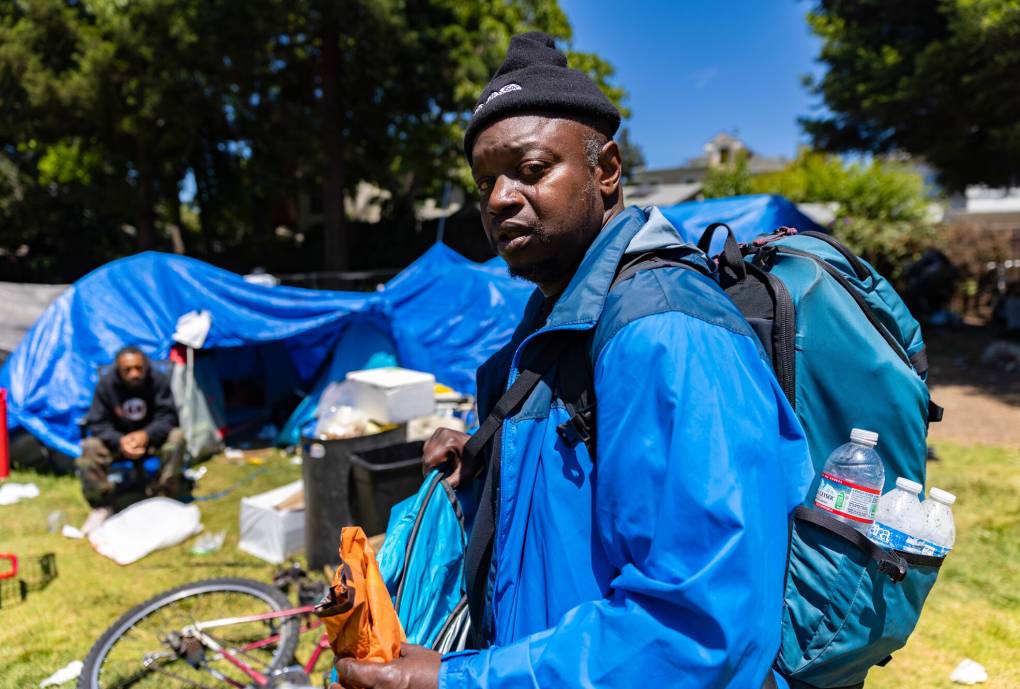
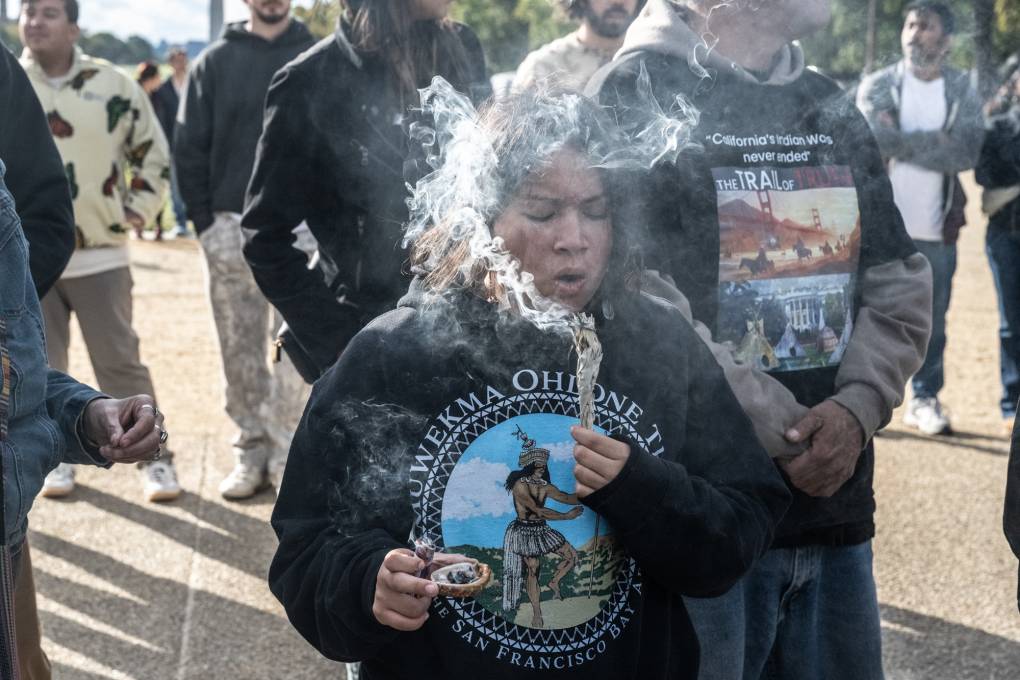
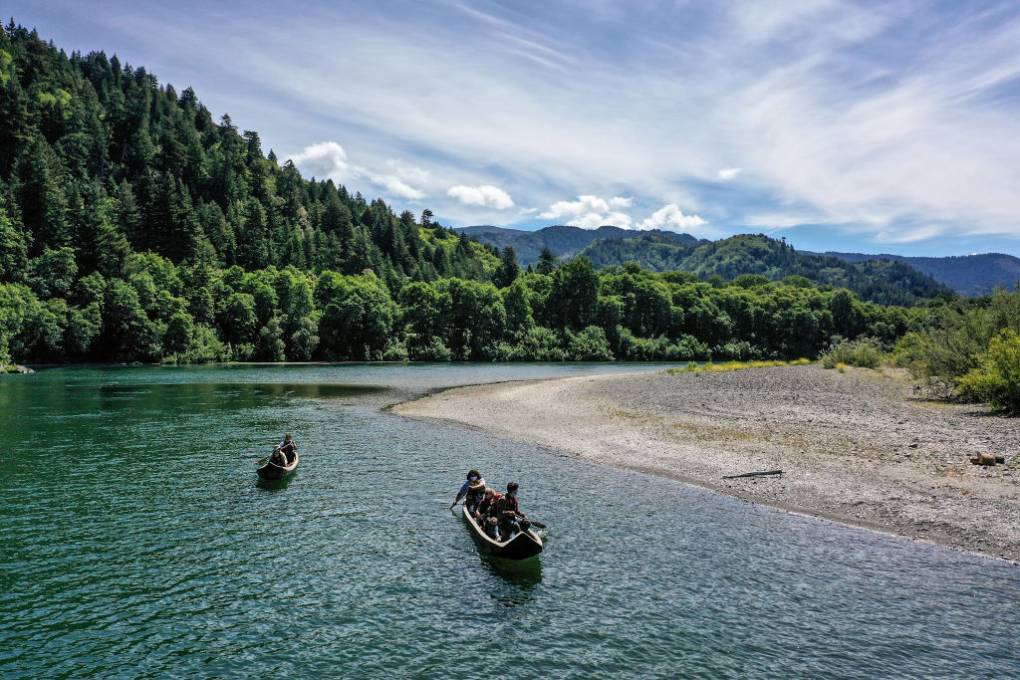
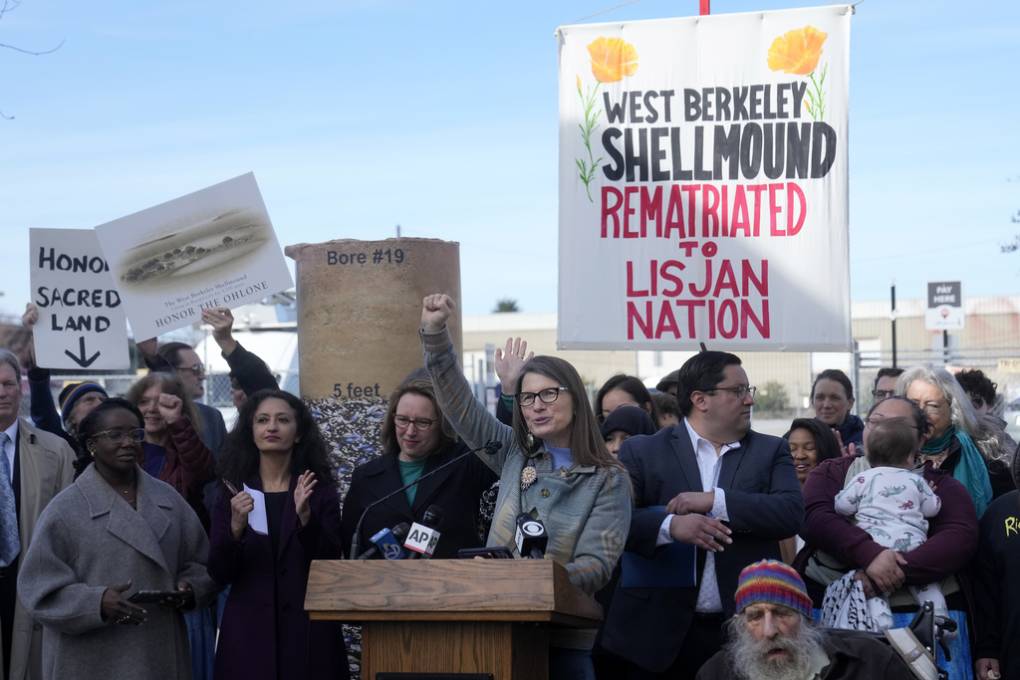
Berkeley Residents, Homeless Advocates Battle Over Fate of Ohlone Park Encampment
Trump Memo Delays New Rule Giving Native Tribes Another Shot at US Recognition
Northern California Tribe to Get Back 125 Acres of Ancestral Land Stolen During Gold Rush
Ohlone People Rejoice After City of Berkeley Votes to Return Sacred Land
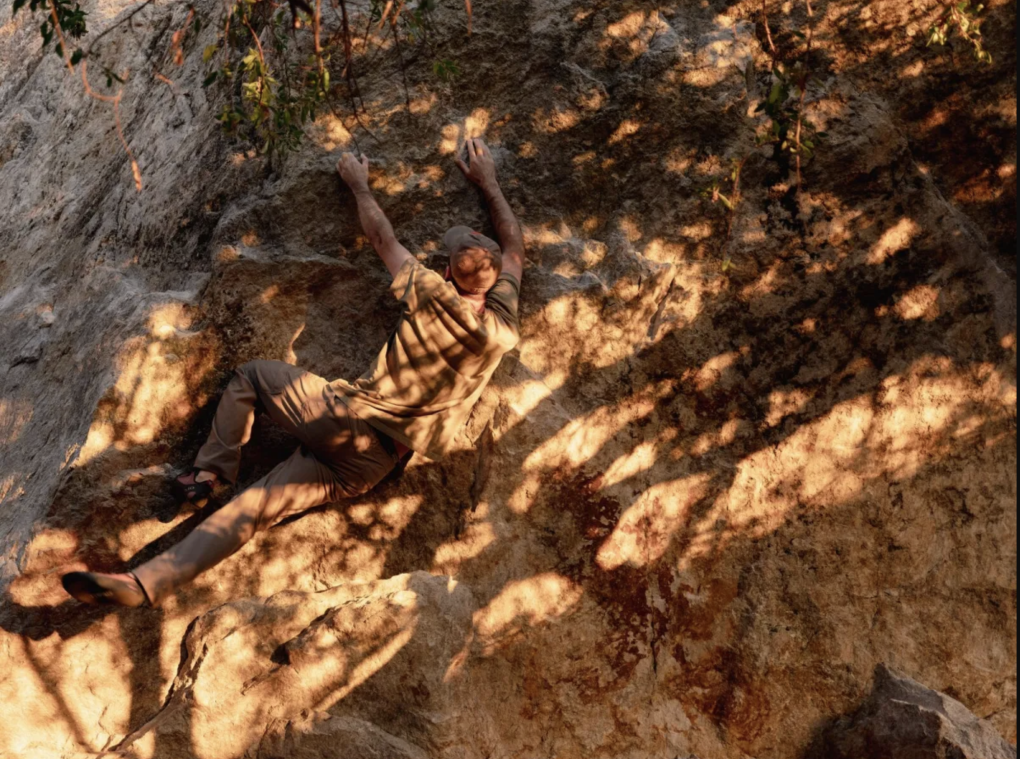
Connecting Climbers with the Native History of Indian and Mortar Rocks
$100 Million Grant to Assist California Native Tribes With Buying Back Land
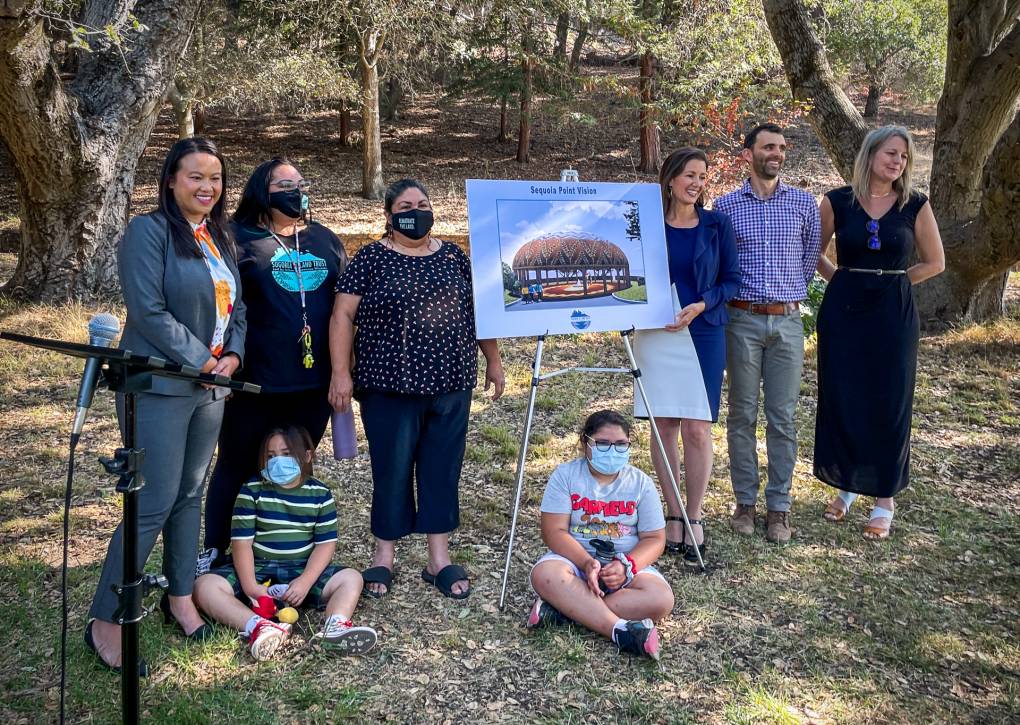
'We Have a Vision': East Bay Ohlone Tribe Looks to Future as Oakland Announces Landback Plan
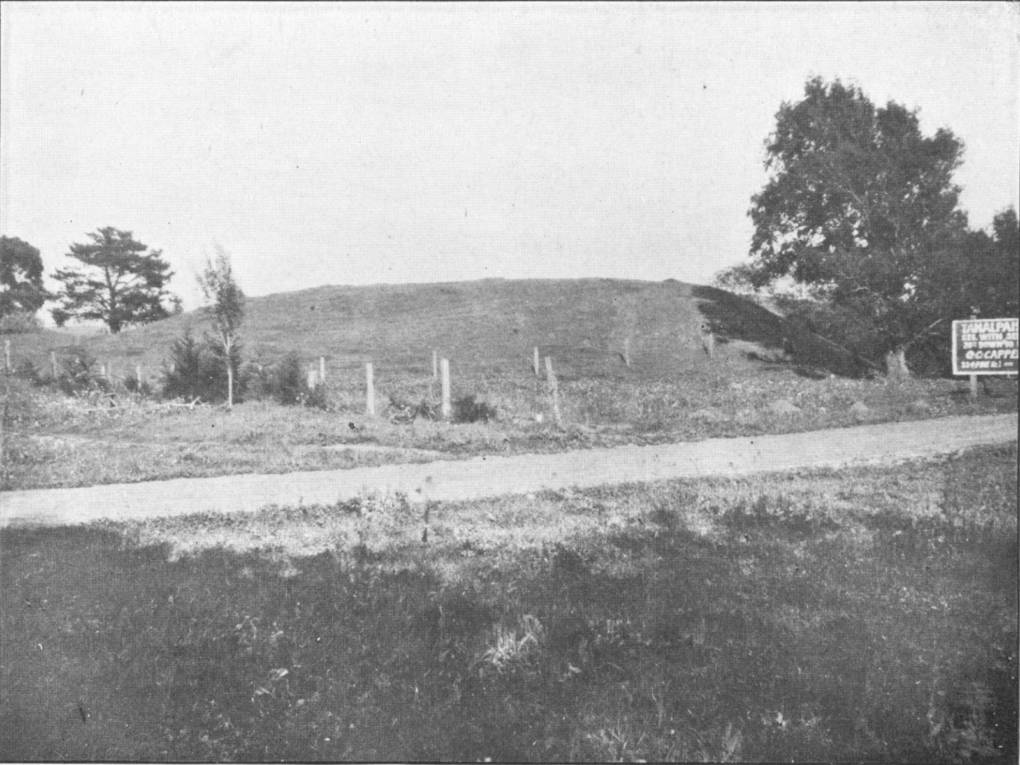
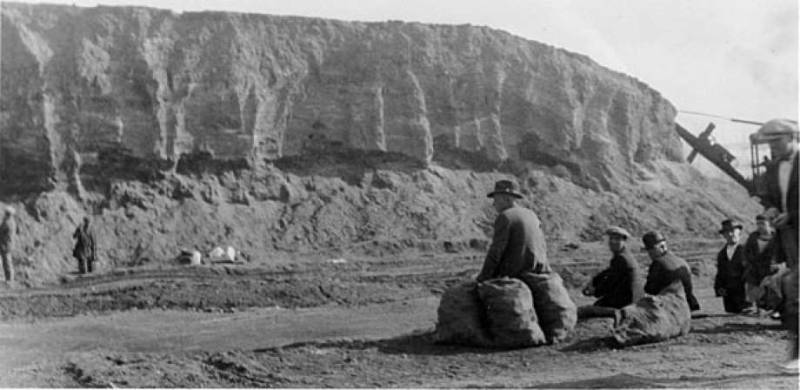
Bay Curious: The History of the Bay’s 425 Shellmounds
There Were Once More Than 425 Shellmounds in the Bay Area. Where Did They Go?
Sponsored
Player sponsored by
window.__IS_SSR__=true
window.__INITIAL_STATE__={
"attachmentsReducer": {
"audio_0": {
"type": "attachments",
"id": "audio_0",
"imgSizes": {
"kqedFullSize": {
"file": "https://ww2.kqed.org/news/wp-content/themes/KQED-unified/img/audio_bgs/background0.jpg"
}
}
},
"audio_1": {
"type": "attachments",
"id": "audio_1",
"imgSizes": {
"kqedFullSize": {
"file": "https://ww2.kqed.org/news/wp-content/themes/KQED-unified/img/audio_bgs/background1.jpg"
}
}
},
"audio_2": {
"type": "attachments",
"id": "audio_2",
"imgSizes": {
"kqedFullSize": {
"file": "https://ww2.kqed.org/news/wp-content/themes/KQED-unified/img/audio_bgs/background2.jpg"
}
}
},
"audio_3": {
"type": "attachments",
"id": "audio_3",
"imgSizes": {
"kqedFullSize": {
"file": "https://ww2.kqed.org/news/wp-content/themes/KQED-unified/img/audio_bgs/background3.jpg"
}
}
},
"audio_4": {
"type": "attachments",
"id": "audio_4",
"imgSizes": {
"kqedFullSize": {
"file": "https://ww2.kqed.org/news/wp-content/themes/KQED-unified/img/audio_bgs/background4.jpg"
}
}
},
"placeholder": {
"type": "attachments",
"id": "placeholder",
"imgSizes": {
"thumbnail": {
"file": "https://cdn.kqed.org/wp-content/uploads/2024/12/KQED-Default-Image-816638274-2000x1333-1-160x107.jpg",
"width": 160,
"height": 107,
"mimeType": "image/jpeg"
},
"medium": {
"file": "https://cdn.kqed.org/wp-content/uploads/2024/12/KQED-Default-Image-816638274-2000x1333-1-800x533.jpg",
"width": 800,
"height": 533,
"mimeType": "image/jpeg"
},
"medium_large": {
"file": "https://cdn.kqed.org/wp-content/uploads/2024/12/KQED-Default-Image-816638274-2000x1333-1-768x512.jpg",
"width": 768,
"height": 512,
"mimeType": "image/jpeg"
},
"large": {
"file": "https://cdn.kqed.org/wp-content/uploads/2024/12/KQED-Default-Image-816638274-2000x1333-1-1020x680.jpg",
"width": 1020,
"height": 680,
"mimeType": "image/jpeg"
},
"1536x1536": {
"file": "https://cdn.kqed.org/wp-content/uploads/2024/12/KQED-Default-Image-816638274-2000x1333-1-1536x1024.jpg",
"width": 1536,
"height": 1024,
"mimeType": "image/jpeg"
},
"fd-lrg": {
"file": "https://cdn.kqed.org/wp-content/uploads/2024/12/KQED-Default-Image-816638274-2000x1333-1-1536x1024.jpg",
"width": 1536,
"height": 1024,
"mimeType": "image/jpeg"
},
"fd-med": {
"file": "https://cdn.kqed.org/wp-content/uploads/2024/12/KQED-Default-Image-816638274-2000x1333-1-1020x680.jpg",
"width": 1020,
"height": 680,
"mimeType": "image/jpeg"
},
"fd-sm": {
"file": "https://cdn.kqed.org/wp-content/uploads/2024/12/KQED-Default-Image-816638274-2000x1333-1-800x533.jpg",
"width": 800,
"height": 533,
"mimeType": "image/jpeg"
},
"post-thumbnail": {
"file": "https://cdn.kqed.org/wp-content/uploads/2024/12/KQED-Default-Image-816638274-2000x1333-1-672x372.jpg",
"width": 672,
"height": 372,
"mimeType": "image/jpeg"
},
"twentyfourteen-full-width": {
"file": "https://cdn.kqed.org/wp-content/uploads/2024/12/KQED-Default-Image-816638274-2000x1333-1-1038x576.jpg",
"width": 1038,
"height": 576,
"mimeType": "image/jpeg"
},
"xxsmall": {
"file": "https://cdn.kqed.org/wp-content/uploads/2024/12/KQED-Default-Image-816638274-2000x1333-1-160x107.jpg",
"width": 160,
"height": 107,
"mimeType": "image/jpeg"
},
"xsmall": {
"file": "https://cdn.kqed.org/wp-content/uploads/2024/12/KQED-Default-Image-816638274-2000x1333-1-672x372.jpg",
"width": 672,
"height": 372,
"mimeType": "image/jpeg"
},
"small": {
"file": "https://cdn.kqed.org/wp-content/uploads/2024/12/KQED-Default-Image-816638274-2000x1333-1-672x372.jpg",
"width": 672,
"height": 372,
"mimeType": "image/jpeg"
},
"xlarge": {
"file": "https://cdn.kqed.org/wp-content/uploads/2024/12/KQED-Default-Image-816638274-2000x1333-1-1020x680.jpg",
"width": 1020,
"height": 680,
"mimeType": "image/jpeg"
},
"full-width": {
"file": "https://cdn.kqed.org/wp-content/uploads/2024/12/KQED-Default-Image-816638274-2000x1333-1-1920x1280.jpg",
"width": 1920,
"height": 1280,
"mimeType": "image/jpeg"
},
"guest-author-32": {
"file": "https://cdn.kqed.org/wp-content/uploads/2025/01/KQED-Default-Image-816638274-1333x1333-1-160x160.jpg",
"width": 32,
"height": 32,
"mimeType": "image/jpeg"
},
"guest-author-50": {
"file": "https://cdn.kqed.org/wp-content/uploads/2025/01/KQED-Default-Image-816638274-1333x1333-1-160x160.jpg",
"width": 50,
"height": 50,
"mimeType": "image/jpeg"
},
"guest-author-64": {
"file": "https://cdn.kqed.org/wp-content/uploads/2025/01/KQED-Default-Image-816638274-1333x1333-1-160x160.jpg",
"width": 64,
"height": 64,
"mimeType": "image/jpeg"
},
"guest-author-96": {
"file": "https://cdn.kqed.org/wp-content/uploads/2025/01/KQED-Default-Image-816638274-1333x1333-1-160x160.jpg",
"width": 96,
"height": 96,
"mimeType": "image/jpeg"
},
"guest-author-128": {
"file": "https://cdn.kqed.org/wp-content/uploads/2025/01/KQED-Default-Image-816638274-1333x1333-1-160x160.jpg",
"width": 128,
"height": 128,
"mimeType": "image/jpeg"
},
"detail": {
"file": "https://cdn.kqed.org/wp-content/uploads/2025/01/KQED-Default-Image-816638274-1333x1333-1-160x160.jpg",
"width": 160,
"height": 160,
"mimeType": "image/jpeg"
},
"kqedFullSize": {
"file": "https://cdn.kqed.org/wp-content/uploads/2024/12/KQED-Default-Image-816638274-2000x1333-1.jpg",
"width": 2000,
"height": 1333
}
}
},
"news_12042186": {
"type": "attachments",
"id": "news_12042186",
"meta": {
"index": "attachments_1716263798",
"site": "news",
"id": "12042186",
"found": true
},
"title": "20250529_OhloneParkEncampment_GC-3_qed",
"publishDate": 1748627843,
"status": "inherit",
"parent": 12041966,
"modified": 1748627871,
"caption": "Travis Smith gets emotional as he contemplates leaving the Ohlone Park encampment in Berkeley on May 29, 2025. The site near downtown Berkeley has become the latest flashpoint in this progressive city’s perennial struggle to manage its intractable homelessness crisis. ",
"credit": "Gina Castro/KQED",
"altTag": null,
"description": null,
"imgSizes": {
"medium": {
"file": "https://cdn.kqed.org/wp-content/uploads/sites/10/2025/05/20250529_OhloneParkEncampment_GC-3_qed-800x541.jpg",
"width": 800,
"height": 541,
"mimeType": "image/jpeg"
},
"large": {
"file": "https://cdn.kqed.org/wp-content/uploads/sites/10/2025/05/20250529_OhloneParkEncampment_GC-3_qed-1020x689.jpg",
"width": 1020,
"height": 689,
"mimeType": "image/jpeg"
},
"thumbnail": {
"file": "https://cdn.kqed.org/wp-content/uploads/sites/10/2025/05/20250529_OhloneParkEncampment_GC-3_qed-160x108.jpg",
"width": 160,
"height": 108,
"mimeType": "image/jpeg"
},
"1536x1536": {
"file": "https://cdn.kqed.org/wp-content/uploads/sites/10/2025/05/20250529_OhloneParkEncampment_GC-3_qed-1536x1038.jpg",
"width": 1536,
"height": 1038,
"mimeType": "image/jpeg"
},
"post-thumbnail": {
"file": "https://cdn.kqed.org/wp-content/uploads/sites/10/2025/05/20250529_OhloneParkEncampment_GC-3_qed-672x372.jpg",
"width": 672,
"height": 372,
"mimeType": "image/jpeg"
},
"twentyfourteen-full-width": {
"file": "https://cdn.kqed.org/wp-content/uploads/sites/10/2025/05/20250529_OhloneParkEncampment_GC-3_qed-1038x576.jpg",
"width": 1038,
"height": 576,
"mimeType": "image/jpeg"
},
"full-width": {
"file": "https://cdn.kqed.org/wp-content/uploads/sites/10/2025/05/20250529_OhloneParkEncampment_GC-3_qed-1920x1298.jpg",
"width": 1920,
"height": 1298,
"mimeType": "image/jpeg"
},
"kqedFullSize": {
"file": "https://cdn.kqed.org/wp-content/uploads/sites/10/2025/05/20250529_OhloneParkEncampment_GC-3_qed.jpg",
"width": 1972,
"height": 1333
}
},
"fetchFailed": false,
"isLoading": false
},
"news_12020612": {
"type": "attachments",
"id": "news_12020612",
"meta": {
"index": "attachments_1716263798",
"site": "news",
"id": "12020612",
"found": true
},
"title": "Multiple Arrested After Police Confront Native American Protesters On National Mall",
"publishDate": 1736281236,
"status": "inherit",
"parent": 12020604,
"modified": 1738977432,
"caption": "Native Americans burn sage during a confrontation with police on the National Mall on Oct. 15, 2024, in Washington, D.C. Native Americans from several tribes, including the Muwekma Ohlone, arrived in Washington, D.C., to demand federal recognition. Local police moved in before a ceremonial ride on horses to the Bureau of Indian Affairs could take place.",
"credit": "Stephanie Keith/Getty Images",
"altTag": null,
"description": null,
"imgSizes": {
"medium": {
"file": "https://cdn.kqed.org/wp-content/uploads/sites/10/2025/01/Muwekma-Ohlone-Getty-800x533.jpg",
"width": 800,
"height": 533,
"mimeType": "image/jpeg"
},
"large": {
"file": "https://cdn.kqed.org/wp-content/uploads/sites/10/2025/01/Muwekma-Ohlone-Getty-1020x680.jpg",
"width": 1020,
"height": 680,
"mimeType": "image/jpeg"
},
"thumbnail": {
"file": "https://cdn.kqed.org/wp-content/uploads/sites/10/2025/01/Muwekma-Ohlone-Getty-160x107.jpg",
"width": 160,
"height": 107,
"mimeType": "image/jpeg"
},
"1536x1536": {
"file": "https://cdn.kqed.org/wp-content/uploads/sites/10/2025/01/Muwekma-Ohlone-Getty-1536x1024.jpg",
"width": 1536,
"height": 1024,
"mimeType": "image/jpeg"
},
"post-thumbnail": {
"file": "https://cdn.kqed.org/wp-content/uploads/sites/10/2025/01/Muwekma-Ohlone-Getty-672x372.jpg",
"width": 672,
"height": 372,
"mimeType": "image/jpeg"
},
"twentyfourteen-full-width": {
"file": "https://cdn.kqed.org/wp-content/uploads/sites/10/2025/01/Muwekma-Ohlone-Getty-1038x576.jpg",
"width": 1038,
"height": 576,
"mimeType": "image/jpeg"
},
"full-width": {
"file": "https://cdn.kqed.org/wp-content/uploads/sites/10/2025/01/Muwekma-Ohlone-Getty-1920x1280.jpg",
"width": 1920,
"height": 1280,
"mimeType": "image/jpeg"
},
"kqedFullSize": {
"file": "https://cdn.kqed.org/wp-content/uploads/sites/10/2025/01/Muwekma-Ohlone-Getty.jpg",
"width": 2000,
"height": 1333
}
},
"fetchFailed": false,
"isLoading": false
},
"news_11980072": {
"type": "attachments",
"id": "news_11980072",
"meta": {
"index": "attachments_1716263798",
"site": "news",
"id": "11980072",
"found": true
},
"parent": 11980053,
"imgSizes": {
"twentyfourteen-full-width": {
"file": "https://cdn.kqed.org/wp-content/uploads/sites/10/2024/03/GettyImages-1233880064-1024x576.jpg",
"width": 1024,
"mimeType": "image/jpeg",
"height": 576
},
"thumbnail": {
"file": "https://cdn.kqed.org/wp-content/uploads/sites/10/2024/03/GettyImages-1233880064-160x107.jpg",
"width": 160,
"mimeType": "image/jpeg",
"height": 107
},
"post-thumbnail": {
"file": "https://cdn.kqed.org/wp-content/uploads/sites/10/2024/03/GettyImages-1233880064-672x372.jpg",
"width": 672,
"mimeType": "image/jpeg",
"height": 372
},
"kqedFullSize": {
"file": "https://cdn.kqed.org/wp-content/uploads/sites/10/2024/03/GettyImages-1233880064.jpg",
"width": 1024,
"height": 683
},
"large": {
"file": "https://cdn.kqed.org/wp-content/uploads/sites/10/2024/03/GettyImages-1233880064-1020x680.jpg",
"width": 1020,
"mimeType": "image/jpeg",
"height": 680
},
"medium": {
"file": "https://cdn.kqed.org/wp-content/uploads/sites/10/2024/03/GettyImages-1233880064-800x534.jpg",
"width": 800,
"mimeType": "image/jpeg",
"height": 534
}
},
"publishDate": 1710895010,
"modified": 1710895081,
"caption": "Yurok guides paddle tourists along the Klamath River in traditional canoes hand crafted from Redwood trees on June 10, 2021. ",
"description": null,
"title": "Redwood Yurok Canoe Tours on the Klamath River",
"credit": "Robert Gauthier/Los Angeles Times via Getty Images",
"status": "inherit",
"altTag": null,
"fetchFailed": false,
"isLoading": false
},
"news_11979333": {
"type": "attachments",
"id": "news_11979333",
"meta": {
"index": "attachments_1716263798",
"site": "news",
"id": "11979333",
"found": true
},
"parent": 11979268,
"imgSizes": {
"twentyfourteen-full-width": {
"file": "https://cdn.kqed.org/wp-content/uploads/sites/10/2024/03/AP24073728844941-1024x576.jpg",
"width": 1024,
"mimeType": "image/jpeg",
"height": 576
},
"thumbnail": {
"file": "https://cdn.kqed.org/wp-content/uploads/sites/10/2024/03/AP24073728844941-160x107.jpg",
"width": 160,
"mimeType": "image/jpeg",
"height": 107
},
"post-thumbnail": {
"file": "https://cdn.kqed.org/wp-content/uploads/sites/10/2024/03/AP24073728844941-672x372.jpg",
"width": 672,
"mimeType": "image/jpeg",
"height": 372
},
"kqedFullSize": {
"file": "https://cdn.kqed.org/wp-content/uploads/sites/10/2024/03/AP24073728844941.jpg",
"width": 1024,
"height": 683
},
"large": {
"file": "https://cdn.kqed.org/wp-content/uploads/sites/10/2024/03/AP24073728844941-1020x680.jpg",
"width": 1020,
"mimeType": "image/jpeg",
"height": 680
},
"medium": {
"file": "https://cdn.kqed.org/wp-content/uploads/sites/10/2024/03/AP24073728844941-800x534.jpg",
"width": 800,
"mimeType": "image/jpeg",
"height": 534
}
},
"publishDate": 1710365009,
"modified": 1710365084,
"caption": "Melissa Nelson, chair of the board of directors of the Sogorea Te’ Land Trust, middle, gestures while speaking at a news conference in Berkeley, Wednesday, March 13, 2024. Berkeley’s City Council voted unanimously Tuesday, March 12, 2024, to adopt an ordinance giving the title of the land to the Sogorea Te’ Land Trust, a women-led, San Francisco Bay Area collective that works to return land to Indigenous people and that raised the funds needed to reach the agreement. ",
"description": null,
"title": "AP24073728844941",
"credit": "Jeff Chiu/AP Photo",
"status": "inherit",
"altTag": null,
"fetchFailed": false,
"isLoading": false
},
"news_11970469": {
"type": "attachments",
"id": "news_11970469",
"meta": {
"index": "attachments_1716263798",
"site": "news",
"id": "11970469",
"found": true
},
"parent": 11970466,
"imgSizes": {
"twentyfourteen-full-width": {
"file": "https://cdn.kqed.org/wp-content/uploads/sites/10/2023/12/Screen-Shot-2023-12-19-at-2.22.41-PM-1038x576.png",
"width": 1038,
"mimeType": "image/png",
"height": 576
},
"thumbnail": {
"file": "https://cdn.kqed.org/wp-content/uploads/sites/10/2023/12/Screen-Shot-2023-12-19-at-2.22.41-PM-160x119.png",
"width": 160,
"mimeType": "image/png",
"height": 119
},
"post-thumbnail": {
"file": "https://cdn.kqed.org/wp-content/uploads/sites/10/2023/12/Screen-Shot-2023-12-19-at-2.22.41-PM-672x372.png",
"width": 672,
"mimeType": "image/png",
"height": 372
},
"kqedFullSize": {
"file": "https://cdn.kqed.org/wp-content/uploads/sites/10/2023/12/Screen-Shot-2023-12-19-at-2.22.41-PM.png",
"width": 2083,
"height": 1550
},
"2048x2048": {
"file": "https://cdn.kqed.org/wp-content/uploads/sites/10/2023/12/Screen-Shot-2023-12-19-at-2.22.41-PM-2048x1524.png",
"width": 2048,
"mimeType": "image/png",
"height": 1524
},
"large": {
"file": "https://cdn.kqed.org/wp-content/uploads/sites/10/2023/12/Screen-Shot-2023-12-19-at-2.22.41-PM-1020x759.png",
"width": 1020,
"mimeType": "image/png",
"height": 759
},
"1536x1536": {
"file": "https://cdn.kqed.org/wp-content/uploads/sites/10/2023/12/Screen-Shot-2023-12-19-at-2.22.41-PM-1536x1143.png",
"width": 1536,
"mimeType": "image/png",
"height": 1143
},
"full-width": {
"file": "https://cdn.kqed.org/wp-content/uploads/sites/10/2023/12/Screen-Shot-2023-12-19-at-2.22.41-PM-1920x1429.png",
"width": 1920,
"mimeType": "image/png",
"height": 1429
},
"medium": {
"file": "https://cdn.kqed.org/wp-content/uploads/sites/10/2023/12/Screen-Shot-2023-12-19-at-2.22.41-PM-800x595.png",
"width": 800,
"mimeType": "image/png",
"height": 595
}
},
"publishDate": 1703024622,
"modified": 1703025747,
"caption": "A climber flags his right foot for balance on an overhanging part of Indian Rock. ",
"description": null,
"title": "Screen Shot 2023-12-19 at 2.22.41 PM",
"credit": "Ximena Natera, Berkeleyside/CatchLight",
"status": "inherit",
"altTag": null,
"fetchFailed": false,
"isLoading": false
},
"news_11957424": {
"type": "attachments",
"id": "news_11957424",
"meta": {
"index": "attachments_1716263798",
"site": "news",
"id": "11957424",
"found": true
},
"title": "Charlene Nijmeh, chair of the Muwekma Ohlone tribe in the Bay Area, stands for a portrait next to Strawberry Creek on the UC Berkeley campus on Friday, November 27, 2020 in Berkeley, Calif.",
"publishDate": 1691171091,
"status": "inherit",
"parent": 12026194,
"modified": 1738971902,
"caption": "The Tribal Nature-Based Solutions grant program is an effort to meet the state’s land conservation goals and also a means to strengthen partnerships with native tribes. Some tribes, however, have raised concerns over its focus. Muwekma Ohlone Chairwoman Charlene Nijmeh said in an email that her tribe is open to developing a project for this grant, but 'too much focus is on plants and animals and not the native people. It's a perpetuation of colonialism and performative allyship.'",
"credit": "Lea Suzuki/The San Francisco Chronicle via Getty Images",
"altTag": "A woman stand in the shadows. Her face and body are illuminated by a spotlight. She has long, brown hair and wears a blue and tan-print jacket and jeans. She looks somber.",
"description": null,
"imgSizes": {
"medium": {
"file": "https://cdn.kqed.org/wp-content/uploads/sites/10/2023/08/TribalBuyBack01-800x533.jpg",
"width": 800,
"height": 533,
"mimeType": "image/jpeg"
},
"large": {
"file": "https://cdn.kqed.org/wp-content/uploads/sites/10/2023/08/TribalBuyBack01-1020x680.jpg",
"width": 1020,
"height": 680,
"mimeType": "image/jpeg"
},
"thumbnail": {
"file": "https://cdn.kqed.org/wp-content/uploads/sites/10/2023/08/TribalBuyBack01-160x107.jpg",
"width": 160,
"height": 107,
"mimeType": "image/jpeg"
},
"1536x1536": {
"file": "https://cdn.kqed.org/wp-content/uploads/sites/10/2023/08/TribalBuyBack01-1536x1024.jpg",
"width": 1536,
"height": 1024,
"mimeType": "image/jpeg"
},
"post-thumbnail": {
"file": "https://cdn.kqed.org/wp-content/uploads/sites/10/2023/08/TribalBuyBack01-672x372.jpg",
"width": 672,
"height": 372,
"mimeType": "image/jpeg"
},
"twentyfourteen-full-width": {
"file": "https://cdn.kqed.org/wp-content/uploads/sites/10/2023/08/TribalBuyBack01-1038x576.jpg",
"width": 1038,
"height": 576,
"mimeType": "image/jpeg"
},
"kqedFullSize": {
"file": "https://cdn.kqed.org/wp-content/uploads/sites/10/2023/08/TribalBuyBack01.jpg",
"width": 1920,
"height": 1280
}
},
"fetchFailed": false,
"isLoading": false
},
"news_11925209": {
"type": "attachments",
"id": "news_11925209",
"meta": {
"index": "attachments_1716263798",
"site": "news",
"id": "11925209",
"found": true
},
"parent": 11925121,
"imgSizes": {
"twentyfourteen-full-width": {
"file": "https://ww2.kqed.org/app/uploads/sites/10/2022/09/IMG_8786-2-1-1038x576.jpg",
"width": 1038,
"mimeType": "image/jpeg",
"height": 576
},
"thumbnail": {
"file": "https://ww2.kqed.org/app/uploads/sites/10/2022/09/IMG_8786-2-1-160x114.jpg",
"width": 160,
"mimeType": "image/jpeg",
"height": 114
},
"post-thumbnail": {
"file": "https://ww2.kqed.org/app/uploads/sites/10/2022/09/IMG_8786-2-1-672x372.jpg",
"width": 672,
"mimeType": "image/jpeg",
"height": 372
},
"kqedFullSize": {
"file": "https://ww2.kqed.org/app/uploads/sites/10/2022/09/IMG_8786-2-1.jpg",
"width": 1920,
"height": 1364
},
"large": {
"file": "https://ww2.kqed.org/app/uploads/sites/10/2022/09/IMG_8786-2-1-1020x725.jpg",
"width": 1020,
"mimeType": "image/jpeg",
"height": 725
},
"1536x1536": {
"file": "https://ww2.kqed.org/app/uploads/sites/10/2022/09/IMG_8786-2-1-1536x1091.jpg",
"width": 1536,
"mimeType": "image/jpeg",
"height": 1091
},
"medium": {
"file": "https://ww2.kqed.org/app/uploads/sites/10/2022/09/IMG_8786-2-1-800x568.jpg",
"width": 800,
"mimeType": "image/jpeg",
"height": 568
}
},
"publishDate": 1662761461,
"modified": 1662765438,
"caption": "Sogorea Te' Land Trust co-founder and Lisjan Ohlone Tribal Chair Corrina Gould (standing next to the sign, wearing a black face mask) and family members pose for a photo with Oakland officials alongside a poster showing a mock-up of the structure the trust hopes to build on the Sequoia Point site.",
"description": null,
"title": "IMG_8786 2 (1)",
"credit": "Annelise Finney/KQED",
"status": "inherit",
"altTag": "a group of people of Native descent pose near a poster board at a press conference",
"fetchFailed": false,
"isLoading": false
},
"news_11704735": {
"type": "attachments",
"id": "news_11704735",
"meta": {
"index": "attachments_1716263798",
"site": "news",
"id": "11704735",
"found": true
},
"parent": 11704679,
"imgSizes": {
"twentyfourteen-full-width": {
"file": "https://ww2.kqed.org/app/uploads/sites/10/2018/11/RS33756_Screen-Shot-2018-11-07-at-2.57.48-PM-qut-1038x576.jpg",
"width": 1038,
"mimeType": "image/jpeg",
"height": 576
},
"thumbnail": {
"file": "https://ww2.kqed.org/app/uploads/sites/10/2018/11/RS33756_Screen-Shot-2018-11-07-at-2.57.48-PM-qut-160x120.jpg",
"width": 160,
"mimeType": "image/jpeg",
"height": 120
},
"post-thumbnail": {
"file": "https://ww2.kqed.org/app/uploads/sites/10/2018/11/RS33756_Screen-Shot-2018-11-07-at-2.57.48-PM-qut-672x372.jpg",
"width": 672,
"mimeType": "image/jpeg",
"height": 372
},
"kqedFullSize": {
"file": "https://ww2.kqed.org/app/uploads/sites/10/2018/11/RS33756_Screen-Shot-2018-11-07-at-2.57.48-PM-qut.jpg",
"width": 1600,
"height": 1200
},
"large": {
"file": "https://ww2.kqed.org/app/uploads/sites/10/2018/11/RS33756_Screen-Shot-2018-11-07-at-2.57.48-PM-qut-1020x765.jpg",
"width": 1020,
"mimeType": "image/jpeg",
"height": 765
},
"complete_open_graph": {
"file": "https://ww2.kqed.org/app/uploads/sites/10/2018/11/RS33756_Screen-Shot-2018-11-07-at-2.57.48-PM-qut-1200x900.jpg",
"width": 1200,
"mimeType": "image/jpeg",
"height": 900
},
"guest-author-50": {
"file": "https://ww2.kqed.org/app/uploads/sites/10/2018/11/RS33756_Screen-Shot-2018-11-07-at-2.57.48-PM-qut-50x50.jpg",
"width": 50,
"mimeType": "image/jpeg",
"height": 50
},
"guest-author-96": {
"file": "https://ww2.kqed.org/app/uploads/sites/10/2018/11/RS33756_Screen-Shot-2018-11-07-at-2.57.48-PM-qut-96x96.jpg",
"width": 96,
"mimeType": "image/jpeg",
"height": 96
},
"medium": {
"file": "https://ww2.kqed.org/app/uploads/sites/10/2018/11/RS33756_Screen-Shot-2018-11-07-at-2.57.48-PM-qut-800x600.jpg",
"width": 800,
"mimeType": "image/jpeg",
"height": 600
},
"guest-author-64": {
"file": "https://ww2.kqed.org/app/uploads/sites/10/2018/11/RS33756_Screen-Shot-2018-11-07-at-2.57.48-PM-qut-64x64.jpg",
"width": 64,
"mimeType": "image/jpeg",
"height": 64
},
"guest-author-32": {
"file": "https://ww2.kqed.org/app/uploads/sites/10/2018/11/RS33756_Screen-Shot-2018-11-07-at-2.57.48-PM-qut-32x32.jpg",
"width": 32,
"mimeType": "image/jpeg",
"height": 32
},
"detail": {
"file": "https://ww2.kqed.org/app/uploads/sites/10/2018/11/RS33756_Screen-Shot-2018-11-07-at-2.57.48-PM-qut-150x150.jpg",
"width": 150,
"mimeType": "image/jpeg",
"height": 150
},
"guest-author-128": {
"file": "https://ww2.kqed.org/app/uploads/sites/10/2018/11/RS33756_Screen-Shot-2018-11-07-at-2.57.48-PM-qut-128x128.jpg",
"width": 128,
"mimeType": "image/jpeg",
"height": 128
}
},
"publishDate": 1541631727,
"modified": 1541631904,
"caption": "A shellmound in Mill Valley, as photographed by archaeologist Nels Nelson in 1909. From Nelson's report \"Shellmounds of the San Francisco Bay Region.\"",
"description": "A shellmound in Mill Valley, as photographed by archaeologist Nels Nelson in 1909. From Nelson's report \"Shellmounds of the San Francisco Bay Region.\"",
"title": "RS33756_Screen Shot 2018-11-07 at 2.57.48 PM-qut",
"credit": null,
"status": "inherit",
"fetchFailed": false,
"isLoading": false
},
"news_11704111": {
"type": "attachments",
"id": "news_11704111",
"meta": {
"index": "attachments_1716263798",
"site": "news",
"id": "11704111",
"found": true
},
"parent": 11704109,
"imgSizes": {
"thumbnail": {
"file": "https://ww2.kqed.org/app/uploads/sites/10/2018/11/920x920-160x78.jpg",
"width": 160,
"mimeType": "image/jpeg",
"height": 78
},
"post-thumbnail": {
"file": "https://ww2.kqed.org/app/uploads/sites/10/2018/11/920x920-672x372.jpg",
"width": 672,
"mimeType": "image/jpeg",
"height": 372
},
"kqedFullSize": {
"file": "https://ww2.kqed.org/app/uploads/sites/10/2018/11/920x920.jpg",
"width": 920,
"height": 448
},
"guest-author-50": {
"file": "https://ww2.kqed.org/app/uploads/sites/10/2018/11/920x920-50x50.jpg",
"width": 50,
"mimeType": "image/jpeg",
"height": 50
},
"guest-author-96": {
"file": "https://ww2.kqed.org/app/uploads/sites/10/2018/11/920x920-96x96.jpg",
"width": 96,
"mimeType": "image/jpeg",
"height": 96
},
"medium": {
"file": "https://ww2.kqed.org/app/uploads/sites/10/2018/11/920x920-800x390.jpg",
"width": 800,
"mimeType": "image/jpeg",
"height": 390
},
"guest-author-64": {
"file": "https://ww2.kqed.org/app/uploads/sites/10/2018/11/920x920-64x64.jpg",
"width": 64,
"mimeType": "image/jpeg",
"height": 64
},
"detail": {
"file": "https://ww2.kqed.org/app/uploads/sites/10/2018/11/920x920-150x150.jpg",
"width": 150,
"mimeType": "image/jpeg",
"height": 150
},
"guest-author-32": {
"file": "https://ww2.kqed.org/app/uploads/sites/10/2018/11/920x920-32x32.jpg",
"width": 32,
"mimeType": "image/jpeg",
"height": 32
},
"guest-author-128": {
"file": "https://ww2.kqed.org/app/uploads/sites/10/2018/11/920x920-128x128.jpg",
"width": 128,
"mimeType": "image/jpeg",
"height": 128
}
},
"publishDate": 1541534606,
"modified": 1648155999,
"caption": "Demolition of the Emeryville shellmound to make way for a paint factory, 1924.",
"description": "Demolition of the Emeryville Shellmound to make way for a paint factory, 1924.",
"title": "920x920",
"credit": "Courtesy of the Phoebe A. Hearst Museum of Anthropology and Regents of the University of California, catalog no. 15-7792",
"status": "inherit",
"altTag": "Demolition of the Emeryville Shellmound to make way for a paint factory, 1924.",
"fetchFailed": false,
"isLoading": false
}
},
"audioPlayerReducer": {
"postId": "stream_live",
"isPaused": true,
"isPlaying": false,
"pfsActive": false,
"pledgeModalIsOpen": true,
"playerDrawerIsOpen": false
},
"authorsReducer": {
"byline_news_11980053": {
"type": "authors",
"id": "byline_news_11980053",
"meta": {
"override": true
},
"slug": "byline_news_11980053",
"name": "Julie Watson\u003cbr>Associated Press",
"isLoading": false
},
"byline_news_11979268": {
"type": "authors",
"id": "byline_news_11979268",
"meta": {
"override": true
},
"slug": "byline_news_11979268",
"name": "Janie Har\u003cbr>Associated Press",
"isLoading": false
},
"ohubertallen": {
"type": "authors",
"id": "102",
"meta": {
"index": "authors_1716337520",
"id": "102",
"found": true
},
"name": "Olivia Allen-Price",
"firstName": "Olivia",
"lastName": "Allen-Price",
"slug": "ohubertallen",
"email": "oallenprice@kqed.org",
"display_author_email": false,
"staff_mastheads": [
"news"
],
"title": "Senior Editor",
"bio": "Olivia Allen-Price is senior editor and host of the award-winning Bay Curious podcast. Prior to joining KQED in 2013, Olivia worked at The Baltimore Sun and The Virginian-Pilot in Norfolk, Va. She holds degrees in journalism and political science from Elon University. Her work has earned awards from the Society of Professional Journalists, the Hearst Foundation and Hearken. She loves to talk about running and curly hair.\r\n\r\nFollow: \u003ca href=\"https://twitter.com/oallenprice\">@oallenprice\u003c/a>\r\nEmail: \u003ca href=\"mailto:oallenprice@kqed.org\">oallenprice@kqed.org\u003c/a>",
"avatar": "https://secure.gravatar.com/avatar/fdd38db811fcf449bd7d7db84a39eea1?s=600&d=blank&r=g",
"twitter": "oallenprice",
"facebook": null,
"instagram": null,
"linkedin": null,
"sites": [
{
"site": "",
"roles": [
"editor"
]
},
{
"site": "arts",
"roles": [
"subscriber"
]
},
{
"site": "styleguide",
"roles": [
"administrator"
]
},
{
"site": "news",
"roles": [
"administrator"
]
},
{
"site": "pop",
"roles": [
"administrator"
]
},
{
"site": "bayareabites",
"roles": [
"contributor"
]
},
{
"site": "stateofhealth",
"roles": [
"administrator"
]
},
{
"site": "science",
"roles": [
"editor"
]
},
{
"site": "breakingnews",
"roles": [
"administrator"
]
}
],
"headData": {
"title": "Olivia Allen-Price | KQED",
"description": "Senior Editor",
"ogImgSrc": "https://secure.gravatar.com/avatar/fdd38db811fcf449bd7d7db84a39eea1?s=600&d=blank&r=g",
"twImgSrc": "https://secure.gravatar.com/avatar/fdd38db811fcf449bd7d7db84a39eea1?s=600&d=blank&r=g"
},
"isLoading": false,
"link": "/author/ohubertallen"
},
"matthewgreen": {
"type": "authors",
"id": "1263",
"meta": {
"index": "authors_1716337520",
"id": "1263",
"found": true
},
"name": "Matthew Green",
"firstName": "Matthew",
"lastName": "Green",
"slug": "matthewgreen",
"email": "mgreen@kqed.org",
"display_author_email": false,
"staff_mastheads": [],
"title": "KQED Editor/Reporter",
"bio": "Matthew Green is a digital media producer for KQED News. He previously produced \u003ca href=\"http://www.kqed.org/lowdown\">The Lowdown\u003c/a>, KQED’s multimedia news education blog. Matthew's written for numerous Bay Area publications, including the Oakland Tribune and San Francisco Chronicle. He also taught journalism classes at Fremont High School in East Oakland.\r\n\r\nEmail: mgreen@kqed.org; Twitter: @MGreenKQED",
"avatar": "https://secure.gravatar.com/avatar/3bf498d1267ca02c8494f33d8cfc575e?s=600&d=blank&r=g",
"twitter": "MGreenKQED",
"facebook": null,
"instagram": null,
"linkedin": null,
"sites": [
{
"site": "news",
"roles": []
},
{
"site": "lowdown",
"roles": []
},
{
"site": "science",
"roles": []
},
{
"site": "education",
"roles": []
},
{
"site": "quest",
"roles": []
},
{
"site": "liveblog",
"roles": []
}
],
"headData": {
"title": "Matthew Green | KQED",
"description": "KQED Editor/Reporter",
"ogImgSrc": "https://secure.gravatar.com/avatar/3bf498d1267ca02c8494f33d8cfc575e?s=600&d=blank&r=g",
"twImgSrc": "https://secure.gravatar.com/avatar/3bf498d1267ca02c8494f33d8cfc575e?s=600&d=blank&r=g"
},
"isLoading": false,
"link": "/author/matthewgreen"
},
"esilvers": {
"type": "authors",
"id": "7237",
"meta": {
"index": "authors_1716337520",
"id": "7237",
"found": true
},
"name": "Emma Silvers",
"firstName": "Emma",
"lastName": "Silvers",
"slug": "esilvers",
"email": "esilvers@kqed.org",
"display_author_email": false,
"staff_mastheads": [],
"title": "KQED Contributor",
"bio": "Emma Silvers is an editor at KQED Arts and a former digital producer at KQED News. Born and raised in the Bay Area, she has previously been an arts and entertainment editor at the \u003cem>San Francisco Chronicle\u003c/em>, \u003cem>SF Weekly\u003c/em> and the \u003cem>San Francisco Bay Guardian.\u003c/em> \u003ca href=\"https://www.emmasilvers.com\">Her work\u003c/a> has also appeared in \u003cem>Rolling Stone\u003c/em>, Pitchfork and \u003cem>Mother Jones\u003c/em>. In 2017 she was the recipient of the Society of Professional Journalists-Northern California's award for arts and culture reporting. In 1993 she \u003ca href=\"https://www.kqed.org/pop/16759/wait-what-my-coworker-was-a-voice-over-hyperventilator-for-jurassic-park\">hyperventilated in \u003cem>Jurassic Park\u003c/em>\u003c/a>.",
"avatar": "https://secure.gravatar.com/avatar/247beada39b88ea5759db1f51dba05cf?s=600&d=blank&r=g",
"twitter": "emmaruthless",
"facebook": null,
"instagram": null,
"linkedin": null,
"sites": [
{
"site": "arts",
"roles": [
"editor"
]
},
{
"site": "news",
"roles": [
"editor"
]
},
{
"site": "pop",
"roles": [
"contributor"
]
},
{
"site": "bayareabites",
"roles": [
"editor"
]
},
{
"site": "food",
"roles": [
"contributor"
]
},
{
"site": "liveblog",
"roles": [
"editor"
]
}
],
"headData": {
"title": "Emma Silvers | KQED",
"description": "KQED Contributor",
"ogImgSrc": "https://secure.gravatar.com/avatar/247beada39b88ea5759db1f51dba05cf?s=600&d=blank&r=g",
"twImgSrc": "https://secure.gravatar.com/avatar/247beada39b88ea5759db1f51dba05cf?s=600&d=blank&r=g"
},
"isLoading": false,
"link": "/author/esilvers"
},
"lklivans": {
"type": "authors",
"id": "8648",
"meta": {
"index": "authors_1716337520",
"id": "8648",
"found": true
},
"name": "Laura Klivans",
"firstName": "Laura",
"lastName": "Klivans",
"slug": "lklivans",
"email": "lklivans@kqed.org",
"display_author_email": true,
"staff_mastheads": [
"news",
"science"
],
"title": "Reporter",
"bio": "Laura Klivans is an award-winning science reporter for KQED News, where she covers climate change with an eye on both groundbreaking progress and gaps in action. She is the former host of KQED's blockbuster video series about tiny, amazing animals, \u003cem>Deep Look\u003c/em>. Her work reaches national audiences through NPR, \u003cem>Here & Now, \u003c/em>PRI, and other major outlets. \r\n\r\nLaura’s won five Northern California Area Emmy Awards for Deep Look and First Place in the Greater Bay Area Journalism Awards for a podcast exploring how one Oakland neighborhood teamed up to reduce planet-heating pollution.\r\n\r\nBeyond her reporting, she hosts and moderates events. In the past, she taught audio storytelling at the UC Berkeley Graduate School of Journalism, led international education programs, worked with immigrants and refugees along the Thai-Burmese border, taught high schoolers sex ed, and was an actress. \r\n\r\nShe's a former UC Berkeley Human Rights Fellow, USC Center for Health Journalism's California Fellow and Coro Fellow in Public Affairs. Laura has a master’s in journalism from UC Berkeley, a master’s in education from Harvard, and an undergraduate degree from Northwestern University.\r\n\r\nShe loves trying to riddle the meaning out of vanity license plates.",
"avatar": "https://secure.gravatar.com/avatar/af8e757bb8ce7b7fee6160ba66e37327?s=600&d=blank&r=g",
"twitter": "lauraklivans",
"facebook": null,
"instagram": null,
"linkedin": null,
"sites": [
{
"site": "news",
"roles": [
"editor"
]
},
{
"site": "stateofhealth",
"roles": [
"contributor",
"editor"
]
},
{
"site": "science",
"roles": [
"editor"
]
},
{
"site": "forum",
"roles": [
"editor"
]
}
],
"headData": {
"title": "Laura Klivans | KQED",
"description": "Reporter",
"ogImgSrc": "https://secure.gravatar.com/avatar/af8e757bb8ce7b7fee6160ba66e37327?s=600&d=blank&r=g",
"twImgSrc": "https://secure.gravatar.com/avatar/af8e757bb8ce7b7fee6160ba66e37327?s=600&d=blank&r=g"
},
"isLoading": false,
"link": "/author/lklivans"
},
"ecruzguevarra": {
"type": "authors",
"id": "8654",
"meta": {
"index": "authors_1716337520",
"id": "8654",
"found": true
},
"name": "Ericka Cruz Guevarra",
"firstName": "Ericka",
"lastName": "Cruz Guevarra",
"slug": "ecruzguevarra",
"email": "ecruzguevarra@kqed.org",
"display_author_email": true,
"staff_mastheads": [
"news"
],
"title": "Producer, The Bay Podcast",
"bio": "Ericka Cruz Guevarra is host of \u003ca href=\"https://www.kqed.org/podcasts/thebay\">\u003cem>The Bay\u003c/em>\u003c/a> podcast at KQED. Before host, she was the show’s producer. Her work in that capacity includes a three-part reported series on policing in Vallejo, which won a 2020 excellence in journalism award from the Society of Professional Journalists. Ericka has worked as a breaking news reporter at Oregon Public Broadcasting, helped produce the Code Switch podcast, and was KQED’s inaugural Raul Ramirez Diversity Fund intern. She’s also an alumna of NPR’s Next Generation Radio program. Send her an email if you have strong feelings about whether Fairfield and Suisun City are the Bay. Ericka is represented by SAG-AFTRA.",
"avatar": "https://secure.gravatar.com/avatar/25e5ab8d3d53fad2dcc7bb2b5c506b1a?s=600&d=blank&r=g",
"twitter": "NotoriousECG",
"facebook": null,
"instagram": null,
"linkedin": null,
"sites": [
{
"site": "arts",
"roles": [
"subscriber"
]
},
{
"site": "news",
"roles": [
"editor",
"manage_categories"
]
},
{
"site": "futureofyou",
"roles": [
"subscriber"
]
},
{
"site": "stateofhealth",
"roles": [
"subscriber"
]
},
{
"site": "science",
"roles": [
"editor"
]
},
{
"site": "forum",
"roles": [
"subscriber"
]
}
],
"headData": {
"title": "Ericka Cruz Guevarra | KQED",
"description": "Producer, The Bay Podcast",
"ogImgSrc": "https://secure.gravatar.com/avatar/25e5ab8d3d53fad2dcc7bb2b5c506b1a?s=600&d=blank&r=g",
"twImgSrc": "https://secure.gravatar.com/avatar/25e5ab8d3d53fad2dcc7bb2b5c506b1a?s=600&d=blank&r=g"
},
"isLoading": false,
"link": "/author/ecruzguevarra"
},
"abandlamudi": {
"type": "authors",
"id": "11672",
"meta": {
"index": "authors_1716337520",
"id": "11672",
"found": true
},
"name": "Adhiti Bandlamudi",
"firstName": "Adhiti",
"lastName": "Bandlamudi",
"slug": "abandlamudi",
"email": "abandlamudi@kqed.org",
"display_author_email": false,
"staff_mastheads": [
"news"
],
"title": "KQED Housing Reporter",
"bio": "Adhiti Bandlamudi reports for KQED's Housing desk. She focuses on how housing gets built across the Bay Area. Before joining KQED in 2020, she reported for WUNC in Durham, North Carolina, WABE in Atlanta, Georgia and Capital Public Radio in Sacramento. In 2017, she was awarded a Kroc Fellowship at NPR where she reported on everything from sprinkles to the Golden State Killer's arrest. When she's not reporting, she's baking new recipes in her kitchen or watching movies with friends and family. She's originally from Georgia and has strong opinions about Great British Bake Off.",
"avatar": "https://secure.gravatar.com/avatar/868129c8b257bb99a3500e2c86a65400?s=600&d=mm&r=g",
"twitter": "oddity_adhiti",
"facebook": null,
"instagram": null,
"linkedin": null,
"sites": [
{
"site": "arts",
"roles": [
"author"
]
},
{
"site": "news",
"roles": [
"editor"
]
},
{
"site": "liveblog",
"roles": [
"author"
]
}
],
"headData": {
"title": "Adhiti Bandlamudi | KQED",
"description": "KQED Housing Reporter",
"ogImgSrc": "https://secure.gravatar.com/avatar/868129c8b257bb99a3500e2c86a65400?s=600&d=mm&r=g",
"twImgSrc": "https://secure.gravatar.com/avatar/868129c8b257bb99a3500e2c86a65400?s=600&d=mm&r=g"
},
"isLoading": false,
"link": "/author/abandlamudi"
},
"afinney": {
"type": "authors",
"id": "11772",
"meta": {
"index": "authors_1716337520",
"id": "11772",
"found": true
},
"name": "Annelise Finney",
"firstName": "Annelise",
"lastName": "Finney",
"slug": "afinney",
"email": "afinney@kqed.org",
"display_author_email": true,
"staff_mastheads": [
"news"
],
"title": "Reporter",
"bio": "Annelise reports on reparations in California and East Bay politics. She co-produced the Sunday Music Drop, a limited-term radio series featuring Bay Area musicians that aired between Sept 2022 and Oct 2024. She joined KQED in 2021 as a general assignment reporter and is an alumna of KALW's Audio Academy. She was born and raised in the East Bay. She is currently away from KQED completing a year-long reporting project in Berlin, Germany as a Alexander Von Humboldt German Chancellor Fellow.",
"avatar": "https://secure.gravatar.com/avatar/5fded66cae47704cdfc5021cde0f3aa4?s=600&d=blank&r=g",
"twitter": null,
"facebook": null,
"instagram": null,
"linkedin": null,
"sites": [
{
"site": "news",
"roles": [
"editor"
]
},
{
"site": "liveblog",
"roles": [
"author"
]
}
],
"headData": {
"title": "Annelise Finney | KQED",
"description": "Reporter",
"ogImgSrc": "https://secure.gravatar.com/avatar/5fded66cae47704cdfc5021cde0f3aa4?s=600&d=blank&r=g",
"twImgSrc": "https://secure.gravatar.com/avatar/5fded66cae47704cdfc5021cde0f3aa4?s=600&d=blank&r=g"
},
"isLoading": false,
"link": "/author/afinney"
},
"mesquinca": {
"type": "authors",
"id": "11802",
"meta": {
"index": "authors_1716337520",
"id": "11802",
"found": true
},
"name": "Maria Esquinca",
"firstName": "Maria",
"lastName": "Esquinca",
"slug": "mesquinca",
"email": "mesquinca@kqed.org",
"display_author_email": false,
"staff_mastheads": [],
"title": "Producer, The Bay",
"bio": "María Esquinca is a producer of The Bay. Before that, she was a New York Women’s Foundation IGNITE Fellow at Latino USA. She worked at Radio Bilingue where she covered the San Joaquin Valley. Maria has interned at WLRN, News 21, The New York Times Student Journalism Institute and at Crain’s Detroit Business as a Dow Jones News Fund Business Reporting Intern. She is an MFA graduate from the University of Miami. In 2017, she graduated from the Walter Cronkite School of Journalism and Mass Communication with a Master of Mass Communication. A fronteriza, she was born in Ciudad Juárez, Chihuahua, Mexico and grew up in El Paso, Texas.",
"avatar": "https://secure.gravatar.com/avatar/77cedba18aae91da775038ba06dcd8d0?s=600&d=blank&r=g",
"twitter": "@m_esquinca",
"facebook": null,
"instagram": null,
"linkedin": null,
"sites": [
{
"site": "news",
"roles": []
}
],
"headData": {
"title": "Maria Esquinca | KQED",
"description": "Producer, The Bay",
"ogImgSrc": "https://secure.gravatar.com/avatar/77cedba18aae91da775038ba06dcd8d0?s=600&d=blank&r=g",
"twImgSrc": "https://secure.gravatar.com/avatar/77cedba18aae91da775038ba06dcd8d0?s=600&d=blank&r=g"
},
"isLoading": false,
"link": "/author/mesquinca"
},
"naltenberg": {
"type": "authors",
"id": "11896",
"meta": {
"index": "authors_1716337520",
"id": "11896",
"found": true
},
"name": "Nik Altenberg",
"firstName": "Nik",
"lastName": "Altenberg",
"slug": "naltenberg",
"email": "naltenberg@kqed.org",
"display_author_email": false,
"staff_mastheads": [],
"title": "KQED Contributor",
"bio": "Nik Altenberg is an on-call reporter for KQED and a copy editor and fact checker for Santa Cruz Local. Nik’s reporting interests include policing, public health, environment, immigration, housing and the places where these issues intersect.",
"avatar": "https://secure.gravatar.com/avatar/e391b3a18ce4a53a7ca3f3065c74418b?s=600&d=blank&r=g",
"twitter": null,
"facebook": null,
"instagram": "https://www.instagram.com/nikaltenberg/",
"linkedin": null,
"sites": [
{
"site": "news",
"roles": []
}
],
"headData": {
"title": "Nik Altenberg | KQED",
"description": "KQED Contributor",
"ogImgSrc": "https://secure.gravatar.com/avatar/e391b3a18ce4a53a7ca3f3065c74418b?s=600&d=blank&r=g",
"twImgSrc": "https://secure.gravatar.com/avatar/e391b3a18ce4a53a7ca3f3065c74418b?s=600&d=blank&r=g"
},
"isLoading": false,
"link": "/author/naltenberg"
},
"skennedy": {
"type": "authors",
"id": "11935",
"meta": {
"index": "authors_1716337520",
"id": "11935",
"found": true
},
"name": "Samantha Kennedy",
"firstName": "Samantha",
"lastName": "Kennedy",
"slug": "skennedy",
"email": "SKennedy@kqed.org",
"display_author_email": false,
"staff_mastheads": [],
"title": "KQED Contributor",
"bio": null,
"avatar": "https://secure.gravatar.com/avatar/43c08445062d04cdb6776b73517064c6?s=600&d=blank&r=g",
"twitter": null,
"facebook": null,
"instagram": null,
"linkedin": null,
"sites": [
{
"site": "news",
"roles": [
"author"
]
}
],
"headData": {
"title": "Samantha Kennedy | KQED",
"description": "KQED Contributor",
"ogImgSrc": "https://secure.gravatar.com/avatar/43c08445062d04cdb6776b73517064c6?s=600&d=blank&r=g",
"twImgSrc": "https://secure.gravatar.com/avatar/43c08445062d04cdb6776b73517064c6?s=600&d=blank&r=g"
},
"isLoading": false,
"link": "/author/skennedy"
}
},
"breakingNewsReducer": {},
"pagesReducer": {},
"postsReducer": {
"stream_live": {
"type": "live",
"id": "stream_live",
"audioUrl": "https://streams.kqed.org/kqedradio",
"title": "Live Stream",
"excerpt": "Live Stream information currently unavailable.",
"link": "/radio",
"featImg": "",
"label": {
"name": "KQED Live",
"link": "/"
}
},
"stream_kqedNewscast": {
"type": "posts",
"id": "stream_kqedNewscast",
"audioUrl": "https://www.kqed.org/.stream/anon/radio/RDnews/newscast.mp3?_=1",
"title": "KQED Newscast",
"featImg": "",
"label": {
"name": "88.5 FM",
"link": "/"
}
},
"news_12041966": {
"type": "posts",
"id": "news_12041966",
"meta": {
"index": "posts_1716263798",
"site": "news",
"id": "12041966",
"score": null,
"sort": [
1748615402000
]
},
"guestAuthors": [],
"slug": "berkeley-residents-homeless-advocates-battle-over-fate-of-ohlone-park-encampment",
"title": "Berkeley Residents, Homeless Advocates Battle Over Fate of Ohlone Park Encampment",
"publishDate": 1748615402,
"format": "standard",
"headTitle": "Berkeley Residents, Homeless Advocates Battle Over Fate of Ohlone Park Encampment | KQED",
"labelTerm": {
"site": "news"
},
"content": "\u003cp>Clutching his morning coffee, Jeremy Wren walked across the grassy field at Ohlone Park toward the tent he’s been living in for the last two months, his large Siberian husky, Jeremiah, in tow.\u003c/p>\n\u003cp>“We were supposed to be out yesterday, but they came and told us that they had to wait for the court to be done,” said Wren, one of about 40 residents at the encampment located on a stretch of greenway near downtown Berkeley.\u003c/p>\n\u003cp>The site on Hearst Avenue, which emerged some six months ago as a protest over the city’s new encampment policy, has become the latest flashpoint in the progressive city’s perennial struggle to manage its intractable homelessness crisis.\u003c/p>\n\u003cp>[ad fullwidth]\u003c/p>\n\u003cp>Amid a concerted campaign by neighbors to remove the encampment, which some have called a \u003ca href=\"https://www.berkeleyscanner.com/2025/05/22/community/guest-essay-ohlone-park-encampment-public-health-public-safety-emergency/\">public health and safety disaster\u003c/a>, the city pledged to begin the process of sweeping the site this week. But that plan was postponed at the 11th hour, after the Berkeley Homeless Union, a group representing encampment residents, sued the city on Tuesday. A federal judge who had previously denied the group’s effort to block the sweep agreed to another hearing, set for June 6, over its latest request for a restraining order.\u003c/p>\n\u003cp>So for at least another week, the tents will remain.\u003c/p>\n\u003cp>For Wren, 53, who has gotten used to the site and the sense of community that has developed around it, this latest reprieve offers at least a temporary source of relief. He came to Berkeley from the Central Valley about five months ago, first staying for months at an encampment at Civic Center Park, and then moving here, along with most other residents from that encampment, \u003ca href=\"https://www.berkeleyside.org/2025/04/11/civic-center-park-camp-cleared\">after the city fenced off the site\u003c/a>.\u003c/p>\n\u003cfigure id=\"attachment_12042052\" class=\"wp-caption aligncenter\" style=\"max-width: 2000px\">\u003cimg loading=\"lazy\" decoding=\"async\" class=\"size-full wp-image-12042052\" src=\"https://cdn.kqed.org/wp-content/uploads/sites/10/2025/05/20250529_OHLONEPARKENCAMPMENT_GC-22-KQED.jpg\" alt=\"\" width=\"2000\" height=\"1333\" srcset=\"https://cdn.kqed.org/wp-content/uploads/sites/10/2025/05/20250529_OHLONEPARKENCAMPMENT_GC-22-KQED.jpg 2000w, https://cdn.kqed.org/wp-content/uploads/sites/10/2025/05/20250529_OHLONEPARKENCAMPMENT_GC-22-KQED-800x533.jpg 800w, https://cdn.kqed.org/wp-content/uploads/sites/10/2025/05/20250529_OHLONEPARKENCAMPMENT_GC-22-KQED-1020x680.jpg 1020w, https://cdn.kqed.org/wp-content/uploads/sites/10/2025/05/20250529_OHLONEPARKENCAMPMENT_GC-22-KQED-160x107.jpg 160w, https://cdn.kqed.org/wp-content/uploads/sites/10/2025/05/20250529_OHLONEPARKENCAMPMENT_GC-22-KQED-1536x1024.jpg 1536w, https://cdn.kqed.org/wp-content/uploads/sites/10/2025/05/20250529_OHLONEPARKENCAMPMENT_GC-22-KQED-1920x1280.jpg 1920w\" sizes=\"auto, (max-width: 2000px) 100vw, 2000px\">\u003cfigcaption class=\"wp-caption-text\">The homeless encampment at Ohlone Park in Berkeley on May 29, 2025. \u003ccite>(Gina Castro/KQED)\u003c/cite>\u003c/figcaption>\u003c/figure>\n\u003cp>But he said he’s sympathetic to the concerns of people who live in houses near the park that don’t want to see a homeless encampment outside their windows.\u003c/p>\n\u003cp>“We’ve got a few of the bad apples. But everything’s pretty much OK,” Wren said. “We try to police ourselves and keep things cordial for the neighbors, because they have issues with people going on their front lawns and taking their lights and stuff like that,” he added. “We try to nip that in a bud.”\u003c/p>\n\u003cp>[aside postID=news_12004348 hero='https://cdn.kqed.org/wp-content/uploads/sites/10/2024/09/026_Berkeley_PeoplesPark_02192021_qed-1020x680.jpg']\u003c/p>\n\u003cp>But many people who live near the encampment, which borders a dog park and is just a stone’s throw from several playgrounds, see things quite differently.\u003c/p>\n\u003cp>A group called Save Ohlone Park has demanded that Berkeley immediately remove the encampment. It recently submitted a petition with hundreds of signatures and threatened to pursue its own legal challenge against the city if it doesn’t take action soon.\u003c/p>\n\u003cp>“I’ve been coming to this park almost every day, multiple times a day, for about a year now, and it was a beautiful community. I felt welcomed and included,” said Nicholas Alexander, an active member of that group, who lives a few blocks from the park.\u003c/p>\n\u003cp>When the encampment ballooned in size a few months ago, following the closure of the Civic Center site, it dramatically changed the dynamic of the park and the surrounding neighborhood, he said.\u003c/p>\n\u003cp>“There are people I haven’t seen for months now,” said Alexander, as he stood in the neighboring dog park, watching his German shepherd frolic with a cluster of smaller mutts. “They refuse to come here because of the drama, because of fights, because of open drug use, because of public defecation and urination, because they’re finding needles in the public playgrounds, in the children’s sandboxes.”\u003c/p>\n\u003cfigure id=\"attachment_12042050\" class=\"wp-caption aligncenter\" style=\"max-width: 2000px\">\u003cimg loading=\"lazy\" decoding=\"async\" class=\"size-full wp-image-12042050\" src=\"https://cdn.kqed.org/wp-content/uploads/sites/10/2025/05/20250529_OHLONEPARKENCAMPMENT_GC-9-KQED.jpg\" alt=\"\" width=\"2000\" height=\"1333\" srcset=\"https://cdn.kqed.org/wp-content/uploads/sites/10/2025/05/20250529_OHLONEPARKENCAMPMENT_GC-9-KQED.jpg 2000w, https://cdn.kqed.org/wp-content/uploads/sites/10/2025/05/20250529_OHLONEPARKENCAMPMENT_GC-9-KQED-800x533.jpg 800w, https://cdn.kqed.org/wp-content/uploads/sites/10/2025/05/20250529_OHLONEPARKENCAMPMENT_GC-9-KQED-1020x680.jpg 1020w, https://cdn.kqed.org/wp-content/uploads/sites/10/2025/05/20250529_OHLONEPARKENCAMPMENT_GC-9-KQED-160x107.jpg 160w, https://cdn.kqed.org/wp-content/uploads/sites/10/2025/05/20250529_OHLONEPARKENCAMPMENT_GC-9-KQED-1536x1024.jpg 1536w, https://cdn.kqed.org/wp-content/uploads/sites/10/2025/05/20250529_OHLONEPARKENCAMPMENT_GC-9-KQED-1920x1280.jpg 1920w\" sizes=\"auto, (max-width: 2000px) 100vw, 2000px\">\u003cfigcaption class=\"wp-caption-text\">Dishawnte Willis looks at lottery scratchers by his tent at the homeless encampment at Ohlone Park in Berkeley on May 29, 2025. \u003ccite>(Gina Castro/KQED)\u003c/cite>\u003c/figcaption>\u003c/figure>\n\u003cp>As a formerly unhoused resident who spent years living and working in various encampments throughout the city, including the longstanding \u003ca href=\"https://www.kqed.org/news/tag/peoples-park\">controversial site at People’s Park\u003c/a>, Alexander said he is intimately familiar with the pain and uncertainty of not having a place to call one’s own. But he said encampments like this, which exist for months without any concrete rules or organization, and largely consist of people from outside the community, can quickly turn toxic.\u003c/p>\n\u003cp>“I’m part of a generation of homeless street kids in Berkeley,” said Alexander, 38, who exited homelessness more than a year ago after receiving one of the 32 Section 8 vouchers that were offered as part of a lottery involving about 5,000 applicants.\u003c/p>\n\u003cp>“I know the eventual outcome of this kind of space. It’s unmanageable,” he said. “You get so many people that there’s no mitigating the harms, and it just becomes an overflow of negativity until you have to clear it. And we have been at that overflow for weeks now.”\u003c/p>\n\u003cp>Alexander was among the more than 100 residents who last week packed into North Berkeley Senior Center, across the street from the encampment, for \u003ca href=\"https://www.berkeleyscanner.com/2025/05/28/community/berkeley-ohlone-park-homeless-camp-closure-planned/\">a heated community meeting\u003c/a> about the site. During one particularly emotional moment, a man who lives near the park recounted holding his infant child as someone wearing a Spiderman mask appeared outside his house and began smoking meth. Police later apprehended the person, confiscating multiple knives, the man said.\u003c/p>\n\u003cp>“That is just one of the many stories, and why I feel so strongly about this,” Alexander said. “Because it has changed the entire fabric of this community.”\u003c/p>\n\u003cp>Berkeley Councilmember Rashi Kesarwani, whose district includes the part of the park where the encampment is located, convened the meeting after fielding a fusillade of complaints in recent months from her constituents.\u003c/p>\n\u003cfigure id=\"attachment_12042051\" class=\"wp-caption aligncenter\" style=\"max-width: 2000px\">\u003cimg loading=\"lazy\" decoding=\"async\" class=\"size-full wp-image-12042051\" src=\"https://cdn.kqed.org/wp-content/uploads/sites/10/2025/05/20250529_OHLONEPARKENCAMPMENT_GC-12-KQED.jpg\" alt=\"\" width=\"2000\" height=\"1333\" srcset=\"https://cdn.kqed.org/wp-content/uploads/sites/10/2025/05/20250529_OHLONEPARKENCAMPMENT_GC-12-KQED.jpg 2000w, https://cdn.kqed.org/wp-content/uploads/sites/10/2025/05/20250529_OHLONEPARKENCAMPMENT_GC-12-KQED-800x533.jpg 800w, https://cdn.kqed.org/wp-content/uploads/sites/10/2025/05/20250529_OHLONEPARKENCAMPMENT_GC-12-KQED-1020x680.jpg 1020w, https://cdn.kqed.org/wp-content/uploads/sites/10/2025/05/20250529_OHLONEPARKENCAMPMENT_GC-12-KQED-160x107.jpg 160w, https://cdn.kqed.org/wp-content/uploads/sites/10/2025/05/20250529_OHLONEPARKENCAMPMENT_GC-12-KQED-1536x1024.jpg 1536w, https://cdn.kqed.org/wp-content/uploads/sites/10/2025/05/20250529_OHLONEPARKENCAMPMENT_GC-12-KQED-1920x1280.jpg 1920w\" sizes=\"auto, (max-width: 2000px) 100vw, 2000px\">\u003cfigcaption class=\"wp-caption-text\">A public notice of an encampment closure is posted on Dishawnte Willis’ tent at the homeless encampment at Ohlone Park in Berkeley on May 29, 2025. \u003ccite>(Gina Castro/KQED)\u003c/cite>\u003c/figcaption>\u003c/figure>\n\u003cp>“I have always said, and I want to continue to reiterate, that I believe that our parks need to be safe and welcoming recreational spaces for all, from seniors to toddlers,” she told KQED. “And the protest encampment that was established at Ohlone Park has always been in violation of park rules that ban overnight camping.”\u003c/p>\n\u003cp>That protest effort, Kesarwani said, is led by a group called Where Do We Go Berkeley, which began directing unhoused people to this and other encampments after the city approved its \u003ca href=\"https://www.kqed.org/news/12004348/berkeley-moves-to-expand-homeless-encampment-sweeps-in-more-aggressive-approach\">updated encampment policy\u003c/a> last year. The policy, which Kesarwani authored, was passed in the wake of the U.S. Supreme Court’s \u003ca href=\"https://www.kqed.org/news/11983492/how-a-pivotal-case-on-homelessness-could-redefine-policies-in-california-and-the-nation\">landmark Grant’s Pass ruling\u003c/a>, giving cities the authority to sweep encampments and arrest people living in them, regardless of whether any shelter options are available.\u003c/p>\n\u003cp>Kesarwani said her policy simply clarifies that Berkeley can and should remove encampments that pose acute public health or safety hazards.\u003c/p>\n\u003cp>“I thought it was important to be clear that we will offer shelter whenever practicable, but in specific instances, when an encampment poses a life, safety or health risk, then we will close that encampment in an effort to protect the life of the individual who is sheltering there, as well as neighboring employees and residents,” she said, citing the longstanding encampment in West Berkeley along Harrison Street that the city has tried to close down for years amid an \u003ca href=\"https://www.kqed.org/news/12004348/berkeley-moves-to-expand-homeless-encampment-sweeps-in-more-aggressive-approach\">ongoing court battle\u003c/a> with the same group now representing Ohlone Park residents.\u003c/p>\n\u003cfigure id=\"attachment_12042049\" class=\"wp-caption aligncenter\" style=\"max-width: 2000px\">\u003cimg loading=\"lazy\" decoding=\"async\" class=\"size-full wp-image-12042049\" src=\"https://cdn.kqed.org/wp-content/uploads/sites/10/2025/05/20250529_OHLONEPARKENCAMPMENT_GC-6-KQED.jpg\" alt=\"\" width=\"2000\" height=\"1333\" srcset=\"https://cdn.kqed.org/wp-content/uploads/sites/10/2025/05/20250529_OHLONEPARKENCAMPMENT_GC-6-KQED.jpg 2000w, https://cdn.kqed.org/wp-content/uploads/sites/10/2025/05/20250529_OHLONEPARKENCAMPMENT_GC-6-KQED-800x533.jpg 800w, https://cdn.kqed.org/wp-content/uploads/sites/10/2025/05/20250529_OHLONEPARKENCAMPMENT_GC-6-KQED-1020x680.jpg 1020w, https://cdn.kqed.org/wp-content/uploads/sites/10/2025/05/20250529_OHLONEPARKENCAMPMENT_GC-6-KQED-160x107.jpg 160w, https://cdn.kqed.org/wp-content/uploads/sites/10/2025/05/20250529_OHLONEPARKENCAMPMENT_GC-6-KQED-1536x1024.jpg 1536w, https://cdn.kqed.org/wp-content/uploads/sites/10/2025/05/20250529_OHLONEPARKENCAMPMENT_GC-6-KQED-1920x1280.jpg 1920w\" sizes=\"auto, (max-width: 2000px) 100vw, 2000px\">\u003cfigcaption class=\"wp-caption-text\">The encampment at Ohlone Park in Berkeley on May 29, 2025. \u003ccite>(Gina Castro/KQED)\u003c/cite>\u003c/figcaption>\u003c/figure>\n\u003cp>“You have makeshift wooden structures with propane tanks inside. You have used syringes. You have open feces and urine. You have rotting food. You have rodents and rodent-harboring conditions,” Kesarwani said. “You have police and fire that are called to that encampment about every three days.”\u003c/p>\n\u003cp>That said, she added, every time the city has closed an encampment, it always offers shelter beds or hotel rooms and an array of social services.\u003c/p>\n\u003cp>“I want the public to know that whenever the city closes an encampment, we do so with the utmost care,” she said. “We offer shelter. We offer motel rooms. We also store people’s belongings so that they can retrieve items that are important to them at a later time.”\u003c/p>\n\u003cp>Wren has experienced the city’s outreach firsthand and appreciates the effort. He said he recently spent 28 days in a motel on the city’s dime, and frequently gets his meals and showers at Dorothy Day House, a nearby shelter.\u003c/p>\n\u003cp>“I think Berkeley’s trying, I really do,” he said. “It’s hard to deal with this, you know? So I understand [the mayor’s] situation, but I thank her for what she has done for me, because there’s a lot of resources around here.”\u003c/p>\n\u003cp>But despite all that, Wren said he still prefers living outside and intends to move to another encampment in the city if this one gets closed down. The shelters he’s stayed in, while helpful, have still kind of felt like “jail,” he said.\u003c/p>\n\u003cp>“I just don’t like the confinement, you know? I’d rather be living in the open,” he said, motioning to his tent in a shady area against a fence, next to a cardboard red Snoopy dog house with a garbage bag stuffed inside it. “I don’t wanna say I’m used to being homeless, but I kind of am.”\u003c/p>\n\u003cp>[ad floatright]\u003c/p>\n",
"blocks": [],
"excerpt": "The site near downtown Berkeley has become the latest flashpoint in this progressive city’s perennial struggle to manage its intractable homelessness crisis. ",
"status": "publish",
"parent": 0,
"modified": 1749054357,
"stats": {
"hasAudio": false,
"hasVideo": false,
"hasChartOrMap": false,
"iframeSrcs": [],
"hasGoogleForm": false,
"hasGallery": false,
"hasHearkenModule": false,
"hasPolis": false,
"paragraphCount": 33,
"wordCount": 1645
},
"headData": {
"title": "Berkeley Residents, Homeless Advocates Battle Over Fate of Ohlone Park Encampment | KQED",
"description": "The site near downtown Berkeley has become the latest flashpoint in this progressive city’s perennial struggle to manage its intractable homelessness crisis. ",
"ogTitle": "",
"ogDescription": "",
"ogImgId": "",
"twTitle": "",
"twDescription": "",
"twImgId": "",
"schema": {
"@context": "https://schema.org",
"@type": "NewsArticle",
"headline": "Berkeley Residents, Homeless Advocates Battle Over Fate of Ohlone Park Encampment",
"datePublished": "2025-05-30T07:30:02-07:00",
"dateModified": "2025-06-04T09:25:57-07:00",
"image": "https://cdn.kqed.org/wp-content/uploads/2020/02/KQED-OG-Image@1x.png",
"isAccessibleForFree": "True",
"publisher": {
"@type": "NewsMediaOrganization",
"@id": "https://www.kqed.org/#organization",
"name": "KQED",
"logo": "https://cdn.kqed.org/wp-content/uploads/2020/02/KQED-OG-Image@1x.png",
"url": "https://www.kqed.org",
"sameAs": [
"https://www.facebook.com/KQED",
"https://twitter.com/KQED",
"https://www.instagram.com/kqed/",
"https://www.tiktok.com/@kqedofficial",
"https://www.linkedin.com/company/kqed",
"https://www.youtube.com/channel/UCeC0IOo7i1P_61zVUWbJ4nw"
]
}
}
},
"sticky": false,
"nprStoryId": "kqed-12041966",
"templateType": "standard",
"featuredImageType": "standard",
"excludeFromSiteSearch": "Include",
"articleAge": "0",
"path": "/news/12041966/berkeley-residents-homeless-advocates-battle-over-fate-of-ohlone-park-encampment",
"audioTrackLength": null,
"parsedContent": [
{
"type": "contentString",
"content": "\u003cdiv class=\"post-body\">\u003cp>\u003cp>Clutching his morning coffee, Jeremy Wren walked across the grassy field at Ohlone Park toward the tent he’s been living in for the last two months, his large Siberian husky, Jeremiah, in tow.\u003c/p>\n\u003cp>“We were supposed to be out yesterday, but they came and told us that they had to wait for the court to be done,” said Wren, one of about 40 residents at the encampment located on a stretch of greenway near downtown Berkeley.\u003c/p>\n\u003cp>The site on Hearst Avenue, which emerged some six months ago as a protest over the city’s new encampment policy, has become the latest flashpoint in the progressive city’s perennial struggle to manage its intractable homelessness crisis.\u003c/p>\n\u003cp>\u003c/p>\u003c/div>",
"attributes": {
"named": {},
"numeric": []
}
},
{
"type": "component",
"content": "",
"name": "ad",
"attributes": {
"named": {
"label": "fullwidth"
},
"numeric": [
"fullwidth"
]
}
},
{
"type": "contentString",
"content": "\u003cdiv class=\"post-body\">\u003cp>\u003c/p>\n\u003cp>Amid a concerted campaign by neighbors to remove the encampment, which some have called a \u003ca href=\"https://www.berkeleyscanner.com/2025/05/22/community/guest-essay-ohlone-park-encampment-public-health-public-safety-emergency/\">public health and safety disaster\u003c/a>, the city pledged to begin the process of sweeping the site this week. But that plan was postponed at the 11th hour, after the Berkeley Homeless Union, a group representing encampment residents, sued the city on Tuesday. A federal judge who had previously denied the group’s effort to block the sweep agreed to another hearing, set for June 6, over its latest request for a restraining order.\u003c/p>\n\u003cp>So for at least another week, the tents will remain.\u003c/p>\n\u003cp>For Wren, 53, who has gotten used to the site and the sense of community that has developed around it, this latest reprieve offers at least a temporary source of relief. He came to Berkeley from the Central Valley about five months ago, first staying for months at an encampment at Civic Center Park, and then moving here, along with most other residents from that encampment, \u003ca href=\"https://www.berkeleyside.org/2025/04/11/civic-center-park-camp-cleared\">after the city fenced off the site\u003c/a>.\u003c/p>\n\u003cfigure id=\"attachment_12042052\" class=\"wp-caption aligncenter\" style=\"max-width: 2000px\">\u003cimg loading=\"lazy\" decoding=\"async\" class=\"size-full wp-image-12042052\" src=\"https://cdn.kqed.org/wp-content/uploads/sites/10/2025/05/20250529_OHLONEPARKENCAMPMENT_GC-22-KQED.jpg\" alt=\"\" width=\"2000\" height=\"1333\" srcset=\"https://cdn.kqed.org/wp-content/uploads/sites/10/2025/05/20250529_OHLONEPARKENCAMPMENT_GC-22-KQED.jpg 2000w, https://cdn.kqed.org/wp-content/uploads/sites/10/2025/05/20250529_OHLONEPARKENCAMPMENT_GC-22-KQED-800x533.jpg 800w, https://cdn.kqed.org/wp-content/uploads/sites/10/2025/05/20250529_OHLONEPARKENCAMPMENT_GC-22-KQED-1020x680.jpg 1020w, https://cdn.kqed.org/wp-content/uploads/sites/10/2025/05/20250529_OHLONEPARKENCAMPMENT_GC-22-KQED-160x107.jpg 160w, https://cdn.kqed.org/wp-content/uploads/sites/10/2025/05/20250529_OHLONEPARKENCAMPMENT_GC-22-KQED-1536x1024.jpg 1536w, https://cdn.kqed.org/wp-content/uploads/sites/10/2025/05/20250529_OHLONEPARKENCAMPMENT_GC-22-KQED-1920x1280.jpg 1920w\" sizes=\"auto, (max-width: 2000px) 100vw, 2000px\">\u003cfigcaption class=\"wp-caption-text\">The homeless encampment at Ohlone Park in Berkeley on May 29, 2025. \u003ccite>(Gina Castro/KQED)\u003c/cite>\u003c/figcaption>\u003c/figure>\n\u003cp>But he said he’s sympathetic to the concerns of people who live in houses near the park that don’t want to see a homeless encampment outside their windows.\u003c/p>\n\u003cp>“We’ve got a few of the bad apples. But everything’s pretty much OK,” Wren said. “We try to police ourselves and keep things cordial for the neighbors, because they have issues with people going on their front lawns and taking their lights and stuff like that,” he added. “We try to nip that in a bud.”\u003c/p>\n\u003cp>\u003c/p>\u003c/div>",
"attributes": {
"named": {},
"numeric": []
}
},
{
"type": "component",
"content": "",
"name": "aside",
"attributes": {
"named": {
"postid": "news_12004348",
"hero": "https://cdn.kqed.org/wp-content/uploads/sites/10/2024/09/026_Berkeley_PeoplesPark_02192021_qed-1020x680.jpg",
"label": ""
},
"numeric": []
}
},
{
"type": "contentString",
"content": "\u003cdiv class=\"post-body\">\u003cp>\u003c/p>\n\u003cp>But many people who live near the encampment, which borders a dog park and is just a stone’s throw from several playgrounds, see things quite differently.\u003c/p>\n\u003cp>A group called Save Ohlone Park has demanded that Berkeley immediately remove the encampment. It recently submitted a petition with hundreds of signatures and threatened to pursue its own legal challenge against the city if it doesn’t take action soon.\u003c/p>\n\u003cp>“I’ve been coming to this park almost every day, multiple times a day, for about a year now, and it was a beautiful community. I felt welcomed and included,” said Nicholas Alexander, an active member of that group, who lives a few blocks from the park.\u003c/p>\n\u003cp>When the encampment ballooned in size a few months ago, following the closure of the Civic Center site, it dramatically changed the dynamic of the park and the surrounding neighborhood, he said.\u003c/p>\n\u003cp>“There are people I haven’t seen for months now,” said Alexander, as he stood in the neighboring dog park, watching his German shepherd frolic with a cluster of smaller mutts. “They refuse to come here because of the drama, because of fights, because of open drug use, because of public defecation and urination, because they’re finding needles in the public playgrounds, in the children’s sandboxes.”\u003c/p>\n\u003cfigure id=\"attachment_12042050\" class=\"wp-caption aligncenter\" style=\"max-width: 2000px\">\u003cimg loading=\"lazy\" decoding=\"async\" class=\"size-full wp-image-12042050\" src=\"https://cdn.kqed.org/wp-content/uploads/sites/10/2025/05/20250529_OHLONEPARKENCAMPMENT_GC-9-KQED.jpg\" alt=\"\" width=\"2000\" height=\"1333\" srcset=\"https://cdn.kqed.org/wp-content/uploads/sites/10/2025/05/20250529_OHLONEPARKENCAMPMENT_GC-9-KQED.jpg 2000w, https://cdn.kqed.org/wp-content/uploads/sites/10/2025/05/20250529_OHLONEPARKENCAMPMENT_GC-9-KQED-800x533.jpg 800w, https://cdn.kqed.org/wp-content/uploads/sites/10/2025/05/20250529_OHLONEPARKENCAMPMENT_GC-9-KQED-1020x680.jpg 1020w, https://cdn.kqed.org/wp-content/uploads/sites/10/2025/05/20250529_OHLONEPARKENCAMPMENT_GC-9-KQED-160x107.jpg 160w, https://cdn.kqed.org/wp-content/uploads/sites/10/2025/05/20250529_OHLONEPARKENCAMPMENT_GC-9-KQED-1536x1024.jpg 1536w, https://cdn.kqed.org/wp-content/uploads/sites/10/2025/05/20250529_OHLONEPARKENCAMPMENT_GC-9-KQED-1920x1280.jpg 1920w\" sizes=\"auto, (max-width: 2000px) 100vw, 2000px\">\u003cfigcaption class=\"wp-caption-text\">Dishawnte Willis looks at lottery scratchers by his tent at the homeless encampment at Ohlone Park in Berkeley on May 29, 2025. \u003ccite>(Gina Castro/KQED)\u003c/cite>\u003c/figcaption>\u003c/figure>\n\u003cp>As a formerly unhoused resident who spent years living and working in various encampments throughout the city, including the longstanding \u003ca href=\"https://www.kqed.org/news/tag/peoples-park\">controversial site at People’s Park\u003c/a>, Alexander said he is intimately familiar with the pain and uncertainty of not having a place to call one’s own. But he said encampments like this, which exist for months without any concrete rules or organization, and largely consist of people from outside the community, can quickly turn toxic.\u003c/p>\n\u003cp>“I’m part of a generation of homeless street kids in Berkeley,” said Alexander, 38, who exited homelessness more than a year ago after receiving one of the 32 Section 8 vouchers that were offered as part of a lottery involving about 5,000 applicants.\u003c/p>\n\u003cp>“I know the eventual outcome of this kind of space. It’s unmanageable,” he said. “You get so many people that there’s no mitigating the harms, and it just becomes an overflow of negativity until you have to clear it. And we have been at that overflow for weeks now.”\u003c/p>\n\u003cp>Alexander was among the more than 100 residents who last week packed into North Berkeley Senior Center, across the street from the encampment, for \u003ca href=\"https://www.berkeleyscanner.com/2025/05/28/community/berkeley-ohlone-park-homeless-camp-closure-planned/\">a heated community meeting\u003c/a> about the site. During one particularly emotional moment, a man who lives near the park recounted holding his infant child as someone wearing a Spiderman mask appeared outside his house and began smoking meth. Police later apprehended the person, confiscating multiple knives, the man said.\u003c/p>\n\u003cp>“That is just one of the many stories, and why I feel so strongly about this,” Alexander said. “Because it has changed the entire fabric of this community.”\u003c/p>\n\u003cp>Berkeley Councilmember Rashi Kesarwani, whose district includes the part of the park where the encampment is located, convened the meeting after fielding a fusillade of complaints in recent months from her constituents.\u003c/p>\n\u003cfigure id=\"attachment_12042051\" class=\"wp-caption aligncenter\" style=\"max-width: 2000px\">\u003cimg loading=\"lazy\" decoding=\"async\" class=\"size-full wp-image-12042051\" src=\"https://cdn.kqed.org/wp-content/uploads/sites/10/2025/05/20250529_OHLONEPARKENCAMPMENT_GC-12-KQED.jpg\" alt=\"\" width=\"2000\" height=\"1333\" srcset=\"https://cdn.kqed.org/wp-content/uploads/sites/10/2025/05/20250529_OHLONEPARKENCAMPMENT_GC-12-KQED.jpg 2000w, https://cdn.kqed.org/wp-content/uploads/sites/10/2025/05/20250529_OHLONEPARKENCAMPMENT_GC-12-KQED-800x533.jpg 800w, https://cdn.kqed.org/wp-content/uploads/sites/10/2025/05/20250529_OHLONEPARKENCAMPMENT_GC-12-KQED-1020x680.jpg 1020w, https://cdn.kqed.org/wp-content/uploads/sites/10/2025/05/20250529_OHLONEPARKENCAMPMENT_GC-12-KQED-160x107.jpg 160w, https://cdn.kqed.org/wp-content/uploads/sites/10/2025/05/20250529_OHLONEPARKENCAMPMENT_GC-12-KQED-1536x1024.jpg 1536w, https://cdn.kqed.org/wp-content/uploads/sites/10/2025/05/20250529_OHLONEPARKENCAMPMENT_GC-12-KQED-1920x1280.jpg 1920w\" sizes=\"auto, (max-width: 2000px) 100vw, 2000px\">\u003cfigcaption class=\"wp-caption-text\">A public notice of an encampment closure is posted on Dishawnte Willis’ tent at the homeless encampment at Ohlone Park in Berkeley on May 29, 2025. \u003ccite>(Gina Castro/KQED)\u003c/cite>\u003c/figcaption>\u003c/figure>\n\u003cp>“I have always said, and I want to continue to reiterate, that I believe that our parks need to be safe and welcoming recreational spaces for all, from seniors to toddlers,” she told KQED. “And the protest encampment that was established at Ohlone Park has always been in violation of park rules that ban overnight camping.”\u003c/p>\n\u003cp>That protest effort, Kesarwani said, is led by a group called Where Do We Go Berkeley, which began directing unhoused people to this and other encampments after the city approved its \u003ca href=\"https://www.kqed.org/news/12004348/berkeley-moves-to-expand-homeless-encampment-sweeps-in-more-aggressive-approach\">updated encampment policy\u003c/a> last year. The policy, which Kesarwani authored, was passed in the wake of the U.S. Supreme Court’s \u003ca href=\"https://www.kqed.org/news/11983492/how-a-pivotal-case-on-homelessness-could-redefine-policies-in-california-and-the-nation\">landmark Grant’s Pass ruling\u003c/a>, giving cities the authority to sweep encampments and arrest people living in them, regardless of whether any shelter options are available.\u003c/p>\n\u003cp>Kesarwani said her policy simply clarifies that Berkeley can and should remove encampments that pose acute public health or safety hazards.\u003c/p>\n\u003cp>“I thought it was important to be clear that we will offer shelter whenever practicable, but in specific instances, when an encampment poses a life, safety or health risk, then we will close that encampment in an effort to protect the life of the individual who is sheltering there, as well as neighboring employees and residents,” she said, citing the longstanding encampment in West Berkeley along Harrison Street that the city has tried to close down for years amid an \u003ca href=\"https://www.kqed.org/news/12004348/berkeley-moves-to-expand-homeless-encampment-sweeps-in-more-aggressive-approach\">ongoing court battle\u003c/a> with the same group now representing Ohlone Park residents.\u003c/p>\n\u003cfigure id=\"attachment_12042049\" class=\"wp-caption aligncenter\" style=\"max-width: 2000px\">\u003cimg loading=\"lazy\" decoding=\"async\" class=\"size-full wp-image-12042049\" src=\"https://cdn.kqed.org/wp-content/uploads/sites/10/2025/05/20250529_OHLONEPARKENCAMPMENT_GC-6-KQED.jpg\" alt=\"\" width=\"2000\" height=\"1333\" srcset=\"https://cdn.kqed.org/wp-content/uploads/sites/10/2025/05/20250529_OHLONEPARKENCAMPMENT_GC-6-KQED.jpg 2000w, https://cdn.kqed.org/wp-content/uploads/sites/10/2025/05/20250529_OHLONEPARKENCAMPMENT_GC-6-KQED-800x533.jpg 800w, https://cdn.kqed.org/wp-content/uploads/sites/10/2025/05/20250529_OHLONEPARKENCAMPMENT_GC-6-KQED-1020x680.jpg 1020w, https://cdn.kqed.org/wp-content/uploads/sites/10/2025/05/20250529_OHLONEPARKENCAMPMENT_GC-6-KQED-160x107.jpg 160w, https://cdn.kqed.org/wp-content/uploads/sites/10/2025/05/20250529_OHLONEPARKENCAMPMENT_GC-6-KQED-1536x1024.jpg 1536w, https://cdn.kqed.org/wp-content/uploads/sites/10/2025/05/20250529_OHLONEPARKENCAMPMENT_GC-6-KQED-1920x1280.jpg 1920w\" sizes=\"auto, (max-width: 2000px) 100vw, 2000px\">\u003cfigcaption class=\"wp-caption-text\">The encampment at Ohlone Park in Berkeley on May 29, 2025. \u003ccite>(Gina Castro/KQED)\u003c/cite>\u003c/figcaption>\u003c/figure>\n\u003cp>“You have makeshift wooden structures with propane tanks inside. You have used syringes. You have open feces and urine. You have rotting food. You have rodents and rodent-harboring conditions,” Kesarwani said. “You have police and fire that are called to that encampment about every three days.”\u003c/p>\n\u003cp>That said, she added, every time the city has closed an encampment, it always offers shelter beds or hotel rooms and an array of social services.\u003c/p>\n\u003cp>“I want the public to know that whenever the city closes an encampment, we do so with the utmost care,” she said. “We offer shelter. We offer motel rooms. We also store people’s belongings so that they can retrieve items that are important to them at a later time.”\u003c/p>\n\u003cp>Wren has experienced the city’s outreach firsthand and appreciates the effort. He said he recently spent 28 days in a motel on the city’s dime, and frequently gets his meals and showers at Dorothy Day House, a nearby shelter.\u003c/p>\n\u003cp>“I think Berkeley’s trying, I really do,” he said. “It’s hard to deal with this, you know? So I understand [the mayor’s] situation, but I thank her for what she has done for me, because there’s a lot of resources around here.”\u003c/p>\n\u003cp>But despite all that, Wren said he still prefers living outside and intends to move to another encampment in the city if this one gets closed down. The shelters he’s stayed in, while helpful, have still kind of felt like “jail,” he said.\u003c/p>\n\u003cp>“I just don’t like the confinement, you know? I’d rather be living in the open,” he said, motioning to his tent in a shady area against a fence, next to a cardboard red Snoopy dog house with a garbage bag stuffed inside it. “I don’t wanna say I’m used to being homeless, but I kind of am.”\u003c/p>\n\u003cp>\u003c/p>\u003c/div>",
"attributes": {
"named": {},
"numeric": []
}
},
{
"type": "component",
"content": "",
"name": "ad",
"attributes": {
"named": {
"label": "floatright"
},
"numeric": [
"floatright"
]
}
},
{
"type": "contentString",
"content": "\u003cdiv class=\"post-body\">\u003cp>\u003c/p>\n\u003c/div>\u003c/p>",
"attributes": {
"named": {},
"numeric": []
}
}
],
"link": "/news/12041966/berkeley-residents-homeless-advocates-battle-over-fate-of-ohlone-park-encampment",
"authors": [
"1263"
],
"categories": [
"news_19906",
"news_6266",
"news_28250",
"news_8"
],
"tags": [
"news_129",
"news_35094",
"news_35129",
"news_21214",
"news_21733",
"news_2672"
],
"featImg": "news_12042186",
"label": "news"
},
"news_12026194": {
"type": "posts",
"id": "news_12026194",
"meta": {
"index": "posts_1716263798",
"site": "news",
"id": "12026194",
"score": null,
"sort": [
1739480854000
]
},
"guestAuthors": [],
"slug": "native-tribes-pushing-for-us-recognition-will-have-new-option-trump-keeps-it",
"title": "Trump Memo Delays New Rule Giving Native Tribes Another Shot at US Recognition",
"publishDate": 1739480854,
"format": "standard",
"headTitle": "Trump Memo Delays New Rule Giving Native Tribes Another Shot at US Recognition | KQED",
"labelTerm": {
"site": "news"
},
"content": "\u003cp>\u003cem>Feb. 13: This story was updated to reflect the news that the rule change was being delayed while the Trump administration reviews it.\u003c/em>\u003c/p>\n\u003cp>For decades,\u003ca href=\"https://www.kqed.org/news/tag/native-american\"> Native American\u003c/a> tribes that unsuccessfully petitioned for federal recognition have been barred from trying again. The Biden administration, in its final months, moved to lift that ban, but federal officials on Thursday delayed the change a day before it was set to take effect — and some in Indian Country say they’re holding their breath.\u003c/p>\n\u003cp>“We’re living in somewhat unprecedented times of pushing the boundary of executive authority over a variety of things,” Elizabeth Reese, a Stanford Law School professor and citizen of the Nambé Pueblo, told KQED before the rule change was delayed. “I think we’re all watching to see if the [Trump] administration continues the Biden administration policy on lifting that ban for re-petitioning and know that this is something that a lot of tribes are watching for — and that it means a lot to them to be able to re-petition their federal recognition.”\u003c/p>\n\u003cp>So far, officials under President Trump have not given any indication whether they will ultimately keep the rule change, but the Bureau of Indian Affairs published \u003ca href=\"https://public-inspection.federalregister.gov/2025-02558.pdf\">a document (PDF)\u003c/a> on Thursday in the Federal Register that delayed lifting the ban on re-petitioning until March 21 while the Trump administration reviews it.\u003c/p>\n\u003cp>Federal recognition designates a tribe as a sovereign nation and gives it access to federal resources it wouldn’t otherwise be eligible for. Petitioning, an administrative process within the Department of the Interior’s Office of Federal Acknowledgement, is the most common of the few ways tribes can presently get recognition — including through a congressional act and a federal court ruling — but it’s also notoriously lengthy and complicated.\u003c/p>\n\u003cp>[ad fullwidth]\u003c/p>\n\u003cp>Tribes can wait years before their petitions are denied, exhausting appeals, and then — since explicitly being banned in 1994 — being left with no way to petition again.\u003c/p>\n\u003cp>That’s been the case for \u003ca href=\"https://www.kqed.org/forum/2010101889209/east-bay-ohlone-tribes-struggle-for-federal-recognition\">the Muwekma Ohlone Tribe\u003c/a> in the Bay Area, which was denied in 2002.\u003c/p>\n\u003cp>Chairwoman Charlene Nijmeh said deciding to re-petition is not so simple.\u003c/p>\n\u003cfigure id=\"attachment_11957424\" class=\"wp-caption aligncenter\" style=\"max-width: 1920px\">\u003ca href=\"https://cdn.kqed.org/wp-content/uploads/sites/10/2023/08/TribalBuyBack01.jpg\">\u003cimg loading=\"lazy\" decoding=\"async\" class=\"wp-image-11957424 size-full\" src=\"https://cdn.kqed.org/wp-content/uploads/sites/10/2023/08/TribalBuyBack01.jpg\" alt=\"A woman stand in the shadows. Her face and body are illuminated by a spotlight. She has long, brown hair and wears a blue and tan-print jacket and jeans. She looks somber.\" width=\"1920\" height=\"1280\" srcset=\"https://cdn.kqed.org/wp-content/uploads/sites/10/2023/08/TribalBuyBack01.jpg 1920w, https://cdn.kqed.org/wp-content/uploads/sites/10/2023/08/TribalBuyBack01-800x533.jpg 800w, https://cdn.kqed.org/wp-content/uploads/sites/10/2023/08/TribalBuyBack01-1020x680.jpg 1020w, https://cdn.kqed.org/wp-content/uploads/sites/10/2023/08/TribalBuyBack01-160x107.jpg 160w, https://cdn.kqed.org/wp-content/uploads/sites/10/2023/08/TribalBuyBack01-1536x1024.jpg 1536w\" sizes=\"auto, (max-width: 1920px) 100vw, 1920px\">\u003c/a>\u003cfigcaption class=\"wp-caption-text\">Charlene Nijmeh, chair of the Muwekma Ohlone tribe in the Bay Area, stands for a portrait next to Strawberry Creek in Berkeley, California, on Friday, Nov. 27, 2020. The East Bay Ohlone tribe has long struggled for federal recognition. \u003ccite>(Lea Suzuki/The San Francisco Chronicle via Getty Images)\u003c/cite>\u003c/figcaption>\u003c/figure>\n\u003cp>“It’s not a promise,” she said. “The question I have is: Are these the same people — which I know they are in the [Interior Department’s] Office of Federal Acknowledgement — are those the same people determining our petition again, who determined it the first time when they gave us the denial?”\u003c/p>\n\u003cp>That doesn’t mean Nijmeh is opposed to removing the ban on re-petitioning, though.\u003c/p>\n\u003cp>“For too long, the recognition process has been broken and has led to deeply unjust determinations that are not rooted in fairness or even the public interest,” Nijmeh wrote in a letter to Bureau of Indian Affairs administrators ahead of the change that she shared with KQED. “This rule change will make just a little bit fairer, creating a narrow window for justice.”\u003c/p>\n\u003cp>Another attempt to do away with the ban in a 2015 final rule failed. That was until a 2020 federal court ruling found that the Department of the Interior’s reasons for implementing the ban were “arbitrary and capricious,” leading the Interior Department to reconsider the ban.\u003c/p>\n\u003cp>Muwekma would be one of more than 30 tribes, including four in California, that would be able to re-petition for recognition if the rule change goes into effect.\u003c/p>\n\u003cp>Bureau of Indian Affairs Director Bryan Mercier, in Thursday’s Federal Register document, said the rule change was delayed because of a \u003ca href=\"https://www.whitehouse.gov/presidential-actions/2025/01/regulatory-freeze-pending-review/\">Trump memo on a “regulatory freeze”\u003c/a> issued on his first day in office, requiring all executive agencies and departments to consider postponing final rules 60 days from its effective date.\u003c/p>\n\u003cp>“Whether to allow re-petitioning is a policy determination that falls within the scope of ‘the management of all Indian affairs,’ and the new administration needs time to review the policy determination, consistent with the direction set forth in the [presidential memo],” Mercier wrote in the document.\u003c/p>\n\u003cp>Representatives from the Department of the Interior and Bureau of Indian Affairs did not respond to requests for comment.\u003c/p>\n\u003cp>[aside postID=news_12010054 hero='https://cdn.kqed.org/wp-content/uploads/sites/10/2024/10/GettyImages-1322038432.jpg']\u003c/p>\n\u003cp>So far, the Trump administration has not given any indication whether it will keep the rule change or otherwise delay it.\u003c/p>\n\u003cp>Since the process was created in 1978, only 18 of the country’s 574 federally recognized tribes have gained recognition through petitioning. Most came through signing treaties — an option that is no longer available.\u003c/p>\n\u003cp>The Pamunkey Indian Tribe in Virginia most recently received acknowledgment through the process in 2016. President Donald Trump also signed an executive order on one of his first days asking the Department of the Interior to create a plan for \u003ca href=\"https://www.npr.org/2025/01/25/g-s1-44677/lumbee-tribe-recognition-north-carolina-trump\">recognizing the Lumbee Tribe of North Carolina\u003c/a>, which has long sought the designation but has faced pushback from other tribes over the legitimacy of its claim to Native identity.\u003c/p>\n\u003cp>Even if the re-petitioning rule change does eventually take effect, Reese, the Stanford law professor, said the Trump administration’s attempts to slash government bureaucracy won’t likely help the complicated federal recognition process.\u003c/p>\n\u003cp>Meanwhile, questions over the administration’s attempts to freeze federal funding and eliminate diversity initiatives stirred uncertainty among tribal leaders. Last month, however, Secretary of the Interior Doug Burgum signed an order that excludes tribal nations from Trump’s directives targeting “Diversity, Equity and Inclusion and Gender Ideology Extremism.”\u003c/p>\n\u003cfigure id=\"attachment_12026280\" class=\"wp-caption aligncenter\" style=\"max-width: 2000px\">\u003cimg loading=\"lazy\" decoding=\"async\" class=\"size-full wp-image-12026280\" src=\"https://cdn.kqed.org/wp-content/uploads/sites/10/2025/02/AP25016621783047-1-1-scaled-e1738972969977.jpg\" alt=\"\" width=\"2000\" height=\"1334\">\u003cfigcaption class=\"wp-caption-text\">Former Gov. Doug Burgum, President-elect Donald Trump’s choice to lead the Interior Department as Secretary of the Interior, testifies before the Senate Energy and Natural Resources Committee on Capitol Hill in Washington, Thursday, Jan. 16, 2025. \u003ccite>(Jose Luis Magana/AP Photo)\u003c/cite>\u003c/figcaption>\u003c/figure>\n\u003cp>Matthew Campbell, deputy director of the Native American Rights Fund and member of the Native Village of Gambell, said it’s still too early to see how Burgum might lead the Department of the Interior, which houses the Bureau of Indian Affairs.\u003c/p>\n\u003cp>“It’s important that we always remind the administration of the important relationships that tribal nations have with the United States and the unique history and political nature of that relationship,” Campbell said, “and the unique obligation that the United States has to consult with tribal nations before they take action that may harm or affect tribes.”\u003c/p>\n\u003cp>Trump’s new leadership has a variety of relationships with Indian Country. Homeland Security Secretary Kristi Noem was banned from all tribal lands in her home state of South Dakota until one tribe \u003ca href=\"https://apnews.com/article/kristi-noem-tribal-ban-south-dakota-e6d39081a38ff9961400a582c3153ee3\">lifted its order\u003c/a> days before her confirmation hearing. Robert F. Kennedy Jr., Trump’s nominee to lead the Health and Human Services Department, was endorsed by some tribal nations during his failed presidential campaign and candidacy for the Cabinet post.\u003c/p>\n\u003cp>Reese said some of Trump’s policies actually align with Indian Country needs. Shrinking the size of the federal government, for example, “actually does need to happen in Indian Country,” she said, and giving “more freedom and flexibility to tribes in how they spend federal dollars is good policy.”\u003c/p>\n\u003cp>“The concern is that the dollars themselves are still incredibly vital,” she continued. “I worry that in cutting inefficient bureaucracies, Trump will go beyond that and cut what he thinks are unnecessary programs that are, in fact, very necessary to the health and safety of Native people across the country.”\u003c/p>\n\u003cp>For the Muwekma, tribal leaders have since turned to trying to gain recognition through an act of Congress, with Nijmeh even unsuccessfully running for a South Bay seat in last year’s March primary. Pushback, including from federally recognized tribes, has stalled their efforts.\u003c/p>\n\u003cp>Much of the pushback from lawmakers centered on concerns about tribal gaming in the Bay Area and keeping the recognition process fair for all tribes.\u003c/p>\n\u003cp>“Because other members of the Bay Area congressional delegation share my concerns about gaming, the Tribe’s decision has left us at an impasse,” former Rep. Anna Eshoo wrote in an Aug. 22 letter to the San José City Council, “and prevented us from engaging constructively on the complex underlying issue of whether legislative recognition should be pursued at all.”\u003c/p>\n\u003cp>Rep. Zoe Lofgren, who Nijmeh ran against in that March primary, also called a San José City Council resolution urging congressional action “misleading.”\u003c/p>\n\u003cp>Nijmeh told KQED that building a casino is not why the Muwekma want federal recognition, but they also don’t want to give up that right.\u003c/p>\n\u003cp>“It is our right, as a sovereign, to use that economic tool if we choose to do it. And that is the word: ‘choose,’” Nijmeh said. “Our current administration is not looking at that right now. We’re focusing on keeping our 614 tribal citizens in our homeland, being able to buy or acquire land to build our native village, to keep our children here.”\u003c/p>\n\u003cp>The resolution in San José ultimately died. A similar Richmond City Council resolution to support the tribe’s bid — brought forward by former Councilmember Gayle McLaughlin, who told KQED ahead of the vote that she had no worries about gaming — was postponed indefinitely last month.\u003c/p>\n\u003cp>In response to opposition to the tribe’s efforts, Nijmeh said the tribe’s spirit “will never die.”\u003c/p>\n\u003cp>“I pray this time it will be different,” Nijmeh said in that letter to the Bureau of Indian Affairs. “But either way, Muwekma Ohlone is a Sovereign Nation, and we will continue to be one.”\u003c/p>\n\u003cp>[ad floatright]\u003c/p>\n",
"blocks": [],
"excerpt": "The Bay Area’s Muwekma Ohlone Tribe is among more than 30 groups allowed to re-petition for federal recognition if a Biden administration rule change takes effect.\r\n",
"status": "publish",
"parent": 0,
"modified": 1739650901,
"stats": {
"hasAudio": false,
"hasVideo": false,
"hasChartOrMap": false,
"iframeSrcs": [],
"hasGoogleForm": false,
"hasGallery": false,
"hasHearkenModule": false,
"hasPolis": false,
"paragraphCount": 38,
"wordCount": 1708
},
"headData": {
"title": "Trump Memo Delays New Rule Giving Native Tribes Another Shot at US Recognition | KQED",
"description": "The Bay Area’s Muwekma Ohlone Tribe is among more than 30 groups allowed to re-petition for federal recognition if a Biden administration rule change takes effect.\r\n",
"ogTitle": "",
"ogDescription": "",
"ogImgId": "",
"twTitle": "",
"twDescription": "",
"twImgId": "",
"schema": {
"@context": "https://schema.org",
"@type": "NewsArticle",
"headline": "Trump Memo Delays New Rule Giving Native Tribes Another Shot at US Recognition",
"datePublished": "2025-02-13T13:07:34-08:00",
"dateModified": "2025-02-15T12:21:41-08:00",
"image": "https://cdn.kqed.org/wp-content/uploads/2020/02/KQED-OG-Image@1x.png",
"isAccessibleForFree": "True",
"publisher": {
"@type": "NewsMediaOrganization",
"@id": "https://www.kqed.org/#organization",
"name": "KQED",
"logo": "https://cdn.kqed.org/wp-content/uploads/2020/02/KQED-OG-Image@1x.png",
"url": "https://www.kqed.org",
"sameAs": [
"https://www.facebook.com/KQED",
"https://twitter.com/KQED",
"https://www.instagram.com/kqed/",
"https://www.tiktok.com/@kqedofficial",
"https://www.linkedin.com/company/kqed",
"https://www.youtube.com/channel/UCeC0IOo7i1P_61zVUWbJ4nw"
]
}
}
},
"sticky": false,
"nprStoryId": "kqed-12026194",
"excludeFromSiteSearch": "Include",
"articleAge": "0",
"path": "/news/12026194/native-tribes-pushing-for-us-recognition-will-have-new-option-trump-keeps-it",
"audioTrackLength": null,
"parsedContent": [
{
"type": "contentString",
"content": "\u003cdiv class=\"post-body\">\u003cp>\u003cp>\u003cem>Feb. 13: This story was updated to reflect the news that the rule change was being delayed while the Trump administration reviews it.\u003c/em>\u003c/p>\n\u003cp>For decades,\u003ca href=\"https://www.kqed.org/news/tag/native-american\"> Native American\u003c/a> tribes that unsuccessfully petitioned for federal recognition have been barred from trying again. The Biden administration, in its final months, moved to lift that ban, but federal officials on Thursday delayed the change a day before it was set to take effect — and some in Indian Country say they’re holding their breath.\u003c/p>\n\u003cp>“We’re living in somewhat unprecedented times of pushing the boundary of executive authority over a variety of things,” Elizabeth Reese, a Stanford Law School professor and citizen of the Nambé Pueblo, told KQED before the rule change was delayed. “I think we’re all watching to see if the [Trump] administration continues the Biden administration policy on lifting that ban for re-petitioning and know that this is something that a lot of tribes are watching for — and that it means a lot to them to be able to re-petition their federal recognition.”\u003c/p>\n\u003cp>So far, officials under President Trump have not given any indication whether they will ultimately keep the rule change, but the Bureau of Indian Affairs published \u003ca href=\"https://public-inspection.federalregister.gov/2025-02558.pdf\">a document (PDF)\u003c/a> on Thursday in the Federal Register that delayed lifting the ban on re-petitioning until March 21 while the Trump administration reviews it.\u003c/p>\n\u003cp>Federal recognition designates a tribe as a sovereign nation and gives it access to federal resources it wouldn’t otherwise be eligible for. Petitioning, an administrative process within the Department of the Interior’s Office of Federal Acknowledgement, is the most common of the few ways tribes can presently get recognition — including through a congressional act and a federal court ruling — but it’s also notoriously lengthy and complicated.\u003c/p>\n\u003cp>\u003c/p>\u003c/div>",
"attributes": {
"named": {},
"numeric": []
}
},
{
"type": "component",
"content": "",
"name": "ad",
"attributes": {
"named": {
"label": "fullwidth"
},
"numeric": [
"fullwidth"
]
}
},
{
"type": "contentString",
"content": "\u003cdiv class=\"post-body\">\u003cp>\u003c/p>\n\u003cp>Tribes can wait years before their petitions are denied, exhausting appeals, and then — since explicitly being banned in 1994 — being left with no way to petition again.\u003c/p>\n\u003cp>That’s been the case for \u003ca href=\"https://www.kqed.org/forum/2010101889209/east-bay-ohlone-tribes-struggle-for-federal-recognition\">the Muwekma Ohlone Tribe\u003c/a> in the Bay Area, which was denied in 2002.\u003c/p>\n\u003cp>Chairwoman Charlene Nijmeh said deciding to re-petition is not so simple.\u003c/p>\n\u003cfigure id=\"attachment_11957424\" class=\"wp-caption aligncenter\" style=\"max-width: 1920px\">\u003ca href=\"https://cdn.kqed.org/wp-content/uploads/sites/10/2023/08/TribalBuyBack01.jpg\">\u003cimg loading=\"lazy\" decoding=\"async\" class=\"wp-image-11957424 size-full\" src=\"https://cdn.kqed.org/wp-content/uploads/sites/10/2023/08/TribalBuyBack01.jpg\" alt=\"A woman stand in the shadows. Her face and body are illuminated by a spotlight. She has long, brown hair and wears a blue and tan-print jacket and jeans. She looks somber.\" width=\"1920\" height=\"1280\" srcset=\"https://cdn.kqed.org/wp-content/uploads/sites/10/2023/08/TribalBuyBack01.jpg 1920w, https://cdn.kqed.org/wp-content/uploads/sites/10/2023/08/TribalBuyBack01-800x533.jpg 800w, https://cdn.kqed.org/wp-content/uploads/sites/10/2023/08/TribalBuyBack01-1020x680.jpg 1020w, https://cdn.kqed.org/wp-content/uploads/sites/10/2023/08/TribalBuyBack01-160x107.jpg 160w, https://cdn.kqed.org/wp-content/uploads/sites/10/2023/08/TribalBuyBack01-1536x1024.jpg 1536w\" sizes=\"auto, (max-width: 1920px) 100vw, 1920px\">\u003c/a>\u003cfigcaption class=\"wp-caption-text\">Charlene Nijmeh, chair of the Muwekma Ohlone tribe in the Bay Area, stands for a portrait next to Strawberry Creek in Berkeley, California, on Friday, Nov. 27, 2020. The East Bay Ohlone tribe has long struggled for federal recognition. \u003ccite>(Lea Suzuki/The San Francisco Chronicle via Getty Images)\u003c/cite>\u003c/figcaption>\u003c/figure>\n\u003cp>“It’s not a promise,” she said. “The question I have is: Are these the same people — which I know they are in the [Interior Department’s] Office of Federal Acknowledgement — are those the same people determining our petition again, who determined it the first time when they gave us the denial?”\u003c/p>\n\u003cp>That doesn’t mean Nijmeh is opposed to removing the ban on re-petitioning, though.\u003c/p>\n\u003cp>“For too long, the recognition process has been broken and has led to deeply unjust determinations that are not rooted in fairness or even the public interest,” Nijmeh wrote in a letter to Bureau of Indian Affairs administrators ahead of the change that she shared with KQED. “This rule change will make just a little bit fairer, creating a narrow window for justice.”\u003c/p>\n\u003cp>Another attempt to do away with the ban in a 2015 final rule failed. That was until a 2020 federal court ruling found that the Department of the Interior’s reasons for implementing the ban were “arbitrary and capricious,” leading the Interior Department to reconsider the ban.\u003c/p>\n\u003cp>Muwekma would be one of more than 30 tribes, including four in California, that would be able to re-petition for recognition if the rule change goes into effect.\u003c/p>\n\u003cp>Bureau of Indian Affairs Director Bryan Mercier, in Thursday’s Federal Register document, said the rule change was delayed because of a \u003ca href=\"https://www.whitehouse.gov/presidential-actions/2025/01/regulatory-freeze-pending-review/\">Trump memo on a “regulatory freeze”\u003c/a> issued on his first day in office, requiring all executive agencies and departments to consider postponing final rules 60 days from its effective date.\u003c/p>\n\u003cp>“Whether to allow re-petitioning is a policy determination that falls within the scope of ‘the management of all Indian affairs,’ and the new administration needs time to review the policy determination, consistent with the direction set forth in the [presidential memo],” Mercier wrote in the document.\u003c/p>\n\u003cp>Representatives from the Department of the Interior and Bureau of Indian Affairs did not respond to requests for comment.\u003c/p>\n\u003cp>\u003c/p>\u003c/div>",
"attributes": {
"named": {},
"numeric": []
}
},
{
"type": "component",
"content": "",
"name": "aside",
"attributes": {
"named": {
"postid": "news_12010054",
"hero": "https://cdn.kqed.org/wp-content/uploads/sites/10/2024/10/GettyImages-1322038432.jpg",
"label": ""
},
"numeric": []
}
},
{
"type": "contentString",
"content": "\u003cdiv class=\"post-body\">\u003cp>\u003c/p>\n\u003cp>So far, the Trump administration has not given any indication whether it will keep the rule change or otherwise delay it.\u003c/p>\n\u003cp>Since the process was created in 1978, only 18 of the country’s 574 federally recognized tribes have gained recognition through petitioning. Most came through signing treaties — an option that is no longer available.\u003c/p>\n\u003cp>The Pamunkey Indian Tribe in Virginia most recently received acknowledgment through the process in 2016. President Donald Trump also signed an executive order on one of his first days asking the Department of the Interior to create a plan for \u003ca href=\"https://www.npr.org/2025/01/25/g-s1-44677/lumbee-tribe-recognition-north-carolina-trump\">recognizing the Lumbee Tribe of North Carolina\u003c/a>, which has long sought the designation but has faced pushback from other tribes over the legitimacy of its claim to Native identity.\u003c/p>\n\u003cp>Even if the re-petitioning rule change does eventually take effect, Reese, the Stanford law professor, said the Trump administration’s attempts to slash government bureaucracy won’t likely help the complicated federal recognition process.\u003c/p>\n\u003cp>Meanwhile, questions over the administration’s attempts to freeze federal funding and eliminate diversity initiatives stirred uncertainty among tribal leaders. Last month, however, Secretary of the Interior Doug Burgum signed an order that excludes tribal nations from Trump’s directives targeting “Diversity, Equity and Inclusion and Gender Ideology Extremism.”\u003c/p>\n\u003cfigure id=\"attachment_12026280\" class=\"wp-caption aligncenter\" style=\"max-width: 2000px\">\u003cimg loading=\"lazy\" decoding=\"async\" class=\"size-full wp-image-12026280\" src=\"https://cdn.kqed.org/wp-content/uploads/sites/10/2025/02/AP25016621783047-1-1-scaled-e1738972969977.jpg\" alt=\"\" width=\"2000\" height=\"1334\">\u003cfigcaption class=\"wp-caption-text\">Former Gov. Doug Burgum, President-elect Donald Trump’s choice to lead the Interior Department as Secretary of the Interior, testifies before the Senate Energy and Natural Resources Committee on Capitol Hill in Washington, Thursday, Jan. 16, 2025. \u003ccite>(Jose Luis Magana/AP Photo)\u003c/cite>\u003c/figcaption>\u003c/figure>\n\u003cp>Matthew Campbell, deputy director of the Native American Rights Fund and member of the Native Village of Gambell, said it’s still too early to see how Burgum might lead the Department of the Interior, which houses the Bureau of Indian Affairs.\u003c/p>\n\u003cp>“It’s important that we always remind the administration of the important relationships that tribal nations have with the United States and the unique history and political nature of that relationship,” Campbell said, “and the unique obligation that the United States has to consult with tribal nations before they take action that may harm or affect tribes.”\u003c/p>\n\u003cp>Trump’s new leadership has a variety of relationships with Indian Country. Homeland Security Secretary Kristi Noem was banned from all tribal lands in her home state of South Dakota until one tribe \u003ca href=\"https://apnews.com/article/kristi-noem-tribal-ban-south-dakota-e6d39081a38ff9961400a582c3153ee3\">lifted its order\u003c/a> days before her confirmation hearing. Robert F. Kennedy Jr., Trump’s nominee to lead the Health and Human Services Department, was endorsed by some tribal nations during his failed presidential campaign and candidacy for the Cabinet post.\u003c/p>\n\u003cp>Reese said some of Trump’s policies actually align with Indian Country needs. Shrinking the size of the federal government, for example, “actually does need to happen in Indian Country,” she said, and giving “more freedom and flexibility to tribes in how they spend federal dollars is good policy.”\u003c/p>\n\u003cp>“The concern is that the dollars themselves are still incredibly vital,” she continued. “I worry that in cutting inefficient bureaucracies, Trump will go beyond that and cut what he thinks are unnecessary programs that are, in fact, very necessary to the health and safety of Native people across the country.”\u003c/p>\n\u003cp>For the Muwekma, tribal leaders have since turned to trying to gain recognition through an act of Congress, with Nijmeh even unsuccessfully running for a South Bay seat in last year’s March primary. Pushback, including from federally recognized tribes, has stalled their efforts.\u003c/p>\n\u003cp>Much of the pushback from lawmakers centered on concerns about tribal gaming in the Bay Area and keeping the recognition process fair for all tribes.\u003c/p>\n\u003cp>“Because other members of the Bay Area congressional delegation share my concerns about gaming, the Tribe’s decision has left us at an impasse,” former Rep. Anna Eshoo wrote in an Aug. 22 letter to the San José City Council, “and prevented us from engaging constructively on the complex underlying issue of whether legislative recognition should be pursued at all.”\u003c/p>\n\u003cp>Rep. Zoe Lofgren, who Nijmeh ran against in that March primary, also called a San José City Council resolution urging congressional action “misleading.”\u003c/p>\n\u003cp>Nijmeh told KQED that building a casino is not why the Muwekma want federal recognition, but they also don’t want to give up that right.\u003c/p>\n\u003cp>“It is our right, as a sovereign, to use that economic tool if we choose to do it. And that is the word: ‘choose,’” Nijmeh said. “Our current administration is not looking at that right now. We’re focusing on keeping our 614 tribal citizens in our homeland, being able to buy or acquire land to build our native village, to keep our children here.”\u003c/p>\n\u003cp>The resolution in San José ultimately died. A similar Richmond City Council resolution to support the tribe’s bid — brought forward by former Councilmember Gayle McLaughlin, who told KQED ahead of the vote that she had no worries about gaming — was postponed indefinitely last month.\u003c/p>\n\u003cp>In response to opposition to the tribe’s efforts, Nijmeh said the tribe’s spirit “will never die.”\u003c/p>\n\u003cp>“I pray this time it will be different,” Nijmeh said in that letter to the Bureau of Indian Affairs. “But either way, Muwekma Ohlone is a Sovereign Nation, and we will continue to be one.”\u003c/p>\n\u003cp>\u003c/p>\u003c/div>",
"attributes": {
"named": {},
"numeric": []
}
},
{
"type": "component",
"content": "",
"name": "ad",
"attributes": {
"named": {
"label": "floatright"
},
"numeric": [
"floatright"
]
}
},
{
"type": "contentString",
"content": "\u003cdiv class=\"post-body\">\u003cp>\u003c/p>\n\u003c/div>\u003c/p>",
"attributes": {
"named": {},
"numeric": []
}
}
],
"link": "/news/12026194/native-tribes-pushing-for-us-recognition-will-have-new-option-trump-keeps-it",
"authors": [
"11935"
],
"categories": [
"news_31795",
"news_8",
"news_13"
],
"tags": [
"news_18538",
"news_34994",
"news_30283",
"news_21512",
"news_17996",
"news_21733",
"news_17968",
"news_579",
"news_31956"
],
"featImg": "news_12020612",
"label": "news"
},
"news_11980053": {
"type": "posts",
"id": "news_11980053",
"meta": {
"index": "posts_1716263798",
"site": "news",
"id": "11980053",
"score": null,
"sort": [
1710950416000
]
},
"guestAuthors": [],
"slug": "northern-california-tribe-to-get-back-125-acres-of-ancestral-land-stolen-during-gold-rush",
"title": "Northern California Tribe to Get Back 125 Acres of Ancestral Land Stolen During Gold Rush",
"publishDate": 1710950416,
"format": "standard",
"headTitle": "Northern California Tribe to Get Back 125 Acres of Ancestral Land Stolen During Gold Rush | KQED",
"labelTerm": {
"site": "news"
},
"content": "\u003cp>California’s Yurok Tribe, which had 90% of its territory taken from it during the Gold Rush of the mid-1800s, will be getting a slice of its land back to serve as a new gateway to Redwood National and State Parks visited by 1 million people a year.\u003c/p>\n\u003cp>The Yurok will be the first Native people to manage tribal land with the National Park Service under a historic memorandum of understanding signed Tuesday by the tribe, Redwood National and State Parks and the nonprofit Save the Redwoods League.\u003c/p>\n\u003cp>The agreement “starts the process of changing the narrative about how, by whom and for whom we steward natural lands,” Sam Hodder, president and CEO of Save the Redwoods League, said in a statement.\u003c/p>\n\u003cp>[ad fullwidth]\u003c/p>\n\u003cp>The tribe will take ownership in 2026 of 125 acres near the tiny Northern California community of Orick in Humboldt County after restoration of a local tributary, Prairie Creek, is complete under the deal. The site will introduce visitors to Yurok customs, culture and history, the tribe said.\u003c/p>\n\u003cp>The area is home to the world’s tallest trees — some reaching more than 350 feet. It’s about a mile from the Pacific coast and adjacent to the Redwood National and State Parks, which includes one national park and three California state parks totaling nearly 132,000 acres.\u003c/p>\n\u003cp>The return of the land — named ’O Rew in the Yurok Language — more than a century after it was stolen from California’s largest tribe is proof of the “sheer will and perseverance of the Yurok people,” said Rosie Clayburn, the tribe’s cultural resources director. “We kind of don’t give up.”\u003c/p>\n\u003cp>[pullquote align=\"right\" size=\"medium\" citation=\"Rosie Clayburn, cultural resources director, Yurok Tribe\"]‘This is work that we’ve always done, and continued to fight for, but I feel like the rest of world is catching up right now and starting to see that Native people know how to manage this land the best.’[/pullquote]For the tribe, redwoods are considered living beings and traditionally only fallen trees have been used to build their homes and canoes.\u003c/p>\n\u003cp>“As the original stewards of this land, we look forward to working together with the Redwood National and State Parks to manage it,” Clayburn said. “This is work that we’ve always done, and continued to fight for, but I feel like the rest of world is catching up right now and starting to see that Native people know how to manage this land the best.”\u003c/p>\n\u003cp>The property is at the heart of the tribe’s ancestral land and was taken in the 1800s to exploit its old-growth redwoods and other natural resources, the tribe said. Save the Redwoods League bought the property in 2013 and began working with the tribe and others to restore it.\u003c/p>\n\u003cp>Much of the property was paved over by a lumber operation that worked there for 50 years and also buried Prairie Creek, where salmon would swim upstream from the Pacific to spawn.\u003c/p>\n\u003cp>A growing Land Back movement has been returning Indigenous homelands to the descendants of those who lived there for millennia before European settlers arrived. That has seen Native American tribes taking a greater role in restoring rivers and lands to how they were before they were expropriated.\u003c/p>\n\u003cp>Last week, a 2.2-acre parking lot \u003ca href=\"https://apnews.com/article/berkeley-tribal-land-returned-b310527bcaba81fcbbc9fd9f6ff0af93\">was returned to the Ohlone people\u003c/a> where they established the first human settlement beside San Francisco Bay 5,700 years ago. In 2022, \u003ca href=\"https://apnews.com/article/business-environment-and-nature-forests-california-native-americans-00156ebf0d5a16eea463b3944e828e8b\">more than 500 acres\u003c/a> of redwood forest on the Lost Coast were returned the InterTribal Sinkyone Wilderness Council, a group of 10 tribes.\u003c/p>\n\u003cp>The ’O Rew property represents just a tiny fraction of the more than 500,000 acres of the ancestral land of the Yurok, whose reservation straddles the lower 44 miles of the Klamath River. The Yurok tribe is also helping lead efforts in the \u003ca href=\"https://apnews.com/article/business-california-native-americans-dams-salmon-311ea96fda0fe1b0052ab8cef9ae36a9\">largest dam removal project\u003c/a> in U.S. history along the California-Oregon border to restore the Klamath and boost the salmon population.\u003c/p>\n\u003cp>[aside label=\"Related Stories\" postID=\"forum_2010101894121,news_11966087,news_11979268,forum_2010101892718\"]Plans for ‘O Rew include a traditional Yurok village of redwood plank houses and a sweat house. There also will be a new visitor and cultural center displaying scores of sacred artefacts from deerskins to baskets that have been returned to the tribe from university and museum collections, Clayburn said.\u003c/p>\n\u003cp>The center, which will include information on the redwoods and forest restoration, also will serve as a hub for the tribe to carry out their traditions, she said.\u003c/p>\n\u003cp>It will add more than a mile of new trails, including a new segment of the California Coastal Trail, with interpretive exhibits. The trails will connect to many of the existing trails inside the parks, including to popular old-growth redwood groves.\u003c/p>\n\u003cp>The tribe had already been restoring salmon habitat for three years on the property, building a meandering stream channel, two connected ponds and about 20 acres of floodplain while dismantling a defunct mill site. Crews also planted more than 50,000 native plants, including grass-like slough sedge, black cottonwood and coast redwood trees.\u003c/p>\n\u003cp>Salmon were once abundant in rivers and streams running through these redwood forests, But dams, logging, development and drought — due in part to climate change — have destroyed the waterways and threatened many of these species. Last year recreational and commercial king salmon fishing seasons \u003ca href=\"https://apnews.com/article/salmon-fishing-ban-chinook-west-coast-fd818fb1489834d5f8f9371818178b11\">were closed\u003c/a> along much of the West Coast due to near-record low numbers of the iconic fish returning to their spawning grounds.\u003c/p>\n\u003cp>Thousands of juvenile coho and chinook salmon and steelhead have already returned to Prairie Creek along with red-legged frogs, northwestern salamanders, waterfowl and other species.\u003c/p>\n\u003cp>Redwoods National Park Superintendent Steve Mietz praised the restoration of the area and its return to the tribe, saying it is “healing the land while healing the relationships among all the people who inhabit this magnificent forest.”\u003c/p>\n\u003cp>\u003c/p>\n",
"blocks": [],
"excerpt": "The Yurok Tribe in Humboldt County signed an agreement with the California and National Park Service and will get back the land by 2026, as part of the growing Land Back movement.",
"status": "publish",
"parent": 0,
"modified": 1721127861,
"stats": {
"hasAudio": false,
"hasVideo": false,
"hasChartOrMap": false,
"iframeSrcs": [],
"hasGoogleForm": false,
"hasGallery": false,
"hasHearkenModule": false,
"hasPolis": false,
"paragraphCount": 22,
"wordCount": 1017
},
"headData": {
"title": "Northern California Tribe to Get Back 125 Acres of Ancestral Land Stolen During Gold Rush | KQED",
"description": "The Yurok Tribe in Humboldt County signed an agreement with the California and National Park Service and will get back the land by 2026, as part of the growing Land Back movement.",
"ogTitle": "",
"ogDescription": "",
"ogImgId": "",
"twTitle": "",
"twDescription": "",
"twImgId": "",
"schema": {
"@context": "https://schema.org",
"@type": "NewsArticle",
"headline": "Northern California Tribe to Get Back 125 Acres of Ancestral Land Stolen During Gold Rush",
"datePublished": "2024-03-20T09:00:16-07:00",
"dateModified": "2024-07-16T04:04:21-07:00",
"image": "https://cdn.kqed.org/wp-content/uploads/2020/02/KQED-OG-Image@1x.png",
"isAccessibleForFree": "True",
"publisher": {
"@type": "NewsMediaOrganization",
"@id": "https://www.kqed.org/#organization",
"name": "KQED",
"logo": "https://cdn.kqed.org/wp-content/uploads/2020/02/KQED-OG-Image@1x.png",
"url": "https://www.kqed.org",
"sameAs": [
"https://www.facebook.com/KQED",
"https://twitter.com/KQED",
"https://www.instagram.com/kqed/",
"https://www.tiktok.com/@kqedofficial",
"https://www.linkedin.com/company/kqed",
"https://www.youtube.com/channel/UCeC0IOo7i1P_61zVUWbJ4nw"
]
}
}
},
"sticky": false,
"nprByline": "Julie Watson\u003cbr>Associated Press",
"excludeFromSiteSearch": "Include",
"showOnAuthorArchivePages": "No",
"articleAge": "0",
"path": "/news/11980053/northern-california-tribe-to-get-back-125-acres-of-ancestral-land-stolen-during-gold-rush",
"audioTrackLength": null,
"parsedContent": [
{
"type": "contentString",
"content": "\u003cdiv class=\"post-body\">\u003cp>\u003cp>California’s Yurok Tribe, which had 90% of its territory taken from it during the Gold Rush of the mid-1800s, will be getting a slice of its land back to serve as a new gateway to Redwood National and State Parks visited by 1 million people a year.\u003c/p>\n\u003cp>The Yurok will be the first Native people to manage tribal land with the National Park Service under a historic memorandum of understanding signed Tuesday by the tribe, Redwood National and State Parks and the nonprofit Save the Redwoods League.\u003c/p>\n\u003cp>The agreement “starts the process of changing the narrative about how, by whom and for whom we steward natural lands,” Sam Hodder, president and CEO of Save the Redwoods League, said in a statement.\u003c/p>\n\u003cp>\u003c/p>\u003c/div>",
"attributes": {
"named": {},
"numeric": []
}
},
{
"type": "component",
"content": "",
"name": "ad",
"attributes": {
"named": {
"label": "fullwidth"
},
"numeric": [
"fullwidth"
]
}
},
{
"type": "contentString",
"content": "\u003cdiv class=\"post-body\">\u003cp>\u003c/p>\n\u003cp>The tribe will take ownership in 2026 of 125 acres near the tiny Northern California community of Orick in Humboldt County after restoration of a local tributary, Prairie Creek, is complete under the deal. The site will introduce visitors to Yurok customs, culture and history, the tribe said.\u003c/p>\n\u003cp>The area is home to the world’s tallest trees — some reaching more than 350 feet. It’s about a mile from the Pacific coast and adjacent to the Redwood National and State Parks, which includes one national park and three California state parks totaling nearly 132,000 acres.\u003c/p>\n\u003cp>The return of the land — named ’O Rew in the Yurok Language — more than a century after it was stolen from California’s largest tribe is proof of the “sheer will and perseverance of the Yurok people,” said Rosie Clayburn, the tribe’s cultural resources director. “We kind of don’t give up.”\u003c/p>\n\u003cp>\u003c/p>\u003c/div>",
"attributes": {
"named": {},
"numeric": []
}
},
{
"type": "component",
"content": "‘This is work that we’ve always done, and continued to fight for, but I feel like the rest of world is catching up right now and starting to see that Native people know how to manage this land the best.’",
"name": "pullquote",
"attributes": {
"named": {
"align": "right",
"size": "medium",
"citation": "Rosie Clayburn, cultural resources director, Yurok Tribe",
"label": ""
},
"numeric": []
}
},
{
"type": "contentString",
"content": "\u003cdiv class=\"post-body\">\u003cp>For the tribe, redwoods are considered living beings and traditionally only fallen trees have been used to build their homes and canoes.\u003c/p>\n\u003cp>“As the original stewards of this land, we look forward to working together with the Redwood National and State Parks to manage it,” Clayburn said. “This is work that we’ve always done, and continued to fight for, but I feel like the rest of world is catching up right now and starting to see that Native people know how to manage this land the best.”\u003c/p>\n\u003cp>The property is at the heart of the tribe’s ancestral land and was taken in the 1800s to exploit its old-growth redwoods and other natural resources, the tribe said. Save the Redwoods League bought the property in 2013 and began working with the tribe and others to restore it.\u003c/p>\n\u003cp>Much of the property was paved over by a lumber operation that worked there for 50 years and also buried Prairie Creek, where salmon would swim upstream from the Pacific to spawn.\u003c/p>\n\u003cp>A growing Land Back movement has been returning Indigenous homelands to the descendants of those who lived there for millennia before European settlers arrived. That has seen Native American tribes taking a greater role in restoring rivers and lands to how they were before they were expropriated.\u003c/p>\n\u003cp>Last week, a 2.2-acre parking lot \u003ca href=\"https://apnews.com/article/berkeley-tribal-land-returned-b310527bcaba81fcbbc9fd9f6ff0af93\">was returned to the Ohlone people\u003c/a> where they established the first human settlement beside San Francisco Bay 5,700 years ago. In 2022, \u003ca href=\"https://apnews.com/article/business-environment-and-nature-forests-california-native-americans-00156ebf0d5a16eea463b3944e828e8b\">more than 500 acres\u003c/a> of redwood forest on the Lost Coast were returned the InterTribal Sinkyone Wilderness Council, a group of 10 tribes.\u003c/p>\n\u003cp>The ’O Rew property represents just a tiny fraction of the more than 500,000 acres of the ancestral land of the Yurok, whose reservation straddles the lower 44 miles of the Klamath River. The Yurok tribe is also helping lead efforts in the \u003ca href=\"https://apnews.com/article/business-california-native-americans-dams-salmon-311ea96fda0fe1b0052ab8cef9ae36a9\">largest dam removal project\u003c/a> in U.S. history along the California-Oregon border to restore the Klamath and boost the salmon population.\u003c/p>\n\u003cp>\u003c/p>\u003c/div>",
"attributes": {
"named": {},
"numeric": []
}
},
{
"type": "component",
"content": "",
"name": "aside",
"attributes": {
"named": {
"label": "Related Stories ",
"postid": "forum_2010101894121,news_11966087,news_11979268,forum_2010101892718"
},
"numeric": []
}
},
{
"type": "contentString",
"content": "\u003cdiv class=\"post-body\">\u003cp>Plans for ‘O Rew include a traditional Yurok village of redwood plank houses and a sweat house. There also will be a new visitor and cultural center displaying scores of sacred artefacts from deerskins to baskets that have been returned to the tribe from university and museum collections, Clayburn said.\u003c/p>\n\u003cp>The center, which will include information on the redwoods and forest restoration, also will serve as a hub for the tribe to carry out their traditions, she said.\u003c/p>\n\u003cp>It will add more than a mile of new trails, including a new segment of the California Coastal Trail, with interpretive exhibits. The trails will connect to many of the existing trails inside the parks, including to popular old-growth redwood groves.\u003c/p>\n\u003cp>The tribe had already been restoring salmon habitat for three years on the property, building a meandering stream channel, two connected ponds and about 20 acres of floodplain while dismantling a defunct mill site. Crews also planted more than 50,000 native plants, including grass-like slough sedge, black cottonwood and coast redwood trees.\u003c/p>\n\u003cp>Salmon were once abundant in rivers and streams running through these redwood forests, But dams, logging, development and drought — due in part to climate change — have destroyed the waterways and threatened many of these species. Last year recreational and commercial king salmon fishing seasons \u003ca href=\"https://apnews.com/article/salmon-fishing-ban-chinook-west-coast-fd818fb1489834d5f8f9371818178b11\">were closed\u003c/a> along much of the West Coast due to near-record low numbers of the iconic fish returning to their spawning grounds.\u003c/p>\n\u003cp>Thousands of juvenile coho and chinook salmon and steelhead have already returned to Prairie Creek along with red-legged frogs, northwestern salamanders, waterfowl and other species.\u003c/p>\n\u003cp>Redwoods National Park Superintendent Steve Mietz praised the restoration of the area and its return to the tribe, saying it is “healing the land while healing the relationships among all the people who inhabit this magnificent forest.”\u003c/p>\n\u003cp>\u003c/p>\n\u003c/div>\u003c/p>",
"attributes": {
"named": {},
"numeric": []
}
}
],
"link": "/news/11980053/northern-california-tribe-to-get-back-125-acres-of-ancestral-land-stolen-during-gold-rush",
"authors": [
"byline_news_11980053"
],
"categories": [
"news_8"
],
"tags": [
"news_30283",
"news_1262",
"news_21733",
"news_21176",
"news_22761",
"news_19976"
],
"featImg": "news_11980072",
"label": "news"
},
"news_11979268": {
"type": "posts",
"id": "news_11979268",
"meta": {
"index": "posts_1716263798",
"site": "news",
"id": "11979268",
"score": null,
"sort": [
1710361636000
]
},
"parent": 0,
"labelTerm": {
"site": "news"
},
"blocks": [],
"publishDate": 1710361636,
"format": "standard",
"title": "Ohlone People Rejoice After City of Berkeley Votes to Return Sacred Land",
"headTitle": "Ohlone People Rejoice After City of Berkeley Votes to Return Sacred Land | KQED",
"content": "\u003cp>Ohlone people and their allies rejoiced Wednesday over the return of sacred native land dating back thousands of years, saying the move righted a historic wrong and restored the people who were first on the land now called Berkeley to their rightful place in history.\u003c/p>\n\u003cp>The 2.2-acre parking lot is the only undeveloped portion of the shellmound in West Berkeley, where ancestors of today’s Ohlone people established the first human settlement on the shores of the San Francisco Bay 5,700 years ago.\u003c/p>\n\u003cp>[pullquote align=\"right\" size=\"medium\" citation=\"Berkeley Mayor Jesse Arreguín\"]‘[I]t’s been a long effort … long, long legal battles, many meetings. People prayed, people protested. But all along, it’s been an incredible community effort. And I’m very grateful that we were able to do this today.’[/pullquote]Berkeley’s City Council voted unanimously Tuesday to adopt an ordinance giving the title of the land to the Sogorea Te’ Land Trust, a San Francisco Bay Area collective led by women that works to return land to Indigenous people. The collective raised most of the money needed to reach an agreement with developers who own the land.\u003c/p>\n\u003cp>“The site will be home to education, prayer and preservation, and will outlast every one of us today to continue telling the story of the Ohlone people,” said Mayor Jesse Arreguín at a celebratory press conference on Fourth Street in Berkeley Wednesday. He said their history is “marked not by adversity, but more importantly, by their unwavering resilience as a community.”\u003c/p>\n\u003cp>Arreguín added that he thought it was “pretty absurd” that they had to buy the site to give it back to Indigenous people “when this was theirs all along, and we stole it from them.”\u003c/p>\n\u003cp>[ad fullwidth]\u003c/p>\n\u003cp>“[I]t’s been a long effort … long, long legal battles, many meetings. People prayed, people protested. But all along, it’s been an incredible community effort. And I’m very grateful that we were able to do this today,” Arreguín said.\u003c/p>\n\u003cp>Cheyenne Zepeda from the\u003cb> \u003c/b>Confederated Villages of Lisjan Nation said that they’ve been praying and fighting for this recognition for over 25 years.\u003c/p>\n\u003cp>“We see a huge parking lot that’s been paved over, we’re looking towards the train tracks, there’s also the freeway that’s here off of university, and we don’t see the beautiful ground that it was before, but we will … we will again,” Zepeda said.\u003c/p>\n\u003cp>[pullquote align=\"right\" size=\"medium\" citation=\"Cheyenne Zepeda, Confederated Villages of Lisjan Nation\"]‘[W]e don’t see the beautiful ground that it was before, but we will … we will again.’[/pullquote]The crowd cheered as speakers talked of a movement to restore other lands to Indigenous people. The site — a three-block area Berkeley designated as a landmark in 2000 — will be home to native medicines and foods, an oasis for pollinators and wildlife, and a place for youth to learn about their heritage, including ancient dances and ceremonies, said Melissa Nelson, chair of the board of the Sogorea Te’ Land Trust.\u003c/p>\n\u003cp>“Thousands of years ago, this site was a thriving … urban center for Native Americans, for California Indians with their beautiful shellmounds dotted all around the bay,” Nelson said. “We want to be a place for global Indigenous leadership to come and gather in solidarity. We want to educate, we want to restore, and we want to heal.”\u003c/p>\n\u003cp>Before Spanish colonizers arrived in the region, the area held a village and a massive shell mound with a height of 20 feet and the length and width of a football field that was a ceremonial and burial site. Built over years with mussel, clam and oyster shells, human remains, and artifacts, the mound also served as a lookout.\u003c/p>\n\u003cp>The Spanish removed the Ohlone from their villages and forced them into labor at local missions. In the late 1800s and early 1900s, Anglo settlers took over the land and razed the shell mound to line roadbeds in Berkeley with shells.\u003c/p>\n\u003cp>[aside label=\"Related Stories\" postID=\"news_11959169,news_11969401,news_11970846\"]The agreement with Berkeley-based Ruegg & Ellsworth LLC, which owns the parking lot, comes after a six-year legal fight that started in 2018 when the developer sued the city after officials denied its application to build a 260-unit apartment building with 50% affordable housing and 27,500 feet of retail and parking space.\u003c/p>\n\u003cp>The settlement was reached after Ruegg & Ellsworth agreed to accept $27 million to settle all outstanding claims and to turn the property over to Berkeley. The Sogorea Te’ Land Trust contributed $25.5 million and Berkeley paid $1.5 million, officials said.\u003c/p>\n\u003cp>The trust plans to build a commemorative park with a new shell mound and a cultural center to house some of the pottery, jewelry, baskets and other artifacts found over the years and that are in the Phoebe A. Hearst Museum of Anthropology at UC Berkeley.\u003c/p>\n\u003cp>Corrina Gould, co-founder of the Sogorea Te’ Land Trust and tribal chair of the Confederated Villages of Lisjan Ohlone, attended Tuesday’s City Council meeting via video conference and wiped away tears after the council voted to return the land.\u003c/p>\n\u003cp>The mound that once stood there was “a place where we first said goodbye to someone,” she said. “To have this place saved forever, I am beyond words.”\u003c/p>\n\u003cp>\u003cem>KQED’s Sara Hossaini contributed to this story.\u003c/em>\u003c/p>\n\u003cp>\u003c/p>\n",
"stats": {
"hasVideo": false,
"hasChartOrMap": false,
"hasAudio": false,
"hasPolis": false,
"wordCount": 959,
"hasGoogleForm": false,
"hasGallery": false,
"hasHearkenModule": false,
"iframeSrcs": [],
"paragraphCount": 20
},
"modified": 1710392959,
"excerpt": "There was celebration at a press conference in Berkeley a day after Berkeley’s City Council voted unanimously to adopt an ordinance giving the title of the land to the Sogorea Te’ Land Trust.",
"headData": {
"twImgId": "",
"twTitle": "",
"ogTitle": "",
"ogImgId": "",
"twDescription": "",
"description": "There was celebration at a press conference in Berkeley a day after Berkeley’s City Council voted unanimously to adopt an ordinance giving the title of the land to the Sogorea Te’ Land Trust.",
"title": "Ohlone People Rejoice After City of Berkeley Votes to Return Sacred Land | KQED",
"ogDescription": "",
"schema": {
"@context": "https://schema.org",
"@type": "NewsArticle",
"headline": "Ohlone People Rejoice After City of Berkeley Votes to Return Sacred Land",
"datePublished": "2024-03-13T13:27:16-07:00",
"dateModified": "2024-03-13T22:09:19-07:00",
"image": "https://cdn.kqed.org/wp-content/uploads/2020/02/KQED-OG-Image@1x.png",
"isAccessibleForFree": "True",
"publisher": {
"@type": "NewsMediaOrganization",
"@id": "https://www.kqed.org/#organization",
"name": "KQED",
"logo": "https://cdn.kqed.org/wp-content/uploads/2020/02/KQED-OG-Image@1x.png",
"url": "https://www.kqed.org",
"sameAs": [
"https://www.facebook.com/KQED",
"https://twitter.com/KQED",
"https://www.instagram.com/kqed/",
"https://www.tiktok.com/@kqedofficial",
"https://www.linkedin.com/company/kqed",
"https://www.youtube.com/channel/UCeC0IOo7i1P_61zVUWbJ4nw"
]
}
}
},
"guestAuthors": [],
"slug": "ohlone-people-rejoice-after-city-of-berkeley-votes-to-return-sacred-land-to-tribe",
"status": "publish",
"nprByline": "Janie Har\u003cbr>Associated Press",
"excludeFromSiteSearch": "Include",
"sticky": false,
"showOnAuthorArchivePages": "No",
"articleAge": "0",
"path": "/news/11979268/ohlone-people-rejoice-after-city-of-berkeley-votes-to-return-sacred-land-to-tribe",
"audioTrackLength": null,
"parsedContent": [
{
"type": "contentString",
"content": "\u003cdiv class=\"post-body\">\u003cp>\u003cp>Ohlone people and their allies rejoiced Wednesday over the return of sacred native land dating back thousands of years, saying the move righted a historic wrong and restored the people who were first on the land now called Berkeley to their rightful place in history.\u003c/p>\n\u003cp>The 2.2-acre parking lot is the only undeveloped portion of the shellmound in West Berkeley, where ancestors of today’s Ohlone people established the first human settlement on the shores of the San Francisco Bay 5,700 years ago.\u003c/p>\n\u003cp>\u003c/p>\u003c/div>",
"attributes": {
"named": {},
"numeric": []
}
},
{
"type": "component",
"content": "‘[I]t’s been a long effort … long, long legal battles, many meetings. People prayed, people protested. But all along, it’s been an incredible community effort. And I’m very grateful that we were able to do this today.’",
"name": "pullquote",
"attributes": {
"named": {
"align": "right",
"size": "medium",
"citation": "Berkeley Mayor Jesse Arreguín",
"label": ""
},
"numeric": []
}
},
{
"type": "contentString",
"content": "\u003cdiv class=\"post-body\">\u003cp>Berkeley’s City Council voted unanimously Tuesday to adopt an ordinance giving the title of the land to the Sogorea Te’ Land Trust, a San Francisco Bay Area collective led by women that works to return land to Indigenous people. The collective raised most of the money needed to reach an agreement with developers who own the land.\u003c/p>\n\u003cp>“The site will be home to education, prayer and preservation, and will outlast every one of us today to continue telling the story of the Ohlone people,” said Mayor Jesse Arreguín at a celebratory press conference on Fourth Street in Berkeley Wednesday. He said their history is “marked not by adversity, but more importantly, by their unwavering resilience as a community.”\u003c/p>\n\u003cp>Arreguín added that he thought it was “pretty absurd” that they had to buy the site to give it back to Indigenous people “when this was theirs all along, and we stole it from them.”\u003c/p>\n\u003cp>\u003c/p>\u003c/div>",
"attributes": {
"named": {},
"numeric": []
}
},
{
"type": "component",
"content": "",
"name": "ad",
"attributes": {
"named": {
"label": "fullwidth"
},
"numeric": [
"fullwidth"
]
}
},
{
"type": "contentString",
"content": "\u003cdiv class=\"post-body\">\u003cp>\u003c/p>\n\u003cp>“[I]t’s been a long effort … long, long legal battles, many meetings. People prayed, people protested. But all along, it’s been an incredible community effort. And I’m very grateful that we were able to do this today,” Arreguín said.\u003c/p>\n\u003cp>Cheyenne Zepeda from the\u003cb> \u003c/b>Confederated Villages of Lisjan Nation said that they’ve been praying and fighting for this recognition for over 25 years.\u003c/p>\n\u003cp>“We see a huge parking lot that’s been paved over, we’re looking towards the train tracks, there’s also the freeway that’s here off of university, and we don’t see the beautiful ground that it was before, but we will … we will again,” Zepeda said.\u003c/p>\n\u003cp>\u003c/p>\u003c/div>",
"attributes": {
"named": {},
"numeric": []
}
},
{
"type": "component",
"content": "‘[W]e don’t see the beautiful ground that it was before, but we will … we will again.’",
"name": "pullquote",
"attributes": {
"named": {
"align": "right",
"size": "medium",
"citation": "Cheyenne Zepeda, Confederated Villages of Lisjan Nation",
"label": ""
},
"numeric": []
}
},
{
"type": "contentString",
"content": "\u003cdiv class=\"post-body\">\u003cp>The crowd cheered as speakers talked of a movement to restore other lands to Indigenous people. The site — a three-block area Berkeley designated as a landmark in 2000 — will be home to native medicines and foods, an oasis for pollinators and wildlife, and a place for youth to learn about their heritage, including ancient dances and ceremonies, said Melissa Nelson, chair of the board of the Sogorea Te’ Land Trust.\u003c/p>\n\u003cp>“Thousands of years ago, this site was a thriving … urban center for Native Americans, for California Indians with their beautiful shellmounds dotted all around the bay,” Nelson said. “We want to be a place for global Indigenous leadership to come and gather in solidarity. We want to educate, we want to restore, and we want to heal.”\u003c/p>\n\u003cp>Before Spanish colonizers arrived in the region, the area held a village and a massive shell mound with a height of 20 feet and the length and width of a football field that was a ceremonial and burial site. Built over years with mussel, clam and oyster shells, human remains, and artifacts, the mound also served as a lookout.\u003c/p>\n\u003cp>The Spanish removed the Ohlone from their villages and forced them into labor at local missions. In the late 1800s and early 1900s, Anglo settlers took over the land and razed the shell mound to line roadbeds in Berkeley with shells.\u003c/p>\n\u003cp>\u003c/p>\u003c/div>",
"attributes": {
"named": {},
"numeric": []
}
},
{
"type": "component",
"content": "",
"name": "aside",
"attributes": {
"named": {
"label": "Related Stories ",
"postid": "news_11959169,news_11969401,news_11970846"
},
"numeric": []
}
},
{
"type": "contentString",
"content": "\u003cdiv class=\"post-body\">\u003cp>The agreement with Berkeley-based Ruegg & Ellsworth LLC, which owns the parking lot, comes after a six-year legal fight that started in 2018 when the developer sued the city after officials denied its application to build a 260-unit apartment building with 50% affordable housing and 27,500 feet of retail and parking space.\u003c/p>\n\u003cp>The settlement was reached after Ruegg & Ellsworth agreed to accept $27 million to settle all outstanding claims and to turn the property over to Berkeley. The Sogorea Te’ Land Trust contributed $25.5 million and Berkeley paid $1.5 million, officials said.\u003c/p>\n\u003cp>The trust plans to build a commemorative park with a new shell mound and a cultural center to house some of the pottery, jewelry, baskets and other artifacts found over the years and that are in the Phoebe A. Hearst Museum of Anthropology at UC Berkeley.\u003c/p>\n\u003cp>Corrina Gould, co-founder of the Sogorea Te’ Land Trust and tribal chair of the Confederated Villages of Lisjan Ohlone, attended Tuesday’s City Council meeting via video conference and wiped away tears after the council voted to return the land.\u003c/p>\n\u003cp>The mound that once stood there was “a place where we first said goodbye to someone,” she said. “To have this place saved forever, I am beyond words.”\u003c/p>\n\u003cp>\u003cem>KQED’s Sara Hossaini contributed to this story.\u003c/em>\u003c/p>\n\u003cp>\u003c/p>\n\u003c/div>\u003c/p>",
"attributes": {
"named": {},
"numeric": []
}
}
],
"link": "/news/11979268/ohlone-people-rejoice-after-city-of-berkeley-votes-to-return-sacred-land-to-tribe",
"authors": [
"byline_news_11979268"
],
"categories": [
"news_8"
],
"tags": [
"news_129",
"news_27626",
"news_27966",
"news_21512",
"news_21733"
],
"featImg": "news_11979333",
"label": "news"
},
"news_11970466": {
"type": "posts",
"id": "news_11970466",
"meta": {
"index": "posts_1716263798",
"site": "news",
"id": "11970466",
"score": null,
"sort": [
1703070036000
]
},
"guestAuthors": [],
"slug": "connecting-climbers-with-the-native-history-of-indian-and-mortar-rocks",
"title": "Connecting Climbers with the Native History of Indian and Mortar Rocks",
"publishDate": 1703070036,
"format": "audio",
"headTitle": "Connecting Climbers with the Native History of Indian and Mortar Rocks | KQED",
"labelTerm": {},
"content": "\u003cp>\u003ca href=\"#episode-transcript\">\u003ci data-stringify-type=\"italic\">View the full episode transcript.\u003c/i>\u003c/a>\u003c/p>\n\u003cp>Nestled in the Berkeley Hills, Indian and Mortar rocks are popular hangout spots known in part for epic views of the Bay. For climbers like Berkeleyside reporter Ally Markovich, they’re known for their outsized role in the development of bouldering.\u003c/p>\n\u003cp>\u003cspan style=\"font-weight: 400\">But for the native Ohlone, the boulders are a symbol of a destroyed cultural landscape, and an urgent call to protect native history.\u003c/span>\u003c/p>\n\u003cp>\u003c!-- iframe plugin v.4.3 wordpress.org/plugins/iframe/ -->\u003cbr>\n\u003ciframe loading=\"lazy\" frameborder=\"0\" height=\"200\" scrolling=\"no\" src=\"https://playlist.megaphone.fm/?e=KQINC6238199084\" width=\"100%\" class=\"iframe-class\">\u003c/iframe>\u003c/p>\n\u003cp>\u003cspan style=\"font-weight: 400\">Links:\u003c/span>\u003c/p>\n\u003cul>\n\u003cli style=\"font-weight: 400\">\u003cspan style=\"font-weight: 400\">Part I: \u003c/span>\u003ca href=\"https://www.berkeleyside.org/2023/12/06/indian-rock-mortar-rock-berkeley-ohlone-indigenous-history\">The stories Indian and Mortar rocks can tell us\u003c/a>\u003c/li>\n\u003cli style=\"font-weight: 400\">\u003cspan style=\"font-weight: 400\">Part II: \u003c/span>\u003ca href=\"https://www.berkeleyside.org/2023/12/07/rock-climbing-indian-rock-mortar-rock\">How Berkeley’s famous boulders took rock climbing to new heights\u003c/a>\u003c/li>\n\u003c/ul>\n\u003ch2 id=\"episode-transcript\">Episode Transcript\u003c/h2>\n\u003cp>\u003ci>\u003cspan style=\"font-weight: 400\">This is a computer-generated transcript. While our team has reviewed it, there may be errors.\u003c/span>\u003c/i>\u003c/p>\n\u003cp>[ad fullwidth]\u003c/p>\n\u003cp>\u003cstrong>Ericka Cruz Guevarra: \u003c/strong>I’m Ericka Cruz Guevarra, and welcome to the Bay. Local News to Keep You Rooted. Growing up, Ally Markovich loved to climb things.\u003c/p>\n\u003cp>\u003cstrong>Ally Markovich: \u003c/strong>I was always scrambling on trees and rocks. And yeah, one of my first dream jobs is to be a tree climber.\u003c/p>\n\u003cp>\u003cstrong>Ericka Cruz Guevarra: \u003c/strong>For Ally, now a reporter with Berkeleyside climbing was a gateway to the outdoors. So about five years ago, she got into climbing as a sport. She loved the way that her body felt moving in all these new ways.\u003c/p>\n\u003cp>\u003cstrong>Ally Markovich: \u003c/strong>I love this sense of achievement. When I succeeded at a climb that I couldn’t even start a couple of weeks ago. Now it’s a huge part of my life.\u003c/p>\n\u003cp>\u003cstrong>Ericka Cruz Guevarra: \u003c/strong>Some of Ally’s favorite spots to climb are Indian and mortar rocks, these famous boulders tucked into an upscale residential neighborhood in Berkeley. Dozens of people visit the rocks every day for the breathtaking views of the Bay Area from the top. And lots of climbers like Ali go there to grab the same holds that legends of the sport once did. These rocks are sacred not just for climbers, but for native communities who have made the Bay Area home for thousands of years. Even though that cultural significance is rarely recognized by those who visit. For native people, the invisible history of the rocks is representative of a destroyed cultural landscape worth protecting.\u003c/p>\n\u003cp>\u003cstrong>Ally Markovich: \u003c/strong>Indigenous people have for a long time been excluded from telling the story of Berkeley and of Indian and water rocks. And yet through that there’s their incredible resistance and survival, and they’re still here and fighting for their rights.\u003c/p>\n\u003cp>\u003cstrong>Ericka Cruz Guevarra: \u003c/strong>Today, we’ll talk with Ally Markovich about her two part series for Berkeley Side on the native history of Indian and water rocks and the role that climbers like her can play in helping to remember it. Stay with us.\u003c/p>\n\u003cp>\u003cstrong>Ericka Cruz Guevarra: \u003c/strong>So I’ve been to Indian Rock to hang out with my friends before, as many people do. But for those who maybe aren’t familiar, can you describe these rocks and where they are?\u003c/p>\n\u003cp>\u003cstrong>Ally Markovich: \u003c/strong>Indian and mortar rocks are a handful of boulders nestled into a prestigious neighborhood near the base of the Berkeley Hills. They’re not too much taller than the houses nearby, but from the top of Indian rock, you have this super beautiful view of the bay. It feels like you can see everything. The Golden Gate Bridge, the cranes in West Oakland Mountain. It’s that view that draws so many people to the rocks. It’s just one of those iconic Berkeley places. Like if you live in the East Bay, chances are you visited Indian Rock to watch the sunset. Maybe you shared Cheeseboard pizza like me with your friends at the top. And it’s also an extremely popular motoring destination.\u003c/p>\n\u003cp>\u003cstrong>Ericka Cruz Guevarra: \u003c/strong>What is the allure of these rocks in the climbing community specifically?\u003c/p>\n\u003cp>\u003cstrong>Ally Markovich: \u003c/strong>It’s like a rare spot where there’s like really good solid rock climbing, even though it’s in a small space, right in a city. And it’s not that hard to get to A lot of climbing. Legends have climbed here, starting in about in the 1930s. People will definitely recognize Alex Honnold. People like Dave and Brad and Dick Leonard, who end up leading the Sierra Club in the thirties. A lot of techniques around safety that actually engendered a lot of the ambitious, roped climbing in Yosemite sort of started at Indian Rock, and then later the sport of climbing in general began to transition to something much more powerful and dynamic, and the dynamism became defining elements.\u003c/p>\n\u003cp>\u003cstrong>Ally Markovich: \u003c/strong>And one of the places that that happened was in the shift of climbers from Indian Rock across the street to murder rock. And I think it remains a really important goalpost for climbers. But there’s also the like, spirit of the place or something like a little something a little bit more magical, like guidebooks call the rocks, the heart and soul of Bay Area climbing, or also heard the granddaddy of Bay area climbing. And I think that combination captures it. And it’s the kind of place that a lot of climbers devote their lives to. So I think there’s something about them that inspire this. Kind of devotional level of commitment to the rocks.\u003c/p>\n\u003cp>\u003cstrong>Ericka Cruz Guevarra: \u003c/strong>I’m curious what role they’ve played in your climbing journey over the years. I mean, are they places you you frequent as a as a climber?\u003c/p>\n\u003cp>\u003cstrong>Ally Markovich: \u003c/strong>I climb there a lot during the pandemic when climbing gyms closed. And so it became during that time an important place of respect for me and a place that I could connect with my friends, connect with nature. And Indian Rock was one of those places where I could find those special, momentary, fleeting connections with people I didn’t know, which I really loved.\u003c/p>\n\u003cp>\u003cstrong>Ericka Cruz Guevarra: \u003c/strong>It sounds like it’s been a big part of your life as a climber, especially in the last couple of years and as someone living in Berkeley. How then did you start reporting on this longer storied history of these rocks beyond the climbing world?\u003c/p>\n\u003cp>\u003cstrong>Ally Markovich: \u003c/strong>In some ways I started with an obvious question, which was Why is this place called Indian Rock? I wanted to know what a lot of people thought of the rock climbers. I wondered whether a lot of people thought that coming on these rocks was problematic. I also wanted to know about the space in general. Like, why? Why the rocks became parks? Who made them? Yeah. But those are some of the questions that I started off with.\u003c/p>\n\u003cp>\u003cstrong>Ericka Cruz Guevarra: \u003c/strong>And also, like, what what exactly, I guess, is the the significance of these rocks to Native folks? What did you learn about the role that these rocks have played in the lives of the native communities in the Bay Area?\u003c/p>\n\u003cp>\u003cstrong>Ally Markovich: \u003c/strong>So I learned that the rocks are a link between the past and the present for a many people who have made the Bay Area home for thousands of years, or, as I’d say, since time immemorial or the beginning of the world. And it remains a place of cultural significance to a lot of people. Today, I got to be immersed in an entire world view. One aspect of that is many. Aloni like many indigenous people, see things in the natural world like rocks as living beings with a life of their own, a personality of their own. They see them as ancestors or relatives. That’s something that I already really. Felt in some ways being an Indian rock. That’s what drew me to this story, this feeling that there was like more here than just a rock. But learning about the indigenous perspective on that was really powerful.\u003c/p>\n\u003cp>\u003cstrong>Ericka Cruz Guevarra: \u003c/strong>Can you tell me who you met to sort of help you learn about this native history? And what are some of the things that they told you about their connections to these rocks?\u003c/p>\n\u003cp>\u003cstrong>Ally Markovich: \u003c/strong>Two of the women I met were Monica Arellano and Gloria Arellano Gomez. Monicas the vice chair of the Maloney Tribe, and Gloria is her sister and a former council member of the tribe.\u003c/p>\n\u003cp>\u003cstrong>Monica Arellano: \u003c/strong>They were used to processed plant meat and fish. Are people gathered? And why are there so many of the mortars? And in one location? Because it was like a social gathering.\u003c/p>\n\u003cp>\u003cstrong>Ally Markovich: \u003c/strong>They brought their three children to the rocks who immediately just disappeared into the park, running around, exploring, doing kid things.\u003c/p>\n\u003cp>\u003cstrong>Monica Arellano: \u003c/strong>They don’t even realize how special this site is. Right. Yeah. The spiritual elements, I guess you could say to an otro significant.\u003c/p>\n\u003cp>\u003cstrong>Ally Markovich: \u003c/strong>There is a powerful moment in the story when Monica sees herself and her family reflected there and how a lonely ancestors might have also spent time in that same place. Families talking, preparing food while their children scamper around.\u003c/p>\n\u003cp>\u003cstrong>Monica Arellano: \u003c/strong>It’s like, Wow, you know, our ancestors walked through here. They use this as a processing location. They visited, you know, just like our children are running around right now. You know, our ancestors, the little children riding around. So to have that, you know, that kind of reflection, it just like, I don’t know, it makes me emotional, you know? And I appreciate that. It’s still here.\u003c/p>\n\u003cp>\u003cstrong>Ericka Cruz Guevarra: \u003c/strong>So many people visit these rocks every day in Berkeley. And this native history doesn’t always necessarily feel present. So why don’t you think more people know about it?\u003c/p>\n\u003cp>\u003cstrong>Ally Markovich: \u003c/strong>Indigenous people have for a long time been excluded from telling the story of Berkeley and of Indian and mortar rocks. I think the names are actually really emblematic of the attempts to erase the indigenous people from the stories. If you think about a name like Indian Rock, it couldn’t be more inaccurate or anonymous. California was densely populated with diverse groups of indigenous people with different traditions and stories and cultures, and then settlers slapped on Indian Rock, eclipsing all of those rich histories.\u003c/p>\n\u003cp>\u003cstrong>Corrina Gould: \u003c/strong>How do we figure out how to take care of these special places?\u003c/p>\n\u003cp>\u003cstrong>Ally Markovich: \u003c/strong>I also met Corrina Gould at the Rocks. Corrina leads the Confederated Villages of Legion and this Great Land Trust. She says Berkeley grew up without us here for the most part.\u003c/p>\n\u003cp>\u003cstrong>Corrina Gould: \u003c/strong>How do we know how to ask permission as guests on this land?\u003c/p>\n\u003cp>\u003cstrong>Ally Markovich: \u003c/strong>I think you’re right. Visitors really rarely engage with native history at the parks, beyond on site parks, if they even pay attention to that. But I think what’s missing from that story is the living culture of the Yellowknife people. They’re current. They’re very much alive. Not in the past. I think people don’t recognize the ongoing development of the culture that exists today.\u003c/p>\n\u003cp>\u003cstrong>Ericka Cruz Guevarra: \u003c/strong>What does it meant that the native significance has not been recognized.\u003c/p>\n\u003cp>\u003cstrong>Ally Markovich: \u003c/strong>Historically when climbers are practicing the techniques that they were developing in the thirties and forties. That was in some ways a time when more of a damage happened to the rock. So, for example, hammering in nails called pitons into the rocks repeatedly would scar out a crack and widen it. So that’s an example of the kind of damage that is, I wouldn’t say widespread at the rocks, but is there for sure.\u003c/p>\n\u003cp>\u003cstrong>Ally Markovich: \u003c/strong>So I think one of the products of people’s ignorance is that if they’re engaging with the waters at all, non-Indigenous people are often doing so without understanding their significance to Indigenous people and the rich history that preceded them. So when I started reporting this story, someone or many people maybe had been grinding in the mortars. Some native people consider that to be desecration.\u003c/p>\n\u003cp>\u003cstrong>Corrina Gould: \u003c/strong>If this was a church for a synagogue, something like that, that happened, maybe use that as though it was a hate crime.\u003c/p>\n\u003cp>\u003cstrong>Ally Markovich: \u003c/strong>Corrina had heard that the mortars had been damaged. And when we got there, she made a beeline for the mortars around the back of modern Rock Park. And and when she saw the damage, she called it a huge wound. This is the first 10 minutes of us meeting each other, and it introduced me to her view of Indian and mortar rocks as a sacred place. I think it’s notable that at the top of Indian rock, that beautiful view we all enjoy is a view of what Karina called the Western gate, where the Golden Gate Bridge now is. As Corrina said, the WHO channel only saw that as the end of their world. And in the religion, she said, spirits leave the world through the western gate. So it’s really notable that that’s a place that gives access to that view, and maybe in part because of that is a spiritual place.\u003c/p>\n\u003cp>\u003cstrong>Ericka Cruz Guevarra: \u003c/strong>Well, I’m wondering, Ally, how would people like Corrina and Monica like to see the native significance of these rocks honored? Like, what would that look like exactly for them?\u003c/p>\n\u003cp>\u003cstrong>Ally Markovich: \u003c/strong>Monica Arellano said that she would love to see the park renamed by the city in the ten year old only language as opposed to having it be called the murder rock. She also talked about wanting to add more prominent signage. She does like it’s hard for people to realize and have appreciation for the cultural significance of the place. For Corrina, she would prefer a place that references the area’s significance as a sacred place. And one thing that she talked about was what it might be like to hold private ceremonies at Indian Rock. You know, for there to be a time where she and other native people could gather when the park was closed to the general public and, you know, renew the relationship with that area.\u003c/p>\n\u003cp>\u003cstrong>Ericka Cruz Guevarra: \u003c/strong>Oh, I want to move on to kind of come back to you as a reporter, but also as a climber and someone who has an appreciation and a reverence for these rocks. I mean, you did all this reporting for over a year. Is it fair to say your reporting has changed your relationship with these rocks and to climbing as well?\u003c/p>\n\u003cp>\u003cstrong>Ally Markovich: \u003c/strong>It has. I think climbers are really good at seeing a lot of aspects of the rock that are invisible to other people, like they’re good at making out a route out of just what someone else looks like, a sheer wall face. You know, they’re really good at knowing just the right way to tell whether a hold is going to crumble out from under them and they shouldn’t touch it or whether it’s strong. But what I think that we are not as good at as climbers is listening to the other stories that the rocks are telling.\u003c/p>\n\u003cp>\u003cstrong>Ally Markovich: \u003c/strong>Something that I love about Corrina Gould said was The Rocks will tell us these stories if we listen to them. And I think it’s made me try to be more attuned to the other stories of not only Indian and water rocks, but of the other places that I’m climbing. On a broader scale. It’s not just Indian rock. It’s in too many indigenous people. It’s an entire sacred landscape, right, that’s been developed into these bustling cities that so many of us love and that we call home.\u003c/p>\n\u003cp>\u003cstrong>Ally Markovich: \u003c/strong>And so I think like how we engage with the significance of a place like Indian and mortar rock in some ways begs the question of, like, how do we engage with our cities, given the fact that these are really significant landscapes as a whole to native people that have been in many ways taken over?\u003c/p>\n\u003cp>\u003cstrong>Ericka Cruz Guevarra: \u003c/strong>Ally, I really appreciate you for sharing your story with us and your reporting as well. Thank you so much for for joining us on the show.\u003c/p>\n\u003cp>\u003cstrong>Ally Markovich: \u003c/strong>Yeah, thank you for having me. I really enjoyed the conversation.\u003c/p>\n\u003cp>\u003cstrong>Ericka Cruz Guevarra: \u003c/strong>That was Ally Markovich, a reporter for Berkeleyside. By the way, if you want to read Ally’s two part series for Berkeley side on Indian and Mortar rocks, I’ll leave you link to the stories in our show news. This conversation with Ally was cut down and edited by producer Maria Esquinca.\u003c/p>\n\u003cp>[ad floatright]\u003c/p>\n\u003cp>\u003cstrong>Ericka Cruz Guevarra: \u003c/strong>We’re getting help this week from Adhiti Bandlamudi, who scored this episode and added all the tape. Additional production support from me. If you like this episode, send it to one other person. Word of mouth is one of the best ways that you can help us grow our show. The Bay is a production of member supported people powered KQED. I’m Ericka Cruz Guevarra, talk to you next time.\u003c/p>\n\n",
"blocks": [],
"excerpt": null,
"status": "publish",
"parent": 0,
"modified": 1721116805,
"stats": {
"hasAudio": true,
"hasVideo": false,
"hasChartOrMap": false,
"iframeSrcs": [],
"hasGoogleForm": false,
"hasGallery": false,
"hasHearkenModule": false,
"hasPolis": false,
"paragraphCount": 54,
"wordCount": 2927
},
"headData": {
"title": "Connecting Climbers with the Native History of Indian and Mortar Rocks | KQED",
"description": "View the full episode transcript. Nestled in the Berkeley Hills, Indian and Mortar rocks are popular hangout spots known in part for epic views of the Bay. For climbers like Berkeleyside reporter Ally Markovich, they’re known for their outsized role in the development of bouldering. But for the native Ohlone, the boulders are a symbol",
"ogTitle": "",
"ogDescription": "",
"ogImgId": "",
"twTitle": "",
"twDescription": "",
"twImgId": "",
"schema": {
"@context": "https://schema.org",
"@type": "NewsArticle",
"headline": "Connecting Climbers with the Native History of Indian and Mortar Rocks",
"datePublished": "2023-12-20T03:00:36-08:00",
"dateModified": "2024-07-16T01:00:05-07:00",
"image": "https://cdn.kqed.org/wp-content/uploads/2020/02/KQED-OG-Image@1x.png",
"isAccessibleForFree": "True",
"publisher": {
"@type": "NewsMediaOrganization",
"@id": "https://www.kqed.org/#organization",
"name": "KQED",
"logo": "https://cdn.kqed.org/wp-content/uploads/2020/02/KQED-OG-Image@1x.png",
"url": "https://www.kqed.org",
"sameAs": [
"https://www.facebook.com/KQED",
"https://twitter.com/KQED",
"https://www.instagram.com/kqed/",
"https://www.tiktok.com/@kqedofficial",
"https://www.linkedin.com/company/kqed",
"https://www.youtube.com/channel/UCeC0IOo7i1P_61zVUWbJ4nw"
]
}
}
},
"source": "The Bay",
"sourceUrl": "https://www.kqed.org/podcasts/thebay",
"audioUrl": "https://www.podtrac.com/pts/redirect.mp3/chrt.fm/track/G6C7C3/traffic.megaphone.fm/KQINC6238199084.mp3?updated=1703024898",
"sticky": false,
"excludeFromSiteSearch": "Include",
"articleAge": "0",
"path": "/news/11970466/connecting-climbers-with-the-native-history-of-indian-and-mortar-rocks",
"audioTrackLength": null,
"parsedContent": [
{
"type": "contentString",
"content": "\u003cdiv class=\"post-body\">\u003cp>\u003cp>\u003ca href=\"#episode-transcript\">\u003ci data-stringify-type=\"italic\">View the full episode transcript.\u003c/i>\u003c/a>\u003c/p>\n\u003cp>Nestled in the Berkeley Hills, Indian and Mortar rocks are popular hangout spots known in part for epic views of the Bay. For climbers like Berkeleyside reporter Ally Markovich, they’re known for their outsized role in the development of bouldering.\u003c/p>\n\u003cp>\u003cspan style=\"font-weight: 400\">But for the native Ohlone, the boulders are a symbol of a destroyed cultural landscape, and an urgent call to protect native history.\u003c/span>\u003c/p>\n\u003cp>\u003c!-- iframe plugin v.4.3 wordpress.org/plugins/iframe/ -->\u003cbr>\n\u003ciframe loading=\"lazy\" frameborder=\"0\" height=\"200\" scrolling=\"no\" src=\"https://playlist.megaphone.fm/?e=KQINC6238199084\" width=\"100%\" class=\"iframe-class\">\u003c/iframe>\u003c/p>\n\u003cp>\u003cspan style=\"font-weight: 400\">Links:\u003c/span>\u003c/p>\n\u003cul>\n\u003cli style=\"font-weight: 400\">\u003cspan style=\"font-weight: 400\">Part I: \u003c/span>\u003ca href=\"https://www.berkeleyside.org/2023/12/06/indian-rock-mortar-rock-berkeley-ohlone-indigenous-history\">The stories Indian and Mortar rocks can tell us\u003c/a>\u003c/li>\n\u003cli style=\"font-weight: 400\">\u003cspan style=\"font-weight: 400\">Part II: \u003c/span>\u003ca href=\"https://www.berkeleyside.org/2023/12/07/rock-climbing-indian-rock-mortar-rock\">How Berkeley’s famous boulders took rock climbing to new heights\u003c/a>\u003c/li>\n\u003c/ul>\n\u003ch2 id=\"episode-transcript\">Episode Transcript\u003c/h2>\n\u003cp>\u003ci>\u003cspan style=\"font-weight: 400\">This is a computer-generated transcript. While our team has reviewed it, there may be errors.\u003c/span>\u003c/i>\u003c/p>\n\u003cp>\u003c/p>\u003c/div>",
"attributes": {
"named": {},
"numeric": []
}
},
{
"type": "component",
"content": "",
"name": "ad",
"attributes": {
"named": {
"label": "fullwidth"
},
"numeric": [
"fullwidth"
]
}
},
{
"type": "contentString",
"content": "\u003cdiv class=\"post-body\">\u003cp>\u003c/p>\n\u003cp>\u003cstrong>Ericka Cruz Guevarra: \u003c/strong>I’m Ericka Cruz Guevarra, and welcome to the Bay. Local News to Keep You Rooted. Growing up, Ally Markovich loved to climb things.\u003c/p>\n\u003cp>\u003cstrong>Ally Markovich: \u003c/strong>I was always scrambling on trees and rocks. And yeah, one of my first dream jobs is to be a tree climber.\u003c/p>\n\u003cp>\u003cstrong>Ericka Cruz Guevarra: \u003c/strong>For Ally, now a reporter with Berkeleyside climbing was a gateway to the outdoors. So about five years ago, she got into climbing as a sport. She loved the way that her body felt moving in all these new ways.\u003c/p>\n\u003cp>\u003cstrong>Ally Markovich: \u003c/strong>I love this sense of achievement. When I succeeded at a climb that I couldn’t even start a couple of weeks ago. Now it’s a huge part of my life.\u003c/p>\n\u003cp>\u003cstrong>Ericka Cruz Guevarra: \u003c/strong>Some of Ally’s favorite spots to climb are Indian and mortar rocks, these famous boulders tucked into an upscale residential neighborhood in Berkeley. Dozens of people visit the rocks every day for the breathtaking views of the Bay Area from the top. And lots of climbers like Ali go there to grab the same holds that legends of the sport once did. These rocks are sacred not just for climbers, but for native communities who have made the Bay Area home for thousands of years. Even though that cultural significance is rarely recognized by those who visit. For native people, the invisible history of the rocks is representative of a destroyed cultural landscape worth protecting.\u003c/p>\n\u003cp>\u003cstrong>Ally Markovich: \u003c/strong>Indigenous people have for a long time been excluded from telling the story of Berkeley and of Indian and water rocks. And yet through that there’s their incredible resistance and survival, and they’re still here and fighting for their rights.\u003c/p>\n\u003cp>\u003cstrong>Ericka Cruz Guevarra: \u003c/strong>Today, we’ll talk with Ally Markovich about her two part series for Berkeley Side on the native history of Indian and water rocks and the role that climbers like her can play in helping to remember it. Stay with us.\u003c/p>\n\u003cp>\u003cstrong>Ericka Cruz Guevarra: \u003c/strong>So I’ve been to Indian Rock to hang out with my friends before, as many people do. But for those who maybe aren’t familiar, can you describe these rocks and where they are?\u003c/p>\n\u003cp>\u003cstrong>Ally Markovich: \u003c/strong>Indian and mortar rocks are a handful of boulders nestled into a prestigious neighborhood near the base of the Berkeley Hills. They’re not too much taller than the houses nearby, but from the top of Indian rock, you have this super beautiful view of the bay. It feels like you can see everything. The Golden Gate Bridge, the cranes in West Oakland Mountain. It’s that view that draws so many people to the rocks. It’s just one of those iconic Berkeley places. Like if you live in the East Bay, chances are you visited Indian Rock to watch the sunset. Maybe you shared Cheeseboard pizza like me with your friends at the top. And it’s also an extremely popular motoring destination.\u003c/p>\n\u003cp>\u003cstrong>Ericka Cruz Guevarra: \u003c/strong>What is the allure of these rocks in the climbing community specifically?\u003c/p>\n\u003cp>\u003cstrong>Ally Markovich: \u003c/strong>It’s like a rare spot where there’s like really good solid rock climbing, even though it’s in a small space, right in a city. And it’s not that hard to get to A lot of climbing. Legends have climbed here, starting in about in the 1930s. People will definitely recognize Alex Honnold. People like Dave and Brad and Dick Leonard, who end up leading the Sierra Club in the thirties. A lot of techniques around safety that actually engendered a lot of the ambitious, roped climbing in Yosemite sort of started at Indian Rock, and then later the sport of climbing in general began to transition to something much more powerful and dynamic, and the dynamism became defining elements.\u003c/p>\n\u003cp>\u003cstrong>Ally Markovich: \u003c/strong>And one of the places that that happened was in the shift of climbers from Indian Rock across the street to murder rock. And I think it remains a really important goalpost for climbers. But there’s also the like, spirit of the place or something like a little something a little bit more magical, like guidebooks call the rocks, the heart and soul of Bay Area climbing, or also heard the granddaddy of Bay area climbing. And I think that combination captures it. And it’s the kind of place that a lot of climbers devote their lives to. So I think there’s something about them that inspire this. Kind of devotional level of commitment to the rocks.\u003c/p>\n\u003cp>\u003cstrong>Ericka Cruz Guevarra: \u003c/strong>I’m curious what role they’ve played in your climbing journey over the years. I mean, are they places you you frequent as a as a climber?\u003c/p>\n\u003cp>\u003cstrong>Ally Markovich: \u003c/strong>I climb there a lot during the pandemic when climbing gyms closed. And so it became during that time an important place of respect for me and a place that I could connect with my friends, connect with nature. And Indian Rock was one of those places where I could find those special, momentary, fleeting connections with people I didn’t know, which I really loved.\u003c/p>\n\u003cp>\u003cstrong>Ericka Cruz Guevarra: \u003c/strong>It sounds like it’s been a big part of your life as a climber, especially in the last couple of years and as someone living in Berkeley. How then did you start reporting on this longer storied history of these rocks beyond the climbing world?\u003c/p>\n\u003cp>\u003cstrong>Ally Markovich: \u003c/strong>In some ways I started with an obvious question, which was Why is this place called Indian Rock? I wanted to know what a lot of people thought of the rock climbers. I wondered whether a lot of people thought that coming on these rocks was problematic. I also wanted to know about the space in general. Like, why? Why the rocks became parks? Who made them? Yeah. But those are some of the questions that I started off with.\u003c/p>\n\u003cp>\u003cstrong>Ericka Cruz Guevarra: \u003c/strong>And also, like, what what exactly, I guess, is the the significance of these rocks to Native folks? What did you learn about the role that these rocks have played in the lives of the native communities in the Bay Area?\u003c/p>\n\u003cp>\u003cstrong>Ally Markovich: \u003c/strong>So I learned that the rocks are a link between the past and the present for a many people who have made the Bay Area home for thousands of years, or, as I’d say, since time immemorial or the beginning of the world. And it remains a place of cultural significance to a lot of people. Today, I got to be immersed in an entire world view. One aspect of that is many. Aloni like many indigenous people, see things in the natural world like rocks as living beings with a life of their own, a personality of their own. They see them as ancestors or relatives. That’s something that I already really. Felt in some ways being an Indian rock. That’s what drew me to this story, this feeling that there was like more here than just a rock. But learning about the indigenous perspective on that was really powerful.\u003c/p>\n\u003cp>\u003cstrong>Ericka Cruz Guevarra: \u003c/strong>Can you tell me who you met to sort of help you learn about this native history? And what are some of the things that they told you about their connections to these rocks?\u003c/p>\n\u003cp>\u003cstrong>Ally Markovich: \u003c/strong>Two of the women I met were Monica Arellano and Gloria Arellano Gomez. Monicas the vice chair of the Maloney Tribe, and Gloria is her sister and a former council member of the tribe.\u003c/p>\n\u003cp>\u003cstrong>Monica Arellano: \u003c/strong>They were used to processed plant meat and fish. Are people gathered? And why are there so many of the mortars? And in one location? Because it was like a social gathering.\u003c/p>\n\u003cp>\u003cstrong>Ally Markovich: \u003c/strong>They brought their three children to the rocks who immediately just disappeared into the park, running around, exploring, doing kid things.\u003c/p>\n\u003cp>\u003cstrong>Monica Arellano: \u003c/strong>They don’t even realize how special this site is. Right. Yeah. The spiritual elements, I guess you could say to an otro significant.\u003c/p>\n\u003cp>\u003cstrong>Ally Markovich: \u003c/strong>There is a powerful moment in the story when Monica sees herself and her family reflected there and how a lonely ancestors might have also spent time in that same place. Families talking, preparing food while their children scamper around.\u003c/p>\n\u003cp>\u003cstrong>Monica Arellano: \u003c/strong>It’s like, Wow, you know, our ancestors walked through here. They use this as a processing location. They visited, you know, just like our children are running around right now. You know, our ancestors, the little children riding around. So to have that, you know, that kind of reflection, it just like, I don’t know, it makes me emotional, you know? And I appreciate that. It’s still here.\u003c/p>\n\u003cp>\u003cstrong>Ericka Cruz Guevarra: \u003c/strong>So many people visit these rocks every day in Berkeley. And this native history doesn’t always necessarily feel present. So why don’t you think more people know about it?\u003c/p>\n\u003cp>\u003cstrong>Ally Markovich: \u003c/strong>Indigenous people have for a long time been excluded from telling the story of Berkeley and of Indian and mortar rocks. I think the names are actually really emblematic of the attempts to erase the indigenous people from the stories. If you think about a name like Indian Rock, it couldn’t be more inaccurate or anonymous. California was densely populated with diverse groups of indigenous people with different traditions and stories and cultures, and then settlers slapped on Indian Rock, eclipsing all of those rich histories.\u003c/p>\n\u003cp>\u003cstrong>Corrina Gould: \u003c/strong>How do we figure out how to take care of these special places?\u003c/p>\n\u003cp>\u003cstrong>Ally Markovich: \u003c/strong>I also met Corrina Gould at the Rocks. Corrina leads the Confederated Villages of Legion and this Great Land Trust. She says Berkeley grew up without us here for the most part.\u003c/p>\n\u003cp>\u003cstrong>Corrina Gould: \u003c/strong>How do we know how to ask permission as guests on this land?\u003c/p>\n\u003cp>\u003cstrong>Ally Markovich: \u003c/strong>I think you’re right. Visitors really rarely engage with native history at the parks, beyond on site parks, if they even pay attention to that. But I think what’s missing from that story is the living culture of the Yellowknife people. They’re current. They’re very much alive. Not in the past. I think people don’t recognize the ongoing development of the culture that exists today.\u003c/p>\n\u003cp>\u003cstrong>Ericka Cruz Guevarra: \u003c/strong>What does it meant that the native significance has not been recognized.\u003c/p>\n\u003cp>\u003cstrong>Ally Markovich: \u003c/strong>Historically when climbers are practicing the techniques that they were developing in the thirties and forties. That was in some ways a time when more of a damage happened to the rock. So, for example, hammering in nails called pitons into the rocks repeatedly would scar out a crack and widen it. So that’s an example of the kind of damage that is, I wouldn’t say widespread at the rocks, but is there for sure.\u003c/p>\n\u003cp>\u003cstrong>Ally Markovich: \u003c/strong>So I think one of the products of people’s ignorance is that if they’re engaging with the waters at all, non-Indigenous people are often doing so without understanding their significance to Indigenous people and the rich history that preceded them. So when I started reporting this story, someone or many people maybe had been grinding in the mortars. Some native people consider that to be desecration.\u003c/p>\n\u003cp>\u003cstrong>Corrina Gould: \u003c/strong>If this was a church for a synagogue, something like that, that happened, maybe use that as though it was a hate crime.\u003c/p>\n\u003cp>\u003cstrong>Ally Markovich: \u003c/strong>Corrina had heard that the mortars had been damaged. And when we got there, she made a beeline for the mortars around the back of modern Rock Park. And and when she saw the damage, she called it a huge wound. This is the first 10 minutes of us meeting each other, and it introduced me to her view of Indian and mortar rocks as a sacred place. I think it’s notable that at the top of Indian rock, that beautiful view we all enjoy is a view of what Karina called the Western gate, where the Golden Gate Bridge now is. As Corrina said, the WHO channel only saw that as the end of their world. And in the religion, she said, spirits leave the world through the western gate. So it’s really notable that that’s a place that gives access to that view, and maybe in part because of that is a spiritual place.\u003c/p>\n\u003cp>\u003cstrong>Ericka Cruz Guevarra: \u003c/strong>Well, I’m wondering, Ally, how would people like Corrina and Monica like to see the native significance of these rocks honored? Like, what would that look like exactly for them?\u003c/p>\n\u003cp>\u003cstrong>Ally Markovich: \u003c/strong>Monica Arellano said that she would love to see the park renamed by the city in the ten year old only language as opposed to having it be called the murder rock. She also talked about wanting to add more prominent signage. She does like it’s hard for people to realize and have appreciation for the cultural significance of the place. For Corrina, she would prefer a place that references the area’s significance as a sacred place. And one thing that she talked about was what it might be like to hold private ceremonies at Indian Rock. You know, for there to be a time where she and other native people could gather when the park was closed to the general public and, you know, renew the relationship with that area.\u003c/p>\n\u003cp>\u003cstrong>Ericka Cruz Guevarra: \u003c/strong>Oh, I want to move on to kind of come back to you as a reporter, but also as a climber and someone who has an appreciation and a reverence for these rocks. I mean, you did all this reporting for over a year. Is it fair to say your reporting has changed your relationship with these rocks and to climbing as well?\u003c/p>\n\u003cp>\u003cstrong>Ally Markovich: \u003c/strong>It has. I think climbers are really good at seeing a lot of aspects of the rock that are invisible to other people, like they’re good at making out a route out of just what someone else looks like, a sheer wall face. You know, they’re really good at knowing just the right way to tell whether a hold is going to crumble out from under them and they shouldn’t touch it or whether it’s strong. But what I think that we are not as good at as climbers is listening to the other stories that the rocks are telling.\u003c/p>\n\u003cp>\u003cstrong>Ally Markovich: \u003c/strong>Something that I love about Corrina Gould said was The Rocks will tell us these stories if we listen to them. And I think it’s made me try to be more attuned to the other stories of not only Indian and water rocks, but of the other places that I’m climbing. On a broader scale. It’s not just Indian rock. It’s in too many indigenous people. It’s an entire sacred landscape, right, that’s been developed into these bustling cities that so many of us love and that we call home.\u003c/p>\n\u003cp>\u003cstrong>Ally Markovich: \u003c/strong>And so I think like how we engage with the significance of a place like Indian and mortar rock in some ways begs the question of, like, how do we engage with our cities, given the fact that these are really significant landscapes as a whole to native people that have been in many ways taken over?\u003c/p>\n\u003cp>\u003cstrong>Ericka Cruz Guevarra: \u003c/strong>Ally, I really appreciate you for sharing your story with us and your reporting as well. Thank you so much for for joining us on the show.\u003c/p>\n\u003cp>\u003cstrong>Ally Markovich: \u003c/strong>Yeah, thank you for having me. I really enjoyed the conversation.\u003c/p>\n\u003cp>\u003cstrong>Ericka Cruz Guevarra: \u003c/strong>That was Ally Markovich, a reporter for Berkeleyside. By the way, if you want to read Ally’s two part series for Berkeley side on Indian and Mortar rocks, I’ll leave you link to the stories in our show news. This conversation with Ally was cut down and edited by producer Maria Esquinca.\u003c/p>\n\u003cp>\u003c/p>\u003c/div>",
"attributes": {
"named": {},
"numeric": []
}
},
{
"type": "component",
"content": "",
"name": "ad",
"attributes": {
"named": {
"label": "floatright"
},
"numeric": [
"floatright"
]
}
},
{
"type": "contentString",
"content": "\u003cdiv class=\"post-body\">\u003cp>\u003c/p>\n\u003cp>\u003cstrong>Ericka Cruz Guevarra: \u003c/strong>We’re getting help this week from Adhiti Bandlamudi, who scored this episode and added all the tape. Additional production support from me. If you like this episode, send it to one other person. Word of mouth is one of the best ways that you can help us grow our show. The Bay is a production of member supported people powered KQED. I’m Ericka Cruz Guevarra, talk to you next time.\u003c/p>\n\n\u003c/div>\u003c/p>",
"attributes": {
"named": {},
"numeric": []
}
}
],
"link": "/news/11970466/connecting-climbers-with-the-native-history-of-indian-and-mortar-rocks",
"authors": [
"8654",
"11802",
"11672"
],
"categories": [
"news_8"
],
"tags": [
"news_129",
"news_21733",
"news_34078",
"news_22598"
],
"featImg": "news_11970469",
"label": "source_news_11970466"
},
"news_11957413": {
"type": "posts",
"id": "news_11957413",
"meta": {
"index": "posts_1716263798",
"site": "news",
"id": "11957413",
"score": null,
"sort": [
1691179204000
]
},
"parent": 0,
"labelTerm": {
"site": "news"
},
"blocks": [],
"publishDate": 1691179204,
"format": "standard",
"title": "$100 Million Grant to Assist California Native Tribes With Buying Back Land",
"headTitle": "$100 Million Grant to Assist California Native Tribes With Buying Back Land | KQED",
"content": "\u003cp>Native American tribes in California can apply for money to help buy back lands they lost during colonization, the California Natural Resources Agency announced Monday.\u003c/p>\n\u003cp>The intention of the $100 million Tribal Nature-Based Solutions grant program is to advance the state’s climate goals by giving tribes the opportunity to buy land for conservation and cultural projects.\u003c/p>\n\u003cp>“The purpose of the grant program really is to strengthen our partnerships with tribes in the natural resources conservation and environmental space,” said Geneva Thompson, Deputy Secretary of Tribal Affairs for the agency. The grant program is part of a broader strategy in Gov. Gavin Newsom’s administration to promote “nature-based” solutions to climate change, such as the \u003ca href=\"https://www.californianature.ca.gov/\">30×30 plan\u003c/a> to conserve 30% of California’s lands and coastal waters by 2030.\u003c/p>\n\u003cp>[ad fullwidth]\u003c/p>\n\u003cp>“We know that the lands benefit and are healthier by being stewarded by tribes and by being lived with in relation to tribal traditional ecological knowledge [and] cultural practices,” Thompson said. The grant will assist tribes to “reacquire those lands to ensure that tribes are back in the stewardship role.”\u003c/p>\n\u003cp>Forestry management and restoration through cultural burning, or the use of fire to manage land, is one type of project that tribes can propose to apply for this money. Initiatives to recover ancestral knowledge and practices, such as traditional food harvesting, will also be considered. Newsom announced the grant program during a Truth and Healing Council meeting last year.[pullquote size=\"medium\" align=\"right\" citation=\"Geneva Thompson, deputy secretary of tribal affairs, California Natural Resources Agency\"]‘We know that the lands benefit and are healthier by being stewarded by tribes and by being lived with in relation to tribal traditional ecological knowledge [and] cultural practices.’[/pullquote]Thompson said in the process of developing guidelines for this grant program, 45 tribes were consulted and ancestral land return was a top priority. Housing for tribal members was also a concern brought up by tribal representatives, she said, but lands purchased through this grant program cannot be lived on.\u003c/p>\n\u003cp>There are 109 federally-recognized tribes in California, and more than 40 tribes have applied for federal status. Thompson said that all California Native American tribes are eligible to apply for the grant, regardless of federally-recognized status.\u003c/p>\n\u003cp>However, some tribes have raised concerns over the focus of the grant program. Muwekma Ohlone Chairwoman Charlene Nijmeh said in an email that her tribe is open to developing a project for this grant, but “too much focus is on plants and animals and not the native people. It’s a perpetuation of colonialism and performative allyship.”\u003c/p>\n\u003cp>A representative for the tribe also wrote in an email that they were not informed of the grant program. Chairwoman Nijmeh also said her tribe was also not included in Newsom’s Truth and Healing Council initiative.[aside label='More on Envrionmental News' tag='environment']The Muwekma Ohlone Tribe, which currently has 614 members, is not a federally-recognized tribe. They lost that status in 1927 when their tribe, along with more than a hundred other tribes in California, were deemed not in need of land by a \u003ca href=\"https://digitalcommons.csumb.edu/cgi/viewcontent.cgi?article=1056&context=hornbeck_usa_3_d\">report on landless tribes (CGI)\u003c/a> issued by an agent for the Bureau of Indian Affairs (at the time called Indian Services).\u003c/p>\n\u003cp>With few exceptions, tribes that did not gain land then still are landless today, including the Muwekma Ohlone Tribe, whose members say they’ve called the San Francisco Bay Area home for more than 10,000 years.\u003c/p>\n\u003cp>In 1851 and 1852, tribes across California \u003ca href=\"https://americanindian.si.edu/nationtonation/unratified-california-treaty-k.html\">signed 18 treaties\u003c/a> with the U.S. government, relinquishing their territories in exchange for a total of 7.5 million acres of reservations — but the Senate never ratified them. Native people, who had already left their territories, were turned away from the lands allocated in the unratified treaties.\u003c/p>\n\u003cp>Governor’s Office of Tribal Affairs Secretary Christina Snider-Ashtari said in a press release that the grant program “is a step in the right direction to begin to address some of the historical wrongs committed against California Native peoples.”\u003c/p>\n\u003cp>\u003ca href=\"https://resources.ca.gov/Newsroom/Page-Content/News-List/California-Launches-Grant-Program-to-Support-California-Native-American-Tribes\">The California Natural Resources Agency\u003c/a> will be hosting a series of webinars for interested tribes, and the first round of applications will be due on Aug. 28.\u003c/p>\n\u003cp>\u003c/p>\n",
"stats": {
"hasVideo": false,
"hasChartOrMap": false,
"hasAudio": false,
"hasPolis": false,
"wordCount": 726,
"hasGoogleForm": false,
"hasGallery": false,
"hasHearkenModule": false,
"iframeSrcs": [],
"paragraphCount": 14
},
"modified": 1706904599,
"excerpt": "The Tribal Nature-Based Solutions program targets the state's climate goals by giving tribes the chance to buy land for conservation and cultural projects.",
"headData": {
"twImgId": "",
"twTitle": "",
"ogTitle": "",
"ogImgId": "",
"twDescription": "",
"description": "The Tribal Nature-Based Solutions program targets the state's climate goals by giving tribes the chance to buy land for conservation and cultural projects.",
"title": "$100 Million Grant to Assist California Native Tribes With Buying Back Land | KQED",
"ogDescription": "",
"schema": {
"@context": "https://schema.org",
"@type": "NewsArticle",
"headline": "$100 Million Grant to Assist California Native Tribes With Buying Back Land",
"datePublished": "2023-08-04T13:00:04-07:00",
"dateModified": "2024-02-02T12:09:59-08:00",
"image": "https://cdn.kqed.org/wp-content/uploads/2020/02/KQED-OG-Image@1x.png",
"isAccessibleForFree": "True",
"publisher": {
"@type": "NewsMediaOrganization",
"@id": "https://www.kqed.org/#organization",
"name": "KQED",
"logo": "https://cdn.kqed.org/wp-content/uploads/2020/02/KQED-OG-Image@1x.png",
"url": "https://www.kqed.org",
"sameAs": [
"https://www.facebook.com/KQED",
"https://twitter.com/KQED",
"https://www.instagram.com/kqed/",
"https://www.tiktok.com/@kqedofficial",
"https://www.linkedin.com/company/kqed",
"https://www.youtube.com/channel/UCeC0IOo7i1P_61zVUWbJ4nw"
]
}
}
},
"guestAuthors": [],
"slug": "100-million-grant-to-assist-california-native-tribes-with-buying-back-land",
"status": "publish",
"excludeFromSiteSearch": "Include",
"sticky": false,
"showOnAuthorArchivePages": "No",
"articleAge": "0",
"path": "/news/11957413/100-million-grant-to-assist-california-native-tribes-with-buying-back-land",
"audioTrackLength": null,
"parsedContent": [
{
"type": "contentString",
"content": "\u003cdiv class=\"post-body\">\u003cp>\u003cp>Native American tribes in California can apply for money to help buy back lands they lost during colonization, the California Natural Resources Agency announced Monday.\u003c/p>\n\u003cp>The intention of the $100 million Tribal Nature-Based Solutions grant program is to advance the state’s climate goals by giving tribes the opportunity to buy land for conservation and cultural projects.\u003c/p>\n\u003cp>“The purpose of the grant program really is to strengthen our partnerships with tribes in the natural resources conservation and environmental space,” said Geneva Thompson, Deputy Secretary of Tribal Affairs for the agency. The grant program is part of a broader strategy in Gov. Gavin Newsom’s administration to promote “nature-based” solutions to climate change, such as the \u003ca href=\"https://www.californianature.ca.gov/\">30×30 plan\u003c/a> to conserve 30% of California’s lands and coastal waters by 2030.\u003c/p>\n\u003cp>\u003c/p>\u003c/div>",
"attributes": {
"named": {},
"numeric": []
}
},
{
"type": "component",
"content": "",
"name": "ad",
"attributes": {
"named": {
"label": "fullwidth"
},
"numeric": [
"fullwidth"
]
}
},
{
"type": "contentString",
"content": "\u003cdiv class=\"post-body\">\u003cp>\u003c/p>\n\u003cp>“We know that the lands benefit and are healthier by being stewarded by tribes and by being lived with in relation to tribal traditional ecological knowledge [and] cultural practices,” Thompson said. The grant will assist tribes to “reacquire those lands to ensure that tribes are back in the stewardship role.”\u003c/p>\n\u003cp>Forestry management and restoration through cultural burning, or the use of fire to manage land, is one type of project that tribes can propose to apply for this money. Initiatives to recover ancestral knowledge and practices, such as traditional food harvesting, will also be considered. Newsom announced the grant program during a Truth and Healing Council meeting last year.\u003c/p>\u003c/div>",
"attributes": {
"named": {},
"numeric": []
}
},
{
"type": "component",
"content": "‘We know that the lands benefit and are healthier by being stewarded by tribes and by being lived with in relation to tribal traditional ecological knowledge [and] cultural practices.’",
"name": "pullquote",
"attributes": {
"named": {
"size": "medium",
"align": "right",
"citation": "Geneva Thompson, deputy secretary of tribal affairs, California Natural Resources Agency",
"label": ""
},
"numeric": []
}
},
{
"type": "contentString",
"content": "\u003cdiv class=\"post-body\">\u003cp>Thompson said in the process of developing guidelines for this grant program, 45 tribes were consulted and ancestral land return was a top priority. Housing for tribal members was also a concern brought up by tribal representatives, she said, but lands purchased through this grant program cannot be lived on.\u003c/p>\n\u003cp>There are 109 federally-recognized tribes in California, and more than 40 tribes have applied for federal status. Thompson said that all California Native American tribes are eligible to apply for the grant, regardless of federally-recognized status.\u003c/p>\n\u003cp>However, some tribes have raised concerns over the focus of the grant program. Muwekma Ohlone Chairwoman Charlene Nijmeh said in an email that her tribe is open to developing a project for this grant, but “too much focus is on plants and animals and not the native people. It’s a perpetuation of colonialism and performative allyship.”\u003c/p>\n\u003cp>A representative for the tribe also wrote in an email that they were not informed of the grant program. Chairwoman Nijmeh also said her tribe was also not included in Newsom’s Truth and Healing Council initiative.\u003c/p>\u003c/div>",
"attributes": {
"named": {},
"numeric": []
}
},
{
"type": "component",
"content": "",
"name": "aside",
"attributes": {
"named": {
"label": "More on Envrionmental News ",
"tag": "environment"
},
"numeric": []
}
},
{
"type": "contentString",
"content": "\u003cdiv class=\"post-body\">\u003cp>The Muwekma Ohlone Tribe, which currently has 614 members, is not a federally-recognized tribe. They lost that status in 1927 when their tribe, along with more than a hundred other tribes in California, were deemed not in need of land by a \u003ca href=\"https://digitalcommons.csumb.edu/cgi/viewcontent.cgi?article=1056&context=hornbeck_usa_3_d\">report on landless tribes (CGI)\u003c/a> issued by an agent for the Bureau of Indian Affairs (at the time called Indian Services).\u003c/p>\n\u003cp>With few exceptions, tribes that did not gain land then still are landless today, including the Muwekma Ohlone Tribe, whose members say they’ve called the San Francisco Bay Area home for more than 10,000 years.\u003c/p>\n\u003cp>In 1851 and 1852, tribes across California \u003ca href=\"https://americanindian.si.edu/nationtonation/unratified-california-treaty-k.html\">signed 18 treaties\u003c/a> with the U.S. government, relinquishing their territories in exchange for a total of 7.5 million acres of reservations — but the Senate never ratified them. Native people, who had already left their territories, were turned away from the lands allocated in the unratified treaties.\u003c/p>\n\u003cp>Governor’s Office of Tribal Affairs Secretary Christina Snider-Ashtari said in a press release that the grant program “is a step in the right direction to begin to address some of the historical wrongs committed against California Native peoples.”\u003c/p>\n\u003cp>\u003ca href=\"https://resources.ca.gov/Newsroom/Page-Content/News-List/California-Launches-Grant-Program-to-Support-California-Native-American-Tribes\">The California Natural Resources Agency\u003c/a> will be hosting a series of webinars for interested tribes, and the first round of applications will be due on Aug. 28.\u003c/p>\n\u003cp>\u003c/p>\n\u003c/div>\u003c/p>",
"attributes": {
"named": {},
"numeric": []
}
}
],
"link": "/news/11957413/100-million-grant-to-assist-california-native-tribes-with-buying-back-land",
"authors": [
"11896"
],
"categories": [
"news_31795",
"news_8"
],
"tags": [
"news_18538",
"news_31791",
"news_16",
"news_21512",
"news_1262",
"news_21733"
],
"featImg": "news_11957424",
"label": "news"
},
"news_11925121": {
"type": "posts",
"id": "news_11925121",
"meta": {
"index": "posts_1716263798",
"site": "news",
"id": "11925121",
"score": null,
"sort": [
1662765640000
]
},
"guestAuthors": [],
"slug": "we-have-a-vision-east-bay-ohlone-tribe-looks-to-future-as-oakland-announces-landback-plan",
"title": "'We Have a Vision': East Bay Ohlone Tribe Looks to Future as Oakland Announces Landback Plan",
"publishDate": 1662765640,
"format": "audio",
"headTitle": "‘We Have a Vision’: East Bay Ohlone Tribe Looks to Future as Oakland Announces Landback Plan | KQED",
"labelTerm": {
"site": "news"
},
"content": "\u003cp>On Thursday, the City of Oakland announced plans to return about 5 acres of Joaquin Miller Park to the East Bay Ohlone, which would make Oakland the first California city ever to turn over part of a municipal park as part of the Indigenous \u003ca href=\"https://www.kqed.org/education/535779/land-back-the-indigenous-fight-to-reclaim-stolen-lands\">Land Back movement\u003c/a>.\u003c/p>\n\u003cp>If approved, the site known as Sequoia Point will be co-stewarded by the Sogorea Te’ Land Trust, a women-run nonprofit, and the Confederated Villages of Lisjan, an East Bay Ohlone tribe, through the creation of a cultural conservation easement. Under that arrangement, the city will retain emergency access to the land but grant the trust the right to use it in perpetuity for natural resource restoration, cultural practices and public education.\u003c/p>\n\u003cp>For Corrina Gould, Lisjan Ohlone tribal chair and co-founder of the Sogorea Te’ Land Trust, the announcement is the culmination of nearly five years of planning and conversations with the city.\u003c/p>\n\u003cp>“We have a vision of a place in the hills that overlooks our territory, that holds us in a basket as we offer prayers, a way for us to tell our story as Lisjan people,” said Gould at a press conference announcing the plans. “A way for us to engage our relatives from all walks of life into stewarding this land in the way that it should be stewarded again.”\u003c/p>\n\u003cp>[ad fullwidth]\u003c/p>\n\u003cp>Representatives from the trust said they’re in talks with planners and architects about what the site might look like, including options for a public education component, such as space for workshops about Ohlone heritage and culture and the Indigenous Land Back movement, a growing effort to return stolen land to the descendants of Indigenous people who inhabited it for millennia.\u003c/p>\n\u003cfigure id=\"attachment_11925212\" class=\"wp-caption aligncenter\" style=\"max-width: 1920px\">\u003ca href=\"https://ww2.kqed.org/app/uploads/sites/10/2022/09/IMG_8787-2-1.jpg\">\u003cimg loading=\"lazy\" decoding=\"async\" class=\"size-full wp-image-11925212\" src=\"https://ww2.kqed.org/app/uploads/sites/10/2022/09/IMG_8787-2-1.jpg\" alt=\"a poster board showing a mockup of a gazebo\" width=\"1920\" height=\"1423\" srcset=\"https://cdn.kqed.org/wp-content/uploads/sites/10/2022/09/IMG_8787-2-1.jpg 1920w, https://cdn.kqed.org/wp-content/uploads/sites/10/2022/09/IMG_8787-2-1-800x593.jpg 800w, https://cdn.kqed.org/wp-content/uploads/sites/10/2022/09/IMG_8787-2-1-1020x756.jpg 1020w, https://cdn.kqed.org/wp-content/uploads/sites/10/2022/09/IMG_8787-2-1-160x119.jpg 160w, https://cdn.kqed.org/wp-content/uploads/sites/10/2022/09/IMG_8787-2-1-1536x1138.jpg 1536w\" sizes=\"(max-width: 1920px) 100vw, 1920px\">\u003c/a>\u003cfigcaption class=\"wp-caption-text\">At a Sept. 8, 2022, press conference, Oakland officials and members of the Sogorea Te’ Land Trust shared a mock-up image of a structure the trust is hoping to build at the Sequoia Point site. \u003ccite>(Annelise Finney/KQED)\u003c/cite>\u003c/figcaption>\u003c/figure>\n\u003cp>The land transfer must still be approved by several committees, including Oakland’s Planning Commission and Parks and Recreation Advisory Committee, and the City Council. City Council Member Sheng Thao, who represents the district in which Sequoia Point is located, will host a community meeting on September 13.\u003c/p>\n\u003cp>[pullquote align=\"right\" size=\"medium\" citation=\"Corrina Gould, co-founder, Sogorea Te' Land Trust\"]‘We have a vision of a place in the hills that overlooks our territory … a way for us to engage our relatives from all walks of life into stewarding this land in the way that it should be stewarded again.’[/pullquote]Oakland Mayor Libby Schaaf said she expects the City Council’s approval by the end of the year. Returning the land to Native stewardship, said Schaaf in a statement, is a way to “offer some redress for past injustices to Native people.”\u003c/p>\n\u003cp>“I hope the work we are doing in Oakland with the Sogorea Te’ Land Trust can serve as a model for other cities working to return Indigenous land to the Indigenous community we stole it from,” she said.\u003c/p>\n\u003cp>[aside label=\"Related Stories\" postID=\"news_11902489,news_11848769,news_11903991\"]Land transfers to Native American groups have made headlines in recent years elsewhere in California. In January, the San Francisco-based Save the Redwoods League bought a remote 523-acre plot of redwoods on the Lost Coast and \u003ca href=\"https://www.kqed.org/news/11902489/a-real-blessing-tribal-group-reclaims-more-than-500-acres-of-northern-california-redwoods\">transferred ownership to the InterTribal Sinkyone Wilderness Council\u003c/a>, or Sinkyone Council, which includes members of 10 federally recognized tribes in Mendocino and Lake counties.\u003c/p>\n\u003cp>But Sequoia Point would mark a notable outgrowth of the movement into a densely populated city — one of the first times municipal urban land has been returned to a Native group in the U.S.\u003c/p>\n\u003cp>Gould said that for Native people, an announcement like Thursday’s is just the beginning.\u003c/p>\n\u003cp>“I really want to lift up that the city of Oakland is the first one to do this,” she said. “And I’m hoping that we can use this as a blueprint for other cities that say, ‘We can’t do this.’ There are other tribes around California that want this to happen … they can use this as an example: Yes, it can.”\u003c/p>\n\u003cp>\u003c/p>\n",
"blocks": [],
"excerpt": "On Thursday, Oakland officials announced plans to return about 5 acres of Joaquin Miller Park to Ohlone stewardship, which would make Oakland the first California city ever to turn over part of a municipal park as part of the Indigenous Land Back movement.",
"status": "publish",
"parent": 0,
"modified": 1728933396,
"stats": {
"hasAudio": false,
"hasVideo": false,
"hasChartOrMap": false,
"iframeSrcs": [],
"hasGoogleForm": false,
"hasGallery": false,
"hasHearkenModule": false,
"hasPolis": false,
"paragraphCount": 14,
"wordCount": 720
},
"headData": {
"title": "'We Have a Vision': East Bay Ohlone Tribe Looks to Future as Oakland Announces Landback Plan | KQED",
"description": "On Thursday, Oakland officials announced plans to return about 5 acres of Joaquin Miller Park to Ohlone stewardship, which would make Oakland the first California city ever to turn over part of a municipal park as part of the Indigenous Land Back movement.",
"ogTitle": "",
"ogDescription": "",
"ogImgId": "",
"twTitle": "",
"twDescription": "",
"twImgId": "",
"schema": {
"@context": "https://schema.org",
"@type": "NewsArticle",
"headline": "'We Have a Vision': East Bay Ohlone Tribe Looks to Future as Oakland Announces Landback Plan",
"datePublished": "2022-09-09T16:20:40-07:00",
"dateModified": "2024-10-14T12:16:36-07:00",
"image": "https://cdn.kqed.org/wp-content/uploads/2020/02/KQED-OG-Image@1x.png",
"isAccessibleForFree": "True",
"publisher": {
"@type": "NewsMediaOrganization",
"@id": "https://www.kqed.org/#organization",
"name": "KQED",
"logo": "https://cdn.kqed.org/wp-content/uploads/2020/02/KQED-OG-Image@1x.png",
"url": "https://www.kqed.org",
"sameAs": [
"https://www.facebook.com/KQED",
"https://twitter.com/KQED",
"https://www.instagram.com/kqed/",
"https://www.tiktok.com/@kqedofficial",
"https://www.linkedin.com/company/kqed",
"https://www.youtube.com/channel/UCeC0IOo7i1P_61zVUWbJ4nw"
]
}
}
},
"audioUrl": "https://traffic.omny.fm/d/clips/0af137ef-751e-4b19-a055-aaef00d2d578/ffca7e9f-6831-41c5-bcaf-aaef00f5a073/cf46f58b-34f1-49df-be0e-af0e014aa02f/audio.mp3",
"sticky": false,
"excludeFromSiteSearch": "Include",
"path": "/news/11925121/we-have-a-vision-east-bay-ohlone-tribe-looks-to-future-as-oakland-announces-landback-plan",
"audioTrackLength": null,
"parsedContent": [
{
"type": "contentString",
"content": "\u003cdiv class=\"post-body\">\u003cp>\u003cp>On Thursday, the City of Oakland announced plans to return about 5 acres of Joaquin Miller Park to the East Bay Ohlone, which would make Oakland the first California city ever to turn over part of a municipal park as part of the Indigenous \u003ca href=\"https://www.kqed.org/education/535779/land-back-the-indigenous-fight-to-reclaim-stolen-lands\">Land Back movement\u003c/a>.\u003c/p>\n\u003cp>If approved, the site known as Sequoia Point will be co-stewarded by the Sogorea Te’ Land Trust, a women-run nonprofit, and the Confederated Villages of Lisjan, an East Bay Ohlone tribe, through the creation of a cultural conservation easement. Under that arrangement, the city will retain emergency access to the land but grant the trust the right to use it in perpetuity for natural resource restoration, cultural practices and public education.\u003c/p>\n\u003cp>For Corrina Gould, Lisjan Ohlone tribal chair and co-founder of the Sogorea Te’ Land Trust, the announcement is the culmination of nearly five years of planning and conversations with the city.\u003c/p>\n\u003cp>“We have a vision of a place in the hills that overlooks our territory, that holds us in a basket as we offer prayers, a way for us to tell our story as Lisjan people,” said Gould at a press conference announcing the plans. “A way for us to engage our relatives from all walks of life into stewarding this land in the way that it should be stewarded again.”\u003c/p>\n\u003cp>\u003c/p>\u003c/div>",
"attributes": {
"named": {},
"numeric": []
}
},
{
"type": "component",
"content": "",
"name": "ad",
"attributes": {
"named": {
"label": "fullwidth"
},
"numeric": [
"fullwidth"
]
}
},
{
"type": "contentString",
"content": "\u003cdiv class=\"post-body\">\u003cp>\u003c/p>\n\u003cp>Representatives from the trust said they’re in talks with planners and architects about what the site might look like, including options for a public education component, such as space for workshops about Ohlone heritage and culture and the Indigenous Land Back movement, a growing effort to return stolen land to the descendants of Indigenous people who inhabited it for millennia.\u003c/p>\n\u003cfigure id=\"attachment_11925212\" class=\"wp-caption aligncenter\" style=\"max-width: 1920px\">\u003ca href=\"https://ww2.kqed.org/app/uploads/sites/10/2022/09/IMG_8787-2-1.jpg\">\u003cimg loading=\"lazy\" decoding=\"async\" class=\"size-full wp-image-11925212\" src=\"https://ww2.kqed.org/app/uploads/sites/10/2022/09/IMG_8787-2-1.jpg\" alt=\"a poster board showing a mockup of a gazebo\" width=\"1920\" height=\"1423\" srcset=\"https://cdn.kqed.org/wp-content/uploads/sites/10/2022/09/IMG_8787-2-1.jpg 1920w, https://cdn.kqed.org/wp-content/uploads/sites/10/2022/09/IMG_8787-2-1-800x593.jpg 800w, https://cdn.kqed.org/wp-content/uploads/sites/10/2022/09/IMG_8787-2-1-1020x756.jpg 1020w, https://cdn.kqed.org/wp-content/uploads/sites/10/2022/09/IMG_8787-2-1-160x119.jpg 160w, https://cdn.kqed.org/wp-content/uploads/sites/10/2022/09/IMG_8787-2-1-1536x1138.jpg 1536w\" sizes=\"(max-width: 1920px) 100vw, 1920px\">\u003c/a>\u003cfigcaption class=\"wp-caption-text\">At a Sept. 8, 2022, press conference, Oakland officials and members of the Sogorea Te’ Land Trust shared a mock-up image of a structure the trust is hoping to build at the Sequoia Point site. \u003ccite>(Annelise Finney/KQED)\u003c/cite>\u003c/figcaption>\u003c/figure>\n\u003cp>The land transfer must still be approved by several committees, including Oakland’s Planning Commission and Parks and Recreation Advisory Committee, and the City Council. City Council Member Sheng Thao, who represents the district in which Sequoia Point is located, will host a community meeting on September 13.\u003c/p>\n\u003cp>\u003c/p>\u003c/div>",
"attributes": {
"named": {},
"numeric": []
}
},
{
"type": "component",
"content": "‘We have a vision of a place in the hills that overlooks our territory … a way for us to engage our relatives from all walks of life into stewarding this land in the way that it should be stewarded again.’",
"name": "pullquote",
"attributes": {
"named": {
"align": "right",
"size": "medium",
"citation": "Corrina Gould, co-founder, Sogorea Te' Land Trust",
"label": ""
},
"numeric": []
}
},
{
"type": "contentString",
"content": "\u003cdiv class=\"post-body\">\u003cp>Oakland Mayor Libby Schaaf said she expects the City Council’s approval by the end of the year. Returning the land to Native stewardship, said Schaaf in a statement, is a way to “offer some redress for past injustices to Native people.”\u003c/p>\n\u003cp>“I hope the work we are doing in Oakland with the Sogorea Te’ Land Trust can serve as a model for other cities working to return Indigenous land to the Indigenous community we stole it from,” she said.\u003c/p>\n\u003cp>\u003c/p>\u003c/div>",
"attributes": {
"named": {},
"numeric": []
}
},
{
"type": "component",
"content": "",
"name": "aside",
"attributes": {
"named": {
"label": "Related Stories ",
"postid": "news_11902489,news_11848769,news_11903991"
},
"numeric": []
}
},
{
"type": "contentString",
"content": "\u003cdiv class=\"post-body\">\u003cp>Land transfers to Native American groups have made headlines in recent years elsewhere in California. In January, the San Francisco-based Save the Redwoods League bought a remote 523-acre plot of redwoods on the Lost Coast and \u003ca href=\"https://www.kqed.org/news/11902489/a-real-blessing-tribal-group-reclaims-more-than-500-acres-of-northern-california-redwoods\">transferred ownership to the InterTribal Sinkyone Wilderness Council\u003c/a>, or Sinkyone Council, which includes members of 10 federally recognized tribes in Mendocino and Lake counties.\u003c/p>\n\u003cp>But Sequoia Point would mark a notable outgrowth of the movement into a densely populated city — one of the first times municipal urban land has been returned to a Native group in the U.S.\u003c/p>\n\u003cp>Gould said that for Native people, an announcement like Thursday’s is just the beginning.\u003c/p>\n\u003cp>“I really want to lift up that the city of Oakland is the first one to do this,” she said. “And I’m hoping that we can use this as a blueprint for other cities that say, ‘We can’t do this.’ There are other tribes around California that want this to happen … they can use this as an example: Yes, it can.”\u003c/p>\n\u003cp>\u003c/p>\n\u003c/div>\u003c/p>",
"attributes": {
"named": {},
"numeric": []
}
}
],
"link": "/news/11925121/we-have-a-vision-east-bay-ohlone-tribe-looks-to-future-as-oakland-announces-landback-plan",
"authors": [
"7237",
"11772"
],
"categories": [
"news_18540",
"news_8"
],
"tags": [
"news_18538",
"news_20013",
"news_27966",
"news_6905",
"news_1262",
"news_21733"
],
"featImg": "news_11925209",
"label": "news"
},
"news_11910149": {
"type": "posts",
"id": "news_11910149",
"meta": {
"index": "posts_1716263798",
"site": "news",
"id": "11910149",
"score": null,
"sort": [
1649066411000
]
},
"parent": 0,
"labelTerm": {},
"blocks": [],
"publishDate": 1649066411,
"format": "audio",
"title": "Bay Curious: The History of the Bay’s 425 Shellmounds",
"headTitle": "Bay Curious: The History of the Bay’s 425 Shellmounds | KQED",
"content": "\u003cp>\u003cspan style=\"font-weight: 400\">Before the Emeryville shoreline was a shopping center and commercial area, it was the site of a sacred burial site belonging to the Ohlone people, natives of the San Francisco Bay Area.\u003c/span>\u003c/p>\n\u003cp>\u003cspan style=\"font-weight: 400\">There were once more than 425 of these shellmounds across the Bay Area. And today, native people are still working to protect what’s left of them. The Bay Curious podcast explores the history of these shellmounds, and what happened to them.\u003c/span>\u003c/p>\n\u003cp>\u003ca href=\"https://bit.ly/3x4KVUZ\">\u003cem>Episode Transcript\u003c/em>\u003c/a>\u003c/p>\n\u003cp>\u003cem>This episode of\u003ca href=\"https://www.kqed.org/news/11704679/there-were-once-more-than-425-shellmounds-in-the-bay-area-where-did-they-go\"> Bay Curious\u003c/a> first aired on Nov. 8, 2018. \u003c/em>\u003c/p>\n\u003cdiv class=\"card card--enclosed grey\">\n\u003cp id=\"embed-code\" class=\"inconsolata\">\n\u003c!-- iframe plugin v.4.3 wordpress.org/plugins/iframe/ -->\u003cbr>\n\u003ciframe loading=\"lazy\" frameborder=\"0\" height=\"200\" scrolling=\"no\" src=\"https://playlist.megaphone.fm?e=KQINC9222326196&light=true\" width=\"100%\" class=\"iframe-class\">\u003c/iframe>\n\u003c/p>\n\u003c/div>\n\u003cp>[ad fullwidth]\u003c/p>\u003cp>\u003c/p>\n",
"stats": {
"hasVideo": false,
"hasChartOrMap": false,
"hasAudio": true,
"hasPolis": false,
"wordCount": 91,
"hasGoogleForm": false,
"hasGallery": false,
"hasHearkenModule": false,
"iframeSrcs": [],
"paragraphCount": 6
},
"modified": 1700690683,
"excerpt": null,
"headData": {
"twImgId": "",
"twTitle": "",
"ogTitle": "",
"ogImgId": "",
"twDescription": "",
"description": "Before the Emeryville shoreline was a shopping center and commercial area, it was the site of a sacred burial site belonging to the Ohlone people, natives of the San Francisco Bay Area. There were once more than 425 of these shellmounds across the Bay Area. And today, native people are still working to protect what’s",
"title": "Bay Curious: The History of the Bay’s 425 Shellmounds | KQED",
"ogDescription": "",
"schema": {
"@context": "https://schema.org",
"@type": "NewsArticle",
"headline": "Bay Curious: The History of the Bay’s 425 Shellmounds",
"datePublished": "2022-04-04T03:00:11-07:00",
"dateModified": "2023-11-22T14:04:43-08:00",
"image": "https://cdn.kqed.org/wp-content/uploads/2020/02/KQED-OG-Image@1x.png",
"isAccessibleForFree": "True",
"publisher": {
"@type": "NewsMediaOrganization",
"@id": "https://www.kqed.org/#organization",
"name": "KQED",
"logo": "https://cdn.kqed.org/wp-content/uploads/2020/02/KQED-OG-Image@1x.png",
"url": "https://www.kqed.org",
"sameAs": [
"https://www.facebook.com/KQED",
"https://twitter.com/KQED",
"https://www.instagram.com/kqed/",
"https://www.tiktok.com/@kqedofficial",
"https://www.linkedin.com/company/kqed",
"https://www.youtube.com/channel/UCeC0IOo7i1P_61zVUWbJ4nw"
]
}
}
},
"guestAuthors": [],
"slug": "bay-curious-the-history-of-the-bays-425-shellmounds",
"status": "publish",
"sourceUrl": "https://www.kqed.org/podcasts/thebay",
"audioUrl": "https://www.podtrac.com/pts/redirect.mp3/traffic.megaphone.fm/KQINC9222326196.mp3?updated=1648847233",
"excludeFromSiteSearch": "Include",
"source": "The Bay",
"path": "/news/11910149/bay-curious-the-history-of-the-bays-425-shellmounds",
"audioTrackLength": null,
"parsedContent": [
{
"type": "contentString",
"content": "\u003cdiv class=\"post-body\">\u003cp>\u003cp>\u003cspan style=\"font-weight: 400\">Before the Emeryville shoreline was a shopping center and commercial area, it was the site of a sacred burial site belonging to the Ohlone people, natives of the San Francisco Bay Area.\u003c/span>\u003c/p>\n\u003cp>\u003cspan style=\"font-weight: 400\">There were once more than 425 of these shellmounds across the Bay Area. And today, native people are still working to protect what’s left of them. The Bay Curious podcast explores the history of these shellmounds, and what happened to them.\u003c/span>\u003c/p>\n\u003cp>\u003ca href=\"https://bit.ly/3x4KVUZ\">\u003cem>Episode Transcript\u003c/em>\u003c/a>\u003c/p>\n\u003cp>\u003cem>This episode of\u003ca href=\"https://www.kqed.org/news/11704679/there-were-once-more-than-425-shellmounds-in-the-bay-area-where-did-they-go\"> Bay Curious\u003c/a> first aired on Nov. 8, 2018. \u003c/em>\u003c/p>\n\u003cdiv class=\"card card--enclosed grey\">\n\u003cp id=\"embed-code\" class=\"inconsolata\">\n\u003c!-- iframe plugin v.4.3 wordpress.org/plugins/iframe/ -->\u003cbr>\n\u003ciframe loading=\"lazy\" frameborder=\"0\" height=\"200\" scrolling=\"no\" src=\"https://playlist.megaphone.fm?e=KQINC9222326196&light=true\" width=\"100%\" class=\"iframe-class\">\u003c/iframe>\n\u003c/p>\n\u003c/div>\n\u003cp>\u003c/p>\u003c/div>",
"attributes": {
"named": {},
"numeric": []
}
},
{
"type": "component",
"content": "",
"name": "ad",
"attributes": {
"named": {
"label": "fullwidth"
},
"numeric": [
"fullwidth"
]
}
},
{
"type": "contentString",
"content": "\u003cdiv class=\"post-body\">\u003cp>\u003c/p>\u003cp>\u003c/p>\n\u003c/div>\u003c/p>",
"attributes": {
"named": {},
"numeric": []
}
}
],
"link": "/news/11910149/bay-curious-the-history-of-the-bays-425-shellmounds",
"authors": [
"8654",
"102",
"8648"
],
"programs": [
"news_28779"
],
"categories": [
"news_8",
"news_33520"
],
"tags": [
"news_21733",
"news_30831",
"news_22598"
],
"featImg": "news_11704735",
"label": "source_news_11910149"
},
"news_11704679": {
"type": "posts",
"id": "news_11704679",
"meta": {
"index": "posts_1716263798",
"site": "news",
"id": "11704679",
"score": null,
"sort": [
1648116052000
]
},
"parent": 0,
"labelTerm": {},
"blocks": [],
"publishDate": 1648116052,
"format": "standard",
"title": "There Were Once More Than 425 Shellmounds in the Bay Area. Where Did They Go?",
"headTitle": "There Were Once More Than 425 Shellmounds in the Bay Area. Where Did They Go? | KQED",
"content": "\u003cp>\u003cem>This article was originally published on Nov. 8, 2018. Since then, the California Court of Appeals ruled that \u003ca href=\"https://www.berkeleyside.org/2021/07/29/development-spengers-parking-lot-can-proceed-ohlone-shellmound-ruling\">a housing development could move forward on the West Berkeley Shellmound site\u003c/a>, despite arguments by the city of Berkeley and the Confederated Villages of Lisjan. Berkeley appealed the ruling, but the State Supreme Court declined to hear the case.\u003c/em>\u003c/p>\n\u003cp>[dropcap]Y[/dropcap]ou may associate the Emeryville shoreline with shops, or the Scandinavian furniture store Ikea. But what you may not know is that before this place was a commercial area, a different human-made structure towered above Bay Area residents: a shellmound.\u003c/p>\n\u003cp>Driving down Shellmound Street may tip you off, too. It did for Bay Curious listener Paul Gilbert, who used to live and work in Emeryville. He would cross Shellmound Street every day for years.\u003c/p>\n\u003cp>[baycuriouspodcastinfo]\u003c/p>\n\u003cp>“And somewhere along the way I’d heard the story that there used to be a Native American mound of shells somewhere along the shore,” Gilbert said.\u003c/p>\n\u003cp>[ad fullwidth]\u003c/p>\n\u003cp>So he asked Bay Curious: “What’s the story behind Shellmound Street in Emeryville, and what happened to the Native American shellmounds that I heard it was named after?”\u003c/p>\n\u003ch2>What are shellmounds?\u003c/h2>\n\u003cp>Shellmounds are human-made mounds of earth and organic matter that were built up over thousands of years. They were created by the people native to the San Francisco Bay Area.\u003c/p>\n\u003cp>The mounds served many purposes.\u003c/p>\n\u003cp>“Shellmounds are created by my ancestors as ceremonial places and as burial sites,” said \u003ca href=\"https://sogoreate-landtrust.org/staff-board/\">Corrina Gould\u003c/a>, tribal spokesperson for the Confederated Villages of Lisjan and co-director of the Sogorea Te’ Land Trust. The Lisjan are one of more than 40 native groups that call the greater Bay Area their home. As colonizers came to Northern California, they lumped these distinct Indigenous groups into one. These days this larger group is sometimes called the Ohlone.\u003c/p>\n\u003cfigure id=\"attachment_11704735\" class=\"wp-caption aligncenter\" style=\"max-width: 800px\">\u003cimg decoding=\"async\" loading=\"lazy\" class=\"size-medium wp-image-11704735\" src=\"https://ww2.kqed.org/news/wp-content/uploads/sites/10/2018/11/RS33756_Screen-Shot-2018-11-07-at-2.57.48-PM-qut-800x600.jpg\" alt=\"A shellmound in Mill Valley, as photographed by archaeologist Nels Nelson in 1909. From Nelson's report "Shellmounds of the San Francisco Bay Region."\" width=\"800\" height=\"600\" srcset=\"https://ww2.kqed.org/app/uploads/sites/10/2018/11/RS33756_Screen-Shot-2018-11-07-at-2.57.48-PM-qut-800x600.jpg 800w, https://ww2.kqed.org/app/uploads/sites/10/2018/11/RS33756_Screen-Shot-2018-11-07-at-2.57.48-PM-qut-160x120.jpg 160w, https://ww2.kqed.org/app/uploads/sites/10/2018/11/RS33756_Screen-Shot-2018-11-07-at-2.57.48-PM-qut-1020x765.jpg 1020w, https://ww2.kqed.org/app/uploads/sites/10/2018/11/RS33756_Screen-Shot-2018-11-07-at-2.57.48-PM-qut-1200x900.jpg 1200w, https://ww2.kqed.org/app/uploads/sites/10/2018/11/RS33756_Screen-Shot-2018-11-07-at-2.57.48-PM-qut.jpg 1600w\" sizes=\"(max-width: 800px) 100vw, 800px\">\u003cfigcaption class=\"wp-caption-text\">A shellmound in Mill Valley, as photographed by archaeologist Nels Nelson in 1909, from Nelson’s report ‘Shellmounds of the San Francisco Bay Region.’\u003c/figcaption>\u003c/figure>\n\u003cp>Gould said innumerable burials were found in shellmounds: “Children buried with their mothers who had been lost in childbirth. Elders with babies.”\u003c/p>\n\u003cp>These bodies were then covered with layers of soil, shell and rock.\u003c/p>\n\u003cfigure id=\"attachment_11704748\" class=\"wp-caption aligncenter\" style=\"max-width: 800px\">\u003cimg decoding=\"async\" loading=\"lazy\" class=\"size-medium wp-image-11704748\" src=\"https://ww2.kqed.org/news/wp-content/uploads/sites/10/2018/11/106958124_4623a24028_b-800x600.jpg\" alt=\"Mussel (like those pictured here), clam and oyster shells give shellmounds their name.\" width=\"800\" height=\"600\" srcset=\"https://ww2.kqed.org/app/uploads/sites/10/2018/11/106958124_4623a24028_b-800x600.jpg 800w, https://ww2.kqed.org/app/uploads/sites/10/2018/11/106958124_4623a24028_b-160x120.jpg 160w, https://ww2.kqed.org/app/uploads/sites/10/2018/11/106958124_4623a24028_b-1020x765.jpg 1020w, https://ww2.kqed.org/app/uploads/sites/10/2018/11/106958124_4623a24028_b.jpg 1024w\" sizes=\"(max-width: 800px) 100vw, 800px\">\u003cfigcaption class=\"wp-caption-text\">Mussel shells (like those pictured here) and clam and oyster shells give shellmounds their name. \u003ccite>(David Gee/flickr)\u003c/cite>\u003c/figcaption>\u003c/figure>\n\u003cp>Growing bigger over time, the shellmounds transformed the flatlands by the bay waters into an undulating, awe-inspiring scene.\u003c/p>\n\u003cp>The shellmounds also served as an active space for the living.\u003c/p>\n\u003cp>“People would come and they would trade with each other, and they would have ceremony at the top of these mounds,” Gould said.\u003c/p>\n\u003cp>Archaeologists have found remnants of communal fireplaces, workshops and homes in the mounds. They were so central to community life that it seems there wasn’t even time for topsoil to build up or for grasses to grow, said UC Berkeley anthropology professor \u003ca href=\"https://anthropology.berkeley.edu/kent-lightfoot\" target=\"_blank\" rel=\"noopener noreferrer\">Kent Lightfoot\u003c/a>.\u003c/p>\n\u003cp>Their height, sometimes taller than 30 feet, served as a focal point to navigate across the bay waters, or to communicate with other tribes.\u003c/p>\n\u003cp>“You could send signals to other people across the bay because you could see their fires,” Gould said, saying the signals could, among other things, warn groups about toxic red tide.\u003c/p>\n\u003cfigure id=\"attachment_11704736\" class=\"wp-caption aligncenter\" style=\"max-width: 800px\">\u003cimg decoding=\"async\" loading=\"lazy\" class=\"size-medium wp-image-11704736\" src=\"https://ww2.kqed.org/news/wp-content/uploads/sites/10/2018/11/RS33755_Screen-Shot-2018-11-07-at-2.58.07-PM-qut-800x617.jpg\" alt=\"A shellmound in San Rafael, as photographed by archaeologist Nels Nelson in 1909. From Nelson's report "Shellmounds of the San Francisco Bay Region."\" width=\"800\" height=\"617\" srcset=\"https://ww2.kqed.org/app/uploads/sites/10/2018/11/RS33755_Screen-Shot-2018-11-07-at-2.58.07-PM-qut-800x617.jpg 800w, https://ww2.kqed.org/app/uploads/sites/10/2018/11/RS33755_Screen-Shot-2018-11-07-at-2.58.07-PM-qut-160x123.jpg 160w, https://ww2.kqed.org/app/uploads/sites/10/2018/11/RS33755_Screen-Shot-2018-11-07-at-2.58.07-PM-qut-1020x787.jpg 1020w, https://ww2.kqed.org/app/uploads/sites/10/2018/11/RS33755_Screen-Shot-2018-11-07-at-2.58.07-PM-qut-1200x925.jpg 1200w, https://ww2.kqed.org/app/uploads/sites/10/2018/11/RS33755_Screen-Shot-2018-11-07-at-2.58.07-PM-qut.jpg 1582w\" sizes=\"(max-width: 800px) 100vw, 800px\">\u003cfigcaption class=\"wp-caption-text\">A shellmound in San Rafael, as photographed by archaeologist Nels Nelson in 1909, from Nelson’s report ‘Shellmounds of the San Francisco Bay Region.’\u003c/figcaption>\u003c/figure>\n\u003cp>“There’s all of these things that are in these mounds that tell us this rich history of our people for thousands and thousands of years,” she said.\u003c/p>\n\u003cp>Gould is referring to remnants of daily Ohlone life, like remnants of the foods that sustained them: not only the mussel, clam and oyster shells that give the mounds their name, but traces of salmon and sturgeon, deer and acorns from the ample oak trees.\u003c/p>\n\u003ch2>How many shellmounds were in the Bay Area?\u003c/h2>\n\u003cp>The San Francisco Bay Area was a popular place to live for Native Americans. Natural resources from both water and land were abundant here. The area from Point Sur in the south to the Carquinez Strait in the north was one of the most densely populated places for Indigenous people north of Mexico, with roughly 10,000 inhabitants.\u003c/p>\n\u003cp>All these people meant a lot of villages, and therefore a lot of shellmounds.\u003c/p>\n\u003cfigure id=\"attachment_11704814\" class=\"wp-caption aligncenter\" style=\"max-width: 640px\">\u003cimg decoding=\"async\" loading=\"lazy\" class=\"wp-image-11704814 size-full\" src=\"https://ww2.kqed.org/news/wp-content/uploads/sites/10/2018/11/IMG_9392.jpg\" alt=\"Corrina Gould stands in front of the site of a former shellmound and village known to Ohlone as Sigorea Te. This place is also called Glen Cove Waterfront Park.\" width=\"640\" height=\"480\" srcset=\"https://ww2.kqed.org/app/uploads/sites/10/2018/11/IMG_9392.jpg 640w, https://ww2.kqed.org/app/uploads/sites/10/2018/11/IMG_9392-160x120.jpg 160w, https://ww2.kqed.org/app/uploads/sites/10/2018/11/IMG_9392-240x180.jpg 240w, https://ww2.kqed.org/app/uploads/sites/10/2018/11/IMG_9392-375x281.jpg 375w, https://ww2.kqed.org/app/uploads/sites/10/2018/11/IMG_9392-520x390.jpg 520w\" sizes=\"(max-width: 640px) 100vw, 640px\">\u003cfigcaption class=\"wp-caption-text\">Corrina Gould stands in front of the site of a former shellmound and village known to Ohlone people as Sogorea Te’. This place is also called Glen Cove Waterfront Park. \u003ccite>(Laura Klivans/KQED)\u003c/cite>\u003c/figcaption>\u003c/figure>\n\u003cp>But as colonizers came to California in the 1700s and 1800s, the native population was devastated. They were killed by newly introduced diseases, starvation and genocide. These killings were \u003ca href=\"https://www.nytimes.com/2016/05/29/books/review/an-american-genocide-by-benja.html\" target=\"_blank\" rel=\"noopener noreferrer\">at times funded by the state of California and the U.S. government\u003c/a>.\u003c/p>\n\u003cp>Native people began to disappear from their traditional land. When their houses of willow branches and tule reeds decomposed, the shellmounds were all that was left to mark where their villages once stood.\u003c/p>\n\u003cfigure id=\"attachment_11704710\" class=\"wp-caption aligncenter\" style=\"max-width: 650px\">\u003cimg decoding=\"async\" loading=\"lazy\" class=\"size-full wp-image-11704710\" src=\"https://ww2.kqed.org/news/wp-content/uploads/sites/10/2018/11/Shell-Mounds-in-SF-Bay.jpg\" alt=\"A map of shellmounds documented in 1909 by archaeologist Nels Nelson.\" width=\"650\" height=\"650\" srcset=\"https://ww2.kqed.org/app/uploads/sites/10/2018/11/Shell-Mounds-in-SF-Bay.jpg 650w, https://ww2.kqed.org/app/uploads/sites/10/2018/11/Shell-Mounds-in-SF-Bay-160x160.jpg 160w, https://ww2.kqed.org/app/uploads/sites/10/2018/11/Shell-Mounds-in-SF-Bay-32x32.jpg 32w, https://ww2.kqed.org/app/uploads/sites/10/2018/11/Shell-Mounds-in-SF-Bay-50x50.jpg 50w, https://ww2.kqed.org/app/uploads/sites/10/2018/11/Shell-Mounds-in-SF-Bay-64x64.jpg 64w, https://ww2.kqed.org/app/uploads/sites/10/2018/11/Shell-Mounds-in-SF-Bay-96x96.jpg 96w, https://ww2.kqed.org/app/uploads/sites/10/2018/11/Shell-Mounds-in-SF-Bay-128x128.jpg 128w, https://ww2.kqed.org/app/uploads/sites/10/2018/11/Shell-Mounds-in-SF-Bay-150x150.jpg 150w\" sizes=\"(max-width: 650px) 100vw, 650px\">\u003cfigcaption class=\"wp-caption-text\">A map of shellmounds documented in 1909 by archaeologist Nels Nelson. \u003ccite>(Courtesy Stanford's CESTA Spatial History Project)\u003c/cite>\u003c/figcaption>\u003c/figure>\n\u003cp>In 1909, a UC Berkeley archaeologist named Nels Nelson counted 425 shellmounds around the Bay Area. He thought there had been many more, too, that already had been worn away by water, time and development.\u003c/p>\n\u003cp>Corrina Gould believes that of the shellmounds Nelson documented in 1909, roughly four can still be seen, in such places as San Bruno, Fremont and Richmond.\u003c/p>\n\u003ch2>What happened to the shellmounds?\u003c/h2>\n\u003cp>Let’s take a look at the Emeryville shellmound as an example of a larger trend. This shellmound was the biggest one recorded in the Bay Area, more than three stories high and 350 feet in diameter, Gould said.\u003c/p>\n\u003cfigure id=\"attachment_11704712\" class=\"wp-caption alignnone\" style=\"max-width: 628px\">\u003cimg decoding=\"async\" loading=\"lazy\" class=\"wp-image-11704712 size-full\" style=\"font-weight: bold;background-color: transparent;color: #767676\" src=\"https://ww2.kqed.org/app/uploads/sites/10/2018/11/oakland_history_room.jpg\" alt=\"Demolition of the Emeryville Shellmound.\" width=\"628\" height=\"274\" srcset=\"https://ww2.kqed.org/app/uploads/sites/10/2018/11/oakland_history_room.jpg 628w, https://ww2.kqed.org/app/uploads/sites/10/2018/11/oakland_history_room-160x70.jpg 160w, https://ww2.kqed.org/app/uploads/sites/10/2018/11/oakland_history_room-240x105.jpg 240w, https://ww2.kqed.org/app/uploads/sites/10/2018/11/oakland_history_room-375x164.jpg 375w, https://ww2.kqed.org/app/uploads/sites/10/2018/11/oakland_history_room-520x227.jpg 520w\" sizes=\"(max-width: 628px) 100vw, 628px\">\u003cfigcaption class=\"wp-caption-text\">Demolition of the Emeryville shellmound. If you look for the shellmound today, you won’t find much above ground. \u003ccite>(Courtesy Oakland History Room)\u003c/cite>\u003c/figcaption>\u003c/figure>\n\u003cp>In the late 1800s, developers sheared off the top to create a dance pavilion — people were literally dancing on graves. At the base of the shellmound, they constructed an amusement park. Decades later the shellmound was leveled completely to make way for a paint factory. And in the early 2000s, the site of this once-busy Native village became a busy outdoor shopping center.\u003c/p>\n\u003cp>This kind of destruction happened across the Bay Area.\u003c/p>\n\u003cp>But Gould emphasized that the shellmounds are still here, albeit underground.\u003c/p>\n\u003cp>“It’s important for us to preserve and protect what’s left,” Gould said. “Even if you as human beings can’t see it on top, we know that the layers of our shellmounds go way deep underneath the land.”\u003c/p>\n\u003cp>The soil below where shellmounds stood is distinct. It’s a dark, rich color from organic material, with white pockets colored by remains of shells.\u003c/p>\n\u003cp>The rich soil from above-ground shellmounds was used to pave roads, fill in parts of the bay and fertilize gardens. Some of the human remains met similar fates.\u003c/p>\n\u003cp>Gould said the shellmounds are beneath landmarks that Bay Area residents pass daily: a Burger King in downtown Oakland, or Yerba Buena Gardens in San Francisco.\u003c/p>\n\u003cp>Many skeletons have been unceremoniously unearthed. Construction crews and archaeologists uncovered human bones as recently as the early 2000s, while building the Emeryville shops. Gould said most of these were reburied in an undisclosed location on the original site. In the past, remains were treated differently. Professional and amateur archaeologists sought out human bones and artifacts and sent them to universities.\u003c/p>\n\u003cp>UC Berkeley’s Phoebe A. Hearst Museum of Anthropology has more than 5,000 sets of human remains from the Bay Area alone. A “set” could represent the remains of one or multiple people, or even just an isolated component of a person, according to a spokesperson for the museum.\u003c/p>\n\u003cp>Two years ago, Gould and other Ohlone people viewed the Hearst Museum’s collection of human remains.\u003c/p>\n\u003cp>“From the top of the ceiling to the floor there was all these trays with our ancestor remains up and down,” Gould said. “I’ll never forget that experience, that this institution is holding these humans, and for what purpose? And how many is too many?”\u003c/p>\n\u003cp>“They were the ancestors, you know, my direct relations,” Gould said. She choked up as she spoke, describing her reaction after the visit: “I lay down in bed for three days and couldn’t move. And it still hurts.”\u003c/p>\n\u003ch2>What’s happening with shellmounds now?\u003c/h2>\n\u003cp>Gould and other Native American activists are fighting to acquire land where the oldest Bay Area shellmound, nearly 5,000 years old, once stood: West Berkeley. The space is privately owned and currently an asphalt parking lot at 1900 Fourth Street, between the Fourth Street shopping corridor and the bay. The location has been designated as an \u003ca href=\"https://www.cityofberkeley.info/uploadedFiles/Planning_and_Development/Level_3_-_LPC/COB_Landmarks_updated%20April%202015.pdf\" target=\"_blank\" rel=\"noopener noreferrer\">archaeological landmark\u003c/a> by the city of Berkeley since 2000.\u003c/p>\n\u003cp>The landowners have sought to build housing here in recent years, but their proposals have been \u003ca href=\"https://www.berkeleyside.com/2018/09/05/berkeley-rejects-sb35-application-for-spengers-lot-development-again\" target=\"_blank\" rel=\"noopener noreferrer\">rejected by the city of Berkeley\u003c/a>. While the owners have challenged the city, a \u003ca href=\"https://www.berkeleyside.com/2019/10/22/judge-rules-for-berkeley-in-developers-lawsuit-over-spengers-parking-lot\" target=\"_blank\" rel=\"noopener noreferrer\">judge recently ruled\u003c/a> in favor of the city.\u003c/p>\n\u003cp>[baycuriousbug]\u003c/p>\n\u003cp>Gould hopes eventually the land will be overseen by Ohlone and other Native Americans. She acknowledges this is just a dream right now, as the owners of the land are not willing to sell. But she said stranger things have happened.\u003c/p>\n\u003cp>Her vision is a space with native plants, a circular dancing structure for Ohlone ceremonies, and a 40-foot-tall mound with a spiral path and information about the Ohlone.\u003c/p>\n\u003cfigure id=\"attachment_11704720\" class=\"wp-caption aligncenter\" style=\"max-width: 800px\">\u003cimg decoding=\"async\" loading=\"lazy\" class=\"wp-image-11704720 size-medium\" src=\"https://ww2.kqed.org/news/wp-content/uploads/sites/10/2018/11/Ohlone-Vision-rev-June-2018-sm-800x550.jpg\" alt=\"A vision for what an open space at 1900 Fourth St in West Berkeley could look like. It would be a monument to Ohlone ancestors and the shellmound that once stood here. \" width=\"800\" height=\"550\" srcset=\"https://ww2.kqed.org/app/uploads/sites/10/2018/11/Ohlone-Vision-rev-June-2018-sm-800x550.jpg 800w, https://ww2.kqed.org/app/uploads/sites/10/2018/11/Ohlone-Vision-rev-June-2018-sm-160x110.jpg 160w, https://ww2.kqed.org/app/uploads/sites/10/2018/11/Ohlone-Vision-rev-June-2018-sm-1020x701.jpg 1020w, https://ww2.kqed.org/app/uploads/sites/10/2018/11/Ohlone-Vision-rev-June-2018-sm-1200x825.jpg 1200w, https://ww2.kqed.org/app/uploads/sites/10/2018/11/Ohlone-Vision-rev-June-2018-sm-1920x1320.jpg 1920w\" sizes=\"(max-width: 800px) 100vw, 800px\">\u003cfigcaption class=\"wp-caption-text\">A vision for what an open space at 1900 Fourth St. in West Berkeley could look like. It would be a monument to Ohlone ancestors and the shellmound that once stood here. \u003ccite>(Courtesy Corrina Gould)\u003c/cite>\u003c/figcaption>\u003c/figure>\n\u003cp>Gould and others regularly hold intertribal prayers here, on the current parking lot. Over her decades as an activist, Gould said Ohlone events have grown stronger, and the crowds have grown larger.\u003c/p>\n\u003cp>She sees this as part of a larger Ohlone resurgence: consulting for the Hearst Museum that houses bones of their relatives, reviving dance steps no one has followed in 100 years, and learning traditional languages — not spoken in generations — from tape recordings.\u003c/p>\n\u003cp>[ad floatright]\u003c/p>\n\u003cp>Her hope is to renew more Ohlone ways, just as she hopes to build a new shellmound on the site of an old one, once flattened.\u003c/p>\n\n",
"stats": {
"hasVideo": false,
"hasChartOrMap": false,
"hasAudio": false,
"hasPolis": false,
"wordCount": 1759,
"hasGoogleForm": false,
"hasGallery": false,
"hasHearkenModule": false,
"iframeSrcs": [],
"paragraphCount": 48
},
"modified": 1700532844,
"excerpt": "Shellmounds were used by Ohlone people as burial sites. People used them to navigate bay waters, and gathered on top of them. Now almost all the more than 425 shellmounds once in the Bay Area have been destroyed, paved over or built upon.",
"headData": {
"twImgId": "",
"twTitle": "",
"ogTitle": "",
"ogImgId": "",
"twDescription": "",
"description": "Shellmounds were used by Ohlone people as burial sites. People used them to navigate bay waters, and gathered on top of them. Now almost all the more than 425 shellmounds once in the Bay Area have been destroyed, paved over or built upon.",
"title": "There Were Once More Than 425 Shellmounds in the Bay Area. Where Did They Go? | KQED",
"ogDescription": "",
"schema": {
"@context": "https://schema.org",
"@type": "NewsArticle",
"headline": "There Were Once More Than 425 Shellmounds in the Bay Area. Where Did They Go?",
"datePublished": "2022-03-24T03:00:52-07:00",
"dateModified": "2023-11-20T18:14:04-08:00",
"image": "https://cdn.kqed.org/wp-content/uploads/2020/02/KQED-OG-Image@1x.png",
"isAccessibleForFree": "True",
"publisher": {
"@type": "NewsMediaOrganization",
"@id": "https://www.kqed.org/#organization",
"name": "KQED",
"logo": "https://cdn.kqed.org/wp-content/uploads/2020/02/KQED-OG-Image@1x.png",
"url": "https://www.kqed.org",
"sameAs": [
"https://www.facebook.com/KQED",
"https://twitter.com/KQED",
"https://www.instagram.com/kqed/",
"https://www.tiktok.com/@kqedofficial",
"https://www.linkedin.com/company/kqed",
"https://www.youtube.com/channel/UCeC0IOo7i1P_61zVUWbJ4nw"
]
}
}
},
"guestAuthors": [],
"slug": "there-were-once-more-than-425-shellmounds-in-the-bay-area-where-did-they-go",
"status": "publish",
"sourceUrl": "https://www.kqed.org/news/series/baycurious",
"audioUrl": "https://www.kqed.org/.stream/anon/radio/new-bay-curious/2018/11/Shellmounds.mp3",
"excludeFromSiteSearch": "Include",
"audioTrackLength": 704,
"source": "Bay Curious",
"path": "/news/11704679/there-were-once-more-than-425-shellmounds-in-the-bay-area-where-did-they-go",
"audioDuration": 711000,
"parsedContent": [
{
"type": "contentString",
"content": "\u003cdiv class=\"post-body\">\u003cp>\u003cp>\u003cem>This article was originally published on Nov. 8, 2018. Since then, the California Court of Appeals ruled that \u003ca href=\"https://www.berkeleyside.org/2021/07/29/development-spengers-parking-lot-can-proceed-ohlone-shellmound-ruling\">a housing development could move forward on the West Berkeley Shellmound site\u003c/a>, despite arguments by the city of Berkeley and the Confederated Villages of Lisjan. Berkeley appealed the ruling, but the State Supreme Court declined to hear the case.\u003c/em>\u003c/p>\n\u003cp>\u003c/p>\u003cp>\u003cspan class=\"utils-parseShortcode-shortcodes-__dropcapShortcode__dropcap\">Y\u003c/span>\u003c/p>\u003cp>ou may associate the Emeryville shoreline with shops, or the Scandinavian furniture store Ikea. But what you may not know is that before this place was a commercial area, a different human-made structure towered above Bay Area residents: a shellmound.\u003c/p>\n\u003cp>Driving down Shellmound Street may tip you off, too. It did for Bay Curious listener Paul Gilbert, who used to live and work in Emeryville. He would cross Shellmound Street every day for years.\u003c/p>\n\u003cp>\u003c/p>\u003cp>\u003caside class=\"alignleft utils-parseShortcode-shortcodes-__bayCuriousPodcastShortcode__bayCurious\">\u003cimg src=https://cdn.kqed.org/wp-content/uploads/2023/02/bayCuriousLogo.png alt=\"Bay Curious Podcast\" loading=\"lazy\" />\n \u003ca href=\"/news/series/baycurious\">Bay Curious\u003c/a> is a podcast that answers your questions about the Bay Area.\n Subscribe on \u003ca href=\"https://itunes.apple.com/us/podcast/bay-curious/id1172473406\" target=\"_blank\" rel=\"noopener noreferrer\">Apple Podcasts\u003c/a>,\n \u003ca href=\"http://www.npr.org/podcasts/500557090/bay-curious\" target=\"_blank\" rel=\"noopener noreferrer\">NPR One\u003c/a> or your favorite podcast platform.\u003c/aside>\u003c/p>\u003cp>\u003c/p>\n\u003cp>“And somewhere along the way I’d heard the story that there used to be a Native American mound of shells somewhere along the shore,” Gilbert said.\u003c/p>\n\u003cp>\u003c/p>\u003c/div>",
"attributes": {
"named": {},
"numeric": []
}
},
{
"type": "component",
"content": "",
"name": "ad",
"attributes": {
"named": {
"label": "fullwidth"
},
"numeric": [
"fullwidth"
]
}
},
{
"type": "contentString",
"content": "\u003cdiv class=\"post-body\">\u003cp>\u003c/p>\n\u003cp>So he asked Bay Curious: “What’s the story behind Shellmound Street in Emeryville, and what happened to the Native American shellmounds that I heard it was named after?”\u003c/p>\n\u003ch2>What are shellmounds?\u003c/h2>\n\u003cp>Shellmounds are human-made mounds of earth and organic matter that were built up over thousands of years. They were created by the people native to the San Francisco Bay Area.\u003c/p>\n\u003cp>The mounds served many purposes.\u003c/p>\n\u003cp>“Shellmounds are created by my ancestors as ceremonial places and as burial sites,” said \u003ca href=\"https://sogoreate-landtrust.org/staff-board/\">Corrina Gould\u003c/a>, tribal spokesperson for the Confederated Villages of Lisjan and co-director of the Sogorea Te’ Land Trust. The Lisjan are one of more than 40 native groups that call the greater Bay Area their home. As colonizers came to Northern California, they lumped these distinct Indigenous groups into one. These days this larger group is sometimes called the Ohlone.\u003c/p>\n\u003cfigure id=\"attachment_11704735\" class=\"wp-caption aligncenter\" style=\"max-width: 800px\">\u003cimg decoding=\"async\" loading=\"lazy\" class=\"size-medium wp-image-11704735\" src=\"https://ww2.kqed.org/news/wp-content/uploads/sites/10/2018/11/RS33756_Screen-Shot-2018-11-07-at-2.57.48-PM-qut-800x600.jpg\" alt=\"A shellmound in Mill Valley, as photographed by archaeologist Nels Nelson in 1909. From Nelson's report "Shellmounds of the San Francisco Bay Region."\" width=\"800\" height=\"600\" srcset=\"https://ww2.kqed.org/app/uploads/sites/10/2018/11/RS33756_Screen-Shot-2018-11-07-at-2.57.48-PM-qut-800x600.jpg 800w, https://ww2.kqed.org/app/uploads/sites/10/2018/11/RS33756_Screen-Shot-2018-11-07-at-2.57.48-PM-qut-160x120.jpg 160w, https://ww2.kqed.org/app/uploads/sites/10/2018/11/RS33756_Screen-Shot-2018-11-07-at-2.57.48-PM-qut-1020x765.jpg 1020w, https://ww2.kqed.org/app/uploads/sites/10/2018/11/RS33756_Screen-Shot-2018-11-07-at-2.57.48-PM-qut-1200x900.jpg 1200w, https://ww2.kqed.org/app/uploads/sites/10/2018/11/RS33756_Screen-Shot-2018-11-07-at-2.57.48-PM-qut.jpg 1600w\" sizes=\"(max-width: 800px) 100vw, 800px\">\u003cfigcaption class=\"wp-caption-text\">A shellmound in Mill Valley, as photographed by archaeologist Nels Nelson in 1909, from Nelson’s report ‘Shellmounds of the San Francisco Bay Region.’\u003c/figcaption>\u003c/figure>\n\u003cp>Gould said innumerable burials were found in shellmounds: “Children buried with their mothers who had been lost in childbirth. Elders with babies.”\u003c/p>\n\u003cp>These bodies were then covered with layers of soil, shell and rock.\u003c/p>\n\u003cfigure id=\"attachment_11704748\" class=\"wp-caption aligncenter\" style=\"max-width: 800px\">\u003cimg decoding=\"async\" loading=\"lazy\" class=\"size-medium wp-image-11704748\" src=\"https://ww2.kqed.org/news/wp-content/uploads/sites/10/2018/11/106958124_4623a24028_b-800x600.jpg\" alt=\"Mussel (like those pictured here), clam and oyster shells give shellmounds their name.\" width=\"800\" height=\"600\" srcset=\"https://ww2.kqed.org/app/uploads/sites/10/2018/11/106958124_4623a24028_b-800x600.jpg 800w, https://ww2.kqed.org/app/uploads/sites/10/2018/11/106958124_4623a24028_b-160x120.jpg 160w, https://ww2.kqed.org/app/uploads/sites/10/2018/11/106958124_4623a24028_b-1020x765.jpg 1020w, https://ww2.kqed.org/app/uploads/sites/10/2018/11/106958124_4623a24028_b.jpg 1024w\" sizes=\"(max-width: 800px) 100vw, 800px\">\u003cfigcaption class=\"wp-caption-text\">Mussel shells (like those pictured here) and clam and oyster shells give shellmounds their name. \u003ccite>(David Gee/flickr)\u003c/cite>\u003c/figcaption>\u003c/figure>\n\u003cp>Growing bigger over time, the shellmounds transformed the flatlands by the bay waters into an undulating, awe-inspiring scene.\u003c/p>\n\u003cp>The shellmounds also served as an active space for the living.\u003c/p>\n\u003cp>“People would come and they would trade with each other, and they would have ceremony at the top of these mounds,” Gould said.\u003c/p>\n\u003cp>Archaeologists have found remnants of communal fireplaces, workshops and homes in the mounds. They were so central to community life that it seems there wasn’t even time for topsoil to build up or for grasses to grow, said UC Berkeley anthropology professor \u003ca href=\"https://anthropology.berkeley.edu/kent-lightfoot\" target=\"_blank\" rel=\"noopener noreferrer\">Kent Lightfoot\u003c/a>.\u003c/p>\n\u003cp>Their height, sometimes taller than 30 feet, served as a focal point to navigate across the bay waters, or to communicate with other tribes.\u003c/p>\n\u003cp>“You could send signals to other people across the bay because you could see their fires,” Gould said, saying the signals could, among other things, warn groups about toxic red tide.\u003c/p>\n\u003cfigure id=\"attachment_11704736\" class=\"wp-caption aligncenter\" style=\"max-width: 800px\">\u003cimg decoding=\"async\" loading=\"lazy\" class=\"size-medium wp-image-11704736\" src=\"https://ww2.kqed.org/news/wp-content/uploads/sites/10/2018/11/RS33755_Screen-Shot-2018-11-07-at-2.58.07-PM-qut-800x617.jpg\" alt=\"A shellmound in San Rafael, as photographed by archaeologist Nels Nelson in 1909. From Nelson's report "Shellmounds of the San Francisco Bay Region."\" width=\"800\" height=\"617\" srcset=\"https://ww2.kqed.org/app/uploads/sites/10/2018/11/RS33755_Screen-Shot-2018-11-07-at-2.58.07-PM-qut-800x617.jpg 800w, https://ww2.kqed.org/app/uploads/sites/10/2018/11/RS33755_Screen-Shot-2018-11-07-at-2.58.07-PM-qut-160x123.jpg 160w, https://ww2.kqed.org/app/uploads/sites/10/2018/11/RS33755_Screen-Shot-2018-11-07-at-2.58.07-PM-qut-1020x787.jpg 1020w, https://ww2.kqed.org/app/uploads/sites/10/2018/11/RS33755_Screen-Shot-2018-11-07-at-2.58.07-PM-qut-1200x925.jpg 1200w, https://ww2.kqed.org/app/uploads/sites/10/2018/11/RS33755_Screen-Shot-2018-11-07-at-2.58.07-PM-qut.jpg 1582w\" sizes=\"(max-width: 800px) 100vw, 800px\">\u003cfigcaption class=\"wp-caption-text\">A shellmound in San Rafael, as photographed by archaeologist Nels Nelson in 1909, from Nelson’s report ‘Shellmounds of the San Francisco Bay Region.’\u003c/figcaption>\u003c/figure>\n\u003cp>“There’s all of these things that are in these mounds that tell us this rich history of our people for thousands and thousands of years,” she said.\u003c/p>\n\u003cp>Gould is referring to remnants of daily Ohlone life, like remnants of the foods that sustained them: not only the mussel, clam and oyster shells that give the mounds their name, but traces of salmon and sturgeon, deer and acorns from the ample oak trees.\u003c/p>\n\u003ch2>How many shellmounds were in the Bay Area?\u003c/h2>\n\u003cp>The San Francisco Bay Area was a popular place to live for Native Americans. Natural resources from both water and land were abundant here. The area from Point Sur in the south to the Carquinez Strait in the north was one of the most densely populated places for Indigenous people north of Mexico, with roughly 10,000 inhabitants.\u003c/p>\n\u003cp>All these people meant a lot of villages, and therefore a lot of shellmounds.\u003c/p>\n\u003cfigure id=\"attachment_11704814\" class=\"wp-caption aligncenter\" style=\"max-width: 640px\">\u003cimg decoding=\"async\" loading=\"lazy\" class=\"wp-image-11704814 size-full\" src=\"https://ww2.kqed.org/news/wp-content/uploads/sites/10/2018/11/IMG_9392.jpg\" alt=\"Corrina Gould stands in front of the site of a former shellmound and village known to Ohlone as Sigorea Te. This place is also called Glen Cove Waterfront Park.\" width=\"640\" height=\"480\" srcset=\"https://ww2.kqed.org/app/uploads/sites/10/2018/11/IMG_9392.jpg 640w, https://ww2.kqed.org/app/uploads/sites/10/2018/11/IMG_9392-160x120.jpg 160w, https://ww2.kqed.org/app/uploads/sites/10/2018/11/IMG_9392-240x180.jpg 240w, https://ww2.kqed.org/app/uploads/sites/10/2018/11/IMG_9392-375x281.jpg 375w, https://ww2.kqed.org/app/uploads/sites/10/2018/11/IMG_9392-520x390.jpg 520w\" sizes=\"(max-width: 640px) 100vw, 640px\">\u003cfigcaption class=\"wp-caption-text\">Corrina Gould stands in front of the site of a former shellmound and village known to Ohlone people as Sogorea Te’. This place is also called Glen Cove Waterfront Park. \u003ccite>(Laura Klivans/KQED)\u003c/cite>\u003c/figcaption>\u003c/figure>\n\u003cp>But as colonizers came to California in the 1700s and 1800s, the native population was devastated. They were killed by newly introduced diseases, starvation and genocide. These killings were \u003ca href=\"https://www.nytimes.com/2016/05/29/books/review/an-american-genocide-by-benja.html\" target=\"_blank\" rel=\"noopener noreferrer\">at times funded by the state of California and the U.S. government\u003c/a>.\u003c/p>\n\u003cp>Native people began to disappear from their traditional land. When their houses of willow branches and tule reeds decomposed, the shellmounds were all that was left to mark where their villages once stood.\u003c/p>\n\u003cfigure id=\"attachment_11704710\" class=\"wp-caption aligncenter\" style=\"max-width: 650px\">\u003cimg decoding=\"async\" loading=\"lazy\" class=\"size-full wp-image-11704710\" src=\"https://ww2.kqed.org/news/wp-content/uploads/sites/10/2018/11/Shell-Mounds-in-SF-Bay.jpg\" alt=\"A map of shellmounds documented in 1909 by archaeologist Nels Nelson.\" width=\"650\" height=\"650\" srcset=\"https://ww2.kqed.org/app/uploads/sites/10/2018/11/Shell-Mounds-in-SF-Bay.jpg 650w, https://ww2.kqed.org/app/uploads/sites/10/2018/11/Shell-Mounds-in-SF-Bay-160x160.jpg 160w, https://ww2.kqed.org/app/uploads/sites/10/2018/11/Shell-Mounds-in-SF-Bay-32x32.jpg 32w, https://ww2.kqed.org/app/uploads/sites/10/2018/11/Shell-Mounds-in-SF-Bay-50x50.jpg 50w, https://ww2.kqed.org/app/uploads/sites/10/2018/11/Shell-Mounds-in-SF-Bay-64x64.jpg 64w, https://ww2.kqed.org/app/uploads/sites/10/2018/11/Shell-Mounds-in-SF-Bay-96x96.jpg 96w, https://ww2.kqed.org/app/uploads/sites/10/2018/11/Shell-Mounds-in-SF-Bay-128x128.jpg 128w, https://ww2.kqed.org/app/uploads/sites/10/2018/11/Shell-Mounds-in-SF-Bay-150x150.jpg 150w\" sizes=\"(max-width: 650px) 100vw, 650px\">\u003cfigcaption class=\"wp-caption-text\">A map of shellmounds documented in 1909 by archaeologist Nels Nelson. \u003ccite>(Courtesy Stanford's CESTA Spatial History Project)\u003c/cite>\u003c/figcaption>\u003c/figure>\n\u003cp>In 1909, a UC Berkeley archaeologist named Nels Nelson counted 425 shellmounds around the Bay Area. He thought there had been many more, too, that already had been worn away by water, time and development.\u003c/p>\n\u003cp>Corrina Gould believes that of the shellmounds Nelson documented in 1909, roughly four can still be seen, in such places as San Bruno, Fremont and Richmond.\u003c/p>\n\u003ch2>What happened to the shellmounds?\u003c/h2>\n\u003cp>Let’s take a look at the Emeryville shellmound as an example of a larger trend. This shellmound was the biggest one recorded in the Bay Area, more than three stories high and 350 feet in diameter, Gould said.\u003c/p>\n\u003cfigure id=\"attachment_11704712\" class=\"wp-caption alignnone\" style=\"max-width: 628px\">\u003cimg decoding=\"async\" loading=\"lazy\" class=\"wp-image-11704712 size-full\" style=\"font-weight: bold;background-color: transparent;color: #767676\" src=\"https://ww2.kqed.org/app/uploads/sites/10/2018/11/oakland_history_room.jpg\" alt=\"Demolition of the Emeryville Shellmound.\" width=\"628\" height=\"274\" srcset=\"https://ww2.kqed.org/app/uploads/sites/10/2018/11/oakland_history_room.jpg 628w, https://ww2.kqed.org/app/uploads/sites/10/2018/11/oakland_history_room-160x70.jpg 160w, https://ww2.kqed.org/app/uploads/sites/10/2018/11/oakland_history_room-240x105.jpg 240w, https://ww2.kqed.org/app/uploads/sites/10/2018/11/oakland_history_room-375x164.jpg 375w, https://ww2.kqed.org/app/uploads/sites/10/2018/11/oakland_history_room-520x227.jpg 520w\" sizes=\"(max-width: 628px) 100vw, 628px\">\u003cfigcaption class=\"wp-caption-text\">Demolition of the Emeryville shellmound. If you look for the shellmound today, you won’t find much above ground. \u003ccite>(Courtesy Oakland History Room)\u003c/cite>\u003c/figcaption>\u003c/figure>\n\u003cp>In the late 1800s, developers sheared off the top to create a dance pavilion — people were literally dancing on graves. At the base of the shellmound, they constructed an amusement park. Decades later the shellmound was leveled completely to make way for a paint factory. And in the early 2000s, the site of this once-busy Native village became a busy outdoor shopping center.\u003c/p>\n\u003cp>This kind of destruction happened across the Bay Area.\u003c/p>\n\u003cp>But Gould emphasized that the shellmounds are still here, albeit underground.\u003c/p>\n\u003cp>“It’s important for us to preserve and protect what’s left,” Gould said. “Even if you as human beings can’t see it on top, we know that the layers of our shellmounds go way deep underneath the land.”\u003c/p>\n\u003cp>The soil below where shellmounds stood is distinct. It’s a dark, rich color from organic material, with white pockets colored by remains of shells.\u003c/p>\n\u003cp>The rich soil from above-ground shellmounds was used to pave roads, fill in parts of the bay and fertilize gardens. Some of the human remains met similar fates.\u003c/p>\n\u003cp>Gould said the shellmounds are beneath landmarks that Bay Area residents pass daily: a Burger King in downtown Oakland, or Yerba Buena Gardens in San Francisco.\u003c/p>\n\u003cp>Many skeletons have been unceremoniously unearthed. Construction crews and archaeologists uncovered human bones as recently as the early 2000s, while building the Emeryville shops. Gould said most of these were reburied in an undisclosed location on the original site. In the past, remains were treated differently. Professional and amateur archaeologists sought out human bones and artifacts and sent them to universities.\u003c/p>\n\u003cp>UC Berkeley’s Phoebe A. Hearst Museum of Anthropology has more than 5,000 sets of human remains from the Bay Area alone. A “set” could represent the remains of one or multiple people, or even just an isolated component of a person, according to a spokesperson for the museum.\u003c/p>\n\u003cp>Two years ago, Gould and other Ohlone people viewed the Hearst Museum’s collection of human remains.\u003c/p>\n\u003cp>“From the top of the ceiling to the floor there was all these trays with our ancestor remains up and down,” Gould said. “I’ll never forget that experience, that this institution is holding these humans, and for what purpose? And how many is too many?”\u003c/p>\n\u003cp>“They were the ancestors, you know, my direct relations,” Gould said. She choked up as she spoke, describing her reaction after the visit: “I lay down in bed for three days and couldn’t move. And it still hurts.”\u003c/p>\n\u003ch2>What’s happening with shellmounds now?\u003c/h2>\n\u003cp>Gould and other Native American activists are fighting to acquire land where the oldest Bay Area shellmound, nearly 5,000 years old, once stood: West Berkeley. The space is privately owned and currently an asphalt parking lot at 1900 Fourth Street, between the Fourth Street shopping corridor and the bay. The location has been designated as an \u003ca href=\"https://www.cityofberkeley.info/uploadedFiles/Planning_and_Development/Level_3_-_LPC/COB_Landmarks_updated%20April%202015.pdf\" target=\"_blank\" rel=\"noopener noreferrer\">archaeological landmark\u003c/a> by the city of Berkeley since 2000.\u003c/p>\n\u003cp>The landowners have sought to build housing here in recent years, but their proposals have been \u003ca href=\"https://www.berkeleyside.com/2018/09/05/berkeley-rejects-sb35-application-for-spengers-lot-development-again\" target=\"_blank\" rel=\"noopener noreferrer\">rejected by the city of Berkeley\u003c/a>. While the owners have challenged the city, a \u003ca href=\"https://www.berkeleyside.com/2019/10/22/judge-rules-for-berkeley-in-developers-lawsuit-over-spengers-parking-lot\" target=\"_blank\" rel=\"noopener noreferrer\">judge recently ruled\u003c/a> in favor of the city.\u003c/p>\n\u003cp>\u003c/p>\u003cp>\u003caside class=\"alignleft utils-parseShortcode-shortcodes-__bayCuriousPodcastShortcode__bayCurious\">\u003cimg src=https://cdn.kqed.org/wp-content/uploads/2023/02/bayCuriousLogo.png alt=\"Bay Curious Podcast\" loading=\"lazy\" />\n What do you wonder about the Bay Area, its culture or people that you want KQED to investigate?\n \u003ca href=\"/news/series/baycurious\">Ask Bay Curious.\u003c/a>\u003c/aside>\u003c/p>\u003cp>\u003c/p>\n\u003cp>Gould hopes eventually the land will be overseen by Ohlone and other Native Americans. She acknowledges this is just a dream right now, as the owners of the land are not willing to sell. But she said stranger things have happened.\u003c/p>\n\u003cp>Her vision is a space with native plants, a circular dancing structure for Ohlone ceremonies, and a 40-foot-tall mound with a spiral path and information about the Ohlone.\u003c/p>\n\u003cfigure id=\"attachment_11704720\" class=\"wp-caption aligncenter\" style=\"max-width: 800px\">\u003cimg decoding=\"async\" loading=\"lazy\" class=\"wp-image-11704720 size-medium\" src=\"https://ww2.kqed.org/news/wp-content/uploads/sites/10/2018/11/Ohlone-Vision-rev-June-2018-sm-800x550.jpg\" alt=\"A vision for what an open space at 1900 Fourth St in West Berkeley could look like. It would be a monument to Ohlone ancestors and the shellmound that once stood here. \" width=\"800\" height=\"550\" srcset=\"https://ww2.kqed.org/app/uploads/sites/10/2018/11/Ohlone-Vision-rev-June-2018-sm-800x550.jpg 800w, https://ww2.kqed.org/app/uploads/sites/10/2018/11/Ohlone-Vision-rev-June-2018-sm-160x110.jpg 160w, https://ww2.kqed.org/app/uploads/sites/10/2018/11/Ohlone-Vision-rev-June-2018-sm-1020x701.jpg 1020w, https://ww2.kqed.org/app/uploads/sites/10/2018/11/Ohlone-Vision-rev-June-2018-sm-1200x825.jpg 1200w, https://ww2.kqed.org/app/uploads/sites/10/2018/11/Ohlone-Vision-rev-June-2018-sm-1920x1320.jpg 1920w\" sizes=\"(max-width: 800px) 100vw, 800px\">\u003cfigcaption class=\"wp-caption-text\">A vision for what an open space at 1900 Fourth St. in West Berkeley could look like. It would be a monument to Ohlone ancestors and the shellmound that once stood here. \u003ccite>(Courtesy Corrina Gould)\u003c/cite>\u003c/figcaption>\u003c/figure>\n\u003cp>Gould and others regularly hold intertribal prayers here, on the current parking lot. Over her decades as an activist, Gould said Ohlone events have grown stronger, and the crowds have grown larger.\u003c/p>\n\u003cp>She sees this as part of a larger Ohlone resurgence: consulting for the Hearst Museum that houses bones of their relatives, reviving dance steps no one has followed in 100 years, and learning traditional languages — not spoken in generations — from tape recordings.\u003c/p>\n\u003cp>\u003c/p>\u003c/div>",
"attributes": {
"named": {},
"numeric": []
}
},
{
"type": "component",
"content": "",
"name": "ad",
"attributes": {
"named": {
"label": "floatright"
},
"numeric": [
"floatright"
]
}
},
{
"type": "contentString",
"content": "\u003cdiv class=\"post-body\">\u003cp>\u003c/p>\n\u003cp>Her hope is to renew more Ohlone ways, just as she hopes to build a new shellmound on the site of an old one, once flattened.\u003c/p>\n\n\u003c/div>\u003c/p>",
"attributes": {
"named": {},
"numeric": []
}
}
],
"link": "/news/11704679/there-were-once-more-than-425-shellmounds-in-the-bay-area-where-did-they-go",
"authors": [
"8648"
],
"programs": [
"news_33523"
],
"series": [
"news_17986"
],
"categories": [
"news_19906",
"news_8",
"news_33520"
],
"tags": [
"news_18426",
"news_24211",
"news_460",
"news_1262",
"news_21733"
],
"featImg": "news_11704111",
"label": "source_news_11704679"
}
},
"programsReducer": {
"all-things-considered": {
"id": "all-things-considered",
"title": "All Things Considered",
"info": "Every weekday, \u003cem>All Things Considered\u003c/em> hosts Robert Siegel, Audie Cornish, Ari Shapiro, and Kelly McEvers present the program's trademark mix of news, interviews, commentaries, reviews, and offbeat features. Michel Martin hosts on the weekends.",
"airtime": "MON-FRI 1pm-2pm, 4:30pm-6:30pm\u003cbr />SAT-SUN 5pm-6pm",
"imageSrc": "https://cdn.kqed.org/wp-content/uploads/2024/04/All-Things-Considered-Podcast-Tile-360x360-1.jpg",
"officialWebsiteLink": "https://www.npr.org/programs/all-things-considered/",
"meta": {
"site": "news",
"source": "npr"
},
"link": "/radio/program/all-things-considered"
},
"american-suburb-podcast": {
"id": "american-suburb-podcast",
"title": "American Suburb: The Podcast",
"tagline": "The flip side of gentrification, told through one town",
"info": "Gentrification is changing cities across America, forcing people from neighborhoods they have long called home. Call them the displaced. Now those priced out of the Bay Area are looking for a better life in an unlikely place. American Suburb follows this migration to one California town along the Delta, 45 miles from San Francisco. But is this once sleepy suburb ready for them?",
"imageSrc": "https://cdn.kqed.org/wp-content/uploads/2024/04/American-Suburb-Podcast-Tile-703x703-1.jpg",
"officialWebsiteLink": "/news/series/american-suburb-podcast",
"meta": {
"site": "news",
"source": "kqed",
"order": 19
},
"link": "/news/series/american-suburb-podcast/",
"subscribe": {
"npr": "https://rpb3r.app.goo.gl/RBrW",
"apple": "https://itunes.apple.com/WebObjects/MZStore.woa/wa/viewPodcast?mt=2&id=1287748328",
"tuneIn": "https://tunein.com/radio/American-Suburb-p1086805/",
"rss": "https://ww2.kqed.org/news/series/american-suburb-podcast/feed/podcast",
"google": "https://podcasts.google.com/feed/aHR0cHM6Ly9mZWVkcy5tZWdhcGhvbmUuZm0vS1FJTkMzMDExODgxNjA5"
}
},
"baycurious": {
"id": "baycurious",
"title": "Bay Curious",
"tagline": "Exploring the Bay Area, one question at a time",
"info": "KQED’s new podcast, Bay Curious, gets to the bottom of the mysteries — both profound and peculiar — that give the Bay Area its unique identity. And we’ll do it with your help! You ask the questions. You decide what Bay Curious investigates. And you join us on the journey to find the answers.",
"imageSrc": "https://cdn.kqed.org/wp-content/uploads/2024/04/Bay-Curious-Podcast-Tile-703x703-1.jpg",
"imageAlt": "\"KQED Bay Curious",
"officialWebsiteLink": "/news/series/baycurious",
"meta": {
"site": "news",
"source": "kqed",
"order": 3
},
"link": "/podcasts/baycurious",
"subscribe": {
"apple": "https://podcasts.apple.com/us/podcast/bay-curious/id1172473406",
"npr": "https://www.npr.org/podcasts/500557090/bay-curious",
"rss": "https://ww2.kqed.org/news/category/bay-curious-podcast/feed/podcast",
"google": "https://podcasts.google.com/feed/aHR0cHM6Ly93dzIua3FlZC5vcmcvbmV3cy9jYXRlZ29yeS9iYXktY3VyaW91cy1wb2RjYXN0L2ZlZWQvcG9kY2FzdA",
"stitcher": "https://www.stitcher.com/podcast/kqed/bay-curious",
"spotify": "https://open.spotify.com/show/6O76IdmhixfijmhTZLIJ8k"
}
},
"bbc-world-service": {
"id": "bbc-world-service",
"title": "BBC World Service",
"info": "The day's top stories from BBC News compiled twice daily in the week, once at weekends.",
"airtime": "MON-FRI 9pm-10pm, TUE-FRI 1am-2am",
"imageSrc": "https://cdn.kqed.org/wp-content/uploads/2024/04/BBC-World-Service-Podcast-Tile-360x360-1.jpg",
"officialWebsiteLink": "https://www.bbc.co.uk/sounds/play/live:bbc_world_service",
"meta": {
"site": "news",
"source": "BBC World Service"
},
"link": "/radio/program/bbc-world-service",
"subscribe": {
"apple": "https://itunes.apple.com/us/podcast/global-news-podcast/id135067274?mt=2",
"tuneIn": "https://tunein.com/radio/BBC-World-Service-p455581/",
"rss": "https://podcasts.files.bbci.co.uk/p02nq0gn.rss"
}
},
"californiareport": {
"id": "californiareport",
"title": "The California Report",
"tagline": "California, day by day",
"info": "KQED’s statewide radio news program providing daily coverage of issues, trends and public policy decisions.",
"imageSrc": "https://cdn.kqed.org/wp-content/uploads/2024/04/The-California-Report-Podcast-Tile-703x703-1.jpg",
"imageAlt": "KQED The California Report",
"officialWebsiteLink": "/californiareport",
"meta": {
"site": "news",
"source": "kqed",
"order": 8
},
"link": "/californiareport",
"subscribe": {
"apple": "https://podcasts.apple.com/us/podcast/kqeds-the-california-report/id79681292",
"google": "https://podcasts.google.com/feed/aHR0cHM6Ly9mZWVkcy5tZWdhcGhvbmUuZm0vS1FJTkM1MDAyODE4NTgz",
"npr": "https://www.npr.org/podcasts/432285393/the-california-report",
"stitcher": "https://www.stitcher.com/podcast/kqedfm-kqeds-the-california-report-podcast-8838",
"rss": "https://ww2.kqed.org/news/tag/tcram/feed/podcast"
}
},
"californiareportmagazine": {
"id": "californiareportmagazine",
"title": "The California Report Magazine",
"tagline": "Your state, your stories",
"info": "Every week, The California Report Magazine takes you on a road trip for the ears: to visit the places and meet the people who make California unique. The in-depth storytelling podcast from the California Report.",
"airtime": "FRI 4:30pm-5pm, 6:30pm-7pm, 11pm-11:30pm",
"imageSrc": "https://cdn.kqed.org/wp-content/uploads/2024/04/The-California-Report-Magazine-Podcast-Tile-703x703-1.jpg",
"imageAlt": "KQED The California Report Magazine",
"officialWebsiteLink": "/californiareportmagazine",
"meta": {
"site": "news",
"source": "kqed",
"order": 10
},
"link": "/californiareportmagazine",
"subscribe": {
"apple": "https://podcasts.apple.com/us/podcast/the-california-report-magazine/id1314750545",
"google": "https://podcasts.google.com/feed/aHR0cHM6Ly9mZWVkcy5tZWdhcGhvbmUuZm0vS1FJTkM3NjkwNjk1OTAz",
"npr": "https://www.npr.org/podcasts/564733126/the-california-report-magazine",
"stitcher": "https://www.stitcher.com/podcast/kqed/the-california-report-magazine",
"rss": "https://ww2.kqed.org/news/tag/tcrmag/feed/podcast"
}
},
"city-arts": {
"id": "city-arts",
"title": "City Arts & Lectures",
"info": "A one-hour radio program to hear celebrated writers, artists and thinkers address contemporary ideas and values, often discussing the creative process. Please note: tapes or transcripts are not available",
"imageSrc": "https://ww2.kqed.org/radio/wp-content/uploads/sites/50/2018/05/cityartsandlecture-300x300.jpg",
"officialWebsiteLink": "https://www.cityarts.net/",
"airtime": "SUN 1pm-2pm, TUE 10pm, WED 1am",
"meta": {
"site": "news",
"source": "City Arts & Lectures"
},
"link": "https://www.cityarts.net",
"subscribe": {
"tuneIn": "https://tunein.com/radio/City-Arts-and-Lectures-p692/",
"rss": "https://www.cityarts.net/feed/"
}
},
"closealltabs": {
"id": "closealltabs",
"title": "Close All Tabs",
"tagline": "Your irreverent guide to the trends redefining our world",
"info": "Close All Tabs breaks down how digital culture shapes our world through thoughtful insights and irreverent humor.",
"imageSrc": "https://cdn.kqed.org/wp-content/uploads/2025/02/CAT_2_Tile-scaled.jpg",
"imageAlt": "\"KQED Close All Tabs",
"officialWebsiteLink": "/podcasts/closealltabs",
"meta": {
"site": "news",
"source": "kqed",
"order": 1
},
"link": "/podcasts/closealltabs",
"subscribe": {
"apple": "https://podcasts.apple.com/us/podcast/close-all-tabs/id214663465",
"rss": "https://feeds.megaphone.fm/KQINC6993880386",
"amazon": "https://music.amazon.com/podcasts/92d9d4ac-67a3-4eed-b10a-fb45d45b1ef2/close-all-tabs",
"spotify": "https://open.spotify.com/show/6LAJFHnGK1pYXYzv6SIol6?si=deb0cae19813417c"
}
},
"code-switch-life-kit": {
"id": "code-switch-life-kit",
"title": "Code Switch / Life Kit",
"info": "\u003cem>Code Switch\u003c/em>, which listeners will hear in the first part of the hour, has fearless and much-needed conversations about race. Hosted by journalists of color, the show tackles the subject of race head-on, exploring how it impacts every part of society — from politics and pop culture to history, sports and more.\u003cbr />\u003cbr />\u003cem>Life Kit\u003c/em>, which will be in the second part of the hour, guides you through spaces and feelings no one prepares you for — from finances to mental health, from workplace microaggressions to imposter syndrome, from relationships to parenting. The show features experts with real world experience and shares their knowledge. Because everyone needs a little help being human.\u003cbr />\u003cbr />\u003ca href=\"https://www.npr.org/podcasts/510312/codeswitch\">\u003cem>Code Switch\u003c/em> offical site and podcast\u003c/a>\u003cbr />\u003ca href=\"https://www.npr.org/lifekit\">\u003cem>Life Kit\u003c/em> offical site and podcast\u003c/a>\u003cbr />",
"airtime": "SUN 9pm-10pm",
"imageSrc": "https://cdn.kqed.org/wp-content/uploads/2024/04/Code-Switch-Life-Kit-Podcast-Tile-360x360-1.jpg",
"meta": {
"site": "radio",
"source": "npr"
},
"link": "/radio/program/code-switch-life-kit",
"subscribe": {
"apple": "https://podcasts.apple.com/podcast/1112190608?mt=2&at=11l79Y&ct=nprdirectory",
"google": "https://podcasts.google.com/feed/aHR0cHM6Ly93d3cubnByLm9yZy9yc3MvcG9kY2FzdC5waHA_aWQ9NTEwMzEy",
"spotify": "https://open.spotify.com/show/3bExJ9JQpkwNhoHvaIIuyV",
"rss": "https://feeds.npr.org/510312/podcast.xml"
}
},
"commonwealth-club": {
"id": "commonwealth-club",
"title": "Commonwealth Club of California Podcast",
"info": "The Commonwealth Club of California is the nation's oldest and largest public affairs forum. As a non-partisan forum, The Club brings to the public airwaves diverse viewpoints on important topics. The Club's weekly radio broadcast - the oldest in the U.S., dating back to 1924 - is carried across the nation on public radio stations and is now podcasting. Our website archive features audio of our recent programs, as well as selected speeches from our long and distinguished history. This podcast feed is usually updated twice a week and is always un-edited.",
"airtime": "THU 10pm, FRI 1am",
"imageSrc": "https://cdn.kqed.org/wp-content/uploads/2024/04/Commonwealth-Club-Podcast-Tile-360x360-1.jpg",
"officialWebsiteLink": "https://www.commonwealthclub.org/podcasts",
"meta": {
"site": "news",
"source": "Commonwealth Club of California"
},
"link": "/radio/program/commonwealth-club",
"subscribe": {
"apple": "https://itunes.apple.com/us/podcast/commonwealth-club-of-california-podcast/id976334034?mt=2",
"google": "https://podcasts.google.com/feed/aHR0cDovL3d3dy5jb21tb253ZWFsdGhjbHViLm9yZy9hdWRpby9wb2RjYXN0L3dlZWtseS54bWw",
"tuneIn": "https://tunein.com/radio/Commonwealth-Club-of-California-p1060/"
}
},
"forum": {
"id": "forum",
"title": "Forum",
"tagline": "The conversation starts here",
"info": "KQED’s live call-in program discussing local, state, national and international issues, as well as in-depth interviews.",
"airtime": "MON-FRI 9am-11am, 10pm-11pm",
"imageSrc": "https://cdn.kqed.org/wp-content/uploads/2024/04/Forum-Podcast-Tile-703x703-1.jpg",
"imageAlt": "KQED Forum with Mina Kim and Alexis Madrigal",
"officialWebsiteLink": "/forum",
"meta": {
"site": "news",
"source": "kqed",
"order": 9
},
"link": "/forum",
"subscribe": {
"apple": "https://podcasts.apple.com/us/podcast/kqeds-forum/id73329719",
"google": "https://podcasts.google.com/feed/aHR0cHM6Ly9mZWVkcy5tZWdhcGhvbmUuZm0vS1FJTkM5NTU3MzgxNjMz",
"npr": "https://www.npr.org/podcasts/432307980/forum",
"stitcher": "https://www.stitcher.com/podcast/kqedfm-kqeds-forum-podcast",
"rss": "https://feeds.megaphone.fm/KQINC9557381633"
}
},
"freakonomics-radio": {
"id": "freakonomics-radio",
"title": "Freakonomics Radio",
"info": "Freakonomics Radio is a one-hour award-winning podcast and public-radio project hosted by Stephen Dubner, with co-author Steve Levitt as a regular guest. It is produced in partnership with WNYC.",
"imageSrc": "https://ww2.kqed.org/news/wp-content/uploads/sites/10/2018/05/freakonomicsRadio.png",
"officialWebsiteLink": "http://freakonomics.com/",
"airtime": "SUN 1am-2am, SAT 3pm-4pm",
"meta": {
"site": "radio",
"source": "WNYC"
},
"link": "/radio/program/freakonomics-radio",
"subscribe": {
"npr": "https://rpb3r.app.goo.gl/4s8b",
"apple": "https://itunes.apple.com/us/podcast/freakonomics-radio/id354668519",
"tuneIn": "https://tunein.com/podcasts/WNYC-Podcasts/Freakonomics-Radio-p272293/",
"rss": "https://feeds.feedburner.com/freakonomicsradio"
}
},
"fresh-air": {
"id": "fresh-air",
"title": "Fresh Air",
"info": "Hosted by Terry Gross, \u003cem>Fresh Air from WHYY\u003c/em> is the Peabody Award-winning weekday magazine of contemporary arts and issues. One of public radio's most popular programs, Fresh Air features intimate conversations with today's biggest luminaries.",
"airtime": "MON-FRI 7pm-8pm",
"imageSrc": "https://cdn.kqed.org/wp-content/uploads/2024/04/Fresh-Air-Podcast-Tile-360x360-1.jpg",
"officialWebsiteLink": "https://www.npr.org/programs/fresh-air/",
"meta": {
"site": "radio",
"source": "npr"
},
"link": "/radio/program/fresh-air",
"subscribe": {
"npr": "https://rpb3r.app.goo.gl/4s8b",
"apple": "https://itunes.apple.com/WebObjects/MZStore.woa/wa/viewPodcast?s=143441&mt=2&id=214089682&at=11l79Y&ct=nprdirectory",
"tuneIn": "https://tunein.com/radio/Fresh-Air-p17/",
"rss": "https://feeds.npr.org/381444908/podcast.xml"
}
},
"here-and-now": {
"id": "here-and-now",
"title": "Here & Now",
"info": "A live production of NPR and WBUR Boston, in collaboration with stations across the country, Here & Now reflects the fluid world of news as it's happening in the middle of the day, with timely, in-depth news, interviews and conversation. Hosted by Robin Young, Jeremy Hobson and Tonya Mosley.",
"airtime": "MON-THU 11am-12pm",
"imageSrc": "https://cdn.kqed.org/wp-content/uploads/2024/04/Here-And-Now-Podcast-Tile-360x360-1.jpg",
"officialWebsiteLink": "http://www.wbur.org/hereandnow",
"meta": {
"site": "news",
"source": "npr"
},
"link": "/radio/program/here-and-now",
"subsdcribe": {
"apple": "https://itunes.apple.com/WebObjects/MZStore.woa/wa/viewPodcast?mt=2&id=426698661",
"tuneIn": "https://tunein.com/radio/Here--Now-p211/",
"rss": "https://feeds.npr.org/510051/podcast.xml"
}
},
"hidden-brain": {
"id": "hidden-brain",
"title": "Hidden Brain",
"info": "Shankar Vedantam uses science and storytelling to reveal the unconscious patterns that drive human behavior, shape our choices and direct our relationships.",
"imageSrc": "https://ww2.kqed.org/radio/wp-content/uploads/sites/50/2018/05/hiddenbrain.jpg",
"officialWebsiteLink": "https://www.npr.org/series/423302056/hidden-brain",
"airtime": "SUN 7pm-8pm",
"meta": {
"site": "news",
"source": "NPR"
},
"link": "/radio/program/hidden-brain",
"subscribe": {
"apple": "https://itunes.apple.com/us/podcast/hidden-brain/id1028908750?mt=2",
"tuneIn": "https://tunein.com/podcasts/Science-Podcasts/Hidden-Brain-p787503/",
"rss": "https://feeds.npr.org/510308/podcast.xml"
}
},
"how-i-built-this": {
"id": "how-i-built-this",
"title": "How I Built This with Guy Raz",
"info": "Guy Raz dives into the stories behind some of the world's best known companies. How I Built This weaves a narrative journey about innovators, entrepreneurs and idealists—and the movements they built.",
"imageSrc": "https://ww2.kqed.org/news/wp-content/uploads/sites/10/2018/05/howIBuiltThis.png",
"officialWebsiteLink": "https://www.npr.org/podcasts/510313/how-i-built-this",
"airtime": "SUN 7:30pm-8pm",
"meta": {
"site": "news",
"source": "npr"
},
"link": "/radio/program/how-i-built-this",
"subscribe": {
"npr": "https://rpb3r.app.goo.gl/3zxy",
"apple": "https://itunes.apple.com/us/podcast/how-i-built-this-with-guy-raz/id1150510297?mt=2",
"tuneIn": "https://tunein.com/podcasts/Arts--Culture-Podcasts/How-I-Built-This-p910896/",
"rss": "https://feeds.npr.org/510313/podcast.xml"
}
},
"hyphenacion": {
"id": "hyphenacion",
"title": "Hyphenación",
"tagline": "Where conversation and cultura meet",
"info": "What kind of no sabo word is Hyphenación? For us, it’s about living within a hyphenation. Like being a third-gen Mexican-American from the Texas border now living that Bay Area Chicano life. Like Xorje! Each week we bring together a couple of hyphenated Latinos to talk all about personal life choices: family, careers, relationships, belonging … everything is on the table. ",
"imageSrc": "https://cdn.kqed.org/wp-content/uploads/2025/03/Hyphenacion_FinalAssets_PodcastTile.png",
"imageAlt": "KQED Hyphenación",
"officialWebsiteLink": "/podcasts/hyphenacion",
"meta": {
"site": "news",
"source": "kqed",
"order": 15
},
"link": "/podcasts/hyphenacion",
"subscribe": {
"apple": "https://podcasts.apple.com/us/podcast/hyphenaci%C3%B3n/id1191591838",
"spotify": "https://open.spotify.com/show/2p3Fifq96nw9BPcmFdIq0o?si=39209f7b25774f38",
"youtube": "https://www.youtube.com/c/kqedarts",
"amazon": "https://music.amazon.com/podcasts/6c3dd23c-93fb-4aab-97ba-1725fa6315f1/hyphenaci%C3%B3n",
"rss": "https://feeds.megaphone.fm/KQINC2275451163"
}
},
"jerrybrown": {
"id": "jerrybrown",
"title": "The Political Mind of Jerry Brown",
"tagline": "Lessons from a lifetime in politics",
"info": "The Political Mind of Jerry Brown brings listeners the wisdom of the former Governor, Mayor, and presidential candidate. Scott Shafer interviewed Brown for more than 40 hours, covering the former governor's life and half-century in the political game – and Brown has some lessons he'd like to share. ",
"imageSrc": "https://cdn.kqed.org/wp-content/uploads/2024/04/The-Political-Mind-of-Jerry-Brown-Podcast-Tile-703x703-1.jpg",
"imageAlt": "KQED The Political Mind of Jerry Brown",
"officialWebsiteLink": "/podcasts/jerrybrown",
"meta": {
"site": "news",
"source": "kqed",
"order": 18
},
"link": "/podcasts/jerrybrown",
"subscribe": {
"npr": "https://www.npr.org/podcasts/790253322/the-political-mind-of-jerry-brown",
"apple": "https://itunes.apple.com/us/podcast/id1492194549",
"rss": "https://ww2.kqed.org/news/series/jerrybrown/feed/podcast/",
"tuneIn": "http://tun.in/pjGcK",
"stitcher": "https://www.stitcher.com/podcast/kqed/the-political-mind-of-jerry-brown",
"spotify": "https://open.spotify.com/show/54C1dmuyFyKMFttY6X2j6r?si=K8SgRCoISNK6ZbjpXrX5-w",
"google": "https://podcasts.google.com/feed/aHR0cHM6Ly93dzIua3FlZC5vcmcvbmV3cy9zZXJpZXMvamVycnlicm93bi9mZWVkL3BvZGNhc3Qv"
}
},
"latino-usa": {
"id": "latino-usa",
"title": "Latino USA",
"airtime": "MON 1am-2am, SUN 6pm-7pm",
"info": "Latino USA, the radio journal of news and culture, is the only national, English-language radio program produced from a Latino perspective.",
"imageSrc": "https://ww2.kqed.org/radio/wp-content/uploads/sites/50/2018/04/latinoUsa.jpg",
"officialWebsiteLink": "http://latinousa.org/",
"meta": {
"site": "news",
"source": "npr"
},
"link": "/radio/program/latino-usa",
"subscribe": {
"npr": "https://rpb3r.app.goo.gl/xtTd",
"apple": "https://itunes.apple.com/WebObjects/MZStore.woa/wa/viewPodcast?s=143441&mt=2&id=79681317&at=11l79Y&ct=nprdirectory",
"tuneIn": "https://tunein.com/radio/Latino-USA-p621/",
"rss": "https://feeds.npr.org/510016/podcast.xml"
}
},
"marketplace": {
"id": "marketplace",
"title": "Marketplace",
"info": "Our flagship program, helmed by Kai Ryssdal, examines what the day in money delivered, through stories, conversations, newsworthy numbers and more. Updated Monday through Friday at about 3:30 p.m. PT.",
"airtime": "MON-FRI 4pm-4:30pm, MON-WED 6:30pm-7pm",
"imageSrc": "https://cdn.kqed.org/wp-content/uploads/2024/04/Marketplace-Podcast-Tile-360x360-1.jpg",
"officialWebsiteLink": "https://www.marketplace.org/",
"meta": {
"site": "news",
"source": "American Public Media"
},
"link": "/radio/program/marketplace",
"subscribe": {
"apple": "https://itunes.apple.com/WebObjects/MZStore.woa/wa/viewPodcast?s=143441&mt=2&id=201853034&at=11l79Y&ct=nprdirectory",
"tuneIn": "https://tunein.com/radio/APM-Marketplace-p88/",
"rss": "https://feeds.publicradio.org/public_feeds/marketplace-pm/rss/rss"
}
},
"masters-of-scale": {
"id": "masters-of-scale",
"title": "Masters of Scale",
"info": "Masters of Scale is an original podcast in which LinkedIn co-founder and Greylock Partner Reid Hoffman sets out to describe and prove theories that explain how great entrepreneurs take their companies from zero to a gazillion in ingenious fashion.",
"airtime": "Every other Wednesday June 12 through October 16 at 8pm (repeats Thursdays at 2am)",
"imageSrc": "https://cdn.kqed.org/wp-content/uploads/2024/04/Masters-of-Scale-Podcast-Tile-360x360-1.jpg",
"officialWebsiteLink": "https://mastersofscale.com/",
"meta": {
"site": "radio",
"source": "WaitWhat"
},
"link": "/radio/program/masters-of-scale",
"subscribe": {
"apple": "http://mastersofscale.app.link/",
"rss": "https://rss.art19.com/masters-of-scale"
}
},
"mindshift": {
"id": "mindshift",
"title": "MindShift",
"tagline": "A podcast about the future of learning and how we raise our kids",
"info": "The MindShift podcast explores the innovations in education that are shaping how kids learn. Hosts Ki Sung and Katrina Schwartz introduce listeners to educators, researchers, parents and students who are developing effective ways to improve how kids learn. We cover topics like how fed-up administrators are developing surprising tactics to deal with classroom disruptions; how listening to podcasts are helping kids develop reading skills; the consequences of overparenting; and why interdisciplinary learning can engage students on all ends of the traditional achievement spectrum. This podcast is part of the MindShift education site, a division of KQED News. KQED is an NPR/PBS member station based in San Francisco. You can also visit the MindShift website for episodes and supplemental blog posts or tweet us \u003ca href=\"https://twitter.com/MindShiftKQED\">@MindShiftKQED\u003c/a> or visit us at \u003ca href=\"/mindshift\">MindShift.KQED.org\u003c/a>",
"imageSrc": "https://cdn.kqed.org/wp-content/uploads/2024/04/Mindshift-Podcast-Tile-703x703-1.jpg",
"imageAlt": "KQED MindShift: How We Will Learn",
"officialWebsiteLink": "/mindshift/",
"meta": {
"site": "news",
"source": "kqed",
"order": 12
},
"link": "/podcasts/mindshift",
"subscribe": {
"apple": "https://podcasts.apple.com/us/podcast/mindshift-podcast/id1078765985",
"google": "https://podcasts.google.com/feed/aHR0cHM6Ly9mZWVkcy5tZWdhcGhvbmUuZm0vS1FJTkM1NzY0NjAwNDI5",
"npr": "https://www.npr.org/podcasts/464615685/mind-shift-podcast",
"stitcher": "https://www.stitcher.com/podcast/kqed/stories-teachers-share",
"spotify": "https://open.spotify.com/show/0MxSpNYZKNprFLCl7eEtyx"
}
},
"morning-edition": {
"id": "morning-edition",
"title": "Morning Edition",
"info": "\u003cem>Morning Edition\u003c/em> takes listeners around the country and the world with multi-faceted stories and commentaries every weekday. Hosts Steve Inskeep, David Greene and Rachel Martin bring you the latest breaking news and features to prepare you for the day.",
"airtime": "MON-FRI 3am-9am",
"imageSrc": "https://cdn.kqed.org/wp-content/uploads/2024/04/Morning-Edition-Podcast-Tile-360x360-1.jpg",
"officialWebsiteLink": "https://www.npr.org/programs/morning-edition/",
"meta": {
"site": "news",
"source": "npr"
},
"link": "/radio/program/morning-edition"
},
"onourwatch": {
"id": "onourwatch",
"title": "On Our Watch",
"tagline": "Deeply-reported investigative journalism",
"info": "For decades, the process for how police police themselves has been inconsistent – if not opaque. In some states, like California, these proceedings were completely hidden. After a new police transparency law unsealed scores of internal affairs files, our reporters set out to examine these cases and the shadow world of police discipline. On Our Watch brings listeners into the rooms where officers are questioned and witnesses are interrogated to find out who this system is really protecting. Is it the officers, or the public they've sworn to serve?",
"imageSrc": "https://cdn.kqed.org/wp-content/uploads/2024/04/On-Our-Watch-Podcast-Tile-703x703-1.jpg",
"imageAlt": "On Our Watch from NPR and KQED",
"officialWebsiteLink": "/podcasts/onourwatch",
"meta": {
"site": "news",
"source": "kqed",
"order": 11
},
"link": "/podcasts/onourwatch",
"subscribe": {
"apple": "https://podcasts.apple.com/podcast/id1567098962",
"google": "https://podcasts.google.com/feed/aHR0cHM6Ly9mZWVkcy5ucHIub3JnLzUxMDM2MC9wb2RjYXN0LnhtbD9zYz1nb29nbGVwb2RjYXN0cw",
"npr": "https://rpb3r.app.goo.gl/onourwatch",
"spotify": "https://open.spotify.com/show/0OLWoyizopu6tY1XiuX70x",
"tuneIn": "https://tunein.com/radio/On-Our-Watch-p1436229/",
"stitcher": "https://www.stitcher.com/show/on-our-watch",
"rss": "https://feeds.npr.org/510360/podcast.xml"
}
},
"on-the-media": {
"id": "on-the-media",
"title": "On The Media",
"info": "Our weekly podcast explores how the media 'sausage' is made, casts an incisive eye on fluctuations in the marketplace of ideas, and examines threats to the freedom of information and expression in America and abroad. For one hour a week, the show tries to lift the veil from the process of \"making media,\" especially news media, because it's through that lens that we see the world and the world sees us",
"airtime": "SUN 2pm-3pm, MON 12am-1am",
"imageSrc": "https://ww2.kqed.org/radio/wp-content/uploads/sites/50/2018/04/onTheMedia.png",
"officialWebsiteLink": "https://www.wnycstudios.org/shows/otm",
"meta": {
"site": "news",
"source": "wnyc"
},
"link": "/radio/program/on-the-media",
"subscribe": {
"apple": "https://itunes.apple.com/us/podcast/on-the-media/id73330715?mt=2",
"tuneIn": "https://tunein.com/radio/On-the-Media-p69/",
"rss": "http://feeds.wnyc.org/onthemedia"
}
},
"pbs-newshour": {
"id": "pbs-newshour",
"title": "PBS NewsHour",
"info": "Analysis, background reports and updates from the PBS NewsHour putting today's news in context.",
"airtime": "MON-FRI 3pm-4pm",
"imageSrc": "https://cdn.kqed.org/wp-content/uploads/2024/04/PBS-News-Hour-Podcast-Tile-360x360-1.jpg",
"officialWebsiteLink": "https://www.pbs.org/newshour/",
"meta": {
"site": "news",
"source": "pbs"
},
"link": "/radio/program/pbs-newshour",
"subscribe": {
"apple": "https://itunes.apple.com/us/podcast/pbs-newshour-full-show/id394432287?mt=2",
"tuneIn": "https://tunein.com/radio/PBS-NewsHour---Full-Show-p425698/",
"rss": "https://www.pbs.org/newshour/feeds/rss/podcasts/show"
}
},
"perspectives": {
"id": "perspectives",
"title": "Perspectives",
"tagline": "KQED's series of daily listener commentaries since 1991",
"info": "KQED's series of daily listener commentaries since 1991.",
"imageSrc": "https://cdn.kqed.org/wp-content/uploads/2025/01/Perspectives_Tile_Final.jpg",
"officialWebsiteLink": "/perspectives/",
"meta": {
"site": "radio",
"source": "kqed",
"order": 14
},
"link": "/perspectives",
"subscribe": {
"apple": "https://podcasts.apple.com/us/podcast/id73801135",
"npr": "https://www.npr.org/podcasts/432309616/perspectives",
"rss": "https://ww2.kqed.org/perspectives/category/perspectives/feed/",
"google": "https://podcasts.google.com/feed/aHR0cHM6Ly93dzIua3FlZC5vcmcvcGVyc3BlY3RpdmVzL2NhdGVnb3J5L3BlcnNwZWN0aXZlcy9mZWVkLw"
}
},
"planet-money": {
"id": "planet-money",
"title": "Planet Money",
"info": "The economy explained. Imagine you could call up a friend and say, Meet me at the bar and tell me what's going on with the economy. Now imagine that's actually a fun evening.",
"airtime": "SUN 3pm-4pm",
"imageSrc": "https://ww2.kqed.org/radio/wp-content/uploads/sites/50/2018/04/planetmoney.jpg",
"officialWebsiteLink": "https://www.npr.org/sections/money/",
"meta": {
"site": "news",
"source": "npr"
},
"link": "/radio/program/planet-money",
"subscribe": {
"npr": "https://rpb3r.app.goo.gl/M4f5",
"apple": "https://itunes.apple.com/us/podcast/planet-money/id290783428?mt=2",
"tuneIn": "https://tunein.com/podcasts/Business--Economics-Podcasts/Planet-Money-p164680/",
"rss": "https://feeds.npr.org/510289/podcast.xml"
}
},
"politicalbreakdown": {
"id": "politicalbreakdown",
"title": "Political Breakdown",
"tagline": "Politics from a personal perspective",
"info": "Political Breakdown is a new series that explores the political intersection of California and the nation. Each week hosts Scott Shafer and Marisa Lagos are joined with a new special guest to unpack politics -- with personality — and offer an insider’s glimpse at how politics happens.",
"airtime": "THU 6:30pm-7pm",
"imageSrc": "https://cdn.kqed.org/wp-content/uploads/2024/04/Political-Breakdown-2024-Podcast-Tile-703x703-1.jpg",
"imageAlt": "KQED Political Breakdown",
"officialWebsiteLink": "/podcasts/politicalbreakdown",
"meta": {
"site": "radio",
"source": "kqed",
"order": 5
},
"link": "/podcasts/politicalbreakdown",
"subscribe": {
"apple": "https://podcasts.apple.com/us/podcast/political-breakdown/id1327641087",
"google": "https://podcasts.google.com/feed/aHR0cHM6Ly9mZWVkcy5tZWdhcGhvbmUuZm0vS1FJTkM5Nzk2MzI2MTEx",
"npr": "https://www.npr.org/podcasts/572155894/political-breakdown",
"stitcher": "https://www.stitcher.com/podcast/kqed/political-breakdown",
"spotify": "https://open.spotify.com/show/07RVyIjIdk2WDuVehvBMoN",
"rss": "https://ww2.kqed.org/news/tag/political-breakdown/feed/podcast"
}
},
"possible": {
"id": "possible",
"title": "Possible",
"info": "Possible is hosted by entrepreneur Reid Hoffman and writer Aria Finger. Together in Possible, Hoffman and Finger lead enlightening discussions about building a brighter collective future. The show features interviews with visionary guests like Trevor Noah, Sam Altman and Janette Sadik-Khan. Possible paints an optimistic portrait of the world we can create through science, policy, business, art and our shared humanity. It asks: What if everything goes right for once? How can we get there? Each episode also includes a short fiction story generated by advanced AI GPT-4, serving as a thought-provoking springboard to speculate how humanity could leverage technology for good.",
"airtime": "SUN 2pm",
"imageSrc": "https://cdn.kqed.org/wp-content/uploads/2024/04/Possible-Podcast-Tile-360x360-1.jpg",
"officialWebsiteLink": "https://www.possible.fm/",
"meta": {
"site": "news",
"source": "Possible"
},
"link": "/radio/program/possible",
"subscribe": {
"apple": "https://podcasts.apple.com/us/podcast/possible/id1677184070",
"spotify": "https://open.spotify.com/show/730YpdUSNlMyPQwNnyjp4k"
}
},
"pri-the-world": {
"id": "pri-the-world",
"title": "PRI's The World: Latest Edition",
"info": "Each weekday, host Marco Werman and his team of producers bring you the world's most interesting stories in an hour of radio that reminds us just how small our planet really is.",
"airtime": "MON-FRI 2pm-3pm",
"imageSrc": "https://cdn.kqed.org/wp-content/uploads/2024/04/The-World-Podcast-Tile-360x360-1.jpg",
"officialWebsiteLink": "https://www.pri.org/programs/the-world",
"meta": {
"site": "news",
"source": "PRI"
},
"link": "/radio/program/pri-the-world",
"subscribe": {
"apple": "https://itunes.apple.com/us/podcast/pris-the-world-latest-edition/id278196007?mt=2",
"tuneIn": "https://tunein.com/podcasts/News--Politics-Podcasts/PRIs-The-World-p24/",
"rss": "http://feeds.feedburner.com/pri/theworld"
}
},
"radiolab": {
"id": "radiolab",
"title": "Radiolab",
"info": "A two-time Peabody Award-winner, Radiolab is an investigation told through sounds and stories, and centered around one big idea. In the Radiolab world, information sounds like music and science and culture collide. Hosted by Jad Abumrad and Robert Krulwich, the show is designed for listeners who demand skepticism, but appreciate wonder. WNYC Studios is the producer of other leading podcasts including Freakonomics Radio, Death, Sex & Money, On the Media and many more.",
"airtime": "SUN 12am-1am, SAT 2pm-3pm",
"imageSrc": "https://ww2.kqed.org/radio/wp-content/uploads/sites/50/2018/04/radiolab1400.png",
"officialWebsiteLink": "https://www.wnycstudios.org/shows/radiolab/",
"meta": {
"site": "science",
"source": "WNYC"
},
"link": "/radio/program/radiolab",
"subscribe": {
"apple": "https://itunes.apple.com/us/podcast/radiolab/id152249110?mt=2",
"tuneIn": "https://tunein.com/radio/RadioLab-p68032/",
"rss": "https://feeds.wnyc.org/radiolab"
}
},
"reveal": {
"id": "reveal",
"title": "Reveal",
"info": "Created by The Center for Investigative Reporting and PRX, Reveal is public radios first one-hour weekly radio show and podcast dedicated to investigative reporting. Credible, fact based and without a partisan agenda, Reveal combines the power and artistry of driveway moment storytelling with data-rich reporting on critically important issues. The result is stories that inform and inspire, arming our listeners with information to right injustices, hold the powerful accountable and improve lives.Reveal is hosted by Al Letson and showcases the award-winning work of CIR and newsrooms large and small across the nation. In a radio and podcast market crowded with choices, Reveal focuses on important and often surprising stories that illuminate the world for our listeners.",
"airtime": "SAT 4pm-5pm",
"imageSrc": "https://ww2.kqed.org/radio/wp-content/uploads/sites/50/2018/04/reveal300px.png",
"officialWebsiteLink": "https://www.revealnews.org/episodes/",
"meta": {
"site": "news",
"source": "npr"
},
"link": "/radio/program/reveal",
"subscribe": {
"apple": "https://itunes.apple.com/us/podcast/reveal/id886009669",
"tuneIn": "https://tunein.com/radio/Reveal-p679597/",
"rss": "http://feeds.revealradio.org/revealpodcast"
}
},
"rightnowish": {
"id": "rightnowish",
"title": "Rightnowish",
"tagline": "Art is where you find it",
"info": "Rightnowish digs into life in the Bay Area right now… ish. Journalist Pendarvis Harshaw takes us to galleries painted on the sides of liquor stores in West Oakland. We'll dance in warehouses in the Bayview, make smoothies with kids in South Berkeley, and listen to classical music in a 1984 Cutlass Supreme in Richmond. Every week, Pen talks to movers and shakers about how the Bay Area shapes what they create, and how they shape the place we call home.",
"imageSrc": "https://cdn.kqed.org/wp-content/uploads/2024/04/Rightnowish-Podcast-Tile-500x500-1.jpg",
"imageAlt": "KQED Rightnowish with Pendarvis Harshaw",
"officialWebsiteLink": "/podcasts/rightnowish",
"meta": {
"site": "arts",
"source": "kqed",
"order": 16
},
"link": "/podcasts/rightnowish",
"subscribe": {
"npr": "https://www.npr.org/podcasts/721590300/rightnowish",
"rss": "https://ww2.kqed.org/arts/programs/rightnowish/feed/podcast",
"apple": "https://podcasts.apple.com/us/podcast/rightnowish/id1482187648",
"stitcher": "https://www.stitcher.com/podcast/kqed/rightnowish",
"google": "https://podcasts.google.com/feed/aHR0cHM6Ly9mZWVkcy5tZWdhcGhvbmUuZm0vS1FJTkMxMjU5MTY3NDc4",
"spotify": "https://open.spotify.com/show/7kEJuafTzTVan7B78ttz1I"
}
},
"science-friday": {
"id": "science-friday",
"title": "Science Friday",
"info": "Science Friday is a weekly science talk show, broadcast live over public radio stations nationwide. Each week, the show focuses on science topics that are in the news and tries to bring an educated, balanced discussion to bear on the scientific issues at hand. Panels of expert guests join host Ira Flatow, a veteran science journalist, to discuss science and to take questions from listeners during the call-in portion of the program.",
"airtime": "FRI 11am-1pm",
"imageSrc": "https://cdn.kqed.org/wp-content/uploads/2024/04/Science-Friday-Podcast-Tile-360x360-1.jpg",
"officialWebsiteLink": "https://www.wnycstudios.org/shows/science-friday",
"meta": {
"site": "news",
"source": "npr"
},
"link": "/radio/program/science-friday",
"subscribe": {
"apple": "https://itunes.apple.com/WebObjects/MZStore.woa/wa/viewPodcast?s=143441&mt=2&id=73329284&at=11l79Y&ct=nprdirectory",
"tuneIn": "https://tunein.com/radio/Science-Friday-p394/",
"rss": "http://feeds.wnyc.org/science-friday"
}
},
"snap-judgment": {
"id": "snap-judgment",
"title": "Snap Judgment",
"tagline": "Real stories with killer beats",
"info": "The Snap Judgment radio show and podcast mixes real stories with killer beats to produce cinematic, dramatic radio. Snap's musical brand of storytelling dares listeners to see the world through the eyes of another. This is storytelling... with a BEAT!! Snap first aired on public radio stations nationwide in July 2010. Today, Snap Judgment airs on over 450 public radio stations and is brought to the airwaves by KQED & PRX.",
"airtime": "SAT 1pm-2pm, 9pm-10pm",
"imageSrc": "https://cdn.kqed.org/wp-content/uploads/2024/05/Snap-Judgment-Podcast-Tile-703x703-1.jpg",
"officialWebsiteLink": "https://snapjudgment.org",
"meta": {
"site": "arts",
"source": "kqed",
"order": 4
},
"link": "https://snapjudgment.org",
"subscribe": {
"apple": "https://podcasts.apple.com/us/podcast/snap-judgment/id283657561",
"npr": "https://www.npr.org/podcasts/449018144/snap-judgment",
"stitcher": "https://www.pandora.com/podcast/snap-judgment/PC:241?source=stitcher-sunset",
"spotify": "https://open.spotify.com/show/3Cct7ZWmxHNAtLgBTqjC5v",
"rss": "https://snap.feed.snapjudgment.org/"
}
},
"soldout": {
"id": "soldout",
"title": "SOLD OUT: Rethinking Housing in America",
"tagline": "A new future for housing",
"info": "Sold Out: Rethinking Housing in America",
"imageSrc": "https://cdn.kqed.org/wp-content/uploads/2024/04/Sold-Out-Podcast-Tile-703x703-1.jpg",
"imageAlt": "KQED Sold Out: Rethinking Housing in America",
"officialWebsiteLink": "/podcasts/soldout",
"meta": {
"site": "news",
"source": "kqed",
"order": 13
},
"link": "/podcasts/soldout",
"subscribe": {
"npr": "https://www.npr.org/podcasts/911586047/s-o-l-d-o-u-t-a-new-future-for-housing",
"apple": "https://podcasts.apple.com/us/podcast/introducing-sold-out-rethinking-housing-in-america/id1531354937",
"rss": "https://feeds.megaphone.fm/soldout",
"spotify": "https://open.spotify.com/show/38dTBSk2ISFoPiyYNoKn1X",
"stitcher": "https://www.stitcher.com/podcast/kqed/sold-out-rethinking-housing-in-america",
"tunein": "https://tunein.com/radio/SOLD-OUT-Rethinking-Housing-in-America-p1365871/",
"google": "https://podcasts.google.com/feed/aHR0cHM6Ly9mZWVkcy5tZWdhcGhvbmUuZm0vc29sZG91dA"
}
},
"spooked": {
"id": "spooked",
"title": "Spooked",
"tagline": "True-life supernatural stories",
"info": "",
"imageSrc": "https://cdn.kqed.org/wp-content/uploads/2024/10/Spooked-Podcast-Tile-703x703-1.jpg",
"imageAlt": "",
"officialWebsiteLink": "https://spookedpodcast.org/",
"meta": {
"site": "news",
"source": "kqed",
"order": 7
},
"link": "https://spookedpodcast.org/",
"subscribe": {
"apple": "https://podcasts.apple.com/us/podcast/spooked/id1279361017",
"npr": "https://www.npr.org/podcasts/549547848/snap-judgment-presents-spooked",
"spotify": "https://open.spotify.com/show/76571Rfl3m7PLJQZKQIGCT",
"rss": "https://feeds.simplecast.com/TBotaapn"
}
},
"tech-nation": {
"id": "tech-nation",
"title": "Tech Nation Radio Podcast",
"info": "Tech Nation is a weekly public radio program, hosted by Dr. Moira Gunn. Founded in 1993, it has grown from a simple interview show to a multi-faceted production, featuring conversations with noted technology and science leaders, and a weekly science and technology-related commentary.",
"airtime": "FRI 10pm",
"imageSrc": "https://cdn.kqed.org/wp-content/uploads/2024/04/Tech-Nation-Radio-Podcast-Tile-360x360-1.jpg",
"officialWebsiteLink": "http://technation.podomatic.com/",
"meta": {
"site": "science",
"source": "Tech Nation Media"
},
"link": "/radio/program/tech-nation",
"subscribe": {
"rss": "https://technation.podomatic.com/rss2.xml"
}
},
"ted-radio-hour": {
"id": "ted-radio-hour",
"title": "TED Radio Hour",
"info": "The TED Radio Hour is a journey through fascinating ideas, astonishing inventions, fresh approaches to old problems, and new ways to think and create.",
"airtime": "SUN 3pm-4pm, SAT 10pm-11pm",
"imageSrc": "https://ww2.kqed.org/radio/wp-content/uploads/sites/50/2018/04/tedRadioHour.jpg",
"officialWebsiteLink": "https://www.npr.org/programs/ted-radio-hour/?showDate=2018-06-22",
"meta": {
"site": "news",
"source": "npr"
},
"link": "/radio/program/ted-radio-hour",
"subscribe": {
"npr": "https://rpb3r.app.goo.gl/8vsS",
"apple": "https://itunes.apple.com/WebObjects/MZStore.woa/wa/viewPodcast?s=143441&mt=2&id=523121474&at=11l79Y&ct=nprdirectory",
"tuneIn": "https://tunein.com/radio/TED-Radio-Hour-p418021/",
"rss": "https://feeds.npr.org/510298/podcast.xml"
}
},
"thebay": {
"id": "thebay",
"title": "The Bay",
"tagline": "Local news to keep you rooted",
"info": "Host Devin Katayama walks you through the biggest story of the day with reporters and newsmakers.",
"imageSrc": "https://cdn.kqed.org/wp-content/uploads/2024/04/The-Bay-Podcast-Tile-703x703-1.jpg",
"imageAlt": "KQED The Bay",
"officialWebsiteLink": "/podcasts/thebay",
"meta": {
"site": "radio",
"source": "kqed",
"order": 2
},
"link": "/podcasts/thebay",
"subscribe": {
"apple": "https://podcasts.apple.com/us/podcast/the-bay/id1350043452",
"google": "https://podcasts.google.com/feed/aHR0cHM6Ly9mZWVkcy5tZWdhcGhvbmUuZm0vS1FJTkM4MjU5Nzg2MzI3",
"npr": "https://www.npr.org/podcasts/586725995/the-bay",
"stitcher": "https://www.stitcher.com/podcast/kqed/the-bay",
"spotify": "https://open.spotify.com/show/4BIKBKIujizLHlIlBNaAqQ",
"rss": "https://feeds.megaphone.fm/KQINC8259786327"
}
},
"thelatest": {
"id": "thelatest",
"title": "The Latest",
"tagline": "Trusted local news in real time",
"info": "",
"imageSrc": "https://cdn.kqed.org/wp-content/uploads/2025/05/The-Latest-2025-Podcast-Tile-703x703-1.jpg",
"imageAlt": "KQED The Latest",
"officialWebsiteLink": "/thelatest",
"meta": {
"site": "news",
"source": "kqed",
"order": 6
},
"link": "/thelatest",
"subscribe": {
"apple": "https://podcasts.apple.com/us/podcast/the-latest-from-kqed/id1197721799",
"npr": "https://www.npr.org/podcasts/1257949365/the-latest-from-k-q-e-d",
"spotify": "https://open.spotify.com/show/5KIIXMgM9GTi5AepwOYvIZ?si=bd3053fec7244dba",
"rss": "https://feeds.megaphone.fm/KQINC9137121918"
}
},
"theleap": {
"id": "theleap",
"title": "The Leap",
"tagline": "What if you closed your eyes, and jumped?",
"info": "Stories about people making dramatic, risky changes, told by award-winning public radio reporter Judy Campbell.",
"imageSrc": "https://cdn.kqed.org/wp-content/uploads/2024/04/The-Leap-Podcast-Tile-703x703-1.jpg",
"imageAlt": "KQED The Leap",
"officialWebsiteLink": "/podcasts/theleap",
"meta": {
"site": "news",
"source": "kqed",
"order": 17
},
"link": "/podcasts/theleap",
"subscribe": {
"apple": "https://podcasts.apple.com/us/podcast/the-leap/id1046668171",
"google": "https://podcasts.google.com/feed/aHR0cHM6Ly9mZWVkcy5tZWdhcGhvbmUuZm0vS1FJTkM0NTcwODQ2MjY2",
"npr": "https://www.npr.org/podcasts/447248267/the-leap",
"stitcher": "https://www.stitcher.com/podcast/kqed/the-leap",
"spotify": "https://open.spotify.com/show/3sSlVHHzU0ytLwuGs1SD1U",
"rss": "https://ww2.kqed.org/news/programs/the-leap/feed/podcast"
}
},
"the-moth-radio-hour": {
"id": "the-moth-radio-hour",
"title": "The Moth Radio Hour",
"info": "Since its launch in 1997, The Moth has presented thousands of true stories, told live and without notes, to standing-room-only crowds worldwide. Moth storytellers stand alone, under a spotlight, with only a microphone and a roomful of strangers. The storyteller and the audience embark on a high-wire act of shared experience which is both terrifying and exhilarating. Since 2008, The Moth podcast has featured many of our favorite stories told live on Moth stages around the country. For information on all of our programs and live events, visit themoth.org.",
"airtime": "SAT 8pm-9pm and SUN 11am-12pm",
"imageSrc": "https://ww2.kqed.org/radio/wp-content/uploads/sites/50/2018/04/theMoth.jpg",
"officialWebsiteLink": "https://themoth.org/",
"meta": {
"site": "arts",
"source": "prx"
},
"link": "/radio/program/the-moth-radio-hour",
"subscribe": {
"apple": "https://itunes.apple.com/us/podcast/the-moth-podcast/id275699983?mt=2",
"tuneIn": "https://tunein.com/radio/The-Moth-p273888/",
"rss": "http://feeds.themoth.org/themothpodcast"
}
},
"the-new-yorker-radio-hour": {
"id": "the-new-yorker-radio-hour",
"title": "The New Yorker Radio Hour",
"info": "The New Yorker Radio Hour is a weekly program presented by the magazine's editor, David Remnick, and produced by WNYC Studios and The New Yorker. Each episode features a diverse mix of interviews, profiles, storytelling, and an occasional burst of humor inspired by the magazine, and shaped by its writers, artists, and editors. This isn't a radio version of a magazine, but something all its own, reflecting the rich possibilities of audio storytelling and conversation. Theme music for the show was composed and performed by Merrill Garbus of tUnE-YArDs.",
"airtime": "SAT 10am-11am",
"imageSrc": "https://cdn.kqed.org/wp-content/uploads/2024/04/The-New-Yorker-Podcast-Tile-360x360-1.jpg",
"officialWebsiteLink": "https://www.wnycstudios.org/shows/tnyradiohour",
"meta": {
"site": "arts",
"source": "WNYC"
},
"link": "/radio/program/the-new-yorker-radio-hour",
"subscribe": {
"apple": "https://itunes.apple.com/us/podcast/id1050430296",
"tuneIn": "https://tunein.com/podcasts/WNYC-Podcasts/New-Yorker-Radio-Hour-p803804/",
"rss": "https://feeds.feedburner.com/newyorkerradiohour"
}
},
"the-sam-sanders-show": {
"id": "the-sam-sanders-show",
"title": "The Sam Sanders Show",
"info": "One of public radio's most dynamic voices, Sam Sanders helped launch The NPR Politics Podcast and hosted NPR's hit show It's Been A Minute. Now, the award-winning host returns with something brand new, The Sam Sanders Show. Every week, Sam Sanders and friends dig into the culture that shapes our lives: what's driving the biggest trends, how artists really think, and even the memes you can't stop scrolling past. Sam is beloved for his way of unpacking the world and bringing you up close to fresh currents and engaging conversations. The Sam Sanders Show is smart, funny and always a good time.",
"airtime": "FRI 12-1pm AND SAT 11am-12pm",
"imageSrc": "https://cdn.kqed.org/wp-content/uploads/2025/11/The-Sam-Sanders-Show-Podcast-Tile-400x400-1.jpg",
"officialWebsiteLink": "https://www.kcrw.com/shows/the-sam-sanders-show/latest",
"meta": {
"site": "arts",
"source": "KCRW"
},
"link": "https://www.kcrw.com/shows/the-sam-sanders-show/latest",
"subscribe": {
"rss": "https://feed.cdnstream1.com/zjb/feed/download/ac/28/59/ac28594c-e1d0-4231-8728-61865cdc80e8.xml"
}
},
"the-splendid-table": {
"id": "the-splendid-table",
"title": "The Splendid Table",
"info": "\u003cem>The Splendid Table\u003c/em> hosts our nation's conversations about cooking, sustainability and food culture.",
"imageSrc": "https://cdn.kqed.org/wp-content/uploads/2024/04/The-Splendid-Table-Podcast-Tile-360x360-1.jpg",
"officialWebsiteLink": "https://www.splendidtable.org/",
"airtime": "SUN 10-11 pm",
"meta": {
"site": "radio",
"source": "npr"
},
"link": "/radio/program/the-splendid-table"
},
"this-american-life": {
"id": "this-american-life",
"title": "This American Life",
"info": "This American Life is a weekly public radio show, heard by 2.2 million people on more than 500 stations. Another 2.5 million people download the weekly podcast. It is hosted by Ira Glass, produced in collaboration with Chicago Public Media, delivered to stations by PRX The Public Radio Exchange, and has won all of the major broadcasting awards.",
"airtime": "SAT 12pm-1pm, 7pm-8pm",
"imageSrc": "https://ww2.kqed.org/radio/wp-content/uploads/sites/50/2018/04/thisAmericanLife.png",
"officialWebsiteLink": "https://www.thisamericanlife.org/",
"meta": {
"site": "news",
"source": "wbez"
},
"link": "/radio/program/this-american-life",
"subscribe": {
"apple": "https://itunes.apple.com/WebObjects/MZStore.woa/wa/viewPodcast?s=143441&mt=2&id=201671138&at=11l79Y&ct=nprdirectory",
"rss": "https://www.thisamericanlife.org/podcast/rss.xml"
}
},
"tinydeskradio": {
"id": "tinydeskradio",
"title": "Tiny Desk Radio",
"info": "We're bringing the best of Tiny Desk to the airwaves, only on public radio.",
"airtime": "SUN 8pm and SAT 9pm",
"imageSrc": "https://cdn.kqed.org/wp-content/uploads/2025/04/300x300-For-Member-Station-Logo-Tiny-Desk-Radio-@2x.png",
"officialWebsiteLink": "https://www.npr.org/series/g-s1-52030/tiny-desk-radio",
"meta": {
"site": "news",
"source": "npr"
},
"link": "/radio/program/tinydeskradio",
"subscribe": {
"rss": "https://feeds.npr.org/g-s1-52030/rss.xml"
}
},
"wait-wait-dont-tell-me": {
"id": "wait-wait-dont-tell-me",
"title": "Wait Wait... Don't Tell Me!",
"info": "Peter Sagal and Bill Kurtis host the weekly NPR News quiz show alongside some of the best and brightest news and entertainment personalities.",
"airtime": "SUN 10am-11am, SAT 11am-12pm, SAT 6pm-7pm",
"imageSrc": "https://cdn.kqed.org/wp-content/uploads/2024/04/Wait-Wait-Podcast-Tile-300x300-1.jpg",
"officialWebsiteLink": "https://www.npr.org/programs/wait-wait-dont-tell-me/",
"meta": {
"site": "news",
"source": "npr"
},
"link": "/radio/program/wait-wait-dont-tell-me",
"subscribe": {
"npr": "https://rpb3r.app.goo.gl/Xogv",
"apple": "https://itunes.apple.com/WebObjects/MZStore.woa/wa/viewPodcast?s=143441&mt=2&id=121493804&at=11l79Y&ct=nprdirectory",
"tuneIn": "https://tunein.com/radio/Wait-Wait-Dont-Tell-Me-p46/",
"rss": "https://feeds.npr.org/344098539/podcast.xml"
}
},
"weekend-edition-saturday": {
"id": "weekend-edition-saturday",
"title": "Weekend Edition Saturday",
"info": "Weekend Edition Saturday wraps up the week's news and offers a mix of analysis and features on a wide range of topics, including arts, sports, entertainment, and human interest stories. The two-hour program is hosted by NPR's Peabody Award-winning Scott Simon.",
"airtime": "SAT 5am-10am",
"imageSrc": "https://cdn.kqed.org/wp-content/uploads/2024/04/Weekend-Edition-Podcast-Tile-360x360-1.jpg",
"officialWebsiteLink": "https://www.npr.org/programs/weekend-edition-saturday/",
"meta": {
"site": "news",
"source": "npr"
},
"link": "/radio/program/weekend-edition-saturday"
},
"weekend-edition-sunday": {
"id": "weekend-edition-sunday",
"title": "Weekend Edition Sunday",
"info": "Weekend Edition Sunday features interviews with newsmakers, artists, scientists, politicians, musicians, writers, theologians and historians. The program has covered news events from Nelson Mandela's 1990 release from a South African prison to the capture of Saddam Hussein.",
"airtime": "SUN 5am-10am",
"imageSrc": "https://cdn.kqed.org/wp-content/uploads/2024/04/Weekend-Edition-Podcast-Tile-360x360-1.jpg",
"officialWebsiteLink": "https://www.npr.org/programs/weekend-edition-sunday/",
"meta": {
"site": "news",
"source": "npr"
},
"link": "/radio/program/weekend-edition-sunday"
}
},
"racesReducer": {},
"racesGenElectionReducer": {},
"radioSchedulesReducer": {},
"listsReducer": {
"posts/news?tag=ohlone": {
"isFetching": false,
"latestQuery": {
"from": 0,
"postsToRender": 9
},
"tag": null,
"vitalsOnly": true,
"totalRequested": 9,
"isLoading": false,
"isLoadingMore": true,
"total": {
"value": 19,
"relation": "eq"
},
"items": [
"news_12041966",
"news_12026194",
"news_11980053",
"news_11979268",
"news_11970466",
"news_11957413",
"news_11925121",
"news_11910149",
"news_11704679"
]
}
},
"recallGuideReducer": {
"intros": {},
"policy": {},
"candidates": {}
},
"savedArticleReducer": {
"articles": [],
"status": {}
},
"pfsSessionReducer": {},
"subscriptionsReducer": {},
"termsReducer": {
"about": {
"name": "About",
"type": "terms",
"id": "about",
"slug": "about",
"link": "/about",
"taxonomy": "site"
},
"arts": {
"name": "Arts & Culture",
"grouping": [
"arts",
"pop",
"trulyca"
],
"description": "KQED Arts provides daily in-depth coverage of the Bay Area's music, art, film, performing arts, literature and arts news, as well as cultural commentary and criticism.",
"type": "terms",
"id": "arts",
"slug": "arts",
"link": "/arts",
"taxonomy": "site"
},
"artschool": {
"name": "Art School",
"parent": "arts",
"type": "terms",
"id": "artschool",
"slug": "artschool",
"link": "/artschool",
"taxonomy": "site"
},
"bayareabites": {
"name": "KQED food",
"grouping": [
"food",
"bayareabites",
"checkplease"
],
"parent": "food",
"type": "terms",
"id": "bayareabites",
"slug": "bayareabites",
"link": "/food",
"taxonomy": "site"
},
"bayareahiphop": {
"name": "Bay Area Hiphop",
"type": "terms",
"id": "bayareahiphop",
"slug": "bayareahiphop",
"link": "/bayareahiphop",
"taxonomy": "site"
},
"campaign21": {
"name": "Campaign 21",
"type": "terms",
"id": "campaign21",
"slug": "campaign21",
"link": "/campaign21",
"taxonomy": "site"
},
"checkplease": {
"name": "KQED food",
"grouping": [
"food",
"bayareabites",
"checkplease"
],
"parent": "food",
"type": "terms",
"id": "checkplease",
"slug": "checkplease",
"link": "/food",
"taxonomy": "site"
},
"education": {
"name": "Education",
"grouping": [
"education"
],
"type": "terms",
"id": "education",
"slug": "education",
"link": "/education",
"taxonomy": "site"
},
"elections": {
"name": "Elections",
"type": "terms",
"id": "elections",
"slug": "elections",
"link": "/elections",
"taxonomy": "site"
},
"events": {
"name": "Events",
"type": "terms",
"id": "events",
"slug": "events",
"link": "/events",
"taxonomy": "site"
},
"event": {
"name": "Event",
"alias": "events",
"type": "terms",
"id": "event",
"slug": "event",
"link": "/event",
"taxonomy": "site"
},
"filmschoolshorts": {
"name": "Film School Shorts",
"type": "terms",
"id": "filmschoolshorts",
"slug": "filmschoolshorts",
"link": "/filmschoolshorts",
"taxonomy": "site"
},
"food": {
"name": "KQED food",
"grouping": [
"food",
"bayareabites",
"checkplease"
],
"type": "terms",
"id": "food",
"slug": "food",
"link": "/food",
"taxonomy": "site"
},
"forum": {
"name": "Forum",
"relatedContentQuery": "posts/forum?",
"parent": "news",
"type": "terms",
"id": "forum",
"slug": "forum",
"link": "/forum",
"taxonomy": "site"
},
"futureofyou": {
"name": "Future of You",
"grouping": [
"science",
"futureofyou"
],
"parent": "science",
"type": "terms",
"id": "futureofyou",
"slug": "futureofyou",
"link": "/futureofyou",
"taxonomy": "site"
},
"jpepinheart": {
"name": "KQED food",
"relatedContentQuery": "posts/food,bayareabites,checkplease",
"parent": "food",
"type": "terms",
"id": "jpepinheart",
"slug": "jpepinheart",
"link": "/food",
"taxonomy": "site"
},
"liveblog": {
"name": "Live Blog",
"type": "terms",
"id": "liveblog",
"slug": "liveblog",
"link": "/liveblog",
"taxonomy": "site"
},
"livetv": {
"name": "Live TV",
"parent": "tv",
"type": "terms",
"id": "livetv",
"slug": "livetv",
"link": "/livetv",
"taxonomy": "site"
},
"lowdown": {
"name": "The Lowdown",
"relatedContentQuery": "posts/lowdown?",
"parent": "news",
"type": "terms",
"id": "lowdown",
"slug": "lowdown",
"link": "/lowdown",
"taxonomy": "site"
},
"mindshift": {
"name": "Mindshift",
"parent": "news",
"description": "MindShift explores the future of education by highlighting the innovative – and sometimes counterintuitive – ways educators and parents are helping all children succeed.",
"type": "terms",
"id": "mindshift",
"slug": "mindshift",
"link": "/mindshift",
"taxonomy": "site"
},
"news": {
"name": "News",
"grouping": [
"news",
"forum"
],
"type": "terms",
"id": "news",
"slug": "news",
"link": "/news",
"taxonomy": "site"
},
"perspectives": {
"name": "Perspectives",
"parent": "radio",
"type": "terms",
"id": "perspectives",
"slug": "perspectives",
"link": "/perspectives",
"taxonomy": "site"
},
"podcasts": {
"name": "Podcasts",
"type": "terms",
"id": "podcasts",
"slug": "podcasts",
"link": "/podcasts",
"taxonomy": "site"
},
"pop": {
"name": "Pop",
"parent": "arts",
"type": "terms",
"id": "pop",
"slug": "pop",
"link": "/pop",
"taxonomy": "site"
},
"pressroom": {
"name": "Pressroom",
"type": "terms",
"id": "pressroom",
"slug": "pressroom",
"link": "/pressroom",
"taxonomy": "site"
},
"quest": {
"name": "Quest",
"parent": "science",
"type": "terms",
"id": "quest",
"slug": "quest",
"link": "/quest",
"taxonomy": "site"
},
"radio": {
"name": "Radio",
"grouping": [
"forum",
"perspectives"
],
"description": "Listen to KQED Public Radio – home of Forum and The California Report – on 88.5 FM in San Francisco, 89.3 FM in Sacramento, 88.3 FM in Santa Rosa and 88.1 FM in Martinez.",
"type": "terms",
"id": "radio",
"slug": "radio",
"link": "/radio",
"taxonomy": "site"
},
"root": {
"name": "KQED",
"image": "https://ww2.kqed.org/app/uploads/2020/02/KQED-OG-Image@1x.png",
"imageWidth": 1200,
"imageHeight": 630,
"headData": {
"title": "KQED | News, Radio, Podcasts, TV | Public Media for Northern California",
"description": "KQED provides public radio, television, and independent reporting on issues that matter to the Bay Area. We’re the NPR and PBS member station for Northern California."
},
"type": "terms",
"id": "root",
"slug": "root",
"link": "/root",
"taxonomy": "site"
},
"science": {
"name": "Science",
"grouping": [
"science",
"futureofyou"
],
"description": "KQED Science brings you award-winning science and environment coverage from the Bay Area and beyond.",
"type": "terms",
"id": "science",
"slug": "science",
"link": "/science",
"taxonomy": "site"
},
"stateofhealth": {
"name": "State of Health",
"parent": "science",
"type": "terms",
"id": "stateofhealth",
"slug": "stateofhealth",
"link": "/stateofhealth",
"taxonomy": "site"
},
"support": {
"name": "Support",
"type": "terms",
"id": "support",
"slug": "support",
"link": "/support",
"taxonomy": "site"
},
"thedolist": {
"name": "The Do List",
"parent": "arts",
"type": "terms",
"id": "thedolist",
"slug": "thedolist",
"link": "/thedolist",
"taxonomy": "site"
},
"trulyca": {
"name": "Truly CA",
"grouping": [
"arts",
"pop",
"trulyca"
],
"parent": "arts",
"type": "terms",
"id": "trulyca",
"slug": "trulyca",
"link": "/trulyca",
"taxonomy": "site"
},
"tv": {
"name": "TV",
"type": "terms",
"id": "tv",
"slug": "tv",
"link": "/tv",
"taxonomy": "site"
},
"voterguide": {
"name": "Voter Guide",
"parent": "elections",
"alias": "elections",
"type": "terms",
"id": "voterguide",
"slug": "voterguide",
"link": "/voterguide",
"taxonomy": "site"
},
"guiaelectoral": {
"name": "Guia Electoral",
"parent": "elections",
"alias": "elections",
"type": "terms",
"id": "guiaelectoral",
"slug": "guiaelectoral",
"link": "/guiaelectoral",
"taxonomy": "site"
},
"news_21733": {
"type": "terms",
"id": "news_21733",
"meta": {
"index": "terms_1716263798",
"site": "news",
"id": "21733",
"found": true
},
"relationships": {},
"featImg": null,
"name": "Ohlone",
"description": null,
"taxonomy": "tag",
"headData": {
"twImgId": null,
"twTitle": null,
"ogTitle": null,
"ogImgId": null,
"twDescription": null,
"description": null,
"title": "Ohlone Archives | KQED News",
"ogDescription": null,
"imageData": {
"ogImageSize": {
"file": "https://cdn.kqed.org/wp-content/uploads/2020/02/KQED-OG-Image@1x.png",
"width": 1200,
"height": 630
},
"twImageSize": {
"file": "https://cdn.kqed.org/wp-content/uploads/2020/02/KQED-OG-Image@1x.png"
},
"twitterCard": "summary_large_image"
}
},
"ttid": 21750,
"slug": "ohlone",
"isLoading": false,
"link": "/news/tag/ohlone"
},
"source_news_11970466": {
"type": "terms",
"id": "source_news_11970466",
"meta": {
"override": true
},
"name": "The Bay",
"link": "https://www.kqed.org/podcasts/thebay",
"isLoading": false
},
"source_news_11910149": {
"type": "terms",
"id": "source_news_11910149",
"meta": {
"override": true
},
"name": "The Bay",
"link": "https://www.kqed.org/podcasts/thebay",
"isLoading": false
},
"source_news_11704679": {
"type": "terms",
"id": "source_news_11704679",
"meta": {
"override": true
},
"name": "Bay Curious",
"link": "https://www.kqed.org/news/series/baycurious",
"isLoading": false
},
"news_19906": {
"type": "terms",
"id": "news_19906",
"meta": {
"index": "terms_1716263798",
"site": "news",
"id": "19906",
"found": true
},
"relationships": {},
"featImg": null,
"name": "Environment",
"description": null,
"taxonomy": "category",
"headData": {
"twImgId": null,
"twTitle": null,
"ogTitle": null,
"ogImgId": null,
"twDescription": null,
"description": null,
"title": "Environment Archives | KQED News",
"ogDescription": null
},
"ttid": 19923,
"slug": "environment",
"isLoading": false,
"link": "/news/category/environment"
},
"news_6266": {
"type": "terms",
"id": "news_6266",
"meta": {
"index": "terms_1716263798",
"site": "news",
"id": "6266",
"found": true
},
"relationships": {},
"featImg": null,
"name": "Housing",
"description": null,
"taxonomy": "category",
"headData": {
"twImgId": null,
"twTitle": null,
"ogTitle": null,
"ogImgId": null,
"twDescription": null,
"description": null,
"title": "Housing Archives | KQED News",
"ogDescription": null
},
"ttid": 6290,
"slug": "housing",
"isLoading": false,
"link": "/news/category/housing"
},
"news_28250": {
"type": "terms",
"id": "news_28250",
"meta": {
"index": "terms_1716263798",
"site": "news",
"id": "28250",
"found": true
},
"relationships": {},
"featImg": null,
"name": "Local",
"description": null,
"taxonomy": "category",
"headData": {
"twImgId": null,
"twTitle": null,
"ogTitle": null,
"ogImgId": null,
"twDescription": null,
"description": null,
"title": "Local Archives | KQED News",
"ogDescription": null
},
"ttid": 28267,
"slug": "local",
"isLoading": false,
"link": "/news/category/local"
},
"news_8": {
"type": "terms",
"id": "news_8",
"meta": {
"index": "terms_1716263798",
"site": "news",
"id": "8",
"found": true
},
"relationships": {},
"featImg": null,
"name": "News",
"description": null,
"taxonomy": "category",
"headData": {
"twImgId": null,
"twTitle": null,
"ogTitle": null,
"ogImgId": null,
"twDescription": null,
"description": null,
"title": "News Archives | KQED News",
"ogDescription": null
},
"ttid": 8,
"slug": "news",
"isLoading": false,
"link": "/news/category/news"
},
"news_129": {
"type": "terms",
"id": "news_129",
"meta": {
"index": "terms_1716263798",
"site": "news",
"id": "129",
"found": true
},
"relationships": {},
"featImg": null,
"name": "Berkeley",
"description": null,
"taxonomy": "tag",
"headData": {
"twImgId": null,
"twTitle": null,
"ogTitle": null,
"ogImgId": null,
"twDescription": null,
"description": null,
"title": "Berkeley Archives | KQED News",
"ogDescription": null
},
"ttid": 133,
"slug": "berkeley",
"isLoading": false,
"link": "/news/tag/berkeley"
},
"news_35094": {
"type": "terms",
"id": "news_35094",
"meta": {
"index": "terms_1716263798",
"site": "news",
"id": "35094",
"found": true
},
"relationships": {},
"name": "encampment sweeps",
"slug": "encampment-sweeps",
"taxonomy": "tag",
"description": null,
"featImg": null,
"headData": {
"title": "encampment sweeps | KQED News",
"description": null,
"ogTitle": null,
"ogDescription": null,
"ogImgId": null,
"twTitle": null,
"twDescription": null,
"twImgId": null
},
"ttid": 35111,
"isLoading": false,
"link": "/news/tag/encampment-sweeps"
},
"news_35129": {
"type": "terms",
"id": "news_35129",
"meta": {
"index": "terms_1716263798",
"site": "news",
"id": "35129",
"found": true
},
"relationships": {},
"name": "homeless",
"slug": "homeless",
"taxonomy": "tag",
"description": null,
"featImg": null,
"headData": {
"title": "homeless | KQED News",
"description": null,
"ogTitle": null,
"ogDescription": null,
"ogImgId": null,
"twTitle": null,
"twDescription": null,
"twImgId": null
},
"ttid": 35146,
"isLoading": false,
"link": "/news/tag/homeless"
},
"news_21214": {
"type": "terms",
"id": "news_21214",
"meta": {
"index": "terms_1716263798",
"site": "news",
"id": "21214",
"found": true
},
"relationships": {},
"featImg": null,
"name": "homeless encampments",
"description": null,
"taxonomy": "tag",
"headData": {
"twImgId": null,
"twTitle": null,
"ogTitle": null,
"ogImgId": null,
"twDescription": null,
"description": null,
"title": "homeless encampments Archives | KQED News",
"ogDescription": null
},
"ttid": 21231,
"slug": "homeless-encampments",
"isLoading": false,
"link": "/news/tag/homeless-encampments"
},
"news_2672": {
"type": "terms",
"id": "news_2672",
"meta": {
"index": "terms_1716263798",
"site": "news",
"id": "2672",
"found": true
},
"relationships": {},
"featImg": null,
"name": "Photography",
"description": "Witness the Bay Area through captivating images and compelling narratives. Explore the latest visually-driven storytelling by KQED and immerse yourself in the heart of our community.",
"taxonomy": "tag",
"headData": {
"twImgId": null,
"twTitle": null,
"ogTitle": null,
"ogImgId": null,
"twDescription": null,
"description": "Witness the Bay Area through captivating images and compelling narratives. Explore the latest visually-driven storytelling by KQED and immerse yourself in the heart of our community.",
"title": "Photography Archives | KQED News",
"ogDescription": null
},
"ttid": 2689,
"slug": "photography",
"isLoading": false,
"link": "/news/tag/photography"
},
"news_33742": {
"type": "terms",
"id": "news_33742",
"meta": {
"index": "terms_1716263798",
"site": "news",
"id": "33742",
"found": true
},
"relationships": {},
"featImg": null,
"name": "Berkeley",
"description": null,
"taxonomy": "interest",
"headData": {
"twImgId": null,
"twTitle": null,
"ogTitle": null,
"ogImgId": null,
"twDescription": null,
"description": null,
"title": "Berkeley Archives | KQED News",
"ogDescription": null
},
"ttid": 33759,
"slug": "berkeley",
"isLoading": false,
"link": "/news/interest/berkeley"
},
"news_33741": {
"type": "terms",
"id": "news_33741",
"meta": {
"index": "terms_1716263798",
"site": "news",
"id": "33741",
"found": true
},
"relationships": {},
"featImg": null,
"name": "East Bay",
"description": null,
"taxonomy": "interest",
"headData": {
"twImgId": null,
"twTitle": null,
"ogTitle": null,
"ogImgId": null,
"twDescription": null,
"description": null,
"title": "East Bay Archives | KQED News",
"ogDescription": null
},
"ttid": 33758,
"slug": "east-bay",
"isLoading": false,
"link": "/news/interest/east-bay"
},
"news_33739": {
"type": "terms",
"id": "news_33739",
"meta": {
"index": "terms_1716263798",
"site": "news",
"id": "33739",
"found": true
},
"relationships": {},
"featImg": null,
"name": "Housing",
"description": null,
"taxonomy": "interest",
"headData": {
"twImgId": null,
"twTitle": null,
"ogTitle": null,
"ogImgId": null,
"twDescription": null,
"description": null,
"title": "Housing Archives | KQED News",
"ogDescription": null
},
"ttid": 33756,
"slug": "housing",
"isLoading": false,
"link": "/news/interest/housing"
},
"news_33733": {
"type": "terms",
"id": "news_33733",
"meta": {
"index": "terms_1716263798",
"site": "news",
"id": "33733",
"found": true
},
"relationships": {},
"featImg": null,
"name": "News",
"description": null,
"taxonomy": "interest",
"headData": {
"twImgId": null,
"twTitle": null,
"ogTitle": null,
"ogImgId": null,
"twDescription": null,
"description": null,
"title": "News Archives | KQED News",
"ogDescription": null
},
"ttid": 33750,
"slug": "news",
"isLoading": false,
"link": "/news/interest/news"
},
"news_31795": {
"type": "terms",
"id": "news_31795",
"meta": {
"index": "terms_1716263798",
"site": "news",
"id": "31795",
"found": true
},
"relationships": {},
"featImg": null,
"name": "California",
"description": null,
"taxonomy": "category",
"headData": {
"twImgId": null,
"twTitle": null,
"ogTitle": null,
"ogImgId": null,
"twDescription": null,
"description": null,
"title": "California Archives | KQED News",
"ogDescription": null
},
"ttid": 31812,
"slug": "california",
"isLoading": false,
"link": "/news/category/california"
},
"news_13": {
"type": "terms",
"id": "news_13",
"meta": {
"index": "terms_1716263798",
"site": "news",
"id": "13",
"found": true
},
"relationships": {},
"name": "Politics",
"slug": "politics",
"taxonomy": "category",
"description": null,
"featImg": null,
"headData": {
"title": "Politics | KQED News",
"description": null,
"ogTitle": null,
"ogDescription": null,
"ogImgId": null,
"twTitle": null,
"twDescription": null,
"twImgId": null
},
"ttid": 13,
"isLoading": false,
"link": "/news/category/politics"
},
"news_18538": {
"type": "terms",
"id": "news_18538",
"meta": {
"index": "terms_1716263798",
"site": "news",
"id": "18538",
"found": true
},
"relationships": {},
"featImg": null,
"name": "California",
"description": null,
"taxonomy": "tag",
"headData": {
"twImgId": null,
"twTitle": null,
"ogTitle": null,
"ogImgId": null,
"twDescription": null,
"description": null,
"title": "California Archives | KQED News",
"ogDescription": null
},
"ttid": 31,
"slug": "california",
"isLoading": false,
"link": "/news/tag/california"
},
"news_34994": {
"type": "terms",
"id": "news_34994",
"meta": {
"index": "terms_1716263798",
"site": "news",
"id": "34994",
"found": true
},
"relationships": {},
"name": "department of the interior",
"slug": "department-of-the-interior",
"taxonomy": "tag",
"description": null,
"featImg": null,
"headData": {
"title": "department of the interior | KQED News",
"description": null,
"ogTitle": null,
"ogDescription": null,
"ogImgId": null,
"twTitle": null,
"twDescription": null,
"twImgId": null
},
"ttid": 35011,
"isLoading": false,
"link": "/news/tag/department-of-the-interior"
},
"news_30283": {
"type": "terms",
"id": "news_30283",
"meta": {
"index": "terms_1716263798",
"site": "news",
"id": "30283",
"found": true
},
"relationships": {},
"featImg": null,
"name": "native",
"description": null,
"taxonomy": "tag",
"headData": {
"twImgId": null,
"twTitle": null,
"ogTitle": null,
"ogImgId": null,
"twDescription": null,
"description": null,
"title": "native Archives | KQED News",
"ogDescription": null
},
"ttid": 30300,
"slug": "native",
"isLoading": false,
"link": "/news/tag/native"
},
"news_21512": {
"type": "terms",
"id": "news_21512",
"meta": {
"index": "terms_1716263798",
"site": "news",
"id": "21512",
"found": true
},
"relationships": {},
"featImg": null,
"name": "Native American",
"description": null,
"taxonomy": "tag",
"headData": {
"twImgId": null,
"twTitle": null,
"ogTitle": null,
"ogImgId": null,
"twDescription": null,
"description": null,
"title": "Native American Archives | KQED News",
"ogDescription": null
},
"ttid": 21529,
"slug": "native-american",
"isLoading": false,
"link": "/news/tag/native-american"
},
"news_17996": {
"type": "terms",
"id": "news_17996",
"meta": {
"index": "terms_1716263798",
"site": "news",
"id": "17996",
"found": true
},
"relationships": {},
"featImg": null,
"name": "News",
"description": null,
"taxonomy": "tag",
"headData": {
"twImgId": null,
"twTitle": null,
"ogTitle": null,
"ogImgId": null,
"twDescription": null,
"description": null,
"title": "News Archives | KQED News",
"ogDescription": null
},
"ttid": 18030,
"slug": "news",
"isLoading": false,
"link": "/news/tag/news"
},
"news_17968": {
"type": "terms",
"id": "news_17968",
"meta": {
"index": "terms_1716263798",
"site": "news",
"id": "17968",
"found": true
},
"relationships": {},
"name": "Politics",
"slug": "politics",
"taxonomy": "tag",
"description": null,
"featImg": null,
"headData": {
"title": "Politics | KQED News",
"description": null,
"ogTitle": null,
"ogDescription": null,
"ogImgId": null,
"twTitle": null,
"twDescription": null,
"twImgId": null
},
"ttid": 18002,
"isLoading": false,
"link": "/news/tag/politics"
},
"news_579": {
"type": "terms",
"id": "news_579",
"meta": {
"index": "terms_1716263798",
"site": "news",
"id": "579",
"found": true
},
"relationships": {},
"featImg": null,
"name": "Richmond",
"description": null,
"taxonomy": "tag",
"headData": {
"twImgId": null,
"twTitle": null,
"ogTitle": null,
"ogImgId": null,
"twDescription": null,
"description": null,
"title": "Richmond Archives | KQED News",
"ogDescription": null
},
"ttid": 2717,
"slug": "richmond",
"isLoading": false,
"link": "/news/tag/richmond"
},
"news_31956": {
"type": "terms",
"id": "news_31956",
"meta": {
"index": "terms_1716263798",
"site": "news",
"id": "31956",
"found": true
},
"relationships": {},
"featImg": null,
"name": "tribal sovereignty",
"description": null,
"taxonomy": "tag",
"headData": {
"twImgId": null,
"twTitle": null,
"ogTitle": null,
"ogImgId": null,
"twDescription": null,
"description": null,
"title": "tribal sovereignty Archives | KQED News",
"ogDescription": null
},
"ttid": 31973,
"slug": "tribal-sovereignty",
"isLoading": false,
"link": "/news/tag/tribal-sovereignty"
},
"news_33738": {
"type": "terms",
"id": "news_33738",
"meta": {
"index": "terms_1716263798",
"site": "news",
"id": "33738",
"found": true
},
"relationships": {},
"featImg": null,
"name": "California",
"description": null,
"taxonomy": "interest",
"headData": {
"twImgId": null,
"twTitle": null,
"ogTitle": null,
"ogImgId": null,
"twDescription": null,
"description": null,
"title": "California Archives | KQED News",
"ogDescription": null
},
"ttid": 33755,
"slug": "california",
"isLoading": false,
"link": "/news/interest/california"
},
"news_33750": {
"type": "terms",
"id": "news_33750",
"meta": {
"index": "terms_1716263798",
"site": "news",
"id": "33750",
"found": true
},
"relationships": {},
"featImg": null,
"name": "Climate",
"description": null,
"taxonomy": "interest",
"headData": {
"twImgId": null,
"twTitle": null,
"ogTitle": null,
"ogImgId": null,
"twDescription": null,
"description": null,
"title": "Climate Archives | KQED News",
"ogDescription": null
},
"ttid": 33767,
"slug": "climate",
"isLoading": false,
"link": "/news/interest/climate"
},
"news_1262": {
"type": "terms",
"id": "news_1262",
"meta": {
"index": "terms_1716263798",
"site": "news",
"id": "1262",
"found": true
},
"relationships": {},
"featImg": null,
"name": "native americans",
"description": null,
"taxonomy": "tag",
"headData": {
"twImgId": null,
"twTitle": null,
"ogTitle": null,
"ogImgId": null,
"twDescription": null,
"description": null,
"title": "native americans Archives | KQED News",
"ogDescription": null
},
"ttid": 1274,
"slug": "native-americans",
"isLoading": false,
"link": "/news/tag/native-americans"
},
"news_21176": {
"type": "terms",
"id": "news_21176",
"meta": {
"index": "terms_1716263798",
"site": "news",
"id": "21176",
"found": true
},
"relationships": {},
"featImg": null,
"name": "redwoods",
"description": null,
"taxonomy": "tag",
"headData": {
"twImgId": null,
"twTitle": null,
"ogTitle": null,
"ogImgId": null,
"twDescription": null,
"description": null,
"title": "redwoods Archives | KQED News",
"ogDescription": null
},
"ttid": 21193,
"slug": "redwoods",
"isLoading": false,
"link": "/news/tag/redwoods"
},
"news_22761": {
"type": "terms",
"id": "news_22761",
"meta": {
"index": "terms_1716263798",
"site": "news",
"id": "22761",
"found": true
},
"relationships": {},
"featImg": null,
"name": "The Gold Rush",
"description": null,
"taxonomy": "tag",
"headData": {
"twImgId": null,
"twTitle": null,
"ogTitle": null,
"ogImgId": null,
"twDescription": null,
"description": null,
"title": "The Gold Rush Archives | KQED News",
"ogDescription": null
},
"ttid": 22778,
"slug": "the-gold-rush",
"isLoading": false,
"link": "/news/tag/the-gold-rush"
},
"news_19976": {
"type": "terms",
"id": "news_19976",
"meta": {
"index": "terms_1716263798",
"site": "news",
"id": "19976",
"found": true
},
"relationships": {},
"featImg": null,
"name": "Yurok",
"description": null,
"taxonomy": "tag",
"headData": {
"twImgId": null,
"twTitle": null,
"ogTitle": null,
"ogImgId": null,
"twDescription": null,
"description": null,
"title": "Yurok Archives | KQED News",
"ogDescription": null
},
"ttid": 19993,
"slug": "yurok",
"isLoading": false,
"link": "/news/tag/yurok"
},
"news_33736": {
"type": "terms",
"id": "news_33736",
"meta": {
"index": "terms_1716263798",
"site": "news",
"id": "33736",
"found": true
},
"relationships": {},
"featImg": null,
"name": "Arts and Culture",
"description": null,
"taxonomy": "interest",
"headData": {
"twImgId": null,
"twTitle": null,
"ogTitle": null,
"ogImgId": null,
"twDescription": null,
"description": null,
"title": "Arts and Culture Archives | KQED News",
"ogDescription": null
},
"ttid": 33753,
"slug": "arts-and-culture",
"isLoading": false,
"link": "/news/interest/arts-and-culture"
},
"news_27626": {
"type": "terms",
"id": "news_27626",
"meta": {
"index": "terms_1716263798",
"site": "news",
"id": "27626",
"found": true
},
"relationships": {},
"featImg": null,
"name": "featured-news",
"description": null,
"taxonomy": "tag",
"headData": {
"twImgId": null,
"twTitle": null,
"ogTitle": null,
"ogImgId": null,
"twDescription": null,
"description": null,
"title": "featured-news Archives | KQED News",
"ogDescription": null
},
"ttid": 27643,
"slug": "featured-news",
"isLoading": false,
"link": "/news/tag/featured-news"
},
"news_27966": {
"type": "terms",
"id": "news_27966",
"meta": {
"index": "terms_1716263798",
"site": "news",
"id": "27966",
"found": true
},
"relationships": {},
"featImg": null,
"name": "indigenous",
"description": null,
"taxonomy": "tag",
"headData": {
"twImgId": null,
"twTitle": null,
"ogTitle": null,
"ogImgId": null,
"twDescription": null,
"description": null,
"title": "indigenous Archives | KQED News",
"ogDescription": null
},
"ttid": 27983,
"slug": "indigenous",
"isLoading": false,
"link": "/news/tag/indigenous"
},
"news_34078": {
"type": "terms",
"id": "news_34078",
"meta": {
"index": "terms_1716263798",
"site": "news",
"id": "34078",
"found": true
},
"relationships": {},
"featImg": null,
"name": "sports",
"description": null,
"taxonomy": "tag",
"headData": {
"twImgId": null,
"twTitle": null,
"ogTitle": null,
"ogImgId": null,
"twDescription": null,
"description": null,
"title": "sports Archives | KQED News",
"ogDescription": null
},
"ttid": 34095,
"slug": "sports",
"isLoading": false,
"link": "/news/tag/sports"
},
"news_22598": {
"type": "terms",
"id": "news_22598",
"meta": {
"index": "terms_1716263798",
"site": "news",
"id": "22598",
"found": true
},
"relationships": {},
"featImg": null,
"name": "The Bay",
"description": "\u003cimg class=\"alignnone size-medium wp-image-11638190\" src=\"https://ww2.kqed.org/news/wp-content/uploads/sites/10/2018/02/TheBay_1200x6301.png\" alt=\"\" />\r\n\u003cbr/>\r\n\r\nEvery good story starts local. So that’s where we start. \u003ci>The Bay\u003c/i> is storytelling for daily news. KQED host Devin Katayama talks with reporters to help us make sense of what’s happening in the Bay Area. One story. One conversation. One idea.\r\n\r\n\u003cstrong>Subscribe to The Bay:\u003c/strong>\r\n\r\n\u003ca href=\"https://itunes.apple.com/us/podcast/the-bay/id1350043452?mt=2\">\u003cimg src=\"https://ww2.kqed.org/news/wp-content/uploads/sites/10/2018/01/Listen_on_Apple_Podcasts_sRGB_US-e1515635079510.png\" />\u003c/a>",
"taxonomy": "tag",
"headData": {
"twImgId": null,
"twTitle": null,
"ogTitle": null,
"ogImgId": null,
"twDescription": null,
"description": "Every good story starts local. So that’s where we start. The Bay is storytelling for daily news. KQED host Devin Katayama talks with reporters to help us make sense of what’s happening in the Bay Area. One story. One conversation. One idea. Subscribe to The Bay:",
"title": "The Bay Archives | KQED News",
"ogDescription": null
},
"ttid": 22615,
"slug": "the-bay",
"isLoading": false,
"link": "/news/tag/the-bay"
},
"news_31791": {
"type": "terms",
"id": "news_31791",
"meta": {
"index": "terms_1716263798",
"site": "news",
"id": "31791",
"found": true
},
"relationships": {},
"featImg": null,
"name": "California tribes",
"description": null,
"taxonomy": "tag",
"headData": {
"twImgId": null,
"twTitle": null,
"ogTitle": null,
"ogImgId": null,
"twDescription": null,
"description": null,
"title": "California tribes Archives | KQED News",
"ogDescription": null
},
"ttid": 31808,
"slug": "california-tribes",
"isLoading": false,
"link": "/news/tag/california-tribes"
},
"news_16": {
"type": "terms",
"id": "news_16",
"meta": {
"index": "terms_1716263798",
"site": "news",
"id": "16",
"found": true
},
"relationships": {},
"featImg": null,
"name": "Gavin Newsom",
"description": null,
"taxonomy": "tag",
"headData": {
"twImgId": null,
"twTitle": null,
"ogTitle": null,
"ogImgId": null,
"twDescription": null,
"description": null,
"title": "Gavin Newsom Archives | KQED News",
"ogDescription": null
},
"ttid": 16,
"slug": "gavin-newsom",
"isLoading": false,
"link": "/news/tag/gavin-newsom"
},
"news_18540": {
"type": "terms",
"id": "news_18540",
"meta": {
"index": "terms_1716263798",
"site": "news",
"id": "18540",
"found": true
},
"relationships": {},
"featImg": null,
"name": "Education",
"description": null,
"taxonomy": "category",
"headData": {
"twImgId": null,
"twTitle": null,
"ogTitle": null,
"ogImgId": null,
"twDescription": null,
"description": null,
"title": "Education Archives | KQED News",
"ogDescription": null
},
"ttid": 2595,
"slug": "education",
"isLoading": false,
"link": "/news/category/education"
},
"news_20013": {
"type": "terms",
"id": "news_20013",
"meta": {
"index": "terms_1716263798",
"site": "news",
"id": "20013",
"found": true
},
"relationships": {},
"featImg": null,
"name": "education",
"description": null,
"taxonomy": "tag",
"headData": {
"twImgId": null,
"twTitle": null,
"ogTitle": null,
"ogImgId": null,
"twDescription": null,
"description": null,
"title": "education Archives | KQED News",
"ogDescription": null
},
"ttid": 20030,
"slug": "education",
"isLoading": false,
"link": "/news/tag/education"
},
"news_6905": {
"type": "terms",
"id": "news_6905",
"meta": {
"index": "terms_1716263798",
"site": "news",
"id": "6905",
"found": true
},
"relationships": {},
"featImg": null,
"name": "Libby Schaaf",
"description": null,
"taxonomy": "tag",
"headData": {
"twImgId": null,
"twTitle": null,
"ogTitle": null,
"ogImgId": null,
"twDescription": null,
"description": null,
"title": "Libby Schaaf Archives | KQED News",
"ogDescription": null
},
"ttid": 6929,
"slug": "libby-schaaf",
"isLoading": false,
"link": "/news/tag/libby-schaaf"
},
"news_28779": {
"type": "terms",
"id": "news_28779",
"meta": {
"index": "terms_1716263798",
"site": "news",
"id": "28779",
"found": true
},
"relationships": {},
"featImg": null,
"name": "The Bay",
"description": null,
"taxonomy": "program",
"headData": {
"twImgId": null,
"twTitle": null,
"ogTitle": null,
"ogImgId": null,
"twDescription": null,
"description": "The Bay is a daily news and culture program from KQED that covers the latest headlines, trends, and stories that matter to the Bay Area.",
"title": "The Bay Area Archives | KQED",
"ogDescription": null
},
"ttid": 28796,
"slug": "the-bay",
"isLoading": false,
"link": "/news/program/the-bay"
},
"news_33520": {
"type": "terms",
"id": "news_33520",
"meta": {
"index": "terms_1716263798",
"site": "news",
"id": "33520",
"found": true
},
"relationships": {},
"featImg": null,
"name": "Podcast",
"description": null,
"taxonomy": "category",
"headData": {
"twImgId": null,
"twTitle": null,
"ogTitle": null,
"ogImgId": null,
"twDescription": null,
"description": null,
"title": "Podcast Archives | KQED News",
"ogDescription": null
},
"ttid": 33537,
"slug": "podcast",
"isLoading": false,
"link": "/news/category/podcast"
},
"news_30831": {
"type": "terms",
"id": "news_30831",
"meta": {
"index": "terms_1716263798",
"site": "news",
"id": "30831",
"found": true
},
"relationships": {},
"name": "Ramaytush Ohlone",
"slug": "ramaytush-ohlone",
"taxonomy": "tag",
"description": null,
"featImg": null,
"headData": {
"title": "Ramaytush Ohlone | KQED News",
"description": null,
"ogTitle": null,
"ogDescription": null,
"ogImgId": null,
"twTitle": null,
"twDescription": null,
"twImgId": null,
"metaRobotsNoIndex": "noindex"
},
"ttid": 30848,
"isLoading": false,
"link": "/news/tag/ramaytush-ohlone"
},
"news_33523": {
"type": "terms",
"id": "news_33523",
"meta": {
"index": "terms_1716263798",
"site": "news",
"id": "33523",
"found": true
},
"relationships": {},
"featImg": null,
"name": "Bay Curious",
"description": null,
"taxonomy": "program",
"headData": {
"twImgId": null,
"twTitle": null,
"ogTitle": null,
"ogImgId": null,
"twDescription": null,
"description": null,
"title": "Bay Curious Archives | KQED News",
"ogDescription": null
},
"ttid": 33540,
"slug": "bay-curious",
"isLoading": false,
"link": "/news/program/bay-curious"
},
"news_17986": {
"type": "terms",
"id": "news_17986",
"meta": {
"index": "terms_1716263798",
"site": "news",
"id": "17986",
"found": true
},
"relationships": {},
"featImg": "https://ww2.kqed.org/app/uploads/sites/10/2016/11/BayCuriousLogoFinal01-e1493662037229.png",
"name": "Bay Curious",
"description": "\u003ch2>A podcast exploring the Bay Area one question at a time\u003c/h2>\r\n\r\n\u003caside>\r\n\u003cdiv style=\"width: 100%; padding-right: 20px;\">\r\n\r\nKQED’s \u003cstrong>Bay Curious\u003c/strong> gets to the bottom of the mysteries — both profound and peculiar — that give the Bay Area its unique identity. And we’ll do it with your help! You ask the questions. You decide what Bay Curious investigates. And you join us on the journey to find the answers.\r\n\u003cbr />\r\n\u003cspan class=\"alignleft\">\u003ca href=\"https://itunes.apple.com/us/podcast/id1172473406\">\u003cimg width=\"75px\" src=\"https://ww2.kqed.org/news/wp-content/uploads/sites/10/2016/11/DownloadOniTunes_100x100.png\">\u003c/a> \u003ca href=\"https://goo.gl/app/playmusic?ibi=com.google.PlayMusic&isi=691797987&ius=googleplaymusic&link=https://play.google.com/music/m/Ipi2mc5aqfen4nr2daayiziiyuy?t%3DBay_Curious\">\u003cimg width=\"75px\" src=\"https://ww2.kqed.org/news/wp-content/uploads/sites/10/2016/11/Google_Play_100x100.png\">\u003c/a>\u003c/span>\u003c/div>\r\n\u003c/aside> \r\n\u003ch2>What's your question?\u003c/h2>\r\n\u003cdiv id=\"huxq6\" class=\"curiosity-module\" data-pym-src=\"//modules.wearehearken.com/kqed/curiosity_modules/133\">\u003c/div>\r\n\u003cscript src=\"//assets.wearehearken.com/production/thirdparty/p.m.js\">\u003c/script>\r\n\u003ch2>Bay Curious monthly newsletter\u003c/h2>\r\nWe're launching it soon! \u003ca href=\"https://docs.google.com/forms/d/e/1FAIpQLSdEtzbyNbSQkRHCCAkKhoGiAl3Bd0zWxhk0ZseJ1KH_o_ZDjQ/viewform\" target=\"_blank\">Sign up\u003c/a> so you don't miss it when it drops.\r\n",
"taxonomy": "series",
"headData": {
"twImgId": null,
"twTitle": null,
"ogTitle": null,
"ogImgId": null,
"twDescription": null,
"description": "A podcast exploring the Bay Area one question at a time KQED’s Bay Curious gets to the bottom of the mysteries — both profound and peculiar — that give the Bay Area its unique identity. And we’ll do it with your help! You ask the questions. You decide what Bay Curious investigates. And you join us on the journey to find the answers. What's your question? Bay Curious monthly newsletter We're launching it soon! Sign up so you don't miss it when it drops.",
"title": "Bay Curious Archives | KQED News",
"ogDescription": null
},
"ttid": 18020,
"slug": "baycurious",
"isLoading": false,
"link": "/news/series/baycurious"
},
"news_18426": {
"type": "terms",
"id": "news_18426",
"meta": {
"index": "terms_1716263798",
"site": "news",
"id": "18426",
"found": true
},
"relationships": {},
"featImg": null,
"name": "Bay Curious",
"description": null,
"taxonomy": "tag",
"headData": {
"twImgId": null,
"twTitle": null,
"ogTitle": null,
"ogImgId": null,
"twDescription": null,
"description": null,
"title": "Bay Curious Archives | KQED News",
"ogDescription": null
},
"ttid": 18460,
"slug": "bay-curious",
"isLoading": false,
"link": "/news/tag/bay-curious"
},
"news_24211": {
"type": "terms",
"id": "news_24211",
"meta": {
"index": "terms_1716263798",
"site": "news",
"id": "24211",
"found": true
},
"relationships": {},
"featImg": null,
"name": "BayCurious",
"description": null,
"taxonomy": "tag",
"headData": {
"twImgId": null,
"twTitle": null,
"ogTitle": null,
"ogImgId": null,
"twDescription": null,
"description": null,
"title": "BayCurious Archives | KQED News",
"ogDescription": null
},
"ttid": 24228,
"slug": "baycurious",
"isLoading": false,
"link": "/news/tag/baycurious"
},
"news_460": {
"type": "terms",
"id": "news_460",
"meta": {
"index": "terms_1716263798",
"site": "news",
"id": "460",
"found": true
},
"relationships": {},
"featImg": null,
"name": "Emeryville",
"description": null,
"taxonomy": "tag",
"headData": {
"twImgId": null,
"twTitle": null,
"ogTitle": null,
"ogImgId": null,
"twDescription": null,
"description": null,
"title": "Emeryville Archives | KQED News",
"ogDescription": null
},
"ttid": 469,
"slug": "emeryville",
"isLoading": false,
"link": "/news/tag/emeryville"
}
},
"userAgentReducer": {
"userAgent": "Mozilla/5.0 AppleWebKit/537.36 (KHTML, like Gecko; compatible; ClaudeBot/1.0; +claudebot@anthropic.com)",
"isBot": true
},
"userPermissionsReducer": {
"wpLoggedIn": false
},
"localStorageReducer": {},
"browserHistoryReducer": [],
"eventsReducer": {},
"fssReducer": {},
"tvDailyScheduleReducer": {},
"tvWeeklyScheduleReducer": {},
"tvPrimetimeScheduleReducer": {},
"tvMonthlyScheduleReducer": {},
"userAccountReducer": {
"user": {
"email": null,
"emailStatus": "EMAIL_UNVALIDATED",
"loggedStatus": "LOGGED_OUT",
"loggingChecked": false,
"articles": [],
"firstName": null,
"lastName": null,
"phoneNumber": null,
"fetchingMembership": false,
"membershipError": false,
"memberships": [
{
"id": null,
"startDate": null,
"firstName": null,
"lastName": null,
"familyNumber": null,
"memberNumber": null,
"memberSince": null,
"expirationDate": null,
"pfsEligible": false,
"isSustaining": false,
"membershipLevel": "Prospect",
"membershipStatus": "Non Member",
"lastGiftDate": null,
"renewalDate": null,
"lastDonationAmount": null
}
]
},
"authModal": {
"isOpen": false,
"view": "LANDING_VIEW"
},
"error": null
},
"youthMediaReducer": {},
"checkPleaseReducer": {
"filterData": {},
"restaurantData": []
},
"location": {
"pathname": "/news/tag/ohlone",
"previousPathname": "/"
}
}