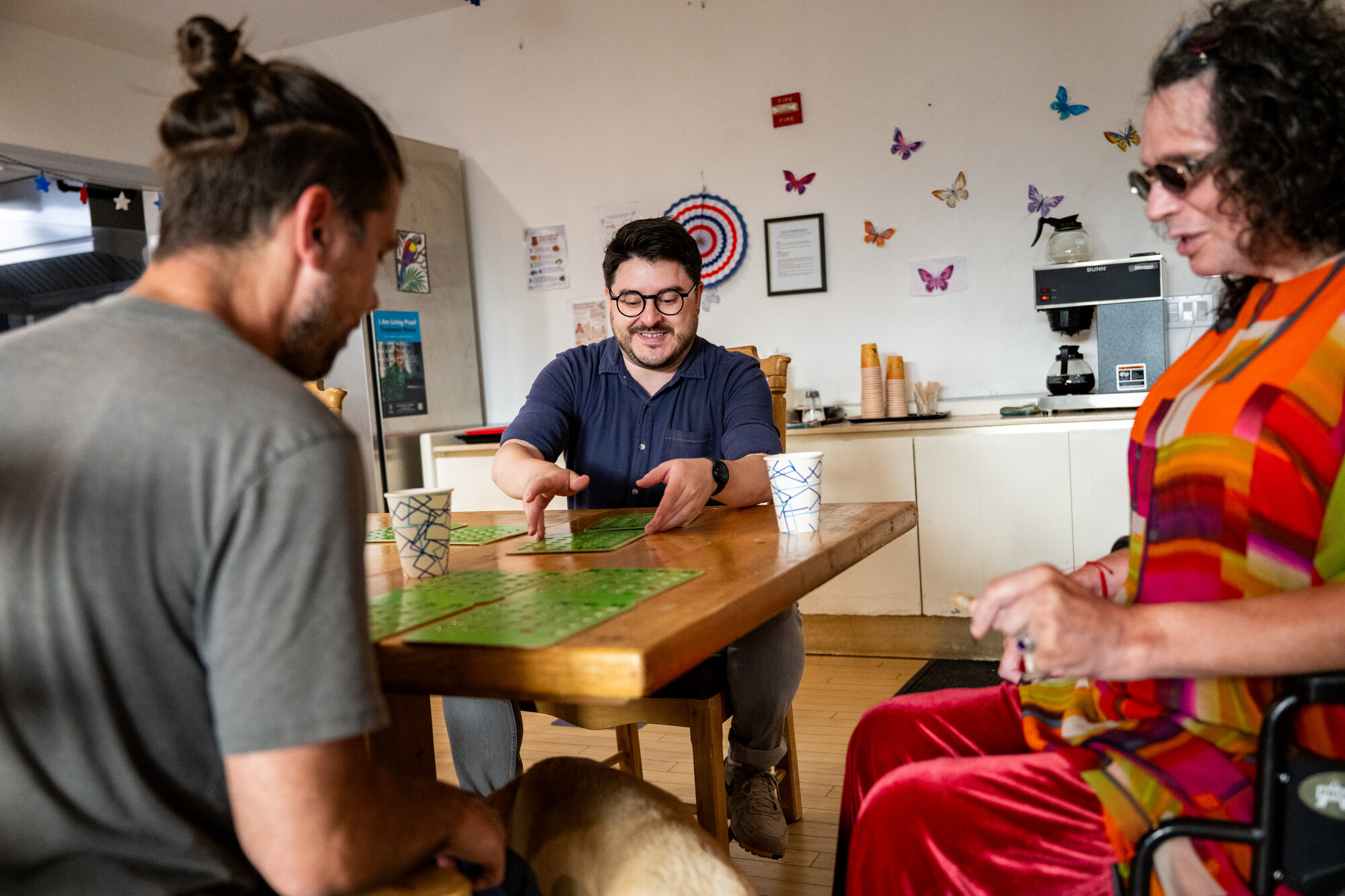
A Compassionate Care Center, Right in the Heart of San Francisco
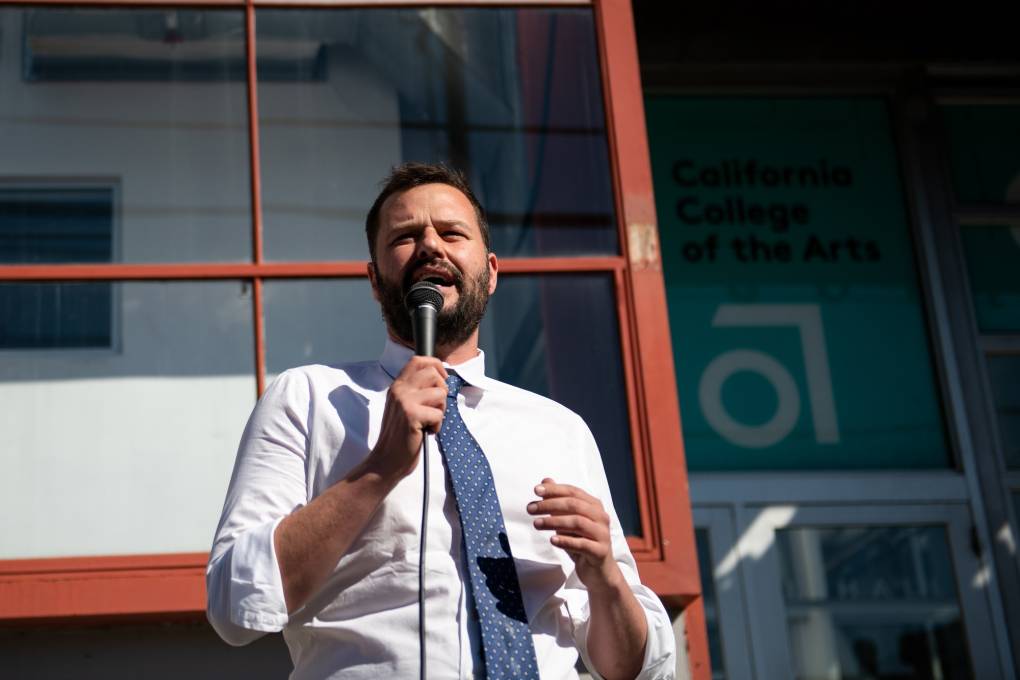
California Lawmakers Push to Protect Free HIV Prevention Amid Legal Threats
The SF-to-LA AIDS/LifeCycle Ride Is Ending, But the ‘Love Bubble’ Community Lives on
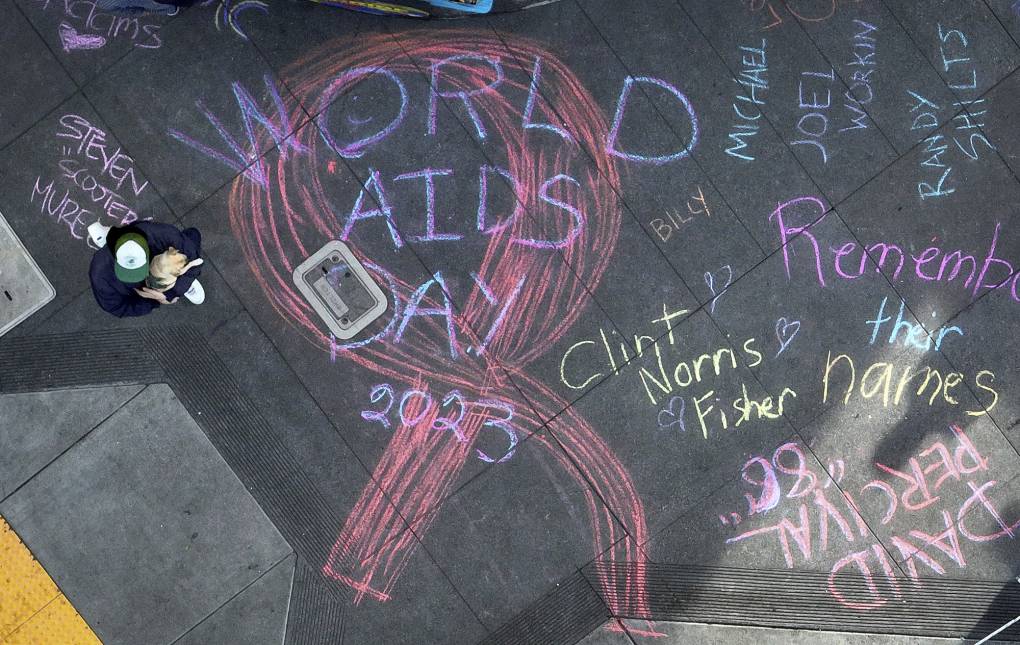
SF Reports Latinx Majority in New HIV Diagnoses Despite Overall Drop
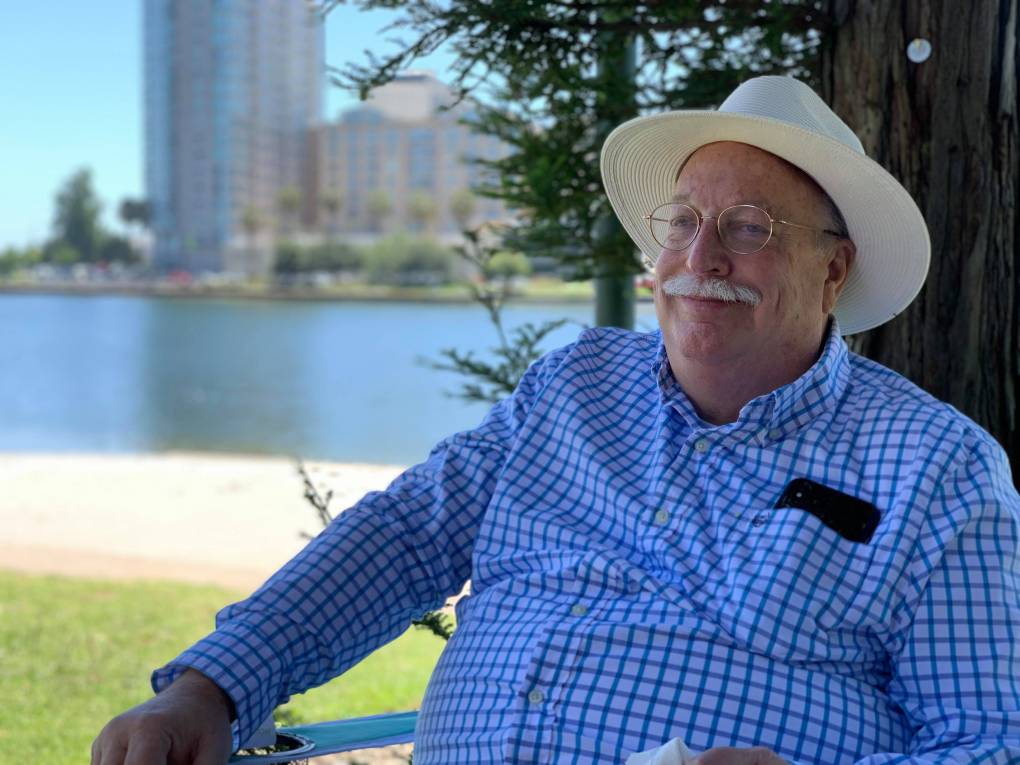
The Marijuana Minister of the Castro
SF Pride 2023: Celebrating the LGBTQ+ Community and Activism
Preparing for California's 'Big Melt' | AIDS/LifeCycle
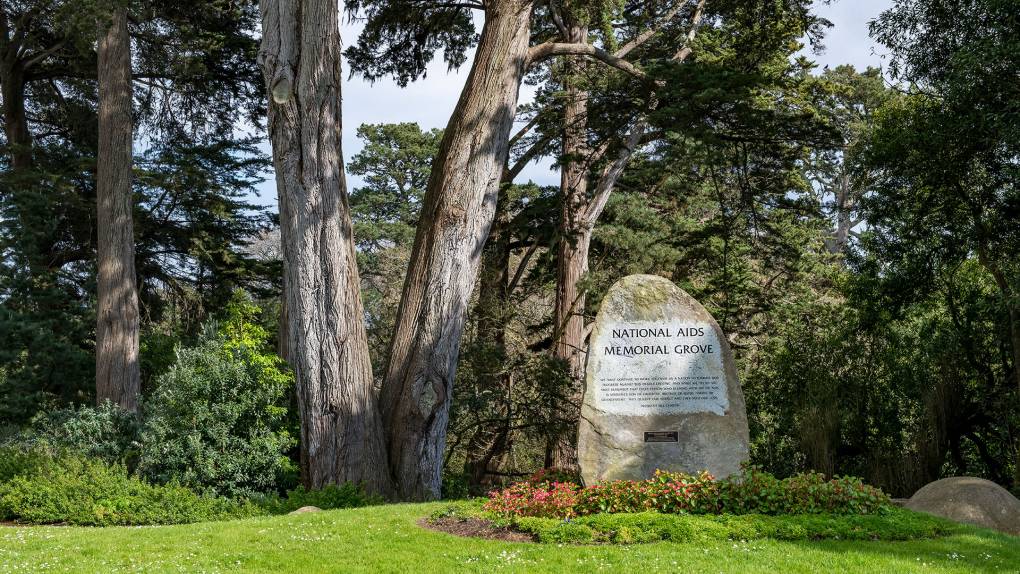
Healing Through Nature at the National AIDS Memorial Grove
Protecting the Immunocompromised Against COVID Could Be Key to Ending the Pandemic
Sponsored
Player sponsored by
window.__IS_SSR__=true
window.__INITIAL_STATE__={
"attachmentsReducer": {
"audio_0": {
"type": "attachments",
"id": "audio_0",
"imgSizes": {
"kqedFullSize": {
"file": "https://ww2.kqed.org/news/wp-content/themes/KQED-unified/img/audio_bgs/background0.jpg"
}
}
},
"audio_1": {
"type": "attachments",
"id": "audio_1",
"imgSizes": {
"kqedFullSize": {
"file": "https://ww2.kqed.org/news/wp-content/themes/KQED-unified/img/audio_bgs/background1.jpg"
}
}
},
"audio_2": {
"type": "attachments",
"id": "audio_2",
"imgSizes": {
"kqedFullSize": {
"file": "https://ww2.kqed.org/news/wp-content/themes/KQED-unified/img/audio_bgs/background2.jpg"
}
}
},
"audio_3": {
"type": "attachments",
"id": "audio_3",
"imgSizes": {
"kqedFullSize": {
"file": "https://ww2.kqed.org/news/wp-content/themes/KQED-unified/img/audio_bgs/background3.jpg"
}
}
},
"audio_4": {
"type": "attachments",
"id": "audio_4",
"imgSizes": {
"kqedFullSize": {
"file": "https://ww2.kqed.org/news/wp-content/themes/KQED-unified/img/audio_bgs/background4.jpg"
}
}
},
"placeholder": {
"type": "attachments",
"id": "placeholder",
"imgSizes": {
"thumbnail": {
"file": "https://cdn.kqed.org/wp-content/uploads/2024/12/KQED-Default-Image-816638274-2000x1333-1-160x107.jpg",
"width": 160,
"height": 107,
"mimeType": "image/jpeg"
},
"medium": {
"file": "https://cdn.kqed.org/wp-content/uploads/2024/12/KQED-Default-Image-816638274-2000x1333-1-800x533.jpg",
"width": 800,
"height": 533,
"mimeType": "image/jpeg"
},
"medium_large": {
"file": "https://cdn.kqed.org/wp-content/uploads/2024/12/KQED-Default-Image-816638274-2000x1333-1-768x512.jpg",
"width": 768,
"height": 512,
"mimeType": "image/jpeg"
},
"large": {
"file": "https://cdn.kqed.org/wp-content/uploads/2024/12/KQED-Default-Image-816638274-2000x1333-1-1020x680.jpg",
"width": 1020,
"height": 680,
"mimeType": "image/jpeg"
},
"1536x1536": {
"file": "https://cdn.kqed.org/wp-content/uploads/2024/12/KQED-Default-Image-816638274-2000x1333-1-1536x1024.jpg",
"width": 1536,
"height": 1024,
"mimeType": "image/jpeg"
},
"fd-lrg": {
"file": "https://cdn.kqed.org/wp-content/uploads/2024/12/KQED-Default-Image-816638274-2000x1333-1-1536x1024.jpg",
"width": 1536,
"height": 1024,
"mimeType": "image/jpeg"
},
"fd-med": {
"file": "https://cdn.kqed.org/wp-content/uploads/2024/12/KQED-Default-Image-816638274-2000x1333-1-1020x680.jpg",
"width": 1020,
"height": 680,
"mimeType": "image/jpeg"
},
"fd-sm": {
"file": "https://cdn.kqed.org/wp-content/uploads/2024/12/KQED-Default-Image-816638274-2000x1333-1-800x533.jpg",
"width": 800,
"height": 533,
"mimeType": "image/jpeg"
},
"post-thumbnail": {
"file": "https://cdn.kqed.org/wp-content/uploads/2024/12/KQED-Default-Image-816638274-2000x1333-1-672x372.jpg",
"width": 672,
"height": 372,
"mimeType": "image/jpeg"
},
"twentyfourteen-full-width": {
"file": "https://cdn.kqed.org/wp-content/uploads/2024/12/KQED-Default-Image-816638274-2000x1333-1-1038x576.jpg",
"width": 1038,
"height": 576,
"mimeType": "image/jpeg"
},
"xxsmall": {
"file": "https://cdn.kqed.org/wp-content/uploads/2024/12/KQED-Default-Image-816638274-2000x1333-1-160x107.jpg",
"width": 160,
"height": 107,
"mimeType": "image/jpeg"
},
"xsmall": {
"file": "https://cdn.kqed.org/wp-content/uploads/2024/12/KQED-Default-Image-816638274-2000x1333-1-672x372.jpg",
"width": 672,
"height": 372,
"mimeType": "image/jpeg"
},
"small": {
"file": "https://cdn.kqed.org/wp-content/uploads/2024/12/KQED-Default-Image-816638274-2000x1333-1-672x372.jpg",
"width": 672,
"height": 372,
"mimeType": "image/jpeg"
},
"xlarge": {
"file": "https://cdn.kqed.org/wp-content/uploads/2024/12/KQED-Default-Image-816638274-2000x1333-1-1020x680.jpg",
"width": 1020,
"height": 680,
"mimeType": "image/jpeg"
},
"full-width": {
"file": "https://cdn.kqed.org/wp-content/uploads/2024/12/KQED-Default-Image-816638274-2000x1333-1-1920x1280.jpg",
"width": 1920,
"height": 1280,
"mimeType": "image/jpeg"
},
"guest-author-32": {
"file": "https://cdn.kqed.org/wp-content/uploads/2025/01/KQED-Default-Image-816638274-1333x1333-1-160x160.jpg",
"width": 32,
"height": 32,
"mimeType": "image/jpeg"
},
"guest-author-50": {
"file": "https://cdn.kqed.org/wp-content/uploads/2025/01/KQED-Default-Image-816638274-1333x1333-1-160x160.jpg",
"width": 50,
"height": 50,
"mimeType": "image/jpeg"
},
"guest-author-64": {
"file": "https://cdn.kqed.org/wp-content/uploads/2025/01/KQED-Default-Image-816638274-1333x1333-1-160x160.jpg",
"width": 64,
"height": 64,
"mimeType": "image/jpeg"
},
"guest-author-96": {
"file": "https://cdn.kqed.org/wp-content/uploads/2025/01/KQED-Default-Image-816638274-1333x1333-1-160x160.jpg",
"width": 96,
"height": 96,
"mimeType": "image/jpeg"
},
"guest-author-128": {
"file": "https://cdn.kqed.org/wp-content/uploads/2025/01/KQED-Default-Image-816638274-1333x1333-1-160x160.jpg",
"width": 128,
"height": 128,
"mimeType": "image/jpeg"
},
"detail": {
"file": "https://cdn.kqed.org/wp-content/uploads/2025/01/KQED-Default-Image-816638274-1333x1333-1-160x160.jpg",
"width": 160,
"height": 160,
"mimeType": "image/jpeg"
},
"kqedFullSize": {
"file": "https://cdn.kqed.org/wp-content/uploads/2024/12/KQED-Default-Image-816638274-2000x1333-1.jpg",
"width": 2000,
"height": 1333
}
}
},
"news_12047822": {
"type": "attachments",
"id": "news_12047822",
"meta": {
"index": "attachments_1716263798",
"site": "news",
"id": "12047822",
"found": true
},
"title": "250709-MaitriCompassionateCare-17-BL_qed",
"publishDate": 1752281219,
"status": "inherit",
"parent": 0,
"modified": 1752281523,
"caption": "Development Director Tomas Moreno (center) plays bingo with residents and volunteers at Maitri Compassionate Care in San Francisco on July 9, 2025. The center provides residential hospice, respite, and medical care.",
"credit": "Beth LaBerge/KQED",
"altTag": null,
"description": null,
"imgSizes": {
"thumbnail": {
"file": "https://cdn.kqed.org/wp-content/uploads/sites/10/2025/07/250709-MaitriCompassionateCare-17-BL_qed-160x107.jpg",
"width": 160,
"height": 107,
"mimeType": "image/jpeg"
},
"1536x1536": {
"file": "https://cdn.kqed.org/wp-content/uploads/sites/10/2025/07/250709-MaitriCompassionateCare-17-BL_qed-1536x1024.jpg",
"width": 1536,
"height": 1024,
"mimeType": "image/jpeg"
},
"post-thumbnail": {
"file": "https://cdn.kqed.org/wp-content/uploads/sites/10/2025/07/250709-MaitriCompassionateCare-17-BL_qed-672x372.jpg",
"width": 672,
"height": 372,
"mimeType": "image/jpeg"
},
"twentyfourteen-full-width": {
"file": "https://cdn.kqed.org/wp-content/uploads/sites/10/2025/07/250709-MaitriCompassionateCare-17-BL_qed-1038x576.jpg",
"width": 1038,
"height": 576,
"mimeType": "image/jpeg"
},
"kqedFullSize": {
"file": "https://cdn.kqed.org/wp-content/uploads/sites/10/2025/07/250709-MaitriCompassionateCare-17-BL_qed.jpg",
"width": 2000,
"height": 1333
}
},
"fetchFailed": false,
"isLoading": false
},
"news_11993605": {
"type": "attachments",
"id": "news_11993605",
"meta": {
"index": "attachments_1716263798",
"site": "news",
"id": "11993605",
"found": true
},
"title": "013_SanFrancisco_CCAStrike_02082022",
"publishDate": 1720715147,
"status": "inherit",
"parent": 11993603,
"modified": 1720808080,
"caption": "California’s political watchdog agency is investigating potential violations of state law by the campaign of Assemblymember Matt Haney.",
"credit": "Beth LaBerge/KQED",
"altTag": null,
"description": null,
"imgSizes": {
"medium": {
"file": "https://cdn.kqed.org/wp-content/uploads/sites/10/2024/07/013_SanFrancisco_CCAStrike_02082022-800x533.jpg",
"width": 800,
"height": 533,
"mimeType": "image/jpeg"
},
"large": {
"file": "https://cdn.kqed.org/wp-content/uploads/sites/10/2024/07/013_SanFrancisco_CCAStrike_02082022-1020x680.jpg",
"width": 1020,
"height": 680,
"mimeType": "image/jpeg"
},
"thumbnail": {
"file": "https://cdn.kqed.org/wp-content/uploads/sites/10/2024/07/013_SanFrancisco_CCAStrike_02082022-160x107.jpg",
"width": 160,
"height": 107,
"mimeType": "image/jpeg"
},
"1536x1536": {
"file": "https://cdn.kqed.org/wp-content/uploads/sites/10/2024/07/013_SanFrancisco_CCAStrike_02082022-1536x1024.jpg",
"width": 1536,
"height": 1024,
"mimeType": "image/jpeg"
},
"post-thumbnail": {
"file": "https://cdn.kqed.org/wp-content/uploads/sites/10/2024/07/013_SanFrancisco_CCAStrike_02082022-672x372.jpg",
"width": 672,
"height": 372,
"mimeType": "image/jpeg"
},
"twentyfourteen-full-width": {
"file": "https://cdn.kqed.org/wp-content/uploads/sites/10/2024/07/013_SanFrancisco_CCAStrike_02082022-1038x576.jpg",
"width": 1038,
"height": 576,
"mimeType": "image/jpeg"
},
"full-width": {
"file": "https://cdn.kqed.org/wp-content/uploads/sites/10/2024/07/013_SanFrancisco_CCAStrike_02082022-1920x1280.jpg",
"width": 1920,
"height": 1280,
"mimeType": "image/jpeg"
},
"kqedFullSize": {
"file": "https://cdn.kqed.org/wp-content/uploads/sites/10/2024/07/013_SanFrancisco_CCAStrike_02082022.jpg",
"width": 2000,
"height": 1333
}
},
"fetchFailed": false,
"isLoading": false
},
"news_12004551": {
"type": "attachments",
"id": "news_12004551",
"meta": {
"index": "attachments_1716263798",
"site": "news",
"id": "12004551",
"found": true
},
"title": "AIDS/LIFECYCLE 2024",
"publishDate": 1726174450,
"status": "inherit",
"parent": 12004482,
"modified": 1726181688,
"caption": "Riders cross the finish line on day 7 of the AIDS/LifeCycle ride in Santa Monica on June 8, 2024. After 30 years of promoting AIDS awareness and raising money, AIDS/LifeCycle has announced that next year’s annual bike ride will be the last.",
"credit": "Courtesy SF AIDS Foundation",
"altTag": null,
"description": null,
"imgSizes": {
"medium": {
"file": "https://cdn.kqed.org/wp-content/uploads/sites/10/2024/09/AIDSLifecycle1-800x533.jpg",
"width": 800,
"height": 533,
"mimeType": "image/jpeg"
},
"large": {
"file": "https://cdn.kqed.org/wp-content/uploads/sites/10/2024/09/AIDSLifecycle1-1020x680.jpg",
"width": 1020,
"height": 680,
"mimeType": "image/jpeg"
},
"thumbnail": {
"file": "https://cdn.kqed.org/wp-content/uploads/sites/10/2024/09/AIDSLifecycle1-160x107.jpg",
"width": 160,
"height": 107,
"mimeType": "image/jpeg"
},
"1536x1536": {
"file": "https://cdn.kqed.org/wp-content/uploads/sites/10/2024/09/AIDSLifecycle1-1536x1024.jpg",
"width": 1536,
"height": 1024,
"mimeType": "image/jpeg"
},
"post-thumbnail": {
"file": "https://cdn.kqed.org/wp-content/uploads/sites/10/2024/09/AIDSLifecycle1-672x372.jpg",
"width": 672,
"height": 372,
"mimeType": "image/jpeg"
},
"twentyfourteen-full-width": {
"file": "https://cdn.kqed.org/wp-content/uploads/sites/10/2024/09/AIDSLifecycle1-1038x576.jpg",
"width": 1038,
"height": 576,
"mimeType": "image/jpeg"
},
"full-width": {
"file": "https://cdn.kqed.org/wp-content/uploads/sites/10/2024/09/AIDSLifecycle1-1920x1280.jpg",
"width": 1920,
"height": 1280,
"mimeType": "image/jpeg"
},
"kqedFullSize": {
"file": "https://cdn.kqed.org/wp-content/uploads/sites/10/2024/09/AIDSLifecycle1.jpg",
"width": 2000,
"height": 1333
}
},
"fetchFailed": false,
"isLoading": false
},
"news_11969002": {
"type": "attachments",
"id": "news_11969002",
"meta": {
"index": "attachments_1716263798",
"site": "news",
"id": "11969002",
"found": true
},
"parent": 0,
"imgSizes": {
"twentyfourteen-full-width": {
"file": "https://ww2.kqed.org/app/uploads/sites/10/2023/12/231204-WORLD-AIDS-DAY-GETTY-JS-KQED-1038x576.jpg",
"width": 1038,
"mimeType": "image/jpeg",
"height": 576
},
"thumbnail": {
"file": "https://ww2.kqed.org/app/uploads/sites/10/2023/12/231204-WORLD-AIDS-DAY-GETTY-JS-KQED-160x101.jpg",
"width": 160,
"mimeType": "image/jpeg",
"height": 101
},
"post-thumbnail": {
"file": "https://ww2.kqed.org/app/uploads/sites/10/2023/12/231204-WORLD-AIDS-DAY-GETTY-JS-KQED-672x372.jpg",
"width": 672,
"mimeType": "image/jpeg",
"height": 372
},
"kqedFullSize": {
"file": "https://ww2.kqed.org/app/uploads/sites/10/2023/12/231204-WORLD-AIDS-DAY-GETTY-JS-KQED.jpg",
"width": 2000,
"height": 1265
},
"large": {
"file": "https://ww2.kqed.org/app/uploads/sites/10/2023/12/231204-WORLD-AIDS-DAY-GETTY-JS-KQED-1020x645.jpg",
"width": 1020,
"mimeType": "image/jpeg",
"height": 645
},
"1536x1536": {
"file": "https://ww2.kqed.org/app/uploads/sites/10/2023/12/231204-WORLD-AIDS-DAY-GETTY-JS-KQED-1536x972.jpg",
"width": 1536,
"mimeType": "image/jpeg",
"height": 972
},
"full-width": {
"file": "https://ww2.kqed.org/app/uploads/sites/10/2023/12/231204-WORLD-AIDS-DAY-GETTY-JS-KQED-1920x1214.jpg",
"width": 1920,
"mimeType": "image/jpeg",
"height": 1214
},
"medium": {
"file": "https://ww2.kqed.org/app/uploads/sites/10/2023/12/231204-WORLD-AIDS-DAY-GETTY-JS-KQED-800x506.jpg",
"width": 800,
"mimeType": "image/jpeg",
"height": 506
}
},
"publishDate": 1701736984,
"modified": 1701751509,
"caption": "The names of the victims of AIDS are seen written in chalk on Castro Street in San Francisco on Dec. 1, 2023.",
"description": null,
"title": "World Aids Day Marked In San Francisco",
"credit": "Justin Sullivan/Getty Images",
"status": "inherit",
"altTag": "A large red ribbon and several names are written in chalk on a sidewalk.",
"fetchFailed": false,
"isLoading": false
},
"news_11903117": {
"type": "attachments",
"id": "news_11903117",
"meta": {
"index": "attachments_1716263798",
"site": "news",
"id": "11903117",
"found": true
},
"parent": 11902998,
"imgSizes": {
"twentyfourteen-full-width": {
"file": "https://ww2.kqed.org/app/uploads/sites/10/2022/01/194146336_326107285562520_8338172634866005523_n-1038x576.jpg",
"width": 1038,
"mimeType": "image/jpeg",
"height": 576
},
"thumbnail": {
"file": "https://ww2.kqed.org/app/uploads/sites/10/2022/01/194146336_326107285562520_8338172634866005523_n-160x120.jpg",
"width": 160,
"mimeType": "image/jpeg",
"height": 120
},
"post-thumbnail": {
"file": "https://ww2.kqed.org/app/uploads/sites/10/2022/01/194146336_326107285562520_8338172634866005523_n-672x372.jpg",
"width": 672,
"mimeType": "image/jpeg",
"height": 372
},
"kqedFullSize": {
"file": "https://ww2.kqed.org/app/uploads/sites/10/2022/01/194146336_326107285562520_8338172634866005523_n-scaled.jpg",
"width": 2560,
"height": 1920
},
"2048x2048": {
"file": "https://ww2.kqed.org/app/uploads/sites/10/2022/01/194146336_326107285562520_8338172634866005523_n-2048x1536.jpg",
"width": 2048,
"mimeType": "image/jpeg",
"height": 1536
},
"large": {
"file": "https://ww2.kqed.org/app/uploads/sites/10/2022/01/194146336_326107285562520_8338172634866005523_n-1020x765.jpg",
"width": 1020,
"mimeType": "image/jpeg",
"height": 765
},
"1536x1536": {
"file": "https://ww2.kqed.org/app/uploads/sites/10/2022/01/194146336_326107285562520_8338172634866005523_n-1536x1152.jpg",
"width": 1536,
"mimeType": "image/jpeg",
"height": 1152
},
"full-width": {
"file": "https://ww2.kqed.org/app/uploads/sites/10/2022/01/194146336_326107285562520_8338172634866005523_n-1920x1440.jpg",
"width": 1920,
"mimeType": "image/jpeg",
"height": 1440
},
"medium": {
"file": "https://ww2.kqed.org/app/uploads/sites/10/2022/01/194146336_326107285562520_8338172634866005523_n-800x600.jpg",
"width": 800,
"mimeType": "image/jpeg",
"height": 600
}
},
"publishDate": 1643394827,
"modified": 1643403729,
"caption": "Rev. Jim Mitulski at Lake Merritt in Oakland in 2021.",
"description": null,
"title": "194146336_326107285562520_8338172634866005523_n",
"credit": "Courtesy of Todd Atkins-Whitley",
"status": "inherit",
"altTag": "A man sitting outside on a chair by a lake.",
"fetchFailed": false,
"isLoading": false
},
"news_11676953": {
"type": "attachments",
"id": "news_11676953",
"meta": {
"index": "attachments_1716263798",
"site": "news",
"id": "11676953",
"found": true
},
"parent": 11676842,
"imgSizes": {
"small": {
"file": "https://ww2.kqed.org/app/uploads/sites/10/2018/06/RS31561_62418_AW_Pride_09-qut-520x347.jpg",
"width": 520,
"mimeType": "image/jpeg",
"height": 347
},
"twentyfourteen-full-width": {
"file": "https://ww2.kqed.org/app/uploads/sites/10/2018/06/RS31561_62418_AW_Pride_09-qut-1038x576.jpg",
"width": 1038,
"mimeType": "image/jpeg",
"height": 576
},
"thumbnail": {
"file": "https://ww2.kqed.org/app/uploads/sites/10/2018/06/RS31561_62418_AW_Pride_09-qut-160x107.jpg",
"width": 160,
"mimeType": "image/jpeg",
"height": 107
},
"fd-sm": {
"file": "https://ww2.kqed.org/app/uploads/sites/10/2018/06/RS31561_62418_AW_Pride_09-qut-960x640.jpg",
"width": 960,
"mimeType": "image/jpeg",
"height": 640
},
"post-thumbnail": {
"file": "https://ww2.kqed.org/app/uploads/sites/10/2018/06/RS31561_62418_AW_Pride_09-qut-672x372.jpg",
"width": 672,
"mimeType": "image/jpeg",
"height": 372
},
"xsmall": {
"file": "https://ww2.kqed.org/app/uploads/sites/10/2018/06/RS31561_62418_AW_Pride_09-qut-375x250.jpg",
"width": 375,
"mimeType": "image/jpeg",
"height": 250
},
"kqedFullSize": {
"file": "https://ww2.kqed.org/app/uploads/sites/10/2018/06/RS31561_62418_AW_Pride_09-qut.jpg",
"width": 1920,
"height": 1280
},
"large": {
"file": "https://ww2.kqed.org/app/uploads/sites/10/2018/06/RS31561_62418_AW_Pride_09-qut-1020x680.jpg",
"width": 1020,
"mimeType": "image/jpeg",
"height": 680
},
"xlarge": {
"file": "https://ww2.kqed.org/app/uploads/sites/10/2018/06/RS31561_62418_AW_Pride_09-qut-1180x787.jpg",
"width": 1180,
"mimeType": "image/jpeg",
"height": 787
},
"complete_open_graph": {
"file": "https://ww2.kqed.org/app/uploads/sites/10/2018/06/RS31561_62418_AW_Pride_09-qut-1200x800.jpg",
"width": 1200,
"mimeType": "image/jpeg",
"height": 800
},
"guest-author-50": {
"file": "https://ww2.kqed.org/app/uploads/sites/10/2018/06/RS31561_62418_AW_Pride_09-qut-50x50.jpg",
"width": 50,
"mimeType": "image/jpeg",
"height": 50
},
"guest-author-96": {
"file": "https://ww2.kqed.org/app/uploads/sites/10/2018/06/RS31561_62418_AW_Pride_09-qut-96x96.jpg",
"width": 96,
"mimeType": "image/jpeg",
"height": 96
},
"medium": {
"file": "https://ww2.kqed.org/app/uploads/sites/10/2018/06/RS31561_62418_AW_Pride_09-qut-800x533.jpg",
"width": 800,
"mimeType": "image/jpeg",
"height": 533
},
"guest-author-64": {
"file": "https://ww2.kqed.org/app/uploads/sites/10/2018/06/RS31561_62418_AW_Pride_09-qut-64x64.jpg",
"width": 64,
"mimeType": "image/jpeg",
"height": 64
},
"guest-author-32": {
"file": "https://ww2.kqed.org/app/uploads/sites/10/2018/06/RS31561_62418_AW_Pride_09-qut-32x32.jpg",
"width": 32,
"mimeType": "image/jpeg",
"height": 32
},
"fd-lrg": {
"file": "https://ww2.kqed.org/app/uploads/sites/10/2018/06/RS31561_62418_AW_Pride_09-qut-1920x1280.jpg",
"width": 1920,
"mimeType": "image/jpeg",
"height": 1280
},
"fd-med": {
"file": "https://ww2.kqed.org/app/uploads/sites/10/2018/06/RS31561_62418_AW_Pride_09-qut-1180x787.jpg",
"width": 1180,
"mimeType": "image/jpeg",
"height": 787
},
"full-width": {
"file": "https://ww2.kqed.org/app/uploads/sites/10/2018/06/RS31561_62418_AW_Pride_09-qut-1920x1280.jpg",
"width": 1920,
"mimeType": "image/jpeg",
"height": 1280
},
"detail": {
"file": "https://ww2.kqed.org/app/uploads/sites/10/2018/06/RS31561_62418_AW_Pride_09-qut-150x150.jpg",
"width": 150,
"mimeType": "image/jpeg",
"height": 150
},
"guest-author-128": {
"file": "https://ww2.kqed.org/app/uploads/sites/10/2018/06/RS31561_62418_AW_Pride_09-qut-128x128.jpg",
"width": 128,
"mimeType": "image/jpeg",
"height": 128
},
"xxsmall": {
"file": "https://ww2.kqed.org/app/uploads/sites/10/2018/06/RS31561_62418_AW_Pride_09-qut-240x160.jpg",
"width": 240,
"mimeType": "image/jpeg",
"height": 160
}
},
"publishDate": 1529887986,
"modified": 1687467006,
"caption": "Organizers estimated 50,000 people participated in the San Francisco Pride Parade on June 24, 2018, in addition to 100,000 who watched from the sidelines.",
"description": "Organizers estimate 50,000 people participated in Sunday's San Francisco Pride Parade, in addition to 100,000 who watched from the sidelines.",
"title": "RS31561_62418_AW_Pride_09-qut",
"credit": "Anne Wernikoff/KQED",
"status": "inherit",
"altTag": "A scene of the Pride parade on Market Street in San Francisco. In the foreground is a white woman wearing rose-colored glasses and holding a rainbow flag with both hands above her head. She is surrounded by other marchers and towers of green and orange balloons. It is sunny, and this is a joyful scene, as the woman is smiling broadly.",
"fetchFailed": false,
"isLoading": false
},
"news_11948076": {
"type": "attachments",
"id": "news_11948076",
"meta": {
"index": "attachments_1716263798",
"site": "news",
"id": "11948076",
"found": true
},
"parent": 11948072,
"imgSizes": {
"twentyfourteen-full-width": {
"file": "https://ww2.kqed.org/app/uploads/sites/10/2023/04/AIDS_LifeCycle-1038x576.png",
"width": 1038,
"mimeType": "image/png",
"height": 576
},
"thumbnail": {
"file": "https://ww2.kqed.org/app/uploads/sites/10/2023/04/AIDS_LifeCycle-160x90.png",
"width": 160,
"mimeType": "image/png",
"height": 90
},
"post-thumbnail": {
"file": "https://ww2.kqed.org/app/uploads/sites/10/2023/04/AIDS_LifeCycle-672x372.png",
"width": 672,
"mimeType": "image/png",
"height": 372
},
"kqedFullSize": {
"file": "https://ww2.kqed.org/app/uploads/sites/10/2023/04/AIDS_LifeCycle.png",
"width": 1920,
"height": 1080
},
"large": {
"file": "https://ww2.kqed.org/app/uploads/sites/10/2023/04/AIDS_LifeCycle-1020x574.png",
"width": 1020,
"mimeType": "image/png",
"height": 574
},
"1536x1536": {
"file": "https://ww2.kqed.org/app/uploads/sites/10/2023/04/AIDS_LifeCycle-1536x864.png",
"width": 1536,
"mimeType": "image/png",
"height": 864
},
"medium": {
"file": "https://ww2.kqed.org/app/uploads/sites/10/2023/04/AIDS_LifeCycle-800x450.png",
"width": 800,
"mimeType": "image/png",
"height": 450
}
},
"publishDate": 1682719914,
"modified": 1682719914,
"caption": null,
"description": null,
"title": "AIDS_LifeCycle",
"credit": null,
"status": "inherit",
"altTag": null,
"fetchFailed": false,
"isLoading": false
},
"news_11915794": {
"type": "attachments",
"id": "news_11915794",
"meta": {
"index": "attachments_1716263798",
"site": "news",
"id": "11915794",
"found": true
},
"parent": 11915788,
"imgSizes": {
"twentyfourteen-full-width": {
"file": "https://ww2.kqed.org/app/uploads/sites/10/2022/06/AIDS-grove1-1038x576.jpg",
"width": 1038,
"mimeType": "image/jpeg",
"height": 576
},
"thumbnail": {
"file": "https://ww2.kqed.org/app/uploads/sites/10/2022/06/AIDS-grove1-160x90.jpg",
"width": 160,
"mimeType": "image/jpeg",
"height": 90
},
"post-thumbnail": {
"file": "https://ww2.kqed.org/app/uploads/sites/10/2022/06/AIDS-grove1-672x372.jpg",
"width": 672,
"mimeType": "image/jpeg",
"height": 372
},
"kqedFullSize": {
"file": "https://ww2.kqed.org/app/uploads/sites/10/2022/06/AIDS-grove1.jpg",
"width": 1920,
"height": 1080
},
"large": {
"file": "https://ww2.kqed.org/app/uploads/sites/10/2022/06/AIDS-grove1-1020x574.jpg",
"width": 1020,
"mimeType": "image/jpeg",
"height": 574
},
"1536x1536": {
"file": "https://ww2.kqed.org/app/uploads/sites/10/2022/06/AIDS-grove1-1536x864.jpg",
"width": 1536,
"mimeType": "image/jpeg",
"height": 864
},
"medium": {
"file": "https://ww2.kqed.org/app/uploads/sites/10/2022/06/AIDS-grove1-800x450.jpg",
"width": 800,
"mimeType": "image/jpeg",
"height": 450
}
},
"publishDate": 1654131434,
"modified": 1654284508,
"caption": "A stone marks the entrance of the AIDS Memorial Grove. Visitors walk down a set of long stairs, through the trees and into the dell.",
"description": null,
"title": "AIDS-grove1",
"credit": "Courtesy of National AIDS Memorial",
"status": "inherit",
"altTag": "In the middle of a grassy knoll, flanked by tall trees, a stone proclaims \"National AIDS Memorial Grove.\"",
"fetchFailed": false,
"isLoading": false
},
"news_11879763": {
"type": "attachments",
"id": "news_11879763",
"meta": {
"index": "attachments_1716263798",
"site": "news",
"id": "11879763",
"found": true
},
"parent": 11879762,
"imgSizes": {
"twentyfourteen-full-width": {
"file": "https://ww2.kqed.org/app/uploads/sites/10/2021/06/gettyimages-1134490895-43-151d9078b33256e7e23d6a620a0205da5f0df640-1038x576.jpg",
"width": 1038,
"mimeType": "image/jpeg",
"height": 576
},
"thumbnail": {
"file": "https://ww2.kqed.org/app/uploads/sites/10/2021/06/gettyimages-1134490895-43-151d9078b33256e7e23d6a620a0205da5f0df640-160x120.jpg",
"width": 160,
"mimeType": "image/jpeg",
"height": 120
},
"post-thumbnail": {
"file": "https://ww2.kqed.org/app/uploads/sites/10/2021/06/gettyimages-1134490895-43-151d9078b33256e7e23d6a620a0205da5f0df640-672x372.jpg",
"width": 672,
"mimeType": "image/jpeg",
"height": 372
},
"kqedFullSize": {
"file": "https://ww2.kqed.org/app/uploads/sites/10/2021/06/gettyimages-1134490895-43-151d9078b33256e7e23d6a620a0205da5f0df640-scaled.jpg",
"width": 2560,
"height": 1919
},
"2048x2048": {
"file": "https://ww2.kqed.org/app/uploads/sites/10/2021/06/gettyimages-1134490895-43-151d9078b33256e7e23d6a620a0205da5f0df640-2048x1535.jpg",
"width": 2048,
"mimeType": "image/jpeg",
"height": 1535
},
"large": {
"file": "https://ww2.kqed.org/app/uploads/sites/10/2021/06/gettyimages-1134490895-43-151d9078b33256e7e23d6a620a0205da5f0df640-1020x765.jpg",
"width": 1020,
"mimeType": "image/jpeg",
"height": 765
},
"1536x1536": {
"file": "https://ww2.kqed.org/app/uploads/sites/10/2021/06/gettyimages-1134490895-43-151d9078b33256e7e23d6a620a0205da5f0df640-1536x1151.jpg",
"width": 1536,
"mimeType": "image/jpeg",
"height": 1151
},
"full-width": {
"file": "https://ww2.kqed.org/app/uploads/sites/10/2021/06/gettyimages-1134490895-43-151d9078b33256e7e23d6a620a0205da5f0df640-1920x1439.jpg",
"width": 1920,
"mimeType": "image/jpeg",
"height": 1439
},
"medium": {
"file": "https://ww2.kqed.org/app/uploads/sites/10/2021/06/gettyimages-1134490895-43-151d9078b33256e7e23d6a620a0205da5f0df640-800x600.jpg",
"width": 800,
"mimeType": "image/jpeg",
"height": 600
}
},
"publishDate": 1624998964,
"modified": 1624999333,
"caption": "HIV-1. Transmission electron micrograph. Cone-shaped cores are sectioned in various orientations. ",
"description": null,
"title": "A computer-enhanced image of the HIV virus.",
"credit": "Computer enhanced image from CDC",
"status": "inherit",
"altTag": null,
"fetchFailed": false,
"isLoading": false
}
},
"audioPlayerReducer": {
"postId": "stream_live",
"isPaused": true,
"isPlaying": false,
"pfsActive": false,
"pledgeModalIsOpen": true,
"playerDrawerIsOpen": false
},
"authorsReducer": {
"byline_news_11879762": {
"type": "authors",
"id": "byline_news_11879762",
"meta": {
"override": true
},
"slug": "byline_news_11879762",
"name": "Nurith Aizenman",
"isLoading": false
},
"astupi": {
"type": "authors",
"id": "70",
"meta": {
"index": "authors_1716337520",
"id": "70",
"found": true
},
"name": "Amanda Stupi",
"firstName": "Amanda",
"lastName": "Stupi",
"slug": "astupi",
"email": "astupi@kqed.org",
"display_author_email": false,
"staff_mastheads": [],
"title": "Senior Engagement Producer",
"bio": "Amanda joined KQED Science’s engagement team as a Senior Audience Engagement Strategist in the spring of 2019. She has helped craft messaging around wildfires, the coronavirus pandemic, climate change and many other stories. She has also brought KQED Science to new platforms such as Reddit’s Ask Me Anything series. Prior to joining KQED Science, Amanda spent seven years as an engagement producer with Forum, KQED’s daily live call-in show. She got her start in radio at KALW's weekly call in show, City Visions, before going on to an internship and stint at NPR's Talk of the Nation.\r\n\r\nPrior to journalism, Amanda taught English at Lowell High School. She's a native of Petaluma and currently lives under the \"South San Francisco the Industrial City\" sign in South City. She believes that engagement is vital to news’s future and that good journalism listens as much as it asks questions.",
"avatar": "https://secure.gravatar.com/avatar/e981c503e5c162da701dcaccfbf87e35?s=600&d=blank&r=g",
"twitter": null,
"facebook": null,
"instagram": null,
"linkedin": null,
"sites": [
{
"site": "arts",
"roles": [
"Contributor"
]
},
{
"site": "news",
"roles": [
"editor"
]
},
{
"site": "pop",
"roles": [
"contributor"
]
},
{
"site": "stateofhealth",
"roles": [
"editor"
]
},
{
"site": "science",
"roles": []
},
{
"site": "perspectives",
"roles": [
"editor"
]
}
],
"headData": {
"title": "Amanda Stupi | KQED",
"description": "Senior Engagement Producer",
"ogImgSrc": "https://secure.gravatar.com/avatar/e981c503e5c162da701dcaccfbf87e35?s=600&d=blank&r=g",
"twImgSrc": "https://secure.gravatar.com/avatar/e981c503e5c162da701dcaccfbf87e35?s=600&d=blank&r=g"
},
"isLoading": false,
"link": "/author/astupi"
},
"kqed": {
"type": "authors",
"id": "236",
"meta": {
"index": "authors_1716337520",
"id": "236",
"found": true
},
"name": "KQED News Staff",
"firstName": "KQED News Staff",
"lastName": null,
"slug": "kqed",
"email": "faq@kqed.org",
"display_author_email": false,
"staff_mastheads": [],
"title": null,
"bio": null,
"avatar": "https://secure.gravatar.com/avatar/ef0e801a68c4c54afa9180db14084167?s=600&d=blank&r=g",
"twitter": null,
"facebook": null,
"instagram": null,
"linkedin": null,
"sites": [
{
"site": "arts",
"roles": [
"contributor"
]
},
{
"site": "news",
"roles": [
"editor"
]
},
{
"site": "futureofyou",
"roles": [
"author"
]
}
],
"headData": {
"title": "KQED News Staff | KQED",
"description": null,
"ogImgSrc": "https://secure.gravatar.com/avatar/ef0e801a68c4c54afa9180db14084167?s=600&d=blank&r=g",
"twImgSrc": "https://secure.gravatar.com/avatar/ef0e801a68c4c54afa9180db14084167?s=600&d=blank&r=g"
},
"isLoading": false,
"link": "/author/kqed"
},
"carlysevern": {
"type": "authors",
"id": "3243",
"meta": {
"index": "authors_1716337520",
"id": "3243",
"found": true
},
"name": "Carly Severn",
"firstName": "Carly",
"lastName": "Severn",
"slug": "carlysevern",
"email": "csevern@kqed.org",
"display_author_email": false,
"staff_mastheads": [
"news"
],
"title": "Senior Editor, Audience News ",
"bio": "Carly is KQED's Senior Editor of Audience News on the Digital News team, and has reported for the California Report Magazine, Bay Curious and KQED Arts. She's formerly the host of \u003ca href=\"http://ww2.kqed.org/pop/category/the-cooler/\" rel=\"noopener noreferrer\">The Cooler\u003c/a> podcast.",
"avatar": "https://secure.gravatar.com/avatar/2d8d6765f186e64c798cf7f0c8088a41?s=600&d=blank&r=g",
"twitter": "teacupinthebay",
"facebook": null,
"instagram": null,
"linkedin": null,
"sites": [
{
"site": "",
"roles": [
"editor"
]
},
{
"site": "arts",
"roles": [
"editor"
]
},
{
"site": "news",
"roles": [
"administrator"
]
},
{
"site": "pop",
"roles": [
"editor"
]
},
{
"site": "futureofyou",
"roles": [
"editor"
]
},
{
"site": "about",
"roles": [
"administrator"
]
},
{
"site": "mindshift",
"roles": [
"editor"
]
},
{
"site": "bayareabites",
"roles": [
"editor"
]
},
{
"site": "stateofhealth",
"roles": [
"editor"
]
},
{
"site": "science",
"roles": [
"editor"
]
},
{
"site": "food",
"roles": [
"contributor"
]
},
{
"site": "forum",
"roles": [
"editor"
]
},
{
"site": "perspectives",
"roles": [
"administrator"
]
},
{
"site": "liveblog",
"roles": [
"editor"
]
}
],
"headData": {
"title": "Carly Severn | KQED",
"description": "Senior Editor, Audience News ",
"ogImgSrc": "https://secure.gravatar.com/avatar/2d8d6765f186e64c798cf7f0c8088a41?s=600&d=blank&r=g",
"twImgSrc": "https://secure.gravatar.com/avatar/2d8d6765f186e64c798cf7f0c8088a41?s=600&d=blank&r=g"
},
"isLoading": false,
"link": "/author/carlysevern"
},
"afont": {
"type": "authors",
"id": "8637",
"meta": {
"index": "authors_1716337520",
"id": "8637",
"found": true
},
"name": "Amanda Font",
"firstName": "Amanda",
"lastName": "Font",
"slug": "afont",
"email": "afont@kqed.org",
"display_author_email": false,
"staff_mastheads": [],
"title": "KQED Contributor",
"bio": "Amanda Font is a producer on \u003cem>The Latest\u003c/em> podcast, and the host and co-producer of the series \u003cem>Audible Cosmos\u003c/em>. She has previously worked as a producer and reporter on the \u003cem>Bay Curious\u003c/em> podcast, and director of \u003cem>The California Report Magazine\u003c/em>. She grew up in the deserts of Southern California and moved north for the trees. Amanda earned a B.A. from the BECA program at San Francisco State, where she worked in the university's radio station. Amanda Font is represented by SAG-AFTRA.",
"avatar": "https://secure.gravatar.com/avatar/d9e81cf0117d5849b9cfb7ab4b1422f1?s=600&d=blank&r=g",
"twitter": null,
"facebook": null,
"instagram": null,
"linkedin": null,
"sites": [
{
"site": "news",
"roles": [
"add_users",
"create_users"
]
},
{
"site": "science",
"roles": []
},
{
"site": "forum",
"roles": [
"administrator"
]
},
{
"site": "perspectives",
"roles": [
"administrator"
]
},
{
"site": "radio",
"roles": [
"administrator"
]
}
],
"headData": {
"title": "Amanda Font | KQED",
"description": "KQED Contributor",
"ogImgSrc": "https://secure.gravatar.com/avatar/d9e81cf0117d5849b9cfb7ab4b1422f1?s=600&d=blank&r=g",
"twImgSrc": "https://secure.gravatar.com/avatar/d9e81cf0117d5849b9cfb7ab4b1422f1?s=600&d=blank&r=g"
},
"isLoading": false,
"link": "/author/afont"
},
"kmoghadam": {
"type": "authors",
"id": "11637",
"meta": {
"index": "authors_1716337520",
"id": "11637",
"found": true
},
"name": "Kyana Moghadam",
"firstName": "Kyana",
"lastName": "Moghadam",
"slug": "kmoghadam",
"email": "kmoghadam@kqed.org",
"display_author_email": false,
"staff_mastheads": [
"news"
],
"title": "Senior Producer ",
"bio": "Kyana Moghadam is a senior producer at KQED. Prior to joining KQED, she was an audio producer and editor with Al Jazeera, Jetty Studios, VOX Media, Democracy Now!, and Global Press.",
"avatar": "https://secure.gravatar.com/avatar/c1b360e5608b20d071f0865012fc8a67?s=600&d=blank&r=g",
"twitter": null,
"facebook": null,
"instagram": null,
"linkedin": "https://www.linkedin.com/in/kyanamoghadam/",
"sites": [
{
"site": "",
"roles": [
"editor"
]
},
{
"site": "arts",
"roles": [
"editor"
]
},
{
"site": "news",
"roles": [
"administrator"
]
},
{
"site": "pop",
"roles": [
"editor"
]
},
{
"site": "about",
"roles": [
"editor"
]
},
{
"site": "forum",
"roles": [
"editor"
]
},
{
"site": "perspectives",
"roles": [
"editor"
]
},
{
"site": "podcasts",
"roles": [
"administrator"
]
}
],
"headData": {
"title": "Kyana Moghadam | KQED",
"description": "Senior Producer ",
"ogImgSrc": "https://secure.gravatar.com/avatar/c1b360e5608b20d071f0865012fc8a67?s=600&d=blank&r=g",
"twImgSrc": "https://secure.gravatar.com/avatar/c1b360e5608b20d071f0865012fc8a67?s=600&d=blank&r=g"
},
"isLoading": false,
"link": "/author/kmoghadam"
},
"ccabreralomeli": {
"type": "authors",
"id": "11708",
"meta": {
"index": "authors_1716337520",
"id": "11708",
"found": true
},
"name": "Carlos Cabrera-Lomelí",
"firstName": "Carlos",
"lastName": "Cabrera-Lomelí",
"slug": "ccabreralomeli",
"email": "ccabreralomeli@KQED.org",
"display_author_email": true,
"staff_mastheads": [
"news"
],
"title": "Community Reporter",
"bio": "Carlos Cabrera-Lomelí is a community reporter with KQED's digital engagement team. He also reports and co-produces for KQED's bilingual news hub KQED en Español. He grew up in San Francisco's Mission District and has previously worked with Univision, 48 Hills and REFORMA in Mexico City.",
"avatar": "https://secure.gravatar.com/avatar/e95ff80bb2eaf18a8f2af4dcf7ffb54b?s=600&d=mm&r=g",
"twitter": "@LomeliCabrera",
"facebook": null,
"instagram": null,
"linkedin": null,
"sites": [
{
"site": "arts",
"roles": [
"editor"
]
},
{
"site": "news",
"roles": [
"editor"
]
},
{
"site": "about",
"roles": [
"editor"
]
},
{
"site": "science",
"roles": [
"editor"
]
},
{
"site": "perspectives",
"roles": [
"editor"
]
},
{
"site": "elections",
"roles": [
"editor"
]
},
{
"site": "liveblog",
"roles": [
"contributor"
]
}
],
"headData": {
"title": "Carlos Cabrera-Lomelí | KQED",
"description": "Community Reporter",
"ogImgSrc": "https://secure.gravatar.com/avatar/e95ff80bb2eaf18a8f2af4dcf7ffb54b?s=600&d=mm&r=g",
"twImgSrc": "https://secure.gravatar.com/avatar/e95ff80bb2eaf18a8f2af4dcf7ffb54b?s=600&d=mm&r=g"
},
"isLoading": false,
"link": "/author/ccabreralomeli"
},
"jlara": {
"type": "authors",
"id": "11761",
"meta": {
"index": "authors_1716337520",
"id": "11761",
"found": true
},
"name": "Juan Carlos Lara",
"firstName": "Juan Carlos",
"lastName": "Lara",
"slug": "jlara",
"email": "jlara@kqed.org",
"display_author_email": false,
"staff_mastheads": [],
"title": "KQED Contributor",
"bio": null,
"avatar": "https://secure.gravatar.com/avatar/19e2052b9b05657c5ff2af2121846e9c?s=600&d=blank&r=g",
"twitter": null,
"facebook": null,
"instagram": null,
"linkedin": null,
"sites": [
{
"site": "arts",
"roles": [
"editor"
]
},
{
"site": "news",
"roles": [
"editor"
]
},
{
"site": "forum",
"roles": [
"editor"
]
},
{
"site": "liveblog",
"roles": [
"contributor"
]
}
],
"headData": {
"title": "Juan Carlos Lara | KQED",
"description": "KQED Contributor",
"ogImgSrc": "https://secure.gravatar.com/avatar/19e2052b9b05657c5ff2af2121846e9c?s=600&d=blank&r=g",
"twImgSrc": "https://secure.gravatar.com/avatar/19e2052b9b05657c5ff2af2121846e9c?s=600&d=blank&r=g"
},
"isLoading": false,
"link": "/author/jlara"
},
"sjohnson": {
"type": "authors",
"id": "11840",
"meta": {
"index": "authors_1716337520",
"id": "11840",
"found": true
},
"name": "Sydney Johnson",
"firstName": "Sydney",
"lastName": "Johnson",
"slug": "sjohnson",
"email": "sjohnson@kqed.org",
"display_author_email": false,
"staff_mastheads": [
"news"
],
"title": "KQED Reporter",
"bio": "Sydney Johnson is a general assignment reporter at KQED. She previously reported on public health and city government at the San Francisco Examiner, and before that, she covered statewide education policy for EdSource. Her reporting has won multiple local, state and national awards. Sydney is a graduate of the University of California, Berkeley and lives in San Francisco.",
"avatar": "https://secure.gravatar.com/avatar/97855f2719b72ad6190b7c535fe642c8?s=600&d=blank&r=g",
"twitter": "sydneyfjohnson",
"facebook": null,
"instagram": null,
"linkedin": null,
"sites": [
{
"site": "news",
"roles": [
"editor"
]
}
],
"headData": {
"title": "Sydney Johnson | KQED",
"description": "KQED Reporter",
"ogImgSrc": "https://secure.gravatar.com/avatar/97855f2719b72ad6190b7c535fe642c8?s=600&d=blank&r=g",
"twImgSrc": "https://secure.gravatar.com/avatar/97855f2719b72ad6190b7c535fe642c8?s=600&d=blank&r=g"
},
"isLoading": false,
"link": "/author/sjohnson"
},
"slim": {
"type": "authors",
"id": "11920",
"meta": {
"index": "authors_1716337520",
"id": "11920",
"found": true
},
"name": "Samantha Lim",
"firstName": "Samantha",
"lastName": "Lim",
"slug": "slim",
"email": "slim@KQED.org",
"display_author_email": false,
"staff_mastheads": [],
"title": "KQED Contributor",
"bio": null,
"avatar": "https://secure.gravatar.com/avatar/82e592e6c15fe1a04d385e8ad0fb0b4e?s=600&d=blank&r=g",
"twitter": null,
"facebook": null,
"instagram": null,
"linkedin": null,
"sites": [
{
"site": "news",
"roles": []
}
],
"headData": {
"title": "Samantha Lim | KQED",
"description": "KQED Contributor",
"ogImgSrc": "https://secure.gravatar.com/avatar/82e592e6c15fe1a04d385e8ad0fb0b4e?s=600&d=blank&r=g",
"twImgSrc": "https://secure.gravatar.com/avatar/82e592e6c15fe1a04d385e8ad0fb0b4e?s=600&d=blank&r=g"
},
"isLoading": false,
"link": "/author/slim"
}
},
"breakingNewsReducer": {},
"pagesReducer": {},
"postsReducer": {
"stream_live": {
"type": "live",
"id": "stream_live",
"audioUrl": "https://streams.kqed.org/kqedradio",
"title": "Live Stream",
"excerpt": "Live Stream information currently unavailable.",
"link": "/radio",
"featImg": "",
"label": {
"name": "KQED Live",
"link": "/"
}
},
"stream_kqedNewscast": {
"type": "posts",
"id": "stream_kqedNewscast",
"audioUrl": "https://www.kqed.org/.stream/anon/radio/RDnews/newscast.mp3?_=1",
"title": "KQED Newscast",
"featImg": "",
"label": {
"name": "88.5 FM",
"link": "/"
}
},
"news_12047959": {
"type": "posts",
"id": "news_12047959",
"meta": {
"index": "posts_1716263798",
"site": "news",
"id": "12047959",
"score": null,
"sort": [
1752850853000
]
},
"guestAuthors": [],
"slug": "a-compassionate-care-center-right-in-the-heart-of-san-francisco",
"title": "A Compassionate Care Center, Right in the Heart of San Francisco",
"publishDate": 1752850853,
"format": "standard",
"headTitle": "A Compassionate Care Center, Right in the Heart of San Francisco | KQED",
"labelTerm": {
"term": 26731,
"site": "news"
},
"content": "\u003cp>On a summer day, after morning traffic had eased and the early fog started to burn off, San Francisco’s \u003ca href=\"https://www.kqed.org/news/tag/castro\">Castro\u003c/a> neighborhood was quiet on the corner of Duboce Avenue and Market Street, where Maitri Compassionate Care Center is located.\u003c/p>\n\u003cp>In addition to being the city’s only AIDS hospice center, Maitri provides 24-hour medical care and respite services for people currently living with HIV or AIDS. It also provides recovery care for people following gender-affirmation surgeries.\u003c/p>\n\u003cp>It would be easy to miss the entrance to the center if not for a giant red, green and blue mural depicting flowers, stars, cats, dogs and a circle of people holding hands. The mural also features a portrait of a man named Issan Dorsey. Dorsey has been referred to as the “bad drag queen” who changed his life and the lives of many other people when he became a Buddhist Zen teacher and monk. In 1987, he opened the doors of his own home to care for a man dying of AIDS. That act of care nearly 40 years ago was the founding act of Maitri.\u003c/p>\n\u003cp>[ad fullwidth]\u003c/p>\n\u003cp>“We were founded at the height of the AIDS epidemic when people in power refused to say the word AIDS, when people were dying on the streets,” said Tomas Moreno, Maitri’s development director.\u003c/p>\n\u003cp>What originally began as a small, grassroots effort to provide compassion and care for people in their final days has developed into the robust center it is today because of advancements in medications. “As AIDS and HIV was no longer a death sentence, people came here to get better,” Moreno said.\u003c/p>\n\u003cfigure id=\"attachment_12047821\" class=\"wp-caption aligncenter\" style=\"max-width: 1999px\">\u003cimg loading=\"lazy\" decoding=\"async\" class=\"size-full wp-image-12047821\" src=\"https://cdn.kqed.org/wp-content/uploads/sites/10/2025/07/250709-MaitriCompassionateCare-14-BL_qed.jpg\" alt=\"\" width=\"1999\" height=\"1333\" srcset=\"https://cdn.kqed.org/wp-content/uploads/sites/10/2025/07/250709-MaitriCompassionateCare-14-BL_qed.jpg 1999w, https://cdn.kqed.org/wp-content/uploads/sites/10/2025/07/250709-MaitriCompassionateCare-14-BL_qed-160x107.jpg 160w, https://cdn.kqed.org/wp-content/uploads/sites/10/2025/07/250709-MaitriCompassionateCare-14-BL_qed-1536x1024.jpg 1536w\" sizes=\"auto, (max-width: 1999px) 100vw, 1999px\">\u003cfigcaption class=\"wp-caption-text\">Development Director Tomas Moreno (center) speaks with residents and volunteers during a bingo game at Maitri Compassionate Care in San Francisco on July 9, 2025. The center provides residential hospice, respite, and medical care. \u003ccite>(Beth LaBerge/KQED)\u003c/cite>\u003c/figcaption>\u003c/figure>\n\u003cp>In addition to providing care for people living with HIV and AIDS, the center has become a safe recovery space for people undergoing gender affirmation surgeries during a time when the LGBTQ community is under attack.\u003c/p>\n\u003cp>Most recently, the Trump administration has \u003ca href=\"https://www.hrc.org/news/understanding-executive-orders-and-what-they-mean-for-the-lgbtq-community\">issued executive orders\u003c/a> to dismantle protections for transgender people, including banning access to some gender-affirming care, in particular for people under the age of 19.[aside postID=forum_2010101910322 hero='https://cdn.kqed.org/wp-content/uploads/sites/43/2025/06/DSC4552_qed.jpg']“People are being singled out,” Moreno said. “Children are being singled out for being trans on the nightly news, and it’s really, really scary.”\u003c/p>\n\u003cp>With funding through Housing Opportunities for People with AIDS and the Ryan White HIV/AIDS Program, as well as the help of private donations and support from the public health department and the city of San Francisco, Maitri has kept its doors open, providing care for lower-income and housing-insecure clients living with HIV or AIDS.\u003c/p>\n\u003cp>Many of whom are elderly, as the epidemic is disproportionately affecting older people. A loss in this funding would greatly impact the level of care that Maitri is able to provide to its clients, which is why the center continues to push for sustainable, grassroots funding, including donations.\u003c/p>\n\u003cp>It’s even expanded its services to include pre- and post-op care for gender-affirmation surgery on a free or sliding scale for people from all across the country and Canada. All of this feels especially important at this moment, and in this particular place.\u003c/p>\n\u003cfigure id=\"attachment_12047818\" class=\"wp-caption aligncenter\" style=\"max-width: 2000px\">\u003cimg loading=\"lazy\" decoding=\"async\" class=\"size-full wp-image-12047818\" src=\"https://cdn.kqed.org/wp-content/uploads/sites/10/2025/07/250709-MaitriCompassionateCare-09-BL_qed.jpg\" alt=\"\" width=\"2000\" height=\"1333\" srcset=\"https://cdn.kqed.org/wp-content/uploads/sites/10/2025/07/250709-MaitriCompassionateCare-09-BL_qed.jpg 2000w, https://cdn.kqed.org/wp-content/uploads/sites/10/2025/07/250709-MaitriCompassionateCare-09-BL_qed-160x107.jpg 160w, https://cdn.kqed.org/wp-content/uploads/sites/10/2025/07/250709-MaitriCompassionateCare-09-BL_qed-1536x1024.jpg 1536w\" sizes=\"auto, (max-width: 2000px) 100vw, 2000px\">\u003cfigcaption class=\"wp-caption-text\">CNA Suki Su picks up a plate of food for a resident at Maitri Compassionate Care in San Francisco on July 9, 2025. The center provides residential hospice, respite, and medical care. \u003ccite>(Beth LaBerge/KQED)\u003c/cite>\u003c/figcaption>\u003c/figure>\n\u003cp>The cost of living in San Francisco is extraordinarily high, and it is home to some of the nation’s highest rates of income inequality. Providing a place to stay, in this case, is a form of health care — and what Maitri provides goes beyond a place to recover.\u003c/p>\n\u003cp>“People really do become family here,” Moreno said. “You see Maitri neighbors really pushing each other to quit smoking, to eat less dessert, to have more salad. To just be better together.”\u003c/p>\n\u003cp>Wanda O’Connor is one of those people. She came to Maitri through a referral after a spinal injury, and has been in the center recovering for nearly a year and a half.\u003c/p>\n\u003cp>During the time she’s been here, she’s quit smoking cigarettes, undergone top surgery and has plans for bottom surgery, and made amazing friends. She said Maitri has been a blessing, calling it “the best kept secret ever.”\u003c/p>\n\u003cfigure id=\"attachment_12047823\" class=\"wp-caption aligncenter\" style=\"max-width: 2000px\">\u003cimg loading=\"lazy\" decoding=\"async\" class=\"size-full wp-image-12047823\" src=\"https://cdn.kqed.org/wp-content/uploads/sites/10/2025/07/250709-MaitriCompassionateCare-18-BL_qed.jpg\" alt=\"\" width=\"2000\" height=\"1333\" srcset=\"https://cdn.kqed.org/wp-content/uploads/sites/10/2025/07/250709-MaitriCompassionateCare-18-BL_qed.jpg 2000w, https://cdn.kqed.org/wp-content/uploads/sites/10/2025/07/250709-MaitriCompassionateCare-18-BL_qed-160x107.jpg 160w, https://cdn.kqed.org/wp-content/uploads/sites/10/2025/07/250709-MaitriCompassionateCare-18-BL_qed-1536x1024.jpg 1536w\" sizes=\"auto, (max-width: 2000px) 100vw, 2000px\">\u003cfigcaption class=\"wp-caption-text\">Residents and former residents play a game of bingo at Maitri Compassionate Care in San Francisco on July 9, 2025. The center provides residential hospice, respite, and medical care. \u003ccite>(Beth LaBerge/KQED)\u003c/cite>\u003c/figcaption>\u003c/figure>\n\u003cp>For her, the attention, care and understanding that Maitri’s staff have given her is beyond what she ever received in the hospital. And it all seems to be effortless. “This place is like a well-lubricated machine,” O’Connor said.\u003c/p>\n\u003cp>The center works hard to keep its clients engaged and feeling a part of a community. There are daily meals, weekly bingo games and art groups, a piano that’s available for playing, and annual holiday parties. Plus, there’s access to ongoing resources, such as on-site therapy and classes or workshops from outside partners or programs.\u003c/p>\n\u003cp>It’s a giant ecosystem that Moreno said has continued to grow, so much so that they now have the Branch aftercare center, which enables former clients to stay connected with the people and offerings at Maitri.\u003c/p>\n\u003cfigure id=\"attachment_12047820\" class=\"wp-caption aligncenter\" style=\"max-width: 2000px\">\u003cimg loading=\"lazy\" decoding=\"async\" class=\"size-full wp-image-12047820\" src=\"https://cdn.kqed.org/wp-content/uploads/sites/10/2025/07/250709-MaitriCompassionateCare-13-BL_qed.jpg\" alt=\"\" width=\"2000\" height=\"1333\" srcset=\"https://cdn.kqed.org/wp-content/uploads/sites/10/2025/07/250709-MaitriCompassionateCare-13-BL_qed.jpg 2000w, https://cdn.kqed.org/wp-content/uploads/sites/10/2025/07/250709-MaitriCompassionateCare-13-BL_qed-160x107.jpg 160w, https://cdn.kqed.org/wp-content/uploads/sites/10/2025/07/250709-MaitriCompassionateCare-13-BL_qed-1536x1024.jpg 1536w\" sizes=\"auto, (max-width: 2000px) 100vw, 2000px\">\u003cfigcaption class=\"wp-caption-text\">Volunteer Mark Silva (left) speaks with resident Wanda O’Connor (center) and David Nevarez during dinner at Maitri Compassionate Care in San Francisco on July 9, 2025. \u003ccite>(Beth LaBerge/KQED)\u003c/cite>\u003c/figcaption>\u003c/figure>\n\u003cp>“Branch doesn’t actually stand for anything,” he said, admitting that it’s a play on the center’s name, “Maitree,” which is a Sanskrit word meaning unconditional acceptance and loving friendship. “My tree, my branch,” he said jokingly.\u003c/p>\n\u003cp>And it really is a branch, connecting many people who have passed through the center. For O’Connor, her branch takes the form of supporting people who are just arriving at Maitri, and helping to assure them it’s likely a very different experience than where they just were. “I’ll sit down and talk with them about my experience” she said, but “then they find it for themselves.”\u003c/p>\n\u003cp>O’Connor is such a strong advocate for the center, she said that if she were to choose a place to die, she would choose Maitri. “I’m not gonna die anytime soon,” she said, “but if I had to, this would be the place I want to die.”\u003c/p>\n\u003cfigure id=\"attachment_12047817\" class=\"wp-caption aligncenter\" style=\"max-width: 1999px\">\u003cimg loading=\"lazy\" decoding=\"async\" class=\"size-full wp-image-12047817\" src=\"https://cdn.kqed.org/wp-content/uploads/sites/10/2025/07/250709-MaitriCompassionateCare-08-BL_qed.jpg\" alt=\"\" width=\"1999\" height=\"1333\" srcset=\"https://cdn.kqed.org/wp-content/uploads/sites/10/2025/07/250709-MaitriCompassionateCare-08-BL_qed.jpg 1999w, https://cdn.kqed.org/wp-content/uploads/sites/10/2025/07/250709-MaitriCompassionateCare-08-BL_qed-160x107.jpg 160w, https://cdn.kqed.org/wp-content/uploads/sites/10/2025/07/250709-MaitriCompassionateCare-08-BL_qed-1536x1024.jpg 1536w\" sizes=\"auto, (max-width: 1999px) 100vw, 1999px\">\u003cfigcaption class=\"wp-caption-text\">Wanda O’Connor (right) eats dinner with David Nevarez at Maitri Compassionate Care in San Francisco on July 9, 2025. \u003ccite>(Beth LaBerge/KQED)\u003c/cite>\u003c/figcaption>\u003c/figure>\n\u003cp>Geary Holst, a former client at Maitri and a member of the Branch program, thought he would be spending his last days living in the center.\u003c/p>\n\u003cp>Holst came to the center after having a heart attack. He was living with HIV, recently diagnosed with Parkinson’s disease, and was fairly confident that when his doctors sent him to Maitri, it was for hospice care. But he bounced back. “It just showed me how to live again,” he said.\u003c/p>\n\u003cp>Now Holst lives two blocks down the street from the center, stopping by multiple times a week to see people, sit down for a meal or attend an event. He spends the holidays here, decorating the tree at Christmas, sharing a big Thanksgiving meal.\u003c/p>\n\u003cfigure id=\"attachment_12047812\" class=\"wp-caption aligncenter\" style=\"max-width: 2000px\">\u003cimg loading=\"lazy\" decoding=\"async\" class=\"size-full wp-image-12047812\" src=\"https://cdn.kqed.org/wp-content/uploads/sites/10/2025/07/250709-MaitriCompassionateCare-02-BL_qed.jpg\" alt=\"\" width=\"2000\" height=\"1333\" srcset=\"https://cdn.kqed.org/wp-content/uploads/sites/10/2025/07/250709-MaitriCompassionateCare-02-BL_qed.jpg 2000w, https://cdn.kqed.org/wp-content/uploads/sites/10/2025/07/250709-MaitriCompassionateCare-02-BL_qed-160x107.jpg 160w, https://cdn.kqed.org/wp-content/uploads/sites/10/2025/07/250709-MaitriCompassionateCare-02-BL_qed-1536x1024.jpg 1536w\" sizes=\"auto, (max-width: 2000px) 100vw, 2000px\">\u003cfigcaption class=\"wp-caption-text\">Geary Holst, 80, watches TV in the living room at Maitri Compassionate Care. \u003ccite>(Beth LaBerge/KQED)\u003c/cite>\u003c/figcaption>\u003c/figure>\n\u003cfigure id=\"attachment_12047970\" class=\"wp-caption aligncenter\" style=\"max-width: 2500px\">\u003cimg loading=\"lazy\" decoding=\"async\" class=\"size-full wp-image-12047970\" src=\"https://cdn.kqed.org/wp-content/uploads/sites/10/2025/07/Side-by-side-Downpage-3.jpg\" alt=\"\" width=\"2500\" height=\"833\" srcset=\"https://cdn.kqed.org/wp-content/uploads/sites/10/2025/07/Side-by-side-Downpage-3.jpg 2500w, https://cdn.kqed.org/wp-content/uploads/sites/10/2025/07/Side-by-side-Downpage-3-2000x666.jpg 2000w, https://cdn.kqed.org/wp-content/uploads/sites/10/2025/07/Side-by-side-Downpage-3-160x53.jpg 160w, https://cdn.kqed.org/wp-content/uploads/sites/10/2025/07/Side-by-side-Downpage-3-1536x512.jpg 1536w, https://cdn.kqed.org/wp-content/uploads/sites/10/2025/07/Side-by-side-Downpage-3-2048x682.jpg 2048w\" sizes=\"auto, (max-width: 2500px) 100vw, 2500px\">\u003cfigcaption class=\"wp-caption-text\">Holst is served dinner (left) and eats with David Nevarez (right) at Maitri Compassionate Care. \u003ccite>(Beth LaBerge/KQED)\u003c/cite>\u003c/figcaption>\u003c/figure>\n\u003cp>“Halloween is a hoot,” he said, adding that people get dressed up and the Sisters of Perpetual Indulgence, a group of drag queen activists and performers, show up and help with the festivities.\u003c/p>\n\u003cp>Holst compares his relationship to Maitri as one would to their “grandma’s house,” because it’s a place people can feel comfortable and accepted — with different personalities all mixing together.\u003c/p>\n\u003cp>For many, it’s a place not just for receiving care, but for getting a second chance at life, for thriving. And that’s not just for Maitri clients, but staff as well.\u003c/p>\n\u003cp>Monique Dupree, Maitri’s head of nursing, and Molly Herzog, the director of client services, joined the Maitri team after careers in nursing and social work, respectively. They’ve both fallen in love with the work they do at Maitri, and in particular, the people they work with.\u003c/p>\n\u003cfigure id=\"attachment_12047811\" class=\"wp-caption aligncenter\" style=\"max-width: 2000px\">\u003cimg loading=\"lazy\" decoding=\"async\" class=\"size-full wp-image-12047811\" src=\"https://cdn.kqed.org/wp-content/uploads/sites/10/2025/07/250709-MaitriCompassionateCare-01-BL_qed.jpg\" alt=\"\" width=\"2000\" height=\"1333\" srcset=\"https://cdn.kqed.org/wp-content/uploads/sites/10/2025/07/250709-MaitriCompassionateCare-01-BL_qed.jpg 2000w, https://cdn.kqed.org/wp-content/uploads/sites/10/2025/07/250709-MaitriCompassionateCare-01-BL_qed-160x107.jpg 160w, https://cdn.kqed.org/wp-content/uploads/sites/10/2025/07/250709-MaitriCompassionateCare-01-BL_qed-1536x1024.jpg 1536w\" sizes=\"auto, (max-width: 2000px) 100vw, 2000px\">\u003cfigcaption class=\"wp-caption-text\">An empty room at Maitri Compassionate Care in San Francisco on July 9, 2025. \u003ccite>(Beth LaBerge/KQED)\u003c/cite>\u003c/figcaption>\u003c/figure>\n\u003cp>“They’re amazing,” Herzog said. She wears a shamrock necklace that a former client made for her, citing it as one of the kinds of tokens the staff receive for the care they give.\u003c/p>\n\u003cp>She calls it a “community of love,” saying that the staff and the clients care for each other. One such client, she said, would always be sitting in the living room when she came in for work, and every morning he greeted her with “Here comes Molly. She brings sunshine out every morning!” It was a beautiful and special way to start every day, she said.\u003c/p>\n\u003cp>For Dupree, her gratitude for finding a place at Maitri is reinforced every time she thinks about what the center provides. Like the name Maitri suggests, acceptance, friendship and compassion are at the heart of everything they do for clients. “It’s all about being there in people’s most vulnerable moments,” she said, “even if there isn’t anything to say.”\u003c/p>\n\u003cp>[ad floatright]\u003c/p>\n",
"blocks": [],
"excerpt": "What originally began as a small, grassroots effort to provide compassion and care for people in their final days has developed into a robust center for the LGBTQ community for people living with HIV/AIDS.",
"status": "publish",
"parent": 0,
"modified": 1752684456,
"stats": {
"hasAudio": false,
"hasVideo": false,
"hasChartOrMap": false,
"iframeSrcs": [],
"hasGoogleForm": false,
"hasGallery": false,
"hasHearkenModule": false,
"hasPolis": false,
"paragraphCount": 32,
"wordCount": 1704
},
"headData": {
"title": "A Compassionate Care Center, Right in the Heart of San Francisco | KQED",
"description": "What originally began as a small, grassroots effort to provide compassion and care for people in their final days has developed into a robust center for the LGBTQ community for people living with HIV/AIDS.",
"ogTitle": "",
"ogDescription": "",
"ogImgId": "",
"twTitle": "",
"twDescription": "",
"twImgId": "",
"schema": {
"@context": "https://schema.org",
"@type": "NewsArticle",
"headline": "A Compassionate Care Center, Right in the Heart of San Francisco",
"datePublished": "2025-07-18T08:00:53-07:00",
"dateModified": "2025-07-16T09:47:36-07:00",
"image": "https://cdn.kqed.org/wp-content/uploads/2020/02/KQED-OG-Image@1x.png",
"isAccessibleForFree": "True",
"publisher": {
"@type": "NewsMediaOrganization",
"@id": "https://www.kqed.org/#organization",
"name": "KQED",
"logo": "https://cdn.kqed.org/wp-content/uploads/2020/02/KQED-OG-Image@1x.png",
"url": "https://www.kqed.org",
"sameAs": [
"https://www.facebook.com/KQED",
"https://twitter.com/KQED",
"https://www.instagram.com/kqed/",
"https://www.tiktok.com/@kqedofficial",
"https://www.linkedin.com/company/kqed",
"https://www.youtube.com/channel/UCeC0IOo7i1P_61zVUWbJ4nw"
]
}
}
},
"primaryCategory": {
"termId": 8,
"slug": "news",
"name": "News"
},
"audioUrl": "https://traffic.omny.fm/d/clips/0af137ef-751e-4b19-a055-aaef00d2d578/ffca7e9f-6831-41c5-bcaf-aaef00f5a073/650bdf28-67e8-41f8-bfcc-b31c000af050/audio.mp3",
"sticky": false,
"templateType": "standard",
"featuredImageType": "standard",
"excludeFromSiteSearch": "Include",
"articleAge": "0",
"path": "/news/12047959/a-compassionate-care-center-right-in-the-heart-of-san-francisco",
"audioTrackLength": null,
"parsedContent": [
{
"type": "contentString",
"content": "\u003cdiv class=\"post-body\">\u003cp>\u003cp>On a summer day, after morning traffic had eased and the early fog started to burn off, San Francisco’s \u003ca href=\"https://www.kqed.org/news/tag/castro\">Castro\u003c/a> neighborhood was quiet on the corner of Duboce Avenue and Market Street, where Maitri Compassionate Care Center is located.\u003c/p>\n\u003cp>In addition to being the city’s only AIDS hospice center, Maitri provides 24-hour medical care and respite services for people currently living with HIV or AIDS. It also provides recovery care for people following gender-affirmation surgeries.\u003c/p>\n\u003cp>It would be easy to miss the entrance to the center if not for a giant red, green and blue mural depicting flowers, stars, cats, dogs and a circle of people holding hands. The mural also features a portrait of a man named Issan Dorsey. Dorsey has been referred to as the “bad drag queen” who changed his life and the lives of many other people when he became a Buddhist Zen teacher and monk. In 1987, he opened the doors of his own home to care for a man dying of AIDS. That act of care nearly 40 years ago was the founding act of Maitri.\u003c/p>\n\u003cp>\u003c/p>\u003c/div>",
"attributes": {
"named": {},
"numeric": []
}
},
{
"type": "component",
"content": "",
"name": "ad",
"attributes": {
"named": {
"label": "fullwidth"
},
"numeric": [
"fullwidth"
]
}
},
{
"type": "contentString",
"content": "\u003cdiv class=\"post-body\">\u003cp>\u003c/p>\n\u003cp>“We were founded at the height of the AIDS epidemic when people in power refused to say the word AIDS, when people were dying on the streets,” said Tomas Moreno, Maitri’s development director.\u003c/p>\n\u003cp>What originally began as a small, grassroots effort to provide compassion and care for people in their final days has developed into the robust center it is today because of advancements in medications. “As AIDS and HIV was no longer a death sentence, people came here to get better,” Moreno said.\u003c/p>\n\u003cfigure id=\"attachment_12047821\" class=\"wp-caption aligncenter\" style=\"max-width: 1999px\">\u003cimg loading=\"lazy\" decoding=\"async\" class=\"size-full wp-image-12047821\" src=\"https://cdn.kqed.org/wp-content/uploads/sites/10/2025/07/250709-MaitriCompassionateCare-14-BL_qed.jpg\" alt=\"\" width=\"1999\" height=\"1333\" srcset=\"https://cdn.kqed.org/wp-content/uploads/sites/10/2025/07/250709-MaitriCompassionateCare-14-BL_qed.jpg 1999w, https://cdn.kqed.org/wp-content/uploads/sites/10/2025/07/250709-MaitriCompassionateCare-14-BL_qed-160x107.jpg 160w, https://cdn.kqed.org/wp-content/uploads/sites/10/2025/07/250709-MaitriCompassionateCare-14-BL_qed-1536x1024.jpg 1536w\" sizes=\"auto, (max-width: 1999px) 100vw, 1999px\">\u003cfigcaption class=\"wp-caption-text\">Development Director Tomas Moreno (center) speaks with residents and volunteers during a bingo game at Maitri Compassionate Care in San Francisco on July 9, 2025. The center provides residential hospice, respite, and medical care. \u003ccite>(Beth LaBerge/KQED)\u003c/cite>\u003c/figcaption>\u003c/figure>\n\u003cp>In addition to providing care for people living with HIV and AIDS, the center has become a safe recovery space for people undergoing gender affirmation surgeries during a time when the LGBTQ community is under attack.\u003c/p>\n\u003cp>Most recently, the Trump administration has \u003ca href=\"https://www.hrc.org/news/understanding-executive-orders-and-what-they-mean-for-the-lgbtq-community\">issued executive orders\u003c/a> to dismantle protections for transgender people, including banning access to some gender-affirming care, in particular for people under the age of 19.\u003c/p>\u003c/div>",
"attributes": {
"named": {},
"numeric": []
}
},
{
"type": "component",
"content": "",
"name": "aside",
"attributes": {
"named": {
"postid": "forum_2010101910322",
"hero": "https://cdn.kqed.org/wp-content/uploads/sites/43/2025/06/DSC4552_qed.jpg",
"label": ""
},
"numeric": []
}
},
{
"type": "contentString",
"content": "\u003cdiv class=\"post-body\">\u003cp>“People are being singled out,” Moreno said. “Children are being singled out for being trans on the nightly news, and it’s really, really scary.”\u003c/p>\n\u003cp>With funding through Housing Opportunities for People with AIDS and the Ryan White HIV/AIDS Program, as well as the help of private donations and support from the public health department and the city of San Francisco, Maitri has kept its doors open, providing care for lower-income and housing-insecure clients living with HIV or AIDS.\u003c/p>\n\u003cp>Many of whom are elderly, as the epidemic is disproportionately affecting older people. A loss in this funding would greatly impact the level of care that Maitri is able to provide to its clients, which is why the center continues to push for sustainable, grassroots funding, including donations.\u003c/p>\n\u003cp>It’s even expanded its services to include pre- and post-op care for gender-affirmation surgery on a free or sliding scale for people from all across the country and Canada. All of this feels especially important at this moment, and in this particular place.\u003c/p>\n\u003cfigure id=\"attachment_12047818\" class=\"wp-caption aligncenter\" style=\"max-width: 2000px\">\u003cimg loading=\"lazy\" decoding=\"async\" class=\"size-full wp-image-12047818\" src=\"https://cdn.kqed.org/wp-content/uploads/sites/10/2025/07/250709-MaitriCompassionateCare-09-BL_qed.jpg\" alt=\"\" width=\"2000\" height=\"1333\" srcset=\"https://cdn.kqed.org/wp-content/uploads/sites/10/2025/07/250709-MaitriCompassionateCare-09-BL_qed.jpg 2000w, https://cdn.kqed.org/wp-content/uploads/sites/10/2025/07/250709-MaitriCompassionateCare-09-BL_qed-160x107.jpg 160w, https://cdn.kqed.org/wp-content/uploads/sites/10/2025/07/250709-MaitriCompassionateCare-09-BL_qed-1536x1024.jpg 1536w\" sizes=\"auto, (max-width: 2000px) 100vw, 2000px\">\u003cfigcaption class=\"wp-caption-text\">CNA Suki Su picks up a plate of food for a resident at Maitri Compassionate Care in San Francisco on July 9, 2025. The center provides residential hospice, respite, and medical care. \u003ccite>(Beth LaBerge/KQED)\u003c/cite>\u003c/figcaption>\u003c/figure>\n\u003cp>The cost of living in San Francisco is extraordinarily high, and it is home to some of the nation’s highest rates of income inequality. Providing a place to stay, in this case, is a form of health care — and what Maitri provides goes beyond a place to recover.\u003c/p>\n\u003cp>“People really do become family here,” Moreno said. “You see Maitri neighbors really pushing each other to quit smoking, to eat less dessert, to have more salad. To just be better together.”\u003c/p>\n\u003cp>Wanda O’Connor is one of those people. She came to Maitri through a referral after a spinal injury, and has been in the center recovering for nearly a year and a half.\u003c/p>\n\u003cp>During the time she’s been here, she’s quit smoking cigarettes, undergone top surgery and has plans for bottom surgery, and made amazing friends. She said Maitri has been a blessing, calling it “the best kept secret ever.”\u003c/p>\n\u003cfigure id=\"attachment_12047823\" class=\"wp-caption aligncenter\" style=\"max-width: 2000px\">\u003cimg loading=\"lazy\" decoding=\"async\" class=\"size-full wp-image-12047823\" src=\"https://cdn.kqed.org/wp-content/uploads/sites/10/2025/07/250709-MaitriCompassionateCare-18-BL_qed.jpg\" alt=\"\" width=\"2000\" height=\"1333\" srcset=\"https://cdn.kqed.org/wp-content/uploads/sites/10/2025/07/250709-MaitriCompassionateCare-18-BL_qed.jpg 2000w, https://cdn.kqed.org/wp-content/uploads/sites/10/2025/07/250709-MaitriCompassionateCare-18-BL_qed-160x107.jpg 160w, https://cdn.kqed.org/wp-content/uploads/sites/10/2025/07/250709-MaitriCompassionateCare-18-BL_qed-1536x1024.jpg 1536w\" sizes=\"auto, (max-width: 2000px) 100vw, 2000px\">\u003cfigcaption class=\"wp-caption-text\">Residents and former residents play a game of bingo at Maitri Compassionate Care in San Francisco on July 9, 2025. The center provides residential hospice, respite, and medical care. \u003ccite>(Beth LaBerge/KQED)\u003c/cite>\u003c/figcaption>\u003c/figure>\n\u003cp>For her, the attention, care and understanding that Maitri’s staff have given her is beyond what she ever received in the hospital. And it all seems to be effortless. “This place is like a well-lubricated machine,” O’Connor said.\u003c/p>\n\u003cp>The center works hard to keep its clients engaged and feeling a part of a community. There are daily meals, weekly bingo games and art groups, a piano that’s available for playing, and annual holiday parties. Plus, there’s access to ongoing resources, such as on-site therapy and classes or workshops from outside partners or programs.\u003c/p>\n\u003cp>It’s a giant ecosystem that Moreno said has continued to grow, so much so that they now have the Branch aftercare center, which enables former clients to stay connected with the people and offerings at Maitri.\u003c/p>\n\u003cfigure id=\"attachment_12047820\" class=\"wp-caption aligncenter\" style=\"max-width: 2000px\">\u003cimg loading=\"lazy\" decoding=\"async\" class=\"size-full wp-image-12047820\" src=\"https://cdn.kqed.org/wp-content/uploads/sites/10/2025/07/250709-MaitriCompassionateCare-13-BL_qed.jpg\" alt=\"\" width=\"2000\" height=\"1333\" srcset=\"https://cdn.kqed.org/wp-content/uploads/sites/10/2025/07/250709-MaitriCompassionateCare-13-BL_qed.jpg 2000w, https://cdn.kqed.org/wp-content/uploads/sites/10/2025/07/250709-MaitriCompassionateCare-13-BL_qed-160x107.jpg 160w, https://cdn.kqed.org/wp-content/uploads/sites/10/2025/07/250709-MaitriCompassionateCare-13-BL_qed-1536x1024.jpg 1536w\" sizes=\"auto, (max-width: 2000px) 100vw, 2000px\">\u003cfigcaption class=\"wp-caption-text\">Volunteer Mark Silva (left) speaks with resident Wanda O’Connor (center) and David Nevarez during dinner at Maitri Compassionate Care in San Francisco on July 9, 2025. \u003ccite>(Beth LaBerge/KQED)\u003c/cite>\u003c/figcaption>\u003c/figure>\n\u003cp>“Branch doesn’t actually stand for anything,” he said, admitting that it’s a play on the center’s name, “Maitree,” which is a Sanskrit word meaning unconditional acceptance and loving friendship. “My tree, my branch,” he said jokingly.\u003c/p>\n\u003cp>And it really is a branch, connecting many people who have passed through the center. For O’Connor, her branch takes the form of supporting people who are just arriving at Maitri, and helping to assure them it’s likely a very different experience than where they just were. “I’ll sit down and talk with them about my experience” she said, but “then they find it for themselves.”\u003c/p>\n\u003cp>O’Connor is such a strong advocate for the center, she said that if she were to choose a place to die, she would choose Maitri. “I’m not gonna die anytime soon,” she said, “but if I had to, this would be the place I want to die.”\u003c/p>\n\u003cfigure id=\"attachment_12047817\" class=\"wp-caption aligncenter\" style=\"max-width: 1999px\">\u003cimg loading=\"lazy\" decoding=\"async\" class=\"size-full wp-image-12047817\" src=\"https://cdn.kqed.org/wp-content/uploads/sites/10/2025/07/250709-MaitriCompassionateCare-08-BL_qed.jpg\" alt=\"\" width=\"1999\" height=\"1333\" srcset=\"https://cdn.kqed.org/wp-content/uploads/sites/10/2025/07/250709-MaitriCompassionateCare-08-BL_qed.jpg 1999w, https://cdn.kqed.org/wp-content/uploads/sites/10/2025/07/250709-MaitriCompassionateCare-08-BL_qed-160x107.jpg 160w, https://cdn.kqed.org/wp-content/uploads/sites/10/2025/07/250709-MaitriCompassionateCare-08-BL_qed-1536x1024.jpg 1536w\" sizes=\"auto, (max-width: 1999px) 100vw, 1999px\">\u003cfigcaption class=\"wp-caption-text\">Wanda O’Connor (right) eats dinner with David Nevarez at Maitri Compassionate Care in San Francisco on July 9, 2025. \u003ccite>(Beth LaBerge/KQED)\u003c/cite>\u003c/figcaption>\u003c/figure>\n\u003cp>Geary Holst, a former client at Maitri and a member of the Branch program, thought he would be spending his last days living in the center.\u003c/p>\n\u003cp>Holst came to the center after having a heart attack. He was living with HIV, recently diagnosed with Parkinson’s disease, and was fairly confident that when his doctors sent him to Maitri, it was for hospice care. But he bounced back. “It just showed me how to live again,” he said.\u003c/p>\n\u003cp>Now Holst lives two blocks down the street from the center, stopping by multiple times a week to see people, sit down for a meal or attend an event. He spends the holidays here, decorating the tree at Christmas, sharing a big Thanksgiving meal.\u003c/p>\n\u003cfigure id=\"attachment_12047812\" class=\"wp-caption aligncenter\" style=\"max-width: 2000px\">\u003cimg loading=\"lazy\" decoding=\"async\" class=\"size-full wp-image-12047812\" src=\"https://cdn.kqed.org/wp-content/uploads/sites/10/2025/07/250709-MaitriCompassionateCare-02-BL_qed.jpg\" alt=\"\" width=\"2000\" height=\"1333\" srcset=\"https://cdn.kqed.org/wp-content/uploads/sites/10/2025/07/250709-MaitriCompassionateCare-02-BL_qed.jpg 2000w, https://cdn.kqed.org/wp-content/uploads/sites/10/2025/07/250709-MaitriCompassionateCare-02-BL_qed-160x107.jpg 160w, https://cdn.kqed.org/wp-content/uploads/sites/10/2025/07/250709-MaitriCompassionateCare-02-BL_qed-1536x1024.jpg 1536w\" sizes=\"auto, (max-width: 2000px) 100vw, 2000px\">\u003cfigcaption class=\"wp-caption-text\">Geary Holst, 80, watches TV in the living room at Maitri Compassionate Care. \u003ccite>(Beth LaBerge/KQED)\u003c/cite>\u003c/figcaption>\u003c/figure>\n\u003cfigure id=\"attachment_12047970\" class=\"wp-caption aligncenter\" style=\"max-width: 2500px\">\u003cimg loading=\"lazy\" decoding=\"async\" class=\"size-full wp-image-12047970\" src=\"https://cdn.kqed.org/wp-content/uploads/sites/10/2025/07/Side-by-side-Downpage-3.jpg\" alt=\"\" width=\"2500\" height=\"833\" srcset=\"https://cdn.kqed.org/wp-content/uploads/sites/10/2025/07/Side-by-side-Downpage-3.jpg 2500w, https://cdn.kqed.org/wp-content/uploads/sites/10/2025/07/Side-by-side-Downpage-3-2000x666.jpg 2000w, https://cdn.kqed.org/wp-content/uploads/sites/10/2025/07/Side-by-side-Downpage-3-160x53.jpg 160w, https://cdn.kqed.org/wp-content/uploads/sites/10/2025/07/Side-by-side-Downpage-3-1536x512.jpg 1536w, https://cdn.kqed.org/wp-content/uploads/sites/10/2025/07/Side-by-side-Downpage-3-2048x682.jpg 2048w\" sizes=\"auto, (max-width: 2500px) 100vw, 2500px\">\u003cfigcaption class=\"wp-caption-text\">Holst is served dinner (left) and eats with David Nevarez (right) at Maitri Compassionate Care. \u003ccite>(Beth LaBerge/KQED)\u003c/cite>\u003c/figcaption>\u003c/figure>\n\u003cp>“Halloween is a hoot,” he said, adding that people get dressed up and the Sisters of Perpetual Indulgence, a group of drag queen activists and performers, show up and help with the festivities.\u003c/p>\n\u003cp>Holst compares his relationship to Maitri as one would to their “grandma’s house,” because it’s a place people can feel comfortable and accepted — with different personalities all mixing together.\u003c/p>\n\u003cp>For many, it’s a place not just for receiving care, but for getting a second chance at life, for thriving. And that’s not just for Maitri clients, but staff as well.\u003c/p>\n\u003cp>Monique Dupree, Maitri’s head of nursing, and Molly Herzog, the director of client services, joined the Maitri team after careers in nursing and social work, respectively. They’ve both fallen in love with the work they do at Maitri, and in particular, the people they work with.\u003c/p>\n\u003cfigure id=\"attachment_12047811\" class=\"wp-caption aligncenter\" style=\"max-width: 2000px\">\u003cimg loading=\"lazy\" decoding=\"async\" class=\"size-full wp-image-12047811\" src=\"https://cdn.kqed.org/wp-content/uploads/sites/10/2025/07/250709-MaitriCompassionateCare-01-BL_qed.jpg\" alt=\"\" width=\"2000\" height=\"1333\" srcset=\"https://cdn.kqed.org/wp-content/uploads/sites/10/2025/07/250709-MaitriCompassionateCare-01-BL_qed.jpg 2000w, https://cdn.kqed.org/wp-content/uploads/sites/10/2025/07/250709-MaitriCompassionateCare-01-BL_qed-160x107.jpg 160w, https://cdn.kqed.org/wp-content/uploads/sites/10/2025/07/250709-MaitriCompassionateCare-01-BL_qed-1536x1024.jpg 1536w\" sizes=\"auto, (max-width: 2000px) 100vw, 2000px\">\u003cfigcaption class=\"wp-caption-text\">An empty room at Maitri Compassionate Care in San Francisco on July 9, 2025. \u003ccite>(Beth LaBerge/KQED)\u003c/cite>\u003c/figcaption>\u003c/figure>\n\u003cp>“They’re amazing,” Herzog said. She wears a shamrock necklace that a former client made for her, citing it as one of the kinds of tokens the staff receive for the care they give.\u003c/p>\n\u003cp>She calls it a “community of love,” saying that the staff and the clients care for each other. One such client, she said, would always be sitting in the living room when she came in for work, and every morning he greeted her with “Here comes Molly. She brings sunshine out every morning!” It was a beautiful and special way to start every day, she said.\u003c/p>\n\u003cp>For Dupree, her gratitude for finding a place at Maitri is reinforced every time she thinks about what the center provides. Like the name Maitri suggests, acceptance, friendship and compassion are at the heart of everything they do for clients. “It’s all about being there in people’s most vulnerable moments,” she said, “even if there isn’t anything to say.”\u003c/p>\n\u003cp>\u003c/p>\u003c/div>",
"attributes": {
"named": {},
"numeric": []
}
},
{
"type": "component",
"content": "",
"name": "ad",
"attributes": {
"named": {
"label": "floatright"
},
"numeric": [
"floatright"
]
}
},
{
"type": "contentString",
"content": "\u003cdiv class=\"post-body\">\u003cp>\u003c/p>\n\u003c/div>\u003c/p>",
"attributes": {
"named": {},
"numeric": []
}
}
],
"link": "/news/12047959/a-compassionate-care-center-right-in-the-heart-of-san-francisco",
"authors": [
"11637"
],
"programs": [
"news_26731"
],
"categories": [
"news_457",
"news_8"
],
"tags": [
"news_34948",
"news_31843",
"news_29548",
"news_18509",
"news_22018",
"news_2486"
],
"featImg": "news_12047822",
"label": "news_26731"
},
"news_12026891": {
"type": "posts",
"id": "news_12026891",
"meta": {
"index": "posts_1716263798",
"site": "news",
"id": "12026891",
"score": null,
"sort": [
1739543411000
]
},
"guestAuthors": [],
"slug": "california-lawmakers-push-protect-free-hiv-prevention-amid-legal-threats",
"title": "California Lawmakers Push to Protect Free HIV Prevention Amid Legal Threats",
"publishDate": 1739543411,
"format": "standard",
"headTitle": "California Lawmakers Push to Protect Free HIV Prevention Amid Legal Threats | KQED",
"labelTerm": {
"site": "news"
},
"content": "\u003cp>More than 40 years after the national HIV/AIDS epidemic began, San Francisco still holds the reminders — in memorials, in murals, in the stories of survivors and in the voids left by the tens of thousands of deaths — of the deep loss suffered during that time.\u003c/p>\n\u003cp>“I came of age as a gay man in the late 1980s during the absolute worst period in the AIDS crisis, with gay men and others having a mass die-off,” state Sen. Scott Wiener said. “It was absolutely terrifying.”\u003c/p>\n\u003cp>That story is not just one of loss but also eventual triumph. Medical advancements mean that people with HIV can live longer with minimal to no risk of transmitting the disease to partners. And highly effective preventative treatments like preexposure prophylaxis, better known as PrEP, help people avoid contracting HIV.\u003c/p>\n\u003cp>[ad fullwidth]\u003c/p>\n\u003cp>“When PrEP came around, for me and for so many other people, it was a game changer that we actually had a tool to protect our health and to stay negative,” said Wiener, who was the first elected official to publicly acknowledge being on the medication. “PrEP is an absolutely essential part of any strategy to end new HIV infections.”\u003c/p>\n\u003cp>Public health experts now hope to dramatically reduce the number of HIV transmissions by the end of the decade, but a lawsuit filed by a business in Texas against parts of the Affordable Care Act could derail ambitions.\u003c/p>\n\u003cfigure id=\"attachment_12004484\" class=\"wp-caption aligncenter\" style=\"max-width: 2000px\">\u003cimg loading=\"lazy\" decoding=\"async\" class=\"size-full wp-image-12004484\" src=\"https://cdn.kqed.org/wp-content/uploads/sites/10/2024/09/AIDSLifecycleGetty1.jpg\" alt=\"\" width=\"2000\" height=\"1271\" srcset=\"https://cdn.kqed.org/wp-content/uploads/sites/10/2024/09/AIDSLifecycleGetty1.jpg 2000w, https://cdn.kqed.org/wp-content/uploads/sites/10/2024/09/AIDSLifecycleGetty1-800x508.jpg 800w, https://cdn.kqed.org/wp-content/uploads/sites/10/2024/09/AIDSLifecycleGetty1-1020x648.jpg 1020w, https://cdn.kqed.org/wp-content/uploads/sites/10/2024/09/AIDSLifecycleGetty1-160x102.jpg 160w, https://cdn.kqed.org/wp-content/uploads/sites/10/2024/09/AIDSLifecycleGetty1-1536x976.jpg 1536w, https://cdn.kqed.org/wp-content/uploads/sites/10/2024/09/AIDSLifecycleGetty1-1920x1220.jpg 1920w\" sizes=\"auto, (max-width: 2000px) 100vw, 2000px\">\u003cfigcaption class=\"wp-caption-text\">A crowd cheers on cyclists at the beginning of the second annual AIDS/LifeCycle event on June 8, 2003, in San Francisco, California. More than 1,500 cyclists are taking part in a 585-mile tour from San Francisco to Los Angeles over seven days to raise money for AIDS and HIV services. \u003ccite>(Justin Sullivan/Getty Images)\u003c/cite>\u003c/figcaption>\u003c/figure>\n\u003cp>The lawsuit, currently under review by the Supreme Court, questions the constitutionality of a mandate requiring that health care providers offer some preventative care, including for HIV, at no cost. In response, Bay Area legislators are pushing to enshrine the no-cost mandate for HIV prevention medication in state law.\u003c/p>\n\u003cp>Wiener and Assemblymember Matt Haney introduced legislation in the state Assembly on Thursday that seeks to protect the no-cost-sharing requirement for existing HIV prevention treatments — and for treatments that could become publicly available in the coming years.\u003c/p>\n\u003cp>“There are so many people who have lost their lives, who have lost loved ones over a number of decades,” Haney said. “California, I think, has a responsibility — certainly San Francisco does as well, to step up and say this medication needs to be protected. It needs to be made available for all who need it.”\u003c/p>\n\u003cp>[aside postID=news_11968984 hero='https://ww2.kqed.org/app/uploads/sites/10/2023/12/231204-WORLD-AIDS-DAY-GETTY-JS-KQED-1020x645.jpg']\u003c/p>\n\u003ch2>A Promising Future for PrEP\u003c/h2>\n\u003cp>In 1987, San Francisco reported roughly 5,000 new HIV cases per year. In recent years, that figure has fallen below 200 and is trending downward.\u003c/p>\n\u003cp>Public health experts attribute that drop in large part to the development of preventative treatments like PrEP. The medication most commonly comes in pill form and is taken daily or before sexual activity to reduce transmission risk. Postexposure prophylaxis, known as PEP, is taken in the hours after sexual activity for the same purpose.\u003c/p>\n\u003cp>The Food and Drug Administration approved PrEP in 2012. In the years since, San Francisco has seen a 67% decline in new HIV diagnoses, according to Susan Buchbinder, director of Bridge HIV, an HIV prevention research unit within the San Francisco Department of Public Health.\u003c/p>\n\u003cp>“The U.S. Preventive Services Task Force gave PrEP an A rating, which means that there’s really substantial evidence that it makes a dramatic difference in prevention of HIV acquisition,” Buchbinder said. “So it should be covered for everyone, free of charge. That’s not always the case, but it should be the case. And it really would make a huge difference.”\u003c/p>\n\u003cp>An injectable version of PrEP requires a shot every two months, and a dosage that lasts six months is currently under FDA review. The proposed legislation would require healthcare providers to offer an option for oral medication and different injection cycles.\u003c/p>\n\u003cfigure id=\"attachment_12010450\" class=\"wp-caption aligncenter\" style=\"max-width: 2000px\">\u003cimg loading=\"lazy\" decoding=\"async\" class=\"size-full wp-image-12010450\" src=\"https://cdn.kqed.org/wp-content/uploads/sites/10/2024/10/241021-SFUSD-BREED-STATE-PRESSER-MD-09-KQED.jpg\" alt=\"\" width=\"2000\" height=\"1333\" srcset=\"https://cdn.kqed.org/wp-content/uploads/sites/10/2024/10/241021-SFUSD-BREED-STATE-PRESSER-MD-09-KQED.jpg 2000w, https://cdn.kqed.org/wp-content/uploads/sites/10/2024/10/241021-SFUSD-BREED-STATE-PRESSER-MD-09-KQED-800x533.jpg 800w, https://cdn.kqed.org/wp-content/uploads/sites/10/2024/10/241021-SFUSD-BREED-STATE-PRESSER-MD-09-KQED-1020x680.jpg 1020w, https://cdn.kqed.org/wp-content/uploads/sites/10/2024/10/241021-SFUSD-BREED-STATE-PRESSER-MD-09-KQED-160x107.jpg 160w, https://cdn.kqed.org/wp-content/uploads/sites/10/2024/10/241021-SFUSD-BREED-STATE-PRESSER-MD-09-KQED-1536x1024.jpg 1536w, https://cdn.kqed.org/wp-content/uploads/sites/10/2024/10/241021-SFUSD-BREED-STATE-PRESSER-MD-09-KQED-1920x1280.jpg 1920w\" sizes=\"auto, (max-width: 2000px) 100vw, 2000px\">\u003cfigcaption class=\"wp-caption-text\">State Sen. Scott Wiener speaks at a press event in front of the SFUSD offices in San Francisco on Oct. 21, 2024. \u003ccite>(Martin do Nascimento/KQED)\u003c/cite>\u003c/figcaption>\u003c/figure>\n\u003cp>“What we want to do is not only ensure that insurance providers in California cover this critical preventative care that can help us eliminate HIV transmissions,” Haney said. “But also that we cover these new forms of medication that will be even more effective because they cover people for longer periods of time.”\u003c/p>\n\u003cp>Buchbinder believes the six-month version of PrEP will be enticing.\u003c/p>\n\u003cp>“We know that an every-six-month injectable will appeal to some people and could really make a difference in increasing the number of people who are on PrEP because, for some people, taking a daily pill isn’t very practical,” Buchbinder said.\u003c/p>\n\u003cp>Working Toward Zero HIV Transmissions Eradicating HIV in the United States has been a goal for many since the epidemic first broke out. In 2019, President Donald Trump set a deadline to end the disease within a decade.\u003c/p>\n\u003cp>“Scientific breakthroughs have brought a once-distant dream within reach. My budget will ask Democrats and Republicans to make the needed commitment to eliminate the HIV epidemic in the United States within 10 years,” Trump said during his State of the Union address.[aside postID=forum_2010101883856 hero='https://ww2.kqed.org/app/uploads/sites/43/2021/06/GettyImages-72693997-1-1020x574.jpg']An initiative led by the U.S. Department of Health and Human Services, Ending the HIV Epidemic in the U.S., set out to decrease transmissions by 75% by 2025 and 90% by 2030. However, 2023 had more than 38,000 cases nationwide, according to preliminary data. That’s up from the more than 36,000 documented cases in 2019, the year Trump made his pledge.\u003c/p>\n\u003cp>Locally, things look more hopeful. Not only are new yearly transmissions in the low hundreds, but other data points look promising as well. Of the people who have HIV in San Francisco, 95% are estimated to be aware of their status, and more than 90% receive care within one month of diagnosis, according to federal data.\u003c/p>\n\u003cp>“So many people have not only dreamed but have worked towards this reality that we are now able to actualize,” Haney said. “Because of this medication, we can actually get to zero new transmissions a year, and there are so many people who have lost their lives, who have lost loved ones over a number of decades who have dreamed of this moment.”\u003c/p>\n\u003cp>Buchbinder acknowledged it is an aggressive target.\u003c/p>\n\u003cp>“We are really working hard on that goal here in San Francisco … We think that there need to be additional tools that would help get us towards that goal.”\u003c/p>\n\u003cp>While Buchbinder did not express confidence that new cases could be all but eliminated by the turn of the decade, she was confident that keeping the medication affordable and accessible is key to continuing current trends.\u003c/p>\n\u003cp>“Cost is always an issue, particularly for preventive treatments,” she said. “People often don’t have the funds to pay for PrEP, and so having government coverage of that and having insurance coverage of that is really a key part of [the] rollout of PrEP.\u003c/p>\n\u003cp>“We know that when people lose their insurance coverage, they often go off of PrEP, and that’s when they may be vulnerable to acquiring HIV.”\u003c/p>\n\u003cp>[ad floatright]\u003c/p>\n",
"blocks": [],
"excerpt": "State Sen. Scott Wiener and Assemblymember Matt Haney introduced legislation on Thursday that would protect the no-cost-sharing requirement for existing HIV prevention treatments.",
"status": "publish",
"parent": 0,
"modified": 1739906676,
"stats": {
"hasAudio": false,
"hasVideo": false,
"hasChartOrMap": false,
"iframeSrcs": [],
"hasGoogleForm": false,
"hasGallery": false,
"hasHearkenModule": false,
"hasPolis": false,
"paragraphCount": 28,
"wordCount": 1304
},
"headData": {
"title": "California Lawmakers Push to Protect Free HIV Prevention Amid Legal Threats | KQED",
"description": "State Sen. Scott Wiener and Assemblymember Matt Haney introduced legislation on Thursday that would protect the no-cost-sharing requirement for existing HIV prevention treatments.",
"ogTitle": "",
"ogDescription": "",
"ogImgId": "",
"twTitle": "",
"twDescription": "",
"twImgId": "",
"schema": {
"@context": "https://schema.org",
"@type": "NewsArticle",
"headline": "California Lawmakers Push to Protect Free HIV Prevention Amid Legal Threats",
"datePublished": "2025-02-14T06:30:11-08:00",
"dateModified": "2025-02-18T11:24:36-08:00",
"image": "https://cdn.kqed.org/wp-content/uploads/2020/02/KQED-OG-Image@1x.png",
"isAccessibleForFree": "True",
"publisher": {
"@type": "NewsMediaOrganization",
"@id": "https://www.kqed.org/#organization",
"name": "KQED",
"logo": "https://cdn.kqed.org/wp-content/uploads/2020/02/KQED-OG-Image@1x.png",
"url": "https://www.kqed.org",
"sameAs": [
"https://www.facebook.com/KQED",
"https://twitter.com/KQED",
"https://www.instagram.com/kqed/",
"https://www.tiktok.com/@kqedofficial",
"https://www.linkedin.com/company/kqed",
"https://www.youtube.com/channel/UCeC0IOo7i1P_61zVUWbJ4nw"
]
}
}
},
"audioUrl": "https://traffic.omny.fm/d/clips/0af137ef-751e-4b19-a055-aaef00d2d578/ffca7e9f-6831-41c5-bcaf-aaef00f5a073/275e3b89-9c2e-4ccc-a60f-b283011ae02e/audio.mp3",
"sticky": false,
"nprStoryId": "kqed-12026891",
"excludeFromSiteSearch": "Include",
"articleAge": "0",
"path": "/news/12026891/california-lawmakers-push-protect-free-hiv-prevention-amid-legal-threats",
"audioTrackLength": null,
"parsedContent": [
{
"type": "contentString",
"content": "\u003cdiv class=\"post-body\">\u003cp>\u003cp>More than 40 years after the national HIV/AIDS epidemic began, San Francisco still holds the reminders — in memorials, in murals, in the stories of survivors and in the voids left by the tens of thousands of deaths — of the deep loss suffered during that time.\u003c/p>\n\u003cp>“I came of age as a gay man in the late 1980s during the absolute worst period in the AIDS crisis, with gay men and others having a mass die-off,” state Sen. Scott Wiener said. “It was absolutely terrifying.”\u003c/p>\n\u003cp>That story is not just one of loss but also eventual triumph. Medical advancements mean that people with HIV can live longer with minimal to no risk of transmitting the disease to partners. And highly effective preventative treatments like preexposure prophylaxis, better known as PrEP, help people avoid contracting HIV.\u003c/p>\n\u003cp>\u003c/p>\u003c/div>",
"attributes": {
"named": {},
"numeric": []
}
},
{
"type": "component",
"content": "",
"name": "ad",
"attributes": {
"named": {
"label": "fullwidth"
},
"numeric": [
"fullwidth"
]
}
},
{
"type": "contentString",
"content": "\u003cdiv class=\"post-body\">\u003cp>\u003c/p>\n\u003cp>“When PrEP came around, for me and for so many other people, it was a game changer that we actually had a tool to protect our health and to stay negative,” said Wiener, who was the first elected official to publicly acknowledge being on the medication. “PrEP is an absolutely essential part of any strategy to end new HIV infections.”\u003c/p>\n\u003cp>Public health experts now hope to dramatically reduce the number of HIV transmissions by the end of the decade, but a lawsuit filed by a business in Texas against parts of the Affordable Care Act could derail ambitions.\u003c/p>\n\u003cfigure id=\"attachment_12004484\" class=\"wp-caption aligncenter\" style=\"max-width: 2000px\">\u003cimg loading=\"lazy\" decoding=\"async\" class=\"size-full wp-image-12004484\" src=\"https://cdn.kqed.org/wp-content/uploads/sites/10/2024/09/AIDSLifecycleGetty1.jpg\" alt=\"\" width=\"2000\" height=\"1271\" srcset=\"https://cdn.kqed.org/wp-content/uploads/sites/10/2024/09/AIDSLifecycleGetty1.jpg 2000w, https://cdn.kqed.org/wp-content/uploads/sites/10/2024/09/AIDSLifecycleGetty1-800x508.jpg 800w, https://cdn.kqed.org/wp-content/uploads/sites/10/2024/09/AIDSLifecycleGetty1-1020x648.jpg 1020w, https://cdn.kqed.org/wp-content/uploads/sites/10/2024/09/AIDSLifecycleGetty1-160x102.jpg 160w, https://cdn.kqed.org/wp-content/uploads/sites/10/2024/09/AIDSLifecycleGetty1-1536x976.jpg 1536w, https://cdn.kqed.org/wp-content/uploads/sites/10/2024/09/AIDSLifecycleGetty1-1920x1220.jpg 1920w\" sizes=\"auto, (max-width: 2000px) 100vw, 2000px\">\u003cfigcaption class=\"wp-caption-text\">A crowd cheers on cyclists at the beginning of the second annual AIDS/LifeCycle event on June 8, 2003, in San Francisco, California. More than 1,500 cyclists are taking part in a 585-mile tour from San Francisco to Los Angeles over seven days to raise money for AIDS and HIV services. \u003ccite>(Justin Sullivan/Getty Images)\u003c/cite>\u003c/figcaption>\u003c/figure>\n\u003cp>The lawsuit, currently under review by the Supreme Court, questions the constitutionality of a mandate requiring that health care providers offer some preventative care, including for HIV, at no cost. In response, Bay Area legislators are pushing to enshrine the no-cost mandate for HIV prevention medication in state law.\u003c/p>\n\u003cp>Wiener and Assemblymember Matt Haney introduced legislation in the state Assembly on Thursday that seeks to protect the no-cost-sharing requirement for existing HIV prevention treatments — and for treatments that could become publicly available in the coming years.\u003c/p>\n\u003cp>“There are so many people who have lost their lives, who have lost loved ones over a number of decades,” Haney said. “California, I think, has a responsibility — certainly San Francisco does as well, to step up and say this medication needs to be protected. It needs to be made available for all who need it.”\u003c/p>\n\u003cp>\u003c/p>\u003c/div>",
"attributes": {
"named": {},
"numeric": []
}
},
{
"type": "component",
"content": "",
"name": "aside",
"attributes": {
"named": {
"postid": "news_11968984",
"hero": "https://ww2.kqed.org/app/uploads/sites/10/2023/12/231204-WORLD-AIDS-DAY-GETTY-JS-KQED-1020x645.jpg",
"label": ""
},
"numeric": []
}
},
{
"type": "contentString",
"content": "\u003cdiv class=\"post-body\">\u003cp>\u003c/p>\n\u003ch2>A Promising Future for PrEP\u003c/h2>\n\u003cp>In 1987, San Francisco reported roughly 5,000 new HIV cases per year. In recent years, that figure has fallen below 200 and is trending downward.\u003c/p>\n\u003cp>Public health experts attribute that drop in large part to the development of preventative treatments like PrEP. The medication most commonly comes in pill form and is taken daily or before sexual activity to reduce transmission risk. Postexposure prophylaxis, known as PEP, is taken in the hours after sexual activity for the same purpose.\u003c/p>\n\u003cp>The Food and Drug Administration approved PrEP in 2012. In the years since, San Francisco has seen a 67% decline in new HIV diagnoses, according to Susan Buchbinder, director of Bridge HIV, an HIV prevention research unit within the San Francisco Department of Public Health.\u003c/p>\n\u003cp>“The U.S. Preventive Services Task Force gave PrEP an A rating, which means that there’s really substantial evidence that it makes a dramatic difference in prevention of HIV acquisition,” Buchbinder said. “So it should be covered for everyone, free of charge. That’s not always the case, but it should be the case. And it really would make a huge difference.”\u003c/p>\n\u003cp>An injectable version of PrEP requires a shot every two months, and a dosage that lasts six months is currently under FDA review. The proposed legislation would require healthcare providers to offer an option for oral medication and different injection cycles.\u003c/p>\n\u003cfigure id=\"attachment_12010450\" class=\"wp-caption aligncenter\" style=\"max-width: 2000px\">\u003cimg loading=\"lazy\" decoding=\"async\" class=\"size-full wp-image-12010450\" src=\"https://cdn.kqed.org/wp-content/uploads/sites/10/2024/10/241021-SFUSD-BREED-STATE-PRESSER-MD-09-KQED.jpg\" alt=\"\" width=\"2000\" height=\"1333\" srcset=\"https://cdn.kqed.org/wp-content/uploads/sites/10/2024/10/241021-SFUSD-BREED-STATE-PRESSER-MD-09-KQED.jpg 2000w, https://cdn.kqed.org/wp-content/uploads/sites/10/2024/10/241021-SFUSD-BREED-STATE-PRESSER-MD-09-KQED-800x533.jpg 800w, https://cdn.kqed.org/wp-content/uploads/sites/10/2024/10/241021-SFUSD-BREED-STATE-PRESSER-MD-09-KQED-1020x680.jpg 1020w, https://cdn.kqed.org/wp-content/uploads/sites/10/2024/10/241021-SFUSD-BREED-STATE-PRESSER-MD-09-KQED-160x107.jpg 160w, https://cdn.kqed.org/wp-content/uploads/sites/10/2024/10/241021-SFUSD-BREED-STATE-PRESSER-MD-09-KQED-1536x1024.jpg 1536w, https://cdn.kqed.org/wp-content/uploads/sites/10/2024/10/241021-SFUSD-BREED-STATE-PRESSER-MD-09-KQED-1920x1280.jpg 1920w\" sizes=\"auto, (max-width: 2000px) 100vw, 2000px\">\u003cfigcaption class=\"wp-caption-text\">State Sen. Scott Wiener speaks at a press event in front of the SFUSD offices in San Francisco on Oct. 21, 2024. \u003ccite>(Martin do Nascimento/KQED)\u003c/cite>\u003c/figcaption>\u003c/figure>\n\u003cp>“What we want to do is not only ensure that insurance providers in California cover this critical preventative care that can help us eliminate HIV transmissions,” Haney said. “But also that we cover these new forms of medication that will be even more effective because they cover people for longer periods of time.”\u003c/p>\n\u003cp>Buchbinder believes the six-month version of PrEP will be enticing.\u003c/p>\n\u003cp>“We know that an every-six-month injectable will appeal to some people and could really make a difference in increasing the number of people who are on PrEP because, for some people, taking a daily pill isn’t very practical,” Buchbinder said.\u003c/p>\n\u003cp>Working Toward Zero HIV Transmissions Eradicating HIV in the United States has been a goal for many since the epidemic first broke out. In 2019, President Donald Trump set a deadline to end the disease within a decade.\u003c/p>\n\u003cp>“Scientific breakthroughs have brought a once-distant dream within reach. My budget will ask Democrats and Republicans to make the needed commitment to eliminate the HIV epidemic in the United States within 10 years,” Trump said during his State of the Union address.\u003c/p>\u003c/div>",
"attributes": {
"named": {},
"numeric": []
}
},
{
"type": "component",
"content": "",
"name": "aside",
"attributes": {
"named": {
"postid": "forum_2010101883856",
"hero": "https://ww2.kqed.org/app/uploads/sites/43/2021/06/GettyImages-72693997-1-1020x574.jpg",
"label": ""
},
"numeric": []
}
},
{
"type": "contentString",
"content": "\u003cdiv class=\"post-body\">\u003cp>An initiative led by the U.S. Department of Health and Human Services, Ending the HIV Epidemic in the U.S., set out to decrease transmissions by 75% by 2025 and 90% by 2030. However, 2023 had more than 38,000 cases nationwide, according to preliminary data. That’s up from the more than 36,000 documented cases in 2019, the year Trump made his pledge.\u003c/p>\n\u003cp>Locally, things look more hopeful. Not only are new yearly transmissions in the low hundreds, but other data points look promising as well. Of the people who have HIV in San Francisco, 95% are estimated to be aware of their status, and more than 90% receive care within one month of diagnosis, according to federal data.\u003c/p>\n\u003cp>“So many people have not only dreamed but have worked towards this reality that we are now able to actualize,” Haney said. “Because of this medication, we can actually get to zero new transmissions a year, and there are so many people who have lost their lives, who have lost loved ones over a number of decades who have dreamed of this moment.”\u003c/p>\n\u003cp>Buchbinder acknowledged it is an aggressive target.\u003c/p>\n\u003cp>“We are really working hard on that goal here in San Francisco … We think that there need to be additional tools that would help get us towards that goal.”\u003c/p>\n\u003cp>While Buchbinder did not express confidence that new cases could be all but eliminated by the turn of the decade, she was confident that keeping the medication affordable and accessible is key to continuing current trends.\u003c/p>\n\u003cp>“Cost is always an issue, particularly for preventive treatments,” she said. “People often don’t have the funds to pay for PrEP, and so having government coverage of that and having insurance coverage of that is really a key part of [the] rollout of PrEP.\u003c/p>\n\u003cp>“We know that when people lose their insurance coverage, they often go off of PrEP, and that’s when they may be vulnerable to acquiring HIV.”\u003c/p>\n\u003cp>\u003c/p>\u003c/div>",
"attributes": {
"named": {},
"numeric": []
}
},
{
"type": "component",
"content": "",
"name": "ad",
"attributes": {
"named": {
"label": "floatright"
},
"numeric": [
"floatright"
]
}
},
{
"type": "contentString",
"content": "\u003cdiv class=\"post-body\">\u003cp>\u003c/p>\n\u003c/div>\u003c/p>",
"attributes": {
"named": {},
"numeric": []
}
}
],
"link": "/news/12026891/california-lawmakers-push-protect-free-hiv-prevention-amid-legal-threats",
"authors": [
"11761"
],
"categories": [
"news_457",
"news_8",
"news_13"
],
"tags": [
"news_18538",
"news_548",
"news_1323",
"news_27626",
"news_34377",
"news_18543",
"news_1054",
"news_34036",
"news_29548",
"news_25468",
"news_17968",
"news_19960",
"news_38",
"news_1217"
],
"featImg": "news_11993605",
"label": "news"
},
"news_12004482": {
"type": "posts",
"id": "news_12004482",
"meta": {
"index": "posts_1716263798",
"site": "news",
"id": "12004482",
"score": null,
"sort": [
1726182742000
]
},
"guestAuthors": [],
"slug": "the-sf-to-la-aids-lifecycle-ride-is-ending-but-the-love-bubble-community-lives-on",
"title": "The SF-to-LA AIDS/LifeCycle Ride Is Ending, But the ‘Love Bubble’ Community Lives on",
"publishDate": 1726182742,
"format": "standard",
"headTitle": "The SF-to-LA AIDS/LifeCycle Ride Is Ending, But the ‘Love Bubble’ Community Lives on | KQED",
"labelTerm": {
"site": "news"
},
"content": "\u003cp>After three decades of promoting AIDS awareness and raising money for advocacy efforts throughout \u003ca href=\"https://www.kqed.org/news/tag/california\">California\u003c/a>, AIDS/LifeCycle has announced that next year’s annual bike ride from San Francisco to Los Angeles will be the last.\u003c/p>\n\u003cp>It marks the end of an era for what was an iconic event for a generation of Bay Area residents, stirring mixed emotions among its longtime participants. Organizers cited rising operational costs and declining participation since the COVID-19 pandemic in the indefinite cancellation.\u003c/p>\n\u003cp>More than 1,000 riders gather each year at the Cow Palace in Daly City for the strictly noncompetitive 545-mile bike ride lasting seven days. The “Love Bubble,” as the event is known to its avid participants, is an important source of community for many who have joined the cycling odyssey.\u003c/p>\n\u003cp>[ad fullwidth]\u003c/p>\n\u003cp>“It has touched and changed the lives of hundreds of thousands of riders and our volunteer roadies,” said Tyler TerMeer, CEO of the San Francisco AIDS Foundation. “I’m a person who’s been living with HIV for the last 20 years of my life, long before I was the CEO of San Francisco AIDS Foundation. I found AIDS/LifeCycle, and I became a participant as a rider 16 years ago, and it has been an incredibly important part of my own life.”\u003c/p>\n\u003cp>According to TerMeer, the decision to end AIDS/LifeCycle was extremely difficult because of what the experience means to so many of its participants. He noted that being part of the ride allowed him to build a support network of “belonging, pride, acceptance and love.”\u003c/p>\n\u003cfigure id=\"attachment_12004555\" class=\"wp-caption aligncenter\" style=\"max-width: 2000px\">\u003cimg loading=\"lazy\" decoding=\"async\" class=\"size-full wp-image-12004555\" src=\"https://cdn.kqed.org/wp-content/uploads/sites/10/2024/09/AIDSLifecycle4.jpg\" alt=\"\" width=\"2000\" height=\"1333\" srcset=\"https://cdn.kqed.org/wp-content/uploads/sites/10/2024/09/AIDSLifecycle4.jpg 2000w, https://cdn.kqed.org/wp-content/uploads/sites/10/2024/09/AIDSLifecycle4-800x533.jpg 800w, https://cdn.kqed.org/wp-content/uploads/sites/10/2024/09/AIDSLifecycle4-1020x680.jpg 1020w, https://cdn.kqed.org/wp-content/uploads/sites/10/2024/09/AIDSLifecycle4-160x107.jpg 160w, https://cdn.kqed.org/wp-content/uploads/sites/10/2024/09/AIDSLifecycle4-1536x1024.jpg 1536w, https://cdn.kqed.org/wp-content/uploads/sites/10/2024/09/AIDSLifecycle4-1920x1280.jpg 1920w\" sizes=\"(max-width: 2000px) 100vw, 2000px\">\u003cfigcaption class=\"wp-caption-text\">The AIDS/LifeCycle, launched in 1994 as the California AIDS Ride, has raised over $300 million for the San Francisco AIDS Foundation and the Los Angeles LGBT Center, supporting essential HIV and AIDS services. \u003ccite>(Courtesy SF AIDS Foundation)\u003c/cite>\u003c/figcaption>\u003c/figure>\n\u003cp>The event first began as the California AIDS Ride in 1994, during the height of the HIV/AIDS epidemic in the state. In 2002, it was rebranded as the AIDS/LifeCycle, with the San Francisco AIDS Foundation and the Los Angeles LGBT Center as its primary benefactors.\u003c/p>\n\u003cp>In the last 30 years, the ride has raised over $300 million for these two organizations, money that has been used to provide medical and social services to those affected with HIV and AIDS.\u003c/p>\n\u003cp>For San Francisco resident and longtime AIDS/LifeCycle rider Jim Winslow, the annual event has allowed him to foster relationships both new and old.\u003c/p>\n\u003cfigure id=\"attachment_12004554\" class=\"wp-caption aligncenter\" style=\"max-width: 2000px\">\u003cimg loading=\"lazy\" decoding=\"async\" class=\"size-full wp-image-12004554\" src=\"https://cdn.kqed.org/wp-content/uploads/sites/10/2024/09/AIDSLifecycle3.jpg\" alt=\"\" width=\"2000\" height=\"1333\" srcset=\"https://cdn.kqed.org/wp-content/uploads/sites/10/2024/09/AIDSLifecycle3.jpg 2000w, https://cdn.kqed.org/wp-content/uploads/sites/10/2024/09/AIDSLifecycle3-800x533.jpg 800w, https://cdn.kqed.org/wp-content/uploads/sites/10/2024/09/AIDSLifecycle3-1020x680.jpg 1020w, https://cdn.kqed.org/wp-content/uploads/sites/10/2024/09/AIDSLifecycle3-160x107.jpg 160w, https://cdn.kqed.org/wp-content/uploads/sites/10/2024/09/AIDSLifecycle3-1536x1024.jpg 1536w, https://cdn.kqed.org/wp-content/uploads/sites/10/2024/09/AIDSLifecycle3-1920x1280.jpg 1920w\" sizes=\"(max-width: 2000px) 100vw, 2000px\">\u003cfigcaption class=\"wp-caption-text\">The final AIDS/LifeCycle ride is set for June 2025. \u003ccite>(Courtesy SF AIDS Foundation)\u003c/cite>\u003c/figcaption>\u003c/figure>\n\u003cp>Winslow participated in the AIDS/LifeCycle ride 17 times alongside his husband, who died last year. During one of those rides, they met a lesbian couple whom they’d go on to befriend. Winslow’s husband eventually became the couple’s sperm donor, resulting in a baby girl.\u003c/p>\n\u003cp>“It’s something that’s created a community to help those of us affected by the AIDS epidemic — who’ve lost so many people — find a way to fight back, a way to create visibility in the state of California for people with HIV,” Winslow said.\u003c/p>\n\u003cp>But Winslow said he understands why the decision to end the rides was made.\u003c/p>\n\u003cfigure id=\"attachment_12004553\" class=\"wp-caption alignleft\" style=\"max-width: 800px\">\u003cimg loading=\"lazy\" decoding=\"async\" class=\"size-medium wp-image-12004553\" src=\"https://cdn.kqed.org/wp-content/uploads/sites/10/2024/09/AIDSLifecycle2-800x1200.jpg\" alt=\"\" width=\"800\" height=\"1200\" srcset=\"https://cdn.kqed.org/wp-content/uploads/sites/10/2024/09/AIDSLifecycle2-800x1200.jpg 800w, https://cdn.kqed.org/wp-content/uploads/sites/10/2024/09/AIDSLifecycle2-1020x1530.jpg 1020w, https://cdn.kqed.org/wp-content/uploads/sites/10/2024/09/AIDSLifecycle2-160x240.jpg 160w, https://cdn.kqed.org/wp-content/uploads/sites/10/2024/09/AIDSLifecycle2-1024x1536.jpg 1024w, https://cdn.kqed.org/wp-content/uploads/sites/10/2024/09/AIDSLifecycle2-1365x2048.jpg 1365w, https://cdn.kqed.org/wp-content/uploads/sites/10/2024/09/AIDSLifecycle2-1920x2880.jpg 1920w, https://cdn.kqed.org/wp-content/uploads/sites/10/2024/09/AIDSLifecycle2-scaled.jpg 1707w\" sizes=\"(max-width: 800px) 100vw, 800px\">\u003cfigcaption class=\"wp-caption-text\">Each year, over 1,000 riders gather at the Cow Palace in Daly City for the noncompetitive, seven-day, 545-mile AIDS/LifeCycle ride. \u003ccite>(Courtesy SF AIDS Foundation)\u003c/cite>\u003c/figcaption>\u003c/figure>\n\u003cp>Each year, cyclists who wish to participate in the AIDS/LifeCycle ride must fundraise a minimum of $3,500 per person. In 2022, the ride attracted over 2,000 cyclists and raised more than $17 million. But those numbers have rapidly declined as the costs of hosting the rides increased dramatically.\u003c/p>\n\u003cp>According to Winslow, it’s not too much of a surprise. In recent years, increased HIV/AIDS awareness and medical advancements, including the preventive drug PrEP, have resulted in lower infection rates.\u003c/p>\n\u003cp>“The cause has changed so much over the years,” Winslow said. “It went from something that was so core to all of us in the community to support to what is now a more manageable disease.”\u003c/p>\n\u003cp>He said it’s an opportunity for AIDS/LifeCycle riders to shift their attention to the other issues facing the LGBTQ community instead of focusing on the actual event itself.\u003c/p>\n\u003cp>TerMeer agreed with the sentiment. He also added that despite the reduced numbers, he still wants the community to work together to uplift the people who suffer from HIV or AIDS or who may be at higher risk of contracting the disease. According to TerMeer, the ride’s legacy of support will continue.\u003c/p>\n\u003cp>The final AIDS/LifeCycle ride will take place in June 2025. As of now, there are no plans for a new cycling event, but community discussions are underway.\u003c/p>\n\u003cp>“Some of my closest friends and chosen family are people that I have met on this ride over the last 16 years, and I don’t take it lightly when I say that this event is life-changing,” TerMeer said. “So many people have met the love of their life, their best friends, the people that they call in the happiest and the hardest of times, and that is true for me as well.”\u003c/p>\n\u003cp>\u003c/p>\n",
"blocks": [],
"excerpt": "After 30 years of promoting AIDS awareness and raising money, AIDS/LifeCycle has announced that next year’s annual bike ride will be the last.",
"status": "publish",
"parent": 0,
"modified": 1726183937,
"stats": {
"hasAudio": false,
"hasVideo": false,
"hasChartOrMap": false,
"iframeSrcs": [],
"hasGoogleForm": false,
"hasGallery": false,
"hasHearkenModule": false,
"hasPolis": false,
"paragraphCount": 20,
"wordCount": 892
},
"headData": {
"title": "The SF-to-LA AIDS/LifeCycle Ride Is Ending, But the ‘Love Bubble’ Community Lives on | KQED",
"description": "After 30 years of promoting AIDS awareness and raising money, AIDS/LifeCycle has announced that next year’s annual bike ride will be the last.",
"ogTitle": "",
"ogDescription": "",
"ogImgId": "",
"twTitle": "",
"twDescription": "",
"twImgId": "",
"schema": {
"@context": "https://schema.org",
"@type": "NewsArticle",
"headline": "The SF-to-LA AIDS/LifeCycle Ride Is Ending, But the ‘Love Bubble’ Community Lives on",
"datePublished": "2024-09-12T16:12:22-07:00",
"dateModified": "2024-09-12T16:32:17-07:00",
"image": "https://cdn.kqed.org/wp-content/uploads/2020/02/KQED-OG-Image@1x.png",
"isAccessibleForFree": "True",
"publisher": {
"@type": "NewsMediaOrganization",
"@id": "https://www.kqed.org/#organization",
"name": "KQED",
"logo": "https://cdn.kqed.org/wp-content/uploads/2020/02/KQED-OG-Image@1x.png",
"url": "https://www.kqed.org",
"sameAs": [
"https://www.facebook.com/KQED",
"https://twitter.com/KQED",
"https://www.instagram.com/kqed/",
"https://www.tiktok.com/@kqedofficial",
"https://www.linkedin.com/company/kqed",
"https://www.youtube.com/channel/UCeC0IOo7i1P_61zVUWbJ4nw"
]
}
}
},
"sticky": false,
"nprStoryId": "kqed-12004482",
"excludeFromSiteSearch": "Include",
"articleAge": "0",
"path": "/news/12004482/the-sf-to-la-aids-lifecycle-ride-is-ending-but-the-love-bubble-community-lives-on",
"audioTrackLength": null,
"parsedContent": [
{
"type": "contentString",
"content": "\u003cdiv class=\"post-body\">\u003cp>\u003cp>After three decades of promoting AIDS awareness and raising money for advocacy efforts throughout \u003ca href=\"https://www.kqed.org/news/tag/california\">California\u003c/a>, AIDS/LifeCycle has announced that next year’s annual bike ride from San Francisco to Los Angeles will be the last.\u003c/p>\n\u003cp>It marks the end of an era for what was an iconic event for a generation of Bay Area residents, stirring mixed emotions among its longtime participants. Organizers cited rising operational costs and declining participation since the COVID-19 pandemic in the indefinite cancellation.\u003c/p>\n\u003cp>More than 1,000 riders gather each year at the Cow Palace in Daly City for the strictly noncompetitive 545-mile bike ride lasting seven days. The “Love Bubble,” as the event is known to its avid participants, is an important source of community for many who have joined the cycling odyssey.\u003c/p>\n\u003cp>\u003c/p>\u003c/div>",
"attributes": {
"named": {},
"numeric": []
}
},
{
"type": "component",
"content": "",
"name": "ad",
"attributes": {
"named": {
"label": "fullwidth"
},
"numeric": [
"fullwidth"
]
}
},
{
"type": "contentString",
"content": "\u003cdiv class=\"post-body\">\u003cp>\u003c/p>\n\u003cp>“It has touched and changed the lives of hundreds of thousands of riders and our volunteer roadies,” said Tyler TerMeer, CEO of the San Francisco AIDS Foundation. “I’m a person who’s been living with HIV for the last 20 years of my life, long before I was the CEO of San Francisco AIDS Foundation. I found AIDS/LifeCycle, and I became a participant as a rider 16 years ago, and it has been an incredibly important part of my own life.”\u003c/p>\n\u003cp>According to TerMeer, the decision to end AIDS/LifeCycle was extremely difficult because of what the experience means to so many of its participants. He noted that being part of the ride allowed him to build a support network of “belonging, pride, acceptance and love.”\u003c/p>\n\u003cfigure id=\"attachment_12004555\" class=\"wp-caption aligncenter\" style=\"max-width: 2000px\">\u003cimg loading=\"lazy\" decoding=\"async\" class=\"size-full wp-image-12004555\" src=\"https://cdn.kqed.org/wp-content/uploads/sites/10/2024/09/AIDSLifecycle4.jpg\" alt=\"\" width=\"2000\" height=\"1333\" srcset=\"https://cdn.kqed.org/wp-content/uploads/sites/10/2024/09/AIDSLifecycle4.jpg 2000w, https://cdn.kqed.org/wp-content/uploads/sites/10/2024/09/AIDSLifecycle4-800x533.jpg 800w, https://cdn.kqed.org/wp-content/uploads/sites/10/2024/09/AIDSLifecycle4-1020x680.jpg 1020w, https://cdn.kqed.org/wp-content/uploads/sites/10/2024/09/AIDSLifecycle4-160x107.jpg 160w, https://cdn.kqed.org/wp-content/uploads/sites/10/2024/09/AIDSLifecycle4-1536x1024.jpg 1536w, https://cdn.kqed.org/wp-content/uploads/sites/10/2024/09/AIDSLifecycle4-1920x1280.jpg 1920w\" sizes=\"(max-width: 2000px) 100vw, 2000px\">\u003cfigcaption class=\"wp-caption-text\">The AIDS/LifeCycle, launched in 1994 as the California AIDS Ride, has raised over $300 million for the San Francisco AIDS Foundation and the Los Angeles LGBT Center, supporting essential HIV and AIDS services. \u003ccite>(Courtesy SF AIDS Foundation)\u003c/cite>\u003c/figcaption>\u003c/figure>\n\u003cp>The event first began as the California AIDS Ride in 1994, during the height of the HIV/AIDS epidemic in the state. In 2002, it was rebranded as the AIDS/LifeCycle, with the San Francisco AIDS Foundation and the Los Angeles LGBT Center as its primary benefactors.\u003c/p>\n\u003cp>In the last 30 years, the ride has raised over $300 million for these two organizations, money that has been used to provide medical and social services to those affected with HIV and AIDS.\u003c/p>\n\u003cp>For San Francisco resident and longtime AIDS/LifeCycle rider Jim Winslow, the annual event has allowed him to foster relationships both new and old.\u003c/p>\n\u003cfigure id=\"attachment_12004554\" class=\"wp-caption aligncenter\" style=\"max-width: 2000px\">\u003cimg loading=\"lazy\" decoding=\"async\" class=\"size-full wp-image-12004554\" src=\"https://cdn.kqed.org/wp-content/uploads/sites/10/2024/09/AIDSLifecycle3.jpg\" alt=\"\" width=\"2000\" height=\"1333\" srcset=\"https://cdn.kqed.org/wp-content/uploads/sites/10/2024/09/AIDSLifecycle3.jpg 2000w, https://cdn.kqed.org/wp-content/uploads/sites/10/2024/09/AIDSLifecycle3-800x533.jpg 800w, https://cdn.kqed.org/wp-content/uploads/sites/10/2024/09/AIDSLifecycle3-1020x680.jpg 1020w, https://cdn.kqed.org/wp-content/uploads/sites/10/2024/09/AIDSLifecycle3-160x107.jpg 160w, https://cdn.kqed.org/wp-content/uploads/sites/10/2024/09/AIDSLifecycle3-1536x1024.jpg 1536w, https://cdn.kqed.org/wp-content/uploads/sites/10/2024/09/AIDSLifecycle3-1920x1280.jpg 1920w\" sizes=\"(max-width: 2000px) 100vw, 2000px\">\u003cfigcaption class=\"wp-caption-text\">The final AIDS/LifeCycle ride is set for June 2025. \u003ccite>(Courtesy SF AIDS Foundation)\u003c/cite>\u003c/figcaption>\u003c/figure>\n\u003cp>Winslow participated in the AIDS/LifeCycle ride 17 times alongside his husband, who died last year. During one of those rides, they met a lesbian couple whom they’d go on to befriend. Winslow’s husband eventually became the couple’s sperm donor, resulting in a baby girl.\u003c/p>\n\u003cp>“It’s something that’s created a community to help those of us affected by the AIDS epidemic — who’ve lost so many people — find a way to fight back, a way to create visibility in the state of California for people with HIV,” Winslow said.\u003c/p>\n\u003cp>But Winslow said he understands why the decision to end the rides was made.\u003c/p>\n\u003cfigure id=\"attachment_12004553\" class=\"wp-caption alignleft\" style=\"max-width: 800px\">\u003cimg loading=\"lazy\" decoding=\"async\" class=\"size-medium wp-image-12004553\" src=\"https://cdn.kqed.org/wp-content/uploads/sites/10/2024/09/AIDSLifecycle2-800x1200.jpg\" alt=\"\" width=\"800\" height=\"1200\" srcset=\"https://cdn.kqed.org/wp-content/uploads/sites/10/2024/09/AIDSLifecycle2-800x1200.jpg 800w, https://cdn.kqed.org/wp-content/uploads/sites/10/2024/09/AIDSLifecycle2-1020x1530.jpg 1020w, https://cdn.kqed.org/wp-content/uploads/sites/10/2024/09/AIDSLifecycle2-160x240.jpg 160w, https://cdn.kqed.org/wp-content/uploads/sites/10/2024/09/AIDSLifecycle2-1024x1536.jpg 1024w, https://cdn.kqed.org/wp-content/uploads/sites/10/2024/09/AIDSLifecycle2-1365x2048.jpg 1365w, https://cdn.kqed.org/wp-content/uploads/sites/10/2024/09/AIDSLifecycle2-1920x2880.jpg 1920w, https://cdn.kqed.org/wp-content/uploads/sites/10/2024/09/AIDSLifecycle2-scaled.jpg 1707w\" sizes=\"(max-width: 800px) 100vw, 800px\">\u003cfigcaption class=\"wp-caption-text\">Each year, over 1,000 riders gather at the Cow Palace in Daly City for the noncompetitive, seven-day, 545-mile AIDS/LifeCycle ride. \u003ccite>(Courtesy SF AIDS Foundation)\u003c/cite>\u003c/figcaption>\u003c/figure>\n\u003cp>Each year, cyclists who wish to participate in the AIDS/LifeCycle ride must fundraise a minimum of $3,500 per person. In 2022, the ride attracted over 2,000 cyclists and raised more than $17 million. But those numbers have rapidly declined as the costs of hosting the rides increased dramatically.\u003c/p>\n\u003cp>According to Winslow, it’s not too much of a surprise. In recent years, increased HIV/AIDS awareness and medical advancements, including the preventive drug PrEP, have resulted in lower infection rates.\u003c/p>\n\u003cp>“The cause has changed so much over the years,” Winslow said. “It went from something that was so core to all of us in the community to support to what is now a more manageable disease.”\u003c/p>\n\u003cp>He said it’s an opportunity for AIDS/LifeCycle riders to shift their attention to the other issues facing the LGBTQ community instead of focusing on the actual event itself.\u003c/p>\n\u003cp>TerMeer agreed with the sentiment. He also added that despite the reduced numbers, he still wants the community to work together to uplift the people who suffer from HIV or AIDS or who may be at higher risk of contracting the disease. According to TerMeer, the ride’s legacy of support will continue.\u003c/p>\n\u003cp>The final AIDS/LifeCycle ride will take place in June 2025. As of now, there are no plans for a new cycling event, but community discussions are underway.\u003c/p>\n\u003cp>“Some of my closest friends and chosen family are people that I have met on this ride over the last 16 years, and I don’t take it lightly when I say that this event is life-changing,” TerMeer said. “So many people have met the love of their life, their best friends, the people that they call in the happiest and the hardest of times, and that is true for me as well.”\u003c/p>\n\u003cp>\u003c/p>\n\u003c/div>\u003c/p>",
"attributes": {
"named": {},
"numeric": []
}
}
],
"link": "/news/12004482/the-sf-to-la-aids-lifecycle-ride-is-ending-but-the-love-bubble-community-lives-on",
"authors": [
"11920"
],
"categories": [
"news_31795",
"news_457",
"news_8"
],
"tags": [
"news_1510",
"news_18538",
"news_18555",
"news_18543",
"news_29548",
"news_4",
"news_38"
],
"featImg": "news_12004551",
"label": "news"
},
"news_11968984": {
"type": "posts",
"id": "news_11968984",
"meta": {
"index": "posts_1716263798",
"site": "news",
"id": "11968984",
"score": null,
"sort": [
1701799285000
]
},
"parent": 0,
"labelTerm": {
"site": "news"
},
"blocks": [],
"publishDate": 1701799285,
"format": "standard",
"title": "SF Reports Latinx Majority in New HIV Diagnoses Despite Overall Drop",
"headTitle": "SF Reports Latinx Majority in New HIV Diagnoses Despite Overall Drop | KQED",
"content": "\u003cp>San Francisco’s wide embrace of HIV prevention has led to a staggering decrease in new cases of the virus, which attacks the body’s immune system. But research released Tuesday by the San Francisco Department of Public Health shows the Latinx community is bearing the brunt of new diagnoses.\u003c/p>\n\u003cp>Testing for HIV has slightly recovered after a sharp decline in 2020 during the COVID-19 pandemic. As the city works to maintain its decades-long progress on HIV, public health officials are noticing slight demographic shifts among populations that are most at risk — and adapting their response as a result. [pullquote size=\"medium\" align=\"right\" citation=\"Dr. Susan Buchbinder, co-chair, Getting to Zero Steering Committee\"]‘We are trying to understand ‘why’ as much as we can, and who within the Latinx community is most affected. It does seem to be men.’[/pullquote]“We are seeing an increase in new infections in the Latinx community,” Dr. Susan Buchbinder told KQED in an interview. Buchbinder is the co-chair of the Getting to Zero Steering Committee, an effort launched in 2013 to prevent any new HIV infections in San Francisco. “We are trying to understand ‘why’ as much as we can, and who within the Latinx community is most affected. It does seem to be men.”\u003c/p>\n\u003cp>The report found there were 157 new HIV diagnoses in San Francisco in 2022, a slight decrease from 2021 when there was a modest uptick. Overall, today’s new case rate for HIV infections is staggeringly lower than years and decades prior and has been largely on a downward trend.\u003c/p>\n\u003cp>Annual HIV diagnoses among Latinx people started to exceed all other racial groups in 2018. But in 2022, the year data for the recent study was gathered, Latino cis men in particular had more new diagnoses than any other group for the first time.\u003c/p>\n\u003cp>[ad fullwidth]\u003c/p>\n\u003cp>It’s not easy to \u003ca href=\"https://www.kqed.org/news/11965937/as-hiv-rates-fall-nationally-latinx-communities-remain-disproportionately-impacted-why#:~:text=Esperanza%20Macias%2C%20policy%20and%20communications,would%20face%20harassment%20and%20assault.\">attribute the shift\u003c/a> to any one cause, Buchbinder said, but factors include access to housing and health care, as well as place of origin and whether prevention was available before arriving in San Francisco.\u003c/p>\n\u003cp>Claudia Cabrera-Lara, program director for HIV services at Instituto Familiar de la Raza, said that concerns around sharing one’s immigration status are another barrier for many undocumented immigrants who could benefit from HIV preventative care.\u003c/p>\n\u003cp>“Many of the clients we work with are undocumented, and even though San Francisco is a sanctuary city, there is a fear that their information could be disclosed,” Cabrera-Lara told KQED. “That’s why so many people aren’t getting access to prep in the Latinx community.”\u003c/p>\n\u003cp>Other marginalized social groups that experienced disproportionate rates of new HIV diagnoses include people who are homeless, which accounted for one in every five new cases in 2022.\u003c/p>\n\u003cp>“We will not be satisfied until we get to zero new infections, and more must be done,” said SFDPH Director of Health Dr. Grant Colfax, in a press release about the new report. “Breaking down barriers to provide stigma-free care that reaches the community is key, and working together across San Francisco’s robust HIV care and prevention infrastructure, we will do just that.”\u003c/p>\n\u003cfigure id=\"attachment_11969006\" class=\"wp-caption aligncenter\" style=\"max-width: 1450px\">\u003cimg decoding=\"async\" loading=\"lazy\" class=\"size-full wp-image-11969006\" src=\"https://ww2.kqed.org/app/uploads/sites/10/2023/12/AnnualReport2022_Page_068-1.jpg\" alt=\"A chart that illustrated figures from a report that studies HIV cases diagnosed by race and ethnicity.\" width=\"1450\" height=\"843\" srcset=\"https://ww2.kqed.org/app/uploads/sites/10/2023/12/AnnualReport2022_Page_068-1.jpg 1450w, https://ww2.kqed.org/app/uploads/sites/10/2023/12/AnnualReport2022_Page_068-1-800x465.jpg 800w, https://ww2.kqed.org/app/uploads/sites/10/2023/12/AnnualReport2022_Page_068-1-1020x593.jpg 1020w, https://ww2.kqed.org/app/uploads/sites/10/2023/12/AnnualReport2022_Page_068-1-160x93.jpg 160w\" sizes=\"(max-width: 1450px) 100vw, 1450px\">\u003cfigcaption class=\"wp-caption-text\">Testing for HIV has slightly recovered after a sharp decline in 2020 during the COVID-19 pandemic. As the city works to maintain its decades-long progress on HIV, public health officials are noticing slight demographic shifts among populations that are most at risk — and adapting their response as a result. \u003ccite>(Courtesy of the San Francisco Department of Public Health)\u003c/cite>\u003c/figcaption>\u003c/figure>\n\u003cp>In July, the Department of Public Health opened seven sites, called Health Access Points, focusing on increasing HIV prevention and treatment services for the Latinx community, African Americans, and other priority populations including people who use drugs, trans women and people who are homeless.\u003c/p>\n\u003cp>At the sites, people can get free testing for HIV and other sexually transmitted diseases, as well as treatment services and support with overdose prevention in a low-barrier setting, meaning they don’t need to prove any insurance or residence. The \u003ca href=\"https://learnsfdph.org/programs/health-access-point-hap/\">access points are located\u003c/a> within community-based nonprofits, such as the Rafiki Coalition, the San Francisco AIDS Foundation and the Instituto Familiar de la Raza. [aside postID=news_11965263 hero='https://ww2.kqed.org/app/uploads/sites/10/2023/10/231022-AIDSMemorialGrove-046-BL-KQED-1020x680.jpg']“We are excited to see the recent launch of the HAPs, which provide equitable access to HIV prevention, care and treatment services,” said Health Officer Dr. Susan Philip in the press announcement. “Providing comprehensive, whole-person care delivered by expert community service providers to those who have traditionally experienced barriers will help us address disparities and reduce new HIV diagnoses.”\u003c/p>\n\u003cp>The total number of people living with HIV who died in 2022 increased from 279 in 2021 to 312 in 2022, the report shows. Many of those deaths, however, were from causes not directly tied to HIV, and the number of late-stage HIV-related deaths has decreased.\u003c/p>\n\u003cp>That is, in part, because San Francisco’s population of people living with HIV is getting older and dying of other causes. They might also be at a higher risk of cardiovascular disease or rectal cancer, Buchbinder said.\u003c/p>\n\u003cp>“HIV prevention is not just using condoms or prep but also the many psycho-social issues affecting this population, like housing, employment, immigration and so on,” said Cabrera-Lara. “In order for people to take care of themselves, they need to take care of these other needs. That’s sometimes forgotten in the prevention effort.”\u003c/p>\n\u003cp>About 73% of people living with HIV in San Francisco are 50 or older, according to the report, and about 25% are 65 and older. Diagnoses among people aged 50 and older have also increased in recent years.\u003c/p>\n\u003cp>“We need to improve the quality of life for people living with HIV,” Buchbinder said. “They have health and psycho-social needs. It’s a large population in San Francisco, and we see deaths go up as the population ages. But we need to get rid of preventable causes of death to help them live as healthy of a life as possible.”\u003c/p>\n\u003cp>\u003c/p>\n",
"stats": {
"hasVideo": false,
"hasChartOrMap": false,
"hasAudio": false,
"hasPolis": false,
"wordCount": 1066,
"hasGoogleForm": false,
"hasGallery": false,
"hasHearkenModule": false,
"iframeSrcs": [],
"paragraphCount": 18
},
"modified": 1701803648,
"excerpt": "San Francisco’s annual HIV report shows a dip in cases overall, but also disparities among where new cases are detected.",
"headData": {
"twImgId": "",
"twTitle": "",
"ogTitle": "",
"ogImgId": "",
"twDescription": "",
"description": "San Francisco’s annual HIV report shows a dip in cases overall, but also disparities among where new cases are detected.",
"title": "SF Reports Latinx Majority in New HIV Diagnoses Despite Overall Drop | KQED",
"ogDescription": "",
"schema": {
"@context": "https://schema.org",
"@type": "NewsArticle",
"headline": "SF Reports Latinx Majority in New HIV Diagnoses Despite Overall Drop",
"datePublished": "2023-12-05T10:01:25-08:00",
"dateModified": "2023-12-05T11:14:08-08:00",
"image": "https://cdn.kqed.org/wp-content/uploads/2020/02/KQED-OG-Image@1x.png",
"isAccessibleForFree": "True",
"publisher": {
"@type": "NewsMediaOrganization",
"@id": "https://www.kqed.org/#organization",
"name": "KQED",
"logo": "https://cdn.kqed.org/wp-content/uploads/2020/02/KQED-OG-Image@1x.png",
"url": "https://www.kqed.org",
"sameAs": [
"https://www.facebook.com/KQED",
"https://twitter.com/KQED",
"https://www.instagram.com/kqed/",
"https://www.tiktok.com/@kqedofficial",
"https://www.linkedin.com/company/kqed",
"https://www.youtube.com/channel/UCeC0IOo7i1P_61zVUWbJ4nw"
]
}
}
},
"guestAuthors": [],
"slug": "sf-reports-latinx-majority-in-new-hiv-diagnoses-despite-overall-drop",
"status": "publish",
"excludeFromSiteSearch": "Include",
"articleAge": "0",
"path": "/news/11968984/sf-reports-latinx-majority-in-new-hiv-diagnoses-despite-overall-drop",
"audioTrackLength": null,
"parsedContent": [
{
"type": "contentString",
"content": "\u003cdiv class=\"post-body\">\u003cp>\u003cp>San Francisco’s wide embrace of HIV prevention has led to a staggering decrease in new cases of the virus, which attacks the body’s immune system. But research released Tuesday by the San Francisco Department of Public Health shows the Latinx community is bearing the brunt of new diagnoses.\u003c/p>\n\u003cp>Testing for HIV has slightly recovered after a sharp decline in 2020 during the COVID-19 pandemic. As the city works to maintain its decades-long progress on HIV, public health officials are noticing slight demographic shifts among populations that are most at risk — and adapting their response as a result. \u003c/p>\u003c/div>",
"attributes": {
"named": {},
"numeric": []
}
},
{
"type": "component",
"content": "‘We are trying to understand ‘why’ as much as we can, and who within the Latinx community is most affected. It does seem to be men.’",
"name": "pullquote",
"attributes": {
"named": {
"size": "medium",
"align": "right",
"citation": "Dr. Susan Buchbinder, co-chair, Getting to Zero Steering Committee",
"label": ""
},
"numeric": []
}
},
{
"type": "contentString",
"content": "\u003cdiv class=\"post-body\">\u003cp>“We are seeing an increase in new infections in the Latinx community,” Dr. Susan Buchbinder told KQED in an interview. Buchbinder is the co-chair of the Getting to Zero Steering Committee, an effort launched in 2013 to prevent any new HIV infections in San Francisco. “We are trying to understand ‘why’ as much as we can, and who within the Latinx community is most affected. It does seem to be men.”\u003c/p>\n\u003cp>The report found there were 157 new HIV diagnoses in San Francisco in 2022, a slight decrease from 2021 when there was a modest uptick. Overall, today’s new case rate for HIV infections is staggeringly lower than years and decades prior and has been largely on a downward trend.\u003c/p>\n\u003cp>Annual HIV diagnoses among Latinx people started to exceed all other racial groups in 2018. But in 2022, the year data for the recent study was gathered, Latino cis men in particular had more new diagnoses than any other group for the first time.\u003c/p>\n\u003cp>\u003c/p>\u003c/div>",
"attributes": {
"named": {},
"numeric": []
}
},
{
"type": "component",
"content": "",
"name": "ad",
"attributes": {
"named": {
"label": "fullwidth"
},
"numeric": [
"fullwidth"
]
}
},
{
"type": "contentString",
"content": "\u003cdiv class=\"post-body\">\u003cp>\u003c/p>\n\u003cp>It’s not easy to \u003ca href=\"https://www.kqed.org/news/11965937/as-hiv-rates-fall-nationally-latinx-communities-remain-disproportionately-impacted-why#:~:text=Esperanza%20Macias%2C%20policy%20and%20communications,would%20face%20harassment%20and%20assault.\">attribute the shift\u003c/a> to any one cause, Buchbinder said, but factors include access to housing and health care, as well as place of origin and whether prevention was available before arriving in San Francisco.\u003c/p>\n\u003cp>Claudia Cabrera-Lara, program director for HIV services at Instituto Familiar de la Raza, said that concerns around sharing one’s immigration status are another barrier for many undocumented immigrants who could benefit from HIV preventative care.\u003c/p>\n\u003cp>“Many of the clients we work with are undocumented, and even though San Francisco is a sanctuary city, there is a fear that their information could be disclosed,” Cabrera-Lara told KQED. “That’s why so many people aren’t getting access to prep in the Latinx community.”\u003c/p>\n\u003cp>Other marginalized social groups that experienced disproportionate rates of new HIV diagnoses include people who are homeless, which accounted for one in every five new cases in 2022.\u003c/p>\n\u003cp>“We will not be satisfied until we get to zero new infections, and more must be done,” said SFDPH Director of Health Dr. Grant Colfax, in a press release about the new report. “Breaking down barriers to provide stigma-free care that reaches the community is key, and working together across San Francisco’s robust HIV care and prevention infrastructure, we will do just that.”\u003c/p>\n\u003cfigure id=\"attachment_11969006\" class=\"wp-caption aligncenter\" style=\"max-width: 1450px\">\u003cimg decoding=\"async\" loading=\"lazy\" class=\"size-full wp-image-11969006\" src=\"https://ww2.kqed.org/app/uploads/sites/10/2023/12/AnnualReport2022_Page_068-1.jpg\" alt=\"A chart that illustrated figures from a report that studies HIV cases diagnosed by race and ethnicity.\" width=\"1450\" height=\"843\" srcset=\"https://ww2.kqed.org/app/uploads/sites/10/2023/12/AnnualReport2022_Page_068-1.jpg 1450w, https://ww2.kqed.org/app/uploads/sites/10/2023/12/AnnualReport2022_Page_068-1-800x465.jpg 800w, https://ww2.kqed.org/app/uploads/sites/10/2023/12/AnnualReport2022_Page_068-1-1020x593.jpg 1020w, https://ww2.kqed.org/app/uploads/sites/10/2023/12/AnnualReport2022_Page_068-1-160x93.jpg 160w\" sizes=\"(max-width: 1450px) 100vw, 1450px\">\u003cfigcaption class=\"wp-caption-text\">Testing for HIV has slightly recovered after a sharp decline in 2020 during the COVID-19 pandemic. As the city works to maintain its decades-long progress on HIV, public health officials are noticing slight demographic shifts among populations that are most at risk — and adapting their response as a result. \u003ccite>(Courtesy of the San Francisco Department of Public Health)\u003c/cite>\u003c/figcaption>\u003c/figure>\n\u003cp>In July, the Department of Public Health opened seven sites, called Health Access Points, focusing on increasing HIV prevention and treatment services for the Latinx community, African Americans, and other priority populations including people who use drugs, trans women and people who are homeless.\u003c/p>\n\u003cp>At the sites, people can get free testing for HIV and other sexually transmitted diseases, as well as treatment services and support with overdose prevention in a low-barrier setting, meaning they don’t need to prove any insurance or residence. The \u003ca href=\"https://learnsfdph.org/programs/health-access-point-hap/\">access points are located\u003c/a> within community-based nonprofits, such as the Rafiki Coalition, the San Francisco AIDS Foundation and the Instituto Familiar de la Raza. \u003c/p>\u003c/div>",
"attributes": {
"named": {},
"numeric": []
}
},
{
"type": "component",
"content": "",
"name": "aside",
"attributes": {
"named": {
"postid": "news_11965263",
"hero": "https://ww2.kqed.org/app/uploads/sites/10/2023/10/231022-AIDSMemorialGrove-046-BL-KQED-1020x680.jpg",
"label": ""
},
"numeric": []
}
},
{
"type": "contentString",
"content": "\u003cdiv class=\"post-body\">\u003cp>“We are excited to see the recent launch of the HAPs, which provide equitable access to HIV prevention, care and treatment services,” said Health Officer Dr. Susan Philip in the press announcement. “Providing comprehensive, whole-person care delivered by expert community service providers to those who have traditionally experienced barriers will help us address disparities and reduce new HIV diagnoses.”\u003c/p>\n\u003cp>The total number of people living with HIV who died in 2022 increased from 279 in 2021 to 312 in 2022, the report shows. Many of those deaths, however, were from causes not directly tied to HIV, and the number of late-stage HIV-related deaths has decreased.\u003c/p>\n\u003cp>That is, in part, because San Francisco’s population of people living with HIV is getting older and dying of other causes. They might also be at a higher risk of cardiovascular disease or rectal cancer, Buchbinder said.\u003c/p>\n\u003cp>“HIV prevention is not just using condoms or prep but also the many psycho-social issues affecting this population, like housing, employment, immigration and so on,” said Cabrera-Lara. “In order for people to take care of themselves, they need to take care of these other needs. That’s sometimes forgotten in the prevention effort.”\u003c/p>\n\u003cp>About 73% of people living with HIV in San Francisco are 50 or older, according to the report, and about 25% are 65 and older. Diagnoses among people aged 50 and older have also increased in recent years.\u003c/p>\n\u003cp>“We need to improve the quality of life for people living with HIV,” Buchbinder said. “They have health and psycho-social needs. It’s a large population in San Francisco, and we see deaths go up as the population ages. But we need to get rid of preventable causes of death to help them live as healthy of a life as possible.”\u003c/p>\n\u003cp>\u003c/p>\n\u003c/div>\u003c/p>",
"attributes": {
"named": {},
"numeric": []
}
}
],
"link": "/news/11968984/sf-reports-latinx-majority-in-new-hiv-diagnoses-despite-overall-drop",
"authors": [
"11840"
],
"categories": [
"news_457",
"news_8"
],
"tags": [
"news_27626",
"news_1511",
"news_29548",
"news_19960",
"news_38"
],
"featImg": "news_11969002",
"label": "news"
},
"news_11966125": {
"type": "posts",
"id": "news_11966125",
"meta": {
"index": "posts_1716263798",
"site": "news",
"id": "11966125",
"score": null,
"sort": [
1698919241000
]
},
"guestAuthors": [],
"slug": "marijuana-minister-of-the-castro",
"title": "The Marijuana Minister of the Castro",
"publishDate": 1698919241,
"format": "standard",
"headTitle": "The Marijuana Minister of the Castro | KQED",
"labelTerm": {
"term": 33523,
"site": "news"
},
"content": "\u003cp>\u003cspan style=\"font-weight: 400;\">When people talk about San Francisco’s Castro neighborhood in the late 1970s, they describe it as a place of freedom for gay people. A place where you could be who you were in public and feel safe. Where love bloomed for many who thought they might never find it.\u003c/span>\u003c/p>\n\u003cp>\u003cspan style=\"font-weight: 400;\">But by the early 80s, death started to move in to that joyful space. During the height of the AIDS epidemic in San Francisco, in a small church a few blocks from the heart of the Castro, one pastor changed the experience of communion and committed felonies to comfort his flock. Reporter Christopher Beale brings us this story, which he originally produced for his podcast “Stereotypes: Straight Talk from Queer Voices,” and later aired on \u003ca href=\"https://www.kqed.org/news/11902998/the-marijuana-minister-of-the-castro\">The California Report Magazine.\u003c/a>\u003c/span>\u003c/p>\n\u003ch2 id=\"episode-transcript\">Episode Transcript\u003c/h2>\n\u003cp>\u003ci>This is a computer-generated transcript. While our team has reviewed it, there may be errors.\u003c/i>\u003c/p>\n\u003cp>\u003cstrong>Olivia Allen-Price:\u003c/strong> When people talk about San Francisco’s Castro neighborhood in the late 1970s, they describe it as a place of freedom for gay people. A place where you could be who you were in public and feel safe. Where love bloomed for many who thought they might never find it.\u003c/p>\n\u003cp>But by the early 80s, death started to move in to that joyful space. San Francisco’s gay community was hit early and hard by HIV and AIDS. People watched friends turn from vibrant to emaciated in a matter of weeks. At the height of the AIDS crisis, close to half the city’s gay men were dying.\u003c/p>\n\u003cp>[ad fullwidth]\u003c/p>\n\u003cp>This was a time before the treatments we have today, of course. and for some, the one thing that helped ease their pain – was marijuana.\u003c/p>\n\u003cp>But pot either medical or recreational, wasn’t legal back then, and state politicians were beginning to crack down on it’s use.\u003c/p>\n\u003cp>\u003cstrong>Jim Mitulski:\u003c/strong> At the expense of people with HIV\u003c/p>\n\u003cp>\u003cstrong>Olivia Allen-Price: \u003c/strong>I’m Olivia Allen-Price. This week on Bay Curious: how a San Francisco pastor changed the experience of communion, and committed felonies to comfort his flock…\u003c/p>\n\u003cp>\u003cstrong>Jim Mitulski:\u003c/strong> I took a risk. I used my body. I acted on a belief that was motivated by my desire to provide healing and comfort for my friends. And I didn’t know what else to do, that I could do. But this was something I could do. And I did it.\u003c/p>\n\u003cp>\u003cstrong>Olivia Allen-Price: \u003c/strong>This story was first produced by KQED’s Christopher Beale for his podcast Stereotypes: Straight Talk from Queer Voices … and later aired on The California Report Magazine.\u003c/p>\n\u003cp>We’re sharing it this week ahead of our theatrical walking tours of the AIDS Memorial Grove in San Francisco .. taking place Nov. 4 and 5. I was just at rehearsals last week and trust me, you don’t want to miss these tours. They feature live music from cellist, El Beh. Very moving dance performances and a ritual with the Sisters of Perpetual indulgence. I’ll be kicking off each tour and I hope to see you. We’ll put a link in the show notes, or you can find your way to KQED.org/live for details.\u003c/p>\n\u003cp>After this quick break, we return with the Marijuana Minister. I’m Olivia Allen-Price.\u003c/p>\n\u003cp>\u003cstrong>Olivia Allen-Price: \u003c/strong>Before we get started: just a heads up this story includes frank discussions of death, sex, religion and drugs. KQED’s Christopher Beale takes it from here…\u003c/p>\n\u003cp>STORY\u003c/p>\n\u003cp>\u003cstrong>Christopher Beale:\u003c/strong> Cities all across America have gay neighborhoods, I like to call them “gayborhoods.” In San Francisco, ours is called the Castro.\u003c/p>\n\u003cp>I’m a few blocks away from the rainbow crosswalk, and the gay bars of The Castro, here on Eureka Street.\u003c/p>\n\u003cp>I’m surrounded by row houses and fourplexes. This block is mostly residential and quiet. The uniformity broken only by this boarded up church building with a lavender sign. It says “a house of prayer for all people.”\u003c/p>\n\u003cp>This was the home of the Castro’s gay church. Where LGBTQIA people came to celebrate their faith, and pray for hope.\u003cbr>\nIt was this amazing energy place.\u003c/p>\n\u003cp>The man at the pulpit in the 80s and 90s…was a gay pastor named Jim Mitulski.\u003c/p>\n\u003cp>\u003cstrong>Jim Mitulski:\u003c/strong> I did always love going to church. And, that was the place that it was quiet. It was pretty, people were nice to each other,\u003c/p>\n\u003cp>\u003cstrong>Christopher Beale:\u003c/strong> Jim grew up in a little town northwest of Detroit called Royal Oak, Michigan.\u003c/p>\n\u003cp>\u003cstrong>Jim Mitulski: \u003c/strong>My family life was rather unhappy, and it was a respite, frankly. And I looked forward to it every week.\u003c/p>\n\u003cp>\u003cstrong>Christopher Beale:\u003c/strong> Can you recall the first time you actually felt the presence of God?\u003c/p>\n\u003cp>\u003cstrong>Jim Mitulski:\u003c/strong> Uh, it definitely happened for me during music in church. my earliest survival skill in church was don’t listen, if they’re talking, just pay attention when they’re singing.\u003c/p>\n\u003cp>I don’t think I’ve ever met a piece of music. I didn’t like and especially in a religious setting. It wasn’t until later that I came to understand that you could actually use the pulpit part for something positive or useful. That didn’t come till college.\u003c/p>\n\u003cp>\u003cstrong>Christopher Beale: \u003c/strong>Jim went to Columbia.\u003c/p>\n\u003cp>\u003cstrong>Jim Mitulski:\u003c/strong> It was a men’s college at that time in New York City. So who do you think goes to a men’s college in New York? In the seventies? Gay guys.\u003c/p>\n\u003cp>\u003cstrong>Christopher Beale:\u003c/strong> Did that ring out to be true?\u003c/p>\n\u003cp>\u003cstrong>Jim Mitulski:\u003c/strong> It turned out to be totally true.\u003c/p>\n\u003cp>[Music} \u003cstrong>Christopher Beale: \u003c/strong>Jim had come out in high school, and even dated a little. In 1970s New York he discovered a love of queer activism. \u003cstrong>Jim Mitulski: \u003c/strong>I was a political gay and I was very involved in gay politics and by politics, I mean in the streets politics. And my grades reflected it by the way, I was a terrible student. I found myself in those activities. I found my voice. I found my vocation. I found my sense of self, my identity. I found my friends. I found my sexuality, You know, the people you’ve protested with in addition to being friends, we were all lovers. And that was a word we used by the way, an army of lovers can not be defeated, which is a classical phrase but we meant it. I probably had sexual adventures every day. From the time I was 18 until I was 25, with different people. And I wasn’t particularly more promiscuous than anyone in my peer group. It was several thousand people. And I know these numbers are horrifying to the post AIDS person. \u003cstrong>Christopher Beale: \u003c/strong>By 1979 – Jim had dropped out of college. \u003cstrong>Jim Mitulski:\u003c/strong> This was not unusual in my class, as it turns out \u003cstrong>Christopher Beale: \u003c/strong>And it was around this time Jim discovered a gay church in Greenwich Village. The MCC, or Metropolitan Community Church had been founded just a year earlier on the west coast by a Gay Reverend named Troy Perry. The “denomination” was hardly even that at this stage, but it was designed by Gay Christians, for Gay Christians. \u003cstrong>Jim Mitulski:\u003c/strong> It was church, not like church. We were anti-church. We were deconstructing Christianity church. We were out in the streets protesting church. We were wear t-shirts not wear vestments church. We wore ragged jeans and pink triangles on our shirts church and it was magical. \u003cstrong>Christopher Beale: \u003c/strong>One day Jim had this kind of epiphany. \u003cstrong>Jim Mitulski:\u003c/strong> I didn’t occur to me that you could be gay and be a priest. Now, this was hilarious to the gay priests that I met eventually. \u003cstrong>Christopher Beale: \u003c/strong>Jim went back to school to become a pastor, and after serving at the MCC in New York for a few years he got his first senior pastor job offer in San Francisco. \u003cstrong>Jim Mitulski:\u003c/strong> I got off the plane just to interview, even. It was like, are you kidding me? It’s beautiful here. It’s so much lighter here. It’s so much brighter. The quality of the sun was something I noticed and people are happier here. And, they’re friendlier, you know, New Yorkers will cut, you dead if you say hello or smile or something, you know, the Castro was hi. Hi. \u003cstrong>Christopher Beale: \u003c/strong>So Jim, now in his twenties, packed up and moved to San Francisco. \u003cstrong>Jim Mitulski:\u003c/strong> Gay heaven. It was was so gay (gay gay gay) we had a gay bank (gay gay gay), we had a gay church (gay gay gay) or gay drug store. We had a gay supermarket, you know, everything was gay, gay, gay. We loved it. And it was a protest every Friday night, which turned into a dance party. you know, we got our news from the BAR \u003cstrong>Christopher Beale: \u003c/strong>The Bay Area Reporter, still active in San Francisco today. \u003cstrong>Jim Mitulski: \u003c/strong>And we did read the Chronicle and the examiner, but mostly, to get the latest installment of the Armistead Maupin column. \u003cstrong>Christopher Beale: \u003c/strong>You might know that column, it spawned several books and a few TV series, it’s called “Tales of the City.” \u003cstrong>Jim Mitulski:\u003c/strong> And that was the mood, that was the feel, that was the San Francisco I came to. And it was a great community in the midst of a terrible tragedy unfolding. And that was evident, but still it was a cool place to be. It was still happy. (gay gay gay) \u003cstrong>Christopher Beale: \u003c/strong>Jim began hosting Sunday services at the little Metropolitan Community Church on Eureka St in 1986. And immediately the congregation began to grow. The community was in need, and eventually the church added a second, and then a third service to accommodate all of the people. [beeping sound]\u003c/p>\n\u003cp>\u003cstrong>Christopher Beale: \u003c/strong>A lot of those parishioners were visibly dying of AIDS and they were on delicately timed medications…\u003c/p>\n\u003cp>\u003cstrong>Jim Mitulski:\u003c/strong> They had to take it every four hours and people had timers. like if you were in church, you’d hear, ‘ding ding’ all the time or anywhere, if you’re at a restaurant anywhere, you kept, always heard the ding ding go off. It became a sound like crickets all the time chirping, which is a weird soundtrack in the background.\u003c/p>\n\u003cp>\u003cstrong>Christopher Beale: \u003c/strong>Over the next few years the MCC in the Castro became the de facto LGBTQIA community center, the doors were pretty much always open. Church services, community meetings…weddings…and an ever-increasing number of funerals took place there.\u003c/p>\n\u003cp>\u003cstrong>Jim Mitulski:\u003c/strong> I just was not equipped for the sheer numbers of it. Now the part of me that is good in crises, just dug right in and did it. I found that I’ll listen to anybody and nothing freaks me out. In fact I found that I was good at going with someone to a difficult topic. I could be with dying people.\u003c/p>\n\u003cp>\u003cstrong>Christopher Beale: \u003c/strong>After a while, hospital visits just became a normal part of the week.\u003c/p>\n\u003cp>\u003cstrong>Jim Mitulski:\u003c/strong> The people that I saw were emaciated. They were dying and in great pain. And in some instances, barely able to talk.\u003c/p>\n\u003cp>Each and every person I talked to was convinced they had brought this on themselves. They were worried about going to hell. Many of them were experiencing rejection from friends, family, and loved ones, including gay friends.\u003c/p>\n\u003cp>\u003cstrong>Christopher Beale: \u003c/strong>The LA Times wrote, in 1988, that about 4% of San Francisco’s population, including an astonishing half of the cities estimated 60+ thousand gay men had AIDS. Without an effective cure, most of those men would die within the next 10 years.\u003c/p>\n\u003cp>\u003cstrong>Jim Mitulski:\u003c/strong> Here’s what I remember of this guy who said, “Will you hold my hand and pray with me?” Which of course I did. And he said that the only person who would hold his hand and pray with him was that one of the nurses on the night shift who always prayed that he would be delivered of his sin of homosexuality before he died.\u003c/p>\n\u003cp>I do honestly believe she meant what she was praying. She wanted him to be saved. He was so alone there. That’s what really shook me to my core. This is why we have a gay church. This is why we do this because people should not have to be in this circumstance. And the only person who will pray with them as someone who also wants them to be cured of homosexuality. That made me angry, that’s how I became an activist, the anger part, it wasn’t the sad part that became the activist. It was the angry part.\u003c/p>\n\u003cp>\u003cstrong>Christopher Beale: \u003c/strong>Jim’s work was taking a physical and emotional toll on him. He gained 80 pounds, then started working out furiously to lose it. He got a therapist.\u003c/p>\n\u003cp>\u003cstrong>Jim Mitulski:\u003c/strong> There was a group of us who connected that summer.\u003c/p>\n\u003cp>\u003cstrong>Christopher Beale: \u003c/strong>He made some new friends. Started going out more.\u003c/p>\n\u003cp>\u003cstrong>Jim Mitulski:\u003c/strong> We used to call ourselves class of 95.\u003c/p>\n\u003cp>[Music]\u003c/p>\n\u003cp>\u003cstrong>Jim Mitulski:\u003c/strong> We might’ve known each other from around. I mean The Castro’s a small town. We found ourselves dancing on Sunday nights at the pleasure dome. And most of us had been pretty good boys until then. And after a while, a lot of people had slept with a lot of people. And I don’t mean that in a disdainful way. I mean, that respectfully it was part of how we connected. It was part of how we were with each other.\u003c/p>\n\u003cp>By the time anyone realized AIDS was sexually transmitted the damage was widespread. The disease could strike a fit, healthy, young guy, and he’d be dead in months.\u003c/p>\n\u003cp>Our moods became darker, our hope dissipated. And I became kind of nihilistic. My capacity to sustain an interior sense of self-preservation waned. And I became less protective of my own sexual behavior. I didn’t care. I didn’t care.\u003c/p>\n\u003cp>We felt like our world was dying and this is impossible to communicate to people who weren’t there. But you asked and I’m going to tell you, we just didn’t care. We did care about our friends. We did care about those who are dying. We didn’t remember what it meant to care anymore, necessarily about not becoming part of this.\u003c/p>\n\u003cp>And that was the summer. We discovered separately, individually that we were not that we were no longer HIV negative.\u003c/p>\n\u003cp>And we started, doing the things that good boys never did…dancing all night, doing recreational drugs that were related to that activity. Using our bodies we felt like we belonged. We were in something together. And we had regrets, but we also weren’t, we weren’t gonna just give up on our lives either.\u003c/p>\n\u003cp>That’s the truth. I’m telling you the truth, because I think my story is different from others, but my story is not unusual.\u003c/p>\n\u003cp>MUSIC FADES\u003c/p>\n\u003cp>\u003cstrong>Christopher Beale: \u003c/strong>Today there are medications that make it possible to live with HIV, but in 1995 everything that seemed to work was experimental…Jim says he tried a drug called Crixivan.\u003c/p>\n\u003cp>\u003cstrong>Jim Mitulski:\u003c/strong> 36 pills a day. Uh, 36? Yeah. Big pills.\u003c/p>\n\u003cp>\u003cstrong>Christopher Beale: \u003c/strong> Can I ask you to compare that to your pill regimen for HIV today?\u003c/p>\n\u003cp>\u003cstrong>Jim Mitulski:\u003c/strong> My, uh, for just, just treating HIV? One.\u003c/p>\n\u003cp>\u003cstrong>Christopher Beale: \u003c/strong>In the 90s those early medications managed to prolong lives, but they could make AIDS patients desperately ill. Those patients quickly discovered that cannabis, or marijuana actually helped with the symptoms.\u003c/p>\n\u003cp>\u003cstrong>Jim Mitulski:\u003c/strong> It did two things. One, it suppressed nausea, so people would eat and they wouldn’t eat otherwise because they just felt sick all the time. And the other thing is it took the pain away or enough away.\u003c/p>\n\u003cp>\u003cstrong>Christopher Beale: \u003c/strong>In the 80s and 90s San Francisco was pretty progressive on marijuana when compared to the rest of the country, even the rest of the state. That had a lot to do with the city’s dying gay population.\u003c/p>\n\u003cp>Medical Marijuana clubs, kind of the 90s equivalent of a dispensary, were where patients got their pot, the government looked the other way and everything was fine. That is until politicians got involved.\u003c/p>\n\u003cp>\u003cstrong>Jim Mitulski:\u003c/strong> Dan Lungren who was running for attorney general. No he was attorney general, he wanted to run for governor, saw this as an issue that he thought could be a popular enforcement issue as a law and order guy. And without consulting with city officials, exercised his authority as a state official, probably with the support of the federal government to one day overnight, crack down on and close without warning, all of the marijuana outlets and distributors in San Francisco. At the expense of people with HIV.\u003c/p>\n\u003cp>\u003cstrong>Christopher Beale: \u003c/strong>One day a friend named Allen White approached Jim…\u003c/p>\n\u003cp>\u003cstrong>Jim Mitulski:\u003c/strong> And he was a character no other word for it, but he was the journalist of the gay community in the seventies, eighties, nineties.\u003c/p>\n\u003cp>\u003cstrong>Christopher Beale: \u003c/strong>White had been talking with a few politicians and had an idea of how to help those AIDS patients get their much-needed medication.\u003c/p>\n\u003cp>\u003cstrong>Jim Mitulski:\u003c/strong> They wondered who could they get to distribute marijuana that the government would think twice about arresting. The risk was high because at that time, the government could seize your asset. They came to me though and said, ‘We want you to do a public distribution of marijuana from the church building to people with HIV.’ So it was a little loosey goosey, but, you know, In a general way. I understood what was at stake.\u003c/p>\n\u003cp>\u003cstrong>Christopher Beale: \u003c/strong>Jim thought about if for a bit, then reached out to his friend Phyllis Nelson.\u003c/p>\n\u003cp>\u003cstrong>Jim Mitulski:\u003c/strong> She shared my heart for social justice and also she kind of ran the church administratively.\u003c/p>\n\u003cp>\u003cstrong>Christopher Beale: \u003c/strong>She came to the church for a variety of reasons. She and her husband, they wanted a place where he could come out. We didn’t know he was gay at first. Also they had a gay son who, uh, had AIDS, so they needed a community of support.\u003c/p>\n\u003cp>Their son’s name was Glenn. Jim officiated his wedding to a man named Rob.\u003c/p>\n\u003cp>\u003cstrong>Jim Mitulski:\u003c/strong> Then sadly, Glenn dies, then Rob dies. And until scenario through all this together, we were standing outside together, I still remember Saturday afternoon after Rob’s funeral sometimes you don’t need words, but we were definitely bonded.\u003c/p>\n\u003cp>\u003cstrong>Christopher Beale: \u003c/strong>After being approached by Allen White about distributing medical marijuana at church, Jim called Phyllis and said…\u003c/p>\n\u003cp>\u003cstrong>Jim Mitulski:\u003c/strong> It’s not without risks. And I don’t know if I should or not. And, um, she said to me, of course he will. And I’ll stand right next to you if you do it because, how can you not?\u003c/p>\n\u003cp>And I knew what she was referring to that moment when we had stood outside. It’s the sunset, uh, just sort of being in that, uh, kind of painful silence, um, after her son and son-in-law had died.\u003c/p>\n\u003cp>This was after my own diagnosis. This was a change in me facing my own mortality made me realize we’re only here as long as we’re here. What are you, what are you being so cautious about? My ministry changed right after that.\u003c/p>\n\u003cp>\u003cstrong>Christopher Beale: \u003c/strong>Do you have a lighter? Cuz I don’t know if I have one. \u003cem>[sound of someone lighting a joint]\u003c/em> In your experience, when someone experiencing, HIV or AIDS would smoke a joint, what do you think was happening for those AIDS patients that was so medically necessary?\u003c/p>\n\u003cp>\u003cstrong>Jim Mitulski:\u003c/strong> AIDS is in itself a disease, right? It’s a— it’s a susceptibility to any number of physical symptoms, including those which are painful to the stomach or to your skin or other kinds of nerve damage. I saw this happen. They would actually feel pain relief and your whole body would just, you know, then it also, and this is something that is something I have experienced the stress around worrying about mortality or about, uh, your circumstances and whether or not you’re going to get everything done that you want to get done while you still can do it.\u003c/p>\n\u003cp>And things like that becomes so overwhelming that it’s all you can think about. just, uh, a period of release from that. And fortunately with this, uh, it’s, it lasts for half an hour, an hour or whatever, not all day, not all night. Um, right. But sometimes the freedom from the omnipresent anxiety, uh, is, is important…it’s welcome.\u003c/p>\n\u003cp>\u003cstrong>Christopher Beale: \u003c/strong>Alright, it’s the summer of 1996, and Jim is getting ready to begin giving out pot to AIDS patients in church.\u003c/p>\n\u003cp>\u003cstrong>Jim Mitulski:\u003c/strong> We had rules, no money could be exchanged. The pot had to be donated. People had to provide a note. We did have security and we were promised by the supervisors and the health department that the city would protect us as much as they could. There would be no city prosecution, and they would try to protect us from any state or federal prosecution, which they couldn’t guarantee wouldn’t happen.\u003c/p>\n\u003cp>\u003cstrong>Christopher Beale: \u003c/strong>That first Sunday, it seemed like everyone was watching. The media was there in the back row.\u003c/p>\n\u003cp>\u003cstrong>Jim Mitulski:\u003c/strong> I preached on, if you want to have an increase in your spiritual growth or spiritual life, act on your conscience. That was my sermon. I took a risk. I used my body. I acted on a belief that was motivated by my desire to provide healing and comfort for my friends. And I didn’t know what else to do that I could do, but this was something I could do. And I did it. When you talk about did you experience God? I experienced God then.\u003c/p>\n\u003cp>MUSIC UP\u003c/p>\n\u003cp>\u003cstrong>Jim Mitulski:\u003c/strong> And the risk was real and the spiritual intensity was real. And the tangible relief for the people who, who used it was real.\u003c/p>\n\u003cp>And here’s what Phyllis said that I still remember.\u003c/p>\n\u003cp>She said, “If the attorney general had to spend a whole morning trying to get his son to eat a half a bowl of cereal, like I did, \u003cem>[tearing up]\u003c/em> he would understand what we’re doing right now.”\u003c/p>\n\u003cp>After church patients would come forward, presented their notes, and left with a small baggie of marijuana. And that first Sunday the police and officials, the they all stayed away. In fact the entire length of the ministry there were no arrests, and no harassment.\u003c/p>\n\u003cp>I swear angels protected us I still believe that and many people were praying for us. They could have arrested us. They could have, but they didn’t. And whether it was optics or whether it was, I think that a lot of people knew we were doing the right thing.\u003c/p>\n\u003cp>This was in the summer and by the fall, there was a proposition on the state ballot.\u003c/p>\n\u003cp>\u003cstrong>Christopher Beale: \u003c/strong>Proposition 215, which permitted the use of medical cannabis in California was passed by voters on November 5, 1996.\u003c/p>\n\u003cp>\u003cstrong>Jim Mitulski:\u003c/strong> Yup. And then we just stopped.\u003c/p>\n\u003cp>\u003cstrong>Christopher Beale: \u003c/strong> How many people would you say you reached with that ministry\u003c/p>\n\u003cp>\u003cstrong>Jim Mitulski: \u003c/strong> Oh, a couple of thousand, probably. Not all of them, gay or people with AIDS, but many of them were, but other people too, that was interesting to me that there was this whole other kind of community that had been that benefited from the gay community’s model of using community, organizing around HIV to achieve a shift in policy around health.\u003c/p>\n\u003cp>[music]\u003c/p>\n\u003cp>\u003cstrong>Jim Mitulski:\u003c/strong> What’s my regret? That we did all that activism on health care on AIDS healthcare on AIDS care in the eighties and nineties, and somehow did not end up with universal healthcare. Crazy.\u003c/p>\n\u003cp>\u003cstrong>Christopher Beale: \u003c/strong>A few months ago I took Jim back to Eureka St.\u003c/p>\n\u003cp>While the caretaker unlocked the now abandoned church Jim walked down the sidewalk examining these memorial plaques honoring church members, and other allies in the community…many of whom have died.\u003c/p>\n\u003cp>Can you read some of them to me?\u003c/p>\n\u003cp>\u003cstrong>Jim Mitulski:\u003c/strong> In a minute… \u003cem>[sounds of crying]\u003c/em> I remember all these people. Good Lord. People whose both weddings and funerals I did. Good God.\u003c/p>\n\u003cp>\u003cstrong>Christopher Beale: \u003c/strong>There’s your name on this plaque of senior pastors…\u003c/p>\n\u003cp>\u003cstrong>Jim Mitulski:\u003c/strong> Yeah, I still rode that horse longer than anybody else.\u003c/p>\n\u003cp>\u003cstrong>Christopher Beale: \u003c/strong>So can we go in?\u003c/p>\n\u003cp>\u003cstrong>Jim Mitulski:\u003c/strong> Let me get the other door.\u003c/p>\n\u003cp>\u003cstrong>Christopher Beale: \u003c/strong>Jim left the Metropolitan Community Church in the Castro in 2000, and hasn’t been back in the church in over a decade..\u003c/p>\n\u003cp>\u003cstrong>Jim Mitulski:\u003c/strong> So of course in my mind, this was the size of grace cathedral but I can see now it really isn’t very big is it? But it seemed bigger and I will say, we used every square inch of it.\u003c/p>\n\u003cp>Sunday nights in the Castro was a thing. Seven o’clock this room filled, it sometimes filled early. And it was all about singing, we sang gospel music. Sometimes for two hours, two-and-a-half hours. It started and it built. And you know there was the sermon and there was communion and then it just kept going.\u003c/p>\n\u003cp>We’d try and end the service and people wouldn’t stop because it was just a release of energy that we had to have. But to see it now you can’t tell maybe but it was this amazing energy place!\u003c/p>\n\u003cp>\u003cstrong>Christopher Beale: \u003c/strong>I asked Jim what he learned from his time as the Marijuana Minister?\u003c/p>\n\u003cp>\u003cstrong>Jim Mitulski:\u003c/strong> Let you let your acts of love guide you, even if it means great risk, the greater love, the greater the risk, and you will never regret acts of great love.\u003c/p>\n\u003cp>HOST OUTRO\u003c/p>\n\u003cp>\u003cstrong>Olivia Allen-Price: \u003c/strong>That was reporter, producer and Bay Curious sound engineer Christopher Beale. He also hosts Stereotypes, the podcast where he first aired this documentary.\u003c/p>\n\u003cp>Special thanks to Reverend Jim Mitulski, Todd and Miguel Atkins Whitley, the Castro Patrol, Kyana Moghadam and Josh Taylor.\u003c/p>\n\u003cp>Bay Curious is made in San Francisco at member-supported KQED. Our show is produced by Amanda Font, Christopher Beale and me, Olivia Allen-Price. With support from Jen Chien, Katie Sprenger, Cesar Saldana, Maha Sanad, Holly Kernan and the whole KQED family.\u003c/p>\n\u003cp>I hope to see you at our AIDS Memorial Grove Walking Tours this weekend. Again, find details and tickets at KQED.org/LIVE.\u003c/p>\n\u003cp>I’m Olivia Allen-Price. Have a great week.\u003c/p>\n\u003cp>[ad floatright]\u003c/p>\n\u003cp>[baycuriousquestion]\u003c/p>\n\n",
"blocks": [],
"excerpt": "In a small church a few blocks away from the Castro — during the height of the AIDS epidemic — one pastor fought to provide comfort to his dying congregation.",
"status": "publish",
"parent": 0,
"modified": 1726004815,
"stats": {
"hasAudio": false,
"hasVideo": false,
"hasChartOrMap": false,
"iframeSrcs": [],
"hasGoogleForm": false,
"hasGallery": false,
"hasHearkenModule": true,
"hasPolis": false,
"paragraphCount": 119,
"wordCount": 4597
},
"headData": {
"title": "The Marijuana Minister of the Castro | KQED",
"description": "In a small church a few blocks away from the Castro — during the height of the AIDS epidemic — one pastor fought to provide comfort to his dying congregation.",
"ogTitle": "",
"ogDescription": "",
"ogImgId": "",
"twTitle": "",
"twDescription": "",
"twImgId": "",
"schema": {
"@context": "https://schema.org",
"@type": "NewsArticle",
"headline": "The Marijuana Minister of the Castro",
"datePublished": "2023-11-02T03:00:41-07:00",
"dateModified": "2024-09-10T14:46:55-07:00",
"image": "https://cdn.kqed.org/wp-content/uploads/2020/02/KQED-OG-Image@1x.png",
"isAccessibleForFree": "True",
"publisher": {
"@type": "NewsMediaOrganization",
"@id": "https://www.kqed.org/#organization",
"name": "KQED",
"logo": "https://cdn.kqed.org/wp-content/uploads/2020/02/KQED-OG-Image@1x.png",
"url": "https://www.kqed.org",
"sameAs": [
"https://www.facebook.com/KQED",
"https://twitter.com/KQED",
"https://www.instagram.com/kqed/",
"https://www.tiktok.com/@kqedofficial",
"https://www.linkedin.com/company/kqed",
"https://www.youtube.com/channel/UCeC0IOo7i1P_61zVUWbJ4nw"
]
}
}
},
"audioUrl": "https://www.podtrac.com/pts/redirect.mp3/pdst.fm/e/chrt.fm/track/G6C7C3/traffic.megaphone.fm/KQINC7361009986.mp3?updated=1698881142",
"sticky": false,
"excludeFromSiteSearch": "Include",
"articleAge": "0",
"path": "/news/11966125/marijuana-minister-of-the-castro",
"audioTrackLength": null,
"parsedContent": [
{
"type": "contentString",
"content": "\u003cdiv class=\"post-body\">\u003cp>\u003cp>\u003cspan style=\"font-weight: 400;\">When people talk about San Francisco’s Castro neighborhood in the late 1970s, they describe it as a place of freedom for gay people. A place where you could be who you were in public and feel safe. Where love bloomed for many who thought they might never find it.\u003c/span>\u003c/p>\n\u003cp>\u003cspan style=\"font-weight: 400;\">But by the early 80s, death started to move in to that joyful space. During the height of the AIDS epidemic in San Francisco, in a small church a few blocks from the heart of the Castro, one pastor changed the experience of communion and committed felonies to comfort his flock. Reporter Christopher Beale brings us this story, which he originally produced for his podcast “Stereotypes: Straight Talk from Queer Voices,” and later aired on \u003ca href=\"https://www.kqed.org/news/11902998/the-marijuana-minister-of-the-castro\">The California Report Magazine.\u003c/a>\u003c/span>\u003c/p>\n\u003ch2 id=\"episode-transcript\">Episode Transcript\u003c/h2>\n\u003cp>\u003ci>This is a computer-generated transcript. While our team has reviewed it, there may be errors.\u003c/i>\u003c/p>\n\u003cp>\u003cstrong>Olivia Allen-Price:\u003c/strong> When people talk about San Francisco’s Castro neighborhood in the late 1970s, they describe it as a place of freedom for gay people. A place where you could be who you were in public and feel safe. Where love bloomed for many who thought they might never find it.\u003c/p>\n\u003cp>But by the early 80s, death started to move in to that joyful space. San Francisco’s gay community was hit early and hard by HIV and AIDS. People watched friends turn from vibrant to emaciated in a matter of weeks. At the height of the AIDS crisis, close to half the city’s gay men were dying.\u003c/p>\n\u003cp>\u003c/p>\u003c/div>",
"attributes": {
"named": {},
"numeric": []
}
},
{
"type": "component",
"content": "",
"name": "ad",
"attributes": {
"named": {
"label": "fullwidth"
},
"numeric": [
"fullwidth"
]
}
},
{
"type": "contentString",
"content": "\u003cdiv class=\"post-body\">\u003cp>\u003c/p>\n\u003cp>This was a time before the treatments we have today, of course. and for some, the one thing that helped ease their pain – was marijuana.\u003c/p>\n\u003cp>But pot either medical or recreational, wasn’t legal back then, and state politicians were beginning to crack down on it’s use.\u003c/p>\n\u003cp>\u003cstrong>Jim Mitulski:\u003c/strong> At the expense of people with HIV\u003c/p>\n\u003cp>\u003cstrong>Olivia Allen-Price: \u003c/strong>I’m Olivia Allen-Price. This week on Bay Curious: how a San Francisco pastor changed the experience of communion, and committed felonies to comfort his flock…\u003c/p>\n\u003cp>\u003cstrong>Jim Mitulski:\u003c/strong> I took a risk. I used my body. I acted on a belief that was motivated by my desire to provide healing and comfort for my friends. And I didn’t know what else to do, that I could do. But this was something I could do. And I did it.\u003c/p>\n\u003cp>\u003cstrong>Olivia Allen-Price: \u003c/strong>This story was first produced by KQED’s Christopher Beale for his podcast Stereotypes: Straight Talk from Queer Voices … and later aired on The California Report Magazine.\u003c/p>\n\u003cp>We’re sharing it this week ahead of our theatrical walking tours of the AIDS Memorial Grove in San Francisco .. taking place Nov. 4 and 5. I was just at rehearsals last week and trust me, you don’t want to miss these tours. They feature live music from cellist, El Beh. Very moving dance performances and a ritual with the Sisters of Perpetual indulgence. I’ll be kicking off each tour and I hope to see you. We’ll put a link in the show notes, or you can find your way to KQED.org/live for details.\u003c/p>\n\u003cp>After this quick break, we return with the Marijuana Minister. I’m Olivia Allen-Price.\u003c/p>\n\u003cp>\u003cstrong>Olivia Allen-Price: \u003c/strong>Before we get started: just a heads up this story includes frank discussions of death, sex, religion and drugs. KQED’s Christopher Beale takes it from here…\u003c/p>\n\u003cp>STORY\u003c/p>\n\u003cp>\u003cstrong>Christopher Beale:\u003c/strong> Cities all across America have gay neighborhoods, I like to call them “gayborhoods.” In San Francisco, ours is called the Castro.\u003c/p>\n\u003cp>I’m a few blocks away from the rainbow crosswalk, and the gay bars of The Castro, here on Eureka Street.\u003c/p>\n\u003cp>I’m surrounded by row houses and fourplexes. This block is mostly residential and quiet. The uniformity broken only by this boarded up church building with a lavender sign. It says “a house of prayer for all people.”\u003c/p>\n\u003cp>This was the home of the Castro’s gay church. Where LGBTQIA people came to celebrate their faith, and pray for hope.\u003cbr>\nIt was this amazing energy place.\u003c/p>\n\u003cp>The man at the pulpit in the 80s and 90s…was a gay pastor named Jim Mitulski.\u003c/p>\n\u003cp>\u003cstrong>Jim Mitulski:\u003c/strong> I did always love going to church. And, that was the place that it was quiet. It was pretty, people were nice to each other,\u003c/p>\n\u003cp>\u003cstrong>Christopher Beale:\u003c/strong> Jim grew up in a little town northwest of Detroit called Royal Oak, Michigan.\u003c/p>\n\u003cp>\u003cstrong>Jim Mitulski: \u003c/strong>My family life was rather unhappy, and it was a respite, frankly. And I looked forward to it every week.\u003c/p>\n\u003cp>\u003cstrong>Christopher Beale:\u003c/strong> Can you recall the first time you actually felt the presence of God?\u003c/p>\n\u003cp>\u003cstrong>Jim Mitulski:\u003c/strong> Uh, it definitely happened for me during music in church. my earliest survival skill in church was don’t listen, if they’re talking, just pay attention when they’re singing.\u003c/p>\n\u003cp>I don’t think I’ve ever met a piece of music. I didn’t like and especially in a religious setting. It wasn’t until later that I came to understand that you could actually use the pulpit part for something positive or useful. That didn’t come till college.\u003c/p>\n\u003cp>\u003cstrong>Christopher Beale: \u003c/strong>Jim went to Columbia.\u003c/p>\n\u003cp>\u003cstrong>Jim Mitulski:\u003c/strong> It was a men’s college at that time in New York City. So who do you think goes to a men’s college in New York? In the seventies? Gay guys.\u003c/p>\n\u003cp>\u003cstrong>Christopher Beale:\u003c/strong> Did that ring out to be true?\u003c/p>\n\u003cp>\u003cstrong>Jim Mitulski:\u003c/strong> It turned out to be totally true.\u003c/p>\n\u003cp>[Music} \u003cstrong>Christopher Beale: \u003c/strong>Jim had come out in high school, and even dated a little. In 1970s New York he discovered a love of queer activism. \u003cstrong>Jim Mitulski: \u003c/strong>I was a political gay and I was very involved in gay politics and by politics, I mean in the streets politics. And my grades reflected it by the way, I was a terrible student. I found myself in those activities. I found my voice. I found my vocation. I found my sense of self, my identity. I found my friends. I found my sexuality, You know, the people you’ve protested with in addition to being friends, we were all lovers. And that was a word we used by the way, an army of lovers can not be defeated, which is a classical phrase but we meant it. I probably had sexual adventures every day. From the time I was 18 until I was 25, with different people. And I wasn’t particularly more promiscuous than anyone in my peer group. It was several thousand people. And I know these numbers are horrifying to the post AIDS person. \u003cstrong>Christopher Beale: \u003c/strong>By 1979 – Jim had dropped out of college. \u003cstrong>Jim Mitulski:\u003c/strong> This was not unusual in my class, as it turns out \u003cstrong>Christopher Beale: \u003c/strong>And it was around this time Jim discovered a gay church in Greenwich Village. The MCC, or Metropolitan Community Church had been founded just a year earlier on the west coast by a Gay Reverend named Troy Perry. The “denomination” was hardly even that at this stage, but it was designed by Gay Christians, for Gay Christians. \u003cstrong>Jim Mitulski:\u003c/strong> It was church, not like church. We were anti-church. We were deconstructing Christianity church. We were out in the streets protesting church. We were wear t-shirts not wear vestments church. We wore ragged jeans and pink triangles on our shirts church and it was magical. \u003cstrong>Christopher Beale: \u003c/strong>One day Jim had this kind of epiphany. \u003cstrong>Jim Mitulski:\u003c/strong> I didn’t occur to me that you could be gay and be a priest. Now, this was hilarious to the gay priests that I met eventually. \u003cstrong>Christopher Beale: \u003c/strong>Jim went back to school to become a pastor, and after serving at the MCC in New York for a few years he got his first senior pastor job offer in San Francisco. \u003cstrong>Jim Mitulski:\u003c/strong> I got off the plane just to interview, even. It was like, are you kidding me? It’s beautiful here. It’s so much lighter here. It’s so much brighter. The quality of the sun was something I noticed and people are happier here. And, they’re friendlier, you know, New Yorkers will cut, you dead if you say hello or smile or something, you know, the Castro was hi. Hi. \u003cstrong>Christopher Beale: \u003c/strong>So Jim, now in his twenties, packed up and moved to San Francisco. \u003cstrong>Jim Mitulski:\u003c/strong> Gay heaven. It was was so gay (gay gay gay) we had a gay bank (gay gay gay), we had a gay church (gay gay gay) or gay drug store. We had a gay supermarket, you know, everything was gay, gay, gay. We loved it. And it was a protest every Friday night, which turned into a dance party. you know, we got our news from the BAR \u003cstrong>Christopher Beale: \u003c/strong>The Bay Area Reporter, still active in San Francisco today. \u003cstrong>Jim Mitulski: \u003c/strong>And we did read the Chronicle and the examiner, but mostly, to get the latest installment of the Armistead Maupin column. \u003cstrong>Christopher Beale: \u003c/strong>You might know that column, it spawned several books and a few TV series, it’s called “Tales of the City.” \u003cstrong>Jim Mitulski:\u003c/strong> And that was the mood, that was the feel, that was the San Francisco I came to. And it was a great community in the midst of a terrible tragedy unfolding. And that was evident, but still it was a cool place to be. It was still happy. (gay gay gay) \u003cstrong>Christopher Beale: \u003c/strong>Jim began hosting Sunday services at the little Metropolitan Community Church on Eureka St in 1986. And immediately the congregation began to grow. The community was in need, and eventually the church added a second, and then a third service to accommodate all of the people. [beeping sound]\u003c/p>\n\u003cp>\u003cstrong>Christopher Beale: \u003c/strong>A lot of those parishioners were visibly dying of AIDS and they were on delicately timed medications…\u003c/p>\n\u003cp>\u003cstrong>Jim Mitulski:\u003c/strong> They had to take it every four hours and people had timers. like if you were in church, you’d hear, ‘ding ding’ all the time or anywhere, if you’re at a restaurant anywhere, you kept, always heard the ding ding go off. It became a sound like crickets all the time chirping, which is a weird soundtrack in the background.\u003c/p>\n\u003cp>\u003cstrong>Christopher Beale: \u003c/strong>Over the next few years the MCC in the Castro became the de facto LGBTQIA community center, the doors were pretty much always open. Church services, community meetings…weddings…and an ever-increasing number of funerals took place there.\u003c/p>\n\u003cp>\u003cstrong>Jim Mitulski:\u003c/strong> I just was not equipped for the sheer numbers of it. Now the part of me that is good in crises, just dug right in and did it. I found that I’ll listen to anybody and nothing freaks me out. In fact I found that I was good at going with someone to a difficult topic. I could be with dying people.\u003c/p>\n\u003cp>\u003cstrong>Christopher Beale: \u003c/strong>After a while, hospital visits just became a normal part of the week.\u003c/p>\n\u003cp>\u003cstrong>Jim Mitulski:\u003c/strong> The people that I saw were emaciated. They were dying and in great pain. And in some instances, barely able to talk.\u003c/p>\n\u003cp>Each and every person I talked to was convinced they had brought this on themselves. They were worried about going to hell. Many of them were experiencing rejection from friends, family, and loved ones, including gay friends.\u003c/p>\n\u003cp>\u003cstrong>Christopher Beale: \u003c/strong>The LA Times wrote, in 1988, that about 4% of San Francisco’s population, including an astonishing half of the cities estimated 60+ thousand gay men had AIDS. Without an effective cure, most of those men would die within the next 10 years.\u003c/p>\n\u003cp>\u003cstrong>Jim Mitulski:\u003c/strong> Here’s what I remember of this guy who said, “Will you hold my hand and pray with me?” Which of course I did. And he said that the only person who would hold his hand and pray with him was that one of the nurses on the night shift who always prayed that he would be delivered of his sin of homosexuality before he died.\u003c/p>\n\u003cp>I do honestly believe she meant what she was praying. She wanted him to be saved. He was so alone there. That’s what really shook me to my core. This is why we have a gay church. This is why we do this because people should not have to be in this circumstance. And the only person who will pray with them as someone who also wants them to be cured of homosexuality. That made me angry, that’s how I became an activist, the anger part, it wasn’t the sad part that became the activist. It was the angry part.\u003c/p>\n\u003cp>\u003cstrong>Christopher Beale: \u003c/strong>Jim’s work was taking a physical and emotional toll on him. He gained 80 pounds, then started working out furiously to lose it. He got a therapist.\u003c/p>\n\u003cp>\u003cstrong>Jim Mitulski:\u003c/strong> There was a group of us who connected that summer.\u003c/p>\n\u003cp>\u003cstrong>Christopher Beale: \u003c/strong>He made some new friends. Started going out more.\u003c/p>\n\u003cp>\u003cstrong>Jim Mitulski:\u003c/strong> We used to call ourselves class of 95.\u003c/p>\n\u003cp>[Music]\u003c/p>\n\u003cp>\u003cstrong>Jim Mitulski:\u003c/strong> We might’ve known each other from around. I mean The Castro’s a small town. We found ourselves dancing on Sunday nights at the pleasure dome. And most of us had been pretty good boys until then. And after a while, a lot of people had slept with a lot of people. And I don’t mean that in a disdainful way. I mean, that respectfully it was part of how we connected. It was part of how we were with each other.\u003c/p>\n\u003cp>By the time anyone realized AIDS was sexually transmitted the damage was widespread. The disease could strike a fit, healthy, young guy, and he’d be dead in months.\u003c/p>\n\u003cp>Our moods became darker, our hope dissipated. And I became kind of nihilistic. My capacity to sustain an interior sense of self-preservation waned. And I became less protective of my own sexual behavior. I didn’t care. I didn’t care.\u003c/p>\n\u003cp>We felt like our world was dying and this is impossible to communicate to people who weren’t there. But you asked and I’m going to tell you, we just didn’t care. We did care about our friends. We did care about those who are dying. We didn’t remember what it meant to care anymore, necessarily about not becoming part of this.\u003c/p>\n\u003cp>And that was the summer. We discovered separately, individually that we were not that we were no longer HIV negative.\u003c/p>\n\u003cp>And we started, doing the things that good boys never did…dancing all night, doing recreational drugs that were related to that activity. Using our bodies we felt like we belonged. We were in something together. And we had regrets, but we also weren’t, we weren’t gonna just give up on our lives either.\u003c/p>\n\u003cp>That’s the truth. I’m telling you the truth, because I think my story is different from others, but my story is not unusual.\u003c/p>\n\u003cp>MUSIC FADES\u003c/p>\n\u003cp>\u003cstrong>Christopher Beale: \u003c/strong>Today there are medications that make it possible to live with HIV, but in 1995 everything that seemed to work was experimental…Jim says he tried a drug called Crixivan.\u003c/p>\n\u003cp>\u003cstrong>Jim Mitulski:\u003c/strong> 36 pills a day. Uh, 36? Yeah. Big pills.\u003c/p>\n\u003cp>\u003cstrong>Christopher Beale: \u003c/strong> Can I ask you to compare that to your pill regimen for HIV today?\u003c/p>\n\u003cp>\u003cstrong>Jim Mitulski:\u003c/strong> My, uh, for just, just treating HIV? One.\u003c/p>\n\u003cp>\u003cstrong>Christopher Beale: \u003c/strong>In the 90s those early medications managed to prolong lives, but they could make AIDS patients desperately ill. Those patients quickly discovered that cannabis, or marijuana actually helped with the symptoms.\u003c/p>\n\u003cp>\u003cstrong>Jim Mitulski:\u003c/strong> It did two things. One, it suppressed nausea, so people would eat and they wouldn’t eat otherwise because they just felt sick all the time. And the other thing is it took the pain away or enough away.\u003c/p>\n\u003cp>\u003cstrong>Christopher Beale: \u003c/strong>In the 80s and 90s San Francisco was pretty progressive on marijuana when compared to the rest of the country, even the rest of the state. That had a lot to do with the city’s dying gay population.\u003c/p>\n\u003cp>Medical Marijuana clubs, kind of the 90s equivalent of a dispensary, were where patients got their pot, the government looked the other way and everything was fine. That is until politicians got involved.\u003c/p>\n\u003cp>\u003cstrong>Jim Mitulski:\u003c/strong> Dan Lungren who was running for attorney general. No he was attorney general, he wanted to run for governor, saw this as an issue that he thought could be a popular enforcement issue as a law and order guy. And without consulting with city officials, exercised his authority as a state official, probably with the support of the federal government to one day overnight, crack down on and close without warning, all of the marijuana outlets and distributors in San Francisco. At the expense of people with HIV.\u003c/p>\n\u003cp>\u003cstrong>Christopher Beale: \u003c/strong>One day a friend named Allen White approached Jim…\u003c/p>\n\u003cp>\u003cstrong>Jim Mitulski:\u003c/strong> And he was a character no other word for it, but he was the journalist of the gay community in the seventies, eighties, nineties.\u003c/p>\n\u003cp>\u003cstrong>Christopher Beale: \u003c/strong>White had been talking with a few politicians and had an idea of how to help those AIDS patients get their much-needed medication.\u003c/p>\n\u003cp>\u003cstrong>Jim Mitulski:\u003c/strong> They wondered who could they get to distribute marijuana that the government would think twice about arresting. The risk was high because at that time, the government could seize your asset. They came to me though and said, ‘We want you to do a public distribution of marijuana from the church building to people with HIV.’ So it was a little loosey goosey, but, you know, In a general way. I understood what was at stake.\u003c/p>\n\u003cp>\u003cstrong>Christopher Beale: \u003c/strong>Jim thought about if for a bit, then reached out to his friend Phyllis Nelson.\u003c/p>\n\u003cp>\u003cstrong>Jim Mitulski:\u003c/strong> She shared my heart for social justice and also she kind of ran the church administratively.\u003c/p>\n\u003cp>\u003cstrong>Christopher Beale: \u003c/strong>She came to the church for a variety of reasons. She and her husband, they wanted a place where he could come out. We didn’t know he was gay at first. Also they had a gay son who, uh, had AIDS, so they needed a community of support.\u003c/p>\n\u003cp>Their son’s name was Glenn. Jim officiated his wedding to a man named Rob.\u003c/p>\n\u003cp>\u003cstrong>Jim Mitulski:\u003c/strong> Then sadly, Glenn dies, then Rob dies. And until scenario through all this together, we were standing outside together, I still remember Saturday afternoon after Rob’s funeral sometimes you don’t need words, but we were definitely bonded.\u003c/p>\n\u003cp>\u003cstrong>Christopher Beale: \u003c/strong>After being approached by Allen White about distributing medical marijuana at church, Jim called Phyllis and said…\u003c/p>\n\u003cp>\u003cstrong>Jim Mitulski:\u003c/strong> It’s not without risks. And I don’t know if I should or not. And, um, she said to me, of course he will. And I’ll stand right next to you if you do it because, how can you not?\u003c/p>\n\u003cp>And I knew what she was referring to that moment when we had stood outside. It’s the sunset, uh, just sort of being in that, uh, kind of painful silence, um, after her son and son-in-law had died.\u003c/p>\n\u003cp>This was after my own diagnosis. This was a change in me facing my own mortality made me realize we’re only here as long as we’re here. What are you, what are you being so cautious about? My ministry changed right after that.\u003c/p>\n\u003cp>\u003cstrong>Christopher Beale: \u003c/strong>Do you have a lighter? Cuz I don’t know if I have one. \u003cem>[sound of someone lighting a joint]\u003c/em> In your experience, when someone experiencing, HIV or AIDS would smoke a joint, what do you think was happening for those AIDS patients that was so medically necessary?\u003c/p>\n\u003cp>\u003cstrong>Jim Mitulski:\u003c/strong> AIDS is in itself a disease, right? It’s a— it’s a susceptibility to any number of physical symptoms, including those which are painful to the stomach or to your skin or other kinds of nerve damage. I saw this happen. They would actually feel pain relief and your whole body would just, you know, then it also, and this is something that is something I have experienced the stress around worrying about mortality or about, uh, your circumstances and whether or not you’re going to get everything done that you want to get done while you still can do it.\u003c/p>\n\u003cp>And things like that becomes so overwhelming that it’s all you can think about. just, uh, a period of release from that. And fortunately with this, uh, it’s, it lasts for half an hour, an hour or whatever, not all day, not all night. Um, right. But sometimes the freedom from the omnipresent anxiety, uh, is, is important…it’s welcome.\u003c/p>\n\u003cp>\u003cstrong>Christopher Beale: \u003c/strong>Alright, it’s the summer of 1996, and Jim is getting ready to begin giving out pot to AIDS patients in church.\u003c/p>\n\u003cp>\u003cstrong>Jim Mitulski:\u003c/strong> We had rules, no money could be exchanged. The pot had to be donated. People had to provide a note. We did have security and we were promised by the supervisors and the health department that the city would protect us as much as they could. There would be no city prosecution, and they would try to protect us from any state or federal prosecution, which they couldn’t guarantee wouldn’t happen.\u003c/p>\n\u003cp>\u003cstrong>Christopher Beale: \u003c/strong>That first Sunday, it seemed like everyone was watching. The media was there in the back row.\u003c/p>\n\u003cp>\u003cstrong>Jim Mitulski:\u003c/strong> I preached on, if you want to have an increase in your spiritual growth or spiritual life, act on your conscience. That was my sermon. I took a risk. I used my body. I acted on a belief that was motivated by my desire to provide healing and comfort for my friends. And I didn’t know what else to do that I could do, but this was something I could do. And I did it. When you talk about did you experience God? I experienced God then.\u003c/p>\n\u003cp>MUSIC UP\u003c/p>\n\u003cp>\u003cstrong>Jim Mitulski:\u003c/strong> And the risk was real and the spiritual intensity was real. And the tangible relief for the people who, who used it was real.\u003c/p>\n\u003cp>And here’s what Phyllis said that I still remember.\u003c/p>\n\u003cp>She said, “If the attorney general had to spend a whole morning trying to get his son to eat a half a bowl of cereal, like I did, \u003cem>[tearing up]\u003c/em> he would understand what we’re doing right now.”\u003c/p>\n\u003cp>After church patients would come forward, presented their notes, and left with a small baggie of marijuana. And that first Sunday the police and officials, the they all stayed away. In fact the entire length of the ministry there were no arrests, and no harassment.\u003c/p>\n\u003cp>I swear angels protected us I still believe that and many people were praying for us. They could have arrested us. They could have, but they didn’t. And whether it was optics or whether it was, I think that a lot of people knew we were doing the right thing.\u003c/p>\n\u003cp>This was in the summer and by the fall, there was a proposition on the state ballot.\u003c/p>\n\u003cp>\u003cstrong>Christopher Beale: \u003c/strong>Proposition 215, which permitted the use of medical cannabis in California was passed by voters on November 5, 1996.\u003c/p>\n\u003cp>\u003cstrong>Jim Mitulski:\u003c/strong> Yup. And then we just stopped.\u003c/p>\n\u003cp>\u003cstrong>Christopher Beale: \u003c/strong> How many people would you say you reached with that ministry\u003c/p>\n\u003cp>\u003cstrong>Jim Mitulski: \u003c/strong> Oh, a couple of thousand, probably. Not all of them, gay or people with AIDS, but many of them were, but other people too, that was interesting to me that there was this whole other kind of community that had been that benefited from the gay community’s model of using community, organizing around HIV to achieve a shift in policy around health.\u003c/p>\n\u003cp>[music]\u003c/p>\n\u003cp>\u003cstrong>Jim Mitulski:\u003c/strong> What’s my regret? That we did all that activism on health care on AIDS healthcare on AIDS care in the eighties and nineties, and somehow did not end up with universal healthcare. Crazy.\u003c/p>\n\u003cp>\u003cstrong>Christopher Beale: \u003c/strong>A few months ago I took Jim back to Eureka St.\u003c/p>\n\u003cp>While the caretaker unlocked the now abandoned church Jim walked down the sidewalk examining these memorial plaques honoring church members, and other allies in the community…many of whom have died.\u003c/p>\n\u003cp>Can you read some of them to me?\u003c/p>\n\u003cp>\u003cstrong>Jim Mitulski:\u003c/strong> In a minute… \u003cem>[sounds of crying]\u003c/em> I remember all these people. Good Lord. People whose both weddings and funerals I did. Good God.\u003c/p>\n\u003cp>\u003cstrong>Christopher Beale: \u003c/strong>There’s your name on this plaque of senior pastors…\u003c/p>\n\u003cp>\u003cstrong>Jim Mitulski:\u003c/strong> Yeah, I still rode that horse longer than anybody else.\u003c/p>\n\u003cp>\u003cstrong>Christopher Beale: \u003c/strong>So can we go in?\u003c/p>\n\u003cp>\u003cstrong>Jim Mitulski:\u003c/strong> Let me get the other door.\u003c/p>\n\u003cp>\u003cstrong>Christopher Beale: \u003c/strong>Jim left the Metropolitan Community Church in the Castro in 2000, and hasn’t been back in the church in over a decade..\u003c/p>\n\u003cp>\u003cstrong>Jim Mitulski:\u003c/strong> So of course in my mind, this was the size of grace cathedral but I can see now it really isn’t very big is it? But it seemed bigger and I will say, we used every square inch of it.\u003c/p>\n\u003cp>Sunday nights in the Castro was a thing. Seven o’clock this room filled, it sometimes filled early. And it was all about singing, we sang gospel music. Sometimes for two hours, two-and-a-half hours. It started and it built. And you know there was the sermon and there was communion and then it just kept going.\u003c/p>\n\u003cp>We’d try and end the service and people wouldn’t stop because it was just a release of energy that we had to have. But to see it now you can’t tell maybe but it was this amazing energy place!\u003c/p>\n\u003cp>\u003cstrong>Christopher Beale: \u003c/strong>I asked Jim what he learned from his time as the Marijuana Minister?\u003c/p>\n\u003cp>\u003cstrong>Jim Mitulski:\u003c/strong> Let you let your acts of love guide you, even if it means great risk, the greater love, the greater the risk, and you will never regret acts of great love.\u003c/p>\n\u003cp>HOST OUTRO\u003c/p>\n\u003cp>\u003cstrong>Olivia Allen-Price: \u003c/strong>That was reporter, producer and Bay Curious sound engineer Christopher Beale. He also hosts Stereotypes, the podcast where he first aired this documentary.\u003c/p>\n\u003cp>Special thanks to Reverend Jim Mitulski, Todd and Miguel Atkins Whitley, the Castro Patrol, Kyana Moghadam and Josh Taylor.\u003c/p>\n\u003cp>Bay Curious is made in San Francisco at member-supported KQED. Our show is produced by Amanda Font, Christopher Beale and me, Olivia Allen-Price. With support from Jen Chien, Katie Sprenger, Cesar Saldana, Maha Sanad, Holly Kernan and the whole KQED family.\u003c/p>\n\u003cp>I hope to see you at our AIDS Memorial Grove Walking Tours this weekend. Again, find details and tickets at KQED.org/LIVE.\u003c/p>\n\u003cp>I’m Olivia Allen-Price. Have a great week.\u003c/p>\n\u003cp>\u003c/p>\u003c/div>",
"attributes": {
"named": {},
"numeric": []
}
},
{
"type": "component",
"content": "",
"name": "ad",
"attributes": {
"named": {
"label": "floatright"
},
"numeric": [
"floatright"
]
}
},
{
"type": "contentString",
"content": "\u003cdiv class=\"post-body\">\u003cp>\u003c/p>\n\u003cp>\u003c/p>\u003c/div>",
"attributes": {
"named": {},
"numeric": []
}
},
{
"type": "component",
"content": "",
"name": "baycuriousquestion",
"attributes": {
"named": {
"label": ""
},
"numeric": []
}
},
{
"type": "contentString",
"content": "\u003cdiv class=\"post-body\">\u003cp>\u003c/p>\n\n\u003c/div>\u003c/p>",
"attributes": {
"named": {},
"numeric": []
}
}
],
"link": "/news/11966125/marijuana-minister-of-the-castro",
"authors": [
"8637"
],
"programs": [
"news_33523"
],
"series": [
"news_17986"
],
"categories": [
"news_457",
"news_8",
"news_33520"
],
"tags": [
"news_21534",
"news_18543",
"news_29548",
"news_102"
],
"featImg": "news_11903117",
"label": "news_33523"
},
"news_11953672": {
"type": "posts",
"id": "news_11953672",
"meta": {
"index": "posts_1716263798",
"site": "news",
"id": "11953672",
"score": null,
"sort": [
1687463002000
]
},
"guestAuthors": [],
"slug": "pride-2023",
"title": "SF Pride 2023: Celebrating the LGBTQ+ Community and Activism",
"publishDate": 1687463002,
"format": "standard",
"headTitle": "SF Pride 2023: Celebrating the LGBTQ+ Community and Activism | KQED",
"labelTerm": {
"site": "news"
},
"content": "\u003cp>San Francisco Pride 2023 is here. And with Pride comes \u003ca href=\"https://www.kqed.org/arts/13930587/drag-dance-and-liberation-5-parties-for-your-2023-sf-pride-weekend\">parties, shows and the chance to meet new people\u003c/a>. But we can’t gloss over the fact that with certain activities sometimes comes risks.\u003c/p>\n\u003cp>What you do this weekend is your business, so we want to make sure that you have the information you need to take care of yourself and those around you. This guide includes when and where everything is happening at this year’s celebration in San Francisco’s Civic Center. But it also includes advice from experts on how to protect yourself from COVID-19 risks, take care of your sexual health and avoid being exposed to fentanyl if you’re planning to use heavier drugs.\u003c/p>\n\u003cp>And one thing to keep in mind: Pride is a time to celebrate the progress and achievements of the LGBTQ+ community, but as many advocates point out, it’s also a time to continue pushing for better protections of queer people across the country. Making sure you and those around you are safe this weekend is part of that work.\u003c/p>\n\u003cp>\u003cb>Jump straight to:\u003c/b>\u003c/p>\n\u003cul>\n\u003cli>\u003cstrong>\u003ca href=\"#paradeschedule\">Pride 2023 parade schedule, route and map\u003c/a>\u003c/strong>\u003c/li>\n\u003cli>\u003cstrong>\u003ca href=\"#drugs\">What to know about drugs this weekend\u003c/a>\u003c/strong>\u003c/li>\n\u003cli>\u003cstrong>\u003ca href=\"#mpox\">Mpox (formerly known as monkeypox) and Pride\u003c/a>\u003c/strong>\u003c/li>\n\u003cli>\u003cstrong>\u003ca href=\"#covid\">COVID considerations at Pride\u003c/a>\u003c/strong>\u003c/li>\n\u003c/ul>\n\u003ch2>\u003ca id=\"paradeschedule\">\u003c/a>Heading to the Pride parade? Know the logistics\u003c/h2>\n\u003cp>Sunday’s Pride parade is not the only way to enjoy Pride, but it definitely is one of the most emblematic Pride celebrations in the country, bringing together hundreds of groups and organizations, along with tens of thousands of people, with hours of music and dancing down Market Street.\u003c/p>\n\u003cp>If you’re not feeling the parade this year, there’s a whole universe of events and parties happening across the Bay Area this weekend: See \u003ca href=\"https://www.kqed.org/arts/13930587/drag-dance-and-liberation-5-parties-for-your-2023-sf-pride-weekend\">KQED Arts’ guide to some of the best Pride parties\u003c/a>, and look for other online guides to the myriad cultural and celebratory events going on, like \u003ca href=\"https://48hills.org/2023/06/ultimate-pride-guide-2023-more-more-more/\">48 Hills’ Ultimate Pride Guide 2023\u003c/a>.\u003c/p>\n\u003cp>And if you are planning to head over to the parade, here’s a quick breakdown of what to expect:\u003c/p>\n\u003cp>\u003cb>When is the Pride parade? And what’s the Pride parade route?\u003c/b>\u003c/p>\n\u003cp>The schedule for the Pride parade on Sunday, June 25:\u003c/p>\n\u003cul>\n\u003cli>Starts at 10:30 a.m. at Market and Beale streets (closest BART station: Embarcadero)\u003c/li>\n\u003cli>Ends at Market and 8th streets (closest BART station: Civic Center)\u003c/li>\n\u003c/ul>\n\u003cp>Save this Pride map to your phone’s camera roll, in case you’re in an area with poor or slow cellphone service:\u003c/p>\n\u003cp>\u003ca href=\"https://ww2.kqed.org/app/uploads/sites/10/2023/06/Screenshot-2023-06-21-at-4.21.30-PM.png\">\u003cimg loading=\"lazy\" decoding=\"async\" class=\"aligncenter size-medium wp-image-11953704\" src=\"https://ww2.kqed.org/app/uploads/sites/10/2023/06/Screenshot-2023-06-21-at-4.21.30-PM-800x791.png\" alt='A mag that reads \"San Francisco Pride\" in the top left corner.' width=\"800\" height=\"791\" srcset=\"https://cdn.kqed.org/wp-content/uploads/sites/10/2023/06/Screenshot-2023-06-21-at-4.21.30-PM-800x791.png 800w, https://cdn.kqed.org/wp-content/uploads/sites/10/2023/06/Screenshot-2023-06-21-at-4.21.30-PM-1020x1009.png 1020w, https://cdn.kqed.org/wp-content/uploads/sites/10/2023/06/Screenshot-2023-06-21-at-4.21.30-PM-160x158.png 160w, https://cdn.kqed.org/wp-content/uploads/sites/10/2023/06/Screenshot-2023-06-21-at-4.21.30-PM.png 1484w\" sizes=\"auto, (max-width: 800px) 100vw, 800px\">\u003c/a>\u003c/p>\n\u003cp>\u003cb>Check the weather forecast — and stay hydrated\u003c/b>\u003c/p>\n\u003cp>Currently, \u003ca href=\"https://forecast.weather.gov/MapClick.php?CityName=San+Francisco&state=CA&site=MTR&textField1=37.775&textField2=-122.418&e=0\">the National Weather Service forecasts mild temperatures for San Francisco this weekend\u003c/a>, with highs around the low-to-mid-60s. SF’s weather is nothing if not changeable, though, so keep an eye on the forecast, pack your sunscreen (you can get surprisingly sunburned even on a cloudy day) and remember to bring a lot of water. (Although, remember that \u003ca href=\"https://sfpride.org/security/\">the official Pride parade prohibits water bottles, “sealed or not,”\u003c/a> and only allows you to bring empty plastic water bottles inside the parade area.)\u003cbr>\n[ad fullwidth]\u003cbr>\n\u003cb>Check the prohibited items list if you’re planning to attend the Sunday Pride parade\u003c/b>\u003c/p>\n\u003cp>There’s a high chance any bag you bring will be searched at Sunday’s Pride parade upon entry, so pack accordingly. Organizers have a description of \u003ca href=\"https://sfpride.org/security/\">the kinds and sizes of bags allowed at the parade\u003c/a> on the Pride site. Be sure to look over the list of\u003ca href=\"https://sfpride.org/security/\"> items that are prohibited\u003c/a>, which include:\u003c/p>\n\u003cul>\n\u003cli>Weapons, regardless of permit\u003c/li>\n\u003cli>Umbrellas\u003c/li>\n\u003cli>Cans, thermoses and glass bottles\u003c/li>\n\u003cli>Any water bottle, even if sealed (although empty plastic water bottles are allowed)\u003c/li>\n\u003cli>Outside food and beverages, including alcohol\u003c/li>\n\u003cli>Narcotics and marijuana\u003c/li>\n\u003cli>Hard-sided coolers\u003c/li>\n\u003cli>Chairs of any kind\u003c/li>\n\u003cli>Drones\u003c/li>\n\u003cli>Pets (except service animals)\u003c/li>\n\u003cli>Bicycles\u003c/li>\n\u003c/ul>\n\u003cp>Speaking of prohibited items, \u003ca href=\"https://www.sanfranciscopolice.org/stay-safe/safety-tips/pride-safety-tips\">the San Francisco Police Department says there will be “a significant police presence during Pride activities,”\u003c/a> and that “both uniformed and plainclothes officers” will be present. SFPD’s Pride advisory also says that because there is “no organized event taking place Saturday in the Castro District” and no street closures, “laws prohibiting possession of open containers of alcoholic beverages and drinking in public will be strictly enforced.”[aside postID=arts_13930587 hero='https://ww2.kqed.org/app/uploads/sites/2/2023/06/Pink-Block-2022-1020x678.png']\u003c/p>\n\u003cp>\u003cb>Know your public transit options (and how you’ll get home)\u003c/b>\u003c/p>\n\u003cp>Your regular bus or train home may be rerouted or disrupted by Pride, so make a plan for getting around and getting home safely before you head out. (See a \u003ca href=\"https://www.sfmta.com/travel-transit-updates\">list of Muni routes disrupted or closed by Pride setup and celebrations all this week\u003c/a>.)\u003c/p>\n\u003cp>\u003ca href=\"https://www.bart.gov/news/articles/2023/news20230609\">BART officials say there will be more service for this year’s Pride Sunday\u003c/a> than for any previous year, opening at 8 a.m. that day and running a five-line service until 9 p.m. “with added special event trains as ridership warrants.” After 9 p.m., that service will be reduced to a three-line service.\u003c/p>\n\u003cp>Expect crowding at BART stations near the parade, as well as in the train carriages (a reason you might consider bringing an N95 mask along). BART recommends using Montgomery Street and Powell Street stations instead of Civic Center or Embarcadero stations, for this reason.\u003c/p>\n\u003ch2>What to know about accessibility at Pride\u003c/h2>\n\u003cp>\u003cb>Accessible viewing areas at Pride\u003c/b>\u003c/p>\n\u003cp>Sunday’s Pride parade has an \u003ca href=\"https://sfpride.org/accessibility/\">accessible parade viewing area\u003c/a>, which organizers say provides “unobstructed parade viewing” for free, for individuals plus one guest. This seated parade viewing area at the parade grandstands also has accessible restroom facilities. You can \u003ca href=\"https://docs.google.com/forms/d/e/1FAIpQLSfsSAMJ_jH4mwg3hMMClLSsVuwqPqqTEn4kYIA1RIBA11igEQ/viewform\">request a spot for you and a guest using this Google Form\u003c/a>.\u003c/p>\n\u003cp>Pride organizers say the parade’s main stage also has a seated viewing platform with ASL interpretation, and that wristbands for this area will be available at the Pride information booth on Fulton Street at Larkin Street. \u003ca href=\"https://sfpride.org/accessibility/\">Find more information about accessibility at Pride.\u003c/a>\u003c/p>\n\u003cp>\u003cb>BART and accessibility\u003c/b>\u003c/p>\n\u003cp>\u003ca href=\"https://www.bart.gov/guide/accessibility/mobility\">All BART stations have accessible elevators\u003c/a>, but being prepared for issues with those elevators is a good idea. You can \u003ca href=\"https://www.bart.gov/news/alerts\">sign up for BART alerts\u003c/a> to be notified if there’s an issue with the elevator at the station you’re planning to use to attend Pride, or check the status of elevator operations at any station by calling (510) 834-LIFT or (888) 2-ELEVAT.\u003c/p>\n\u003cp>If you discover that an elevator is not working at a particular station you’re planning to use, call the BART Transit Information Center to get information about transit alternatives at (510) 465-2278 from 8 a.m. to 6 p.m., Monday to Friday.\u003c/p>\n\u003cp>In a statement about accessibility, Pride organizers say the event has a “zero-tolerance policy for harassment, discrimination, or any form of violence,” and that Pride security personnel, “in collaboration with law enforcement, will be vigilant in enforcing these guidelines and addressing any inappropriate behavior.”\u003c/p>\n\u003cfigure id=\"attachment_11947462\" class=\"wp-caption aligncenter\" style=\"max-width: 1920px\">\u003cimg loading=\"lazy\" decoding=\"async\" class=\"size-full wp-image-11947462\" src=\"https://ww2.kqed.org/app/uploads/sites/10/2023/04/RS64551_011_KQED_MothershipHarmReduction_04112023-qut.jpg\" alt=\"A wooden box hanging on a bar wall is open, with medication, cups, instructions inside.\" width=\"1920\" height=\"1280\" srcset=\"https://cdn.kqed.org/wp-content/uploads/sites/10/2023/04/RS64551_011_KQED_MothershipHarmReduction_04112023-qut.jpg 1920w, https://cdn.kqed.org/wp-content/uploads/sites/10/2023/04/RS64551_011_KQED_MothershipHarmReduction_04112023-qut-800x533.jpg 800w, https://cdn.kqed.org/wp-content/uploads/sites/10/2023/04/RS64551_011_KQED_MothershipHarmReduction_04112023-qut-1020x680.jpg 1020w, https://cdn.kqed.org/wp-content/uploads/sites/10/2023/04/RS64551_011_KQED_MothershipHarmReduction_04112023-qut-160x107.jpg 160w, https://cdn.kqed.org/wp-content/uploads/sites/10/2023/04/RS64551_011_KQED_MothershipHarmReduction_04112023-qut-1536x1024.jpg 1536w\" sizes=\"auto, (max-width: 1920px) 100vw, 1920px\">\u003cfigcaption class=\"wp-caption-text\">A harm-reduction box created by Josh Yule hangs on the wall at Mothership bar in San Francisco on April 11, 2023. The boxes include Narcan and instructions on how to administer it, along with fentanyl test strips. \u003ccite>(Beth LaBerge/KQED)\u003c/cite>\u003c/figcaption>\u003c/figure>\n\u003ch2>\u003ca id=\"drugs\">\u003c/a>Always test your drugs\u003c/h2>\n\u003cp>In the past few years, there’s been a spike nationwide of accidental fentanyl overdoses. Many party drugs, including cocaine and molly, are increasingly laced with fentanyl. Just in San Francisco, \u003ca href=\"https://www.kqed.org/news/11947448/there-to-save-a-life-san-francisco-bars-fight-fentanyl-overdoses-with-narcan\">hundreds of people have already lost their lives this year due to fentanyl overdoses\u003c/a>.\u003c/p>\n\u003cp>Kate Franza, who leads the behavioral health services team at the \u003ca href=\"https://sfcommunityhealth.org/\">San Francisco Community Health Center\u003c/a> in the city’s Tenderloin District, says it is very common nowadays to find other drugs laced with fentanyl and that if someone is going to consume drugs like cocaine or molly, they should very much consider the possibility that there may be fentanyl present.\u003c/p>\n\u003cp>“We don’t want folks to be anxious,” she said, “but we want folks to know that there’s ways that they can prepare themselves and do things to be safe so that they can check if their drugs have fentanyl in them and then make an informed decision.”\u003c/p>\n\u003cp>\u003cstrong>Consider testing ahead of time\u003c/strong>\u003c/p>\n\u003cp>If you know you will be taking drugs this weekend, Franza says one way to reduce the risk of being exposed to fentanyl is bringing your own substances that you have already tested and know are free of fentanyl. That way, you avoid consuming from unknown sources at places, like a crowded party, where it might be harder to test.\u003c/p>\n\u003cp>Testing, Franza says, is critical. “Because if your drugs are cut with fentanyl, you can die. It can trigger an overdose. It can trigger death,” she said. “And if folks feel shame or embarrassment, they can test privately as long as they have the strips.”\u003c/p>\n\u003cul>\n\u003cli>The nonprofit FentCheck provides bars and other community spaces with fentanyl test strips and Narcan. \u003ca href=\"https://fentcheck.org/check-your-drugs-1\">Find locations with free fentanyl strips here\u003c/a>, and review a \u003ca href=\"https://fentcheck.org/check-your-drugs-2\">step-by-step tutorial from FentCheck on how to use test strips here\u003c/a>.\u003c/li>\n\u003c/ul>\n\u003cp>\u003cstrong>Know about Narcan\u003c/strong>\u003c/p>\n\u003cp>Franza also recommends bringing your own water and a Narcan kit. Narcan is the brand name for a naloxone nasal spray that is administered to someone when they are experiencing an opioid overdose (that includes fentanyl).\u003c/p>\n\u003cp>Anyone can buy and apply Narcan. You can buy a Narcan kit at a pharmacy without needing a prescription, and you can also get it free of charge at the San Francisco Department of Public Health’s Community Behavioral Health Services pharmacy at 1380 Howard Street. The pharmacy is open Monday to Friday from 9 a.m. to 6:30 p.m., and on weekdays from 9 a.m. to 4:30 p.m.\u003c/p>\n\u003cul>\n\u003cli>Watch this video training from the National Harm Reduction Coalition: \u003ca href=\"https://www.youtube.com/watch?v=01mIImI85lM\">How to safely administer Narcan to someone experiencing an opioid overdose\u003c/a>\u003c/li>\n\u003c/ul>\n\u003cp>“Mixing various substances increases the risk of access to fentanyl, but [also] overdose with uppers and downers,” said Franza. “Be mindful of making decisions as best as you can about what drugs you want to do and minimize mixing.”\u003c/p>\n\u003cp>\u003cstrong>Set up a buddy system\u003c/strong>\u003c/p>\n\u003cp>Your friends are key in keeping you safe, especially when you’re taking harder drugs, adds Franza. She recommends setting up a buddy system where each person reminds the other to test whatever you will be taking, drinking enough water and having emergency contacts ready if additional help is needed. Additionally, if you made a plan for the weekend, including specific limits of what you will consume and when, a friend can help you remember this information when you may not be sober.\u003c/p>\n\u003cp>“If you’re planning on going out a lot during Pride, you may want to set some limitations because each time you do it, it’s harder on your body,” Franza said. “Another strategy is buying less. The likelihood of you doing more if you have it on you is higher. So if you buy less, it’s essentially one step further to have to purchase more.”\u003c/p>\n\u003ch2>\u003ca id=\"mpox\">\u003c/a>What to know about Pride and mpox\u003c/h2>\n\u003cp>\u003cb>What is mpox, and why should you be vigilant for it?\u003c/b>\u003c/p>\n\u003cp>In the summer and fall of 2022, \u003ca href=\"https://www.kqed.org/news/11919070/monkeypox-in-the-bay-area-from-symptoms-to-how-to-find-a-vaccine-heres-what-we-know\">an outbreak of the mpox virus\u003c/a> — \u003ca href=\"https://www.who.int/news/item/28-11-2022-who-recommends-new-name-for-monkeypox-disease\">formerly known as monkeypox\u003c/a> — hit the United States. This virus particularly affected gay and bisexual men, as well as trans and nonbinary people who have sex with men, in California.\u003c/p>\n\u003cp>After \u003ca href=\"https://www.kqed.org/news/11939819/when-mpox-hit-community-clinics-stepped-in-why-hasnt-the-government-paid-them-back-yet\">a mass vaccination effort led both by organizers from the LGBTQ+ community\u003c/a> and public health officials, the rate of mpox infections dropped to virtually zero in California. But in May, with Pride around the corner, \u003ca href=\"https://www.cbsnews.com/news/mpox-resurgence-dozens-new-cases-nationwide-cdc-investigating/\">an outbreak in Chicago that resulted in 13 suspected or confirmed cases\u003c/a> prompted Bay Area health officials to once again urge local communities to be vigilant for the virus ahead of Pride — and to seek out the free mpox vaccine.[aside label='More Guides from KQED' tag='audience-news']\u003c/p>\n\u003cp>Cases of mpox have remained low in the Bay Area since last summer’s outbreak, and health officials in the city aren’t seeing any rise that’s giving them cause for concern, says Dr. Stephanie Cohen, director of HIV prevention for the Population Health Division at SFDPH. But with a huge number of gatherings and celebrations planned — not just over Pride weekend but well into the summer and fall — and also the volume of visitors to the city arriving for these celebrations from other parts of the state and the country, Cohen stresses that she and her colleagues in Bay Area public health will be remaining vigilant and cautious about mpox.\u003c/p>\n\u003cfigure id=\"attachment_11949273\" class=\"wp-caption aligncenter\" style=\"max-width: 1920px\">\u003cimg loading=\"lazy\" decoding=\"async\" class=\"wp-image-11949273 size-full\" src=\"https://ww2.kqed.org/app/uploads/sites/10/2023/05/RS65506_GettyImages-1428290091-1-qut.jpg\" alt=\"Small orange discs appear to float in a dense, thick brown substance.\" width=\"1920\" height=\"1523\" srcset=\"https://cdn.kqed.org/wp-content/uploads/sites/10/2023/05/RS65506_GettyImages-1428290091-1-qut.jpg 1920w, https://cdn.kqed.org/wp-content/uploads/sites/10/2023/05/RS65506_GettyImages-1428290091-1-qut-800x635.jpg 800w, https://cdn.kqed.org/wp-content/uploads/sites/10/2023/05/RS65506_GettyImages-1428290091-1-qut-1020x809.jpg 1020w, https://cdn.kqed.org/wp-content/uploads/sites/10/2023/05/RS65506_GettyImages-1428290091-1-qut-160x127.jpg 160w, https://cdn.kqed.org/wp-content/uploads/sites/10/2023/05/RS65506_GettyImages-1428290091-1-qut-1536x1218.jpg 1536w\" sizes=\"auto, (max-width: 1920px) 100vw, 1920px\">\u003cfigcaption class=\"wp-caption-text\">Colorized transmission electron micrograph of mpox virus particles (orange) found within an infected cell (brown), cultured in a laboratory. \u003ccite>(NIH-NIAID/Image Point FR/BSIP/Universal Images Group via Getty Images)\u003c/cite>\u003c/figcaption>\u003c/figure>\n\u003cp>\u003cb>If I haven’t got an mpox vaccine, is it too late?\u003c/b>\u003c/p>\n\u003cp>It’s definitely not too late, and you should “absolutely” get a free mpox vaccine if you want one, says SFDPH’s Cohen — even if your first dose is coming just days or even hours before Pride.\u003c/p>\n\u003cp>“The body will start producing the antibodies really soon after the vaccine is given,” said Cohen. “And some protection against mpox is definitely better than no protection against mpox.” Cohen also points out that although the vaccine doesn’t offer 100% protection against contracting mpox, “what we’re seeing is that people who got infected with mpox after having been vaccinated … have a much less severe illness.”\u003c/p>\n\u003cp>Dr. Peter Chin-Hong, infectious disease expert at UCSF, echoes this recommendation to get your mpox vaccine to keep yourself and the community safer — noting that not only does immunity start building quickly, but that the virus also has a longer incubation period than say, COVID.\u003c/p>\n\u003cul>\n\u003cli>\u003ca href=\"#covid\">\u003cstrong>Jump to: Reducing the risk of COVID-19 during Pride\u003c/strong>\u003c/a>\u003c/li>\n\u003c/ul>\n\u003cp>This means that even if you get your vaccine within just a few days of exposure, “your body starts making immune cells that start to work,” said Chin-Hong — and \u003ca href=\"https://www.cdc.gov/poxvirus/mpox/interim-considerations/overview.html\">the mpox vaccine can also “be used in a post-exposure prophylaxis situation (PEP\u003c/a>), not just for pre-exposure prophylaxis (PREP).” And while your immediate thoughts may be on mpox exposure during Pride weekend, there are multiple Pride events happening all over the Bay Area for many months. “So think of it as an insurance policy beyond Pride in SF,” he advised.\u003c/p>\n\u003cp>\u003cb>Where can I find an mpox vaccine?\u003c/b>\u003c/p>\n\u003cp>There are several places across the Bay Area to find a free mpox vaccine, which comes in two doses one month apart. \u003ca href=\"https://www.kqed.org/news/11949180/mpox-and-the-bay-area-why-health-officials-are-again-urging-vigilance-and-vaccines#mpoxvaccinenearme\">Find an mpox vaccination clinic near you.\u003c/a>\u003c/p>\n\u003cp>There are no longer any limitations on who can get an mpox vaccine: In 2022 public health officials were originally only offering vaccines to people who’d been exposed, or were categorized as higher risk, but all those eligibility criteria are no longer in effect. If you want an mpox vaccine, you can get one — free.\u003c/p>\n\u003cp>[aside postID=\"news_11939819\" hero=\"https://ww2.kqed.org/app/uploads/sites/10/2023/01/082422_MonkeyPoxClinicFresno_LV__012-CM-1-1020x680.jpg\"]By getting an mpox vaccine, you’ll be joining many folks locally who have done the same. Cohen says that after SFDPH’s awareness campaign in May, the number of mpox vaccines being given in San Francisco every week has “about doubled.” Although some of these vaccinations are for people getting their second dose, Cohen said that “most of them are actually people getting their first dose.”\u003c/p>\n\u003cp>\u003cb>How does mpox spread?\u003c/b>\u003c/p>\n\u003cp>\u003ca href=\"https://sf.gov/information/monkeypox\">Mpox is a disease that is caused when a person is infected with the mpox virus.\u003c/a> As the name might suggest, the virus is related to the smallpox virus but is generally less severe and “much less contagious” than smallpox, according to the California Department of Public Health.\u003c/p>\n\u003cp>Mpox is not strictly a sexually transmitted infection. The virus can spread through close, skin-to-skin contact and through \u003ca href=\"https://www.cdc.gov/poxvirus/monkeypox/symptoms.html\">coming into contact with objects and fabrics used by somebody infected with mpox\u003c/a>. This includes coming into contact with the rashes and sores that can develop on an infected person’s skin and even inside their mouth. The virus can also spread through respiratory droplets and saliva.\u003c/p>\n\u003cp>This makes it possible for mpox to spread during sex and other intimate actions, like kissing and cuddling. But it can also spread through nonsexual behavior, like using a towel or bedsheets previously used by an infected person that have not been washed yet.\u003c/p>\n\u003cp>\u003cb>What are the symptoms of mpox?\u003c/b>\u003c/p>\n\u003cp>\u003ca href=\"https://www.who.int/news-room/fact-sheets/detail/monkeypox\">The incubation period for mpox\u003c/a> — the amount of time between exposure and developing symptoms and becoming contagious — is usually between six and 13 days, according to the Centers for Disease Control and Prevention. It can, however, range from five to 21 days.\u003c/p>\n\u003cp>Mpox symptoms often start as flu-like symptoms, says SFDPH, but the virus also appears as a rash, or sores or spots that can resemble pimples or blisters on the skin anywhere on the body, especially around your genitals. These spots often start as “red, flat spots, and then become bumps,” says SFDPH, before the bumps become filled with pus, and turn into scabs when they break. \u003ca href=\"https://sf.gov/information/mpox\">See the full list of mpox symptoms from SFDPH.\u003c/a>\u003c/p>\n\u003cp>[aside postID=\"news_11949180\" hero=\"https://ww2.kqed.org/app/uploads/sites/10/2022/08/RS57502_007_KQED_MonkeypoxVaccineLineSFGen_08012022-qut.jpg\"]“It’s really important that if someone develops a rash that they think might be related to pox, even if it’s subtle, to come in and see their doctor and get checked out and get tested,” urged Cohen. “And that can help us prevent the spread of transmission in the community.” \u003ca href=\"https://sf.gov/information/mpox\">See more on what to do if you suspect you have mpox.\u003c/a>\u003c/p>\n\u003ch2>\u003cb>Take care of your personal and sexual health\u003c/b>\u003c/h2>\n\u003cp>It goes without saying that taking care of your individual health and that of your partners involves practicing safer sex, and making sure you bring protection like condoms to Pride.\u003c/p>\n\u003cp>SFDPH’s Dr. Stephanie Cohen says that in addition to having a presence at stages at Friday’s Trans March and Sunday’s Pride parade, the department will also be marching in the parade on Sunday and handing out “harm-reduction supply” (such as condoms).\u003c/p>\n\u003cp>You can also find free HIV and hepatitis C screenings at the following events this weekend:\u003c/p>\n\u003cul>\n\u003cli>\u003cb>Trans March SF, Friday, June\u003c/b> \u003cstrong>23:\u003c/strong> The march will include a resource fair at Dolores Park from 3 p.m. to 6 p.m., which will include free screenings.\u003c/li>\n\u003cli>\u003cb>Trans stage at SF Pride, Saturday, June 24:\u003c/b> Screenings will be offered at the Trans Thrive booth on the corner of Golden Gate Avenue and Polk Street, from 12 p.m. to 6 p.m.\u003c/li>\n\u003cli>\u003cb>A&PI LGBT Community Stage at SF Pride, Sunday, June 25:\u003c/b> Screenings will be offered at the the corner of Golden Gate Avenue and Polk Street from 10 a.m. to 6 p.m.\u003c/li>\n\u003c/ul>\n\u003cp>If you need to get tested after Pride, your county may offer free or low-cost screenings. For example, \u003ca href=\"https://www.sfcityclinic.org/services/sti-and-hiv-testing\">San Francisco City Clinic offers low-cost STI testing\u003c/a>, diagnosis and treatment on a walk-in basis, whether you’re insured or not. They also offer free condoms, and you can get at-home tests delivered via City Clinic in discreet packaging including screening kits for HIV and STIs.\u003c/p>\n\u003cfigure id=\"attachment_11950446\" class=\"wp-caption aligncenter\" style=\"max-width: 2560px\">\u003cimg loading=\"lazy\" decoding=\"async\" class=\"wp-image-11950446 size-full\" src=\"https://ww2.kqed.org/app/uploads/sites/10/2023/05/GettyImages-1369841386-scaled.jpg\" alt=\"A young Asian man with glasses and a moustache and goatee squeezes the sample liquid on a test strip while carrying out a COVID-19 rapid self test at home.\" width=\"2560\" height=\"1707\" srcset=\"https://cdn.kqed.org/wp-content/uploads/sites/10/2023/05/GettyImages-1369841386-scaled.jpg 2560w, https://cdn.kqed.org/wp-content/uploads/sites/10/2023/05/GettyImages-1369841386-800x533.jpg 800w, https://cdn.kqed.org/wp-content/uploads/sites/10/2023/05/GettyImages-1369841386-1020x680.jpg 1020w, https://cdn.kqed.org/wp-content/uploads/sites/10/2023/05/GettyImages-1369841386-160x107.jpg 160w, https://cdn.kqed.org/wp-content/uploads/sites/10/2023/05/GettyImages-1369841386-1536x1024.jpg 1536w, https://cdn.kqed.org/wp-content/uploads/sites/10/2023/05/GettyImages-1369841386-2048x1365.jpg 2048w, https://cdn.kqed.org/wp-content/uploads/sites/10/2023/05/GettyImages-1369841386-1920x1280.jpg 1920w\" sizes=\"auto, (max-width: 2560px) 100vw, 2560px\">\u003cfigcaption class=\"wp-caption-text\">According to the most recent FDA data, antigen tests are effective in detecting arcturus and other omicron subvariants. \u003ccite>(Tang Ming Tung/Getty Images)\u003c/cite>\u003c/figcaption>\u003c/figure>\n\u003ch2>\u003ca id=\"covid\">\u003c/a>Pride and COVID-19\u003c/h2>\n\u003cp>\u003cb>Consider bringing an N95 mask with you\u003c/b>\u003c/p>\n\u003cp>While \u003ca href=\"https://data.wastewaterscan.org/tracker/?charts=CiIQACABSABSBjM3NDMwYVoGTiBHZW5leKwBigEGNjdiODZi&selectedChartId=67b86b\">the presence of COVID in San Francisco wastewater\u003c/a> has steadily fallen after a spike in March, a huge amount of folks will be traveling into the city from other parts of the Bay Area, the state, the country and even the world — meaning it’s impossible to know just how many COVID-positive people will be present in the same crowded indoor space as you.\u003c/p>\n\u003cp>Even if you \u003ci>really \u003c/i>don’t want to wear a mask at a party or inside a bar, you might want to slip one on when using a busy bathroom (or “well-worn” Porta Potty), on public transit or in a crowded store on a supply run — and carrying one in your back pocket or purse at least gives you this option. And since Pride is for everyone, if you’re going to a celebration that’s primarily attended by disabled folks or people who are otherwise at a higher risk for severe illness from COVID, you might be outright asked to wear a mask.\u003c/p>\n\u003cp>\u003cb>Stay home if you’re not feeling well (even if it’s not COVID)\u003c/b>\u003c/p>\n\u003cp>If you’re experiencing any of \u003ca href=\"https://www.cdc.gov/coronavirus/2019-ncov/symptoms-testing/symptoms.html\">the symptoms of COVID\u003c/a> — which, with the arcturus variant, can include pink eye — seek out a test, and stay home if you’re positive. If you’re negative, but still feeling sick, consider staying home regardless. Missing the celebrations will hurt, but you’ll be keeping your community safer — even if it’s not COVID.\u003c/p>\n\u003cp>\u003cb>Feeling sick a couple days after Pride? Seek out a COVID test\u003c/b>\u003c/p>\n\u003cp>Unfortunately, finding a quick, free COVID test — whether an at-home antigen test or a PCR test — has gotten progressively harder at this stage of the pandemic, as more sites and services have been shuttered for good. As of June 1, the federal government has also ended its \u003ca href=\"https://www.covid.gov/tests\"> free at-home COVID-test-ordering service\u003c/a> through USPS. But you still have options: \u003ca href=\"https://www.kqed.org/news/11940562/how-to-find-a-free-covid-test-near-you-in-2023-because-its-getting-harder\">Find a free or low-cost test near you with our guide\u003c/a>, or use \u003ca href=\"https://testinglocator.cdc.gov/Search\">the CDC’s COVID test locator\u003c/a> — and read \u003ca href=\"https://www.kqed.org/news/11950386/at-home-covid-tests-are-still-effective-in-2023-and-you-can-still-get-them-for-free\">our guide to using at-home antigen tests in 2023\u003c/a>.\u003c/p>\n\u003cp>How long should you wait after a potential COVID exposure to take a test? If you’ve heard that incubation times for the virus are getting shorter, you’re not wrong — people really are testing positive for COVID more quickly than they were in 2020, when the average incubation period was five days. That’s because “the incubation period is definitely changing with the variants,” said UCSF’s Chin-Hong, and the period keeps going down somewhat with every new variant.\u003c/p>\n\u003cp>Given this trend, even with a lack of studies on the arcturus variant, it “makes sense that if someone has symptoms as quickly as two days after exposure, they should test rather than waiting the full five days,” advised Chin-Hong. “But if [you test] negative at two to three days, rinse and repeat.” In other words: If you’re feeling sick as soon as two days after a Pride party, don’t assume it’s just a cold or you’re rundown after the celebrations — it could very well be COVID.\u003c/p>\n\u003ch2>\u003cb>Lastly, remember: You don’t have to stick to the main Sunday parade\u003c/b>\u003c/h2>\n\u003cp>The presence of large corporations in the Pride parade can be jarring for some, who may not feel comfortable celebrating in this particular environment.\u003c/p>\n\u003cp>But there’ll be a huge amount of gatherings, celebrations, parties and safe spaces around Pride weekend — truly, something for everyone.\u003c/p>\n\u003cp>\u003ca href=\"https://www.transmarch.org/trans-march-2023/\">The 2023 Trans March\u003c/a> and accompanying events will kick off Pride weekend on Friday, June 23, starting at 11 a.m. with the Señora Felicia Flames Intergenerational Brunch, and the march itself is at 6 p.m. The following day, on Saturday, June 24, \u003ca href=\"https://www.thedykemarch.org/\">the 2023 Dyke March\u003c/a> begins at 5 p.m., starting from Dolores and 18th streets.\u003c/p>\n\u003cp>\u003ca href=\"https://www.kqed.org/arts/13930587/drag-dance-and-liberation-5-parties-for-your-2023-sf-pride-weekend\">KQED Arts has a guide to several Pride parties taking place over the weekend.\u003c/a>\u003c/p>\n\u003ch2>\u003ca id=\"tellus\">\u003c/a>Tell us: What else do you need information about?\u003c/h2>\n\u003cp>At KQED News, we know that it can sometimes be hard to track down the answers to navigate life in the Bay Area in 2023. We’ve published \u003ca href=\"https://www.kqed.org/news/tag/coronavirus-resources-and-explainers\">clear, helpful explainers and guides about issues like COVID\u003c/a>, \u003ca href=\"https://www.kqed.org/news/11936674/how-to-prepare-for-this-weeks-atmospheric-river-storm-sandbags-emergency-kits-and-more\">how to cope with intense winter weather\u003c/a> and \u003ca href=\"https://www.kqed.org/news/11821950/how-to-safely-attend-a-protest-in-the-bay-area\">how to exercise your right to protest safely\u003c/a>.\u003c/p>\n\u003cp>So tell us: What do you need to know more about? Tell us, and you could see your question answered online or on social media. What you submit will make our reporting stronger, and help us decide what to cover here on our site, and on KQED Public Radio, too.\u003c/p>\n\u003cp>[hearken id=\"10483\" src=\"https://modules.wearehearken.com/kqed/embed/10483.js\"]\u003c/p>\n\u003cp>[ad floatright]\u003c/p>\n",
"blocks": [],
"excerpt": "From the Pride schedule and route map to testing your drugs and finding an mpox vaccine, here's everything you need to know about staying safer at Pride this year.",
"status": "publish",
"parent": 0,
"modified": 1746546870,
"stats": {
"hasAudio": false,
"hasVideo": false,
"hasChartOrMap": false,
"iframeSrcs": [],
"hasGoogleForm": false,
"hasGallery": false,
"hasHearkenModule": true,
"hasPolis": false,
"paragraphCount": 81,
"wordCount": 4169
},
"headData": {
"title": "SF Pride: Safely Celebrate the Vibrant Festivities | KQED",
"description": "Explore SF Pride 2023 with the latest on LGBTQ+ celebrations, community events, and inspiring stories of activism. Stay informed and join the movement.",
"ogTitle": "",
"ogDescription": "",
"ogImgId": "",
"twTitle": "",
"twDescription": "",
"twImgId": "",
"socialTitle": "SF Pride: Safely Celebrate the Vibrant Festivities | KQED",
"socialDescription": "Explore SF Pride 2023 with the latest on LGBTQ+ celebrations, community events, and inspiring stories of activism. Stay informed and join the movement.",
"schema": {
"@context": "https://schema.org",
"@type": "NewsArticle",
"headline": "SF Pride 2023: Celebrating the LGBTQ+ Community and Activism",
"datePublished": "2023-06-22T12:43:22-07:00",
"dateModified": "2025-05-06T08:54:30-07:00",
"image": "https://cdn.kqed.org/wp-content/uploads/2020/02/KQED-OG-Image@1x.png",
"isAccessibleForFree": "True",
"publisher": {
"@type": "NewsMediaOrganization",
"@id": "https://www.kqed.org/#organization",
"name": "KQED",
"logo": "https://cdn.kqed.org/wp-content/uploads/2020/02/KQED-OG-Image@1x.png",
"url": "https://www.kqed.org",
"sameAs": [
"https://www.facebook.com/KQED",
"https://twitter.com/KQED",
"https://www.instagram.com/kqed/",
"https://www.tiktok.com/@kqedofficial",
"https://www.linkedin.com/company/kqed",
"https://www.youtube.com/channel/UCeC0IOo7i1P_61zVUWbJ4nw"
]
}
}
},
"sticky": false,
"templateType": "standard",
"featuredImageType": "standard",
"excludeFromSiteSearch": "Include",
"articleAge": "0",
"path": "/news/11953672/pride-2023",
"audioTrackLength": null,
"parsedContent": [
{
"type": "contentString",
"content": "\u003cdiv class=\"post-body\">\u003cp>\u003cp>San Francisco Pride 2023 is here. And with Pride comes \u003ca href=\"https://www.kqed.org/arts/13930587/drag-dance-and-liberation-5-parties-for-your-2023-sf-pride-weekend\">parties, shows and the chance to meet new people\u003c/a>. But we can’t gloss over the fact that with certain activities sometimes comes risks.\u003c/p>\n\u003cp>What you do this weekend is your business, so we want to make sure that you have the information you need to take care of yourself and those around you. This guide includes when and where everything is happening at this year’s celebration in San Francisco’s Civic Center. But it also includes advice from experts on how to protect yourself from COVID-19 risks, take care of your sexual health and avoid being exposed to fentanyl if you’re planning to use heavier drugs.\u003c/p>\n\u003cp>And one thing to keep in mind: Pride is a time to celebrate the progress and achievements of the LGBTQ+ community, but as many advocates point out, it’s also a time to continue pushing for better protections of queer people across the country. Making sure you and those around you are safe this weekend is part of that work.\u003c/p>\n\u003cp>\u003cb>Jump straight to:\u003c/b>\u003c/p>\n\u003cul>\n\u003cli>\u003cstrong>\u003ca href=\"#paradeschedule\">Pride 2023 parade schedule, route and map\u003c/a>\u003c/strong>\u003c/li>\n\u003cli>\u003cstrong>\u003ca href=\"#drugs\">What to know about drugs this weekend\u003c/a>\u003c/strong>\u003c/li>\n\u003cli>\u003cstrong>\u003ca href=\"#mpox\">Mpox (formerly known as monkeypox) and Pride\u003c/a>\u003c/strong>\u003c/li>\n\u003cli>\u003cstrong>\u003ca href=\"#covid\">COVID considerations at Pride\u003c/a>\u003c/strong>\u003c/li>\n\u003c/ul>\n\u003ch2>\u003ca id=\"paradeschedule\">\u003c/a>Heading to the Pride parade? Know the logistics\u003c/h2>\n\u003cp>Sunday’s Pride parade is not the only way to enjoy Pride, but it definitely is one of the most emblematic Pride celebrations in the country, bringing together hundreds of groups and organizations, along with tens of thousands of people, with hours of music and dancing down Market Street.\u003c/p>\n\u003cp>If you’re not feeling the parade this year, there’s a whole universe of events and parties happening across the Bay Area this weekend: See \u003ca href=\"https://www.kqed.org/arts/13930587/drag-dance-and-liberation-5-parties-for-your-2023-sf-pride-weekend\">KQED Arts’ guide to some of the best Pride parties\u003c/a>, and look for other online guides to the myriad cultural and celebratory events going on, like \u003ca href=\"https://48hills.org/2023/06/ultimate-pride-guide-2023-more-more-more/\">48 Hills’ Ultimate Pride Guide 2023\u003c/a>.\u003c/p>\n\u003cp>And if you are planning to head over to the parade, here’s a quick breakdown of what to expect:\u003c/p>\n\u003cp>\u003cb>When is the Pride parade? And what’s the Pride parade route?\u003c/b>\u003c/p>\n\u003cp>The schedule for the Pride parade on Sunday, June 25:\u003c/p>\n\u003cul>\n\u003cli>Starts at 10:30 a.m. at Market and Beale streets (closest BART station: Embarcadero)\u003c/li>\n\u003cli>Ends at Market and 8th streets (closest BART station: Civic Center)\u003c/li>\n\u003c/ul>\n\u003cp>Save this Pride map to your phone’s camera roll, in case you’re in an area with poor or slow cellphone service:\u003c/p>\n\u003cp>\u003ca href=\"https://ww2.kqed.org/app/uploads/sites/10/2023/06/Screenshot-2023-06-21-at-4.21.30-PM.png\">\u003cimg loading=\"lazy\" decoding=\"async\" class=\"aligncenter size-medium wp-image-11953704\" src=\"https://ww2.kqed.org/app/uploads/sites/10/2023/06/Screenshot-2023-06-21-at-4.21.30-PM-800x791.png\" alt='A mag that reads \"San Francisco Pride\" in the top left corner.' width=\"800\" height=\"791\" srcset=\"https://cdn.kqed.org/wp-content/uploads/sites/10/2023/06/Screenshot-2023-06-21-at-4.21.30-PM-800x791.png 800w, https://cdn.kqed.org/wp-content/uploads/sites/10/2023/06/Screenshot-2023-06-21-at-4.21.30-PM-1020x1009.png 1020w, https://cdn.kqed.org/wp-content/uploads/sites/10/2023/06/Screenshot-2023-06-21-at-4.21.30-PM-160x158.png 160w, https://cdn.kqed.org/wp-content/uploads/sites/10/2023/06/Screenshot-2023-06-21-at-4.21.30-PM.png 1484w\" sizes=\"auto, (max-width: 800px) 100vw, 800px\">\u003c/a>\u003c/p>\n\u003cp>\u003cb>Check the weather forecast — and stay hydrated\u003c/b>\u003c/p>\n\u003cp>Currently, \u003ca href=\"https://forecast.weather.gov/MapClick.php?CityName=San+Francisco&state=CA&site=MTR&textField1=37.775&textField2=-122.418&e=0\">the National Weather Service forecasts mild temperatures for San Francisco this weekend\u003c/a>, with highs around the low-to-mid-60s. SF’s weather is nothing if not changeable, though, so keep an eye on the forecast, pack your sunscreen (you can get surprisingly sunburned even on a cloudy day) and remember to bring a lot of water. (Although, remember that \u003ca href=\"https://sfpride.org/security/\">the official Pride parade prohibits water bottles, “sealed or not,”\u003c/a> and only allows you to bring empty plastic water bottles inside the parade area.)\u003cbr>\n\u003c/p>\u003c/div>",
"attributes": {
"named": {},
"numeric": []
}
},
{
"type": "component",
"content": "",
"name": "ad",
"attributes": {
"named": {
"label": "fullwidth"
},
"numeric": [
"fullwidth"
]
}
},
{
"type": "contentString",
"content": "\u003cdiv class=\"post-body\">\u003cp>\u003cbr>\n\u003cb>Check the prohibited items list if you’re planning to attend the Sunday Pride parade\u003c/b>\u003c/p>\n\u003cp>There’s a high chance any bag you bring will be searched at Sunday’s Pride parade upon entry, so pack accordingly. Organizers have a description of \u003ca href=\"https://sfpride.org/security/\">the kinds and sizes of bags allowed at the parade\u003c/a> on the Pride site. Be sure to look over the list of\u003ca href=\"https://sfpride.org/security/\"> items that are prohibited\u003c/a>, which include:\u003c/p>\n\u003cul>\n\u003cli>Weapons, regardless of permit\u003c/li>\n\u003cli>Umbrellas\u003c/li>\n\u003cli>Cans, thermoses and glass bottles\u003c/li>\n\u003cli>Any water bottle, even if sealed (although empty plastic water bottles are allowed)\u003c/li>\n\u003cli>Outside food and beverages, including alcohol\u003c/li>\n\u003cli>Narcotics and marijuana\u003c/li>\n\u003cli>Hard-sided coolers\u003c/li>\n\u003cli>Chairs of any kind\u003c/li>\n\u003cli>Drones\u003c/li>\n\u003cli>Pets (except service animals)\u003c/li>\n\u003cli>Bicycles\u003c/li>\n\u003c/ul>\n\u003cp>Speaking of prohibited items, \u003ca href=\"https://www.sanfranciscopolice.org/stay-safe/safety-tips/pride-safety-tips\">the San Francisco Police Department says there will be “a significant police presence during Pride activities,”\u003c/a> and that “both uniformed and plainclothes officers” will be present. SFPD’s Pride advisory also says that because there is “no organized event taking place Saturday in the Castro District” and no street closures, “laws prohibiting possession of open containers of alcoholic beverages and drinking in public will be strictly enforced.”\u003c/p>\u003c/div>",
"attributes": {
"named": {},
"numeric": []
}
},
{
"type": "component",
"content": "",
"name": "aside",
"attributes": {
"named": {
"postid": "arts_13930587",
"hero": "https://ww2.kqed.org/app/uploads/sites/2/2023/06/Pink-Block-2022-1020x678.png",
"label": ""
},
"numeric": []
}
},
{
"type": "contentString",
"content": "\u003cdiv class=\"post-body\">\u003cp>\u003c/p>\n\u003cp>\u003cb>Know your public transit options (and how you’ll get home)\u003c/b>\u003c/p>\n\u003cp>Your regular bus or train home may be rerouted or disrupted by Pride, so make a plan for getting around and getting home safely before you head out. (See a \u003ca href=\"https://www.sfmta.com/travel-transit-updates\">list of Muni routes disrupted or closed by Pride setup and celebrations all this week\u003c/a>.)\u003c/p>\n\u003cp>\u003ca href=\"https://www.bart.gov/news/articles/2023/news20230609\">BART officials say there will be more service for this year’s Pride Sunday\u003c/a> than for any previous year, opening at 8 a.m. that day and running a five-line service until 9 p.m. “with added special event trains as ridership warrants.” After 9 p.m., that service will be reduced to a three-line service.\u003c/p>\n\u003cp>Expect crowding at BART stations near the parade, as well as in the train carriages (a reason you might consider bringing an N95 mask along). BART recommends using Montgomery Street and Powell Street stations instead of Civic Center or Embarcadero stations, for this reason.\u003c/p>\n\u003ch2>What to know about accessibility at Pride\u003c/h2>\n\u003cp>\u003cb>Accessible viewing areas at Pride\u003c/b>\u003c/p>\n\u003cp>Sunday’s Pride parade has an \u003ca href=\"https://sfpride.org/accessibility/\">accessible parade viewing area\u003c/a>, which organizers say provides “unobstructed parade viewing” for free, for individuals plus one guest. This seated parade viewing area at the parade grandstands also has accessible restroom facilities. You can \u003ca href=\"https://docs.google.com/forms/d/e/1FAIpQLSfsSAMJ_jH4mwg3hMMClLSsVuwqPqqTEn4kYIA1RIBA11igEQ/viewform\">request a spot for you and a guest using this Google Form\u003c/a>.\u003c/p>\n\u003cp>Pride organizers say the parade’s main stage also has a seated viewing platform with ASL interpretation, and that wristbands for this area will be available at the Pride information booth on Fulton Street at Larkin Street. \u003ca href=\"https://sfpride.org/accessibility/\">Find more information about accessibility at Pride.\u003c/a>\u003c/p>\n\u003cp>\u003cb>BART and accessibility\u003c/b>\u003c/p>\n\u003cp>\u003ca href=\"https://www.bart.gov/guide/accessibility/mobility\">All BART stations have accessible elevators\u003c/a>, but being prepared for issues with those elevators is a good idea. You can \u003ca href=\"https://www.bart.gov/news/alerts\">sign up for BART alerts\u003c/a> to be notified if there’s an issue with the elevator at the station you’re planning to use to attend Pride, or check the status of elevator operations at any station by calling (510) 834-LIFT or (888) 2-ELEVAT.\u003c/p>\n\u003cp>If you discover that an elevator is not working at a particular station you’re planning to use, call the BART Transit Information Center to get information about transit alternatives at (510) 465-2278 from 8 a.m. to 6 p.m., Monday to Friday.\u003c/p>\n\u003cp>In a statement about accessibility, Pride organizers say the event has a “zero-tolerance policy for harassment, discrimination, or any form of violence,” and that Pride security personnel, “in collaboration with law enforcement, will be vigilant in enforcing these guidelines and addressing any inappropriate behavior.”\u003c/p>\n\u003cfigure id=\"attachment_11947462\" class=\"wp-caption aligncenter\" style=\"max-width: 1920px\">\u003cimg loading=\"lazy\" decoding=\"async\" class=\"size-full wp-image-11947462\" src=\"https://ww2.kqed.org/app/uploads/sites/10/2023/04/RS64551_011_KQED_MothershipHarmReduction_04112023-qut.jpg\" alt=\"A wooden box hanging on a bar wall is open, with medication, cups, instructions inside.\" width=\"1920\" height=\"1280\" srcset=\"https://cdn.kqed.org/wp-content/uploads/sites/10/2023/04/RS64551_011_KQED_MothershipHarmReduction_04112023-qut.jpg 1920w, https://cdn.kqed.org/wp-content/uploads/sites/10/2023/04/RS64551_011_KQED_MothershipHarmReduction_04112023-qut-800x533.jpg 800w, https://cdn.kqed.org/wp-content/uploads/sites/10/2023/04/RS64551_011_KQED_MothershipHarmReduction_04112023-qut-1020x680.jpg 1020w, https://cdn.kqed.org/wp-content/uploads/sites/10/2023/04/RS64551_011_KQED_MothershipHarmReduction_04112023-qut-160x107.jpg 160w, https://cdn.kqed.org/wp-content/uploads/sites/10/2023/04/RS64551_011_KQED_MothershipHarmReduction_04112023-qut-1536x1024.jpg 1536w\" sizes=\"auto, (max-width: 1920px) 100vw, 1920px\">\u003cfigcaption class=\"wp-caption-text\">A harm-reduction box created by Josh Yule hangs on the wall at Mothership bar in San Francisco on April 11, 2023. The boxes include Narcan and instructions on how to administer it, along with fentanyl test strips. \u003ccite>(Beth LaBerge/KQED)\u003c/cite>\u003c/figcaption>\u003c/figure>\n\u003ch2>\u003ca id=\"drugs\">\u003c/a>Always test your drugs\u003c/h2>\n\u003cp>In the past few years, there’s been a spike nationwide of accidental fentanyl overdoses. Many party drugs, including cocaine and molly, are increasingly laced with fentanyl. Just in San Francisco, \u003ca href=\"https://www.kqed.org/news/11947448/there-to-save-a-life-san-francisco-bars-fight-fentanyl-overdoses-with-narcan\">hundreds of people have already lost their lives this year due to fentanyl overdoses\u003c/a>.\u003c/p>\n\u003cp>Kate Franza, who leads the behavioral health services team at the \u003ca href=\"https://sfcommunityhealth.org/\">San Francisco Community Health Center\u003c/a> in the city’s Tenderloin District, says it is very common nowadays to find other drugs laced with fentanyl and that if someone is going to consume drugs like cocaine or molly, they should very much consider the possibility that there may be fentanyl present.\u003c/p>\n\u003cp>“We don’t want folks to be anxious,” she said, “but we want folks to know that there’s ways that they can prepare themselves and do things to be safe so that they can check if their drugs have fentanyl in them and then make an informed decision.”\u003c/p>\n\u003cp>\u003cstrong>Consider testing ahead of time\u003c/strong>\u003c/p>\n\u003cp>If you know you will be taking drugs this weekend, Franza says one way to reduce the risk of being exposed to fentanyl is bringing your own substances that you have already tested and know are free of fentanyl. That way, you avoid consuming from unknown sources at places, like a crowded party, where it might be harder to test.\u003c/p>\n\u003cp>Testing, Franza says, is critical. “Because if your drugs are cut with fentanyl, you can die. It can trigger an overdose. It can trigger death,” she said. “And if folks feel shame or embarrassment, they can test privately as long as they have the strips.”\u003c/p>\n\u003cul>\n\u003cli>The nonprofit FentCheck provides bars and other community spaces with fentanyl test strips and Narcan. \u003ca href=\"https://fentcheck.org/check-your-drugs-1\">Find locations with free fentanyl strips here\u003c/a>, and review a \u003ca href=\"https://fentcheck.org/check-your-drugs-2\">step-by-step tutorial from FentCheck on how to use test strips here\u003c/a>.\u003c/li>\n\u003c/ul>\n\u003cp>\u003cstrong>Know about Narcan\u003c/strong>\u003c/p>\n\u003cp>Franza also recommends bringing your own water and a Narcan kit. Narcan is the brand name for a naloxone nasal spray that is administered to someone when they are experiencing an opioid overdose (that includes fentanyl).\u003c/p>\n\u003cp>Anyone can buy and apply Narcan. You can buy a Narcan kit at a pharmacy without needing a prescription, and you can also get it free of charge at the San Francisco Department of Public Health’s Community Behavioral Health Services pharmacy at 1380 Howard Street. The pharmacy is open Monday to Friday from 9 a.m. to 6:30 p.m., and on weekdays from 9 a.m. to 4:30 p.m.\u003c/p>\n\u003cul>\n\u003cli>Watch this video training from the National Harm Reduction Coalition: \u003ca href=\"https://www.youtube.com/watch?v=01mIImI85lM\">How to safely administer Narcan to someone experiencing an opioid overdose\u003c/a>\u003c/li>\n\u003c/ul>\n\u003cp>“Mixing various substances increases the risk of access to fentanyl, but [also] overdose with uppers and downers,” said Franza. “Be mindful of making decisions as best as you can about what drugs you want to do and minimize mixing.”\u003c/p>\n\u003cp>\u003cstrong>Set up a buddy system\u003c/strong>\u003c/p>\n\u003cp>Your friends are key in keeping you safe, especially when you’re taking harder drugs, adds Franza. She recommends setting up a buddy system where each person reminds the other to test whatever you will be taking, drinking enough water and having emergency contacts ready if additional help is needed. Additionally, if you made a plan for the weekend, including specific limits of what you will consume and when, a friend can help you remember this information when you may not be sober.\u003c/p>\n\u003cp>“If you’re planning on going out a lot during Pride, you may want to set some limitations because each time you do it, it’s harder on your body,” Franza said. “Another strategy is buying less. The likelihood of you doing more if you have it on you is higher. So if you buy less, it’s essentially one step further to have to purchase more.”\u003c/p>\n\u003ch2>\u003ca id=\"mpox\">\u003c/a>What to know about Pride and mpox\u003c/h2>\n\u003cp>\u003cb>What is mpox, and why should you be vigilant for it?\u003c/b>\u003c/p>\n\u003cp>In the summer and fall of 2022, \u003ca href=\"https://www.kqed.org/news/11919070/monkeypox-in-the-bay-area-from-symptoms-to-how-to-find-a-vaccine-heres-what-we-know\">an outbreak of the mpox virus\u003c/a> — \u003ca href=\"https://www.who.int/news/item/28-11-2022-who-recommends-new-name-for-monkeypox-disease\">formerly known as monkeypox\u003c/a> — hit the United States. This virus particularly affected gay and bisexual men, as well as trans and nonbinary people who have sex with men, in California.\u003c/p>\n\u003cp>After \u003ca href=\"https://www.kqed.org/news/11939819/when-mpox-hit-community-clinics-stepped-in-why-hasnt-the-government-paid-them-back-yet\">a mass vaccination effort led both by organizers from the LGBTQ+ community\u003c/a> and public health officials, the rate of mpox infections dropped to virtually zero in California. But in May, with Pride around the corner, \u003ca href=\"https://www.cbsnews.com/news/mpox-resurgence-dozens-new-cases-nationwide-cdc-investigating/\">an outbreak in Chicago that resulted in 13 suspected or confirmed cases\u003c/a> prompted Bay Area health officials to once again urge local communities to be vigilant for the virus ahead of Pride — and to seek out the free mpox vaccine.\u003c/p>\u003c/div>",
"attributes": {
"named": {},
"numeric": []
}
},
{
"type": "component",
"content": "",
"name": "aside",
"attributes": {
"named": {
"label": "More Guides from KQED ",
"tag": "audience-news"
},
"numeric": []
}
},
{
"type": "contentString",
"content": "\u003cdiv class=\"post-body\">\u003cp>\u003c/p>\n\u003cp>Cases of mpox have remained low in the Bay Area since last summer’s outbreak, and health officials in the city aren’t seeing any rise that’s giving them cause for concern, says Dr. Stephanie Cohen, director of HIV prevention for the Population Health Division at SFDPH. But with a huge number of gatherings and celebrations planned — not just over Pride weekend but well into the summer and fall — and also the volume of visitors to the city arriving for these celebrations from other parts of the state and the country, Cohen stresses that she and her colleagues in Bay Area public health will be remaining vigilant and cautious about mpox.\u003c/p>\n\u003cfigure id=\"attachment_11949273\" class=\"wp-caption aligncenter\" style=\"max-width: 1920px\">\u003cimg loading=\"lazy\" decoding=\"async\" class=\"wp-image-11949273 size-full\" src=\"https://ww2.kqed.org/app/uploads/sites/10/2023/05/RS65506_GettyImages-1428290091-1-qut.jpg\" alt=\"Small orange discs appear to float in a dense, thick brown substance.\" width=\"1920\" height=\"1523\" srcset=\"https://cdn.kqed.org/wp-content/uploads/sites/10/2023/05/RS65506_GettyImages-1428290091-1-qut.jpg 1920w, https://cdn.kqed.org/wp-content/uploads/sites/10/2023/05/RS65506_GettyImages-1428290091-1-qut-800x635.jpg 800w, https://cdn.kqed.org/wp-content/uploads/sites/10/2023/05/RS65506_GettyImages-1428290091-1-qut-1020x809.jpg 1020w, https://cdn.kqed.org/wp-content/uploads/sites/10/2023/05/RS65506_GettyImages-1428290091-1-qut-160x127.jpg 160w, https://cdn.kqed.org/wp-content/uploads/sites/10/2023/05/RS65506_GettyImages-1428290091-1-qut-1536x1218.jpg 1536w\" sizes=\"auto, (max-width: 1920px) 100vw, 1920px\">\u003cfigcaption class=\"wp-caption-text\">Colorized transmission electron micrograph of mpox virus particles (orange) found within an infected cell (brown), cultured in a laboratory. \u003ccite>(NIH-NIAID/Image Point FR/BSIP/Universal Images Group via Getty Images)\u003c/cite>\u003c/figcaption>\u003c/figure>\n\u003cp>\u003cb>If I haven’t got an mpox vaccine, is it too late?\u003c/b>\u003c/p>\n\u003cp>It’s definitely not too late, and you should “absolutely” get a free mpox vaccine if you want one, says SFDPH’s Cohen — even if your first dose is coming just days or even hours before Pride.\u003c/p>\n\u003cp>“The body will start producing the antibodies really soon after the vaccine is given,” said Cohen. “And some protection against mpox is definitely better than no protection against mpox.” Cohen also points out that although the vaccine doesn’t offer 100% protection against contracting mpox, “what we’re seeing is that people who got infected with mpox after having been vaccinated … have a much less severe illness.”\u003c/p>\n\u003cp>Dr. Peter Chin-Hong, infectious disease expert at UCSF, echoes this recommendation to get your mpox vaccine to keep yourself and the community safer — noting that not only does immunity start building quickly, but that the virus also has a longer incubation period than say, COVID.\u003c/p>\n\u003cul>\n\u003cli>\u003ca href=\"#covid\">\u003cstrong>Jump to: Reducing the risk of COVID-19 during Pride\u003c/strong>\u003c/a>\u003c/li>\n\u003c/ul>\n\u003cp>This means that even if you get your vaccine within just a few days of exposure, “your body starts making immune cells that start to work,” said Chin-Hong — and \u003ca href=\"https://www.cdc.gov/poxvirus/mpox/interim-considerations/overview.html\">the mpox vaccine can also “be used in a post-exposure prophylaxis situation (PEP\u003c/a>), not just for pre-exposure prophylaxis (PREP).” And while your immediate thoughts may be on mpox exposure during Pride weekend, there are multiple Pride events happening all over the Bay Area for many months. “So think of it as an insurance policy beyond Pride in SF,” he advised.\u003c/p>\n\u003cp>\u003cb>Where can I find an mpox vaccine?\u003c/b>\u003c/p>\n\u003cp>There are several places across the Bay Area to find a free mpox vaccine, which comes in two doses one month apart. \u003ca href=\"https://www.kqed.org/news/11949180/mpox-and-the-bay-area-why-health-officials-are-again-urging-vigilance-and-vaccines#mpoxvaccinenearme\">Find an mpox vaccination clinic near you.\u003c/a>\u003c/p>\n\u003cp>There are no longer any limitations on who can get an mpox vaccine: In 2022 public health officials were originally only offering vaccines to people who’d been exposed, or were categorized as higher risk, but all those eligibility criteria are no longer in effect. If you want an mpox vaccine, you can get one — free.\u003c/p>\n\u003cp>\u003c/p>\u003c/div>",
"attributes": {
"named": {},
"numeric": []
}
},
{
"type": "component",
"content": "",
"name": "aside",
"attributes": {
"named": {
"postid": "news_11939819",
"hero": "https://ww2.kqed.org/app/uploads/sites/10/2023/01/082422_MonkeyPoxClinicFresno_LV__012-CM-1-1020x680.jpg",
"label": ""
},
"numeric": []
}
},
{
"type": "contentString",
"content": "\u003cdiv class=\"post-body\">\u003cp>By getting an mpox vaccine, you’ll be joining many folks locally who have done the same. Cohen says that after SFDPH’s awareness campaign in May, the number of mpox vaccines being given in San Francisco every week has “about doubled.” Although some of these vaccinations are for people getting their second dose, Cohen said that “most of them are actually people getting their first dose.”\u003c/p>\n\u003cp>\u003cb>How does mpox spread?\u003c/b>\u003c/p>\n\u003cp>\u003ca href=\"https://sf.gov/information/monkeypox\">Mpox is a disease that is caused when a person is infected with the mpox virus.\u003c/a> As the name might suggest, the virus is related to the smallpox virus but is generally less severe and “much less contagious” than smallpox, according to the California Department of Public Health.\u003c/p>\n\u003cp>Mpox is not strictly a sexually transmitted infection. The virus can spread through close, skin-to-skin contact and through \u003ca href=\"https://www.cdc.gov/poxvirus/monkeypox/symptoms.html\">coming into contact with objects and fabrics used by somebody infected with mpox\u003c/a>. This includes coming into contact with the rashes and sores that can develop on an infected person’s skin and even inside their mouth. The virus can also spread through respiratory droplets and saliva.\u003c/p>\n\u003cp>This makes it possible for mpox to spread during sex and other intimate actions, like kissing and cuddling. But it can also spread through nonsexual behavior, like using a towel or bedsheets previously used by an infected person that have not been washed yet.\u003c/p>\n\u003cp>\u003cb>What are the symptoms of mpox?\u003c/b>\u003c/p>\n\u003cp>\u003ca href=\"https://www.who.int/news-room/fact-sheets/detail/monkeypox\">The incubation period for mpox\u003c/a> — the amount of time between exposure and developing symptoms and becoming contagious — is usually between six and 13 days, according to the Centers for Disease Control and Prevention. It can, however, range from five to 21 days.\u003c/p>\n\u003cp>Mpox symptoms often start as flu-like symptoms, says SFDPH, but the virus also appears as a rash, or sores or spots that can resemble pimples or blisters on the skin anywhere on the body, especially around your genitals. These spots often start as “red, flat spots, and then become bumps,” says SFDPH, before the bumps become filled with pus, and turn into scabs when they break. \u003ca href=\"https://sf.gov/information/mpox\">See the full list of mpox symptoms from SFDPH.\u003c/a>\u003c/p>\n\u003cp>\u003c/p>\u003c/div>",
"attributes": {
"named": {},
"numeric": []
}
},
{
"type": "component",
"content": "",
"name": "aside",
"attributes": {
"named": {
"postid": "news_11949180",
"hero": "https://ww2.kqed.org/app/uploads/sites/10/2022/08/RS57502_007_KQED_MonkeypoxVaccineLineSFGen_08012022-qut.jpg",
"label": ""
},
"numeric": []
}
},
{
"type": "contentString",
"content": "\u003cdiv class=\"post-body\">\u003cp>“It’s really important that if someone develops a rash that they think might be related to pox, even if it’s subtle, to come in and see their doctor and get checked out and get tested,” urged Cohen. “And that can help us prevent the spread of transmission in the community.” \u003ca href=\"https://sf.gov/information/mpox\">See more on what to do if you suspect you have mpox.\u003c/a>\u003c/p>\n\u003ch2>\u003cb>Take care of your personal and sexual health\u003c/b>\u003c/h2>\n\u003cp>It goes without saying that taking care of your individual health and that of your partners involves practicing safer sex, and making sure you bring protection like condoms to Pride.\u003c/p>\n\u003cp>SFDPH’s Dr. Stephanie Cohen says that in addition to having a presence at stages at Friday’s Trans March and Sunday’s Pride parade, the department will also be marching in the parade on Sunday and handing out “harm-reduction supply” (such as condoms).\u003c/p>\n\u003cp>You can also find free HIV and hepatitis C screenings at the following events this weekend:\u003c/p>\n\u003cul>\n\u003cli>\u003cb>Trans March SF, Friday, June\u003c/b> \u003cstrong>23:\u003c/strong> The march will include a resource fair at Dolores Park from 3 p.m. to 6 p.m., which will include free screenings.\u003c/li>\n\u003cli>\u003cb>Trans stage at SF Pride, Saturday, June 24:\u003c/b> Screenings will be offered at the Trans Thrive booth on the corner of Golden Gate Avenue and Polk Street, from 12 p.m. to 6 p.m.\u003c/li>\n\u003cli>\u003cb>A&PI LGBT Community Stage at SF Pride, Sunday, June 25:\u003c/b> Screenings will be offered at the the corner of Golden Gate Avenue and Polk Street from 10 a.m. to 6 p.m.\u003c/li>\n\u003c/ul>\n\u003cp>If you need to get tested after Pride, your county may offer free or low-cost screenings. For example, \u003ca href=\"https://www.sfcityclinic.org/services/sti-and-hiv-testing\">San Francisco City Clinic offers low-cost STI testing\u003c/a>, diagnosis and treatment on a walk-in basis, whether you’re insured or not. They also offer free condoms, and you can get at-home tests delivered via City Clinic in discreet packaging including screening kits for HIV and STIs.\u003c/p>\n\u003cfigure id=\"attachment_11950446\" class=\"wp-caption aligncenter\" style=\"max-width: 2560px\">\u003cimg loading=\"lazy\" decoding=\"async\" class=\"wp-image-11950446 size-full\" src=\"https://ww2.kqed.org/app/uploads/sites/10/2023/05/GettyImages-1369841386-scaled.jpg\" alt=\"A young Asian man with glasses and a moustache and goatee squeezes the sample liquid on a test strip while carrying out a COVID-19 rapid self test at home.\" width=\"2560\" height=\"1707\" srcset=\"https://cdn.kqed.org/wp-content/uploads/sites/10/2023/05/GettyImages-1369841386-scaled.jpg 2560w, https://cdn.kqed.org/wp-content/uploads/sites/10/2023/05/GettyImages-1369841386-800x533.jpg 800w, https://cdn.kqed.org/wp-content/uploads/sites/10/2023/05/GettyImages-1369841386-1020x680.jpg 1020w, https://cdn.kqed.org/wp-content/uploads/sites/10/2023/05/GettyImages-1369841386-160x107.jpg 160w, https://cdn.kqed.org/wp-content/uploads/sites/10/2023/05/GettyImages-1369841386-1536x1024.jpg 1536w, https://cdn.kqed.org/wp-content/uploads/sites/10/2023/05/GettyImages-1369841386-2048x1365.jpg 2048w, https://cdn.kqed.org/wp-content/uploads/sites/10/2023/05/GettyImages-1369841386-1920x1280.jpg 1920w\" sizes=\"auto, (max-width: 2560px) 100vw, 2560px\">\u003cfigcaption class=\"wp-caption-text\">According to the most recent FDA data, antigen tests are effective in detecting arcturus and other omicron subvariants. \u003ccite>(Tang Ming Tung/Getty Images)\u003c/cite>\u003c/figcaption>\u003c/figure>\n\u003ch2>\u003ca id=\"covid\">\u003c/a>Pride and COVID-19\u003c/h2>\n\u003cp>\u003cb>Consider bringing an N95 mask with you\u003c/b>\u003c/p>\n\u003cp>While \u003ca href=\"https://data.wastewaterscan.org/tracker/?charts=CiIQACABSABSBjM3NDMwYVoGTiBHZW5leKwBigEGNjdiODZi&selectedChartId=67b86b\">the presence of COVID in San Francisco wastewater\u003c/a> has steadily fallen after a spike in March, a huge amount of folks will be traveling into the city from other parts of the Bay Area, the state, the country and even the world — meaning it’s impossible to know just how many COVID-positive people will be present in the same crowded indoor space as you.\u003c/p>\n\u003cp>Even if you \u003ci>really \u003c/i>don’t want to wear a mask at a party or inside a bar, you might want to slip one on when using a busy bathroom (or “well-worn” Porta Potty), on public transit or in a crowded store on a supply run — and carrying one in your back pocket or purse at least gives you this option. And since Pride is for everyone, if you’re going to a celebration that’s primarily attended by disabled folks or people who are otherwise at a higher risk for severe illness from COVID, you might be outright asked to wear a mask.\u003c/p>\n\u003cp>\u003cb>Stay home if you’re not feeling well (even if it’s not COVID)\u003c/b>\u003c/p>\n\u003cp>If you’re experiencing any of \u003ca href=\"https://www.cdc.gov/coronavirus/2019-ncov/symptoms-testing/symptoms.html\">the symptoms of COVID\u003c/a> — which, with the arcturus variant, can include pink eye — seek out a test, and stay home if you’re positive. If you’re negative, but still feeling sick, consider staying home regardless. Missing the celebrations will hurt, but you’ll be keeping your community safer — even if it’s not COVID.\u003c/p>\n\u003cp>\u003cb>Feeling sick a couple days after Pride? Seek out a COVID test\u003c/b>\u003c/p>\n\u003cp>Unfortunately, finding a quick, free COVID test — whether an at-home antigen test or a PCR test — has gotten progressively harder at this stage of the pandemic, as more sites and services have been shuttered for good. As of June 1, the federal government has also ended its \u003ca href=\"https://www.covid.gov/tests\"> free at-home COVID-test-ordering service\u003c/a> through USPS. But you still have options: \u003ca href=\"https://www.kqed.org/news/11940562/how-to-find-a-free-covid-test-near-you-in-2023-because-its-getting-harder\">Find a free or low-cost test near you with our guide\u003c/a>, or use \u003ca href=\"https://testinglocator.cdc.gov/Search\">the CDC’s COVID test locator\u003c/a> — and read \u003ca href=\"https://www.kqed.org/news/11950386/at-home-covid-tests-are-still-effective-in-2023-and-you-can-still-get-them-for-free\">our guide to using at-home antigen tests in 2023\u003c/a>.\u003c/p>\n\u003cp>How long should you wait after a potential COVID exposure to take a test? If you’ve heard that incubation times for the virus are getting shorter, you’re not wrong — people really are testing positive for COVID more quickly than they were in 2020, when the average incubation period was five days. That’s because “the incubation period is definitely changing with the variants,” said UCSF’s Chin-Hong, and the period keeps going down somewhat with every new variant.\u003c/p>\n\u003cp>Given this trend, even with a lack of studies on the arcturus variant, it “makes sense that if someone has symptoms as quickly as two days after exposure, they should test rather than waiting the full five days,” advised Chin-Hong. “But if [you test] negative at two to three days, rinse and repeat.” In other words: If you’re feeling sick as soon as two days after a Pride party, don’t assume it’s just a cold or you’re rundown after the celebrations — it could very well be COVID.\u003c/p>\n\u003ch2>\u003cb>Lastly, remember: You don’t have to stick to the main Sunday parade\u003c/b>\u003c/h2>\n\u003cp>The presence of large corporations in the Pride parade can be jarring for some, who may not feel comfortable celebrating in this particular environment.\u003c/p>\n\u003cp>But there’ll be a huge amount of gatherings, celebrations, parties and safe spaces around Pride weekend — truly, something for everyone.\u003c/p>\n\u003cp>\u003ca href=\"https://www.transmarch.org/trans-march-2023/\">The 2023 Trans March\u003c/a> and accompanying events will kick off Pride weekend on Friday, June 23, starting at 11 a.m. with the Señora Felicia Flames Intergenerational Brunch, and the march itself is at 6 p.m. The following day, on Saturday, June 24, \u003ca href=\"https://www.thedykemarch.org/\">the 2023 Dyke March\u003c/a> begins at 5 p.m., starting from Dolores and 18th streets.\u003c/p>\n\u003cp>\u003ca href=\"https://www.kqed.org/arts/13930587/drag-dance-and-liberation-5-parties-for-your-2023-sf-pride-weekend\">KQED Arts has a guide to several Pride parties taking place over the weekend.\u003c/a>\u003c/p>\n\u003ch2>\u003ca id=\"tellus\">\u003c/a>Tell us: What else do you need information about?\u003c/h2>\n\u003cp>At KQED News, we know that it can sometimes be hard to track down the answers to navigate life in the Bay Area in 2023. We’ve published \u003ca href=\"https://www.kqed.org/news/tag/coronavirus-resources-and-explainers\">clear, helpful explainers and guides about issues like COVID\u003c/a>, \u003ca href=\"https://www.kqed.org/news/11936674/how-to-prepare-for-this-weeks-atmospheric-river-storm-sandbags-emergency-kits-and-more\">how to cope with intense winter weather\u003c/a> and \u003ca href=\"https://www.kqed.org/news/11821950/how-to-safely-attend-a-protest-in-the-bay-area\">how to exercise your right to protest safely\u003c/a>.\u003c/p>\n\u003cp>So tell us: What do you need to know more about? Tell us, and you could see your question answered online or on social media. What you submit will make our reporting stronger, and help us decide what to cover here on our site, and on KQED Public Radio, too.\u003c/p>\n\u003cp>\u003c/p>\u003c/div>",
"attributes": {
"named": {},
"numeric": []
}
},
{
"type": "component",
"content": "",
"name": "hearken",
"attributes": {
"named": {
"id": "10483",
"src": "https://modules.wearehearken.com/kqed/embed/10483.js",
"label": ""
},
"numeric": []
}
},
{
"type": "contentString",
"content": "\u003cdiv class=\"post-body\">\u003cp>\u003c/p>\n\u003cp>\u003c/p>\u003c/div>",
"attributes": {
"named": {},
"numeric": []
}
},
{
"type": "component",
"content": "",
"name": "ad",
"attributes": {
"named": {
"label": "floatright"
},
"numeric": [
"floatright"
]
}
},
{
"type": "contentString",
"content": "\u003cdiv class=\"post-body\">\u003cp>\u003c/p>\n\u003c/div>\u003c/p>",
"attributes": {
"named": {},
"numeric": []
}
}
],
"link": "/news/11953672/pride-2023",
"authors": [
"3243",
"11708"
],
"categories": [
"news_28250",
"news_8"
],
"tags": [
"news_21167",
"news_32707",
"news_27350",
"news_27989",
"news_2587",
"news_23051",
"news_138",
"news_29548",
"news_26702",
"news_20004",
"news_31133",
"news_32353",
"news_1579",
"news_2486"
],
"featImg": "news_11676953",
"label": "news"
},
"news_11948072": {
"type": "posts",
"id": "news_11948072",
"meta": {
"index": "posts_1716263798",
"site": "news",
"id": "11948072",
"score": null,
"sort": [
1682726204000
]
},
"guestAuthors": [],
"slug": "preparing-for-californias-big-melt-aids-lifecycle",
"title": "Preparing for California's 'Big Melt' | AIDS/LifeCycle",
"publishDate": 1682726204,
"format": "video",
"headTitle": "Preparing for California’s ‘Big Melt’ | AIDS/LifeCycle | KQED",
"labelTerm": {
"term": 7052,
"site": "news"
},
"content": "\u003cp>\u003cb>Preparing for California’s ‘Big Melt’\u003c/b>\u003c/p>\n\u003cp>\u003cspan style=\"font-weight: 400\">This past winter saw waves of atmospheric river storms unleash nearly unprecedented levels of rain on California. And while the storms left a multibillion-dollar trail of damage in their wake, they also finally brought about the end of a years-long drought that had gripped the Golden State. Now as we head toward summer, the water from those same winter storms is gearing up for its next act: “The Big Melt.” \u003c/span>\u003c/p>\n\u003cp>\u003cspan style=\"font-weight: 400\">Guests:\u003c/span>\u003c/p>\n\u003cul>\n\u003cli style=\"font-weight: 400\">\u003cspan style=\"font-weight: 400\">Dan Brekke, KQED editor and reporter\u003c/span>\u003c/li>\n\u003cli style=\"font-weight: 400\">\u003cspan style=\"font-weight: 400\">Gerry D\u003c/span>\u003cspan style=\"font-weight: 400\">í\u003c/span>\u003cspan style=\"font-weight: 400\">az, \u003c/span>\u003ci>\u003cspan style=\"font-weight: 400\">San Francisco Chronicle\u003c/span>\u003c/i>\u003cspan style=\"font-weight: 400\"> newsroom meteorologist \u003c/span>\u003c/li>\n\u003c/ul>\n\u003cp>\u003cb>AIDS/LifeCycle Race\u003c/b>\u003c/p>\n\u003cp>\u003cspan style=\"font-weight: 400\">The AIDS/LifeCycle kicks off this June, and this year participants will travel from San Francisco to Santa Monica in a seven-day, 545-mile bicycle ride. We talk about the event’s history and why it has long been billed as much more than a race.\u003c/span>\u003c/p>\n\u003cp>[ad fullwidth]\u003c/p>\n\u003cp>\u003cspan style=\"font-weight: 400\">Guests:\u003c/span>\u003c/p>\n\u003cul>\n\u003cli style=\"font-weight: 400\">\u003cspan style=\"font-weight: 400\">Tracy Evans, AIDS/LifeCycle senior director\u003c/span>\u003c/li>\n\u003cli style=\"font-weight: 400\">\u003cspan style=\"font-weight: 400\">Tyler TerMeer, San Francisco AIDS Foundation CEO\u003c/span>\u003c/li>\n\u003c/ul>\n\u003cp>\u003cb>Something Beautiful: Youth Takeover and Mount Diablo\u003c/b>\u003c/p>\n\u003cp>\u003cspan style=\"font-weight: 400\">This week, we have a guest host: a high schooler who is a member of KQED’s Youth Advisory Board. All week, KQED has been including young people in our programming, as part of our commitment to education and engaging with our community. \u003c/span>\u003c/p>\n\u003cp>\u003c/p>\n\u003cp>\u003cspan style=\"font-weight: 400\">This week’s look at Something Beautiful is Mount Diablo, which is visible from most of the Bay Area. Once there, visitors can opt to picnic at the summit or hike through Rock City. Several Indigenous tribes including the Ohlone, Nisenan, and Miwok consider it sacred ground.\u003c/span>\u003c/p>\n\n",
"blocks": [],
"excerpt": null,
"status": "publish",
"parent": 0,
"modified": 1738793934,
"stats": {
"hasAudio": false,
"hasVideo": false,
"hasChartOrMap": false,
"iframeSrcs": [],
"hasGoogleForm": false,
"hasGallery": false,
"hasHearkenModule": false,
"hasPolis": false,
"paragraphCount": 11,
"wordCount": 268
},
"headData": {
"title": "Preparing for California's 'Big Melt' | AIDS/LifeCycle | KQED",
"description": "Preparing for California's 'Big Melt' This past winter saw waves of atmospheric river storms unleash nearly unprecedented levels of rain on California. And while the storms left a multibillion-dollar trail of damage in their wake, they also finally brought about the end of a years-long drought that had gripped the Golden State. Now as we head toward summer, the water from those same winter storms is gearing up for its next act: "The Big Melt." Guests: Dan Brekke, KQED editor and reporter Gerry Díaz, San Francisco Chronicle newsroom meteorologist AIDS/LifeCycle Race The AIDS/LifeCycle kicks off this June, and this year",
"ogTitle": "",
"ogDescription": "",
"ogImgId": "",
"twTitle": "",
"twDescription": "",
"twImgId": "",
"schema": {
"@context": "https://schema.org",
"@type": "NewsArticle",
"headline": "Preparing for California's 'Big Melt' | AIDS/LifeCycle",
"datePublished": "2023-04-28T16:56:44-07:00",
"dateModified": "2025-02-05T14:18:54-08:00",
"image": "https://cdn.kqed.org/wp-content/uploads/2020/02/KQED-OG-Image@1x.png",
"isAccessibleForFree": "True",
"publisher": {
"@type": "NewsMediaOrganization",
"@id": "https://www.kqed.org/#organization",
"name": "KQED",
"logo": "https://cdn.kqed.org/wp-content/uploads/2020/02/KQED-OG-Image@1x.png",
"url": "https://www.kqed.org",
"sameAs": [
"https://www.facebook.com/KQED",
"https://twitter.com/KQED",
"https://www.instagram.com/kqed/",
"https://www.tiktok.com/@kqedofficial",
"https://www.linkedin.com/company/kqed",
"https://www.youtube.com/channel/UCeC0IOo7i1P_61zVUWbJ4nw"
]
}
}
},
"videoEmbed": "https://youtu.be/yLQNXL3-pMQ",
"sticky": false,
"excludeFromSiteSearch": "Include",
"articleAge": "0",
"path": "/news/11948072/preparing-for-californias-big-melt-aids-lifecycle",
"audioTrackLength": null,
"parsedContent": [
{
"type": "contentString",
"content": "\u003cdiv class=\"post-body\">\u003cp>\u003cp>\u003cb>Preparing for California’s ‘Big Melt’\u003c/b>\u003c/p>\n\u003cp>\u003cspan style=\"font-weight: 400\">This past winter saw waves of atmospheric river storms unleash nearly unprecedented levels of rain on California. And while the storms left a multibillion-dollar trail of damage in their wake, they also finally brought about the end of a years-long drought that had gripped the Golden State. Now as we head toward summer, the water from those same winter storms is gearing up for its next act: “The Big Melt.” \u003c/span>\u003c/p>\n\u003cp>\u003cspan style=\"font-weight: 400\">Guests:\u003c/span>\u003c/p>\n\u003cul>\n\u003cli style=\"font-weight: 400\">\u003cspan style=\"font-weight: 400\">Dan Brekke, KQED editor and reporter\u003c/span>\u003c/li>\n\u003cli style=\"font-weight: 400\">\u003cspan style=\"font-weight: 400\">Gerry D\u003c/span>\u003cspan style=\"font-weight: 400\">í\u003c/span>\u003cspan style=\"font-weight: 400\">az, \u003c/span>\u003ci>\u003cspan style=\"font-weight: 400\">San Francisco Chronicle\u003c/span>\u003c/i>\u003cspan style=\"font-weight: 400\"> newsroom meteorologist \u003c/span>\u003c/li>\n\u003c/ul>\n\u003cp>\u003cb>AIDS/LifeCycle Race\u003c/b>\u003c/p>\n\u003cp>\u003cspan style=\"font-weight: 400\">The AIDS/LifeCycle kicks off this June, and this year participants will travel from San Francisco to Santa Monica in a seven-day, 545-mile bicycle ride. We talk about the event’s history and why it has long been billed as much more than a race.\u003c/span>\u003c/p>\n\u003cp>\u003c/p>\u003c/div>",
"attributes": {
"named": {},
"numeric": []
}
},
{
"type": "component",
"content": "",
"name": "ad",
"attributes": {
"named": {
"label": "fullwidth"
},
"numeric": [
"fullwidth"
]
}
},
{
"type": "contentString",
"content": "\u003cdiv class=\"post-body\">\u003cp>\u003c/p>\n\u003cp>\u003cspan style=\"font-weight: 400\">Guests:\u003c/span>\u003c/p>\n\u003cul>\n\u003cli style=\"font-weight: 400\">\u003cspan style=\"font-weight: 400\">Tracy Evans, AIDS/LifeCycle senior director\u003c/span>\u003c/li>\n\u003cli style=\"font-weight: 400\">\u003cspan style=\"font-weight: 400\">Tyler TerMeer, San Francisco AIDS Foundation CEO\u003c/span>\u003c/li>\n\u003c/ul>\n\u003cp>\u003cb>Something Beautiful: Youth Takeover and Mount Diablo\u003c/b>\u003c/p>\n\u003cp>\u003cspan style=\"font-weight: 400\">This week, we have a guest host: a high schooler who is a member of KQED’s Youth Advisory Board. All week, KQED has been including young people in our programming, as part of our commitment to education and engaging with our community. \u003c/span>\u003c/p>\n\u003cp>\u003c/p>\n\u003cp>\u003cspan style=\"font-weight: 400\">This week’s look at Something Beautiful is Mount Diablo, which is visible from most of the Bay Area. Once there, visitors can opt to picnic at the summit or hike through Rock City. Several Indigenous tribes including the Ohlone, Nisenan, and Miwok consider it sacred ground.\u003c/span>\u003c/p>\n\n\u003c/div>\u003c/p>",
"attributes": {
"named": {},
"numeric": []
}
}
],
"link": "/news/11948072/preparing-for-californias-big-melt-aids-lifecycle",
"authors": [
"236"
],
"programs": [
"news_7052"
],
"categories": [
"news_223",
"news_31795",
"news_19906",
"news_457",
"news_8",
"news_356",
"news_25641"
],
"tags": [
"news_20447",
"news_311",
"news_24620",
"news_20023",
"news_3431",
"news_32298",
"news_29548",
"news_4794",
"news_21950",
"news_312",
"news_467",
"news_23013"
],
"featImg": "news_11948076",
"label": "news_7052"
},
"news_11915788": {
"type": "posts",
"id": "news_11915788",
"meta": {
"index": "posts_1716263798",
"site": "news",
"id": "11915788",
"score": null,
"sort": [
1654250480000
]
},
"guestAuthors": [],
"slug": "healing-in-nature-at-the-aids-memorial-grove",
"title": "Healing Through Nature at the National AIDS Memorial Grove",
"publishDate": 1654250480,
"format": "standard",
"headTitle": "Healing Through Nature at the National AIDS Memorial Grove | KQED",
"labelTerm": {},
"content": "\u003cp>\u003cem>This story is part of the Bay Curious series “\u003ca href=\"https://www.kqed.org/news/11915065/take-a-very-curious-golden-gate-park-walking-tour\">A Very Curious Walking Tour of Golden Gate Park\u003c/a>.”\u003c/em>\u003c/p>\n\u003cp>Visit the AIDS Memorial Grove at Golden Gate Park’s eastern end and you’ll see tall redwoods, green ferns, an open field and evidence of lots of loving care. Descending into the grove is like entering a different world, a calmer place than the hustle and bustle of the street above.\u003c/p>\n\u003cp>When Tom Jensen first came to the National AIDS Memorial Grove in 2002, he had no idea how much it would change his life.\u003c/p>\n\u003cp>[baycuriouspodcastinfo]\u003c/p>\n\u003cp>“My plan was to come and work off [to] the sidelines,” Jensen said. “I didn’t really want to be with people.”\u003c/p>\n\u003cp>A self-described introvert, Jensen had just lost his longtime partner, Bobby Hilliard, to AIDS. He decided to volunteer at one of the Grove’s monthly work days. Jensen says that his grief was so strong he was worried he would “start calling in sick days if I didn’t make a move to engage in life and take my grief somewhere.”\u003c/p>\n\u003cfigure id=\"attachment_11915795\" class=\"wp-caption aligncenter\" style=\"max-width: 2560px\">\u003cimg loading=\"lazy\" decoding=\"async\" class=\"size-full wp-image-11915795\" src=\"https://ww2.kqed.org/app/uploads/sites/10/2022/06/Tom-Bobby-scaled.jpg\" alt=\"Two men wearing 1980s style clothes stand on a hiking path in the woods. The two are hugging, one slightly leaning into the other.\" width=\"2560\" height=\"1800\" srcset=\"https://cdn.kqed.org/wp-content/uploads/sites/10/2022/06/Tom-Bobby-scaled.jpg 2560w, https://cdn.kqed.org/wp-content/uploads/sites/10/2022/06/Tom-Bobby-800x563.jpg 800w, https://cdn.kqed.org/wp-content/uploads/sites/10/2022/06/Tom-Bobby-1020x717.jpg 1020w, https://cdn.kqed.org/wp-content/uploads/sites/10/2022/06/Tom-Bobby-160x113.jpg 160w, https://cdn.kqed.org/wp-content/uploads/sites/10/2022/06/Tom-Bobby-1536x1080.jpg 1536w, https://cdn.kqed.org/wp-content/uploads/sites/10/2022/06/Tom-Bobby-2048x1440.jpg 2048w, https://cdn.kqed.org/wp-content/uploads/sites/10/2022/06/Tom-Bobby-1920x1350.jpg 1920w\" sizes=\"(max-width: 2560px) 100vw, 2560px\">\u003cfigcaption class=\"wp-caption-text\">Tom Jensen and his longtime partner Bobby Hilliard on a hike in Yosemite National Park. \u003ccite>(Courtesy Tom Jensen)\u003c/cite>\u003c/figcaption>\u003c/figure>\n\u003cp>Even though Jensen didn’t anticipate taking on a leadership role, he knew that he could contribute to the Grove. He grew up learning about plants from his father, and when Bobby started taking botany classes, Jensen went on field trips with him all over California.\u003c/p>\n\u003cp>Jensen proved so useful that first day he was asked to be on a committee. And the Grove and its community made such an impression on Jensen that he’s currently serving his second stint on the board of directors for the National AIDS Memorial, which includes the Grove, the AIDS Memorial Quilt (which will be \u003ca href=\"https://www.aidsmemorial.org/quilt35\">displayed in Golden Gate Park on June 11-12 in Robin Williams Meadow\u003c/a>) and numerous educational programs.\u003c/p>\n\u003cp>“This is just such a huge family,” said Jensen. “I was transformed by being here and by getting involved.”\u003c/p>\n\u003cp>[ad fullwidth]\u003c/p>\n\u003ch2>San Francisco in the 1980s\u003c/h2>\n\u003cp>Jensen moved to San Francisco’s Castro neighborhood in 1978. He described it as “a playland and a wonderland,” full of “freedom and liberation.” He felt like he was part of a community and a generation that could change the world.\u003c/p>\n\u003cp>But within four years, death was all around him as San Francisco’s gay community began to feel the impact of the AIDS epidemic. It was common to see people he worked out with at the gym looking like “emaciated old men” in a matter of weeks.\u003c/p>\n\u003cp>“They were covered with Kaposi’s sarcoma lesions and walking on canes and in wheelchairs,” he said.\u003c/p>\n\u003cp>Between \u003ca href=\"https://wonder.cdc.gov/controller/saved/D12/D293F286\" target=\"_blank\" rel=\"noopener noreferrer\">1981 and 1994, more than 15,000 San Franciscans died of AIDS\u003c/a>. \u003ca href=\"https://www.cdc.gov/mmwr//preview/mmwrhtml/00001477.htm\">By 1988, the CDC had recorded more than 80,000 cases of AIDS\u003c/a> in the United States. Of those, more than half were fatal.\u003c/p>\n\u003ch2>The community advocates for and supports itself\u003c/h2>\n\u003cp>San Francisco’s gay community was hit early and hard by the AIDS epidemic in the 1980s, as were intravenous drug users and hemophiliacs who depended on blood transfusions. White gay men received the most media attention, but the disease has always disproportionately affected communities of color.\u003c/p>\n\u003cp>Homophobia and racism shaped how the federal government and public health institutions responded. \u003ca href=\"https://www.theatlantic.com/politics/archive/2021/04/full-story-nancy-reagan-and-aids-crisis/618552/\">President Ronald Reagan didn’t publicly mention the disease until 1985.\u003c/a> Meanwhile his administration cut funding for federal public health organizations, including what was then known as the Centers for Disease Control, which published \u003ca href=\"https://www.cdc.gov/mmwr/preview/mmwrhtml/mm5021a1.htm#:%7e:text=Twenty%20years%20ago%2C%20on%20June,homosexuals%22%3B%20two%20had%20died.\">the first report on what would come to be known as AIDS in 1981\u003c/a>. The media dubbed the disease the “gay plague,” and the \u003ca href=\"https://www.theatlantic.com/politics/archive/2021/04/full-story-nancy-reagan-and-aids-crisis/618552/\">White House spokesperson joked about it when reporters brought up the skyrocketing death rate\u003c/a> in press conferences.\u003c/p>\n\u003cfigure id=\"attachment_11915798\" class=\"wp-caption aligncenter\" style=\"max-width: 1920px\">\u003cimg loading=\"lazy\" decoding=\"async\" class=\"size-full wp-image-11915798\" src=\"https://ww2.kqed.org/app/uploads/sites/10/2022/06/CircleofFriends-AIDS3.jpg\" alt=\"Orange flowers sit in the center of a stone circle. Around the flowers names are carved into the stone, spiraling outward.\" width=\"1920\" height=\"1778\" srcset=\"https://cdn.kqed.org/wp-content/uploads/sites/10/2022/06/CircleofFriends-AIDS3.jpg 1920w, https://cdn.kqed.org/wp-content/uploads/sites/10/2022/06/CircleofFriends-AIDS3-800x741.jpg 800w, https://cdn.kqed.org/wp-content/uploads/sites/10/2022/06/CircleofFriends-AIDS3-1020x945.jpg 1020w, https://cdn.kqed.org/wp-content/uploads/sites/10/2022/06/CircleofFriends-AIDS3-160x148.jpg 160w, https://cdn.kqed.org/wp-content/uploads/sites/10/2022/06/CircleofFriends-AIDS3-1536x1422.jpg 1536w\" sizes=\"(max-width: 1920px) 100vw, 1920px\">\u003cfigcaption class=\"wp-caption-text\">The Circle of Friends is a centerpiece of the Grove. The names of those who have died of AIDS-related complications or who have been affected by AIDS are carved there. \u003ccite>(Courtesy National AIDS Memorial)\u003c/cite>\u003c/figcaption>\u003c/figure>\n\u003cp>“Many of these people may not have died if our government and a majority of society had cared more about them,” said Steve Sagaser, a senior program manager with the National AIDS Memorial.\u003c/p>\n\u003cp>As a result, early in the epidemic, people with AIDS were largely left to fend for themselves.\u003c/p>\n\u003cp>“That’s how the response to AIDS in the first decade happened,” Jensen said. “People making food for their neighbors and having that grow into \u003ca href=\"https://www.openhand.org/\">Project Open Hand\u003c/a>. It’s just \u003ca href=\"https://www.kqed.org/pop/103422/rebel-girls-from-bay-area-history-ruth-brinker-aids-activist\">Ruth Brinker\u003c/a> [founder of Project Open Hand] saying, ‘Everyone in my building has AIDS’ and making dinner for 12 units.”\u003c/p>\n\u003cp>\u003ca href=\"https://www.newyorker.com/magazine/2021/06/14/how-act-up-changed-america\">Activists pushed the government to act faster\u003c/a>, fund research and develop treatments, but it took years of in-your-face advocacy to get the federal government to act.\u003c/p>\n\u003ch2>A different way to grieve\u003c/h2>\n\u003cp>Sagaser says that in the 1980s many people in San Francisco were experiencing “loss after loss at such a rate that it was impossible to complete the grieving process for one person and you’d already lost another.”\u003c/p>\n\u003cp>In 1987, against this setting, a small group of San Francisco residents, including several with backgrounds in landscaping and architecture, started talking about the possibility of having a dedicated space to grieve those who died from AIDS.\u003c/p>\n\u003cp>The founders of the Grove envisioned “solace through life and plants,” said Jensen. They wanted an alternative to a cemetery or a church — something in nature, with life running through it.\u003c/p>\n\u003cp>[baycuriousbug]\u003c/p>\n\u003cp>In 1988, the group asked the San Francisco Recreation and Parks Department for some land to use for the memorial. The city offered the de Laveaga Dell, a 7.5-acre bowl-like valley that budget cuts and neglect had led to degeneration into an overgrown, swampy mess. But the Grove’s founders saw potential there.\u003c/p>\n\u003cp>Landscape architects and designers volunteered their time to craft plans for the Grove. They aimed to create a space with the sanctity of a cathedral but that was welcoming to everyone. After a collaborative process the planners agreed on a design that highlighted the dramatic contrast of light and dark in the valley.\u003c/p>\n\u003cp>They also created spots in the Grove that lent themselves toward individual reflection but made sure the Grove could also accommodate groups. Plants and trees were chosen so there would always be something blooming, no matter the season.\u003c/p>\n\u003cp>Sagaser calls The Circle of Friends the “heart of the Grove.” It’s a circular flagstone area where close to 3,000 names are carved, spiraling outward. Close to 80% of the names are of individuals who died from AIDS, while others are people who have been affected by the disease. Sagaser says the Grove gets around 100 requests a year for new names to be carved.\u003c/p>\n\u003cp>On Sept. 21, 1991, volunteers broke ground on the Grove. It took them three years to remove trash. In 1996, Bill Clinton signed legislation, championed by Rep. Nancy Pelosi, granting the Grove national memorial status. It is the nation’s first and only federally designated memorial to those who have died of AIDS.\u003c/p>\n\u003cp>“It’s not just about remembering the [people] who have died, but remembering the activism that was associated with it,” Sagaser said. “The activism was necessary because [the] government wasn’t doing anything about it because it was hitting a group of people who were already demonized or stigmatized.”\u003c/p>\n\u003cp>Despite the federal designation as a national memorial, the Grove receives no federal funding. Its operating costs are covered by the \u003ca href=\"https://www.aidsmemorial.org/\">National AIDS Memorial nonprofit\u003c/a>.\u003c/p>\n\u003ch2>Volunteers are the lifeblood of the Grove\u003c/h2>\n\u003cp>The volunteer energy behind the Grove hasn’t dropped off since shovels started digging in 1991.\u003c/p>\n\u003cfigure id=\"attachment_11915799\" class=\"wp-caption aligncenter\" style=\"max-width: 1920px\">\u003cimg loading=\"lazy\" decoding=\"async\" class=\"size-full wp-image-11915799\" src=\"https://ww2.kqed.org/app/uploads/sites/10/2022/06/VolunteerDay-AIDS4.jpg\" alt='A group of five people lean into a hillside, working with the plants in the ground. A sixth man walks towards us wearing a shirt that says \"volunteer.\"' width=\"1920\" height=\"1080\" srcset=\"https://cdn.kqed.org/wp-content/uploads/sites/10/2022/06/VolunteerDay-AIDS4.jpg 1920w, https://cdn.kqed.org/wp-content/uploads/sites/10/2022/06/VolunteerDay-AIDS4-800x450.jpg 800w, https://cdn.kqed.org/wp-content/uploads/sites/10/2022/06/VolunteerDay-AIDS4-1020x574.jpg 1020w, https://cdn.kqed.org/wp-content/uploads/sites/10/2022/06/VolunteerDay-AIDS4-160x90.jpg 160w, https://cdn.kqed.org/wp-content/uploads/sites/10/2022/06/VolunteerDay-AIDS4-1536x864.jpg 1536w\" sizes=\"(max-width: 1920px) 100vw, 1920px\">\u003cfigcaption class=\"wp-caption-text\">Volunteers at a work day in July 2015. \u003ccite>(Courtesy National AIDS Memorial)\u003c/cite>\u003c/figcaption>\u003c/figure>\n\u003cp>Every year, nearly 2,000 volunteers contribute about 4,500 hours of work, according to Phil Ginsburg, general manager of the San Francisco Recreation and Parks Department. That adds up to over a quarter of a million volunteer hours in the Grove’s 31-year lifespan.\u003c/p>\n\u003cp>A significant portion of that labor occurs during the Grove’s work days. They happen every third Saturday and still follow the same format as the first one in 1991: Breakfast at 8:30, welcome and announcements at 9:00, several hours of work, and then a healing circle at noon.\u003c/p>\n\u003cp>To close out the day, everyone gathers at The Circle of Friends. They join hands, ring a Tibetan bell, “and then we say out loud the names of people we’ve lost to AIDS or people who just need that healing energy,” Sagaser said. “It’s our tradition. It’s been happening for 31 years. We never miss it.”\u003c/p>\n\u003cfigure id=\"attachment_11915796\" class=\"wp-caption aligncenter\" style=\"max-width: 1920px\">\u003cimg loading=\"lazy\" decoding=\"async\" class=\"size-full wp-image-11915796\" src=\"https://ww2.kqed.org/app/uploads/sites/10/2022/06/healing-circle-AIDS2.jpg\" alt=\"A group of about fifty people stand in a circle holding hands in a brightly lit grassy area.\" width=\"1920\" height=\"1080\" srcset=\"https://cdn.kqed.org/wp-content/uploads/sites/10/2022/06/healing-circle-AIDS2.jpg 1920w, https://cdn.kqed.org/wp-content/uploads/sites/10/2022/06/healing-circle-AIDS2-800x450.jpg 800w, https://cdn.kqed.org/wp-content/uploads/sites/10/2022/06/healing-circle-AIDS2-1020x574.jpg 1020w, https://cdn.kqed.org/wp-content/uploads/sites/10/2022/06/healing-circle-AIDS2-160x90.jpg 160w, https://cdn.kqed.org/wp-content/uploads/sites/10/2022/06/healing-circle-AIDS2-1536x864.jpg 1536w\" sizes=\"(max-width: 1920px) 100vw, 1920px\">\u003cfigcaption class=\"wp-caption-text\">Every volunteer work day at the AIDS Memorial Grove ends with a healing circle where participants link hands and say the names of loved ones lost to AIDS. \u003ccite>(Courtesy National AIDS Memorial)\u003c/cite>\u003c/figcaption>\u003c/figure>\n\u003ch2>An ever-evolving space\u003c/h2>\n\u003cp>The Grove has gradually grown from its original 7.5 acres to 10 and has added features to recognize the breadth of people affected by the epidemic. In 2017 the Hemophilia Circle was dedicated to honor those with the blood disease who have died from AIDS. Tainted blood transfusions were an early spreader of HIV.\u003c/p>\n\u003cp>The Grove is never complete, by design. Tending to the space is part of the healing process for volunteers. The work offers people a way to move through their grief.\u003c/p>\n\u003cp>And like the garden, the epidemic has changed over the years. Life-saving treatments now allow HIV-positive people to live long, full lives. But new cases still occur, and access to preventive drugs and treatment are unequal. Communities of color have always been most affected by the disease, and \u003ca href=\"https://www.cdc.gov/hiv/basics/statistics.html\">recent CDC numbers show that more than half of new cases are among Black and Latino people\u003c/a>.\u003c/p>\n\u003cp>There’s still work to be done.\u003c/p>\n\u003cp>[baycuriousquestion]\u003c/p>\n\u003cp>[ad floatright]\u003c/p>\n",
"blocks": [],
"excerpt": "The National AIDS Memorial Grove is the first and only federally designated memorial to those lost to AIDS. Its creator envisioned a welcoming, cathedral-like space where anyone could come and grieve. Thousands of people have volunteered over the years to make the Grove the peaceful place it has become.",
"status": "publish",
"parent": 0,
"modified": 1726005714,
"stats": {
"hasAudio": false,
"hasVideo": false,
"hasChartOrMap": false,
"iframeSrcs": [],
"hasGoogleForm": false,
"hasGallery": false,
"hasHearkenModule": true,
"hasPolis": false,
"paragraphCount": 41,
"wordCount": 1704
},
"headData": {
"title": "Healing Through Nature at the National AIDS Memorial Grove | KQED",
"description": "The National AIDS Memorial Grove is the first and only federally designated memorial to those lost to AIDS. Its creator envisioned a welcoming, cathedral-like space where anyone could come and grieve. Thousands of people have volunteered over the years to make the Grove the peaceful place it has become.",
"ogTitle": "",
"ogDescription": "",
"ogImgId": "",
"twTitle": "",
"twDescription": "",
"twImgId": "",
"schema": {
"@context": "https://schema.org",
"@type": "NewsArticle",
"headline": "Healing Through Nature at the National AIDS Memorial Grove",
"datePublished": "2022-06-03T03:01:20-07:00",
"dateModified": "2024-09-10T15:01:54-07:00",
"image": "https://cdn.kqed.org/wp-content/uploads/2020/02/KQED-OG-Image@1x.png",
"isAccessibleForFree": "True",
"publisher": {
"@type": "NewsMediaOrganization",
"@id": "https://www.kqed.org/#organization",
"name": "KQED",
"logo": "https://cdn.kqed.org/wp-content/uploads/2020/02/KQED-OG-Image@1x.png",
"url": "https://www.kqed.org",
"sameAs": [
"https://www.facebook.com/KQED",
"https://twitter.com/KQED",
"https://www.instagram.com/kqed/",
"https://www.tiktok.com/@kqedofficial",
"https://www.linkedin.com/company/kqed",
"https://www.youtube.com/channel/UCeC0IOo7i1P_61zVUWbJ4nw"
]
}
}
},
"source": "Food",
"sourceUrl": "/food/",
"audioUrl": "https://dcs.megaphone.fm/KQINC6215992288.mp3?key=ce1b8ddb65c48479f2aa0f9673971758",
"sticky": false,
"excludeFromSiteSearch": "Include",
"path": "/news/11915788/healing-in-nature-at-the-aids-memorial-grove",
"audioTrackLength": null,
"parsedContent": [
{
"type": "contentString",
"content": "\u003cdiv class=\"post-body\">\u003cp>\u003cp>\u003cem>This story is part of the Bay Curious series “\u003ca href=\"https://www.kqed.org/news/11915065/take-a-very-curious-golden-gate-park-walking-tour\">A Very Curious Walking Tour of Golden Gate Park\u003c/a>.”\u003c/em>\u003c/p>\n\u003cp>Visit the AIDS Memorial Grove at Golden Gate Park’s eastern end and you’ll see tall redwoods, green ferns, an open field and evidence of lots of loving care. Descending into the grove is like entering a different world, a calmer place than the hustle and bustle of the street above.\u003c/p>\n\u003cp>When Tom Jensen first came to the National AIDS Memorial Grove in 2002, he had no idea how much it would change his life.\u003c/p>\n\u003cp>\u003c/p>\u003cp>\u003caside class=\"alignleft utils-parseShortcode-shortcodes-__bayCuriousPodcastShortcode__bayCurious\">\u003cimg src=https://cdn.kqed.org/wp-content/uploads/2023/02/bayCuriousLogo.png alt=\"Bay Curious Podcast\" loading=\"lazy\" />\n \u003ca href=\"/news/series/baycurious\">Bay Curious\u003c/a> is a podcast that answers your questions about the Bay Area.\n Subscribe on \u003ca href=\"https://itunes.apple.com/us/podcast/bay-curious/id1172473406\" target=\"_blank\" rel=\"noopener noreferrer\">Apple Podcasts\u003c/a>,\n \u003ca href=\"http://www.npr.org/podcasts/500557090/bay-curious\" target=\"_blank\" rel=\"noopener noreferrer\">NPR One\u003c/a> or your favorite podcast platform.\u003c/aside>\u003c/p>\u003cp>\u003c/p>\n\u003cp>“My plan was to come and work off [to] the sidelines,” Jensen said. “I didn’t really want to be with people.”\u003c/p>\n\u003cp>A self-described introvert, Jensen had just lost his longtime partner, Bobby Hilliard, to AIDS. He decided to volunteer at one of the Grove’s monthly work days. Jensen says that his grief was so strong he was worried he would “start calling in sick days if I didn’t make a move to engage in life and take my grief somewhere.”\u003c/p>\n\u003cfigure id=\"attachment_11915795\" class=\"wp-caption aligncenter\" style=\"max-width: 2560px\">\u003cimg loading=\"lazy\" decoding=\"async\" class=\"size-full wp-image-11915795\" src=\"https://ww2.kqed.org/app/uploads/sites/10/2022/06/Tom-Bobby-scaled.jpg\" alt=\"Two men wearing 1980s style clothes stand on a hiking path in the woods. The two are hugging, one slightly leaning into the other.\" width=\"2560\" height=\"1800\" srcset=\"https://cdn.kqed.org/wp-content/uploads/sites/10/2022/06/Tom-Bobby-scaled.jpg 2560w, https://cdn.kqed.org/wp-content/uploads/sites/10/2022/06/Tom-Bobby-800x563.jpg 800w, https://cdn.kqed.org/wp-content/uploads/sites/10/2022/06/Tom-Bobby-1020x717.jpg 1020w, https://cdn.kqed.org/wp-content/uploads/sites/10/2022/06/Tom-Bobby-160x113.jpg 160w, https://cdn.kqed.org/wp-content/uploads/sites/10/2022/06/Tom-Bobby-1536x1080.jpg 1536w, https://cdn.kqed.org/wp-content/uploads/sites/10/2022/06/Tom-Bobby-2048x1440.jpg 2048w, https://cdn.kqed.org/wp-content/uploads/sites/10/2022/06/Tom-Bobby-1920x1350.jpg 1920w\" sizes=\"(max-width: 2560px) 100vw, 2560px\">\u003cfigcaption class=\"wp-caption-text\">Tom Jensen and his longtime partner Bobby Hilliard on a hike in Yosemite National Park. \u003ccite>(Courtesy Tom Jensen)\u003c/cite>\u003c/figcaption>\u003c/figure>\n\u003cp>Even though Jensen didn’t anticipate taking on a leadership role, he knew that he could contribute to the Grove. He grew up learning about plants from his father, and when Bobby started taking botany classes, Jensen went on field trips with him all over California.\u003c/p>\n\u003cp>Jensen proved so useful that first day he was asked to be on a committee. And the Grove and its community made such an impression on Jensen that he’s currently serving his second stint on the board of directors for the National AIDS Memorial, which includes the Grove, the AIDS Memorial Quilt (which will be \u003ca href=\"https://www.aidsmemorial.org/quilt35\">displayed in Golden Gate Park on June 11-12 in Robin Williams Meadow\u003c/a>) and numerous educational programs.\u003c/p>\n\u003cp>“This is just such a huge family,” said Jensen. “I was transformed by being here and by getting involved.”\u003c/p>\n\u003cp>\u003c/p>\u003c/div>",
"attributes": {
"named": {},
"numeric": []
}
},
{
"type": "component",
"content": "",
"name": "ad",
"attributes": {
"named": {
"label": "fullwidth"
},
"numeric": [
"fullwidth"
]
}
},
{
"type": "contentString",
"content": "\u003cdiv class=\"post-body\">\u003cp>\u003c/p>\n\u003ch2>San Francisco in the 1980s\u003c/h2>\n\u003cp>Jensen moved to San Francisco’s Castro neighborhood in 1978. He described it as “a playland and a wonderland,” full of “freedom and liberation.” He felt like he was part of a community and a generation that could change the world.\u003c/p>\n\u003cp>But within four years, death was all around him as San Francisco’s gay community began to feel the impact of the AIDS epidemic. It was common to see people he worked out with at the gym looking like “emaciated old men” in a matter of weeks.\u003c/p>\n\u003cp>“They were covered with Kaposi’s sarcoma lesions and walking on canes and in wheelchairs,” he said.\u003c/p>\n\u003cp>Between \u003ca href=\"https://wonder.cdc.gov/controller/saved/D12/D293F286\" target=\"_blank\" rel=\"noopener noreferrer\">1981 and 1994, more than 15,000 San Franciscans died of AIDS\u003c/a>. \u003ca href=\"https://www.cdc.gov/mmwr//preview/mmwrhtml/00001477.htm\">By 1988, the CDC had recorded more than 80,000 cases of AIDS\u003c/a> in the United States. Of those, more than half were fatal.\u003c/p>\n\u003ch2>The community advocates for and supports itself\u003c/h2>\n\u003cp>San Francisco’s gay community was hit early and hard by the AIDS epidemic in the 1980s, as were intravenous drug users and hemophiliacs who depended on blood transfusions. White gay men received the most media attention, but the disease has always disproportionately affected communities of color.\u003c/p>\n\u003cp>Homophobia and racism shaped how the federal government and public health institutions responded. \u003ca href=\"https://www.theatlantic.com/politics/archive/2021/04/full-story-nancy-reagan-and-aids-crisis/618552/\">President Ronald Reagan didn’t publicly mention the disease until 1985.\u003c/a> Meanwhile his administration cut funding for federal public health organizations, including what was then known as the Centers for Disease Control, which published \u003ca href=\"https://www.cdc.gov/mmwr/preview/mmwrhtml/mm5021a1.htm#:%7e:text=Twenty%20years%20ago%2C%20on%20June,homosexuals%22%3B%20two%20had%20died.\">the first report on what would come to be known as AIDS in 1981\u003c/a>. The media dubbed the disease the “gay plague,” and the \u003ca href=\"https://www.theatlantic.com/politics/archive/2021/04/full-story-nancy-reagan-and-aids-crisis/618552/\">White House spokesperson joked about it when reporters brought up the skyrocketing death rate\u003c/a> in press conferences.\u003c/p>\n\u003cfigure id=\"attachment_11915798\" class=\"wp-caption aligncenter\" style=\"max-width: 1920px\">\u003cimg loading=\"lazy\" decoding=\"async\" class=\"size-full wp-image-11915798\" src=\"https://ww2.kqed.org/app/uploads/sites/10/2022/06/CircleofFriends-AIDS3.jpg\" alt=\"Orange flowers sit in the center of a stone circle. Around the flowers names are carved into the stone, spiraling outward.\" width=\"1920\" height=\"1778\" srcset=\"https://cdn.kqed.org/wp-content/uploads/sites/10/2022/06/CircleofFriends-AIDS3.jpg 1920w, https://cdn.kqed.org/wp-content/uploads/sites/10/2022/06/CircleofFriends-AIDS3-800x741.jpg 800w, https://cdn.kqed.org/wp-content/uploads/sites/10/2022/06/CircleofFriends-AIDS3-1020x945.jpg 1020w, https://cdn.kqed.org/wp-content/uploads/sites/10/2022/06/CircleofFriends-AIDS3-160x148.jpg 160w, https://cdn.kqed.org/wp-content/uploads/sites/10/2022/06/CircleofFriends-AIDS3-1536x1422.jpg 1536w\" sizes=\"(max-width: 1920px) 100vw, 1920px\">\u003cfigcaption class=\"wp-caption-text\">The Circle of Friends is a centerpiece of the Grove. The names of those who have died of AIDS-related complications or who have been affected by AIDS are carved there. \u003ccite>(Courtesy National AIDS Memorial)\u003c/cite>\u003c/figcaption>\u003c/figure>\n\u003cp>“Many of these people may not have died if our government and a majority of society had cared more about them,” said Steve Sagaser, a senior program manager with the National AIDS Memorial.\u003c/p>\n\u003cp>As a result, early in the epidemic, people with AIDS were largely left to fend for themselves.\u003c/p>\n\u003cp>“That’s how the response to AIDS in the first decade happened,” Jensen said. “People making food for their neighbors and having that grow into \u003ca href=\"https://www.openhand.org/\">Project Open Hand\u003c/a>. It’s just \u003ca href=\"https://www.kqed.org/pop/103422/rebel-girls-from-bay-area-history-ruth-brinker-aids-activist\">Ruth Brinker\u003c/a> [founder of Project Open Hand] saying, ‘Everyone in my building has AIDS’ and making dinner for 12 units.”\u003c/p>\n\u003cp>\u003ca href=\"https://www.newyorker.com/magazine/2021/06/14/how-act-up-changed-america\">Activists pushed the government to act faster\u003c/a>, fund research and develop treatments, but it took years of in-your-face advocacy to get the federal government to act.\u003c/p>\n\u003ch2>A different way to grieve\u003c/h2>\n\u003cp>Sagaser says that in the 1980s many people in San Francisco were experiencing “loss after loss at such a rate that it was impossible to complete the grieving process for one person and you’d already lost another.”\u003c/p>\n\u003cp>In 1987, against this setting, a small group of San Francisco residents, including several with backgrounds in landscaping and architecture, started talking about the possibility of having a dedicated space to grieve those who died from AIDS.\u003c/p>\n\u003cp>The founders of the Grove envisioned “solace through life and plants,” said Jensen. They wanted an alternative to a cemetery or a church — something in nature, with life running through it.\u003c/p>\n\u003cp>\u003c/p>\u003cp>\u003caside class=\"alignleft utils-parseShortcode-shortcodes-__bayCuriousPodcastShortcode__bayCurious\">\u003cimg src=https://cdn.kqed.org/wp-content/uploads/2023/02/bayCuriousLogo.png alt=\"Bay Curious Podcast\" loading=\"lazy\" />\n What do you wonder about the Bay Area, its culture or people that you want KQED to investigate?\n \u003ca href=\"/news/series/baycurious\">Ask Bay Curious.\u003c/a>\u003c/aside>\u003c/p>\u003cp>\u003c/p>\n\u003cp>In 1988, the group asked the San Francisco Recreation and Parks Department for some land to use for the memorial. The city offered the de Laveaga Dell, a 7.5-acre bowl-like valley that budget cuts and neglect had led to degeneration into an overgrown, swampy mess. But the Grove’s founders saw potential there.\u003c/p>\n\u003cp>Landscape architects and designers volunteered their time to craft plans for the Grove. They aimed to create a space with the sanctity of a cathedral but that was welcoming to everyone. After a collaborative process the planners agreed on a design that highlighted the dramatic contrast of light and dark in the valley.\u003c/p>\n\u003cp>They also created spots in the Grove that lent themselves toward individual reflection but made sure the Grove could also accommodate groups. Plants and trees were chosen so there would always be something blooming, no matter the season.\u003c/p>\n\u003cp>Sagaser calls The Circle of Friends the “heart of the Grove.” It’s a circular flagstone area where close to 3,000 names are carved, spiraling outward. Close to 80% of the names are of individuals who died from AIDS, while others are people who have been affected by the disease. Sagaser says the Grove gets around 100 requests a year for new names to be carved.\u003c/p>\n\u003cp>On Sept. 21, 1991, volunteers broke ground on the Grove. It took them three years to remove trash. In 1996, Bill Clinton signed legislation, championed by Rep. Nancy Pelosi, granting the Grove national memorial status. It is the nation’s first and only federally designated memorial to those who have died of AIDS.\u003c/p>\n\u003cp>“It’s not just about remembering the [people] who have died, but remembering the activism that was associated with it,” Sagaser said. “The activism was necessary because [the] government wasn’t doing anything about it because it was hitting a group of people who were already demonized or stigmatized.”\u003c/p>\n\u003cp>Despite the federal designation as a national memorial, the Grove receives no federal funding. Its operating costs are covered by the \u003ca href=\"https://www.aidsmemorial.org/\">National AIDS Memorial nonprofit\u003c/a>.\u003c/p>\n\u003ch2>Volunteers are the lifeblood of the Grove\u003c/h2>\n\u003cp>The volunteer energy behind the Grove hasn’t dropped off since shovels started digging in 1991.\u003c/p>\n\u003cfigure id=\"attachment_11915799\" class=\"wp-caption aligncenter\" style=\"max-width: 1920px\">\u003cimg loading=\"lazy\" decoding=\"async\" class=\"size-full wp-image-11915799\" src=\"https://ww2.kqed.org/app/uploads/sites/10/2022/06/VolunteerDay-AIDS4.jpg\" alt='A group of five people lean into a hillside, working with the plants in the ground. A sixth man walks towards us wearing a shirt that says \"volunteer.\"' width=\"1920\" height=\"1080\" srcset=\"https://cdn.kqed.org/wp-content/uploads/sites/10/2022/06/VolunteerDay-AIDS4.jpg 1920w, https://cdn.kqed.org/wp-content/uploads/sites/10/2022/06/VolunteerDay-AIDS4-800x450.jpg 800w, https://cdn.kqed.org/wp-content/uploads/sites/10/2022/06/VolunteerDay-AIDS4-1020x574.jpg 1020w, https://cdn.kqed.org/wp-content/uploads/sites/10/2022/06/VolunteerDay-AIDS4-160x90.jpg 160w, https://cdn.kqed.org/wp-content/uploads/sites/10/2022/06/VolunteerDay-AIDS4-1536x864.jpg 1536w\" sizes=\"(max-width: 1920px) 100vw, 1920px\">\u003cfigcaption class=\"wp-caption-text\">Volunteers at a work day in July 2015. \u003ccite>(Courtesy National AIDS Memorial)\u003c/cite>\u003c/figcaption>\u003c/figure>\n\u003cp>Every year, nearly 2,000 volunteers contribute about 4,500 hours of work, according to Phil Ginsburg, general manager of the San Francisco Recreation and Parks Department. That adds up to over a quarter of a million volunteer hours in the Grove’s 31-year lifespan.\u003c/p>\n\u003cp>A significant portion of that labor occurs during the Grove’s work days. They happen every third Saturday and still follow the same format as the first one in 1991: Breakfast at 8:30, welcome and announcements at 9:00, several hours of work, and then a healing circle at noon.\u003c/p>\n\u003cp>To close out the day, everyone gathers at The Circle of Friends. They join hands, ring a Tibetan bell, “and then we say out loud the names of people we’ve lost to AIDS or people who just need that healing energy,” Sagaser said. “It’s our tradition. It’s been happening for 31 years. We never miss it.”\u003c/p>\n\u003cfigure id=\"attachment_11915796\" class=\"wp-caption aligncenter\" style=\"max-width: 1920px\">\u003cimg loading=\"lazy\" decoding=\"async\" class=\"size-full wp-image-11915796\" src=\"https://ww2.kqed.org/app/uploads/sites/10/2022/06/healing-circle-AIDS2.jpg\" alt=\"A group of about fifty people stand in a circle holding hands in a brightly lit grassy area.\" width=\"1920\" height=\"1080\" srcset=\"https://cdn.kqed.org/wp-content/uploads/sites/10/2022/06/healing-circle-AIDS2.jpg 1920w, https://cdn.kqed.org/wp-content/uploads/sites/10/2022/06/healing-circle-AIDS2-800x450.jpg 800w, https://cdn.kqed.org/wp-content/uploads/sites/10/2022/06/healing-circle-AIDS2-1020x574.jpg 1020w, https://cdn.kqed.org/wp-content/uploads/sites/10/2022/06/healing-circle-AIDS2-160x90.jpg 160w, https://cdn.kqed.org/wp-content/uploads/sites/10/2022/06/healing-circle-AIDS2-1536x864.jpg 1536w\" sizes=\"(max-width: 1920px) 100vw, 1920px\">\u003cfigcaption class=\"wp-caption-text\">Every volunteer work day at the AIDS Memorial Grove ends with a healing circle where participants link hands and say the names of loved ones lost to AIDS. \u003ccite>(Courtesy National AIDS Memorial)\u003c/cite>\u003c/figcaption>\u003c/figure>\n\u003ch2>An ever-evolving space\u003c/h2>\n\u003cp>The Grove has gradually grown from its original 7.5 acres to 10 and has added features to recognize the breadth of people affected by the epidemic. In 2017 the Hemophilia Circle was dedicated to honor those with the blood disease who have died from AIDS. Tainted blood transfusions were an early spreader of HIV.\u003c/p>\n\u003cp>The Grove is never complete, by design. Tending to the space is part of the healing process for volunteers. The work offers people a way to move through their grief.\u003c/p>\n\u003cp>And like the garden, the epidemic has changed over the years. Life-saving treatments now allow HIV-positive people to live long, full lives. But new cases still occur, and access to preventive drugs and treatment are unequal. Communities of color have always been most affected by the disease, and \u003ca href=\"https://www.cdc.gov/hiv/basics/statistics.html\">recent CDC numbers show that more than half of new cases are among Black and Latino people\u003c/a>.\u003c/p>\n\u003cp>There’s still work to be done.\u003c/p>\n\u003cp>\u003c/p>\u003c/div>",
"attributes": {
"named": {},
"numeric": []
}
},
{
"type": "component",
"content": "",
"name": "baycuriousquestion",
"attributes": {
"named": {
"label": ""
},
"numeric": []
}
},
{
"type": "contentString",
"content": "\u003cdiv class=\"post-body\">\u003cp>\u003c/p>\n\u003cp>\u003c/p>\u003c/div>",
"attributes": {
"named": {},
"numeric": []
}
},
{
"type": "component",
"content": "",
"name": "ad",
"attributes": {
"named": {
"label": "floatright"
},
"numeric": [
"floatright"
]
}
},
{
"type": "contentString",
"content": "\u003cdiv class=\"post-body\">\u003cp>\u003c/p>\n\u003c/div>\u003c/p>",
"attributes": {
"named": {},
"numeric": []
}
}
],
"link": "/news/11915788/healing-in-nature-at-the-aids-memorial-grove",
"authors": [
"70"
],
"programs": [
"news_33523"
],
"series": [
"news_17986"
],
"categories": [
"news_457",
"news_8",
"news_33520"
],
"tags": [
"news_823",
"news_18543",
"news_29548",
"news_31170"
],
"featImg": "news_11915794",
"label": "source_news_11915788"
},
"news_11879762": {
"type": "posts",
"id": "news_11879762",
"meta": {
"index": "posts_1716263798",
"site": "news",
"id": "11879762",
"score": null,
"sort": [
1624999546000
]
},
"guestAuthors": [],
"slug": "protecting-the-immuno-compromised-against-covid-could-be-key-to-ending-the-pandemic",
"title": "Protecting the Immunocompromised Against COVID Could Be Key to Ending the Pandemic",
"publishDate": 1624999546,
"format": "standard",
"headTitle": "Protecting the Immunocompromised Against COVID Could Be Key to Ending the Pandemic | KQED",
"labelTerm": {},
"content": "\u003cp>There’s mounting research to suggest that protecting people who are immunocompromised from getting COVID is important not just for their sake – it could be critical in the effort to end the pandemic for everyone.\u003c/p>\n\u003cp>The evidence comes from two separate strands of studies.\u003c/p>\n\u003cp>\u003ca href=\"https://www.ucl.ac.uk/infection-immunity/people/dr-laura-mccoy\">Dr. Laura McCoy\u003c/a> has been doing the first type. She’s an infectious disease researcher at University College London.\u003c/p>\n\u003cp>“The group of people that I’m particularly interested in are those living with HIV,” she says.\u003c/p>\n\u003cp>She’s been studying how well their immune systems respond to vaccines against COVID-19 — specifically the Pfizer vaccine.\u003c/p>\n\u003cp>So far, it’s worked quite well for HIV-positive people.\u003c/p>\n\u003cp>But there’s a catch. In her studies, “all of our participants had really quite well-controlled HIV.”\u003c/p>\n\u003cp>Normally, HIV attacks the immune system. But these patients were on anti-HIV medications that were suppressing HIV’s impact. “What we hadn’t yet seen was how people’s immune response was affected when their HIV was effectively out of control because they weren’t on medication,” says McCoy.\u003c/p>\n\u003cp>Then, in a clinic she was working with, an HIV-positive patient came in who was not on any meds. The HIV virus had decimated this person’s immune system. For instance, says McCoy, “when we looked at their blood there were very few functional B-cells or T-cells.” Both are crucial players in the immune system.\u003c/p>\n\u003cp>And as it happened, just 16 days earlier, this person had gotten their second dose of the Pfizer vaccine.\u003c/p>\n\u003cp>Typically two weeks after the second dose a person’s blood is teeming with antibodies against COVID. But with this person, “we actually couldn’t see any measurable levels of anti-coronavirus antibody in the blood,” says McCoy.\u003c/p>\n\u003cp>Even after 44 days — once this person had been put on HIV meds and their immune system had recovered — they still had not produced any COVID-19 antibodies in response to the vaccine.\u003c/p>\n\u003cp>“That’s really quite extraordinary,” says McCoy.\u003c/p>\n\u003cp>These results, \u003ca href=\"https://www.thelancet.com/journals/lanhiv/article/PIIS2352-3018(21)00099-0/fulltext\">published in the journal The Lancet\u003c/a> this month, match similar findings that the vaccines may not be effective for people who are immunocompromised for other reasons such as individuals with cancer or organ transplant recipients who are taking immunosuppressing drugs to keep their bodies from rejecting the transplant.\u003c/p>\n\u003cp>\u003ca href=\"https://www.publichealth.columbia.edu/people/our-faculty/ssa16\">Dr. Salim Abdool Karim\u003c/a> directs South Africa’s Centre for the AIDS Programme of Research. He says this research suggests that a lot of people are at risk around the world. “Most countries will have immunosuppressed individuals,” he notes.\u003c/p>\n\u003cp>And Abdool Karim says it’s time to connect the dots to the second category of research regarding immunocompromised people and COVID-19.\u003c/p>\n\u003cp>Specifically, a team that includes researchers at the center Abdool Karim leads \u003ca href=\"https://www.medrxiv.org/content/10.1101/2021.06.03.21258228v1\">recently followed the case of a woman in South Africa\u003c/a> who was infected with the coronavirus at a time when her HIV was uncontrolled. It took her body seven months to clear the coronavirus.\u003c/p>\n\u003cp>“In the course of that time the virus underwent multiple mutations,” says Abdool Karim. And step by step these mutations morphed the virus into a version of the variants of concern that have fueled new surges across the world.\u003c/p>\n\u003cp>“So essentially this HIV-positive woman became a cauldron for the creation of a whole lot of new variants,” he says. “She literally recreated the steps.”\u003c/p>\n\u003cp>That finding echoes a handful of similar studies.\u003c/p>\n\u003cp>Abdool Karim, who also co-chairs South Africa’s advisory committee on COVID-19, says his takeaway is this: “Immunosuppressed individuals are really important in this pandemic.”\u003c/p>\n\u003cp>Protecting them needs to be made a top priority — to keep them safe and to slow the emergence of variants, he says.\u003c/p>\n\u003cp>[ad fullwidth]\u003c/p>\n\u003cp>There are potential solutions: For instance, a recent \u003ca href=\"https://www.npr.org/sections/health-shots/2021/06/15/1006382264/a-3rd-dose-of-covid-vaccines-may-boost-immunity-for-transplant-recipients\">study of organ transplant patients \u003c/a>who were on immunosuppressing drugs found that giving them a third dose of either the Pfizer or Moderna vaccine did have some effect. Similarly, McCoy’s work on HIV-positive patients suggests if you make sure a person’s HIV has been treated before you give them a COVID vaccine, the vaccine will work.\u003c/p>\n\u003cp>What’s important, says Abdool Karim, will be to ramp up research on all this. This is a new scientific puzzle, he says. And “we’ve only just begun putting the pieces together.”\u003c/p>\n\u003cdiv class=\"fullattribution\">Copyright 2021 NPR. To see more, visit https://www.npr.org.\u003cimg decoding=\"async\" src=\"https://www.google-analytics.com/__utm.gif?utmac=UA-5828686-4&utmdt=Protecting+The+Immuno-Compromised+Against+COVID+Could+Be+Key+To+Ending+The+Pandemic&utme=8(APIKey)9(MDAxOTAwOTE4MDEyMTkxMDAzNjczZDljZA004)\">\u003c/div>\n\u003cp>\u003c/p>\n",
"blocks": [],
"excerpt": "Vaccines may not be as effective for those who are immunocompromised. Protecting them needs to be made a top priority, say researchers — to keep them safe and to slow the emergence of variants.",
"status": "publish",
"parent": 0,
"modified": 1726006308,
"stats": {
"hasAudio": false,
"hasVideo": false,
"hasChartOrMap": false,
"iframeSrcs": [],
"hasGoogleForm": false,
"hasGallery": false,
"hasHearkenModule": false,
"hasPolis": false,
"paragraphCount": 26,
"wordCount": 776
},
"headData": {
"title": "Protecting the Immunocompromised Against COVID Could Be Key to Ending the Pandemic | KQED",
"description": "Vaccines may not be as effective for those who are immunocompromised. Protecting them needs to be made a top priority, say researchers — to keep them safe and to slow the emergence of variants.",
"ogTitle": "",
"ogDescription": "",
"ogImgId": "",
"twTitle": "",
"twDescription": "",
"twImgId": "",
"schema": {
"@context": "https://schema.org",
"@type": "NewsArticle",
"headline": "Protecting the Immunocompromised Against COVID Could Be Key to Ending the Pandemic",
"datePublished": "2021-06-29T13:45:46-07:00",
"dateModified": "2024-09-10T15:11:48-07:00",
"image": "https://cdn.kqed.org/wp-content/uploads/2020/02/KQED-OG-Image@1x.png",
"isAccessibleForFree": "True",
"publisher": {
"@type": "NewsMediaOrganization",
"@id": "https://www.kqed.org/#organization",
"name": "KQED",
"logo": "https://cdn.kqed.org/wp-content/uploads/2020/02/KQED-OG-Image@1x.png",
"url": "https://www.kqed.org",
"sameAs": [
"https://www.facebook.com/KQED",
"https://twitter.com/KQED",
"https://www.instagram.com/kqed/",
"https://www.tiktok.com/@kqedofficial",
"https://www.linkedin.com/company/kqed",
"https://www.youtube.com/channel/UCeC0IOo7i1P_61zVUWbJ4nw"
]
}
}
},
"source": "NPR",
"sourceUrl": "https://www.npr.org/",
"sticky": false,
"nprImageCredit": "Callista Images",
"nprByline": "Nurith Aizenman",
"nprImageAgency": "Getty Images/Image Source",
"nprStoryId": "1011043650",
"nprApiLink": "http://api.npr.org/query?id=1011043650&apiKey=MDAxOTAwOTE4MDEyMTkxMDAzNjczZDljZA004",
"nprHtmlLink": "https://www.npr.org/sections/goatsandsoda/2021/06/28/1011043650/the-key-to-ending-the-pandemic-may-be-protecting-immunocompromised-people?ft=nprml&f=1011043650",
"nprRetrievedStory": "1",
"nprPubDate": "Mon, 28 Jun 2021 18:50:00 -0400",
"nprStoryDate": "Mon, 28 Jun 2021 16:09:00 -0400",
"nprLastModifiedDate": "Mon, 28 Jun 2021 18:50:19 -0400",
"nprAudio": "https://ondemand.npr.org/anon.npr-mp3/npr/atc/2021/06/20210628_atc_the_key_to_ending_the_pandemic_may_be_protecting_immunocompromised_people.mp3?orgId=1&topicId=1031&d=255&p=2&story=1011043650&ft=nprml&f=1011043650",
"nprAudioM3u": "http://api.npr.org/m3u/11011043654-9c105e.m3u?orgId=1&topicId=1031&d=255&p=2&story=1011043650&ft=nprml&f=1011043650",
"path": "/news/11879762/protecting-the-immuno-compromised-against-covid-could-be-key-to-ending-the-pandemic",
"audioUrl": "https://ondemand.npr.org/anon.npr-mp3/npr/atc/2021/06/20210628_atc_the_key_to_ending_the_pandemic_may_be_protecting_immunocompromised_people.mp3?orgId=1&topicId=1031&d=255&p=2&story=1011043650&ft=nprml&f=1011043650",
"audioTrackLength": null,
"parsedContent": [
{
"type": "contentString",
"content": "\u003cdiv class=\"post-body\">\u003cp>\u003cp>There’s mounting research to suggest that protecting people who are immunocompromised from getting COVID is important not just for their sake – it could be critical in the effort to end the pandemic for everyone.\u003c/p>\n\u003cp>The evidence comes from two separate strands of studies.\u003c/p>\n\u003cp>\u003ca href=\"https://www.ucl.ac.uk/infection-immunity/people/dr-laura-mccoy\">Dr. Laura McCoy\u003c/a> has been doing the first type. She’s an infectious disease researcher at University College London.\u003c/p>\n\u003cp>“The group of people that I’m particularly interested in are those living with HIV,” she says.\u003c/p>\n\u003cp>She’s been studying how well their immune systems respond to vaccines against COVID-19 — specifically the Pfizer vaccine.\u003c/p>\n\u003cp>So far, it’s worked quite well for HIV-positive people.\u003c/p>\n\u003cp>But there’s a catch. In her studies, “all of our participants had really quite well-controlled HIV.”\u003c/p>\n\u003cp>Normally, HIV attacks the immune system. But these patients were on anti-HIV medications that were suppressing HIV’s impact. “What we hadn’t yet seen was how people’s immune response was affected when their HIV was effectively out of control because they weren’t on medication,” says McCoy.\u003c/p>\n\u003cp>Then, in a clinic she was working with, an HIV-positive patient came in who was not on any meds. The HIV virus had decimated this person’s immune system. For instance, says McCoy, “when we looked at their blood there were very few functional B-cells or T-cells.” Both are crucial players in the immune system.\u003c/p>\n\u003cp>And as it happened, just 16 days earlier, this person had gotten their second dose of the Pfizer vaccine.\u003c/p>\n\u003cp>Typically two weeks after the second dose a person’s blood is teeming with antibodies against COVID. But with this person, “we actually couldn’t see any measurable levels of anti-coronavirus antibody in the blood,” says McCoy.\u003c/p>\n\u003cp>Even after 44 days — once this person had been put on HIV meds and their immune system had recovered — they still had not produced any COVID-19 antibodies in response to the vaccine.\u003c/p>\n\u003cp>“That’s really quite extraordinary,” says McCoy.\u003c/p>\n\u003cp>These results, \u003ca href=\"https://www.thelancet.com/journals/lanhiv/article/PIIS2352-3018(21)00099-0/fulltext\">published in the journal The Lancet\u003c/a> this month, match similar findings that the vaccines may not be effective for people who are immunocompromised for other reasons such as individuals with cancer or organ transplant recipients who are taking immunosuppressing drugs to keep their bodies from rejecting the transplant.\u003c/p>\n\u003cp>\u003ca href=\"https://www.publichealth.columbia.edu/people/our-faculty/ssa16\">Dr. Salim Abdool Karim\u003c/a> directs South Africa’s Centre for the AIDS Programme of Research. He says this research suggests that a lot of people are at risk around the world. “Most countries will have immunosuppressed individuals,” he notes.\u003c/p>\n\u003cp>And Abdool Karim says it’s time to connect the dots to the second category of research regarding immunocompromised people and COVID-19.\u003c/p>\n\u003cp>Specifically, a team that includes researchers at the center Abdool Karim leads \u003ca href=\"https://www.medrxiv.org/content/10.1101/2021.06.03.21258228v1\">recently followed the case of a woman in South Africa\u003c/a> who was infected with the coronavirus at a time when her HIV was uncontrolled. It took her body seven months to clear the coronavirus.\u003c/p>\n\u003cp>“In the course of that time the virus underwent multiple mutations,” says Abdool Karim. And step by step these mutations morphed the virus into a version of the variants of concern that have fueled new surges across the world.\u003c/p>\n\u003cp>“So essentially this HIV-positive woman became a cauldron for the creation of a whole lot of new variants,” he says. “She literally recreated the steps.”\u003c/p>\n\u003cp>That finding echoes a handful of similar studies.\u003c/p>\n\u003cp>Abdool Karim, who also co-chairs South Africa’s advisory committee on COVID-19, says his takeaway is this: “Immunosuppressed individuals are really important in this pandemic.”\u003c/p>\n\u003cp>Protecting them needs to be made a top priority — to keep them safe and to slow the emergence of variants, he says.\u003c/p>\n\u003cp>\u003c/p>\u003c/div>",
"attributes": {
"named": {},
"numeric": []
}
},
{
"type": "component",
"content": "",
"name": "ad",
"attributes": {
"named": {
"label": "fullwidth"
},
"numeric": [
"fullwidth"
]
}
},
{
"type": "contentString",
"content": "\u003cdiv class=\"post-body\">\u003cp>\u003c/p>\n\u003cp>There are potential solutions: For instance, a recent \u003ca href=\"https://www.npr.org/sections/health-shots/2021/06/15/1006382264/a-3rd-dose-of-covid-vaccines-may-boost-immunity-for-transplant-recipients\">study of organ transplant patients \u003c/a>who were on immunosuppressing drugs found that giving them a third dose of either the Pfizer or Moderna vaccine did have some effect. Similarly, McCoy’s work on HIV-positive patients suggests if you make sure a person’s HIV has been treated before you give them a COVID vaccine, the vaccine will work.\u003c/p>\n\u003cp>What’s important, says Abdool Karim, will be to ramp up research on all this. This is a new scientific puzzle, he says. And “we’ve only just begun putting the pieces together.”\u003c/p>\n\u003cdiv class=\"fullattribution\">Copyright 2021 NPR. To see more, visit https://www.npr.org.\u003cimg decoding=\"async\" src=\"https://www.google-analytics.com/__utm.gif?utmac=UA-5828686-4&utmdt=Protecting+The+Immuno-Compromised+Against+COVID+Could+Be+Key+To+Ending+The+Pandemic&utme=8(APIKey)9(MDAxOTAwOTE4MDEyMTkxMDAzNjczZDljZA004)\">\u003c/div>\n\u003cp>\u003c/p>\n\u003c/div>\u003c/p>",
"attributes": {
"named": {},
"numeric": []
}
}
],
"link": "/news/11879762/protecting-the-immuno-compromised-against-covid-could-be-key-to-ending-the-pandemic",
"authors": [
"byline_news_11879762"
],
"categories": [
"news_457",
"news_8"
],
"tags": [
"news_27350",
"news_28801",
"news_27504",
"news_18543",
"news_29548"
],
"featImg": "news_11879763",
"label": "source_news_11879762"
}
},
"programsReducer": {
"all-things-considered": {
"id": "all-things-considered",
"title": "All Things Considered",
"info": "Every weekday, \u003cem>All Things Considered\u003c/em> hosts Robert Siegel, Audie Cornish, Ari Shapiro, and Kelly McEvers present the program's trademark mix of news, interviews, commentaries, reviews, and offbeat features. Michel Martin hosts on the weekends.",
"airtime": "MON-FRI 1pm-2pm, 4:30pm-6:30pm\u003cbr />SAT-SUN 5pm-6pm",
"imageSrc": "https://cdn.kqed.org/wp-content/uploads/2024/04/All-Things-Considered-Podcast-Tile-360x360-1.jpg",
"officialWebsiteLink": "https://www.npr.org/programs/all-things-considered/",
"meta": {
"site": "news",
"source": "npr"
},
"link": "/radio/program/all-things-considered"
},
"american-suburb-podcast": {
"id": "american-suburb-podcast",
"title": "American Suburb: The Podcast",
"tagline": "The flip side of gentrification, told through one town",
"info": "Gentrification is changing cities across America, forcing people from neighborhoods they have long called home. Call them the displaced. Now those priced out of the Bay Area are looking for a better life in an unlikely place. American Suburb follows this migration to one California town along the Delta, 45 miles from San Francisco. But is this once sleepy suburb ready for them?",
"imageSrc": "https://cdn.kqed.org/wp-content/uploads/2024/04/American-Suburb-Podcast-Tile-703x703-1.jpg",
"officialWebsiteLink": "/news/series/american-suburb-podcast",
"meta": {
"site": "news",
"source": "kqed",
"order": 19
},
"link": "/news/series/american-suburb-podcast/",
"subscribe": {
"npr": "https://rpb3r.app.goo.gl/RBrW",
"apple": "https://itunes.apple.com/WebObjects/MZStore.woa/wa/viewPodcast?mt=2&id=1287748328",
"tuneIn": "https://tunein.com/radio/American-Suburb-p1086805/",
"rss": "https://ww2.kqed.org/news/series/american-suburb-podcast/feed/podcast",
"google": "https://podcasts.google.com/feed/aHR0cHM6Ly9mZWVkcy5tZWdhcGhvbmUuZm0vS1FJTkMzMDExODgxNjA5"
}
},
"baycurious": {
"id": "baycurious",
"title": "Bay Curious",
"tagline": "Exploring the Bay Area, one question at a time",
"info": "KQED’s new podcast, Bay Curious, gets to the bottom of the mysteries — both profound and peculiar — that give the Bay Area its unique identity. And we’ll do it with your help! You ask the questions. You decide what Bay Curious investigates. And you join us on the journey to find the answers.",
"imageSrc": "https://cdn.kqed.org/wp-content/uploads/2024/04/Bay-Curious-Podcast-Tile-703x703-1.jpg",
"imageAlt": "\"KQED Bay Curious",
"officialWebsiteLink": "/news/series/baycurious",
"meta": {
"site": "news",
"source": "kqed",
"order": 3
},
"link": "/podcasts/baycurious",
"subscribe": {
"apple": "https://podcasts.apple.com/us/podcast/bay-curious/id1172473406",
"npr": "https://www.npr.org/podcasts/500557090/bay-curious",
"rss": "https://ww2.kqed.org/news/category/bay-curious-podcast/feed/podcast",
"google": "https://podcasts.google.com/feed/aHR0cHM6Ly93dzIua3FlZC5vcmcvbmV3cy9jYXRlZ29yeS9iYXktY3VyaW91cy1wb2RjYXN0L2ZlZWQvcG9kY2FzdA",
"stitcher": "https://www.stitcher.com/podcast/kqed/bay-curious",
"spotify": "https://open.spotify.com/show/6O76IdmhixfijmhTZLIJ8k"
}
},
"bbc-world-service": {
"id": "bbc-world-service",
"title": "BBC World Service",
"info": "The day's top stories from BBC News compiled twice daily in the week, once at weekends.",
"airtime": "MON-FRI 9pm-10pm, TUE-FRI 1am-2am",
"imageSrc": "https://cdn.kqed.org/wp-content/uploads/2024/04/BBC-World-Service-Podcast-Tile-360x360-1.jpg",
"officialWebsiteLink": "https://www.bbc.co.uk/sounds/play/live:bbc_world_service",
"meta": {
"site": "news",
"source": "BBC World Service"
},
"link": "/radio/program/bbc-world-service",
"subscribe": {
"apple": "https://itunes.apple.com/us/podcast/global-news-podcast/id135067274?mt=2",
"tuneIn": "https://tunein.com/radio/BBC-World-Service-p455581/",
"rss": "https://podcasts.files.bbci.co.uk/p02nq0gn.rss"
}
},
"californiareport": {
"id": "californiareport",
"title": "The California Report",
"tagline": "California, day by day",
"info": "KQED’s statewide radio news program providing daily coverage of issues, trends and public policy decisions.",
"imageSrc": "https://cdn.kqed.org/wp-content/uploads/2024/04/The-California-Report-Podcast-Tile-703x703-1.jpg",
"imageAlt": "KQED The California Report",
"officialWebsiteLink": "/californiareport",
"meta": {
"site": "news",
"source": "kqed",
"order": 8
},
"link": "/californiareport",
"subscribe": {
"apple": "https://podcasts.apple.com/us/podcast/kqeds-the-california-report/id79681292",
"google": "https://podcasts.google.com/feed/aHR0cHM6Ly9mZWVkcy5tZWdhcGhvbmUuZm0vS1FJTkM1MDAyODE4NTgz",
"npr": "https://www.npr.org/podcasts/432285393/the-california-report",
"stitcher": "https://www.stitcher.com/podcast/kqedfm-kqeds-the-california-report-podcast-8838",
"rss": "https://ww2.kqed.org/news/tag/tcram/feed/podcast"
}
},
"californiareportmagazine": {
"id": "californiareportmagazine",
"title": "The California Report Magazine",
"tagline": "Your state, your stories",
"info": "Every week, The California Report Magazine takes you on a road trip for the ears: to visit the places and meet the people who make California unique. The in-depth storytelling podcast from the California Report.",
"airtime": "FRI 4:30pm-5pm, 6:30pm-7pm, 11pm-11:30pm",
"imageSrc": "https://cdn.kqed.org/wp-content/uploads/2024/04/The-California-Report-Magazine-Podcast-Tile-703x703-1.jpg",
"imageAlt": "KQED The California Report Magazine",
"officialWebsiteLink": "/californiareportmagazine",
"meta": {
"site": "news",
"source": "kqed",
"order": 10
},
"link": "/californiareportmagazine",
"subscribe": {
"apple": "https://podcasts.apple.com/us/podcast/the-california-report-magazine/id1314750545",
"google": "https://podcasts.google.com/feed/aHR0cHM6Ly9mZWVkcy5tZWdhcGhvbmUuZm0vS1FJTkM3NjkwNjk1OTAz",
"npr": "https://www.npr.org/podcasts/564733126/the-california-report-magazine",
"stitcher": "https://www.stitcher.com/podcast/kqed/the-california-report-magazine",
"rss": "https://ww2.kqed.org/news/tag/tcrmag/feed/podcast"
}
},
"city-arts": {
"id": "city-arts",
"title": "City Arts & Lectures",
"info": "A one-hour radio program to hear celebrated writers, artists and thinkers address contemporary ideas and values, often discussing the creative process. Please note: tapes or transcripts are not available",
"imageSrc": "https://ww2.kqed.org/radio/wp-content/uploads/sites/50/2018/05/cityartsandlecture-300x300.jpg",
"officialWebsiteLink": "https://www.cityarts.net/",
"airtime": "SUN 1pm-2pm, TUE 10pm, WED 1am",
"meta": {
"site": "news",
"source": "City Arts & Lectures"
},
"link": "https://www.cityarts.net",
"subscribe": {
"tuneIn": "https://tunein.com/radio/City-Arts-and-Lectures-p692/",
"rss": "https://www.cityarts.net/feed/"
}
},
"closealltabs": {
"id": "closealltabs",
"title": "Close All Tabs",
"tagline": "Your irreverent guide to the trends redefining our world",
"info": "Close All Tabs breaks down how digital culture shapes our world through thoughtful insights and irreverent humor.",
"imageSrc": "https://cdn.kqed.org/wp-content/uploads/2025/02/CAT_2_Tile-scaled.jpg",
"imageAlt": "\"KQED Close All Tabs",
"officialWebsiteLink": "/podcasts/closealltabs",
"meta": {
"site": "news",
"source": "kqed",
"order": 1
},
"link": "/podcasts/closealltabs",
"subscribe": {
"apple": "https://podcasts.apple.com/us/podcast/close-all-tabs/id214663465",
"rss": "https://feeds.megaphone.fm/KQINC6993880386",
"amazon": "https://music.amazon.com/podcasts/92d9d4ac-67a3-4eed-b10a-fb45d45b1ef2/close-all-tabs",
"spotify": "https://open.spotify.com/show/6LAJFHnGK1pYXYzv6SIol6?si=deb0cae19813417c"
}
},
"code-switch-life-kit": {
"id": "code-switch-life-kit",
"title": "Code Switch / Life Kit",
"info": "\u003cem>Code Switch\u003c/em>, which listeners will hear in the first part of the hour, has fearless and much-needed conversations about race. Hosted by journalists of color, the show tackles the subject of race head-on, exploring how it impacts every part of society — from politics and pop culture to history, sports and more.\u003cbr />\u003cbr />\u003cem>Life Kit\u003c/em>, which will be in the second part of the hour, guides you through spaces and feelings no one prepares you for — from finances to mental health, from workplace microaggressions to imposter syndrome, from relationships to parenting. The show features experts with real world experience and shares their knowledge. Because everyone needs a little help being human.\u003cbr />\u003cbr />\u003ca href=\"https://www.npr.org/podcasts/510312/codeswitch\">\u003cem>Code Switch\u003c/em> offical site and podcast\u003c/a>\u003cbr />\u003ca href=\"https://www.npr.org/lifekit\">\u003cem>Life Kit\u003c/em> offical site and podcast\u003c/a>\u003cbr />",
"airtime": "SUN 9pm-10pm",
"imageSrc": "https://cdn.kqed.org/wp-content/uploads/2024/04/Code-Switch-Life-Kit-Podcast-Tile-360x360-1.jpg",
"meta": {
"site": "radio",
"source": "npr"
},
"link": "/radio/program/code-switch-life-kit",
"subscribe": {
"apple": "https://podcasts.apple.com/podcast/1112190608?mt=2&at=11l79Y&ct=nprdirectory",
"google": "https://podcasts.google.com/feed/aHR0cHM6Ly93d3cubnByLm9yZy9yc3MvcG9kY2FzdC5waHA_aWQ9NTEwMzEy",
"spotify": "https://open.spotify.com/show/3bExJ9JQpkwNhoHvaIIuyV",
"rss": "https://feeds.npr.org/510312/podcast.xml"
}
},
"commonwealth-club": {
"id": "commonwealth-club",
"title": "Commonwealth Club of California Podcast",
"info": "The Commonwealth Club of California is the nation's oldest and largest public affairs forum. As a non-partisan forum, The Club brings to the public airwaves diverse viewpoints on important topics. The Club's weekly radio broadcast - the oldest in the U.S., dating back to 1924 - is carried across the nation on public radio stations and is now podcasting. Our website archive features audio of our recent programs, as well as selected speeches from our long and distinguished history. This podcast feed is usually updated twice a week and is always un-edited.",
"airtime": "THU 10pm, FRI 1am",
"imageSrc": "https://cdn.kqed.org/wp-content/uploads/2024/04/Commonwealth-Club-Podcast-Tile-360x360-1.jpg",
"officialWebsiteLink": "https://www.commonwealthclub.org/podcasts",
"meta": {
"site": "news",
"source": "Commonwealth Club of California"
},
"link": "/radio/program/commonwealth-club",
"subscribe": {
"apple": "https://itunes.apple.com/us/podcast/commonwealth-club-of-california-podcast/id976334034?mt=2",
"google": "https://podcasts.google.com/feed/aHR0cDovL3d3dy5jb21tb253ZWFsdGhjbHViLm9yZy9hdWRpby9wb2RjYXN0L3dlZWtseS54bWw",
"tuneIn": "https://tunein.com/radio/Commonwealth-Club-of-California-p1060/"
}
},
"forum": {
"id": "forum",
"title": "Forum",
"tagline": "The conversation starts here",
"info": "KQED’s live call-in program discussing local, state, national and international issues, as well as in-depth interviews.",
"airtime": "MON-FRI 9am-11am, 10pm-11pm",
"imageSrc": "https://cdn.kqed.org/wp-content/uploads/2024/04/Forum-Podcast-Tile-703x703-1.jpg",
"imageAlt": "KQED Forum with Mina Kim and Alexis Madrigal",
"officialWebsiteLink": "/forum",
"meta": {
"site": "news",
"source": "kqed",
"order": 9
},
"link": "/forum",
"subscribe": {
"apple": "https://podcasts.apple.com/us/podcast/kqeds-forum/id73329719",
"google": "https://podcasts.google.com/feed/aHR0cHM6Ly9mZWVkcy5tZWdhcGhvbmUuZm0vS1FJTkM5NTU3MzgxNjMz",
"npr": "https://www.npr.org/podcasts/432307980/forum",
"stitcher": "https://www.stitcher.com/podcast/kqedfm-kqeds-forum-podcast",
"rss": "https://feeds.megaphone.fm/KQINC9557381633"
}
},
"freakonomics-radio": {
"id": "freakonomics-radio",
"title": "Freakonomics Radio",
"info": "Freakonomics Radio is a one-hour award-winning podcast and public-radio project hosted by Stephen Dubner, with co-author Steve Levitt as a regular guest. It is produced in partnership with WNYC.",
"imageSrc": "https://ww2.kqed.org/news/wp-content/uploads/sites/10/2018/05/freakonomicsRadio.png",
"officialWebsiteLink": "http://freakonomics.com/",
"airtime": "SUN 1am-2am, SAT 3pm-4pm",
"meta": {
"site": "radio",
"source": "WNYC"
},
"link": "/radio/program/freakonomics-radio",
"subscribe": {
"npr": "https://rpb3r.app.goo.gl/4s8b",
"apple": "https://itunes.apple.com/us/podcast/freakonomics-radio/id354668519",
"tuneIn": "https://tunein.com/podcasts/WNYC-Podcasts/Freakonomics-Radio-p272293/",
"rss": "https://feeds.feedburner.com/freakonomicsradio"
}
},
"fresh-air": {
"id": "fresh-air",
"title": "Fresh Air",
"info": "Hosted by Terry Gross, \u003cem>Fresh Air from WHYY\u003c/em> is the Peabody Award-winning weekday magazine of contemporary arts and issues. One of public radio's most popular programs, Fresh Air features intimate conversations with today's biggest luminaries.",
"airtime": "MON-FRI 7pm-8pm",
"imageSrc": "https://cdn.kqed.org/wp-content/uploads/2024/04/Fresh-Air-Podcast-Tile-360x360-1.jpg",
"officialWebsiteLink": "https://www.npr.org/programs/fresh-air/",
"meta": {
"site": "radio",
"source": "npr"
},
"link": "/radio/program/fresh-air",
"subscribe": {
"npr": "https://rpb3r.app.goo.gl/4s8b",
"apple": "https://itunes.apple.com/WebObjects/MZStore.woa/wa/viewPodcast?s=143441&mt=2&id=214089682&at=11l79Y&ct=nprdirectory",
"tuneIn": "https://tunein.com/radio/Fresh-Air-p17/",
"rss": "https://feeds.npr.org/381444908/podcast.xml"
}
},
"here-and-now": {
"id": "here-and-now",
"title": "Here & Now",
"info": "A live production of NPR and WBUR Boston, in collaboration with stations across the country, Here & Now reflects the fluid world of news as it's happening in the middle of the day, with timely, in-depth news, interviews and conversation. Hosted by Robin Young, Jeremy Hobson and Tonya Mosley.",
"airtime": "MON-THU 11am-12pm",
"imageSrc": "https://cdn.kqed.org/wp-content/uploads/2024/04/Here-And-Now-Podcast-Tile-360x360-1.jpg",
"officialWebsiteLink": "http://www.wbur.org/hereandnow",
"meta": {
"site": "news",
"source": "npr"
},
"link": "/radio/program/here-and-now",
"subsdcribe": {
"apple": "https://itunes.apple.com/WebObjects/MZStore.woa/wa/viewPodcast?mt=2&id=426698661",
"tuneIn": "https://tunein.com/radio/Here--Now-p211/",
"rss": "https://feeds.npr.org/510051/podcast.xml"
}
},
"hidden-brain": {
"id": "hidden-brain",
"title": "Hidden Brain",
"info": "Shankar Vedantam uses science and storytelling to reveal the unconscious patterns that drive human behavior, shape our choices and direct our relationships.",
"imageSrc": "https://ww2.kqed.org/radio/wp-content/uploads/sites/50/2018/05/hiddenbrain.jpg",
"officialWebsiteLink": "https://www.npr.org/series/423302056/hidden-brain",
"airtime": "SUN 7pm-8pm",
"meta": {
"site": "news",
"source": "NPR"
},
"link": "/radio/program/hidden-brain",
"subscribe": {
"apple": "https://itunes.apple.com/us/podcast/hidden-brain/id1028908750?mt=2",
"tuneIn": "https://tunein.com/podcasts/Science-Podcasts/Hidden-Brain-p787503/",
"rss": "https://feeds.npr.org/510308/podcast.xml"
}
},
"how-i-built-this": {
"id": "how-i-built-this",
"title": "How I Built This with Guy Raz",
"info": "Guy Raz dives into the stories behind some of the world's best known companies. How I Built This weaves a narrative journey about innovators, entrepreneurs and idealists—and the movements they built.",
"imageSrc": "https://ww2.kqed.org/news/wp-content/uploads/sites/10/2018/05/howIBuiltThis.png",
"officialWebsiteLink": "https://www.npr.org/podcasts/510313/how-i-built-this",
"airtime": "SUN 7:30pm-8pm",
"meta": {
"site": "news",
"source": "npr"
},
"link": "/radio/program/how-i-built-this",
"subscribe": {
"npr": "https://rpb3r.app.goo.gl/3zxy",
"apple": "https://itunes.apple.com/us/podcast/how-i-built-this-with-guy-raz/id1150510297?mt=2",
"tuneIn": "https://tunein.com/podcasts/Arts--Culture-Podcasts/How-I-Built-This-p910896/",
"rss": "https://feeds.npr.org/510313/podcast.xml"
}
},
"hyphenacion": {
"id": "hyphenacion",
"title": "Hyphenación",
"tagline": "Where conversation and cultura meet",
"info": "What kind of no sabo word is Hyphenación? For us, it’s about living within a hyphenation. Like being a third-gen Mexican-American from the Texas border now living that Bay Area Chicano life. Like Xorje! Each week we bring together a couple of hyphenated Latinos to talk all about personal life choices: family, careers, relationships, belonging … everything is on the table. ",
"imageSrc": "https://cdn.kqed.org/wp-content/uploads/2025/03/Hyphenacion_FinalAssets_PodcastTile.png",
"imageAlt": "KQED Hyphenación",
"officialWebsiteLink": "/podcasts/hyphenacion",
"meta": {
"site": "news",
"source": "kqed",
"order": 15
},
"link": "/podcasts/hyphenacion",
"subscribe": {
"apple": "https://podcasts.apple.com/us/podcast/hyphenaci%C3%B3n/id1191591838",
"spotify": "https://open.spotify.com/show/2p3Fifq96nw9BPcmFdIq0o?si=39209f7b25774f38",
"youtube": "https://www.youtube.com/c/kqedarts",
"amazon": "https://music.amazon.com/podcasts/6c3dd23c-93fb-4aab-97ba-1725fa6315f1/hyphenaci%C3%B3n",
"rss": "https://feeds.megaphone.fm/KQINC2275451163"
}
},
"jerrybrown": {
"id": "jerrybrown",
"title": "The Political Mind of Jerry Brown",
"tagline": "Lessons from a lifetime in politics",
"info": "The Political Mind of Jerry Brown brings listeners the wisdom of the former Governor, Mayor, and presidential candidate. Scott Shafer interviewed Brown for more than 40 hours, covering the former governor's life and half-century in the political game – and Brown has some lessons he'd like to share. ",
"imageSrc": "https://cdn.kqed.org/wp-content/uploads/2024/04/The-Political-Mind-of-Jerry-Brown-Podcast-Tile-703x703-1.jpg",
"imageAlt": "KQED The Political Mind of Jerry Brown",
"officialWebsiteLink": "/podcasts/jerrybrown",
"meta": {
"site": "news",
"source": "kqed",
"order": 18
},
"link": "/podcasts/jerrybrown",
"subscribe": {
"npr": "https://www.npr.org/podcasts/790253322/the-political-mind-of-jerry-brown",
"apple": "https://itunes.apple.com/us/podcast/id1492194549",
"rss": "https://ww2.kqed.org/news/series/jerrybrown/feed/podcast/",
"tuneIn": "http://tun.in/pjGcK",
"stitcher": "https://www.stitcher.com/podcast/kqed/the-political-mind-of-jerry-brown",
"spotify": "https://open.spotify.com/show/54C1dmuyFyKMFttY6X2j6r?si=K8SgRCoISNK6ZbjpXrX5-w",
"google": "https://podcasts.google.com/feed/aHR0cHM6Ly93dzIua3FlZC5vcmcvbmV3cy9zZXJpZXMvamVycnlicm93bi9mZWVkL3BvZGNhc3Qv"
}
},
"latino-usa": {
"id": "latino-usa",
"title": "Latino USA",
"airtime": "MON 1am-2am, SUN 6pm-7pm",
"info": "Latino USA, the radio journal of news and culture, is the only national, English-language radio program produced from a Latino perspective.",
"imageSrc": "https://ww2.kqed.org/radio/wp-content/uploads/sites/50/2018/04/latinoUsa.jpg",
"officialWebsiteLink": "http://latinousa.org/",
"meta": {
"site": "news",
"source": "npr"
},
"link": "/radio/program/latino-usa",
"subscribe": {
"npr": "https://rpb3r.app.goo.gl/xtTd",
"apple": "https://itunes.apple.com/WebObjects/MZStore.woa/wa/viewPodcast?s=143441&mt=2&id=79681317&at=11l79Y&ct=nprdirectory",
"tuneIn": "https://tunein.com/radio/Latino-USA-p621/",
"rss": "https://feeds.npr.org/510016/podcast.xml"
}
},
"marketplace": {
"id": "marketplace",
"title": "Marketplace",
"info": "Our flagship program, helmed by Kai Ryssdal, examines what the day in money delivered, through stories, conversations, newsworthy numbers and more. Updated Monday through Friday at about 3:30 p.m. PT.",
"airtime": "MON-FRI 4pm-4:30pm, MON-WED 6:30pm-7pm",
"imageSrc": "https://cdn.kqed.org/wp-content/uploads/2024/04/Marketplace-Podcast-Tile-360x360-1.jpg",
"officialWebsiteLink": "https://www.marketplace.org/",
"meta": {
"site": "news",
"source": "American Public Media"
},
"link": "/radio/program/marketplace",
"subscribe": {
"apple": "https://itunes.apple.com/WebObjects/MZStore.woa/wa/viewPodcast?s=143441&mt=2&id=201853034&at=11l79Y&ct=nprdirectory",
"tuneIn": "https://tunein.com/radio/APM-Marketplace-p88/",
"rss": "https://feeds.publicradio.org/public_feeds/marketplace-pm/rss/rss"
}
},
"masters-of-scale": {
"id": "masters-of-scale",
"title": "Masters of Scale",
"info": "Masters of Scale is an original podcast in which LinkedIn co-founder and Greylock Partner Reid Hoffman sets out to describe and prove theories that explain how great entrepreneurs take their companies from zero to a gazillion in ingenious fashion.",
"airtime": "Every other Wednesday June 12 through October 16 at 8pm (repeats Thursdays at 2am)",
"imageSrc": "https://cdn.kqed.org/wp-content/uploads/2024/04/Masters-of-Scale-Podcast-Tile-360x360-1.jpg",
"officialWebsiteLink": "https://mastersofscale.com/",
"meta": {
"site": "radio",
"source": "WaitWhat"
},
"link": "/radio/program/masters-of-scale",
"subscribe": {
"apple": "http://mastersofscale.app.link/",
"rss": "https://rss.art19.com/masters-of-scale"
}
},
"mindshift": {
"id": "mindshift",
"title": "MindShift",
"tagline": "A podcast about the future of learning and how we raise our kids",
"info": "The MindShift podcast explores the innovations in education that are shaping how kids learn. Hosts Ki Sung and Katrina Schwartz introduce listeners to educators, researchers, parents and students who are developing effective ways to improve how kids learn. We cover topics like how fed-up administrators are developing surprising tactics to deal with classroom disruptions; how listening to podcasts are helping kids develop reading skills; the consequences of overparenting; and why interdisciplinary learning can engage students on all ends of the traditional achievement spectrum. This podcast is part of the MindShift education site, a division of KQED News. KQED is an NPR/PBS member station based in San Francisco. You can also visit the MindShift website for episodes and supplemental blog posts or tweet us \u003ca href=\"https://twitter.com/MindShiftKQED\">@MindShiftKQED\u003c/a> or visit us at \u003ca href=\"/mindshift\">MindShift.KQED.org\u003c/a>",
"imageSrc": "https://cdn.kqed.org/wp-content/uploads/2024/04/Mindshift-Podcast-Tile-703x703-1.jpg",
"imageAlt": "KQED MindShift: How We Will Learn",
"officialWebsiteLink": "/mindshift/",
"meta": {
"site": "news",
"source": "kqed",
"order": 12
},
"link": "/podcasts/mindshift",
"subscribe": {
"apple": "https://podcasts.apple.com/us/podcast/mindshift-podcast/id1078765985",
"google": "https://podcasts.google.com/feed/aHR0cHM6Ly9mZWVkcy5tZWdhcGhvbmUuZm0vS1FJTkM1NzY0NjAwNDI5",
"npr": "https://www.npr.org/podcasts/464615685/mind-shift-podcast",
"stitcher": "https://www.stitcher.com/podcast/kqed/stories-teachers-share",
"spotify": "https://open.spotify.com/show/0MxSpNYZKNprFLCl7eEtyx"
}
},
"morning-edition": {
"id": "morning-edition",
"title": "Morning Edition",
"info": "\u003cem>Morning Edition\u003c/em> takes listeners around the country and the world with multi-faceted stories and commentaries every weekday. Hosts Steve Inskeep, David Greene and Rachel Martin bring you the latest breaking news and features to prepare you for the day.",
"airtime": "MON-FRI 3am-9am",
"imageSrc": "https://cdn.kqed.org/wp-content/uploads/2024/04/Morning-Edition-Podcast-Tile-360x360-1.jpg",
"officialWebsiteLink": "https://www.npr.org/programs/morning-edition/",
"meta": {
"site": "news",
"source": "npr"
},
"link": "/radio/program/morning-edition"
},
"onourwatch": {
"id": "onourwatch",
"title": "On Our Watch",
"tagline": "Deeply-reported investigative journalism",
"info": "For decades, the process for how police police themselves has been inconsistent – if not opaque. In some states, like California, these proceedings were completely hidden. After a new police transparency law unsealed scores of internal affairs files, our reporters set out to examine these cases and the shadow world of police discipline. On Our Watch brings listeners into the rooms where officers are questioned and witnesses are interrogated to find out who this system is really protecting. Is it the officers, or the public they've sworn to serve?",
"imageSrc": "https://cdn.kqed.org/wp-content/uploads/2024/04/On-Our-Watch-Podcast-Tile-703x703-1.jpg",
"imageAlt": "On Our Watch from NPR and KQED",
"officialWebsiteLink": "/podcasts/onourwatch",
"meta": {
"site": "news",
"source": "kqed",
"order": 11
},
"link": "/podcasts/onourwatch",
"subscribe": {
"apple": "https://podcasts.apple.com/podcast/id1567098962",
"google": "https://podcasts.google.com/feed/aHR0cHM6Ly9mZWVkcy5ucHIub3JnLzUxMDM2MC9wb2RjYXN0LnhtbD9zYz1nb29nbGVwb2RjYXN0cw",
"npr": "https://rpb3r.app.goo.gl/onourwatch",
"spotify": "https://open.spotify.com/show/0OLWoyizopu6tY1XiuX70x",
"tuneIn": "https://tunein.com/radio/On-Our-Watch-p1436229/",
"stitcher": "https://www.stitcher.com/show/on-our-watch",
"rss": "https://feeds.npr.org/510360/podcast.xml"
}
},
"on-the-media": {
"id": "on-the-media",
"title": "On The Media",
"info": "Our weekly podcast explores how the media 'sausage' is made, casts an incisive eye on fluctuations in the marketplace of ideas, and examines threats to the freedom of information and expression in America and abroad. For one hour a week, the show tries to lift the veil from the process of \"making media,\" especially news media, because it's through that lens that we see the world and the world sees us",
"airtime": "SUN 2pm-3pm, MON 12am-1am",
"imageSrc": "https://ww2.kqed.org/radio/wp-content/uploads/sites/50/2018/04/onTheMedia.png",
"officialWebsiteLink": "https://www.wnycstudios.org/shows/otm",
"meta": {
"site": "news",
"source": "wnyc"
},
"link": "/radio/program/on-the-media",
"subscribe": {
"apple": "https://itunes.apple.com/us/podcast/on-the-media/id73330715?mt=2",
"tuneIn": "https://tunein.com/radio/On-the-Media-p69/",
"rss": "http://feeds.wnyc.org/onthemedia"
}
},
"pbs-newshour": {
"id": "pbs-newshour",
"title": "PBS NewsHour",
"info": "Analysis, background reports and updates from the PBS NewsHour putting today's news in context.",
"airtime": "MON-FRI 3pm-4pm",
"imageSrc": "https://cdn.kqed.org/wp-content/uploads/2024/04/PBS-News-Hour-Podcast-Tile-360x360-1.jpg",
"officialWebsiteLink": "https://www.pbs.org/newshour/",
"meta": {
"site": "news",
"source": "pbs"
},
"link": "/radio/program/pbs-newshour",
"subscribe": {
"apple": "https://itunes.apple.com/us/podcast/pbs-newshour-full-show/id394432287?mt=2",
"tuneIn": "https://tunein.com/radio/PBS-NewsHour---Full-Show-p425698/",
"rss": "https://www.pbs.org/newshour/feeds/rss/podcasts/show"
}
},
"perspectives": {
"id": "perspectives",
"title": "Perspectives",
"tagline": "KQED's series of daily listener commentaries since 1991",
"info": "KQED's series of daily listener commentaries since 1991.",
"imageSrc": "https://cdn.kqed.org/wp-content/uploads/2025/01/Perspectives_Tile_Final.jpg",
"officialWebsiteLink": "/perspectives/",
"meta": {
"site": "radio",
"source": "kqed",
"order": 14
},
"link": "/perspectives",
"subscribe": {
"apple": "https://podcasts.apple.com/us/podcast/id73801135",
"npr": "https://www.npr.org/podcasts/432309616/perspectives",
"rss": "https://ww2.kqed.org/perspectives/category/perspectives/feed/",
"google": "https://podcasts.google.com/feed/aHR0cHM6Ly93dzIua3FlZC5vcmcvcGVyc3BlY3RpdmVzL2NhdGVnb3J5L3BlcnNwZWN0aXZlcy9mZWVkLw"
}
},
"planet-money": {
"id": "planet-money",
"title": "Planet Money",
"info": "The economy explained. Imagine you could call up a friend and say, Meet me at the bar and tell me what's going on with the economy. Now imagine that's actually a fun evening.",
"airtime": "SUN 3pm-4pm",
"imageSrc": "https://ww2.kqed.org/radio/wp-content/uploads/sites/50/2018/04/planetmoney.jpg",
"officialWebsiteLink": "https://www.npr.org/sections/money/",
"meta": {
"site": "news",
"source": "npr"
},
"link": "/radio/program/planet-money",
"subscribe": {
"npr": "https://rpb3r.app.goo.gl/M4f5",
"apple": "https://itunes.apple.com/us/podcast/planet-money/id290783428?mt=2",
"tuneIn": "https://tunein.com/podcasts/Business--Economics-Podcasts/Planet-Money-p164680/",
"rss": "https://feeds.npr.org/510289/podcast.xml"
}
},
"politicalbreakdown": {
"id": "politicalbreakdown",
"title": "Political Breakdown",
"tagline": "Politics from a personal perspective",
"info": "Political Breakdown is a new series that explores the political intersection of California and the nation. Each week hosts Scott Shafer and Marisa Lagos are joined with a new special guest to unpack politics -- with personality — and offer an insider’s glimpse at how politics happens.",
"airtime": "THU 6:30pm-7pm",
"imageSrc": "https://cdn.kqed.org/wp-content/uploads/2024/04/Political-Breakdown-2024-Podcast-Tile-703x703-1.jpg",
"imageAlt": "KQED Political Breakdown",
"officialWebsiteLink": "/podcasts/politicalbreakdown",
"meta": {
"site": "radio",
"source": "kqed",
"order": 5
},
"link": "/podcasts/politicalbreakdown",
"subscribe": {
"apple": "https://podcasts.apple.com/us/podcast/political-breakdown/id1327641087",
"google": "https://podcasts.google.com/feed/aHR0cHM6Ly9mZWVkcy5tZWdhcGhvbmUuZm0vS1FJTkM5Nzk2MzI2MTEx",
"npr": "https://www.npr.org/podcasts/572155894/political-breakdown",
"stitcher": "https://www.stitcher.com/podcast/kqed/political-breakdown",
"spotify": "https://open.spotify.com/show/07RVyIjIdk2WDuVehvBMoN",
"rss": "https://ww2.kqed.org/news/tag/political-breakdown/feed/podcast"
}
},
"possible": {
"id": "possible",
"title": "Possible",
"info": "Possible is hosted by entrepreneur Reid Hoffman and writer Aria Finger. Together in Possible, Hoffman and Finger lead enlightening discussions about building a brighter collective future. The show features interviews with visionary guests like Trevor Noah, Sam Altman and Janette Sadik-Khan. Possible paints an optimistic portrait of the world we can create through science, policy, business, art and our shared humanity. It asks: What if everything goes right for once? How can we get there? Each episode also includes a short fiction story generated by advanced AI GPT-4, serving as a thought-provoking springboard to speculate how humanity could leverage technology for good.",
"airtime": "SUN 2pm",
"imageSrc": "https://cdn.kqed.org/wp-content/uploads/2024/04/Possible-Podcast-Tile-360x360-1.jpg",
"officialWebsiteLink": "https://www.possible.fm/",
"meta": {
"site": "news",
"source": "Possible"
},
"link": "/radio/program/possible",
"subscribe": {
"apple": "https://podcasts.apple.com/us/podcast/possible/id1677184070",
"spotify": "https://open.spotify.com/show/730YpdUSNlMyPQwNnyjp4k"
}
},
"pri-the-world": {
"id": "pri-the-world",
"title": "PRI's The World: Latest Edition",
"info": "Each weekday, host Marco Werman and his team of producers bring you the world's most interesting stories in an hour of radio that reminds us just how small our planet really is.",
"airtime": "MON-FRI 2pm-3pm",
"imageSrc": "https://cdn.kqed.org/wp-content/uploads/2024/04/The-World-Podcast-Tile-360x360-1.jpg",
"officialWebsiteLink": "https://www.pri.org/programs/the-world",
"meta": {
"site": "news",
"source": "PRI"
},
"link": "/radio/program/pri-the-world",
"subscribe": {
"apple": "https://itunes.apple.com/us/podcast/pris-the-world-latest-edition/id278196007?mt=2",
"tuneIn": "https://tunein.com/podcasts/News--Politics-Podcasts/PRIs-The-World-p24/",
"rss": "http://feeds.feedburner.com/pri/theworld"
}
},
"radiolab": {
"id": "radiolab",
"title": "Radiolab",
"info": "A two-time Peabody Award-winner, Radiolab is an investigation told through sounds and stories, and centered around one big idea. In the Radiolab world, information sounds like music and science and culture collide. Hosted by Jad Abumrad and Robert Krulwich, the show is designed for listeners who demand skepticism, but appreciate wonder. WNYC Studios is the producer of other leading podcasts including Freakonomics Radio, Death, Sex & Money, On the Media and many more.",
"airtime": "SUN 12am-1am, SAT 2pm-3pm",
"imageSrc": "https://ww2.kqed.org/radio/wp-content/uploads/sites/50/2018/04/radiolab1400.png",
"officialWebsiteLink": "https://www.wnycstudios.org/shows/radiolab/",
"meta": {
"site": "science",
"source": "WNYC"
},
"link": "/radio/program/radiolab",
"subscribe": {
"apple": "https://itunes.apple.com/us/podcast/radiolab/id152249110?mt=2",
"tuneIn": "https://tunein.com/radio/RadioLab-p68032/",
"rss": "https://feeds.wnyc.org/radiolab"
}
},
"reveal": {
"id": "reveal",
"title": "Reveal",
"info": "Created by The Center for Investigative Reporting and PRX, Reveal is public radios first one-hour weekly radio show and podcast dedicated to investigative reporting. Credible, fact based and without a partisan agenda, Reveal combines the power and artistry of driveway moment storytelling with data-rich reporting on critically important issues. The result is stories that inform and inspire, arming our listeners with information to right injustices, hold the powerful accountable and improve lives.Reveal is hosted by Al Letson and showcases the award-winning work of CIR and newsrooms large and small across the nation. In a radio and podcast market crowded with choices, Reveal focuses on important and often surprising stories that illuminate the world for our listeners.",
"airtime": "SAT 4pm-5pm",
"imageSrc": "https://ww2.kqed.org/radio/wp-content/uploads/sites/50/2018/04/reveal300px.png",
"officialWebsiteLink": "https://www.revealnews.org/episodes/",
"meta": {
"site": "news",
"source": "npr"
},
"link": "/radio/program/reveal",
"subscribe": {
"apple": "https://itunes.apple.com/us/podcast/reveal/id886009669",
"tuneIn": "https://tunein.com/radio/Reveal-p679597/",
"rss": "http://feeds.revealradio.org/revealpodcast"
}
},
"rightnowish": {
"id": "rightnowish",
"title": "Rightnowish",
"tagline": "Art is where you find it",
"info": "Rightnowish digs into life in the Bay Area right now… ish. Journalist Pendarvis Harshaw takes us to galleries painted on the sides of liquor stores in West Oakland. We'll dance in warehouses in the Bayview, make smoothies with kids in South Berkeley, and listen to classical music in a 1984 Cutlass Supreme in Richmond. Every week, Pen talks to movers and shakers about how the Bay Area shapes what they create, and how they shape the place we call home.",
"imageSrc": "https://cdn.kqed.org/wp-content/uploads/2024/04/Rightnowish-Podcast-Tile-500x500-1.jpg",
"imageAlt": "KQED Rightnowish with Pendarvis Harshaw",
"officialWebsiteLink": "/podcasts/rightnowish",
"meta": {
"site": "arts",
"source": "kqed",
"order": 16
},
"link": "/podcasts/rightnowish",
"subscribe": {
"npr": "https://www.npr.org/podcasts/721590300/rightnowish",
"rss": "https://ww2.kqed.org/arts/programs/rightnowish/feed/podcast",
"apple": "https://podcasts.apple.com/us/podcast/rightnowish/id1482187648",
"stitcher": "https://www.stitcher.com/podcast/kqed/rightnowish",
"google": "https://podcasts.google.com/feed/aHR0cHM6Ly9mZWVkcy5tZWdhcGhvbmUuZm0vS1FJTkMxMjU5MTY3NDc4",
"spotify": "https://open.spotify.com/show/7kEJuafTzTVan7B78ttz1I"
}
},
"science-friday": {
"id": "science-friday",
"title": "Science Friday",
"info": "Science Friday is a weekly science talk show, broadcast live over public radio stations nationwide. Each week, the show focuses on science topics that are in the news and tries to bring an educated, balanced discussion to bear on the scientific issues at hand. Panels of expert guests join host Ira Flatow, a veteran science journalist, to discuss science and to take questions from listeners during the call-in portion of the program.",
"airtime": "FRI 11am-1pm",
"imageSrc": "https://cdn.kqed.org/wp-content/uploads/2024/04/Science-Friday-Podcast-Tile-360x360-1.jpg",
"officialWebsiteLink": "https://www.wnycstudios.org/shows/science-friday",
"meta": {
"site": "news",
"source": "npr"
},
"link": "/radio/program/science-friday",
"subscribe": {
"apple": "https://itunes.apple.com/WebObjects/MZStore.woa/wa/viewPodcast?s=143441&mt=2&id=73329284&at=11l79Y&ct=nprdirectory",
"tuneIn": "https://tunein.com/radio/Science-Friday-p394/",
"rss": "http://feeds.wnyc.org/science-friday"
}
},
"snap-judgment": {
"id": "snap-judgment",
"title": "Snap Judgment",
"tagline": "Real stories with killer beats",
"info": "The Snap Judgment radio show and podcast mixes real stories with killer beats to produce cinematic, dramatic radio. Snap's musical brand of storytelling dares listeners to see the world through the eyes of another. This is storytelling... with a BEAT!! Snap first aired on public radio stations nationwide in July 2010. Today, Snap Judgment airs on over 450 public radio stations and is brought to the airwaves by KQED & PRX.",
"airtime": "SAT 1pm-2pm, 9pm-10pm",
"imageSrc": "https://cdn.kqed.org/wp-content/uploads/2024/05/Snap-Judgment-Podcast-Tile-703x703-1.jpg",
"officialWebsiteLink": "https://snapjudgment.org",
"meta": {
"site": "arts",
"source": "kqed",
"order": 4
},
"link": "https://snapjudgment.org",
"subscribe": {
"apple": "https://podcasts.apple.com/us/podcast/snap-judgment/id283657561",
"npr": "https://www.npr.org/podcasts/449018144/snap-judgment",
"stitcher": "https://www.pandora.com/podcast/snap-judgment/PC:241?source=stitcher-sunset",
"spotify": "https://open.spotify.com/show/3Cct7ZWmxHNAtLgBTqjC5v",
"rss": "https://snap.feed.snapjudgment.org/"
}
},
"soldout": {
"id": "soldout",
"title": "SOLD OUT: Rethinking Housing in America",
"tagline": "A new future for housing",
"info": "Sold Out: Rethinking Housing in America",
"imageSrc": "https://cdn.kqed.org/wp-content/uploads/2024/04/Sold-Out-Podcast-Tile-703x703-1.jpg",
"imageAlt": "KQED Sold Out: Rethinking Housing in America",
"officialWebsiteLink": "/podcasts/soldout",
"meta": {
"site": "news",
"source": "kqed",
"order": 13
},
"link": "/podcasts/soldout",
"subscribe": {
"npr": "https://www.npr.org/podcasts/911586047/s-o-l-d-o-u-t-a-new-future-for-housing",
"apple": "https://podcasts.apple.com/us/podcast/introducing-sold-out-rethinking-housing-in-america/id1531354937",
"rss": "https://feeds.megaphone.fm/soldout",
"spotify": "https://open.spotify.com/show/38dTBSk2ISFoPiyYNoKn1X",
"stitcher": "https://www.stitcher.com/podcast/kqed/sold-out-rethinking-housing-in-america",
"tunein": "https://tunein.com/radio/SOLD-OUT-Rethinking-Housing-in-America-p1365871/",
"google": "https://podcasts.google.com/feed/aHR0cHM6Ly9mZWVkcy5tZWdhcGhvbmUuZm0vc29sZG91dA"
}
},
"spooked": {
"id": "spooked",
"title": "Spooked",
"tagline": "True-life supernatural stories",
"info": "",
"imageSrc": "https://cdn.kqed.org/wp-content/uploads/2024/10/Spooked-Podcast-Tile-703x703-1.jpg",
"imageAlt": "",
"officialWebsiteLink": "https://spookedpodcast.org/",
"meta": {
"site": "news",
"source": "kqed",
"order": 7
},
"link": "https://spookedpodcast.org/",
"subscribe": {
"apple": "https://podcasts.apple.com/us/podcast/spooked/id1279361017",
"npr": "https://www.npr.org/podcasts/549547848/snap-judgment-presents-spooked",
"spotify": "https://open.spotify.com/show/76571Rfl3m7PLJQZKQIGCT",
"rss": "https://feeds.simplecast.com/TBotaapn"
}
},
"tech-nation": {
"id": "tech-nation",
"title": "Tech Nation Radio Podcast",
"info": "Tech Nation is a weekly public radio program, hosted by Dr. Moira Gunn. Founded in 1993, it has grown from a simple interview show to a multi-faceted production, featuring conversations with noted technology and science leaders, and a weekly science and technology-related commentary.",
"airtime": "FRI 10pm",
"imageSrc": "https://cdn.kqed.org/wp-content/uploads/2024/04/Tech-Nation-Radio-Podcast-Tile-360x360-1.jpg",
"officialWebsiteLink": "http://technation.podomatic.com/",
"meta": {
"site": "science",
"source": "Tech Nation Media"
},
"link": "/radio/program/tech-nation",
"subscribe": {
"rss": "https://technation.podomatic.com/rss2.xml"
}
},
"ted-radio-hour": {
"id": "ted-radio-hour",
"title": "TED Radio Hour",
"info": "The TED Radio Hour is a journey through fascinating ideas, astonishing inventions, fresh approaches to old problems, and new ways to think and create.",
"airtime": "SUN 3pm-4pm, SAT 10pm-11pm",
"imageSrc": "https://ww2.kqed.org/radio/wp-content/uploads/sites/50/2018/04/tedRadioHour.jpg",
"officialWebsiteLink": "https://www.npr.org/programs/ted-radio-hour/?showDate=2018-06-22",
"meta": {
"site": "news",
"source": "npr"
},
"link": "/radio/program/ted-radio-hour",
"subscribe": {
"npr": "https://rpb3r.app.goo.gl/8vsS",
"apple": "https://itunes.apple.com/WebObjects/MZStore.woa/wa/viewPodcast?s=143441&mt=2&id=523121474&at=11l79Y&ct=nprdirectory",
"tuneIn": "https://tunein.com/radio/TED-Radio-Hour-p418021/",
"rss": "https://feeds.npr.org/510298/podcast.xml"
}
},
"thebay": {
"id": "thebay",
"title": "The Bay",
"tagline": "Local news to keep you rooted",
"info": "Host Devin Katayama walks you through the biggest story of the day with reporters and newsmakers.",
"imageSrc": "https://cdn.kqed.org/wp-content/uploads/2024/04/The-Bay-Podcast-Tile-703x703-1.jpg",
"imageAlt": "KQED The Bay",
"officialWebsiteLink": "/podcasts/thebay",
"meta": {
"site": "radio",
"source": "kqed",
"order": 2
},
"link": "/podcasts/thebay",
"subscribe": {
"apple": "https://podcasts.apple.com/us/podcast/the-bay/id1350043452",
"google": "https://podcasts.google.com/feed/aHR0cHM6Ly9mZWVkcy5tZWdhcGhvbmUuZm0vS1FJTkM4MjU5Nzg2MzI3",
"npr": "https://www.npr.org/podcasts/586725995/the-bay",
"stitcher": "https://www.stitcher.com/podcast/kqed/the-bay",
"spotify": "https://open.spotify.com/show/4BIKBKIujizLHlIlBNaAqQ",
"rss": "https://feeds.megaphone.fm/KQINC8259786327"
}
},
"thelatest": {
"id": "thelatest",
"title": "The Latest",
"tagline": "Trusted local news in real time",
"info": "",
"imageSrc": "https://cdn.kqed.org/wp-content/uploads/2025/05/The-Latest-2025-Podcast-Tile-703x703-1.jpg",
"imageAlt": "KQED The Latest",
"officialWebsiteLink": "/thelatest",
"meta": {
"site": "news",
"source": "kqed",
"order": 6
},
"link": "/thelatest",
"subscribe": {
"apple": "https://podcasts.apple.com/us/podcast/the-latest-from-kqed/id1197721799",
"npr": "https://www.npr.org/podcasts/1257949365/the-latest-from-k-q-e-d",
"spotify": "https://open.spotify.com/show/5KIIXMgM9GTi5AepwOYvIZ?si=bd3053fec7244dba",
"rss": "https://feeds.megaphone.fm/KQINC9137121918"
}
},
"theleap": {
"id": "theleap",
"title": "The Leap",
"tagline": "What if you closed your eyes, and jumped?",
"info": "Stories about people making dramatic, risky changes, told by award-winning public radio reporter Judy Campbell.",
"imageSrc": "https://cdn.kqed.org/wp-content/uploads/2024/04/The-Leap-Podcast-Tile-703x703-1.jpg",
"imageAlt": "KQED The Leap",
"officialWebsiteLink": "/podcasts/theleap",
"meta": {
"site": "news",
"source": "kqed",
"order": 17
},
"link": "/podcasts/theleap",
"subscribe": {
"apple": "https://podcasts.apple.com/us/podcast/the-leap/id1046668171",
"google": "https://podcasts.google.com/feed/aHR0cHM6Ly9mZWVkcy5tZWdhcGhvbmUuZm0vS1FJTkM0NTcwODQ2MjY2",
"npr": "https://www.npr.org/podcasts/447248267/the-leap",
"stitcher": "https://www.stitcher.com/podcast/kqed/the-leap",
"spotify": "https://open.spotify.com/show/3sSlVHHzU0ytLwuGs1SD1U",
"rss": "https://ww2.kqed.org/news/programs/the-leap/feed/podcast"
}
},
"the-moth-radio-hour": {
"id": "the-moth-radio-hour",
"title": "The Moth Radio Hour",
"info": "Since its launch in 1997, The Moth has presented thousands of true stories, told live and without notes, to standing-room-only crowds worldwide. Moth storytellers stand alone, under a spotlight, with only a microphone and a roomful of strangers. The storyteller and the audience embark on a high-wire act of shared experience which is both terrifying and exhilarating. Since 2008, The Moth podcast has featured many of our favorite stories told live on Moth stages around the country. For information on all of our programs and live events, visit themoth.org.",
"airtime": "SAT 8pm-9pm and SUN 11am-12pm",
"imageSrc": "https://ww2.kqed.org/radio/wp-content/uploads/sites/50/2018/04/theMoth.jpg",
"officialWebsiteLink": "https://themoth.org/",
"meta": {
"site": "arts",
"source": "prx"
},
"link": "/radio/program/the-moth-radio-hour",
"subscribe": {
"apple": "https://itunes.apple.com/us/podcast/the-moth-podcast/id275699983?mt=2",
"tuneIn": "https://tunein.com/radio/The-Moth-p273888/",
"rss": "http://feeds.themoth.org/themothpodcast"
}
},
"the-new-yorker-radio-hour": {
"id": "the-new-yorker-radio-hour",
"title": "The New Yorker Radio Hour",
"info": "The New Yorker Radio Hour is a weekly program presented by the magazine's editor, David Remnick, and produced by WNYC Studios and The New Yorker. Each episode features a diverse mix of interviews, profiles, storytelling, and an occasional burst of humor inspired by the magazine, and shaped by its writers, artists, and editors. This isn't a radio version of a magazine, but something all its own, reflecting the rich possibilities of audio storytelling and conversation. Theme music for the show was composed and performed by Merrill Garbus of tUnE-YArDs.",
"airtime": "SAT 10am-11am",
"imageSrc": "https://cdn.kqed.org/wp-content/uploads/2024/04/The-New-Yorker-Podcast-Tile-360x360-1.jpg",
"officialWebsiteLink": "https://www.wnycstudios.org/shows/tnyradiohour",
"meta": {
"site": "arts",
"source": "WNYC"
},
"link": "/radio/program/the-new-yorker-radio-hour",
"subscribe": {
"apple": "https://itunes.apple.com/us/podcast/id1050430296",
"tuneIn": "https://tunein.com/podcasts/WNYC-Podcasts/New-Yorker-Radio-Hour-p803804/",
"rss": "https://feeds.feedburner.com/newyorkerradiohour"
}
},
"the-sam-sanders-show": {
"id": "the-sam-sanders-show",
"title": "The Sam Sanders Show",
"info": "One of public radio's most dynamic voices, Sam Sanders helped launch The NPR Politics Podcast and hosted NPR's hit show It's Been A Minute. Now, the award-winning host returns with something brand new, The Sam Sanders Show. Every week, Sam Sanders and friends dig into the culture that shapes our lives: what's driving the biggest trends, how artists really think, and even the memes you can't stop scrolling past. Sam is beloved for his way of unpacking the world and bringing you up close to fresh currents and engaging conversations. The Sam Sanders Show is smart, funny and always a good time.",
"airtime": "FRI 12-1pm AND SAT 11am-12pm",
"imageSrc": "https://cdn.kqed.org/wp-content/uploads/2025/11/The-Sam-Sanders-Show-Podcast-Tile-400x400-1.jpg",
"officialWebsiteLink": "https://www.kcrw.com/shows/the-sam-sanders-show/latest",
"meta": {
"site": "arts",
"source": "KCRW"
},
"link": "https://www.kcrw.com/shows/the-sam-sanders-show/latest",
"subscribe": {
"rss": "https://feed.cdnstream1.com/zjb/feed/download/ac/28/59/ac28594c-e1d0-4231-8728-61865cdc80e8.xml"
}
},
"the-splendid-table": {
"id": "the-splendid-table",
"title": "The Splendid Table",
"info": "\u003cem>The Splendid Table\u003c/em> hosts our nation's conversations about cooking, sustainability and food culture.",
"imageSrc": "https://cdn.kqed.org/wp-content/uploads/2024/04/The-Splendid-Table-Podcast-Tile-360x360-1.jpg",
"officialWebsiteLink": "https://www.splendidtable.org/",
"airtime": "SUN 10-11 pm",
"meta": {
"site": "radio",
"source": "npr"
},
"link": "/radio/program/the-splendid-table"
},
"this-american-life": {
"id": "this-american-life",
"title": "This American Life",
"info": "This American Life is a weekly public radio show, heard by 2.2 million people on more than 500 stations. Another 2.5 million people download the weekly podcast. It is hosted by Ira Glass, produced in collaboration with Chicago Public Media, delivered to stations by PRX The Public Radio Exchange, and has won all of the major broadcasting awards.",
"airtime": "SAT 12pm-1pm, 7pm-8pm",
"imageSrc": "https://ww2.kqed.org/radio/wp-content/uploads/sites/50/2018/04/thisAmericanLife.png",
"officialWebsiteLink": "https://www.thisamericanlife.org/",
"meta": {
"site": "news",
"source": "wbez"
},
"link": "/radio/program/this-american-life",
"subscribe": {
"apple": "https://itunes.apple.com/WebObjects/MZStore.woa/wa/viewPodcast?s=143441&mt=2&id=201671138&at=11l79Y&ct=nprdirectory",
"rss": "https://www.thisamericanlife.org/podcast/rss.xml"
}
},
"tinydeskradio": {
"id": "tinydeskradio",
"title": "Tiny Desk Radio",
"info": "We're bringing the best of Tiny Desk to the airwaves, only on public radio.",
"airtime": "SUN 8pm and SAT 9pm",
"imageSrc": "https://cdn.kqed.org/wp-content/uploads/2025/04/300x300-For-Member-Station-Logo-Tiny-Desk-Radio-@2x.png",
"officialWebsiteLink": "https://www.npr.org/series/g-s1-52030/tiny-desk-radio",
"meta": {
"site": "news",
"source": "npr"
},
"link": "/radio/program/tinydeskradio",
"subscribe": {
"rss": "https://feeds.npr.org/g-s1-52030/rss.xml"
}
},
"wait-wait-dont-tell-me": {
"id": "wait-wait-dont-tell-me",
"title": "Wait Wait... Don't Tell Me!",
"info": "Peter Sagal and Bill Kurtis host the weekly NPR News quiz show alongside some of the best and brightest news and entertainment personalities.",
"airtime": "SUN 10am-11am, SAT 11am-12pm, SAT 6pm-7pm",
"imageSrc": "https://cdn.kqed.org/wp-content/uploads/2024/04/Wait-Wait-Podcast-Tile-300x300-1.jpg",
"officialWebsiteLink": "https://www.npr.org/programs/wait-wait-dont-tell-me/",
"meta": {
"site": "news",
"source": "npr"
},
"link": "/radio/program/wait-wait-dont-tell-me",
"subscribe": {
"npr": "https://rpb3r.app.goo.gl/Xogv",
"apple": "https://itunes.apple.com/WebObjects/MZStore.woa/wa/viewPodcast?s=143441&mt=2&id=121493804&at=11l79Y&ct=nprdirectory",
"tuneIn": "https://tunein.com/radio/Wait-Wait-Dont-Tell-Me-p46/",
"rss": "https://feeds.npr.org/344098539/podcast.xml"
}
},
"weekend-edition-saturday": {
"id": "weekend-edition-saturday",
"title": "Weekend Edition Saturday",
"info": "Weekend Edition Saturday wraps up the week's news and offers a mix of analysis and features on a wide range of topics, including arts, sports, entertainment, and human interest stories. The two-hour program is hosted by NPR's Peabody Award-winning Scott Simon.",
"airtime": "SAT 5am-10am",
"imageSrc": "https://cdn.kqed.org/wp-content/uploads/2024/04/Weekend-Edition-Podcast-Tile-360x360-1.jpg",
"officialWebsiteLink": "https://www.npr.org/programs/weekend-edition-saturday/",
"meta": {
"site": "news",
"source": "npr"
},
"link": "/radio/program/weekend-edition-saturday"
},
"weekend-edition-sunday": {
"id": "weekend-edition-sunday",
"title": "Weekend Edition Sunday",
"info": "Weekend Edition Sunday features interviews with newsmakers, artists, scientists, politicians, musicians, writers, theologians and historians. The program has covered news events from Nelson Mandela's 1990 release from a South African prison to the capture of Saddam Hussein.",
"airtime": "SUN 5am-10am",
"imageSrc": "https://cdn.kqed.org/wp-content/uploads/2024/04/Weekend-Edition-Podcast-Tile-360x360-1.jpg",
"officialWebsiteLink": "https://www.npr.org/programs/weekend-edition-sunday/",
"meta": {
"site": "news",
"source": "npr"
},
"link": "/radio/program/weekend-edition-sunday"
}
},
"racesReducer": {},
"racesGenElectionReducer": {},
"radioSchedulesReducer": {},
"listsReducer": {
"posts/news?tag=hiv-aids": {
"isFetching": false,
"latestQuery": {
"from": 0,
"postsToRender": 9
},
"tag": null,
"vitalsOnly": true,
"totalRequested": 9,
"isLoading": false,
"isLoadingMore": true,
"total": {
"value": 10,
"relation": "eq"
},
"items": [
"news_12047959",
"news_12026891",
"news_12004482",
"news_11968984",
"news_11966125",
"news_11953672",
"news_11948072",
"news_11915788",
"news_11879762"
]
}
},
"recallGuideReducer": {
"intros": {},
"policy": {},
"candidates": {}
},
"savedArticleReducer": {
"articles": [],
"status": {}
},
"pfsSessionReducer": {},
"subscriptionsReducer": {},
"termsReducer": {
"about": {
"name": "About",
"type": "terms",
"id": "about",
"slug": "about",
"link": "/about",
"taxonomy": "site"
},
"arts": {
"name": "Arts & Culture",
"grouping": [
"arts",
"pop",
"trulyca"
],
"description": "KQED Arts provides daily in-depth coverage of the Bay Area's music, art, film, performing arts, literature and arts news, as well as cultural commentary and criticism.",
"type": "terms",
"id": "arts",
"slug": "arts",
"link": "/arts",
"taxonomy": "site"
},
"artschool": {
"name": "Art School",
"parent": "arts",
"type": "terms",
"id": "artschool",
"slug": "artschool",
"link": "/artschool",
"taxonomy": "site"
},
"bayareabites": {
"name": "KQED food",
"grouping": [
"food",
"bayareabites",
"checkplease"
],
"parent": "food",
"type": "terms",
"id": "bayareabites",
"slug": "bayareabites",
"link": "/food",
"taxonomy": "site"
},
"bayareahiphop": {
"name": "Bay Area Hiphop",
"type": "terms",
"id": "bayareahiphop",
"slug": "bayareahiphop",
"link": "/bayareahiphop",
"taxonomy": "site"
},
"campaign21": {
"name": "Campaign 21",
"type": "terms",
"id": "campaign21",
"slug": "campaign21",
"link": "/campaign21",
"taxonomy": "site"
},
"checkplease": {
"name": "KQED food",
"grouping": [
"food",
"bayareabites",
"checkplease"
],
"parent": "food",
"type": "terms",
"id": "checkplease",
"slug": "checkplease",
"link": "/food",
"taxonomy": "site"
},
"education": {
"name": "Education",
"grouping": [
"education"
],
"type": "terms",
"id": "education",
"slug": "education",
"link": "/education",
"taxonomy": "site"
},
"elections": {
"name": "Elections",
"type": "terms",
"id": "elections",
"slug": "elections",
"link": "/elections",
"taxonomy": "site"
},
"events": {
"name": "Events",
"type": "terms",
"id": "events",
"slug": "events",
"link": "/events",
"taxonomy": "site"
},
"event": {
"name": "Event",
"alias": "events",
"type": "terms",
"id": "event",
"slug": "event",
"link": "/event",
"taxonomy": "site"
},
"filmschoolshorts": {
"name": "Film School Shorts",
"type": "terms",
"id": "filmschoolshorts",
"slug": "filmschoolshorts",
"link": "/filmschoolshorts",
"taxonomy": "site"
},
"food": {
"name": "KQED food",
"grouping": [
"food",
"bayareabites",
"checkplease"
],
"type": "terms",
"id": "food",
"slug": "food",
"link": "/food",
"taxonomy": "site"
},
"forum": {
"name": "Forum",
"relatedContentQuery": "posts/forum?",
"parent": "news",
"type": "terms",
"id": "forum",
"slug": "forum",
"link": "/forum",
"taxonomy": "site"
},
"futureofyou": {
"name": "Future of You",
"grouping": [
"science",
"futureofyou"
],
"parent": "science",
"type": "terms",
"id": "futureofyou",
"slug": "futureofyou",
"link": "/futureofyou",
"taxonomy": "site"
},
"jpepinheart": {
"name": "KQED food",
"relatedContentQuery": "posts/food,bayareabites,checkplease",
"parent": "food",
"type": "terms",
"id": "jpepinheart",
"slug": "jpepinheart",
"link": "/food",
"taxonomy": "site"
},
"liveblog": {
"name": "Live Blog",
"type": "terms",
"id": "liveblog",
"slug": "liveblog",
"link": "/liveblog",
"taxonomy": "site"
},
"livetv": {
"name": "Live TV",
"parent": "tv",
"type": "terms",
"id": "livetv",
"slug": "livetv",
"link": "/livetv",
"taxonomy": "site"
},
"lowdown": {
"name": "The Lowdown",
"relatedContentQuery": "posts/lowdown?",
"parent": "news",
"type": "terms",
"id": "lowdown",
"slug": "lowdown",
"link": "/lowdown",
"taxonomy": "site"
},
"mindshift": {
"name": "Mindshift",
"parent": "news",
"description": "MindShift explores the future of education by highlighting the innovative – and sometimes counterintuitive – ways educators and parents are helping all children succeed.",
"type": "terms",
"id": "mindshift",
"slug": "mindshift",
"link": "/mindshift",
"taxonomy": "site"
},
"news": {
"name": "News",
"grouping": [
"news",
"forum"
],
"type": "terms",
"id": "news",
"slug": "news",
"link": "/news",
"taxonomy": "site"
},
"perspectives": {
"name": "Perspectives",
"parent": "radio",
"type": "terms",
"id": "perspectives",
"slug": "perspectives",
"link": "/perspectives",
"taxonomy": "site"
},
"podcasts": {
"name": "Podcasts",
"type": "terms",
"id": "podcasts",
"slug": "podcasts",
"link": "/podcasts",
"taxonomy": "site"
},
"pop": {
"name": "Pop",
"parent": "arts",
"type": "terms",
"id": "pop",
"slug": "pop",
"link": "/pop",
"taxonomy": "site"
},
"pressroom": {
"name": "Pressroom",
"type": "terms",
"id": "pressroom",
"slug": "pressroom",
"link": "/pressroom",
"taxonomy": "site"
},
"quest": {
"name": "Quest",
"parent": "science",
"type": "terms",
"id": "quest",
"slug": "quest",
"link": "/quest",
"taxonomy": "site"
},
"radio": {
"name": "Radio",
"grouping": [
"forum",
"perspectives"
],
"description": "Listen to KQED Public Radio – home of Forum and The California Report – on 88.5 FM in San Francisco, 89.3 FM in Sacramento, 88.3 FM in Santa Rosa and 88.1 FM in Martinez.",
"type": "terms",
"id": "radio",
"slug": "radio",
"link": "/radio",
"taxonomy": "site"
},
"root": {
"name": "KQED",
"image": "https://ww2.kqed.org/app/uploads/2020/02/KQED-OG-Image@1x.png",
"imageWidth": 1200,
"imageHeight": 630,
"headData": {
"title": "KQED | News, Radio, Podcasts, TV | Public Media for Northern California",
"description": "KQED provides public radio, television, and independent reporting on issues that matter to the Bay Area. We’re the NPR and PBS member station for Northern California."
},
"type": "terms",
"id": "root",
"slug": "root",
"link": "/root",
"taxonomy": "site"
},
"science": {
"name": "Science",
"grouping": [
"science",
"futureofyou"
],
"description": "KQED Science brings you award-winning science and environment coverage from the Bay Area and beyond.",
"type": "terms",
"id": "science",
"slug": "science",
"link": "/science",
"taxonomy": "site"
},
"stateofhealth": {
"name": "State of Health",
"parent": "science",
"type": "terms",
"id": "stateofhealth",
"slug": "stateofhealth",
"link": "/stateofhealth",
"taxonomy": "site"
},
"support": {
"name": "Support",
"type": "terms",
"id": "support",
"slug": "support",
"link": "/support",
"taxonomy": "site"
},
"thedolist": {
"name": "The Do List",
"parent": "arts",
"type": "terms",
"id": "thedolist",
"slug": "thedolist",
"link": "/thedolist",
"taxonomy": "site"
},
"trulyca": {
"name": "Truly CA",
"grouping": [
"arts",
"pop",
"trulyca"
],
"parent": "arts",
"type": "terms",
"id": "trulyca",
"slug": "trulyca",
"link": "/trulyca",
"taxonomy": "site"
},
"tv": {
"name": "TV",
"type": "terms",
"id": "tv",
"slug": "tv",
"link": "/tv",
"taxonomy": "site"
},
"voterguide": {
"name": "Voter Guide",
"parent": "elections",
"alias": "elections",
"type": "terms",
"id": "voterguide",
"slug": "voterguide",
"link": "/voterguide",
"taxonomy": "site"
},
"guiaelectoral": {
"name": "Guia Electoral",
"parent": "elections",
"alias": "elections",
"type": "terms",
"id": "guiaelectoral",
"slug": "guiaelectoral",
"link": "/guiaelectoral",
"taxonomy": "site"
},
"news_29548": {
"type": "terms",
"id": "news_29548",
"meta": {
"index": "terms_1716263798",
"site": "news",
"id": "29548",
"found": true
},
"relationships": {},
"featImg": null,
"name": "HIV/AIDS",
"description": null,
"taxonomy": "tag",
"headData": {
"twImgId": null,
"twTitle": null,
"ogTitle": null,
"ogImgId": null,
"twDescription": null,
"description": null,
"title": "HIV/AIDS Archives | KQED News",
"ogDescription": null,
"imageData": {
"ogImageSize": {
"file": "https://cdn.kqed.org/wp-content/uploads/2020/02/KQED-OG-Image@1x.png",
"width": 1200,
"height": 630
},
"twImageSize": {
"file": "https://cdn.kqed.org/wp-content/uploads/2020/02/KQED-OG-Image@1x.png"
},
"twitterCard": "summary_large_image"
}
},
"ttid": 29565,
"slug": "hiv-aids",
"isLoading": false,
"link": "/news/tag/hiv-aids"
},
"source_news_11915788": {
"type": "terms",
"id": "source_news_11915788",
"meta": {
"override": true
},
"name": "Food",
"link": "/food/",
"isLoading": false
},
"source_news_11879762": {
"type": "terms",
"id": "source_news_11879762",
"meta": {
"override": true
},
"name": "NPR",
"link": "https://www.npr.org/",
"isLoading": false
},
"news_26731": {
"type": "terms",
"id": "news_26731",
"meta": {
"index": "terms_1716263798",
"site": "news",
"id": "26731",
"found": true
},
"relationships": {},
"featImg": null,
"name": "The California Report Magazine",
"description": null,
"taxonomy": "program",
"headData": {
"twImgId": null,
"twTitle": null,
"ogTitle": null,
"ogImgId": null,
"twDescription": null,
"description": null,
"title": "The California Report Magazine Archives | KQED News",
"ogDescription": null
},
"ttid": 26748,
"slug": "the-california-report-magazine",
"isLoading": false,
"link": "/news/program/the-california-report-magazine"
},
"news_457": {
"type": "terms",
"id": "news_457",
"meta": {
"index": "terms_1716263798",
"site": "news",
"id": "457",
"found": true
},
"relationships": {},
"featImg": null,
"name": "Health",
"description": null,
"taxonomy": "category",
"headData": {
"twImgId": null,
"twTitle": null,
"ogTitle": null,
"ogImgId": null,
"twDescription": null,
"description": null,
"title": "Health Archives | KQED News",
"ogDescription": null
},
"ttid": 16998,
"slug": "health",
"isLoading": false,
"link": "/news/category/health"
},
"news_8": {
"type": "terms",
"id": "news_8",
"meta": {
"index": "terms_1716263798",
"site": "news",
"id": "8",
"found": true
},
"relationships": {},
"featImg": null,
"name": "News",
"description": null,
"taxonomy": "category",
"headData": {
"twImgId": null,
"twTitle": null,
"ogTitle": null,
"ogImgId": null,
"twDescription": null,
"description": null,
"title": "News Archives | KQED News",
"ogDescription": null
},
"ttid": 8,
"slug": "news",
"isLoading": false,
"link": "/news/category/news"
},
"news_34948": {
"type": "terms",
"id": "news_34948",
"meta": {
"index": "terms_1716263798",
"site": "news",
"id": "34948",
"found": true
},
"relationships": {},
"name": "gender",
"slug": "gender",
"taxonomy": "tag",
"description": null,
"featImg": null,
"headData": {
"title": "gender | KQED News",
"description": null,
"ogTitle": null,
"ogDescription": null,
"ogImgId": null,
"twTitle": null,
"twDescription": null,
"twImgId": null
},
"ttid": 34965,
"isLoading": false,
"link": "/news/tag/gender"
},
"news_31843": {
"type": "terms",
"id": "news_31843",
"meta": {
"index": "terms_1716263798",
"site": "news",
"id": "31843",
"found": true
},
"relationships": {},
"featImg": null,
"name": "gender affirming care",
"description": null,
"taxonomy": "tag",
"headData": {
"twImgId": null,
"twTitle": null,
"ogTitle": null,
"ogImgId": null,
"twDescription": null,
"description": null,
"title": "gender affirming care Archives | KQED News",
"ogDescription": null
},
"ttid": 31860,
"slug": "gender-affirming-care",
"isLoading": false,
"link": "/news/tag/gender-affirming-care"
},
"news_18509": {
"type": "terms",
"id": "news_18509",
"meta": {
"index": "terms_1716263798",
"site": "news",
"id": "18509",
"found": true
},
"relationships": {},
"featImg": null,
"name": "Hospice",
"description": null,
"taxonomy": "tag",
"headData": {
"twImgId": null,
"twTitle": null,
"ogTitle": null,
"ogImgId": null,
"twDescription": null,
"description": null,
"title": "Hospice Archives | KQED News",
"ogDescription": null
},
"ttid": 18543,
"slug": "hospice",
"isLoading": false,
"link": "/news/tag/hospice"
},
"news_22018": {
"type": "terms",
"id": "news_22018",
"meta": {
"index": "terms_1716263798",
"site": "news",
"id": "22018",
"found": true
},
"relationships": {},
"featImg": null,
"name": "TCRMag",
"description": null,
"taxonomy": "tag",
"headData": {
"twImgId": null,
"twTitle": null,
"ogTitle": null,
"ogImgId": null,
"twDescription": null,
"description": null,
"title": "TCRMag Archives | KQED News",
"ogDescription": null
},
"ttid": 22035,
"slug": "tcrmag",
"isLoading": false,
"link": "/news/tag/tcrmag"
},
"news_2486": {
"type": "terms",
"id": "news_2486",
"meta": {
"index": "terms_1716263798",
"site": "news",
"id": "2486",
"found": true
},
"relationships": {},
"featImg": null,
"name": "transgender",
"description": null,
"taxonomy": "tag",
"headData": {
"twImgId": null,
"twTitle": null,
"ogTitle": null,
"ogImgId": null,
"twDescription": null,
"description": null,
"title": "transgender Archives | KQED News",
"ogDescription": null
},
"ttid": 2501,
"slug": "transgender",
"isLoading": false,
"link": "/news/tag/transgender"
},
"news_33747": {
"type": "terms",
"id": "news_33747",
"meta": {
"index": "terms_1716263798",
"site": "news",
"id": "33747",
"found": true
},
"relationships": {},
"featImg": null,
"name": "Health",
"description": null,
"taxonomy": "interest",
"headData": {
"twImgId": null,
"twTitle": null,
"ogTitle": null,
"ogImgId": null,
"twDescription": null,
"description": null,
"title": "Health Archives | KQED News",
"ogDescription": null
},
"ttid": 33764,
"slug": "health",
"isLoading": false,
"link": "/news/interest/health"
},
"news_33733": {
"type": "terms",
"id": "news_33733",
"meta": {
"index": "terms_1716263798",
"site": "news",
"id": "33733",
"found": true
},
"relationships": {},
"featImg": null,
"name": "News",
"description": null,
"taxonomy": "interest",
"headData": {
"twImgId": null,
"twTitle": null,
"ogTitle": null,
"ogImgId": null,
"twDescription": null,
"description": null,
"title": "News Archives | KQED News",
"ogDescription": null
},
"ttid": 33750,
"slug": "news",
"isLoading": false,
"link": "/news/interest/news"
},
"news_33729": {
"type": "terms",
"id": "news_33729",
"meta": {
"index": "terms_1716263798",
"site": "news",
"id": "33729",
"found": true
},
"relationships": {},
"featImg": null,
"name": "San Francisco",
"description": null,
"taxonomy": "interest",
"headData": {
"twImgId": null,
"twTitle": null,
"ogTitle": null,
"ogImgId": null,
"twDescription": null,
"description": null,
"title": "San Francisco Archives | KQED News",
"ogDescription": null
},
"ttid": 33746,
"slug": "san-francisco",
"isLoading": false,
"link": "/news/interest/san-francisco"
},
"news_13": {
"type": "terms",
"id": "news_13",
"meta": {
"index": "terms_1716263798",
"site": "news",
"id": "13",
"found": true
},
"relationships": {},
"name": "Politics",
"slug": "politics",
"taxonomy": "category",
"description": null,
"featImg": null,
"headData": {
"title": "Politics | KQED News",
"description": null,
"ogTitle": null,
"ogDescription": null,
"ogImgId": null,
"twTitle": null,
"twDescription": null,
"twImgId": null
},
"ttid": 13,
"isLoading": false,
"link": "/news/category/politics"
},
"news_18538": {
"type": "terms",
"id": "news_18538",
"meta": {
"index": "terms_1716263798",
"site": "news",
"id": "18538",
"found": true
},
"relationships": {},
"featImg": null,
"name": "California",
"description": null,
"taxonomy": "tag",
"headData": {
"twImgId": null,
"twTitle": null,
"ogTitle": null,
"ogImgId": null,
"twDescription": null,
"description": null,
"title": "California Archives | KQED News",
"ogDescription": null
},
"ttid": 31,
"slug": "california",
"isLoading": false,
"link": "/news/tag/california"
},
"news_548": {
"type": "terms",
"id": "news_548",
"meta": {
"index": "terms_1716263798",
"site": "news",
"id": "548",
"found": true
},
"relationships": {},
"featImg": null,
"name": "California Supreme Court",
"description": null,
"taxonomy": "tag",
"headData": {
"twImgId": null,
"twTitle": null,
"ogTitle": null,
"ogImgId": null,
"twDescription": null,
"description": null,
"title": "California Supreme Court Archives | KQED News",
"ogDescription": null
},
"ttid": 557,
"slug": "california-supreme-court",
"isLoading": false,
"link": "/news/tag/california-supreme-court"
},
"news_1323": {
"type": "terms",
"id": "news_1323",
"meta": {
"index": "terms_1716263798",
"site": "news",
"id": "1323",
"found": true
},
"relationships": {},
"featImg": null,
"name": "Donald Trump",
"description": null,
"taxonomy": "tag",
"headData": {
"twImgId": null,
"twTitle": null,
"ogTitle": null,
"ogImgId": null,
"twDescription": null,
"description": null,
"title": "Donald Trump Archives | KQED News",
"ogDescription": null
},
"ttid": 1335,
"slug": "donald-trump",
"isLoading": false,
"link": "/news/tag/donald-trump"
},
"news_27626": {
"type": "terms",
"id": "news_27626",
"meta": {
"index": "terms_1716263798",
"site": "news",
"id": "27626",
"found": true
},
"relationships": {},
"featImg": null,
"name": "featured-news",
"description": null,
"taxonomy": "tag",
"headData": {
"twImgId": null,
"twTitle": null,
"ogTitle": null,
"ogImgId": null,
"twDescription": null,
"description": null,
"title": "featured-news Archives | KQED News",
"ogDescription": null
},
"ttid": 27643,
"slug": "featured-news",
"isLoading": false,
"link": "/news/tag/featured-news"
},
"news_34377": {
"type": "terms",
"id": "news_34377",
"meta": {
"index": "terms_1716263798",
"site": "news",
"id": "34377",
"found": true
},
"relationships": {},
"name": "featured-politics",
"slug": "featured-politics",
"taxonomy": "tag",
"description": null,
"featImg": null,
"headData": {
"title": "featured-politics Archives | KQED News",
"description": null,
"ogTitle": null,
"ogDescription": null,
"ogImgId": null,
"twTitle": null,
"twDescription": null,
"twImgId": null
},
"ttid": 34394,
"isLoading": false,
"link": "/news/tag/featured-politics"
},
"news_18543": {
"type": "terms",
"id": "news_18543",
"meta": {
"index": "terms_1716263798",
"site": "news",
"id": "18543",
"found": true
},
"relationships": {},
"featImg": null,
"name": "Health",
"description": null,
"taxonomy": "tag",
"headData": {
"twImgId": null,
"twTitle": null,
"ogTitle": null,
"ogImgId": null,
"twDescription": null,
"description": null,
"title": "Health Archives | KQED News",
"ogDescription": null
},
"ttid": 466,
"slug": "health",
"isLoading": false,
"link": "/news/tag/health"
},
"news_1054": {
"type": "terms",
"id": "news_1054",
"meta": {
"index": "terms_1716263798",
"site": "news",
"id": "1054",
"found": true
},
"relationships": {},
"featImg": null,
"name": "health insurance",
"description": null,
"taxonomy": "tag",
"headData": {
"twImgId": null,
"twTitle": null,
"ogTitle": null,
"ogImgId": null,
"twDescription": null,
"description": null,
"title": "health insurance Archives | KQED News",
"ogDescription": null
},
"ttid": 1065,
"slug": "health-insurance",
"isLoading": false,
"link": "/news/tag/health-insurance"
},
"news_34036": {
"type": "terms",
"id": "news_34036",
"meta": {
"index": "terms_1716263798",
"site": "news",
"id": "34036",
"found": true
},
"relationships": {},
"featImg": null,
"name": "HIV",
"description": null,
"taxonomy": "tag",
"headData": {
"twImgId": null,
"twTitle": null,
"ogTitle": null,
"ogImgId": null,
"twDescription": null,
"description": null,
"title": "HIV Archives | KQED News",
"ogDescription": null
},
"ttid": 34053,
"slug": "hiv",
"isLoading": false,
"link": "/news/tag/hiv"
},
"news_25468": {
"type": "terms",
"id": "news_25468",
"meta": {
"index": "terms_1716263798",
"site": "news",
"id": "25468",
"found": true
},
"relationships": {},
"featImg": null,
"name": "Matt Haney",
"description": null,
"taxonomy": "tag",
"headData": {
"twImgId": null,
"twTitle": null,
"ogTitle": null,
"ogImgId": null,
"twDescription": null,
"description": null,
"title": "Matt Haney Archives | KQED News",
"ogDescription": null
},
"ttid": 25485,
"slug": "matt-haney",
"isLoading": false,
"link": "/news/tag/matt-haney"
},
"news_17968": {
"type": "terms",
"id": "news_17968",
"meta": {
"index": "terms_1716263798",
"site": "news",
"id": "17968",
"found": true
},
"relationships": {},
"name": "Politics",
"slug": "politics",
"taxonomy": "tag",
"description": null,
"featImg": null,
"headData": {
"title": "Politics | KQED News",
"description": null,
"ogTitle": null,
"ogDescription": null,
"ogImgId": null,
"twTitle": null,
"twDescription": null,
"twImgId": null
},
"ttid": 18002,
"isLoading": false,
"link": "/news/tag/politics"
},
"news_19960": {
"type": "terms",
"id": "news_19960",
"meta": {
"index": "terms_1716263798",
"site": "news",
"id": "19960",
"found": true
},
"relationships": {},
"featImg": null,
"name": "public health",
"description": null,
"taxonomy": "tag",
"headData": {
"twImgId": null,
"twTitle": null,
"ogTitle": null,
"ogImgId": null,
"twDescription": null,
"description": null,
"title": "public health Archives | KQED News",
"ogDescription": null
},
"ttid": 19977,
"slug": "public-health",
"isLoading": false,
"link": "/news/tag/public-health"
},
"news_38": {
"type": "terms",
"id": "news_38",
"meta": {
"index": "terms_1716263798",
"site": "news",
"id": "38",
"found": true
},
"relationships": {},
"featImg": null,
"name": "San Francisco",
"description": null,
"taxonomy": "tag",
"headData": {
"twImgId": null,
"twTitle": null,
"ogTitle": null,
"ogImgId": null,
"twDescription": null,
"description": null,
"title": "San Francisco Archives | KQED News",
"ogDescription": null
},
"ttid": 58,
"slug": "san-francisco",
"isLoading": false,
"link": "/news/tag/san-francisco"
},
"news_1217": {
"type": "terms",
"id": "news_1217",
"meta": {
"index": "terms_1716263798",
"site": "news",
"id": "1217",
"found": true
},
"relationships": {},
"featImg": null,
"name": "Scott Wiener",
"description": null,
"taxonomy": "tag",
"headData": {
"twImgId": null,
"twTitle": null,
"ogTitle": null,
"ogImgId": null,
"twDescription": null,
"description": null,
"title": "Scott Wiener Archives | KQED News",
"ogDescription": null
},
"ttid": 1229,
"slug": "scott-wiener",
"isLoading": false,
"link": "/news/tag/scott-wiener"
},
"news_33734": {
"type": "terms",
"id": "news_33734",
"meta": {
"index": "terms_1716263798",
"site": "news",
"id": "33734",
"found": true
},
"relationships": {},
"featImg": null,
"name": "Local Politics",
"description": null,
"taxonomy": "interest",
"headData": {
"twImgId": null,
"twTitle": null,
"ogTitle": null,
"ogImgId": null,
"twDescription": null,
"description": null,
"title": "Local Politics Archives | KQED News",
"ogDescription": null
},
"ttid": 33751,
"slug": "local-politics",
"isLoading": false,
"link": "/news/interest/local-politics"
},
"news_31795": {
"type": "terms",
"id": "news_31795",
"meta": {
"index": "terms_1716263798",
"site": "news",
"id": "31795",
"found": true
},
"relationships": {},
"featImg": null,
"name": "California",
"description": null,
"taxonomy": "category",
"headData": {
"twImgId": null,
"twTitle": null,
"ogTitle": null,
"ogImgId": null,
"twDescription": null,
"description": null,
"title": "California Archives | KQED News",
"ogDescription": null
},
"ttid": 31812,
"slug": "california",
"isLoading": false,
"link": "/news/category/california"
},
"news_1510": {
"type": "terms",
"id": "news_1510",
"meta": {
"index": "terms_1716263798",
"site": "news",
"id": "1510",
"found": true
},
"relationships": {},
"featImg": null,
"name": "AIDS",
"description": null,
"taxonomy": "tag",
"headData": {
"twImgId": null,
"twTitle": null,
"ogTitle": null,
"ogImgId": null,
"twDescription": null,
"description": null,
"title": "AIDS Archives | KQED News",
"ogDescription": null
},
"ttid": 1522,
"slug": "aids",
"isLoading": false,
"link": "/news/tag/aids"
},
"news_18555": {
"type": "terms",
"id": "news_18555",
"meta": {
"index": "terms_1716263798",
"site": "news",
"id": "18555",
"found": true
},
"relationships": {},
"featImg": null,
"name": "cycling",
"description": null,
"taxonomy": "tag",
"headData": {
"twImgId": null,
"twTitle": null,
"ogTitle": null,
"ogImgId": null,
"twDescription": null,
"description": null,
"title": "cycling Archives | KQED News",
"ogDescription": null
},
"ttid": 18572,
"slug": "cycling",
"isLoading": false,
"link": "/news/tag/cycling"
},
"news_4": {
"type": "terms",
"id": "news_4",
"meta": {
"index": "terms_1716263798",
"site": "news",
"id": "4",
"found": true
},
"relationships": {},
"featImg": null,
"name": "los angeles",
"description": null,
"taxonomy": "tag",
"headData": {
"twImgId": null,
"twTitle": null,
"ogTitle": null,
"ogImgId": null,
"twDescription": null,
"description": null,
"title": "los angeles Archives | KQED News",
"ogDescription": null
},
"ttid": 4,
"slug": "los-angeles",
"isLoading": false,
"link": "/news/tag/los-angeles"
},
"news_33738": {
"type": "terms",
"id": "news_33738",
"meta": {
"index": "terms_1716263798",
"site": "news",
"id": "33738",
"found": true
},
"relationships": {},
"featImg": null,
"name": "California",
"description": null,
"taxonomy": "interest",
"headData": {
"twImgId": null,
"twTitle": null,
"ogTitle": null,
"ogImgId": null,
"twDescription": null,
"description": null,
"title": "California Archives | KQED News",
"ogDescription": null
},
"ttid": 33755,
"slug": "california",
"isLoading": false,
"link": "/news/interest/california"
},
"news_33523": {
"type": "terms",
"id": "news_33523",
"meta": {
"index": "terms_1716263798",
"site": "news",
"id": "33523",
"found": true
},
"relationships": {},
"featImg": null,
"name": "Bay Curious",
"description": null,
"taxonomy": "program",
"headData": {
"twImgId": null,
"twTitle": null,
"ogTitle": null,
"ogImgId": null,
"twDescription": null,
"description": null,
"title": "Bay Curious Archives | KQED News",
"ogDescription": null
},
"ttid": 33540,
"slug": "bay-curious",
"isLoading": false,
"link": "/news/program/bay-curious"
},
"news_17986": {
"type": "terms",
"id": "news_17986",
"meta": {
"index": "terms_1716263798",
"site": "news",
"id": "17986",
"found": true
},
"relationships": {},
"featImg": "https://ww2.kqed.org/app/uploads/sites/10/2016/11/BayCuriousLogoFinal01-e1493662037229.png",
"name": "Bay Curious",
"description": "\u003ch2>A podcast exploring the Bay Area one question at a time\u003c/h2>\r\n\r\n\u003caside>\r\n\u003cdiv style=\"width: 100%; padding-right: 20px;\">\r\n\r\nKQED’s \u003cstrong>Bay Curious\u003c/strong> gets to the bottom of the mysteries — both profound and peculiar — that give the Bay Area its unique identity. And we’ll do it with your help! You ask the questions. You decide what Bay Curious investigates. And you join us on the journey to find the answers.\r\n\u003cbr />\r\n\u003cspan class=\"alignleft\">\u003ca href=\"https://itunes.apple.com/us/podcast/id1172473406\">\u003cimg width=\"75px\" src=\"https://ww2.kqed.org/news/wp-content/uploads/sites/10/2016/11/DownloadOniTunes_100x100.png\">\u003c/a> \u003ca href=\"https://goo.gl/app/playmusic?ibi=com.google.PlayMusic&isi=691797987&ius=googleplaymusic&link=https://play.google.com/music/m/Ipi2mc5aqfen4nr2daayiziiyuy?t%3DBay_Curious\">\u003cimg width=\"75px\" src=\"https://ww2.kqed.org/news/wp-content/uploads/sites/10/2016/11/Google_Play_100x100.png\">\u003c/a>\u003c/span>\u003c/div>\r\n\u003c/aside> \r\n\u003ch2>What's your question?\u003c/h2>\r\n\u003cdiv id=\"huxq6\" class=\"curiosity-module\" data-pym-src=\"//modules.wearehearken.com/kqed/curiosity_modules/133\">\u003c/div>\r\n\u003cscript src=\"//assets.wearehearken.com/production/thirdparty/p.m.js\">\u003c/script>\r\n\u003ch2>Bay Curious monthly newsletter\u003c/h2>\r\nWe're launching it soon! \u003ca href=\"https://docs.google.com/forms/d/e/1FAIpQLSdEtzbyNbSQkRHCCAkKhoGiAl3Bd0zWxhk0ZseJ1KH_o_ZDjQ/viewform\" target=\"_blank\">Sign up\u003c/a> so you don't miss it when it drops.\r\n",
"taxonomy": "series",
"headData": {
"twImgId": null,
"twTitle": null,
"ogTitle": null,
"ogImgId": null,
"twDescription": null,
"description": "A podcast exploring the Bay Area one question at a time KQED’s Bay Curious gets to the bottom of the mysteries — both profound and peculiar — that give the Bay Area its unique identity. And we’ll do it with your help! You ask the questions. You decide what Bay Curious investigates. And you join us on the journey to find the answers. What's your question? Bay Curious monthly newsletter We're launching it soon! Sign up so you don't miss it when it drops.",
"title": "Bay Curious Archives | KQED News",
"ogDescription": null
},
"ttid": 18020,
"slug": "baycurious",
"isLoading": false,
"link": "/news/series/baycurious"
},
"news_33520": {
"type": "terms",
"id": "news_33520",
"meta": {
"index": "terms_1716263798",
"site": "news",
"id": "33520",
"found": true
},
"relationships": {},
"featImg": null,
"name": "Podcast",
"description": null,
"taxonomy": "category",
"headData": {
"twImgId": null,
"twTitle": null,
"ogTitle": null,
"ogImgId": null,
"twDescription": null,
"description": null,
"title": "Podcast Archives | KQED News",
"ogDescription": null
},
"ttid": 33537,
"slug": "podcast",
"isLoading": false,
"link": "/news/category/podcast"
},
"news_21534": {
"type": "terms",
"id": "news_21534",
"meta": {
"index": "terms_1716263798",
"site": "news",
"id": "21534",
"found": true
},
"relationships": {},
"featImg": null,
"name": "Castro",
"description": null,
"taxonomy": "tag",
"headData": {
"twImgId": null,
"twTitle": null,
"ogTitle": null,
"ogImgId": null,
"twDescription": null,
"description": null,
"title": "Castro Archives | KQED News",
"ogDescription": null
},
"ttid": 21551,
"slug": "castro",
"isLoading": false,
"link": "/news/tag/castro"
},
"news_102": {
"type": "terms",
"id": "news_102",
"meta": {
"index": "terms_1716263798",
"site": "news",
"id": "102",
"found": true
},
"relationships": {},
"featImg": null,
"name": "marijuana",
"description": null,
"taxonomy": "tag",
"headData": {
"twImgId": null,
"twTitle": null,
"ogTitle": null,
"ogImgId": null,
"twDescription": null,
"description": null,
"title": "marijuana Archives | KQED News",
"ogDescription": null
},
"ttid": 106,
"slug": "marijuana",
"isLoading": false,
"link": "/news/tag/marijuana"
},
"news_28250": {
"type": "terms",
"id": "news_28250",
"meta": {
"index": "terms_1716263798",
"site": "news",
"id": "28250",
"found": true
},
"relationships": {},
"featImg": null,
"name": "Local",
"description": null,
"taxonomy": "category",
"headData": {
"twImgId": null,
"twTitle": null,
"ogTitle": null,
"ogImgId": null,
"twDescription": null,
"description": null,
"title": "Local Archives | KQED News",
"ogDescription": null
},
"ttid": 28267,
"slug": "local",
"isLoading": false,
"link": "/news/category/local"
},
"news_21167": {
"type": "terms",
"id": "news_21167",
"meta": {
"index": "terms_1716263798",
"site": "news",
"id": "21167",
"found": true
},
"relationships": {},
"name": "Affordable Health Care Act",
"slug": "affordable-health-care-act",
"taxonomy": "tag",
"description": null,
"featImg": null,
"headData": {
"title": "Affordable Health Care Act | KQED News",
"description": null,
"ogTitle": null,
"ogDescription": null,
"ogImgId": null,
"twTitle": null,
"twDescription": null,
"twImgId": null,
"metaRobotsNoIndex": "noindex"
},
"ttid": 21184,
"isLoading": false,
"link": "/news/tag/affordable-health-care-act"
},
"news_32707": {
"type": "terms",
"id": "news_32707",
"meta": {
"index": "terms_1716263798",
"site": "news",
"id": "32707",
"found": true
},
"relationships": {},
"featImg": null,
"name": "audience-news",
"description": null,
"taxonomy": "tag",
"headData": {
"twImgId": null,
"twTitle": null,
"ogTitle": null,
"ogImgId": null,
"twDescription": null,
"description": null,
"title": "audience-news Archives | KQED News",
"ogDescription": null
},
"ttid": 32724,
"slug": "audience-news",
"isLoading": false,
"link": "/news/tag/audience-news"
},
"news_27350": {
"type": "terms",
"id": "news_27350",
"meta": {
"index": "terms_1716263798",
"site": "news",
"id": "27350",
"found": true
},
"relationships": {},
"featImg": null,
"name": "coronavirus",
"description": null,
"taxonomy": "tag",
"headData": {
"twImgId": null,
"twTitle": null,
"ogTitle": null,
"ogImgId": null,
"twDescription": null,
"description": null,
"title": "coronavirus Archives | KQED News",
"ogDescription": null
},
"ttid": 27367,
"slug": "coronavirus",
"isLoading": false,
"link": "/news/tag/coronavirus"
},
"news_27989": {
"type": "terms",
"id": "news_27989",
"meta": {
"index": "terms_1716263798",
"site": "news",
"id": "27989",
"found": true
},
"relationships": {},
"featImg": null,
"name": "covid",
"description": null,
"taxonomy": "tag",
"headData": {
"twImgId": null,
"twTitle": null,
"ogTitle": null,
"ogImgId": null,
"twDescription": null,
"description": null,
"title": "covid Archives | KQED News",
"ogDescription": null
},
"ttid": 28006,
"slug": "covid",
"isLoading": false,
"link": "/news/tag/covid"
},
"news_2587": {
"type": "terms",
"id": "news_2587",
"meta": {
"index": "terms_1716263798",
"site": "news",
"id": "2587",
"found": true
},
"relationships": {},
"featImg": null,
"name": "drugs",
"description": null,
"taxonomy": "tag",
"headData": {
"twImgId": null,
"twTitle": null,
"ogTitle": null,
"ogImgId": null,
"twDescription": null,
"description": null,
"title": "drugs Archives | KQED News",
"ogDescription": null
},
"ttid": 2603,
"slug": "drugs",
"isLoading": false,
"link": "/news/tag/drugs"
},
"news_23051": {
"type": "terms",
"id": "news_23051",
"meta": {
"index": "terms_1716263798",
"site": "news",
"id": "23051",
"found": true
},
"relationships": {},
"featImg": null,
"name": "fentanyl",
"description": null,
"taxonomy": "tag",
"headData": {
"twImgId": null,
"twTitle": null,
"ogTitle": null,
"ogImgId": null,
"twDescription": null,
"description": null,
"title": "fentanyl Archives | KQED News",
"ogDescription": null
},
"ttid": 23068,
"slug": "fentanyl",
"isLoading": false,
"link": "/news/tag/fentanyl"
},
"news_138": {
"type": "terms",
"id": "news_138",
"meta": {
"index": "terms_1716263798",
"site": "news",
"id": "138",
"found": true
},
"relationships": {},
"featImg": null,
"name": "Gay Pride",
"description": null,
"taxonomy": "tag",
"headData": {
"twImgId": null,
"twTitle": null,
"ogTitle": null,
"ogImgId": null,
"twDescription": null,
"description": null,
"title": "Gay Pride Archives | KQED News",
"ogDescription": null
},
"ttid": 142,
"slug": "gay-pride",
"isLoading": false,
"link": "/news/tag/gay-pride"
},
"news_26702": {
"type": "terms",
"id": "news_26702",
"meta": {
"index": "terms_1716263798",
"site": "news",
"id": "26702",
"found": true
},
"relationships": {},
"featImg": null,
"name": "KQED guides",
"description": null,
"taxonomy": "tag",
"headData": {
"twImgId": null,
"twTitle": null,
"ogTitle": null,
"ogImgId": null,
"twDescription": null,
"description": null,
"title": "KQED guides Archives | KQED News",
"ogDescription": null
},
"ttid": 26719,
"slug": "kqed-guides",
"isLoading": false,
"link": "/news/tag/kqed-guides"
},
"news_20004": {
"type": "terms",
"id": "news_20004",
"meta": {
"index": "terms_1716263798",
"site": "news",
"id": "20004",
"found": true
},
"relationships": {},
"featImg": null,
"name": "LGBTQ",
"description": null,
"taxonomy": "tag",
"headData": {
"twImgId": null,
"twTitle": null,
"ogTitle": null,
"ogImgId": null,
"twDescription": null,
"description": null,
"title": "LGBTQ Archives | KQED News",
"ogDescription": null
},
"ttid": 20021,
"slug": "lgbtq",
"isLoading": false,
"link": "/news/tag/lgbtq"
},
"news_31133": {
"type": "terms",
"id": "news_31133",
"meta": {
"index": "terms_1716263798",
"site": "news",
"id": "31133",
"found": true
},
"relationships": {},
"featImg": null,
"name": "Monkeypox",
"description": null,
"taxonomy": "tag",
"headData": {
"twImgId": null,
"twTitle": null,
"ogTitle": null,
"ogImgId": null,
"twDescription": null,
"description": null,
"title": "Monkeypox Archives | KQED News",
"ogDescription": null
},
"ttid": 31150,
"slug": "monkeypox",
"isLoading": false,
"link": "/news/tag/monkeypox"
},
"news_32353": {
"type": "terms",
"id": "news_32353",
"meta": {
"index": "terms_1716263798",
"site": "news",
"id": "32353",
"found": true
},
"relationships": {},
"featImg": null,
"name": "mpox",
"description": null,
"taxonomy": "tag",
"headData": {
"twImgId": null,
"twTitle": null,
"ogTitle": null,
"ogImgId": null,
"twDescription": null,
"description": null,
"title": "mpox Archives | KQED News",
"ogDescription": null
},
"ttid": 32370,
"slug": "mpox",
"isLoading": false,
"link": "/news/tag/mpox"
},
"news_1579": {
"type": "terms",
"id": "news_1579",
"meta": {
"index": "terms_1716263798",
"site": "news",
"id": "1579",
"found": true
},
"relationships": {},
"featImg": null,
"name": "San Francisco Pride",
"description": null,
"taxonomy": "tag",
"headData": {
"twImgId": null,
"twTitle": null,
"ogTitle": null,
"ogImgId": null,
"twDescription": null,
"description": null,
"title": "San Francisco Pride Archives | KQED News",
"ogDescription": null
},
"ttid": 1591,
"slug": "san-francisco-pride",
"isLoading": false,
"link": "/news/tag/san-francisco-pride"
},
"news_7052": {
"type": "terms",
"id": "news_7052",
"meta": {
"index": "terms_1716263798",
"site": "news",
"id": "7052",
"found": true
},
"relationships": {
"ogImgId": {
"data": {
"type": "attachments",
"id": "news_117396"
}
}
},
"featImg": "https://ww2.kqed.org/app/uploads/sites/10/2014/10/KQED-Newsroom-Logo-Web-Banners-051.png",
"name": "KQED Newsroom",
"description": null,
"taxonomy": "program",
"headData": {
"twImgId": null,
"twTitle": null,
"ogTitle": "KQED Newsroom",
"ogImgId": "news_117396",
"twDescription": null,
"description": "KQED Newsroom airs every Friday on KQED-9",
"title": "KQED Newsroom | KQED Arts",
"ogDescription": "KQED Newsroom is our weekly show highlighting the issues that matter most to the people of Northern California."
},
"ttid": 7078,
"slug": "kqed-newsroom",
"isLoading": false,
"link": "/news/program/kqed-newsroom"
},
"news_223": {
"type": "terms",
"id": "news_223",
"meta": {
"index": "terms_1716263798",
"site": "news",
"id": "223",
"found": true
},
"relationships": {},
"featImg": null,
"name": "Arts and Culture",
"description": null,
"taxonomy": "category",
"headData": {
"twImgId": null,
"twTitle": null,
"ogTitle": null,
"ogImgId": null,
"twDescription": null,
"description": null,
"title": "Arts and Culture Archives | KQED News",
"ogDescription": null
},
"ttid": 231,
"slug": "arts-and-culture",
"isLoading": false,
"link": "/news/category/arts-and-culture"
},
"news_19906": {
"type": "terms",
"id": "news_19906",
"meta": {
"index": "terms_1716263798",
"site": "news",
"id": "19906",
"found": true
},
"relationships": {},
"featImg": null,
"name": "Environment",
"description": null,
"taxonomy": "category",
"headData": {
"twImgId": null,
"twTitle": null,
"ogTitle": null,
"ogImgId": null,
"twDescription": null,
"description": null,
"title": "Environment Archives | KQED News",
"ogDescription": null
},
"ttid": 19923,
"slug": "environment",
"isLoading": false,
"link": "/news/category/environment"
},
"news_356": {
"type": "terms",
"id": "news_356",
"meta": {
"index": "terms_1716263798",
"site": "news",
"id": "356",
"found": true
},
"relationships": {},
"featImg": null,
"name": "Science",
"description": null,
"taxonomy": "category",
"headData": {
"twImgId": null,
"twTitle": null,
"ogTitle": null,
"ogImgId": null,
"twDescription": null,
"description": null,
"title": "Science Archives | KQED News",
"ogDescription": null
},
"ttid": 364,
"slug": "science",
"isLoading": false,
"link": "/news/category/science"
},
"news_25641": {
"type": "terms",
"id": "news_25641",
"meta": {
"index": "terms_1716263798",
"site": "news",
"id": "25641",
"found": true
},
"relationships": {},
"featImg": null,
"name": "Youth Takeover",
"description": null,
"taxonomy": "category",
"headData": {
"twImgId": null,
"twTitle": null,
"ogTitle": null,
"ogImgId": null,
"twDescription": null,
"description": null,
"title": "Youth Takeover Archives | KQED News",
"ogDescription": null
},
"ttid": 25658,
"slug": "youth-takeover",
"isLoading": false,
"link": "/news/category/youth-takeover"
},
"news_20447": {
"type": "terms",
"id": "news_20447",
"meta": {
"index": "terms_1716263798",
"site": "news",
"id": "20447",
"found": true
},
"relationships": {},
"featImg": null,
"name": "California water",
"description": null,
"taxonomy": "tag",
"headData": {
"twImgId": null,
"twTitle": null,
"ogTitle": null,
"ogImgId": null,
"twDescription": null,
"description": null,
"title": "California water Archives | KQED News",
"ogDescription": null
},
"ttid": 20464,
"slug": "california-water",
"isLoading": false,
"link": "/news/tag/california-water"
},
"news_311": {
"type": "terms",
"id": "news_311",
"meta": {
"index": "terms_1716263798",
"site": "news",
"id": "311",
"found": true
},
"relationships": {},
"featImg": null,
"name": "Central Valley",
"description": null,
"taxonomy": "tag",
"headData": {
"twImgId": null,
"twTitle": null,
"ogTitle": null,
"ogImgId": null,
"twDescription": null,
"description": null,
"title": "Central Valley Archives | KQED News",
"ogDescription": null
},
"ttid": 319,
"slug": "central-valley",
"isLoading": false,
"link": "/news/tag/central-valley"
},
"news_24620": {
"type": "terms",
"id": "news_24620",
"meta": {
"index": "terms_1716263798",
"site": "news",
"id": "24620",
"found": true
},
"relationships": {},
"featImg": null,
"name": "Dan Brekke",
"description": null,
"taxonomy": "tag",
"headData": {
"twImgId": null,
"twTitle": null,
"ogTitle": null,
"ogImgId": null,
"twDescription": null,
"description": null,
"title": "Dan Brekke Archives | KQED News",
"ogDescription": null
},
"ttid": 24637,
"slug": "dan-brekke",
"isLoading": false,
"link": "/news/tag/dan-brekke"
},
"news_20023": {
"type": "terms",
"id": "news_20023",
"meta": {
"index": "terms_1716263798",
"site": "news",
"id": "20023",
"found": true
},
"relationships": {},
"featImg": null,
"name": "environment",
"description": null,
"taxonomy": "tag",
"headData": {
"twImgId": null,
"twTitle": null,
"ogTitle": null,
"ogImgId": null,
"twDescription": null,
"description": null,
"title": "environment Archives | KQED News",
"ogDescription": null
},
"ttid": 20040,
"slug": "environment",
"isLoading": false,
"link": "/news/tag/environment"
},
"news_3431": {
"type": "terms",
"id": "news_3431",
"meta": {
"index": "terms_1716263798",
"site": "news",
"id": "3431",
"found": true
},
"relationships": {},
"name": "Flooding",
"slug": "flooding",
"taxonomy": "tag",
"description": null,
"featImg": null,
"headData": {
"title": "Flooding | KQED News",
"description": null,
"ogTitle": null,
"ogDescription": null,
"ogImgId": null,
"twTitle": null,
"twDescription": null,
"twImgId": null
},
"ttid": 3449,
"isLoading": false,
"link": "/news/tag/flooding"
},
"news_32298": {
"type": "terms",
"id": "news_32298",
"meta": {
"index": "terms_1716263798",
"site": "news",
"id": "32298",
"found": true
},
"relationships": {},
"name": "Gerry Diaz",
"slug": "gerry-diaz",
"taxonomy": "tag",
"description": null,
"featImg": null,
"headData": {
"title": "Gerry Diaz | KQED News",
"description": null,
"ogTitle": null,
"ogDescription": null,
"ogImgId": null,
"twTitle": null,
"twDescription": null,
"twImgId": null,
"metaRobotsNoIndex": "noindex"
},
"ttid": 32315,
"isLoading": false,
"link": "/news/tag/gerry-diaz"
},
"news_4794": {
"type": "terms",
"id": "news_4794",
"meta": {
"index": "terms_1716263798",
"site": "news",
"id": "4794",
"found": true
},
"relationships": {},
"featImg": null,
"name": "mount diablo",
"description": null,
"taxonomy": "tag",
"headData": {
"twImgId": null,
"twTitle": null,
"ogTitle": null,
"ogImgId": null,
"twDescription": null,
"description": null,
"title": "mount diablo Archives | KQED News",
"ogDescription": null
},
"ttid": 4813,
"slug": "mount-diablo",
"isLoading": false,
"link": "/news/tag/mount-diablo"
},
"news_21950": {
"type": "terms",
"id": "news_21950",
"meta": {
"index": "terms_1716263798",
"site": "news",
"id": "21950",
"found": true
},
"relationships": {},
"featImg": null,
"name": "nature",
"description": null,
"taxonomy": "tag",
"headData": {
"twImgId": null,
"twTitle": null,
"ogTitle": null,
"ogImgId": null,
"twDescription": null,
"description": null,
"title": "nature Archives | KQED News",
"ogDescription": null
},
"ttid": 21967,
"slug": "nature",
"isLoading": false,
"link": "/news/tag/nature"
},
"news_312": {
"type": "terms",
"id": "news_312",
"meta": {
"index": "terms_1716263798",
"site": "news",
"id": "312",
"found": true
},
"relationships": {},
"featImg": null,
"name": "San Joaquin Valley",
"description": null,
"taxonomy": "tag",
"headData": {
"twImgId": null,
"twTitle": null,
"ogTitle": null,
"ogImgId": null,
"twDescription": null,
"description": null,
"title": "San Joaquin Valley Archives | KQED News",
"ogDescription": null
},
"ttid": 320,
"slug": "san-joaquin-valley",
"isLoading": false,
"link": "/news/tag/san-joaquin-valley"
},
"news_467": {
"type": "terms",
"id": "news_467",
"meta": {
"index": "terms_1716263798",
"site": "news",
"id": "467",
"found": true
},
"relationships": {},
"featImg": null,
"name": "snowpack",
"description": null,
"taxonomy": "tag",
"headData": {
"twImgId": null,
"twTitle": null,
"ogTitle": null,
"ogImgId": null,
"twDescription": null,
"description": null,
"title": "snowpack Archives | KQED News",
"ogDescription": null
},
"ttid": 476,
"slug": "snowpack",
"isLoading": false,
"link": "/news/tag/snowpack"
},
"news_23013": {
"type": "terms",
"id": "news_23013",
"meta": {
"index": "terms_1716263798",
"site": "news",
"id": "23013",
"found": true
},
"relationships": {},
"featImg": null,
"name": "Youth Takeover",
"description": null,
"taxonomy": "tag",
"headData": {
"twImgId": null,
"twTitle": null,
"ogTitle": null,
"ogImgId": null,
"twDescription": null,
"description": null,
"title": "Youth Takeover Archives | KQED News",
"ogDescription": null
},
"ttid": 23030,
"slug": "youth-takeover",
"isLoading": false,
"link": "/news/tag/youth-takeover"
},
"news_823": {
"type": "terms",
"id": "news_823",
"meta": {
"index": "terms_1716263798",
"site": "news",
"id": "823",
"found": true
},
"relationships": {},
"featImg": null,
"name": "Golden Gate Park",
"description": null,
"taxonomy": "tag",
"headData": {
"twImgId": null,
"twTitle": null,
"ogTitle": null,
"ogImgId": null,
"twDescription": null,
"description": null,
"title": "Golden Gate Park Archives | KQED News",
"ogDescription": null
},
"ttid": 833,
"slug": "golden-gate-park",
"isLoading": false,
"link": "/news/tag/golden-gate-park"
},
"news_31170": {
"type": "terms",
"id": "news_31170",
"meta": {
"index": "terms_1716263798",
"site": "news",
"id": "31170",
"found": true
},
"relationships": {},
"name": "National AIDS Memorial Grove",
"slug": "national-aids-memorial-grove",
"taxonomy": "tag",
"description": null,
"featImg": null,
"headData": {
"title": "National AIDS Memorial Grove | KQED News",
"description": null,
"ogTitle": null,
"ogDescription": null,
"ogImgId": null,
"twTitle": null,
"twDescription": null,
"twImgId": null,
"metaRobotsNoIndex": "noindex"
},
"ttid": 31187,
"isLoading": false,
"link": "/news/tag/national-aids-memorial-grove"
},
"news_28801": {
"type": "terms",
"id": "news_28801",
"meta": {
"index": "terms_1716263798",
"site": "news",
"id": "28801",
"found": true
},
"relationships": {},
"name": "COVID vaccines",
"slug": "covid-vaccines",
"taxonomy": "tag",
"description": null,
"featImg": null,
"headData": {
"title": "COVID vaccines | KQED News",
"description": null,
"ogTitle": null,
"ogDescription": null,
"ogImgId": null,
"twTitle": null,
"twDescription": null,
"twImgId": null
},
"ttid": 28818,
"isLoading": false,
"link": "/news/tag/covid-vaccines"
},
"news_27504": {
"type": "terms",
"id": "news_27504",
"meta": {
"index": "terms_1716263798",
"site": "news",
"id": "27504",
"found": true
},
"relationships": {},
"featImg": null,
"name": "covid-19",
"description": null,
"taxonomy": "tag",
"headData": {
"twImgId": null,
"twTitle": null,
"ogTitle": null,
"ogImgId": null,
"twDescription": null,
"description": null,
"title": "covid-19 Archives | KQED News",
"ogDescription": null
},
"ttid": 27521,
"slug": "covid-19",
"isLoading": false,
"link": "/news/tag/covid-19"
}
},
"userAgentReducer": {
"userAgent": "Mozilla/5.0 AppleWebKit/537.36 (KHTML, like Gecko; compatible; ClaudeBot/1.0; +claudebot@anthropic.com)",
"isBot": true
},
"userPermissionsReducer": {
"wpLoggedIn": false
},
"localStorageReducer": {},
"browserHistoryReducer": [],
"eventsReducer": {},
"fssReducer": {},
"tvDailyScheduleReducer": {},
"tvWeeklyScheduleReducer": {},
"tvPrimetimeScheduleReducer": {},
"tvMonthlyScheduleReducer": {},
"userAccountReducer": {
"user": {
"email": null,
"emailStatus": "EMAIL_UNVALIDATED",
"loggedStatus": "LOGGED_OUT",
"loggingChecked": false,
"articles": [],
"firstName": null,
"lastName": null,
"phoneNumber": null,
"fetchingMembership": false,
"membershipError": false,
"memberships": [
{
"id": null,
"startDate": null,
"firstName": null,
"lastName": null,
"familyNumber": null,
"memberNumber": null,
"memberSince": null,
"expirationDate": null,
"pfsEligible": false,
"isSustaining": false,
"membershipLevel": "Prospect",
"membershipStatus": "Non Member",
"lastGiftDate": null,
"renewalDate": null,
"lastDonationAmount": null
}
]
},
"authModal": {
"isOpen": false,
"view": "LANDING_VIEW"
},
"error": null
},
"youthMediaReducer": {},
"checkPleaseReducer": {
"filterData": {},
"restaurantData": []
},
"location": {
"pathname": "/news/tag/hiv-aids",
"previousPathname": "/"
}
}