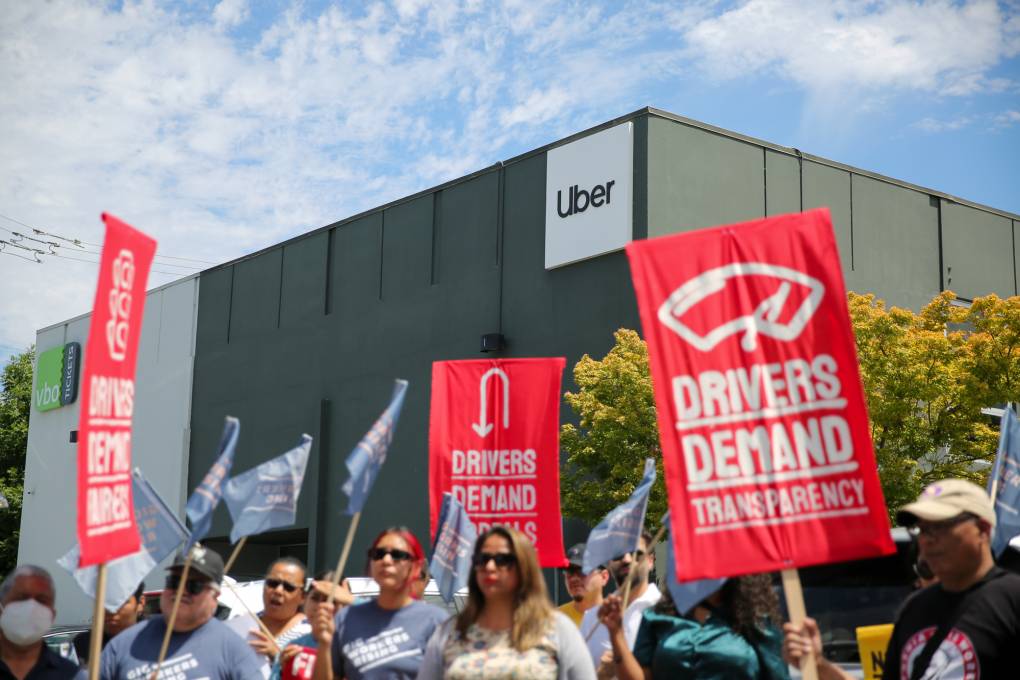
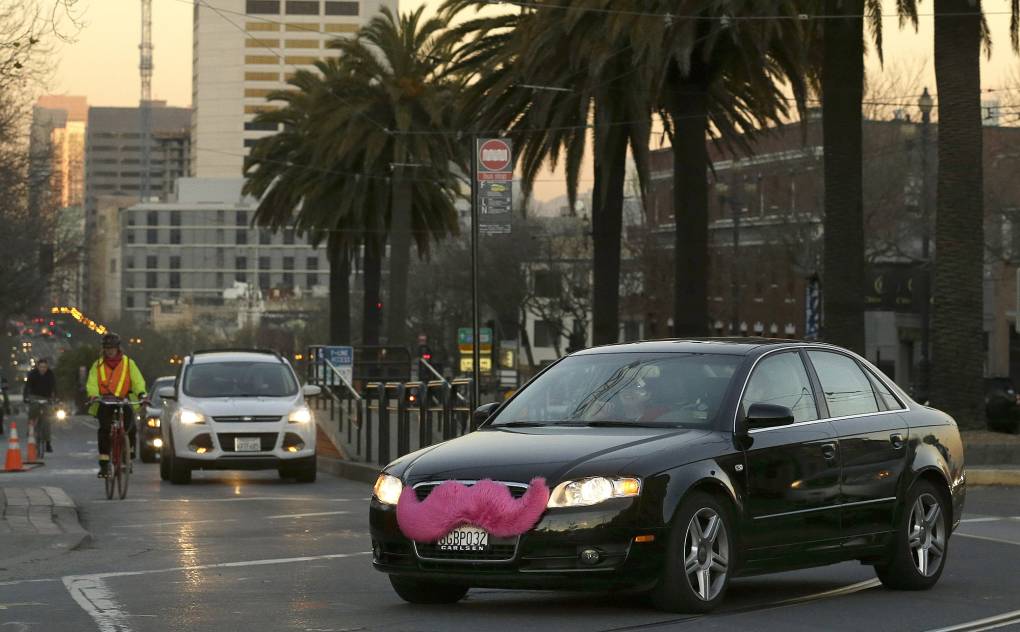
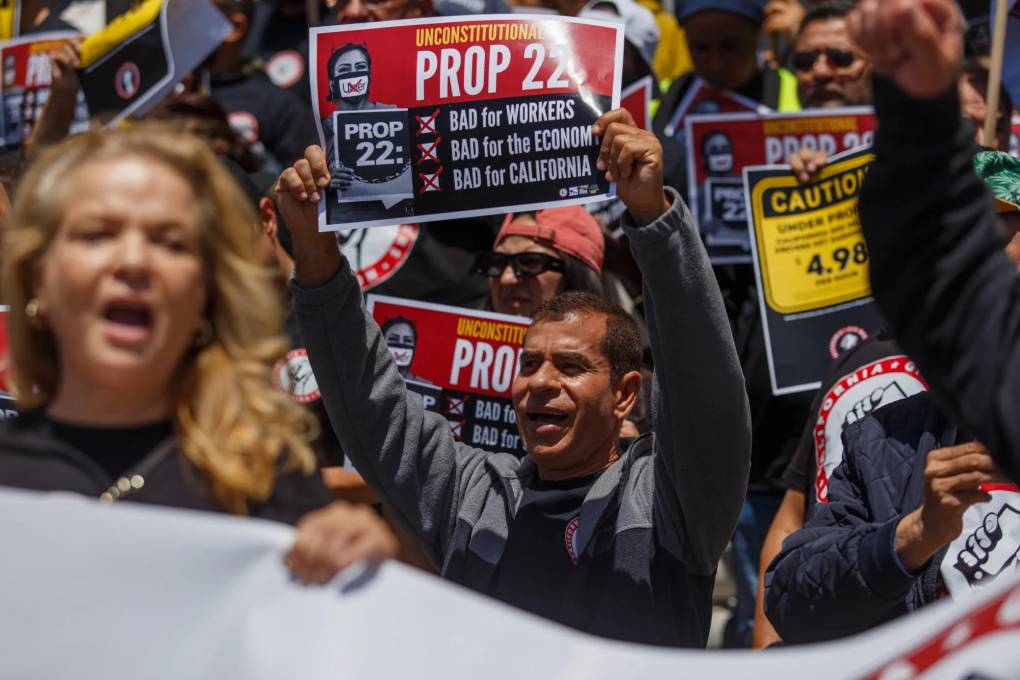
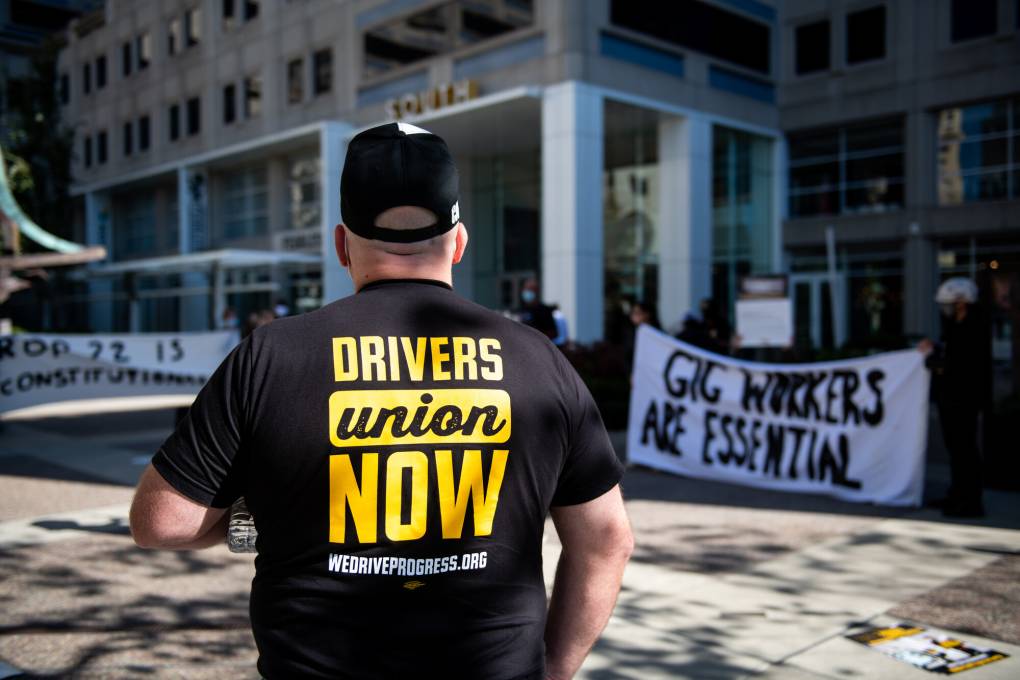
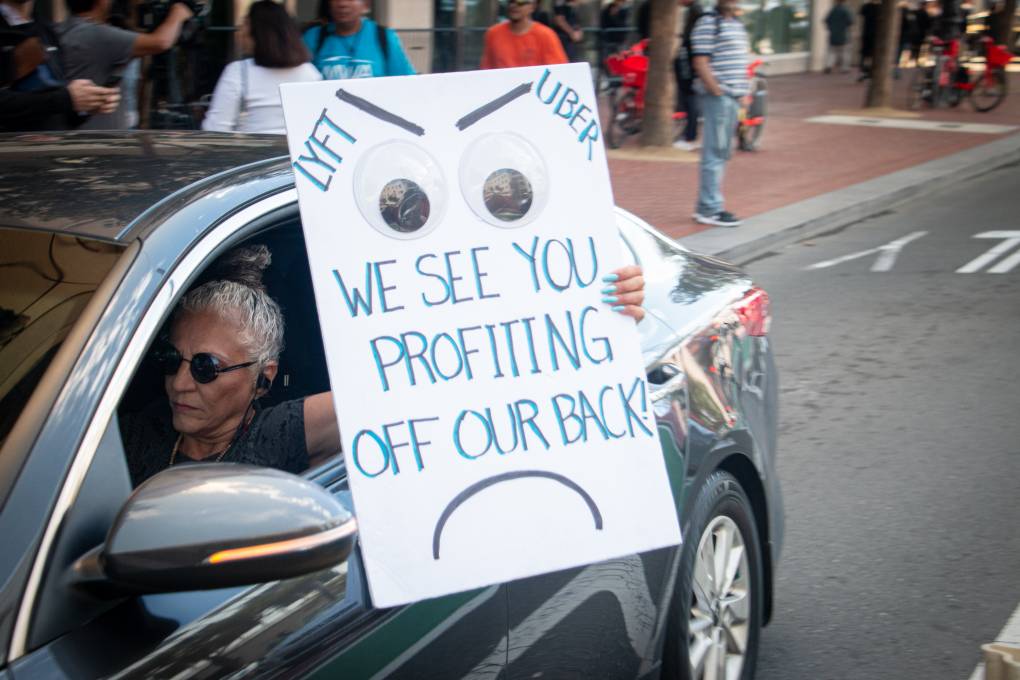
Uber, Lyft Withheld Billions in Pay, Drivers Say. California Settlement Talks Are Underway
Uber and Lyft’s Appeal in California Labor Case Won’t Be Heard by Supreme Court
Gig Workers Are Seeing Little of Prop. 22 Promises — and Lack of Enforcement From State
California Supreme Court Upholds Keeping Gig Drivers as Independent Contractors
Uber and Lyft Are Fighting Minimum Wage Laws. But in This State, the Drivers Won
'It's Now or Never': Writers and Actors See Conflict With Big Tech as Existential
'No Reward for Loyalty': Gig Companies Winning Fight to Classify Drivers as Independent
Amazon Workers Strike at Third Largest Air Hub in US, File Labor Complaint
Gig Workers Find Few Safeguards, Despite Working in Dangerous Industry
Sponsored
Player sponsored by
window.__IS_SSR__=true
window.__INITIAL_STATE__={
"attachmentsReducer": {
"audio_0": {
"type": "attachments",
"id": "audio_0",
"imgSizes": {
"kqedFullSize": {
"file": "https://ww2.kqed.org/news/wp-content/themes/KQED-unified/img/audio_bgs/background0.jpg"
}
}
},
"audio_1": {
"type": "attachments",
"id": "audio_1",
"imgSizes": {
"kqedFullSize": {
"file": "https://ww2.kqed.org/news/wp-content/themes/KQED-unified/img/audio_bgs/background1.jpg"
}
}
},
"audio_2": {
"type": "attachments",
"id": "audio_2",
"imgSizes": {
"kqedFullSize": {
"file": "https://ww2.kqed.org/news/wp-content/themes/KQED-unified/img/audio_bgs/background2.jpg"
}
}
},
"audio_3": {
"type": "attachments",
"id": "audio_3",
"imgSizes": {
"kqedFullSize": {
"file": "https://ww2.kqed.org/news/wp-content/themes/KQED-unified/img/audio_bgs/background3.jpg"
}
}
},
"audio_4": {
"type": "attachments",
"id": "audio_4",
"imgSizes": {
"kqedFullSize": {
"file": "https://ww2.kqed.org/news/wp-content/themes/KQED-unified/img/audio_bgs/background4.jpg"
}
}
},
"placeholder": {
"type": "attachments",
"id": "placeholder",
"imgSizes": {
"thumbnail": {
"file": "https://cdn.kqed.org/wp-content/uploads/2024/12/KQED-Default-Image-816638274-2000x1333-1-160x107.jpg",
"width": 160,
"height": 107,
"mimeType": "image/jpeg"
},
"medium": {
"file": "https://cdn.kqed.org/wp-content/uploads/2024/12/KQED-Default-Image-816638274-2000x1333-1-800x533.jpg",
"width": 800,
"height": 533,
"mimeType": "image/jpeg"
},
"medium_large": {
"file": "https://cdn.kqed.org/wp-content/uploads/2024/12/KQED-Default-Image-816638274-2000x1333-1-768x512.jpg",
"width": 768,
"height": 512,
"mimeType": "image/jpeg"
},
"large": {
"file": "https://cdn.kqed.org/wp-content/uploads/2024/12/KQED-Default-Image-816638274-2000x1333-1-1020x680.jpg",
"width": 1020,
"height": 680,
"mimeType": "image/jpeg"
},
"1536x1536": {
"file": "https://cdn.kqed.org/wp-content/uploads/2024/12/KQED-Default-Image-816638274-2000x1333-1-1536x1024.jpg",
"width": 1536,
"height": 1024,
"mimeType": "image/jpeg"
},
"fd-lrg": {
"file": "https://cdn.kqed.org/wp-content/uploads/2024/12/KQED-Default-Image-816638274-2000x1333-1-1536x1024.jpg",
"width": 1536,
"height": 1024,
"mimeType": "image/jpeg"
},
"fd-med": {
"file": "https://cdn.kqed.org/wp-content/uploads/2024/12/KQED-Default-Image-816638274-2000x1333-1-1020x680.jpg",
"width": 1020,
"height": 680,
"mimeType": "image/jpeg"
},
"fd-sm": {
"file": "https://cdn.kqed.org/wp-content/uploads/2024/12/KQED-Default-Image-816638274-2000x1333-1-800x533.jpg",
"width": 800,
"height": 533,
"mimeType": "image/jpeg"
},
"post-thumbnail": {
"file": "https://cdn.kqed.org/wp-content/uploads/2024/12/KQED-Default-Image-816638274-2000x1333-1-672x372.jpg",
"width": 672,
"height": 372,
"mimeType": "image/jpeg"
},
"twentyfourteen-full-width": {
"file": "https://cdn.kqed.org/wp-content/uploads/2024/12/KQED-Default-Image-816638274-2000x1333-1-1038x576.jpg",
"width": 1038,
"height": 576,
"mimeType": "image/jpeg"
},
"xxsmall": {
"file": "https://cdn.kqed.org/wp-content/uploads/2024/12/KQED-Default-Image-816638274-2000x1333-1-160x107.jpg",
"width": 160,
"height": 107,
"mimeType": "image/jpeg"
},
"xsmall": {
"file": "https://cdn.kqed.org/wp-content/uploads/2024/12/KQED-Default-Image-816638274-2000x1333-1-672x372.jpg",
"width": 672,
"height": 372,
"mimeType": "image/jpeg"
},
"small": {
"file": "https://cdn.kqed.org/wp-content/uploads/2024/12/KQED-Default-Image-816638274-2000x1333-1-672x372.jpg",
"width": 672,
"height": 372,
"mimeType": "image/jpeg"
},
"xlarge": {
"file": "https://cdn.kqed.org/wp-content/uploads/2024/12/KQED-Default-Image-816638274-2000x1333-1-1020x680.jpg",
"width": 1020,
"height": 680,
"mimeType": "image/jpeg"
},
"full-width": {
"file": "https://cdn.kqed.org/wp-content/uploads/2024/12/KQED-Default-Image-816638274-2000x1333-1-1920x1280.jpg",
"width": 1920,
"height": 1280,
"mimeType": "image/jpeg"
},
"guest-author-32": {
"file": "https://cdn.kqed.org/wp-content/uploads/2025/01/KQED-Default-Image-816638274-1333x1333-1-160x160.jpg",
"width": 32,
"height": 32,
"mimeType": "image/jpeg"
},
"guest-author-50": {
"file": "https://cdn.kqed.org/wp-content/uploads/2025/01/KQED-Default-Image-816638274-1333x1333-1-160x160.jpg",
"width": 50,
"height": 50,
"mimeType": "image/jpeg"
},
"guest-author-64": {
"file": "https://cdn.kqed.org/wp-content/uploads/2025/01/KQED-Default-Image-816638274-1333x1333-1-160x160.jpg",
"width": 64,
"height": 64,
"mimeType": "image/jpeg"
},
"guest-author-96": {
"file": "https://cdn.kqed.org/wp-content/uploads/2025/01/KQED-Default-Image-816638274-1333x1333-1-160x160.jpg",
"width": 96,
"height": 96,
"mimeType": "image/jpeg"
},
"guest-author-128": {
"file": "https://cdn.kqed.org/wp-content/uploads/2025/01/KQED-Default-Image-816638274-1333x1333-1-160x160.jpg",
"width": 128,
"height": 128,
"mimeType": "image/jpeg"
},
"detail": {
"file": "https://cdn.kqed.org/wp-content/uploads/2025/01/KQED-Default-Image-816638274-1333x1333-1-160x160.jpg",
"width": 160,
"height": 160,
"mimeType": "image/jpeg"
},
"kqedFullSize": {
"file": "https://cdn.kqed.org/wp-content/uploads/2024/12/KQED-Default-Image-816638274-2000x1333-1.jpg",
"width": 2000,
"height": 1333
}
}
},
"news_12033651": {
"type": "attachments",
"id": "news_12033651",
"meta": {
"index": "attachments_1716263798",
"site": "news",
"id": "12033651",
"found": true
},
"title": "240625-UBERSANJOSE-JG-1 (1)",
"publishDate": 1743204895,
"status": "inherit",
"parent": 12033648,
"modified": 1743204956,
"caption": "Uber drivers and advocates rally outside the company's driver support center in South San José on June 25, 2024.",
"credit": "Joseph Geha/KQED",
"altTag": null,
"description": null,
"imgSizes": {
"medium": {
"file": "https://cdn.kqed.org/wp-content/uploads/sites/10/2025/03/240625-UBERSANJOSE-JG-1-1-800x533.jpg",
"width": 800,
"height": 533,
"mimeType": "image/jpeg"
},
"large": {
"file": "https://cdn.kqed.org/wp-content/uploads/sites/10/2025/03/240625-UBERSANJOSE-JG-1-1-1020x680.jpg",
"width": 1020,
"height": 680,
"mimeType": "image/jpeg"
},
"thumbnail": {
"file": "https://cdn.kqed.org/wp-content/uploads/sites/10/2025/03/240625-UBERSANJOSE-JG-1-1-160x107.jpg",
"width": 160,
"height": 107,
"mimeType": "image/jpeg"
},
"1536x1536": {
"file": "https://cdn.kqed.org/wp-content/uploads/sites/10/2025/03/240625-UBERSANJOSE-JG-1-1-1536x1024.jpg",
"width": 1536,
"height": 1024,
"mimeType": "image/jpeg"
},
"post-thumbnail": {
"file": "https://cdn.kqed.org/wp-content/uploads/sites/10/2025/03/240625-UBERSANJOSE-JG-1-1-672x372.jpg",
"width": 672,
"height": 372,
"mimeType": "image/jpeg"
},
"twentyfourteen-full-width": {
"file": "https://cdn.kqed.org/wp-content/uploads/sites/10/2025/03/240625-UBERSANJOSE-JG-1-1-1038x576.jpg",
"width": 1038,
"height": 576,
"mimeType": "image/jpeg"
},
"full-width": {
"file": "https://cdn.kqed.org/wp-content/uploads/sites/10/2025/03/240625-UBERSANJOSE-JG-1-1-1920x1280.jpg",
"width": 1920,
"height": 1280,
"mimeType": "image/jpeg"
},
"kqedFullSize": {
"file": "https://cdn.kqed.org/wp-content/uploads/sites/10/2025/03/240625-UBERSANJOSE-JG-1-1.jpg",
"width": 2000,
"height": 1333
}
},
"fetchFailed": false,
"isLoading": false
},
"news_12008321": {
"type": "attachments",
"id": "news_12008321",
"meta": {
"index": "attachments_1716263798",
"site": "news",
"id": "12008321",
"found": true
},
"title": "San Francisco Ride Hailing Lawsuit",
"publishDate": 1728334457,
"status": "inherit",
"parent": 12008292,
"modified": 1744762102,
"caption": "A Lyft car crosses Market Street in San Francisco on Feb. 8, 2018. ",
"credit": "Jeff Chiu/AP Photo",
"altTag": null,
"description": null,
"imgSizes": {
"medium": {
"file": "https://cdn.kqed.org/wp-content/uploads/sites/10/2024/10/SFLyftDriverAP-800x496.jpg",
"width": 800,
"height": 496,
"mimeType": "image/jpeg"
},
"large": {
"file": "https://cdn.kqed.org/wp-content/uploads/sites/10/2024/10/SFLyftDriverAP-1020x632.jpg",
"width": 1020,
"height": 632,
"mimeType": "image/jpeg"
},
"thumbnail": {
"file": "https://cdn.kqed.org/wp-content/uploads/sites/10/2024/10/SFLyftDriverAP-160x99.jpg",
"width": 160,
"height": 99,
"mimeType": "image/jpeg"
},
"1536x1536": {
"file": "https://cdn.kqed.org/wp-content/uploads/sites/10/2024/10/SFLyftDriverAP-1536x952.jpg",
"width": 1536,
"height": 952,
"mimeType": "image/jpeg"
},
"post-thumbnail": {
"file": "https://cdn.kqed.org/wp-content/uploads/sites/10/2024/10/SFLyftDriverAP-672x372.jpg",
"width": 672,
"height": 372,
"mimeType": "image/jpeg"
},
"twentyfourteen-full-width": {
"file": "https://cdn.kqed.org/wp-content/uploads/sites/10/2024/10/SFLyftDriverAP-1038x576.jpg",
"width": 1038,
"height": 576,
"mimeType": "image/jpeg"
},
"full-width": {
"file": "https://cdn.kqed.org/wp-content/uploads/sites/10/2024/10/SFLyftDriverAP-1920x1190.jpg",
"width": 1920,
"height": 1190,
"mimeType": "image/jpeg"
},
"kqedFullSize": {
"file": "https://cdn.kqed.org/wp-content/uploads/sites/10/2024/10/SFLyftDriverAP.jpg",
"width": 2000,
"height": 1240
}
},
"fetchFailed": false,
"isLoading": false
},
"news_12003064": {
"type": "attachments",
"id": "news_12003064",
"meta": {
"index": "attachments_1716263798",
"site": "news",
"id": "12003064",
"found": true
},
"title": "052124_Prop-22_JY_CM_12",
"publishDate": 1725481668,
"status": "inherit",
"parent": 12002988,
"modified": 1725481702,
"caption": "Ride-share drivers of the California Gig Workers Union hold a rally outside of the Supreme Court of California to protest Prop. 22 in San Francisco on May 21, 2024. The state Supreme Court later upheld the constitutionality of the measure. \n",
"credit": "Juliana Yamada/CalMatters",
"altTag": null,
"description": null,
"imgSizes": {
"medium": {
"file": "https://cdn.kqed.org/wp-content/uploads/sites/10/2024/09/052124_Prop-22_JY_CM_12-800x533.jpg",
"width": 800,
"height": 533,
"mimeType": "image/jpeg"
},
"large": {
"file": "https://cdn.kqed.org/wp-content/uploads/sites/10/2024/09/052124_Prop-22_JY_CM_12-1020x680.jpg",
"width": 1020,
"height": 680,
"mimeType": "image/jpeg"
},
"thumbnail": {
"file": "https://cdn.kqed.org/wp-content/uploads/sites/10/2024/09/052124_Prop-22_JY_CM_12-160x107.jpg",
"width": 160,
"height": 107,
"mimeType": "image/jpeg"
},
"1536x1536": {
"file": "https://cdn.kqed.org/wp-content/uploads/sites/10/2024/09/052124_Prop-22_JY_CM_12-1536x1024.jpg",
"width": 1536,
"height": 1024,
"mimeType": "image/jpeg"
},
"post-thumbnail": {
"file": "https://cdn.kqed.org/wp-content/uploads/sites/10/2024/09/052124_Prop-22_JY_CM_12-672x372.jpg",
"width": 672,
"height": 372,
"mimeType": "image/jpeg"
},
"twentyfourteen-full-width": {
"file": "https://cdn.kqed.org/wp-content/uploads/sites/10/2024/09/052124_Prop-22_JY_CM_12-1038x576.jpg",
"width": 1038,
"height": 576,
"mimeType": "image/jpeg"
},
"full-width": {
"file": "https://cdn.kqed.org/wp-content/uploads/sites/10/2024/09/052124_Prop-22_JY_CM_12-1920x1280.jpg",
"width": 1920,
"height": 1280,
"mimeType": "image/jpeg"
},
"kqedFullSize": {
"file": "https://cdn.kqed.org/wp-content/uploads/sites/10/2024/09/052124_Prop-22_JY_CM_12.jpg",
"width": 2000,
"height": 1333
}
},
"fetchFailed": false,
"isLoading": false
},
"news_11997381": {
"type": "attachments",
"id": "news_11997381",
"meta": {
"index": "attachments_1716263798",
"site": "news",
"id": "11997381",
"found": true
},
"title": "004_SanFrancisco_GigWorkerProtest_11032021_qed",
"publishDate": 1721928101,
"status": "inherit",
"parent": 11997373,
"modified": 1721934202,
"caption": "Gig workers, rideshare and delivery drivers with both We Drive Progress and Gig Workers Rising demonstrate outside of the DoorDash Headquarters in San Francisco on Nov. 3, 2021, demanding fair pay and employee rights.",
"credit": "Beth LaBerge/KQED",
"altTag": null,
"description": null,
"imgSizes": {
"medium": {
"file": "https://cdn.kqed.org/wp-content/uploads/sites/10/2024/07/004_SanFrancisco_GigWorkerProtest_11032021_qed-800x533.jpg",
"width": 800,
"height": 533,
"mimeType": "image/jpeg"
},
"large": {
"file": "https://cdn.kqed.org/wp-content/uploads/sites/10/2024/07/004_SanFrancisco_GigWorkerProtest_11032021_qed-1020x680.jpg",
"width": 1020,
"height": 680,
"mimeType": "image/jpeg"
},
"thumbnail": {
"file": "https://cdn.kqed.org/wp-content/uploads/sites/10/2024/07/004_SanFrancisco_GigWorkerProtest_11032021_qed-160x107.jpg",
"width": 160,
"height": 107,
"mimeType": "image/jpeg"
},
"1536x1536": {
"file": "https://cdn.kqed.org/wp-content/uploads/sites/10/2024/07/004_SanFrancisco_GigWorkerProtest_11032021_qed-1536x1024.jpg",
"width": 1536,
"height": 1024,
"mimeType": "image/jpeg"
},
"post-thumbnail": {
"file": "https://cdn.kqed.org/wp-content/uploads/sites/10/2024/07/004_SanFrancisco_GigWorkerProtest_11032021_qed-672x372.jpg",
"width": 672,
"height": 372,
"mimeType": "image/jpeg"
},
"twentyfourteen-full-width": {
"file": "https://cdn.kqed.org/wp-content/uploads/sites/10/2024/07/004_SanFrancisco_GigWorkerProtest_11032021_qed-1038x576.jpg",
"width": 1038,
"height": 576,
"mimeType": "image/jpeg"
},
"full-width": {
"file": "https://cdn.kqed.org/wp-content/uploads/sites/10/2024/07/004_SanFrancisco_GigWorkerProtest_11032021_qed-1920x1280.jpg",
"width": 1920,
"height": 1280,
"mimeType": "image/jpeg"
},
"kqedFullSize": {
"file": "https://cdn.kqed.org/wp-content/uploads/sites/10/2024/07/004_SanFrancisco_GigWorkerProtest_11032021_qed.jpg",
"width": 2000,
"height": 1333
}
},
"fetchFailed": false,
"isLoading": false
},
"news_11990763": {
"type": "attachments",
"id": "news_11990763",
"meta": {
"index": "attachments_1716263798",
"site": "news",
"id": "11990763",
"found": true
},
"title": "npr.brightspotcdn copy",
"publishDate": 1718657883,
"status": "inherit",
"parent": 11990750,
"modified": 1718657907,
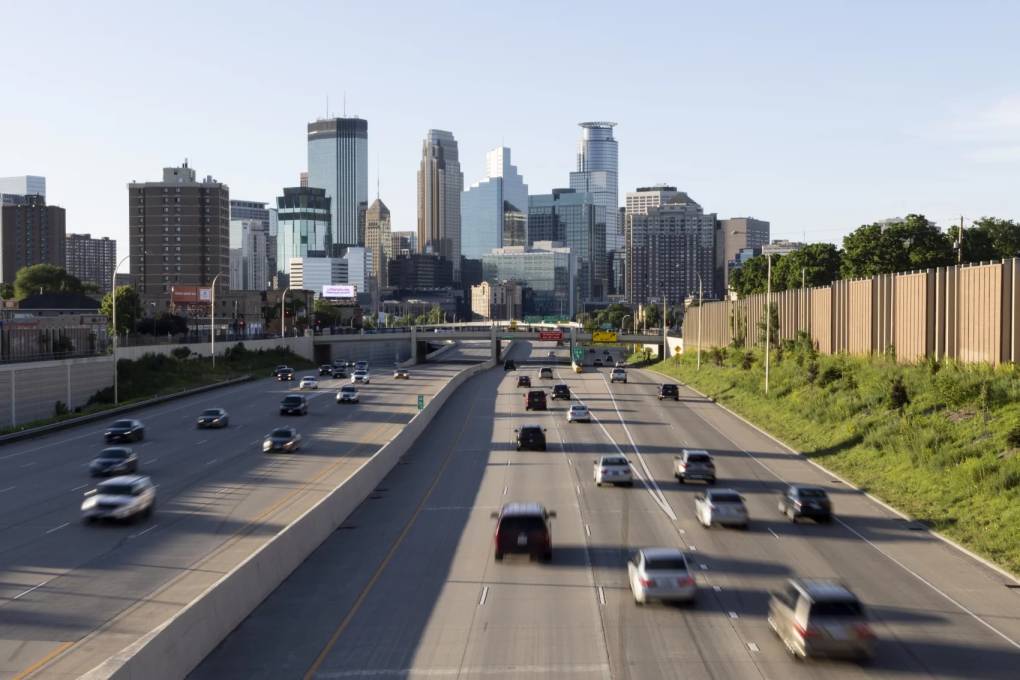
"caption": "Vehicles drive toward downtown Minneapolis on Interstate 35 on a Sunday in May.",
"credit": "Jenn Ackerman for NPR",
"altTag": null,
"description": null,
"imgSizes": {
"medium": {
"file": "https://cdn.kqed.org/wp-content/uploads/sites/10/2024/06/npr.brightspotcdn-copy-800x534.jpg",
"width": 800,
"height": 534,
"mimeType": "image/jpeg"
},
"large": {
"file": "https://cdn.kqed.org/wp-content/uploads/sites/10/2024/06/npr.brightspotcdn-copy-1020x680.jpg",
"width": 1020,
"height": 680,
"mimeType": "image/jpeg"
},
"thumbnail": {
"file": "https://cdn.kqed.org/wp-content/uploads/sites/10/2024/06/npr.brightspotcdn-copy-160x107.jpg",
"width": 160,
"height": 107,
"mimeType": "image/jpeg"
},
"1536x1536": {
"file": "https://cdn.kqed.org/wp-content/uploads/sites/10/2024/06/npr.brightspotcdn-copy-1536x1025.jpg",
"width": 1536,
"height": 1025,
"mimeType": "image/jpeg"
},
"post-thumbnail": {
"file": "https://cdn.kqed.org/wp-content/uploads/sites/10/2024/06/npr.brightspotcdn-copy-672x372.jpg",
"width": 672,
"height": 372,
"mimeType": "image/jpeg"
},
"twentyfourteen-full-width": {
"file": "https://cdn.kqed.org/wp-content/uploads/sites/10/2024/06/npr.brightspotcdn-copy-1038x576.jpg",
"width": 1038,
"height": 576,
"mimeType": "image/jpeg"
},
"kqedFullSize": {
"file": "https://cdn.kqed.org/wp-content/uploads/sites/10/2024/06/npr.brightspotcdn-copy.jpg",
"width": 1700,
"height": 1134
}
},
"fetchFailed": false,
"isLoading": false
},
"news_11956208": {
"type": "attachments",
"id": "news_11956208",
"meta": {
"index": "attachments_1716263798",
"site": "news",
"id": "11956208",
"found": true
},
"parent": 11956178,
"imgSizes": {
"twentyfourteen-full-width": {
"file": "https://ww2.kqed.org/app/uploads/sites/10/2023/07/230721-SAG-AFTRA-LOS-GATOS-RM-01-KQED-1038x576.jpg",
"width": 1038,
"mimeType": "image/jpeg",
"height": 576
},
"thumbnail": {
"file": "https://ww2.kqed.org/app/uploads/sites/10/2023/07/230721-SAG-AFTRA-LOS-GATOS-RM-01-KQED-160x120.jpg",
"width": 160,
"mimeType": "image/jpeg",
"height": 120
},
"post-thumbnail": {
"file": "https://ww2.kqed.org/app/uploads/sites/10/2023/07/230721-SAG-AFTRA-LOS-GATOS-RM-01-KQED-672x372.jpg",
"width": 672,
"mimeType": "image/jpeg",
"height": 372
},
"kqedFullSize": {
"file": "https://ww2.kqed.org/app/uploads/sites/10/2023/07/230721-SAG-AFTRA-LOS-GATOS-RM-01-KQED.jpg",
"width": 2000,
"height": 1500
},
"large": {
"file": "https://ww2.kqed.org/app/uploads/sites/10/2023/07/230721-SAG-AFTRA-LOS-GATOS-RM-01-KQED-1020x765.jpg",
"width": 1020,
"mimeType": "image/jpeg",
"height": 765
},
"1536x1536": {
"file": "https://ww2.kqed.org/app/uploads/sites/10/2023/07/230721-SAG-AFTRA-LOS-GATOS-RM-01-KQED-1536x1152.jpg",
"width": 1536,
"mimeType": "image/jpeg",
"height": 1152
},
"full-width": {
"file": "https://ww2.kqed.org/app/uploads/sites/10/2023/07/230721-SAG-AFTRA-LOS-GATOS-RM-01-KQED-1920x1440.jpg",
"width": 1920,
"mimeType": "image/jpeg",
"height": 1440
},
"medium": {
"file": "https://ww2.kqed.org/app/uploads/sites/10/2023/07/230721-SAG-AFTRA-LOS-GATOS-RM-01-KQED-800x600.jpg",
"width": 800,
"mimeType": "image/jpeg",
"height": 600
}
},
"publishDate": 1689971294,
"modified": 1689971393,
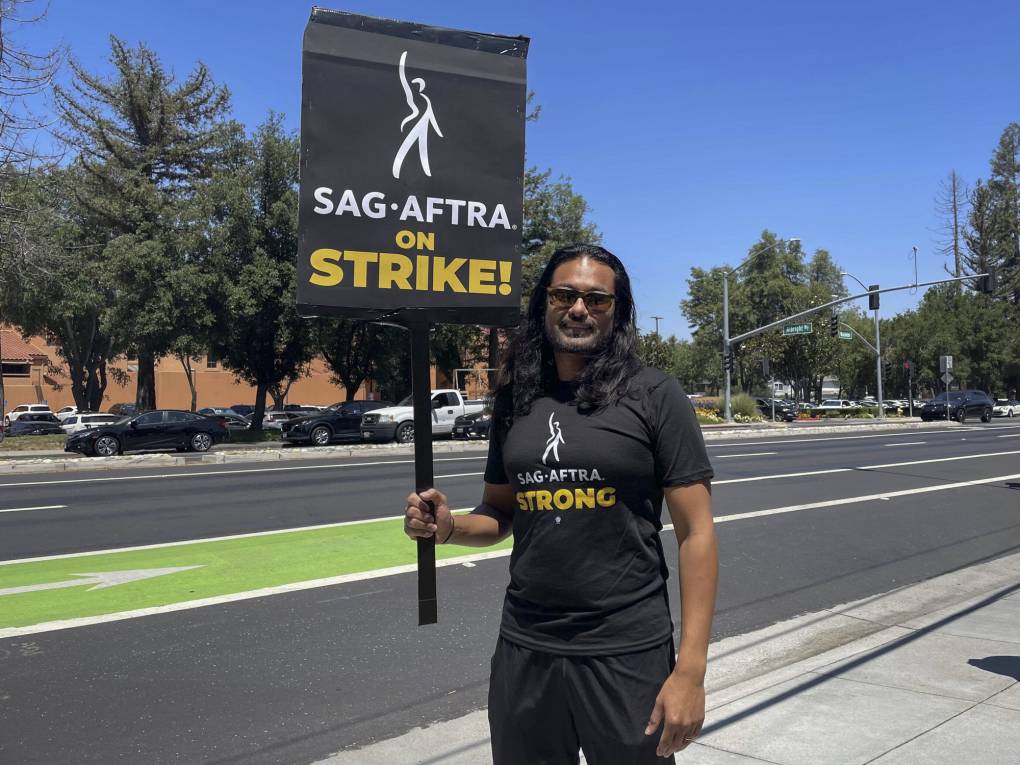
"caption": "Actor Rajiv Shah of Los Gatos joined dozens of SAG-AFTRA members who rallied outside of Netflix headquarters in Los Gatos on July 11, 2023.",
"description": null,
"title": "230721-SAG-AFTRA LOS GATOS-RM-01-KQED",
"credit": "Rachael Myrow/KQED",
"status": "inherit",
"altTag": "A south Asian man with long hair holds a sign and wears a t-shirt that both read \"SAG-AFTRA on Strike\"",
"fetchFailed": false,
"isLoading": false
},
"news_11944370": {
"type": "attachments",
"id": "news_11944370",
"meta": {
"index": "attachments_1716263798",
"site": "news",
"id": "11944370",
"found": true
},
"parent": 0,
"imgSizes": {
"twentyfourteen-full-width": {
"file": "https://ww2.kqed.org/app/uploads/sites/10/2023/03/RS52368_010_SanFrancisco_GigWorkerProtest_11032021-1038x576.jpg",
"width": 1038,
"mimeType": "image/jpeg",
"height": 576
},
"thumbnail": {
"file": "https://ww2.kqed.org/app/uploads/sites/10/2023/03/RS52368_010_SanFrancisco_GigWorkerProtest_11032021-160x106.jpg",
"width": 160,
"mimeType": "image/jpeg",
"height": 106
},
"post-thumbnail": {
"file": "https://ww2.kqed.org/app/uploads/sites/10/2023/03/RS52368_010_SanFrancisco_GigWorkerProtest_11032021-672x372.jpg",
"width": 672,
"mimeType": "image/jpeg",
"height": 372
},
"kqedFullSize": {
"file": "https://ww2.kqed.org/app/uploads/sites/10/2023/03/RS52368_010_SanFrancisco_GigWorkerProtest_11032021-scaled.jpg",
"width": 2560,
"height": 1704
},
"2048x2048": {
"file": "https://ww2.kqed.org/app/uploads/sites/10/2023/03/RS52368_010_SanFrancisco_GigWorkerProtest_11032021-2048x1363.jpg",
"width": 2048,
"mimeType": "image/jpeg",
"height": 1363
},
"large": {
"file": "https://ww2.kqed.org/app/uploads/sites/10/2023/03/RS52368_010_SanFrancisco_GigWorkerProtest_11032021-1020x679.jpg",
"width": 1020,
"mimeType": "image/jpeg",
"height": 679
},
"1536x1536": {
"file": "https://ww2.kqed.org/app/uploads/sites/10/2023/03/RS52368_010_SanFrancisco_GigWorkerProtest_11032021-1536x1022.jpg",
"width": 1536,
"mimeType": "image/jpeg",
"height": 1022
},
"full-width": {
"file": "https://ww2.kqed.org/app/uploads/sites/10/2023/03/RS52368_010_SanFrancisco_GigWorkerProtest_11032021-1920x1278.jpg",
"width": 1920,
"mimeType": "image/jpeg",
"height": 1278
},
"medium": {
"file": "https://ww2.kqed.org/app/uploads/sites/10/2023/03/RS52368_010_SanFrancisco_GigWorkerProtest_11032021-800x532.jpg",
"width": 800,
"mimeType": "image/jpeg",
"height": 532
}
},
"publishDate": 1679511824,
"modified": 1679526543,
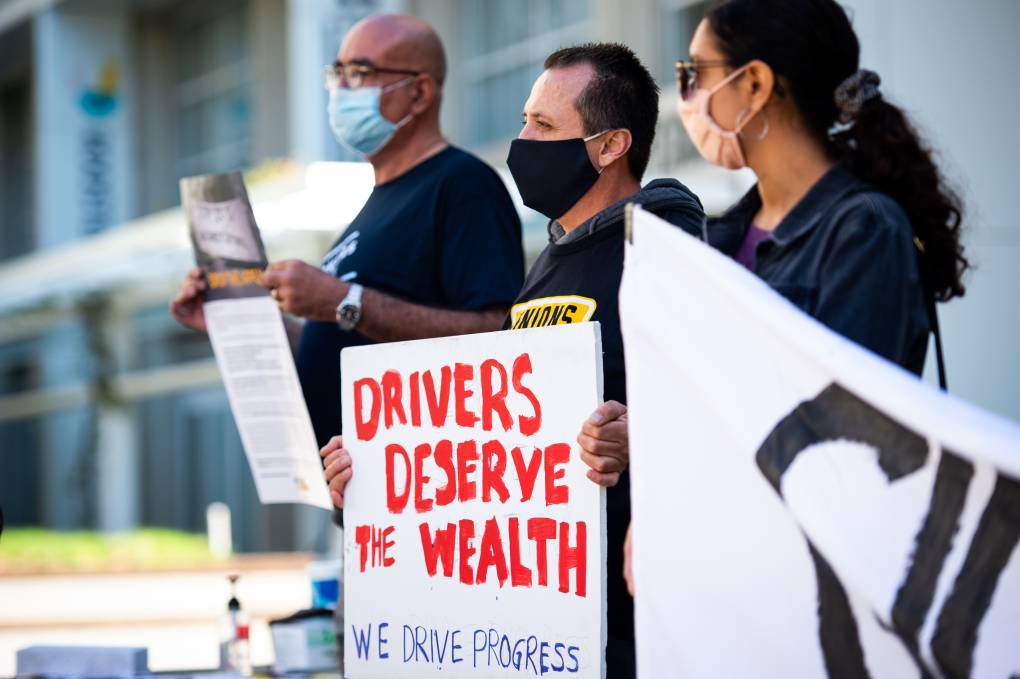
"caption": "Hector Castellanos (center) with We Drive Progress holds a sign that says 'Drivers Deserve the Wealth' outside DoorDash headquarters in San Francisco on Nov. 3, 2021, along with fellow gig workers, including rideshare and delivery drivers, demanding fair pay and employee rights.",
"description": null,
"title": "RS52368_010_SanFrancisco_GigWorkerProtest_11032021",
"credit": "Beth LaBerge/KQED",
"status": "inherit",
"altTag": "A man with dark hair holds a white sign with red lettering that reads, \"Drivers Deserve the Wealth\" and \"We Drive Progress.\" Other black and white signs are seen in foreground.",
"fetchFailed": false,
"isLoading": false
},
"news_11929065": {
"type": "attachments",
"id": "news_11929065",
"meta": {
"index": "attachments_1716263798",
"site": "news",
"id": "11929065",
"found": true
},
"parent": 11929057,
"imgSizes": {
"twentyfourteen-full-width": {
"file": "https://ww2.kqed.org/app/uploads/sites/10/2022/10/5B2A0633-1038x576.jpeg",
"width": 1038,
"mimeType": "image/jpeg",
"height": 576
},
"thumbnail": {
"file": "https://ww2.kqed.org/app/uploads/sites/10/2022/10/5B2A0633-160x107.jpeg",
"width": 160,
"mimeType": "image/jpeg",
"height": 107
},
"post-thumbnail": {
"file": "https://ww2.kqed.org/app/uploads/sites/10/2022/10/5B2A0633-672x372.jpeg",
"width": 672,
"mimeType": "image/jpeg",
"height": 372
},
"kqedFullSize": {
"file": "https://ww2.kqed.org/app/uploads/sites/10/2022/10/5B2A0633-scaled.jpeg",
"width": 2560,
"height": 1707
},
"2048x2048": {
"file": "https://ww2.kqed.org/app/uploads/sites/10/2022/10/5B2A0633-2048x1365.jpeg",
"width": 2048,
"mimeType": "image/jpeg",
"height": 1365
},
"large": {
"file": "https://ww2.kqed.org/app/uploads/sites/10/2022/10/5B2A0633-1020x680.jpeg",
"width": 1020,
"mimeType": "image/jpeg",
"height": 680
},
"1536x1536": {
"file": "https://ww2.kqed.org/app/uploads/sites/10/2022/10/5B2A0633-1536x1024.jpeg",
"width": 1536,
"mimeType": "image/jpeg",
"height": 1024
},
"full-width": {
"file": "https://ww2.kqed.org/app/uploads/sites/10/2022/10/5B2A0633-1920x1280.jpeg",
"width": 1920,
"mimeType": "image/jpeg",
"height": 1280
},
"medium": {
"file": "https://ww2.kqed.org/app/uploads/sites/10/2022/10/5B2A0633-800x533.jpeg",
"width": 800,
"mimeType": "image/jpeg",
"height": 533
}
},
"publishDate": 1665796125,
"modified": 1665796235,
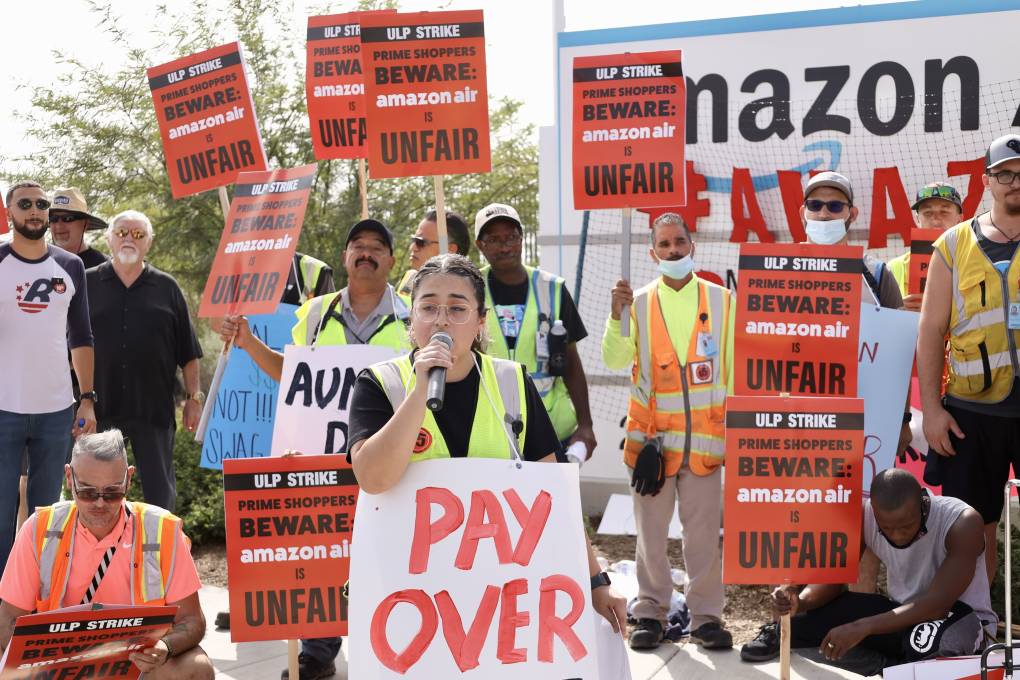
"caption": "Melissa Ojeda, an Amazon warehouse worker, strikes outside the company's air freight fulfillment center in San Bernardino on Oct. 14, 2022.",
"description": null,
"title": "5B2A0633",
"credit": "Courtesy of Warehouse Worker Resource Center",
"status": "inherit",
"altTag": "Striking workers carry signs as a woman speaks into a microphone holding a sign that says \"pay over\"",
"fetchFailed": false,
"isLoading": false
},
"news_11910763": {
"type": "attachments",
"id": "news_11910763",
"meta": {
"index": "attachments_1716263798",
"site": "news",
"id": "11910763",
"found": true
},
"parent": 11910759,
"imgSizes": {
"twentyfourteen-full-width": {
"file": "https://ww2.kqed.org/app/uploads/sites/10/2022/04/yes2-1038x576.jpg",
"width": 1038,
"mimeType": "image/jpeg",
"height": 576
},
"thumbnail": {
"file": "https://ww2.kqed.org/app/uploads/sites/10/2022/04/yes2-160x107.jpg",
"width": 160,
"mimeType": "image/jpeg",
"height": 107
},
"post-thumbnail": {
"file": "https://ww2.kqed.org/app/uploads/sites/10/2022/04/yes2-672x372.jpg",
"width": 672,
"mimeType": "image/jpeg",
"height": 372
},
"kqedFullSize": {
"file": "https://ww2.kqed.org/app/uploads/sites/10/2022/04/yes2-scaled.jpg",
"width": 2560,
"height": 1707
},
"2048x2048": {
"file": "https://ww2.kqed.org/app/uploads/sites/10/2022/04/yes2-2048x1365.jpg",
"width": 2048,
"mimeType": "image/jpeg",
"height": 1365
},
"large": {
"file": "https://ww2.kqed.org/app/uploads/sites/10/2022/04/yes2-1020x680.jpg",
"width": 1020,
"mimeType": "image/jpeg",
"height": 680
},
"1536x1536": {
"file": "https://ww2.kqed.org/app/uploads/sites/10/2022/04/yes2-1536x1024.jpg",
"width": 1536,
"mimeType": "image/jpeg",
"height": 1024
},
"full-width": {
"file": "https://ww2.kqed.org/app/uploads/sites/10/2022/04/yes2-1920x1280.jpg",
"width": 1920,
"mimeType": "image/jpeg",
"height": 1280
},
"medium": {
"file": "https://ww2.kqed.org/app/uploads/sites/10/2022/04/yes2-800x533.jpg",
"width": 800,
"mimeType": "image/jpeg",
"height": 533
}
},
"publishDate": 1649701642,
"modified": 1649714628,
"caption": "Rideshare drivers protest outside Uber's former headquarters on Market Street in downtown San Francisco on Aug. 27, 2019.",
"description": null,
"title": "yes2",
"credit": "Courtesy of Gig Workers Rising",
"status": "inherit",
"altTag": "A woman wearing sunglasses drives a car while holding a sign that says: \"Lyft and Uber we see you profiting off our back!\"",
"fetchFailed": false,
"isLoading": false
}
},
"audioPlayerReducer": {
"postId": "stream_live",
"isPaused": true,
"isPlaying": false,
"pfsActive": false,
"pledgeModalIsOpen": true,
"playerDrawerIsOpen": false
},
"authorsReducer": {
"byline_news_12002988": {
"type": "authors",
"id": "byline_news_12002988",
"meta": {
"override": true
},
"slug": "byline_news_12002988",
"name": "Levi Sumagaysay, CALMatters",
"isLoading": false
},
"byline_news_11990750": {
"type": "authors",
"id": "byline_news_11990750",
"meta": {
"override": true
},
"slug": "byline_news_11990750",
"name": "\u003ca href=\"https://www.npr.org/people/1147860766/dara-kerr\">Dara Kerr\u003c/a>",
"isLoading": false
},
"rachael-myrow": {
"type": "authors",
"id": "251",
"meta": {
"index": "authors_1716337520",
"id": "251",
"found": true
},
"name": "Rachael Myrow",
"firstName": "Rachael",
"lastName": "Myrow",
"slug": "rachael-myrow",
"email": "rmyrow@kqed.org",
"display_author_email": true,
"staff_mastheads": [
"news"
],
"title": "Senior Editor of KQED's Silicon Valley News Desk",
"bio": "• I write and edit stories about how Silicon Valley power and policies shape everyday life in California. I’m also passionate about making Bay Area history and culture more accessible to a broad public. • I’ve been a journalist for most of my life, starting in high school with The Franklin Press in Los Angeles, where I grew up. While earning my first degree in English at UC Berkeley, I got my start in public radio at KALX-FM. After completing a second degree in journalism at Cal, I landed my first professional job at Marketplace, then moved on to KPCC (now LAist), and then KQED, where I hosted The California Report for more than seven years. • My reporting has appeared on NPR, The World, WBUR’s \u003ci>Here & Now\u003c/i>, and the BBC. I also guest host for KQED’s \u003ci>Forum\u003c/i>, as well as the Commonwealth Club in San Francisco. • I speak periodically on media, democracy and technology issues, and do voiceover work for documentaries and educational video projects. • Outside of the studio, you'll find me hiking Bay Area trails and whipping up Insta-ready meals in my kitchen. • I do not accept gifts, money, or favors from anyone connected to my reporting, I don't pay people for information, and I do not support or donate to political causes. • I strive to treat the people I report on with fairness, honesty, and respect. I also recognize there are often multiple sides to a story and work to verify information through multiple sources and documentation. If I get something wrong, I correct it.",
"avatar": "https://secure.gravatar.com/avatar/87bf8cb5874e045cdff430523a6d48b1?s=600&d=blank&r=g",
"twitter": "rachaelmyrow",
"facebook": null,
"instagram": null,
"linkedin": "https://www.linkedin.com/in/rachaelmyrow/",
"sites": [
{
"site": "arts",
"roles": [
"administrator"
]
},
{
"site": "news",
"roles": [
"edit_others_posts",
"editor"
]
},
{
"site": "futureofyou",
"roles": [
"editor"
]
},
{
"site": "bayareabites",
"roles": [
"editor"
]
},
{
"site": "stateofhealth",
"roles": [
"editor"
]
},
{
"site": "science",
"roles": [
"editor"
]
},
{
"site": "food",
"roles": [
"editor"
]
},
{
"site": "forum",
"roles": [
"editor"
]
},
{
"site": "liveblog",
"roles": [
"author"
]
}
],
"headData": {
"title": "Rachael Myrow | KQED",
"description": "Senior Editor of KQED's Silicon Valley News Desk",
"ogImgSrc": "https://secure.gravatar.com/avatar/87bf8cb5874e045cdff430523a6d48b1?s=600&d=blank&r=g",
"twImgSrc": "https://secure.gravatar.com/avatar/87bf8cb5874e045cdff430523a6d48b1?s=600&d=blank&r=g"
},
"isLoading": false,
"link": "/author/rachael-myrow"
},
"fjhabvala": {
"type": "authors",
"id": "8659",
"meta": {
"index": "authors_1716337520",
"id": "8659",
"found": true
},
"name": "Farida Jhabvala Romero",
"firstName": "Farida",
"lastName": "Jhabvala Romero",
"slug": "fjhabvala",
"email": "fjhabvala@kqed.org",
"display_author_email": true,
"staff_mastheads": [
"news"
],
"title": "KQED Contributor",
"bio": "\u003cspan style=\"font-weight: 400;\">Farida Jhabvala Romero is a Labor Correspondent for KQED. She previously covered immigration. Farida was \u003ca href=\"https://www.ccnma.org/2022-most-influential-latina-journalists\">named\u003c/a> one of the 10 Most Influential Latina Journalists in California in 2022 by the California Chicano News Media Association. Her work has won awards from the Society of Professional Journalists (Northern California), as well as a national and regional Edward M. Murrow Award for the collaborative reporting projects “Dangerous Air” and “Graying California.” \u003c/span>\u003cspan style=\"font-weight: 400;\">Before joining KQED, Farida worked as a producer at Radio Bilingüe, a national public radio network. Farida earned her master’s degree in journalism from Stanford University.\u003c/span>",
"avatar": "https://secure.gravatar.com/avatar/c3ab27c5554b67b478f80971e515aa02?s=600&d=blank&r=g",
"twitter": "FaridaJhabvala",
"facebook": null,
"instagram": null,
"linkedin": "https://www.linkedin.com/in/faridajhabvala/",
"sites": [
{
"site": "news",
"roles": [
"editor"
]
},
{
"site": "stateofhealth",
"roles": [
"author"
]
}
],
"headData": {
"title": "Farida Jhabvala Romero | KQED",
"description": "KQED Contributor",
"ogImgSrc": "https://secure.gravatar.com/avatar/c3ab27c5554b67b478f80971e515aa02?s=600&d=blank&r=g",
"twImgSrc": "https://secure.gravatar.com/avatar/c3ab27c5554b67b478f80971e515aa02?s=600&d=blank&r=g"
},
"isLoading": false,
"link": "/author/fjhabvala"
},
"abandlamudi": {
"type": "authors",
"id": "11672",
"meta": {
"index": "authors_1716337520",
"id": "11672",
"found": true
},
"name": "Adhiti Bandlamudi",
"firstName": "Adhiti",
"lastName": "Bandlamudi",
"slug": "abandlamudi",
"email": "abandlamudi@kqed.org",
"display_author_email": false,
"staff_mastheads": [
"news"
],
"title": "KQED Housing Reporter",
"bio": "Adhiti Bandlamudi reports for KQED's Housing desk. She focuses on how housing gets built across the Bay Area. Before joining KQED in 2020, she reported for WUNC in Durham, North Carolina, WABE in Atlanta, Georgia and Capital Public Radio in Sacramento. In 2017, she was awarded a Kroc Fellowship at NPR where she reported on everything from sprinkles to the Golden State Killer's arrest. When she's not reporting, she's baking new recipes in her kitchen or watching movies with friends and family. She's originally from Georgia and has strong opinions about Great British Bake Off.",
"avatar": "https://secure.gravatar.com/avatar/868129c8b257bb99a3500e2c86a65400?s=600&d=mm&r=g",
"twitter": "oddity_adhiti",
"facebook": null,
"instagram": null,
"linkedin": null,
"sites": [
{
"site": "arts",
"roles": [
"author"
]
},
{
"site": "news",
"roles": [
"editor"
]
},
{
"site": "liveblog",
"roles": [
"author"
]
}
],
"headData": {
"title": "Adhiti Bandlamudi | KQED",
"description": "KQED Housing Reporter",
"ogImgSrc": "https://secure.gravatar.com/avatar/868129c8b257bb99a3500e2c86a65400?s=600&d=mm&r=g",
"twImgSrc": "https://secure.gravatar.com/avatar/868129c8b257bb99a3500e2c86a65400?s=600&d=mm&r=g"
},
"isLoading": false,
"link": "/author/abandlamudi"
},
"slim": {
"type": "authors",
"id": "11920",
"meta": {
"index": "authors_1716337520",
"id": "11920",
"found": true
},
"name": "Samantha Lim",
"firstName": "Samantha",
"lastName": "Lim",
"slug": "slim",
"email": "slim@KQED.org",
"display_author_email": false,
"staff_mastheads": [],
"title": "KQED Contributor",
"bio": null,
"avatar": "https://secure.gravatar.com/avatar/82e592e6c15fe1a04d385e8ad0fb0b4e?s=600&d=blank&r=g",
"twitter": null,
"facebook": null,
"instagram": null,
"linkedin": null,
"sites": [
{
"site": "news",
"roles": []
}
],
"headData": {
"title": "Samantha Lim | KQED",
"description": "KQED Contributor",
"ogImgSrc": "https://secure.gravatar.com/avatar/82e592e6c15fe1a04d385e8ad0fb0b4e?s=600&d=blank&r=g",
"twImgSrc": "https://secure.gravatar.com/avatar/82e592e6c15fe1a04d385e8ad0fb0b4e?s=600&d=blank&r=g"
},
"isLoading": false,
"link": "/author/slim"
}
},
"breakingNewsReducer": {},
"pagesReducer": {},
"postsReducer": {
"stream_live": {
"type": "live",
"id": "stream_live",
"audioUrl": "https://streams.kqed.org/kqedradio",
"title": "Live Stream",
"excerpt": "Live Stream information currently unavailable.",
"link": "/radio",
"featImg": "",
"label": {
"name": "KQED Live",
"link": "/"
}
},
"stream_kqedNewscast": {
"type": "posts",
"id": "stream_kqedNewscast",
"audioUrl": "https://www.kqed.org/.stream/anon/radio/RDnews/newscast.mp3?_=1",
"title": "KQED Newscast",
"featImg": "",
"label": {
"name": "88.5 FM",
"link": "/"
}
},
"news_12033648": {
"type": "posts",
"id": "news_12033648",
"meta": {
"index": "posts_1716263798",
"site": "news",
"id": "12033648",
"score": null,
"sort": [
1743447652000
]
},
"guestAuthors": [],
"slug": "uber-lyft-withheld-billions-in-pay-california-alleges-settlement-talks-are-underway",
"title": "Uber, Lyft Withheld Billions in Pay, Drivers Say. California Settlement Talks Are Underway",
"publishDate": 1743447652,
"format": "standard",
"headTitle": "Uber, Lyft Withheld Billions in Pay, Drivers Say. California Settlement Talks Are Underway | KQED",
"labelTerm": {
"site": "news"
},
"content": "\u003cp>\u003cem>Updated 12 p.m. Monday\u003c/em>\u003c/p>\n\u003cp>Nearly half a decade after public officials sued Uber and Lyft, alleging that the companies were withholding what drivers say could amount to \u003ca href=\"https://www.kqed.org/news/12002988/some-gig-workers-say-they-are-seeing-little-of-prop-22-promises-and-lack-of-enforcement-from-state\">billions of dollars\u003c/a> in wages and compensation, negotiations with the state are set to begin Monday and continue for two weeks.\u003c/p>\n\u003cp>Drivers are demanding that the state push for a settlement that adequately recoups what they say are years of lost wages, improves workplace conditions — such as protections against drivers being deactivated from the apps — and raises wages moving forward.\u003c/p>\n\u003cp>More than 250,000 drivers who worked with Uber and Lyft between 2016 and 2020 could be eligible for the settlement, according to Rideshare Drivers United, an organization based in California. Roughly 5,000 drivers filed claims with the state labor commissioner’s office in 2020, alleging that they were denied overtime, mileage reimbursement and other benefits employees are entitled to.\u003c/p>\n\u003cp>[ad fullwidth]\u003c/p>\n\u003cp>That same year, then-California Attorney General Xavier Becerra and the city attorneys of San Francisco, Los Angeles and San Diego sued Uber and Lyft for misclassifying drivers as independent contractors. The labor commissioner’s office also sued the companies, alleging wage theft.\u003c/p>\n\u003cp>The two actions, in addition to several others filed on behalf of individual drivers, were combined into a single joint case before the San Francisco Superior Court. A closed-door mediation session with Uber is scheduled for Monday, while separate talks with Lyft are set to take place on April 8.\u003c/p>\n\u003cfigure id=\"attachment_11997574\" class=\"wp-caption aligncenter\" style=\"max-width: 1024px\">\u003ca href=\"https://cdn.kqed.org/wp-content/uploads/sites/10/2024/07/GettyImages-2003719181.jpg\">\u003cimg loading=\"lazy\" decoding=\"async\" class=\"size-full wp-image-11997574\" src=\"https://cdn.kqed.org/wp-content/uploads/sites/10/2024/07/GettyImages-2003719181.jpg\" alt=\"\" width=\"1024\" height=\"683\" srcset=\"https://cdn.kqed.org/wp-content/uploads/sites/10/2024/07/GettyImages-2003719181.jpg 1024w, https://cdn.kqed.org/wp-content/uploads/sites/10/2024/07/GettyImages-2003719181-800x534.jpg 800w, https://cdn.kqed.org/wp-content/uploads/sites/10/2024/07/GettyImages-2003719181-1020x680.jpg 1020w, https://cdn.kqed.org/wp-content/uploads/sites/10/2024/07/GettyImages-2003719181-160x107.jpg 160w\" sizes=\"auto, (max-width: 1024px) 100vw, 1024px\">\u003c/a>\u003cfigcaption class=\"wp-caption-text\">Members of the Rideshare Drivers United organization protest against Uber and Lyft during a demonstration in Los Angeles, California, on Feb.14, 2024. \u003ccite>(Frederic J. Brown/AFP via Getty Images)\u003c/cite>\u003c/figcaption>\u003c/figure>\n\u003cp>The lawsuits and subsequent negotiations cover a period of time before California voters passed Proposition 22, a ballot initiative that allowed Uber, Lyft and other gig companies to \u003ca href=\"https://www.kqed.org/news/11997373/california-supreme-court-upholds-keeping-gig-drivers-as-independent-contractors\">classify their drivers as independent contractors\u003c/a>.\u003c/p>\n\u003cp>The proposition, which received more than $200 million in backing from gig companies, including Uber and Lyft, promised that independent workers would receive better wages and treatment, a stipulation that some drivers allege was not met.\u003c/p>\n\u003cp>Uber and Lyft “have been doing what they want. They take more than half of our paycheck and then leave us in bad condition and deactivate us unfairly,” said Ibrahim Diallo, a San Francisco resident who started driving for Uber in 2015 before his account was deactivated in 2023. “More than half of the Uber drivers have to drive 12 hours six days a week, sometimes even seven days, to be able to meet the bills.”\u003c/p>\n\u003cp>Drivers don’t get paid enough to make ends meet, and they also have to deal with maintenance costs, registration fees and paying for gas, Diallo said, adding that the ride-hailing companies are paying their drivers less and less each year.\u003c/p>\n\u003cp>[aside postID=news_12033549 hero='https://cdn.kqed.org/wp-content/uploads/sites/10/2025/03/240617-VTAfile-22-BL_qed-1020x680.jpg']\u003c/p>\n\u003cp>“Uber and Lyft are useful, but we can do better,” he said. “We have to treat people with dignity. They have to get good pay to allow them to take weekends, at least spend time with their wife, with their children, and be happy.”\u003c/p>\n\u003cp>According to Uber, drivers earn at least 120% of minimum wage during active hours. The company also said it has invested more than $1 billion into direct benefits, including health care plans and accident insurance for workers.\u003c/p>\n\u003cp>“Drivers come to Uber precisely because of the unique flexibility that it provides,” an Uber spokesperson said in an email. “Prop 22 safeguarded their choice to work independently while ensuring important new protections. The voters of California have spoken — overwhelmingly — and we look forward to putting these years-old matters behind us.”\u003c/p>\n\u003cp>According to Veena Dubal, a law professor at UC Irvine who researches the ride-hailing industry and has been critical of Uber and Lyft, studies show drivers are making less money than they did before Proposition 22. Researchers at the UC Berkeley Labor Center \u003ca href=\"https://laborcenter.berkeley.edu/gig-passenger-and-delivery-driver-pay-in-five-metro-areas/\">found\u003c/a> last year that ride-hail drivers in the San Francisco Bay, Los Angeles and three other metro areas made an hourly average wage of $5.97 without tips and $7.63 with tips, after taking into account expenses and wait times.\u003c/p>\n\u003cp>However, Dubal said it’s unlikely that the companies will concede much in terms of future protections for workers because of how much they invested in Proposition 22.\u003c/p>\n\u003cp>Drivers “deserve every penny of the billions of dollars that are owed to them,” she said. “It’s tragic that this is primarily about getting workers what they were owed 10 years ago and not ensuring that workers today are at least protected by the minimum wage, at least protected by unemployment insurance. Proposition 22 really precluded all of that.”\u003c/p>\n\u003cp>\u003c/p>\n",
"blocks": [],
"excerpt": "Years after lawsuits alleging massive wage theft and worker misclassification, Uber and Lyft drivers want the state to take their demands into account during closed-door mediations.\r\n",
"status": "publish",
"parent": 0,
"modified": 1743449125,
"stats": {
"hasAudio": false,
"hasVideo": false,
"hasChartOrMap": false,
"iframeSrcs": [],
"hasGoogleForm": false,
"hasGallery": false,
"hasHearkenModule": false,
"hasPolis": false,
"paragraphCount": 19,
"wordCount": 816
},
"headData": {
"title": "Uber, Lyft Withheld Billions in Pay, Drivers Say. California Settlement Talks Are Underway | KQED",
"description": "Years after lawsuits alleging massive wage theft and worker misclassification, Uber and Lyft drivers want the state to take their demands into account during closed-door mediations.\r\n",
"ogTitle": "",
"ogDescription": "",
"ogImgId": "",
"twTitle": "",
"twDescription": "",
"twImgId": "",
"schema": {
"@context": "https://schema.org",
"@type": "NewsArticle",
"headline": "Uber, Lyft Withheld Billions in Pay, Drivers Say. California Settlement Talks Are Underway",
"datePublished": "2025-03-31T12:00:52-07:00",
"dateModified": "2025-03-31T12:25:25-07:00",
"image": "https://cdn.kqed.org/wp-content/uploads/2020/02/KQED-OG-Image@1x.png",
"isAccessibleForFree": "True",
"publisher": {
"@type": "NewsMediaOrganization",
"@id": "https://www.kqed.org/#organization",
"name": "KQED",
"logo": "https://cdn.kqed.org/wp-content/uploads/2020/02/KQED-OG-Image@1x.png",
"url": "https://www.kqed.org",
"sameAs": [
"https://www.facebook.com/KQED",
"https://twitter.com/KQED",
"https://www.instagram.com/kqed/",
"https://www.tiktok.com/@kqedofficial",
"https://www.linkedin.com/company/kqed",
"https://www.youtube.com/channel/UCeC0IOo7i1P_61zVUWbJ4nw"
]
}
}
},
"sticky": false,
"nprStoryId": "kqed-12033648",
"templateType": "standard",
"featuredImageType": "standard",
"excludeFromSiteSearch": "Include",
"articleAge": "0",
"path": "/news/12033648/uber-lyft-withheld-billions-in-pay-california-alleges-settlement-talks-are-underway",
"audioTrackLength": null,
"parsedContent": [
{
"type": "contentString",
"content": "\u003cdiv class=\"post-body\">\u003cp>\u003cp>\u003cem>Updated 12 p.m. Monday\u003c/em>\u003c/p>\n\u003cp>Nearly half a decade after public officials sued Uber and Lyft, alleging that the companies were withholding what drivers say could amount to \u003ca href=\"https://www.kqed.org/news/12002988/some-gig-workers-say-they-are-seeing-little-of-prop-22-promises-and-lack-of-enforcement-from-state\">billions of dollars\u003c/a> in wages and compensation, negotiations with the state are set to begin Monday and continue for two weeks.\u003c/p>\n\u003cp>Drivers are demanding that the state push for a settlement that adequately recoups what they say are years of lost wages, improves workplace conditions — such as protections against drivers being deactivated from the apps — and raises wages moving forward.\u003c/p>\n\u003cp>More than 250,000 drivers who worked with Uber and Lyft between 2016 and 2020 could be eligible for the settlement, according to Rideshare Drivers United, an organization based in California. Roughly 5,000 drivers filed claims with the state labor commissioner’s office in 2020, alleging that they were denied overtime, mileage reimbursement and other benefits employees are entitled to.\u003c/p>\n\u003cp>\u003c/p>\u003c/div>",
"attributes": {
"named": {},
"numeric": []
}
},
{
"type": "component",
"content": "",
"name": "ad",
"attributes": {
"named": {
"label": "fullwidth"
},
"numeric": [
"fullwidth"
]
}
},
{
"type": "contentString",
"content": "\u003cdiv class=\"post-body\">\u003cp>\u003c/p>\n\u003cp>That same year, then-California Attorney General Xavier Becerra and the city attorneys of San Francisco, Los Angeles and San Diego sued Uber and Lyft for misclassifying drivers as independent contractors. The labor commissioner’s office also sued the companies, alleging wage theft.\u003c/p>\n\u003cp>The two actions, in addition to several others filed on behalf of individual drivers, were combined into a single joint case before the San Francisco Superior Court. A closed-door mediation session with Uber is scheduled for Monday, while separate talks with Lyft are set to take place on April 8.\u003c/p>\n\u003cfigure id=\"attachment_11997574\" class=\"wp-caption aligncenter\" style=\"max-width: 1024px\">\u003ca href=\"https://cdn.kqed.org/wp-content/uploads/sites/10/2024/07/GettyImages-2003719181.jpg\">\u003cimg loading=\"lazy\" decoding=\"async\" class=\"size-full wp-image-11997574\" src=\"https://cdn.kqed.org/wp-content/uploads/sites/10/2024/07/GettyImages-2003719181.jpg\" alt=\"\" width=\"1024\" height=\"683\" srcset=\"https://cdn.kqed.org/wp-content/uploads/sites/10/2024/07/GettyImages-2003719181.jpg 1024w, https://cdn.kqed.org/wp-content/uploads/sites/10/2024/07/GettyImages-2003719181-800x534.jpg 800w, https://cdn.kqed.org/wp-content/uploads/sites/10/2024/07/GettyImages-2003719181-1020x680.jpg 1020w, https://cdn.kqed.org/wp-content/uploads/sites/10/2024/07/GettyImages-2003719181-160x107.jpg 160w\" sizes=\"auto, (max-width: 1024px) 100vw, 1024px\">\u003c/a>\u003cfigcaption class=\"wp-caption-text\">Members of the Rideshare Drivers United organization protest against Uber and Lyft during a demonstration in Los Angeles, California, on Feb.14, 2024. \u003ccite>(Frederic J. Brown/AFP via Getty Images)\u003c/cite>\u003c/figcaption>\u003c/figure>\n\u003cp>The lawsuits and subsequent negotiations cover a period of time before California voters passed Proposition 22, a ballot initiative that allowed Uber, Lyft and other gig companies to \u003ca href=\"https://www.kqed.org/news/11997373/california-supreme-court-upholds-keeping-gig-drivers-as-independent-contractors\">classify their drivers as independent contractors\u003c/a>.\u003c/p>\n\u003cp>The proposition, which received more than $200 million in backing from gig companies, including Uber and Lyft, promised that independent workers would receive better wages and treatment, a stipulation that some drivers allege was not met.\u003c/p>\n\u003cp>Uber and Lyft “have been doing what they want. They take more than half of our paycheck and then leave us in bad condition and deactivate us unfairly,” said Ibrahim Diallo, a San Francisco resident who started driving for Uber in 2015 before his account was deactivated in 2023. “More than half of the Uber drivers have to drive 12 hours six days a week, sometimes even seven days, to be able to meet the bills.”\u003c/p>\n\u003cp>Drivers don’t get paid enough to make ends meet, and they also have to deal with maintenance costs, registration fees and paying for gas, Diallo said, adding that the ride-hailing companies are paying their drivers less and less each year.\u003c/p>\n\u003cp>\u003c/p>\u003c/div>",
"attributes": {
"named": {},
"numeric": []
}
},
{
"type": "component",
"content": "",
"name": "aside",
"attributes": {
"named": {
"postid": "news_12033549",
"hero": "https://cdn.kqed.org/wp-content/uploads/sites/10/2025/03/240617-VTAfile-22-BL_qed-1020x680.jpg",
"label": ""
},
"numeric": []
}
},
{
"type": "contentString",
"content": "\u003cdiv class=\"post-body\">\u003cp>\u003c/p>\n\u003cp>“Uber and Lyft are useful, but we can do better,” he said. “We have to treat people with dignity. They have to get good pay to allow them to take weekends, at least spend time with their wife, with their children, and be happy.”\u003c/p>\n\u003cp>According to Uber, drivers earn at least 120% of minimum wage during active hours. The company also said it has invested more than $1 billion into direct benefits, including health care plans and accident insurance for workers.\u003c/p>\n\u003cp>“Drivers come to Uber precisely because of the unique flexibility that it provides,” an Uber spokesperson said in an email. “Prop 22 safeguarded their choice to work independently while ensuring important new protections. The voters of California have spoken — overwhelmingly — and we look forward to putting these years-old matters behind us.”\u003c/p>\n\u003cp>According to Veena Dubal, a law professor at UC Irvine who researches the ride-hailing industry and has been critical of Uber and Lyft, studies show drivers are making less money than they did before Proposition 22. Researchers at the UC Berkeley Labor Center \u003ca href=\"https://laborcenter.berkeley.edu/gig-passenger-and-delivery-driver-pay-in-five-metro-areas/\">found\u003c/a> last year that ride-hail drivers in the San Francisco Bay, Los Angeles and three other metro areas made an hourly average wage of $5.97 without tips and $7.63 with tips, after taking into account expenses and wait times.\u003c/p>\n\u003cp>However, Dubal said it’s unlikely that the companies will concede much in terms of future protections for workers because of how much they invested in Proposition 22.\u003c/p>\n\u003cp>Drivers “deserve every penny of the billions of dollars that are owed to them,” she said. “It’s tragic that this is primarily about getting workers what they were owed 10 years ago and not ensuring that workers today are at least protected by the minimum wage, at least protected by unemployment insurance. Proposition 22 really precluded all of that.”\u003c/p>\n\u003cp>\u003c/p>\n\u003c/div>\u003c/p>",
"attributes": {
"named": {},
"numeric": []
}
}
],
"link": "/news/12033648/uber-lyft-withheld-billions-in-pay-california-alleges-settlement-talks-are-underway",
"authors": [
"11920",
"8659"
],
"categories": [
"news_31795",
"news_34551",
"news_8"
],
"tags": [
"news_18538",
"news_27626",
"news_17994",
"news_26585",
"news_19904",
"news_24863",
"news_35207",
"news_34586",
"news_4523",
"news_18208"
],
"featImg": "news_12033651",
"label": "news"
},
"news_12008292": {
"type": "posts",
"id": "news_12008292",
"meta": {
"index": "posts_1716263798",
"site": "news",
"id": "12008292",
"score": null,
"sort": [
1728335044000
]
},
"guestAuthors": [],
"slug": "uber-and-lyfts-appeal-in-california-labor-case-wont-be-heard-by-supreme-court",
"title": "Uber and Lyft’s Appeal in California Labor Case Won’t Be Heard by Supreme Court",
"publishDate": 1728335044,
"format": "standard",
"headTitle": "Uber and Lyft’s Appeal in California Labor Case Won’t Be Heard by Supreme Court | KQED",
"labelTerm": {
"site": "news"
},
"content": "\u003cp>U.S. Supreme Court justices on Monday declined to hear an appeal from \u003ca href=\"https://www.kqed.org/news/tag/uber\">Uber\u003c/a> and \u003ca href=\"https://www.kqed.org/news/tag/lyft\">Lyft\u003c/a> that sought to block California state labor lawsuits over back pay for drivers.\u003c/p>\n\u003cp>The decision — or lack thereof — let stand a California appeals court ruling from 2023 that allowed the state lawsuits to proceed because state officials never agreed to be bound by employer arbitration agreements.\u003c/p>\n\u003cp>“The California Court of Appeal basically said, look, these state agencies, they get to go into court, and they have the authority to undertake enforcement actions to enforce the law,” said Cheryl Sabnis, who practices employer-side labor law in San Francisco for Vedder Price.\u003c/p>\n\u003cp>“This is not a private dispute necessarily between an individual and a company where you would definitely see a motion to compel arbitration. You know, often those are granted. This is a very different animal,” she added.\u003c/p>\n\u003cp>[ad fullwidth]\u003c/p>\n\u003ch2>Here’s what you need to know:\u003c/h2>\n\u003cp>Four years ago, California Atty. Gen. Rob Bonta and Labor Commissioner Lilia Garcia-Brower sued the ride-hailing companies for the “misclassification of drivers as independent contractors” rather than as employees. The suit sought money “for unpaid wages and penalties owed to workers which will be distributed to all drivers who worked for Uber or Lyft during the time period covered by the lawsuits.”\u003c/p>\n\u003cp>The lawsuit continued even after voters approved Proposition 22 in 2020 to uphold the authority of companies to classify drivers as independent contractors. Uber, Lyft and DoorDash, among other companies, spent more than $200 million to back the ballot measure, which was approved by 59% of voters in November 2020. The initiative was in response to \u003ca href=\"https://www.kqed.org/news/tag/ab5\">Assembly Bill 5\u003c/a>, a state law that made it more difficult to classify drivers as independent contractors.\u003c/p>\n\u003cfigure id=\"attachment_11959050\" class=\"wp-caption aligncenter\" style=\"max-width: 2000px\">\u003cimg loading=\"lazy\" decoding=\"async\" class=\"size-full wp-image-11959050\" src=\"https://cdn.kqed.org/wp-content/uploads/sites/10/2023/08/230824-UBER-Getty-RB-KQED.jpg\" alt='A white bumpersticker with the word \"Uber\" written on it on a car bumper.' width=\"2000\" height=\"1333\" srcset=\"https://cdn.kqed.org/wp-content/uploads/sites/10/2023/08/230824-UBER-Getty-RB-KQED.jpg 2000w, https://cdn.kqed.org/wp-content/uploads/sites/10/2023/08/230824-UBER-Getty-RB-KQED-800x533.jpg 800w, https://cdn.kqed.org/wp-content/uploads/sites/10/2023/08/230824-UBER-Getty-RB-KQED-1020x680.jpg 1020w, https://cdn.kqed.org/wp-content/uploads/sites/10/2023/08/230824-UBER-Getty-RB-KQED-160x107.jpg 160w, https://cdn.kqed.org/wp-content/uploads/sites/10/2023/08/230824-UBER-Getty-RB-KQED-1536x1024.jpg 1536w, https://cdn.kqed.org/wp-content/uploads/sites/10/2023/08/230824-UBER-Getty-RB-KQED-1920x1280.jpg 1920w\" sizes=\"(max-width: 2000px) 100vw, 2000px\">\u003cfigcaption class=\"wp-caption-text\">An Uber sticker is seen on a car on Aug. 20, 2020 in Los Angeles. \u003ccite>(Robyn Beck/AFP via Getty Images)\u003c/cite>\u003c/figcaption>\u003c/figure>\n\u003cp>In its ruling last year, the state appeals court in San Francisco said California officials were not suing on behalf of drivers so much as enforcing state labor laws. “The public officials who brought these actions do not derive their authority from individual drivers but from their independent statutory authority to bring civil enforcement actions,” \u003ca href=\"https://casetext.com/case/in-re-uber-techs-wage-hour-cases\">Justice Jon Streeter wrote\u003c/a> for the California Court of Appeal.\u003c/p>\n\u003cp>In January, the state Supreme Court refused to hear an appeal. Uber and Lyft then asked the U.S. Supreme Court to weigh in.\u003c/p>\n\u003cp>The California attorney general’s office applauded the high court’s move on Monday. “We’re pleased by the U.S. Supreme Court’s decision to deny certiorari in this case, allowing the case to proceed in the California Superior Court,” the office said in a statement, adding that it “remains committed to defending the rights of California workers to receive the benefits and protections to which they are legally entitled.”\u003c/p>\n\u003ch2>Driving the story\u003c/h2>\n\u003cp>Uber and Lyft have been locked in a years-long battle with the state of California over how to classify gig workers. In their\u003ca href=\"https://www.scotusblog.com/case-files/cases/uber-technologies-inc-v-california/\"> appeal to the Supreme Court, lawyers for Uber\u003c/a> and Lyft, joined by a coalition of California employers, contended that the Federal Arbitration Act overrides state laws and blocks state lawsuits seeking money for employees who already agreed to arbitrate claims as individuals.\u003c/p>\n\u003cp>[aside postID=news_12007450 hero='https://ww2.kqed.org/app/uploads/sites/10/2017/10/RS27783_GettyImages-461843616-qut-1180x782.jpg']\u003c/p>\n\u003cp>The U.S. Supreme Court \u003ca href=\"https://www.supremecourt.gov/docket/docketfiles/html/public/23-1130.html\">provided no explanatio\u003c/a>n along with its determination not to hear appeals from\u003ca href=\"https://www.kqed.org/news/tag/uber\"> Uber\u003c/a> and\u003ca href=\"https://www.kqed.org/news/tag/lyft\"> Lyft\u003c/a> asking to block state labor lawsuits over back pay for drivers. That kicks the case back to state courts, but it means there’s a continuing lack of clarity, according to UC Santa Cruz sociology professor Steve McKay, who directs the university’s Center for Labor and Community.\u003c/p>\n\u003cp>“When we have a system where employers pay for a lot of the benefits, who’s covered and how? And that’s actually falling more and more to the state to provide that then if employers aren’t doing it,” McKay said.\u003c/p>\n\u003cp>There’s a lot of money at stake, he explained.\u003c/p>\n\u003cp>“When you’re an independent contractor, you’re not covered by worker protections such as wage and hour laws, anti-discrimination laws, and laws providing the ability for collective bargaining. If you’re a contractor, you don’t receive unemployment benefits. When you’re temporarily jobless, you don’t get worker’s comp if you’re injured, and you’re responsible for paying all the payroll tax,” McKay said.\u003c/p>\n\u003ch2>The company take\u003c/h2>\n\u003cp>Two years ago, the justices struck down part of California state law that\u003ca href=\"https://www.supremecourt.gov/opinions/21pdf/20-1573_8p6h.pdf\"> authorized private attorneys to sue\u003c/a> on behalf of a group of employees, even though they had agreed to be bound by individual arbitration.\u003c/p>\n\u003cp>Theane Evangelis, counsel for Uber, wrote in a statement to KQED, “While the Supreme Court did not take this opportunity to weigh in now, it should do so in the future, holding once again that the FAA preempts state efforts to undermine arbitration agreements.”\u003c/p>\n\u003cp>“It is also important to note that the Supreme Court is still considering our constitutional challenge to AB5,” she continued. “As we explained in detail in our complaint in that case — and to which a three-judge panel of the Ninth Circuit unanimously agreed — in enacting AB5, the California legislature unfairly targeted my clients out of animus rather than reason. We’re asking the U.S. Supreme Court to grant review and give us our day in court.”\u003c/p>\n\u003cp>\u003c/p>\n",
"blocks": [],
"excerpt": "The U.S. Supreme Court declined to hear an appeal from Uber and Lyft, letting a California appeals court decision stand in a labor lawsuit that sought back pay for drivers.",
"status": "publish",
"parent": 0,
"modified": 1729026954,
"stats": {
"hasAudio": false,
"hasVideo": false,
"hasChartOrMap": false,
"iframeSrcs": [],
"hasGoogleForm": false,
"hasGallery": false,
"hasHearkenModule": false,
"hasPolis": false,
"paragraphCount": 20,
"wordCount": 959
},
"headData": {
"title": "Uber and Lyft’s Appeal in California Labor Case Won’t Be Heard by Supreme Court | KQED",
"description": "The U.S. Supreme Court declined to hear an appeal from Uber and Lyft, letting a California appeals court decision stand in a labor lawsuit that sought back pay for drivers.",
"ogTitle": "",
"ogDescription": "",
"ogImgId": "",
"twTitle": "",
"twDescription": "",
"twImgId": "",
"schema": {
"@context": "https://schema.org",
"@type": "NewsArticle",
"headline": "Uber and Lyft’s Appeal in California Labor Case Won’t Be Heard by Supreme Court",
"datePublished": "2024-10-07T14:04:04-07:00",
"dateModified": "2024-10-15T14:15:54-07:00",
"image": "https://cdn.kqed.org/wp-content/uploads/2020/02/KQED-OG-Image@1x.png",
"isAccessibleForFree": "True",
"publisher": {
"@type": "NewsMediaOrganization",
"@id": "https://www.kqed.org/#organization",
"name": "KQED",
"logo": "https://cdn.kqed.org/wp-content/uploads/2020/02/KQED-OG-Image@1x.png",
"url": "https://www.kqed.org",
"sameAs": [
"https://www.facebook.com/KQED",
"https://twitter.com/KQED",
"https://www.instagram.com/kqed/",
"https://www.tiktok.com/@kqedofficial",
"https://www.linkedin.com/company/kqed",
"https://www.youtube.com/channel/UCeC0IOo7i1P_61zVUWbJ4nw"
]
}
}
},
"audioUrl": "https://traffic.omny.fm/d/clips/0af137ef-751e-4b19-a055-aaef00d2d578/ffca7e9f-6831-41c5-bcaf-aaef00f5a073/96a3a249-242b-4d68-9074-b2030109a695/audio.mp3",
"sticky": false,
"nprStoryId": "kqed-12008292",
"excludeFromSiteSearch": "Include",
"articleAge": "0",
"path": "/news/12008292/uber-and-lyfts-appeal-in-california-labor-case-wont-be-heard-by-supreme-court",
"audioTrackLength": null,
"parsedContent": [
{
"type": "contentString",
"content": "\u003cdiv class=\"post-body\">\u003cp>\u003cp>U.S. Supreme Court justices on Monday declined to hear an appeal from \u003ca href=\"https://www.kqed.org/news/tag/uber\">Uber\u003c/a> and \u003ca href=\"https://www.kqed.org/news/tag/lyft\">Lyft\u003c/a> that sought to block California state labor lawsuits over back pay for drivers.\u003c/p>\n\u003cp>The decision — or lack thereof — let stand a California appeals court ruling from 2023 that allowed the state lawsuits to proceed because state officials never agreed to be bound by employer arbitration agreements.\u003c/p>\n\u003cp>“The California Court of Appeal basically said, look, these state agencies, they get to go into court, and they have the authority to undertake enforcement actions to enforce the law,” said Cheryl Sabnis, who practices employer-side labor law in San Francisco for Vedder Price.\u003c/p>\n\u003cp>“This is not a private dispute necessarily between an individual and a company where you would definitely see a motion to compel arbitration. You know, often those are granted. This is a very different animal,” she added.\u003c/p>\n\u003cp>\u003c/p>\u003c/div>",
"attributes": {
"named": {},
"numeric": []
}
},
{
"type": "component",
"content": "",
"name": "ad",
"attributes": {
"named": {
"label": "fullwidth"
},
"numeric": [
"fullwidth"
]
}
},
{
"type": "contentString",
"content": "\u003cdiv class=\"post-body\">\u003cp>\u003c/p>\n\u003ch2>Here’s what you need to know:\u003c/h2>\n\u003cp>Four years ago, California Atty. Gen. Rob Bonta and Labor Commissioner Lilia Garcia-Brower sued the ride-hailing companies for the “misclassification of drivers as independent contractors” rather than as employees. The suit sought money “for unpaid wages and penalties owed to workers which will be distributed to all drivers who worked for Uber or Lyft during the time period covered by the lawsuits.”\u003c/p>\n\u003cp>The lawsuit continued even after voters approved Proposition 22 in 2020 to uphold the authority of companies to classify drivers as independent contractors. Uber, Lyft and DoorDash, among other companies, spent more than $200 million to back the ballot measure, which was approved by 59% of voters in November 2020. The initiative was in response to \u003ca href=\"https://www.kqed.org/news/tag/ab5\">Assembly Bill 5\u003c/a>, a state law that made it more difficult to classify drivers as independent contractors.\u003c/p>\n\u003cfigure id=\"attachment_11959050\" class=\"wp-caption aligncenter\" style=\"max-width: 2000px\">\u003cimg loading=\"lazy\" decoding=\"async\" class=\"size-full wp-image-11959050\" src=\"https://cdn.kqed.org/wp-content/uploads/sites/10/2023/08/230824-UBER-Getty-RB-KQED.jpg\" alt='A white bumpersticker with the word \"Uber\" written on it on a car bumper.' width=\"2000\" height=\"1333\" srcset=\"https://cdn.kqed.org/wp-content/uploads/sites/10/2023/08/230824-UBER-Getty-RB-KQED.jpg 2000w, https://cdn.kqed.org/wp-content/uploads/sites/10/2023/08/230824-UBER-Getty-RB-KQED-800x533.jpg 800w, https://cdn.kqed.org/wp-content/uploads/sites/10/2023/08/230824-UBER-Getty-RB-KQED-1020x680.jpg 1020w, https://cdn.kqed.org/wp-content/uploads/sites/10/2023/08/230824-UBER-Getty-RB-KQED-160x107.jpg 160w, https://cdn.kqed.org/wp-content/uploads/sites/10/2023/08/230824-UBER-Getty-RB-KQED-1536x1024.jpg 1536w, https://cdn.kqed.org/wp-content/uploads/sites/10/2023/08/230824-UBER-Getty-RB-KQED-1920x1280.jpg 1920w\" sizes=\"(max-width: 2000px) 100vw, 2000px\">\u003cfigcaption class=\"wp-caption-text\">An Uber sticker is seen on a car on Aug. 20, 2020 in Los Angeles. \u003ccite>(Robyn Beck/AFP via Getty Images)\u003c/cite>\u003c/figcaption>\u003c/figure>\n\u003cp>In its ruling last year, the state appeals court in San Francisco said California officials were not suing on behalf of drivers so much as enforcing state labor laws. “The public officials who brought these actions do not derive their authority from individual drivers but from their independent statutory authority to bring civil enforcement actions,” \u003ca href=\"https://casetext.com/case/in-re-uber-techs-wage-hour-cases\">Justice Jon Streeter wrote\u003c/a> for the California Court of Appeal.\u003c/p>\n\u003cp>In January, the state Supreme Court refused to hear an appeal. Uber and Lyft then asked the U.S. Supreme Court to weigh in.\u003c/p>\n\u003cp>The California attorney general’s office applauded the high court’s move on Monday. “We’re pleased by the U.S. Supreme Court’s decision to deny certiorari in this case, allowing the case to proceed in the California Superior Court,” the office said in a statement, adding that it “remains committed to defending the rights of California workers to receive the benefits and protections to which they are legally entitled.”\u003c/p>\n\u003ch2>Driving the story\u003c/h2>\n\u003cp>Uber and Lyft have been locked in a years-long battle with the state of California over how to classify gig workers. In their\u003ca href=\"https://www.scotusblog.com/case-files/cases/uber-technologies-inc-v-california/\"> appeal to the Supreme Court, lawyers for Uber\u003c/a> and Lyft, joined by a coalition of California employers, contended that the Federal Arbitration Act overrides state laws and blocks state lawsuits seeking money for employees who already agreed to arbitrate claims as individuals.\u003c/p>\n\u003cp>\u003c/p>\u003c/div>",
"attributes": {
"named": {},
"numeric": []
}
},
{
"type": "component",
"content": "",
"name": "aside",
"attributes": {
"named": {
"postid": "news_12007450",
"hero": "https://ww2.kqed.org/app/uploads/sites/10/2017/10/RS27783_GettyImages-461843616-qut-1180x782.jpg",
"label": ""
},
"numeric": []
}
},
{
"type": "contentString",
"content": "\u003cdiv class=\"post-body\">\u003cp>\u003c/p>\n\u003cp>The U.S. Supreme Court \u003ca href=\"https://www.supremecourt.gov/docket/docketfiles/html/public/23-1130.html\">provided no explanatio\u003c/a>n along with its determination not to hear appeals from\u003ca href=\"https://www.kqed.org/news/tag/uber\"> Uber\u003c/a> and\u003ca href=\"https://www.kqed.org/news/tag/lyft\"> Lyft\u003c/a> asking to block state labor lawsuits over back pay for drivers. That kicks the case back to state courts, but it means there’s a continuing lack of clarity, according to UC Santa Cruz sociology professor Steve McKay, who directs the university’s Center for Labor and Community.\u003c/p>\n\u003cp>“When we have a system where employers pay for a lot of the benefits, who’s covered and how? And that’s actually falling more and more to the state to provide that then if employers aren’t doing it,” McKay said.\u003c/p>\n\u003cp>There’s a lot of money at stake, he explained.\u003c/p>\n\u003cp>“When you’re an independent contractor, you’re not covered by worker protections such as wage and hour laws, anti-discrimination laws, and laws providing the ability for collective bargaining. If you’re a contractor, you don’t receive unemployment benefits. When you’re temporarily jobless, you don’t get worker’s comp if you’re injured, and you’re responsible for paying all the payroll tax,” McKay said.\u003c/p>\n\u003ch2>The company take\u003c/h2>\n\u003cp>Two years ago, the justices struck down part of California state law that\u003ca href=\"https://www.supremecourt.gov/opinions/21pdf/20-1573_8p6h.pdf\"> authorized private attorneys to sue\u003c/a> on behalf of a group of employees, even though they had agreed to be bound by individual arbitration.\u003c/p>\n\u003cp>Theane Evangelis, counsel for Uber, wrote in a statement to KQED, “While the Supreme Court did not take this opportunity to weigh in now, it should do so in the future, holding once again that the FAA preempts state efforts to undermine arbitration agreements.”\u003c/p>\n\u003cp>“It is also important to note that the Supreme Court is still considering our constitutional challenge to AB5,” she continued. “As we explained in detail in our complaint in that case — and to which a three-judge panel of the Ninth Circuit unanimously agreed — in enacting AB5, the California legislature unfairly targeted my clients out of animus rather than reason. We’re asking the U.S. Supreme Court to grant review and give us our day in court.”\u003c/p>\n\u003cp>\u003c/p>\n\u003c/div>\u003c/p>",
"attributes": {
"named": {},
"numeric": []
}
}
],
"link": "/news/12008292/uber-and-lyfts-appeal-in-california-labor-case-wont-be-heard-by-supreme-court",
"authors": [
"251"
],
"categories": [
"news_34551",
"news_8",
"news_248"
],
"tags": [
"news_18538",
"news_27626",
"news_34164",
"news_17994",
"news_26585",
"news_19904",
"news_21891",
"news_4524",
"news_18183",
"news_23667",
"news_201",
"news_34586",
"news_1631",
"news_1172",
"news_4523"
],
"featImg": "news_12008321",
"label": "news"
},
"news_12002988": {
"type": "posts",
"id": "news_12002988",
"meta": {
"index": "posts_1716263798",
"site": "news",
"id": "12002988",
"score": null,
"sort": [
1725485406000
]
},
"guestAuthors": [],
"slug": "some-gig-workers-say-they-are-seeing-little-of-prop-22-promises-and-lack-of-enforcement-from-state",
"title": "Gig Workers Are Seeing Little of Prop. 22 Promises — and Lack of Enforcement From State",
"publishDate": 1725485406,
"format": "standard",
"headTitle": "Gig Workers Are Seeing Little of Prop. 22 Promises — and Lack of Enforcement From State | KQED",
"labelTerm": {},
"content": "\u003cp>Nearly four years after California voters approved better wages and health benefits for ride-hailing drivers and delivery workers, no one is actually ensuring they are provided, according to state agencies, interviews with workers and a review of wage claims filed with the state.\u003c/p>\n\u003cp>Voters mandated the benefits in November 2020 when they approved \u003ca href=\"https://calmatters.org/tag/proposition-22/\">Proposition 22\u003c/a>. The ballot initiative was backed by gig-work companies that wanted to keep their workers classified as independent contractors and were resisting a \u003ca href=\"https://calmatters.org/economy/2024/06/ab-5-california-uber/\">2019 state law\u003c/a> that would have considered them employees. Prop. 22 stipulated that gig workers would remain independent contractors but be treated better.\u003c/p>\n\u003cp>The state Industrial Relations Department, which handles wage claims, now tells CalMatters it does not have jurisdiction to resolve those related to Prop. 22, citing a \u003ca href=\"https://calmatters.org/economy/2024/07/prop-22-california-gig-work-law-upheld/\">July 25 California Supreme Court ruling\u003c/a> that upheld the law and therefore maintains that gig workers are not employees. That effectively passes enforcement responsibility on to the state attorney general, whose office was noncommittal when asked about its plans, saying that it does not adjudicate individual claims but does prosecute companies that systematically violate the law.\u003c/p>\n\u003cp>The lack of enforcement leaves in limbo workers who in many cases have already been waiting for months or years for the state to resolve their complaints. Workers have filed 54 claims related to Prop. 22 since it went into effect in December 2020. At least 32 of them are unresolved, state records obtained by CalMatters show, although at least two of those are due to workers not following through.\u003c/p>\n\u003cp>Of the unresolved claims, one goes back to 2021, several are from 2022 and 2023, and about half are from this year, through May.\u003c/p>\n\u003cp>[ad fullwidth]\u003c/p>\n\u003cp>Emails included with the claims show that the Industrial Relations Department told one worker it was severely understaffed, and seven others, starting in 2022, that it did not have jurisdiction to help them since they were independent contractors rather than employees.\u003c/p>\n\u003cp>Although the number of claims filed with the state represent just a fraction of the more than 1 million gig workers in California, they give a glimpse into what happens when workers turn to the state for help instead of the companies that backed Prop. 22.\u003c/p>\n\u003cp>Workers say in the claims, and in interviews with CalMatters, that companies such as Uber, Lyft and Instacart failed to provide higher wages and health care stipends under the law, and that the companies’ representatives sometimes act confused or take a long time to handle their requests for Prop. 22 benefits. The gig companies have touted the law as something that has boosted pay and benefits, and have said it has helped gig workers hang on to work they can do whenever they want.\u003c/p>\n\u003cp>Laura Robinson is among the workers who have had to aggressively pursue what they believe they’re owed under the law. For the past year, she has filed claims with the state and fought two different gig-work companies for different benefits promised under Prop. 22. \u003c/p>\n\u003cfigure id=\"attachment_12003065\" class=\"wp-caption alignright\" style=\"max-width: 600px\">\u003cimg loading=\"lazy\" decoding=\"async\" src=\"https://cdn.kqed.org/wp-content/uploads/sites/10/2024/09/052024_Laura-Robinson_ZS_CM_09-1-800x1200.jpg\" alt=\"\" width=\"600\" height=\"1000\" class=\"size-medium wp-image-12003065\">\u003cfigcaption class=\"wp-caption-text\">Laura Robinson in her home in Irvine on May 20, 2024. Robinson, who was in a car accident last year while working for Instacart, was recently informed she will receive occupational accident insurance after months of effort. \u003ccite>(Laura Robinson in her home in Irvine on May 20, 2024. Robinson, who was in a car accident last year while working for Instacart, was recently informed she will receive occupational accident insurance after months of effort. Photo by Zaydee Sanchez/CalMatters)\u003c/cite>\u003c/figcaption>\u003c/figure>\n\u003cp> She was making a delivery for Instacart a year ago, she said, when a driver making a U-turn hit her, totaling her car. Now, she said, she has lingering back pain, and has only been able to make a total of a few deliveries over the past several months.\u003c/p>\n\u003cp>Robinson, who lives in Irvine, tried to get Instacart to retroactively provide her with occupational accident insurance as required under Prop. 22.\u003c/p>\n\u003cp>When she first contacted Instacart about the collision, “four or five different (representatives) told me on chat ‘we don’t provide insurance,’ but I told them this is California,” Robinson said. “Finally someone said ‘oh yeah, I know what you’re talking about.’ ” Robinson had some difficulties documenting the accident, because, she said, the responding Torrance Police Department officer rode away on his motorcycle without writing a report. But after about seven months, she finally heard back from Zurich, Instacart’s insurance provider. She received a lump sum, and monthly payments for the time that she has been largely unable to work, according to bank statements and emails from Zurich to her, which she shared with CalMatters.\u003c/p>\n\u003cp>Instacart spokesperson Charlotte Healow said all the company’s shopper support agents should know about “shopper injury protection” and that there is information in the app about how to go about filing claims. But Robinson showed CalMatters several screenshots of her chats with support agents who either thought she was asking about health insurance or who told her someone would email her back about her situation — which eventually happened, though it took a few tries.\u003c/p>\n\u003cp>Robinson said she had also struggled to get a smaller gig platform, food delivery app Curri, to comply with the law. Under Prop. 22, ride-hailing and delivery gig companies are supposed to pay her 120% of minimum wage for the time she spends driving, making up for any shortfall in the pay she receives, but Curri had not done so, she said. Not knowing where to turn, she asked a few different state agencies for help, including the attorney general’s office. She even lodged a complaint with the Federal Motor Carrier Safety Administration’s National Consumer Complaint Database. After several months, the Industrial Relations Department scheduled a hearing for her case for Aug. 29. Last week, the department told her the company decided to settle and pay her what it owed, according to emails and a release she signed that she shared with CalMatters. Curri’s marketing director referred CalMatters to the company’s legal department, which did not return three emailed requests for comment.\u003c/p>\n\u003cp>Robinson saw the upside of Prop. 22 after it passed. She liked being able to continue setting her own hours and saw a bump in her earnings delivering for Grubhub due to the law. But she is now frustrated about how tough it was to figure out who’s supposed to be upholding it.\u003c/p>\n\u003cp>“It’s not helpful if it’s not enforced or applied,” she said. \u003c/p>\n\u003cp>Robinson said the deputy labor commissioner she was in touch with throughout the process of pursuing her claim against Curri told her last week that because Prop. 22 was upheld by the state Supreme Court — effectively ensuring gig workers cannot be considered employees — the department would no longer be handling similar cases because it does not have jurisdiction over independent contractors.\u003c/p>\n\u003ch2>What gig workers are complaining about\u003c/h2>\n\u003cp>The Prop. 22-related wage claims reviewed by CalMatters were part of a larger set of nearly 200 claims that gig workers filed with the Industrial Relations Department since the law took effect in December 2020. Citing the California Public Records Act, CalMatters sought all wage claims in that timeframe involving gig companies, but the state did not provide any claims against DoorDash, which is one of the biggest of the app-based gig companies. A department spokesperson could not explain why.\u003c/p>\n\u003cp>Most of the claimants sought delayed or unpaid wages, including adjustments owed under Prop. 22. Others sought health care stipends required under the gig-work law, and one driver said he sought occupational accident insurance but did not receive it.\u003c/p>\n\u003cp>The claims also shed light on the mechanics of how app companies are allegedly withholding wages. In them, some gig workers claimed that they were deactivated — kicked off or fired by the app — before receiving all their wages. [aside label=\"Related Stories\" tag=\"proposition-22\"]The records also indicate the state had trouble holding app companies to account in a timely fashion. In emails about the claims, some workers frequently asked for updates about their cases and complained about limited communications from the state. This prompted one supervisor in the Industrial Relations Department’s San Francisco office to \u003ca href=\"https://calmatters.org/wp-content/uploads/2024/08/CM-1006930-PRA-HQ-46848.pdf\">respond by email\u003c/a> on May 30, 2024, seemingly noting that gig workers’ complaints were just a fraction of the array of worker complaints the state fields: “I am working with 40% staff shortage. There are over 3,000 cases, most of which are older than yours, and only seven people (total) to handle them.” The department did not respond to requests for comment on whether this shortfall persists.\u003c/p>\n\u003cp>Monetary wage claims ranged from about $2 to nearly $420,000. Most — 54% — were against ride-hailing and delivery giant Uber and 25% were against its rides competitor Lyft. There were 17 claims against grocery-delivery app maker Instacart, seven against food-delivery platform Grubhub, four against Target-owned delivery service Shipt and three against UPS-owned delivery service Roadie.\u003c/p>\n\u003cp>The Industrial Relations Department has long tried to resolve gig workers’ wage disputes. The labor commissioner, who heads the department’s Labor Standards Enforcement Division, still has pending \u003ca href=\"https://www.dir.ca.gov/dlse/Lawsuits-Uber-Lyft.html\">wage-theft lawsuits\u003c/a> against Uber and Lyft that it filed in 2020 on behalf of about 5,000 workers with wage claims going back to 2017.\u003c/p>\n\u003cp>Those cases predate Prop. 22, originating during a period when gig workers were misclassified and should have been considered employees under California law, the labor commissioner argues in the wage-theft suits. After Prop. 22 passed, opponents challenged it and the case ended up before the California Supreme Court, which upheld the law in July, effectively affirming that drivers are independent contractors, not employees. A department spokesperson, Peter Melton, said the ruling means the department can no longer handle claims about missing wage adjustments under the earnings guarantee, unpaid health care stipends or other aspects of the law.\u003c/p>\n\u003cp>Department representatives made similar statements to workers even before Prop. 22 was upheld, the claims records show. An email response, dated March 26, 2024, from the department to an Uber driver \u003ca href=\"https://calmatters.org/wp-content/uploads/2024/08/CM-1007106-PRA-HQ-46848.pdf\">stated\u003c/a>: “The Division of Labor Standards Enforcement enforces employment law. We cannot enforce Prop 22 earnings because they aren’t ‘wages’ earned by ‘employees’.”\u003c/p>\n\u003cp>This echoes the position lawyers for Uber and Lyft took in some of the records when responding to wage claims. They asked the state to dismiss such claims, writing in \u003ca href=\"https://calmatters.org/wp-content/uploads/2024/08/CM-1003300-PRA-HQ-46848.pdf\">one email\u003c/a>: “As of December 16, 2020, drivers using Lyft’s platform are considered independent contractors by statute and, thus, cannot seek relief under the Labor Code.” [aside label=\"More Coverage\" tag=\"gig-economy\"]Now that the department has disavowed responsibility for Prop. 22 claims, the question remains: Who will enforce the law?\u003c/p>\n\u003cp>Scott Kronland, the attorney for Service Employees International Union California who unsuccessfully argued before the state Supreme Court that it should throw out Prop. 22, told CalMatters: “I’ve also heard from drivers that they’re not getting the things they’re promised by Prop. 22.”\u003c/p>\n\u003cp>Kronland said their recourse, after the ruling, is to press local prosecutors or the attorney general, who have the ability to hold companies liable for unlawful business practices under the state’s Unfair Competition Law. Still, he said “enforcement is something the Legislature could clarify.”\u003c/p>\n\u003cp>In an unsigned email response to CalMatters’ questions after the state Supreme Court decision, including whether it planned to pursue Prop.-22-related cases against gig-work companies, the attorney general’s office said gig workers can submit complaints at \u003ca href=\"http://oag.ca.gov/report\">oag.ca.gov/report\u003c/a>. The email added: “Although the Attorney General does not represent individual workers or adjudicate individual complaints by holding administrative hearings like (the Department of Industrial Relations), DOJ brings lawsuits to hold accountable companies that systematically break the law, for example through widespread violations of wage and hour standards. Reports or complaints of employer misconduct are an important part of our work.”\u003c/p>\n\u003cp>When CalMatters previously asked the attorney general’s office for copies of any wage complaints it had received from gig workers thus far, a spokesperson responded that the office was representing the state in its effort to defend \u003ca href=\"https://calmatters.org/economy/2024/05/prop-22-oral-arguments/\">Prop. 22 before the California Supreme Court\u003c/a> — and referred CalMatters back to the Industrial Relations Department.\u003c/p>\n\u003ch3>What gig companies share about Prop. 22’s impact\u003c/h3>\n\u003cp>Gig companies have said that, due in part to the initiative’s earnings guarantee, workers now make more than $30 an hour. But a May study by the UC Berkeley Labor Center found that, for California ride-hailing drivers, average earnings after expenses, not including tips, is about $7.12 an hour, and for delivery workers, $5.93. With tips, drivers’ average hourly earnings are $9.09 an hour, and $13.62 for delivery workers, the study found.\u003c/p>\n\u003cp>To better understand the impact of Prop. 22, CalMatters asked each of the four largest gig companies — Uber, Lyft, DoorDash and Instacart — the following:\u003c/p>\n\u003cul class=\"wp-block-list\">\n\u003cli>How much they have spent on delivering on each of Prop. 22’s four main promises:\n\u003cul class=\"wp-block-list\">\n\u003cli>120% of minimum wage earnings guarantee\u003c/li>\n\u003cli>Health care stipends\u003c/li>\n\u003cli>Occupational accident insurance\u003c/li>\n\u003cli>Accidental death insurance\u003c/li>\n\u003c/ul>\n\u003c/li>\n\u003cli>How many gig workers have received each of the promised benefits.\u003c/li>\n\u003cli>Whether they have passed on costs to consumers, and if so, where they account for those customer fees in their public financial filings.\u003c/li>\n\u003cli>How they handle complaints or issues related to their promises.\u003c/li>\n\u003c/ul>\n\u003cp>Lyft said 85% of California Lyft drivers who have driven for the company since Prop. 22 went into effect have received at least one wage “top up” — the additional money drivers receive under the earnings guarantee — through the end of the fourth quarter of 2023, though spokesperson Shadawn Reddick-Smith would not provide specific numbers of Lyft drivers in the state. None of the other companies would give any information on their delivery of the wage guarantee.\u003c/p>\n\u003cp>Instacart spokesperson Healow said the company has paid out about $40 million in health care subsidies to its delivery workers, which she said number in the tens of thousands in the state. She also said about 11% of California shoppers have become eligible for a health care stipend since Prop. 22 took effect, and that 28% of those eligible shoppers have redeemed their subsidy.\u003c/p>\n\u003cp>To qualify for the health care stipends, workers must work at least 15 hours a week each quarter, and be enrolled in health insurance that is not provided by an employer or the government. Because the gig companies won’t share how many workers have received the stipends, CalMatters asked the state health insurance exchange, Covered California, if it had data that might help shed some light. Seven percent of the 1.6 million people who used Covered California reported doing gig work in a 2023 survey, said a spokesperson for the exchange, Jagdip Dhillon.\u003c/p>\n\u003cp>DoorDash spokesperson Parker Dorrough said that just 11% of eligible couriers used the health care stipend in the fourth quarter of 2023 but that 80% of DoorDash’s delivery workers had health care coverage through another source, such as their full-time job or spouse.\u003c/p>\n\u003cp>None of the other companies would give any information on their delivery of the stipend. Lyft’s Reddick-Smith said 80% of California Lyft drivers already have health care coverage, including 13% who bought their own coverage (this second group is the set of drivers who qualified for the stipend).\u003c/p>\n\u003cfigure id=\"attachment_12003067\" class=\"wp-caption center\" style=\"max-width: 2560px\">\u003cimg loading=\"lazy\" decoding=\"async\" src=\"https://cdn.kqed.org/wp-content/uploads/sites/10/2024/09/GettyImages-1448862196-1-scaled.jpg\" alt=\"\" width=\"2560\" height=\"1721\" class=\"size-full wp-image-12003067\" srcset=\"https://cdn.kqed.org/wp-content/uploads/sites/10/2024/09/GettyImages-1448862196-1-scaled.jpg 2560w, https://cdn.kqed.org/wp-content/uploads/sites/10/2024/09/GettyImages-1448862196-1-800x538.jpg 800w, https://cdn.kqed.org/wp-content/uploads/sites/10/2024/09/GettyImages-1448862196-1-1020x686.jpg 1020w, https://cdn.kqed.org/wp-content/uploads/sites/10/2024/09/GettyImages-1448862196-1-160x108.jpg 160w, https://cdn.kqed.org/wp-content/uploads/sites/10/2024/09/GettyImages-1448862196-1-1536x1033.jpg 1536w, https://cdn.kqed.org/wp-content/uploads/sites/10/2024/09/GettyImages-1448862196-1-2048x1377.jpg 2048w, https://cdn.kqed.org/wp-content/uploads/sites/10/2024/09/GettyImages-1448862196-1-1920x1291.jpg 1920w\" sizes=\"(max-width: 2560px) 100vw, 2560px\">\u003cfigcaption class=\"wp-caption-text\">A sign is posted on a car as gig workers with the California Gig Workers Union stage a rally against Proposition 22 outside of the California First Appellate District Court of Appeal on December 13, 2022 in San Francisco, California. \u003ccite>(Justin Sullivan/Getty Images)\u003c/cite>\u003c/figcaption>\u003c/figure>\n\u003cp>None of the four companies provided the numbers of workers who have used occupational accident or accidental death insurance.\u003c/p>\n\u003cp>None of the companies would disclose how they account for the fees they charge customers for Prop. 22 expenses, nor are the fees included in their publicly available financial filings. Instacart said it does not charge customers for expenses associated with Prop. 22. Lyft said its per-ride service fee includes a 75-cent “California Driver Benefits Fee.” Uber charges customers a “CA Driver Benefits” fee for each ride and delivery in the state and spokesperson Zahid Arab said the company has “invested more than we collected in fees.”\u003c/p>\n\u003cp>Uber published a blog post after CalMatters’ questions, saying it has “invested” more than $1 billion in Prop. 22 benefits. Arab would not break down these benefits further.\u003c/p>\n\u003cp>As for complaints related to the promises, each of the companies said workers should contact support agents, whom they can usually get in touch with in the app; an Instacart spokesperson said workers can make some claims directly in the company’s app.\u003c/p>\n\u003ch3>Seeing little from Prop. 22\u003c/h3>\n\u003cp>Ride-hailing driver Sergio Avedian last year helped raise public awareness of the lack of Prop. 22 enforcement. Specifically, he homed in on one narrow issue: Under the law, gig-work companies were supposed to adjust for inflation each year the reimbursement they pay to drivers for mileage. Avedian said no such adjustment had taken place for two consecutive years. And as a podcaster and contributor to the Rideshare Guy, a popular gig-work blog, he had a high profile. Avedian and a fellow eagle-eyed driver started pestering the state’s treasurer’s office, which had not published the adjusted rates as stipulated under Prop 22. The office eventually did so and, the Los Angeles Times reported, put the state’s gig workers \u003ca href=\"https://www.latimes.com/business/technology/story/2023-06-01/column-uber-david-and-goliath\">on track to get back pay for the mileage expenses\u003c/a> — pay potentially worth hundreds of millions of dollars.\u003c/p>\n\u003cp>Now, a year later, Avedian is curious about gig-company math again. He has asked Uber some of the same questions CalMatters did — including how the company accounts for the driver-benefits fee it adds on to each ride or delivery. The company’s response to him was similar — it provided few specifics.\u003c/p>\n\u003cp>Besides his concern about the issue as a driver, Avedian said “as a consumer who is paying into the Prop. 22 fund on every trip or delivery, I would like to know the accounting of where my money is going.”\u003c/p>\n\u003cp>When the gig companies were campaigning for Prop. 22, they implored voters to “\u003ca href=\"https://www.youtube.com/watch?v=-7QJLgdQaf4\">help create a better path forward for drivers\u003c/a>.”\u003c/p>\n\u003cp>But Avedian and other gig workers in California say their paths have not changed much. Many still complain about low wages, little transparency from the companies and lack of worker protections.\u003c/p>\n\u003cp>Yasha Timenovich said he has worked as a ride-hailing driver for a decade, first with Uber, now with Lyft.\u003c/p>\n\u003cp>“I work 12, 13, 14 hours a day,” said Timenovich, who drives in the Los Angeles area. “But the time I sit and wait at LAX is not accounted for.” He said he has to work long hours to try to make sure he has enough earnings. “We’re not completely independent contractors. We’re not employees. We’re sort of a hybrid model of theirs. We’re pretty much nobody.”\u003c/p>\n\u003cp>He also said he must obtain health insurance through Medi-Cal, California’s health care coverage for low-income residents — which in turn means he doesn’t qualify for the health care stipend. He said every driver he knows “is on Medi-Cal because they can’t afford health insurance. I don’t know anyone who has (the stipend).”\u003c/p>\n\u003cp>[ad floatright]\u003c/p>\n\u003cp>Many drivers voted for Prop. 22, he said. But “what we were told was a lie.”\u003c/p>\n\u003cdiv class=\"wp-block-newspack-blocks-homepage-articles cm-manual-eoa-recirc wpnbha show-image image-alignleft ts-3 is-1 is-landscape cm-manual-eoa-recirc has-text-align-left\">\n\u003cdiv data-posts=\"\" data-current-post-id=\"438437\">\u003c/div>\n\u003c/div>\n\n",
"blocks": [],
"excerpt": "Gig companies pushed for Prop. 22, promising improved pay and benefits for California workers. But when companies fail to deliver, the state isn’t doing much to help push back.",
"status": "publish",
"parent": 0,
"modified": 1725486925,
"stats": {
"hasAudio": false,
"hasVideo": false,
"hasChartOrMap": false,
"iframeSrcs": [],
"hasGoogleForm": false,
"hasGallery": false,
"hasHearkenModule": false,
"hasPolis": false,
"paragraphCount": 51,
"wordCount": 3363
},
"headData": {
"title": "Gig Workers Are Seeing Little of Prop. 22 Promises — and Lack of Enforcement From State | KQED",
"description": "Gig companies pushed for Prop. 22, promising improved pay and benefits for California workers. But when companies fail to deliver, the state isn’t doing much to help push back.",
"ogTitle": "",
"ogDescription": "",
"ogImgId": "",
"twTitle": "",
"twDescription": "",
"twImgId": "",
"schema": {
"@context": "https://schema.org",
"@type": "NewsArticle",
"headline": "Gig Workers Are Seeing Little of Prop. 22 Promises — and Lack of Enforcement From State",
"datePublished": "2024-09-04T14:30:06-07:00",
"dateModified": "2024-09-04T14:55:25-07:00",
"image": "https://cdn.kqed.org/wp-content/uploads/2020/02/KQED-OG-Image@1x.png",
"isAccessibleForFree": "True",
"publisher": {
"@type": "NewsMediaOrganization",
"@id": "https://www.kqed.org/#organization",
"name": "KQED",
"logo": "https://cdn.kqed.org/wp-content/uploads/2020/02/KQED-OG-Image@1x.png",
"url": "https://www.kqed.org",
"sameAs": [
"https://www.facebook.com/KQED",
"https://twitter.com/KQED",
"https://www.instagram.com/kqed/",
"https://www.tiktok.com/@kqedofficial",
"https://www.linkedin.com/company/kqed",
"https://www.youtube.com/channel/UCeC0IOo7i1P_61zVUWbJ4nw"
]
}
}
},
"source": "CalMatters",
"sourceUrl": "https://calmatters.org/economy/2024/09/gig-work-california-prop-22-enforcement/",
"sticky": false,
"nprByline": "Levi Sumagaysay, CALMatters",
"nprStoryId": "kqed-12002988",
"excludeFromSiteSearch": "Include",
"showOnAuthorArchivePages": "No",
"articleAge": "0",
"path": "/news/12002988/some-gig-workers-say-they-are-seeing-little-of-prop-22-promises-and-lack-of-enforcement-from-state",
"audioTrackLength": null,
"parsedContent": [
{
"type": "contentString",
"content": "\u003cdiv class=\"post-body\">\u003cp>\u003cp>Nearly four years after California voters approved better wages and health benefits for ride-hailing drivers and delivery workers, no one is actually ensuring they are provided, according to state agencies, interviews with workers and a review of wage claims filed with the state.\u003c/p>\n\u003cp>Voters mandated the benefits in November 2020 when they approved \u003ca href=\"https://calmatters.org/tag/proposition-22/\">Proposition 22\u003c/a>. The ballot initiative was backed by gig-work companies that wanted to keep their workers classified as independent contractors and were resisting a \u003ca href=\"https://calmatters.org/economy/2024/06/ab-5-california-uber/\">2019 state law\u003c/a> that would have considered them employees. Prop. 22 stipulated that gig workers would remain independent contractors but be treated better.\u003c/p>\n\u003cp>The state Industrial Relations Department, which handles wage claims, now tells CalMatters it does not have jurisdiction to resolve those related to Prop. 22, citing a \u003ca href=\"https://calmatters.org/economy/2024/07/prop-22-california-gig-work-law-upheld/\">July 25 California Supreme Court ruling\u003c/a> that upheld the law and therefore maintains that gig workers are not employees. That effectively passes enforcement responsibility on to the state attorney general, whose office was noncommittal when asked about its plans, saying that it does not adjudicate individual claims but does prosecute companies that systematically violate the law.\u003c/p>\n\u003cp>The lack of enforcement leaves in limbo workers who in many cases have already been waiting for months or years for the state to resolve their complaints. Workers have filed 54 claims related to Prop. 22 since it went into effect in December 2020. At least 32 of them are unresolved, state records obtained by CalMatters show, although at least two of those are due to workers not following through.\u003c/p>\n\u003cp>Of the unresolved claims, one goes back to 2021, several are from 2022 and 2023, and about half are from this year, through May.\u003c/p>\n\u003cp>\u003c/p>\u003c/div>",
"attributes": {
"named": {},
"numeric": []
}
},
{
"type": "component",
"content": "",
"name": "ad",
"attributes": {
"named": {
"label": "fullwidth"
},
"numeric": [
"fullwidth"
]
}
},
{
"type": "contentString",
"content": "\u003cdiv class=\"post-body\">\u003cp>\u003c/p>\n\u003cp>Emails included with the claims show that the Industrial Relations Department told one worker it was severely understaffed, and seven others, starting in 2022, that it did not have jurisdiction to help them since they were independent contractors rather than employees.\u003c/p>\n\u003cp>Although the number of claims filed with the state represent just a fraction of the more than 1 million gig workers in California, they give a glimpse into what happens when workers turn to the state for help instead of the companies that backed Prop. 22.\u003c/p>\n\u003cp>Workers say in the claims, and in interviews with CalMatters, that companies such as Uber, Lyft and Instacart failed to provide higher wages and health care stipends under the law, and that the companies’ representatives sometimes act confused or take a long time to handle their requests for Prop. 22 benefits. The gig companies have touted the law as something that has boosted pay and benefits, and have said it has helped gig workers hang on to work they can do whenever they want.\u003c/p>\n\u003cp>Laura Robinson is among the workers who have had to aggressively pursue what they believe they’re owed under the law. For the past year, she has filed claims with the state and fought two different gig-work companies for different benefits promised under Prop. 22. \u003c/p>\n\u003cfigure id=\"attachment_12003065\" class=\"wp-caption alignright\" style=\"max-width: 600px\">\u003cimg loading=\"lazy\" decoding=\"async\" src=\"https://cdn.kqed.org/wp-content/uploads/sites/10/2024/09/052024_Laura-Robinson_ZS_CM_09-1-800x1200.jpg\" alt=\"\" width=\"600\" height=\"1000\" class=\"size-medium wp-image-12003065\">\u003cfigcaption class=\"wp-caption-text\">Laura Robinson in her home in Irvine on May 20, 2024. Robinson, who was in a car accident last year while working for Instacart, was recently informed she will receive occupational accident insurance after months of effort. \u003ccite>(Laura Robinson in her home in Irvine on May 20, 2024. Robinson, who was in a car accident last year while working for Instacart, was recently informed she will receive occupational accident insurance after months of effort. Photo by Zaydee Sanchez/CalMatters)\u003c/cite>\u003c/figcaption>\u003c/figure>\n\u003cp> She was making a delivery for Instacart a year ago, she said, when a driver making a U-turn hit her, totaling her car. Now, she said, she has lingering back pain, and has only been able to make a total of a few deliveries over the past several months.\u003c/p>\n\u003cp>Robinson, who lives in Irvine, tried to get Instacart to retroactively provide her with occupational accident insurance as required under Prop. 22.\u003c/p>\n\u003cp>When she first contacted Instacart about the collision, “four or five different (representatives) told me on chat ‘we don’t provide insurance,’ but I told them this is California,” Robinson said. “Finally someone said ‘oh yeah, I know what you’re talking about.’ ” Robinson had some difficulties documenting the accident, because, she said, the responding Torrance Police Department officer rode away on his motorcycle without writing a report. But after about seven months, she finally heard back from Zurich, Instacart’s insurance provider. She received a lump sum, and monthly payments for the time that she has been largely unable to work, according to bank statements and emails from Zurich to her, which she shared with CalMatters.\u003c/p>\n\u003cp>Instacart spokesperson Charlotte Healow said all the company’s shopper support agents should know about “shopper injury protection” and that there is information in the app about how to go about filing claims. But Robinson showed CalMatters several screenshots of her chats with support agents who either thought she was asking about health insurance or who told her someone would email her back about her situation — which eventually happened, though it took a few tries.\u003c/p>\n\u003cp>Robinson said she had also struggled to get a smaller gig platform, food delivery app Curri, to comply with the law. Under Prop. 22, ride-hailing and delivery gig companies are supposed to pay her 120% of minimum wage for the time she spends driving, making up for any shortfall in the pay she receives, but Curri had not done so, she said. Not knowing where to turn, she asked a few different state agencies for help, including the attorney general’s office. She even lodged a complaint with the Federal Motor Carrier Safety Administration’s National Consumer Complaint Database. After several months, the Industrial Relations Department scheduled a hearing for her case for Aug. 29. Last week, the department told her the company decided to settle and pay her what it owed, according to emails and a release she signed that she shared with CalMatters. Curri’s marketing director referred CalMatters to the company’s legal department, which did not return three emailed requests for comment.\u003c/p>\n\u003cp>Robinson saw the upside of Prop. 22 after it passed. She liked being able to continue setting her own hours and saw a bump in her earnings delivering for Grubhub due to the law. But she is now frustrated about how tough it was to figure out who’s supposed to be upholding it.\u003c/p>\n\u003cp>“It’s not helpful if it’s not enforced or applied,” she said. \u003c/p>\n\u003cp>Robinson said the deputy labor commissioner she was in touch with throughout the process of pursuing her claim against Curri told her last week that because Prop. 22 was upheld by the state Supreme Court — effectively ensuring gig workers cannot be considered employees — the department would no longer be handling similar cases because it does not have jurisdiction over independent contractors.\u003c/p>\n\u003ch2>What gig workers are complaining about\u003c/h2>\n\u003cp>The Prop. 22-related wage claims reviewed by CalMatters were part of a larger set of nearly 200 claims that gig workers filed with the Industrial Relations Department since the law took effect in December 2020. Citing the California Public Records Act, CalMatters sought all wage claims in that timeframe involving gig companies, but the state did not provide any claims against DoorDash, which is one of the biggest of the app-based gig companies. A department spokesperson could not explain why.\u003c/p>\n\u003cp>Most of the claimants sought delayed or unpaid wages, including adjustments owed under Prop. 22. Others sought health care stipends required under the gig-work law, and one driver said he sought occupational accident insurance but did not receive it.\u003c/p>\n\u003cp>The claims also shed light on the mechanics of how app companies are allegedly withholding wages. In them, some gig workers claimed that they were deactivated — kicked off or fired by the app — before receiving all their wages. \u003c/p>\u003c/div>",
"attributes": {
"named": {},
"numeric": []
}
},
{
"type": "component",
"content": "",
"name": "aside",
"attributes": {
"named": {
"label": "Related Stories ",
"tag": "proposition-22"
},
"numeric": []
}
},
{
"type": "contentString",
"content": "\u003cdiv class=\"post-body\">\u003cp>The records also indicate the state had trouble holding app companies to account in a timely fashion. In emails about the claims, some workers frequently asked for updates about their cases and complained about limited communications from the state. This prompted one supervisor in the Industrial Relations Department’s San Francisco office to \u003ca href=\"https://calmatters.org/wp-content/uploads/2024/08/CM-1006930-PRA-HQ-46848.pdf\">respond by email\u003c/a> on May 30, 2024, seemingly noting that gig workers’ complaints were just a fraction of the array of worker complaints the state fields: “I am working with 40% staff shortage. There are over 3,000 cases, most of which are older than yours, and only seven people (total) to handle them.” The department did not respond to requests for comment on whether this shortfall persists.\u003c/p>\n\u003cp>Monetary wage claims ranged from about $2 to nearly $420,000. Most — 54% — were against ride-hailing and delivery giant Uber and 25% were against its rides competitor Lyft. There were 17 claims against grocery-delivery app maker Instacart, seven against food-delivery platform Grubhub, four against Target-owned delivery service Shipt and three against UPS-owned delivery service Roadie.\u003c/p>\n\u003cp>The Industrial Relations Department has long tried to resolve gig workers’ wage disputes. The labor commissioner, who heads the department’s Labor Standards Enforcement Division, still has pending \u003ca href=\"https://www.dir.ca.gov/dlse/Lawsuits-Uber-Lyft.html\">wage-theft lawsuits\u003c/a> against Uber and Lyft that it filed in 2020 on behalf of about 5,000 workers with wage claims going back to 2017.\u003c/p>\n\u003cp>Those cases predate Prop. 22, originating during a period when gig workers were misclassified and should have been considered employees under California law, the labor commissioner argues in the wage-theft suits. After Prop. 22 passed, opponents challenged it and the case ended up before the California Supreme Court, which upheld the law in July, effectively affirming that drivers are independent contractors, not employees. A department spokesperson, Peter Melton, said the ruling means the department can no longer handle claims about missing wage adjustments under the earnings guarantee, unpaid health care stipends or other aspects of the law.\u003c/p>\n\u003cp>Department representatives made similar statements to workers even before Prop. 22 was upheld, the claims records show. An email response, dated March 26, 2024, from the department to an Uber driver \u003ca href=\"https://calmatters.org/wp-content/uploads/2024/08/CM-1007106-PRA-HQ-46848.pdf\">stated\u003c/a>: “The Division of Labor Standards Enforcement enforces employment law. We cannot enforce Prop 22 earnings because they aren’t ‘wages’ earned by ‘employees’.”\u003c/p>\n\u003cp>This echoes the position lawyers for Uber and Lyft took in some of the records when responding to wage claims. They asked the state to dismiss such claims, writing in \u003ca href=\"https://calmatters.org/wp-content/uploads/2024/08/CM-1003300-PRA-HQ-46848.pdf\">one email\u003c/a>: “As of December 16, 2020, drivers using Lyft’s platform are considered independent contractors by statute and, thus, cannot seek relief under the Labor Code.” \u003c/p>\u003c/div>",
"attributes": {
"named": {},
"numeric": []
}
},
{
"type": "component",
"content": "",
"name": "aside",
"attributes": {
"named": {
"label": "More Coverage ",
"tag": "gig-economy"
},
"numeric": []
}
},
{
"type": "contentString",
"content": "\u003cdiv class=\"post-body\">\u003cp>Now that the department has disavowed responsibility for Prop. 22 claims, the question remains: Who will enforce the law?\u003c/p>\n\u003cp>Scott Kronland, the attorney for Service Employees International Union California who unsuccessfully argued before the state Supreme Court that it should throw out Prop. 22, told CalMatters: “I’ve also heard from drivers that they’re not getting the things they’re promised by Prop. 22.”\u003c/p>\n\u003cp>Kronland said their recourse, after the ruling, is to press local prosecutors or the attorney general, who have the ability to hold companies liable for unlawful business practices under the state’s Unfair Competition Law. Still, he said “enforcement is something the Legislature could clarify.”\u003c/p>\n\u003cp>In an unsigned email response to CalMatters’ questions after the state Supreme Court decision, including whether it planned to pursue Prop.-22-related cases against gig-work companies, the attorney general’s office said gig workers can submit complaints at \u003ca href=\"http://oag.ca.gov/report\">oag.ca.gov/report\u003c/a>. The email added: “Although the Attorney General does not represent individual workers or adjudicate individual complaints by holding administrative hearings like (the Department of Industrial Relations), DOJ brings lawsuits to hold accountable companies that systematically break the law, for example through widespread violations of wage and hour standards. Reports or complaints of employer misconduct are an important part of our work.”\u003c/p>\n\u003cp>When CalMatters previously asked the attorney general’s office for copies of any wage complaints it had received from gig workers thus far, a spokesperson responded that the office was representing the state in its effort to defend \u003ca href=\"https://calmatters.org/economy/2024/05/prop-22-oral-arguments/\">Prop. 22 before the California Supreme Court\u003c/a> — and referred CalMatters back to the Industrial Relations Department.\u003c/p>\n\u003ch3>What gig companies share about Prop. 22’s impact\u003c/h3>\n\u003cp>Gig companies have said that, due in part to the initiative’s earnings guarantee, workers now make more than $30 an hour. But a May study by the UC Berkeley Labor Center found that, for California ride-hailing drivers, average earnings after expenses, not including tips, is about $7.12 an hour, and for delivery workers, $5.93. With tips, drivers’ average hourly earnings are $9.09 an hour, and $13.62 for delivery workers, the study found.\u003c/p>\n\u003cp>To better understand the impact of Prop. 22, CalMatters asked each of the four largest gig companies — Uber, Lyft, DoorDash and Instacart — the following:\u003c/p>\n\u003cul class=\"wp-block-list\">\n\u003cli>How much they have spent on delivering on each of Prop. 22’s four main promises:\n\u003cul class=\"wp-block-list\">\n\u003cli>120% of minimum wage earnings guarantee\u003c/li>\n\u003cli>Health care stipends\u003c/li>\n\u003cli>Occupational accident insurance\u003c/li>\n\u003cli>Accidental death insurance\u003c/li>\n\u003c/ul>\n\u003c/li>\n\u003cli>How many gig workers have received each of the promised benefits.\u003c/li>\n\u003cli>Whether they have passed on costs to consumers, and if so, where they account for those customer fees in their public financial filings.\u003c/li>\n\u003cli>How they handle complaints or issues related to their promises.\u003c/li>\n\u003c/ul>\n\u003cp>Lyft said 85% of California Lyft drivers who have driven for the company since Prop. 22 went into effect have received at least one wage “top up” — the additional money drivers receive under the earnings guarantee — through the end of the fourth quarter of 2023, though spokesperson Shadawn Reddick-Smith would not provide specific numbers of Lyft drivers in the state. None of the other companies would give any information on their delivery of the wage guarantee.\u003c/p>\n\u003cp>Instacart spokesperson Healow said the company has paid out about $40 million in health care subsidies to its delivery workers, which she said number in the tens of thousands in the state. She also said about 11% of California shoppers have become eligible for a health care stipend since Prop. 22 took effect, and that 28% of those eligible shoppers have redeemed their subsidy.\u003c/p>\n\u003cp>To qualify for the health care stipends, workers must work at least 15 hours a week each quarter, and be enrolled in health insurance that is not provided by an employer or the government. Because the gig companies won’t share how many workers have received the stipends, CalMatters asked the state health insurance exchange, Covered California, if it had data that might help shed some light. Seven percent of the 1.6 million people who used Covered California reported doing gig work in a 2023 survey, said a spokesperson for the exchange, Jagdip Dhillon.\u003c/p>\n\u003cp>DoorDash spokesperson Parker Dorrough said that just 11% of eligible couriers used the health care stipend in the fourth quarter of 2023 but that 80% of DoorDash’s delivery workers had health care coverage through another source, such as their full-time job or spouse.\u003c/p>\n\u003cp>None of the other companies would give any information on their delivery of the stipend. Lyft’s Reddick-Smith said 80% of California Lyft drivers already have health care coverage, including 13% who bought their own coverage (this second group is the set of drivers who qualified for the stipend).\u003c/p>\n\u003cfigure id=\"attachment_12003067\" class=\"wp-caption center\" style=\"max-width: 2560px\">\u003cimg loading=\"lazy\" decoding=\"async\" src=\"https://cdn.kqed.org/wp-content/uploads/sites/10/2024/09/GettyImages-1448862196-1-scaled.jpg\" alt=\"\" width=\"2560\" height=\"1721\" class=\"size-full wp-image-12003067\" srcset=\"https://cdn.kqed.org/wp-content/uploads/sites/10/2024/09/GettyImages-1448862196-1-scaled.jpg 2560w, https://cdn.kqed.org/wp-content/uploads/sites/10/2024/09/GettyImages-1448862196-1-800x538.jpg 800w, https://cdn.kqed.org/wp-content/uploads/sites/10/2024/09/GettyImages-1448862196-1-1020x686.jpg 1020w, https://cdn.kqed.org/wp-content/uploads/sites/10/2024/09/GettyImages-1448862196-1-160x108.jpg 160w, https://cdn.kqed.org/wp-content/uploads/sites/10/2024/09/GettyImages-1448862196-1-1536x1033.jpg 1536w, https://cdn.kqed.org/wp-content/uploads/sites/10/2024/09/GettyImages-1448862196-1-2048x1377.jpg 2048w, https://cdn.kqed.org/wp-content/uploads/sites/10/2024/09/GettyImages-1448862196-1-1920x1291.jpg 1920w\" sizes=\"(max-width: 2560px) 100vw, 2560px\">\u003cfigcaption class=\"wp-caption-text\">A sign is posted on a car as gig workers with the California Gig Workers Union stage a rally against Proposition 22 outside of the California First Appellate District Court of Appeal on December 13, 2022 in San Francisco, California. \u003ccite>(Justin Sullivan/Getty Images)\u003c/cite>\u003c/figcaption>\u003c/figure>\n\u003cp>None of the four companies provided the numbers of workers who have used occupational accident or accidental death insurance.\u003c/p>\n\u003cp>None of the companies would disclose how they account for the fees they charge customers for Prop. 22 expenses, nor are the fees included in their publicly available financial filings. Instacart said it does not charge customers for expenses associated with Prop. 22. Lyft said its per-ride service fee includes a 75-cent “California Driver Benefits Fee.” Uber charges customers a “CA Driver Benefits” fee for each ride and delivery in the state and spokesperson Zahid Arab said the company has “invested more than we collected in fees.”\u003c/p>\n\u003cp>Uber published a blog post after CalMatters’ questions, saying it has “invested” more than $1 billion in Prop. 22 benefits. Arab would not break down these benefits further.\u003c/p>\n\u003cp>As for complaints related to the promises, each of the companies said workers should contact support agents, whom they can usually get in touch with in the app; an Instacart spokesperson said workers can make some claims directly in the company’s app.\u003c/p>\n\u003ch3>Seeing little from Prop. 22\u003c/h3>\n\u003cp>Ride-hailing driver Sergio Avedian last year helped raise public awareness of the lack of Prop. 22 enforcement. Specifically, he homed in on one narrow issue: Under the law, gig-work companies were supposed to adjust for inflation each year the reimbursement they pay to drivers for mileage. Avedian said no such adjustment had taken place for two consecutive years. And as a podcaster and contributor to the Rideshare Guy, a popular gig-work blog, he had a high profile. Avedian and a fellow eagle-eyed driver started pestering the state’s treasurer’s office, which had not published the adjusted rates as stipulated under Prop 22. The office eventually did so and, the Los Angeles Times reported, put the state’s gig workers \u003ca href=\"https://www.latimes.com/business/technology/story/2023-06-01/column-uber-david-and-goliath\">on track to get back pay for the mileage expenses\u003c/a> — pay potentially worth hundreds of millions of dollars.\u003c/p>\n\u003cp>Now, a year later, Avedian is curious about gig-company math again. He has asked Uber some of the same questions CalMatters did — including how the company accounts for the driver-benefits fee it adds on to each ride or delivery. The company’s response to him was similar — it provided few specifics.\u003c/p>\n\u003cp>Besides his concern about the issue as a driver, Avedian said “as a consumer who is paying into the Prop. 22 fund on every trip or delivery, I would like to know the accounting of where my money is going.”\u003c/p>\n\u003cp>When the gig companies were campaigning for Prop. 22, they implored voters to “\u003ca href=\"https://www.youtube.com/watch?v=-7QJLgdQaf4\">help create a better path forward for drivers\u003c/a>.”\u003c/p>\n\u003cp>But Avedian and other gig workers in California say their paths have not changed much. Many still complain about low wages, little transparency from the companies and lack of worker protections.\u003c/p>\n\u003cp>Yasha Timenovich said he has worked as a ride-hailing driver for a decade, first with Uber, now with Lyft.\u003c/p>\n\u003cp>“I work 12, 13, 14 hours a day,” said Timenovich, who drives in the Los Angeles area. “But the time I sit and wait at LAX is not accounted for.” He said he has to work long hours to try to make sure he has enough earnings. “We’re not completely independent contractors. We’re not employees. We’re sort of a hybrid model of theirs. We’re pretty much nobody.”\u003c/p>\n\u003cp>He also said he must obtain health insurance through Medi-Cal, California’s health care coverage for low-income residents — which in turn means he doesn’t qualify for the health care stipend. He said every driver he knows “is on Medi-Cal because they can’t afford health insurance. I don’t know anyone who has (the stipend).”\u003c/p>\n\u003cp>\u003c/p>\u003c/div>",
"attributes": {
"named": {},
"numeric": []
}
},
{
"type": "component",
"content": "",
"name": "ad",
"attributes": {
"named": {
"label": "floatright"
},
"numeric": [
"floatright"
]
}
},
{
"type": "contentString",
"content": "\u003cdiv class=\"post-body\">\u003cp>\u003c/p>\n\u003cp>Many drivers voted for Prop. 22, he said. But “what we were told was a lie.”\u003c/p>\n\u003cdiv class=\"wp-block-newspack-blocks-homepage-articles cm-manual-eoa-recirc wpnbha show-image image-alignleft ts-3 is-1 is-landscape cm-manual-eoa-recirc has-text-align-left\">\n\u003cdiv data-posts=\"\" data-current-post-id=\"438437\">\u003c/div>\n\u003c/div>\n\n\u003c/div>\u003c/p>",
"attributes": {
"named": {},
"numeric": []
}
}
],
"link": "/news/12002988/some-gig-workers-say-they-are-seeing-little-of-prop-22-promises-and-lack-of-enforcement-from-state",
"authors": [
"byline_news_12002988"
],
"categories": [
"news_31795",
"news_1758",
"news_8"
],
"tags": [
"news_34164",
"news_17994",
"news_26585",
"news_25039",
"news_4524",
"news_28695",
"news_25675",
"news_4523"
],
"featImg": "news_12003064",
"label": "source_news_12002988"
},
"news_11997373": {
"type": "posts",
"id": "news_11997373",
"meta": {
"index": "posts_1716263798",
"site": "news",
"id": "11997373",
"score": null,
"sort": [
1721931547000
]
},
"guestAuthors": [],
"slug": "california-supreme-court-upholds-keeping-gig-drivers-as-independent-contractors",
"title": "California Supreme Court Upholds Keeping Gig Drivers as Independent Contractors",
"publishDate": 1721931547,
"format": "standard",
"headTitle": "California Supreme Court Upholds Keeping Gig Drivers as Independent Contractors | KQED",
"labelTerm": {
"site": "news"
},
"content": "\u003cp>The California Supreme Court on Thursday upheld a law that allows app-based rideshare and delivery companies to treat their drivers as independent contractors instead of employees, handing a victory to the companies that put the initiative on the ballot in 2020.\u003c/p>\n\u003cp>The justices’ \u003ca href=\"https://www.courts.ca.gov/opinions/documents/S279622.PDF\">unanimous decision\u003c/a> focused on a clause in the industry-backed Proposition 22 that excluded app-based drivers from the state workers’ compensation system. The court declined to invalidate the law over a challenge brought by four drivers and the Service Employees International Union, which argued that Prop. 22 conflicted with the state Legislature’s constitutional powers to set those benefits.\u003c/p>\n\u003cp>The court found that the Legislature does not have the sole authority to govern the workers’ compensation system. The law “does not preclude the electorate from exercising its initiative power to legislate on matters affecting workers’ compensation,” Justice Goodwin Liu wrote in the ruling.\u003c/p>\n\u003cp>Uber, Lyft and Doordash, among other companies, spent more than $200 million to back Prop. 22, which was approved by 59% of voters in November 2020. The ballot initiative was in response to AB 5, a state law that made it more difficult to classify drivers as independent contractors.\u003c/p>\n\u003cp>[ad fullwidth]\u003c/p>\n\u003cp>Independent contractors are much cheaper for employers because they generally lack workers’ compensation coverage if injured on the job, overtime pay, and other protections afforded to employees. In the state, there are an estimated 1.4 million drivers working for DoorDash, Instacart, Lyft and Uber.\u003c/p>\n\u003cp>“California’s Supreme Court erred today by siding with multi-billion dollar corporations’ efforts to write their own laws to put profits over people,” Assemblymember Liz Ortega (D-San Leandro), who chairs the Assembly Labor Committee, said in a statement. “Being injured on the job shouldn’t mean that you and your family are placed in financial jeopardy, but that’s what workers face when corporations misclassify them to avoid employers’ responsibilities like workers’ compensation.”\u003c/p>\n\u003cp>Rory Little, a professor at UC Law San Francisco, told KQED that the ruling represents a big win for backers of Prop. 22, but it’s “not the end of the story.”\u003c/p>\n\u003cp>“This is a hot button issue. Not just in California, but all around the country,” he continued. “And so there’s going to be legislative efforts to address this further.”\u003c/p>\n\u003cp>Minutes after the court decision, Instacart applauded it as a “historic moment,” while Uber called it a “victory for drivers and democracy,” noting that 10 million voters supported Prop. 22.\u003c/p>\n\u003cp>“Whether drivers or couriers choose to earn just a few hours a week or more, their freedom to work when and how they want is now firmly etched into California law, putting an end to misguided attempts to force them into an employment model that they overwhelmingly do not want,” Uber said in a \u003ca href=\"https://www.uber.com/newsroom/prop-22-upheld/\">statement\u003c/a> posted on its website.\u003c/p>\n\u003cp>The justices’ ruling on Thursday did not address a clause in Proposition 22 that makes it all but impossible for lawmakers to change the law by requiring a seven-eighths supermajority vote for amendments.\u003c/p>\n\u003cp>\u003cem>KQED’s \u003ca href=\"https://www.kqed.org/author/rachael-myrow\">Rachael Myrow\u003c/a> contributed to this report. This is a developing story, and it will be updated.\u003c/em>\u003c/p>\n\u003cp>\u003c/p>\n",
"blocks": [],
"excerpt": "The ruling on Proposition 22 hands a victory to the app-based companies like Uber and Lyft, which spent $200 million in their campaign on the ballot measure.",
"status": "publish",
"parent": 0,
"modified": 1721947770,
"stats": {
"hasAudio": false,
"hasVideo": false,
"hasChartOrMap": false,
"iframeSrcs": [],
"hasGoogleForm": false,
"hasGallery": false,
"hasHearkenModule": false,
"hasPolis": false,
"paragraphCount": 14,
"wordCount": 556
},
"headData": {
"title": "California Supreme Court Upholds Keeping Gig Drivers as Independent Contractors | KQED",
"description": "The ruling on Proposition 22 hands a victory to the app-based companies like Uber and Lyft, which spent $200 million in their campaign on the ballot measure.",
"ogTitle": "",
"ogDescription": "",
"ogImgId": "",
"twTitle": "",
"twDescription": "",
"twImgId": "",
"schema": {
"@context": "https://schema.org",
"@type": "NewsArticle",
"headline": "California Supreme Court Upholds Keeping Gig Drivers as Independent Contractors",
"datePublished": "2024-07-25T11:19:07-07:00",
"dateModified": "2024-07-25T15:49:30-07:00",
"image": "https://cdn.kqed.org/wp-content/uploads/2020/02/KQED-OG-Image@1x.png",
"isAccessibleForFree": "True",
"publisher": {
"@type": "NewsMediaOrganization",
"@id": "https://www.kqed.org/#organization",
"name": "KQED",
"logo": "https://cdn.kqed.org/wp-content/uploads/2020/02/KQED-OG-Image@1x.png",
"url": "https://www.kqed.org",
"sameAs": [
"https://www.facebook.com/KQED",
"https://twitter.com/KQED",
"https://www.instagram.com/kqed/",
"https://www.tiktok.com/@kqedofficial",
"https://www.linkedin.com/company/kqed",
"https://www.youtube.com/channel/UCeC0IOo7i1P_61zVUWbJ4nw"
]
}
}
},
"sticky": false,
"nprStoryId": "kqed-11997373",
"excludeFromSiteSearch": "Include",
"articleAge": "0",
"path": "/news/11997373/california-supreme-court-upholds-keeping-gig-drivers-as-independent-contractors",
"audioTrackLength": null,
"parsedContent": [
{
"type": "contentString",
"content": "\u003cdiv class=\"post-body\">\u003cp>\u003cp>The California Supreme Court on Thursday upheld a law that allows app-based rideshare and delivery companies to treat their drivers as independent contractors instead of employees, handing a victory to the companies that put the initiative on the ballot in 2020.\u003c/p>\n\u003cp>The justices’ \u003ca href=\"https://www.courts.ca.gov/opinions/documents/S279622.PDF\">unanimous decision\u003c/a> focused on a clause in the industry-backed Proposition 22 that excluded app-based drivers from the state workers’ compensation system. The court declined to invalidate the law over a challenge brought by four drivers and the Service Employees International Union, which argued that Prop. 22 conflicted with the state Legislature’s constitutional powers to set those benefits.\u003c/p>\n\u003cp>The court found that the Legislature does not have the sole authority to govern the workers’ compensation system. The law “does not preclude the electorate from exercising its initiative power to legislate on matters affecting workers’ compensation,” Justice Goodwin Liu wrote in the ruling.\u003c/p>\n\u003cp>Uber, Lyft and Doordash, among other companies, spent more than $200 million to back Prop. 22, which was approved by 59% of voters in November 2020. The ballot initiative was in response to AB 5, a state law that made it more difficult to classify drivers as independent contractors.\u003c/p>\n\u003cp>\u003c/p>\u003c/div>",
"attributes": {
"named": {},
"numeric": []
}
},
{
"type": "component",
"content": "",
"name": "ad",
"attributes": {
"named": {
"label": "fullwidth"
},
"numeric": [
"fullwidth"
]
}
},
{
"type": "contentString",
"content": "\u003cdiv class=\"post-body\">\u003cp>\u003c/p>\n\u003cp>Independent contractors are much cheaper for employers because they generally lack workers’ compensation coverage if injured on the job, overtime pay, and other protections afforded to employees. In the state, there are an estimated 1.4 million drivers working for DoorDash, Instacart, Lyft and Uber.\u003c/p>\n\u003cp>“California’s Supreme Court erred today by siding with multi-billion dollar corporations’ efforts to write their own laws to put profits over people,” Assemblymember Liz Ortega (D-San Leandro), who chairs the Assembly Labor Committee, said in a statement. “Being injured on the job shouldn’t mean that you and your family are placed in financial jeopardy, but that’s what workers face when corporations misclassify them to avoid employers’ responsibilities like workers’ compensation.”\u003c/p>\n\u003cp>Rory Little, a professor at UC Law San Francisco, told KQED that the ruling represents a big win for backers of Prop. 22, but it’s “not the end of the story.”\u003c/p>\n\u003cp>“This is a hot button issue. Not just in California, but all around the country,” he continued. “And so there’s going to be legislative efforts to address this further.”\u003c/p>\n\u003cp>Minutes after the court decision, Instacart applauded it as a “historic moment,” while Uber called it a “victory for drivers and democracy,” noting that 10 million voters supported Prop. 22.\u003c/p>\n\u003cp>“Whether drivers or couriers choose to earn just a few hours a week or more, their freedom to work when and how they want is now firmly etched into California law, putting an end to misguided attempts to force them into an employment model that they overwhelmingly do not want,” Uber said in a \u003ca href=\"https://www.uber.com/newsroom/prop-22-upheld/\">statement\u003c/a> posted on its website.\u003c/p>\n\u003cp>The justices’ ruling on Thursday did not address a clause in Proposition 22 that makes it all but impossible for lawmakers to change the law by requiring a seven-eighths supermajority vote for amendments.\u003c/p>\n\u003cp>\u003cem>KQED’s \u003ca href=\"https://www.kqed.org/author/rachael-myrow\">Rachael Myrow\u003c/a> contributed to this report. This is a developing story, and it will be updated.\u003c/em>\u003c/p>\n\u003cp>\u003c/p>\n\u003c/div>\u003c/p>",
"attributes": {
"named": {},
"numeric": []
}
}
],
"link": "/news/11997373/california-supreme-court-upholds-keeping-gig-drivers-as-independent-contractors",
"authors": [
"8659"
],
"categories": [
"news_8"
],
"tags": [
"news_548",
"news_34164",
"news_17994",
"news_26585",
"news_24862",
"news_19904",
"news_28695"
],
"featImg": "news_11997381",
"label": "news"
},
"news_11990750": {
"type": "posts",
"id": "news_11990750",
"meta": {
"index": "posts_1716263798",
"site": "news",
"id": "11990750",
"score": null,
"sort": [
1718721000000
]
},
"guestAuthors": [],
"slug": "uber-and-lyft-are-fighting-minimum-wage-laws-but-in-this-state-the-drivers-won",
"title": "Uber and Lyft Are Fighting Minimum Wage Laws. But in This State, the Drivers Won",
"publishDate": 1718721000,
"format": "standard",
"headTitle": "Uber and Lyft Are Fighting Minimum Wage Laws. But in This State, the Drivers Won | KQED",
"labelTerm": {
"term": 253,
"site": "news"
},
"content": "\u003cp>In a windowless room, Uber driver Farhan Badel took the podium in front of a committee of Minnesota state legislators in early May. As Badel leaned into the microphone and started speaking, the room quieted. Testifying before lawmakers was something he’d done nearly a dozen times before, but he says this time felt like his last chance.\u003c/p>\n\u003cp>“We’ve been fighting for two long years,” Badel stated, referencing ride-hail drivers’ battle to get a minimum wage law passed in the state. He said his message to lawmakers was this: “Uber and Lyft, especially Uber, notorious for their shady lobbying … should not be allowed to dictate what becomes law in this state.”\u003c/p>\n\u003cp>The lobbying Badel referenced is part of a playbook Uber and Lyft have used in cities across the country to curb minimum wage laws for drivers. The San Francisco-based companies have barraged lawmakers with emails, sent warning messages to riders and drivers, and threatened to vacate states if they were forced to pay minimum wage.\u003c/p>\n\u003cp>[ad fullwidth]\u003c/p>\n\u003cp>In Minnesota, the campaign was particularly aggressive. Interviews with drivers and lawmakers, along with internal emails and documents obtained by NPR, show that Minnesota was the target of an intense operation.\u003c/p>\n\u003cp>That hearing where Badel testified was the latest twist in a whiplash series of events. Over the last two years, ride-hail drivers had organized and grown into a more than 1,300-member group that marched at City Hall, met with lawmakers and brought national attention to their plight.\u003c/p>\n\u003cp>They had seen wins and losses in dizzying succession: Three separate bills mandating minimum wage for ride-hail drivers passed at the state and city levels, only to get unexpectedly vetoed by Gov. Tim Walz or Minneapolis Mayor Jacob Frey. The drivers say it felt to them like a true David and Goliath situation, pitting them against multibillion-dollar corporations that seemed to hold far more power.\u003c/p>\n\u003cfigure id=\"attachment_11990764\" class=\"wp-caption alignnone\" style=\"max-width: 1700px\">\u003cimg loading=\"lazy\" decoding=\"async\" class=\"size-full wp-image-11990764\" src=\"https://cdn.kqed.org/wp-content/uploads/sites/10/2024/06/npr.brightspotcdn-1-copy.jpg\" alt=\"\" width=\"1700\" height=\"1134\" srcset=\"https://cdn.kqed.org/wp-content/uploads/sites/10/2024/06/npr.brightspotcdn-1-copy.jpg 1700w, https://cdn.kqed.org/wp-content/uploads/sites/10/2024/06/npr.brightspotcdn-1-copy-800x534.jpg 800w, https://cdn.kqed.org/wp-content/uploads/sites/10/2024/06/npr.brightspotcdn-1-copy-1020x680.jpg 1020w, https://cdn.kqed.org/wp-content/uploads/sites/10/2024/06/npr.brightspotcdn-1-copy-160x107.jpg 160w, https://cdn.kqed.org/wp-content/uploads/sites/10/2024/06/npr.brightspotcdn-1-copy-1536x1025.jpg 1536w\" sizes=\"(max-width: 1700px) 100vw, 1700px\">\u003cfigcaption class=\"wp-caption-text\">Farhan Badel, an Uber/Lyft driver and MULDA organizer, in Apple Valley, Minn., on May 25. \u003ccite>(Jenn Ackerman for NPR)\u003c/cite>\u003c/figcaption>\u003c/figure>\n\u003cp>This spring it reached a boiling point. After gains by the drivers, Uber and Lyft stepped up their lobbying campaign and \u003ca href=\"https://www.npr.org/2024/03/15/1238885721/uber-lyft-minneapolis-minimum-wage-law\">threatened to pull out of Minneapolis\u003c/a>.\u003c/p>\n\u003cp>“This is part of their corporate playbook,” says Laura Padin, who \u003ca href=\"https://www.datocms-assets.com/64990/1714149807-the-bullys-playbook-april-2024.pdf\">studies lobbying in the gig economy (PDF)\u003c/a> at the National Employment Law Project, a labor rights advocacy organization. “The fact that they can issue threats and say ‘We’re going to leave if you treat us like everyone else’ is a big problem.”\u003c/p>\n\u003cp>Spokespeople for Uber and Lyft say the proposed minimum wage would have left the companies unable to sustain their businesses in the state. Uber says it would have made Minnesota “one of the most expensive markets in the country,” and Lyft says it would have made “prices rise so much that we would have seen a 51% decrease in ride requests.”\u003c/p>\n\u003cp>Walz and Frey, both labor-friendly Democrats, had been adamant that they wanted ride-hail drivers to make a livable wage. They also took the companies, and their warnings, seriously.\u003c/p>\n\u003cp>“From the very beginning, I had two primary goals,” Frey told NPR in an interview. “To get a very significant pay increase for drivers and to keep this very important rideshare service, including Uber and Lyft, in our city.”\u003c/p>\n\u003cp>Similar scenarios have played out in New York and Seattle, which ultimately passed city minimum wage laws. But every state law governing driver pay and protections that has been crafted to date has included provisions backed by Uber and Lyft — through their \u003ca href=\"https://www.nybooks.com/online/2024/05/09/inside-uber-political-machine/?utm_source=Twitter&utm_medium=social&utm_campaign=2024-05-09_Wells-Uber-1\">lobbying and public campaigns\u003c/a>. For example, in California, the companies \u003ca href=\"https://cal-access.sos.ca.gov/Campaign/Committees/Detail.aspx?id=1422181&session=2019&view=received\">spent a combined $108.5 million\u003c/a> on a successful \u003ca href=\"https://www.npr.org/2020/11/05/931561150/california-voters-give-uber-lyft-a-win-but-some-drivers-arent-so-sure\">ballot measure campaign\u003c/a> to exempt them from a state labor law. Another statewide battle happened in Washington, and one is underway in Massachusetts.\u003c/p>\n\u003cp>But in Minnesota, something wholly unexpected happened last month — the drivers won.\u003c/p>\n\u003ch2>‘The worst I’ve seen in eight years’\u003c/h2>\n\u003cp>It all started in a small coffee shop in Minneapolis. In the summer of 2022, ride-hail driver Eid Ali gathered with about 20 Uber and Lyft drivers to talk about low pay, safety concerns and other issues that come with the job. Ali is a father of five and the sole provider for his family. Before he started driving for Uber and Lyft in 2014, Ali was a taxi driver and had done some organizing. He says this helped him and the other drivers come up with a game plan.\u003c/p>\n\u003cp>The first step was to recruit more drivers. Ali and the others went to shopping malls and airport parking lots to speak with drivers. They also went to mosques — the majority of ride-hail drivers in Minneapolis are immigrants, according to \u003ca href=\"https://www.dli.mn.gov/sites/default/files/pdf/TNC_driver_earnings_analysis_pay_standard_options_report_030824.pdf\">state data (PDF)\u003c/a>, with many from East Africa, especially Somalia.\u003c/p>\n\u003cp>The drivers coalesced in a group called Minnesota Uber/Lyft Drivers Association, or MULDA, and Ali became the president.\u003c/p>\n\u003cfigure id=\"attachment_11990765\" class=\"wp-caption alignnone\" style=\"max-width: 1700px\">\u003cimg loading=\"lazy\" decoding=\"async\" class=\"size-full wp-image-11990765\" src=\"https://cdn.kqed.org/wp-content/uploads/sites/10/2024/06/npr.brightspotcdn2-copy.jpg\" alt=\"\" width=\"1700\" height=\"1134\" srcset=\"https://cdn.kqed.org/wp-content/uploads/sites/10/2024/06/npr.brightspotcdn2-copy.jpg 1700w, https://cdn.kqed.org/wp-content/uploads/sites/10/2024/06/npr.brightspotcdn2-copy-800x534.jpg 800w, https://cdn.kqed.org/wp-content/uploads/sites/10/2024/06/npr.brightspotcdn2-copy-1020x680.jpg 1020w, https://cdn.kqed.org/wp-content/uploads/sites/10/2024/06/npr.brightspotcdn2-copy-160x107.jpg 160w, https://cdn.kqed.org/wp-content/uploads/sites/10/2024/06/npr.brightspotcdn2-copy-1536x1025.jpg 1536w\" sizes=\"(max-width: 1700px) 100vw, 1700px\">\u003cfigcaption class=\"wp-caption-text\">Eid Ali, president of Minnesota Uber/Lyft Drivers Association (MULDA), at the organization’s offices in Bloomington, Minn., on May 25. \u003ccite>(Jenn Ackerman for NPR)\u003c/cite>\u003c/figcaption>\u003c/figure>\n\u003cp>He says drivers reached out to him constantly about not being able to make ends meet. “Family folks raising kids, who depend on this income, are coming to me every day and telling me ‘I don’t know what to do,’” Ali says. “I was thinking that if I don’t do anything, if I don’t fight a few more days or maybe a few more weeks, who’s going to do that?”\u003c/p>\n\u003cp>Uber and Lyft categorize drivers as independent contractors rather than employees. This means drivers pay their own expenses such as gas, car maintenance and cellphones, and they don’t have employee benefits, including health insurance, sick days and workers’ compensation.\u003c/p>\n\u003cp>Low pay is the top problem, drivers say, as their earnings have steadily shrunk and become harder to predict. In 2022, both Uber and Lyft \u003ca href=\"https://themarkup.org/working-for-an-algorithm/2022/03/01/secretive-algorithm-will-now-determine-uber-driver-pay-in-many-cities\">switched how they paid drivers\u003c/a>, going from a time-and-mileage calculation to an opaque algorithm. Uber and Lyft say the software helps drivers pick and choose trips, but drivers say since that change they’ve seen the companies take a bigger cut, while they’ve gotten less.\u003c/p>\n\u003cp>Sergio Avedian, a longtime ride-hail driver in Los Angeles and senior contributor to the popular blog the \u003ca href=\"https://therideshareguy.com/\">Rideshare Guy\u003c/a>, says thousands of drivers regularly send him their pay stubs. “This is the worst I’ve seen in eight years,” he says, estimating he often earns less than minimum wage after expenses. “But people are driving, they’re desperate.”\u003c/p>\n\u003cp>In the Twin Cities metro area, where 95% of all of Minnesota’s ride-hail trips happen, the median take-home wage for drivers is $13.63 per hour, according to a \u003ca href=\"https://www.dli.mn.gov/sites/default/files/pdf/TNC_driver_earnings_analysis_pay_standard_options_report_030824.pdf\">report (PDF)\u003c/a> by the Minnesota Department of Labor and Industry. That’s below the minimum wage for large businesses in St. Paul ($15) and Minneapolis ($15.57).\u003c/p>\n\u003cp>Uber’s spokesperson calls this report “\u003ca href=\"https://uberpubpolicy.medium.com/excessive-rates-and-their-negative-effects-a-review-of-minnesotas-proposed-pay-standard-9747c14d0254\">flawed\u003c/a>.” Lyft didn’t respond to questions about driver pay.\u003c/p>\n\u003cp>Uber and Lyft have shaped minimum wage laws in their favor in other states. In Washington, for example, after Seattle passed a minimum wage for ride-hail drivers, the two companies \u003ca href=\"https://themarkup.org/news/2022/03/04/bill-in-washington-state-would-be-first-to-bar-uber-and-lyft-drivers-from-being-classified-as-employees\">lobbied legislators\u003c/a> to pass a state law. That law gives drivers a minimum pay floor but also grants a key concession to the companies: ensuring that the drivers remain classified as independent contractors, which exempts the companies from providing customary worker benefits.\u003c/p>\n\u003cfigure id=\"attachment_11990766\" class=\"wp-caption alignnone\" style=\"max-width: 1700px\">\u003cimg loading=\"lazy\" decoding=\"async\" class=\"size-full wp-image-11990766\" src=\"https://cdn.kqed.org/wp-content/uploads/sites/10/2024/06/npr.brightspotcdn3-copy.jpg\" alt=\"\" width=\"1700\" height=\"1134\" srcset=\"https://cdn.kqed.org/wp-content/uploads/sites/10/2024/06/npr.brightspotcdn3-copy.jpg 1700w, https://cdn.kqed.org/wp-content/uploads/sites/10/2024/06/npr.brightspotcdn3-copy-800x534.jpg 800w, https://cdn.kqed.org/wp-content/uploads/sites/10/2024/06/npr.brightspotcdn3-copy-1020x680.jpg 1020w, https://cdn.kqed.org/wp-content/uploads/sites/10/2024/06/npr.brightspotcdn3-copy-160x107.jpg 160w, https://cdn.kqed.org/wp-content/uploads/sites/10/2024/06/npr.brightspotcdn3-copy-1536x1025.jpg 1536w\" sizes=\"(max-width: 1700px) 100vw, 1700px\">\u003cfigcaption class=\"wp-caption-text\">Symbols for Uber and Lyft adorn Farhan Badel’s vehicle in Apple Valley, Minn. \u003ccite>(Jenn Ackerman for NPR)\u003c/cite>\u003c/figcaption>\u003c/figure>\n\u003cp>By the fall of 2022, hundreds of drivers had joined MULDA, with the campaign crystallizing around the push for a minimum wage. That October, they \u003ca href=\"https://minnesotareformer.com/2022/10/20/uber-and-lyft-drivers-press-lawmakers-to-address-long-standing-labor-complaints/\">held their first press conference\u003c/a> at the Minnesota state Capitol. “Drivers are at a breaking point,” Ali announced, alongside state lawmakers that day. From there, their cause quickly picked up steam.\u003c/p>\n\u003cp>By March 2023, state legislators had introduced a \u003ca href=\"https://www.revisor.mn.gov/bills/bill.php?b=House&f=HF2369&ssn=0&y=2023\">bill\u003c/a> that set out minimum pay and other protections for ride-hail drivers. It swiftly passed the House and Senate and landed on Walz’s desk in late May 2023.\u003c/p>\n\u003cp>All signs pointed to Walz signing the bill, Badel says. The drivers got ready to celebrate a victory.\u003c/p>\n\u003cp>“Insiders told us to come to the state Capitol the day when they signed all these bills,” Badel says. “They told us to come there dressed well — you know, look presentable, look happy. So, we were getting all these checkmarks that he was going to sign the bill.”\u003c/p>\n\u003ch2>A lobbying blitz\u003c/h2>\n\u003cp>What Badel and Ali didn’t know was that Uber and Lyft’s lobbyists were hard at work behind the scenes.\u003c/p>\n\u003cp>Days before the governor received the bill, the companies’ lobbyists sent a slew of emails to his staffers and colleagues, according to public records obtained by NPR. Those included “talking points and numbers” that said rider fares would skyrocket if the bill passed. In Minneapolis, they said fares would go up 70%, without citing specific data.\u003c/p>\n\u003cp>\u003c!-- iframe plugin v.4.3 wordpress.org/plugins/iframe/ -->\u003cbr>\n\u003ciframe loading=\"lazy\" src=\"https://apps.npr.org/dailygraphics/graphics/lyft-uber-playbook-20240610/aiTimeline.html?initialWidth=840&childId=responsive-embed-lyft-uber-playbook-20240610-aiTimeline&parentTitle=Uber%20and%20Lyft%20use%20lobbying%20to%20fight%20minimum%20wage%20law%20in%20Minnesota%20%3A%20NPR&parentUrl=https%3A%2F%2Fwww.npr.org%2F2024%2F06%2F17%2Fnx-s1-4942958%2Fuber-minimum-wage-minnesota-lyft-lobbying\" width=\"800\" height=\"2200\" scrolling=\"yes\" class=\"iframe-class\" frameborder=\"0\">\u003c/iframe>\u003c/p>\n\u003cp>Brent Kent, a registered lobbyist for Lyft and the company’s director of public policy, sent a letter to Minnesota’s Senate president saying the bill would have a “catastrophic impact” and create “transportation deserts.” Rides in Minneapolis would go from $17 to $54, he said, also not citing specific data for that statistic.\u003c/p>\n\u003cp>As signing day neared, the lobbyists ramped up their efforts. They requested phone calls between Walz and the CEOs of both Uber and Lyft. At one point, Uber lobbyist Joel Carlson emailed the governor’s legislative assistant asking for an alternative email for the office, because he said he had a lot of people wanting to write in with opposition to the bill and didn’t want to “email bomb” her.\u003c/p>\n\u003cp>Carlson also fired off “veto request” letters he collected from 11 community groups — business and hospitality associations as well as organizations that work with people with disabilities, the elderly and domestic violence survivors. At least half of those groups have partnered with Uber or Lyft, but that wasn’t disclosed in their letters.\u003c/p>\n\u003cp>Uber’s spokesperson says it “engaged many organizations and local stakeholders to ensure they understood the impact of the legislation” and “many decided to express their concerns.” The spokesperson also confirmed that Uber CEO Dara Khosrowshahi had spoken with the governor.\u003c/p>\n\u003cfigure id=\"attachment_11990767\" class=\"wp-caption alignnone\" style=\"max-width: 1700px\">\u003cimg loading=\"lazy\" decoding=\"async\" class=\"size-full wp-image-11990767\" src=\"https://cdn.kqed.org/wp-content/uploads/sites/10/2024/06/npr.brightspotcdn4-copy.jpg\" alt=\"\" width=\"1700\" height=\"1134\" srcset=\"https://cdn.kqed.org/wp-content/uploads/sites/10/2024/06/npr.brightspotcdn4-copy.jpg 1700w, https://cdn.kqed.org/wp-content/uploads/sites/10/2024/06/npr.brightspotcdn4-copy-800x534.jpg 800w, https://cdn.kqed.org/wp-content/uploads/sites/10/2024/06/npr.brightspotcdn4-copy-1020x680.jpg 1020w, https://cdn.kqed.org/wp-content/uploads/sites/10/2024/06/npr.brightspotcdn4-copy-160x107.jpg 160w, https://cdn.kqed.org/wp-content/uploads/sites/10/2024/06/npr.brightspotcdn4-copy-1536x1025.jpg 1536w\" sizes=\"(max-width: 1700px) 100vw, 1700px\">\u003cfigcaption class=\"wp-caption-text\">Matthew McGlory, a rideshare driver and active member of MULDA, in downtown Minneapolis. \u003ccite>(Jenn Ackerman for NPR)\u003c/cite>\u003c/figcaption>\u003c/figure>\n\u003cp>“We urged the governor to veto the bill publicly, as well, via issued statements and in emails to riders and drivers,” the spokesperson says.\u003c/p>\n\u003cp>Lyft didn’t respond to questions about its involvement with the letters from community groups or conversations between its CEO and the governor.\u003c/p>\n\u003cp>Days before the anticipated signing, the companies rolled out a tactic they’d used in California, New York, Texas and other states: They \u003ca href=\"https://www.cbsnews.com/news/uber-minnesota-rideshare-driver-bill-veto-tim-walz/\">threatened to leave the state\u003c/a> if the bill was signed into law.\u003c/p>\n\u003cp>By May 25, 2023, Ali says he and the other drivers were anxious about the outcome. They gathered in front of Walz’s office chanting, “Governor sign the bill!”\u003c/p>\n\u003cp>That afternoon, Walz issued his \u003ca href=\"https://www.house.mn.gov/NewLaws/story/2023/5502\">first and only veto\u003c/a> in four years as governor.\u003c/p>\n\u003cp>His veto letter started off saying the minimum wage bill “could make Minnesota one of the most expensive states in the country for rideshare.” It cited the need to maintain ride-hail services in the state and also referenced the letters from community groups.\u003c/p>\n\u003cp>A spokeswoman for Walz says that alongside the veto, the governor \u003ca href=\"https://mn.gov/governor/assets/EO%2023-07%20TNC_tcm1055-579270.pdf\">formed a task force (PDF)\u003c/a> to study the issue. She pointed NPR to a \u003ca href=\"https://mn.gov/governor/newsroom/press-releases/#/detail/appId/1/id/579275\">press release\u003c/a> where he said, “Rideshare drivers deserve fair wages and safe working conditions … This is not the right bill to achieve these goals.”\u003c/p>\n\u003cp>Ali says it was a big surprise and a major blow for MULDA. “That was my worst nightmare, because I didn’t know what to say to those drivers.”\u003c/p>\n\u003ch2>‘You’re our last resort’\u003c/h2>\n\u003cp>As the state bill made its way through the Legislature, the MULDA drivers were also simultaneously working with city council members in Minneapolis. After the governor’s veto, the drivers reorganized and went all in at the local level — becoming ever-present at City Hall.\u003c/p>\n\u003cp>“They came to City Hall many, many times, saying: ‘Government officials, you’re our last resort,’” says Robin Wonsley, the Minneapolis council member for Ward 2.\u003c/p>\n\u003cp>“The makeup of the workforce for the rideshare companies is predominantly Black, predominantly immigrant and also predominantly low income,” she added. “And many of these drivers, or a disproportionate number of these drivers, are \u003ca href=\"https://www.dli.mn.gov/sites/default/files/pdf/TNC_driver_earnings_analysis_pay_standard_options_report_030824.pdf\">actually on public assistance (PDF)\u003c/a>.”\u003c/p>\n\u003cfigure id=\"attachment_11990768\" class=\"wp-caption alignnone\" style=\"max-width: 1700px\">\u003cimg loading=\"lazy\" decoding=\"async\" class=\"size-full wp-image-11990768\" src=\"https://cdn.kqed.org/wp-content/uploads/sites/10/2024/06/npr.brightspotcdn5-copy.jpg\" alt=\"\" width=\"1700\" height=\"1134\" srcset=\"https://cdn.kqed.org/wp-content/uploads/sites/10/2024/06/npr.brightspotcdn5-copy.jpg 1700w, https://cdn.kqed.org/wp-content/uploads/sites/10/2024/06/npr.brightspotcdn5-copy-800x534.jpg 800w, https://cdn.kqed.org/wp-content/uploads/sites/10/2024/06/npr.brightspotcdn5-copy-1020x680.jpg 1020w, https://cdn.kqed.org/wp-content/uploads/sites/10/2024/06/npr.brightspotcdn5-copy-160x107.jpg 160w, https://cdn.kqed.org/wp-content/uploads/sites/10/2024/06/npr.brightspotcdn5-copy-1536x1025.jpg 1536w\" sizes=\"(max-width: 1700px) 100vw, 1700px\">\u003cfigcaption class=\"wp-caption-text\">Robin Wonsley, Minneapolis council member for Ward 2, outside City Hall in Bloomington, Minn., on May 26. Wonsley and colleagues worked on a city ordinance to give ride-hail drivers a minimum wage in Minneapolis. \u003ccite>(Jenn Ackerman for NPR)\u003c/cite>\u003c/figcaption>\u003c/figure>\n\u003cp>She joined fellow council members Jamal Osman, who’d introduced her to MULDA, and Jason Chavez to work on a city ordinance. They reached out to economists and experts to come up with a calculation that would be equivalent to the city’s minimum wage. Uber and Lyft only pay drivers when they’re giving rides and not when they’re waiting for a passenger, so a straight hourly wage wouldn’t work. The \u003ca href=\"https://lims.minneapolismn.gov/Download/MetaData/31233/2023-052_Id_31233.pdf\">ordinance (PDF)\u003c/a> they introduced mandated that drivers be paid $1.40 per mile and 51¢ per minute.\u003c/p>\n\u003cp>It \u003ca href=\"https://www.mprnews.org/story/2023/08/17/minneapolis-approves-measure-to-boost-pay-for-uber-lyft-drivers\">passed the council\u003c/a> in August 2023 by a 7–5 vote. But behind the scenes, the companies’ lobbyists were leaning hard on Frey.\u003c/p>\n\u003cp>As with the governor, Uber and Lyft’s lobbyists targeted the mayor, according to internal emails obtained by NPR through public records requests. Lyft’s Kent reached out to staffers saying the company had “grave concerns.” He sent the mayor and council members an opposition letter from a Lyft executive that had one sentence bolded and underlined: “Should this proposal become law, Lyft will be forced to cease operations.”\u003c/p>\n\u003cp>Meanwhile, Uber’s Carlson called the ordinance “problematic.” On Aug. 21, Carlson emailed a senior aide at City Hall, saying he had spoken with the mayor.\u003c/p>\n\u003cp>“Uber understands the importance and optics to provide a thoughtful response to the council’s vote and have offered to him the opportunity to announce the following if he chooses,” the email reads. Carlson said the mayor could announce that Uber pledges to give drivers a minimum wage and a $5 minimum on all trips. He sent suggested language for the mayor’s announcement.\u003c/p>\n\u003cfigure id=\"attachment_11990769\" class=\"wp-caption alignnone\" style=\"max-width: 1700px\">\u003cimg loading=\"lazy\" decoding=\"async\" class=\"size-full wp-image-11990769\" src=\"https://cdn.kqed.org/wp-content/uploads/sites/10/2024/06/npr.brightspotcdn6-copy.jpg\" alt=\"\" width=\"1700\" height=\"1134\" srcset=\"https://cdn.kqed.org/wp-content/uploads/sites/10/2024/06/npr.brightspotcdn6-copy.jpg 1700w, https://cdn.kqed.org/wp-content/uploads/sites/10/2024/06/npr.brightspotcdn6-copy-800x534.jpg 800w, https://cdn.kqed.org/wp-content/uploads/sites/10/2024/06/npr.brightspotcdn6-copy-1020x680.jpg 1020w, https://cdn.kqed.org/wp-content/uploads/sites/10/2024/06/npr.brightspotcdn6-copy-160x107.jpg 160w, https://cdn.kqed.org/wp-content/uploads/sites/10/2024/06/npr.brightspotcdn6-copy-1536x1025.jpg 1536w\" sizes=\"(max-width: 1700px) 100vw, 1700px\">\u003cfigcaption class=\"wp-caption-text\">In Minneapolis, the median take-home wage for ride-hail drivers is nearly $2 less than the minimum wage. \u003ccite>(Jenn Ackerman for NPR)\u003c/cite>\u003c/figcaption>\u003c/figure>\n\u003cp>The next day, Frey \u003ca href=\"https://www.mprnews.org/story/2023/08/22/minneapolis-mayor-jacob-frey-vetoes-rideshare-bill\">vetoed the ordinance\u003c/a>. In his \u003ca href=\"https://lims.minneapolismn.gov/Download/FileV2/32370/2023_052-Veto-Letter.pdf\">veto letter (PDF)\u003c/a>, he said he’d work on another ordinance that included all stakeholders. The mayor also wrote that he was “pleased to share” that he secured a commitment from Uber to provide drivers a minimum wage and a $5 minimum per ride.\u003c/p>\n\u003cp>Uber’s spokesperson says the minimum wage guarantee “was not part of any negotiations.” A spokesperson for Frey says the commitment from Uber “was not in exchange for a veto.”\u003c/p>\n\u003cp>Wonsley says she was outraged.\u003c/p>\n\u003cp>“Why are we having city leaders now supporting a multibillion-dollar corporation and having an exemption from a city policy that hundreds of small businesses have been in compliance with?” she says, referring to the city’s minimum wage law. “And then he announced a nonbinding agreement with Uber, saying, ‘Look, we don’t need to change nothing, the company has made a commitment, a symbolic commitment to pay drivers more.’ ”\u003c/p>\n\u003cp>“We were like ‘Wait, what?’ ” Wonsley adds. “That makes absolutely no sense.”\u003c/p>\n\u003cp>Frey’s spokesperson says the commitment from Uber “was never intended to be a permanent solution.”\u003c/p>\n\u003ch2>Public pressure campaign\u003c/h2>\n\u003cp>The mayor’s veto, coming after the governor’s veto, could have been the end for MULDA drivers’ quest to get a minimum wage law. In other states that went through similar scenarios, such setbacks have taken the wind out of organizing efforts. But Ali and Badel say they came too close to give up. And council member Wonsley says she wasn’t ready to back down either.\u003c/p>\n\u003cp>She and her colleagues introduced two more ordinances in October 2023. One focused on minimum wage, the other on worker protections.\u003c/p>\n\u003cp>Less than six months later, the council passed the new minimum wage \u003ca href=\"https://lims.minneapolismn.gov/Download/FileV2/34129/Transportation-Rideshare-Compensation-Ordinance.pdf\">ordinance (PDF)\u003c/a> by a 9–4 vote. The next day, once again, Frey vetoed the ordinance.\u003c/p>\n\u003cp>“I asked the City Council to wait one day,” says Frey, until after the release of the statewide report on driver earnings. “Both times I vetoed it because it wasn’t supported by the data. And so, we should be listening to the data.”\u003c/p>\n\u003cp>This time, however, the council had enough votes to \u003ca href=\"https://www.mprnews.org/story/2024/03/14/minneapolis-city-council-overrides-freys-veto-on-ordinance-boosting-rideshare-driver-pay\">override his veto\u003c/a>.\u003c/p>\n\u003cp>With this go-round, Uber and Lyft kicked their pressure campaign up a notch. Instead of mostly working with lawmakers behind closed doors, the companies brought their lobbying to the public.\u003c/p>\n\u003cp>“It’s been a full-court press campaign,” Wonsley says. “Every single day there are several articles, interviews in the press, basically demonizing our actions and creating a lot of confusion for the public around what our policy actually accomplished.”\u003c/p>\n\u003cp>The day after the veto override, Uber and Lyft \u003ca href=\"https://www.npr.org/2024/03/15/1238885721/uber-lyft-minneapolis-minimum-wage-law\">announced they were leaving Minneapolis\u003c/a> as soon as the ordinance went into effect. It was around this time that Matthew McGlory, a MULDA member and longtime Uber and Lyft driver, started getting in-app messages and emails from the companies.\u003c/p>\n\u003cfigure id=\"attachment_11990770\" class=\"wp-caption alignnone\" style=\"max-width: 1700px\">\u003cimg loading=\"lazy\" decoding=\"async\" class=\"size-full wp-image-11990770\" src=\"https://cdn.kqed.org/wp-content/uploads/sites/10/2024/06/npr.brightspotcdn7-copy.jpg\" alt=\"\" width=\"1700\" height=\"1134\" srcset=\"https://cdn.kqed.org/wp-content/uploads/sites/10/2024/06/npr.brightspotcdn7-copy.jpg 1700w, https://cdn.kqed.org/wp-content/uploads/sites/10/2024/06/npr.brightspotcdn7-copy-800x534.jpg 800w, https://cdn.kqed.org/wp-content/uploads/sites/10/2024/06/npr.brightspotcdn7-copy-1020x680.jpg 1020w, https://cdn.kqed.org/wp-content/uploads/sites/10/2024/06/npr.brightspotcdn7-copy-160x107.jpg 160w, https://cdn.kqed.org/wp-content/uploads/sites/10/2024/06/npr.brightspotcdn7-copy-1536x1025.jpg 1536w\" sizes=\"(max-width: 1700px) 100vw, 1700px\">\u003cfigcaption class=\"wp-caption-text\">Matthew McGlory, a rideshare driver and active member of MULDA, in downtown Minneapolis on May 26. McGlory says drivers in other states have been watching Minnesota, waiting to see what happened. \u003ccite>(Jenn Ackerman for NPR)\u003c/cite>\u003c/figcaption>\u003c/figure>\n\u003cp>“We know that this decision will have a huge negative effect,” a message from Uber read. “It will put thousands of drivers — like you — out of work.” Uber provided a link to email lawmakers urging them to pass statewide legislation that could preempt the city ordinance and be more favorable to the companies.\u003c/p>\n\u003cp>Lyft, meanwhile, sent an email to its riders saying the ordinance would make rides “unaffordable” for the majority of residents. Lyft’s spokesperson didn’t respond to questions about the in-app messages. Uber’s spokesperson says, “The message speaks for itself.”\u003c/p>\n\u003cp>There was also a flurry of activity in the local news. Uber put an online ad in the \u003cem>Star Tribune\u003c/em> saying Minneapolis was “forcing” it to leave and offered a button to click to “save our rides.” Dan Meyers, a director at disability advocacy group Rise, \u003ca href=\"https://www.startribune.com/minneapolis-rideshare-driver-pay-proposal-looks-at-only-one-side-of-equation/600348209/\">wrote an op-ed\u003c/a> saying the ordinance would be “devastating to the disability community.” Lyft and Rise are \u003ca href=\"https://rise.org/12858-2/\">longtime partners\u003c/a>, which wasn’t disclosed in the op-ed.\u003c/p>\n\u003cp>A spokesperson for Rise says, “Our work with Lyft is well-known among our peers and partners.” Lyft didn’t respond to questions about any possible involvement with the op-ed.\u003c/p>\n\u003cp>Even with the ordinance set to go into effect in Minneapolis, MULDA drivers say they were still nervous. A statewide bill could preempt the city ordinance and undercut their pay. It was hard to tell which way it would go.\u003c/p>\n\u003ch2>‘No one else has been able to do this in the country’\u003c/h2>\n\u003cp>The same day Farhan Badel took the podium in early May pleading with state lawmakers to not let the ride-hail companies dictate the law, Uber’s Carlson also spoke. They were discussing a compromise state bill that would preempt the Minneapolis ordinance — it offered drivers a rate of $1.27 per mile and 49¢ per minute. Carlson told the lawmakers this wouldn’t work for Uber.\u003c/p>\n\u003cp>[aside label=\"Related Stories\" postID=\"news_11986533,news_11987167,forum_2010101905828\"]“Uber has calculated that if you reasonably calculate the expenses you come up with a rate of 41¢ per mile and 68¢ per minute,” he said.\u003c/p>\n\u003cp>The legislators left that hearing without giving any indication\u003cstrong> \u003c/strong>which way it would go. But a couple of weeks later, they made a move that stunned observers.\u003c/p>\n\u003cp>On the night of May 19, \u003ca href=\"https://minnesotareformer.com/2024/05/21/heres-whats-in-the-bill-regulating-uber-and-lyft-driver-pay-and-labor-standards/\">the state passed a new bill\u003c/a> giving drivers the minimum wage rate of $1.28 per mile and 31¢ per minute. Even though it was slightly lower and preempted the Minneapolis ordinance, Wonsley and the council backed it. Frey says he was opposed to the preemption, but that he ultimately supported the bill too since he says it was “nearly identical” to what he proposed months earlier.\u003c/p>\n\u003cp>It was a major win for the MULDA drivers. After the bill’s passage, in a moment of jubilation in the Capitol’s hallways, they hoisted one of the state legislators in the air and chanted “MULDA” over and over. The legislator, Sen. Omar Fateh, who was instrumental in getting the bill passed, said, “It was Uber and Lyft versus MULDA and MULDA won.” The crowd erupted in cheers.\u003c/p>\n\u003cfigure id=\"attachment_11990771\" class=\"wp-caption alignnone\" style=\"max-width: 1700px\">\u003cimg loading=\"lazy\" decoding=\"async\" class=\"size-full wp-image-11990771\" src=\"https://cdn.kqed.org/wp-content/uploads/sites/10/2024/06/npr.brightspotcdn8-copy.jpg\" alt=\"\" width=\"1700\" height=\"1134\" srcset=\"https://cdn.kqed.org/wp-content/uploads/sites/10/2024/06/npr.brightspotcdn8-copy.jpg 1700w, https://cdn.kqed.org/wp-content/uploads/sites/10/2024/06/npr.brightspotcdn8-copy-800x534.jpg 800w, https://cdn.kqed.org/wp-content/uploads/sites/10/2024/06/npr.brightspotcdn8-copy-1020x680.jpg 1020w, https://cdn.kqed.org/wp-content/uploads/sites/10/2024/06/npr.brightspotcdn8-copy-160x107.jpg 160w, https://cdn.kqed.org/wp-content/uploads/sites/10/2024/06/npr.brightspotcdn8-copy-1536x1025.jpg 1536w\" sizes=\"(max-width: 1700px) 100vw, 1700px\">\u003cfigcaption class=\"wp-caption-text\">Rideshare vehicles share the road with other drivers in downtown Minneapolis. \u003ccite>(Jenn Ackerman for NPR)\u003c/cite>\u003c/figcaption>\u003c/figure>\n\u003cp>Spokespeople for Uber and Lyft say the companies accepted the compromise, and that neither will shutter operations in the state. Unlike the minimum pay laws for ride-hail drivers in California and Washington state, Minnesota’s bill doesn’t mandate that drivers remain independent contractors — something Uber and Lyft had sought, but didn’t get.\u003c/p>\n\u003cp>On May 28, Walz signed the bill into law with Ali by his side wearing a white MULDA T-shirt. During a press conference announcing its passage, the governor congratulated state lawmakers. “No one else has been able to do this in the country,” Walz said.\u003c/p>\n\u003cp>The driver McGlory says MULDA has heard from drivers in other states who have been watching Minnesota over the past year and a half, waiting to see what happened.\u003c/p>\n\u003cp>“I’m doing this not just for drivers in Minneapolis. I’m doing this for the drivers in Nashville, Tenn. I’m doing this for drivers in Jackson, Miss.,” McGlory says, pausing for a moment before continuing. “Because when we educate ourselves, when we organize ourselves and we mobilize ourselves, we can win.”\u003c/p>\n\u003cp>“Like my favorite physics teacher said, ‘We have to become an unstoppable force that meets an immovable object.’”\u003c/p>\n\u003cp>[ad floatright]\u003c/p>\n",
"blocks": [],
"excerpt": "Uber and Lyft have lobbied in cities across the country to curb minimum wage laws for drivers, but drivers of the ride-hail companies in Minnesota scored a hard-fought victory after years of struggle.",
"status": "publish",
"parent": 0,
"modified": 1718669052,
"stats": {
"hasAudio": false,
"hasVideo": false,
"hasChartOrMap": true,
"iframeSrcs": [
"https://apps.npr.org/dailygraphics/graphics/lyft-uber-playbook-20240610/aiTimeline.html"
],
"hasGoogleForm": false,
"hasGallery": false,
"hasHearkenModule": false,
"hasPolis": false,
"paragraphCount": 81,
"wordCount": 3965
},
"headData": {
"title": "Uber and Lyft Are Fighting Minimum Wage Laws. But in This State, the Drivers Won | KQED",
"description": "Uber and Lyft have lobbied in cities across the country to curb minimum wage laws for drivers, but drivers of the ride-hail companies in Minnesota scored a hard-fought victory after years of struggle.",
"ogTitle": "",
"ogDescription": "",
"ogImgId": "",
"twTitle": "",
"twDescription": "",
"twImgId": "",
"schema": {
"@context": "https://schema.org",
"@type": "NewsArticle",
"headline": "Uber and Lyft Are Fighting Minimum Wage Laws. But in This State, the Drivers Won",
"datePublished": "2024-06-18T07:30:00-07:00",
"dateModified": "2024-06-17T17:04:12-07:00",
"image": "https://cdn.kqed.org/wp-content/uploads/2020/02/KQED-OG-Image@1x.png",
"isAccessibleForFree": "True",
"publisher": {
"@type": "NewsMediaOrganization",
"@id": "https://www.kqed.org/#organization",
"name": "KQED",
"logo": "https://cdn.kqed.org/wp-content/uploads/2020/02/KQED-OG-Image@1x.png",
"url": "https://www.kqed.org",
"sameAs": [
"https://www.facebook.com/KQED",
"https://twitter.com/KQED",
"https://www.instagram.com/kqed/",
"https://www.tiktok.com/@kqedofficial",
"https://www.linkedin.com/company/kqed",
"https://www.youtube.com/channel/UCeC0IOo7i1P_61zVUWbJ4nw"
]
}
}
},
"sticky": false,
"nprByline": "\u003ca href=\"https://www.npr.org/people/1147860766/dara-kerr\">Dara Kerr\u003c/a>",
"excludeFromSiteSearch": "Include",
"showOnAuthorArchivePages": "No",
"articleAge": "0",
"path": "/news/11990750/uber-and-lyft-are-fighting-minimum-wage-laws-but-in-this-state-the-drivers-won",
"audioTrackLength": null,
"parsedContent": [
{
"type": "contentString",
"content": "\u003cdiv class=\"post-body\">\u003cp>\u003cp>In a windowless room, Uber driver Farhan Badel took the podium in front of a committee of Minnesota state legislators in early May. As Badel leaned into the microphone and started speaking, the room quieted. Testifying before lawmakers was something he’d done nearly a dozen times before, but he says this time felt like his last chance.\u003c/p>\n\u003cp>“We’ve been fighting for two long years,” Badel stated, referencing ride-hail drivers’ battle to get a minimum wage law passed in the state. He said his message to lawmakers was this: “Uber and Lyft, especially Uber, notorious for their shady lobbying … should not be allowed to dictate what becomes law in this state.”\u003c/p>\n\u003cp>The lobbying Badel referenced is part of a playbook Uber and Lyft have used in cities across the country to curb minimum wage laws for drivers. The San Francisco-based companies have barraged lawmakers with emails, sent warning messages to riders and drivers, and threatened to vacate states if they were forced to pay minimum wage.\u003c/p>\n\u003cp>\u003c/p>\u003c/div>",
"attributes": {
"named": {},
"numeric": []
}
},
{
"type": "component",
"content": "",
"name": "ad",
"attributes": {
"named": {
"label": "fullwidth"
},
"numeric": [
"fullwidth"
]
}
},
{
"type": "contentString",
"content": "\u003cdiv class=\"post-body\">\u003cp>\u003c/p>\n\u003cp>In Minnesota, the campaign was particularly aggressive. Interviews with drivers and lawmakers, along with internal emails and documents obtained by NPR, show that Minnesota was the target of an intense operation.\u003c/p>\n\u003cp>That hearing where Badel testified was the latest twist in a whiplash series of events. Over the last two years, ride-hail drivers had organized and grown into a more than 1,300-member group that marched at City Hall, met with lawmakers and brought national attention to their plight.\u003c/p>\n\u003cp>They had seen wins and losses in dizzying succession: Three separate bills mandating minimum wage for ride-hail drivers passed at the state and city levels, only to get unexpectedly vetoed by Gov. Tim Walz or Minneapolis Mayor Jacob Frey. The drivers say it felt to them like a true David and Goliath situation, pitting them against multibillion-dollar corporations that seemed to hold far more power.\u003c/p>\n\u003cfigure id=\"attachment_11990764\" class=\"wp-caption alignnone\" style=\"max-width: 1700px\">\u003cimg loading=\"lazy\" decoding=\"async\" class=\"size-full wp-image-11990764\" src=\"https://cdn.kqed.org/wp-content/uploads/sites/10/2024/06/npr.brightspotcdn-1-copy.jpg\" alt=\"\" width=\"1700\" height=\"1134\" srcset=\"https://cdn.kqed.org/wp-content/uploads/sites/10/2024/06/npr.brightspotcdn-1-copy.jpg 1700w, https://cdn.kqed.org/wp-content/uploads/sites/10/2024/06/npr.brightspotcdn-1-copy-800x534.jpg 800w, https://cdn.kqed.org/wp-content/uploads/sites/10/2024/06/npr.brightspotcdn-1-copy-1020x680.jpg 1020w, https://cdn.kqed.org/wp-content/uploads/sites/10/2024/06/npr.brightspotcdn-1-copy-160x107.jpg 160w, https://cdn.kqed.org/wp-content/uploads/sites/10/2024/06/npr.brightspotcdn-1-copy-1536x1025.jpg 1536w\" sizes=\"(max-width: 1700px) 100vw, 1700px\">\u003cfigcaption class=\"wp-caption-text\">Farhan Badel, an Uber/Lyft driver and MULDA organizer, in Apple Valley, Minn., on May 25. \u003ccite>(Jenn Ackerman for NPR)\u003c/cite>\u003c/figcaption>\u003c/figure>\n\u003cp>This spring it reached a boiling point. After gains by the drivers, Uber and Lyft stepped up their lobbying campaign and \u003ca href=\"https://www.npr.org/2024/03/15/1238885721/uber-lyft-minneapolis-minimum-wage-law\">threatened to pull out of Minneapolis\u003c/a>.\u003c/p>\n\u003cp>“This is part of their corporate playbook,” says Laura Padin, who \u003ca href=\"https://www.datocms-assets.com/64990/1714149807-the-bullys-playbook-april-2024.pdf\">studies lobbying in the gig economy (PDF)\u003c/a> at the National Employment Law Project, a labor rights advocacy organization. “The fact that they can issue threats and say ‘We’re going to leave if you treat us like everyone else’ is a big problem.”\u003c/p>\n\u003cp>Spokespeople for Uber and Lyft say the proposed minimum wage would have left the companies unable to sustain their businesses in the state. Uber says it would have made Minnesota “one of the most expensive markets in the country,” and Lyft says it would have made “prices rise so much that we would have seen a 51% decrease in ride requests.”\u003c/p>\n\u003cp>Walz and Frey, both labor-friendly Democrats, had been adamant that they wanted ride-hail drivers to make a livable wage. They also took the companies, and their warnings, seriously.\u003c/p>\n\u003cp>“From the very beginning, I had two primary goals,” Frey told NPR in an interview. “To get a very significant pay increase for drivers and to keep this very important rideshare service, including Uber and Lyft, in our city.”\u003c/p>\n\u003cp>Similar scenarios have played out in New York and Seattle, which ultimately passed city minimum wage laws. But every state law governing driver pay and protections that has been crafted to date has included provisions backed by Uber and Lyft — through their \u003ca href=\"https://www.nybooks.com/online/2024/05/09/inside-uber-political-machine/?utm_source=Twitter&utm_medium=social&utm_campaign=2024-05-09_Wells-Uber-1\">lobbying and public campaigns\u003c/a>. For example, in California, the companies \u003ca href=\"https://cal-access.sos.ca.gov/Campaign/Committees/Detail.aspx?id=1422181&session=2019&view=received\">spent a combined $108.5 million\u003c/a> on a successful \u003ca href=\"https://www.npr.org/2020/11/05/931561150/california-voters-give-uber-lyft-a-win-but-some-drivers-arent-so-sure\">ballot measure campaign\u003c/a> to exempt them from a state labor law. Another statewide battle happened in Washington, and one is underway in Massachusetts.\u003c/p>\n\u003cp>But in Minnesota, something wholly unexpected happened last month — the drivers won.\u003c/p>\n\u003ch2>‘The worst I’ve seen in eight years’\u003c/h2>\n\u003cp>It all started in a small coffee shop in Minneapolis. In the summer of 2022, ride-hail driver Eid Ali gathered with about 20 Uber and Lyft drivers to talk about low pay, safety concerns and other issues that come with the job. Ali is a father of five and the sole provider for his family. Before he started driving for Uber and Lyft in 2014, Ali was a taxi driver and had done some organizing. He says this helped him and the other drivers come up with a game plan.\u003c/p>\n\u003cp>The first step was to recruit more drivers. Ali and the others went to shopping malls and airport parking lots to speak with drivers. They also went to mosques — the majority of ride-hail drivers in Minneapolis are immigrants, according to \u003ca href=\"https://www.dli.mn.gov/sites/default/files/pdf/TNC_driver_earnings_analysis_pay_standard_options_report_030824.pdf\">state data (PDF)\u003c/a>, with many from East Africa, especially Somalia.\u003c/p>\n\u003cp>The drivers coalesced in a group called Minnesota Uber/Lyft Drivers Association, or MULDA, and Ali became the president.\u003c/p>\n\u003cfigure id=\"attachment_11990765\" class=\"wp-caption alignnone\" style=\"max-width: 1700px\">\u003cimg loading=\"lazy\" decoding=\"async\" class=\"size-full wp-image-11990765\" src=\"https://cdn.kqed.org/wp-content/uploads/sites/10/2024/06/npr.brightspotcdn2-copy.jpg\" alt=\"\" width=\"1700\" height=\"1134\" srcset=\"https://cdn.kqed.org/wp-content/uploads/sites/10/2024/06/npr.brightspotcdn2-copy.jpg 1700w, https://cdn.kqed.org/wp-content/uploads/sites/10/2024/06/npr.brightspotcdn2-copy-800x534.jpg 800w, https://cdn.kqed.org/wp-content/uploads/sites/10/2024/06/npr.brightspotcdn2-copy-1020x680.jpg 1020w, https://cdn.kqed.org/wp-content/uploads/sites/10/2024/06/npr.brightspotcdn2-copy-160x107.jpg 160w, https://cdn.kqed.org/wp-content/uploads/sites/10/2024/06/npr.brightspotcdn2-copy-1536x1025.jpg 1536w\" sizes=\"(max-width: 1700px) 100vw, 1700px\">\u003cfigcaption class=\"wp-caption-text\">Eid Ali, president of Minnesota Uber/Lyft Drivers Association (MULDA), at the organization’s offices in Bloomington, Minn., on May 25. \u003ccite>(Jenn Ackerman for NPR)\u003c/cite>\u003c/figcaption>\u003c/figure>\n\u003cp>He says drivers reached out to him constantly about not being able to make ends meet. “Family folks raising kids, who depend on this income, are coming to me every day and telling me ‘I don’t know what to do,’” Ali says. “I was thinking that if I don’t do anything, if I don’t fight a few more days or maybe a few more weeks, who’s going to do that?”\u003c/p>\n\u003cp>Uber and Lyft categorize drivers as independent contractors rather than employees. This means drivers pay their own expenses such as gas, car maintenance and cellphones, and they don’t have employee benefits, including health insurance, sick days and workers’ compensation.\u003c/p>\n\u003cp>Low pay is the top problem, drivers say, as their earnings have steadily shrunk and become harder to predict. In 2022, both Uber and Lyft \u003ca href=\"https://themarkup.org/working-for-an-algorithm/2022/03/01/secretive-algorithm-will-now-determine-uber-driver-pay-in-many-cities\">switched how they paid drivers\u003c/a>, going from a time-and-mileage calculation to an opaque algorithm. Uber and Lyft say the software helps drivers pick and choose trips, but drivers say since that change they’ve seen the companies take a bigger cut, while they’ve gotten less.\u003c/p>\n\u003cp>Sergio Avedian, a longtime ride-hail driver in Los Angeles and senior contributor to the popular blog the \u003ca href=\"https://therideshareguy.com/\">Rideshare Guy\u003c/a>, says thousands of drivers regularly send him their pay stubs. “This is the worst I’ve seen in eight years,” he says, estimating he often earns less than minimum wage after expenses. “But people are driving, they’re desperate.”\u003c/p>\n\u003cp>In the Twin Cities metro area, where 95% of all of Minnesota’s ride-hail trips happen, the median take-home wage for drivers is $13.63 per hour, according to a \u003ca href=\"https://www.dli.mn.gov/sites/default/files/pdf/TNC_driver_earnings_analysis_pay_standard_options_report_030824.pdf\">report (PDF)\u003c/a> by the Minnesota Department of Labor and Industry. That’s below the minimum wage for large businesses in St. Paul ($15) and Minneapolis ($15.57).\u003c/p>\n\u003cp>Uber’s spokesperson calls this report “\u003ca href=\"https://uberpubpolicy.medium.com/excessive-rates-and-their-negative-effects-a-review-of-minnesotas-proposed-pay-standard-9747c14d0254\">flawed\u003c/a>.” Lyft didn’t respond to questions about driver pay.\u003c/p>\n\u003cp>Uber and Lyft have shaped minimum wage laws in their favor in other states. In Washington, for example, after Seattle passed a minimum wage for ride-hail drivers, the two companies \u003ca href=\"https://themarkup.org/news/2022/03/04/bill-in-washington-state-would-be-first-to-bar-uber-and-lyft-drivers-from-being-classified-as-employees\">lobbied legislators\u003c/a> to pass a state law. That law gives drivers a minimum pay floor but also grants a key concession to the companies: ensuring that the drivers remain classified as independent contractors, which exempts the companies from providing customary worker benefits.\u003c/p>\n\u003cfigure id=\"attachment_11990766\" class=\"wp-caption alignnone\" style=\"max-width: 1700px\">\u003cimg loading=\"lazy\" decoding=\"async\" class=\"size-full wp-image-11990766\" src=\"https://cdn.kqed.org/wp-content/uploads/sites/10/2024/06/npr.brightspotcdn3-copy.jpg\" alt=\"\" width=\"1700\" height=\"1134\" srcset=\"https://cdn.kqed.org/wp-content/uploads/sites/10/2024/06/npr.brightspotcdn3-copy.jpg 1700w, https://cdn.kqed.org/wp-content/uploads/sites/10/2024/06/npr.brightspotcdn3-copy-800x534.jpg 800w, https://cdn.kqed.org/wp-content/uploads/sites/10/2024/06/npr.brightspotcdn3-copy-1020x680.jpg 1020w, https://cdn.kqed.org/wp-content/uploads/sites/10/2024/06/npr.brightspotcdn3-copy-160x107.jpg 160w, https://cdn.kqed.org/wp-content/uploads/sites/10/2024/06/npr.brightspotcdn3-copy-1536x1025.jpg 1536w\" sizes=\"(max-width: 1700px) 100vw, 1700px\">\u003cfigcaption class=\"wp-caption-text\">Symbols for Uber and Lyft adorn Farhan Badel’s vehicle in Apple Valley, Minn. \u003ccite>(Jenn Ackerman for NPR)\u003c/cite>\u003c/figcaption>\u003c/figure>\n\u003cp>By the fall of 2022, hundreds of drivers had joined MULDA, with the campaign crystallizing around the push for a minimum wage. That October, they \u003ca href=\"https://minnesotareformer.com/2022/10/20/uber-and-lyft-drivers-press-lawmakers-to-address-long-standing-labor-complaints/\">held their first press conference\u003c/a> at the Minnesota state Capitol. “Drivers are at a breaking point,” Ali announced, alongside state lawmakers that day. From there, their cause quickly picked up steam.\u003c/p>\n\u003cp>By March 2023, state legislators had introduced a \u003ca href=\"https://www.revisor.mn.gov/bills/bill.php?b=House&f=HF2369&ssn=0&y=2023\">bill\u003c/a> that set out minimum pay and other protections for ride-hail drivers. It swiftly passed the House and Senate and landed on Walz’s desk in late May 2023.\u003c/p>\n\u003cp>All signs pointed to Walz signing the bill, Badel says. The drivers got ready to celebrate a victory.\u003c/p>\n\u003cp>“Insiders told us to come to the state Capitol the day when they signed all these bills,” Badel says. “They told us to come there dressed well — you know, look presentable, look happy. So, we were getting all these checkmarks that he was going to sign the bill.”\u003c/p>\n\u003ch2>A lobbying blitz\u003c/h2>\n\u003cp>What Badel and Ali didn’t know was that Uber and Lyft’s lobbyists were hard at work behind the scenes.\u003c/p>\n\u003cp>Days before the governor received the bill, the companies’ lobbyists sent a slew of emails to his staffers and colleagues, according to public records obtained by NPR. Those included “talking points and numbers” that said rider fares would skyrocket if the bill passed. In Minneapolis, they said fares would go up 70%, without citing specific data.\u003c/p>\n\u003cp>\u003c!-- iframe plugin v.4.3 wordpress.org/plugins/iframe/ -->\u003cbr>\n\u003ciframe loading=\"lazy\" src=\"https://apps.npr.org/dailygraphics/graphics/lyft-uber-playbook-20240610/aiTimeline.html?initialWidth=840&childId=responsive-embed-lyft-uber-playbook-20240610-aiTimeline&parentTitle=Uber%20and%20Lyft%20use%20lobbying%20to%20fight%20minimum%20wage%20law%20in%20Minnesota%20%3A%20NPR&parentUrl=https%3A%2F%2Fwww.npr.org%2F2024%2F06%2F17%2Fnx-s1-4942958%2Fuber-minimum-wage-minnesota-lyft-lobbying\" width=\"800\" height=\"2200\" scrolling=\"yes\" class=\"iframe-class\" frameborder=\"0\">\u003c/iframe>\u003c/p>\n\u003cp>Brent Kent, a registered lobbyist for Lyft and the company’s director of public policy, sent a letter to Minnesota’s Senate president saying the bill would have a “catastrophic impact” and create “transportation deserts.” Rides in Minneapolis would go from $17 to $54, he said, also not citing specific data for that statistic.\u003c/p>\n\u003cp>As signing day neared, the lobbyists ramped up their efforts. They requested phone calls between Walz and the CEOs of both Uber and Lyft. At one point, Uber lobbyist Joel Carlson emailed the governor’s legislative assistant asking for an alternative email for the office, because he said he had a lot of people wanting to write in with opposition to the bill and didn’t want to “email bomb” her.\u003c/p>\n\u003cp>Carlson also fired off “veto request” letters he collected from 11 community groups — business and hospitality associations as well as organizations that work with people with disabilities, the elderly and domestic violence survivors. At least half of those groups have partnered with Uber or Lyft, but that wasn’t disclosed in their letters.\u003c/p>\n\u003cp>Uber’s spokesperson says it “engaged many organizations and local stakeholders to ensure they understood the impact of the legislation” and “many decided to express their concerns.” The spokesperson also confirmed that Uber CEO Dara Khosrowshahi had spoken with the governor.\u003c/p>\n\u003cfigure id=\"attachment_11990767\" class=\"wp-caption alignnone\" style=\"max-width: 1700px\">\u003cimg loading=\"lazy\" decoding=\"async\" class=\"size-full wp-image-11990767\" src=\"https://cdn.kqed.org/wp-content/uploads/sites/10/2024/06/npr.brightspotcdn4-copy.jpg\" alt=\"\" width=\"1700\" height=\"1134\" srcset=\"https://cdn.kqed.org/wp-content/uploads/sites/10/2024/06/npr.brightspotcdn4-copy.jpg 1700w, https://cdn.kqed.org/wp-content/uploads/sites/10/2024/06/npr.brightspotcdn4-copy-800x534.jpg 800w, https://cdn.kqed.org/wp-content/uploads/sites/10/2024/06/npr.brightspotcdn4-copy-1020x680.jpg 1020w, https://cdn.kqed.org/wp-content/uploads/sites/10/2024/06/npr.brightspotcdn4-copy-160x107.jpg 160w, https://cdn.kqed.org/wp-content/uploads/sites/10/2024/06/npr.brightspotcdn4-copy-1536x1025.jpg 1536w\" sizes=\"(max-width: 1700px) 100vw, 1700px\">\u003cfigcaption class=\"wp-caption-text\">Matthew McGlory, a rideshare driver and active member of MULDA, in downtown Minneapolis. \u003ccite>(Jenn Ackerman for NPR)\u003c/cite>\u003c/figcaption>\u003c/figure>\n\u003cp>“We urged the governor to veto the bill publicly, as well, via issued statements and in emails to riders and drivers,” the spokesperson says.\u003c/p>\n\u003cp>Lyft didn’t respond to questions about its involvement with the letters from community groups or conversations between its CEO and the governor.\u003c/p>\n\u003cp>Days before the anticipated signing, the companies rolled out a tactic they’d used in California, New York, Texas and other states: They \u003ca href=\"https://www.cbsnews.com/news/uber-minnesota-rideshare-driver-bill-veto-tim-walz/\">threatened to leave the state\u003c/a> if the bill was signed into law.\u003c/p>\n\u003cp>By May 25, 2023, Ali says he and the other drivers were anxious about the outcome. They gathered in front of Walz’s office chanting, “Governor sign the bill!”\u003c/p>\n\u003cp>That afternoon, Walz issued his \u003ca href=\"https://www.house.mn.gov/NewLaws/story/2023/5502\">first and only veto\u003c/a> in four years as governor.\u003c/p>\n\u003cp>His veto letter started off saying the minimum wage bill “could make Minnesota one of the most expensive states in the country for rideshare.” It cited the need to maintain ride-hail services in the state and also referenced the letters from community groups.\u003c/p>\n\u003cp>A spokeswoman for Walz says that alongside the veto, the governor \u003ca href=\"https://mn.gov/governor/assets/EO%2023-07%20TNC_tcm1055-579270.pdf\">formed a task force (PDF)\u003c/a> to study the issue. She pointed NPR to a \u003ca href=\"https://mn.gov/governor/newsroom/press-releases/#/detail/appId/1/id/579275\">press release\u003c/a> where he said, “Rideshare drivers deserve fair wages and safe working conditions … This is not the right bill to achieve these goals.”\u003c/p>\n\u003cp>Ali says it was a big surprise and a major blow for MULDA. “That was my worst nightmare, because I didn’t know what to say to those drivers.”\u003c/p>\n\u003ch2>‘You’re our last resort’\u003c/h2>\n\u003cp>As the state bill made its way through the Legislature, the MULDA drivers were also simultaneously working with city council members in Minneapolis. After the governor’s veto, the drivers reorganized and went all in at the local level — becoming ever-present at City Hall.\u003c/p>\n\u003cp>“They came to City Hall many, many times, saying: ‘Government officials, you’re our last resort,’” says Robin Wonsley, the Minneapolis council member for Ward 2.\u003c/p>\n\u003cp>“The makeup of the workforce for the rideshare companies is predominantly Black, predominantly immigrant and also predominantly low income,” she added. “And many of these drivers, or a disproportionate number of these drivers, are \u003ca href=\"https://www.dli.mn.gov/sites/default/files/pdf/TNC_driver_earnings_analysis_pay_standard_options_report_030824.pdf\">actually on public assistance (PDF)\u003c/a>.”\u003c/p>\n\u003cfigure id=\"attachment_11990768\" class=\"wp-caption alignnone\" style=\"max-width: 1700px\">\u003cimg loading=\"lazy\" decoding=\"async\" class=\"size-full wp-image-11990768\" src=\"https://cdn.kqed.org/wp-content/uploads/sites/10/2024/06/npr.brightspotcdn5-copy.jpg\" alt=\"\" width=\"1700\" height=\"1134\" srcset=\"https://cdn.kqed.org/wp-content/uploads/sites/10/2024/06/npr.brightspotcdn5-copy.jpg 1700w, https://cdn.kqed.org/wp-content/uploads/sites/10/2024/06/npr.brightspotcdn5-copy-800x534.jpg 800w, https://cdn.kqed.org/wp-content/uploads/sites/10/2024/06/npr.brightspotcdn5-copy-1020x680.jpg 1020w, https://cdn.kqed.org/wp-content/uploads/sites/10/2024/06/npr.brightspotcdn5-copy-160x107.jpg 160w, https://cdn.kqed.org/wp-content/uploads/sites/10/2024/06/npr.brightspotcdn5-copy-1536x1025.jpg 1536w\" sizes=\"(max-width: 1700px) 100vw, 1700px\">\u003cfigcaption class=\"wp-caption-text\">Robin Wonsley, Minneapolis council member for Ward 2, outside City Hall in Bloomington, Minn., on May 26. Wonsley and colleagues worked on a city ordinance to give ride-hail drivers a minimum wage in Minneapolis. \u003ccite>(Jenn Ackerman for NPR)\u003c/cite>\u003c/figcaption>\u003c/figure>\n\u003cp>She joined fellow council members Jamal Osman, who’d introduced her to MULDA, and Jason Chavez to work on a city ordinance. They reached out to economists and experts to come up with a calculation that would be equivalent to the city’s minimum wage. Uber and Lyft only pay drivers when they’re giving rides and not when they’re waiting for a passenger, so a straight hourly wage wouldn’t work. The \u003ca href=\"https://lims.minneapolismn.gov/Download/MetaData/31233/2023-052_Id_31233.pdf\">ordinance (PDF)\u003c/a> they introduced mandated that drivers be paid $1.40 per mile and 51¢ per minute.\u003c/p>\n\u003cp>It \u003ca href=\"https://www.mprnews.org/story/2023/08/17/minneapolis-approves-measure-to-boost-pay-for-uber-lyft-drivers\">passed the council\u003c/a> in August 2023 by a 7–5 vote. But behind the scenes, the companies’ lobbyists were leaning hard on Frey.\u003c/p>\n\u003cp>As with the governor, Uber and Lyft’s lobbyists targeted the mayor, according to internal emails obtained by NPR through public records requests. Lyft’s Kent reached out to staffers saying the company had “grave concerns.” He sent the mayor and council members an opposition letter from a Lyft executive that had one sentence bolded and underlined: “Should this proposal become law, Lyft will be forced to cease operations.”\u003c/p>\n\u003cp>Meanwhile, Uber’s Carlson called the ordinance “problematic.” On Aug. 21, Carlson emailed a senior aide at City Hall, saying he had spoken with the mayor.\u003c/p>\n\u003cp>“Uber understands the importance and optics to provide a thoughtful response to the council’s vote and have offered to him the opportunity to announce the following if he chooses,” the email reads. Carlson said the mayor could announce that Uber pledges to give drivers a minimum wage and a $5 minimum on all trips. He sent suggested language for the mayor’s announcement.\u003c/p>\n\u003cfigure id=\"attachment_11990769\" class=\"wp-caption alignnone\" style=\"max-width: 1700px\">\u003cimg loading=\"lazy\" decoding=\"async\" class=\"size-full wp-image-11990769\" src=\"https://cdn.kqed.org/wp-content/uploads/sites/10/2024/06/npr.brightspotcdn6-copy.jpg\" alt=\"\" width=\"1700\" height=\"1134\" srcset=\"https://cdn.kqed.org/wp-content/uploads/sites/10/2024/06/npr.brightspotcdn6-copy.jpg 1700w, https://cdn.kqed.org/wp-content/uploads/sites/10/2024/06/npr.brightspotcdn6-copy-800x534.jpg 800w, https://cdn.kqed.org/wp-content/uploads/sites/10/2024/06/npr.brightspotcdn6-copy-1020x680.jpg 1020w, https://cdn.kqed.org/wp-content/uploads/sites/10/2024/06/npr.brightspotcdn6-copy-160x107.jpg 160w, https://cdn.kqed.org/wp-content/uploads/sites/10/2024/06/npr.brightspotcdn6-copy-1536x1025.jpg 1536w\" sizes=\"(max-width: 1700px) 100vw, 1700px\">\u003cfigcaption class=\"wp-caption-text\">In Minneapolis, the median take-home wage for ride-hail drivers is nearly $2 less than the minimum wage. \u003ccite>(Jenn Ackerman for NPR)\u003c/cite>\u003c/figcaption>\u003c/figure>\n\u003cp>The next day, Frey \u003ca href=\"https://www.mprnews.org/story/2023/08/22/minneapolis-mayor-jacob-frey-vetoes-rideshare-bill\">vetoed the ordinance\u003c/a>. In his \u003ca href=\"https://lims.minneapolismn.gov/Download/FileV2/32370/2023_052-Veto-Letter.pdf\">veto letter (PDF)\u003c/a>, he said he’d work on another ordinance that included all stakeholders. The mayor also wrote that he was “pleased to share” that he secured a commitment from Uber to provide drivers a minimum wage and a $5 minimum per ride.\u003c/p>\n\u003cp>Uber’s spokesperson says the minimum wage guarantee “was not part of any negotiations.” A spokesperson for Frey says the commitment from Uber “was not in exchange for a veto.”\u003c/p>\n\u003cp>Wonsley says she was outraged.\u003c/p>\n\u003cp>“Why are we having city leaders now supporting a multibillion-dollar corporation and having an exemption from a city policy that hundreds of small businesses have been in compliance with?” she says, referring to the city’s minimum wage law. “And then he announced a nonbinding agreement with Uber, saying, ‘Look, we don’t need to change nothing, the company has made a commitment, a symbolic commitment to pay drivers more.’ ”\u003c/p>\n\u003cp>“We were like ‘Wait, what?’ ” Wonsley adds. “That makes absolutely no sense.”\u003c/p>\n\u003cp>Frey’s spokesperson says the commitment from Uber “was never intended to be a permanent solution.”\u003c/p>\n\u003ch2>Public pressure campaign\u003c/h2>\n\u003cp>The mayor’s veto, coming after the governor’s veto, could have been the end for MULDA drivers’ quest to get a minimum wage law. In other states that went through similar scenarios, such setbacks have taken the wind out of organizing efforts. But Ali and Badel say they came too close to give up. And council member Wonsley says she wasn’t ready to back down either.\u003c/p>\n\u003cp>She and her colleagues introduced two more ordinances in October 2023. One focused on minimum wage, the other on worker protections.\u003c/p>\n\u003cp>Less than six months later, the council passed the new minimum wage \u003ca href=\"https://lims.minneapolismn.gov/Download/FileV2/34129/Transportation-Rideshare-Compensation-Ordinance.pdf\">ordinance (PDF)\u003c/a> by a 9–4 vote. The next day, once again, Frey vetoed the ordinance.\u003c/p>\n\u003cp>“I asked the City Council to wait one day,” says Frey, until after the release of the statewide report on driver earnings. “Both times I vetoed it because it wasn’t supported by the data. And so, we should be listening to the data.”\u003c/p>\n\u003cp>This time, however, the council had enough votes to \u003ca href=\"https://www.mprnews.org/story/2024/03/14/minneapolis-city-council-overrides-freys-veto-on-ordinance-boosting-rideshare-driver-pay\">override his veto\u003c/a>.\u003c/p>\n\u003cp>With this go-round, Uber and Lyft kicked their pressure campaign up a notch. Instead of mostly working with lawmakers behind closed doors, the companies brought their lobbying to the public.\u003c/p>\n\u003cp>“It’s been a full-court press campaign,” Wonsley says. “Every single day there are several articles, interviews in the press, basically demonizing our actions and creating a lot of confusion for the public around what our policy actually accomplished.”\u003c/p>\n\u003cp>The day after the veto override, Uber and Lyft \u003ca href=\"https://www.npr.org/2024/03/15/1238885721/uber-lyft-minneapolis-minimum-wage-law\">announced they were leaving Minneapolis\u003c/a> as soon as the ordinance went into effect. It was around this time that Matthew McGlory, a MULDA member and longtime Uber and Lyft driver, started getting in-app messages and emails from the companies.\u003c/p>\n\u003cfigure id=\"attachment_11990770\" class=\"wp-caption alignnone\" style=\"max-width: 1700px\">\u003cimg loading=\"lazy\" decoding=\"async\" class=\"size-full wp-image-11990770\" src=\"https://cdn.kqed.org/wp-content/uploads/sites/10/2024/06/npr.brightspotcdn7-copy.jpg\" alt=\"\" width=\"1700\" height=\"1134\" srcset=\"https://cdn.kqed.org/wp-content/uploads/sites/10/2024/06/npr.brightspotcdn7-copy.jpg 1700w, https://cdn.kqed.org/wp-content/uploads/sites/10/2024/06/npr.brightspotcdn7-copy-800x534.jpg 800w, https://cdn.kqed.org/wp-content/uploads/sites/10/2024/06/npr.brightspotcdn7-copy-1020x680.jpg 1020w, https://cdn.kqed.org/wp-content/uploads/sites/10/2024/06/npr.brightspotcdn7-copy-160x107.jpg 160w, https://cdn.kqed.org/wp-content/uploads/sites/10/2024/06/npr.brightspotcdn7-copy-1536x1025.jpg 1536w\" sizes=\"(max-width: 1700px) 100vw, 1700px\">\u003cfigcaption class=\"wp-caption-text\">Matthew McGlory, a rideshare driver and active member of MULDA, in downtown Minneapolis on May 26. McGlory says drivers in other states have been watching Minnesota, waiting to see what happened. \u003ccite>(Jenn Ackerman for NPR)\u003c/cite>\u003c/figcaption>\u003c/figure>\n\u003cp>“We know that this decision will have a huge negative effect,” a message from Uber read. “It will put thousands of drivers — like you — out of work.” Uber provided a link to email lawmakers urging them to pass statewide legislation that could preempt the city ordinance and be more favorable to the companies.\u003c/p>\n\u003cp>Lyft, meanwhile, sent an email to its riders saying the ordinance would make rides “unaffordable” for the majority of residents. Lyft’s spokesperson didn’t respond to questions about the in-app messages. Uber’s spokesperson says, “The message speaks for itself.”\u003c/p>\n\u003cp>There was also a flurry of activity in the local news. Uber put an online ad in the \u003cem>Star Tribune\u003c/em> saying Minneapolis was “forcing” it to leave and offered a button to click to “save our rides.” Dan Meyers, a director at disability advocacy group Rise, \u003ca href=\"https://www.startribune.com/minneapolis-rideshare-driver-pay-proposal-looks-at-only-one-side-of-equation/600348209/\">wrote an op-ed\u003c/a> saying the ordinance would be “devastating to the disability community.” Lyft and Rise are \u003ca href=\"https://rise.org/12858-2/\">longtime partners\u003c/a>, which wasn’t disclosed in the op-ed.\u003c/p>\n\u003cp>A spokesperson for Rise says, “Our work with Lyft is well-known among our peers and partners.” Lyft didn’t respond to questions about any possible involvement with the op-ed.\u003c/p>\n\u003cp>Even with the ordinance set to go into effect in Minneapolis, MULDA drivers say they were still nervous. A statewide bill could preempt the city ordinance and undercut their pay. It was hard to tell which way it would go.\u003c/p>\n\u003ch2>‘No one else has been able to do this in the country’\u003c/h2>\n\u003cp>The same day Farhan Badel took the podium in early May pleading with state lawmakers to not let the ride-hail companies dictate the law, Uber’s Carlson also spoke. They were discussing a compromise state bill that would preempt the Minneapolis ordinance — it offered drivers a rate of $1.27 per mile and 49¢ per minute. Carlson told the lawmakers this wouldn’t work for Uber.\u003c/p>\n\u003cp>\u003c/p>\u003c/div>",
"attributes": {
"named": {},
"numeric": []
}
},
{
"type": "component",
"content": "",
"name": "aside",
"attributes": {
"named": {
"label": "Related Stories ",
"postid": "news_11986533,news_11987167,forum_2010101905828"
},
"numeric": []
}
},
{
"type": "contentString",
"content": "\u003cdiv class=\"post-body\">\u003cp>“Uber has calculated that if you reasonably calculate the expenses you come up with a rate of 41¢ per mile and 68¢ per minute,” he said.\u003c/p>\n\u003cp>The legislators left that hearing without giving any indication\u003cstrong> \u003c/strong>which way it would go. But a couple of weeks later, they made a move that stunned observers.\u003c/p>\n\u003cp>On the night of May 19, \u003ca href=\"https://minnesotareformer.com/2024/05/21/heres-whats-in-the-bill-regulating-uber-and-lyft-driver-pay-and-labor-standards/\">the state passed a new bill\u003c/a> giving drivers the minimum wage rate of $1.28 per mile and 31¢ per minute. Even though it was slightly lower and preempted the Minneapolis ordinance, Wonsley and the council backed it. Frey says he was opposed to the preemption, but that he ultimately supported the bill too since he says it was “nearly identical” to what he proposed months earlier.\u003c/p>\n\u003cp>It was a major win for the MULDA drivers. After the bill’s passage, in a moment of jubilation in the Capitol’s hallways, they hoisted one of the state legislators in the air and chanted “MULDA” over and over. The legislator, Sen. Omar Fateh, who was instrumental in getting the bill passed, said, “It was Uber and Lyft versus MULDA and MULDA won.” The crowd erupted in cheers.\u003c/p>\n\u003cfigure id=\"attachment_11990771\" class=\"wp-caption alignnone\" style=\"max-width: 1700px\">\u003cimg loading=\"lazy\" decoding=\"async\" class=\"size-full wp-image-11990771\" src=\"https://cdn.kqed.org/wp-content/uploads/sites/10/2024/06/npr.brightspotcdn8-copy.jpg\" alt=\"\" width=\"1700\" height=\"1134\" srcset=\"https://cdn.kqed.org/wp-content/uploads/sites/10/2024/06/npr.brightspotcdn8-copy.jpg 1700w, https://cdn.kqed.org/wp-content/uploads/sites/10/2024/06/npr.brightspotcdn8-copy-800x534.jpg 800w, https://cdn.kqed.org/wp-content/uploads/sites/10/2024/06/npr.brightspotcdn8-copy-1020x680.jpg 1020w, https://cdn.kqed.org/wp-content/uploads/sites/10/2024/06/npr.brightspotcdn8-copy-160x107.jpg 160w, https://cdn.kqed.org/wp-content/uploads/sites/10/2024/06/npr.brightspotcdn8-copy-1536x1025.jpg 1536w\" sizes=\"(max-width: 1700px) 100vw, 1700px\">\u003cfigcaption class=\"wp-caption-text\">Rideshare vehicles share the road with other drivers in downtown Minneapolis. \u003ccite>(Jenn Ackerman for NPR)\u003c/cite>\u003c/figcaption>\u003c/figure>\n\u003cp>Spokespeople for Uber and Lyft say the companies accepted the compromise, and that neither will shutter operations in the state. Unlike the minimum pay laws for ride-hail drivers in California and Washington state, Minnesota’s bill doesn’t mandate that drivers remain independent contractors — something Uber and Lyft had sought, but didn’t get.\u003c/p>\n\u003cp>On May 28, Walz signed the bill into law with Ali by his side wearing a white MULDA T-shirt. During a press conference announcing its passage, the governor congratulated state lawmakers. “No one else has been able to do this in the country,” Walz said.\u003c/p>\n\u003cp>The driver McGlory says MULDA has heard from drivers in other states who have been watching Minnesota over the past year and a half, waiting to see what happened.\u003c/p>\n\u003cp>“I’m doing this not just for drivers in Minneapolis. I’m doing this for the drivers in Nashville, Tenn. I’m doing this for drivers in Jackson, Miss.,” McGlory says, pausing for a moment before continuing. “Because when we educate ourselves, when we organize ourselves and we mobilize ourselves, we can win.”\u003c/p>\n\u003cp>“Like my favorite physics teacher said, ‘We have to become an unstoppable force that meets an immovable object.’”\u003c/p>\n\u003cp>\u003c/p>\u003c/div>",
"attributes": {
"named": {},
"numeric": []
}
},
{
"type": "component",
"content": "",
"name": "ad",
"attributes": {
"named": {
"label": "floatright"
},
"numeric": [
"floatright"
]
}
},
{
"type": "contentString",
"content": "\u003cdiv class=\"post-body\">\u003cp>\u003c/p>\n\u003c/div>\u003c/p>",
"attributes": {
"named": {},
"numeric": []
}
}
],
"link": "/news/11990750/uber-and-lyft-are-fighting-minimum-wage-laws-but-in-this-state-the-drivers-won",
"authors": [
"byline_news_11990750"
],
"categories": [
"news_1758",
"news_8",
"news_1397"
],
"tags": [
"news_17994",
"news_4524",
"news_2141",
"news_25675",
"news_4523"
],
"affiliates": [
"news_253"
],
"featImg": "news_11990763",
"label": "news_253"
},
"news_11956178": {
"type": "posts",
"id": "news_11956178",
"meta": {
"index": "posts_1716263798",
"site": "news",
"id": "11956178",
"score": null,
"sort": [
1689978267000
]
},
"guestAuthors": [],
"slug": "its-now-or-never-writers-and-actors-see-conflict-with-big-tech-as-existential",
"title": "'It's Now or Never': Writers and Actors See Conflict With Big Tech as Existential",
"publishDate": 1689978267,
"format": "audio",
"headTitle": "‘It’s Now or Never’: Writers and Actors See Conflict With Big Tech as Existential | KQED",
"labelTerm": {
"site": "news"
},
"content": "\u003cp>Dozens of SAG-AFTRA members rallied outside Netflix headquarters in Los Gatos on Thursday, protesting declining pay and residuals in the streaming age.\u003c/p>\n\u003cp>Netflix is just one of the Alliance of Motion Picture and Television Producers (AMPTP) member companies that SAG-AFTRA is striking against. Others include the major motion picture studios, the principal broadcast television networks, and streaming services like Apple TV+ and Amazon, as well as Netflix.\u003c/p>\n\u003cp>So why pick on Netflix? The actors said in large part because Netflix is the streaming monster that \u003ca href=\"https://advanced-television.com/2022/11/18/report-streaming-37-of-us-tv-viewing-in-october/\">redefined the entertainment business\u003c/a> over the last 16 years, and it \u003ca href=\"https://www.nexttv.com/news/what-slow-start-streaming-for-netflixs-most-popular-shows-was-actually-up-5-through-the-first-six-weeks-of-2023\">continues to dominate\u003c/a> today.\u003c/p>\n\u003cp>[ad fullwidth]\u003c/p>\n\u003cp>“Tech is only going to grow. You know, streaming is only going to grow. So all we’re asking is that we grow with it,” said \u003ca href=\"https://rajivshahofficial.com\">Rajiv Shah\u003c/a>, a member of the Screen Actors Guild–American Federation of Television and Radio Artists for more than 20 years.\u003c/p>\n\u003cp>Shah said he’s prepared to stay off movie and TV sets for as long as necessary to extract what he considers an equitable contract from the biggest companies in the business. [aside label=\"related coverage\" tag=\"proposition-22\"]“What everybody understands is this is setting a precedent for what’s going to come in the future because you see it in the gig economy and see how people are — their work is being utilized, but not fairly compensated,” he said.\u003c/p>\n\u003cp>This wouldn’t be the first time Big Tech has gone up against Big Labor in California. In the state Legislature and at the ballot box, the “gig economy” has disrupted multiple labor markets. In stark terms, that’s because the shift to part-time work with minimal employer-provided benefits has taken money out of the pockets of rank-and-file workers and \u003ca href=\"https://www.kqed.org/news/11944344/no-reward-for-loyalty-gig-companies-winning-fight-to-classify-drivers-as-independent\">shifted it to the pockets of executives and investors\u003c/a>.\u003c/p>\n\u003cp>SAG-AFTRA President Fran Drescher has said as much in her speeches. “What’s happening to us is happening across all fields of labor … Employers make Wall Street and greed their priority and they forget about the essential contributors that make the machine run,” she said announcing the strike.\u003c/p>\n\u003cp>\u003ciframe loading=\"lazy\" title=\"Watch: Fran Drescher delivers fiery speech on SAG-AFTRA strike\" width=\"640\" height=\"360\" src=\"https://www.youtube.com/embed/J4SAPOX7R5M?feature=oembed\" frameborder=\"0\" allow=\"accelerometer; autoplay; clipboard-write; encrypted-media; gyroscope; picture-in-picture; web-share\" referrerpolicy=\"strict-origin-when-cross-origin\" allowfullscreen>\u003c/iframe>\u003c/p>\n\u003cp>In the latest \u003ca href=\"https://www.youtube.com/watch?v=FBFcFWZ4hPs\">Netflix earnings call\u003c/a> last week, co-CEO Ted Sarandos was careful to note he was raised in a union household before he echoed the party line put forward by the AMPTP. “We’re super committed to getting to an agreement as soon as possible, one that’s equitable, and one that enables the industry and everybody in it, to move forward into the future,” he said.[pullquote align=\"right\" size=\"medium\" citation=\"Paola Tapia-Limón, member, Writers Guild of America\"]‘There’s always greed … people wanting to make the best products with the least amount of money. But … at least those people respected the art form. The tech companies, they don’t care. It’s just money to them.’[/pullquote]Last year, \u003ca href=\"https://variety.com/2023/digital/news/netflix-executive-compensation-2022-reed-hastings-ted-sarandos-1235591184/\">Sarandos made $50 million\u003c/a>. That’s not nearly as much as the \u003ca href=\"https://www.cnbc.com/2023/07/05/heres-how-much-the-10-highest-paid-us-ceos-earn.html\">highest-paid CEOs in the U.S.\u003c/a>, but the storyline of executives making billions while rank-and-file creatives suffer sticks in the craw of Writers Guild of America member Paola Tapia-Limón of Los Angeles. The WGA has been on strike since early May. “My last episode aired a while ago, and I did get residuals. But it’s still a ridiculous amount,” she told KQED.\u003c/p>\n\u003cp>Even during what’s been called the “\u003ca href=\"https://www.theverge.com/2022/12/14/23507793/streaming-wars-hbo-max-netflix-ads-residuals-warrior-nun\">golden age\u003c/a>” of streaming TV, with the rise of the writer-producer, \u003ca href=\"https://www.wgacontract2023.org/updates/bulletins/writers-are-not-keeping-up\">compensation for most writers has stagnated\u003c/a>, according to the WGA.\u003c/p>\n\u003cp>She added that this has been happening just as Hollywood finally began to diversify in a meaningful way, allowing people like Tapia-Limón to build a middle-class career. “The thought of leaving the industry has definitely crossed my mind in my darkest moments. I’m not going to lie. But I also worked really hard to get here. It’s been over a decade, and I’m a little stubborn,” she said.\u003c/p>\n\u003ch2>What’s different about this struggle\u003c/h2>\n\u003cp>\u003ca href=\"https://apnews.com/article/past-hollywood-strikes-62de005f62e38dd09b38cd591ea26123\">Hollywood producers have played hardball\u003c/a> in every labor conflict for more than a century. Tapia-Limón knows “\u003ca href=\"https://www.cnn.com/2023/07/19/business/nightcap-hollywood-accounting-strike/index.html\">fuzzy accounting\u003c/a>” in this business predates the entry of Big Tech. But, Tapia-Limón says, for deep-pocketed companies like Apple and Amazon, entertainment is just one of many things they do.\u003c/p>\n\u003cp>“There’s always greed … people wanting to make the best products with the least amount of money. But … at least those people respected the art form. The tech companies, they don’t care. It’s just money to them,” Tapia-Limón said.\u003c/p>\n\u003cfigure id=\"attachment_11956195\" class=\"wp-caption alignright\" style=\"max-width: 1024px\">\u003cimg loading=\"lazy\" decoding=\"async\" src=\"https://ww2.kqed.org/app/uploads/sites/10/2023/07/3D3444F1-1ABE-4C62-BB36-A78ED55AEAA4_1_105_c.jpeg\" alt=\"An African American woman holds a SAG-AFTRA on STRIKE sign with protestors behind her holding the same signs.\" width=\"1024\" height=\"768\" class=\"size-full wp-image-11956195\" srcset=\"https://cdn.kqed.org/wp-content/uploads/sites/10/2023/07/3D3444F1-1ABE-4C62-BB36-A78ED55AEAA4_1_105_c.jpeg 1024w, https://cdn.kqed.org/wp-content/uploads/sites/10/2023/07/3D3444F1-1ABE-4C62-BB36-A78ED55AEAA4_1_105_c-800x600.jpeg 800w, https://cdn.kqed.org/wp-content/uploads/sites/10/2023/07/3D3444F1-1ABE-4C62-BB36-A78ED55AEAA4_1_105_c-1020x765.jpeg 1020w, https://cdn.kqed.org/wp-content/uploads/sites/10/2023/07/3D3444F1-1ABE-4C62-BB36-A78ED55AEAA4_1_105_c-160x120.jpeg 160w\" sizes=\"auto, (max-width: 1024px) 100vw, 1024px\">\u003cfigcaption class=\"wp-caption-text\">SAG-AFTRA member Harley Ford of Vallejo at the rally in Los Gatos on Thursday. Ford said she’s ready for a long fight, because she believes this conflict is existential for humans, in yet another industry moving to replace as many as possible with artificial intelligence. ‘I mean, we get it. It’s here to stay. But let us bring the characters to life. Let an actual human do that,’ she said. \u003ccite>(Rachael Myrow/KQED)\u003c/cite>\u003c/figcaption>\u003c/figure>\n\u003cp>“It’s sociopathic. It doesn’t make any sense to me. We’re not asking for them to give up their billions,” said Jorge Rivera, vice chair of the Latinx Writers Committee for WGA West. But he added he thinks it’s a mistake to demonize Big Tech alone. Wall Street, he said, and its demand for exponential growth is also playing a major part in the economic disruption of Hollywood.\u003c/p>\n\u003cp>“You can’t just make a profit. You’ve got to grow that profit every year, and I don’t think that is a sustainable model for entertainment. Yeah, we can make billions a year, but can we multiply that by 100 every year? I don’t think so. That’s what they want,” Rivera said. This is in an era when \u003ca href=\"https://www.npr.org/2023/07/20/1188952468/is-the-tv-film-industry-collapsing-or-just-reshaping-itself-for-the-future\">people spend more time and money\u003c/a> on video games than movies, and more time watching YouTube than any TV network.\u003c/p>\n\u003cp>So what happens next? By many accounts: artificial intelligence. Many writers and actors told KQED they fear they have a limited time before the big companies figure out how to minimize the human contributions to entertainment. The humans figure this is the last time they’ll be in a position to negotiate.\u003c/p>\n\u003cp>[ad floatright]\u003c/p>\n",
"blocks": [],
"excerpt": "The Hollywood strikes this time are different from those of the past, and not just because the technology has changed: Silicon Valley has taken over Hollywood, and Big Tech has an established anti-union bent.",
"status": "publish",
"parent": 0,
"modified": 1740699840,
"stats": {
"hasAudio": false,
"hasVideo": true,
"hasChartOrMap": false,
"iframeSrcs": [],
"hasGoogleForm": false,
"hasGallery": false,
"hasHearkenModule": false,
"hasPolis": false,
"paragraphCount": 18,
"wordCount": 1120
},
"headData": {
"title": "'It's Now or Never': Writers and Actors See Conflict With Big Tech as Existential | KQED",
"description": "The Hollywood strikes this time are different from those of the past, and not just because the technology has changed: Silicon Valley has taken over Hollywood, and Big Tech has an established anti-union bent.",
"ogTitle": "",
"ogDescription": "",
"ogImgId": "",
"twTitle": "",
"twDescription": "",
"twImgId": "",
"schema": {
"@context": "https://schema.org",
"@type": "NewsArticle",
"headline": "'It's Now or Never': Writers and Actors See Conflict With Big Tech as Existential",
"datePublished": "2023-07-21T15:24:27-07:00",
"dateModified": "2025-02-27T15:44:00-08:00",
"image": "https://cdn.kqed.org/wp-content/uploads/2020/02/KQED-OG-Image@1x.png",
"isAccessibleForFree": "True",
"publisher": {
"@type": "NewsMediaOrganization",
"@id": "https://www.kqed.org/#organization",
"name": "KQED",
"logo": "https://cdn.kqed.org/wp-content/uploads/2020/02/KQED-OG-Image@1x.png",
"url": "https://www.kqed.org",
"sameAs": [
"https://www.facebook.com/KQED",
"https://twitter.com/KQED",
"https://www.instagram.com/kqed/",
"https://www.tiktok.com/@kqedofficial",
"https://www.linkedin.com/company/kqed",
"https://www.youtube.com/channel/UCeC0IOo7i1P_61zVUWbJ4nw"
]
}
}
},
"audioUrl": "https://traffic.omny.fm/d/clips/0af137ef-751e-4b19-a055-aaef00d2d578/ffca7e9f-6831-4[…]f-aaef00f5a073/03c5df9e-7ad6-4298-940e-b04a01016bf4/audio.mp3",
"sticky": false,
"excludeFromSiteSearch": "Include",
"articleAge": "0",
"path": "/news/11956178/its-now-or-never-writers-and-actors-see-conflict-with-big-tech-as-existential",
"audioTrackLength": null,
"parsedContent": [
{
"type": "contentString",
"content": "\u003cdiv class=\"post-body\">\u003cp>\u003cp>Dozens of SAG-AFTRA members rallied outside Netflix headquarters in Los Gatos on Thursday, protesting declining pay and residuals in the streaming age.\u003c/p>\n\u003cp>Netflix is just one of the Alliance of Motion Picture and Television Producers (AMPTP) member companies that SAG-AFTRA is striking against. Others include the major motion picture studios, the principal broadcast television networks, and streaming services like Apple TV+ and Amazon, as well as Netflix.\u003c/p>\n\u003cp>So why pick on Netflix? The actors said in large part because Netflix is the streaming monster that \u003ca href=\"https://advanced-television.com/2022/11/18/report-streaming-37-of-us-tv-viewing-in-october/\">redefined the entertainment business\u003c/a> over the last 16 years, and it \u003ca href=\"https://www.nexttv.com/news/what-slow-start-streaming-for-netflixs-most-popular-shows-was-actually-up-5-through-the-first-six-weeks-of-2023\">continues to dominate\u003c/a> today.\u003c/p>\n\u003cp>\u003c/p>\u003c/div>",
"attributes": {
"named": {},
"numeric": []
}
},
{
"type": "component",
"content": "",
"name": "ad",
"attributes": {
"named": {
"label": "fullwidth"
},
"numeric": [
"fullwidth"
]
}
},
{
"type": "contentString",
"content": "\u003cdiv class=\"post-body\">\u003cp>\u003c/p>\n\u003cp>“Tech is only going to grow. You know, streaming is only going to grow. So all we’re asking is that we grow with it,” said \u003ca href=\"https://rajivshahofficial.com\">Rajiv Shah\u003c/a>, a member of the Screen Actors Guild–American Federation of Television and Radio Artists for more than 20 years.\u003c/p>\n\u003cp>Shah said he’s prepared to stay off movie and TV sets for as long as necessary to extract what he considers an equitable contract from the biggest companies in the business. \u003c/p>\u003c/div>",
"attributes": {
"named": {},
"numeric": []
}
},
{
"type": "component",
"content": "",
"name": "aside",
"attributes": {
"named": {
"label": "related coverage ",
"tag": "proposition-22"
},
"numeric": []
}
},
{
"type": "contentString",
"content": "\u003cdiv class=\"post-body\">\u003cp>“What everybody understands is this is setting a precedent for what’s going to come in the future because you see it in the gig economy and see how people are — their work is being utilized, but not fairly compensated,” he said.\u003c/p>\n\u003cp>This wouldn’t be the first time Big Tech has gone up against Big Labor in California. In the state Legislature and at the ballot box, the “gig economy” has disrupted multiple labor markets. In stark terms, that’s because the shift to part-time work with minimal employer-provided benefits has taken money out of the pockets of rank-and-file workers and \u003ca href=\"https://www.kqed.org/news/11944344/no-reward-for-loyalty-gig-companies-winning-fight-to-classify-drivers-as-independent\">shifted it to the pockets of executives and investors\u003c/a>.\u003c/p>\n\u003cp>SAG-AFTRA President Fran Drescher has said as much in her speeches. “What’s happening to us is happening across all fields of labor … Employers make Wall Street and greed their priority and they forget about the essential contributors that make the machine run,” she said announcing the strike.\u003c/p>\n\u003cp>\u003ciframe loading=\"lazy\" title=\"Watch: Fran Drescher delivers fiery speech on SAG-AFTRA strike\" width=\"640\" height=\"360\" src=\"https://www.youtube.com/embed/J4SAPOX7R5M?feature=oembed\" frameborder=\"0\" allow=\"accelerometer; autoplay; clipboard-write; encrypted-media; gyroscope; picture-in-picture; web-share\" referrerpolicy=\"strict-origin-when-cross-origin\" allowfullscreen>\u003c/iframe>\u003c/p>\n\u003cp>In the latest \u003ca href=\"https://www.youtube.com/watch?v=FBFcFWZ4hPs\">Netflix earnings call\u003c/a> last week, co-CEO Ted Sarandos was careful to note he was raised in a union household before he echoed the party line put forward by the AMPTP. “We’re super committed to getting to an agreement as soon as possible, one that’s equitable, and one that enables the industry and everybody in it, to move forward into the future,” he said.\u003c/p>\u003c/div>",
"attributes": {
"named": {},
"numeric": []
}
},
{
"type": "component",
"content": "‘There’s always greed … people wanting to make the best products with the least amount of money. But … at least those people respected the art form. The tech companies, they don’t care. It’s just money to them.’",
"name": "pullquote",
"attributes": {
"named": {
"align": "right",
"size": "medium",
"citation": "Paola Tapia-Limón, member, Writers Guild of America",
"label": ""
},
"numeric": []
}
},
{
"type": "contentString",
"content": "\u003cdiv class=\"post-body\">\u003cp>Last year, \u003ca href=\"https://variety.com/2023/digital/news/netflix-executive-compensation-2022-reed-hastings-ted-sarandos-1235591184/\">Sarandos made $50 million\u003c/a>. That’s not nearly as much as the \u003ca href=\"https://www.cnbc.com/2023/07/05/heres-how-much-the-10-highest-paid-us-ceos-earn.html\">highest-paid CEOs in the U.S.\u003c/a>, but the storyline of executives making billions while rank-and-file creatives suffer sticks in the craw of Writers Guild of America member Paola Tapia-Limón of Los Angeles. The WGA has been on strike since early May. “My last episode aired a while ago, and I did get residuals. But it’s still a ridiculous amount,” she told KQED.\u003c/p>\n\u003cp>Even during what’s been called the “\u003ca href=\"https://www.theverge.com/2022/12/14/23507793/streaming-wars-hbo-max-netflix-ads-residuals-warrior-nun\">golden age\u003c/a>” of streaming TV, with the rise of the writer-producer, \u003ca href=\"https://www.wgacontract2023.org/updates/bulletins/writers-are-not-keeping-up\">compensation for most writers has stagnated\u003c/a>, according to the WGA.\u003c/p>\n\u003cp>She added that this has been happening just as Hollywood finally began to diversify in a meaningful way, allowing people like Tapia-Limón to build a middle-class career. “The thought of leaving the industry has definitely crossed my mind in my darkest moments. I’m not going to lie. But I also worked really hard to get here. It’s been over a decade, and I’m a little stubborn,” she said.\u003c/p>\n\u003ch2>What’s different about this struggle\u003c/h2>\n\u003cp>\u003ca href=\"https://apnews.com/article/past-hollywood-strikes-62de005f62e38dd09b38cd591ea26123\">Hollywood producers have played hardball\u003c/a> in every labor conflict for more than a century. Tapia-Limón knows “\u003ca href=\"https://www.cnn.com/2023/07/19/business/nightcap-hollywood-accounting-strike/index.html\">fuzzy accounting\u003c/a>” in this business predates the entry of Big Tech. But, Tapia-Limón says, for deep-pocketed companies like Apple and Amazon, entertainment is just one of many things they do.\u003c/p>\n\u003cp>“There’s always greed … people wanting to make the best products with the least amount of money. But … at least those people respected the art form. The tech companies, they don’t care. It’s just money to them,” Tapia-Limón said.\u003c/p>\n\u003cfigure id=\"attachment_11956195\" class=\"wp-caption alignright\" style=\"max-width: 1024px\">\u003cimg loading=\"lazy\" decoding=\"async\" src=\"https://ww2.kqed.org/app/uploads/sites/10/2023/07/3D3444F1-1ABE-4C62-BB36-A78ED55AEAA4_1_105_c.jpeg\" alt=\"An African American woman holds a SAG-AFTRA on STRIKE sign with protestors behind her holding the same signs.\" width=\"1024\" height=\"768\" class=\"size-full wp-image-11956195\" srcset=\"https://cdn.kqed.org/wp-content/uploads/sites/10/2023/07/3D3444F1-1ABE-4C62-BB36-A78ED55AEAA4_1_105_c.jpeg 1024w, https://cdn.kqed.org/wp-content/uploads/sites/10/2023/07/3D3444F1-1ABE-4C62-BB36-A78ED55AEAA4_1_105_c-800x600.jpeg 800w, https://cdn.kqed.org/wp-content/uploads/sites/10/2023/07/3D3444F1-1ABE-4C62-BB36-A78ED55AEAA4_1_105_c-1020x765.jpeg 1020w, https://cdn.kqed.org/wp-content/uploads/sites/10/2023/07/3D3444F1-1ABE-4C62-BB36-A78ED55AEAA4_1_105_c-160x120.jpeg 160w\" sizes=\"auto, (max-width: 1024px) 100vw, 1024px\">\u003cfigcaption class=\"wp-caption-text\">SAG-AFTRA member Harley Ford of Vallejo at the rally in Los Gatos on Thursday. Ford said she’s ready for a long fight, because she believes this conflict is existential for humans, in yet another industry moving to replace as many as possible with artificial intelligence. ‘I mean, we get it. It’s here to stay. But let us bring the characters to life. Let an actual human do that,’ she said. \u003ccite>(Rachael Myrow/KQED)\u003c/cite>\u003c/figcaption>\u003c/figure>\n\u003cp>“It’s sociopathic. It doesn’t make any sense to me. We’re not asking for them to give up their billions,” said Jorge Rivera, vice chair of the Latinx Writers Committee for WGA West. But he added he thinks it’s a mistake to demonize Big Tech alone. Wall Street, he said, and its demand for exponential growth is also playing a major part in the economic disruption of Hollywood.\u003c/p>\n\u003cp>“You can’t just make a profit. You’ve got to grow that profit every year, and I don’t think that is a sustainable model for entertainment. Yeah, we can make billions a year, but can we multiply that by 100 every year? I don’t think so. That’s what they want,” Rivera said. This is in an era when \u003ca href=\"https://www.npr.org/2023/07/20/1188952468/is-the-tv-film-industry-collapsing-or-just-reshaping-itself-for-the-future\">people spend more time and money\u003c/a> on video games than movies, and more time watching YouTube than any TV network.\u003c/p>\n\u003cp>So what happens next? By many accounts: artificial intelligence. Many writers and actors told KQED they fear they have a limited time before the big companies figure out how to minimize the human contributions to entertainment. The humans figure this is the last time they’ll be in a position to negotiate.\u003c/p>\n\u003cp>\u003c/p>\u003c/div>",
"attributes": {
"named": {},
"numeric": []
}
},
{
"type": "component",
"content": "",
"name": "ad",
"attributes": {
"named": {
"label": "floatright"
},
"numeric": [
"floatright"
]
}
},
{
"type": "contentString",
"content": "\u003cdiv class=\"post-body\">\u003cp>\u003c/p>\n\u003c/div>\u003c/p>",
"attributes": {
"named": {},
"numeric": []
}
}
],
"link": "/news/11956178/its-now-or-never-writers-and-actors-see-conflict-with-big-tech-as-existential",
"authors": [
"251"
],
"categories": [
"news_29992",
"news_8",
"news_248"
],
"tags": [
"news_27626",
"news_17994",
"news_727",
"news_28389",
"news_1631",
"news_794"
],
"featImg": "news_11956208",
"label": "news"
},
"news_11944344": {
"type": "posts",
"id": "news_11944344",
"meta": {
"index": "posts_1716263798",
"site": "news",
"id": "11944344",
"score": null,
"sort": [
1679526902000
]
},
"guestAuthors": [],
"slug": "no-reward-for-loyalty-gig-companies-winning-fight-to-classify-drivers-as-independent",
"title": "'No Reward for Loyalty': Gig Companies Winning Fight to Classify Drivers as Independent",
"publishDate": 1679526902,
"format": "standard",
"headTitle": "‘No Reward for Loyalty’: Gig Companies Winning Fight to Classify Drivers as Independent | KQED",
"labelTerm": {
"term": 72,
"site": "news"
},
"content": "\u003cp>After a California appeals court \u003ca href=\"https://www.politico.com/news/2023/03/13/california-court-lets-gig-companies-keep-treating-workers-as-contractors-00086898\">upheld most of Proposition 22\u003c/a> last week, it’s widely expected the Service Employees International Union (SEIU) will appeal to the state Supreme Court. That’s even though the union says it’s still considering its options.\u003c/p>\n\u003cp>[aside label=\"More California Coverage\" tag=\"california\"]\u003c/p>\n\u003cp>Tia Orr, executive director of SEIU California, wrote in an email to KQED, “Drivers have always led this movement, and we will follow their lead as we consider all options — whether that’s seeking review from the California Supreme Court — to ensure that rideshare drivers and delivery workers have access to the same rights and protections afforded to other workers in California.”\u003c/p>\n\u003cp>\u003ca href=\"https://vig.cdn.sos.ca.gov/2020/general/pdf/topl-prop22.pdf\">Prop. 22 (PDF)\u003c/a> is widely perceived as a major carve-out of California labor law, allowing Uber, Lyft and similar businesses to classify their drivers as independent contractors, rather than employees. A lower court ruling \u003ca href=\"https://www.marketwatch.com/story/judge-shoots-down-landmark-law-that-kept-uber-and-lyft-drivers-from-being-employees-11629513964\">found the law unconstitutional\u003c/a>. But the \u003ca href=\"https://www.courts.ca.gov/opinions/documents/A163655.PDF\">two-judge majority on the state appeals panel disagreed (PDF)\u003c/a>, arguing state law has never provided generous labor protections to “all potentially eligible wage workers” in California. There are, for instance, \u003ca href=\"https://www.kqed.org/news/11939848/a-legacy-of-slavery-for-domestic-workers-californias-new-safety-guidelines-are-long-overdue-say-advocates\">long-standing carve-outs for domestic and agricultural workers\u003c/a>.\u003c/p>\n\u003ch2>Rideshare industry reaction exultant\u003c/h2>\n\u003cp>In a statement following the release of the decision, \u003ca href=\"https://www.lyft.com/blog/posts/lyft-statement-on-california-court-of-appeal-prop-22-decision\">Lyft officials wrote in a blog post\u003c/a>, “We are pleased that the court upheld the democratic will of the voters … We are excited to continue operating our service with no changes.”\u003c/p>\n\u003cfigure id=\"attachment_11944379\" class=\"wp-caption aligncenter\" style=\"max-width: 2560px\">\u003cimg loading=\"lazy\" decoding=\"async\" class=\"size-full wp-image-11944379\" src=\"https://ww2.kqed.org/app/uploads/sites/10/2023/03/RS16535_IMG_0443.JPG-scaled.jpg\" alt=\"A closeup shot of a black vehicle with a pink Lyft sticker and a black and white Uber sticker on the left side of its windshield. The vehicle sits idle waiting to pick up a customer.\" width=\"2560\" height=\"1707\" srcset=\"https://cdn.kqed.org/wp-content/uploads/sites/10/2023/03/RS16535_IMG_0443.JPG-scaled.jpg 2560w, https://cdn.kqed.org/wp-content/uploads/sites/10/2023/03/RS16535_IMG_0443.JPG-800x533.jpg 800w, https://cdn.kqed.org/wp-content/uploads/sites/10/2023/03/RS16535_IMG_0443.JPG-1020x680.jpg 1020w, https://cdn.kqed.org/wp-content/uploads/sites/10/2023/03/RS16535_IMG_0443.JPG-160x107.jpg 160w, https://cdn.kqed.org/wp-content/uploads/sites/10/2023/03/RS16535_IMG_0443.JPG-1536x1024.jpg 1536w, https://cdn.kqed.org/wp-content/uploads/sites/10/2023/03/RS16535_IMG_0443.JPG-2048x1365.jpg 2048w, https://cdn.kqed.org/wp-content/uploads/sites/10/2023/03/RS16535_IMG_0443.JPG-1920x1280.jpg 1920w\" sizes=\"(max-width: 2560px) 100vw, 2560px\">\u003cfigcaption class=\"wp-caption-text\">Proposition 22 allows gig companies such as Uber and Lyft to classify their drivers as independent contractors, rather than employees. \u003ccite>(Ericka Cruz Guevarra/KQED)\u003c/cite>\u003c/figcaption>\u003c/figure>\n\u003cp>Uber’s chief legal officer, Tony West, wrote in an email to KQED, “Across the state, drivers and couriers have said they are happy with Prop 22, which affords them new benefits while preserving the unique flexibility of app-based work.”\u003c/p>\n\u003cp>The 1st District Court of Appeal in San Francisco did invalidate Prop. 22’s most \u003ca href=\"https://calmatters.org/politics/post-it/2020/10/california-amendment-threshold-proposition-22/\">controversial provision\u003c/a>, one that required a close-to-impossible seven-eighths’ vote of the Legislature to pass any bills that modify Prop. 22. But experts don’t expect Uber or Lyft to appeal, lest they risk the possibility the California Supreme Court agrees with the lower court ruling, and/or strike down all of Prop. 22.\u003c/p>\n\u003cp>[ad fullwidth]\u003c/p>\n\u003cp>Stanford labor law professor William Gould, who served as chair of the National Labor Relations Board from 1994 to 1998, wrote in an email to KQED that he thinks it’s “more than likely that the California Supreme Court will reverse. Should it not do so, the Biden administration’s new wage and hour rule on who is an employee preempts state law and, if drawn inconsistently with Proposition 22, will trump it constitutionally.”\u003c/p>\n\u003cp>In a separate but related decision, a unanimous 9th Circuit panel \u003ca href=\"https://www.reuters.com/legal/ubers-challenge-calif-contractor-law-revived-by-us-appeals-court-2023-03-17/\">reinstated Uber and Postmates’ constitutional claim\u003c/a> against California’s \u003ca href=\"https://www.kqed.org/news/tag/ab5\">Assembly Bill 5\u003c/a> on Friday. The San Francisco-based appeals panel said the state must face claims that the law is unconstitutional because it singles out app-based transportation businesses while exempting many other industries from the need to justify why they classify some workers as contractors rather than employees.[aside label=\"More on Assembly Bill 5\" tag=\"ab5\"]Already, the success of Prop. 22 with California voters at the ballot box in 2020 has inspired a similar measure on the 2024 ballot, one that would \u003ca href=\"https://elections.cdn.sos.ca.gov/ccrov/2023/january/23012jh.pdf\">overturn a new law (PDF)\u003c/a> designed to \u003ca href=\"https://calmatters.org/california-divide/ca-divide-workplace/2022/08/fast-food-workers/\">improve wages and working conditions in fast food\u003c/a>.\u003c/p>\n\u003cp>“No question there are a lot of minimum labor law standards in California, and I understand why employers find them onerous to comply with, not to mention expensive,” said UC Berkeley law professor Catherine Fisk, who wrote a friend-of-the-court brief on behalf of a group of California labor and employment law professors opposed to Prop. 22. She added that she’s “disappointed” by the appeals court decision.\u003c/p>\n\u003cp>“I don’t think it’s really in the public’s best interest to have such a large group of workers who are carved out of the minimum protections of state law. That exists not only to benefit the workers and their families, but the communities that are affected by abject poverty,” she said.\u003c/p>\n\u003ch2>Happy to be independent, unhappy about the pay\u003c/h2>\n\u003cp>“Scott from LA County,” who drives for Uber, says he didn’t even vote in 2020 when the measure was on the ballot. KQED is not sharing Scott’s last name because because he fears the company might retaliate against him for speaking to KQED; he is unaffiliated with either the SEIU or the industry-backed \u003ca href=\"https://protectdriversandservices.com/about/our-coalition/\">Protect App-Based Drivers and Services coalition\u003c/a> (PADS).\u003c/p>\n\u003cp>“I was a little nonchalant about Prop. 22 because I was just getting started, and things were surprisingly good back then,” he said.\u003c/p>\n\u003cp>Scott admitted his opinion changed after Prop. 22 took effect the following January, and he watched the measure’s promised 120% of minimum wage become a ceiling for him, rather than a floor. In other words, he makes about $18.60 an hour these days.\u003c/p>\n\u003cfigure id=\"attachment_11944396\" class=\"wp-caption aligncenter\" style=\"max-width: 2560px\">\u003cimg loading=\"lazy\" decoding=\"async\" class=\"size-full wp-image-11944396\" src=\"https://ww2.kqed.org/app/uploads/sites/10/2023/03/RS52363_004_SanFrancisco_GigWorkerProtest_11032021-scaled.jpg\" alt='A man stands with his back to the camera wearing a black T-shirt with yellow writing that reads \"Drivers Union Now.\" In the background, two people hold a large white sign that reads, \"Gig Workers Are Essential.\"' width=\"2560\" height=\"1707\" srcset=\"https://cdn.kqed.org/wp-content/uploads/sites/10/2023/03/RS52363_004_SanFrancisco_GigWorkerProtest_11032021-scaled.jpg 2560w, https://cdn.kqed.org/wp-content/uploads/sites/10/2023/03/RS52363_004_SanFrancisco_GigWorkerProtest_11032021-800x533.jpg 800w, https://cdn.kqed.org/wp-content/uploads/sites/10/2023/03/RS52363_004_SanFrancisco_GigWorkerProtest_11032021-1020x680.jpg 1020w, https://cdn.kqed.org/wp-content/uploads/sites/10/2023/03/RS52363_004_SanFrancisco_GigWorkerProtest_11032021-160x107.jpg 160w, https://cdn.kqed.org/wp-content/uploads/sites/10/2023/03/RS52363_004_SanFrancisco_GigWorkerProtest_11032021-1536x1024.jpg 1536w, https://cdn.kqed.org/wp-content/uploads/sites/10/2023/03/RS52363_004_SanFrancisco_GigWorkerProtest_11032021-2048x1365.jpg 2048w, https://cdn.kqed.org/wp-content/uploads/sites/10/2023/03/RS52363_004_SanFrancisco_GigWorkerProtest_11032021-1920x1280.jpg 1920w\" sizes=\"(max-width: 2560px) 100vw, 2560px\">\u003cfigcaption class=\"wp-caption-text\">Gig workers, including rideshare and delivery drivers, with We Drive Progress and Gig Workers Rising demonstrate outside DoorDash headquarters in San Francisco on Nov. 3, 2021, demanding fair pay and employee rights. \u003ccite>(Beth LaBerge/KQED)\u003c/cite>\u003c/figcaption>\u003c/figure>\n\u003cp>“But that’s not what independent contractors got into Uber for, to make 120% of minimum wage,” he said. “In the past, I was making $30, $40, $50 an hour.”[pullquote size=\"medium\" align=\"right\" citation=\"Scott, rideshare driver\"]‘There’s no reward for loyalty. You just kind of always feel like you’re replaceable.’[/pullquote]That said, Scott still loves choosing his own hours, 20 to 25 a week, and he’s not really bothered by the fact that independent contractors, as defined by Prop. 22, don’t have the same protections as employees under California law.\u003c/p>\n\u003cp>He said what bothers him most, aside from making less money, is his sense that the company is driving out gig workers like him — who remember the days before Prop. 22 and can see the work is becoming less profitable — and relying on high turnover to pull in new people who can’t remember when drivers made more.\u003c/p>\n\u003cp>“There’s no reward for loyalty. You just kind of always feel like you’re replaceable,” Scott said.\u003c/p>\n\u003ch2>Side hustle or livelihood?\u003c/h2>\n\u003cp>The percentage of rideshare drivers who are full time versus part time has been a point of contention between union-friendly Democratic lawmakers in California and the rideshare companies. A report published last year by UC Riverside’s Center for Economic Forecasting and Development for the industry-backed drivers’ coalition found “\u003ca href=\"https://protectdriversandservices.com/wp-content/uploads/2022/03/UCR_CEFD_CA_AppDrivers_Analysis_2_17_2022-41.pdf\">only 23% of drivers report working with platforms on what would conventionally be considered a full-time basis\u003c/a>.”\u003c/p>\n\u003cfigure id=\"attachment_11944401\" class=\"wp-caption aligncenter\" style=\"max-width: 2560px\">\u003cimg loading=\"lazy\" decoding=\"async\" class=\"size-full wp-image-11944401\" src=\"https://ww2.kqed.org/app/uploads/sites/10/2023/03/RS52369_011_SanFrancisco_GigWorkerProtest_11032021-scaled.jpg\" alt=\"\" width=\"2560\" height=\"1704\" srcset=\"https://cdn.kqed.org/wp-content/uploads/sites/10/2023/03/RS52369_011_SanFrancisco_GigWorkerProtest_11032021-scaled.jpg 2560w, https://cdn.kqed.org/wp-content/uploads/sites/10/2023/03/RS52369_011_SanFrancisco_GigWorkerProtest_11032021-800x533.jpg 800w, https://cdn.kqed.org/wp-content/uploads/sites/10/2023/03/RS52369_011_SanFrancisco_GigWorkerProtest_11032021-1020x679.jpg 1020w, https://cdn.kqed.org/wp-content/uploads/sites/10/2023/03/RS52369_011_SanFrancisco_GigWorkerProtest_11032021-160x107.jpg 160w, https://cdn.kqed.org/wp-content/uploads/sites/10/2023/03/RS52369_011_SanFrancisco_GigWorkerProtest_11032021-1536x1022.jpg 1536w, https://cdn.kqed.org/wp-content/uploads/sites/10/2023/03/RS52369_011_SanFrancisco_GigWorkerProtest_11032021-2048x1363.jpg 2048w, https://cdn.kqed.org/wp-content/uploads/sites/10/2023/03/RS52369_011_SanFrancisco_GigWorkerProtest_11032021-1920x1278.jpg 1920w\" sizes=\"(max-width: 2560px) 100vw, 2560px\">\u003cfigcaption class=\"wp-caption-text\">A demonstrator holds a sign that says ‘Prop 22 Is Unconstitutional’ during a protest outside DoorDash headquarters in San Francisco on Nov. 3, 2021. \u003ccite>(Beth LaBerge/KQED)\u003c/cite>\u003c/figcaption>\u003c/figure>\n\u003cp>In a recent talk before The Economic Club of Chicago, \u003ca href=\"https://www.youtube.com/watch?t=2131&v=HFKrv9Ub9WI&feature=youtu.be\">Uber CEO Dara Khosrowshahi said the weakening economy is bringing more drivers — he calls them “earners” — online\u003c/a>.\u003c/p>\n\u003cp>“About 70% of our earners are saying inflation is actually one of the reasons why they’re coming on to the platform, because they can earn flexibly. And they can, you know, earn another $500 a week for groceries or whatever else they need to live,” Khosrowshahi said.\u003c/p>\n\u003cp>If drivers are only making a little extra money with the platforms versus relying on the driving for their livelihoods, labor lawyers say, it’s easier for gig companies to argue they aren’t exploiting the drivers by refusing to provide them the benefits employees would receive — or exploiting taxpayers by socializing the costs drivers can’t afford to cover on their own.\u003c/p>\n\u003cp>“We saw this during the pandemic, right after Proposition 22 was enacted,” said Fisk, of UC Berkeley. “Every other employer had paid into the unemployment system. So when their workers became unemployed, they could file a claim for unemployment and be compensated. Uber and Lyft exempted themselves from the unemployment system. Their drivers were left penniless. So what did the companies say? ‘Congress has created a system for independent contractors. You should apply to that.’ Who was paying for that? \u003ca href=\"https://www.kqed.org/news/11812496/uber-and-lyft-arent-paying-for-drivers-unemployment-you-are-confirms-newsom\">The taxpayers\u003c/a>.”\u003c/p>\n\u003cp>[ad floatright]\u003c/p>\n",
"blocks": [],
"excerpt": "Labor advocates are mulling their options after a California appeals court reversed most of a ruling invalidating Prop. 22, the state's 2020 voter-approved gig economy law allowing ride-hailing and delivery companies to classify workers as independent contractors rather than employees.",
"status": "publish",
"parent": 0,
"modified": 1729027547,
"stats": {
"hasAudio": false,
"hasVideo": false,
"hasChartOrMap": false,
"iframeSrcs": [],
"hasGoogleForm": false,
"hasGallery": false,
"hasHearkenModule": false,
"hasPolis": false,
"paragraphCount": 24,
"wordCount": 1447
},
"headData": {
"title": "'No Reward for Loyalty': Gig Companies Winning Fight to Classify Drivers as Independent | KQED",
"description": "Labor advocates are mulling their options after a California appeals court reversed most of a ruling invalidating Prop. 22, the state's 2020 voter-approved gig economy law allowing ride-hailing and delivery companies to classify workers as independent contractors rather than employees.",
"ogTitle": "",
"ogDescription": "",
"ogImgId": "",
"twTitle": "",
"twDescription": "",
"twImgId": "",
"schema": {
"@context": "https://schema.org",
"@type": "NewsArticle",
"headline": "'No Reward for Loyalty': Gig Companies Winning Fight to Classify Drivers as Independent",
"datePublished": "2023-03-22T16:15:02-07:00",
"dateModified": "2024-10-15T14:25:47-07:00",
"image": "https://cdn.kqed.org/wp-content/uploads/2020/02/KQED-OG-Image@1x.png",
"isAccessibleForFree": "True",
"publisher": {
"@type": "NewsMediaOrganization",
"@id": "https://www.kqed.org/#organization",
"name": "KQED",
"logo": "https://cdn.kqed.org/wp-content/uploads/2020/02/KQED-OG-Image@1x.png",
"url": "https://www.kqed.org",
"sameAs": [
"https://www.facebook.com/KQED",
"https://twitter.com/KQED",
"https://www.instagram.com/kqed/",
"https://www.tiktok.com/@kqedofficial",
"https://www.linkedin.com/company/kqed",
"https://www.youtube.com/channel/UCeC0IOo7i1P_61zVUWbJ4nw"
]
}
}
},
"audioUrl": "https://traffic.omny.fm/d/clips/0af137ef-751e-4b19-a055-aaef00d2d578/ffca7e9f-6831-4[…]f-aaef00f5a073/4e415b4b-1ff5-4652-a454-afcd0108868a/audio.mp3",
"sticky": false,
"templateType": "standard",
"featuredImageType": "standard",
"excludeFromSiteSearch": "Include",
"showOnAuthorArchivePages": "No",
"articleAge": "0",
"path": "/news/11944344/no-reward-for-loyalty-gig-companies-winning-fight-to-classify-drivers-as-independent",
"audioTrackLength": null,
"parsedContent": [
{
"type": "contentString",
"content": "\u003cdiv class=\"post-body\">\u003cp>\u003cp>After a California appeals court \u003ca href=\"https://www.politico.com/news/2023/03/13/california-court-lets-gig-companies-keep-treating-workers-as-contractors-00086898\">upheld most of Proposition 22\u003c/a> last week, it’s widely expected the Service Employees International Union (SEIU) will appeal to the state Supreme Court. That’s even though the union says it’s still considering its options.\u003c/p>\n\u003cp>\u003c/p>\u003c/div>",
"attributes": {
"named": {},
"numeric": []
}
},
{
"type": "component",
"content": "",
"name": "aside",
"attributes": {
"named": {
"label": "More California Coverage ",
"tag": "california"
},
"numeric": []
}
},
{
"type": "contentString",
"content": "\u003cdiv class=\"post-body\">\u003cp>\u003c/p>\n\u003cp>Tia Orr, executive director of SEIU California, wrote in an email to KQED, “Drivers have always led this movement, and we will follow their lead as we consider all options — whether that’s seeking review from the California Supreme Court — to ensure that rideshare drivers and delivery workers have access to the same rights and protections afforded to other workers in California.”\u003c/p>\n\u003cp>\u003ca href=\"https://vig.cdn.sos.ca.gov/2020/general/pdf/topl-prop22.pdf\">Prop. 22 (PDF)\u003c/a> is widely perceived as a major carve-out of California labor law, allowing Uber, Lyft and similar businesses to classify their drivers as independent contractors, rather than employees. A lower court ruling \u003ca href=\"https://www.marketwatch.com/story/judge-shoots-down-landmark-law-that-kept-uber-and-lyft-drivers-from-being-employees-11629513964\">found the law unconstitutional\u003c/a>. But the \u003ca href=\"https://www.courts.ca.gov/opinions/documents/A163655.PDF\">two-judge majority on the state appeals panel disagreed (PDF)\u003c/a>, arguing state law has never provided generous labor protections to “all potentially eligible wage workers” in California. There are, for instance, \u003ca href=\"https://www.kqed.org/news/11939848/a-legacy-of-slavery-for-domestic-workers-californias-new-safety-guidelines-are-long-overdue-say-advocates\">long-standing carve-outs for domestic and agricultural workers\u003c/a>.\u003c/p>\n\u003ch2>Rideshare industry reaction exultant\u003c/h2>\n\u003cp>In a statement following the release of the decision, \u003ca href=\"https://www.lyft.com/blog/posts/lyft-statement-on-california-court-of-appeal-prop-22-decision\">Lyft officials wrote in a blog post\u003c/a>, “We are pleased that the court upheld the democratic will of the voters … We are excited to continue operating our service with no changes.”\u003c/p>\n\u003cfigure id=\"attachment_11944379\" class=\"wp-caption aligncenter\" style=\"max-width: 2560px\">\u003cimg loading=\"lazy\" decoding=\"async\" class=\"size-full wp-image-11944379\" src=\"https://ww2.kqed.org/app/uploads/sites/10/2023/03/RS16535_IMG_0443.JPG-scaled.jpg\" alt=\"A closeup shot of a black vehicle with a pink Lyft sticker and a black and white Uber sticker on the left side of its windshield. The vehicle sits idle waiting to pick up a customer.\" width=\"2560\" height=\"1707\" srcset=\"https://cdn.kqed.org/wp-content/uploads/sites/10/2023/03/RS16535_IMG_0443.JPG-scaled.jpg 2560w, https://cdn.kqed.org/wp-content/uploads/sites/10/2023/03/RS16535_IMG_0443.JPG-800x533.jpg 800w, https://cdn.kqed.org/wp-content/uploads/sites/10/2023/03/RS16535_IMG_0443.JPG-1020x680.jpg 1020w, https://cdn.kqed.org/wp-content/uploads/sites/10/2023/03/RS16535_IMG_0443.JPG-160x107.jpg 160w, https://cdn.kqed.org/wp-content/uploads/sites/10/2023/03/RS16535_IMG_0443.JPG-1536x1024.jpg 1536w, https://cdn.kqed.org/wp-content/uploads/sites/10/2023/03/RS16535_IMG_0443.JPG-2048x1365.jpg 2048w, https://cdn.kqed.org/wp-content/uploads/sites/10/2023/03/RS16535_IMG_0443.JPG-1920x1280.jpg 1920w\" sizes=\"(max-width: 2560px) 100vw, 2560px\">\u003cfigcaption class=\"wp-caption-text\">Proposition 22 allows gig companies such as Uber and Lyft to classify their drivers as independent contractors, rather than employees. \u003ccite>(Ericka Cruz Guevarra/KQED)\u003c/cite>\u003c/figcaption>\u003c/figure>\n\u003cp>Uber’s chief legal officer, Tony West, wrote in an email to KQED, “Across the state, drivers and couriers have said they are happy with Prop 22, which affords them new benefits while preserving the unique flexibility of app-based work.”\u003c/p>\n\u003cp>The 1st District Court of Appeal in San Francisco did invalidate Prop. 22’s most \u003ca href=\"https://calmatters.org/politics/post-it/2020/10/california-amendment-threshold-proposition-22/\">controversial provision\u003c/a>, one that required a close-to-impossible seven-eighths’ vote of the Legislature to pass any bills that modify Prop. 22. But experts don’t expect Uber or Lyft to appeal, lest they risk the possibility the California Supreme Court agrees with the lower court ruling, and/or strike down all of Prop. 22.\u003c/p>\n\u003cp>\u003c/p>\u003c/div>",
"attributes": {
"named": {},
"numeric": []
}
},
{
"type": "component",
"content": "",
"name": "ad",
"attributes": {
"named": {
"label": "fullwidth"
},
"numeric": [
"fullwidth"
]
}
},
{
"type": "contentString",
"content": "\u003cdiv class=\"post-body\">\u003cp>\u003c/p>\n\u003cp>Stanford labor law professor William Gould, who served as chair of the National Labor Relations Board from 1994 to 1998, wrote in an email to KQED that he thinks it’s “more than likely that the California Supreme Court will reverse. Should it not do so, the Biden administration’s new wage and hour rule on who is an employee preempts state law and, if drawn inconsistently with Proposition 22, will trump it constitutionally.”\u003c/p>\n\u003cp>In a separate but related decision, a unanimous 9th Circuit panel \u003ca href=\"https://www.reuters.com/legal/ubers-challenge-calif-contractor-law-revived-by-us-appeals-court-2023-03-17/\">reinstated Uber and Postmates’ constitutional claim\u003c/a> against California’s \u003ca href=\"https://www.kqed.org/news/tag/ab5\">Assembly Bill 5\u003c/a> on Friday. The San Francisco-based appeals panel said the state must face claims that the law is unconstitutional because it singles out app-based transportation businesses while exempting many other industries from the need to justify why they classify some workers as contractors rather than employees.\u003c/p>\u003c/div>",
"attributes": {
"named": {},
"numeric": []
}
},
{
"type": "component",
"content": "",
"name": "aside",
"attributes": {
"named": {
"label": "More on Assembly Bill 5 ",
"tag": "ab5"
},
"numeric": []
}
},
{
"type": "contentString",
"content": "\u003cdiv class=\"post-body\">\u003cp>Already, the success of Prop. 22 with California voters at the ballot box in 2020 has inspired a similar measure on the 2024 ballot, one that would \u003ca href=\"https://elections.cdn.sos.ca.gov/ccrov/2023/january/23012jh.pdf\">overturn a new law (PDF)\u003c/a> designed to \u003ca href=\"https://calmatters.org/california-divide/ca-divide-workplace/2022/08/fast-food-workers/\">improve wages and working conditions in fast food\u003c/a>.\u003c/p>\n\u003cp>“No question there are a lot of minimum labor law standards in California, and I understand why employers find them onerous to comply with, not to mention expensive,” said UC Berkeley law professor Catherine Fisk, who wrote a friend-of-the-court brief on behalf of a group of California labor and employment law professors opposed to Prop. 22. She added that she’s “disappointed” by the appeals court decision.\u003c/p>\n\u003cp>“I don’t think it’s really in the public’s best interest to have such a large group of workers who are carved out of the minimum protections of state law. That exists not only to benefit the workers and their families, but the communities that are affected by abject poverty,” she said.\u003c/p>\n\u003ch2>Happy to be independent, unhappy about the pay\u003c/h2>\n\u003cp>“Scott from LA County,” who drives for Uber, says he didn’t even vote in 2020 when the measure was on the ballot. KQED is not sharing Scott’s last name because because he fears the company might retaliate against him for speaking to KQED; he is unaffiliated with either the SEIU or the industry-backed \u003ca href=\"https://protectdriversandservices.com/about/our-coalition/\">Protect App-Based Drivers and Services coalition\u003c/a> (PADS).\u003c/p>\n\u003cp>“I was a little nonchalant about Prop. 22 because I was just getting started, and things were surprisingly good back then,” he said.\u003c/p>\n\u003cp>Scott admitted his opinion changed after Prop. 22 took effect the following January, and he watched the measure’s promised 120% of minimum wage become a ceiling for him, rather than a floor. In other words, he makes about $18.60 an hour these days.\u003c/p>\n\u003cfigure id=\"attachment_11944396\" class=\"wp-caption aligncenter\" style=\"max-width: 2560px\">\u003cimg loading=\"lazy\" decoding=\"async\" class=\"size-full wp-image-11944396\" src=\"https://ww2.kqed.org/app/uploads/sites/10/2023/03/RS52363_004_SanFrancisco_GigWorkerProtest_11032021-scaled.jpg\" alt='A man stands with his back to the camera wearing a black T-shirt with yellow writing that reads \"Drivers Union Now.\" In the background, two people hold a large white sign that reads, \"Gig Workers Are Essential.\"' width=\"2560\" height=\"1707\" srcset=\"https://cdn.kqed.org/wp-content/uploads/sites/10/2023/03/RS52363_004_SanFrancisco_GigWorkerProtest_11032021-scaled.jpg 2560w, https://cdn.kqed.org/wp-content/uploads/sites/10/2023/03/RS52363_004_SanFrancisco_GigWorkerProtest_11032021-800x533.jpg 800w, https://cdn.kqed.org/wp-content/uploads/sites/10/2023/03/RS52363_004_SanFrancisco_GigWorkerProtest_11032021-1020x680.jpg 1020w, https://cdn.kqed.org/wp-content/uploads/sites/10/2023/03/RS52363_004_SanFrancisco_GigWorkerProtest_11032021-160x107.jpg 160w, https://cdn.kqed.org/wp-content/uploads/sites/10/2023/03/RS52363_004_SanFrancisco_GigWorkerProtest_11032021-1536x1024.jpg 1536w, https://cdn.kqed.org/wp-content/uploads/sites/10/2023/03/RS52363_004_SanFrancisco_GigWorkerProtest_11032021-2048x1365.jpg 2048w, https://cdn.kqed.org/wp-content/uploads/sites/10/2023/03/RS52363_004_SanFrancisco_GigWorkerProtest_11032021-1920x1280.jpg 1920w\" sizes=\"(max-width: 2560px) 100vw, 2560px\">\u003cfigcaption class=\"wp-caption-text\">Gig workers, including rideshare and delivery drivers, with We Drive Progress and Gig Workers Rising demonstrate outside DoorDash headquarters in San Francisco on Nov. 3, 2021, demanding fair pay and employee rights. \u003ccite>(Beth LaBerge/KQED)\u003c/cite>\u003c/figcaption>\u003c/figure>\n\u003cp>“But that’s not what independent contractors got into Uber for, to make 120% of minimum wage,” he said. “In the past, I was making $30, $40, $50 an hour.”\u003c/p>\u003c/div>",
"attributes": {
"named": {},
"numeric": []
}
},
{
"type": "component",
"content": "‘There’s no reward for loyalty. You just kind of always feel like you’re replaceable.’",
"name": "pullquote",
"attributes": {
"named": {
"size": "medium",
"align": "right",
"citation": "Scott, rideshare driver",
"label": ""
},
"numeric": []
}
},
{
"type": "contentString",
"content": "\u003cdiv class=\"post-body\">\u003cp>That said, Scott still loves choosing his own hours, 20 to 25 a week, and he’s not really bothered by the fact that independent contractors, as defined by Prop. 22, don’t have the same protections as employees under California law.\u003c/p>\n\u003cp>He said what bothers him most, aside from making less money, is his sense that the company is driving out gig workers like him — who remember the days before Prop. 22 and can see the work is becoming less profitable — and relying on high turnover to pull in new people who can’t remember when drivers made more.\u003c/p>\n\u003cp>“There’s no reward for loyalty. You just kind of always feel like you’re replaceable,” Scott said.\u003c/p>\n\u003ch2>Side hustle or livelihood?\u003c/h2>\n\u003cp>The percentage of rideshare drivers who are full time versus part time has been a point of contention between union-friendly Democratic lawmakers in California and the rideshare companies. A report published last year by UC Riverside’s Center for Economic Forecasting and Development for the industry-backed drivers’ coalition found “\u003ca href=\"https://protectdriversandservices.com/wp-content/uploads/2022/03/UCR_CEFD_CA_AppDrivers_Analysis_2_17_2022-41.pdf\">only 23% of drivers report working with platforms on what would conventionally be considered a full-time basis\u003c/a>.”\u003c/p>\n\u003cfigure id=\"attachment_11944401\" class=\"wp-caption aligncenter\" style=\"max-width: 2560px\">\u003cimg loading=\"lazy\" decoding=\"async\" class=\"size-full wp-image-11944401\" src=\"https://ww2.kqed.org/app/uploads/sites/10/2023/03/RS52369_011_SanFrancisco_GigWorkerProtest_11032021-scaled.jpg\" alt=\"\" width=\"2560\" height=\"1704\" srcset=\"https://cdn.kqed.org/wp-content/uploads/sites/10/2023/03/RS52369_011_SanFrancisco_GigWorkerProtest_11032021-scaled.jpg 2560w, https://cdn.kqed.org/wp-content/uploads/sites/10/2023/03/RS52369_011_SanFrancisco_GigWorkerProtest_11032021-800x533.jpg 800w, https://cdn.kqed.org/wp-content/uploads/sites/10/2023/03/RS52369_011_SanFrancisco_GigWorkerProtest_11032021-1020x679.jpg 1020w, https://cdn.kqed.org/wp-content/uploads/sites/10/2023/03/RS52369_011_SanFrancisco_GigWorkerProtest_11032021-160x107.jpg 160w, https://cdn.kqed.org/wp-content/uploads/sites/10/2023/03/RS52369_011_SanFrancisco_GigWorkerProtest_11032021-1536x1022.jpg 1536w, https://cdn.kqed.org/wp-content/uploads/sites/10/2023/03/RS52369_011_SanFrancisco_GigWorkerProtest_11032021-2048x1363.jpg 2048w, https://cdn.kqed.org/wp-content/uploads/sites/10/2023/03/RS52369_011_SanFrancisco_GigWorkerProtest_11032021-1920x1278.jpg 1920w\" sizes=\"(max-width: 2560px) 100vw, 2560px\">\u003cfigcaption class=\"wp-caption-text\">A demonstrator holds a sign that says ‘Prop 22 Is Unconstitutional’ during a protest outside DoorDash headquarters in San Francisco on Nov. 3, 2021. \u003ccite>(Beth LaBerge/KQED)\u003c/cite>\u003c/figcaption>\u003c/figure>\n\u003cp>In a recent talk before The Economic Club of Chicago, \u003ca href=\"https://www.youtube.com/watch?t=2131&v=HFKrv9Ub9WI&feature=youtu.be\">Uber CEO Dara Khosrowshahi said the weakening economy is bringing more drivers — he calls them “earners” — online\u003c/a>.\u003c/p>\n\u003cp>“About 70% of our earners are saying inflation is actually one of the reasons why they’re coming on to the platform, because they can earn flexibly. And they can, you know, earn another $500 a week for groceries or whatever else they need to live,” Khosrowshahi said.\u003c/p>\n\u003cp>If drivers are only making a little extra money with the platforms versus relying on the driving for their livelihoods, labor lawyers say, it’s easier for gig companies to argue they aren’t exploiting the drivers by refusing to provide them the benefits employees would receive — or exploiting taxpayers by socializing the costs drivers can’t afford to cover on their own.\u003c/p>\n\u003cp>“We saw this during the pandemic, right after Proposition 22 was enacted,” said Fisk, of UC Berkeley. “Every other employer had paid into the unemployment system. So when their workers became unemployed, they could file a claim for unemployment and be compensated. Uber and Lyft exempted themselves from the unemployment system. Their drivers were left penniless. So what did the companies say? ‘Congress has created a system for independent contractors. You should apply to that.’ Who was paying for that? \u003ca href=\"https://www.kqed.org/news/11812496/uber-and-lyft-arent-paying-for-drivers-unemployment-you-are-confirms-newsom\">The taxpayers\u003c/a>.”\u003c/p>\n\u003cp>\u003c/p>\u003c/div>",
"attributes": {
"named": {},
"numeric": []
}
},
{
"type": "component",
"content": "",
"name": "ad",
"attributes": {
"named": {
"label": "floatright"
},
"numeric": [
"floatright"
]
}
},
{
"type": "contentString",
"content": "\u003cdiv class=\"post-body\">\u003cp>\u003c/p>\n\u003c/div>\u003c/p>",
"attributes": {
"named": {},
"numeric": []
}
}
],
"link": "/news/11944344/no-reward-for-loyalty-gig-companies-winning-fight-to-classify-drivers-as-independent",
"authors": [
"251"
],
"programs": [
"news_72"
],
"categories": [
"news_31795",
"news_1758",
"news_8",
"news_33520",
"news_248"
],
"tags": [
"news_17994",
"news_26585",
"news_4524",
"news_25675",
"news_4658",
"news_1631",
"news_4523"
],
"featImg": "news_11944370",
"label": "news_72"
},
"news_11929057": {
"type": "posts",
"id": "news_11929057",
"meta": {
"index": "posts_1716263798",
"site": "news",
"id": "11929057",
"score": null,
"sort": [
1665838818000
]
},
"guestAuthors": [],
"slug": "amazon-workers-strike-at-third-largest-air-hub-in-us-file-labor-complaint",
"title": "Amazon Workers Strike at Third Largest Air Hub in US, File Labor Complaint",
"publishDate": 1665838818,
"format": "standard",
"headTitle": "Amazon Workers Strike at Third Largest Air Hub in US, File Labor Complaint | KQED",
"labelTerm": {
"site": "news"
},
"content": "\u003cp>Workers at Amazon’s air freight fulfillment center in San Bernardino, which serves the West Coast, walked off the job Friday over what they say are insufficient wages and unsafe working conditions.\u003c/p>\n\u003cp>Inland Empire Amazon Workers United also filed a complaint with the National Labor Relations Board against supervisors, charging them with retaliating against employees for organizing. A spokesperson for the federal agency confirmed they received a complaint.\u003c/p>\n\u003cp>Workers at the facility, the company’s third largest in the U.S., are calling on the online retail giant to increase pay by $5 an hour and to improve job safety, especially during extreme heat. This is the \u003ca href=\"https://www.latimes.com/california/story/2022-08-15/amazon-warehouse-workers-walkout-san-bernardino-air-hub\">second worker strike at the air hub since August\u003c/a>.[pullquote size=\"medium\" align=\"right\" citation=\"Rex Evans, Amazon worker\"]‘That’s why we had to organize, because they could spend millions on consultants to union-bust, to not let us organize. But they can’t give us the $5 raise.’[/pullquote]Amazon’s transportation and warehouse workers across the country are set to receive about $1 per hour more in their paychecks starting today, according to a company spokesperson. Amazon announced the raise in late September, as part of a nearly \u003ca href=\"https://press.aboutamazon.com/news-releases/news-release-details/amazon-expands-pay-and-benefits-front-line-employees-new\">$1 billion investment over the next year in its workforce\u003c/a>.\u003c/p>\n\u003cp>While the starting wage at the San Bernardino facility, called KSBD, will now be about $18 per hour, workers said the boost is not enough to afford the rising cost of rent, groceries and gas.\u003c/p>\n\u003cp>“They came back with this pitiful $1, which is nowhere near enough for associates to live off,” said Rex Evans, 61, who helps load cargo planes and directs them to and from tarmac gates. “A lot of associates are angry. They are tired of it.”\u003c/p>\n\u003cp>Evans, a former firefighter, said Amazon hired consultants who singled out and harassed workers involved in organizing efforts in recent months. In July, Evans and others delivered a petition to management requesting the $5 increase, which was signed by more than 800 workers.\u003c/p>\n\u003cp>The following month, dozens of employees — \u003ca href=\"https://www.latimes.com/california/story/2022-08-15/amazon-warehouse-workers-walkout-san-bernardino-air-hub\">74 out of more than 1,500\u003c/a>, according to Amazon — abandoned their workstations midday in protest. As temperatures soared above 100 degrees, employees demanded the company fully implement required \u003ca href=\"https://www.dir.ca.gov/DIRNews/2022/2022-46.html#:~:text=To%20prevent%20heat%20illness%2C%20the,do%20in%20case%20of%20an\">California protections for outdoor workers\u003c/a> and offer first aid care and breaks for any employee feeling sick from the heat.\u003c/p>\n\u003cp>“This company makes huge profits, but they disregard the health and safety and livelihoods of the workers,” said Evans. “That’s why we had to organize, because they could spend millions on consultants to union-bust, to not let us organize. But they can’t give us the $5 raise.”\u003c/p>\n\u003cfigure id=\"attachment_11929064\" class=\"wp-caption alignnone\" style=\"max-width: 2560px\">\u003cimg loading=\"lazy\" decoding=\"async\" class=\"size-full wp-image-11929064\" src=\"https://ww2.kqed.org/app/uploads/sites/10/2022/10/5B2A7110-scaled.jpeg\" alt=\"Dozens of strikers march with signs on a tarmac.\" width=\"2560\" height=\"1707\" srcset=\"https://cdn.kqed.org/wp-content/uploads/sites/10/2022/10/5B2A7110-scaled.jpeg 2560w, https://cdn.kqed.org/wp-content/uploads/sites/10/2022/10/5B2A7110-800x533.jpeg 800w, https://cdn.kqed.org/wp-content/uploads/sites/10/2022/10/5B2A7110-1020x680.jpeg 1020w, https://cdn.kqed.org/wp-content/uploads/sites/10/2022/10/5B2A7110-160x107.jpeg 160w, https://cdn.kqed.org/wp-content/uploads/sites/10/2022/10/5B2A7110-1536x1024.jpeg 1536w, https://cdn.kqed.org/wp-content/uploads/sites/10/2022/10/5B2A7110-2048x1365.jpeg 2048w, https://cdn.kqed.org/wp-content/uploads/sites/10/2022/10/5B2A7110-1920x1280.jpeg 1920w\" sizes=\"auto, (max-width: 2560px) 100vw, 2560px\">\u003cfigcaption class=\"wp-caption-text\">Striking workers at Amazon’s air freight fulfillment center in San Bernardino on Friday, Oct. 14, 2022. They are rallying for better pay among a surge in unionization efforts across the country. \u003ccite>(Courtesy of Warehouse Worker Resource Center)\u003c/cite>\u003c/figcaption>\u003c/figure>\n\u003cp>Amazon’s retail business has boomed during the pandemic, as consumers increasingly shopped online. The company reported an \u003ca href=\"https://www.businesswire.com/news/home/20220202005957/en/Amazon.com-Announces-Fourth-Quarter-Results\">operating income of nearly $25 billion\u003c/a> last year, compared to about $23 billion in 2020.\u003c/p>\n\u003cp>In a statement, an Amazon spokesperson said the company has “robust protocols” that meet or exceed industry standards and regulations. KSBD and other Amazon air hubs have air-conditioning, fans and a team of safety professionals ensuring employees take extra breaks when needed, wrote Mary Kate Paradis.\u003c/p>\n\u003cp>“We respect our employees’ rights and freedoms, and take the health and safety of our employees very seriously,” Paradis said. “We’re proud to offer compensation packages for our front-line employees that not only include great pay, but also provide comprehensive benefits for regular full-time employees.”\u003c/p>\n\u003cp>The average pay for front-line Amazon warehouse and transportation jobs is more than $19 an hour, she said, while full-time employees are offered health insurance, a retirement account with a 50% company match and other benefits.\u003c/p>\n\u003cp>The sprawling warehouse industry employs more than 200,000 people in the Inland Empire metro area, east of Los Angeles, according to the Warehouse Worker Resource Center. About one-fifth are employed at Amazon facilities. The region has the \u003ca href=\"https://www.consumerreports.org/corporate-accountability/how-one-click-shopping-is-harming-californias-inland-empire-a1416131827/#:~:text=Amazon%2C%20the%20largest%20private%20employer,dozen%20facilities%20in%20the%20area.\">third largest concentration of Amazon warehouses\u003c/a> in the country, according to research by Consumer Reports.\u003c/p>\n\u003cp>Warehousing, transportation and delivery services are notorious for higher injury rates than other kinds of jobs, and are considered “\u003ca href=\"https://www.dir.ca.gov/dosh/documents/hhu-list-2021-2022.pdf\">high hazard\u003c/a>” by state regulators.\u003c/p>\n\u003cp>Workers at Amazon face more dangerous conditions than the rest of the warehouse industry, and \u003ca href=\"https://thesoc.org/wp-content/uploads/2022/04/The-Injury-Machine_How-Amazons-Production-System-Hurts-Workers.pdf\">the company’s overall injury rate increased by 20% between 2020 and 2021\u003c/a>, according to a recent analysis by the Strategic Organizing Center, a coalition of four labor unions.\u003c/p>\n\u003cp>In 2021, KSBD’s rate for injuries that required days off work or job restrictions was significantly higher than for the industry as a whole, with \u003ca href=\"https://www.osha.gov/Establishment-Specific-Injury-and-Illness-Data\">9.4 reported serious injuries per 100 workers\u003c/a>, according to figures kept by the Occupational Safety and Health Administration.\u003c/p>\n\u003cp>On Friday afternoon, about 100 workers at KSBD joined a picket line, said strike organizers. Amazon did not immediately confirm the number of employees who walked off the job.\u003c/p>\n\u003cp>The one-day work stoppage comes days after Amazon warehouse workers in Moreno Valley, just south of San Bernardino, \u003ca href=\"https://www.latimes.com/business/story/2022-10-11/amazon-workers-moreno-valley-union-petition\">filed paperwork to hold a union election\u003c/a> — the first time Amazon employees in the state have done so.\u003c/p>\n\u003cp>On Thursday, rideshare and delivery drivers for Uber, DoorDash and other app-based companies \u003ca href=\"https://www.kqed.org/news/11928844/rideshare-drivers-rally-for-rights-announce-new-statewide-union\">rallied in San Francisco\u003c/a>, announcing the formation of a statewide union seeking to improve pay and working conditions for gig workers.\u003c/p>\n\u003cp>In recent months, workers at Starbucks, Trader Joe’s, Apple and other \u003ca href=\"https://www.cnbc.com/2022/08/05/why-starbucks-apple-and-google-are-unionizing-now-for-the-first-time.html\">companies across the country have voted to unionize\u003c/a>. Labor experts say the surge in organizing marks a dramatic shift, in stark contrast to decades of declining union membership in the U.S.\u003c/p>\n\u003cp>“Support for unions is the highest that we’ve seen since the mid-1960s in the United States,” said Ken Jacobs, who chairs the UC Berkeley Labor Center. “There’s interest among large numbers of workers in joining unions. And we see support across all age groups and Democrats, Republicans, independents.”\u003c/p>\n\u003cp>[ad fullwidth]\u003c/p>\n\u003cp>\u003c/p>\n",
"blocks": [],
"excerpt": "This is the second strike by workers at the company's air freight fulfillment center in San Bernardino seeking better pay and protections from job conditions they say are unsafe.",
"status": "publish",
"parent": 0,
"modified": 1740699865,
"stats": {
"hasAudio": false,
"hasVideo": false,
"hasChartOrMap": false,
"iframeSrcs": [],
"hasGoogleForm": false,
"hasGallery": false,
"hasHearkenModule": false,
"hasPolis": false,
"paragraphCount": 23,
"wordCount": 1046
},
"headData": {
"title": "Amazon Workers Strike at Third Largest Air Hub in US, File Labor Complaint | KQED",
"description": "This is the second strike by workers at the company's air freight fulfillment center in San Bernardino seeking better pay and protections from job conditions they say are unsafe.",
"ogTitle": "",
"ogDescription": "",
"ogImgId": "",
"twTitle": "",
"twDescription": "",
"twImgId": "",
"schema": {
"@context": "https://schema.org",
"@type": "NewsArticle",
"headline": "Amazon Workers Strike at Third Largest Air Hub in US, File Labor Complaint",
"datePublished": "2022-10-15T06:00:18-07:00",
"dateModified": "2025-02-27T15:44:25-08:00",
"image": "https://cdn.kqed.org/wp-content/uploads/2020/02/KQED-OG-Image@1x.png",
"isAccessibleForFree": "True",
"publisher": {
"@type": "NewsMediaOrganization",
"@id": "https://www.kqed.org/#organization",
"name": "KQED",
"logo": "https://cdn.kqed.org/wp-content/uploads/2020/02/KQED-OG-Image@1x.png",
"url": "https://www.kqed.org",
"sameAs": [
"https://www.facebook.com/KQED",
"https://twitter.com/KQED",
"https://www.instagram.com/kqed/",
"https://www.tiktok.com/@kqedofficial",
"https://www.linkedin.com/company/kqed",
"https://www.youtube.com/channel/UCeC0IOo7i1P_61zVUWbJ4nw"
]
}
}
},
"sticky": false,
"excludeFromSiteSearch": "Include",
"path": "/news/11929057/amazon-workers-strike-at-third-largest-air-hub-in-us-file-labor-complaint",
"audioTrackLength": null,
"parsedContent": [
{
"type": "contentString",
"content": "\u003cdiv class=\"post-body\">\u003cp>\u003cp>Workers at Amazon’s air freight fulfillment center in San Bernardino, which serves the West Coast, walked off the job Friday over what they say are insufficient wages and unsafe working conditions.\u003c/p>\n\u003cp>Inland Empire Amazon Workers United also filed a complaint with the National Labor Relations Board against supervisors, charging them with retaliating against employees for organizing. A spokesperson for the federal agency confirmed they received a complaint.\u003c/p>\n\u003cp>Workers at the facility, the company’s third largest in the U.S., are calling on the online retail giant to increase pay by $5 an hour and to improve job safety, especially during extreme heat. This is the \u003ca href=\"https://www.latimes.com/california/story/2022-08-15/amazon-warehouse-workers-walkout-san-bernardino-air-hub\">second worker strike at the air hub since August\u003c/a>.\u003c/p>\u003c/div>",
"attributes": {
"named": {},
"numeric": []
}
},
{
"type": "component",
"content": "‘That’s why we had to organize, because they could spend millions on consultants to union-bust, to not let us organize. But they can’t give us the $5 raise.’",
"name": "pullquote",
"attributes": {
"named": {
"size": "medium",
"align": "right",
"citation": "Rex Evans, Amazon worker",
"label": ""
},
"numeric": []
}
},
{
"type": "contentString",
"content": "\u003cdiv class=\"post-body\">\u003cp>Amazon’s transportation and warehouse workers across the country are set to receive about $1 per hour more in their paychecks starting today, according to a company spokesperson. Amazon announced the raise in late September, as part of a nearly \u003ca href=\"https://press.aboutamazon.com/news-releases/news-release-details/amazon-expands-pay-and-benefits-front-line-employees-new\">$1 billion investment over the next year in its workforce\u003c/a>.\u003c/p>\n\u003cp>While the starting wage at the San Bernardino facility, called KSBD, will now be about $18 per hour, workers said the boost is not enough to afford the rising cost of rent, groceries and gas.\u003c/p>\n\u003cp>“They came back with this pitiful $1, which is nowhere near enough for associates to live off,” said Rex Evans, 61, who helps load cargo planes and directs them to and from tarmac gates. “A lot of associates are angry. They are tired of it.”\u003c/p>\n\u003cp>Evans, a former firefighter, said Amazon hired consultants who singled out and harassed workers involved in organizing efforts in recent months. In July, Evans and others delivered a petition to management requesting the $5 increase, which was signed by more than 800 workers.\u003c/p>\n\u003cp>The following month, dozens of employees — \u003ca href=\"https://www.latimes.com/california/story/2022-08-15/amazon-warehouse-workers-walkout-san-bernardino-air-hub\">74 out of more than 1,500\u003c/a>, according to Amazon — abandoned their workstations midday in protest. As temperatures soared above 100 degrees, employees demanded the company fully implement required \u003ca href=\"https://www.dir.ca.gov/DIRNews/2022/2022-46.html#:~:text=To%20prevent%20heat%20illness%2C%20the,do%20in%20case%20of%20an\">California protections for outdoor workers\u003c/a> and offer first aid care and breaks for any employee feeling sick from the heat.\u003c/p>\n\u003cp>“This company makes huge profits, but they disregard the health and safety and livelihoods of the workers,” said Evans. “That’s why we had to organize, because they could spend millions on consultants to union-bust, to not let us organize. But they can’t give us the $5 raise.”\u003c/p>\n\u003cfigure id=\"attachment_11929064\" class=\"wp-caption alignnone\" style=\"max-width: 2560px\">\u003cimg loading=\"lazy\" decoding=\"async\" class=\"size-full wp-image-11929064\" src=\"https://ww2.kqed.org/app/uploads/sites/10/2022/10/5B2A7110-scaled.jpeg\" alt=\"Dozens of strikers march with signs on a tarmac.\" width=\"2560\" height=\"1707\" srcset=\"https://cdn.kqed.org/wp-content/uploads/sites/10/2022/10/5B2A7110-scaled.jpeg 2560w, https://cdn.kqed.org/wp-content/uploads/sites/10/2022/10/5B2A7110-800x533.jpeg 800w, https://cdn.kqed.org/wp-content/uploads/sites/10/2022/10/5B2A7110-1020x680.jpeg 1020w, https://cdn.kqed.org/wp-content/uploads/sites/10/2022/10/5B2A7110-160x107.jpeg 160w, https://cdn.kqed.org/wp-content/uploads/sites/10/2022/10/5B2A7110-1536x1024.jpeg 1536w, https://cdn.kqed.org/wp-content/uploads/sites/10/2022/10/5B2A7110-2048x1365.jpeg 2048w, https://cdn.kqed.org/wp-content/uploads/sites/10/2022/10/5B2A7110-1920x1280.jpeg 1920w\" sizes=\"auto, (max-width: 2560px) 100vw, 2560px\">\u003cfigcaption class=\"wp-caption-text\">Striking workers at Amazon’s air freight fulfillment center in San Bernardino on Friday, Oct. 14, 2022. They are rallying for better pay among a surge in unionization efforts across the country. \u003ccite>(Courtesy of Warehouse Worker Resource Center)\u003c/cite>\u003c/figcaption>\u003c/figure>\n\u003cp>Amazon’s retail business has boomed during the pandemic, as consumers increasingly shopped online. The company reported an \u003ca href=\"https://www.businesswire.com/news/home/20220202005957/en/Amazon.com-Announces-Fourth-Quarter-Results\">operating income of nearly $25 billion\u003c/a> last year, compared to about $23 billion in 2020.\u003c/p>\n\u003cp>In a statement, an Amazon spokesperson said the company has “robust protocols” that meet or exceed industry standards and regulations. KSBD and other Amazon air hubs have air-conditioning, fans and a team of safety professionals ensuring employees take extra breaks when needed, wrote Mary Kate Paradis.\u003c/p>\n\u003cp>“We respect our employees’ rights and freedoms, and take the health and safety of our employees very seriously,” Paradis said. “We’re proud to offer compensation packages for our front-line employees that not only include great pay, but also provide comprehensive benefits for regular full-time employees.”\u003c/p>\n\u003cp>The average pay for front-line Amazon warehouse and transportation jobs is more than $19 an hour, she said, while full-time employees are offered health insurance, a retirement account with a 50% company match and other benefits.\u003c/p>\n\u003cp>The sprawling warehouse industry employs more than 200,000 people in the Inland Empire metro area, east of Los Angeles, according to the Warehouse Worker Resource Center. About one-fifth are employed at Amazon facilities. The region has the \u003ca href=\"https://www.consumerreports.org/corporate-accountability/how-one-click-shopping-is-harming-californias-inland-empire-a1416131827/#:~:text=Amazon%2C%20the%20largest%20private%20employer,dozen%20facilities%20in%20the%20area.\">third largest concentration of Amazon warehouses\u003c/a> in the country, according to research by Consumer Reports.\u003c/p>\n\u003cp>Warehousing, transportation and delivery services are notorious for higher injury rates than other kinds of jobs, and are considered “\u003ca href=\"https://www.dir.ca.gov/dosh/documents/hhu-list-2021-2022.pdf\">high hazard\u003c/a>” by state regulators.\u003c/p>\n\u003cp>Workers at Amazon face more dangerous conditions than the rest of the warehouse industry, and \u003ca href=\"https://thesoc.org/wp-content/uploads/2022/04/The-Injury-Machine_How-Amazons-Production-System-Hurts-Workers.pdf\">the company’s overall injury rate increased by 20% between 2020 and 2021\u003c/a>, according to a recent analysis by the Strategic Organizing Center, a coalition of four labor unions.\u003c/p>\n\u003cp>In 2021, KSBD’s rate for injuries that required days off work or job restrictions was significantly higher than for the industry as a whole, with \u003ca href=\"https://www.osha.gov/Establishment-Specific-Injury-and-Illness-Data\">9.4 reported serious injuries per 100 workers\u003c/a>, according to figures kept by the Occupational Safety and Health Administration.\u003c/p>\n\u003cp>On Friday afternoon, about 100 workers at KSBD joined a picket line, said strike organizers. Amazon did not immediately confirm the number of employees who walked off the job.\u003c/p>\n\u003cp>The one-day work stoppage comes days after Amazon warehouse workers in Moreno Valley, just south of San Bernardino, \u003ca href=\"https://www.latimes.com/business/story/2022-10-11/amazon-workers-moreno-valley-union-petition\">filed paperwork to hold a union election\u003c/a> — the first time Amazon employees in the state have done so.\u003c/p>\n\u003cp>On Thursday, rideshare and delivery drivers for Uber, DoorDash and other app-based companies \u003ca href=\"https://www.kqed.org/news/11928844/rideshare-drivers-rally-for-rights-announce-new-statewide-union\">rallied in San Francisco\u003c/a>, announcing the formation of a statewide union seeking to improve pay and working conditions for gig workers.\u003c/p>\n\u003cp>In recent months, workers at Starbucks, Trader Joe’s, Apple and other \u003ca href=\"https://www.cnbc.com/2022/08/05/why-starbucks-apple-and-google-are-unionizing-now-for-the-first-time.html\">companies across the country have voted to unionize\u003c/a>. Labor experts say the surge in organizing marks a dramatic shift, in stark contrast to decades of declining union membership in the U.S.\u003c/p>\n\u003cp>“Support for unions is the highest that we’ve seen since the mid-1960s in the United States,” said Ken Jacobs, who chairs the UC Berkeley Labor Center. “There’s interest among large numbers of workers in joining unions. And we see support across all age groups and Democrats, Republicans, independents.”\u003c/p>\n\u003cp>\u003c/p>\u003c/div>",
"attributes": {
"named": {},
"numeric": []
}
},
{
"type": "component",
"content": "",
"name": "ad",
"attributes": {
"named": {
"label": "fullwidth"
},
"numeric": [
"fullwidth"
]
}
},
{
"type": "contentString",
"content": "\u003cdiv class=\"post-body\">\u003cp>\u003c/p>\n\u003cp>\u003c/p>\n\u003c/div>\u003c/p>",
"attributes": {
"named": {},
"numeric": []
}
}
],
"link": "/news/11929057/amazon-workers-strike-at-third-largest-air-hub-in-us-file-labor-complaint",
"authors": [
"8659"
],
"categories": [
"news_1758",
"news_8",
"news_248"
],
"tags": [
"news_1611",
"news_17994",
"news_2759",
"news_1631",
"news_794"
],
"featImg": "news_11929065",
"label": "news"
},
"news_11910759": {
"type": "posts",
"id": "news_11910759",
"meta": {
"index": "posts_1716263798",
"site": "news",
"id": "11910759",
"score": null,
"sort": [
1649709034000
]
},
"guestAuthors": [],
"slug": "gig-workers-find-few-safeguards-despite-working-in-dangerous-industry",
"title": "Gig Workers Find Few Safeguards, Despite Working in Dangerous Industry",
"publishDate": 1649709034,
"format": "standard",
"headTitle": "Gig Workers Find Few Safeguards, Despite Working in Dangerous Industry | KQED",
"labelTerm": {
"site": "news"
},
"content": "\u003cp>\u003cspan style=\"font-weight: 400\">Cherri Murphy started driving for Lyft in 2017. \u003c/span>\u003c/p>\n\u003cp>\u003cspan style=\"font-weight: 400\">She had just finished her master’s program in divinity at the Berkeley School of Theology, and was about to start pursuing a doctorate there. She needed a job to pay off school debt, and a car to get around Oakland. Lyft provided both. \u003c/span>\u003c/p>\n\u003cp>\u003cspan style=\"font-weight: 400\">“It seemed like a godsend,” Murphy said. “I needed the flexibility they had promised me along with a rental car. But over time, I found myself in this constant cycle of working just to make ends meet.” \u003c/span>\u003c/p>\n\u003cp>\u003ca href=\"https://help.lyft.com/hc/en-us/articles/360001550508?_gl=1*jje8na*_gcl_aw*R0NMLjE2NDkyODI2MDAuQ2p3S0NBanc5TFNTQmhCc0Vpd0FLdGYwbndZdE04MGhjSmpfeW5kS21JRjBNYW9pMGRwbTNKQ2w0SnltLVRSU3Z5ZnJ2THRaU3V2c0Nob0NvNE1RQXZEX0J3RQ..\">\u003cspan style=\"font-weight: 400\">Lyft’s \u003c/span>\u003cspan style=\"font-weight: 400\">rental car program\u003c/span>\u003c/a>\u003cspan style=\"font-weight: 400\"> covers routine maintenance, but if a tire blows out or a window is broken during a smash-and-grab, the driver could be charged for the damag\u003c/span>\u003cspan style=\"font-weight: 400\">es if Lyft decides the damages were the driver’s fault.\u003c/span>\u003cspan style=\"font-weight: 400\"> Murphy was struggling to keep up with payments to repair the car, and she said she frequently experienced racism and verbal harassment from Lyft passengers.\u003c/span>[pullquote size=\"medium\" align=\"right\" citation=\"Jasimine StokesOliver, former DoorDash driver\"]‘As I bent over to arrange [the food] at the door, I saw the gun in his hand.’[/pullquote]\u003cspan style=\"font-weight: 400\">Feeling frustrated with the lack of support from Lyft, Murphy started organizing with Gig Workers Rising, a San Jose-based nonprofit that advocates for workers like Murphy. She began collecting the stories of hundreds of rideshare drivers who felt they were being treated unfairly by the companies they worked for. Murphy and others at Gig Workers Rising came across several GoFundMe pages for rideshare drivers who died while driving and delivering food. The families of the drivers were searching for answers and compensation.\u003c/span>\u003c/p>\n\u003cp>\u003cspan style=\"font-weight: 400\">In a \u003c/span>\u003cspan style=\"font-weight: 400\">recently released report, \u003c/span>\u003cspan style=\"font-weight: 400\">Gig Workers Rising found that \u003ca href=\"https://www.gigsafetynow.com/_files/ugd/af5398_87e49dc58be84bff9cd94076bafe5004.pdf\">over 50 rideshare and delivery drivers were killed\u003c/a> from 2017 to February 2022 in the United States. The report focuses on drivers who have been slain, but does not include fatal traffic accidents or other injuries drivers sustained while on the road. \u003c/span>\u003c/p>\n\u003cp>[ad fullwidth]\u003c/p>\n\u003cp>\u003cspan style=\"font-weight: 400\">“The killings are the tip of the iceberg,” said Murphy. “Thousands are getting into car accidents, they’re being sexually assaulted, physically assaulted and emotionally accosted. These workers aren’t afforded the important legal protections that they deserve.” \u003c/span>\u003c/p>\n\u003cp>\u003cspan style=\"font-weight: 400\">Major gig companies have responded to requests for comment from KQED by focusing on the safety features the apps provide drivers. \u003c/span>\u003c/p>\n\u003cp>\u003cspan style=\"font-weight: 400\">An Uber spokesperson highlighted the company’s “in-app emergency button with 911 integration, Follow My Ride location sharing” and a new function that allows riders and drivers to \u003c/span>\u003ca href=\"https://www.uber.com/newsroom/always-looking-out/\">\u003cspan style=\"font-weight: 400\">record audio\u003c/span>\u003c/a>\u003cspan style=\"font-weight: 400\"> during the ride if either party feels unsafe. \u003c/span>\u003c/p>\n\u003cp>\u003cspan style=\"font-weight: 400\">Julian Crowley, a spokesperson for DoorDash, said “while negative incidents are incredibly rare, we’re constantly working to improve safety for all those who use our platform.” He pointed out that like Uber, DoorDash has an in-app emergency button.\u003c/span>\u003c/p>\n\u003cp>\u003ca href=\"https://news.adt.com/news-releases/news-release-details/doordash-partners-adt-help-protect-its-community-millions\">\u003cspan style=\"font-weight: 400\">DoorDash\u003c/span>\u003c/a>\u003cspan style=\"font-weight: 400\"> and \u003c/span>\u003ca href=\"https://www.lyft.com/blog/posts/lyft-launches-emergency-help\">\u003cspan style=\"font-weight: 400\">Lyft \u003c/span>\u003c/a>\u003cspan style=\"font-weight: 400\">also \u003c/span>\u003cspan style=\"font-weight: 400\">have partnered with security company ADT to offer safety features within their respective apps.\u003c/span>\u003c/p>\n\u003cfigure id=\"attachment_11895066\" class=\"wp-caption alignnone\" style=\"max-width: 800px\">\u003cimg loading=\"lazy\" decoding=\"async\" class=\"size-medium wp-image-11895066\" src=\"https://ww2.kqed.org/app/uploads/sites/10/2021/11/RS52362_002_SanFrancisco_GigWorkerProtest_11032021-qut-800x533.jpg\" alt=\"Two men holding signs and two women, one wearing purple and holding a microphone and one woman holding a sign are standing in front of a building.\" width=\"800\" height=\"533\" srcset=\"https://cdn.kqed.org/wp-content/uploads/sites/10/2021/11/RS52362_002_SanFrancisco_GigWorkerProtest_11032021-qut-800x533.jpg 800w, https://cdn.kqed.org/wp-content/uploads/sites/10/2021/11/RS52362_002_SanFrancisco_GigWorkerProtest_11032021-qut-1020x680.jpg 1020w, https://cdn.kqed.org/wp-content/uploads/sites/10/2021/11/RS52362_002_SanFrancisco_GigWorkerProtest_11032021-qut-160x107.jpg 160w, https://cdn.kqed.org/wp-content/uploads/sites/10/2021/11/RS52362_002_SanFrancisco_GigWorkerProtest_11032021-qut-1536x1024.jpg 1536w, https://cdn.kqed.org/wp-content/uploads/sites/10/2021/11/RS52362_002_SanFrancisco_GigWorkerProtest_11032021-qut.jpg 1920w\" sizes=\"(max-width: 800px) 100vw, 800px\">\u003cfigcaption class=\"wp-caption-text\">Cherri Murphy, with Gig Workers Rising, speaks outside DoorDash headquarters in San Francisco on Nov. 3, 2021, demanding fair pay and employee rights for gig workers and rideshare and delivery drivers. \u003ccite>(Beth LaBerge/KQED)\u003c/cite>\u003c/figcaption>\u003c/figure>\n\u003cp>\u003cspan style=\"font-weight: 400\">Grubhub was the only company to claim there were inaccuracies in the Gig Workers Rising report, specifically in the case of Salauddin Bablu, a Grubhub driver who was killed in Manhattan in October during a carjacking attack. The report claims Bablu’s family “only received sympathies” from the food delivery company, but a \u003c/span>\u003cspan style=\"font-weight: 400\">Grubhub\u003c/span>\u003cspan style=\"font-weight: 400\"> spokesperson said the company offered the family financial support “for the amount they requested.”\u003c/span>\u003c/p>\n\u003cp>\u003cspan style=\"font-weight: 400\">Grubhub was not legally obligated to financially compensate Bablu’s family because he was not “online” at the time of the incident, and therefore not working for the company at that time. Similarly, when Uber driver \u003c/span>\u003ca href=\"https://sanfrancisco.cbslocal.com/2021/12/18/uber-driver-murder-arrest-ahmad-fawad-yusufi-clifford-lavern-stokes/\">\u003cspan style=\"font-weight: 400\">Ahmad Fawad Yusufi\u003c/span>\u003c/a>\u003cspan style=\"font-weight: 400\">, an Afghan refugee, was fatally shot in San Francisco’s Mission District while napping in his car between trips, Uber did not offer compensation to Yufusi’s family because he was offline at the time of the incident.\u003c/span>\u003c/p>\n\u003cp>\u003cspan style=\"font-weight: 400\">“We have long known, for over a century, that\u003c/span>\u003cspan style=\"font-weight: 400\"> [transportation]\u003c/span>\u003cspan style=\"font-weight: 400\"> is a dangerous sector,” said Professor Veena Dubal, a labor expert from UC Hastings. “Whether it’s because you’re getting into accidents or because you’re held up at gunpoint or because your body is constantly in the car.”\u003c/span>\u003c/p>\n\u003cp>\u003cspan style=\"font-weight: 400\">According to a \u003c/span>\u003cspan style=\"font-weight: 400\">2020 report \u003c/span>\u003cspan style=\"font-weight: 400\">from the U.S. Bureau of Labor Statistics, \u003ca href=\"https://www.bls.gov/news.release/pdf/cfoi.pdf\">transportation-related incidents have been the most common work injury since 2016\u003c/a>. The Occupational Safety and Health Administration deemed taxi driving to be one of the most dangerous professions in the country, as \u003ca href=\"http://www.taxi-library.org/osha_fact_sheet.htm\">taxi drivers are 60 times more likely to be murdered on the job\u003c/a> compared to other workers.\u003c/span>\u003c/p>\n\u003cp>\u003cspan style=\"font-weight: 400\">“It makes sense that this danger translates to people who are doing similar work, like food delivery work, transportation and ride-hailing work,” Dubal said. \u003c/span>\u003c/p>\n\u003cp>\u003cspan style=\"font-weight: 400\">But unlike taxi drivers, who have unionized to receive workers’ compensation if they are injured on the job, rideshare and delivery drivers for gig companies like DoorDash, Lyft and Uber are considered independent contractors and therefore ineligible for traditional workers’ compensation. \u003c/span>\u003c/p>\n\u003ch2>\u003cb>Companies play in the gray of Proposition 22\u003c/b>\u003c/h2>\n\u003cp>\u003cspan style=\"font-weight: 400\">California Proposition 22, a ballot proposition that solidified the classification of gig workers as independent contractors, was passed overwhelmingly by California voters in 2020. \u003c/span>\u003cspan style=\"font-weight: 400\">Gig companies including Uber and Lyft lobbied heavily, pouring almost $200 million\u003c/span> \u003cspan style=\"font-weight: 400\">into the campaign to pass the measure, making Prop. 22 the most expensive ballot measure in California history. \u003c/span>\u003c/p>\n\u003cp>\u003cspan style=\"font-weight: 400\">According to Dubal, rideshare workers occasionally received workers’ compensation if they were injured on the job before the law was passed.\u003c/span>\u003c/p>\n\u003cp>\u003cspan style=\"font-weight: 400\">“There have been workers all over the country who have applied for workers’ compensation based on injuries that they had sustained while on the job and claimed that they were employees,” Dubal said. “They had been misclassified by their employer and received it.” \u003c/span>\u003c/p>\n\u003cp>\u003cspan style=\"font-weight: 400\">Since the controversial ballot measure passed, it has been harder for gig workers who have been injured on the job to receive workers’ compensation. Alameda County Superior Court Judge Frank Roesch ruled the law was \u003c/span>\u003ca href=\"https://s3.documentcloud.org/documents/21046905/prop-22-unconstitutional.pdf\">\u003cspan style=\"font-weight: 400\">“unconstitutional” and “unenforceable.”\u003c/span>\u003c/a>\u003cspan style=\"font-weight: 400\"> The law’s constitutionality is currently being debated in other courts, specifically around the limited kinds of workers’ compensation the law provides gig workers.\u003c/span>\u003c/p>\n\u003cfigure id=\"attachment_11843323\" class=\"wp-caption alignnone\" style=\"max-width: 800px\">\u003cimg loading=\"lazy\" decoding=\"async\" class=\"size-medium wp-image-11843323\" src=\"https://ww2.kqed.org/app/uploads/sites/10/2020/10/YesOn22Driver-800x538.jpg\" alt=\"Uber driver Sergei Fyodorov holds a flyer supporting a yes vote on Proposition 22 in Oakland.\" width=\"800\" height=\"538\" srcset=\"https://cdn.kqed.org/wp-content/uploads/sites/10/2020/10/YesOn22Driver-800x538.jpg 800w, https://cdn.kqed.org/wp-content/uploads/sites/10/2020/10/YesOn22Driver-1020x685.jpg 1020w, https://cdn.kqed.org/wp-content/uploads/sites/10/2020/10/YesOn22Driver-160x108.jpg 160w, https://cdn.kqed.org/wp-content/uploads/sites/10/2020/10/YesOn22Driver-1536x1032.jpg 1536w, https://cdn.kqed.org/wp-content/uploads/sites/10/2020/10/YesOn22Driver.jpg 1920w\" sizes=\"(max-width: 800px) 100vw, 800px\">\u003cfigcaption class=\"wp-caption-text\">Uber driver Sergei Fyodorov holds a flyer suggesting riders ask him why he supports Proposition 22, in Oakland on October 2020. \u003ccite>(Josh Edelson/AFP via Getty Images)\u003c/cite>\u003c/figcaption>\u003c/figure>\n\u003ch2>\u003cb>Limited forms of coverage\u003c/b>\u003c/h2>\n\u003cp>\u003cspan style=\"font-weight: 400\">Keshon, who asked KQED not to use his last name for safety reasons, had enjoyed working for DoorDash while going to school in San Diego. One night in August, he picked up an order from Jack in the Box and was driving to deliver it when he was \u003c/span>\u003ca href=\"https://www.nbcsandiego.com/news/local/doordash-driver-shot-in-face-in-linda-vista/2697966/\">\u003cspan style=\"font-weight: 400\">shot in the face \u003c/span>\u003c/a>\u003cspan style=\"font-weight: 400\">and crashed into a traffic signal pole. The San Diego Police say his case is still open and they have made no arrests. \u003c/span>\u003c/p>\n\u003cp>\u003cspan style=\"font-weight: 400\">“There are fragments of bullets still in my nephew’s head,” said Jasimine StokesOliver, Keshon’s aunt and a former DoorDash driver. “I don’t know if those things are going to affect him later.”\u003c/span>\u003c/p>\n\u003cp>\u003cspan style=\"font-weight: 400\">Prop. 22 promises that gig companies would offer contractors “occupational accident insurance” to cover medical expenses and lost income in the case of injuries sustained while on the job. The insurance only goes so far, and many companies, including DoorDash, do not require drivers to opt into the insurance.\u003c/span>\u003c/p>\n\u003cp>\u003cspan style=\"font-weight: 400\">Prop. 22 also requires companies to cover medical bills up to $1 million — in contrast to the state’s system, which requires companies to cover all medical bills \u003c/span>\u003cspan style=\"font-weight: 400\">for injuries sustained on the job\u003c/span>\u003cspan style=\"font-weight: 400\">, no matter how expensive. The law also requires companies to offer disability payments for up to two years. For non-gig workers, companies could be required to offer disability payments for the rest of a worker’s life, according to California law.\u003c/span>\u003c/p>\n\u003cp>\u003cspan style=\"font-weight: 400\">According to StokesOliver, DoorDash covered Keshon’s medical expenses and gave him about $300 a week for two months — half of what he would have made if he hadn’t been bedridden. DoorDash did not cover the damages to Keshon’s car, which was totaled in the accident. \u003c/span>[aside postID=news_11907530 label='More On Gig Workers']\u003cspan style=\"font-weight: 400\">Under Prop. 22, gig companies do not have to cover damages to a driver’s car, and it’s up to the company to set its rules. \u003c/span>\u003ca href=\"https://www.lyft.com/driver/insurance\">\u003cspan style=\"font-weight: 400\">Lyft’s insurance\u003c/span>\u003c/a>\u003cspan style=\"font-weight: 400\">, for example, covers damage to a car up to its actual cash value, if the driver already has comprehensive and collision coverage. Uber’s insurance covers physical damage to the car, “\u003ca href=\"https://www.uber.com/us/en/drive/insurance/\">regardless of who is at fault\u003c/a>.”\u003c/span>\u003c/p>\n\u003cp>\u003cspan style=\"font-weight: 400\">StokesOliver herself narrowly avoided an assault while driving for DoorDash.\u003c/span>\u003c/p>\n\u003cp>\u003cspan style=\"font-weight: 400\">“As I bent over to arrange [the food] at the door, I saw the gun in his hand,” StokesOliver said of the stranger who followed her to the door. \u003c/span>\u003c/p>\n\u003cp>\u003cspan style=\"font-weight: 400\">She pulled out her phone and said she had to take a picture of the order and send it to DoorDash. She said once the man saw her phone, he pulled the gun away and left. StokesOliver was horrified and hurried back to her car. Her 10-year-old son was in the back seat. \u003c/span>\u003c/p>\n\u003cp>\u003cspan style=\"font-weight: 400\">As she drove away, StokesOliver kept the app open and ignored alerts to move to the next order until she felt safe enough to report the incident. StokesOliver said she was assured the company would look into what happened. \u003c/span>\u003c/p>\n\u003cp>\u003cspan style=\"font-weight: 400\">“I was hoping they would send the police to that address,” StokesOliver said. “They never contacted me to tell me that they notified the police or [encouraged me] to make a police report. There was just none of that.” \u003c/span>\u003c/p>\n\u003cp>\u003cspan style=\"font-weight: 400\">StokesOliver left gig work soon after. She feels unsafe because of the lack of protections. \u003c/span>\u003c/p>\n\u003cp>[ad floatright]\u003c/p>\n\u003cp>\u003cb>“\u003c/b>\u003cspan style=\"font-weight: 400\">It was now time for me to protect my 10-year-old and make sure that he can make it to his teens,” StokesOliver said. “I don’t want those types of violences affecting him and his lifestyle.”\u003c/span>\u003c/p>\n\n",
"blocks": [],
"excerpt": "A new study from Gig Workers Rising says workers are often left on their own when bad things happen.",
"status": "publish",
"parent": 0,
"modified": 1729027689,
"stats": {
"hasAudio": false,
"hasVideo": false,
"hasChartOrMap": false,
"iframeSrcs": [],
"hasGoogleForm": false,
"hasGallery": false,
"hasHearkenModule": false,
"hasPolis": false,
"paragraphCount": 34,
"wordCount": 1746
},
"headData": {
"title": "Gig Workers Find Few Safeguards, Despite Working in Dangerous Industry | KQED",
"description": "A new study from Gig Workers Rising says workers are often left on their own when bad things happen.",
"ogTitle": "",
"ogDescription": "",
"ogImgId": "",
"twTitle": "",
"twDescription": "",
"twImgId": "",
"schema": {
"@context": "https://schema.org",
"@type": "NewsArticle",
"headline": "Gig Workers Find Few Safeguards, Despite Working in Dangerous Industry",
"datePublished": "2022-04-11T13:30:34-07:00",
"dateModified": "2024-10-15T14:28:09-07:00",
"image": "https://cdn.kqed.org/wp-content/uploads/2020/02/KQED-OG-Image@1x.png",
"isAccessibleForFree": "True",
"publisher": {
"@type": "NewsMediaOrganization",
"@id": "https://www.kqed.org/#organization",
"name": "KQED",
"logo": "https://cdn.kqed.org/wp-content/uploads/2020/02/KQED-OG-Image@1x.png",
"url": "https://www.kqed.org",
"sameAs": [
"https://www.facebook.com/KQED",
"https://twitter.com/KQED",
"https://www.instagram.com/kqed/",
"https://www.tiktok.com/@kqedofficial",
"https://www.linkedin.com/company/kqed",
"https://www.youtube.com/channel/UCeC0IOo7i1P_61zVUWbJ4nw"
]
}
}
},
"audioUrl": "https://traffic.omny.fm/d/clips/0af137ef-751e-4b19-a055-aaef00d2d578/ffca7e9f-6831-41c5-bcaf-aaef00f5a073/a47bae28-f24b-4c4d-a503-ae6f010bc64c/audio.mp3",
"sticky": false,
"excludeFromSiteSearch": "Include",
"showOnAuthorArchivePages": "No",
"path": "/news/11910759/gig-workers-find-few-safeguards-despite-working-in-dangerous-industry",
"audioTrackLength": null,
"parsedContent": [
{
"type": "contentString",
"content": "\u003cdiv class=\"post-body\">\u003cp>\u003cp>\u003cspan style=\"font-weight: 400\">Cherri Murphy started driving for Lyft in 2017. \u003c/span>\u003c/p>\n\u003cp>\u003cspan style=\"font-weight: 400\">She had just finished her master’s program in divinity at the Berkeley School of Theology, and was about to start pursuing a doctorate there. She needed a job to pay off school debt, and a car to get around Oakland. Lyft provided both. \u003c/span>\u003c/p>\n\u003cp>\u003cspan style=\"font-weight: 400\">“It seemed like a godsend,” Murphy said. “I needed the flexibility they had promised me along with a rental car. But over time, I found myself in this constant cycle of working just to make ends meet.” \u003c/span>\u003c/p>\n\u003cp>\u003ca href=\"https://help.lyft.com/hc/en-us/articles/360001550508?_gl=1*jje8na*_gcl_aw*R0NMLjE2NDkyODI2MDAuQ2p3S0NBanc5TFNTQmhCc0Vpd0FLdGYwbndZdE04MGhjSmpfeW5kS21JRjBNYW9pMGRwbTNKQ2w0SnltLVRSU3Z5ZnJ2THRaU3V2c0Nob0NvNE1RQXZEX0J3RQ..\">\u003cspan style=\"font-weight: 400\">Lyft’s \u003c/span>\u003cspan style=\"font-weight: 400\">rental car program\u003c/span>\u003c/a>\u003cspan style=\"font-weight: 400\"> covers routine maintenance, but if a tire blows out or a window is broken during a smash-and-grab, the driver could be charged for the damag\u003c/span>\u003cspan style=\"font-weight: 400\">es if Lyft decides the damages were the driver’s fault.\u003c/span>\u003cspan style=\"font-weight: 400\"> Murphy was struggling to keep up with payments to repair the car, and she said she frequently experienced racism and verbal harassment from Lyft passengers.\u003c/span>\u003c/p>\u003c/div>",
"attributes": {
"named": {},
"numeric": []
}
},
{
"type": "component",
"content": "‘As I bent over to arrange [the food] at the door, I saw the gun in his hand.’",
"name": "pullquote",
"attributes": {
"named": {
"size": "medium",
"align": "right",
"citation": "Jasimine StokesOliver, former DoorDash driver",
"label": ""
},
"numeric": []
}
},
{
"type": "contentString",
"content": "\u003cdiv class=\"post-body\">\u003cp>\u003cspan style=\"font-weight: 400\">Feeling frustrated with the lack of support from Lyft, Murphy started organizing with Gig Workers Rising, a San Jose-based nonprofit that advocates for workers like Murphy. She began collecting the stories of hundreds of rideshare drivers who felt they were being treated unfairly by the companies they worked for. Murphy and others at Gig Workers Rising came across several GoFundMe pages for rideshare drivers who died while driving and delivering food. The families of the drivers were searching for answers and compensation.\u003c/span>\u003c/p>\n\u003cp>\u003cspan style=\"font-weight: 400\">In a \u003c/span>\u003cspan style=\"font-weight: 400\">recently released report, \u003c/span>\u003cspan style=\"font-weight: 400\">Gig Workers Rising found that \u003ca href=\"https://www.gigsafetynow.com/_files/ugd/af5398_87e49dc58be84bff9cd94076bafe5004.pdf\">over 50 rideshare and delivery drivers were killed\u003c/a> from 2017 to February 2022 in the United States. The report focuses on drivers who have been slain, but does not include fatal traffic accidents or other injuries drivers sustained while on the road. \u003c/span>\u003c/p>\n\u003cp>\u003c/p>\u003c/div>",
"attributes": {
"named": {},
"numeric": []
}
},
{
"type": "component",
"content": "",
"name": "ad",
"attributes": {
"named": {
"label": "fullwidth"
},
"numeric": [
"fullwidth"
]
}
},
{
"type": "contentString",
"content": "\u003cdiv class=\"post-body\">\u003cp>\u003c/p>\n\u003cp>\u003cspan style=\"font-weight: 400\">“The killings are the tip of the iceberg,” said Murphy. “Thousands are getting into car accidents, they’re being sexually assaulted, physically assaulted and emotionally accosted. These workers aren’t afforded the important legal protections that they deserve.” \u003c/span>\u003c/p>\n\u003cp>\u003cspan style=\"font-weight: 400\">Major gig companies have responded to requests for comment from KQED by focusing on the safety features the apps provide drivers. \u003c/span>\u003c/p>\n\u003cp>\u003cspan style=\"font-weight: 400\">An Uber spokesperson highlighted the company’s “in-app emergency button with 911 integration, Follow My Ride location sharing” and a new function that allows riders and drivers to \u003c/span>\u003ca href=\"https://www.uber.com/newsroom/always-looking-out/\">\u003cspan style=\"font-weight: 400\">record audio\u003c/span>\u003c/a>\u003cspan style=\"font-weight: 400\"> during the ride if either party feels unsafe. \u003c/span>\u003c/p>\n\u003cp>\u003cspan style=\"font-weight: 400\">Julian Crowley, a spokesperson for DoorDash, said “while negative incidents are incredibly rare, we’re constantly working to improve safety for all those who use our platform.” He pointed out that like Uber, DoorDash has an in-app emergency button.\u003c/span>\u003c/p>\n\u003cp>\u003ca href=\"https://news.adt.com/news-releases/news-release-details/doordash-partners-adt-help-protect-its-community-millions\">\u003cspan style=\"font-weight: 400\">DoorDash\u003c/span>\u003c/a>\u003cspan style=\"font-weight: 400\"> and \u003c/span>\u003ca href=\"https://www.lyft.com/blog/posts/lyft-launches-emergency-help\">\u003cspan style=\"font-weight: 400\">Lyft \u003c/span>\u003c/a>\u003cspan style=\"font-weight: 400\">also \u003c/span>\u003cspan style=\"font-weight: 400\">have partnered with security company ADT to offer safety features within their respective apps.\u003c/span>\u003c/p>\n\u003cfigure id=\"attachment_11895066\" class=\"wp-caption alignnone\" style=\"max-width: 800px\">\u003cimg loading=\"lazy\" decoding=\"async\" class=\"size-medium wp-image-11895066\" src=\"https://ww2.kqed.org/app/uploads/sites/10/2021/11/RS52362_002_SanFrancisco_GigWorkerProtest_11032021-qut-800x533.jpg\" alt=\"Two men holding signs and two women, one wearing purple and holding a microphone and one woman holding a sign are standing in front of a building.\" width=\"800\" height=\"533\" srcset=\"https://cdn.kqed.org/wp-content/uploads/sites/10/2021/11/RS52362_002_SanFrancisco_GigWorkerProtest_11032021-qut-800x533.jpg 800w, https://cdn.kqed.org/wp-content/uploads/sites/10/2021/11/RS52362_002_SanFrancisco_GigWorkerProtest_11032021-qut-1020x680.jpg 1020w, https://cdn.kqed.org/wp-content/uploads/sites/10/2021/11/RS52362_002_SanFrancisco_GigWorkerProtest_11032021-qut-160x107.jpg 160w, https://cdn.kqed.org/wp-content/uploads/sites/10/2021/11/RS52362_002_SanFrancisco_GigWorkerProtest_11032021-qut-1536x1024.jpg 1536w, https://cdn.kqed.org/wp-content/uploads/sites/10/2021/11/RS52362_002_SanFrancisco_GigWorkerProtest_11032021-qut.jpg 1920w\" sizes=\"(max-width: 800px) 100vw, 800px\">\u003cfigcaption class=\"wp-caption-text\">Cherri Murphy, with Gig Workers Rising, speaks outside DoorDash headquarters in San Francisco on Nov. 3, 2021, demanding fair pay and employee rights for gig workers and rideshare and delivery drivers. \u003ccite>(Beth LaBerge/KQED)\u003c/cite>\u003c/figcaption>\u003c/figure>\n\u003cp>\u003cspan style=\"font-weight: 400\">Grubhub was the only company to claim there were inaccuracies in the Gig Workers Rising report, specifically in the case of Salauddin Bablu, a Grubhub driver who was killed in Manhattan in October during a carjacking attack. The report claims Bablu’s family “only received sympathies” from the food delivery company, but a \u003c/span>\u003cspan style=\"font-weight: 400\">Grubhub\u003c/span>\u003cspan style=\"font-weight: 400\"> spokesperson said the company offered the family financial support “for the amount they requested.”\u003c/span>\u003c/p>\n\u003cp>\u003cspan style=\"font-weight: 400\">Grubhub was not legally obligated to financially compensate Bablu’s family because he was not “online” at the time of the incident, and therefore not working for the company at that time. Similarly, when Uber driver \u003c/span>\u003ca href=\"https://sanfrancisco.cbslocal.com/2021/12/18/uber-driver-murder-arrest-ahmad-fawad-yusufi-clifford-lavern-stokes/\">\u003cspan style=\"font-weight: 400\">Ahmad Fawad Yusufi\u003c/span>\u003c/a>\u003cspan style=\"font-weight: 400\">, an Afghan refugee, was fatally shot in San Francisco’s Mission District while napping in his car between trips, Uber did not offer compensation to Yufusi’s family because he was offline at the time of the incident.\u003c/span>\u003c/p>\n\u003cp>\u003cspan style=\"font-weight: 400\">“We have long known, for over a century, that\u003c/span>\u003cspan style=\"font-weight: 400\"> [transportation]\u003c/span>\u003cspan style=\"font-weight: 400\"> is a dangerous sector,” said Professor Veena Dubal, a labor expert from UC Hastings. “Whether it’s because you’re getting into accidents or because you’re held up at gunpoint or because your body is constantly in the car.”\u003c/span>\u003c/p>\n\u003cp>\u003cspan style=\"font-weight: 400\">According to a \u003c/span>\u003cspan style=\"font-weight: 400\">2020 report \u003c/span>\u003cspan style=\"font-weight: 400\">from the U.S. Bureau of Labor Statistics, \u003ca href=\"https://www.bls.gov/news.release/pdf/cfoi.pdf\">transportation-related incidents have been the most common work injury since 2016\u003c/a>. The Occupational Safety and Health Administration deemed taxi driving to be one of the most dangerous professions in the country, as \u003ca href=\"http://www.taxi-library.org/osha_fact_sheet.htm\">taxi drivers are 60 times more likely to be murdered on the job\u003c/a> compared to other workers.\u003c/span>\u003c/p>\n\u003cp>\u003cspan style=\"font-weight: 400\">“It makes sense that this danger translates to people who are doing similar work, like food delivery work, transportation and ride-hailing work,” Dubal said. \u003c/span>\u003c/p>\n\u003cp>\u003cspan style=\"font-weight: 400\">But unlike taxi drivers, who have unionized to receive workers’ compensation if they are injured on the job, rideshare and delivery drivers for gig companies like DoorDash, Lyft and Uber are considered independent contractors and therefore ineligible for traditional workers’ compensation. \u003c/span>\u003c/p>\n\u003ch2>\u003cb>Companies play in the gray of Proposition 22\u003c/b>\u003c/h2>\n\u003cp>\u003cspan style=\"font-weight: 400\">California Proposition 22, a ballot proposition that solidified the classification of gig workers as independent contractors, was passed overwhelmingly by California voters in 2020. \u003c/span>\u003cspan style=\"font-weight: 400\">Gig companies including Uber and Lyft lobbied heavily, pouring almost $200 million\u003c/span> \u003cspan style=\"font-weight: 400\">into the campaign to pass the measure, making Prop. 22 the most expensive ballot measure in California history. \u003c/span>\u003c/p>\n\u003cp>\u003cspan style=\"font-weight: 400\">According to Dubal, rideshare workers occasionally received workers’ compensation if they were injured on the job before the law was passed.\u003c/span>\u003c/p>\n\u003cp>\u003cspan style=\"font-weight: 400\">“There have been workers all over the country who have applied for workers’ compensation based on injuries that they had sustained while on the job and claimed that they were employees,” Dubal said. “They had been misclassified by their employer and received it.” \u003c/span>\u003c/p>\n\u003cp>\u003cspan style=\"font-weight: 400\">Since the controversial ballot measure passed, it has been harder for gig workers who have been injured on the job to receive workers’ compensation. Alameda County Superior Court Judge Frank Roesch ruled the law was \u003c/span>\u003ca href=\"https://s3.documentcloud.org/documents/21046905/prop-22-unconstitutional.pdf\">\u003cspan style=\"font-weight: 400\">“unconstitutional” and “unenforceable.”\u003c/span>\u003c/a>\u003cspan style=\"font-weight: 400\"> The law’s constitutionality is currently being debated in other courts, specifically around the limited kinds of workers’ compensation the law provides gig workers.\u003c/span>\u003c/p>\n\u003cfigure id=\"attachment_11843323\" class=\"wp-caption alignnone\" style=\"max-width: 800px\">\u003cimg loading=\"lazy\" decoding=\"async\" class=\"size-medium wp-image-11843323\" src=\"https://ww2.kqed.org/app/uploads/sites/10/2020/10/YesOn22Driver-800x538.jpg\" alt=\"Uber driver Sergei Fyodorov holds a flyer supporting a yes vote on Proposition 22 in Oakland.\" width=\"800\" height=\"538\" srcset=\"https://cdn.kqed.org/wp-content/uploads/sites/10/2020/10/YesOn22Driver-800x538.jpg 800w, https://cdn.kqed.org/wp-content/uploads/sites/10/2020/10/YesOn22Driver-1020x685.jpg 1020w, https://cdn.kqed.org/wp-content/uploads/sites/10/2020/10/YesOn22Driver-160x108.jpg 160w, https://cdn.kqed.org/wp-content/uploads/sites/10/2020/10/YesOn22Driver-1536x1032.jpg 1536w, https://cdn.kqed.org/wp-content/uploads/sites/10/2020/10/YesOn22Driver.jpg 1920w\" sizes=\"(max-width: 800px) 100vw, 800px\">\u003cfigcaption class=\"wp-caption-text\">Uber driver Sergei Fyodorov holds a flyer suggesting riders ask him why he supports Proposition 22, in Oakland on October 2020. \u003ccite>(Josh Edelson/AFP via Getty Images)\u003c/cite>\u003c/figcaption>\u003c/figure>\n\u003ch2>\u003cb>Limited forms of coverage\u003c/b>\u003c/h2>\n\u003cp>\u003cspan style=\"font-weight: 400\">Keshon, who asked KQED not to use his last name for safety reasons, had enjoyed working for DoorDash while going to school in San Diego. One night in August, he picked up an order from Jack in the Box and was driving to deliver it when he was \u003c/span>\u003ca href=\"https://www.nbcsandiego.com/news/local/doordash-driver-shot-in-face-in-linda-vista/2697966/\">\u003cspan style=\"font-weight: 400\">shot in the face \u003c/span>\u003c/a>\u003cspan style=\"font-weight: 400\">and crashed into a traffic signal pole. The San Diego Police say his case is still open and they have made no arrests. \u003c/span>\u003c/p>\n\u003cp>\u003cspan style=\"font-weight: 400\">“There are fragments of bullets still in my nephew’s head,” said Jasimine StokesOliver, Keshon’s aunt and a former DoorDash driver. “I don’t know if those things are going to affect him later.”\u003c/span>\u003c/p>\n\u003cp>\u003cspan style=\"font-weight: 400\">Prop. 22 promises that gig companies would offer contractors “occupational accident insurance” to cover medical expenses and lost income in the case of injuries sustained while on the job. The insurance only goes so far, and many companies, including DoorDash, do not require drivers to opt into the insurance.\u003c/span>\u003c/p>\n\u003cp>\u003cspan style=\"font-weight: 400\">Prop. 22 also requires companies to cover medical bills up to $1 million — in contrast to the state’s system, which requires companies to cover all medical bills \u003c/span>\u003cspan style=\"font-weight: 400\">for injuries sustained on the job\u003c/span>\u003cspan style=\"font-weight: 400\">, no matter how expensive. The law also requires companies to offer disability payments for up to two years. For non-gig workers, companies could be required to offer disability payments for the rest of a worker’s life, according to California law.\u003c/span>\u003c/p>\n\u003cp>\u003cspan style=\"font-weight: 400\">According to StokesOliver, DoorDash covered Keshon’s medical expenses and gave him about $300 a week for two months — half of what he would have made if he hadn’t been bedridden. DoorDash did not cover the damages to Keshon’s car, which was totaled in the accident. \u003c/span>\u003c/p>\u003c/div>",
"attributes": {
"named": {},
"numeric": []
}
},
{
"type": "component",
"content": "",
"name": "aside",
"attributes": {
"named": {
"postid": "news_11907530",
"label": "More On Gig Workers "
},
"numeric": []
}
},
{
"type": "contentString",
"content": "\u003cdiv class=\"post-body\">\u003cp>\u003cspan style=\"font-weight: 400\">Under Prop. 22, gig companies do not have to cover damages to a driver’s car, and it’s up to the company to set its rules. \u003c/span>\u003ca href=\"https://www.lyft.com/driver/insurance\">\u003cspan style=\"font-weight: 400\">Lyft’s insurance\u003c/span>\u003c/a>\u003cspan style=\"font-weight: 400\">, for example, covers damage to a car up to its actual cash value, if the driver already has comprehensive and collision coverage. Uber’s insurance covers physical damage to the car, “\u003ca href=\"https://www.uber.com/us/en/drive/insurance/\">regardless of who is at fault\u003c/a>.”\u003c/span>\u003c/p>\n\u003cp>\u003cspan style=\"font-weight: 400\">StokesOliver herself narrowly avoided an assault while driving for DoorDash.\u003c/span>\u003c/p>\n\u003cp>\u003cspan style=\"font-weight: 400\">“As I bent over to arrange [the food] at the door, I saw the gun in his hand,” StokesOliver said of the stranger who followed her to the door. \u003c/span>\u003c/p>\n\u003cp>\u003cspan style=\"font-weight: 400\">She pulled out her phone and said she had to take a picture of the order and send it to DoorDash. She said once the man saw her phone, he pulled the gun away and left. StokesOliver was horrified and hurried back to her car. Her 10-year-old son was in the back seat. \u003c/span>\u003c/p>\n\u003cp>\u003cspan style=\"font-weight: 400\">As she drove away, StokesOliver kept the app open and ignored alerts to move to the next order until she felt safe enough to report the incident. StokesOliver said she was assured the company would look into what happened. \u003c/span>\u003c/p>\n\u003cp>\u003cspan style=\"font-weight: 400\">“I was hoping they would send the police to that address,” StokesOliver said. “They never contacted me to tell me that they notified the police or [encouraged me] to make a police report. There was just none of that.” \u003c/span>\u003c/p>\n\u003cp>\u003cspan style=\"font-weight: 400\">StokesOliver left gig work soon after. She feels unsafe because of the lack of protections. \u003c/span>\u003c/p>\n\u003cp>\u003c/p>\u003c/div>",
"attributes": {
"named": {},
"numeric": []
}
},
{
"type": "component",
"content": "",
"name": "ad",
"attributes": {
"named": {
"label": "floatright"
},
"numeric": [
"floatright"
]
}
},
{
"type": "contentString",
"content": "\u003cdiv class=\"post-body\">\u003cp>\u003c/p>\n\u003cp>\u003cb>“\u003c/b>\u003cspan style=\"font-weight: 400\">It was now time for me to protect my 10-year-old and make sure that he can make it to his teens,” StokesOliver said. “I don’t want those types of violences affecting him and his lifestyle.”\u003c/span>\u003c/p>\n\n\u003c/div>\u003c/p>",
"attributes": {
"named": {},
"numeric": []
}
}
],
"link": "/news/11910759/gig-workers-find-few-safeguards-despite-working-in-dangerous-industry",
"authors": [
"11672"
],
"categories": [
"news_8",
"news_248"
],
"tags": [
"news_27510",
"news_17994",
"news_26585",
"news_1631",
"news_4569"
],
"featImg": "news_11910763",
"label": "news"
}
},
"programsReducer": {
"all-things-considered": {
"id": "all-things-considered",
"title": "All Things Considered",
"info": "Every weekday, \u003cem>All Things Considered\u003c/em> hosts Robert Siegel, Audie Cornish, Ari Shapiro, and Kelly McEvers present the program's trademark mix of news, interviews, commentaries, reviews, and offbeat features. Michel Martin hosts on the weekends.",
"airtime": "MON-FRI 1pm-2pm, 4:30pm-6:30pm\u003cbr />SAT-SUN 5pm-6pm",
"imageSrc": "https://cdn.kqed.org/wp-content/uploads/2024/04/All-Things-Considered-Podcast-Tile-360x360-1.jpg",
"officialWebsiteLink": "https://www.npr.org/programs/all-things-considered/",
"meta": {
"site": "news",
"source": "npr"
},
"link": "/radio/program/all-things-considered"
},
"american-suburb-podcast": {
"id": "american-suburb-podcast",
"title": "American Suburb: The Podcast",
"tagline": "The flip side of gentrification, told through one town",
"info": "Gentrification is changing cities across America, forcing people from neighborhoods they have long called home. Call them the displaced. Now those priced out of the Bay Area are looking for a better life in an unlikely place. American Suburb follows this migration to one California town along the Delta, 45 miles from San Francisco. But is this once sleepy suburb ready for them?",
"imageSrc": "https://cdn.kqed.org/wp-content/uploads/2024/04/American-Suburb-Podcast-Tile-703x703-1.jpg",
"officialWebsiteLink": "/news/series/american-suburb-podcast",
"meta": {
"site": "news",
"source": "kqed",
"order": 19
},
"link": "/news/series/american-suburb-podcast/",
"subscribe": {
"npr": "https://rpb3r.app.goo.gl/RBrW",
"apple": "https://itunes.apple.com/WebObjects/MZStore.woa/wa/viewPodcast?mt=2&id=1287748328",
"tuneIn": "https://tunein.com/radio/American-Suburb-p1086805/",
"rss": "https://ww2.kqed.org/news/series/american-suburb-podcast/feed/podcast",
"google": "https://podcasts.google.com/feed/aHR0cHM6Ly9mZWVkcy5tZWdhcGhvbmUuZm0vS1FJTkMzMDExODgxNjA5"
}
},
"baycurious": {
"id": "baycurious",
"title": "Bay Curious",
"tagline": "Exploring the Bay Area, one question at a time",
"info": "KQED’s new podcast, Bay Curious, gets to the bottom of the mysteries — both profound and peculiar — that give the Bay Area its unique identity. And we’ll do it with your help! You ask the questions. You decide what Bay Curious investigates. And you join us on the journey to find the answers.",
"imageSrc": "https://cdn.kqed.org/wp-content/uploads/2024/04/Bay-Curious-Podcast-Tile-703x703-1.jpg",
"imageAlt": "\"KQED Bay Curious",
"officialWebsiteLink": "/news/series/baycurious",
"meta": {
"site": "news",
"source": "kqed",
"order": 3
},
"link": "/podcasts/baycurious",
"subscribe": {
"apple": "https://podcasts.apple.com/us/podcast/bay-curious/id1172473406",
"npr": "https://www.npr.org/podcasts/500557090/bay-curious",
"rss": "https://ww2.kqed.org/news/category/bay-curious-podcast/feed/podcast",
"google": "https://podcasts.google.com/feed/aHR0cHM6Ly93dzIua3FlZC5vcmcvbmV3cy9jYXRlZ29yeS9iYXktY3VyaW91cy1wb2RjYXN0L2ZlZWQvcG9kY2FzdA",
"stitcher": "https://www.stitcher.com/podcast/kqed/bay-curious",
"spotify": "https://open.spotify.com/show/6O76IdmhixfijmhTZLIJ8k"
}
},
"bbc-world-service": {
"id": "bbc-world-service",
"title": "BBC World Service",
"info": "The day's top stories from BBC News compiled twice daily in the week, once at weekends.",
"airtime": "MON-FRI 9pm-10pm, TUE-FRI 1am-2am",
"imageSrc": "https://cdn.kqed.org/wp-content/uploads/2024/04/BBC-World-Service-Podcast-Tile-360x360-1.jpg",
"officialWebsiteLink": "https://www.bbc.co.uk/sounds/play/live:bbc_world_service",
"meta": {
"site": "news",
"source": "BBC World Service"
},
"link": "/radio/program/bbc-world-service",
"subscribe": {
"apple": "https://itunes.apple.com/us/podcast/global-news-podcast/id135067274?mt=2",
"tuneIn": "https://tunein.com/radio/BBC-World-Service-p455581/",
"rss": "https://podcasts.files.bbci.co.uk/p02nq0gn.rss"
}
},
"californiareport": {
"id": "californiareport",
"title": "The California Report",
"tagline": "California, day by day",
"info": "KQED’s statewide radio news program providing daily coverage of issues, trends and public policy decisions.",
"imageSrc": "https://cdn.kqed.org/wp-content/uploads/2024/04/The-California-Report-Podcast-Tile-703x703-1.jpg",
"imageAlt": "KQED The California Report",
"officialWebsiteLink": "/californiareport",
"meta": {
"site": "news",
"source": "kqed",
"order": 8
},
"link": "/californiareport",
"subscribe": {
"apple": "https://podcasts.apple.com/us/podcast/kqeds-the-california-report/id79681292",
"google": "https://podcasts.google.com/feed/aHR0cHM6Ly9mZWVkcy5tZWdhcGhvbmUuZm0vS1FJTkM1MDAyODE4NTgz",
"npr": "https://www.npr.org/podcasts/432285393/the-california-report",
"stitcher": "https://www.stitcher.com/podcast/kqedfm-kqeds-the-california-report-podcast-8838",
"rss": "https://ww2.kqed.org/news/tag/tcram/feed/podcast"
}
},
"californiareportmagazine": {
"id": "californiareportmagazine",
"title": "The California Report Magazine",
"tagline": "Your state, your stories",
"info": "Every week, The California Report Magazine takes you on a road trip for the ears: to visit the places and meet the people who make California unique. The in-depth storytelling podcast from the California Report.",
"airtime": "FRI 4:30pm-5pm, 6:30pm-7pm, 11pm-11:30pm",
"imageSrc": "https://cdn.kqed.org/wp-content/uploads/2024/04/The-California-Report-Magazine-Podcast-Tile-703x703-1.jpg",
"imageAlt": "KQED The California Report Magazine",
"officialWebsiteLink": "/californiareportmagazine",
"meta": {
"site": "news",
"source": "kqed",
"order": 10
},
"link": "/californiareportmagazine",
"subscribe": {
"apple": "https://podcasts.apple.com/us/podcast/the-california-report-magazine/id1314750545",
"google": "https://podcasts.google.com/feed/aHR0cHM6Ly9mZWVkcy5tZWdhcGhvbmUuZm0vS1FJTkM3NjkwNjk1OTAz",
"npr": "https://www.npr.org/podcasts/564733126/the-california-report-magazine",
"stitcher": "https://www.stitcher.com/podcast/kqed/the-california-report-magazine",
"rss": "https://ww2.kqed.org/news/tag/tcrmag/feed/podcast"
}
},
"city-arts": {
"id": "city-arts",
"title": "City Arts & Lectures",
"info": "A one-hour radio program to hear celebrated writers, artists and thinkers address contemporary ideas and values, often discussing the creative process. Please note: tapes or transcripts are not available",
"imageSrc": "https://ww2.kqed.org/radio/wp-content/uploads/sites/50/2018/05/cityartsandlecture-300x300.jpg",
"officialWebsiteLink": "https://www.cityarts.net/",
"airtime": "SUN 1pm-2pm, TUE 10pm, WED 1am",
"meta": {
"site": "news",
"source": "City Arts & Lectures"
},
"link": "https://www.cityarts.net",
"subscribe": {
"tuneIn": "https://tunein.com/radio/City-Arts-and-Lectures-p692/",
"rss": "https://www.cityarts.net/feed/"
}
},
"closealltabs": {
"id": "closealltabs",
"title": "Close All Tabs",
"tagline": "Your irreverent guide to the trends redefining our world",
"info": "Close All Tabs breaks down how digital culture shapes our world through thoughtful insights and irreverent humor.",
"imageSrc": "https://cdn.kqed.org/wp-content/uploads/2025/02/CAT_2_Tile-scaled.jpg",
"imageAlt": "\"KQED Close All Tabs",
"officialWebsiteLink": "/podcasts/closealltabs",
"meta": {
"site": "news",
"source": "kqed",
"order": 1
},
"link": "/podcasts/closealltabs",
"subscribe": {
"apple": "https://podcasts.apple.com/us/podcast/close-all-tabs/id214663465",
"rss": "https://feeds.megaphone.fm/KQINC6993880386",
"amazon": "https://music.amazon.com/podcasts/92d9d4ac-67a3-4eed-b10a-fb45d45b1ef2/close-all-tabs",
"spotify": "https://open.spotify.com/show/6LAJFHnGK1pYXYzv6SIol6?si=deb0cae19813417c"
}
},
"code-switch-life-kit": {
"id": "code-switch-life-kit",
"title": "Code Switch / Life Kit",
"info": "\u003cem>Code Switch\u003c/em>, which listeners will hear in the first part of the hour, has fearless and much-needed conversations about race. Hosted by journalists of color, the show tackles the subject of race head-on, exploring how it impacts every part of society — from politics and pop culture to history, sports and more.\u003cbr />\u003cbr />\u003cem>Life Kit\u003c/em>, which will be in the second part of the hour, guides you through spaces and feelings no one prepares you for — from finances to mental health, from workplace microaggressions to imposter syndrome, from relationships to parenting. The show features experts with real world experience and shares their knowledge. Because everyone needs a little help being human.\u003cbr />\u003cbr />\u003ca href=\"https://www.npr.org/podcasts/510312/codeswitch\">\u003cem>Code Switch\u003c/em> offical site and podcast\u003c/a>\u003cbr />\u003ca href=\"https://www.npr.org/lifekit\">\u003cem>Life Kit\u003c/em> offical site and podcast\u003c/a>\u003cbr />",
"airtime": "SUN 9pm-10pm",
"imageSrc": "https://cdn.kqed.org/wp-content/uploads/2024/04/Code-Switch-Life-Kit-Podcast-Tile-360x360-1.jpg",
"meta": {
"site": "radio",
"source": "npr"
},
"link": "/radio/program/code-switch-life-kit",
"subscribe": {
"apple": "https://podcasts.apple.com/podcast/1112190608?mt=2&at=11l79Y&ct=nprdirectory",
"google": "https://podcasts.google.com/feed/aHR0cHM6Ly93d3cubnByLm9yZy9yc3MvcG9kY2FzdC5waHA_aWQ9NTEwMzEy",
"spotify": "https://open.spotify.com/show/3bExJ9JQpkwNhoHvaIIuyV",
"rss": "https://feeds.npr.org/510312/podcast.xml"
}
},
"commonwealth-club": {
"id": "commonwealth-club",
"title": "Commonwealth Club of California Podcast",
"info": "The Commonwealth Club of California is the nation's oldest and largest public affairs forum. As a non-partisan forum, The Club brings to the public airwaves diverse viewpoints on important topics. The Club's weekly radio broadcast - the oldest in the U.S., dating back to 1924 - is carried across the nation on public radio stations and is now podcasting. Our website archive features audio of our recent programs, as well as selected speeches from our long and distinguished history. This podcast feed is usually updated twice a week and is always un-edited.",
"airtime": "THU 10pm, FRI 1am",
"imageSrc": "https://cdn.kqed.org/wp-content/uploads/2024/04/Commonwealth-Club-Podcast-Tile-360x360-1.jpg",
"officialWebsiteLink": "https://www.commonwealthclub.org/podcasts",
"meta": {
"site": "news",
"source": "Commonwealth Club of California"
},
"link": "/radio/program/commonwealth-club",
"subscribe": {
"apple": "https://itunes.apple.com/us/podcast/commonwealth-club-of-california-podcast/id976334034?mt=2",
"google": "https://podcasts.google.com/feed/aHR0cDovL3d3dy5jb21tb253ZWFsdGhjbHViLm9yZy9hdWRpby9wb2RjYXN0L3dlZWtseS54bWw",
"tuneIn": "https://tunein.com/radio/Commonwealth-Club-of-California-p1060/"
}
},
"forum": {
"id": "forum",
"title": "Forum",
"tagline": "The conversation starts here",
"info": "KQED’s live call-in program discussing local, state, national and international issues, as well as in-depth interviews.",
"airtime": "MON-FRI 9am-11am, 10pm-11pm",
"imageSrc": "https://cdn.kqed.org/wp-content/uploads/2024/04/Forum-Podcast-Tile-703x703-1.jpg",
"imageAlt": "KQED Forum with Mina Kim and Alexis Madrigal",
"officialWebsiteLink": "/forum",
"meta": {
"site": "news",
"source": "kqed",
"order": 9
},
"link": "/forum",
"subscribe": {
"apple": "https://podcasts.apple.com/us/podcast/kqeds-forum/id73329719",
"google": "https://podcasts.google.com/feed/aHR0cHM6Ly9mZWVkcy5tZWdhcGhvbmUuZm0vS1FJTkM5NTU3MzgxNjMz",
"npr": "https://www.npr.org/podcasts/432307980/forum",
"stitcher": "https://www.stitcher.com/podcast/kqedfm-kqeds-forum-podcast",
"rss": "https://feeds.megaphone.fm/KQINC9557381633"
}
},
"freakonomics-radio": {
"id": "freakonomics-radio",
"title": "Freakonomics Radio",
"info": "Freakonomics Radio is a one-hour award-winning podcast and public-radio project hosted by Stephen Dubner, with co-author Steve Levitt as a regular guest. It is produced in partnership with WNYC.",
"imageSrc": "https://ww2.kqed.org/news/wp-content/uploads/sites/10/2018/05/freakonomicsRadio.png",
"officialWebsiteLink": "http://freakonomics.com/",
"airtime": "SUN 1am-2am, SAT 3pm-4pm",
"meta": {
"site": "radio",
"source": "WNYC"
},
"link": "/radio/program/freakonomics-radio",
"subscribe": {
"npr": "https://rpb3r.app.goo.gl/4s8b",
"apple": "https://itunes.apple.com/us/podcast/freakonomics-radio/id354668519",
"tuneIn": "https://tunein.com/podcasts/WNYC-Podcasts/Freakonomics-Radio-p272293/",
"rss": "https://feeds.feedburner.com/freakonomicsradio"
}
},
"fresh-air": {
"id": "fresh-air",
"title": "Fresh Air",
"info": "Hosted by Terry Gross, \u003cem>Fresh Air from WHYY\u003c/em> is the Peabody Award-winning weekday magazine of contemporary arts and issues. One of public radio's most popular programs, Fresh Air features intimate conversations with today's biggest luminaries.",
"airtime": "MON-FRI 7pm-8pm",
"imageSrc": "https://cdn.kqed.org/wp-content/uploads/2024/04/Fresh-Air-Podcast-Tile-360x360-1.jpg",
"officialWebsiteLink": "https://www.npr.org/programs/fresh-air/",
"meta": {
"site": "radio",
"source": "npr"
},
"link": "/radio/program/fresh-air",
"subscribe": {
"npr": "https://rpb3r.app.goo.gl/4s8b",
"apple": "https://itunes.apple.com/WebObjects/MZStore.woa/wa/viewPodcast?s=143441&mt=2&id=214089682&at=11l79Y&ct=nprdirectory",
"tuneIn": "https://tunein.com/radio/Fresh-Air-p17/",
"rss": "https://feeds.npr.org/381444908/podcast.xml"
}
},
"here-and-now": {
"id": "here-and-now",
"title": "Here & Now",
"info": "A live production of NPR and WBUR Boston, in collaboration with stations across the country, Here & Now reflects the fluid world of news as it's happening in the middle of the day, with timely, in-depth news, interviews and conversation. Hosted by Robin Young, Jeremy Hobson and Tonya Mosley.",
"airtime": "MON-THU 11am-12pm",
"imageSrc": "https://cdn.kqed.org/wp-content/uploads/2024/04/Here-And-Now-Podcast-Tile-360x360-1.jpg",
"officialWebsiteLink": "http://www.wbur.org/hereandnow",
"meta": {
"site": "news",
"source": "npr"
},
"link": "/radio/program/here-and-now",
"subsdcribe": {
"apple": "https://itunes.apple.com/WebObjects/MZStore.woa/wa/viewPodcast?mt=2&id=426698661",
"tuneIn": "https://tunein.com/radio/Here--Now-p211/",
"rss": "https://feeds.npr.org/510051/podcast.xml"
}
},
"hidden-brain": {
"id": "hidden-brain",
"title": "Hidden Brain",
"info": "Shankar Vedantam uses science and storytelling to reveal the unconscious patterns that drive human behavior, shape our choices and direct our relationships.",
"imageSrc": "https://ww2.kqed.org/radio/wp-content/uploads/sites/50/2018/05/hiddenbrain.jpg",
"officialWebsiteLink": "https://www.npr.org/series/423302056/hidden-brain",
"airtime": "SUN 7pm-8pm",
"meta": {
"site": "news",
"source": "NPR"
},
"link": "/radio/program/hidden-brain",
"subscribe": {
"apple": "https://itunes.apple.com/us/podcast/hidden-brain/id1028908750?mt=2",
"tuneIn": "https://tunein.com/podcasts/Science-Podcasts/Hidden-Brain-p787503/",
"rss": "https://feeds.npr.org/510308/podcast.xml"
}
},
"how-i-built-this": {
"id": "how-i-built-this",
"title": "How I Built This with Guy Raz",
"info": "Guy Raz dives into the stories behind some of the world's best known companies. How I Built This weaves a narrative journey about innovators, entrepreneurs and idealists—and the movements they built.",
"imageSrc": "https://ww2.kqed.org/news/wp-content/uploads/sites/10/2018/05/howIBuiltThis.png",
"officialWebsiteLink": "https://www.npr.org/podcasts/510313/how-i-built-this",
"airtime": "SUN 7:30pm-8pm",
"meta": {
"site": "news",
"source": "npr"
},
"link": "/radio/program/how-i-built-this",
"subscribe": {
"npr": "https://rpb3r.app.goo.gl/3zxy",
"apple": "https://itunes.apple.com/us/podcast/how-i-built-this-with-guy-raz/id1150510297?mt=2",
"tuneIn": "https://tunein.com/podcasts/Arts--Culture-Podcasts/How-I-Built-This-p910896/",
"rss": "https://feeds.npr.org/510313/podcast.xml"
}
},
"hyphenacion": {
"id": "hyphenacion",
"title": "Hyphenación",
"tagline": "Where conversation and cultura meet",
"info": "What kind of no sabo word is Hyphenación? For us, it’s about living within a hyphenation. Like being a third-gen Mexican-American from the Texas border now living that Bay Area Chicano life. Like Xorje! Each week we bring together a couple of hyphenated Latinos to talk all about personal life choices: family, careers, relationships, belonging … everything is on the table. ",
"imageSrc": "https://cdn.kqed.org/wp-content/uploads/2025/03/Hyphenacion_FinalAssets_PodcastTile.png",
"imageAlt": "KQED Hyphenación",
"officialWebsiteLink": "/podcasts/hyphenacion",
"meta": {
"site": "news",
"source": "kqed",
"order": 15
},
"link": "/podcasts/hyphenacion",
"subscribe": {
"apple": "https://podcasts.apple.com/us/podcast/hyphenaci%C3%B3n/id1191591838",
"spotify": "https://open.spotify.com/show/2p3Fifq96nw9BPcmFdIq0o?si=39209f7b25774f38",
"youtube": "https://www.youtube.com/c/kqedarts",
"amazon": "https://music.amazon.com/podcasts/6c3dd23c-93fb-4aab-97ba-1725fa6315f1/hyphenaci%C3%B3n",
"rss": "https://feeds.megaphone.fm/KQINC2275451163"
}
},
"jerrybrown": {
"id": "jerrybrown",
"title": "The Political Mind of Jerry Brown",
"tagline": "Lessons from a lifetime in politics",
"info": "The Political Mind of Jerry Brown brings listeners the wisdom of the former Governor, Mayor, and presidential candidate. Scott Shafer interviewed Brown for more than 40 hours, covering the former governor's life and half-century in the political game – and Brown has some lessons he'd like to share. ",
"imageSrc": "https://cdn.kqed.org/wp-content/uploads/2024/04/The-Political-Mind-of-Jerry-Brown-Podcast-Tile-703x703-1.jpg",
"imageAlt": "KQED The Political Mind of Jerry Brown",
"officialWebsiteLink": "/podcasts/jerrybrown",
"meta": {
"site": "news",
"source": "kqed",
"order": 18
},
"link": "/podcasts/jerrybrown",
"subscribe": {
"npr": "https://www.npr.org/podcasts/790253322/the-political-mind-of-jerry-brown",
"apple": "https://itunes.apple.com/us/podcast/id1492194549",
"rss": "https://ww2.kqed.org/news/series/jerrybrown/feed/podcast/",
"tuneIn": "http://tun.in/pjGcK",
"stitcher": "https://www.stitcher.com/podcast/kqed/the-political-mind-of-jerry-brown",
"spotify": "https://open.spotify.com/show/54C1dmuyFyKMFttY6X2j6r?si=K8SgRCoISNK6ZbjpXrX5-w",
"google": "https://podcasts.google.com/feed/aHR0cHM6Ly93dzIua3FlZC5vcmcvbmV3cy9zZXJpZXMvamVycnlicm93bi9mZWVkL3BvZGNhc3Qv"
}
},
"latino-usa": {
"id": "latino-usa",
"title": "Latino USA",
"airtime": "MON 1am-2am, SUN 6pm-7pm",
"info": "Latino USA, the radio journal of news and culture, is the only national, English-language radio program produced from a Latino perspective.",
"imageSrc": "https://ww2.kqed.org/radio/wp-content/uploads/sites/50/2018/04/latinoUsa.jpg",
"officialWebsiteLink": "http://latinousa.org/",
"meta": {
"site": "news",
"source": "npr"
},
"link": "/radio/program/latino-usa",
"subscribe": {
"npr": "https://rpb3r.app.goo.gl/xtTd",
"apple": "https://itunes.apple.com/WebObjects/MZStore.woa/wa/viewPodcast?s=143441&mt=2&id=79681317&at=11l79Y&ct=nprdirectory",
"tuneIn": "https://tunein.com/radio/Latino-USA-p621/",
"rss": "https://feeds.npr.org/510016/podcast.xml"
}
},
"marketplace": {
"id": "marketplace",
"title": "Marketplace",
"info": "Our flagship program, helmed by Kai Ryssdal, examines what the day in money delivered, through stories, conversations, newsworthy numbers and more. Updated Monday through Friday at about 3:30 p.m. PT.",
"airtime": "MON-FRI 4pm-4:30pm, MON-WED 6:30pm-7pm",
"imageSrc": "https://cdn.kqed.org/wp-content/uploads/2024/04/Marketplace-Podcast-Tile-360x360-1.jpg",
"officialWebsiteLink": "https://www.marketplace.org/",
"meta": {
"site": "news",
"source": "American Public Media"
},
"link": "/radio/program/marketplace",
"subscribe": {
"apple": "https://itunes.apple.com/WebObjects/MZStore.woa/wa/viewPodcast?s=143441&mt=2&id=201853034&at=11l79Y&ct=nprdirectory",
"tuneIn": "https://tunein.com/radio/APM-Marketplace-p88/",
"rss": "https://feeds.publicradio.org/public_feeds/marketplace-pm/rss/rss"
}
},
"masters-of-scale": {
"id": "masters-of-scale",
"title": "Masters of Scale",
"info": "Masters of Scale is an original podcast in which LinkedIn co-founder and Greylock Partner Reid Hoffman sets out to describe and prove theories that explain how great entrepreneurs take their companies from zero to a gazillion in ingenious fashion.",
"airtime": "Every other Wednesday June 12 through October 16 at 8pm (repeats Thursdays at 2am)",
"imageSrc": "https://cdn.kqed.org/wp-content/uploads/2024/04/Masters-of-Scale-Podcast-Tile-360x360-1.jpg",
"officialWebsiteLink": "https://mastersofscale.com/",
"meta": {
"site": "radio",
"source": "WaitWhat"
},
"link": "/radio/program/masters-of-scale",
"subscribe": {
"apple": "http://mastersofscale.app.link/",
"rss": "https://rss.art19.com/masters-of-scale"
}
},
"mindshift": {
"id": "mindshift",
"title": "MindShift",
"tagline": "A podcast about the future of learning and how we raise our kids",
"info": "The MindShift podcast explores the innovations in education that are shaping how kids learn. Hosts Ki Sung and Katrina Schwartz introduce listeners to educators, researchers, parents and students who are developing effective ways to improve how kids learn. We cover topics like how fed-up administrators are developing surprising tactics to deal with classroom disruptions; how listening to podcasts are helping kids develop reading skills; the consequences of overparenting; and why interdisciplinary learning can engage students on all ends of the traditional achievement spectrum. This podcast is part of the MindShift education site, a division of KQED News. KQED is an NPR/PBS member station based in San Francisco. You can also visit the MindShift website for episodes and supplemental blog posts or tweet us \u003ca href=\"https://twitter.com/MindShiftKQED\">@MindShiftKQED\u003c/a> or visit us at \u003ca href=\"/mindshift\">MindShift.KQED.org\u003c/a>",
"imageSrc": "https://cdn.kqed.org/wp-content/uploads/2024/04/Mindshift-Podcast-Tile-703x703-1.jpg",
"imageAlt": "KQED MindShift: How We Will Learn",
"officialWebsiteLink": "/mindshift/",
"meta": {
"site": "news",
"source": "kqed",
"order": 12
},
"link": "/podcasts/mindshift",
"subscribe": {
"apple": "https://podcasts.apple.com/us/podcast/mindshift-podcast/id1078765985",
"google": "https://podcasts.google.com/feed/aHR0cHM6Ly9mZWVkcy5tZWdhcGhvbmUuZm0vS1FJTkM1NzY0NjAwNDI5",
"npr": "https://www.npr.org/podcasts/464615685/mind-shift-podcast",
"stitcher": "https://www.stitcher.com/podcast/kqed/stories-teachers-share",
"spotify": "https://open.spotify.com/show/0MxSpNYZKNprFLCl7eEtyx"
}
},
"morning-edition": {
"id": "morning-edition",
"title": "Morning Edition",
"info": "\u003cem>Morning Edition\u003c/em> takes listeners around the country and the world with multi-faceted stories and commentaries every weekday. Hosts Steve Inskeep, David Greene and Rachel Martin bring you the latest breaking news and features to prepare you for the day.",
"airtime": "MON-FRI 3am-9am",
"imageSrc": "https://cdn.kqed.org/wp-content/uploads/2024/04/Morning-Edition-Podcast-Tile-360x360-1.jpg",
"officialWebsiteLink": "https://www.npr.org/programs/morning-edition/",
"meta": {
"site": "news",
"source": "npr"
},
"link": "/radio/program/morning-edition"
},
"onourwatch": {
"id": "onourwatch",
"title": "On Our Watch",
"tagline": "Deeply-reported investigative journalism",
"info": "For decades, the process for how police police themselves has been inconsistent – if not opaque. In some states, like California, these proceedings were completely hidden. After a new police transparency law unsealed scores of internal affairs files, our reporters set out to examine these cases and the shadow world of police discipline. On Our Watch brings listeners into the rooms where officers are questioned and witnesses are interrogated to find out who this system is really protecting. Is it the officers, or the public they've sworn to serve?",
"imageSrc": "https://cdn.kqed.org/wp-content/uploads/2024/04/On-Our-Watch-Podcast-Tile-703x703-1.jpg",
"imageAlt": "On Our Watch from NPR and KQED",
"officialWebsiteLink": "/podcasts/onourwatch",
"meta": {
"site": "news",
"source": "kqed",
"order": 11
},
"link": "/podcasts/onourwatch",
"subscribe": {
"apple": "https://podcasts.apple.com/podcast/id1567098962",
"google": "https://podcasts.google.com/feed/aHR0cHM6Ly9mZWVkcy5ucHIub3JnLzUxMDM2MC9wb2RjYXN0LnhtbD9zYz1nb29nbGVwb2RjYXN0cw",
"npr": "https://rpb3r.app.goo.gl/onourwatch",
"spotify": "https://open.spotify.com/show/0OLWoyizopu6tY1XiuX70x",
"tuneIn": "https://tunein.com/radio/On-Our-Watch-p1436229/",
"stitcher": "https://www.stitcher.com/show/on-our-watch",
"rss": "https://feeds.npr.org/510360/podcast.xml"
}
},
"on-the-media": {
"id": "on-the-media",
"title": "On The Media",
"info": "Our weekly podcast explores how the media 'sausage' is made, casts an incisive eye on fluctuations in the marketplace of ideas, and examines threats to the freedom of information and expression in America and abroad. For one hour a week, the show tries to lift the veil from the process of \"making media,\" especially news media, because it's through that lens that we see the world and the world sees us",
"airtime": "SUN 2pm-3pm, MON 12am-1am",
"imageSrc": "https://ww2.kqed.org/radio/wp-content/uploads/sites/50/2018/04/onTheMedia.png",
"officialWebsiteLink": "https://www.wnycstudios.org/shows/otm",
"meta": {
"site": "news",
"source": "wnyc"
},
"link": "/radio/program/on-the-media",
"subscribe": {
"apple": "https://itunes.apple.com/us/podcast/on-the-media/id73330715?mt=2",
"tuneIn": "https://tunein.com/radio/On-the-Media-p69/",
"rss": "http://feeds.wnyc.org/onthemedia"
}
},
"pbs-newshour": {
"id": "pbs-newshour",
"title": "PBS NewsHour",
"info": "Analysis, background reports and updates from the PBS NewsHour putting today's news in context.",
"airtime": "MON-FRI 3pm-4pm",
"imageSrc": "https://cdn.kqed.org/wp-content/uploads/2024/04/PBS-News-Hour-Podcast-Tile-360x360-1.jpg",
"officialWebsiteLink": "https://www.pbs.org/newshour/",
"meta": {
"site": "news",
"source": "pbs"
},
"link": "/radio/program/pbs-newshour",
"subscribe": {
"apple": "https://itunes.apple.com/us/podcast/pbs-newshour-full-show/id394432287?mt=2",
"tuneIn": "https://tunein.com/radio/PBS-NewsHour---Full-Show-p425698/",
"rss": "https://www.pbs.org/newshour/feeds/rss/podcasts/show"
}
},
"perspectives": {
"id": "perspectives",
"title": "Perspectives",
"tagline": "KQED's series of daily listener commentaries since 1991",
"info": "KQED's series of daily listener commentaries since 1991.",
"imageSrc": "https://cdn.kqed.org/wp-content/uploads/2025/01/Perspectives_Tile_Final.jpg",
"officialWebsiteLink": "/perspectives/",
"meta": {
"site": "radio",
"source": "kqed",
"order": 14
},
"link": "/perspectives",
"subscribe": {
"apple": "https://podcasts.apple.com/us/podcast/id73801135",
"npr": "https://www.npr.org/podcasts/432309616/perspectives",
"rss": "https://ww2.kqed.org/perspectives/category/perspectives/feed/",
"google": "https://podcasts.google.com/feed/aHR0cHM6Ly93dzIua3FlZC5vcmcvcGVyc3BlY3RpdmVzL2NhdGVnb3J5L3BlcnNwZWN0aXZlcy9mZWVkLw"
}
},
"planet-money": {
"id": "planet-money",
"title": "Planet Money",
"info": "The economy explained. Imagine you could call up a friend and say, Meet me at the bar and tell me what's going on with the economy. Now imagine that's actually a fun evening.",
"airtime": "SUN 3pm-4pm",
"imageSrc": "https://ww2.kqed.org/radio/wp-content/uploads/sites/50/2018/04/planetmoney.jpg",
"officialWebsiteLink": "https://www.npr.org/sections/money/",
"meta": {
"site": "news",
"source": "npr"
},
"link": "/radio/program/planet-money",
"subscribe": {
"npr": "https://rpb3r.app.goo.gl/M4f5",
"apple": "https://itunes.apple.com/us/podcast/planet-money/id290783428?mt=2",
"tuneIn": "https://tunein.com/podcasts/Business--Economics-Podcasts/Planet-Money-p164680/",
"rss": "https://feeds.npr.org/510289/podcast.xml"
}
},
"politicalbreakdown": {
"id": "politicalbreakdown",
"title": "Political Breakdown",
"tagline": "Politics from a personal perspective",
"info": "Political Breakdown is a new series that explores the political intersection of California and the nation. Each week hosts Scott Shafer and Marisa Lagos are joined with a new special guest to unpack politics -- with personality — and offer an insider’s glimpse at how politics happens.",
"airtime": "THU 6:30pm-7pm",
"imageSrc": "https://cdn.kqed.org/wp-content/uploads/2024/04/Political-Breakdown-2024-Podcast-Tile-703x703-1.jpg",
"imageAlt": "KQED Political Breakdown",
"officialWebsiteLink": "/podcasts/politicalbreakdown",
"meta": {
"site": "radio",
"source": "kqed",
"order": 5
},
"link": "/podcasts/politicalbreakdown",
"subscribe": {
"apple": "https://podcasts.apple.com/us/podcast/political-breakdown/id1327641087",
"google": "https://podcasts.google.com/feed/aHR0cHM6Ly9mZWVkcy5tZWdhcGhvbmUuZm0vS1FJTkM5Nzk2MzI2MTEx",
"npr": "https://www.npr.org/podcasts/572155894/political-breakdown",
"stitcher": "https://www.stitcher.com/podcast/kqed/political-breakdown",
"spotify": "https://open.spotify.com/show/07RVyIjIdk2WDuVehvBMoN",
"rss": "https://ww2.kqed.org/news/tag/political-breakdown/feed/podcast"
}
},
"possible": {
"id": "possible",
"title": "Possible",
"info": "Possible is hosted by entrepreneur Reid Hoffman and writer Aria Finger. Together in Possible, Hoffman and Finger lead enlightening discussions about building a brighter collective future. The show features interviews with visionary guests like Trevor Noah, Sam Altman and Janette Sadik-Khan. Possible paints an optimistic portrait of the world we can create through science, policy, business, art and our shared humanity. It asks: What if everything goes right for once? How can we get there? Each episode also includes a short fiction story generated by advanced AI GPT-4, serving as a thought-provoking springboard to speculate how humanity could leverage technology for good.",
"airtime": "SUN 2pm",
"imageSrc": "https://cdn.kqed.org/wp-content/uploads/2024/04/Possible-Podcast-Tile-360x360-1.jpg",
"officialWebsiteLink": "https://www.possible.fm/",
"meta": {
"site": "news",
"source": "Possible"
},
"link": "/radio/program/possible",
"subscribe": {
"apple": "https://podcasts.apple.com/us/podcast/possible/id1677184070",
"spotify": "https://open.spotify.com/show/730YpdUSNlMyPQwNnyjp4k"
}
},
"pri-the-world": {
"id": "pri-the-world",
"title": "PRI's The World: Latest Edition",
"info": "Each weekday, host Marco Werman and his team of producers bring you the world's most interesting stories in an hour of radio that reminds us just how small our planet really is.",
"airtime": "MON-FRI 2pm-3pm",
"imageSrc": "https://cdn.kqed.org/wp-content/uploads/2024/04/The-World-Podcast-Tile-360x360-1.jpg",
"officialWebsiteLink": "https://www.pri.org/programs/the-world",
"meta": {
"site": "news",
"source": "PRI"
},
"link": "/radio/program/pri-the-world",
"subscribe": {
"apple": "https://itunes.apple.com/us/podcast/pris-the-world-latest-edition/id278196007?mt=2",
"tuneIn": "https://tunein.com/podcasts/News--Politics-Podcasts/PRIs-The-World-p24/",
"rss": "http://feeds.feedburner.com/pri/theworld"
}
},
"radiolab": {
"id": "radiolab",
"title": "Radiolab",
"info": "A two-time Peabody Award-winner, Radiolab is an investigation told through sounds and stories, and centered around one big idea. In the Radiolab world, information sounds like music and science and culture collide. Hosted by Jad Abumrad and Robert Krulwich, the show is designed for listeners who demand skepticism, but appreciate wonder. WNYC Studios is the producer of other leading podcasts including Freakonomics Radio, Death, Sex & Money, On the Media and many more.",
"airtime": "SUN 12am-1am, SAT 2pm-3pm",
"imageSrc": "https://ww2.kqed.org/radio/wp-content/uploads/sites/50/2018/04/radiolab1400.png",
"officialWebsiteLink": "https://www.wnycstudios.org/shows/radiolab/",
"meta": {
"site": "science",
"source": "WNYC"
},
"link": "/radio/program/radiolab",
"subscribe": {
"apple": "https://itunes.apple.com/us/podcast/radiolab/id152249110?mt=2",
"tuneIn": "https://tunein.com/radio/RadioLab-p68032/",
"rss": "https://feeds.wnyc.org/radiolab"
}
},
"reveal": {
"id": "reveal",
"title": "Reveal",
"info": "Created by The Center for Investigative Reporting and PRX, Reveal is public radios first one-hour weekly radio show and podcast dedicated to investigative reporting. Credible, fact based and without a partisan agenda, Reveal combines the power and artistry of driveway moment storytelling with data-rich reporting on critically important issues. The result is stories that inform and inspire, arming our listeners with information to right injustices, hold the powerful accountable and improve lives.Reveal is hosted by Al Letson and showcases the award-winning work of CIR and newsrooms large and small across the nation. In a radio and podcast market crowded with choices, Reveal focuses on important and often surprising stories that illuminate the world for our listeners.",
"airtime": "SAT 4pm-5pm",
"imageSrc": "https://ww2.kqed.org/radio/wp-content/uploads/sites/50/2018/04/reveal300px.png",
"officialWebsiteLink": "https://www.revealnews.org/episodes/",
"meta": {
"site": "news",
"source": "npr"
},
"link": "/radio/program/reveal",
"subscribe": {
"apple": "https://itunes.apple.com/us/podcast/reveal/id886009669",
"tuneIn": "https://tunein.com/radio/Reveal-p679597/",
"rss": "http://feeds.revealradio.org/revealpodcast"
}
},
"rightnowish": {
"id": "rightnowish",
"title": "Rightnowish",
"tagline": "Art is where you find it",
"info": "Rightnowish digs into life in the Bay Area right now… ish. Journalist Pendarvis Harshaw takes us to galleries painted on the sides of liquor stores in West Oakland. We'll dance in warehouses in the Bayview, make smoothies with kids in South Berkeley, and listen to classical music in a 1984 Cutlass Supreme in Richmond. Every week, Pen talks to movers and shakers about how the Bay Area shapes what they create, and how they shape the place we call home.",
"imageSrc": "https://cdn.kqed.org/wp-content/uploads/2024/04/Rightnowish-Podcast-Tile-500x500-1.jpg",
"imageAlt": "KQED Rightnowish with Pendarvis Harshaw",
"officialWebsiteLink": "/podcasts/rightnowish",
"meta": {
"site": "arts",
"source": "kqed",
"order": 16
},
"link": "/podcasts/rightnowish",
"subscribe": {
"npr": "https://www.npr.org/podcasts/721590300/rightnowish",
"rss": "https://ww2.kqed.org/arts/programs/rightnowish/feed/podcast",
"apple": "https://podcasts.apple.com/us/podcast/rightnowish/id1482187648",
"stitcher": "https://www.stitcher.com/podcast/kqed/rightnowish",
"google": "https://podcasts.google.com/feed/aHR0cHM6Ly9mZWVkcy5tZWdhcGhvbmUuZm0vS1FJTkMxMjU5MTY3NDc4",
"spotify": "https://open.spotify.com/show/7kEJuafTzTVan7B78ttz1I"
}
},
"science-friday": {
"id": "science-friday",
"title": "Science Friday",
"info": "Science Friday is a weekly science talk show, broadcast live over public radio stations nationwide. Each week, the show focuses on science topics that are in the news and tries to bring an educated, balanced discussion to bear on the scientific issues at hand. Panels of expert guests join host Ira Flatow, a veteran science journalist, to discuss science and to take questions from listeners during the call-in portion of the program.",
"airtime": "FRI 11am-1pm",
"imageSrc": "https://cdn.kqed.org/wp-content/uploads/2024/04/Science-Friday-Podcast-Tile-360x360-1.jpg",
"officialWebsiteLink": "https://www.wnycstudios.org/shows/science-friday",
"meta": {
"site": "news",
"source": "npr"
},
"link": "/radio/program/science-friday",
"subscribe": {
"apple": "https://itunes.apple.com/WebObjects/MZStore.woa/wa/viewPodcast?s=143441&mt=2&id=73329284&at=11l79Y&ct=nprdirectory",
"tuneIn": "https://tunein.com/radio/Science-Friday-p394/",
"rss": "http://feeds.wnyc.org/science-friday"
}
},
"snap-judgment": {
"id": "snap-judgment",
"title": "Snap Judgment",
"tagline": "Real stories with killer beats",
"info": "The Snap Judgment radio show and podcast mixes real stories with killer beats to produce cinematic, dramatic radio. Snap's musical brand of storytelling dares listeners to see the world through the eyes of another. This is storytelling... with a BEAT!! Snap first aired on public radio stations nationwide in July 2010. Today, Snap Judgment airs on over 450 public radio stations and is brought to the airwaves by KQED & PRX.",
"airtime": "SAT 1pm-2pm, 9pm-10pm",
"imageSrc": "https://cdn.kqed.org/wp-content/uploads/2024/05/Snap-Judgment-Podcast-Tile-703x703-1.jpg",
"officialWebsiteLink": "https://snapjudgment.org",
"meta": {
"site": "arts",
"source": "kqed",
"order": 4
},
"link": "https://snapjudgment.org",
"subscribe": {
"apple": "https://podcasts.apple.com/us/podcast/snap-judgment/id283657561",
"npr": "https://www.npr.org/podcasts/449018144/snap-judgment",
"stitcher": "https://www.pandora.com/podcast/snap-judgment/PC:241?source=stitcher-sunset",
"spotify": "https://open.spotify.com/show/3Cct7ZWmxHNAtLgBTqjC5v",
"rss": "https://snap.feed.snapjudgment.org/"
}
},
"soldout": {
"id": "soldout",
"title": "SOLD OUT: Rethinking Housing in America",
"tagline": "A new future for housing",
"info": "Sold Out: Rethinking Housing in America",
"imageSrc": "https://cdn.kqed.org/wp-content/uploads/2024/04/Sold-Out-Podcast-Tile-703x703-1.jpg",
"imageAlt": "KQED Sold Out: Rethinking Housing in America",
"officialWebsiteLink": "/podcasts/soldout",
"meta": {
"site": "news",
"source": "kqed",
"order": 13
},
"link": "/podcasts/soldout",
"subscribe": {
"npr": "https://www.npr.org/podcasts/911586047/s-o-l-d-o-u-t-a-new-future-for-housing",
"apple": "https://podcasts.apple.com/us/podcast/introducing-sold-out-rethinking-housing-in-america/id1531354937",
"rss": "https://feeds.megaphone.fm/soldout",
"spotify": "https://open.spotify.com/show/38dTBSk2ISFoPiyYNoKn1X",
"stitcher": "https://www.stitcher.com/podcast/kqed/sold-out-rethinking-housing-in-america",
"tunein": "https://tunein.com/radio/SOLD-OUT-Rethinking-Housing-in-America-p1365871/",
"google": "https://podcasts.google.com/feed/aHR0cHM6Ly9mZWVkcy5tZWdhcGhvbmUuZm0vc29sZG91dA"
}
},
"spooked": {
"id": "spooked",
"title": "Spooked",
"tagline": "True-life supernatural stories",
"info": "",
"imageSrc": "https://cdn.kqed.org/wp-content/uploads/2024/10/Spooked-Podcast-Tile-703x703-1.jpg",
"imageAlt": "",
"officialWebsiteLink": "https://spookedpodcast.org/",
"meta": {
"site": "news",
"source": "kqed",
"order": 7
},
"link": "https://spookedpodcast.org/",
"subscribe": {
"apple": "https://podcasts.apple.com/us/podcast/spooked/id1279361017",
"npr": "https://www.npr.org/podcasts/549547848/snap-judgment-presents-spooked",
"spotify": "https://open.spotify.com/show/76571Rfl3m7PLJQZKQIGCT",
"rss": "https://feeds.simplecast.com/TBotaapn"
}
},
"tech-nation": {
"id": "tech-nation",
"title": "Tech Nation Radio Podcast",
"info": "Tech Nation is a weekly public radio program, hosted by Dr. Moira Gunn. Founded in 1993, it has grown from a simple interview show to a multi-faceted production, featuring conversations with noted technology and science leaders, and a weekly science and technology-related commentary.",
"airtime": "FRI 10pm",
"imageSrc": "https://cdn.kqed.org/wp-content/uploads/2024/04/Tech-Nation-Radio-Podcast-Tile-360x360-1.jpg",
"officialWebsiteLink": "http://technation.podomatic.com/",
"meta": {
"site": "science",
"source": "Tech Nation Media"
},
"link": "/radio/program/tech-nation",
"subscribe": {
"rss": "https://technation.podomatic.com/rss2.xml"
}
},
"ted-radio-hour": {
"id": "ted-radio-hour",
"title": "TED Radio Hour",
"info": "The TED Radio Hour is a journey through fascinating ideas, astonishing inventions, fresh approaches to old problems, and new ways to think and create.",
"airtime": "SUN 3pm-4pm, SAT 10pm-11pm",
"imageSrc": "https://ww2.kqed.org/radio/wp-content/uploads/sites/50/2018/04/tedRadioHour.jpg",
"officialWebsiteLink": "https://www.npr.org/programs/ted-radio-hour/?showDate=2018-06-22",
"meta": {
"site": "news",
"source": "npr"
},
"link": "/radio/program/ted-radio-hour",
"subscribe": {
"npr": "https://rpb3r.app.goo.gl/8vsS",
"apple": "https://itunes.apple.com/WebObjects/MZStore.woa/wa/viewPodcast?s=143441&mt=2&id=523121474&at=11l79Y&ct=nprdirectory",
"tuneIn": "https://tunein.com/radio/TED-Radio-Hour-p418021/",
"rss": "https://feeds.npr.org/510298/podcast.xml"
}
},
"thebay": {
"id": "thebay",
"title": "The Bay",
"tagline": "Local news to keep you rooted",
"info": "Host Devin Katayama walks you through the biggest story of the day with reporters and newsmakers.",
"imageSrc": "https://cdn.kqed.org/wp-content/uploads/2024/04/The-Bay-Podcast-Tile-703x703-1.jpg",
"imageAlt": "KQED The Bay",
"officialWebsiteLink": "/podcasts/thebay",
"meta": {
"site": "radio",
"source": "kqed",
"order": 2
},
"link": "/podcasts/thebay",
"subscribe": {
"apple": "https://podcasts.apple.com/us/podcast/the-bay/id1350043452",
"google": "https://podcasts.google.com/feed/aHR0cHM6Ly9mZWVkcy5tZWdhcGhvbmUuZm0vS1FJTkM4MjU5Nzg2MzI3",
"npr": "https://www.npr.org/podcasts/586725995/the-bay",
"stitcher": "https://www.stitcher.com/podcast/kqed/the-bay",
"spotify": "https://open.spotify.com/show/4BIKBKIujizLHlIlBNaAqQ",
"rss": "https://feeds.megaphone.fm/KQINC8259786327"
}
},
"thelatest": {
"id": "thelatest",
"title": "The Latest",
"tagline": "Trusted local news in real time",
"info": "",
"imageSrc": "https://cdn.kqed.org/wp-content/uploads/2025/05/The-Latest-2025-Podcast-Tile-703x703-1.jpg",
"imageAlt": "KQED The Latest",
"officialWebsiteLink": "/thelatest",
"meta": {
"site": "news",
"source": "kqed",
"order": 6
},
"link": "/thelatest",
"subscribe": {
"apple": "https://podcasts.apple.com/us/podcast/the-latest-from-kqed/id1197721799",
"npr": "https://www.npr.org/podcasts/1257949365/the-latest-from-k-q-e-d",
"spotify": "https://open.spotify.com/show/5KIIXMgM9GTi5AepwOYvIZ?si=bd3053fec7244dba",
"rss": "https://feeds.megaphone.fm/KQINC9137121918"
}
},
"theleap": {
"id": "theleap",
"title": "The Leap",
"tagline": "What if you closed your eyes, and jumped?",
"info": "Stories about people making dramatic, risky changes, told by award-winning public radio reporter Judy Campbell.",
"imageSrc": "https://cdn.kqed.org/wp-content/uploads/2024/04/The-Leap-Podcast-Tile-703x703-1.jpg",
"imageAlt": "KQED The Leap",
"officialWebsiteLink": "/podcasts/theleap",
"meta": {
"site": "news",
"source": "kqed",
"order": 17
},
"link": "/podcasts/theleap",
"subscribe": {
"apple": "https://podcasts.apple.com/us/podcast/the-leap/id1046668171",
"google": "https://podcasts.google.com/feed/aHR0cHM6Ly9mZWVkcy5tZWdhcGhvbmUuZm0vS1FJTkM0NTcwODQ2MjY2",
"npr": "https://www.npr.org/podcasts/447248267/the-leap",
"stitcher": "https://www.stitcher.com/podcast/kqed/the-leap",
"spotify": "https://open.spotify.com/show/3sSlVHHzU0ytLwuGs1SD1U",
"rss": "https://ww2.kqed.org/news/programs/the-leap/feed/podcast"
}
},
"the-moth-radio-hour": {
"id": "the-moth-radio-hour",
"title": "The Moth Radio Hour",
"info": "Since its launch in 1997, The Moth has presented thousands of true stories, told live and without notes, to standing-room-only crowds worldwide. Moth storytellers stand alone, under a spotlight, with only a microphone and a roomful of strangers. The storyteller and the audience embark on a high-wire act of shared experience which is both terrifying and exhilarating. Since 2008, The Moth podcast has featured many of our favorite stories told live on Moth stages around the country. For information on all of our programs and live events, visit themoth.org.",
"airtime": "SAT 8pm-9pm and SUN 11am-12pm",
"imageSrc": "https://ww2.kqed.org/radio/wp-content/uploads/sites/50/2018/04/theMoth.jpg",
"officialWebsiteLink": "https://themoth.org/",
"meta": {
"site": "arts",
"source": "prx"
},
"link": "/radio/program/the-moth-radio-hour",
"subscribe": {
"apple": "https://itunes.apple.com/us/podcast/the-moth-podcast/id275699983?mt=2",
"tuneIn": "https://tunein.com/radio/The-Moth-p273888/",
"rss": "http://feeds.themoth.org/themothpodcast"
}
},
"the-new-yorker-radio-hour": {
"id": "the-new-yorker-radio-hour",
"title": "The New Yorker Radio Hour",
"info": "The New Yorker Radio Hour is a weekly program presented by the magazine's editor, David Remnick, and produced by WNYC Studios and The New Yorker. Each episode features a diverse mix of interviews, profiles, storytelling, and an occasional burst of humor inspired by the magazine, and shaped by its writers, artists, and editors. This isn't a radio version of a magazine, but something all its own, reflecting the rich possibilities of audio storytelling and conversation. Theme music for the show was composed and performed by Merrill Garbus of tUnE-YArDs.",
"airtime": "SAT 10am-11am",
"imageSrc": "https://cdn.kqed.org/wp-content/uploads/2024/04/The-New-Yorker-Podcast-Tile-360x360-1.jpg",
"officialWebsiteLink": "https://www.wnycstudios.org/shows/tnyradiohour",
"meta": {
"site": "arts",
"source": "WNYC"
},
"link": "/radio/program/the-new-yorker-radio-hour",
"subscribe": {
"apple": "https://itunes.apple.com/us/podcast/id1050430296",
"tuneIn": "https://tunein.com/podcasts/WNYC-Podcasts/New-Yorker-Radio-Hour-p803804/",
"rss": "https://feeds.feedburner.com/newyorkerradiohour"
}
},
"the-sam-sanders-show": {
"id": "the-sam-sanders-show",
"title": "The Sam Sanders Show",
"info": "One of public radio's most dynamic voices, Sam Sanders helped launch The NPR Politics Podcast and hosted NPR's hit show It's Been A Minute. Now, the award-winning host returns with something brand new, The Sam Sanders Show. Every week, Sam Sanders and friends dig into the culture that shapes our lives: what's driving the biggest trends, how artists really think, and even the memes you can't stop scrolling past. Sam is beloved for his way of unpacking the world and bringing you up close to fresh currents and engaging conversations. The Sam Sanders Show is smart, funny and always a good time.",
"airtime": "FRI 12-1pm AND SAT 11am-12pm",
"imageSrc": "https://cdn.kqed.org/wp-content/uploads/2025/11/The-Sam-Sanders-Show-Podcast-Tile-400x400-1.jpg",
"officialWebsiteLink": "https://www.kcrw.com/shows/the-sam-sanders-show/latest",
"meta": {
"site": "arts",
"source": "KCRW"
},
"link": "https://www.kcrw.com/shows/the-sam-sanders-show/latest",
"subscribe": {
"rss": "https://feed.cdnstream1.com/zjb/feed/download/ac/28/59/ac28594c-e1d0-4231-8728-61865cdc80e8.xml"
}
},
"the-splendid-table": {
"id": "the-splendid-table",
"title": "The Splendid Table",
"info": "\u003cem>The Splendid Table\u003c/em> hosts our nation's conversations about cooking, sustainability and food culture.",
"imageSrc": "https://cdn.kqed.org/wp-content/uploads/2024/04/The-Splendid-Table-Podcast-Tile-360x360-1.jpg",
"officialWebsiteLink": "https://www.splendidtable.org/",
"airtime": "SUN 10-11 pm",
"meta": {
"site": "radio",
"source": "npr"
},
"link": "/radio/program/the-splendid-table"
},
"this-american-life": {
"id": "this-american-life",
"title": "This American Life",
"info": "This American Life is a weekly public radio show, heard by 2.2 million people on more than 500 stations. Another 2.5 million people download the weekly podcast. It is hosted by Ira Glass, produced in collaboration with Chicago Public Media, delivered to stations by PRX The Public Radio Exchange, and has won all of the major broadcasting awards.",
"airtime": "SAT 12pm-1pm, 7pm-8pm",
"imageSrc": "https://ww2.kqed.org/radio/wp-content/uploads/sites/50/2018/04/thisAmericanLife.png",
"officialWebsiteLink": "https://www.thisamericanlife.org/",
"meta": {
"site": "news",
"source": "wbez"
},
"link": "/radio/program/this-american-life",
"subscribe": {
"apple": "https://itunes.apple.com/WebObjects/MZStore.woa/wa/viewPodcast?s=143441&mt=2&id=201671138&at=11l79Y&ct=nprdirectory",
"rss": "https://www.thisamericanlife.org/podcast/rss.xml"
}
},
"tinydeskradio": {
"id": "tinydeskradio",
"title": "Tiny Desk Radio",
"info": "We're bringing the best of Tiny Desk to the airwaves, only on public radio.",
"airtime": "SUN 8pm and SAT 9pm",
"imageSrc": "https://cdn.kqed.org/wp-content/uploads/2025/04/300x300-For-Member-Station-Logo-Tiny-Desk-Radio-@2x.png",
"officialWebsiteLink": "https://www.npr.org/series/g-s1-52030/tiny-desk-radio",
"meta": {
"site": "news",
"source": "npr"
},
"link": "/radio/program/tinydeskradio",
"subscribe": {
"rss": "https://feeds.npr.org/g-s1-52030/rss.xml"
}
},
"wait-wait-dont-tell-me": {
"id": "wait-wait-dont-tell-me",
"title": "Wait Wait... Don't Tell Me!",
"info": "Peter Sagal and Bill Kurtis host the weekly NPR News quiz show alongside some of the best and brightest news and entertainment personalities.",
"airtime": "SUN 10am-11am, SAT 11am-12pm, SAT 6pm-7pm",
"imageSrc": "https://cdn.kqed.org/wp-content/uploads/2024/04/Wait-Wait-Podcast-Tile-300x300-1.jpg",
"officialWebsiteLink": "https://www.npr.org/programs/wait-wait-dont-tell-me/",
"meta": {
"site": "news",
"source": "npr"
},
"link": "/radio/program/wait-wait-dont-tell-me",
"subscribe": {
"npr": "https://rpb3r.app.goo.gl/Xogv",
"apple": "https://itunes.apple.com/WebObjects/MZStore.woa/wa/viewPodcast?s=143441&mt=2&id=121493804&at=11l79Y&ct=nprdirectory",
"tuneIn": "https://tunein.com/radio/Wait-Wait-Dont-Tell-Me-p46/",
"rss": "https://feeds.npr.org/344098539/podcast.xml"
}
},
"weekend-edition-saturday": {
"id": "weekend-edition-saturday",
"title": "Weekend Edition Saturday",
"info": "Weekend Edition Saturday wraps up the week's news and offers a mix of analysis and features on a wide range of topics, including arts, sports, entertainment, and human interest stories. The two-hour program is hosted by NPR's Peabody Award-winning Scott Simon.",
"airtime": "SAT 5am-10am",
"imageSrc": "https://cdn.kqed.org/wp-content/uploads/2024/04/Weekend-Edition-Podcast-Tile-360x360-1.jpg",
"officialWebsiteLink": "https://www.npr.org/programs/weekend-edition-saturday/",
"meta": {
"site": "news",
"source": "npr"
},
"link": "/radio/program/weekend-edition-saturday"
},
"weekend-edition-sunday": {
"id": "weekend-edition-sunday",
"title": "Weekend Edition Sunday",
"info": "Weekend Edition Sunday features interviews with newsmakers, artists, scientists, politicians, musicians, writers, theologians and historians. The program has covered news events from Nelson Mandela's 1990 release from a South African prison to the capture of Saddam Hussein.",
"airtime": "SUN 5am-10am",
"imageSrc": "https://cdn.kqed.org/wp-content/uploads/2024/04/Weekend-Edition-Podcast-Tile-360x360-1.jpg",
"officialWebsiteLink": "https://www.npr.org/programs/weekend-edition-sunday/",
"meta": {
"site": "news",
"source": "npr"
},
"link": "/radio/program/weekend-edition-sunday"
}
},
"racesReducer": {},
"racesGenElectionReducer": {},
"radioSchedulesReducer": {},
"listsReducer": {
"posts/news?tag=gig-economy": {
"isFetching": false,
"latestQuery": {
"from": 0,
"postsToRender": 9
},
"tag": null,
"vitalsOnly": true,
"totalRequested": 9,
"isLoading": false,
"isLoadingMore": true,
"total": {
"value": 77,
"relation": "eq"
},
"items": [
"news_12033648",
"news_12008292",
"news_12002988",
"news_11997373",
"news_11990750",
"news_11956178",
"news_11944344",
"news_11929057",
"news_11910759"
]
}
},
"recallGuideReducer": {
"intros": {},
"policy": {},
"candidates": {}
},
"savedArticleReducer": {
"articles": [],
"status": {}
},
"pfsSessionReducer": {},
"subscriptionsReducer": {},
"termsReducer": {
"about": {
"name": "About",
"type": "terms",
"id": "about",
"slug": "about",
"link": "/about",
"taxonomy": "site"
},
"arts": {
"name": "Arts & Culture",
"grouping": [
"arts",
"pop",
"trulyca"
],
"description": "KQED Arts provides daily in-depth coverage of the Bay Area's music, art, film, performing arts, literature and arts news, as well as cultural commentary and criticism.",
"type": "terms",
"id": "arts",
"slug": "arts",
"link": "/arts",
"taxonomy": "site"
},
"artschool": {
"name": "Art School",
"parent": "arts",
"type": "terms",
"id": "artschool",
"slug": "artschool",
"link": "/artschool",
"taxonomy": "site"
},
"bayareabites": {
"name": "KQED food",
"grouping": [
"food",
"bayareabites",
"checkplease"
],
"parent": "food",
"type": "terms",
"id": "bayareabites",
"slug": "bayareabites",
"link": "/food",
"taxonomy": "site"
},
"bayareahiphop": {
"name": "Bay Area Hiphop",
"type": "terms",
"id": "bayareahiphop",
"slug": "bayareahiphop",
"link": "/bayareahiphop",
"taxonomy": "site"
},
"campaign21": {
"name": "Campaign 21",
"type": "terms",
"id": "campaign21",
"slug": "campaign21",
"link": "/campaign21",
"taxonomy": "site"
},
"checkplease": {
"name": "KQED food",
"grouping": [
"food",
"bayareabites",
"checkplease"
],
"parent": "food",
"type": "terms",
"id": "checkplease",
"slug": "checkplease",
"link": "/food",
"taxonomy": "site"
},
"education": {
"name": "Education",
"grouping": [
"education"
],
"type": "terms",
"id": "education",
"slug": "education",
"link": "/education",
"taxonomy": "site"
},
"elections": {
"name": "Elections",
"type": "terms",
"id": "elections",
"slug": "elections",
"link": "/elections",
"taxonomy": "site"
},
"events": {
"name": "Events",
"type": "terms",
"id": "events",
"slug": "events",
"link": "/events",
"taxonomy": "site"
},
"event": {
"name": "Event",
"alias": "events",
"type": "terms",
"id": "event",
"slug": "event",
"link": "/event",
"taxonomy": "site"
},
"filmschoolshorts": {
"name": "Film School Shorts",
"type": "terms",
"id": "filmschoolshorts",
"slug": "filmschoolshorts",
"link": "/filmschoolshorts",
"taxonomy": "site"
},
"food": {
"name": "KQED food",
"grouping": [
"food",
"bayareabites",
"checkplease"
],
"type": "terms",
"id": "food",
"slug": "food",
"link": "/food",
"taxonomy": "site"
},
"forum": {
"name": "Forum",
"relatedContentQuery": "posts/forum?",
"parent": "news",
"type": "terms",
"id": "forum",
"slug": "forum",
"link": "/forum",
"taxonomy": "site"
},
"futureofyou": {
"name": "Future of You",
"grouping": [
"science",
"futureofyou"
],
"parent": "science",
"type": "terms",
"id": "futureofyou",
"slug": "futureofyou",
"link": "/futureofyou",
"taxonomy": "site"
},
"jpepinheart": {
"name": "KQED food",
"relatedContentQuery": "posts/food,bayareabites,checkplease",
"parent": "food",
"type": "terms",
"id": "jpepinheart",
"slug": "jpepinheart",
"link": "/food",
"taxonomy": "site"
},
"liveblog": {
"name": "Live Blog",
"type": "terms",
"id": "liveblog",
"slug": "liveblog",
"link": "/liveblog",
"taxonomy": "site"
},
"livetv": {
"name": "Live TV",
"parent": "tv",
"type": "terms",
"id": "livetv",
"slug": "livetv",
"link": "/livetv",
"taxonomy": "site"
},
"lowdown": {
"name": "The Lowdown",
"relatedContentQuery": "posts/lowdown?",
"parent": "news",
"type": "terms",
"id": "lowdown",
"slug": "lowdown",
"link": "/lowdown",
"taxonomy": "site"
},
"mindshift": {
"name": "Mindshift",
"parent": "news",
"description": "MindShift explores the future of education by highlighting the innovative – and sometimes counterintuitive – ways educators and parents are helping all children succeed.",
"type": "terms",
"id": "mindshift",
"slug": "mindshift",
"link": "/mindshift",
"taxonomy": "site"
},
"news": {
"name": "News",
"grouping": [
"news",
"forum"
],
"type": "terms",
"id": "news",
"slug": "news",
"link": "/news",
"taxonomy": "site"
},
"perspectives": {
"name": "Perspectives",
"parent": "radio",
"type": "terms",
"id": "perspectives",
"slug": "perspectives",
"link": "/perspectives",
"taxonomy": "site"
},
"podcasts": {
"name": "Podcasts",
"type": "terms",
"id": "podcasts",
"slug": "podcasts",
"link": "/podcasts",
"taxonomy": "site"
},
"pop": {
"name": "Pop",
"parent": "arts",
"type": "terms",
"id": "pop",
"slug": "pop",
"link": "/pop",
"taxonomy": "site"
},
"pressroom": {
"name": "Pressroom",
"type": "terms",
"id": "pressroom",
"slug": "pressroom",
"link": "/pressroom",
"taxonomy": "site"
},
"quest": {
"name": "Quest",
"parent": "science",
"type": "terms",
"id": "quest",
"slug": "quest",
"link": "/quest",
"taxonomy": "site"
},
"radio": {
"name": "Radio",
"grouping": [
"forum",
"perspectives"
],
"description": "Listen to KQED Public Radio – home of Forum and The California Report – on 88.5 FM in San Francisco, 89.3 FM in Sacramento, 88.3 FM in Santa Rosa and 88.1 FM in Martinez.",
"type": "terms",
"id": "radio",
"slug": "radio",
"link": "/radio",
"taxonomy": "site"
},
"root": {
"name": "KQED",
"image": "https://ww2.kqed.org/app/uploads/2020/02/KQED-OG-Image@1x.png",
"imageWidth": 1200,
"imageHeight": 630,
"headData": {
"title": "KQED | News, Radio, Podcasts, TV | Public Media for Northern California",
"description": "KQED provides public radio, television, and independent reporting on issues that matter to the Bay Area. We’re the NPR and PBS member station for Northern California."
},
"type": "terms",
"id": "root",
"slug": "root",
"link": "/root",
"taxonomy": "site"
},
"science": {
"name": "Science",
"grouping": [
"science",
"futureofyou"
],
"description": "KQED Science brings you award-winning science and environment coverage from the Bay Area and beyond.",
"type": "terms",
"id": "science",
"slug": "science",
"link": "/science",
"taxonomy": "site"
},
"stateofhealth": {
"name": "State of Health",
"parent": "science",
"type": "terms",
"id": "stateofhealth",
"slug": "stateofhealth",
"link": "/stateofhealth",
"taxonomy": "site"
},
"support": {
"name": "Support",
"type": "terms",
"id": "support",
"slug": "support",
"link": "/support",
"taxonomy": "site"
},
"thedolist": {
"name": "The Do List",
"parent": "arts",
"type": "terms",
"id": "thedolist",
"slug": "thedolist",
"link": "/thedolist",
"taxonomy": "site"
},
"trulyca": {
"name": "Truly CA",
"grouping": [
"arts",
"pop",
"trulyca"
],
"parent": "arts",
"type": "terms",
"id": "trulyca",
"slug": "trulyca",
"link": "/trulyca",
"taxonomy": "site"
},
"tv": {
"name": "TV",
"type": "terms",
"id": "tv",
"slug": "tv",
"link": "/tv",
"taxonomy": "site"
},
"voterguide": {
"name": "Voter Guide",
"parent": "elections",
"alias": "elections",
"type": "terms",
"id": "voterguide",
"slug": "voterguide",
"link": "/voterguide",
"taxonomy": "site"
},
"guiaelectoral": {
"name": "Guia Electoral",
"parent": "elections",
"alias": "elections",
"type": "terms",
"id": "guiaelectoral",
"slug": "guiaelectoral",
"link": "/guiaelectoral",
"taxonomy": "site"
},
"news_17994": {
"type": "terms",
"id": "news_17994",
"meta": {
"index": "terms_1716263798",
"site": "news",
"id": "17994",
"found": true
},
"relationships": {},
"featImg": null,
"name": "gig economy",
"description": null,
"taxonomy": "tag",
"headData": {
"twImgId": null,
"twTitle": null,
"ogTitle": null,
"ogImgId": null,
"twDescription": null,
"description": null,
"title": "gig economy Archives | KQED News",
"ogDescription": null,
"imageData": {
"ogImageSize": {
"file": "https://cdn.kqed.org/wp-content/uploads/2020/02/KQED-OG-Image@1x.png",
"width": 1200,
"height": 630
},
"twImageSize": {
"file": "https://cdn.kqed.org/wp-content/uploads/2020/02/KQED-OG-Image@1x.png"
},
"twitterCard": "summary_large_image"
}
},
"ttid": 18028,
"slug": "gig-economy",
"isLoading": false,
"link": "/news/tag/gig-economy"
},
"source_news_12002988": {
"type": "terms",
"id": "source_news_12002988",
"meta": {
"override": true
},
"name": "CalMatters",
"link": "https://calmatters.org/economy/2024/09/gig-work-california-prop-22-enforcement/",
"isLoading": false
},
"news_31795": {
"type": "terms",
"id": "news_31795",
"meta": {
"index": "terms_1716263798",
"site": "news",
"id": "31795",
"found": true
},
"relationships": {},
"featImg": null,
"name": "California",
"description": null,
"taxonomy": "category",
"headData": {
"twImgId": null,
"twTitle": null,
"ogTitle": null,
"ogImgId": null,
"twDescription": null,
"description": null,
"title": "California Archives | KQED News",
"ogDescription": null
},
"ttid": 31812,
"slug": "california",
"isLoading": false,
"link": "/news/category/california"
},
"news_34551": {
"type": "terms",
"id": "news_34551",
"meta": {
"index": "terms_1716263798",
"site": "news",
"id": "34551",
"found": true
},
"relationships": {},
"name": "Labor",
"slug": "labor",
"taxonomy": "category",
"description": "We examine worker safety, workplace regulation, employment trends and union organizing.",
"featImg": null,
"headData": {
"title": "Labor | KQED News",
"description": "We examine worker safety, workplace regulation, employment trends and union organizing.",
"ogTitle": null,
"ogDescription": null,
"ogImgId": null,
"twTitle": null,
"twDescription": null,
"twImgId": null
},
"ttid": 34568,
"isLoading": false,
"link": "/news/category/labor"
},
"news_8": {
"type": "terms",
"id": "news_8",
"meta": {
"index": "terms_1716263798",
"site": "news",
"id": "8",
"found": true
},
"relationships": {},
"featImg": null,
"name": "News",
"description": null,
"taxonomy": "category",
"headData": {
"twImgId": null,
"twTitle": null,
"ogTitle": null,
"ogImgId": null,
"twDescription": null,
"description": null,
"title": "News Archives | KQED News",
"ogDescription": null
},
"ttid": 8,
"slug": "news",
"isLoading": false,
"link": "/news/category/news"
},
"news_18538": {
"type": "terms",
"id": "news_18538",
"meta": {
"index": "terms_1716263798",
"site": "news",
"id": "18538",
"found": true
},
"relationships": {},
"featImg": null,
"name": "California",
"description": null,
"taxonomy": "tag",
"headData": {
"twImgId": null,
"twTitle": null,
"ogTitle": null,
"ogImgId": null,
"twDescription": null,
"description": null,
"title": "California Archives | KQED News",
"ogDescription": null
},
"ttid": 31,
"slug": "california",
"isLoading": false,
"link": "/news/tag/california"
},
"news_27626": {
"type": "terms",
"id": "news_27626",
"meta": {
"index": "terms_1716263798",
"site": "news",
"id": "27626",
"found": true
},
"relationships": {},
"featImg": null,
"name": "featured-news",
"description": null,
"taxonomy": "tag",
"headData": {
"twImgId": null,
"twTitle": null,
"ogTitle": null,
"ogImgId": null,
"twDescription": null,
"description": null,
"title": "featured-news Archives | KQED News",
"ogDescription": null
},
"ttid": 27643,
"slug": "featured-news",
"isLoading": false,
"link": "/news/tag/featured-news"
},
"news_26585": {
"type": "terms",
"id": "news_26585",
"meta": {
"index": "terms_1716263798",
"site": "news",
"id": "26585",
"found": true
},
"relationships": {},
"featImg": null,
"name": "gig workers",
"description": null,
"taxonomy": "tag",
"headData": {
"twImgId": null,
"twTitle": null,
"ogTitle": null,
"ogImgId": null,
"twDescription": null,
"description": null,
"title": "gig workers Archives | KQED News",
"ogDescription": null
},
"ttid": 26602,
"slug": "gig-workers",
"isLoading": false,
"link": "/news/tag/gig-workers"
},
"news_19904": {
"type": "terms",
"id": "news_19904",
"meta": {
"index": "terms_1716263798",
"site": "news",
"id": "19904",
"found": true
},
"relationships": {},
"name": "Labor",
"slug": "labor",
"taxonomy": "tag",
"description": null,
"featImg": null,
"headData": {
"title": "Labor | KQED News",
"description": null,
"ogTitle": null,
"ogDescription": null,
"ogImgId": null,
"twTitle": null,
"twDescription": null,
"twImgId": null
},
"ttid": 19921,
"isLoading": false,
"link": "/news/tag/labor"
},
"news_24863": {
"type": "terms",
"id": "news_24863",
"meta": {
"index": "terms_1716263798",
"site": "news",
"id": "24863",
"found": true
},
"relationships": {},
"featImg": null,
"name": "labor disputes",
"description": null,
"taxonomy": "tag",
"headData": {
"twImgId": null,
"twTitle": null,
"ogTitle": null,
"ogImgId": null,
"twDescription": null,
"description": null,
"title": "labor disputes Archives | KQED News",
"ogDescription": null
},
"ttid": 24880,
"slug": "labor-disputes",
"isLoading": false,
"link": "/news/tag/labor-disputes"
},
"news_35207": {
"type": "terms",
"id": "news_35207",
"meta": {
"index": "terms_1716263798",
"site": "news",
"id": "35207",
"found": true
},
"relationships": {},
"name": "ride hail drivers",
"slug": "ride-hail-drivers",
"taxonomy": "tag",
"description": null,
"featImg": null,
"headData": {
"title": "ride hail drivers | KQED News",
"description": null,
"ogTitle": null,
"ogDescription": null,
"ogImgId": null,
"twTitle": null,
"twDescription": null,
"twImgId": null
},
"ttid": 35224,
"isLoading": false,
"link": "/news/tag/ride-hail-drivers"
},
"news_34586": {
"type": "terms",
"id": "news_34586",
"meta": {
"index": "terms_1716263798",
"site": "news",
"id": "34586",
"found": true
},
"relationships": {},
"name": "Silicon Valley",
"slug": "silicon-valley",
"taxonomy": "tag",
"description": null,
"featImg": null,
"headData": {
"title": "Silicon Valley | KQED News",
"description": null,
"ogTitle": null,
"ogDescription": null,
"ogImgId": null,
"twTitle": null,
"twDescription": null,
"twImgId": null
},
"ttid": 34603,
"isLoading": false,
"link": "/news/tag/silicon-valley"
},
"news_4523": {
"type": "terms",
"id": "news_4523",
"meta": {
"index": "terms_1716263798",
"site": "news",
"id": "4523",
"found": true
},
"relationships": {},
"featImg": null,
"name": "Uber",
"description": null,
"taxonomy": "tag",
"headData": {
"twImgId": null,
"twTitle": null,
"ogTitle": null,
"ogImgId": null,
"twDescription": null,
"description": null,
"title": "Uber Archives | KQED News",
"ogDescription": null
},
"ttid": 4542,
"slug": "uber",
"isLoading": false,
"link": "/news/tag/uber"
},
"news_18208": {
"type": "terms",
"id": "news_18208",
"meta": {
"index": "terms_1716263798",
"site": "news",
"id": "18208",
"found": true
},
"relationships": {},
"featImg": null,
"name": "wage theft",
"description": null,
"taxonomy": "tag",
"headData": {
"twImgId": null,
"twTitle": null,
"ogTitle": null,
"ogImgId": null,
"twDescription": null,
"description": null,
"title": "wage theft Archives | KQED News",
"ogDescription": null
},
"ttid": 18242,
"slug": "wage-theft",
"isLoading": false,
"link": "/news/tag/wage-theft"
},
"news_33738": {
"type": "terms",
"id": "news_33738",
"meta": {
"index": "terms_1716263798",
"site": "news",
"id": "33738",
"found": true
},
"relationships": {},
"featImg": null,
"name": "California",
"description": null,
"taxonomy": "interest",
"headData": {
"twImgId": null,
"twTitle": null,
"ogTitle": null,
"ogImgId": null,
"twDescription": null,
"description": null,
"title": "California Archives | KQED News",
"ogDescription": null
},
"ttid": 33755,
"slug": "california",
"isLoading": false,
"link": "/news/interest/california"
},
"news_33733": {
"type": "terms",
"id": "news_33733",
"meta": {
"index": "terms_1716263798",
"site": "news",
"id": "33733",
"found": true
},
"relationships": {},
"featImg": null,
"name": "News",
"description": null,
"taxonomy": "interest",
"headData": {
"twImgId": null,
"twTitle": null,
"ogTitle": null,
"ogImgId": null,
"twDescription": null,
"description": null,
"title": "News Archives | KQED News",
"ogDescription": null
},
"ttid": 33750,
"slug": "news",
"isLoading": false,
"link": "/news/interest/news"
},
"news_33729": {
"type": "terms",
"id": "news_33729",
"meta": {
"index": "terms_1716263798",
"site": "news",
"id": "33729",
"found": true
},
"relationships": {},
"featImg": null,
"name": "San Francisco",
"description": null,
"taxonomy": "interest",
"headData": {
"twImgId": null,
"twTitle": null,
"ogTitle": null,
"ogImgId": null,
"twDescription": null,
"description": null,
"title": "San Francisco Archives | KQED News",
"ogDescription": null
},
"ttid": 33746,
"slug": "san-francisco",
"isLoading": false,
"link": "/news/interest/san-francisco"
},
"news_248": {
"type": "terms",
"id": "news_248",
"meta": {
"index": "terms_1716263798",
"site": "news",
"id": "248",
"found": true
},
"relationships": {},
"featImg": null,
"name": "Technology",
"description": null,
"taxonomy": "category",
"headData": {
"twImgId": null,
"twTitle": null,
"ogTitle": null,
"ogImgId": null,
"twDescription": null,
"description": null,
"title": "Technology Archives | KQED News",
"ogDescription": null
},
"ttid": 256,
"slug": "technology",
"isLoading": false,
"link": "/news/category/technology"
},
"news_34164": {
"type": "terms",
"id": "news_34164",
"meta": {
"index": "terms_1716263798",
"site": "news",
"id": "34164",
"found": true
},
"relationships": {},
"name": "gig companies",
"slug": "gig-companies",
"taxonomy": "tag",
"description": null,
"featImg": null,
"headData": {
"title": "gig companies Archives | KQED News",
"description": null,
"ogTitle": null,
"ogDescription": null,
"ogImgId": null,
"twTitle": null,
"twDescription": null,
"twImgId": null
},
"ttid": 34181,
"isLoading": false,
"link": "/news/tag/gig-companies"
},
"news_21891": {
"type": "terms",
"id": "news_21891",
"meta": {
"index": "terms_1716263798",
"site": "news",
"id": "21891",
"found": true
},
"relationships": {},
"featImg": null,
"name": "lawsuits",
"description": null,
"taxonomy": "tag",
"headData": {
"twImgId": null,
"twTitle": null,
"ogTitle": null,
"ogImgId": null,
"twDescription": null,
"description": null,
"title": "lawsuits Archives | KQED News",
"ogDescription": null
},
"ttid": 21908,
"slug": "lawsuits",
"isLoading": false,
"link": "/news/tag/lawsuits"
},
"news_4524": {
"type": "terms",
"id": "news_4524",
"meta": {
"index": "terms_1716263798",
"site": "news",
"id": "4524",
"found": true
},
"relationships": {},
"featImg": null,
"name": "Lyft",
"description": null,
"taxonomy": "tag",
"headData": {
"twImgId": null,
"twTitle": null,
"ogTitle": null,
"ogImgId": null,
"twDescription": null,
"description": null,
"title": "Lyft Archives | KQED News",
"ogDescription": null
},
"ttid": 4543,
"slug": "lyft",
"isLoading": false,
"link": "/news/tag/lyft"
},
"news_18183": {
"type": "terms",
"id": "news_18183",
"meta": {
"index": "terms_1716263798",
"site": "news",
"id": "18183",
"found": true
},
"relationships": {},
"featImg": null,
"name": "ride services",
"description": null,
"taxonomy": "tag",
"headData": {
"twImgId": null,
"twTitle": null,
"ogTitle": null,
"ogImgId": null,
"twDescription": null,
"description": null,
"title": "ride services Archives | KQED News",
"ogDescription": null
},
"ttid": 18217,
"slug": "ride-services",
"isLoading": false,
"link": "/news/tag/ride-services"
},
"news_23667": {
"type": "terms",
"id": "news_23667",
"meta": {
"index": "terms_1716263798",
"site": "news",
"id": "23667",
"found": true
},
"relationships": {},
"featImg": null,
"name": "ride-hailing",
"description": null,
"taxonomy": "tag",
"headData": {
"twImgId": null,
"twTitle": null,
"ogTitle": null,
"ogImgId": null,
"twDescription": null,
"description": null,
"title": "ride-hailing Archives | KQED News",
"ogDescription": null
},
"ttid": 23684,
"slug": "ride-hailing",
"isLoading": false,
"link": "/news/tag/ride-hailing"
},
"news_201": {
"type": "terms",
"id": "news_201",
"meta": {
"index": "terms_1716263798",
"site": "news",
"id": "201",
"found": true
},
"relationships": {},
"featImg": null,
"name": "SCOTUS",
"description": null,
"taxonomy": "tag",
"headData": {
"twImgId": null,
"twTitle": null,
"ogTitle": null,
"ogImgId": null,
"twDescription": null,
"description": null,
"title": "SCOTUS Archives | KQED News",
"ogDescription": null
},
"ttid": 209,
"slug": "scotus",
"isLoading": false,
"link": "/news/tag/scotus"
},
"news_1631": {
"type": "terms",
"id": "news_1631",
"meta": {
"index": "terms_1716263798",
"site": "news",
"id": "1631",
"found": true
},
"relationships": {},
"name": "Technology",
"slug": "technology",
"taxonomy": "tag",
"description": null,
"featImg": null,
"headData": {
"title": "Technology | KQED News",
"description": null,
"ogTitle": null,
"ogDescription": null,
"ogImgId": null,
"twTitle": null,
"twDescription": null,
"twImgId": null
},
"ttid": 1643,
"isLoading": false,
"link": "/news/tag/technology"
},
"news_1172": {
"type": "terms",
"id": "news_1172",
"meta": {
"index": "terms_1716263798",
"site": "news",
"id": "1172",
"found": true
},
"relationships": {},
"featImg": null,
"name": "U.S. Supreme Court",
"description": null,
"taxonomy": "tag",
"headData": {
"twImgId": null,
"twTitle": null,
"ogTitle": null,
"ogImgId": null,
"twDescription": null,
"description": null,
"title": "U.S. Supreme Court Archives | KQED News",
"ogDescription": null
},
"ttid": 1183,
"slug": "u-s-supreme-court",
"isLoading": false,
"link": "/news/tag/u-s-supreme-court"
},
"news_33732": {
"type": "terms",
"id": "news_33732",
"meta": {
"index": "terms_1716263798",
"site": "news",
"id": "33732",
"found": true
},
"relationships": {},
"featImg": null,
"name": "Technology",
"description": null,
"taxonomy": "interest",
"headData": {
"twImgId": null,
"twTitle": null,
"ogTitle": null,
"ogImgId": null,
"twDescription": null,
"description": null,
"title": "Technology Archives | KQED News",
"ogDescription": null
},
"ttid": 33749,
"slug": "technology",
"isLoading": false,
"link": "/news/interest/technology"
},
"news_1758": {
"type": "terms",
"id": "news_1758",
"meta": {
"index": "terms_1716263798",
"site": "news",
"id": "1758",
"found": true
},
"relationships": {},
"featImg": null,
"name": "Economy",
"description": null,
"taxonomy": "category",
"headData": {
"twImgId": null,
"twTitle": null,
"ogTitle": null,
"ogImgId": null,
"twDescription": null,
"description": "Full coverage of the economy",
"title": "Economy Archives | KQED News",
"ogDescription": null
},
"ttid": 2648,
"slug": "economy",
"isLoading": false,
"link": "/news/category/economy"
},
"news_25039": {
"type": "terms",
"id": "news_25039",
"meta": {
"index": "terms_1716263798",
"site": "news",
"id": "25039",
"found": true
},
"relationships": {},
"featImg": null,
"name": "Instacart",
"description": null,
"taxonomy": "tag",
"headData": {
"twImgId": null,
"twTitle": null,
"ogTitle": null,
"ogImgId": null,
"twDescription": null,
"description": null,
"title": "Instacart Archives | KQED News",
"ogDescription": null
},
"ttid": 25056,
"slug": "instacart",
"isLoading": false,
"link": "/news/tag/instacart"
},
"news_28695": {
"type": "terms",
"id": "news_28695",
"meta": {
"index": "terms_1716263798",
"site": "news",
"id": "28695",
"found": true
},
"relationships": {},
"featImg": null,
"name": "proposition 22",
"description": null,
"taxonomy": "tag",
"headData": {
"twImgId": null,
"twTitle": null,
"ogTitle": null,
"ogImgId": null,
"twDescription": null,
"description": null,
"title": "proposition 22 Archives | KQED News",
"ogDescription": null
},
"ttid": 28712,
"slug": "proposition-22",
"isLoading": false,
"link": "/news/tag/proposition-22"
},
"news_25675": {
"type": "terms",
"id": "news_25675",
"meta": {
"index": "terms_1716263798",
"site": "news",
"id": "25675",
"found": true
},
"relationships": {},
"featImg": null,
"name": "rideshare",
"description": null,
"taxonomy": "tag",
"headData": {
"twImgId": null,
"twTitle": null,
"ogTitle": null,
"ogImgId": null,
"twDescription": null,
"description": null,
"title": "rideshare Archives | KQED News",
"ogDescription": null
},
"ttid": 25692,
"slug": "rideshare",
"isLoading": false,
"link": "/news/tag/rideshare"
},
"news_548": {
"type": "terms",
"id": "news_548",
"meta": {
"index": "terms_1716263798",
"site": "news",
"id": "548",
"found": true
},
"relationships": {},
"featImg": null,
"name": "California Supreme Court",
"description": null,
"taxonomy": "tag",
"headData": {
"twImgId": null,
"twTitle": null,
"ogTitle": null,
"ogImgId": null,
"twDescription": null,
"description": null,
"title": "California Supreme Court Archives | KQED News",
"ogDescription": null
},
"ttid": 557,
"slug": "california-supreme-court",
"isLoading": false,
"link": "/news/tag/california-supreme-court"
},
"news_24862": {
"type": "terms",
"id": "news_24862",
"meta": {
"index": "terms_1716263798",
"site": "news",
"id": "24862",
"found": true
},
"relationships": {},
"featImg": null,
"name": "independent contractors",
"description": null,
"taxonomy": "tag",
"headData": {
"twImgId": null,
"twTitle": null,
"ogTitle": null,
"ogImgId": null,
"twDescription": null,
"description": null,
"title": "independent contractors Archives | KQED News",
"ogDescription": null
},
"ttid": 24879,
"slug": "independent-contractors",
"isLoading": false,
"link": "/news/tag/independent-contractors"
},
"news_1397": {
"type": "terms",
"id": "news_1397",
"meta": {
"index": "terms_1716263798",
"site": "news",
"id": "1397",
"found": true
},
"relationships": {},
"featImg": null,
"name": "Transportation",
"description": null,
"taxonomy": "category",
"headData": {
"twImgId": null,
"twTitle": null,
"ogTitle": null,
"ogImgId": null,
"twDescription": null,
"description": null,
"title": "Transportation Archives | KQED News",
"ogDescription": null
},
"ttid": 1409,
"slug": "transportation",
"isLoading": false,
"link": "/news/category/transportation"
},
"news_2141": {
"type": "terms",
"id": "news_2141",
"meta": {
"index": "terms_1716263798",
"site": "news",
"id": "2141",
"found": true
},
"relationships": {},
"featImg": null,
"name": "minimum wage",
"description": null,
"taxonomy": "tag",
"headData": {
"twImgId": null,
"twTitle": null,
"ogTitle": null,
"ogImgId": null,
"twDescription": null,
"description": null,
"title": "minimum wage Archives | KQED News",
"ogDescription": null
},
"ttid": 2156,
"slug": "minimum-wage",
"isLoading": false,
"link": "/news/tag/minimum-wage"
},
"news_253": {
"type": "terms",
"id": "news_253",
"meta": {
"index": "terms_1716263798",
"site": "news",
"id": "253",
"found": true
},
"relationships": {},
"featImg": null,
"name": "NPR",
"description": null,
"taxonomy": "affiliate",
"headData": {
"twImgId": null,
"twTitle": null,
"ogTitle": null,
"ogImgId": null,
"twDescription": null,
"description": "KQED is the NPR station for the Bay Area, providing award-winning news, programming, and community engagement.",
"title": "NPR Archives - Get the Latest News and Reports from California | KQED",
"ogDescription": null
},
"ttid": 7083,
"slug": "npr",
"isLoading": false,
"link": "/news/affiliate/npr"
},
"news_29992": {
"type": "terms",
"id": "news_29992",
"meta": {
"index": "terms_1716263798",
"site": "news",
"id": "29992",
"found": true
},
"relationships": {},
"featImg": null,
"name": "Arts",
"description": null,
"taxonomy": "category",
"headData": {
"twImgId": null,
"twTitle": null,
"ogTitle": null,
"ogImgId": null,
"twDescription": null,
"description": null,
"title": "Arts Archives | KQED News",
"ogDescription": null
},
"ttid": 30009,
"slug": "arts",
"isLoading": false,
"link": "/news/category/arts"
},
"news_727": {
"type": "terms",
"id": "news_727",
"meta": {
"index": "terms_1716263798",
"site": "news",
"id": "727",
"found": true
},
"relationships": {},
"featImg": null,
"name": "Netflix",
"description": null,
"taxonomy": "tag",
"headData": {
"twImgId": null,
"twTitle": null,
"ogTitle": null,
"ogImgId": null,
"twDescription": null,
"description": null,
"title": "Netflix Archives | KQED News",
"ogDescription": null
},
"ttid": 736,
"slug": "netflix",
"isLoading": false,
"link": "/news/tag/netflix"
},
"news_28389": {
"type": "terms",
"id": "news_28389",
"meta": {
"index": "terms_1716263798",
"site": "news",
"id": "28389",
"found": true
},
"relationships": {},
"featImg": null,
"name": "SAG AFTRA",
"description": null,
"taxonomy": "tag",
"headData": {
"twImgId": null,
"twTitle": null,
"ogTitle": null,
"ogImgId": null,
"twDescription": null,
"description": null,
"title": "SAG AFTRA Archives | KQED News",
"ogDescription": null
},
"ttid": 28406,
"slug": "sag-aftra",
"isLoading": false,
"link": "/news/tag/sag-aftra"
},
"news_794": {
"type": "terms",
"id": "news_794",
"meta": {
"index": "terms_1716263798",
"site": "news",
"id": "794",
"found": true
},
"relationships": {},
"name": "Unions",
"slug": "unions",
"taxonomy": "tag",
"description": null,
"featImg": null,
"headData": {
"title": "Unions | KQED News",
"description": null,
"ogTitle": null,
"ogDescription": null,
"ogImgId": null,
"twTitle": null,
"twDescription": null,
"twImgId": null
},
"ttid": 804,
"isLoading": false,
"link": "/news/tag/unions"
},
"news_72": {
"type": "terms",
"id": "news_72",
"meta": {
"index": "terms_1716263798",
"site": "news",
"id": "72",
"found": true
},
"relationships": {},
"featImg": "https://ww2.kqed.org/app/uploads/sites/10/2014/10/TCR-2-Logo-Web-Banners-03.png",
"name": "The California Report",
"description": null,
"taxonomy": "program",
"headData": {
"twImgId": null,
"twTitle": null,
"ogTitle": null,
"ogImgId": null,
"twDescription": null,
"description": null,
"title": "The California Report Archives | KQED News",
"ogDescription": null
},
"ttid": 6969,
"slug": "the-california-report",
"isLoading": false,
"link": "/news/program/the-california-report"
},
"news_33520": {
"type": "terms",
"id": "news_33520",
"meta": {
"index": "terms_1716263798",
"site": "news",
"id": "33520",
"found": true
},
"relationships": {},
"featImg": null,
"name": "Podcast",
"description": null,
"taxonomy": "category",
"headData": {
"twImgId": null,
"twTitle": null,
"ogTitle": null,
"ogImgId": null,
"twDescription": null,
"description": null,
"title": "Podcast Archives | KQED News",
"ogDescription": null
},
"ttid": 33537,
"slug": "podcast",
"isLoading": false,
"link": "/news/category/podcast"
},
"news_4658": {
"type": "terms",
"id": "news_4658",
"meta": {
"index": "terms_1716263798",
"site": "news",
"id": "4658",
"found": true
},
"relationships": {},
"featImg": null,
"name": "ridesharing",
"description": null,
"taxonomy": "tag",
"headData": {
"twImgId": null,
"twTitle": null,
"ogTitle": null,
"ogImgId": null,
"twDescription": null,
"description": null,
"title": "ridesharing Archives | KQED News",
"ogDescription": null
},
"ttid": 4677,
"slug": "ridesharing",
"isLoading": false,
"link": "/news/tag/ridesharing"
},
"news_1611": {
"type": "terms",
"id": "news_1611",
"meta": {
"index": "terms_1716263798",
"site": "news",
"id": "1611",
"found": true
},
"relationships": {},
"featImg": null,
"name": "Amazon",
"description": null,
"taxonomy": "tag",
"headData": {
"twImgId": null,
"twTitle": null,
"ogTitle": null,
"ogImgId": null,
"twDescription": null,
"description": null,
"title": "Amazon Archives | KQED News",
"ogDescription": null
},
"ttid": 1623,
"slug": "amazon",
"isLoading": false,
"link": "/news/tag/amazon"
},
"news_2759": {
"type": "terms",
"id": "news_2759",
"meta": {
"index": "terms_1716263798",
"site": "news",
"id": "2759",
"found": true
},
"relationships": {},
"featImg": null,
"name": "Strike",
"description": null,
"taxonomy": "tag",
"headData": {
"twImgId": null,
"twTitle": null,
"ogTitle": null,
"ogImgId": null,
"twDescription": null,
"description": null,
"title": "Strike Archives | KQED News",
"ogDescription": null
},
"ttid": 2777,
"slug": "strike",
"isLoading": false,
"link": "/news/tag/strike"
},
"news_27510": {
"type": "terms",
"id": "news_27510",
"meta": {
"index": "terms_1716263798",
"site": "news",
"id": "27510",
"found": true
},
"relationships": {},
"featImg": null,
"name": "Adhiti Bandlamudi",
"description": null,
"taxonomy": "tag",
"headData": {
"twImgId": null,
"twTitle": null,
"ogTitle": null,
"ogImgId": null,
"twDescription": null,
"description": null,
"title": "Adhiti Bandlamudi Archives | KQED News",
"ogDescription": null
},
"ttid": 27527,
"slug": "adhiti-bandlamudi",
"isLoading": false,
"link": "/news/tag/adhiti-bandlamudi"
},
"news_4569": {
"type": "terms",
"id": "news_4569",
"meta": {
"index": "terms_1716263798",
"site": "news",
"id": "4569",
"found": true
},
"relationships": {},
"featImg": null,
"name": "Workers",
"description": null,
"taxonomy": "tag",
"headData": {
"twImgId": null,
"twTitle": null,
"ogTitle": null,
"ogImgId": null,
"twDescription": null,
"description": null,
"title": "Workers Archives | KQED News",
"ogDescription": null
},
"ttid": 4588,
"slug": "workers",
"isLoading": false,
"link": "/news/tag/workers"
}
},
"userAgentReducer": {
"userAgent": "Mozilla/5.0 AppleWebKit/537.36 (KHTML, like Gecko; compatible; ClaudeBot/1.0; +claudebot@anthropic.com)",
"isBot": true
},
"userPermissionsReducer": {
"wpLoggedIn": false
},
"localStorageReducer": {},
"browserHistoryReducer": [],
"eventsReducer": {},
"fssReducer": {},
"tvDailyScheduleReducer": {},
"tvWeeklyScheduleReducer": {},
"tvPrimetimeScheduleReducer": {},
"tvMonthlyScheduleReducer": {},
"userAccountReducer": {
"user": {
"email": null,
"emailStatus": "EMAIL_UNVALIDATED",
"loggedStatus": "LOGGED_OUT",
"loggingChecked": false,
"articles": [],
"firstName": null,
"lastName": null,
"phoneNumber": null,
"fetchingMembership": false,
"membershipError": false,
"memberships": [
{
"id": null,
"startDate": null,
"firstName": null,
"lastName": null,
"familyNumber": null,
"memberNumber": null,
"memberSince": null,
"expirationDate": null,
"pfsEligible": false,
"isSustaining": false,
"membershipLevel": "Prospect",
"membershipStatus": "Non Member",
"lastGiftDate": null,
"renewalDate": null,
"lastDonationAmount": null
}
]
},
"authModal": {
"isOpen": false,
"view": "LANDING_VIEW"
},
"error": null
},
"youthMediaReducer": {},
"checkPleaseReducer": {
"filterData": {},
"restaurantData": []
},
"location": {
"pathname": "/news/tag/gig-economy",
"previousPathname": "/"
}
}