window.__IS_SSR__=true
window.__INITIAL_STATE__={
"attachmentsReducer": {
"audio_0": {
"type": "attachments",
"id": "audio_0",
"imgSizes": {
"kqedFullSize": {
"file": "https://ww2.kqed.org/news/wp-content/themes/KQED-unified/img/audio_bgs/background0.jpg"
}
}
},
"audio_1": {
"type": "attachments",
"id": "audio_1",
"imgSizes": {
"kqedFullSize": {
"file": "https://ww2.kqed.org/news/wp-content/themes/KQED-unified/img/audio_bgs/background1.jpg"
}
}
},
"audio_2": {
"type": "attachments",
"id": "audio_2",
"imgSizes": {
"kqedFullSize": {
"file": "https://ww2.kqed.org/news/wp-content/themes/KQED-unified/img/audio_bgs/background2.jpg"
}
}
},
"audio_3": {
"type": "attachments",
"id": "audio_3",
"imgSizes": {
"kqedFullSize": {
"file": "https://ww2.kqed.org/news/wp-content/themes/KQED-unified/img/audio_bgs/background3.jpg"
}
}
},
"audio_4": {
"type": "attachments",
"id": "audio_4",
"imgSizes": {
"kqedFullSize": {
"file": "https://ww2.kqed.org/news/wp-content/themes/KQED-unified/img/audio_bgs/background4.jpg"
}
}
},
"placeholder": {
"type": "attachments",
"id": "placeholder",
"imgSizes": {
"thumbnail": {
"file": "https://cdn.kqed.org/wp-content/uploads/2024/12/KQED-Default-Image-816638274-2000x1333-1-160x107.jpg",
"width": 160,
"height": 107,
"mimeType": "image/jpeg"
},
"medium": {
"file": "https://cdn.kqed.org/wp-content/uploads/2024/12/KQED-Default-Image-816638274-2000x1333-1-800x533.jpg",
"width": 800,
"height": 533,
"mimeType": "image/jpeg"
},
"medium_large": {
"file": "https://cdn.kqed.org/wp-content/uploads/2024/12/KQED-Default-Image-816638274-2000x1333-1-768x512.jpg",
"width": 768,
"height": 512,
"mimeType": "image/jpeg"
},
"large": {
"file": "https://cdn.kqed.org/wp-content/uploads/2024/12/KQED-Default-Image-816638274-2000x1333-1-1020x680.jpg",
"width": 1020,
"height": 680,
"mimeType": "image/jpeg"
},
"1536x1536": {
"file": "https://cdn.kqed.org/wp-content/uploads/2024/12/KQED-Default-Image-816638274-2000x1333-1-1536x1024.jpg",
"width": 1536,
"height": 1024,
"mimeType": "image/jpeg"
},
"fd-lrg": {
"file": "https://cdn.kqed.org/wp-content/uploads/2024/12/KQED-Default-Image-816638274-2000x1333-1-1536x1024.jpg",
"width": 1536,
"height": 1024,
"mimeType": "image/jpeg"
},
"fd-med": {
"file": "https://cdn.kqed.org/wp-content/uploads/2024/12/KQED-Default-Image-816638274-2000x1333-1-1020x680.jpg",
"width": 1020,
"height": 680,
"mimeType": "image/jpeg"
},
"fd-sm": {
"file": "https://cdn.kqed.org/wp-content/uploads/2024/12/KQED-Default-Image-816638274-2000x1333-1-800x533.jpg",
"width": 800,
"height": 533,
"mimeType": "image/jpeg"
},
"post-thumbnail": {
"file": "https://cdn.kqed.org/wp-content/uploads/2024/12/KQED-Default-Image-816638274-2000x1333-1-672x372.jpg",
"width": 672,
"height": 372,
"mimeType": "image/jpeg"
},
"twentyfourteen-full-width": {
"file": "https://cdn.kqed.org/wp-content/uploads/2024/12/KQED-Default-Image-816638274-2000x1333-1-1038x576.jpg",
"width": 1038,
"height": 576,
"mimeType": "image/jpeg"
},
"xxsmall": {
"file": "https://cdn.kqed.org/wp-content/uploads/2024/12/KQED-Default-Image-816638274-2000x1333-1-160x107.jpg",
"width": 160,
"height": 107,
"mimeType": "image/jpeg"
},
"xsmall": {
"file": "https://cdn.kqed.org/wp-content/uploads/2024/12/KQED-Default-Image-816638274-2000x1333-1-672x372.jpg",
"width": 672,
"height": 372,
"mimeType": "image/jpeg"
},
"small": {
"file": "https://cdn.kqed.org/wp-content/uploads/2024/12/KQED-Default-Image-816638274-2000x1333-1-672x372.jpg",
"width": 672,
"height": 372,
"mimeType": "image/jpeg"
},
"xlarge": {
"file": "https://cdn.kqed.org/wp-content/uploads/2024/12/KQED-Default-Image-816638274-2000x1333-1-1020x680.jpg",
"width": 1020,
"height": 680,
"mimeType": "image/jpeg"
},
"full-width": {
"file": "https://cdn.kqed.org/wp-content/uploads/2024/12/KQED-Default-Image-816638274-2000x1333-1-1920x1280.jpg",
"width": 1920,
"height": 1280,
"mimeType": "image/jpeg"
},
"guest-author-32": {
"file": "https://cdn.kqed.org/wp-content/uploads/2025/01/KQED-Default-Image-816638274-1333x1333-1-160x160.jpg",
"width": 32,
"height": 32,
"mimeType": "image/jpeg"
},
"guest-author-50": {
"file": "https://cdn.kqed.org/wp-content/uploads/2025/01/KQED-Default-Image-816638274-1333x1333-1-160x160.jpg",
"width": 50,
"height": 50,
"mimeType": "image/jpeg"
},
"guest-author-64": {
"file": "https://cdn.kqed.org/wp-content/uploads/2025/01/KQED-Default-Image-816638274-1333x1333-1-160x160.jpg",
"width": 64,
"height": 64,
"mimeType": "image/jpeg"
},
"guest-author-96": {
"file": "https://cdn.kqed.org/wp-content/uploads/2025/01/KQED-Default-Image-816638274-1333x1333-1-160x160.jpg",
"width": 96,
"height": 96,
"mimeType": "image/jpeg"
},
"guest-author-128": {
"file": "https://cdn.kqed.org/wp-content/uploads/2025/01/KQED-Default-Image-816638274-1333x1333-1-160x160.jpg",
"width": 128,
"height": 128,
"mimeType": "image/jpeg"
},
"detail": {
"file": "https://cdn.kqed.org/wp-content/uploads/2025/01/KQED-Default-Image-816638274-1333x1333-1-160x160.jpg",
"width": 160,
"height": 160,
"mimeType": "image/jpeg"
},
"kqedFullSize": {
"file": "https://cdn.kqed.org/wp-content/uploads/2024/12/KQED-Default-Image-816638274-2000x1333-1.jpg",
"width": 2000,
"height": 1333
}
}
},
"news_12052037": {
"type": "attachments",
"id": "news_12052037",
"meta": {
"index": "attachments_1716263798",
"site": "news",
"id": "12052037",
"found": true
},
"title": "StanfordUniversity",
"publishDate": 1755112876,
"status": "inherit",
"parent": 12052024,
"modified": 1755125856,
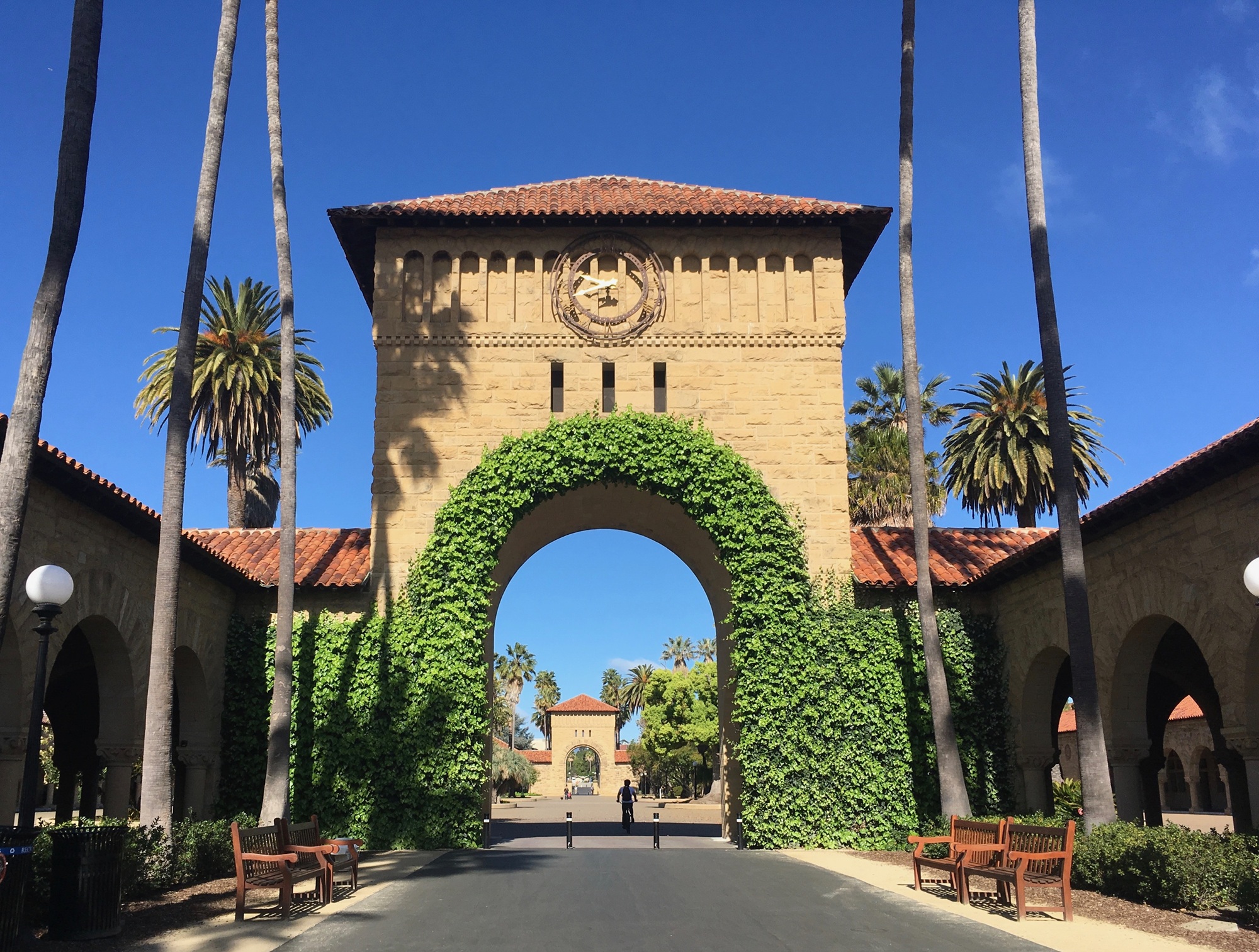
"caption": "One of the entrances to the Main Quad on the Stanford University campus on April 9, 2019. Stanford University senior Billy Ramirez returned to campus this fall to find that the university’s housing and dining department used artificial intelligence to replace him with a Black woman on a public banner. ",
"credit": "Rachael Myrow/KQED",
"altTag": null,
"description": null,
"imgSizes": {
"thumbnail": {
"file": "https://cdn.kqed.org/wp-content/uploads/sites/10/2025/08/StanfordUniversity-160x121.jpg",
"width": 160,
"height": 121,
"mimeType": "image/jpeg"
},
"1536x1536": {
"file": "https://cdn.kqed.org/wp-content/uploads/sites/10/2025/08/StanfordUniversity-1536x1162.jpg",
"width": 1536,
"height": 1162,
"mimeType": "image/jpeg"
},
"post-thumbnail": {
"file": "https://cdn.kqed.org/wp-content/uploads/sites/10/2025/08/StanfordUniversity-672x372.jpg",
"width": 672,
"height": 372,
"mimeType": "image/jpeg"
},
"twentyfourteen-full-width": {
"file": "https://cdn.kqed.org/wp-content/uploads/sites/10/2025/08/StanfordUniversity-1038x576.jpg",
"width": 1038,
"height": 576,
"mimeType": "image/jpeg"
},
"kqedFullSize": {
"file": "https://cdn.kqed.org/wp-content/uploads/sites/10/2025/08/StanfordUniversity.jpg",
"width": 2000,
"height": 1513
}
},
"isLoading": false,
"fetchFailed": false
},
"news_12015756": {
"type": "attachments",
"id": "news_12015756",
"meta": {
"index": "attachments_1716263798",
"site": "news",
"id": "12015756",
"found": true
},
"title": "US-POLITICS-government-Trump",
"publishDate": 1732560501,
"status": "inherit",
"parent": 12015752,
"modified": 1781741530,
"caption": "U.S. President Donald Trump listens while acting OMB Director Russell Vought speaks during an executive order signing regarding federal regulations in the Roosevelt Room of the White House on Oct. 9, 2019, in Washington, D.C. ",
"credit": "Brendan Smialowski/AFP via Getty Images",
"altTag": null,
"description": null,
"imgSizes": {
"medium": {
"file": "https://cdn.kqed.org/wp-content/uploads/sites/10/2024/11/GettyImages-1174750205-800x533.jpg",
"width": 800,
"height": 533,
"mimeType": "image/jpeg"
},
"large": {
"file": "https://cdn.kqed.org/wp-content/uploads/sites/10/2024/11/GettyImages-1174750205-1020x680.jpg",
"width": 1020,
"height": 680,
"mimeType": "image/jpeg"
},
"thumbnail": {
"file": "https://cdn.kqed.org/wp-content/uploads/sites/10/2024/11/GettyImages-1174750205-160x107.jpg",
"width": 160,
"height": 107,
"mimeType": "image/jpeg"
},
"1536x1536": {
"file": "https://cdn.kqed.org/wp-content/uploads/sites/10/2024/11/GettyImages-1174750205-1536x1024.jpg",
"width": 1536,
"height": 1024,
"mimeType": "image/jpeg"
},
"2048x2048": {
"file": "https://cdn.kqed.org/wp-content/uploads/sites/10/2024/11/GettyImages-1174750205-2048x1365.jpg",
"width": 2048,
"height": 1365,
"mimeType": "image/jpeg"
},
"post-thumbnail": {
"file": "https://cdn.kqed.org/wp-content/uploads/sites/10/2024/11/GettyImages-1174750205-672x372.jpg",
"width": 672,
"height": 372,
"mimeType": "image/jpeg"
},
"twentyfourteen-full-width": {
"file": "https://cdn.kqed.org/wp-content/uploads/sites/10/2024/11/GettyImages-1174750205-1038x576.jpg",
"width": 1038,
"height": 576,
"mimeType": "image/jpeg"
},
"full-width": {
"file": "https://cdn.kqed.org/wp-content/uploads/sites/10/2024/11/GettyImages-1174750205-1920x1280.jpg",
"width": 1920,
"height": 1280,
"mimeType": "image/jpeg"
},
"kqedFullSize": {
"file": "https://cdn.kqed.org/wp-content/uploads/sites/10/2024/11/GettyImages-1174750205-scaled-e1781739384219.jpg",
"width": 2000,
"height": 1334
}
},
"isLoading": false,
"fetchFailed": false
},
"news_12049457": {
"type": "attachments",
"id": "news_12049457",
"meta": {
"index": "attachments_1716263798",
"site": "news",
"id": "12049457",
"found": true
},
"title": "Muir Woods Exhibit (1)",
"publishDate": 1753310562,
"status": "inherit",
"parent": 12049405,
"modified": 1758226708,
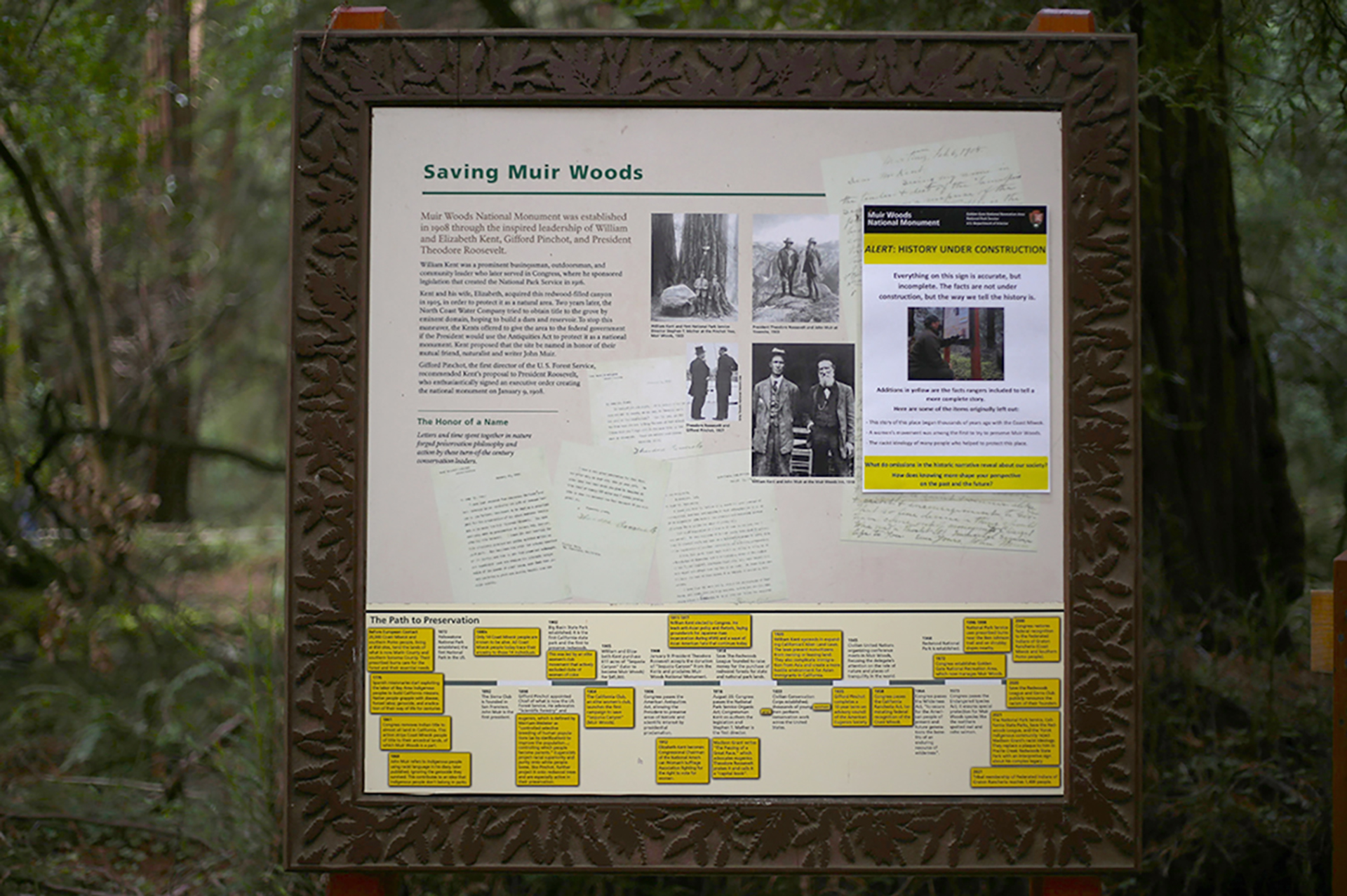
"caption": "The Muir Woods 'History in Construction' Exhibit, which was put up in 2021 to honor previously undocumented contributions to the park's stewardship. Signs like this one were part of the Trump Administration's removal order.",
"credit": "Courtesy of NPS/Jace Ritchey",
"altTag": null,
"description": null,
"imgSizes": {
"thumbnail": {
"file": "https://cdn.kqed.org/wp-content/uploads/sites/10/2025/07/Muir-Woods-Exhibit-1-160x106.png",
"width": 160,
"height": 106,
"mimeType": "image/png"
},
"1536x1536": {
"file": "https://cdn.kqed.org/wp-content/uploads/sites/10/2025/07/Muir-Woods-Exhibit-1-1536x1022.png",
"width": 1536,
"height": 1022,
"mimeType": "image/png"
},
"post-thumbnail": {
"file": "https://cdn.kqed.org/wp-content/uploads/sites/10/2025/07/Muir-Woods-Exhibit-1-672x372.png",
"width": 672,
"height": 372,
"mimeType": "image/png"
},
"twentyfourteen-full-width": {
"file": "https://cdn.kqed.org/wp-content/uploads/sites/10/2025/07/Muir-Woods-Exhibit-1-1038x576.png",
"width": 1038,
"height": 576,
"mimeType": "image/png"
},
"kqedFullSize": {
"file": "https://cdn.kqed.org/wp-content/uploads/sites/10/2025/07/Muir-Woods-Exhibit-1.png",
"width": 1920,
"height": 1277
}
},
"isLoading": false,
"fetchFailed": false
},
"news_12062227": {
"type": "attachments",
"id": "news_12062227",
"meta": {
"index": "attachments_1716263798",
"site": "news",
"id": "12062227",
"found": true
},
"title": "20251029_STANFORDFILE--_GH-2-KQED",
"publishDate": 1761843198,
"status": "inherit",
"parent": 0,
"modified": 1761843299,
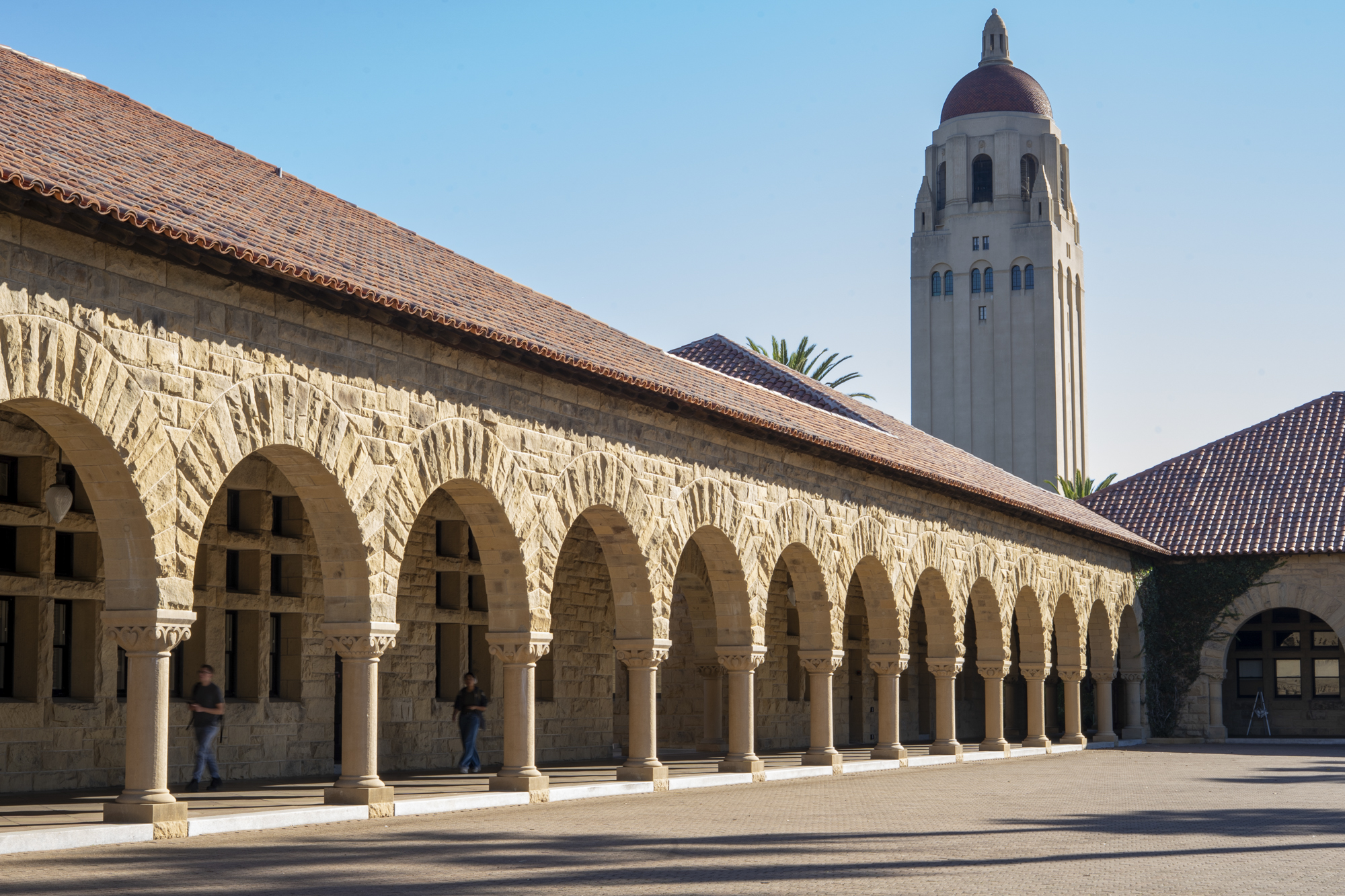
"caption": "The arched walkways of Stanford’s Main Quad in Stanford Oct. 29, 2025.",
"credit": "Gustavo Hernandez/KQED",
"altTag": null,
"description": null,
"imgSizes": {
"thumbnail": {
"file": "https://cdn.kqed.org/wp-content/uploads/sites/10/2025/10/20251029_STANFORDFILE-_GH-2-KQED-160x107.jpg",
"width": 160,
"height": 107,
"mimeType": "image/jpeg"
},
"1536x1536": {
"file": "https://cdn.kqed.org/wp-content/uploads/sites/10/2025/10/20251029_STANFORDFILE-_GH-2-KQED-1536x1024.jpg",
"width": 1536,
"height": 1024,
"mimeType": "image/jpeg"
},
"post-thumbnail": {
"file": "https://cdn.kqed.org/wp-content/uploads/sites/10/2025/10/20251029_STANFORDFILE-_GH-2-KQED-672x372.jpg",
"width": 672,
"height": 372,
"mimeType": "image/jpeg"
},
"twentyfourteen-full-width": {
"file": "https://cdn.kqed.org/wp-content/uploads/sites/10/2025/10/20251029_STANFORDFILE-_GH-2-KQED-1038x576.jpg",
"width": 1038,
"height": 576,
"mimeType": "image/jpeg"
},
"npr-cds-wide": {
"file": "https://cdn.kqed.org/wp-content/uploads/sites/10/2025/10/20251029_STANFORDFILE-_GH-2-KQED-1600x900.jpg",
"width": 1600,
"height": 900,
"mimeType": "image/jpeg"
},
"kqedFullSize": {
"file": "https://cdn.kqed.org/wp-content/uploads/sites/10/2025/10/20251029_STANFORDFILE-_GH-2-KQED.jpg",
"width": 2000,
"height": 1333
}
},
"isLoading": false,
"fetchFailed": false
},
"news_12070193": {
"type": "attachments",
"id": "news_12070193",
"meta": {
"index": "attachments_1716263798",
"site": "news",
"id": "12070193",
"found": true
},
"title": "MLK Day March San Francisco",
"publishDate": 1768593375,
"status": "inherit",
"parent": 12070047,
"modified": 1768593429,
"caption": "A crowd marches across the Lefty O'Doul Bridge during the MLK Day March in San Francisco on Monday, Jan. 20, 2025.",
"credit": "Hearst Newspapers",
"altTag": null,
"description": null,
"imgSizes": {
"thumbnail": {
"file": "https://cdn.kqed.org/wp-content/uploads/sites/10/2026/01/GettyImages-2194434108-160x107.jpg",
"width": 160,
"height": 107,
"mimeType": "image/jpeg"
},
"1536x1536": {
"file": "https://cdn.kqed.org/wp-content/uploads/sites/10/2026/01/GettyImages-2194434108-1536x1024.jpg",
"width": 1536,
"height": 1024,
"mimeType": "image/jpeg"
},
"post-thumbnail": {
"file": "https://cdn.kqed.org/wp-content/uploads/sites/10/2026/01/GettyImages-2194434108-672x372.jpg",
"width": 672,
"height": 372,
"mimeType": "image/jpeg"
},
"twentyfourteen-full-width": {
"file": "https://cdn.kqed.org/wp-content/uploads/sites/10/2026/01/GettyImages-2194434108-1038x576.jpg",
"width": 1038,
"height": 576,
"mimeType": "image/jpeg"
},
"npr-cds-wide": {
"file": "https://cdn.kqed.org/wp-content/uploads/sites/10/2026/01/GettyImages-2194434108-1200x675.jpg",
"width": 1200,
"height": 675,
"mimeType": "image/jpeg"
},
"kqedFullSize": {
"file": "https://cdn.kqed.org/wp-content/uploads/sites/10/2026/01/GettyImages-2194434108.jpg",
"width": 1980,
"height": 1320
}
},
"isLoading": false,
"fetchFailed": false
},
"news_12065956": {
"type": "attachments",
"id": "news_12065956",
"meta": {
"index": "attachments_1716263798",
"site": "news",
"id": "12065956",
"found": true
},
"title": "251027-YosemiteShutdown-51-BL_qed",
"publishDate": 1764800032,
"status": "inherit",
"parent": 12065920,
"modified": 1764879444,
"caption": "Souvenirs, books, hiking gear and other items line the shelves at the Welcome Center in Yosemite National Park on Oct. 27, 2025.",
"credit": "Beth LaBerge/KQED",
"altTag": null,
"description": null,
"imgSizes": {
"thumbnail": {
"file": "https://cdn.kqed.org/wp-content/uploads/sites/10/2025/12/251027-YosemiteShutdown-51-BL_qed-160x107.jpg",
"width": 160,
"height": 107,
"mimeType": "image/jpeg"
},
"1536x1536": {
"file": "https://cdn.kqed.org/wp-content/uploads/sites/10/2025/12/251027-YosemiteShutdown-51-BL_qed-1536x1024.jpg",
"width": 1536,
"height": 1024,
"mimeType": "image/jpeg"
},
"post-thumbnail": {
"file": "https://cdn.kqed.org/wp-content/uploads/sites/10/2025/12/251027-YosemiteShutdown-51-BL_qed-672x372.jpg",
"width": 672,
"height": 372,
"mimeType": "image/jpeg"
},
"twentyfourteen-full-width": {
"file": "https://cdn.kqed.org/wp-content/uploads/sites/10/2025/12/251027-YosemiteShutdown-51-BL_qed-1038x576.jpg",
"width": 1038,
"height": 576,
"mimeType": "image/jpeg"
},
"npr-cds-wide": {
"file": "https://cdn.kqed.org/wp-content/uploads/sites/10/2025/12/251027-YosemiteShutdown-51-BL_qed-1200x675.jpg",
"width": 1200,
"height": 675,
"mimeType": "image/jpeg"
},
"kqedFullSize": {
"file": "https://cdn.kqed.org/wp-content/uploads/sites/10/2025/12/251027-YosemiteShutdown-51-BL_qed.jpg",
"width": 1999,
"height": 1333
}
},
"isLoading": false,
"fetchFailed": false
},
"news_12056057": {
"type": "attachments",
"id": "news_12056057",
"meta": {
"index": "attachments_1716263798",
"site": "news",
"id": "12056057",
"found": true
},
"title": "ICE Protests At Federal Building In Santa Ana",
"publishDate": 1758028673,
"status": "inherit",
"parent": 12056056,
"modified": 1758028755,
"caption": "Santa Ana, CA - June 09: Protester run from police as they use tear gas and flash-bangs at the Federal Building in Santa Ana, CA, on Monday, June 9, 2025. About 400 anti-ICE protesters spent the afternoon carrying signs as they chanted and yelled at police. ",
"credit": "Photo by Jeff Gritchen/MediaNews Group/Orange County Register via Getty Images",
"altTag": null,
"description": null,
"imgSizes": {
"medium": {
"file": "https://cdn.kqed.org/wp-content/uploads/sites/10/2025/09/GettyImages-2218868730-2000x1016.jpg",
"width": 2000,
"height": 1016,
"mimeType": "image/jpeg"
},
"large": {
"file": "https://cdn.kqed.org/wp-content/uploads/sites/10/2025/09/GettyImages-2218868730-2000x1016.jpg",
"width": 2000,
"height": 1016,
"mimeType": "image/jpeg"
},
"thumbnail": {
"file": "https://cdn.kqed.org/wp-content/uploads/sites/10/2025/09/GettyImages-2218868730-160x81.jpg",
"width": 160,
"height": 81,
"mimeType": "image/jpeg"
},
"1536x1536": {
"file": "https://cdn.kqed.org/wp-content/uploads/sites/10/2025/09/GettyImages-2218868730-1536x780.jpg",
"width": 1536,
"height": 780,
"mimeType": "image/jpeg"
},
"2048x2048": {
"file": "https://cdn.kqed.org/wp-content/uploads/sites/10/2025/09/GettyImages-2218868730-2048x1040.jpg",
"width": 2048,
"height": 1040,
"mimeType": "image/jpeg"
},
"post-thumbnail": {
"file": "https://cdn.kqed.org/wp-content/uploads/sites/10/2025/09/GettyImages-2218868730-672x372.jpg",
"width": 672,
"height": 372,
"mimeType": "image/jpeg"
},
"twentyfourteen-full-width": {
"file": "https://cdn.kqed.org/wp-content/uploads/sites/10/2025/09/GettyImages-2218868730-1038x576.jpg",
"width": 1038,
"height": 576,
"mimeType": "image/jpeg"
},
"full-width": {
"file": "https://cdn.kqed.org/wp-content/uploads/sites/10/2025/09/GettyImages-2218868730-2000x1016.jpg",
"width": 2000,
"height": 1016,
"mimeType": "image/jpeg"
},
"kqedFullSize": {
"file": "https://cdn.kqed.org/wp-content/uploads/sites/10/2025/09/GettyImages-2218868730-scaled.jpg",
"width": 2560,
"height": 1300
}
},
"isLoading": false,
"fetchFailed": false
},
"news_12045890": {
"type": "attachments",
"id": "news_12045890",
"meta": {
"index": "attachments_1716263798",
"site": "news",
"id": "12045890",
"found": true
},
"title": "ggbridge_003_qed",
"publishDate": 1750872107,
"status": "inherit",
"parent": 12045887,
"modified": 1750872136,
"caption": "The Golden Gate Bridge in San Francisco on Feb. 15, 2019.",
"credit": "Lindsey Moore/KQED",
"altTag": null,
"description": null,
"imgSizes": {
"thumbnail": {
"file": "https://cdn.kqed.org/wp-content/uploads/sites/10/2025/06/ggbridge_003_qed-160x112.jpg",
"width": 160,
"height": 112,
"mimeType": "image/jpeg"
},
"1536x1536": {
"file": "https://cdn.kqed.org/wp-content/uploads/sites/10/2025/06/ggbridge_003_qed-1536x1079.jpg",
"width": 1536,
"height": 1079,
"mimeType": "image/jpeg"
},
"post-thumbnail": {
"file": "https://cdn.kqed.org/wp-content/uploads/sites/10/2025/06/ggbridge_003_qed-672x372.jpg",
"width": 672,
"height": 372,
"mimeType": "image/jpeg"
},
"twentyfourteen-full-width": {
"file": "https://cdn.kqed.org/wp-content/uploads/sites/10/2025/06/ggbridge_003_qed-1038x576.jpg",
"width": 1038,
"height": 576,
"mimeType": "image/jpeg"
},
"kqedFullSize": {
"file": "https://cdn.kqed.org/wp-content/uploads/sites/10/2025/06/ggbridge_003_qed.jpg",
"width": 1897,
"height": 1333
}
},
"isLoading": false,
"fetchFailed": false
},
"news_12042569": {
"type": "attachments",
"id": "news_12042569",
"meta": {
"index": "attachments_1716263798",
"site": "news",
"id": "12042569",
"found": true
},
"title": "US-MILITARY-NAVY-HARVEY MILK",
"publishDate": 1748986634,
"status": "inherit",
"parent": 12042566,
"modified": 1748995401,
"caption": "USNS Harvey Milk departs the General Dynamics NASSCO shipyard after a ceremonial address in San Diego, California, on Nov. 6, 2021. ",
"credit": "Ariana Drehsler/AFP via Getty Images",
"altTag": null,
"description": null,
"imgSizes": {
"medium": {
"file": "https://cdn.kqed.org/wp-content/uploads/sites/10/2025/06/USNS-Harvey-Milk-Getty-800x533.jpg",
"width": 800,
"height": 533,
"mimeType": "image/jpeg"
},
"large": {
"file": "https://cdn.kqed.org/wp-content/uploads/sites/10/2025/06/USNS-Harvey-Milk-Getty-1020x680.jpg",
"width": 1020,
"height": 680,
"mimeType": "image/jpeg"
},
"thumbnail": {
"file": "https://cdn.kqed.org/wp-content/uploads/sites/10/2025/06/USNS-Harvey-Milk-Getty-160x107.jpg",
"width": 160,
"height": 107,
"mimeType": "image/jpeg"
},
"1536x1536": {
"file": "https://cdn.kqed.org/wp-content/uploads/sites/10/2025/06/USNS-Harvey-Milk-Getty-1536x1024.jpg",
"width": 1536,
"height": 1024,
"mimeType": "image/jpeg"
},
"post-thumbnail": {
"file": "https://cdn.kqed.org/wp-content/uploads/sites/10/2025/06/USNS-Harvey-Milk-Getty-672x372.jpg",
"width": 672,
"height": 372,
"mimeType": "image/jpeg"
},
"twentyfourteen-full-width": {
"file": "https://cdn.kqed.org/wp-content/uploads/sites/10/2025/06/USNS-Harvey-Milk-Getty-1038x576.jpg",
"width": 1038,
"height": 576,
"mimeType": "image/jpeg"
},
"full-width": {
"file": "https://cdn.kqed.org/wp-content/uploads/sites/10/2025/06/USNS-Harvey-Milk-Getty-1920x1280.jpg",
"width": 1920,
"height": 1280,
"mimeType": "image/jpeg"
},
"kqedFullSize": {
"file": "https://cdn.kqed.org/wp-content/uploads/sites/10/2025/06/USNS-Harvey-Milk-Getty.jpg",
"width": 2000,
"height": 1333
}
},
"isLoading": false,
"fetchFailed": false
},
"news_12041447": {
"type": "attachments",
"id": "news_12041447",
"meta": {
"index": "attachments_1716263798",
"site": "news",
"id": "12041447",
"found": true
},
"title": "npr.brightspotcdn copy",
"publishDate": 1747960151,
"status": "inherit",
"parent": 12041446,
"modified": 1747960178,
"caption": "The Smithsonian Institution Building on the National Mall is seen on March 28 in Washington, DC. The organization is the target of an order from President Trump that seeks to restore 'truth and sanity to American history.'",
"credit": "Kevin Dietsch/Getty Images",
"altTag": null,
"description": null,
"imgSizes": {
"medium": {
"file": "https://cdn.kqed.org/wp-content/uploads/sites/10/2025/05/npr.brightspotcdn-copy-10-800x534.jpg",
"width": 800,
"height": 534,
"mimeType": "image/jpeg"
},
"large": {
"file": "https://cdn.kqed.org/wp-content/uploads/sites/10/2025/05/npr.brightspotcdn-copy-10-1020x680.jpg",
"width": 1020,
"height": 680,
"mimeType": "image/jpeg"
},
"thumbnail": {
"file": "https://cdn.kqed.org/wp-content/uploads/sites/10/2025/05/npr.brightspotcdn-copy-10-160x107.jpg",
"width": 160,
"height": 107,
"mimeType": "image/jpeg"
},
"1536x1536": {
"file": "https://cdn.kqed.org/wp-content/uploads/sites/10/2025/05/npr.brightspotcdn-copy-10-1536x1024.jpg",
"width": 1536,
"height": 1024,
"mimeType": "image/jpeg"
},
"post-thumbnail": {
"file": "https://cdn.kqed.org/wp-content/uploads/sites/10/2025/05/npr.brightspotcdn-copy-10-672x372.jpg",
"width": 672,
"height": 372,
"mimeType": "image/jpeg"
},
"twentyfourteen-full-width": {
"file": "https://cdn.kqed.org/wp-content/uploads/sites/10/2025/05/npr.brightspotcdn-copy-10-1038x576.jpg",
"width": 1038,
"height": 576,
"mimeType": "image/jpeg"
},
"kqedFullSize": {
"file": "https://cdn.kqed.org/wp-content/uploads/sites/10/2025/05/npr.brightspotcdn-copy-10.jpg",
"width": 1600,
"height": 1067
}
},
"isLoading": false,
"fetchFailed": false
},
"news_12039612": {
"type": "attachments",
"id": "news_12039612",
"meta": {
"index": "attachments_1716263798",
"site": "news",
"id": "12039612",
"found": true
},
"title": "IMG_1018",
"publishDate": 1746825477,
"status": "inherit",
"parent": 12039390,
"modified": 1746826660,
"caption": "President Donald Trump’s administration has disrupted long-standing government norms. Yet even in California, many of his supporters remain steadfast.",
"credit": "Anna Vignet/KQED",
"altTag": null,
"description": null,
"imgSizes": {
"medium": {
"file": "https://cdn.kqed.org/wp-content/uploads/sites/10/2025/05/IMG_1018-800x600.jpg",
"width": 800,
"height": 600,
"mimeType": "image/jpeg"
},
"large": {
"file": "https://cdn.kqed.org/wp-content/uploads/sites/10/2025/05/IMG_1018-1020x765.jpg",
"width": 1020,
"height": 765,
"mimeType": "image/jpeg"
},
"thumbnail": {
"file": "https://cdn.kqed.org/wp-content/uploads/sites/10/2025/05/IMG_1018-160x120.jpg",
"width": 160,
"height": 120,
"mimeType": "image/jpeg"
},
"1536x1536": {
"file": "https://cdn.kqed.org/wp-content/uploads/sites/10/2025/05/IMG_1018-1536x1152.jpg",
"width": 1536,
"height": 1152,
"mimeType": "image/jpeg"
},
"2048x2048": {
"file": "https://cdn.kqed.org/wp-content/uploads/sites/10/2025/05/IMG_1018-2048x1536.jpg",
"width": 2048,
"height": 1536,
"mimeType": "image/jpeg"
},
"post-thumbnail": {
"file": "https://cdn.kqed.org/wp-content/uploads/sites/10/2025/05/IMG_1018-672x372.jpg",
"width": 672,
"height": 372,
"mimeType": "image/jpeg"
},
"twentyfourteen-full-width": {
"file": "https://cdn.kqed.org/wp-content/uploads/sites/10/2025/05/IMG_1018-1038x576.jpg",
"width": 1038,
"height": 576,
"mimeType": "image/jpeg"
},
"full-width": {
"file": "https://cdn.kqed.org/wp-content/uploads/sites/10/2025/05/IMG_1018-1920x1440.jpg",
"width": 1920,
"height": 1440,
"mimeType": "image/jpeg"
},
"kqedFullSize": {
"file": "https://cdn.kqed.org/wp-content/uploads/sites/10/2025/05/IMG_1018.jpg",
"width": 2560,
"height": 1920
}
},
"isLoading": false,
"fetchFailed": false
}
},
"audioPlayerReducer": {
"postId": "stream_live",
"isPaused": true,
"isPlaying": false,
"pfsActive": false,
"pledgeModalIsOpen": true,
"playerDrawerIsOpen": false,
"liveAudioPlayStartedAt": 0,
"liveAudioPlayContext": ""
},
"authorsReducer": {
"byline_news_12077715": {
"type": "authors",
"id": "byline_news_12077715",
"meta": {
"override": true
},
"slug": "byline_news_12077715",
"name": "The Associated Press",
"isLoading": false
},
"byline_news_12041446": {
"type": "authors",
"id": "byline_news_12041446",
"meta": {
"override": true
},
"slug": "byline_news_12041446",
"name": "\u003ca href=\"https://www.npr.org/people/14562108/bill-chappell\">Bill Chappell\u003c/a>, NPR",
"isLoading": false
},
"danbrekke": {
"type": "authors",
"id": "222",
"meta": {
"index": "authors_1716337520",
"id": "222",
"found": true
},
"name": "Dan Brekke",
"firstName": "Dan",
"lastName": "Brekke",
"slug": "danbrekke",
"email": "dbrekke@kqed.org",
"display_author_email": true,
"staff_mastheads": [
"news",
"science"
],
"title": "KQED Editor and Reporter",
"bio": "Dan Brekke is a reporter and editor for KQED News, responsible for coverage of topics ranging from California water issues to the Bay Area's transportation challenges. In a newsroom career that began in Chicago in 1972, Dan has worked for \u003cem>The San Francisco Examiner,\u003c/em> Wired and TechTV and has been published in The New York Times, The New York Times Magazine, Business 2.0, Salon and elsewhere.\r\n\r\nSince joining KQED in 2007, Dan has reported, edited and produced both radio and online features and breaking news pieces. He has shared as both editor and reporter in four Society of Professional Journalists Norcal Excellence in Journalism awards and one Edward R. Murrow regional award. He was chosen for a spring 2017 residency at the Mesa Refuge to advance his research on California salmon.\r\n\r\nEmail Dan at: \u003ca href=\"mailto:dbrekke@kqed.org\">dbrekke@kqed.org\u003c/a>\r\n\r\n\u003cstrong>Twitter:\u003c/strong> \u003ca href=\"https://twitter.com/danbrekke\" rel=\"noopener noreferrer\">twitter.com/danbrekke\u003c/a>\r\n\u003cstrong>Facebook:\u003c/strong> \u003ca href=\"https://www.facebook.com/danbrekke\" rel=\"noopener noreferrer\">www.facebook.com/danbrekke\u003c/a>\r\n\u003cstrong>LinkedIn:\u003c/strong> \u003ca href=\"https://www.linkedin.com/in/danbrekke\" rel=\"noopener noreferrer\">www.linkedin.com/in/danbrekke\u003c/a>",
"avatar": "https://secure.gravatar.com/avatar/8f1f0d2a978fb3b23426c922c7e2af558fa36905b49c4ce76a97dc3c72d27226?s=600&d=mm&r=g",
"twitter": "danbrekke",
"bluesky": null,
"facebook": null,
"instagram": "https://www.instagram.com/dan.brekke/",
"linkedin": "https://www.linkedin.com/in/danbrekke/",
"sites": [
{
"site": "news",
"roles": [
"administrator",
"create_posts"
]
},
{
"site": "stateofhealth",
"roles": [
"editor"
]
},
{
"site": "science",
"roles": [
"editor"
]
},
{
"site": "quest",
"roles": [
"contributor"
]
},
{
"site": "food",
"roles": [
"contributor"
]
},
{
"site": "forum",
"roles": [
"contributor"
]
},
{
"site": "elections",
"roles": [
"editor"
]
},
{
"site": "liveblog",
"roles": [
"editor"
]
}
],
"headData": {
"title": "Dan Brekke | KQED",
"description": "KQED Editor and Reporter",
"ogImgSrc": "https://secure.gravatar.com/avatar/8f1f0d2a978fb3b23426c922c7e2af558fa36905b49c4ce76a97dc3c72d27226?s=600&d=mm&r=g",
"twImgSrc": "https://secure.gravatar.com/avatar/8f1f0d2a978fb3b23426c922c7e2af558fa36905b49c4ce76a97dc3c72d27226?s=600&d=mm&r=g"
},
"isLoading": false,
"link": "/author/danbrekke"
},
"kmizuguchi": {
"type": "authors",
"id": "11739",
"meta": {
"index": "authors_1716337520",
"id": "11739",
"found": true
},
"name": "Keith Mizuguchi",
"firstName": "Keith",
"lastName": "Mizuguchi",
"slug": "kmizuguchi",
"email": "kmizuguchi@kqed.org",
"display_author_email": false,
"staff_mastheads": [],
"title": "KQED Contributor",
"bio": null,
"avatar": "https://secure.gravatar.com/avatar/64d8a7de0723d4099b9fe4e915136103febcc20809abce228ee4415bcb237023?s=600&d=blank&r=g",
"twitter": null,
"bluesky": null,
"facebook": null,
"instagram": null,
"linkedin": null,
"sites": [
{
"site": "news",
"roles": [
"editor"
]
},
{
"site": "science",
"roles": [
"editor"
]
}
],
"headData": {
"title": "Keith Mizuguchi | KQED",
"description": "KQED Contributor",
"ogImgSrc": "https://secure.gravatar.com/avatar/64d8a7de0723d4099b9fe4e915136103febcc20809abce228ee4415bcb237023?s=600&d=blank&r=g",
"twImgSrc": "https://secure.gravatar.com/avatar/64d8a7de0723d4099b9fe4e915136103febcc20809abce228ee4415bcb237023?s=600&d=blank&r=g"
},
"isLoading": false,
"link": "/author/kmizuguchi"
},
"eromero": {
"type": "authors",
"id": "11746",
"meta": {
"index": "authors_1716337520",
"id": "11746",
"found": true
},
"name": "Ezra David Romero",
"firstName": "Ezra David",
"lastName": "Romero",
"slug": "eromero",
"email": "eromero@kqed.org",
"display_author_email": true,
"staff_mastheads": [
"news",
"science"
],
"title": "Climate Reporter",
"bio": "Ezra David Romero is a climate reporter for KQED News. He covers the absence and excess of water in the Bay Area — think sea level rise, flooding and drought. For nearly a decade he’s covered how warming temperatures are altering the lives of Californians. He’s reported on farmers worried their pistachio trees aren’t getting enough sleep, families desperate for water, scientists studying dying giant sequoias, and alongside firefighters containing wildfires. His work has appeared on local stations across California and nationally on public radio shows like Morning Edition, Here and Now, All Things Considered and Science Friday. ",
"avatar": "https://secure.gravatar.com/avatar/c76404d287c10ed40224227551ac36e24352c7306f106632caf6fead76f8801f?s=600&d=blank&r=g",
"twitter": "ezraromero",
"bluesky": null,
"facebook": null,
"instagram": null,
"linkedin": null,
"sites": [
{
"site": "arts",
"roles": [
"editor"
]
},
{
"site": "news",
"roles": [
"editor"
]
},
{
"site": "science",
"roles": [
"editor"
]
},
{
"site": "liveblog",
"roles": [
"author"
]
}
],
"headData": {
"title": "Ezra David Romero | KQED",
"description": "Climate Reporter",
"ogImgSrc": "https://secure.gravatar.com/avatar/c76404d287c10ed40224227551ac36e24352c7306f106632caf6fead76f8801f?s=600&d=blank&r=g",
"twImgSrc": "https://secure.gravatar.com/avatar/c76404d287c10ed40224227551ac36e24352c7306f106632caf6fead76f8801f?s=600&d=blank&r=g"
},
"isLoading": false,
"link": "/author/eromero"
},
"ibloom": {
"type": "authors",
"id": "11805",
"meta": {
"index": "authors_1716337520",
"id": "11805",
"found": true
},
"name": "Izzy Bloom",
"firstName": "Izzy",
"lastName": "Bloom",
"slug": "ibloom",
"email": "ibloom@kqed.org",
"display_author_email": false,
"staff_mastheads": [],
"title": "KQED Reporter & Producer",
"bio": "Izzy is a reporter and producer on KQED's California Politics & Government Desk. She joined the desk in 2024 to produce Political Breakdown, covering local and national elections and attending the RNC and DNC in Milwaukee and Chicago. \r\n\r\nBefore that, Izzy was a producer on The California Report and reported long-form stories for The California Report Magazine. She was a finalist for the Third Coast/Richard H. Driehaus Foundation Competition and was awarded for her reporting on indigenous land back by the Society of Professional Journalists. Izzy received her master's in journalism from the University of California, Berkeley.",
"avatar": "https://secure.gravatar.com/avatar/cc4d272ca430783ee1a8efac470a6b1e0fdd082c3beb61da019801d0ff751c8c?s=600&d=blank&r=g",
"twitter": null,
"bluesky": null,
"facebook": null,
"instagram": null,
"linkedin": null,
"sites": [
{
"site": "news",
"roles": [
"editor"
]
},
{
"site": "perspectives",
"roles": [
"editor"
]
}
],
"headData": {
"title": "Izzy Bloom | KQED",
"description": "KQED Reporter & Producer",
"ogImgSrc": "https://secure.gravatar.com/avatar/cc4d272ca430783ee1a8efac470a6b1e0fdd082c3beb61da019801d0ff751c8c?s=600&d=blank&r=g",
"twImgSrc": "https://secure.gravatar.com/avatar/cc4d272ca430783ee1a8efac470a6b1e0fdd082c3beb61da019801d0ff751c8c?s=600&d=blank&r=g"
},
"isLoading": false,
"link": "/author/ibloom"
},
"kdebenedetti": {
"type": "authors",
"id": "11913",
"meta": {
"index": "authors_1716337520",
"id": "11913",
"found": true
},
"name": "Katie DeBenedetti",
"firstName": "Katie",
"lastName": "DeBenedetti",
"slug": "kdebenedetti",
"email": "kdebenedetti@kqed.org",
"display_author_email": false,
"staff_mastheads": [
"news",
"science"
],
"title": "KQED Contributor",
"bio": "Katie DeBenedetti is a digital reporter covering daily news for the Express Desk. Prior to joining KQED as a culture reporting intern in January 2024, she covered education and city government for the Napa Valley Register.",
"avatar": "https://secure.gravatar.com/avatar/6e31073cb8f7e4214ab03f42771d0f45?s=600&d=blank&r=g",
"twitter": null,
"facebook": null,
"instagram": null,
"linkedin": null,
"sites": [
{
"site": "news",
"roles": [
"author"
]
},
{
"site": "science",
"roles": [
"author"
]
},
{
"site": "liveblog",
"roles": [
"author"
]
}
],
"headData": {
"title": "Katie DeBenedetti | KQED",
"description": "KQED Contributor",
"ogImgSrc": "https://secure.gravatar.com/avatar/6e31073cb8f7e4214ab03f42771d0f45?s=600&d=blank&r=g",
"twImgSrc": "https://secure.gravatar.com/avatar/6e31073cb8f7e4214ab03f42771d0f45?s=600&d=blank&r=g"
},
"isLoading": false,
"link": "/author/kdebenedetti"
},
"slim": {
"type": "authors",
"id": "11920",
"meta": {
"index": "authors_1716337520",
"id": "11920",
"found": true
},
"name": "Samantha Lim",
"firstName": "Samantha",
"lastName": "Lim",
"slug": "slim",
"email": "slim@KQED.org",
"display_author_email": false,
"staff_mastheads": [],
"title": "KQED Contributor",
"bio": null,
"avatar": "https://secure.gravatar.com/avatar/82e592e6c15fe1a04d385e8ad0fb0b4e?s=600&d=blank&r=g",
"twitter": null,
"facebook": null,
"instagram": null,
"linkedin": null,
"sites": [
{
"site": "news",
"roles": []
}
],
"headData": {
"title": "Samantha Lim | KQED",
"description": "KQED Contributor",
"ogImgSrc": "https://secure.gravatar.com/avatar/82e592e6c15fe1a04d385e8ad0fb0b4e?s=600&d=blank&r=g",
"twImgSrc": "https://secure.gravatar.com/avatar/82e592e6c15fe1a04d385e8ad0fb0b4e?s=600&d=blank&r=g"
},
"isLoading": false,
"link": "/author/slim"
},
"sarahwright": {
"type": "authors",
"id": "11956",
"meta": {
"index": "authors_1716337520",
"id": "11956",
"found": true
},
"name": "Sarah Wright",
"firstName": "Sarah",
"lastName": "Wright",
"slug": "sarahwright",
"email": "swright@kqed.org",
"display_author_email": true,
"staff_mastheads": [],
"title": "Outdoors Engagement Reporter",
"bio": "Sarah Wright is KQED's Outdoors Engagement Reporter. Originally from Lake Tahoe, she completed a thru-hike of the Pacific Crest Trail in 2019 and was a U.S. Fulbright Program grantee to Argentina in 2023. Her journalism has appeared in The Guardian, The San Francisco Standard, The Palo Alto Weekly and the Half Moon Bay Review.",
"avatar": "https://secure.gravatar.com/avatar/c161a3d6441865cba25e6db4fa561099ad665799e9432e34da2b84d7e371524c?s=600&d=blank&r=g",
"twitter": null,
"bluesky": null,
"facebook": null,
"instagram": null,
"linkedin": null,
"sites": [
{
"site": "arts",
"roles": [
"editor"
]
},
{
"site": "news",
"roles": [
"editor"
]
},
{
"site": "science",
"roles": [
"contributor",
"author"
]
},
{
"site": "forum",
"roles": [
"editor"
]
}
],
"headData": {
"title": "Sarah Wright | KQED",
"description": "Outdoors Engagement Reporter",
"ogImgSrc": "https://secure.gravatar.com/avatar/c161a3d6441865cba25e6db4fa561099ad665799e9432e34da2b84d7e371524c?s=600&d=blank&r=g",
"twImgSrc": "https://secure.gravatar.com/avatar/c161a3d6441865cba25e6db4fa561099ad665799e9432e34da2b84d7e371524c?s=600&d=blank&r=g"
},
"isLoading": false,
"link": "/author/sarahwright"
},
"aaliahmad": {
"type": "authors",
"id": "11986",
"meta": {
"index": "authors_1716337520",
"id": "11986",
"found": true
},
"name": "Ayah Ali-Ahmad",
"firstName": "Ayah",
"lastName": "Ali-Ahmad",
"slug": "aaliahmad",
"email": "aaliahmad@KQED.org",
"display_author_email": false,
"staff_mastheads": [],
"title": "KQED Contributor",
"bio": null,
"avatar": "https://secure.gravatar.com/avatar/1cf54f187a5e1064b2cfef3f3d2f1e4f93e453395d56912aca6382a6071ec3ed?s=600&d=blank&r=g",
"twitter": "ayahaliahmad",
"bluesky": null,
"facebook": null,
"instagram": null,
"linkedin": null,
"sites": [
{
"site": "news",
"roles": [
"subscriber"
]
}
],
"headData": {
"title": "Ayah Ali-Ahmad | KQED",
"description": "KQED Contributor",
"ogImgSrc": "https://secure.gravatar.com/avatar/1cf54f187a5e1064b2cfef3f3d2f1e4f93e453395d56912aca6382a6071ec3ed?s=600&d=blank&r=g",
"twImgSrc": "https://secure.gravatar.com/avatar/1cf54f187a5e1064b2cfef3f3d2f1e4f93e453395d56912aca6382a6071ec3ed?s=600&d=blank&r=g"
},
"isLoading": false,
"link": "/author/aaliahmad"
},
"ejackson": {
"type": "authors",
"id": "12003",
"meta": {
"index": "authors_1716337520",
"id": "12003",
"found": true
},
"name": "Ella Jackson",
"firstName": "Ella",
"lastName": "Jackson",
"slug": "ejackson",
"email": "ejackson@kqed.org",
"display_author_email": false,
"staff_mastheads": [],
"title": "KQED Contributor",
"bio": null,
"avatar": "https://secure.gravatar.com/avatar/3c688edc62aec1dcae096e1475956d245f72bde99cff316455871c9b22a7205b?s=600&d=blank&r=g",
"twitter": null,
"bluesky": null,
"facebook": null,
"instagram": null,
"linkedin": null,
"sites": [
{
"site": "news",
"roles": [
"author"
]
},
{
"site": "science",
"roles": [
"author"
]
}
],
"headData": {
"title": "Ella Jackson | KQED",
"description": "KQED Contributor",
"ogImgSrc": "https://secure.gravatar.com/avatar/3c688edc62aec1dcae096e1475956d245f72bde99cff316455871c9b22a7205b?s=600&d=blank&r=g",
"twImgSrc": "https://secure.gravatar.com/avatar/3c688edc62aec1dcae096e1475956d245f72bde99cff316455871c9b22a7205b?s=600&d=blank&r=g"
},
"isLoading": false,
"link": "/author/ejackson"
}
},
"pagesReducer": {
"news_tag_dei": {
"type": "terms",
"id": "news_32395",
"meta": {
"index": "terms_1716263798",
"site": "news",
"id": "32395",
"score": 9.55733
},
"featImg": null,
"name": "DEI",
"description": null,
"taxonomy": "tag",
"headData": {
"twImgId": null,
"twTitle": null,
"ogTitle": null,
"ogImgId": null,
"twDescription": null,
"description": null,
"title": "DEI Archives | KQED News",
"ogDescription": null
},
"ttid": 32412,
"slug": "dei",
"isLoading": false,
"title": "DEI",
"pageMeta": {
"site": "news",
"WpPageTemplate": "page-topic-editorial",
"currentPage": 1
},
"blocks": [
{
"blockName": "kqed/post-list",
"attrs": {
"layout": "cardArticle2",
"query": "posts/news?tag=dei",
"seeMore": false,
"paginated": true,
"page": 1
}
},
{
"blockName": "kqed/ad"
}
]
}
},
"pfsSessionReducer": {},
"postsReducer": {
"stream_live": {
"type": "live",
"id": "stream_live",
"audioUrl": "https://streams.kqed.org/kqedradio",
"title": "Live Stream",
"excerpt": "Live Stream information currently unavailable.",
"link": "/radio",
"featImg": "",
"label": {
"name": "KQED Live",
"link": "/"
}
},
"stream_kqedNewscast": {
"type": "posts",
"id": "stream_kqedNewscast",
"audioUrl": "https://www.kqed.org/.stream/anon/radio/RDnews/newscast.mp3?_=1",
"title": "KQED Newscast",
"featImg": "",
"label": {
"name": "88.5 FM",
"link": "/"
}
},
"news_12101196": {
"type": "posts",
"id": "news_12101196",
"meta": {
"index": "posts_1716263798",
"site": "news",
"id": "12101196",
"score": null,
"sort": [
1790278083000
]
},
"guestAuthors": [],
"slug": "stanford-ai-usage-face-swaps-on-campus-banner-sparks-national-backlash",
"title": "Stanford AI Usage, ‘Face Swaps’ on Campus Banner Spark National Backlash",
"publishDate": 1790278083,
"format": "standard",
"headTitle": "Stanford AI Usage, ‘Face Swaps’ on Campus Banner Spark National Backlash | KQED",
"labelTerm": {
"site": "news"
},
"content": "\n\u003cp>\u003ca href=\"https://www.kqed.org/news/tag/stanford-university\">Stanford University\u003c/a> senior Billy Ramirez returned to campus this fall to find that the university’s housing and dining department used artificial intelligence to replace him with a Black woman on a public banner. \u003c/p>\n\n\n\n\u003cp>Stanford Residential and Dining Enterprises, which oversees the university’s housing operations, dining services and campus conferences, hung the promotional banner in a student housing center, according to \u003ca href=\"https://stanforddaily.com/2026/09/23/university-confirms-ai-edited-photo/\">\u003cem>The Stanford Daily\u003c/em>\u003c/a>. \u003c/p>\n\n\n\n\u003cp>The outlet also reported that the original photo, taken in Stern Dining during a 2024 Lunar New Year celebration, was previously used unaltered. \u003c/p>\n\n\n\n\u003cfigure class=\"wp-block-image size-full\">\u003cimg loading=\"lazy\" decoding=\"async\" width=\"2000\" height=\"1320\" src=\"https://cdn.kqed.org/wp-content/uploads/sites/10/2023/07/230719-STANFORD-GETTY-DM-KQED.jpg\" alt=\"An ornate sandstone-colored building with a series of arches sitting on a brick plaza.\" class=\"wp-image-11956028\" srcset=\"https://cdn.kqed.org/wp-content/uploads/sites/10/2023/07/230719-STANFORD-GETTY-DM-KQED.jpg 2000w, https://cdn.kqed.org/wp-content/uploads/sites/10/2023/07/230719-STANFORD-GETTY-DM-KQED-800x528.jpg 800w, https://cdn.kqed.org/wp-content/uploads/sites/10/2023/07/230719-STANFORD-GETTY-DM-KQED-1020x673.jpg 1020w, https://cdn.kqed.org/wp-content/uploads/sites/10/2023/07/230719-STANFORD-GETTY-DM-KQED-160x106.jpg 160w, https://cdn.kqed.org/wp-content/uploads/sites/10/2023/07/230719-STANFORD-GETTY-DM-KQED-1536x1014.jpg 1536w, https://cdn.kqed.org/wp-content/uploads/sites/10/2023/07/230719-STANFORD-GETTY-DM-KQED-1920x1267.jpg 1920w\" sizes=\"auto, (max-width: 2000px) 100vw, 2000px\" />\u003cfigcaption class=\"wp-element-caption\">The arches of the Main Quadrangle buildings on the campus of Stanford University in Palo Alto on Oct. 2, 2021. (David Madison/Getty Images)\u003c/figcaption>\u003c/figure>\n\n\n\n\u003cp>In addition to replacing Ramirez, Stanford R&DE made significant changes to the other two students’ faces. The edits and use of AI caused a stir on the campus social media app, Fizz, according to the Daily, consequently drawing \u003ca href=\"https://www.nytimes.com/2026/09/22/us/stanford-photo-swap-black-hispanic-student.html\">national attention\u003c/a>. \u003c/p>\n\n\n\n\u003cp>“Seeing my identity changed and being left out of the picture made me feel, in a way, silenced and erased from a representation that was supposed to include me,” Ramirez told the \u003ca href=\"https://stanfordreview.org/stanford-r-de-uses-ai-to-race-swap-students-for-advertising/\">\u003cem>Stanford Review\u003c/em>\u003c/a>, an independent paper founded by venture capitalist and university alum Peter Thiel. \u003c/p>\n\n\n\n\n\n\u003cp>Ramirez’s class was the last cohort admitted to a U.S. college before the Supreme Court gutted \u003ca href=\"https://www.npr.org/2023/06/29/1181138066/affirmative-action-supreme-court-decision\">affirmative action\u003c/a> in 2023. \u003c/p>\n\n\n\n\u003cp>The \u003ca href=\"https://www.brookings.edu/articles/the-complex-ramifications-of-students-for-fair-admissions-v-harvard/\">Brookings Institute\u003c/a> found that these changes had a sizable impact on the racial profile of college populations across the country.\u003c/p>\n\n\n\n\u003cp>At Stanford, \u003ca href=\"https://news.stanford.edu/stories/2025/01/final-enrollment-data-for-class-of-2028-reported-in-common-data-set\">enrollment\u003c/a> for Black or African American students fell from 8.9% to 4.5% and enrollment for Hispanic or Latino students fell from 16.7% to 14.6%. \u003c/p>\n\n\n\n\u003cp>At the same time, Asian student enrollment increased from 28.8% to 33%, and White student enrollment increased from 21.9% to 24.1%. \u003c/p>\n\n\n\n\u003cp>Universities have a long history of artificially diversifying models in their marketing. In 2019, \u003ca href=\"https://www.insidehighered.com/blogs/call-action-marketing-and-communications-higher-education/marketing-authenticity-higher\">\u003cem>Inside Higher Ed\u003c/em>\u003c/a> reported on a series of incidents, including one at York College of Pennsylvania, where the school used Photoshop to replace two white students “with an African American student and (seemingly) Muslim student.” \u003c/p>\n\n\n\n\u003cp>Stanford AI researcher Maty Bohacek said he found the situation “highly problematic” and explained how AI image editing introduces new problems to an old story. \u003c/p>\n\n\n\n\u003cfigure class=\"wp-block-image size-full\">\u003cimg loading=\"lazy\" decoding=\"async\" width=\"2000\" height=\"1333\" src=\"https://cdn.kqed.org/wp-content/uploads/sites/10/2025/12/251210-STANFORDFILE00607_TV-KQED.jpg\" alt=\"\" class=\"wp-image-12067141\" srcset=\"https://cdn.kqed.org/wp-content/uploads/sites/10/2025/12/251210-STANFORDFILE00607_TV-KQED.jpg 2000w, https://cdn.kqed.org/wp-content/uploads/sites/10/2025/12/251210-STANFORDFILE00607_TV-KQED-160x107.jpg 160w, https://cdn.kqed.org/wp-content/uploads/sites/10/2025/12/251210-STANFORDFILE00607_TV-KQED-1536x1024.jpg 1536w\" sizes=\"auto, (max-width: 2000px) 100vw, 2000px\" />\u003cfigcaption class=\"wp-element-caption\">Hoover Tower at Stanford University in Palo Alto on Dec. 10, 2025. (Tâm Vũ/KQED)\u003c/figcaption>\u003c/figure>\n\n\n\n\u003cp>“Humans would most likely go into Photoshop and start working on specific areas of the image,” Bohacek, who focuses on media integrity, said. “But AI models these days, most of them anyway, can’t do that.”\u003c/p>\n\n\n\n\u003cp>Bohacek said that most publicly available AI models cannot work directly with individual pixels, the way a human would in photoshop. Instead, they take the entire image, convert it into a mathematical form, make edits, then convert it back into an image. \u003c/p>\n\n\n\n\u003cp>During this process, other parts of the photo can also be altered, like the two students to the left of Ramirez, he said, and biases can be introduced. \u003c/p>\n\n\n\n\u003cp>“These models are heavily post-trained to produce imagery or text that humans tend to prefer or tend to rate as more aesthetically pleasing,” Bohacek said. “That to me is problematic because we changed people’s likeness,” noting that both students were made to look thinner. \u003c/p>\n\n\n\n\u003cp>In an anonymous Substack titled \u003ca href=\"https://theothertwo.substack.com/p/letter-to-the-stanford-community\">“The Other Two,”\u003c/a> the authors introduced themselves as the students pictured alongside Ramirez. \u003c/p>\n\n\n\n\u003cp>They wrote that they filed a report to the university’s Title VI office for discrimination and said they demanded that Stanford take down the banners with the photo.\u003c/p>\n\n\n\n\u003cfigure class=\"wp-block-image size-full\">\u003cimg loading=\"lazy\" decoding=\"async\" width=\"2000\" height=\"1333\" src=\"https://cdn.kqed.org/wp-content/uploads/sites/10/2025/10/20251029_STANFORDFILE-_GH-2-KQED.jpg\" alt=\"\" class=\"wp-image-12062227\" srcset=\"https://cdn.kqed.org/wp-content/uploads/sites/10/2025/10/20251029_STANFORDFILE-_GH-2-KQED.jpg 2000w, https://cdn.kqed.org/wp-content/uploads/sites/10/2025/10/20251029_STANFORDFILE-_GH-2-KQED-160x107.jpg 160w, https://cdn.kqed.org/wp-content/uploads/sites/10/2025/10/20251029_STANFORDFILE-_GH-2-KQED-1536x1024.jpg 1536w\" sizes=\"auto, (max-width: 2000px) 100vw, 2000px\" />\u003cfigcaption class=\"wp-element-caption\">The arched walkways of Stanford’s Main Quad in Stanford Oct. 29, 2025. (Gustavo Hernandez/KQED)\u003c/figcaption>\u003c/figure>\n\n\n\n\u003cp>“The fact that the picture generated one of our peers into a Black woman to showcase “diversity,” despite enrolling the lowest Black student population in the past recent years, has shown that universities have not shown enough institutional support for their Black community and see them as a tool for their marketing,” the authors wrote.\u003c/p>\n\n\n\n\u003cp>“To see Southeast Asian facial features be changed to adhere to the East Asian beauty standards shows that Stanford sees the Asia diaspora as a monolith,” they continued.\u003c/p>\n\n\n\n\u003cp>In an email to KQED, Stanford spokesperson Charlene Gage said that the university “reviewed the matter and confirmed that AI was used to alter the image in violation of the university policy.” \u003c/p>\n\n\n\n\u003cp>Gage said that Stanford removed the banners with the image in question and “are working to provide additional training for all staff and ensure proper review.”\u003c/p>\n",
"blocks": [
{
"blockName": "core/paragraph",
"attrs": {
"dropCap": false
},
"innerHTML": "\n\u003cp>\u003ca href=\"https://www.kqed.org/news/tag/stanford-university\">Stanford University\u003c/a> senior Billy Ramirez returned to campus this fall to find that the university’s housing and dining department used artificial intelligence to replace him with a Black woman on a public banner. \u003c/p>\n",
"innerContent": [
"\n\u003cp>\u003ca href=\"https://www.kqed.org/news/tag/stanford-university\">Stanford University\u003c/a> senior Billy Ramirez returned to campus this fall to find that the university’s housing and dining department used artificial intelligence to replace him with a Black woman on a public banner. \u003c/p>\n"
],
"innerBlocks": []
},
{
"blockName": "core/paragraph",
"attrs": {
"dropCap": false
},
"innerHTML": "\n\u003cp>Stanford Residential and Dining Enterprises, which oversees the university’s housing operations, dining services and campus conferences, hung the promotional banner in a student housing center, according to \u003ca href=\"https://stanforddaily.com/2026/09/23/university-confirms-ai-edited-photo/\">\u003cem>The Stanford Daily\u003c/em>\u003c/a>. \u003c/p>\n",
"innerContent": [
"\n\u003cp>Stanford Residential and Dining Enterprises, which oversees the university’s housing operations, dining services and campus conferences, hung the promotional banner in a student housing center, according to \u003ca href=\"https://stanforddaily.com/2026/09/23/university-confirms-ai-edited-photo/\">\u003cem>The Stanford Daily\u003c/em>\u003c/a>. \u003c/p>\n"
],
"innerBlocks": []
},
{
"blockName": "core/paragraph",
"attrs": {
"dropCap": false
},
"innerHTML": "\n\u003cp>The outlet also reported that the original photo, taken in Stern Dining during a 2024 Lunar New Year celebration, was previously used unaltered. \u003c/p>\n",
"innerContent": [
"\n\u003cp>The outlet also reported that the original photo, taken in Stern Dining during a 2024 Lunar New Year celebration, was previously used unaltered. \u003c/p>\n"
],
"innerBlocks": []
},
{
"blockName": "core/image",
"attrs": {
"id": 11956028,
"sizeSlug": "full",
"linkDestination": "none",
"alt": "An ornate sandstone-colored building with a series of arches sitting on a brick plaza.",
"srcset": "https://cdn.kqed.org/wp-content/uploads/sites/10/2023/07/230719-STANFORD-GETTY-DM-KQED.jpg 2000w, https://cdn.kqed.org/wp-content/uploads/sites/10/2023/07/230719-STANFORD-GETTY-DM-KQED-800x528.jpg 800w, https://cdn.kqed.org/wp-content/uploads/sites/10/2023/07/230719-STANFORD-GETTY-DM-KQED-1020x673.jpg 1020w, https://cdn.kqed.org/wp-content/uploads/sites/10/2023/07/230719-STANFORD-GETTY-DM-KQED-160x106.jpg 160w, https://cdn.kqed.org/wp-content/uploads/sites/10/2023/07/230719-STANFORD-GETTY-DM-KQED-1536x1014.jpg 1536w, https://cdn.kqed.org/wp-content/uploads/sites/10/2023/07/230719-STANFORD-GETTY-DM-KQED-1920x1267.jpg 1920w",
"sizes": "(min-width: 992px) min(100vw, 1536px), (min-width: 768px) min(100vw, 1280px), min(100vw, 1020px)"
},
"innerHTML": "\n\u003cfigure class=\"wp-block-image size-full\">\u003cimg src=\"https://cdn.kqed.org/wp-content/uploads/sites/10/2023/07/230719-STANFORD-GETTY-DM-KQED.jpg\" alt=\"An ornate sandstone-colored building with a series of arches sitting on a brick plaza.\" class=\"wp-image-11956028\" srcset=\"https://cdn.kqed.org/wp-content/uploads/sites/10/2023/07/230719-STANFORD-GETTY-DM-KQED.jpg 2000w, https://cdn.kqed.org/wp-content/uploads/sites/10/2023/07/230719-STANFORD-GETTY-DM-KQED-800x528.jpg 800w, https://cdn.kqed.org/wp-content/uploads/sites/10/2023/07/230719-STANFORD-GETTY-DM-KQED-1020x673.jpg 1020w, https://cdn.kqed.org/wp-content/uploads/sites/10/2023/07/230719-STANFORD-GETTY-DM-KQED-160x106.jpg 160w, https://cdn.kqed.org/wp-content/uploads/sites/10/2023/07/230719-STANFORD-GETTY-DM-KQED-1536x1014.jpg 1536w, https://cdn.kqed.org/wp-content/uploads/sites/10/2023/07/230719-STANFORD-GETTY-DM-KQED-1920x1267.jpg 1920w\" sizes=\"(min-width: 992px) min(100vw, 1536px), (min-width: 768px) min(100vw, 1280px), min(100vw, 1020px)\"/>\u003cfigcaption class=\"wp-element-caption\">The arches of the Main Quadrangle buildings on the campus of Stanford University in Palo Alto on Oct. 2, 2021.\u003ccite class=\"wp-inline-image-credit\"> (David Madison/Getty Images)\u003c/cite>\u003c/figcaption>\u003c/figure>\n",
"innerContent": [
"\n\u003cfigure class=\"wp-block-image size-full\">\u003cimg src=\"https://cdn.kqed.org/wp-content/uploads/sites/10/2023/07/230719-STANFORD-GETTY-DM-KQED.jpg\" alt=\"An ornate sandstone-colored building with a series of arches sitting on a brick plaza.\" class=\"wp-image-11956028\"/>\u003cfigcaption class=\"wp-element-caption\">The arches of the Main Quadrangle buildings on the campus of Stanford University in Palo Alto on Oct. 2, 2021.\u003ccite class=\"wp-inline-image-credit\"> (David Madison/Getty Images)\u003c/cite>\u003c/figcaption>\u003c/figure>\n"
],
"innerBlocks": []
},
{
"blockName": "core/paragraph",
"attrs": {
"dropCap": false
},
"innerHTML": "\n\u003cp>In addition to replacing Ramirez, Stanford R&DE made significant changes to the other two students’ faces. The edits and use of AI caused a stir on the campus social media app, Fizz, according to the Daily, consequently drawing \u003ca href=\"https://www.nytimes.com/2026/09/22/us/stanford-photo-swap-black-hispanic-student.html\">national attention\u003c/a>. \u003c/p>\n",
"innerContent": [
"\n\u003cp>In addition to replacing Ramirez, Stanford R&DE made significant changes to the other two students’ faces. The edits and use of AI caused a stir on the campus social media app, Fizz, according to the Daily, consequently drawing \u003ca href=\"https://www.nytimes.com/2026/09/22/us/stanford-photo-swap-black-hispanic-student.html\">national attention\u003c/a>. \u003c/p>\n"
],
"innerBlocks": []
},
{
"blockName": "core/paragraph",
"attrs": {
"dropCap": false
},
"innerHTML": "\n\u003cp>“Seeing my identity changed and being left out of the picture made me feel, in a way, silenced and erased from a representation that was supposed to include me,” Ramirez told the \u003ca href=\"https://stanfordreview.org/stanford-r-de-uses-ai-to-race-swap-students-for-advertising/\">\u003cem>Stanford Review\u003c/em>\u003c/a>, an independent paper founded by venture capitalist and university alum Peter Thiel. \u003c/p>\n",
"innerContent": [
"\n\u003cp>“Seeing my identity changed and being left out of the picture made me feel, in a way, silenced and erased from a representation that was supposed to include me,” Ramirez told the \u003ca href=\"https://stanfordreview.org/stanford-r-de-uses-ai-to-race-swap-students-for-advertising/\">\u003cem>Stanford Review\u003c/em>\u003c/a>, an independent paper founded by venture capitalist and university alum Peter Thiel. \u003c/p>\n"
],
"innerBlocks": []
},
{
"blockName": "kqed-v2/related-articles",
"attrs": {
"postIds": [
"news_12100624"
],
"label": "Related Articles",
"maxPosts": 1,
"showImages": false,
"heroImage": "https://cdn.kqed.org/wp-content/uploads/sites/10/2026/09/GavinNewsomCM1.jpg",
"query": "",
"labelWasCleared": false,
"heroImageAlt": "",
"heroImageLink": "",
"labelLink": "",
"alignment": "right",
"target": "_self",
"manualLinks": [],
"posts": []
},
"innerHTML": "",
"innerContent": [],
"innerBlocks": []
},
{
"blockName": "core/paragraph",
"attrs": {
"dropCap": false
},
"innerHTML": "\n\u003cp>Ramirez’s class was the last cohort admitted to a U.S. college before the Supreme Court gutted \u003ca href=\"https://www.npr.org/2023/06/29/1181138066/affirmative-action-supreme-court-decision\">affirmative action\u003c/a> in 2023. \u003c/p>\n",
"innerContent": [
"\n\u003cp>Ramirez’s class was the last cohort admitted to a U.S. college before the Supreme Court gutted \u003ca href=\"https://www.npr.org/2023/06/29/1181138066/affirmative-action-supreme-court-decision\">affirmative action\u003c/a> in 2023. \u003c/p>\n"
],
"innerBlocks": []
},
{
"blockName": "core/paragraph",
"attrs": {
"dropCap": false
},
"innerHTML": "\n\u003cp>The \u003ca href=\"https://www.brookings.edu/articles/the-complex-ramifications-of-students-for-fair-admissions-v-harvard/\">Brookings Institute\u003c/a> found that these changes had a sizable impact on the racial profile of college populations across the country.\u003c/p>\n",
"innerContent": [
"\n\u003cp>The \u003ca href=\"https://www.brookings.edu/articles/the-complex-ramifications-of-students-for-fair-admissions-v-harvard/\">Brookings Institute\u003c/a> found that these changes had a sizable impact on the racial profile of college populations across the country.\u003c/p>\n"
],
"innerBlocks": []
},
{
"blockName": "core/paragraph",
"attrs": {
"dropCap": false
},
"innerHTML": "\n\u003cp>At Stanford, \u003ca href=\"https://news.stanford.edu/stories/2025/01/final-enrollment-data-for-class-of-2028-reported-in-common-data-set\">enrollment\u003c/a> for Black or African American students fell from 8.9% to 4.5% and enrollment for Hispanic or Latino students fell from 16.7% to 14.6%. \u003c/p>\n",
"innerContent": [
"\n\u003cp>At Stanford, \u003ca href=\"https://news.stanford.edu/stories/2025/01/final-enrollment-data-for-class-of-2028-reported-in-common-data-set\">enrollment\u003c/a> for Black or African American students fell from 8.9% to 4.5% and enrollment for Hispanic or Latino students fell from 16.7% to 14.6%. \u003c/p>\n"
],
"innerBlocks": []
},
{
"blockName": "core/paragraph",
"attrs": {
"dropCap": false
},
"innerHTML": "\n\u003cp>At the same time, Asian student enrollment increased from 28.8% to 33%, and White student enrollment increased from 21.9% to 24.1%. \u003c/p>\n",
"innerContent": [
"\n\u003cp>At the same time, Asian student enrollment increased from 28.8% to 33%, and White student enrollment increased from 21.9% to 24.1%. \u003c/p>\n"
],
"innerBlocks": []
},
{
"blockName": "core/paragraph",
"attrs": {
"dropCap": false
},
"innerHTML": "\n\u003cp>Universities have a long history of artificially diversifying models in their marketing. In 2019, \u003ca href=\"https://www.insidehighered.com/blogs/call-action-marketing-and-communications-higher-education/marketing-authenticity-higher\">\u003cem>Inside Higher Ed\u003c/em>\u003c/a> reported on a series of incidents, including one at York College of Pennsylvania, where the school used Photoshop to replace two white students “with an African American student and (seemingly) Muslim student.” \u003c/p>\n",
"innerContent": [
"\n\u003cp>Universities have a long history of artificially diversifying models in their marketing. In 2019, \u003ca href=\"https://www.insidehighered.com/blogs/call-action-marketing-and-communications-higher-education/marketing-authenticity-higher\">\u003cem>Inside Higher Ed\u003c/em>\u003c/a> reported on a series of incidents, including one at York College of Pennsylvania, where the school used Photoshop to replace two white students “with an African American student and (seemingly) Muslim student.” \u003c/p>\n"
],
"innerBlocks": []
},
{
"blockName": "core/paragraph",
"attrs": {
"dropCap": false
},
"innerHTML": "\n\u003cp>Stanford AI researcher Maty Bohacek said he found the situation “highly problematic” and explained how AI image editing introduces new problems to an old story. \u003c/p>\n",
"innerContent": [
"\n\u003cp>Stanford AI researcher Maty Bohacek said he found the situation “highly problematic” and explained how AI image editing introduces new problems to an old story. \u003c/p>\n"
],
"innerBlocks": []
},
{
"blockName": "core/image",
"attrs": {
"id": 12067141,
"sizeSlug": "full",
"linkDestination": "none",
"alt": "",
"srcset": "https://cdn.kqed.org/wp-content/uploads/sites/10/2025/12/251210-STANFORDFILE00607_TV-KQED.jpg 2000w, https://cdn.kqed.org/wp-content/uploads/sites/10/2025/12/251210-STANFORDFILE00607_TV-KQED-160x107.jpg 160w, https://cdn.kqed.org/wp-content/uploads/sites/10/2025/12/251210-STANFORDFILE00607_TV-KQED-1536x1024.jpg 1536w",
"sizes": "(min-width: 992px) min(100vw, 1536px), (min-width: 768px) min(100vw, 1280px), min(100vw, 1020px)"
},
"innerHTML": "\n\u003cfigure class=\"wp-block-image size-full\">\u003cimg src=\"https://cdn.kqed.org/wp-content/uploads/sites/10/2025/12/251210-STANFORDFILE00607_TV-KQED.jpg\" alt=\"\" class=\"wp-image-12067141\" srcset=\"https://cdn.kqed.org/wp-content/uploads/sites/10/2025/12/251210-STANFORDFILE00607_TV-KQED.jpg 2000w, https://cdn.kqed.org/wp-content/uploads/sites/10/2025/12/251210-STANFORDFILE00607_TV-KQED-160x107.jpg 160w, https://cdn.kqed.org/wp-content/uploads/sites/10/2025/12/251210-STANFORDFILE00607_TV-KQED-1536x1024.jpg 1536w\" sizes=\"(min-width: 992px) min(100vw, 1536px), (min-width: 768px) min(100vw, 1280px), min(100vw, 1020px)\"/>\u003cfigcaption class=\"wp-element-caption\">Hoover Tower at Stanford University in Palo Alto on Dec. 10, 2025.\u003ccite class=\"wp-inline-image-credit\"> (Tâm Vũ/KQED)\u003c/cite>\u003c/figcaption>\u003c/figure>\n",
"innerContent": [
"\n\u003cfigure class=\"wp-block-image size-full\">\u003cimg src=\"https://cdn.kqed.org/wp-content/uploads/sites/10/2025/12/251210-STANFORDFILE00607_TV-KQED.jpg\" alt=\"\" class=\"wp-image-12067141\"/>\u003cfigcaption class=\"wp-element-caption\">Hoover Tower at Stanford University in Palo Alto on Dec. 10, 2025.\u003ccite class=\"wp-inline-image-credit\"> (Tâm Vũ/KQED)\u003c/cite>\u003c/figcaption>\u003c/figure>\n"
],
"innerBlocks": []
},
{
"blockName": "core/paragraph",
"attrs": {
"dropCap": false
},
"innerHTML": "\n\u003cp>“Humans would most likely go into Photoshop and start working on specific areas of the image,” Bohacek, who focuses on media integrity, said. “But AI models these days, most of them anyway, can’t do that.”\u003c/p>\n",
"innerContent": [
"\n\u003cp>“Humans would most likely go into Photoshop and start working on specific areas of the image,” Bohacek, who focuses on media integrity, said. “But AI models these days, most of them anyway, can’t do that.”\u003c/p>\n"
],
"innerBlocks": []
},
{
"blockName": "core/paragraph",
"attrs": {
"dropCap": false
},
"innerHTML": "\n\u003cp>Bohacek said that most publicly available AI models cannot work directly with individual pixels, the way a human would in photoshop. Instead, they take the entire image, convert it into a mathematical form, make edits, then convert it back into an image. \u003c/p>\n",
"innerContent": [
"\n\u003cp>Bohacek said that most publicly available AI models cannot work directly with individual pixels, the way a human would in photoshop. Instead, they take the entire image, convert it into a mathematical form, make edits, then convert it back into an image. \u003c/p>\n"
],
"innerBlocks": []
},
{
"blockName": "core/paragraph",
"attrs": {
"dropCap": false
},
"innerHTML": "\n\u003cp>During this process, other parts of the photo can also be altered, like the two students to the left of Ramirez, he said, and biases can be introduced. \u003c/p>\n",
"innerContent": [
"\n\u003cp>During this process, other parts of the photo can also be altered, like the two students to the left of Ramirez, he said, and biases can be introduced. \u003c/p>\n"
],
"innerBlocks": []
},
{
"blockName": "core/paragraph",
"attrs": {
"dropCap": false
},
"innerHTML": "\n\u003cp>“These models are heavily post-trained to produce imagery or text that humans tend to prefer or tend to rate as more aesthetically pleasing,” Bohacek said. “That to me is problematic because we changed people’s likeness,” noting that both students were made to look thinner. \u003c/p>\n",
"innerContent": [
"\n\u003cp>“These models are heavily post-trained to produce imagery or text that humans tend to prefer or tend to rate as more aesthetically pleasing,” Bohacek said. “That to me is problematic because we changed people’s likeness,” noting that both students were made to look thinner. \u003c/p>\n"
],
"innerBlocks": []
},
{
"blockName": "core/paragraph",
"attrs": {
"dropCap": false
},
"innerHTML": "\n\u003cp>In an anonymous Substack titled \u003ca href=\"https://theothertwo.substack.com/p/letter-to-the-stanford-community\">“The Other Two,”\u003c/a> the authors introduced themselves as the students pictured alongside Ramirez. \u003c/p>\n",
"innerContent": [
"\n\u003cp>In an anonymous Substack titled \u003ca href=\"https://theothertwo.substack.com/p/letter-to-the-stanford-community\">“The Other Two,”\u003c/a> the authors introduced themselves as the students pictured alongside Ramirez. \u003c/p>\n"
],
"innerBlocks": []
},
{
"blockName": "core/paragraph",
"attrs": {
"dropCap": false
},
"innerHTML": "\n\u003cp>They wrote that they filed a report to the university’s Title VI office for discrimination and said they demanded that Stanford take down the banners with the photo.\u003c/p>\n",
"innerContent": [
"\n\u003cp>They wrote that they filed a report to the university’s Title VI office for discrimination and said they demanded that Stanford take down the banners with the photo.\u003c/p>\n"
],
"innerBlocks": []
},
{
"blockName": "core/image",
"attrs": {
"id": 12062227,
"sizeSlug": "full",
"linkDestination": "none",
"alt": "",
"srcset": "https://cdn.kqed.org/wp-content/uploads/sites/10/2025/10/20251029_STANFORDFILE-_GH-2-KQED.jpg 2000w, https://cdn.kqed.org/wp-content/uploads/sites/10/2025/10/20251029_STANFORDFILE-_GH-2-KQED-160x107.jpg 160w, https://cdn.kqed.org/wp-content/uploads/sites/10/2025/10/20251029_STANFORDFILE-_GH-2-KQED-1536x1024.jpg 1536w",
"sizes": "(min-width: 992px) min(100vw, 1536px), (min-width: 768px) min(100vw, 1280px), min(100vw, 1020px)"
},
"innerHTML": "\n\u003cfigure class=\"wp-block-image size-full\">\u003cimg src=\"https://cdn.kqed.org/wp-content/uploads/sites/10/2025/10/20251029_STANFORDFILE-_GH-2-KQED.jpg\" alt=\"\" class=\"wp-image-12062227\" srcset=\"https://cdn.kqed.org/wp-content/uploads/sites/10/2025/10/20251029_STANFORDFILE-_GH-2-KQED.jpg 2000w, https://cdn.kqed.org/wp-content/uploads/sites/10/2025/10/20251029_STANFORDFILE-_GH-2-KQED-160x107.jpg 160w, https://cdn.kqed.org/wp-content/uploads/sites/10/2025/10/20251029_STANFORDFILE-_GH-2-KQED-1536x1024.jpg 1536w\" sizes=\"(min-width: 992px) min(100vw, 1536px), (min-width: 768px) min(100vw, 1280px), min(100vw, 1020px)\"/>\u003cfigcaption class=\"wp-element-caption\">The arched walkways of Stanford’s Main Quad in Stanford Oct. 29, 2025.\u003ccite class=\"wp-inline-image-credit\"> (Gustavo Hernandez/KQED)\u003c/cite>\u003c/figcaption>\u003c/figure>\n",
"innerContent": [
"\n\u003cfigure class=\"wp-block-image size-full\">\u003cimg src=\"https://cdn.kqed.org/wp-content/uploads/sites/10/2025/10/20251029_STANFORDFILE-_GH-2-KQED.jpg\" alt=\"\" class=\"wp-image-12062227\"/>\u003cfigcaption class=\"wp-element-caption\">The arched walkways of Stanford’s Main Quad in Stanford Oct. 29, 2025.\u003ccite class=\"wp-inline-image-credit\"> (Gustavo Hernandez/KQED)\u003c/cite>\u003c/figcaption>\u003c/figure>\n"
],
"innerBlocks": []
},
{
"blockName": "core/paragraph",
"attrs": {
"dropCap": false
},
"innerHTML": "\n\u003cp>“The fact that the picture generated one of our peers into a Black woman to showcase “diversity,” despite enrolling the lowest Black student population in the past recent years, has shown that universities have not shown enough institutional support for their Black community and see them as a tool for their marketing,” the authors wrote.\u003c/p>\n",
"innerContent": [
"\n\u003cp>“The fact that the picture generated one of our peers into a Black woman to showcase “diversity,” despite enrolling the lowest Black student population in the past recent years, has shown that universities have not shown enough institutional support for their Black community and see them as a tool for their marketing,” the authors wrote.\u003c/p>\n"
],
"innerBlocks": []
},
{
"blockName": "core/paragraph",
"attrs": {
"dropCap": false
},
"innerHTML": "\n\u003cp>“To see Southeast Asian facial features be changed to adhere to the East Asian beauty standards shows that Stanford sees the Asia diaspora as a monolith,” they continued.\u003c/p>\n",
"innerContent": [
"\n\u003cp>“To see Southeast Asian facial features be changed to adhere to the East Asian beauty standards shows that Stanford sees the Asia diaspora as a monolith,” they continued.\u003c/p>\n"
],
"innerBlocks": []
},
{
"blockName": "core/paragraph",
"attrs": {
"dropCap": false
},
"innerHTML": "\n\u003cp>In an email to KQED, Stanford spokesperson Charlene Gage said that the university “reviewed the matter and confirmed that AI was used to alter the image in violation of the university policy.” \u003c/p>\n",
"innerContent": [
"\n\u003cp>In an email to KQED, Stanford spokesperson Charlene Gage said that the university “reviewed the matter and confirmed that AI was used to alter the image in violation of the university policy.” \u003c/p>\n"
],
"innerBlocks": []
},
{
"blockName": "core/paragraph",
"attrs": {
"dropCap": false
},
"innerHTML": "\n\u003cp>Gage said that Stanford removed the banners with the image in question and “are working to provide additional training for all staff and ensure proper review.”\u003c/p>\n",
"innerContent": [
"\n\u003cp>Gage said that Stanford removed the banners with the image in question and “are working to provide additional training for all staff and ensure proper review.”\u003c/p>\n"
],
"innerBlocks": []
}
],
"excerpt": "Amid criticism from students and national coverage of the incident, Stanford has removed all banners with the image and pledged to conduct a proper review.",
"status": "publish",
"parent": 0,
"modified": 1790285224,
"stats": {
"hasAudio": false,
"hasVideo": false,
"hasChartOrMap": false,
"iframeSrcs": [],
"hasGoogleForm": false,
"hasGallery": false,
"hasHearkenModule": false,
"hasPolis": false,
"paragraphCount": 21,
"wordCount": 758
},
"headData": {
"title": "Stanford AI Usage, ‘Face Swaps’ on Campus Banner Spark National Backlash | KQED",
"description": "Amid criticism from students and national coverage of the incident, Stanford has removed all banners with the image and pledged to conduct a proper review.",
"ogTitle": "",
"ogDescription": "",
"ogImgId": "",
"twTitle": "",
"twDescription": "",
"twImgId": "",
"schema": {
"@context": "https://schema.org",
"@type": "NewsArticle",
"headline": "Stanford AI Usage, ‘Face Swaps’ on Campus Banner Spark National Backlash",
"datePublished": "2026-09-24T12:28:03-07:00",
"dateModified": "2026-09-24T14:27:04-07:00",
"image": "https://cdn.kqed.org/wp-content/uploads/2020/02/KQED-OG-Image@1x.png",
"isAccessibleForFree": "True",
"publisher": {
"@type": "NewsMediaOrganization",
"@id": "https://www.kqed.org/#organization",
"name": "KQED",
"logo": "https://cdn.kqed.org/wp-content/uploads/2020/02/KQED-OG-Image@1x.png",
"url": "https://www.kqed.org",
"sameAs": [
"https://www.facebook.com/KQED",
"https://twitter.com/KQED",
"https://www.instagram.com/kqed/",
"https://www.tiktok.com/@kqedofficial",
"https://www.linkedin.com/company/kqed",
"https://www.youtube.com/channel/UCeC0IOo7i1P_61zVUWbJ4nw"
]
}
}
},
"primaryCategory": {
"termId": 248,
"slug": "technology",
"name": "Technology"
},
"sticky": false,
"nprStoryId": "kqed-12101196",
"templateType": "standard",
"featuredImageType": "standard",
"excludeFromSiteSearch": "Include",
"articleAge": "0",
"path": "/news/12101196/stanford-ai-usage-face-swaps-on-campus-banner-sparks-national-backlash",
"audioTrackLength": null,
"parsedContent": [
{
"type": "contentString",
"content": "\u003cdiv class=\"post-body\">\u003cp>\n\u003cp>\u003ca href=\"https://www.kqed.org/news/tag/stanford-university\">Stanford University\u003c/a> senior Billy Ramirez returned to campus this fall to find that the university’s housing and dining department used artificial intelligence to replace him with a Black woman on a public banner. \u003c/p>\n\n\n\n\u003cp>Stanford Residential and Dining Enterprises, which oversees the university’s housing operations, dining services and campus conferences, hung the promotional banner in a student housing center, according to \u003ca href=\"https://stanforddaily.com/2026/09/23/university-confirms-ai-edited-photo/\">\u003cem>The Stanford Daily\u003c/em>\u003c/a>. \u003c/p>\n\n\n\n\u003cp>The outlet also reported that the original photo, taken in Stern Dining during a 2024 Lunar New Year celebration, was previously used unaltered. \u003c/p>\n\n\n\n\u003cfigure class=\"wp-block-image size-full\">\u003cimg loading=\"lazy\" decoding=\"async\" width=\"2000\" height=\"1320\" src=\"https://cdn.kqed.org/wp-content/uploads/sites/10/2023/07/230719-STANFORD-GETTY-DM-KQED.jpg\" alt=\"An ornate sandstone-colored building with a series of arches sitting on a brick plaza.\" class=\"wp-image-11956028\" srcset=\"https://cdn.kqed.org/wp-content/uploads/sites/10/2023/07/230719-STANFORD-GETTY-DM-KQED.jpg 2000w, https://cdn.kqed.org/wp-content/uploads/sites/10/2023/07/230719-STANFORD-GETTY-DM-KQED-800x528.jpg 800w, https://cdn.kqed.org/wp-content/uploads/sites/10/2023/07/230719-STANFORD-GETTY-DM-KQED-1020x673.jpg 1020w, https://cdn.kqed.org/wp-content/uploads/sites/10/2023/07/230719-STANFORD-GETTY-DM-KQED-160x106.jpg 160w, https://cdn.kqed.org/wp-content/uploads/sites/10/2023/07/230719-STANFORD-GETTY-DM-KQED-1536x1014.jpg 1536w, https://cdn.kqed.org/wp-content/uploads/sites/10/2023/07/230719-STANFORD-GETTY-DM-KQED-1920x1267.jpg 1920w\" sizes=\"auto, (max-width: 2000px) 100vw, 2000px\" />\u003cfigcaption class=\"wp-element-caption\">The arches of the Main Quadrangle buildings on the campus of Stanford University in Palo Alto on Oct. 2, 2021. (David Madison/Getty Images)\u003c/figcaption>\u003c/figure>\n\n\n\n\u003cp>In addition to replacing Ramirez, Stanford R&DE made significant changes to the other two students’ faces. The edits and use of AI caused a stir on the campus social media app, Fizz, according to the Daily, consequently drawing \u003ca href=\"https://www.nytimes.com/2026/09/22/us/stanford-photo-swap-black-hispanic-student.html\">national attention\u003c/a>. \u003c/p>\n\n\n\n\u003cp>“Seeing my identity changed and being left out of the picture made me feel, in a way, silenced and erased from a representation that was supposed to include me,” Ramirez told the \u003ca href=\"https://stanfordreview.org/stanford-r-de-uses-ai-to-race-swap-students-for-advertising/\">\u003cem>Stanford Review\u003c/em>\u003c/a>, an independent paper founded by venture capitalist and university alum Peter Thiel. \u003c/p>\n\n\n\n\n\n\u003cp>Ramirez’s class was the last cohort admitted to a U.S. college before the Supreme Court gutted \u003ca href=\"https://www.npr.org/2023/06/29/1181138066/affirmative-action-supreme-court-decision\">affirmative action\u003c/a> in 2023. \u003c/p>\n\n\n\n\u003cp>The \u003ca href=\"https://www.brookings.edu/articles/the-complex-ramifications-of-students-for-fair-admissions-v-harvard/\">Brookings Institute\u003c/a> found that these changes had a sizable impact on the racial profile of college populations across the country.\u003c/p>\n\n\n\n\u003cp>At Stanford, \u003ca href=\"https://news.stanford.edu/stories/2025/01/final-enrollment-data-for-class-of-2028-reported-in-common-data-set\">enrollment\u003c/a> for Black or African American students fell from 8.9% to 4.5% and enrollment for Hispanic or Latino students fell from 16.7% to 14.6%. \u003c/p>\n\n\n\n\u003cp>At the same time, Asian student enrollment increased from 28.8% to 33%, and White student enrollment increased from 21.9% to 24.1%. \u003c/p>\n\n\n\n\u003cp>Universities have a long history of artificially diversifying models in their marketing. In 2019, \u003ca href=\"https://www.insidehighered.com/blogs/call-action-marketing-and-communications-higher-education/marketing-authenticity-higher\">\u003cem>Inside Higher Ed\u003c/em>\u003c/a> reported on a series of incidents, including one at York College of Pennsylvania, where the school used Photoshop to replace two white students “with an African American student and (seemingly) Muslim student.” \u003c/p>\n\n\n\n\u003cp>Stanford AI researcher Maty Bohacek said he found the situation “highly problematic” and explained how AI image editing introduces new problems to an old story. \u003c/p>\n\n\n\n\u003cfigure class=\"wp-block-image size-full\">\u003cimg loading=\"lazy\" decoding=\"async\" width=\"2000\" height=\"1333\" src=\"https://cdn.kqed.org/wp-content/uploads/sites/10/2025/12/251210-STANFORDFILE00607_TV-KQED.jpg\" alt=\"\" class=\"wp-image-12067141\" srcset=\"https://cdn.kqed.org/wp-content/uploads/sites/10/2025/12/251210-STANFORDFILE00607_TV-KQED.jpg 2000w, https://cdn.kqed.org/wp-content/uploads/sites/10/2025/12/251210-STANFORDFILE00607_TV-KQED-160x107.jpg 160w, https://cdn.kqed.org/wp-content/uploads/sites/10/2025/12/251210-STANFORDFILE00607_TV-KQED-1536x1024.jpg 1536w\" sizes=\"auto, (max-width: 2000px) 100vw, 2000px\" />\u003cfigcaption class=\"wp-element-caption\">Hoover Tower at Stanford University in Palo Alto on Dec. 10, 2025. (Tâm Vũ/KQED)\u003c/figcaption>\u003c/figure>\n\n\n\n\u003cp>“Humans would most likely go into Photoshop and start working on specific areas of the image,” Bohacek, who focuses on media integrity, said. “But AI models these days, most of them anyway, can’t do that.”\u003c/p>\n\n\n\n\u003cp>Bohacek said that most publicly available AI models cannot work directly with individual pixels, the way a human would in photoshop. Instead, they take the entire image, convert it into a mathematical form, make edits, then convert it back into an image. \u003c/p>\n\n\n\n\u003cp>During this process, other parts of the photo can also be altered, like the two students to the left of Ramirez, he said, and biases can be introduced. \u003c/p>\n\n\n\n\u003cp>“These models are heavily post-trained to produce imagery or text that humans tend to prefer or tend to rate as more aesthetically pleasing,” Bohacek said. “That to me is problematic because we changed people’s likeness,” noting that both students were made to look thinner. \u003c/p>\n\n\n\n\u003cp>In an anonymous Substack titled \u003ca href=\"https://theothertwo.substack.com/p/letter-to-the-stanford-community\">“The Other Two,”\u003c/a> the authors introduced themselves as the students pictured alongside Ramirez. \u003c/p>\n\n\n\n\u003cp>They wrote that they filed a report to the university’s Title VI office for discrimination and said they demanded that Stanford take down the banners with the photo.\u003c/p>\n\n\n\n\u003cfigure class=\"wp-block-image size-full\">\u003cimg loading=\"lazy\" decoding=\"async\" width=\"2000\" height=\"1333\" src=\"https://cdn.kqed.org/wp-content/uploads/sites/10/2025/10/20251029_STANFORDFILE-_GH-2-KQED.jpg\" alt=\"\" class=\"wp-image-12062227\" srcset=\"https://cdn.kqed.org/wp-content/uploads/sites/10/2025/10/20251029_STANFORDFILE-_GH-2-KQED.jpg 2000w, https://cdn.kqed.org/wp-content/uploads/sites/10/2025/10/20251029_STANFORDFILE-_GH-2-KQED-160x107.jpg 160w, https://cdn.kqed.org/wp-content/uploads/sites/10/2025/10/20251029_STANFORDFILE-_GH-2-KQED-1536x1024.jpg 1536w\" sizes=\"auto, (max-width: 2000px) 100vw, 2000px\" />\u003cfigcaption class=\"wp-element-caption\">The arched walkways of Stanford’s Main Quad in Stanford Oct. 29, 2025. (Gustavo Hernandez/KQED)\u003c/figcaption>\u003c/figure>\n\n\n\n\u003cp>“The fact that the picture generated one of our peers into a Black woman to showcase “diversity,” despite enrolling the lowest Black student population in the past recent years, has shown that universities have not shown enough institutional support for their Black community and see them as a tool for their marketing,” the authors wrote.\u003c/p>\n\n\n\n\u003cp>“To see Southeast Asian facial features be changed to adhere to the East Asian beauty standards shows that Stanford sees the Asia diaspora as a monolith,” they continued.\u003c/p>\n\n\n\n\u003cp>In an email to KQED, Stanford spokesperson Charlene Gage said that the university “reviewed the matter and confirmed that AI was used to alter the image in violation of the university policy.” \u003c/p>\n\n\n\n\u003cp>Gage said that Stanford removed the banners with the image in question and “are working to provide additional training for all staff and ensure proper review.”\u003c/p>\n\u003c/div>\u003c/p>",
"attributes": {
"named": {},
"numeric": []
}
}
],
"link": "/news/12101196/stanford-ai-usage-face-swaps-on-campus-banner-sparks-national-backlash",
"authors": [
"12003"
],
"categories": [
"news_18540",
"news_28250",
"news_8",
"news_248"
],
"tags": [
"news_25184",
"news_34755",
"news_1386",
"news_32395",
"news_178",
"news_1928",
"news_3457"
],
"featImg": "news_12052037",
"label": "news"
},
"news_12087915": {
"type": "posts",
"id": "news_12087915",
"meta": {
"index": "posts_1716263798",
"site": "news",
"id": "12087915",
"score": null,
"sort": [
1781740221000
]
},
"guestAuthors": [],
"slug": "bay-area-cities-ask-us-judge-to-block-trump-from-cutting-funds-over-dei-immigration",
"title": "Bay Area Cities Ask US Judge to Block Trump From Cutting Funds Over DEI, Immigration",
"publishDate": 1781740221,
"format": "standard",
"headTitle": "Bay Area Cities Ask US Judge to Block Trump From Cutting Funds Over DEI, Immigration | KQED",
"labelTerm": {
"site": "news"
},
"content": "\u003cp>As their budget deadline approaches, \u003ca href=\"https://www.kqed.org/news/tag/bay-area\">Bay Area \u003c/a>cities asked a federal judge in San Francisco on Wednesday to temporarily block the Trump administration from denying funding over local policies linked to gender, diversity, equity and inclusion and immigration.\u003c/p>\n\u003cp>Santa Clara, Santa Cruz and Redwood City are among 11 California and Oregon jurisdictions suing a slew of federal departments over conditions they say are unconstitutional and designed to coerce them into adhering to the president’s policy agenda.\u003c/p>\n\u003cp>The plaintiffs’ attorneys argue that the president’s executive orders and grant program conditions put municipalities in an “untenable” position, forced to choose between “acquiescing in unlawful conditions or forfeiting critical federal funding necessary to carry out essential public safety, public health, and environmental programs.”\u003c/p>\n\u003cp>[ad fullwidth]\u003c/p>\n\u003cp>U.S. District Judge William Orrick did not issue a ruling during Wednesday’s hearing, but he appeared poised to grant the municipalities’ request for a preliminary injunction — under a narrow scope. He said if the cities and counties had applied for a specific grant that had a condition related to one of the policy issues in the suit, there is a threat of harm that gives the city or county the right to bring the motion.\u003c/p>\n\u003cp>He raised questions about whether the municipalities had standing to bring a case regarding grants that they hadn’t yet applied for, signaling that he might instead plan to expand his injunction to applicable grants whenever the cities or counties do apply in the future.\u003c/p>\n\u003cp>“If I was a municipality, I wouldn’t be all that concerned about what I am going to do,” he said during the brief hearing.\u003c/p>\n\u003cfigure id=\"attachment_12088034\" class=\"wp-caption aligncenter\" style=\"max-width: 1997px\">\u003cimg loading=\"lazy\" decoding=\"async\" class=\"size-full wp-image-12088034\" src=\"https://cdn.kqed.org/wp-content/uploads/sites/10/2026/06/COURTHOUSE_007_qed.jpg\" alt=\"\" width=\"1997\" height=\"1333\" srcset=\"https://cdn.kqed.org/wp-content/uploads/sites/10/2026/06/COURTHOUSE_007_qed.jpg 1997w, https://cdn.kqed.org/wp-content/uploads/sites/10/2026/06/COURTHOUSE_007_qed-160x107.jpg 160w, https://cdn.kqed.org/wp-content/uploads/sites/10/2026/06/COURTHOUSE_007_qed-1536x1025.jpg 1536w\" sizes=\"auto, (max-width: 1997px) 100vw, 1997px\">\u003cfigcaption class=\"wp-caption-text\">The Phillip Burton Federal Building and United States Courthouse in San Francisco, California, on March 6, 2018. \u003ccite>(Lauren Hanussak/KQED)\u003c/cite>\u003c/figcaption>\u003c/figure>\n\u003cp>Orrick said he would issue a written order “as soon as possible,” after prosecuting attorney Jim Ross noted that cities and counties have to finalize their budgets for the coming fiscal year before July.\u003c/p>\n\u003cp>The suit is one of many filed across the U.S. stemming from President Donald Trump’s threats to withhold federal funding from local governments that don’t comply with the administration’s policy views on diversity, equity and inclusion, gender and immigration enforcement.\u003c/p>\n\u003cp>The directives — which include the “Ending Taxpayer Subsidization of Open Borders” and “Ending Illegal Discrimination and Restoring Merit-Based Opportunity” orders issued last year — call for the heads of federal agencies, including the Department of Homeland Security, Department of Justice and Department of Interior, to include terms in their grants and contracts that prohibit recipients from operating DEI programs and “promot[ing] gender ideology,” and require that they comply with federal immigration officials.[aside postID=news_12087600 hero='https://cdn.kqed.org/wp-content/uploads/sites/10/2026/06/CoalOaklandGetty.jpg']The suit alleges that the orders’ vague and ambiguous language violates the Constitution’s Due Process and Spending clauses, and allows the administration to condition funding as a “mechanism of retaliation” against municipalities that have viewpoints or policies that don’t align with the administration’s. They also say that DHS’s updated “standard terms and conditions” require entities to violate their sanctuary policies, and other departments’ new grant and contract terms similarly restrict funding for entities that support DEI initiatives or transgender people in violation of antidiscrimination laws.\u003c/p>\n\u003cp>The plaintiffs have asked the court to establish that the funding conditions are unlawful and unconstitutional, and prohibit the administration from conditioning congressionally authorized funds on those requirements.\u003c/p>\n\u003cp>“The Constitution vests Congress — not the Executive — with the authority to make laws and\u003c/p>\n\u003cp>appropriate federal funds,” the suit said. “While the Executive Branch is charged with faithfully executing the laws enacted by Congress, that duty does not include the power to unilaterally rewrite or expand the statutory terms under which federal funds are awarded.\u003c/p>\n\u003cp>“These actions exceed Defendants’ constitutional and statutory authority, erode the separation of powers, and disregard core constitutional and statutory protections,” it continues.\u003c/p>\n\u003cp>\u003c/p>\n",
"blocks": [],
"excerpt": "Santa Clara, Redwood City and Santa Cruz have sued for a preliminary injunction blocking the administration from cutting off or conditioning the use of federal funds over local policies linked to gender and sanctuary status.",
"status": "publish",
"parent": 0,
"modified": 1781743073,
"stats": {
"hasAudio": false,
"hasVideo": false,
"hasChartOrMap": false,
"iframeSrcs": [],
"hasGoogleForm": false,
"hasGallery": false,
"hasHearkenModule": false,
"hasPolis": false,
"paragraphCount": 15,
"wordCount": 698
},
"headData": {
"title": "Bay Area Cities Ask US Judge to Block Trump From Cutting Funds Over DEI, Immigration | KQED",
"description": "Santa Clara, Redwood City and Santa Cruz have sued for a preliminary injunction blocking the administration from cutting off or conditioning the use of federal funds over local policies linked to gender and sanctuary status.",
"ogTitle": "",
"ogDescription": "",
"ogImgId": "",
"twTitle": "",
"twDescription": "",
"twImgId": "",
"schema": {
"@context": "https://schema.org",
"@type": "NewsArticle",
"headline": "Bay Area Cities Ask US Judge to Block Trump From Cutting Funds Over DEI, Immigration",
"datePublished": "2026-06-17T16:50:21-07:00",
"dateModified": "2026-06-17T17:37:53-07:00",
"image": "https://cdn.kqed.org/wp-content/uploads/2020/02/KQED-OG-Image@1x.png",
"isAccessibleForFree": "True",
"publisher": {
"@type": "NewsMediaOrganization",
"@id": "https://www.kqed.org/#organization",
"name": "KQED",
"logo": "https://cdn.kqed.org/wp-content/uploads/2020/02/KQED-OG-Image@1x.png",
"url": "https://www.kqed.org",
"sameAs": [
"https://www.facebook.com/KQED",
"https://twitter.com/KQED",
"https://www.instagram.com/kqed/",
"https://www.tiktok.com/@kqedofficial",
"https://www.linkedin.com/company/kqed",
"https://www.youtube.com/channel/UCeC0IOo7i1P_61zVUWbJ4nw"
]
}
}
},
"primaryCategory": {
"termId": 6188,
"slug": "law-and-justice",
"name": "Law and Justice"
},
"sticky": false,
"nprStoryId": "kqed-12087915",
"templateType": "standard",
"featuredImageType": "standard",
"excludeFromSiteSearch": "Include",
"articleAge": "0",
"path": "/news/12087915/bay-area-cities-ask-us-judge-to-block-trump-from-cutting-funds-over-dei-immigration",
"audioTrackLength": null,
"parsedContent": [
{
"type": "contentString",
"content": "\u003cdiv class=\"post-body\">\u003cp>\u003cp>As their budget deadline approaches, \u003ca href=\"https://www.kqed.org/news/tag/bay-area\">Bay Area \u003c/a>cities asked a federal judge in San Francisco on Wednesday to temporarily block the Trump administration from denying funding over local policies linked to gender, diversity, equity and inclusion and immigration.\u003c/p>\n\u003cp>Santa Clara, Santa Cruz and Redwood City are among 11 California and Oregon jurisdictions suing a slew of federal departments over conditions they say are unconstitutional and designed to coerce them into adhering to the president’s policy agenda.\u003c/p>\n\u003cp>The plaintiffs’ attorneys argue that the president’s executive orders and grant program conditions put municipalities in an “untenable” position, forced to choose between “acquiescing in unlawful conditions or forfeiting critical federal funding necessary to carry out essential public safety, public health, and environmental programs.”\u003c/p>\n\u003cp>\u003c/p>\u003c/div>",
"attributes": {
"named": {},
"numeric": []
}
},
{
"type": "component",
"content": "",
"name": "ad",
"attributes": {
"named": {
"label": "fullwidth"
},
"numeric": [
"fullwidth"
]
}
},
{
"type": "contentString",
"content": "\u003cdiv class=\"post-body\">\u003cp>\u003c/p>\n\u003cp>U.S. District Judge William Orrick did not issue a ruling during Wednesday’s hearing, but he appeared poised to grant the municipalities’ request for a preliminary injunction — under a narrow scope. He said if the cities and counties had applied for a specific grant that had a condition related to one of the policy issues in the suit, there is a threat of harm that gives the city or county the right to bring the motion.\u003c/p>\n\u003cp>He raised questions about whether the municipalities had standing to bring a case regarding grants that they hadn’t yet applied for, signaling that he might instead plan to expand his injunction to applicable grants whenever the cities or counties do apply in the future.\u003c/p>\n\u003cp>“If I was a municipality, I wouldn’t be all that concerned about what I am going to do,” he said during the brief hearing.\u003c/p>\n\u003cfigure id=\"attachment_12088034\" class=\"wp-caption aligncenter\" style=\"max-width: 1997px\">\u003cimg loading=\"lazy\" decoding=\"async\" class=\"size-full wp-image-12088034\" src=\"https://cdn.kqed.org/wp-content/uploads/sites/10/2026/06/COURTHOUSE_007_qed.jpg\" alt=\"\" width=\"1997\" height=\"1333\" srcset=\"https://cdn.kqed.org/wp-content/uploads/sites/10/2026/06/COURTHOUSE_007_qed.jpg 1997w, https://cdn.kqed.org/wp-content/uploads/sites/10/2026/06/COURTHOUSE_007_qed-160x107.jpg 160w, https://cdn.kqed.org/wp-content/uploads/sites/10/2026/06/COURTHOUSE_007_qed-1536x1025.jpg 1536w\" sizes=\"auto, (max-width: 1997px) 100vw, 1997px\">\u003cfigcaption class=\"wp-caption-text\">The Phillip Burton Federal Building and United States Courthouse in San Francisco, California, on March 6, 2018. \u003ccite>(Lauren Hanussak/KQED)\u003c/cite>\u003c/figcaption>\u003c/figure>\n\u003cp>Orrick said he would issue a written order “as soon as possible,” after prosecuting attorney Jim Ross noted that cities and counties have to finalize their budgets for the coming fiscal year before July.\u003c/p>\n\u003cp>The suit is one of many filed across the U.S. stemming from President Donald Trump’s threats to withhold federal funding from local governments that don’t comply with the administration’s policy views on diversity, equity and inclusion, gender and immigration enforcement.\u003c/p>\n\u003cp>The directives — which include the “Ending Taxpayer Subsidization of Open Borders” and “Ending Illegal Discrimination and Restoring Merit-Based Opportunity” orders issued last year — call for the heads of federal agencies, including the Department of Homeland Security, Department of Justice and Department of Interior, to include terms in their grants and contracts that prohibit recipients from operating DEI programs and “promot[ing] gender ideology,” and require that they comply with federal immigration officials.\u003c/p>\u003c/div>",
"attributes": {
"named": {},
"numeric": []
}
},
{
"type": "component",
"content": "",
"name": "aside",
"attributes": {
"named": {
"postid": "news_12087600",
"hero": "https://cdn.kqed.org/wp-content/uploads/sites/10/2026/06/CoalOaklandGetty.jpg",
"label": ""
},
"numeric": []
}
},
{
"type": "contentString",
"content": "\u003cdiv class=\"post-body\">\u003cp>The suit alleges that the orders’ vague and ambiguous language violates the Constitution’s Due Process and Spending clauses, and allows the administration to condition funding as a “mechanism of retaliation” against municipalities that have viewpoints or policies that don’t align with the administration’s. They also say that DHS’s updated “standard terms and conditions” require entities to violate their sanctuary policies, and other departments’ new grant and contract terms similarly restrict funding for entities that support DEI initiatives or transgender people in violation of antidiscrimination laws.\u003c/p>\n\u003cp>The plaintiffs have asked the court to establish that the funding conditions are unlawful and unconstitutional, and prohibit the administration from conditioning congressionally authorized funds on those requirements.\u003c/p>\n\u003cp>“The Constitution vests Congress — not the Executive — with the authority to make laws and\u003c/p>\n\u003cp>appropriate federal funds,” the suit said. “While the Executive Branch is charged with faithfully executing the laws enacted by Congress, that duty does not include the power to unilaterally rewrite or expand the statutory terms under which federal funds are awarded.\u003c/p>\n\u003cp>“These actions exceed Defendants’ constitutional and statutory authority, erode the separation of powers, and disregard core constitutional and statutory protections,” it continues.\u003c/p>\n\u003cp>\u003c/p>\n\u003c/div>\u003c/p>",
"attributes": {
"named": {},
"numeric": []
}
}
],
"link": "/news/12087915/bay-area-cities-ask-us-judge-to-block-trump-from-cutting-funds-over-dei-immigration",
"authors": [
"11913"
],
"categories": [
"news_31795",
"news_6188",
"news_28250",
"news_8",
"news_13"
],
"tags": [
"news_18538",
"news_32395",
"news_1323",
"news_27626",
"news_35063",
"news_34927",
"news_17968",
"news_17867",
"news_1749"
],
"featImg": "news_12015756",
"label": "news"
},
"news_12087610": {
"type": "posts",
"id": "news_12087610",
"meta": {
"index": "posts_1716263798",
"site": "news",
"id": "12087610",
"score": null,
"sort": [
1781557223000
]
},
"guestAuthors": [],
"slug": "court-orders-national-parks-signage-including-at-muir-woods-to-be-restored",
"title": "Court Orders National Parks Signage, Including at Muir Woods, to Be Restored",
"publishDate": 1781557223,
"format": "standard",
"headTitle": "Court Orders National Parks Signage, Including at Muir Woods, to Be Restored | KQED",
"labelTerm": {
"site": "news"
},
"content": "\u003cp>A U.S. District Court ruling issued Friday ordered the Trump administration to restore \u003ca href=\"https://www.kqed.org/news/12055659/national-park-service-california-yosemite-muir-woods-trump-executive-order\">signage at national parks that was taken down last year\u003c/a>. That includes a sign at \u003ca href=\"https://www.kqed.org/news/12049405/muir-woods-national-monument-exhibit-removal-trump-executive-order-national-parks-history-under-construction-sticky-notes\">Muir Woods National Monument\u003c/a> in Marin County that documented the contributions of women and Indigenous people to the founding of the park.\u003c/p>\n\u003cp>The signage, which was removed as part of a 2025 \u003ca href=\"https://www.doi.gov/document-library/secretary-order/so-3431-restoring-truth-and-sanity-american-history\">executive order\u003c/a>, includes anything on display that the administration deemed would “inappropriately disparage Americans past or living.”\u003c/p>\n\u003cp>In \u003ca href=\"https://democracyforward.org/wp-content/uploads/2026/06/Parks-PI-Order.pdf\">her 63-page ruling\u003c/a>, Judge Angel Kelley documented exhibits on slavery, climate change and history that were taken down by leaders in President Donald Trump’s White House, who she said: “seek to rewrite the nation’s history with a white-out pen.”\u003c/p>\n\u003cp>[ad fullwidth]\u003c/p>\n\u003cp>Parks advocacy groups, which filed a \u003ca href=\"https://apnews.com/article/slavery-exhibit-climate-national-parks-trump-cb443d3d61c0df9613bc6dd37f7b0f07\">February lawsuit\u003c/a> challenging the order, celebrated the decision, especially amid the 250th anniversary of the founding of the United States.\u003c/p>\n\u003cp>“Today’s court ruling will help protect national parks from the administration’s unprecedented campaign to erase history and science at these one-of-a-kind places,” wrote Alan Spears, senior director for cultural resources at the National Parks Conservation Association, one of the plaintiff organizations. “National parks belong to the American people and censorship of any kind goes against the values these places represent. Americans count on national parks to help us understand our full, rich history.”\u003c/p>\n\u003cp>A Department of the Interior spokesperson told KQED in an email that it is weighing an appeal given the ruling is “from a [President] Biden-appointed judge.”\u003c/p>\n\u003cfigure id=\"attachment_12087613\" class=\"wp-caption aligncenter\" style=\"max-width: 2000px\">\u003cimg loading=\"lazy\" decoding=\"async\" class=\"size-full wp-image-12087613\" src=\"https://cdn.kqed.org/wp-content/uploads/sites/10/2026/06/NPSGetty.jpg\" alt=\"\" width=\"2000\" height=\"1277\" srcset=\"https://cdn.kqed.org/wp-content/uploads/sites/10/2026/06/NPSGetty.jpg 2000w, https://cdn.kqed.org/wp-content/uploads/sites/10/2026/06/NPSGetty-160x102.jpg 160w, https://cdn.kqed.org/wp-content/uploads/sites/10/2026/06/NPSGetty-1536x981.jpg 1536w\" sizes=\"auto, (max-width: 2000px) 100vw, 2000px\">\u003cfigcaption class=\"wp-caption-text\">Staff with the National Parks Service replace the plaques that were part of the ‘Freedom and Slavery in the Making of a New Nation’ exhibit at the President’s house on Feb. 19, 2026, in Philadelphia, Pennsylvania. On Jan. 22, 2926, the exhibit was removed as part of the Trump administration’s policies, and on President’s Day, U.S. District Judge Cynthia Rufe ordered the exhibit’s restoration. \u003ccite>(Matthew Hatcher/Getty Images)\u003c/cite>\u003c/figcaption>\u003c/figure>\n\u003cp>Jon Jarvis, former director of the National Park Service under President Barack Obama, said he anticipates an appeal, but even without one, it’s unlikely the administration will take immediate action to restore removed signs like the one at Muir Woods.\u003c/p>\n\u003cp>This administration’s NPS has been “kind of a mess,” and has a “pattern of ignoring court decisions,” he said. “And I think implementation of this order will also be very messy.”\u003c/p>\n\u003cp>The \u003ca href=\"https://www.kqed.org/news/12055659/national-park-service-california-yosemite-muir-woods-trump-executive-order\">removal process itself has been chaotic\u003c/a> since it was announced last year, Jarvis said.[aside postID=news_12087471 hero='https://cdn.kqed.org/wp-content/uploads/sites/10/2026/06/Trailhead-Gays-LEDE.jpg']“There haven’t been a wholesale and comprehensive set of decisions made from [the executive order],” he said. “There have been some places that have been, let’s say, more aggressive about it … but in many cases, nothing’s ever actually been done to remove or adjust the signs.” Jarvis praised Kelley’s ruling as “well-justified.” He said it “will go in the sort of annals of park service legal lore,” in particular noting its focus on the park service’s education mission.\u003c/p>\n\u003cp>“It’s an affirmation of the park services, not only its mission and responsibilities, but its policy and its responsibility to tell America’s story authentically and to ensure that no one gets left out of that story,” Jarvis said.\u003c/p>\n\u003cp>Parks advocacy groups nationwide have been\u003ca href=\"https://sites.google.com/umn.edu/save-our-signs/home\"> documenting what has been taken down\u003c/a> both physically and digitally on government websites as a result of the executive order. At sites across the state, including at Manzanar National Historic Site in Inyo County, where Japanese Americans were incarcerated during World War II, QR codes were posted soliciting public input on what should be taken down.\u003c/p>\n\u003cp>“The park service took down or revised a lot of signs, and they put them in storage, and they’ll come back out,” he said. “They’re either going to come back now, or they’re going to come back in a few years.”\u003c/p>\n\u003cp>\u003c/p>\n",
"blocks": [],
"excerpt": "The interior department is considering an appeal as parks advocacy organizations celebrate the win.",
"status": "publish",
"parent": 0,
"modified": 1781559067,
"stats": {
"hasAudio": false,
"hasVideo": false,
"hasChartOrMap": false,
"iframeSrcs": [],
"hasGoogleForm": false,
"hasGallery": false,
"hasHearkenModule": false,
"hasPolis": false,
"paragraphCount": 14,
"wordCount": 718
},
"headData": {
"title": "Court Orders National Parks Signage, Including at Muir Woods, to Be Restored | KQED",
"description": "The interior department is considering an appeal as parks advocacy organizations celebrate the win.",
"ogTitle": "",
"ogDescription": "",
"ogImgId": "",
"twTitle": "",
"twDescription": "",
"twImgId": "",
"schema": {
"@context": "https://schema.org",
"@type": "NewsArticle",
"headline": "Court Orders National Parks Signage, Including at Muir Woods, to Be Restored",
"datePublished": "2026-06-15T14:00:23-07:00",
"dateModified": "2026-06-15T14:31:07-07:00",
"image": "https://cdn.kqed.org/wp-content/uploads/2020/02/KQED-OG-Image@1x.png",
"isAccessibleForFree": "True",
"publisher": {
"@type": "NewsMediaOrganization",
"@id": "https://www.kqed.org/#organization",
"name": "KQED",
"logo": "https://cdn.kqed.org/wp-content/uploads/2020/02/KQED-OG-Image@1x.png",
"url": "https://www.kqed.org",
"sameAs": [
"https://www.facebook.com/KQED",
"https://twitter.com/KQED",
"https://www.instagram.com/kqed/",
"https://www.tiktok.com/@kqedofficial",
"https://www.linkedin.com/company/kqed",
"https://www.youtube.com/channel/UCeC0IOo7i1P_61zVUWbJ4nw"
]
}
}
},
"primaryCategory": {
"termId": 31795,
"slug": "california",
"name": "California"
},
"sticky": false,
"nprStoryId": "kqed-12087610",
"templateType": "standard",
"featuredImageType": "standard",
"excludeFromSiteSearch": "Include",
"articleAge": "0",
"path": "/news/12087610/court-orders-national-parks-signage-including-at-muir-woods-to-be-restored",
"audioTrackLength": null,
"parsedContent": [
{
"type": "contentString",
"content": "\u003cdiv class=\"post-body\">\u003cp>\u003cp>A U.S. District Court ruling issued Friday ordered the Trump administration to restore \u003ca href=\"https://www.kqed.org/news/12055659/national-park-service-california-yosemite-muir-woods-trump-executive-order\">signage at national parks that was taken down last year\u003c/a>. That includes a sign at \u003ca href=\"https://www.kqed.org/news/12049405/muir-woods-national-monument-exhibit-removal-trump-executive-order-national-parks-history-under-construction-sticky-notes\">Muir Woods National Monument\u003c/a> in Marin County that documented the contributions of women and Indigenous people to the founding of the park.\u003c/p>\n\u003cp>The signage, which was removed as part of a 2025 \u003ca href=\"https://www.doi.gov/document-library/secretary-order/so-3431-restoring-truth-and-sanity-american-history\">executive order\u003c/a>, includes anything on display that the administration deemed would “inappropriately disparage Americans past or living.”\u003c/p>\n\u003cp>In \u003ca href=\"https://democracyforward.org/wp-content/uploads/2026/06/Parks-PI-Order.pdf\">her 63-page ruling\u003c/a>, Judge Angel Kelley documented exhibits on slavery, climate change and history that were taken down by leaders in President Donald Trump’s White House, who she said: “seek to rewrite the nation’s history with a white-out pen.”\u003c/p>\n\u003cp>\u003c/p>\u003c/div>",
"attributes": {
"named": {},
"numeric": []
}
},
{
"type": "component",
"content": "",
"name": "ad",
"attributes": {
"named": {
"label": "fullwidth"
},
"numeric": [
"fullwidth"
]
}
},
{
"type": "contentString",
"content": "\u003cdiv class=\"post-body\">\u003cp>\u003c/p>\n\u003cp>Parks advocacy groups, which filed a \u003ca href=\"https://apnews.com/article/slavery-exhibit-climate-national-parks-trump-cb443d3d61c0df9613bc6dd37f7b0f07\">February lawsuit\u003c/a> challenging the order, celebrated the decision, especially amid the 250th anniversary of the founding of the United States.\u003c/p>\n\u003cp>“Today’s court ruling will help protect national parks from the administration’s unprecedented campaign to erase history and science at these one-of-a-kind places,” wrote Alan Spears, senior director for cultural resources at the National Parks Conservation Association, one of the plaintiff organizations. “National parks belong to the American people and censorship of any kind goes against the values these places represent. Americans count on national parks to help us understand our full, rich history.”\u003c/p>\n\u003cp>A Department of the Interior spokesperson told KQED in an email that it is weighing an appeal given the ruling is “from a [President] Biden-appointed judge.”\u003c/p>\n\u003cfigure id=\"attachment_12087613\" class=\"wp-caption aligncenter\" style=\"max-width: 2000px\">\u003cimg loading=\"lazy\" decoding=\"async\" class=\"size-full wp-image-12087613\" src=\"https://cdn.kqed.org/wp-content/uploads/sites/10/2026/06/NPSGetty.jpg\" alt=\"\" width=\"2000\" height=\"1277\" srcset=\"https://cdn.kqed.org/wp-content/uploads/sites/10/2026/06/NPSGetty.jpg 2000w, https://cdn.kqed.org/wp-content/uploads/sites/10/2026/06/NPSGetty-160x102.jpg 160w, https://cdn.kqed.org/wp-content/uploads/sites/10/2026/06/NPSGetty-1536x981.jpg 1536w\" sizes=\"auto, (max-width: 2000px) 100vw, 2000px\">\u003cfigcaption class=\"wp-caption-text\">Staff with the National Parks Service replace the plaques that were part of the ‘Freedom and Slavery in the Making of a New Nation’ exhibit at the President’s house on Feb. 19, 2026, in Philadelphia, Pennsylvania. On Jan. 22, 2926, the exhibit was removed as part of the Trump administration’s policies, and on President’s Day, U.S. District Judge Cynthia Rufe ordered the exhibit’s restoration. \u003ccite>(Matthew Hatcher/Getty Images)\u003c/cite>\u003c/figcaption>\u003c/figure>\n\u003cp>Jon Jarvis, former director of the National Park Service under President Barack Obama, said he anticipates an appeal, but even without one, it’s unlikely the administration will take immediate action to restore removed signs like the one at Muir Woods.\u003c/p>\n\u003cp>This administration’s NPS has been “kind of a mess,” and has a “pattern of ignoring court decisions,” he said. “And I think implementation of this order will also be very messy.”\u003c/p>\n\u003cp>The \u003ca href=\"https://www.kqed.org/news/12055659/national-park-service-california-yosemite-muir-woods-trump-executive-order\">removal process itself has been chaotic\u003c/a> since it was announced last year, Jarvis said.\u003c/p>\u003c/div>",
"attributes": {
"named": {},
"numeric": []
}
},
{
"type": "component",
"content": "",
"name": "aside",
"attributes": {
"named": {
"postid": "news_12087471",
"hero": "https://cdn.kqed.org/wp-content/uploads/sites/10/2026/06/Trailhead-Gays-LEDE.jpg",
"label": ""
},
"numeric": []
}
},
{
"type": "contentString",
"content": "\u003cdiv class=\"post-body\">\u003cp>“There haven’t been a wholesale and comprehensive set of decisions made from [the executive order],” he said. “There have been some places that have been, let’s say, more aggressive about it … but in many cases, nothing’s ever actually been done to remove or adjust the signs.” Jarvis praised Kelley’s ruling as “well-justified.” He said it “will go in the sort of annals of park service legal lore,” in particular noting its focus on the park service’s education mission.\u003c/p>\n\u003cp>“It’s an affirmation of the park services, not only its mission and responsibilities, but its policy and its responsibility to tell America’s story authentically and to ensure that no one gets left out of that story,” Jarvis said.\u003c/p>\n\u003cp>Parks advocacy groups nationwide have been\u003ca href=\"https://sites.google.com/umn.edu/save-our-signs/home\"> documenting what has been taken down\u003c/a> both physically and digitally on government websites as a result of the executive order. At sites across the state, including at Manzanar National Historic Site in Inyo County, where Japanese Americans were incarcerated during World War II, QR codes were posted soliciting public input on what should be taken down.\u003c/p>\n\u003cp>“The park service took down or revised a lot of signs, and they put them in storage, and they’ll come back out,” he said. “They’re either going to come back now, or they’re going to come back in a few years.”\u003c/p>\n\u003cp>\u003c/p>\n\u003c/div>\u003c/p>",
"attributes": {
"named": {},
"numeric": []
}
}
],
"link": "/news/12087610/court-orders-national-parks-signage-including-at-muir-woods-to-be-restored",
"authors": [
"11956"
],
"categories": [
"news_31795",
"news_34168",
"news_34551",
"news_8",
"news_13"
],
"tags": [
"news_32707",
"news_18538",
"news_24345",
"news_32395",
"news_1323",
"news_20013",
"news_19904",
"news_2715",
"news_35725",
"news_36379",
"news_17968",
"news_19216",
"news_28497"
],
"featImg": "news_12049457",
"label": "news"
},
"news_12077715": {
"type": "posts",
"id": "news_12077715",
"meta": {
"index": "posts_1716263798",
"site": "news",
"id": "12077715",
"score": null,
"sort": [
1774561085000
]
},
"guestAuthors": [],
"slug": "trump-administration-opens-investigation-into-race-in-admissions-at-stanford-medical-school",
"title": "Trump Administration Opens Investigation Into Race in Admissions at Stanford Medical School",
"publishDate": 1774561085,
"format": "standard",
"headTitle": "Trump Administration Opens Investigation Into Race in Admissions at Stanford Medical School | KQED",
"labelTerm": {
"site": "news"
},
"content": "\u003cdiv class=\"mceTemp\">\u003c/div>\n\u003cp>The Trump administration has opened investigations into how race is considered in admissions at \u003ca href=\"https://www.kqed.org/news/tag/stanford-university\">Stanford University\u003c/a>, Ohio State and the University of California, San Diego, ratcheting up its pressure campaign against colleges and universities.\u003c/p>\n\u003cp>Harmeet Dhillon, the Justice Department’s assistant attorney general for civil rights, \u003ca href=\"https://x.com/AAGDhillon/status/2037236817376743455\">announced\u003c/a> the investigations Wednesday on X.\u003c/p>\n\u003cp>Through a series of investigations and executive actions, President Donald Trump has been ramping up scrutiny of universities he decries as overrun by liberal influence. His administration previously has targeted undergraduate admissions at selective colleges, demanding they collect data to show they are in line with a 2023 Supreme Court decision forbidding affirmative action in college admissions.\u003c/p>\n\u003cp>[ad fullwidth]\u003c/p>\n\u003cp>The investigations were reported first by \u003ca href=\"https://www.nytimes.com/2026/03/26/us/politics/trump-medical-schools-civil-rights.html\">The New York Times\u003c/a>.\u003c/p>\n\u003cp>In a letter to Ohio State, Dhillon wrote that the Justice Department was seeking any documents related to “the use or lack of use of race” in evaluating applicants. She said they were also seeking all applicant-level admissions data and any reviews by the school of admissions trends or outcomes by race.\u003c/p>\n\u003cp>A separate, five-page document details the records the government is seeking. It includes data on standardized test scores, information collected or inferred on race and ethnicity, and admissions decisions for each applicant going back to the incoming class that started in 2019.\u003c/p>\n\u003cfigure id=\"attachment_12062228\" class=\"wp-caption aligncenter\" style=\"max-width: 2000px\">\u003ca href=\"https://cdn.kqed.org/wp-content/uploads/sites/10/2025/10/20251029_STANFORDFILE-_GH-3-KQED.jpg\">\u003cimg loading=\"lazy\" decoding=\"async\" class=\"size-full wp-image-12062228\" src=\"https://cdn.kqed.org/wp-content/uploads/sites/10/2025/10/20251029_STANFORDFILE-_GH-3-KQED.jpg\" alt=\"\" width=\"2000\" height=\"1333\" srcset=\"https://cdn.kqed.org/wp-content/uploads/sites/10/2025/10/20251029_STANFORDFILE-_GH-3-KQED.jpg 2000w, https://cdn.kqed.org/wp-content/uploads/sites/10/2025/10/20251029_STANFORDFILE-_GH-3-KQED-160x107.jpg 160w, https://cdn.kqed.org/wp-content/uploads/sites/10/2025/10/20251029_STANFORDFILE-_GH-3-KQED-1536x1024.jpg 1536w\" sizes=\"auto, (max-width: 2000px) 100vw, 2000px\">\u003c/a>\u003cfigcaption class=\"wp-caption-text\">Students walk and bike past the fountain outside Memorial Auditorium at Stanford University in Stanford on Oct. 29, 2025. \u003ccite>(Gustavo Hernandez/KQED)\u003c/cite>\u003c/figcaption>\u003c/figure>\n\u003cp>Ohio State spokesperson Benjamin Johnson said the school is compliant with state and federal regulations and legal rulings regarding admissions. “We’ve received the attached letter and will respond appropriately,” he said.\u003c/p>\n\u003cp>UC San Diego said in a written statement that it was reviewing the notice from the Justice Department. “UC San Diego is committed to fair processes in all of our programs and activities, including admissions, consistent with federal and state anti-discrimination laws,” the university said in a written statement.\u003c/p>\n\u003cp>[aside postID=news_12077496 hero='https://ww2.kqed.org/app/uploads/sites/10/2019/02/GettyImages-450371283-1020x680.jpg']\u003c/p>\n\u003cp>Stanford School of Medicine spokesperson Cecilia Arradaza said it was reviewing the letter. “Stanford School of Medicine prohibits unlawful discrimination on the basis of race, color, national or ethnic origin, or any other characteristic protected by applicable law,” Arradaza said in a written statement.\u003c/p>\n\u003cp>The Justice Department confirmed to KQED that the initial focus of the investigation is admissions.\u003c/p>\n\u003cp>The Supreme Court ruling that banned the use of \u003ca href=\"https://apnews.com/article/supreme-court-affirmative-action-college-race-f83d6318017ec9b9029b12ee2256e744\">affirmative action in admissions\u003c/a> said colleges could still consider how race has shaped students’ lives if applicants share that information in their admissions essays. Trump has raised concerns that colleges and universities were using personal statements and other proxies to consider race, which he views as illegal discrimination.\u003c/p>\n\u003cp>Earlier this month, a coalition of 17 Democratic state attorneys general filed a lawsuit challenging a \u003ca href=\"https://apnews.com/article/trump-race-college-admissions-executive-order-9fe070750d31879b24800032a013659d\">Trump administration policy\u003c/a> that requires higher education institutions to collect data showing they aren’t considering race in admissions. A federal judge in Massachusetts is weighing their request to block the demand.\u003c/p>\n\u003cp>\u003cem>KQED’s Sara Gaiser contributed to this report. \u003c/em>\u003c/p>\n\u003cp>\u003c/p>\n",
"blocks": [],
"excerpt": "The Justice Department has been ramping up scrutiny of universities, using tools such as control of federal research funding as leverage.",
"status": "publish",
"parent": 0,
"modified": 1774569106,
"stats": {
"hasAudio": false,
"hasVideo": false,
"hasChartOrMap": false,
"iframeSrcs": [],
"hasGoogleForm": false,
"hasGallery": false,
"hasHearkenModule": false,
"hasPolis": false,
"paragraphCount": 16,
"wordCount": 532
},
"headData": {
"title": "Trump Administration Opens Investigation Into Race in Admissions at Stanford Medical School | KQED",
"description": "The Justice Department has been ramping up scrutiny of universities, using tools such as control of federal research funding as leverage.",
"ogTitle": "",
"ogDescription": "",
"ogImgId": "",
"twTitle": "",
"twDescription": "",
"twImgId": "",
"schema": {
"@context": "https://schema.org",
"@type": "NewsArticle",
"headline": "Trump Administration Opens Investigation Into Race in Admissions at Stanford Medical School",
"datePublished": "2026-03-26T14:38:05-07:00",
"dateModified": "2026-03-26T16:51:46-07:00",
"image": "https://cdn.kqed.org/wp-content/uploads/2020/02/KQED-OG-Image@1x.png",
"isAccessibleForFree": "True",
"publisher": {
"@type": "NewsMediaOrganization",
"@id": "https://www.kqed.org/#organization",
"name": "KQED",
"logo": "https://cdn.kqed.org/wp-content/uploads/2020/02/KQED-OG-Image@1x.png",
"url": "https://www.kqed.org",
"sameAs": [
"https://www.facebook.com/KQED",
"https://twitter.com/KQED",
"https://www.instagram.com/kqed/",
"https://www.tiktok.com/@kqedofficial",
"https://www.linkedin.com/company/kqed",
"https://www.youtube.com/channel/UCeC0IOo7i1P_61zVUWbJ4nw"
]
}
}
},
"primaryCategory": {
"termId": 13,
"slug": "politics",
"name": "Politics"
},
"sticky": false,
"nprByline": "The Associated Press",
"nprStoryId": "kqed-12077715",
"templateType": "standard",
"featuredImageType": "standard",
"excludeFromSiteSearch": "Include",
"showOnAuthorArchivePages": "No",
"articleAge": "0",
"path": "/news/12077715/trump-administration-opens-investigation-into-race-in-admissions-at-stanford-medical-school",
"audioTrackLength": null,
"parsedContent": [
{
"type": "contentString",
"content": "\u003cdiv class=\"post-body\">\u003cp>\u003cdiv class=\"mceTemp\">\u003c/div>\n\u003cp>The Trump administration has opened investigations into how race is considered in admissions at \u003ca href=\"https://www.kqed.org/news/tag/stanford-university\">Stanford University\u003c/a>, Ohio State and the University of California, San Diego, ratcheting up its pressure campaign against colleges and universities.\u003c/p>\n\u003cp>Harmeet Dhillon, the Justice Department’s assistant attorney general for civil rights, \u003ca href=\"https://x.com/AAGDhillon/status/2037236817376743455\">announced\u003c/a> the investigations Wednesday on X.\u003c/p>\n\u003cp>Through a series of investigations and executive actions, President Donald Trump has been ramping up scrutiny of universities he decries as overrun by liberal influence. His administration previously has targeted undergraduate admissions at selective colleges, demanding they collect data to show they are in line with a 2023 Supreme Court decision forbidding affirmative action in college admissions.\u003c/p>\n\u003cp>\u003c/p>\u003c/div>",
"attributes": {
"named": {},
"numeric": []
}
},
{
"type": "component",
"content": "",
"name": "ad",
"attributes": {
"named": {
"label": "fullwidth"
},
"numeric": [
"fullwidth"
]
}
},
{
"type": "contentString",
"content": "\u003cdiv class=\"post-body\">\u003cp>\u003c/p>\n\u003cp>The investigations were reported first by \u003ca href=\"https://www.nytimes.com/2026/03/26/us/politics/trump-medical-schools-civil-rights.html\">The New York Times\u003c/a>.\u003c/p>\n\u003cp>In a letter to Ohio State, Dhillon wrote that the Justice Department was seeking any documents related to “the use or lack of use of race” in evaluating applicants. She said they were also seeking all applicant-level admissions data and any reviews by the school of admissions trends or outcomes by race.\u003c/p>\n\u003cp>A separate, five-page document details the records the government is seeking. It includes data on standardized test scores, information collected or inferred on race and ethnicity, and admissions decisions for each applicant going back to the incoming class that started in 2019.\u003c/p>\n\u003cfigure id=\"attachment_12062228\" class=\"wp-caption aligncenter\" style=\"max-width: 2000px\">\u003ca href=\"https://cdn.kqed.org/wp-content/uploads/sites/10/2025/10/20251029_STANFORDFILE-_GH-3-KQED.jpg\">\u003cimg loading=\"lazy\" decoding=\"async\" class=\"size-full wp-image-12062228\" src=\"https://cdn.kqed.org/wp-content/uploads/sites/10/2025/10/20251029_STANFORDFILE-_GH-3-KQED.jpg\" alt=\"\" width=\"2000\" height=\"1333\" srcset=\"https://cdn.kqed.org/wp-content/uploads/sites/10/2025/10/20251029_STANFORDFILE-_GH-3-KQED.jpg 2000w, https://cdn.kqed.org/wp-content/uploads/sites/10/2025/10/20251029_STANFORDFILE-_GH-3-KQED-160x107.jpg 160w, https://cdn.kqed.org/wp-content/uploads/sites/10/2025/10/20251029_STANFORDFILE-_GH-3-KQED-1536x1024.jpg 1536w\" sizes=\"auto, (max-width: 2000px) 100vw, 2000px\">\u003c/a>\u003cfigcaption class=\"wp-caption-text\">Students walk and bike past the fountain outside Memorial Auditorium at Stanford University in Stanford on Oct. 29, 2025. \u003ccite>(Gustavo Hernandez/KQED)\u003c/cite>\u003c/figcaption>\u003c/figure>\n\u003cp>Ohio State spokesperson Benjamin Johnson said the school is compliant with state and federal regulations and legal rulings regarding admissions. “We’ve received the attached letter and will respond appropriately,” he said.\u003c/p>\n\u003cp>UC San Diego said in a written statement that it was reviewing the notice from the Justice Department. “UC San Diego is committed to fair processes in all of our programs and activities, including admissions, consistent with federal and state anti-discrimination laws,” the university said in a written statement.\u003c/p>\n\u003cp>\u003c/p>\u003c/div>",
"attributes": {
"named": {},
"numeric": []
}
},
{
"type": "component",
"content": "",
"name": "aside",
"attributes": {
"named": {
"postid": "news_12077496",
"hero": "https://ww2.kqed.org/app/uploads/sites/10/2019/02/GettyImages-450371283-1020x680.jpg",
"label": ""
},
"numeric": []
}
},
{
"type": "contentString",
"content": "\u003cdiv class=\"post-body\">\u003cp>\u003c/p>\n\u003cp>Stanford School of Medicine spokesperson Cecilia Arradaza said it was reviewing the letter. “Stanford School of Medicine prohibits unlawful discrimination on the basis of race, color, national or ethnic origin, or any other characteristic protected by applicable law,” Arradaza said in a written statement.\u003c/p>\n\u003cp>The Justice Department confirmed to KQED that the initial focus of the investigation is admissions.\u003c/p>\n\u003cp>The Supreme Court ruling that banned the use of \u003ca href=\"https://apnews.com/article/supreme-court-affirmative-action-college-race-f83d6318017ec9b9029b12ee2256e744\">affirmative action in admissions\u003c/a> said colleges could still consider how race has shaped students’ lives if applicants share that information in their admissions essays. Trump has raised concerns that colleges and universities were using personal statements and other proxies to consider race, which he views as illegal discrimination.\u003c/p>\n\u003cp>Earlier this month, a coalition of 17 Democratic state attorneys general filed a lawsuit challenging a \u003ca href=\"https://apnews.com/article/trump-race-college-admissions-executive-order-9fe070750d31879b24800032a013659d\">Trump administration policy\u003c/a> that requires higher education institutions to collect data showing they aren’t considering race in admissions. A federal judge in Massachusetts is weighing their request to block the demand.\u003c/p>\n\u003cp>\u003cem>KQED’s Sara Gaiser contributed to this report. \u003c/em>\u003c/p>\n\u003cp>\u003c/p>\n\u003c/div>\u003c/p>",
"attributes": {
"named": {},
"numeric": []
}
}
],
"link": "/news/12077715/trump-administration-opens-investigation-into-race-in-admissions-at-stanford-medical-school",
"authors": [
"byline_news_12077715"
],
"categories": [
"news_31795",
"news_18540",
"news_8",
"news_13"
],
"tags": [
"news_18538",
"news_32395",
"news_1323",
"news_20013",
"news_1928"
],
"featImg": "news_12062227",
"label": "news"
},
"news_12070047": {
"type": "posts",
"id": "news_12070047",
"meta": {
"index": "posts_1716263798",
"site": "news",
"id": "12070047",
"score": null,
"sort": [
1768824014000
]
},
"guestAuthors": [],
"slug": "bay-area-turns-to-protest-and-service-on-mlk-day-amid-trump-immigration-policies",
"title": "Bay Area Turns to Protest and Service on MLK Day Amid Trump Immigration Policies",
"publishDate": 1768824014,
"format": "standard",
"headTitle": "Bay Area Turns to Protest and Service on MLK Day Amid Trump Immigration Policies | KQED",
"labelTerm": {
"site": "news"
},
"content": "\u003cp>Ninety-seven years after the birth of Rev. \u003ca href=\"https://www.kqed.org/news/tag/martin-luther-king-jr\">Martin Luther King Jr.\u003c/a>, communities in the Bay Area will celebrate the legendary civil rights activist’s legacy by making their voices heard, amid the Trump administration’s ongoing efforts to dismantle diversity, equity and inclusion programs and deport historic numbers of immigrants.\u003c/p>\n\u003cp>“This year is not just about honoring history, it’s about practicing for the future,” said Gina Fromer, CEO of San Francisco social justice organization GLIDE. “I have no doubt that we need to march many times this year in defense of our rights. Dr. King said hate cannot drive out hate, only love can do that.”\u003c/p>\n\u003cp>Fromer said GLIDE’s annual march, which gathers at the San Francisco Caltrain station at Fourth and King Streets and has been a local tradition for 41 years, is intended to mirror the Selma to Montgomery protest marches of 1965.\u003c/p>\n\u003cp>[ad fullwidth]\u003c/p>\n\u003cp>Across the Bay Area, activists are seizing the moment and transforming what is typically a yearly opportunity to give back through acts of service into a day of political action. \u003ca href=\"https://www.kqed.org/arts/13985432/mlk-day-events-bay-area-guide-2026\">Throughout the Bay Area\u003c/a>, residents are honoring MLK’s desire to strengthen community and building local resilience through shoreline cleanups, food distributions and interfaith gatherings.\u003c/p>\n\u003cp>This year, Fromer said, Glide’s march will advocate for “radical inclusivity” at a time when the rights of LGBTQ+, unhoused and immigrant communities are threatened. She noted that the current administration’s attacks make the late leader’s message of “unconditional love” more important than ever.\u003c/p>\n\u003cfigure id=\"attachment_12067303\" class=\"wp-caption aligncenter\" style=\"max-width: 2000px\">\u003cimg loading=\"lazy\" decoding=\"async\" class=\"size-full wp-image-12067303\" src=\"https://cdn.kqed.org/wp-content/uploads/sites/10/2025/12/250609-SF-IMMIGRATION-PROTESTS-MD-67-KQED.jpg\" alt=\"\" width=\"2000\" height=\"1334\" srcset=\"https://cdn.kqed.org/wp-content/uploads/sites/10/2025/12/250609-SF-IMMIGRATION-PROTESTS-MD-67-KQED.jpg 2000w, https://cdn.kqed.org/wp-content/uploads/sites/10/2025/12/250609-SF-IMMIGRATION-PROTESTS-MD-67-KQED-160x107.jpg 160w, https://cdn.kqed.org/wp-content/uploads/sites/10/2025/12/250609-SF-IMMIGRATION-PROTESTS-MD-67-KQED-1536x1025.jpg 1536w\" sizes=\"auto, (max-width: 2000px) 100vw, 2000px\">\u003cfigcaption class=\"wp-caption-text\">Protestors march in the Mission District in San Francisco in opposition to the Trump Administration’s immigration policy and enforcement on June 9, 2025. \u003ccite>(Martin do Nascimento/KQED)\u003c/cite>\u003c/figcaption>\u003c/figure>\n\u003cp>In the East Bay, the Freedmen Federation and Faith In Action East Bay have organized a Unity Vigil at Richmond’s City Hall to address what they call “state-sanctioned violence.”\u003c/p>\n\u003cp>Kira Lee, a professor and organizer with the collective, said the recent death of Los Angeles resident and U.S. citizen \u003ca href=\"https://naacp.org/articles/naacp-joins-civil-rights-groups-letter-urging-congress-check-ice-abuses-and-uphold\">Keith Porter Jr.\u003c/a> in ICE custody and sightings of \u003ca href=\"https://www.kqed.org/news/12049389/richmond-school-district-to-train-staff-on-ice-raids-due-to-falling-attendance\">federal immigration agents in Richmond\u003c/a> have made it impossible to separate the holiday from the current political moment.\u003c/p>\n\u003cp>Lee called the surge in enforcement an “exercise in othering” that targets residents across race and citizenship status. “I don’t view this as an immigration issue. I view this as a racial issue,” Lee said.[aside postID=news_12069104 hero='https://cdn.kqed.org/wp-content/uploads/sites/10/2026/01/ReneeGoodProtestOaklandGetty.jpg']“I view it as slave catching, where state violence is being used to decide who belongs and who doesn’t. Black and brown families have been screaming for protection this entire time.”\u003c/p>\n\u003cp>In the tradition of giving back, South Berkeley high school students with the youth design nonprofit Girls Garage will unveil their renovation of a home for an older Black couple this weekend.\u003c/p>\n\u003cp>The ribbon-cutting ceremony on Monday will mark the culmination of a year-long project to repair damage done by an unlicensed contractor that had left the family home unlivable and them at risk of displacement.\u003c/p>\n\u003cp>Emily Pilloton-Lam, the nonprofit’s founder, said that community-led projects offer people realistic ways to take action during periods of national uncertainty. And encouraging young women and gender-expansive youth to lead the remodel, she said, sends a powerful message.\u003c/p>\n\u003cp>“It is a very, very difficult time to maintain hope when we see what’s going on all over the country,” Pilloton-Lam said. “Projects like this bring us back down to a really human scale of one family, one neighbor and local organizations. It’s a reminder that we still can make a really big difference in the lives of individuals in our immediate community.”\u003c/p>\n\u003cfigure id=\"attachment_12070195\" class=\"wp-caption aligncenter\" style=\"max-width: 1980px\">\u003cimg loading=\"lazy\" decoding=\"async\" class=\"size-full wp-image-12070195\" src=\"https://cdn.kqed.org/wp-content/uploads/sites/10/2026/01/GettyImages-2194434019.jpg\" alt=\"\" width=\"1980\" height=\"1264\" srcset=\"https://cdn.kqed.org/wp-content/uploads/sites/10/2026/01/GettyImages-2194434019.jpg 1980w, https://cdn.kqed.org/wp-content/uploads/sites/10/2026/01/GettyImages-2194434019-160x102.jpg 160w, https://cdn.kqed.org/wp-content/uploads/sites/10/2026/01/GettyImages-2194434019-1536x981.jpg 1536w\" sizes=\"auto, (max-width: 1980px) 100vw, 1980px\">\u003cfigcaption class=\"wp-caption-text\">People dance and cheer together while marching during the MLK Day March in San Francisco on Monday, Jan. 20, 2025. \u003ccite>(San Francisco Chronicle/Hearst Newspapers)\u003c/cite>\u003c/figcaption>\u003c/figure>\n\u003cp>While President Donald Trump scrapped free entry to National Parks on MLK Day, adding his own birthday to the calendar, Gov. Gavin Newsom announced on Friday that visitors can enjoy free entry at more than 200 of California’s state parks for MLK Day.\u003c/p>\n\u003cp>“Dr. King’s legacy deserves to be honored, not erased,” Newsom said in a statement. “I’m encouraging all Californians to get outside on MLK Day, spend time in nature, reflect on Dr. King’s legacy, and reaffirm our commitment to advancing civil rights for all.”\u003c/p>\n\u003cp>Sheila Fritz, a program manager for the Golden Gate National Parks Conservancy, said for the MLK Day of Service on Monday, volunteers will gather at Fort Mason’s Black Point Historic Gardens to remove invasive species and revegetate the historic garden pathways with native plants.\u003c/p>\n\u003cp>\u003c/p>\n",
"blocks": [],
"excerpt": "From San Francisco to Richmond, marches, vigils and service events reflect growing concern over federal enforcement and LGBTQ+ rights.",
"status": "publish",
"parent": 0,
"modified": 1768601317,
"stats": {
"hasAudio": false,
"hasVideo": false,
"hasChartOrMap": false,
"iframeSrcs": [],
"hasGoogleForm": false,
"hasGallery": false,
"hasHearkenModule": false,
"hasPolis": false,
"paragraphCount": 17,
"wordCount": 825
},
"headData": {
"title": "Bay Area Turns to Protest and Service on MLK Day Amid Trump Immigration Policies | KQED",
"description": "From San Francisco to Richmond, marches, vigils and service events reflect growing concern over federal enforcement and LGBTQ+ rights.",
"ogTitle": "",
"ogDescription": "",
"ogImgId": "",
"twTitle": "",
"twDescription": "",
"twImgId": "",
"schema": {
"@context": "https://schema.org",
"@type": "NewsArticle",
"headline": "Bay Area Turns to Protest and Service on MLK Day Amid Trump Immigration Policies",
"datePublished": "2026-01-19T04:00:14-08:00",
"dateModified": "2026-01-16T14:08:37-08:00",
"image": "https://cdn.kqed.org/wp-content/uploads/2020/02/KQED-OG-Image@1x.png",
"isAccessibleForFree": "True",
"publisher": {
"@type": "NewsMediaOrganization",
"@id": "https://www.kqed.org/#organization",
"name": "KQED",
"logo": "https://cdn.kqed.org/wp-content/uploads/2020/02/KQED-OG-Image@1x.png",
"url": "https://www.kqed.org",
"sameAs": [
"https://www.facebook.com/KQED",
"https://twitter.com/KQED",
"https://www.instagram.com/kqed/",
"https://www.tiktok.com/@kqedofficial",
"https://www.linkedin.com/company/kqed",
"https://www.youtube.com/channel/UCeC0IOo7i1P_61zVUWbJ4nw"
]
}
}
},
"primaryCategory": {
"termId": 34169,
"slug": "cultural-commentary",
"name": "Cultural Commentary"
},
"sticky": false,
"templateType": "standard",
"featuredImageType": "standard",
"excludeFromSiteSearch": "Include",
"articleAge": "0",
"path": "/news/12070047/bay-area-turns-to-protest-and-service-on-mlk-day-amid-trump-immigration-policies",
"audioTrackLength": null,
"parsedContent": [
{
"type": "contentString",
"content": "\u003cdiv class=\"post-body\">\u003cp>\u003cp>Ninety-seven years after the birth of Rev. \u003ca href=\"https://www.kqed.org/news/tag/martin-luther-king-jr\">Martin Luther King Jr.\u003c/a>, communities in the Bay Area will celebrate the legendary civil rights activist’s legacy by making their voices heard, amid the Trump administration’s ongoing efforts to dismantle diversity, equity and inclusion programs and deport historic numbers of immigrants.\u003c/p>\n\u003cp>“This year is not just about honoring history, it’s about practicing for the future,” said Gina Fromer, CEO of San Francisco social justice organization GLIDE. “I have no doubt that we need to march many times this year in defense of our rights. Dr. King said hate cannot drive out hate, only love can do that.”\u003c/p>\n\u003cp>Fromer said GLIDE’s annual march, which gathers at the San Francisco Caltrain station at Fourth and King Streets and has been a local tradition for 41 years, is intended to mirror the Selma to Montgomery protest marches of 1965.\u003c/p>\n\u003cp>\u003c/p>\u003c/div>",
"attributes": {
"named": {},
"numeric": []
}
},
{
"type": "component",
"content": "",
"name": "ad",
"attributes": {
"named": {
"label": "fullwidth"
},
"numeric": [
"fullwidth"
]
}
},
{
"type": "contentString",
"content": "\u003cdiv class=\"post-body\">\u003cp>\u003c/p>\n\u003cp>Across the Bay Area, activists are seizing the moment and transforming what is typically a yearly opportunity to give back through acts of service into a day of political action. \u003ca href=\"https://www.kqed.org/arts/13985432/mlk-day-events-bay-area-guide-2026\">Throughout the Bay Area\u003c/a>, residents are honoring MLK’s desire to strengthen community and building local resilience through shoreline cleanups, food distributions and interfaith gatherings.\u003c/p>\n\u003cp>This year, Fromer said, Glide’s march will advocate for “radical inclusivity” at a time when the rights of LGBTQ+, unhoused and immigrant communities are threatened. She noted that the current administration’s attacks make the late leader’s message of “unconditional love” more important than ever.\u003c/p>\n\u003cfigure id=\"attachment_12067303\" class=\"wp-caption aligncenter\" style=\"max-width: 2000px\">\u003cimg loading=\"lazy\" decoding=\"async\" class=\"size-full wp-image-12067303\" src=\"https://cdn.kqed.org/wp-content/uploads/sites/10/2025/12/250609-SF-IMMIGRATION-PROTESTS-MD-67-KQED.jpg\" alt=\"\" width=\"2000\" height=\"1334\" srcset=\"https://cdn.kqed.org/wp-content/uploads/sites/10/2025/12/250609-SF-IMMIGRATION-PROTESTS-MD-67-KQED.jpg 2000w, https://cdn.kqed.org/wp-content/uploads/sites/10/2025/12/250609-SF-IMMIGRATION-PROTESTS-MD-67-KQED-160x107.jpg 160w, https://cdn.kqed.org/wp-content/uploads/sites/10/2025/12/250609-SF-IMMIGRATION-PROTESTS-MD-67-KQED-1536x1025.jpg 1536w\" sizes=\"auto, (max-width: 2000px) 100vw, 2000px\">\u003cfigcaption class=\"wp-caption-text\">Protestors march in the Mission District in San Francisco in opposition to the Trump Administration’s immigration policy and enforcement on June 9, 2025. \u003ccite>(Martin do Nascimento/KQED)\u003c/cite>\u003c/figcaption>\u003c/figure>\n\u003cp>In the East Bay, the Freedmen Federation and Faith In Action East Bay have organized a Unity Vigil at Richmond’s City Hall to address what they call “state-sanctioned violence.”\u003c/p>\n\u003cp>Kira Lee, a professor and organizer with the collective, said the recent death of Los Angeles resident and U.S. citizen \u003ca href=\"https://naacp.org/articles/naacp-joins-civil-rights-groups-letter-urging-congress-check-ice-abuses-and-uphold\">Keith Porter Jr.\u003c/a> in ICE custody and sightings of \u003ca href=\"https://www.kqed.org/news/12049389/richmond-school-district-to-train-staff-on-ice-raids-due-to-falling-attendance\">federal immigration agents in Richmond\u003c/a> have made it impossible to separate the holiday from the current political moment.\u003c/p>\n\u003cp>Lee called the surge in enforcement an “exercise in othering” that targets residents across race and citizenship status. “I don’t view this as an immigration issue. I view this as a racial issue,” Lee said.\u003c/p>\u003c/div>",
"attributes": {
"named": {},
"numeric": []
}
},
{
"type": "component",
"content": "",
"name": "aside",
"attributes": {
"named": {
"postid": "news_12069104",
"hero": "https://cdn.kqed.org/wp-content/uploads/sites/10/2026/01/ReneeGoodProtestOaklandGetty.jpg",
"label": ""
},
"numeric": []
}
},
{
"type": "contentString",
"content": "\u003cdiv class=\"post-body\">\u003cp>“I view it as slave catching, where state violence is being used to decide who belongs and who doesn’t. Black and brown families have been screaming for protection this entire time.”\u003c/p>\n\u003cp>In the tradition of giving back, South Berkeley high school students with the youth design nonprofit Girls Garage will unveil their renovation of a home for an older Black couple this weekend.\u003c/p>\n\u003cp>The ribbon-cutting ceremony on Monday will mark the culmination of a year-long project to repair damage done by an unlicensed contractor that had left the family home unlivable and them at risk of displacement.\u003c/p>\n\u003cp>Emily Pilloton-Lam, the nonprofit’s founder, said that community-led projects offer people realistic ways to take action during periods of national uncertainty. And encouraging young women and gender-expansive youth to lead the remodel, she said, sends a powerful message.\u003c/p>\n\u003cp>“It is a very, very difficult time to maintain hope when we see what’s going on all over the country,” Pilloton-Lam said. “Projects like this bring us back down to a really human scale of one family, one neighbor and local organizations. It’s a reminder that we still can make a really big difference in the lives of individuals in our immediate community.”\u003c/p>\n\u003cfigure id=\"attachment_12070195\" class=\"wp-caption aligncenter\" style=\"max-width: 1980px\">\u003cimg loading=\"lazy\" decoding=\"async\" class=\"size-full wp-image-12070195\" src=\"https://cdn.kqed.org/wp-content/uploads/sites/10/2026/01/GettyImages-2194434019.jpg\" alt=\"\" width=\"1980\" height=\"1264\" srcset=\"https://cdn.kqed.org/wp-content/uploads/sites/10/2026/01/GettyImages-2194434019.jpg 1980w, https://cdn.kqed.org/wp-content/uploads/sites/10/2026/01/GettyImages-2194434019-160x102.jpg 160w, https://cdn.kqed.org/wp-content/uploads/sites/10/2026/01/GettyImages-2194434019-1536x981.jpg 1536w\" sizes=\"auto, (max-width: 1980px) 100vw, 1980px\">\u003cfigcaption class=\"wp-caption-text\">People dance and cheer together while marching during the MLK Day March in San Francisco on Monday, Jan. 20, 2025. \u003ccite>(San Francisco Chronicle/Hearst Newspapers)\u003c/cite>\u003c/figcaption>\u003c/figure>\n\u003cp>While President Donald Trump scrapped free entry to National Parks on MLK Day, adding his own birthday to the calendar, Gov. Gavin Newsom announced on Friday that visitors can enjoy free entry at more than 200 of California’s state parks for MLK Day.\u003c/p>\n\u003cp>“Dr. King’s legacy deserves to be honored, not erased,” Newsom said in a statement. “I’m encouraging all Californians to get outside on MLK Day, spend time in nature, reflect on Dr. King’s legacy, and reaffirm our commitment to advancing civil rights for all.”\u003c/p>\n\u003cp>Sheila Fritz, a program manager for the Golden Gate National Parks Conservancy, said for the MLK Day of Service on Monday, volunteers will gather at Fort Mason’s Black Point Historic Gardens to remove invasive species and revegetate the historic garden pathways with native plants.\u003c/p>\n\u003cp>\u003c/p>\n\u003c/div>\u003c/p>",
"attributes": {
"named": {},
"numeric": []
}
}
],
"link": "/news/12070047/bay-area-turns-to-protest-and-service-on-mlk-day-amid-trump-immigration-policies",
"authors": [
"11986"
],
"categories": [
"news_31795",
"news_34169",
"news_28250",
"news_8"
],
"tags": [
"news_32395",
"news_1323",
"news_27626",
"news_16",
"news_20857",
"news_20004",
"news_20755",
"news_17996"
],
"featImg": "news_12070193",
"label": "news"
},
"news_12065920": {
"type": "posts",
"id": "news_12065920",
"meta": {
"index": "posts_1716263798",
"site": "news",
"id": "12065920",
"score": null,
"sort": [
1764870651000
]
},
"guestAuthors": [],
"slug": "trump-orders-dei-out-of-national-park-bookstores",
"title": "Trump Orders DEI Out of National Park Bookstores",
"publishDate": 1764870651,
"format": "standard",
"headTitle": "Trump Orders DEI Out of National Park Bookstores | KQED",
"labelTerm": {
"site": "news"
},
"content": "\u003cp>The \u003ca href=\"https://www.kqed.org/news/tag/donald-trump\">Trump\u003c/a> administration is instructing \u003ca href=\"https://www.kqed.org/news/tag/national-park-service\">National Park Service\u003c/a> leaders to review their gift shops for “equity-related” content by Dec. 19, according to a memo obtained by KQED.\u003c/p>\n\u003cp>The memo, signed by National Park Service Acting Director Jessica Bowron in late November and sent out to staff this week, directs national park staff to “review all retail items available for purchase.”\u003c/p>\n\u003cp>According to the memo, the merchandise review complies with January 2025 executive orders from President Donald Trump and the Department of the Interior that address what the White House calls “illegal and immoral discrimination programs” related to DEI and what the administration terms “Gender Ideology.”\u003c/p>\n\u003cp>[ad fullwidth]\u003c/p>\n\u003cp>In response, national park advocacy groups expressed frustration at what they see as the Trump administration’s latest attempt to weaponize the country’s treasured public lands — and to \u003ca href=\"https://www.kqed.org/news/12055659/national-park-service-california-yosemite-muir-woods-trump-executive-order\">rewrite history in favor of their political ideology. \u003c/a>\u003c/p>\n\u003cp>“Going after gift shops is just one part of the administration’s deeply troubling pattern of silencing science and hiding history in our parks,” said National Parks Conservation Association Senior Director Alan Spears in an email to KQED.\u003c/p>\n\u003cfigure id=\"attachment_12066068\" class=\"wp-caption aligncenter\" style=\"max-width: 2000px\">\u003cimg loading=\"lazy\" decoding=\"async\" class=\"size-full wp-image-12066068\" src=\"https://cdn.kqed.org/wp-content/uploads/sites/10/2025/12/GlacierGiftShopMontanaGetty.jpg\" alt=\"\" width=\"2000\" height=\"1333\" srcset=\"https://cdn.kqed.org/wp-content/uploads/sites/10/2025/12/GlacierGiftShopMontanaGetty.jpg 2000w, https://cdn.kqed.org/wp-content/uploads/sites/10/2025/12/GlacierGiftShopMontanaGetty-160x107.jpg 160w, https://cdn.kqed.org/wp-content/uploads/sites/10/2025/12/GlacierGiftShopMontanaGetty-1536x1024.jpg 1536w\" sizes=\"auto, (max-width: 2000px) 100vw, 2000px\">\u003cfigcaption class=\"wp-caption-text\">Tourists shopping at the gift shop of the Many Glacier Hotel in Glacier National Park, Montana. \u003ccite>(Ron Buskirk/UCG/Universal Images Group via Getty Images)\u003c/cite>\u003c/figcaption>\u003c/figure>\n\u003cp>“Park Service staff should be managing parks, not censorship campaigns,” he wrote.\u003c/p>\n\u003cp>One park service superintendent, who spoke on condition of anonymity for fear of retaliation and losing their job, said the communication they’ve received from higher-ups clarifies that national park staff will not only have to review, but also carry out the removal of content by the deadline.\u003c/p>\n\u003cp>In response to KQED’s questions about the memo, the Interior Department confirmed in an email that it is “conducting a common-sense review of retail items to ensure our gift shops remain neutral spaces that serve all visitors.”\u003c/p>\n\u003cp>“If any items are found to be inconsistent with the Order, they are being removed from sale,” a department spokesperson wrote.\u003c/p>\n\u003ch2>Merchandise now in spotlight\u003c/h2>\n\u003cp>The memo is the latest issued this year, following a directive over the summer requiring parks to review their signage and bookstores for materials that “\u003ca href=\"https://www.kqed.org/news/12055659/national-park-service-california-yosemite-muir-woods-trump-executive-order\">inappropriately disparage Americans past or living\u003c/a>.”\u003c/p>\n\u003cp>That order focused on content that casts Americans in a negative light, which resulted in the \u003ca href=\"https://www.kqed.org/news/12049405/muir-woods-national-monument-exhibit-removal-trump-executive-order-national-parks-history-under-construction-sticky-notes\">removal of a sign at Muir Woods National Monument\u003c/a> spotlighting the contributions of Indigenous people and women to the park, among others.[aside postID=news_12065737 hero='https://cdn.kqed.org/wp-content/uploads/sites/10/2025/10/YosemiteGetty.jpg']The order also targeted \u003ca href=\"https://www.washingtonpost.com/climate-environment/2025/09/15/national-parks-slavery-information-removal/\">slavery-related exhibits\u003c/a> at multiple East Coast parks, and, according to the author of a book on \u003ca href=\"https://www.facebook.com/obi.kaufmann/posts/pfbid0dhWpb5Nun9cfhhco31CoyXdmuqRVY9ZuVThLpz8KrwEjeWVFh4VQxAag4LcA3Cp2l\">California’s water crisis\u003c/a>, led to Yosemite National Park halting purchases of their work to sell in the gift shop.\u003c/p>\n\u003cp>That widespread effort to review parks’ content is still underway, and the additional merchandise content under review includes anything that highlights diversity, equity, inclusion, accessibility or environmental justice, according to the November memo.\u003c/p>\n\u003cp>The memo instructed national park staff to notify the groups that run gift shops, often concessionaires or nonprofit partners, of the review requirement and coordinate with them in the process.\u003c/p>\n\u003cp>Staff were also instructed not just to review any materials currently on display in park bookstores, but also all merchandise plans, including materials on backorder or currently out of stock, according to the superintendent.\u003c/p>\n\u003cp>Staff do not have to read books for sale in parks in their entirety to perform the review, according to the anonymous superintendent. Instead, they said, staff are directed to scan a book’s title and table of contents for any “equity-related” content.\u003c/p>\n\u003ch2>‘Guidance without guidance’\u003c/h2>\n\u003cp>NPS staff are now tasked with completing their own review of materials, which may include removing some items to review them. Any materials found to be “non-compliant” must be removed from sale immediately, according to the memo.\u003c/p>\n\u003cp>The superintendent said it has been frustrating to continue receiving this “guidance without guidance,” which leaves determining concepts like “equity-related” up to the interpretation of NPS staff. “It’s not easy, depending on the content of your park,” they said.\u003c/p>\n\u003cp>“Without further guidance, it’s putting a lot of pressure on, ultimately, the park superintendents to make these decisions about removing,” the superintendent continued.\u003c/p>\n\u003cfigure id=\"attachment_12029489\" class=\"wp-caption aligncenter\" style=\"max-width: 2000px\">\u003cimg loading=\"lazy\" decoding=\"async\" class=\"size-full wp-image-12029489\" src=\"https://cdn.kqed.org/wp-content/uploads/sites/10/2025/03/CaliforniaPublicLandsGetty1.jpg\" alt=\"\" width=\"2000\" height=\"1335\" srcset=\"https://cdn.kqed.org/wp-content/uploads/sites/10/2025/03/CaliforniaPublicLandsGetty1.jpg 2000w, https://cdn.kqed.org/wp-content/uploads/sites/10/2025/03/CaliforniaPublicLandsGetty1-800x534.jpg 800w, https://cdn.kqed.org/wp-content/uploads/sites/10/2025/03/CaliforniaPublicLandsGetty1-1020x681.jpg 1020w, https://cdn.kqed.org/wp-content/uploads/sites/10/2025/03/CaliforniaPublicLandsGetty1-160x107.jpg 160w, https://cdn.kqed.org/wp-content/uploads/sites/10/2025/03/CaliforniaPublicLandsGetty1-1536x1025.jpg 1536w, https://cdn.kqed.org/wp-content/uploads/sites/10/2025/03/CaliforniaPublicLandsGetty1-1920x1282.jpg 1920w\" sizes=\"auto, (max-width: 2000px) 100vw, 2000px\">\u003cfigcaption class=\"wp-caption-text\">A volunteer for the National Park Service welcomes visitors at the Exploration Center in Yosemite Valley, at Yosemite National Park on March 1, 2025. \u003ccite>(Laure Andrillon/AFP via Getty)\u003c/cite>\u003c/figcaption>\u003c/figure>\n\u003cp>“And book-removing can be, in general, pretty controversial with the public. So, when the public gets mad that something’s removed, the [Department of Interior] can say, ‘Oh, well, the superintendent chose that and they chose the wrong thing. We didn’t tell them they had to do that.’”\u003c/p>\n\u003cp>Additionally, all of the bookstore stock already goes through a review process — one signed annually by the superintendent.\u003c/p>\n\u003cp>“So, obviously, we thought these [books] were good things to have, that made sense in our park,” they said. “My initial reaction is: ‘I don’t have anything to remove because we’ve already vetted everything.’”\u003c/p>\n\u003cp>While the instructions don’t say staff have to report what they flag or remove to higher-ups, at least one regional office has offered assistance with reviewing content.\u003c/p>\n\u003cp>The superintendent, who said they’ll likely take responsibility for implementing the memo at their park, doesn’t expect that any of their questions about what does or does not qualify as “equity-related” will get answered, based on their previous experiences requesting clarity around these orders.\u003cbr>\n[aside postID=news_12060911 hero='https://cdn.kqed.org/wp-content/uploads/sites/10/2025/10/NationalParkServiceGetty.jpg']Not least because some of the content parks flagged earlier under the original signage review are still pending, they said.\u003c/p>\n\u003cp>Instead, they plan to consult with their staff who review merchandise and go from there.\u003c/p>\n\u003cp>\u003ca href=\"https://www.theguardian.com/us-news/2025/aug/07/us-national-parks-trump-cuts\">Chronic understaffing\u003c/a> and a hiring freeze at national parks remain challenges, said Jesse Chakrin, executive director of The Fund for People in Parks, not to mention that staff are still catching up after \u003ca href=\"https://www.kqed.org/news/12062476/at-yosemite-youd-barely-know-a-shutdown-was-happening-why-advocates-say-that-matters\">the monthlong government shutdown\u003c/a> that furloughed them and their work.\u003c/p>\n\u003cp>This latest directive, the superintendent said, is also making the nonprofit and for-profit groups that run the bookstores nervous about money.\u003c/p>\n\u003cp>“They’ve invested money in this inventory, and now they can’t sell it,” they said. “So, there’s a financial hit.”\u003c/p>\n\u003cp>“I’m very curious who decided this was a priority,” they said.\u003c/p>\n\u003cp>Chakrin called the action outlined in the memo “a waste of time, and with goals that seem antithetical to the story of what these parks represent,” built on executive orders that “misrepresent” diversity, accessibility and environmental justice.\u003c/p>\n\u003cp>Chakrin sees both the original signage review order and this new merchandise directive as “two peas in a pod,” aimed at stories like those of the \u003ca href=\"https://www.nps.gov/yose/learn/historyculture/buffalo-soldiers.htm\">Buffalo Soldiers\u003c/a>, which are objective facts of history at many parks, but which now may be flagged for removal because of the administration’s agenda.\u003c/p>\n\u003cp>For the staff now tasked with executing it, Chakrin called it a “damned if you do, damned if you don’t” scenario.\u003c/p>\n\u003cp>“It’s such an unenviable position to have to try and execute these orders in a way that satisfies the administration and also doesn’t undercut your values and your business relationship with a concessioner and your staff’s morale, which is already in the toilet,” he said. “I just don’t envy the superintendents that have to make these decisions.”\u003c/p>\n\u003cp>[ad floatright]\u003c/p>\n",
"blocks": [],
"excerpt": "A new memo gives the National Park Service two weeks to review bookstores for “equity-related” content for removal. ",
"status": "publish",
"parent": 0,
"modified": 1765219254,
"stats": {
"hasAudio": false,
"hasVideo": false,
"hasChartOrMap": false,
"iframeSrcs": [],
"hasGoogleForm": false,
"hasGallery": false,
"hasHearkenModule": false,
"hasPolis": false,
"paragraphCount": 34,
"wordCount": 1333
},
"headData": {
"title": "Trump Orders DEI Out of National Park Bookstores | KQED",
"description": "A new memo gives the National Park Service two weeks to review bookstores for “equity-related” content for removal. ",
"ogTitle": "",
"ogDescription": "",
"ogImgId": "",
"twTitle": "",
"twDescription": "",
"twImgId": "",
"schema": {
"@context": "https://schema.org",
"@type": "NewsArticle",
"headline": "Trump Orders DEI Out of National Park Bookstores",
"datePublished": "2025-12-04T09:50:51-08:00",
"dateModified": "2025-12-08T10:40:54-08:00",
"image": "https://cdn.kqed.org/wp-content/uploads/2020/02/KQED-OG-Image@1x.png",
"isAccessibleForFree": "True",
"publisher": {
"@type": "NewsMediaOrganization",
"@id": "https://www.kqed.org/#organization",
"name": "KQED",
"logo": "https://cdn.kqed.org/wp-content/uploads/2020/02/KQED-OG-Image@1x.png",
"url": "https://www.kqed.org",
"sameAs": [
"https://www.facebook.com/KQED",
"https://twitter.com/KQED",
"https://www.instagram.com/kqed/",
"https://www.tiktok.com/@kqedofficial",
"https://www.linkedin.com/company/kqed",
"https://www.youtube.com/channel/UCeC0IOo7i1P_61zVUWbJ4nw"
]
}
}
},
"primaryCategory": {
"termId": 13,
"slug": "politics",
"name": "Politics"
},
"audioUrl": "https://traffic.omny.fm/d/clips/0af137ef-751e-4b19-a055-aaef00d2d578/ffca7e9f-6831-41c5-bcaf-aaef00f5a073/b0685618-45d6-44c3-9284-b3ad01199fb9/audio.mp3",
"sticky": false,
"nprStoryId": "kqed-12065920",
"templateType": "standard",
"featuredImageType": "standard",
"excludeFromSiteSearch": "Include",
"articleAge": "0",
"path": "/news/12065920/trump-orders-dei-out-of-national-park-bookstores",
"audioTrackLength": null,
"parsedContent": [
{
"type": "contentString",
"content": "\u003cdiv class=\"post-body\">\u003cp>\u003cp>The \u003ca href=\"https://www.kqed.org/news/tag/donald-trump\">Trump\u003c/a> administration is instructing \u003ca href=\"https://www.kqed.org/news/tag/national-park-service\">National Park Service\u003c/a> leaders to review their gift shops for “equity-related” content by Dec. 19, according to a memo obtained by KQED.\u003c/p>\n\u003cp>The memo, signed by National Park Service Acting Director Jessica Bowron in late November and sent out to staff this week, directs national park staff to “review all retail items available for purchase.”\u003c/p>\n\u003cp>According to the memo, the merchandise review complies with January 2025 executive orders from President Donald Trump and the Department of the Interior that address what the White House calls “illegal and immoral discrimination programs” related to DEI and what the administration terms “Gender Ideology.”\u003c/p>\n\u003cp>\u003c/p>\u003c/div>",
"attributes": {
"named": {},
"numeric": []
}
},
{
"type": "component",
"content": "",
"name": "ad",
"attributes": {
"named": {
"label": "fullwidth"
},
"numeric": [
"fullwidth"
]
}
},
{
"type": "contentString",
"content": "\u003cdiv class=\"post-body\">\u003cp>\u003c/p>\n\u003cp>In response, national park advocacy groups expressed frustration at what they see as the Trump administration’s latest attempt to weaponize the country’s treasured public lands — and to \u003ca href=\"https://www.kqed.org/news/12055659/national-park-service-california-yosemite-muir-woods-trump-executive-order\">rewrite history in favor of their political ideology. \u003c/a>\u003c/p>\n\u003cp>“Going after gift shops is just one part of the administration’s deeply troubling pattern of silencing science and hiding history in our parks,” said National Parks Conservation Association Senior Director Alan Spears in an email to KQED.\u003c/p>\n\u003cfigure id=\"attachment_12066068\" class=\"wp-caption aligncenter\" style=\"max-width: 2000px\">\u003cimg loading=\"lazy\" decoding=\"async\" class=\"size-full wp-image-12066068\" src=\"https://cdn.kqed.org/wp-content/uploads/sites/10/2025/12/GlacierGiftShopMontanaGetty.jpg\" alt=\"\" width=\"2000\" height=\"1333\" srcset=\"https://cdn.kqed.org/wp-content/uploads/sites/10/2025/12/GlacierGiftShopMontanaGetty.jpg 2000w, https://cdn.kqed.org/wp-content/uploads/sites/10/2025/12/GlacierGiftShopMontanaGetty-160x107.jpg 160w, https://cdn.kqed.org/wp-content/uploads/sites/10/2025/12/GlacierGiftShopMontanaGetty-1536x1024.jpg 1536w\" sizes=\"auto, (max-width: 2000px) 100vw, 2000px\">\u003cfigcaption class=\"wp-caption-text\">Tourists shopping at the gift shop of the Many Glacier Hotel in Glacier National Park, Montana. \u003ccite>(Ron Buskirk/UCG/Universal Images Group via Getty Images)\u003c/cite>\u003c/figcaption>\u003c/figure>\n\u003cp>“Park Service staff should be managing parks, not censorship campaigns,” he wrote.\u003c/p>\n\u003cp>One park service superintendent, who spoke on condition of anonymity for fear of retaliation and losing their job, said the communication they’ve received from higher-ups clarifies that national park staff will not only have to review, but also carry out the removal of content by the deadline.\u003c/p>\n\u003cp>In response to KQED’s questions about the memo, the Interior Department confirmed in an email that it is “conducting a common-sense review of retail items to ensure our gift shops remain neutral spaces that serve all visitors.”\u003c/p>\n\u003cp>“If any items are found to be inconsistent with the Order, they are being removed from sale,” a department spokesperson wrote.\u003c/p>\n\u003ch2>Merchandise now in spotlight\u003c/h2>\n\u003cp>The memo is the latest issued this year, following a directive over the summer requiring parks to review their signage and bookstores for materials that “\u003ca href=\"https://www.kqed.org/news/12055659/national-park-service-california-yosemite-muir-woods-trump-executive-order\">inappropriately disparage Americans past or living\u003c/a>.”\u003c/p>\n\u003cp>That order focused on content that casts Americans in a negative light, which resulted in the \u003ca href=\"https://www.kqed.org/news/12049405/muir-woods-national-monument-exhibit-removal-trump-executive-order-national-parks-history-under-construction-sticky-notes\">removal of a sign at Muir Woods National Monument\u003c/a> spotlighting the contributions of Indigenous people and women to the park, among others.\u003c/p>\u003c/div>",
"attributes": {
"named": {},
"numeric": []
}
},
{
"type": "component",
"content": "",
"name": "aside",
"attributes": {
"named": {
"postid": "news_12065737",
"hero": "https://cdn.kqed.org/wp-content/uploads/sites/10/2025/10/YosemiteGetty.jpg",
"label": ""
},
"numeric": []
}
},
{
"type": "contentString",
"content": "\u003cdiv class=\"post-body\">\u003cp>The order also targeted \u003ca href=\"https://www.washingtonpost.com/climate-environment/2025/09/15/national-parks-slavery-information-removal/\">slavery-related exhibits\u003c/a> at multiple East Coast parks, and, according to the author of a book on \u003ca href=\"https://www.facebook.com/obi.kaufmann/posts/pfbid0dhWpb5Nun9cfhhco31CoyXdmuqRVY9ZuVThLpz8KrwEjeWVFh4VQxAag4LcA3Cp2l\">California’s water crisis\u003c/a>, led to Yosemite National Park halting purchases of their work to sell in the gift shop.\u003c/p>\n\u003cp>That widespread effort to review parks’ content is still underway, and the additional merchandise content under review includes anything that highlights diversity, equity, inclusion, accessibility or environmental justice, according to the November memo.\u003c/p>\n\u003cp>The memo instructed national park staff to notify the groups that run gift shops, often concessionaires or nonprofit partners, of the review requirement and coordinate with them in the process.\u003c/p>\n\u003cp>Staff were also instructed not just to review any materials currently on display in park bookstores, but also all merchandise plans, including materials on backorder or currently out of stock, according to the superintendent.\u003c/p>\n\u003cp>Staff do not have to read books for sale in parks in their entirety to perform the review, according to the anonymous superintendent. Instead, they said, staff are directed to scan a book’s title and table of contents for any “equity-related” content.\u003c/p>\n\u003ch2>‘Guidance without guidance’\u003c/h2>\n\u003cp>NPS staff are now tasked with completing their own review of materials, which may include removing some items to review them. Any materials found to be “non-compliant” must be removed from sale immediately, according to the memo.\u003c/p>\n\u003cp>The superintendent said it has been frustrating to continue receiving this “guidance without guidance,” which leaves determining concepts like “equity-related” up to the interpretation of NPS staff. “It’s not easy, depending on the content of your park,” they said.\u003c/p>\n\u003cp>“Without further guidance, it’s putting a lot of pressure on, ultimately, the park superintendents to make these decisions about removing,” the superintendent continued.\u003c/p>\n\u003cfigure id=\"attachment_12029489\" class=\"wp-caption aligncenter\" style=\"max-width: 2000px\">\u003cimg loading=\"lazy\" decoding=\"async\" class=\"size-full wp-image-12029489\" src=\"https://cdn.kqed.org/wp-content/uploads/sites/10/2025/03/CaliforniaPublicLandsGetty1.jpg\" alt=\"\" width=\"2000\" height=\"1335\" srcset=\"https://cdn.kqed.org/wp-content/uploads/sites/10/2025/03/CaliforniaPublicLandsGetty1.jpg 2000w, https://cdn.kqed.org/wp-content/uploads/sites/10/2025/03/CaliforniaPublicLandsGetty1-800x534.jpg 800w, https://cdn.kqed.org/wp-content/uploads/sites/10/2025/03/CaliforniaPublicLandsGetty1-1020x681.jpg 1020w, https://cdn.kqed.org/wp-content/uploads/sites/10/2025/03/CaliforniaPublicLandsGetty1-160x107.jpg 160w, https://cdn.kqed.org/wp-content/uploads/sites/10/2025/03/CaliforniaPublicLandsGetty1-1536x1025.jpg 1536w, https://cdn.kqed.org/wp-content/uploads/sites/10/2025/03/CaliforniaPublicLandsGetty1-1920x1282.jpg 1920w\" sizes=\"auto, (max-width: 2000px) 100vw, 2000px\">\u003cfigcaption class=\"wp-caption-text\">A volunteer for the National Park Service welcomes visitors at the Exploration Center in Yosemite Valley, at Yosemite National Park on March 1, 2025. \u003ccite>(Laure Andrillon/AFP via Getty)\u003c/cite>\u003c/figcaption>\u003c/figure>\n\u003cp>“And book-removing can be, in general, pretty controversial with the public. So, when the public gets mad that something’s removed, the [Department of Interior] can say, ‘Oh, well, the superintendent chose that and they chose the wrong thing. We didn’t tell them they had to do that.’”\u003c/p>\n\u003cp>Additionally, all of the bookstore stock already goes through a review process — one signed annually by the superintendent.\u003c/p>\n\u003cp>“So, obviously, we thought these [books] were good things to have, that made sense in our park,” they said. “My initial reaction is: ‘I don’t have anything to remove because we’ve already vetted everything.’”\u003c/p>\n\u003cp>While the instructions don’t say staff have to report what they flag or remove to higher-ups, at least one regional office has offered assistance with reviewing content.\u003c/p>\n\u003cp>The superintendent, who said they’ll likely take responsibility for implementing the memo at their park, doesn’t expect that any of their questions about what does or does not qualify as “equity-related” will get answered, based on their previous experiences requesting clarity around these orders.\u003cbr>\n\u003c/p>\u003c/div>",
"attributes": {
"named": {},
"numeric": []
}
},
{
"type": "component",
"content": "",
"name": "aside",
"attributes": {
"named": {
"postid": "news_12060911",
"hero": "https://cdn.kqed.org/wp-content/uploads/sites/10/2025/10/NationalParkServiceGetty.jpg",
"label": ""
},
"numeric": []
}
},
{
"type": "contentString",
"content": "\u003cdiv class=\"post-body\">\u003cp>Not least because some of the content parks flagged earlier under the original signage review are still pending, they said.\u003c/p>\n\u003cp>Instead, they plan to consult with their staff who review merchandise and go from there.\u003c/p>\n\u003cp>\u003ca href=\"https://www.theguardian.com/us-news/2025/aug/07/us-national-parks-trump-cuts\">Chronic understaffing\u003c/a> and a hiring freeze at national parks remain challenges, said Jesse Chakrin, executive director of The Fund for People in Parks, not to mention that staff are still catching up after \u003ca href=\"https://www.kqed.org/news/12062476/at-yosemite-youd-barely-know-a-shutdown-was-happening-why-advocates-say-that-matters\">the monthlong government shutdown\u003c/a> that furloughed them and their work.\u003c/p>\n\u003cp>This latest directive, the superintendent said, is also making the nonprofit and for-profit groups that run the bookstores nervous about money.\u003c/p>\n\u003cp>“They’ve invested money in this inventory, and now they can’t sell it,” they said. “So, there’s a financial hit.”\u003c/p>\n\u003cp>“I’m very curious who decided this was a priority,” they said.\u003c/p>\n\u003cp>Chakrin called the action outlined in the memo “a waste of time, and with goals that seem antithetical to the story of what these parks represent,” built on executive orders that “misrepresent” diversity, accessibility and environmental justice.\u003c/p>\n\u003cp>Chakrin sees both the original signage review order and this new merchandise directive as “two peas in a pod,” aimed at stories like those of the \u003ca href=\"https://www.nps.gov/yose/learn/historyculture/buffalo-soldiers.htm\">Buffalo Soldiers\u003c/a>, which are objective facts of history at many parks, but which now may be flagged for removal because of the administration’s agenda.\u003c/p>\n\u003cp>For the staff now tasked with executing it, Chakrin called it a “damned if you do, damned if you don’t” scenario.\u003c/p>\n\u003cp>“It’s such an unenviable position to have to try and execute these orders in a way that satisfies the administration and also doesn’t undercut your values and your business relationship with a concessioner and your staff’s morale, which is already in the toilet,” he said. “I just don’t envy the superintendents that have to make these decisions.”\u003c/p>\n\u003cp>\u003c/p>\u003c/div>",
"attributes": {
"named": {},
"numeric": []
}
},
{
"type": "component",
"content": "",
"name": "ad",
"attributes": {
"named": {
"label": "floatright"
},
"numeric": [
"floatright"
]
}
},
{
"type": "contentString",
"content": "\u003cdiv class=\"post-body\">\u003cp>\u003c/p>\n\u003c/div>\u003c/p>",
"attributes": {
"named": {},
"numeric": []
}
}
],
"link": "/news/12065920/trump-orders-dei-out-of-national-park-bookstores",
"authors": [
"11956"
],
"categories": [
"news_31795",
"news_1758",
"news_34168",
"news_28250",
"news_8",
"news_13"
],
"tags": [
"news_32707",
"news_18538",
"news_32395",
"news_34994",
"news_35888",
"news_20138",
"news_2715",
"news_21950",
"news_2905",
"news_17968",
"news_19216",
"news_1855"
],
"featImg": "news_12065956",
"label": "news"
},
"news_12056056": {
"type": "posts",
"id": "news_12056056",
"meta": {
"index": "posts_1716263798",
"site": "news",
"id": "12056056",
"score": null,
"sort": [
1758040447000
]
},
"guestAuthors": [],
"slug": "santa-ana-police-called-out-for-tactics-used-during-protests",
"title": "Santa Ana Police Called Out For Tactics Used During Protests",
"publishDate": 1758040447,
"format": "audio",
"headTitle": "Santa Ana Police Called Out For Tactics Used During Protests | KQED",
"labelTerm": {},
"content": "\u003cp>\u003cb>Here are the morning’s top stories on Tuesday, September 16, 2025…\u003c/b>\u003c/p>\n\u003cul>\n\u003cli style=\"font-weight: 400\">\u003cspan style=\"font-weight: 400\">In the wake of George Floyd’s death and the protests that followed, California passed a law limiting the use of force against people exercising their First Amendment rights. An LAist investigation found that even when \u003c/span>\u003ca href=\"https://laist.com/news/politics/santa-ana-police-department-reports-say-officers-followed-the-law-during-anti-ice-protests-eyewitnesses-tell-a-different-story\">\u003cspan style=\"font-weight: 400\">police departments appear to be breaking that law\u003c/span>\u003c/a>\u003cspan style=\"font-weight: 400\">, the state doesn’t have a mechanism to actually enforce it. \u003c/span>\u003c/li>\n\u003cli style=\"font-weight: 400\">\u003cspan style=\"font-weight: 400\">Two companies with thousands of permits to drill oil wells in California merged on Monday, just two days after state lawmakers loosened environmental reviews for permits in Kern County. \u003c/span>\u003c/li>\n\u003cli style=\"font-weight: 400\">\u003cspan style=\"font-weight: 400\">UC Merced students are speaking out after several campus leaders in charge of diversity, equity and inclusion programs were laid off. \u003c/span>\u003c/li>\n\u003c/ul>\n\u003cdiv class=\"ArticlePage-actions\">\n\u003cdiv class=\"ArticlePage-actionsSticky\">\n\u003cdiv class=\"ArticlePage-actionsSticky-content\">\u003c/div>\n\u003c/div>\n\u003c/div>\n\u003cp> \u003c/p>\n\u003cdiv class=\"ArticlePage-main-content\">\n\u003carticle class=\"ArticlePage-mainContent\">\n\u003cdiv class=\"ArticlePage-headingContent\">\n\u003ch2 class=\"ArticlePage-headline\">\u003ca href=\"https://laist.com/news/politics/santa-ana-police-department-reports-say-officers-followed-the-law-during-anti-ice-protests-eyewitnesses-tell-a-different-story\">\u003cstrong>Conflicting Reports Over Santa Ana Police Response To Anti-ICE Protests \u003c/strong>\u003c/a>\u003c/h2>\n\u003cp>The protest on Monday, June 9, started small. Nathan Tran, a Garden Grove native and community organizer with the Party for Socialism and Liberation, \u003ca class=\"Link\" href=\"https://laist.com/news/protestors-gather-santa-ana-alleged-immigration-raids\" data-cms-ai=\"0\">joined a few dozen people\u003c/a> outside the federal building in Santa Ana, a local epicenter for immigration enforcement actions that were ramping up across Southern California.\u003c/p>\n\u003cp>Despite the small crowd, Tran said he saw federal agents wearing riot gear, standing at the ready. He said they were armed with crowd control weapons and rifles with live ammunition.\u003c/p>\n\u003cp>By the evening, the crowd had swelled to around 500 people and the protest had moved to the downtown Santa Ana area. Officers with the Santa Ana Police Department formed a skirmish line. Tran watched from Sasscer Park, around 30 feet away from the main crowd, as tensions rose. Police suddenly cleared the crowd with “barrages of rubber bullets, pepper balls, flash bangs, tear gas,” Tran said, without warning or apparent provocation. He said people in the crowd responded by hurling back water bottles and fireworks.\u003c/p>\n\u003cp>Tran turned to leave. Then, “ I feel this like sensation, like I got punched really hard in the jaw,” Tran said. He had been hit in the face with a less-lethal projectile. The impact left a deep gash on Tran’s chin. Doctors at UCI Medical Center told him they could see the tendons connecting his jaw muscles.\u003c/p>\n\u003cp>In the wake of George Floyd’s death in 2020 and concerns about the overly aggressive police response to the protests that followed, California lawmakers took steps to protect residents exercising their first amendment rights. They did so by passing Assembly Bill 48, a 2021 law that bans the indiscriminate use of force against civilians at protests. Law enforcement agencies now have to take several steps including de-escalation tactics like dispersal orders before they can use these military equipment such as foam bullets and tear gas. And the law says “projectiles shall not be aimed at the head, neck, or any other vital organs.” The law also requires agencies to make public reports about their use of force at protests.\u003c/p>\n\u003cp>Santa Ana said in a June news release that officers responded to the protests on June 9 and the following days “in strict accordance with the law.” But Tran and other protestors say Santa Ana Police broke the law during those protests. The ACLU SoCal also sent a letter to the police department detailing how they broke AB 48.\u003c/p>\n\u003ch2>\u003cstrong>Oil Industry Merger Could Have Big Impact In California \u003c/strong>\u003c/h2>\n\u003c/div>\n\u003cp>Two companies that play a big role in oil production in California are merging.\u003c/p>\n\u003cp>On Monday, California Resources announced it was buying Berry Corporation in \u003ca href=\"https://www.nasdaq.com/articles/california-resources-and-berry-combine-all-stock-transaction\">an all-stock deal\u003c/a>. This comes just days after the state legislature sent a bill to Governor Gavin Newsom’s desk that \u003ca href=\"https://www.kqed.org/news/12055461/california-lawmakers-reach-last-minute-deals-on-climate-energy\">loosens some of the state’s environmental regulations\u003c/a> when it comes to drilling. The bill would also remove regulatory and legal obstacles for thousands of oil wells in Kern County by exempting them from a final review under the California Environmental Quality Act.\u003c/p>\n\u003cp>Oil companies and environmentalists have clashed for more than a decade over challenges that have effectively stalled the permitting process for drilling new oil wells in Kern County. All parties have been trying to find a solution to stabilize gas prices for consumers, especially with the anticipated closure of two refineries in California.\u003c/p>\n\u003cp>California Resources executive Francisco Leon said the decision to merge with Berry Corporation grew directly out of a change in the priorities of state leaders. “The dependence on foreign oil has taken its toll, it’s driving prices higher,” he said in a conference call with investors. “It’s having refineries exiting the state so to stabilize the fuel markets, the state really wants that local production.”\u003c/p>\n\u003ch2>\u003cstrong>UC Merced Students Protest DEI Cuts\u003c/strong>\u003c/h2>\n\u003cp>Recent layoffs at the University of California Merced are causing a stir, especially among students of color.\u003c/p>\n\u003cp>Several campus leaders in charge of diversity, equity and inclusion programs were let go earlier this month. They were in charge of programs that not only supported students of color, but also those without legal status and students who are low income.\u003c/p>\n\u003cp>Now the Black Student Union is calling for the staff to be reinstated. “It doesn’t sit right on my chest at all. It’s hard to sleep at night. I can barely sit and even concentrate on one thing. It’s like I’m afraid of what’s to come next with my final years of college,” said Black Student Union President Brenden Wilson.\u003c/p>\n\u003c/article>\n\u003c/div>\n\u003cp> \u003c/p>\n\u003cp>[ad fullwidth]\u003c/p>\u003cp>\u003c/p>\n",
"blocks": [],
"excerpt": "Anti-ICE protests led to skirmishes between police and demonstrators.",
"status": "publish",
"parent": 0,
"modified": 1758040447,
"stats": {
"hasAudio": false,
"hasVideo": false,
"hasChartOrMap": false,
"iframeSrcs": [],
"hasGoogleForm": false,
"hasGallery": false,
"hasHearkenModule": false,
"hasPolis": false,
"paragraphCount": 16,
"wordCount": 929
},
"headData": {
"title": "Santa Ana Police Called Out For Tactics Used During Protests | KQED",
"description": "Anti-ICE protests led to skirmishes between police and demonstrators.",
"ogTitle": "",
"ogDescription": "",
"ogImgId": "",
"twTitle": "",
"twDescription": "",
"twImgId": "",
"schema": {
"@context": "https://schema.org",
"@type": "NewsArticle",
"headline": "Santa Ana Police Called Out For Tactics Used During Protests",
"datePublished": "2025-09-16T09:34:07-07:00",
"dateModified": "2025-09-16T09:34:07-07:00",
"image": "https://cdn.kqed.org/wp-content/uploads/2020/02/KQED-OG-Image@1x.png",
"isAccessibleForFree": "True",
"publisher": {
"@type": "NewsMediaOrganization",
"@id": "https://www.kqed.org/#organization",
"name": "KQED",
"logo": "https://cdn.kqed.org/wp-content/uploads/2020/02/KQED-OG-Image@1x.png",
"url": "https://www.kqed.org",
"sameAs": [
"https://www.facebook.com/KQED",
"https://twitter.com/KQED",
"https://www.instagram.com/kqed/",
"https://www.tiktok.com/@kqedofficial",
"https://www.linkedin.com/company/kqed",
"https://www.youtube.com/channel/UCeC0IOo7i1P_61zVUWbJ4nw"
]
}
}
},
"primaryCategory": {
"termId": 33520,
"slug": "podcast",
"name": "Podcast"
},
"source": "The California Report",
"sourceUrl": "https://www.kqed.org/news/tag/tcrarchive/",
"audioUrl": "https://www.podtrac.com/pts/redirect.mp3/chrt.fm/track/G6C7C3/traffic.megaphone.fm/KQINC2966248728.mp3?updated=1758030451",
"sticky": false,
"nprStoryId": "kqed-12056056",
"templateType": "standard",
"featuredImageType": "standard",
"excludeFromSiteSearch": "Include",
"articleAge": "0",
"path": "/news/12056056/santa-ana-police-called-out-for-tactics-used-during-protests",
"audioTrackLength": null,
"parsedContent": [
{
"type": "contentString",
"content": "\u003cdiv class=\"post-body\">\u003cp>\u003cp>\u003cb>Here are the morning’s top stories on Tuesday, September 16, 2025…\u003c/b>\u003c/p>\n\u003cul>\n\u003cli style=\"font-weight: 400\">\u003cspan style=\"font-weight: 400\">In the wake of George Floyd’s death and the protests that followed, California passed a law limiting the use of force against people exercising their First Amendment rights. An LAist investigation found that even when \u003c/span>\u003ca href=\"https://laist.com/news/politics/santa-ana-police-department-reports-say-officers-followed-the-law-during-anti-ice-protests-eyewitnesses-tell-a-different-story\">\u003cspan style=\"font-weight: 400\">police departments appear to be breaking that law\u003c/span>\u003c/a>\u003cspan style=\"font-weight: 400\">, the state doesn’t have a mechanism to actually enforce it. \u003c/span>\u003c/li>\n\u003cli style=\"font-weight: 400\">\u003cspan style=\"font-weight: 400\">Two companies with thousands of permits to drill oil wells in California merged on Monday, just two days after state lawmakers loosened environmental reviews for permits in Kern County. \u003c/span>\u003c/li>\n\u003cli style=\"font-weight: 400\">\u003cspan style=\"font-weight: 400\">UC Merced students are speaking out after several campus leaders in charge of diversity, equity and inclusion programs were laid off. \u003c/span>\u003c/li>\n\u003c/ul>\n\u003cdiv class=\"ArticlePage-actions\">\n\u003cdiv class=\"ArticlePage-actionsSticky\">\n\u003cdiv class=\"ArticlePage-actionsSticky-content\">\u003c/div>\n\u003c/div>\n\u003c/div>\n\u003cp> \u003c/p>\n\u003cdiv class=\"ArticlePage-main-content\">\n\u003carticle class=\"ArticlePage-mainContent\">\n\u003cdiv class=\"ArticlePage-headingContent\">\n\u003ch2 class=\"ArticlePage-headline\">\u003ca href=\"https://laist.com/news/politics/santa-ana-police-department-reports-say-officers-followed-the-law-during-anti-ice-protests-eyewitnesses-tell-a-different-story\">\u003cstrong>Conflicting Reports Over Santa Ana Police Response To Anti-ICE Protests \u003c/strong>\u003c/a>\u003c/h2>\n\u003cp>The protest on Monday, June 9, started small. Nathan Tran, a Garden Grove native and community organizer with the Party for Socialism and Liberation, \u003ca class=\"Link\" href=\"https://laist.com/news/protestors-gather-santa-ana-alleged-immigration-raids\" data-cms-ai=\"0\">joined a few dozen people\u003c/a> outside the federal building in Santa Ana, a local epicenter for immigration enforcement actions that were ramping up across Southern California.\u003c/p>\n\u003cp>Despite the small crowd, Tran said he saw federal agents wearing riot gear, standing at the ready. He said they were armed with crowd control weapons and rifles with live ammunition.\u003c/p>\n\u003cp>By the evening, the crowd had swelled to around 500 people and the protest had moved to the downtown Santa Ana area. Officers with the Santa Ana Police Department formed a skirmish line. Tran watched from Sasscer Park, around 30 feet away from the main crowd, as tensions rose. Police suddenly cleared the crowd with “barrages of rubber bullets, pepper balls, flash bangs, tear gas,” Tran said, without warning or apparent provocation. He said people in the crowd responded by hurling back water bottles and fireworks.\u003c/p>\n\u003cp>Tran turned to leave. Then, “ I feel this like sensation, like I got punched really hard in the jaw,” Tran said. He had been hit in the face with a less-lethal projectile. The impact left a deep gash on Tran’s chin. Doctors at UCI Medical Center told him they could see the tendons connecting his jaw muscles.\u003c/p>\n\u003cp>In the wake of George Floyd’s death in 2020 and concerns about the overly aggressive police response to the protests that followed, California lawmakers took steps to protect residents exercising their first amendment rights. They did so by passing Assembly Bill 48, a 2021 law that bans the indiscriminate use of force against civilians at protests. Law enforcement agencies now have to take several steps including de-escalation tactics like dispersal orders before they can use these military equipment such as foam bullets and tear gas. And the law says “projectiles shall not be aimed at the head, neck, or any other vital organs.” The law also requires agencies to make public reports about their use of force at protests.\u003c/p>\n\u003cp>Santa Ana said in a June news release that officers responded to the protests on June 9 and the following days “in strict accordance with the law.” But Tran and other protestors say Santa Ana Police broke the law during those protests. The ACLU SoCal also sent a letter to the police department detailing how they broke AB 48.\u003c/p>\n\u003ch2>\u003cstrong>Oil Industry Merger Could Have Big Impact In California \u003c/strong>\u003c/h2>\n\u003c/div>\n\u003cp>Two companies that play a big role in oil production in California are merging.\u003c/p>\n\u003cp>On Monday, California Resources announced it was buying Berry Corporation in \u003ca href=\"https://www.nasdaq.com/articles/california-resources-and-berry-combine-all-stock-transaction\">an all-stock deal\u003c/a>. This comes just days after the state legislature sent a bill to Governor Gavin Newsom’s desk that \u003ca href=\"https://www.kqed.org/news/12055461/california-lawmakers-reach-last-minute-deals-on-climate-energy\">loosens some of the state’s environmental regulations\u003c/a> when it comes to drilling. The bill would also remove regulatory and legal obstacles for thousands of oil wells in Kern County by exempting them from a final review under the California Environmental Quality Act.\u003c/p>\n\u003cp>Oil companies and environmentalists have clashed for more than a decade over challenges that have effectively stalled the permitting process for drilling new oil wells in Kern County. All parties have been trying to find a solution to stabilize gas prices for consumers, especially with the anticipated closure of two refineries in California.\u003c/p>\n\u003cp>California Resources executive Francisco Leon said the decision to merge with Berry Corporation grew directly out of a change in the priorities of state leaders. “The dependence on foreign oil has taken its toll, it’s driving prices higher,” he said in a conference call with investors. “It’s having refineries exiting the state so to stabilize the fuel markets, the state really wants that local production.”\u003c/p>\n\u003ch2>\u003cstrong>UC Merced Students Protest DEI Cuts\u003c/strong>\u003c/h2>\n\u003cp>Recent layoffs at the University of California Merced are causing a stir, especially among students of color.\u003c/p>\n\u003cp>Several campus leaders in charge of diversity, equity and inclusion programs were let go earlier this month. They were in charge of programs that not only supported students of color, but also those without legal status and students who are low income.\u003c/p>\n\u003cp>Now the Black Student Union is calling for the staff to be reinstated. “It doesn’t sit right on my chest at all. It’s hard to sleep at night. I can barely sit and even concentrate on one thing. It’s like I’m afraid of what’s to come next with my final years of college,” said Black Student Union President Brenden Wilson.\u003c/p>\n\u003c/article>\n\u003c/div>\n\u003cp> \u003c/p>\n\u003cp>\u003c/p>\u003c/div>",
"attributes": {
"named": {},
"numeric": []
}
},
{
"type": "component",
"content": "",
"name": "ad",
"attributes": {
"named": {
"label": "fullwidth"
},
"numeric": [
"fullwidth"
]
}
},
{
"type": "contentString",
"content": "\u003cdiv class=\"post-body\">\u003cp>\u003c/p>\u003cp>\u003c/p>\n\u003c/div>\u003c/p>",
"attributes": {
"named": {},
"numeric": []
}
}
],
"link": "/news/12056056/santa-ana-police-called-out-for-tactics-used-during-protests",
"authors": [
"11739"
],
"programs": [
"news_72"
],
"categories": [
"news_33520",
"news_34018"
],
"tags": [
"news_35879",
"news_32395",
"news_21390",
"news_35878",
"news_21998",
"news_21268",
"news_20612",
"news_25418"
],
"featImg": "news_12056057",
"label": "source_news_12056056"
},
"news_12045887": {
"type": "posts",
"id": "news_12045887",
"meta": {
"index": "posts_1716263798",
"site": "news",
"id": "12045887",
"score": null,
"sort": [
1751061696000
]
},
"guestAuthors": [],
"slug": "golden-gate-bridge-district-aims-to-drop-dei-fearing-loss-of-federal-funds",
"title": "Golden Gate Bridge District Drops DEI Language, Fearing Loss of Federal Funds",
"publishDate": 1751061696,
"format": "standard",
"headTitle": "Golden Gate Bridge District Drops DEI Language, Fearing Loss of Federal Funds | KQED",
"labelTerm": {
"site": "news"
},
"content": "\u003cp>\u003cstrong>Update, 2:50 p.m. Friday:\u003c/strong>\u003c/p>\n\u003cp>The board that oversees the \u003ca href=\"https://www.kqed.org/news/tag/golden-gate-bridge\">Golden Gate Bridge\u003c/a>, Highway and Transportation District voted Friday to approve a compromise resolution that declares the agency’s support for human rights while rescinding previously approved policies that supported diversity, equity and inclusion.\u003c/p>\n\u003cp>The move was designed to adhere to new Trump administration funding rules that would deny federal grants to agencies that have adopted DEI policies. The funding rules are based on the administration’s position that diversity, equity and inclusion policies are discriminatory and illegal under federal law, including the Civil Rights Act of 1964.\u003c/p>\n\u003cp>Bridge district General Manager Denis Mulligan had argued it was necessary for the board to rescind earlier district resolutions containing DEI language in order to preserve access to a $400 million Department of Transportation grant the agency is counting on for a seismic retrofit of the bridge.\u003c/p>\n\u003cp>[ad fullwidth]\u003c/p>\n\u003cp>Several board members said they were uneasy with abandoning support for equity programs under pressure from the Trump administration, saying they believe it could embolden federal authorities to impose even more restrictive conditions on future funding.\u003c/p>\n\u003cp>“Clearly the choices in front of us are awful,” said Sonoma County board member Gerard Giudice. He offered a compromise: replacing a 2020 board resolution with one containing a more general declaration.\u003c/p>\n\u003cfigure id=\"attachment_12010374\" class=\"wp-caption aligncenter\" style=\"max-width: 2000px\">\u003cimg loading=\"lazy\" decoding=\"async\" class=\"size-full wp-image-12010374\" src=\"https://cdn.kqed.org/wp-content/uploads/sites/10/2024/10/GGBridgeProtestAprilGetty.jpg\" alt=\"\" width=\"2000\" height=\"1372\" srcset=\"https://cdn.kqed.org/wp-content/uploads/sites/10/2024/10/GGBridgeProtestAprilGetty.jpg 2000w, https://cdn.kqed.org/wp-content/uploads/sites/10/2024/10/GGBridgeProtestAprilGetty-800x549.jpg 800w, https://cdn.kqed.org/wp-content/uploads/sites/10/2024/10/GGBridgeProtestAprilGetty-1020x700.jpg 1020w, https://cdn.kqed.org/wp-content/uploads/sites/10/2024/10/GGBridgeProtestAprilGetty-160x110.jpg 160w, https://cdn.kqed.org/wp-content/uploads/sites/10/2024/10/GGBridgeProtestAprilGetty-1536x1054.jpg 1536w, https://cdn.kqed.org/wp-content/uploads/sites/10/2024/10/GGBridgeProtestAprilGetty-1920x1317.jpg 1920w\" sizes=\"auto, (max-width: 2000px) 100vw, 2000px\">\u003cfigcaption class=\"wp-caption-text\">San Francisco’s Golden Gate Bridge on April 15, 2024. \u003ccite>(Paul Kuroda/AFP via Getty Images)\u003c/cite>\u003c/figcaption>\u003c/figure>\n\u003cp>“Let’s craft a resolution that is based on our values, that the district believes every person has the right to be respected and to be safe,” Giudice said. “That the district and the board of directors show honor, compassion, and the qualities of character that support equal justice and due process for all.”\u003c/p>\n\u003cp>The 2020 resolution, passed a month after the Minneapolis police murder of George Floyd, originally read:\u003c/p>\n\u003cp>“The District believes every person, regardless of race, color, national origin, religion, creed, sex (including pregnancy, sexual orientation, gender identity or transgender status), age, or disability, deserves the right to feel respected and safe within our organization, to feel welcome in using our Bridge and public transit facilities, and to be afforded opportunities on a fair and equitable basis in all transactions involving the District.”\u003c/p>\n\u003cp>The new resolution says:\u003c/p>\n\u003cp>“The District believes every person deserves the right to feel respected and safe within our organization, to feel welcome in using our Bridge and public transit facilities, and to be afforded opportunities on a fair and equal basis in all transactions involving the District.”\u003c/p>\n\u003cp>The board voted to accept the amended resolution by a vote of 11–3, with members Joel Engardio and Danny Sauter of San Francisco and Holli Thier of Marin County voting no.\u003c/p>\n\u003cp>\u003cstrong>Original story:\u003c/strong>\u003c/p>\n\u003cp>The head of the agency that operates the \u003ca href=\"https://www.kqed.org/news/tag/golden-gate-bridge\">Golden Gate Bridge\u003c/a> is asking its board to repeal commitments to diversity, equity and inclusion programs in response to Trump administration funding restrictions.\u003c/p>\n\u003cp>Agency General Manager Denis Mulligan called the action “a business decision” that is necessary to ensure the Golden Gate Bridge, Highway and Transportation District receives \u003ca href=\"https://highways.dot.gov/newsroom/biden-harris-administration-announces-400-million-improve-golden-gate-bridge-through\">$400 million in federal funding\u003c/a> it’s counting on for a seismic retrofit of the bridge.\u003c/p>\n\u003cfigure id=\"attachment_12045403\" class=\"wp-caption aligncenter\" style=\"max-width: 2560px\">\u003cimg loading=\"lazy\" decoding=\"async\" class=\"size-full wp-image-12045403\" src=\"https://cdn.kqed.org/wp-content/uploads/sites/10/2025/06/gettyimages-2220605099-1-scaled.jpeg\" alt=\"President Trump pumps his fist after stepping off Air Force One at Joint Base Andrews in Maryland on Saturday.\" width=\"2560\" height=\"1705\" srcset=\"https://cdn.kqed.org/wp-content/uploads/sites/10/2025/06/gettyimages-2220605099-1-scaled.jpeg 2560w, https://cdn.kqed.org/wp-content/uploads/sites/10/2025/06/gettyimages-2220605099-1-2000x1332.jpeg 2000w, https://cdn.kqed.org/wp-content/uploads/sites/10/2025/06/gettyimages-2220605099-1-160x107.jpeg 160w, https://cdn.kqed.org/wp-content/uploads/sites/10/2025/06/gettyimages-2220605099-1-1536x1023.jpeg 1536w, https://cdn.kqed.org/wp-content/uploads/sites/10/2025/06/gettyimages-2220605099-1-2048x1364.jpeg 2048w\" sizes=\"auto, (max-width: 2560px) 100vw, 2560px\">\u003cfigcaption class=\"wp-caption-text\">President Trump pumps his fist after stepping off Air Force One at Joint Base Andrews in Maryland on Saturday.\u003c/figcaption>\u003c/figure>\n\u003cp>It comes as the Trump administration’s new conditions on funding have pushed agencies across California and the U.S. to review their DEI policies and priorities.\u003c/p>\n\u003cp>“It’s not $400 million we could get someplace else,” Mulligan said in an interview. “The question is, should we undo a couple of policies that we know are problematic words to access [these] funds or not?”\u003c/p>\n\u003cp>But the proposed move faces criticism from the district’s nine-member board, with one representative saying it represents a retreat in the face of an attack on local values.\u003c/p>\n\u003cp>“We can’t just live our lives only thinking about business decisions,” said San Francisco Supervisor Joel Engardio, who serves on the bridge district board. “There are things called moral decisions, and this is one of them.”\u003c/p>\n\u003cfigure id=\"attachment_12016406\" class=\"wp-caption aligncenter\" style=\"max-width: 1999px\">\u003cimg loading=\"lazy\" decoding=\"async\" class=\"size-full wp-image-12016406\" src=\"https://cdn.kqed.org/wp-content/uploads/sites/10/2024/12/20230915-SunsetNightMarket-13-JY_qed.jpg\" alt=\"\" width=\"1999\" height=\"1333\" srcset=\"https://cdn.kqed.org/wp-content/uploads/sites/10/2024/12/20230915-SunsetNightMarket-13-JY_qed.jpg 1999w, https://cdn.kqed.org/wp-content/uploads/sites/10/2024/12/20230915-SunsetNightMarket-13-JY_qed-800x533.jpg 800w, https://cdn.kqed.org/wp-content/uploads/sites/10/2024/12/20230915-SunsetNightMarket-13-JY_qed-1020x680.jpg 1020w, https://cdn.kqed.org/wp-content/uploads/sites/10/2024/12/20230915-SunsetNightMarket-13-JY_qed-160x107.jpg 160w, https://cdn.kqed.org/wp-content/uploads/sites/10/2024/12/20230915-SunsetNightMarket-13-JY_qed-1536x1024.jpg 1536w, https://cdn.kqed.org/wp-content/uploads/sites/10/2024/12/20230915-SunsetNightMarket-13-JY_qed-1920x1280.jpg 1920w\" sizes=\"auto, (max-width: 1999px) 100vw, 1999px\">\u003cfigcaption class=\"wp-caption-text\">Supervisor Joel Engardio speaks on stage at the Sunset Night Market on Irving Street in San Francisco on Sept. 15, 2023. \u003ccite>(Juliana Yamada/KQED)\u003c/cite>\u003c/figcaption>\u003c/figure>\n\u003cp>Mulligan’s staff has introduced \u003ca href=\"https://www.goldengate.org/assets/1/25/2025-0627-rulescomm-no3-gmrescindresosrevstratplancomplyftafhwadot.pdf?12860\">a resolution\u003c/a> for a Friday district board meeting that would rescind DEI-related measures adopted in 2020 and 2023.\u003c/p>\n\u003cp>The\u003ca href=\"https://www.documentcloud.org/documents/25983828-ggbhtd-resolution-20-049/\"> 2020 resolution\u003c/a> was essentially a solidarity statement condemning \u003ca href=\"https://www.kqed.org/news/11821834/bay-area-protests-over-death-of-george-floyd\">the police murder of George Floyd\u003c/a>, denouncing racism and committing the agency, among other things, to “recruit, hire, train and retain talent from Black People, Indigenous People, and other People of Color.” The \u003ca href=\"https://www.documentcloud.org/documents/25983902-2023-0127-boardmeeting-no8d-rulessum/\">2023 policy\u003c/a> approved by the board added “social equity” as one of the factors the district could consider in awarding contracts.\u003c/p>\n\u003cp>A staff report accompanying the Friday resolution notes that although neither of the prior board actions is in apparent violation of federal anti-discrimination law, they could run afoul of a pair of directives from the U.S. Department of Transportation.\u003c/p>\n\u003cp>The first of those was \u003ca href=\"https://www.transportation.gov/sites/dot.gov/files/2025-04/Follow%20the%20Law%20Letter%20to%20Applicants%204.24.25.pdf\">an April 24 letter\u003c/a> from Transportation Secretary Sean Duffy to all grant recipients. The letter warned “any policy, program or activity that is premised on a prohibited classification, including discriminatory policies or practices designed to achieve socalled ‘diversity, equity, and inclusion,’ or ‘DEI,’ goals, presumptively violates federal law.”[aside postID=news_12044945 hero='https://cdn.kqed.org/wp-content/uploads/sites/10/2025/06/20241204-BART-JY-009_qed.jpg']The next day, the Federal Transit Administration issued funding guidelines requiring grant recipients to certify that they do not “operate any programs promoting diversity, equity, and inclusion (DEI) initiatives that violate any applicable federal anti-discrimination laws.”\u003c/p>\n\u003cp>Mulligan argued that the Trump administration directives leave the district with just three “unpleasant choices.”\u003c/p>\n\u003cp>The district could sign a funding agreement for the $400 million grant, which was awarded in 2023, with its current policies in place, but he said that would run the risk of having the grant denied or clawed back.\u003c/p>\n\u003cp>The district could instead challenge the orders in court, following the lead of about 30 other agencies that sued the administration in a Washington state federal court.\u003c/p>\n\u003cp>But Mulligan said that would mean engaging in a process that could take years to play out and delay the seismic project indefinitely.\u003c/p>\n\u003cp>Finally, he said, the district can rescind its policies and avoid the uncertainty and delay of the first two options.\u003c/p>\n\u003cp>“That will allow us to award a construction contract, start strengthening the bridge and put people to work, hundreds of people to work,” Mulligan said. “And so when you look at the three options from a business perspective, that seems to be the most prudent” course of action.\u003c/p>\n\u003cfigure id=\"attachment_11972459\" class=\"wp-caption aligncenter\" style=\"max-width: 2000px\">\u003cimg loading=\"lazy\" decoding=\"async\" class=\"size-full wp-image-11972459\" src=\"https://cdn.kqed.org/wp-content/uploads/sites/10/2024/01/240108-BridgeSafetyNet-26-BL-KQED.jpg\" alt=\"A white man with suit and sunglasses gazes out over the edge of Golden Gate Bridge.\" width=\"2000\" height=\"1333\" srcset=\"https://cdn.kqed.org/wp-content/uploads/sites/10/2024/01/240108-BridgeSafetyNet-26-BL-KQED.jpg 2000w, https://cdn.kqed.org/wp-content/uploads/sites/10/2024/01/240108-BridgeSafetyNet-26-BL-KQED-800x533.jpg 800w, https://cdn.kqed.org/wp-content/uploads/sites/10/2024/01/240108-BridgeSafetyNet-26-BL-KQED-1020x680.jpg 1020w, https://cdn.kqed.org/wp-content/uploads/sites/10/2024/01/240108-BridgeSafetyNet-26-BL-KQED-160x107.jpg 160w, https://cdn.kqed.org/wp-content/uploads/sites/10/2024/01/240108-BridgeSafetyNet-26-BL-KQED-1536x1024.jpg 1536w, https://cdn.kqed.org/wp-content/uploads/sites/10/2024/01/240108-BridgeSafetyNet-26-BL-KQED-1920x1280.jpg 1920w\" sizes=\"auto, (max-width: 2000px) 100vw, 2000px\">\u003cfigcaption class=\"wp-caption-text\">Denis Mulligan, general manager of the Golden Gate Bridge Highway and Transportation District, looks at the safety net being installed below the sidewalk on the Golden Gate Bridge on Jan. 8, 2024. \u003ccite>(Beth LaBerge/KQED)\u003c/cite>\u003c/figcaption>\u003c/figure>\n\u003cp>The general manager also argued that repealing the board’s previous actions will not alter the district’s commitment to the Bay Area community.\u003c/p>\n\u003cp>“If we undo two policies, we’re still the Golden Gate Bridge District,” Mulligan said. “You know, this was a bridge that was built with all union labor in the 1930s. It’s a bridge of the people. We provide first-class bus and ferry service to everybody. We treat our employees with dignity and respect. You know, if you’re a vendor, we’re a trusted partner that you can do business with. So none of that changes.”\u003c/p>\n\u003cp>But board member Engardio called it “disappointing and alarming” that the district would back away from values that should be celebrated.[aside postID=news_12042706 hero='https://ww2.kqed.org/app/uploads/sites/10/2022/05/IMG_7164-1020x765.jpeg']“We are talking about a simple statement that said people should be treated with respect, feel safe, and be free from discrimination,” he said, referring to the 2020 resolution. “There is nothing controversial about that statement. And if we start retreating from statements like that, where does it end?”\u003c/p>\n\u003cp>He added that the district retreating from its positions on DEI would send a negative message to its workforce.\u003c/p>\n\u003cp>“If we’re rescinding statements that say, ‘Folks should be free from discrimination,’ what kind of signal does that send to our workers and to the people?” he asked.\u003c/p>\n\u003cp>The bridge district is just one of many agencies contending with the implications of the Trump administration’s new demands on recipients of federal funds.\u003c/p>\n\u003cp>BART has apparently taken down \u003ca href=\"https://web.archive.org/web/20250301063106/https:/www.bart.gov/about/business/ocr/diversity\">a page\u003c/a> that promoted its DEI efforts. The page, which was live as recently as early March, has been scrubbed of content and now displays the message “\u003ca href=\"https://www.bart.gov/about/business/ocr/diversity\">access denied\u003c/a>.”\u003c/p>\n\u003cp>In response to emailed questions about the page, a BART spokesperson wrote: “The district has reviewed federal guidelines and taken steps to bring its programs into compliance. We are not providing any more details beyond that at this time.”\u003c/p>\n\u003cp>Thirty-one jurisdictions nationwide, including San Francisco, Santa Clara and Sonoma counties and the city of San José, filed a federal suit in Washington state in May challenging the administration’s authority to impose new conditions on funding that had already been awarded. The grants at risk would help pay for homelessness prevention, housing assistance and transportation infrastructure.\u003c/p>\n\u003cp>A federal judge in Seattle issued \u003ca href=\"https://storage.courtlistener.com/recap/gov.uscourts.wawd.347622/gov.uscourts.wawd.347622.169.0.pdf\">a preliminary injunction\u003c/a> against the Trump administration earlier this month, an order now under appeal to the 9th U.S. Circuit Court.\u003c/p>\n\u003cp>[ad floatright]\u003c/p>\n",
"blocks": [],
"excerpt": "The head of the Golden Gate Bridge agency said abandoning earlier positions on equity is the “most prudent” course to secure a $400 million grant for a seismic retrofit. ",
"status": "publish",
"parent": 0,
"modified": 1751301249,
"stats": {
"hasAudio": false,
"hasVideo": false,
"hasChartOrMap": false,
"iframeSrcs": [],
"hasGoogleForm": false,
"hasGallery": false,
"hasHearkenModule": false,
"hasPolis": false,
"paragraphCount": 41,
"wordCount": 1642
},
"headData": {
"title": "Golden Gate Bridge District Drops DEI Language, Fearing Loss of Federal Funds | KQED",
"description": "The head of the Golden Gate Bridge agency said abandoning earlier positions on equity is the “most prudent” course to secure a $400 million grant for a seismic retrofit. ",
"ogTitle": "",
"ogDescription": "",
"ogImgId": "",
"twTitle": "",
"twDescription": "",
"twImgId": "",
"schema": {
"@context": "https://schema.org",
"@type": "NewsArticle",
"headline": "Golden Gate Bridge District Drops DEI Language, Fearing Loss of Federal Funds",
"datePublished": "2025-06-27T15:01:36-07:00",
"dateModified": "2025-06-30T09:34:09-07:00",
"image": "https://cdn.kqed.org/wp-content/uploads/2020/02/KQED-OG-Image@1x.png",
"isAccessibleForFree": "True",
"publisher": {
"@type": "NewsMediaOrganization",
"@id": "https://www.kqed.org/#organization",
"name": "KQED",
"logo": "https://cdn.kqed.org/wp-content/uploads/2020/02/KQED-OG-Image@1x.png",
"url": "https://www.kqed.org",
"sameAs": [
"https://www.facebook.com/KQED",
"https://twitter.com/KQED",
"https://www.instagram.com/kqed/",
"https://www.tiktok.com/@kqedofficial",
"https://www.linkedin.com/company/kqed",
"https://www.youtube.com/channel/UCeC0IOo7i1P_61zVUWbJ4nw"
]
}
}
},
"primaryCategory": {
"termId": 8,
"slug": "news",
"name": "News"
},
"sticky": false,
"nprStoryId": "kqed-12045887",
"templateType": "standard",
"featuredImageType": "standard",
"excludeFromSiteSearch": "Include",
"articleAge": "0",
"path": "/news/12045887/golden-gate-bridge-district-aims-to-drop-dei-fearing-loss-of-federal-funds",
"audioTrackLength": null,
"parsedContent": [
{
"type": "contentString",
"content": "\u003cdiv class=\"post-body\">\u003cp>\u003cp>\u003cstrong>Update, 2:50 p.m. Friday:\u003c/strong>\u003c/p>\n\u003cp>The board that oversees the \u003ca href=\"https://www.kqed.org/news/tag/golden-gate-bridge\">Golden Gate Bridge\u003c/a>, Highway and Transportation District voted Friday to approve a compromise resolution that declares the agency’s support for human rights while rescinding previously approved policies that supported diversity, equity and inclusion.\u003c/p>\n\u003cp>The move was designed to adhere to new Trump administration funding rules that would deny federal grants to agencies that have adopted DEI policies. The funding rules are based on the administration’s position that diversity, equity and inclusion policies are discriminatory and illegal under federal law, including the Civil Rights Act of 1964.\u003c/p>\n\u003cp>Bridge district General Manager Denis Mulligan had argued it was necessary for the board to rescind earlier district resolutions containing DEI language in order to preserve access to a $400 million Department of Transportation grant the agency is counting on for a seismic retrofit of the bridge.\u003c/p>\n\u003cp>\u003c/p>\u003c/div>",
"attributes": {
"named": {},
"numeric": []
}
},
{
"type": "component",
"content": "",
"name": "ad",
"attributes": {
"named": {
"label": "fullwidth"
},
"numeric": [
"fullwidth"
]
}
},
{
"type": "contentString",
"content": "\u003cdiv class=\"post-body\">\u003cp>\u003c/p>\n\u003cp>Several board members said they were uneasy with abandoning support for equity programs under pressure from the Trump administration, saying they believe it could embolden federal authorities to impose even more restrictive conditions on future funding.\u003c/p>\n\u003cp>“Clearly the choices in front of us are awful,” said Sonoma County board member Gerard Giudice. He offered a compromise: replacing a 2020 board resolution with one containing a more general declaration.\u003c/p>\n\u003cfigure id=\"attachment_12010374\" class=\"wp-caption aligncenter\" style=\"max-width: 2000px\">\u003cimg loading=\"lazy\" decoding=\"async\" class=\"size-full wp-image-12010374\" src=\"https://cdn.kqed.org/wp-content/uploads/sites/10/2024/10/GGBridgeProtestAprilGetty.jpg\" alt=\"\" width=\"2000\" height=\"1372\" srcset=\"https://cdn.kqed.org/wp-content/uploads/sites/10/2024/10/GGBridgeProtestAprilGetty.jpg 2000w, https://cdn.kqed.org/wp-content/uploads/sites/10/2024/10/GGBridgeProtestAprilGetty-800x549.jpg 800w, https://cdn.kqed.org/wp-content/uploads/sites/10/2024/10/GGBridgeProtestAprilGetty-1020x700.jpg 1020w, https://cdn.kqed.org/wp-content/uploads/sites/10/2024/10/GGBridgeProtestAprilGetty-160x110.jpg 160w, https://cdn.kqed.org/wp-content/uploads/sites/10/2024/10/GGBridgeProtestAprilGetty-1536x1054.jpg 1536w, https://cdn.kqed.org/wp-content/uploads/sites/10/2024/10/GGBridgeProtestAprilGetty-1920x1317.jpg 1920w\" sizes=\"auto, (max-width: 2000px) 100vw, 2000px\">\u003cfigcaption class=\"wp-caption-text\">San Francisco’s Golden Gate Bridge on April 15, 2024. \u003ccite>(Paul Kuroda/AFP via Getty Images)\u003c/cite>\u003c/figcaption>\u003c/figure>\n\u003cp>“Let’s craft a resolution that is based on our values, that the district believes every person has the right to be respected and to be safe,” Giudice said. “That the district and the board of directors show honor, compassion, and the qualities of character that support equal justice and due process for all.”\u003c/p>\n\u003cp>The 2020 resolution, passed a month after the Minneapolis police murder of George Floyd, originally read:\u003c/p>\n\u003cp>“The District believes every person, regardless of race, color, national origin, religion, creed, sex (including pregnancy, sexual orientation, gender identity or transgender status), age, or disability, deserves the right to feel respected and safe within our organization, to feel welcome in using our Bridge and public transit facilities, and to be afforded opportunities on a fair and equitable basis in all transactions involving the District.”\u003c/p>\n\u003cp>The new resolution says:\u003c/p>\n\u003cp>“The District believes every person deserves the right to feel respected and safe within our organization, to feel welcome in using our Bridge and public transit facilities, and to be afforded opportunities on a fair and equal basis in all transactions involving the District.”\u003c/p>\n\u003cp>The board voted to accept the amended resolution by a vote of 11–3, with members Joel Engardio and Danny Sauter of San Francisco and Holli Thier of Marin County voting no.\u003c/p>\n\u003cp>\u003cstrong>Original story:\u003c/strong>\u003c/p>\n\u003cp>The head of the agency that operates the \u003ca href=\"https://www.kqed.org/news/tag/golden-gate-bridge\">Golden Gate Bridge\u003c/a> is asking its board to repeal commitments to diversity, equity and inclusion programs in response to Trump administration funding restrictions.\u003c/p>\n\u003cp>Agency General Manager Denis Mulligan called the action “a business decision” that is necessary to ensure the Golden Gate Bridge, Highway and Transportation District receives \u003ca href=\"https://highways.dot.gov/newsroom/biden-harris-administration-announces-400-million-improve-golden-gate-bridge-through\">$400 million in federal funding\u003c/a> it’s counting on for a seismic retrofit of the bridge.\u003c/p>\n\u003cfigure id=\"attachment_12045403\" class=\"wp-caption aligncenter\" style=\"max-width: 2560px\">\u003cimg loading=\"lazy\" decoding=\"async\" class=\"size-full wp-image-12045403\" src=\"https://cdn.kqed.org/wp-content/uploads/sites/10/2025/06/gettyimages-2220605099-1-scaled.jpeg\" alt=\"President Trump pumps his fist after stepping off Air Force One at Joint Base Andrews in Maryland on Saturday.\" width=\"2560\" height=\"1705\" srcset=\"https://cdn.kqed.org/wp-content/uploads/sites/10/2025/06/gettyimages-2220605099-1-scaled.jpeg 2560w, https://cdn.kqed.org/wp-content/uploads/sites/10/2025/06/gettyimages-2220605099-1-2000x1332.jpeg 2000w, https://cdn.kqed.org/wp-content/uploads/sites/10/2025/06/gettyimages-2220605099-1-160x107.jpeg 160w, https://cdn.kqed.org/wp-content/uploads/sites/10/2025/06/gettyimages-2220605099-1-1536x1023.jpeg 1536w, https://cdn.kqed.org/wp-content/uploads/sites/10/2025/06/gettyimages-2220605099-1-2048x1364.jpeg 2048w\" sizes=\"auto, (max-width: 2560px) 100vw, 2560px\">\u003cfigcaption class=\"wp-caption-text\">President Trump pumps his fist after stepping off Air Force One at Joint Base Andrews in Maryland on Saturday.\u003c/figcaption>\u003c/figure>\n\u003cp>It comes as the Trump administration’s new conditions on funding have pushed agencies across California and the U.S. to review their DEI policies and priorities.\u003c/p>\n\u003cp>“It’s not $400 million we could get someplace else,” Mulligan said in an interview. “The question is, should we undo a couple of policies that we know are problematic words to access [these] funds or not?”\u003c/p>\n\u003cp>But the proposed move faces criticism from the district’s nine-member board, with one representative saying it represents a retreat in the face of an attack on local values.\u003c/p>\n\u003cp>“We can’t just live our lives only thinking about business decisions,” said San Francisco Supervisor Joel Engardio, who serves on the bridge district board. “There are things called moral decisions, and this is one of them.”\u003c/p>\n\u003cfigure id=\"attachment_12016406\" class=\"wp-caption aligncenter\" style=\"max-width: 1999px\">\u003cimg loading=\"lazy\" decoding=\"async\" class=\"size-full wp-image-12016406\" src=\"https://cdn.kqed.org/wp-content/uploads/sites/10/2024/12/20230915-SunsetNightMarket-13-JY_qed.jpg\" alt=\"\" width=\"1999\" height=\"1333\" srcset=\"https://cdn.kqed.org/wp-content/uploads/sites/10/2024/12/20230915-SunsetNightMarket-13-JY_qed.jpg 1999w, https://cdn.kqed.org/wp-content/uploads/sites/10/2024/12/20230915-SunsetNightMarket-13-JY_qed-800x533.jpg 800w, https://cdn.kqed.org/wp-content/uploads/sites/10/2024/12/20230915-SunsetNightMarket-13-JY_qed-1020x680.jpg 1020w, https://cdn.kqed.org/wp-content/uploads/sites/10/2024/12/20230915-SunsetNightMarket-13-JY_qed-160x107.jpg 160w, https://cdn.kqed.org/wp-content/uploads/sites/10/2024/12/20230915-SunsetNightMarket-13-JY_qed-1536x1024.jpg 1536w, https://cdn.kqed.org/wp-content/uploads/sites/10/2024/12/20230915-SunsetNightMarket-13-JY_qed-1920x1280.jpg 1920w\" sizes=\"auto, (max-width: 1999px) 100vw, 1999px\">\u003cfigcaption class=\"wp-caption-text\">Supervisor Joel Engardio speaks on stage at the Sunset Night Market on Irving Street in San Francisco on Sept. 15, 2023. \u003ccite>(Juliana Yamada/KQED)\u003c/cite>\u003c/figcaption>\u003c/figure>\n\u003cp>Mulligan’s staff has introduced \u003ca href=\"https://www.goldengate.org/assets/1/25/2025-0627-rulescomm-no3-gmrescindresosrevstratplancomplyftafhwadot.pdf?12860\">a resolution\u003c/a> for a Friday district board meeting that would rescind DEI-related measures adopted in 2020 and 2023.\u003c/p>\n\u003cp>The\u003ca href=\"https://www.documentcloud.org/documents/25983828-ggbhtd-resolution-20-049/\"> 2020 resolution\u003c/a> was essentially a solidarity statement condemning \u003ca href=\"https://www.kqed.org/news/11821834/bay-area-protests-over-death-of-george-floyd\">the police murder of George Floyd\u003c/a>, denouncing racism and committing the agency, among other things, to “recruit, hire, train and retain talent from Black People, Indigenous People, and other People of Color.” The \u003ca href=\"https://www.documentcloud.org/documents/25983902-2023-0127-boardmeeting-no8d-rulessum/\">2023 policy\u003c/a> approved by the board added “social equity” as one of the factors the district could consider in awarding contracts.\u003c/p>\n\u003cp>A staff report accompanying the Friday resolution notes that although neither of the prior board actions is in apparent violation of federal anti-discrimination law, they could run afoul of a pair of directives from the U.S. Department of Transportation.\u003c/p>\n\u003cp>The first of those was \u003ca href=\"https://www.transportation.gov/sites/dot.gov/files/2025-04/Follow%20the%20Law%20Letter%20to%20Applicants%204.24.25.pdf\">an April 24 letter\u003c/a> from Transportation Secretary Sean Duffy to all grant recipients. The letter warned “any policy, program or activity that is premised on a prohibited classification, including discriminatory policies or practices designed to achieve socalled ‘diversity, equity, and inclusion,’ or ‘DEI,’ goals, presumptively violates federal law.”\u003c/p>\u003c/div>",
"attributes": {
"named": {},
"numeric": []
}
},
{
"type": "component",
"content": "",
"name": "aside",
"attributes": {
"named": {
"postid": "news_12044945",
"hero": "https://cdn.kqed.org/wp-content/uploads/sites/10/2025/06/20241204-BART-JY-009_qed.jpg",
"label": ""
},
"numeric": []
}
},
{
"type": "contentString",
"content": "\u003cdiv class=\"post-body\">\u003cp>The next day, the Federal Transit Administration issued funding guidelines requiring grant recipients to certify that they do not “operate any programs promoting diversity, equity, and inclusion (DEI) initiatives that violate any applicable federal anti-discrimination laws.”\u003c/p>\n\u003cp>Mulligan argued that the Trump administration directives leave the district with just three “unpleasant choices.”\u003c/p>\n\u003cp>The district could sign a funding agreement for the $400 million grant, which was awarded in 2023, with its current policies in place, but he said that would run the risk of having the grant denied or clawed back.\u003c/p>\n\u003cp>The district could instead challenge the orders in court, following the lead of about 30 other agencies that sued the administration in a Washington state federal court.\u003c/p>\n\u003cp>But Mulligan said that would mean engaging in a process that could take years to play out and delay the seismic project indefinitely.\u003c/p>\n\u003cp>Finally, he said, the district can rescind its policies and avoid the uncertainty and delay of the first two options.\u003c/p>\n\u003cp>“That will allow us to award a construction contract, start strengthening the bridge and put people to work, hundreds of people to work,” Mulligan said. “And so when you look at the three options from a business perspective, that seems to be the most prudent” course of action.\u003c/p>\n\u003cfigure id=\"attachment_11972459\" class=\"wp-caption aligncenter\" style=\"max-width: 2000px\">\u003cimg loading=\"lazy\" decoding=\"async\" class=\"size-full wp-image-11972459\" src=\"https://cdn.kqed.org/wp-content/uploads/sites/10/2024/01/240108-BridgeSafetyNet-26-BL-KQED.jpg\" alt=\"A white man with suit and sunglasses gazes out over the edge of Golden Gate Bridge.\" width=\"2000\" height=\"1333\" srcset=\"https://cdn.kqed.org/wp-content/uploads/sites/10/2024/01/240108-BridgeSafetyNet-26-BL-KQED.jpg 2000w, https://cdn.kqed.org/wp-content/uploads/sites/10/2024/01/240108-BridgeSafetyNet-26-BL-KQED-800x533.jpg 800w, https://cdn.kqed.org/wp-content/uploads/sites/10/2024/01/240108-BridgeSafetyNet-26-BL-KQED-1020x680.jpg 1020w, https://cdn.kqed.org/wp-content/uploads/sites/10/2024/01/240108-BridgeSafetyNet-26-BL-KQED-160x107.jpg 160w, https://cdn.kqed.org/wp-content/uploads/sites/10/2024/01/240108-BridgeSafetyNet-26-BL-KQED-1536x1024.jpg 1536w, https://cdn.kqed.org/wp-content/uploads/sites/10/2024/01/240108-BridgeSafetyNet-26-BL-KQED-1920x1280.jpg 1920w\" sizes=\"auto, (max-width: 2000px) 100vw, 2000px\">\u003cfigcaption class=\"wp-caption-text\">Denis Mulligan, general manager of the Golden Gate Bridge Highway and Transportation District, looks at the safety net being installed below the sidewalk on the Golden Gate Bridge on Jan. 8, 2024. \u003ccite>(Beth LaBerge/KQED)\u003c/cite>\u003c/figcaption>\u003c/figure>\n\u003cp>The general manager also argued that repealing the board’s previous actions will not alter the district’s commitment to the Bay Area community.\u003c/p>\n\u003cp>“If we undo two policies, we’re still the Golden Gate Bridge District,” Mulligan said. “You know, this was a bridge that was built with all union labor in the 1930s. It’s a bridge of the people. We provide first-class bus and ferry service to everybody. We treat our employees with dignity and respect. You know, if you’re a vendor, we’re a trusted partner that you can do business with. So none of that changes.”\u003c/p>\n\u003cp>But board member Engardio called it “disappointing and alarming” that the district would back away from values that should be celebrated.\u003c/p>\u003c/div>",
"attributes": {
"named": {},
"numeric": []
}
},
{
"type": "component",
"content": "",
"name": "aside",
"attributes": {
"named": {
"postid": "news_12042706",
"hero": "https://ww2.kqed.org/app/uploads/sites/10/2022/05/IMG_7164-1020x765.jpeg",
"label": ""
},
"numeric": []
}
},
{
"type": "contentString",
"content": "\u003cdiv class=\"post-body\">\u003cp>“We are talking about a simple statement that said people should be treated with respect, feel safe, and be free from discrimination,” he said, referring to the 2020 resolution. “There is nothing controversial about that statement. And if we start retreating from statements like that, where does it end?”\u003c/p>\n\u003cp>He added that the district retreating from its positions on DEI would send a negative message to its workforce.\u003c/p>\n\u003cp>“If we’re rescinding statements that say, ‘Folks should be free from discrimination,’ what kind of signal does that send to our workers and to the people?” he asked.\u003c/p>\n\u003cp>The bridge district is just one of many agencies contending with the implications of the Trump administration’s new demands on recipients of federal funds.\u003c/p>\n\u003cp>BART has apparently taken down \u003ca href=\"https://web.archive.org/web/20250301063106/https:/www.bart.gov/about/business/ocr/diversity\">a page\u003c/a> that promoted its DEI efforts. The page, which was live as recently as early March, has been scrubbed of content and now displays the message “\u003ca href=\"https://www.bart.gov/about/business/ocr/diversity\">access denied\u003c/a>.”\u003c/p>\n\u003cp>In response to emailed questions about the page, a BART spokesperson wrote: “The district has reviewed federal guidelines and taken steps to bring its programs into compliance. We are not providing any more details beyond that at this time.”\u003c/p>\n\u003cp>Thirty-one jurisdictions nationwide, including San Francisco, Santa Clara and Sonoma counties and the city of San José, filed a federal suit in Washington state in May challenging the administration’s authority to impose new conditions on funding that had already been awarded. The grants at risk would help pay for homelessness prevention, housing assistance and transportation infrastructure.\u003c/p>\n\u003cp>A federal judge in Seattle issued \u003ca href=\"https://storage.courtlistener.com/recap/gov.uscourts.wawd.347622/gov.uscourts.wawd.347622.169.0.pdf\">a preliminary injunction\u003c/a> against the Trump administration earlier this month, an order now under appeal to the 9th U.S. Circuit Court.\u003c/p>\n\u003cp>\u003c/p>\u003c/div>",
"attributes": {
"named": {},
"numeric": []
}
},
{
"type": "component",
"content": "",
"name": "ad",
"attributes": {
"named": {
"label": "floatright"
},
"numeric": [
"floatright"
]
}
},
{
"type": "contentString",
"content": "\u003cdiv class=\"post-body\">\u003cp>\u003c/p>\n\u003c/div>\u003c/p>",
"attributes": {
"named": {},
"numeric": []
}
}
],
"link": "/news/12045887/golden-gate-bridge-district-aims-to-drop-dei-fearing-loss-of-federal-funds",
"authors": [
"222"
],
"categories": [
"news_28250",
"news_8",
"news_13"
],
"tags": [
"news_32395",
"news_1323",
"news_35063",
"news_1276",
"news_17968",
"news_38",
"news_20517"
],
"featImg": "news_12045890",
"label": "news"
},
"news_12046285": {
"type": "posts",
"id": "news_12046285",
"meta": {
"index": "posts_1716263798",
"site": "news",
"id": "12046285",
"score": null,
"sort": [
1751052744000
]
},
"guestAuthors": [],
"slug": "harvey-milks-name-stripped-from-navy-ship-during-pride-month-angering-lgbtq-community",
"title": "Harvey Milk’s Name Stripped From Navy Ship During Pride Month, Angering LGBTQ+ Community",
"publishDate": 1751052744,
"format": "standard",
"headTitle": "Harvey Milk’s Name Stripped From Navy Ship During Pride Month, Angering LGBTQ+ Community | KQED",
"labelTerm": {
"site": "news"
},
"content": "\u003cp>Just ahead of \u003ca href=\"https://www.kqed.org/news/12044243/san-francisco-pride-2025-parade-route-times-street-closures-safety-lgbtq\">Pride festivities\u003c/a> in San Francisco, Defense Secretary Pete Hegseth’s move to strip the name of gay rights trailblazer and veteran \u003ca href=\"https://www.kqed.org/news/12043115/despicable-bay-area-leaders-slam-plan-to-rename-usns-harvey-milk\">Harvey Milk\u003c/a> from a naval ship drew widespread criticism from the LGBTQ+ community and allies.\u003c/p>\n\u003cp>The ship will now be named after Oscar V. Peterson, a U.S. Navy chief who posthumously received the Medal of Honor for valor during World War II, Hegseth said in a \u003ca href=\"https://x.com/SecDef/status/1938568563838886269\">video posted on the social media platform X on Friday\u003c/a>.\u003c/p>\n\u003cp>“We are taking the politics out of ship naming,” he said. “We’re not renaming this ship to anything political.”\u003c/p>\n\u003cp>[ad fullwidth]\u003c/p>\n\u003cp>LGBTQ+ advocates and allies called the renaming inherently political, a slap in the face for all queer people and a sign of a step back on equal rights nationally.\u003c/p>\n\u003cp>San Francisco Supervisor Matt Dorsey sits at Milk’s former desk in the supervisors’ chambers. He questioned whether the U.S. military has anything better to do than performative actions when there are “other issues the country should be focusing on.”\u003c/p>\n\u003cfigure id=\"attachment_11950274\" class=\"wp-caption aligncenter\" style=\"max-width: 1024px\">\u003cimg loading=\"lazy\" decoding=\"async\" class=\"size-full wp-image-11950274\" src=\"https://cdn.kqed.org/wp-content/uploads/sites/10/2030/05/GettyImages-517285578.jpg\" alt=\"A white man in a suit and tie leans back in his chair behind a desk in his office and smiles at the camera.\" width=\"1024\" height=\"687\" srcset=\"https://cdn.kqed.org/wp-content/uploads/sites/10/2030/05/GettyImages-517285578.jpg 1024w, https://cdn.kqed.org/wp-content/uploads/sites/10/2030/05/GettyImages-517285578-800x537.jpg 800w, https://cdn.kqed.org/wp-content/uploads/sites/10/2030/05/GettyImages-517285578-1020x684.jpg 1020w, https://cdn.kqed.org/wp-content/uploads/sites/10/2030/05/GettyImages-517285578-160x107.jpg 160w\" sizes=\"auto, (max-width: 1024px) 100vw, 1024px\">\u003cfigcaption class=\"wp-caption-text\">Member of the San Francisco Board of Supervisors, Harvey Milk, Dec. 4, 1977. \u003ccite>(Bettmann/Getty Images)\u003c/cite>\u003c/figcaption>\u003c/figure>\n\u003cp>“What is troubling to see is there is a mean-spiritedness that is pervading the conservative movement right now,” he said. “This is an example of right-wing woke. It is deeply unserious.”\u003c/p>\n\u003cp>Nicole Murray-Ramirez, an LGBTQ+ rights activist who helped launch the letter campaign to get Milk’s name on the ship, learned about the name change on Friday morning after speaking at the Stonewall Inn in New York City the previous evening.\u003c/p>\n\u003cp>“To do this on a Pride weekend is beyond evil and it’s cruel,” said Murray-Ramirez, who leads the International Imperial Courts of the United States, Canada and Mexico, a grassroots LGBTQ+ network. “But Harvey Milk’s legacy will last forever, we are not going to let this stand.”\u003c/p>\n\u003cp>Murray-Ramirez said he hopes the renaming mobilizes LGBTQ+ people to vote and protest as the Trump administration targets queer people.[aside postID=news_12043115 hero='https://cdn.kqed.org/wp-content/uploads/sites/10/2025/06/HarveyMilkFolo2.jpg']“We’re a resilient community, we will continue the fight and this is absolutely a war,” he said. “We also have to be prepared to return to the streets.”\u003c/p>\n\u003cp>Milk, one of the first openly gay elected officials in the country, served as a U.S. Navy officer before he was forced to retire after his sexuality was made public. He was elected to the San Francisco Board of Supervisors in 1977 and served until his assassination the following year. The USNS Harvey Milk was christened in 2021 in honor of the civil rights icon.\u003c/p>\n\u003cp>Milk’s nephew and Harvey Milk Foundation co-founder Stuart Milk wrote in a \u003ca href=\"https://www.facebook.com/stuart.milk\">Facebook post \u003c/a>that the renaming is “petty and dishonest” since his uncle “served honorably” in the Navy.\u003c/p>\n\u003cp>“Neither the bullets that took his life, nor the stripping of his name from this ship will stop my uncle’s message of hope, hope unshamed, hope unafraid, from reaching all that yearn for acceptance and love across the globe,” Milk wrote.\u003c/p>\n\u003cp>While some on social media lauded Hegseth’s decision, others like the progressive veterans group VoteVets wrote that “\u003ca href=\"https://x.com/votevets/status/1938661551277257206?s=46&t=8L9OHVE58oUXKjH2wCBDtA\">erasing LGBTQ+ veterans is a disgrace.\u003c/a>”\u003c/p>\n\u003cfigure id=\"attachment_12043150\" class=\"wp-caption aligncenter\" style=\"max-width: 2000px\">\u003cimg loading=\"lazy\" decoding=\"async\" class=\"size-full wp-image-12043150\" src=\"https://cdn.kqed.org/wp-content/uploads/sites/10/2025/06/HarveyMilkFolo3.jpg\" alt=\"\" width=\"2000\" height=\"1500\" srcset=\"https://cdn.kqed.org/wp-content/uploads/sites/10/2025/06/HarveyMilkFolo3.jpg 2000w, https://cdn.kqed.org/wp-content/uploads/sites/10/2025/06/HarveyMilkFolo3-160x120.jpg 160w, https://cdn.kqed.org/wp-content/uploads/sites/10/2025/06/HarveyMilkFolo3-1536x1152.jpg 1536w\" sizes=\"auto, (max-width: 2000px) 100vw, 2000px\">\u003cfigcaption class=\"wp-caption-text\">Zoe Dunning, a gay veteran, speaks at a press conference at San Francisco’s Jane Warner Plaza, on June 6, 2025. \u003ccite>(Samantha Kennedy/KQED)\u003c/cite>\u003c/figcaption>\u003c/figure>\n\u003cp>The renaming comes after Hegseth in early June ordered a review of vessels named after civil rights leaders, including Harvey Milk.\u003c/p>\n\u003cp>“This is not about political activists, unlike the previous administration,” Hegseth said.\u003c/p>\n\u003cp>At the time, state Sen. Scott Wiener, D-San Francisco, called the decision part of the Trump administration’s “campaign to erase all LGBTQ people from public life.”\u003c/p>\n\u003cp>For many in the LGBTQ+ community, Milk’s legacy is deeply tied to the Bay Area’s gay rights movement, Wiener said, and the ship served as a powerful acknowledgment of that history and his leadership.\u003c/p>\n\u003cp>It will take up to six months to repaint the name and any branding on the ship, according to a spokesperson for the Department of Defense. “There are no plans to rename any other ships in this class,” the spokesperson said.\u003c/p>\n\u003cp>\u003c/p>\n",
"blocks": [],
"excerpt": "Defense Secretary Pete Hegseth announced that the USNS Harvey Milk would be renamed after a Medal of Honor recipient, saying they \"are taking the politics out of ship naming.\"",
"status": "publish",
"parent": 0,
"modified": 1751053977,
"stats": {
"hasAudio": false,
"hasVideo": false,
"hasChartOrMap": false,
"iframeSrcs": [],
"hasGoogleForm": false,
"hasGallery": false,
"hasHearkenModule": false,
"hasPolis": false,
"paragraphCount": 20,
"wordCount": 753
},
"headData": {
"title": "Harvey Milk’s Name Stripped From Navy Ship During Pride Month, Angering LGBTQ+ Community | KQED",
"description": "Defense Secretary Pete Hegseth announced that the USNS Harvey Milk would be renamed after a Medal of Honor recipient, saying they "are taking the politics out of ship naming."",
"ogTitle": "",
"ogDescription": "",
"ogImgId": "",
"twTitle": "",
"twDescription": "",
"twImgId": "",
"schema": {
"@context": "https://schema.org",
"@type": "NewsArticle",
"headline": "Harvey Milk’s Name Stripped From Navy Ship During Pride Month, Angering LGBTQ+ Community",
"datePublished": "2025-06-27T12:32:24-07:00",
"dateModified": "2025-06-27T12:52:57-07:00",
"image": "https://cdn.kqed.org/wp-content/uploads/2020/02/KQED-OG-Image@1x.png",
"isAccessibleForFree": "True",
"publisher": {
"@type": "NewsMediaOrganization",
"@id": "https://www.kqed.org/#organization",
"name": "KQED",
"logo": "https://cdn.kqed.org/wp-content/uploads/2020/02/KQED-OG-Image@1x.png",
"url": "https://www.kqed.org",
"sameAs": [
"https://www.facebook.com/KQED",
"https://twitter.com/KQED",
"https://www.instagram.com/kqed/",
"https://www.tiktok.com/@kqedofficial",
"https://www.linkedin.com/company/kqed",
"https://www.youtube.com/channel/UCeC0IOo7i1P_61zVUWbJ4nw"
]
}
}
},
"primaryCategory": {
"termId": 8,
"slug": "news",
"name": "News"
},
"sticky": false,
"nprStoryId": "kqed-12046285",
"templateType": "standard",
"featuredImageType": "standard",
"excludeFromSiteSearch": "Include",
"articleAge": "0",
"path": "/news/12046285/harvey-milks-name-stripped-from-navy-ship-during-pride-month-angering-lgbtq-community",
"audioTrackLength": null,
"parsedContent": [
{
"type": "contentString",
"content": "\u003cdiv class=\"post-body\">\u003cp>\u003cp>Just ahead of \u003ca href=\"https://www.kqed.org/news/12044243/san-francisco-pride-2025-parade-route-times-street-closures-safety-lgbtq\">Pride festivities\u003c/a> in San Francisco, Defense Secretary Pete Hegseth’s move to strip the name of gay rights trailblazer and veteran \u003ca href=\"https://www.kqed.org/news/12043115/despicable-bay-area-leaders-slam-plan-to-rename-usns-harvey-milk\">Harvey Milk\u003c/a> from a naval ship drew widespread criticism from the LGBTQ+ community and allies.\u003c/p>\n\u003cp>The ship will now be named after Oscar V. Peterson, a U.S. Navy chief who posthumously received the Medal of Honor for valor during World War II, Hegseth said in a \u003ca href=\"https://x.com/SecDef/status/1938568563838886269\">video posted on the social media platform X on Friday\u003c/a>.\u003c/p>\n\u003cp>“We are taking the politics out of ship naming,” he said. “We’re not renaming this ship to anything political.”\u003c/p>\n\u003cp>\u003c/p>\u003c/div>",
"attributes": {
"named": {},
"numeric": []
}
},
{
"type": "component",
"content": "",
"name": "ad",
"attributes": {
"named": {
"label": "fullwidth"
},
"numeric": [
"fullwidth"
]
}
},
{
"type": "contentString",
"content": "\u003cdiv class=\"post-body\">\u003cp>\u003c/p>\n\u003cp>LGBTQ+ advocates and allies called the renaming inherently political, a slap in the face for all queer people and a sign of a step back on equal rights nationally.\u003c/p>\n\u003cp>San Francisco Supervisor Matt Dorsey sits at Milk’s former desk in the supervisors’ chambers. He questioned whether the U.S. military has anything better to do than performative actions when there are “other issues the country should be focusing on.”\u003c/p>\n\u003cfigure id=\"attachment_11950274\" class=\"wp-caption aligncenter\" style=\"max-width: 1024px\">\u003cimg loading=\"lazy\" decoding=\"async\" class=\"size-full wp-image-11950274\" src=\"https://cdn.kqed.org/wp-content/uploads/sites/10/2030/05/GettyImages-517285578.jpg\" alt=\"A white man in a suit and tie leans back in his chair behind a desk in his office and smiles at the camera.\" width=\"1024\" height=\"687\" srcset=\"https://cdn.kqed.org/wp-content/uploads/sites/10/2030/05/GettyImages-517285578.jpg 1024w, https://cdn.kqed.org/wp-content/uploads/sites/10/2030/05/GettyImages-517285578-800x537.jpg 800w, https://cdn.kqed.org/wp-content/uploads/sites/10/2030/05/GettyImages-517285578-1020x684.jpg 1020w, https://cdn.kqed.org/wp-content/uploads/sites/10/2030/05/GettyImages-517285578-160x107.jpg 160w\" sizes=\"auto, (max-width: 1024px) 100vw, 1024px\">\u003cfigcaption class=\"wp-caption-text\">Member of the San Francisco Board of Supervisors, Harvey Milk, Dec. 4, 1977. \u003ccite>(Bettmann/Getty Images)\u003c/cite>\u003c/figcaption>\u003c/figure>\n\u003cp>“What is troubling to see is there is a mean-spiritedness that is pervading the conservative movement right now,” he said. “This is an example of right-wing woke. It is deeply unserious.”\u003c/p>\n\u003cp>Nicole Murray-Ramirez, an LGBTQ+ rights activist who helped launch the letter campaign to get Milk’s name on the ship, learned about the name change on Friday morning after speaking at the Stonewall Inn in New York City the previous evening.\u003c/p>\n\u003cp>“To do this on a Pride weekend is beyond evil and it’s cruel,” said Murray-Ramirez, who leads the International Imperial Courts of the United States, Canada and Mexico, a grassroots LGBTQ+ network. “But Harvey Milk’s legacy will last forever, we are not going to let this stand.”\u003c/p>\n\u003cp>Murray-Ramirez said he hopes the renaming mobilizes LGBTQ+ people to vote and protest as the Trump administration targets queer people.\u003c/p>\u003c/div>",
"attributes": {
"named": {},
"numeric": []
}
},
{
"type": "component",
"content": "",
"name": "aside",
"attributes": {
"named": {
"postid": "news_12043115",
"hero": "https://cdn.kqed.org/wp-content/uploads/sites/10/2025/06/HarveyMilkFolo2.jpg",
"label": ""
},
"numeric": []
}
},
{
"type": "contentString",
"content": "\u003cdiv class=\"post-body\">\u003cp>“We’re a resilient community, we will continue the fight and this is absolutely a war,” he said. “We also have to be prepared to return to the streets.”\u003c/p>\n\u003cp>Milk, one of the first openly gay elected officials in the country, served as a U.S. Navy officer before he was forced to retire after his sexuality was made public. He was elected to the San Francisco Board of Supervisors in 1977 and served until his assassination the following year. The USNS Harvey Milk was christened in 2021 in honor of the civil rights icon.\u003c/p>\n\u003cp>Milk’s nephew and Harvey Milk Foundation co-founder Stuart Milk wrote in a \u003ca href=\"https://www.facebook.com/stuart.milk\">Facebook post \u003c/a>that the renaming is “petty and dishonest” since his uncle “served honorably” in the Navy.\u003c/p>\n\u003cp>“Neither the bullets that took his life, nor the stripping of his name from this ship will stop my uncle’s message of hope, hope unshamed, hope unafraid, from reaching all that yearn for acceptance and love across the globe,” Milk wrote.\u003c/p>\n\u003cp>While some on social media lauded Hegseth’s decision, others like the progressive veterans group VoteVets wrote that “\u003ca href=\"https://x.com/votevets/status/1938661551277257206?s=46&t=8L9OHVE58oUXKjH2wCBDtA\">erasing LGBTQ+ veterans is a disgrace.\u003c/a>”\u003c/p>\n\u003cfigure id=\"attachment_12043150\" class=\"wp-caption aligncenter\" style=\"max-width: 2000px\">\u003cimg loading=\"lazy\" decoding=\"async\" class=\"size-full wp-image-12043150\" src=\"https://cdn.kqed.org/wp-content/uploads/sites/10/2025/06/HarveyMilkFolo3.jpg\" alt=\"\" width=\"2000\" height=\"1500\" srcset=\"https://cdn.kqed.org/wp-content/uploads/sites/10/2025/06/HarveyMilkFolo3.jpg 2000w, https://cdn.kqed.org/wp-content/uploads/sites/10/2025/06/HarveyMilkFolo3-160x120.jpg 160w, https://cdn.kqed.org/wp-content/uploads/sites/10/2025/06/HarveyMilkFolo3-1536x1152.jpg 1536w\" sizes=\"auto, (max-width: 2000px) 100vw, 2000px\">\u003cfigcaption class=\"wp-caption-text\">Zoe Dunning, a gay veteran, speaks at a press conference at San Francisco’s Jane Warner Plaza, on June 6, 2025. \u003ccite>(Samantha Kennedy/KQED)\u003c/cite>\u003c/figcaption>\u003c/figure>\n\u003cp>The renaming comes after Hegseth in early June ordered a review of vessels named after civil rights leaders, including Harvey Milk.\u003c/p>\n\u003cp>“This is not about political activists, unlike the previous administration,” Hegseth said.\u003c/p>\n\u003cp>At the time, state Sen. Scott Wiener, D-San Francisco, called the decision part of the Trump administration’s “campaign to erase all LGBTQ people from public life.”\u003c/p>\n\u003cp>For many in the LGBTQ+ community, Milk’s legacy is deeply tied to the Bay Area’s gay rights movement, Wiener said, and the ship served as a powerful acknowledgment of that history and his leadership.\u003c/p>\n\u003cp>It will take up to six months to repaint the name and any branding on the ship, according to a spokesperson for the Department of Defense. “There are no plans to rename any other ships in this class,” the spokesperson said.\u003c/p>\n\u003cp>\u003c/p>\n\u003c/div>\u003c/p>",
"attributes": {
"named": {},
"numeric": []
}
}
],
"link": "/news/12046285/harvey-milks-name-stripped-from-navy-ship-during-pride-month-angering-lgbtq-community",
"authors": [
"11746"
],
"categories": [
"news_31795",
"news_8",
"news_13"
],
"tags": [
"news_32395",
"news_34377",
"news_1682",
"news_20003",
"news_17968",
"news_38"
],
"featImg": "news_12042569",
"label": "news"
},
"news_12042566": {
"type": "posts",
"id": "news_12042566",
"meta": {
"index": "posts_1716263798",
"site": "news",
"id": "12042566",
"score": null,
"sort": [
1748995285000
]
},
"guestAuthors": [],
"slug": "shameful-bay-area-leaders-condemn-trumps-threat-to-rename-usns-harvey-milk",
"title": "‘Shameful’: Bay Area Leaders Condemn Trump’s Threat to Rename USNS Harvey Milk",
"publishDate": 1748995285,
"format": "standard",
"headTitle": "‘Shameful’: Bay Area Leaders Condemn Trump’s Threat to Rename USNS Harvey Milk | KQED",
"labelTerm": {
"site": "news"
},
"content": "\u003cp>Amid reports that U.S. Secretary of Defense Pete Hegseth is ordering the Navy to rename the \u003ca href=\"https://www.kqed.org/news/11895494/the-u-s-navy-has-christened-a-ship-named-after-slain-gay-rights-leader-harvey-milk\">USNS Harvey Milk\u003c/a> during Pride month, several Bay Area leaders are condemning the directive as an \u003ca href=\"https://www.kqed.org/news/tag/lgbtq\">attack on the LGBTQ+ community\u003c/a>.\u003c/p>\n\u003cp>The naval oiler is one of several ships named after iconic civil rights leaders, including watercraft named for Supreme Court Justice Ruth Bader Ginsburg and Harriet Tubman. These ships are among several that could be renamed, keeping with the Trump administration’s hostility towards diversity, equity and inclusion efforts, according to reports by CBS News and other outlets.\u003c/p>\n\u003cp>The renaming of the USNS could happen in as little as a month. A spokesperson for the Pentagon said more information will be available upon the completion of an internal review.\u003c/p>\n\u003cp>[ad fullwidth]\u003c/p>\n\u003cp>“Secretary Hegseth is committed to ensuring that the names attached to all [Department of Defense] installations and assets are reflective of the Commander-in-Chief’s priorities, our nation’s history, and the warrior ethos,” spokesperson Sean Parnell said in a statement.\u003c/p>\n\u003cp>Harvey Milk, a gay rights trailblazer and former San Francisco city supervisor, was one of the first openly gay elected officials in the country. He also served as an officer in the U.S. Navy for several years before he was \u003ca href=\"https://www.ebar.com/story/288094/redirect/News/News/\">forced to retire\u003c/a> after the discovery of his sexuality.\u003c/p>\n\u003cfigure id=\"attachment_11706596\" class=\"wp-caption aligncenter\" style=\"max-width: 2000px\">\u003cimg loading=\"lazy\" decoding=\"async\" class=\"size-full wp-image-11706596\" src=\"https://cdn.kqed.org/wp-content/uploads/sites/10/2018/11/IMG_8675-e1748995062500.jpg\" alt=\"\" width=\"2000\" height=\"1500\">\u003cfigcaption class=\"wp-caption-text\">Mayor George Moscone, left, and Harvey Milk were political allies who represented a changing political landscape in San Francisco.\u003c/figcaption>\u003c/figure>\n\u003cp>In 1978, Milk was assassinated at City Hall alongside Mayor George Moscone by former San Francisco Supervisor Dan White. His untimely death, as well as his years of activism on behalf of the gay community, turned him into a civil rights icon.\u003c/p>\n\u003cp>“The reported decision by the Trump Administration to change the names of the USNS Harvey Milk and other ships in the John Lewis-class is a shameful, vindictive erasure of those who fought to break down barriers for all to chase the American Dream,” Speaker Emerita Nancy Pelosi said in a statement to KQED.\u003c/p>\n\u003cp>Pelosi said San Francisco is proud to have Milk’s name on a naval vessel alongside others that honor civil rights giants. He fought not only for the LGBTQ+ community but for “the dignity and worth of every person,” she added.[aside postID=news_12042393 hero='https://cdn.kqed.org/wp-content/uploads/sites/10/2025/06/BoulderColoradoAttackGetty-1020x680.jpg']State Sen. Scott Wiener called the decision to rename the USNS Harvey Milk a reversal of all the work that’s been done to persuade the Navy to recognize Milk and his service. He rebuked the order as an act of bigotry.\u003c/p>\n\u003cp>“The removal of Harvey Milk’s name from a naval vessel — during Pride Month, no less — is absolutely shameful. Harvey Milk was a hero. He was a veteran who served our country. He died for our community,” Wiener told KQED in a statement.\u003c/p>\n\u003cp>Trump and Hegseth are “determined to erase LGBTQ people from all aspects of public life,” he continued.\u003c/p>\n\u003cp>Cleve Jones, a human rights activist who was a student intern in the office of Supervisor Milk, said the news of the possible name change is unsurprising in light of everything that has transpired since Trump’s election.\u003c/p>\n\u003cp>He said it is interesting, however, that the defense secretary has chosen to focus so much attention on the name of a ship in the backdrop of major global conflicts such as the war against Ukraine and China’s threats against Taiwan.\u003c/p>\n\u003cp>“This administration … has turned the entire world order upside down and inside out,” Jones said. “It’s really shameful and does not bode well for the security of our nation.”\u003c/p>\n\u003cp>As for how Milk would react to this week’s news, Jones said he thinks the man would be unbothered.\u003c/p>\n\u003cp>Milk “would shrug it off and laugh and double down,” Jones said. “It’s time for us all to focus on the real issues: the real issue of security, the real issues of housing costs, of groceries, of the press — the real issues facing Americans, the ones they talk about at their dinner table.”\u003c/p>\n\u003cp>“I don’t think they’re talking about the names of these ships at their kitchen table.”\u003c/p>\n\u003cp>\u003cem>KQED’s \u003c/em>\u003ca href=\"https://www.kqed.org/author/adahlstromeckman\">\u003cem>Azul Dahlstrom-Eckman\u003c/em>\u003c/a>\u003cem> contributed to this report.\u003c/em>\u003c/p>\n\u003cp>\u003c/p>\n",
"blocks": [],
"excerpt": "Ships named for other civil rights leaders could also be renamed, after Trump’s latest order targeting DEI and the LGBTQ+ community. ",
"status": "publish",
"parent": 0,
"modified": 1749063926,
"stats": {
"hasAudio": false,
"hasVideo": false,
"hasChartOrMap": false,
"iframeSrcs": [],
"hasGoogleForm": false,
"hasGallery": false,
"hasHearkenModule": false,
"hasPolis": false,
"paragraphCount": 19,
"wordCount": 745
},
"headData": {
"title": "‘Shameful’: Bay Area Leaders Condemn Trump’s Threat to Rename USNS Harvey Milk | KQED",
"description": "Ships named for other civil rights leaders could also be renamed, after Trump’s latest order targeting DEI and the LGBTQ+ community. ",
"ogTitle": "",
"ogDescription": "",
"ogImgId": "",
"twTitle": "",
"twDescription": "",
"twImgId": "",
"schema": {
"@context": "https://schema.org",
"@type": "NewsArticle",
"headline": "‘Shameful’: Bay Area Leaders Condemn Trump’s Threat to Rename USNS Harvey Milk",
"datePublished": "2025-06-03T17:01:25-07:00",
"dateModified": "2025-06-04T12:05:26-07:00",
"image": "https://cdn.kqed.org/wp-content/uploads/2020/02/KQED-OG-Image@1x.png",
"isAccessibleForFree": "True",
"publisher": {
"@type": "NewsMediaOrganization",
"@id": "https://www.kqed.org/#organization",
"name": "KQED",
"logo": "https://cdn.kqed.org/wp-content/uploads/2020/02/KQED-OG-Image@1x.png",
"url": "https://www.kqed.org",
"sameAs": [
"https://www.facebook.com/KQED",
"https://twitter.com/KQED",
"https://www.instagram.com/kqed/",
"https://www.tiktok.com/@kqedofficial",
"https://www.linkedin.com/company/kqed",
"https://www.youtube.com/channel/UCeC0IOo7i1P_61zVUWbJ4nw"
]
}
}
},
"audioUrl": "https://traffic.omny.fm/d/clips/0af137ef-751e-4b19-a055-aaef00d2d578/ffca7e9f-6831-41c5-bcaf-aaef00f5a073/38a38375-f1b4-4d74-b4e1-b2f201019dcf/audio.mp3",
"sticky": false,
"nprStoryId": "kqed-12042566",
"templateType": "standard",
"featuredImageType": "standard",
"excludeFromSiteSearch": "Include",
"articleAge": "0",
"path": "/news/12042566/shameful-bay-area-leaders-condemn-trumps-threat-to-rename-usns-harvey-milk",
"audioTrackLength": null,
"parsedContent": [
{
"type": "contentString",
"content": "\u003cdiv class=\"post-body\">\u003cp>\u003cp>Amid reports that U.S. Secretary of Defense Pete Hegseth is ordering the Navy to rename the \u003ca href=\"https://www.kqed.org/news/11895494/the-u-s-navy-has-christened-a-ship-named-after-slain-gay-rights-leader-harvey-milk\">USNS Harvey Milk\u003c/a> during Pride month, several Bay Area leaders are condemning the directive as an \u003ca href=\"https://www.kqed.org/news/tag/lgbtq\">attack on the LGBTQ+ community\u003c/a>.\u003c/p>\n\u003cp>The naval oiler is one of several ships named after iconic civil rights leaders, including watercraft named for Supreme Court Justice Ruth Bader Ginsburg and Harriet Tubman. These ships are among several that could be renamed, keeping with the Trump administration’s hostility towards diversity, equity and inclusion efforts, according to reports by CBS News and other outlets.\u003c/p>\n\u003cp>The renaming of the USNS could happen in as little as a month. A spokesperson for the Pentagon said more information will be available upon the completion of an internal review.\u003c/p>\n\u003cp>\u003c/p>\u003c/div>",
"attributes": {
"named": {},
"numeric": []
}
},
{
"type": "component",
"content": "",
"name": "ad",
"attributes": {
"named": {
"label": "fullwidth"
},
"numeric": [
"fullwidth"
]
}
},
{
"type": "contentString",
"content": "\u003cdiv class=\"post-body\">\u003cp>\u003c/p>\n\u003cp>“Secretary Hegseth is committed to ensuring that the names attached to all [Department of Defense] installations and assets are reflective of the Commander-in-Chief’s priorities, our nation’s history, and the warrior ethos,” spokesperson Sean Parnell said in a statement.\u003c/p>\n\u003cp>Harvey Milk, a gay rights trailblazer and former San Francisco city supervisor, was one of the first openly gay elected officials in the country. He also served as an officer in the U.S. Navy for several years before he was \u003ca href=\"https://www.ebar.com/story/288094/redirect/News/News/\">forced to retire\u003c/a> after the discovery of his sexuality.\u003c/p>\n\u003cfigure id=\"attachment_11706596\" class=\"wp-caption aligncenter\" style=\"max-width: 2000px\">\u003cimg loading=\"lazy\" decoding=\"async\" class=\"size-full wp-image-11706596\" src=\"https://cdn.kqed.org/wp-content/uploads/sites/10/2018/11/IMG_8675-e1748995062500.jpg\" alt=\"\" width=\"2000\" height=\"1500\">\u003cfigcaption class=\"wp-caption-text\">Mayor George Moscone, left, and Harvey Milk were political allies who represented a changing political landscape in San Francisco.\u003c/figcaption>\u003c/figure>\n\u003cp>In 1978, Milk was assassinated at City Hall alongside Mayor George Moscone by former San Francisco Supervisor Dan White. His untimely death, as well as his years of activism on behalf of the gay community, turned him into a civil rights icon.\u003c/p>\n\u003cp>“The reported decision by the Trump Administration to change the names of the USNS Harvey Milk and other ships in the John Lewis-class is a shameful, vindictive erasure of those who fought to break down barriers for all to chase the American Dream,” Speaker Emerita Nancy Pelosi said in a statement to KQED.\u003c/p>\n\u003cp>Pelosi said San Francisco is proud to have Milk’s name on a naval vessel alongside others that honor civil rights giants. He fought not only for the LGBTQ+ community but for “the dignity and worth of every person,” she added.\u003c/p>\u003c/div>",
"attributes": {
"named": {},
"numeric": []
}
},
{
"type": "component",
"content": "",
"name": "aside",
"attributes": {
"named": {
"postid": "news_12042393",
"hero": "https://cdn.kqed.org/wp-content/uploads/sites/10/2025/06/BoulderColoradoAttackGetty-1020x680.jpg",
"label": ""
},
"numeric": []
}
},
{
"type": "contentString",
"content": "\u003cdiv class=\"post-body\">\u003cp>State Sen. Scott Wiener called the decision to rename the USNS Harvey Milk a reversal of all the work that’s been done to persuade the Navy to recognize Milk and his service. He rebuked the order as an act of bigotry.\u003c/p>\n\u003cp>“The removal of Harvey Milk’s name from a naval vessel — during Pride Month, no less — is absolutely shameful. Harvey Milk was a hero. He was a veteran who served our country. He died for our community,” Wiener told KQED in a statement.\u003c/p>\n\u003cp>Trump and Hegseth are “determined to erase LGBTQ people from all aspects of public life,” he continued.\u003c/p>\n\u003cp>Cleve Jones, a human rights activist who was a student intern in the office of Supervisor Milk, said the news of the possible name change is unsurprising in light of everything that has transpired since Trump’s election.\u003c/p>\n\u003cp>He said it is interesting, however, that the defense secretary has chosen to focus so much attention on the name of a ship in the backdrop of major global conflicts such as the war against Ukraine and China’s threats against Taiwan.\u003c/p>\n\u003cp>“This administration … has turned the entire world order upside down and inside out,” Jones said. “It’s really shameful and does not bode well for the security of our nation.”\u003c/p>\n\u003cp>As for how Milk would react to this week’s news, Jones said he thinks the man would be unbothered.\u003c/p>\n\u003cp>Milk “would shrug it off and laugh and double down,” Jones said. “It’s time for us all to focus on the real issues: the real issue of security, the real issues of housing costs, of groceries, of the press — the real issues facing Americans, the ones they talk about at their dinner table.”\u003c/p>\n\u003cp>“I don’t think they’re talking about the names of these ships at their kitchen table.”\u003c/p>\n\u003cp>\u003cem>KQED’s \u003c/em>\u003ca href=\"https://www.kqed.org/author/adahlstromeckman\">\u003cem>Azul Dahlstrom-Eckman\u003c/em>\u003c/a>\u003cem> contributed to this report.\u003c/em>\u003c/p>\n\u003cp>\u003c/p>\n\u003c/div>\u003c/p>",
"attributes": {
"named": {},
"numeric": []
}
}
],
"link": "/news/12042566/shameful-bay-area-leaders-condemn-trumps-threat-to-rename-usns-harvey-milk",
"authors": [
"11920"
],
"categories": [
"news_28250",
"news_8",
"news_13"
],
"tags": [
"news_4750",
"news_32395",
"news_1323",
"news_35457",
"news_1682",
"news_20004",
"news_17968",
"news_38"
],
"featImg": "news_12042569",
"label": "news"
},
"news_12041446": {
"type": "posts",
"id": "news_12041446",
"meta": {
"index": "posts_1716263798",
"site": "news",
"id": "12041446",
"score": null,
"sort": [
1748278834000
]
},
"guestAuthors": [],
"slug": "these-7-executive-actions-show-how-trump-wants-to-reshape-american-history",
"title": "These 7 Executive Actions Show How Trump Wants to Reshape American History",
"publishDate": 1748278834,
"format": "standard",
"headTitle": "These 7 Executive Actions Show How Trump Wants to Reshape American History | KQED",
"labelTerm": {
"term": 253,
"site": "news"
},
"content": "\u003cp>President Trump issued a record number of executive actions in his first months in office, enacting sweeping changes in how the federal government works — and signaling his intentions to reshape how the country’s stories are told.\u003c/p>\n\u003cp>“Over the past decade, Americans have witnessed a concerted and widespread effort to rewrite our Nation’s history, replacing objective facts with a distorted narrative driven by ideology rather than truth,” the president said in an executive order entitled \u003ca href=\"https://www.whitehouse.gov/presidential-actions/2025/03/restoring-truth-and-sanity-to-american-history/\">“Restoring Truth And Sanity To American History.”\u003c/a>\u003c/p>\n\u003cp>The president’s actions are part of a general push-and-pull of how presidents seek to paint the past to bolster their agenda, historians say. Like many populists, Trump wants to “Make America Great Again” and champions nostalgia about a past golden age.\u003c/p>\n\u003cp>Trump said he wants to remind Americans of “our extraordinary heritage, consistent progress toward becoming a more perfect Union, and unmatched record of advancing liberty, prosperity, and human flourishing.”\u003c/p>\n\u003cp>[ad fullwidth]\u003c/p>\n\u003cp>But many historians are sounding an alarm and say the president is going too far.\u003c/p>\n\u003cp>Critics worry that the executive actions taken together, for instance, would minimize or even erase achievements by women and minorities.\u003c/p>\n\u003cp>The Organization of American Historians says that under the Trump administration, institutions such as museums and historic parks are now “\u003ca href=\"https://www.oah.org/2025/03/31/statement-on-executive-order-restoring-truth-and-sanity-to-american-history/\">under assault\u003c/a>.” The 6,000-member group calls the president’s order “a disturbing attack on core institutions and the public presentation of history, and indeed on historians and history itself.”\u003c/p>\n\u003cp>Trump’s allies defend his executive actions, saying they’re meant to correct what conservatives see as attempts to skew history.\u003c/p>\n\u003cp>“President Trump continues to fulfill his promise in restoring truth and common sense to the United States and its institutions,” White House Spokesman Davis Ingle said in a statement to NPR. “President Trump is ensuring that we are celebrating true American history and ingenuity instead of corrupting it in the name of left-wing ideology.”\u003c/p>\n\u003cfigure id=\"attachment_12041448\" class=\"wp-caption aligncenter\" style=\"max-width: 1600px\">\u003cimg loading=\"lazy\" decoding=\"async\" class=\"size-full wp-image-12041448\" src=\"https://cdn.kqed.org/wp-content/uploads/sites/10/2025/05/npr.brightspotcdn-copy-11.jpg\" alt=\"\" width=\"1600\" height=\"1259\" srcset=\"https://cdn.kqed.org/wp-content/uploads/sites/10/2025/05/npr.brightspotcdn-copy-11.jpg 1600w, https://cdn.kqed.org/wp-content/uploads/sites/10/2025/05/npr.brightspotcdn-copy-11-800x630.jpg 800w, https://cdn.kqed.org/wp-content/uploads/sites/10/2025/05/npr.brightspotcdn-copy-11-1020x803.jpg 1020w, https://cdn.kqed.org/wp-content/uploads/sites/10/2025/05/npr.brightspotcdn-copy-11-160x126.jpg 160w, https://cdn.kqed.org/wp-content/uploads/sites/10/2025/05/npr.brightspotcdn-copy-11-1536x1209.jpg 1536w\" sizes=\"auto, (max-width: 1600px) 100vw, 1600px\">\u003cfigcaption class=\"wp-caption-text\">Cadets training to join the first black combat unit in the US Army Air Corps are seen with an instructor in Tuskegee, Ala., on Sept. 5, 1942. \u003ccite>(AP Photo)\u003c/cite>\u003c/figcaption>\u003c/figure>\n\u003cp>Here’s a sampling of Trump’s actions, and what critics and supporters say about the battle over how the country’s cultural and historical heritage should be presented.\u003c/p>\n\u003ch2>Executive actions and orders related to history\u003c/h2>\n\u003cul class=\"edTag\">\n\u003cli>\u003ca href=\"https://www.whitehouse.gov/presidential-actions/2025/03/restoring-truth-and-sanity-to-american-history/\">Restoring Truth And Sanity To American History\u003c/a>\u003cbr>\nThe\u003ca href=\"https://www.npr.org/2025/03/27/nx-s1-5342914/smithsonian-president-trump-executive-order\"> March 27 executive order\u003c/a> calls for the removal of “divisive, race-centered ideology” at the Smithsonian Institution, and instructs the Interior secretary to \u003ca href=\"https://www.npr.org/2025/03/28/nx-s1-5343613/trump-executive-order-smithsonian-monuments\">revoke recent changes to landmarks and monuments\u003c/a> if they’re found to “perpetuate a false reconstruction of American history.”\u003c/li>\n\u003cli>\u003ca href=\"https://www.whitehouse.gov/presidential-actions/2025/03/improving-education-outcomes-by-empowering-parents-states-and-communities/\">Improving Education Outcomes by Empowering Parents, States, and Communities\u003c/a>\u003cbr>\nThe March 20 executive order seeks to shut down the Department of Education. It also \u003ca href=\"https://www.npr.org/2025/04/03/nx-s1-5350978/trump-administration-warns-schools-about-dei-programs\">calls for withholding federal money\u003c/a> from programs related to diversity, equity and inclusion or “promoting gender ideology.”\u003c/li>\n\u003cli>\u003ca href=\"https://www.whitehouse.gov/presidential-actions/2025/03/continuing-the-reduction-of-the-federal-bureaucracy/\">Continuing The Reduction Of The Federal Bureaucracy\u003c/a>\u003cbr>\nThe March 14 presidential action seeks to dismantle the Institute of Museum and Library Services, which sends federal money to\u003ca href=\"https://www.npr.org/2025/04/22/nx-s1-5364825/small-and-rural-libraries-are-feeling-the-cuts-from-president-trumps-executive-order\"> libraries and museums\u003c/a>, and six other agencies.\u003c/li>\n\u003cli>\u003ca href=\"https://www.whitehouse.gov/presidential-actions/2025/01/restoring-americas-fighting-force/\">Restoring America’s Fighting Force\u003c/a>\u003cbr>\nThe Jan. 27 action abolishes DEI programs and initiatives in the military, long seen as a pioneer in America’s push toward racial equality. The Trump administration later \u003ca href=\"https://www.npr.org/2025/03/20/nx-s1-5334461/pentagon-black-veterans-navajo-code-talkers-website-diversity\">reverses a purge of Pentagon webpages\u003c/a> featuring notable female and minority veterans.\u003c/li>\n\u003cli>\u003ca href=\"https://www.whitehouse.gov/presidential-actions/2025/01/ending-radical-indoctrination-in-k-12-schooling/\">Ending Radical Indoctrination in K–12 Schooling\u003c/a>\u003cbr>\nThe Jan. 29 action revives Trump’s\u003ca href=\"https://www.npr.org/2020/09/17/914127266/trump-announces-patriotic-education-commission-a-largely-political-move\"> 2020 call for “patriotic education.”\u003c/a> It accuses schools of indoctrinating children in anti-American ideologies, citing gender policies and stating that “demanding acquiescence to ‘White Privilege’ or ‘unconscious bias,’ actually promotes racial discrimination and undermines national unity.”\u003c/li>\n\u003cli>\u003ca href=\"https://www.whitehouse.gov/presidential-actions/2025/01/restoring-names-that-honor-american-greatness/\">Restoring Names That Honor American Greatness\u003c/a>\u003cbr>\nTrump seeks to put his stamp on the map in this Jan. 20 action, calling for changing the name of the \u003ca href=\"https://www.npr.org/2025/01/22/nx-s1-5269660/president-trump-promises-to-rename-the-mountain-denali-as-mount-mckinley\">Alaskan mountain known as Denali\u003c/a> back to its earlier name, Mount McKinley, and changing the Gulf of Mexico to\u003ca href=\"https://www.npr.org/2025/02/03/nx-s1-5281985/google-maps-gulf-of-mexico-america\"> the Gulf of America\u003c/a>.\u003c/li>\n\u003cli>\u003ca href=\"https://www.whitehouse.gov/presidential-actions/2025/01/celebrating-americas-250th-birthday/\">Celebrating America’s 250th Birthday\u003c/a>\u003cbr>\nThe action from Jan. 29 reinstates and expands Trump’s \u003ca href=\"https://www.npr.org/2021/01/18/958079495/i-beg-your-garden-trump-adds-hero-names-to-statue-garden-unlikely-to-take-root\">2020 plan\u003c/a> to create a \u003ca href=\"https://www.npr.org/2025/04/24/nx-s1-5375767/trump-national-garden-of-american-heroes-statues\">National Garden of American Heroes\u003c/a>. The \u003ca href=\"https://trumpwhitehouse.archives.gov/presidential-actions/executive-order-building-national-garden-american-heroes/\">original list\u003c/a> includes civil rights activist Ida B. Wells-Barnett and anti-abortion activist Nellie Gray, along with actor John Wayne and Oglala Lakota war strategist \u003ca href=\"https://www.mtpr.org/montana-news/2013-11-13/the-only-indian-chief-to-win-a-war-against-the-u-s-army\">Red Cloud\u003c/a>.\u003c/li>\n\u003c/ul>\n\u003ch2>Competing visions of how to view American history\u003c/h2>\n\u003cp>It’s common for U.S. presidents to consider history as they take office — and to overturn their predecessors’ actions, as \u003ca href=\"https://www.npr.org/2021/05/14/997010619/biden-dissolves-controversial-trump-orders-on-race-and-culture\">Joe Biden did after Trump’s first term\u003c/a>. But historians say Trump is charting new territory.\u003c/p>\n\u003cp>“Rather than seeking to place himself in [history], he’s trying to transform it to fit him,” says Jefferson Cowie, a Pulitzer Prize-winning historian at Vanderbilt University. He calls Trump’s approach a “completely different kind of project” than previous presidents.\u003c/p>\n\u003cfigure id=\"attachment_12041449\" class=\"wp-caption aligncenter\" style=\"max-width: 1600px\">\u003cimg loading=\"lazy\" decoding=\"async\" class=\"size-full wp-image-12041449\" src=\"https://cdn.kqed.org/wp-content/uploads/sites/10/2025/05/npr.brightspotcdn-copy-12.jpg\" alt=\"\" width=\"1600\" height=\"1067\" srcset=\"https://cdn.kqed.org/wp-content/uploads/sites/10/2025/05/npr.brightspotcdn-copy-12.jpg 1600w, https://cdn.kqed.org/wp-content/uploads/sites/10/2025/05/npr.brightspotcdn-copy-12-800x534.jpg 800w, https://cdn.kqed.org/wp-content/uploads/sites/10/2025/05/npr.brightspotcdn-copy-12-1020x680.jpg 1020w, https://cdn.kqed.org/wp-content/uploads/sites/10/2025/05/npr.brightspotcdn-copy-12-160x107.jpg 160w, https://cdn.kqed.org/wp-content/uploads/sites/10/2025/05/npr.brightspotcdn-copy-12-1536x1024.jpg 1536w\" sizes=\"auto, (max-width: 1600px) 100vw, 1600px\">\u003cfigcaption class=\"wp-caption-text\">Denali, the tallest mountain on the North American continent, is seen here looming behind a boat on the Susitna River near Talkeetna, Alaska, in June 2021. \u003ccite>(Mark Thiessen/AP)\u003c/cite>\u003c/figcaption>\u003c/figure>\n\u003cp>Cowie says that Trump’s long-running slogan, “Make America Great Again,” points to how he wants to portray history.\u003c/p>\n\u003cp>“Like a lot of populists, he works on nostalgia for a golden age,” the historian says. “This idea that somebody took your birthright and there’s some version of America we need to get back to.”\u003c/p>\n\u003cp>Cowie says the president seems to invoke two different eras as touchstones: the golden age of American manufacturing, when work was stable and wages weren’t stagnant, and the 1950s, the pre-Civil Rights era of what Cowie describes as white, patriarchal households.\u003c/p>\n\u003cp>The approach hints at an essential divide in interpreting the story of the United States: Is America a country striving to return to former glory, or a nation on a continuous arc of self-improvement?[aside postID=forum_2010101909697 hero='https://cdn.kqed.org/wp-content/uploads/sites/43/2025/04/GettyImages-2207404060-smithsonian-1020x574.jpg']Those visions have always been competing, says Angela Diaz, an associate professor specializing in Civil War history at the University of Illinois Urbana-Champaign.\u003c/p>\n\u003cp>A large majority of Americans — for instance, women, people of color, the impoverished — did not, in fact, flourish during the so-called golden eras of the past, Diaz and other historians note.\u003c/p>\n\u003cp>For many groups, a return to the past would mean “erasing a lot of the legal, economic, political, technological, social progress that the country has made and calling all of that into question,” Diaz says.\u003c/p>\n\u003cp>Diaz also says history should include more stories: “The more voices we have in our history, the fuller it is, the richer it is. And I would say the more accurate it is, in terms of its complexity.”\u003c/p>\n\u003cp>The Organization of American Historians agrees. In its response to Trump’s order on American History, it warned that his action “proposes to rewrite history to reflect a glorified narrative that downplays or disappears elements of America’s history — slavery, segregation, discrimination, division — while suppressing the voices of historically excluded groups.”\u003c/p>\n\u003cp>In some instances, legal challenges have \u003ca href=\"https://www.npr.org/2025/05/06/nx-s1-5388902/library-funding-cuts-trump-injunction\">put some of the initiatives on hold\u003c/a> for now.\u003c/p>\n\u003ch2>Conservatives applaud Trump’s moves\u003c/h2>\n\u003cp>Conservative groups have largely welcomed Trump’s push to influence history and culture. That includes the Heritage Foundation, creators of \u003ca href=\"https://static.heritage.org/project2025/2025_MandateForLeadership_FULL.pdf\" target=\"_blank\" rel=\"noopener\">Project 2025\u003c/a>, which lays out how the president should combat what it calls “the totalitarian cult known today as ‘The Great Awokening.'”\u003c/p>\n\u003cp>Jonathan Butcher, a Heritage Foundation\u003cstrong> \u003c/strong>senior fellow focusing on education, praises Trump’s reinstatement of the \u003ca href=\"https://www.ed.gov/sites/ed/files/about/bdscomm/list/1776/final-report.pdf\" target=\"_blank\" rel=\"noopener\">1776 Project\u003c/a> on U.S. history.\u003cstrong> \u003c/strong>The presidential advisory commission’s report was released in the final days of Trump’s first administration.\u003c/p>\n\u003cp>It was seen as a counterpoint to the \u003ca href=\"https://www.npr.org/2020/09/18/914519531/creator-of-1619-project-on-trumps-patriotic-education\">1619 Project\u003c/a> by Nikole Hannah-Jones and \u003cem>The New York Times\u003c/em>. The Pulitzer Prize-winning series’ goal was, in its own words, to reframe American history by “placing the consequences of slavery and the contributions of black Americans at the very center of our national narrative.”\u003c/p>\n\u003cp>The 1776 Report lists what the advisory commission described as five “challenges to America’s principles”: slavery, progressivism, fascism, communism and “racism and identity politics.”\u003c/p>\n\u003cp>“I think that document helps to underlie the executive orders that have come” from the White House, Butcher says.\u003c/p>\n\u003cfigure id=\"attachment_12041450\" class=\"wp-caption aligncenter\" style=\"max-width: 1600px\">\u003cimg loading=\"lazy\" decoding=\"async\" class=\"size-full wp-image-12041450\" src=\"https://cdn.kqed.org/wp-content/uploads/sites/10/2025/05/npr.brightspotcdn-copy-13.jpg\" alt=\"\" width=\"1600\" height=\"1161\" srcset=\"https://cdn.kqed.org/wp-content/uploads/sites/10/2025/05/npr.brightspotcdn-copy-13.jpg 1600w, https://cdn.kqed.org/wp-content/uploads/sites/10/2025/05/npr.brightspotcdn-copy-13-800x581.jpg 800w, https://cdn.kqed.org/wp-content/uploads/sites/10/2025/05/npr.brightspotcdn-copy-13-1020x740.jpg 1020w, https://cdn.kqed.org/wp-content/uploads/sites/10/2025/05/npr.brightspotcdn-copy-13-160x116.jpg 160w, https://cdn.kqed.org/wp-content/uploads/sites/10/2025/05/npr.brightspotcdn-copy-13-1536x1115.jpg 1536w\" sizes=\"auto, (max-width: 1600px) 100vw, 1600px\">\u003cfigcaption class=\"wp-caption-text\">People attend the unveiling of a Confederate monument surrounded by U.S. and Confederate flags at Arlington Cemetery, Va., on June 4, 1914. \u003ccite>(Library of Congress)\u003c/cite>\u003c/figcaption>\u003c/figure>\n\u003cp>When the administration looks to prohibit DEI programs in schools, he adds, “it is with the understanding that those particular concepts are based on racial favoritism.”\u003c/p>\n\u003cp>Butcher agrees that there is a tension between two fundamental approaches to history: one focusing on America’s ideals, and one focusing on the country’s failures to embody them.\u003c/p>\n\u003cp>“Those two ideas are always going to be in competition in American life,” Butcher says. The country’s story includes the institution of slavery and the Jim Crow era, he explains, as well as the Constitution and the Declaration\u003cstrong> \u003c/strong>of Independence and the notion of God-given individual rights.\u003c/p>\n\u003cp>In Butcher’s view, the history of race in the U.S. has been portrayed recently in inaccurate or problematic ways, citing both \u003cem>The 1619 Project\u003c/em> and an influential essay, “\u003ca href=\"https://admin.artsci.washington.edu/sites/adming/files/unpacking-invisible-knapsack.pdf\" target=\"_blank\" rel=\"noopener\">White Privilege: Unpacking the Invisible Knapsack\u003c/a>” by Peggy McIntosh.\u003c/p>\n\u003cp>Criticizing those works, Butcher argues that they’re based on the “idea that there are burdens that America will either never get around or that systemic racism can’t be resolved.”\u003c/p>\n\u003cp>“It doesn’t give students the chance to look back in American history and say these were, of course, imperfect people who were trying, in many cases, in key cases, to live up to America’s founding ideals,” Butcher says. “And I think that that’s the message that we need to be giving to the next generation.”\u003c/p>\n\u003ch2>Renaming places can unite people — if done correctly\u003c/h2>\n\u003cp>In the U.S., recent pushes to transform how the past is remembered echo another large-scale attempt at revamping history: the \u003ca href=\"https://www.neh.gov/news/reconstruction-vs-redemption\">Redemption era\u003c/a>.\u003c/p>\n\u003cp>In the decades after the Civil War, white Southerners led a violent counteraction to Reconstruction and sought a return to the old order based on white supremacy. Statues and monuments sprang up to honor the Confederacy. Through at least the 1940s, U.S. military bases were named for Confederate leaders, \u003ca href=\"https://history.army.mil/Research/Frequently-Asked-Questions/Naming-of-US-Army-Posts/\">according to the U.S. Army\u003c/a>.\u003c/p>\n\u003cp>In the 1950s and ’60s, as tensions again rose over civil rights in the U.S., so did memorials to the Confederacy.\u003c/p>\n\u003cp>In the past decade, many monuments and memorials linked to white supremacy made headlines again. This time, they’ve been targeted for \u003ca href=\"https://www.npr.org/2018/08/05/633952187/where-do-confederate-monuments-go-after-they-come-down\">removal\u003c/a> or \u003ca href=\"https://www.npr.org/2023/11/06/1211025633/the-last-army-base-named-for-a-confederate-general-is-now-called-fort-eisenhower\">renaming\u003c/a> during a national reckoning that grew after shocking events such as the \u003ca href=\"https://www.npr.org/sections/codeswitch/2016/06/08/481149042/how-a-shooting-changed-charlestons-oldest-black-church\">mass shooting that killed nine Black worshipers\u003c/a> at Emanuel African Methodist Episcopal Church in Charleston, S.C., in 2015 and \u003ca href=\"https://www.npr.org/sections/trial-over-killing-of-george-floyd/2021/04/20/987777911/court-says-jury-has-reached-verdict-in-derek-chauvins-murder-trial\">the police killing of George Floyd\u003c/a> in Minneapolis in 2020.\u003c/p>\n\u003cp>A similar dynamic can be seen in other countries: In times of social and political upheaval, leaders seek to refocus the lens of history.\u003c/p>\n\u003cp>Political regimes seek “to represent and manipulate landscapes to promote their own ideological and political objectives,” says Martha Lungi Kabinde-Machate, who\u003ca href=\"https://www.tandfonline.com/doi/full/10.1080/03736245.2024.2418603\"> studies language and names\u003c/a> at Tshwane University of Technology in Pretoria, South Africa.\u003c/p>\n\u003cp>Changing things like street names, she says, helps politicians focus “on cleansing, restoring, and transforming memory.”\u003c/p>\n\u003cp>Kabinde-Machate has analyzed what happened after the end of apartheid when South Africa renamed geographic markers like streets. The most successful efforts, she says, use eponyms “that unite people rather than names that cause divisions … These [uniting] names include athletes, poets, scholars, doctors, and musicians.”\u003c/p>\n\u003cp>In some ways, President Trump appears to be following this thinking: Many people to be featured in the “Garden of American Heroes” are from entertainment (Alex Trebek) and sports (Kobe Bryant). But his approach to military forts and historical markers is more divisive.\u003c/p>\n\u003cp>Trump \u003ca href=\"https://www.militarytimes.com/news/pentagon-congress/2020/06/10/trump-opposes-changing-bases-named-for-confederate-generals/\">previously opposed a plan to rename U.S. bases\u003c/a> if their namesakes were Confederate figures. And in his second term, Trump’s defense secretary, Pete Hegseth, has restored names such as \u003ca href=\"https://www.live5news.com/2025/03/03/pentagon-changes-name-georgia-army-base-back-fort-benning-dumping-fort-moore/\">Fort Benning\u003c/a> and \u003ca href=\"https://www.npr.org/2025/02/11/nx-s1-5293246/hegseth-fort-bragg-liberty-name\">Fort Bragg\u003c/a>. The Pentagon says those two installations now honor U.S. veterans with the same last names as Confederate officers. But as Hegseth announced the change to the now-former Fort Liberty in North Carolina, he stated, “That’s right: Bragg is back.”\u003c/p>\n\u003cp>Such reversions raise a question: The Trump administration’s push to remake American history is stirring controversy, but what kind of lasting effects might it have?\u003c/p>\n\u003cp>“As long as the data is not lost, it seems all reversible,” Vanderbilt’s Cowie says. “Especially since they’re executive orders, which you can immediately reverse with a new regime.”\u003c/p>\n\u003cp>If Trump’s intent is to make changes that truly resonate and reflect America, Kabinde-Machate’s work suggests that the process should be transparent. The goal, she says, is that “everyone has a chance to participate and express their opinions on the process; the information should be made public.”\u003c/p>\n\u003cp>[ad floatright]\u003c/p>\n",
"blocks": [],
"excerpt": "The president's actions have been part of a general push-and-pull of how presidents seek to paint the past to bolster their agenda, historians say.",
"status": "publish",
"parent": 0,
"modified": 1747962063,
"stats": {
"hasAudio": false,
"hasVideo": false,
"hasChartOrMap": false,
"iframeSrcs": [],
"hasGoogleForm": false,
"hasGallery": false,
"hasHearkenModule": false,
"hasPolis": false,
"paragraphCount": 47,
"wordCount": 2344
},
"headData": {
"title": "These 7 Executive Actions Show How Trump Wants to Reshape American History | KQED",
"description": "The president's actions have been part of a general push-and-pull of how presidents seek to paint the past to bolster their agenda, historians say.",
"ogTitle": "",
"ogDescription": "",
"ogImgId": "",
"twTitle": "",
"twDescription": "",
"twImgId": "",
"schema": {
"@context": "https://schema.org",
"@type": "NewsArticle",
"headline": "These 7 Executive Actions Show How Trump Wants to Reshape American History",
"datePublished": "2025-05-26T10:00:34-07:00",
"dateModified": "2025-05-22T18:01:03-07:00",
"image": "https://cdn.kqed.org/wp-content/uploads/2020/02/KQED-OG-Image@1x.png",
"isAccessibleForFree": "True",
"publisher": {
"@type": "NewsMediaOrganization",
"@id": "https://www.kqed.org/#organization",
"name": "KQED",
"logo": "https://cdn.kqed.org/wp-content/uploads/2020/02/KQED-OG-Image@1x.png",
"url": "https://www.kqed.org",
"sameAs": [
"https://www.facebook.com/KQED",
"https://twitter.com/KQED",
"https://www.instagram.com/kqed/",
"https://www.tiktok.com/@kqedofficial",
"https://www.linkedin.com/company/kqed",
"https://www.youtube.com/channel/UCeC0IOo7i1P_61zVUWbJ4nw"
]
}
}
},
"sticky": false,
"nprByline": "\u003ca href=\"https://www.npr.org/people/14562108/bill-chappell\">Bill Chappell\u003c/a>, NPR",
"templateType": "standard",
"featuredImageType": "standard",
"excludeFromSiteSearch": "Include",
"showOnAuthorArchivePages": "No",
"articleAge": "0",
"path": "/news/12041446/these-7-executive-actions-show-how-trump-wants-to-reshape-american-history",
"audioTrackLength": null,
"parsedContent": [
{
"type": "contentString",
"content": "\u003cdiv class=\"post-body\">\u003cp>\u003cp>President Trump issued a record number of executive actions in his first months in office, enacting sweeping changes in how the federal government works — and signaling his intentions to reshape how the country’s stories are told.\u003c/p>\n\u003cp>“Over the past decade, Americans have witnessed a concerted and widespread effort to rewrite our Nation’s history, replacing objective facts with a distorted narrative driven by ideology rather than truth,” the president said in an executive order entitled \u003ca href=\"https://www.whitehouse.gov/presidential-actions/2025/03/restoring-truth-and-sanity-to-american-history/\">“Restoring Truth And Sanity To American History.”\u003c/a>\u003c/p>\n\u003cp>The president’s actions are part of a general push-and-pull of how presidents seek to paint the past to bolster their agenda, historians say. Like many populists, Trump wants to “Make America Great Again” and champions nostalgia about a past golden age.\u003c/p>\n\u003cp>Trump said he wants to remind Americans of “our extraordinary heritage, consistent progress toward becoming a more perfect Union, and unmatched record of advancing liberty, prosperity, and human flourishing.”\u003c/p>\n\u003cp>\u003c/p>\u003c/div>",
"attributes": {
"named": {},
"numeric": []
}
},
{
"type": "component",
"content": "",
"name": "ad",
"attributes": {
"named": {
"label": "fullwidth"
},
"numeric": [
"fullwidth"
]
}
},
{
"type": "contentString",
"content": "\u003cdiv class=\"post-body\">\u003cp>\u003c/p>\n\u003cp>But many historians are sounding an alarm and say the president is going too far.\u003c/p>\n\u003cp>Critics worry that the executive actions taken together, for instance, would minimize or even erase achievements by women and minorities.\u003c/p>\n\u003cp>The Organization of American Historians says that under the Trump administration, institutions such as museums and historic parks are now “\u003ca href=\"https://www.oah.org/2025/03/31/statement-on-executive-order-restoring-truth-and-sanity-to-american-history/\">under assault\u003c/a>.” The 6,000-member group calls the president’s order “a disturbing attack on core institutions and the public presentation of history, and indeed on historians and history itself.”\u003c/p>\n\u003cp>Trump’s allies defend his executive actions, saying they’re meant to correct what conservatives see as attempts to skew history.\u003c/p>\n\u003cp>“President Trump continues to fulfill his promise in restoring truth and common sense to the United States and its institutions,” White House Spokesman Davis Ingle said in a statement to NPR. “President Trump is ensuring that we are celebrating true American history and ingenuity instead of corrupting it in the name of left-wing ideology.”\u003c/p>\n\u003cfigure id=\"attachment_12041448\" class=\"wp-caption aligncenter\" style=\"max-width: 1600px\">\u003cimg loading=\"lazy\" decoding=\"async\" class=\"size-full wp-image-12041448\" src=\"https://cdn.kqed.org/wp-content/uploads/sites/10/2025/05/npr.brightspotcdn-copy-11.jpg\" alt=\"\" width=\"1600\" height=\"1259\" srcset=\"https://cdn.kqed.org/wp-content/uploads/sites/10/2025/05/npr.brightspotcdn-copy-11.jpg 1600w, https://cdn.kqed.org/wp-content/uploads/sites/10/2025/05/npr.brightspotcdn-copy-11-800x630.jpg 800w, https://cdn.kqed.org/wp-content/uploads/sites/10/2025/05/npr.brightspotcdn-copy-11-1020x803.jpg 1020w, https://cdn.kqed.org/wp-content/uploads/sites/10/2025/05/npr.brightspotcdn-copy-11-160x126.jpg 160w, https://cdn.kqed.org/wp-content/uploads/sites/10/2025/05/npr.brightspotcdn-copy-11-1536x1209.jpg 1536w\" sizes=\"auto, (max-width: 1600px) 100vw, 1600px\">\u003cfigcaption class=\"wp-caption-text\">Cadets training to join the first black combat unit in the US Army Air Corps are seen with an instructor in Tuskegee, Ala., on Sept. 5, 1942. \u003ccite>(AP Photo)\u003c/cite>\u003c/figcaption>\u003c/figure>\n\u003cp>Here’s a sampling of Trump’s actions, and what critics and supporters say about the battle over how the country’s cultural and historical heritage should be presented.\u003c/p>\n\u003ch2>Executive actions and orders related to history\u003c/h2>\n\u003cul class=\"edTag\">\n\u003cli>\u003ca href=\"https://www.whitehouse.gov/presidential-actions/2025/03/restoring-truth-and-sanity-to-american-history/\">Restoring Truth And Sanity To American History\u003c/a>\u003cbr>\nThe\u003ca href=\"https://www.npr.org/2025/03/27/nx-s1-5342914/smithsonian-president-trump-executive-order\"> March 27 executive order\u003c/a> calls for the removal of “divisive, race-centered ideology” at the Smithsonian Institution, and instructs the Interior secretary to \u003ca href=\"https://www.npr.org/2025/03/28/nx-s1-5343613/trump-executive-order-smithsonian-monuments\">revoke recent changes to landmarks and monuments\u003c/a> if they’re found to “perpetuate a false reconstruction of American history.”\u003c/li>\n\u003cli>\u003ca href=\"https://www.whitehouse.gov/presidential-actions/2025/03/improving-education-outcomes-by-empowering-parents-states-and-communities/\">Improving Education Outcomes by Empowering Parents, States, and Communities\u003c/a>\u003cbr>\nThe March 20 executive order seeks to shut down the Department of Education. It also \u003ca href=\"https://www.npr.org/2025/04/03/nx-s1-5350978/trump-administration-warns-schools-about-dei-programs\">calls for withholding federal money\u003c/a> from programs related to diversity, equity and inclusion or “promoting gender ideology.”\u003c/li>\n\u003cli>\u003ca href=\"https://www.whitehouse.gov/presidential-actions/2025/03/continuing-the-reduction-of-the-federal-bureaucracy/\">Continuing The Reduction Of The Federal Bureaucracy\u003c/a>\u003cbr>\nThe March 14 presidential action seeks to dismantle the Institute of Museum and Library Services, which sends federal money to\u003ca href=\"https://www.npr.org/2025/04/22/nx-s1-5364825/small-and-rural-libraries-are-feeling-the-cuts-from-president-trumps-executive-order\"> libraries and museums\u003c/a>, and six other agencies.\u003c/li>\n\u003cli>\u003ca href=\"https://www.whitehouse.gov/presidential-actions/2025/01/restoring-americas-fighting-force/\">Restoring America’s Fighting Force\u003c/a>\u003cbr>\nThe Jan. 27 action abolishes DEI programs and initiatives in the military, long seen as a pioneer in America’s push toward racial equality. The Trump administration later \u003ca href=\"https://www.npr.org/2025/03/20/nx-s1-5334461/pentagon-black-veterans-navajo-code-talkers-website-diversity\">reverses a purge of Pentagon webpages\u003c/a> featuring notable female and minority veterans.\u003c/li>\n\u003cli>\u003ca href=\"https://www.whitehouse.gov/presidential-actions/2025/01/ending-radical-indoctrination-in-k-12-schooling/\">Ending Radical Indoctrination in K–12 Schooling\u003c/a>\u003cbr>\nThe Jan. 29 action revives Trump’s\u003ca href=\"https://www.npr.org/2020/09/17/914127266/trump-announces-patriotic-education-commission-a-largely-political-move\"> 2020 call for “patriotic education.”\u003c/a> It accuses schools of indoctrinating children in anti-American ideologies, citing gender policies and stating that “demanding acquiescence to ‘White Privilege’ or ‘unconscious bias,’ actually promotes racial discrimination and undermines national unity.”\u003c/li>\n\u003cli>\u003ca href=\"https://www.whitehouse.gov/presidential-actions/2025/01/restoring-names-that-honor-american-greatness/\">Restoring Names That Honor American Greatness\u003c/a>\u003cbr>\nTrump seeks to put his stamp on the map in this Jan. 20 action, calling for changing the name of the \u003ca href=\"https://www.npr.org/2025/01/22/nx-s1-5269660/president-trump-promises-to-rename-the-mountain-denali-as-mount-mckinley\">Alaskan mountain known as Denali\u003c/a> back to its earlier name, Mount McKinley, and changing the Gulf of Mexico to\u003ca href=\"https://www.npr.org/2025/02/03/nx-s1-5281985/google-maps-gulf-of-mexico-america\"> the Gulf of America\u003c/a>.\u003c/li>\n\u003cli>\u003ca href=\"https://www.whitehouse.gov/presidential-actions/2025/01/celebrating-americas-250th-birthday/\">Celebrating America’s 250th Birthday\u003c/a>\u003cbr>\nThe action from Jan. 29 reinstates and expands Trump’s \u003ca href=\"https://www.npr.org/2021/01/18/958079495/i-beg-your-garden-trump-adds-hero-names-to-statue-garden-unlikely-to-take-root\">2020 plan\u003c/a> to create a \u003ca href=\"https://www.npr.org/2025/04/24/nx-s1-5375767/trump-national-garden-of-american-heroes-statues\">National Garden of American Heroes\u003c/a>. The \u003ca href=\"https://trumpwhitehouse.archives.gov/presidential-actions/executive-order-building-national-garden-american-heroes/\">original list\u003c/a> includes civil rights activist Ida B. Wells-Barnett and anti-abortion activist Nellie Gray, along with actor John Wayne and Oglala Lakota war strategist \u003ca href=\"https://www.mtpr.org/montana-news/2013-11-13/the-only-indian-chief-to-win-a-war-against-the-u-s-army\">Red Cloud\u003c/a>.\u003c/li>\n\u003c/ul>\n\u003ch2>Competing visions of how to view American history\u003c/h2>\n\u003cp>It’s common for U.S. presidents to consider history as they take office — and to overturn their predecessors’ actions, as \u003ca href=\"https://www.npr.org/2021/05/14/997010619/biden-dissolves-controversial-trump-orders-on-race-and-culture\">Joe Biden did after Trump’s first term\u003c/a>. But historians say Trump is charting new territory.\u003c/p>\n\u003cp>“Rather than seeking to place himself in [history], he’s trying to transform it to fit him,” says Jefferson Cowie, a Pulitzer Prize-winning historian at Vanderbilt University. He calls Trump’s approach a “completely different kind of project” than previous presidents.\u003c/p>\n\u003cfigure id=\"attachment_12041449\" class=\"wp-caption aligncenter\" style=\"max-width: 1600px\">\u003cimg loading=\"lazy\" decoding=\"async\" class=\"size-full wp-image-12041449\" src=\"https://cdn.kqed.org/wp-content/uploads/sites/10/2025/05/npr.brightspotcdn-copy-12.jpg\" alt=\"\" width=\"1600\" height=\"1067\" srcset=\"https://cdn.kqed.org/wp-content/uploads/sites/10/2025/05/npr.brightspotcdn-copy-12.jpg 1600w, https://cdn.kqed.org/wp-content/uploads/sites/10/2025/05/npr.brightspotcdn-copy-12-800x534.jpg 800w, https://cdn.kqed.org/wp-content/uploads/sites/10/2025/05/npr.brightspotcdn-copy-12-1020x680.jpg 1020w, https://cdn.kqed.org/wp-content/uploads/sites/10/2025/05/npr.brightspotcdn-copy-12-160x107.jpg 160w, https://cdn.kqed.org/wp-content/uploads/sites/10/2025/05/npr.brightspotcdn-copy-12-1536x1024.jpg 1536w\" sizes=\"auto, (max-width: 1600px) 100vw, 1600px\">\u003cfigcaption class=\"wp-caption-text\">Denali, the tallest mountain on the North American continent, is seen here looming behind a boat on the Susitna River near Talkeetna, Alaska, in June 2021. \u003ccite>(Mark Thiessen/AP)\u003c/cite>\u003c/figcaption>\u003c/figure>\n\u003cp>Cowie says that Trump’s long-running slogan, “Make America Great Again,” points to how he wants to portray history.\u003c/p>\n\u003cp>“Like a lot of populists, he works on nostalgia for a golden age,” the historian says. “This idea that somebody took your birthright and there’s some version of America we need to get back to.”\u003c/p>\n\u003cp>Cowie says the president seems to invoke two different eras as touchstones: the golden age of American manufacturing, when work was stable and wages weren’t stagnant, and the 1950s, the pre-Civil Rights era of what Cowie describes as white, patriarchal households.\u003c/p>\n\u003cp>The approach hints at an essential divide in interpreting the story of the United States: Is America a country striving to return to former glory, or a nation on a continuous arc of self-improvement?\u003c/p>\u003c/div>",
"attributes": {
"named": {},
"numeric": []
}
},
{
"type": "component",
"content": "",
"name": "aside",
"attributes": {
"named": {
"postid": "forum_2010101909697",
"hero": "https://cdn.kqed.org/wp-content/uploads/sites/43/2025/04/GettyImages-2207404060-smithsonian-1020x574.jpg",
"label": ""
},
"numeric": []
}
},
{
"type": "contentString",
"content": "\u003cdiv class=\"post-body\">\u003cp>Those visions have always been competing, says Angela Diaz, an associate professor specializing in Civil War history at the University of Illinois Urbana-Champaign.\u003c/p>\n\u003cp>A large majority of Americans — for instance, women, people of color, the impoverished — did not, in fact, flourish during the so-called golden eras of the past, Diaz and other historians note.\u003c/p>\n\u003cp>For many groups, a return to the past would mean “erasing a lot of the legal, economic, political, technological, social progress that the country has made and calling all of that into question,” Diaz says.\u003c/p>\n\u003cp>Diaz also says history should include more stories: “The more voices we have in our history, the fuller it is, the richer it is. And I would say the more accurate it is, in terms of its complexity.”\u003c/p>\n\u003cp>The Organization of American Historians agrees. In its response to Trump’s order on American History, it warned that his action “proposes to rewrite history to reflect a glorified narrative that downplays or disappears elements of America’s history — slavery, segregation, discrimination, division — while suppressing the voices of historically excluded groups.”\u003c/p>\n\u003cp>In some instances, legal challenges have \u003ca href=\"https://www.npr.org/2025/05/06/nx-s1-5388902/library-funding-cuts-trump-injunction\">put some of the initiatives on hold\u003c/a> for now.\u003c/p>\n\u003ch2>Conservatives applaud Trump’s moves\u003c/h2>\n\u003cp>Conservative groups have largely welcomed Trump’s push to influence history and culture. That includes the Heritage Foundation, creators of \u003ca href=\"https://static.heritage.org/project2025/2025_MandateForLeadership_FULL.pdf\" target=\"_blank\" rel=\"noopener\">Project 2025\u003c/a>, which lays out how the president should combat what it calls “the totalitarian cult known today as ‘The Great Awokening.'”\u003c/p>\n\u003cp>Jonathan Butcher, a Heritage Foundation\u003cstrong> \u003c/strong>senior fellow focusing on education, praises Trump’s reinstatement of the \u003ca href=\"https://www.ed.gov/sites/ed/files/about/bdscomm/list/1776/final-report.pdf\" target=\"_blank\" rel=\"noopener\">1776 Project\u003c/a> on U.S. history.\u003cstrong> \u003c/strong>The presidential advisory commission’s report was released in the final days of Trump’s first administration.\u003c/p>\n\u003cp>It was seen as a counterpoint to the \u003ca href=\"https://www.npr.org/2020/09/18/914519531/creator-of-1619-project-on-trumps-patriotic-education\">1619 Project\u003c/a> by Nikole Hannah-Jones and \u003cem>The New York Times\u003c/em>. The Pulitzer Prize-winning series’ goal was, in its own words, to reframe American history by “placing the consequences of slavery and the contributions of black Americans at the very center of our national narrative.”\u003c/p>\n\u003cp>The 1776 Report lists what the advisory commission described as five “challenges to America’s principles”: slavery, progressivism, fascism, communism and “racism and identity politics.”\u003c/p>\n\u003cp>“I think that document helps to underlie the executive orders that have come” from the White House, Butcher says.\u003c/p>\n\u003cfigure id=\"attachment_12041450\" class=\"wp-caption aligncenter\" style=\"max-width: 1600px\">\u003cimg loading=\"lazy\" decoding=\"async\" class=\"size-full wp-image-12041450\" src=\"https://cdn.kqed.org/wp-content/uploads/sites/10/2025/05/npr.brightspotcdn-copy-13.jpg\" alt=\"\" width=\"1600\" height=\"1161\" srcset=\"https://cdn.kqed.org/wp-content/uploads/sites/10/2025/05/npr.brightspotcdn-copy-13.jpg 1600w, https://cdn.kqed.org/wp-content/uploads/sites/10/2025/05/npr.brightspotcdn-copy-13-800x581.jpg 800w, https://cdn.kqed.org/wp-content/uploads/sites/10/2025/05/npr.brightspotcdn-copy-13-1020x740.jpg 1020w, https://cdn.kqed.org/wp-content/uploads/sites/10/2025/05/npr.brightspotcdn-copy-13-160x116.jpg 160w, https://cdn.kqed.org/wp-content/uploads/sites/10/2025/05/npr.brightspotcdn-copy-13-1536x1115.jpg 1536w\" sizes=\"auto, (max-width: 1600px) 100vw, 1600px\">\u003cfigcaption class=\"wp-caption-text\">People attend the unveiling of a Confederate monument surrounded by U.S. and Confederate flags at Arlington Cemetery, Va., on June 4, 1914. \u003ccite>(Library of Congress)\u003c/cite>\u003c/figcaption>\u003c/figure>\n\u003cp>When the administration looks to prohibit DEI programs in schools, he adds, “it is with the understanding that those particular concepts are based on racial favoritism.”\u003c/p>\n\u003cp>Butcher agrees that there is a tension between two fundamental approaches to history: one focusing on America’s ideals, and one focusing on the country’s failures to embody them.\u003c/p>\n\u003cp>“Those two ideas are always going to be in competition in American life,” Butcher says. The country’s story includes the institution of slavery and the Jim Crow era, he explains, as well as the Constitution and the Declaration\u003cstrong> \u003c/strong>of Independence and the notion of God-given individual rights.\u003c/p>\n\u003cp>In Butcher’s view, the history of race in the U.S. has been portrayed recently in inaccurate or problematic ways, citing both \u003cem>The 1619 Project\u003c/em> and an influential essay, “\u003ca href=\"https://admin.artsci.washington.edu/sites/adming/files/unpacking-invisible-knapsack.pdf\" target=\"_blank\" rel=\"noopener\">White Privilege: Unpacking the Invisible Knapsack\u003c/a>” by Peggy McIntosh.\u003c/p>\n\u003cp>Criticizing those works, Butcher argues that they’re based on the “idea that there are burdens that America will either never get around or that systemic racism can’t be resolved.”\u003c/p>\n\u003cp>“It doesn’t give students the chance to look back in American history and say these were, of course, imperfect people who were trying, in many cases, in key cases, to live up to America’s founding ideals,” Butcher says. “And I think that that’s the message that we need to be giving to the next generation.”\u003c/p>\n\u003ch2>Renaming places can unite people — if done correctly\u003c/h2>\n\u003cp>In the U.S., recent pushes to transform how the past is remembered echo another large-scale attempt at revamping history: the \u003ca href=\"https://www.neh.gov/news/reconstruction-vs-redemption\">Redemption era\u003c/a>.\u003c/p>\n\u003cp>In the decades after the Civil War, white Southerners led a violent counteraction to Reconstruction and sought a return to the old order based on white supremacy. Statues and monuments sprang up to honor the Confederacy. Through at least the 1940s, U.S. military bases were named for Confederate leaders, \u003ca href=\"https://history.army.mil/Research/Frequently-Asked-Questions/Naming-of-US-Army-Posts/\">according to the U.S. Army\u003c/a>.\u003c/p>\n\u003cp>In the 1950s and ’60s, as tensions again rose over civil rights in the U.S., so did memorials to the Confederacy.\u003c/p>\n\u003cp>In the past decade, many monuments and memorials linked to white supremacy made headlines again. This time, they’ve been targeted for \u003ca href=\"https://www.npr.org/2018/08/05/633952187/where-do-confederate-monuments-go-after-they-come-down\">removal\u003c/a> or \u003ca href=\"https://www.npr.org/2023/11/06/1211025633/the-last-army-base-named-for-a-confederate-general-is-now-called-fort-eisenhower\">renaming\u003c/a> during a national reckoning that grew after shocking events such as the \u003ca href=\"https://www.npr.org/sections/codeswitch/2016/06/08/481149042/how-a-shooting-changed-charlestons-oldest-black-church\">mass shooting that killed nine Black worshipers\u003c/a> at Emanuel African Methodist Episcopal Church in Charleston, S.C., in 2015 and \u003ca href=\"https://www.npr.org/sections/trial-over-killing-of-george-floyd/2021/04/20/987777911/court-says-jury-has-reached-verdict-in-derek-chauvins-murder-trial\">the police killing of George Floyd\u003c/a> in Minneapolis in 2020.\u003c/p>\n\u003cp>A similar dynamic can be seen in other countries: In times of social and political upheaval, leaders seek to refocus the lens of history.\u003c/p>\n\u003cp>Political regimes seek “to represent and manipulate landscapes to promote their own ideological and political objectives,” says Martha Lungi Kabinde-Machate, who\u003ca href=\"https://www.tandfonline.com/doi/full/10.1080/03736245.2024.2418603\"> studies language and names\u003c/a> at Tshwane University of Technology in Pretoria, South Africa.\u003c/p>\n\u003cp>Changing things like street names, she says, helps politicians focus “on cleansing, restoring, and transforming memory.”\u003c/p>\n\u003cp>Kabinde-Machate has analyzed what happened after the end of apartheid when South Africa renamed geographic markers like streets. The most successful efforts, she says, use eponyms “that unite people rather than names that cause divisions … These [uniting] names include athletes, poets, scholars, doctors, and musicians.”\u003c/p>\n\u003cp>In some ways, President Trump appears to be following this thinking: Many people to be featured in the “Garden of American Heroes” are from entertainment (Alex Trebek) and sports (Kobe Bryant). But his approach to military forts and historical markers is more divisive.\u003c/p>\n\u003cp>Trump \u003ca href=\"https://www.militarytimes.com/news/pentagon-congress/2020/06/10/trump-opposes-changing-bases-named-for-confederate-generals/\">previously opposed a plan to rename U.S. bases\u003c/a> if their namesakes were Confederate figures. And in his second term, Trump’s defense secretary, Pete Hegseth, has restored names such as \u003ca href=\"https://www.live5news.com/2025/03/03/pentagon-changes-name-georgia-army-base-back-fort-benning-dumping-fort-moore/\">Fort Benning\u003c/a> and \u003ca href=\"https://www.npr.org/2025/02/11/nx-s1-5293246/hegseth-fort-bragg-liberty-name\">Fort Bragg\u003c/a>. The Pentagon says those two installations now honor U.S. veterans with the same last names as Confederate officers. But as Hegseth announced the change to the now-former Fort Liberty in North Carolina, he stated, “That’s right: Bragg is back.”\u003c/p>\n\u003cp>Such reversions raise a question: The Trump administration’s push to remake American history is stirring controversy, but what kind of lasting effects might it have?\u003c/p>\n\u003cp>“As long as the data is not lost, it seems all reversible,” Vanderbilt’s Cowie says. “Especially since they’re executive orders, which you can immediately reverse with a new regime.”\u003c/p>\n\u003cp>If Trump’s intent is to make changes that truly resonate and reflect America, Kabinde-Machate’s work suggests that the process should be transparent. The goal, she says, is that “everyone has a chance to participate and express their opinions on the process; the information should be made public.”\u003c/p>\n\u003cp>\u003c/p>\u003c/div>",
"attributes": {
"named": {},
"numeric": []
}
},
{
"type": "component",
"content": "",
"name": "ad",
"attributes": {
"named": {
"label": "floatright"
},
"numeric": [
"floatright"
]
}
},
{
"type": "contentString",
"content": "\u003cdiv class=\"post-body\">\u003cp>\u003c/p>\n\u003c/div>\u003c/p>",
"attributes": {
"named": {},
"numeric": []
}
}
],
"link": "/news/12041446/these-7-executive-actions-show-how-trump-wants-to-reshape-american-history",
"authors": [
"byline_news_12041446"
],
"categories": [
"news_8",
"news_13"
],
"tags": [
"news_32395",
"news_160",
"news_35256"
],
"affiliates": [
"news_253"
],
"featImg": "news_12041447",
"label": "news_253"
},
"news_12039390": {
"type": "posts",
"id": "news_12039390",
"meta": {
"index": "posts_1716263798",
"site": "news",
"id": "12039390",
"score": null,
"sort": [
1747051205000
]
},
"guestAuthors": [],
"slug": "do-california-trump-supporters-have-buyers-remorse-not-so-far",
"title": "Do California Trump Supporters Have Buyer's Remorse? Not So Far",
"publishDate": 1747051205,
"format": "standard",
"headTitle": "Do California Trump Supporters Have Buyer’s Remorse? Not So Far | KQED",
"labelTerm": {
"site": "news"
},
"content": "\u003cp>\u003ca href=\"https://www.kqed.org/news/tag/donald-trump\">President Donald Trump\u003c/a> has flooded the first 100 days of his second term with a flurry of executive orders. His policies have included mass federal layoffs, sweeping tariffs, an overhaul of the country’s immigration system, the elimination of DEI initiatives and efforts to curb transgender rights.\u003c/p>\n\u003cp>Today, Trump’s approval among all California registered voters is 30% — lower than his 39% approval in 2017 — according to a recent \u003ca href=\"https://escholarship.org/uc/item/128155g3\">poll from UC Berkeley’s Institute of Governmental Studies\u003c/a>.\u003c/p>\n\u003cp>Mark DiCamillo, the director of the IGS poll, said Trump’s ratings are historically low. “Usually, presidents start out with a high approval because they’re in a honeymoon period. That’s not the case with Trump in California,” he said.\u003c/p>\n\u003cp>[ad fullwidth]\u003c/p>\n\u003cp>However, many Californians remain enthusiastic about the direction of the country under Trump’s leadership. Among California Republicans, 75% approve of how the president is handling the job.\u003c/p>\n\u003cp>Asked how they feel about the president’s policies in his first three months, Trump voters across the state, from San Diego to Humboldt counties, told KQED they are “ecstatic,” “elated,” “thrilled” and “proud.”\u003c/p>\n\u003cp>Among the two dozen California Trump voters interviewed for this story, some were more cautious — even skeptical. Several expressed a desire for Trump to take more of a scalpel, rather than an ax, approach in his agenda.\u003c/p>\n\u003cp>The following six voters shared how the president’s policies have impacted their lives and communities in his first 100 days.\u003c/p>\n\u003ch2>Shannon Kessler, 56, San Luis Obispo\u003c/h2>\n\u003cp>“I’m really pleased with his policies and presidency. It’s what I was hoping for when I voted for him,” said Shannon Kessler, a mom to a now-graduated track and field athlete.\u003c/p>\n\u003cp>Kessler feels the country now has an administration that will stand up for girls. As a former student-athlete, she doesn’t think it’s fair for transgender athletes to compete in girls’ and women’s sports.\u003c/p>\n\u003cfigure id=\"attachment_12039094\" class=\"wp-caption aligncenter\" style=\"max-width: 2000px\">\u003cimg loading=\"lazy\" decoding=\"async\" class=\"size-full wp-image-12039094\" src=\"https://cdn.kqed.org/wp-content/uploads/sites/10/2025/05/TRUMPS-100-DAYS-2025-LEOPO-1-KQED.jpg\" alt=\"\" width=\"2000\" height=\"1334\" srcset=\"https://cdn.kqed.org/wp-content/uploads/sites/10/2025/05/TRUMPS-100-DAYS-2025-LEOPO-1-KQED.jpg 2000w, https://cdn.kqed.org/wp-content/uploads/sites/10/2025/05/TRUMPS-100-DAYS-2025-LEOPO-1-KQED-800x534.jpg 800w, https://cdn.kqed.org/wp-content/uploads/sites/10/2025/05/TRUMPS-100-DAYS-2025-LEOPO-1-KQED-1020x680.jpg 1020w, https://cdn.kqed.org/wp-content/uploads/sites/10/2025/05/TRUMPS-100-DAYS-2025-LEOPO-1-KQED-160x107.jpg 160w, https://cdn.kqed.org/wp-content/uploads/sites/10/2025/05/TRUMPS-100-DAYS-2025-LEOPO-1-KQED-1536x1025.jpg 1536w, https://cdn.kqed.org/wp-content/uploads/sites/10/2025/05/TRUMPS-100-DAYS-2025-LEOPO-1-KQED-1920x1281.jpg 1920w\" sizes=\"auto, (max-width: 2000px) 100vw, 2000px\">\u003cfigcaption class=\"wp-caption-text\">Shannon Kessler sits in her home in Arroyo Grande, California, on Monday, May 5, 2025. Kessler, a Trump voter in 2016 and 2024, says she’s encouraged by the president’s actions during his first 100 days in office. \u003ccite>(Julie Leopo for KQED)\u003c/cite>\u003c/figcaption>\u003c/figure>\n\u003cp>In March, Gov. Gavin Newsom, in a conversation with conservative activist Charlie Kirk, \u003ca href=\"https://www.kqed.org/news/12030376/newsom-splits-with-democrats-on-trans-athletes-in-sports\">called transgender participation in women’s sports\u003c/a> “deeply unfair.”\u003c/p>\n\u003cp>“I agree with him on that, but he has done nothing to change that,” Kessler, a real estate agent, said of Newsom’s comment. “He could set an example and take action to protect girls. He’s the father of girls.” She wants to see Newsom push Democratic legislators to support bills like one that would have \u003ca href=\"https://www.latimes.com/california/story/2025-04-01/hearing-on-trans-kids-in-school-sports\">banned transgender athletes\u003c/a> from girls’ sports, locker rooms, bathrooms and dorms.\u003c/p>\n\u003cp>As a fifth-generation Californian, Kessler said she’s seen the state burden its residents with “extreme regulations” on housing and water rights. She’s glad to see Trump \u003ca href=\"https://www.kqed.org/science/1996483/never-before-seen-documents-reveal-epa-canceled-63-grants-across-california\">dismantling the Environmental Protection Agency\u003c/a> and taking power away from “out-of-control three-letter agencies.”\u003c/p>\n\u003cp>Kessler is among the nearly 40% of Californians who voted for Trump. She said she’s resentful that Democratic leadership has vowed to fight the administration and doesn’t feel represented when she reads about Newsom and Attorney General Rob Bonta building up a war chest of taxpayer dollars to \u003ca href=\"https://www.kqed.org/news/12038732/california-sues-to-block-trump-and-rfk-jr-health-cuts-that-shuttered-sf-office\">sue the Trump administration\u003c/a> over policies like tariffs, dismantling federal agencies and withholding research grants.\u003c/p>\n\u003cp>“It offends me that they’re supposed to be my representatives,” she said. “That doesn’t represent me at all. Why do you want to fight with your government? Why don’t you just work with them?”\u003c/p>\n\u003ch2>Emma Valdez Garrison, 19, Fresno\u003c/h2>\n\u003cp>“As a woman who lives in California, we’ve created such a dangerous climate for young women,” said Emma Valdez Garrison, a 19-year-old political science major at California State University, Fresno. “Seeing a president and a man who’s standing up against the invasion of our country is something that I’m personally really excited to see.”\u003c/p>\n\u003cp>Garrison supports Trump’s push for \u003ca href=\"https://www.kqed.org/news/12031468/trumps-anti-dei-crackdown-targets-over-50-universities-nationwide\">colleges and universities to eliminate DEI\u003c/a> in their hiring and admissions processes. “It brings back merit-based hiring and performance-based hiring,” she said.\u003c/p>\n\u003cfigure id=\"attachment_12032137\" class=\"wp-caption aligncenter\" style=\"max-width: 2000px\">\u003cimg loading=\"lazy\" decoding=\"async\" class=\"size-full wp-image-12032137\" src=\"https://cdn.kqed.org/wp-content/uploads/sites/10/2025/03/DonaldTrumpTigerWoods-e1742423060297.jpg\" alt=\"\" width=\"2000\" height=\"1334\">\u003cfigcaption class=\"wp-caption-text\">U.S. President Donald Trump and golf legend Tiger Woods arrive for a reception honoring Black History Month in the East Room of the White House on Feb. 20, 2025, in Washington, D.C. The Black History Month celebration comes as Trump has signed a series of executive orders ending federal diversity, equity and inclusion (DEI) programs and cutting funding to schools and universities that do not cut DEI programs. \u003ccite>(Win McNamee/Getty Images)\u003c/cite>\u003c/figcaption>\u003c/figure>\n\u003cp>Recently, a woman in Garrison’s sorority shared a trans visibility day post on the group’s social media page.\u003c/p>\n\u003cp>“For a long time, as a sorority, they’ve promoted ideas that are really woke and against what the majority of the girls in the house believe,” Garrison said. “A lot of girls felt like they couldn’t say anything because federally it was accepted.”\u003c/p>\n\u003cp>But after Trump was inaugurated, Garrison said she and other women in their sorority felt emboldened to speak out.\u003c/p>\n\u003cfigure id=\"attachment_12039096\" class=\"wp-caption aligncenter\" style=\"max-width: 2000px\">\u003cimg loading=\"lazy\" decoding=\"async\" class=\"size-full wp-image-12039096\" src=\"https://cdn.kqed.org/wp-content/uploads/sites/10/2025/05/TRUMPS-100-DAYS-2025-LEOPO-8-KQED.jpg\" alt=\"\" width=\"2000\" height=\"1334\" srcset=\"https://cdn.kqed.org/wp-content/uploads/sites/10/2025/05/TRUMPS-100-DAYS-2025-LEOPO-8-KQED.jpg 2000w, https://cdn.kqed.org/wp-content/uploads/sites/10/2025/05/TRUMPS-100-DAYS-2025-LEOPO-8-KQED-800x534.jpg 800w, https://cdn.kqed.org/wp-content/uploads/sites/10/2025/05/TRUMPS-100-DAYS-2025-LEOPO-8-KQED-1020x680.jpg 1020w, https://cdn.kqed.org/wp-content/uploads/sites/10/2025/05/TRUMPS-100-DAYS-2025-LEOPO-8-KQED-160x107.jpg 160w, https://cdn.kqed.org/wp-content/uploads/sites/10/2025/05/TRUMPS-100-DAYS-2025-LEOPO-8-KQED-1536x1025.jpg 1536w, https://cdn.kqed.org/wp-content/uploads/sites/10/2025/05/TRUMPS-100-DAYS-2025-LEOPO-8-KQED-1920x1281.jpg 1920w\" sizes=\"auto, (max-width: 2000px) 100vw, 2000px\">\u003cfigcaption class=\"wp-caption-text\">Shannon Kessler lays out her Trump hats in her home in Arroyo Grande, California, on Monday, May 5, 2025. \u003ccite>(Julie Leopo for KQED)\u003c/cite>\u003c/figcaption>\u003c/figure>\n\u003cp>“We finally felt confident enough to say we’re against this as a sorority,” she said. “It’s no longer going to be something that we as a sorority post or celebrate.”\u003c/p>\n\u003cp>Garrison is also relieved to see Trump targeting undocumented immigrants and issuing mass deportations. Her grandmother immigrated to the United States from Mexico when she was 21.\u003c/p>\n\u003cp>“She did it the legal way. She did it the hard way. It cost her a lot of money. It cost her a lot of time,” Garrison said. “It was a big sacrifice for her to become a United States citizen.”\u003c/p>\n\u003cp>She said her grandmother feels it’s unfair when unauthorized immigrants receive certain benefits.\u003c/p>\n\u003ch2>Ben Pino, 55, Los Angeles County\u003c/h2>\n\u003cp>Ben Pino was a lifelong Democrat who voted for Hillary Clinton in 2016. However, after Trump’s first term, he noticed more money in his pocket and purchased a condo in 2019 that he said has nearly doubled in value.\u003c/p>\n\u003cp>“I was impressed because I’ve never seen someone take so much action in such a short amount of time and truly make a difference on my day-to-day living,” Pino said.\u003c/p>\n\u003cfigure id=\"attachment_12039370\" class=\"wp-caption aligncenter\" style=\"max-width: 2000px\">\u003cimg loading=\"lazy\" decoding=\"async\" class=\"size-full wp-image-12039370\" src=\"https://cdn.kqed.org/wp-content/uploads/sites/10/2025/05/CA-TRUMP-VOTERS-1-KQED.jpg\" alt=\"\" width=\"2000\" height=\"1334\" srcset=\"https://cdn.kqed.org/wp-content/uploads/sites/10/2025/05/CA-TRUMP-VOTERS-1-KQED.jpg 2000w, https://cdn.kqed.org/wp-content/uploads/sites/10/2025/05/CA-TRUMP-VOTERS-1-KQED-800x534.jpg 800w, https://cdn.kqed.org/wp-content/uploads/sites/10/2025/05/CA-TRUMP-VOTERS-1-KQED-1020x680.jpg 1020w, https://cdn.kqed.org/wp-content/uploads/sites/10/2025/05/CA-TRUMP-VOTERS-1-KQED-160x107.jpg 160w, https://cdn.kqed.org/wp-content/uploads/sites/10/2025/05/CA-TRUMP-VOTERS-1-KQED-1536x1025.jpg 1536w, https://cdn.kqed.org/wp-content/uploads/sites/10/2025/05/CA-TRUMP-VOTERS-1-KQED-1920x1281.jpg 1920w\" sizes=\"auto, (max-width: 2000px) 100vw, 2000px\">\u003cfigcaption class=\"wp-caption-text\">Ben Pino in his neighborhood in Los Angeles County on May 7, 2025. \u003ccite>(Julie Leopo for LAist)\u003c/cite>\u003c/figcaption>\u003c/figure>\n\u003cp>Pino voted for Trump in 2020 and again in 2024. He’s happy with the president’s policies so far this year, especially on immigration. Although he sympathizes with people coming to the U.S. in search of a better life, he thinks the Biden administration allowed too many people to enter the country illegally, leaving Trump no choice but to enforce mass deportations.\u003c/p>\n\u003cp>“My parents waited eight years to come here from Cuba,” Pino said. “They waited patiently until it was their turn, and they came with permission and they became naturalized citizens.”[aside postID=news_12038735 hero='https://cdn.kqed.org/wp-content/uploads/sites/10/2024/12/039_KQED_SanFrancisco_Coronavirus_03132020_7340_qed-1020x680.jpg']But Pino does have one criticism of Trump: his rhetoric on transgender issues.\u003c/p>\n\u003cp>“He takes down the entire Republican Party that way by making us look like we’re maybe not kind to other people,” Pino said. His friend recently transitioned, and he worries that Trump is “creating a climate where [the transgender community] could be disrespected or maybe even treated unfairly or unkindly.”\u003c/p>\n\u003cp>Pino endorses Trump’s executive order \u003ca href=\"https://www.kqed.org/news/12025974/federal-officials-investigate-san-jose-state-under-trumps-order-trans-athletes\">barring transgender girls and women\u003c/a> from competing in sports that align with their gender identity. However, he disagrees with his order \u003ca href=\"https://www.whitehouse.gov/presidential-actions/2025/01/defending-women-from-gender-ideology-extremism-and-restoring-biological-truth-to-the-federal-government/\">recognizing only two sexes\u003c/a>. “I don’t think that you should just throw them to the wolves and just ignore them now and pretend like they never existed,” Pino said.\u003c/p>\n\u003cp>He views Trump more as a reality show character than a polished politician. Although he agrees with the policies, he’s a bit horrified by Trump’s delivery.\u003c/p>\n\u003cp>“Even with the people that we’re deporting, I don’t want them deported because they’re different,” he said. “I want them to be deported because they came here illegally. So I just wish he’d lighten up on that stance there a little bit and not be so mean to them.”\u003c/p>\n\u003ch2>Kim Durham, 68, Sacramento\u003c/h2>\n\u003cp>“I am glad to see the corruptness exposed,” Kim Durham said, referring to the federal agencies scaled back or gutted by Elon Musk and his Department of Government Efficiency, or DOGE.\u003c/p>\n\u003cp>“I’m not saying [Musk’s] done a perfect job,” Durham said. She thinks DOGE will have to revisit some of their cuts and consider re-employing some workers. She believes the administration had to move quickly to make sufficient progress in four years. “Unfortunately, they’re going to have to let a lot of good people go, too, if we’re cutting back on the government.”\u003c/p>\n\u003cfigure id=\"attachment_12039089\" class=\"wp-caption aligncenter\" style=\"max-width: 2000px\">\u003cimg loading=\"lazy\" decoding=\"async\" class=\"size-full wp-image-12039089\" src=\"https://cdn.kqed.org/wp-content/uploads/sites/10/2025/05/250506-TRUMP100DAYS-10-BL-KQED.jpg\" alt=\"\" width=\"2000\" height=\"1333\" srcset=\"https://cdn.kqed.org/wp-content/uploads/sites/10/2025/05/250506-TRUMP100DAYS-10-BL-KQED.jpg 2000w, https://cdn.kqed.org/wp-content/uploads/sites/10/2025/05/250506-TRUMP100DAYS-10-BL-KQED-800x533.jpg 800w, https://cdn.kqed.org/wp-content/uploads/sites/10/2025/05/250506-TRUMP100DAYS-10-BL-KQED-1020x680.jpg 1020w, https://cdn.kqed.org/wp-content/uploads/sites/10/2025/05/250506-TRUMP100DAYS-10-BL-KQED-160x107.jpg 160w, https://cdn.kqed.org/wp-content/uploads/sites/10/2025/05/250506-TRUMP100DAYS-10-BL-KQED-1536x1024.jpg 1536w, https://cdn.kqed.org/wp-content/uploads/sites/10/2025/05/250506-TRUMP100DAYS-10-BL-KQED-1920x1280.jpg 1920w\" sizes=\"auto, (max-width: 2000px) 100vw, 2000px\">\u003cfigcaption class=\"wp-caption-text\">Kim Durham sits outside of an apartment she rents outside of Sacramento on May 6, 2025. \u003ccite>(Beth LaBerge/KQED)\u003c/cite>\u003c/figcaption>\u003c/figure>\n\u003cp>In response to Musk’s efforts to slash federal staffing and budgets, protestors have \u003ca href=\"https://www.kqed.org/news/12033741/protesters-swarm-tesla-showrooms-to-oppose-elon-musks-purge-of-us-government\">targeted the billionaire’s electric car company\u003c/a>, vandalizing Tesla vehicles and charging stations and \u003ca href=\"https://www.kqed.org/forum/2010101909107/anti-musk-sentiment-boils-over-to-tesla-owners\">holding “Tesla Takedown” demonstrations\u003c/a> across the country.\u003c/p>\n\u003cp>“I’m extremely disheartened to see the level of evil that’s being generated against Elon Musk [and] the Tesla dealerships,” Durham said.\u003c/p>\n\u003cp>She added that it’s one thing to boycott a company you don’t like and another thing to involve innocent people caught in the crosshairs. “I feel for every employee that works at any of those dealerships.”[aside postID=news_12038128 hero='https://cdn.kqed.org/wp-content/uploads/sites/10/2025/04/npr.brightspotcdn-copy-21-1020x680.jpg']Durham’s daughter and son-in-law are both police officers, and she’s concerned by how politicized the job has become. The “defund the police” movement, in her view, has discouraged people from entering the police academy and contributed to challenges in police recruitment and retention.\u003c/p>\n\u003cp>“Defund the police has done a lot of damage here,” she said. “A police officer ought to be able to do his or her job to protect the people, regardless. It shouldn’t be such a political thing.”\u003c/p>\n\u003cp>Having worked in the print and shipping industry for 25 years, Durham noted that her company purchases much of its paper and ink from overseas, including China.\u003c/p>\n\u003cp>As a result of Trump’s tariffs, currently \u003ca href=\"https://www.kqed.org/forum/2010101909786/trumps-tariff-strategy-risks-long-term-damage-to-us-china-relationship\">up to 145% against China\u003c/a>, Durham’s employer is looking to adapt by purchasing from different countries or offering customers digital marketing options.\u003c/p>\n\u003cp>But Durham’s not worried. In the short term, she anticipates the tariffs will harm the business and may even reduce her income. But in the long term, she hopes they will encourage timber industries and paper mills to reopen in America — providing more jobs and bolstering the economy.\u003c/p>\n\u003cp>“I think it’s gonna hurt for a bit,” Durham explained. “I’m willing to lose a little bit myself for the country that I’d like to see my little granddaughter here enjoy.”\u003c/p>\n\u003ch2>Cindy Cremona, 65, San Diego County\u003c/h2>\n\u003cp>Cindy Cremona approves of Trump’s plans to expand natural resource extraction, especially opening oil reserves to lower gas prices. However, she wants the administration to remain environmentally responsible. “You can be conservative and still care about the environment,” she said.\u003c/p>\n\u003cp>Cremona lives in Encinitas, a coastal North County beach city in San Diego, with her dogs, horse and a rescue frog in her backyard pond. She worries that overdevelopment in the region has destroyed wildlife corridors.\u003c/p>\n\u003cfigure id=\"attachment_12039413\" class=\"wp-caption aligncenter\" style=\"max-width: 2000px\">\u003cimg loading=\"lazy\" decoding=\"async\" class=\"wp-image-12039413 size-full\" src=\"https://cdn.kqed.org/wp-content/uploads/sites/10/2025/05/250508-Trump-100-Days-San-Diego-CC-03.jpg\" alt=\"\" width=\"2000\" height=\"1335\" srcset=\"https://cdn.kqed.org/wp-content/uploads/sites/10/2025/05/250508-Trump-100-Days-San-Diego-CC-03.jpg 2000w, https://cdn.kqed.org/wp-content/uploads/sites/10/2025/05/250508-Trump-100-Days-San-Diego-CC-03-800x534.jpg 800w, https://cdn.kqed.org/wp-content/uploads/sites/10/2025/05/250508-Trump-100-Days-San-Diego-CC-03-1020x681.jpg 1020w, https://cdn.kqed.org/wp-content/uploads/sites/10/2025/05/250508-Trump-100-Days-San-Diego-CC-03-160x107.jpg 160w, https://cdn.kqed.org/wp-content/uploads/sites/10/2025/05/250508-Trump-100-Days-San-Diego-CC-03-1536x1025.jpg 1536w, https://cdn.kqed.org/wp-content/uploads/sites/10/2025/05/250508-Trump-100-Days-San-Diego-CC-03-1920x1282.jpg 1920w\" sizes=\"auto, (max-width: 2000px) 100vw, 2000px\">\u003cfigcaption class=\"wp-caption-text\">Cindy Cremona and her 12-year-old Andalusian horse Durango in San Marcos, California, on May 8, 2025. \u003ccite>(Carolyne Corelis/KPBS)\u003c/cite>\u003c/figcaption>\u003c/figure>\n\u003cp>“I can’t let my dogs out in the yard alone anymore because bobcats and coyotes are jumping into yards and eating our pets,” she said. “They’re doing that because they’re being squeezed out of every last bit of open space in our residential communities. And that’s heartbreaking to me.”\u003c/p>\n\u003cp>As a recruiter for life science technology companies, Cremona is concerned about the pace of Trump’s federal overhaul, especially when it comes to \u003ca href=\"https://www.kqed.org/news/12030313/uc-berkeley-scientists-protest-trump-administrations-cuts-to-research-funding\">National Institutes of Health funding cuts\u003c/a>. She’s already noticed companies slowing down hiring as they wait to see how grant funding and layoffs play out.\u003c/p>\n\u003cp>While she supports the general idea of government audits and eliminating waste, Cremona takes issue with broad changes. “Sometimes it’s not what you do, it’s how you do it,” she said. “I would have preferred a more thoughtful scalpel approach.”[aside postID=news_12038033 hero='https://cdn.kqed.org/wp-content/uploads/sites/10/2025/04/250421-CHINATOWNTARIFFS-30-BL-KQED-1020x680.jpg']Still, Cremona expects Trump’s “shock and awe” approach will include some backpedaling. “There’s a lot of hysteria about what’s been cut and how it’s gonna hurt,” she said. “I just think it’s way too early to make a judgment.”\u003c/p>\n\u003cp>She sees Trump’s handling of government as his signature businessman approach that differs from most politicians. “As a businesswoman, I appreciate that and I relate to it,” she said. “I don’t always like his particular style, though.”\u003c/p>\n\u003cp>Cremona, who is currently shopping for a new car, is considering an American-made model because of Trump’s auto tariffs, despite typically buying foreign vehicles.\u003c/p>\n\u003cp>She believes Trump is using tariffs to reset the economy toward self-reliance. “I think this president, if anybody, can get China to bow down,” she said. “Because China is as much of a bully as [Trump is]. He’s not afraid of China.”\u003c/p>\n\u003cp>Even if the tariffs cause short-term pain, including the drop she’s noticed in her retirement savings, Cremona remains confident that they will ultimately bolster the economy.\u003c/p>\n\u003cp>“I’m cautiously optimistic,” she said. “I’m excited, I like change. I think the country needed a little shakeup.”\u003c/p>\n\u003ch2>Emerson Green, 25, El Dorado County\u003c/h2>\n\u003cp>Emerson Green feels “a little let down” by Trump’s second term so far.\u003c/p>\n\u003cp>Although he initially supported Trump and Musk’s efforts to downsize the federal workforce, he “expected that a lot of that stuff would just hit a brick wall in the court system.”\u003c/p>\n\u003cp>“The hiring freezes were a little bit shocking,” Green said. His mom had applied for a job with the Internal Revenue Service — a job she was excited to secure for its good pay and benefits — and received an offer letter. However, when Trump issued an across-the-board \u003ca href=\"https://www.kqed.org/news/12034478/federal-workers-fired-thousands-california-wants-hire-them\">government hiring freeze\u003c/a>, her offer was rescinded.\u003c/p>\n\u003cfigure id=\"attachment_12039098\" class=\"wp-caption aligncenter\" style=\"max-width: 1489px\">\u003cimg loading=\"lazy\" decoding=\"async\" class=\"size-full wp-image-12039098\" src=\"https://cdn.kqed.org/wp-content/uploads/sites/10/2025/05/250505-EMERSON-02-BL-KQED.jpg\" alt=\"\" width=\"1489\" height=\"993\" srcset=\"https://cdn.kqed.org/wp-content/uploads/sites/10/2025/05/250505-EMERSON-02-BL-KQED.jpg 1489w, https://cdn.kqed.org/wp-content/uploads/sites/10/2025/05/250505-EMERSON-02-BL-KQED-800x534.jpg 800w, https://cdn.kqed.org/wp-content/uploads/sites/10/2025/05/250505-EMERSON-02-BL-KQED-1020x680.jpg 1020w, https://cdn.kqed.org/wp-content/uploads/sites/10/2025/05/250505-EMERSON-02-BL-KQED-160x107.jpg 160w\" sizes=\"auto, (max-width: 1489px) 100vw, 1489px\">\u003cfigcaption class=\"wp-caption-text\">Emerson Green sits during a hike in Adams Canyon, Utah, on May 4, 2025. \u003ccite>(Courtesy of Emerson Green)\u003c/cite>\u003c/figcaption>\u003c/figure>\n\u003cp>“I just think that’s a really big sort of middle finger to the American working class,” he said.\u003c/p>\n\u003cp>Green agrees with Trump’s objective of eliminating fraud, waste and abuse in the federal government. He just wants a more nuanced approach, such as limited hiring freezes on certain branches of the IRS, where wasteful spending could be more clearly pinpointed. “A lot of these things did make sense at the time, but the way they’re being enforced just raises some eyebrows for me,” he said.\u003c/p>\n\u003cp>On Musk’s role in the administration, Green is ambivalent but dislikes that Musk touts the need for people to work 80-hour workweeks. “The thing that really grosses me out is how the Trump administration is sort of playing along with this dialogue of reducing people to just economic units,” he said.\u003c/p>\n\u003cp>Until a few weeks ago, Green worked at AutoZone, where he noticed that parts imported from China were already increasing in price. Before that, he ran his own headstone company and imported much of the granite from China and India. He supports Trump’s intent behind imposing tariffs to boost American manufacturing, but worries that the sweeping policies will hurt small businesses the most.\u003c/p>\n\u003cp>Ultimately, Green gives Trump credit for trying to address long-standing issues and doing what he promised on the campaign trail. “At the very least, what I can give kudos to Trump for is actually trying to do the things,” Green said.\u003c/p>\n\u003cp>Green said he “somewhat regrets” voting for Trump in November, but he still wouldn’t have voted for Kamala Harris.\u003c/p>\n\u003cp>“Knowing where things have ended up now, I probably either would’ve hesitantly voted for him or just abstained altogether,” Green said. “I think honestly, from a moral standpoint, I probably would have abstained.”\u003c/p>\n\u003cp>\u003cem>Has President Donald Trump’s second term affected your life or community? KQED is continuing our reporting on how Californians are experiencing the administration’s policies. Share your story using \u003c/em>\u003ca href=\"https://docs.google.com/forms/d/1SutmEdDAaQ3_y2onK16kD98WsM_H-JrsTYFxGzh7UXo/edit\">\u003cem>our form\u003c/em>\u003c/a>\u003cem>. You can also reach our politics team directly at \u003c/em>\u003ca href=\"mailto:politics@kqed.org\">\u003cem>politics@kqed.org\u003c/em>\u003c/a>\u003cem>.\u003c/em>\u003c/p>\n\u003cp>https://docs.google.com/forms/d/e/1FAIpQLSe-6Em0FA1xZECy5BUiL9ZpDYksuiNmoh2TaPYkoWn-fV9wlQ/viewform?usp=preview\u003c/p>\n\u003cp>[ad floatright]\u003c/p>\n",
"blocks": [],
"excerpt": "For California Trump supporters, many expressed enthusiasm for the president’s policies in his second term so far, especially his aggressive action on immigration and government spending.",
"status": "publish",
"parent": 0,
"modified": 1746903513,
"stats": {
"hasAudio": false,
"hasVideo": false,
"hasChartOrMap": false,
"iframeSrcs": [],
"hasGoogleForm": true,
"hasGallery": false,
"hasHearkenModule": false,
"hasPolis": false,
"paragraphCount": 64,
"wordCount": 3056
},
"headData": {
"title": "Do California Trump Supporters Have Buyer's Remorse? Not So Far | KQED",
"description": "For California Trump supporters, many expressed enthusiasm for the president’s policies in his second term so far, especially his aggressive action on immigration and government spending.",
"ogTitle": "",
"ogDescription": "",
"ogImgId": "",
"twTitle": "",
"twDescription": "",
"twImgId": "",
"schema": {
"@context": "https://schema.org",
"@type": "NewsArticle",
"headline": "Do California Trump Supporters Have Buyer's Remorse? Not So Far",
"datePublished": "2025-05-12T05:00:05-07:00",
"dateModified": "2025-05-10T11:58:33-07:00",
"image": "https://cdn.kqed.org/wp-content/uploads/2020/02/KQED-OG-Image@1x.png",
"isAccessibleForFree": "True",
"publisher": {
"@type": "NewsMediaOrganization",
"@id": "https://www.kqed.org/#organization",
"name": "KQED",
"logo": "https://cdn.kqed.org/wp-content/uploads/2020/02/KQED-OG-Image@1x.png",
"url": "https://www.kqed.org",
"sameAs": [
"https://www.facebook.com/KQED",
"https://twitter.com/KQED",
"https://www.instagram.com/kqed/",
"https://www.tiktok.com/@kqedofficial",
"https://www.linkedin.com/company/kqed",
"https://www.youtube.com/channel/UCeC0IOo7i1P_61zVUWbJ4nw"
]
}
}
},
"audioUrl": "https://traffic.omny.fm/d/clips/0af137ef-751e-4b19-a055-aaef00d2d578/ffca7e9f-6831-41c5-bcaf-aaef00f5a073/0130f7b0-bdf6-4f9e-87f8-b2d000fe17d6/audio.mp3",
"sticky": false,
"templateType": "standard",
"featuredImageType": "standard",
"excludeFromSiteSearch": "Include",
"showOnAuthorArchivePages": "No",
"articleAge": "0",
"path": "/news/12039390/do-california-trump-supporters-have-buyers-remorse-not-so-far",
"audioTrackLength": null,
"parsedContent": [
{
"type": "contentString",
"content": "\u003cdiv class=\"post-body\">\u003cp>\u003cp>\u003ca href=\"https://www.kqed.org/news/tag/donald-trump\">President Donald Trump\u003c/a> has flooded the first 100 days of his second term with a flurry of executive orders. His policies have included mass federal layoffs, sweeping tariffs, an overhaul of the country’s immigration system, the elimination of DEI initiatives and efforts to curb transgender rights.\u003c/p>\n\u003cp>Today, Trump’s approval among all California registered voters is 30% — lower than his 39% approval in 2017 — according to a recent \u003ca href=\"https://escholarship.org/uc/item/128155g3\">poll from UC Berkeley’s Institute of Governmental Studies\u003c/a>.\u003c/p>\n\u003cp>Mark DiCamillo, the director of the IGS poll, said Trump’s ratings are historically low. “Usually, presidents start out with a high approval because they’re in a honeymoon period. That’s not the case with Trump in California,” he said.\u003c/p>\n\u003cp>\u003c/p>\u003c/div>",
"attributes": {
"named": {},
"numeric": []
}
},
{
"type": "component",
"content": "",
"name": "ad",
"attributes": {
"named": {
"label": "fullwidth"
},
"numeric": [
"fullwidth"
]
}
},
{
"type": "contentString",
"content": "\u003cdiv class=\"post-body\">\u003cp>\u003c/p>\n\u003cp>However, many Californians remain enthusiastic about the direction of the country under Trump’s leadership. Among California Republicans, 75% approve of how the president is handling the job.\u003c/p>\n\u003cp>Asked how they feel about the president’s policies in his first three months, Trump voters across the state, from San Diego to Humboldt counties, told KQED they are “ecstatic,” “elated,” “thrilled” and “proud.”\u003c/p>\n\u003cp>Among the two dozen California Trump voters interviewed for this story, some were more cautious — even skeptical. Several expressed a desire for Trump to take more of a scalpel, rather than an ax, approach in his agenda.\u003c/p>\n\u003cp>The following six voters shared how the president’s policies have impacted their lives and communities in his first 100 days.\u003c/p>\n\u003ch2>Shannon Kessler, 56, San Luis Obispo\u003c/h2>\n\u003cp>“I’m really pleased with his policies and presidency. It’s what I was hoping for when I voted for him,” said Shannon Kessler, a mom to a now-graduated track and field athlete.\u003c/p>\n\u003cp>Kessler feels the country now has an administration that will stand up for girls. As a former student-athlete, she doesn’t think it’s fair for transgender athletes to compete in girls’ and women’s sports.\u003c/p>\n\u003cfigure id=\"attachment_12039094\" class=\"wp-caption aligncenter\" style=\"max-width: 2000px\">\u003cimg loading=\"lazy\" decoding=\"async\" class=\"size-full wp-image-12039094\" src=\"https://cdn.kqed.org/wp-content/uploads/sites/10/2025/05/TRUMPS-100-DAYS-2025-LEOPO-1-KQED.jpg\" alt=\"\" width=\"2000\" height=\"1334\" srcset=\"https://cdn.kqed.org/wp-content/uploads/sites/10/2025/05/TRUMPS-100-DAYS-2025-LEOPO-1-KQED.jpg 2000w, https://cdn.kqed.org/wp-content/uploads/sites/10/2025/05/TRUMPS-100-DAYS-2025-LEOPO-1-KQED-800x534.jpg 800w, https://cdn.kqed.org/wp-content/uploads/sites/10/2025/05/TRUMPS-100-DAYS-2025-LEOPO-1-KQED-1020x680.jpg 1020w, https://cdn.kqed.org/wp-content/uploads/sites/10/2025/05/TRUMPS-100-DAYS-2025-LEOPO-1-KQED-160x107.jpg 160w, https://cdn.kqed.org/wp-content/uploads/sites/10/2025/05/TRUMPS-100-DAYS-2025-LEOPO-1-KQED-1536x1025.jpg 1536w, https://cdn.kqed.org/wp-content/uploads/sites/10/2025/05/TRUMPS-100-DAYS-2025-LEOPO-1-KQED-1920x1281.jpg 1920w\" sizes=\"auto, (max-width: 2000px) 100vw, 2000px\">\u003cfigcaption class=\"wp-caption-text\">Shannon Kessler sits in her home in Arroyo Grande, California, on Monday, May 5, 2025. Kessler, a Trump voter in 2016 and 2024, says she’s encouraged by the president’s actions during his first 100 days in office. \u003ccite>(Julie Leopo for KQED)\u003c/cite>\u003c/figcaption>\u003c/figure>\n\u003cp>In March, Gov. Gavin Newsom, in a conversation with conservative activist Charlie Kirk, \u003ca href=\"https://www.kqed.org/news/12030376/newsom-splits-with-democrats-on-trans-athletes-in-sports\">called transgender participation in women’s sports\u003c/a> “deeply unfair.”\u003c/p>\n\u003cp>“I agree with him on that, but he has done nothing to change that,” Kessler, a real estate agent, said of Newsom’s comment. “He could set an example and take action to protect girls. He’s the father of girls.” She wants to see Newsom push Democratic legislators to support bills like one that would have \u003ca href=\"https://www.latimes.com/california/story/2025-04-01/hearing-on-trans-kids-in-school-sports\">banned transgender athletes\u003c/a> from girls’ sports, locker rooms, bathrooms and dorms.\u003c/p>\n\u003cp>As a fifth-generation Californian, Kessler said she’s seen the state burden its residents with “extreme regulations” on housing and water rights. She’s glad to see Trump \u003ca href=\"https://www.kqed.org/science/1996483/never-before-seen-documents-reveal-epa-canceled-63-grants-across-california\">dismantling the Environmental Protection Agency\u003c/a> and taking power away from “out-of-control three-letter agencies.”\u003c/p>\n\u003cp>Kessler is among the nearly 40% of Californians who voted for Trump. She said she’s resentful that Democratic leadership has vowed to fight the administration and doesn’t feel represented when she reads about Newsom and Attorney General Rob Bonta building up a war chest of taxpayer dollars to \u003ca href=\"https://www.kqed.org/news/12038732/california-sues-to-block-trump-and-rfk-jr-health-cuts-that-shuttered-sf-office\">sue the Trump administration\u003c/a> over policies like tariffs, dismantling federal agencies and withholding research grants.\u003c/p>\n\u003cp>“It offends me that they’re supposed to be my representatives,” she said. “That doesn’t represent me at all. Why do you want to fight with your government? Why don’t you just work with them?”\u003c/p>\n\u003ch2>Emma Valdez Garrison, 19, Fresno\u003c/h2>\n\u003cp>“As a woman who lives in California, we’ve created such a dangerous climate for young women,” said Emma Valdez Garrison, a 19-year-old political science major at California State University, Fresno. “Seeing a president and a man who’s standing up against the invasion of our country is something that I’m personally really excited to see.”\u003c/p>\n\u003cp>Garrison supports Trump’s push for \u003ca href=\"https://www.kqed.org/news/12031468/trumps-anti-dei-crackdown-targets-over-50-universities-nationwide\">colleges and universities to eliminate DEI\u003c/a> in their hiring and admissions processes. “It brings back merit-based hiring and performance-based hiring,” she said.\u003c/p>\n\u003cfigure id=\"attachment_12032137\" class=\"wp-caption aligncenter\" style=\"max-width: 2000px\">\u003cimg loading=\"lazy\" decoding=\"async\" class=\"size-full wp-image-12032137\" src=\"https://cdn.kqed.org/wp-content/uploads/sites/10/2025/03/DonaldTrumpTigerWoods-e1742423060297.jpg\" alt=\"\" width=\"2000\" height=\"1334\">\u003cfigcaption class=\"wp-caption-text\">U.S. President Donald Trump and golf legend Tiger Woods arrive for a reception honoring Black History Month in the East Room of the White House on Feb. 20, 2025, in Washington, D.C. The Black History Month celebration comes as Trump has signed a series of executive orders ending federal diversity, equity and inclusion (DEI) programs and cutting funding to schools and universities that do not cut DEI programs. \u003ccite>(Win McNamee/Getty Images)\u003c/cite>\u003c/figcaption>\u003c/figure>\n\u003cp>Recently, a woman in Garrison’s sorority shared a trans visibility day post on the group’s social media page.\u003c/p>\n\u003cp>“For a long time, as a sorority, they’ve promoted ideas that are really woke and against what the majority of the girls in the house believe,” Garrison said. “A lot of girls felt like they couldn’t say anything because federally it was accepted.”\u003c/p>\n\u003cp>But after Trump was inaugurated, Garrison said she and other women in their sorority felt emboldened to speak out.\u003c/p>\n\u003cfigure id=\"attachment_12039096\" class=\"wp-caption aligncenter\" style=\"max-width: 2000px\">\u003cimg loading=\"lazy\" decoding=\"async\" class=\"size-full wp-image-12039096\" src=\"https://cdn.kqed.org/wp-content/uploads/sites/10/2025/05/TRUMPS-100-DAYS-2025-LEOPO-8-KQED.jpg\" alt=\"\" width=\"2000\" height=\"1334\" srcset=\"https://cdn.kqed.org/wp-content/uploads/sites/10/2025/05/TRUMPS-100-DAYS-2025-LEOPO-8-KQED.jpg 2000w, https://cdn.kqed.org/wp-content/uploads/sites/10/2025/05/TRUMPS-100-DAYS-2025-LEOPO-8-KQED-800x534.jpg 800w, https://cdn.kqed.org/wp-content/uploads/sites/10/2025/05/TRUMPS-100-DAYS-2025-LEOPO-8-KQED-1020x680.jpg 1020w, https://cdn.kqed.org/wp-content/uploads/sites/10/2025/05/TRUMPS-100-DAYS-2025-LEOPO-8-KQED-160x107.jpg 160w, https://cdn.kqed.org/wp-content/uploads/sites/10/2025/05/TRUMPS-100-DAYS-2025-LEOPO-8-KQED-1536x1025.jpg 1536w, https://cdn.kqed.org/wp-content/uploads/sites/10/2025/05/TRUMPS-100-DAYS-2025-LEOPO-8-KQED-1920x1281.jpg 1920w\" sizes=\"auto, (max-width: 2000px) 100vw, 2000px\">\u003cfigcaption class=\"wp-caption-text\">Shannon Kessler lays out her Trump hats in her home in Arroyo Grande, California, on Monday, May 5, 2025. \u003ccite>(Julie Leopo for KQED)\u003c/cite>\u003c/figcaption>\u003c/figure>\n\u003cp>“We finally felt confident enough to say we’re against this as a sorority,” she said. “It’s no longer going to be something that we as a sorority post or celebrate.”\u003c/p>\n\u003cp>Garrison is also relieved to see Trump targeting undocumented immigrants and issuing mass deportations. Her grandmother immigrated to the United States from Mexico when she was 21.\u003c/p>\n\u003cp>“She did it the legal way. She did it the hard way. It cost her a lot of money. It cost her a lot of time,” Garrison said. “It was a big sacrifice for her to become a United States citizen.”\u003c/p>\n\u003cp>She said her grandmother feels it’s unfair when unauthorized immigrants receive certain benefits.\u003c/p>\n\u003ch2>Ben Pino, 55, Los Angeles County\u003c/h2>\n\u003cp>Ben Pino was a lifelong Democrat who voted for Hillary Clinton in 2016. However, after Trump’s first term, he noticed more money in his pocket and purchased a condo in 2019 that he said has nearly doubled in value.\u003c/p>\n\u003cp>“I was impressed because I’ve never seen someone take so much action in such a short amount of time and truly make a difference on my day-to-day living,” Pino said.\u003c/p>\n\u003cfigure id=\"attachment_12039370\" class=\"wp-caption aligncenter\" style=\"max-width: 2000px\">\u003cimg loading=\"lazy\" decoding=\"async\" class=\"size-full wp-image-12039370\" src=\"https://cdn.kqed.org/wp-content/uploads/sites/10/2025/05/CA-TRUMP-VOTERS-1-KQED.jpg\" alt=\"\" width=\"2000\" height=\"1334\" srcset=\"https://cdn.kqed.org/wp-content/uploads/sites/10/2025/05/CA-TRUMP-VOTERS-1-KQED.jpg 2000w, https://cdn.kqed.org/wp-content/uploads/sites/10/2025/05/CA-TRUMP-VOTERS-1-KQED-800x534.jpg 800w, https://cdn.kqed.org/wp-content/uploads/sites/10/2025/05/CA-TRUMP-VOTERS-1-KQED-1020x680.jpg 1020w, https://cdn.kqed.org/wp-content/uploads/sites/10/2025/05/CA-TRUMP-VOTERS-1-KQED-160x107.jpg 160w, https://cdn.kqed.org/wp-content/uploads/sites/10/2025/05/CA-TRUMP-VOTERS-1-KQED-1536x1025.jpg 1536w, https://cdn.kqed.org/wp-content/uploads/sites/10/2025/05/CA-TRUMP-VOTERS-1-KQED-1920x1281.jpg 1920w\" sizes=\"auto, (max-width: 2000px) 100vw, 2000px\">\u003cfigcaption class=\"wp-caption-text\">Ben Pino in his neighborhood in Los Angeles County on May 7, 2025. \u003ccite>(Julie Leopo for LAist)\u003c/cite>\u003c/figcaption>\u003c/figure>\n\u003cp>Pino voted for Trump in 2020 and again in 2024. He’s happy with the president’s policies so far this year, especially on immigration. Although he sympathizes with people coming to the U.S. in search of a better life, he thinks the Biden administration allowed too many people to enter the country illegally, leaving Trump no choice but to enforce mass deportations.\u003c/p>\n\u003cp>“My parents waited eight years to come here from Cuba,” Pino said. “They waited patiently until it was their turn, and they came with permission and they became naturalized citizens.”\u003c/p>\u003c/div>",
"attributes": {
"named": {},
"numeric": []
}
},
{
"type": "component",
"content": "",
"name": "aside",
"attributes": {
"named": {
"postid": "news_12038735",
"hero": "https://cdn.kqed.org/wp-content/uploads/sites/10/2024/12/039_KQED_SanFrancisco_Coronavirus_03132020_7340_qed-1020x680.jpg",
"label": ""
},
"numeric": []
}
},
{
"type": "contentString",
"content": "\u003cdiv class=\"post-body\">\u003cp>But Pino does have one criticism of Trump: his rhetoric on transgender issues.\u003c/p>\n\u003cp>“He takes down the entire Republican Party that way by making us look like we’re maybe not kind to other people,” Pino said. His friend recently transitioned, and he worries that Trump is “creating a climate where [the transgender community] could be disrespected or maybe even treated unfairly or unkindly.”\u003c/p>\n\u003cp>Pino endorses Trump’s executive order \u003ca href=\"https://www.kqed.org/news/12025974/federal-officials-investigate-san-jose-state-under-trumps-order-trans-athletes\">barring transgender girls and women\u003c/a> from competing in sports that align with their gender identity. However, he disagrees with his order \u003ca href=\"https://www.whitehouse.gov/presidential-actions/2025/01/defending-women-from-gender-ideology-extremism-and-restoring-biological-truth-to-the-federal-government/\">recognizing only two sexes\u003c/a>. “I don’t think that you should just throw them to the wolves and just ignore them now and pretend like they never existed,” Pino said.\u003c/p>\n\u003cp>He views Trump more as a reality show character than a polished politician. Although he agrees with the policies, he’s a bit horrified by Trump’s delivery.\u003c/p>\n\u003cp>“Even with the people that we’re deporting, I don’t want them deported because they’re different,” he said. “I want them to be deported because they came here illegally. So I just wish he’d lighten up on that stance there a little bit and not be so mean to them.”\u003c/p>\n\u003ch2>Kim Durham, 68, Sacramento\u003c/h2>\n\u003cp>“I am glad to see the corruptness exposed,” Kim Durham said, referring to the federal agencies scaled back or gutted by Elon Musk and his Department of Government Efficiency, or DOGE.\u003c/p>\n\u003cp>“I’m not saying [Musk’s] done a perfect job,” Durham said. She thinks DOGE will have to revisit some of their cuts and consider re-employing some workers. She believes the administration had to move quickly to make sufficient progress in four years. “Unfortunately, they’re going to have to let a lot of good people go, too, if we’re cutting back on the government.”\u003c/p>\n\u003cfigure id=\"attachment_12039089\" class=\"wp-caption aligncenter\" style=\"max-width: 2000px\">\u003cimg loading=\"lazy\" decoding=\"async\" class=\"size-full wp-image-12039089\" src=\"https://cdn.kqed.org/wp-content/uploads/sites/10/2025/05/250506-TRUMP100DAYS-10-BL-KQED.jpg\" alt=\"\" width=\"2000\" height=\"1333\" srcset=\"https://cdn.kqed.org/wp-content/uploads/sites/10/2025/05/250506-TRUMP100DAYS-10-BL-KQED.jpg 2000w, https://cdn.kqed.org/wp-content/uploads/sites/10/2025/05/250506-TRUMP100DAYS-10-BL-KQED-800x533.jpg 800w, https://cdn.kqed.org/wp-content/uploads/sites/10/2025/05/250506-TRUMP100DAYS-10-BL-KQED-1020x680.jpg 1020w, https://cdn.kqed.org/wp-content/uploads/sites/10/2025/05/250506-TRUMP100DAYS-10-BL-KQED-160x107.jpg 160w, https://cdn.kqed.org/wp-content/uploads/sites/10/2025/05/250506-TRUMP100DAYS-10-BL-KQED-1536x1024.jpg 1536w, https://cdn.kqed.org/wp-content/uploads/sites/10/2025/05/250506-TRUMP100DAYS-10-BL-KQED-1920x1280.jpg 1920w\" sizes=\"auto, (max-width: 2000px) 100vw, 2000px\">\u003cfigcaption class=\"wp-caption-text\">Kim Durham sits outside of an apartment she rents outside of Sacramento on May 6, 2025. \u003ccite>(Beth LaBerge/KQED)\u003c/cite>\u003c/figcaption>\u003c/figure>\n\u003cp>In response to Musk’s efforts to slash federal staffing and budgets, protestors have \u003ca href=\"https://www.kqed.org/news/12033741/protesters-swarm-tesla-showrooms-to-oppose-elon-musks-purge-of-us-government\">targeted the billionaire’s electric car company\u003c/a>, vandalizing Tesla vehicles and charging stations and \u003ca href=\"https://www.kqed.org/forum/2010101909107/anti-musk-sentiment-boils-over-to-tesla-owners\">holding “Tesla Takedown” demonstrations\u003c/a> across the country.\u003c/p>\n\u003cp>“I’m extremely disheartened to see the level of evil that’s being generated against Elon Musk [and] the Tesla dealerships,” Durham said.\u003c/p>\n\u003cp>She added that it’s one thing to boycott a company you don’t like and another thing to involve innocent people caught in the crosshairs. “I feel for every employee that works at any of those dealerships.”\u003c/p>\u003c/div>",
"attributes": {
"named": {},
"numeric": []
}
},
{
"type": "component",
"content": "",
"name": "aside",
"attributes": {
"named": {
"postid": "news_12038128",
"hero": "https://cdn.kqed.org/wp-content/uploads/sites/10/2025/04/npr.brightspotcdn-copy-21-1020x680.jpg",
"label": ""
},
"numeric": []
}
},
{
"type": "contentString",
"content": "\u003cdiv class=\"post-body\">\u003cp>Durham’s daughter and son-in-law are both police officers, and she’s concerned by how politicized the job has become. The “defund the police” movement, in her view, has discouraged people from entering the police academy and contributed to challenges in police recruitment and retention.\u003c/p>\n\u003cp>“Defund the police has done a lot of damage here,” she said. “A police officer ought to be able to do his or her job to protect the people, regardless. It shouldn’t be such a political thing.”\u003c/p>\n\u003cp>Having worked in the print and shipping industry for 25 years, Durham noted that her company purchases much of its paper and ink from overseas, including China.\u003c/p>\n\u003cp>As a result of Trump’s tariffs, currently \u003ca href=\"https://www.kqed.org/forum/2010101909786/trumps-tariff-strategy-risks-long-term-damage-to-us-china-relationship\">up to 145% against China\u003c/a>, Durham’s employer is looking to adapt by purchasing from different countries or offering customers digital marketing options.\u003c/p>\n\u003cp>But Durham’s not worried. In the short term, she anticipates the tariffs will harm the business and may even reduce her income. But in the long term, she hopes they will encourage timber industries and paper mills to reopen in America — providing more jobs and bolstering the economy.\u003c/p>\n\u003cp>“I think it’s gonna hurt for a bit,” Durham explained. “I’m willing to lose a little bit myself for the country that I’d like to see my little granddaughter here enjoy.”\u003c/p>\n\u003ch2>Cindy Cremona, 65, San Diego County\u003c/h2>\n\u003cp>Cindy Cremona approves of Trump’s plans to expand natural resource extraction, especially opening oil reserves to lower gas prices. However, she wants the administration to remain environmentally responsible. “You can be conservative and still care about the environment,” she said.\u003c/p>\n\u003cp>Cremona lives in Encinitas, a coastal North County beach city in San Diego, with her dogs, horse and a rescue frog in her backyard pond. She worries that overdevelopment in the region has destroyed wildlife corridors.\u003c/p>\n\u003cfigure id=\"attachment_12039413\" class=\"wp-caption aligncenter\" style=\"max-width: 2000px\">\u003cimg loading=\"lazy\" decoding=\"async\" class=\"wp-image-12039413 size-full\" src=\"https://cdn.kqed.org/wp-content/uploads/sites/10/2025/05/250508-Trump-100-Days-San-Diego-CC-03.jpg\" alt=\"\" width=\"2000\" height=\"1335\" srcset=\"https://cdn.kqed.org/wp-content/uploads/sites/10/2025/05/250508-Trump-100-Days-San-Diego-CC-03.jpg 2000w, https://cdn.kqed.org/wp-content/uploads/sites/10/2025/05/250508-Trump-100-Days-San-Diego-CC-03-800x534.jpg 800w, https://cdn.kqed.org/wp-content/uploads/sites/10/2025/05/250508-Trump-100-Days-San-Diego-CC-03-1020x681.jpg 1020w, https://cdn.kqed.org/wp-content/uploads/sites/10/2025/05/250508-Trump-100-Days-San-Diego-CC-03-160x107.jpg 160w, https://cdn.kqed.org/wp-content/uploads/sites/10/2025/05/250508-Trump-100-Days-San-Diego-CC-03-1536x1025.jpg 1536w, https://cdn.kqed.org/wp-content/uploads/sites/10/2025/05/250508-Trump-100-Days-San-Diego-CC-03-1920x1282.jpg 1920w\" sizes=\"auto, (max-width: 2000px) 100vw, 2000px\">\u003cfigcaption class=\"wp-caption-text\">Cindy Cremona and her 12-year-old Andalusian horse Durango in San Marcos, California, on May 8, 2025. \u003ccite>(Carolyne Corelis/KPBS)\u003c/cite>\u003c/figcaption>\u003c/figure>\n\u003cp>“I can’t let my dogs out in the yard alone anymore because bobcats and coyotes are jumping into yards and eating our pets,” she said. “They’re doing that because they’re being squeezed out of every last bit of open space in our residential communities. And that’s heartbreaking to me.”\u003c/p>\n\u003cp>As a recruiter for life science technology companies, Cremona is concerned about the pace of Trump’s federal overhaul, especially when it comes to \u003ca href=\"https://www.kqed.org/news/12030313/uc-berkeley-scientists-protest-trump-administrations-cuts-to-research-funding\">National Institutes of Health funding cuts\u003c/a>. She’s already noticed companies slowing down hiring as they wait to see how grant funding and layoffs play out.\u003c/p>\n\u003cp>While she supports the general idea of government audits and eliminating waste, Cremona takes issue with broad changes. “Sometimes it’s not what you do, it’s how you do it,” she said. “I would have preferred a more thoughtful scalpel approach.”\u003c/p>\u003c/div>",
"attributes": {
"named": {},
"numeric": []
}
},
{
"type": "component",
"content": "",
"name": "aside",
"attributes": {
"named": {
"postid": "news_12038033",
"hero": "https://cdn.kqed.org/wp-content/uploads/sites/10/2025/04/250421-CHINATOWNTARIFFS-30-BL-KQED-1020x680.jpg",
"label": ""
},
"numeric": []
}
},
{
"type": "contentString",
"content": "\u003cdiv class=\"post-body\">\u003cp>Still, Cremona expects Trump’s “shock and awe” approach will include some backpedaling. “There’s a lot of hysteria about what’s been cut and how it’s gonna hurt,” she said. “I just think it’s way too early to make a judgment.”\u003c/p>\n\u003cp>She sees Trump’s handling of government as his signature businessman approach that differs from most politicians. “As a businesswoman, I appreciate that and I relate to it,” she said. “I don’t always like his particular style, though.”\u003c/p>\n\u003cp>Cremona, who is currently shopping for a new car, is considering an American-made model because of Trump’s auto tariffs, despite typically buying foreign vehicles.\u003c/p>\n\u003cp>She believes Trump is using tariffs to reset the economy toward self-reliance. “I think this president, if anybody, can get China to bow down,” she said. “Because China is as much of a bully as [Trump is]. He’s not afraid of China.”\u003c/p>\n\u003cp>Even if the tariffs cause short-term pain, including the drop she’s noticed in her retirement savings, Cremona remains confident that they will ultimately bolster the economy.\u003c/p>\n\u003cp>“I’m cautiously optimistic,” she said. “I’m excited, I like change. I think the country needed a little shakeup.”\u003c/p>\n\u003ch2>Emerson Green, 25, El Dorado County\u003c/h2>\n\u003cp>Emerson Green feels “a little let down” by Trump’s second term so far.\u003c/p>\n\u003cp>Although he initially supported Trump and Musk’s efforts to downsize the federal workforce, he “expected that a lot of that stuff would just hit a brick wall in the court system.”\u003c/p>\n\u003cp>“The hiring freezes were a little bit shocking,” Green said. His mom had applied for a job with the Internal Revenue Service — a job she was excited to secure for its good pay and benefits — and received an offer letter. However, when Trump issued an across-the-board \u003ca href=\"https://www.kqed.org/news/12034478/federal-workers-fired-thousands-california-wants-hire-them\">government hiring freeze\u003c/a>, her offer was rescinded.\u003c/p>\n\u003cfigure id=\"attachment_12039098\" class=\"wp-caption aligncenter\" style=\"max-width: 1489px\">\u003cimg loading=\"lazy\" decoding=\"async\" class=\"size-full wp-image-12039098\" src=\"https://cdn.kqed.org/wp-content/uploads/sites/10/2025/05/250505-EMERSON-02-BL-KQED.jpg\" alt=\"\" width=\"1489\" height=\"993\" srcset=\"https://cdn.kqed.org/wp-content/uploads/sites/10/2025/05/250505-EMERSON-02-BL-KQED.jpg 1489w, https://cdn.kqed.org/wp-content/uploads/sites/10/2025/05/250505-EMERSON-02-BL-KQED-800x534.jpg 800w, https://cdn.kqed.org/wp-content/uploads/sites/10/2025/05/250505-EMERSON-02-BL-KQED-1020x680.jpg 1020w, https://cdn.kqed.org/wp-content/uploads/sites/10/2025/05/250505-EMERSON-02-BL-KQED-160x107.jpg 160w\" sizes=\"auto, (max-width: 1489px) 100vw, 1489px\">\u003cfigcaption class=\"wp-caption-text\">Emerson Green sits during a hike in Adams Canyon, Utah, on May 4, 2025. \u003ccite>(Courtesy of Emerson Green)\u003c/cite>\u003c/figcaption>\u003c/figure>\n\u003cp>“I just think that’s a really big sort of middle finger to the American working class,” he said.\u003c/p>\n\u003cp>Green agrees with Trump’s objective of eliminating fraud, waste and abuse in the federal government. He just wants a more nuanced approach, such as limited hiring freezes on certain branches of the IRS, where wasteful spending could be more clearly pinpointed. “A lot of these things did make sense at the time, but the way they’re being enforced just raises some eyebrows for me,” he said.\u003c/p>\n\u003cp>On Musk’s role in the administration, Green is ambivalent but dislikes that Musk touts the need for people to work 80-hour workweeks. “The thing that really grosses me out is how the Trump administration is sort of playing along with this dialogue of reducing people to just economic units,” he said.\u003c/p>\n\u003cp>Until a few weeks ago, Green worked at AutoZone, where he noticed that parts imported from China were already increasing in price. Before that, he ran his own headstone company and imported much of the granite from China and India. He supports Trump’s intent behind imposing tariffs to boost American manufacturing, but worries that the sweeping policies will hurt small businesses the most.\u003c/p>\n\u003cp>Ultimately, Green gives Trump credit for trying to address long-standing issues and doing what he promised on the campaign trail. “At the very least, what I can give kudos to Trump for is actually trying to do the things,” Green said.\u003c/p>\n\u003cp>Green said he “somewhat regrets” voting for Trump in November, but he still wouldn’t have voted for Kamala Harris.\u003c/p>\n\u003cp>“Knowing where things have ended up now, I probably either would’ve hesitantly voted for him or just abstained altogether,” Green said. “I think honestly, from a moral standpoint, I probably would have abstained.”\u003c/p>\n\u003cp>\u003cem>Has President Donald Trump’s second term affected your life or community? KQED is continuing our reporting on how Californians are experiencing the administration’s policies. Share your story using \u003c/em>\u003ca href=\"https://docs.google.com/forms/d/1SutmEdDAaQ3_y2onK16kD98WsM_H-JrsTYFxGzh7UXo/edit\">\u003cem>our form\u003c/em>\u003c/a>\u003cem>. You can also reach our politics team directly at \u003c/em>\u003ca href=\"mailto:politics@kqed.org\">\u003cem>politics@kqed.org\u003c/em>\u003c/a>\u003cem>.\u003c/em>\u003c/p>\u003c/p>\u003cp>\u003cdiv class='utils-parseShortcode-shortcodes-__shortcodes__shortcodeWrapper'>\n \u003ciframe\n src='https://docs.google.com/forms/d/e/1FAIpQLSe-6Em0FA1xZECy5BUiL9ZpDYksuiNmoh2TaPYkoWn-fV9wlQ/viewform?usp=preview?embedded=true'\n title='https://docs.google.com/forms/d/e/1FAIpQLSe-6Em0FA1xZECy5BUiL9ZpDYksuiNmoh2TaPYkoWn-fV9wlQ/viewform?usp=preview'\n width='760' height='500'\n frameborder='0'\n marginheight='0' marginwidth='0'>\u003c/iframe>\u003c/div>\u003c/p>\u003cp>\u003cp>\u003c/p>\u003c/div>",
"attributes": {
"named": {},
"numeric": []
}
},
{
"type": "component",
"content": "",
"name": "ad",
"attributes": {
"named": {
"label": "floatright"
},
"numeric": [
"floatright"
]
}
},
{
"type": "contentString",
"content": "\u003cdiv class=\"post-body\">\u003cp>\u003c/p>\n\u003c/div>\u003c/p>",
"attributes": {
"named": {},
"numeric": []
}
}
],
"link": "/news/12039390/do-california-trump-supporters-have-buyers-remorse-not-so-far",
"authors": [
"11805"
],
"categories": [
"news_31795",
"news_8",
"news_13"
],
"tags": [
"news_18538",
"news_3976",
"news_27166",
"news_32395",
"news_1323",
"news_18545",
"news_20466",
"news_27626",
"news_34377",
"news_16",
"news_35338",
"news_20202",
"news_17968",
"news_386",
"news_95",
"news_23908",
"news_22934",
"news_2486",
"news_35339"
],
"featImg": "news_12039612",
"label": "news"
}
},
"podcastsReducer": {
"isFetching": false,
"fetchFailed": false,
"hasFetched": false,
"podcasts": {}
},
"radioProgramsReducer": {
"isFetching": false,
"fetchFailed": false,
"hasFetched": false,
"radioPrograms": {}
},
"radioSearchSegmentsReducer": {},
"programsReducer": {
"all-things-considered": {
"id": "all-things-considered",
"title": "All Things Considered",
"info": "Every weekday, \u003cem>All Things Considered\u003c/em> hosts Robert Siegel, Audie Cornish, Ari Shapiro, and Kelly McEvers present the program's trademark mix of news, interviews, commentaries, reviews, and offbeat features. Michel Martin hosts on the weekends.",
"airtime": "MON-FRI 1pm-2pm, 4:30pm-6:30pm\u003cbr />SAT-SUN 5pm-6pm",
"imageSrc": "https://cdn.kqed.org/wp-content/uploads/2024/04/All-Things-Considered-Podcast-Tile-360x360-1.jpg",
"officialWebsiteLink": "https://www.npr.org/programs/all-things-considered/",
"meta": {
"site": "news",
"source": "npr"
},
"link": "/radio/program/all-things-considered"
},
"american-suburb-podcast": {
"id": "american-suburb-podcast",
"title": "American Suburb: The Podcast",
"tagline": "The flip side of gentrification, told through one town",
"info": "Gentrification is changing cities across America, forcing people from neighborhoods they have long called home. Call them the displaced. Now those priced out of the Bay Area are looking for a better life in an unlikely place. American Suburb follows this migration to one California town along the Delta, 45 miles from San Francisco. But is this once sleepy suburb ready for them?",
"imageSrc": "https://cdn.kqed.org/wp-content/uploads/2024/04/American-Suburb-Podcast-Tile-703x703-1.jpg",
"officialWebsiteLink": "/news/series/american-suburb-podcast",
"meta": {
"site": "news",
"source": "kqed",
"order": 19
},
"link": "/news/series/american-suburb-podcast/",
"subscribe": {
"npr": "https://rpb3r.app.goo.gl/RBrW",
"apple": "https://itunes.apple.com/WebObjects/MZStore.woa/wa/viewPodcast?mt=2&id=1287748328",
"tuneIn": "https://tunein.com/radio/American-Suburb-p1086805/",
"rss": "https://ww2.kqed.org/news/series/american-suburb-podcast/feed/podcast",
"google": "https://podcasts.google.com/feed/aHR0cHM6Ly9mZWVkcy5tZWdhcGhvbmUuZm0vS1FJTkMzMDExODgxNjA5"
}
},
"baycurious": {
"id": "baycurious",
"title": "Bay Curious",
"tagline": "Exploring the Bay Area, one question at a time",
"info": "KQED’s new podcast, Bay Curious, gets to the bottom of the mysteries — both profound and peculiar — that give the Bay Area its unique identity. And we’ll do it with your help! You ask the questions. You decide what Bay Curious investigates. And you join us on the journey to find the answers.",
"imageSrc": "https://cdn.kqed.org/wp-content/uploads/2024/04/Bay-Curious-Podcast-Tile-703x703-1.jpg",
"imageAlt": "KQED Bay Curious",
"officialWebsiteLink": "/news/series/baycurious",
"meta": {
"site": "news",
"source": "kqed",
"order": 3
},
"link": "/podcasts/baycurious",
"subscribe": {
"apple": "https://podcasts.apple.com/us/podcast/bay-curious/id1172473406",
"npr": "https://www.npr.org/podcasts/500557090/bay-curious",
"rss": "https://ww2.kqed.org/news/category/bay-curious-podcast/feed/podcast",
"amazon": "https://music.amazon.com/podcasts/9a90d476-aa04-455d-9a4c-0871ed6216d4/bay-curious",
"stitcher": "https://www.stitcher.com/podcast/kqed/bay-curious",
"spotify": "https://open.spotify.com/show/6O76IdmhixfijmhTZLIJ8k"
}
},
"bbc-world-service": {
"id": "bbc-world-service",
"title": "BBC World Service",
"info": "The day's top stories from BBC News compiled twice daily in the week, once at weekends.",
"airtime": "MON-FRI 9pm-10pm, TUE-FRI 1am-2am",
"imageSrc": "https://cdn.kqed.org/wp-content/uploads/2024/04/BBC-World-Service-Podcast-Tile-360x360-1.jpg",
"officialWebsiteLink": "https://www.bbc.co.uk/sounds/play/live:bbc_world_service",
"meta": {
"site": "news",
"source": "BBC World Service"
},
"link": "/radio/program/bbc-world-service",
"subscribe": {
"apple": "https://itunes.apple.com/us/podcast/global-news-podcast/id135067274?mt=2",
"tuneIn": "https://tunein.com/radio/BBC-World-Service-p455581/",
"rss": "https://podcasts.files.bbci.co.uk/p02nq0gn.rss"
}
},
"californiareport": {
"id": "californiareport",
"title": "The California Report",
"tagline": "California, day by day",
"info": "KQED’s statewide radio news program providing daily coverage of issues, trends and public policy decisions.",
"imageSrc": "https://cdn.kqed.org/wp-content/uploads/2024/04/The-California-Report-Podcast-Tile-703x703-1.jpg",
"imageAlt": "KQED The California Report",
"officialWebsiteLink": "/californiareport",
"meta": {
"site": "news",
"source": "kqed",
"order": 8
},
"link": "/californiareport",
"subscribe": {
"apple": "https://podcasts.apple.com/us/podcast/kqeds-the-california-report/id79681292",
"amazon": "https://music.amazon.com/podcasts/26099305-72af-4542-9dde-ac1807fe36d5/kqed-s-the-california-report",
"npr": "https://www.npr.org/podcasts/432285393/the-california-report",
"stitcher": "https://www.stitcher.com/podcast/kqedfm-kqeds-the-california-report-podcast-8838",
"rss": "https://ww2.kqed.org/news/tag/tcram/feed/podcast"
}
},
"californiareportmagazine": {
"id": "californiareportmagazine",
"title": "The California Report Magazine",
"tagline": "Your state, your stories",
"info": "Every week, The California Report Magazine takes you on a road trip for the ears: to visit the places and meet the people who make California unique. The in-depth storytelling podcast from the California Report.",
"airtime": "FRI 4:30pm-5pm, 6:30pm-7pm, 11pm-11:30pm",
"imageSrc": "https://cdn.kqed.org/wp-content/uploads/2024/04/The-California-Report-Magazine-Podcast-Tile-703x703-1.jpg",
"imageAlt": "KQED The California Report Magazine",
"officialWebsiteLink": "/californiareportmagazine",
"meta": {
"site": "news",
"source": "kqed",
"order": 10
},
"link": "/californiareportmagazine",
"subscribe": {
"apple": "https://podcasts.apple.com/us/podcast/the-california-report-magazine/id1314750545",
"google": "https://podcasts.google.com/feed/aHR0cHM6Ly9mZWVkcy5tZWdhcGhvbmUuZm0vS1FJTkM3NjkwNjk1OTAz",
"npr": "https://www.npr.org/podcasts/564733126/the-california-report-magazine",
"stitcher": "https://www.stitcher.com/podcast/kqed/the-california-report-magazine",
"rss": "https://ww2.kqed.org/news/tag/tcrmag/feed/podcast"
}
},
"city-arts": {
"id": "city-arts",
"title": "City Arts & Lectures",
"info": "A one-hour radio program to hear celebrated writers, artists and thinkers address contemporary ideas and values, often discussing the creative process. Please note: tapes or transcripts are not available",
"imageSrc": "https://ww2.kqed.org/radio/wp-content/uploads/sites/50/2018/05/cityartsandlecture-300x300.jpg",
"officialWebsiteLink": "https://www.cityarts.net/",
"airtime": "SUN 1pm-2pm, TUE 10pm, WED 1am",
"meta": {
"site": "news",
"source": "City Arts & Lectures"
},
"link": "https://www.cityarts.net",
"subscribe": {
"tuneIn": "https://tunein.com/radio/City-Arts-and-Lectures-p692/",
"rss": "https://www.cityarts.net/feed/"
}
},
"closealltabs": {
"id": "closealltabs",
"title": "Close All Tabs",
"tagline": "Your irreverent guide to the trends redefining our world",
"info": "Close All Tabs breaks down how digital culture shapes our world through thoughtful insights and irreverent humor.",
"imageSrc": "https://cdn.kqed.org/wp-content/uploads/2025/02/CAT_2_Tile-scaled.jpg",
"imageAlt": "KQED Close All Tabs",
"officialWebsiteLink": "/podcasts/closealltabs",
"meta": {
"site": "news",
"source": "kqed",
"order": 1
},
"link": "/podcasts/closealltabs",
"subscribe": {
"apple": "https://podcasts.apple.com/us/podcast/close-all-tabs/id214663465",
"rss": "https://feeds.megaphone.fm/KQINC6993880386",
"amazon": "https://music.amazon.com/podcasts/92d9d4ac-67a3-4eed-b10a-fb45d45b1ef2/close-all-tabs",
"spotify": "https://open.spotify.com/show/6LAJFHnGK1pYXYzv6SIol6?si=deb0cae19813417c"
}
},
"code-switch-life-kit": {
"id": "code-switch-life-kit",
"title": "Code Switch / Life Kit",
"info": "\u003cem>Code Switch\u003c/em>, which listeners will hear in the first part of the hour, has fearless and much-needed conversations about race. Hosted by journalists of color, the show tackles the subject of race head-on, exploring how it impacts every part of society — from politics and pop culture to history, sports and more.\u003cbr />\u003cbr />\u003cem>Life Kit\u003c/em>, which will be in the second part of the hour, guides you through spaces and feelings no one prepares you for — from finances to mental health, from workplace microaggressions to imposter syndrome, from relationships to parenting. The show features experts with real world experience and shares their knowledge. Because everyone needs a little help being human.\u003cbr />\u003cbr />\u003ca href=\"https://www.npr.org/podcasts/510312/codeswitch\">\u003cem>Code Switch\u003c/em> offical site and podcast\u003c/a>\u003cbr />\u003ca href=\"https://www.npr.org/lifekit\">\u003cem>Life Kit\u003c/em> offical site and podcast\u003c/a>\u003cbr />",
"airtime": "SUN 9pm-10pm",
"imageSrc": "https://cdn.kqed.org/wp-content/uploads/2024/04/Code-Switch-Life-Kit-Podcast-Tile-360x360-1.jpg",
"meta": {
"site": "radio",
"source": "npr"
},
"link": "/radio/program/code-switch-life-kit",
"subscribe": {
"apple": "https://podcasts.apple.com/podcast/1112190608?mt=2&at=11l79Y&ct=nprdirectory",
"google": "https://podcasts.google.com/feed/aHR0cHM6Ly93d3cubnByLm9yZy9yc3MvcG9kY2FzdC5waHA_aWQ9NTEwMzEy",
"spotify": "https://open.spotify.com/show/3bExJ9JQpkwNhoHvaIIuyV",
"rss": "https://feeds.npr.org/510312/podcast.xml"
}
},
"commonwealth-club": {
"id": "commonwealth-club",
"title": "Commonwealth Club of California Podcast",
"info": "The Commonwealth Club of California is the nation's oldest and largest public affairs forum. As a non-partisan forum, The Club brings to the public airwaves diverse viewpoints on important topics. The Club's weekly radio broadcast - the oldest in the U.S., dating back to 1924 - is carried across the nation on public radio stations and is now podcasting. Our website archive features audio of our recent programs, as well as selected speeches from our long and distinguished history. This podcast feed is usually updated twice a week and is always un-edited.",
"airtime": "THU 10pm, FRI 1am",
"imageSrc": "https://cdn.kqed.org/wp-content/uploads/2024/04/Commonwealth-Club-Podcast-Tile-360x360-1.jpg",
"officialWebsiteLink": "https://www.commonwealthclub.org/podcasts",
"meta": {
"site": "news",
"source": "Commonwealth Club of California"
},
"link": "/radio/program/commonwealth-club",
"subscribe": {
"apple": "https://itunes.apple.com/us/podcast/commonwealth-club-of-california-podcast/id976334034?mt=2",
"google": "https://podcasts.google.com/feed/aHR0cDovL3d3dy5jb21tb253ZWFsdGhjbHViLm9yZy9hdWRpby9wb2RjYXN0L3dlZWtseS54bWw",
"tuneIn": "https://tunein.com/radio/Commonwealth-Club-of-California-p1060/"
}
},
"forum": {
"id": "forum",
"title": "Forum",
"tagline": "The conversation starts here",
"info": "KQED’s live call-in program discussing local, state, national and international issues, as well as in-depth interviews.",
"airtime": "MON-FRI 9am-11am, 10pm-11pm",
"imageSrc": "https://cdn.kqed.org/wp-content/uploads/2024/04/Forum-Podcast-Tile-703x703-1.jpg",
"imageAlt": "KQED Forum with Mina Kim and Alexis Madrigal",
"officialWebsiteLink": "/forum",
"meta": {
"site": "news",
"source": "kqed",
"order": 9
},
"link": "/forum",
"subscribe": {
"apple": "https://podcasts.apple.com/us/podcast/kqeds-forum/id73329719",
"google": "https://podcasts.google.com/feed/aHR0cHM6Ly9mZWVkcy5tZWdhcGhvbmUuZm0vS1FJTkM5NTU3MzgxNjMz",
"npr": "https://www.npr.org/podcasts/432307980/forum",
"stitcher": "https://www.stitcher.com/podcast/kqedfm-kqeds-forum-podcast",
"rss": "https://feeds.megaphone.fm/KQINC9557381633"
}
},
"freakonomics-radio": {
"id": "freakonomics-radio",
"title": "Freakonomics Radio",
"info": "Freakonomics Radio is a one-hour award-winning podcast and public-radio project hosted by Stephen Dubner, with co-author Steve Levitt as a regular guest. It is produced in partnership with WNYC.",
"imageSrc": "https://ww2.kqed.org/news/wp-content/uploads/sites/10/2018/05/freakonomicsRadio.png",
"officialWebsiteLink": "http://freakonomics.com/",
"airtime": "SUN 1am-2am, SAT 3pm-4pm",
"meta": {
"site": "radio",
"source": "WNYC"
},
"link": "/radio/program/freakonomics-radio",
"subscribe": {
"npr": "https://rpb3r.app.goo.gl/4s8b",
"apple": "https://itunes.apple.com/us/podcast/freakonomics-radio/id354668519",
"tuneIn": "https://tunein.com/podcasts/WNYC-Podcasts/Freakonomics-Radio-p272293/",
"rss": "https://feeds.feedburner.com/freakonomicsradio"
}
},
"fresh-air": {
"id": "fresh-air",
"title": "Fresh Air",
"info": "Hosted by Terry Gross, \u003cem>Fresh Air from WHYY\u003c/em> is the Peabody Award-winning weekday magazine of contemporary arts and issues. One of public radio's most popular programs, Fresh Air features intimate conversations with today's biggest luminaries.",
"airtime": "MON-FRI 7pm-8pm",
"imageSrc": "https://cdn.kqed.org/wp-content/uploads/2024/04/Fresh-Air-Podcast-Tile-360x360-1.jpg",
"officialWebsiteLink": "https://www.npr.org/programs/fresh-air/",
"meta": {
"site": "radio",
"source": "npr"
},
"link": "/radio/program/fresh-air",
"subscribe": {
"npr": "https://rpb3r.app.goo.gl/4s8b",
"apple": "https://itunes.apple.com/WebObjects/MZStore.woa/wa/viewPodcast?s=143441&mt=2&id=214089682&at=11l79Y&ct=nprdirectory",
"tuneIn": "https://tunein.com/radio/Fresh-Air-p17/",
"rss": "https://feeds.npr.org/381444908/podcast.xml"
}
},
"here-and-now": {
"id": "here-and-now",
"title": "Here & Now",
"info": "A live production of NPR and WBUR Boston, in collaboration with stations across the country, Here & Now reflects the fluid world of news as it's happening in the middle of the day, with timely, in-depth news, interviews and conversation. Hosted by Robin Young, Jeremy Hobson and Tonya Mosley.",
"airtime": "MON-THU 11am-12pm",
"imageSrc": "https://cdn.kqed.org/wp-content/uploads/2024/04/Here-And-Now-Podcast-Tile-360x360-1.jpg",
"officialWebsiteLink": "http://www.wbur.org/hereandnow",
"meta": {
"site": "news",
"source": "npr"
},
"link": "/radio/program/here-and-now",
"subsdcribe": {
"apple": "https://itunes.apple.com/WebObjects/MZStore.woa/wa/viewPodcast?mt=2&id=426698661",
"tuneIn": "https://tunein.com/radio/Here--Now-p211/",
"rss": "https://feeds.npr.org/510051/podcast.xml"
}
},
"hidden-brain": {
"id": "hidden-brain",
"title": "Hidden Brain",
"info": "Shankar Vedantam uses science and storytelling to reveal the unconscious patterns that drive human behavior, shape our choices and direct our relationships.",
"imageSrc": "https://ww2.kqed.org/radio/wp-content/uploads/sites/50/2018/05/hiddenbrain.jpg",
"officialWebsiteLink": "https://www.npr.org/series/423302056/hidden-brain",
"airtime": "SUN 7pm-8pm",
"meta": {
"site": "news",
"source": "NPR"
},
"link": "/radio/program/hidden-brain",
"subscribe": {
"apple": "https://itunes.apple.com/us/podcast/hidden-brain/id1028908750?mt=2",
"tuneIn": "https://tunein.com/podcasts/Science-Podcasts/Hidden-Brain-p787503/",
"rss": "https://feeds.npr.org/510308/podcast.xml"
}
},
"how-i-built-this": {
"id": "how-i-built-this",
"title": "How I Built This with Guy Raz",
"info": "Guy Raz dives into the stories behind some of the world's best known companies. How I Built This weaves a narrative journey about innovators, entrepreneurs and idealists—and the movements they built.",
"imageSrc": "https://ww2.kqed.org/news/wp-content/uploads/sites/10/2018/05/howIBuiltThis.png",
"officialWebsiteLink": "https://www.npr.org/podcasts/510313/how-i-built-this",
"airtime": "SUN 7:30pm-8pm",
"meta": {
"site": "news",
"source": "npr"
},
"link": "/radio/program/how-i-built-this",
"subscribe": {
"npr": "https://rpb3r.app.goo.gl/3zxy",
"apple": "https://itunes.apple.com/us/podcast/how-i-built-this-with-guy-raz/id1150510297?mt=2",
"tuneIn": "https://tunein.com/podcasts/Arts--Culture-Podcasts/How-I-Built-This-p910896/",
"rss": "https://feeds.npr.org/510313/podcast.xml"
}
},
"hyphenacion": {
"id": "hyphenacion",
"title": "Hyphenación",
"tagline": "Where conversation and cultura meet",
"info": "What kind of no sabo word is Hyphenación? For us, it’s about living within a hyphenation. Like being a third-gen Mexican-American from the Texas border now living that Bay Area Chicano life. Like Xorje! Each week we bring together a couple of hyphenated Latinos to talk all about personal life choices: family, careers, relationships, belonging … everything is on the table. ",
"imageSrc": "https://cdn.kqed.org/wp-content/uploads/2025/03/Hyphenacion_FinalAssets_PodcastTile.png",
"imageAlt": "KQED Hyphenación",
"officialWebsiteLink": "/podcasts/hyphenacion",
"meta": {
"site": "news",
"source": "kqed",
"order": 15
},
"link": "/podcasts/hyphenacion",
"subscribe": {
"apple": "https://podcasts.apple.com/us/podcast/hyphenaci%C3%B3n/id1191591838",
"spotify": "https://open.spotify.com/show/2p3Fifq96nw9BPcmFdIq0o?si=39209f7b25774f38",
"youtube": "https://www.youtube.com/c/kqedarts",
"amazon": "https://music.amazon.com/podcasts/6c3dd23c-93fb-4aab-97ba-1725fa6315f1/hyphenaci%C3%B3n",
"rss": "https://feeds.megaphone.fm/KQINC2275451163"
}
},
"jerrybrown": {
"id": "jerrybrown",
"title": "The Political Mind of Jerry Brown",
"tagline": "Lessons from a lifetime in politics",
"info": "The Political Mind of Jerry Brown brings listeners the wisdom of the former Governor, Mayor, and presidential candidate. Scott Shafer interviewed Brown for more than 40 hours, covering the former governor's life and half-century in the political game – and Brown has some lessons he'd like to share. ",
"imageSrc": "https://cdn.kqed.org/wp-content/uploads/2024/04/The-Political-Mind-of-Jerry-Brown-Podcast-Tile-703x703-1.jpg",
"imageAlt": "KQED The Political Mind of Jerry Brown",
"officialWebsiteLink": "/podcasts/jerrybrown",
"meta": {
"site": "news",
"source": "kqed",
"order": 18
},
"link": "/podcasts/jerrybrown",
"subscribe": {
"npr": "https://www.npr.org/podcasts/790253322/the-political-mind-of-jerry-brown",
"apple": "https://itunes.apple.com/us/podcast/id1492194549",
"rss": "https://ww2.kqed.org/news/series/jerrybrown/feed/podcast/",
"tuneIn": "http://tun.in/pjGcK",
"stitcher": "https://www.stitcher.com/podcast/kqed/the-political-mind-of-jerry-brown",
"spotify": "https://open.spotify.com/show/54C1dmuyFyKMFttY6X2j6r?si=K8SgRCoISNK6ZbjpXrX5-w",
"amazon": "https://music.amazon.com/podcasts/44420f75-3b0e-4301-ab3b-16da6b09e543/the-political-mind-of-jerry-brown"
}
},
"latino-usa": {
"id": "latino-usa",
"title": "Latino USA",
"airtime": "MON 1am-2am, SUN 6pm-7pm",
"info": "Latino USA, the radio journal of news and culture, is the only national, English-language radio program produced from a Latino perspective.",
"imageSrc": "https://ww2.kqed.org/radio/wp-content/uploads/sites/50/2018/04/latinoUsa.jpg",
"officialWebsiteLink": "http://latinousa.org/",
"meta": {
"site": "news",
"source": "npr"
},
"link": "/radio/program/latino-usa",
"subscribe": {
"npr": "https://rpb3r.app.goo.gl/xtTd",
"apple": "https://itunes.apple.com/WebObjects/MZStore.woa/wa/viewPodcast?s=143441&mt=2&id=79681317&at=11l79Y&ct=nprdirectory",
"tuneIn": "https://tunein.com/radio/Latino-USA-p621/",
"rss": "https://feeds.npr.org/510016/podcast.xml"
}
},
"marketplace": {
"id": "marketplace",
"title": "Marketplace",
"info": "Our flagship program, helmed by Kai Ryssdal, examines what the day in money delivered, through stories, conversations, newsworthy numbers and more. Updated Monday through Friday at about 3:30 p.m. PT.",
"airtime": "MON-FRI 4pm-4:30pm, MON-WED 6:30pm-7pm",
"imageSrc": "https://cdn.kqed.org/wp-content/uploads/2024/04/Marketplace-Podcast-Tile-360x360-1.jpg",
"officialWebsiteLink": "https://www.marketplace.org/",
"meta": {
"site": "news",
"source": "American Public Media"
},
"link": "/radio/program/marketplace",
"subscribe": {
"apple": "https://itunes.apple.com/WebObjects/MZStore.woa/wa/viewPodcast?s=143441&mt=2&id=201853034&at=11l79Y&ct=nprdirectory",
"tuneIn": "https://tunein.com/radio/APM-Marketplace-p88/",
"rss": "https://feeds.publicradio.org/public_feeds/marketplace-pm/rss/rss"
}
},
"masters-of-scale": {
"id": "masters-of-scale",
"title": "Masters of Scale",
"info": "Masters of Scale is an original podcast in which LinkedIn co-founder and Greylock Partner Reid Hoffman sets out to describe and prove theories that explain how great entrepreneurs take their companies from zero to a gazillion in ingenious fashion.",
"airtime": "Every other Wednesday June 12 through October 16 at 8pm (repeats Thursdays at 2am)",
"imageSrc": "https://cdn.kqed.org/wp-content/uploads/2024/04/Masters-of-Scale-Podcast-Tile-360x360-1.jpg",
"officialWebsiteLink": "https://mastersofscale.com/",
"meta": {
"site": "radio",
"source": "WaitWhat"
},
"link": "/radio/program/masters-of-scale",
"subscribe": {
"apple": "http://mastersofscale.app.link/",
"rss": "https://rss.art19.com/masters-of-scale"
}
},
"mindshift": {
"id": "mindshift",
"title": "MindShift",
"tagline": "A podcast about the future of learning and how we raise our kids",
"info": "The MindShift podcast explores the innovations in education that are shaping how kids learn. Hosts Ki Sung and Katrina Schwartz introduce listeners to educators, researchers, parents and students who are developing effective ways to improve how kids learn. We cover topics like how fed-up administrators are developing surprising tactics to deal with classroom disruptions; how listening to podcasts are helping kids develop reading skills; the consequences of overparenting; and why interdisciplinary learning can engage students on all ends of the traditional achievement spectrum. This podcast is part of the MindShift education site, a division of KQED News. KQED is an NPR/PBS member station based in San Francisco. You can also visit the MindShift website for episodes and supplemental blog posts or tweet us \u003ca href=\"https://twitter.com/MindShiftKQED\">@MindShiftKQED\u003c/a> or visit us at \u003ca href=\"/mindshift\">MindShift.KQED.org\u003c/a>",
"imageSrc": "https://cdn.kqed.org/wp-content/uploads/2024/04/Mindshift-Podcast-Tile-703x703-1.jpg",
"imageAlt": "KQED MindShift: How We Will Learn",
"officialWebsiteLink": "/mindshift/",
"meta": {
"site": "news",
"source": "kqed",
"order": 12
},
"link": "/podcasts/mindshift",
"subscribe": {
"apple": "https://podcasts.apple.com/us/podcast/mindshift-podcast/id1078765985",
"google": "https://podcasts.google.com/feed/aHR0cHM6Ly9mZWVkcy5tZWdhcGhvbmUuZm0vS1FJTkM1NzY0NjAwNDI5",
"npr": "https://www.npr.org/podcasts/464615685/mind-shift-podcast",
"stitcher": "https://www.stitcher.com/podcast/kqed/stories-teachers-share",
"spotify": "https://open.spotify.com/show/0MxSpNYZKNprFLCl7eEtyx"
}
},
"morning-edition": {
"id": "morning-edition",
"title": "Morning Edition",
"info": "\u003cem>Morning Edition\u003c/em> takes listeners around the country and the world with multi-faceted stories and commentaries every weekday. Hosts Steve Inskeep, David Greene and Rachel Martin bring you the latest breaking news and features to prepare you for the day.",
"airtime": "MON-FRI 3am-9am",
"imageSrc": "https://cdn.kqed.org/wp-content/uploads/2024/04/Morning-Edition-Podcast-Tile-360x360-1.jpg",
"officialWebsiteLink": "https://www.npr.org/programs/morning-edition/",
"meta": {
"site": "news",
"source": "npr"
},
"link": "/radio/program/morning-edition"
},
"onourwatch": {
"id": "onourwatch",
"title": "On Our Watch",
"tagline": "Deeply-reported investigative journalism",
"info": "For decades, the process for how police police themselves has been inconsistent – if not opaque. In some states, like California, these proceedings were completely hidden. After a new police transparency law unsealed scores of internal affairs files, our reporters set out to examine these cases and the shadow world of police discipline. On Our Watch brings listeners into the rooms where officers are questioned and witnesses are interrogated to find out who this system is really protecting. Is it the officers, or the public they've sworn to serve?",
"imageSrc": "https://cdn.kqed.org/wp-content/uploads/2024/04/On-Our-Watch-Podcast-Tile-703x703-1.jpg",
"imageAlt": "On Our Watch from NPR and KQED",
"officialWebsiteLink": "/podcasts/onourwatch",
"meta": {
"site": "news",
"source": "kqed",
"order": 11
},
"link": "/podcasts/onourwatch",
"subscribe": {
"apple": "https://podcasts.apple.com/podcast/id1567098962",
"google": "https://podcasts.google.com/feed/aHR0cHM6Ly9mZWVkcy5ucHIub3JnLzUxMDM2MC9wb2RjYXN0LnhtbD9zYz1nb29nbGVwb2RjYXN0cw",
"npr": "https://rpb3r.app.goo.gl/onourwatch",
"spotify": "https://open.spotify.com/show/0OLWoyizopu6tY1XiuX70x",
"tuneIn": "https://tunein.com/radio/On-Our-Watch-p1436229/",
"stitcher": "https://www.stitcher.com/show/on-our-watch",
"rss": "https://feeds.npr.org/510360/podcast.xml"
}
},
"on-the-media": {
"id": "on-the-media",
"title": "On The Media",
"info": "Our weekly podcast explores how the media 'sausage' is made, casts an incisive eye on fluctuations in the marketplace of ideas, and examines threats to the freedom of information and expression in America and abroad. For one hour a week, the show tries to lift the veil from the process of \"making media,\" especially news media, because it's through that lens that we see the world and the world sees us",
"airtime": "SUN 2pm-3pm, MON 12am-1am",
"imageSrc": "https://ww2.kqed.org/radio/wp-content/uploads/sites/50/2018/04/onTheMedia.png",
"officialWebsiteLink": "https://www.wnycstudios.org/shows/otm",
"meta": {
"site": "news",
"source": "wnyc"
},
"link": "/radio/program/on-the-media",
"subscribe": {
"apple": "https://itunes.apple.com/us/podcast/on-the-media/id73330715?mt=2",
"tuneIn": "https://tunein.com/radio/On-the-Media-p69/",
"rss": "http://feeds.wnyc.org/onthemedia"
}
},
"pbs-newshour": {
"id": "pbs-newshour",
"title": "PBS NewsHour",
"info": "Analysis, background reports and updates from the PBS NewsHour putting today's news in context.",
"airtime": "MON-FRI 3pm-4pm",
"imageSrc": "https://cdn.kqed.org/wp-content/uploads/2024/04/PBS-News-Hour-Podcast-Tile-360x360-1.jpg",
"officialWebsiteLink": "https://www.pbs.org/newshour/",
"meta": {
"site": "news",
"source": "pbs"
},
"link": "/radio/program/pbs-newshour",
"subscribe": {
"apple": "https://itunes.apple.com/us/podcast/pbs-newshour-full-show/id394432287?mt=2",
"tuneIn": "https://tunein.com/radio/PBS-NewsHour---Full-Show-p425698/",
"rss": "https://www.pbs.org/newshour/feeds/rss/podcasts/show"
}
},
"perspectives": {
"id": "perspectives",
"title": "Perspectives",
"tagline": "KQED's series of daily listener commentaries since 1991",
"info": "KQED's series of daily listener commentaries since 1991.",
"imageSrc": "https://cdn.kqed.org/wp-content/uploads/2025/01/Perspectives_Tile_Final.jpg",
"imageAlt": "KQED Perspectives",
"officialWebsiteLink": "/perspectives/",
"meta": {
"site": "radio",
"source": "kqed",
"order": 14
},
"link": "/perspectives",
"subscribe": {
"apple": "https://podcasts.apple.com/us/podcast/id73801135",
"npr": "https://www.npr.org/podcasts/432309616/perspectives",
"rss": "https://ww2.kqed.org/perspectives/category/perspectives/feed/",
"google": "https://podcasts.google.com/feed/aHR0cHM6Ly93dzIua3FlZC5vcmcvcGVyc3BlY3RpdmVzL2NhdGVnb3J5L3BlcnNwZWN0aXZlcy9mZWVkLw"
}
},
"planet-money": {
"id": "planet-money",
"title": "Planet Money",
"info": "The economy explained. Imagine you could call up a friend and say, Meet me at the bar and tell me what's going on with the economy. Now imagine that's actually a fun evening.",
"airtime": "SUN 3pm-4pm",
"imageSrc": "https://ww2.kqed.org/radio/wp-content/uploads/sites/50/2018/04/planetmoney.jpg",
"officialWebsiteLink": "https://www.npr.org/sections/money/",
"meta": {
"site": "news",
"source": "npr"
},
"link": "/radio/program/planet-money",
"subscribe": {
"npr": "https://rpb3r.app.goo.gl/M4f5",
"apple": "https://itunes.apple.com/us/podcast/planet-money/id290783428?mt=2",
"tuneIn": "https://tunein.com/podcasts/Business--Economics-Podcasts/Planet-Money-p164680/",
"rss": "https://feeds.npr.org/510289/podcast.xml"
}
},
"politicalbreakdown": {
"id": "politicalbreakdown",
"title": "Political Breakdown",
"tagline": "Politics from a personal perspective",
"info": "Political Breakdown is a new series that explores the political intersection of California and the nation. Each week hosts Scott Shafer and Marisa Lagos are joined with a new special guest to unpack politics -- with personality — and offer an insider’s glimpse at how politics happens.",
"airtime": "THU 6:30pm-7pm",
"imageSrc": "https://cdn.kqed.org/wp-content/uploads/2024/04/Political-Breakdown-2024-Podcast-Tile-703x703-1.jpg",
"imageAlt": "KQED Political Breakdown",
"officialWebsiteLink": "/podcasts/politicalbreakdown",
"meta": {
"site": "radio",
"source": "kqed",
"order": 5
},
"link": "/podcasts/politicalbreakdown",
"subscribe": {
"apple": "https://podcasts.apple.com/us/podcast/political-breakdown/id1327641087",
"amazon": "https://music.amazon.com/podcasts/e0c2d153-ad36-4c8d-901d-f1da6a724824/political-breakdown",
"npr": "https://www.npr.org/podcasts/572155894/political-breakdown",
"stitcher": "https://www.stitcher.com/podcast/kqed/political-breakdown",
"spotify": "https://open.spotify.com/show/07RVyIjIdk2WDuVehvBMoN",
"rss": "https://ww2.kqed.org/news/tag/political-breakdown/feed/podcast"
}
},
"possible": {
"id": "possible",
"title": "Possible",
"info": "Possible is hosted by entrepreneur Reid Hoffman and writer Aria Finger. Together in Possible, Hoffman and Finger lead enlightening discussions about building a brighter collective future. The show features interviews with visionary guests like Trevor Noah, Sam Altman and Janette Sadik-Khan. Possible paints an optimistic portrait of the world we can create through science, policy, business, art and our shared humanity. It asks: What if everything goes right for once? How can we get there? Each episode also includes a short fiction story generated by advanced AI GPT-4, serving as a thought-provoking springboard to speculate how humanity could leverage technology for good.",
"airtime": "SUN 2pm",
"imageSrc": "https://cdn.kqed.org/wp-content/uploads/2024/04/Possible-Podcast-Tile-360x360-1.jpg",
"officialWebsiteLink": "https://www.possible.fm/",
"meta": {
"site": "news",
"source": "Possible"
},
"link": "/radio/program/possible",
"subscribe": {
"apple": "https://podcasts.apple.com/us/podcast/possible/id1677184070",
"spotify": "https://open.spotify.com/show/730YpdUSNlMyPQwNnyjp4k"
}
},
"pri-the-world": {
"id": "pri-the-world",
"title": "PRI's The World: Latest Edition",
"info": "Each weekday, host Marco Werman and his team of producers bring you the world's most interesting stories in an hour of radio that reminds us just how small our planet really is.",
"airtime": "MON-FRI 2pm-3pm",
"imageSrc": "https://cdn.kqed.org/wp-content/uploads/2024/04/The-World-Podcast-Tile-360x360-1.jpg",
"officialWebsiteLink": "https://www.pri.org/programs/the-world",
"meta": {
"site": "news",
"source": "PRI"
},
"link": "/radio/program/pri-the-world",
"subscribe": {
"apple": "https://itunes.apple.com/us/podcast/pris-the-world-latest-edition/id278196007?mt=2",
"tuneIn": "https://tunein.com/podcasts/News--Politics-Podcasts/PRIs-The-World-p24/",
"rss": "http://feeds.feedburner.com/pri/theworld"
}
},
"radiolab": {
"id": "radiolab",
"title": "Radiolab",
"info": "A two-time Peabody Award-winner, Radiolab is an investigation told through sounds and stories, and centered around one big idea. In the Radiolab world, information sounds like music and science and culture collide. Hosted by Jad Abumrad and Robert Krulwich, the show is designed for listeners who demand skepticism, but appreciate wonder. WNYC Studios is the producer of other leading podcasts including Freakonomics Radio, Death, Sex & Money, On the Media and many more.",
"airtime": "SUN 12am-1am, SAT 2pm-3pm",
"imageSrc": "https://ww2.kqed.org/radio/wp-content/uploads/sites/50/2018/04/radiolab1400.png",
"officialWebsiteLink": "https://www.wnycstudios.org/shows/radiolab/",
"meta": {
"site": "science",
"source": "WNYC"
},
"link": "/radio/program/radiolab",
"subscribe": {
"apple": "https://itunes.apple.com/us/podcast/radiolab/id152249110?mt=2",
"tuneIn": "https://tunein.com/radio/RadioLab-p68032/",
"rss": "https://feeds.wnyc.org/radiolab"
}
},
"reveal": {
"id": "reveal",
"title": "Reveal",
"info": "Created by The Center for Investigative Reporting and PRX, Reveal is public radios first one-hour weekly radio show and podcast dedicated to investigative reporting. Credible, fact based and without a partisan agenda, Reveal combines the power and artistry of driveway moment storytelling with data-rich reporting on critically important issues. The result is stories that inform and inspire, arming our listeners with information to right injustices, hold the powerful accountable and improve lives.Reveal is hosted by Al Letson and showcases the award-winning work of CIR and newsrooms large and small across the nation. In a radio and podcast market crowded with choices, Reveal focuses on important and often surprising stories that illuminate the world for our listeners.",
"airtime": "SAT 4pm-5pm",
"imageSrc": "https://ww2.kqed.org/radio/wp-content/uploads/sites/50/2018/04/reveal300px.png",
"officialWebsiteLink": "https://www.revealnews.org/episodes/",
"meta": {
"site": "news",
"source": "npr"
},
"link": "/radio/program/reveal",
"subscribe": {
"apple": "https://itunes.apple.com/us/podcast/reveal/id886009669",
"tuneIn": "https://tunein.com/radio/Reveal-p679597/",
"rss": "http://feeds.revealradio.org/revealpodcast"
}
},
"rightnowish": {
"id": "rightnowish",
"title": "Rightnowish",
"tagline": "Art is where you find it",
"info": "Rightnowish digs into life in the Bay Area right now… ish. Journalist Pendarvis Harshaw takes us to galleries painted on the sides of liquor stores in West Oakland. We'll dance in warehouses in the Bayview, make smoothies with kids in South Berkeley, and listen to classical music in a 1984 Cutlass Supreme in Richmond. Every week, Pen talks to movers and shakers about how the Bay Area shapes what they create, and how they shape the place we call home.",
"imageSrc": "https://cdn.kqed.org/wp-content/uploads/2024/04/Rightnowish-Podcast-Tile-500x500-1.jpg",
"imageAlt": "KQED Rightnowish with Pendarvis Harshaw",
"officialWebsiteLink": "/podcasts/rightnowish",
"meta": {
"site": "arts",
"source": "kqed",
"order": 16
},
"link": "/podcasts/rightnowish",
"subscribe": {
"npr": "https://www.npr.org/podcasts/721590300/rightnowish",
"rss": "https://ww2.kqed.org/arts/programs/rightnowish/feed/podcast",
"apple": "https://podcasts.apple.com/us/podcast/rightnowish/id1482187648",
"stitcher": "https://www.stitcher.com/podcast/kqed/rightnowish",
"google": "https://podcasts.google.com/feed/aHR0cHM6Ly9mZWVkcy5tZWdhcGhvbmUuZm0vS1FJTkMxMjU5MTY3NDc4",
"spotify": "https://open.spotify.com/show/7kEJuafTzTVan7B78ttz1I"
}
},
"science-friday": {
"id": "science-friday",
"title": "Science Friday",
"info": "Science Friday is a weekly science talk show, broadcast live over public radio stations nationwide. Each week, the show focuses on science topics that are in the news and tries to bring an educated, balanced discussion to bear on the scientific issues at hand. Panels of expert guests join host Ira Flatow, a veteran science journalist, to discuss science and to take questions from listeners during the call-in portion of the program.",
"airtime": "FRI 11am-1pm",
"imageSrc": "https://cdn.kqed.org/wp-content/uploads/2024/04/Science-Friday-Podcast-Tile-360x360-1.jpg",
"officialWebsiteLink": "https://www.wnycstudios.org/shows/science-friday",
"meta": {
"site": "news",
"source": "npr"
},
"link": "/radio/program/science-friday",
"subscribe": {
"apple": "https://itunes.apple.com/WebObjects/MZStore.woa/wa/viewPodcast?s=143441&mt=2&id=73329284&at=11l79Y&ct=nprdirectory",
"tuneIn": "https://tunein.com/radio/Science-Friday-p394/",
"rss": "http://feeds.wnyc.org/science-friday"
}
},
"snap-judgment": {
"id": "snap-judgment",
"title": "Snap Judgment",
"tagline": "Real stories with killer beats",
"info": "The Snap Judgment radio show and podcast mixes real stories with killer beats to produce cinematic, dramatic radio. Snap's musical brand of storytelling dares listeners to see the world through the eyes of another. This is storytelling... with a BEAT!! Snap first aired on public radio stations nationwide in July 2010. Today, Snap Judgment airs on over 450 public radio stations and is brought to the airwaves by KQED & PRX.",
"airtime": "SAT 1pm-2pm, 9pm-10pm",
"imageSrc": "https://cdn.kqed.org/wp-content/uploads/2024/05/Snap-Judgment-Podcast-Tile-703x703-1.jpg",
"imageAlt": "KQED Snap Judgment",
"officialWebsiteLink": "https://snapjudgment.org",
"meta": {
"site": "arts",
"source": "kqed",
"order": 4
},
"link": "https://snapjudgment.org",
"subscribe": {
"apple": "https://podcasts.apple.com/us/podcast/snap-judgment/id283657561",
"npr": "https://www.npr.org/podcasts/449018144/snap-judgment",
"stitcher": "https://www.pandora.com/podcast/snap-judgment/PC:241?source=stitcher-sunset",
"spotify": "https://open.spotify.com/show/3Cct7ZWmxHNAtLgBTqjC5v",
"rss": "https://snap.feed.snapjudgment.org/"
}
},
"soldout": {
"id": "soldout",
"title": "SOLD OUT: Rethinking Housing in America",
"tagline": "A new future for housing",
"info": "Sold Out: Rethinking Housing in America",
"imageSrc": "https://cdn.kqed.org/wp-content/uploads/2024/04/Sold-Out-Podcast-Tile-703x703-1.jpg",
"imageAlt": "KQED Sold Out: Rethinking Housing in America",
"officialWebsiteLink": "/podcasts/soldout",
"meta": {
"site": "news",
"source": "kqed",
"order": 13
},
"link": "/podcasts/soldout",
"subscribe": {
"npr": "https://www.npr.org/podcasts/911586047/s-o-l-d-o-u-t-a-new-future-for-housing",
"apple": "https://podcasts.apple.com/us/podcast/introducing-sold-out-rethinking-housing-in-america/id1531354937",
"rss": "https://feeds.megaphone.fm/soldout",
"spotify": "https://open.spotify.com/show/38dTBSk2ISFoPiyYNoKn1X",
"stitcher": "https://www.stitcher.com/podcast/kqed/sold-out-rethinking-housing-in-america",
"tunein": "https://tunein.com/radio/SOLD-OUT-Rethinking-Housing-in-America-p1365871/"
}
},
"spooked": {
"id": "spooked",
"title": "Spooked",
"tagline": "True-life supernatural stories",
"info": "",
"imageSrc": "https://cdn.kqed.org/wp-content/uploads/2024/10/Spooked-Podcast-Tile-703x703-1.jpg",
"imageAlt": "KQED Spooked",
"officialWebsiteLink": "https://spookedpodcast.org/",
"meta": {
"site": "news",
"source": "kqed",
"order": 7
},
"link": "https://spookedpodcast.org/",
"subscribe": {
"apple": "https://podcasts.apple.com/us/podcast/spooked/id1279361017",
"npr": "https://www.npr.org/podcasts/549547848/snap-judgment-presents-spooked",
"spotify": "https://open.spotify.com/show/76571Rfl3m7PLJQZKQIGCT",
"rss": "https://feeds.simplecast.com/TBotaapn"
}
},
"tech-nation": {
"id": "tech-nation",
"title": "Tech Nation Radio Podcast",
"info": "Tech Nation is a weekly public radio program, hosted by Dr. Moira Gunn. Founded in 1993, it has grown from a simple interview show to a multi-faceted production, featuring conversations with noted technology and science leaders, and a weekly science and technology-related commentary.",
"airtime": "FRI 10pm",
"imageSrc": "https://cdn.kqed.org/wp-content/uploads/2024/04/Tech-Nation-Radio-Podcast-Tile-360x360-1.jpg",
"officialWebsiteLink": "http://technation.podomatic.com/",
"meta": {
"site": "science",
"source": "Tech Nation Media"
},
"link": "/radio/program/tech-nation",
"subscribe": {
"rss": "https://technation.podomatic.com/rss2.xml"
}
},
"ted-radio-hour": {
"id": "ted-radio-hour",
"title": "TED Radio Hour",
"info": "The TED Radio Hour is a journey through fascinating ideas, astonishing inventions, fresh approaches to old problems, and new ways to think and create.",
"airtime": "SUN 3pm-4pm, SAT 10pm-11pm",
"imageSrc": "https://ww2.kqed.org/radio/wp-content/uploads/sites/50/2018/04/tedRadioHour.jpg",
"officialWebsiteLink": "https://www.npr.org/programs/ted-radio-hour/?showDate=2018-06-22",
"meta": {
"site": "news",
"source": "npr"
},
"link": "/radio/program/ted-radio-hour",
"subscribe": {
"npr": "https://rpb3r.app.goo.gl/8vsS",
"apple": "https://itunes.apple.com/WebObjects/MZStore.woa/wa/viewPodcast?s=143441&mt=2&id=523121474&at=11l79Y&ct=nprdirectory",
"tuneIn": "https://tunein.com/radio/TED-Radio-Hour-p418021/",
"rss": "https://feeds.npr.org/510298/podcast.xml"
}
},
"thebay": {
"id": "thebay",
"title": "The Bay",
"tagline": "Local news to keep you rooted",
"info": "Host Devin Katayama walks you through the biggest story of the day with reporters and newsmakers.",
"imageSrc": "https://cdn.kqed.org/wp-content/uploads/2024/04/The-Bay-Podcast-Tile-703x703-1.jpg",
"imageAlt": "KQED The Bay",
"officialWebsiteLink": "/podcasts/thebay",
"meta": {
"site": "radio",
"source": "kqed",
"order": 2
},
"link": "/podcasts/thebay",
"subscribe": {
"apple": "https://podcasts.apple.com/us/podcast/the-bay/id1350043452",
"amazon": "https://music.amazon.com/podcasts/d800ea4c-7a2c-42f2-b861-edaf78a5db0b/the-bay",
"npr": "https://www.npr.org/podcasts/586725995/the-bay",
"stitcher": "https://www.stitcher.com/podcast/kqed/the-bay",
"spotify": "https://open.spotify.com/show/4BIKBKIujizLHlIlBNaAqQ",
"rss": "https://feeds.megaphone.fm/KQINC8259786327"
}
},
"thelatest": {
"id": "thelatest",
"title": "The Latest",
"tagline": "Trusted local news in real time",
"info": "",
"imageSrc": "https://cdn.kqed.org/wp-content/uploads/2025/05/The-Latest-2025-Podcast-Tile-703x703-1.jpg",
"imageAlt": "KQED The Latest",
"officialWebsiteLink": "/thelatest",
"meta": {
"site": "news",
"source": "kqed",
"order": 6
},
"link": "/thelatest",
"subscribe": {
"apple": "https://podcasts.apple.com/us/podcast/the-latest-from-kqed/id1197721799",
"npr": "https://www.npr.org/podcasts/1257949365/the-latest-from-k-q-e-d",
"spotify": "https://open.spotify.com/show/5KIIXMgM9GTi5AepwOYvIZ?si=bd3053fec7244dba",
"rss": "https://feeds.megaphone.fm/KQINC9137121918"
}
},
"theleap": {
"id": "theleap",
"title": "The Leap",
"tagline": "What if you closed your eyes, and jumped?",
"info": "Stories about people making dramatic, risky changes, told by award-winning public radio reporter Judy Campbell.",
"imageSrc": "https://cdn.kqed.org/wp-content/uploads/2024/04/The-Leap-Podcast-Tile-703x703-1.jpg",
"imageAlt": "KQED The Leap",
"officialWebsiteLink": "/podcasts/theleap",
"meta": {
"site": "news",
"source": "kqed",
"order": 17
},
"link": "/podcasts/theleap",
"subscribe": {
"apple": "https://podcasts.apple.com/us/podcast/the-leap/id1046668171",
"npr": "https://www.npr.org/podcasts/447248267/the-leap",
"stitcher": "https://www.stitcher.com/podcast/kqed/the-leap",
"spotify": "https://open.spotify.com/show/3sSlVHHzU0ytLwuGs1SD1U",
"rss": "https://ww2.kqed.org/news/programs/the-leap/feed/podcast"
}
},
"the-moth-radio-hour": {
"id": "the-moth-radio-hour",
"title": "The Moth Radio Hour",
"info": "Since its launch in 1997, The Moth has presented thousands of true stories, told live and without notes, to standing-room-only crowds worldwide. Moth storytellers stand alone, under a spotlight, with only a microphone and a roomful of strangers. The storyteller and the audience embark on a high-wire act of shared experience which is both terrifying and exhilarating. Since 2008, The Moth podcast has featured many of our favorite stories told live on Moth stages around the country. For information on all of our programs and live events, visit themoth.org.",
"airtime": "SAT 8pm-9pm and SUN 11am-12pm",
"imageSrc": "https://ww2.kqed.org/radio/wp-content/uploads/sites/50/2018/04/theMoth.jpg",
"officialWebsiteLink": "https://themoth.org/",
"meta": {
"site": "arts",
"source": "prx"
},
"link": "/radio/program/the-moth-radio-hour",
"subscribe": {
"apple": "https://itunes.apple.com/us/podcast/the-moth-podcast/id275699983?mt=2",
"tuneIn": "https://tunein.com/radio/The-Moth-p273888/",
"rss": "http://feeds.themoth.org/themothpodcast"
}
},
"the-new-yorker-radio-hour": {
"id": "the-new-yorker-radio-hour",
"title": "The New Yorker Radio Hour",
"info": "The New Yorker Radio Hour is a weekly program presented by the magazine's editor, David Remnick, and produced by WNYC Studios and The New Yorker. Each episode features a diverse mix of interviews, profiles, storytelling, and an occasional burst of humor inspired by the magazine, and shaped by its writers, artists, and editors. This isn't a radio version of a magazine, but something all its own, reflecting the rich possibilities of audio storytelling and conversation. Theme music for the show was composed and performed by Merrill Garbus of tUnE-YArDs.",
"airtime": "SAT 10am-11am",
"imageSrc": "https://cdn.kqed.org/wp-content/uploads/2024/04/The-New-Yorker-Podcast-Tile-360x360-1.jpg",
"officialWebsiteLink": "https://www.wnycstudios.org/shows/tnyradiohour",
"meta": {
"site": "arts",
"source": "WNYC"
},
"link": "/radio/program/the-new-yorker-radio-hour",
"subscribe": {
"apple": "https://itunes.apple.com/us/podcast/id1050430296",
"tuneIn": "https://tunein.com/podcasts/WNYC-Podcasts/New-Yorker-Radio-Hour-p803804/",
"rss": "https://feeds.feedburner.com/newyorkerradiohour"
}
},
"the-sam-sanders-show": {
"id": "the-sam-sanders-show",
"title": "The Sam Sanders Show",
"info": "One of public radio's most dynamic voices, Sam Sanders helped launch The NPR Politics Podcast and hosted NPR's hit show It's Been A Minute. Now, the award-winning host returns with something brand new, The Sam Sanders Show. Every week, Sam Sanders and friends dig into the culture that shapes our lives: what's driving the biggest trends, how artists really think, and even the memes you can't stop scrolling past. Sam is beloved for his way of unpacking the world and bringing you up close to fresh currents and engaging conversations. The Sam Sanders Show is smart, funny and always a good time.",
"airtime": "FRI 12-1pm AND SAT 11am-12pm",
"imageSrc": "https://cdn.kqed.org/wp-content/uploads/2025/11/The-Sam-Sanders-Show-Podcast-Tile-400x400-1.jpg",
"officialWebsiteLink": "https://www.kcrw.com/shows/the-sam-sanders-show/latest",
"meta": {
"site": "arts",
"source": "KCRW"
},
"link": "https://www.kcrw.com/shows/the-sam-sanders-show/latest",
"subscribe": {
"rss": "https://feed.cdnstream1.com/zjb/feed/download/ac/28/59/ac28594c-e1d0-4231-8728-61865cdc80e8.xml"
}
},
"the-splendid-table": {
"id": "the-splendid-table",
"title": "The Splendid Table",
"info": "\u003cem>The Splendid Table\u003c/em> hosts our nation's conversations about cooking, sustainability and food culture.",
"imageSrc": "https://cdn.kqed.org/wp-content/uploads/2024/04/The-Splendid-Table-Podcast-Tile-360x360-1.jpg",
"officialWebsiteLink": "https://www.splendidtable.org/",
"airtime": "SUN 10-11 pm",
"meta": {
"site": "radio",
"source": "npr"
},
"link": "/radio/program/the-splendid-table"
},
"this-american-life": {
"id": "this-american-life",
"title": "This American Life",
"info": "This American Life is a weekly public radio show, heard by 2.2 million people on more than 500 stations. Another 2.5 million people download the weekly podcast. It is hosted by Ira Glass, produced in collaboration with Chicago Public Media, delivered to stations by PRX The Public Radio Exchange, and has won all of the major broadcasting awards.",
"airtime": "SAT 12pm-1pm, 7pm-8pm",
"imageSrc": "https://ww2.kqed.org/radio/wp-content/uploads/sites/50/2018/04/thisAmericanLife.png",
"officialWebsiteLink": "https://www.thisamericanlife.org/",
"meta": {
"site": "news",
"source": "wbez"
},
"link": "/radio/program/this-american-life",
"subscribe": {
"apple": "https://itunes.apple.com/WebObjects/MZStore.woa/wa/viewPodcast?s=143441&mt=2&id=201671138&at=11l79Y&ct=nprdirectory",
"rss": "https://www.thisamericanlife.org/podcast/rss.xml"
}
},
"tinydeskradio": {
"id": "tinydeskradio",
"title": "Tiny Desk Radio",
"info": "We're bringing the best of Tiny Desk to the airwaves, only on public radio.",
"airtime": "SUN 8pm and SAT 9pm",
"imageSrc": "https://cdn.kqed.org/wp-content/uploads/2025/04/300x300-For-Member-Station-Logo-Tiny-Desk-Radio-@2x.png",
"officialWebsiteLink": "https://www.npr.org/series/g-s1-52030/tiny-desk-radio",
"meta": {
"site": "news",
"source": "npr"
},
"link": "/radio/program/tinydeskradio",
"subscribe": {
"rss": "https://feeds.npr.org/g-s1-52030/rss.xml"
}
},
"wait-wait-dont-tell-me": {
"id": "wait-wait-dont-tell-me",
"title": "Wait Wait... Don't Tell Me!",
"info": "Peter Sagal and Bill Kurtis host the weekly NPR News quiz show alongside some of the best and brightest news and entertainment personalities.",
"airtime": "SUN 10am-11am, SAT 11am-12pm, SAT 6pm-7pm",
"imageSrc": "https://cdn.kqed.org/wp-content/uploads/2024/04/Wait-Wait-Podcast-Tile-300x300-1.jpg",
"officialWebsiteLink": "https://www.npr.org/programs/wait-wait-dont-tell-me/",
"meta": {
"site": "news",
"source": "npr"
},
"link": "/radio/program/wait-wait-dont-tell-me",
"subscribe": {
"npr": "https://rpb3r.app.goo.gl/Xogv",
"apple": "https://itunes.apple.com/WebObjects/MZStore.woa/wa/viewPodcast?s=143441&mt=2&id=121493804&at=11l79Y&ct=nprdirectory",
"tuneIn": "https://tunein.com/radio/Wait-Wait-Dont-Tell-Me-p46/",
"rss": "https://feeds.npr.org/344098539/podcast.xml"
}
},
"weekend-edition-saturday": {
"id": "weekend-edition-saturday",
"title": "Weekend Edition Saturday",
"info": "Weekend Edition Saturday wraps up the week's news and offers a mix of analysis and features on a wide range of topics, including arts, sports, entertainment, and human interest stories. The two-hour program is hosted by NPR's Peabody Award-winning Scott Simon.",
"airtime": "SAT 5am-10am",
"imageSrc": "https://cdn.kqed.org/wp-content/uploads/2024/04/Weekend-Edition-Podcast-Tile-360x360-1.jpg",
"officialWebsiteLink": "https://www.npr.org/programs/weekend-edition-saturday/",
"meta": {
"site": "news",
"source": "npr"
},
"link": "/radio/program/weekend-edition-saturday"
},
"weekend-edition-sunday": {
"id": "weekend-edition-sunday",
"title": "Weekend Edition Sunday",
"info": "Weekend Edition Sunday features interviews with newsmakers, artists, scientists, politicians, musicians, writers, theologians and historians. The program has covered news events from Nelson Mandela's 1990 release from a South African prison to the capture of Saddam Hussein.",
"airtime": "SUN 5am-10am",
"imageSrc": "https://cdn.kqed.org/wp-content/uploads/2024/04/Weekend-Edition-Podcast-Tile-360x360-1.jpg",
"officialWebsiteLink": "https://www.npr.org/programs/weekend-edition-sunday/",
"meta": {
"site": "news",
"source": "npr"
},
"link": "/radio/program/weekend-edition-sunday"
}
},
"racesReducer": {},
"racesGenElectionReducer": {},
"racesGenElection2026Reducer": {},
"racesGenElection2026PresidentialReducer": {},
"radioSchedulesReducer": {},
"listsReducer": {
"posts/news?tag=dei": {
"isFetching": false,
"latestQuery": {
"from": 0,
"size": 12
},
"vitalsOnly": false,
"totalRequested": 12,
"isLoading": false,
"isLoadingMore": true,
"total": {
"value": 24,
"relation": "eq"
},
"items": [
"news_12101196",
"news_12087915",
"news_12087610",
"news_12077715",
"news_12070047",
"news_12065920",
"news_12056056",
"news_12045887",
"news_12046285",
"news_12042566",
"news_12041446",
"news_12039390"
],
"complete": true
}
},
"recallGuideReducer": {
"intros": {},
"policy": {},
"candidates": {}
},
"savedArticleReducer": {
"articles": [],
"status": {}
},
"newslettersReducer": {
"isFetching": false,
"fetchFailed": false,
"hasFetched": false,
"newsletters": {},
"isSubscribing": false,
"isUnsubscribing": false,
"subscribedNewsletters": {}
},
"termsReducer": {
"about": {
"name": "About",
"type": "terms",
"id": "about",
"slug": "about",
"link": "/about",
"taxonomy": "site"
},
"arts": {
"name": "Arts & Culture",
"grouping": [
"arts",
"pop",
"trulyca"
],
"description": "KQED Arts provides daily in-depth coverage of the Bay Area's music, art, film, performing arts, literature and arts news, as well as cultural commentary and criticism.",
"type": "terms",
"id": "arts",
"slug": "arts",
"link": "/arts",
"taxonomy": "site"
},
"artschool": {
"name": "Art School",
"parent": "arts",
"type": "terms",
"id": "artschool",
"slug": "artschool",
"link": "/artschool",
"taxonomy": "site"
},
"bayareabites": {
"name": "KQED food",
"grouping": [
"food",
"bayareabites",
"checkplease"
],
"parent": "food",
"type": "terms",
"id": "bayareabites",
"slug": "bayareabites",
"link": "/food",
"taxonomy": "site"
},
"bayareahiphop": {
"name": "Bay Area Hiphop",
"type": "terms",
"id": "bayareahiphop",
"slug": "bayareahiphop",
"link": "/bayareahiphop",
"taxonomy": "site"
},
"campaign21": {
"name": "Campaign 21",
"type": "terms",
"id": "campaign21",
"slug": "campaign21",
"link": "/campaign21",
"taxonomy": "site"
},
"careers": {
"name": "Careers",
"type": "terms",
"id": "careers",
"slug": "careers",
"link": "/careers",
"taxonomy": "site"
},
"checkplease": {
"name": "KQED food",
"grouping": [
"food",
"bayareabites",
"checkplease"
],
"parent": "food",
"type": "terms",
"id": "checkplease",
"slug": "checkplease",
"link": "/food",
"taxonomy": "site"
},
"education": {
"name": "Education",
"grouping": [
"education"
],
"type": "terms",
"id": "education",
"slug": "education",
"link": "/education",
"taxonomy": "site"
},
"elections": {
"name": "Elections",
"type": "terms",
"id": "elections",
"slug": "elections",
"link": "/elections",
"taxonomy": "site"
},
"events": {
"name": "Events",
"type": "terms",
"id": "events",
"slug": "events",
"link": "/events",
"taxonomy": "site"
},
"event": {
"name": "Event",
"alias": "events",
"type": "terms",
"id": "event",
"slug": "event",
"link": "/event",
"taxonomy": "site"
},
"filmschoolshorts": {
"name": "Film School Shorts",
"type": "terms",
"id": "filmschoolshorts",
"slug": "filmschoolshorts",
"link": "/filmschoolshorts",
"taxonomy": "site"
},
"food": {
"name": "KQED food",
"grouping": [
"food",
"bayareabites",
"checkplease"
],
"type": "terms",
"id": "food",
"slug": "food",
"link": "/food",
"taxonomy": "site"
},
"forum": {
"name": "Forum",
"relatedContentQuery": "posts/forum?",
"parent": "news",
"type": "terms",
"id": "forum",
"slug": "forum",
"link": "/forum",
"taxonomy": "site"
},
"futureofyou": {
"name": "Future of You",
"grouping": [
"science",
"futureofyou"
],
"parent": "science",
"type": "terms",
"id": "futureofyou",
"slug": "futureofyou",
"link": "/futureofyou",
"taxonomy": "site"
},
"jpepinheart": {
"name": "KQED food",
"relatedContentQuery": "posts/food,bayareabites,checkplease",
"parent": "food",
"type": "terms",
"id": "jpepinheart",
"slug": "jpepinheart",
"link": "/food",
"taxonomy": "site"
},
"liveblog": {
"name": "Live Blog",
"type": "terms",
"id": "liveblog",
"slug": "liveblog",
"link": "/liveblog",
"taxonomy": "site"
},
"livetv": {
"name": "Live TV",
"parent": "tv",
"type": "terms",
"id": "livetv",
"slug": "livetv",
"link": "/livetv",
"taxonomy": "site"
},
"lowdown": {
"name": "The Lowdown",
"relatedContentQuery": "posts/lowdown?",
"parent": "news",
"type": "terms",
"id": "lowdown",
"slug": "lowdown",
"link": "/lowdown",
"taxonomy": "site"
},
"mindshift": {
"name": "Mindshift",
"parent": "news",
"description": "MindShift explores the future of education by highlighting the innovative – and sometimes counterintuitive – ways educators and parents are helping all children succeed.",
"type": "terms",
"id": "mindshift",
"slug": "mindshift",
"link": "/mindshift",
"taxonomy": "site"
},
"news": {
"name": "News",
"grouping": [
"news",
"forum"
],
"type": "terms",
"id": "news",
"slug": "news",
"link": "/news",
"taxonomy": "site"
},
"newsletters": {
"name": "newsletters",
"type": "terms",
"id": "newsletters",
"slug": "newsletters",
"link": "/newsletters",
"taxonomy": "site"
},
"perspectives": {
"name": "Perspectives",
"parent": "radio",
"type": "terms",
"id": "perspectives",
"slug": "perspectives",
"link": "/perspectives",
"taxonomy": "site"
},
"podcasts": {
"name": "Podcasts",
"type": "terms",
"id": "podcasts",
"slug": "podcasts",
"link": "/podcasts",
"taxonomy": "site"
},
"pop": {
"name": "Pop",
"parent": "arts",
"type": "terms",
"id": "pop",
"slug": "pop",
"link": "/pop",
"taxonomy": "site"
},
"pressroom": {
"name": "Pressroom",
"type": "terms",
"id": "pressroom",
"slug": "pressroom",
"link": "/pressroom",
"taxonomy": "site"
},
"quest": {
"name": "Quest",
"parent": "science",
"type": "terms",
"id": "quest",
"slug": "quest",
"link": "/quest",
"taxonomy": "site"
},
"radio": {
"name": "Radio",
"grouping": [
"forum",
"perspectives"
],
"description": "Listen to KQED Public Radio – home of Forum and The California Report – on 88.5 FM in San Francisco, 89.3 FM in Sacramento, 88.3 FM in Santa Rosa and 88.1 FM in Martinez.",
"type": "terms",
"id": "radio",
"slug": "radio",
"link": "/radio",
"taxonomy": "site"
},
"root": {
"name": "KQED",
"image": "https://ww2.kqed.org/app/uploads/2020/02/KQED-OG-Image@1x.png",
"imageWidth": 1200,
"imageHeight": 630,
"headData": {
"title": "KQED | News, Radio, Podcasts, TV | Public Media for Northern California",
"description": "KQED provides public radio, television, and independent reporting on issues that matter to the Bay Area. We’re the NPR and PBS member station for Northern California."
},
"type": "terms",
"id": "root",
"slug": "root",
"link": "/root",
"taxonomy": "site"
},
"science": {
"name": "Science",
"grouping": [
"science",
"futureofyou"
],
"description": "KQED Science brings you award-winning science and environment coverage from the Bay Area and beyond.",
"type": "terms",
"id": "science",
"slug": "science",
"link": "/science",
"taxonomy": "site"
},
"stateofhealth": {
"name": "State of Health",
"parent": "science",
"type": "terms",
"id": "stateofhealth",
"slug": "stateofhealth",
"link": "/stateofhealth",
"taxonomy": "site"
},
"support": {
"name": "Support",
"type": "terms",
"id": "support",
"slug": "support",
"link": "/support",
"taxonomy": "site"
},
"thedolist": {
"name": "The Do List",
"parent": "arts",
"type": "terms",
"id": "thedolist",
"slug": "thedolist",
"link": "/thedolist",
"taxonomy": "site"
},
"trulyca": {
"name": "Truly CA",
"grouping": [
"arts",
"pop",
"trulyca"
],
"parent": "arts",
"type": "terms",
"id": "trulyca",
"slug": "trulyca",
"link": "/trulyca",
"taxonomy": "site"
},
"tv": {
"name": "TV",
"type": "terms",
"id": "tv",
"slug": "tv",
"link": "/tv",
"taxonomy": "site"
},
"voterguide": {
"name": "Voter Guide",
"parent": "elections",
"alias": "elections",
"type": "terms",
"id": "voterguide",
"slug": "voterguide",
"link": "/voterguide",
"taxonomy": "site"
},
"guiaelectoral": {
"name": "Guia Electoral",
"parent": "elections",
"alias": "elections",
"type": "terms",
"id": "guiaelectoral",
"slug": "guiaelectoral",
"link": "/guiaelectoral",
"taxonomy": "site"
},
"news_tag_dei": {
"isLoading": true
},
"news_32395": {
"type": "terms",
"id": "news_32395",
"meta": {
"index": "terms_1716263798",
"site": "news",
"id": "32395",
"found": true
},
"relationships": {},
"featImg": null,
"name": "DEI",
"description": null,
"taxonomy": "tag",
"headData": {
"twImgId": null,
"twTitle": null,
"ogTitle": null,
"ogImgId": null,
"twDescription": null,
"description": null,
"title": "DEI Archives | KQED News",
"ogDescription": null
},
"ttid": 32412,
"slug": "dei",
"isLoading": false,
"link": "/news/tag/dei"
},
"source_news_12056056": {
"type": "terms",
"id": "source_news_12056056",
"meta": {
"override": true
},
"name": "The California Report",
"link": "https://www.kqed.org/news/tag/tcrarchive/",
"isLoading": false
},
"news_18540": {
"type": "terms",
"id": "news_18540",
"meta": {
"index": "terms_1716263798",
"site": "news",
"id": "18540",
"found": true
},
"relationships": {},
"featImg": null,
"name": "Education",
"description": null,
"taxonomy": "category",
"headData": {
"twImgId": null,
"twTitle": null,
"ogTitle": null,
"ogImgId": null,
"twDescription": null,
"description": null,
"title": "Education Archives | KQED News",
"ogDescription": null
},
"ttid": 2595,
"slug": "education",
"isLoading": false,
"link": "/news/category/education"
},
"news_28250": {
"type": "terms",
"id": "news_28250",
"meta": {
"index": "terms_1716263798",
"site": "news",
"id": "28250",
"found": true
},
"relationships": {},
"featImg": null,
"name": "Local",
"description": null,
"taxonomy": "category",
"headData": {
"twImgId": null,
"twTitle": null,
"ogTitle": null,
"ogImgId": null,
"twDescription": null,
"description": null,
"title": "Local Archives | KQED News",
"ogDescription": null
},
"ttid": 28267,
"slug": "local",
"isLoading": false,
"link": "/news/category/local"
},
"news_8": {
"type": "terms",
"id": "news_8",
"meta": {
"index": "terms_1716263798",
"site": "news",
"id": "8",
"found": true
},
"relationships": {},
"featImg": null,
"name": "News",
"description": null,
"taxonomy": "category",
"headData": {
"twImgId": null,
"twTitle": null,
"ogTitle": null,
"ogImgId": null,
"twDescription": null,
"description": null,
"title": "News Archives | KQED News",
"ogDescription": null
},
"ttid": 8,
"slug": "news",
"isLoading": false,
"link": "/news/category/news"
},
"news_248": {
"type": "terms",
"id": "news_248",
"meta": {
"index": "terms_1716263798",
"site": "news",
"id": "248",
"found": true
},
"relationships": {},
"featImg": null,
"name": "Technology",
"description": null,
"taxonomy": "category",
"headData": {
"twImgId": null,
"twTitle": null,
"ogTitle": null,
"ogImgId": null,
"twDescription": null,
"description": null,
"title": "Technology Archives | KQED News",
"ogDescription": null
},
"ttid": 256,
"slug": "technology",
"isLoading": false,
"link": "/news/category/technology"
},
"news_25184": {
"type": "terms",
"id": "news_25184",
"meta": {
"index": "terms_1716263798",
"site": "news",
"id": "25184",
"found": true
},
"relationships": {},
"featImg": null,
"name": "AI",
"description": null,
"taxonomy": "tag",
"headData": {
"twImgId": null,
"twTitle": null,
"ogTitle": null,
"ogImgId": null,
"twDescription": null,
"description": null,
"title": "AI Archives | KQED News",
"ogDescription": null
},
"ttid": 25201,
"slug": "ai",
"isLoading": false,
"link": "/news/tag/ai"
},
"news_34755": {
"type": "terms",
"id": "news_34755",
"meta": {
"index": "terms_1716263798",
"site": "news",
"id": "34755",
"found": true
},
"relationships": {},
"name": "artificial intelligence",
"slug": "artificial-intelligence",
"taxonomy": "tag",
"description": null,
"featImg": null,
"headData": {
"title": "artificial intelligence | KQED News",
"description": null,
"ogTitle": null,
"ogDescription": null,
"ogImgId": null,
"twTitle": null,
"twDescription": null,
"twImgId": null
},
"ttid": 34772,
"isLoading": false,
"link": "/news/tag/artificial-intelligence"
},
"news_1386": {
"type": "terms",
"id": "news_1386",
"meta": {
"index": "terms_1716263798",
"site": "news",
"id": "1386",
"found": true
},
"relationships": {},
"featImg": null,
"name": "Bay Area",
"description": null,
"taxonomy": "tag",
"headData": {
"twImgId": null,
"twTitle": null,
"ogTitle": null,
"ogImgId": null,
"twDescription": null,
"description": null,
"title": "Bay Area Archives | KQED News",
"ogDescription": null
},
"ttid": 1398,
"slug": "bay-area",
"isLoading": false,
"link": "/news/tag/bay-area"
},
"news_178": {
"type": "terms",
"id": "news_178",
"meta": {
"index": "terms_1716263798",
"site": "news",
"id": "178",
"found": true
},
"relationships": {},
"featImg": null,
"name": "Stanford",
"description": null,
"taxonomy": "tag",
"headData": {
"twImgId": null,
"twTitle": null,
"ogTitle": null,
"ogImgId": null,
"twDescription": null,
"description": null,
"title": "Stanford Archives | KQED News",
"ogDescription": null
},
"ttid": 185,
"slug": "stanford",
"isLoading": false,
"link": "/news/tag/stanford"
},
"news_1928": {
"type": "terms",
"id": "news_1928",
"meta": {
"index": "terms_1716263798",
"site": "news",
"id": "1928",
"found": true
},
"relationships": {},
"featImg": null,
"name": "Stanford University",
"description": null,
"taxonomy": "tag",
"headData": {
"twImgId": null,
"twTitle": null,
"ogTitle": null,
"ogImgId": null,
"twDescription": null,
"description": null,
"title": "Stanford University Archives | KQED News",
"ogDescription": null
},
"ttid": 1943,
"slug": "stanford-university",
"isLoading": false,
"link": "/news/tag/stanford-university"
},
"news_3457": {
"type": "terms",
"id": "news_3457",
"meta": {
"index": "terms_1716263798",
"site": "news",
"id": "3457",
"found": true
},
"relationships": {},
"name": "Students",
"slug": "students",
"taxonomy": "tag",
"description": null,
"featImg": null,
"headData": {
"title": "Students | KQED News",
"description": null,
"ogTitle": null,
"ogDescription": null,
"ogImgId": null,
"twTitle": null,
"twDescription": null,
"twImgId": null
},
"ttid": 3475,
"isLoading": false,
"link": "/news/tag/students"
},
"news_33746": {
"type": "terms",
"id": "news_33746",
"meta": {
"index": "terms_1716263798",
"site": "news",
"id": "33746",
"found": true
},
"relationships": {},
"featImg": null,
"name": "Education",
"description": null,
"taxonomy": "interest",
"headData": {
"twImgId": null,
"twTitle": null,
"ogTitle": null,
"ogImgId": null,
"twDescription": null,
"description": null,
"title": "Education Archives | KQED News",
"ogDescription": null
},
"ttid": 33763,
"slug": "education",
"isLoading": false,
"link": "/news/interest/education"
},
"news_33744": {
"type": "terms",
"id": "news_33744",
"meta": {
"index": "terms_1716263798",
"site": "news",
"id": "33744",
"found": true
},
"relationships": {},
"featImg": null,
"name": "Peninsula",
"description": null,
"taxonomy": "interest",
"headData": {
"twImgId": null,
"twTitle": null,
"ogTitle": null,
"ogImgId": null,
"twDescription": null,
"description": null,
"title": "Peninsula Archives | KQED News",
"ogDescription": null
},
"ttid": 33761,
"slug": "peninsula",
"isLoading": false,
"link": "/news/interest/peninsula"
},
"news_33732": {
"type": "terms",
"id": "news_33732",
"meta": {
"index": "terms_1716263798",
"site": "news",
"id": "33732",
"found": true
},
"relationships": {},
"featImg": null,
"name": "Technology",
"description": null,
"taxonomy": "interest",
"headData": {
"twImgId": null,
"twTitle": null,
"ogTitle": null,
"ogImgId": null,
"twDescription": null,
"description": null,
"title": "Technology Archives | KQED News",
"ogDescription": null
},
"ttid": 33749,
"slug": "technology",
"isLoading": false,
"link": "/news/interest/technology"
},
"news_31795": {
"type": "terms",
"id": "news_31795",
"meta": {
"index": "terms_1716263798",
"site": "news",
"id": "31795",
"found": true
},
"relationships": {},
"featImg": null,
"name": "California",
"description": null,
"taxonomy": "category",
"headData": {
"twImgId": null,
"twTitle": null,
"ogTitle": null,
"ogImgId": null,
"twDescription": null,
"description": null,
"title": "California Archives | KQED News",
"ogDescription": null
},
"ttid": 31812,
"slug": "california",
"isLoading": false,
"link": "/news/category/california"
},
"news_6188": {
"type": "terms",
"id": "news_6188",
"meta": {
"index": "terms_1716263798",
"site": "news",
"id": "6188",
"found": true
},
"relationships": {},
"featImg": null,
"name": "Law and Justice",
"description": null,
"taxonomy": "category",
"headData": {
"twImgId": null,
"twTitle": null,
"ogTitle": null,
"ogImgId": null,
"twDescription": null,
"description": null,
"title": "Law and Justice Archives | KQED News",
"ogDescription": null
},
"ttid": 6212,
"slug": "law-and-justice",
"isLoading": false,
"link": "/news/category/law-and-justice"
},
"news_13": {
"type": "terms",
"id": "news_13",
"meta": {
"index": "terms_1716263798",
"site": "news",
"id": "13",
"found": true
},
"relationships": {},
"name": "Politics",
"slug": "politics",
"taxonomy": "category",
"description": null,
"featImg": null,
"headData": {
"title": "Politics | KQED News",
"description": null,
"ogTitle": null,
"ogDescription": null,
"ogImgId": null,
"twTitle": null,
"twDescription": null,
"twImgId": null
},
"ttid": 13,
"isLoading": false,
"link": "/news/category/politics"
},
"news_18538": {
"type": "terms",
"id": "news_18538",
"meta": {
"index": "terms_1716263798",
"site": "news",
"id": "18538",
"found": true
},
"relationships": {},
"featImg": null,
"name": "California",
"description": null,
"taxonomy": "tag",
"headData": {
"twImgId": null,
"twTitle": null,
"ogTitle": null,
"ogImgId": null,
"twDescription": null,
"description": null,
"title": "California Archives | KQED News",
"ogDescription": null
},
"ttid": 31,
"slug": "california",
"isLoading": false,
"link": "/news/tag/california"
},
"news_1323": {
"type": "terms",
"id": "news_1323",
"meta": {
"index": "terms_1716263798",
"site": "news",
"id": "1323",
"found": true
},
"relationships": {},
"featImg": null,
"name": "Donald Trump",
"description": null,
"taxonomy": "tag",
"headData": {
"twImgId": null,
"twTitle": null,
"ogTitle": null,
"ogImgId": null,
"twDescription": null,
"description": null,
"title": "Donald Trump Archives | KQED News",
"ogDescription": null
},
"ttid": 1335,
"slug": "donald-trump",
"isLoading": false,
"link": "/news/tag/donald-trump"
},
"news_27626": {
"type": "terms",
"id": "news_27626",
"meta": {
"index": "terms_1716263798",
"site": "news",
"id": "27626",
"found": true
},
"relationships": {},
"featImg": null,
"name": "featured-news",
"description": null,
"taxonomy": "tag",
"headData": {
"twImgId": null,
"twTitle": null,
"ogTitle": null,
"ogImgId": null,
"twDescription": null,
"description": null,
"title": "featured-news Archives | KQED News",
"ogDescription": null
},
"ttid": 27643,
"slug": "featured-news",
"isLoading": false,
"link": "/news/tag/featured-news"
},
"news_35063": {
"type": "terms",
"id": "news_35063",
"meta": {
"index": "terms_1716263798",
"site": "news",
"id": "35063",
"found": true
},
"relationships": {},
"name": "federal funding",
"slug": "federal-funding",
"taxonomy": "tag",
"description": null,
"featImg": null,
"headData": {
"title": "federal funding | KQED News",
"description": null,
"ogTitle": null,
"ogDescription": null,
"ogImgId": null,
"twTitle": null,
"twDescription": null,
"twImgId": null
},
"ttid": 35080,
"isLoading": false,
"link": "/news/tag/federal-funding"
},
"news_34927": {
"type": "terms",
"id": "news_34927",
"meta": {
"index": "terms_1716263798",
"site": "news",
"id": "34927",
"found": true
},
"relationships": {},
"name": "federal funds",
"slug": "federal-funds",
"taxonomy": "tag",
"description": null,
"featImg": null,
"headData": {
"title": "federal funds | KQED News",
"description": null,
"ogTitle": null,
"ogDescription": null,
"ogImgId": null,
"twTitle": null,
"twDescription": null,
"twImgId": null
},
"ttid": 34944,
"isLoading": false,
"link": "/news/tag/federal-funds"
},
"news_17968": {
"type": "terms",
"id": "news_17968",
"meta": {
"index": "terms_1716263798",
"site": "news",
"id": "17968",
"found": true
},
"relationships": {},
"name": "Politics",
"slug": "politics",
"taxonomy": "tag",
"description": null,
"featImg": null,
"headData": {
"title": "Politics | KQED News",
"description": null,
"ogTitle": null,
"ogDescription": null,
"ogImgId": null,
"twTitle": null,
"twDescription": null,
"twImgId": null
},
"ttid": 18002,
"isLoading": false,
"link": "/news/tag/politics"
},
"news_17867": {
"type": "terms",
"id": "news_17867",
"meta": {
"index": "terms_1716263798",
"site": "news",
"id": "17867",
"found": true
},
"relationships": {},
"featImg": null,
"name": "Redwood City",
"description": null,
"taxonomy": "tag",
"headData": {
"twImgId": null,
"twTitle": null,
"ogTitle": null,
"ogImgId": null,
"twDescription": null,
"description": null,
"title": "Redwood City Archives | KQED News",
"ogDescription": null
},
"ttid": 17901,
"slug": "redwood-city",
"isLoading": false,
"link": "/news/tag/redwood-city"
},
"news_1749": {
"type": "terms",
"id": "news_1749",
"meta": {
"index": "terms_1716263798",
"site": "news",
"id": "1749",
"found": true
},
"relationships": {},
"featImg": null,
"name": "Santa Clara",
"description": null,
"taxonomy": "tag",
"headData": {
"twImgId": null,
"twTitle": null,
"ogTitle": null,
"ogImgId": null,
"twDescription": null,
"description": null,
"title": "Santa Clara Archives | KQED News",
"ogDescription": null
},
"ttid": 1761,
"slug": "santa-clara",
"isLoading": false,
"link": "/news/tag/santa-clara"
},
"news_33738": {
"type": "terms",
"id": "news_33738",
"meta": {
"index": "terms_1716263798",
"site": "news",
"id": "33738",
"found": true
},
"relationships": {},
"featImg": null,
"name": "California",
"description": null,
"taxonomy": "interest",
"headData": {
"twImgId": null,
"twTitle": null,
"ogTitle": null,
"ogImgId": null,
"twDescription": null,
"description": null,
"title": "California Archives | KQED News",
"ogDescription": null
},
"ttid": 33755,
"slug": "california",
"isLoading": false,
"link": "/news/interest/california"
},
"news_33734": {
"type": "terms",
"id": "news_33734",
"meta": {
"index": "terms_1716263798",
"site": "news",
"id": "33734",
"found": true
},
"relationships": {},
"featImg": null,
"name": "Local Politics",
"description": null,
"taxonomy": "interest",
"headData": {
"twImgId": null,
"twTitle": null,
"ogTitle": null,
"ogImgId": null,
"twDescription": null,
"description": null,
"title": "Local Politics Archives | KQED News",
"ogDescription": null
},
"ttid": 33751,
"slug": "local-politics",
"isLoading": false,
"link": "/news/interest/local-politics"
},
"news_33733": {
"type": "terms",
"id": "news_33733",
"meta": {
"index": "terms_1716263798",
"site": "news",
"id": "33733",
"found": true
},
"relationships": {},
"featImg": null,
"name": "News",
"description": null,
"taxonomy": "interest",
"headData": {
"twImgId": null,
"twTitle": null,
"ogTitle": null,
"ogImgId": null,
"twDescription": null,
"description": null,
"title": "News Archives | KQED News",
"ogDescription": null
},
"ttid": 33750,
"slug": "news",
"isLoading": false,
"link": "/news/interest/news"
},
"news_34168": {
"type": "terms",
"id": "news_34168",
"meta": {
"index": "terms_1716263798",
"site": "news",
"id": "34168",
"found": true
},
"relationships": {},
"name": "Guides and Explainers",
"slug": "guides-and-explainers",
"taxonomy": "category",
"description": null,
"featImg": null,
"headData": {
"title": "Guides and Explainers Archives | KQED News",
"description": null,
"ogTitle": null,
"ogDescription": null,
"ogImgId": null,
"twTitle": null,
"twDescription": null,
"twImgId": null
},
"ttid": 34185,
"isLoading": false,
"link": "/news/category/guides-and-explainers"
},
"news_34551": {
"type": "terms",
"id": "news_34551",
"meta": {
"index": "terms_1716263798",
"site": "news",
"id": "34551",
"found": true
},
"relationships": {},
"name": "Labor",
"slug": "labor",
"taxonomy": "category",
"description": "We examine worker safety, workplace regulation, employment trends and union organizing.",
"featImg": null,
"headData": {
"title": "Labor | KQED News",
"description": "We examine worker safety, workplace regulation, employment trends and union organizing.",
"ogTitle": null,
"ogDescription": null,
"ogImgId": null,
"twTitle": null,
"twDescription": null,
"twImgId": null
},
"ttid": 34568,
"isLoading": false,
"link": "/news/category/labor"
},
"news_32707": {
"type": "terms",
"id": "news_32707",
"meta": {
"index": "terms_1716263798",
"site": "news",
"id": "32707",
"found": true
},
"relationships": {},
"featImg": null,
"name": "audience-news",
"description": null,
"taxonomy": "tag",
"headData": {
"twImgId": null,
"twTitle": null,
"ogTitle": null,
"ogImgId": null,
"twDescription": null,
"description": null,
"title": "audience-news Archives | KQED News",
"ogDescription": null
},
"ttid": 32724,
"slug": "audience-news",
"isLoading": false,
"link": "/news/tag/audience-news"
},
"news_24345": {
"type": "terms",
"id": "news_24345",
"meta": {
"index": "terms_1716263798",
"site": "news",
"id": "24345",
"found": true
},
"relationships": {},
"featImg": null,
"name": "California State Parks",
"description": null,
"taxonomy": "tag",
"headData": {
"twImgId": null,
"twTitle": null,
"ogTitle": null,
"ogImgId": null,
"twDescription": null,
"description": null,
"title": "California State Parks Archives | KQED News",
"ogDescription": null
},
"ttid": 24362,
"slug": "california-state-parks",
"isLoading": false,
"link": "/news/tag/california-state-parks"
},
"news_20013": {
"type": "terms",
"id": "news_20013",
"meta": {
"index": "terms_1716263798",
"site": "news",
"id": "20013",
"found": true
},
"relationships": {},
"featImg": null,
"name": "education",
"description": null,
"taxonomy": "tag",
"headData": {
"twImgId": null,
"twTitle": null,
"ogTitle": null,
"ogImgId": null,
"twDescription": null,
"description": null,
"title": "education Archives | KQED News",
"ogDescription": null
},
"ttid": 20030,
"slug": "education",
"isLoading": false,
"link": "/news/tag/education"
},
"news_19904": {
"type": "terms",
"id": "news_19904",
"meta": {
"index": "terms_1716263798",
"site": "news",
"id": "19904",
"found": true
},
"relationships": {},
"name": "Labor",
"slug": "labor",
"taxonomy": "tag",
"description": null,
"featImg": null,
"headData": {
"title": "Labor | KQED News",
"description": null,
"ogTitle": null,
"ogDescription": null,
"ogImgId": null,
"twTitle": null,
"twDescription": null,
"twImgId": null
},
"ttid": 19921,
"isLoading": false,
"link": "/news/tag/labor"
},
"news_2715": {
"type": "terms",
"id": "news_2715",
"meta": {
"index": "terms_1716263798",
"site": "news",
"id": "2715",
"found": true
},
"relationships": {},
"featImg": null,
"name": "national parks",
"description": null,
"taxonomy": "tag",
"headData": {
"twImgId": null,
"twTitle": null,
"ogTitle": null,
"ogImgId": null,
"twDescription": null,
"description": null,
"title": "national parks Archives | KQED News",
"ogDescription": null
},
"ttid": 2733,
"slug": "national-parks",
"isLoading": false,
"link": "/news/tag/national-parks"
},
"news_35725": {
"type": "terms",
"id": "news_35725",
"meta": {
"index": "terms_1716263798",
"site": "news",
"id": "35725",
"found": true
},
"relationships": {},
"name": "National Parks Service",
"slug": "national-parks-service",
"taxonomy": "tag",
"description": null,
"featImg": null,
"headData": {
"title": "National Parks Service | KQED News",
"description": null,
"ogTitle": null,
"ogDescription": null,
"ogImgId": null,
"twTitle": null,
"twDescription": null,
"twImgId": null
},
"ttid": 35742,
"isLoading": false,
"link": "/news/tag/national-parks-service"
},
"news_36379": {
"type": "terms",
"id": "news_36379",
"meta": {
"index": "terms_1716263798",
"site": "news",
"id": "36379",
"found": true
},
"relationships": {},
"name": "outdoors",
"slug": "outdoors",
"taxonomy": "tag",
"description": null,
"featImg": null,
"headData": {
"title": "outdoors | KQED News",
"description": null,
"ogTitle": null,
"ogDescription": null,
"ogImgId": null,
"twTitle": null,
"twDescription": null,
"twImgId": null
},
"ttid": 36396,
"isLoading": false,
"link": "/news/tag/outdoors"
},
"news_19216": {
"type": "terms",
"id": "news_19216",
"meta": {
"index": "terms_1716263798",
"site": "news",
"id": "19216",
"found": true
},
"relationships": {},
"featImg": null,
"name": "racism",
"description": null,
"taxonomy": "tag",
"headData": {
"twImgId": null,
"twTitle": null,
"ogTitle": null,
"ogImgId": null,
"twDescription": null,
"description": null,
"title": "racism Archives | KQED News",
"ogDescription": null
},
"ttid": 19233,
"slug": "racism",
"isLoading": false,
"link": "/news/tag/racism"
},
"news_28497": {
"type": "terms",
"id": "news_28497",
"meta": {
"index": "terms_1716263798",
"site": "news",
"id": "28497",
"found": true
},
"relationships": {},
"featImg": null,
"name": "systemic racism",
"description": null,
"taxonomy": "tag",
"headData": {
"twImgId": null,
"twTitle": null,
"ogTitle": null,
"ogImgId": null,
"twDescription": null,
"description": null,
"title": "systemic racism Archives | KQED News",
"ogDescription": null
},
"ttid": 28514,
"slug": "systemic-racism",
"isLoading": false,
"link": "/news/tag/systemic-racism"
},
"news_34169": {
"type": "terms",
"id": "news_34169",
"meta": {
"index": "terms_1716263798",
"site": "news",
"id": "34169",
"found": true
},
"relationships": {},
"name": "Cultural Commentary",
"slug": "cultural-commentary",
"taxonomy": "category",
"description": null,
"featImg": null,
"headData": {
"title": "Cultural Commentary Archives | KQED News",
"description": null,
"ogTitle": null,
"ogDescription": null,
"ogImgId": null,
"twTitle": null,
"twDescription": null,
"twImgId": null
},
"ttid": 34186,
"isLoading": false,
"link": "/news/category/cultural-commentary"
},
"news_16": {
"type": "terms",
"id": "news_16",
"meta": {
"index": "terms_1716263798",
"site": "news",
"id": "16",
"found": true
},
"relationships": {},
"featImg": null,
"name": "Gavin Newsom",
"description": null,
"taxonomy": "tag",
"headData": {
"twImgId": null,
"twTitle": null,
"ogTitle": null,
"ogImgId": null,
"twDescription": null,
"description": null,
"title": "Gavin Newsom Archives | KQED News",
"ogDescription": null
},
"ttid": 16,
"slug": "gavin-newsom",
"isLoading": false,
"link": "/news/tag/gavin-newsom"
},
"news_20857": {
"type": "terms",
"id": "news_20857",
"meta": {
"index": "terms_1716263798",
"site": "news",
"id": "20857",
"found": true
},
"relationships": {},
"featImg": null,
"name": "Immigration Customs and Enforcement",
"description": null,
"taxonomy": "tag",
"headData": {
"twImgId": null,
"twTitle": null,
"ogTitle": null,
"ogImgId": null,
"twDescription": null,
"description": null,
"title": "Immigration Customs and Enforcement Archives | KQED News",
"ogDescription": null
},
"ttid": 20874,
"slug": "immigration-customs-and-enforcement",
"isLoading": false,
"link": "/news/tag/immigration-customs-and-enforcement"
},
"news_20004": {
"type": "terms",
"id": "news_20004",
"meta": {
"index": "terms_1716263798",
"site": "news",
"id": "20004",
"found": true
},
"relationships": {},
"featImg": null,
"name": "LGBTQ",
"description": null,
"taxonomy": "tag",
"headData": {
"twImgId": null,
"twTitle": null,
"ogTitle": null,
"ogImgId": null,
"twDescription": null,
"description": null,
"title": "LGBTQ Archives | KQED News",
"ogDescription": null
},
"ttid": 20021,
"slug": "lgbtq",
"isLoading": false,
"link": "/news/tag/lgbtq"
},
"news_20755": {
"type": "terms",
"id": "news_20755",
"meta": {
"index": "terms_1716263798",
"site": "news",
"id": "20755",
"found": true
},
"relationships": {},
"featImg": null,
"name": "Martin Luther King Jr.",
"description": null,
"taxonomy": "tag",
"headData": {
"twImgId": null,
"twTitle": null,
"ogTitle": null,
"ogImgId": null,
"twDescription": null,
"description": null,
"title": "Martin Luther King Jr. Archives | KQED News",
"ogDescription": null
},
"ttid": 20772,
"slug": "martin-luther-king-jr",
"isLoading": false,
"link": "/news/tag/martin-luther-king-jr"
},
"news_17996": {
"type": "terms",
"id": "news_17996",
"meta": {
"index": "terms_1716263798",
"site": "news",
"id": "17996",
"found": true
},
"relationships": {},
"featImg": null,
"name": "News",
"description": null,
"taxonomy": "tag",
"headData": {
"twImgId": null,
"twTitle": null,
"ogTitle": null,
"ogImgId": null,
"twDescription": null,
"description": null,
"title": "News Archives | KQED News",
"ogDescription": null
},
"ttid": 18030,
"slug": "news",
"isLoading": false,
"link": "/news/tag/news"
},
"news_33729": {
"type": "terms",
"id": "news_33729",
"meta": {
"index": "terms_1716263798",
"site": "news",
"id": "33729",
"found": true
},
"relationships": {},
"featImg": null,
"name": "San Francisco",
"description": null,
"taxonomy": "interest",
"headData": {
"twImgId": null,
"twTitle": null,
"ogTitle": null,
"ogImgId": null,
"twDescription": null,
"description": null,
"title": "San Francisco Archives | KQED News",
"ogDescription": null
},
"ttid": 33746,
"slug": "san-francisco",
"isLoading": false,
"link": "/news/interest/san-francisco"
},
"news_1758": {
"type": "terms",
"id": "news_1758",
"meta": {
"index": "terms_1716263798",
"site": "news",
"id": "1758",
"found": true
},
"relationships": {},
"featImg": null,
"name": "Economy",
"description": null,
"taxonomy": "category",
"headData": {
"twImgId": null,
"twTitle": null,
"ogTitle": null,
"ogImgId": null,
"twDescription": null,
"description": "Full coverage of the economy",
"title": "Economy Archives | KQED News",
"ogDescription": null
},
"ttid": 2648,
"slug": "economy",
"isLoading": false,
"link": "/news/category/economy"
},
"news_34994": {
"type": "terms",
"id": "news_34994",
"meta": {
"index": "terms_1716263798",
"site": "news",
"id": "34994",
"found": true
},
"relationships": {},
"name": "department of the interior",
"slug": "department-of-the-interior",
"taxonomy": "tag",
"description": null,
"featImg": null,
"headData": {
"title": "department of the interior | KQED News",
"description": null,
"ogTitle": null,
"ogDescription": null,
"ogImgId": null,
"twTitle": null,
"twDescription": null,
"twImgId": null
},
"ttid": 35011,
"isLoading": false,
"link": "/news/tag/department-of-the-interior"
},
"news_35888": {
"type": "terms",
"id": "news_35888",
"meta": {
"index": "terms_1716263798",
"site": "news",
"id": "35888",
"found": true
},
"relationships": {},
"name": "featured-audience-news",
"slug": "featured-audience-news",
"taxonomy": "tag",
"description": null,
"featImg": null,
"headData": {
"title": "featured-audience-news | KQED News",
"description": null,
"ogTitle": null,
"ogDescription": null,
"ogImgId": null,
"twTitle": null,
"twDescription": null,
"twImgId": null
},
"ttid": 35905,
"isLoading": false,
"link": "/news/tag/featured-audience-news"
},
"news_20138": {
"type": "terms",
"id": "news_20138",
"meta": {
"index": "terms_1716263798",
"site": "news",
"id": "20138",
"found": true
},
"relationships": {},
"featImg": null,
"name": "holidays",
"description": null,
"taxonomy": "tag",
"headData": {
"twImgId": null,
"twTitle": null,
"ogTitle": null,
"ogImgId": null,
"twDescription": null,
"description": null,
"title": "holidays Archives | KQED News",
"ogDescription": null
},
"ttid": 20155,
"slug": "holidays",
"isLoading": false,
"link": "/news/tag/holidays"
},
"news_21950": {
"type": "terms",
"id": "news_21950",
"meta": {
"index": "terms_1716263798",
"site": "news",
"id": "21950",
"found": true
},
"relationships": {},
"featImg": null,
"name": "nature",
"description": null,
"taxonomy": "tag",
"headData": {
"twImgId": null,
"twTitle": null,
"ogTitle": null,
"ogImgId": null,
"twDescription": null,
"description": null,
"title": "nature Archives | KQED News",
"ogDescription": null
},
"ttid": 21967,
"slug": "nature",
"isLoading": false,
"link": "/news/tag/nature"
},
"news_2905": {
"type": "terms",
"id": "news_2905",
"meta": {
"index": "terms_1716263798",
"site": "news",
"id": "2905",
"found": true
},
"relationships": {},
"featImg": null,
"name": "parks",
"description": null,
"taxonomy": "tag",
"headData": {
"twImgId": null,
"twTitle": null,
"ogTitle": null,
"ogImgId": null,
"twDescription": null,
"description": null,
"title": "parks Archives | KQED News",
"ogDescription": null
},
"ttid": 2923,
"slug": "parks",
"isLoading": false,
"link": "/news/tag/parks"
},
"news_1855": {
"type": "terms",
"id": "news_1855",
"meta": {
"index": "terms_1716263798",
"site": "news",
"id": "1855",
"found": true
},
"relationships": {},
"featImg": null,
"name": "travel",
"description": null,
"taxonomy": "tag",
"headData": {
"twImgId": null,
"twTitle": null,
"ogTitle": null,
"ogImgId": null,
"twDescription": null,
"description": null,
"title": "travel Archives | KQED News",
"ogDescription": null
},
"ttid": 1870,
"slug": "travel",
"isLoading": false,
"link": "/news/tag/travel"
},
"news_72": {
"type": "terms",
"id": "news_72",
"meta": {
"index": "terms_1716263798",
"site": "news",
"id": "72",
"found": true
},
"relationships": {},
"featImg": "https://ww2.kqed.org/app/uploads/sites/10/2014/10/TCR-2-Logo-Web-Banners-03.png",
"name": "The California Report",
"description": null,
"taxonomy": "program",
"headData": {
"twImgId": null,
"twTitle": null,
"ogTitle": null,
"ogImgId": null,
"twDescription": null,
"description": null,
"title": "The California Report Archives | KQED News",
"ogDescription": null
},
"ttid": 6969,
"slug": "the-california-report",
"isLoading": false,
"link": "/news/program/the-california-report"
},
"news_33520": {
"type": "terms",
"id": "news_33520",
"meta": {
"index": "terms_1716263798",
"site": "news",
"id": "33520",
"found": true
},
"relationships": {},
"featImg": null,
"name": "Podcast",
"description": null,
"taxonomy": "category",
"headData": {
"twImgId": null,
"twTitle": null,
"ogTitle": null,
"ogImgId": null,
"twDescription": null,
"description": null,
"title": "Podcast Archives | KQED News",
"ogDescription": null
},
"ttid": 33537,
"slug": "podcast",
"isLoading": false,
"link": "/news/category/podcast"
},
"news_34018": {
"type": "terms",
"id": "news_34018",
"meta": {
"index": "terms_1716263798",
"site": "news",
"id": "34018",
"found": true
},
"relationships": {},
"featImg": null,
"name": "tcr",
"description": null,
"taxonomy": "category",
"headData": {
"twImgId": null,
"twTitle": null,
"ogTitle": null,
"ogImgId": null,
"twDescription": null,
"description": null,
"title": "tcr Archives | KQED News",
"ogDescription": null
},
"ttid": 34035,
"slug": "tcr",
"isLoading": false,
"link": "/news/category/tcr"
},
"news_35879": {
"type": "terms",
"id": "news_35879",
"meta": {
"index": "terms_1716263798",
"site": "news",
"id": "35879",
"found": true
},
"relationships": {},
"name": "California Resources",
"slug": "california-resources",
"taxonomy": "tag",
"description": null,
"featImg": null,
"headData": {
"title": "California Resources | KQED News",
"description": null,
"ogTitle": null,
"ogDescription": null,
"ogImgId": null,
"twTitle": null,
"twDescription": null,
"twImgId": null
},
"ttid": 35896,
"isLoading": false,
"link": "/news/tag/california-resources"
},
"news_21390": {
"type": "terms",
"id": "news_21390",
"meta": {
"index": "terms_1716263798",
"site": "news",
"id": "21390",
"found": true
},
"relationships": {},
"featImg": null,
"name": "oil industry",
"description": null,
"taxonomy": "tag",
"headData": {
"twImgId": null,
"twTitle": null,
"ogTitle": null,
"ogImgId": null,
"twDescription": null,
"description": null,
"title": "oil industry Archives | KQED News",
"ogDescription": null
},
"ttid": 21407,
"slug": "oil-industry",
"isLoading": false,
"link": "/news/tag/oil-industry"
},
"news_35878": {
"type": "terms",
"id": "news_35878",
"meta": {
"index": "terms_1716263798",
"site": "news",
"id": "35878",
"found": true
},
"relationships": {},
"name": "Santa Ana Police",
"slug": "santa-ana-police",
"taxonomy": "tag",
"description": null,
"featImg": null,
"headData": {
"title": "Santa Ana Police | KQED News",
"description": null,
"ogTitle": null,
"ogDescription": null,
"ogImgId": null,
"twTitle": null,
"twDescription": null,
"twImgId": null
},
"ttid": 35895,
"isLoading": false,
"link": "/news/tag/santa-ana-police"
},
"news_21998": {
"type": "terms",
"id": "news_21998",
"meta": {
"index": "terms_1716263798",
"site": "news",
"id": "21998",
"found": true
},
"relationships": {},
"featImg": null,
"name": "TCRAM",
"description": null,
"taxonomy": "tag",
"headData": {
"twImgId": null,
"twTitle": null,
"ogTitle": null,
"ogImgId": null,
"twDescription": null,
"description": null,
"title": "TCRAM Archives | KQED News",
"ogDescription": null
},
"ttid": 22015,
"slug": "tcram",
"isLoading": false,
"link": "/news/tag/tcram"
},
"news_21268": {
"type": "terms",
"id": "news_21268",
"meta": {
"index": "terms_1716263798",
"site": "news",
"id": "21268",
"found": true
},
"relationships": {},
"featImg": null,
"name": "tcrarchive",
"description": null,
"taxonomy": "tag",
"headData": {
"twImgId": null,
"twTitle": null,
"ogTitle": null,
"ogImgId": null,
"twDescription": null,
"description": null,
"title": "tcrarchive Archives | KQED News",
"ogDescription": null
},
"ttid": 21285,
"slug": "tcrarchive",
"isLoading": false,
"link": "/news/tag/tcrarchive"
},
"news_20612": {
"type": "terms",
"id": "news_20612",
"meta": {
"index": "terms_1716263798",
"site": "news",
"id": "20612",
"found": true
},
"relationships": {},
"name": "UC Merced",
"slug": "uc-merced",
"taxonomy": "tag",
"description": null,
"featImg": null,
"headData": {
"title": "UC Merced | KQED News",
"description": null,
"ogTitle": null,
"ogDescription": null,
"ogImgId": null,
"twTitle": null,
"twDescription": null,
"twImgId": null,
"metaRobotsNoIndex": "noindex"
},
"ttid": 20629,
"isLoading": false,
"link": "/news/tag/uc-merced"
},
"news_25418": {
"type": "terms",
"id": "news_25418",
"meta": {
"index": "terms_1716263798",
"site": "news",
"id": "25418",
"found": true
},
"relationships": {},
"featImg": null,
"name": "Use of Force",
"description": null,
"taxonomy": "tag",
"headData": {
"twImgId": null,
"twTitle": null,
"ogTitle": null,
"ogImgId": null,
"twDescription": null,
"description": null,
"title": "Use of Force Archives | KQED News",
"ogDescription": null
},
"ttid": 25435,
"slug": "use-of-force",
"isLoading": false,
"link": "/news/tag/use-of-force"
},
"news_1276": {
"type": "terms",
"id": "news_1276",
"meta": {
"index": "terms_1716263798",
"site": "news",
"id": "1276",
"found": true
},
"relationships": {},
"featImg": null,
"name": "Golden Gate Bridge",
"description": null,
"taxonomy": "tag",
"headData": {
"twImgId": null,
"twTitle": null,
"ogTitle": null,
"ogImgId": null,
"twDescription": null,
"description": null,
"title": "Golden Gate Bridge Archives | KQED News",
"ogDescription": null
},
"ttid": 1288,
"slug": "golden-gate-bridge",
"isLoading": false,
"link": "/news/tag/golden-gate-bridge"
},
"news_38": {
"type": "terms",
"id": "news_38",
"meta": {
"index": "terms_1716263798",
"site": "news",
"id": "38",
"found": true
},
"relationships": {},
"featImg": null,
"name": "San Francisco",
"description": null,
"taxonomy": "tag",
"headData": {
"twImgId": null,
"twTitle": null,
"ogTitle": null,
"ogImgId": null,
"twDescription": null,
"description": null,
"title": "San Francisco Archives | KQED News",
"ogDescription": null
},
"ttid": 58,
"slug": "san-francisco",
"isLoading": false,
"link": "/news/tag/san-francisco"
},
"news_20517": {
"type": "terms",
"id": "news_20517",
"meta": {
"index": "terms_1716263798",
"site": "news",
"id": "20517",
"found": true
},
"relationships": {},
"featImg": null,
"name": "transportation",
"description": null,
"taxonomy": "tag",
"headData": {
"twImgId": null,
"twTitle": null,
"ogTitle": null,
"ogImgId": null,
"twDescription": null,
"description": null,
"title": "transportation Archives | KQED News",
"ogDescription": null
},
"ttid": 20534,
"slug": "transportation",
"isLoading": false,
"link": "/news/tag/transportation"
},
"news_34377": {
"type": "terms",
"id": "news_34377",
"meta": {
"index": "terms_1716263798",
"site": "news",
"id": "34377",
"found": true
},
"relationships": {},
"name": "featured-politics",
"slug": "featured-politics",
"taxonomy": "tag",
"description": null,
"featImg": null,
"headData": {
"title": "featured-politics Archives | KQED News",
"description": null,
"ogTitle": null,
"ogDescription": null,
"ogImgId": null,
"twTitle": null,
"twDescription": null,
"twImgId": null
},
"ttid": 34394,
"isLoading": false,
"link": "/news/tag/featured-politics"
},
"news_1682": {
"type": "terms",
"id": "news_1682",
"meta": {
"index": "terms_1716263798",
"site": "news",
"id": "1682",
"found": true
},
"relationships": {},
"featImg": null,
"name": "Harvey Milk",
"description": null,
"taxonomy": "tag",
"headData": {
"twImgId": null,
"twTitle": null,
"ogTitle": null,
"ogImgId": null,
"twDescription": null,
"description": null,
"title": "Harvey Milk Archives | KQED News",
"ogDescription": null
},
"ttid": 1694,
"slug": "harvey-milk",
"isLoading": false,
"link": "/news/tag/harvey-milk"
},
"news_20003": {
"type": "terms",
"id": "news_20003",
"meta": {
"index": "terms_1716263798",
"site": "news",
"id": "20003",
"found": true
},
"relationships": {},
"featImg": null,
"name": "LGBTQ community",
"description": null,
"taxonomy": "tag",
"headData": {
"twImgId": null,
"twTitle": null,
"ogTitle": null,
"ogImgId": null,
"twDescription": null,
"description": null,
"title": "LGBTQ community Archives | KQED News",
"ogDescription": null
},
"ttid": 20020,
"slug": "lgbtq-community",
"isLoading": false,
"link": "/news/tag/lgbtq-community"
},
"news_4750": {
"type": "terms",
"id": "news_4750",
"meta": {
"index": "terms_1716263798",
"site": "news",
"id": "4750",
"found": true
},
"relationships": {},
"featImg": null,
"name": "civil rights",
"description": null,
"taxonomy": "tag",
"headData": {
"twImgId": null,
"twTitle": null,
"ogTitle": null,
"ogImgId": null,
"twDescription": null,
"description": null,
"title": "civil rights Archives | KQED News",
"ogDescription": null
},
"ttid": 4769,
"slug": "civil-rights",
"isLoading": false,
"link": "/news/tag/civil-rights"
},
"news_35457": {
"type": "terms",
"id": "news_35457",
"meta": {
"index": "terms_1716263798",
"site": "news",
"id": "35457",
"found": true
},
"relationships": {},
"name": "features-politics",
"slug": "features-politics",
"taxonomy": "tag",
"description": null,
"featImg": null,
"headData": {
"title": "features-politics | KQED News",
"description": null,
"ogTitle": null,
"ogDescription": null,
"ogImgId": null,
"twTitle": null,
"twDescription": null,
"twImgId": null
},
"ttid": 35474,
"isLoading": false,
"link": "/news/tag/features-politics"
},
"news_160": {
"type": "terms",
"id": "news_160",
"meta": {
"index": "terms_1716263798",
"site": "news",
"id": "160",
"found": true
},
"relationships": {},
"featImg": null,
"name": "history",
"description": null,
"taxonomy": "tag",
"headData": {
"twImgId": null,
"twTitle": null,
"ogTitle": null,
"ogImgId": null,
"twDescription": null,
"description": null,
"title": "history Archives | KQED News",
"ogDescription": null
},
"ttid": 167,
"slug": "history",
"isLoading": false,
"link": "/news/tag/history"
},
"news_35256": {
"type": "terms",
"id": "news_35256",
"meta": {
"index": "terms_1716263798",
"site": "news",
"id": "35256",
"found": true
},
"relationships": {},
"name": "Trump Administration",
"slug": "trump-administration",
"taxonomy": "tag",
"description": null,
"featImg": null,
"headData": {
"title": "Trump Administration | KQED News",
"description": null,
"ogTitle": null,
"ogDescription": null,
"ogImgId": null,
"twTitle": null,
"twDescription": null,
"twImgId": null
},
"ttid": 35273,
"isLoading": false,
"link": "/news/tag/trump-administration"
},
"news_253": {
"type": "terms",
"id": "news_253",
"meta": {
"index": "terms_1716263798",
"site": "news",
"id": "253",
"found": true
},
"relationships": {},
"featImg": null,
"name": "NPR",
"description": null,
"taxonomy": "affiliate",
"headData": {
"twImgId": null,
"twTitle": null,
"ogTitle": null,
"ogImgId": null,
"twDescription": null,
"description": "KQED is the NPR station for the Bay Area, providing award-winning news, programming, and community engagement.",
"title": "NPR Archives - Get the Latest News and Reports from California | KQED",
"ogDescription": null
},
"ttid": 7083,
"slug": "npr",
"isLoading": false,
"link": "/news/affiliate/npr"
},
"news_3976": {
"type": "terms",
"id": "news_3976",
"meta": {
"index": "terms_1716263798",
"site": "news",
"id": "3976",
"found": true
},
"relationships": {},
"featImg": null,
"name": "California Republicans",
"description": null,
"taxonomy": "tag",
"headData": {
"twImgId": null,
"twTitle": null,
"ogTitle": null,
"ogImgId": null,
"twDescription": null,
"description": null,
"title": "California Republicans Archives | KQED News",
"ogDescription": null
},
"ttid": 3995,
"slug": "california-republicans",
"isLoading": false,
"link": "/news/tag/california-republicans"
},
"news_27166": {
"type": "terms",
"id": "news_27166",
"meta": {
"index": "terms_1716263798",
"site": "news",
"id": "27166",
"found": true
},
"relationships": {},
"featImg": null,
"name": "california voters",
"description": null,
"taxonomy": "tag",
"headData": {
"twImgId": null,
"twTitle": null,
"ogTitle": null,
"ogImgId": null,
"twDescription": null,
"description": null,
"title": "california voters Archives | KQED News",
"ogDescription": null
},
"ttid": 27183,
"slug": "california-voters",
"isLoading": false,
"link": "/news/tag/california-voters"
},
"news_18545": {
"type": "terms",
"id": "news_18545",
"meta": {
"index": "terms_1716263798",
"site": "news",
"id": "18545",
"found": true
},
"relationships": {},
"featImg": null,
"name": "Economy",
"description": null,
"taxonomy": "tag",
"headData": {
"twImgId": null,
"twTitle": null,
"ogTitle": null,
"ogImgId": null,
"twDescription": null,
"description": null,
"title": "Economy Archives | KQED News",
"ogDescription": null
},
"ttid": 1771,
"slug": "economy",
"isLoading": false,
"link": "/news/tag/economy"
},
"news_20466": {
"type": "terms",
"id": "news_20466",
"meta": {
"index": "terms_1716263798",
"site": "news",
"id": "20466",
"found": true
},
"relationships": {},
"featImg": null,
"name": "Executive Order",
"description": null,
"taxonomy": "tag",
"headData": {
"twImgId": null,
"twTitle": null,
"ogTitle": null,
"ogImgId": null,
"twDescription": null,
"description": null,
"title": "Executive Order Archives | KQED News",
"ogDescription": null
},
"ttid": 20483,
"slug": "executive-order",
"isLoading": false,
"link": "/news/tag/executive-order"
},
"news_35338": {
"type": "terms",
"id": "news_35338",
"meta": {
"index": "terms_1716263798",
"site": "news",
"id": "35338",
"found": true
},
"relationships": {},
"name": "global trade war",
"slug": "global-trade-war",
"taxonomy": "tag",
"description": null,
"featImg": null,
"headData": {
"title": "global trade war | KQED News",
"description": null,
"ogTitle": null,
"ogDescription": null,
"ogImgId": null,
"twTitle": null,
"twDescription": null,
"twImgId": null
},
"ttid": 35355,
"isLoading": false,
"link": "/news/tag/global-trade-war"
},
"news_20202": {
"type": "terms",
"id": "news_20202",
"meta": {
"index": "terms_1716263798",
"site": "news",
"id": "20202",
"found": true
},
"relationships": {},
"featImg": null,
"name": "immigration",
"description": null,
"taxonomy": "tag",
"headData": {
"twImgId": null,
"twTitle": null,
"ogTitle": null,
"ogImgId": null,
"twDescription": null,
"description": null,
"title": "immigration Archives | KQED News",
"ogDescription": null
},
"ttid": 20219,
"slug": "immigration",
"isLoading": false,
"link": "/news/tag/immigration"
},
"news_386": {
"type": "terms",
"id": "news_386",
"meta": {
"index": "terms_1716263798",
"site": "news",
"id": "386",
"found": true
},
"relationships": {},
"featImg": null,
"name": "Republicans",
"description": null,
"taxonomy": "tag",
"headData": {
"twImgId": null,
"twTitle": null,
"ogTitle": null,
"ogImgId": null,
"twDescription": null,
"description": null,
"title": "Republicans Archives | KQED News",
"ogDescription": null
},
"ttid": 394,
"slug": "republicans",
"isLoading": false,
"link": "/news/tag/republicans"
},
"news_95": {
"type": "terms",
"id": "news_95",
"meta": {
"index": "terms_1716263798",
"site": "news",
"id": "95",
"found": true
},
"relationships": {},
"featImg": null,
"name": "Sacramento",
"description": null,
"taxonomy": "tag",
"headData": {
"twImgId": null,
"twTitle": null,
"ogTitle": null,
"ogImgId": null,
"twDescription": null,
"description": null,
"title": "Sacramento Archives | KQED News",
"ogDescription": null
},
"ttid": 411,
"slug": "sacramento",
"isLoading": false,
"link": "/news/tag/sacramento"
},
"news_23908": {
"type": "terms",
"id": "news_23908",
"meta": {
"index": "terms_1716263798",
"site": "news",
"id": "23908",
"found": true
},
"relationships": {},
"featImg": null,
"name": "tariffs",
"description": null,
"taxonomy": "tag",
"headData": {
"twImgId": null,
"twTitle": null,
"ogTitle": null,
"ogImgId": null,
"twDescription": null,
"description": null,
"title": "tariffs Archives | KQED News",
"ogDescription": null
},
"ttid": 23925,
"slug": "tariffs",
"isLoading": false,
"link": "/news/tag/tariffs"
},
"news_22934": {
"type": "terms",
"id": "news_22934",
"meta": {
"index": "terms_1716263798",
"site": "news",
"id": "22934",
"found": true
},
"relationships": {},
"featImg": null,
"name": "trade war",
"description": null,
"taxonomy": "tag",
"headData": {
"twImgId": null,
"twTitle": null,
"ogTitle": null,
"ogImgId": null,
"twDescription": null,
"description": null,
"title": "trade war Archives | KQED News",
"ogDescription": null
},
"ttid": 22951,
"slug": "trade-war",
"isLoading": false,
"link": "/news/tag/trade-war"
},
"news_2486": {
"type": "terms",
"id": "news_2486",
"meta": {
"index": "terms_1716263798",
"site": "news",
"id": "2486",
"found": true
},
"relationships": {},
"featImg": null,
"name": "transgender",
"description": null,
"taxonomy": "tag",
"headData": {
"twImgId": null,
"twTitle": null,
"ogTitle": null,
"ogImgId": null,
"twDescription": null,
"description": null,
"title": "transgender Archives | KQED News",
"ogDescription": null
},
"ttid": 2501,
"slug": "transgender",
"isLoading": false,
"link": "/news/tag/transgender"
},
"news_35339": {
"type": "terms",
"id": "news_35339",
"meta": {
"index": "terms_1716263798",
"site": "news",
"id": "35339",
"found": true
},
"relationships": {},
"name": "Trump trade war",
"slug": "trump-trade-war",
"taxonomy": "tag",
"description": null,
"featImg": null,
"headData": {
"title": "Trump trade war | KQED News",
"description": null,
"ogTitle": null,
"ogDescription": null,
"ogImgId": null,
"twTitle": null,
"twDescription": null,
"twImgId": null
},
"ttid": 35356,
"isLoading": false,
"link": "/news/tag/trump-trade-war"
}
},
"userPermissionsReducer": {
"wpLoggedIn": false
},
"eventsReducer": {},
"fssReducer": {},
"tvDailyScheduleReducer": {},
"tvWeeklyScheduleReducer": {},
"tvPrimetimeScheduleReducer": {},
"tvMonthlyScheduleReducer": {},
"userAccountReducer": {
"user": {
"email": null,
"emailStatus": "EMAIL_UNVALIDATED",
"loggedStatus": "LOGGED_OUT",
"loggingChecked": false,
"articles": [],
"firstName": null,
"lastName": null,
"phoneNumber": null,
"fetchingMembership": false,
"membershipError": false,
"memberships": [
{
"id": null,
"startDate": null,
"firstName": null,
"lastName": null,
"familyNumber": null,
"memberNumber": null,
"memberSince": null,
"expirationDate": null,
"pfsEligible": false,
"isSustaining": false,
"membershipLevel": "Prospect",
"membershipStatus": "Non Member",
"lastGiftDate": null,
"renewalDate": null,
"lastDonationAmount": null
}
]
},
"authModal": {
"isOpen": false,
"view": "LANDING_VIEW"
},
"error": null
},
"youthMediaReducer": {},
"checkPleaseReducer": {
"filterData": {
"region": {
"key": "Restaurant Region",
"filters": [
"Any Region"
]
},
"cuisine": {
"key": "Restaurant Cuisine",
"filters": [
"Any Cuisine"
]
}
},
"restaurantDataById": {},
"restaurantIdsSorted": [],
"error": null
},
"userAgentReducer": {
"userAgent": "Mozilla/5.0 AppleWebKit/537.36 (KHTML, like Gecko; compatible; ClaudeBot/1.0; +claudebot@anthropic.com)",
"isBot": true
},
"requestOutcomesReducer": {
"notFound": []
}
}