Here are the morning’s top stories on Tuesday, September 16, 2025…
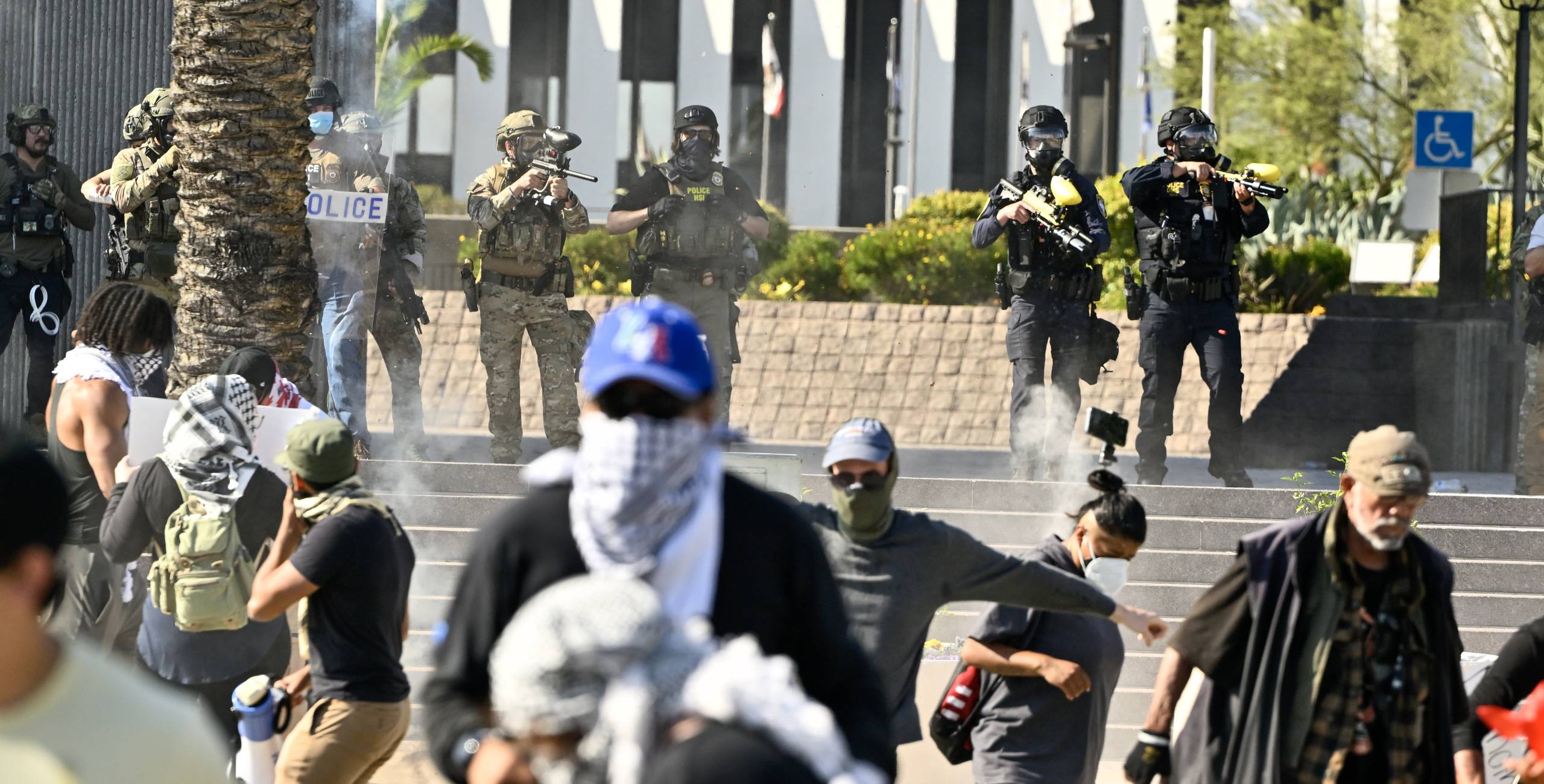
- In the wake of George Floyd’s death and the protests that followed, California passed a law limiting the use of force against people exercising their First Amendment rights. An LAist investigation found that even when police departments appear to be breaking that law, the state doesn’t have a mechanism to actually enforce it.
- Two companies with thousands of permits to drill oil wells in California merged on Monday, just two days after state lawmakers loosened environmental reviews for permits in Kern County.
- UC Merced students are speaking out after several campus leaders in charge of diversity, equity and inclusion programs were laid off.
Conflicting Reports Over Santa Ana Police Response To Anti-ICE Protests
The protest on Monday, June 9, started small. Nathan Tran, a Garden Grove native and community organizer with the Party for Socialism and Liberation, joined a few dozen people outside the federal building in Santa Ana, a local epicenter for immigration enforcement actions that were ramping up across Southern California.
Despite the small crowd, Tran said he saw federal agents wearing riot gear, standing at the ready. He said they were armed with crowd control weapons and rifles with live ammunition.
By the evening, the crowd had swelled to around 500 people and the protest had moved to the downtown Santa Ana area. Officers with the Santa Ana Police Department formed a skirmish line. Tran watched from Sasscer Park, around 30 feet away from the main crowd, as tensions rose. Police suddenly cleared the crowd with “barrages of rubber bullets, pepper balls, flash bangs, tear gas,” Tran said, without warning or apparent provocation. He said people in the crowd responded by hurling back water bottles and fireworks.
Tran turned to leave. Then, “ I feel this like sensation, like I got punched really hard in the jaw,” Tran said. He had been hit in the face with a less-lethal projectile. The impact left a deep gash on Tran’s chin. Doctors at UCI Medical Center told him they could see the tendons connecting his jaw muscles.
In the wake of George Floyd’s death in 2020 and concerns about the overly aggressive police response to the protests that followed, California lawmakers took steps to protect residents exercising their first amendment rights. They did so by passing Assembly Bill 48, a 2021 law that bans the indiscriminate use of force against civilians at protests. Law enforcement agencies now have to take several steps including de-escalation tactics like dispersal orders before they can use these military equipment such as foam bullets and tear gas. And the law says “projectiles shall not be aimed at the head, neck, or any other vital organs.” The law also requires agencies to make public reports about their use of force at protests.
Santa Ana said in a June news release that officers responded to the protests on June 9 and the following days “in strict accordance with the law.” But Tran and other protestors say Santa Ana Police broke the law during those protests. The ACLU SoCal also sent a letter to the police department detailing how they broke AB 48.
Oil Industry Merger Could Have Big Impact In California
Two companies that play a big role in oil production in California are merging.
On Monday, California Resources announced it was buying Berry Corporation in an all-stock deal. This comes just days after the state legislature sent a bill to Governor Gavin Newsom’s desk that loosens some of the state’s environmental regulations when it comes to drilling. The bill would also remove regulatory and legal obstacles for thousands of oil wells in Kern County by exempting them from a final review under the California Environmental Quality Act.
Oil companies and environmentalists have clashed for more than a decade over challenges that have effectively stalled the permitting process for drilling new oil wells in Kern County. All parties have been trying to find a solution to stabilize gas prices for consumers, especially with the anticipated closure of two refineries in California.
California Resources executive Francisco Leon said the decision to merge with Berry Corporation grew directly out of a change in the priorities of state leaders. “The dependence on foreign oil has taken its toll, it’s driving prices higher,” he said in a conference call with investors. “It’s having refineries exiting the state so to stabilize the fuel markets, the state really wants that local production.”
UC Merced Students Protest DEI Cuts
Recent layoffs at the University of California Merced are causing a stir, especially among students of color.
Several campus leaders in charge of diversity, equity and inclusion programs were let go earlier this month. They were in charge of programs that not only supported students of color, but also those without legal status and students who are low income.
Now the Black Student Union is calling for the staff to be reinstated. “It doesn’t sit right on my chest at all. It’s hard to sleep at night. I can barely sit and even concentrate on one thing. It’s like I’m afraid of what’s to come next with my final years of college,” said Black Student Union President Brenden Wilson.