window.__IS_SSR__=true
window.__INITIAL_STATE__={
"attachmentsReducer": {
"audio_0": {
"type": "attachments",
"id": "audio_0",
"imgSizes": {
"kqedFullSize": {
"file": "https://ww2.kqed.org/news/wp-content/themes/KQED-unified/img/audio_bgs/background0.jpg"
}
}
},
"audio_1": {
"type": "attachments",
"id": "audio_1",
"imgSizes": {
"kqedFullSize": {
"file": "https://ww2.kqed.org/news/wp-content/themes/KQED-unified/img/audio_bgs/background1.jpg"
}
}
},
"audio_2": {
"type": "attachments",
"id": "audio_2",
"imgSizes": {
"kqedFullSize": {
"file": "https://ww2.kqed.org/news/wp-content/themes/KQED-unified/img/audio_bgs/background2.jpg"
}
}
},
"audio_3": {
"type": "attachments",
"id": "audio_3",
"imgSizes": {
"kqedFullSize": {
"file": "https://ww2.kqed.org/news/wp-content/themes/KQED-unified/img/audio_bgs/background3.jpg"
}
}
},
"audio_4": {
"type": "attachments",
"id": "audio_4",
"imgSizes": {
"kqedFullSize": {
"file": "https://ww2.kqed.org/news/wp-content/themes/KQED-unified/img/audio_bgs/background4.jpg"
}
}
},
"placeholder": {
"type": "attachments",
"id": "placeholder",
"imgSizes": {
"thumbnail": {
"file": "https://cdn.kqed.org/wp-content/uploads/2024/12/KQED-Default-Image-816638274-2000x1333-1-160x107.jpg",
"width": 160,
"height": 107,
"mimeType": "image/jpeg"
},
"medium": {
"file": "https://cdn.kqed.org/wp-content/uploads/2024/12/KQED-Default-Image-816638274-2000x1333-1-800x533.jpg",
"width": 800,
"height": 533,
"mimeType": "image/jpeg"
},
"medium_large": {
"file": "https://cdn.kqed.org/wp-content/uploads/2024/12/KQED-Default-Image-816638274-2000x1333-1-768x512.jpg",
"width": 768,
"height": 512,
"mimeType": "image/jpeg"
},
"large": {
"file": "https://cdn.kqed.org/wp-content/uploads/2024/12/KQED-Default-Image-816638274-2000x1333-1-1020x680.jpg",
"width": 1020,
"height": 680,
"mimeType": "image/jpeg"
},
"1536x1536": {
"file": "https://cdn.kqed.org/wp-content/uploads/2024/12/KQED-Default-Image-816638274-2000x1333-1-1536x1024.jpg",
"width": 1536,
"height": 1024,
"mimeType": "image/jpeg"
},
"fd-lrg": {
"file": "https://cdn.kqed.org/wp-content/uploads/2024/12/KQED-Default-Image-816638274-2000x1333-1-1536x1024.jpg",
"width": 1536,
"height": 1024,
"mimeType": "image/jpeg"
},
"fd-med": {
"file": "https://cdn.kqed.org/wp-content/uploads/2024/12/KQED-Default-Image-816638274-2000x1333-1-1020x680.jpg",
"width": 1020,
"height": 680,
"mimeType": "image/jpeg"
},
"fd-sm": {
"file": "https://cdn.kqed.org/wp-content/uploads/2024/12/KQED-Default-Image-816638274-2000x1333-1-800x533.jpg",
"width": 800,
"height": 533,
"mimeType": "image/jpeg"
},
"post-thumbnail": {
"file": "https://cdn.kqed.org/wp-content/uploads/2024/12/KQED-Default-Image-816638274-2000x1333-1-672x372.jpg",
"width": 672,
"height": 372,
"mimeType": "image/jpeg"
},
"twentyfourteen-full-width": {
"file": "https://cdn.kqed.org/wp-content/uploads/2024/12/KQED-Default-Image-816638274-2000x1333-1-1038x576.jpg",
"width": 1038,
"height": 576,
"mimeType": "image/jpeg"
},
"xxsmall": {
"file": "https://cdn.kqed.org/wp-content/uploads/2024/12/KQED-Default-Image-816638274-2000x1333-1-160x107.jpg",
"width": 160,
"height": 107,
"mimeType": "image/jpeg"
},
"xsmall": {
"file": "https://cdn.kqed.org/wp-content/uploads/2024/12/KQED-Default-Image-816638274-2000x1333-1-672x372.jpg",
"width": 672,
"height": 372,
"mimeType": "image/jpeg"
},
"small": {
"file": "https://cdn.kqed.org/wp-content/uploads/2024/12/KQED-Default-Image-816638274-2000x1333-1-672x372.jpg",
"width": 672,
"height": 372,
"mimeType": "image/jpeg"
},
"xlarge": {
"file": "https://cdn.kqed.org/wp-content/uploads/2024/12/KQED-Default-Image-816638274-2000x1333-1-1020x680.jpg",
"width": 1020,
"height": 680,
"mimeType": "image/jpeg"
},
"full-width": {
"file": "https://cdn.kqed.org/wp-content/uploads/2024/12/KQED-Default-Image-816638274-2000x1333-1-1920x1280.jpg",
"width": 1920,
"height": 1280,
"mimeType": "image/jpeg"
},
"guest-author-32": {
"file": "https://cdn.kqed.org/wp-content/uploads/2025/01/KQED-Default-Image-816638274-1333x1333-1-160x160.jpg",
"width": 32,
"height": 32,
"mimeType": "image/jpeg"
},
"guest-author-50": {
"file": "https://cdn.kqed.org/wp-content/uploads/2025/01/KQED-Default-Image-816638274-1333x1333-1-160x160.jpg",
"width": 50,
"height": 50,
"mimeType": "image/jpeg"
},
"guest-author-64": {
"file": "https://cdn.kqed.org/wp-content/uploads/2025/01/KQED-Default-Image-816638274-1333x1333-1-160x160.jpg",
"width": 64,
"height": 64,
"mimeType": "image/jpeg"
},
"guest-author-96": {
"file": "https://cdn.kqed.org/wp-content/uploads/2025/01/KQED-Default-Image-816638274-1333x1333-1-160x160.jpg",
"width": 96,
"height": 96,
"mimeType": "image/jpeg"
},
"guest-author-128": {
"file": "https://cdn.kqed.org/wp-content/uploads/2025/01/KQED-Default-Image-816638274-1333x1333-1-160x160.jpg",
"width": 128,
"height": 128,
"mimeType": "image/jpeg"
},
"detail": {
"file": "https://cdn.kqed.org/wp-content/uploads/2025/01/KQED-Default-Image-816638274-1333x1333-1-160x160.jpg",
"width": 160,
"height": 160,
"mimeType": "image/jpeg"
},
"kqedFullSize": {
"file": "https://cdn.kqed.org/wp-content/uploads/2024/12/KQED-Default-Image-816638274-2000x1333-1.jpg",
"width": 2000,
"height": 1333
}
}
},
"news_11902349": {
"type": "attachments",
"id": "news_11902349",
"meta": {
"index": "attachments_1716263798",
"site": "news",
"id": "11902349",
"found": true
},
"parent": 11902308,
"imgSizes": {
"twentyfourteen-full-width": {
"file": "https://ww2.kqed.org/app/uploads/sites/10/2022/01/RS53252_GettyImages-1237291550-qut-1038x576.jpg",
"width": 1038,
"mimeType": "image/jpeg",
"height": 576
},
"thumbnail": {
"file": "https://ww2.kqed.org/app/uploads/sites/10/2022/01/RS53252_GettyImages-1237291550-qut-160x107.jpg",
"width": 160,
"mimeType": "image/jpeg",
"height": 107
},
"post-thumbnail": {
"file": "https://ww2.kqed.org/app/uploads/sites/10/2022/01/RS53252_GettyImages-1237291550-qut-672x372.jpg",
"width": 672,
"mimeType": "image/jpeg",
"height": 372
},
"kqedFullSize": {
"file": "https://ww2.kqed.org/app/uploads/sites/10/2022/01/RS53252_GettyImages-1237291550-qut.jpg",
"width": 1920,
"height": 1280
},
"large": {
"file": "https://ww2.kqed.org/app/uploads/sites/10/2022/01/RS53252_GettyImages-1237291550-qut-1020x680.jpg",
"width": 1020,
"mimeType": "image/jpeg",
"height": 680
},
"1536x1536": {
"file": "https://ww2.kqed.org/app/uploads/sites/10/2022/01/RS53252_GettyImages-1237291550-qut-1536x1024.jpg",
"width": 1536,
"mimeType": "image/jpeg",
"height": 1024
},
"medium": {
"file": "https://ww2.kqed.org/app/uploads/sites/10/2022/01/RS53252_GettyImages-1237291550-qut-800x533.jpg",
"width": 800,
"mimeType": "image/jpeg",
"height": 533
}
},
"publishDate": 1642799225,
"modified": 1642817004,
"caption": "A positive COVID test result can induce mixed emotions.",
"description": null,
"title": "US-HEALTH-virus-COVID-TEST",
"credit": "Joseph Prezioso/AFP via Getty Images",
"status": "inherit",
"altTag": "A hand holds an at-home COVID test, while another person's hand points to the test.",
"isLoading": false,
"fetchFailed": false
},
"news_11904347": {
"type": "attachments",
"id": "news_11904347",
"meta": {
"index": "attachments_1716263798",
"site": "news",
"id": "11904347",
"found": true
},
"parent": 11904345,
"imgSizes": {
"twentyfourteen-full-width": {
"file": "https://ww2.kqed.org/app/uploads/sites/10/2022/02/sciencesource_ss22514018_custom-2fd91017d666ace5b6746d615c5e9e20f06f1974-1-1038x576.jpg",
"width": 1038,
"mimeType": "image/jpeg",
"height": 576
},
"thumbnail": {
"file": "https://ww2.kqed.org/app/uploads/sites/10/2022/02/sciencesource_ss22514018_custom-2fd91017d666ace5b6746d615c5e9e20f06f1974-1-160x125.jpg",
"width": 160,
"mimeType": "image/jpeg",
"height": 125
},
"post-thumbnail": {
"file": "https://ww2.kqed.org/app/uploads/sites/10/2022/02/sciencesource_ss22514018_custom-2fd91017d666ace5b6746d615c5e9e20f06f1974-1-672x372.jpg",
"width": 672,
"mimeType": "image/jpeg",
"height": 372
},
"kqedFullSize": {
"file": "https://ww2.kqed.org/app/uploads/sites/10/2022/02/sciencesource_ss22514018_custom-2fd91017d666ace5b6746d615c5e9e20f06f1974-1-scaled-e1644267755274.jpg",
"width": 1920,
"height": 1499
},
"2048x2048": {
"file": "https://ww2.kqed.org/app/uploads/sites/10/2022/02/sciencesource_ss22514018_custom-2fd91017d666ace5b6746d615c5e9e20f06f1974-1-2048x1599.jpg",
"width": 2048,
"mimeType": "image/jpeg",
"height": 1599
},
"large": {
"file": "https://ww2.kqed.org/app/uploads/sites/10/2022/02/sciencesource_ss22514018_custom-2fd91017d666ace5b6746d615c5e9e20f06f1974-1-1020x796.jpg",
"width": 1020,
"mimeType": "image/jpeg",
"height": 796
},
"1536x1536": {
"file": "https://ww2.kqed.org/app/uploads/sites/10/2022/02/sciencesource_ss22514018_custom-2fd91017d666ace5b6746d615c5e9e20f06f1974-1-1536x1199.jpg",
"width": 1536,
"mimeType": "image/jpeg",
"height": 1199
},
"full-width": {
"file": "https://ww2.kqed.org/app/uploads/sites/10/2022/02/sciencesource_ss22514018_custom-2fd91017d666ace5b6746d615c5e9e20f06f1974-1-1920x1499.jpg",
"width": 1920,
"mimeType": "image/jpeg",
"height": 1499
},
"medium": {
"file": "https://ww2.kqed.org/app/uploads/sites/10/2022/02/sciencesource_ss22514018_custom-2fd91017d666ace5b6746d615c5e9e20f06f1974-1-800x625.jpg",
"width": 800,
"mimeType": "image/jpeg",
"height": 625
}
},
"publishDate": 1644265924,
"modified": 1644273464,
"caption": "This colorized transmission electron micrograph shows SARS-CoV-2, also known as 2019-nCoV, the virus that causes COVID-19. ",
"description": "This colorized transmission electron micrograph (TEM) shows SARS-CoV-2, also known as 2019-nCoV, the virus that causes COVID-19. This specimen was isolated from a patient in the U.S. Particles of the virus are shown emerging from the surface of cells cultured in the lab. The spikes on the outer edge of the particles give coronaviruses their name, meaning 'crown-like'.",
"title": "SARS-CoV-2 is shown in this colorized transmission electron micrograph. This specimen was isolated from a patient in the U.S. Particles of the virus are shown emerging from the surface of cells cultured in the lab.",
"credit": "\u003ca href=\"https://www.sciencesource.com/archive/Image/Novel-Coronavirus-SARS-CoV-2-SS22514018.html\">Science Source\u003c/a>",
"status": "inherit",
"altTag": "A microscopic image of the virus that causes COVID.",
"isLoading": false,
"fetchFailed": false
},
"news_11903823": {
"type": "attachments",
"id": "news_11903823",
"meta": {
"index": "attachments_1716263798",
"site": "news",
"id": "11903823",
"found": true
},
"parent": 11903506,
"imgSizes": {
"twentyfourteen-full-width": {
"file": "https://ww2.kqed.org/app/uploads/sites/10/2022/02/RS53459_006_StockPhoto_AtHomeCOVIDTest_02022022-qut-1038x576.jpg",
"width": 1038,
"mimeType": "image/jpeg",
"height": 576
},
"thumbnail": {
"file": "https://ww2.kqed.org/app/uploads/sites/10/2022/02/RS53459_006_StockPhoto_AtHomeCOVIDTest_02022022-qut-160x107.jpg",
"width": 160,
"mimeType": "image/jpeg",
"height": 107
},
"post-thumbnail": {
"file": "https://ww2.kqed.org/app/uploads/sites/10/2022/02/RS53459_006_StockPhoto_AtHomeCOVIDTest_02022022-qut-672x372.jpg",
"width": 672,
"mimeType": "image/jpeg",
"height": 372
},
"kqedFullSize": {
"file": "https://ww2.kqed.org/app/uploads/sites/10/2022/02/RS53459_006_StockPhoto_AtHomeCOVIDTest_02022022-qut.jpg",
"width": 1920,
"height": 1280
},
"large": {
"file": "https://ww2.kqed.org/app/uploads/sites/10/2022/02/RS53459_006_StockPhoto_AtHomeCOVIDTest_02022022-qut-1020x680.jpg",
"width": 1020,
"mimeType": "image/jpeg",
"height": 680
},
"1536x1536": {
"file": "https://ww2.kqed.org/app/uploads/sites/10/2022/02/RS53459_006_StockPhoto_AtHomeCOVIDTest_02022022-qut-1536x1024.jpg",
"width": 1536,
"mimeType": "image/jpeg",
"height": 1024
},
"medium": {
"file": "https://ww2.kqed.org/app/uploads/sites/10/2022/02/RS53459_006_StockPhoto_AtHomeCOVIDTest_02022022-qut-800x533.jpg",
"width": 800,
"mimeType": "image/jpeg",
"height": 533
}
},
"publishDate": 1643852977,
"modified": 1643939053,
"caption": "A hand holds an at-home COVID-19 test.",
"description": null,
"title": "Stock image: At-home COVID-19 test.",
"credit": "Beth LaBerge/KQED",
"status": "inherit",
"altTag": null,
"isLoading": false,
"fetchFailed": false
},
"news_11902406": {
"type": "attachments",
"id": "news_11902406",
"meta": {
"index": "attachments_1716263798",
"site": "news",
"id": "11902406",
"found": true
},
"parent": 11902396,
"imgSizes": {
"twentyfourteen-full-width": {
"file": "https://ww2.kqed.org/app/uploads/sites/10/2022/01/RS53036_023_Richmond_HighSchoolStudents_01132022-qut-1038x576.jpg",
"width": 1038,
"mimeType": "image/jpeg",
"height": 576
},
"thumbnail": {
"file": "https://ww2.kqed.org/app/uploads/sites/10/2022/01/RS53036_023_Richmond_HighSchoolStudents_01132022-qut-160x107.jpg",
"width": 160,
"mimeType": "image/jpeg",
"height": 107
},
"post-thumbnail": {
"file": "https://ww2.kqed.org/app/uploads/sites/10/2022/01/RS53036_023_Richmond_HighSchoolStudents_01132022-qut-672x372.jpg",
"width": 672,
"mimeType": "image/jpeg",
"height": 372
},
"kqedFullSize": {
"file": "https://ww2.kqed.org/app/uploads/sites/10/2022/01/RS53036_023_Richmond_HighSchoolStudents_01132022-qut.jpg",
"width": 1920,
"height": 1280
},
"large": {
"file": "https://ww2.kqed.org/app/uploads/sites/10/2022/01/RS53036_023_Richmond_HighSchoolStudents_01132022-qut-1020x680.jpg",
"width": 1020,
"mimeType": "image/jpeg",
"height": 680
},
"1536x1536": {
"file": "https://ww2.kqed.org/app/uploads/sites/10/2022/01/RS53036_023_Richmond_HighSchoolStudents_01132022-qut-1536x1024.jpg",
"width": 1536,
"mimeType": "image/jpeg",
"height": 1024
},
"medium": {
"file": "https://ww2.kqed.org/app/uploads/sites/10/2022/01/RS53036_023_Richmond_HighSchoolStudents_01132022-qut-800x533.jpg",
"width": 800,
"mimeType": "image/jpeg",
"height": 533
}
},
"publishDate": 1642814384,
"modified": 1643653046,
"caption": "Dayanara Mendoza, 16, a sophomore at Richmond High School, sits outside the school on Jan. 14, 2022. She said on a recent school day, three of her five teachers were out. Thousands of students and dozens of teachers in West Contra Costa Unified School District haven't attended school over the past three weeks, saying they don't feel safe returning to in-person instruction.",
"description": null,
"title": "RS53036_023_Richmond_HighSchoolStudents_01132022-qut",
"credit": "Beth LaBerge/KQED",
"status": "inherit",
"altTag": "Teenage girl wearing mask looks toward camera, with sign reading Richmond High School in background",
"isLoading": false,
"fetchFailed": false
},
"news_11901834": {
"type": "attachments",
"id": "news_11901834",
"meta": {
"index": "attachments_1716263798",
"site": "news",
"id": "11901834",
"found": true
},
"parent": 11901829,
"imgSizes": {
"twentyfourteen-full-width": {
"file": "https://ww2.kqed.org/app/uploads/sites/10/2022/01/01112022_Long-Beach_Testing_Site_PU_CM_15-1038x576.jpeg",
"width": 1038,
"mimeType": "image/jpeg",
"height": 576
},
"thumbnail": {
"file": "https://ww2.kqed.org/app/uploads/sites/10/2022/01/01112022_Long-Beach_Testing_Site_PU_CM_15-160x107.jpeg",
"width": 160,
"mimeType": "image/jpeg",
"height": 107
},
"post-thumbnail": {
"file": "https://ww2.kqed.org/app/uploads/sites/10/2022/01/01112022_Long-Beach_Testing_Site_PU_CM_15-672x372.jpeg",
"width": 672,
"mimeType": "image/jpeg",
"height": 372
},
"kqedFullSize": {
"file": "https://ww2.kqed.org/app/uploads/sites/10/2022/01/01112022_Long-Beach_Testing_Site_PU_CM_15-e1642218789897.jpeg",
"width": 1920,
"height": 1280
},
"large": {
"file": "https://ww2.kqed.org/app/uploads/sites/10/2022/01/01112022_Long-Beach_Testing_Site_PU_CM_15-1020x680.jpeg",
"width": 1020,
"mimeType": "image/jpeg",
"height": 680
},
"1536x1536": {
"file": "https://ww2.kqed.org/app/uploads/sites/10/2022/01/01112022_Long-Beach_Testing_Site_PU_CM_15-1536x1024.jpeg",
"width": 1536,
"mimeType": "image/jpeg",
"height": 1024
},
"full-width": {
"file": "https://ww2.kqed.org/app/uploads/sites/10/2022/01/01112022_Long-Beach_Testing_Site_PU_CM_15-1920x1280.jpeg",
"width": 1920,
"mimeType": "image/jpeg",
"height": 1280
},
"medium": {
"file": "https://ww2.kqed.org/app/uploads/sites/10/2022/01/01112022_Long-Beach_Testing_Site_PU_CM_15-800x533.jpeg",
"width": 800,
"mimeType": "image/jpeg",
"height": 533
}
},
"publishDate": 1642218768,
"modified": 1642537744,
"caption": "Diane Ahern swabs herself for COVID-19 at a testing site at the Long Beach Airport in Long Beach on Jan. 11, 2022. 'I need to get tested every three days to be able to visit my parents at their retirement home,' Ahern said. 'I'm nervous.'",
"description": null,
"title": "01112022_Long-Beach_Testing_Site_PU_CM_15",
"credit": "Pablo Unzueta/CalMatters",
"status": "inherit",
"altTag": "Woman swabs her nose while seated in her caras part of a COVID test.",
"isLoading": false,
"fetchFailed": false
},
"news_11900814": {
"type": "attachments",
"id": "news_11900814",
"meta": {
"index": "attachments_1716263798",
"site": "news",
"id": "11900814",
"found": true
},
"parent": 11900490,
"imgSizes": {
"twentyfourteen-full-width": {
"file": "https://ww2.kqed.org/app/uploads/sites/10/2022/01/pexels-polina-tankilevitch-3873188-1-1038x576.jpg",
"width": 1038,
"mimeType": "image/jpeg",
"height": 576
},
"thumbnail": {
"file": "https://ww2.kqed.org/app/uploads/sites/10/2022/01/pexels-polina-tankilevitch-3873188-1-160x107.jpg",
"width": 160,
"mimeType": "image/jpeg",
"height": 107
},
"post-thumbnail": {
"file": "https://ww2.kqed.org/app/uploads/sites/10/2022/01/pexels-polina-tankilevitch-3873188-1-672x372.jpg",
"width": 672,
"mimeType": "image/jpeg",
"height": 372
},
"kqedFullSize": {
"file": "https://ww2.kqed.org/app/uploads/sites/10/2022/01/pexels-polina-tankilevitch-3873188-1.jpg",
"width": 1920,
"height": 1280
},
"large": {
"file": "https://ww2.kqed.org/app/uploads/sites/10/2022/01/pexels-polina-tankilevitch-3873188-1-1020x680.jpg",
"width": 1020,
"mimeType": "image/jpeg",
"height": 680
},
"1536x1536": {
"file": "https://ww2.kqed.org/app/uploads/sites/10/2022/01/pexels-polina-tankilevitch-3873188-1-1536x1024.jpg",
"width": 1536,
"mimeType": "image/jpeg",
"height": 1024
},
"medium": {
"file": "https://ww2.kqed.org/app/uploads/sites/10/2022/01/pexels-polina-tankilevitch-3873188-1-800x533.jpg",
"width": 800,
"mimeType": "image/jpeg",
"height": 533
}
},
"publishDate": 1641355721,
"modified": 1642126126,
"caption": "Getting COVID can be a shock that temporarily upends your life. Three KQED hosts have advice for those on this journey.",
"description": null,
"title": "pexels-polina-tankilevitch-3873188 (1)",
"credit": "Polina Tankilevitch/Pexels",
"status": "inherit",
"altTag": "A person in a blue sweater holds a thermometer in their hands while laying under a knit blanket.",
"isLoading": false,
"fetchFailed": false
},
"news_11901546": {
"type": "attachments",
"id": "news_11901546",
"meta": {
"index": "attachments_1716263798",
"site": "news",
"id": "11901546",
"found": true
},
"parent": 11901518,
"imgSizes": {
"twentyfourteen-full-width": {
"file": "https://ww2.kqed.org/app/uploads/sites/10/2022/01/cases_011122_final-1038x576.png",
"width": 1038,
"mimeType": "image/png",
"height": 576
},
"thumbnail": {
"file": "https://ww2.kqed.org/app/uploads/sites/10/2022/01/cases_011122_final-160x111.png",
"width": 160,
"mimeType": "image/png",
"height": 111
},
"post-thumbnail": {
"file": "https://ww2.kqed.org/app/uploads/sites/10/2022/01/cases_011122_final-672x372.png",
"width": 672,
"mimeType": "image/png",
"height": 372
},
"kqedFullSize": {
"file": "https://ww2.kqed.org/app/uploads/sites/10/2022/01/cases_011122_final.png",
"width": 1920,
"height": 1334
},
"large": {
"file": "https://ww2.kqed.org/app/uploads/sites/10/2022/01/cases_011122_final-1020x709.png",
"width": 1020,
"mimeType": "image/png",
"height": 709
},
"1536x1536": {
"file": "https://ww2.kqed.org/app/uploads/sites/10/2022/01/cases_011122_final-1536x1067.png",
"width": 1536,
"mimeType": "image/png",
"height": 1067
},
"medium": {
"file": "https://ww2.kqed.org/app/uploads/sites/10/2022/01/cases_011122_final-800x556.png",
"width": 800,
"mimeType": "image/png",
"height": 556
}
},
"publishDate": 1642025838,
"modified": 1642025983,
"caption": null,
"description": null,
"title": "cases_011122_final",
"credit": null,
"status": "inherit",
"altTag": "Cartoon: masked school kids in front of upwardly sloping red lines on graphs. The first says, \"omicron cases,\" the next one says, \"cases of zoom flashback,\" followed by \"fear of closing classrooms,\" \"appreciation of in-person school\" and \"prayers to keep school open.\"",
"isLoading": false,
"fetchFailed": false
},
"news_11901275": {
"type": "attachments",
"id": "news_11901275",
"meta": {
"index": "attachments_1716263798",
"site": "news",
"id": "11901275",
"found": true
},
"parent": 11901267,
"imgSizes": {
"twentyfourteen-full-width": {
"file": "https://ww2.kqed.org/app/uploads/sites/10/2022/01/leantesting_011022_final-1038x576.png",
"width": 1038,
"mimeType": "image/png",
"height": 576
},
"thumbnail": {
"file": "https://ww2.kqed.org/app/uploads/sites/10/2022/01/leantesting_011022_final-160x115.png",
"width": 160,
"mimeType": "image/png",
"height": 115
},
"post-thumbnail": {
"file": "https://ww2.kqed.org/app/uploads/sites/10/2022/01/leantesting_011022_final-672x372.png",
"width": 672,
"mimeType": "image/png",
"height": 372
},
"kqedFullSize": {
"file": "https://ww2.kqed.org/app/uploads/sites/10/2022/01/leantesting_011022_final.png",
"width": 1920,
"height": 1379
},
"large": {
"file": "https://ww2.kqed.org/app/uploads/sites/10/2022/01/leantesting_011022_final-1020x733.png",
"width": 1020,
"mimeType": "image/png",
"height": 733
},
"1536x1536": {
"file": "https://ww2.kqed.org/app/uploads/sites/10/2022/01/leantesting_011022_final-1536x1103.png",
"width": 1536,
"mimeType": "image/png",
"height": 1103
},
"medium": {
"file": "https://ww2.kqed.org/app/uploads/sites/10/2022/01/leantesting_011022_final-800x575.png",
"width": 800,
"mimeType": "image/png",
"height": 575
}
},
"publishDate": 1641851297,
"modified": 1641851473,
"caption": null,
"description": null,
"title": "leantesting_011022_final",
"credit": null,
"status": "inherit",
"altTag": "Cartoon: a three-legged stool with one leg, chopped shorter, that is labeled \"testi--.\" The other two legs read, \"masks\" and \"vaccines.\" Atop the stool is a small crowd of nervous people looking down as the stool leans toward covid virus.",
"isLoading": false,
"fetchFailed": false
},
"news_11901120": {
"type": "attachments",
"id": "news_11901120",
"meta": {
"index": "attachments_1716263798",
"site": "news",
"id": "11901120",
"found": true
},
"parent": 11901101,
"imgSizes": {
"twentyfourteen-full-width": {
"file": "https://ww2.kqed.org/app/uploads/sites/10/2022/01/RS50699_004_SanFrancisco_COVIDVaccinations_08172021-qut-1038x576.jpg",
"width": 1038,
"mimeType": "image/jpeg",
"height": 576
},
"thumbnail": {
"file": "https://ww2.kqed.org/app/uploads/sites/10/2022/01/RS50699_004_SanFrancisco_COVIDVaccinations_08172021-qut-160x107.jpg",
"width": 160,
"mimeType": "image/jpeg",
"height": 107
},
"post-thumbnail": {
"file": "https://ww2.kqed.org/app/uploads/sites/10/2022/01/RS50699_004_SanFrancisco_COVIDVaccinations_08172021-qut-672x372.jpg",
"width": 672,
"mimeType": "image/jpeg",
"height": 372
},
"kqedFullSize": {
"file": "https://ww2.kqed.org/app/uploads/sites/10/2022/01/RS50699_004_SanFrancisco_COVIDVaccinations_08172021-qut.jpg",
"width": 1920,
"height": 1280
},
"large": {
"file": "https://ww2.kqed.org/app/uploads/sites/10/2022/01/RS50699_004_SanFrancisco_COVIDVaccinations_08172021-qut-1020x680.jpg",
"width": 1020,
"mimeType": "image/jpeg",
"height": 680
},
"1536x1536": {
"file": "https://ww2.kqed.org/app/uploads/sites/10/2022/01/RS50699_004_SanFrancisco_COVIDVaccinations_08172021-qut-1536x1024.jpg",
"width": 1536,
"mimeType": "image/jpeg",
"height": 1024
},
"medium": {
"file": "https://ww2.kqed.org/app/uploads/sites/10/2022/01/RS50699_004_SanFrancisco_COVIDVaccinations_08172021-qut-800x533.jpg",
"width": 800,
"mimeType": "image/jpeg",
"height": 533
}
},
"publishDate": 1641590560,
"modified": 1641601398,
"caption": "A registered nurse administers a COVID-19 vaccine at the Southeast Health Center in San Francisco's Bayview neighborhood on Aug. 17, 2021.",
"description": null,
"title": "RS50699_004_SanFrancisco_COVIDVaccinations_08172021-qut",
"credit": "Beth LaBerge/KQED",
"status": "inherit",
"altTag": "A masked nurse leans over to give a COVID vaccine dose to a man sitting down wearing a mask.",
"isLoading": false,
"fetchFailed": false
},
"news_11901091": {
"type": "attachments",
"id": "news_11901091",
"meta": {
"index": "attachments_1716263798",
"site": "news",
"id": "11901091",
"found": true
},
"parent": 11901008,
"imgSizes": {
"twentyfourteen-full-width": {
"file": "https://ww2.kqed.org/app/uploads/sites/10/2022/01/GettyImages-1237588762-1038x576.jpg",
"width": 1038,
"mimeType": "image/jpeg",
"height": 576
},
"thumbnail": {
"file": "https://ww2.kqed.org/app/uploads/sites/10/2022/01/GettyImages-1237588762-160x107.jpg",
"width": 160,
"mimeType": "image/jpeg",
"height": 107
},
"post-thumbnail": {
"file": "https://ww2.kqed.org/app/uploads/sites/10/2022/01/GettyImages-1237588762-672x372.jpg",
"width": 672,
"mimeType": "image/jpeg",
"height": 372
},
"kqedFullSize": {
"file": "https://ww2.kqed.org/app/uploads/sites/10/2022/01/GettyImages-1237588762-scaled.jpg",
"width": 2560,
"height": 1706
},
"2048x2048": {
"file": "https://ww2.kqed.org/app/uploads/sites/10/2022/01/GettyImages-1237588762-2048x1365.jpg",
"width": 2048,
"mimeType": "image/jpeg",
"height": 1365
},
"large": {
"file": "https://ww2.kqed.org/app/uploads/sites/10/2022/01/GettyImages-1237588762-1020x680.jpg",
"width": 1020,
"mimeType": "image/jpeg",
"height": 680
},
"1536x1536": {
"file": "https://ww2.kqed.org/app/uploads/sites/10/2022/01/GettyImages-1237588762-1536x1024.jpg",
"width": 1536,
"mimeType": "image/jpeg",
"height": 1024
},
"full-width": {
"file": "https://ww2.kqed.org/app/uploads/sites/10/2022/01/GettyImages-1237588762-1920x1280.jpg",
"width": 1920,
"mimeType": "image/jpeg",
"height": 1280
},
"medium": {
"file": "https://ww2.kqed.org/app/uploads/sites/10/2022/01/GettyImages-1237588762-800x533.jpg",
"width": 800,
"mimeType": "image/jpeg",
"height": 533
}
},
"publishDate": 1641583344,
"modified": 1641595749,
"caption": "Rapid COVID-19 test kits await distribution at Union Station in Los Angeles on Jan. 7, 2022.",
"description": "Rapid COVID-19 test kits await distribution at Union Station in Los Angeles, California, on January 7, 2022.",
"title": "US-HEALTH-VIRUS-TESTS",
"credit": "Frederic J. Brown/AFP via Getty Images",
"status": "inherit",
"altTag": "Several small boxes are stacked next to each other on a counter, each one has the same design and label, which read, \"COVID-19 Antigen Home Test.\"",
"isLoading": false,
"fetchFailed": false
},
"news_11900967": {
"type": "attachments",
"id": "news_11900967",
"meta": {
"index": "attachments_1716263798",
"site": "news",
"id": "11900967",
"found": true
},
"parent": 11890031,
"imgSizes": {
"twentyfourteen-full-width": {
"file": "https://ww2.kqed.org/app/uploads/sites/10/2021/10/RS52992_GettyImages-1237563534-qut-1038x576.jpg",
"width": 1038,
"mimeType": "image/jpeg",
"height": 576
},
"thumbnail": {
"file": "https://ww2.kqed.org/app/uploads/sites/10/2021/10/RS52992_GettyImages-1237563534-qut-160x107.jpg",
"width": 160,
"mimeType": "image/jpeg",
"height": 107
},
"post-thumbnail": {
"file": "https://ww2.kqed.org/app/uploads/sites/10/2021/10/RS52992_GettyImages-1237563534-qut-672x372.jpg",
"width": 672,
"mimeType": "image/jpeg",
"height": 372
},
"kqedFullSize": {
"file": "https://ww2.kqed.org/app/uploads/sites/10/2021/10/RS52992_GettyImages-1237563534-qut.jpg",
"width": 1920,
"height": 1278
},
"large": {
"file": "https://ww2.kqed.org/app/uploads/sites/10/2021/10/RS52992_GettyImages-1237563534-qut-1020x679.jpg",
"width": 1020,
"mimeType": "image/jpeg",
"height": 679
},
"1536x1536": {
"file": "https://ww2.kqed.org/app/uploads/sites/10/2021/10/RS52992_GettyImages-1237563534-qut-1536x1022.jpg",
"width": 1536,
"mimeType": "image/jpeg",
"height": 1022
},
"medium": {
"file": "https://ww2.kqed.org/app/uploads/sites/10/2021/10/RS52992_GettyImages-1237563534-qut-800x533.jpg",
"width": 800,
"mimeType": "image/jpeg",
"height": 533
}
},
"publishDate": 1641496276,
"modified": 1677088673,
"caption": "Children age 12-15 years old receive a Pfizer-BioNTech Covid-19 vaccine booster at Hartford Hospital in Hartford, Connecticut on January 6, 2022. ",
"description": null,
"title": "US-virus-HEALTH-vaccines",
"credit": "Joseph Prezioso/AFP via Getty Images",
"status": "inherit",
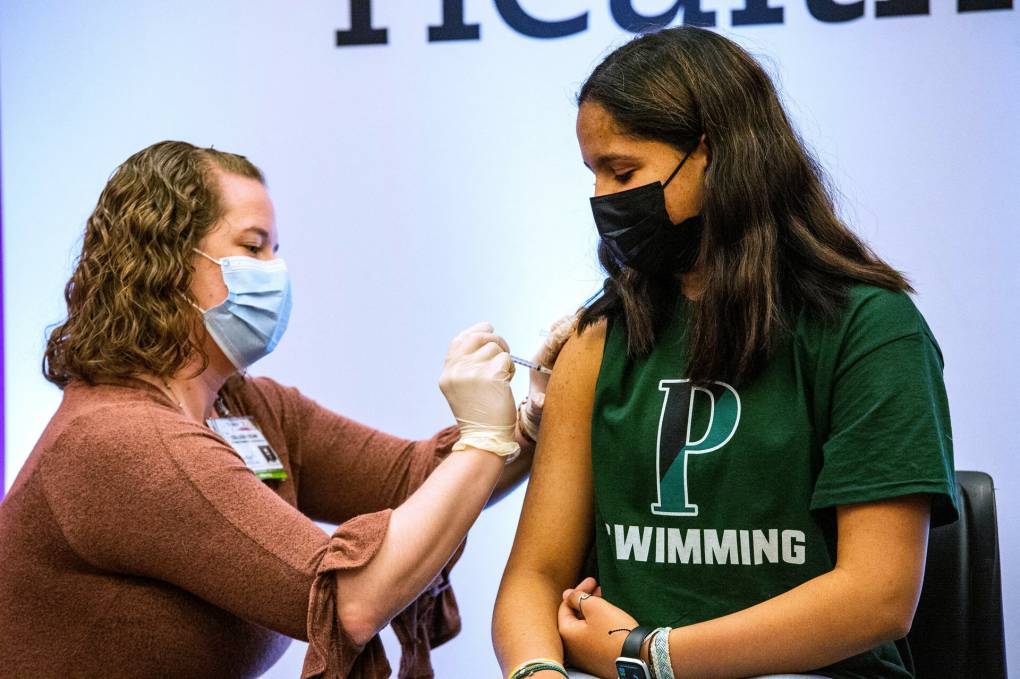
"altTag": "A health care worker wearing a brown shirt crouches to administer a COVID booster shot to a young person seated in a chair wearing a shirt that says \"SWIMMING.\"",
"isLoading": false,
"fetchFailed": false
}
},
"audioPlayerReducer": {
"postId": "stream_live",
"isPaused": true,
"isPlaying": false,
"pfsActive": false,
"pledgeModalIsOpen": true,
"playerDrawerIsOpen": false,
"liveAudioPlayStartedAt": 0,
"liveAudioPlayContext": ""
},
"authorsReducer": {
"byline_news_11904345": {
"type": "authors",
"id": "byline_news_11904345",
"meta": {
"override": true
},
"slug": "byline_news_11904345",
"name": "Michaeleen Doucleff",
"isLoading": false
},
"byline_news_11901829": {
"type": "authors",
"id": "byline_news_11901829",
"meta": {
"override": true
},
"slug": "byline_news_11901829",
"name": "\u003ca href=\"https://calmatters.org/author/anaibarra/\">Ana B. Ibarra\u003c/a>",
"isLoading": false
},
"byline_news_11901101": {
"type": "authors",
"id": "byline_news_11901101",
"meta": {
"override": true
},
"slug": "byline_news_11901101",
"name": "\u003ca href=\"https://calmatters.org/author/kristen-hwang/\">Kristen Hwang\u003c/a> and \u003ca href=\"https://calmatters.org/author/anaibarra/\">Ana B. Ibarra\u003c/a>",
"isLoading": false
},
"byline_news_11901008": {
"type": "authors",
"id": "byline_news_11901008",
"meta": {
"override": true
},
"slug": "byline_news_11901008",
"name": "\u003ca href=\"https://twitter.com/m_scribe\">Melody Schreiber\u003c/a>",
"isLoading": false
},
"jmcevoy": {
"type": "authors",
"id": "231",
"meta": {
"index": "authors_1716337520",
"id": "231",
"found": true
},
"name": "Julia McEvoy",
"firstName": "Julia",
"lastName": "McEvoy",
"slug": "jmcevoy",
"email": "jmcevoy@KQED.org",
"display_author_email": true,
"staff_mastheads": [
"news"
],
"title": "KQED Senior Editor",
"bio": "Julia McEvoy is KQED's Senior Editor, Education Equity.\r\n\r\nJulia heads KQED’s education coverage examining inequities students face in Bay Area and California schools, and reports on what it will take to educate the next generation.\r\n\r\nJulia's editorial work has received a Peabody Award, a Casey Medal for Coverage of Children and Families, several Edward R. Murrow awards, as well as awards from the Public Radio News Directors Inc. and the Society for Professional Journalists.",
"avatar": "https://secure.gravatar.com/avatar/aec3ce21abe02b302fd33638abd56a22?s=600&d=blank&r=g",
"twitter": "juliamcevoy1",
"facebook": null,
"instagram": null,
"linkedin": null,
"sites": [
{
"site": "news",
"roles": []
},
{
"site": "stateofhealth",
"roles": [
"author"
]
}
],
"headData": {
"title": "Julia McEvoy | KQED",
"description": "KQED Senior Editor",
"ogImgSrc": "https://secure.gravatar.com/avatar/aec3ce21abe02b302fd33638abd56a22?s=600&d=blank&r=g",
"twImgSrc": "https://secure.gravatar.com/avatar/aec3ce21abe02b302fd33638abd56a22?s=600&d=blank&r=g"
},
"isLoading": false,
"link": "/author/jmcevoy"
},
"kqed": {
"type": "authors",
"id": "236",
"meta": {
"index": "authors_1716337520",
"id": "236",
"found": true
},
"name": "KQED News Staff",
"firstName": "KQED News Staff",
"lastName": null,
"slug": "kqed",
"email": "faq@kqed.org",
"display_author_email": false,
"staff_mastheads": [],
"title": null,
"bio": null,
"avatar": "https://secure.gravatar.com/avatar/ef0e801a68c4c54afa9180db14084167?s=600&d=blank&r=g",
"twitter": null,
"facebook": null,
"instagram": null,
"linkedin": null,
"sites": [
{
"site": "arts",
"roles": [
"contributor"
]
},
{
"site": "news",
"roles": [
"editor"
]
},
{
"site": "futureofyou",
"roles": [
"author"
]
}
],
"headData": {
"title": "KQED News Staff | KQED",
"description": null,
"ogImgSrc": "https://secure.gravatar.com/avatar/ef0e801a68c4c54afa9180db14084167?s=600&d=blank&r=g",
"twImgSrc": "https://secure.gravatar.com/avatar/ef0e801a68c4c54afa9180db14084167?s=600&d=blank&r=g"
},
"isLoading": false,
"link": "/author/kqed"
},
"markfiore": {
"type": "authors",
"id": "3236",
"meta": {
"index": "authors_1716337520",
"id": "3236",
"found": true
},
"name": "Mark Fiore",
"firstName": "Mark",
"lastName": "Fiore",
"slug": "markfiore",
"email": "mark@markfiore.com",
"display_author_email": false,
"staff_mastheads": [
"news"
],
"title": "KQED News Cartoonist",
"bio": "\u003ca href=\"http://www.MarkFiore.com\">MarkFiore.com\u003c/a> | \u003ca href=\"https://twitter.com/markfiore\">Follow on Twitter\u003c/a> | \u003ca href=\"https://www.facebook.com/pages/Mark-Fiore-Animated-Political-Cartoons/94451707396?ref=bookmarks\">Facebook\u003c/a> | \u003ca href=\"mailto:mark@markfiore.com\">email\u003c/a>\r\n\r\nPulitzer Prize-winner, Mark Fiore, who the Wall Street Journal has called “the undisputed guru of the form,” creates animated political cartoons in San Francisco, where his work has been featured regularly on the San Francisco Chronicle’s web site, SFGate.com. His work has appeared on Newsweek.com, Slate.com, CBSNews.com, MotherJones.com, DailyKos.com and NPR’s web site. Fiore’s political animation has appeared on CNN, Frontline, Bill Moyers Journal, Salon.com and cable and broadcast outlets across the globe.\r\n\r\nBeginning his professional life by drawing traditional political cartoons for newspapers, Fiore’s work appeared in publications ranging from the Washington Post to the Los Angeles Times. In the late 1990s, he began to experiment with animating political cartoons and, after a short stint at the San Jose Mercury News as their staff cartoonist, Fiore devoted all his energies to animation.\r\nGrowing up in California, Fiore also spent a good portion of his life in the backwoods of Idaho. It was this combination that shaped him politically. Mark majored in political science at Colorado College, where, in a perfect send-off for a cartoonist, he received his diploma in 1991 as commencement speaker Dick Cheney smiled approvingly.\r\nMark Fiore was awarded the Pulitzer Prize for political cartooning in 2010, a Robert F. Kennedy Journalism Award in 2004 and has twice received an Online Journalism Award for commentary from the Online News Association (2002, 2008). Fiore has received two awards for his work in new media from the National Cartoonists Society (2001, 2002), and in 2006 received The James Madison Freedom of Information Award from The Society of Professional Journalists.",
"avatar": "https://secure.gravatar.com/avatar/fc4e2a612b15b67bad0c6f0e1db4ca9b?s=600&d=blank&r=g",
"twitter": "MarkFiore",
"facebook": null,
"instagram": "https://www.instagram.com/markfiore/?hl=en",
"linkedin": null,
"sites": [
{
"site": "arts",
"roles": [
"contributor"
]
},
{
"site": "news",
"roles": [
"editor"
]
},
{
"site": "futureofyou",
"roles": [
"editor"
]
},
{
"site": "science",
"roles": [
"editor"
]
}
],
"headData": {
"title": "Mark Fiore | KQED",
"description": "KQED News Cartoonist",
"ogImgSrc": "https://secure.gravatar.com/avatar/fc4e2a612b15b67bad0c6f0e1db4ca9b?s=600&d=blank&r=g",
"twImgSrc": "https://secure.gravatar.com/avatar/fc4e2a612b15b67bad0c6f0e1db4ca9b?s=600&d=blank&r=g"
},
"isLoading": false,
"link": "/author/markfiore"
},
"carlysevern": {
"type": "authors",
"id": "3243",
"meta": {
"index": "authors_1716337520",
"id": "3243",
"found": true
},
"name": "Carly Severn",
"firstName": "Carly",
"lastName": "Severn",
"slug": "carlysevern",
"email": "csevern@kqed.org",
"display_author_email": false,
"staff_mastheads": [
"news"
],
"title": "Senior Editor, Audience News ",
"bio": "Carly is KQED's Senior Editor of Audience News on the Digital News team, and has reported for the California Report Magazine, Bay Curious and KQED Arts. She's formerly the host of \u003ca href=\"http://ww2.kqed.org/pop/category/the-cooler/\" rel=\"noopener noreferrer\">The Cooler\u003c/a> podcast.",
"avatar": "https://secure.gravatar.com/avatar/54037bf5c128fe678f0ef26cec97a93f2e7f220a22d7285703328f12c42c1b1d?s=600&d=blank&r=g",
"twitter": "teacupinthebay",
"bluesky": null,
"facebook": null,
"instagram": null,
"linkedin": null,
"sites": [
{
"site": "",
"roles": [
"editor"
]
},
{
"site": "arts",
"roles": [
"editor"
]
},
{
"site": "news",
"roles": [
"administrator"
]
},
{
"site": "pop",
"roles": [
"editor"
]
},
{
"site": "futureofyou",
"roles": [
"editor"
]
},
{
"site": "about",
"roles": [
"administrator"
]
},
{
"site": "mindshift",
"roles": [
"editor"
]
},
{
"site": "bayareabites",
"roles": [
"editor"
]
},
{
"site": "stateofhealth",
"roles": [
"editor"
]
},
{
"site": "science",
"roles": [
"editor"
]
},
{
"site": "food",
"roles": [
"contributor"
]
},
{
"site": "forum",
"roles": [
"editor"
]
},
{
"site": "perspectives",
"roles": [
"administrator"
]
},
{
"site": "liveblog",
"roles": [
"editor"
]
}
],
"headData": {
"title": "Carly Severn | KQED",
"description": "Senior Editor, Audience News ",
"ogImgSrc": "https://secure.gravatar.com/avatar/54037bf5c128fe678f0ef26cec97a93f2e7f220a22d7285703328f12c42c1b1d?s=600&d=blank&r=g",
"twImgSrc": "https://secure.gravatar.com/avatar/54037bf5c128fe678f0ef26cec97a93f2e7f220a22d7285703328f12c42c1b1d?s=600&d=blank&r=g"
},
"isLoading": false,
"link": "/author/carlysevern"
},
"bwatt": {
"type": "authors",
"id": "11238",
"meta": {
"index": "authors_1716337520",
"id": "11238",
"found": true
},
"name": "Brian Watt",
"firstName": "Brian",
"lastName": "Watt",
"slug": "bwatt",
"email": "bwatt@KQED.org",
"display_author_email": false,
"staff_mastheads": [
"news"
],
"title": "Morning News Anchor",
"bio": "Brian Watt is KQED's morning radio news anchor. He joined the KQED News team in April of 2016. Prior to that, he worked as a Reporter for KPCC in Los Angeles and a producer at \u003cem>Marketplace.\u003c/em>\r\n\r\nDuring eight years at KPCC, Brian covered business and economics, and his work won several awards. In 2008, he won the Los Angeles Press Club’s first-place award for Business and Financial Reporting, Broadcast. He’s also received honorable mention and been first runner up for the Press Club’s Radio Journalist of the Year. He won two Golden Mike awards from the Radio and TV News Association of Southern California.\r\n\r\nBrian holds degrees in theater from Yale University and the Sorbonne, and has worked as an actor in France, Italy, Brazil, Hungary and . . . Hollywood. He appeared in a few television shows, including \u003cem>The West Wing, Judging Amy\u003c/em> and \u003cem>The District.\u003c/em>\r\n\r\nEmail: bwatt@KQED.org Twitter: @RadioBWatt",
"avatar": "https://secure.gravatar.com/avatar/55393ff57ed34e2be773ba4789dd6a19?s=600&d=blank&r=g",
"twitter": "@RadioBWatt",
"facebook": null,
"instagram": null,
"linkedin": null,
"sites": [
{
"site": "arts",
"roles": [
"contributor"
]
},
{
"site": "news",
"roles": [
"editor"
]
}
],
"headData": {
"title": "Brian Watt | KQED",
"description": "Morning News Anchor",
"ogImgSrc": "https://secure.gravatar.com/avatar/55393ff57ed34e2be773ba4789dd6a19?s=600&d=blank&r=g",
"twImgSrc": "https://secure.gravatar.com/avatar/55393ff57ed34e2be773ba4789dd6a19?s=600&d=blank&r=g"
},
"isLoading": false,
"link": "/author/bwatt"
},
"lblanco": {
"type": "authors",
"id": "11357",
"meta": {
"index": "authors_1716337520",
"id": "11357",
"found": true
},
"name": "Lina Blanco",
"firstName": "Lina",
"lastName": "Blanco",
"slug": "lblanco",
"email": "lblanco@kqed.org",
"display_author_email": false,
"staff_mastheads": [],
"title": null,
"bio": "Lina was a Senior Engagement Platforms Manager for KQED News, producing engagement strategies on social media at \u003ca href=\"https://twitter.com/KQEDnews\">@KQEDNews, \u003c/a>via \u003ca href=\"https://www.kqed.org/about/newsletters/\">KQED's daily newsletter\u003c/a> as well as texting campaigns with KQED readers and listeners. She also co-produces for KQED's bilingual news hub \u003ca href=\"https://www.instagram.com/kqedenespanol/\">KQED en Español\u003c/a>.\r\n\r\nLina previously worked for \u003ca href=\"https://kqed.org/arts\">KQED Arts\u003c/a> — supporting audience engagement efforts on the weekly \u003ca href=\"https://www.kqed.org/podcasts/rightnowish\">\u003cem>Rightnowish\u003c/em> \u003c/a>podcast, Webby-winning video series \u003ca href=\"https://www.kqed.org/if-cities-could-dance\">\u003cem>If Cities Could Dance\u003c/em>\u003c/a>, and daily Arts & Culture reporting. She won a \u003ca href=\"https://www.kqed.org/pressroom/10884/murrow\">National 2019 Edward R. Murrow Award for Excellence in Social Media\u003c/a> for KQED's series \u003cem>The Hustle\u003c/em>.\r\n\r\nBefore KQED, Lina worked as a graphic designer and digital storytelling facilitator at the \u003ca href=\"https://www.nativehealth.org/\">Native American Health Center\u003c/a>.\r\n\r\nShe's mom to a senior Chihuahua (plus one black cat) and lives in West Sonoma County on a small farmstead.",
"avatar": "https://secure.gravatar.com/avatar/77ec326d67223c38a436b87bcfd2a2e8?s=600&d=mm&r=g",
"twitter": "LinaBlanco",
"facebook": null,
"instagram": null,
"linkedin": null,
"sites": [
{
"site": "arts",
"roles": [
"subscriber"
]
},
{
"site": "news",
"roles": [
"subscriber"
]
},
{
"site": "pop",
"roles": [
"administrator"
]
},
{
"site": "about",
"roles": [
"administrator"
]
},
{
"site": "bayareabites",
"roles": [
"editor"
]
},
{
"site": "science",
"roles": [
"editor"
]
},
{
"site": "checkplease",
"roles": [
"editor"
]
},
{
"site": "food",
"roles": []
},
{
"site": "perspectives",
"roles": [
"editor"
]
}
],
"headData": {
"title": "Lina Blanco | KQED",
"description": null,
"ogImgSrc": "https://secure.gravatar.com/avatar/77ec326d67223c38a436b87bcfd2a2e8?s=600&d=mm&r=g",
"twImgSrc": "https://secure.gravatar.com/avatar/77ec326d67223c38a436b87bcfd2a2e8?s=600&d=mm&r=g"
},
"isLoading": false,
"link": "/author/lblanco"
},
"amontecillo": {
"type": "authors",
"id": "11649",
"meta": {
"index": "authors_1716337520",
"id": "11649",
"found": true
},
"name": "Alan Montecillo",
"firstName": "Alan",
"lastName": "Montecillo",
"slug": "amontecillo",
"email": "amontecillo@kqed.org",
"display_author_email": false,
"staff_mastheads": [
"news"
],
"title": "KQED Contributor",
"bio": "Alan Montecillo is the senior editor of \u003cem>\u003ca href=\"http://kqed.org/thebay\">The Bay\u003c/a>, \u003c/em> KQED's local news podcast. Before moving to the Bay Area, he worked as a senior talk show producer for WILL in Champaign-Urbana, Illinois and at Oregon Public Broadcasting in Portland, Oregon. He has won journalism awards from the Society of Professional Journalists Northern California, the Public Media Journalists Association, The Signal Awards, and has also received a regional Edward R. Murrow award. Alan is a Filipino American from Hong Kong and a graduate of Reed College.",
"avatar": "https://secure.gravatar.com/avatar/268f53a2066899ea9efdd8a5900218b17c822d9862cbc9326cccec53ef41d349?s=600&d=blank&r=g",
"twitter": "alanmontecillo",
"bluesky": null,
"facebook": null,
"instagram": null,
"linkedin": null,
"sites": [
{
"site": "",
"roles": [
"editor"
]
},
{
"site": "news",
"roles": [
"editor",
"manage_categories"
]
}
],
"headData": {
"title": "Alan Montecillo | KQED",
"description": "KQED Contributor",
"ogImgSrc": "https://secure.gravatar.com/avatar/268f53a2066899ea9efdd8a5900218b17c822d9862cbc9326cccec53ef41d349?s=600&d=blank&r=g",
"twImgSrc": "https://secure.gravatar.com/avatar/268f53a2066899ea9efdd8a5900218b17c822d9862cbc9326cccec53ef41d349?s=600&d=blank&r=g"
},
"isLoading": false,
"link": "/author/amontecillo"
}
},
"pagesReducer": {
"news_tag_covid": {
"type": "terms",
"id": "news_27989",
"meta": {
"index": "terms_1716263798",
"site": "news",
"id": "27989",
"score": 9.103905
},
"featImg": null,
"name": "covid",
"description": null,
"taxonomy": "tag",
"headData": {
"twImgId": null,
"twTitle": null,
"ogTitle": null,
"ogImgId": null,
"twDescription": null,
"description": null,
"title": "covid Archives | KQED News",
"ogDescription": null
},
"ttid": 28006,
"slug": "covid",
"isLoading": false,
"title": "covid",
"pageMeta": {
"site": "news",
"WpPageTemplate": "page-topic-editorial",
"currentPage": 10
},
"blocks": [
{
"blockName": "kqed/post-list",
"attrs": {
"layout": "cardArticle2",
"query": "posts/news?tag=covid",
"seeMore": false,
"paginated": true,
"page": 10
}
},
{
"blockName": "kqed/ad"
}
]
}
},
"pfsSessionReducer": {},
"postsReducer": {
"stream_live": {
"type": "live",
"id": "stream_live",
"audioUrl": "https://streams.kqed.org/kqedradio",
"title": "Live Stream",
"excerpt": "Live Stream information currently unavailable.",
"link": "/radio",
"featImg": "",
"label": {
"name": "KQED Live",
"link": "/"
}
},
"stream_kqedNewscast": {
"type": "posts",
"id": "stream_kqedNewscast",
"audioUrl": "https://www.kqed.org/.stream/anon/radio/RDnews/newscast.mp3?_=1",
"title": "KQED Newscast",
"featImg": "",
"label": {
"name": "88.5 FM",
"link": "/"
}
},
"news_11904568": {
"type": "posts",
"id": "news_11904568",
"meta": {
"index": "posts_1716263798",
"site": "news",
"id": "11904568",
"score": null,
"sort": [
1644404421000
]
},
"parent": 0,
"labelTerm": {},
"blocks": [],
"publishDate": 1644404421,
"format": "audio",
"title": "Have You Felt 'COVID Shame?' It's Not Just You",
"headTitle": "Have You Felt ‘COVID Shame?’ It’s Not Just You | KQED",
"content": "\u003cp>Way more people gotten sick with COVID-19 during these past few weeks. If you’ve tested positive, you may have felt a range of emotions: Surprise, fear…even anger.\u003c/p>\n\u003cp>There’s also another emotion members of KQED’s audience are reporting: shame. For some, it’s a gut feeling upon seeing that “positive” result. Others also fear being judged by their peers after being careful for so long.\u003c/p>\n\u003cp>Today, we’re sharing a conversation about this issue of ‘COVID shame’, with KQED senior engagement editor Carly Severn and KQED host Brian Watt.\u003c/p>\n\u003cp id=\"embed-code\" class=\"inconsolata\">\n\u003c!-- iframe plugin v.4.3 wordpress.org/plugins/iframe/ -->\u003cbr>\n\u003ciframe loading=\"lazy\" frameborder=\"0\" height=\"200\" scrolling=\"no\" src=\"https://playlist.megaphone.fm?e=KQINC4627466962&light=true\" width=\"100%\" class=\"iframe-class\">\u003c/iframe>\u003c/p>\n\u003cp>[ad fullwidth]\u003c/p>\u003cp>\u003c/p>\n",
"stats": {
"hasVideo": false,
"hasChartOrMap": false,
"hasAudio": true,
"hasPolis": false,
"wordCount": 105,
"hasGoogleForm": false,
"hasGallery": false,
"hasHearkenModule": false,
"iframeSrcs": [],
"paragraphCount": 5
},
"modified": 1700690824,
"excerpt": null,
"headData": {
"twImgId": "",
"twTitle": "",
"ogTitle": "",
"ogImgId": "",
"twDescription": "",
"description": "Way more people gotten sick with COVID-19 during these past few weeks. If you've tested positive, you may have felt a range of emotions: Surprise, fear...even anger. There's also another emotion members of KQED's audience are reporting: shame. For some, it's a gut feeling upon seeing that "positive" result. Others also fear being judged by",
"title": "Have You Felt 'COVID Shame?' It's Not Just You | KQED",
"ogDescription": "",
"schema": {
"@context": "https://schema.org",
"@type": "NewsArticle",
"headline": "Have You Felt 'COVID Shame?' It's Not Just You",
"datePublished": "2022-02-09T03:00:21-08:00",
"dateModified": "2023-11-22T14:07:04-08:00",
"image": "https://cdn.kqed.org/wp-content/uploads/2020/02/KQED-OG-Image@1x.png",
"isAccessibleForFree": "True",
"publisher": {
"@type": "NewsMediaOrganization",
"@id": "https://www.kqed.org/#organization",
"name": "KQED",
"logo": "https://cdn.kqed.org/wp-content/uploads/2020/02/KQED-OG-Image@1x.png",
"url": "https://www.kqed.org",
"sameAs": [
"https://www.facebook.com/KQED",
"https://twitter.com/KQED",
"https://www.instagram.com/kqed/",
"https://www.tiktok.com/@kqedofficial",
"https://www.linkedin.com/company/kqed",
"https://www.youtube.com/channel/UCeC0IOo7i1P_61zVUWbJ4nw"
]
}
}
},
"guestAuthors": [],
"slug": "covid-shame-podcast",
"status": "publish",
"sourceUrl": "https://www.kqed.org/podcasts/thebay",
"audioUrl": "https://www.podtrac.com/pts/redirect.mp3/traffic.megaphone.fm/KQINC4627466962.mp3?updated=1644388564",
"excludeFromSiteSearch": "Include",
"source": "The Bay",
"path": "/news/11904568/covid-shame-podcast",
"audioTrackLength": null,
"parsedContent": [
{
"type": "contentString",
"content": "\u003cdiv class=\"post-body\">\u003cp>\u003cp>Way more people gotten sick with COVID-19 during these past few weeks. If you’ve tested positive, you may have felt a range of emotions: Surprise, fear…even anger.\u003c/p>\n\u003cp>There’s also another emotion members of KQED’s audience are reporting: shame. For some, it’s a gut feeling upon seeing that “positive” result. Others also fear being judged by their peers after being careful for so long.\u003c/p>\n\u003cp>Today, we’re sharing a conversation about this issue of ‘COVID shame’, with KQED senior engagement editor Carly Severn and KQED host Brian Watt.\u003c/p>\n\u003cp id=\"embed-code\" class=\"inconsolata\">\n\u003c!-- iframe plugin v.4.3 wordpress.org/plugins/iframe/ -->\u003cbr>\n\u003ciframe loading=\"lazy\" frameborder=\"0\" height=\"200\" scrolling=\"no\" src=\"https://playlist.megaphone.fm?e=KQINC4627466962&light=true\" width=\"100%\" class=\"iframe-class\">\u003c/iframe>\u003c/p>\n\u003cp>\u003c/p>\u003c/div>",
"attributes": {
"named": {},
"numeric": []
}
},
{
"type": "component",
"content": "",
"name": "ad",
"attributes": {
"named": {
"label": "fullwidth"
},
"numeric": [
"fullwidth"
]
}
},
{
"type": "contentString",
"content": "\u003cdiv class=\"post-body\">\u003cp>\u003c/p>\u003cp>\u003c/p>\n\u003c/div>\u003c/p>",
"attributes": {
"named": {},
"numeric": []
}
}
],
"link": "/news/11904568/covid-shame-podcast",
"authors": [
"11238",
"3243",
"11649"
],
"programs": [
"news_28779"
],
"categories": [
"news_8",
"news_33520"
],
"tags": [
"news_27989",
"news_22598"
],
"featImg": "news_11902349",
"label": "source_news_11904568"
},
"news_11904345": {
"type": "posts",
"id": "news_11904345",
"meta": {
"index": "posts_1716263798",
"site": "news",
"id": "11904345",
"score": null,
"sort": [
1644267888000
]
},
"guestAuthors": [],
"slug": "the-future-of-the-pandemic-is-becoming-clearer-as-researchers-learn-more-about-the-nature-of-covid-infections",
"title": "The Future of the Pandemic Is Becoming Clearer as Researchers Learn More About the Nature of COVID Infections",
"publishDate": 1644267888,
"format": "standard",
"headTitle": "The Future of the Pandemic Is Becoming Clearer as Researchers Learn More About the Nature of COVID Infections | KQED",
"labelTerm": {},
"content": "\u003cp>During the early days of the pandemic, scientists and doctors were concerned that being infected with COVID-19 might not trigger a strong immune response in many people — thus an infection might not provide long-term protection.\u003c/p>\n\u003cp>“Immunity to Covid-19 could be lost in months, UK study suggests,” \u003ca href=\"https://www.theguardian.com/world/2020/jul/12/immunity-to-covid-19-could-be-lost-in-months-uk-study-suggests\">a headline from The Guardian alerted\u003c/a> back in July 2020. “King’s College London team found steep drops in patients’ antibody levels three months after infection,” the story warned.\u003c/p>\n\u003cp>But that idea was based on preliminary data from the laboratory — and on a faulty understanding of how the immune system works. Now, about a year and a half later, better data is painting a more optimistic picture about immunity after a bout of COVID-19. In fact, a symptomatic infection triggers a remarkable immune response in the general population, likely offering protection against severe disease and death for a few years.\u003c/p>\n\u003cp>And if you’re vaccinated on top of that, your protection is likely even better, studies are consistently showing.\u003c/p>\n\u003cp>Here are several key questions people have been asking throughout the pandemic — and ones that researchers are beginning to answer.\u003c/p>\n\u003ch2>\u003cstrong>If I recently had COVID, am I protected against getting a severe course of COVID in the future ?\u003c/strong>\u003c/h2>\n\u003cp>With SARS-CoV-2, your immune system generates two types of protection: protection against reinfection and protection against severe illness upon that second infection. Let’s start with the latter.\u003c/p>\n\u003cp>[ad fullwidth]\u003c/p>\n\u003cp>If you’re under age 50 and healthy, then a bout of COVID-19 offers good protection against severe disease if you were to be infected again in a future surge, said epidemiologist \u003ca href=\"https://vivo.weill.cornell.edu/display/cwid-lja2002\">Laith Abu-Raddad\u003c/a>, at Weill Cornell Medicine-Qatar. “That’s really important because eventually, every one of us will get infected,” he said. “But if reinfections prove to be more mild, in general, it will allow us to live with this pandemic in a much easier way.”\u003c/p>\n\u003cp>Abu-Raddad and his team have been tracking reinfections in Qatar for more than a year. In one study, the team analyzed about 1,300 reinfections among more than 350,000 people in Qatar. They found that a prior COVID-19 infection reduced the risk of hospitalization upon reinfection by about 90% compared to people experiencing their first infection.\u003c/p>\n\u003cp>\u003ca href=\"https://www.nejm.org/doi/full/10.1056/NEJMc2108120\">These findings\u003c/a>, published in The New England Journal of Medicine in December, are consistent with \u003ca href=\"https://www.cdc.gov/mmwr/volumes/71/wr/mm7104e1.htm?s_cid=mm7104e1_w\">data released by the Centers for Disease Control and Prevention last month\u003c/a>. In that study, a prior infection reduced the risk of hospitalization during the delta surge by more than 50 times compared to no prior infection and no vaccination. People who both had a prior infection and were vaccinated had the most protection.\u003c/p>\n\u003cp>And here’s the “really good news,” Abu-Raddad said: This protection against severe disease persists, perhaps for years. “We’ve been following this same group of people for over a year and a half now, we don’t see much waning. If it’s there, it’s too small to discern.”\u003c/p>\n\u003cp>But the good news doesn’t necessarily hold true for everyone. This long-term protection is seen in healthy people under age 50, Abu-Raddad points out. It’s likely less potent and possibly more short-lived for people who are older or who have underlying health conditions, he said. More data is needed to know how the protection varies with age.\u003c/p>\n\u003cp>That said, studies in the laboratory also suggest that protection against severe disease is long-term after a bout of COVID-19, at least for healthy people.\u003c/p>\n\u003cp>In particular, \u003ca href=\"https://pubmed.ncbi.nlm.nih.gov/34250512/\">antibodies against SARS-CoV-2 persist in the blood\u003c/a> for months, possibly years after an infection, scientists at the Fred Hutchinson Cancer Research Center and Emory University have reported.\u003c/p>\n\u003cp>In that study, immunologist Juliana McElrath and her colleagues measured antibodies in the blood of more than 200 people after a confirmed SARS-CoV-2 infection. More than 90% of the volunteers generated antibodies to SARS-CoV-2 right after infection. In general, the level of antibodies declined quickly two to three months after an infection, but after about four months, the level began to plateau. Even after eight months, the vast majority of people in the study still had antibodies in their blood that could neutralize SARS-CoV-2.\u003c/p>\n\u003cp>After publishing that study in Cell Reports Medicine, the team continued to follow the same group of people, and now has data up to 15 months after infection, the researchers told Nature on Tuesday. So far, the antibodies seem to be sticking around for the long haul, said immunologist \u003ca href=\"https://vaccines.emory.edu/faculty/primary-faculty/ahmed-rafi.html\">Rafi Ahmed\u003c/a> at Emory University, who helped lead the study. “Looking at the shape of the curve, it looks pretty damn good. It is really quite stable.”\u003c/p>\n\u003cp>[aside label=\"related coverage\" tag=\"covid\"]Last Tuesday, researchers at the Johns Hopkins Medical Institutions also reported that \u003ca href=\"https://jamanetwork.com/journals/jama/fullarticle/2788894\">SARS-CoV-2 antibodies can persist up to 20 months\u003c/a>. In that study, 293 out of 295 unvaccinated people generated antibodies after a positive COVID test.\u003c/p>\n\u003cp>This pattern, with antibodies declining quickly and then plateauing, occurs with any infection, not just SARS-CoV-2, immunologist \u003ca href=\"https://immunobiology.arizona.edu/profile/deepta-bhattacharya-phd\">Deepta Bhattacharya\u003c/a> told NPR \u003ca href=\"https://www.npr.org/sections/goatsandsoda/2021/08/30/1032520934/immunity-to-covid-19-could-last-longer-than-youd-think\">back in August\u003c/a>. “In every single immune response, there is a sharp rise in antibodies, a period of sharp decline,” and then it starts to stabilize at a lower level, he said.\u003c/p>\n\u003cp>About six months after a SARS-CoV-2 infection, right around the time when the antibody level starts to stabilize, the immune system does something extraordinary: It generates special cells, called long-lived plasma cells, that can make potent antibodies against SARS-CoV-2 for decades, possibly even a lifetime. “These cells are remarkable,” Bhattacharya said. “They’re estimated to spit out something like 10,000 antibody molecules per second.” Therefore, you wouldn’t need many of these cells to protect against a future infection.\u003c/p>\n\u003cp>On top of that, the immune system also generates several types of cells, known as B and T cells, which kick into action upon reinfection. These cells quickly ramp up antibody levels and destroy infected cells to ensure a mild course of COVID doesn’t turn into a serious one. Several studies, including one published in January, have shown that \u003ca href=\"https://www.ncbi.nlm.nih.gov/pmc/articles/PMC8768427/\">these cells are durable and likely persist longer than a year\u003c/a>.\u003c/p>\n\u003ch2>\u003cstrong>Does this mean I won’t get reinfected if I’ve had COVID? \u003c/strong>\u003c/h2>\n\u003cp>Unfortunately, the answer is no.\u003c/p>\n\u003cp>“Reinfections are not just possible, they’re pretty much inevitable,” said evolutionary biologist \u003ca href=\"https://ysph.yale.edu/profile/jeffrey_townsend/\">Jeffrey Townsend\u003c/a> at Yale University. “At least all the evidence that we have now says that that’s true.”\u003c/p>\n\u003cp>To estimate how often reinfections will occur with SARS-CoV-2, Townsend and his team have been studying four other coronaviruses. They are known as “seasonal coronaviruses” and cause about 30% of colds each year.\u003c/p>\n\u003cp>“They all infect and reinfect on a yearly timescale,” he said, “so there’s no reason to expect something different from SARS-CoV-2.”\u003c/p>\n\u003cp>The risk of \u003ca href=\"https://www.thelancet.com/journals/lanmic/article/PIIS2666-5247(21)00219-6/fulltext\">reinfection is likely very low right after you’re sick\u003c/a> — up to about four months or so afterward, Townsend and his team estimate. Then the risk grows. And their data suggests that, on average, people will be reinfected every year or two with SARS-CoV-2. “It is very rare for reinfection to happen on a very short timescale, but on a longer timescale it seems to happen with some frequency,” he said.\u003c/p>\n\u003cp>But your specific risk for reinfection depends heavily on your personal situation, such as whether you’re exposed to lots of people at work or live with children who go to school. “So that time frame for reinfection each year or so assumes that we all just relax everything about our protections and just sort of let it rip, basically,” Townsend said.\u003c/p>\n\u003cp>And, he said, your risk of reinfection also depends on the virus and how much it mutates. For example, during the delta surge, a previous infection offered about 85% protection against reinfection, Abu-Raddad and his team found. But with omicron, that protection dropped to 55%. So the chance of reinfection was much higher.\u003c/p>\n\u003ch2>\u003cstrong>So why is the immune system so good at preventing severe disease but not really able to stop reinfection?\u003c/strong>\u003c/h2>\n\u003cp>No one knows for sure. But this \u003ca href=\"https://www.microbe.tv/twiv/twiv-857/\">strategy may be a deliberate one by the immune system\u003c/a>, National Institutes of Health immunologist Jonathan Yewdell explained last week on the podcast This Week in Virology.\u003c/p>\n\u003cp>In essence, your immune system is allocating resources. And its primary goal is to keep you alive. So the immune system has decided that, with coronaviruses, it’s not worth stopping the infection as long as it can stop serious, life-threatening illness.\u003c/p>\n\u003cp>“That is good enough under most circumstances,” Yewdell explained. “You might not think when you’re in bed with a 106 [degree] fever, you know, and crying for your spouse to help you because you could barely move that ‘this is good enough.’ But as long as you’ve recovered … you know, mission accomplished.”\u003c/p>\n\u003cp>In other words, the immune system is not built to stop every sickness or asymptomatic infection. And it’s definitely not built to “give you a negative PCR test,” Yewdell said.\u003c/p>\n\u003cp>[ad floatright]\u003c/p>\n\u003cp>So the future of COVID-19 is starting to become clearer: We’re going to have a lot more infections but hopefully a lot fewer hospitalizations and deaths.\u003c/p>\n\u003cdiv class=\"fullattribution\">Copyright 2022 NPR. To see more, visit www.npr.org.\u003cimg decoding=\"async\" src=\"https://www.google-analytics.com/__utm.gif?utmac=UA-5828686-4&utmdt=The+future+of+the+pandemic+is+looking+clearer+as+we+learn+more+about+infection&utme=8(APIKey)9(MDAxOTAwOTE4MDEyMTkxMDAzNjczZDljZA004)\">\u003c/div>\n\n",
"blocks": [],
"excerpt": "Scientists are beginning to get a better understanding of how long antibodies from a COVID infection can protect you — and what they'll protect you from.",
"status": "publish",
"parent": 0,
"modified": 1726005784,
"stats": {
"hasAudio": false,
"hasVideo": false,
"hasChartOrMap": false,
"iframeSrcs": [],
"hasGoogleForm": false,
"hasGallery": false,
"hasHearkenModule": false,
"hasPolis": false,
"paragraphCount": 33,
"wordCount": 1637
},
"headData": {
"title": "The Future of the Pandemic Is Becoming Clearer as Researchers Learn More About the Nature of COVID Infections | KQED",
"description": "Scientists are beginning to get a better understanding of how long antibodies from a COVID infection can protect you — and what they'll protect you from.",
"ogTitle": "",
"ogDescription": "",
"ogImgId": "",
"twTitle": "",
"twDescription": "",
"twImgId": "",
"schema": {
"@context": "https://schema.org",
"@type": "NewsArticle",
"headline": "The Future of the Pandemic Is Becoming Clearer as Researchers Learn More About the Nature of COVID Infections",
"datePublished": "2022-02-07T13:04:48-08:00",
"dateModified": "2024-09-10T15:03:04-07:00",
"image": "https://cdn.kqed.org/wp-content/uploads/2020/02/KQED-OG-Image@1x.png",
"isAccessibleForFree": "True",
"publisher": {
"@type": "NewsMediaOrganization",
"@id": "https://www.kqed.org/#organization",
"name": "KQED",
"logo": "https://cdn.kqed.org/wp-content/uploads/2020/02/KQED-OG-Image@1x.png",
"url": "https://www.kqed.org",
"sameAs": [
"https://www.facebook.com/KQED",
"https://twitter.com/KQED",
"https://www.instagram.com/kqed/",
"https://www.tiktok.com/@kqedofficial",
"https://www.linkedin.com/company/kqed",
"https://www.youtube.com/channel/UCeC0IOo7i1P_61zVUWbJ4nw"
]
}
}
},
"source": "NPR",
"sourceUrl": "https://www.npr.org/",
"sticky": false,
"nprByline": "Michaeleen Doucleff",
"nprImageAgency": "Science Source",
"nprStoryId": "1057245449",
"nprApiLink": "http://api.npr.org/query?id=1057245449&apiKey=MDAxOTAwOTE4MDEyMTkxMDAzNjczZDljZA004",
"nprHtmlLink": "https://www.npr.org/sections/goatsandsoda/2022/02/07/1057245449/the-future-of-the-pandemic-is-looking-clearer-as-we-learn-more-about-infection?ft=nprml&f=1057245449",
"nprRetrievedStory": "1",
"nprPubDate": "Mon, 07 Feb 2022 12:27:00 -0500",
"nprStoryDate": "Mon, 07 Feb 2022 05:00:50 -0500",
"nprLastModifiedDate": "Mon, 07 Feb 2022 12:27:40 -0500",
"nprAudio": "https://ondemand.npr.org/anon.npr-mp3/npr/me/2022/02/20220207_me_the_future_of_the_pandemic_is_looking_clearer_as_we_learn_more_about_infection.mp3?orgId=1&topicId=1031&d=388&p=3&story=1057245449&ft=nprml&f=1057245449",
"nprAudioM3u": "http://api.npr.org/m3u/11078777355-92e35b.m3u?orgId=1&topicId=1031&d=388&p=3&story=1057245449&ft=nprml&f=1057245449",
"excludeFromSiteSearch": "Include",
"showOnAuthorArchivePages": "No",
"path": "/news/11904345/the-future-of-the-pandemic-is-becoming-clearer-as-researchers-learn-more-about-the-nature-of-covid-infections",
"audioUrl": "https://ondemand.npr.org/anon.npr-mp3/npr/me/2022/02/20220207_me_the_future_of_the_pandemic_is_looking_clearer_as_we_learn_more_about_infection.mp3?orgId=1&topicId=1031&d=388&p=3&story=1057245449&ft=nprml&f=1057245449",
"audioTrackLength": null,
"parsedContent": [
{
"type": "contentString",
"content": "\u003cdiv class=\"post-body\">\u003cp>\u003cp>During the early days of the pandemic, scientists and doctors were concerned that being infected with COVID-19 might not trigger a strong immune response in many people — thus an infection might not provide long-term protection.\u003c/p>\n\u003cp>“Immunity to Covid-19 could be lost in months, UK study suggests,” \u003ca href=\"https://www.theguardian.com/world/2020/jul/12/immunity-to-covid-19-could-be-lost-in-months-uk-study-suggests\">a headline from The Guardian alerted\u003c/a> back in July 2020. “King’s College London team found steep drops in patients’ antibody levels three months after infection,” the story warned.\u003c/p>\n\u003cp>But that idea was based on preliminary data from the laboratory — and on a faulty understanding of how the immune system works. Now, about a year and a half later, better data is painting a more optimistic picture about immunity after a bout of COVID-19. In fact, a symptomatic infection triggers a remarkable immune response in the general population, likely offering protection against severe disease and death for a few years.\u003c/p>\n\u003cp>And if you’re vaccinated on top of that, your protection is likely even better, studies are consistently showing.\u003c/p>\n\u003cp>Here are several key questions people have been asking throughout the pandemic — and ones that researchers are beginning to answer.\u003c/p>\n\u003ch2>\u003cstrong>If I recently had COVID, am I protected against getting a severe course of COVID in the future ?\u003c/strong>\u003c/h2>\n\u003cp>With SARS-CoV-2, your immune system generates two types of protection: protection against reinfection and protection against severe illness upon that second infection. Let’s start with the latter.\u003c/p>\n\u003cp>\u003c/p>\u003c/div>",
"attributes": {
"named": {},
"numeric": []
}
},
{
"type": "component",
"content": "",
"name": "ad",
"attributes": {
"named": {
"label": "fullwidth"
},
"numeric": [
"fullwidth"
]
}
},
{
"type": "contentString",
"content": "\u003cdiv class=\"post-body\">\u003cp>\u003c/p>\n\u003cp>If you’re under age 50 and healthy, then a bout of COVID-19 offers good protection against severe disease if you were to be infected again in a future surge, said epidemiologist \u003ca href=\"https://vivo.weill.cornell.edu/display/cwid-lja2002\">Laith Abu-Raddad\u003c/a>, at Weill Cornell Medicine-Qatar. “That’s really important because eventually, every one of us will get infected,” he said. “But if reinfections prove to be more mild, in general, it will allow us to live with this pandemic in a much easier way.”\u003c/p>\n\u003cp>Abu-Raddad and his team have been tracking reinfections in Qatar for more than a year. In one study, the team analyzed about 1,300 reinfections among more than 350,000 people in Qatar. They found that a prior COVID-19 infection reduced the risk of hospitalization upon reinfection by about 90% compared to people experiencing their first infection.\u003c/p>\n\u003cp>\u003ca href=\"https://www.nejm.org/doi/full/10.1056/NEJMc2108120\">These findings\u003c/a>, published in The New England Journal of Medicine in December, are consistent with \u003ca href=\"https://www.cdc.gov/mmwr/volumes/71/wr/mm7104e1.htm?s_cid=mm7104e1_w\">data released by the Centers for Disease Control and Prevention last month\u003c/a>. In that study, a prior infection reduced the risk of hospitalization during the delta surge by more than 50 times compared to no prior infection and no vaccination. People who both had a prior infection and were vaccinated had the most protection.\u003c/p>\n\u003cp>And here’s the “really good news,” Abu-Raddad said: This protection against severe disease persists, perhaps for years. “We’ve been following this same group of people for over a year and a half now, we don’t see much waning. If it’s there, it’s too small to discern.”\u003c/p>\n\u003cp>But the good news doesn’t necessarily hold true for everyone. This long-term protection is seen in healthy people under age 50, Abu-Raddad points out. It’s likely less potent and possibly more short-lived for people who are older or who have underlying health conditions, he said. More data is needed to know how the protection varies with age.\u003c/p>\n\u003cp>That said, studies in the laboratory also suggest that protection against severe disease is long-term after a bout of COVID-19, at least for healthy people.\u003c/p>\n\u003cp>In particular, \u003ca href=\"https://pubmed.ncbi.nlm.nih.gov/34250512/\">antibodies against SARS-CoV-2 persist in the blood\u003c/a> for months, possibly years after an infection, scientists at the Fred Hutchinson Cancer Research Center and Emory University have reported.\u003c/p>\n\u003cp>In that study, immunologist Juliana McElrath and her colleagues measured antibodies in the blood of more than 200 people after a confirmed SARS-CoV-2 infection. More than 90% of the volunteers generated antibodies to SARS-CoV-2 right after infection. In general, the level of antibodies declined quickly two to three months after an infection, but after about four months, the level began to plateau. Even after eight months, the vast majority of people in the study still had antibodies in their blood that could neutralize SARS-CoV-2.\u003c/p>\n\u003cp>After publishing that study in Cell Reports Medicine, the team continued to follow the same group of people, and now has data up to 15 months after infection, the researchers told Nature on Tuesday. So far, the antibodies seem to be sticking around for the long haul, said immunologist \u003ca href=\"https://vaccines.emory.edu/faculty/primary-faculty/ahmed-rafi.html\">Rafi Ahmed\u003c/a> at Emory University, who helped lead the study. “Looking at the shape of the curve, it looks pretty damn good. It is really quite stable.”\u003c/p>\n\u003cp>\u003c/p>\u003c/div>",
"attributes": {
"named": {},
"numeric": []
}
},
{
"type": "component",
"content": "",
"name": "aside",
"attributes": {
"named": {
"label": "related coverage ",
"tag": "covid"
},
"numeric": []
}
},
{
"type": "contentString",
"content": "\u003cdiv class=\"post-body\">\u003cp>Last Tuesday, researchers at the Johns Hopkins Medical Institutions also reported that \u003ca href=\"https://jamanetwork.com/journals/jama/fullarticle/2788894\">SARS-CoV-2 antibodies can persist up to 20 months\u003c/a>. In that study, 293 out of 295 unvaccinated people generated antibodies after a positive COVID test.\u003c/p>\n\u003cp>This pattern, with antibodies declining quickly and then plateauing, occurs with any infection, not just SARS-CoV-2, immunologist \u003ca href=\"https://immunobiology.arizona.edu/profile/deepta-bhattacharya-phd\">Deepta Bhattacharya\u003c/a> told NPR \u003ca href=\"https://www.npr.org/sections/goatsandsoda/2021/08/30/1032520934/immunity-to-covid-19-could-last-longer-than-youd-think\">back in August\u003c/a>. “In every single immune response, there is a sharp rise in antibodies, a period of sharp decline,” and then it starts to stabilize at a lower level, he said.\u003c/p>\n\u003cp>About six months after a SARS-CoV-2 infection, right around the time when the antibody level starts to stabilize, the immune system does something extraordinary: It generates special cells, called long-lived plasma cells, that can make potent antibodies against SARS-CoV-2 for decades, possibly even a lifetime. “These cells are remarkable,” Bhattacharya said. “They’re estimated to spit out something like 10,000 antibody molecules per second.” Therefore, you wouldn’t need many of these cells to protect against a future infection.\u003c/p>\n\u003cp>On top of that, the immune system also generates several types of cells, known as B and T cells, which kick into action upon reinfection. These cells quickly ramp up antibody levels and destroy infected cells to ensure a mild course of COVID doesn’t turn into a serious one. Several studies, including one published in January, have shown that \u003ca href=\"https://www.ncbi.nlm.nih.gov/pmc/articles/PMC8768427/\">these cells are durable and likely persist longer than a year\u003c/a>.\u003c/p>\n\u003ch2>\u003cstrong>Does this mean I won’t get reinfected if I’ve had COVID? \u003c/strong>\u003c/h2>\n\u003cp>Unfortunately, the answer is no.\u003c/p>\n\u003cp>“Reinfections are not just possible, they’re pretty much inevitable,” said evolutionary biologist \u003ca href=\"https://ysph.yale.edu/profile/jeffrey_townsend/\">Jeffrey Townsend\u003c/a> at Yale University. “At least all the evidence that we have now says that that’s true.”\u003c/p>\n\u003cp>To estimate how often reinfections will occur with SARS-CoV-2, Townsend and his team have been studying four other coronaviruses. They are known as “seasonal coronaviruses” and cause about 30% of colds each year.\u003c/p>\n\u003cp>“They all infect and reinfect on a yearly timescale,” he said, “so there’s no reason to expect something different from SARS-CoV-2.”\u003c/p>\n\u003cp>The risk of \u003ca href=\"https://www.thelancet.com/journals/lanmic/article/PIIS2666-5247(21)00219-6/fulltext\">reinfection is likely very low right after you’re sick\u003c/a> — up to about four months or so afterward, Townsend and his team estimate. Then the risk grows. And their data suggests that, on average, people will be reinfected every year or two with SARS-CoV-2. “It is very rare for reinfection to happen on a very short timescale, but on a longer timescale it seems to happen with some frequency,” he said.\u003c/p>\n\u003cp>But your specific risk for reinfection depends heavily on your personal situation, such as whether you’re exposed to lots of people at work or live with children who go to school. “So that time frame for reinfection each year or so assumes that we all just relax everything about our protections and just sort of let it rip, basically,” Townsend said.\u003c/p>\n\u003cp>And, he said, your risk of reinfection also depends on the virus and how much it mutates. For example, during the delta surge, a previous infection offered about 85% protection against reinfection, Abu-Raddad and his team found. But with omicron, that protection dropped to 55%. So the chance of reinfection was much higher.\u003c/p>\n\u003ch2>\u003cstrong>So why is the immune system so good at preventing severe disease but not really able to stop reinfection?\u003c/strong>\u003c/h2>\n\u003cp>No one knows for sure. But this \u003ca href=\"https://www.microbe.tv/twiv/twiv-857/\">strategy may be a deliberate one by the immune system\u003c/a>, National Institutes of Health immunologist Jonathan Yewdell explained last week on the podcast This Week in Virology.\u003c/p>\n\u003cp>In essence, your immune system is allocating resources. And its primary goal is to keep you alive. So the immune system has decided that, with coronaviruses, it’s not worth stopping the infection as long as it can stop serious, life-threatening illness.\u003c/p>\n\u003cp>“That is good enough under most circumstances,” Yewdell explained. “You might not think when you’re in bed with a 106 [degree] fever, you know, and crying for your spouse to help you because you could barely move that ‘this is good enough.’ But as long as you’ve recovered … you know, mission accomplished.”\u003c/p>\n\u003cp>In other words, the immune system is not built to stop every sickness or asymptomatic infection. And it’s definitely not built to “give you a negative PCR test,” Yewdell said.\u003c/p>\n\u003cp>\u003c/p>\u003c/div>",
"attributes": {
"named": {},
"numeric": []
}
},
{
"type": "component",
"content": "",
"name": "ad",
"attributes": {
"named": {
"label": "floatright"
},
"numeric": [
"floatright"
]
}
},
{
"type": "contentString",
"content": "\u003cdiv class=\"post-body\">\u003cp>\u003c/p>\n\u003cp>So the future of COVID-19 is starting to become clearer: We’re going to have a lot more infections but hopefully a lot fewer hospitalizations and deaths.\u003c/p>\n\u003cdiv class=\"fullattribution\">Copyright 2022 NPR. To see more, visit www.npr.org.\u003cimg decoding=\"async\" src=\"https://www.google-analytics.com/__utm.gif?utmac=UA-5828686-4&utmdt=The+future+of+the+pandemic+is+looking+clearer+as+we+learn+more+about+infection&utme=8(APIKey)9(MDAxOTAwOTE4MDEyMTkxMDAzNjczZDljZA004)\">\u003c/div>\n\n\u003c/div>\u003c/p>",
"attributes": {
"named": {},
"numeric": []
}
}
],
"link": "/news/11904345/the-future-of-the-pandemic-is-becoming-clearer-as-researchers-learn-more-about-the-nature-of-covid-infections",
"authors": [
"byline_news_11904345"
],
"categories": [
"news_457",
"news_8",
"news_356"
],
"tags": [
"news_27350",
"news_27989",
"news_27504",
"news_18543",
"news_27660"
],
"featImg": "news_11904347",
"label": "source_news_11904345"
},
"news_11903506": {
"type": "posts",
"id": "news_11903506",
"meta": {
"index": "posts_1716263798",
"site": "news",
"id": "11903506",
"score": null,
"sort": [
1643935585000
]
},
"guestAuthors": [],
"slug": "i-felt-as-if-i-failed-why-do-some-people-feel-shame-at-getting-covid",
"title": "'I Felt As If I Failed': Why Do Some People Feel Shame at Getting COVID?",
"publishDate": 1643935585,
"format": "image",
"headTitle": "‘I Felt As If I Failed’: Why Do Some People Feel Shame at Getting COVID? | KQED",
"labelTerm": {
"site": "news"
},
"content": "\u003cp>[dropcap]G[/dropcap]etting COVID can make a person feel a variety of emotions: anger, fear, frustration. But many folks have reported experiencing another kind of reaction to their own positive test result: a feeling of shame.\u003c/p>\n\u003cp>For those who haven’t experienced it themselves, the idea of being ashamed at getting COVID — during a literal pandemic, no less — might seem odd. And yet \u003ca href=\"https://www.kqed.org/news/11902308\">when we asked KQED audiences for their stories\u003c/a>, “COVID shame” was something that many people told us they couldn’t help but feel.\u003c/p>\n\u003cp>“I cried the second I saw the pink line,” one audience member told KQED. “I felt as if I failed myself and society.” Like most people who sent us their stories, they asked to remain anonymous.\u003c/p>\n\u003cp>“I thought I would be a disappointment to [my staff], I thought I’d let them down,” a person who worked in hospitality wrote. Another person said social media had been compounding their feelings of guilt and shame after testing positive.\u003c/p>\n\u003cp>“I saw a friend’s post of a small, masked gathering on Instagram,” they wrote. “The caption said something about how no one in the photo had ever had COVID because they took ‘the right precautions.’ Ouch.” The post, they wrote, “made me feel like I caught COVID because I hadn’t [taken precautions].”\u003c/p>\n\u003cp>[pullquote size='medium' align='right' citation=\"Dr. Marissa Raymond-Flesch, UCSF physician\"]‘[Getting COVID] felt like a moral failing on some level — like there would be an assumption that I took an unnecessary risk, or did something to get myself sick.’[/pullquote]Not even medical professionals are immune from feeling shame at testing positive. UCSF physician Marissa Raymond-Flesch told KQED about her experience of catching the delta variant “after being incredibly COVID-cautious for the entire pandemic.”\u003c/p>\n\u003cp>“It felt,” wrote Raymond-Flesch, “like a moral failing on some level — like there would be an assumption that I took an unnecessary risk, or did something to get myself sick. It helped me to understand how much judgment people harbor about those who get COVID.”\u003c/p>\n\u003cp>And judging from KQED’s audience responses, you don’t have to get COVID to feel COVID shame. “If I ever do test positive, I know it will feel like I did something wrong,” one anonymous audience member said. “I feel a lot of shame and anxiety related to any minor sniffle, even when I test negative,” said another.\u003c/p>\n\u003cp>Of course, this isn’t everyone’s COVID reality. There are many people who continue to feel fear or anxiety rather than shame when they test positive — people more concerned about lost wages, or being immunocompromised and high-risk, or not having access to reliable health information in languages other than English, than being ashamed of what others might think of them.\u003c/p>\n\u003cp>But it begs the question: How did we get to a point where contracting the disease that’s been raging at pandemic level across the globe still feels, for some, like a personal failing?\u003c/p>\n\u003ch2>Why talking about COVID can be like talking about sexual health\u003c/h2>\n\u003cp>There’s a long history of shame — and shaming — when it comes to viruses and disease. Especially when it involves contagion.\u003c/p>\n\u003cp>This history is something that’s often most keenly felt in the world of sexual health and sexually transmitted infections. Bay Area teacher and sex educator Julia Feldman said the parallels between how we talk about COVID and conversations about sexual health have been there since the start of the pandemic.\u003c/p>\n\u003cfigure id=\"attachment_11902462\" class=\"wp-caption aligncenter\" style=\"max-width: 804px\">\u003cimg loading=\"lazy\" decoding=\"async\" src=\"https://ww2.kqed.org/app/uploads/sites/10/2022/01/gettyimages-1237291550-dabc9b233c1a9c6516b0c2f0b08a5324dfcf86bc.jpg\" alt=\"A hand holding a white and red rapid antigen test.\" width=\"804\" height=\"603\" class=\"size-full wp-image-11902462\" srcset=\"https://cdn.kqed.org/wp-content/uploads/sites/10/2022/01/gettyimages-1237291550-dabc9b233c1a9c6516b0c2f0b08a5324dfcf86bc.jpg 804w, https://cdn.kqed.org/wp-content/uploads/sites/10/2022/01/gettyimages-1237291550-dabc9b233c1a9c6516b0c2f0b08a5324dfcf86bc-800x600.jpg 800w, https://cdn.kqed.org/wp-content/uploads/sites/10/2022/01/gettyimages-1237291550-dabc9b233c1a9c6516b0c2f0b08a5324dfcf86bc-160x120.jpg 160w\" sizes=\"(max-width: 804px) 100vw, 804px\">\u003cfigcaption class=\"wp-caption-text\">Some audience members told KQED they felt intense shame and guilt about the ripple effects their positive diagnosis had created for others in their lives. \u003ccite>(Joseph Prezioso/AFP via Getty Images)\u003c/cite>\u003c/figcaption>\u003c/figure>\n\u003cp>The major overlap, said Feldman, is that “from the beginning of the pandemic, we’ve been taught that it’s our responsibility to stay healthy, and that we can do things to \u003cem>do\u003c/em> that.”\u003c/p>\n\u003cp>The “major misconception” underlying feelings of shame in regard to both sexual health and COVID, she said, is that “if we do ‘all the right things,’ we won’t get it. And that the logical extension of that is, well, if you do get it, it must mean you’ve done something wrong.”\u003c/p>\n\u003cp>In this environment, you don’t need to have caught COVID to feel like you’re constantly teetering on the precipice of shame. Despite never having tested positive, audience member Rachel S. said she experienced intense “guilt and shame” just waiting for test results anytime she felt she might have COVID symptoms — and quizzed herself constantly about what she might have done “wrong”: “‘Was it from when I sat at that outdoor patio the other day? Or visited my parents last week? I knew I shouldn’t have!’ etc.”\u003c/p>\n\u003cp>[pullquote size='medium' align='right' citation=\"Julia Feldman, teacher and sex educator\"]‘From the beginning of the pandemic, we’ve been taught that it’s our responsibility to stay healthy, and that we can do things to \u003cem>do\u003c/em> that.’[/pullquote]Audience members also reported feeling intense shame and guilt about the ripple effects their positive diagnosis created for others in their lives — the exposure they’d caused family members, or the impact on their work.\u003c/p>\n\u003cp>“I held my baby niece the day before I tested positive. I’d also met my sisters, parents, and my 3-year-old had gone to preschool,” wrote one audience member. “I was so upset that I had exposed so many people, some vulnerable without being able to be vaccinated, and hadn’t just stayed home.”\u003c/p>\n\u003cp>Exposure, close contact, wearing protection, getting tested, vaccination: It’s striking how much of our language around COVID mirrors the vocabulary of sexual health. (One anonymous audience member even referred to her COVID diagnosis — and how she felt others would judge her for it — as “my Scarlet Letter.”)\u003c/p>\n\u003cp>And of course, shame and shaming around infection is nothing new.\u003c/p>\n\u003cp>“As a tool for social control, shame around sexuality and sexual health has existed as long as we know,” said Feldman. “Because especially our current society is so deeply impacted by purity culture from religion.”\u003c/p>\n\u003ch2>‘It’s our job to not get sick’\u003c/h2>\n\u003cp>The idea of personal wrongdoing always being to blame for infection — whether it’s COVID or an STI — is just not accurate.\u003c/p>\n\u003cp>“Every doctor will tell you that you can take every precaution and use condoms, get tested regularly, communicate as much as you can with your partners, and you can still contract an STI — even if you do all ‘the right things,'” said Feldman.\u003c/p>\n\u003cp>Yet notions of shame persist around sexual health and COVID in ways they don’t with the common cold, or a bout of flu, precisely because of that idea of being well behaved enough to escape infection. In contrast to those winter bugs, with STIs and COVID Feldman said “we’re taught that it’s our job to not get sick.”\u003c/p>\n\u003cfigure id=\"attachment_11902464\" class=\"wp-caption alignnone\" style=\"max-width: 1706px\">\u003cimg loading=\"lazy\" decoding=\"async\" class=\"size-full wp-image-11902464\" src=\"https://ww2.kqed.org/app/uploads/sites/10/2022/01/rapid-antigen-getty-1360218499-68f8812df7a058f0fe404fbc8c7f3736393405d4.jpg\" alt=\"\" width=\"1706\" height=\"1280\" srcset=\"https://cdn.kqed.org/wp-content/uploads/sites/10/2022/01/rapid-antigen-getty-1360218499-68f8812df7a058f0fe404fbc8c7f3736393405d4.jpg 1706w, https://cdn.kqed.org/wp-content/uploads/sites/10/2022/01/rapid-antigen-getty-1360218499-68f8812df7a058f0fe404fbc8c7f3736393405d4-800x600.jpg 800w, https://cdn.kqed.org/wp-content/uploads/sites/10/2022/01/rapid-antigen-getty-1360218499-68f8812df7a058f0fe404fbc8c7f3736393405d4-1020x765.jpg 1020w, https://cdn.kqed.org/wp-content/uploads/sites/10/2022/01/rapid-antigen-getty-1360218499-68f8812df7a058f0fe404fbc8c7f3736393405d4-160x120.jpg 160w, https://cdn.kqed.org/wp-content/uploads/sites/10/2022/01/rapid-antigen-getty-1360218499-68f8812df7a058f0fe404fbc8c7f3736393405d4-1536x1152.jpg 1536w\" sizes=\"(max-width: 1706px) 100vw, 1706px\">\u003cfigcaption class=\"wp-caption-text\">An AccessBio CareStart COVID-19 antigen home test. \u003ccite>(Ben Hasty/MediaNews Group/Reading Eagle via Getty Images)\u003c/cite>\u003c/figcaption>\u003c/figure>\n\u003cp>Several audience members told KQED they actually felt more ashamed to get COVID \u003cem>because\u003c/em> they’d been so cautious previously — and been vocal about their caution — as if their positive test was some kind of divine punishment for their hubris, inviting judgment upon them.\u003c/p>\n\u003cp>“I was ashamed because I felt like I would be judged, having been vocal about wearing masks and getting tested regularly on my social media,” one person told us. “It felt like a failure.”\u003c/p>\n\u003cp>Another audience member, Nicole, said that after two years of working from home, masking, rarely socializing and “being critical of others who weren’t doing everything ‘right’, I got it anyway.”\u003c/p>\n\u003cp>“Of course it was embarrassing to have the thing I had considered so avoidable, that only ignorant or selfish people got,” wrote Nicole.\u003c/p>\n\u003cp>[pullquote size='medium' align='right' citation=\"Anonymous\"]‘I was ashamed because I felt like I would be judged, having been vocal about wearing masks and getting tested regularly on my social media. It felt like a failure.’[/pullquote]In some cases, the sense of responsibility felt by people at getting COVID can have truly devastating consequences. Earlier this month, the \u003ca href=\"https://www.latimes.com/california/story/2022-01-16/covid-took-his-dad-away-then-his-dreams-began-to-fade\">Los Angeles Times featured the story of Anthony Michael Reyes Jr.\u003c/a>, a 17-year-old who contracted COVID at school and brought it back into his LA household.\u003c/p>\n\u003cp>After his father was placed on a ventilator and died from the disease, Reyes is reported as having spoken of blaming himself for getting COVID at school and infecting his father. Almost three months after his father’s death, Reyes took his own life.\u003c/p>\n\u003ch2>‘Not a moral failing’\u003c/h2>\n\u003cp>If a person tells themself that getting COVID can be a moral slipup, that also confers a kind of goodness — superiority, even — on the people who haven’t gotten it yet.\u003c/p>\n\u003cp>This notion of avoiding COVID if you make “the right choices” can also lead to framing ourselves (and other people) as accordingly trustworthy or not, Feldman said.\u003c/p>\n\u003cp>That’s something echoed in the story of one anonymous audience member who told us how they contracted COVID from a house guest whose assurances of having tested negative earlier turned out to be false.\u003c/p>\n\u003cp>“I felt ashamed of myself for trusting blindly and not taking enough precautions to protect myself,” said the commenter. “I should have used my judgment.”\u003c/p>\n\u003cp>When a person is surrounded by messages that COVID only happens to the careless and the reckless, actually \u003cem>getting\u003c/em> COVID can create a kind of jarring dissonance in the mind, between the kind of person someone thinks themselves to be (cautious, COVID-negative) and the kind of person a positive test “reveals” them to be. Another audience member told us of her “mistake” sharing an unmasked indoor meal with another person, which led to her own positive COVID test.\u003c/p>\n\u003cp>“Why did I trust this young man? … The guilt and shame I felt was intense,” she said. “I had prided myself on being a responsible person and very cautious about COVID.”\u003c/p>\n\u003cfigure id=\"attachment_11901091\" class=\"wp-caption aligncenter\" style=\"max-width: 2560px\">\u003cimg loading=\"lazy\" decoding=\"async\" class=\"size-full wp-image-11901091\" src=\"https://ww2.kqed.org/app/uploads/sites/10/2022/01/GettyImages-1237588762-scaled.jpg\" alt='Several small boxes are stacked next to each other on a counter, each one has the same design and label, which read, \"COVID-19 Antigen Home Test.\"' width=\"2560\" height=\"1706\" srcset=\"https://cdn.kqed.org/wp-content/uploads/sites/10/2022/01/GettyImages-1237588762-scaled.jpg 2560w, https://cdn.kqed.org/wp-content/uploads/sites/10/2022/01/GettyImages-1237588762-800x533.jpg 800w, https://cdn.kqed.org/wp-content/uploads/sites/10/2022/01/GettyImages-1237588762-1020x680.jpg 1020w, https://cdn.kqed.org/wp-content/uploads/sites/10/2022/01/GettyImages-1237588762-160x107.jpg 160w, https://cdn.kqed.org/wp-content/uploads/sites/10/2022/01/GettyImages-1237588762-1536x1024.jpg 1536w, https://cdn.kqed.org/wp-content/uploads/sites/10/2022/01/GettyImages-1237588762-2048x1365.jpg 2048w, https://cdn.kqed.org/wp-content/uploads/sites/10/2022/01/GettyImages-1237588762-1920x1280.jpg 1920w\" sizes=\"(max-width: 2560px) 100vw, 2560px\">\u003cfigcaption class=\"wp-caption-text\">Rapid COVID-19 test kits await distribution at Union Station in Los Angeles on Jan. 7, 2022. \u003ccite>(Frederic J. Brown/AFP via Getty Images)\u003c/cite>\u003c/figcaption>\u003c/figure>\n\u003cp>“When we infuse so much meaning into these concepts, we’re really doing ourselves a great disservice,” said Feldman. “Because it’s not a moral failing if you get sick. And that’s kind of the messaging that people have been given from the start of the pandemic: that if you get it, you’re failing.”\u003c/p>\n\u003ch2>‘Accountability without shame’\u003c/h2>\n\u003cp>Of course, not everyone thinks shaming some people who get COVID is necessarily a bad thing. (As \u003ca href=\"https://twitter.com/ukgirlinsf/status/1484696098568499202\">one Twitter user responded to KQED’s callout\u003c/a> about COVID shame: “If they didn’t take precautions or wear a mask, or get vaccinated, and get COVID then they absolutely should feel guilty! Only those taking precautions who still contract COVID should feel guilt free.”)\u003c/p>\n\u003cp>It’s easy to find people who think those who are reckless — with their socializing, with not getting vaccinated — should be shamed. But as a tool for change and a public health mitigation, shame doesn’t actually work, said Feldman.\u003c/p>\n\u003cp>“The data shows us that fear and shame are not effective strategies,” she said.\u003c/p>\n\u003cp>[pullquote size='medium' align='right' citation=\"Julia Feldman, teacher and sex educator\"]‘It’s not a moral failing if you get sick.’[/pullquote]Feldman wants to see us talk less in terms of shame and more about accountability: for the choices we make, and how they affect others in our lives. Many of us default to binary thinking, she said, because of how complex these conversations can be. And much of sex education historically has not been “able to hold space for those complexities, for teaching people how to navigate risk and also understand personal and collective risk — and when your risk can impact other people.”\u003c/p>\n\u003cp>“When it comes to sexual health, that’s one of the few areas where our personal decisions about risk impact other people’s risk,” Feldman said — a dynamic with clear parallels to COVID. Yet rather than rushing to feel or impart shame, “can we hold responsibility for making informed decisions for being communicative about our risk?” asked Feldman, so that “we’re also not shaming people when it turns out that the risks they took didn’t pan out?”\u003c/p>\n\u003cp>“Can we have accountability without shame?” she asked.\u003c/p>\n\u003ch2>A painful history\u003c/h2>\n\u003cp>In a place like the Bay Area, the notion of feeling shame for contracting a contagious disease with high community spread — or being made to feel ashamed for it — can’t help but raise difficult memories of the height of the AIDS epidemic.\u003c/p>\n\u003cp>Jesus Guillen is an independent consultant on HIV and aging. For him, the shame he’s seeing people exhibit around their positive COVID results is a reminder that when it comes to contagious disease, “after 40 years of the first HIV/AIDS cases, we still have so much stigma and discrimination.” And shame, said Guillen, “will not \u003cem>be\u003c/em> there without the stigma and discrimination.”\u003c/p>\n\u003cp>An important connection Guillen draws between HIV/AIDS and COVID is that still-pervasive notion that a person can contract either condition “because you are not being careful.” In reality, of course, “it takes only one person, one distraction,” he said.\u003c/p>\n\u003cp>[pullquote size='medium' align='right' citation=\"Jesus Guillen, founder, HIV Long Term Survivors\"]‘Shame will not \u003cem>be\u003c/em> there without the stigma and discrimination.’[/pullquote]As the San Francisco-based founder of the online support network HIV Long Term Survivors, Guillen’s focus is on the kinds of practical and emotional assistance that people living with HIV/AIDS receive — and what they’ve historically been denied. For Guillen, when it comes to COVID, a glaring indication of the sheer lack of support your average person receives is found in the absence of post-diagnosis follow-up, or even counseling, for those who test positive.\u003c/p>\n\u003cp>Guillen said a question he often gets is, “How soon should I seek out a therapist after my HIV diagnosis?” Over the decades, his answer remains the same: “The first day.” And while AIDS and COVID are of course markedly dissimilar as diseases in many important ways, Guillen said he’s nonetheless struck by the parallels in the all-too-frequent silence at the point of diagnosis.\u003c/p>\n\u003cfigure id=\"attachment_11901097\" class=\"wp-caption aligncenter\" style=\"max-width: 2560px\">\u003cimg loading=\"lazy\" decoding=\"async\" class=\"size-full wp-image-11901097\" src=\"https://ww2.kqed.org/app/uploads/sites/10/2022/01/GettyImages-1360301966-scaled.jpg\" alt=\"A person wearing scrubs and a face mask and a plastic protector sticks a nose swab into another person's nose.\" width=\"2560\" height=\"1706\" srcset=\"https://cdn.kqed.org/wp-content/uploads/sites/10/2022/01/GettyImages-1360301966-scaled.jpg 2560w, https://cdn.kqed.org/wp-content/uploads/sites/10/2022/01/GettyImages-1360301966-800x533.jpg 800w, https://cdn.kqed.org/wp-content/uploads/sites/10/2022/01/GettyImages-1360301966-1020x680.jpg 1020w, https://cdn.kqed.org/wp-content/uploads/sites/10/2022/01/GettyImages-1360301966-160x107.jpg 160w, https://cdn.kqed.org/wp-content/uploads/sites/10/2022/01/GettyImages-1360301966-1536x1024.jpg 1536w, https://cdn.kqed.org/wp-content/uploads/sites/10/2022/01/GettyImages-1360301966-2048x1365.jpg 2048w, https://cdn.kqed.org/wp-content/uploads/sites/10/2022/01/GettyImages-1360301966-1920x1280.jpg 1920w\" sizes=\"(max-width: 2560px) 100vw, 2560px\">\u003cfigcaption class=\"wp-caption-text\">Merline Jimene administers a COVID-19 test swab at a testing site in the international terminal of Los Angeles International Airport amid a surge in omicron variant cases on Dec. 21, 2021. \u003ccite>(Mario Tama/Getty Images)\u003c/cite>\u003c/figcaption>\u003c/figure>\n\u003cp>Unless you’re receiving your test results from your regular health care provider, who is more likely to offer a follow-up treatment plan, a positive COVID test result from a provider or laboratory isn’t usually followed by an offer of professional emotional support, or guidance navigating next steps. For folks testing positive through rapid at-home antigen tests, that absence of support is likely to be felt more strongly. And Guillen suggests that for many, this — the absence of support at diagnosis — is when a lack of communication sets in, and the shame can soon follow.\u003c/p>\n\u003cp>Knowledge levels around COVID and how it affects the body (specifically, how it might affect yours) also wildly vary from person to person, said Guillen. To generalize about how much the average person knows about the coronavirus is “just a huge mistake,” he said, and it’s something that’s only exacerbated by a lack of support at the point of diagnosis.\u003c/p>\n\u003cp>After all, if a person has had access to reliable, accurate information about COVID and to a regular health care provider to make them aware of their own risk levels, then that person is more likely to weigh their positive test result with the facts. For others who lack that access, getting diagnosed with COVID can feel like facing something utterly terrifying — and shameful.\u003c/p>\n\u003cp>[ad fullwidth]\u003c/p>\n\u003ch2>Shame and silence\u003c/h2>\n\u003cp>The thing about shame is that it’s a deeply lonely place to be. So perhaps it’s no surprise that the pandemic — a time of frequent isolation, whether you’re COVID-positive or not — has provided such fertile ground for shame.\u003c/p>\n\u003cp>“I cried every day in isolation,” one anonymous audience member told KQED.\u003c/p>\n\u003cp>Shame also feeds off silence. Feldman said it’s telling that many folks who get COVID often wait to reveal their diagnosis to their wider circles.\u003c/p>\n\u003cp>“A lot of people aren’t announcing that they have tested positive until they’ve recovered, and can show on the other side that they are strong — and that it didn’t affect them negatively,” she observed.\u003c/p>\n\u003cp>In his work with people living with HIV/AIDS, Guillen has seen too many patients feel like they have to hide a diagnosis to all but a select few. “The reality is that every time that we hide it, of course, then we are not comfortable with ourselves,” he said.\u003c/p>\n\u003cp>Feldman was struck that even New York Rep. Alexandria Ocasio-Cortez — a public figure noted for her radical transparency and vulnerability online — only shared her own positive COVID test after her recovery. Whether they realize it or not, Feldman said, by waiting to disclose their diagnosis after the fact, many people are sharing “only in light of their proof that they are healthy enough to come out the other side.”\u003c/p>\n\u003cp>https://www.instagram.com/p/CYxZkQOgyjI/\u003c/p>\n\u003cp>Shame is also practically unhelpful during COVID — the secrecy that it feeds can have a chilling effect on transparent communication. In Dec. 2021, Crystal Clark, a psychiatrist and associate professor of psychiatry and behavioral sciences at Northwestern University’s Feinberg School of Medicine, \u003ca href=\"https://news.northwestern.edu/stories/2021/12/covid-shame-torments-the-infected/\">said she’d observed how COVID shame was even resulting in some people not getting tested\u003c/a>.\u003c/p>\n\u003cp>“They believe that they have been doing everything as they should, and feel like, ‘I can’t have this,'” said Clark. “They avoid finding out, because if they do, it’s that guilt and shame that goes with that.”\u003c/p>\n\u003cp>Feldman gave the example of a person who chooses to dine indoors, but also chooses to tell their elderly family members that they’ve done so “so they know the risks that I took, and will probably choose to be outdoors for the next week because that was a risk I took.”\u003c/p>\n\u003cp>“But there’s nothing shameful about \u003cem>taking\u003c/em> that risk,” she stressed. “If there’s anything shameful, it would be about taking that risk and then not being transparent about the people that you’re potentially endangering.”\u003c/p>\n\u003ch2>‘Felt like I wasn’t doing my part’\u003c/h2>\n\u003cp>Throughout the pandemic, official public health language has consistently laid emphasis on the role of the individual in fighting COVID: stop the spread, flatten the curve, do your part. It’s perhaps no surprise then that in comments from KQED’s audience, the idea of personal responsibility — and its often-crushing weight — looms so large.\u003c/p>\n\u003cp>“It’s like I felt I wasn’t doing my part as well as I could have to help end this pandemic,” wrote Rachel S. Another anonymous audience member wrote of their guilt at feeling “like I could have made better choices (even though we don’t go anywhere or travel.).”\u003c/p>\n\u003cp>Bad choices, good choices, never being quite sure which is which: Shame may thrive within silence and stigma, but it also feeds off isolation and confusion — two things that have been in overabundance during the pandemic.\u003c/p>\n\u003cp>[pullquote size='medium' align='right' citation=\"Rachel S., KQED audience member\"]‘It’s like I felt I wasn’t doing my part as well as I could have to help end this pandemic.’[/pullquote]Physical isolation has been enforced during COVID, both for people who test positive and for all of us during periods of what we’ve collectively called “lockdown” or “quarantine,” as a precautionary measure to avoid community spread. But we’ve also been isolated from reliable information — whether by being flooded with misinformation about vaccines online, or by confusion borne out of a lack of clarity around what’s safe, and what’s not.\u003c/p>\n\u003cp>In many ways it’s possible to see the idea that anyone would even experience shame at testing positive for COVID as an entirely predictable, inevitable consequence of the sheer amount of personal responsibility placed upon individuals over the last two years.\u003c/p>\n\u003cp>https://twitter.com/ScrewyDecimal/status/1480205386665844736\u003c/p>\n\u003cp>We’re told testing is the responsible thing to do to stop community spread of COVID, and to keep our loved ones and communities safe. And yet, as we’ve seen during the omicron surge, a PCR test with results that come back soon enough to be meaningful can be extremely hard to locate. Twenty-two months into the pandemic, \u003ca href=\"https://www.kqed.org/news/11901928/you-can-now-order-free-covid-at-home-tests-via-usps\">you can now order four free at-home COVID tests per household from the federal government via the United States Postal Service\u003c/a> — but that’s not nearly enough to cover a house full of roommates, or a multigenerational home.\u003c/p>\n\u003cp>[aside label='Coronavirus Resources' tag='coronavirus-resources-and-explainers']To wear a mask is to do your part and to do the right thing, we’re told. But assistance in acquiring the right mask has been spotty at best. The first nationwide program to offer free high-quality masks launched in January 2022. For almost two years, the Centers for Disease Control and Prevention stressed wearing masks as a crucial way to slow the spread of COVID. But its guidance on which masks were safest was only updated in mid-January 2022, confirming that N95s offered “the highest level of protection.” Until now, people have largely been left to work out which mask will protect them best on their own.\u003c/p>\n\u003cp>When vaccines became widely available in 2021, people were told that getting their shot was the best way to protect not just themselves but their communities. Yet finding an appointment in those first weeks and months was such a complicated, frustrating process that it involved word-of-mouth tips and a degree of tech proficiency that left many people simply unable to find the vaccine they desperately wanted.\u003c/p>\n\u003cp>So if things go wrong — and you already carry the notion that getting COVID is somehow a personal failing — it might be easy to feel like you chose the wrong path and, because you did, you’re to blame.\u003c/p>\n\u003ch2>‘We need a reframing’\u003c/h2>\n\u003cp>Increasing numbers of vaccinated people have been testing positive for COVID in recent weeks due to the surging omicron variant — most of them not requiring hospitalization thanks to the effectiveness of vaccines. Could there be a silver lining to the spread of omicron, in the sense of decreasing shame by making catching COVID a more universal experience?\u003c/p>\n\u003cp>https://twitter.com/danahull/status/1480319166959611906?s=21\u003c/p>\n\u003cp>UCSF’s Dr. Marissa Raymond-Flesch hopes so.\u003c/p>\n\u003cp>“I think that any experience that becomes more and more universal becomes less shameful, and I think that’s good and wonderful,” she told KQED — but said she also hopes that COVID potentially becoming endemic isn’t the only reason to wave goodbye to the shame of a positive test. “I think that there is room to trust each other — that we are all doing the very best that we can every day — and to figure out what those trade-offs are for our own health and well-being,” she said.\u003c/p>\n\u003cp>But with the sheer weight of personal responsibility placed on individuals during the pandemic, set against a centuries-long backdrop of shaming around disease, can we \u003cem>ever\u003c/em> truly escape the specter of shame as long as COVID is with us? Or for the next great contagious threat to public health?\u003c/p>\n\u003cp>“I want to believe that we can learn from our mistakes,” said Julia Feldman. “But I think it’s very similar to sexual health. You can’t learn from your mistakes without access to accurate information … I think as a society, we need a reframing.”\u003c/p>\n\u003cp>For Feldman, it’s not just about evolving our thinking around disease, but also “our understanding of risk and responsibility” — and learning to accept the complexity and nuances of those conversations. As a collective, she said, it’s about finding a way to “hold space” for those competing ideas: “Yes, we want to do everything we can to keep ourselves safe — and at the same time, no matter how much you tried, the reality is that there’s nothing you can do to stay 100% safe.”\u003c/p>\n\u003cp>“If we’re going to accept that shame does not correct people’s behavior in an effective and long-term way, what does?” Feldman asked. “I think it’s something that’s very antithetical to our cultural approach to individualism, this notion that there is collective responsibility, that my actions impact you — and that that’s not a bad thing.”\u003c/p>\n\u003cp>[pullquote size='medium' align='right' citation=\"Jesus Guillen, founder, HIV Long Term Survivors\"]‘I really believe that if we don’t deal with the stigma and discrimination in one health issue, we will never [move] ahead with the next one.’[/pullquote]Jesus Guillen suggests that these internalized social judgments will persist as long as diseases like AIDS and COVID continue to be seen less as health conditions and more as symbols, loaded with moral and political meaning. And Guillen said that if unaddressed, our collective inability to divorce diseases from judgment will only get worse for those who contract those diseases — whatever they are.\u003c/p>\n\u003cp>“I really believe that if we don’t deal with the stigma and discrimination in one health issue, we will never [move] ahead with the next one,” he said.\u003c/p>\n\u003cp>And in the meantime, as we approach the three-year mark of the coronavirus pandemic, if someone still experiences shame as their default emotion when they test positive, UCSF’s Dr. Marissa Raymond-Flesch offers a perspective that she found personally comforting after her own positive diagnosis.\u003c/p>\n\u003cp>“My husband told me, ‘It’s like you’ve been standing in a hurricane for more than a year with an umbrella and you finally got wet,'” said Raymond-Flesch. “It was an incredibly helpful metaphor that I’ve shared with many patients and colleagues who have tested positive since then.”\u003c/p>\n\u003cp>She tells those people “that we are in the middle of a pandemic, and we are each doing the best that we can to get by, in so many ways.”\u003c/p>\n\u003cp>[ad floatright]\u003c/p>\n",
"blocks": [],
"excerpt": "Nobody should ever have to feel ashamed of getting COVID — but many told KQED they still do. Why?",
"status": "publish",
"parent": 0,
"modified": 1726005800,
"stats": {
"hasAudio": false,
"hasVideo": false,
"hasChartOrMap": false,
"iframeSrcs": [],
"hasGoogleForm": false,
"hasGallery": false,
"hasHearkenModule": false,
"hasPolis": false,
"paragraphCount": 83,
"wordCount": 4725
},
"headData": {
"title": "'I Felt As If I Failed': Why Do Some People Feel Shame at Getting COVID? | KQED",
"description": "Nobody should ever have to feel ashamed of getting COVID — but many told KQED they still do. Why?",
"ogTitle": "",
"ogDescription": "",
"ogImgId": "",
"twTitle": "",
"twDescription": "",
"twImgId": "",
"schema": {
"@context": "https://schema.org",
"@type": "NewsArticle",
"headline": "'I Felt As If I Failed': Why Do Some People Feel Shame at Getting COVID?",
"datePublished": "2022-02-03T16:46:25-08:00",
"dateModified": "2024-09-10T15:03:20-07:00",
"image": "https://cdn.kqed.org/wp-content/uploads/2020/02/KQED-OG-Image@1x.png",
"isAccessibleForFree": "True",
"publisher": {
"@type": "NewsMediaOrganization",
"@id": "https://www.kqed.org/#organization",
"name": "KQED",
"logo": "https://cdn.kqed.org/wp-content/uploads/2020/02/KQED-OG-Image@1x.png",
"url": "https://www.kqed.org",
"sameAs": [
"https://www.facebook.com/KQED",
"https://twitter.com/KQED",
"https://www.instagram.com/kqed/",
"https://www.tiktok.com/@kqedofficial",
"https://www.linkedin.com/company/kqed",
"https://www.youtube.com/channel/UCeC0IOo7i1P_61zVUWbJ4nw"
]
}
}
},
"audioUrl": "https://traffic.omny.fm/d/clips/0af137ef-751e-4b19-a055-aaef00d2d578/ffca7e9f-6831-41c5-bcaf-aaef00f5a073/9be9b6ff-8754-40a1-b32e-ae3101347902/audio.mp3",
"sticky": false,
"excludeFromSiteSearch": "Include",
"path": "/news/11903506/i-felt-as-if-i-failed-why-do-some-people-feel-shame-at-getting-covid",
"audioTrackLength": null,
"parsedContent": [
{
"type": "contentString",
"content": "\u003cdiv class=\"post-body\">\u003cp>\u003cp>\u003c/p>\u003cp>\u003cspan class=\"utils-parseShortcode-shortcodes-__dropcapShortcode__dropcap\">G\u003c/span>\u003c/p>\u003cp>etting COVID can make a person feel a variety of emotions: anger, fear, frustration. But many folks have reported experiencing another kind of reaction to their own positive test result: a feeling of shame.\u003c/p>\n\u003cp>For those who haven’t experienced it themselves, the idea of being ashamed at getting COVID — during a literal pandemic, no less — might seem odd. And yet \u003ca href=\"https://www.kqed.org/news/11902308\">when we asked KQED audiences for their stories\u003c/a>, “COVID shame” was something that many people told us they couldn’t help but feel.\u003c/p>\n\u003cp>“I cried the second I saw the pink line,” one audience member told KQED. “I felt as if I failed myself and society.” Like most people who sent us their stories, they asked to remain anonymous.\u003c/p>\n\u003cp>“I thought I would be a disappointment to [my staff], I thought I’d let them down,” a person who worked in hospitality wrote. Another person said social media had been compounding their feelings of guilt and shame after testing positive.\u003c/p>\n\u003cp>“I saw a friend’s post of a small, masked gathering on Instagram,” they wrote. “The caption said something about how no one in the photo had ever had COVID because they took ‘the right precautions.’ Ouch.” The post, they wrote, “made me feel like I caught COVID because I hadn’t [taken precautions].”\u003c/p>\n\u003cp>\u003c/p>\u003c/div>",
"attributes": {
"named": {},
"numeric": []
}
},
{
"type": "component",
"content": "‘[Getting COVID] felt like a moral failing on some level — like there would be an assumption that I took an unnecessary risk, or did something to get myself sick.’",
"name": "pullquote",
"attributes": {
"named": {
"size": "medium",
"align": "right",
"citation": "Dr. Marissa Raymond-Flesch, UCSF physician",
"label": ""
},
"numeric": []
}
},
{
"type": "contentString",
"content": "\u003cdiv class=\"post-body\">\u003cp>Not even medical professionals are immune from feeling shame at testing positive. UCSF physician Marissa Raymond-Flesch told KQED about her experience of catching the delta variant “after being incredibly COVID-cautious for the entire pandemic.”\u003c/p>\n\u003cp>“It felt,” wrote Raymond-Flesch, “like a moral failing on some level — like there would be an assumption that I took an unnecessary risk, or did something to get myself sick. It helped me to understand how much judgment people harbor about those who get COVID.”\u003c/p>\n\u003cp>And judging from KQED’s audience responses, you don’t have to get COVID to feel COVID shame. “If I ever do test positive, I know it will feel like I did something wrong,” one anonymous audience member said. “I feel a lot of shame and anxiety related to any minor sniffle, even when I test negative,” said another.\u003c/p>\n\u003cp>Of course, this isn’t everyone’s COVID reality. There are many people who continue to feel fear or anxiety rather than shame when they test positive — people more concerned about lost wages, or being immunocompromised and high-risk, or not having access to reliable health information in languages other than English, than being ashamed of what others might think of them.\u003c/p>\n\u003cp>But it begs the question: How did we get to a point where contracting the disease that’s been raging at pandemic level across the globe still feels, for some, like a personal failing?\u003c/p>\n\u003ch2>Why talking about COVID can be like talking about sexual health\u003c/h2>\n\u003cp>There’s a long history of shame — and shaming — when it comes to viruses and disease. Especially when it involves contagion.\u003c/p>\n\u003cp>This history is something that’s often most keenly felt in the world of sexual health and sexually transmitted infections. Bay Area teacher and sex educator Julia Feldman said the parallels between how we talk about COVID and conversations about sexual health have been there since the start of the pandemic.\u003c/p>\n\u003cfigure id=\"attachment_11902462\" class=\"wp-caption aligncenter\" style=\"max-width: 804px\">\u003cimg loading=\"lazy\" decoding=\"async\" src=\"https://ww2.kqed.org/app/uploads/sites/10/2022/01/gettyimages-1237291550-dabc9b233c1a9c6516b0c2f0b08a5324dfcf86bc.jpg\" alt=\"A hand holding a white and red rapid antigen test.\" width=\"804\" height=\"603\" class=\"size-full wp-image-11902462\" srcset=\"https://cdn.kqed.org/wp-content/uploads/sites/10/2022/01/gettyimages-1237291550-dabc9b233c1a9c6516b0c2f0b08a5324dfcf86bc.jpg 804w, https://cdn.kqed.org/wp-content/uploads/sites/10/2022/01/gettyimages-1237291550-dabc9b233c1a9c6516b0c2f0b08a5324dfcf86bc-800x600.jpg 800w, https://cdn.kqed.org/wp-content/uploads/sites/10/2022/01/gettyimages-1237291550-dabc9b233c1a9c6516b0c2f0b08a5324dfcf86bc-160x120.jpg 160w\" sizes=\"(max-width: 804px) 100vw, 804px\">\u003cfigcaption class=\"wp-caption-text\">Some audience members told KQED they felt intense shame and guilt about the ripple effects their positive diagnosis had created for others in their lives. \u003ccite>(Joseph Prezioso/AFP via Getty Images)\u003c/cite>\u003c/figcaption>\u003c/figure>\n\u003cp>The major overlap, said Feldman, is that “from the beginning of the pandemic, we’ve been taught that it’s our responsibility to stay healthy, and that we can do things to \u003cem>do\u003c/em> that.”\u003c/p>\n\u003cp>The “major misconception” underlying feelings of shame in regard to both sexual health and COVID, she said, is that “if we do ‘all the right things,’ we won’t get it. And that the logical extension of that is, well, if you do get it, it must mean you’ve done something wrong.”\u003c/p>\n\u003cp>In this environment, you don’t need to have caught COVID to feel like you’re constantly teetering on the precipice of shame. Despite never having tested positive, audience member Rachel S. said she experienced intense “guilt and shame” just waiting for test results anytime she felt she might have COVID symptoms — and quizzed herself constantly about what she might have done “wrong”: “‘Was it from when I sat at that outdoor patio the other day? Or visited my parents last week? I knew I shouldn’t have!’ etc.”\u003c/p>\n\u003cp>\u003c/p>\u003c/div>",
"attributes": {
"named": {},
"numeric": []
}
},
{
"type": "component",
"content": "‘From the beginning of the pandemic, we’ve been taught that it’s our responsibility to stay healthy, and that we can do things to \u003cem>do\u003c/em> that.’",
"name": "pullquote",
"attributes": {
"named": {
"size": "medium",
"align": "right",
"citation": "Julia Feldman, teacher and sex educator",
"label": ""
},
"numeric": []
}
},
{
"type": "contentString",
"content": "\u003cdiv class=\"post-body\">\u003cp>Audience members also reported feeling intense shame and guilt about the ripple effects their positive diagnosis created for others in their lives — the exposure they’d caused family members, or the impact on their work.\u003c/p>\n\u003cp>“I held my baby niece the day before I tested positive. I’d also met my sisters, parents, and my 3-year-old had gone to preschool,” wrote one audience member. “I was so upset that I had exposed so many people, some vulnerable without being able to be vaccinated, and hadn’t just stayed home.”\u003c/p>\n\u003cp>Exposure, close contact, wearing protection, getting tested, vaccination: It’s striking how much of our language around COVID mirrors the vocabulary of sexual health. (One anonymous audience member even referred to her COVID diagnosis — and how she felt others would judge her for it — as “my Scarlet Letter.”)\u003c/p>\n\u003cp>And of course, shame and shaming around infection is nothing new.\u003c/p>\n\u003cp>“As a tool for social control, shame around sexuality and sexual health has existed as long as we know,” said Feldman. “Because especially our current society is so deeply impacted by purity culture from religion.”\u003c/p>\n\u003ch2>‘It’s our job to not get sick’\u003c/h2>\n\u003cp>The idea of personal wrongdoing always being to blame for infection — whether it’s COVID or an STI — is just not accurate.\u003c/p>\n\u003cp>“Every doctor will tell you that you can take every precaution and use condoms, get tested regularly, communicate as much as you can with your partners, and you can still contract an STI — even if you do all ‘the right things,'” said Feldman.\u003c/p>\n\u003cp>Yet notions of shame persist around sexual health and COVID in ways they don’t with the common cold, or a bout of flu, precisely because of that idea of being well behaved enough to escape infection. In contrast to those winter bugs, with STIs and COVID Feldman said “we’re taught that it’s our job to not get sick.”\u003c/p>\n\u003cfigure id=\"attachment_11902464\" class=\"wp-caption alignnone\" style=\"max-width: 1706px\">\u003cimg loading=\"lazy\" decoding=\"async\" class=\"size-full wp-image-11902464\" src=\"https://ww2.kqed.org/app/uploads/sites/10/2022/01/rapid-antigen-getty-1360218499-68f8812df7a058f0fe404fbc8c7f3736393405d4.jpg\" alt=\"\" width=\"1706\" height=\"1280\" srcset=\"https://cdn.kqed.org/wp-content/uploads/sites/10/2022/01/rapid-antigen-getty-1360218499-68f8812df7a058f0fe404fbc8c7f3736393405d4.jpg 1706w, https://cdn.kqed.org/wp-content/uploads/sites/10/2022/01/rapid-antigen-getty-1360218499-68f8812df7a058f0fe404fbc8c7f3736393405d4-800x600.jpg 800w, https://cdn.kqed.org/wp-content/uploads/sites/10/2022/01/rapid-antigen-getty-1360218499-68f8812df7a058f0fe404fbc8c7f3736393405d4-1020x765.jpg 1020w, https://cdn.kqed.org/wp-content/uploads/sites/10/2022/01/rapid-antigen-getty-1360218499-68f8812df7a058f0fe404fbc8c7f3736393405d4-160x120.jpg 160w, https://cdn.kqed.org/wp-content/uploads/sites/10/2022/01/rapid-antigen-getty-1360218499-68f8812df7a058f0fe404fbc8c7f3736393405d4-1536x1152.jpg 1536w\" sizes=\"(max-width: 1706px) 100vw, 1706px\">\u003cfigcaption class=\"wp-caption-text\">An AccessBio CareStart COVID-19 antigen home test. \u003ccite>(Ben Hasty/MediaNews Group/Reading Eagle via Getty Images)\u003c/cite>\u003c/figcaption>\u003c/figure>\n\u003cp>Several audience members told KQED they actually felt more ashamed to get COVID \u003cem>because\u003c/em> they’d been so cautious previously — and been vocal about their caution — as if their positive test was some kind of divine punishment for their hubris, inviting judgment upon them.\u003c/p>\n\u003cp>“I was ashamed because I felt like I would be judged, having been vocal about wearing masks and getting tested regularly on my social media,” one person told us. “It felt like a failure.”\u003c/p>\n\u003cp>Another audience member, Nicole, said that after two years of working from home, masking, rarely socializing and “being critical of others who weren’t doing everything ‘right’, I got it anyway.”\u003c/p>\n\u003cp>“Of course it was embarrassing to have the thing I had considered so avoidable, that only ignorant or selfish people got,” wrote Nicole.\u003c/p>\n\u003cp>\u003c/p>\u003c/div>",
"attributes": {
"named": {},
"numeric": []
}
},
{
"type": "component",
"content": "‘I was ashamed because I felt like I would be judged, having been vocal about wearing masks and getting tested regularly on my social media. It felt like a failure.’",
"name": "pullquote",
"attributes": {
"named": {
"size": "medium",
"align": "right",
"citation": "Anonymous",
"label": ""
},
"numeric": []
}
},
{
"type": "contentString",
"content": "\u003cdiv class=\"post-body\">\u003cp>In some cases, the sense of responsibility felt by people at getting COVID can have truly devastating consequences. Earlier this month, the \u003ca href=\"https://www.latimes.com/california/story/2022-01-16/covid-took-his-dad-away-then-his-dreams-began-to-fade\">Los Angeles Times featured the story of Anthony Michael Reyes Jr.\u003c/a>, a 17-year-old who contracted COVID at school and brought it back into his LA household.\u003c/p>\n\u003cp>After his father was placed on a ventilator and died from the disease, Reyes is reported as having spoken of blaming himself for getting COVID at school and infecting his father. Almost three months after his father’s death, Reyes took his own life.\u003c/p>\n\u003ch2>‘Not a moral failing’\u003c/h2>\n\u003cp>If a person tells themself that getting COVID can be a moral slipup, that also confers a kind of goodness — superiority, even — on the people who haven’t gotten it yet.\u003c/p>\n\u003cp>This notion of avoiding COVID if you make “the right choices” can also lead to framing ourselves (and other people) as accordingly trustworthy or not, Feldman said.\u003c/p>\n\u003cp>That’s something echoed in the story of one anonymous audience member who told us how they contracted COVID from a house guest whose assurances of having tested negative earlier turned out to be false.\u003c/p>\n\u003cp>“I felt ashamed of myself for trusting blindly and not taking enough precautions to protect myself,” said the commenter. “I should have used my judgment.”\u003c/p>\n\u003cp>When a person is surrounded by messages that COVID only happens to the careless and the reckless, actually \u003cem>getting\u003c/em> COVID can create a kind of jarring dissonance in the mind, between the kind of person someone thinks themselves to be (cautious, COVID-negative) and the kind of person a positive test “reveals” them to be. Another audience member told us of her “mistake” sharing an unmasked indoor meal with another person, which led to her own positive COVID test.\u003c/p>\n\u003cp>“Why did I trust this young man? … The guilt and shame I felt was intense,” she said. “I had prided myself on being a responsible person and very cautious about COVID.”\u003c/p>\n\u003cfigure id=\"attachment_11901091\" class=\"wp-caption aligncenter\" style=\"max-width: 2560px\">\u003cimg loading=\"lazy\" decoding=\"async\" class=\"size-full wp-image-11901091\" src=\"https://ww2.kqed.org/app/uploads/sites/10/2022/01/GettyImages-1237588762-scaled.jpg\" alt='Several small boxes are stacked next to each other on a counter, each one has the same design and label, which read, \"COVID-19 Antigen Home Test.\"' width=\"2560\" height=\"1706\" srcset=\"https://cdn.kqed.org/wp-content/uploads/sites/10/2022/01/GettyImages-1237588762-scaled.jpg 2560w, https://cdn.kqed.org/wp-content/uploads/sites/10/2022/01/GettyImages-1237588762-800x533.jpg 800w, https://cdn.kqed.org/wp-content/uploads/sites/10/2022/01/GettyImages-1237588762-1020x680.jpg 1020w, https://cdn.kqed.org/wp-content/uploads/sites/10/2022/01/GettyImages-1237588762-160x107.jpg 160w, https://cdn.kqed.org/wp-content/uploads/sites/10/2022/01/GettyImages-1237588762-1536x1024.jpg 1536w, https://cdn.kqed.org/wp-content/uploads/sites/10/2022/01/GettyImages-1237588762-2048x1365.jpg 2048w, https://cdn.kqed.org/wp-content/uploads/sites/10/2022/01/GettyImages-1237588762-1920x1280.jpg 1920w\" sizes=\"(max-width: 2560px) 100vw, 2560px\">\u003cfigcaption class=\"wp-caption-text\">Rapid COVID-19 test kits await distribution at Union Station in Los Angeles on Jan. 7, 2022. \u003ccite>(Frederic J. Brown/AFP via Getty Images)\u003c/cite>\u003c/figcaption>\u003c/figure>\n\u003cp>“When we infuse so much meaning into these concepts, we’re really doing ourselves a great disservice,” said Feldman. “Because it’s not a moral failing if you get sick. And that’s kind of the messaging that people have been given from the start of the pandemic: that if you get it, you’re failing.”\u003c/p>\n\u003ch2>‘Accountability without shame’\u003c/h2>\n\u003cp>Of course, not everyone thinks shaming some people who get COVID is necessarily a bad thing. (As \u003ca href=\"https://twitter.com/ukgirlinsf/status/1484696098568499202\">one Twitter user responded to KQED’s callout\u003c/a> about COVID shame: “If they didn’t take precautions or wear a mask, or get vaccinated, and get COVID then they absolutely should feel guilty! Only those taking precautions who still contract COVID should feel guilt free.”)\u003c/p>\n\u003cp>It’s easy to find people who think those who are reckless — with their socializing, with not getting vaccinated — should be shamed. But as a tool for change and a public health mitigation, shame doesn’t actually work, said Feldman.\u003c/p>\n\u003cp>“The data shows us that fear and shame are not effective strategies,” she said.\u003c/p>\n\u003cp>\u003c/p>\u003c/div>",
"attributes": {
"named": {},
"numeric": []
}
},
{
"type": "component",
"content": "‘It’s not a moral failing if you get sick.’",
"name": "pullquote",
"attributes": {
"named": {
"size": "medium",
"align": "right",
"citation": "Julia Feldman, teacher and sex educator",
"label": ""
},
"numeric": []
}
},
{
"type": "contentString",
"content": "\u003cdiv class=\"post-body\">\u003cp>Feldman wants to see us talk less in terms of shame and more about accountability: for the choices we make, and how they affect others in our lives. Many of us default to binary thinking, she said, because of how complex these conversations can be. And much of sex education historically has not been “able to hold space for those complexities, for teaching people how to navigate risk and also understand personal and collective risk — and when your risk can impact other people.”\u003c/p>\n\u003cp>“When it comes to sexual health, that’s one of the few areas where our personal decisions about risk impact other people’s risk,” Feldman said — a dynamic with clear parallels to COVID. Yet rather than rushing to feel or impart shame, “can we hold responsibility for making informed decisions for being communicative about our risk?” asked Feldman, so that “we’re also not shaming people when it turns out that the risks they took didn’t pan out?”\u003c/p>\n\u003cp>“Can we have accountability without shame?” she asked.\u003c/p>\n\u003ch2>A painful history\u003c/h2>\n\u003cp>In a place like the Bay Area, the notion of feeling shame for contracting a contagious disease with high community spread — or being made to feel ashamed for it — can’t help but raise difficult memories of the height of the AIDS epidemic.\u003c/p>\n\u003cp>Jesus Guillen is an independent consultant on HIV and aging. For him, the shame he’s seeing people exhibit around their positive COVID results is a reminder that when it comes to contagious disease, “after 40 years of the first HIV/AIDS cases, we still have so much stigma and discrimination.” And shame, said Guillen, “will not \u003cem>be\u003c/em> there without the stigma and discrimination.”\u003c/p>\n\u003cp>An important connection Guillen draws between HIV/AIDS and COVID is that still-pervasive notion that a person can contract either condition “because you are not being careful.” In reality, of course, “it takes only one person, one distraction,” he said.\u003c/p>\n\u003cp>\u003c/p>\u003c/div>",
"attributes": {
"named": {},
"numeric": []
}
},
{
"type": "component",
"content": "‘Shame will not \u003cem>be\u003c/em> there without the stigma and discrimination.’",
"name": "pullquote",
"attributes": {
"named": {
"size": "medium",
"align": "right",
"citation": "Jesus Guillen, founder, HIV Long Term Survivors",
"label": ""
},
"numeric": []
}
},
{
"type": "contentString",
"content": "\u003cdiv class=\"post-body\">\u003cp>As the San Francisco-based founder of the online support network HIV Long Term Survivors, Guillen’s focus is on the kinds of practical and emotional assistance that people living with HIV/AIDS receive — and what they’ve historically been denied. For Guillen, when it comes to COVID, a glaring indication of the sheer lack of support your average person receives is found in the absence of post-diagnosis follow-up, or even counseling, for those who test positive.\u003c/p>\n\u003cp>Guillen said a question he often gets is, “How soon should I seek out a therapist after my HIV diagnosis?” Over the decades, his answer remains the same: “The first day.” And while AIDS and COVID are of course markedly dissimilar as diseases in many important ways, Guillen said he’s nonetheless struck by the parallels in the all-too-frequent silence at the point of diagnosis.\u003c/p>\n\u003cfigure id=\"attachment_11901097\" class=\"wp-caption aligncenter\" style=\"max-width: 2560px\">\u003cimg loading=\"lazy\" decoding=\"async\" class=\"size-full wp-image-11901097\" src=\"https://ww2.kqed.org/app/uploads/sites/10/2022/01/GettyImages-1360301966-scaled.jpg\" alt=\"A person wearing scrubs and a face mask and a plastic protector sticks a nose swab into another person's nose.\" width=\"2560\" height=\"1706\" srcset=\"https://cdn.kqed.org/wp-content/uploads/sites/10/2022/01/GettyImages-1360301966-scaled.jpg 2560w, https://cdn.kqed.org/wp-content/uploads/sites/10/2022/01/GettyImages-1360301966-800x533.jpg 800w, https://cdn.kqed.org/wp-content/uploads/sites/10/2022/01/GettyImages-1360301966-1020x680.jpg 1020w, https://cdn.kqed.org/wp-content/uploads/sites/10/2022/01/GettyImages-1360301966-160x107.jpg 160w, https://cdn.kqed.org/wp-content/uploads/sites/10/2022/01/GettyImages-1360301966-1536x1024.jpg 1536w, https://cdn.kqed.org/wp-content/uploads/sites/10/2022/01/GettyImages-1360301966-2048x1365.jpg 2048w, https://cdn.kqed.org/wp-content/uploads/sites/10/2022/01/GettyImages-1360301966-1920x1280.jpg 1920w\" sizes=\"(max-width: 2560px) 100vw, 2560px\">\u003cfigcaption class=\"wp-caption-text\">Merline Jimene administers a COVID-19 test swab at a testing site in the international terminal of Los Angeles International Airport amid a surge in omicron variant cases on Dec. 21, 2021. \u003ccite>(Mario Tama/Getty Images)\u003c/cite>\u003c/figcaption>\u003c/figure>\n\u003cp>Unless you’re receiving your test results from your regular health care provider, who is more likely to offer a follow-up treatment plan, a positive COVID test result from a provider or laboratory isn’t usually followed by an offer of professional emotional support, or guidance navigating next steps. For folks testing positive through rapid at-home antigen tests, that absence of support is likely to be felt more strongly. And Guillen suggests that for many, this — the absence of support at diagnosis — is when a lack of communication sets in, and the shame can soon follow.\u003c/p>\n\u003cp>Knowledge levels around COVID and how it affects the body (specifically, how it might affect yours) also wildly vary from person to person, said Guillen. To generalize about how much the average person knows about the coronavirus is “just a huge mistake,” he said, and it’s something that’s only exacerbated by a lack of support at the point of diagnosis.\u003c/p>\n\u003cp>After all, if a person has had access to reliable, accurate information about COVID and to a regular health care provider to make them aware of their own risk levels, then that person is more likely to weigh their positive test result with the facts. For others who lack that access, getting diagnosed with COVID can feel like facing something utterly terrifying — and shameful.\u003c/p>\n\u003cp>\u003c/p>\u003c/div>",
"attributes": {
"named": {},
"numeric": []
}
},
{
"type": "component",
"content": "",
"name": "ad",
"attributes": {
"named": {
"label": "fullwidth"
},
"numeric": [
"fullwidth"
]
}
},
{
"type": "contentString",
"content": "\u003cdiv class=\"post-body\">\u003cp>\u003c/p>\n\u003ch2>Shame and silence\u003c/h2>\n\u003cp>The thing about shame is that it’s a deeply lonely place to be. So perhaps it’s no surprise that the pandemic — a time of frequent isolation, whether you’re COVID-positive or not — has provided such fertile ground for shame.\u003c/p>\n\u003cp>“I cried every day in isolation,” one anonymous audience member told KQED.\u003c/p>\n\u003cp>Shame also feeds off silence. Feldman said it’s telling that many folks who get COVID often wait to reveal their diagnosis to their wider circles.\u003c/p>\n\u003cp>“A lot of people aren’t announcing that they have tested positive until they’ve recovered, and can show on the other side that they are strong — and that it didn’t affect them negatively,” she observed.\u003c/p>\n\u003cp>In his work with people living with HIV/AIDS, Guillen has seen too many patients feel like they have to hide a diagnosis to all but a select few. “The reality is that every time that we hide it, of course, then we are not comfortable with ourselves,” he said.\u003c/p>\n\u003cp>Feldman was struck that even New York Rep. Alexandria Ocasio-Cortez — a public figure noted for her radical transparency and vulnerability online — only shared her own positive COVID test after her recovery. Whether they realize it or not, Feldman said, by waiting to disclose their diagnosis after the fact, many people are sharing “only in light of their proof that they are healthy enough to come out the other side.”\u003c/p>\u003c/p>\u003c/div>",
"attributes": {
"named": {},
"numeric": []
}
},
{
"type": "component",
"content": "",
"name": "instagramLink",
"attributes": {
"named": {
"instagramUrl": "https://www.instagram.com/p/CYxZkQOgyjI/"
},
"numeric": []
}
},
{
"type": "contentString",
"content": "\u003cdiv class=\"post-body\">\u003cp>\u003cp>Shame is also practically unhelpful during COVID — the secrecy that it feeds can have a chilling effect on transparent communication. In Dec. 2021, Crystal Clark, a psychiatrist and associate professor of psychiatry and behavioral sciences at Northwestern University’s Feinberg School of Medicine, \u003ca href=\"https://news.northwestern.edu/stories/2021/12/covid-shame-torments-the-infected/\">said she’d observed how COVID shame was even resulting in some people not getting tested\u003c/a>.\u003c/p>\n\u003cp>“They believe that they have been doing everything as they should, and feel like, ‘I can’t have this,'” said Clark. “They avoid finding out, because if they do, it’s that guilt and shame that goes with that.”\u003c/p>\n\u003cp>Feldman gave the example of a person who chooses to dine indoors, but also chooses to tell their elderly family members that they’ve done so “so they know the risks that I took, and will probably choose to be outdoors for the next week because that was a risk I took.”\u003c/p>\n\u003cp>“But there’s nothing shameful about \u003cem>taking\u003c/em> that risk,” she stressed. “If there’s anything shameful, it would be about taking that risk and then not being transparent about the people that you’re potentially endangering.”\u003c/p>\n\u003ch2>‘Felt like I wasn’t doing my part’\u003c/h2>\n\u003cp>Throughout the pandemic, official public health language has consistently laid emphasis on the role of the individual in fighting COVID: stop the spread, flatten the curve, do your part. It’s perhaps no surprise then that in comments from KQED’s audience, the idea of personal responsibility — and its often-crushing weight — looms so large.\u003c/p>\n\u003cp>“It’s like I felt I wasn’t doing my part as well as I could have to help end this pandemic,” wrote Rachel S. Another anonymous audience member wrote of their guilt at feeling “like I could have made better choices (even though we don’t go anywhere or travel.).”\u003c/p>\n\u003cp>Bad choices, good choices, never being quite sure which is which: Shame may thrive within silence and stigma, but it also feeds off isolation and confusion — two things that have been in overabundance during the pandemic.\u003c/p>\n\u003cp>\u003c/p>\u003c/div>",
"attributes": {
"named": {},
"numeric": []
}
},
{
"type": "component",
"content": "‘It’s like I felt I wasn’t doing my part as well as I could have to help end this pandemic.’",
"name": "pullquote",
"attributes": {
"named": {
"size": "medium",
"align": "right",
"citation": "Rachel S., KQED audience member",
"label": ""
},
"numeric": []
}
},
{
"type": "contentString",
"content": "\u003cdiv class=\"post-body\">\u003cp>Physical isolation has been enforced during COVID, both for people who test positive and for all of us during periods of what we’ve collectively called “lockdown” or “quarantine,” as a precautionary measure to avoid community spread. But we’ve also been isolated from reliable information — whether by being flooded with misinformation about vaccines online, or by confusion borne out of a lack of clarity around what’s safe, and what’s not.\u003c/p>\n\u003cp>In many ways it’s possible to see the idea that anyone would even experience shame at testing positive for COVID as an entirely predictable, inevitable consequence of the sheer amount of personal responsibility placed upon individuals over the last two years.\u003c/p>\u003c/p>\u003c/div>",
"attributes": {
"named": {},
"numeric": []
}
},
{
"type": "component",
"content": "",
"name": "singleTwitterStatus",
"attributes": {
"named": {
"id": "1480205386665844736"
},
"numeric": []
}
},
{
"type": "contentString",
"content": "\u003cdiv class=\"post-body\">\u003cp>\n\u003cp>We’re told testing is the responsible thing to do to stop community spread of COVID, and to keep our loved ones and communities safe. And yet, as we’ve seen during the omicron surge, a PCR test with results that come back soon enough to be meaningful can be extremely hard to locate. Twenty-two months into the pandemic, \u003ca href=\"https://www.kqed.org/news/11901928/you-can-now-order-free-covid-at-home-tests-via-usps\">you can now order four free at-home COVID tests per household from the federal government via the United States Postal Service\u003c/a> — but that’s not nearly enough to cover a house full of roommates, or a multigenerational home.\u003c/p>\n\u003cp>\u003c/p>\u003c/div>",
"attributes": {
"named": {},
"numeric": []
}
},
{
"type": "component",
"content": "",
"name": "aside",
"attributes": {
"named": {
"label": "Coronavirus Resources ",
"tag": "coronavirus-resources-and-explainers"
},
"numeric": []
}
},
{
"type": "contentString",
"content": "\u003cdiv class=\"post-body\">\u003cp>To wear a mask is to do your part and to do the right thing, we’re told. But assistance in acquiring the right mask has been spotty at best. The first nationwide program to offer free high-quality masks launched in January 2022. For almost two years, the Centers for Disease Control and Prevention stressed wearing masks as a crucial way to slow the spread of COVID. But its guidance on which masks were safest was only updated in mid-January 2022, confirming that N95s offered “the highest level of protection.” Until now, people have largely been left to work out which mask will protect them best on their own.\u003c/p>\n\u003cp>When vaccines became widely available in 2021, people were told that getting their shot was the best way to protect not just themselves but their communities. Yet finding an appointment in those first weeks and months was such a complicated, frustrating process that it involved word-of-mouth tips and a degree of tech proficiency that left many people simply unable to find the vaccine they desperately wanted.\u003c/p>\n\u003cp>So if things go wrong — and you already carry the notion that getting COVID is somehow a personal failing — it might be easy to feel like you chose the wrong path and, because you did, you’re to blame.\u003c/p>\n\u003ch2>‘We need a reframing’\u003c/h2>\n\u003cp>Increasing numbers of vaccinated people have been testing positive for COVID in recent weeks due to the surging omicron variant — most of them not requiring hospitalization thanks to the effectiveness of vaccines. Could there be a silver lining to the spread of omicron, in the sense of decreasing shame by making catching COVID a more universal experience?\u003c/p>\u003c/p>\u003c/div>",
"attributes": {
"named": {},
"numeric": []
}
},
{
"type": "component",
"content": "",
"name": "singleTwitterStatus",
"attributes": {
"named": {
"id": "1480319166959611906"
},
"numeric": []
}
},
{
"type": "contentString",
"content": "\u003cdiv class=\"post-body\">\u003cp>\n\u003cp>UCSF’s Dr. Marissa Raymond-Flesch hopes so.\u003c/p>\n\u003cp>“I think that any experience that becomes more and more universal becomes less shameful, and I think that’s good and wonderful,” she told KQED — but said she also hopes that COVID potentially becoming endemic isn’t the only reason to wave goodbye to the shame of a positive test. “I think that there is room to trust each other — that we are all doing the very best that we can every day — and to figure out what those trade-offs are for our own health and well-being,” she said.\u003c/p>\n\u003cp>But with the sheer weight of personal responsibility placed on individuals during the pandemic, set against a centuries-long backdrop of shaming around disease, can we \u003cem>ever\u003c/em> truly escape the specter of shame as long as COVID is with us? Or for the next great contagious threat to public health?\u003c/p>\n\u003cp>“I want to believe that we can learn from our mistakes,” said Julia Feldman. “But I think it’s very similar to sexual health. You can’t learn from your mistakes without access to accurate information … I think as a society, we need a reframing.”\u003c/p>\n\u003cp>For Feldman, it’s not just about evolving our thinking around disease, but also “our understanding of risk and responsibility” — and learning to accept the complexity and nuances of those conversations. As a collective, she said, it’s about finding a way to “hold space” for those competing ideas: “Yes, we want to do everything we can to keep ourselves safe — and at the same time, no matter how much you tried, the reality is that there’s nothing you can do to stay 100% safe.”\u003c/p>\n\u003cp>“If we’re going to accept that shame does not correct people’s behavior in an effective and long-term way, what does?” Feldman asked. “I think it’s something that’s very antithetical to our cultural approach to individualism, this notion that there is collective responsibility, that my actions impact you — and that that’s not a bad thing.”\u003c/p>\n\u003cp>\u003c/p>\u003c/div>",
"attributes": {
"named": {},
"numeric": []
}
},
{
"type": "component",
"content": "‘I really believe that if we don’t deal with the stigma and discrimination in one health issue, we will never [move] ahead with the next one.’",
"name": "pullquote",
"attributes": {
"named": {
"size": "medium",
"align": "right",
"citation": "Jesus Guillen, founder, HIV Long Term Survivors",
"label": ""
},
"numeric": []
}
},
{
"type": "contentString",
"content": "\u003cdiv class=\"post-body\">\u003cp>Jesus Guillen suggests that these internalized social judgments will persist as long as diseases like AIDS and COVID continue to be seen less as health conditions and more as symbols, loaded with moral and political meaning. And Guillen said that if unaddressed, our collective inability to divorce diseases from judgment will only get worse for those who contract those diseases — whatever they are.\u003c/p>\n\u003cp>“I really believe that if we don’t deal with the stigma and discrimination in one health issue, we will never [move] ahead with the next one,” he said.\u003c/p>\n\u003cp>And in the meantime, as we approach the three-year mark of the coronavirus pandemic, if someone still experiences shame as their default emotion when they test positive, UCSF’s Dr. Marissa Raymond-Flesch offers a perspective that she found personally comforting after her own positive diagnosis.\u003c/p>\n\u003cp>“My husband told me, ‘It’s like you’ve been standing in a hurricane for more than a year with an umbrella and you finally got wet,'” said Raymond-Flesch. “It was an incredibly helpful metaphor that I’ve shared with many patients and colleagues who have tested positive since then.”\u003c/p>\n\u003cp>She tells those people “that we are in the middle of a pandemic, and we are each doing the best that we can to get by, in so many ways.”\u003c/p>\n\u003cp>\u003c/p>\u003c/div>",
"attributes": {
"named": {},
"numeric": []
}
},
{
"type": "component",
"content": "",
"name": "ad",
"attributes": {
"named": {
"label": "floatright"
},
"numeric": [
"floatright"
]
}
},
{
"type": "contentString",
"content": "\u003cdiv class=\"post-body\">\u003cp>\u003c/p>\n\u003c/div>\u003c/p>",
"attributes": {
"named": {},
"numeric": []
}
}
],
"link": "/news/11903506/i-felt-as-if-i-failed-why-do-some-people-feel-shame-at-getting-covid",
"authors": [
"3243"
],
"categories": [
"news_457",
"news_8"
],
"tags": [
"news_27350",
"news_29029",
"news_27989",
"news_27626",
"news_18543",
"news_21423"
],
"featImg": "news_11903823",
"label": "news"
},
"news_11902396": {
"type": "posts",
"id": "news_11902396",
"meta": {
"index": "posts_1716263798",
"site": "news",
"id": "11902396",
"score": null,
"sort": [
1642860107000
]
},
"guestAuthors": [],
"slug": "shouldnt-have-to-make-this-decision-thousands-of-contra-costa-students-stay-home-citing-omicron-fears",
"title": "'Shouldn't Have to Make This Decision': Thousands of Contra Costa Students Stay Home, Citing Omicron Fears",
"publishDate": 1642860107,
"format": "standard",
"headTitle": "‘Shouldn’t Have to Make This Decision’: Thousands of Contra Costa Students Stay Home, Citing Omicron Fears | KQED",
"labelTerm": {
"site": "news"
},
"content": "\u003cp>Nearly one-third of students in West Contra Costa Unified have not been attending school over the past three weeks, creating a crisis for the East Bay school district.\u003c/p>\n\u003cp>The district — which covers the cities of Richmond, San Pablo, El Cerrito, Pinole and Hercules and enrolls some 27,000 students — reported 737 student and 70 staff COVID cases from Jan. 11-14. But even students who are not positive or quarantining are choosing to remain at home, out of fear they will be next to get the virus. On Jan. 14, for example, district attendance figures show 8,820 students were absent, while 17,440 attended.\u003c/p>\n\u003cp>“This entire week, I feel like I am choosing between my health, the health of my family versus my education. I shouldn’t have to make this decision,” student school board delegate Justin Trujillo, a senior at Pinole Valley High School, told the board at a Jan. 13 safety meeting in Richmond.\u003c/p>\n\u003cp>[pullquote size=\"medium\" align=\"right\" citation=\"Irene Kou, student delegate to the West Contra Costa County Unified School District board\"]‘It is a joke that the district believes that in-person learning in these conditions is better for all of us.’[/pullquote]\u003c/p>\n\u003cp>While the district says few of these positive cases are linked to in-school transmission, students like Trujillo aren’t buying it.\u003c/p>\n\u003cp>Both Trujillo and De Anza High senior Irene Kou, the other student delegate to the board, believe it is past time for the district to offer a temporary return to online learning for students who feel vulnerable.\u003c/p>\n\u003cp>“It is a joke that the district believes that in-person learning in these conditions is better for all of us,” said Kou. “Having our county health officials determine it is safe to go to school when they have not visited our school sites or interviewed students or staff members to understand what it is truly like on campus is just another slap in the face for us.”\u003c/p>\n\u003cp>[ad fullwidth]\u003c/p>\n\u003cp>County health officials and county education officials confirmed they had not made any visits to schools in the West Contra Costa Unified School District since the most recent omicron surge began.\u003c/p>\n\u003cp>A Contra Costa Health Services spokesperson said in an email that infections diagnosed in students and school staff are not necessarily the result of exposure at school, and COVID-19 transmission remains much more likely to occur among people living in the same household or participating in other non-school activities, which they attributed to the California Department of Public Health.\u003c/p>\n\u003cp>At Richmond High, where 53 students tested positive for COVID during the week of Jan. 11-14 (a short week after students had Monday off) and where hundreds of kids have been sent home to quarantine, 32 teachers stayed home Wednesday as part of a single-day “sick-out” action by teachers and students protesting safety conditions at the school.\u003c/p>\n\u003cp>[pullquote size=\"medium\" align=\"right\" citation=\"Lorenzo Morotti, teacher, Richmond High\"]‘Latino students and families were hit so hard last year with COVID. They’ve seen family members die because of COVID, they’ve had family members lose jobs … There’s a huge disconnect between the district and the reality that’s on the ground.’[/pullquote]Richmond High journalism teacher Lorenzo Morotti, who did show up to teach, said hundreds of students are without teachers, and are being sent to the auditorium or gym to spend their seven class periods. “There is no learning going on in these classrooms. All there is is anxiety and the spread of COVID,” said Morotti.\u003c/p>\n\u003cp>Dayanara Mendoza, a 16-year-old sophomore at Richmond High, said that on a recent school day three of her five teachers were out.\u003c/p>\n\u003cp>“They either put us in the theater or they give us subs because a lot of teachers are absent and they have to put, like, other kids in the theater as well,” she said.\u003c/p>\n\u003cp>Morotti supports the teacher’s sick-out, calling it absurd to think COVID isn’t being transmitted inside the school. During the Jan. 19 board meeting, the district said it has little evidence of in-school transmission. However, Morotti said after kids returned from winter break, eight of his students were sent home on a single day, all of them in class with a student who tested positive.\u003c/p>\n\u003cp>In this majority-Latino district, Morotti said families have a right to be concerned.\u003c/p>\n\u003cp>“Latino students and families were hit so hard last year with COVID. They’ve seen family members die because of COVID, \u003ca href=\"https://www.kqed.org/mindshift/58972/how-teens-are-experiencing-their-version-of-the-great-resignation\">they’ve had family members lose jobs because of COVID\u003c/a>. There’s a huge disconnect between the district and the reality that’s on the ground,” Morotti said.\u003c/p>\n\u003cfigure id=\"attachment_11902413\" class=\"wp-caption aligncenter\" style=\"max-width: 1920px\">\u003cimg loading=\"lazy\" decoding=\"async\" class=\"size-full wp-image-11902413\" src=\"https://ww2.kqed.org/app/uploads/sites/10/2022/01/RS53039_026_Richmond_HighSchoolStudents_01132022-qut.jpg\" alt=\"male high school senior wearing mask and white t shirt stands with a backpack in front of high school entrance\" width=\"1920\" height=\"1280\" srcset=\"https://cdn.kqed.org/wp-content/uploads/sites/10/2022/01/RS53039_026_Richmond_HighSchoolStudents_01132022-qut.jpg 1920w, https://cdn.kqed.org/wp-content/uploads/sites/10/2022/01/RS53039_026_Richmond_HighSchoolStudents_01132022-qut-800x533.jpg 800w, https://cdn.kqed.org/wp-content/uploads/sites/10/2022/01/RS53039_026_Richmond_HighSchoolStudents_01132022-qut-1020x680.jpg 1020w, https://cdn.kqed.org/wp-content/uploads/sites/10/2022/01/RS53039_026_Richmond_HighSchoolStudents_01132022-qut-160x107.jpg 160w, https://cdn.kqed.org/wp-content/uploads/sites/10/2022/01/RS53039_026_Richmond_HighSchoolStudents_01132022-qut-1536x1024.jpg 1536w\" sizes=\"(max-width: 1920px) 100vw, 1920px\">\u003cfigcaption class=\"wp-caption-text\">Adrian Revuelta, 18, a senior at Richmond High School, stands outside the school on Jan. 14, 2021. ‘With the uprising of COVID cases … you see everyone keeping their distance, being scared,’ he said. \u003ccite>(Beth LaBerge/KQED)\u003c/cite>\u003c/figcaption>\u003c/figure>\n\u003cp>Richmond High’s student body is 85.4% Latino with 40.7% English-language learners, and many teachers have voiced concerns to the board about the difficulty many of their non-native English-speaking parents are having navigating the school district’s online portal needed to reserve COVID testing appointments, where even the translation option is hard to see, according to those who spoke during public comment.\u003c/p>\n\u003cp>Although senior Adrian Revuelta said the fear of catching COVID at school is real, he remains reluctant to return to distance learning. Revuelta said the hallways feel different.\u003c/p>\n\u003cp>“At lunch, you usually see people up on the lockers, people chitchatting … With the uprising of COVID cases … you see everyone keeping their distance, being scared, you know?”\u003c/p>\n\u003cp>But Revuelta had just returned from four days in quarantine himself (he tested negative) and said he’s having a hard time catching up. The only silver lining of fewer classmates, he said, is that his class sizes are smaller and teachers who are there can give him more individualized instruction.\u003c/p>\n\u003cp>With so many teachers out, and a shortage of substitutes to step in, sophomore Luz Ruiz said the staffing shortage is affecting learning.\u003c/p>\n\u003cp>“It is a little difficult for me right now since there’s finals, and I really wanted my teacher’s opinions on what to do, and they’re not here, so I can’t really ask them,” she said. Ruiz thinks a temporary pause on in-person classes makes sense.\u003c/p>\n\u003cfigure id=\"attachment_11902418\" class=\"wp-caption aligncenter\" style=\"max-width: 1920px\">\u003cimg loading=\"lazy\" decoding=\"async\" class=\"size-full wp-image-11902418\" src=\"https://ww2.kqed.org/app/uploads/sites/10/2022/01/RS53026_013_Richmond_HighSchoolStudents_01132022-qut.jpg\" alt=\"young girl wearing mask sits with pensive look outside an entrance to her high school\" width=\"1920\" height=\"1280\" srcset=\"https://cdn.kqed.org/wp-content/uploads/sites/10/2022/01/RS53026_013_Richmond_HighSchoolStudents_01132022-qut.jpg 1920w, https://cdn.kqed.org/wp-content/uploads/sites/10/2022/01/RS53026_013_Richmond_HighSchoolStudents_01132022-qut-800x533.jpg 800w, https://cdn.kqed.org/wp-content/uploads/sites/10/2022/01/RS53026_013_Richmond_HighSchoolStudents_01132022-qut-1020x680.jpg 1020w, https://cdn.kqed.org/wp-content/uploads/sites/10/2022/01/RS53026_013_Richmond_HighSchoolStudents_01132022-qut-160x107.jpg 160w, https://cdn.kqed.org/wp-content/uploads/sites/10/2022/01/RS53026_013_Richmond_HighSchoolStudents_01132022-qut-1536x1024.jpg 1536w\" sizes=\"(max-width: 1920px) 100vw, 1920px\">\u003cfigcaption class=\"wp-caption-text\">Luz Ruiz, 15, a sophomore at Richmond High, sits outside the school on Jan. 14, 2022. \u003ccite>(Beth LaBerge/KQED)\u003c/cite>\u003c/figcaption>\u003c/figure>\n\u003cp>During the Jan. 19 school board meeting, board member Leslie Reckler called the situation across the district “desperate.” But safety concerns were not even part of the board agenda.\u003c/p>\n\u003cp>Following public comment during which parents questioned the lack of focus on safety concerns, district Superintendent Kenneth “Chris” Hurst announced he had amended his presentation to include an update on safety, admitting this was not typically done.\u003c/p>\n\u003cp>“We are certainly listening. The message by some that’s being shared that we are not listening is simply not accurate,” said Hurst, as he began a lengthy presentation on the district’s future strategic plan.\u003c/p>\n\u003cp>While some teachers and students are calling for allowing some schools to shift over to online learning, that’s not an option being endorsed by the district. The district’s only virtual school is already at capacity with 316 students, in part because they cannot fill the 24 positions needed to staff the online school. Meanwhile, some 400 parents are on the waitlist, trying to get their kids in.\u003c/p>\n\u003cp>[aside label='More Education Coverage' tag='education']It is not just a problem of hiring teachers — \u003ca href=\"https://www.kqed.org/news/11900220/state-slow-to-approve-substitute-teachers-districts-use-new-tactics-to-fill-the-gap\">like many other Bay Area districts, WCCUSD is also struggling to find substitutes\u003c/a>. District data shows it pays the lowest daily rate for substitutes in the Bay Area: $190 compared with $300 in San Francisco. Board member Demetrio Gonzales-Hoy pleaded for the district to do what it can to attract more substitute educators who could help fill in for teachers. “That is on us, that there are hundreds of students who are not learning,” Gonzalez-Hoy lamented.\u003c/p>\n\u003cp>This week the district \u003ca href=\"https://www.mercurynews.com/2022/01/12/here-come-the-parents-to-help-palo-alto-schools-stay-open-amid-covid-surge/\">followed others\u003c/a> in launching a public campaign calling on community members for help. So far, 11 have come forward; the district’s goal is to get 100.\u003c/p>\n\u003cp>When asked at last week’s special board meeting about learning loss for the thousands of students who are missing classes, the district’s Chief Academic Officer LaResha Martin didn’t have an answer for elementary school kids. For middle and high school kids, she said, grading deadlines would be extended.\u003c/p>\n\u003cp>“And so that’s really to help all those students who’ve been out, to give them an extra eight to 10 days to get in any missing work, especially for our students who have been out on quarantine because of COVID, and to give our staff additional time to enter grades,” Martin said.\u003c/p>\n\u003cfigure id=\"attachment_11902420\" class=\"wp-caption aligncenter\" style=\"max-width: 1920px\">\u003cimg loading=\"lazy\" decoding=\"async\" class=\"size-full wp-image-11902420\" src=\"https://ww2.kqed.org/app/uploads/sites/10/2022/01/RS53017_004_Richmond_HighSchoolStudents_01132022-qut-1.jpg\" alt=\"young high school student wearing wearing mask sits beneath a tree on green grass with bright red school wall behind her\" width=\"1920\" height=\"1280\" srcset=\"https://cdn.kqed.org/wp-content/uploads/sites/10/2022/01/RS53017_004_Richmond_HighSchoolStudents_01132022-qut-1.jpg 1920w, https://cdn.kqed.org/wp-content/uploads/sites/10/2022/01/RS53017_004_Richmond_HighSchoolStudents_01132022-qut-1-800x533.jpg 800w, https://cdn.kqed.org/wp-content/uploads/sites/10/2022/01/RS53017_004_Richmond_HighSchoolStudents_01132022-qut-1-1020x680.jpg 1020w, https://cdn.kqed.org/wp-content/uploads/sites/10/2022/01/RS53017_004_Richmond_HighSchoolStudents_01132022-qut-1-160x107.jpg 160w, https://cdn.kqed.org/wp-content/uploads/sites/10/2022/01/RS53017_004_Richmond_HighSchoolStudents_01132022-qut-1-1536x1024.jpg 1536w\" sizes=\"(max-width: 1920px) 100vw, 1920px\">\u003cfigcaption class=\"wp-caption-text\">Cincia Valiente, 17, a junior at Richmond High School, sits outside the school on Jan. 14, 2022. \u003ccite>(Beth LaBerge/KQED)\u003c/cite>\u003c/figcaption>\u003c/figure>\n\u003cp>Extra time to turn assignments in should help Richmond High junior Cincia Valiente. She stayed home Wednesday in part, she said, because the school has only been distributing cloth masks, which she considers inadequate.\u003c/p>\n\u003cp>“They are not giving out the disposable kind. I asked multiple times, actually,” Valiente said.\u003c/p>\n\u003cp>The district says it is now distributing N95s for teachers and surgical masks for students. It has requested 200,000 from the state. But at Richmond High, it feels a bit late since during the week of Jan 11, over half the student body was out.\u003c/p>\n\u003cp>District staff said more take-home testing kits have been ordered and it is trying to get the county to help it schedule more vaccine clinics. Just 52% of West Contra Costa Unified’s students are vaccinated, fewer than in other Bay Area districts, such as Oakland Unified (62%) and Berkeley Unified (80%).\u003c/p>\n\u003cp>Meanwhile, the county office of education has said it will help the district speed up its contact tracing.\u003c/p>\n\u003cp>“I’m actually really scared that we might have to leave school again,” said Valiente. ”It’s really hard to work at home. There’s so many distractions.”\u003c/p>\n\u003cp>Valiente said she doesn’t want to return to learning from home — she just wants schools to be safer.\u003c/p>\n\u003cp>[ad floatright]\u003c/p>\n",
"blocks": [],
"excerpt": "Nearly one-third of students in West Contra Costa Unified — covering Richmond, San Pablo, El Cerrito, Pinole and Hercules — haven't attended school over the past three weeks, saying they don't feel safe returning to in-person instruction, and that the district is failing them by not providing better online learning options.",
"status": "publish",
"parent": 0,
"modified": 1721115835,
"stats": {
"hasAudio": false,
"hasVideo": false,
"hasChartOrMap": false,
"iframeSrcs": [],
"hasGoogleForm": false,
"hasGallery": false,
"hasHearkenModule": false,
"hasPolis": false,
"paragraphCount": 39,
"wordCount": 1801
},
"headData": {
"title": "'Shouldn't Have to Make This Decision': Thousands of Contra Costa Students Stay Home, Citing Omicron Fears | KQED",
"description": "Nearly one-third of students in West Contra Costa Unified — covering Richmond, San Pablo, El Cerrito, Pinole and Hercules — haven't attended school over the past three weeks, saying they don't feel safe returning to in-person instruction, and that the district is failing them by not providing better online learning options.",
"ogTitle": "",
"ogDescription": "",
"ogImgId": "",
"twTitle": "",
"twDescription": "",
"twImgId": "",
"schema": {
"@context": "https://schema.org",
"@type": "NewsArticle",
"headline": "'Shouldn't Have to Make This Decision': Thousands of Contra Costa Students Stay Home, Citing Omicron Fears",
"datePublished": "2022-01-22T06:01:47-08:00",
"dateModified": "2024-07-16T00:43:55-07:00",
"image": "https://cdn.kqed.org/wp-content/uploads/2020/02/KQED-OG-Image@1x.png",
"isAccessibleForFree": "True",
"publisher": {
"@type": "NewsMediaOrganization",
"@id": "https://www.kqed.org/#organization",
"name": "KQED",
"logo": "https://cdn.kqed.org/wp-content/uploads/2020/02/KQED-OG-Image@1x.png",
"url": "https://www.kqed.org",
"sameAs": [
"https://www.facebook.com/KQED",
"https://twitter.com/KQED",
"https://www.instagram.com/kqed/",
"https://www.tiktok.com/@kqedofficial",
"https://www.linkedin.com/company/kqed",
"https://www.youtube.com/channel/UCeC0IOo7i1P_61zVUWbJ4nw"
]
}
}
},
"audioUrl": "https://traffic.omny.fm/d/clips/0af137ef-751e-4b19-a055-aaef00d2d578/ffca7e9f-6831-4[…]f-aaef00f5a073/d5df789a-1725-48fd-80aa-ae24000dce76/audio.mp3",
"sticky": false,
"excludeFromSiteSearch": "Include",
"path": "/news/11902396/shouldnt-have-to-make-this-decision-thousands-of-contra-costa-students-stay-home-citing-omicron-fears",
"audioTrackLength": null,
"parsedContent": [
{
"type": "contentString",
"content": "\u003cdiv class=\"post-body\">\u003cp>\u003cp>Nearly one-third of students in West Contra Costa Unified have not been attending school over the past three weeks, creating a crisis for the East Bay school district.\u003c/p>\n\u003cp>The district — which covers the cities of Richmond, San Pablo, El Cerrito, Pinole and Hercules and enrolls some 27,000 students — reported 737 student and 70 staff COVID cases from Jan. 11-14. But even students who are not positive or quarantining are choosing to remain at home, out of fear they will be next to get the virus. On Jan. 14, for example, district attendance figures show 8,820 students were absent, while 17,440 attended.\u003c/p>\n\u003cp>“This entire week, I feel like I am choosing between my health, the health of my family versus my education. I shouldn’t have to make this decision,” student school board delegate Justin Trujillo, a senior at Pinole Valley High School, told the board at a Jan. 13 safety meeting in Richmond.\u003c/p>\n\u003cp>\u003c/p>\u003c/div>",
"attributes": {
"named": {},
"numeric": []
}
},
{
"type": "component",
"content": "‘It is a joke that the district believes that in-person learning in these conditions is better for all of us.’",
"name": "pullquote",
"attributes": {
"named": {
"size": "medium",
"align": "right",
"citation": "Irene Kou, student delegate to the West Contra Costa County Unified School District board",
"label": ""
},
"numeric": []
}
},
{
"type": "contentString",
"content": "\u003cdiv class=\"post-body\">\u003cp>\u003c/p>\n\u003cp>While the district says few of these positive cases are linked to in-school transmission, students like Trujillo aren’t buying it.\u003c/p>\n\u003cp>Both Trujillo and De Anza High senior Irene Kou, the other student delegate to the board, believe it is past time for the district to offer a temporary return to online learning for students who feel vulnerable.\u003c/p>\n\u003cp>“It is a joke that the district believes that in-person learning in these conditions is better for all of us,” said Kou. “Having our county health officials determine it is safe to go to school when they have not visited our school sites or interviewed students or staff members to understand what it is truly like on campus is just another slap in the face for us.”\u003c/p>\n\u003cp>\u003c/p>\u003c/div>",
"attributes": {
"named": {},
"numeric": []
}
},
{
"type": "component",
"content": "",
"name": "ad",
"attributes": {
"named": {
"label": "fullwidth"
},
"numeric": [
"fullwidth"
]
}
},
{
"type": "contentString",
"content": "\u003cdiv class=\"post-body\">\u003cp>\u003c/p>\n\u003cp>County health officials and county education officials confirmed they had not made any visits to schools in the West Contra Costa Unified School District since the most recent omicron surge began.\u003c/p>\n\u003cp>A Contra Costa Health Services spokesperson said in an email that infections diagnosed in students and school staff are not necessarily the result of exposure at school, and COVID-19 transmission remains much more likely to occur among people living in the same household or participating in other non-school activities, which they attributed to the California Department of Public Health.\u003c/p>\n\u003cp>At Richmond High, where 53 students tested positive for COVID during the week of Jan. 11-14 (a short week after students had Monday off) and where hundreds of kids have been sent home to quarantine, 32 teachers stayed home Wednesday as part of a single-day “sick-out” action by teachers and students protesting safety conditions at the school.\u003c/p>\n\u003cp>\u003c/p>\u003c/div>",
"attributes": {
"named": {},
"numeric": []
}
},
{
"type": "component",
"content": "‘Latino students and families were hit so hard last year with COVID. They’ve seen family members die because of COVID, they’ve had family members lose jobs … There’s a huge disconnect between the district and the reality that’s on the ground.’",
"name": "pullquote",
"attributes": {
"named": {
"size": "medium",
"align": "right",
"citation": "Lorenzo Morotti, teacher, Richmond High",
"label": ""
},
"numeric": []
}
},
{
"type": "contentString",
"content": "\u003cdiv class=\"post-body\">\u003cp>Richmond High journalism teacher Lorenzo Morotti, who did show up to teach, said hundreds of students are without teachers, and are being sent to the auditorium or gym to spend their seven class periods. “There is no learning going on in these classrooms. All there is is anxiety and the spread of COVID,” said Morotti.\u003c/p>\n\u003cp>Dayanara Mendoza, a 16-year-old sophomore at Richmond High, said that on a recent school day three of her five teachers were out.\u003c/p>\n\u003cp>“They either put us in the theater or they give us subs because a lot of teachers are absent and they have to put, like, other kids in the theater as well,” she said.\u003c/p>\n\u003cp>Morotti supports the teacher’s sick-out, calling it absurd to think COVID isn’t being transmitted inside the school. During the Jan. 19 board meeting, the district said it has little evidence of in-school transmission. However, Morotti said after kids returned from winter break, eight of his students were sent home on a single day, all of them in class with a student who tested positive.\u003c/p>\n\u003cp>In this majority-Latino district, Morotti said families have a right to be concerned.\u003c/p>\n\u003cp>“Latino students and families were hit so hard last year with COVID. They’ve seen family members die because of COVID, \u003ca href=\"https://www.kqed.org/mindshift/58972/how-teens-are-experiencing-their-version-of-the-great-resignation\">they’ve had family members lose jobs because of COVID\u003c/a>. There’s a huge disconnect between the district and the reality that’s on the ground,” Morotti said.\u003c/p>\n\u003cfigure id=\"attachment_11902413\" class=\"wp-caption aligncenter\" style=\"max-width: 1920px\">\u003cimg loading=\"lazy\" decoding=\"async\" class=\"size-full wp-image-11902413\" src=\"https://ww2.kqed.org/app/uploads/sites/10/2022/01/RS53039_026_Richmond_HighSchoolStudents_01132022-qut.jpg\" alt=\"male high school senior wearing mask and white t shirt stands with a backpack in front of high school entrance\" width=\"1920\" height=\"1280\" srcset=\"https://cdn.kqed.org/wp-content/uploads/sites/10/2022/01/RS53039_026_Richmond_HighSchoolStudents_01132022-qut.jpg 1920w, https://cdn.kqed.org/wp-content/uploads/sites/10/2022/01/RS53039_026_Richmond_HighSchoolStudents_01132022-qut-800x533.jpg 800w, https://cdn.kqed.org/wp-content/uploads/sites/10/2022/01/RS53039_026_Richmond_HighSchoolStudents_01132022-qut-1020x680.jpg 1020w, https://cdn.kqed.org/wp-content/uploads/sites/10/2022/01/RS53039_026_Richmond_HighSchoolStudents_01132022-qut-160x107.jpg 160w, https://cdn.kqed.org/wp-content/uploads/sites/10/2022/01/RS53039_026_Richmond_HighSchoolStudents_01132022-qut-1536x1024.jpg 1536w\" sizes=\"(max-width: 1920px) 100vw, 1920px\">\u003cfigcaption class=\"wp-caption-text\">Adrian Revuelta, 18, a senior at Richmond High School, stands outside the school on Jan. 14, 2021. ‘With the uprising of COVID cases … you see everyone keeping their distance, being scared,’ he said. \u003ccite>(Beth LaBerge/KQED)\u003c/cite>\u003c/figcaption>\u003c/figure>\n\u003cp>Richmond High’s student body is 85.4% Latino with 40.7% English-language learners, and many teachers have voiced concerns to the board about the difficulty many of their non-native English-speaking parents are having navigating the school district’s online portal needed to reserve COVID testing appointments, where even the translation option is hard to see, according to those who spoke during public comment.\u003c/p>\n\u003cp>Although senior Adrian Revuelta said the fear of catching COVID at school is real, he remains reluctant to return to distance learning. Revuelta said the hallways feel different.\u003c/p>\n\u003cp>“At lunch, you usually see people up on the lockers, people chitchatting … With the uprising of COVID cases … you see everyone keeping their distance, being scared, you know?”\u003c/p>\n\u003cp>But Revuelta had just returned from four days in quarantine himself (he tested negative) and said he’s having a hard time catching up. The only silver lining of fewer classmates, he said, is that his class sizes are smaller and teachers who are there can give him more individualized instruction.\u003c/p>\n\u003cp>With so many teachers out, and a shortage of substitutes to step in, sophomore Luz Ruiz said the staffing shortage is affecting learning.\u003c/p>\n\u003cp>“It is a little difficult for me right now since there’s finals, and I really wanted my teacher’s opinions on what to do, and they’re not here, so I can’t really ask them,” she said. Ruiz thinks a temporary pause on in-person classes makes sense.\u003c/p>\n\u003cfigure id=\"attachment_11902418\" class=\"wp-caption aligncenter\" style=\"max-width: 1920px\">\u003cimg loading=\"lazy\" decoding=\"async\" class=\"size-full wp-image-11902418\" src=\"https://ww2.kqed.org/app/uploads/sites/10/2022/01/RS53026_013_Richmond_HighSchoolStudents_01132022-qut.jpg\" alt=\"young girl wearing mask sits with pensive look outside an entrance to her high school\" width=\"1920\" height=\"1280\" srcset=\"https://cdn.kqed.org/wp-content/uploads/sites/10/2022/01/RS53026_013_Richmond_HighSchoolStudents_01132022-qut.jpg 1920w, https://cdn.kqed.org/wp-content/uploads/sites/10/2022/01/RS53026_013_Richmond_HighSchoolStudents_01132022-qut-800x533.jpg 800w, https://cdn.kqed.org/wp-content/uploads/sites/10/2022/01/RS53026_013_Richmond_HighSchoolStudents_01132022-qut-1020x680.jpg 1020w, https://cdn.kqed.org/wp-content/uploads/sites/10/2022/01/RS53026_013_Richmond_HighSchoolStudents_01132022-qut-160x107.jpg 160w, https://cdn.kqed.org/wp-content/uploads/sites/10/2022/01/RS53026_013_Richmond_HighSchoolStudents_01132022-qut-1536x1024.jpg 1536w\" sizes=\"(max-width: 1920px) 100vw, 1920px\">\u003cfigcaption class=\"wp-caption-text\">Luz Ruiz, 15, a sophomore at Richmond High, sits outside the school on Jan. 14, 2022. \u003ccite>(Beth LaBerge/KQED)\u003c/cite>\u003c/figcaption>\u003c/figure>\n\u003cp>During the Jan. 19 school board meeting, board member Leslie Reckler called the situation across the district “desperate.” But safety concerns were not even part of the board agenda.\u003c/p>\n\u003cp>Following public comment during which parents questioned the lack of focus on safety concerns, district Superintendent Kenneth “Chris” Hurst announced he had amended his presentation to include an update on safety, admitting this was not typically done.\u003c/p>\n\u003cp>“We are certainly listening. The message by some that’s being shared that we are not listening is simply not accurate,” said Hurst, as he began a lengthy presentation on the district’s future strategic plan.\u003c/p>\n\u003cp>While some teachers and students are calling for allowing some schools to shift over to online learning, that’s not an option being endorsed by the district. The district’s only virtual school is already at capacity with 316 students, in part because they cannot fill the 24 positions needed to staff the online school. Meanwhile, some 400 parents are on the waitlist, trying to get their kids in.\u003c/p>\n\u003cp>\u003c/p>\u003c/div>",
"attributes": {
"named": {},
"numeric": []
}
},
{
"type": "component",
"content": "",
"name": "aside",
"attributes": {
"named": {
"label": "More Education Coverage ",
"tag": "education"
},
"numeric": []
}
},
{
"type": "contentString",
"content": "\u003cdiv class=\"post-body\">\u003cp>It is not just a problem of hiring teachers — \u003ca href=\"https://www.kqed.org/news/11900220/state-slow-to-approve-substitute-teachers-districts-use-new-tactics-to-fill-the-gap\">like many other Bay Area districts, WCCUSD is also struggling to find substitutes\u003c/a>. District data shows it pays the lowest daily rate for substitutes in the Bay Area: $190 compared with $300 in San Francisco. Board member Demetrio Gonzales-Hoy pleaded for the district to do what it can to attract more substitute educators who could help fill in for teachers. “That is on us, that there are hundreds of students who are not learning,” Gonzalez-Hoy lamented.\u003c/p>\n\u003cp>This week the district \u003ca href=\"https://www.mercurynews.com/2022/01/12/here-come-the-parents-to-help-palo-alto-schools-stay-open-amid-covid-surge/\">followed others\u003c/a> in launching a public campaign calling on community members for help. So far, 11 have come forward; the district’s goal is to get 100.\u003c/p>\n\u003cp>When asked at last week’s special board meeting about learning loss for the thousands of students who are missing classes, the district’s Chief Academic Officer LaResha Martin didn’t have an answer for elementary school kids. For middle and high school kids, she said, grading deadlines would be extended.\u003c/p>\n\u003cp>“And so that’s really to help all those students who’ve been out, to give them an extra eight to 10 days to get in any missing work, especially for our students who have been out on quarantine because of COVID, and to give our staff additional time to enter grades,” Martin said.\u003c/p>\n\u003cfigure id=\"attachment_11902420\" class=\"wp-caption aligncenter\" style=\"max-width: 1920px\">\u003cimg loading=\"lazy\" decoding=\"async\" class=\"size-full wp-image-11902420\" src=\"https://ww2.kqed.org/app/uploads/sites/10/2022/01/RS53017_004_Richmond_HighSchoolStudents_01132022-qut-1.jpg\" alt=\"young high school student wearing wearing mask sits beneath a tree on green grass with bright red school wall behind her\" width=\"1920\" height=\"1280\" srcset=\"https://cdn.kqed.org/wp-content/uploads/sites/10/2022/01/RS53017_004_Richmond_HighSchoolStudents_01132022-qut-1.jpg 1920w, https://cdn.kqed.org/wp-content/uploads/sites/10/2022/01/RS53017_004_Richmond_HighSchoolStudents_01132022-qut-1-800x533.jpg 800w, https://cdn.kqed.org/wp-content/uploads/sites/10/2022/01/RS53017_004_Richmond_HighSchoolStudents_01132022-qut-1-1020x680.jpg 1020w, https://cdn.kqed.org/wp-content/uploads/sites/10/2022/01/RS53017_004_Richmond_HighSchoolStudents_01132022-qut-1-160x107.jpg 160w, https://cdn.kqed.org/wp-content/uploads/sites/10/2022/01/RS53017_004_Richmond_HighSchoolStudents_01132022-qut-1-1536x1024.jpg 1536w\" sizes=\"(max-width: 1920px) 100vw, 1920px\">\u003cfigcaption class=\"wp-caption-text\">Cincia Valiente, 17, a junior at Richmond High School, sits outside the school on Jan. 14, 2022. \u003ccite>(Beth LaBerge/KQED)\u003c/cite>\u003c/figcaption>\u003c/figure>\n\u003cp>Extra time to turn assignments in should help Richmond High junior Cincia Valiente. She stayed home Wednesday in part, she said, because the school has only been distributing cloth masks, which she considers inadequate.\u003c/p>\n\u003cp>“They are not giving out the disposable kind. I asked multiple times, actually,” Valiente said.\u003c/p>\n\u003cp>The district says it is now distributing N95s for teachers and surgical masks for students. It has requested 200,000 from the state. But at Richmond High, it feels a bit late since during the week of Jan 11, over half the student body was out.\u003c/p>\n\u003cp>District staff said more take-home testing kits have been ordered and it is trying to get the county to help it schedule more vaccine clinics. Just 52% of West Contra Costa Unified’s students are vaccinated, fewer than in other Bay Area districts, such as Oakland Unified (62%) and Berkeley Unified (80%).\u003c/p>\n\u003cp>Meanwhile, the county office of education has said it will help the district speed up its contact tracing.\u003c/p>\n\u003cp>“I’m actually really scared that we might have to leave school again,” said Valiente. ”It’s really hard to work at home. There’s so many distractions.”\u003c/p>\n\u003cp>Valiente said she doesn’t want to return to learning from home — she just wants schools to be safer.\u003c/p>\n\u003cp>\u003c/p>\u003c/div>",
"attributes": {
"named": {},
"numeric": []
}
},
{
"type": "component",
"content": "",
"name": "ad",
"attributes": {
"named": {
"label": "floatright"
},
"numeric": [
"floatright"
]
}
},
{
"type": "contentString",
"content": "\u003cdiv class=\"post-body\">\u003cp>\u003c/p>\n\u003c/div>\u003c/p>",
"attributes": {
"named": {},
"numeric": []
}
}
],
"link": "/news/11902396/shouldnt-have-to-make-this-decision-thousands-of-contra-costa-students-stay-home-citing-omicron-fears",
"authors": [
"231"
],
"categories": [
"news_18540",
"news_8"
],
"tags": [
"news_27350",
"news_27989",
"news_20013",
"news_27626",
"news_579",
"news_27458"
],
"featImg": "news_11902406",
"label": "news"
},
"news_11902308": {
"type": "posts",
"id": "news_11902308",
"meta": {
"index": "posts_1716263798",
"site": "news",
"id": "11902308",
"score": null,
"sort": [
1642803929000
]
},
"parent": 0,
"labelTerm": {
"site": "news"
},
"blocks": [],
"publishDate": 1642803929,
"format": "image",
"disqusTitle": "Some People Say They Felt 'Ashamed' to Get COVID. Did You?",
"title": "Some People Say They Felt 'Ashamed' to Get COVID. Did You?",
"headTitle": "KQED News",
"content": "\u003cp>Getting COVID can make a person feel a variety of emotions: anger, fear, frustration.\u003c/p>\n\u003cp>And for some people we've heard from, that emotion can be embarrassment — even shame — that they’ve tested positive. Sometimes it's their own gut reaction to their diagnosis. Other times, it's stemming from the judgments of other people.\u003c/p>\n\u003cp>We’re working on a KQED story about the idea of being \"ashamed to get COVID\" — why people can feel that way, what might be behind it, and whether that might be changing. And we’d like to hear from you.\u003c/p>\n\u003cp>\u003cstrong>Tell us: Did you feel somehow ashamed to get COVID — even if you knew that feeling wasn’t rational, or accurate? \u003c/strong>\u003c/p>\n\u003cp>If you (or someone you know) can relate, share your story in the comment box below, and tell us everything and anything you'd want us to know. We would love to include your experience in our story, and we might be in touch to hear more about your perspective. You can choose to remain anonymous if you prefer by checking the \"Please don't publish my name if you use my words\" box.\u003c/p>\n\u003cp>[hearken id=\"6069\" src=\"https://modules.wearehearken.com/kqed/embed/9044.js\"]\u003c/p>\n\u003cp>[ad fullwidth]\u003c/p>\n\u003cp>\u003c/p>\n",
"disqusIdentifier": "11902308 https://ww2.kqed.org/news/?p=11902308",
"disqusUrl": "https://ww2.kqed.org/news/2022/01/21/some-people-say-they-felt-ashamed-to-get-covid-did-you/",
"stats": {
"hasVideo": false,
"hasChartOrMap": false,
"hasAudio": false,
"hasPolis": false,
"wordCount": 214,
"hasGoogleForm": false,
"hasGallery": false,
"hasHearkenModule": true,
"iframeSrcs": [],
"paragraphCount": 8
},
"modified": 1643048459,
"excerpt": "Tell us: Did you feel somehow ashamed to get COVID — even if you knew that feeling wasn't rational, or accurate? ",
"headData": {
"twImgId": "",
"twTitle": "",
"ogTitle": "",
"ogImgId": "",
"twDescription": "",
"description": "Tell us: Did you feel somehow ashamed to get COVID — even if you knew that feeling wasn't rational, or accurate? ",
"title": "Some People Say They Felt 'Ashamed' to Get COVID. Did You? | KQED",
"ogDescription": "",
"schema": {
"@context": "https://schema.org",
"@type": "NewsArticle",
"headline": "Some People Say They Felt 'Ashamed' to Get COVID. Did You?",
"datePublished": "2022-01-21T14:25:29-08:00",
"dateModified": "2022-01-24T10:20:59-08:00",
"image": "https://cdn.kqed.org/wp-content/uploads/2020/02/KQED-OG-Image@1x.png",
"isAccessibleForFree": "True",
"publisher": {
"@type": "NewsMediaOrganization",
"@id": "https://www.kqed.org/#organization",
"name": "KQED",
"logo": "https://cdn.kqed.org/wp-content/uploads/2020/02/KQED-OG-Image@1x.png",
"url": "https://www.kqed.org",
"sameAs": [
"https://www.facebook.com/KQED",
"https://twitter.com/KQED",
"https://www.instagram.com/kqed/",
"https://www.tiktok.com/@kqedofficial",
"https://www.linkedin.com/company/kqed",
"https://www.youtube.com/channel/UCeC0IOo7i1P_61zVUWbJ4nw"
]
}
}
},
"guestAuthors": [],
"slug": "some-people-say-they-felt-ashamed-to-get-covid-did-you",
"status": "publish",
"excludeFromSiteSearch": "Include",
"path": "/news/11902308/some-people-say-they-felt-ashamed-to-get-covid-did-you",
"audioTrackLength": null,
"parsedContent": [
{
"type": "contentString",
"content": "\u003cdiv class=\"post-body\">\u003cp>\u003cp>Getting COVID can make a person feel a variety of emotions: anger, fear, frustration.\u003c/p>\n\u003cp>And for some people we've heard from, that emotion can be embarrassment — even shame — that they’ve tested positive. Sometimes it's their own gut reaction to their diagnosis. Other times, it's stemming from the judgments of other people.\u003c/p>\n\u003cp>We’re working on a KQED story about the idea of being \"ashamed to get COVID\" — why people can feel that way, what might be behind it, and whether that might be changing. And we’d like to hear from you.\u003c/p>\n\u003cp>\u003cstrong>Tell us: Did you feel somehow ashamed to get COVID — even if you knew that feeling wasn’t rational, or accurate? \u003c/strong>\u003c/p>\n\u003cp>If you (or someone you know) can relate, share your story in the comment box below, and tell us everything and anything you'd want us to know. We would love to include your experience in our story, and we might be in touch to hear more about your perspective. You can choose to remain anonymous if you prefer by checking the \"Please don't publish my name if you use my words\" box.\u003c/p>\n\u003cp>\u003c/p>\u003c/div>",
"attributes": {
"named": {},
"numeric": []
}
},
{
"type": "component",
"content": "",
"name": "hearken",
"attributes": {
"named": {
"id": "6069",
"src": "https://modules.wearehearken.com/kqed/embed/9044.js",
"label": ""
},
"numeric": []
}
},
{
"type": "contentString",
"content": "\u003cdiv class=\"post-body\">\u003cp>\u003c/p>\n\u003cp>\u003c/p>\u003c/div>",
"attributes": {
"named": {},
"numeric": []
}
},
{
"type": "component",
"content": "",
"name": "ad",
"attributes": {
"named": {
"label": "fullwidth"
},
"numeric": [
"fullwidth"
]
}
},
{
"type": "contentString",
"content": "\u003cdiv class=\"post-body\">\u003cp>\u003c/p>\n\u003cp>\u003c/p>\n\u003c/div>\u003c/p>",
"attributes": {
"named": {},
"numeric": []
}
}
],
"link": "/news/11902308/some-people-say-they-felt-ashamed-to-get-covid-did-you",
"authors": [
"236"
],
"categories": [
"news_8"
],
"tags": [
"news_27350",
"news_27989"
],
"featImg": "news_11902349",
"label": "news"
},
"news_11901829": {
"type": "posts",
"id": "news_11901829",
"meta": {
"index": "posts_1716263798",
"site": "news",
"id": "11901829",
"score": null,
"sort": [
1642370226000
]
},
"guestAuthors": [],
"slug": "as-covid-surges-rapid-results-can-cost-a-couple-of-hundred-dollars",
"title": "As COVID Surges, Rapid Results Can Cost a Couple Hundred Dollars",
"publishDate": 1642370226,
"format": "standard",
"headTitle": "As COVID Surges, Rapid Results Can Cost a Couple Hundred Dollars | KQED",
"labelTerm": {},
"content": "\u003cp>When Rebecca Santucci of Lakewood learned that her sister, Stacy, may have been exposed to COVID-19, she set out to look for a rapid test. She needed to know quickly whether their 88-year-old father was at risk.\u003c/p>\n\u003cp>Pharmacies had been wiped out of home test kits, and testing clinics were booked solid for at least two weeks. On Amazon, she found a set of two at-home tests for $38, but they wouldn’t arrive until the following month. And anything that required waiting hours in line wouldn’t work for her sister, who has Down syndrome and anxiety.\u003c/p>\n\u003cp>Eventually she found a slot for a rapid antigen test at a private drive-thru clinic on the \u003ca href=\"https://www.lakewoodcity.org/Government/COVID-19-Updates/COVID-19-Test-Sites\">city of Lakewood’s website\u003c/a>. But the appointment was five days after Stacy learned of her potential exposure.\u003c/p>\n\u003cp>The price tag for the test: $129.\u003c/p>\n\u003cp>“We ended up paying the money but it killed me to do it,” Rebecca said. Stacy tested negative, so at least they finally got some peace of mind.\u003c/p>\n\u003cp>[ad fullwidth]\u003c/p>\n\u003cp>With the explosion of the highly transmissible omicron variant, more Californians find themselves seeking tests wherever they can find them. State and local testing sites offer free COVID-19 tests, but they are swamped, forcing people to seek private pop-up clinics.\u003c/p>\n\u003cp>Quick results often come with hefty upfront costs: Some clinics charge nearly $300 for a rapid PCR test.\u003c/p>\n\u003cp>Although state and federal regulations require COVID tests to be free or covered by health insurance, people often have to pay upfront, and the amount is unaffordable for many Californians.\u003c/p>\n\u003cp>Those who can’t afford to pay will often have to wait hours in line at local and state free testing sites, and then sometimes wait days for the lab results.\u003c/p>\n\u003cp>“There is a requirement that testing be free, but there is no requirement of how fast those test results need to be returned,” said Shira Shafir, a UCLA professor of epidemiology. “With this omicron surge, some people are again waiting four to five days for those lab results and at that point those results are essentially useless.”\u003c/p>\n\u003cp>Adding to the demand for quick results is that certain places demand proof of testing within a time frame of 24 to 72 hours. People need them \u003ca href=\"https://www.cdph.ca.gov/Programs/CID/DCDC/Pages/COVID-19/Order-of-the-State-Public-Health-Officer-Requirements-for-Visitors-in-Acute-Health-Care-and-Long-Term-Care-Settings.aspx\">to visit nursing and senior homes\u003c/a>, return to day care programs or board flights to Hawaii or overseas.\u003c/p>\n\u003cp>Pop-up sites at California’s international airports charge upfront. At San Francisco International Airport, \u003ca href=\"https://www.gohealthuc.com/dte/dignity/san-francisco-international-airport-covid-19-testing\">a rapid test is $275\u003c/a>. At \u003ca href=\"https://www.flylax.com/travelsafely\">Los Angeles International Airport\u003c/a>, a rapid PCR test with results in one hour costs $199. According to one LAX provider, \u003ca href=\"https://claritymv.com/faq/#1543992442921-43f43563-e92b\">Clarity Mobile Venture\u003c/a>, debit or credit card payments are required, although a receipt is provided for insurance reimbursement. At San Diego International Airport, \u003ca href=\"https://carbonhealth.com/locations/covid-19-travel-clearance-san-diego-airport\">the cost is $135 to $165\u003c/a>, and at Long Beach Airport, a test with \u003ca href=\"https://www.oaklandairport.com/hawaii-passengers-testing/\">1.5-hour results costs $250\u003c/a>.\u003c/p>\n\u003cp>At the \u003ca href=\"https://www.covidclinic.org/lakewood-ca/\">Lakewood clinic\u003c/a> where Santucci went, costs range from $129 for a rapid antigen test with one-hour results to $299 for a PCR test with two-hour results. The clinic also advertises a free standard PCR test with results in two or more days.\u003c/p>\n\u003cp>“With rapid tests, what people may be paying for is the guarantee of quick results,” said Shafir. “The test site is not always pitching it that way.”\u003c/p>\n\u003cp>PCR and antigen tests are both used to diagnose COVID-19; antigen tests can yield faster results but PCR tests are more sensitive to detecting the virus so they are considered more accurate.\u003c/p>\n\u003cp>Health experts say getting results quickly is vital to protecting people and avoiding long quarantines, but rapid tests have \u003ca href=\"https://calmatters.org/health/coronavirus/2021/09/covid-california-tests/\">long been in short supply\u003c/a>.\u003c/p>\n\u003ch3 id=\"h-save-your-receipts\">Save your receipts\u003c/h3>\n\u003cp>Californians have an array of places where they can be tested: a hodgepodge of pharmacies, community clinics, government mass-testing sites and private pop-up sites. Many of these are free, but they are booked for weeks. Some pop-up testing sites charge upfront, creating confusion as to why, since testing is supposed to be free.\u003c/p>\n\u003cp>At most pharmacies and doctor’s offices, providers do not charge people directly. Instead, they collect insurance information so they can be paid. But some private testing clinics charge individuals, who are then responsible for seeking reimbursement from an insurer. Claims can be filed online or sent to the insurer by mail.\u003c/p>\n\u003cp>But it’s not always a guarantee that they’ll get their money back.\u003c/p>\n\u003cp>Stacy Santucci is covered by Medicare, which covers people with disabilities. Rebecca said she did not receive a receipt after her sister’s test, but she had an email confirmation from the testing provider, Covid Clinic. When Rebecca called her sister’s Medicare plan, she was advised to print the email and send it in by snail mail, but there was no assurance she’d be reimbursed because the printed email might not suffice.\u003c/p>\n\u003cp>https://twitter.com/16thkid/status/1479580275688411139\u003c/p>\n\u003cp>Experts recommend checking receipts for extra service charges, such as a fee for expedited results.\u003c/p>\n\u003cp>Charging an extra fee for rapid results is deceptive, said state Sen. Richard Pan, a Democrat from Sacramento, who last year authored a bill, \u003ca href=\"https://leginfo.legislature.ca.gov/faces/billNavClient.xhtml?bill_id=202120220SB510\">SB 510\u003c/a>, that clarified rules around free testing. The law, which went into effect Jan. 1, codifies federal rules into state law, requiring insurance companies to cover testing without any cost sharing such as copays or deductibles.\u003c/p>\n\u003cp>Pan said his office is looking into cases of providers who are tacking on extra charges to a test — they’ll provide a procedure code for the test itself that patients can then submit to their insurer for repayment, but they won’t provide a reimbursement code for the mysterious extra charge.\u003c/p>\n\u003cp>“Trying to splice the bill in a way that continues to have a cost to the patient is certainly not in the spirit of the law,” Pan said.\u003c/p>\n\u003cp>The law also doesn’t address the issue of having to pay upfront. The challenge is that new test sites don’t usually have existing relationships with insurers, so instead they charge the individual, Pan said.\u003c/p>\n\u003cp>“They [testing clinics] just want to get paid. To them it doesn’t matter where that payment comes from,” Shafir said.\u003c/p>\n\u003cp>It’s been a \u003ca href=\"https://calmatters.org/health/coronavirus/2021/09/covid-california-tests/\">pattern throughout the pandemic\u003c/a> that those with fewer resources are less likely to access testing.\u003c/p>\n\u003cp>Upfront costs and long lines can deter people from getting tested and worsen health disparities, experts say. People without insurance don’t have the option to seek reimbursement. And testing requires free time or a flexible job, and sometimes the physical ability to stand in line or car ownership.\u003c/p>\n\u003ch3 id=\"h-state-is-reviewing-complaints\">State is reviewing complaints\u003c/h3>\n\u003cp>The California Department of Public Health told CalMatters in an unsigned email that it is aware of complaints regarding pop-up sites, including concerns around business practices related to pricing, but also around the validity of tests and sample handling.\u003c/p>\n\u003cp>The health department urges residents to look on its website for \u003ca href=\"https://covid19.ca.gov/get-tested/#how-to-get-tested\">verified testing sites\u003c/a> where there are no out-of-pocket costs, regardless of insurance situation.\u003c/p>\n\u003cfigure id=\"attachment_11901831\" class=\"wp-caption alignnone\" style=\"max-width: 1536px\">\u003cimg loading=\"lazy\" decoding=\"async\" class=\"size-full wp-image-11901831\" src=\"https://ww2.kqed.org/app/uploads/sites/10/2022/01/01042022-Oakland-Omicron-MHN-CM-07.jpeg\" alt=\"Person receives curbside COVID nasal swab testing in downtown Oakland\" width=\"1536\" height=\"1021\" srcset=\"https://cdn.kqed.org/wp-content/uploads/sites/10/2022/01/01042022-Oakland-Omicron-MHN-CM-07.jpeg 1536w, https://cdn.kqed.org/wp-content/uploads/sites/10/2022/01/01042022-Oakland-Omicron-MHN-CM-07-800x532.jpeg 800w, https://cdn.kqed.org/wp-content/uploads/sites/10/2022/01/01042022-Oakland-Omicron-MHN-CM-07-1020x678.jpeg 1020w, https://cdn.kqed.org/wp-content/uploads/sites/10/2022/01/01042022-Oakland-Omicron-MHN-CM-07-160x106.jpeg 160w\" sizes=\"(max-width: 1536px) 100vw, 1536px\">\u003cfigcaption class=\"wp-caption-text\">Eddie Daniels administers a rapid COVID-19 test at Greater St. Paul Church in downtown Oakland on Jan. 4, 2022. \u003ccite>(Martin do Nascimento/CalMatters)\u003c/cite>\u003c/figcaption>\u003c/figure>\n\u003cp>In recent press conferences, Gov. Gavin Newsom has touted the more than 6,200 verified testing locations in the state. About 90% of Californians are within a 30-minute drive of a verified testing site, according to the state health department.\u003c/p>\n\u003cp>“While that’s impressive, we recognize it’s not good enough, nor is the fact that there are lines appearing at sites like this all across the state,” Newsom said from a testing location in Paramount on Wednesday.\u003c/p>\n\u003cp>In response, Newsom has tapped the National Guard to help administer testing and introduced a \u003ca href=\"https://calmatters.org/newsletters/whatmatters/2022/01/covid-testing-california-budget/\">$2.7 billion COVID relief package\u003c/a> that includes dollars to increase capacity, staffing and hours at testing sites, as well as expand the number of COVID-19 antigen tests being sent to local health departments, community clinics and county offices of education and schools.\u003c/p>\n\u003cp>https://twitter.com/LACountyBOS/status/1481770317282349056\u003c/p>\n\u003cp>Testing sites are likely to be in high demand for several more weeks, especially as at-home test kits are still hard to come by.\u003c/p>\n\u003cp>For those who can find at-home tests, a new state order will add some protections for what people pay. Newsom \u003ca href=\"https://www.gov.ca.gov/2022/01/08/governor-newsom-signs-executive-order-to-prevent-price-gouging-on-at-home-covid-tests/\">signed an executive order\u003c/a> to protect people from price gouging of at-home test kits. The order prohibits the sale of test kits at a price that is more than 10% of the price the seller was charging on Dec. 1. New sellers may not charge a price greater than 50% of what they paid for the test kit.\u003c/p>\n\u003cp>Starting Saturday, a new federal rule will allow people who purchase at-home tests to get reimbursed from their insurer for up to eight at-home coronavirus tests per person per month. Again, the trick is finding those tests.\u003c/p>\n\u003cp>[ad floatright]\u003c/p>\n\u003cp>Also, U.S. residents can order free rapid at-home coronavirus tests online at \u003ca href=\"http://covidtests.gov/\" target=\"_blank\" rel=\"noreferrer noopener\">COVIDtests.gov\u003c/a> beginning Wednesday. The tests will ship 7 to 12 days later, according to federal officials.\u003c/p>\n\n",
"blocks": [],
"excerpt": "For those who can't wait in line for free tests, some clinics offer results for more than $100 for a PCR test. Faster results can cost a couple hundred more. ",
"status": "publish",
"parent": 0,
"modified": 1726005834,
"stats": {
"hasAudio": false,
"hasVideo": false,
"hasChartOrMap": false,
"iframeSrcs": [],
"hasGoogleForm": false,
"hasGallery": false,
"hasHearkenModule": false,
"hasPolis": false,
"paragraphCount": 39,
"wordCount": 1569
},
"headData": {
"title": "As COVID Surges, Rapid Results Can Cost a Couple Hundred Dollars | KQED",
"description": "For those who can't wait in line for free tests, some clinics offer results for more than $100 for a PCR test. Faster results can cost a couple hundred more. ",
"ogTitle": "",
"ogDescription": "",
"ogImgId": "",
"twTitle": "",
"twDescription": "",
"twImgId": "",
"schema": {
"@context": "https://schema.org",
"@type": "NewsArticle",
"headline": "As COVID Surges, Rapid Results Can Cost a Couple Hundred Dollars",
"datePublished": "2022-01-16T13:57:06-08:00",
"dateModified": "2024-09-10T15:03:54-07:00",
"image": "https://cdn.kqed.org/wp-content/uploads/2020/02/KQED-OG-Image@1x.png",
"isAccessibleForFree": "True",
"publisher": {
"@type": "NewsMediaOrganization",
"@id": "https://www.kqed.org/#organization",
"name": "KQED",
"logo": "https://cdn.kqed.org/wp-content/uploads/2020/02/KQED-OG-Image@1x.png",
"url": "https://www.kqed.org",
"sameAs": [
"https://www.facebook.com/KQED",
"https://twitter.com/KQED",
"https://www.instagram.com/kqed/",
"https://www.tiktok.com/@kqedofficial",
"https://www.linkedin.com/company/kqed",
"https://www.youtube.com/channel/UCeC0IOo7i1P_61zVUWbJ4nw"
]
}
}
},
"source": "CalMatters",
"sticky": false,
"nprByline": "\u003ca href=\"https://calmatters.org/author/anaibarra/\">Ana B. Ibarra\u003c/a>",
"excludeFromSiteSearch": "Include",
"showOnAuthorArchivePages": "No",
"path": "/news/11901829/as-covid-surges-rapid-results-can-cost-a-couple-of-hundred-dollars",
"audioTrackLength": null,
"parsedContent": [
{
"type": "contentString",
"content": "\u003cdiv class=\"post-body\">\u003cp>\u003cp>When Rebecca Santucci of Lakewood learned that her sister, Stacy, may have been exposed to COVID-19, she set out to look for a rapid test. She needed to know quickly whether their 88-year-old father was at risk.\u003c/p>\n\u003cp>Pharmacies had been wiped out of home test kits, and testing clinics were booked solid for at least two weeks. On Amazon, she found a set of two at-home tests for $38, but they wouldn’t arrive until the following month. And anything that required waiting hours in line wouldn’t work for her sister, who has Down syndrome and anxiety.\u003c/p>\n\u003cp>Eventually she found a slot for a rapid antigen test at a private drive-thru clinic on the \u003ca href=\"https://www.lakewoodcity.org/Government/COVID-19-Updates/COVID-19-Test-Sites\">city of Lakewood’s website\u003c/a>. But the appointment was five days after Stacy learned of her potential exposure.\u003c/p>\n\u003cp>The price tag for the test: $129.\u003c/p>\n\u003cp>“We ended up paying the money but it killed me to do it,” Rebecca said. Stacy tested negative, so at least they finally got some peace of mind.\u003c/p>\n\u003cp>\u003c/p>\u003c/div>",
"attributes": {
"named": {},
"numeric": []
}
},
{
"type": "component",
"content": "",
"name": "ad",
"attributes": {
"named": {
"label": "fullwidth"
},
"numeric": [
"fullwidth"
]
}
},
{
"type": "contentString",
"content": "\u003cdiv class=\"post-body\">\u003cp>\u003c/p>\n\u003cp>With the explosion of the highly transmissible omicron variant, more Californians find themselves seeking tests wherever they can find them. State and local testing sites offer free COVID-19 tests, but they are swamped, forcing people to seek private pop-up clinics.\u003c/p>\n\u003cp>Quick results often come with hefty upfront costs: Some clinics charge nearly $300 for a rapid PCR test.\u003c/p>\n\u003cp>Although state and federal regulations require COVID tests to be free or covered by health insurance, people often have to pay upfront, and the amount is unaffordable for many Californians.\u003c/p>\n\u003cp>Those who can’t afford to pay will often have to wait hours in line at local and state free testing sites, and then sometimes wait days for the lab results.\u003c/p>\n\u003cp>“There is a requirement that testing be free, but there is no requirement of how fast those test results need to be returned,” said Shira Shafir, a UCLA professor of epidemiology. “With this omicron surge, some people are again waiting four to five days for those lab results and at that point those results are essentially useless.”\u003c/p>\n\u003cp>Adding to the demand for quick results is that certain places demand proof of testing within a time frame of 24 to 72 hours. People need them \u003ca href=\"https://www.cdph.ca.gov/Programs/CID/DCDC/Pages/COVID-19/Order-of-the-State-Public-Health-Officer-Requirements-for-Visitors-in-Acute-Health-Care-and-Long-Term-Care-Settings.aspx\">to visit nursing and senior homes\u003c/a>, return to day care programs or board flights to Hawaii or overseas.\u003c/p>\n\u003cp>Pop-up sites at California’s international airports charge upfront. At San Francisco International Airport, \u003ca href=\"https://www.gohealthuc.com/dte/dignity/san-francisco-international-airport-covid-19-testing\">a rapid test is $275\u003c/a>. At \u003ca href=\"https://www.flylax.com/travelsafely\">Los Angeles International Airport\u003c/a>, a rapid PCR test with results in one hour costs $199. According to one LAX provider, \u003ca href=\"https://claritymv.com/faq/#1543992442921-43f43563-e92b\">Clarity Mobile Venture\u003c/a>, debit or credit card payments are required, although a receipt is provided for insurance reimbursement. At San Diego International Airport, \u003ca href=\"https://carbonhealth.com/locations/covid-19-travel-clearance-san-diego-airport\">the cost is $135 to $165\u003c/a>, and at Long Beach Airport, a test with \u003ca href=\"https://www.oaklandairport.com/hawaii-passengers-testing/\">1.5-hour results costs $250\u003c/a>.\u003c/p>\n\u003cp>At the \u003ca href=\"https://www.covidclinic.org/lakewood-ca/\">Lakewood clinic\u003c/a> where Santucci went, costs range from $129 for a rapid antigen test with one-hour results to $299 for a PCR test with two-hour results. The clinic also advertises a free standard PCR test with results in two or more days.\u003c/p>\n\u003cp>“With rapid tests, what people may be paying for is the guarantee of quick results,” said Shafir. “The test site is not always pitching it that way.”\u003c/p>\n\u003cp>PCR and antigen tests are both used to diagnose COVID-19; antigen tests can yield faster results but PCR tests are more sensitive to detecting the virus so they are considered more accurate.\u003c/p>\n\u003cp>Health experts say getting results quickly is vital to protecting people and avoiding long quarantines, but rapid tests have \u003ca href=\"https://calmatters.org/health/coronavirus/2021/09/covid-california-tests/\">long been in short supply\u003c/a>.\u003c/p>\n\u003ch3 id=\"h-save-your-receipts\">Save your receipts\u003c/h3>\n\u003cp>Californians have an array of places where they can be tested: a hodgepodge of pharmacies, community clinics, government mass-testing sites and private pop-up sites. Many of these are free, but they are booked for weeks. Some pop-up testing sites charge upfront, creating confusion as to why, since testing is supposed to be free.\u003c/p>\n\u003cp>At most pharmacies and doctor’s offices, providers do not charge people directly. Instead, they collect insurance information so they can be paid. But some private testing clinics charge individuals, who are then responsible for seeking reimbursement from an insurer. Claims can be filed online or sent to the insurer by mail.\u003c/p>\n\u003cp>But it’s not always a guarantee that they’ll get their money back.\u003c/p>\n\u003cp>Stacy Santucci is covered by Medicare, which covers people with disabilities. Rebecca said she did not receive a receipt after her sister’s test, but she had an email confirmation from the testing provider, Covid Clinic. When Rebecca called her sister’s Medicare plan, she was advised to print the email and send it in by snail mail, but there was no assurance she’d be reimbursed because the printed email might not suffice.\u003c/p>\u003c/p>\u003c/div>",
"attributes": {
"named": {},
"numeric": []
}
},
{
"type": "component",
"content": "",
"name": "singleTwitterStatus",
"attributes": {
"named": {
"id": "1479580275688411139"
},
"numeric": []
}
},
{
"type": "contentString",
"content": "\u003cdiv class=\"post-body\">\u003cp>\n\u003cp>Experts recommend checking receipts for extra service charges, such as a fee for expedited results.\u003c/p>\n\u003cp>Charging an extra fee for rapid results is deceptive, said state Sen. Richard Pan, a Democrat from Sacramento, who last year authored a bill, \u003ca href=\"https://leginfo.legislature.ca.gov/faces/billNavClient.xhtml?bill_id=202120220SB510\">SB 510\u003c/a>, that clarified rules around free testing. The law, which went into effect Jan. 1, codifies federal rules into state law, requiring insurance companies to cover testing without any cost sharing such as copays or deductibles.\u003c/p>\n\u003cp>Pan said his office is looking into cases of providers who are tacking on extra charges to a test — they’ll provide a procedure code for the test itself that patients can then submit to their insurer for repayment, but they won’t provide a reimbursement code for the mysterious extra charge.\u003c/p>\n\u003cp>“Trying to splice the bill in a way that continues to have a cost to the patient is certainly not in the spirit of the law,” Pan said.\u003c/p>\n\u003cp>The law also doesn’t address the issue of having to pay upfront. The challenge is that new test sites don’t usually have existing relationships with insurers, so instead they charge the individual, Pan said.\u003c/p>\n\u003cp>“They [testing clinics] just want to get paid. To them it doesn’t matter where that payment comes from,” Shafir said.\u003c/p>\n\u003cp>It’s been a \u003ca href=\"https://calmatters.org/health/coronavirus/2021/09/covid-california-tests/\">pattern throughout the pandemic\u003c/a> that those with fewer resources are less likely to access testing.\u003c/p>\n\u003cp>Upfront costs and long lines can deter people from getting tested and worsen health disparities, experts say. People without insurance don’t have the option to seek reimbursement. And testing requires free time or a flexible job, and sometimes the physical ability to stand in line or car ownership.\u003c/p>\n\u003ch3 id=\"h-state-is-reviewing-complaints\">State is reviewing complaints\u003c/h3>\n\u003cp>The California Department of Public Health told CalMatters in an unsigned email that it is aware of complaints regarding pop-up sites, including concerns around business practices related to pricing, but also around the validity of tests and sample handling.\u003c/p>\n\u003cp>The health department urges residents to look on its website for \u003ca href=\"https://covid19.ca.gov/get-tested/#how-to-get-tested\">verified testing sites\u003c/a> where there are no out-of-pocket costs, regardless of insurance situation.\u003c/p>\n\u003cfigure id=\"attachment_11901831\" class=\"wp-caption alignnone\" style=\"max-width: 1536px\">\u003cimg loading=\"lazy\" decoding=\"async\" class=\"size-full wp-image-11901831\" src=\"https://ww2.kqed.org/app/uploads/sites/10/2022/01/01042022-Oakland-Omicron-MHN-CM-07.jpeg\" alt=\"Person receives curbside COVID nasal swab testing in downtown Oakland\" width=\"1536\" height=\"1021\" srcset=\"https://cdn.kqed.org/wp-content/uploads/sites/10/2022/01/01042022-Oakland-Omicron-MHN-CM-07.jpeg 1536w, https://cdn.kqed.org/wp-content/uploads/sites/10/2022/01/01042022-Oakland-Omicron-MHN-CM-07-800x532.jpeg 800w, https://cdn.kqed.org/wp-content/uploads/sites/10/2022/01/01042022-Oakland-Omicron-MHN-CM-07-1020x678.jpeg 1020w, https://cdn.kqed.org/wp-content/uploads/sites/10/2022/01/01042022-Oakland-Omicron-MHN-CM-07-160x106.jpeg 160w\" sizes=\"(max-width: 1536px) 100vw, 1536px\">\u003cfigcaption class=\"wp-caption-text\">Eddie Daniels administers a rapid COVID-19 test at Greater St. Paul Church in downtown Oakland on Jan. 4, 2022. \u003ccite>(Martin do Nascimento/CalMatters)\u003c/cite>\u003c/figcaption>\u003c/figure>\n\u003cp>In recent press conferences, Gov. Gavin Newsom has touted the more than 6,200 verified testing locations in the state. About 90% of Californians are within a 30-minute drive of a verified testing site, according to the state health department.\u003c/p>\n\u003cp>“While that’s impressive, we recognize it’s not good enough, nor is the fact that there are lines appearing at sites like this all across the state,” Newsom said from a testing location in Paramount on Wednesday.\u003c/p>\n\u003cp>In response, Newsom has tapped the National Guard to help administer testing and introduced a \u003ca href=\"https://calmatters.org/newsletters/whatmatters/2022/01/covid-testing-california-budget/\">$2.7 billion COVID relief package\u003c/a> that includes dollars to increase capacity, staffing and hours at testing sites, as well as expand the number of COVID-19 antigen tests being sent to local health departments, community clinics and county offices of education and schools.\u003c/p>\u003c/p>\u003c/div>",
"attributes": {
"named": {},
"numeric": []
}
},
{
"type": "component",
"content": "",
"name": "singleTwitterStatus",
"attributes": {
"named": {
"id": "1481770317282349056"
},
"numeric": []
}
},
{
"type": "contentString",
"content": "\u003cdiv class=\"post-body\">\u003cp>\n\u003cp>Testing sites are likely to be in high demand for several more weeks, especially as at-home test kits are still hard to come by.\u003c/p>\n\u003cp>For those who can find at-home tests, a new state order will add some protections for what people pay. Newsom \u003ca href=\"https://www.gov.ca.gov/2022/01/08/governor-newsom-signs-executive-order-to-prevent-price-gouging-on-at-home-covid-tests/\">signed an executive order\u003c/a> to protect people from price gouging of at-home test kits. The order prohibits the sale of test kits at a price that is more than 10% of the price the seller was charging on Dec. 1. New sellers may not charge a price greater than 50% of what they paid for the test kit.\u003c/p>\n\u003cp>Starting Saturday, a new federal rule will allow people who purchase at-home tests to get reimbursed from their insurer for up to eight at-home coronavirus tests per person per month. Again, the trick is finding those tests.\u003c/p>\n\u003cp>\u003c/p>\u003c/div>",
"attributes": {
"named": {},
"numeric": []
}
},
{
"type": "component",
"content": "",
"name": "ad",
"attributes": {
"named": {
"label": "floatright"
},
"numeric": [
"floatright"
]
}
},
{
"type": "contentString",
"content": "\u003cdiv class=\"post-body\">\u003cp>\u003c/p>\n\u003cp>Also, U.S. residents can order free rapid at-home coronavirus tests online at \u003ca href=\"http://covidtests.gov/\" target=\"_blank\" rel=\"noreferrer noopener\">COVIDtests.gov\u003c/a> beginning Wednesday. The tests will ship 7 to 12 days later, according to federal officials.\u003c/p>\n\n\u003c/div>\u003c/p>",
"attributes": {
"named": {},
"numeric": []
}
}
],
"link": "/news/11901829/as-covid-surges-rapid-results-can-cost-a-couple-of-hundred-dollars",
"authors": [
"byline_news_11901829"
],
"categories": [
"news_457",
"news_8"
],
"tags": [
"news_1153",
"news_27989",
"news_27626",
"news_18543"
],
"featImg": "news_11901834",
"label": "source_news_11901829"
},
"news_11900490": {
"type": "posts",
"id": "news_11900490",
"meta": {
"index": "posts_1716263798",
"site": "news",
"id": "11900490",
"score": null,
"sort": [
1642126133000
]
},
"guestAuthors": [],
"slug": "the-realities-of-getting-covid-from-the-kqed-hosts-whove-been-there",
"title": "The Realities of Getting COVID, From the KQED Hosts Who've Been There",
"publishDate": 1642126133,
"format": "standard",
"headTitle": "The Realities of Getting COVID, From the KQED Hosts Who’ve Been There | KQED",
"labelTerm": {
"site": "news"
},
"content": "\u003cp>Skip to:\u003c/p>\n\u003cul>\n\u003cli>\u003ca href=\"#symptoms\">What are the symptoms of a breakthrough infection of COVID?\u003c/a>\u003c/li>\n\u003cli>\u003ca href=\"#todo\">What steps should I follow if I test positive?\u003c/a>\u003c/li>\n\u003c/ul>\n\u003cp>We used to think of breakthrough cases of COVID in vaccinated people as being relatively rare. But the rise of the omicron variant has shown that’s no longer the case.\u003c/p>\n\u003cp>We know \u003ca href=\"https://www.kqed.org/news/11899272/omicron-evades-pfizer-and-moderna-vaccines-new-studies-suggest-but-boosters-help\" target=\"_blank\" rel=\"noopener noreferrer\"> booster shots help raise your protection against omicron\u003c/a>, as public health officials urge everyone eligible for one to get one. We also know that being vaccinated still gives you greater protection against severe hospitalization and death.\u003c/p>\n\u003cp>Still, when a breakthrough case happens, it can be easy to feel surprise and shock. Just ask three of our own KQED hosts:\u003c/p>\n\u003cul>\n\u003cli>\u003ca href=\"https://www.kqed.org/author/ogpenn\" target=\"_blank\" rel=\"noopener noreferrer\">Pendarvis Harshaw\u003c/a>, KQED Arts and Culture columnist and host of the\u003ca href=\"https://www.kqed.org/podcasts/rightnowish\" target=\"_blank\" rel=\"noopener noreferrer\"> podcast Rightnowish\u003c/a>\u003c/li>\n\u003cli>\u003ca href=\"https://www.kqed.org/author/amadrigal\" target=\"_blank\" rel=\"noopener noreferrer\">Alexis Madrigal\u003c/a>, cohost of \u003ca href=\"https://www.kqed.org/forum\">KQED Forum\u003c/a>\u003c/li>\n\u003cli>\u003ca href=\"https://www.kqed.org/author/mlagos\">Marisa Lagos\u003c/a>, California politics and government correspondent and cohost of the\u003ca href=\"https://www.kqed.org/podcasts/politicalbreakdown\"> Political Breakdown\u003c/a> podcast\u003c/li>\n\u003c/ul>\n\u003cp>All three have experienced their own breakthrough COVID cases in the last months, and there’s a lot they wish they’d known. If you’ve been wondering how a positive COVID test right now might affect your daily life, keep reading to learn about their experiences — from the symptoms and logistical stresses to the importance of self-care, and what they wish they could have planned for beforehand.\u003c/p>\n\u003ch3>\u003ca id=\"symptoms\">\u003c/a>What are the common symptoms of a breakthrough COVID case?\u003c/h3>\n\u003cp>For Pendarvis Harshaw, the first sign of his COVID case in summer 2021 was losing his smell. “I got a bit of a cough and the first thing I remember was trying to spray some cologne and then smell it,” he says. “That’s when I was like, ‘Wait, I can’t smell my cologne.'”\u003c/p>\n\u003cfigure id=\"attachment_11901698\" class=\"wp-caption alignnone\" style=\"max-width: 1020px\">\u003cimg loading=\"lazy\" decoding=\"async\" class=\"size-full wp-image-11901698\" src=\"https://ww2.kqed.org/app/uploads/sites/10/2022/01/OGPenn_LaraKaur_1920x1080-1020x574-1.jpg\" alt=\"\" width=\"1020\" height=\"574\" srcset=\"https://cdn.kqed.org/wp-content/uploads/sites/10/2022/01/OGPenn_LaraKaur_1920x1080-1020x574-1.jpg 1020w, https://cdn.kqed.org/wp-content/uploads/sites/10/2022/01/OGPenn_LaraKaur_1920x1080-1020x574-1-800x450.jpg 800w, https://cdn.kqed.org/wp-content/uploads/sites/10/2022/01/OGPenn_LaraKaur_1920x1080-1020x574-1-160x90.jpg 160w\" sizes=\"(max-width: 1020px) 100vw, 1020px\">\u003cfigcaption class=\"wp-caption-text\">KQED podcast host Pendarvis Harshaw \u003ccite>(Lara Kaur/Community Portrait Pop-Up)\u003c/cite>\u003c/figcaption>\u003c/figure>\n\u003cp>In Marisa Lagos’s home, all of her family contracted the omicron variant over the holidays. For her, it showed up as what she calls “flu-like symptoms.”\u003c/p>\n\u003cp>“I was in bed for a few days, just really fatigued. But nothing serious — nowhere even approaching, needing to go to the hospital,” she says.\u003c/p>\n\u003cp>While most people with a breakthrough COVID case experience mild symptoms, you still should acknowledge that you’re sick and it won’t feel great. And people experience symptoms differently.\u003c/p>\n\u003cp>\u003ca href=\"https://www.kqed.org/science/1976780/what-i-learned-from-my-mild-breakthrough-case-of-covid\" target=\"_blank\" rel=\"noopener noreferrer\">Dr. Bob Wachter, chair of UCSF’s Department of Medicine, told NPR \u003c/a>that the terminology “mild” is really a catchall. It can go from being “a day of feeling crummy to being completely laid up in bed for a week, all of your bones hurt and your brain isn’t working well.”\u003c/p>\n\u003cp>\u003cstrong>Common COVID-19 symptoms, according to the CDC, include\u003c/strong>:\u003c/p>\n\u003cul>\n\u003cli>Fever or chills\u003c/li>\n\u003cli>Cough\u003c/li>\n\u003cli>Shortness of breath or difficulty breathing\u003c/li>\n\u003cli>Fatigue\u003c/li>\n\u003cli>Muscle or body aches\u003c/li>\n\u003cli>Headache\u003c/li>\n\u003cli>New loss of taste or smell\u003c/li>\n\u003cli>Sore throat\u003c/li>\n\u003cli>Congestion or runny nose\u003c/li>\n\u003cli>Nausea or vomiting\u003c/li>\n\u003cli>Diarrhea\u003c/li>\n\u003c/ul>\n\u003cp>After a COVID home test and a drive-through rapid PCR test both came back positive, the realization sank in for Harshaw.\u003c/p>\n\u003cp>“I think I had one day where I was just, like, straight on the ground … laid out in a fetal position,” he says.\u003c/p>\n\u003cp>As far as symptoms, he remembers a “little bit of the sniffles, a little bit of sneezing, definitely chills, body aches — you name it. … Energy depleted, feeling like gravity is tenfold.”\u003c/p>\n\u003cp>Alexis Madrigal says his early symptoms started with a “little tickle in the back of the throat” and a stuffy nose. “It wasn’t really until the test came back positive that I was like, ‘Oh, no.'”\u003c/p>\n\u003cp>Don’t necessarily expect a COVID infection to register in your body like you assume it might, says Madrigal, who notes there was “nothing super distinctive” about his sickness at that early stage of testing.\u003c/p>\n\u003cp>“I did lose my sense of smell, but it was much later,” he says.\u003c/p>\n\u003cfigure id=\"attachment_11901702\" class=\"wp-caption alignnone\" style=\"max-width: 1920px\">\u003cimg loading=\"lazy\" decoding=\"async\" class=\"size-full wp-image-11901702\" src=\"https://ww2.kqed.org/app/uploads/sites/10/2022/01/RS53013_unnamed-1-qut.jpg\" alt=\"\" width=\"1920\" height=\"1440\" srcset=\"https://cdn.kqed.org/wp-content/uploads/sites/10/2022/01/RS53013_unnamed-1-qut.jpg 1920w, https://cdn.kqed.org/wp-content/uploads/sites/10/2022/01/RS53013_unnamed-1-qut-800x600.jpg 800w, https://cdn.kqed.org/wp-content/uploads/sites/10/2022/01/RS53013_unnamed-1-qut-1020x765.jpg 1020w, https://cdn.kqed.org/wp-content/uploads/sites/10/2022/01/RS53013_unnamed-1-qut-160x120.jpg 160w, https://cdn.kqed.org/wp-content/uploads/sites/10/2022/01/RS53013_unnamed-1-qut-1536x1152.jpg 1536w\" sizes=\"(max-width: 1920px) 100vw, 1920px\">\u003cfigcaption class=\"wp-caption-text\">KQED host Alexis Madrigal \u003ccite>(Courtesy Alexis Madrigal)\u003c/cite>\u003c/figcaption>\u003c/figure>\n\u003ch3>When should you get a COVID test?\u003c/h3>\n\u003cp>If you have a fever or a cough or feel any \u003ca href=\"https://www.cdc.gov/coronavirus/2019-ncov/symptoms-testing/symptoms.html\" target=\"_blank\" rel=\"noopener noreferrer\">symptoms outlined by the CDC\u003c/a>, you could have COVID-19 and should get tested. If you’ve come in close contact with someone who tested positive for the virus, get tested.\u003c/p>\n\u003cp>All of this advice comes with the \u003cem>big\u003c/em> caveat: We know that finding a test fast, whether it’s an onsite PCR test or an at-home test like a BinaxNOW kit, can be tricky — and, in the case of at-home tests, expensive. And you might have to be prepared to \u003ca href=\"https://www.kqed.org/news/11898455/where-to-find-a-covid-test-near-you-in-the-bay-area\">explore multiple options for getting a COVID test\u003c/a>.\u003c/p>\n\u003cp>“I have to acknowledge that we are in a position of privilege,” says Lagos, since she and her family “had access to a lot of at-home tests that we had bought prior to this scare ahead of seeing people for Christmas.”\u003c/p>\n\u003cp>\u003cstrong>\u003ca href=\"https://www.kqed.org/news/11898455/where-to-find-a-covid-test-near-you-in-the-bay-area\" target=\"_blank\" rel=\"noopener noreferrer\">Looking for a COVID test near you in the Bay Area? Read our guide to finding one.\u003c/a>\u003c/strong>\u003c/p>\n\u003cp>\u003cstrong>I’m fully vaccinated. When should I take a COVID test? \u003c/strong>\u003c/p>\n\u003cp>Do you have symptoms? If so, try to \u003ca href=\"https://www.kqed.org/news/11898455/where-to-find-a-covid-test-near-you-in-the-bay-area\">find a test immediately\u003c/a>.\u003c/p>\n\u003cp>The CDC recommends that if you’ve come into close contact with someone with COVID-19, fully vaccinated people should be tested five to seven days after your last exposure — i.e., when you came into contact with someone who has a confirmed case of COVID-19.\u003c/p>\n\u003cp>There is already \u003ca href=\"https://www.nbcchicago.com/news/coronavirus/how-long-are-you-contagious-with-omicron-covid-infection-heres-what-health-experts-say/2727655/\">evidence that the omicron variant may have a shorter incubation period than previous forms of COVID\u003c/a>. But if you choose to test earlier than five days from an exposure, don’t take an early negative result as definitive proof you \u003cem>don’t\u003c/em> have COVID. Keep testing, to be sure you’re not infectious and inadvertently spreading COVID to others.\u003c/p>\n\u003cp>Lagos’s story highlights the importance of repeat testing — and not accepting an early at-home negative result as a sign someone has no COVID risk.\u003c/p>\n\u003cp>“We had actually asked everybody to take those rapid tests [over the holidays], just to be safe,” she says. “And so we had tested ourselves and our kids. I did have one kid who had some minor cold symptoms and we tested him repeatedly. And he didn’t come up positive until after Christmas, after we had seen people.”\u003c/p>\n\u003cfigure id=\"attachment_11901699\" class=\"wp-caption alignnone\" style=\"max-width: 1000px\">\u003cimg loading=\"lazy\" decoding=\"async\" class=\"size-full wp-image-11901699\" src=\"https://ww2.kqed.org/app/uploads/sites/10/2022/01/Marisa-Lagos-lead.jpeg\" alt=\"\" width=\"1000\" height=\"667\" srcset=\"https://cdn.kqed.org/wp-content/uploads/sites/10/2022/01/Marisa-Lagos-lead.jpeg 1000w, https://cdn.kqed.org/wp-content/uploads/sites/10/2022/01/Marisa-Lagos-lead-800x534.jpeg 800w, https://cdn.kqed.org/wp-content/uploads/sites/10/2022/01/Marisa-Lagos-lead-160x107.jpeg 160w\" sizes=\"(max-width: 1000px) 100vw, 1000px\">\u003cfigcaption class=\"wp-caption-text\">KQED host Marisa Lagos \u003ccite>(Stephanie Lister/KQED)\u003c/cite>\u003c/figcaption>\u003c/figure>\n\u003cp>\u003cstrong>I’m not yet vaccinated. When should I take a COVID test? \u003c/strong>\u003c/p>\n\u003cp>If you’re not fully vaccinated and are experiencing symptoms of COVID-19, you should get tested immediately. If you’re not fully vaccinated and have been in close contact with someone who tested positive for COVID-19, get tested immediately.\u003c/p>\n\u003cp>The CDC says you should get tested again five to seven days after your last exposure and immediately if you experience symptoms.\u003c/p>\n\u003ch3>\u003ca id=\"todo\">\u003c/a>What steps should I follow if I test positive for COVID?\u003c/h3>\n\u003cp>If you do test positive for COVID with an at-home test or a PCR test, don’t panic. Find a way to confirm your results with a second test while you plan to isolate yourself from anyone else in your household. \u003ca href=\"https://www.cdc.gov/coronavirus/2019-ncov/if-you-are-sick/steps-when-sick.html\" target=\"_blank\" rel=\"noopener noreferrer\">The CDC has a specific checklist you can follow if you get sick. \u003c/a>Read along for key takeaways and advice.\u003c/p>\n\u003cp>\u003cstrong>Reporting your positive COVID test\u003cbr>\n\u003c/strong>If you test positive for COVID on a PCR test, someone from the health department may call you as part of their \u003ca href=\"https://www.cdc.gov/coronavirus/2019-ncov/daily-life-coping/contact-tracing.html#you-are-diagnosed\" target=\"_blank\" rel=\"noopener noreferrer\">contact tracing efforts\u003c/a> to slow the spread of COVID.\u003c/p>\n\u003cp>However, if you test positive for COVID using a home antigen test, the California Department of Public Health says \u003ca href=\"https://www.cdph.ca.gov/Programs/CID/DCDC/Pages/COVID-19/Over-The-Counter-Tests-LHJ-Guidance.aspx\" target=\"_blank\" rel=\"noopener noreferrer\">there are certain steps you should take to report your results\u003c/a> when using an over-the-counter test.\u003c/p>\n\u003cul class=\"p-rich_text_list p-rich_text_list__bullet\" data-stringify-type=\"unordered-list\" data-indent=\"0\" data-border=\"0\">\n\u003cli data-stringify-indent=\"0\" data-stringify-border=\"0\">Use the instructions on your test to self-report your COVID-positive results.\u003c/li>\n\u003cli data-stringify-indent=\"0\" data-stringify-border=\"0\">Some over-the-counter tests may have automatic reporting, while others require you to report your own results through an app on your phone.\u003c/li>\n\u003cli data-stringify-indent=\"0\" data-stringify-border=\"0\">If your test does not provide electronic reporting and you have health care coverage, you can share your results with a health care provider to receive appropriate medical care.\u003c/li>\n\u003c/ul>\n\u003cp>Kaiser says that if you have a positive home antigen test — whether you’re symptomatic or not — you’re considered positive for COVID and \u003cem>don’t\u003c/em> need to confirm with a PCR test, but you should still report your positive COVID-19 home test. If you’re a Kaiser member, you can report your positive test using their \u003ca href=\"https://protect-us.mimecast.com/s/SkkECkRozNIYAX4zS9hOx2?domain=healthy.kaiserpermanente.org\">positive COVID-19 home test e-visit\u003c/a> tool.\u003c/p>\n\u003cp>As a journalist, Lagos says she can’t help but be “struck” by what the lack of a consistent system for self-reporting positive home test results means for public COVID case numbers this winter.\u003c/p>\n\u003cp>“We’re probably undercounting these pretty dramatically at this point,” she says.\u003c/p>\n\u003cp>\u003cstrong>Talk to your people\u003c/strong>\u003c/p>\n\u003cp>If you’ve tested positive for COVID, it’s essential that you let any of your close contacts know that they may have been exposed to the virus. Whether this is through a group text or a phone call, letting anyone you may have come into direct contact with gives others a chance to prepare and get tested themselves.\u003c/p>\n\u003cp>Madrigal says he began interrogating himself about whom he’d been in contact with — his neighbors, his mother-in-law and his children. “\u003cspan style=\"font-weight: 400\">You kind of get in touch with folks, and they immediately want to go get tested,” he said. “That’s people’s very natural reaction.” \u003c/span>\u003cspan style=\"font-weight: 400\">But when \u003cem>is\u003c/em> the best time for your close contacts to get tested?\u003c/span>\u003c/p>\n\u003cp>\u003cspan style=\"font-weight: 400\">The CDC says that someone with COVID-19 can spread the virus starting 48 hours or two days before the person has any symptoms or tests positive. For your fully vaccinated close contacts, it’s best if they take their test five to seven days after their initial exposure of coming into contact with you. For anyone unvaccinated, it’s important that they get tested right away. \u003c/span>\u003c/p>\n\u003cp>Madrigal says that going back and tracing everyone he came into contact with, and handling those logistics, were some of the most challenging aspects of getting COVID: “When we say we’re ‘all in it together’ in a positive way … you’re also all in it together in the sense that everyone you’ve exposed is in it with you.”\u003c/p>\n\u003cp>“That was tough,” he admits.\u003c/p>\n\u003cfigure id=\"attachment_11901097\" class=\"wp-caption alignnone\" style=\"max-width: 2560px\">\u003cimg loading=\"lazy\" decoding=\"async\" class=\"size-full wp-image-11901097\" src=\"https://ww2.kqed.org/app/uploads/sites/10/2022/01/GettyImages-1360301966-scaled.jpg\" alt=\"A person wearing scrubs and a face mask and a plastic protector sticks a nose swab into another person's nose.\" width=\"2560\" height=\"1706\" srcset=\"https://cdn.kqed.org/wp-content/uploads/sites/10/2022/01/GettyImages-1360301966-scaled.jpg 2560w, https://cdn.kqed.org/wp-content/uploads/sites/10/2022/01/GettyImages-1360301966-800x533.jpg 800w, https://cdn.kqed.org/wp-content/uploads/sites/10/2022/01/GettyImages-1360301966-1020x680.jpg 1020w, https://cdn.kqed.org/wp-content/uploads/sites/10/2022/01/GettyImages-1360301966-160x107.jpg 160w, https://cdn.kqed.org/wp-content/uploads/sites/10/2022/01/GettyImages-1360301966-1536x1024.jpg 1536w, https://cdn.kqed.org/wp-content/uploads/sites/10/2022/01/GettyImages-1360301966-2048x1365.jpg 2048w, https://cdn.kqed.org/wp-content/uploads/sites/10/2022/01/GettyImages-1360301966-1920x1280.jpg 1920w\" sizes=\"(max-width: 2560px) 100vw, 2560px\">\u003cfigcaption class=\"wp-caption-text\">Merline Jimene administers a COVID-19 test swab to a person at a testing site located in the international terminal at Los Angeles International Airport amid a surge in omicron variant cases on Dec. 21, 2021. \u003ccite>(Mario Tama/Getty Images)\u003c/cite>\u003c/figcaption>\u003c/figure>\n\u003cp>\u003cstrong>Isolate from others\u003c/strong>\u003c/p>\n\u003cp>The CDC recommends\u003ca href=\"https://www.cdc.gov/coronavirus/2019-ncov/your-health/quarantine-isolation.html\" target=\"_blank\" rel=\"noopener noreferrer\"> isolating yourself from other members of your household\u003c/a> — if possible, within a separate, contained area in your home and away from others — for at least five full days, with Day Zero as the day you first experienced symptoms. \u003ca href=\"https://www.kqed.org/news/11900296/cdc-recommends-shorter-covid-isolation-and-quarantine-periods\" target=\"_blank\" rel=\"noopener noreferrer\">This CDC guidance changed from a previous isolation period of 10 days\u003c/a>, and local public health experts encourage you to weigh the risks of breaking isolation earlier than 10 days.\u003c/p>\n\u003cp>It’s essential to only venture out if you need to seek immediate medical care. If you’re experiencing\u003ca href=\"https://www.cdc.gov/coronavirus/2019-ncov/symptoms-testing/symptoms.html\"> any of the CDC’s emergency warning signs\u003c/a> like trouble breathing, pressure in the chest, or pale, gray, or blue-colored skin, seek medical care.\u003c/p>\n\u003cp>Madrigal says that as soon as his at-home test came back positive, he was on the phone to schedule his PCR test while packing a bag to isolate from his family in a separate apartment. “We were lucky enough to find a neighbor who had a rental [nearby]” where he was able to isolate, he says.\u003c/p>\n\u003cp>While Lagos acknowledges she feels “lucky” to have had access to paid time off, during which she and her partner could stay home, “in terms of preventing it from spreading throughout a household, I mean — we have tiny homes in San Francisco,” she notes. “Most of us don’t \u003cem>have\u003c/em> extra bedrooms or bathrooms.”\u003c/p>\n\u003cp>For that reason, Lagos says that in her personal experience, much of the official advice about isolating with COVID “is not that practical when you’re actually in this situation — particularly with kids involved.”\u003c/p>\n\u003cp>If finding a separate space to wait out isolation or quarantine outside your home isn’t possible for you, either, try to designate spaces within your home that reduce the possibility of transmission. That might look like sleeping in another room, using a separate bathroom, wearing masks inside at all times or improving ventilation within your home — for example, by opening your windows. The CDC also recommends avoiding sharing all personal household items — towels, dishes, glassware — with the folks you live with.\u003c/p>\n\u003cp>Think about it this way, recommends Madrigal: Even if you can’t isolate in a completely separate space, “what is the way that I can reduce my exposing the people around me as much as possible?”\u003c/p>\n\u003cp>\u003cstrong>Monitor your symptoms\u003c/strong>\u003c/p>\n\u003cp>Remember to keep track of your symptoms — even if it means writing them down. If you ever have any of the following symptoms, or any of the other \u003ca href=\"https://www.cdc.gov/coronavirus/2019-ncov/symptoms-testing/symptoms.html#seek-medical-attention\" target=\"_blank\" rel=\"noopener noreferrer\">emergency warning signs per the CDC\u003c/a>, call 911 immediately:\u003c/p>\n\u003cul>\n\u003cli>Trouble breathing\u003c/li>\n\u003cli>Persistent pain or pressure in the chest\u003c/li>\n\u003cli>New confusion\u003c/li>\n\u003cli>Inability to wake or stay awake\u003c/li>\n\u003cli>Pale, gray, or blue-colored skin, lips, or nail beds, depending on skin tone\u003c/li>\n\u003c/ul>\n\u003cp class=\"tr-paragraph\" data-pm-slice='2 2 [\"paragraph-wrapper\",{}]'>Madrigal says it’s essential to keep an eye on your body after your COVID diagnosis: “If I didn’t have these kinds of metrics [like resting heart rate], I might just think it was all in my head.”\u003c/p>\n\u003cp>\u003cspan style=\"font-weight: 400\">[pullquote size='medium' align='right' citation=\"Pendarvis Harshaw, KQED columnist and host of podcast Rightnowish\"]‘Any time you go through something traumatic, you go through something significant — you want a support group.’[/pullquote]\u003c/span>\u003c/p>\n\u003cfigure id=\"attachment_11901091\" class=\"wp-caption alignnone\" style=\"max-width: 2560px\">\u003cimg loading=\"lazy\" decoding=\"async\" class=\"size-full wp-image-11901091\" src=\"https://ww2.kqed.org/app/uploads/sites/10/2022/01/GettyImages-1237588762-scaled.jpg\" alt='Several small boxes are stacked next to each other on a counter, each one has the same design and label, which read, \"COVID-19 Antigen Home Test.\"' width=\"2560\" height=\"1706\" srcset=\"https://cdn.kqed.org/wp-content/uploads/sites/10/2022/01/GettyImages-1237588762-scaled.jpg 2560w, https://cdn.kqed.org/wp-content/uploads/sites/10/2022/01/GettyImages-1237588762-800x533.jpg 800w, https://cdn.kqed.org/wp-content/uploads/sites/10/2022/01/GettyImages-1237588762-1020x680.jpg 1020w, https://cdn.kqed.org/wp-content/uploads/sites/10/2022/01/GettyImages-1237588762-160x107.jpg 160w, https://cdn.kqed.org/wp-content/uploads/sites/10/2022/01/GettyImages-1237588762-1536x1024.jpg 1536w, https://cdn.kqed.org/wp-content/uploads/sites/10/2022/01/GettyImages-1237588762-2048x1365.jpg 2048w, https://cdn.kqed.org/wp-content/uploads/sites/10/2022/01/GettyImages-1237588762-1920x1280.jpg 1920w\" sizes=\"(max-width: 2560px) 100vw, 2560px\">\u003cfigcaption class=\"wp-caption-text\">Rapid COVID-19 test kits await distribution at Union Station in Los Angeles on Jan. 7, 2022. \u003ccite>(Frederic J. Brown/AFP via Getty Images)\u003c/cite>\u003c/figcaption>\u003c/figure>\n\u003cp>\u003cstrong>Find a support network\u003c/strong>\u003c/p>\n\u003cp>Harshaw’s own COVID diagnosis came at a time when he and \u003ca href=\"https://www.kqed.org/arts/13901531/lawyers-investigate-death-of-steve-zumbi-gaines-zion-i-mc\" target=\"_blank\" rel=\"noopener noreferrer\">a community of fans were grieving after the death of Steve ‘Zumbi’ Gaines\u003c/a>, the prolific MC of Zion I. Recognizing that his positive result was coming at a particularly tough time, rather than running from that fact, was key for him.\u003c/p>\n\u003cp>“Any time you go through something traumatic, you go through something significant — you want a support group … to survive life, have a support group,” Harshaw says.\u003c/p>\n\u003cp>Several of Harshaw’s friends also caught COVID in different circumstances around the same time Harshaw himself was isolating. In this way, having loved ones to turn to and talk about their shared experiences in a group chat transformed Harshaw’s isolation time into a source of comfort.\u003c/p>\n\u003cp>“When it comes to facing something of this magnitude, make sure you have a friend or two that you can talk to,” he advises.\u003c/p>\n\u003cp>\u003cstrong>Don’t overlook self-care\u003c/strong>\u003c/p>\n\u003cp>Get plenty of rest, stay hydrated and take over-the-counter medicines like acetaminophen as needed to address any physical discomfort.\u003c/p>\n\u003cp>For Harshaw, balancing his own COVID diagnosis and mental health required a careful dance between nourishing his physical and spiritual self-care. “It was the balance of trying to nurture myself,” he says. “Like physical nourishment, and make sure I eat soup and drink juice while \u003cem>also\u003c/em> don’t lose my head.”\u003c/p>\n\u003cp>Once Harshaw had addressed and handled the logistics of child care, he resolved to unplug. For him, this looked like grabbing a book, a puzzle, and an intricate coloring sheet from the library and turning up the jazz.\u003c/p>\n\u003cp>He also admits that was the time\u003ca href=\"https://www.kqed.org/arts/13898520/cat-daddy\" target=\"_blank\" rel=\"noopener noreferrer\"> he finally bonded with his cat\u003c/a>.\u003c/p>\n\u003cfigure id=\"attachment_11900815\" class=\"wp-caption aligncenter\" style=\"max-width: 800px\">\u003cimg loading=\"lazy\" decoding=\"async\" class=\"wp-image-11900815 size-medium\" src=\"https://ww2.kqed.org/app/uploads/sites/10/2022/01/pexels-cottonbro-3737623-800x533.jpg\" alt=\"A bag of oranges in a white knit bag. \" width=\"800\" height=\"533\" srcset=\"https://cdn.kqed.org/wp-content/uploads/sites/10/2022/01/pexels-cottonbro-3737623-800x533.jpg 800w, https://cdn.kqed.org/wp-content/uploads/sites/10/2022/01/pexels-cottonbro-3737623-1020x680.jpg 1020w, https://cdn.kqed.org/wp-content/uploads/sites/10/2022/01/pexels-cottonbro-3737623-160x107.jpg 160w, https://cdn.kqed.org/wp-content/uploads/sites/10/2022/01/pexels-cottonbro-3737623.jpg 1280w\" sizes=\"(max-width: 800px) 100vw, 800px\">\u003cfigcaption class=\"wp-caption-text\">When it comes to logistics like grocery shopping, reach out to a network of support and find someone who can help. \u003ccite>(Cottonbro/Pexels)\u003c/cite>\u003c/figcaption>\u003c/figure>\n\u003ch3>How do I handle the logistics of a positive test?\u003c/h3>\n\u003cp>Let’s face it: A positive COVID result requires a near-immediate halt to your typical day-to-day life as you know it.\u003c/p>\n\u003cp>When you first get that positive result, you’ll start thinking about all the ways you might be interacting with others, from the care you provide for your family to how you interact with roommates — and, of course, your work and ability to earn money.\u003c/p>\n\u003cp>\u003cstrong>Handling child care when you have COVID\u003c/strong>\u003c/p>\n\u003cp>Because Madrigal and his whole family had to isolate, his kids were out of school for a week — and his partner also had to quarantine \u003cem>with\u003c/em> them. “My wife had to have a whole bunch of conversations with her work,” he admits.\u003c/p>\n\u003cp>But he adds that child care extended beyond their family unit and included others from a wider circle of support — family, neighbors, friends — who helped them out by bringing over toys for their kids to play with. “I\u003cspan data-pm-slice='1 1 [\"paragraph-wrapper\",{},\"paragraph\",{\"id\":\"p13-0\"}]'>t was pretty sweet how people kind of came together in our community around,” says Madrigal.\u003c/span>\u003c/p>\n\u003cp>Think about neighbors, friends and extended family members who would be able to step in and support with child care while you’re isolating, or even who might be able to pick essential care items like groceries or medicines, if home delivery isn’t an option.\u003c/p>\n\u003cp>For Harshaw, who co-parents his young daughter, coordinating child care with her mother after his positive test was crucial. “I asked if she could take my daughter for a couple more days while I got better,” he says. “Hats off to her. She held it down, and I really appreciate that.”\u003c/p>\n\u003cp>\u003cb>Groceries and accessing food while self-isolating\u003c/b>\u003c/p>\n\u003cp>When you’re isolating, it’s essential that you stay home until it’s safe for you to be around others — and the CDC recently changed its isolation guidance to span at least a full five days. That makes grabbing the essential supplies you need to isolate difficult.\u003c/p>\n\u003cp>When it came to figuring out what to eat and how to get groceries, Harshaw turned to his networks of support. “I worked with the neighbor to get a couple of things,” he says. “But other than that, I just dug deep into my cabinets.”\u003c/p>\n\u003cp>He says having his old emergency earthquake go-bag ready from the start of the pandemic was his go-to for feeding himself while he self-isolated — that, and a bag of frozen only-open-in-case-of-emergency lemons.\u003c/p>\n\u003cp>\u003cstrong>Find out if your employer can cover your pay while you self-isolate\u003c/strong>\u003c/p>\n\u003cp>Talk to your employer to identify what protections you have in case of a COVID-19-positive diagnosis.\u003c/p>\n\u003cp>The repercussions of not going to work are not equal for all workers. Many hourly workers are not granted the same protections or benefits that salaried workers are. At the end of 2021, California ended its COVID-19 Supplemental Paid Sick Leave (SPSL), which granted workers 80 extra hours of leave if they tested positive for the coronavirus or had to care for a family member.\u003c/p>\n\u003cp>However, exclusion pay is still required for California workers who have to quarantine due to a COVID-19 exposure at your workplace. Through the \u003ca href=\"https://www.dir.ca.gov/dlse/COVID19Resources/FAQ-Exclusion-Pay-ETS.html\" target=\"_blank\" rel=\"noopener noreferrer\">Emergency Temporary Standards (ETS)\u003c/a>, Cal/OSHA requires employers to maintain an employee’s pay and benefits for any worker who is “excluded” from a workplace while they isolate or quarantine.\u003c/p>\n\u003cp>[ad fullwidth]\u003c/p>\n\u003cp>There are limitations to this temporary exclusion pay, however. The ETS does not extend to any COVID exposure that wasn’t work-related. So if you were exposed outside of work, your employer isn’t obligated by the state to pay for lost wages.\u003c/p>\n\u003cp>It’s also limited to workers, which means the state is not requiring your employer to maintain your pay or benefits if you’re caring for a family member — including children.\u003c/p>\n\u003cp>However, you may be eligible for sick leave or other benefits such as disability insurance, paid family leave, or unemployment insurance benefits. Your own city or county also may offer programs to support people who are losing work because of a COVID diagnosis, such as \u003ca href=\"https://oewd.org/employees-impacted-covid-19\">San Francisco’s Right to Recover \u003c/a>\u003cspan style=\"font-weight: 400\">Program that provides $1,285 to reimburse “or pay reasonable and necessary personal, family, or living expenses” to any worker who lives in SF and tests positive for COVID,\u003c/span> \u003cspan style=\"font-weight: 400\">and “anticipates \u003c/span>\u003cspan style=\"font-weight: 400\">experiencing financial hardship during their two-week quarantine or isolation\u003c/span>\u003cspan style=\"font-weight: 400\">.” This particular program is offered regardless of a person’s immigration or citizenship status. \u003c/span>\u003c/p>\n\u003cul>\n\u003cli>\u003cstrong>Skip to: \u003ca href=\"https://www.kqed.org/news/11894053/got-covid-19-at-your-job-and-applying-for-workers-comp-in-california-heres-how-it-works\">Got COVID-19 at Your Job and Applying for Workers’ Comp in California? Here’s How It Works\u003c/a>\u003c/strong>\u003c/li>\n\u003c/ul>\n\u003cp>\u003cspan style=\"font-weight: 400\">[pullquote size='medium' align='right' citation=\"Alexis Madrigal, co-host of KQED's Forum\"]‘The best way I can describe it is: I can feel where my heart is all the time. And not in, like a cute way.’[/pullquote]\u003c/span>\u003c/p>\n\u003cfigure id=\"attachment_11899398\" class=\"wp-caption alignnone\" style=\"max-width: 1920px\">\u003cimg loading=\"lazy\" decoding=\"async\" class=\"size-full wp-image-11899398\" src=\"https://ww2.kqed.org/app/uploads/sites/10/2021/12/RS52942_GettyImages-1328758598-qut.jpg\" alt=\"A gloved blue hands held by a nurse in a blue robe hold a small white COVID-19 testing vial and swab.\" width=\"1920\" height=\"1291\" srcset=\"https://cdn.kqed.org/wp-content/uploads/sites/10/2021/12/RS52942_GettyImages-1328758598-qut.jpg 1920w, https://cdn.kqed.org/wp-content/uploads/sites/10/2021/12/RS52942_GettyImages-1328758598-qut-800x538.jpg 800w, https://cdn.kqed.org/wp-content/uploads/sites/10/2021/12/RS52942_GettyImages-1328758598-qut-1020x686.jpg 1020w, https://cdn.kqed.org/wp-content/uploads/sites/10/2021/12/RS52942_GettyImages-1328758598-qut-160x108.jpg 160w, https://cdn.kqed.org/wp-content/uploads/sites/10/2021/12/RS52942_GettyImages-1328758598-qut-1536x1033.jpg 1536w\" sizes=\"(max-width: 1920px) 100vw, 1920px\">\u003cfigcaption class=\"wp-caption-text\">A registered nurse stirs a nasal swab in testing solution after administering a COVID-19 test at Sameday Testing on July 14, 2021, in Los Angeles. \u003ccite>(Mario Tama/Getty Images)\u003c/cite>\u003c/figcaption>\u003c/figure>\n\u003ch3>What should people who’ve just tested positive know?\u003c/h3>\n\u003cp>As natural as it is, don’t panic thinking you’ve automatically exposed or infected your loved ones in your home, says Madrigal. That’s not “actually how the virus works.”\u003c/p>\n\u003cp>“You actually have some leverage to protect the people around you even after you’ve tested positive and been in the house with them,” he says. Madrigal also says to remember that, with the proper isolation and protection, keeping your loved ones safe from COVID isn’t off the table.\u003c/p>\n\u003cp>For him, another big takeaway he wishes he’d known before getting COVID is the importance of preparing a COVID emergency plan \u003cem>before\u003c/em> you test positive — much like you would have for an earthquake or wildfire — to make your life easier while you prepare to isolate or quarantine.\u003c/p>\n\u003cp>\u003cstrong>Some things to include in your COVID emergency kit\u003c/strong>:\u003c/p>\n\u003cul>\n\u003cli>Food and liquids to last up to 10 days\u003c/li>\n\u003cli>Extra N95s, KN95s or well-fitting masks\u003c/li>\n\u003cli>Fans or other ventilation\u003c/li>\n\u003cli>Extra testing supplies\u003c/li>\n\u003cli>A designated place to isolate — that could be in a space closed off from roommates, family members or children\u003c/li>\n\u003cli>A phone tree, texting group or go-to list of people who could help you with child care or groceries — it could be a neighbor, friend or family member\u003c/li>\n\u003c/ul>\n\u003cp>Harshaw says that for him, getting COVID offered a lesson in suppressing the ego: “\u003cspan style=\"font-weight: 400\">It’s not about self. It’s not about how you’re perceived by the larger community. It is really about the health: the benefit of us as a people being on one accord.” \u003c/span>\u003c/p>\n\u003cp>Harshaw also says that isolating and spending a lot of alone time with yourself brings its own challenges — especially if you want to stay glued to the news.\u003c/p>\n\u003cp>\u003cspan style=\"font-weight: 400\">“It’s hard to be with yourself. There are some pretty ugly thoughts in there,” he says. “So, having a support group, having hobbies and healthy outlets — and a couple of snacks.”\u003c/span>\u003c/p>\n\u003cp>[ad floatright]\u003c/p>\n",
"blocks": [],
"excerpt": "Worried about getting a breakthrough COVID infection? Hear directly from three KQED hosts who've been there — and read what they wish they'd known.",
"status": "publish",
"parent": 0,
"modified": 1721158263,
"stats": {
"hasAudio": false,
"hasVideo": false,
"hasChartOrMap": false,
"iframeSrcs": [],
"hasGoogleForm": false,
"hasGallery": false,
"hasHearkenModule": false,
"hasPolis": false,
"paragraphCount": 91,
"wordCount": 3984
},
"headData": {
"title": "The Realities of Getting COVID, From the KQED Hosts Who've Been There | KQED",
"description": "Worried about getting a breakthrough COVID infection? Hear directly from three KQED hosts who've been there — and read what they wish they'd known.",
"ogTitle": "",
"ogDescription": "",
"ogImgId": "",
"twTitle": "",
"twDescription": "",
"twImgId": "",
"schema": {
"@context": "https://schema.org",
"@type": "NewsArticle",
"headline": "The Realities of Getting COVID, From the KQED Hosts Who've Been There",
"datePublished": "2022-01-13T18:08:53-08:00",
"dateModified": "2024-07-16T12:31:03-07:00",
"image": "https://cdn.kqed.org/wp-content/uploads/2020/02/KQED-OG-Image@1x.png",
"isAccessibleForFree": "True",
"publisher": {
"@type": "NewsMediaOrganization",
"@id": "https://www.kqed.org/#organization",
"name": "KQED",
"logo": "https://cdn.kqed.org/wp-content/uploads/2020/02/KQED-OG-Image@1x.png",
"url": "https://www.kqed.org",
"sameAs": [
"https://www.facebook.com/KQED",
"https://twitter.com/KQED",
"https://www.instagram.com/kqed/",
"https://www.tiktok.com/@kqedofficial",
"https://www.linkedin.com/company/kqed",
"https://www.youtube.com/channel/UCeC0IOo7i1P_61zVUWbJ4nw"
]
}
}
},
"sticky": false,
"excludeFromSiteSearch": "Include",
"path": "/news/11900490/the-realities-of-getting-covid-from-the-kqed-hosts-whove-been-there",
"audioTrackLength": null,
"parsedContent": [
{
"type": "contentString",
"content": "\u003cdiv class=\"post-body\">\u003cp>\u003cp>Skip to:\u003c/p>\n\u003cul>\n\u003cli>\u003ca href=\"#symptoms\">What are the symptoms of a breakthrough infection of COVID?\u003c/a>\u003c/li>\n\u003cli>\u003ca href=\"#todo\">What steps should I follow if I test positive?\u003c/a>\u003c/li>\n\u003c/ul>\n\u003cp>We used to think of breakthrough cases of COVID in vaccinated people as being relatively rare. But the rise of the omicron variant has shown that’s no longer the case.\u003c/p>\n\u003cp>We know \u003ca href=\"https://www.kqed.org/news/11899272/omicron-evades-pfizer-and-moderna-vaccines-new-studies-suggest-but-boosters-help\" target=\"_blank\" rel=\"noopener noreferrer\"> booster shots help raise your protection against omicron\u003c/a>, as public health officials urge everyone eligible for one to get one. We also know that being vaccinated still gives you greater protection against severe hospitalization and death.\u003c/p>\n\u003cp>Still, when a breakthrough case happens, it can be easy to feel surprise and shock. Just ask three of our own KQED hosts:\u003c/p>\n\u003cul>\n\u003cli>\u003ca href=\"https://www.kqed.org/author/ogpenn\" target=\"_blank\" rel=\"noopener noreferrer\">Pendarvis Harshaw\u003c/a>, KQED Arts and Culture columnist and host of the\u003ca href=\"https://www.kqed.org/podcasts/rightnowish\" target=\"_blank\" rel=\"noopener noreferrer\"> podcast Rightnowish\u003c/a>\u003c/li>\n\u003cli>\u003ca href=\"https://www.kqed.org/author/amadrigal\" target=\"_blank\" rel=\"noopener noreferrer\">Alexis Madrigal\u003c/a>, cohost of \u003ca href=\"https://www.kqed.org/forum\">KQED Forum\u003c/a>\u003c/li>\n\u003cli>\u003ca href=\"https://www.kqed.org/author/mlagos\">Marisa Lagos\u003c/a>, California politics and government correspondent and cohost of the\u003ca href=\"https://www.kqed.org/podcasts/politicalbreakdown\"> Political Breakdown\u003c/a> podcast\u003c/li>\n\u003c/ul>\n\u003cp>All three have experienced their own breakthrough COVID cases in the last months, and there’s a lot they wish they’d known. If you’ve been wondering how a positive COVID test right now might affect your daily life, keep reading to learn about their experiences — from the symptoms and logistical stresses to the importance of self-care, and what they wish they could have planned for beforehand.\u003c/p>\n\u003ch3>\u003ca id=\"symptoms\">\u003c/a>What are the common symptoms of a breakthrough COVID case?\u003c/h3>\n\u003cp>For Pendarvis Harshaw, the first sign of his COVID case in summer 2021 was losing his smell. “I got a bit of a cough and the first thing I remember was trying to spray some cologne and then smell it,” he says. “That’s when I was like, ‘Wait, I can’t smell my cologne.'”\u003c/p>\n\u003cfigure id=\"attachment_11901698\" class=\"wp-caption alignnone\" style=\"max-width: 1020px\">\u003cimg loading=\"lazy\" decoding=\"async\" class=\"size-full wp-image-11901698\" src=\"https://ww2.kqed.org/app/uploads/sites/10/2022/01/OGPenn_LaraKaur_1920x1080-1020x574-1.jpg\" alt=\"\" width=\"1020\" height=\"574\" srcset=\"https://cdn.kqed.org/wp-content/uploads/sites/10/2022/01/OGPenn_LaraKaur_1920x1080-1020x574-1.jpg 1020w, https://cdn.kqed.org/wp-content/uploads/sites/10/2022/01/OGPenn_LaraKaur_1920x1080-1020x574-1-800x450.jpg 800w, https://cdn.kqed.org/wp-content/uploads/sites/10/2022/01/OGPenn_LaraKaur_1920x1080-1020x574-1-160x90.jpg 160w\" sizes=\"(max-width: 1020px) 100vw, 1020px\">\u003cfigcaption class=\"wp-caption-text\">KQED podcast host Pendarvis Harshaw \u003ccite>(Lara Kaur/Community Portrait Pop-Up)\u003c/cite>\u003c/figcaption>\u003c/figure>\n\u003cp>In Marisa Lagos’s home, all of her family contracted the omicron variant over the holidays. For her, it showed up as what she calls “flu-like symptoms.”\u003c/p>\n\u003cp>“I was in bed for a few days, just really fatigued. But nothing serious — nowhere even approaching, needing to go to the hospital,” she says.\u003c/p>\n\u003cp>While most people with a breakthrough COVID case experience mild symptoms, you still should acknowledge that you’re sick and it won’t feel great. And people experience symptoms differently.\u003c/p>\n\u003cp>\u003ca href=\"https://www.kqed.org/science/1976780/what-i-learned-from-my-mild-breakthrough-case-of-covid\" target=\"_blank\" rel=\"noopener noreferrer\">Dr. Bob Wachter, chair of UCSF’s Department of Medicine, told NPR \u003c/a>that the terminology “mild” is really a catchall. It can go from being “a day of feeling crummy to being completely laid up in bed for a week, all of your bones hurt and your brain isn’t working well.”\u003c/p>\n\u003cp>\u003cstrong>Common COVID-19 symptoms, according to the CDC, include\u003c/strong>:\u003c/p>\n\u003cul>\n\u003cli>Fever or chills\u003c/li>\n\u003cli>Cough\u003c/li>\n\u003cli>Shortness of breath or difficulty breathing\u003c/li>\n\u003cli>Fatigue\u003c/li>\n\u003cli>Muscle or body aches\u003c/li>\n\u003cli>Headache\u003c/li>\n\u003cli>New loss of taste or smell\u003c/li>\n\u003cli>Sore throat\u003c/li>\n\u003cli>Congestion or runny nose\u003c/li>\n\u003cli>Nausea or vomiting\u003c/li>\n\u003cli>Diarrhea\u003c/li>\n\u003c/ul>\n\u003cp>After a COVID home test and a drive-through rapid PCR test both came back positive, the realization sank in for Harshaw.\u003c/p>\n\u003cp>“I think I had one day where I was just, like, straight on the ground … laid out in a fetal position,” he says.\u003c/p>\n\u003cp>As far as symptoms, he remembers a “little bit of the sniffles, a little bit of sneezing, definitely chills, body aches — you name it. … Energy depleted, feeling like gravity is tenfold.”\u003c/p>\n\u003cp>Alexis Madrigal says his early symptoms started with a “little tickle in the back of the throat” and a stuffy nose. “It wasn’t really until the test came back positive that I was like, ‘Oh, no.'”\u003c/p>\n\u003cp>Don’t necessarily expect a COVID infection to register in your body like you assume it might, says Madrigal, who notes there was “nothing super distinctive” about his sickness at that early stage of testing.\u003c/p>\n\u003cp>“I did lose my sense of smell, but it was much later,” he says.\u003c/p>\n\u003cfigure id=\"attachment_11901702\" class=\"wp-caption alignnone\" style=\"max-width: 1920px\">\u003cimg loading=\"lazy\" decoding=\"async\" class=\"size-full wp-image-11901702\" src=\"https://ww2.kqed.org/app/uploads/sites/10/2022/01/RS53013_unnamed-1-qut.jpg\" alt=\"\" width=\"1920\" height=\"1440\" srcset=\"https://cdn.kqed.org/wp-content/uploads/sites/10/2022/01/RS53013_unnamed-1-qut.jpg 1920w, https://cdn.kqed.org/wp-content/uploads/sites/10/2022/01/RS53013_unnamed-1-qut-800x600.jpg 800w, https://cdn.kqed.org/wp-content/uploads/sites/10/2022/01/RS53013_unnamed-1-qut-1020x765.jpg 1020w, https://cdn.kqed.org/wp-content/uploads/sites/10/2022/01/RS53013_unnamed-1-qut-160x120.jpg 160w, https://cdn.kqed.org/wp-content/uploads/sites/10/2022/01/RS53013_unnamed-1-qut-1536x1152.jpg 1536w\" sizes=\"(max-width: 1920px) 100vw, 1920px\">\u003cfigcaption class=\"wp-caption-text\">KQED host Alexis Madrigal \u003ccite>(Courtesy Alexis Madrigal)\u003c/cite>\u003c/figcaption>\u003c/figure>\n\u003ch3>When should you get a COVID test?\u003c/h3>\n\u003cp>If you have a fever or a cough or feel any \u003ca href=\"https://www.cdc.gov/coronavirus/2019-ncov/symptoms-testing/symptoms.html\" target=\"_blank\" rel=\"noopener noreferrer\">symptoms outlined by the CDC\u003c/a>, you could have COVID-19 and should get tested. If you’ve come in close contact with someone who tested positive for the virus, get tested.\u003c/p>\n\u003cp>All of this advice comes with the \u003cem>big\u003c/em> caveat: We know that finding a test fast, whether it’s an onsite PCR test or an at-home test like a BinaxNOW kit, can be tricky — and, in the case of at-home tests, expensive. And you might have to be prepared to \u003ca href=\"https://www.kqed.org/news/11898455/where-to-find-a-covid-test-near-you-in-the-bay-area\">explore multiple options for getting a COVID test\u003c/a>.\u003c/p>\n\u003cp>“I have to acknowledge that we are in a position of privilege,” says Lagos, since she and her family “had access to a lot of at-home tests that we had bought prior to this scare ahead of seeing people for Christmas.”\u003c/p>\n\u003cp>\u003cstrong>\u003ca href=\"https://www.kqed.org/news/11898455/where-to-find-a-covid-test-near-you-in-the-bay-area\" target=\"_blank\" rel=\"noopener noreferrer\">Looking for a COVID test near you in the Bay Area? Read our guide to finding one.\u003c/a>\u003c/strong>\u003c/p>\n\u003cp>\u003cstrong>I’m fully vaccinated. When should I take a COVID test? \u003c/strong>\u003c/p>\n\u003cp>Do you have symptoms? If so, try to \u003ca href=\"https://www.kqed.org/news/11898455/where-to-find-a-covid-test-near-you-in-the-bay-area\">find a test immediately\u003c/a>.\u003c/p>\n\u003cp>The CDC recommends that if you’ve come into close contact with someone with COVID-19, fully vaccinated people should be tested five to seven days after your last exposure — i.e., when you came into contact with someone who has a confirmed case of COVID-19.\u003c/p>\n\u003cp>There is already \u003ca href=\"https://www.nbcchicago.com/news/coronavirus/how-long-are-you-contagious-with-omicron-covid-infection-heres-what-health-experts-say/2727655/\">evidence that the omicron variant may have a shorter incubation period than previous forms of COVID\u003c/a>. But if you choose to test earlier than five days from an exposure, don’t take an early negative result as definitive proof you \u003cem>don’t\u003c/em> have COVID. Keep testing, to be sure you’re not infectious and inadvertently spreading COVID to others.\u003c/p>\n\u003cp>Lagos’s story highlights the importance of repeat testing — and not accepting an early at-home negative result as a sign someone has no COVID risk.\u003c/p>\n\u003cp>“We had actually asked everybody to take those rapid tests [over the holidays], just to be safe,” she says. “And so we had tested ourselves and our kids. I did have one kid who had some minor cold symptoms and we tested him repeatedly. And he didn’t come up positive until after Christmas, after we had seen people.”\u003c/p>\n\u003cfigure id=\"attachment_11901699\" class=\"wp-caption alignnone\" style=\"max-width: 1000px\">\u003cimg loading=\"lazy\" decoding=\"async\" class=\"size-full wp-image-11901699\" src=\"https://ww2.kqed.org/app/uploads/sites/10/2022/01/Marisa-Lagos-lead.jpeg\" alt=\"\" width=\"1000\" height=\"667\" srcset=\"https://cdn.kqed.org/wp-content/uploads/sites/10/2022/01/Marisa-Lagos-lead.jpeg 1000w, https://cdn.kqed.org/wp-content/uploads/sites/10/2022/01/Marisa-Lagos-lead-800x534.jpeg 800w, https://cdn.kqed.org/wp-content/uploads/sites/10/2022/01/Marisa-Lagos-lead-160x107.jpeg 160w\" sizes=\"(max-width: 1000px) 100vw, 1000px\">\u003cfigcaption class=\"wp-caption-text\">KQED host Marisa Lagos \u003ccite>(Stephanie Lister/KQED)\u003c/cite>\u003c/figcaption>\u003c/figure>\n\u003cp>\u003cstrong>I’m not yet vaccinated. When should I take a COVID test? \u003c/strong>\u003c/p>\n\u003cp>If you’re not fully vaccinated and are experiencing symptoms of COVID-19, you should get tested immediately. If you’re not fully vaccinated and have been in close contact with someone who tested positive for COVID-19, get tested immediately.\u003c/p>\n\u003cp>The CDC says you should get tested again five to seven days after your last exposure and immediately if you experience symptoms.\u003c/p>\n\u003ch3>\u003ca id=\"todo\">\u003c/a>What steps should I follow if I test positive for COVID?\u003c/h3>\n\u003cp>If you do test positive for COVID with an at-home test or a PCR test, don’t panic. Find a way to confirm your results with a second test while you plan to isolate yourself from anyone else in your household. \u003ca href=\"https://www.cdc.gov/coronavirus/2019-ncov/if-you-are-sick/steps-when-sick.html\" target=\"_blank\" rel=\"noopener noreferrer\">The CDC has a specific checklist you can follow if you get sick. \u003c/a>Read along for key takeaways and advice.\u003c/p>\n\u003cp>\u003cstrong>Reporting your positive COVID test\u003cbr>\n\u003c/strong>If you test positive for COVID on a PCR test, someone from the health department may call you as part of their \u003ca href=\"https://www.cdc.gov/coronavirus/2019-ncov/daily-life-coping/contact-tracing.html#you-are-diagnosed\" target=\"_blank\" rel=\"noopener noreferrer\">contact tracing efforts\u003c/a> to slow the spread of COVID.\u003c/p>\n\u003cp>However, if you test positive for COVID using a home antigen test, the California Department of Public Health says \u003ca href=\"https://www.cdph.ca.gov/Programs/CID/DCDC/Pages/COVID-19/Over-The-Counter-Tests-LHJ-Guidance.aspx\" target=\"_blank\" rel=\"noopener noreferrer\">there are certain steps you should take to report your results\u003c/a> when using an over-the-counter test.\u003c/p>\n\u003cul class=\"p-rich_text_list p-rich_text_list__bullet\" data-stringify-type=\"unordered-list\" data-indent=\"0\" data-border=\"0\">\n\u003cli data-stringify-indent=\"0\" data-stringify-border=\"0\">Use the instructions on your test to self-report your COVID-positive results.\u003c/li>\n\u003cli data-stringify-indent=\"0\" data-stringify-border=\"0\">Some over-the-counter tests may have automatic reporting, while others require you to report your own results through an app on your phone.\u003c/li>\n\u003cli data-stringify-indent=\"0\" data-stringify-border=\"0\">If your test does not provide electronic reporting and you have health care coverage, you can share your results with a health care provider to receive appropriate medical care.\u003c/li>\n\u003c/ul>\n\u003cp>Kaiser says that if you have a positive home antigen test — whether you’re symptomatic or not — you’re considered positive for COVID and \u003cem>don’t\u003c/em> need to confirm with a PCR test, but you should still report your positive COVID-19 home test. If you’re a Kaiser member, you can report your positive test using their \u003ca href=\"https://protect-us.mimecast.com/s/SkkECkRozNIYAX4zS9hOx2?domain=healthy.kaiserpermanente.org\">positive COVID-19 home test e-visit\u003c/a> tool.\u003c/p>\n\u003cp>As a journalist, Lagos says she can’t help but be “struck” by what the lack of a consistent system for self-reporting positive home test results means for public COVID case numbers this winter.\u003c/p>\n\u003cp>“We’re probably undercounting these pretty dramatically at this point,” she says.\u003c/p>\n\u003cp>\u003cstrong>Talk to your people\u003c/strong>\u003c/p>\n\u003cp>If you’ve tested positive for COVID, it’s essential that you let any of your close contacts know that they may have been exposed to the virus. Whether this is through a group text or a phone call, letting anyone you may have come into direct contact with gives others a chance to prepare and get tested themselves.\u003c/p>\n\u003cp>Madrigal says he began interrogating himself about whom he’d been in contact with — his neighbors, his mother-in-law and his children. “\u003cspan style=\"font-weight: 400\">You kind of get in touch with folks, and they immediately want to go get tested,” he said. “That’s people’s very natural reaction.” \u003c/span>\u003cspan style=\"font-weight: 400\">But when \u003cem>is\u003c/em> the best time for your close contacts to get tested?\u003c/span>\u003c/p>\n\u003cp>\u003cspan style=\"font-weight: 400\">The CDC says that someone with COVID-19 can spread the virus starting 48 hours or two days before the person has any symptoms or tests positive. For your fully vaccinated close contacts, it’s best if they take their test five to seven days after their initial exposure of coming into contact with you. For anyone unvaccinated, it’s important that they get tested right away. \u003c/span>\u003c/p>\n\u003cp>Madrigal says that going back and tracing everyone he came into contact with, and handling those logistics, were some of the most challenging aspects of getting COVID: “When we say we’re ‘all in it together’ in a positive way … you’re also all in it together in the sense that everyone you’ve exposed is in it with you.”\u003c/p>\n\u003cp>“That was tough,” he admits.\u003c/p>\n\u003cfigure id=\"attachment_11901097\" class=\"wp-caption alignnone\" style=\"max-width: 2560px\">\u003cimg loading=\"lazy\" decoding=\"async\" class=\"size-full wp-image-11901097\" src=\"https://ww2.kqed.org/app/uploads/sites/10/2022/01/GettyImages-1360301966-scaled.jpg\" alt=\"A person wearing scrubs and a face mask and a plastic protector sticks a nose swab into another person's nose.\" width=\"2560\" height=\"1706\" srcset=\"https://cdn.kqed.org/wp-content/uploads/sites/10/2022/01/GettyImages-1360301966-scaled.jpg 2560w, https://cdn.kqed.org/wp-content/uploads/sites/10/2022/01/GettyImages-1360301966-800x533.jpg 800w, https://cdn.kqed.org/wp-content/uploads/sites/10/2022/01/GettyImages-1360301966-1020x680.jpg 1020w, https://cdn.kqed.org/wp-content/uploads/sites/10/2022/01/GettyImages-1360301966-160x107.jpg 160w, https://cdn.kqed.org/wp-content/uploads/sites/10/2022/01/GettyImages-1360301966-1536x1024.jpg 1536w, https://cdn.kqed.org/wp-content/uploads/sites/10/2022/01/GettyImages-1360301966-2048x1365.jpg 2048w, https://cdn.kqed.org/wp-content/uploads/sites/10/2022/01/GettyImages-1360301966-1920x1280.jpg 1920w\" sizes=\"(max-width: 2560px) 100vw, 2560px\">\u003cfigcaption class=\"wp-caption-text\">Merline Jimene administers a COVID-19 test swab to a person at a testing site located in the international terminal at Los Angeles International Airport amid a surge in omicron variant cases on Dec. 21, 2021. \u003ccite>(Mario Tama/Getty Images)\u003c/cite>\u003c/figcaption>\u003c/figure>\n\u003cp>\u003cstrong>Isolate from others\u003c/strong>\u003c/p>\n\u003cp>The CDC recommends\u003ca href=\"https://www.cdc.gov/coronavirus/2019-ncov/your-health/quarantine-isolation.html\" target=\"_blank\" rel=\"noopener noreferrer\"> isolating yourself from other members of your household\u003c/a> — if possible, within a separate, contained area in your home and away from others — for at least five full days, with Day Zero as the day you first experienced symptoms. \u003ca href=\"https://www.kqed.org/news/11900296/cdc-recommends-shorter-covid-isolation-and-quarantine-periods\" target=\"_blank\" rel=\"noopener noreferrer\">This CDC guidance changed from a previous isolation period of 10 days\u003c/a>, and local public health experts encourage you to weigh the risks of breaking isolation earlier than 10 days.\u003c/p>\n\u003cp>It’s essential to only venture out if you need to seek immediate medical care. If you’re experiencing\u003ca href=\"https://www.cdc.gov/coronavirus/2019-ncov/symptoms-testing/symptoms.html\"> any of the CDC’s emergency warning signs\u003c/a> like trouble breathing, pressure in the chest, or pale, gray, or blue-colored skin, seek medical care.\u003c/p>\n\u003cp>Madrigal says that as soon as his at-home test came back positive, he was on the phone to schedule his PCR test while packing a bag to isolate from his family in a separate apartment. “We were lucky enough to find a neighbor who had a rental [nearby]” where he was able to isolate, he says.\u003c/p>\n\u003cp>While Lagos acknowledges she feels “lucky” to have had access to paid time off, during which she and her partner could stay home, “in terms of preventing it from spreading throughout a household, I mean — we have tiny homes in San Francisco,” she notes. “Most of us don’t \u003cem>have\u003c/em> extra bedrooms or bathrooms.”\u003c/p>\n\u003cp>For that reason, Lagos says that in her personal experience, much of the official advice about isolating with COVID “is not that practical when you’re actually in this situation — particularly with kids involved.”\u003c/p>\n\u003cp>If finding a separate space to wait out isolation or quarantine outside your home isn’t possible for you, either, try to designate spaces within your home that reduce the possibility of transmission. That might look like sleeping in another room, using a separate bathroom, wearing masks inside at all times or improving ventilation within your home — for example, by opening your windows. The CDC also recommends avoiding sharing all personal household items — towels, dishes, glassware — with the folks you live with.\u003c/p>\n\u003cp>Think about it this way, recommends Madrigal: Even if you can’t isolate in a completely separate space, “what is the way that I can reduce my exposing the people around me as much as possible?”\u003c/p>\n\u003cp>\u003cstrong>Monitor your symptoms\u003c/strong>\u003c/p>\n\u003cp>Remember to keep track of your symptoms — even if it means writing them down. If you ever have any of the following symptoms, or any of the other \u003ca href=\"https://www.cdc.gov/coronavirus/2019-ncov/symptoms-testing/symptoms.html#seek-medical-attention\" target=\"_blank\" rel=\"noopener noreferrer\">emergency warning signs per the CDC\u003c/a>, call 911 immediately:\u003c/p>\n\u003cul>\n\u003cli>Trouble breathing\u003c/li>\n\u003cli>Persistent pain or pressure in the chest\u003c/li>\n\u003cli>New confusion\u003c/li>\n\u003cli>Inability to wake or stay awake\u003c/li>\n\u003cli>Pale, gray, or blue-colored skin, lips, or nail beds, depending on skin tone\u003c/li>\n\u003c/ul>\n\u003cp class=\"tr-paragraph\" data-pm-slice='2 2 [\"paragraph-wrapper\",{}]'>Madrigal says it’s essential to keep an eye on your body after your COVID diagnosis: “If I didn’t have these kinds of metrics [like resting heart rate], I might just think it was all in my head.”\u003c/p>\n\u003cp>\u003cspan style=\"font-weight: 400\">\u003c/p>\u003c/div>",
"attributes": {
"named": {},
"numeric": []
}
},
{
"type": "component",
"content": "‘Any time you go through something traumatic, you go through something significant — you want a support group.’",
"name": "pullquote",
"attributes": {
"named": {
"size": "medium",
"align": "right",
"citation": "Pendarvis Harshaw, KQED columnist and host of podcast Rightnowish",
"label": ""
},
"numeric": []
}
},
{
"type": "contentString",
"content": "\u003cdiv class=\"post-body\">\u003cp>\u003c/span>\u003c/p>\n\u003cfigure id=\"attachment_11901091\" class=\"wp-caption alignnone\" style=\"max-width: 2560px\">\u003cimg loading=\"lazy\" decoding=\"async\" class=\"size-full wp-image-11901091\" src=\"https://ww2.kqed.org/app/uploads/sites/10/2022/01/GettyImages-1237588762-scaled.jpg\" alt='Several small boxes are stacked next to each other on a counter, each one has the same design and label, which read, \"COVID-19 Antigen Home Test.\"' width=\"2560\" height=\"1706\" srcset=\"https://cdn.kqed.org/wp-content/uploads/sites/10/2022/01/GettyImages-1237588762-scaled.jpg 2560w, https://cdn.kqed.org/wp-content/uploads/sites/10/2022/01/GettyImages-1237588762-800x533.jpg 800w, https://cdn.kqed.org/wp-content/uploads/sites/10/2022/01/GettyImages-1237588762-1020x680.jpg 1020w, https://cdn.kqed.org/wp-content/uploads/sites/10/2022/01/GettyImages-1237588762-160x107.jpg 160w, https://cdn.kqed.org/wp-content/uploads/sites/10/2022/01/GettyImages-1237588762-1536x1024.jpg 1536w, https://cdn.kqed.org/wp-content/uploads/sites/10/2022/01/GettyImages-1237588762-2048x1365.jpg 2048w, https://cdn.kqed.org/wp-content/uploads/sites/10/2022/01/GettyImages-1237588762-1920x1280.jpg 1920w\" sizes=\"(max-width: 2560px) 100vw, 2560px\">\u003cfigcaption class=\"wp-caption-text\">Rapid COVID-19 test kits await distribution at Union Station in Los Angeles on Jan. 7, 2022. \u003ccite>(Frederic J. Brown/AFP via Getty Images)\u003c/cite>\u003c/figcaption>\u003c/figure>\n\u003cp>\u003cstrong>Find a support network\u003c/strong>\u003c/p>\n\u003cp>Harshaw’s own COVID diagnosis came at a time when he and \u003ca href=\"https://www.kqed.org/arts/13901531/lawyers-investigate-death-of-steve-zumbi-gaines-zion-i-mc\" target=\"_blank\" rel=\"noopener noreferrer\">a community of fans were grieving after the death of Steve ‘Zumbi’ Gaines\u003c/a>, the prolific MC of Zion I. Recognizing that his positive result was coming at a particularly tough time, rather than running from that fact, was key for him.\u003c/p>\n\u003cp>“Any time you go through something traumatic, you go through something significant — you want a support group … to survive life, have a support group,” Harshaw says.\u003c/p>\n\u003cp>Several of Harshaw’s friends also caught COVID in different circumstances around the same time Harshaw himself was isolating. In this way, having loved ones to turn to and talk about their shared experiences in a group chat transformed Harshaw’s isolation time into a source of comfort.\u003c/p>\n\u003cp>“When it comes to facing something of this magnitude, make sure you have a friend or two that you can talk to,” he advises.\u003c/p>\n\u003cp>\u003cstrong>Don’t overlook self-care\u003c/strong>\u003c/p>\n\u003cp>Get plenty of rest, stay hydrated and take over-the-counter medicines like acetaminophen as needed to address any physical discomfort.\u003c/p>\n\u003cp>For Harshaw, balancing his own COVID diagnosis and mental health required a careful dance between nourishing his physical and spiritual self-care. “It was the balance of trying to nurture myself,” he says. “Like physical nourishment, and make sure I eat soup and drink juice while \u003cem>also\u003c/em> don’t lose my head.”\u003c/p>\n\u003cp>Once Harshaw had addressed and handled the logistics of child care, he resolved to unplug. For him, this looked like grabbing a book, a puzzle, and an intricate coloring sheet from the library and turning up the jazz.\u003c/p>\n\u003cp>He also admits that was the time\u003ca href=\"https://www.kqed.org/arts/13898520/cat-daddy\" target=\"_blank\" rel=\"noopener noreferrer\"> he finally bonded with his cat\u003c/a>.\u003c/p>\n\u003cfigure id=\"attachment_11900815\" class=\"wp-caption aligncenter\" style=\"max-width: 800px\">\u003cimg loading=\"lazy\" decoding=\"async\" class=\"wp-image-11900815 size-medium\" src=\"https://ww2.kqed.org/app/uploads/sites/10/2022/01/pexels-cottonbro-3737623-800x533.jpg\" alt=\"A bag of oranges in a white knit bag. \" width=\"800\" height=\"533\" srcset=\"https://cdn.kqed.org/wp-content/uploads/sites/10/2022/01/pexels-cottonbro-3737623-800x533.jpg 800w, https://cdn.kqed.org/wp-content/uploads/sites/10/2022/01/pexels-cottonbro-3737623-1020x680.jpg 1020w, https://cdn.kqed.org/wp-content/uploads/sites/10/2022/01/pexels-cottonbro-3737623-160x107.jpg 160w, https://cdn.kqed.org/wp-content/uploads/sites/10/2022/01/pexels-cottonbro-3737623.jpg 1280w\" sizes=\"(max-width: 800px) 100vw, 800px\">\u003cfigcaption class=\"wp-caption-text\">When it comes to logistics like grocery shopping, reach out to a network of support and find someone who can help. \u003ccite>(Cottonbro/Pexels)\u003c/cite>\u003c/figcaption>\u003c/figure>\n\u003ch3>How do I handle the logistics of a positive test?\u003c/h3>\n\u003cp>Let’s face it: A positive COVID result requires a near-immediate halt to your typical day-to-day life as you know it.\u003c/p>\n\u003cp>When you first get that positive result, you’ll start thinking about all the ways you might be interacting with others, from the care you provide for your family to how you interact with roommates — and, of course, your work and ability to earn money.\u003c/p>\n\u003cp>\u003cstrong>Handling child care when you have COVID\u003c/strong>\u003c/p>\n\u003cp>Because Madrigal and his whole family had to isolate, his kids were out of school for a week — and his partner also had to quarantine \u003cem>with\u003c/em> them. “My wife had to have a whole bunch of conversations with her work,” he admits.\u003c/p>\n\u003cp>But he adds that child care extended beyond their family unit and included others from a wider circle of support — family, neighbors, friends — who helped them out by bringing over toys for their kids to play with. “I\u003cspan data-pm-slice='1 1 [\"paragraph-wrapper\",{},\"paragraph\",{\"id\":\"p13-0\"}]'>t was pretty sweet how people kind of came together in our community around,” says Madrigal.\u003c/span>\u003c/p>\n\u003cp>Think about neighbors, friends and extended family members who would be able to step in and support with child care while you’re isolating, or even who might be able to pick essential care items like groceries or medicines, if home delivery isn’t an option.\u003c/p>\n\u003cp>For Harshaw, who co-parents his young daughter, coordinating child care with her mother after his positive test was crucial. “I asked if she could take my daughter for a couple more days while I got better,” he says. “Hats off to her. She held it down, and I really appreciate that.”\u003c/p>\n\u003cp>\u003cb>Groceries and accessing food while self-isolating\u003c/b>\u003c/p>\n\u003cp>When you’re isolating, it’s essential that you stay home until it’s safe for you to be around others — and the CDC recently changed its isolation guidance to span at least a full five days. That makes grabbing the essential supplies you need to isolate difficult.\u003c/p>\n\u003cp>When it came to figuring out what to eat and how to get groceries, Harshaw turned to his networks of support. “I worked with the neighbor to get a couple of things,” he says. “But other than that, I just dug deep into my cabinets.”\u003c/p>\n\u003cp>He says having his old emergency earthquake go-bag ready from the start of the pandemic was his go-to for feeding himself while he self-isolated — that, and a bag of frozen only-open-in-case-of-emergency lemons.\u003c/p>\n\u003cp>\u003cstrong>Find out if your employer can cover your pay while you self-isolate\u003c/strong>\u003c/p>\n\u003cp>Talk to your employer to identify what protections you have in case of a COVID-19-positive diagnosis.\u003c/p>\n\u003cp>The repercussions of not going to work are not equal for all workers. Many hourly workers are not granted the same protections or benefits that salaried workers are. At the end of 2021, California ended its COVID-19 Supplemental Paid Sick Leave (SPSL), which granted workers 80 extra hours of leave if they tested positive for the coronavirus or had to care for a family member.\u003c/p>\n\u003cp>However, exclusion pay is still required for California workers who have to quarantine due to a COVID-19 exposure at your workplace. Through the \u003ca href=\"https://www.dir.ca.gov/dlse/COVID19Resources/FAQ-Exclusion-Pay-ETS.html\" target=\"_blank\" rel=\"noopener noreferrer\">Emergency Temporary Standards (ETS)\u003c/a>, Cal/OSHA requires employers to maintain an employee’s pay and benefits for any worker who is “excluded” from a workplace while they isolate or quarantine.\u003c/p>\n\u003cp>\u003c/p>\u003c/div>",
"attributes": {
"named": {},
"numeric": []
}
},
{
"type": "component",
"content": "",
"name": "ad",
"attributes": {
"named": {
"label": "fullwidth"
},
"numeric": [
"fullwidth"
]
}
},
{
"type": "contentString",
"content": "\u003cdiv class=\"post-body\">\u003cp>\u003c/p>\n\u003cp>There are limitations to this temporary exclusion pay, however. The ETS does not extend to any COVID exposure that wasn’t work-related. So if you were exposed outside of work, your employer isn’t obligated by the state to pay for lost wages.\u003c/p>\n\u003cp>It’s also limited to workers, which means the state is not requiring your employer to maintain your pay or benefits if you’re caring for a family member — including children.\u003c/p>\n\u003cp>However, you may be eligible for sick leave or other benefits such as disability insurance, paid family leave, or unemployment insurance benefits. Your own city or county also may offer programs to support people who are losing work because of a COVID diagnosis, such as \u003ca href=\"https://oewd.org/employees-impacted-covid-19\">San Francisco’s Right to Recover \u003c/a>\u003cspan style=\"font-weight: 400\">Program that provides $1,285 to reimburse “or pay reasonable and necessary personal, family, or living expenses” to any worker who lives in SF and tests positive for COVID,\u003c/span> \u003cspan style=\"font-weight: 400\">and “anticipates \u003c/span>\u003cspan style=\"font-weight: 400\">experiencing financial hardship during their two-week quarantine or isolation\u003c/span>\u003cspan style=\"font-weight: 400\">.” This particular program is offered regardless of a person’s immigration or citizenship status. \u003c/span>\u003c/p>\n\u003cul>\n\u003cli>\u003cstrong>Skip to: \u003ca href=\"https://www.kqed.org/news/11894053/got-covid-19-at-your-job-and-applying-for-workers-comp-in-california-heres-how-it-works\">Got COVID-19 at Your Job and Applying for Workers’ Comp in California? Here’s How It Works\u003c/a>\u003c/strong>\u003c/li>\n\u003c/ul>\n\u003cp>\u003cspan style=\"font-weight: 400\">\u003c/p>\u003c/div>",
"attributes": {
"named": {},
"numeric": []
}
},
{
"type": "component",
"content": "‘The best way I can describe it is: I can feel where my heart is all the time. And not in, like a cute way.’",
"name": "pullquote",
"attributes": {
"named": {
"size": "medium",
"align": "right",
"citation": "Alexis Madrigal, co-host of KQED's Forum",
"label": ""
},
"numeric": []
}
},
{
"type": "contentString",
"content": "\u003cdiv class=\"post-body\">\u003cp>\u003c/span>\u003c/p>\n\u003cfigure id=\"attachment_11899398\" class=\"wp-caption alignnone\" style=\"max-width: 1920px\">\u003cimg loading=\"lazy\" decoding=\"async\" class=\"size-full wp-image-11899398\" src=\"https://ww2.kqed.org/app/uploads/sites/10/2021/12/RS52942_GettyImages-1328758598-qut.jpg\" alt=\"A gloved blue hands held by a nurse in a blue robe hold a small white COVID-19 testing vial and swab.\" width=\"1920\" height=\"1291\" srcset=\"https://cdn.kqed.org/wp-content/uploads/sites/10/2021/12/RS52942_GettyImages-1328758598-qut.jpg 1920w, https://cdn.kqed.org/wp-content/uploads/sites/10/2021/12/RS52942_GettyImages-1328758598-qut-800x538.jpg 800w, https://cdn.kqed.org/wp-content/uploads/sites/10/2021/12/RS52942_GettyImages-1328758598-qut-1020x686.jpg 1020w, https://cdn.kqed.org/wp-content/uploads/sites/10/2021/12/RS52942_GettyImages-1328758598-qut-160x108.jpg 160w, https://cdn.kqed.org/wp-content/uploads/sites/10/2021/12/RS52942_GettyImages-1328758598-qut-1536x1033.jpg 1536w\" sizes=\"(max-width: 1920px) 100vw, 1920px\">\u003cfigcaption class=\"wp-caption-text\">A registered nurse stirs a nasal swab in testing solution after administering a COVID-19 test at Sameday Testing on July 14, 2021, in Los Angeles. \u003ccite>(Mario Tama/Getty Images)\u003c/cite>\u003c/figcaption>\u003c/figure>\n\u003ch3>What should people who’ve just tested positive know?\u003c/h3>\n\u003cp>As natural as it is, don’t panic thinking you’ve automatically exposed or infected your loved ones in your home, says Madrigal. That’s not “actually how the virus works.”\u003c/p>\n\u003cp>“You actually have some leverage to protect the people around you even after you’ve tested positive and been in the house with them,” he says. Madrigal also says to remember that, with the proper isolation and protection, keeping your loved ones safe from COVID isn’t off the table.\u003c/p>\n\u003cp>For him, another big takeaway he wishes he’d known before getting COVID is the importance of preparing a COVID emergency plan \u003cem>before\u003c/em> you test positive — much like you would have for an earthquake or wildfire — to make your life easier while you prepare to isolate or quarantine.\u003c/p>\n\u003cp>\u003cstrong>Some things to include in your COVID emergency kit\u003c/strong>:\u003c/p>\n\u003cul>\n\u003cli>Food and liquids to last up to 10 days\u003c/li>\n\u003cli>Extra N95s, KN95s or well-fitting masks\u003c/li>\n\u003cli>Fans or other ventilation\u003c/li>\n\u003cli>Extra testing supplies\u003c/li>\n\u003cli>A designated place to isolate — that could be in a space closed off from roommates, family members or children\u003c/li>\n\u003cli>A phone tree, texting group or go-to list of people who could help you with child care or groceries — it could be a neighbor, friend or family member\u003c/li>\n\u003c/ul>\n\u003cp>Harshaw says that for him, getting COVID offered a lesson in suppressing the ego: “\u003cspan style=\"font-weight: 400\">It’s not about self. It’s not about how you’re perceived by the larger community. It is really about the health: the benefit of us as a people being on one accord.” \u003c/span>\u003c/p>\n\u003cp>Harshaw also says that isolating and spending a lot of alone time with yourself brings its own challenges — especially if you want to stay glued to the news.\u003c/p>\n\u003cp>\u003cspan style=\"font-weight: 400\">“It’s hard to be with yourself. There are some pretty ugly thoughts in there,” he says. “So, having a support group, having hobbies and healthy outlets — and a couple of snacks.”\u003c/span>\u003c/p>\n\u003cp>\u003c/p>\u003c/div>",
"attributes": {
"named": {},
"numeric": []
}
},
{
"type": "component",
"content": "",
"name": "ad",
"attributes": {
"named": {
"label": "floatright"
},
"numeric": [
"floatright"
]
}
},
{
"type": "contentString",
"content": "\u003cdiv class=\"post-body\">\u003cp>\u003c/p>\n\u003c/div>\u003c/p>",
"attributes": {
"named": {},
"numeric": []
}
}
],
"link": "/news/11900490/the-realities-of-getting-covid-from-the-kqed-hosts-whove-been-there",
"authors": [
"11357",
"3243"
],
"categories": [
"news_457",
"news_8"
],
"tags": [
"news_27350",
"news_29029",
"news_27989",
"news_27504",
"news_27626"
],
"featImg": "news_11900814",
"label": "news"
},
"news_11901518": {
"type": "posts",
"id": "news_11901518",
"meta": {
"index": "posts_1716263798",
"site": "news",
"id": "11901518",
"score": null,
"sort": [
1642029681000
]
},
"guestAuthors": [],
"slug": "stay-in-school-please",
"title": "Stay in School ... Please",
"publishDate": 1642029681,
"format": "aside",
"headTitle": "Stay in School … Please | KQED",
"labelTerm": {
"term": 18515,
"site": "news"
},
"content": "\u003cp>\u003ca href=\"https://ww2.kqed.org/app/uploads/sites/10/2022/01/cases_011122_final.png\">\u003cimg loading=\"lazy\" decoding=\"async\" class=\"alignnone size-full wp-image-11901546\" src=\"https://ww2.kqed.org/app/uploads/sites/10/2022/01/cases_011122_final.png\" alt='Cartoon: masked school kids in front of upwardly sloping red lines on graphs. The first says, \"omicron cases,\" the next one says, \"cases of zoom flashback,\" followed by \"fear of closing classrooms,\" \"appreciation of in-person school\" and \"prayers to keep school open.\"' width=\"1920\" height=\"1334\" srcset=\"https://cdn.kqed.org/wp-content/uploads/sites/10/2022/01/cases_011122_final.png 1920w, https://cdn.kqed.org/wp-content/uploads/sites/10/2022/01/cases_011122_final-800x556.png 800w, https://cdn.kqed.org/wp-content/uploads/sites/10/2022/01/cases_011122_final-1020x709.png 1020w, https://cdn.kqed.org/wp-content/uploads/sites/10/2022/01/cases_011122_final-160x111.png 160w, https://cdn.kqed.org/wp-content/uploads/sites/10/2022/01/cases_011122_final-1536x1067.png 1536w\" sizes=\"auto, (max-width: 1920px) 100vw, 1920px\">\u003c/a>Amid staff shortages and student absences, \u003ca href=\"https://bit.ly/fiorebayschools\">schools and families in the Bay Area are struggling to adapt\u003c/a> as the surge of omicron cases continues.\u003c/p>\n\u003cp>Fortunately we live in a region that has a \u003ca href=\"https://twitter.com/Bob_Wachter/status/1480972956100534278\">relatively high COVID-19 vaccination rate\u003c/a>, so even though the variant is spreading rapidly, that \u003ca href=\"https://www.sfgate.com/bayarea/article/COVID-San-Francisco-staff-shortage-UCSF-16758335.php\">isn’t translating to intubations and deaths\u003c/a> like we’ve seen at previous points in the pandemic.\u003c/p>\n\u003cp>It appears that most schools in the Bay Area and across California are determined to keep in-person learning going — although I am definitely having Zoom and remote-learning pod flashbacks.\u003c/p>\n\u003cp>Thanks to vaccines and face masks, it looks like kids will be able to keep learning in their classrooms.\u003c/p>\n\u003cp>Fingers crossed …\u003c/p>\n\u003cp>[ad fullwidth]\u003c/p>\n\u003cp>\u003c/p>\n",
"blocks": [],
"excerpt": "Amid staff shortages and student absences, schools and families in the Bay Area are struggling to adapt as the surge of omicron cases continues.",
"status": "publish",
"parent": 0,
"modified": 1740615333,
"stats": {
"hasAudio": false,
"hasVideo": false,
"hasChartOrMap": false,
"iframeSrcs": [],
"hasGoogleForm": false,
"hasGallery": false,
"hasHearkenModule": false,
"hasPolis": false,
"paragraphCount": 7,
"wordCount": 123
},
"headData": {
"title": "Stay in School ... Please | KQED",
"description": "Amid staff shortages and student absences, schools and families in the Bay Area are struggling to adapt as the surge of omicron cases continues.",
"ogTitle": "",
"ogDescription": "",
"ogImgId": "",
"twTitle": "",
"twDescription": "",
"twImgId": "",
"schema": {
"@context": "https://schema.org",
"@type": "NewsArticle",
"headline": "Stay in School ... Please",
"datePublished": "2022-01-12T15:21:21-08:00",
"dateModified": "2025-02-26T16:15:33-08:00",
"image": "https://cdn.kqed.org/wp-content/uploads/2020/02/KQED-OG-Image@1x.png",
"isAccessibleForFree": "True",
"publisher": {
"@type": "NewsMediaOrganization",
"@id": "https://www.kqed.org/#organization",
"name": "KQED",
"logo": "https://cdn.kqed.org/wp-content/uploads/2020/02/KQED-OG-Image@1x.png",
"url": "https://www.kqed.org",
"sameAs": [
"https://www.facebook.com/KQED",
"https://twitter.com/KQED",
"https://www.instagram.com/kqed/",
"https://www.tiktok.com/@kqedofficial",
"https://www.linkedin.com/company/kqed",
"https://www.youtube.com/channel/UCeC0IOo7i1P_61zVUWbJ4nw"
]
}
}
},
"sticky": false,
"excludeFromSiteSearch": "Include",
"path": "/news/11901518/stay-in-school-please",
"audioTrackLength": null,
"parsedContent": [
{
"type": "contentString",
"content": "\u003cdiv class=\"post-body\">\u003cp>\u003cp>\u003ca href=\"https://ww2.kqed.org/app/uploads/sites/10/2022/01/cases_011122_final.png\">\u003cimg loading=\"lazy\" decoding=\"async\" class=\"alignnone size-full wp-image-11901546\" src=\"https://ww2.kqed.org/app/uploads/sites/10/2022/01/cases_011122_final.png\" alt='Cartoon: masked school kids in front of upwardly sloping red lines on graphs. The first says, \"omicron cases,\" the next one says, \"cases of zoom flashback,\" followed by \"fear of closing classrooms,\" \"appreciation of in-person school\" and \"prayers to keep school open.\"' width=\"1920\" height=\"1334\" srcset=\"https://cdn.kqed.org/wp-content/uploads/sites/10/2022/01/cases_011122_final.png 1920w, https://cdn.kqed.org/wp-content/uploads/sites/10/2022/01/cases_011122_final-800x556.png 800w, https://cdn.kqed.org/wp-content/uploads/sites/10/2022/01/cases_011122_final-1020x709.png 1020w, https://cdn.kqed.org/wp-content/uploads/sites/10/2022/01/cases_011122_final-160x111.png 160w, https://cdn.kqed.org/wp-content/uploads/sites/10/2022/01/cases_011122_final-1536x1067.png 1536w\" sizes=\"auto, (max-width: 1920px) 100vw, 1920px\">\u003c/a>Amid staff shortages and student absences, \u003ca href=\"https://bit.ly/fiorebayschools\">schools and families in the Bay Area are struggling to adapt\u003c/a> as the surge of omicron cases continues.\u003c/p>\n\u003cp>Fortunately we live in a region that has a \u003ca href=\"https://twitter.com/Bob_Wachter/status/1480972956100534278\">relatively high COVID-19 vaccination rate\u003c/a>, so even though the variant is spreading rapidly, that \u003ca href=\"https://www.sfgate.com/bayarea/article/COVID-San-Francisco-staff-shortage-UCSF-16758335.php\">isn’t translating to intubations and deaths\u003c/a> like we’ve seen at previous points in the pandemic.\u003c/p>\n\u003cp>It appears that most schools in the Bay Area and across California are determined to keep in-person learning going — although I am definitely having Zoom and remote-learning pod flashbacks.\u003c/p>\n\u003cp>Thanks to vaccines and face masks, it looks like kids will be able to keep learning in their classrooms.\u003c/p>\n\u003cp>Fingers crossed …\u003c/p>\n\u003cp>\u003c/p>\u003c/div>",
"attributes": {
"named": {},
"numeric": []
}
},
{
"type": "component",
"content": "",
"name": "ad",
"attributes": {
"named": {
"label": "fullwidth"
},
"numeric": [
"fullwidth"
]
}
},
{
"type": "contentString",
"content": "\u003cdiv class=\"post-body\">\u003cp>\u003c/p>\n\u003cp>\u003c/p>\n\u003c/div>\u003c/p>",
"attributes": {
"named": {},
"numeric": []
}
}
],
"link": "/news/11901518/stay-in-school-please",
"authors": [
"3236"
],
"series": [
"news_18515"
],
"categories": [
"news_21291"
],
"tags": [
"news_27350",
"news_27989",
"news_28801",
"news_27504",
"news_20949",
"news_30305",
"news_30306",
"news_20661",
"news_27660",
"news_19960",
"news_28515",
"news_981"
],
"featImg": "news_11901546",
"label": "news_18515"
},
"news_11901267": {
"type": "posts",
"id": "news_11901267",
"meta": {
"index": "posts_1716263798",
"site": "news",
"id": "11901267",
"score": null,
"sort": [
1641852453000
]
},
"parent": 0,
"labelTerm": {
"site": "news",
"term": 18515
},
"blocks": [],
"publishDate": 1641852453,
"format": "aside",
"disqusTitle": "The Two-and-a-Half-Legged Stool",
"title": "The Two-and-a-Half-Legged Stool",
"headTitle": "Mark Fiore: Drawn to the Bay | KQED News",
"content": "\u003cp>\u003ca href=\"https://ww2.kqed.org/app/uploads/sites/10/2022/01/leantesting_011022_final.png\">\u003cimg class=\"alignnone size-full wp-image-11901275\" src=\"https://ww2.kqed.org/app/uploads/sites/10/2022/01/leantesting_011022_final.png\" alt='Cartoon: a three-legged stool with one leg, chopped shorter, that is labeled \"testi--.\" The other two legs read, \"masks\" and \"vaccines.\" Atop the stool is a small crowd of nervous people looking down as the stool leans toward covid virus.' width=\"1920\" height=\"1379\" srcset=\"https://ww2.kqed.org/app/uploads/sites/10/2022/01/leantesting_011022_final.png 1920w, https://ww2.kqed.org/app/uploads/sites/10/2022/01/leantesting_011022_final-800x575.png 800w, https://ww2.kqed.org/app/uploads/sites/10/2022/01/leantesting_011022_final-1020x733.png 1020w, https://ww2.kqed.org/app/uploads/sites/10/2022/01/leantesting_011022_final-160x115.png 160w, https://ww2.kqed.org/app/uploads/sites/10/2022/01/leantesting_011022_final-1536x1103.png 1536w\" sizes=\"(max-width: 1920px) 100vw, 1920px\">\u003c/a>\u003c/p>\n\u003cp>With COVID testing hard to come by, \u003ca href=\"https://bit.ly/fiorenewsombudgettesting\">the budget proposal Gov. Gavin Newsom released today includes $1.2 billion to expand capacity at testing sites\u003c/a> and distribute rapid tests across the state.\u003c/p>\n\u003cp>I still cannot believe that we are struggling to distribute rapid antigen tests and provide access to PCR testing this late in the game.\u003c/p>\n\u003cp>\u003ca href=\"https://www.sfchronicle.com/health/article/California-officials-warn-against-price-gouging-16761546.php\">From supply shortages to price gouging\u003c/a>, I'm beginning to suspect that capitalism may not be the best means for ending a deadly pandemic.\u003c/p>\n\u003cp>Let's hope Newsom's proposal makes it easier for people to get tested. In the meantime, \u003ca href=\"https://bit.ly/fiorecovidtesting\">here are some suggestions for finding a COVID test in the Bay Area\u003c/a>.\u003c/p>\n\u003cp>[ad fullwidth]\u003c/p>\n\u003cp>\u003c/p>\n",
"disqusIdentifier": "11901267 https://ww2.kqed.org/news/?p=11901267",
"disqusUrl": "https://ww2.kqed.org/news/2022/01/10/the-two-and-a-half-legged-stool/",
"stats": {
"hasVideo": false,
"hasChartOrMap": false,
"hasAudio": false,
"hasPolis": false,
"wordCount": 112,
"hasGoogleForm": false,
"hasGallery": false,
"hasHearkenModule": false,
"iframeSrcs": [],
"paragraphCount": 7
},
"modified": 1641852453,
"excerpt": "With COVID testing hard to come by, the budget proposal Gov. Gavin Newsom released today includes $1.2 billion to expand capacity at testing sites and distribute rapid tests across the state.",
"headData": {
"twImgId": "",
"twTitle": "",
"ogTitle": "",
"ogImgId": "",
"twDescription": "",
"description": "With COVID testing hard to come by, the budget proposal Gov. Gavin Newsom released today includes $1.2 billion to expand capacity at testing sites and distribute rapid tests across the state.",
"title": "The Two-and-a-Half-Legged Stool | KQED",
"ogDescription": "",
"schema": {
"@context": "https://schema.org",
"@type": "NewsArticle",
"headline": "The Two-and-a-Half-Legged Stool",
"datePublished": "2022-01-10T14:07:33-08:00",
"dateModified": "2022-01-10T14:07:33-08:00",
"image": "https://cdn.kqed.org/wp-content/uploads/2020/02/KQED-OG-Image@1x.png",
"isAccessibleForFree": "True",
"publisher": {
"@type": "NewsMediaOrganization",
"@id": "https://www.kqed.org/#organization",
"name": "KQED",
"logo": "https://cdn.kqed.org/wp-content/uploads/2020/02/KQED-OG-Image@1x.png",
"url": "https://www.kqed.org",
"sameAs": [
"https://www.facebook.com/KQED",
"https://twitter.com/KQED",
"https://www.instagram.com/kqed/",
"https://www.tiktok.com/@kqedofficial",
"https://www.linkedin.com/company/kqed",
"https://www.youtube.com/channel/UCeC0IOo7i1P_61zVUWbJ4nw"
]
}
}
},
"guestAuthors": [],
"slug": "the-two-and-a-half-legged-stool",
"status": "publish",
"excludeFromSiteSearch": "Include",
"path": "/news/11901267/the-two-and-a-half-legged-stool",
"audioTrackLength": null,
"parsedContent": [
{
"type": "contentString",
"content": "\u003cdiv class=\"post-body\">\u003cp>\u003cp>\u003ca href=\"https://ww2.kqed.org/app/uploads/sites/10/2022/01/leantesting_011022_final.png\">\u003cimg class=\"alignnone size-full wp-image-11901275\" src=\"https://ww2.kqed.org/app/uploads/sites/10/2022/01/leantesting_011022_final.png\" alt='Cartoon: a three-legged stool with one leg, chopped shorter, that is labeled \"testi--.\" The other two legs read, \"masks\" and \"vaccines.\" Atop the stool is a small crowd of nervous people looking down as the stool leans toward covid virus.' width=\"1920\" height=\"1379\" srcset=\"https://ww2.kqed.org/app/uploads/sites/10/2022/01/leantesting_011022_final.png 1920w, https://ww2.kqed.org/app/uploads/sites/10/2022/01/leantesting_011022_final-800x575.png 800w, https://ww2.kqed.org/app/uploads/sites/10/2022/01/leantesting_011022_final-1020x733.png 1020w, https://ww2.kqed.org/app/uploads/sites/10/2022/01/leantesting_011022_final-160x115.png 160w, https://ww2.kqed.org/app/uploads/sites/10/2022/01/leantesting_011022_final-1536x1103.png 1536w\" sizes=\"(max-width: 1920px) 100vw, 1920px\">\u003c/a>\u003c/p>\n\u003cp>With COVID testing hard to come by, \u003ca href=\"https://bit.ly/fiorenewsombudgettesting\">the budget proposal Gov. Gavin Newsom released today includes $1.2 billion to expand capacity at testing sites\u003c/a> and distribute rapid tests across the state.\u003c/p>\n\u003cp>I still cannot believe that we are struggling to distribute rapid antigen tests and provide access to PCR testing this late in the game.\u003c/p>\n\u003cp>\u003ca href=\"https://www.sfchronicle.com/health/article/California-officials-warn-against-price-gouging-16761546.php\">From supply shortages to price gouging\u003c/a>, I'm beginning to suspect that capitalism may not be the best means for ending a deadly pandemic.\u003c/p>\n\u003cp>Let's hope Newsom's proposal makes it easier for people to get tested. In the meantime, \u003ca href=\"https://bit.ly/fiorecovidtesting\">here are some suggestions for finding a COVID test in the Bay Area\u003c/a>.\u003c/p>\n\u003cp>\u003c/p>\u003c/div>",
"attributes": {
"named": {},
"numeric": []
}
},
{
"type": "component",
"content": "",
"name": "ad",
"attributes": {
"named": {
"label": "fullwidth"
},
"numeric": [
"fullwidth"
]
}
},
{
"type": "contentString",
"content": "\u003cdiv class=\"post-body\">\u003cp>\u003c/p>\n\u003cp>\u003c/p>\n\u003c/div>\u003c/p>",
"attributes": {
"named": {},
"numeric": []
}
}
],
"link": "/news/11901267/the-two-and-a-half-legged-stool",
"authors": [
"3236"
],
"series": [
"news_18515"
],
"categories": [
"news_457",
"news_8",
"news_13"
],
"tags": [
"news_402",
"news_1153",
"news_22178",
"news_27646",
"news_27989",
"news_27504",
"news_29122",
"news_16",
"news_20949",
"news_27660",
"news_19960"
],
"featImg": "news_11901275",
"label": "news_18515"
},
"news_11901101": {
"type": "posts",
"id": "news_11901101",
"meta": {
"index": "posts_1716263798",
"site": "news",
"id": "11901101",
"score": null,
"sort": [
1641601768000
]
},
"guestAuthors": [],
"slug": "fewer-than-40-of-californians-have-gotten-a-booster-in-most-counties-and-its-not-about-availability",
"title": "Fewer Than 40% of Californians Have Gotten a Booster in Most Counties — And It's Not About Availability",
"publishDate": 1641601768,
"format": "standard",
"headTitle": "Fewer Than 40% of Californians Have Gotten a Booster in Most Counties — And It’s Not About Availability | KQED",
"labelTerm": {},
"content": "\u003cp>Hospitals are at capacity. COVID-19 infections are at record highs. Testing lines stretch for hours. Yet even as the omicron variant batters the state, only 38% of vaccinated Californians have gotten a booster shot.\u003c/p>\n\u003cp>As with initial vaccinations, acceptance of the booster shot has varied throughout California: Counties in the far north and rural areas continue to see lower numbers, with as few as 23% of vaccinated people getting a booster in Mariposa, Colusa and Merced counties, according to a CalMatters analysis of \u003ca href=\"https://data.ca.gov/dataset/covid-19-vaccine-progress-dashboard-data\">state data\u003c/a>.\u003c/p>\n\u003cp>The Bay Area boasts the highest rate, at 55%, although only three counties have more than half of their vaccinated populations boosted: San Francisco, Marin and San Mateo. In 19 California counties, fewer than a third of eligible residents are boosted.\u003c/p>\n\u003cp>In Imperial County — the border community that \u003ca href=\"https://calmatters.org/health/coronavirus/2021/08/imperial-county-vaccination-rate/\">led the state in vaccination rates\u003c/a> last spring after it was hit hard by the virus — only a quarter of eligible residents have gotten a booster shot. The health officer there blames “pandemic fatigue.”\u003c/p>\n\u003cp>[ad fullwidth]\u003c/p>\n\u003cp>“I do think there’s been some fatigue after nearly two years of this pandemic, not just in Imperial County, but everywhere,” said County Health Officer Dr. Stephen Munday. “People want to get back to their normal lives. They want to go to work, they want to take care of their families. It’s kind of like, well, gosh, I got my two doses, why do I have to get another one?”\u003c/p>\n\u003cp>It’s not just in rural counties where a majority of people haven’t yet gotten the extra shot: Los Angeles, Kern, Santa Barbara and 28 other counties have lower booster rates than the 38% statewide average. Major population centers such as San Diego, San Bernardino and Riverside are lagging behind.\u003c/p>\n\u003cp>[aside postID=news_11890031 hero='https://ww2.kqed.org/app/uploads/sites/10/2021/10/RS52992_GettyImages-1237563534-qut-1038x576.jpg']State and federal recommendations for booster shots have changed several times, making them difficult for the public to follow. Current guidance advises a booster for all adults, while children as young as 12 can only get an additional Pfizer shot. Immunocompromised children as young as 5 also are eligible for another Pfizer dose.\u003c/p>\n\u003cp>Studies show an additional dose can double protection against infection and is highly effective in preventing severe disease and hospitalization even against the omicron variant, said UCSF epidemiologist George Rutherford.\u003c/p>\n\u003cp>“Run, don’t walk, to go get your boosters,” Fresno County Health Officer Dr. Rais Vohra said.\u003c/p>\n\u003cp>Most older adults throughout the state have listened to the advice: Nearly 64% have been boosted. In Marin County, as many as 80% of those 65 and older have been boosted, and only four counties have boosted fewer than half of their older populations.\u003c/p>\n\u003cp>\u003c!-- iframe plugin v.4.3 wordpress.org/plugins/iframe/ -->\u003cbr>\n\u003ciframe loading=\"lazy\" src=\"https://flo.uri.sh/visualisation/8321358/embed#?secret=xq5ApaV3LC\" data-secret=\"xq5ApaV3LC\" frameborder=\"0\" scrolling=\"no\" height=\"575\" width=\"800\" class=\"iframe-class\">\u003c/iframe>\u003c/p>\n\u003cp>But for younger Californians, getting an additional dose is far less common. Only 47% of those age 50-64 have been boosted. Forty-four counties have boosted fewer than half their populations in this age group.\u003c/p>\n\u003cp>“The case spikes are being driven by the unvaccinated, which are 25 to 45 years old, largely,” Rutherford said. “That’s where we’re seeing the majority of cases, and that’s where the majority of unvaccinated or under-vaccinated people are.”\u003c/p>\n\u003cp>Unlike early in the pandemic when vaccines were limited, the slow booster uptake has little to do with availability. “There’s a very robust supply,” said Imperial County Health Officer Munday.\u003c/p>\n\u003cp>According to the state health department, California’s stockpile currently has \u003ca href=\"https://covid19.ca.gov/vaccination-progress-data/\">5.6 million available doses\u003c/a> — a 39-day supply. \u003ca href=\"https://myturn.ca.gov/\">MyTurn\u003c/a>, the state’s vaccination portal, recently added booster appointments for children age 12-15.\u003c/p>\n\u003cp>“Omicron is here. We can’t abandon the tools that have allowed California to be one of the safest states throughout the pandemic. Those are vaccines and boosters,” Health and Human Services Secretary Dr. Mark Ghaly said during an update Wednesday.\u003c/p>\n\u003cp>Total hospitalizations are approaching 51,000 people, a number just shy of the peak capacity reached during last winter’s surge. Approximately \u003ca href=\"https://calmatters.org/health/coronavirus/2020/04/california-coronavirus-covid-patient-hospitalization-data-icu/\">8,000 of those patients represent COVID-19 cases\u003c/a>.\u003c/p>\n\u003cp>“To those who haven’t been vaccinated at all: Get your vaccine as quickly as you can. And those who have been vaccinated but haven’t been boosted, please consider getting boosted,” Ghaly said.\u003c/p>\n\u003cp>[aside postID=news_11900736 hero='https://ww2.kqed.org/app/uploads/sites/10/2022/01/Screen-Shot-2022-01-07-at-12.57.01-PM-1020x777.png']In Fresno, where COVID-19 has prompted deployment of the National Guard, many health care workers are unable to work due to COVID-19 exposure or infection, further straining their hospital system, officials said.\u003c/p>\n\u003cp>Only a third of eligible residents in Fresno County are currently boosted, according to state data.\u003c/p>\n\u003cp>“The boosted vaccination population is fending off the omicron infections really quickly,” Vohra said. “For the unvaccinated folks, they basically are the ones who are super vulnerable, and those are the ones we’re worried about because they’re the ones that land in the hospitals and ICU.”\u003c/p>\n\u003cp>North of Fresno, officials in sparsely populated Mariposa County are relying heavily on the state’s MyTurn portal to distribute booster shots. Fewer than a quarter of eligible residents have been boosted.\u003c/p>\n\u003cp>County Health Officer Dr. Eric Sergienko said mass vaccination clinics have subsided due to decreased demand, fewer resources and privacy concerns in their small community.\u003c/p>\n\u003cp>“Rather than doing clinics with hundreds, we have clinics through MyTurn that are booked out with 30 to 100 people at our scheduled clinics on Tuesdays and Thursday,” Sergienko said.\u003c/p>\n\u003cp>Cases and hospitalizations in Mariposa County have trended younger with a majority of cases occurring among those age 20-40 and a majority of hospitalizations among unvaccinated people age 40-55, department spokesperson Lizz Darcy said.\u003c/p>\n\u003cp>The statewide surge in infections and hospitalizations is expected to peak during the third week of January, experts say. Hospitalizations remain substantially \u003ca href=\"https://calmatters.org/health/coronavirus/2020/04/california-coronavirus-covid-patient-hospitalization-data-icu/\">below pre-vaccine levels.\u003c/a>\u003c/p>\n\u003cp>Community organizations and health centers, which have been at the forefront of vaccine education and distribution, say interest in the booster has increased during this current surge.\u003c/p>\n\u003cp>“It seems our community is much more receptive to receiving the booster than they were originally to get the first dose,” said Bryant Macias, emergency relief supervisor at the United Farm Workers Foundation, which has advocated for priority doses for farmworkers and \u003ca href=\"https://calmatters.org/health/coronavirus/2021/03/california-farmworkers-vaccine-obstacles/\">helped organize clinics\u003c/a>.\u003c/p>\n\u003cp>“The main challenges we have identified are individuals not knowing how long they need to wait before getting the booster shot, whether or not they can get a booster that is different from their initial vaccine, and some folks only wanting the booster if it’s the same kind as their initial dose.”\u003c/p>\n\u003cp>In agricultural counties, like those in the Central Valley, workplace vaccine clinics played an important role in increasing access last spring. Those events for boosters may not be as visible yet because it’s the off season for many crops. But they’re in the plans, said Irene de Barraicua, director of operations with Líderes Campesinas, a nonprofit network of farmworkers based in Oxnard.\u003c/p>\n\u003cp>“We’ve heard from counties and workgroups that are enthusiastic about continuing these efforts,” she said.\u003c/p>\n\u003cp>[ad floatright]\u003c/p>\n",
"blocks": [],
"excerpt": "In 19 California counties, fewer than a third of residents vaccinated against COVID are boosted. In some counties, it's fewer than 25%. One health official blames 'pandemic fatigue.'",
"status": "publish",
"parent": 0,
"modified": 1740614123,
"stats": {
"hasAudio": false,
"hasVideo": false,
"hasChartOrMap": true,
"iframeSrcs": [
"https://flo.uri.sh/visualisation/8321358/embed#"
],
"hasGoogleForm": false,
"hasGallery": false,
"hasHearkenModule": false,
"hasPolis": false,
"paragraphCount": 33,
"wordCount": 1247
},
"headData": {
"title": "Fewer Than 40% of Californians Have Gotten a Booster in Most Counties — And It's Not About Availability | KQED",
"description": "In 19 California counties, fewer than a third of residents vaccinated against COVID are boosted. In some counties, it's fewer than 25%. One health official blames 'pandemic fatigue.'",
"ogTitle": "",
"ogDescription": "",
"ogImgId": "",
"twTitle": "",
"twDescription": "",
"twImgId": "",
"schema": {
"@context": "https://schema.org",
"@type": "NewsArticle",
"headline": "Fewer Than 40% of Californians Have Gotten a Booster in Most Counties — And It's Not About Availability",
"datePublished": "2022-01-07T16:29:28-08:00",
"dateModified": "2025-02-26T15:55:23-08:00",
"image": "https://cdn.kqed.org/wp-content/uploads/2020/02/KQED-OG-Image@1x.png",
"isAccessibleForFree": "True",
"publisher": {
"@type": "NewsMediaOrganization",
"@id": "https://www.kqed.org/#organization",
"name": "KQED",
"logo": "https://cdn.kqed.org/wp-content/uploads/2020/02/KQED-OG-Image@1x.png",
"url": "https://www.kqed.org",
"sameAs": [
"https://www.facebook.com/KQED",
"https://twitter.com/KQED",
"https://www.instagram.com/kqed/",
"https://www.tiktok.com/@kqedofficial",
"https://www.linkedin.com/company/kqed",
"https://www.youtube.com/channel/UCeC0IOo7i1P_61zVUWbJ4nw"
]
}
}
},
"source": "Calmatters",
"sourceUrl": "https://calmatters.org/",
"sticky": false,
"nprByline": "\u003ca href=\"https://calmatters.org/author/kristen-hwang/\">Kristen Hwang\u003c/a> and \u003ca href=\"https://calmatters.org/author/anaibarra/\">Ana B. Ibarra\u003c/a>",
"excludeFromSiteSearch": "Include",
"showOnAuthorArchivePages": "No",
"path": "/news/11901101/fewer-than-40-of-californians-have-gotten-a-booster-in-most-counties-and-its-not-about-availability",
"audioTrackLength": null,
"parsedContent": [
{
"type": "contentString",
"content": "\u003cdiv class=\"post-body\">\u003cp>\u003cp>Hospitals are at capacity. COVID-19 infections are at record highs. Testing lines stretch for hours. Yet even as the omicron variant batters the state, only 38% of vaccinated Californians have gotten a booster shot.\u003c/p>\n\u003cp>As with initial vaccinations, acceptance of the booster shot has varied throughout California: Counties in the far north and rural areas continue to see lower numbers, with as few as 23% of vaccinated people getting a booster in Mariposa, Colusa and Merced counties, according to a CalMatters analysis of \u003ca href=\"https://data.ca.gov/dataset/covid-19-vaccine-progress-dashboard-data\">state data\u003c/a>.\u003c/p>\n\u003cp>The Bay Area boasts the highest rate, at 55%, although only three counties have more than half of their vaccinated populations boosted: San Francisco, Marin and San Mateo. In 19 California counties, fewer than a third of eligible residents are boosted.\u003c/p>\n\u003cp>In Imperial County — the border community that \u003ca href=\"https://calmatters.org/health/coronavirus/2021/08/imperial-county-vaccination-rate/\">led the state in vaccination rates\u003c/a> last spring after it was hit hard by the virus — only a quarter of eligible residents have gotten a booster shot. The health officer there blames “pandemic fatigue.”\u003c/p>\n\u003cp>\u003c/p>\u003c/div>",
"attributes": {
"named": {},
"numeric": []
}
},
{
"type": "component",
"content": "",
"name": "ad",
"attributes": {
"named": {
"label": "fullwidth"
},
"numeric": [
"fullwidth"
]
}
},
{
"type": "contentString",
"content": "\u003cdiv class=\"post-body\">\u003cp>\u003c/p>\n\u003cp>“I do think there’s been some fatigue after nearly two years of this pandemic, not just in Imperial County, but everywhere,” said County Health Officer Dr. Stephen Munday. “People want to get back to their normal lives. They want to go to work, they want to take care of their families. It’s kind of like, well, gosh, I got my two doses, why do I have to get another one?”\u003c/p>\n\u003cp>It’s not just in rural counties where a majority of people haven’t yet gotten the extra shot: Los Angeles, Kern, Santa Barbara and 28 other counties have lower booster rates than the 38% statewide average. Major population centers such as San Diego, San Bernardino and Riverside are lagging behind.\u003c/p>\n\u003cp>\u003c/p>\u003c/div>",
"attributes": {
"named": {},
"numeric": []
}
},
{
"type": "component",
"content": "",
"name": "aside",
"attributes": {
"named": {
"postid": "news_11890031",
"hero": "https://ww2.kqed.org/app/uploads/sites/10/2021/10/RS52992_GettyImages-1237563534-qut-1038x576.jpg",
"label": ""
},
"numeric": []
}
},
{
"type": "contentString",
"content": "\u003cdiv class=\"post-body\">\u003cp>State and federal recommendations for booster shots have changed several times, making them difficult for the public to follow. Current guidance advises a booster for all adults, while children as young as 12 can only get an additional Pfizer shot. Immunocompromised children as young as 5 also are eligible for another Pfizer dose.\u003c/p>\n\u003cp>Studies show an additional dose can double protection against infection and is highly effective in preventing severe disease and hospitalization even against the omicron variant, said UCSF epidemiologist George Rutherford.\u003c/p>\n\u003cp>“Run, don’t walk, to go get your boosters,” Fresno County Health Officer Dr. Rais Vohra said.\u003c/p>\n\u003cp>Most older adults throughout the state have listened to the advice: Nearly 64% have been boosted. In Marin County, as many as 80% of those 65 and older have been boosted, and only four counties have boosted fewer than half of their older populations.\u003c/p>\n\u003cp>\u003c!-- iframe plugin v.4.3 wordpress.org/plugins/iframe/ -->\u003cbr>\n\u003ciframe loading=\"lazy\" src=\"https://flo.uri.sh/visualisation/8321358/embed#?secret=xq5ApaV3LC\" data-secret=\"xq5ApaV3LC\" frameborder=\"0\" scrolling=\"no\" height=\"575\" width=\"800\" class=\"iframe-class\">\u003c/iframe>\u003c/p>\n\u003cp>But for younger Californians, getting an additional dose is far less common. Only 47% of those age 50-64 have been boosted. Forty-four counties have boosted fewer than half their populations in this age group.\u003c/p>\n\u003cp>“The case spikes are being driven by the unvaccinated, which are 25 to 45 years old, largely,” Rutherford said. “That’s where we’re seeing the majority of cases, and that’s where the majority of unvaccinated or under-vaccinated people are.”\u003c/p>\n\u003cp>Unlike early in the pandemic when vaccines were limited, the slow booster uptake has little to do with availability. “There’s a very robust supply,” said Imperial County Health Officer Munday.\u003c/p>\n\u003cp>According to the state health department, California’s stockpile currently has \u003ca href=\"https://covid19.ca.gov/vaccination-progress-data/\">5.6 million available doses\u003c/a> — a 39-day supply. \u003ca href=\"https://myturn.ca.gov/\">MyTurn\u003c/a>, the state’s vaccination portal, recently added booster appointments for children age 12-15.\u003c/p>\n\u003cp>“Omicron is here. We can’t abandon the tools that have allowed California to be one of the safest states throughout the pandemic. Those are vaccines and boosters,” Health and Human Services Secretary Dr. Mark Ghaly said during an update Wednesday.\u003c/p>\n\u003cp>Total hospitalizations are approaching 51,000 people, a number just shy of the peak capacity reached during last winter’s surge. Approximately \u003ca href=\"https://calmatters.org/health/coronavirus/2020/04/california-coronavirus-covid-patient-hospitalization-data-icu/\">8,000 of those patients represent COVID-19 cases\u003c/a>.\u003c/p>\n\u003cp>“To those who haven’t been vaccinated at all: Get your vaccine as quickly as you can. And those who have been vaccinated but haven’t been boosted, please consider getting boosted,” Ghaly said.\u003c/p>\n\u003cp>\u003c/p>\u003c/div>",
"attributes": {
"named": {},
"numeric": []
}
},
{
"type": "component",
"content": "",
"name": "aside",
"attributes": {
"named": {
"postid": "news_11900736",
"hero": "https://ww2.kqed.org/app/uploads/sites/10/2022/01/Screen-Shot-2022-01-07-at-12.57.01-PM-1020x777.png",
"label": ""
},
"numeric": []
}
},
{
"type": "contentString",
"content": "\u003cdiv class=\"post-body\">\u003cp>In Fresno, where COVID-19 has prompted deployment of the National Guard, many health care workers are unable to work due to COVID-19 exposure or infection, further straining their hospital system, officials said.\u003c/p>\n\u003cp>Only a third of eligible residents in Fresno County are currently boosted, according to state data.\u003c/p>\n\u003cp>“The boosted vaccination population is fending off the omicron infections really quickly,” Vohra said. “For the unvaccinated folks, they basically are the ones who are super vulnerable, and those are the ones we’re worried about because they’re the ones that land in the hospitals and ICU.”\u003c/p>\n\u003cp>North of Fresno, officials in sparsely populated Mariposa County are relying heavily on the state’s MyTurn portal to distribute booster shots. Fewer than a quarter of eligible residents have been boosted.\u003c/p>\n\u003cp>County Health Officer Dr. Eric Sergienko said mass vaccination clinics have subsided due to decreased demand, fewer resources and privacy concerns in their small community.\u003c/p>\n\u003cp>“Rather than doing clinics with hundreds, we have clinics through MyTurn that are booked out with 30 to 100 people at our scheduled clinics on Tuesdays and Thursday,” Sergienko said.\u003c/p>\n\u003cp>Cases and hospitalizations in Mariposa County have trended younger with a majority of cases occurring among those age 20-40 and a majority of hospitalizations among unvaccinated people age 40-55, department spokesperson Lizz Darcy said.\u003c/p>\n\u003cp>The statewide surge in infections and hospitalizations is expected to peak during the third week of January, experts say. Hospitalizations remain substantially \u003ca href=\"https://calmatters.org/health/coronavirus/2020/04/california-coronavirus-covid-patient-hospitalization-data-icu/\">below pre-vaccine levels.\u003c/a>\u003c/p>\n\u003cp>Community organizations and health centers, which have been at the forefront of vaccine education and distribution, say interest in the booster has increased during this current surge.\u003c/p>\n\u003cp>“It seems our community is much more receptive to receiving the booster than they were originally to get the first dose,” said Bryant Macias, emergency relief supervisor at the United Farm Workers Foundation, which has advocated for priority doses for farmworkers and \u003ca href=\"https://calmatters.org/health/coronavirus/2021/03/california-farmworkers-vaccine-obstacles/\">helped organize clinics\u003c/a>.\u003c/p>\n\u003cp>“The main challenges we have identified are individuals not knowing how long they need to wait before getting the booster shot, whether or not they can get a booster that is different from their initial vaccine, and some folks only wanting the booster if it’s the same kind as their initial dose.”\u003c/p>\n\u003cp>In agricultural counties, like those in the Central Valley, workplace vaccine clinics played an important role in increasing access last spring. Those events for boosters may not be as visible yet because it’s the off season for many crops. But they’re in the plans, said Irene de Barraicua, director of operations with Líderes Campesinas, a nonprofit network of farmworkers based in Oxnard.\u003c/p>\n\u003cp>“We’ve heard from counties and workgroups that are enthusiastic about continuing these efforts,” she said.\u003c/p>\n\u003cp>\u003c/p>\u003c/div>",
"attributes": {
"named": {},
"numeric": []
}
},
{
"type": "component",
"content": "",
"name": "ad",
"attributes": {
"named": {
"label": "floatright"
},
"numeric": [
"floatright"
]
}
},
{
"type": "contentString",
"content": "\u003cdiv class=\"post-body\">\u003cp>\u003c/p>\n\u003c/div>\u003c/p>",
"attributes": {
"named": {},
"numeric": []
}
}
],
"link": "/news/11901101/fewer-than-40-of-californians-have-gotten-a-booster-in-most-counties-and-its-not-about-availability",
"authors": [
"byline_news_11901101"
],
"categories": [
"news_457",
"news_8"
],
"tags": [
"news_29759",
"news_18538",
"news_27350",
"news_27989",
"news_28801",
"news_18543",
"news_981"
],
"affiliates": [
"news_18481"
],
"featImg": "news_11901120",
"label": "source_news_11901101"
},
"news_11901008": {
"type": "posts",
"id": "news_11901008",
"meta": {
"index": "posts_1716263798",
"site": "news",
"id": "11901008",
"score": null,
"sort": [
1641586543000
]
},
"guestAuthors": [],
"slug": "covid-tests-from-rapid-home-tests-to-pcr-heres-what-to-know-right-now",
"title": "COVID Tests: From Rapid Home Tests to PCRs, Here's What to Know Right Now",
"publishDate": 1641586543,
"format": "standard",
"headTitle": "COVID Tests: From Rapid Home Tests to PCRs, Here’s What to Know Right Now | KQED",
"labelTerm": {
"term": 253,
"site": "news"
},
"content": "\u003cp>\u003cem>Updated Wednesday, Jan. 19.\u003c/em>\u003c/p>\n\u003cp>In an ideal world, the U.S. would be awash in COVID tests. Anyone exposed to the coronavirus could self-test or go to a lab or clinic if necessary.\u003c/p>\n\u003cp>But right now, self-tests are in short supply in many parts of the country.\u003c/p>\n\u003cp>[aside postID=\"news_11898455\" hero=\"https://ww2.kqed.org/app/uploads/sites/10/2021/12/RS52826_GettyImages-1227768883-qut.jpg\"]Test manufacturers are ramping up production, so hopefully — at some point — you won’t be seeing those “no tests available” signs at your local pharmacy or have to wait a week or more for tests ordered online.\u003c/p>\n\u003cp>What’s more, \u003ca href=\"https://www.kqed.org/news/11900296/cdc-recommends-shorter-covid-isolation-and-quarantine-periods\">the Centers for Disease Control and Prevention has changed its testing guidelines in the wake of the omicron surge\u003c/a> in the U.S. — and public health researchers are critical of some of the recommendations.\u003c/p>\n\u003cp>The result is a lot of confusion, so we’ve compiled some frequently asked questions about COVID-19 tests. Don’t have time to go through the whole guide? Click the links below to skip to a specific section:\u003c/p>\n\u003cul>\n\u003cli>\u003ca href=\"#types\">\u003cstrong>What types of COVID tests are there?\u003c/strong>\u003c/a>\u003c/li>\n\u003cli>\u003ca href=\"#difference\">What’s the difference between antigen and PCR tests?\u003c/a>\u003c/li>\n\u003cli>\u003ca href=\"#time\">\u003cstrong>When is the right time to get tested?\u003c/strong>\u003c/a>\u003c/li>\n\u003cli>\u003ca href=\"#many\">How many tests should I take?\u003c/a>\u003c/li>\n\u003cli>\u003ca href=\"#before\">\u003cstrong>Should I get tested before seeing people?\u003c/strong>\u003c/a>\u003c/li>\n\u003cli>\u003ca href=\"#accurate\">If I test negative, how accurate is that result?\u003c/a>\u003c/li>\n\u003cli>\u003ca href=\"#positive\">\u003cstrong>What happens if I test positive?\u003c/strong>\u003c/a>\u003c/li>\n\u003cli>\u003ca href=\"#omicron\">Do the tests detect omicron?\u003c/a>\u003c/li>\n\u003c/ul>\n\u003cfigure id=\"attachment_11901097\" class=\"wp-caption alignnone\" style=\"max-width: 2560px\">\u003cimg loading=\"lazy\" decoding=\"async\" class=\"size-full wp-image-11901097\" src=\"https://ww2.kqed.org/app/uploads/sites/10/2022/01/GettyImages-1360301966-scaled.jpg\" alt=\"A person wearing scrubs and a face mask and a plastic protector sticks a nose swab into another person's nose.\" width=\"2560\" height=\"1706\" srcset=\"https://cdn.kqed.org/wp-content/uploads/sites/10/2022/01/GettyImages-1360301966-scaled.jpg 2560w, https://cdn.kqed.org/wp-content/uploads/sites/10/2022/01/GettyImages-1360301966-800x533.jpg 800w, https://cdn.kqed.org/wp-content/uploads/sites/10/2022/01/GettyImages-1360301966-1020x680.jpg 1020w, https://cdn.kqed.org/wp-content/uploads/sites/10/2022/01/GettyImages-1360301966-160x107.jpg 160w, https://cdn.kqed.org/wp-content/uploads/sites/10/2022/01/GettyImages-1360301966-1536x1024.jpg 1536w, https://cdn.kqed.org/wp-content/uploads/sites/10/2022/01/GettyImages-1360301966-2048x1365.jpg 2048w, https://cdn.kqed.org/wp-content/uploads/sites/10/2022/01/GettyImages-1360301966-1920x1280.jpg 1920w\" sizes=\"(max-width: 2560px) 100vw, 2560px\">\u003cfigcaption class=\"wp-caption-text\">Merline Jimene administers a COVID-19 test swab to a person at a testing site located in the international terminal at Los Angeles International Airport amid a surge in omicron variant cases on Dec. 21, 2021. \u003ccite>(Mario Tama/Getty Images)\u003c/cite>\u003c/figcaption>\u003c/figure>\n\u003ch3>\u003ca id=\"types\">\u003c/a>What types of COVID tests are there?\u003c/h3>\n\u003cp>There’s the rapid, do-it-yourself home test, which involves swabbing your nose and takes about 15 minutes to display a result on a test strip provided in the kit. These cost about $20 for a package of two tests. They’re known as antigen tests — antigens are basically the proteins from the virus that the rapid tests can identify.\u003c/p>\n\u003cp>Then there’s the PCR test performed in a lab or clinic. PCR stands for polymerase chain reaction, which is a technique for amplifying trace amounts of virus DNA. Depending on how busy your local technicians are, you may have PCR results within a day, or it may take several days. A PCR test usually costs about $150 without insurance.\u003c/p>\n\u003cp>There’s a third type of test: a blood test that looks for antibodies after you’ve been sick, and some samples can even be taken from a finger prick at home and sent to a lab. But they are not used to diagnose COVID-19.\u003c/p>\n\u003cp>The cost to diagnose COVID-19 is an eligible medical expense for tax purposes, which means you can use your health flexible spending account (health FSA), health savings account (HSA), health reimbursement arrangement (HRA) or Archer medical savings account (Archer MSA) to\u003ca href=\"https://www.irs.gov/newsroom/irs-cost-of-home-testing-for-covid-19-is-eligible-medical-expense-reimbursable-under-fsas-hsas\"> pay for or get reimbursed for an at-home COVID test kit\u003c/a>.\u003c/p>\n\u003cp>Most insurance policies cover PCR and rapid tests administered by health providers. As of Jan. 15, people with private health insurance can get reimbursed by their insurer for the cost of up to eight at-home COVID tests per month. \u003ca href=\"https://www.kqed.org/news/11902122/at-home-covid-test-reimbursement-from-blue-shield-to-kaiser-how-to-get-your-health-insurance-to-pay-you-back\">Read more about getting reimbursed for at-home COVID tests through your health insurer.\u003c/a>\u003c/p>\n\u003cp>You also now can \u003ca href=\"https://www.covidtests.gov/\">order free at-home COVID-19 tests online\u003c/a> from the federal government and the United States Postal Service. The White House program, which went live Jan. 18, offers four at-home COVID tests to every household in the United States, to be shipped by USPS.\u003c/p>\n\u003cp>The tests and shipping are completely free of charge. \u003ca href=\"https://www.kqed.org/news/11901928/you-can-now-order-free-covid-at-home-tests-via-usps\">Read more about how to order free tests through USPS.\u003c/a>\u003c/p>\n\u003cfigure id=\"attachment_11899398\" class=\"wp-caption alignnone\" style=\"max-width: 1920px\">\u003cimg loading=\"lazy\" decoding=\"async\" class=\"size-full wp-image-11899398\" src=\"https://ww2.kqed.org/app/uploads/sites/10/2021/12/RS52942_GettyImages-1328758598-qut.jpg\" alt=\"A gloved blue hands held by a nurse in a blue robe hold a small white COVID-19 testing vial and swab.\" width=\"1920\" height=\"1291\" srcset=\"https://cdn.kqed.org/wp-content/uploads/sites/10/2021/12/RS52942_GettyImages-1328758598-qut.jpg 1920w, https://cdn.kqed.org/wp-content/uploads/sites/10/2021/12/RS52942_GettyImages-1328758598-qut-800x538.jpg 800w, https://cdn.kqed.org/wp-content/uploads/sites/10/2021/12/RS52942_GettyImages-1328758598-qut-1020x686.jpg 1020w, https://cdn.kqed.org/wp-content/uploads/sites/10/2021/12/RS52942_GettyImages-1328758598-qut-160x108.jpg 160w, https://cdn.kqed.org/wp-content/uploads/sites/10/2021/12/RS52942_GettyImages-1328758598-qut-1536x1033.jpg 1536w\" sizes=\"(max-width: 1920px) 100vw, 1920px\">\u003cfigcaption class=\"wp-caption-text\">A registered nurse stirs a nasal swab in testing solution after administering a COVID-19 test at Sameday Testing on July 14, 2021, in Los Angeles. \u003ccite>(Mario Tama/Getty Images)\u003c/cite>\u003c/figcaption>\u003c/figure>\n\u003ch3>\u003ca id=\"difference\">\u003c/a>What’s the difference between antigen and PCR tests?\u003c/h3>\n\u003cp>The PCR test is much more accurate at identifying an infection because it can amplify traces of the virus — in other words, even if you have a small amount of virus, it can detect it. So it can tell whether you’re infected even a day or so after you develop what appear to be COVID-19 symptoms or a few days after exposure to someone with COVID-19.\u003c/p>\n\u003cp>The antigen tests don’t magnify the amount of virus in the sample you take, so you need a pretty high viral load to test positive. As \u003ca href=\"https://keck.usc.edu/faculty-search/susan-butler-wu/\">Susan Butler-Wu\u003c/a>, associate professor of clinical pathology at the Keck School of Medicine of the University of Southern California, puts it: “It’s a test for [determining whether you have] a lot of virus.”\u003c/p>\n\u003cp>[aside postID=\"news_11900053\" hero=\"https://ww2.kqed.org/app/uploads/sites/10/2021/12/GettyImages-1237257420-1020x680.jpg\"]So you might test negative on a home test even if you are infected — at the beginning or the end of your illness, for example, when you don’t have a lot of virus.\u003c/p>\n\u003cp>The more urgent question, says Butler-Wu, is: “Which test can you get?”\u003c/p>\n\u003cp>If you have symptoms and likely have been exposed to the virus by traveling or socializing, a positive antigen test is probably enough evidence that you have the virus, says \u003ca href=\"https://profiles.stanford.edu/abraar-karan\">Dr. Abraar Karan\u003c/a>, an infectious disease physician at Stanford University.\u003c/p>\n\u003cp>As for PCR tests, availability depends on the demand in your community. Some testing facilities are slammed, with few appointments available and hours-long waits even if you can snag an appointment. And it can take several days to get results from a PCR test.\u003c/p>\n\u003ch3>\u003ca id=\"time\">\u003c/a>When should I test?\u003c/h3>\n\u003cp>The answer depends on whether you can get a test — and what you’re using it for. A test can be used to tell you whether you have COVID-19 — for instance, if you have symptoms or you’ve been around someone who tested positive. And they also can be used as an added precaution before socializing (which we’ll discuss a couple of questions down).\u003c/p>\n\u003cp>If you’ve been exposed to someone with COVID-19, you should self-test. But not right away.\u003c/p>\n\u003cp>“If you’ve been exposed, wait a few days because testing right away could be negative,” Karan says. After you wait, “then we’ll be able to detect virus.”\u003c/p>\n\u003cp>The Centers for Disease Control and Prevention recommends self-testing either when symptoms develop or, if you aren’t showing symptoms, five to seven days after exposure. That would give enough time for the body to develop a viral load that can be detected by a home test.\u003c/p>\n\u003cp>With the omicron variant, there have been reports that rapid tests are negative during the first day or two of symptoms. So even if you’re showing symptoms, you might want to wait a day or two to take the first test, especially if you have a limited supply of tests.\u003c/p>\n\u003cfigure id=\"attachment_11890072\" class=\"wp-caption alignnone\" style=\"max-width: 1029px\">\u003cimg loading=\"lazy\" decoding=\"async\" class=\"size-full wp-image-11890072\" src=\"https://ww2.kqed.org/app/uploads/sites/10/2021/09/RS46093_001_KQED_SanFrancisco_COVIDTesting_11302020-qut-e1632780302268.jpg\" alt=\"A gloved hand holds up a small, white envelope with pink lettering: a rapid COVID-19 test.\" width=\"1029\" height=\"686\">\u003cfigcaption class=\"wp-caption-text\">A rapid COVID-19 test held by a health care professional at a Unidos En Salud testing site, a collaboration between UCSF and the Latino Task Force, during a post-holiday COVID-19 outreach event on 24th and Mission streets in San Francisco on Nov. 30, 2020. \u003ccite>(Beth LaBerge/KQED)\u003c/cite>\u003c/figcaption>\u003c/figure>\n\u003ch3>\u003ca id=\"many\">\u003c/a>How many tests should I take?\u003c/h3>\n\u003cp>At least two.\u003c/p>\n\u003cp>Why test twice? Home tests are most accurate when you use them serially — at least two over the course of a few days. And if you have a limited supply of home tests, you will want to aim for the time when you are most likely to get an accurate result — say, on Day 5 and Day 7 after exposure.\u003c/p>\n\u003cp>“These tests absolutely have to be used serially, to be perfectly honest. They don’t have the sensitivity to be used one-and-done if they’re negative,” Butler-Wu says. “By repeating it, you’re allowing the virus to potentially grow more to the point, essentially, where now you can detect it.”\u003c/p>\n\u003cp>“If that test is negative, all that’s telling you is: At this point in time, you don’t have a ton of virus in you,” Karan says.\u003c/p>\n\u003ch3>\u003ca id=\"before\">\u003c/a>Should I get tested before seeing people?\u003c/h3>\n\u003cp>“If you’re going to visit Grandma or something, yeah, I would probably rapid-test before that,” Karan says. “Or if I’m going somewhere where there’s going be a lot of people. If I’m contagious that day [and don’t know it], I could infect tons of people.”\u003c/p>\n\u003cp>A positive test result will tell you to cancel your plans and stay home and isolate.\u003c/p>\n\u003cp>But negative results don’t mean it’s time to rip the mask off in social settings. Rapid tests could be negative before a party and positive during it, just a few hours later — even if you’re vaccinated and boosted.\u003c/p>\n\u003cp>“To say that the negative test means being indoors unmasked — I think that needs to get rethought, pronto,” Butler-Wu says.\u003c/p>\n\u003cp>“Omicron has changed the game completely,” she says. “We know from Christmas soirees that occurred in European places that those exact scenarios happened: vaccinated people, negative tests and there was still spread.”\u003c/p>\n\u003cfigure id=\"attachment_11900757\" class=\"wp-caption alignnone\" style=\"max-width: 1920px\">\u003cimg loading=\"lazy\" decoding=\"async\" class=\"size-full wp-image-11900757\" src=\"https://ww2.kqed.org/app/uploads/sites/10/2022/01/RS46111_019_KQED_SanFrancisco_COVIDTesting_11302020-qut.jpg\" alt=\"Two people are shown. One is wearing medical scrubs and a face mask, as they perform a COVID-19, the other is a person who ahs taken their mask off to receive the test in their nose.\" width=\"1920\" height=\"1280\" srcset=\"https://cdn.kqed.org/wp-content/uploads/sites/10/2022/01/RS46111_019_KQED_SanFrancisco_COVIDTesting_11302020-qut.jpg 1920w, https://cdn.kqed.org/wp-content/uploads/sites/10/2022/01/RS46111_019_KQED_SanFrancisco_COVIDTesting_11302020-qut-800x533.jpg 800w, https://cdn.kqed.org/wp-content/uploads/sites/10/2022/01/RS46111_019_KQED_SanFrancisco_COVIDTesting_11302020-qut-1020x680.jpg 1020w, https://cdn.kqed.org/wp-content/uploads/sites/10/2022/01/RS46111_019_KQED_SanFrancisco_COVIDTesting_11302020-qut-160x107.jpg 160w, https://cdn.kqed.org/wp-content/uploads/sites/10/2022/01/RS46111_019_KQED_SanFrancisco_COVIDTesting_11302020-qut-1536x1024.jpg 1536w\" sizes=\"(max-width: 1920px) 100vw, 1920px\">\u003cfigcaption class=\"wp-caption-text\">A health care worker tests a patient for COVID-19 at a testing site on 24th and Mission streets in San Francisco on Nov. 30, 2020. \u003ccite>(Beth LaBerge/KQED)\u003c/cite>\u003c/figcaption>\u003c/figure>\n\u003ch3>\u003ca id=\"accurate\">\u003c/a>If I test negative, how accurate is that result?\u003c/h3>\n\u003cp>There can be false negatives, especially soon after exposure when not much virus is present in your body, or if the virus is replicating somewhere other than where you were swabbed — for instance, in your throat instead of your nose.\u003c/p>\n\u003cp>However, that doesn’t mean you should use an at-home test to swab in other places that aren’t your nose. A recent viral \u003ca href=\"https://www.tiktok.com/@angelapharmd/video/7049615931995147566\">TikTok video encourages viewers to swab their throats instead\u003c/a>, but emergency physician \u003ca href=\"https://emergency.ucsf.edu/people/mary-mercer-md\">Mary Mercer\u003c/a> says that is not necessary. She’s part of the COVID-19 task force with the San Francisco Department of Public Health.\u003c/p>\n\u003cp>“You need to follow the directions for whichever at-home test you have,” she says. “You do not need to swab your throat in addition to your nose if it’s a nasal test.”\u003c/p>\n\u003cp>But if you tested negative and feel the result isn’t accurate, it may be a good idea to test again.\u003c/p>\n\u003cp>[aside postID=\"news_11890031\" hero=\"https://ww2.kqed.org/app/uploads/sites/10/2021/10/RS52992_GettyImages-1237563534-qut.jpg\"]According to a pre-omicron study, \u003ca href=\"https://www.cdc.gov/mmwr/volumes/70/wr/mm7003e3.htm\">the Abbott BinaxNOW antigen test was 92.6% accurate at detecting the virus in symptomatic people\u003c/a> and 78.6% accurate in asymptomatic people, compared to PCR results in cases where people had viable virus.\u003c/p>\n\u003cp>It is also possible to have a false negative from a PCR test.\u003c/p>\n\u003cp>“Any test is a snapshot of what’s happening in the part of your body that was sampled at that moment. That’s all it tells you,” Butler-Wu says.\u003c/p>\n\u003cp>PCR tests are more sensitive and can detect lower amounts of the virus in the body, she says. However, if you were just exposed and are in the very early stages of incubation, you probably haven’t reached what doctors call the “limit of detection.”\u003c/p>\n\u003cp>That’s why \u003ca href=\"https://www.cdc.gov/coronavirus/2019-ncov/testing/diagnostic-testing.html\">the CDC recommends that people get tested at least five days after a possible exposure, or when they start noticing symptoms\u003c/a>.\u003c/p>\n\u003ch3>\u003ca id=\"positive\">\u003c/a>What happens if I test positive?\u003c/h3>\n\u003cp>When you test positive, you should isolate yourself for a minimum of five days and wear a mask for five days after that, according to the CDC. If you have rapid tests, you can use them after five days to see whether you’re still positive, which would mean you need to continue isolating.\u003c/p>\n\u003cp>If you tested at a clinic, they will report the results to the local public health department for you. But if you test positive on a home test, you’re not required to report that to the department of public health, says Mercer, the emergency physician from San Francisco.\u003c/p>\n\u003cp>[aside label ='More COVID-19 Coverage' tag='omicron']“We do recommend that if you have a positive test, you call your provider, your personal physician or provider to let them know that you’re positive,” she says.\u003c/p>\n\u003cp>If you’re worried that you have a false positive, those are pretty rare on PCR tests and \u003ca href=\"https://www.npr.org/2021/12/12/1063483612/at-home-covid-19-tests-have-room-for-improvement\">usually happen because of contaminated samples, research has found\u003c/a>.\u003c/p>\n\u003cp>A \u003ca href=\"https://www.fda.gov/medical-devices/letters-health-care-providers/potential-false-positive-results-antigen-tests-rapid-detection-sars-cov-2-letter-clinical-laboratory\">false positive on an antigen test is possible but fairly unlikely\u003c/a> if the test is taken correctly, says Butler-Wu, especially if you develop symptoms and you know you’ve been exposed to someone with COVID-19. And a lot of people are being exposed at this current time of great spread to the omicron and delta variants.\u003c/p>\n\u003cp>If “there’s a bunch of COVID and I’m symptomatic, it’s probably a true positive,” Butler-Wu says.\u003c/p>\n\u003ch3>\u003ca id=\"omicron\">\u003c/a>Do the tests detect omicron?\u003c/h3>\n\u003cp>Rapid tests \u003ca href=\"https://www.fda.gov/medical-devices/coronavirus-covid-19-and-medical-devices/sars-cov-2-viral-mutations-impact-covid-19-tests#omicronvariantimpact\">may not be as accurate for omicron\u003c/a>, the U.S. Food and Drug Administration said in late December — but they haven’t released data yet on why they are less accurate and to what degree.\u003c/p>\n\u003cp>The FDA also has warned that \u003ca href=\"https://www.fda.gov/medical-devices/coronavirus-covid-19-and-medical-devices/sars-cov-2-viral-mutations-impact-covid-19-tests\">three types of PCR tests may not detect omicron\u003c/a>.\u003c/p>\n\u003cp>Because of these issues, if you’re testing at home after symptoms or an exposure to someone with COVID-19, the use of two tests spaced a few days apart is critical.\u003c/p>\n\u003cp>\u003cem>This post includes reporting from KQED’s Kevin Stark, Carlos Cabrera-Lomelí and Carly Severn.\u003c/em>\u003c/p>\n\u003cp>[ad fullwidth]\u003c/p>\n\u003cp>[ad floatright]\u003c/p>\n",
"blocks": [],
"excerpt": "What is the best COVID-19 test? When should I get tested? How many tests should I take? Do tests detect omicron? KQED has the latest information on coronavirus testing during the omicron surge. ",
"status": "publish",
"parent": 0,
"modified": 1721128848,
"stats": {
"hasAudio": false,
"hasVideo": false,
"hasChartOrMap": false,
"iframeSrcs": [],
"hasGoogleForm": false,
"hasGallery": false,
"hasHearkenModule": false,
"hasPolis": false,
"paragraphCount": 54,
"wordCount": 2367
},
"headData": {
"title": "COVID Tests: From Rapid Home Tests to PCRs, Here's What to Know Right Now | KQED",
"description": "What is the best COVID-19 test? When should I get tested? How many tests should I take? Do tests detect omicron? KQED has the latest information on coronavirus testing during the omicron surge. ",
"ogTitle": "",
"ogDescription": "",
"ogImgId": "",
"twTitle": "",
"twDescription": "",
"twImgId": "",
"schema": {
"@context": "https://schema.org",
"@type": "NewsArticle",
"headline": "COVID Tests: From Rapid Home Tests to PCRs, Here's What to Know Right Now",
"datePublished": "2022-01-07T12:15:43-08:00",
"dateModified": "2024-07-16T04:20:48-07:00",
"image": "https://cdn.kqed.org/wp-content/uploads/2020/02/KQED-OG-Image@1x.png",
"isAccessibleForFree": "True",
"publisher": {
"@type": "NewsMediaOrganization",
"@id": "https://www.kqed.org/#organization",
"name": "KQED",
"logo": "https://cdn.kqed.org/wp-content/uploads/2020/02/KQED-OG-Image@1x.png",
"url": "https://www.kqed.org",
"sameAs": [
"https://www.facebook.com/KQED",
"https://twitter.com/KQED",
"https://www.instagram.com/kqed/",
"https://www.tiktok.com/@kqedofficial",
"https://www.linkedin.com/company/kqed",
"https://www.youtube.com/channel/UCeC0IOo7i1P_61zVUWbJ4nw"
]
}
}
},
"sticky": false,
"nprByline": "\u003ca href=\"https://twitter.com/m_scribe\">Melody Schreiber\u003c/a>",
"excludeFromSiteSearch": "Include",
"showOnAuthorArchivePages": "No",
"path": "/news/11901008/covid-tests-from-rapid-home-tests-to-pcr-heres-what-to-know-right-now",
"audioTrackLength": null,
"parsedContent": [
{
"type": "contentString",
"content": "\u003cdiv class=\"post-body\">\u003cp>\u003cp>\u003cem>Updated Wednesday, Jan. 19.\u003c/em>\u003c/p>\n\u003cp>In an ideal world, the U.S. would be awash in COVID tests. Anyone exposed to the coronavirus could self-test or go to a lab or clinic if necessary.\u003c/p>\n\u003cp>But right now, self-tests are in short supply in many parts of the country.\u003c/p>\n\u003cp>\u003c/p>\u003c/div>",
"attributes": {
"named": {},
"numeric": []
}
},
{
"type": "component",
"content": "",
"name": "aside",
"attributes": {
"named": {
"postid": "news_11898455",
"hero": "https://ww2.kqed.org/app/uploads/sites/10/2021/12/RS52826_GettyImages-1227768883-qut.jpg",
"label": ""
},
"numeric": []
}
},
{
"type": "contentString",
"content": "\u003cdiv class=\"post-body\">\u003cp>Test manufacturers are ramping up production, so hopefully — at some point — you won’t be seeing those “no tests available” signs at your local pharmacy or have to wait a week or more for tests ordered online.\u003c/p>\n\u003cp>What’s more, \u003ca href=\"https://www.kqed.org/news/11900296/cdc-recommends-shorter-covid-isolation-and-quarantine-periods\">the Centers for Disease Control and Prevention has changed its testing guidelines in the wake of the omicron surge\u003c/a> in the U.S. — and public health researchers are critical of some of the recommendations.\u003c/p>\n\u003cp>The result is a lot of confusion, so we’ve compiled some frequently asked questions about COVID-19 tests. Don’t have time to go through the whole guide? Click the links below to skip to a specific section:\u003c/p>\n\u003cul>\n\u003cli>\u003ca href=\"#types\">\u003cstrong>What types of COVID tests are there?\u003c/strong>\u003c/a>\u003c/li>\n\u003cli>\u003ca href=\"#difference\">What’s the difference between antigen and PCR tests?\u003c/a>\u003c/li>\n\u003cli>\u003ca href=\"#time\">\u003cstrong>When is the right time to get tested?\u003c/strong>\u003c/a>\u003c/li>\n\u003cli>\u003ca href=\"#many\">How many tests should I take?\u003c/a>\u003c/li>\n\u003cli>\u003ca href=\"#before\">\u003cstrong>Should I get tested before seeing people?\u003c/strong>\u003c/a>\u003c/li>\n\u003cli>\u003ca href=\"#accurate\">If I test negative, how accurate is that result?\u003c/a>\u003c/li>\n\u003cli>\u003ca href=\"#positive\">\u003cstrong>What happens if I test positive?\u003c/strong>\u003c/a>\u003c/li>\n\u003cli>\u003ca href=\"#omicron\">Do the tests detect omicron?\u003c/a>\u003c/li>\n\u003c/ul>\n\u003cfigure id=\"attachment_11901097\" class=\"wp-caption alignnone\" style=\"max-width: 2560px\">\u003cimg loading=\"lazy\" decoding=\"async\" class=\"size-full wp-image-11901097\" src=\"https://ww2.kqed.org/app/uploads/sites/10/2022/01/GettyImages-1360301966-scaled.jpg\" alt=\"A person wearing scrubs and a face mask and a plastic protector sticks a nose swab into another person's nose.\" width=\"2560\" height=\"1706\" srcset=\"https://cdn.kqed.org/wp-content/uploads/sites/10/2022/01/GettyImages-1360301966-scaled.jpg 2560w, https://cdn.kqed.org/wp-content/uploads/sites/10/2022/01/GettyImages-1360301966-800x533.jpg 800w, https://cdn.kqed.org/wp-content/uploads/sites/10/2022/01/GettyImages-1360301966-1020x680.jpg 1020w, https://cdn.kqed.org/wp-content/uploads/sites/10/2022/01/GettyImages-1360301966-160x107.jpg 160w, https://cdn.kqed.org/wp-content/uploads/sites/10/2022/01/GettyImages-1360301966-1536x1024.jpg 1536w, https://cdn.kqed.org/wp-content/uploads/sites/10/2022/01/GettyImages-1360301966-2048x1365.jpg 2048w, https://cdn.kqed.org/wp-content/uploads/sites/10/2022/01/GettyImages-1360301966-1920x1280.jpg 1920w\" sizes=\"(max-width: 2560px) 100vw, 2560px\">\u003cfigcaption class=\"wp-caption-text\">Merline Jimene administers a COVID-19 test swab to a person at a testing site located in the international terminal at Los Angeles International Airport amid a surge in omicron variant cases on Dec. 21, 2021. \u003ccite>(Mario Tama/Getty Images)\u003c/cite>\u003c/figcaption>\u003c/figure>\n\u003ch3>\u003ca id=\"types\">\u003c/a>What types of COVID tests are there?\u003c/h3>\n\u003cp>There’s the rapid, do-it-yourself home test, which involves swabbing your nose and takes about 15 minutes to display a result on a test strip provided in the kit. These cost about $20 for a package of two tests. They’re known as antigen tests — antigens are basically the proteins from the virus that the rapid tests can identify.\u003c/p>\n\u003cp>Then there’s the PCR test performed in a lab or clinic. PCR stands for polymerase chain reaction, which is a technique for amplifying trace amounts of virus DNA. Depending on how busy your local technicians are, you may have PCR results within a day, or it may take several days. A PCR test usually costs about $150 without insurance.\u003c/p>\n\u003cp>There’s a third type of test: a blood test that looks for antibodies after you’ve been sick, and some samples can even be taken from a finger prick at home and sent to a lab. But they are not used to diagnose COVID-19.\u003c/p>\n\u003cp>The cost to diagnose COVID-19 is an eligible medical expense for tax purposes, which means you can use your health flexible spending account (health FSA), health savings account (HSA), health reimbursement arrangement (HRA) or Archer medical savings account (Archer MSA) to\u003ca href=\"https://www.irs.gov/newsroom/irs-cost-of-home-testing-for-covid-19-is-eligible-medical-expense-reimbursable-under-fsas-hsas\"> pay for or get reimbursed for an at-home COVID test kit\u003c/a>.\u003c/p>\n\u003cp>Most insurance policies cover PCR and rapid tests administered by health providers. As of Jan. 15, people with private health insurance can get reimbursed by their insurer for the cost of up to eight at-home COVID tests per month. \u003ca href=\"https://www.kqed.org/news/11902122/at-home-covid-test-reimbursement-from-blue-shield-to-kaiser-how-to-get-your-health-insurance-to-pay-you-back\">Read more about getting reimbursed for at-home COVID tests through your health insurer.\u003c/a>\u003c/p>\n\u003cp>You also now can \u003ca href=\"https://www.covidtests.gov/\">order free at-home COVID-19 tests online\u003c/a> from the federal government and the United States Postal Service. The White House program, which went live Jan. 18, offers four at-home COVID tests to every household in the United States, to be shipped by USPS.\u003c/p>\n\u003cp>The tests and shipping are completely free of charge. \u003ca href=\"https://www.kqed.org/news/11901928/you-can-now-order-free-covid-at-home-tests-via-usps\">Read more about how to order free tests through USPS.\u003c/a>\u003c/p>\n\u003cfigure id=\"attachment_11899398\" class=\"wp-caption alignnone\" style=\"max-width: 1920px\">\u003cimg loading=\"lazy\" decoding=\"async\" class=\"size-full wp-image-11899398\" src=\"https://ww2.kqed.org/app/uploads/sites/10/2021/12/RS52942_GettyImages-1328758598-qut.jpg\" alt=\"A gloved blue hands held by a nurse in a blue robe hold a small white COVID-19 testing vial and swab.\" width=\"1920\" height=\"1291\" srcset=\"https://cdn.kqed.org/wp-content/uploads/sites/10/2021/12/RS52942_GettyImages-1328758598-qut.jpg 1920w, https://cdn.kqed.org/wp-content/uploads/sites/10/2021/12/RS52942_GettyImages-1328758598-qut-800x538.jpg 800w, https://cdn.kqed.org/wp-content/uploads/sites/10/2021/12/RS52942_GettyImages-1328758598-qut-1020x686.jpg 1020w, https://cdn.kqed.org/wp-content/uploads/sites/10/2021/12/RS52942_GettyImages-1328758598-qut-160x108.jpg 160w, https://cdn.kqed.org/wp-content/uploads/sites/10/2021/12/RS52942_GettyImages-1328758598-qut-1536x1033.jpg 1536w\" sizes=\"(max-width: 1920px) 100vw, 1920px\">\u003cfigcaption class=\"wp-caption-text\">A registered nurse stirs a nasal swab in testing solution after administering a COVID-19 test at Sameday Testing on July 14, 2021, in Los Angeles. \u003ccite>(Mario Tama/Getty Images)\u003c/cite>\u003c/figcaption>\u003c/figure>\n\u003ch3>\u003ca id=\"difference\">\u003c/a>What’s the difference between antigen and PCR tests?\u003c/h3>\n\u003cp>The PCR test is much more accurate at identifying an infection because it can amplify traces of the virus — in other words, even if you have a small amount of virus, it can detect it. So it can tell whether you’re infected even a day or so after you develop what appear to be COVID-19 symptoms or a few days after exposure to someone with COVID-19.\u003c/p>\n\u003cp>The antigen tests don’t magnify the amount of virus in the sample you take, so you need a pretty high viral load to test positive. As \u003ca href=\"https://keck.usc.edu/faculty-search/susan-butler-wu/\">Susan Butler-Wu\u003c/a>, associate professor of clinical pathology at the Keck School of Medicine of the University of Southern California, puts it: “It’s a test for [determining whether you have] a lot of virus.”\u003c/p>\n\u003cp>\u003c/p>\u003c/div>",
"attributes": {
"named": {},
"numeric": []
}
},
{
"type": "component",
"content": "",
"name": "aside",
"attributes": {
"named": {
"postid": "news_11900053",
"hero": "https://ww2.kqed.org/app/uploads/sites/10/2021/12/GettyImages-1237257420-1020x680.jpg",
"label": ""
},
"numeric": []
}
},
{
"type": "contentString",
"content": "\u003cdiv class=\"post-body\">\u003cp>So you might test negative on a home test even if you are infected — at the beginning or the end of your illness, for example, when you don’t have a lot of virus.\u003c/p>\n\u003cp>The more urgent question, says Butler-Wu, is: “Which test can you get?”\u003c/p>\n\u003cp>If you have symptoms and likely have been exposed to the virus by traveling or socializing, a positive antigen test is probably enough evidence that you have the virus, says \u003ca href=\"https://profiles.stanford.edu/abraar-karan\">Dr. Abraar Karan\u003c/a>, an infectious disease physician at Stanford University.\u003c/p>\n\u003cp>As for PCR tests, availability depends on the demand in your community. Some testing facilities are slammed, with few appointments available and hours-long waits even if you can snag an appointment. And it can take several days to get results from a PCR test.\u003c/p>\n\u003ch3>\u003ca id=\"time\">\u003c/a>When should I test?\u003c/h3>\n\u003cp>The answer depends on whether you can get a test — and what you’re using it for. A test can be used to tell you whether you have COVID-19 — for instance, if you have symptoms or you’ve been around someone who tested positive. And they also can be used as an added precaution before socializing (which we’ll discuss a couple of questions down).\u003c/p>\n\u003cp>If you’ve been exposed to someone with COVID-19, you should self-test. But not right away.\u003c/p>\n\u003cp>“If you’ve been exposed, wait a few days because testing right away could be negative,” Karan says. After you wait, “then we’ll be able to detect virus.”\u003c/p>\n\u003cp>The Centers for Disease Control and Prevention recommends self-testing either when symptoms develop or, if you aren’t showing symptoms, five to seven days after exposure. That would give enough time for the body to develop a viral load that can be detected by a home test.\u003c/p>\n\u003cp>With the omicron variant, there have been reports that rapid tests are negative during the first day or two of symptoms. So even if you’re showing symptoms, you might want to wait a day or two to take the first test, especially if you have a limited supply of tests.\u003c/p>\n\u003cfigure id=\"attachment_11890072\" class=\"wp-caption alignnone\" style=\"max-width: 1029px\">\u003cimg loading=\"lazy\" decoding=\"async\" class=\"size-full wp-image-11890072\" src=\"https://ww2.kqed.org/app/uploads/sites/10/2021/09/RS46093_001_KQED_SanFrancisco_COVIDTesting_11302020-qut-e1632780302268.jpg\" alt=\"A gloved hand holds up a small, white envelope with pink lettering: a rapid COVID-19 test.\" width=\"1029\" height=\"686\">\u003cfigcaption class=\"wp-caption-text\">A rapid COVID-19 test held by a health care professional at a Unidos En Salud testing site, a collaboration between UCSF and the Latino Task Force, during a post-holiday COVID-19 outreach event on 24th and Mission streets in San Francisco on Nov. 30, 2020. \u003ccite>(Beth LaBerge/KQED)\u003c/cite>\u003c/figcaption>\u003c/figure>\n\u003ch3>\u003ca id=\"many\">\u003c/a>How many tests should I take?\u003c/h3>\n\u003cp>At least two.\u003c/p>\n\u003cp>Why test twice? Home tests are most accurate when you use them serially — at least two over the course of a few days. And if you have a limited supply of home tests, you will want to aim for the time when you are most likely to get an accurate result — say, on Day 5 and Day 7 after exposure.\u003c/p>\n\u003cp>“These tests absolutely have to be used serially, to be perfectly honest. They don’t have the sensitivity to be used one-and-done if they’re negative,” Butler-Wu says. “By repeating it, you’re allowing the virus to potentially grow more to the point, essentially, where now you can detect it.”\u003c/p>\n\u003cp>“If that test is negative, all that’s telling you is: At this point in time, you don’t have a ton of virus in you,” Karan says.\u003c/p>\n\u003ch3>\u003ca id=\"before\">\u003c/a>Should I get tested before seeing people?\u003c/h3>\n\u003cp>“If you’re going to visit Grandma or something, yeah, I would probably rapid-test before that,” Karan says. “Or if I’m going somewhere where there’s going be a lot of people. If I’m contagious that day [and don’t know it], I could infect tons of people.”\u003c/p>\n\u003cp>A positive test result will tell you to cancel your plans and stay home and isolate.\u003c/p>\n\u003cp>But negative results don’t mean it’s time to rip the mask off in social settings. Rapid tests could be negative before a party and positive during it, just a few hours later — even if you’re vaccinated and boosted.\u003c/p>\n\u003cp>“To say that the negative test means being indoors unmasked — I think that needs to get rethought, pronto,” Butler-Wu says.\u003c/p>\n\u003cp>“Omicron has changed the game completely,” she says. “We know from Christmas soirees that occurred in European places that those exact scenarios happened: vaccinated people, negative tests and there was still spread.”\u003c/p>\n\u003cfigure id=\"attachment_11900757\" class=\"wp-caption alignnone\" style=\"max-width: 1920px\">\u003cimg loading=\"lazy\" decoding=\"async\" class=\"size-full wp-image-11900757\" src=\"https://ww2.kqed.org/app/uploads/sites/10/2022/01/RS46111_019_KQED_SanFrancisco_COVIDTesting_11302020-qut.jpg\" alt=\"Two people are shown. One is wearing medical scrubs and a face mask, as they perform a COVID-19, the other is a person who ahs taken their mask off to receive the test in their nose.\" width=\"1920\" height=\"1280\" srcset=\"https://cdn.kqed.org/wp-content/uploads/sites/10/2022/01/RS46111_019_KQED_SanFrancisco_COVIDTesting_11302020-qut.jpg 1920w, https://cdn.kqed.org/wp-content/uploads/sites/10/2022/01/RS46111_019_KQED_SanFrancisco_COVIDTesting_11302020-qut-800x533.jpg 800w, https://cdn.kqed.org/wp-content/uploads/sites/10/2022/01/RS46111_019_KQED_SanFrancisco_COVIDTesting_11302020-qut-1020x680.jpg 1020w, https://cdn.kqed.org/wp-content/uploads/sites/10/2022/01/RS46111_019_KQED_SanFrancisco_COVIDTesting_11302020-qut-160x107.jpg 160w, https://cdn.kqed.org/wp-content/uploads/sites/10/2022/01/RS46111_019_KQED_SanFrancisco_COVIDTesting_11302020-qut-1536x1024.jpg 1536w\" sizes=\"(max-width: 1920px) 100vw, 1920px\">\u003cfigcaption class=\"wp-caption-text\">A health care worker tests a patient for COVID-19 at a testing site on 24th and Mission streets in San Francisco on Nov. 30, 2020. \u003ccite>(Beth LaBerge/KQED)\u003c/cite>\u003c/figcaption>\u003c/figure>\n\u003ch3>\u003ca id=\"accurate\">\u003c/a>If I test negative, how accurate is that result?\u003c/h3>\n\u003cp>There can be false negatives, especially soon after exposure when not much virus is present in your body, or if the virus is replicating somewhere other than where you were swabbed — for instance, in your throat instead of your nose.\u003c/p>\n\u003cp>However, that doesn’t mean you should use an at-home test to swab in other places that aren’t your nose. A recent viral \u003ca href=\"https://www.tiktok.com/@angelapharmd/video/7049615931995147566\">TikTok video encourages viewers to swab their throats instead\u003c/a>, but emergency physician \u003ca href=\"https://emergency.ucsf.edu/people/mary-mercer-md\">Mary Mercer\u003c/a> says that is not necessary. She’s part of the COVID-19 task force with the San Francisco Department of Public Health.\u003c/p>\n\u003cp>“You need to follow the directions for whichever at-home test you have,” she says. “You do not need to swab your throat in addition to your nose if it’s a nasal test.”\u003c/p>\n\u003cp>But if you tested negative and feel the result isn’t accurate, it may be a good idea to test again.\u003c/p>\n\u003cp>\u003c/p>\u003c/div>",
"attributes": {
"named": {},
"numeric": []
}
},
{
"type": "component",
"content": "",
"name": "aside",
"attributes": {
"named": {
"postid": "news_11890031",
"hero": "https://ww2.kqed.org/app/uploads/sites/10/2021/10/RS52992_GettyImages-1237563534-qut.jpg",
"label": ""
},
"numeric": []
}
},
{
"type": "contentString",
"content": "\u003cdiv class=\"post-body\">\u003cp>According to a pre-omicron study, \u003ca href=\"https://www.cdc.gov/mmwr/volumes/70/wr/mm7003e3.htm\">the Abbott BinaxNOW antigen test was 92.6% accurate at detecting the virus in symptomatic people\u003c/a> and 78.6% accurate in asymptomatic people, compared to PCR results in cases where people had viable virus.\u003c/p>\n\u003cp>It is also possible to have a false negative from a PCR test.\u003c/p>\n\u003cp>“Any test is a snapshot of what’s happening in the part of your body that was sampled at that moment. That’s all it tells you,” Butler-Wu says.\u003c/p>\n\u003cp>PCR tests are more sensitive and can detect lower amounts of the virus in the body, she says. However, if you were just exposed and are in the very early stages of incubation, you probably haven’t reached what doctors call the “limit of detection.”\u003c/p>\n\u003cp>That’s why \u003ca href=\"https://www.cdc.gov/coronavirus/2019-ncov/testing/diagnostic-testing.html\">the CDC recommends that people get tested at least five days after a possible exposure, or when they start noticing symptoms\u003c/a>.\u003c/p>\n\u003ch3>\u003ca id=\"positive\">\u003c/a>What happens if I test positive?\u003c/h3>\n\u003cp>When you test positive, you should isolate yourself for a minimum of five days and wear a mask for five days after that, according to the CDC. If you have rapid tests, you can use them after five days to see whether you’re still positive, which would mean you need to continue isolating.\u003c/p>\n\u003cp>If you tested at a clinic, they will report the results to the local public health department for you. But if you test positive on a home test, you’re not required to report that to the department of public health, says Mercer, the emergency physician from San Francisco.\u003c/p>\n\u003cp>\u003c/p>\u003c/div>",
"attributes": {
"named": {},
"numeric": []
}
},
{
"type": "component",
"content": "",
"name": "aside",
"attributes": {
"named": {
"label": "More COVID-19 Coverage ",
"tag": "omicron"
},
"numeric": []
}
},
{
"type": "contentString",
"content": "\u003cdiv class=\"post-body\">\u003cp>“We do recommend that if you have a positive test, you call your provider, your personal physician or provider to let them know that you’re positive,” she says.\u003c/p>\n\u003cp>If you’re worried that you have a false positive, those are pretty rare on PCR tests and \u003ca href=\"https://www.npr.org/2021/12/12/1063483612/at-home-covid-19-tests-have-room-for-improvement\">usually happen because of contaminated samples, research has found\u003c/a>.\u003c/p>\n\u003cp>A \u003ca href=\"https://www.fda.gov/medical-devices/letters-health-care-providers/potential-false-positive-results-antigen-tests-rapid-detection-sars-cov-2-letter-clinical-laboratory\">false positive on an antigen test is possible but fairly unlikely\u003c/a> if the test is taken correctly, says Butler-Wu, especially if you develop symptoms and you know you’ve been exposed to someone with COVID-19. And a lot of people are being exposed at this current time of great spread to the omicron and delta variants.\u003c/p>\n\u003cp>If “there’s a bunch of COVID and I’m symptomatic, it’s probably a true positive,” Butler-Wu says.\u003c/p>\n\u003ch3>\u003ca id=\"omicron\">\u003c/a>Do the tests detect omicron?\u003c/h3>\n\u003cp>Rapid tests \u003ca href=\"https://www.fda.gov/medical-devices/coronavirus-covid-19-and-medical-devices/sars-cov-2-viral-mutations-impact-covid-19-tests#omicronvariantimpact\">may not be as accurate for omicron\u003c/a>, the U.S. Food and Drug Administration said in late December — but they haven’t released data yet on why they are less accurate and to what degree.\u003c/p>\n\u003cp>The FDA also has warned that \u003ca href=\"https://www.fda.gov/medical-devices/coronavirus-covid-19-and-medical-devices/sars-cov-2-viral-mutations-impact-covid-19-tests\">three types of PCR tests may not detect omicron\u003c/a>.\u003c/p>\n\u003cp>Because of these issues, if you’re testing at home after symptoms or an exposure to someone with COVID-19, the use of two tests spaced a few days apart is critical.\u003c/p>\n\u003cp>\u003cem>This post includes reporting from KQED’s Kevin Stark, Carlos Cabrera-Lomelí and Carly Severn.\u003c/em>\u003c/p>\n\u003cp>\u003c/p>\u003c/div>",
"attributes": {
"named": {},
"numeric": []
}
},
{
"type": "component",
"content": "",
"name": "ad",
"attributes": {
"named": {
"label": "fullwidth"
},
"numeric": [
"fullwidth"
]
}
},
{
"type": "contentString",
"content": "\u003cdiv class=\"post-body\">\u003cp>\u003c/p>\n\u003cp>\u003c/p>\u003c/div>",
"attributes": {
"named": {},
"numeric": []
}
},
{
"type": "component",
"content": "",
"name": "ad",
"attributes": {
"named": {
"label": "floatright"
},
"numeric": [
"floatright"
]
}
},
{
"type": "contentString",
"content": "\u003cdiv class=\"post-body\">\u003cp>\u003c/p>\n\u003c/div>\u003c/p>",
"attributes": {
"named": {},
"numeric": []
}
}
],
"link": "/news/11901008/covid-tests-from-rapid-home-tests-to-pcr-heres-what-to-know-right-now",
"authors": [
"byline_news_11901008"
],
"categories": [
"news_457",
"news_8"
],
"tags": [
"news_27350",
"news_27646",
"news_27989",
"news_29546",
"news_29123",
"news_27504",
"news_29122",
"news_27626",
"news_30305",
"news_30306",
"news_27660",
"news_24721"
],
"affiliates": [
"news_253"
],
"featImg": "news_11901091",
"label": "news_253"
},
"news_11890031": {
"type": "posts",
"id": "news_11890031",
"meta": {
"index": "posts_1716263798",
"site": "news",
"id": "11890031",
"score": null,
"sort": [
1641496222000
]
},
"guestAuthors": [],
"slug": "where-can-i-get-a-pfizer-covid-booster-shot-near-me-heres-whos-eligible",
"title": "Where Can I Get a Moderna, Johnson & Johnson or Pfizer COVID Booster Shot Near Me? ",
"publishDate": 1641496222,
"format": "image",
"headTitle": "Where Can I Get a Moderna, Johnson & Johnson or Pfizer COVID Booster Shot Near Me? | KQED",
"labelTerm": {
"site": "news"
},
"content": "\u003cp>\u003cem>Updated Thursday, Jan. 6\u003c/em>\u003c/p>\n\u003cp>\u003cstrong>What to know about COVID vaccine boosters if your first vaccine was:\u003c/strong>\u003c/p>\n\u003cul>\n\u003cli>\u003cstrong>\u003ca href=\"#JJ\">Johnson & Johnson \u003c/a>\u003c/strong>\u003c/li>\n\u003cli>\u003cstrong>\u003ca href=\"#moderna\">Moderna \u003c/a>\u003c/strong>\u003c/li>\n\u003cli>\u003cstrong>\u003ca href=\"#pfizer\">Pfizer\u003c/a>\u003c/strong>\u003c/li>\n\u003c/ul>\n\u003cp>Moderna booster shots, Pfizer booster shots and Johnson & Johnson booster shots of the COVID-19 vaccine are now available, following a \u003ca href=\"https://www.cdc.gov/media/releases/2021/p1021-covid-booster.html\">thorough in-depth review process \u003c/a>from the Food and Drug Administration and the Centers for Disease Control and Prevention.\u003c/p>\n\u003cp>All eligible people in the United States are now being urged to \u003ca href=\"https://www.kqed.org/news/11900053/omicron-cases-are-on-the-rise-but-booster-shots-are-the-best-defense-we-have\">get their booster shots in light of the omicron variant\u003c/a>. Boosters were originally recommended only for certain groups. But now, \u003cem>everyone\u003c/em> in California age 18 and over is being urged to get a COVID booster shot this winter — and \u003ca href=\"https://apnews.com/article/coronavirus-boosters-adults-cdc-fda-pfizer-moderna-34aabde2c1c5a88c7763fa1dac77df5f\">the CDC approved the same expansion nationwide.\u003c/a>\u003c/p>\n\u003cp>The most recent developments on COVID boosters are around the Pfizer booster shot specifically. The CDC has now authorized Pfizer COVID booster shots for kids age 12-15 at least five months after their last shot. The CDC also has \u003ca href=\"https://www.cdc.gov/media/releases/2022/s0104-Pfizer-Booster.html\">officially reduced the amount of time it recommends\u003c/a> for \u003cem>everyone\u003c/em> to get a Pfizer booster shot after their last Pfizer vaccine dose, to five months down from six. \u003ca href=\"#pfizer\">Read more about Pfizer booster shots.\u003c/a>\u003c/p>\n\u003cp>\u003cstrong>Skip to:\u003c/strong>\u003c/p>\n\u003cul>\n\u003cli>\u003cstrong>\u003ca href=\"#mix\">Can I “mix and match” COVID booster shots?\u003c/a>\u003c/strong>\u003c/li>\n\u003cli>\u003cstrong>\u003ca href=\"#where\">Where can I find a COVID booster shot near me?\u003c/a>\u003c/strong>\u003c/li>\n\u003c/ul>\n\u003cp>Keep reading for what you need to know about every COVID booster shot. And remember, whichever shot you get, your initial COVID vaccine or your vaccine booster shot will always be free. You do not need health insurance to be vaccinated. You also will not be asked for proof of citizenship or about your immigration status. Getting a COVID vaccine \u003ca href=\"https://www.uscis.gov/green-card/green-card-processes-and-procedures/public-charge/public-charge-resources\">does not make you a public charge\u003c/a> and won’t affect any current or future green card applications.\u003c/p>\n\u003ch3>\u003ca id=\"mix\">\u003c/a>Can I “mix and match” COVID vaccines for my booster shot?\u003c/h3>\n\u003cp>Booster shots for all three COVID vaccines being used in the United States are available — and you \u003cem>can\u003c/em> “mix and match” brands.\u003c/p>\n\u003cp>The CDC says that \u003ca href=\"https://www.cdc.gov/media/releases/2021/p1021-covid-booster.html\">you can go ahead and choose which vaccine to get for your booster dose\u003c/a>. “Some people may have a preference for the vaccine type that they originally received, and others may prefer to get a different booster,” says the CDC.\u003c/p>\n\u003cp>So, \u003cem>should\u003c/em> you mix and match your booster? \u003ca href=\"https://www.theatlantic.com/health/archive/2021/10/cdc-booster-choice-mix-and-match/620461/\">The CDC and the FDA are basically leaving the choice to you \u003c/a>— and isn’t (yet) telling Americans which possible vaccine-and-booster combinations might be best.\u003c/p>\n\u003cp>“It’s \u003ca href=\"https://www.reuters.com/world/us/americans-can-mix-match-covid-19-boosters-original-vaccine-recommended-fauci-2021-10-22/\">generally recommended that you get the booster that is the original regimen\u003c/a> that you got in the first place,” White House chief medical adviser Dr. Anthony Fauci told CNN. But he also confirmed that mixing and matching was entirely possible “for one reason or other — and there may be different circumstances with people, availability or just different personal choices.”\u003c/p>\n\u003cp>Whatever you decide to do, make sure that you not only check whether you’re eligible to receive a booster, but that enough time has passed between your first shot(s) to get your booster.\u003c/p>\n\u003cp>Keep reading for the exact time period you need to wait after getting a Pfizer, Moderna or J&J vaccine to get a booster. And remember: COVID booster shots are only available to people age 18 and older, even though young people age 12 and older can get Pfizer for their first two doses.\u003c/p>\n\u003cfigure id=\"attachment_11890214\" class=\"wp-caption alignnone\" style=\"max-width: 2560px\">\u003cimg loading=\"lazy\" decoding=\"async\" class=\"size-full wp-image-11890214\" src=\"https://ww2.kqed.org/app/uploads/sites/10/2021/09/GettyImages-1234768670-scaled.jpg\" alt=\"A man sitting on a large porch lifts up his sleeve as he awaits his vaccine, beside a woman in an orange safety vest preparing the vaccine.\" width=\"2560\" height=\"1703\" srcset=\"https://cdn.kqed.org/wp-content/uploads/sites/10/2021/09/GettyImages-1234768670-scaled.jpg 2560w, https://cdn.kqed.org/wp-content/uploads/sites/10/2021/09/GettyImages-1234768670-800x532.jpg 800w, https://cdn.kqed.org/wp-content/uploads/sites/10/2021/09/GettyImages-1234768670-1020x679.jpg 1020w, https://cdn.kqed.org/wp-content/uploads/sites/10/2021/09/GettyImages-1234768670-160x106.jpg 160w, https://cdn.kqed.org/wp-content/uploads/sites/10/2021/09/GettyImages-1234768670-1536x1022.jpg 1536w, https://cdn.kqed.org/wp-content/uploads/sites/10/2021/09/GettyImages-1234768670-2048x1362.jpg 2048w, https://cdn.kqed.org/wp-content/uploads/sites/10/2021/09/GettyImages-1234768670-1920x1277.jpg 1920w\" sizes=\"auto, (max-width: 2560px) 100vw, 2560px\">\u003cfigcaption class=\"wp-caption-text\">A nurse prepares a first dose of the Pfizer coronavirus vaccine for Jose Luis Sánchez at a clinic in Pasadena, California, on Aug. 19, 2021. The clinic is one of the first in the city to offer “supplemental” third coronavirus shots to people with immunological conditions, according to organizers. \u003ccite>(Robyn Beck/AFP via Getty Images)\u003c/cite>\u003c/figcaption>\u003c/figure>\n\u003ch3>\u003ca id=\"JJ\">\u003c/a>I got the Johnson & Johnson COVID vaccine. Am I eligible for the Johnson & Johnson booster?\u003c/h3>\n\u003cp>The full name of the J&J vaccine is the Johnson & Johnson/Janssen COVID-19 vaccine.\u003c/p>\n\u003cp>Unlike the Pfizer and Moderna boosters, which were originally only offered to certain groups, \u003cem>everyone\u003c/em> age 18 and over who got the Johnson & Johnson single-shot vaccine is eligible to get a Johnson & Johnson booster.\u003c/p>\n\u003cp>If that’s you, you can get a Johnson & Johnson booster shot at least two months after your first dose of the Johnson & Johnson vaccine.\u003c/p>\n\u003cp>Because \u003ca href=\"#mix\">the CDC allows mixing-and-matching of COVID boosters\u003c/a>, if you originally got the Johnson & Johnson vaccine you can get a Johnson & Johnson booster shot, or choose to \u003ca href=\"#pfizer\">get a Pfizer booster shot \u003c/a>or \u003ca href=\"#moderna\">a Moderna booster shot \u003c/a>instead.\u003c/p>\n\u003cul>\n\u003cli>\u003cstrong>\u003ca href=\"#where\">Find a Johnson & Johnson COVID booster shot near you.\u003c/a>\u003c/strong>\u003c/li>\n\u003c/ul>\n\u003ch3>\u003ca id=\"moderna\">\u003c/a>I got the Moderna COVID vaccine. Am I eligible for the Moderna booster?\u003c/h3>\n\u003cp>Moderna COVID vaccine booster shots are available for people age 18 and over at least six months after their second dose of the Moderna vaccine. \u003ca href=\"https://www.fda.gov/news-events/press-announcements/coronavirus-covid-19-update-fda-takes-additional-actions-use-booster-dose-covid-19-vaccines\">The Moderna booster shot is half the dose\u003c/a> of the shots given in the original vaccination series.\u003c/p>\n\u003cp>Because \u003ca href=\"#mix\">the CDC allows mixing-and-matching of COVID boosters\u003c/a>, if you originally got the Moderna vaccine, you can get a Moderna booster shot, or choose to \u003ca href=\"#pfizer\">get a Pfizer booster shot \u003c/a>instead. You could also get a Moderna booster shot if you got Pfizer initially.\u003c/p>\n\u003cp>The federal endorsement of Moderna booster shots was originally split into two types: people whom the FDA and CDC say \u003cem>should\u003c/em> get a booster shot, and people whom those agencies say \u003ci>may \u003c/i>get one if they want one. (The Pfizer booster shots had the same eligibility groups as the Moderna booster shots.)\u003c/p>\n\u003cp>But now, the CDC recommends booster shots for everyone age 18 and over, especially those age 50 and over.\u003c/p>\n\u003cul>\n\u003cli>\u003cstrong>\u003ca href=\"#where\">Find a Moderna COVID booster shot near you.\u003c/a>\u003c/strong>\u003c/li>\n\u003c/ul>\n\u003cfigure id=\"attachment_11890217\" class=\"wp-caption alignnone\" style=\"max-width: 2560px\">\u003cimg loading=\"lazy\" decoding=\"async\" class=\"wp-image-11890217 size-full\" src=\"https://ww2.kqed.org/app/uploads/sites/10/2021/09/GettyImages-1234768450-scaled.jpg\" alt=\"A close-up of a hand gripping a vaccination card and writing on it with a pen.\" width=\"2560\" height=\"1704\" srcset=\"https://cdn.kqed.org/wp-content/uploads/sites/10/2021/09/GettyImages-1234768450-scaled.jpg 2560w, https://cdn.kqed.org/wp-content/uploads/sites/10/2021/09/GettyImages-1234768450-800x532.jpg 800w, https://cdn.kqed.org/wp-content/uploads/sites/10/2021/09/GettyImages-1234768450-1020x679.jpg 1020w, https://cdn.kqed.org/wp-content/uploads/sites/10/2021/09/GettyImages-1234768450-160x106.jpg 160w, https://cdn.kqed.org/wp-content/uploads/sites/10/2021/09/GettyImages-1234768450-1536x1022.jpg 1536w, https://cdn.kqed.org/wp-content/uploads/sites/10/2021/09/GettyImages-1234768450-2048x1363.jpg 2048w, https://cdn.kqed.org/wp-content/uploads/sites/10/2021/09/GettyImages-1234768450-1920x1278.jpg 1920w\" sizes=\"auto, (max-width: 2560px) 100vw, 2560px\">\u003cfigcaption class=\"wp-caption-text\">A nurse marks a coronavirus vaccination card with a third, booster dose of Pfizer, at a vaccine clinic in Pasadena, California, on Aug. 19, 2021. \u003ccite>(Robyn Beck/AFP via Getty Images))\u003c/cite>\u003c/figcaption>\u003c/figure>\n\u003ch3>\u003ca id=\"pfizer\">\u003c/a>I got the Pfizer COVID vaccine. Am I eligible for the Pfizer booster?\u003c/h3>\n\u003cp>Pfizer COVID vaccine booster shots are now available to everyone age 12 and over at least five months after their second dose of the Pfizer vaccine. (\u003ca href=\"https://www.cdc.gov/media/releases/2022/s0104-Pfizer-Booster.html\">The previously recommended time to wait for a Pfizer booster was at least six months.\u003c/a>)\u003c/p>\n\u003cp>You may see the Pfizer-BioNTech COVID-19 vaccine also referred to as Comirnaty. This is the brand name of this particular vaccine.\u003c/p>\n\u003cp>Because \u003ca href=\"#mix\">the CDC allows mixing-and-matching of COVID boosters\u003c/a>, if you originally got the Pfizer vaccine, you can get a Pfizer booster shot, or choose to \u003ca href=\"#moderna\">get a Moderna booster shot \u003c/a>instead. You could also get a Pfizer booster shot if you got Moderna initially.\u003c/p>\n\u003cp>The federal endorsement of Pfizer booster shots was originally split into two types: people whom the FDA and CDC say \u003cem>should\u003c/em> get a booster shot, and people whom those agencies say \u003ci>may \u003c/i>get one if they want one. (The Moderna booster shots had the same eligibility groups as the Pfizer booster shots.)\u003c/p>\n\u003cp>But now, the CDC recommends booster shots for everyone age 18 and over, especially those age 50 and over. The CDC has now authorized Pfizer COVID booster shots for kids age 12-15 at least five months after their last shot.\u003c/p>\n\u003ch3>\u003ca id=\"where\">\u003c/a>Where can I find a Moderna, Johnson & Johnson or Pfizer booster shot near me if I’m eligible?\u003c/h3>\n\u003cp>Don’t assume you’ll be proactively contacted about getting your COVID-19 vaccine booster.\u003c/p>\n\u003cp>Remember that a certain location may only be offering a certain type of booster, whether that’s Moderna, Pfizer or J&J. Make sure that the location you’re walking into or making an appointment for offers the type of vaccine you need or want. \u003ca href=\"#mix\">Read more about “mixing and matching” COVID vaccines boosters.\u003c/a>\u003c/p>\n\u003cp>Make sure that enough time has passed between your first shot(s) and your booster. When you’re making an appointment for a booster shot, you’ll likely be asked for the date of your last COVID vaccine dose, to ensure you’re not getting your booster shot too soon.\u003c/p>\n\u003cp>Demand for booster shots may be higher as Thanksgiving and the December holidays approach. So if you’re having difficulty finding an appointment for a booster shot near you, keep trying a mix of the following routes:\u003c/p>\n\u003cp>\u003cstrong>1. Find a Moderna, Johnson & Johnson or Pfizer booster shot through My Turn.\u003c/strong>\u003c/p>\n\u003cp>\u003ca href=\"https://myturn.ca.gov/\">My Turn is the state’s tool\u003c/a> that allows Californians to schedule vaccination appointments, as supplies allow. You can also try to \u003ca href=\"https://myturn.ca.gov/clinic.html\">find a walk-in appointment through My Turn.\u003c/a>\u003c/p>\n\u003cp>\u003ca href=\"https://myturn.ca.gov/\">Visit the My Turn page\u003c/a> and select “Make an Appointment.” My Turn will ask you for your information, and then for a ZIP code or location you’d like to use to search for vaccine appointments. You can give your home location, or you can input other locations to see which sites are available farther from your home.\u003c/p>\n\u003cp>When you find and schedule an appointment for a vaccination site through My Turn, the California Department of Public Health says you don’t necessarily need to be a resident or a worker in that particular county where the vaccination site is based. So don’t worry if My Turn is suggesting appointments in a county other than the one where you live or work.\u003c/p>\n\u003cp>If you can’t travel to a clinic for your booster shot because of health or transportation issues, you can note this when registering on My Turn, and representatives from the California Department of Public Health will call you to arrange an in-home visit or transportation.\u003c/p>\n\u003cp>If you’re trying to find an appointment at a certain location and can’t see it in the search results, try searching on My Turn for that site’s \u003cem>exact\u003c/em> ZIP code, rather than your own. Remember that if you’re not seeing a specific site in the search results, it might just be because of low supply or lack of available appointments. You’ll also be shown a lot of pharmacy results: Keep scrolling through them to make sure you’re not missing clinic results hidden among them.\u003c/p>\n\u003cp>My Turn will ask you to provide a cellphone number and an email address. The state says this is so you can use two-factor authentication to doubly confirm your identity and make your appointment, and to prevent bots from automatically scooping up available appointments online.\u003c/p>\n\u003cp>If you don’t have an email address or a cellphone number, or you have questions, you can call the California COVID-19 hotline at (833) 422-4255 (Monday-Friday 8 a.m.-8 p.m., Saturday and Sunday 8 a.m.-5 p.m PT) and sign up over the phone. Both English-speaking and Spanish-speaking operators are available. Callers needing information in other languages will be connected to a translation service that offers assistance in over 250 languages.\u003c/p>\n\u003cfigure id=\"attachment_11889661\" class=\"wp-caption alignnone\" style=\"max-width: 1920px\">\u003cimg loading=\"lazy\" decoding=\"async\" class=\"size-full wp-image-11889661\" src=\"https://ww2.kqed.org/app/uploads/sites/10/2021/09/michigan_shot_gettyimages-1234850852-8f2a1402d5a0ab808313f55bdac52f950c8ad974-scaled-e1632414475184.jpg\" alt=\"Blue-gloved hands administer a vaccine into a shoulder.\" width=\"1920\" height=\"1440\">\u003cfigcaption class=\"wp-caption-text\">Rufus Peoples receives his booster dose of the Pfizer-BioNTech coronavirus vaccine during an Oakland County Health Department vaccination clinic at the Southfield Pavilion on Aug. 24, 2021, in Southfield, Michigan. \u003ccite>(Emily Elconin/Getty Images)\u003c/cite>\u003c/figcaption>\u003c/figure>\n\u003cp>\u003cstrong>2. Find a Moderna, Johnson & Johnson or Pfizer booster shot through your county.\u003c/strong>\u003c/p>\n\u003cp>\u003ca href=\"https://www.kqed.org/news/11855623/where-can-i-get-a-covid-19-vaccine-in-the-bay-area-your-questions-answered#county\">Visit your county’s public health website \u003c/a>to learn how your county is vaccinating its residents. If the county you work in is different from your county of residence, it’s also likely you can get vaccinated there. The availability of vaccination appointments will be based on the doses that the state has supplied to your county.\u003c/p>\n\u003cp>You can also sign up to receive notifications via email from your county to know when there is greater appointment availability. \u003ca href=\"https://www.kqed.org/news/11855623/where-can-i-get-a-covid-19-vaccine-in-the-bay-area-your-questions-answered#county\">Find your Bay Area county in our list.\u003c/a>\u003c/p>\n\u003cp>\u003cstrong>3. Find a Moderna, Johnson & Johnson or Pfizer booster shot through your health care provider.\u003c/strong>\u003c/p>\n\u003cp>If you have health insurance, check with your provider to see whether they can offer you your booster shot. If you don’t have health insurance but get medical care through a city- or county-run provider, you can check with that location.\u003c/p>\n\u003cp>As well as trying to talk with your health care provider directly, check the website of your provider to see whether they’re offering the ability to make appointments, and sign up for their vaccine notifications if they’re offering them.\u003c/p>\n\u003cp>\u003cstrong>4. Find a Moderna, Johnson & Johnson or Pfizer booster shot through a local pharmacy.\u003c/strong>\u003c/p>\n\u003cp>Several pharmacy chains are offering online appointments for the coronavirus vaccine booster, and some also offer walk-in boosters with no appointment:\u003c/p>\n\u003cul>\n\u003cli>\u003ca href=\"https://www.cvs.com/immunizations/covid-19-vaccine?icid=cvs-home-hero1-banner-1-link2-coronavirus-vaccine\">CVS COVID-19 vaccine appointments \u003c/a>\u003c/li>\n\u003cli>\u003ca href=\"https://www.riteaid.com/pharmacy/covid-qualifier?utm_source=state&utm_medium=web&utm_campaign=Covid19&utm_content=Covid19scheduler_CA_2_12_21\">Rite Aid COVID-19 vaccine appointments\u003c/a>\u003c/li>\n\u003cli>\u003ca href=\"https://www.mhealthappointments.com/covidappt\">Safeway (Albertsons) COVID-19 vaccine appointments\u003c/a>\u003c/li>\n\u003cli>\u003ca href=\"https://www.walgreens.com/findcare/vaccination/covid-19?ban=covid_vaccine_landing_schedule\">Walgreens COVID-19 vaccine appointments\u003c/a>, or call (800) WALGREENS/(800) 925-4733\u003c/li>\n\u003cli>\u003ca href=\"https://costcorx.appointment-plus.com/appointments/book?section=typeOfVaccine&workflow=default\">Costco’s COVID-19 vaccine appointments\u003c/a>\u003c/li>\n\u003c/ul>\n\u003cp>[ad fullwidth]\u003c/p>\n\u003ch3>\u003ca id=\"immunocompromised\">\u003c/a>How is this different from the third shots that were already available?\u003c/h3>\n\u003cp>Immunocompromised people who already got two doses of the Pfizer or Moderna vaccine can get a third shot to boost their protection from COVID-19. You might hear these also called booster shots, or additional shots, or third shots.\u003c/p>\n\u003cp>Right now, only a very small group of people with compromised immune systems qualify for the third dose, and people with other conditions like diabetes or heart disease are not currently included. \u003ca href=\"https://www.cdc.gov/coronavirus/2019-ncov/vaccines/recommendations/immuno.html\">Read the CDC’s list clarifying exactly who is eligible.\u003c/a>\u003c/p>\n\u003cp>If you qualify, you can receive a third shot of the Pfizer or Moderna COVID vaccine at least 28 days after your second Pfizer or Moderna shot. (This is different from the recently approved Pfizer booster shots for more people detailed above, which are administered at least six months after a person’s second Pfizer shot.)\u003c/p>\n\u003cp>If you’re immunocompromised, you can \u003ca href=\"https://myturn.ca.gov/\">make an appointment for a third shot through the state’s My Turn site\u003c/a>, by hitting the “3rd Dose Scheduling” button.\u003c/p>\n\u003cp>\u003ca href=\"https://www.cvs.com/immunizations/covid-19-vaccine\">CVS\u003c/a> and \u003ca href=\"https://www.walgreens.com/topic/promotion/covid-vaccine.jsp#guidlines\">Walgreens\u003c/a> are offering a third dose to eligible immunocompromised people. \u003ca href=\"https://www.cvs.com/immunizations/covid-19-vaccine\">Make an appointment through CVS\u003c/a>, or \u003ca href=\"https://www.walgreens.com/topic/promotion/covid-vaccine.jsp#guidlines\">make an appointment through Walgreens\u003c/a>.\u003c/p>\n\u003cp>Bay Area counties are also offering these third shots to eligible immunocompromised people.\u003ca href=\"https://www.kqed.org/news/11855623/where-can-i-get-a-covid-19-vaccine-in-the-bay-area-your-questions-answered#county\"> Check your county’s vaccine webpage.\u003c/a>\u003c/p>\n\u003ch3>Why are booster shots controversial for some?\u003c/h3>\n\u003cp>The booster shot process has been an often controversial one. President Biden’s August announcement originally stated that all Americans would be offered a booster shot starting the week of Sept. 20, which led to \u003ca href=\"https://www.kqed.org/news/11888748/covid-vaccine-boosters-were-meant-to-roll-out-this-week-what-happened\">disagreement within the FDA and the CDC around who — if anyone — should be offered these extra shots\u003c/a>.\u003c/p>\n\u003cp>Amid all this is also the ethical issue of Americans getting third shots of the COVID-19 vaccine while so many other people around the world have been unable to access even their first dose.\u003c/p>\n\u003cp>Top scientists at the World Health Organization met the White House’s August announcement on booster shots with bitter objections. “We’re planning to hand out extra life jackets to people who already have life jackets, while we’re leaving other people to drown without a single life jacket,” \u003ca href=\"https://www.kqed.org/news/11885531/covid-booster-shots-to-roll-out-in-september-in-the-u-s-health-officials-say\">said Dr. Michael Ryan\u003c/a>, executive director of the WHO’s emergencies program.\u003c/p>\n\u003cp>\u003cem>This story was first published on Sept. 28. KQED’s Carlos Cabrera-Lomelí contributed to this story.\u003c/em>\u003c/p>\n\u003cp>[ad floatright]\u003c/p>\n",
"blocks": [],
"excerpt": "Pfizer booster shots are now available to everyone age 12 and up, and Moderna and J&J booster shots are available for all those 18 and up. Here's where you can find a booster shot near you.",
"status": "publish",
"parent": 0,
"modified": 1740615348,
"stats": {
"hasAudio": false,
"hasVideo": false,
"hasChartOrMap": false,
"iframeSrcs": [],
"hasGoogleForm": false,
"hasGallery": false,
"hasHearkenModule": false,
"hasPolis": false,
"paragraphCount": 58,
"wordCount": 2585
},
"headData": {
"title": "Where Can I Get a Moderna, Johnson & Johnson or Pfizer COVID Booster Shot Near Me? | KQED",
"description": "Pfizer booster shots are now available to everyone age 12 and up, and Moderna and J&J booster shots are available for all those 18 and up. Here's where you can find a booster shot near you.",
"ogTitle": "",
"ogDescription": "",
"ogImgId": "",
"twTitle": "",
"twDescription": "",
"twImgId": "",
"schema": {
"@context": "https://schema.org",
"@type": "NewsArticle",
"headline": "Where Can I Get a Moderna, Johnson & Johnson or Pfizer COVID Booster Shot Near Me? ",
"datePublished": "2022-01-06T11:10:22-08:00",
"dateModified": "2025-02-26T16:15:48-08:00",
"image": "https://cdn.kqed.org/wp-content/uploads/2020/02/KQED-OG-Image@1x.png",
"isAccessibleForFree": "True",
"publisher": {
"@type": "NewsMediaOrganization",
"@id": "https://www.kqed.org/#organization",
"name": "KQED",
"logo": "https://cdn.kqed.org/wp-content/uploads/2020/02/KQED-OG-Image@1x.png",
"url": "https://www.kqed.org",
"sameAs": [
"https://www.facebook.com/KQED",
"https://twitter.com/KQED",
"https://www.instagram.com/kqed/",
"https://www.tiktok.com/@kqedofficial",
"https://www.linkedin.com/company/kqed",
"https://www.youtube.com/channel/UCeC0IOo7i1P_61zVUWbJ4nw"
]
}
}
},
"sticky": false,
"excludeFromSiteSearch": "Include",
"path": "/news/11890031/where-can-i-get-a-pfizer-covid-booster-shot-near-me-heres-whos-eligible",
"audioTrackLength": null,
"parsedContent": [
{
"type": "contentString",
"content": "\u003cdiv class=\"post-body\">\u003cp>\u003cp>\u003cem>Updated Thursday, Jan. 6\u003c/em>\u003c/p>\n\u003cp>\u003cstrong>What to know about COVID vaccine boosters if your first vaccine was:\u003c/strong>\u003c/p>\n\u003cul>\n\u003cli>\u003cstrong>\u003ca href=\"#JJ\">Johnson & Johnson \u003c/a>\u003c/strong>\u003c/li>\n\u003cli>\u003cstrong>\u003ca href=\"#moderna\">Moderna \u003c/a>\u003c/strong>\u003c/li>\n\u003cli>\u003cstrong>\u003ca href=\"#pfizer\">Pfizer\u003c/a>\u003c/strong>\u003c/li>\n\u003c/ul>\n\u003cp>Moderna booster shots, Pfizer booster shots and Johnson & Johnson booster shots of the COVID-19 vaccine are now available, following a \u003ca href=\"https://www.cdc.gov/media/releases/2021/p1021-covid-booster.html\">thorough in-depth review process \u003c/a>from the Food and Drug Administration and the Centers for Disease Control and Prevention.\u003c/p>\n\u003cp>All eligible people in the United States are now being urged to \u003ca href=\"https://www.kqed.org/news/11900053/omicron-cases-are-on-the-rise-but-booster-shots-are-the-best-defense-we-have\">get their booster shots in light of the omicron variant\u003c/a>. Boosters were originally recommended only for certain groups. But now, \u003cem>everyone\u003c/em> in California age 18 and over is being urged to get a COVID booster shot this winter — and \u003ca href=\"https://apnews.com/article/coronavirus-boosters-adults-cdc-fda-pfizer-moderna-34aabde2c1c5a88c7763fa1dac77df5f\">the CDC approved the same expansion nationwide.\u003c/a>\u003c/p>\n\u003cp>The most recent developments on COVID boosters are around the Pfizer booster shot specifically. The CDC has now authorized Pfizer COVID booster shots for kids age 12-15 at least five months after their last shot. The CDC also has \u003ca href=\"https://www.cdc.gov/media/releases/2022/s0104-Pfizer-Booster.html\">officially reduced the amount of time it recommends\u003c/a> for \u003cem>everyone\u003c/em> to get a Pfizer booster shot after their last Pfizer vaccine dose, to five months down from six. \u003ca href=\"#pfizer\">Read more about Pfizer booster shots.\u003c/a>\u003c/p>\n\u003cp>\u003cstrong>Skip to:\u003c/strong>\u003c/p>\n\u003cul>\n\u003cli>\u003cstrong>\u003ca href=\"#mix\">Can I “mix and match” COVID booster shots?\u003c/a>\u003c/strong>\u003c/li>\n\u003cli>\u003cstrong>\u003ca href=\"#where\">Where can I find a COVID booster shot near me?\u003c/a>\u003c/strong>\u003c/li>\n\u003c/ul>\n\u003cp>Keep reading for what you need to know about every COVID booster shot. And remember, whichever shot you get, your initial COVID vaccine or your vaccine booster shot will always be free. You do not need health insurance to be vaccinated. You also will not be asked for proof of citizenship or about your immigration status. Getting a COVID vaccine \u003ca href=\"https://www.uscis.gov/green-card/green-card-processes-and-procedures/public-charge/public-charge-resources\">does not make you a public charge\u003c/a> and won’t affect any current or future green card applications.\u003c/p>\n\u003ch3>\u003ca id=\"mix\">\u003c/a>Can I “mix and match” COVID vaccines for my booster shot?\u003c/h3>\n\u003cp>Booster shots for all three COVID vaccines being used in the United States are available — and you \u003cem>can\u003c/em> “mix and match” brands.\u003c/p>\n\u003cp>The CDC says that \u003ca href=\"https://www.cdc.gov/media/releases/2021/p1021-covid-booster.html\">you can go ahead and choose which vaccine to get for your booster dose\u003c/a>. “Some people may have a preference for the vaccine type that they originally received, and others may prefer to get a different booster,” says the CDC.\u003c/p>\n\u003cp>So, \u003cem>should\u003c/em> you mix and match your booster? \u003ca href=\"https://www.theatlantic.com/health/archive/2021/10/cdc-booster-choice-mix-and-match/620461/\">The CDC and the FDA are basically leaving the choice to you \u003c/a>— and isn’t (yet) telling Americans which possible vaccine-and-booster combinations might be best.\u003c/p>\n\u003cp>“It’s \u003ca href=\"https://www.reuters.com/world/us/americans-can-mix-match-covid-19-boosters-original-vaccine-recommended-fauci-2021-10-22/\">generally recommended that you get the booster that is the original regimen\u003c/a> that you got in the first place,” White House chief medical adviser Dr. Anthony Fauci told CNN. But he also confirmed that mixing and matching was entirely possible “for one reason or other — and there may be different circumstances with people, availability or just different personal choices.”\u003c/p>\n\u003cp>Whatever you decide to do, make sure that you not only check whether you’re eligible to receive a booster, but that enough time has passed between your first shot(s) to get your booster.\u003c/p>\n\u003cp>Keep reading for the exact time period you need to wait after getting a Pfizer, Moderna or J&J vaccine to get a booster. And remember: COVID booster shots are only available to people age 18 and older, even though young people age 12 and older can get Pfizer for their first two doses.\u003c/p>\n\u003cfigure id=\"attachment_11890214\" class=\"wp-caption alignnone\" style=\"max-width: 2560px\">\u003cimg loading=\"lazy\" decoding=\"async\" class=\"size-full wp-image-11890214\" src=\"https://ww2.kqed.org/app/uploads/sites/10/2021/09/GettyImages-1234768670-scaled.jpg\" alt=\"A man sitting on a large porch lifts up his sleeve as he awaits his vaccine, beside a woman in an orange safety vest preparing the vaccine.\" width=\"2560\" height=\"1703\" srcset=\"https://cdn.kqed.org/wp-content/uploads/sites/10/2021/09/GettyImages-1234768670-scaled.jpg 2560w, https://cdn.kqed.org/wp-content/uploads/sites/10/2021/09/GettyImages-1234768670-800x532.jpg 800w, https://cdn.kqed.org/wp-content/uploads/sites/10/2021/09/GettyImages-1234768670-1020x679.jpg 1020w, https://cdn.kqed.org/wp-content/uploads/sites/10/2021/09/GettyImages-1234768670-160x106.jpg 160w, https://cdn.kqed.org/wp-content/uploads/sites/10/2021/09/GettyImages-1234768670-1536x1022.jpg 1536w, https://cdn.kqed.org/wp-content/uploads/sites/10/2021/09/GettyImages-1234768670-2048x1362.jpg 2048w, https://cdn.kqed.org/wp-content/uploads/sites/10/2021/09/GettyImages-1234768670-1920x1277.jpg 1920w\" sizes=\"auto, (max-width: 2560px) 100vw, 2560px\">\u003cfigcaption class=\"wp-caption-text\">A nurse prepares a first dose of the Pfizer coronavirus vaccine for Jose Luis Sánchez at a clinic in Pasadena, California, on Aug. 19, 2021. The clinic is one of the first in the city to offer “supplemental” third coronavirus shots to people with immunological conditions, according to organizers. \u003ccite>(Robyn Beck/AFP via Getty Images)\u003c/cite>\u003c/figcaption>\u003c/figure>\n\u003ch3>\u003ca id=\"JJ\">\u003c/a>I got the Johnson & Johnson COVID vaccine. Am I eligible for the Johnson & Johnson booster?\u003c/h3>\n\u003cp>The full name of the J&J vaccine is the Johnson & Johnson/Janssen COVID-19 vaccine.\u003c/p>\n\u003cp>Unlike the Pfizer and Moderna boosters, which were originally only offered to certain groups, \u003cem>everyone\u003c/em> age 18 and over who got the Johnson & Johnson single-shot vaccine is eligible to get a Johnson & Johnson booster.\u003c/p>\n\u003cp>If that’s you, you can get a Johnson & Johnson booster shot at least two months after your first dose of the Johnson & Johnson vaccine.\u003c/p>\n\u003cp>Because \u003ca href=\"#mix\">the CDC allows mixing-and-matching of COVID boosters\u003c/a>, if you originally got the Johnson & Johnson vaccine you can get a Johnson & Johnson booster shot, or choose to \u003ca href=\"#pfizer\">get a Pfizer booster shot \u003c/a>or \u003ca href=\"#moderna\">a Moderna booster shot \u003c/a>instead.\u003c/p>\n\u003cul>\n\u003cli>\u003cstrong>\u003ca href=\"#where\">Find a Johnson & Johnson COVID booster shot near you.\u003c/a>\u003c/strong>\u003c/li>\n\u003c/ul>\n\u003ch3>\u003ca id=\"moderna\">\u003c/a>I got the Moderna COVID vaccine. Am I eligible for the Moderna booster?\u003c/h3>\n\u003cp>Moderna COVID vaccine booster shots are available for people age 18 and over at least six months after their second dose of the Moderna vaccine. \u003ca href=\"https://www.fda.gov/news-events/press-announcements/coronavirus-covid-19-update-fda-takes-additional-actions-use-booster-dose-covid-19-vaccines\">The Moderna booster shot is half the dose\u003c/a> of the shots given in the original vaccination series.\u003c/p>\n\u003cp>Because \u003ca href=\"#mix\">the CDC allows mixing-and-matching of COVID boosters\u003c/a>, if you originally got the Moderna vaccine, you can get a Moderna booster shot, or choose to \u003ca href=\"#pfizer\">get a Pfizer booster shot \u003c/a>instead. You could also get a Moderna booster shot if you got Pfizer initially.\u003c/p>\n\u003cp>The federal endorsement of Moderna booster shots was originally split into two types: people whom the FDA and CDC say \u003cem>should\u003c/em> get a booster shot, and people whom those agencies say \u003ci>may \u003c/i>get one if they want one. (The Pfizer booster shots had the same eligibility groups as the Moderna booster shots.)\u003c/p>\n\u003cp>But now, the CDC recommends booster shots for everyone age 18 and over, especially those age 50 and over.\u003c/p>\n\u003cul>\n\u003cli>\u003cstrong>\u003ca href=\"#where\">Find a Moderna COVID booster shot near you.\u003c/a>\u003c/strong>\u003c/li>\n\u003c/ul>\n\u003cfigure id=\"attachment_11890217\" class=\"wp-caption alignnone\" style=\"max-width: 2560px\">\u003cimg loading=\"lazy\" decoding=\"async\" class=\"wp-image-11890217 size-full\" src=\"https://ww2.kqed.org/app/uploads/sites/10/2021/09/GettyImages-1234768450-scaled.jpg\" alt=\"A close-up of a hand gripping a vaccination card and writing on it with a pen.\" width=\"2560\" height=\"1704\" srcset=\"https://cdn.kqed.org/wp-content/uploads/sites/10/2021/09/GettyImages-1234768450-scaled.jpg 2560w, https://cdn.kqed.org/wp-content/uploads/sites/10/2021/09/GettyImages-1234768450-800x532.jpg 800w, https://cdn.kqed.org/wp-content/uploads/sites/10/2021/09/GettyImages-1234768450-1020x679.jpg 1020w, https://cdn.kqed.org/wp-content/uploads/sites/10/2021/09/GettyImages-1234768450-160x106.jpg 160w, https://cdn.kqed.org/wp-content/uploads/sites/10/2021/09/GettyImages-1234768450-1536x1022.jpg 1536w, https://cdn.kqed.org/wp-content/uploads/sites/10/2021/09/GettyImages-1234768450-2048x1363.jpg 2048w, https://cdn.kqed.org/wp-content/uploads/sites/10/2021/09/GettyImages-1234768450-1920x1278.jpg 1920w\" sizes=\"auto, (max-width: 2560px) 100vw, 2560px\">\u003cfigcaption class=\"wp-caption-text\">A nurse marks a coronavirus vaccination card with a third, booster dose of Pfizer, at a vaccine clinic in Pasadena, California, on Aug. 19, 2021. \u003ccite>(Robyn Beck/AFP via Getty Images))\u003c/cite>\u003c/figcaption>\u003c/figure>\n\u003ch3>\u003ca id=\"pfizer\">\u003c/a>I got the Pfizer COVID vaccine. Am I eligible for the Pfizer booster?\u003c/h3>\n\u003cp>Pfizer COVID vaccine booster shots are now available to everyone age 12 and over at least five months after their second dose of the Pfizer vaccine. (\u003ca href=\"https://www.cdc.gov/media/releases/2022/s0104-Pfizer-Booster.html\">The previously recommended time to wait for a Pfizer booster was at least six months.\u003c/a>)\u003c/p>\n\u003cp>You may see the Pfizer-BioNTech COVID-19 vaccine also referred to as Comirnaty. This is the brand name of this particular vaccine.\u003c/p>\n\u003cp>Because \u003ca href=\"#mix\">the CDC allows mixing-and-matching of COVID boosters\u003c/a>, if you originally got the Pfizer vaccine, you can get a Pfizer booster shot, or choose to \u003ca href=\"#moderna\">get a Moderna booster shot \u003c/a>instead. You could also get a Pfizer booster shot if you got Moderna initially.\u003c/p>\n\u003cp>The federal endorsement of Pfizer booster shots was originally split into two types: people whom the FDA and CDC say \u003cem>should\u003c/em> get a booster shot, and people whom those agencies say \u003ci>may \u003c/i>get one if they want one. (The Moderna booster shots had the same eligibility groups as the Pfizer booster shots.)\u003c/p>\n\u003cp>But now, the CDC recommends booster shots for everyone age 18 and over, especially those age 50 and over. The CDC has now authorized Pfizer COVID booster shots for kids age 12-15 at least five months after their last shot.\u003c/p>\n\u003ch3>\u003ca id=\"where\">\u003c/a>Where can I find a Moderna, Johnson & Johnson or Pfizer booster shot near me if I’m eligible?\u003c/h3>\n\u003cp>Don’t assume you’ll be proactively contacted about getting your COVID-19 vaccine booster.\u003c/p>\n\u003cp>Remember that a certain location may only be offering a certain type of booster, whether that’s Moderna, Pfizer or J&J. Make sure that the location you’re walking into or making an appointment for offers the type of vaccine you need or want. \u003ca href=\"#mix\">Read more about “mixing and matching” COVID vaccines boosters.\u003c/a>\u003c/p>\n\u003cp>Make sure that enough time has passed between your first shot(s) and your booster. When you’re making an appointment for a booster shot, you’ll likely be asked for the date of your last COVID vaccine dose, to ensure you’re not getting your booster shot too soon.\u003c/p>\n\u003cp>Demand for booster shots may be higher as Thanksgiving and the December holidays approach. So if you’re having difficulty finding an appointment for a booster shot near you, keep trying a mix of the following routes:\u003c/p>\n\u003cp>\u003cstrong>1. Find a Moderna, Johnson & Johnson or Pfizer booster shot through My Turn.\u003c/strong>\u003c/p>\n\u003cp>\u003ca href=\"https://myturn.ca.gov/\">My Turn is the state’s tool\u003c/a> that allows Californians to schedule vaccination appointments, as supplies allow. You can also try to \u003ca href=\"https://myturn.ca.gov/clinic.html\">find a walk-in appointment through My Turn.\u003c/a>\u003c/p>\n\u003cp>\u003ca href=\"https://myturn.ca.gov/\">Visit the My Turn page\u003c/a> and select “Make an Appointment.” My Turn will ask you for your information, and then for a ZIP code or location you’d like to use to search for vaccine appointments. You can give your home location, or you can input other locations to see which sites are available farther from your home.\u003c/p>\n\u003cp>When you find and schedule an appointment for a vaccination site through My Turn, the California Department of Public Health says you don’t necessarily need to be a resident or a worker in that particular county where the vaccination site is based. So don’t worry if My Turn is suggesting appointments in a county other than the one where you live or work.\u003c/p>\n\u003cp>If you can’t travel to a clinic for your booster shot because of health or transportation issues, you can note this when registering on My Turn, and representatives from the California Department of Public Health will call you to arrange an in-home visit or transportation.\u003c/p>\n\u003cp>If you’re trying to find an appointment at a certain location and can’t see it in the search results, try searching on My Turn for that site’s \u003cem>exact\u003c/em> ZIP code, rather than your own. Remember that if you’re not seeing a specific site in the search results, it might just be because of low supply or lack of available appointments. You’ll also be shown a lot of pharmacy results: Keep scrolling through them to make sure you’re not missing clinic results hidden among them.\u003c/p>\n\u003cp>My Turn will ask you to provide a cellphone number and an email address. The state says this is so you can use two-factor authentication to doubly confirm your identity and make your appointment, and to prevent bots from automatically scooping up available appointments online.\u003c/p>\n\u003cp>If you don’t have an email address or a cellphone number, or you have questions, you can call the California COVID-19 hotline at (833) 422-4255 (Monday-Friday 8 a.m.-8 p.m., Saturday and Sunday 8 a.m.-5 p.m PT) and sign up over the phone. Both English-speaking and Spanish-speaking operators are available. Callers needing information in other languages will be connected to a translation service that offers assistance in over 250 languages.\u003c/p>\n\u003cfigure id=\"attachment_11889661\" class=\"wp-caption alignnone\" style=\"max-width: 1920px\">\u003cimg loading=\"lazy\" decoding=\"async\" class=\"size-full wp-image-11889661\" src=\"https://ww2.kqed.org/app/uploads/sites/10/2021/09/michigan_shot_gettyimages-1234850852-8f2a1402d5a0ab808313f55bdac52f950c8ad974-scaled-e1632414475184.jpg\" alt=\"Blue-gloved hands administer a vaccine into a shoulder.\" width=\"1920\" height=\"1440\">\u003cfigcaption class=\"wp-caption-text\">Rufus Peoples receives his booster dose of the Pfizer-BioNTech coronavirus vaccine during an Oakland County Health Department vaccination clinic at the Southfield Pavilion on Aug. 24, 2021, in Southfield, Michigan. \u003ccite>(Emily Elconin/Getty Images)\u003c/cite>\u003c/figcaption>\u003c/figure>\n\u003cp>\u003cstrong>2. Find a Moderna, Johnson & Johnson or Pfizer booster shot through your county.\u003c/strong>\u003c/p>\n\u003cp>\u003ca href=\"https://www.kqed.org/news/11855623/where-can-i-get-a-covid-19-vaccine-in-the-bay-area-your-questions-answered#county\">Visit your county’s public health website \u003c/a>to learn how your county is vaccinating its residents. If the county you work in is different from your county of residence, it’s also likely you can get vaccinated there. The availability of vaccination appointments will be based on the doses that the state has supplied to your county.\u003c/p>\n\u003cp>You can also sign up to receive notifications via email from your county to know when there is greater appointment availability. \u003ca href=\"https://www.kqed.org/news/11855623/where-can-i-get-a-covid-19-vaccine-in-the-bay-area-your-questions-answered#county\">Find your Bay Area county in our list.\u003c/a>\u003c/p>\n\u003cp>\u003cstrong>3. Find a Moderna, Johnson & Johnson or Pfizer booster shot through your health care provider.\u003c/strong>\u003c/p>\n\u003cp>If you have health insurance, check with your provider to see whether they can offer you your booster shot. If you don’t have health insurance but get medical care through a city- or county-run provider, you can check with that location.\u003c/p>\n\u003cp>As well as trying to talk with your health care provider directly, check the website of your provider to see whether they’re offering the ability to make appointments, and sign up for their vaccine notifications if they’re offering them.\u003c/p>\n\u003cp>\u003cstrong>4. Find a Moderna, Johnson & Johnson or Pfizer booster shot through a local pharmacy.\u003c/strong>\u003c/p>\n\u003cp>Several pharmacy chains are offering online appointments for the coronavirus vaccine booster, and some also offer walk-in boosters with no appointment:\u003c/p>\n\u003cul>\n\u003cli>\u003ca href=\"https://www.cvs.com/immunizations/covid-19-vaccine?icid=cvs-home-hero1-banner-1-link2-coronavirus-vaccine\">CVS COVID-19 vaccine appointments \u003c/a>\u003c/li>\n\u003cli>\u003ca href=\"https://www.riteaid.com/pharmacy/covid-qualifier?utm_source=state&utm_medium=web&utm_campaign=Covid19&utm_content=Covid19scheduler_CA_2_12_21\">Rite Aid COVID-19 vaccine appointments\u003c/a>\u003c/li>\n\u003cli>\u003ca href=\"https://www.mhealthappointments.com/covidappt\">Safeway (Albertsons) COVID-19 vaccine appointments\u003c/a>\u003c/li>\n\u003cli>\u003ca href=\"https://www.walgreens.com/findcare/vaccination/covid-19?ban=covid_vaccine_landing_schedule\">Walgreens COVID-19 vaccine appointments\u003c/a>, or call (800) WALGREENS/(800) 925-4733\u003c/li>\n\u003cli>\u003ca href=\"https://costcorx.appointment-plus.com/appointments/book?section=typeOfVaccine&workflow=default\">Costco’s COVID-19 vaccine appointments\u003c/a>\u003c/li>\n\u003c/ul>\n\u003cp>\u003c/p>\u003c/div>",
"attributes": {
"named": {},
"numeric": []
}
},
{
"type": "component",
"content": "",
"name": "ad",
"attributes": {
"named": {
"label": "fullwidth"
},
"numeric": [
"fullwidth"
]
}
},
{
"type": "contentString",
"content": "\u003cdiv class=\"post-body\">\u003cp>\u003c/p>\n\u003ch3>\u003ca id=\"immunocompromised\">\u003c/a>How is this different from the third shots that were already available?\u003c/h3>\n\u003cp>Immunocompromised people who already got two doses of the Pfizer or Moderna vaccine can get a third shot to boost their protection from COVID-19. You might hear these also called booster shots, or additional shots, or third shots.\u003c/p>\n\u003cp>Right now, only a very small group of people with compromised immune systems qualify for the third dose, and people with other conditions like diabetes or heart disease are not currently included. \u003ca href=\"https://www.cdc.gov/coronavirus/2019-ncov/vaccines/recommendations/immuno.html\">Read the CDC’s list clarifying exactly who is eligible.\u003c/a>\u003c/p>\n\u003cp>If you qualify, you can receive a third shot of the Pfizer or Moderna COVID vaccine at least 28 days after your second Pfizer or Moderna shot. (This is different from the recently approved Pfizer booster shots for more people detailed above, which are administered at least six months after a person’s second Pfizer shot.)\u003c/p>\n\u003cp>If you’re immunocompromised, you can \u003ca href=\"https://myturn.ca.gov/\">make an appointment for a third shot through the state’s My Turn site\u003c/a>, by hitting the “3rd Dose Scheduling” button.\u003c/p>\n\u003cp>\u003ca href=\"https://www.cvs.com/immunizations/covid-19-vaccine\">CVS\u003c/a> and \u003ca href=\"https://www.walgreens.com/topic/promotion/covid-vaccine.jsp#guidlines\">Walgreens\u003c/a> are offering a third dose to eligible immunocompromised people. \u003ca href=\"https://www.cvs.com/immunizations/covid-19-vaccine\">Make an appointment through CVS\u003c/a>, or \u003ca href=\"https://www.walgreens.com/topic/promotion/covid-vaccine.jsp#guidlines\">make an appointment through Walgreens\u003c/a>.\u003c/p>\n\u003cp>Bay Area counties are also offering these third shots to eligible immunocompromised people.\u003ca href=\"https://www.kqed.org/news/11855623/where-can-i-get-a-covid-19-vaccine-in-the-bay-area-your-questions-answered#county\"> Check your county’s vaccine webpage.\u003c/a>\u003c/p>\n\u003ch3>Why are booster shots controversial for some?\u003c/h3>\n\u003cp>The booster shot process has been an often controversial one. President Biden’s August announcement originally stated that all Americans would be offered a booster shot starting the week of Sept. 20, which led to \u003ca href=\"https://www.kqed.org/news/11888748/covid-vaccine-boosters-were-meant-to-roll-out-this-week-what-happened\">disagreement within the FDA and the CDC around who — if anyone — should be offered these extra shots\u003c/a>.\u003c/p>\n\u003cp>Amid all this is also the ethical issue of Americans getting third shots of the COVID-19 vaccine while so many other people around the world have been unable to access even their first dose.\u003c/p>\n\u003cp>Top scientists at the World Health Organization met the White House’s August announcement on booster shots with bitter objections. “We’re planning to hand out extra life jackets to people who already have life jackets, while we’re leaving other people to drown without a single life jacket,” \u003ca href=\"https://www.kqed.org/news/11885531/covid-booster-shots-to-roll-out-in-september-in-the-u-s-health-officials-say\">said Dr. Michael Ryan\u003c/a>, executive director of the WHO’s emergencies program.\u003c/p>\n\u003cp>\u003cem>This story was first published on Sept. 28. KQED’s Carlos Cabrera-Lomelí contributed to this story.\u003c/em>\u003c/p>\n\u003cp>\u003c/p>\u003c/div>",
"attributes": {
"named": {},
"numeric": []
}
},
{
"type": "component",
"content": "",
"name": "ad",
"attributes": {
"named": {
"label": "floatright"
},
"numeric": [
"floatright"
]
}
},
{
"type": "contentString",
"content": "\u003cdiv class=\"post-body\">\u003cp>\u003c/p>\n\u003c/div>\u003c/p>",
"attributes": {
"named": {},
"numeric": []
}
}
],
"link": "/news/11890031/where-can-i-get-a-pfizer-covid-booster-shot-near-me-heres-whos-eligible",
"authors": [
"3243"
],
"categories": [
"news_457",
"news_8"
],
"tags": [
"news_29914",
"news_27350",
"news_27989",
"news_28801",
"news_27626",
"news_981"
],
"featImg": "news_11900967",
"label": "news"
}
},
"podcastsReducer": {
"isFetching": false,
"fetchFailed": false,
"hasFetched": false,
"podcasts": {}
},
"radioProgramsReducer": {
"isFetching": false,
"fetchFailed": false,
"hasFetched": false,
"radioPrograms": {}
},
"radioSearchSegmentsReducer": {},
"programsReducer": {
"all-things-considered": {
"id": "all-things-considered",
"title": "All Things Considered",
"info": "Every weekday, \u003cem>All Things Considered\u003c/em> hosts Robert Siegel, Audie Cornish, Ari Shapiro, and Kelly McEvers present the program's trademark mix of news, interviews, commentaries, reviews, and offbeat features. Michel Martin hosts on the weekends.",
"airtime": "MON-FRI 1pm-2pm, 4:30pm-6:30pm\u003cbr />SAT-SUN 5pm-6pm",
"imageSrc": "https://cdn.kqed.org/wp-content/uploads/2024/04/All-Things-Considered-Podcast-Tile-360x360-1.jpg",
"officialWebsiteLink": "https://www.npr.org/programs/all-things-considered/",
"meta": {
"site": "news",
"source": "npr"
},
"link": "/radio/program/all-things-considered"
},
"american-suburb-podcast": {
"id": "american-suburb-podcast",
"title": "American Suburb: The Podcast",
"tagline": "The flip side of gentrification, told through one town",
"info": "Gentrification is changing cities across America, forcing people from neighborhoods they have long called home. Call them the displaced. Now those priced out of the Bay Area are looking for a better life in an unlikely place. American Suburb follows this migration to one California town along the Delta, 45 miles from San Francisco. But is this once sleepy suburb ready for them?",
"imageSrc": "https://cdn.kqed.org/wp-content/uploads/2024/04/American-Suburb-Podcast-Tile-703x703-1.jpg",
"officialWebsiteLink": "/news/series/american-suburb-podcast",
"meta": {
"site": "news",
"source": "kqed",
"order": 19
},
"link": "/news/series/american-suburb-podcast/",
"subscribe": {
"npr": "https://rpb3r.app.goo.gl/RBrW",
"apple": "https://itunes.apple.com/WebObjects/MZStore.woa/wa/viewPodcast?mt=2&id=1287748328",
"tuneIn": "https://tunein.com/radio/American-Suburb-p1086805/",
"rss": "https://ww2.kqed.org/news/series/american-suburb-podcast/feed/podcast",
"google": "https://podcasts.google.com/feed/aHR0cHM6Ly9mZWVkcy5tZWdhcGhvbmUuZm0vS1FJTkMzMDExODgxNjA5"
}
},
"baycurious": {
"id": "baycurious",
"title": "Bay Curious",
"tagline": "Exploring the Bay Area, one question at a time",
"info": "KQED’s new podcast, Bay Curious, gets to the bottom of the mysteries — both profound and peculiar — that give the Bay Area its unique identity. And we’ll do it with your help! You ask the questions. You decide what Bay Curious investigates. And you join us on the journey to find the answers.",
"imageSrc": "https://cdn.kqed.org/wp-content/uploads/2024/04/Bay-Curious-Podcast-Tile-703x703-1.jpg",
"imageAlt": "KQED Bay Curious",
"officialWebsiteLink": "/news/series/baycurious",
"meta": {
"site": "news",
"source": "kqed",
"order": 3
},
"link": "/podcasts/baycurious",
"subscribe": {
"apple": "https://podcasts.apple.com/us/podcast/bay-curious/id1172473406",
"npr": "https://www.npr.org/podcasts/500557090/bay-curious",
"rss": "https://ww2.kqed.org/news/category/bay-curious-podcast/feed/podcast",
"amazon": "https://music.amazon.com/podcasts/9a90d476-aa04-455d-9a4c-0871ed6216d4/bay-curious",
"stitcher": "https://www.stitcher.com/podcast/kqed/bay-curious",
"spotify": "https://open.spotify.com/show/6O76IdmhixfijmhTZLIJ8k"
}
},
"bbc-world-service": {
"id": "bbc-world-service",
"title": "BBC World Service",
"info": "The day's top stories from BBC News compiled twice daily in the week, once at weekends.",
"airtime": "MON-FRI 9pm-10pm, TUE-FRI 1am-2am",
"imageSrc": "https://cdn.kqed.org/wp-content/uploads/2024/04/BBC-World-Service-Podcast-Tile-360x360-1.jpg",
"officialWebsiteLink": "https://www.bbc.co.uk/sounds/play/live:bbc_world_service",
"meta": {
"site": "news",
"source": "BBC World Service"
},
"link": "/radio/program/bbc-world-service",
"subscribe": {
"apple": "https://itunes.apple.com/us/podcast/global-news-podcast/id135067274?mt=2",
"tuneIn": "https://tunein.com/radio/BBC-World-Service-p455581/",
"rss": "https://podcasts.files.bbci.co.uk/p02nq0gn.rss"
}
},
"californiareport": {
"id": "californiareport",
"title": "The California Report",
"tagline": "California, day by day",
"info": "KQED’s statewide radio news program providing daily coverage of issues, trends and public policy decisions.",
"imageSrc": "https://cdn.kqed.org/wp-content/uploads/2024/04/The-California-Report-Podcast-Tile-703x703-1.jpg",
"imageAlt": "KQED The California Report",
"officialWebsiteLink": "/californiareport",
"meta": {
"site": "news",
"source": "kqed",
"order": 8
},
"link": "/californiareport",
"subscribe": {
"apple": "https://podcasts.apple.com/us/podcast/kqeds-the-california-report/id79681292",
"amazon": "https://music.amazon.com/podcasts/26099305-72af-4542-9dde-ac1807fe36d5/kqed-s-the-california-report",
"npr": "https://www.npr.org/podcasts/432285393/the-california-report",
"stitcher": "https://www.stitcher.com/podcast/kqedfm-kqeds-the-california-report-podcast-8838",
"rss": "https://ww2.kqed.org/news/tag/tcram/feed/podcast"
}
},
"californiareportmagazine": {
"id": "californiareportmagazine",
"title": "The California Report Magazine",
"tagline": "Your state, your stories",
"info": "Every week, The California Report Magazine takes you on a road trip for the ears: to visit the places and meet the people who make California unique. The in-depth storytelling podcast from the California Report.",
"airtime": "FRI 4:30pm-5pm, 6:30pm-7pm, 11pm-11:30pm",
"imageSrc": "https://cdn.kqed.org/wp-content/uploads/2024/04/The-California-Report-Magazine-Podcast-Tile-703x703-1.jpg",
"imageAlt": "KQED The California Report Magazine",
"officialWebsiteLink": "/californiareportmagazine",
"meta": {
"site": "news",
"source": "kqed",
"order": 10
},
"link": "/californiareportmagazine",
"subscribe": {
"apple": "https://podcasts.apple.com/us/podcast/the-california-report-magazine/id1314750545",
"google": "https://podcasts.google.com/feed/aHR0cHM6Ly9mZWVkcy5tZWdhcGhvbmUuZm0vS1FJTkM3NjkwNjk1OTAz",
"npr": "https://www.npr.org/podcasts/564733126/the-california-report-magazine",
"stitcher": "https://www.stitcher.com/podcast/kqed/the-california-report-magazine",
"rss": "https://ww2.kqed.org/news/tag/tcrmag/feed/podcast"
}
},
"city-arts": {
"id": "city-arts",
"title": "City Arts & Lectures",
"info": "A one-hour radio program to hear celebrated writers, artists and thinkers address contemporary ideas and values, often discussing the creative process. Please note: tapes or transcripts are not available",
"imageSrc": "https://ww2.kqed.org/radio/wp-content/uploads/sites/50/2018/05/cityartsandlecture-300x300.jpg",
"officialWebsiteLink": "https://www.cityarts.net/",
"airtime": "SUN 1pm-2pm, TUE 10pm, WED 1am",
"meta": {
"site": "news",
"source": "City Arts & Lectures"
},
"link": "https://www.cityarts.net",
"subscribe": {
"tuneIn": "https://tunein.com/radio/City-Arts-and-Lectures-p692/",
"rss": "https://www.cityarts.net/feed/"
}
},
"closealltabs": {
"id": "closealltabs",
"title": "Close All Tabs",
"tagline": "Your irreverent guide to the trends redefining our world",
"info": "Close All Tabs breaks down how digital culture shapes our world through thoughtful insights and irreverent humor.",
"imageSrc": "https://cdn.kqed.org/wp-content/uploads/2025/02/CAT_2_Tile-scaled.jpg",
"imageAlt": "KQED Close All Tabs",
"officialWebsiteLink": "/podcasts/closealltabs",
"meta": {
"site": "news",
"source": "kqed",
"order": 1
},
"link": "/podcasts/closealltabs",
"subscribe": {
"apple": "https://podcasts.apple.com/us/podcast/close-all-tabs/id214663465",
"rss": "https://feeds.megaphone.fm/KQINC6993880386",
"amazon": "https://music.amazon.com/podcasts/92d9d4ac-67a3-4eed-b10a-fb45d45b1ef2/close-all-tabs",
"spotify": "https://open.spotify.com/show/6LAJFHnGK1pYXYzv6SIol6?si=deb0cae19813417c"
}
},
"code-switch-life-kit": {
"id": "code-switch-life-kit",
"title": "Code Switch / Life Kit",
"info": "\u003cem>Code Switch\u003c/em>, which listeners will hear in the first part of the hour, has fearless and much-needed conversations about race. Hosted by journalists of color, the show tackles the subject of race head-on, exploring how it impacts every part of society — from politics and pop culture to history, sports and more.\u003cbr />\u003cbr />\u003cem>Life Kit\u003c/em>, which will be in the second part of the hour, guides you through spaces and feelings no one prepares you for — from finances to mental health, from workplace microaggressions to imposter syndrome, from relationships to parenting. The show features experts with real world experience and shares their knowledge. Because everyone needs a little help being human.\u003cbr />\u003cbr />\u003ca href=\"https://www.npr.org/podcasts/510312/codeswitch\">\u003cem>Code Switch\u003c/em> offical site and podcast\u003c/a>\u003cbr />\u003ca href=\"https://www.npr.org/lifekit\">\u003cem>Life Kit\u003c/em> offical site and podcast\u003c/a>\u003cbr />",
"airtime": "SUN 9pm-10pm",
"imageSrc": "https://cdn.kqed.org/wp-content/uploads/2024/04/Code-Switch-Life-Kit-Podcast-Tile-360x360-1.jpg",
"meta": {
"site": "radio",
"source": "npr"
},
"link": "/radio/program/code-switch-life-kit",
"subscribe": {
"apple": "https://podcasts.apple.com/podcast/1112190608?mt=2&at=11l79Y&ct=nprdirectory",
"google": "https://podcasts.google.com/feed/aHR0cHM6Ly93d3cubnByLm9yZy9yc3MvcG9kY2FzdC5waHA_aWQ9NTEwMzEy",
"spotify": "https://open.spotify.com/show/3bExJ9JQpkwNhoHvaIIuyV",
"rss": "https://feeds.npr.org/510312/podcast.xml"
}
},
"commonwealth-club": {
"id": "commonwealth-club",
"title": "Commonwealth Club of California Podcast",
"info": "The Commonwealth Club of California is the nation's oldest and largest public affairs forum. As a non-partisan forum, The Club brings to the public airwaves diverse viewpoints on important topics. The Club's weekly radio broadcast - the oldest in the U.S., dating back to 1924 - is carried across the nation on public radio stations and is now podcasting. Our website archive features audio of our recent programs, as well as selected speeches from our long and distinguished history. This podcast feed is usually updated twice a week and is always un-edited.",
"airtime": "THU 10pm, FRI 1am",
"imageSrc": "https://cdn.kqed.org/wp-content/uploads/2024/04/Commonwealth-Club-Podcast-Tile-360x360-1.jpg",
"officialWebsiteLink": "https://www.commonwealthclub.org/podcasts",
"meta": {
"site": "news",
"source": "Commonwealth Club of California"
},
"link": "/radio/program/commonwealth-club",
"subscribe": {
"apple": "https://itunes.apple.com/us/podcast/commonwealth-club-of-california-podcast/id976334034?mt=2",
"google": "https://podcasts.google.com/feed/aHR0cDovL3d3dy5jb21tb253ZWFsdGhjbHViLm9yZy9hdWRpby9wb2RjYXN0L3dlZWtseS54bWw",
"tuneIn": "https://tunein.com/radio/Commonwealth-Club-of-California-p1060/"
}
},
"forum": {
"id": "forum",
"title": "Forum",
"tagline": "The conversation starts here",
"info": "KQED’s live call-in program discussing local, state, national and international issues, as well as in-depth interviews.",
"airtime": "MON-FRI 9am-11am, 10pm-11pm",
"imageSrc": "https://cdn.kqed.org/wp-content/uploads/2024/04/Forum-Podcast-Tile-703x703-1.jpg",
"imageAlt": "KQED Forum with Mina Kim and Alexis Madrigal",
"officialWebsiteLink": "/forum",
"meta": {
"site": "news",
"source": "kqed",
"order": 9
},
"link": "/forum",
"subscribe": {
"apple": "https://podcasts.apple.com/us/podcast/kqeds-forum/id73329719",
"google": "https://podcasts.google.com/feed/aHR0cHM6Ly9mZWVkcy5tZWdhcGhvbmUuZm0vS1FJTkM5NTU3MzgxNjMz",
"npr": "https://www.npr.org/podcasts/432307980/forum",
"stitcher": "https://www.stitcher.com/podcast/kqedfm-kqeds-forum-podcast",
"rss": "https://feeds.megaphone.fm/KQINC9557381633"
}
},
"freakonomics-radio": {
"id": "freakonomics-radio",
"title": "Freakonomics Radio",
"info": "Freakonomics Radio is a one-hour award-winning podcast and public-radio project hosted by Stephen Dubner, with co-author Steve Levitt as a regular guest. It is produced in partnership with WNYC.",
"imageSrc": "https://ww2.kqed.org/news/wp-content/uploads/sites/10/2018/05/freakonomicsRadio.png",
"officialWebsiteLink": "http://freakonomics.com/",
"airtime": "SUN 1am-2am, SAT 3pm-4pm",
"meta": {
"site": "radio",
"source": "WNYC"
},
"link": "/radio/program/freakonomics-radio",
"subscribe": {
"npr": "https://rpb3r.app.goo.gl/4s8b",
"apple": "https://itunes.apple.com/us/podcast/freakonomics-radio/id354668519",
"tuneIn": "https://tunein.com/podcasts/WNYC-Podcasts/Freakonomics-Radio-p272293/",
"rss": "https://feeds.feedburner.com/freakonomicsradio"
}
},
"fresh-air": {
"id": "fresh-air",
"title": "Fresh Air",
"info": "Hosted by Terry Gross, \u003cem>Fresh Air from WHYY\u003c/em> is the Peabody Award-winning weekday magazine of contemporary arts and issues. One of public radio's most popular programs, Fresh Air features intimate conversations with today's biggest luminaries.",
"airtime": "MON-FRI 7pm-8pm",
"imageSrc": "https://cdn.kqed.org/wp-content/uploads/2024/04/Fresh-Air-Podcast-Tile-360x360-1.jpg",
"officialWebsiteLink": "https://www.npr.org/programs/fresh-air/",
"meta": {
"site": "radio",
"source": "npr"
},
"link": "/radio/program/fresh-air",
"subscribe": {
"npr": "https://rpb3r.app.goo.gl/4s8b",
"apple": "https://itunes.apple.com/WebObjects/MZStore.woa/wa/viewPodcast?s=143441&mt=2&id=214089682&at=11l79Y&ct=nprdirectory",
"tuneIn": "https://tunein.com/radio/Fresh-Air-p17/",
"rss": "https://feeds.npr.org/381444908/podcast.xml"
}
},
"here-and-now": {
"id": "here-and-now",
"title": "Here & Now",
"info": "A live production of NPR and WBUR Boston, in collaboration with stations across the country, Here & Now reflects the fluid world of news as it's happening in the middle of the day, with timely, in-depth news, interviews and conversation. Hosted by Robin Young, Jeremy Hobson and Tonya Mosley.",
"airtime": "MON-THU 11am-12pm",
"imageSrc": "https://cdn.kqed.org/wp-content/uploads/2024/04/Here-And-Now-Podcast-Tile-360x360-1.jpg",
"officialWebsiteLink": "http://www.wbur.org/hereandnow",
"meta": {
"site": "news",
"source": "npr"
},
"link": "/radio/program/here-and-now",
"subsdcribe": {
"apple": "https://itunes.apple.com/WebObjects/MZStore.woa/wa/viewPodcast?mt=2&id=426698661",
"tuneIn": "https://tunein.com/radio/Here--Now-p211/",
"rss": "https://feeds.npr.org/510051/podcast.xml"
}
},
"hidden-brain": {
"id": "hidden-brain",
"title": "Hidden Brain",
"info": "Shankar Vedantam uses science and storytelling to reveal the unconscious patterns that drive human behavior, shape our choices and direct our relationships.",
"imageSrc": "https://ww2.kqed.org/radio/wp-content/uploads/sites/50/2018/05/hiddenbrain.jpg",
"officialWebsiteLink": "https://www.npr.org/series/423302056/hidden-brain",
"airtime": "SUN 7pm-8pm",
"meta": {
"site": "news",
"source": "NPR"
},
"link": "/radio/program/hidden-brain",
"subscribe": {
"apple": "https://itunes.apple.com/us/podcast/hidden-brain/id1028908750?mt=2",
"tuneIn": "https://tunein.com/podcasts/Science-Podcasts/Hidden-Brain-p787503/",
"rss": "https://feeds.npr.org/510308/podcast.xml"
}
},
"how-i-built-this": {
"id": "how-i-built-this",
"title": "How I Built This with Guy Raz",
"info": "Guy Raz dives into the stories behind some of the world's best known companies. How I Built This weaves a narrative journey about innovators, entrepreneurs and idealists—and the movements they built.",
"imageSrc": "https://ww2.kqed.org/news/wp-content/uploads/sites/10/2018/05/howIBuiltThis.png",
"officialWebsiteLink": "https://www.npr.org/podcasts/510313/how-i-built-this",
"airtime": "SUN 7:30pm-8pm",
"meta": {
"site": "news",
"source": "npr"
},
"link": "/radio/program/how-i-built-this",
"subscribe": {
"npr": "https://rpb3r.app.goo.gl/3zxy",
"apple": "https://itunes.apple.com/us/podcast/how-i-built-this-with-guy-raz/id1150510297?mt=2",
"tuneIn": "https://tunein.com/podcasts/Arts--Culture-Podcasts/How-I-Built-This-p910896/",
"rss": "https://feeds.npr.org/510313/podcast.xml"
}
},
"hyphenacion": {
"id": "hyphenacion",
"title": "Hyphenación",
"tagline": "Where conversation and cultura meet",
"info": "What kind of no sabo word is Hyphenación? For us, it’s about living within a hyphenation. Like being a third-gen Mexican-American from the Texas border now living that Bay Area Chicano life. Like Xorje! Each week we bring together a couple of hyphenated Latinos to talk all about personal life choices: family, careers, relationships, belonging … everything is on the table. ",
"imageSrc": "https://cdn.kqed.org/wp-content/uploads/2025/03/Hyphenacion_FinalAssets_PodcastTile.png",
"imageAlt": "KQED Hyphenación",
"officialWebsiteLink": "/podcasts/hyphenacion",
"meta": {
"site": "news",
"source": "kqed",
"order": 15
},
"link": "/podcasts/hyphenacion",
"subscribe": {
"apple": "https://podcasts.apple.com/us/podcast/hyphenaci%C3%B3n/id1191591838",
"spotify": "https://open.spotify.com/show/2p3Fifq96nw9BPcmFdIq0o?si=39209f7b25774f38",
"youtube": "https://www.youtube.com/c/kqedarts",
"amazon": "https://music.amazon.com/podcasts/6c3dd23c-93fb-4aab-97ba-1725fa6315f1/hyphenaci%C3%B3n",
"rss": "https://feeds.megaphone.fm/KQINC2275451163"
}
},
"jerrybrown": {
"id": "jerrybrown",
"title": "The Political Mind of Jerry Brown",
"tagline": "Lessons from a lifetime in politics",
"info": "The Political Mind of Jerry Brown brings listeners the wisdom of the former Governor, Mayor, and presidential candidate. Scott Shafer interviewed Brown for more than 40 hours, covering the former governor's life and half-century in the political game – and Brown has some lessons he'd like to share. ",
"imageSrc": "https://cdn.kqed.org/wp-content/uploads/2024/04/The-Political-Mind-of-Jerry-Brown-Podcast-Tile-703x703-1.jpg",
"imageAlt": "KQED The Political Mind of Jerry Brown",
"officialWebsiteLink": "/podcasts/jerrybrown",
"meta": {
"site": "news",
"source": "kqed",
"order": 18
},
"link": "/podcasts/jerrybrown",
"subscribe": {
"npr": "https://www.npr.org/podcasts/790253322/the-political-mind-of-jerry-brown",
"apple": "https://itunes.apple.com/us/podcast/id1492194549",
"rss": "https://ww2.kqed.org/news/series/jerrybrown/feed/podcast/",
"tuneIn": "http://tun.in/pjGcK",
"stitcher": "https://www.stitcher.com/podcast/kqed/the-political-mind-of-jerry-brown",
"spotify": "https://open.spotify.com/show/54C1dmuyFyKMFttY6X2j6r?si=K8SgRCoISNK6ZbjpXrX5-w",
"amazon": "https://music.amazon.com/podcasts/44420f75-3b0e-4301-ab3b-16da6b09e543/the-political-mind-of-jerry-brown"
}
},
"latino-usa": {
"id": "latino-usa",
"title": "Latino USA",
"airtime": "MON 1am-2am, SUN 6pm-7pm",
"info": "Latino USA, the radio journal of news and culture, is the only national, English-language radio program produced from a Latino perspective.",
"imageSrc": "https://ww2.kqed.org/radio/wp-content/uploads/sites/50/2018/04/latinoUsa.jpg",
"officialWebsiteLink": "http://latinousa.org/",
"meta": {
"site": "news",
"source": "npr"
},
"link": "/radio/program/latino-usa",
"subscribe": {
"npr": "https://rpb3r.app.goo.gl/xtTd",
"apple": "https://itunes.apple.com/WebObjects/MZStore.woa/wa/viewPodcast?s=143441&mt=2&id=79681317&at=11l79Y&ct=nprdirectory",
"tuneIn": "https://tunein.com/radio/Latino-USA-p621/",
"rss": "https://feeds.npr.org/510016/podcast.xml"
}
},
"marketplace": {
"id": "marketplace",
"title": "Marketplace",
"info": "Our flagship program, helmed by Kai Ryssdal, examines what the day in money delivered, through stories, conversations, newsworthy numbers and more. Updated Monday through Friday at about 3:30 p.m. PT.",
"airtime": "MON-FRI 4pm-4:30pm, MON-WED 6:30pm-7pm",
"imageSrc": "https://cdn.kqed.org/wp-content/uploads/2024/04/Marketplace-Podcast-Tile-360x360-1.jpg",
"officialWebsiteLink": "https://www.marketplace.org/",
"meta": {
"site": "news",
"source": "American Public Media"
},
"link": "/radio/program/marketplace",
"subscribe": {
"apple": "https://itunes.apple.com/WebObjects/MZStore.woa/wa/viewPodcast?s=143441&mt=2&id=201853034&at=11l79Y&ct=nprdirectory",
"tuneIn": "https://tunein.com/radio/APM-Marketplace-p88/",
"rss": "https://feeds.publicradio.org/public_feeds/marketplace-pm/rss/rss"
}
},
"masters-of-scale": {
"id": "masters-of-scale",
"title": "Masters of Scale",
"info": "Masters of Scale is an original podcast in which LinkedIn co-founder and Greylock Partner Reid Hoffman sets out to describe and prove theories that explain how great entrepreneurs take their companies from zero to a gazillion in ingenious fashion.",
"airtime": "Every other Wednesday June 12 through October 16 at 8pm (repeats Thursdays at 2am)",
"imageSrc": "https://cdn.kqed.org/wp-content/uploads/2024/04/Masters-of-Scale-Podcast-Tile-360x360-1.jpg",
"officialWebsiteLink": "https://mastersofscale.com/",
"meta": {
"site": "radio",
"source": "WaitWhat"
},
"link": "/radio/program/masters-of-scale",
"subscribe": {
"apple": "http://mastersofscale.app.link/",
"rss": "https://rss.art19.com/masters-of-scale"
}
},
"mindshift": {
"id": "mindshift",
"title": "MindShift",
"tagline": "A podcast about the future of learning and how we raise our kids",
"info": "The MindShift podcast explores the innovations in education that are shaping how kids learn. Hosts Ki Sung and Katrina Schwartz introduce listeners to educators, researchers, parents and students who are developing effective ways to improve how kids learn. We cover topics like how fed-up administrators are developing surprising tactics to deal with classroom disruptions; how listening to podcasts are helping kids develop reading skills; the consequences of overparenting; and why interdisciplinary learning can engage students on all ends of the traditional achievement spectrum. This podcast is part of the MindShift education site, a division of KQED News. KQED is an NPR/PBS member station based in San Francisco. You can also visit the MindShift website for episodes and supplemental blog posts or tweet us \u003ca href=\"https://twitter.com/MindShiftKQED\">@MindShiftKQED\u003c/a> or visit us at \u003ca href=\"/mindshift\">MindShift.KQED.org\u003c/a>",
"imageSrc": "https://cdn.kqed.org/wp-content/uploads/2024/04/Mindshift-Podcast-Tile-703x703-1.jpg",
"imageAlt": "KQED MindShift: How We Will Learn",
"officialWebsiteLink": "/mindshift/",
"meta": {
"site": "news",
"source": "kqed",
"order": 12
},
"link": "/podcasts/mindshift",
"subscribe": {
"apple": "https://podcasts.apple.com/us/podcast/mindshift-podcast/id1078765985",
"google": "https://podcasts.google.com/feed/aHR0cHM6Ly9mZWVkcy5tZWdhcGhvbmUuZm0vS1FJTkM1NzY0NjAwNDI5",
"npr": "https://www.npr.org/podcasts/464615685/mind-shift-podcast",
"stitcher": "https://www.stitcher.com/podcast/kqed/stories-teachers-share",
"spotify": "https://open.spotify.com/show/0MxSpNYZKNprFLCl7eEtyx"
}
},
"morning-edition": {
"id": "morning-edition",
"title": "Morning Edition",
"info": "\u003cem>Morning Edition\u003c/em> takes listeners around the country and the world with multi-faceted stories and commentaries every weekday. Hosts Steve Inskeep, David Greene and Rachel Martin bring you the latest breaking news and features to prepare you for the day.",
"airtime": "MON-FRI 3am-9am",
"imageSrc": "https://cdn.kqed.org/wp-content/uploads/2024/04/Morning-Edition-Podcast-Tile-360x360-1.jpg",
"officialWebsiteLink": "https://www.npr.org/programs/morning-edition/",
"meta": {
"site": "news",
"source": "npr"
},
"link": "/radio/program/morning-edition"
},
"onourwatch": {
"id": "onourwatch",
"title": "On Our Watch",
"tagline": "Deeply-reported investigative journalism",
"info": "For decades, the process for how police police themselves has been inconsistent – if not opaque. In some states, like California, these proceedings were completely hidden. After a new police transparency law unsealed scores of internal affairs files, our reporters set out to examine these cases and the shadow world of police discipline. On Our Watch brings listeners into the rooms where officers are questioned and witnesses are interrogated to find out who this system is really protecting. Is it the officers, or the public they've sworn to serve?",
"imageSrc": "https://cdn.kqed.org/wp-content/uploads/2024/04/On-Our-Watch-Podcast-Tile-703x703-1.jpg",
"imageAlt": "On Our Watch from NPR and KQED",
"officialWebsiteLink": "/podcasts/onourwatch",
"meta": {
"site": "news",
"source": "kqed",
"order": 11
},
"link": "/podcasts/onourwatch",
"subscribe": {
"apple": "https://podcasts.apple.com/podcast/id1567098962",
"google": "https://podcasts.google.com/feed/aHR0cHM6Ly9mZWVkcy5ucHIub3JnLzUxMDM2MC9wb2RjYXN0LnhtbD9zYz1nb29nbGVwb2RjYXN0cw",
"npr": "https://rpb3r.app.goo.gl/onourwatch",
"spotify": "https://open.spotify.com/show/0OLWoyizopu6tY1XiuX70x",
"tuneIn": "https://tunein.com/radio/On-Our-Watch-p1436229/",
"stitcher": "https://www.stitcher.com/show/on-our-watch",
"rss": "https://feeds.npr.org/510360/podcast.xml"
}
},
"on-the-media": {
"id": "on-the-media",
"title": "On The Media",
"info": "Our weekly podcast explores how the media 'sausage' is made, casts an incisive eye on fluctuations in the marketplace of ideas, and examines threats to the freedom of information and expression in America and abroad. For one hour a week, the show tries to lift the veil from the process of \"making media,\" especially news media, because it's through that lens that we see the world and the world sees us",
"airtime": "SUN 2pm-3pm, MON 12am-1am",
"imageSrc": "https://ww2.kqed.org/radio/wp-content/uploads/sites/50/2018/04/onTheMedia.png",
"officialWebsiteLink": "https://www.wnycstudios.org/shows/otm",
"meta": {
"site": "news",
"source": "wnyc"
},
"link": "/radio/program/on-the-media",
"subscribe": {
"apple": "https://itunes.apple.com/us/podcast/on-the-media/id73330715?mt=2",
"tuneIn": "https://tunein.com/radio/On-the-Media-p69/",
"rss": "http://feeds.wnyc.org/onthemedia"
}
},
"pbs-newshour": {
"id": "pbs-newshour",
"title": "PBS NewsHour",
"info": "Analysis, background reports and updates from the PBS NewsHour putting today's news in context.",
"airtime": "MON-FRI 3pm-4pm",
"imageSrc": "https://cdn.kqed.org/wp-content/uploads/2024/04/PBS-News-Hour-Podcast-Tile-360x360-1.jpg",
"officialWebsiteLink": "https://www.pbs.org/newshour/",
"meta": {
"site": "news",
"source": "pbs"
},
"link": "/radio/program/pbs-newshour",
"subscribe": {
"apple": "https://itunes.apple.com/us/podcast/pbs-newshour-full-show/id394432287?mt=2",
"tuneIn": "https://tunein.com/radio/PBS-NewsHour---Full-Show-p425698/",
"rss": "https://www.pbs.org/newshour/feeds/rss/podcasts/show"
}
},
"perspectives": {
"id": "perspectives",
"title": "Perspectives",
"tagline": "KQED's series of daily listener commentaries since 1991",
"info": "KQED's series of daily listener commentaries since 1991.",
"imageSrc": "https://cdn.kqed.org/wp-content/uploads/2025/01/Perspectives_Tile_Final.jpg",
"imageAlt": "KQED Perspectives",
"officialWebsiteLink": "/perspectives/",
"meta": {
"site": "radio",
"source": "kqed",
"order": 14
},
"link": "/perspectives",
"subscribe": {
"apple": "https://podcasts.apple.com/us/podcast/id73801135",
"npr": "https://www.npr.org/podcasts/432309616/perspectives",
"rss": "https://ww2.kqed.org/perspectives/category/perspectives/feed/",
"google": "https://podcasts.google.com/feed/aHR0cHM6Ly93dzIua3FlZC5vcmcvcGVyc3BlY3RpdmVzL2NhdGVnb3J5L3BlcnNwZWN0aXZlcy9mZWVkLw"
}
},
"planet-money": {
"id": "planet-money",
"title": "Planet Money",
"info": "The economy explained. Imagine you could call up a friend and say, Meet me at the bar and tell me what's going on with the economy. Now imagine that's actually a fun evening.",
"airtime": "SUN 3pm-4pm",
"imageSrc": "https://ww2.kqed.org/radio/wp-content/uploads/sites/50/2018/04/planetmoney.jpg",
"officialWebsiteLink": "https://www.npr.org/sections/money/",
"meta": {
"site": "news",
"source": "npr"
},
"link": "/radio/program/planet-money",
"subscribe": {
"npr": "https://rpb3r.app.goo.gl/M4f5",
"apple": "https://itunes.apple.com/us/podcast/planet-money/id290783428?mt=2",
"tuneIn": "https://tunein.com/podcasts/Business--Economics-Podcasts/Planet-Money-p164680/",
"rss": "https://feeds.npr.org/510289/podcast.xml"
}
},
"politicalbreakdown": {
"id": "politicalbreakdown",
"title": "Political Breakdown",
"tagline": "Politics from a personal perspective",
"info": "Political Breakdown is a new series that explores the political intersection of California and the nation. Each week hosts Scott Shafer and Marisa Lagos are joined with a new special guest to unpack politics -- with personality — and offer an insider’s glimpse at how politics happens.",
"airtime": "THU 6:30pm-7pm",
"imageSrc": "https://cdn.kqed.org/wp-content/uploads/2024/04/Political-Breakdown-2024-Podcast-Tile-703x703-1.jpg",
"imageAlt": "KQED Political Breakdown",
"officialWebsiteLink": "/podcasts/politicalbreakdown",
"meta": {
"site": "radio",
"source": "kqed",
"order": 5
},
"link": "/podcasts/politicalbreakdown",
"subscribe": {
"apple": "https://podcasts.apple.com/us/podcast/political-breakdown/id1327641087",
"amazon": "https://music.amazon.com/podcasts/e0c2d153-ad36-4c8d-901d-f1da6a724824/political-breakdown",
"npr": "https://www.npr.org/podcasts/572155894/political-breakdown",
"stitcher": "https://www.stitcher.com/podcast/kqed/political-breakdown",
"spotify": "https://open.spotify.com/show/07RVyIjIdk2WDuVehvBMoN",
"rss": "https://ww2.kqed.org/news/tag/political-breakdown/feed/podcast"
}
},
"possible": {
"id": "possible",
"title": "Possible",
"info": "Possible is hosted by entrepreneur Reid Hoffman and writer Aria Finger. Together in Possible, Hoffman and Finger lead enlightening discussions about building a brighter collective future. The show features interviews with visionary guests like Trevor Noah, Sam Altman and Janette Sadik-Khan. Possible paints an optimistic portrait of the world we can create through science, policy, business, art and our shared humanity. It asks: What if everything goes right for once? How can we get there? Each episode also includes a short fiction story generated by advanced AI GPT-4, serving as a thought-provoking springboard to speculate how humanity could leverage technology for good.",
"airtime": "SUN 2pm",
"imageSrc": "https://cdn.kqed.org/wp-content/uploads/2024/04/Possible-Podcast-Tile-360x360-1.jpg",
"officialWebsiteLink": "https://www.possible.fm/",
"meta": {
"site": "news",
"source": "Possible"
},
"link": "/radio/program/possible",
"subscribe": {
"apple": "https://podcasts.apple.com/us/podcast/possible/id1677184070",
"spotify": "https://open.spotify.com/show/730YpdUSNlMyPQwNnyjp4k"
}
},
"pri-the-world": {
"id": "pri-the-world",
"title": "PRI's The World: Latest Edition",
"info": "Each weekday, host Marco Werman and his team of producers bring you the world's most interesting stories in an hour of radio that reminds us just how small our planet really is.",
"airtime": "MON-FRI 2pm-3pm",
"imageSrc": "https://cdn.kqed.org/wp-content/uploads/2024/04/The-World-Podcast-Tile-360x360-1.jpg",
"officialWebsiteLink": "https://www.pri.org/programs/the-world",
"meta": {
"site": "news",
"source": "PRI"
},
"link": "/radio/program/pri-the-world",
"subscribe": {
"apple": "https://itunes.apple.com/us/podcast/pris-the-world-latest-edition/id278196007?mt=2",
"tuneIn": "https://tunein.com/podcasts/News--Politics-Podcasts/PRIs-The-World-p24/",
"rss": "http://feeds.feedburner.com/pri/theworld"
}
},
"radiolab": {
"id": "radiolab",
"title": "Radiolab",
"info": "A two-time Peabody Award-winner, Radiolab is an investigation told through sounds and stories, and centered around one big idea. In the Radiolab world, information sounds like music and science and culture collide. Hosted by Jad Abumrad and Robert Krulwich, the show is designed for listeners who demand skepticism, but appreciate wonder. WNYC Studios is the producer of other leading podcasts including Freakonomics Radio, Death, Sex & Money, On the Media and many more.",
"airtime": "SUN 12am-1am, SAT 2pm-3pm",
"imageSrc": "https://ww2.kqed.org/radio/wp-content/uploads/sites/50/2018/04/radiolab1400.png",
"officialWebsiteLink": "https://www.wnycstudios.org/shows/radiolab/",
"meta": {
"site": "science",
"source": "WNYC"
},
"link": "/radio/program/radiolab",
"subscribe": {
"apple": "https://itunes.apple.com/us/podcast/radiolab/id152249110?mt=2",
"tuneIn": "https://tunein.com/radio/RadioLab-p68032/",
"rss": "https://feeds.wnyc.org/radiolab"
}
},
"reveal": {
"id": "reveal",
"title": "Reveal",
"info": "Created by The Center for Investigative Reporting and PRX, Reveal is public radios first one-hour weekly radio show and podcast dedicated to investigative reporting. Credible, fact based and without a partisan agenda, Reveal combines the power and artistry of driveway moment storytelling with data-rich reporting on critically important issues. The result is stories that inform and inspire, arming our listeners with information to right injustices, hold the powerful accountable and improve lives.Reveal is hosted by Al Letson and showcases the award-winning work of CIR and newsrooms large and small across the nation. In a radio and podcast market crowded with choices, Reveal focuses on important and often surprising stories that illuminate the world for our listeners.",
"airtime": "SAT 4pm-5pm",
"imageSrc": "https://ww2.kqed.org/radio/wp-content/uploads/sites/50/2018/04/reveal300px.png",
"officialWebsiteLink": "https://www.revealnews.org/episodes/",
"meta": {
"site": "news",
"source": "npr"
},
"link": "/radio/program/reveal",
"subscribe": {
"apple": "https://itunes.apple.com/us/podcast/reveal/id886009669",
"tuneIn": "https://tunein.com/radio/Reveal-p679597/",
"rss": "http://feeds.revealradio.org/revealpodcast"
}
},
"rightnowish": {
"id": "rightnowish",
"title": "Rightnowish",
"tagline": "Art is where you find it",
"info": "Rightnowish digs into life in the Bay Area right now… ish. Journalist Pendarvis Harshaw takes us to galleries painted on the sides of liquor stores in West Oakland. We'll dance in warehouses in the Bayview, make smoothies with kids in South Berkeley, and listen to classical music in a 1984 Cutlass Supreme in Richmond. Every week, Pen talks to movers and shakers about how the Bay Area shapes what they create, and how they shape the place we call home.",
"imageSrc": "https://cdn.kqed.org/wp-content/uploads/2024/04/Rightnowish-Podcast-Tile-500x500-1.jpg",
"imageAlt": "KQED Rightnowish with Pendarvis Harshaw",
"officialWebsiteLink": "/podcasts/rightnowish",
"meta": {
"site": "arts",
"source": "kqed",
"order": 16
},
"link": "/podcasts/rightnowish",
"subscribe": {
"npr": "https://www.npr.org/podcasts/721590300/rightnowish",
"rss": "https://ww2.kqed.org/arts/programs/rightnowish/feed/podcast",
"apple": "https://podcasts.apple.com/us/podcast/rightnowish/id1482187648",
"stitcher": "https://www.stitcher.com/podcast/kqed/rightnowish",
"google": "https://podcasts.google.com/feed/aHR0cHM6Ly9mZWVkcy5tZWdhcGhvbmUuZm0vS1FJTkMxMjU5MTY3NDc4",
"spotify": "https://open.spotify.com/show/7kEJuafTzTVan7B78ttz1I"
}
},
"science-friday": {
"id": "science-friday",
"title": "Science Friday",
"info": "Science Friday is a weekly science talk show, broadcast live over public radio stations nationwide. Each week, the show focuses on science topics that are in the news and tries to bring an educated, balanced discussion to bear on the scientific issues at hand. Panels of expert guests join host Ira Flatow, a veteran science journalist, to discuss science and to take questions from listeners during the call-in portion of the program.",
"airtime": "FRI 11am-1pm",
"imageSrc": "https://cdn.kqed.org/wp-content/uploads/2024/04/Science-Friday-Podcast-Tile-360x360-1.jpg",
"officialWebsiteLink": "https://www.wnycstudios.org/shows/science-friday",
"meta": {
"site": "news",
"source": "npr"
},
"link": "/radio/program/science-friday",
"subscribe": {
"apple": "https://itunes.apple.com/WebObjects/MZStore.woa/wa/viewPodcast?s=143441&mt=2&id=73329284&at=11l79Y&ct=nprdirectory",
"tuneIn": "https://tunein.com/radio/Science-Friday-p394/",
"rss": "http://feeds.wnyc.org/science-friday"
}
},
"snap-judgment": {
"id": "snap-judgment",
"title": "Snap Judgment",
"tagline": "Real stories with killer beats",
"info": "The Snap Judgment radio show and podcast mixes real stories with killer beats to produce cinematic, dramatic radio. Snap's musical brand of storytelling dares listeners to see the world through the eyes of another. This is storytelling... with a BEAT!! Snap first aired on public radio stations nationwide in July 2010. Today, Snap Judgment airs on over 450 public radio stations and is brought to the airwaves by KQED & PRX.",
"airtime": "SAT 1pm-2pm, 9pm-10pm",
"imageSrc": "https://cdn.kqed.org/wp-content/uploads/2024/05/Snap-Judgment-Podcast-Tile-703x703-1.jpg",
"imageAlt": "KQED Snap Judgment",
"officialWebsiteLink": "https://snapjudgment.org",
"meta": {
"site": "arts",
"source": "kqed",
"order": 4
},
"link": "https://snapjudgment.org",
"subscribe": {
"apple": "https://podcasts.apple.com/us/podcast/snap-judgment/id283657561",
"npr": "https://www.npr.org/podcasts/449018144/snap-judgment",
"stitcher": "https://www.pandora.com/podcast/snap-judgment/PC:241?source=stitcher-sunset",
"spotify": "https://open.spotify.com/show/3Cct7ZWmxHNAtLgBTqjC5v",
"rss": "https://snap.feed.snapjudgment.org/"
}
},
"soldout": {
"id": "soldout",
"title": "SOLD OUT: Rethinking Housing in America",
"tagline": "A new future for housing",
"info": "Sold Out: Rethinking Housing in America",
"imageSrc": "https://cdn.kqed.org/wp-content/uploads/2024/04/Sold-Out-Podcast-Tile-703x703-1.jpg",
"imageAlt": "KQED Sold Out: Rethinking Housing in America",
"officialWebsiteLink": "/podcasts/soldout",
"meta": {
"site": "news",
"source": "kqed",
"order": 13
},
"link": "/podcasts/soldout",
"subscribe": {
"npr": "https://www.npr.org/podcasts/911586047/s-o-l-d-o-u-t-a-new-future-for-housing",
"apple": "https://podcasts.apple.com/us/podcast/introducing-sold-out-rethinking-housing-in-america/id1531354937",
"rss": "https://feeds.megaphone.fm/soldout",
"spotify": "https://open.spotify.com/show/38dTBSk2ISFoPiyYNoKn1X",
"stitcher": "https://www.stitcher.com/podcast/kqed/sold-out-rethinking-housing-in-america",
"tunein": "https://tunein.com/radio/SOLD-OUT-Rethinking-Housing-in-America-p1365871/"
}
},
"spooked": {
"id": "spooked",
"title": "Spooked",
"tagline": "True-life supernatural stories",
"info": "",
"imageSrc": "https://cdn.kqed.org/wp-content/uploads/2024/10/Spooked-Podcast-Tile-703x703-1.jpg",
"imageAlt": "KQED Spooked",
"officialWebsiteLink": "https://spookedpodcast.org/",
"meta": {
"site": "news",
"source": "kqed",
"order": 7
},
"link": "https://spookedpodcast.org/",
"subscribe": {
"apple": "https://podcasts.apple.com/us/podcast/spooked/id1279361017",
"npr": "https://www.npr.org/podcasts/549547848/snap-judgment-presents-spooked",
"spotify": "https://open.spotify.com/show/76571Rfl3m7PLJQZKQIGCT",
"rss": "https://feeds.simplecast.com/TBotaapn"
}
},
"tech-nation": {
"id": "tech-nation",
"title": "Tech Nation Radio Podcast",
"info": "Tech Nation is a weekly public radio program, hosted by Dr. Moira Gunn. Founded in 1993, it has grown from a simple interview show to a multi-faceted production, featuring conversations with noted technology and science leaders, and a weekly science and technology-related commentary.",
"airtime": "FRI 10pm",
"imageSrc": "https://cdn.kqed.org/wp-content/uploads/2024/04/Tech-Nation-Radio-Podcast-Tile-360x360-1.jpg",
"officialWebsiteLink": "http://technation.podomatic.com/",
"meta": {
"site": "science",
"source": "Tech Nation Media"
},
"link": "/radio/program/tech-nation",
"subscribe": {
"rss": "https://technation.podomatic.com/rss2.xml"
}
},
"ted-radio-hour": {
"id": "ted-radio-hour",
"title": "TED Radio Hour",
"info": "The TED Radio Hour is a journey through fascinating ideas, astonishing inventions, fresh approaches to old problems, and new ways to think and create.",
"airtime": "SUN 3pm-4pm, SAT 10pm-11pm",
"imageSrc": "https://ww2.kqed.org/radio/wp-content/uploads/sites/50/2018/04/tedRadioHour.jpg",
"officialWebsiteLink": "https://www.npr.org/programs/ted-radio-hour/?showDate=2018-06-22",
"meta": {
"site": "news",
"source": "npr"
},
"link": "/radio/program/ted-radio-hour",
"subscribe": {
"npr": "https://rpb3r.app.goo.gl/8vsS",
"apple": "https://itunes.apple.com/WebObjects/MZStore.woa/wa/viewPodcast?s=143441&mt=2&id=523121474&at=11l79Y&ct=nprdirectory",
"tuneIn": "https://tunein.com/radio/TED-Radio-Hour-p418021/",
"rss": "https://feeds.npr.org/510298/podcast.xml"
}
},
"thebay": {
"id": "thebay",
"title": "The Bay",
"tagline": "Local news to keep you rooted",
"info": "Host Devin Katayama walks you through the biggest story of the day with reporters and newsmakers.",
"imageSrc": "https://cdn.kqed.org/wp-content/uploads/2024/04/The-Bay-Podcast-Tile-703x703-1.jpg",
"imageAlt": "KQED The Bay",
"officialWebsiteLink": "/podcasts/thebay",
"meta": {
"site": "radio",
"source": "kqed",
"order": 2
},
"link": "/podcasts/thebay",
"subscribe": {
"apple": "https://podcasts.apple.com/us/podcast/the-bay/id1350043452",
"amazon": "https://music.amazon.com/podcasts/d800ea4c-7a2c-42f2-b861-edaf78a5db0b/the-bay",
"npr": "https://www.npr.org/podcasts/586725995/the-bay",
"stitcher": "https://www.stitcher.com/podcast/kqed/the-bay",
"spotify": "https://open.spotify.com/show/4BIKBKIujizLHlIlBNaAqQ",
"rss": "https://feeds.megaphone.fm/KQINC8259786327"
}
},
"thelatest": {
"id": "thelatest",
"title": "The Latest",
"tagline": "Trusted local news in real time",
"info": "",
"imageSrc": "https://cdn.kqed.org/wp-content/uploads/2025/05/The-Latest-2025-Podcast-Tile-703x703-1.jpg",
"imageAlt": "KQED The Latest",
"officialWebsiteLink": "/thelatest",
"meta": {
"site": "news",
"source": "kqed",
"order": 6
},
"link": "/thelatest",
"subscribe": {
"apple": "https://podcasts.apple.com/us/podcast/the-latest-from-kqed/id1197721799",
"npr": "https://www.npr.org/podcasts/1257949365/the-latest-from-k-q-e-d",
"spotify": "https://open.spotify.com/show/5KIIXMgM9GTi5AepwOYvIZ?si=bd3053fec7244dba",
"rss": "https://feeds.megaphone.fm/KQINC9137121918"
}
},
"theleap": {
"id": "theleap",
"title": "The Leap",
"tagline": "What if you closed your eyes, and jumped?",
"info": "Stories about people making dramatic, risky changes, told by award-winning public radio reporter Judy Campbell.",
"imageSrc": "https://cdn.kqed.org/wp-content/uploads/2024/04/The-Leap-Podcast-Tile-703x703-1.jpg",
"imageAlt": "KQED The Leap",
"officialWebsiteLink": "/podcasts/theleap",
"meta": {
"site": "news",
"source": "kqed",
"order": 17
},
"link": "/podcasts/theleap",
"subscribe": {
"apple": "https://podcasts.apple.com/us/podcast/the-leap/id1046668171",
"npr": "https://www.npr.org/podcasts/447248267/the-leap",
"stitcher": "https://www.stitcher.com/podcast/kqed/the-leap",
"spotify": "https://open.spotify.com/show/3sSlVHHzU0ytLwuGs1SD1U",
"rss": "https://ww2.kqed.org/news/programs/the-leap/feed/podcast"
}
},
"the-moth-radio-hour": {
"id": "the-moth-radio-hour",
"title": "The Moth Radio Hour",
"info": "Since its launch in 1997, The Moth has presented thousands of true stories, told live and without notes, to standing-room-only crowds worldwide. Moth storytellers stand alone, under a spotlight, with only a microphone and a roomful of strangers. The storyteller and the audience embark on a high-wire act of shared experience which is both terrifying and exhilarating. Since 2008, The Moth podcast has featured many of our favorite stories told live on Moth stages around the country. For information on all of our programs and live events, visit themoth.org.",
"airtime": "SAT 8pm-9pm and SUN 11am-12pm",
"imageSrc": "https://ww2.kqed.org/radio/wp-content/uploads/sites/50/2018/04/theMoth.jpg",
"officialWebsiteLink": "https://themoth.org/",
"meta": {
"site": "arts",
"source": "prx"
},
"link": "/radio/program/the-moth-radio-hour",
"subscribe": {
"apple": "https://itunes.apple.com/us/podcast/the-moth-podcast/id275699983?mt=2",
"tuneIn": "https://tunein.com/radio/The-Moth-p273888/",
"rss": "http://feeds.themoth.org/themothpodcast"
}
},
"the-new-yorker-radio-hour": {
"id": "the-new-yorker-radio-hour",
"title": "The New Yorker Radio Hour",
"info": "The New Yorker Radio Hour is a weekly program presented by the magazine's editor, David Remnick, and produced by WNYC Studios and The New Yorker. Each episode features a diverse mix of interviews, profiles, storytelling, and an occasional burst of humor inspired by the magazine, and shaped by its writers, artists, and editors. This isn't a radio version of a magazine, but something all its own, reflecting the rich possibilities of audio storytelling and conversation. Theme music for the show was composed and performed by Merrill Garbus of tUnE-YArDs.",
"airtime": "SAT 10am-11am",
"imageSrc": "https://cdn.kqed.org/wp-content/uploads/2024/04/The-New-Yorker-Podcast-Tile-360x360-1.jpg",
"officialWebsiteLink": "https://www.wnycstudios.org/shows/tnyradiohour",
"meta": {
"site": "arts",
"source": "WNYC"
},
"link": "/radio/program/the-new-yorker-radio-hour",
"subscribe": {
"apple": "https://itunes.apple.com/us/podcast/id1050430296",
"tuneIn": "https://tunein.com/podcasts/WNYC-Podcasts/New-Yorker-Radio-Hour-p803804/",
"rss": "https://feeds.feedburner.com/newyorkerradiohour"
}
},
"the-sam-sanders-show": {
"id": "the-sam-sanders-show",
"title": "The Sam Sanders Show",
"info": "One of public radio's most dynamic voices, Sam Sanders helped launch The NPR Politics Podcast and hosted NPR's hit show It's Been A Minute. Now, the award-winning host returns with something brand new, The Sam Sanders Show. Every week, Sam Sanders and friends dig into the culture that shapes our lives: what's driving the biggest trends, how artists really think, and even the memes you can't stop scrolling past. Sam is beloved for his way of unpacking the world and bringing you up close to fresh currents and engaging conversations. The Sam Sanders Show is smart, funny and always a good time.",
"airtime": "FRI 12-1pm AND SAT 11am-12pm",
"imageSrc": "https://cdn.kqed.org/wp-content/uploads/2025/11/The-Sam-Sanders-Show-Podcast-Tile-400x400-1.jpg",
"officialWebsiteLink": "https://www.kcrw.com/shows/the-sam-sanders-show/latest",
"meta": {
"site": "arts",
"source": "KCRW"
},
"link": "https://www.kcrw.com/shows/the-sam-sanders-show/latest",
"subscribe": {
"rss": "https://feed.cdnstream1.com/zjb/feed/download/ac/28/59/ac28594c-e1d0-4231-8728-61865cdc80e8.xml"
}
},
"the-splendid-table": {
"id": "the-splendid-table",
"title": "The Splendid Table",
"info": "\u003cem>The Splendid Table\u003c/em> hosts our nation's conversations about cooking, sustainability and food culture.",
"imageSrc": "https://cdn.kqed.org/wp-content/uploads/2024/04/The-Splendid-Table-Podcast-Tile-360x360-1.jpg",
"officialWebsiteLink": "https://www.splendidtable.org/",
"airtime": "SUN 10-11 pm",
"meta": {
"site": "radio",
"source": "npr"
},
"link": "/radio/program/the-splendid-table"
},
"this-american-life": {
"id": "this-american-life",
"title": "This American Life",
"info": "This American Life is a weekly public radio show, heard by 2.2 million people on more than 500 stations. Another 2.5 million people download the weekly podcast. It is hosted by Ira Glass, produced in collaboration with Chicago Public Media, delivered to stations by PRX The Public Radio Exchange, and has won all of the major broadcasting awards.",
"airtime": "SAT 12pm-1pm, 7pm-8pm",
"imageSrc": "https://ww2.kqed.org/radio/wp-content/uploads/sites/50/2018/04/thisAmericanLife.png",
"officialWebsiteLink": "https://www.thisamericanlife.org/",
"meta": {
"site": "news",
"source": "wbez"
},
"link": "/radio/program/this-american-life",
"subscribe": {
"apple": "https://itunes.apple.com/WebObjects/MZStore.woa/wa/viewPodcast?s=143441&mt=2&id=201671138&at=11l79Y&ct=nprdirectory",
"rss": "https://www.thisamericanlife.org/podcast/rss.xml"
}
},
"tinydeskradio": {
"id": "tinydeskradio",
"title": "Tiny Desk Radio",
"info": "We're bringing the best of Tiny Desk to the airwaves, only on public radio.",
"airtime": "SUN 8pm and SAT 9pm",
"imageSrc": "https://cdn.kqed.org/wp-content/uploads/2025/04/300x300-For-Member-Station-Logo-Tiny-Desk-Radio-@2x.png",
"officialWebsiteLink": "https://www.npr.org/series/g-s1-52030/tiny-desk-radio",
"meta": {
"site": "news",
"source": "npr"
},
"link": "/radio/program/tinydeskradio",
"subscribe": {
"rss": "https://feeds.npr.org/g-s1-52030/rss.xml"
}
},
"wait-wait-dont-tell-me": {
"id": "wait-wait-dont-tell-me",
"title": "Wait Wait... Don't Tell Me!",
"info": "Peter Sagal and Bill Kurtis host the weekly NPR News quiz show alongside some of the best and brightest news and entertainment personalities.",
"airtime": "SUN 10am-11am, SAT 11am-12pm, SAT 6pm-7pm",
"imageSrc": "https://cdn.kqed.org/wp-content/uploads/2024/04/Wait-Wait-Podcast-Tile-300x300-1.jpg",
"officialWebsiteLink": "https://www.npr.org/programs/wait-wait-dont-tell-me/",
"meta": {
"site": "news",
"source": "npr"
},
"link": "/radio/program/wait-wait-dont-tell-me",
"subscribe": {
"npr": "https://rpb3r.app.goo.gl/Xogv",
"apple": "https://itunes.apple.com/WebObjects/MZStore.woa/wa/viewPodcast?s=143441&mt=2&id=121493804&at=11l79Y&ct=nprdirectory",
"tuneIn": "https://tunein.com/radio/Wait-Wait-Dont-Tell-Me-p46/",
"rss": "https://feeds.npr.org/344098539/podcast.xml"
}
},
"weekend-edition-saturday": {
"id": "weekend-edition-saturday",
"title": "Weekend Edition Saturday",
"info": "Weekend Edition Saturday wraps up the week's news and offers a mix of analysis and features on a wide range of topics, including arts, sports, entertainment, and human interest stories. The two-hour program is hosted by NPR's Peabody Award-winning Scott Simon.",
"airtime": "SAT 5am-10am",
"imageSrc": "https://cdn.kqed.org/wp-content/uploads/2024/04/Weekend-Edition-Podcast-Tile-360x360-1.jpg",
"officialWebsiteLink": "https://www.npr.org/programs/weekend-edition-saturday/",
"meta": {
"site": "news",
"source": "npr"
},
"link": "/radio/program/weekend-edition-saturday"
},
"weekend-edition-sunday": {
"id": "weekend-edition-sunday",
"title": "Weekend Edition Sunday",
"info": "Weekend Edition Sunday features interviews with newsmakers, artists, scientists, politicians, musicians, writers, theologians and historians. The program has covered news events from Nelson Mandela's 1990 release from a South African prison to the capture of Saddam Hussein.",
"airtime": "SUN 5am-10am",
"imageSrc": "https://cdn.kqed.org/wp-content/uploads/2024/04/Weekend-Edition-Podcast-Tile-360x360-1.jpg",
"officialWebsiteLink": "https://www.npr.org/programs/weekend-edition-sunday/",
"meta": {
"site": "news",
"source": "npr"
},
"link": "/radio/program/weekend-edition-sunday"
}
},
"racesReducer": {},
"racesGenElectionReducer": {},
"racesGenElection2026Reducer": {},
"radioSchedulesReducer": {},
"listsReducer": {
"posts/news?tag=covid": {
"isFetching": false,
"latestQuery": {
"from": 108,
"size": 12
},
"vitalsOnly": false,
"totalRequested": 12,
"isLoading": false,
"isLoadingMore": true,
"total": {
"value": 184,
"relation": "eq"
},
"items": [
"news_11904568",
"news_11904345",
"news_11903506",
"news_11902396",
"news_11902308",
"news_11901829",
"news_11900490",
"news_11901518",
"news_11901267",
"news_11901101",
"news_11901008",
"news_11890031"
],
"complete": true
}
},
"recallGuideReducer": {
"intros": {},
"policy": {},
"candidates": {}
},
"savedArticleReducer": {
"articles": [],
"status": {}
},
"newslettersReducer": {
"isFetching": false,
"fetchFailed": false,
"hasFetched": false,
"newsletters": {},
"isSubscribing": false,
"isUnsubscribing": false,
"subscribedNewsletters": {}
},
"termsReducer": {
"about": {
"name": "About",
"type": "terms",
"id": "about",
"slug": "about",
"link": "/about",
"taxonomy": "site"
},
"arts": {
"name": "Arts & Culture",
"grouping": [
"arts",
"pop",
"trulyca"
],
"description": "KQED Arts provides daily in-depth coverage of the Bay Area's music, art, film, performing arts, literature and arts news, as well as cultural commentary and criticism.",
"type": "terms",
"id": "arts",
"slug": "arts",
"link": "/arts",
"taxonomy": "site"
},
"artschool": {
"name": "Art School",
"parent": "arts",
"type": "terms",
"id": "artschool",
"slug": "artschool",
"link": "/artschool",
"taxonomy": "site"
},
"bayareabites": {
"name": "KQED food",
"grouping": [
"food",
"bayareabites",
"checkplease"
],
"parent": "food",
"type": "terms",
"id": "bayareabites",
"slug": "bayareabites",
"link": "/food",
"taxonomy": "site"
},
"bayareahiphop": {
"name": "Bay Area Hiphop",
"type": "terms",
"id": "bayareahiphop",
"slug": "bayareahiphop",
"link": "/bayareahiphop",
"taxonomy": "site"
},
"campaign21": {
"name": "Campaign 21",
"type": "terms",
"id": "campaign21",
"slug": "campaign21",
"link": "/campaign21",
"taxonomy": "site"
},
"careers": {
"name": "Careers",
"type": "terms",
"id": "careers",
"slug": "careers",
"link": "/careers",
"taxonomy": "site"
},
"checkplease": {
"name": "KQED food",
"grouping": [
"food",
"bayareabites",
"checkplease"
],
"parent": "food",
"type": "terms",
"id": "checkplease",
"slug": "checkplease",
"link": "/food",
"taxonomy": "site"
},
"education": {
"name": "Education",
"grouping": [
"education"
],
"type": "terms",
"id": "education",
"slug": "education",
"link": "/education",
"taxonomy": "site"
},
"elections": {
"name": "Elections",
"type": "terms",
"id": "elections",
"slug": "elections",
"link": "/elections",
"taxonomy": "site"
},
"events": {
"name": "Events",
"type": "terms",
"id": "events",
"slug": "events",
"link": "/events",
"taxonomy": "site"
},
"event": {
"name": "Event",
"alias": "events",
"type": "terms",
"id": "event",
"slug": "event",
"link": "/event",
"taxonomy": "site"
},
"filmschoolshorts": {
"name": "Film School Shorts",
"type": "terms",
"id": "filmschoolshorts",
"slug": "filmschoolshorts",
"link": "/filmschoolshorts",
"taxonomy": "site"
},
"food": {
"name": "KQED food",
"grouping": [
"food",
"bayareabites",
"checkplease"
],
"type": "terms",
"id": "food",
"slug": "food",
"link": "/food",
"taxonomy": "site"
},
"forum": {
"name": "Forum",
"relatedContentQuery": "posts/forum?",
"parent": "news",
"type": "terms",
"id": "forum",
"slug": "forum",
"link": "/forum",
"taxonomy": "site"
},
"futureofyou": {
"name": "Future of You",
"grouping": [
"science",
"futureofyou"
],
"parent": "science",
"type": "terms",
"id": "futureofyou",
"slug": "futureofyou",
"link": "/futureofyou",
"taxonomy": "site"
},
"jpepinheart": {
"name": "KQED food",
"relatedContentQuery": "posts/food,bayareabites,checkplease",
"parent": "food",
"type": "terms",
"id": "jpepinheart",
"slug": "jpepinheart",
"link": "/food",
"taxonomy": "site"
},
"liveblog": {
"name": "Live Blog",
"type": "terms",
"id": "liveblog",
"slug": "liveblog",
"link": "/liveblog",
"taxonomy": "site"
},
"livetv": {
"name": "Live TV",
"parent": "tv",
"type": "terms",
"id": "livetv",
"slug": "livetv",
"link": "/livetv",
"taxonomy": "site"
},
"lowdown": {
"name": "The Lowdown",
"relatedContentQuery": "posts/lowdown?",
"parent": "news",
"type": "terms",
"id": "lowdown",
"slug": "lowdown",
"link": "/lowdown",
"taxonomy": "site"
},
"mindshift": {
"name": "Mindshift",
"parent": "news",
"description": "MindShift explores the future of education by highlighting the innovative – and sometimes counterintuitive – ways educators and parents are helping all children succeed.",
"type": "terms",
"id": "mindshift",
"slug": "mindshift",
"link": "/mindshift",
"taxonomy": "site"
},
"news": {
"name": "News",
"grouping": [
"news",
"forum"
],
"type": "terms",
"id": "news",
"slug": "news",
"link": "/news",
"taxonomy": "site"
},
"newsletters": {
"name": "newsletters",
"type": "terms",
"id": "newsletters",
"slug": "newsletters",
"link": "/newsletters",
"taxonomy": "site"
},
"perspectives": {
"name": "Perspectives",
"parent": "radio",
"type": "terms",
"id": "perspectives",
"slug": "perspectives",
"link": "/perspectives",
"taxonomy": "site"
},
"podcasts": {
"name": "Podcasts",
"type": "terms",
"id": "podcasts",
"slug": "podcasts",
"link": "/podcasts",
"taxonomy": "site"
},
"pop": {
"name": "Pop",
"parent": "arts",
"type": "terms",
"id": "pop",
"slug": "pop",
"link": "/pop",
"taxonomy": "site"
},
"pressroom": {
"name": "Pressroom",
"type": "terms",
"id": "pressroom",
"slug": "pressroom",
"link": "/pressroom",
"taxonomy": "site"
},
"quest": {
"name": "Quest",
"parent": "science",
"type": "terms",
"id": "quest",
"slug": "quest",
"link": "/quest",
"taxonomy": "site"
},
"radio": {
"name": "Radio",
"grouping": [
"forum",
"perspectives"
],
"description": "Listen to KQED Public Radio – home of Forum and The California Report – on 88.5 FM in San Francisco, 89.3 FM in Sacramento, 88.3 FM in Santa Rosa and 88.1 FM in Martinez.",
"type": "terms",
"id": "radio",
"slug": "radio",
"link": "/radio",
"taxonomy": "site"
},
"root": {
"name": "KQED",
"image": "https://ww2.kqed.org/app/uploads/2020/02/KQED-OG-Image@1x.png",
"imageWidth": 1200,
"imageHeight": 630,
"headData": {
"title": "KQED | News, Radio, Podcasts, TV | Public Media for Northern California",
"description": "KQED provides public radio, television, and independent reporting on issues that matter to the Bay Area. We’re the NPR and PBS member station for Northern California."
},
"type": "terms",
"id": "root",
"slug": "root",
"link": "/root",
"taxonomy": "site"
},
"science": {
"name": "Science",
"grouping": [
"science",
"futureofyou"
],
"description": "KQED Science brings you award-winning science and environment coverage from the Bay Area and beyond.",
"type": "terms",
"id": "science",
"slug": "science",
"link": "/science",
"taxonomy": "site"
},
"stateofhealth": {
"name": "State of Health",
"parent": "science",
"type": "terms",
"id": "stateofhealth",
"slug": "stateofhealth",
"link": "/stateofhealth",
"taxonomy": "site"
},
"support": {
"name": "Support",
"type": "terms",
"id": "support",
"slug": "support",
"link": "/support",
"taxonomy": "site"
},
"thedolist": {
"name": "The Do List",
"parent": "arts",
"type": "terms",
"id": "thedolist",
"slug": "thedolist",
"link": "/thedolist",
"taxonomy": "site"
},
"trulyca": {
"name": "Truly CA",
"grouping": [
"arts",
"pop",
"trulyca"
],
"parent": "arts",
"type": "terms",
"id": "trulyca",
"slug": "trulyca",
"link": "/trulyca",
"taxonomy": "site"
},
"tv": {
"name": "TV",
"type": "terms",
"id": "tv",
"slug": "tv",
"link": "/tv",
"taxonomy": "site"
},
"voterguide": {
"name": "Voter Guide",
"parent": "elections",
"alias": "elections",
"type": "terms",
"id": "voterguide",
"slug": "voterguide",
"link": "/voterguide",
"taxonomy": "site"
},
"guiaelectoral": {
"name": "Guia Electoral",
"parent": "elections",
"alias": "elections",
"type": "terms",
"id": "guiaelectoral",
"slug": "guiaelectoral",
"link": "/guiaelectoral",
"taxonomy": "site"
},
"news_tag_covid": {
"isLoading": true
},
"news_27989": {
"type": "terms",
"id": "news_27989",
"meta": {
"index": "terms_1716263798",
"site": "news",
"id": "27989",
"found": true
},
"relationships": {},
"featImg": null,
"name": "covid",
"description": null,
"taxonomy": "tag",
"headData": {
"twImgId": null,
"twTitle": null,
"ogTitle": null,
"ogImgId": null,
"twDescription": null,
"description": null,
"title": "covid Archives | KQED News",
"ogDescription": null
},
"ttid": 28006,
"slug": "covid",
"isLoading": false,
"link": "/news/tag/covid"
},
"source_news_11904568": {
"type": "terms",
"id": "source_news_11904568",
"meta": {
"override": true
},
"name": "The Bay",
"link": "https://www.kqed.org/podcasts/thebay",
"isLoading": false
},
"source_news_11904345": {
"type": "terms",
"id": "source_news_11904345",
"meta": {
"override": true
},
"name": "NPR",
"link": "https://www.npr.org/",
"isLoading": false
},
"source_news_11901829": {
"type": "terms",
"id": "source_news_11901829",
"meta": {
"override": true
},
"name": "CalMatters",
"isLoading": false
},
"source_news_11901101": {
"type": "terms",
"id": "source_news_11901101",
"meta": {
"override": true
},
"name": "Calmatters",
"link": "https://calmatters.org/",
"isLoading": false
},
"news_28779": {
"type": "terms",
"id": "news_28779",
"meta": {
"index": "terms_1716263798",
"site": "news",
"id": "28779",
"found": true
},
"relationships": {},
"featImg": null,
"name": "The Bay",
"description": null,
"taxonomy": "program",
"headData": {
"twImgId": null,
"twTitle": null,
"ogTitle": null,
"ogImgId": null,
"twDescription": null,
"description": "The Bay is a daily news and culture program from KQED that covers the latest headlines, trends, and stories that matter to the Bay Area.",
"title": "The Bay Area Archives | KQED",
"ogDescription": null
},
"ttid": 28796,
"slug": "the-bay",
"isLoading": false,
"link": "/news/program/the-bay"
},
"news_8": {
"type": "terms",
"id": "news_8",
"meta": {
"index": "terms_1716263798",
"site": "news",
"id": "8",
"found": true
},
"relationships": {},
"featImg": null,
"name": "News",
"description": null,
"taxonomy": "category",
"headData": {
"twImgId": null,
"twTitle": null,
"ogTitle": null,
"ogImgId": null,
"twDescription": null,
"description": null,
"title": "News Archives | KQED News",
"ogDescription": null
},
"ttid": 8,
"slug": "news",
"isLoading": false,
"link": "/news/category/news"
},
"news_33520": {
"type": "terms",
"id": "news_33520",
"meta": {
"index": "terms_1716263798",
"site": "news",
"id": "33520",
"found": true
},
"relationships": {},
"featImg": null,
"name": "Podcast",
"description": null,
"taxonomy": "category",
"headData": {
"twImgId": null,
"twTitle": null,
"ogTitle": null,
"ogImgId": null,
"twDescription": null,
"description": null,
"title": "Podcast Archives | KQED News",
"ogDescription": null
},
"ttid": 33537,
"slug": "podcast",
"isLoading": false,
"link": "/news/category/podcast"
},
"news_22598": {
"type": "terms",
"id": "news_22598",
"meta": {
"index": "terms_1716263798",
"site": "news",
"id": "22598",
"found": true
},
"relationships": {},
"featImg": null,
"name": "The Bay",
"description": "\u003cimg class=\"alignnone size-medium wp-image-11638190\" src=\"https://ww2.kqed.org/news/wp-content/uploads/sites/10/2018/02/TheBay_1200x6301.png\" alt=\"\" />\r\n\u003cbr/>\r\n\r\nEvery good story starts local. So that’s where we start. \u003ci>The Bay\u003c/i> is storytelling for daily news. KQED host Devin Katayama talks with reporters to help us make sense of what’s happening in the Bay Area. One story. One conversation. One idea.\r\n\r\n\u003cstrong>Subscribe to The Bay:\u003c/strong>\r\n\r\n\u003ca href=\"https://itunes.apple.com/us/podcast/the-bay/id1350043452?mt=2\">\u003cimg src=\"https://ww2.kqed.org/news/wp-content/uploads/sites/10/2018/01/Listen_on_Apple_Podcasts_sRGB_US-e1515635079510.png\" />\u003c/a>",
"taxonomy": "tag",
"headData": {
"twImgId": null,
"twTitle": null,
"ogTitle": null,
"ogImgId": null,
"twDescription": null,
"description": "Every good story starts local. So that’s where we start. The Bay is storytelling for daily news. KQED host Devin Katayama talks with reporters to help us make sense of what’s happening in the Bay Area. One story. One conversation. One idea. Subscribe to The Bay:",
"title": "The Bay Archives | KQED News",
"ogDescription": null
},
"ttid": 22615,
"slug": "the-bay",
"isLoading": false,
"link": "/news/tag/the-bay"
},
"news_457": {
"type": "terms",
"id": "news_457",
"meta": {
"index": "terms_1716263798",
"site": "news",
"id": "457",
"found": true
},
"relationships": {},
"featImg": null,
"name": "Health",
"description": null,
"taxonomy": "category",
"headData": {
"twImgId": null,
"twTitle": null,
"ogTitle": null,
"ogImgId": null,
"twDescription": null,
"description": null,
"title": "Health Archives | KQED News",
"ogDescription": null
},
"ttid": 16998,
"slug": "health",
"isLoading": false,
"link": "/news/category/health"
},
"news_356": {
"type": "terms",
"id": "news_356",
"meta": {
"index": "terms_1716263798",
"site": "news",
"id": "356",
"found": true
},
"relationships": {},
"featImg": null,
"name": "Science",
"description": null,
"taxonomy": "category",
"headData": {
"twImgId": null,
"twTitle": null,
"ogTitle": null,
"ogImgId": null,
"twDescription": null,
"description": null,
"title": "Science Archives | KQED News",
"ogDescription": null
},
"ttid": 364,
"slug": "science",
"isLoading": false,
"link": "/news/category/science"
},
"news_27350": {
"type": "terms",
"id": "news_27350",
"meta": {
"index": "terms_1716263798",
"site": "news",
"id": "27350",
"found": true
},
"relationships": {},
"featImg": null,
"name": "coronavirus",
"description": null,
"taxonomy": "tag",
"headData": {
"twImgId": null,
"twTitle": null,
"ogTitle": null,
"ogImgId": null,
"twDescription": null,
"description": null,
"title": "coronavirus Archives | KQED News",
"ogDescription": null
},
"ttid": 27367,
"slug": "coronavirus",
"isLoading": false,
"link": "/news/tag/coronavirus"
},
"news_27504": {
"type": "terms",
"id": "news_27504",
"meta": {
"index": "terms_1716263798",
"site": "news",
"id": "27504",
"found": true
},
"relationships": {},
"featImg": null,
"name": "covid-19",
"description": null,
"taxonomy": "tag",
"headData": {
"twImgId": null,
"twTitle": null,
"ogTitle": null,
"ogImgId": null,
"twDescription": null,
"description": null,
"title": "covid-19 Archives | KQED News",
"ogDescription": null
},
"ttid": 27521,
"slug": "covid-19",
"isLoading": false,
"link": "/news/tag/covid-19"
},
"news_18543": {
"type": "terms",
"id": "news_18543",
"meta": {
"index": "terms_1716263798",
"site": "news",
"id": "18543",
"found": true
},
"relationships": {},
"featImg": null,
"name": "Health",
"description": null,
"taxonomy": "tag",
"headData": {
"twImgId": null,
"twTitle": null,
"ogTitle": null,
"ogImgId": null,
"twDescription": null,
"description": null,
"title": "Health Archives | KQED News",
"ogDescription": null
},
"ttid": 466,
"slug": "health",
"isLoading": false,
"link": "/news/tag/health"
},
"news_27660": {
"type": "terms",
"id": "news_27660",
"meta": {
"index": "terms_1716263798",
"site": "news",
"id": "27660",
"found": true
},
"relationships": {},
"featImg": null,
"name": "pandemic",
"description": null,
"taxonomy": "tag",
"headData": {
"twImgId": null,
"twTitle": null,
"ogTitle": null,
"ogImgId": null,
"twDescription": null,
"description": null,
"title": "pandemic Archives | KQED News",
"ogDescription": null
},
"ttid": 27677,
"slug": "pandemic",
"isLoading": false,
"link": "/news/tag/pandemic"
},
"news_29029": {
"type": "terms",
"id": "news_29029",
"meta": {
"index": "terms_1716263798",
"site": "news",
"id": "29029",
"found": true
},
"relationships": {},
"featImg": null,
"name": "Coronavirus Resources and Explainers",
"description": null,
"taxonomy": "tag",
"headData": {
"twImgId": null,
"twTitle": null,
"ogTitle": null,
"ogImgId": null,
"twDescription": null,
"description": null,
"title": "Coronavirus Resources and Explainers Archives | KQED News",
"ogDescription": null
},
"ttid": 29046,
"slug": "coronavirus-resources-and-explainers",
"isLoading": false,
"link": "/news/tag/coronavirus-resources-and-explainers"
},
"news_27626": {
"type": "terms",
"id": "news_27626",
"meta": {
"index": "terms_1716263798",
"site": "news",
"id": "27626",
"found": true
},
"relationships": {},
"featImg": null,
"name": "featured-news",
"description": null,
"taxonomy": "tag",
"headData": {
"twImgId": null,
"twTitle": null,
"ogTitle": null,
"ogImgId": null,
"twDescription": null,
"description": null,
"title": "featured-news Archives | KQED News",
"ogDescription": null
},
"ttid": 27643,
"slug": "featured-news",
"isLoading": false,
"link": "/news/tag/featured-news"
},
"news_21423": {
"type": "terms",
"id": "news_21423",
"meta": {
"index": "terms_1716263798",
"site": "news",
"id": "21423",
"found": true
},
"relationships": {},
"featImg": null,
"name": "psychology",
"description": null,
"taxonomy": "tag",
"headData": {
"twImgId": null,
"twTitle": null,
"ogTitle": null,
"ogImgId": null,
"twDescription": null,
"description": null,
"title": "psychology Archives | KQED News",
"ogDescription": null
},
"ttid": 21440,
"slug": "psychology",
"isLoading": false,
"link": "/news/tag/psychology"
},
"news_18540": {
"type": "terms",
"id": "news_18540",
"meta": {
"index": "terms_1716263798",
"site": "news",
"id": "18540",
"found": true
},
"relationships": {},
"featImg": null,
"name": "Education",
"description": null,
"taxonomy": "category",
"headData": {
"twImgId": null,
"twTitle": null,
"ogTitle": null,
"ogImgId": null,
"twDescription": null,
"description": null,
"title": "Education Archives | KQED News",
"ogDescription": null
},
"ttid": 2595,
"slug": "education",
"isLoading": false,
"link": "/news/category/education"
},
"news_20013": {
"type": "terms",
"id": "news_20013",
"meta": {
"index": "terms_1716263798",
"site": "news",
"id": "20013",
"found": true
},
"relationships": {},
"featImg": null,
"name": "education",
"description": null,
"taxonomy": "tag",
"headData": {
"twImgId": null,
"twTitle": null,
"ogTitle": null,
"ogImgId": null,
"twDescription": null,
"description": null,
"title": "education Archives | KQED News",
"ogDescription": null
},
"ttid": 20030,
"slug": "education",
"isLoading": false,
"link": "/news/tag/education"
},
"news_579": {
"type": "terms",
"id": "news_579",
"meta": {
"index": "terms_1716263798",
"site": "news",
"id": "579",
"found": true
},
"relationships": {},
"featImg": null,
"name": "Richmond",
"description": null,
"taxonomy": "tag",
"headData": {
"twImgId": null,
"twTitle": null,
"ogTitle": null,
"ogImgId": null,
"twDescription": null,
"description": null,
"title": "Richmond Archives | KQED News",
"ogDescription": null
},
"ttid": 2717,
"slug": "richmond",
"isLoading": false,
"link": "/news/tag/richmond"
},
"news_27458": {
"type": "terms",
"id": "news_27458",
"meta": {
"index": "terms_1716263798",
"site": "news",
"id": "27458",
"found": true
},
"relationships": {},
"featImg": null,
"name": "West Contra Costa Unified School District",
"description": null,
"taxonomy": "tag",
"headData": {
"twImgId": null,
"twTitle": null,
"ogTitle": null,
"ogImgId": null,
"twDescription": null,
"description": null,
"title": "West Contra Costa Unified School District Archives | KQED News",
"ogDescription": null
},
"ttid": 27475,
"slug": "west-contra-costa-unified-school-district",
"isLoading": false,
"link": "/news/tag/west-contra-costa-unified-school-district"
},
"news_1153": {
"type": "terms",
"id": "news_1153",
"meta": {
"index": "terms_1716263798",
"site": "news",
"id": "1153",
"found": true
},
"relationships": {},
"featImg": null,
"name": "California Department of Public Health",
"description": null,
"taxonomy": "tag",
"headData": {
"twImgId": null,
"twTitle": null,
"ogTitle": null,
"ogImgId": null,
"twDescription": null,
"description": null,
"title": "California Department of Public Health Archives | KQED News",
"ogDescription": null
},
"ttid": 1164,
"slug": "california-department-of-public-health",
"isLoading": false,
"link": "/news/tag/california-department-of-public-health"
},
"news_18515": {
"type": "terms",
"id": "news_18515",
"meta": {
"index": "terms_1716263798",
"site": "news",
"id": "18515",
"found": true
},
"relationships": {},
"featImg": "https://ww2.kqed.org/app/uploads/sites/10/2015/09/DrawnBayHeader.jpg",
"name": "Mark Fiore: Drawn to the Bay",
"description": "\"Mark Fiore: Drawn to the Bay\" is a look at the Bay Area through the eyes of a longtime local cartoonist. Sometimes current, sometimes quirky, always interesting and engaging, you can find Drawn to the Bay here and on KQED’s Facebook, Twitter and Instagram feeds Monday through Friday. Mark Fiore is a Pulitzer Prize-winning political animator and cartoonist who hatched in California before the Intertubes were even invented.\r\n",
"taxonomy": "series",
"headData": {
"twImgId": null,
"twTitle": null,
"ogTitle": null,
"ogImgId": null,
"twDescription": null,
"description": "\"Mark Fiore: Drawn to the Bay\" is a look at the Bay Area through the eyes of a longtime local cartoonist. Sometimes current, sometimes quirky, always interesting and engaging, you can find Drawn to the Bay here and on KQED’s Facebook, Twitter and Instagram feeds Monday through Friday. Mark Fiore is a Pulitzer Prize-winning political animator and cartoonist who hatched in California before the Intertubes were even invented.",
"title": "Mark Fiore: Drawn to the Bay Archives | KQED News",
"ogDescription": null
},
"ttid": 18549,
"slug": "mark-fiore-drawn-to-the-bay",
"isLoading": false,
"link": "/news/series/mark-fiore-drawn-to-the-bay"
},
"news_21291": {
"type": "terms",
"id": "news_21291",
"meta": {
"index": "terms_1716263798",
"site": "news",
"id": "21291",
"found": true
},
"relationships": {},
"featImg": null,
"name": "Uncategorized",
"description": null,
"taxonomy": "category",
"headData": {
"twImgId": null,
"twTitle": null,
"ogTitle": null,
"ogImgId": null,
"twDescription": null,
"description": null,
"title": "Uncategorized Archives | KQED News",
"ogDescription": null
},
"ttid": 21308,
"slug": "uncategorized",
"isLoading": false,
"link": "/news/category/uncategorized"
},
"news_28801": {
"type": "terms",
"id": "news_28801",
"meta": {
"index": "terms_1716263798",
"site": "news",
"id": "28801",
"found": true
},
"relationships": {},
"name": "COVID vaccines",
"slug": "covid-vaccines",
"taxonomy": "tag",
"description": null,
"featImg": null,
"headData": {
"title": "COVID vaccines | KQED News",
"description": null,
"ogTitle": null,
"ogDescription": null,
"ogImgId": null,
"twTitle": null,
"twDescription": null,
"twImgId": null
},
"ttid": 28818,
"isLoading": false,
"link": "/news/tag/covid-vaccines"
},
"news_20949": {
"type": "terms",
"id": "news_20949",
"meta": {
"index": "terms_1716263798",
"site": "news",
"id": "20949",
"found": true
},
"relationships": {},
"featImg": null,
"name": "mark-fiore-drawn-to-the-bay-featured",
"description": null,
"taxonomy": "tag",
"headData": {
"twImgId": null,
"twTitle": null,
"ogTitle": null,
"ogImgId": null,
"twDescription": null,
"description": null,
"title": "mark-fiore-drawn-to-the-bay-featured Archives | KQED News",
"ogDescription": null
},
"ttid": 20966,
"slug": "mark-fiore-drawn-to-the-bay-featured",
"isLoading": false,
"link": "/news/tag/mark-fiore-drawn-to-the-bay-featured"
},
"news_30305": {
"type": "terms",
"id": "news_30305",
"meta": {
"index": "terms_1716263798",
"site": "news",
"id": "30305",
"found": true
},
"relationships": {},
"featImg": null,
"name": "omicron",
"description": null,
"taxonomy": "tag",
"headData": {
"twImgId": null,
"twTitle": null,
"ogTitle": null,
"ogImgId": null,
"twDescription": null,
"description": null,
"title": "omicron Archives | KQED News",
"ogDescription": null
},
"ttid": 30322,
"slug": "omicron",
"isLoading": false,
"link": "/news/tag/omicron"
},
"news_30306": {
"type": "terms",
"id": "news_30306",
"meta": {
"index": "terms_1716263798",
"site": "news",
"id": "30306",
"found": true
},
"relationships": {},
"featImg": null,
"name": "omicron variant",
"description": null,
"taxonomy": "tag",
"headData": {
"twImgId": null,
"twTitle": null,
"ogTitle": null,
"ogImgId": null,
"twDescription": null,
"description": null,
"title": "omicron variant Archives | KQED News",
"ogDescription": null
},
"ttid": 30323,
"slug": "omicron-variant",
"isLoading": false,
"link": "/news/tag/omicron-variant"
},
"news_20661": {
"type": "terms",
"id": "news_20661",
"meta": {
"index": "terms_1716263798",
"site": "news",
"id": "20661",
"found": true
},
"relationships": {},
"featImg": null,
"name": "online learning",
"description": null,
"taxonomy": "tag",
"headData": {
"twImgId": null,
"twTitle": null,
"ogTitle": null,
"ogImgId": null,
"twDescription": null,
"description": null,
"title": "online learning Archives | KQED News",
"ogDescription": null
},
"ttid": 20678,
"slug": "online-learning",
"isLoading": false,
"link": "/news/tag/online-learning"
},
"news_19960": {
"type": "terms",
"id": "news_19960",
"meta": {
"index": "terms_1716263798",
"site": "news",
"id": "19960",
"found": true
},
"relationships": {},
"featImg": null,
"name": "public health",
"description": null,
"taxonomy": "tag",
"headData": {
"twImgId": null,
"twTitle": null,
"ogTitle": null,
"ogImgId": null,
"twDescription": null,
"description": null,
"title": "public health Archives | KQED News",
"ogDescription": null
},
"ttid": 19977,
"slug": "public-health",
"isLoading": false,
"link": "/news/tag/public-health"
},
"news_28515": {
"type": "terms",
"id": "news_28515",
"meta": {
"index": "terms_1716263798",
"site": "news",
"id": "28515",
"found": true
},
"relationships": {},
"featImg": null,
"name": "remote learning",
"description": null,
"taxonomy": "tag",
"headData": {
"twImgId": null,
"twTitle": null,
"ogTitle": null,
"ogImgId": null,
"twDescription": null,
"description": null,
"title": "remote learning Archives | KQED News",
"ogDescription": null
},
"ttid": 28532,
"slug": "remote-learning",
"isLoading": false,
"link": "/news/tag/remote-learning"
},
"news_981": {
"type": "terms",
"id": "news_981",
"meta": {
"index": "terms_1716263798",
"site": "news",
"id": "981",
"found": true
},
"relationships": {},
"name": "Vaccines",
"slug": "vaccines",
"taxonomy": "tag",
"description": null,
"featImg": null,
"headData": {
"title": "Vaccines | KQED News",
"description": null,
"ogTitle": null,
"ogDescription": null,
"ogImgId": null,
"twTitle": null,
"twDescription": null,
"twImgId": null
},
"ttid": 991,
"isLoading": false,
"link": "/news/tag/vaccines"
},
"news_13": {
"type": "terms",
"id": "news_13",
"meta": {
"index": "terms_1716263798",
"site": "news",
"id": "13",
"found": true
},
"relationships": {},
"name": "Politics",
"slug": "politics",
"taxonomy": "category",
"description": null,
"featImg": null,
"headData": {
"title": "Politics | KQED News",
"description": null,
"ogTitle": null,
"ogDescription": null,
"ogImgId": null,
"twTitle": null,
"twDescription": null,
"twImgId": null
},
"ttid": 13,
"isLoading": false,
"link": "/news/category/politics"
},
"news_402": {
"type": "terms",
"id": "news_402",
"meta": {
"index": "terms_1716263798",
"site": "news",
"id": "402",
"found": true
},
"relationships": {},
"featImg": null,
"name": "California budget",
"description": null,
"taxonomy": "tag",
"headData": {
"twImgId": null,
"twTitle": null,
"ogTitle": null,
"ogImgId": null,
"twDescription": null,
"description": null,
"title": "California budget Archives | KQED News",
"ogDescription": null
},
"ttid": 410,
"slug": "california-budget",
"isLoading": false,
"link": "/news/tag/california-budget"
},
"news_22178": {
"type": "terms",
"id": "news_22178",
"meta": {
"index": "terms_1716263798",
"site": "news",
"id": "22178",
"found": true
},
"relationships": {},
"featImg": null,
"name": "California State Budget",
"description": null,
"taxonomy": "tag",
"headData": {
"twImgId": null,
"twTitle": null,
"ogTitle": null,
"ogImgId": null,
"twDescription": null,
"description": null,
"title": "California State Budget Archives | KQED News",
"ogDescription": null
},
"ttid": 22195,
"slug": "california-state-budget",
"isLoading": false,
"link": "/news/tag/california-state-budget"
},
"news_27646": {
"type": "terms",
"id": "news_27646",
"meta": {
"index": "terms_1716263798",
"site": "news",
"id": "27646",
"found": true
},
"relationships": {},
"featImg": null,
"name": "coronavirus testing",
"description": null,
"taxonomy": "tag",
"headData": {
"twImgId": null,
"twTitle": null,
"ogTitle": null,
"ogImgId": null,
"twDescription": null,
"description": null,
"title": "coronavirus testing Archives | KQED News",
"ogDescription": null
},
"ttid": 27663,
"slug": "coronavirus-testing",
"isLoading": false,
"link": "/news/tag/coronavirus-testing"
},
"news_29122": {
"type": "terms",
"id": "news_29122",
"meta": {
"index": "terms_1716263798",
"site": "news",
"id": "29122",
"found": true
},
"relationships": {},
"featImg": null,
"name": "COVID-19 testing",
"description": null,
"taxonomy": "tag",
"headData": {
"twImgId": null,
"twTitle": null,
"ogTitle": null,
"ogImgId": null,
"twDescription": null,
"description": null,
"title": "COVID-19 testing Archives | KQED News",
"ogDescription": null
},
"ttid": 29139,
"slug": "covid-19-testing",
"isLoading": false,
"link": "/news/tag/covid-19-testing"
},
"news_16": {
"type": "terms",
"id": "news_16",
"meta": {
"index": "terms_1716263798",
"site": "news",
"id": "16",
"found": true
},
"relationships": {},
"featImg": null,
"name": "Gavin Newsom",
"description": null,
"taxonomy": "tag",
"headData": {
"twImgId": null,
"twTitle": null,
"ogTitle": null,
"ogImgId": null,
"twDescription": null,
"description": null,
"title": "Gavin Newsom Archives | KQED News",
"ogDescription": null
},
"ttid": 16,
"slug": "gavin-newsom",
"isLoading": false,
"link": "/news/tag/gavin-newsom"
},
"news_29759": {
"type": "terms",
"id": "news_29759",
"meta": {
"index": "terms_1716263798",
"site": "news",
"id": "29759",
"found": true
},
"relationships": {},
"featImg": null,
"name": "booster shot",
"description": null,
"taxonomy": "tag",
"headData": {
"twImgId": null,
"twTitle": null,
"ogTitle": null,
"ogImgId": null,
"twDescription": null,
"description": null,
"title": "booster shot Archives | KQED News",
"ogDescription": null
},
"ttid": 29776,
"slug": "booster-shot",
"isLoading": false,
"link": "/news/tag/booster-shot"
},
"news_18538": {
"type": "terms",
"id": "news_18538",
"meta": {
"index": "terms_1716263798",
"site": "news",
"id": "18538",
"found": true
},
"relationships": {},
"featImg": null,
"name": "California",
"description": null,
"taxonomy": "tag",
"headData": {
"twImgId": null,
"twTitle": null,
"ogTitle": null,
"ogImgId": null,
"twDescription": null,
"description": null,
"title": "California Archives | KQED News",
"ogDescription": null
},
"ttid": 31,
"slug": "california",
"isLoading": false,
"link": "/news/tag/california"
},
"news_18481": {
"type": "terms",
"id": "news_18481",
"meta": {
"index": "terms_1716263798",
"site": "news",
"id": "18481",
"found": true
},
"relationships": {},
"featImg": null,
"name": "CALmatters",
"description": null,
"taxonomy": "affiliate",
"headData": {
"twImgId": null,
"twTitle": null,
"ogTitle": null,
"ogImgId": null,
"twDescription": null,
"description": null,
"title": "CALmatters Archives | KQED Arts",
"ogDescription": null
},
"ttid": 18515,
"slug": "calmatters",
"isLoading": false,
"link": "/news/affiliate/calmatters"
},
"news_29546": {
"type": "terms",
"id": "news_29546",
"meta": {
"index": "terms_1716263798",
"site": "news",
"id": "29546",
"found": true
},
"relationships": {},
"featImg": null,
"name": "Covid 19 Pandemic",
"description": null,
"taxonomy": "tag",
"headData": {
"twImgId": null,
"twTitle": null,
"ogTitle": null,
"ogImgId": null,
"twDescription": null,
"description": null,
"title": "Covid 19 Pandemic Archives | KQED News",
"ogDescription": null
},
"ttid": 29563,
"slug": "covid-19-pandemic",
"isLoading": false,
"link": "/news/tag/covid-19-pandemic"
},
"news_29123": {
"type": "terms",
"id": "news_29123",
"meta": {
"index": "terms_1716263798",
"site": "news",
"id": "29123",
"found": true
},
"relationships": {},
"featImg": null,
"name": "covid testing",
"description": null,
"taxonomy": "tag",
"headData": {
"twImgId": null,
"twTitle": null,
"ogTitle": null,
"ogImgId": null,
"twDescription": null,
"description": null,
"title": "covid testing Archives | KQED News",
"ogDescription": null
},
"ttid": 29140,
"slug": "covid-testing",
"isLoading": false,
"link": "/news/tag/covid-testing"
},
"news_24721": {
"type": "terms",
"id": "news_24721",
"meta": {
"index": "terms_1716263798",
"site": "news",
"id": "24721",
"found": true
},
"relationships": {},
"featImg": null,
"name": "testing",
"description": null,
"taxonomy": "tag",
"headData": {
"twImgId": null,
"twTitle": null,
"ogTitle": null,
"ogImgId": null,
"twDescription": null,
"description": null,
"title": "testing Archives | KQED News",
"ogDescription": null
},
"ttid": 24738,
"slug": "testing",
"isLoading": false,
"link": "/news/tag/testing"
},
"news_253": {
"type": "terms",
"id": "news_253",
"meta": {
"index": "terms_1716263798",
"site": "news",
"id": "253",
"found": true
},
"relationships": {},
"featImg": null,
"name": "NPR",
"description": null,
"taxonomy": "affiliate",
"headData": {
"twImgId": null,
"twTitle": null,
"ogTitle": null,
"ogImgId": null,
"twDescription": null,
"description": "KQED is the NPR station for the Bay Area, providing award-winning news, programming, and community engagement.",
"title": "NPR Archives - Get the Latest News and Reports from California | KQED",
"ogDescription": null
},
"ttid": 7083,
"slug": "npr",
"isLoading": false,
"link": "/news/affiliate/npr"
},
"news_29914": {
"type": "terms",
"id": "news_29914",
"meta": {
"index": "terms_1716263798",
"site": "news",
"id": "29914",
"found": true
},
"relationships": {},
"featImg": null,
"name": "booster shots",
"description": null,
"taxonomy": "tag",
"headData": {
"twImgId": null,
"twTitle": null,
"ogTitle": null,
"ogImgId": null,
"twDescription": null,
"description": null,
"title": "booster shots Archives | KQED News",
"ogDescription": null
},
"ttid": 29931,
"slug": "booster-shots",
"isLoading": false,
"link": "/news/tag/booster-shots"
}
},
"userPermissionsReducer": {
"wpLoggedIn": false
},
"eventsReducer": {},
"fssReducer": {},
"tvDailyScheduleReducer": {},
"tvWeeklyScheduleReducer": {},
"tvPrimetimeScheduleReducer": {},
"tvMonthlyScheduleReducer": {},
"userAccountReducer": {
"user": {
"email": null,
"emailStatus": "EMAIL_UNVALIDATED",
"loggedStatus": "LOGGED_OUT",
"loggingChecked": false,
"articles": [],
"firstName": null,
"lastName": null,
"phoneNumber": null,
"fetchingMembership": false,
"membershipError": false,
"memberships": [
{
"id": null,
"startDate": null,
"firstName": null,
"lastName": null,
"familyNumber": null,
"memberNumber": null,
"memberSince": null,
"expirationDate": null,
"pfsEligible": false,
"isSustaining": false,
"membershipLevel": "Prospect",
"membershipStatus": "Non Member",
"lastGiftDate": null,
"renewalDate": null,
"lastDonationAmount": null
}
]
},
"authModal": {
"isOpen": false,
"view": "LANDING_VIEW"
},
"error": null
},
"youthMediaReducer": {},
"checkPleaseReducer": {
"filterData": {
"region": {
"key": "Restaurant Region",
"filters": [
"Any Region"
]
},
"cuisine": {
"key": "Restaurant Cuisine",
"filters": [
"Any Cuisine"
]
}
},
"restaurantDataById": {},
"restaurantIdsSorted": [],
"error": null
},
"userAgentReducer": {
"userAgent": "Mozilla/5.0 AppleWebKit/537.36 (KHTML, like Gecko; compatible; ClaudeBot/1.0; +claudebot@anthropic.com)",
"isBot": true
},
"requestOutcomesReducer": {
"notFound": []
}
}