window.__IS_SSR__=true
window.__INITIAL_STATE__={
"attachmentsReducer": {
"audio_0": {
"type": "attachments",
"id": "audio_0",
"imgSizes": {
"kqedFullSize": {
"file": "https://ww2.kqed.org/news/wp-content/themes/KQED-unified/img/audio_bgs/background0.jpg"
}
}
},
"audio_1": {
"type": "attachments",
"id": "audio_1",
"imgSizes": {
"kqedFullSize": {
"file": "https://ww2.kqed.org/news/wp-content/themes/KQED-unified/img/audio_bgs/background1.jpg"
}
}
},
"audio_2": {
"type": "attachments",
"id": "audio_2",
"imgSizes": {
"kqedFullSize": {
"file": "https://ww2.kqed.org/news/wp-content/themes/KQED-unified/img/audio_bgs/background2.jpg"
}
}
},
"audio_3": {
"type": "attachments",
"id": "audio_3",
"imgSizes": {
"kqedFullSize": {
"file": "https://ww2.kqed.org/news/wp-content/themes/KQED-unified/img/audio_bgs/background3.jpg"
}
}
},
"audio_4": {
"type": "attachments",
"id": "audio_4",
"imgSizes": {
"kqedFullSize": {
"file": "https://ww2.kqed.org/news/wp-content/themes/KQED-unified/img/audio_bgs/background4.jpg"
}
}
},
"placeholder": {
"type": "attachments",
"id": "placeholder",
"imgSizes": {
"thumbnail": {
"file": "https://cdn.kqed.org/wp-content/uploads/2024/12/KQED-Default-Image-816638274-2000x1333-1-160x107.jpg",
"width": 160,
"height": 107,
"mimeType": "image/jpeg"
},
"medium": {
"file": "https://cdn.kqed.org/wp-content/uploads/2024/12/KQED-Default-Image-816638274-2000x1333-1-800x533.jpg",
"width": 800,
"height": 533,
"mimeType": "image/jpeg"
},
"medium_large": {
"file": "https://cdn.kqed.org/wp-content/uploads/2024/12/KQED-Default-Image-816638274-2000x1333-1-768x512.jpg",
"width": 768,
"height": 512,
"mimeType": "image/jpeg"
},
"large": {
"file": "https://cdn.kqed.org/wp-content/uploads/2024/12/KQED-Default-Image-816638274-2000x1333-1-1020x680.jpg",
"width": 1020,
"height": 680,
"mimeType": "image/jpeg"
},
"1536x1536": {
"file": "https://cdn.kqed.org/wp-content/uploads/2024/12/KQED-Default-Image-816638274-2000x1333-1-1536x1024.jpg",
"width": 1536,
"height": 1024,
"mimeType": "image/jpeg"
},
"fd-lrg": {
"file": "https://cdn.kqed.org/wp-content/uploads/2024/12/KQED-Default-Image-816638274-2000x1333-1-1536x1024.jpg",
"width": 1536,
"height": 1024,
"mimeType": "image/jpeg"
},
"fd-med": {
"file": "https://cdn.kqed.org/wp-content/uploads/2024/12/KQED-Default-Image-816638274-2000x1333-1-1020x680.jpg",
"width": 1020,
"height": 680,
"mimeType": "image/jpeg"
},
"fd-sm": {
"file": "https://cdn.kqed.org/wp-content/uploads/2024/12/KQED-Default-Image-816638274-2000x1333-1-800x533.jpg",
"width": 800,
"height": 533,
"mimeType": "image/jpeg"
},
"post-thumbnail": {
"file": "https://cdn.kqed.org/wp-content/uploads/2024/12/KQED-Default-Image-816638274-2000x1333-1-672x372.jpg",
"width": 672,
"height": 372,
"mimeType": "image/jpeg"
},
"twentyfourteen-full-width": {
"file": "https://cdn.kqed.org/wp-content/uploads/2024/12/KQED-Default-Image-816638274-2000x1333-1-1038x576.jpg",
"width": 1038,
"height": 576,
"mimeType": "image/jpeg"
},
"xxsmall": {
"file": "https://cdn.kqed.org/wp-content/uploads/2024/12/KQED-Default-Image-816638274-2000x1333-1-160x107.jpg",
"width": 160,
"height": 107,
"mimeType": "image/jpeg"
},
"xsmall": {
"file": "https://cdn.kqed.org/wp-content/uploads/2024/12/KQED-Default-Image-816638274-2000x1333-1-672x372.jpg",
"width": 672,
"height": 372,
"mimeType": "image/jpeg"
},
"small": {
"file": "https://cdn.kqed.org/wp-content/uploads/2024/12/KQED-Default-Image-816638274-2000x1333-1-672x372.jpg",
"width": 672,
"height": 372,
"mimeType": "image/jpeg"
},
"xlarge": {
"file": "https://cdn.kqed.org/wp-content/uploads/2024/12/KQED-Default-Image-816638274-2000x1333-1-1020x680.jpg",
"width": 1020,
"height": 680,
"mimeType": "image/jpeg"
},
"full-width": {
"file": "https://cdn.kqed.org/wp-content/uploads/2024/12/KQED-Default-Image-816638274-2000x1333-1-1920x1280.jpg",
"width": 1920,
"height": 1280,
"mimeType": "image/jpeg"
},
"guest-author-32": {
"file": "https://cdn.kqed.org/wp-content/uploads/2025/01/KQED-Default-Image-816638274-1333x1333-1-160x160.jpg",
"width": 32,
"height": 32,
"mimeType": "image/jpeg"
},
"guest-author-50": {
"file": "https://cdn.kqed.org/wp-content/uploads/2025/01/KQED-Default-Image-816638274-1333x1333-1-160x160.jpg",
"width": 50,
"height": 50,
"mimeType": "image/jpeg"
},
"guest-author-64": {
"file": "https://cdn.kqed.org/wp-content/uploads/2025/01/KQED-Default-Image-816638274-1333x1333-1-160x160.jpg",
"width": 64,
"height": 64,
"mimeType": "image/jpeg"
},
"guest-author-96": {
"file": "https://cdn.kqed.org/wp-content/uploads/2025/01/KQED-Default-Image-816638274-1333x1333-1-160x160.jpg",
"width": 96,
"height": 96,
"mimeType": "image/jpeg"
},
"guest-author-128": {
"file": "https://cdn.kqed.org/wp-content/uploads/2025/01/KQED-Default-Image-816638274-1333x1333-1-160x160.jpg",
"width": 128,
"height": 128,
"mimeType": "image/jpeg"
},
"detail": {
"file": "https://cdn.kqed.org/wp-content/uploads/2025/01/KQED-Default-Image-816638274-1333x1333-1-160x160.jpg",
"width": 160,
"height": 160,
"mimeType": "image/jpeg"
},
"kqedFullSize": {
"file": "https://cdn.kqed.org/wp-content/uploads/2024/12/KQED-Default-Image-816638274-2000x1333-1.jpg",
"width": 2000,
"height": 1333
}
}
},
"news_12058716": {
"type": "attachments",
"id": "news_12058716",
"meta": {
"index": "attachments_1716263798",
"site": "news",
"id": "12058716",
"found": true
},
"title": "Federal Crackdown Oregon",
"publishDate": 1759715151,
"status": "inherit",
"parent": 12058715,
"modified": 1761091451,
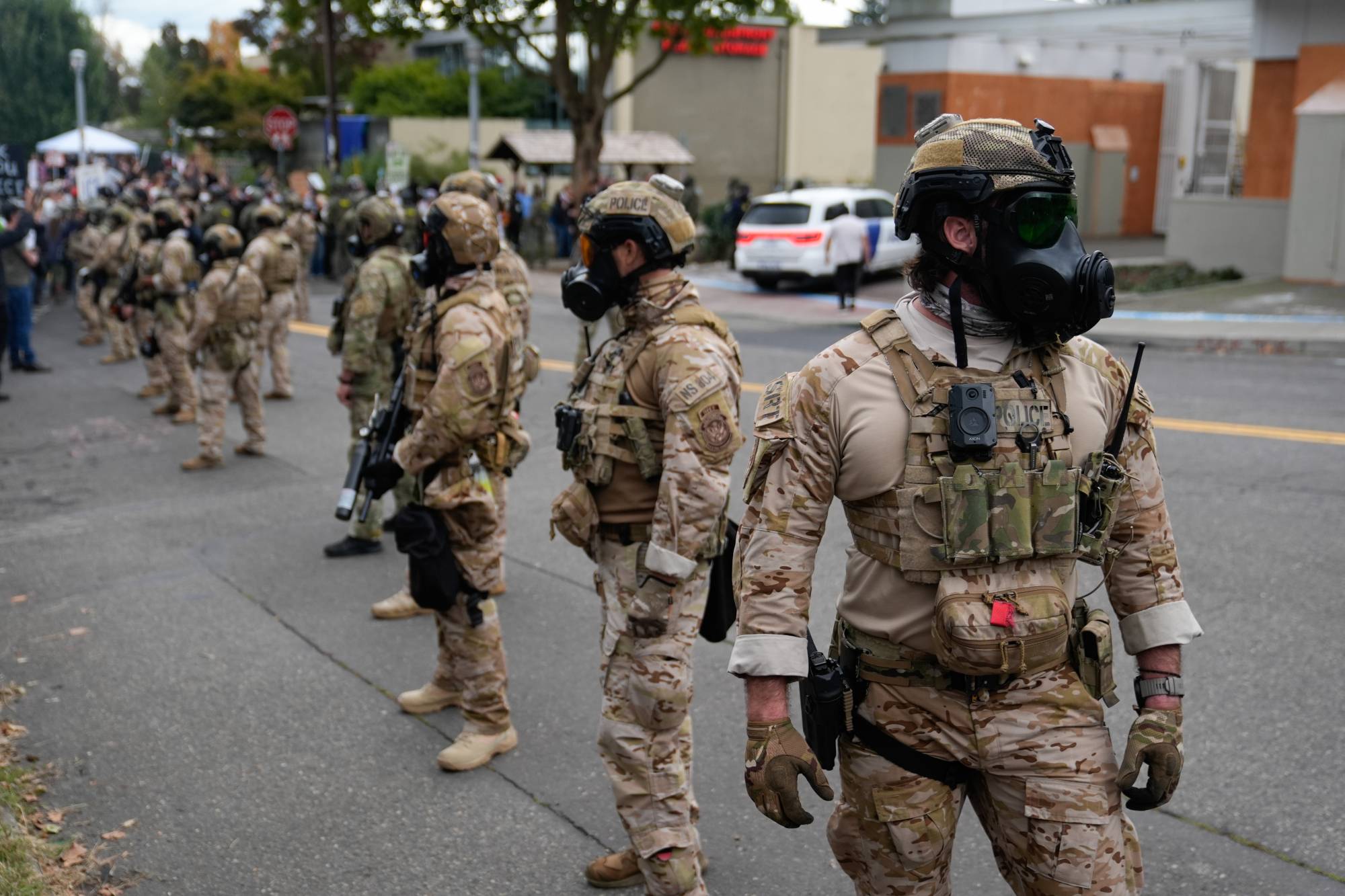
"caption": "Law enforcement officers block the road for a vehicle to enter a U.S. Immigration and Customs Enforcement facility on Oct. 4, 2025, in Portland, Oregon.",
"credit": "Jenny Kane/The Associated Press ",
"altTag": "Several people dressed in military gear and wearing gas masks stand in a line in the middle of the street.",
"description": null,
"imgSizes": {
"medium": {
"file": "https://cdn.kqed.org/wp-content/uploads/sites/10/2025/10/AP25278748416734-2000x1333.jpg",
"width": 2000,
"height": 1333,
"mimeType": "image/jpeg"
},
"large": {
"file": "https://cdn.kqed.org/wp-content/uploads/sites/10/2025/10/AP25278748416734-2000x1333.jpg",
"width": 2000,
"height": 1333,
"mimeType": "image/jpeg"
},
"thumbnail": {
"file": "https://cdn.kqed.org/wp-content/uploads/sites/10/2025/10/AP25278748416734-160x107.jpg",
"width": 160,
"height": 107,
"mimeType": "image/jpeg"
},
"1536x1536": {
"file": "https://cdn.kqed.org/wp-content/uploads/sites/10/2025/10/AP25278748416734-1536x1024.jpg",
"width": 1536,
"height": 1024,
"mimeType": "image/jpeg"
},
"2048x2048": {
"file": "https://cdn.kqed.org/wp-content/uploads/sites/10/2025/10/AP25278748416734-2048x1365.jpg",
"width": 2048,
"height": 1365,
"mimeType": "image/jpeg"
},
"post-thumbnail": {
"file": "https://cdn.kqed.org/wp-content/uploads/sites/10/2025/10/AP25278748416734-672x372.jpg",
"width": 672,
"height": 372,
"mimeType": "image/jpeg"
},
"twentyfourteen-full-width": {
"file": "https://cdn.kqed.org/wp-content/uploads/sites/10/2025/10/AP25278748416734-1038x576.jpg",
"width": 1038,
"height": 576,
"mimeType": "image/jpeg"
},
"full-width": {
"file": "https://cdn.kqed.org/wp-content/uploads/sites/10/2025/10/AP25278748416734-2000x1333.jpg",
"width": 2000,
"height": 1333,
"mimeType": "image/jpeg"
},
"kqedFullSize": {
"file": "https://cdn.kqed.org/wp-content/uploads/sites/10/2025/10/AP25278748416734-scaled-e1761091431392.jpg",
"width": 2000,
"height": 1334
}
},
"isLoading": false,
"fetchFailed": false
},
"news_12058166": {
"type": "attachments",
"id": "news_12058166",
"meta": {
"index": "attachments_1716263798",
"site": "news",
"id": "12058166",
"found": true
},
"title": "President Trump And Pete Hegseth Address U.S. Senior Military Leaders At Quantico",
"publishDate": 1759276159,
"status": "inherit",
"parent": 12058130,
"modified": 1759276199,
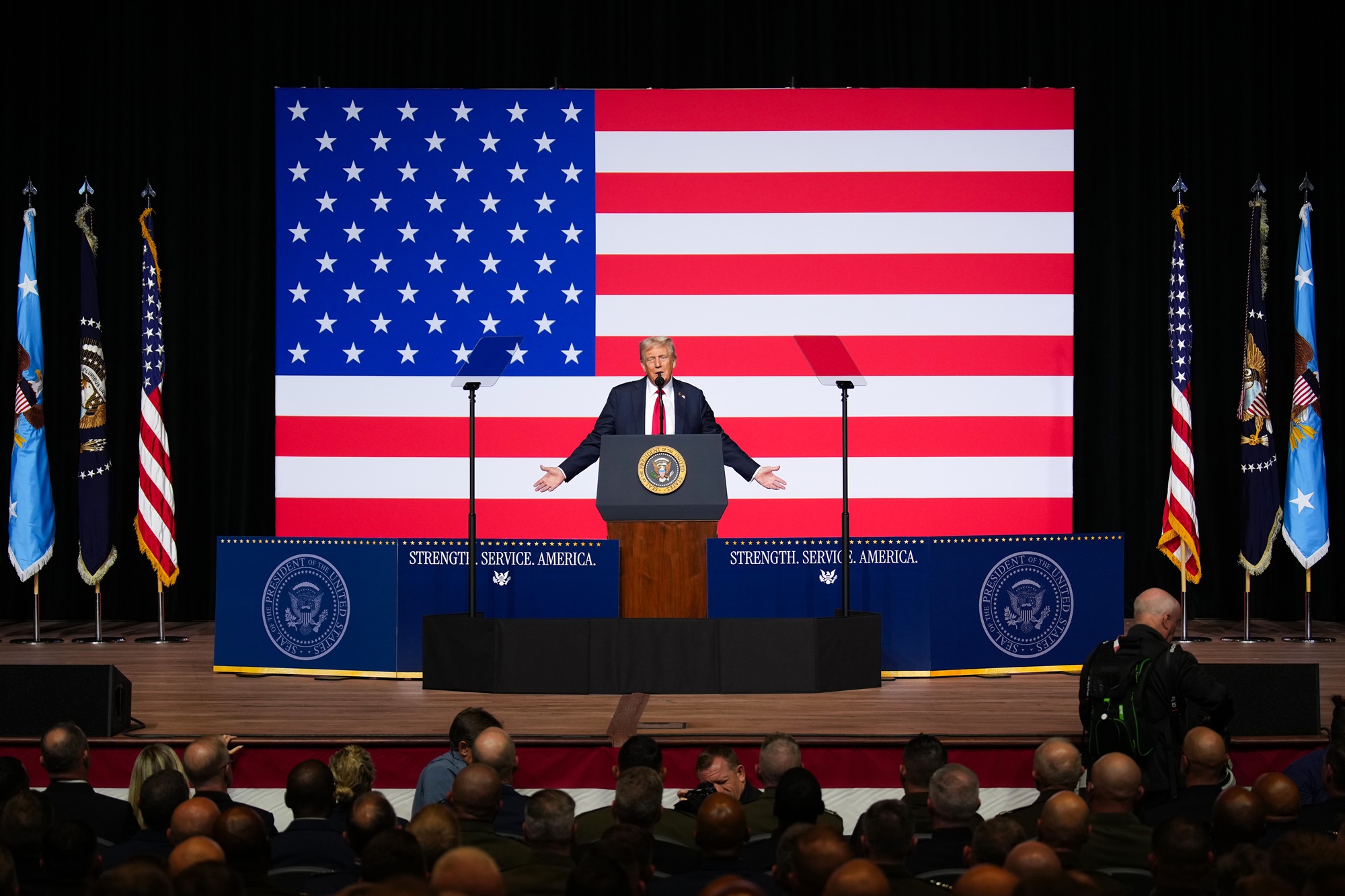
"caption": "U.S. President Donald Trump speaks to senior military leaders at Marine Corps Base Quantico on Sept. 30, 2025, in Quantico, Virginia. In an unprecedented gathering, almost 800 generals, admirals and their senior enlisted leaders have been ordered into one location from around the world on short notice. ",
"credit": "Andrew Harnik/Getty Images",
"altTag": null,
"description": null,
"imgSizes": {
"thumbnail": {
"file": "https://cdn.kqed.org/wp-content/uploads/sites/10/2025/09/DonaldTrumpVirginaGetty-160x107.jpg",
"width": 160,
"height": 107,
"mimeType": "image/jpeg"
},
"1536x1536": {
"file": "https://cdn.kqed.org/wp-content/uploads/sites/10/2025/09/DonaldTrumpVirginaGetty-1536x1024.jpg",
"width": 1536,
"height": 1024,
"mimeType": "image/jpeg"
},
"post-thumbnail": {
"file": "https://cdn.kqed.org/wp-content/uploads/sites/10/2025/09/DonaldTrumpVirginaGetty-672x372.jpg",
"width": 672,
"height": 372,
"mimeType": "image/jpeg"
},
"twentyfourteen-full-width": {
"file": "https://cdn.kqed.org/wp-content/uploads/sites/10/2025/09/DonaldTrumpVirginaGetty-1038x576.jpg",
"width": 1038,
"height": 576,
"mimeType": "image/jpeg"
},
"kqedFullSize": {
"file": "https://cdn.kqed.org/wp-content/uploads/sites/10/2025/09/DonaldTrumpVirginaGetty.jpg",
"width": 2000,
"height": 1333
}
},
"isLoading": false,
"fetchFailed": false
},
"news_12044826": {
"type": "attachments",
"id": "news_12044826",
"meta": {
"index": "attachments_1716263798",
"site": "news",
"id": "12044826",
"found": true
},
"title": "Protests Erupt In L.A. County Sparked By Federal Immigration Raids",
"publishDate": 1750202502,
"status": "inherit",
"parent": 12044637,
"modified": 1757026443,
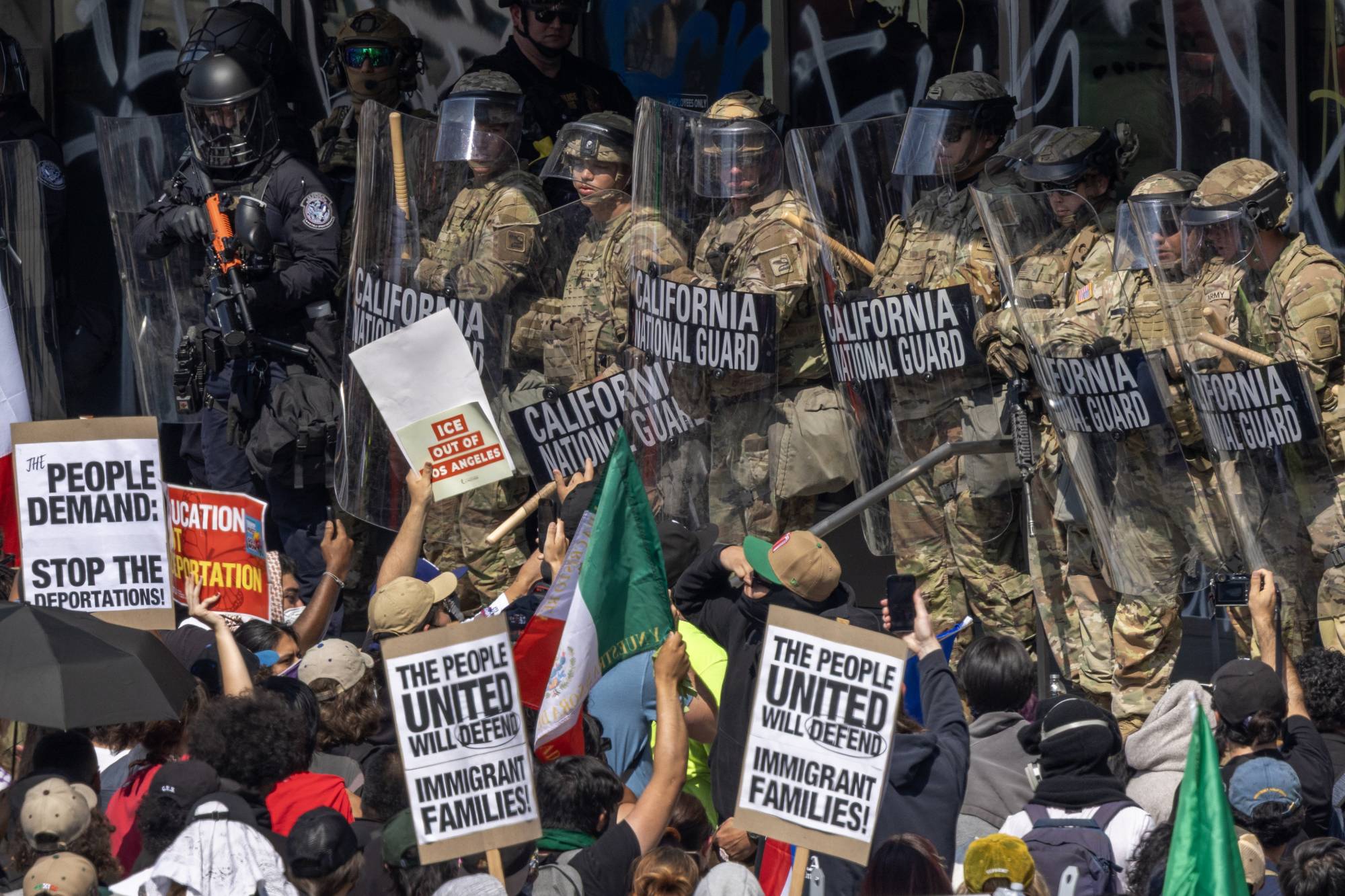
"caption": "A police officer holds a less lethal rifle as protesters confront California National Guard soldiers and police outside of a federal building, as protests continue in Los Angeles following 3 days of clashes with police after a series of immigration raids on June 9, 2025. ",
"credit": "David McNew/Getty Images",
"altTag": null,
"description": null,
"imgSizes": {
"medium": {
"file": "https://cdn.kqed.org/wp-content/uploads/sites/10/2025/06/GettyImages-2219434485-2000x1333.jpg",
"width": 2000,
"height": 1333,
"mimeType": "image/jpeg"
},
"large": {
"file": "https://cdn.kqed.org/wp-content/uploads/sites/10/2025/06/GettyImages-2219434485-2000x1333.jpg",
"width": 2000,
"height": 1333,
"mimeType": "image/jpeg"
},
"thumbnail": {
"file": "https://cdn.kqed.org/wp-content/uploads/sites/10/2025/06/GettyImages-2219434485-160x107.jpg",
"width": 160,
"height": 107,
"mimeType": "image/jpeg"
},
"1536x1536": {
"file": "https://cdn.kqed.org/wp-content/uploads/sites/10/2025/06/GettyImages-2219434485-1536x1024.jpg",
"width": 1536,
"height": 1024,
"mimeType": "image/jpeg"
},
"2048x2048": {
"file": "https://cdn.kqed.org/wp-content/uploads/sites/10/2025/06/GettyImages-2219434485-2048x1365.jpg",
"width": 2048,
"height": 1365,
"mimeType": "image/jpeg"
},
"post-thumbnail": {
"file": "https://cdn.kqed.org/wp-content/uploads/sites/10/2025/06/GettyImages-2219434485-672x372.jpg",
"width": 672,
"height": 372,
"mimeType": "image/jpeg"
},
"twentyfourteen-full-width": {
"file": "https://cdn.kqed.org/wp-content/uploads/sites/10/2025/06/GettyImages-2219434485-1038x576.jpg",
"width": 1038,
"height": 576,
"mimeType": "image/jpeg"
},
"full-width": {
"file": "https://cdn.kqed.org/wp-content/uploads/sites/10/2025/06/GettyImages-2219434485-2000x1333.jpg",
"width": 2000,
"height": 1333,
"mimeType": "image/jpeg"
},
"kqedFullSize": {
"file": "https://cdn.kqed.org/wp-content/uploads/sites/10/2025/06/GettyImages-2219434485-scaled-e1753393070287.jpg",
"width": 2000,
"height": 1334
}
},
"isLoading": false,
"fetchFailed": false
},
"news_12052244": {
"type": "attachments",
"id": "news_12052244",
"meta": {
"index": "attachments_1716263798",
"site": "news",
"id": "12052244",
"found": true
},
"title": "250814-OAKLANDPUSHBACK-08-KQED",
"publishDate": 1755202777,
"status": "inherit",
"parent": 12054322,
"modified": 1763165876,
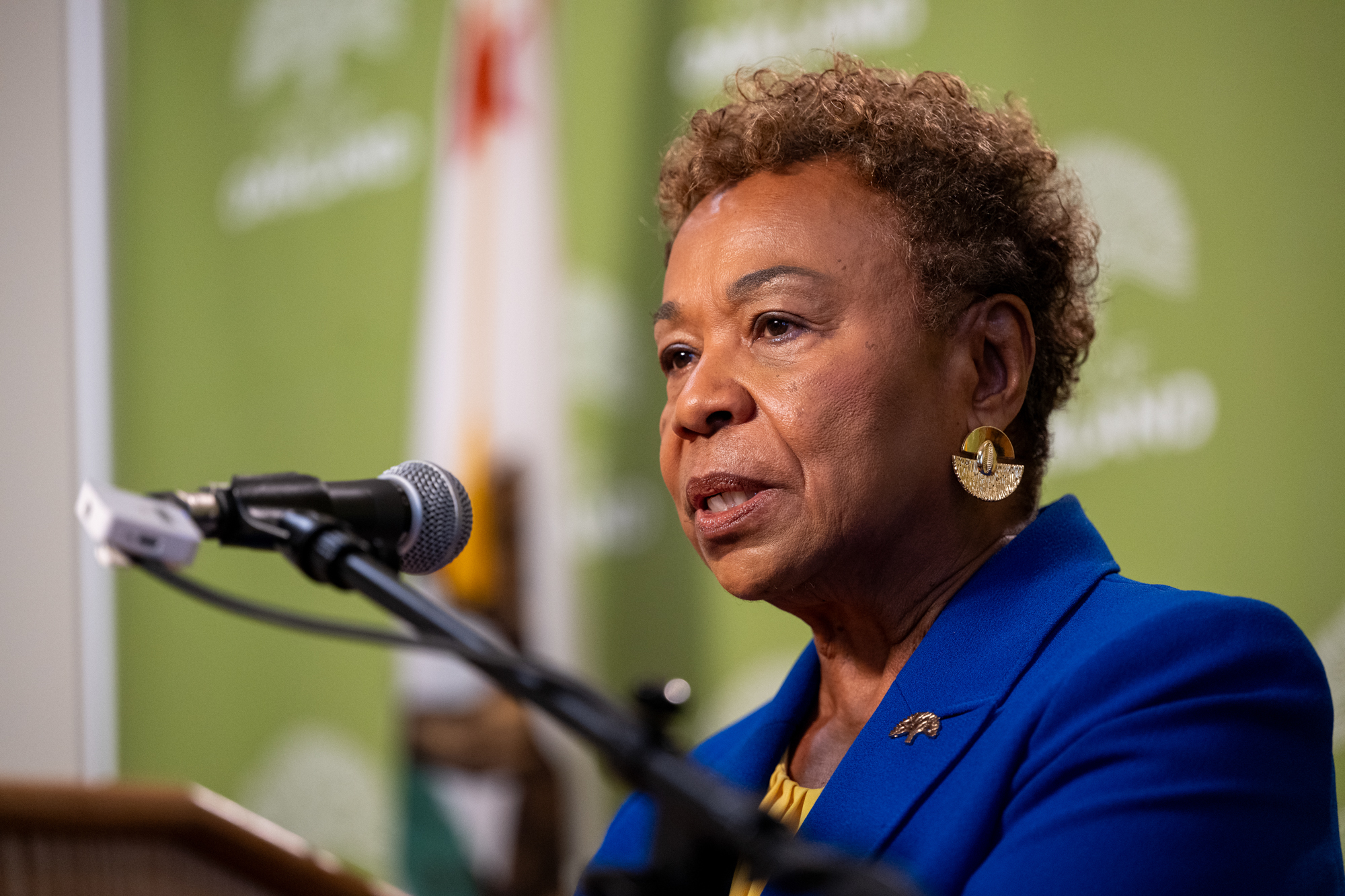
"caption": "Mayor Barbara Lee speaks during a press conference at Oakland City Hall in Oakland on Aug. 14, 2025.",
"credit": "Beth LaBerge/KQED",
"altTag": null,
"description": null,
"imgSizes": {
"thumbnail": {
"file": "https://cdn.kqed.org/wp-content/uploads/sites/10/2025/08/250814-OAKLANDPUSHBACK-08-KQED-160x107.jpg",
"width": 160,
"height": 107,
"mimeType": "image/jpeg"
},
"1536x1536": {
"file": "https://cdn.kqed.org/wp-content/uploads/sites/10/2025/08/250814-OAKLANDPUSHBACK-08-KQED-1536x1024.jpg",
"width": 1536,
"height": 1024,
"mimeType": "image/jpeg"
},
"post-thumbnail": {
"file": "https://cdn.kqed.org/wp-content/uploads/sites/10/2025/08/250814-OAKLANDPUSHBACK-08-KQED-672x372.jpg",
"width": 672,
"height": 372,
"mimeType": "image/jpeg"
},
"twentyfourteen-full-width": {
"file": "https://cdn.kqed.org/wp-content/uploads/sites/10/2025/08/250814-OAKLANDPUSHBACK-08-KQED-1038x576.jpg",
"width": 1038,
"height": 576,
"mimeType": "image/jpeg"
},
"kqedFullSize": {
"file": "https://cdn.kqed.org/wp-content/uploads/sites/10/2025/08/250814-OAKLANDPUSHBACK-08-KQED.jpg",
"width": 2000,
"height": 1333
}
},
"isLoading": false,
"fetchFailed": false
},
"news_12051970": {
"type": "attachments",
"id": "news_12051970",
"meta": {
"index": "attachments_1716263798",
"site": "news",
"id": "12051970",
"found": true
},
"title": "Immigration California Lawsuit",
"publishDate": 1755042034,
"status": "inherit",
"parent": 12051954,
"modified": 1761004716,
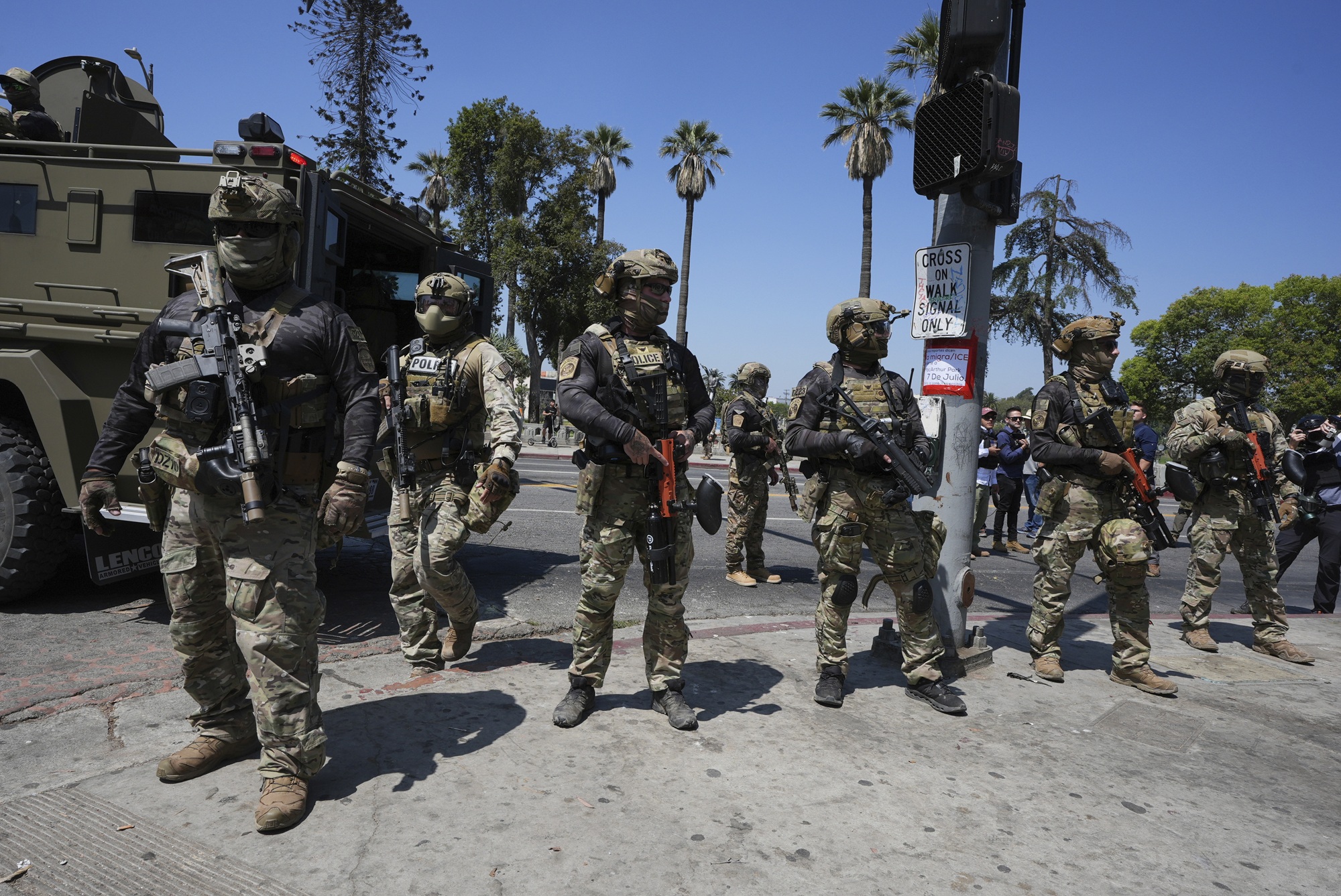
"caption": "Federal agents stage at MacArthur Park on July 7, 2025, in Los Angeles, California. ",
"credit": "Damian Dovarganes/AP Photo",
"altTag": null,
"description": null,
"imgSizes": {
"thumbnail": {
"file": "https://cdn.kqed.org/wp-content/uploads/sites/10/2025/08/NationalGuardTrumpAP-160x107.jpg",
"width": 160,
"height": 107,
"mimeType": "image/jpeg"
},
"1536x1536": {
"file": "https://cdn.kqed.org/wp-content/uploads/sites/10/2025/08/NationalGuardTrumpAP-1536x1027.jpg",
"width": 1536,
"height": 1027,
"mimeType": "image/jpeg"
},
"post-thumbnail": {
"file": "https://cdn.kqed.org/wp-content/uploads/sites/10/2025/08/NationalGuardTrumpAP-672x372.jpg",
"width": 672,
"height": 372,
"mimeType": "image/jpeg"
},
"twentyfourteen-full-width": {
"file": "https://cdn.kqed.org/wp-content/uploads/sites/10/2025/08/NationalGuardTrumpAP-1038x576.jpg",
"width": 1038,
"height": 576,
"mimeType": "image/jpeg"
},
"kqedFullSize": {
"file": "https://cdn.kqed.org/wp-content/uploads/sites/10/2025/08/NationalGuardTrumpAP.jpg",
"width": 2000,
"height": 1337
}
},
"isLoading": false,
"fetchFailed": false
},
"news_12043922": {
"type": "attachments",
"id": "news_12043922",
"meta": {
"index": "attachments_1716263798",
"site": "news",
"id": "12043922",
"found": true
},
"title": "Immigration Protests Los Angeles",
"publishDate": 1749749041,
"status": "inherit",
"parent": 12043920,
"modified": 1749757600,
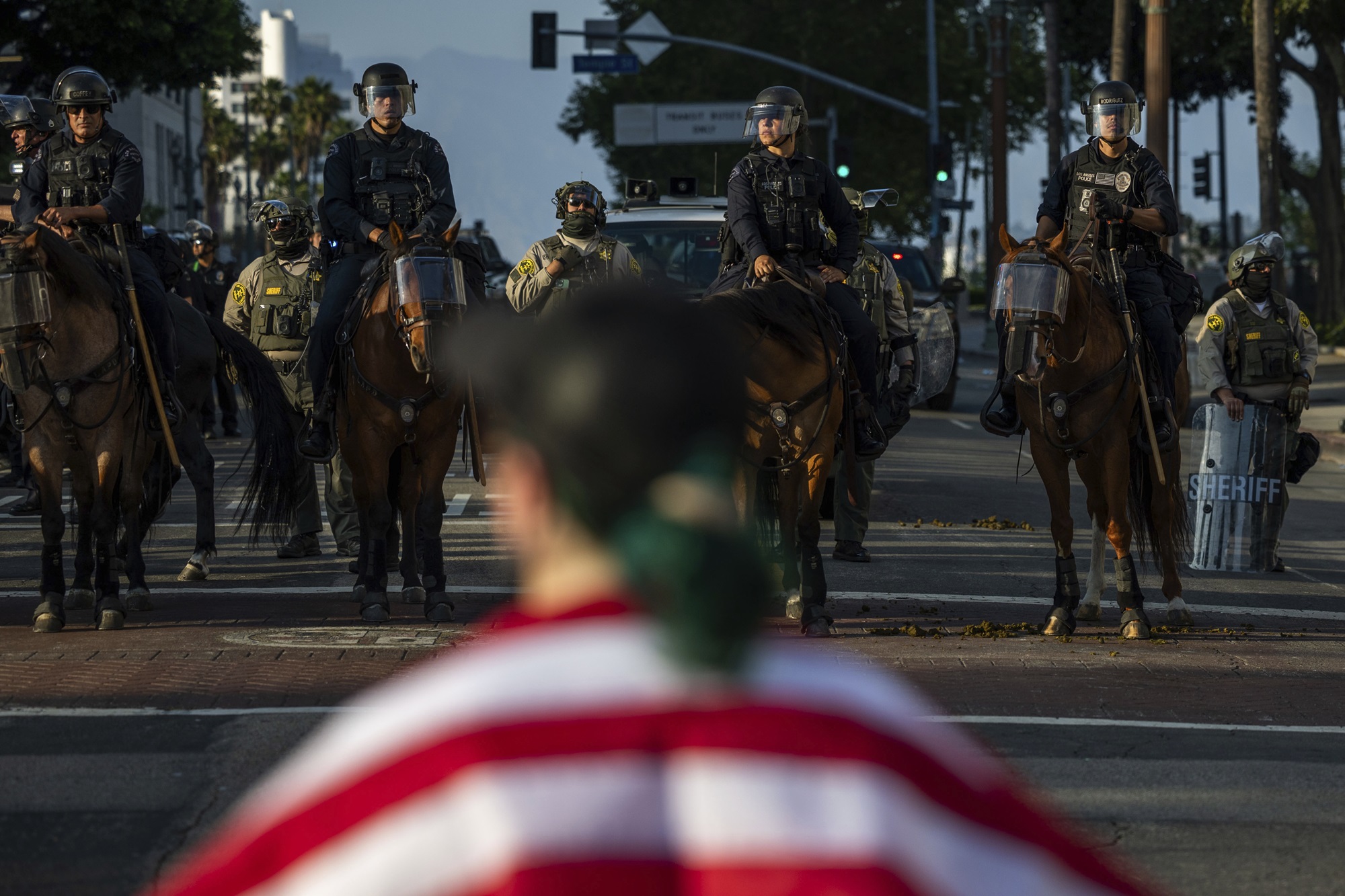
"caption": "Police confront protesters outside City Hall during protests over federal immigration enforcement raids on Wednesday, June 11, 2025, in Los Angeles. ",
"credit": "Ethan Swope/AP Photo",
"altTag": null,
"description": null,
"imgSizes": {
"thumbnail": {
"file": "https://cdn.kqed.org/wp-content/uploads/sites/10/2025/06/LosAngelesImmigrationRaidAP-160x107.jpg",
"width": 160,
"height": 107,
"mimeType": "image/jpeg"
},
"1536x1536": {
"file": "https://cdn.kqed.org/wp-content/uploads/sites/10/2025/06/LosAngelesImmigrationRaidAP-1536x1024.jpg",
"width": 1536,
"height": 1024,
"mimeType": "image/jpeg"
},
"post-thumbnail": {
"file": "https://cdn.kqed.org/wp-content/uploads/sites/10/2025/06/LosAngelesImmigrationRaidAP-672x372.jpg",
"width": 672,
"height": 372,
"mimeType": "image/jpeg"
},
"twentyfourteen-full-width": {
"file": "https://cdn.kqed.org/wp-content/uploads/sites/10/2025/06/LosAngelesImmigrationRaidAP-1038x576.jpg",
"width": 1038,
"height": 576,
"mimeType": "image/jpeg"
},
"kqedFullSize": {
"file": "https://cdn.kqed.org/wp-content/uploads/sites/10/2025/06/LosAngelesImmigrationRaidAP.jpg",
"width": 2000,
"height": 1333
}
},
"isLoading": false,
"fetchFailed": false
},
"news_12044992": {
"type": "attachments",
"id": "news_12044992",
"meta": {
"index": "attachments_1716263798",
"site": "news",
"id": "12044992",
"found": true
},
"title": "061425-No-Kings-Trump-Marines-REUTERS-CM copy",
"publishDate": 1750287559,
"status": "inherit",
"parent": 12044990,
"modified": 1750287608,
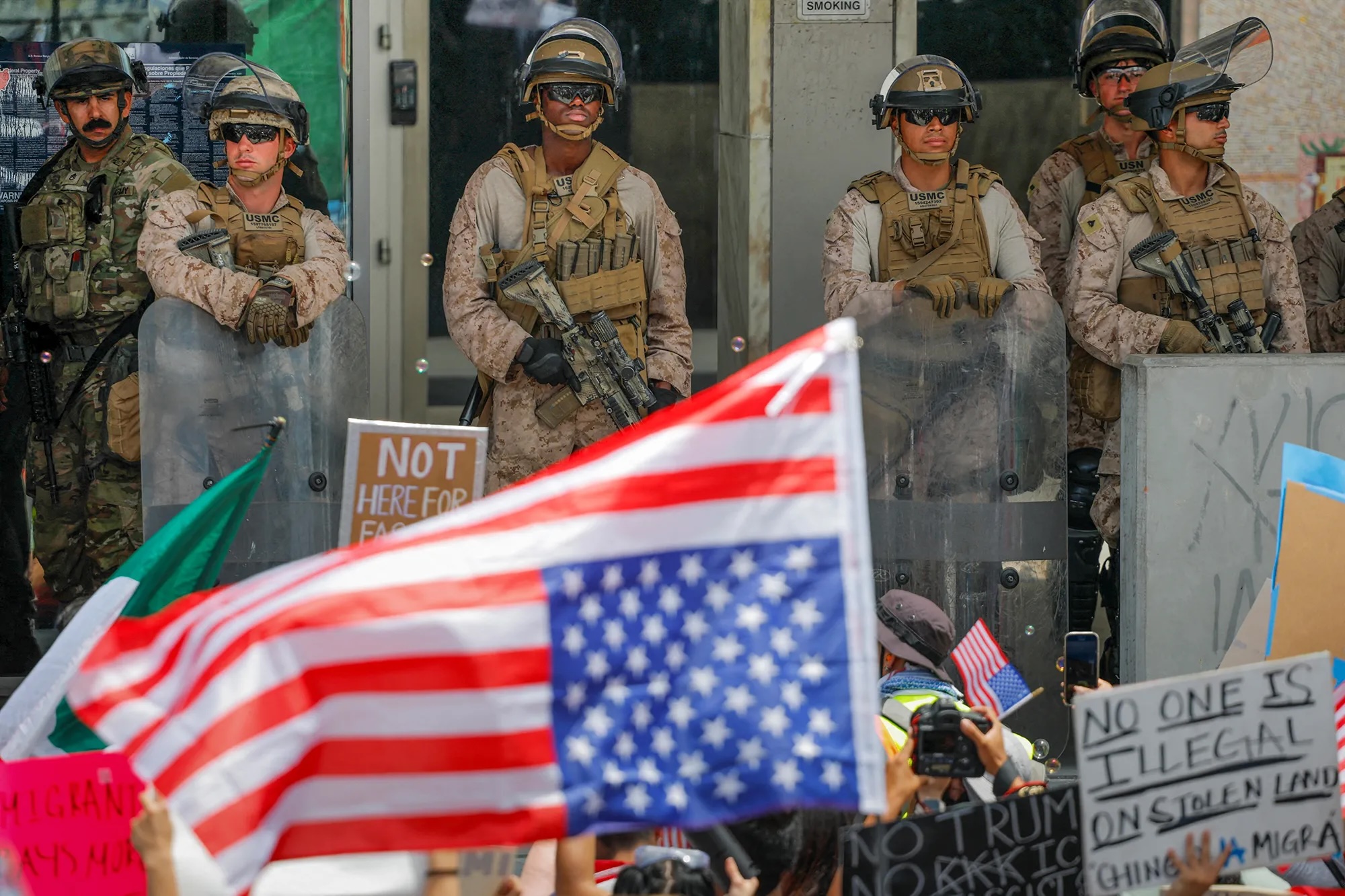
"caption": "Demonstrators wave US and Mexican flags as US Marines stand guard outside the Edward R. Roybal Federal Building during a No Kings Day protest against President Donald Trump's policies in Los Angeles, on June 14, 2025.",
"credit": "Mike Blake/Reuters",
"altTag": null,
"description": null,
"imgSizes": {
"thumbnail": {
"file": "https://cdn.kqed.org/wp-content/uploads/sites/10/2025/06/061425-No-Kings-Trump-Marines-REUTERS-CM-copy-160x107.jpg",
"width": 160,
"height": 107,
"mimeType": "image/jpeg"
},
"1536x1536": {
"file": "https://cdn.kqed.org/wp-content/uploads/sites/10/2025/06/061425-No-Kings-Trump-Marines-REUTERS-CM-copy-1536x1024.jpg",
"width": 1536,
"height": 1024,
"mimeType": "image/jpeg"
},
"post-thumbnail": {
"file": "https://cdn.kqed.org/wp-content/uploads/sites/10/2025/06/061425-No-Kings-Trump-Marines-REUTERS-CM-copy-672x372.jpg",
"width": 672,
"height": 372,
"mimeType": "image/jpeg"
},
"twentyfourteen-full-width": {
"file": "https://cdn.kqed.org/wp-content/uploads/sites/10/2025/06/061425-No-Kings-Trump-Marines-REUTERS-CM-copy-1038x576.jpg",
"width": 1038,
"height": 576,
"mimeType": "image/jpeg"
},
"kqedFullSize": {
"file": "https://cdn.kqed.org/wp-content/uploads/sites/10/2025/06/061425-No-Kings-Trump-Marines-REUTERS-CM-copy.jpg",
"width": 2000,
"height": 1333
}
},
"isLoading": false,
"fetchFailed": false
},
"news_12044094": {
"type": "attachments",
"id": "news_12044094",
"meta": {
"index": "attachments_1716263798",
"site": "news",
"id": "12044094",
"found": true
},
"title": "Protesters clash with law enforcement in downtown Los Angeles near the Federal Building and the Metropolitan Detention Center due to the immigration raids roil L.A.",
"publishDate": 1749776912,
"status": "inherit",
"parent": 12043935,
"modified": 1749777473,
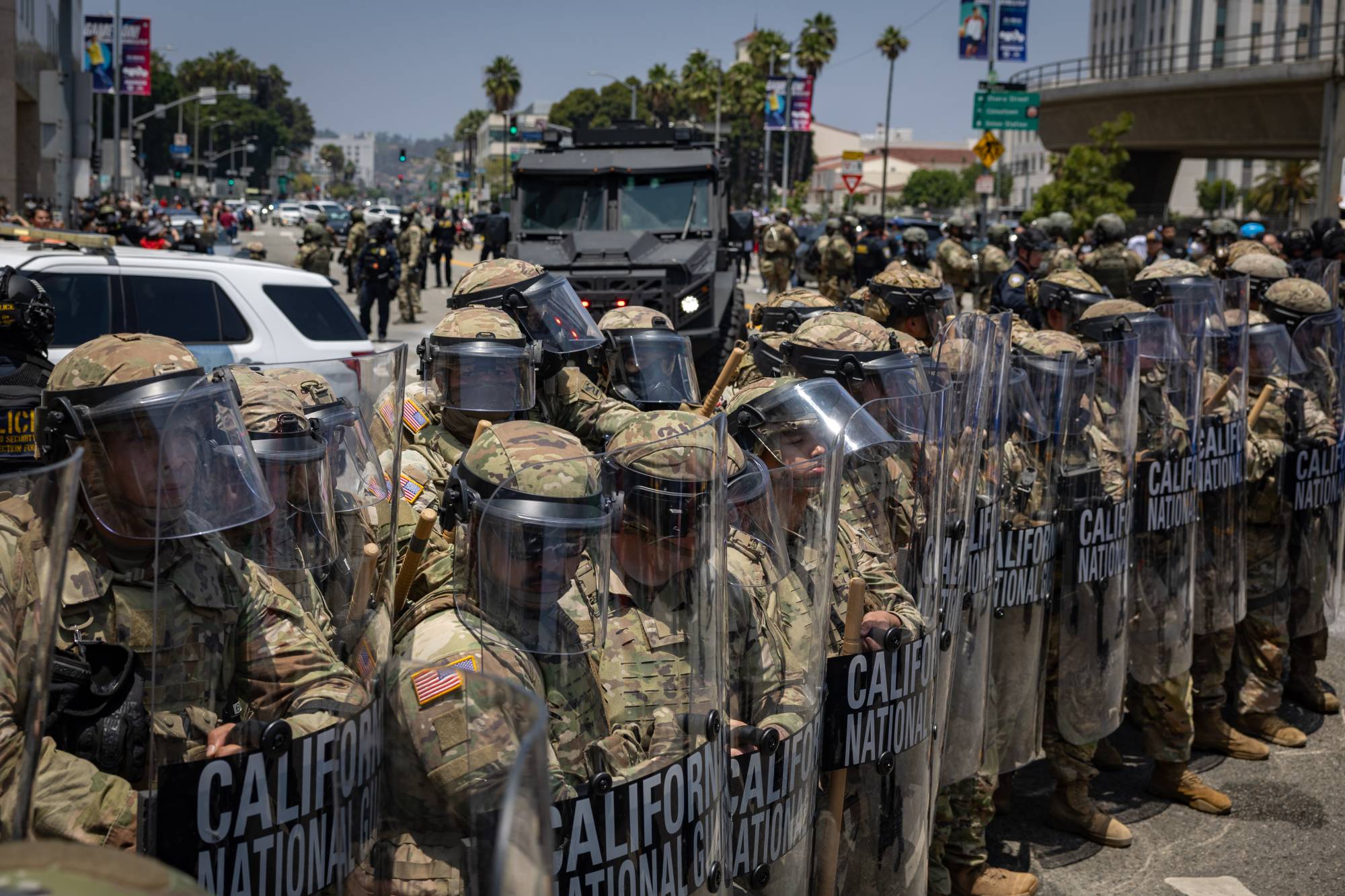
"caption": "California National Guard stands guard as protesters clash with law enforcement in downtown Los Angeles at the Metropolitan Detention Center due to the immigration raids roil LA on Sunday, June 8, 2025 in Los Angeles. ",
"credit": "Jason Armond/Los Angeles Times via Getty Images",
"altTag": null,
"description": null,
"imgSizes": {
"medium": {
"file": "https://cdn.kqed.org/wp-content/uploads/sites/10/2025/06/GettyImages-2218796587-2000x1333.jpg",
"width": 2000,
"height": 1333,
"mimeType": "image/jpeg"
},
"large": {
"file": "https://cdn.kqed.org/wp-content/uploads/sites/10/2025/06/GettyImages-2218796587-2000x1333.jpg",
"width": 2000,
"height": 1333,
"mimeType": "image/jpeg"
},
"thumbnail": {
"file": "https://cdn.kqed.org/wp-content/uploads/sites/10/2025/06/GettyImages-2218796587-160x107.jpg",
"width": 160,
"height": 107,
"mimeType": "image/jpeg"
},
"1536x1536": {
"file": "https://cdn.kqed.org/wp-content/uploads/sites/10/2025/06/GettyImages-2218796587-1536x1024.jpg",
"width": 1536,
"height": 1024,
"mimeType": "image/jpeg"
},
"2048x2048": {
"file": "https://cdn.kqed.org/wp-content/uploads/sites/10/2025/06/GettyImages-2218796587-2048x1365.jpg",
"width": 2048,
"height": 1365,
"mimeType": "image/jpeg"
},
"post-thumbnail": {
"file": "https://cdn.kqed.org/wp-content/uploads/sites/10/2025/06/GettyImages-2218796587-672x372.jpg",
"width": 672,
"height": 372,
"mimeType": "image/jpeg"
},
"twentyfourteen-full-width": {
"file": "https://cdn.kqed.org/wp-content/uploads/sites/10/2025/06/GettyImages-2218796587-1038x576.jpg",
"width": 1038,
"height": 576,
"mimeType": "image/jpeg"
},
"full-width": {
"file": "https://cdn.kqed.org/wp-content/uploads/sites/10/2025/06/GettyImages-2218796587-2000x1333.jpg",
"width": 2000,
"height": 1333,
"mimeType": "image/jpeg"
},
"kqedFullSize": {
"file": "https://cdn.kqed.org/wp-content/uploads/sites/10/2025/06/GettyImages-2218796587-scaled-e1750446347200.jpg",
"width": 2000,
"height": 1334
}
},
"isLoading": false,
"fetchFailed": false
},
"news_12044791": {
"type": "attachments",
"id": "news_12044791",
"meta": {
"index": "attachments_1716263798",
"site": "news",
"id": "12044791",
"found": true
},
"title": "US-POLITICS-IMMIGRATION-ICE",
"publishDate": 1750196649,
"status": "inherit",
"parent": 12044748,
"modified": 1776108571,
"caption": "A farmworker works in a strawberry field on June 12, 2025, in Oxnard, California. Anti-immigration crackdowns ordered by President Donald Trump have seen federal authorities target factories and work sites since June 6, sparking days of angry protests in Los Angeles. ",
"credit": "Apu Gomes/AFP via Getty Images",
"altTag": null,
"description": null,
"imgSizes": {
"thumbnail": {
"file": "https://cdn.kqed.org/wp-content/uploads/sites/10/2025/06/CaliforniaFarmworkersGetty-160x107.jpg",
"width": 160,
"height": 107,
"mimeType": "image/jpeg"
},
"1536x1536": {
"file": "https://cdn.kqed.org/wp-content/uploads/sites/10/2025/06/CaliforniaFarmworkersGetty-1536x1024.jpg",
"width": 1536,
"height": 1024,
"mimeType": "image/jpeg"
},
"post-thumbnail": {
"file": "https://cdn.kqed.org/wp-content/uploads/sites/10/2025/06/CaliforniaFarmworkersGetty-672x372.jpg",
"width": 672,
"height": 372,
"mimeType": "image/jpeg"
},
"twentyfourteen-full-width": {
"file": "https://cdn.kqed.org/wp-content/uploads/sites/10/2025/06/CaliforniaFarmworkersGetty-1038x576.jpg",
"width": 1038,
"height": 576,
"mimeType": "image/jpeg"
},
"kqedFullSize": {
"file": "https://cdn.kqed.org/wp-content/uploads/sites/10/2025/06/CaliforniaFarmworkersGetty.jpg",
"width": 2000,
"height": 1333
}
},
"isLoading": false,
"fetchFailed": false
},
"news_12043958": {
"type": "attachments",
"id": "news_12043958",
"meta": {
"index": "attachments_1716263798",
"site": "news",
"id": "12043958",
"found": true
},
"title": "APTOPIX Immigration-Protests",
"publishDate": 1749754480,
"status": "inherit",
"parent": 12043957,
"modified": 1749754502,
"caption": "U.S. Sen. Alex Padilla is pushed out of the room as Homeland Security Secretary Kristi Noem holds a news conference regarding the recent protests in Los Angeles on Thursday, June 12, 2025. ",
"credit": "Etienne Laurent/AP Photo",
"altTag": null,
"description": null,
"imgSizes": {
"thumbnail": {
"file": "https://cdn.kqed.org/wp-content/uploads/sites/10/2025/06/PadillaRemovedAP-160x107.jpg",
"width": 160,
"height": 107,
"mimeType": "image/jpeg"
},
"1536x1536": {
"file": "https://cdn.kqed.org/wp-content/uploads/sites/10/2025/06/PadillaRemovedAP-1536x1024.jpg",
"width": 1536,
"height": 1024,
"mimeType": "image/jpeg"
},
"post-thumbnail": {
"file": "https://cdn.kqed.org/wp-content/uploads/sites/10/2025/06/PadillaRemovedAP-672x372.jpg",
"width": 672,
"height": 372,
"mimeType": "image/jpeg"
},
"twentyfourteen-full-width": {
"file": "https://cdn.kqed.org/wp-content/uploads/sites/10/2025/06/PadillaRemovedAP-1038x576.jpg",
"width": 1038,
"height": 576,
"mimeType": "image/jpeg"
},
"kqedFullSize": {
"file": "https://cdn.kqed.org/wp-content/uploads/sites/10/2025/06/PadillaRemovedAP.jpg",
"width": 2000,
"height": 1333
}
},
"isLoading": false,
"fetchFailed": false
},
"news_12043749": {
"type": "attachments",
"id": "news_12043749",
"meta": {
"index": "attachments_1716263798",
"site": "news",
"id": "12043749",
"found": true
},
"title": "LAProtestCM1",
"publishDate": 1749660653,
"status": "inherit",
"parent": 12043745,
"modified": 1749660679,
"caption": "Members of the press take cover as police officers clear the area outside of a federal building as protests continue in Los Angeles on June 9, 2025.",
"credit": "David McNew/Getty Images",
"altTag": null,
"description": null,
"imgSizes": {
"thumbnail": {
"file": "https://cdn.kqed.org/wp-content/uploads/sites/10/2025/06/LAProtestCM1-160x107.jpg",
"width": 160,
"height": 107,
"mimeType": "image/jpeg"
},
"1536x1536": {
"file": "https://cdn.kqed.org/wp-content/uploads/sites/10/2025/06/LAProtestCM1-1536x1025.jpg",
"width": 1536,
"height": 1025,
"mimeType": "image/jpeg"
},
"post-thumbnail": {
"file": "https://cdn.kqed.org/wp-content/uploads/sites/10/2025/06/LAProtestCM1-672x372.jpg",
"width": 672,
"height": 372,
"mimeType": "image/jpeg"
},
"twentyfourteen-full-width": {
"file": "https://cdn.kqed.org/wp-content/uploads/sites/10/2025/06/LAProtestCM1-1038x576.jpg",
"width": 1038,
"height": 576,
"mimeType": "image/jpeg"
},
"kqedFullSize": {
"file": "https://cdn.kqed.org/wp-content/uploads/sites/10/2025/06/LAProtestCM1.jpg",
"width": 1999,
"height": 1334
}
},
"isLoading": false,
"fetchFailed": false
}
},
"audioPlayerReducer": {
"postId": "stream_live",
"isPaused": true,
"isPlaying": false,
"pfsActive": false,
"pledgeModalIsOpen": true,
"playerDrawerIsOpen": false,
"liveAudioPlayStartedAt": 0,
"liveAudioPlayContext": ""
},
"authorsReducer": {
"byline_news_12058715": {
"type": "authors",
"id": "byline_news_12058715",
"meta": {
"override": true
},
"slug": "byline_news_12058715",
"name": "Christopher Weber and Jack Brook, The Associated Press ",
"isLoading": false
},
"byline_news_12044990": {
"type": "authors",
"id": "byline_news_12044990",
"meta": {
"override": true
},
"slug": "byline_news_12044990",
"name": "Yue Stella Yu, CalMatters",
"isLoading": false
},
"byline_news_12043745": {
"type": "authors",
"id": "byline_news_12043745",
"meta": {
"override": true
},
"slug": "byline_news_12043745",
"name": "John D'Anna, CalMatters",
"isLoading": false
},
"mlagos": {
"type": "authors",
"id": "3239",
"meta": {
"index": "authors_1716337520",
"id": "3239",
"found": true
},
"name": "Marisa Lagos",
"firstName": "Marisa",
"lastName": "Lagos",
"slug": "mlagos",
"email": "mlagos@kqed.org",
"display_author_email": false,
"staff_mastheads": [
"news"
],
"title": "KQED Contributor",
"bio": "Marisa Lagos is a correspondent for KQED’s California Politics and Government Desk and co-hosts the award-winning show and podcast, Political Breakdown. At KQED, Lagos also conducts reporting, analysis and investigations into state, local and national politics for radio, TV, online and onstage. In 2022, she and co-host, Scott Shafer, moderated the only gubernatorial debate in California. In 2020, the \u003ci>Washington Post\u003c/i> named her one of the top political journalists in California; she was nominated for a Peabody and won several other awards for her work investigating the 2017 California wildfires. She has worked at the \u003ci>San Francisco Chronicle\u003c/i>, \u003ci>San Francisco Examiner\u003c/i> and \u003ci>Los Angeles Times\u003c/i>. A UC Santa Barbara graduate, she lives in San Francisco with her two sons and husband.",
"avatar": "https://secure.gravatar.com/avatar/a261a0d3696fc066871ef96b85b5e7d2?s=600&d=blank&r=g",
"twitter": "@mlagos",
"facebook": null,
"instagram": null,
"linkedin": null,
"sites": [
{
"site": "arts",
"roles": [
"author"
]
},
{
"site": "news",
"roles": [
"editor"
]
},
{
"site": "science",
"roles": [
"editor"
]
},
{
"site": "forum",
"roles": [
"author"
]
},
{
"site": "liveblog",
"roles": [
"author"
]
}
],
"headData": {
"title": "Marisa Lagos | KQED",
"description": "KQED Contributor",
"ogImgSrc": "https://secure.gravatar.com/avatar/a261a0d3696fc066871ef96b85b5e7d2?s=600&d=blank&r=g",
"twImgSrc": "https://secure.gravatar.com/avatar/a261a0d3696fc066871ef96b85b5e7d2?s=600&d=blank&r=g"
},
"isLoading": false,
"link": "/author/mlagos"
},
"agonzalez": {
"type": "authors",
"id": "11724",
"meta": {
"index": "authors_1716337520",
"id": "11724",
"found": true
},
"name": "Alexander Gonzalez",
"firstName": "Alexander",
"lastName": "Gonzalez",
"slug": "agonzalez",
"email": "AlexanderGonzalez@KQED.org",
"display_author_email": false,
"staff_mastheads": [
"news"
],
"title": "KQED Contributor",
"bio": null,
"avatar": "https://secure.gravatar.com/avatar/9e291ed34e154df4c662edf858b641d70b4859939bfe40be478408f9dfd057d2?s=600&d=blank&r=g",
"twitter": null,
"bluesky": null,
"facebook": null,
"instagram": null,
"linkedin": null,
"sites": [
{
"site": "arts",
"roles": [
"editor"
]
},
{
"site": "news",
"roles": [
"editor"
]
},
{
"site": "science",
"roles": [
"editor"
]
}
],
"headData": {
"title": "Alexander Gonzalez | KQED",
"description": "KQED Contributor",
"ogImgSrc": "https://secure.gravatar.com/avatar/9e291ed34e154df4c662edf858b641d70b4859939bfe40be478408f9dfd057d2?s=600&d=blank&r=g",
"twImgSrc": "https://secure.gravatar.com/avatar/9e291ed34e154df4c662edf858b641d70b4859939bfe40be478408f9dfd057d2?s=600&d=blank&r=g"
},
"isLoading": false,
"link": "/author/agonzalez"
},
"jlara": {
"type": "authors",
"id": "11761",
"meta": {
"index": "authors_1716337520",
"id": "11761",
"found": true
},
"name": "Juan Carlos Lara",
"firstName": "Juan Carlos",
"lastName": "Lara",
"slug": "jlara",
"email": "jlara@kqed.org",
"display_author_email": false,
"staff_mastheads": [],
"title": "KQED Contributor",
"bio": null,
"avatar": "https://secure.gravatar.com/avatar/19e2052b9b05657c5ff2af2121846e9c?s=600&d=blank&r=g",
"twitter": null,
"facebook": null,
"instagram": null,
"linkedin": null,
"sites": [
{
"site": "arts",
"roles": [
"editor"
]
},
{
"site": "news",
"roles": [
"editor"
]
},
{
"site": "forum",
"roles": [
"editor"
]
},
{
"site": "liveblog",
"roles": [
"contributor"
]
}
],
"headData": {
"title": "Juan Carlos Lara | KQED",
"description": "KQED Contributor",
"ogImgSrc": "https://secure.gravatar.com/avatar/19e2052b9b05657c5ff2af2121846e9c?s=600&d=blank&r=g",
"twImgSrc": "https://secure.gravatar.com/avatar/19e2052b9b05657c5ff2af2121846e9c?s=600&d=blank&r=g"
},
"isLoading": false,
"link": "/author/jlara"
},
"sjohnson": {
"type": "authors",
"id": "11840",
"meta": {
"index": "authors_1716337520",
"id": "11840",
"found": true
},
"name": "Sydney Johnson",
"firstName": "Sydney",
"lastName": "Johnson",
"slug": "sjohnson",
"email": "sjohnson@kqed.org",
"display_author_email": false,
"staff_mastheads": [
"news"
],
"title": "KQED Reporter",
"bio": "Sydney Johnson is a general assignment reporter at KQED. She previously reported on public health and city government at the San Francisco Examiner, and before that, she covered statewide education policy for EdSource. Her reporting has won multiple local, state and national awards. Sydney is a graduate of the University of California, Berkeley and lives in San Francisco.",
"avatar": "https://secure.gravatar.com/avatar/97855f2719b72ad6190b7c535fe642c8?s=600&d=blank&r=g",
"twitter": "sydneyfjohnson",
"facebook": null,
"instagram": null,
"linkedin": null,
"sites": [
{
"site": "news",
"roles": [
"editor"
]
}
],
"headData": {
"title": "Sydney Johnson | KQED",
"description": "KQED Reporter",
"ogImgSrc": "https://secure.gravatar.com/avatar/97855f2719b72ad6190b7c535fe642c8?s=600&d=blank&r=g",
"twImgSrc": "https://secure.gravatar.com/avatar/97855f2719b72ad6190b7c535fe642c8?s=600&d=blank&r=g"
},
"isLoading": false,
"link": "/author/sjohnson"
},
"jservantez": {
"type": "authors",
"id": "11909",
"meta": {
"index": "authors_1716337520",
"id": "11909",
"found": true
},
"name": "Jared Servantez",
"firstName": "Jared",
"lastName": "Servantez",
"slug": "jservantez",
"email": "jservantez@kqed.org",
"display_author_email": true,
"staff_mastheads": [
"news"
],
"title": "KQED Contributor",
"bio": "Jared Servantez is the editor of KQED's Express Desk, leading the newsroom's online breaking news operation. He most recently worked for the Los Angeles Times, where he served as a breaking news editor, the Metro Desk's night editor, and a copy editor. Jared is a graduate of the USC Annenberg School for Communication and Journalism.",
"avatar": "https://secure.gravatar.com/avatar/f0e317c67bb498c3f077f033d1cc79e62f3bc1303fa20a14e8880d31fbe7e01e?s=600&d=blank&r=g",
"twitter": "jservantez",
"bluesky": null,
"facebook": null,
"instagram": null,
"linkedin": null,
"sites": [
{
"site": "news",
"roles": [
"editor"
]
},
{
"site": "science",
"roles": [
"editor",
"author"
]
},
{
"site": "liveblog",
"roles": [
"editor"
]
}
],
"headData": {
"title": "Jared Servantez | KQED",
"description": "KQED Contributor",
"ogImgSrc": "https://secure.gravatar.com/avatar/f0e317c67bb498c3f077f033d1cc79e62f3bc1303fa20a14e8880d31fbe7e01e?s=600&d=blank&r=g",
"twImgSrc": "https://secure.gravatar.com/avatar/f0e317c67bb498c3f077f033d1cc79e62f3bc1303fa20a14e8880d31fbe7e01e?s=600&d=blank&r=g"
},
"isLoading": false,
"link": "/author/jservantez"
},
"skennedy": {
"type": "authors",
"id": "11935",
"meta": {
"index": "authors_1716337520",
"id": "11935",
"found": true
},
"name": "Samantha Kennedy",
"firstName": "Samantha",
"lastName": "Kennedy",
"slug": "skennedy",
"email": "SKennedy@kqed.org",
"display_author_email": false,
"staff_mastheads": [],
"title": "KQED Contributor",
"bio": null,
"avatar": "https://secure.gravatar.com/avatar/adc7b14bf1e801793202a156ecc864d4ad505b0fd63162a2f3da0e5ba57222d0?s=600&d=blank&r=g",
"twitter": null,
"bluesky": null,
"facebook": null,
"instagram": null,
"linkedin": null,
"sites": [
{
"site": "arts",
"roles": [
"author"
]
},
{
"site": "news",
"roles": [
"editor"
]
},
{
"site": "science",
"roles": [
"editor"
]
}
],
"headData": {
"title": "Samantha Kennedy | KQED",
"description": "KQED Contributor",
"ogImgSrc": "https://secure.gravatar.com/avatar/adc7b14bf1e801793202a156ecc864d4ad505b0fd63162a2f3da0e5ba57222d0?s=600&d=blank&r=g",
"twImgSrc": "https://secure.gravatar.com/avatar/adc7b14bf1e801793202a156ecc864d4ad505b0fd63162a2f3da0e5ba57222d0?s=600&d=blank&r=g"
},
"isLoading": false,
"link": "/author/skennedy"
}
},
"pagesReducer": {
"news_tag_california-national-guard": {
"type": "terms",
"id": "news_20098",
"meta": {
"index": "terms_1716263798",
"site": "news",
"id": "20098",
"score": 10.403168
},
"featImg": null,
"name": "California National Guard",
"description": null,
"taxonomy": "tag",
"headData": {
"twImgId": null,
"twTitle": null,
"ogTitle": null,
"ogImgId": null,
"twDescription": null,
"description": null,
"title": "California National Guard Archives | KQED News",
"ogDescription": null
},
"ttid": 20115,
"slug": "california-national-guard",
"isLoading": false,
"title": "California National Guard",
"pageMeta": {
"site": "news",
"WpPageTemplate": "page-topic-editorial",
"currentPage": 2
},
"blocks": [
{
"blockName": "kqed/post-list",
"attrs": {
"layout": "cardArticle2",
"query": "posts/news?tag=california-national-guard",
"seeMore": false,
"paginated": true,
"page": 2
}
},
{
"blockName": "kqed/ad"
}
]
}
},
"pfsSessionReducer": {},
"postsReducer": {
"stream_live": {
"type": "live",
"id": "stream_live",
"audioUrl": "https://streams.kqed.org/kqedradio",
"title": "Live Stream",
"excerpt": "Live Stream information currently unavailable.",
"link": "/radio",
"featImg": "",
"label": {
"name": "KQED Live",
"link": "/"
}
},
"stream_kqedNewscast": {
"type": "posts",
"id": "stream_kqedNewscast",
"audioUrl": "https://www.kqed.org/.stream/anon/radio/RDnews/newscast.mp3?_=1",
"title": "KQED Newscast",
"featImg": "",
"label": {
"name": "88.5 FM",
"link": "/"
}
},
"news_12058715": {
"type": "posts",
"id": "news_12058715",
"meta": {
"index": "posts_1716263798",
"site": "news",
"id": "12058715",
"score": null,
"sort": [
1759715941000
]
},
"guestAuthors": [],
"slug": "trumps-order-to-deploy-california-national-guard-to-oregon-sparks-legal-showdown",
"title": "Federal Judge Halts Trump’s Plan to Deploy California Troops to Oregon Protests",
"publishDate": 1759715941,
"format": "standard",
"headTitle": "Federal Judge Halts Trump’s Plan to Deploy California Troops to Oregon Protests | KQED",
"labelTerm": {},
"content": "\u003cp>A federal judge in Oregon late Sunday halted the Trump administration from federalizing any out-of-state National Guard troops for \u003ca href=\"https://www.kqed.org/news/12058677/newsom-says-trump-is-sending-300-california-national-guard-members-to-oregon\">deployment to Oregon\u003c/a>, including hundreds from California.\u003c/p>\n\u003cp>U.S. District Judge Karin Immergut held an emergency hearing after California joined Oregon’s lawsuit earlier in the day.\u003c/p>\n\u003cp>Gov. Gavin Newsom celebrated the ruling, calling it a “victory for American democracy itself.” In a post on X, he \u003ca href=\"https://x.com/CAgovernor/status/1975042264885035195\">wrote\u003c/a>, “Trump’s abuse of power won’t stand.”\u003c/p>\n\u003cp>The broader order comes a day after the same judge \u003ca href=\"https://www.opb.org/article/2025/10/04/portland-national-guard-deployment-judge-decision/\">temporarily blocked\u003c/a> the Trump administration from deploying Oregon’s National Guard in response to protests outside a U.S. Immigration and Customs Enforcement building in Portland.\u003c/p>\n\u003cp>The administration attempted to bypass that ruling by deploying troops from California. According to a memo from Defense Secretary Pete Hegseth filed in court, the president also ordered 400 Texas National Guard troops to “perform federal protection missions” in Chicago, Portland and potentially other major cities.\u003c/p>\n\u003cp>[ad fullwidth]\u003c/p>\n\u003cp>The White House has increasingly turned to federalizing troops for deployment in U.S. cities, including earlier this summer in Los Angeles and Washington, D.C. President Donald Trump has also threatened to send troops to Chicago and on Tuesday mentioned San Francisco as a potential “training ground” during a speech to top military officials in Virginia.\u003c/p>\n\u003cp>The deployment of California troops comes \u003ca href=\"https://www.kqed.org/news/12054322/judge-rules-trump-violated-law-by-sending-troops-to-los-angeles\">amid an ongoing court battle\u003c/a> over Trump’s earlier decision to send 4,000 National Guard troops and 700 Marines to Los Angeles in June after protests against immigration raids. A federal judge later ruled that deployment violated federal law, and the Trump administration has appealed.\u003c/p>\n\u003cp>Trump was sending California National Guard members to Oregon after a \u003ca href=\"https://apnews.com/article/immigration-chicago-portland-memphis-trump-arrests-b36199b00e0511e687c10fa83fd838b5\">judge temporarily blocked\u003c/a> his administration from deploying that state’s guard to Portland, and the Democratic governors of both states pledged Sunday to fight the move in court.\u003c/p>\n\u003cp>A Pentagon spokesperson said in a statement that about 200 federalized members of the California National Guard who had been on duty around Los Angeles were being reassigned to Portland. Oregon Gov. Tina Kotek said about 100 arrived Saturday and around 100 more were en route Sunday.\u003c/p>\n\u003cp>Kotek said there had been no formal communication with the federal government about the deployment. California Gov. Gavin Newsom’s office said about 300 previously federalized California guard members could eventually be deployed.\u003c/p>\n\u003cp>The events in Oregon come a day after \u003ca href=\"https://apnews.com/article/chicago-illinois-trump-national-guard-acbf033191926157c5771825470eb2f8\">Illinois’ governor made a similar announcement\u003c/a> about troops in his state being activated.\u003c/p>\n\u003cp>Kotek said the latest move by federal officials is an attempt to circumvent Saturday’s court ruling that blocked deployment of Oregon’s guard members.\u003c/p>\n\u003cp>“The facts on the ground in Oregon haven’t changed,” Kotek said during a news conference Sunday. “There’s no need for military intervention in Oregon. There’s no insurrection in Portland, there’s no threat to national security.”\u003c/p>\n\u003ch2>Oregon and California go back to court\u003c/h2>\n\u003cp>Oregon Attorney General Dan Rayfield said his state, along with the city of Portland and California, is seeking an amended temporary restraining order against the deployment of any National Guard troops.\u003c/p>\n\u003cp>“What was unlawful yesterday is unlawful today,” Rayfield said. “The judge’s order was not some minor procedural point for the president to work around, like my 14-year-old does when he doesn’t like my answers.”\u003c/p>\n\u003cp>Rayfield added that Oregon “will absolutely not be a party to the president’s attempt to normalize the use of the United States military in our American cities.”[aside postID=\"news_12055131,news_12044621,news_12051687\" label=\"Related Stories\"]\u003c/p>\n\u003cp>Newsom, a Democrat, said in a statement that California personnel were on their way Sunday and called the deployment “a breathtaking abuse of the law and power.” He said these troops were “federalized” and \u003ca href=\"https://apnews.com/article/newsom-trump-unrest-raids-immigration-protests-0cb6a74e6ddad6b6d767eb47509182a7\">put under the president’s control\u003c/a> months ago over his objections, in response to unrest in Los Angeles.\u003c/p>\n\u003cp>“The commander-in-chief is using the U.S. military as a political weapon against American citizens,” Newsom said.\u003c/p>\n\u003cp>California also joined Oregon’s lawsuit challenging the Trump administration’s deployment of National Guard personnel to Portland as unlawful and unnecessary overreach.\u003c/p>\n\u003cp>Three hundred California National Guard personnel deployed in southern California had already been federalized until early November, and leaders of the California Military Department had learned that all 300 of those “will be imminently deployed to Portland,” according to the amended complaint filed Sunday.\u003c/p>\n\u003cp>Trump deployed California National Guard troops to Los Angeles in June to enforce immigration law and has no legal grounds to redeploy them to Oregon for another purpose, Sunday’s court filing stated.\u003c/p>\n\u003cp>“They cannot continue to hold the federalized National Guard members hostage by altering their mission and sending them to another State,” the filing said.\u003c/p>\n\u003cp>The lawsuit notes that the president has the authority to deploy National Guard troops under very specific circumstances: repelling an invasion, suppressing a rebellion or enforcing federal laws.\u003c/p>\n\u003cp>“There is no rebellion in Portland,” the filing said.\u003c/p>\n\u003cp>In a related court filing, an attorney in the California Military Department said the U.S. Army Northern Command advised the department on Sunday that an order will be issued keeping the 300 guard personnel federalized through the end of January.\u003c/p>\n\u003ch2>Protests are confined to one city block\u003c/h2>\n\u003cp>The U.S. Immigration and Customs Enforcement building in Portland has recently been the site of nightly protests. A Trump-appointed federal judge in Oregon on Saturday temporarily blocked the Trump administration’s plan to deploy the Oregon National Guard in Portland to protect federal property amid protests after Trump called the city “war-ravaged.”\u003c/p>\n\u003cp>Oregon officials and Portland residents alike said that description was ludicrous. The protest was relatively small and localized to just one block of the city of 650,000 residents, Kotek said.\u003c/p>\n\u003cp>Judge Immergut, appointed by Trump during his first term, issued the order pending further arguments in a lawsuit brought by the state and city. She said the relatively small protests did not justify the use of federalized forces and allowing the deployment could harm Oregon’s state sovereignty.\u003c/p>\n\u003cp>California Attorney General Rob Bonta said the president is “specifically targeting cities that lean Democratic” or have leaders and residents who speak out against the administration’s abuses of power.\u003c/p>\n\u003cp>“It’s our National Guard, California’s National Guard, not Trump’s Royal Guard, as he seems to think,” Bonta said during a Sunday evening news conference. “Trump can’t use our military troops as his own personal police force.”\u003c/p>\n\u003cp>Portland Mayor Keith Wilson said Sunday that he saw federal agents engaged in what he described as unjustified use of force and indiscriminately spraying pepper spray and impact munitions during a protest outside the ICE facility.\u003c/p>\n\u003cp>“This is an aggressive approach trying to inflame the situation that has otherwise been peaceful,” Wilson said.\u003c/p>\n\u003cp>Portland has alerted the civil rights division of the Department of Justice to the agents’ actions, Wilson said.\u003c/p>\n\u003ch2>Troops also deployed to Illinois\u003c/h2>\n\u003cp>Trump has characterized both Portland and Chicago as cities rife with crime and unrest. Since the start of his second term, he has sent or talked about sending troops to 10 cities.\u003c/p>\n\u003cp>Trump authorized the deployment of 300 Illinois National Guard troops to protect federal officers and assets in Chicago on Saturday.\u003c/p>\n\u003cp>Illinois Gov. JB Pritzker’s office said the situation in Chicago “does not require the use of the military and, as a result, the Governor opposes the deployment of the national guard under any status.” Pritzker didn’t receive any calls from federal officials about the deployment, his office said.\u003c/p>\n\u003cp>[ad floatright]\u003c/p>\n\u003cp>\u003cem>KQED’s \u003ca href=\"https://www.kqed.org/author/msolomon\">Molly Solomon\u003c/a> contributed to this story.\u003c/em>\u003c/p>\n\n",
"blocks": [],
"excerpt": "A federal judge in Oregon blocked President Trump from federalizing California and Texas National Guard troops for deployment to Oregon, escalating tensions over protest response and states’ rights.",
"status": "publish",
"parent": 0,
"modified": 1759725557,
"stats": {
"hasAudio": false,
"hasVideo": false,
"hasChartOrMap": false,
"iframeSrcs": [],
"hasGoogleForm": false,
"hasGallery": false,
"hasHearkenModule": false,
"hasPolis": false,
"paragraphCount": 39,
"wordCount": 1332
},
"headData": {
"title": "Federal Judge Halts Trump’s Plan to Deploy California Troops to Oregon Protests | KQED",
"description": "A federal judge in Oregon blocked President Trump from federalizing California and Texas National Guard troops for deployment to Oregon, escalating tensions over protest response and states’ rights.",
"ogTitle": "",
"ogDescription": "",
"ogImgId": "",
"twTitle": "",
"twDescription": "",
"twImgId": "",
"schema": {
"@context": "https://schema.org",
"@type": "NewsArticle",
"headline": "Federal Judge Halts Trump’s Plan to Deploy California Troops to Oregon Protests",
"datePublished": "2025-10-05T18:59:01-07:00",
"dateModified": "2025-10-05T21:39:17-07:00",
"image": "https://cdn.kqed.org/wp-content/uploads/2020/02/KQED-OG-Image@1x.png",
"isAccessibleForFree": "True",
"publisher": {
"@type": "NewsMediaOrganization",
"@id": "https://www.kqed.org/#organization",
"name": "KQED",
"logo": "https://cdn.kqed.org/wp-content/uploads/2020/02/KQED-OG-Image@1x.png",
"url": "https://www.kqed.org",
"sameAs": [
"https://www.facebook.com/KQED",
"https://twitter.com/KQED",
"https://www.instagram.com/kqed/",
"https://www.tiktok.com/@kqedofficial",
"https://www.linkedin.com/company/kqed",
"https://www.youtube.com/channel/UCeC0IOo7i1P_61zVUWbJ4nw"
]
}
}
},
"primaryCategory": {
"termId": 8,
"slug": "news",
"name": "News"
},
"source": "The Associated Press",
"sticky": false,
"nprByline": "Christopher Weber and Jack Brook, The Associated Press ",
"nprStoryId": "kqed-12058715",
"templateType": "standard",
"featuredImageType": "standard",
"excludeFromSiteSearch": "Include",
"showOnAuthorArchivePages": "No",
"articleAge": "0",
"path": "/news/12058715/trumps-order-to-deploy-california-national-guard-to-oregon-sparks-legal-showdown",
"audioTrackLength": null,
"parsedContent": [
{
"type": "contentString",
"content": "\u003cdiv class=\"post-body\">\u003cp>\u003cp>A federal judge in Oregon late Sunday halted the Trump administration from federalizing any out-of-state National Guard troops for \u003ca href=\"https://www.kqed.org/news/12058677/newsom-says-trump-is-sending-300-california-national-guard-members-to-oregon\">deployment to Oregon\u003c/a>, including hundreds from California.\u003c/p>\n\u003cp>U.S. District Judge Karin Immergut held an emergency hearing after California joined Oregon’s lawsuit earlier in the day.\u003c/p>\n\u003cp>Gov. Gavin Newsom celebrated the ruling, calling it a “victory for American democracy itself.” In a post on X, he \u003ca href=\"https://x.com/CAgovernor/status/1975042264885035195\">wrote\u003c/a>, “Trump’s abuse of power won’t stand.”\u003c/p>\n\u003cp>The broader order comes a day after the same judge \u003ca href=\"https://www.opb.org/article/2025/10/04/portland-national-guard-deployment-judge-decision/\">temporarily blocked\u003c/a> the Trump administration from deploying Oregon’s National Guard in response to protests outside a U.S. Immigration and Customs Enforcement building in Portland.\u003c/p>\n\u003cp>The administration attempted to bypass that ruling by deploying troops from California. According to a memo from Defense Secretary Pete Hegseth filed in court, the president also ordered 400 Texas National Guard troops to “perform federal protection missions” in Chicago, Portland and potentially other major cities.\u003c/p>\n\u003cp>\u003c/p>\u003c/div>",
"attributes": {
"named": {},
"numeric": []
}
},
{
"type": "component",
"content": "",
"name": "ad",
"attributes": {
"named": {
"label": "fullwidth"
},
"numeric": [
"fullwidth"
]
}
},
{
"type": "contentString",
"content": "\u003cdiv class=\"post-body\">\u003cp>\u003c/p>\n\u003cp>The White House has increasingly turned to federalizing troops for deployment in U.S. cities, including earlier this summer in Los Angeles and Washington, D.C. President Donald Trump has also threatened to send troops to Chicago and on Tuesday mentioned San Francisco as a potential “training ground” during a speech to top military officials in Virginia.\u003c/p>\n\u003cp>The deployment of California troops comes \u003ca href=\"https://www.kqed.org/news/12054322/judge-rules-trump-violated-law-by-sending-troops-to-los-angeles\">amid an ongoing court battle\u003c/a> over Trump’s earlier decision to send 4,000 National Guard troops and 700 Marines to Los Angeles in June after protests against immigration raids. A federal judge later ruled that deployment violated federal law, and the Trump administration has appealed.\u003c/p>\n\u003cp>Trump was sending California National Guard members to Oregon after a \u003ca href=\"https://apnews.com/article/immigration-chicago-portland-memphis-trump-arrests-b36199b00e0511e687c10fa83fd838b5\">judge temporarily blocked\u003c/a> his administration from deploying that state’s guard to Portland, and the Democratic governors of both states pledged Sunday to fight the move in court.\u003c/p>\n\u003cp>A Pentagon spokesperson said in a statement that about 200 federalized members of the California National Guard who had been on duty around Los Angeles were being reassigned to Portland. Oregon Gov. Tina Kotek said about 100 arrived Saturday and around 100 more were en route Sunday.\u003c/p>\n\u003cp>Kotek said there had been no formal communication with the federal government about the deployment. California Gov. Gavin Newsom’s office said about 300 previously federalized California guard members could eventually be deployed.\u003c/p>\n\u003cp>The events in Oregon come a day after \u003ca href=\"https://apnews.com/article/chicago-illinois-trump-national-guard-acbf033191926157c5771825470eb2f8\">Illinois’ governor made a similar announcement\u003c/a> about troops in his state being activated.\u003c/p>\n\u003cp>Kotek said the latest move by federal officials is an attempt to circumvent Saturday’s court ruling that blocked deployment of Oregon’s guard members.\u003c/p>\n\u003cp>“The facts on the ground in Oregon haven’t changed,” Kotek said during a news conference Sunday. “There’s no need for military intervention in Oregon. There’s no insurrection in Portland, there’s no threat to national security.”\u003c/p>\n\u003ch2>Oregon and California go back to court\u003c/h2>\n\u003cp>Oregon Attorney General Dan Rayfield said his state, along with the city of Portland and California, is seeking an amended temporary restraining order against the deployment of any National Guard troops.\u003c/p>\n\u003cp>“What was unlawful yesterday is unlawful today,” Rayfield said. “The judge’s order was not some minor procedural point for the president to work around, like my 14-year-old does when he doesn’t like my answers.”\u003c/p>\n\u003cp>Rayfield added that Oregon “will absolutely not be a party to the president’s attempt to normalize the use of the United States military in our American cities.”\u003c/p>\u003c/div>",
"attributes": {
"named": {},
"numeric": []
}
},
{
"type": "component",
"content": "",
"name": "aside",
"attributes": {
"named": {
"postid": "news_12055131,news_12044621,news_12051687",
"label": "Related Stories "
},
"numeric": []
}
},
{
"type": "contentString",
"content": "\u003cdiv class=\"post-body\">\u003cp>\u003c/p>\n\u003cp>Newsom, a Democrat, said in a statement that California personnel were on their way Sunday and called the deployment “a breathtaking abuse of the law and power.” He said these troops were “federalized” and \u003ca href=\"https://apnews.com/article/newsom-trump-unrest-raids-immigration-protests-0cb6a74e6ddad6b6d767eb47509182a7\">put under the president’s control\u003c/a> months ago over his objections, in response to unrest in Los Angeles.\u003c/p>\n\u003cp>“The commander-in-chief is using the U.S. military as a political weapon against American citizens,” Newsom said.\u003c/p>\n\u003cp>California also joined Oregon’s lawsuit challenging the Trump administration’s deployment of National Guard personnel to Portland as unlawful and unnecessary overreach.\u003c/p>\n\u003cp>Three hundred California National Guard personnel deployed in southern California had already been federalized until early November, and leaders of the California Military Department had learned that all 300 of those “will be imminently deployed to Portland,” according to the amended complaint filed Sunday.\u003c/p>\n\u003cp>Trump deployed California National Guard troops to Los Angeles in June to enforce immigration law and has no legal grounds to redeploy them to Oregon for another purpose, Sunday’s court filing stated.\u003c/p>\n\u003cp>“They cannot continue to hold the federalized National Guard members hostage by altering their mission and sending them to another State,” the filing said.\u003c/p>\n\u003cp>The lawsuit notes that the president has the authority to deploy National Guard troops under very specific circumstances: repelling an invasion, suppressing a rebellion or enforcing federal laws.\u003c/p>\n\u003cp>“There is no rebellion in Portland,” the filing said.\u003c/p>\n\u003cp>In a related court filing, an attorney in the California Military Department said the U.S. Army Northern Command advised the department on Sunday that an order will be issued keeping the 300 guard personnel federalized through the end of January.\u003c/p>\n\u003ch2>Protests are confined to one city block\u003c/h2>\n\u003cp>The U.S. Immigration and Customs Enforcement building in Portland has recently been the site of nightly protests. A Trump-appointed federal judge in Oregon on Saturday temporarily blocked the Trump administration’s plan to deploy the Oregon National Guard in Portland to protect federal property amid protests after Trump called the city “war-ravaged.”\u003c/p>\n\u003cp>Oregon officials and Portland residents alike said that description was ludicrous. The protest was relatively small and localized to just one block of the city of 650,000 residents, Kotek said.\u003c/p>\n\u003cp>Judge Immergut, appointed by Trump during his first term, issued the order pending further arguments in a lawsuit brought by the state and city. She said the relatively small protests did not justify the use of federalized forces and allowing the deployment could harm Oregon’s state sovereignty.\u003c/p>\n\u003cp>California Attorney General Rob Bonta said the president is “specifically targeting cities that lean Democratic” or have leaders and residents who speak out against the administration’s abuses of power.\u003c/p>\n\u003cp>“It’s our National Guard, California’s National Guard, not Trump’s Royal Guard, as he seems to think,” Bonta said during a Sunday evening news conference. “Trump can’t use our military troops as his own personal police force.”\u003c/p>\n\u003cp>Portland Mayor Keith Wilson said Sunday that he saw federal agents engaged in what he described as unjustified use of force and indiscriminately spraying pepper spray and impact munitions during a protest outside the ICE facility.\u003c/p>\n\u003cp>“This is an aggressive approach trying to inflame the situation that has otherwise been peaceful,” Wilson said.\u003c/p>\n\u003cp>Portland has alerted the civil rights division of the Department of Justice to the agents’ actions, Wilson said.\u003c/p>\n\u003ch2>Troops also deployed to Illinois\u003c/h2>\n\u003cp>Trump has characterized both Portland and Chicago as cities rife with crime and unrest. Since the start of his second term, he has sent or talked about sending troops to 10 cities.\u003c/p>\n\u003cp>Trump authorized the deployment of 300 Illinois National Guard troops to protect federal officers and assets in Chicago on Saturday.\u003c/p>\n\u003cp>Illinois Gov. JB Pritzker’s office said the situation in Chicago “does not require the use of the military and, as a result, the Governor opposes the deployment of the national guard under any status.” Pritzker didn’t receive any calls from federal officials about the deployment, his office said.\u003c/p>\n\u003cp>\u003c/p>\u003c/div>",
"attributes": {
"named": {},
"numeric": []
}
},
{
"type": "component",
"content": "",
"name": "ad",
"attributes": {
"named": {
"label": "floatright"
},
"numeric": [
"floatright"
]
}
},
{
"type": "contentString",
"content": "\u003cdiv class=\"post-body\">\u003cp>\u003c/p>\n\u003cp>\u003cem>KQED’s \u003ca href=\"https://www.kqed.org/author/msolomon\">Molly Solomon\u003c/a> contributed to this story.\u003c/em>\u003c/p>\n\n\u003c/div>\u003c/p>",
"attributes": {
"named": {},
"numeric": []
}
}
],
"link": "/news/12058715/trumps-order-to-deploy-california-national-guard-to-oregon-sparks-legal-showdown",
"authors": [
"byline_news_12058715"
],
"categories": [
"news_8"
],
"tags": [
"news_20098",
"news_27626",
"news_16",
"news_1024",
"news_3674",
"news_35256"
],
"featImg": "news_12058716",
"label": "source_news_12058715"
},
"news_12058130": {
"type": "posts",
"id": "news_12058130",
"meta": {
"index": "posts_1716263798",
"site": "news",
"id": "12058130",
"score": null,
"sort": [
1759276516000
]
},
"guestAuthors": [],
"slug": "san-francisco-officials-respond-to-trump-telling-us-generals-were-under-invasion-from-within",
"title": "San Francisco Officials Respond to Trump Telling US Generals: ‘We're Under Invasion From Within’",
"publishDate": 1759276516,
"format": "standard",
"headTitle": "San Francisco Officials Respond to Trump Telling US Generals: ‘We’re Under Invasion From Within’ | KQED",
"labelTerm": {
"site": "news"
},
"content": "\u003cp>California elected officials reacted with concern on Tuesday to President \u003ca href=\"https://www.kqed.org/news/tag/donald-trump\">Donald Trump\u003c/a>’s threat to send troops to Democratic strongholds like \u003ca href=\"https://www.kqed.org/news/tag/san-francisco\">San Francisco\u003c/a> and other major cities to fight what the commander-in-chief called a “war from within.”\u003c/p>\n\u003cp>Speaking to a highly unusual gathering of top U.S. military officials in Virginia, Trump called on generals to defend the country against an internal invasion. He suggested using Democratic-led cities as “training grounds” for the National Guard.\u003c/p>\n\u003cp>The president’s comments quickly drew condemnation from Democratic leaders, including Gov. Gavin Newsom and state Sen. Scott Wiener, as well as immigration advocates across California.\u003c/p>\n\u003cp>[ad fullwidth]\u003c/p>\n\u003cp>“Training the military to ‘quell civil disturbances’ is another step toward authoritarianism,” Wiener posted on social media platform X. “Linking it to ‘the enemy from within’ is absolutely terrifying since that was the phrase Hitler used for Jews & others considered undesirable. He doesn’t even hide what he’s doing.”\u003c/p>\n\u003cp>Trump’s remarks come amid \u003ca href=\"https://www.kqed.org/news/12054322/judge-rules-trump-violated-law-by-sending-troops-to-los-angeles\">an ongoing court battle over his decision\u003c/a> to deploy the National Guard and military to Los Angeles in June in the wake of protests against raids by U.S. Immigration and Customs Enforcement. A federal judge later ruled that deployment violated federal law, and the Trump administration has appealed.\u003c/p>\n\u003cfigure id=\"attachment_12010450\" class=\"wp-caption aligncenter\" style=\"max-width: 2000px\">\u003cimg loading=\"lazy\" decoding=\"async\" class=\"size-full wp-image-12010450\" src=\"https://cdn.kqed.org/wp-content/uploads/sites/10/2024/10/241021-SFUSD-BREED-STATE-PRESSER-MD-09-KQED.jpg\" alt=\"\" width=\"2000\" height=\"1333\" srcset=\"https://cdn.kqed.org/wp-content/uploads/sites/10/2024/10/241021-SFUSD-BREED-STATE-PRESSER-MD-09-KQED.jpg 2000w, https://cdn.kqed.org/wp-content/uploads/sites/10/2024/10/241021-SFUSD-BREED-STATE-PRESSER-MD-09-KQED-800x533.jpg 800w, https://cdn.kqed.org/wp-content/uploads/sites/10/2024/10/241021-SFUSD-BREED-STATE-PRESSER-MD-09-KQED-1020x680.jpg 1020w, https://cdn.kqed.org/wp-content/uploads/sites/10/2024/10/241021-SFUSD-BREED-STATE-PRESSER-MD-09-KQED-160x107.jpg 160w, https://cdn.kqed.org/wp-content/uploads/sites/10/2024/10/241021-SFUSD-BREED-STATE-PRESSER-MD-09-KQED-1536x1024.jpg 1536w, https://cdn.kqed.org/wp-content/uploads/sites/10/2024/10/241021-SFUSD-BREED-STATE-PRESSER-MD-09-KQED-1920x1280.jpg 1920w\" sizes=\"auto, (max-width: 2000px) 100vw, 2000px\">\u003cfigcaption class=\"wp-caption-text\">State Sen. Scott Wiener speaks at a press event in front of the SFUSD offices in San Francisco on Oct. 21, 2024. \u003ccite>(Martin do Nascimento/KQED)\u003c/cite>\u003c/figcaption>\u003c/figure>\n\u003cp>He has repeatedly targeted cities with sanctuary policies, which prohibit local law enforcement from aiding ICE. Federal officers can still carry out immigration enforcement in these cities.\u003c/p>\n\u003cp>In August, Trump called out San Francisco as one of the \u003ca href=\"https://www.sfchronicle.com/politics/article/trump-san-francisco-troops-20883072.php\">cities he’d like to “clean up”\u003c/a> by sending in the National Guard. This week, the president said he would deploy troops to Portland, Oregon, to protect immigration enforcement officials. The city of Portland and the state of Oregon have since sued the Trump administration to stop the deployment.\u003c/p>\n\u003cp>The president’s speech on Tuesday, however, was the first time Trump publicly alluded to cities such as San Francisco, Chicago, New York and Los Angeles as war zones, according to the \u003cem>Washington Post\u003c/em>, and directed military officials to be “a major part” in fighting on the ground.[aside postID=news_12057742 hero='https://cdn.kqed.org/wp-content/uploads/sites/10/2025/09/GettyImages-2236329361-2000x1333.jpg']“San Francisco and Chicago, New York, Los Angeles. They’re very unsafe places,” Trump said. “We’re gonna straighten them out one by one.”\u003c/p>\n\u003cp>An operation is currently underway in Memphis, Tennessee, where 219 officers have been “special deputized,” according to a \u003ca href=\"https://x.com/AGPamBondi/status/1973000379185938582\">post on X\u003c/a> from Attorney General Pamela Bondi. Nine arrests were made on Monday, she said.\u003c/p>\n\u003cp>When asked by reporters for a response at a press conference on Tuesday, San Francisco Mayor Daniel Lurie said crime rates are falling and general welfare in the city is rebounding.\u003c/p>\n\u003cp>“Crime in San Francisco is down 30%, it’s down 40% in our financial district, and we are continuing to drive those numbers down,” Lurie said. “People are feeling better here in San Francisco. And that’s what I can control.”\u003c/p>\n\u003cp>Lurie has largely \u003ca href=\"https://www.kqed.org/news/12023569/lurie-tiptoes-around-trump-as-sf-leaders-challenge-executive-orders\">avoided uttering Trump’s name\u003c/a> and repeatedly said he can only focus on San Francisco, not what happens in Washington, D.C. The mayor’s approach has marked a stark contrast to that of other Democratic leaders, \u003ca href=\"https://www.kqed.org/news/12054630/in-picking-a-fight-with-trump-newsom-gambles-on-his-own-political-future\">like Newsom\u003c/a>, who has staked out a position as a leader of the Trump resistance movement and sought opportunities to spar with the president.\u003c/p>\n\u003cp>“This speech should terrify anyone who cares about our country. Declaring war on our nation’s cities and using our troops as political pawns is what dictators do,” Newsom posted on X on Tuesday. “This man cares about nothing but his own ego and power.”\u003c/p>\n\u003cfigure id=\"attachment_12054634\" class=\"wp-caption aligncenter\" style=\"max-width: 2000px\">\u003cimg loading=\"lazy\" decoding=\"async\" class=\"size-full wp-image-12054634\" src=\"https://cdn.kqed.org/wp-content/uploads/sites/10/2025/09/GavinNewsomAP.jpg\" alt=\"\" width=\"2000\" height=\"1333\" srcset=\"https://cdn.kqed.org/wp-content/uploads/sites/10/2025/09/GavinNewsomAP.jpg 2000w, https://cdn.kqed.org/wp-content/uploads/sites/10/2025/09/GavinNewsomAP-160x107.jpg 160w, https://cdn.kqed.org/wp-content/uploads/sites/10/2025/09/GavinNewsomAP-1536x1024.jpg 1536w\" sizes=\"auto, (max-width: 2000px) 100vw, 2000px\">\u003cfigcaption class=\"wp-caption-text\">Gov. Gavin Newsom at a press conference to discuss the measures to redraw the state’s Congressional districts and put new maps before voters in a special election, in Sacramento, California, on Aug. 21, 2025. \u003ccite>(Rich Pedroncelli/AP Photo)\u003c/cite>\u003c/figcaption>\u003c/figure>\n\u003cp>Trump, known for his off-the-cuff remarks, has previously made threats that don’t transpire and his comments on Tuesday were met with lackluster applause from military leaders. But arrests by ICE outside San Francisco’s immigration court have increased this year already and his comments on Tuesday appear to mark an escalation in his fight against Democrats.\u003c/p>\n\u003cp>Immigration advocates across the state said the president’s words amplify fear in communities and should be taken seriously.\u003c/p>\n\u003cp>“Far from making our neighborhoods safer, the militarization of our streets brought fear, violence and separation of families,” said Masih Fouladi, executive director of the California Immigration Policy Center.\u003c/p>\n\u003cp>Fouladi pointed to events such as the National Guard rolling military vehicles through MacArthur Park in Los Angeles in July in a dramatic show of force.\u003c/p>\n\u003cp>“The deployment led to the detention and deportation of permanent residents … including family members of military veterans. This is not public safety. It is state-sponsored violence and harm.”\u003c/p>\n\u003cp>Several local leaders in Los Angeles, including Mayor Karen Bass, fired back at the president at the time, saying local police were capable of keeping peace in protests and that federal law enforcement was overreaching and stirring fear.\u003c/p>\n\u003cp>“Localities and the state should not take this passively,” Fouladi said. “They should be thinking proactively about how to prepare so that if what happened in L.A. happens in our region, that we protect those who are going to be most vulnerable.”\u003c/p>\n\u003cp>\u003c/p>\n",
"blocks": [],
"excerpt": "The president’s remarks quickly drew criticism from local Democratic leaders and were met with lackluster applause from military officials.",
"status": "publish",
"parent": 0,
"modified": 1759278341,
"stats": {
"hasAudio": false,
"hasVideo": false,
"hasChartOrMap": false,
"iframeSrcs": [],
"hasGoogleForm": false,
"hasGallery": false,
"hasHearkenModule": false,
"hasPolis": false,
"paragraphCount": 22,
"wordCount": 969
},
"headData": {
"title": "San Francisco Officials Respond to Trump Telling US Generals: ‘We're Under Invasion From Within’ | KQED",
"description": "The president’s remarks quickly drew criticism from local Democratic leaders and were met with lackluster applause from military officials.",
"ogTitle": "",
"ogDescription": "",
"ogImgId": "",
"twTitle": "",
"twDescription": "",
"twImgId": "",
"schema": {
"@context": "https://schema.org",
"@type": "NewsArticle",
"headline": "San Francisco Officials Respond to Trump Telling US Generals: ‘We're Under Invasion From Within’",
"datePublished": "2025-09-30T16:55:16-07:00",
"dateModified": "2025-09-30T17:25:41-07:00",
"image": "https://cdn.kqed.org/wp-content/uploads/2020/02/KQED-OG-Image@1x.png",
"isAccessibleForFree": "True",
"publisher": {
"@type": "NewsMediaOrganization",
"@id": "https://www.kqed.org/#organization",
"name": "KQED",
"logo": "https://cdn.kqed.org/wp-content/uploads/2020/02/KQED-OG-Image@1x.png",
"url": "https://www.kqed.org",
"sameAs": [
"https://www.facebook.com/KQED",
"https://twitter.com/KQED",
"https://www.instagram.com/kqed/",
"https://www.tiktok.com/@kqedofficial",
"https://www.linkedin.com/company/kqed",
"https://www.youtube.com/channel/UCeC0IOo7i1P_61zVUWbJ4nw"
]
}
}
},
"primaryCategory": {
"termId": 13,
"slug": "politics",
"name": "Politics"
},
"sticky": false,
"nprStoryId": "kqed-12058130",
"templateType": "standard",
"featuredImageType": "standard",
"excludeFromSiteSearch": "Include",
"articleAge": "0",
"path": "/news/12058130/san-francisco-officials-respond-to-trump-telling-us-generals-were-under-invasion-from-within",
"audioTrackLength": null,
"parsedContent": [
{
"type": "contentString",
"content": "\u003cdiv class=\"post-body\">\u003cp>\u003cp>California elected officials reacted with concern on Tuesday to President \u003ca href=\"https://www.kqed.org/news/tag/donald-trump\">Donald Trump\u003c/a>’s threat to send troops to Democratic strongholds like \u003ca href=\"https://www.kqed.org/news/tag/san-francisco\">San Francisco\u003c/a> and other major cities to fight what the commander-in-chief called a “war from within.”\u003c/p>\n\u003cp>Speaking to a highly unusual gathering of top U.S. military officials in Virginia, Trump called on generals to defend the country against an internal invasion. He suggested using Democratic-led cities as “training grounds” for the National Guard.\u003c/p>\n\u003cp>The president’s comments quickly drew condemnation from Democratic leaders, including Gov. Gavin Newsom and state Sen. Scott Wiener, as well as immigration advocates across California.\u003c/p>\n\u003cp>\u003c/p>\u003c/div>",
"attributes": {
"named": {},
"numeric": []
}
},
{
"type": "component",
"content": "",
"name": "ad",
"attributes": {
"named": {
"label": "fullwidth"
},
"numeric": [
"fullwidth"
]
}
},
{
"type": "contentString",
"content": "\u003cdiv class=\"post-body\">\u003cp>\u003c/p>\n\u003cp>“Training the military to ‘quell civil disturbances’ is another step toward authoritarianism,” Wiener posted on social media platform X. “Linking it to ‘the enemy from within’ is absolutely terrifying since that was the phrase Hitler used for Jews & others considered undesirable. He doesn’t even hide what he’s doing.”\u003c/p>\n\u003cp>Trump’s remarks come amid \u003ca href=\"https://www.kqed.org/news/12054322/judge-rules-trump-violated-law-by-sending-troops-to-los-angeles\">an ongoing court battle over his decision\u003c/a> to deploy the National Guard and military to Los Angeles in June in the wake of protests against raids by U.S. Immigration and Customs Enforcement. A federal judge later ruled that deployment violated federal law, and the Trump administration has appealed.\u003c/p>\n\u003cfigure id=\"attachment_12010450\" class=\"wp-caption aligncenter\" style=\"max-width: 2000px\">\u003cimg loading=\"lazy\" decoding=\"async\" class=\"size-full wp-image-12010450\" src=\"https://cdn.kqed.org/wp-content/uploads/sites/10/2024/10/241021-SFUSD-BREED-STATE-PRESSER-MD-09-KQED.jpg\" alt=\"\" width=\"2000\" height=\"1333\" srcset=\"https://cdn.kqed.org/wp-content/uploads/sites/10/2024/10/241021-SFUSD-BREED-STATE-PRESSER-MD-09-KQED.jpg 2000w, https://cdn.kqed.org/wp-content/uploads/sites/10/2024/10/241021-SFUSD-BREED-STATE-PRESSER-MD-09-KQED-800x533.jpg 800w, https://cdn.kqed.org/wp-content/uploads/sites/10/2024/10/241021-SFUSD-BREED-STATE-PRESSER-MD-09-KQED-1020x680.jpg 1020w, https://cdn.kqed.org/wp-content/uploads/sites/10/2024/10/241021-SFUSD-BREED-STATE-PRESSER-MD-09-KQED-160x107.jpg 160w, https://cdn.kqed.org/wp-content/uploads/sites/10/2024/10/241021-SFUSD-BREED-STATE-PRESSER-MD-09-KQED-1536x1024.jpg 1536w, https://cdn.kqed.org/wp-content/uploads/sites/10/2024/10/241021-SFUSD-BREED-STATE-PRESSER-MD-09-KQED-1920x1280.jpg 1920w\" sizes=\"auto, (max-width: 2000px) 100vw, 2000px\">\u003cfigcaption class=\"wp-caption-text\">State Sen. Scott Wiener speaks at a press event in front of the SFUSD offices in San Francisco on Oct. 21, 2024. \u003ccite>(Martin do Nascimento/KQED)\u003c/cite>\u003c/figcaption>\u003c/figure>\n\u003cp>He has repeatedly targeted cities with sanctuary policies, which prohibit local law enforcement from aiding ICE. Federal officers can still carry out immigration enforcement in these cities.\u003c/p>\n\u003cp>In August, Trump called out San Francisco as one of the \u003ca href=\"https://www.sfchronicle.com/politics/article/trump-san-francisco-troops-20883072.php\">cities he’d like to “clean up”\u003c/a> by sending in the National Guard. This week, the president said he would deploy troops to Portland, Oregon, to protect immigration enforcement officials. The city of Portland and the state of Oregon have since sued the Trump administration to stop the deployment.\u003c/p>\n\u003cp>The president’s speech on Tuesday, however, was the first time Trump publicly alluded to cities such as San Francisco, Chicago, New York and Los Angeles as war zones, according to the \u003cem>Washington Post\u003c/em>, and directed military officials to be “a major part” in fighting on the ground.\u003c/p>\u003c/div>",
"attributes": {
"named": {},
"numeric": []
}
},
{
"type": "component",
"content": "",
"name": "aside",
"attributes": {
"named": {
"postid": "news_12057742",
"hero": "https://cdn.kqed.org/wp-content/uploads/sites/10/2025/09/GettyImages-2236329361-2000x1333.jpg",
"label": ""
},
"numeric": []
}
},
{
"type": "contentString",
"content": "\u003cdiv class=\"post-body\">\u003cp>“San Francisco and Chicago, New York, Los Angeles. They’re very unsafe places,” Trump said. “We’re gonna straighten them out one by one.”\u003c/p>\n\u003cp>An operation is currently underway in Memphis, Tennessee, where 219 officers have been “special deputized,” according to a \u003ca href=\"https://x.com/AGPamBondi/status/1973000379185938582\">post on X\u003c/a> from Attorney General Pamela Bondi. Nine arrests were made on Monday, she said.\u003c/p>\n\u003cp>When asked by reporters for a response at a press conference on Tuesday, San Francisco Mayor Daniel Lurie said crime rates are falling and general welfare in the city is rebounding.\u003c/p>\n\u003cp>“Crime in San Francisco is down 30%, it’s down 40% in our financial district, and we are continuing to drive those numbers down,” Lurie said. “People are feeling better here in San Francisco. And that’s what I can control.”\u003c/p>\n\u003cp>Lurie has largely \u003ca href=\"https://www.kqed.org/news/12023569/lurie-tiptoes-around-trump-as-sf-leaders-challenge-executive-orders\">avoided uttering Trump’s name\u003c/a> and repeatedly said he can only focus on San Francisco, not what happens in Washington, D.C. The mayor’s approach has marked a stark contrast to that of other Democratic leaders, \u003ca href=\"https://www.kqed.org/news/12054630/in-picking-a-fight-with-trump-newsom-gambles-on-his-own-political-future\">like Newsom\u003c/a>, who has staked out a position as a leader of the Trump resistance movement and sought opportunities to spar with the president.\u003c/p>\n\u003cp>“This speech should terrify anyone who cares about our country. Declaring war on our nation’s cities and using our troops as political pawns is what dictators do,” Newsom posted on X on Tuesday. “This man cares about nothing but his own ego and power.”\u003c/p>\n\u003cfigure id=\"attachment_12054634\" class=\"wp-caption aligncenter\" style=\"max-width: 2000px\">\u003cimg loading=\"lazy\" decoding=\"async\" class=\"size-full wp-image-12054634\" src=\"https://cdn.kqed.org/wp-content/uploads/sites/10/2025/09/GavinNewsomAP.jpg\" alt=\"\" width=\"2000\" height=\"1333\" srcset=\"https://cdn.kqed.org/wp-content/uploads/sites/10/2025/09/GavinNewsomAP.jpg 2000w, https://cdn.kqed.org/wp-content/uploads/sites/10/2025/09/GavinNewsomAP-160x107.jpg 160w, https://cdn.kqed.org/wp-content/uploads/sites/10/2025/09/GavinNewsomAP-1536x1024.jpg 1536w\" sizes=\"auto, (max-width: 2000px) 100vw, 2000px\">\u003cfigcaption class=\"wp-caption-text\">Gov. Gavin Newsom at a press conference to discuss the measures to redraw the state’s Congressional districts and put new maps before voters in a special election, in Sacramento, California, on Aug. 21, 2025. \u003ccite>(Rich Pedroncelli/AP Photo)\u003c/cite>\u003c/figcaption>\u003c/figure>\n\u003cp>Trump, known for his off-the-cuff remarks, has previously made threats that don’t transpire and his comments on Tuesday were met with lackluster applause from military leaders. But arrests by ICE outside San Francisco’s immigration court have increased this year already and his comments on Tuesday appear to mark an escalation in his fight against Democrats.\u003c/p>\n\u003cp>Immigration advocates across the state said the president’s words amplify fear in communities and should be taken seriously.\u003c/p>\n\u003cp>“Far from making our neighborhoods safer, the militarization of our streets brought fear, violence and separation of families,” said Masih Fouladi, executive director of the California Immigration Policy Center.\u003c/p>\n\u003cp>Fouladi pointed to events such as the National Guard rolling military vehicles through MacArthur Park in Los Angeles in July in a dramatic show of force.\u003c/p>\n\u003cp>“The deployment led to the detention and deportation of permanent residents … including family members of military veterans. This is not public safety. It is state-sponsored violence and harm.”\u003c/p>\n\u003cp>Several local leaders in Los Angeles, including Mayor Karen Bass, fired back at the president at the time, saying local police were capable of keeping peace in protests and that federal law enforcement was overreaching and stirring fear.\u003c/p>\n\u003cp>“Localities and the state should not take this passively,” Fouladi said. “They should be thinking proactively about how to prepare so that if what happened in L.A. happens in our region, that we protect those who are going to be most vulnerable.”\u003c/p>\n\u003cp>\u003c/p>\n\u003c/div>\u003c/p>",
"attributes": {
"named": {},
"numeric": []
}
}
],
"link": "/news/12058130/san-francisco-officials-respond-to-trump-telling-us-generals-were-under-invasion-from-within",
"authors": [
"11840"
],
"categories": [
"news_31795",
"news_1169",
"news_6188",
"news_28250",
"news_8",
"news_13"
],
"tags": [
"news_20098",
"news_34055",
"news_1323",
"news_34377",
"news_20202",
"news_79",
"news_17968",
"news_38"
],
"featImg": "news_12058166",
"label": "news"
},
"news_12054700": {
"type": "posts",
"id": "news_12054700",
"meta": {
"index": "posts_1716263798",
"site": "news",
"id": "12054700",
"score": null,
"sort": [
1757026046000
]
},
"guestAuthors": [],
"slug": "newsom-trump-troop-stunt-cost-taxpayers-nearly-120-million",
"title": "Newsom: Trump Troop ‘Stunt’ Cost Taxpayers Nearly $120 Million",
"publishDate": 1757026046,
"format": "standard",
"headTitle": "Newsom: Trump Troop ‘Stunt’ Cost Taxpayers Nearly $120 Million | KQED",
"labelTerm": {
"site": "news"
},
"content": "\u003cp>President \u003ca href=\"https://www.kqed.org/news/tag/donald-trump\">Donald Trump\u003c/a>’s deployment of military troops to Los Angeles has cost U.S. taxpayers at least $118 million, said Gov. Gavin Newsom, who has sued over the president’s move.\u003c/p>\n\u003cp>The figure, Newsom’s office said Thursday, is based on an estimate compiled by the California National Guard. The Trump administration has not responded to a public information request for documents and records itemizing the cost of the military deployment, Newsom’s office stated.\u003c/p>\n\u003cp>[ad fullwidth]\u003c/p>\n\u003cp>The governor estimates that the June deployment of 4,000 National Guard soldiers and 700 U.S. Marines cost taxpayers $71 million in food, $37 million in payroll and another $9 million in other costs. Newsom called the deployment a “stunt” and a waste of resources.\u003c/p>\n\u003cp>The $118 million total is close to the \u003ca href=\"https://www.politico.com/news/2025/06/10/troops-deployed-to-la-will-cost-134m-pentagon-official-says-00396632\">$134 million estimate\u003c/a> provided to lawmakers by Defense Secretary Pete Hegseth earlier this summer, as the troops were being deployed.\u003c/p>\n\u003cfigure id=\"attachment_12049917\" class=\"wp-caption aligncenter\" style=\"max-width: 2000px\">\u003cimg loading=\"lazy\" decoding=\"async\" class=\"size-full wp-image-12049917\" src=\"https://cdn.kqed.org/wp-content/uploads/sites/10/2025/07/072525-Gavin-Newsom-Presser-AP-CM-01.jpg\" alt=\"\" width=\"2000\" height=\"1333\" srcset=\"https://cdn.kqed.org/wp-content/uploads/sites/10/2025/07/072525-Gavin-Newsom-Presser-AP-CM-01.jpg 2000w, https://cdn.kqed.org/wp-content/uploads/sites/10/2025/07/072525-Gavin-Newsom-Presser-AP-CM-01-160x107.jpg 160w, https://cdn.kqed.org/wp-content/uploads/sites/10/2025/07/072525-Gavin-Newsom-Presser-AP-CM-01-1536x1024.jpg 1536w\" sizes=\"auto, (max-width: 2000px) 100vw, 2000px\">\u003cfigcaption class=\"wp-caption-text\">Gov. Gavin Newsom calls for a new way for California to redraw its congressional district maps during a news conference in Sacramento on July 25, 2025. \u003ccite>(Rich Pedroncelli/AP Photo)\u003c/cite>\u003c/figcaption>\u003c/figure>\n\u003cp>“Let us not forget what this political theater is costing us all — millions of taxpayer dollars down the drain, an atrophy to the readiness of guards members across the nation, and unnecessary hardships to the families supporting those troops,” Newsom said in a written statement. “Talk about waste, fraud, and abuse.”\u003c/p>\n\u003cp>Trump dispatched the troops to L.A. in June as protests broke out in response to immigration raids. The president claimed that those protests amounted to a rebellion and that he had the power to seize control of California’s National Guard, which Newsom usually oversees.[aside postID=news_12054322 hero='https://cdn.kqed.org/wp-content/uploads/sites/10/2025/08/NationalGuardLAAP.jpg']The state sued and this week won a favorable ruling from U.S. District Court Judge Charles Breyer, who ordered Trump to stop allowing the 300 National Guard troops still in L.A. to conduct policing of civilians.\u003c/p>\n\u003cp>Breyer also ruled that the protests did not amount to a rebellion; the president has appealed, and the ruling remains on hold.\u003c/p>\n\u003cp>In announcing the costs, Newsom noted that fewer than one-fifth of the troops deployed to L.A. were actually utilized.\u003c/p>\n\u003cp>Trump has also sent troops to Washington, D.C. under the guise of fighting crime and said he plans to also send military units to Democrat-led cities, including Chicago.\u003c/p>\n\u003cp>Newsom, who has accused the president of trying to create his own national police force, called on other states to “do the math themselves.”\u003c/p>\n\u003cp>\u003c/p>\n",
"blocks": [],
"excerpt": "The California governor called President Donald Trump’s costly deployment of troops to Los Angeles “waste, fraud and abuse.”",
"status": "publish",
"parent": 0,
"modified": 1757027110,
"stats": {
"hasAudio": false,
"hasVideo": false,
"hasChartOrMap": false,
"iframeSrcs": [],
"hasGoogleForm": false,
"hasGallery": false,
"hasHearkenModule": false,
"hasPolis": false,
"paragraphCount": 12,
"wordCount": 445
},
"headData": {
"title": "Newsom: Trump Troop ‘Stunt’ Cost Taxpayers Nearly $120 Million | KQED",
"description": "The California governor called President Donald Trump’s costly deployment of troops to Los Angeles “waste, fraud and abuse.”",
"ogTitle": "",
"ogDescription": "",
"ogImgId": "",
"twTitle": "",
"twDescription": "",
"twImgId": "",
"schema": {
"@context": "https://schema.org",
"@type": "NewsArticle",
"headline": "Newsom: Trump Troop ‘Stunt’ Cost Taxpayers Nearly $120 Million",
"datePublished": "2025-09-04T15:47:26-07:00",
"dateModified": "2025-09-04T16:05:10-07:00",
"image": "https://cdn.kqed.org/wp-content/uploads/2020/02/KQED-OG-Image@1x.png",
"isAccessibleForFree": "True",
"publisher": {
"@type": "NewsMediaOrganization",
"@id": "https://www.kqed.org/#organization",
"name": "KQED",
"logo": "https://cdn.kqed.org/wp-content/uploads/2020/02/KQED-OG-Image@1x.png",
"url": "https://www.kqed.org",
"sameAs": [
"https://www.facebook.com/KQED",
"https://twitter.com/KQED",
"https://www.instagram.com/kqed/",
"https://www.tiktok.com/@kqedofficial",
"https://www.linkedin.com/company/kqed",
"https://www.youtube.com/channel/UCeC0IOo7i1P_61zVUWbJ4nw"
]
}
}
},
"primaryCategory": {
"termId": 1169,
"slug": "immigration",
"name": "Immigration"
},
"sticky": false,
"nprStoryId": "kqed-12054700",
"templateType": "standard",
"featuredImageType": "standard",
"excludeFromSiteSearch": "Include",
"articleAge": "0",
"path": "/news/12054700/newsom-trump-troop-stunt-cost-taxpayers-nearly-120-million",
"audioTrackLength": null,
"parsedContent": [
{
"type": "contentString",
"content": "\u003cdiv class=\"post-body\">\u003cp>\u003cp>President \u003ca href=\"https://www.kqed.org/news/tag/donald-trump\">Donald Trump\u003c/a>’s deployment of military troops to Los Angeles has cost U.S. taxpayers at least $118 million, said Gov. Gavin Newsom, who has sued over the president’s move.\u003c/p>\n\u003cp>The figure, Newsom’s office said Thursday, is based on an estimate compiled by the California National Guard. The Trump administration has not responded to a public information request for documents and records itemizing the cost of the military deployment, Newsom’s office stated.\u003c/p>\n\u003cp>\u003c/p>\u003c/div>",
"attributes": {
"named": {},
"numeric": []
}
},
{
"type": "component",
"content": "",
"name": "ad",
"attributes": {
"named": {
"label": "fullwidth"
},
"numeric": [
"fullwidth"
]
}
},
{
"type": "contentString",
"content": "\u003cdiv class=\"post-body\">\u003cp>\u003c/p>\n\u003cp>The governor estimates that the June deployment of 4,000 National Guard soldiers and 700 U.S. Marines cost taxpayers $71 million in food, $37 million in payroll and another $9 million in other costs. Newsom called the deployment a “stunt” and a waste of resources.\u003c/p>\n\u003cp>The $118 million total is close to the \u003ca href=\"https://www.politico.com/news/2025/06/10/troops-deployed-to-la-will-cost-134m-pentagon-official-says-00396632\">$134 million estimate\u003c/a> provided to lawmakers by Defense Secretary Pete Hegseth earlier this summer, as the troops were being deployed.\u003c/p>\n\u003cfigure id=\"attachment_12049917\" class=\"wp-caption aligncenter\" style=\"max-width: 2000px\">\u003cimg loading=\"lazy\" decoding=\"async\" class=\"size-full wp-image-12049917\" src=\"https://cdn.kqed.org/wp-content/uploads/sites/10/2025/07/072525-Gavin-Newsom-Presser-AP-CM-01.jpg\" alt=\"\" width=\"2000\" height=\"1333\" srcset=\"https://cdn.kqed.org/wp-content/uploads/sites/10/2025/07/072525-Gavin-Newsom-Presser-AP-CM-01.jpg 2000w, https://cdn.kqed.org/wp-content/uploads/sites/10/2025/07/072525-Gavin-Newsom-Presser-AP-CM-01-160x107.jpg 160w, https://cdn.kqed.org/wp-content/uploads/sites/10/2025/07/072525-Gavin-Newsom-Presser-AP-CM-01-1536x1024.jpg 1536w\" sizes=\"auto, (max-width: 2000px) 100vw, 2000px\">\u003cfigcaption class=\"wp-caption-text\">Gov. Gavin Newsom calls for a new way for California to redraw its congressional district maps during a news conference in Sacramento on July 25, 2025. \u003ccite>(Rich Pedroncelli/AP Photo)\u003c/cite>\u003c/figcaption>\u003c/figure>\n\u003cp>“Let us not forget what this political theater is costing us all — millions of taxpayer dollars down the drain, an atrophy to the readiness of guards members across the nation, and unnecessary hardships to the families supporting those troops,” Newsom said in a written statement. “Talk about waste, fraud, and abuse.”\u003c/p>\n\u003cp>Trump dispatched the troops to L.A. in June as protests broke out in response to immigration raids. The president claimed that those protests amounted to a rebellion and that he had the power to seize control of California’s National Guard, which Newsom usually oversees.\u003c/p>\u003c/div>",
"attributes": {
"named": {},
"numeric": []
}
},
{
"type": "component",
"content": "",
"name": "aside",
"attributes": {
"named": {
"postid": "news_12054322",
"hero": "https://cdn.kqed.org/wp-content/uploads/sites/10/2025/08/NationalGuardLAAP.jpg",
"label": ""
},
"numeric": []
}
},
{
"type": "contentString",
"content": "\u003cdiv class=\"post-body\">\u003cp>The state sued and this week won a favorable ruling from U.S. District Court Judge Charles Breyer, who ordered Trump to stop allowing the 300 National Guard troops still in L.A. to conduct policing of civilians.\u003c/p>\n\u003cp>Breyer also ruled that the protests did not amount to a rebellion; the president has appealed, and the ruling remains on hold.\u003c/p>\n\u003cp>In announcing the costs, Newsom noted that fewer than one-fifth of the troops deployed to L.A. were actually utilized.\u003c/p>\n\u003cp>Trump has also sent troops to Washington, D.C. under the guise of fighting crime and said he plans to also send military units to Democrat-led cities, including Chicago.\u003c/p>\n\u003cp>Newsom, who has accused the president of trying to create his own national police force, called on other states to “do the math themselves.”\u003c/p>\n\u003cp>\u003c/p>\n\u003c/div>\u003c/p>",
"attributes": {
"named": {},
"numeric": []
}
}
],
"link": "/news/12054700/newsom-trump-troop-stunt-cost-taxpayers-nearly-120-million",
"authors": [
"3239"
],
"categories": [
"news_31795",
"news_1169",
"news_8",
"news_13"
],
"tags": [
"news_18538",
"news_20098",
"news_1323",
"news_27626",
"news_16",
"news_20202",
"news_4",
"news_21238",
"news_20529"
],
"featImg": "news_12044826",
"label": "news"
},
"news_12052249": {
"type": "posts",
"id": "news_12052249",
"meta": {
"index": "posts_1716263798",
"site": "news",
"id": "12052249",
"score": null,
"sort": [
1755262846000
]
},
"guestAuthors": [],
"slug": "amid-trumps-dc-takeover-oakland-and-other-very-bad-cities-push-back-on-threats",
"title": "Amid Trump’s DC Takeover, Oakland and Other ‘Very Bad’ Cities Push Back on Threats",
"publishDate": 1755262846,
"format": "standard",
"headTitle": "Amid Trump’s DC Takeover, Oakland and Other ‘Very Bad’ Cities Push Back on Threats | KQED",
"labelTerm": {
"site": "news"
},
"content": "\u003cp>\u003ca href=\"https://www.kqed.org/news/tag/oakland\">Oakland\u003c/a> is on a “very bad” list. The Bay Area city this week joined New York, Baltimore, Chicago and Los Angeles as one of the Democrat-led jurisdictions President Donald Trump signaled could be next for a federal takeover.\u003c/p>\n\u003cp>Trump’s comments on Monday came as he \u003ca href=\"https://www.kqed.org/news/12051916\">sent National Guard troops\u003c/a> into Washington, D.C., and said the federal government would take control of local police to help make what he has called an “incredibly dangerous” city safe again. Washington, however, saw its lowest incidence of violent crime last year in decades, \u003ca href=\"https://www.justice.gov/usao-dc/pr/violent-crime-dc-hits-30-year-low\">according to\u003c/a> U.S. Department of Justice officials.\u003c/p>\n\u003cp>“We have other cities also that are bad, very bad,” Trump \u003ca href=\"https://www.rev.com/transcripts/trump-details-crime-crackdown-for-d-c\">said Monday\u003c/a>. “You look at Chicago, how bad it is. You look at Los Angeles, how bad it is. We have other cities that are very bad. New York has a problem. And then you have, of course, Baltimore and Oakland.\u003c/p>\n\u003cp>“We don’t even mention that anymore; they’re so far gone,” he said. “We’re not going to let it happen. We’re not going to lose our cities over this, and this will go further.”\u003c/p>\n\u003cp>[ad fullwidth]\u003c/p>\n\u003cp>Oakland Mayor Barbara Lee, who joined other city leaders on Thursday to push back against Trump’s remarks, said the president’s list intentionally targets Black and brown-led communities. And she’s “not going to back down.”\u003c/p>\n\u003cp>“These are cities that happen to be led by Black mayors — what is this about? His motives are fear-mongering and diversionary,” Lee said. “When Donald Trump threatens our communities, we stand up.”\u003c/p>\n\u003cfigure id=\"attachment_12052245\" class=\"wp-caption aligncenter\" style=\"max-width: 2000px\">\u003cimg loading=\"lazy\" decoding=\"async\" class=\"size-full wp-image-12052245\" src=\"https://cdn.kqed.org/wp-content/uploads/sites/10/2025/08/250814-OAKLANDPUSHBACK-17-KQED.jpg\" alt=\"\" width=\"2000\" height=\"1333\" srcset=\"https://cdn.kqed.org/wp-content/uploads/sites/10/2025/08/250814-OAKLANDPUSHBACK-17-KQED.jpg 2000w, https://cdn.kqed.org/wp-content/uploads/sites/10/2025/08/250814-OAKLANDPUSHBACK-17-KQED-160x107.jpg 160w, https://cdn.kqed.org/wp-content/uploads/sites/10/2025/08/250814-OAKLANDPUSHBACK-17-KQED-1536x1024.jpg 1536w\" sizes=\"auto, (max-width: 2000px) 100vw, 2000px\">\u003cfigcaption class=\"wp-caption-text\">Councilmember Carroll Fife speaks during a press conference at Oakland City Hall in Oakland on Aug. 14, 2025, condemning President Trump’s recent remarks about Oakland. \u003ccite>(Beth LaBerge/KQED)\u003c/cite>\u003c/figcaption>\u003c/figure>\n\u003cp>Oakland leaders said they wanted to “set the record straight” on false claims Trump made about their city, citing his comments about large amounts of crime in the Democrat-led cities.\u003c/p>\n\u003cp>Crime in the city has dropped by 29% between Jan. 1 and June 30 compared to that same period last year, according to data from the Oakland Police Department released last week. The data also showed a 21% decrease in homicides and a 24% decrease in rapes.\u003c/p>\n\u003cp>Trump’s warning came as the federal government moved to take more control over D.C., whose local government is Democrat-led but has only a limited form of self-governance granted by Congress. The president controls D.C.’s National Guard and has the power to federalize its police in an emergency — setting it apart from the other cities he called out this week.\u003c/p>\n\u003cp>Still, Trump’s remarks also come months after he deployed more than 4,000 National Guard troops to Los Angeles following protests in response to the administration’s increased immigration enforcement.\u003c/p>\n\u003cfigure id=\"attachment_12052243\" class=\"wp-caption aligncenter\" style=\"max-width: 2000px\">\u003cimg loading=\"lazy\" decoding=\"async\" class=\"size-full wp-image-12052243\" src=\"https://cdn.kqed.org/wp-content/uploads/sites/10/2025/08/250814-OAKLANDPUSHBACK-02-KQED.jpg\" alt=\"\" width=\"2000\" height=\"1333\" srcset=\"https://cdn.kqed.org/wp-content/uploads/sites/10/2025/08/250814-OAKLANDPUSHBACK-02-KQED.jpg 2000w, https://cdn.kqed.org/wp-content/uploads/sites/10/2025/08/250814-OAKLANDPUSHBACK-02-KQED-160x107.jpg 160w, https://cdn.kqed.org/wp-content/uploads/sites/10/2025/08/250814-OAKLANDPUSHBACK-02-KQED-1536x1024.jpg 1536w\" sizes=\"auto, (max-width: 2000px) 100vw, 2000px\">\u003cfigcaption class=\"wp-caption-text\">A crowd fills the room during a press conference at Oakland City Hall in Oakland on Aug. 14, 2025, condemning President Trump’s recent remarks about Oakland. \u003ccite>(Beth LaBerge/KQED)\u003c/cite>\u003c/figcaption>\u003c/figure>\n\u003cp>Civil rights attorney Adanté Pointer echoed Lee’s comments on Trump calling out Oakland and the other Democrat-led cities.\u003c/p>\n\u003cp>“This is a signal that he has been sending out throughout his campaign — and now his administration as the president — which is that Black communities are open season,” Pointer told KQED. “But in the process of doing that, what he’s saying to his base is, ‘Hey, these are problem places, and you know what, I’m going to come in there and clean up shop.’”[aside postID=news_12052198 hero='https://cdn.kqed.org/wp-content/uploads/sites/10/2025/07/GettyImages-2220045842-2000x1334.jpg']Even with Oakland’s decline in crime, Pointer said that Trump “feels comfortable misrepresenting the data” because it’s accepted that “you can humiliate Black people and their community.”\u003c/p>\n\u003cp>Pointer said that while the decline in crime in Oakland is noticeable, that doesn’t mean all crime was stamped out. And the cities that Trump is targeting where crime has decreased have something else in common, he said.\u003c/p>\n\u003cp>“What you see are there are mayors and administrations there — and governors even — who are using a more comprehensive approach to deal with crime,” Pointer said. “So it’s not just lock people up and being completely punitive that’s been driving the crime numbers down. Instead, it’s been trying to raise everyone’s boats.”\u003c/p>\n\u003cp>The Oakland Police Department this month \u003ca href=\"https://www.oaklandca.gov/News-Releases/Police/OPD-Shares-Crime-Statistics-for-First-Half-of-2025\">credited partnerships\u003c/a> with the community — including those with community-based organizations and city departments — for helping to reduce crime.\u003c/p>\n\u003cp>“Let’s be clear: This is not about public safety, this is about power,” City Councilmember Rowena Brown said Thursday. “We’ll continue moving forward with determination, despite those who seek to underestimate the strength and resiliency of our city that we love so much.”\u003c/p>\n\u003cp>\u003c/p>\n",
"blocks": [],
"excerpt": "Oakland Mayor Barbara Lee said the city is “not going to back down” after President Trump called it out among a list of other cities led by Black Democrats.\r\n",
"status": "publish",
"parent": 0,
"modified": 1755281092,
"stats": {
"hasAudio": false,
"hasVideo": false,
"hasChartOrMap": false,
"iframeSrcs": [],
"hasGoogleForm": false,
"hasGallery": false,
"hasHearkenModule": false,
"hasPolis": false,
"paragraphCount": 18,
"wordCount": 866
},
"headData": {
"title": "Amid Trump’s DC Takeover, Oakland and Other ‘Very Bad’ Cities Push Back on Threats | KQED",
"description": "Oakland Mayor Barbara Lee said the city is “not going to back down” after President Trump called it out among a list of other cities led by Black Democrats.\r\n",
"ogTitle": "",
"ogDescription": "",
"ogImgId": "",
"twTitle": "",
"twDescription": "",
"twImgId": "",
"schema": {
"@context": "https://schema.org",
"@type": "NewsArticle",
"headline": "Amid Trump’s DC Takeover, Oakland and Other ‘Very Bad’ Cities Push Back on Threats",
"datePublished": "2025-08-15T06:00:46-07:00",
"dateModified": "2025-08-15T11:04:52-07:00",
"image": "https://cdn.kqed.org/wp-content/uploads/2020/02/KQED-OG-Image@1x.png",
"isAccessibleForFree": "True",
"publisher": {
"@type": "NewsMediaOrganization",
"@id": "https://www.kqed.org/#organization",
"name": "KQED",
"logo": "https://cdn.kqed.org/wp-content/uploads/2020/02/KQED-OG-Image@1x.png",
"url": "https://www.kqed.org",
"sameAs": [
"https://www.facebook.com/KQED",
"https://twitter.com/KQED",
"https://www.instagram.com/kqed/",
"https://www.tiktok.com/@kqedofficial",
"https://www.linkedin.com/company/kqed",
"https://www.youtube.com/channel/UCeC0IOo7i1P_61zVUWbJ4nw"
]
}
}
},
"primaryCategory": {
"termId": 8,
"slug": "news",
"name": "News"
},
"audioUrl": "https://traffic.omny.fm/d/clips/0af137ef-751e-4b19-a055-aaef00d2d578/ffca7e9f-6831-41c5-bcaf-aaef00f5a073/a1caf640-35fe-4f5f-a155-b33a010d8d22/audio.mp3",
"sticky": false,
"nprStoryId": "kqed-12052249",
"templateType": "standard",
"featuredImageType": "standard",
"excludeFromSiteSearch": "Include",
"articleAge": "0",
"path": "/news/12052249/amid-trumps-dc-takeover-oakland-and-other-very-bad-cities-push-back-on-threats",
"audioTrackLength": null,
"parsedContent": [
{
"type": "contentString",
"content": "\u003cdiv class=\"post-body\">\u003cp>\u003cp>\u003ca href=\"https://www.kqed.org/news/tag/oakland\">Oakland\u003c/a> is on a “very bad” list. The Bay Area city this week joined New York, Baltimore, Chicago and Los Angeles as one of the Democrat-led jurisdictions President Donald Trump signaled could be next for a federal takeover.\u003c/p>\n\u003cp>Trump’s comments on Monday came as he \u003ca href=\"https://www.kqed.org/news/12051916\">sent National Guard troops\u003c/a> into Washington, D.C., and said the federal government would take control of local police to help make what he has called an “incredibly dangerous” city safe again. Washington, however, saw its lowest incidence of violent crime last year in decades, \u003ca href=\"https://www.justice.gov/usao-dc/pr/violent-crime-dc-hits-30-year-low\">according to\u003c/a> U.S. Department of Justice officials.\u003c/p>\n\u003cp>“We have other cities also that are bad, very bad,” Trump \u003ca href=\"https://www.rev.com/transcripts/trump-details-crime-crackdown-for-d-c\">said Monday\u003c/a>. “You look at Chicago, how bad it is. You look at Los Angeles, how bad it is. We have other cities that are very bad. New York has a problem. And then you have, of course, Baltimore and Oakland.\u003c/p>\n\u003cp>“We don’t even mention that anymore; they’re so far gone,” he said. “We’re not going to let it happen. We’re not going to lose our cities over this, and this will go further.”\u003c/p>\n\u003cp>\u003c/p>\u003c/div>",
"attributes": {
"named": {},
"numeric": []
}
},
{
"type": "component",
"content": "",
"name": "ad",
"attributes": {
"named": {
"label": "fullwidth"
},
"numeric": [
"fullwidth"
]
}
},
{
"type": "contentString",
"content": "\u003cdiv class=\"post-body\">\u003cp>\u003c/p>\n\u003cp>Oakland Mayor Barbara Lee, who joined other city leaders on Thursday to push back against Trump’s remarks, said the president’s list intentionally targets Black and brown-led communities. And she’s “not going to back down.”\u003c/p>\n\u003cp>“These are cities that happen to be led by Black mayors — what is this about? His motives are fear-mongering and diversionary,” Lee said. “When Donald Trump threatens our communities, we stand up.”\u003c/p>\n\u003cfigure id=\"attachment_12052245\" class=\"wp-caption aligncenter\" style=\"max-width: 2000px\">\u003cimg loading=\"lazy\" decoding=\"async\" class=\"size-full wp-image-12052245\" src=\"https://cdn.kqed.org/wp-content/uploads/sites/10/2025/08/250814-OAKLANDPUSHBACK-17-KQED.jpg\" alt=\"\" width=\"2000\" height=\"1333\" srcset=\"https://cdn.kqed.org/wp-content/uploads/sites/10/2025/08/250814-OAKLANDPUSHBACK-17-KQED.jpg 2000w, https://cdn.kqed.org/wp-content/uploads/sites/10/2025/08/250814-OAKLANDPUSHBACK-17-KQED-160x107.jpg 160w, https://cdn.kqed.org/wp-content/uploads/sites/10/2025/08/250814-OAKLANDPUSHBACK-17-KQED-1536x1024.jpg 1536w\" sizes=\"auto, (max-width: 2000px) 100vw, 2000px\">\u003cfigcaption class=\"wp-caption-text\">Councilmember Carroll Fife speaks during a press conference at Oakland City Hall in Oakland on Aug. 14, 2025, condemning President Trump’s recent remarks about Oakland. \u003ccite>(Beth LaBerge/KQED)\u003c/cite>\u003c/figcaption>\u003c/figure>\n\u003cp>Oakland leaders said they wanted to “set the record straight” on false claims Trump made about their city, citing his comments about large amounts of crime in the Democrat-led cities.\u003c/p>\n\u003cp>Crime in the city has dropped by 29% between Jan. 1 and June 30 compared to that same period last year, according to data from the Oakland Police Department released last week. The data also showed a 21% decrease in homicides and a 24% decrease in rapes.\u003c/p>\n\u003cp>Trump’s warning came as the federal government moved to take more control over D.C., whose local government is Democrat-led but has only a limited form of self-governance granted by Congress. The president controls D.C.’s National Guard and has the power to federalize its police in an emergency — setting it apart from the other cities he called out this week.\u003c/p>\n\u003cp>Still, Trump’s remarks also come months after he deployed more than 4,000 National Guard troops to Los Angeles following protests in response to the administration’s increased immigration enforcement.\u003c/p>\n\u003cfigure id=\"attachment_12052243\" class=\"wp-caption aligncenter\" style=\"max-width: 2000px\">\u003cimg loading=\"lazy\" decoding=\"async\" class=\"size-full wp-image-12052243\" src=\"https://cdn.kqed.org/wp-content/uploads/sites/10/2025/08/250814-OAKLANDPUSHBACK-02-KQED.jpg\" alt=\"\" width=\"2000\" height=\"1333\" srcset=\"https://cdn.kqed.org/wp-content/uploads/sites/10/2025/08/250814-OAKLANDPUSHBACK-02-KQED.jpg 2000w, https://cdn.kqed.org/wp-content/uploads/sites/10/2025/08/250814-OAKLANDPUSHBACK-02-KQED-160x107.jpg 160w, https://cdn.kqed.org/wp-content/uploads/sites/10/2025/08/250814-OAKLANDPUSHBACK-02-KQED-1536x1024.jpg 1536w\" sizes=\"auto, (max-width: 2000px) 100vw, 2000px\">\u003cfigcaption class=\"wp-caption-text\">A crowd fills the room during a press conference at Oakland City Hall in Oakland on Aug. 14, 2025, condemning President Trump’s recent remarks about Oakland. \u003ccite>(Beth LaBerge/KQED)\u003c/cite>\u003c/figcaption>\u003c/figure>\n\u003cp>Civil rights attorney Adanté Pointer echoed Lee’s comments on Trump calling out Oakland and the other Democrat-led cities.\u003c/p>\n\u003cp>“This is a signal that he has been sending out throughout his campaign — and now his administration as the president — which is that Black communities are open season,” Pointer told KQED. “But in the process of doing that, what he’s saying to his base is, ‘Hey, these are problem places, and you know what, I’m going to come in there and clean up shop.’”\u003c/p>\u003c/div>",
"attributes": {
"named": {},
"numeric": []
}
},
{
"type": "component",
"content": "",
"name": "aside",
"attributes": {
"named": {
"postid": "news_12052198",
"hero": "https://cdn.kqed.org/wp-content/uploads/sites/10/2025/07/GettyImages-2220045842-2000x1334.jpg",
"label": ""
},
"numeric": []
}
},
{
"type": "contentString",
"content": "\u003cdiv class=\"post-body\">\u003cp>Even with Oakland’s decline in crime, Pointer said that Trump “feels comfortable misrepresenting the data” because it’s accepted that “you can humiliate Black people and their community.”\u003c/p>\n\u003cp>Pointer said that while the decline in crime in Oakland is noticeable, that doesn’t mean all crime was stamped out. And the cities that Trump is targeting where crime has decreased have something else in common, he said.\u003c/p>\n\u003cp>“What you see are there are mayors and administrations there — and governors even — who are using a more comprehensive approach to deal with crime,” Pointer said. “So it’s not just lock people up and being completely punitive that’s been driving the crime numbers down. Instead, it’s been trying to raise everyone’s boats.”\u003c/p>\n\u003cp>The Oakland Police Department this month \u003ca href=\"https://www.oaklandca.gov/News-Releases/Police/OPD-Shares-Crime-Statistics-for-First-Half-of-2025\">credited partnerships\u003c/a> with the community — including those with community-based organizations and city departments — for helping to reduce crime.\u003c/p>\n\u003cp>“Let’s be clear: This is not about public safety, this is about power,” City Councilmember Rowena Brown said Thursday. “We’ll continue moving forward with determination, despite those who seek to underestimate the strength and resiliency of our city that we love so much.”\u003c/p>\n\u003cp>\u003c/p>\n\u003c/div>\u003c/p>",
"attributes": {
"named": {},
"numeric": []
}
}
],
"link": "/news/12052249/amid-trumps-dc-takeover-oakland-and-other-very-bad-cities-push-back-on-threats",
"authors": [
"11935"
],
"categories": [
"news_31795",
"news_1169",
"news_28250",
"news_8",
"news_13"
],
"tags": [
"news_22185",
"news_20098",
"news_1323",
"news_18352",
"news_34377",
"news_35606",
"news_20202",
"news_79",
"news_34054",
"news_17968"
],
"featImg": "news_12052244",
"label": "news"
},
"news_12051954": {
"type": "posts",
"id": "news_12051954",
"meta": {
"index": "posts_1716263798",
"site": "news",
"id": "12051954",
"score": null,
"sort": [
1755176450000
]
},
"guestAuthors": [],
"slug": "judge-to-rule-whether-trumps-use-of-troops-in-la-violated-federal-law",
"title": "Judge to Rule Whether Trump’s Use of Troops in LA Violated Federal Law",
"publishDate": 1755176450,
"format": "standard",
"headTitle": "Judge to Rule Whether Trump’s Use of Troops in LA Violated Federal Law | KQED",
"labelTerm": {
"site": "news"
},
"content": "\u003cp>Attorneys for the state and federal governments gave their final arguments on Wednesday over the legality of President Donald Trump’s \u003ca href=\"https://www.kqed.org/news/12051797/california-argues-trumps-use-of-troops-in-l-a-violated-federal-law\">ongoing deployment of the National Guard\u003c/a> in Southern California.\u003c/p>\n\u003cp>The three-day court hearing wrapped up the day after Trump announced he could send National Guard troops to other U.S. cities, such as Washington, D.C., and Oakland, to address local crime rates.\u003c/p>\n\u003cp>Earlier this year, California Attorney General Rob Bonta sued the Trump Administration over the mobilization of around 4,000 California National Guard members and 700 Marines to Los Angeles to clamp down on protests against immigration enforcement raids.\u003c/p>\n\u003cp>[ad fullwidth]\u003c/p>\n\u003cp>Closing arguments hinged on whether the president violated a federal law restricting the use of the U.S. military for domestic law enforcement purposes, the Posse Comitatus Act.\u003c/p>\n\u003cp>“It’s a president who, over the wishes of the local officials, is deciding to send in the National Guard, saying things are terrible on the ground,” said Jessica Levinson, professor at Loyola Law School, on KQED’s Political Breakdown. “For California, what they’re arguing in this case is essentially, do you have the power to send in the troops? And once the troops are here, did they violate the Posse Comitatus Act?”\u003c/p>\n\u003cfigure id=\"attachment_12046313\" class=\"wp-caption aligncenter\" style=\"max-width: 2000px\">\u003cimg loading=\"lazy\" decoding=\"async\" class=\"size-full wp-image-12046313\" src=\"https://cdn.kqed.org/wp-content/uploads/sites/10/2025/06/GavinNewsomGetty2.jpg\" alt=\"\" width=\"2000\" height=\"1333\" srcset=\"https://cdn.kqed.org/wp-content/uploads/sites/10/2025/06/GavinNewsomGetty2.jpg 2000w, https://cdn.kqed.org/wp-content/uploads/sites/10/2025/06/GavinNewsomGetty2-160x107.jpg 160w, https://cdn.kqed.org/wp-content/uploads/sites/10/2025/06/GavinNewsomGetty2-1536x1024.jpg 1536w\" sizes=\"auto, (max-width: 2000px) 100vw, 2000px\">\u003cfigcaption class=\"wp-caption-text\">Gov. Gavin Newsom speaks after U.S. District Judge Charles Breyer granted an emergency temporary restraining order to stop President Trump’s deployment of the California National Guard, on Thursday, June 12, 2025, at the California State Supreme Court building in San Francisco. \u003ccite>(Santiago Mejia/San Francisco Chronicle via Getty Images)\u003c/cite>\u003c/figcaption>\u003c/figure>\n\u003cp>Senior District Judge Charles R. Breyer is expected to decide in the coming weeks.\u003c/p>\n\u003cp>“The judge will do some line drawing to say, ‘I understand the line between what is acceptable for the federal government to do with the Marines and National Guard and what’s not acceptable,’ and then will say there is evidence of if they did or did not cross that line,” said David Levine, professor of law at UC Law San Francisco.\u003c/p>\n\u003cp>U.S. attorneys argued that Trump adhered to federal law that prohibits presidents from ordering the military to enforce law domestically, with few exceptions, by limiting military actions to protecting federal officers.\u003c/p>\n\u003cp>Deputy Assistant Attorney General Eric Hamilton described protests in Los Angeles as a “rebellion” and deemed them a risk.[aside postID=news_12051699 hero='https://cdn.kqed.org/wp-content/uploads/sites/10/2025/08/AP25221029877312-2000x1333.jpg']Breyer said the reasoning behind the order was vague, and asked attorneys to define legal limits on the president sending the military in to enforce federal law.\u003c/p>\n\u003cp>“We’re going to see federal officers everywhere if the president determines there’s risk,” Breyer said. “There’s a big difference between a violation of the law and the inability to address the violation of the law by (local) law enforcement.\u003c/p>\n\u003cp>“That’s what police officers do every day. They walk the streets, they see violations of the law, and they take appropriate actions that they can take. Is there any evidence that local law enforcement, the SWAT teams or any local law enforcement were unable to enforce the law?”\u003c/p>\n\u003cp>Around 300 troops are still stationed in California, down from more than 4,000 earlier this spring. California argued the deployment violated state police power and is asking Judge Breyer to order the Trump administration to return control of the remaining troops to Gov. Gavin Newsom. The governor is the commander-in-chief of each state’s National Guard.\u003c/p>\n\u003cp>While there are rare instances where the president has taken state resources and federalized them, “most of the time it’s with [the state in] cooperation during an emergency,” Levine said, pointing to incidents like Hurricane Katrina.\u003c/p>\n\u003cp>California Deputy Attorney General Meghan Strong argued that recent incidents, such as when National Guard soldiers in Humvees arrived at Los Angeles’s MacArthur Park this July, lacked a clear cause.\u003c/p>\n\u003cfigure id=\"attachment_11903923\" class=\"wp-caption aligncenter\" style=\"max-width: 1920px\">\u003cimg loading=\"lazy\" decoding=\"async\" class=\"size-full wp-image-11903923\" src=\"https://cdn.kqed.org/wp-content/uploads/sites/10/2022/02/Crosswalk2-scaled-e1643926956960.jpg\" alt=\"A lone person crossing a broad street, with the sun rising behind her.\" width=\"1920\" height=\"1439\">\u003cfigcaption class=\"wp-caption-text\">A woman crosses a large boulevard in Los Angeles’ MacArthur Park neighborhood. \u003ccite>(Saul Gonzalez/KQED)\u003c/cite>\u003c/figcaption>\u003c/figure>\n\u003cp>The action “harms quasi-sovereign interest in the health and wellbeing of residents … Shows of force like that in MacArthur Park are designed to strike fear in civilians so they will obey and comply with law enforcement and military commands alike,” Strong said. “The operations that the federal government and the military were engaging in escalated tensions and caused further harm to the state and its civilians.”\u003c/p>\n\u003cp>Experts following the case closely say this is a unique case that has not been tested before in court.\u003c/p>\n\u003cp>The U.S. Constitution limits presidential and military power on domestic soil in the Third Amendment. But, “besides the Third Amendment, the president has huge amounts of power over the military,” Levine said.\u003c/p>\n\u003cp>The Posse Comitatus Act is a relic of the Reconstruction period, passed after several southern states sought to prohibit the federal government from using the military to protect recently freed slaves after the Emancipation Proclamation.\u003c/p>\n\u003cp>On Wednesday, both parties argued whether a federal judge has the authority to rein in the president’s use of the military domestically. The defendants argued that the state has no standing to base their case on Posse Comitatus because it falls under federal criminal law.\u003c/p>\n\u003cp>Strong said on Tuesday that the military could assist federal law enforcement at any time danger may be present and can protect federal buildings.\u003c/p>\n\u003cp>The outcome of California’s lawsuit against Trump for deploying troops in Los Angeles, however, may not necessarily establish precedent in other jurisdictions.\u003c/p>\n\u003cp>“Whatever Breyer rules, it’s only binding on these parties, and could be persuasive in other legal cases, but not binding,” Levine said. “The president hasn’t yet moved into Republican controlled states. If he moves into Houston, he’ll have an eager conversation with Gov. Abbot. Until we get to another blue state, we might not face this problem.”\u003c/p>\n\u003cp>\u003cem>KQED reporter \u003ca href=\"https://www.kqed.org/author/bkrans\">Brian Krans\u003c/a> and \u003ca href=\"https://www.kqed.org/author/jsmall\">Julie Small\u003c/a> contributed to this report. \u003c/em>\u003c/p>\n\u003cp>\u003c/p>\n",
"blocks": [],
"excerpt": "Attorneys for the State of California argued that President Trump bulldozed a federal law restricting the use of the U.S. military for domestic law enforcement purposes.",
"status": "publish",
"parent": 0,
"modified": 1755189110,
"stats": {
"hasAudio": false,
"hasVideo": false,
"hasChartOrMap": false,
"iframeSrcs": [],
"hasGoogleForm": false,
"hasGallery": false,
"hasHearkenModule": false,
"hasPolis": false,
"paragraphCount": 25,
"wordCount": 1029
},
"headData": {
"title": "Judge to Rule Whether Trump’s Use of Troops in LA Violated Federal Law | KQED",
"description": "Attorneys for the State of California argued that President Trump bulldozed a federal law restricting the use of the U.S. military for domestic law enforcement purposes.",
"ogTitle": "",
"ogDescription": "",
"ogImgId": "",
"twTitle": "",
"twDescription": "",
"twImgId": "",
"schema": {
"@context": "https://schema.org",
"@type": "NewsArticle",
"headline": "Judge to Rule Whether Trump’s Use of Troops in LA Violated Federal Law",
"datePublished": "2025-08-14T06:00:50-07:00",
"dateModified": "2025-08-14T09:31:50-07:00",
"image": "https://cdn.kqed.org/wp-content/uploads/2020/02/KQED-OG-Image@1x.png",
"isAccessibleForFree": "True",
"publisher": {
"@type": "NewsMediaOrganization",
"@id": "https://www.kqed.org/#organization",
"name": "KQED",
"logo": "https://cdn.kqed.org/wp-content/uploads/2020/02/KQED-OG-Image@1x.png",
"url": "https://www.kqed.org",
"sameAs": [
"https://www.facebook.com/KQED",
"https://twitter.com/KQED",
"https://www.instagram.com/kqed/",
"https://www.tiktok.com/@kqedofficial",
"https://www.linkedin.com/company/kqed",
"https://www.youtube.com/channel/UCeC0IOo7i1P_61zVUWbJ4nw"
]
}
}
},
"primaryCategory": {
"termId": 8,
"slug": "news",
"name": "News"
},
"sticky": false,
"nprStoryId": "kqed-12051954",
"templateType": "standard",
"featuredImageType": "standard",
"excludeFromSiteSearch": "Include",
"articleAge": "0",
"path": "/news/12051954/judge-to-rule-whether-trumps-use-of-troops-in-la-violated-federal-law",
"audioTrackLength": null,
"parsedContent": [
{
"type": "contentString",
"content": "\u003cdiv class=\"post-body\">\u003cp>\u003cp>Attorneys for the state and federal governments gave their final arguments on Wednesday over the legality of President Donald Trump’s \u003ca href=\"https://www.kqed.org/news/12051797/california-argues-trumps-use-of-troops-in-l-a-violated-federal-law\">ongoing deployment of the National Guard\u003c/a> in Southern California.\u003c/p>\n\u003cp>The three-day court hearing wrapped up the day after Trump announced he could send National Guard troops to other U.S. cities, such as Washington, D.C., and Oakland, to address local crime rates.\u003c/p>\n\u003cp>Earlier this year, California Attorney General Rob Bonta sued the Trump Administration over the mobilization of around 4,000 California National Guard members and 700 Marines to Los Angeles to clamp down on protests against immigration enforcement raids.\u003c/p>\n\u003cp>\u003c/p>\u003c/div>",
"attributes": {
"named": {},
"numeric": []
}
},
{
"type": "component",
"content": "",
"name": "ad",
"attributes": {
"named": {
"label": "fullwidth"
},
"numeric": [
"fullwidth"
]
}
},
{
"type": "contentString",
"content": "\u003cdiv class=\"post-body\">\u003cp>\u003c/p>\n\u003cp>Closing arguments hinged on whether the president violated a federal law restricting the use of the U.S. military for domestic law enforcement purposes, the Posse Comitatus Act.\u003c/p>\n\u003cp>“It’s a president who, over the wishes of the local officials, is deciding to send in the National Guard, saying things are terrible on the ground,” said Jessica Levinson, professor at Loyola Law School, on KQED’s Political Breakdown. “For California, what they’re arguing in this case is essentially, do you have the power to send in the troops? And once the troops are here, did they violate the Posse Comitatus Act?”\u003c/p>\n\u003cfigure id=\"attachment_12046313\" class=\"wp-caption aligncenter\" style=\"max-width: 2000px\">\u003cimg loading=\"lazy\" decoding=\"async\" class=\"size-full wp-image-12046313\" src=\"https://cdn.kqed.org/wp-content/uploads/sites/10/2025/06/GavinNewsomGetty2.jpg\" alt=\"\" width=\"2000\" height=\"1333\" srcset=\"https://cdn.kqed.org/wp-content/uploads/sites/10/2025/06/GavinNewsomGetty2.jpg 2000w, https://cdn.kqed.org/wp-content/uploads/sites/10/2025/06/GavinNewsomGetty2-160x107.jpg 160w, https://cdn.kqed.org/wp-content/uploads/sites/10/2025/06/GavinNewsomGetty2-1536x1024.jpg 1536w\" sizes=\"auto, (max-width: 2000px) 100vw, 2000px\">\u003cfigcaption class=\"wp-caption-text\">Gov. Gavin Newsom speaks after U.S. District Judge Charles Breyer granted an emergency temporary restraining order to stop President Trump’s deployment of the California National Guard, on Thursday, June 12, 2025, at the California State Supreme Court building in San Francisco. \u003ccite>(Santiago Mejia/San Francisco Chronicle via Getty Images)\u003c/cite>\u003c/figcaption>\u003c/figure>\n\u003cp>Senior District Judge Charles R. Breyer is expected to decide in the coming weeks.\u003c/p>\n\u003cp>“The judge will do some line drawing to say, ‘I understand the line between what is acceptable for the federal government to do with the Marines and National Guard and what’s not acceptable,’ and then will say there is evidence of if they did or did not cross that line,” said David Levine, professor of law at UC Law San Francisco.\u003c/p>\n\u003cp>U.S. attorneys argued that Trump adhered to federal law that prohibits presidents from ordering the military to enforce law domestically, with few exceptions, by limiting military actions to protecting federal officers.\u003c/p>\n\u003cp>Deputy Assistant Attorney General Eric Hamilton described protests in Los Angeles as a “rebellion” and deemed them a risk.\u003c/p>\u003c/div>",
"attributes": {
"named": {},
"numeric": []
}
},
{
"type": "component",
"content": "",
"name": "aside",
"attributes": {
"named": {
"postid": "news_12051699",
"hero": "https://cdn.kqed.org/wp-content/uploads/sites/10/2025/08/AP25221029877312-2000x1333.jpg",
"label": ""
},
"numeric": []
}
},
{
"type": "contentString",
"content": "\u003cdiv class=\"post-body\">\u003cp>Breyer said the reasoning behind the order was vague, and asked attorneys to define legal limits on the president sending the military in to enforce federal law.\u003c/p>\n\u003cp>“We’re going to see federal officers everywhere if the president determines there’s risk,” Breyer said. “There’s a big difference between a violation of the law and the inability to address the violation of the law by (local) law enforcement.\u003c/p>\n\u003cp>“That’s what police officers do every day. They walk the streets, they see violations of the law, and they take appropriate actions that they can take. Is there any evidence that local law enforcement, the SWAT teams or any local law enforcement were unable to enforce the law?”\u003c/p>\n\u003cp>Around 300 troops are still stationed in California, down from more than 4,000 earlier this spring. California argued the deployment violated state police power and is asking Judge Breyer to order the Trump administration to return control of the remaining troops to Gov. Gavin Newsom. The governor is the commander-in-chief of each state’s National Guard.\u003c/p>\n\u003cp>While there are rare instances where the president has taken state resources and federalized them, “most of the time it’s with [the state in] cooperation during an emergency,” Levine said, pointing to incidents like Hurricane Katrina.\u003c/p>\n\u003cp>California Deputy Attorney General Meghan Strong argued that recent incidents, such as when National Guard soldiers in Humvees arrived at Los Angeles’s MacArthur Park this July, lacked a clear cause.\u003c/p>\n\u003cfigure id=\"attachment_11903923\" class=\"wp-caption aligncenter\" style=\"max-width: 1920px\">\u003cimg loading=\"lazy\" decoding=\"async\" class=\"size-full wp-image-11903923\" src=\"https://cdn.kqed.org/wp-content/uploads/sites/10/2022/02/Crosswalk2-scaled-e1643926956960.jpg\" alt=\"A lone person crossing a broad street, with the sun rising behind her.\" width=\"1920\" height=\"1439\">\u003cfigcaption class=\"wp-caption-text\">A woman crosses a large boulevard in Los Angeles’ MacArthur Park neighborhood. \u003ccite>(Saul Gonzalez/KQED)\u003c/cite>\u003c/figcaption>\u003c/figure>\n\u003cp>The action “harms quasi-sovereign interest in the health and wellbeing of residents … Shows of force like that in MacArthur Park are designed to strike fear in civilians so they will obey and comply with law enforcement and military commands alike,” Strong said. “The operations that the federal government and the military were engaging in escalated tensions and caused further harm to the state and its civilians.”\u003c/p>\n\u003cp>Experts following the case closely say this is a unique case that has not been tested before in court.\u003c/p>\n\u003cp>The U.S. Constitution limits presidential and military power on domestic soil in the Third Amendment. But, “besides the Third Amendment, the president has huge amounts of power over the military,” Levine said.\u003c/p>\n\u003cp>The Posse Comitatus Act is a relic of the Reconstruction period, passed after several southern states sought to prohibit the federal government from using the military to protect recently freed slaves after the Emancipation Proclamation.\u003c/p>\n\u003cp>On Wednesday, both parties argued whether a federal judge has the authority to rein in the president’s use of the military domestically. The defendants argued that the state has no standing to base their case on Posse Comitatus because it falls under federal criminal law.\u003c/p>\n\u003cp>Strong said on Tuesday that the military could assist federal law enforcement at any time danger may be present and can protect federal buildings.\u003c/p>\n\u003cp>The outcome of California’s lawsuit against Trump for deploying troops in Los Angeles, however, may not necessarily establish precedent in other jurisdictions.\u003c/p>\n\u003cp>“Whatever Breyer rules, it’s only binding on these parties, and could be persuasive in other legal cases, but not binding,” Levine said. “The president hasn’t yet moved into Republican controlled states. If he moves into Houston, he’ll have an eager conversation with Gov. Abbot. Until we get to another blue state, we might not face this problem.”\u003c/p>\n\u003cp>\u003cem>KQED reporter \u003ca href=\"https://www.kqed.org/author/bkrans\">Brian Krans\u003c/a> and \u003ca href=\"https://www.kqed.org/author/jsmall\">Julie Small\u003c/a> contributed to this report. \u003c/em>\u003c/p>\n\u003cp>\u003c/p>\n\u003c/div>\u003c/p>",
"attributes": {
"named": {},
"numeric": []
}
}
],
"link": "/news/12051954/judge-to-rule-whether-trumps-use-of-troops-in-la-violated-federal-law",
"authors": [
"11840"
],
"categories": [
"news_31795",
"news_8",
"news_13"
],
"tags": [
"news_18538",
"news_20098",
"news_17626",
"news_17725",
"news_1323",
"news_34377",
"news_16",
"news_35606",
"news_20202",
"news_19954",
"news_4",
"news_35532",
"news_79",
"news_17968",
"news_38"
],
"featImg": "news_12051970",
"label": "news"
},
"news_12046104": {
"type": "posts",
"id": "news_12046104",
"meta": {
"index": "posts_1716263798",
"site": "news",
"id": "12046104",
"score": null,
"sort": [
1750966252000
]
},
"guestAuthors": [],
"slug": "federal-judge-orders-trump-officials-to-be-deposed-after-national-troops-deployment",
"title": "Federal Judge Orders Trump Officials to Be Deposed After National Troops Deployment",
"publishDate": 1750966252,
"format": "standard",
"headTitle": "Federal Judge Orders Trump Officials to Be Deposed After National Troops Deployment | KQED",
"labelTerm": {
"site": "news"
},
"content": "\u003cp>The state of \u003ca href=\"https://www.kqed.org/news/tag/california\">California\u003c/a> will be allowed to depose key Trump administration officials and seek more details about how thousands of armed troops have been used since their deployment earlier this month to Los Angeles amidst immigration raids and resulting protests.\u003c/p>\n\u003cp>The decision by U.S. District Judge Charles Breyer is the latest legal development in \u003ca href=\"https://www.kqed.org/news/12043548/california-asks-court-to-stop-national-guard-marines-from-patrolling-la-streets\">a case brought by California Gov. Gavin Newsom\u003c/a> over President Donald Trump’s decision to call up \u003ca href=\"https://www.kqed.org/news/12043221/protesters-and-immigration-authorities-face-off-for-a-2nd-day-in-la-area-after-arrests\">4,000 National Guard troops\u003c/a> and \u003ca href=\"https://www.kqed.org/news/12043453/trump-mobilizes-marines-for-duty-in-los-angeles\">700 U.S. Marines\u003c/a> in early June. The president argues that the troops are needed to quell protests and ensure that federal immigration laws can be enforced, while the state maintains that their presence is illegal, unnecessary and likely to provoke more violence.\u003c/p>\n\u003cp>In his ruling late Wednesday, Breyer denied the Trump administration’s request to transfer the case to a different federal court and found that an earlier appeals court ruling siding with the administration over the president’s authority to call up the troops does not preclude him from considering how they can be used.\u003c/p>\n\u003cp>[ad fullwidth]\u003c/p>\n\u003cp>That earlier \u003ca href=\"https://www.kqed.org/news/12045198/judge-delays-hearing-on-troops-in-la-leaving-them-under-trumps-control-for-now\">appeals court ruling\u003c/a> handed the Trump administration a big win, allowing the president to maintain control of the National Guard and keep troops in L.A. while the broader case moves forward.\u003c/p>\n\u003cp>Breyer said Wednesday that he will allow California to depose U.S. Immigration and Customs Enforcement’s Ernesto Santacruz Jr., director of the L.A. Enforcement and Removal Operations field office, and U.S. Army Maj. Gen. Niave F. Knell.\u003c/p>\n\u003cfigure id=\"attachment_12043566\" class=\"wp-caption aligncenter\" style=\"max-width: 2000px\">\u003cimg loading=\"lazy\" decoding=\"async\" class=\"size-full wp-image-12043566\" src=\"https://cdn.kqed.org/wp-content/uploads/sites/10/2025/06/LosAngelesAP.jpg\" alt=\"\" width=\"2000\" height=\"1333\" srcset=\"https://cdn.kqed.org/wp-content/uploads/sites/10/2025/06/LosAngelesAP.jpg 2000w, https://cdn.kqed.org/wp-content/uploads/sites/10/2025/06/LosAngelesAP-160x107.jpg 160w, https://cdn.kqed.org/wp-content/uploads/sites/10/2025/06/LosAngelesAP-1536x1024.jpg 1536w\" sizes=\"auto, (max-width: 2000px) 100vw, 2000px\">\u003cfigcaption class=\"wp-caption-text\">A Los Angeles police officer uses a baton to push back a protester offering them a flower along a street near a federal building in downtown Los Angeles on Monday, June 9, 2025. \u003ccite>(Eric Thayer/AP Photo)\u003c/cite>\u003c/figcaption>\u003c/figure>\n\u003cp>The state can also seek information from the administration on what instructions and rules of engagement were given to the troops, what operations they have conducted in Southern California and whether the circumstances in those first days of protest “justify deployments that are untethered to protection” of federal property and personnel.\u003c/p>\n\u003cp>In response to Trump administration claims, Breyer wrote, “the Court has a difficult time imagining how limited written discovery on less than a month’s worth of enforcement actions could be excessive, let alone ‘unbelievably broad.’”\u003c/p>\n\u003cp>California filed suit shortly after Trump’s deployment of the troops. Breyer initially issued a temporary restraining order that directed Trump to \u003ca href=\"https://www.kqed.org/news/12043920/judge-weighs-californias-lawsuit-over-trumps-troop-deployment-in-la\">hand back control\u003c/a> of the California National Guard troops to Newsom.[aside postID=news_12045579 hero='https://cdn.kqed.org/wp-content/uploads/sites/10/2025/06/gettyimages-2219185144-2000x1334.jpeg']But the 9th U.S. Circuit Court of Appeals blocked Breyer’s TRO within hours of his ruling, and a week later ruled that Trump “likely” acted within his authority when he invoked a rarely used legal provision that allows a president to deploy federal service members if “there is a rebellion or danger of a rebellion against the authority of the Government of the United States.”\u003c/p>\n\u003cp>Breyer is now considering whether to issue a separate preliminary injunction based on questions not addressed in the appeals court ruling, including whether the deployment violates the Posse Comitatus Act, a 147-year-old law that bars using the military against civilians.\u003c/p>\n\u003cp>The White House argued in court filings this week that since the appeals court approved Trump’s authority to call up the troops, he is allowed to decide how to use them. But in his order, Breyer wrote that those claims are premature, and noted that the administration’s reading ignores the key differences between the statute Trump used to federalize the National Guard and the Posse Comitatus Act.\u003c/p>\n\u003cp>“A second reason why Defendants’ argument is premature is that its success may hinge on evidence that would be gathered in the very discovery that Plaintiffs seek,” Breyer wrote. “Plaintiffs’ Posse Comitatus Act claim might remain viable if they can present evidence that Defendants are using the federalized National Guard members to enforce state law or federal law unrelated to ‘those laws’ that justified federalizing the National Guard in the first place.”\u003c/p>\n\u003cp>\u003c/p>\n",
"blocks": [],
"excerpt": "U.S. District Judge Charles Breyer will allow California to question key Trump administration officials and seek details on how national troops have been used since their deployment earlier this month.",
"status": "publish",
"parent": 0,
"modified": 1750969825,
"stats": {
"hasAudio": false,
"hasVideo": false,
"hasChartOrMap": false,
"iframeSrcs": [],
"hasGoogleForm": false,
"hasGallery": false,
"hasHearkenModule": false,
"hasPolis": false,
"paragraphCount": 13,
"wordCount": 705
},
"headData": {
"title": "Federal Judge Orders Trump Officials to Be Deposed After National Troops Deployment | KQED",
"description": "U.S. District Judge Charles Breyer will allow California to question key Trump administration officials and seek details on how national troops have been used since their deployment earlier this month.",
"ogTitle": "",
"ogDescription": "",
"ogImgId": "",
"twTitle": "",
"twDescription": "",
"twImgId": "",
"schema": {
"@context": "https://schema.org",
"@type": "NewsArticle",
"headline": "Federal Judge Orders Trump Officials to Be Deposed After National Troops Deployment",
"datePublished": "2025-06-26T12:30:52-07:00",
"dateModified": "2025-06-26T13:30:25-07:00",
"image": "https://cdn.kqed.org/wp-content/uploads/2020/02/KQED-OG-Image@1x.png",
"isAccessibleForFree": "True",
"publisher": {
"@type": "NewsMediaOrganization",
"@id": "https://www.kqed.org/#organization",
"name": "KQED",
"logo": "https://cdn.kqed.org/wp-content/uploads/2020/02/KQED-OG-Image@1x.png",
"url": "https://www.kqed.org",
"sameAs": [
"https://www.facebook.com/KQED",
"https://twitter.com/KQED",
"https://www.instagram.com/kqed/",
"https://www.tiktok.com/@kqedofficial",
"https://www.linkedin.com/company/kqed",
"https://www.youtube.com/channel/UCeC0IOo7i1P_61zVUWbJ4nw"
]
}
}
},
"primaryCategory": {
"termId": 8,
"slug": "news",
"name": "News"
},
"sticky": false,
"nprStoryId": "kqed-12046104",
"templateType": "standard",
"featuredImageType": "standard",
"excludeFromSiteSearch": "Include",
"articleAge": "0",
"path": "/news/12046104/federal-judge-orders-trump-officials-to-be-deposed-after-national-troops-deployment",
"audioTrackLength": null,
"parsedContent": [
{
"type": "contentString",
"content": "\u003cdiv class=\"post-body\">\u003cp>\u003cp>The state of \u003ca href=\"https://www.kqed.org/news/tag/california\">California\u003c/a> will be allowed to depose key Trump administration officials and seek more details about how thousands of armed troops have been used since their deployment earlier this month to Los Angeles amidst immigration raids and resulting protests.\u003c/p>\n\u003cp>The decision by U.S. District Judge Charles Breyer is the latest legal development in \u003ca href=\"https://www.kqed.org/news/12043548/california-asks-court-to-stop-national-guard-marines-from-patrolling-la-streets\">a case brought by California Gov. Gavin Newsom\u003c/a> over President Donald Trump’s decision to call up \u003ca href=\"https://www.kqed.org/news/12043221/protesters-and-immigration-authorities-face-off-for-a-2nd-day-in-la-area-after-arrests\">4,000 National Guard troops\u003c/a> and \u003ca href=\"https://www.kqed.org/news/12043453/trump-mobilizes-marines-for-duty-in-los-angeles\">700 U.S. Marines\u003c/a> in early June. The president argues that the troops are needed to quell protests and ensure that federal immigration laws can be enforced, while the state maintains that their presence is illegal, unnecessary and likely to provoke more violence.\u003c/p>\n\u003cp>In his ruling late Wednesday, Breyer denied the Trump administration’s request to transfer the case to a different federal court and found that an earlier appeals court ruling siding with the administration over the president’s authority to call up the troops does not preclude him from considering how they can be used.\u003c/p>\n\u003cp>\u003c/p>\u003c/div>",
"attributes": {
"named": {},
"numeric": []
}
},
{
"type": "component",
"content": "",
"name": "ad",
"attributes": {
"named": {
"label": "fullwidth"
},
"numeric": [
"fullwidth"
]
}
},
{
"type": "contentString",
"content": "\u003cdiv class=\"post-body\">\u003cp>\u003c/p>\n\u003cp>That earlier \u003ca href=\"https://www.kqed.org/news/12045198/judge-delays-hearing-on-troops-in-la-leaving-them-under-trumps-control-for-now\">appeals court ruling\u003c/a> handed the Trump administration a big win, allowing the president to maintain control of the National Guard and keep troops in L.A. while the broader case moves forward.\u003c/p>\n\u003cp>Breyer said Wednesday that he will allow California to depose U.S. Immigration and Customs Enforcement’s Ernesto Santacruz Jr., director of the L.A. Enforcement and Removal Operations field office, and U.S. Army Maj. Gen. Niave F. Knell.\u003c/p>\n\u003cfigure id=\"attachment_12043566\" class=\"wp-caption aligncenter\" style=\"max-width: 2000px\">\u003cimg loading=\"lazy\" decoding=\"async\" class=\"size-full wp-image-12043566\" src=\"https://cdn.kqed.org/wp-content/uploads/sites/10/2025/06/LosAngelesAP.jpg\" alt=\"\" width=\"2000\" height=\"1333\" srcset=\"https://cdn.kqed.org/wp-content/uploads/sites/10/2025/06/LosAngelesAP.jpg 2000w, https://cdn.kqed.org/wp-content/uploads/sites/10/2025/06/LosAngelesAP-160x107.jpg 160w, https://cdn.kqed.org/wp-content/uploads/sites/10/2025/06/LosAngelesAP-1536x1024.jpg 1536w\" sizes=\"auto, (max-width: 2000px) 100vw, 2000px\">\u003cfigcaption class=\"wp-caption-text\">A Los Angeles police officer uses a baton to push back a protester offering them a flower along a street near a federal building in downtown Los Angeles on Monday, June 9, 2025. \u003ccite>(Eric Thayer/AP Photo)\u003c/cite>\u003c/figcaption>\u003c/figure>\n\u003cp>The state can also seek information from the administration on what instructions and rules of engagement were given to the troops, what operations they have conducted in Southern California and whether the circumstances in those first days of protest “justify deployments that are untethered to protection” of federal property and personnel.\u003c/p>\n\u003cp>In response to Trump administration claims, Breyer wrote, “the Court has a difficult time imagining how limited written discovery on less than a month’s worth of enforcement actions could be excessive, let alone ‘unbelievably broad.’”\u003c/p>\n\u003cp>California filed suit shortly after Trump’s deployment of the troops. Breyer initially issued a temporary restraining order that directed Trump to \u003ca href=\"https://www.kqed.org/news/12043920/judge-weighs-californias-lawsuit-over-trumps-troop-deployment-in-la\">hand back control\u003c/a> of the California National Guard troops to Newsom.\u003c/p>\u003c/div>",
"attributes": {
"named": {},
"numeric": []
}
},
{
"type": "component",
"content": "",
"name": "aside",
"attributes": {
"named": {
"postid": "news_12045579",
"hero": "https://cdn.kqed.org/wp-content/uploads/sites/10/2025/06/gettyimages-2219185144-2000x1334.jpeg",
"label": ""
},
"numeric": []
}
},
{
"type": "contentString",
"content": "\u003cdiv class=\"post-body\">\u003cp>But the 9th U.S. Circuit Court of Appeals blocked Breyer’s TRO within hours of his ruling, and a week later ruled that Trump “likely” acted within his authority when he invoked a rarely used legal provision that allows a president to deploy federal service members if “there is a rebellion or danger of a rebellion against the authority of the Government of the United States.”\u003c/p>\n\u003cp>Breyer is now considering whether to issue a separate preliminary injunction based on questions not addressed in the appeals court ruling, including whether the deployment violates the Posse Comitatus Act, a 147-year-old law that bars using the military against civilians.\u003c/p>\n\u003cp>The White House argued in court filings this week that since the appeals court approved Trump’s authority to call up the troops, he is allowed to decide how to use them. But in his order, Breyer wrote that those claims are premature, and noted that the administration’s reading ignores the key differences between the statute Trump used to federalize the National Guard and the Posse Comitatus Act.\u003c/p>\n\u003cp>“A second reason why Defendants’ argument is premature is that its success may hinge on evidence that would be gathered in the very discovery that Plaintiffs seek,” Breyer wrote. “Plaintiffs’ Posse Comitatus Act claim might remain viable if they can present evidence that Defendants are using the federalized National Guard members to enforce state law or federal law unrelated to ‘those laws’ that justified federalizing the National Guard in the first place.”\u003c/p>\n\u003cp>\u003c/p>\n\u003c/div>\u003c/p>",
"attributes": {
"named": {},
"numeric": []
}
}
],
"link": "/news/12046104/federal-judge-orders-trump-officials-to-be-deposed-after-national-troops-deployment",
"authors": [
"3239"
],
"categories": [
"news_31795",
"news_1169",
"news_8",
"news_13"
],
"tags": [
"news_18538",
"news_20098",
"news_1323",
"news_34377",
"news_16",
"news_20202",
"news_4",
"news_79",
"news_17968",
"news_20529"
],
"featImg": "news_12043922",
"label": "news"
},
"news_12044990": {
"type": "posts",
"id": "news_12044990",
"meta": {
"index": "posts_1716263798",
"site": "news",
"id": "12044990",
"score": null,
"sort": [
1750356032000
]
},
"guestAuthors": [],
"slug": "california-republicans-hate-government-overreach-most-are-quiet-on-trumps-military-in-la",
"title": "California Republicans Hate Government ‘Overreach.’ Most Are Quiet on Trump’s Military in LA",
"publishDate": 1750356032,
"format": "standard",
"headTitle": "California Republicans Hate Government ‘Overreach.’ Most Are Quiet on Trump’s Military in LA | KQED",
"labelTerm": {
"term": 18481,
"site": "news"
},
"content": "\u003cp>\u003c!-- Creative Commons Attribution-NonCommercial-NoDerivatives https://creativecommons.org/licenses/by-nc-nd/4.0/ -->\u003c/p>\n\u003cp>\u003cem>This story was originally published by \u003ca href=\"https://calmatters.org/\">CalMatters\u003c/a>. \u003ca href=\"https://calmatters.org/subscribe-to-calmatters/\">Sign up\u003c/a> for their newsletters.\u003c/em>\u003c/p>\n\u003cp>When is it OK for a president to use military forces on civilians in a state over the objections of their governor?\u003c/p>\n\u003cp>When that governor is Gavin Newsom, California Republican leaders say.\u003c/p>\n\u003cp>In a rare move, President Donald Trump overrode Newsom and local leaders in sending 4,000 National Guard members and 700 active-duty Marines to Los Angeles in response to protests against the president’s immigration enforcement.\u003c/p>\n\u003cp>California is \u003ca href=\"https://calmatters.org/politics/2025/06/national-guard-los-angeles-appeals-court/\">challenging Trump’s order in federal court.\u003c/a> While the president argues that he has the sole authority to deploy the military, legal scholars and \u003ca href=\"https://storage.courtlistener.com/recap/gov.uscourts.cand.450934/gov.uscourts.cand.450934.64.0.pdf#page=28\">judges\u003c/a> have warned that the move risks intruding upon state sovereignty and tilting the constitutional balance of power between the federal and state governments.\u003c/p>\n\u003cp>[ad fullwidth]\u003c/p>\n\u003cp>But most California Republican lawmakers, who have vehemently opposed “\u003ca href=\"https://sr40.senate.ca.gov/content/senator-brian-jones-introduces-religion-essential-act\">government overreach\u003c/a>,” would not say where they stand on Trump’s military intervention in Los Angeles.\u003c/p>\n\u003cp>CalMatters asked all 29 Republican lawmakers in the state Legislature whether they support Trump’s troop deployment. Only six answered, and all sided with Trump.\u003c/p>\n\u003cp>The Democrats had it coming, those lawmakers argued, because their lenient immigration and crime policies — including a \u003ca href=\"https://calmatters.org/justice/2025/01/california-sanctuary-state/\">2017 state “sanctuary” law\u003c/a> that limits local cooperation with federal immigration enforcement agents — forced Trump’s hand.\u003c/p>\n\u003cp>“It is the root cause of the rioting and violence that we are witnessing this year,” state Sen. \u003ca href=\"https://calmatters.digitaldemocracy.org/legislators/marie-alvarado-gil-165433\">Marie Alvarado-Gil\u003c/a> of Modesto said of the sanctuary law \u003ca href=\"https://www.dropbox.com/scl/fo/tnda7zejwkyhstl66tc2f/AAQkBbl-PrFSyZNx69FlB0s?e=2&preview=Senator+Alvarado-Gil+-+A+Message+to+Immigrant+Families.mp4&rlkey=m4mfhr6sdmxfcp0jeidvi6598&st=z5vl8mm5&dl=0\">in a video last week\u003c/a>.\u003c/p>\n\u003cp>State Republicans also seized on sporadic violent clashes, captured in viral videos on social media, as proof of Newsom and other Democrats’ failure to rein in violence. The GOP lawmakers argued that’s why Trump had to step in, even though \u003ca href=\"https://thehill.com/homenews/state-watch/5346247-lapd-chief-donald-trump-national-guard-la-protests/\">local police had said they did not need help\u003c/a> from federal troops.\u003c/p>\n\u003cp>“What do you do when you have a governor who’s not leading (and) is not doing anything about unrest and violence in his own state?” said Assembly Republican Leader \u003ca href=\"https://calmatters.digitaldemocracy.org/legislators/james-gallagher-108\">James Gallagher\u003c/a> of Chico.\u003c/p>\n\u003cfigure>\u003cimg decoding=\"async\" src=\"https://calmatters.org/wp-content/uploads/2022/06/032723-Oil-and-Gas-Bill-Assembly-Floor-MG-CM-02-1024x682.jpg\" alt=\"Republican Assemblymember James Gallagher argues against Gov. Newsom's oil profit penalty plan at the Capitol on March 27, 2023. If passed, the bill would impose a penalty on oil companies for high gas prices. Photo by Miguel Gutierrez Jr., CalMatters\">\u003cfigcaption>Republican Assemblymember James Gallagher argues against Gov. Newsom’s oil profit penalty plan at the Capitol on March 27, 2023. \u003cem>Miguel Gutierrez Jr./CalMatters\u003c/em>\u003c/figcaption>\u003c/figure>\n\u003cp>But would the Republican lawmakers say the same if a Democratic president descended the military upon a red state over the head of its governor? Some said yes as others bit their tongues, arguing it should be judged on a case-by-case basis and refusing to entertain hypotheticals.\u003c/p>\n\u003cp>“It depends on the situation,” Gallagher told CalMatters. “What are the times when you can and when you can’t? That’s what the court’s going to decide.”\u003c/p>\n\u003cp>[aside postID=news_12043221 hero='https://cdn.kqed.org/wp-content/uploads/sites/10/2025/06/AP25159020191076-2000x1333.jpg']\u003c/p>\n\u003cp>It’s no surprise that state Republicans are using the opportunity to slam Democrats on immigration and crime: Those strategies have \u003ca href=\"https://calmatters.org/justice/2025/06/immigrant-legal-aid-budget/\">worked for the minority party\u003c/a> in the past. It’s also a chance for them to demonstrate their loyalty to Trump, who wields a definitive influence over the party.\u003c/p>\n\u003cp>But it is particularly worrisome when Republicans are aligned with Trump in a move to override state authority, which tears at the fabric of the \u003ca href=\"https://constitution.congress.gov/browse/essay/amdt10-3-4/ALDE_00013624/\">U.S. Constitution\u003c/a>, said Eric Schickler, political science professor at the University of California, Berkeley.\u003c/p>\n\u003cp>“If you think about what the framers were worried about when they created the Constitution, it’s exactly this kind of dynamic,” he said. “It’s not an exaggeration to say the nature of the U.S. political system has changed. And it’s changed not just because of Trump’s force of will as an individual, but it’s changed because members of his party, when he’s asserted authority, have sided with him consistently.”\u003c/p>\n\u003cp>That alignment could cost Republicans in 2026, said Mike Madrid, a longtime GOP strategist and a vocal critic of Trump. \u003ca href=\"https://poll.qu.edu/poll-release?releaseid=3924\">Polling in recent weeks\u003c/a> has shown that Trump’s immigration policies and military deployment in Los Angeles are \u003ca href=\"https://www.washingtonpost.com/nation/interactive/2025/protests-ice-los-angeles-trump-deployment-poll/?itid=hp-top-table-main_p001_f006\">growingly unpopular\u003c/a> among Americans.\u003c/p>\n\u003cp>“I don’t think people are seeing this as an immigration issue anymore. They are seeing it the way the governor has framed this, which is a constitutional issue, a federal overreach issue, a due process issue,” Madrid said. “That puts Republicans on very troubling ground.”\u003c/p>\n\u003ch2>California GOP lawmakers: Trump ‘stepped up’\u003c/h2>\n\u003cp>While Trump’s executive order told the troops to guard federal personnel and properties, he and his administration have also repeatedly suggested that the troops are there to \u003ca href=\"https://truthsocial.com/@realDonaldTrump/posts/114654277401980803\">crack down\u003c/a>. U.S. Homeland Security Secretary Kristi Noem last week even said the military was there to “liberate the city from the socialists.”\u003c/p>\n\u003cp>The military presence has stoked fear among legal experts and some law enforcement officials, who argue there is no legal standing for Trump’s use of authority. Unleashing military forces on domestic protesters can also have a chilling effect, \u003ca href=\"https://www.latimes.com/california/story/2025-06-07/what-is-title-10-trump-homan-national-guard\">risk escalating the situation further\u003c/a> and \u003ca href=\"https://www.nytimes.com/2025/06/13/opinion/lapd-troops-la-protests.html\">create confusion among civilians\u003c/a>, they said.\u003c/p>\n\u003cp>CalMatters also reached out to U.S. Reps. David Valadao, Young Kim and Ken Calvert, three Republicans who will likely face fierce challenges from Democrats in 2026. None of them responded.\u003c/p>\n\u003cp>While acknowledging California’s sovereignty, some state Republican lawmakers told CalMatters Trump needed to intervene due to what they perceived as a lack of leadership from Newsom. They cited videos of brick-throwing, Molotov-cocktail-tossing protesters and \u003ca href=\"https://www.nytimes.com/2025/06/13/us/politics/trump-la-immigration-protests-fact-check.html\">made unsubstantiated claims\u003c/a> that paid agitators stoked violence among protesters — a claim Trump has made.\u003c/p>\n\u003cp>Assemblymember \u003ca href=\"https://calmatters.digitaldemocracy.org/legislators/jeff-gonzalez-187454\">Jeff Gonzalez\u003c/a>, a Coachella Republican and the only incumbent lawmaker who is a retired Marine, initially would not say if the scale of the Los Angeles protests warranted federal intervention, stating he did not have the “confidential intelligence” to weigh in. He also did not commit to supporting the same actions if they came from another president, arguing each situation is different.\u003c/p>\n\u003cfigure>\u003cimg decoding=\"async\" src=\"https://calmatters.org/wp-content/uploads/2025/06/012325-Capitol-Session-FG-31-1024x682.jpg\" alt=\"\">\u003cfigcaption>Assemblymember Jeff Gonzalez speaks during session at the state Capitol in Sacramento on Jan. 23, 2025. \u003cem>Fred Greaves for CalMatters\u003c/em>\u003c/figcaption>\u003c/figure>\n\u003cp>But when a CalMatters reporter pushed for comments, Gonzalez pointed to videos of violence as justification for Trump’s deployment.\u003c/p>\n\u003cp>“When you have leaders that don’t step up, someone needs to step up, and that’s what took place,” he said.\u003c/p>\n\u003cp>State Sen. \u003ca href=\"https://calmatters.digitaldemocracy.org/legislators/steven-choi-100940\">Steven Choi\u003c/a> of Irvine told CalMatters that while he supports states’ rights, when immigration agents face violence or interference, “it is appropriate for federal authorities to protect both those agents and federal properties.”\u003c/p>\n\u003cp>Sen. \u003ca href=\"https://calmatters.digitaldemocracy.org/legislators/tony-strickland-188489\">Tony Strickland\u003c/a>, a former mayor of Huntington Beach, said there is precedent for federalizing the California National Guard to quell domestic riots, referencing the 1992 turmoil in Los Angeles over the acquittal of police officers who severely beat Black activist Rodney King.\u003c/p>\n\u003cp>But in that example, then-President George H.W. Bush deployed troops at the request of then-Republican Gov. Pete Wilson and then-Democratic Mayor Tom Bradley. The riots were also far more violent, resulting in 63 deaths.\u003c/p>\n\u003cp>Strickland argued that deaths have been avoided in Los Angeles only because Trump sent in the military, echoing the president’s \u003ca href=\"https://truthsocial.com/@realDonaldTrump/posts/114670085083632579\">assertion\u003c/a> that the city otherwise would have burned to the ground.\u003c/p>\n\u003cp>“Do you wait till 63 people die before you call them in?” Strickland said.\u003c/p>\n\u003ch2>Blaming California’s sanctuary law\u003c/h2>\n\u003cp>The Republicans argued that Trump’s use of military force was necessary because of California’s 2017 sanctuary state law, which has been \u003ca href=\"https://www.npr.org/2019/04/18/714882333/federal-appeals-panel-upholds-california-sanctuary-state-law\">upheld in federal court\u003c/a>.\u003c/p>\n\u003cp>Their logic goes like this: Had California police been more cooperative with Immigration and Customs Enforcement, federal agents wouldn’t have had to arrest immigrants in the streets, Californians wouldn’t have been so riled and Trump wouldn’t have had to deploy troops to protect those agents.\u003c/p>\n\u003cp>Under current law, local law enforcement can choose to alert federal immigration authorities about an upcoming release of an inmate if \u003ca href=\"https://calmatters.org/justice/2025/01/california-sanctuary-state/\">they are convicted of violent felonies\u003c/a>. Senate Republican Leader \u003ca href=\"https://calmatters.digitaldemocracy.org/legislators/brian-jones-42\">Brian Jones\u003c/a>, of San Diego, failed this year to push through a measure that \u003ca href=\"https://calmatters.digitaldemocracy.org/bills/ca_202520260sb554\">would have made the cooperation mandatory\u003c/a>.\u003c/p>\n\u003cfigure>\u003cimg decoding=\"async\" src=\"https://calmatters.org/wp-content/uploads/2025/01/09012023-Suspense-RL-CM-12-1024x682.jpg\" alt=\"A person seated in a formal meeting room is captured through a blurred foreground. The individual wears glasses, a suit, and a tie, seated on a red chair with a nameplate visible on the desk. The neutral-toned walls and wooden furniture add to the professional atmosphere.\">\u003cfigcaption>State Senate Republican Leader Brian Jones, a San Diego Republican, during the state Senate Appropriations Committee session in Sacramento on Sept. 1, 2023. \u003cem>Rahul Lal for CalMatters\u003c/em>\u003c/figcaption>\u003c/figure>\n\u003cp>It is California’s lack of cooperation that forced federal immigration agents to hunt down “violent criminals” in public, Jones argued. He dismissed arrests, such as that of a 4-year-old girl on life-saving medication in Bakersfield, as “collateral.”\u003c/p>\n\u003cp>“When the federal agents are having to go into neighborhoods and find these violent felons to capture and report and prosecute … there are going to be collateral arrests in that, and that’s the state that Gov. Newsom and the Democratic leadership have created,” Jones told CalMatters.\u003c/p>\n\u003cp>Assemblymember \u003ca href=\"https://calmatters.digitaldemocracy.org/legislators/tom-lackey-10\">Tom Lackey\u003c/a>, a Palmdale Republican who served in the California Highway Patrol for 28 years, said the sanctuary law “created all of this fear and chaos.”\u003c/p>\n\u003cp>“What we are seeing now is a situation where the supermajority has limited tools to manage immigration; creating a communication breakdown between local and federal law enforcement, and a vacuum that invites a heavier hand from Washington,” he said in a statement.\u003c/p>\n\u003cp>But Madrid said blaming the tension all on the state’s sanctuary law is an “extraordinarily weak” argument.\u003c/p>\n\u003cp>“If that were the case, this would have been a situation long before,” he said. “It is consciously deceptive in telling a very, very small part of the problem.”\u003c/p>\n\u003cp>While Madrid called the state’s sanctuary law a “patchwork” policy, he argued immigration is an issue entirely “on the doorstep of the federal government.” The Trump administration has missed opportunities to rein in the border, Madrid argued, noting Trump last year helped \u003ca href=\"https://www.cnn.com/2024/01/25/politics/gop-senators-angry-trump-immigration-deal\">kill a bipartisan legislative deal\u003c/a> over border security.\u003c/p>\n\u003cp>“What California has decided to do is to say: ‘Fine, if you are not going to control border security and … leave us as the largest border state in the country to deal with it, we are going to accommodate it. We are going to ingratiate people into the fabric of our culture, our politics and our economy,’” he said.\u003c/p>\n\u003ch2>Could support for troops cost Republicans?\u003c/h2>\n\u003cp>Aligning with Trump has its perks. The president — the face of a growingly populist party — can galvanize Republican voters and help legislators cement their conservative base. Even as the president’s \u003ca href=\"https://www.nbcnews.com/politics/trump-administration/poll-americans-disapprove-trumps-performance-republicans-manage-splits-rcna212585\">approval rating slips among Americans\u003c/a>, Republican voters continue to show strong support for him.\u003c/p>\n\u003cp>But Republicans could lose ground, especially among Latino voters, over Trump’s fierce crackdown on immigration and the protests, Madrid predicted.\u003c/p>\n\u003cp>While Latinos flocked toward Trump in 2024 despite the president’s promise of mass deportation, that threat is no longer “abstract” but “existential,” Madrid said. Moreover, more Americans are alarmed by Trump’s use of the military on its own people, he said.\u003c/p>\n\u003cp>“He so overplayed his hand on immigration crackdowns that it’s now about overreach and not about border security,” Madrid said.\u003c/p>\n\u003cp>\u003cem>For the record: A previous version of the story incorrectly stated that Los Angeles police officers killed Black activist Rodney King in 1992. They did not kill him but severely beat him.\u003c/em>\u003c/p>\n\u003cp>\u003cem>This article was \u003ca href=\"https://calmatters.org/politics/2025/06/california-republicans-trump-military-los-angeles/\">originally published on CalMatters\u003c/a> and was republished under the \u003ca href=\"https://creativecommons.org/licenses/by-nc-nd/4.0/\">Creative Commons Attribution-NonCommercial-NoDerivatives\u003c/a> license.\u003c/em>\u003c/p>\n\u003cp>[ad floatright]\u003c/p>\n",
"blocks": [],
"excerpt": "California Republicans who agreed to speak with CalMatters endorse President Donald Trump’s military deployment in Los Angeles as necessary to save the state from its Democratic leadership.",
"status": "publish",
"parent": 0,
"modified": 1750288125,
"stats": {
"hasAudio": false,
"hasVideo": false,
"hasChartOrMap": false,
"iframeSrcs": [],
"hasGoogleForm": false,
"hasGallery": false,
"hasHearkenModule": false,
"hasPolis": false,
"paragraphCount": 51,
"wordCount": 1964
},
"headData": {
"title": "California Republicans Hate Government ‘Overreach.’ Most Are Quiet on Trump’s Military in LA | KQED",
"description": "California Republicans who agreed to speak with CalMatters endorse President Donald Trump’s military deployment in Los Angeles as necessary to save the state from its Democratic leadership.",
"ogTitle": "",
"ogDescription": "",
"ogImgId": "",
"twTitle": "",
"twDescription": "",
"twImgId": "",
"schema": {
"@context": "https://schema.org",
"@type": "NewsArticle",
"headline": "California Republicans Hate Government ‘Overreach.’ Most Are Quiet on Trump’s Military in LA",
"datePublished": "2025-06-19T11:00:32-07:00",
"dateModified": "2025-06-18T16:08:45-07:00",
"image": "https://cdn.kqed.org/wp-content/uploads/2020/02/KQED-OG-Image@1x.png",
"isAccessibleForFree": "True",
"publisher": {
"@type": "NewsMediaOrganization",
"@id": "https://www.kqed.org/#organization",
"name": "KQED",
"logo": "https://cdn.kqed.org/wp-content/uploads/2020/02/KQED-OG-Image@1x.png",
"url": "https://www.kqed.org",
"sameAs": [
"https://www.facebook.com/KQED",
"https://twitter.com/KQED",
"https://www.instagram.com/kqed/",
"https://www.tiktok.com/@kqedofficial",
"https://www.linkedin.com/company/kqed",
"https://www.youtube.com/channel/UCeC0IOo7i1P_61zVUWbJ4nw"
]
}
}
},
"sticky": false,
"nprByline": "Yue Stella Yu, CalMatters",
"templateType": "standard",
"featuredImageType": "standard",
"excludeFromSiteSearch": "Include",
"showOnAuthorArchivePages": "No",
"articleAge": "0",
"path": "/news/12044990/california-republicans-hate-government-overreach-most-are-quiet-on-trumps-military-in-la",
"audioTrackLength": null,
"parsedContent": [
{
"type": "contentString",
"content": "\u003cdiv class=\"post-body\">\u003cp>\u003cp>\u003c!-- Creative Commons Attribution-NonCommercial-NoDerivatives https://creativecommons.org/licenses/by-nc-nd/4.0/ -->\u003c/p>\n\u003cp>\u003cem>This story was originally published by \u003ca href=\"https://calmatters.org/\">CalMatters\u003c/a>. \u003ca href=\"https://calmatters.org/subscribe-to-calmatters/\">Sign up\u003c/a> for their newsletters.\u003c/em>\u003c/p>\n\u003cp>When is it OK for a president to use military forces on civilians in a state over the objections of their governor?\u003c/p>\n\u003cp>When that governor is Gavin Newsom, California Republican leaders say.\u003c/p>\n\u003cp>In a rare move, President Donald Trump overrode Newsom and local leaders in sending 4,000 National Guard members and 700 active-duty Marines to Los Angeles in response to protests against the president’s immigration enforcement.\u003c/p>\n\u003cp>California is \u003ca href=\"https://calmatters.org/politics/2025/06/national-guard-los-angeles-appeals-court/\">challenging Trump’s order in federal court.\u003c/a> While the president argues that he has the sole authority to deploy the military, legal scholars and \u003ca href=\"https://storage.courtlistener.com/recap/gov.uscourts.cand.450934/gov.uscourts.cand.450934.64.0.pdf#page=28\">judges\u003c/a> have warned that the move risks intruding upon state sovereignty and tilting the constitutional balance of power between the federal and state governments.\u003c/p>\n\u003cp>\u003c/p>\u003c/div>",
"attributes": {
"named": {},
"numeric": []
}
},
{
"type": "component",
"content": "",
"name": "ad",
"attributes": {
"named": {
"label": "fullwidth"
},
"numeric": [
"fullwidth"
]
}
},
{
"type": "contentString",
"content": "\u003cdiv class=\"post-body\">\u003cp>\u003c/p>\n\u003cp>But most California Republican lawmakers, who have vehemently opposed “\u003ca href=\"https://sr40.senate.ca.gov/content/senator-brian-jones-introduces-religion-essential-act\">government overreach\u003c/a>,” would not say where they stand on Trump’s military intervention in Los Angeles.\u003c/p>\n\u003cp>CalMatters asked all 29 Republican lawmakers in the state Legislature whether they support Trump’s troop deployment. Only six answered, and all sided with Trump.\u003c/p>\n\u003cp>The Democrats had it coming, those lawmakers argued, because their lenient immigration and crime policies — including a \u003ca href=\"https://calmatters.org/justice/2025/01/california-sanctuary-state/\">2017 state “sanctuary” law\u003c/a> that limits local cooperation with federal immigration enforcement agents — forced Trump’s hand.\u003c/p>\n\u003cp>“It is the root cause of the rioting and violence that we are witnessing this year,” state Sen. \u003ca href=\"https://calmatters.digitaldemocracy.org/legislators/marie-alvarado-gil-165433\">Marie Alvarado-Gil\u003c/a> of Modesto said of the sanctuary law \u003ca href=\"https://www.dropbox.com/scl/fo/tnda7zejwkyhstl66tc2f/AAQkBbl-PrFSyZNx69FlB0s?e=2&preview=Senator+Alvarado-Gil+-+A+Message+to+Immigrant+Families.mp4&rlkey=m4mfhr6sdmxfcp0jeidvi6598&st=z5vl8mm5&dl=0\">in a video last week\u003c/a>.\u003c/p>\n\u003cp>State Republicans also seized on sporadic violent clashes, captured in viral videos on social media, as proof of Newsom and other Democrats’ failure to rein in violence. The GOP lawmakers argued that’s why Trump had to step in, even though \u003ca href=\"https://thehill.com/homenews/state-watch/5346247-lapd-chief-donald-trump-national-guard-la-protests/\">local police had said they did not need help\u003c/a> from federal troops.\u003c/p>\n\u003cp>“What do you do when you have a governor who’s not leading (and) is not doing anything about unrest and violence in his own state?” said Assembly Republican Leader \u003ca href=\"https://calmatters.digitaldemocracy.org/legislators/james-gallagher-108\">James Gallagher\u003c/a> of Chico.\u003c/p>\n\u003cfigure>\u003cimg decoding=\"async\" src=\"https://calmatters.org/wp-content/uploads/2022/06/032723-Oil-and-Gas-Bill-Assembly-Floor-MG-CM-02-1024x682.jpg\" alt=\"Republican Assemblymember James Gallagher argues against Gov. Newsom's oil profit penalty plan at the Capitol on March 27, 2023. If passed, the bill would impose a penalty on oil companies for high gas prices. Photo by Miguel Gutierrez Jr., CalMatters\">\u003cfigcaption>Republican Assemblymember James Gallagher argues against Gov. Newsom’s oil profit penalty plan at the Capitol on March 27, 2023. \u003cem>Miguel Gutierrez Jr./CalMatters\u003c/em>\u003c/figcaption>\u003c/figure>\n\u003cp>But would the Republican lawmakers say the same if a Democratic president descended the military upon a red state over the head of its governor? Some said yes as others bit their tongues, arguing it should be judged on a case-by-case basis and refusing to entertain hypotheticals.\u003c/p>\n\u003cp>“It depends on the situation,” Gallagher told CalMatters. “What are the times when you can and when you can’t? That’s what the court’s going to decide.”\u003c/p>\n\u003cp>\u003c/p>\u003c/div>",
"attributes": {
"named": {},
"numeric": []
}
},
{
"type": "component",
"content": "",
"name": "aside",
"attributes": {
"named": {
"postid": "news_12043221",
"hero": "https://cdn.kqed.org/wp-content/uploads/sites/10/2025/06/AP25159020191076-2000x1333.jpg",
"label": ""
},
"numeric": []
}
},
{
"type": "contentString",
"content": "\u003cdiv class=\"post-body\">\u003cp>\u003c/p>\n\u003cp>It’s no surprise that state Republicans are using the opportunity to slam Democrats on immigration and crime: Those strategies have \u003ca href=\"https://calmatters.org/justice/2025/06/immigrant-legal-aid-budget/\">worked for the minority party\u003c/a> in the past. It’s also a chance for them to demonstrate their loyalty to Trump, who wields a definitive influence over the party.\u003c/p>\n\u003cp>But it is particularly worrisome when Republicans are aligned with Trump in a move to override state authority, which tears at the fabric of the \u003ca href=\"https://constitution.congress.gov/browse/essay/amdt10-3-4/ALDE_00013624/\">U.S. Constitution\u003c/a>, said Eric Schickler, political science professor at the University of California, Berkeley.\u003c/p>\n\u003cp>“If you think about what the framers were worried about when they created the Constitution, it’s exactly this kind of dynamic,” he said. “It’s not an exaggeration to say the nature of the U.S. political system has changed. And it’s changed not just because of Trump’s force of will as an individual, but it’s changed because members of his party, when he’s asserted authority, have sided with him consistently.”\u003c/p>\n\u003cp>That alignment could cost Republicans in 2026, said Mike Madrid, a longtime GOP strategist and a vocal critic of Trump. \u003ca href=\"https://poll.qu.edu/poll-release?releaseid=3924\">Polling in recent weeks\u003c/a> has shown that Trump’s immigration policies and military deployment in Los Angeles are \u003ca href=\"https://www.washingtonpost.com/nation/interactive/2025/protests-ice-los-angeles-trump-deployment-poll/?itid=hp-top-table-main_p001_f006\">growingly unpopular\u003c/a> among Americans.\u003c/p>\n\u003cp>“I don’t think people are seeing this as an immigration issue anymore. They are seeing it the way the governor has framed this, which is a constitutional issue, a federal overreach issue, a due process issue,” Madrid said. “That puts Republicans on very troubling ground.”\u003c/p>\n\u003ch2>California GOP lawmakers: Trump ‘stepped up’\u003c/h2>\n\u003cp>While Trump’s executive order told the troops to guard federal personnel and properties, he and his administration have also repeatedly suggested that the troops are there to \u003ca href=\"https://truthsocial.com/@realDonaldTrump/posts/114654277401980803\">crack down\u003c/a>. U.S. Homeland Security Secretary Kristi Noem last week even said the military was there to “liberate the city from the socialists.”\u003c/p>\n\u003cp>The military presence has stoked fear among legal experts and some law enforcement officials, who argue there is no legal standing for Trump’s use of authority. Unleashing military forces on domestic protesters can also have a chilling effect, \u003ca href=\"https://www.latimes.com/california/story/2025-06-07/what-is-title-10-trump-homan-national-guard\">risk escalating the situation further\u003c/a> and \u003ca href=\"https://www.nytimes.com/2025/06/13/opinion/lapd-troops-la-protests.html\">create confusion among civilians\u003c/a>, they said.\u003c/p>\n\u003cp>CalMatters also reached out to U.S. Reps. David Valadao, Young Kim and Ken Calvert, three Republicans who will likely face fierce challenges from Democrats in 2026. None of them responded.\u003c/p>\n\u003cp>While acknowledging California’s sovereignty, some state Republican lawmakers told CalMatters Trump needed to intervene due to what they perceived as a lack of leadership from Newsom. They cited videos of brick-throwing, Molotov-cocktail-tossing protesters and \u003ca href=\"https://www.nytimes.com/2025/06/13/us/politics/trump-la-immigration-protests-fact-check.html\">made unsubstantiated claims\u003c/a> that paid agitators stoked violence among protesters — a claim Trump has made.\u003c/p>\n\u003cp>Assemblymember \u003ca href=\"https://calmatters.digitaldemocracy.org/legislators/jeff-gonzalez-187454\">Jeff Gonzalez\u003c/a>, a Coachella Republican and the only incumbent lawmaker who is a retired Marine, initially would not say if the scale of the Los Angeles protests warranted federal intervention, stating he did not have the “confidential intelligence” to weigh in. He also did not commit to supporting the same actions if they came from another president, arguing each situation is different.\u003c/p>\n\u003cfigure>\u003cimg decoding=\"async\" src=\"https://calmatters.org/wp-content/uploads/2025/06/012325-Capitol-Session-FG-31-1024x682.jpg\" alt=\"\">\u003cfigcaption>Assemblymember Jeff Gonzalez speaks during session at the state Capitol in Sacramento on Jan. 23, 2025. \u003cem>Fred Greaves for CalMatters\u003c/em>\u003c/figcaption>\u003c/figure>\n\u003cp>But when a CalMatters reporter pushed for comments, Gonzalez pointed to videos of violence as justification for Trump’s deployment.\u003c/p>\n\u003cp>“When you have leaders that don’t step up, someone needs to step up, and that’s what took place,” he said.\u003c/p>\n\u003cp>State Sen. \u003ca href=\"https://calmatters.digitaldemocracy.org/legislators/steven-choi-100940\">Steven Choi\u003c/a> of Irvine told CalMatters that while he supports states’ rights, when immigration agents face violence or interference, “it is appropriate for federal authorities to protect both those agents and federal properties.”\u003c/p>\n\u003cp>Sen. \u003ca href=\"https://calmatters.digitaldemocracy.org/legislators/tony-strickland-188489\">Tony Strickland\u003c/a>, a former mayor of Huntington Beach, said there is precedent for federalizing the California National Guard to quell domestic riots, referencing the 1992 turmoil in Los Angeles over the acquittal of police officers who severely beat Black activist Rodney King.\u003c/p>\n\u003cp>But in that example, then-President George H.W. Bush deployed troops at the request of then-Republican Gov. Pete Wilson and then-Democratic Mayor Tom Bradley. The riots were also far more violent, resulting in 63 deaths.\u003c/p>\n\u003cp>Strickland argued that deaths have been avoided in Los Angeles only because Trump sent in the military, echoing the president’s \u003ca href=\"https://truthsocial.com/@realDonaldTrump/posts/114670085083632579\">assertion\u003c/a> that the city otherwise would have burned to the ground.\u003c/p>\n\u003cp>“Do you wait till 63 people die before you call them in?” Strickland said.\u003c/p>\n\u003ch2>Blaming California’s sanctuary law\u003c/h2>\n\u003cp>The Republicans argued that Trump’s use of military force was necessary because of California’s 2017 sanctuary state law, which has been \u003ca href=\"https://www.npr.org/2019/04/18/714882333/federal-appeals-panel-upholds-california-sanctuary-state-law\">upheld in federal court\u003c/a>.\u003c/p>\n\u003cp>Their logic goes like this: Had California police been more cooperative with Immigration and Customs Enforcement, federal agents wouldn’t have had to arrest immigrants in the streets, Californians wouldn’t have been so riled and Trump wouldn’t have had to deploy troops to protect those agents.\u003c/p>\n\u003cp>Under current law, local law enforcement can choose to alert federal immigration authorities about an upcoming release of an inmate if \u003ca href=\"https://calmatters.org/justice/2025/01/california-sanctuary-state/\">they are convicted of violent felonies\u003c/a>. Senate Republican Leader \u003ca href=\"https://calmatters.digitaldemocracy.org/legislators/brian-jones-42\">Brian Jones\u003c/a>, of San Diego, failed this year to push through a measure that \u003ca href=\"https://calmatters.digitaldemocracy.org/bills/ca_202520260sb554\">would have made the cooperation mandatory\u003c/a>.\u003c/p>\n\u003cfigure>\u003cimg decoding=\"async\" src=\"https://calmatters.org/wp-content/uploads/2025/01/09012023-Suspense-RL-CM-12-1024x682.jpg\" alt=\"A person seated in a formal meeting room is captured through a blurred foreground. The individual wears glasses, a suit, and a tie, seated on a red chair with a nameplate visible on the desk. The neutral-toned walls and wooden furniture add to the professional atmosphere.\">\u003cfigcaption>State Senate Republican Leader Brian Jones, a San Diego Republican, during the state Senate Appropriations Committee session in Sacramento on Sept. 1, 2023. \u003cem>Rahul Lal for CalMatters\u003c/em>\u003c/figcaption>\u003c/figure>\n\u003cp>It is California’s lack of cooperation that forced federal immigration agents to hunt down “violent criminals” in public, Jones argued. He dismissed arrests, such as that of a 4-year-old girl on life-saving medication in Bakersfield, as “collateral.”\u003c/p>\n\u003cp>“When the federal agents are having to go into neighborhoods and find these violent felons to capture and report and prosecute … there are going to be collateral arrests in that, and that’s the state that Gov. Newsom and the Democratic leadership have created,” Jones told CalMatters.\u003c/p>\n\u003cp>Assemblymember \u003ca href=\"https://calmatters.digitaldemocracy.org/legislators/tom-lackey-10\">Tom Lackey\u003c/a>, a Palmdale Republican who served in the California Highway Patrol for 28 years, said the sanctuary law “created all of this fear and chaos.”\u003c/p>\n\u003cp>“What we are seeing now is a situation where the supermajority has limited tools to manage immigration; creating a communication breakdown between local and federal law enforcement, and a vacuum that invites a heavier hand from Washington,” he said in a statement.\u003c/p>\n\u003cp>But Madrid said blaming the tension all on the state’s sanctuary law is an “extraordinarily weak” argument.\u003c/p>\n\u003cp>“If that were the case, this would have been a situation long before,” he said. “It is consciously deceptive in telling a very, very small part of the problem.”\u003c/p>\n\u003cp>While Madrid called the state’s sanctuary law a “patchwork” policy, he argued immigration is an issue entirely “on the doorstep of the federal government.” The Trump administration has missed opportunities to rein in the border, Madrid argued, noting Trump last year helped \u003ca href=\"https://www.cnn.com/2024/01/25/politics/gop-senators-angry-trump-immigration-deal\">kill a bipartisan legislative deal\u003c/a> over border security.\u003c/p>\n\u003cp>“What California has decided to do is to say: ‘Fine, if you are not going to control border security and … leave us as the largest border state in the country to deal with it, we are going to accommodate it. We are going to ingratiate people into the fabric of our culture, our politics and our economy,’” he said.\u003c/p>\n\u003ch2>Could support for troops cost Republicans?\u003c/h2>\n\u003cp>Aligning with Trump has its perks. The president — the face of a growingly populist party — can galvanize Republican voters and help legislators cement their conservative base. Even as the president’s \u003ca href=\"https://www.nbcnews.com/politics/trump-administration/poll-americans-disapprove-trumps-performance-republicans-manage-splits-rcna212585\">approval rating slips among Americans\u003c/a>, Republican voters continue to show strong support for him.\u003c/p>\n\u003cp>But Republicans could lose ground, especially among Latino voters, over Trump’s fierce crackdown on immigration and the protests, Madrid predicted.\u003c/p>\n\u003cp>While Latinos flocked toward Trump in 2024 despite the president’s promise of mass deportation, that threat is no longer “abstract” but “existential,” Madrid said. Moreover, more Americans are alarmed by Trump’s use of the military on its own people, he said.\u003c/p>\n\u003cp>“He so overplayed his hand on immigration crackdowns that it’s now about overreach and not about border security,” Madrid said.\u003c/p>\n\u003cp>\u003cem>For the record: A previous version of the story incorrectly stated that Los Angeles police officers killed Black activist Rodney King in 1992. They did not kill him but severely beat him.\u003c/em>\u003c/p>\n\u003cp>\u003cem>This article was \u003ca href=\"https://calmatters.org/politics/2025/06/california-republicans-trump-military-los-angeles/\">originally published on CalMatters\u003c/a> and was republished under the \u003ca href=\"https://creativecommons.org/licenses/by-nc-nd/4.0/\">Creative Commons Attribution-NonCommercial-NoDerivatives\u003c/a> license.\u003c/em>\u003c/p>\n\u003cp>\u003c/p>\u003c/div>",
"attributes": {
"named": {},
"numeric": []
}
},
{
"type": "component",
"content": "",
"name": "ad",
"attributes": {
"named": {
"label": "floatright"
},
"numeric": [
"floatright"
]
}
},
{
"type": "contentString",
"content": "\u003cdiv class=\"post-body\">\u003cp>\u003c/p>\n\u003c/div>\u003c/p>",
"attributes": {
"named": {},
"numeric": []
}
}
],
"link": "/news/12044990/california-republicans-hate-government-overreach-most-are-quiet-on-trumps-military-in-la",
"authors": [
"byline_news_12044990"
],
"categories": [
"news_31795",
"news_8",
"news_13"
],
"tags": [
"news_1871",
"news_20098",
"news_3976",
"news_1323",
"news_35532",
"news_21708",
"news_35256",
"news_21417"
],
"affiliates": [
"news_18481"
],
"featImg": "news_12044992",
"label": "news_18481"
},
"news_12044621": {
"type": "posts",
"id": "news_12044621",
"meta": {
"index": "posts_1716263798",
"site": "news",
"id": "12044621",
"score": null,
"sort": [
1750197964000
]
},
"guestAuthors": [],
"slug": "appeals-court-hears-newsoms-case-against-trumps-national-guard-mobilization",
"title": "Appeals Court Seems Skeptical of California’s Case Against National Guard Deployment",
"publishDate": 1750197964,
"format": "standard",
"headTitle": "Appeals Court Seems Skeptical of California’s Case Against National Guard Deployment | KQED",
"labelTerm": {
"site": "news"
},
"content": "\u003cp>\u003cem>Updated 3:05 p.m. Tuesday\u003c/em>\u003c/p>\n\u003cp>A three-judge panel of the 9th Circuit Court of Appeals appeared skeptical Tuesday of California’s arguments that the courts should second-guess President Trump’s recent decision to seize control of the California National Guard and \u003ca href=\"https://www.kqed.org/news/12043548/california-asks-court-to-stop-national-guard-marines-from-patrolling-la-streets\">send thousands of armed troops\u003c/a> into Los Angeles.\u003c/p>\n\u003cp>The court did not immediately issue a ruling.\u003c/p>\n\u003cp>Tuesday afternoon’s hearing comes five days after U.S. District Judge Charles Breyer \u003ca href=\"https://www.kqed.org/news/12043935/how-solid-is-californias-legal-case-against-trump-deploying-troops-to-la\">ordered Trump to return control\u003c/a> of the 4,000 California National Guard troops to Gov. Gavin Newsom. Within hours of Breyer issuing that temporary restraining order, \u003ca href=\"https://www.kqed.org/news/12043920/judge-weighs-californias-lawsuit-over-trumps-troop-deployment-in-la\">the appeals court blocked the ruling\u003c/a> and scheduled Tuesday’s hearing to consider its legality.\u003c/p>\n\u003cp>[ad fullwidth]\u003c/p>\n\u003cp>The appeals court panel is made up of two Trump appointees, Judges Mark Bennett and Eric Miller, and Judge Jennifer Sung, who was appointed by former President Joe Biden.\u003c/p>\n\u003cp>Much of the hourlong hearing focused on the Trump administration’s contention that the courts shouldn’t be involved at all.\u003c/p>\n\u003cp>“Is it the United States’ position that the court has no role at all in reviewing what the president has done in calling forth the militia?” Bennett asked.\u003c/p>\n\u003cp>Assistant Attorney General Brett Shumate responded yes, that the law giving the president this power is “unreviewable.”\u003c/p>\n\u003cfigure id=\"attachment_10875038\" class=\"wp-caption aligncenter\" style=\"max-width: 1920px\">\u003cimg loading=\"lazy\" decoding=\"async\" class=\"size-full wp-image-10875038\" src=\"https://cdn.kqed.org/wp-content/uploads/sites/10/2016/02/9thcircuit.jpg\" alt=\"The 9th Circuit Court of Appeals in San Francisco.\" width=\"1920\" height=\"1283\" srcset=\"https://cdn.kqed.org/wp-content/uploads/sites/10/2016/02/9thcircuit.jpg 1920w, https://cdn.kqed.org/wp-content/uploads/sites/10/2016/02/9thcircuit-400x267.jpg 400w, https://cdn.kqed.org/wp-content/uploads/sites/10/2016/02/9thcircuit-800x535.jpg 800w, https://cdn.kqed.org/wp-content/uploads/sites/10/2016/02/9thcircuit-1180x789.jpg 1180w, https://cdn.kqed.org/wp-content/uploads/sites/10/2016/02/9thcircuit-960x642.jpg 960w\" sizes=\"auto, (max-width: 1920px) 100vw, 1920px\">\u003cfigcaption class=\"wp-caption-text\">The 9th U.S. Circuit Court of Appeals in San Francisco. \u003ccite>(Justin Sullivan/Getty Images)\u003c/cite>\u003c/figcaption>\u003c/figure>\n\u003cp>“The court should immediately stay the District Court’s extraordinary order, because it interferes with the president’s commander-in-chief powers based on an erroneous interpretation of the applicable statute,” Shumate said. “It upends the military chain of command. It gives state governors veto power over the president’s military orders. It puts [federal] judges on a collision course with the commander-in-chief. And it endangers lives.”\u003c/p>\n\u003cp>California Supervising Deputy Solicitor General Sam Harbourt, however, urged the court not to embrace what he framed as a “highly deferential, essentially unchecked view of authority.”\u003c/p>\n\u003cp>“We don’t have a problem with according the president some level of appropriate deference based upon his experience implementing federal law,” he said. “The problem as we see it is that there’s really nothing to defer to here, because … defendants made no attempt whatsoever to provide argument or evidence that they even contemplated more modest measures to the extreme response of calling in the National Guard and militarizing the situation.”[aside postID=news_12044570 hero='https://cdn.kqed.org/wp-content/uploads/sites/10/2025/06/GETTYIMAGES-1243313067-KQED.jpg']But Bennett seemed wary of that argument. Even if he were to agree that the courts have the authority to review Trump’s decision, the judge asked, where in the law does it say that the courts should weigh whether the president considered lesser measures?\u003c/p>\n\u003cp>It’s unusual for an appeals court to block a temporary restraining order, but the case poses extraordinary questions about executive power, national security and how and when military troops can police civilian communities.\u003c/p>\n\u003cp>Trump’s mobilization of the guard came after \u003ca href=\"https://www.kqed.org/news/12043221/protesters-and-immigration-authorities-face-off-for-a-2nd-day-in-la-area-after-arrests\">protests broke out\u003c/a> in and around Los Angeles on June 6, in reaction to his administration’s increasingly aggressive deportation efforts. It marked the first time since the 1960s Civil Rights Movement that a president seized control of a state’s National Guard without consulting the state’s governor; in that case, President Lyndon B. Johnson commanded the troops to protect protesters marching in Alabama.\u003c/p>\n\u003cp>In mobilizing the National Guard, Trump declared the immigration protests “a form of rebellion against the authority of the government.” He later called up \u003ca href=\"https://www.kqed.org/news/12043453/trump-mobilizes-marines-for-duty-in-los-angeles\">700 U.S. Marines\u003c/a> as well.\u003c/p>\n\u003cp>The 9th Circuit panel has a number of options: It could affirm Breyer’s ruling, vacate it entirely, modify it, or delay a decision.\u003c/p>\n\u003cp>In his 36-page ruling last week, Breyer concluded that the president did not follow procedures set out by Congress when he federalized the troops without telling Newsom, and that the president also erred by labeling the protests a rebellion.\u003c/p>\n\u003cfigure id=\"attachment_12043426\" class=\"wp-caption aligncenter\" style=\"max-width: 2000px\">\u003cimg loading=\"lazy\" decoding=\"async\" class=\"wp-image-12043426 size-full\" src=\"https://cdn.kqed.org/wp-content/uploads/sites/10/2025/06/GavinNewsomRobBontaGetty.jpg\" alt=\"\" width=\"2000\" height=\"1491\" srcset=\"https://cdn.kqed.org/wp-content/uploads/sites/10/2025/06/GavinNewsomRobBontaGetty.jpg 2000w, https://cdn.kqed.org/wp-content/uploads/sites/10/2025/06/GavinNewsomRobBontaGetty-160x119.jpg 160w, https://cdn.kqed.org/wp-content/uploads/sites/10/2025/06/GavinNewsomRobBontaGetty-1536x1145.jpg 1536w\" sizes=\"auto, (max-width: 2000px) 100vw, 2000px\">\u003cfigcaption class=\"wp-caption-text\">Gov. Gavin Newsom (right) speaks as Attorney General Rob Bonta looks on during a news conference on April 16, 2025, in Ceres, California. \u003ccite>(Justin Sullivan/Getty Images)\u003c/cite>\u003c/figcaption>\u003c/figure>\n\u003cp>“His actions were illegal — both exceeding the scope of his statutory authority and violating the Tenth Amendment to the United States Constitution,” Breyer wrote. “He must therefore return control of the California National Guard to the governor of the state of California forthwith.”\u003c/p>\n\u003cp>In court last week, Breyer bristled at the federal government’s argument that the case shouldn’t be reviewable by the courts, noting that the U.S. was “founded in response to a monarch.” And he warned in his ruling that Trump’s actions federalizing the National Guard “threatens serious injury to the constitutional balance of power between the federal and state governments, and it sets a dangerous precedent for future domestic military activity.”\u003c/p>\n\u003cp>Critics have warned that if the courts allow the president to use troops in California, Trump won’t stop there. In the memo declaring the immigration protests a rebellion, the president did not name California or L.A., potentially leaving the door open to future deployment of troops in other cities.\u003c/p>\n\u003cp>California’s case is being supported by Democratic leaders in 22 other states, including 21 attorneys general and the Kansas governor, as well as a group of eight retired military officers. In a court filing, the group of four-star admirals and generals and former Army and Navy secretaries filed a brief in support of California’s position, arguing that deploying the National Guard and Marines “poses multiple risks to the core mission” of both branches and the troops’ well-being.\u003c/p>\n\u003cp>They wrote that the deployment diverts the troops from their primary mission, that they are not trained to conduct domestic law enforcement operations and that the “use of federal military personnel in the context of law enforcement operations should be a last resort to avoid the politicization of the military, which inevitably erodes public trust, impacts recruitment and undermines troop morale.”\u003c/p>\n\u003cfigure id=\"attachment_12043446\" class=\"wp-caption aligncenter\" style=\"max-width: 2560px\">\u003cimg loading=\"lazy\" decoding=\"async\" class=\"size-full wp-image-12043446\" src=\"https://cdn.kqed.org/wp-content/uploads/sites/10/2025/06/AP25160742848163-scaled.jpg\" alt=\"\" width=\"2560\" height=\"1707\" srcset=\"https://cdn.kqed.org/wp-content/uploads/sites/10/2025/06/AP25160742848163-scaled.jpg 2560w, https://cdn.kqed.org/wp-content/uploads/sites/10/2025/06/AP25160742848163-2000x1333.jpg 2000w, https://cdn.kqed.org/wp-content/uploads/sites/10/2025/06/AP25160742848163-160x107.jpg 160w, https://cdn.kqed.org/wp-content/uploads/sites/10/2025/06/AP25160742848163-1536x1024.jpg 1536w, https://cdn.kqed.org/wp-content/uploads/sites/10/2025/06/AP25160742848163-2048x1365.jpg 2048w\" sizes=\"auto, (max-width: 2560px) 100vw, 2560px\">\u003cfigcaption class=\"wp-caption-text\">National Guard members stand guard near the metropolitan detention center Monday, June 9, 2025, in downtown Los Angeles. \u003ccite>(Eric Thayer/AP Photo)\u003c/cite>\u003c/figcaption>\u003c/figure>\n\u003cp>“A bedrock principle of American democracy is that our military is apolitical,” the brief states. “Particular caution is therefore necessary if the U.S. military is to be deployed domestically in the context of a politically charged situation. This is especially so in situations that involve political protests and citizens exercising their First Amendment rights, which members of the United States armed forces are sworn to uphold. It is essential that such deployments be a last resort, especially in the context of policing protests and other constitutionally protected speech and activities.”\u003c/p>\n\u003cp>Newsom has also argued that using the National Guard for this purpose is hurting California by diverting the troops from important assignments, including fentanyl enforcement at the U.S.-Mexico border and preventing and fighting wildfires. On Tuesday, the governor’s office said the guard’s firefighting force, normally made up of more than 300 members, has lost more than half of its team, just as “peak wildfire season” approaches.\u003c/p>\n\u003cp>In a conversation on Substack shortly before the Tuesday hearing began, Newsom said democratic principles are at stake.\u003c/p>\n\u003cp>“[If] Donald Trump can unilaterally decide to militarize the streets of America — it happens to be in L.A., now, it will be in your city next,” Newsom said.\u003c/p>\n\u003cp>It’s not clear how the 9th Circuit will handle this case. Since the appeals court agreed to take the case, its decision could theoretically be appealed to the U.S. Supreme Court by either party.\u003c/p>\n\u003cp>In the meantime, both sides will continue briefing the lower court on California’s request that Breyer go further and issue a preliminary injunction in the case. A hearing is scheduled for Friday on that request. Over the weekend, Breyer denied the White House’s motion to delay it, writing that it would be counterproductive and that the facts on the ground continue to change.\u003c/p>\n\u003cp>[ad floatright]\u003c/p>\n",
"blocks": [],
"excerpt": "A three-judge 9th Circuit panel heard arguments five days after it blocked a lower ruling ordering President Trump to return control of National Guard troops to Gov. Gavin Newsom.",
"status": "publish",
"parent": 0,
"modified": 1750198078,
"stats": {
"hasAudio": false,
"hasVideo": false,
"hasChartOrMap": false,
"iframeSrcs": [],
"hasGoogleForm": false,
"hasGallery": false,
"hasHearkenModule": false,
"hasPolis": false,
"paragraphCount": 29,
"wordCount": 1399
},
"headData": {
"title": "Appeals Court Seems Skeptical of California’s Case Against National Guard Deployment | KQED",
"description": "A three-judge 9th Circuit panel heard arguments five days after it blocked a lower ruling ordering President Trump to return control of National Guard troops to Gov. Gavin Newsom.",
"ogTitle": "",
"ogDescription": "",
"ogImgId": "",
"twTitle": "",
"twDescription": "",
"twImgId": "",
"schema": {
"@context": "https://schema.org",
"@type": "NewsArticle",
"headline": "Appeals Court Seems Skeptical of California’s Case Against National Guard Deployment",
"datePublished": "2025-06-17T15:06:04-07:00",
"dateModified": "2025-06-17T15:07:58-07:00",
"image": "https://cdn.kqed.org/wp-content/uploads/2020/02/KQED-OG-Image@1x.png",
"isAccessibleForFree": "True",
"publisher": {
"@type": "NewsMediaOrganization",
"@id": "https://www.kqed.org/#organization",
"name": "KQED",
"logo": "https://cdn.kqed.org/wp-content/uploads/2020/02/KQED-OG-Image@1x.png",
"url": "https://www.kqed.org",
"sameAs": [
"https://www.facebook.com/KQED",
"https://twitter.com/KQED",
"https://www.instagram.com/kqed/",
"https://www.tiktok.com/@kqedofficial",
"https://www.linkedin.com/company/kqed",
"https://www.youtube.com/channel/UCeC0IOo7i1P_61zVUWbJ4nw"
]
}
}
},
"sticky": false,
"nprStoryId": "kqed-12044621",
"templateType": "standard",
"featuredImageType": "standard",
"excludeFromSiteSearch": "Include",
"articleAge": "0",
"path": "/news/12044621/appeals-court-hears-newsoms-case-against-trumps-national-guard-mobilization",
"audioTrackLength": null,
"parsedContent": [
{
"type": "contentString",
"content": "\u003cdiv class=\"post-body\">\u003cp>\u003cp>\u003cem>Updated 3:05 p.m. Tuesday\u003c/em>\u003c/p>\n\u003cp>A three-judge panel of the 9th Circuit Court of Appeals appeared skeptical Tuesday of California’s arguments that the courts should second-guess President Trump’s recent decision to seize control of the California National Guard and \u003ca href=\"https://www.kqed.org/news/12043548/california-asks-court-to-stop-national-guard-marines-from-patrolling-la-streets\">send thousands of armed troops\u003c/a> into Los Angeles.\u003c/p>\n\u003cp>The court did not immediately issue a ruling.\u003c/p>\n\u003cp>Tuesday afternoon’s hearing comes five days after U.S. District Judge Charles Breyer \u003ca href=\"https://www.kqed.org/news/12043935/how-solid-is-californias-legal-case-against-trump-deploying-troops-to-la\">ordered Trump to return control\u003c/a> of the 4,000 California National Guard troops to Gov. Gavin Newsom. Within hours of Breyer issuing that temporary restraining order, \u003ca href=\"https://www.kqed.org/news/12043920/judge-weighs-californias-lawsuit-over-trumps-troop-deployment-in-la\">the appeals court blocked the ruling\u003c/a> and scheduled Tuesday’s hearing to consider its legality.\u003c/p>\n\u003cp>\u003c/p>\u003c/div>",
"attributes": {
"named": {},
"numeric": []
}
},
{
"type": "component",
"content": "",
"name": "ad",
"attributes": {
"named": {
"label": "fullwidth"
},
"numeric": [
"fullwidth"
]
}
},
{
"type": "contentString",
"content": "\u003cdiv class=\"post-body\">\u003cp>\u003c/p>\n\u003cp>The appeals court panel is made up of two Trump appointees, Judges Mark Bennett and Eric Miller, and Judge Jennifer Sung, who was appointed by former President Joe Biden.\u003c/p>\n\u003cp>Much of the hourlong hearing focused on the Trump administration’s contention that the courts shouldn’t be involved at all.\u003c/p>\n\u003cp>“Is it the United States’ position that the court has no role at all in reviewing what the president has done in calling forth the militia?” Bennett asked.\u003c/p>\n\u003cp>Assistant Attorney General Brett Shumate responded yes, that the law giving the president this power is “unreviewable.”\u003c/p>\n\u003cfigure id=\"attachment_10875038\" class=\"wp-caption aligncenter\" style=\"max-width: 1920px\">\u003cimg loading=\"lazy\" decoding=\"async\" class=\"size-full wp-image-10875038\" src=\"https://cdn.kqed.org/wp-content/uploads/sites/10/2016/02/9thcircuit.jpg\" alt=\"The 9th Circuit Court of Appeals in San Francisco.\" width=\"1920\" height=\"1283\" srcset=\"https://cdn.kqed.org/wp-content/uploads/sites/10/2016/02/9thcircuit.jpg 1920w, https://cdn.kqed.org/wp-content/uploads/sites/10/2016/02/9thcircuit-400x267.jpg 400w, https://cdn.kqed.org/wp-content/uploads/sites/10/2016/02/9thcircuit-800x535.jpg 800w, https://cdn.kqed.org/wp-content/uploads/sites/10/2016/02/9thcircuit-1180x789.jpg 1180w, https://cdn.kqed.org/wp-content/uploads/sites/10/2016/02/9thcircuit-960x642.jpg 960w\" sizes=\"auto, (max-width: 1920px) 100vw, 1920px\">\u003cfigcaption class=\"wp-caption-text\">The 9th U.S. Circuit Court of Appeals in San Francisco. \u003ccite>(Justin Sullivan/Getty Images)\u003c/cite>\u003c/figcaption>\u003c/figure>\n\u003cp>“The court should immediately stay the District Court’s extraordinary order, because it interferes with the president’s commander-in-chief powers based on an erroneous interpretation of the applicable statute,” Shumate said. “It upends the military chain of command. It gives state governors veto power over the president’s military orders. It puts [federal] judges on a collision course with the commander-in-chief. And it endangers lives.”\u003c/p>\n\u003cp>California Supervising Deputy Solicitor General Sam Harbourt, however, urged the court not to embrace what he framed as a “highly deferential, essentially unchecked view of authority.”\u003c/p>\n\u003cp>“We don’t have a problem with according the president some level of appropriate deference based upon his experience implementing federal law,” he said. “The problem as we see it is that there’s really nothing to defer to here, because … defendants made no attempt whatsoever to provide argument or evidence that they even contemplated more modest measures to the extreme response of calling in the National Guard and militarizing the situation.”\u003c/p>\u003c/div>",
"attributes": {
"named": {},
"numeric": []
}
},
{
"type": "component",
"content": "",
"name": "aside",
"attributes": {
"named": {
"postid": "news_12044570",
"hero": "https://cdn.kqed.org/wp-content/uploads/sites/10/2025/06/GETTYIMAGES-1243313067-KQED.jpg",
"label": ""
},
"numeric": []
}
},
{
"type": "contentString",
"content": "\u003cdiv class=\"post-body\">\u003cp>But Bennett seemed wary of that argument. Even if he were to agree that the courts have the authority to review Trump’s decision, the judge asked, where in the law does it say that the courts should weigh whether the president considered lesser measures?\u003c/p>\n\u003cp>It’s unusual for an appeals court to block a temporary restraining order, but the case poses extraordinary questions about executive power, national security and how and when military troops can police civilian communities.\u003c/p>\n\u003cp>Trump’s mobilization of the guard came after \u003ca href=\"https://www.kqed.org/news/12043221/protesters-and-immigration-authorities-face-off-for-a-2nd-day-in-la-area-after-arrests\">protests broke out\u003c/a> in and around Los Angeles on June 6, in reaction to his administration’s increasingly aggressive deportation efforts. It marked the first time since the 1960s Civil Rights Movement that a president seized control of a state’s National Guard without consulting the state’s governor; in that case, President Lyndon B. Johnson commanded the troops to protect protesters marching in Alabama.\u003c/p>\n\u003cp>In mobilizing the National Guard, Trump declared the immigration protests “a form of rebellion against the authority of the government.” He later called up \u003ca href=\"https://www.kqed.org/news/12043453/trump-mobilizes-marines-for-duty-in-los-angeles\">700 U.S. Marines\u003c/a> as well.\u003c/p>\n\u003cp>The 9th Circuit panel has a number of options: It could affirm Breyer’s ruling, vacate it entirely, modify it, or delay a decision.\u003c/p>\n\u003cp>In his 36-page ruling last week, Breyer concluded that the president did not follow procedures set out by Congress when he federalized the troops without telling Newsom, and that the president also erred by labeling the protests a rebellion.\u003c/p>\n\u003cfigure id=\"attachment_12043426\" class=\"wp-caption aligncenter\" style=\"max-width: 2000px\">\u003cimg loading=\"lazy\" decoding=\"async\" class=\"wp-image-12043426 size-full\" src=\"https://cdn.kqed.org/wp-content/uploads/sites/10/2025/06/GavinNewsomRobBontaGetty.jpg\" alt=\"\" width=\"2000\" height=\"1491\" srcset=\"https://cdn.kqed.org/wp-content/uploads/sites/10/2025/06/GavinNewsomRobBontaGetty.jpg 2000w, https://cdn.kqed.org/wp-content/uploads/sites/10/2025/06/GavinNewsomRobBontaGetty-160x119.jpg 160w, https://cdn.kqed.org/wp-content/uploads/sites/10/2025/06/GavinNewsomRobBontaGetty-1536x1145.jpg 1536w\" sizes=\"auto, (max-width: 2000px) 100vw, 2000px\">\u003cfigcaption class=\"wp-caption-text\">Gov. Gavin Newsom (right) speaks as Attorney General Rob Bonta looks on during a news conference on April 16, 2025, in Ceres, California. \u003ccite>(Justin Sullivan/Getty Images)\u003c/cite>\u003c/figcaption>\u003c/figure>\n\u003cp>“His actions were illegal — both exceeding the scope of his statutory authority and violating the Tenth Amendment to the United States Constitution,” Breyer wrote. “He must therefore return control of the California National Guard to the governor of the state of California forthwith.”\u003c/p>\n\u003cp>In court last week, Breyer bristled at the federal government’s argument that the case shouldn’t be reviewable by the courts, noting that the U.S. was “founded in response to a monarch.” And he warned in his ruling that Trump’s actions federalizing the National Guard “threatens serious injury to the constitutional balance of power between the federal and state governments, and it sets a dangerous precedent for future domestic military activity.”\u003c/p>\n\u003cp>Critics have warned that if the courts allow the president to use troops in California, Trump won’t stop there. In the memo declaring the immigration protests a rebellion, the president did not name California or L.A., potentially leaving the door open to future deployment of troops in other cities.\u003c/p>\n\u003cp>California’s case is being supported by Democratic leaders in 22 other states, including 21 attorneys general and the Kansas governor, as well as a group of eight retired military officers. In a court filing, the group of four-star admirals and generals and former Army and Navy secretaries filed a brief in support of California’s position, arguing that deploying the National Guard and Marines “poses multiple risks to the core mission” of both branches and the troops’ well-being.\u003c/p>\n\u003cp>They wrote that the deployment diverts the troops from their primary mission, that they are not trained to conduct domestic law enforcement operations and that the “use of federal military personnel in the context of law enforcement operations should be a last resort to avoid the politicization of the military, which inevitably erodes public trust, impacts recruitment and undermines troop morale.”\u003c/p>\n\u003cfigure id=\"attachment_12043446\" class=\"wp-caption aligncenter\" style=\"max-width: 2560px\">\u003cimg loading=\"lazy\" decoding=\"async\" class=\"size-full wp-image-12043446\" src=\"https://cdn.kqed.org/wp-content/uploads/sites/10/2025/06/AP25160742848163-scaled.jpg\" alt=\"\" width=\"2560\" height=\"1707\" srcset=\"https://cdn.kqed.org/wp-content/uploads/sites/10/2025/06/AP25160742848163-scaled.jpg 2560w, https://cdn.kqed.org/wp-content/uploads/sites/10/2025/06/AP25160742848163-2000x1333.jpg 2000w, https://cdn.kqed.org/wp-content/uploads/sites/10/2025/06/AP25160742848163-160x107.jpg 160w, https://cdn.kqed.org/wp-content/uploads/sites/10/2025/06/AP25160742848163-1536x1024.jpg 1536w, https://cdn.kqed.org/wp-content/uploads/sites/10/2025/06/AP25160742848163-2048x1365.jpg 2048w\" sizes=\"auto, (max-width: 2560px) 100vw, 2560px\">\u003cfigcaption class=\"wp-caption-text\">National Guard members stand guard near the metropolitan detention center Monday, June 9, 2025, in downtown Los Angeles. \u003ccite>(Eric Thayer/AP Photo)\u003c/cite>\u003c/figcaption>\u003c/figure>\n\u003cp>“A bedrock principle of American democracy is that our military is apolitical,” the brief states. “Particular caution is therefore necessary if the U.S. military is to be deployed domestically in the context of a politically charged situation. This is especially so in situations that involve political protests and citizens exercising their First Amendment rights, which members of the United States armed forces are sworn to uphold. It is essential that such deployments be a last resort, especially in the context of policing protests and other constitutionally protected speech and activities.”\u003c/p>\n\u003cp>Newsom has also argued that using the National Guard for this purpose is hurting California by diverting the troops from important assignments, including fentanyl enforcement at the U.S.-Mexico border and preventing and fighting wildfires. On Tuesday, the governor’s office said the guard’s firefighting force, normally made up of more than 300 members, has lost more than half of its team, just as “peak wildfire season” approaches.\u003c/p>\n\u003cp>In a conversation on Substack shortly before the Tuesday hearing began, Newsom said democratic principles are at stake.\u003c/p>\n\u003cp>“[If] Donald Trump can unilaterally decide to militarize the streets of America — it happens to be in L.A., now, it will be in your city next,” Newsom said.\u003c/p>\n\u003cp>It’s not clear how the 9th Circuit will handle this case. Since the appeals court agreed to take the case, its decision could theoretically be appealed to the U.S. Supreme Court by either party.\u003c/p>\n\u003cp>In the meantime, both sides will continue briefing the lower court on California’s request that Breyer go further and issue a preliminary injunction in the case. A hearing is scheduled for Friday on that request. Over the weekend, Breyer denied the White House’s motion to delay it, writing that it would be counterproductive and that the facts on the ground continue to change.\u003c/p>\n\u003cp>\u003c/p>\u003c/div>",
"attributes": {
"named": {},
"numeric": []
}
},
{
"type": "component",
"content": "",
"name": "ad",
"attributes": {
"named": {
"label": "floatright"
},
"numeric": [
"floatright"
]
}
},
{
"type": "contentString",
"content": "\u003cdiv class=\"post-body\">\u003cp>\u003c/p>\n\u003c/div>\u003c/p>",
"attributes": {
"named": {},
"numeric": []
}
}
],
"link": "/news/12044621/appeals-court-hears-newsoms-case-against-trumps-national-guard-mobilization",
"authors": [
"3239"
],
"categories": [
"news_1169",
"news_8",
"news_13"
],
"tags": [
"news_20098",
"news_1323",
"news_27626",
"news_34377",
"news_20202",
"news_4",
"news_79",
"news_17968",
"news_20529"
],
"featImg": "news_12044094",
"label": "news"
},
"news_12044748": {
"type": "posts",
"id": "news_12044748",
"meta": {
"index": "posts_1716263798",
"site": "news",
"id": "12044748",
"score": null,
"sort": [
1750197090000
]
},
"guestAuthors": [],
"slug": "mass-deportations-would-take-a-major-toll-on-california-economy-report-finds",
"title": "Mass Deportations Would Take a Major Toll on California Economy, Report Finds",
"publishDate": 1750197090,
"format": "standard",
"headTitle": "Mass Deportations Would Take a Major Toll on California Economy, Report Finds | KQED",
"labelTerm": {
"site": "news"
},
"content": "\u003cp>As the federal government continues to crack down on immigration, a new report by the Bay Area Council Economic Institute suggests that \u003ca href=\"https://www.kqed.org/news/tag/mass-deportations\">mass deportations\u003c/a> pose a significant threat to California’s economy.\u003c/p>\n\u003cp>The \u003ca href=\"https://www.bayareaeconomy.org/report/economic-impact-of-mass-deportation-in-california/https:/www.bayareaeconomy.org/report/economic-impact-of-mass-deportation-in-california/\">study\u003c/a> released Tuesday details the degree to which immigrants are critical to the state’s economic health. Undocumented residents make up 8% of the California workforce, according to the report, which found that federal policies focused on deportations could cost the state’s gross domestic product output $275 billion in wages and “other direct and indirect economic activity.”\u003c/p>\n\u003cp>“This pretty astronomical amount really surprised us. We knew it would be big, but I don’t think we realized how far-reaching the role undocumented workers play in sustaining the economy in California would be,” said Abby Raisz, research director at the Economic Institute and an author of the report.\u003c/p>\n\u003cp>[ad fullwidth]\u003c/p>\n\u003cp>The scale of the worst-case deportation scenario is so significant that it would drop California’s global economic ranking two places, putting the state behind the United Kingdom and India, according to the study.\u003c/p>\n\u003cp>The findings point to several industries, such as construction and agriculture, that would suffer greatly from a dramatic drop in immigrant workers. Without undocumented labor, GDP generated by California’s construction industry would shrink by 16%, and agriculture would take a 14% hit.\u003c/p>\n\u003cfigure id=\"attachment_11958488\" class=\"wp-caption aligncenter\" style=\"max-width: 2000px\">\u003cimg loading=\"lazy\" decoding=\"async\" class=\"size-full wp-image-11958488\" src=\"https://cdn.kqed.org/wp-content/uploads/sites/10/2023/08/230817-PETALUMA-VINEYARD-FARMWORKERS-AP-ER-KQED.jpg\" alt=\"Two people wearing long sleeves, hats and face coverings work in a large outdoor field of grape vines on a sunny day.\" width=\"2000\" height=\"1333\" srcset=\"https://cdn.kqed.org/wp-content/uploads/sites/10/2023/08/230817-PETALUMA-VINEYARD-FARMWORKERS-AP-ER-KQED.jpg 2000w, https://cdn.kqed.org/wp-content/uploads/sites/10/2023/08/230817-PETALUMA-VINEYARD-FARMWORKERS-AP-ER-KQED-800x533.jpg 800w, https://cdn.kqed.org/wp-content/uploads/sites/10/2023/08/230817-PETALUMA-VINEYARD-FARMWORKERS-AP-ER-KQED-1020x680.jpg 1020w, https://cdn.kqed.org/wp-content/uploads/sites/10/2023/08/230817-PETALUMA-VINEYARD-FARMWORKERS-AP-ER-KQED-160x107.jpg 160w, https://cdn.kqed.org/wp-content/uploads/sites/10/2023/08/230817-PETALUMA-VINEYARD-FARMWORKERS-AP-ER-KQED-1536x1024.jpg 1536w, https://cdn.kqed.org/wp-content/uploads/sites/10/2023/08/230817-PETALUMA-VINEYARD-FARMWORKERS-AP-ER-KQED-1920x1280.jpg 1920w\" sizes=\"auto, (max-width: 2000px) 100vw, 2000px\">\u003cfigcaption class=\"wp-caption-text\">Workers trim leaves on Pinot Noir vines in Petaluma on May 21, 2018. \u003ccite>(Eric Risberg/AP Photo)\u003c/cite>\u003c/figcaption>\u003c/figure>\n\u003cp>“We’re talking about workers who are essential to our agricultural industry in our country, who have been working in agriculture for decades. This is not the way we need to treat this workforce,” said Teresa Romero, the first Latina and first immigrant woman to serve as president of the national United Farm Workers union. “Without this workforce … small farms are going to go out of business.”\u003c/p>\n\u003cp>The White House has recently taken note of the toll that increased immigration raids and arrests have had on several sectors. President Donald Trump \u003ca href=\"https://www.pbs.org/newshour/show/trump-administration-pauses-immigration-raids-on-farms-hotels-and-restaurants\">signaled\u003c/a> that the federal government would pause raids at hotels, restaurants and farms, acknowledging that the agriculture and hospitality industries rely heavily on immigrant workers.\u003c/p>\n\u003cp>“It’s a welcome move, but just making the exception for farm workers, hotel workers, or folks at restaurants isn’t enough. The reality is immigrants are a central part of California and the United States,” said Masih Fouladi, executive director of the California Immigrant Policy Center, an immigrant rights advocacy organization.[aside postID=news_12044621 hero='https://cdn.kqed.org/wp-content/uploads/sites/10/2025/06/GettyImages-2218796587-2000x1333.jpg']“Let’s be mindful of the folks being targeted who are in the grocery stores that make sure that we can buy those produce from farms,” Fouladi said. “The folks who make sure that we are safe in hospitals and clinics are being targeted.”\u003c/p>\n\u003cp>The Bay Area Council’s report shows that 63% of the state’s agricultural workers are immigrants, and almost 26% are undocumented. In construction, 41% of workers are immigrants and 14% are undocumented.\u003c/p>\n\u003cp>“In the case of the Bay Area, a lot of that would be concentrated in industries that are really already struggling to find workers, especially in a post-COVID environment where we’re seeing sales tax revenue at an all-time low,” Raisz said. “We’re still struggling to recoup the pre-pandemic economic activity and foot traffic that we experienced before COVID hit.”\u003c/p>\n\u003cp>In addition to labor impacts, the study finds that the average undocumented immigrant pays $7,000 in state, local and federal taxes. Loss of tax revenue from mass deportations would cost local, state and federal budgets a combined $23 billion annually.\u003c/p>\n\u003cp>In addition to a variety of data sources, the report drew on direct interviews with dozens of employers, workers, trade groups and elected officials. They urged continued advocacy to oppose mass deportation efforts, increased state protections and eventually federal reforms that would create pathways to citizenship.\u003c/p>\n\u003cp>“There needs to be a lot of comprehensive immigration reform, and right now, we’re in a crisis moment, and how do we make sure that we don’t fall into a total state of disarray and destabilize all of our industries that keep the state, and frankly, the country, running,” Raisz said.\u003c/p>\n\u003cp>\u003c/p>\n",
"blocks": [],
"excerpt": "A new study by the Bay Area Council Economic Institute finds that undocumented immigrant workers contribute hundreds of billions of dollars in economic activity.",
"status": "publish",
"parent": 0,
"modified": 1750266737,
"stats": {
"hasAudio": false,
"hasVideo": false,
"hasChartOrMap": false,
"iframeSrcs": [],
"hasGoogleForm": false,
"hasGallery": false,
"hasHearkenModule": false,
"hasPolis": false,
"paragraphCount": 15,
"wordCount": 744
},
"headData": {
"title": "Mass Deportations Would Take a Major Toll on California Economy, Report Finds | KQED",
"description": "A new study by the Bay Area Council Economic Institute finds that undocumented immigrant workers contribute hundreds of billions of dollars in economic activity.",
"ogTitle": "",
"ogDescription": "",
"ogImgId": "",
"twTitle": "",
"twDescription": "",
"twImgId": "",
"schema": {
"@context": "https://schema.org",
"@type": "NewsArticle",
"headline": "Mass Deportations Would Take a Major Toll on California Economy, Report Finds",
"datePublished": "2025-06-17T14:51:30-07:00",
"dateModified": "2025-06-18T10:12:17-07:00",
"image": "https://cdn.kqed.org/wp-content/uploads/2020/02/KQED-OG-Image@1x.png",
"isAccessibleForFree": "True",
"publisher": {
"@type": "NewsMediaOrganization",
"@id": "https://www.kqed.org/#organization",
"name": "KQED",
"logo": "https://cdn.kqed.org/wp-content/uploads/2020/02/KQED-OG-Image@1x.png",
"url": "https://www.kqed.org",
"sameAs": [
"https://www.facebook.com/KQED",
"https://twitter.com/KQED",
"https://www.instagram.com/kqed/",
"https://www.tiktok.com/@kqedofficial",
"https://www.linkedin.com/company/kqed",
"https://www.youtube.com/channel/UCeC0IOo7i1P_61zVUWbJ4nw"
]
}
}
},
"audioUrl": "https://traffic.omny.fm/d/clips/0af137ef-751e-4b19-a055-aaef00d2d578/ffca7e9f-6831-41c5-bcaf-aaef00f5a073/917aef14-3611-476b-bd9f-b30001029042/audio.mp3",
"sticky": false,
"nprStoryId": "kqed-12044748",
"templateType": "standard",
"featuredImageType": "standard",
"excludeFromSiteSearch": "Include",
"articleAge": "0",
"path": "/news/12044748/mass-deportations-would-take-a-major-toll-on-california-economy-report-finds",
"audioTrackLength": null,
"parsedContent": [
{
"type": "contentString",
"content": "\u003cdiv class=\"post-body\">\u003cp>\u003cp>As the federal government continues to crack down on immigration, a new report by the Bay Area Council Economic Institute suggests that \u003ca href=\"https://www.kqed.org/news/tag/mass-deportations\">mass deportations\u003c/a> pose a significant threat to California’s economy.\u003c/p>\n\u003cp>The \u003ca href=\"https://www.bayareaeconomy.org/report/economic-impact-of-mass-deportation-in-california/https:/www.bayareaeconomy.org/report/economic-impact-of-mass-deportation-in-california/\">study\u003c/a> released Tuesday details the degree to which immigrants are critical to the state’s economic health. Undocumented residents make up 8% of the California workforce, according to the report, which found that federal policies focused on deportations could cost the state’s gross domestic product output $275 billion in wages and “other direct and indirect economic activity.”\u003c/p>\n\u003cp>“This pretty astronomical amount really surprised us. We knew it would be big, but I don’t think we realized how far-reaching the role undocumented workers play in sustaining the economy in California would be,” said Abby Raisz, research director at the Economic Institute and an author of the report.\u003c/p>\n\u003cp>\u003c/p>\u003c/div>",
"attributes": {
"named": {},
"numeric": []
}
},
{
"type": "component",
"content": "",
"name": "ad",
"attributes": {
"named": {
"label": "fullwidth"
},
"numeric": [
"fullwidth"
]
}
},
{
"type": "contentString",
"content": "\u003cdiv class=\"post-body\">\u003cp>\u003c/p>\n\u003cp>The scale of the worst-case deportation scenario is so significant that it would drop California’s global economic ranking two places, putting the state behind the United Kingdom and India, according to the study.\u003c/p>\n\u003cp>The findings point to several industries, such as construction and agriculture, that would suffer greatly from a dramatic drop in immigrant workers. Without undocumented labor, GDP generated by California’s construction industry would shrink by 16%, and agriculture would take a 14% hit.\u003c/p>\n\u003cfigure id=\"attachment_11958488\" class=\"wp-caption aligncenter\" style=\"max-width: 2000px\">\u003cimg loading=\"lazy\" decoding=\"async\" class=\"size-full wp-image-11958488\" src=\"https://cdn.kqed.org/wp-content/uploads/sites/10/2023/08/230817-PETALUMA-VINEYARD-FARMWORKERS-AP-ER-KQED.jpg\" alt=\"Two people wearing long sleeves, hats and face coverings work in a large outdoor field of grape vines on a sunny day.\" width=\"2000\" height=\"1333\" srcset=\"https://cdn.kqed.org/wp-content/uploads/sites/10/2023/08/230817-PETALUMA-VINEYARD-FARMWORKERS-AP-ER-KQED.jpg 2000w, https://cdn.kqed.org/wp-content/uploads/sites/10/2023/08/230817-PETALUMA-VINEYARD-FARMWORKERS-AP-ER-KQED-800x533.jpg 800w, https://cdn.kqed.org/wp-content/uploads/sites/10/2023/08/230817-PETALUMA-VINEYARD-FARMWORKERS-AP-ER-KQED-1020x680.jpg 1020w, https://cdn.kqed.org/wp-content/uploads/sites/10/2023/08/230817-PETALUMA-VINEYARD-FARMWORKERS-AP-ER-KQED-160x107.jpg 160w, https://cdn.kqed.org/wp-content/uploads/sites/10/2023/08/230817-PETALUMA-VINEYARD-FARMWORKERS-AP-ER-KQED-1536x1024.jpg 1536w, https://cdn.kqed.org/wp-content/uploads/sites/10/2023/08/230817-PETALUMA-VINEYARD-FARMWORKERS-AP-ER-KQED-1920x1280.jpg 1920w\" sizes=\"auto, (max-width: 2000px) 100vw, 2000px\">\u003cfigcaption class=\"wp-caption-text\">Workers trim leaves on Pinot Noir vines in Petaluma on May 21, 2018. \u003ccite>(Eric Risberg/AP Photo)\u003c/cite>\u003c/figcaption>\u003c/figure>\n\u003cp>“We’re talking about workers who are essential to our agricultural industry in our country, who have been working in agriculture for decades. This is not the way we need to treat this workforce,” said Teresa Romero, the first Latina and first immigrant woman to serve as president of the national United Farm Workers union. “Without this workforce … small farms are going to go out of business.”\u003c/p>\n\u003cp>The White House has recently taken note of the toll that increased immigration raids and arrests have had on several sectors. President Donald Trump \u003ca href=\"https://www.pbs.org/newshour/show/trump-administration-pauses-immigration-raids-on-farms-hotels-and-restaurants\">signaled\u003c/a> that the federal government would pause raids at hotels, restaurants and farms, acknowledging that the agriculture and hospitality industries rely heavily on immigrant workers.\u003c/p>\n\u003cp>“It’s a welcome move, but just making the exception for farm workers, hotel workers, or folks at restaurants isn’t enough. The reality is immigrants are a central part of California and the United States,” said Masih Fouladi, executive director of the California Immigrant Policy Center, an immigrant rights advocacy organization.\u003c/p>\u003c/div>",
"attributes": {
"named": {},
"numeric": []
}
},
{
"type": "component",
"content": "",
"name": "aside",
"attributes": {
"named": {
"postid": "news_12044621",
"hero": "https://cdn.kqed.org/wp-content/uploads/sites/10/2025/06/GettyImages-2218796587-2000x1333.jpg",
"label": ""
},
"numeric": []
}
},
{
"type": "contentString",
"content": "\u003cdiv class=\"post-body\">\u003cp>“Let’s be mindful of the folks being targeted who are in the grocery stores that make sure that we can buy those produce from farms,” Fouladi said. “The folks who make sure that we are safe in hospitals and clinics are being targeted.”\u003c/p>\n\u003cp>The Bay Area Council’s report shows that 63% of the state’s agricultural workers are immigrants, and almost 26% are undocumented. In construction, 41% of workers are immigrants and 14% are undocumented.\u003c/p>\n\u003cp>“In the case of the Bay Area, a lot of that would be concentrated in industries that are really already struggling to find workers, especially in a post-COVID environment where we’re seeing sales tax revenue at an all-time low,” Raisz said. “We’re still struggling to recoup the pre-pandemic economic activity and foot traffic that we experienced before COVID hit.”\u003c/p>\n\u003cp>In addition to labor impacts, the study finds that the average undocumented immigrant pays $7,000 in state, local and federal taxes. Loss of tax revenue from mass deportations would cost local, state and federal budgets a combined $23 billion annually.\u003c/p>\n\u003cp>In addition to a variety of data sources, the report drew on direct interviews with dozens of employers, workers, trade groups and elected officials. They urged continued advocacy to oppose mass deportation efforts, increased state protections and eventually federal reforms that would create pathways to citizenship.\u003c/p>\n\u003cp>“There needs to be a lot of comprehensive immigration reform, and right now, we’re in a crisis moment, and how do we make sure that we don’t fall into a total state of disarray and destabilize all of our industries that keep the state, and frankly, the country, running,” Raisz said.\u003c/p>\n\u003cp>\u003c/p>\n\u003c/div>\u003c/p>",
"attributes": {
"named": {},
"numeric": []
}
}
],
"link": "/news/12044748/mass-deportations-would-take-a-major-toll-on-california-economy-report-finds",
"authors": [
"11724"
],
"categories": [
"news_1169",
"news_8",
"news_13"
],
"tags": [
"news_1386",
"news_18538",
"news_3651",
"news_20098",
"news_1323",
"news_18545",
"news_18269",
"news_20202",
"news_79",
"news_20529",
"news_244"
],
"featImg": "news_12044791",
"label": "news"
},
"news_12043920": {
"type": "posts",
"id": "news_12043920",
"meta": {
"index": "posts_1716263798",
"site": "news",
"id": "12043920",
"score": null,
"sort": [
1749780016000
]
},
"guestAuthors": [],
"slug": "judge-weighs-californias-lawsuit-over-trumps-troop-deployment-in-la",
"title": "Appeals Court Halts Order for Trump to Return California Guard to Newsom",
"publishDate": 1749780016,
"format": "standard",
"headTitle": "Appeals Court Halts Order for Trump to Return California Guard to Newsom | KQED",
"labelTerm": {
"site": "news"
},
"content": "\u003cp>\u003cem>Updated at 9:15 p.m. Thursday\u003c/em>\u003c/p>\n\u003cp>A federal appeals court blocked a judge’s ruling Thursday that President Donald Trump overstepped his authority when he seized control of California’s National Guard without telling Gov. Gavin Newsom.\u003c/p>\n\u003cp>Trump dispatched the troops to Los Angeles to respond to protests sparked by immigration raids.\u003c/p>\n\u003cp>Earlier Thursday, U.S. District Judge Charles Breyer issued a decision that returned control of the National Guard troops to Newsom, but it did not change the status of the 700 U.S. Marines Trump also ordered to L.A. But the Ninth Circuit Court of appeals blocked that ruling a few hours later, and scheduled a hearing for Tuesday.\u003c/p>\n\u003cp>[ad fullwidth]\u003c/p>\n\u003cp>Breyer had ruled that Trump needed to cede control of the National Guard troops back to the governor by midday Friday.\u003c/p>\n\u003cp>“At this early stage of the proceedings, the Court must determine whether the President followed the congressionally mandated procedure for his actions. He did not,” Breyer wrote. “His actions were illegal — both exceeding the scope of his statutory authority and violating the Tenth Amendment to the United States Constitution. He must therefore return control of the California National Guard to the Governor of the State of California forthwith.”\u003c/p>\n\u003cp>Before the appeals court intervened, Newsom applauded Breyer’s decision and told reporters Thursday’s ruling was a test of democracy.\u003c/p>\n\u003cp>“This decision was important because it’s about constraints, it’s about limits, it’s about our democracy,” Newsom said, and added that the National Guard would be redeployed to “what they were doing before Donald Trump commandeered them” — border security, vegetation management and law enforcement.\u003c/p>\n\u003cp>“Donald Trump better abide by these orders or we have a constitutional crisis,” the governor warned. “The likes of which we haven’t seen in our lifetime.”\u003c/p>\n\u003cp>[aside postID=news_12043766 hero='https://cdn.kqed.org/wp-content/uploads/sites/10/2025/04/GavinNewsom1AP-1020x680.jpg']\u003c/p>\n\u003cp>The initial ruling followed an hour-long hearing during which Breyer pressed both sides, and focused mostly around whether Trump went through the proper process for calling up the National Guard. He forcefully pushed back at the federal government’s contention that the courts had no place to weigh in on the issue, noting that the U.S. was “founded in response to a monarch.”\u003c/p>\n\u003cp>“The president is, of course, limited to his authority, and that’s the difference between a constitutional government and King George,” he said.\u003c/p>\n\u003cp>“It’s not that a leader can simply say something and then it becomes it. It’s a question of a leader — a president or a governor — following the law as set forth in both the Constitution and statutes. That’s what a president, a governor, or any leader must act under. Otherwise they become something other than a constitutional officer.”\u003c/p>\n\u003cp>At issue is whether the president had the power to overrule Newsom and activate 2,000 National Guard troops this week — troops who are normally under the control of state governors. Such a move by a U.S. president hasn’t occurred since the Civil Rights Movement in the 1960s.\u003c/p>\n\u003cp>California also objected in the suit to Trump and Defense Secretary Pete Hegseth’s decision to deploy 700 U.S. Marines to the Southern California city, though in that case, the state acknowledges that the president has sole authority over the troops.\u003c/p>\n\u003cp>The state’s attorneys asked the judge to order the National Guard troops back to their regular assignments, and for both the Marines and National Guard troops to be prohibited from patrolling streets or otherwise aiding in any law enforcement action other than protecting federal property and personnel. Specifically, the state wanted Breyer to bar the armed troops from directly participating in the “enforcement of civil laws,” something California contends they have been doing this week.\u003c/p>\n\u003cp>California filed suit on Monday, then asked for an immediate restraining order on Tuesday. Breyer instead asked the Trump administration to respond by Wednesday and scheduled the hearing for Thursday.\u003c/p>\n\u003cfigure id=\"attachment_12043426\" class=\"wp-caption aligncenter\" style=\"max-width: 2000px\">\u003ca href=\"https://cdn.kqed.org/wp-content/uploads/sites/10/2025/06/GavinNewsomRobBontaGetty.jpg\">\u003cimg loading=\"lazy\" decoding=\"async\" class=\"size-full wp-image-12043426\" src=\"https://cdn.kqed.org/wp-content/uploads/sites/10/2025/06/GavinNewsomRobBontaGetty.jpg\" alt=\"\" width=\"2000\" height=\"1491\" srcset=\"https://cdn.kqed.org/wp-content/uploads/sites/10/2025/06/GavinNewsomRobBontaGetty.jpg 2000w, https://cdn.kqed.org/wp-content/uploads/sites/10/2025/06/GavinNewsomRobBontaGetty-160x119.jpg 160w, https://cdn.kqed.org/wp-content/uploads/sites/10/2025/06/GavinNewsomRobBontaGetty-1536x1145.jpg 1536w\" sizes=\"auto, (max-width: 2000px) 100vw, 2000px\">\u003c/a>\u003cfigcaption class=\"wp-caption-text\">Gov. Gavin Newsom (right) speaks as Attorney General Rob Bonta looks on during a news conference on April 16, 2025, in Ceres, California. \u003ccite>(Justin Sullivan/Getty Images)\u003c/cite>\u003c/figcaption>\u003c/figure>\n\u003cp>In court Thursday, California Deputy Attorney General Nicholas Green contended that the “version of executive power to police civilian communities that the government is advancing is breathtaking in scope.”\u003c/p>\n\u003cp>“They are saying, Your Honor, that the president by fiat can federalize the National Guard and deploy it in the streets of a civilian city whenever he perceives that there is disobedience to an order,” Green said. “That is an expansive, dangerous conception of federal executive power.”\u003c/p>\n\u003cp>Trump invoked a rarely used legal provision on Saturday that allows a president to deploy federal service members if “there is a rebellion or danger of a rebellion against the authority of the Government of the United States.” In court filings, the government argued the state is asking the court to “stop the President of the United States from exercising his lawful statutory and constitutional power to ensure that federal personnel and facilities are protected.”\u003c/p>\n\u003cp>In its response, California accused the president of advancing “a breathtaking vision of unlimited, unreviewable executive power.”\u003c/p>\n\u003cp>While the federal government has argued the troops are solely there to protect immigration agents as they pursue deportations, the commander overseeing U.S. military operations in Los Angeles said this week that the troops can detain people if federal personnel are assaulted — but cannot arrest them.\u003c/p>\n\u003cp>Breyer focused much of his questioning Thursday on whether Trump had followed proper legal procedures. He honed in on language in the \u003ca href=\"https://codes.findlaw.com/us/title-10-armed-forces/10-usc-sect-12406/\">statute\u003c/a> that says “orders for these purposes shall be issued through governors of the states.”\u003c/p>\n\u003cp>Breyer said Trump’s administration didn’t tell Newsom directly, but instead Hegseth told the California National Guard’s adjutant general.\u003c/p>\n\u003cp>“I’m trying to figure out how something is through somebody if in fact you didn’t give it to him,” he said.\u003c/p>\n\u003cp>Assistant Attorney General Brett Shumate argued that the proper process was followed because the adjutant general “issues orders in the name of the governor.”\u003c/p>\n\u003cp>But if that’s the case, Breyer mused, why would Congress even mention the governor in the statute?\u003c/p>\n\u003cp>“Why not just simply say to the commanding officer, the command officer of the guard should be notified. I mean, isn’t there a contemplation at least that there may be a discussion between the commander in chief of the force and the prospective commander in chief of the force as to the advisability of that force?” Breyer said, noting that both Trump and Newsom were duly elected.\u003c/p>\n\u003cp>Breyer rejected California’s request to limit the actions of the U.S. Marines. The state wanted Breyer to prohibit the Marines from conducting law enforcement of civilians — but at the hearing, the judge noted that he has no evidence that is happening.\u003c/p>\n\u003cp>Green responded that the governor’s office has information that the Marines are planning to relieve the National Guard on the ground in L.A. “in the next 24 hours.”\u003c/p>\n\u003cp>But Breyer said it’s not his job as a judge to issue orders based on something that might happen.\u003c/p>\n\u003cp>“I sort of don’t think that’s my business,” he said.“It seems somewhat speculative, and it seems certainly a view of the future as distinct from what is presently being done today on this record.”\u003c/p>\n\u003cp>\u003cem>KQED’s \u003c/em>\u003ca href=\"https://www.kqed.org/author/gmarzorati\">\u003cem>Guy Marzorati\u003c/em>\u003c/a>\u003cem> contributed to this report.\u003c/em>\u003c/p>\n\u003cp>[ad floatright]\u003c/p>\n",
"blocks": [],
"excerpt": "Lawyers for California accused the Trump administration of advancing 'unlimited' executive power. ",
"status": "publish",
"parent": 0,
"modified": 1749846064,
"stats": {
"hasAudio": false,
"hasVideo": false,
"hasChartOrMap": false,
"iframeSrcs": [],
"hasGoogleForm": false,
"hasGallery": false,
"hasHearkenModule": false,
"hasPolis": false,
"paragraphCount": 35,
"wordCount": 1320
},
"headData": {
"title": "Appeals Court Halts Order for Trump to Return California Guard to Newsom | KQED",
"description": "Lawyers for California accused the Trump administration of advancing 'unlimited' executive power. ",
"ogTitle": "",
"ogDescription": "",
"ogImgId": "",
"twTitle": "",
"twDescription": "",
"twImgId": "",
"schema": {
"@context": "https://schema.org",
"@type": "NewsArticle",
"headline": "Appeals Court Halts Order for Trump to Return California Guard to Newsom",
"datePublished": "2025-06-12T19:00:16-07:00",
"dateModified": "2025-06-13T13:21:04-07:00",
"image": "https://cdn.kqed.org/wp-content/uploads/2020/02/KQED-OG-Image@1x.png",
"isAccessibleForFree": "True",
"publisher": {
"@type": "NewsMediaOrganization",
"@id": "https://www.kqed.org/#organization",
"name": "KQED",
"logo": "https://cdn.kqed.org/wp-content/uploads/2020/02/KQED-OG-Image@1x.png",
"url": "https://www.kqed.org",
"sameAs": [
"https://www.facebook.com/KQED",
"https://twitter.com/KQED",
"https://www.instagram.com/kqed/",
"https://www.tiktok.com/@kqedofficial",
"https://www.linkedin.com/company/kqed",
"https://www.youtube.com/channel/UCeC0IOo7i1P_61zVUWbJ4nw"
]
}
}
},
"audioUrl": "https://traffic.omny.fm/d/clips/0af137ef-751e-4b19-a055-aaef00d2d578/ffca7e9f-6831-41c5-bcaf-aaef00f5a073/06ebc327-c13a-400d-8b4e-b2fb01095b3f/audio.mp3",
"sticky": false,
"nprStoryId": "kqed-12043920",
"templateType": "standard",
"featuredImageType": "standard",
"excludeFromSiteSearch": "Include",
"articleAge": "0",
"path": "/news/12043920/judge-weighs-californias-lawsuit-over-trumps-troop-deployment-in-la",
"audioTrackLength": null,
"parsedContent": [
{
"type": "contentString",
"content": "\u003cdiv class=\"post-body\">\u003cp>\u003cp>\u003cem>Updated at 9:15 p.m. Thursday\u003c/em>\u003c/p>\n\u003cp>A federal appeals court blocked a judge’s ruling Thursday that President Donald Trump overstepped his authority when he seized control of California’s National Guard without telling Gov. Gavin Newsom.\u003c/p>\n\u003cp>Trump dispatched the troops to Los Angeles to respond to protests sparked by immigration raids.\u003c/p>\n\u003cp>Earlier Thursday, U.S. District Judge Charles Breyer issued a decision that returned control of the National Guard troops to Newsom, but it did not change the status of the 700 U.S. Marines Trump also ordered to L.A. But the Ninth Circuit Court of appeals blocked that ruling a few hours later, and scheduled a hearing for Tuesday.\u003c/p>\n\u003cp>\u003c/p>\u003c/div>",
"attributes": {
"named": {},
"numeric": []
}
},
{
"type": "component",
"content": "",
"name": "ad",
"attributes": {
"named": {
"label": "fullwidth"
},
"numeric": [
"fullwidth"
]
}
},
{
"type": "contentString",
"content": "\u003cdiv class=\"post-body\">\u003cp>\u003c/p>\n\u003cp>Breyer had ruled that Trump needed to cede control of the National Guard troops back to the governor by midday Friday.\u003c/p>\n\u003cp>“At this early stage of the proceedings, the Court must determine whether the President followed the congressionally mandated procedure for his actions. He did not,” Breyer wrote. “His actions were illegal — both exceeding the scope of his statutory authority and violating the Tenth Amendment to the United States Constitution. He must therefore return control of the California National Guard to the Governor of the State of California forthwith.”\u003c/p>\n\u003cp>Before the appeals court intervened, Newsom applauded Breyer’s decision and told reporters Thursday’s ruling was a test of democracy.\u003c/p>\n\u003cp>“This decision was important because it’s about constraints, it’s about limits, it’s about our democracy,” Newsom said, and added that the National Guard would be redeployed to “what they were doing before Donald Trump commandeered them” — border security, vegetation management and law enforcement.\u003c/p>\n\u003cp>“Donald Trump better abide by these orders or we have a constitutional crisis,” the governor warned. “The likes of which we haven’t seen in our lifetime.”\u003c/p>\n\u003cp>\u003c/p>\u003c/div>",
"attributes": {
"named": {},
"numeric": []
}
},
{
"type": "component",
"content": "",
"name": "aside",
"attributes": {
"named": {
"postid": "news_12043766",
"hero": "https://cdn.kqed.org/wp-content/uploads/sites/10/2025/04/GavinNewsom1AP-1020x680.jpg",
"label": ""
},
"numeric": []
}
},
{
"type": "contentString",
"content": "\u003cdiv class=\"post-body\">\u003cp>\u003c/p>\n\u003cp>The initial ruling followed an hour-long hearing during which Breyer pressed both sides, and focused mostly around whether Trump went through the proper process for calling up the National Guard. He forcefully pushed back at the federal government’s contention that the courts had no place to weigh in on the issue, noting that the U.S. was “founded in response to a monarch.”\u003c/p>\n\u003cp>“The president is, of course, limited to his authority, and that’s the difference between a constitutional government and King George,” he said.\u003c/p>\n\u003cp>“It’s not that a leader can simply say something and then it becomes it. It’s a question of a leader — a president or a governor — following the law as set forth in both the Constitution and statutes. That’s what a president, a governor, or any leader must act under. Otherwise they become something other than a constitutional officer.”\u003c/p>\n\u003cp>At issue is whether the president had the power to overrule Newsom and activate 2,000 National Guard troops this week — troops who are normally under the control of state governors. Such a move by a U.S. president hasn’t occurred since the Civil Rights Movement in the 1960s.\u003c/p>\n\u003cp>California also objected in the suit to Trump and Defense Secretary Pete Hegseth’s decision to deploy 700 U.S. Marines to the Southern California city, though in that case, the state acknowledges that the president has sole authority over the troops.\u003c/p>\n\u003cp>The state’s attorneys asked the judge to order the National Guard troops back to their regular assignments, and for both the Marines and National Guard troops to be prohibited from patrolling streets or otherwise aiding in any law enforcement action other than protecting federal property and personnel. Specifically, the state wanted Breyer to bar the armed troops from directly participating in the “enforcement of civil laws,” something California contends they have been doing this week.\u003c/p>\n\u003cp>California filed suit on Monday, then asked for an immediate restraining order on Tuesday. Breyer instead asked the Trump administration to respond by Wednesday and scheduled the hearing for Thursday.\u003c/p>\n\u003cfigure id=\"attachment_12043426\" class=\"wp-caption aligncenter\" style=\"max-width: 2000px\">\u003ca href=\"https://cdn.kqed.org/wp-content/uploads/sites/10/2025/06/GavinNewsomRobBontaGetty.jpg\">\u003cimg loading=\"lazy\" decoding=\"async\" class=\"size-full wp-image-12043426\" src=\"https://cdn.kqed.org/wp-content/uploads/sites/10/2025/06/GavinNewsomRobBontaGetty.jpg\" alt=\"\" width=\"2000\" height=\"1491\" srcset=\"https://cdn.kqed.org/wp-content/uploads/sites/10/2025/06/GavinNewsomRobBontaGetty.jpg 2000w, https://cdn.kqed.org/wp-content/uploads/sites/10/2025/06/GavinNewsomRobBontaGetty-160x119.jpg 160w, https://cdn.kqed.org/wp-content/uploads/sites/10/2025/06/GavinNewsomRobBontaGetty-1536x1145.jpg 1536w\" sizes=\"auto, (max-width: 2000px) 100vw, 2000px\">\u003c/a>\u003cfigcaption class=\"wp-caption-text\">Gov. Gavin Newsom (right) speaks as Attorney General Rob Bonta looks on during a news conference on April 16, 2025, in Ceres, California. \u003ccite>(Justin Sullivan/Getty Images)\u003c/cite>\u003c/figcaption>\u003c/figure>\n\u003cp>In court Thursday, California Deputy Attorney General Nicholas Green contended that the “version of executive power to police civilian communities that the government is advancing is breathtaking in scope.”\u003c/p>\n\u003cp>“They are saying, Your Honor, that the president by fiat can federalize the National Guard and deploy it in the streets of a civilian city whenever he perceives that there is disobedience to an order,” Green said. “That is an expansive, dangerous conception of federal executive power.”\u003c/p>\n\u003cp>Trump invoked a rarely used legal provision on Saturday that allows a president to deploy federal service members if “there is a rebellion or danger of a rebellion against the authority of the Government of the United States.” In court filings, the government argued the state is asking the court to “stop the President of the United States from exercising his lawful statutory and constitutional power to ensure that federal personnel and facilities are protected.”\u003c/p>\n\u003cp>In its response, California accused the president of advancing “a breathtaking vision of unlimited, unreviewable executive power.”\u003c/p>\n\u003cp>While the federal government has argued the troops are solely there to protect immigration agents as they pursue deportations, the commander overseeing U.S. military operations in Los Angeles said this week that the troops can detain people if federal personnel are assaulted — but cannot arrest them.\u003c/p>\n\u003cp>Breyer focused much of his questioning Thursday on whether Trump had followed proper legal procedures. He honed in on language in the \u003ca href=\"https://codes.findlaw.com/us/title-10-armed-forces/10-usc-sect-12406/\">statute\u003c/a> that says “orders for these purposes shall be issued through governors of the states.”\u003c/p>\n\u003cp>Breyer said Trump’s administration didn’t tell Newsom directly, but instead Hegseth told the California National Guard’s adjutant general.\u003c/p>\n\u003cp>“I’m trying to figure out how something is through somebody if in fact you didn’t give it to him,” he said.\u003c/p>\n\u003cp>Assistant Attorney General Brett Shumate argued that the proper process was followed because the adjutant general “issues orders in the name of the governor.”\u003c/p>\n\u003cp>But if that’s the case, Breyer mused, why would Congress even mention the governor in the statute?\u003c/p>\n\u003cp>“Why not just simply say to the commanding officer, the command officer of the guard should be notified. I mean, isn’t there a contemplation at least that there may be a discussion between the commander in chief of the force and the prospective commander in chief of the force as to the advisability of that force?” Breyer said, noting that both Trump and Newsom were duly elected.\u003c/p>\n\u003cp>Breyer rejected California’s request to limit the actions of the U.S. Marines. The state wanted Breyer to prohibit the Marines from conducting law enforcement of civilians — but at the hearing, the judge noted that he has no evidence that is happening.\u003c/p>\n\u003cp>Green responded that the governor’s office has information that the Marines are planning to relieve the National Guard on the ground in L.A. “in the next 24 hours.”\u003c/p>\n\u003cp>But Breyer said it’s not his job as a judge to issue orders based on something that might happen.\u003c/p>\n\u003cp>“I sort of don’t think that’s my business,” he said.“It seems somewhat speculative, and it seems certainly a view of the future as distinct from what is presently being done today on this record.”\u003c/p>\n\u003cp>\u003cem>KQED’s \u003c/em>\u003ca href=\"https://www.kqed.org/author/gmarzorati\">\u003cem>Guy Marzorati\u003c/em>\u003c/a>\u003cem> contributed to this report.\u003c/em>\u003c/p>\n\u003cp>\u003c/p>\u003c/div>",
"attributes": {
"named": {},
"numeric": []
}
},
{
"type": "component",
"content": "",
"name": "ad",
"attributes": {
"named": {
"label": "floatright"
},
"numeric": [
"floatright"
]
}
},
{
"type": "contentString",
"content": "\u003cdiv class=\"post-body\">\u003cp>\u003c/p>\n\u003c/div>\u003c/p>",
"attributes": {
"named": {},
"numeric": []
}
}
],
"link": "/news/12043920/judge-weighs-californias-lawsuit-over-trumps-troop-deployment-in-la",
"authors": [
"3239"
],
"categories": [
"news_31795",
"news_1169",
"news_8",
"news_13"
],
"tags": [
"news_18538",
"news_20098",
"news_1323",
"news_27626",
"news_34377",
"news_16",
"news_20202",
"news_4",
"news_79",
"news_17968",
"news_20529"
],
"featImg": "news_12043922",
"label": "news"
},
"news_12043957": {
"type": "posts",
"id": "news_12043957",
"meta": {
"index": "posts_1716263798",
"site": "news",
"id": "12043957",
"score": null,
"sort": [
1749755887000
]
},
"guestAuthors": [],
"slug": "california-sen-alex-padilla-forced-to-ground-handcuffed-by-agents-at-dhs-briefing",
"title": "California Sen. Alex Padilla Forced to Ground, Handcuffed by Agents at DHS Briefing",
"publishDate": 1749755887,
"format": "standard",
"headTitle": "California Sen. Alex Padilla Forced to Ground, Handcuffed by Agents at DHS Briefing | KQED",
"labelTerm": {
"site": "news"
},
"content": "\u003cp>\u003cem>Updated 2:10 p.m. Thursday\u003c/em>\u003c/p>\n\u003cp>California Sen. \u003ca href=\"https://www.kqed.org/news/tag/alex-padilla\">Alex Padilla\u003c/a> was forced to the ground and handcuffed at a Los Angeles press conference Thursday, where Homeland Security Secretary Kristi Noem was speaking.\u003c/p>\n\u003cp>\u003ca href=\"https://x.com/BillMelugin_/status/1933222907398008912\">Footage from the scene\u003c/a> shows several federal agents pushing Padilla out of the room as he says, “I’m Senator Alex Padilla, I have questions for the secretary.” As they push him into an adjacent hallway, he can be heard saying, “Hands off.”\u003c/p>\n\u003cp>The officials then push Padilla, who has his hands up at his sides, onto his knees, then fully onto the floor, \u003ca href=\"https://x.com/jacobsoboroff/status/1933232550409089128\">where he is handcuffed\u003c/a>.\u003c/p>\n\u003cp>[ad fullwidth]\u003c/p>\n\u003cp>Noem was talking about demonstrations against Immigration and Customs Enforcement operations in L.A. at the time.\u003c/p>\n\u003cp>Shortly before 12:30 p.m., Padilla exited the federal building in Los Angeles and spoke to reporters outside, where he said he had not been arrested or detained.\u003c/p>\n\u003cp>Padilla said he was at the federal building to attend a briefing “as part of my responsibility as a senator to provide oversight and accountability” when he learned that Noem was holding a press conference in another room. He said he went to seek answers on the administration’s “increasingly extreme immigration actions,” because he had been unable to get a meeting with Department of Homeland Security officials.\u003c/p>\n\u003cfigure id=\"attachment_12043454\" class=\"wp-caption aligncenter\" style=\"max-width: 2560px\">\u003cimg loading=\"lazy\" decoding=\"async\" class=\"size-full wp-image-12043454\" src=\"https://cdn.kqed.org/wp-content/uploads/sites/10/2025/06/gettyimages-2219185144-scaled.jpeg\" alt=\"National Guard troops stand outside the Metropolitan Detention Center on Sunday in Los Angeles. Tensions in the city remain high after the Trump administration called in the National Guard against the wishes of city leaders following two days of clashes with police during a series of immigration raids.\" width=\"2560\" height=\"1708\" srcset=\"https://cdn.kqed.org/wp-content/uploads/sites/10/2025/06/gettyimages-2219185144-scaled.jpeg 2560w, https://cdn.kqed.org/wp-content/uploads/sites/10/2025/06/gettyimages-2219185144-2000x1334.jpeg 2000w, https://cdn.kqed.org/wp-content/uploads/sites/10/2025/06/gettyimages-2219185144-160x107.jpeg 160w, https://cdn.kqed.org/wp-content/uploads/sites/10/2025/06/gettyimages-2219185144-1536x1025.jpeg 1536w, https://cdn.kqed.org/wp-content/uploads/sites/10/2025/06/gettyimages-2219185144-2048x1366.jpeg 2048w\" sizes=\"auto, (max-width: 2560px) 100vw, 2560px\">\u003cfigcaption class=\"wp-caption-text\">National Guard troops stand outside the Metropolitan Detention Center on Sunday in Los Angeles. Tensions in the city remain high after the Trump administration called in the National Guard against the wishes of city leaders following two days of clashes with police during a series of immigration raids. \u003ccite>(Spencer Platt/Getty Images)\u003c/cite>\u003c/figcaption>\u003c/figure>\n\u003cp>When he began to ask a question, he said, he was “almost immediately forcibly removed from the room.”\u003c/p>\n\u003cp>“I will say this,” Padilla said outside the federal building. “If this is how this administration responds to a senator with a question, if this is how the Department of Homeland Security responds to a senator with a question, you can only imagine what they’re doing to farmworkers, to cooks, to day laborers out in the Los Angeles community and throughout California and throughout the country. We will hold this administration accountable.”\u003c/p>\n\u003cp>Padilla has long been an outspoken supporter of immigrants and migrant workers. The son of Mexican immigrants and the first Latino to represent California in the Senate, he began his political career in L.A. in the 1990s after protesting against Proposition 187, which excluded undocumented immigrants from a swath of public benefits.\u003c/p>\n\u003cp>Mike Madrid, a longtime political consultant, said in \u003ca href=\"https://x.com/madrid_mike/status/1933227968958247161\">a social media post\u003c/a> that he had known Padilla for 25 years, “and never seen anything like this. It’s so out of character for his measured personality — he’s a living example of how Latinos feel right now.”\u003c/p>\n\u003cp>In a statement, Gov. Gavin Newsom called the incident “outrageous, dictatorial and shameful,” adding that “Trump and his shock troops are out of control.”[aside postID=news_11984807 hero='https://cdn.kqed.org/wp-content/uploads/sites/10/2025/06/250609-SF-IMMIGRATION-PROTESTS-MD-18-KQED.jpg']Senate Minority Leader Chuck Schumer (D–N.Y.) spoke about the video on the Senate floor, saying: “I just saw something that sickened my stomach: the manhandling of a United States senator. We need immediate answers to what the hell went on.”\u003c/p>\n\u003cp>Los Angeles Mayor Karen Bass called the incident “absolutely abhorrent and outrageous.”\u003c/p>\n\u003cp>“This administration’s violent attacks on our city must end,” she said in \u003ca href=\"https://x.com/MayorOfLA/status/1933227193771176262\">a social media post\u003c/a>.\u003c/p>\n\u003cp>A statement from Assistant Homeland Security Secretary Tricia McLaughlin accused Padilla of “disrespectful political theatre,” charging that he did not comply with requests to back away. Noem and her office accused Padilla of failing to identify himself, adding that the Secret Service “thought he was an attacker” after he “lunged toward Secretary Noem.”\u003c/p>\n\u003cp>Video from the scene shows Padilla clearly identifying himself as authorities grapple with him and try to push him out of the room.\u003c/p>\n\u003cp>The DHS statement said that the senator and Noem spoke for 15 minutes after the incident.\u003c/p>\n\u003cp>“The conversation was great and we’re going to continue to communicate,” Noem told reporters after walking out of the press conference. “We exchanged phone numbers and we’re going to continue to talk on ways we can communicate better.”\u003c/p>\n\u003cp>Ahead of the press conference, the department said the event was for Noem to “show her support for DHS, law enforcement, and U.S. military personnel who are working to restore law and order.”\u003c/p>\n\u003cp>The Trump administration has called on National Guard troops and Marines in recent days in response to protests of the administration’s immigration enforcement tactics.\u003c/p>\n\u003cp>\u003c/p>\n",
"blocks": [],
"excerpt": "The senator was trying to speak at a press conference by Homeland Security Secretary Kristi Noem in Los Angeles when he was forcibly removed.",
"status": "publish",
"parent": 0,
"modified": 1749767559,
"stats": {
"hasAudio": false,
"hasVideo": false,
"hasChartOrMap": false,
"iframeSrcs": [],
"hasGoogleForm": false,
"hasGallery": false,
"hasHearkenModule": false,
"hasPolis": false,
"paragraphCount": 22,
"wordCount": 817
},
"headData": {
"title": "California Sen. Alex Padilla Forced to Ground, Handcuffed by Agents at DHS Briefing | KQED",
"description": "The senator was trying to speak at a press conference by Homeland Security Secretary Kristi Noem in Los Angeles when he was forcibly removed.",
"ogTitle": "",
"ogDescription": "",
"ogImgId": "",
"twTitle": "",
"twDescription": "",
"twImgId": "",
"schema": {
"@context": "https://schema.org",
"@type": "NewsArticle",
"headline": "California Sen. Alex Padilla Forced to Ground, Handcuffed by Agents at DHS Briefing",
"datePublished": "2025-06-12T12:18:07-07:00",
"dateModified": "2025-06-12T15:32:39-07:00",
"image": "https://cdn.kqed.org/wp-content/uploads/2020/02/KQED-OG-Image@1x.png",
"isAccessibleForFree": "True",
"publisher": {
"@type": "NewsMediaOrganization",
"@id": "https://www.kqed.org/#organization",
"name": "KQED",
"logo": "https://cdn.kqed.org/wp-content/uploads/2020/02/KQED-OG-Image@1x.png",
"url": "https://www.kqed.org",
"sameAs": [
"https://www.facebook.com/KQED",
"https://twitter.com/KQED",
"https://www.instagram.com/kqed/",
"https://www.tiktok.com/@kqedofficial",
"https://www.linkedin.com/company/kqed",
"https://www.youtube.com/channel/UCeC0IOo7i1P_61zVUWbJ4nw"
]
}
}
},
"sticky": false,
"nprStoryId": "kqed-12043957",
"templateType": "standard",
"featuredImageType": "standard",
"excludeFromSiteSearch": "Include",
"articleAge": "0",
"path": "/news/12043957/california-sen-alex-padilla-forced-to-ground-handcuffed-by-agents-at-dhs-briefing",
"audioTrackLength": null,
"parsedContent": [
{
"type": "contentString",
"content": "\u003cdiv class=\"post-body\">\u003cp>\u003cp>\u003cem>Updated 2:10 p.m. Thursday\u003c/em>\u003c/p>\n\u003cp>California Sen. \u003ca href=\"https://www.kqed.org/news/tag/alex-padilla\">Alex Padilla\u003c/a> was forced to the ground and handcuffed at a Los Angeles press conference Thursday, where Homeland Security Secretary Kristi Noem was speaking.\u003c/p>\n\u003cp>\u003ca href=\"https://x.com/BillMelugin_/status/1933222907398008912\">Footage from the scene\u003c/a> shows several federal agents pushing Padilla out of the room as he says, “I’m Senator Alex Padilla, I have questions for the secretary.” As they push him into an adjacent hallway, he can be heard saying, “Hands off.”\u003c/p>\n\u003cp>The officials then push Padilla, who has his hands up at his sides, onto his knees, then fully onto the floor, \u003ca href=\"https://x.com/jacobsoboroff/status/1933232550409089128\">where he is handcuffed\u003c/a>.\u003c/p>\n\u003cp>\u003c/p>\u003c/div>",
"attributes": {
"named": {},
"numeric": []
}
},
{
"type": "component",
"content": "",
"name": "ad",
"attributes": {
"named": {
"label": "fullwidth"
},
"numeric": [
"fullwidth"
]
}
},
{
"type": "contentString",
"content": "\u003cdiv class=\"post-body\">\u003cp>\u003c/p>\n\u003cp>Noem was talking about demonstrations against Immigration and Customs Enforcement operations in L.A. at the time.\u003c/p>\n\u003cp>Shortly before 12:30 p.m., Padilla exited the federal building in Los Angeles and spoke to reporters outside, where he said he had not been arrested or detained.\u003c/p>\n\u003cp>Padilla said he was at the federal building to attend a briefing “as part of my responsibility as a senator to provide oversight and accountability” when he learned that Noem was holding a press conference in another room. He said he went to seek answers on the administration’s “increasingly extreme immigration actions,” because he had been unable to get a meeting with Department of Homeland Security officials.\u003c/p>\n\u003cfigure id=\"attachment_12043454\" class=\"wp-caption aligncenter\" style=\"max-width: 2560px\">\u003cimg loading=\"lazy\" decoding=\"async\" class=\"size-full wp-image-12043454\" src=\"https://cdn.kqed.org/wp-content/uploads/sites/10/2025/06/gettyimages-2219185144-scaled.jpeg\" alt=\"National Guard troops stand outside the Metropolitan Detention Center on Sunday in Los Angeles. Tensions in the city remain high after the Trump administration called in the National Guard against the wishes of city leaders following two days of clashes with police during a series of immigration raids.\" width=\"2560\" height=\"1708\" srcset=\"https://cdn.kqed.org/wp-content/uploads/sites/10/2025/06/gettyimages-2219185144-scaled.jpeg 2560w, https://cdn.kqed.org/wp-content/uploads/sites/10/2025/06/gettyimages-2219185144-2000x1334.jpeg 2000w, https://cdn.kqed.org/wp-content/uploads/sites/10/2025/06/gettyimages-2219185144-160x107.jpeg 160w, https://cdn.kqed.org/wp-content/uploads/sites/10/2025/06/gettyimages-2219185144-1536x1025.jpeg 1536w, https://cdn.kqed.org/wp-content/uploads/sites/10/2025/06/gettyimages-2219185144-2048x1366.jpeg 2048w\" sizes=\"auto, (max-width: 2560px) 100vw, 2560px\">\u003cfigcaption class=\"wp-caption-text\">National Guard troops stand outside the Metropolitan Detention Center on Sunday in Los Angeles. Tensions in the city remain high after the Trump administration called in the National Guard against the wishes of city leaders following two days of clashes with police during a series of immigration raids. \u003ccite>(Spencer Platt/Getty Images)\u003c/cite>\u003c/figcaption>\u003c/figure>\n\u003cp>When he began to ask a question, he said, he was “almost immediately forcibly removed from the room.”\u003c/p>\n\u003cp>“I will say this,” Padilla said outside the federal building. “If this is how this administration responds to a senator with a question, if this is how the Department of Homeland Security responds to a senator with a question, you can only imagine what they’re doing to farmworkers, to cooks, to day laborers out in the Los Angeles community and throughout California and throughout the country. We will hold this administration accountable.”\u003c/p>\n\u003cp>Padilla has long been an outspoken supporter of immigrants and migrant workers. The son of Mexican immigrants and the first Latino to represent California in the Senate, he began his political career in L.A. in the 1990s after protesting against Proposition 187, which excluded undocumented immigrants from a swath of public benefits.\u003c/p>\n\u003cp>Mike Madrid, a longtime political consultant, said in \u003ca href=\"https://x.com/madrid_mike/status/1933227968958247161\">a social media post\u003c/a> that he had known Padilla for 25 years, “and never seen anything like this. It’s so out of character for his measured personality — he’s a living example of how Latinos feel right now.”\u003c/p>\n\u003cp>In a statement, Gov. Gavin Newsom called the incident “outrageous, dictatorial and shameful,” adding that “Trump and his shock troops are out of control.”\u003c/p>\u003c/div>",
"attributes": {
"named": {},
"numeric": []
}
},
{
"type": "component",
"content": "",
"name": "aside",
"attributes": {
"named": {
"postid": "news_11984807",
"hero": "https://cdn.kqed.org/wp-content/uploads/sites/10/2025/06/250609-SF-IMMIGRATION-PROTESTS-MD-18-KQED.jpg",
"label": ""
},
"numeric": []
}
},
{
"type": "contentString",
"content": "\u003cdiv class=\"post-body\">\u003cp>Senate Minority Leader Chuck Schumer (D–N.Y.) spoke about the video on the Senate floor, saying: “I just saw something that sickened my stomach: the manhandling of a United States senator. We need immediate answers to what the hell went on.”\u003c/p>\n\u003cp>Los Angeles Mayor Karen Bass called the incident “absolutely abhorrent and outrageous.”\u003c/p>\n\u003cp>“This administration’s violent attacks on our city must end,” she said in \u003ca href=\"https://x.com/MayorOfLA/status/1933227193771176262\">a social media post\u003c/a>.\u003c/p>\n\u003cp>A statement from Assistant Homeland Security Secretary Tricia McLaughlin accused Padilla of “disrespectful political theatre,” charging that he did not comply with requests to back away. Noem and her office accused Padilla of failing to identify himself, adding that the Secret Service “thought he was an attacker” after he “lunged toward Secretary Noem.”\u003c/p>\n\u003cp>Video from the scene shows Padilla clearly identifying himself as authorities grapple with him and try to push him out of the room.\u003c/p>\n\u003cp>The DHS statement said that the senator and Noem spoke for 15 minutes after the incident.\u003c/p>\n\u003cp>“The conversation was great and we’re going to continue to communicate,” Noem told reporters after walking out of the press conference. “We exchanged phone numbers and we’re going to continue to talk on ways we can communicate better.”\u003c/p>\n\u003cp>Ahead of the press conference, the department said the event was for Noem to “show her support for DHS, law enforcement, and U.S. military personnel who are working to restore law and order.”\u003c/p>\n\u003cp>The Trump administration has called on National Guard troops and Marines in recent days in response to protests of the administration’s immigration enforcement tactics.\u003c/p>\n\u003cp>\u003c/p>\n\u003c/div>\u003c/p>",
"attributes": {
"named": {},
"numeric": []
}
}
],
"link": "/news/12043957/california-sen-alex-padilla-forced-to-ground-handcuffed-by-agents-at-dhs-briefing",
"authors": [
"11909",
"11761"
],
"categories": [
"news_31795",
"news_1169",
"news_8",
"news_13"
],
"tags": [
"news_19112",
"news_18538",
"news_20098",
"news_1323",
"news_27626",
"news_16",
"news_20202",
"news_4",
"news_21708",
"news_79",
"news_20529",
"news_244"
],
"featImg": "news_12043958",
"label": "news"
},
"news_12043745": {
"type": "posts",
"id": "news_12043745",
"meta": {
"index": "posts_1716263798",
"site": "news",
"id": "12043745",
"score": null,
"sort": [
1749664806000
]
},
"guestAuthors": [],
"slug": "why-reporter-ruben-salazars-death-55-years-ago-still-resonates-ice-protests",
"title": "Why Reporter Ruben Salazar’s Death 55 Years Ago Still Resonates in LA Protests",
"publishDate": 1749664806,
"format": "standard",
"headTitle": "Why Reporter Ruben Salazar’s Death 55 Years Ago Still Resonates in LA Protests | KQED",
"labelTerm": {},
"content": "\u003cp>\u003c!-- Creative Commons Attribution-NonCommercial-NoDerivatives https://creativecommons.org/licenses/by-nc-nd/4.0/ -->\u003c/p>\n\u003cp>\u003cem>This story was originally published by \u003ca href=\"https://calmatters.org/\">CalMatters\u003c/a>. \u003ca href=\"https://calmatters.org/subscribe-to-calmatters/\">Sign up\u003c/a> for their newsletters.\u003c/em>\u003c/p>\n\u003cp>The specter of law enforcement firing “less-lethal” rounds into crowds of protesters and striking journalists on the streets of \u003ca href=\"https://www.kqed.org/news/tag/los-angeles\">Los Angeles\u003c/a> is a haunting echo of the death of journalist \u003ca href=\"https://library.sonoma.edu/research/research-guides/regional-research/notable-north-bay-people/ruben-salazar-1928-1970\">Ruben Salazar while covering a protest more than 50 years ago\u003c/a>.\u003c/p>\n\u003cp>In four days of protests over ICE immigration arrests in the Los Angeles Area, nearly a dozen journalists, including CalMatters investigative reporter Sergio Olmos, were struck by projectiles fired by law enforcement officers, according to data compiled by \u003ca href=\"https://lapressclub.org/about/board/adam-rose-2/\">Adam Rose, chair of the press rights committee \u003c/a>of the Los Angeles Press Club.\u003c/p>\n\u003cp>Most sustained minor bruises, but one, British journalist Nick Stern, was hit in the leg with a projectile, apparently fired by a Los Angeles County Sheriff’s deputy, while covering Friday night’s disturbance in the community of Paramount.\u003c/p>\n\u003cp>[ad fullwidth]\u003c/p>\n\u003cp>The impact left a 2-inch hole in his leg and required emergency surgery to remove a 40mm projectile, according to media reports.\u003c/p>\n\u003cp>“It hurt so much that I thought they might be firing live rounds,” \u003ca href=\"https://www.theguardian.com/us-news/2025/jun/08/la-protests-photographer-hit-by-non-lethal-rounds\">he told \u003cem>The Guardian\u003c/em>.\u003c/a> “I’ve been with non-lethal rounds before. They hurt like hell but generally don’t break the skin. But the blood made me think it was a live round.”\u003c/p>\n\u003cp>Another journalist, Lauren Tomasi of News9 Australia, was struck by a rubber bullet fired by a Los Angeles Police Department officer while she was broadcasting live during Sunday’s protest outside the Metropolitan Detention Center in Downtown Los Angeles.\u003c/p>\n\u003cfigure id=\"attachment_12043754\" class=\"wp-caption aligncenter\" style=\"max-width: 2250px\">\u003cimg loading=\"lazy\" decoding=\"async\" class=\"size-full wp-image-12043754\" src=\"https://cdn.kqed.org/wp-content/uploads/sites/10/2025/06/LAProtestScreengrab01.jpg\" alt=\"\" width=\"2250\" height=\"2000\" srcset=\"https://cdn.kqed.org/wp-content/uploads/sites/10/2025/06/LAProtestScreengrab01.jpg 2250w, https://cdn.kqed.org/wp-content/uploads/sites/10/2025/06/LAProtestScreengrab01-2000x1778.jpg 2000w, https://cdn.kqed.org/wp-content/uploads/sites/10/2025/06/LAProtestScreengrab01-160x142.jpg 160w, https://cdn.kqed.org/wp-content/uploads/sites/10/2025/06/LAProtestScreengrab01-1536x1365.jpg 1536w, https://cdn.kqed.org/wp-content/uploads/sites/10/2025/06/LAProtestScreengrab01-2048x1820.jpg 2048w\" sizes=\"auto, (max-width: 2250px) 100vw, 2250px\">\u003cfigcaption class=\"wp-caption-text\">U.S correspondent Lauren Tomasi of 9News in Australia is hit by a projectile fired by LAPD during a live broadcast in downtown Los Angeles on June 8, 2025. \u003ccite>(Screenshot/9News)\u003c/cite>\u003c/figcaption>\u003c/figure>\n\u003cp>The Los Angeles Sheriff’s Department told CalMatters in a statement that the department is reviewing footage of Stern’s injury and “it is not clear at this time whether our department was involved.”\u003c/p>\n\u003cp>The statement said the department is committed to ensuring members of the media “can perform their duties safely while covering events, including protests, civil disobedience and public gatherings.”\u003c/p>\n\u003cp>The statement added that the Tomasi incident “involved another law enforcement agency and not the Sheriff’s Department.”\u003c/p>\n\u003cp>\u003ca href=\"https://x.com/9NewsAUS/status/1931885297203347706?ref_src=twsrc%5Etfw%7Ctwcamp%5Etweetembed%7Ctwterm%5E1931885297203347706%7Ctwgr%5E5bb6c7a309df0e8abb6908bca8945f2a5808eb17%7Ctwcon%5Es1_&ref_url=https%3A%2F%2Fwww.theguardian.com%2Fmedia%2F2025%2Fjun%2F09%2Faustralian-reporter-shot-with-rubber-bullet-while-covering-anti-ice-protests-in-los-angeles\">A video posted on X by News9 Australia\u003c/a> shows a uniformed LAPD officer taking aim and firing in the direction of Tomasi and her crew.\u003c/p>\n\u003cp>When asked for comment, an LAPD spokesperson directed CalMatters to \u003ca href=\"https://x.com/LAPDPIO/status/1932200228951892284/photo/1\">a news release posted\u003c/a> on the agency’s X account. It states that police fired more than 600 rounds of “less-than-lethal munitions” Saturday and Sunday while arresting 29 people.\u003c/p>\n\u003cp>The release states that the department will continue to review body-worn footage from the incidents, but makes no mention of the Tomasi case or other journalists who were struck.\u003c/p>\n\u003cp>News9 reported that the LAPD has launched a formal investigation into the Tomasi incident.\u003c/p>\n\u003cp>A subsequent release by the LAPD states that its Professional Standards Bureau “will be investigating allegations of excessive force,” but does not mention Tomasi or other media.\u003c/p>\n\u003ch2>A history of problems\u003c/h2>\n\u003cp>The hazards journalists face covering the news are not new. Throughout the years, dozens of journalists have been injured by police while covering disturbances in and around Los Angeles.\u003c/p>\n\u003cp>Rose, the LA Press Club’s journalists’ rights advocate, said he started compiling data on incidents after the violence during the 2020 LA George Floyd protests to try to determine whether there has been a pattern involving police encounters in which journalists are injured.\u003c/p>\n\u003cfigure id=\"attachment_11987039\" class=\"wp-caption aligncenter\" style=\"max-width: 2000px\">\u003cimg loading=\"lazy\" decoding=\"async\" class=\"size-full wp-image-11987039\" src=\"https://cdn.kqed.org/wp-content/uploads/sites/10/2024/05/200529-GeorgeFloyd-04-BL.jpg\" alt=\"\" width=\"2000\" height=\"1333\" srcset=\"https://cdn.kqed.org/wp-content/uploads/sites/10/2024/05/200529-GeorgeFloyd-04-BL.jpg 2000w, https://cdn.kqed.org/wp-content/uploads/sites/10/2024/05/200529-GeorgeFloyd-04-BL-800x533.jpg 800w, https://cdn.kqed.org/wp-content/uploads/sites/10/2024/05/200529-GeorgeFloyd-04-BL-1020x680.jpg 1020w, https://cdn.kqed.org/wp-content/uploads/sites/10/2024/05/200529-GeorgeFloyd-04-BL-160x107.jpg 160w, https://cdn.kqed.org/wp-content/uploads/sites/10/2024/05/200529-GeorgeFloyd-04-BL-1536x1024.jpg 1536w, https://cdn.kqed.org/wp-content/uploads/sites/10/2024/05/200529-GeorgeFloyd-04-BL-1920x1280.jpg 1920w\" sizes=\"auto, (max-width: 2000px) 100vw, 2000px\">\u003cfigcaption class=\"wp-caption-text\">A demonstrator outside Oakland police headquarters on May 29 2020, carries a sign with the words, “I can’t breathe” spoken by George Floyd, the man murdered on May 25, 2020, by police in Minneapolis. \u003ccite>(Beth LaBerge/KQED)\u003c/cite>\u003c/figcaption>\u003c/figure>\n\u003cp>He said he believes a pattern does exist.\u003c/p>\n\u003cp>“There has been a long history of problematic dynamics between police and the press in Los Angeles,” he said, especially during incidents of unrest in which police “appear to clearly target journalists.”\u003c/p>\n\u003cp>He cited the 2007 “Mayday Melee,” in which LAPD officers tried to clear protesters at an immigration rally in MacArthur Park. More than 40 people were injured, including nine journalists, and the city paid out $13 million to settle excessive force claims.\u003c/p>\n\u003cp>Six years earlier, LAPD agreed to pay $60,000 to settle a case involving seven reporters who were injured by police covering disturbances surrounding the 2000 Democratic National Convention.[aside postID=news_12043548 hero='https://cdn.kqed.org/wp-content/uploads/sites/10/2025/06/AP25160742848163-2000x1333.jpg']“The [LAPD] culture is really concerning,” Rose said. “Police and the press are both a type of first responder and there should be a level of professionalism and respect. When you culturally target journalists, the rights of the press are chilled and the ability of the public to be informed is harmed.”\u003c/p>\n\u003cp>Rose noted that \u003ca href=\"https://law.justia.com/codes/california/code-pen/part-4/title-4-7/section-13652/#:~:text=(6)%20Officers%20shall%20minimize%20the,to%20extract%20individuals%20in%20distress.\">California Penal Code Section 13652\u003c/a> was amended in 2021 to require that officers “minimize the possible incidental impact of their use of kinetic energy projectiles and chemical agents on bystanders, medical personnel, journalists, or other unintended targets.”\u003c/p>\n\u003cp>Olmos, the CalMatters journalist who was struck, \u003ca href=\"https://x.com/MrOlmos/status/1932266657139024094\">reported on X \u003c/a>that he saw officers aiming less-lethal munitions at close range, “including at eye level.”\u003c/p>\n\u003cp>When asked for a response, an LAPD spokesman directed CalMatters to submit questions in writing via email but not to expect an immediate reply.\u003c/p>\n\u003cp>Rose said it is somewhat difficult to draw a straight line between more recent episodes and the death of Salzar, but there are enough similarities that after 55 years, his case still rings as a cautionary tale.\u003c/p>\n\u003cp>“He was killed by a tear-gas canister fired through an open door, which indicates a sort of recklessness, and that recklessness certainly continues,” he said.\u003c/p>\n\u003cp>Rose noted that on Friday, freelance journalist Sean Becker-Carmitchel was struck in the head by a tear-gas round and that “had it been two inches lower, he would have lost an eye.”\u003c/p>\n\u003ch2>‘The loss of a hero’\u003c/h2>\n\u003cp>Salazar was a columnist for the \u003cem>Los Angeles Times\u003c/em> as well as the news director of a Spanish-language radio station.\u003c/p>\n\u003cp>On Aug. 29, 1970, he was covering a march in East Los Angeles by Latinos against the Vietnam War. As the protest grew more heated, sheriff’s deputies tried to disperse the crowds with tear gas.\u003c/p>\n\u003cp>Salazar ducked into a bar called The Silver Dollar. A short time later, a deputy fired a 10-inch tear gas projectile through the curtained door of the establishment, striking Salazar in the head and killing him. The death was ultimately ruled accidental.\u003c/p>\n\u003cfigure id=\"attachment_11643081\" class=\"wp-caption aligncenter\" style=\"max-width: 1920px\">\u003cimg loading=\"lazy\" decoding=\"async\" class=\"size-full wp-image-11643081\" src=\"https://cdn.kqed.org/wp-content/uploads/sites/10/2018/01/LATimes.jpg\" alt=\"The Los Angeles Times building in downtown L.A.\" width=\"1920\" height=\"1254\" srcset=\"https://cdn.kqed.org/wp-content/uploads/sites/10/2018/01/LATimes.jpg 1920w, https://cdn.kqed.org/wp-content/uploads/sites/10/2018/01/LATimes-160x105.jpg 160w, https://cdn.kqed.org/wp-content/uploads/sites/10/2018/01/LATimes-800x523.jpg 800w, https://cdn.kqed.org/wp-content/uploads/sites/10/2018/01/LATimes-1020x666.jpg 1020w, https://cdn.kqed.org/wp-content/uploads/sites/10/2018/01/LATimes-1180x771.jpg 1180w, https://cdn.kqed.org/wp-content/uploads/sites/10/2018/01/LATimes-960x627.jpg 960w, https://cdn.kqed.org/wp-content/uploads/sites/10/2018/01/LATimes-240x157.jpg 240w, https://cdn.kqed.org/wp-content/uploads/sites/10/2018/01/LATimes-375x245.jpg 375w, https://cdn.kqed.org/wp-content/uploads/sites/10/2018/01/LATimes-520x340.jpg 520w\" sizes=\"auto, (max-width: 1920px) 100vw, 1920px\">\u003cfigcaption class=\"wp-caption-text\">The Los Angeles Times building in downtown L.A. \u003ccite>(Mae Ryan/KPCC)\u003c/cite>\u003c/figcaption>\u003c/figure>\n\u003cp>Retired journalist Frank Sotomayor joined the \u003cem>Times\u003c/em> in 1970, shortly after Salazar’s death. He had become an admirer of Salazar’s after relatives began sending him copies of his columns while he was stationed in Tokyo with the Army.\u003c/p>\n\u003cp>Those columns led him to apply at the \u003cem>Times\u003c/em>.\u003c/p>\n\u003cp>“The day I got out of the Army was the day he was killed,” Sotomayor told CalMatters.\u003c/p>\n\u003cp>“He was one of the few Latinos in journalism at the time … for the people who knew him, they were just stunned … that anything like this would happen.”[aside postID=news_12043445 hero='https://cdn.kqed.org/wp-content/uploads/sites/10/2025/06/250609-SF-IMMIGRATION-PROTESTS-MD-17-KQED-1.jpg']“To me, it was the loss of a hero that I’d always wanted to meet and never had the opportunity.”\u003c/p>\n\u003cp>Sotomayor, who helped lead a \u003cem>Times\u003c/em> project on the Latino community and culture that won the 1984 Pulitzer Prize for public service and later worked on a 20th anniversary retrospective about Salazar’s death, noted that there are still questions surrounding the case.\u003c/p>\n\u003cp>“There’s still people who believe Ruben was killed on purpose,” he said. “I’ve never made my mind up whether it was on purpose or an accident, as the Sheriff’s Office called it. Why someone would fire a projectile of that type into a business … it seems like it’s beyond a coincidence.”\u003c/p>\n\u003cp>Sotomayor noted that the type of tear-gas canister that struck Salazar would not fit the description of a non-lethal projectile today.\u003c/p>\n\u003cp>But that doesn’t discount the danger journalists face in trying to cover their communities.\u003c/p>\n\u003cp>Last year was the deadliest year for journalists on record, with at least 124 killed in the line of duty, \u003ca href=\"https://cpj.org/special-reports/2024-is-deadliest-year-for-journalists-in-cpj-history-almost-70-percent-killed-by-israel/#:~:text=All%20of%20the%202024%20killings,See%20our%20methodology%20here.\">according to the Committee to Protect Journalists. \u003c/a>Most died while covering conflicts in Gaza, Ukraine and other parts of the world.\u003c/p>\n\u003cp>\u003cem>This article was \u003ca href=\"https://calmatters.org/justice/2025/06/ruben-salazars-death-journalists-protests/\">originally published on CalMatters\u003c/a> and was republished under the \u003ca href=\"https://creativecommons.org/licenses/by-nc-nd/4.0/\">Creative Commons Attribution-NonCommercial-NoDerivatives\u003c/a> license.\u003c/em>\u003c/p>\n\u003cp>[ad floatright]\u003c/p>\n",
"blocks": [],
"excerpt": "Ruben Salazar died 55 years ago while covering a protest in LA. His case illustrates the dangers journalists face today as police fire “less lethal munitions” into crowds.",
"status": "publish",
"parent": 0,
"modified": 1749662379,
"stats": {
"hasAudio": false,
"hasVideo": false,
"hasChartOrMap": false,
"iframeSrcs": [],
"hasGoogleForm": false,
"hasGallery": false,
"hasHearkenModule": false,
"hasPolis": false,
"paragraphCount": 43,
"wordCount": 1512
},
"headData": {
"title": "Why Reporter Ruben Salazar’s Death 55 Years Ago Still Resonates in LA Protests | KQED",
"description": "Ruben Salazar died 55 years ago while covering a protest in LA. His case illustrates the dangers journalists face today as police fire “less lethal munitions” into crowds.",
"ogTitle": "",
"ogDescription": "",
"ogImgId": "",
"twTitle": "",
"twDescription": "",
"twImgId": "",
"schema": {
"@context": "https://schema.org",
"@type": "NewsArticle",
"headline": "Why Reporter Ruben Salazar’s Death 55 Years Ago Still Resonates in LA Protests",
"datePublished": "2025-06-11T11:00:06-07:00",
"dateModified": "2025-06-11T10:19:39-07:00",
"image": "https://cdn.kqed.org/wp-content/uploads/2020/02/KQED-OG-Image@1x.png",
"isAccessibleForFree": "True",
"publisher": {
"@type": "NewsMediaOrganization",
"@id": "https://www.kqed.org/#organization",
"name": "KQED",
"logo": "https://cdn.kqed.org/wp-content/uploads/2020/02/KQED-OG-Image@1x.png",
"url": "https://www.kqed.org",
"sameAs": [
"https://www.facebook.com/KQED",
"https://twitter.com/KQED",
"https://www.instagram.com/kqed/",
"https://www.tiktok.com/@kqedofficial",
"https://www.linkedin.com/company/kqed",
"https://www.youtube.com/channel/UCeC0IOo7i1P_61zVUWbJ4nw"
]
}
}
},
"source": "CalMatters",
"sourceUrl": "https://calmatters.org/",
"sticky": false,
"nprByline": "John D'Anna, CalMatters",
"templateType": "standard",
"featuredImageType": "standard",
"excludeFromSiteSearch": "Include",
"showOnAuthorArchivePages": "No",
"articleAge": "0",
"path": "/news/12043745/why-reporter-ruben-salazars-death-55-years-ago-still-resonates-ice-protests",
"audioTrackLength": null,
"parsedContent": [
{
"type": "contentString",
"content": "\u003cdiv class=\"post-body\">\u003cp>\u003cp>\u003c!-- Creative Commons Attribution-NonCommercial-NoDerivatives https://creativecommons.org/licenses/by-nc-nd/4.0/ -->\u003c/p>\n\u003cp>\u003cem>This story was originally published by \u003ca href=\"https://calmatters.org/\">CalMatters\u003c/a>. \u003ca href=\"https://calmatters.org/subscribe-to-calmatters/\">Sign up\u003c/a> for their newsletters.\u003c/em>\u003c/p>\n\u003cp>The specter of law enforcement firing “less-lethal” rounds into crowds of protesters and striking journalists on the streets of \u003ca href=\"https://www.kqed.org/news/tag/los-angeles\">Los Angeles\u003c/a> is a haunting echo of the death of journalist \u003ca href=\"https://library.sonoma.edu/research/research-guides/regional-research/notable-north-bay-people/ruben-salazar-1928-1970\">Ruben Salazar while covering a protest more than 50 years ago\u003c/a>.\u003c/p>\n\u003cp>In four days of protests over ICE immigration arrests in the Los Angeles Area, nearly a dozen journalists, including CalMatters investigative reporter Sergio Olmos, were struck by projectiles fired by law enforcement officers, according to data compiled by \u003ca href=\"https://lapressclub.org/about/board/adam-rose-2/\">Adam Rose, chair of the press rights committee \u003c/a>of the Los Angeles Press Club.\u003c/p>\n\u003cp>Most sustained minor bruises, but one, British journalist Nick Stern, was hit in the leg with a projectile, apparently fired by a Los Angeles County Sheriff’s deputy, while covering Friday night’s disturbance in the community of Paramount.\u003c/p>\n\u003cp>\u003c/p>\u003c/div>",
"attributes": {
"named": {},
"numeric": []
}
},
{
"type": "component",
"content": "",
"name": "ad",
"attributes": {
"named": {
"label": "fullwidth"
},
"numeric": [
"fullwidth"
]
}
},
{
"type": "contentString",
"content": "\u003cdiv class=\"post-body\">\u003cp>\u003c/p>\n\u003cp>The impact left a 2-inch hole in his leg and required emergency surgery to remove a 40mm projectile, according to media reports.\u003c/p>\n\u003cp>“It hurt so much that I thought they might be firing live rounds,” \u003ca href=\"https://www.theguardian.com/us-news/2025/jun/08/la-protests-photographer-hit-by-non-lethal-rounds\">he told \u003cem>The Guardian\u003c/em>.\u003c/a> “I’ve been with non-lethal rounds before. They hurt like hell but generally don’t break the skin. But the blood made me think it was a live round.”\u003c/p>\n\u003cp>Another journalist, Lauren Tomasi of News9 Australia, was struck by a rubber bullet fired by a Los Angeles Police Department officer while she was broadcasting live during Sunday’s protest outside the Metropolitan Detention Center in Downtown Los Angeles.\u003c/p>\n\u003cfigure id=\"attachment_12043754\" class=\"wp-caption aligncenter\" style=\"max-width: 2250px\">\u003cimg loading=\"lazy\" decoding=\"async\" class=\"size-full wp-image-12043754\" src=\"https://cdn.kqed.org/wp-content/uploads/sites/10/2025/06/LAProtestScreengrab01.jpg\" alt=\"\" width=\"2250\" height=\"2000\" srcset=\"https://cdn.kqed.org/wp-content/uploads/sites/10/2025/06/LAProtestScreengrab01.jpg 2250w, https://cdn.kqed.org/wp-content/uploads/sites/10/2025/06/LAProtestScreengrab01-2000x1778.jpg 2000w, https://cdn.kqed.org/wp-content/uploads/sites/10/2025/06/LAProtestScreengrab01-160x142.jpg 160w, https://cdn.kqed.org/wp-content/uploads/sites/10/2025/06/LAProtestScreengrab01-1536x1365.jpg 1536w, https://cdn.kqed.org/wp-content/uploads/sites/10/2025/06/LAProtestScreengrab01-2048x1820.jpg 2048w\" sizes=\"auto, (max-width: 2250px) 100vw, 2250px\">\u003cfigcaption class=\"wp-caption-text\">U.S correspondent Lauren Tomasi of 9News in Australia is hit by a projectile fired by LAPD during a live broadcast in downtown Los Angeles on June 8, 2025. \u003ccite>(Screenshot/9News)\u003c/cite>\u003c/figcaption>\u003c/figure>\n\u003cp>The Los Angeles Sheriff’s Department told CalMatters in a statement that the department is reviewing footage of Stern’s injury and “it is not clear at this time whether our department was involved.”\u003c/p>\n\u003cp>The statement said the department is committed to ensuring members of the media “can perform their duties safely while covering events, including protests, civil disobedience and public gatherings.”\u003c/p>\n\u003cp>The statement added that the Tomasi incident “involved another law enforcement agency and not the Sheriff’s Department.”\u003c/p>\n\u003cp>\u003ca href=\"https://x.com/9NewsAUS/status/1931885297203347706?ref_src=twsrc%5Etfw%7Ctwcamp%5Etweetembed%7Ctwterm%5E1931885297203347706%7Ctwgr%5E5bb6c7a309df0e8abb6908bca8945f2a5808eb17%7Ctwcon%5Es1_&ref_url=https%3A%2F%2Fwww.theguardian.com%2Fmedia%2F2025%2Fjun%2F09%2Faustralian-reporter-shot-with-rubber-bullet-while-covering-anti-ice-protests-in-los-angeles\">A video posted on X by News9 Australia\u003c/a> shows a uniformed LAPD officer taking aim and firing in the direction of Tomasi and her crew.\u003c/p>\n\u003cp>When asked for comment, an LAPD spokesperson directed CalMatters to \u003ca href=\"https://x.com/LAPDPIO/status/1932200228951892284/photo/1\">a news release posted\u003c/a> on the agency’s X account. It states that police fired more than 600 rounds of “less-than-lethal munitions” Saturday and Sunday while arresting 29 people.\u003c/p>\n\u003cp>The release states that the department will continue to review body-worn footage from the incidents, but makes no mention of the Tomasi case or other journalists who were struck.\u003c/p>\n\u003cp>News9 reported that the LAPD has launched a formal investigation into the Tomasi incident.\u003c/p>\n\u003cp>A subsequent release by the LAPD states that its Professional Standards Bureau “will be investigating allegations of excessive force,” but does not mention Tomasi or other media.\u003c/p>\n\u003ch2>A history of problems\u003c/h2>\n\u003cp>The hazards journalists face covering the news are not new. Throughout the years, dozens of journalists have been injured by police while covering disturbances in and around Los Angeles.\u003c/p>\n\u003cp>Rose, the LA Press Club’s journalists’ rights advocate, said he started compiling data on incidents after the violence during the 2020 LA George Floyd protests to try to determine whether there has been a pattern involving police encounters in which journalists are injured.\u003c/p>\n\u003cfigure id=\"attachment_11987039\" class=\"wp-caption aligncenter\" style=\"max-width: 2000px\">\u003cimg loading=\"lazy\" decoding=\"async\" class=\"size-full wp-image-11987039\" src=\"https://cdn.kqed.org/wp-content/uploads/sites/10/2024/05/200529-GeorgeFloyd-04-BL.jpg\" alt=\"\" width=\"2000\" height=\"1333\" srcset=\"https://cdn.kqed.org/wp-content/uploads/sites/10/2024/05/200529-GeorgeFloyd-04-BL.jpg 2000w, https://cdn.kqed.org/wp-content/uploads/sites/10/2024/05/200529-GeorgeFloyd-04-BL-800x533.jpg 800w, https://cdn.kqed.org/wp-content/uploads/sites/10/2024/05/200529-GeorgeFloyd-04-BL-1020x680.jpg 1020w, https://cdn.kqed.org/wp-content/uploads/sites/10/2024/05/200529-GeorgeFloyd-04-BL-160x107.jpg 160w, https://cdn.kqed.org/wp-content/uploads/sites/10/2024/05/200529-GeorgeFloyd-04-BL-1536x1024.jpg 1536w, https://cdn.kqed.org/wp-content/uploads/sites/10/2024/05/200529-GeorgeFloyd-04-BL-1920x1280.jpg 1920w\" sizes=\"auto, (max-width: 2000px) 100vw, 2000px\">\u003cfigcaption class=\"wp-caption-text\">A demonstrator outside Oakland police headquarters on May 29 2020, carries a sign with the words, “I can’t breathe” spoken by George Floyd, the man murdered on May 25, 2020, by police in Minneapolis. \u003ccite>(Beth LaBerge/KQED)\u003c/cite>\u003c/figcaption>\u003c/figure>\n\u003cp>He said he believes a pattern does exist.\u003c/p>\n\u003cp>“There has been a long history of problematic dynamics between police and the press in Los Angeles,” he said, especially during incidents of unrest in which police “appear to clearly target journalists.”\u003c/p>\n\u003cp>He cited the 2007 “Mayday Melee,” in which LAPD officers tried to clear protesters at an immigration rally in MacArthur Park. More than 40 people were injured, including nine journalists, and the city paid out $13 million to settle excessive force claims.\u003c/p>\n\u003cp>Six years earlier, LAPD agreed to pay $60,000 to settle a case involving seven reporters who were injured by police covering disturbances surrounding the 2000 Democratic National Convention.\u003c/p>\u003c/div>",
"attributes": {
"named": {},
"numeric": []
}
},
{
"type": "component",
"content": "",
"name": "aside",
"attributes": {
"named": {
"postid": "news_12043548",
"hero": "https://cdn.kqed.org/wp-content/uploads/sites/10/2025/06/AP25160742848163-2000x1333.jpg",
"label": ""
},
"numeric": []
}
},
{
"type": "contentString",
"content": "\u003cdiv class=\"post-body\">\u003cp>“The [LAPD] culture is really concerning,” Rose said. “Police and the press are both a type of first responder and there should be a level of professionalism and respect. When you culturally target journalists, the rights of the press are chilled and the ability of the public to be informed is harmed.”\u003c/p>\n\u003cp>Rose noted that \u003ca href=\"https://law.justia.com/codes/california/code-pen/part-4/title-4-7/section-13652/#:~:text=(6)%20Officers%20shall%20minimize%20the,to%20extract%20individuals%20in%20distress.\">California Penal Code Section 13652\u003c/a> was amended in 2021 to require that officers “minimize the possible incidental impact of their use of kinetic energy projectiles and chemical agents on bystanders, medical personnel, journalists, or other unintended targets.”\u003c/p>\n\u003cp>Olmos, the CalMatters journalist who was struck, \u003ca href=\"https://x.com/MrOlmos/status/1932266657139024094\">reported on X \u003c/a>that he saw officers aiming less-lethal munitions at close range, “including at eye level.”\u003c/p>\n\u003cp>When asked for a response, an LAPD spokesman directed CalMatters to submit questions in writing via email but not to expect an immediate reply.\u003c/p>\n\u003cp>Rose said it is somewhat difficult to draw a straight line between more recent episodes and the death of Salzar, but there are enough similarities that after 55 years, his case still rings as a cautionary tale.\u003c/p>\n\u003cp>“He was killed by a tear-gas canister fired through an open door, which indicates a sort of recklessness, and that recklessness certainly continues,” he said.\u003c/p>\n\u003cp>Rose noted that on Friday, freelance journalist Sean Becker-Carmitchel was struck in the head by a tear-gas round and that “had it been two inches lower, he would have lost an eye.”\u003c/p>\n\u003ch2>‘The loss of a hero’\u003c/h2>\n\u003cp>Salazar was a columnist for the \u003cem>Los Angeles Times\u003c/em> as well as the news director of a Spanish-language radio station.\u003c/p>\n\u003cp>On Aug. 29, 1970, he was covering a march in East Los Angeles by Latinos against the Vietnam War. As the protest grew more heated, sheriff’s deputies tried to disperse the crowds with tear gas.\u003c/p>\n\u003cp>Salazar ducked into a bar called The Silver Dollar. A short time later, a deputy fired a 10-inch tear gas projectile through the curtained door of the establishment, striking Salazar in the head and killing him. The death was ultimately ruled accidental.\u003c/p>\n\u003cfigure id=\"attachment_11643081\" class=\"wp-caption aligncenter\" style=\"max-width: 1920px\">\u003cimg loading=\"lazy\" decoding=\"async\" class=\"size-full wp-image-11643081\" src=\"https://cdn.kqed.org/wp-content/uploads/sites/10/2018/01/LATimes.jpg\" alt=\"The Los Angeles Times building in downtown L.A.\" width=\"1920\" height=\"1254\" srcset=\"https://cdn.kqed.org/wp-content/uploads/sites/10/2018/01/LATimes.jpg 1920w, https://cdn.kqed.org/wp-content/uploads/sites/10/2018/01/LATimes-160x105.jpg 160w, https://cdn.kqed.org/wp-content/uploads/sites/10/2018/01/LATimes-800x523.jpg 800w, https://cdn.kqed.org/wp-content/uploads/sites/10/2018/01/LATimes-1020x666.jpg 1020w, https://cdn.kqed.org/wp-content/uploads/sites/10/2018/01/LATimes-1180x771.jpg 1180w, https://cdn.kqed.org/wp-content/uploads/sites/10/2018/01/LATimes-960x627.jpg 960w, https://cdn.kqed.org/wp-content/uploads/sites/10/2018/01/LATimes-240x157.jpg 240w, https://cdn.kqed.org/wp-content/uploads/sites/10/2018/01/LATimes-375x245.jpg 375w, https://cdn.kqed.org/wp-content/uploads/sites/10/2018/01/LATimes-520x340.jpg 520w\" sizes=\"auto, (max-width: 1920px) 100vw, 1920px\">\u003cfigcaption class=\"wp-caption-text\">The Los Angeles Times building in downtown L.A. \u003ccite>(Mae Ryan/KPCC)\u003c/cite>\u003c/figcaption>\u003c/figure>\n\u003cp>Retired journalist Frank Sotomayor joined the \u003cem>Times\u003c/em> in 1970, shortly after Salazar’s death. He had become an admirer of Salazar’s after relatives began sending him copies of his columns while he was stationed in Tokyo with the Army.\u003c/p>\n\u003cp>Those columns led him to apply at the \u003cem>Times\u003c/em>.\u003c/p>\n\u003cp>“The day I got out of the Army was the day he was killed,” Sotomayor told CalMatters.\u003c/p>\n\u003cp>“He was one of the few Latinos in journalism at the time … for the people who knew him, they were just stunned … that anything like this would happen.”\u003c/p>\u003c/div>",
"attributes": {
"named": {},
"numeric": []
}
},
{
"type": "component",
"content": "",
"name": "aside",
"attributes": {
"named": {
"postid": "news_12043445",
"hero": "https://cdn.kqed.org/wp-content/uploads/sites/10/2025/06/250609-SF-IMMIGRATION-PROTESTS-MD-17-KQED-1.jpg",
"label": ""
},
"numeric": []
}
},
{
"type": "contentString",
"content": "\u003cdiv class=\"post-body\">\u003cp>“To me, it was the loss of a hero that I’d always wanted to meet and never had the opportunity.”\u003c/p>\n\u003cp>Sotomayor, who helped lead a \u003cem>Times\u003c/em> project on the Latino community and culture that won the 1984 Pulitzer Prize for public service and later worked on a 20th anniversary retrospective about Salazar’s death, noted that there are still questions surrounding the case.\u003c/p>\n\u003cp>“There’s still people who believe Ruben was killed on purpose,” he said. “I’ve never made my mind up whether it was on purpose or an accident, as the Sheriff’s Office called it. Why someone would fire a projectile of that type into a business … it seems like it’s beyond a coincidence.”\u003c/p>\n\u003cp>Sotomayor noted that the type of tear-gas canister that struck Salazar would not fit the description of a non-lethal projectile today.\u003c/p>\n\u003cp>But that doesn’t discount the danger journalists face in trying to cover their communities.\u003c/p>\n\u003cp>Last year was the deadliest year for journalists on record, with at least 124 killed in the line of duty, \u003ca href=\"https://cpj.org/special-reports/2024-is-deadliest-year-for-journalists-in-cpj-history-almost-70-percent-killed-by-israel/#:~:text=All%20of%20the%202024%20killings,See%20our%20methodology%20here.\">according to the Committee to Protect Journalists. \u003c/a>Most died while covering conflicts in Gaza, Ukraine and other parts of the world.\u003c/p>\n\u003cp>\u003cem>This article was \u003ca href=\"https://calmatters.org/justice/2025/06/ruben-salazars-death-journalists-protests/\">originally published on CalMatters\u003c/a> and was republished under the \u003ca href=\"https://creativecommons.org/licenses/by-nc-nd/4.0/\">Creative Commons Attribution-NonCommercial-NoDerivatives\u003c/a> license.\u003c/em>\u003c/p>\n\u003cp>\u003c/p>\u003c/div>",
"attributes": {
"named": {},
"numeric": []
}
},
{
"type": "component",
"content": "",
"name": "ad",
"attributes": {
"named": {
"label": "floatright"
},
"numeric": [
"floatright"
]
}
},
{
"type": "contentString",
"content": "\u003cdiv class=\"post-body\">\u003cp>\u003c/p>\n\u003c/div>\u003c/p>",
"attributes": {
"named": {},
"numeric": []
}
}
],
"link": "/news/12043745/why-reporter-ruben-salazars-death-55-years-ago-still-resonates-ice-protests",
"authors": [
"byline_news_12043745"
],
"categories": [
"news_31795",
"news_1169",
"news_8",
"news_13"
],
"tags": [
"news_18538",
"news_20098",
"news_4750",
"news_1323",
"news_23960",
"news_23959",
"news_16",
"news_20202",
"news_4",
"news_21708",
"news_205",
"news_3260",
"news_17968",
"news_20529"
],
"affiliates": [
"news_18481"
],
"featImg": "news_12043749",
"label": "source_news_12043745"
}
},
"podcastsReducer": {
"isFetching": false,
"fetchFailed": false,
"hasFetched": false,
"podcasts": {}
},
"radioProgramsReducer": {
"isFetching": false,
"fetchFailed": false,
"hasFetched": false,
"radioPrograms": {}
},
"radioSearchSegmentsReducer": {},
"programsReducer": {
"all-things-considered": {
"id": "all-things-considered",
"title": "All Things Considered",
"info": "Every weekday, \u003cem>All Things Considered\u003c/em> hosts Robert Siegel, Audie Cornish, Ari Shapiro, and Kelly McEvers present the program's trademark mix of news, interviews, commentaries, reviews, and offbeat features. Michel Martin hosts on the weekends.",
"airtime": "MON-FRI 1pm-2pm, 4:30pm-6:30pm\u003cbr />SAT-SUN 5pm-6pm",
"imageSrc": "https://cdn.kqed.org/wp-content/uploads/2024/04/All-Things-Considered-Podcast-Tile-360x360-1.jpg",
"officialWebsiteLink": "https://www.npr.org/programs/all-things-considered/",
"meta": {
"site": "news",
"source": "npr"
},
"link": "/radio/program/all-things-considered"
},
"american-suburb-podcast": {
"id": "american-suburb-podcast",
"title": "American Suburb: The Podcast",
"tagline": "The flip side of gentrification, told through one town",
"info": "Gentrification is changing cities across America, forcing people from neighborhoods they have long called home. Call them the displaced. Now those priced out of the Bay Area are looking for a better life in an unlikely place. American Suburb follows this migration to one California town along the Delta, 45 miles from San Francisco. But is this once sleepy suburb ready for them?",
"imageSrc": "https://cdn.kqed.org/wp-content/uploads/2024/04/American-Suburb-Podcast-Tile-703x703-1.jpg",
"officialWebsiteLink": "/news/series/american-suburb-podcast",
"meta": {
"site": "news",
"source": "kqed",
"order": 19
},
"link": "/news/series/american-suburb-podcast/",
"subscribe": {
"npr": "https://rpb3r.app.goo.gl/RBrW",
"apple": "https://itunes.apple.com/WebObjects/MZStore.woa/wa/viewPodcast?mt=2&id=1287748328",
"tuneIn": "https://tunein.com/radio/American-Suburb-p1086805/",
"rss": "https://ww2.kqed.org/news/series/american-suburb-podcast/feed/podcast",
"google": "https://podcasts.google.com/feed/aHR0cHM6Ly9mZWVkcy5tZWdhcGhvbmUuZm0vS1FJTkMzMDExODgxNjA5"
}
},
"baycurious": {
"id": "baycurious",
"title": "Bay Curious",
"tagline": "Exploring the Bay Area, one question at a time",
"info": "KQED’s new podcast, Bay Curious, gets to the bottom of the mysteries — both profound and peculiar — that give the Bay Area its unique identity. And we’ll do it with your help! You ask the questions. You decide what Bay Curious investigates. And you join us on the journey to find the answers.",
"imageSrc": "https://cdn.kqed.org/wp-content/uploads/2024/04/Bay-Curious-Podcast-Tile-703x703-1.jpg",
"imageAlt": "KQED Bay Curious",
"officialWebsiteLink": "/news/series/baycurious",
"meta": {
"site": "news",
"source": "kqed",
"order": 3
},
"link": "/podcasts/baycurious",
"subscribe": {
"apple": "https://podcasts.apple.com/us/podcast/bay-curious/id1172473406",
"npr": "https://www.npr.org/podcasts/500557090/bay-curious",
"rss": "https://ww2.kqed.org/news/category/bay-curious-podcast/feed/podcast",
"amazon": "https://music.amazon.com/podcasts/9a90d476-aa04-455d-9a4c-0871ed6216d4/bay-curious",
"stitcher": "https://www.stitcher.com/podcast/kqed/bay-curious",
"spotify": "https://open.spotify.com/show/6O76IdmhixfijmhTZLIJ8k"
}
},
"bbc-world-service": {
"id": "bbc-world-service",
"title": "BBC World Service",
"info": "The day's top stories from BBC News compiled twice daily in the week, once at weekends.",
"airtime": "MON-FRI 9pm-10pm, TUE-FRI 1am-2am",
"imageSrc": "https://cdn.kqed.org/wp-content/uploads/2024/04/BBC-World-Service-Podcast-Tile-360x360-1.jpg",
"officialWebsiteLink": "https://www.bbc.co.uk/sounds/play/live:bbc_world_service",
"meta": {
"site": "news",
"source": "BBC World Service"
},
"link": "/radio/program/bbc-world-service",
"subscribe": {
"apple": "https://itunes.apple.com/us/podcast/global-news-podcast/id135067274?mt=2",
"tuneIn": "https://tunein.com/radio/BBC-World-Service-p455581/",
"rss": "https://podcasts.files.bbci.co.uk/p02nq0gn.rss"
}
},
"californiareport": {
"id": "californiareport",
"title": "The California Report",
"tagline": "California, day by day",
"info": "KQED’s statewide radio news program providing daily coverage of issues, trends and public policy decisions.",
"imageSrc": "https://cdn.kqed.org/wp-content/uploads/2024/04/The-California-Report-Podcast-Tile-703x703-1.jpg",
"imageAlt": "KQED The California Report",
"officialWebsiteLink": "/californiareport",
"meta": {
"site": "news",
"source": "kqed",
"order": 8
},
"link": "/californiareport",
"subscribe": {
"apple": "https://podcasts.apple.com/us/podcast/kqeds-the-california-report/id79681292",
"amazon": "https://music.amazon.com/podcasts/26099305-72af-4542-9dde-ac1807fe36d5/kqed-s-the-california-report",
"npr": "https://www.npr.org/podcasts/432285393/the-california-report",
"stitcher": "https://www.stitcher.com/podcast/kqedfm-kqeds-the-california-report-podcast-8838",
"rss": "https://ww2.kqed.org/news/tag/tcram/feed/podcast"
}
},
"californiareportmagazine": {
"id": "californiareportmagazine",
"title": "The California Report Magazine",
"tagline": "Your state, your stories",
"info": "Every week, The California Report Magazine takes you on a road trip for the ears: to visit the places and meet the people who make California unique. The in-depth storytelling podcast from the California Report.",
"airtime": "FRI 4:30pm-5pm, 6:30pm-7pm, 11pm-11:30pm",
"imageSrc": "https://cdn.kqed.org/wp-content/uploads/2024/04/The-California-Report-Magazine-Podcast-Tile-703x703-1.jpg",
"imageAlt": "KQED The California Report Magazine",
"officialWebsiteLink": "/californiareportmagazine",
"meta": {
"site": "news",
"source": "kqed",
"order": 10
},
"link": "/californiareportmagazine",
"subscribe": {
"apple": "https://podcasts.apple.com/us/podcast/the-california-report-magazine/id1314750545",
"google": "https://podcasts.google.com/feed/aHR0cHM6Ly9mZWVkcy5tZWdhcGhvbmUuZm0vS1FJTkM3NjkwNjk1OTAz",
"npr": "https://www.npr.org/podcasts/564733126/the-california-report-magazine",
"stitcher": "https://www.stitcher.com/podcast/kqed/the-california-report-magazine",
"rss": "https://ww2.kqed.org/news/tag/tcrmag/feed/podcast"
}
},
"city-arts": {
"id": "city-arts",
"title": "City Arts & Lectures",
"info": "A one-hour radio program to hear celebrated writers, artists and thinkers address contemporary ideas and values, often discussing the creative process. Please note: tapes or transcripts are not available",
"imageSrc": "https://ww2.kqed.org/radio/wp-content/uploads/sites/50/2018/05/cityartsandlecture-300x300.jpg",
"officialWebsiteLink": "https://www.cityarts.net/",
"airtime": "SUN 1pm-2pm, TUE 10pm, WED 1am",
"meta": {
"site": "news",
"source": "City Arts & Lectures"
},
"link": "https://www.cityarts.net",
"subscribe": {
"tuneIn": "https://tunein.com/radio/City-Arts-and-Lectures-p692/",
"rss": "https://www.cityarts.net/feed/"
}
},
"closealltabs": {
"id": "closealltabs",
"title": "Close All Tabs",
"tagline": "Your irreverent guide to the trends redefining our world",
"info": "Close All Tabs breaks down how digital culture shapes our world through thoughtful insights and irreverent humor.",
"imageSrc": "https://cdn.kqed.org/wp-content/uploads/2025/02/CAT_2_Tile-scaled.jpg",
"imageAlt": "KQED Close All Tabs",
"officialWebsiteLink": "/podcasts/closealltabs",
"meta": {
"site": "news",
"source": "kqed",
"order": 1
},
"link": "/podcasts/closealltabs",
"subscribe": {
"apple": "https://podcasts.apple.com/us/podcast/close-all-tabs/id214663465",
"rss": "https://feeds.megaphone.fm/KQINC6993880386",
"amazon": "https://music.amazon.com/podcasts/92d9d4ac-67a3-4eed-b10a-fb45d45b1ef2/close-all-tabs",
"spotify": "https://open.spotify.com/show/6LAJFHnGK1pYXYzv6SIol6?si=deb0cae19813417c"
}
},
"code-switch-life-kit": {
"id": "code-switch-life-kit",
"title": "Code Switch / Life Kit",
"info": "\u003cem>Code Switch\u003c/em>, which listeners will hear in the first part of the hour, has fearless and much-needed conversations about race. Hosted by journalists of color, the show tackles the subject of race head-on, exploring how it impacts every part of society — from politics and pop culture to history, sports and more.\u003cbr />\u003cbr />\u003cem>Life Kit\u003c/em>, which will be in the second part of the hour, guides you through spaces and feelings no one prepares you for — from finances to mental health, from workplace microaggressions to imposter syndrome, from relationships to parenting. The show features experts with real world experience and shares their knowledge. Because everyone needs a little help being human.\u003cbr />\u003cbr />\u003ca href=\"https://www.npr.org/podcasts/510312/codeswitch\">\u003cem>Code Switch\u003c/em> offical site and podcast\u003c/a>\u003cbr />\u003ca href=\"https://www.npr.org/lifekit\">\u003cem>Life Kit\u003c/em> offical site and podcast\u003c/a>\u003cbr />",
"airtime": "SUN 9pm-10pm",
"imageSrc": "https://cdn.kqed.org/wp-content/uploads/2024/04/Code-Switch-Life-Kit-Podcast-Tile-360x360-1.jpg",
"meta": {
"site": "radio",
"source": "npr"
},
"link": "/radio/program/code-switch-life-kit",
"subscribe": {
"apple": "https://podcasts.apple.com/podcast/1112190608?mt=2&at=11l79Y&ct=nprdirectory",
"google": "https://podcasts.google.com/feed/aHR0cHM6Ly93d3cubnByLm9yZy9yc3MvcG9kY2FzdC5waHA_aWQ9NTEwMzEy",
"spotify": "https://open.spotify.com/show/3bExJ9JQpkwNhoHvaIIuyV",
"rss": "https://feeds.npr.org/510312/podcast.xml"
}
},
"commonwealth-club": {
"id": "commonwealth-club",
"title": "Commonwealth Club of California Podcast",
"info": "The Commonwealth Club of California is the nation's oldest and largest public affairs forum. As a non-partisan forum, The Club brings to the public airwaves diverse viewpoints on important topics. The Club's weekly radio broadcast - the oldest in the U.S., dating back to 1924 - is carried across the nation on public radio stations and is now podcasting. Our website archive features audio of our recent programs, as well as selected speeches from our long and distinguished history. This podcast feed is usually updated twice a week and is always un-edited.",
"airtime": "THU 10pm, FRI 1am",
"imageSrc": "https://cdn.kqed.org/wp-content/uploads/2024/04/Commonwealth-Club-Podcast-Tile-360x360-1.jpg",
"officialWebsiteLink": "https://www.commonwealthclub.org/podcasts",
"meta": {
"site": "news",
"source": "Commonwealth Club of California"
},
"link": "/radio/program/commonwealth-club",
"subscribe": {
"apple": "https://itunes.apple.com/us/podcast/commonwealth-club-of-california-podcast/id976334034?mt=2",
"google": "https://podcasts.google.com/feed/aHR0cDovL3d3dy5jb21tb253ZWFsdGhjbHViLm9yZy9hdWRpby9wb2RjYXN0L3dlZWtseS54bWw",
"tuneIn": "https://tunein.com/radio/Commonwealth-Club-of-California-p1060/"
}
},
"forum": {
"id": "forum",
"title": "Forum",
"tagline": "The conversation starts here",
"info": "KQED’s live call-in program discussing local, state, national and international issues, as well as in-depth interviews.",
"airtime": "MON-FRI 9am-11am, 10pm-11pm",
"imageSrc": "https://cdn.kqed.org/wp-content/uploads/2024/04/Forum-Podcast-Tile-703x703-1.jpg",
"imageAlt": "KQED Forum with Mina Kim and Alexis Madrigal",
"officialWebsiteLink": "/forum",
"meta": {
"site": "news",
"source": "kqed",
"order": 9
},
"link": "/forum",
"subscribe": {
"apple": "https://podcasts.apple.com/us/podcast/kqeds-forum/id73329719",
"google": "https://podcasts.google.com/feed/aHR0cHM6Ly9mZWVkcy5tZWdhcGhvbmUuZm0vS1FJTkM5NTU3MzgxNjMz",
"npr": "https://www.npr.org/podcasts/432307980/forum",
"stitcher": "https://www.stitcher.com/podcast/kqedfm-kqeds-forum-podcast",
"rss": "https://feeds.megaphone.fm/KQINC9557381633"
}
},
"freakonomics-radio": {
"id": "freakonomics-radio",
"title": "Freakonomics Radio",
"info": "Freakonomics Radio is a one-hour award-winning podcast and public-radio project hosted by Stephen Dubner, with co-author Steve Levitt as a regular guest. It is produced in partnership with WNYC.",
"imageSrc": "https://ww2.kqed.org/news/wp-content/uploads/sites/10/2018/05/freakonomicsRadio.png",
"officialWebsiteLink": "http://freakonomics.com/",
"airtime": "SUN 1am-2am, SAT 3pm-4pm",
"meta": {
"site": "radio",
"source": "WNYC"
},
"link": "/radio/program/freakonomics-radio",
"subscribe": {
"npr": "https://rpb3r.app.goo.gl/4s8b",
"apple": "https://itunes.apple.com/us/podcast/freakonomics-radio/id354668519",
"tuneIn": "https://tunein.com/podcasts/WNYC-Podcasts/Freakonomics-Radio-p272293/",
"rss": "https://feeds.feedburner.com/freakonomicsradio"
}
},
"fresh-air": {
"id": "fresh-air",
"title": "Fresh Air",
"info": "Hosted by Terry Gross, \u003cem>Fresh Air from WHYY\u003c/em> is the Peabody Award-winning weekday magazine of contemporary arts and issues. One of public radio's most popular programs, Fresh Air features intimate conversations with today's biggest luminaries.",
"airtime": "MON-FRI 7pm-8pm",
"imageSrc": "https://cdn.kqed.org/wp-content/uploads/2024/04/Fresh-Air-Podcast-Tile-360x360-1.jpg",
"officialWebsiteLink": "https://www.npr.org/programs/fresh-air/",
"meta": {
"site": "radio",
"source": "npr"
},
"link": "/radio/program/fresh-air",
"subscribe": {
"npr": "https://rpb3r.app.goo.gl/4s8b",
"apple": "https://itunes.apple.com/WebObjects/MZStore.woa/wa/viewPodcast?s=143441&mt=2&id=214089682&at=11l79Y&ct=nprdirectory",
"tuneIn": "https://tunein.com/radio/Fresh-Air-p17/",
"rss": "https://feeds.npr.org/381444908/podcast.xml"
}
},
"here-and-now": {
"id": "here-and-now",
"title": "Here & Now",
"info": "A live production of NPR and WBUR Boston, in collaboration with stations across the country, Here & Now reflects the fluid world of news as it's happening in the middle of the day, with timely, in-depth news, interviews and conversation. Hosted by Robin Young, Jeremy Hobson and Tonya Mosley.",
"airtime": "MON-THU 11am-12pm",
"imageSrc": "https://cdn.kqed.org/wp-content/uploads/2024/04/Here-And-Now-Podcast-Tile-360x360-1.jpg",
"officialWebsiteLink": "http://www.wbur.org/hereandnow",
"meta": {
"site": "news",
"source": "npr"
},
"link": "/radio/program/here-and-now",
"subsdcribe": {
"apple": "https://itunes.apple.com/WebObjects/MZStore.woa/wa/viewPodcast?mt=2&id=426698661",
"tuneIn": "https://tunein.com/radio/Here--Now-p211/",
"rss": "https://feeds.npr.org/510051/podcast.xml"
}
},
"hidden-brain": {
"id": "hidden-brain",
"title": "Hidden Brain",
"info": "Shankar Vedantam uses science and storytelling to reveal the unconscious patterns that drive human behavior, shape our choices and direct our relationships.",
"imageSrc": "https://ww2.kqed.org/radio/wp-content/uploads/sites/50/2018/05/hiddenbrain.jpg",
"officialWebsiteLink": "https://www.npr.org/series/423302056/hidden-brain",
"airtime": "SUN 7pm-8pm",
"meta": {
"site": "news",
"source": "NPR"
},
"link": "/radio/program/hidden-brain",
"subscribe": {
"apple": "https://itunes.apple.com/us/podcast/hidden-brain/id1028908750?mt=2",
"tuneIn": "https://tunein.com/podcasts/Science-Podcasts/Hidden-Brain-p787503/",
"rss": "https://feeds.npr.org/510308/podcast.xml"
}
},
"how-i-built-this": {
"id": "how-i-built-this",
"title": "How I Built This with Guy Raz",
"info": "Guy Raz dives into the stories behind some of the world's best known companies. How I Built This weaves a narrative journey about innovators, entrepreneurs and idealists—and the movements they built.",
"imageSrc": "https://ww2.kqed.org/news/wp-content/uploads/sites/10/2018/05/howIBuiltThis.png",
"officialWebsiteLink": "https://www.npr.org/podcasts/510313/how-i-built-this",
"airtime": "SUN 7:30pm-8pm",
"meta": {
"site": "news",
"source": "npr"
},
"link": "/radio/program/how-i-built-this",
"subscribe": {
"npr": "https://rpb3r.app.goo.gl/3zxy",
"apple": "https://itunes.apple.com/us/podcast/how-i-built-this-with-guy-raz/id1150510297?mt=2",
"tuneIn": "https://tunein.com/podcasts/Arts--Culture-Podcasts/How-I-Built-This-p910896/",
"rss": "https://feeds.npr.org/510313/podcast.xml"
}
},
"hyphenacion": {
"id": "hyphenacion",
"title": "Hyphenación",
"tagline": "Where conversation and cultura meet",
"info": "What kind of no sabo word is Hyphenación? For us, it’s about living within a hyphenation. Like being a third-gen Mexican-American from the Texas border now living that Bay Area Chicano life. Like Xorje! Each week we bring together a couple of hyphenated Latinos to talk all about personal life choices: family, careers, relationships, belonging … everything is on the table. ",
"imageSrc": "https://cdn.kqed.org/wp-content/uploads/2025/03/Hyphenacion_FinalAssets_PodcastTile.png",
"imageAlt": "KQED Hyphenación",
"officialWebsiteLink": "/podcasts/hyphenacion",
"meta": {
"site": "news",
"source": "kqed",
"order": 15
},
"link": "/podcasts/hyphenacion",
"subscribe": {
"apple": "https://podcasts.apple.com/us/podcast/hyphenaci%C3%B3n/id1191591838",
"spotify": "https://open.spotify.com/show/2p3Fifq96nw9BPcmFdIq0o?si=39209f7b25774f38",
"youtube": "https://www.youtube.com/c/kqedarts",
"amazon": "https://music.amazon.com/podcasts/6c3dd23c-93fb-4aab-97ba-1725fa6315f1/hyphenaci%C3%B3n",
"rss": "https://feeds.megaphone.fm/KQINC2275451163"
}
},
"jerrybrown": {
"id": "jerrybrown",
"title": "The Political Mind of Jerry Brown",
"tagline": "Lessons from a lifetime in politics",
"info": "The Political Mind of Jerry Brown brings listeners the wisdom of the former Governor, Mayor, and presidential candidate. Scott Shafer interviewed Brown for more than 40 hours, covering the former governor's life and half-century in the political game – and Brown has some lessons he'd like to share. ",
"imageSrc": "https://cdn.kqed.org/wp-content/uploads/2024/04/The-Political-Mind-of-Jerry-Brown-Podcast-Tile-703x703-1.jpg",
"imageAlt": "KQED The Political Mind of Jerry Brown",
"officialWebsiteLink": "/podcasts/jerrybrown",
"meta": {
"site": "news",
"source": "kqed",
"order": 18
},
"link": "/podcasts/jerrybrown",
"subscribe": {
"npr": "https://www.npr.org/podcasts/790253322/the-political-mind-of-jerry-brown",
"apple": "https://itunes.apple.com/us/podcast/id1492194549",
"rss": "https://ww2.kqed.org/news/series/jerrybrown/feed/podcast/",
"tuneIn": "http://tun.in/pjGcK",
"stitcher": "https://www.stitcher.com/podcast/kqed/the-political-mind-of-jerry-brown",
"spotify": "https://open.spotify.com/show/54C1dmuyFyKMFttY6X2j6r?si=K8SgRCoISNK6ZbjpXrX5-w",
"amazon": "https://music.amazon.com/podcasts/44420f75-3b0e-4301-ab3b-16da6b09e543/the-political-mind-of-jerry-brown"
}
},
"latino-usa": {
"id": "latino-usa",
"title": "Latino USA",
"airtime": "MON 1am-2am, SUN 6pm-7pm",
"info": "Latino USA, the radio journal of news and culture, is the only national, English-language radio program produced from a Latino perspective.",
"imageSrc": "https://ww2.kqed.org/radio/wp-content/uploads/sites/50/2018/04/latinoUsa.jpg",
"officialWebsiteLink": "http://latinousa.org/",
"meta": {
"site": "news",
"source": "npr"
},
"link": "/radio/program/latino-usa",
"subscribe": {
"npr": "https://rpb3r.app.goo.gl/xtTd",
"apple": "https://itunes.apple.com/WebObjects/MZStore.woa/wa/viewPodcast?s=143441&mt=2&id=79681317&at=11l79Y&ct=nprdirectory",
"tuneIn": "https://tunein.com/radio/Latino-USA-p621/",
"rss": "https://feeds.npr.org/510016/podcast.xml"
}
},
"marketplace": {
"id": "marketplace",
"title": "Marketplace",
"info": "Our flagship program, helmed by Kai Ryssdal, examines what the day in money delivered, through stories, conversations, newsworthy numbers and more. Updated Monday through Friday at about 3:30 p.m. PT.",
"airtime": "MON-FRI 4pm-4:30pm, MON-WED 6:30pm-7pm",
"imageSrc": "https://cdn.kqed.org/wp-content/uploads/2024/04/Marketplace-Podcast-Tile-360x360-1.jpg",
"officialWebsiteLink": "https://www.marketplace.org/",
"meta": {
"site": "news",
"source": "American Public Media"
},
"link": "/radio/program/marketplace",
"subscribe": {
"apple": "https://itunes.apple.com/WebObjects/MZStore.woa/wa/viewPodcast?s=143441&mt=2&id=201853034&at=11l79Y&ct=nprdirectory",
"tuneIn": "https://tunein.com/radio/APM-Marketplace-p88/",
"rss": "https://feeds.publicradio.org/public_feeds/marketplace-pm/rss/rss"
}
},
"masters-of-scale": {
"id": "masters-of-scale",
"title": "Masters of Scale",
"info": "Masters of Scale is an original podcast in which LinkedIn co-founder and Greylock Partner Reid Hoffman sets out to describe and prove theories that explain how great entrepreneurs take their companies from zero to a gazillion in ingenious fashion.",
"airtime": "Every other Wednesday June 12 through October 16 at 8pm (repeats Thursdays at 2am)",
"imageSrc": "https://cdn.kqed.org/wp-content/uploads/2024/04/Masters-of-Scale-Podcast-Tile-360x360-1.jpg",
"officialWebsiteLink": "https://mastersofscale.com/",
"meta": {
"site": "radio",
"source": "WaitWhat"
},
"link": "/radio/program/masters-of-scale",
"subscribe": {
"apple": "http://mastersofscale.app.link/",
"rss": "https://rss.art19.com/masters-of-scale"
}
},
"mindshift": {
"id": "mindshift",
"title": "MindShift",
"tagline": "A podcast about the future of learning and how we raise our kids",
"info": "The MindShift podcast explores the innovations in education that are shaping how kids learn. Hosts Ki Sung and Katrina Schwartz introduce listeners to educators, researchers, parents and students who are developing effective ways to improve how kids learn. We cover topics like how fed-up administrators are developing surprising tactics to deal with classroom disruptions; how listening to podcasts are helping kids develop reading skills; the consequences of overparenting; and why interdisciplinary learning can engage students on all ends of the traditional achievement spectrum. This podcast is part of the MindShift education site, a division of KQED News. KQED is an NPR/PBS member station based in San Francisco. You can also visit the MindShift website for episodes and supplemental blog posts or tweet us \u003ca href=\"https://twitter.com/MindShiftKQED\">@MindShiftKQED\u003c/a> or visit us at \u003ca href=\"/mindshift\">MindShift.KQED.org\u003c/a>",
"imageSrc": "https://cdn.kqed.org/wp-content/uploads/2024/04/Mindshift-Podcast-Tile-703x703-1.jpg",
"imageAlt": "KQED MindShift: How We Will Learn",
"officialWebsiteLink": "/mindshift/",
"meta": {
"site": "news",
"source": "kqed",
"order": 12
},
"link": "/podcasts/mindshift",
"subscribe": {
"apple": "https://podcasts.apple.com/us/podcast/mindshift-podcast/id1078765985",
"google": "https://podcasts.google.com/feed/aHR0cHM6Ly9mZWVkcy5tZWdhcGhvbmUuZm0vS1FJTkM1NzY0NjAwNDI5",
"npr": "https://www.npr.org/podcasts/464615685/mind-shift-podcast",
"stitcher": "https://www.stitcher.com/podcast/kqed/stories-teachers-share",
"spotify": "https://open.spotify.com/show/0MxSpNYZKNprFLCl7eEtyx"
}
},
"morning-edition": {
"id": "morning-edition",
"title": "Morning Edition",
"info": "\u003cem>Morning Edition\u003c/em> takes listeners around the country and the world with multi-faceted stories and commentaries every weekday. Hosts Steve Inskeep, David Greene and Rachel Martin bring you the latest breaking news and features to prepare you for the day.",
"airtime": "MON-FRI 3am-9am",
"imageSrc": "https://cdn.kqed.org/wp-content/uploads/2024/04/Morning-Edition-Podcast-Tile-360x360-1.jpg",
"officialWebsiteLink": "https://www.npr.org/programs/morning-edition/",
"meta": {
"site": "news",
"source": "npr"
},
"link": "/radio/program/morning-edition"
},
"onourwatch": {
"id": "onourwatch",
"title": "On Our Watch",
"tagline": "Deeply-reported investigative journalism",
"info": "For decades, the process for how police police themselves has been inconsistent – if not opaque. In some states, like California, these proceedings were completely hidden. After a new police transparency law unsealed scores of internal affairs files, our reporters set out to examine these cases and the shadow world of police discipline. On Our Watch brings listeners into the rooms where officers are questioned and witnesses are interrogated to find out who this system is really protecting. Is it the officers, or the public they've sworn to serve?",
"imageSrc": "https://cdn.kqed.org/wp-content/uploads/2024/04/On-Our-Watch-Podcast-Tile-703x703-1.jpg",
"imageAlt": "On Our Watch from NPR and KQED",
"officialWebsiteLink": "/podcasts/onourwatch",
"meta": {
"site": "news",
"source": "kqed",
"order": 11
},
"link": "/podcasts/onourwatch",
"subscribe": {
"apple": "https://podcasts.apple.com/podcast/id1567098962",
"google": "https://podcasts.google.com/feed/aHR0cHM6Ly9mZWVkcy5ucHIub3JnLzUxMDM2MC9wb2RjYXN0LnhtbD9zYz1nb29nbGVwb2RjYXN0cw",
"npr": "https://rpb3r.app.goo.gl/onourwatch",
"spotify": "https://open.spotify.com/show/0OLWoyizopu6tY1XiuX70x",
"tuneIn": "https://tunein.com/radio/On-Our-Watch-p1436229/",
"stitcher": "https://www.stitcher.com/show/on-our-watch",
"rss": "https://feeds.npr.org/510360/podcast.xml"
}
},
"on-the-media": {
"id": "on-the-media",
"title": "On The Media",
"info": "Our weekly podcast explores how the media 'sausage' is made, casts an incisive eye on fluctuations in the marketplace of ideas, and examines threats to the freedom of information and expression in America and abroad. For one hour a week, the show tries to lift the veil from the process of \"making media,\" especially news media, because it's through that lens that we see the world and the world sees us",
"airtime": "SUN 2pm-3pm, MON 12am-1am",
"imageSrc": "https://ww2.kqed.org/radio/wp-content/uploads/sites/50/2018/04/onTheMedia.png",
"officialWebsiteLink": "https://www.wnycstudios.org/shows/otm",
"meta": {
"site": "news",
"source": "wnyc"
},
"link": "/radio/program/on-the-media",
"subscribe": {
"apple": "https://itunes.apple.com/us/podcast/on-the-media/id73330715?mt=2",
"tuneIn": "https://tunein.com/radio/On-the-Media-p69/",
"rss": "http://feeds.wnyc.org/onthemedia"
}
},
"pbs-newshour": {
"id": "pbs-newshour",
"title": "PBS NewsHour",
"info": "Analysis, background reports and updates from the PBS NewsHour putting today's news in context.",
"airtime": "MON-FRI 3pm-4pm",
"imageSrc": "https://cdn.kqed.org/wp-content/uploads/2024/04/PBS-News-Hour-Podcast-Tile-360x360-1.jpg",
"officialWebsiteLink": "https://www.pbs.org/newshour/",
"meta": {
"site": "news",
"source": "pbs"
},
"link": "/radio/program/pbs-newshour",
"subscribe": {
"apple": "https://itunes.apple.com/us/podcast/pbs-newshour-full-show/id394432287?mt=2",
"tuneIn": "https://tunein.com/radio/PBS-NewsHour---Full-Show-p425698/",
"rss": "https://www.pbs.org/newshour/feeds/rss/podcasts/show"
}
},
"perspectives": {
"id": "perspectives",
"title": "Perspectives",
"tagline": "KQED's series of daily listener commentaries since 1991",
"info": "KQED's series of daily listener commentaries since 1991.",
"imageSrc": "https://cdn.kqed.org/wp-content/uploads/2025/01/Perspectives_Tile_Final.jpg",
"imageAlt": "KQED Perspectives",
"officialWebsiteLink": "/perspectives/",
"meta": {
"site": "radio",
"source": "kqed",
"order": 14
},
"link": "/perspectives",
"subscribe": {
"apple": "https://podcasts.apple.com/us/podcast/id73801135",
"npr": "https://www.npr.org/podcasts/432309616/perspectives",
"rss": "https://ww2.kqed.org/perspectives/category/perspectives/feed/",
"google": "https://podcasts.google.com/feed/aHR0cHM6Ly93dzIua3FlZC5vcmcvcGVyc3BlY3RpdmVzL2NhdGVnb3J5L3BlcnNwZWN0aXZlcy9mZWVkLw"
}
},
"planet-money": {
"id": "planet-money",
"title": "Planet Money",
"info": "The economy explained. Imagine you could call up a friend and say, Meet me at the bar and tell me what's going on with the economy. Now imagine that's actually a fun evening.",
"airtime": "SUN 3pm-4pm",
"imageSrc": "https://ww2.kqed.org/radio/wp-content/uploads/sites/50/2018/04/planetmoney.jpg",
"officialWebsiteLink": "https://www.npr.org/sections/money/",
"meta": {
"site": "news",
"source": "npr"
},
"link": "/radio/program/planet-money",
"subscribe": {
"npr": "https://rpb3r.app.goo.gl/M4f5",
"apple": "https://itunes.apple.com/us/podcast/planet-money/id290783428?mt=2",
"tuneIn": "https://tunein.com/podcasts/Business--Economics-Podcasts/Planet-Money-p164680/",
"rss": "https://feeds.npr.org/510289/podcast.xml"
}
},
"politicalbreakdown": {
"id": "politicalbreakdown",
"title": "Political Breakdown",
"tagline": "Politics from a personal perspective",
"info": "Political Breakdown is a new series that explores the political intersection of California and the nation. Each week hosts Scott Shafer and Marisa Lagos are joined with a new special guest to unpack politics -- with personality — and offer an insider’s glimpse at how politics happens.",
"airtime": "THU 6:30pm-7pm",
"imageSrc": "https://cdn.kqed.org/wp-content/uploads/2024/04/Political-Breakdown-2024-Podcast-Tile-703x703-1.jpg",
"imageAlt": "KQED Political Breakdown",
"officialWebsiteLink": "/podcasts/politicalbreakdown",
"meta": {
"site": "radio",
"source": "kqed",
"order": 5
},
"link": "/podcasts/politicalbreakdown",
"subscribe": {
"apple": "https://podcasts.apple.com/us/podcast/political-breakdown/id1327641087",
"amazon": "https://music.amazon.com/podcasts/e0c2d153-ad36-4c8d-901d-f1da6a724824/political-breakdown",
"npr": "https://www.npr.org/podcasts/572155894/political-breakdown",
"stitcher": "https://www.stitcher.com/podcast/kqed/political-breakdown",
"spotify": "https://open.spotify.com/show/07RVyIjIdk2WDuVehvBMoN",
"rss": "https://ww2.kqed.org/news/tag/political-breakdown/feed/podcast"
}
},
"possible": {
"id": "possible",
"title": "Possible",
"info": "Possible is hosted by entrepreneur Reid Hoffman and writer Aria Finger. Together in Possible, Hoffman and Finger lead enlightening discussions about building a brighter collective future. The show features interviews with visionary guests like Trevor Noah, Sam Altman and Janette Sadik-Khan. Possible paints an optimistic portrait of the world we can create through science, policy, business, art and our shared humanity. It asks: What if everything goes right for once? How can we get there? Each episode also includes a short fiction story generated by advanced AI GPT-4, serving as a thought-provoking springboard to speculate how humanity could leverage technology for good.",
"airtime": "SUN 2pm",
"imageSrc": "https://cdn.kqed.org/wp-content/uploads/2024/04/Possible-Podcast-Tile-360x360-1.jpg",
"officialWebsiteLink": "https://www.possible.fm/",
"meta": {
"site": "news",
"source": "Possible"
},
"link": "/radio/program/possible",
"subscribe": {
"apple": "https://podcasts.apple.com/us/podcast/possible/id1677184070",
"spotify": "https://open.spotify.com/show/730YpdUSNlMyPQwNnyjp4k"
}
},
"pri-the-world": {
"id": "pri-the-world",
"title": "PRI's The World: Latest Edition",
"info": "Each weekday, host Marco Werman and his team of producers bring you the world's most interesting stories in an hour of radio that reminds us just how small our planet really is.",
"airtime": "MON-FRI 2pm-3pm",
"imageSrc": "https://cdn.kqed.org/wp-content/uploads/2024/04/The-World-Podcast-Tile-360x360-1.jpg",
"officialWebsiteLink": "https://www.pri.org/programs/the-world",
"meta": {
"site": "news",
"source": "PRI"
},
"link": "/radio/program/pri-the-world",
"subscribe": {
"apple": "https://itunes.apple.com/us/podcast/pris-the-world-latest-edition/id278196007?mt=2",
"tuneIn": "https://tunein.com/podcasts/News--Politics-Podcasts/PRIs-The-World-p24/",
"rss": "http://feeds.feedburner.com/pri/theworld"
}
},
"radiolab": {
"id": "radiolab",
"title": "Radiolab",
"info": "A two-time Peabody Award-winner, Radiolab is an investigation told through sounds and stories, and centered around one big idea. In the Radiolab world, information sounds like music and science and culture collide. Hosted by Jad Abumrad and Robert Krulwich, the show is designed for listeners who demand skepticism, but appreciate wonder. WNYC Studios is the producer of other leading podcasts including Freakonomics Radio, Death, Sex & Money, On the Media and many more.",
"airtime": "SUN 12am-1am, SAT 2pm-3pm",
"imageSrc": "https://ww2.kqed.org/radio/wp-content/uploads/sites/50/2018/04/radiolab1400.png",
"officialWebsiteLink": "https://www.wnycstudios.org/shows/radiolab/",
"meta": {
"site": "science",
"source": "WNYC"
},
"link": "/radio/program/radiolab",
"subscribe": {
"apple": "https://itunes.apple.com/us/podcast/radiolab/id152249110?mt=2",
"tuneIn": "https://tunein.com/radio/RadioLab-p68032/",
"rss": "https://feeds.wnyc.org/radiolab"
}
},
"reveal": {
"id": "reveal",
"title": "Reveal",
"info": "Created by The Center for Investigative Reporting and PRX, Reveal is public radios first one-hour weekly radio show and podcast dedicated to investigative reporting. Credible, fact based and without a partisan agenda, Reveal combines the power and artistry of driveway moment storytelling with data-rich reporting on critically important issues. The result is stories that inform and inspire, arming our listeners with information to right injustices, hold the powerful accountable and improve lives.Reveal is hosted by Al Letson and showcases the award-winning work of CIR and newsrooms large and small across the nation. In a radio and podcast market crowded with choices, Reveal focuses on important and often surprising stories that illuminate the world for our listeners.",
"airtime": "SAT 4pm-5pm",
"imageSrc": "https://ww2.kqed.org/radio/wp-content/uploads/sites/50/2018/04/reveal300px.png",
"officialWebsiteLink": "https://www.revealnews.org/episodes/",
"meta": {
"site": "news",
"source": "npr"
},
"link": "/radio/program/reveal",
"subscribe": {
"apple": "https://itunes.apple.com/us/podcast/reveal/id886009669",
"tuneIn": "https://tunein.com/radio/Reveal-p679597/",
"rss": "http://feeds.revealradio.org/revealpodcast"
}
},
"rightnowish": {
"id": "rightnowish",
"title": "Rightnowish",
"tagline": "Art is where you find it",
"info": "Rightnowish digs into life in the Bay Area right now… ish. Journalist Pendarvis Harshaw takes us to galleries painted on the sides of liquor stores in West Oakland. We'll dance in warehouses in the Bayview, make smoothies with kids in South Berkeley, and listen to classical music in a 1984 Cutlass Supreme in Richmond. Every week, Pen talks to movers and shakers about how the Bay Area shapes what they create, and how they shape the place we call home.",
"imageSrc": "https://cdn.kqed.org/wp-content/uploads/2024/04/Rightnowish-Podcast-Tile-500x500-1.jpg",
"imageAlt": "KQED Rightnowish with Pendarvis Harshaw",
"officialWebsiteLink": "/podcasts/rightnowish",
"meta": {
"site": "arts",
"source": "kqed",
"order": 16
},
"link": "/podcasts/rightnowish",
"subscribe": {
"npr": "https://www.npr.org/podcasts/721590300/rightnowish",
"rss": "https://ww2.kqed.org/arts/programs/rightnowish/feed/podcast",
"apple": "https://podcasts.apple.com/us/podcast/rightnowish/id1482187648",
"stitcher": "https://www.stitcher.com/podcast/kqed/rightnowish",
"google": "https://podcasts.google.com/feed/aHR0cHM6Ly9mZWVkcy5tZWdhcGhvbmUuZm0vS1FJTkMxMjU5MTY3NDc4",
"spotify": "https://open.spotify.com/show/7kEJuafTzTVan7B78ttz1I"
}
},
"science-friday": {
"id": "science-friday",
"title": "Science Friday",
"info": "Science Friday is a weekly science talk show, broadcast live over public radio stations nationwide. Each week, the show focuses on science topics that are in the news and tries to bring an educated, balanced discussion to bear on the scientific issues at hand. Panels of expert guests join host Ira Flatow, a veteran science journalist, to discuss science and to take questions from listeners during the call-in portion of the program.",
"airtime": "FRI 11am-1pm",
"imageSrc": "https://cdn.kqed.org/wp-content/uploads/2024/04/Science-Friday-Podcast-Tile-360x360-1.jpg",
"officialWebsiteLink": "https://www.wnycstudios.org/shows/science-friday",
"meta": {
"site": "news",
"source": "npr"
},
"link": "/radio/program/science-friday",
"subscribe": {
"apple": "https://itunes.apple.com/WebObjects/MZStore.woa/wa/viewPodcast?s=143441&mt=2&id=73329284&at=11l79Y&ct=nprdirectory",
"tuneIn": "https://tunein.com/radio/Science-Friday-p394/",
"rss": "http://feeds.wnyc.org/science-friday"
}
},
"snap-judgment": {
"id": "snap-judgment",
"title": "Snap Judgment",
"tagline": "Real stories with killer beats",
"info": "The Snap Judgment radio show and podcast mixes real stories with killer beats to produce cinematic, dramatic radio. Snap's musical brand of storytelling dares listeners to see the world through the eyes of another. This is storytelling... with a BEAT!! Snap first aired on public radio stations nationwide in July 2010. Today, Snap Judgment airs on over 450 public radio stations and is brought to the airwaves by KQED & PRX.",
"airtime": "SAT 1pm-2pm, 9pm-10pm",
"imageSrc": "https://cdn.kqed.org/wp-content/uploads/2024/05/Snap-Judgment-Podcast-Tile-703x703-1.jpg",
"imageAlt": "KQED Snap Judgment",
"officialWebsiteLink": "https://snapjudgment.org",
"meta": {
"site": "arts",
"source": "kqed",
"order": 4
},
"link": "https://snapjudgment.org",
"subscribe": {
"apple": "https://podcasts.apple.com/us/podcast/snap-judgment/id283657561",
"npr": "https://www.npr.org/podcasts/449018144/snap-judgment",
"stitcher": "https://www.pandora.com/podcast/snap-judgment/PC:241?source=stitcher-sunset",
"spotify": "https://open.spotify.com/show/3Cct7ZWmxHNAtLgBTqjC5v",
"rss": "https://snap.feed.snapjudgment.org/"
}
},
"soldout": {
"id": "soldout",
"title": "SOLD OUT: Rethinking Housing in America",
"tagline": "A new future for housing",
"info": "Sold Out: Rethinking Housing in America",
"imageSrc": "https://cdn.kqed.org/wp-content/uploads/2024/04/Sold-Out-Podcast-Tile-703x703-1.jpg",
"imageAlt": "KQED Sold Out: Rethinking Housing in America",
"officialWebsiteLink": "/podcasts/soldout",
"meta": {
"site": "news",
"source": "kqed",
"order": 13
},
"link": "/podcasts/soldout",
"subscribe": {
"npr": "https://www.npr.org/podcasts/911586047/s-o-l-d-o-u-t-a-new-future-for-housing",
"apple": "https://podcasts.apple.com/us/podcast/introducing-sold-out-rethinking-housing-in-america/id1531354937",
"rss": "https://feeds.megaphone.fm/soldout",
"spotify": "https://open.spotify.com/show/38dTBSk2ISFoPiyYNoKn1X",
"stitcher": "https://www.stitcher.com/podcast/kqed/sold-out-rethinking-housing-in-america",
"tunein": "https://tunein.com/radio/SOLD-OUT-Rethinking-Housing-in-America-p1365871/"
}
},
"spooked": {
"id": "spooked",
"title": "Spooked",
"tagline": "True-life supernatural stories",
"info": "",
"imageSrc": "https://cdn.kqed.org/wp-content/uploads/2024/10/Spooked-Podcast-Tile-703x703-1.jpg",
"imageAlt": "KQED Spooked",
"officialWebsiteLink": "https://spookedpodcast.org/",
"meta": {
"site": "news",
"source": "kqed",
"order": 7
},
"link": "https://spookedpodcast.org/",
"subscribe": {
"apple": "https://podcasts.apple.com/us/podcast/spooked/id1279361017",
"npr": "https://www.npr.org/podcasts/549547848/snap-judgment-presents-spooked",
"spotify": "https://open.spotify.com/show/76571Rfl3m7PLJQZKQIGCT",
"rss": "https://feeds.simplecast.com/TBotaapn"
}
},
"tech-nation": {
"id": "tech-nation",
"title": "Tech Nation Radio Podcast",
"info": "Tech Nation is a weekly public radio program, hosted by Dr. Moira Gunn. Founded in 1993, it has grown from a simple interview show to a multi-faceted production, featuring conversations with noted technology and science leaders, and a weekly science and technology-related commentary.",
"airtime": "FRI 10pm",
"imageSrc": "https://cdn.kqed.org/wp-content/uploads/2024/04/Tech-Nation-Radio-Podcast-Tile-360x360-1.jpg",
"officialWebsiteLink": "http://technation.podomatic.com/",
"meta": {
"site": "science",
"source": "Tech Nation Media"
},
"link": "/radio/program/tech-nation",
"subscribe": {
"rss": "https://technation.podomatic.com/rss2.xml"
}
},
"ted-radio-hour": {
"id": "ted-radio-hour",
"title": "TED Radio Hour",
"info": "The TED Radio Hour is a journey through fascinating ideas, astonishing inventions, fresh approaches to old problems, and new ways to think and create.",
"airtime": "SUN 3pm-4pm, SAT 10pm-11pm",
"imageSrc": "https://ww2.kqed.org/radio/wp-content/uploads/sites/50/2018/04/tedRadioHour.jpg",
"officialWebsiteLink": "https://www.npr.org/programs/ted-radio-hour/?showDate=2018-06-22",
"meta": {
"site": "news",
"source": "npr"
},
"link": "/radio/program/ted-radio-hour",
"subscribe": {
"npr": "https://rpb3r.app.goo.gl/8vsS",
"apple": "https://itunes.apple.com/WebObjects/MZStore.woa/wa/viewPodcast?s=143441&mt=2&id=523121474&at=11l79Y&ct=nprdirectory",
"tuneIn": "https://tunein.com/radio/TED-Radio-Hour-p418021/",
"rss": "https://feeds.npr.org/510298/podcast.xml"
}
},
"thebay": {
"id": "thebay",
"title": "The Bay",
"tagline": "Local news to keep you rooted",
"info": "Host Devin Katayama walks you through the biggest story of the day with reporters and newsmakers.",
"imageSrc": "https://cdn.kqed.org/wp-content/uploads/2024/04/The-Bay-Podcast-Tile-703x703-1.jpg",
"imageAlt": "KQED The Bay",
"officialWebsiteLink": "/podcasts/thebay",
"meta": {
"site": "radio",
"source": "kqed",
"order": 2
},
"link": "/podcasts/thebay",
"subscribe": {
"apple": "https://podcasts.apple.com/us/podcast/the-bay/id1350043452",
"amazon": "https://music.amazon.com/podcasts/d800ea4c-7a2c-42f2-b861-edaf78a5db0b/the-bay",
"npr": "https://www.npr.org/podcasts/586725995/the-bay",
"stitcher": "https://www.stitcher.com/podcast/kqed/the-bay",
"spotify": "https://open.spotify.com/show/4BIKBKIujizLHlIlBNaAqQ",
"rss": "https://feeds.megaphone.fm/KQINC8259786327"
}
},
"thelatest": {
"id": "thelatest",
"title": "The Latest",
"tagline": "Trusted local news in real time",
"info": "",
"imageSrc": "https://cdn.kqed.org/wp-content/uploads/2025/05/The-Latest-2025-Podcast-Tile-703x703-1.jpg",
"imageAlt": "KQED The Latest",
"officialWebsiteLink": "/thelatest",
"meta": {
"site": "news",
"source": "kqed",
"order": 6
},
"link": "/thelatest",
"subscribe": {
"apple": "https://podcasts.apple.com/us/podcast/the-latest-from-kqed/id1197721799",
"npr": "https://www.npr.org/podcasts/1257949365/the-latest-from-k-q-e-d",
"spotify": "https://open.spotify.com/show/5KIIXMgM9GTi5AepwOYvIZ?si=bd3053fec7244dba",
"rss": "https://feeds.megaphone.fm/KQINC9137121918"
}
},
"theleap": {
"id": "theleap",
"title": "The Leap",
"tagline": "What if you closed your eyes, and jumped?",
"info": "Stories about people making dramatic, risky changes, told by award-winning public radio reporter Judy Campbell.",
"imageSrc": "https://cdn.kqed.org/wp-content/uploads/2024/04/The-Leap-Podcast-Tile-703x703-1.jpg",
"imageAlt": "KQED The Leap",
"officialWebsiteLink": "/podcasts/theleap",
"meta": {
"site": "news",
"source": "kqed",
"order": 17
},
"link": "/podcasts/theleap",
"subscribe": {
"apple": "https://podcasts.apple.com/us/podcast/the-leap/id1046668171",
"npr": "https://www.npr.org/podcasts/447248267/the-leap",
"stitcher": "https://www.stitcher.com/podcast/kqed/the-leap",
"spotify": "https://open.spotify.com/show/3sSlVHHzU0ytLwuGs1SD1U",
"rss": "https://ww2.kqed.org/news/programs/the-leap/feed/podcast"
}
},
"the-moth-radio-hour": {
"id": "the-moth-radio-hour",
"title": "The Moth Radio Hour",
"info": "Since its launch in 1997, The Moth has presented thousands of true stories, told live and without notes, to standing-room-only crowds worldwide. Moth storytellers stand alone, under a spotlight, with only a microphone and a roomful of strangers. The storyteller and the audience embark on a high-wire act of shared experience which is both terrifying and exhilarating. Since 2008, The Moth podcast has featured many of our favorite stories told live on Moth stages around the country. For information on all of our programs and live events, visit themoth.org.",
"airtime": "SAT 8pm-9pm and SUN 11am-12pm",
"imageSrc": "https://ww2.kqed.org/radio/wp-content/uploads/sites/50/2018/04/theMoth.jpg",
"officialWebsiteLink": "https://themoth.org/",
"meta": {
"site": "arts",
"source": "prx"
},
"link": "/radio/program/the-moth-radio-hour",
"subscribe": {
"apple": "https://itunes.apple.com/us/podcast/the-moth-podcast/id275699983?mt=2",
"tuneIn": "https://tunein.com/radio/The-Moth-p273888/",
"rss": "http://feeds.themoth.org/themothpodcast"
}
},
"the-new-yorker-radio-hour": {
"id": "the-new-yorker-radio-hour",
"title": "The New Yorker Radio Hour",
"info": "The New Yorker Radio Hour is a weekly program presented by the magazine's editor, David Remnick, and produced by WNYC Studios and The New Yorker. Each episode features a diverse mix of interviews, profiles, storytelling, and an occasional burst of humor inspired by the magazine, and shaped by its writers, artists, and editors. This isn't a radio version of a magazine, but something all its own, reflecting the rich possibilities of audio storytelling and conversation. Theme music for the show was composed and performed by Merrill Garbus of tUnE-YArDs.",
"airtime": "SAT 10am-11am",
"imageSrc": "https://cdn.kqed.org/wp-content/uploads/2024/04/The-New-Yorker-Podcast-Tile-360x360-1.jpg",
"officialWebsiteLink": "https://www.wnycstudios.org/shows/tnyradiohour",
"meta": {
"site": "arts",
"source": "WNYC"
},
"link": "/radio/program/the-new-yorker-radio-hour",
"subscribe": {
"apple": "https://itunes.apple.com/us/podcast/id1050430296",
"tuneIn": "https://tunein.com/podcasts/WNYC-Podcasts/New-Yorker-Radio-Hour-p803804/",
"rss": "https://feeds.feedburner.com/newyorkerradiohour"
}
},
"the-sam-sanders-show": {
"id": "the-sam-sanders-show",
"title": "The Sam Sanders Show",
"info": "One of public radio's most dynamic voices, Sam Sanders helped launch The NPR Politics Podcast and hosted NPR's hit show It's Been A Minute. Now, the award-winning host returns with something brand new, The Sam Sanders Show. Every week, Sam Sanders and friends dig into the culture that shapes our lives: what's driving the biggest trends, how artists really think, and even the memes you can't stop scrolling past. Sam is beloved for his way of unpacking the world and bringing you up close to fresh currents and engaging conversations. The Sam Sanders Show is smart, funny and always a good time.",
"airtime": "FRI 12-1pm AND SAT 11am-12pm",
"imageSrc": "https://cdn.kqed.org/wp-content/uploads/2025/11/The-Sam-Sanders-Show-Podcast-Tile-400x400-1.jpg",
"officialWebsiteLink": "https://www.kcrw.com/shows/the-sam-sanders-show/latest",
"meta": {
"site": "arts",
"source": "KCRW"
},
"link": "https://www.kcrw.com/shows/the-sam-sanders-show/latest",
"subscribe": {
"rss": "https://feed.cdnstream1.com/zjb/feed/download/ac/28/59/ac28594c-e1d0-4231-8728-61865cdc80e8.xml"
}
},
"the-splendid-table": {
"id": "the-splendid-table",
"title": "The Splendid Table",
"info": "\u003cem>The Splendid Table\u003c/em> hosts our nation's conversations about cooking, sustainability and food culture.",
"imageSrc": "https://cdn.kqed.org/wp-content/uploads/2024/04/The-Splendid-Table-Podcast-Tile-360x360-1.jpg",
"officialWebsiteLink": "https://www.splendidtable.org/",
"airtime": "SUN 10-11 pm",
"meta": {
"site": "radio",
"source": "npr"
},
"link": "/radio/program/the-splendid-table"
},
"this-american-life": {
"id": "this-american-life",
"title": "This American Life",
"info": "This American Life is a weekly public radio show, heard by 2.2 million people on more than 500 stations. Another 2.5 million people download the weekly podcast. It is hosted by Ira Glass, produced in collaboration with Chicago Public Media, delivered to stations by PRX The Public Radio Exchange, and has won all of the major broadcasting awards.",
"airtime": "SAT 12pm-1pm, 7pm-8pm",
"imageSrc": "https://ww2.kqed.org/radio/wp-content/uploads/sites/50/2018/04/thisAmericanLife.png",
"officialWebsiteLink": "https://www.thisamericanlife.org/",
"meta": {
"site": "news",
"source": "wbez"
},
"link": "/radio/program/this-american-life",
"subscribe": {
"apple": "https://itunes.apple.com/WebObjects/MZStore.woa/wa/viewPodcast?s=143441&mt=2&id=201671138&at=11l79Y&ct=nprdirectory",
"rss": "https://www.thisamericanlife.org/podcast/rss.xml"
}
},
"tinydeskradio": {
"id": "tinydeskradio",
"title": "Tiny Desk Radio",
"info": "We're bringing the best of Tiny Desk to the airwaves, only on public radio.",
"airtime": "SUN 8pm and SAT 9pm",
"imageSrc": "https://cdn.kqed.org/wp-content/uploads/2025/04/300x300-For-Member-Station-Logo-Tiny-Desk-Radio-@2x.png",
"officialWebsiteLink": "https://www.npr.org/series/g-s1-52030/tiny-desk-radio",
"meta": {
"site": "news",
"source": "npr"
},
"link": "/radio/program/tinydeskradio",
"subscribe": {
"rss": "https://feeds.npr.org/g-s1-52030/rss.xml"
}
},
"wait-wait-dont-tell-me": {
"id": "wait-wait-dont-tell-me",
"title": "Wait Wait... Don't Tell Me!",
"info": "Peter Sagal and Bill Kurtis host the weekly NPR News quiz show alongside some of the best and brightest news and entertainment personalities.",
"airtime": "SUN 10am-11am, SAT 11am-12pm, SAT 6pm-7pm",
"imageSrc": "https://cdn.kqed.org/wp-content/uploads/2024/04/Wait-Wait-Podcast-Tile-300x300-1.jpg",
"officialWebsiteLink": "https://www.npr.org/programs/wait-wait-dont-tell-me/",
"meta": {
"site": "news",
"source": "npr"
},
"link": "/radio/program/wait-wait-dont-tell-me",
"subscribe": {
"npr": "https://rpb3r.app.goo.gl/Xogv",
"apple": "https://itunes.apple.com/WebObjects/MZStore.woa/wa/viewPodcast?s=143441&mt=2&id=121493804&at=11l79Y&ct=nprdirectory",
"tuneIn": "https://tunein.com/radio/Wait-Wait-Dont-Tell-Me-p46/",
"rss": "https://feeds.npr.org/344098539/podcast.xml"
}
},
"weekend-edition-saturday": {
"id": "weekend-edition-saturday",
"title": "Weekend Edition Saturday",
"info": "Weekend Edition Saturday wraps up the week's news and offers a mix of analysis and features on a wide range of topics, including arts, sports, entertainment, and human interest stories. The two-hour program is hosted by NPR's Peabody Award-winning Scott Simon.",
"airtime": "SAT 5am-10am",
"imageSrc": "https://cdn.kqed.org/wp-content/uploads/2024/04/Weekend-Edition-Podcast-Tile-360x360-1.jpg",
"officialWebsiteLink": "https://www.npr.org/programs/weekend-edition-saturday/",
"meta": {
"site": "news",
"source": "npr"
},
"link": "/radio/program/weekend-edition-saturday"
},
"weekend-edition-sunday": {
"id": "weekend-edition-sunday",
"title": "Weekend Edition Sunday",
"info": "Weekend Edition Sunday features interviews with newsmakers, artists, scientists, politicians, musicians, writers, theologians and historians. The program has covered news events from Nelson Mandela's 1990 release from a South African prison to the capture of Saddam Hussein.",
"airtime": "SUN 5am-10am",
"imageSrc": "https://cdn.kqed.org/wp-content/uploads/2024/04/Weekend-Edition-Podcast-Tile-360x360-1.jpg",
"officialWebsiteLink": "https://www.npr.org/programs/weekend-edition-sunday/",
"meta": {
"site": "news",
"source": "npr"
},
"link": "/radio/program/weekend-edition-sunday"
}
},
"racesReducer": {},
"racesGenElectionReducer": {},
"racesGenElection2026Reducer": {},
"radioSchedulesReducer": {},
"listsReducer": {
"posts/news?tag=california-national-guard": {
"isFetching": false,
"latestQuery": {
"from": 12,
"size": 12
},
"vitalsOnly": false,
"totalRequested": 12,
"isLoading": false,
"isLoadingMore": true,
"total": {
"value": 42,
"relation": "eq"
},
"items": [
"news_12058715",
"news_12058130",
"news_12054700",
"news_12052249",
"news_12051954",
"news_12046104",
"news_12044990",
"news_12044621",
"news_12044748",
"news_12043920",
"news_12043957",
"news_12043745"
],
"complete": true
}
},
"recallGuideReducer": {
"intros": {},
"policy": {},
"candidates": {}
},
"savedArticleReducer": {
"articles": [],
"status": {}
},
"newslettersReducer": {
"isFetching": false,
"fetchFailed": false,
"hasFetched": false,
"newsletters": {},
"isSubscribing": false,
"isUnsubscribing": false,
"subscribedNewsletters": {}
},
"termsReducer": {
"about": {
"name": "About",
"type": "terms",
"id": "about",
"slug": "about",
"link": "/about",
"taxonomy": "site"
},
"arts": {
"name": "Arts & Culture",
"grouping": [
"arts",
"pop",
"trulyca"
],
"description": "KQED Arts provides daily in-depth coverage of the Bay Area's music, art, film, performing arts, literature and arts news, as well as cultural commentary and criticism.",
"type": "terms",
"id": "arts",
"slug": "arts",
"link": "/arts",
"taxonomy": "site"
},
"artschool": {
"name": "Art School",
"parent": "arts",
"type": "terms",
"id": "artschool",
"slug": "artschool",
"link": "/artschool",
"taxonomy": "site"
},
"bayareabites": {
"name": "KQED food",
"grouping": [
"food",
"bayareabites",
"checkplease"
],
"parent": "food",
"type": "terms",
"id": "bayareabites",
"slug": "bayareabites",
"link": "/food",
"taxonomy": "site"
},
"bayareahiphop": {
"name": "Bay Area Hiphop",
"type": "terms",
"id": "bayareahiphop",
"slug": "bayareahiphop",
"link": "/bayareahiphop",
"taxonomy": "site"
},
"campaign21": {
"name": "Campaign 21",
"type": "terms",
"id": "campaign21",
"slug": "campaign21",
"link": "/campaign21",
"taxonomy": "site"
},
"careers": {
"name": "Careers",
"type": "terms",
"id": "careers",
"slug": "careers",
"link": "/careers",
"taxonomy": "site"
},
"checkplease": {
"name": "KQED food",
"grouping": [
"food",
"bayareabites",
"checkplease"
],
"parent": "food",
"type": "terms",
"id": "checkplease",
"slug": "checkplease",
"link": "/food",
"taxonomy": "site"
},
"education": {
"name": "Education",
"grouping": [
"education"
],
"type": "terms",
"id": "education",
"slug": "education",
"link": "/education",
"taxonomy": "site"
},
"elections": {
"name": "Elections",
"type": "terms",
"id": "elections",
"slug": "elections",
"link": "/elections",
"taxonomy": "site"
},
"events": {
"name": "Events",
"type": "terms",
"id": "events",
"slug": "events",
"link": "/events",
"taxonomy": "site"
},
"event": {
"name": "Event",
"alias": "events",
"type": "terms",
"id": "event",
"slug": "event",
"link": "/event",
"taxonomy": "site"
},
"filmschoolshorts": {
"name": "Film School Shorts",
"type": "terms",
"id": "filmschoolshorts",
"slug": "filmschoolshorts",
"link": "/filmschoolshorts",
"taxonomy": "site"
},
"food": {
"name": "KQED food",
"grouping": [
"food",
"bayareabites",
"checkplease"
],
"type": "terms",
"id": "food",
"slug": "food",
"link": "/food",
"taxonomy": "site"
},
"forum": {
"name": "Forum",
"relatedContentQuery": "posts/forum?",
"parent": "news",
"type": "terms",
"id": "forum",
"slug": "forum",
"link": "/forum",
"taxonomy": "site"
},
"futureofyou": {
"name": "Future of You",
"grouping": [
"science",
"futureofyou"
],
"parent": "science",
"type": "terms",
"id": "futureofyou",
"slug": "futureofyou",
"link": "/futureofyou",
"taxonomy": "site"
},
"jpepinheart": {
"name": "KQED food",
"relatedContentQuery": "posts/food,bayareabites,checkplease",
"parent": "food",
"type": "terms",
"id": "jpepinheart",
"slug": "jpepinheart",
"link": "/food",
"taxonomy": "site"
},
"liveblog": {
"name": "Live Blog",
"type": "terms",
"id": "liveblog",
"slug": "liveblog",
"link": "/liveblog",
"taxonomy": "site"
},
"livetv": {
"name": "Live TV",
"parent": "tv",
"type": "terms",
"id": "livetv",
"slug": "livetv",
"link": "/livetv",
"taxonomy": "site"
},
"lowdown": {
"name": "The Lowdown",
"relatedContentQuery": "posts/lowdown?",
"parent": "news",
"type": "terms",
"id": "lowdown",
"slug": "lowdown",
"link": "/lowdown",
"taxonomy": "site"
},
"mindshift": {
"name": "Mindshift",
"parent": "news",
"description": "MindShift explores the future of education by highlighting the innovative – and sometimes counterintuitive – ways educators and parents are helping all children succeed.",
"type": "terms",
"id": "mindshift",
"slug": "mindshift",
"link": "/mindshift",
"taxonomy": "site"
},
"news": {
"name": "News",
"grouping": [
"news",
"forum"
],
"type": "terms",
"id": "news",
"slug": "news",
"link": "/news",
"taxonomy": "site"
},
"newsletters": {
"name": "newsletters",
"type": "terms",
"id": "newsletters",
"slug": "newsletters",
"link": "/newsletters",
"taxonomy": "site"
},
"perspectives": {
"name": "Perspectives",
"parent": "radio",
"type": "terms",
"id": "perspectives",
"slug": "perspectives",
"link": "/perspectives",
"taxonomy": "site"
},
"podcasts": {
"name": "Podcasts",
"type": "terms",
"id": "podcasts",
"slug": "podcasts",
"link": "/podcasts",
"taxonomy": "site"
},
"pop": {
"name": "Pop",
"parent": "arts",
"type": "terms",
"id": "pop",
"slug": "pop",
"link": "/pop",
"taxonomy": "site"
},
"pressroom": {
"name": "Pressroom",
"type": "terms",
"id": "pressroom",
"slug": "pressroom",
"link": "/pressroom",
"taxonomy": "site"
},
"quest": {
"name": "Quest",
"parent": "science",
"type": "terms",
"id": "quest",
"slug": "quest",
"link": "/quest",
"taxonomy": "site"
},
"radio": {
"name": "Radio",
"grouping": [
"forum",
"perspectives"
],
"description": "Listen to KQED Public Radio – home of Forum and The California Report – on 88.5 FM in San Francisco, 89.3 FM in Sacramento, 88.3 FM in Santa Rosa and 88.1 FM in Martinez.",
"type": "terms",
"id": "radio",
"slug": "radio",
"link": "/radio",
"taxonomy": "site"
},
"root": {
"name": "KQED",
"image": "https://ww2.kqed.org/app/uploads/2020/02/KQED-OG-Image@1x.png",
"imageWidth": 1200,
"imageHeight": 630,
"headData": {
"title": "KQED | News, Radio, Podcasts, TV | Public Media for Northern California",
"description": "KQED provides public radio, television, and independent reporting on issues that matter to the Bay Area. We’re the NPR and PBS member station for Northern California."
},
"type": "terms",
"id": "root",
"slug": "root",
"link": "/root",
"taxonomy": "site"
},
"science": {
"name": "Science",
"grouping": [
"science",
"futureofyou"
],
"description": "KQED Science brings you award-winning science and environment coverage from the Bay Area and beyond.",
"type": "terms",
"id": "science",
"slug": "science",
"link": "/science",
"taxonomy": "site"
},
"stateofhealth": {
"name": "State of Health",
"parent": "science",
"type": "terms",
"id": "stateofhealth",
"slug": "stateofhealth",
"link": "/stateofhealth",
"taxonomy": "site"
},
"support": {
"name": "Support",
"type": "terms",
"id": "support",
"slug": "support",
"link": "/support",
"taxonomy": "site"
},
"thedolist": {
"name": "The Do List",
"parent": "arts",
"type": "terms",
"id": "thedolist",
"slug": "thedolist",
"link": "/thedolist",
"taxonomy": "site"
},
"trulyca": {
"name": "Truly CA",
"grouping": [
"arts",
"pop",
"trulyca"
],
"parent": "arts",
"type": "terms",
"id": "trulyca",
"slug": "trulyca",
"link": "/trulyca",
"taxonomy": "site"
},
"tv": {
"name": "TV",
"type": "terms",
"id": "tv",
"slug": "tv",
"link": "/tv",
"taxonomy": "site"
},
"voterguide": {
"name": "Voter Guide",
"parent": "elections",
"alias": "elections",
"type": "terms",
"id": "voterguide",
"slug": "voterguide",
"link": "/voterguide",
"taxonomy": "site"
},
"guiaelectoral": {
"name": "Guia Electoral",
"parent": "elections",
"alias": "elections",
"type": "terms",
"id": "guiaelectoral",
"slug": "guiaelectoral",
"link": "/guiaelectoral",
"taxonomy": "site"
},
"news_tag_california-national-guard": {
"isLoading": true
},
"news_20098": {
"type": "terms",
"id": "news_20098",
"meta": {
"index": "terms_1716263798",
"site": "news",
"id": "20098",
"found": true
},
"relationships": {},
"featImg": null,
"name": "California National Guard",
"description": null,
"taxonomy": "tag",
"headData": {
"twImgId": null,
"twTitle": null,
"ogTitle": null,
"ogImgId": null,
"twDescription": null,
"description": null,
"title": "California National Guard Archives | KQED News",
"ogDescription": null
},
"ttid": 20115,
"slug": "california-national-guard",
"isLoading": false,
"link": "/news/tag/california-national-guard"
},
"source_news_12058715": {
"type": "terms",
"id": "source_news_12058715",
"meta": {
"override": true
},
"name": "The Associated Press",
"isLoading": false
},
"source_news_12043745": {
"type": "terms",
"id": "source_news_12043745",
"meta": {
"override": true
},
"name": "CalMatters",
"link": "https://calmatters.org/",
"isLoading": false
},
"news_8": {
"type": "terms",
"id": "news_8",
"meta": {
"index": "terms_1716263798",
"site": "news",
"id": "8",
"found": true
},
"relationships": {},
"featImg": null,
"name": "News",
"description": null,
"taxonomy": "category",
"headData": {
"twImgId": null,
"twTitle": null,
"ogTitle": null,
"ogImgId": null,
"twDescription": null,
"description": null,
"title": "News Archives | KQED News",
"ogDescription": null
},
"ttid": 8,
"slug": "news",
"isLoading": false,
"link": "/news/category/news"
},
"news_27626": {
"type": "terms",
"id": "news_27626",
"meta": {
"index": "terms_1716263798",
"site": "news",
"id": "27626",
"found": true
},
"relationships": {},
"featImg": null,
"name": "featured-news",
"description": null,
"taxonomy": "tag",
"headData": {
"twImgId": null,
"twTitle": null,
"ogTitle": null,
"ogImgId": null,
"twDescription": null,
"description": null,
"title": "featured-news Archives | KQED News",
"ogDescription": null
},
"ttid": 27643,
"slug": "featured-news",
"isLoading": false,
"link": "/news/tag/featured-news"
},
"news_16": {
"type": "terms",
"id": "news_16",
"meta": {
"index": "terms_1716263798",
"site": "news",
"id": "16",
"found": true
},
"relationships": {},
"featImg": null,
"name": "Gavin Newsom",
"description": null,
"taxonomy": "tag",
"headData": {
"twImgId": null,
"twTitle": null,
"ogTitle": null,
"ogImgId": null,
"twDescription": null,
"description": null,
"title": "Gavin Newsom Archives | KQED News",
"ogDescription": null
},
"ttid": 16,
"slug": "gavin-newsom",
"isLoading": false,
"link": "/news/tag/gavin-newsom"
},
"news_1024": {
"type": "terms",
"id": "news_1024",
"meta": {
"index": "terms_1716263798",
"site": "news",
"id": "1024",
"found": true
},
"relationships": {},
"featImg": null,
"name": "oregon",
"description": null,
"taxonomy": "tag",
"headData": {
"twImgId": null,
"twTitle": null,
"ogTitle": null,
"ogImgId": null,
"twDescription": null,
"description": null,
"title": "oregon Archives | KQED News",
"ogDescription": null
},
"ttid": 1034,
"slug": "oregon",
"isLoading": false,
"link": "/news/tag/oregon"
},
"news_3674": {
"type": "terms",
"id": "news_3674",
"meta": {
"index": "terms_1716263798",
"site": "news",
"id": "3674",
"found": true
},
"relationships": {},
"featImg": null,
"name": "Rob Bonta",
"description": null,
"taxonomy": "tag",
"headData": {
"twImgId": null,
"twTitle": null,
"ogTitle": null,
"ogImgId": null,
"twDescription": null,
"description": null,
"title": "Rob Bonta Archives | KQED News",
"ogDescription": null
},
"ttid": 3692,
"slug": "rob-bonta",
"isLoading": false,
"link": "/news/tag/rob-bonta"
},
"news_35256": {
"type": "terms",
"id": "news_35256",
"meta": {
"index": "terms_1716263798",
"site": "news",
"id": "35256",
"found": true
},
"relationships": {},
"name": "Trump Administration",
"slug": "trump-administration",
"taxonomy": "tag",
"description": null,
"featImg": null,
"headData": {
"title": "Trump Administration | KQED News",
"description": null,
"ogTitle": null,
"ogDescription": null,
"ogImgId": null,
"twTitle": null,
"twDescription": null,
"twImgId": null
},
"ttid": 35273,
"isLoading": false,
"link": "/news/tag/trump-administration"
},
"news_31795": {
"type": "terms",
"id": "news_31795",
"meta": {
"index": "terms_1716263798",
"site": "news",
"id": "31795",
"found": true
},
"relationships": {},
"featImg": null,
"name": "California",
"description": null,
"taxonomy": "category",
"headData": {
"twImgId": null,
"twTitle": null,
"ogTitle": null,
"ogImgId": null,
"twDescription": null,
"description": null,
"title": "California Archives | KQED News",
"ogDescription": null
},
"ttid": 31812,
"slug": "california",
"isLoading": false,
"link": "/news/category/california"
},
"news_1169": {
"type": "terms",
"id": "news_1169",
"meta": {
"index": "terms_1716263798",
"site": "news",
"id": "1169",
"found": true
},
"relationships": {},
"featImg": null,
"name": "Immigration",
"description": null,
"taxonomy": "category",
"headData": {
"twImgId": null,
"twTitle": null,
"ogTitle": null,
"ogImgId": null,
"twDescription": null,
"description": null,
"title": "Immigration Archives | KQED News",
"ogDescription": null
},
"ttid": 1180,
"slug": "immigration",
"isLoading": false,
"link": "/news/category/immigration"
},
"news_6188": {
"type": "terms",
"id": "news_6188",
"meta": {
"index": "terms_1716263798",
"site": "news",
"id": "6188",
"found": true
},
"relationships": {},
"featImg": null,
"name": "Law and Justice",
"description": null,
"taxonomy": "category",
"headData": {
"twImgId": null,
"twTitle": null,
"ogTitle": null,
"ogImgId": null,
"twDescription": null,
"description": null,
"title": "Law and Justice Archives | KQED News",
"ogDescription": null
},
"ttid": 6212,
"slug": "law-and-justice",
"isLoading": false,
"link": "/news/category/law-and-justice"
},
"news_28250": {
"type": "terms",
"id": "news_28250",
"meta": {
"index": "terms_1716263798",
"site": "news",
"id": "28250",
"found": true
},
"relationships": {},
"featImg": null,
"name": "Local",
"description": null,
"taxonomy": "category",
"headData": {
"twImgId": null,
"twTitle": null,
"ogTitle": null,
"ogImgId": null,
"twDescription": null,
"description": null,
"title": "Local Archives | KQED News",
"ogDescription": null
},
"ttid": 28267,
"slug": "local",
"isLoading": false,
"link": "/news/category/local"
},
"news_13": {
"type": "terms",
"id": "news_13",
"meta": {
"index": "terms_1716263798",
"site": "news",
"id": "13",
"found": true
},
"relationships": {},
"name": "Politics",
"slug": "politics",
"taxonomy": "category",
"description": null,
"featImg": null,
"headData": {
"title": "Politics | KQED News",
"description": null,
"ogTitle": null,
"ogDescription": null,
"ogImgId": null,
"twTitle": null,
"twDescription": null,
"twImgId": null
},
"ttid": 13,
"isLoading": false,
"link": "/news/category/politics"
},
"news_34055": {
"type": "terms",
"id": "news_34055",
"meta": {
"index": "terms_1716263798",
"site": "news",
"id": "34055",
"found": true
},
"relationships": {},
"name": "Daniel Lurie",
"slug": "daniel-lurie",
"taxonomy": "tag",
"description": null,
"featImg": null,
"headData": {
"title": "Daniel Lurie | KQED News",
"description": null,
"ogTitle": null,
"ogDescription": null,
"ogImgId": null,
"twTitle": null,
"twDescription": null,
"twImgId": null
},
"ttid": 34072,
"isLoading": false,
"link": "/news/tag/daniel-lurie"
},
"news_1323": {
"type": "terms",
"id": "news_1323",
"meta": {
"index": "terms_1716263798",
"site": "news",
"id": "1323",
"found": true
},
"relationships": {},
"featImg": null,
"name": "Donald Trump",
"description": null,
"taxonomy": "tag",
"headData": {
"twImgId": null,
"twTitle": null,
"ogTitle": null,
"ogImgId": null,
"twDescription": null,
"description": null,
"title": "Donald Trump Archives | KQED News",
"ogDescription": null
},
"ttid": 1335,
"slug": "donald-trump",
"isLoading": false,
"link": "/news/tag/donald-trump"
},
"news_34377": {
"type": "terms",
"id": "news_34377",
"meta": {
"index": "terms_1716263798",
"site": "news",
"id": "34377",
"found": true
},
"relationships": {},
"name": "featured-politics",
"slug": "featured-politics",
"taxonomy": "tag",
"description": null,
"featImg": null,
"headData": {
"title": "featured-politics Archives | KQED News",
"description": null,
"ogTitle": null,
"ogDescription": null,
"ogImgId": null,
"twTitle": null,
"twDescription": null,
"twImgId": null
},
"ttid": 34394,
"isLoading": false,
"link": "/news/tag/featured-politics"
},
"news_20202": {
"type": "terms",
"id": "news_20202",
"meta": {
"index": "terms_1716263798",
"site": "news",
"id": "20202",
"found": true
},
"relationships": {},
"featImg": null,
"name": "immigration",
"description": null,
"taxonomy": "tag",
"headData": {
"twImgId": null,
"twTitle": null,
"ogTitle": null,
"ogImgId": null,
"twDescription": null,
"description": null,
"title": "immigration Archives | KQED News",
"ogDescription": null
},
"ttid": 20219,
"slug": "immigration",
"isLoading": false,
"link": "/news/tag/immigration"
},
"news_79": {
"type": "terms",
"id": "news_79",
"meta": {
"index": "terms_1716263798",
"site": "news",
"id": "79",
"found": true
},
"relationships": {},
"featImg": null,
"name": "National Guard",
"description": null,
"taxonomy": "tag",
"headData": {
"twImgId": null,
"twTitle": null,
"ogTitle": null,
"ogImgId": null,
"twDescription": null,
"description": null,
"title": "National Guard Archives | KQED News",
"ogDescription": null
},
"ttid": 80,
"slug": "national-guard",
"isLoading": false,
"link": "/news/tag/national-guard"
},
"news_17968": {
"type": "terms",
"id": "news_17968",
"meta": {
"index": "terms_1716263798",
"site": "news",
"id": "17968",
"found": true
},
"relationships": {},
"name": "Politics",
"slug": "politics",
"taxonomy": "tag",
"description": null,
"featImg": null,
"headData": {
"title": "Politics | KQED News",
"description": null,
"ogTitle": null,
"ogDescription": null,
"ogImgId": null,
"twTitle": null,
"twDescription": null,
"twImgId": null
},
"ttid": 18002,
"isLoading": false,
"link": "/news/tag/politics"
},
"news_38": {
"type": "terms",
"id": "news_38",
"meta": {
"index": "terms_1716263798",
"site": "news",
"id": "38",
"found": true
},
"relationships": {},
"featImg": null,
"name": "San Francisco",
"description": null,
"taxonomy": "tag",
"headData": {
"twImgId": null,
"twTitle": null,
"ogTitle": null,
"ogImgId": null,
"twDescription": null,
"description": null,
"title": "San Francisco Archives | KQED News",
"ogDescription": null
},
"ttid": 58,
"slug": "san-francisco",
"isLoading": false,
"link": "/news/tag/san-francisco"
},
"news_33734": {
"type": "terms",
"id": "news_33734",
"meta": {
"index": "terms_1716263798",
"site": "news",
"id": "33734",
"found": true
},
"relationships": {},
"featImg": null,
"name": "Local Politics",
"description": null,
"taxonomy": "interest",
"headData": {
"twImgId": null,
"twTitle": null,
"ogTitle": null,
"ogImgId": null,
"twDescription": null,
"description": null,
"title": "Local Politics Archives | KQED News",
"ogDescription": null
},
"ttid": 33751,
"slug": "local-politics",
"isLoading": false,
"link": "/news/interest/local-politics"
},
"news_33733": {
"type": "terms",
"id": "news_33733",
"meta": {
"index": "terms_1716263798",
"site": "news",
"id": "33733",
"found": true
},
"relationships": {},
"featImg": null,
"name": "News",
"description": null,
"taxonomy": "interest",
"headData": {
"twImgId": null,
"twTitle": null,
"ogTitle": null,
"ogImgId": null,
"twDescription": null,
"description": null,
"title": "News Archives | KQED News",
"ogDescription": null
},
"ttid": 33750,
"slug": "news",
"isLoading": false,
"link": "/news/interest/news"
},
"news_33729": {
"type": "terms",
"id": "news_33729",
"meta": {
"index": "terms_1716263798",
"site": "news",
"id": "33729",
"found": true
},
"relationships": {},
"featImg": null,
"name": "San Francisco",
"description": null,
"taxonomy": "interest",
"headData": {
"twImgId": null,
"twTitle": null,
"ogTitle": null,
"ogImgId": null,
"twDescription": null,
"description": null,
"title": "San Francisco Archives | KQED News",
"ogDescription": null
},
"ttid": 33746,
"slug": "san-francisco",
"isLoading": false,
"link": "/news/interest/san-francisco"
},
"news_18538": {
"type": "terms",
"id": "news_18538",
"meta": {
"index": "terms_1716263798",
"site": "news",
"id": "18538",
"found": true
},
"relationships": {},
"featImg": null,
"name": "California",
"description": null,
"taxonomy": "tag",
"headData": {
"twImgId": null,
"twTitle": null,
"ogTitle": null,
"ogImgId": null,
"twDescription": null,
"description": null,
"title": "California Archives | KQED News",
"ogDescription": null
},
"ttid": 31,
"slug": "california",
"isLoading": false,
"link": "/news/tag/california"
},
"news_4": {
"type": "terms",
"id": "news_4",
"meta": {
"index": "terms_1716263798",
"site": "news",
"id": "4",
"found": true
},
"relationships": {},
"featImg": null,
"name": "los angeles",
"description": null,
"taxonomy": "tag",
"headData": {
"twImgId": null,
"twTitle": null,
"ogTitle": null,
"ogImgId": null,
"twDescription": null,
"description": null,
"title": "los angeles Archives | KQED News",
"ogDescription": null
},
"ttid": 4,
"slug": "los-angeles",
"isLoading": false,
"link": "/news/tag/los-angeles"
},
"news_21238": {
"type": "terms",
"id": "news_21238",
"meta": {
"index": "terms_1716263798",
"site": "news",
"id": "21238",
"found": true
},
"relationships": {},
"featImg": null,
"name": "Los Angeles County",
"description": null,
"taxonomy": "tag",
"headData": {
"twImgId": null,
"twTitle": null,
"ogTitle": null,
"ogImgId": null,
"twDescription": null,
"description": null,
"title": "Los Angeles County Archives | KQED News",
"ogDescription": null
},
"ttid": 21255,
"slug": "los-angeles-county",
"isLoading": false,
"link": "/news/tag/los-angeles-county"
},
"news_20529": {
"type": "terms",
"id": "news_20529",
"meta": {
"index": "terms_1716263798",
"site": "news",
"id": "20529",
"found": true
},
"relationships": {},
"featImg": null,
"name": "U.S. Immigration and Customs Enforcement",
"description": null,
"taxonomy": "tag",
"headData": {
"twImgId": null,
"twTitle": null,
"ogTitle": null,
"ogImgId": null,
"twDescription": null,
"description": null,
"title": "U.S. Immigration and Customs Enforcement Archives | KQED News",
"ogDescription": null
},
"ttid": 20546,
"slug": "u-s-immigration-and-customs-enforcement",
"isLoading": false,
"link": "/news/tag/u-s-immigration-and-customs-enforcement"
},
"news_33748": {
"type": "terms",
"id": "news_33748",
"meta": {
"index": "terms_1716263798",
"site": "news",
"id": "33748",
"found": true
},
"relationships": {},
"featImg": null,
"name": "Immigration",
"description": null,
"taxonomy": "interest",
"headData": {
"twImgId": null,
"twTitle": null,
"ogTitle": null,
"ogImgId": null,
"twDescription": null,
"description": null,
"title": "Immigration Archives | KQED News",
"ogDescription": null
},
"ttid": 33765,
"slug": "immigration",
"isLoading": false,
"link": "/news/interest/immigration"
},
"news_22185": {
"type": "terms",
"id": "news_22185",
"meta": {
"index": "terms_1716263798",
"site": "news",
"id": "22185",
"found": true
},
"relationships": {},
"featImg": null,
"name": "Barbara Lee",
"description": null,
"taxonomy": "tag",
"headData": {
"twImgId": null,
"twTitle": null,
"ogTitle": null,
"ogImgId": null,
"twDescription": null,
"description": null,
"title": "Barbara Lee Archives | KQED News",
"ogDescription": null
},
"ttid": 22202,
"slug": "barbara-lee",
"isLoading": false,
"link": "/news/tag/barbara-lee"
},
"news_18352": {
"type": "terms",
"id": "news_18352",
"meta": {
"index": "terms_1716263798",
"site": "news",
"id": "18352",
"found": true
},
"relationships": {},
"featImg": null,
"name": "East Bay",
"description": null,
"taxonomy": "tag",
"headData": {
"twImgId": null,
"twTitle": null,
"ogTitle": null,
"ogImgId": null,
"twDescription": null,
"description": null,
"title": "East Bay Archives | KQED News",
"ogDescription": null
},
"ttid": 18386,
"slug": "east-bay",
"isLoading": false,
"link": "/news/tag/east-bay"
},
"news_35606": {
"type": "terms",
"id": "news_35606",
"meta": {
"index": "terms_1716263798",
"site": "news",
"id": "35606",
"found": true
},
"relationships": {},
"name": "ICE raids",
"slug": "ice-raids",
"taxonomy": "tag",
"description": null,
"featImg": null,
"headData": {
"title": "ICE raids | KQED News",
"description": null,
"ogTitle": null,
"ogDescription": null,
"ogImgId": null,
"twTitle": null,
"twDescription": null,
"twImgId": null
},
"ttid": 35623,
"isLoading": false,
"link": "/news/tag/ice-raids"
},
"news_34054": {
"type": "terms",
"id": "news_34054",
"meta": {
"index": "terms_1716263798",
"site": "news",
"id": "34054",
"found": true
},
"relationships": {},
"featImg": null,
"name": "oakland",
"description": null,
"taxonomy": "tag",
"headData": {
"twImgId": null,
"twTitle": null,
"ogTitle": null,
"ogImgId": null,
"twDescription": null,
"description": null,
"title": "oakland Archives | KQED News",
"ogDescription": null
},
"ttid": 34071,
"slug": "oakland",
"isLoading": false,
"link": "/news/tag/oakland"
},
"news_33730": {
"type": "terms",
"id": "news_33730",
"meta": {
"index": "terms_1716263798",
"site": "news",
"id": "33730",
"found": true
},
"relationships": {},
"featImg": null,
"name": "Oakland",
"description": null,
"taxonomy": "interest",
"headData": {
"twImgId": null,
"twTitle": null,
"ogTitle": null,
"ogImgId": null,
"twDescription": null,
"description": null,
"title": "Oakland Archives | KQED News",
"ogDescription": null
},
"ttid": 33747,
"slug": "oakland",
"isLoading": false,
"link": "/news/interest/oakland"
},
"news_17626": {
"type": "terms",
"id": "news_17626",
"meta": {
"index": "terms_1716263798",
"site": "news",
"id": "17626",
"found": true
},
"relationships": {},
"featImg": null,
"name": "crime",
"description": null,
"taxonomy": "tag",
"headData": {
"twImgId": null,
"twTitle": null,
"ogTitle": null,
"ogImgId": null,
"twDescription": null,
"description": null,
"title": "crime Archives | KQED News",
"ogDescription": null
},
"ttid": 17660,
"slug": "crime",
"isLoading": false,
"link": "/news/tag/crime"
},
"news_17725": {
"type": "terms",
"id": "news_17725",
"meta": {
"index": "terms_1716263798",
"site": "news",
"id": "17725",
"found": true
},
"relationships": {},
"featImg": null,
"name": "criminal justice",
"description": null,
"taxonomy": "tag",
"headData": {
"twImgId": null,
"twTitle": null,
"ogTitle": null,
"ogImgId": null,
"twDescription": null,
"description": null,
"title": "criminal justice Archives | KQED News",
"ogDescription": null
},
"ttid": 17759,
"slug": "criminal-justice",
"isLoading": false,
"link": "/news/tag/criminal-justice"
},
"news_19954": {
"type": "terms",
"id": "news_19954",
"meta": {
"index": "terms_1716263798",
"site": "news",
"id": "19954",
"found": true
},
"relationships": {},
"featImg": null,
"name": "Law and Justice",
"description": null,
"taxonomy": "tag",
"headData": {
"twImgId": null,
"twTitle": null,
"ogTitle": null,
"ogImgId": null,
"twDescription": null,
"description": null,
"title": "Law and Justice Archives | KQED News",
"ogDescription": null
},
"ttid": 19971,
"slug": "law-and-justice",
"isLoading": false,
"link": "/news/tag/law-and-justice"
},
"news_35532": {
"type": "terms",
"id": "news_35532",
"meta": {
"index": "terms_1716263798",
"site": "news",
"id": "35532",
"found": true
},
"relationships": {},
"name": "los angeles protests",
"slug": "los-angeles-protests",
"taxonomy": "tag",
"description": null,
"featImg": null,
"headData": {
"title": "los angeles protests | KQED News",
"description": null,
"ogTitle": null,
"ogDescription": null,
"ogImgId": null,
"twTitle": null,
"twDescription": null,
"twImgId": null
},
"ttid": 35549,
"isLoading": false,
"link": "/news/tag/los-angeles-protests"
},
"news_33738": {
"type": "terms",
"id": "news_33738",
"meta": {
"index": "terms_1716263798",
"site": "news",
"id": "33738",
"found": true
},
"relationships": {},
"featImg": null,
"name": "California",
"description": null,
"taxonomy": "interest",
"headData": {
"twImgId": null,
"twTitle": null,
"ogTitle": null,
"ogImgId": null,
"twDescription": null,
"description": null,
"title": "California Archives | KQED News",
"ogDescription": null
},
"ttid": 33755,
"slug": "california",
"isLoading": false,
"link": "/news/interest/california"
},
"news_1871": {
"type": "terms",
"id": "news_1871",
"meta": {
"index": "terms_1716263798",
"site": "news",
"id": "1871",
"found": true
},
"relationships": {},
"featImg": null,
"name": "California GOP",
"description": null,
"taxonomy": "tag",
"headData": {
"twImgId": null,
"twTitle": null,
"ogTitle": null,
"ogImgId": null,
"twDescription": null,
"description": null,
"title": "California GOP Archives | KQED News",
"ogDescription": null
},
"ttid": 1886,
"slug": "california-gop",
"isLoading": false,
"link": "/news/tag/california-gop"
},
"news_3976": {
"type": "terms",
"id": "news_3976",
"meta": {
"index": "terms_1716263798",
"site": "news",
"id": "3976",
"found": true
},
"relationships": {},
"featImg": null,
"name": "California Republicans",
"description": null,
"taxonomy": "tag",
"headData": {
"twImgId": null,
"twTitle": null,
"ogTitle": null,
"ogImgId": null,
"twDescription": null,
"description": null,
"title": "California Republicans Archives | KQED News",
"ogDescription": null
},
"ttid": 3995,
"slug": "california-republicans",
"isLoading": false,
"link": "/news/tag/california-republicans"
},
"news_21708": {
"type": "terms",
"id": "news_21708",
"meta": {
"index": "terms_1716263798",
"site": "news",
"id": "21708",
"found": true
},
"relationships": {},
"featImg": null,
"name": "Marines",
"description": null,
"taxonomy": "tag",
"headData": {
"twImgId": null,
"twTitle": null,
"ogTitle": null,
"ogImgId": null,
"twDescription": null,
"description": null,
"title": "Marines Archives | KQED News",
"ogDescription": null
},
"ttid": 21725,
"slug": "marines",
"isLoading": false,
"link": "/news/tag/marines"
},
"news_21417": {
"type": "terms",
"id": "news_21417",
"meta": {
"index": "terms_1716263798",
"site": "news",
"id": "21417",
"found": true
},
"relationships": {},
"featImg": null,
"name": "U.S. Military",
"description": null,
"taxonomy": "tag",
"headData": {
"twImgId": null,
"twTitle": null,
"ogTitle": null,
"ogImgId": null,
"twDescription": null,
"description": null,
"title": "U.S. Military Archives | KQED News",
"ogDescription": null
},
"ttid": 21434,
"slug": "u-s-military",
"isLoading": false,
"link": "/news/tag/u-s-military"
},
"news_18481": {
"type": "terms",
"id": "news_18481",
"meta": {
"index": "terms_1716263798",
"site": "news",
"id": "18481",
"found": true
},
"relationships": {},
"featImg": null,
"name": "CALmatters",
"description": null,
"taxonomy": "affiliate",
"headData": {
"twImgId": null,
"twTitle": null,
"ogTitle": null,
"ogImgId": null,
"twDescription": null,
"description": null,
"title": "CALmatters Archives | KQED Arts",
"ogDescription": null
},
"ttid": 18515,
"slug": "calmatters",
"isLoading": false,
"link": "/news/affiliate/calmatters"
},
"news_1386": {
"type": "terms",
"id": "news_1386",
"meta": {
"index": "terms_1716263798",
"site": "news",
"id": "1386",
"found": true
},
"relationships": {},
"featImg": null,
"name": "Bay Area",
"description": null,
"taxonomy": "tag",
"headData": {
"twImgId": null,
"twTitle": null,
"ogTitle": null,
"ogImgId": null,
"twDescription": null,
"description": null,
"title": "Bay Area Archives | KQED News",
"ogDescription": null
},
"ttid": 1398,
"slug": "bay-area",
"isLoading": false,
"link": "/news/tag/bay-area"
},
"news_3651": {
"type": "terms",
"id": "news_3651",
"meta": {
"index": "terms_1716263798",
"site": "news",
"id": "3651",
"found": true
},
"relationships": {},
"featImg": null,
"name": "California economy",
"description": null,
"taxonomy": "tag",
"headData": {
"twImgId": null,
"twTitle": null,
"ogTitle": null,
"ogImgId": null,
"twDescription": null,
"description": null,
"title": "California economy Archives | KQED News",
"ogDescription": null
},
"ttid": 3669,
"slug": "california-economy",
"isLoading": false,
"link": "/news/tag/california-economy"
},
"news_18545": {
"type": "terms",
"id": "news_18545",
"meta": {
"index": "terms_1716263798",
"site": "news",
"id": "18545",
"found": true
},
"relationships": {},
"featImg": null,
"name": "Economy",
"description": null,
"taxonomy": "tag",
"headData": {
"twImgId": null,
"twTitle": null,
"ogTitle": null,
"ogImgId": null,
"twDescription": null,
"description": null,
"title": "Economy Archives | KQED News",
"ogDescription": null
},
"ttid": 1771,
"slug": "economy",
"isLoading": false,
"link": "/news/tag/economy"
},
"news_18269": {
"type": "terms",
"id": "news_18269",
"meta": {
"index": "terms_1716263798",
"site": "news",
"id": "18269",
"found": true
},
"relationships": {},
"featImg": null,
"name": "farmworkers",
"description": null,
"taxonomy": "tag",
"headData": {
"twImgId": null,
"twTitle": null,
"ogTitle": null,
"ogImgId": null,
"twDescription": null,
"description": null,
"title": "farmworkers Archives | KQED News",
"ogDescription": null
},
"ttid": 18303,
"slug": "farmworkers",
"isLoading": false,
"link": "/news/tag/farmworkers"
},
"news_244": {
"type": "terms",
"id": "news_244",
"meta": {
"index": "terms_1716263798",
"site": "news",
"id": "244",
"found": true
},
"relationships": {},
"featImg": null,
"name": "undocumented immigrants",
"description": null,
"taxonomy": "tag",
"headData": {
"twImgId": null,
"twTitle": null,
"ogTitle": null,
"ogImgId": null,
"twDescription": null,
"description": null,
"title": "undocumented immigrants Archives | KQED News",
"ogDescription": null
},
"ttid": 252,
"slug": "undocumented-immigrants",
"isLoading": false,
"link": "/news/tag/undocumented-immigrants"
},
"news_19112": {
"type": "terms",
"id": "news_19112",
"meta": {
"index": "terms_1716263798",
"site": "news",
"id": "19112",
"found": true
},
"relationships": {},
"featImg": null,
"name": "Alex Padilla",
"description": null,
"taxonomy": "tag",
"headData": {
"twImgId": null,
"twTitle": null,
"ogTitle": null,
"ogImgId": null,
"twDescription": null,
"description": null,
"title": "Alex Padilla Archives | KQED News",
"ogDescription": null
},
"ttid": 19129,
"slug": "alex-padilla",
"isLoading": false,
"link": "/news/tag/alex-padilla"
},
"news_4750": {
"type": "terms",
"id": "news_4750",
"meta": {
"index": "terms_1716263798",
"site": "news",
"id": "4750",
"found": true
},
"relationships": {},
"featImg": null,
"name": "civil rights",
"description": null,
"taxonomy": "tag",
"headData": {
"twImgId": null,
"twTitle": null,
"ogTitle": null,
"ogImgId": null,
"twDescription": null,
"description": null,
"title": "civil rights Archives | KQED News",
"ogDescription": null
},
"ttid": 4769,
"slug": "civil-rights",
"isLoading": false,
"link": "/news/tag/civil-rights"
},
"news_23960": {
"type": "terms",
"id": "news_23960",
"meta": {
"index": "terms_1716263798",
"site": "news",
"id": "23960",
"found": true
},
"relationships": {},
"featImg": null,
"name": "First Amendment",
"description": null,
"taxonomy": "tag",
"headData": {
"twImgId": null,
"twTitle": null,
"ogTitle": null,
"ogImgId": null,
"twDescription": null,
"description": null,
"title": "First Amendment Archives | KQED News",
"ogDescription": null
},
"ttid": 23977,
"slug": "first-amendment",
"isLoading": false,
"link": "/news/tag/first-amendment"
},
"news_23959": {
"type": "terms",
"id": "news_23959",
"meta": {
"index": "terms_1716263798",
"site": "news",
"id": "23959",
"found": true
},
"relationships": {},
"featImg": null,
"name": "freedom of the press",
"description": null,
"taxonomy": "tag",
"headData": {
"twImgId": null,
"twTitle": null,
"ogTitle": null,
"ogImgId": null,
"twDescription": null,
"description": null,
"title": "freedom of the press Archives | KQED News",
"ogDescription": null
},
"ttid": 23976,
"slug": "freedom-of-the-press",
"isLoading": false,
"link": "/news/tag/freedom-of-the-press"
},
"news_205": {
"type": "terms",
"id": "news_205",
"meta": {
"index": "terms_1716263798",
"site": "news",
"id": "205",
"found": true
},
"relationships": {},
"featImg": null,
"name": "Media",
"description": null,
"taxonomy": "tag",
"headData": {
"twImgId": null,
"twTitle": null,
"ogTitle": null,
"ogImgId": null,
"twDescription": null,
"description": null,
"title": "Media Archives | KQED News",
"ogDescription": null
},
"ttid": 213,
"slug": "media",
"isLoading": false,
"link": "/news/tag/media"
},
"news_3260": {
"type": "terms",
"id": "news_3260",
"meta": {
"index": "terms_1716263798",
"site": "news",
"id": "3260",
"found": true
},
"relationships": {},
"featImg": null,
"name": "media access",
"description": null,
"taxonomy": "tag",
"headData": {
"twImgId": null,
"twTitle": null,
"ogTitle": null,
"ogImgId": null,
"twDescription": null,
"description": null,
"title": "media access Archives | KQED News",
"ogDescription": null
},
"ttid": 3278,
"slug": "media-access",
"isLoading": false,
"link": "/news/tag/media-access"
}
},
"userPermissionsReducer": {
"wpLoggedIn": false
},
"eventsReducer": {},
"fssReducer": {},
"tvDailyScheduleReducer": {},
"tvWeeklyScheduleReducer": {},
"tvPrimetimeScheduleReducer": {},
"tvMonthlyScheduleReducer": {},
"userAccountReducer": {
"user": {
"email": null,
"emailStatus": "EMAIL_UNVALIDATED",
"loggedStatus": "LOGGED_OUT",
"loggingChecked": false,
"articles": [],
"firstName": null,
"lastName": null,
"phoneNumber": null,
"fetchingMembership": false,
"membershipError": false,
"memberships": [
{
"id": null,
"startDate": null,
"firstName": null,
"lastName": null,
"familyNumber": null,
"memberNumber": null,
"memberSince": null,
"expirationDate": null,
"pfsEligible": false,
"isSustaining": false,
"membershipLevel": "Prospect",
"membershipStatus": "Non Member",
"lastGiftDate": null,
"renewalDate": null,
"lastDonationAmount": null
}
]
},
"authModal": {
"isOpen": false,
"view": "LANDING_VIEW"
},
"error": null
},
"youthMediaReducer": {},
"checkPleaseReducer": {
"filterData": {
"region": {
"key": "Restaurant Region",
"filters": [
"Any Region"
]
},
"cuisine": {
"key": "Restaurant Cuisine",
"filters": [
"Any Cuisine"
]
}
},
"restaurantDataById": {},
"restaurantIdsSorted": [],
"error": null
},
"userAgentReducer": {
"userAgent": "Mozilla/5.0 AppleWebKit/537.36 (KHTML, like Gecko; compatible; ClaudeBot/1.0; +claudebot@anthropic.com)",
"isBot": true
},
"requestOutcomesReducer": {
"notFound": []
}
}