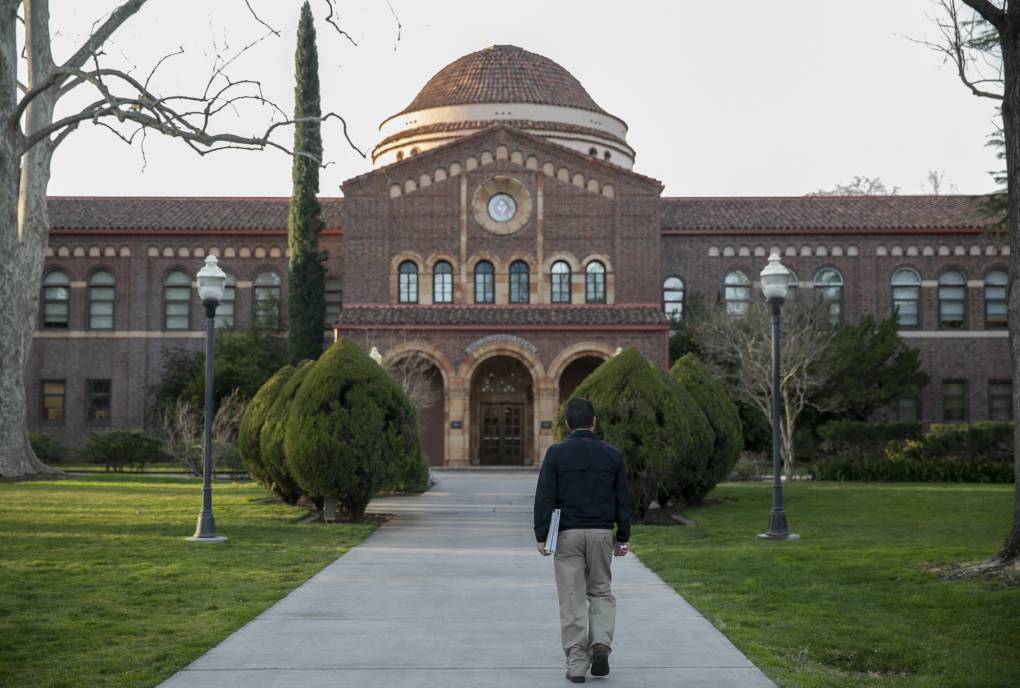
No Need to Apply: Cal State Is Automatically Admitting High School Students With Good Grades
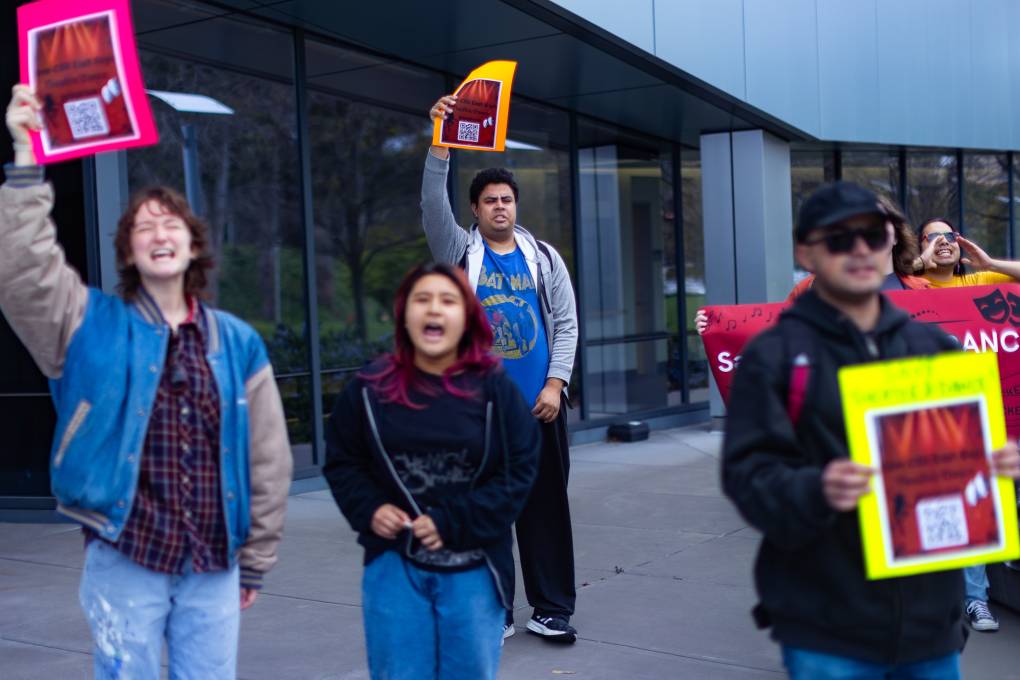
As Cal State East Bay Slashes Budget, Theater Students Push to Save Their Program
Standstill for Community College Bachelor's Degrees Amid Cal State Dispute
Newsom and the Legislature Are Far Apart on College Spending as Budget Deadline Nears
Cal State System Could Face Additional $500 Million Deficit Amid Scaled-Back State Aid and Salary Increases
Cal State Faculty Union Vows Weeklong Strike Over Pay Raise and Other Benefits
Cal State Faculty Hold a Series of 1-Day Strikes
Thousands of Cal State Faculty Launch Rolling 1-Day Walkouts in Fight for Higher Pay
California State University Students to See 6% Tuition Increase Next Fall
Sponsored
Player sponsored by
window.__IS_SSR__=true
window.__INITIAL_STATE__={
"attachmentsReducer": {
"audio_0": {
"type": "attachments",
"id": "audio_0",
"imgSizes": {
"kqedFullSize": {
"file": "https://ww2.kqed.org/news/wp-content/themes/KQED-unified/img/audio_bgs/background0.jpg"
}
}
},
"audio_1": {
"type": "attachments",
"id": "audio_1",
"imgSizes": {
"kqedFullSize": {
"file": "https://ww2.kqed.org/news/wp-content/themes/KQED-unified/img/audio_bgs/background1.jpg"
}
}
},
"audio_2": {
"type": "attachments",
"id": "audio_2",
"imgSizes": {
"kqedFullSize": {
"file": "https://ww2.kqed.org/news/wp-content/themes/KQED-unified/img/audio_bgs/background2.jpg"
}
}
},
"audio_3": {
"type": "attachments",
"id": "audio_3",
"imgSizes": {
"kqedFullSize": {
"file": "https://ww2.kqed.org/news/wp-content/themes/KQED-unified/img/audio_bgs/background3.jpg"
}
}
},
"audio_4": {
"type": "attachments",
"id": "audio_4",
"imgSizes": {
"kqedFullSize": {
"file": "https://ww2.kqed.org/news/wp-content/themes/KQED-unified/img/audio_bgs/background4.jpg"
}
}
},
"placeholder": {
"type": "attachments",
"id": "placeholder",
"imgSizes": {
"thumbnail": {
"file": "https://cdn.kqed.org/wp-content/uploads/2024/12/KQED-Default-Image-816638274-2000x1333-1-160x107.jpg",
"width": 160,
"height": 107,
"mimeType": "image/jpeg"
},
"medium": {
"file": "https://cdn.kqed.org/wp-content/uploads/2024/12/KQED-Default-Image-816638274-2000x1333-1-800x533.jpg",
"width": 800,
"height": 533,
"mimeType": "image/jpeg"
},
"medium_large": {
"file": "https://cdn.kqed.org/wp-content/uploads/2024/12/KQED-Default-Image-816638274-2000x1333-1-768x512.jpg",
"width": 768,
"height": 512,
"mimeType": "image/jpeg"
},
"large": {
"file": "https://cdn.kqed.org/wp-content/uploads/2024/12/KQED-Default-Image-816638274-2000x1333-1-1020x680.jpg",
"width": 1020,
"height": 680,
"mimeType": "image/jpeg"
},
"1536x1536": {
"file": "https://cdn.kqed.org/wp-content/uploads/2024/12/KQED-Default-Image-816638274-2000x1333-1-1536x1024.jpg",
"width": 1536,
"height": 1024,
"mimeType": "image/jpeg"
},
"fd-lrg": {
"file": "https://cdn.kqed.org/wp-content/uploads/2024/12/KQED-Default-Image-816638274-2000x1333-1-1536x1024.jpg",
"width": 1536,
"height": 1024,
"mimeType": "image/jpeg"
},
"fd-med": {
"file": "https://cdn.kqed.org/wp-content/uploads/2024/12/KQED-Default-Image-816638274-2000x1333-1-1020x680.jpg",
"width": 1020,
"height": 680,
"mimeType": "image/jpeg"
},
"fd-sm": {
"file": "https://cdn.kqed.org/wp-content/uploads/2024/12/KQED-Default-Image-816638274-2000x1333-1-800x533.jpg",
"width": 800,
"height": 533,
"mimeType": "image/jpeg"
},
"post-thumbnail": {
"file": "https://cdn.kqed.org/wp-content/uploads/2024/12/KQED-Default-Image-816638274-2000x1333-1-672x372.jpg",
"width": 672,
"height": 372,
"mimeType": "image/jpeg"
},
"twentyfourteen-full-width": {
"file": "https://cdn.kqed.org/wp-content/uploads/2024/12/KQED-Default-Image-816638274-2000x1333-1-1038x576.jpg",
"width": 1038,
"height": 576,
"mimeType": "image/jpeg"
},
"xxsmall": {
"file": "https://cdn.kqed.org/wp-content/uploads/2024/12/KQED-Default-Image-816638274-2000x1333-1-160x107.jpg",
"width": 160,
"height": 107,
"mimeType": "image/jpeg"
},
"xsmall": {
"file": "https://cdn.kqed.org/wp-content/uploads/2024/12/KQED-Default-Image-816638274-2000x1333-1-672x372.jpg",
"width": 672,
"height": 372,
"mimeType": "image/jpeg"
},
"small": {
"file": "https://cdn.kqed.org/wp-content/uploads/2024/12/KQED-Default-Image-816638274-2000x1333-1-672x372.jpg",
"width": 672,
"height": 372,
"mimeType": "image/jpeg"
},
"xlarge": {
"file": "https://cdn.kqed.org/wp-content/uploads/2024/12/KQED-Default-Image-816638274-2000x1333-1-1020x680.jpg",
"width": 1020,
"height": 680,
"mimeType": "image/jpeg"
},
"full-width": {
"file": "https://cdn.kqed.org/wp-content/uploads/2024/12/KQED-Default-Image-816638274-2000x1333-1-1920x1280.jpg",
"width": 1920,
"height": 1280,
"mimeType": "image/jpeg"
},
"guest-author-32": {
"file": "https://cdn.kqed.org/wp-content/uploads/2025/01/KQED-Default-Image-816638274-1333x1333-1-160x160.jpg",
"width": 32,
"height": 32,
"mimeType": "image/jpeg"
},
"guest-author-50": {
"file": "https://cdn.kqed.org/wp-content/uploads/2025/01/KQED-Default-Image-816638274-1333x1333-1-160x160.jpg",
"width": 50,
"height": 50,
"mimeType": "image/jpeg"
},
"guest-author-64": {
"file": "https://cdn.kqed.org/wp-content/uploads/2025/01/KQED-Default-Image-816638274-1333x1333-1-160x160.jpg",
"width": 64,
"height": 64,
"mimeType": "image/jpeg"
},
"guest-author-96": {
"file": "https://cdn.kqed.org/wp-content/uploads/2025/01/KQED-Default-Image-816638274-1333x1333-1-160x160.jpg",
"width": 96,
"height": 96,
"mimeType": "image/jpeg"
},
"guest-author-128": {
"file": "https://cdn.kqed.org/wp-content/uploads/2025/01/KQED-Default-Image-816638274-1333x1333-1-160x160.jpg",
"width": 128,
"height": 128,
"mimeType": "image/jpeg"
},
"detail": {
"file": "https://cdn.kqed.org/wp-content/uploads/2025/01/KQED-Default-Image-816638274-1333x1333-1-160x160.jpg",
"width": 160,
"height": 160,
"mimeType": "image/jpeg"
},
"kqedFullSize": {
"file": "https://cdn.kqed.org/wp-content/uploads/2024/12/KQED-Default-Image-816638274-2000x1333-1.jpg",
"width": 2000,
"height": 1333
}
}
},
"news_12033775": {
"type": "attachments",
"id": "news_12033775",
"meta": {
"index": "attachments_1716263798",
"site": "news",
"id": "12033775",
"found": true
},
"title": "021220_WestClimateEmergency_09",
"publishDate": 1743377922,
"status": "inherit",
"parent": 12033771,
"modified": 1743377974,
"caption": "A student walks across campus at Chico State University on February 12, 2020. ",
"credit": "Anne Wernikoff/CalMatters",
"altTag": "A person wearing a dark shirt and grey pants walks toward a building on a campus.",
"description": null,
"imgSizes": {
"medium": {
"file": "https://cdn.kqed.org/wp-content/uploads/sites/10/2025/03/021220_WestClimateEmergency_09-800x540.jpg",
"width": 800,
"height": 540,
"mimeType": "image/jpeg"
},
"large": {
"file": "https://cdn.kqed.org/wp-content/uploads/sites/10/2025/03/021220_WestClimateEmergency_09-1020x688.jpg",
"width": 1020,
"height": 688,
"mimeType": "image/jpeg"
},
"thumbnail": {
"file": "https://cdn.kqed.org/wp-content/uploads/sites/10/2025/03/021220_WestClimateEmergency_09-160x108.jpg",
"width": 160,
"height": 108,
"mimeType": "image/jpeg"
},
"1536x1536": {
"file": "https://cdn.kqed.org/wp-content/uploads/sites/10/2025/03/021220_WestClimateEmergency_09-1536x1036.jpg",
"width": 1536,
"height": 1036,
"mimeType": "image/jpeg"
},
"post-thumbnail": {
"file": "https://cdn.kqed.org/wp-content/uploads/sites/10/2025/03/021220_WestClimateEmergency_09-672x372.jpg",
"width": 672,
"height": 372,
"mimeType": "image/jpeg"
},
"twentyfourteen-full-width": {
"file": "https://cdn.kqed.org/wp-content/uploads/sites/10/2025/03/021220_WestClimateEmergency_09-1038x576.jpg",
"width": 1038,
"height": 576,
"mimeType": "image/jpeg"
},
"full-width": {
"file": "https://cdn.kqed.org/wp-content/uploads/sites/10/2025/03/021220_WestClimateEmergency_09-1920x1295.jpg",
"width": 1920,
"height": 1295,
"mimeType": "image/jpeg"
},
"kqedFullSize": {
"file": "https://cdn.kqed.org/wp-content/uploads/sites/10/2025/03/021220_WestClimateEmergency_09.jpg",
"width": 2000,
"height": 1349
}
},
"fetchFailed": false,
"isLoading": false
},
"news_12033437": {
"type": "attachments",
"id": "news_12033437",
"meta": {
"index": "attachments_1716263798",
"site": "news",
"id": "12033437",
"found": true
},
"title": "California State University East Bay student protest",
"publishDate": 1743113569,
"status": "inherit",
"parent": 0,
"modified": 1743194450,
"caption": "Kadin Foster, 22, center-rear, a theater major, joins others in protest against proposed cuts to the school's theater and dance department at California State University East Bay, as they march across campus in Hayward on Tuesday, March 27, 2025. Organizers, advocating to preserve arts education, delivered a petition with more than 800 signatures to the provost's office, urging administrators to reconsider eliminating the program.",
"credit": "Estefany Gonzalez for KQED",
"altTag": null,
"description": null,
"imgSizes": {
"medium": {
"file": "https://cdn.kqed.org/wp-content/uploads/sites/10/2025/03/20250326_CSUEB-Protest_EG_00010-800x533.jpg",
"width": 800,
"height": 533,
"mimeType": "image/jpeg"
},
"large": {
"file": "https://cdn.kqed.org/wp-content/uploads/sites/10/2025/03/20250326_CSUEB-Protest_EG_00010-1020x680.jpg",
"width": 1020,
"height": 680,
"mimeType": "image/jpeg"
},
"thumbnail": {
"file": "https://cdn.kqed.org/wp-content/uploads/sites/10/2025/03/20250326_CSUEB-Protest_EG_00010-160x107.jpg",
"width": 160,
"height": 107,
"mimeType": "image/jpeg"
},
"1536x1536": {
"file": "https://cdn.kqed.org/wp-content/uploads/sites/10/2025/03/20250326_CSUEB-Protest_EG_00010-1536x1024.jpg",
"width": 1536,
"height": 1024,
"mimeType": "image/jpeg"
},
"post-thumbnail": {
"file": "https://cdn.kqed.org/wp-content/uploads/sites/10/2025/03/20250326_CSUEB-Protest_EG_00010-672x372.jpg",
"width": 672,
"height": 372,
"mimeType": "image/jpeg"
},
"twentyfourteen-full-width": {
"file": "https://cdn.kqed.org/wp-content/uploads/sites/10/2025/03/20250326_CSUEB-Protest_EG_00010-1038x576.jpg",
"width": 1038,
"height": 576,
"mimeType": "image/jpeg"
},
"full-width": {
"file": "https://cdn.kqed.org/wp-content/uploads/sites/10/2025/03/20250326_CSUEB-Protest_EG_00010-1920x1280.jpg",
"width": 1920,
"height": 1280,
"mimeType": "image/jpeg"
},
"kqedFullSize": {
"file": "https://cdn.kqed.org/wp-content/uploads/sites/10/2025/03/20250326_CSUEB-Protest_EG_00010.jpg",
"width": 2000,
"height": 1333
}
},
"fetchFailed": false,
"isLoading": false
},
"news_12023068": {
"type": "attachments",
"id": "news_12023068",
"meta": {
"index": "attachments_1716263798",
"site": "news",
"id": "12023068",
"found": true
},
"title": "Photographer",
"publishDate": 1737322221,
"status": "inherit",
"parent": 12023065,
"modified": 1737322272,
"caption": "Santiago Canyon College is one of seven community colleges in the state that have yet to get final approval for bachelor's degrees they proposed in 2023.",
"credit": "Courtesy of Santiago Canyon College",
"altTag": "An aerial view of a college campus with people walking around.",
"description": null,
"imgSizes": {
"medium": {
"file": "https://cdn.kqed.org/wp-content/uploads/sites/10/2025/01/0207SSC200203437-2048x1365-1-800x533.jpg",
"width": 800,
"height": 533,
"mimeType": "image/jpeg"
},
"large": {
"file": "https://cdn.kqed.org/wp-content/uploads/sites/10/2025/01/0207SSC200203437-2048x1365-1-1020x680.jpg",
"width": 1020,
"height": 680,
"mimeType": "image/jpeg"
},
"thumbnail": {
"file": "https://cdn.kqed.org/wp-content/uploads/sites/10/2025/01/0207SSC200203437-2048x1365-1-160x107.jpg",
"width": 160,
"height": 107,
"mimeType": "image/jpeg"
},
"1536x1536": {
"file": "https://cdn.kqed.org/wp-content/uploads/sites/10/2025/01/0207SSC200203437-2048x1365-1-1536x1024.jpg",
"width": 1536,
"height": 1024,
"mimeType": "image/jpeg"
},
"post-thumbnail": {
"file": "https://cdn.kqed.org/wp-content/uploads/sites/10/2025/01/0207SSC200203437-2048x1365-1-672x372.jpg",
"width": 672,
"height": 372,
"mimeType": "image/jpeg"
},
"twentyfourteen-full-width": {
"file": "https://cdn.kqed.org/wp-content/uploads/sites/10/2025/01/0207SSC200203437-2048x1365-1-1038x576.jpg",
"width": 1038,
"height": 576,
"mimeType": "image/jpeg"
},
"full-width": {
"file": "https://cdn.kqed.org/wp-content/uploads/sites/10/2025/01/0207SSC200203437-2048x1365-1-1920x1280.jpg",
"width": 1920,
"height": 1280,
"mimeType": "image/jpeg"
},
"kqedFullSize": {
"file": "https://cdn.kqed.org/wp-content/uploads/sites/10/2025/01/0207SSC200203437-2048x1365-1.jpg",
"width": 2048,
"height": 1365
}
},
"fetchFailed": false,
"isLoading": false
},
"news_11990711": {
"type": "attachments",
"id": "news_11990711",
"meta": {
"index": "attachments_1716263798",
"site": "news",
"id": "11990711",
"found": true
},
"title": "070723_SF-State_SN_CM_12-ezgif.com-webp-to-jpg-converter",
"publishDate": 1718649614,
"status": "inherit",
"parent": 11990668,
"modified": 1718649743,
"caption": "Inside J. Paul Leonard Library at San Francisco State University in San Francisco on July 7, 2023.\n",
"credit": "Semantha Norris/CalMatters",
"altTag": null,
"description": null,
"imgSizes": {
"medium": {
"file": "https://cdn.kqed.org/wp-content/uploads/sites/10/2024/06/070723_SF-State_SN_CM_12-ezgif.com-webp-to-jpg-converter-800x533.jpg",
"width": 800,
"height": 533,
"mimeType": "image/jpeg"
},
"large": {
"file": "https://cdn.kqed.org/wp-content/uploads/sites/10/2024/06/070723_SF-State_SN_CM_12-ezgif.com-webp-to-jpg-converter-1020x680.jpg",
"width": 1020,
"height": 680,
"mimeType": "image/jpeg"
},
"thumbnail": {
"file": "https://cdn.kqed.org/wp-content/uploads/sites/10/2024/06/070723_SF-State_SN_CM_12-ezgif.com-webp-to-jpg-converter-160x107.jpg",
"width": 160,
"height": 107,
"mimeType": "image/jpeg"
},
"1536x1536": {
"file": "https://cdn.kqed.org/wp-content/uploads/sites/10/2024/06/070723_SF-State_SN_CM_12-ezgif.com-webp-to-jpg-converter-1536x1024.jpg",
"width": 1536,
"height": 1024,
"mimeType": "image/jpeg"
},
"post-thumbnail": {
"file": "https://cdn.kqed.org/wp-content/uploads/sites/10/2024/06/070723_SF-State_SN_CM_12-ezgif.com-webp-to-jpg-converter-672x372.jpg",
"width": 672,
"height": 372,
"mimeType": "image/jpeg"
},
"twentyfourteen-full-width": {
"file": "https://cdn.kqed.org/wp-content/uploads/sites/10/2024/06/070723_SF-State_SN_CM_12-ezgif.com-webp-to-jpg-converter-1038x576.jpg",
"width": 1038,
"height": 576,
"mimeType": "image/jpeg"
},
"full-width": {
"file": "https://cdn.kqed.org/wp-content/uploads/sites/10/2024/06/070723_SF-State_SN_CM_12-ezgif.com-webp-to-jpg-converter-1920x1280.jpg",
"width": 1920,
"height": 1280,
"mimeType": "image/jpeg"
},
"kqedFullSize": {
"file": "https://cdn.kqed.org/wp-content/uploads/sites/10/2024/06/070723_SF-State_SN_CM_12-ezgif.com-webp-to-jpg-converter.jpg",
"width": 2000,
"height": 1333
}
},
"fetchFailed": false,
"isLoading": false
},
"news_11987883": {
"type": "attachments",
"id": "news_11987883",
"meta": {
"index": "attachments_1716263798",
"site": "news",
"id": "11987883",
"found": true
},
"title": "CMEducation01",
"publishDate": 1716917670,
"status": "inherit",
"parent": 11987878,
"modified": 1716917693,
"caption": "The CSU Long Beach campus on in Long Beach April 24, 2024.",
"credit": "Jules Hotz/CalMatters",
"altTag": null,
"description": null,
"imgSizes": {
"medium": {
"file": "https://cdn.kqed.org/wp-content/uploads/sites/10/2024/05/CMEducation01-800x533.jpg",
"width": 800,
"height": 533,
"mimeType": "image/jpeg"
},
"large": {
"file": "https://cdn.kqed.org/wp-content/uploads/sites/10/2024/05/CMEducation01-1020x680.jpg",
"width": 1020,
"height": 680,
"mimeType": "image/jpeg"
},
"thumbnail": {
"file": "https://cdn.kqed.org/wp-content/uploads/sites/10/2024/05/CMEducation01-160x107.jpg",
"width": 160,
"height": 107,
"mimeType": "image/jpeg"
},
"1536x1536": {
"file": "https://cdn.kqed.org/wp-content/uploads/sites/10/2024/05/CMEducation01-1536x1024.jpg",
"width": 1536,
"height": 1024,
"mimeType": "image/jpeg"
},
"post-thumbnail": {
"file": "https://cdn.kqed.org/wp-content/uploads/sites/10/2024/05/CMEducation01-672x372.jpg",
"width": 672,
"height": 372,
"mimeType": "image/jpeg"
},
"twentyfourteen-full-width": {
"file": "https://cdn.kqed.org/wp-content/uploads/sites/10/2024/05/CMEducation01-1038x576.jpg",
"width": 1038,
"height": 576,
"mimeType": "image/jpeg"
},
"full-width": {
"file": "https://cdn.kqed.org/wp-content/uploads/sites/10/2024/05/CMEducation01-1920x1280.jpg",
"width": 1920,
"height": 1280,
"mimeType": "image/jpeg"
},
"kqedFullSize": {
"file": "https://cdn.kqed.org/wp-content/uploads/sites/10/2024/05/CMEducation01.jpg",
"width": 2000,
"height": 1333
}
},
"fetchFailed": false,
"isLoading": false
},
"news_11972176": {
"type": "attachments",
"id": "news_11972176",
"meta": {
"index": "attachments_1716263798",
"site": "news",
"id": "11972176",
"found": true
},
"parent": 11972172,
"imgSizes": {
"twentyfourteen-full-width": {
"file": "https://cdn.kqed.org/wp-content/uploads/sites/10/2024/01/120423_CSU-Pomona-CFA-Strike_CM_11-copy-1038x576.jpg",
"width": 1038,
"mimeType": "image/jpeg",
"height": 576
},
"thumbnail": {
"file": "https://cdn.kqed.org/wp-content/uploads/sites/10/2024/01/120423_CSU-Pomona-CFA-Strike_CM_11-copy-160x107.jpg",
"width": 160,
"mimeType": "image/jpeg",
"height": 107
},
"post-thumbnail": {
"file": "https://cdn.kqed.org/wp-content/uploads/sites/10/2024/01/120423_CSU-Pomona-CFA-Strike_CM_11-copy-672x372.jpg",
"width": 672,
"mimeType": "image/jpeg",
"height": 372
},
"kqedFullSize": {
"file": "https://cdn.kqed.org/wp-content/uploads/sites/10/2024/01/120423_CSU-Pomona-CFA-Strike_CM_11-copy.jpg",
"width": 2000,
"height": 1334
},
"large": {
"file": "https://cdn.kqed.org/wp-content/uploads/sites/10/2024/01/120423_CSU-Pomona-CFA-Strike_CM_11-copy-1020x680.jpg",
"width": 1020,
"mimeType": "image/jpeg",
"height": 680
},
"1536x1536": {
"file": "https://cdn.kqed.org/wp-content/uploads/sites/10/2024/01/120423_CSU-Pomona-CFA-Strike_CM_11-copy-1536x1025.jpg",
"width": 1536,
"mimeType": "image/jpeg",
"height": 1025
},
"full-width": {
"file": "https://cdn.kqed.org/wp-content/uploads/sites/10/2024/01/120423_CSU-Pomona-CFA-Strike_CM_11-copy-1920x1281.jpg",
"width": 1920,
"mimeType": "image/jpeg",
"height": 1281
},
"medium": {
"file": "https://cdn.kqed.org/wp-content/uploads/sites/10/2024/01/120423_CSU-Pomona-CFA-Strike_CM_11-copy-800x534.jpg",
"width": 800,
"mimeType": "image/jpeg",
"height": 534
}
},
"publishDate": 1704913283,
"modified": 1704913338,
"caption": "Jackie Barrett, a student and intern with California Faculty Association, speaks to the crowd during a faculty strike at CSU Pomona on Dec. 4, 2023.\n",
"description": null,
"title": "120423_CSU-Pomona-CFA-Strike_CM_11 copy",
"credit": "Lauren Justice for CalMatters",
"status": "inherit",
"altTag": "A young woman speaks into a microphone surrounded by strikers with signs and banners.",
"fetchFailed": false,
"isLoading": false
},
"news_11969093": {
"type": "attachments",
"id": "news_11969093",
"meta": {
"index": "attachments_1716263798",
"site": "news",
"id": "11969093",
"found": true
},
"parent": 11969109,
"imgSizes": {
"twentyfourteen-full-width": {
"file": "https://cdn.kqed.org/wp-content/uploads/sites/10/2023/12/231205-SFSUFacultyStrike-27-BL-KQED-1038x576.jpg",
"width": 1038,
"mimeType": "image/jpeg",
"height": 576
},
"thumbnail": {
"file": "https://cdn.kqed.org/wp-content/uploads/sites/10/2023/12/231205-SFSUFacultyStrike-27-BL-KQED-160x107.jpg",
"width": 160,
"mimeType": "image/jpeg",
"height": 107
},
"post-thumbnail": {
"file": "https://cdn.kqed.org/wp-content/uploads/sites/10/2023/12/231205-SFSUFacultyStrike-27-BL-KQED-672x372.jpg",
"width": 672,
"mimeType": "image/jpeg",
"height": 372
},
"kqedFullSize": {
"file": "https://cdn.kqed.org/wp-content/uploads/sites/10/2023/12/231205-SFSUFacultyStrike-27-BL-KQED.jpg",
"width": 2000,
"height": 1333
},
"large": {
"file": "https://cdn.kqed.org/wp-content/uploads/sites/10/2023/12/231205-SFSUFacultyStrike-27-BL-KQED-1020x680.jpg",
"width": 1020,
"mimeType": "image/jpeg",
"height": 680
},
"1536x1536": {
"file": "https://cdn.kqed.org/wp-content/uploads/sites/10/2023/12/231205-SFSUFacultyStrike-27-BL-KQED-1536x1024.jpg",
"width": 1536,
"mimeType": "image/jpeg",
"height": 1024
},
"full-width": {
"file": "https://cdn.kqed.org/wp-content/uploads/sites/10/2023/12/231205-SFSUFacultyStrike-27-BL-KQED-1920x1280.jpg",
"width": 1920,
"mimeType": "image/jpeg",
"height": 1280
},
"medium": {
"file": "https://cdn.kqed.org/wp-content/uploads/sites/10/2023/12/231205-SFSUFacultyStrike-27-BL-KQED-800x533.jpg",
"width": 800,
"mimeType": "image/jpeg",
"height": 533
}
},
"publishDate": 1701812939,
"modified": 1701824768,
"caption": "Charles Toombs, president of the California Faculty Association, addresses striking SF State faculty members during a 1-day strike on campus on Dec. 5, 2023. ",
"description": null,
"title": "231205-SFSUFacultyStrike-27-BL-KQED",
"credit": "Beth LaBerge/KQED",
"status": "inherit",
"altTag": "A person in a baseball cap speaks into a microphone in front of a group of people in red shirts carry picket signs in an outdoor setting.",
"fetchFailed": false,
"isLoading": false
},
"news_11968971": {
"type": "attachments",
"id": "news_11968971",
"meta": {
"index": "attachments_1716263798",
"site": "news",
"id": "11968971",
"found": true
},
"title": "20230822-SFSU-37-JY-qut",
"publishDate": 1701720325,
"status": "inherit",
"parent": 11968948,
"modified": 1741396518,
"caption": "Students walk across San Francisco State’s campus on Aug. 22, 2023. ",
"credit": "Juliana Yamada/KQED",
"altTag": "Many students, wearing backpacks, walk across a college campus. A large sign says, 'San Francisco State University.'",
"description": null,
"imgSizes": {
"medium": {
"file": "https://cdn.kqed.org/wp-content/uploads/sites/10/2023/12/20230822-SFSU-37-JY-qut-800x533.jpg",
"width": 800,
"height": 533,
"mimeType": "image/jpeg"
},
"large": {
"file": "https://cdn.kqed.org/wp-content/uploads/sites/10/2023/12/20230822-SFSU-37-JY-qut-1020x680.jpg",
"width": 1020,
"height": 680,
"mimeType": "image/jpeg"
},
"thumbnail": {
"file": "https://cdn.kqed.org/wp-content/uploads/sites/10/2023/12/20230822-SFSU-37-JY-qut-160x107.jpg",
"width": 160,
"height": 107,
"mimeType": "image/jpeg"
},
"1536x1536": {
"file": "https://cdn.kqed.org/wp-content/uploads/sites/10/2023/12/20230822-SFSU-37-JY-qut-1536x1024.jpg",
"width": 1536,
"height": 1024,
"mimeType": "image/jpeg"
},
"post-thumbnail": {
"file": "https://cdn.kqed.org/wp-content/uploads/sites/10/2023/12/20230822-SFSU-37-JY-qut-672x372.jpg",
"width": 672,
"height": 372,
"mimeType": "image/jpeg"
},
"twentyfourteen-full-width": {
"file": "https://cdn.kqed.org/wp-content/uploads/sites/10/2023/12/20230822-SFSU-37-JY-qut-1038x576.jpg",
"width": 1038,
"height": 576,
"mimeType": "image/jpeg"
},
"kqedFullSize": {
"file": "https://cdn.kqed.org/wp-content/uploads/sites/10/2023/12/20230822-SFSU-37-JY-qut.jpg",
"width": 1920,
"height": 1280
}
},
"fetchFailed": false,
"isLoading": false
},
"news_11961148": {
"type": "attachments",
"id": "news_11961148",
"meta": {
"index": "attachments_1716263798",
"site": "news",
"id": "11961148",
"found": true
},
"parent": 0,
"imgSizes": {
"twentyfourteen-full-width": {
"file": "https://ww2.kqed.org/app/uploads/sites/10/2023/09/CSU01-1038x576.jpg",
"width": 1038,
"mimeType": "image/jpeg",
"height": 576
},
"thumbnail": {
"file": "https://ww2.kqed.org/app/uploads/sites/10/2023/09/CSU01-160x90.jpg",
"width": 160,
"mimeType": "image/jpeg",
"height": 90
},
"post-thumbnail": {
"file": "https://ww2.kqed.org/app/uploads/sites/10/2023/09/CSU01-672x372.jpg",
"width": 672,
"mimeType": "image/jpeg",
"height": 372
},
"kqedFullSize": {
"file": "https://ww2.kqed.org/app/uploads/sites/10/2023/09/CSU01.jpg",
"width": 1536,
"height": 864
},
"large": {
"file": "https://ww2.kqed.org/app/uploads/sites/10/2023/09/CSU01-1020x574.jpg",
"width": 1020,
"mimeType": "image/jpeg",
"height": 574
},
"medium": {
"file": "https://ww2.kqed.org/app/uploads/sites/10/2023/09/CSU01-800x450.jpg",
"width": 800,
"mimeType": "image/jpeg",
"height": 450
}
},
"publishDate": 1694710324,
"modified": 1694715353,
"caption": "Students, faculty and staff protest a potential tuition increase across the California State University system on Sept. 12, 2023.",
"description": null,
"title": "CSU01",
"credit": "Courtesy of EdSource",
"status": "inherit",
"altTag": "A protest is happening in this photo with many college students of all ages holding signs that say, \"Students Deserve Smaller Classrooms. California Faculty Association.\"",
"fetchFailed": false,
"isLoading": false
}
},
"audioPlayerReducer": {
"postId": "stream_live",
"isPaused": true,
"isPlaying": false,
"pfsActive": false,
"pledgeModalIsOpen": true,
"playerDrawerIsOpen": false
},
"authorsReducer": {
"byline_news_12033771": {
"type": "authors",
"id": "byline_news_12033771",
"meta": {
"override": true
},
"slug": "byline_news_12033771",
"name": "\u003ca href=\"https://calmatters.org/author/mikhailzinshteyn\">Mikhail Zinshteyn, \u003c/a>CalMatters",
"isLoading": false
},
"byline_news_12023065": {
"type": "authors",
"id": "byline_news_12023065",
"meta": {
"override": true
},
"slug": "byline_news_12023065",
"name": "\u003ca href=\"https://edsource.org/author/mburke\">Michael Burke,\u003c/a> EdSource",
"isLoading": false
},
"byline_news_11990668": {
"type": "authors",
"id": "byline_news_11990668",
"meta": {
"override": true
},
"slug": "byline_news_11990668",
"name": "Mikhail Zinshteyn ",
"isLoading": false
},
"byline_news_11987878": {
"type": "authors",
"id": "byline_news_11987878",
"meta": {
"override": true
},
"slug": "byline_news_11987878",
"name": "Mikhail Zinshteyn, CalMatters",
"isLoading": false
},
"byline_news_11972172": {
"type": "authors",
"id": "byline_news_11972172",
"meta": {
"override": true
},
"slug": "byline_news_11972172",
"name": "\u003ca href=\"https://calmatters.org/author/mikhailzinshteyn/\">Mikhail Zinshteyn\u003c/a>",
"isLoading": false
},
"byline_news_11968948": {
"type": "authors",
"id": "byline_news_11968948",
"meta": {
"override": true
},
"slug": "byline_news_11968948",
"name": "\u003ca href=\"https://twitter.com/sophieadanna\">Sophie Austin\u003c/a>\u003cbr>The Associated Press/Report for America",
"isLoading": false
},
"byline_news_11961149": {
"type": "authors",
"id": "byline_news_11961149",
"meta": {
"override": true
},
"slug": "byline_news_11961149",
"name": "\u003ca href=\"https://edsource.org/author/asmith\">Ashley A. Smith\u003c/a>",
"isLoading": false
},
"ecruzguevarra": {
"type": "authors",
"id": "8654",
"meta": {
"index": "authors_1716337520",
"id": "8654",
"found": true
},
"name": "Ericka Cruz Guevarra",
"firstName": "Ericka",
"lastName": "Cruz Guevarra",
"slug": "ecruzguevarra",
"email": "ecruzguevarra@kqed.org",
"display_author_email": true,
"staff_mastheads": [
"news"
],
"title": "Producer, The Bay Podcast",
"bio": "Ericka Cruz Guevarra is host of \u003ca href=\"https://www.kqed.org/podcasts/thebay\">\u003cem>The Bay\u003c/em>\u003c/a> podcast at KQED. Before host, she was the show’s producer. Her work in that capacity includes a three-part reported series on policing in Vallejo, which won a 2020 excellence in journalism award from the Society of Professional Journalists. Ericka has worked as a breaking news reporter at Oregon Public Broadcasting, helped produce the Code Switch podcast, and was KQED’s inaugural Raul Ramirez Diversity Fund intern. She’s also an alumna of NPR’s Next Generation Radio program. Send her an email if you have strong feelings about whether Fairfield and Suisun City are the Bay. Ericka is represented by SAG-AFTRA.",
"avatar": "https://secure.gravatar.com/avatar/25e5ab8d3d53fad2dcc7bb2b5c506b1a?s=600&d=blank&r=g",
"twitter": "NotoriousECG",
"facebook": null,
"instagram": null,
"linkedin": null,
"sites": [
{
"site": "arts",
"roles": [
"subscriber"
]
},
{
"site": "news",
"roles": [
"editor",
"manage_categories"
]
},
{
"site": "futureofyou",
"roles": [
"subscriber"
]
},
{
"site": "stateofhealth",
"roles": [
"subscriber"
]
},
{
"site": "science",
"roles": [
"editor"
]
},
{
"site": "forum",
"roles": [
"subscriber"
]
}
],
"headData": {
"title": "Ericka Cruz Guevarra | KQED",
"description": "Producer, The Bay Podcast",
"ogImgSrc": "https://secure.gravatar.com/avatar/25e5ab8d3d53fad2dcc7bb2b5c506b1a?s=600&d=blank&r=g",
"twImgSrc": "https://secure.gravatar.com/avatar/25e5ab8d3d53fad2dcc7bb2b5c506b1a?s=600&d=blank&r=g"
},
"isLoading": false,
"link": "/author/ecruzguevarra"
},
"amontecillo": {
"type": "authors",
"id": "11649",
"meta": {
"index": "authors_1716337520",
"id": "11649",
"found": true
},
"name": "Alan Montecillo",
"firstName": "Alan",
"lastName": "Montecillo",
"slug": "amontecillo",
"email": "amontecillo@kqed.org",
"display_author_email": false,
"staff_mastheads": [
"news"
],
"title": "KQED Contributor",
"bio": "Alan Montecillo is the senior editor of \u003cem>\u003ca href=\"http://kqed.org/thebay\">The Bay\u003c/a>, \u003c/em> KQED's local news podcast. Before moving to the Bay Area, he worked as a senior talk show producer for WILL in Champaign-Urbana, Illinois and at Oregon Public Broadcasting in Portland, Oregon. He has won journalism awards from the Society of Professional Journalists Northern California, the Public Media Journalists Association, The Signal Awards, and has also received a regional Edward R. Murrow award. Alan is a Filipino American from Hong Kong and a graduate of Reed College.",
"avatar": "https://secure.gravatar.com/avatar/d5e4e7a76481969ccba76f4e2b5ccabc?s=600&d=blank&r=g",
"twitter": "alanmontecillo",
"facebook": null,
"instagram": null,
"linkedin": null,
"sites": [
{
"site": "",
"roles": [
"editor"
]
},
{
"site": "news",
"roles": [
"editor",
"manage_categories"
]
}
],
"headData": {
"title": "Alan Montecillo | KQED",
"description": "KQED Contributor",
"ogImgSrc": "https://secure.gravatar.com/avatar/d5e4e7a76481969ccba76f4e2b5ccabc?s=600&d=blank&r=g",
"twImgSrc": "https://secure.gravatar.com/avatar/d5e4e7a76481969ccba76f4e2b5ccabc?s=600&d=blank&r=g"
},
"isLoading": false,
"link": "/author/amontecillo"
},
"jlara": {
"type": "authors",
"id": "11761",
"meta": {
"index": "authors_1716337520",
"id": "11761",
"found": true
},
"name": "Juan Carlos Lara",
"firstName": "Juan Carlos",
"lastName": "Lara",
"slug": "jlara",
"email": "jlara@kqed.org",
"display_author_email": false,
"staff_mastheads": [],
"title": "KQED Contributor",
"bio": null,
"avatar": "https://secure.gravatar.com/avatar/19e2052b9b05657c5ff2af2121846e9c?s=600&d=blank&r=g",
"twitter": null,
"facebook": null,
"instagram": null,
"linkedin": null,
"sites": [
{
"site": "arts",
"roles": [
"editor"
]
},
{
"site": "news",
"roles": [
"editor"
]
},
{
"site": "forum",
"roles": [
"editor"
]
},
{
"site": "liveblog",
"roles": [
"contributor"
]
}
],
"headData": {
"title": "Juan Carlos Lara | KQED",
"description": "KQED Contributor",
"ogImgSrc": "https://secure.gravatar.com/avatar/19e2052b9b05657c5ff2af2121846e9c?s=600&d=blank&r=g",
"twImgSrc": "https://secure.gravatar.com/avatar/19e2052b9b05657c5ff2af2121846e9c?s=600&d=blank&r=g"
},
"isLoading": false,
"link": "/author/jlara"
},
"mesquinca": {
"type": "authors",
"id": "11802",
"meta": {
"index": "authors_1716337520",
"id": "11802",
"found": true
},
"name": "Maria Esquinca",
"firstName": "Maria",
"lastName": "Esquinca",
"slug": "mesquinca",
"email": "mesquinca@kqed.org",
"display_author_email": false,
"staff_mastheads": [],
"title": "Producer, The Bay",
"bio": "María Esquinca is a producer of The Bay. Before that, she was a New York Women’s Foundation IGNITE Fellow at Latino USA. She worked at Radio Bilingue where she covered the San Joaquin Valley. Maria has interned at WLRN, News 21, The New York Times Student Journalism Institute and at Crain’s Detroit Business as a Dow Jones News Fund Business Reporting Intern. She is an MFA graduate from the University of Miami. In 2017, she graduated from the Walter Cronkite School of Journalism and Mass Communication with a Master of Mass Communication. A fronteriza, she was born in Ciudad Juárez, Chihuahua, Mexico and grew up in El Paso, Texas.",
"avatar": "https://secure.gravatar.com/avatar/77cedba18aae91da775038ba06dcd8d0?s=600&d=blank&r=g",
"twitter": "@m_esquinca",
"facebook": null,
"instagram": null,
"linkedin": null,
"sites": [
{
"site": "news",
"roles": []
}
],
"headData": {
"title": "Maria Esquinca | KQED",
"description": "Producer, The Bay",
"ogImgSrc": "https://secure.gravatar.com/avatar/77cedba18aae91da775038ba06dcd8d0?s=600&d=blank&r=g",
"twImgSrc": "https://secure.gravatar.com/avatar/77cedba18aae91da775038ba06dcd8d0?s=600&d=blank&r=g"
},
"isLoading": false,
"link": "/author/mesquinca"
},
"kdebenedetti": {
"type": "authors",
"id": "11913",
"meta": {
"index": "authors_1716337520",
"id": "11913",
"found": true
},
"name": "Katie DeBenedetti",
"firstName": "Katie",
"lastName": "DeBenedetti",
"slug": "kdebenedetti",
"email": "kdebenedetti@kqed.org",
"display_author_email": false,
"staff_mastheads": [
"news",
"science"
],
"title": "KQED Contributor",
"bio": "Katie DeBenedetti is a digital reporter covering daily news for the Express Desk. Prior to joining KQED as a culture reporting intern in January 2024, she covered education and city government for the Napa Valley Register.",
"avatar": "https://secure.gravatar.com/avatar/6e31073cb8f7e4214ab03f42771d0f45?s=600&d=blank&r=g",
"twitter": null,
"facebook": null,
"instagram": null,
"linkedin": null,
"sites": [
{
"site": "news",
"roles": [
"author"
]
},
{
"site": "science",
"roles": [
"author"
]
},
{
"site": "liveblog",
"roles": [
"author"
]
}
],
"headData": {
"title": "Katie DeBenedetti | KQED",
"description": "KQED Contributor",
"ogImgSrc": "https://secure.gravatar.com/avatar/6e31073cb8f7e4214ab03f42771d0f45?s=600&d=blank&r=g",
"twImgSrc": "https://secure.gravatar.com/avatar/6e31073cb8f7e4214ab03f42771d0f45?s=600&d=blank&r=g"
},
"isLoading": false,
"link": "/author/kdebenedetti"
}
},
"breakingNewsReducer": {},
"pagesReducer": {},
"postsReducer": {
"stream_live": {
"type": "live",
"id": "stream_live",
"audioUrl": "https://streams.kqed.org/kqedradio",
"title": "Live Stream",
"excerpt": "Live Stream information currently unavailable.",
"link": "/radio",
"featImg": "",
"label": {
"name": "KQED Live",
"link": "/"
}
},
"stream_kqedNewscast": {
"type": "posts",
"id": "stream_kqedNewscast",
"audioUrl": "https://www.kqed.org/.stream/anon/radio/RDnews/newscast.mp3?_=1",
"title": "KQED Newscast",
"featImg": "",
"label": {
"name": "88.5 FM",
"link": "/"
}
},
"news_12033771": {
"type": "posts",
"id": "news_12033771",
"meta": {
"index": "posts_1716263798",
"site": "news",
"id": "12033771",
"score": null,
"sort": [
1743379221000
]
},
"guestAuthors": [],
"slug": "no-need-to-apply-cal-state-is-automatically-admitting-high-school-students-with-good-grades",
"title": "No Need to Apply: Cal State Is Automatically Admitting High School Students With Good Grades",
"publishDate": 1743379221,
"format": "standard",
"headTitle": "No Need to Apply: Cal State Is Automatically Admitting High School Students With Good Grades | KQED",
"labelTerm": {
"term": 18481,
"site": "news"
},
"content": "\u003cp>More than 17,400 high school seniors last fall got the sweetest news any anxious student can get: Congratulations, because of your high school GPA, you’re automatically admitted to one of 10 California State University campuses of your choice — and they’re all relatively affordable.\u003c/p>\n\u003cp>Even with less than a week to go before the campuses wrap their final decisions about whom to admit, \u003ca href=\"https://www.calstate.edu/impact-of-the-csu/community/Pages/riverside-county-office-of-education-partnership.aspx\">a pilot program focusing on Riverside County\u003c/a> is already showing that more students have been admitted from the county than last year, about 10,600 so far in 2025 compared to last year’s roughly 9,800.\u003c/p>\n\u003cp>The pilot builds on Cal State’s efforts to enroll more students and works like this: High school seniors receive a notice in the mail that they’re automatically admitted as long as they maintain their grades, finish the 15 mandatory courses necessary for admission to a Cal State, and complete an admissions form to claim their spot at a campus. Cal State was able to mail the notices because it signed an agreement with the Riverside County Office of Education that gave the university eligible students’ addresses.\u003c/p>\n\u003cp>Now in the program’s first year, Cal State joins other public universities across the country in a growing national movement to \u003ca href=\"https://www.washingtonpost.com/education/2025/03/06/state-colleges-direct-admissions-programs-high-school-students/\">automatically admit eligible students\u003c/a>. From November through January, Cal State informed students they were accepted to the 10 campuses. To claim a spot, students needed to go online and pick at least one campus.\u003c/p>\n\u003cp>If past admissions and enrollment trends hold, Cal State as a system will educate hundreds of more students, all from Riverside, than they would have without the pilot. That’d be a boon for a system that prides itself on its affordability and motto that it’s the people’s university; Cal State admits a far higher percentage of students than the University of California. It also could serve as a much-needed budget boost from the extra tuition revenue those students bring, especially at campuses with sinking enrollment.\u003c/p>\n\u003cp>[ad fullwidth]\u003c/p>\n\u003cp>Eight campuses — Channel Islands, Chico, East Bay, Humboldt, Maritime Academy, Monterey Bay, San Francisco, and Sonoma — are so under-enrolled that Cal State is pulling some of their state revenues to send \u003ca href=\"https://calmatters.org/wp-content/uploads/2025/03/B_2024-02_Final_Budget_Allocations_Attachments.pdf#page=2\">to campuses that are still growing (PDF)\u003c/a>. Cal Maritime is soon merging with another campus \u003ca href=\"https://calmatters.org/education/2024/11/cal-maritime-cal-poly-merger/\">because of its perilous finances\u003c/a>. The pilot also includes the two closest campuses to the county, San Bernardino and San Marcos.\u003c/p>\n\u003cp>The system chose Riverside County because all of its public high school students were already loaded onto a state data platform that \u003ca href=\"https://vimeo.com/902085427\">can directly transmit student grades to Cal State\u003c/a> — a key step in creating automatic admissions. Riverside is also “ethnically and economically representative of the diversity of California — many of the students the CSU is so proud to serve,” a spokesperson for the system, Amy Bentley Smith, wrote in an email.\u003c/p>\n\u003cp>At Heritage High School, a public school in Riverside County, the pilot encouraged students who previously didn’t even consider attending a public four-year university to submit the automatic admission forms to a Cal State.\u003c/p>\n\u003cp>Silvia Morales, a 17-year-old senior at Heritage, got an automatic admissions letter. “I was pretty set on going to community college and then transferring, because I felt like I wasn’t ready for the four-year commitment to a college,” she said.\u003c/p>\n\u003cp>Even with a 3.0 GPA, higher than \u003ca href=\"https://www.calstate.edu/apply/freshman/getting_into_the_csu/pages/admission-requirements.aspx\">the 2.5 GPA Cal State requires for admission\u003c/a>, she nearly didn’t submit the forms to secure her admission until early January. That’s well past the standard Nov. 30 admissions deadline.\u003c/p>\n\u003cp>It wasn’t until her counselor, Chris Tinajero, pulled her into a meeting that she decided to opt into the pilot. “I went through the sales pitch like, ‘Hey, you get this guaranteed admission, you’re an amazing student,’” he recounted. [aside postID=\"news_12012688,news_12033192,news_12033333\" label=\"Related Stories\"]\u003c/p>\n\u003cp>The pitch worked. Though Cal State sent a physical pamphlet and her high school also emailed her about the pilot, “I wasn’t really paying attention,” Morales said. She needed an adult she trusted at the school to persuade her that the applications were worth the effort, she said.\u003c/p>\n\u003cp>Morales applied to three Cal State campuses in the pilot plus two outside the program that were still accepting late applications — Chico, Humboldt, Los Angeles, Northridge and San Bernardino. She got into each one, she said.\u003c/p>\n\u003cp>Her parents are “proud of me because I want to go to college,” Morales said. Neither went to college, she added.\u003c/p>\n\u003cp>Final enrollment figures won’t be tallied until August, including how many of the students admitted through the pilot attended one of the 10 campuses. But the system’s chancellor’s office is already planning to replicate the pilot program in a Northern California county, which will be named sometime in April, Cal State officials said.\u003c/p>\n\u003cp>A \u003ca href=\"https://calmatters.digitaldemocracy.org/bills/ca_202520260sb640\">bill\u003c/a> by Christopher Cabaldon, a state senator and Democrat from Napa, would make automatic enrollment to Cal State for eligible students a state law. The bill hasn’t been heard in a committee yet.\u003c/p>\n\u003ch2>A boost in application numbers\u003c/h2>\n\u003cp>Of the 17,000 students who received an invitation to secure their automatic admissions, about 13,200 submitted the necessary forms. That’s about 3,000 more students who applied from the county than last year.\u003c/p>\n\u003cp>Those who otherwise wouldn’t have applied to a Cal State include students who were eyeing private colleges, said Melina Gonzalez, a counselor at Heritage who typically advises students who are already college-bound.\u003c/p>\n\u003cp>Nearby private colleges offer all students application fee waivers; at Cal State, typically only students with low income receive fee waivers. But the pilot provided each Cal State student one fee waiver worth $70, which was a draw to students and their parents who don’t qualify for the fee waiver but might struggle to pay.\u003c/p>\n\u003cp>Last year, 10 of the 100 senior students Gonzalez counseled didn’t apply to a Cal State. This application season, all her students submitted at least one Cal State application, she said.\u003c/p>\n\u003cp>“It was big, it was really cool, their eyes, they were so excited,” she said of the automatically admitted students. “They would come in and show me their letters.”\u003c/p>\n\u003cp>Parents called her asking if the pamphlet from Cal State was authentic. With guaranteed admission, some parents ultimately decided to pay for additional applications to campuses in the pilot, knowing it wasn’t in vain.\u003c/p>\n\u003cp>At Heritage, high school counselors reviewed Cal State’s provisional list of students eligible for the pilot to add more seniors, such as those who hadn’t yet completed the mandatory courses but were on track to do so.\u003c/p>\n\u003cp>Tinajero was also able to persuade some students who hadn’t completed all the required courses for Cal State entry to take those, including online classes. Still, others with qualifying grades didn’t apply because they weren’t persuaded that a four-year university was for them. Tinajero sees program growth in the coming years, assuming Cal State continues with the pilot. Younger high school students who witnessed the fanfare of automatic admissions may take more seriously the need to pass the 15 required courses to be eligible for a Cal State or University of California campus, he said.\u003c/p>\n\u003cp>That’s part of Cal State’s vision for this pilot, said April Grommo, the system’s assistant vice chancellor of strategic enrollment management: Begin encouraging students to take the required courses in ninth grade so that by 11th and 12th grade they’re more receptive to applying to Cal State.\u003c/p>\n\u003ch2>Pilot leads to more applications\u003c/h2>\n\u003cp>The automatic admissions pilot is likely what explains the jump in overall applicants, said Grommo. “If you look at the historical numbers of Riverside County students that have applied to the CSU, it’s very consistent at 10,000, so there’s no other accelerator or explanation for the significant increase in the applications,” she said.\u003c/p>\n\u003cp>Some campuses in the pilot are probably going to see more students from Riverside County than others. The eight under-enrolled Cal State campuses each enrolled fewer than than 100 Riverside students as freshmen, a CalMatters review of 2024 admissions data show. Two enrolled fewer than 10 Riverside students as freshmen.\u003c/p>\n\u003cp>Cal State isn’t solely relying on past trends to enroll more students. Grommo cited research that suggests direct admissions programs are associated with increases in student enrollment, but not among low-income students, who are less familiar with the college-going process or have additional economic and family demands, like work and child care.\u003c/p>\n\u003cfigure id=\"attachment_12033774\" class=\"wp-caption aligncenter\" style=\"max-width: 2000px\">\u003ca href=\"https://cdn.kqed.org/wp-content/uploads/sites/10/2025/03/070723_San-Francisco-State_SN_CM_02.jpg\">\u003cimg loading=\"lazy\" decoding=\"async\" class=\"size-full wp-image-12033774\" src=\"https://cdn.kqed.org/wp-content/uploads/sites/10/2025/03/070723_San-Francisco-State_SN_CM_02.jpg\" alt=\"People walking around a campus with buildings and trees.\" width=\"2000\" height=\"1333\" srcset=\"https://cdn.kqed.org/wp-content/uploads/sites/10/2025/03/070723_San-Francisco-State_SN_CM_02.jpg 2000w, https://cdn.kqed.org/wp-content/uploads/sites/10/2025/03/070723_San-Francisco-State_SN_CM_02-800x533.jpg 800w, https://cdn.kqed.org/wp-content/uploads/sites/10/2025/03/070723_San-Francisco-State_SN_CM_02-1020x680.jpg 1020w, https://cdn.kqed.org/wp-content/uploads/sites/10/2025/03/070723_San-Francisco-State_SN_CM_02-160x107.jpg 160w, https://cdn.kqed.org/wp-content/uploads/sites/10/2025/03/070723_San-Francisco-State_SN_CM_02-1536x1024.jpg 1536w, https://cdn.kqed.org/wp-content/uploads/sites/10/2025/03/070723_San-Francisco-State_SN_CM_02-1920x1280.jpg 1920w\" sizes=\"auto, (max-width: 2000px) 100vw, 2000px\">\u003c/a>\u003cfigcaption class=\"wp-caption-text\">The quad at San Francisco State University in San Francisco on July 7, 2023. \u003ccite>(Semantha Norris/Calmatters)\u003c/cite>\u003c/figcaption>\u003c/figure>\n\u003cp>Even after students are admitted, some don’t complete key steps in the enrollment process, such as maintaining their grades in the second semester, completing registration forms to enroll, and paying deposits. Others, especially low-income students, have a change of heart over summer about attending college, \u003ca href=\"https://educationnorthwest.org/resources/what-research-says-about-summer-melt\">which scholars call “summer melt\u003c/a>.” Then there are the students who got into typically more selective campuses, such as at elite private schools and the University of California, and choose instead to go to those.\u003c/p>\n\u003cp>To prompt more students to actually enroll, Cal State officials in early March hosted \u003ca href=\"https://app.smartsheet.com/b/form/ab897910675041c2aa0783b4687c3177\">two college fairs\u003c/a> in Riverside County for students admitted through the pilot. About 2,600 students signed up to be bussed from their high schools to large venues, including the Riverside Convention Center, where they met with staff, alumni and current students from all 10 Cal State campuses participating in the program. Those were followed by receptions with students and parents.\u003c/p>\n\u003cp>Grommo said they maxed out capacity at both venues for the student events. While it’s common for individual campuses to host events for admitted students, it was a first for Cal State’s central office.\u003c/p>\n\u003cp>The event costs, physical mailers to students about their admissions guarantee, invitation to the college fairs and another flyer about the relative affordability of a Cal State cost the system’s central office around $300,000, Grommo estimates. But if the event moves the needle on students agreeing to attend a Cal State, the tuition revenue at the largely under-enrolled campuses alone would be a huge return on investment.\u003c/p>\n\u003cp>The effort is a far more targeted approach than another admissions outreach effort Cal State rolled out last fall to inform students who started but didn’t finish their college applications that they’re provisionally accepted, as long as they complete and send their forms. The notification went to 106,000 students and was the result of a \u003ca href=\"https://www.calstate.edu/csu-system/news/Pages/CSU-Named-as-Winner-of-The-Great-Admissions-Redesign-Challenge.aspx\">$750,000 grant Cal State won from the Lumina Foundation\u003c/a>, a major higher education philanthropy. The system will know by fall if this notification resulted in more students attending a Cal State.\u003c/p>\n\u003cp>But that was aimed at students who already applied. The Riverside pilot brings in students, like Morales, who wouldn’t have applied without the mailers and entreaties from counselors. She’s leaning toward picking Cal State San Bernardino for next fall. It’s close to home and an older cousin recently graduated who had a good experience there, she said.\u003c/p>\n\u003cp>Her next task? Working with her parents to complete the federal application for financial aid by April 2, the deadline for guaranteed tuition waivers for low- and middle-income students.\u003c/p>\n\u003cp>[ad floatright]\u003c/p>\n\u003cp>It’s possible that Cal State may take the direct admissions pilot statewide. All counties are required by state law to join the state-funded data system that Riverside is already a part of to electronically transmit students’ high school grades to Cal States and UCs. Doing so removes the need for schools to send campuses paper transcripts. The deadline for all counties to join the state data system is summer of 2026.\u003c/p>\n\n",
"blocks": [],
"excerpt": "Riverside County high school students who meet requirements are guaranteed admission to one of 10 Cal State campuses.",
"status": "publish",
"parent": 0,
"modified": 1743527070,
"stats": {
"hasAudio": false,
"hasVideo": false,
"hasChartOrMap": false,
"iframeSrcs": [],
"hasGoogleForm": false,
"hasGallery": false,
"hasHearkenModule": false,
"hasPolis": false,
"paragraphCount": 38,
"wordCount": 2040
},
"headData": {
"title": "No Need to Apply: Cal State Is Automatically Admitting High School Students With Good Grades | KQED",
"description": "Riverside County high school students who meet requirements are guaranteed admission to one of 10 Cal State campuses.",
"ogTitle": "",
"ogDescription": "",
"ogImgId": "",
"twTitle": "",
"twDescription": "",
"twImgId": "",
"schema": {
"@context": "https://schema.org",
"@type": "NewsArticle",
"headline": "No Need to Apply: Cal State Is Automatically Admitting High School Students With Good Grades",
"datePublished": "2025-03-30T17:00:21-07:00",
"dateModified": "2025-04-01T10:04:30-07:00",
"image": "https://cdn.kqed.org/wp-content/uploads/2020/02/KQED-OG-Image@1x.png",
"isAccessibleForFree": "True",
"publisher": {
"@type": "NewsMediaOrganization",
"@id": "https://www.kqed.org/#organization",
"name": "KQED",
"logo": "https://cdn.kqed.org/wp-content/uploads/2020/02/KQED-OG-Image@1x.png",
"url": "https://www.kqed.org",
"sameAs": [
"https://www.facebook.com/KQED",
"https://twitter.com/KQED",
"https://www.instagram.com/kqed/",
"https://www.tiktok.com/@kqedofficial",
"https://www.linkedin.com/company/kqed",
"https://www.youtube.com/channel/UCeC0IOo7i1P_61zVUWbJ4nw"
]
}
}
},
"sticky": false,
"nprByline": "\u003ca href=\"https://calmatters.org/author/mikhailzinshteyn\">Mikhail Zinshteyn, \u003c/a>CalMatters",
"nprStoryId": "kqed-12033771",
"templateType": "standard",
"featuredImageType": "standard",
"excludeFromSiteSearch": "Include",
"showOnAuthorArchivePages": "No",
"articleAge": "0",
"path": "/news/12033771/no-need-to-apply-cal-state-is-automatically-admitting-high-school-students-with-good-grades",
"audioTrackLength": null,
"parsedContent": [
{
"type": "contentString",
"content": "\u003cdiv class=\"post-body\">\u003cp>\u003cp>More than 17,400 high school seniors last fall got the sweetest news any anxious student can get: Congratulations, because of your high school GPA, you’re automatically admitted to one of 10 California State University campuses of your choice — and they’re all relatively affordable.\u003c/p>\n\u003cp>Even with less than a week to go before the campuses wrap their final decisions about whom to admit, \u003ca href=\"https://www.calstate.edu/impact-of-the-csu/community/Pages/riverside-county-office-of-education-partnership.aspx\">a pilot program focusing on Riverside County\u003c/a> is already showing that more students have been admitted from the county than last year, about 10,600 so far in 2025 compared to last year’s roughly 9,800.\u003c/p>\n\u003cp>The pilot builds on Cal State’s efforts to enroll more students and works like this: High school seniors receive a notice in the mail that they’re automatically admitted as long as they maintain their grades, finish the 15 mandatory courses necessary for admission to a Cal State, and complete an admissions form to claim their spot at a campus. Cal State was able to mail the notices because it signed an agreement with the Riverside County Office of Education that gave the university eligible students’ addresses.\u003c/p>\n\u003cp>Now in the program’s first year, Cal State joins other public universities across the country in a growing national movement to \u003ca href=\"https://www.washingtonpost.com/education/2025/03/06/state-colleges-direct-admissions-programs-high-school-students/\">automatically admit eligible students\u003c/a>. From November through January, Cal State informed students they were accepted to the 10 campuses. To claim a spot, students needed to go online and pick at least one campus.\u003c/p>\n\u003cp>If past admissions and enrollment trends hold, Cal State as a system will educate hundreds of more students, all from Riverside, than they would have without the pilot. That’d be a boon for a system that prides itself on its affordability and motto that it’s the people’s university; Cal State admits a far higher percentage of students than the University of California. It also could serve as a much-needed budget boost from the extra tuition revenue those students bring, especially at campuses with sinking enrollment.\u003c/p>\n\u003cp>\u003c/p>\u003c/div>",
"attributes": {
"named": {},
"numeric": []
}
},
{
"type": "component",
"content": "",
"name": "ad",
"attributes": {
"named": {
"label": "fullwidth"
},
"numeric": [
"fullwidth"
]
}
},
{
"type": "contentString",
"content": "\u003cdiv class=\"post-body\">\u003cp>\u003c/p>\n\u003cp>Eight campuses — Channel Islands, Chico, East Bay, Humboldt, Maritime Academy, Monterey Bay, San Francisco, and Sonoma — are so under-enrolled that Cal State is pulling some of their state revenues to send \u003ca href=\"https://calmatters.org/wp-content/uploads/2025/03/B_2024-02_Final_Budget_Allocations_Attachments.pdf#page=2\">to campuses that are still growing (PDF)\u003c/a>. Cal Maritime is soon merging with another campus \u003ca href=\"https://calmatters.org/education/2024/11/cal-maritime-cal-poly-merger/\">because of its perilous finances\u003c/a>. The pilot also includes the two closest campuses to the county, San Bernardino and San Marcos.\u003c/p>\n\u003cp>The system chose Riverside County because all of its public high school students were already loaded onto a state data platform that \u003ca href=\"https://vimeo.com/902085427\">can directly transmit student grades to Cal State\u003c/a> — a key step in creating automatic admissions. Riverside is also “ethnically and economically representative of the diversity of California — many of the students the CSU is so proud to serve,” a spokesperson for the system, Amy Bentley Smith, wrote in an email.\u003c/p>\n\u003cp>At Heritage High School, a public school in Riverside County, the pilot encouraged students who previously didn’t even consider attending a public four-year university to submit the automatic admission forms to a Cal State.\u003c/p>\n\u003cp>Silvia Morales, a 17-year-old senior at Heritage, got an automatic admissions letter. “I was pretty set on going to community college and then transferring, because I felt like I wasn’t ready for the four-year commitment to a college,” she said.\u003c/p>\n\u003cp>Even with a 3.0 GPA, higher than \u003ca href=\"https://www.calstate.edu/apply/freshman/getting_into_the_csu/pages/admission-requirements.aspx\">the 2.5 GPA Cal State requires for admission\u003c/a>, she nearly didn’t submit the forms to secure her admission until early January. That’s well past the standard Nov. 30 admissions deadline.\u003c/p>\n\u003cp>It wasn’t until her counselor, Chris Tinajero, pulled her into a meeting that she decided to opt into the pilot. “I went through the sales pitch like, ‘Hey, you get this guaranteed admission, you’re an amazing student,’” he recounted. \u003c/p>\u003c/div>",
"attributes": {
"named": {},
"numeric": []
}
},
{
"type": "component",
"content": "",
"name": "aside",
"attributes": {
"named": {
"postid": "news_12012688,news_12033192,news_12033333",
"label": "Related Stories "
},
"numeric": []
}
},
{
"type": "contentString",
"content": "\u003cdiv class=\"post-body\">\u003cp>\u003c/p>\n\u003cp>The pitch worked. Though Cal State sent a physical pamphlet and her high school also emailed her about the pilot, “I wasn’t really paying attention,” Morales said. She needed an adult she trusted at the school to persuade her that the applications were worth the effort, she said.\u003c/p>\n\u003cp>Morales applied to three Cal State campuses in the pilot plus two outside the program that were still accepting late applications — Chico, Humboldt, Los Angeles, Northridge and San Bernardino. She got into each one, she said.\u003c/p>\n\u003cp>Her parents are “proud of me because I want to go to college,” Morales said. Neither went to college, she added.\u003c/p>\n\u003cp>Final enrollment figures won’t be tallied until August, including how many of the students admitted through the pilot attended one of the 10 campuses. But the system’s chancellor’s office is already planning to replicate the pilot program in a Northern California county, which will be named sometime in April, Cal State officials said.\u003c/p>\n\u003cp>A \u003ca href=\"https://calmatters.digitaldemocracy.org/bills/ca_202520260sb640\">bill\u003c/a> by Christopher Cabaldon, a state senator and Democrat from Napa, would make automatic enrollment to Cal State for eligible students a state law. The bill hasn’t been heard in a committee yet.\u003c/p>\n\u003ch2>A boost in application numbers\u003c/h2>\n\u003cp>Of the 17,000 students who received an invitation to secure their automatic admissions, about 13,200 submitted the necessary forms. That’s about 3,000 more students who applied from the county than last year.\u003c/p>\n\u003cp>Those who otherwise wouldn’t have applied to a Cal State include students who were eyeing private colleges, said Melina Gonzalez, a counselor at Heritage who typically advises students who are already college-bound.\u003c/p>\n\u003cp>Nearby private colleges offer all students application fee waivers; at Cal State, typically only students with low income receive fee waivers. But the pilot provided each Cal State student one fee waiver worth $70, which was a draw to students and their parents who don’t qualify for the fee waiver but might struggle to pay.\u003c/p>\n\u003cp>Last year, 10 of the 100 senior students Gonzalez counseled didn’t apply to a Cal State. This application season, all her students submitted at least one Cal State application, she said.\u003c/p>\n\u003cp>“It was big, it was really cool, their eyes, they were so excited,” she said of the automatically admitted students. “They would come in and show me their letters.”\u003c/p>\n\u003cp>Parents called her asking if the pamphlet from Cal State was authentic. With guaranteed admission, some parents ultimately decided to pay for additional applications to campuses in the pilot, knowing it wasn’t in vain.\u003c/p>\n\u003cp>At Heritage, high school counselors reviewed Cal State’s provisional list of students eligible for the pilot to add more seniors, such as those who hadn’t yet completed the mandatory courses but were on track to do so.\u003c/p>\n\u003cp>Tinajero was also able to persuade some students who hadn’t completed all the required courses for Cal State entry to take those, including online classes. Still, others with qualifying grades didn’t apply because they weren’t persuaded that a four-year university was for them. Tinajero sees program growth in the coming years, assuming Cal State continues with the pilot. Younger high school students who witnessed the fanfare of automatic admissions may take more seriously the need to pass the 15 required courses to be eligible for a Cal State or University of California campus, he said.\u003c/p>\n\u003cp>That’s part of Cal State’s vision for this pilot, said April Grommo, the system’s assistant vice chancellor of strategic enrollment management: Begin encouraging students to take the required courses in ninth grade so that by 11th and 12th grade they’re more receptive to applying to Cal State.\u003c/p>\n\u003ch2>Pilot leads to more applications\u003c/h2>\n\u003cp>The automatic admissions pilot is likely what explains the jump in overall applicants, said Grommo. “If you look at the historical numbers of Riverside County students that have applied to the CSU, it’s very consistent at 10,000, so there’s no other accelerator or explanation for the significant increase in the applications,” she said.\u003c/p>\n\u003cp>Some campuses in the pilot are probably going to see more students from Riverside County than others. The eight under-enrolled Cal State campuses each enrolled fewer than than 100 Riverside students as freshmen, a CalMatters review of 2024 admissions data show. Two enrolled fewer than 10 Riverside students as freshmen.\u003c/p>\n\u003cp>Cal State isn’t solely relying on past trends to enroll more students. Grommo cited research that suggests direct admissions programs are associated with increases in student enrollment, but not among low-income students, who are less familiar with the college-going process or have additional economic and family demands, like work and child care.\u003c/p>\n\u003cfigure id=\"attachment_12033774\" class=\"wp-caption aligncenter\" style=\"max-width: 2000px\">\u003ca href=\"https://cdn.kqed.org/wp-content/uploads/sites/10/2025/03/070723_San-Francisco-State_SN_CM_02.jpg\">\u003cimg loading=\"lazy\" decoding=\"async\" class=\"size-full wp-image-12033774\" src=\"https://cdn.kqed.org/wp-content/uploads/sites/10/2025/03/070723_San-Francisco-State_SN_CM_02.jpg\" alt=\"People walking around a campus with buildings and trees.\" width=\"2000\" height=\"1333\" srcset=\"https://cdn.kqed.org/wp-content/uploads/sites/10/2025/03/070723_San-Francisco-State_SN_CM_02.jpg 2000w, https://cdn.kqed.org/wp-content/uploads/sites/10/2025/03/070723_San-Francisco-State_SN_CM_02-800x533.jpg 800w, https://cdn.kqed.org/wp-content/uploads/sites/10/2025/03/070723_San-Francisco-State_SN_CM_02-1020x680.jpg 1020w, https://cdn.kqed.org/wp-content/uploads/sites/10/2025/03/070723_San-Francisco-State_SN_CM_02-160x107.jpg 160w, https://cdn.kqed.org/wp-content/uploads/sites/10/2025/03/070723_San-Francisco-State_SN_CM_02-1536x1024.jpg 1536w, https://cdn.kqed.org/wp-content/uploads/sites/10/2025/03/070723_San-Francisco-State_SN_CM_02-1920x1280.jpg 1920w\" sizes=\"auto, (max-width: 2000px) 100vw, 2000px\">\u003c/a>\u003cfigcaption class=\"wp-caption-text\">The quad at San Francisco State University in San Francisco on July 7, 2023. \u003ccite>(Semantha Norris/Calmatters)\u003c/cite>\u003c/figcaption>\u003c/figure>\n\u003cp>Even after students are admitted, some don’t complete key steps in the enrollment process, such as maintaining their grades in the second semester, completing registration forms to enroll, and paying deposits. Others, especially low-income students, have a change of heart over summer about attending college, \u003ca href=\"https://educationnorthwest.org/resources/what-research-says-about-summer-melt\">which scholars call “summer melt\u003c/a>.” Then there are the students who got into typically more selective campuses, such as at elite private schools and the University of California, and choose instead to go to those.\u003c/p>\n\u003cp>To prompt more students to actually enroll, Cal State officials in early March hosted \u003ca href=\"https://app.smartsheet.com/b/form/ab897910675041c2aa0783b4687c3177\">two college fairs\u003c/a> in Riverside County for students admitted through the pilot. About 2,600 students signed up to be bussed from their high schools to large venues, including the Riverside Convention Center, where they met with staff, alumni and current students from all 10 Cal State campuses participating in the program. Those were followed by receptions with students and parents.\u003c/p>\n\u003cp>Grommo said they maxed out capacity at both venues for the student events. While it’s common for individual campuses to host events for admitted students, it was a first for Cal State’s central office.\u003c/p>\n\u003cp>The event costs, physical mailers to students about their admissions guarantee, invitation to the college fairs and another flyer about the relative affordability of a Cal State cost the system’s central office around $300,000, Grommo estimates. But if the event moves the needle on students agreeing to attend a Cal State, the tuition revenue at the largely under-enrolled campuses alone would be a huge return on investment.\u003c/p>\n\u003cp>The effort is a far more targeted approach than another admissions outreach effort Cal State rolled out last fall to inform students who started but didn’t finish their college applications that they’re provisionally accepted, as long as they complete and send their forms. The notification went to 106,000 students and was the result of a \u003ca href=\"https://www.calstate.edu/csu-system/news/Pages/CSU-Named-as-Winner-of-The-Great-Admissions-Redesign-Challenge.aspx\">$750,000 grant Cal State won from the Lumina Foundation\u003c/a>, a major higher education philanthropy. The system will know by fall if this notification resulted in more students attending a Cal State.\u003c/p>\n\u003cp>But that was aimed at students who already applied. The Riverside pilot brings in students, like Morales, who wouldn’t have applied without the mailers and entreaties from counselors. She’s leaning toward picking Cal State San Bernardino for next fall. It’s close to home and an older cousin recently graduated who had a good experience there, she said.\u003c/p>\n\u003cp>Her next task? Working with her parents to complete the federal application for financial aid by April 2, the deadline for guaranteed tuition waivers for low- and middle-income students.\u003c/p>\n\u003cp>\u003c/p>\u003c/div>",
"attributes": {
"named": {},
"numeric": []
}
},
{
"type": "component",
"content": "",
"name": "ad",
"attributes": {
"named": {
"label": "floatright"
},
"numeric": [
"floatright"
]
}
},
{
"type": "contentString",
"content": "\u003cdiv class=\"post-body\">\u003cp>\u003c/p>\n\u003cp>It’s possible that Cal State may take the direct admissions pilot statewide. All counties are required by state law to join the state-funded data system that Riverside is already a part of to electronically transmit students’ high school grades to Cal States and UCs. Doing so removes the need for schools to send campuses paper transcripts. The deadline for all counties to join the state data system is summer of 2026.\u003c/p>\n\n\u003c/div>\u003c/p>",
"attributes": {
"named": {},
"numeric": []
}
}
],
"link": "/news/12033771/no-need-to-apply-cal-state-is-automatically-admitting-high-school-students-with-good-grades",
"authors": [
"byline_news_12033771"
],
"categories": [
"news_18540",
"news_8"
],
"tags": [
"news_2776",
"news_22809",
"news_20859",
"news_3457"
],
"affiliates": [
"news_18481"
],
"featImg": "news_12033775",
"label": "news_18481"
},
"news_12033333": {
"type": "posts",
"id": "news_12033333",
"meta": {
"index": "posts_1716263798",
"site": "news",
"id": "12033333",
"score": null,
"sort": [
1743194624000
]
},
"guestAuthors": [],
"slug": "as-cal-state-east-bay-slashes-budget-theater-students-push-to-save-their-program",
"title": "As Cal State East Bay Slashes Budget, Theater Students Push to Save Their Program",
"publishDate": 1743194624,
"format": "standard",
"headTitle": "As Cal State East Bay Slashes Budget, Theater Students Push to Save Their Program | KQED",
"labelTerm": {
"site": "news"
},
"content": "\u003cp>Victoria Mannah has loved being on stage since fourth grade choir.\u003c/p>\n\u003cp>“It’s been my whole life at this point,” she said. “My dad is a choir teacher, and so I grew up, and I always wanted to be on stage and sing with my dad.”\u003c/p>\n\u003cp>Mannah is in her final semester at Cal State East Bay, where she’s studied theater and arts since 2023. She plans to graduate this spring, but she’s worried that other students won’t be able to do the same if the department is shut down due to \u003ca href=\"https://www.kqed.org/news/12025961/sonoma-state-1st-csu-slash-programs-likely-wont-be-last\">campus budget cuts\u003c/a>.\u003c/p>\n\u003cp>[ad fullwidth]\u003c/p>\n\u003cp>“We were informed by almost every teacher in the department that they were concerned about the department being dissolved,” she told KQED. “They were encouraging students to start looking for other schools to complete their degree.”\u003c/p>\n\u003cp>The entire \u003ca href=\"https://www.kqed.org/news/tag/california-state-university\">California State University\u003c/a> system is facing an 8% funding reduction from the state, and some Bay Area campuses have struggled to maintain enrollment, bringing revenue down further. Cal State East Bay is facing a budget deficit that totaled about $14 million in the fall. And after \u003ca href=\"https://www.kqed.org/news/12024772/angry-sonoma-state-university-community-protests-wide-cuts\">major athletics and degree program cuts\u003c/a> — including to dance and theater arts — were announced at nearby \u003ca href=\"https://www.kqed.org/news/tag/sonoma-state\">Sonoma State\u003c/a> in January, many in the East Bay program are on edge.\u003c/p>\n\u003cfigure id=\"attachment_12033435\" class=\"wp-caption aligncenter\" style=\"max-width: 2000px\">\u003cimg loading=\"lazy\" decoding=\"async\" class=\"size-full wp-image-12033435\" src=\"https://cdn.kqed.org/wp-content/uploads/sites/10/2025/03/20250326_CSUEB-Protest_EG_00005.jpg\" alt=\"\" width=\"2000\" height=\"1333\" srcset=\"https://cdn.kqed.org/wp-content/uploads/sites/10/2025/03/20250326_CSUEB-Protest_EG_00005.jpg 2000w, https://cdn.kqed.org/wp-content/uploads/sites/10/2025/03/20250326_CSUEB-Protest_EG_00005-800x533.jpg 800w, https://cdn.kqed.org/wp-content/uploads/sites/10/2025/03/20250326_CSUEB-Protest_EG_00005-1020x680.jpg 1020w, https://cdn.kqed.org/wp-content/uploads/sites/10/2025/03/20250326_CSUEB-Protest_EG_00005-160x107.jpg 160w, https://cdn.kqed.org/wp-content/uploads/sites/10/2025/03/20250326_CSUEB-Protest_EG_00005-1536x1024.jpg 1536w, https://cdn.kqed.org/wp-content/uploads/sites/10/2025/03/20250326_CSUEB-Protest_EG_00005-1920x1280.jpg 1920w\" sizes=\"auto, (max-width: 2000px) 100vw, 2000px\">\u003cfigcaption class=\"wp-caption-text\">Isabelle Lorenzo, 20, right, a theater major with a concentration of tech and design, joins other students at California State University East Bay in a march across campus on Tuesday, March 27, 2025. \u003ccite>(Estefany Gonzalez for KQED)\u003c/cite>\u003c/figcaption>\u003c/figure>\n\u003cp>On Thursday, a dozen students working toward theater degrees climbed the spiraling stairs to University President Cathy Sandeen’s office, hand-delivering a petition signed by more than 900 CSU East Bay students, faculty and community members to her staff. Chanting “East Bay arts,” they urged Sandeen to continue funding the department.\u003c/p>\n\u003cp>The school said that as of now, “the theatre and dance program remains intact.”\u003c/p>\n\u003cp>“It would be speculation on my part to talk about what cuts could be made to account for the budget deficit next year or when we might release more information,” university spokesperson Kimberly Hawkins said in an email.\u003c/p>\n\u003cfigure id=\"attachment_12033436\" class=\"wp-caption aligncenter\" style=\"max-width: 2000px\">\u003cimg loading=\"lazy\" decoding=\"async\" class=\"size-full wp-image-12033436\" src=\"https://cdn.kqed.org/wp-content/uploads/sites/10/2025/03/20250326_CSUEB-Protest_EG_00008.jpg\" alt=\"\" width=\"2000\" height=\"1333\" srcset=\"https://cdn.kqed.org/wp-content/uploads/sites/10/2025/03/20250326_CSUEB-Protest_EG_00008.jpg 2000w, https://cdn.kqed.org/wp-content/uploads/sites/10/2025/03/20250326_CSUEB-Protest_EG_00008-800x533.jpg 800w, https://cdn.kqed.org/wp-content/uploads/sites/10/2025/03/20250326_CSUEB-Protest_EG_00008-1020x680.jpg 1020w, https://cdn.kqed.org/wp-content/uploads/sites/10/2025/03/20250326_CSUEB-Protest_EG_00008-160x107.jpg 160w, https://cdn.kqed.org/wp-content/uploads/sites/10/2025/03/20250326_CSUEB-Protest_EG_00008-1536x1024.jpg 1536w, https://cdn.kqed.org/wp-content/uploads/sites/10/2025/03/20250326_CSUEB-Protest_EG_00008-1920x1280.jpg 1920w\" sizes=\"auto, (max-width: 2000px) 100vw, 2000px\">\u003cfigcaption class=\"wp-caption-text\">California State University East Bay students march across campus in Hayward on Tuesday, March 27, 2025. \u003ccite>(Estefany Gonzalez for KQED)\u003c/cite>\u003c/figcaption>\u003c/figure>\n\u003cp>So far, the university said it has been able to save about $10 million throughout this budget year.\u003c/p>\n\u003cp>Richard Olmsted, head of the Department of Theatre and Dance, is worried about the small-but-mighty program’s odds.\u003c/p>\n\u003cp>Olmsted said the program graduates 14 to 20 students a year on four separate degree tracks.\u003c/p>\n\u003cp>“Whenever it’s numbers they’re looking at, we’re never going to look good on that,” he said.\u003c/p>\n\u003cp>The program is losing a lecturer, one of its four faculty members, at the end of the semester, and Olmsted is worried the department as a whole is on a list of under-enrolled programs currently eyed for discontinuation.\u003c/p>\n\u003cfigure id=\"attachment_12033434\" class=\"wp-caption aligncenter\" style=\"max-width: 2000px\">\u003cimg loading=\"lazy\" decoding=\"async\" class=\"size-full wp-image-12033434\" src=\"https://cdn.kqed.org/wp-content/uploads/sites/10/2025/03/20250326_CSUEB-Protest_EG_00002.jpg\" alt=\"\" width=\"2000\" height=\"1333\" srcset=\"https://cdn.kqed.org/wp-content/uploads/sites/10/2025/03/20250326_CSUEB-Protest_EG_00002.jpg 2000w, https://cdn.kqed.org/wp-content/uploads/sites/10/2025/03/20250326_CSUEB-Protest_EG_00002-800x533.jpg 800w, https://cdn.kqed.org/wp-content/uploads/sites/10/2025/03/20250326_CSUEB-Protest_EG_00002-1020x680.jpg 1020w, https://cdn.kqed.org/wp-content/uploads/sites/10/2025/03/20250326_CSUEB-Protest_EG_00002-160x107.jpg 160w, https://cdn.kqed.org/wp-content/uploads/sites/10/2025/03/20250326_CSUEB-Protest_EG_00002-1536x1024.jpg 1536w, https://cdn.kqed.org/wp-content/uploads/sites/10/2025/03/20250326_CSUEB-Protest_EG_00002-1920x1280.jpg 1920w\" sizes=\"auto, (max-width: 2000px) 100vw, 2000px\">\u003cfigcaption class=\"wp-caption-text\">Victoria Mannah, 28, center, gathers students in a theater room for a protest against proposed cuts to the school’s theater and dance department at California State University East Bay, in Hayward, on Tuesday, March 27, 2025. \u003ccite>(Estefany Gonzalez for KQED)\u003c/cite>\u003c/figcaption>\u003c/figure>\n\u003cp>In February, Sandeen sent a message to the university community saying that CSU East Bay was preparing to form a new advisory committee to “continue to closely review all degree programs, minors, and concentrations that have consistently low enrollments, and we will recommend a path forward for those programs.”\u003c/p>\n\u003cp>Eleven degree programs were suspended in the fall, and over the last 18 months, 165 lecturers who taught part-time or up to four classes a semester lost their appointments.\u003c/p>\n\u003cp>Theatre and Dance has proposed merging with the Music Department to consolidate resources, according to Olmsted, but he isn’t sure what will happen at the end of the year.\u003c/p>\n\u003cp>[aside postID=news_12030322 hero='https://cdn.kqed.org/wp-content/uploads/sites/10/2025/03/20230822-SFSU-45-JY_qed-1020x680.jpg']\u003c/p>\n\u003cp>“We’re not going to look good on any spreadsheet ever. Our value comes from other metrics,” he said.\u003c/p>\n\u003cp>Olmsted believes that the Theatre and Dance Department provides a path for some students to get their bachelor’s degree who might not otherwise. It also gives students who might not be eligible to study in other performing arts programs a shot.\u003c/p>\n\u003cp>“We’re not a super competitive theater and dance program,” he told KQED. “We include everybody in our auditions, in our plays, and we really try to find jobs that are appropriate for people.\u003c/p>\n\u003cp>He continued: “We open our auditions to everyone — faculty, staff, students in any department. We’ve had all of those people in our shows.”\u003c/p>\n\u003cp>The department’s accessibility helped George Amaras come back to the university in the fall. Amaras originally enrolled in theater at Cal State East Bay in 2014 but took a break before their senior year to focus on mental health.\u003c/p>\n\u003cp>“After that, the pandemic happened, so that kind of added on to the break, and I was really trying to find healing before I came back,” they told KQED.\u003c/p>\n\u003cfigure id=\"attachment_12033439\" class=\"wp-caption aligncenter\" style=\"max-width: 2000px\">\u003cimg loading=\"lazy\" decoding=\"async\" class=\"size-full wp-image-12033439\" src=\"https://cdn.kqed.org/wp-content/uploads/sites/10/2025/03/20250326_CSUEB-Protest_EG_00028.jpg\" alt=\"\" width=\"2000\" height=\"1333\" srcset=\"https://cdn.kqed.org/wp-content/uploads/sites/10/2025/03/20250326_CSUEB-Protest_EG_00028.jpg 2000w, https://cdn.kqed.org/wp-content/uploads/sites/10/2025/03/20250326_CSUEB-Protest_EG_00028-800x533.jpg 800w, https://cdn.kqed.org/wp-content/uploads/sites/10/2025/03/20250326_CSUEB-Protest_EG_00028-1020x680.jpg 1020w, https://cdn.kqed.org/wp-content/uploads/sites/10/2025/03/20250326_CSUEB-Protest_EG_00028-160x107.jpg 160w, https://cdn.kqed.org/wp-content/uploads/sites/10/2025/03/20250326_CSUEB-Protest_EG_00028-1536x1024.jpg 1536w, https://cdn.kqed.org/wp-content/uploads/sites/10/2025/03/20250326_CSUEB-Protest_EG_00028-1920x1280.jpg 1920w\" sizes=\"auto, (max-width: 2000px) 100vw, 2000px\">\u003cfigcaption class=\"wp-caption-text\">Students at California State University East Bay speak to staff at the Office of the President at CSUEB in Hayward on Tuesday, March 27, 2025. \u003ccite>(Estefany Gonzalez for KQED)\u003c/cite>\u003c/figcaption>\u003c/figure>\n\u003cp>Last fall, Amaras joined one of the department’s dance troupes open to alums and community members.\u003c/p>\n\u003cp>“I was trying to find my ground and see where the campus was currently standing,” they said. “Since then, I started back in school this spring, and I’m here to finish now. I should be walking [at graduation] in the spring of 2026.”\u003c/p>\n\u003cp>Amaras said theater is a way to filter through their emotions and be creative.\u003c/p>\n\u003cp>“During my break, I was trying to just live and struggle with the economy and rent, but I came back because it’s something that I enjoy, and it’s more fulfilling than just a paycheck,” Amaras said.\u003c/p>\n\u003cp>Amaras, like most of the students in the department, hopes to continue performing after school — even if it isn’t professionally.\u003c/p>\n\u003cp>“We’re not just job training students to work in theater or performing arts,” Olmsted said, adding that the department has alumni working full-time in the arts — from the Bay Area’s theatre circuit to Broadway — but it also produces students who go into all fields.\u003c/p>\n\u003cp>CSU leadership, at East Bay and elsewhere, has said they are prioritizing high-demand and career-focused majors. Arts programs are often the first to go, despite Olmsted’s assertion that the degrees do prepare students for the workforce.\u003c/p>\n\u003cfigure id=\"attachment_12033440\" class=\"wp-caption aligncenter\" style=\"max-width: 2000px\">\u003cimg loading=\"lazy\" decoding=\"async\" class=\"size-full wp-image-12033440\" src=\"https://cdn.kqed.org/wp-content/uploads/sites/10/2025/03/20250326_CSUEB-Protest_EG_00031.jpg\" alt=\"\" width=\"2000\" height=\"1333\" srcset=\"https://cdn.kqed.org/wp-content/uploads/sites/10/2025/03/20250326_CSUEB-Protest_EG_00031.jpg 2000w, https://cdn.kqed.org/wp-content/uploads/sites/10/2025/03/20250326_CSUEB-Protest_EG_00031-800x533.jpg 800w, https://cdn.kqed.org/wp-content/uploads/sites/10/2025/03/20250326_CSUEB-Protest_EG_00031-1020x680.jpg 1020w, https://cdn.kqed.org/wp-content/uploads/sites/10/2025/03/20250326_CSUEB-Protest_EG_00031-160x107.jpg 160w, https://cdn.kqed.org/wp-content/uploads/sites/10/2025/03/20250326_CSUEB-Protest_EG_00031-1536x1024.jpg 1536w, https://cdn.kqed.org/wp-content/uploads/sites/10/2025/03/20250326_CSUEB-Protest_EG_00031-1920x1280.jpg 1920w\" sizes=\"auto, (max-width: 2000px) 100vw, 2000px\">\u003cfigcaption class=\"wp-caption-text\">Students at California State University East Bay exit the Office of the President at CSUEB in protest of proposed cuts to the school’s theater and dance department in Hayward, on Tuesday, March 27, 2025. \u003ccite>(Estefany Gonzalez for KQED)\u003c/cite>\u003c/figcaption>\u003c/figure>\n\u003cp>“We teach students how to work on creative projects together, how to research material, how to present themselves and their ideas,” he said. “All of these really good, soft skills that will help them throughout their lives.”\u003c/p>\n\u003cp>He said that in this limbo period, he doesn’t know what to say to students, whether they are currently enrolled at the school or considering attending in the future.\u003c/p>\n\u003cp>“I’ve had a number of prospective students that I’ve talked with, and it’s really hard to just say, ‘Come on over here, it’s going to be great,’” he told KQED. “I used to be full-throated — ‘You’ll do well here, we’ll make sure of that.’ Now, I’m hesitant.”\u003c/p>\n\u003cp>[ad floatright]\u003c/p>\n",
"blocks": [],
"excerpt": "Schools in the California State University system are bracing for steep cuts due to declining enrollment. East Bay arts students worry their program could be targeted. ",
"status": "publish",
"parent": 0,
"modified": 1743540692,
"stats": {
"hasAudio": false,
"hasVideo": false,
"hasChartOrMap": false,
"iframeSrcs": [],
"hasGoogleForm": false,
"hasGallery": false,
"hasHearkenModule": false,
"hasPolis": false,
"paragraphCount": 35,
"wordCount": 1344
},
"headData": {
"title": "As Cal State East Bay Slashes Budget, Theater Students Push to Save Their Program | KQED",
"description": "Schools in the California State University system are bracing for steep cuts due to declining enrollment. East Bay arts students worry their program could be targeted. ",
"ogTitle": "",
"ogDescription": "",
"ogImgId": "",
"twTitle": "",
"twDescription": "",
"twImgId": "",
"schema": {
"@context": "https://schema.org",
"@type": "NewsArticle",
"headline": "As Cal State East Bay Slashes Budget, Theater Students Push to Save Their Program",
"datePublished": "2025-03-28T13:43:44-07:00",
"dateModified": "2025-04-01T13:51:32-07:00",
"image": "https://cdn.kqed.org/wp-content/uploads/2020/02/KQED-OG-Image@1x.png",
"isAccessibleForFree": "True",
"publisher": {
"@type": "NewsMediaOrganization",
"@id": "https://www.kqed.org/#organization",
"name": "KQED",
"logo": "https://cdn.kqed.org/wp-content/uploads/2020/02/KQED-OG-Image@1x.png",
"url": "https://www.kqed.org",
"sameAs": [
"https://www.facebook.com/KQED",
"https://twitter.com/KQED",
"https://www.instagram.com/kqed/",
"https://www.tiktok.com/@kqedofficial",
"https://www.linkedin.com/company/kqed",
"https://www.youtube.com/channel/UCeC0IOo7i1P_61zVUWbJ4nw"
]
}
}
},
"audioUrl": "https://traffic.omny.fm/d/clips/0af137ef-751e-4b19-a055-aaef00d2d578/ffca7e9f-6831-41c5-bcaf-aaef00f5a073/acc80f4f-1a27-4b4d-b057-b2b20125b4ef/audio.mp3",
"sticky": false,
"nprStoryId": "kqed-12033333",
"templateType": "standard",
"featuredImageType": "standard",
"excludeFromSiteSearch": "Include",
"articleAge": "0",
"path": "/news/12033333/as-cal-state-east-bay-slashes-budget-theater-students-push-to-save-their-program",
"audioTrackLength": null,
"parsedContent": [
{
"type": "contentString",
"content": "\u003cdiv class=\"post-body\">\u003cp>\u003cp>Victoria Mannah has loved being on stage since fourth grade choir.\u003c/p>\n\u003cp>“It’s been my whole life at this point,” she said. “My dad is a choir teacher, and so I grew up, and I always wanted to be on stage and sing with my dad.”\u003c/p>\n\u003cp>Mannah is in her final semester at Cal State East Bay, where she’s studied theater and arts since 2023. She plans to graduate this spring, but she’s worried that other students won’t be able to do the same if the department is shut down due to \u003ca href=\"https://www.kqed.org/news/12025961/sonoma-state-1st-csu-slash-programs-likely-wont-be-last\">campus budget cuts\u003c/a>.\u003c/p>\n\u003cp>\u003c/p>\u003c/div>",
"attributes": {
"named": {},
"numeric": []
}
},
{
"type": "component",
"content": "",
"name": "ad",
"attributes": {
"named": {
"label": "fullwidth"
},
"numeric": [
"fullwidth"
]
}
},
{
"type": "contentString",
"content": "\u003cdiv class=\"post-body\">\u003cp>\u003c/p>\n\u003cp>“We were informed by almost every teacher in the department that they were concerned about the department being dissolved,” she told KQED. “They were encouraging students to start looking for other schools to complete their degree.”\u003c/p>\n\u003cp>The entire \u003ca href=\"https://www.kqed.org/news/tag/california-state-university\">California State University\u003c/a> system is facing an 8% funding reduction from the state, and some Bay Area campuses have struggled to maintain enrollment, bringing revenue down further. Cal State East Bay is facing a budget deficit that totaled about $14 million in the fall. And after \u003ca href=\"https://www.kqed.org/news/12024772/angry-sonoma-state-university-community-protests-wide-cuts\">major athletics and degree program cuts\u003c/a> — including to dance and theater arts — were announced at nearby \u003ca href=\"https://www.kqed.org/news/tag/sonoma-state\">Sonoma State\u003c/a> in January, many in the East Bay program are on edge.\u003c/p>\n\u003cfigure id=\"attachment_12033435\" class=\"wp-caption aligncenter\" style=\"max-width: 2000px\">\u003cimg loading=\"lazy\" decoding=\"async\" class=\"size-full wp-image-12033435\" src=\"https://cdn.kqed.org/wp-content/uploads/sites/10/2025/03/20250326_CSUEB-Protest_EG_00005.jpg\" alt=\"\" width=\"2000\" height=\"1333\" srcset=\"https://cdn.kqed.org/wp-content/uploads/sites/10/2025/03/20250326_CSUEB-Protest_EG_00005.jpg 2000w, https://cdn.kqed.org/wp-content/uploads/sites/10/2025/03/20250326_CSUEB-Protest_EG_00005-800x533.jpg 800w, https://cdn.kqed.org/wp-content/uploads/sites/10/2025/03/20250326_CSUEB-Protest_EG_00005-1020x680.jpg 1020w, https://cdn.kqed.org/wp-content/uploads/sites/10/2025/03/20250326_CSUEB-Protest_EG_00005-160x107.jpg 160w, https://cdn.kqed.org/wp-content/uploads/sites/10/2025/03/20250326_CSUEB-Protest_EG_00005-1536x1024.jpg 1536w, https://cdn.kqed.org/wp-content/uploads/sites/10/2025/03/20250326_CSUEB-Protest_EG_00005-1920x1280.jpg 1920w\" sizes=\"auto, (max-width: 2000px) 100vw, 2000px\">\u003cfigcaption class=\"wp-caption-text\">Isabelle Lorenzo, 20, right, a theater major with a concentration of tech and design, joins other students at California State University East Bay in a march across campus on Tuesday, March 27, 2025. \u003ccite>(Estefany Gonzalez for KQED)\u003c/cite>\u003c/figcaption>\u003c/figure>\n\u003cp>On Thursday, a dozen students working toward theater degrees climbed the spiraling stairs to University President Cathy Sandeen’s office, hand-delivering a petition signed by more than 900 CSU East Bay students, faculty and community members to her staff. Chanting “East Bay arts,” they urged Sandeen to continue funding the department.\u003c/p>\n\u003cp>The school said that as of now, “the theatre and dance program remains intact.”\u003c/p>\n\u003cp>“It would be speculation on my part to talk about what cuts could be made to account for the budget deficit next year or when we might release more information,” university spokesperson Kimberly Hawkins said in an email.\u003c/p>\n\u003cfigure id=\"attachment_12033436\" class=\"wp-caption aligncenter\" style=\"max-width: 2000px\">\u003cimg loading=\"lazy\" decoding=\"async\" class=\"size-full wp-image-12033436\" src=\"https://cdn.kqed.org/wp-content/uploads/sites/10/2025/03/20250326_CSUEB-Protest_EG_00008.jpg\" alt=\"\" width=\"2000\" height=\"1333\" srcset=\"https://cdn.kqed.org/wp-content/uploads/sites/10/2025/03/20250326_CSUEB-Protest_EG_00008.jpg 2000w, https://cdn.kqed.org/wp-content/uploads/sites/10/2025/03/20250326_CSUEB-Protest_EG_00008-800x533.jpg 800w, https://cdn.kqed.org/wp-content/uploads/sites/10/2025/03/20250326_CSUEB-Protest_EG_00008-1020x680.jpg 1020w, https://cdn.kqed.org/wp-content/uploads/sites/10/2025/03/20250326_CSUEB-Protest_EG_00008-160x107.jpg 160w, https://cdn.kqed.org/wp-content/uploads/sites/10/2025/03/20250326_CSUEB-Protest_EG_00008-1536x1024.jpg 1536w, https://cdn.kqed.org/wp-content/uploads/sites/10/2025/03/20250326_CSUEB-Protest_EG_00008-1920x1280.jpg 1920w\" sizes=\"auto, (max-width: 2000px) 100vw, 2000px\">\u003cfigcaption class=\"wp-caption-text\">California State University East Bay students march across campus in Hayward on Tuesday, March 27, 2025. \u003ccite>(Estefany Gonzalez for KQED)\u003c/cite>\u003c/figcaption>\u003c/figure>\n\u003cp>So far, the university said it has been able to save about $10 million throughout this budget year.\u003c/p>\n\u003cp>Richard Olmsted, head of the Department of Theatre and Dance, is worried about the small-but-mighty program’s odds.\u003c/p>\n\u003cp>Olmsted said the program graduates 14 to 20 students a year on four separate degree tracks.\u003c/p>\n\u003cp>“Whenever it’s numbers they’re looking at, we’re never going to look good on that,” he said.\u003c/p>\n\u003cp>The program is losing a lecturer, one of its four faculty members, at the end of the semester, and Olmsted is worried the department as a whole is on a list of under-enrolled programs currently eyed for discontinuation.\u003c/p>\n\u003cfigure id=\"attachment_12033434\" class=\"wp-caption aligncenter\" style=\"max-width: 2000px\">\u003cimg loading=\"lazy\" decoding=\"async\" class=\"size-full wp-image-12033434\" src=\"https://cdn.kqed.org/wp-content/uploads/sites/10/2025/03/20250326_CSUEB-Protest_EG_00002.jpg\" alt=\"\" width=\"2000\" height=\"1333\" srcset=\"https://cdn.kqed.org/wp-content/uploads/sites/10/2025/03/20250326_CSUEB-Protest_EG_00002.jpg 2000w, https://cdn.kqed.org/wp-content/uploads/sites/10/2025/03/20250326_CSUEB-Protest_EG_00002-800x533.jpg 800w, https://cdn.kqed.org/wp-content/uploads/sites/10/2025/03/20250326_CSUEB-Protest_EG_00002-1020x680.jpg 1020w, https://cdn.kqed.org/wp-content/uploads/sites/10/2025/03/20250326_CSUEB-Protest_EG_00002-160x107.jpg 160w, https://cdn.kqed.org/wp-content/uploads/sites/10/2025/03/20250326_CSUEB-Protest_EG_00002-1536x1024.jpg 1536w, https://cdn.kqed.org/wp-content/uploads/sites/10/2025/03/20250326_CSUEB-Protest_EG_00002-1920x1280.jpg 1920w\" sizes=\"auto, (max-width: 2000px) 100vw, 2000px\">\u003cfigcaption class=\"wp-caption-text\">Victoria Mannah, 28, center, gathers students in a theater room for a protest against proposed cuts to the school’s theater and dance department at California State University East Bay, in Hayward, on Tuesday, March 27, 2025. \u003ccite>(Estefany Gonzalez for KQED)\u003c/cite>\u003c/figcaption>\u003c/figure>\n\u003cp>In February, Sandeen sent a message to the university community saying that CSU East Bay was preparing to form a new advisory committee to “continue to closely review all degree programs, minors, and concentrations that have consistently low enrollments, and we will recommend a path forward for those programs.”\u003c/p>\n\u003cp>Eleven degree programs were suspended in the fall, and over the last 18 months, 165 lecturers who taught part-time or up to four classes a semester lost their appointments.\u003c/p>\n\u003cp>Theatre and Dance has proposed merging with the Music Department to consolidate resources, according to Olmsted, but he isn’t sure what will happen at the end of the year.\u003c/p>\n\u003cp>\u003c/p>\u003c/div>",
"attributes": {
"named": {},
"numeric": []
}
},
{
"type": "component",
"content": "",
"name": "aside",
"attributes": {
"named": {
"postid": "news_12030322",
"hero": "https://cdn.kqed.org/wp-content/uploads/sites/10/2025/03/20230822-SFSU-45-JY_qed-1020x680.jpg",
"label": ""
},
"numeric": []
}
},
{
"type": "contentString",
"content": "\u003cdiv class=\"post-body\">\u003cp>\u003c/p>\n\u003cp>“We’re not going to look good on any spreadsheet ever. Our value comes from other metrics,” he said.\u003c/p>\n\u003cp>Olmsted believes that the Theatre and Dance Department provides a path for some students to get their bachelor’s degree who might not otherwise. It also gives students who might not be eligible to study in other performing arts programs a shot.\u003c/p>\n\u003cp>“We’re not a super competitive theater and dance program,” he told KQED. “We include everybody in our auditions, in our plays, and we really try to find jobs that are appropriate for people.\u003c/p>\n\u003cp>He continued: “We open our auditions to everyone — faculty, staff, students in any department. We’ve had all of those people in our shows.”\u003c/p>\n\u003cp>The department’s accessibility helped George Amaras come back to the university in the fall. Amaras originally enrolled in theater at Cal State East Bay in 2014 but took a break before their senior year to focus on mental health.\u003c/p>\n\u003cp>“After that, the pandemic happened, so that kind of added on to the break, and I was really trying to find healing before I came back,” they told KQED.\u003c/p>\n\u003cfigure id=\"attachment_12033439\" class=\"wp-caption aligncenter\" style=\"max-width: 2000px\">\u003cimg loading=\"lazy\" decoding=\"async\" class=\"size-full wp-image-12033439\" src=\"https://cdn.kqed.org/wp-content/uploads/sites/10/2025/03/20250326_CSUEB-Protest_EG_00028.jpg\" alt=\"\" width=\"2000\" height=\"1333\" srcset=\"https://cdn.kqed.org/wp-content/uploads/sites/10/2025/03/20250326_CSUEB-Protest_EG_00028.jpg 2000w, https://cdn.kqed.org/wp-content/uploads/sites/10/2025/03/20250326_CSUEB-Protest_EG_00028-800x533.jpg 800w, https://cdn.kqed.org/wp-content/uploads/sites/10/2025/03/20250326_CSUEB-Protest_EG_00028-1020x680.jpg 1020w, https://cdn.kqed.org/wp-content/uploads/sites/10/2025/03/20250326_CSUEB-Protest_EG_00028-160x107.jpg 160w, https://cdn.kqed.org/wp-content/uploads/sites/10/2025/03/20250326_CSUEB-Protest_EG_00028-1536x1024.jpg 1536w, https://cdn.kqed.org/wp-content/uploads/sites/10/2025/03/20250326_CSUEB-Protest_EG_00028-1920x1280.jpg 1920w\" sizes=\"auto, (max-width: 2000px) 100vw, 2000px\">\u003cfigcaption class=\"wp-caption-text\">Students at California State University East Bay speak to staff at the Office of the President at CSUEB in Hayward on Tuesday, March 27, 2025. \u003ccite>(Estefany Gonzalez for KQED)\u003c/cite>\u003c/figcaption>\u003c/figure>\n\u003cp>Last fall, Amaras joined one of the department’s dance troupes open to alums and community members.\u003c/p>\n\u003cp>“I was trying to find my ground and see where the campus was currently standing,” they said. “Since then, I started back in school this spring, and I’m here to finish now. I should be walking [at graduation] in the spring of 2026.”\u003c/p>\n\u003cp>Amaras said theater is a way to filter through their emotions and be creative.\u003c/p>\n\u003cp>“During my break, I was trying to just live and struggle with the economy and rent, but I came back because it’s something that I enjoy, and it’s more fulfilling than just a paycheck,” Amaras said.\u003c/p>\n\u003cp>Amaras, like most of the students in the department, hopes to continue performing after school — even if it isn’t professionally.\u003c/p>\n\u003cp>“We’re not just job training students to work in theater or performing arts,” Olmsted said, adding that the department has alumni working full-time in the arts — from the Bay Area’s theatre circuit to Broadway — but it also produces students who go into all fields.\u003c/p>\n\u003cp>CSU leadership, at East Bay and elsewhere, has said they are prioritizing high-demand and career-focused majors. Arts programs are often the first to go, despite Olmsted’s assertion that the degrees do prepare students for the workforce.\u003c/p>\n\u003cfigure id=\"attachment_12033440\" class=\"wp-caption aligncenter\" style=\"max-width: 2000px\">\u003cimg loading=\"lazy\" decoding=\"async\" class=\"size-full wp-image-12033440\" src=\"https://cdn.kqed.org/wp-content/uploads/sites/10/2025/03/20250326_CSUEB-Protest_EG_00031.jpg\" alt=\"\" width=\"2000\" height=\"1333\" srcset=\"https://cdn.kqed.org/wp-content/uploads/sites/10/2025/03/20250326_CSUEB-Protest_EG_00031.jpg 2000w, https://cdn.kqed.org/wp-content/uploads/sites/10/2025/03/20250326_CSUEB-Protest_EG_00031-800x533.jpg 800w, https://cdn.kqed.org/wp-content/uploads/sites/10/2025/03/20250326_CSUEB-Protest_EG_00031-1020x680.jpg 1020w, https://cdn.kqed.org/wp-content/uploads/sites/10/2025/03/20250326_CSUEB-Protest_EG_00031-160x107.jpg 160w, https://cdn.kqed.org/wp-content/uploads/sites/10/2025/03/20250326_CSUEB-Protest_EG_00031-1536x1024.jpg 1536w, https://cdn.kqed.org/wp-content/uploads/sites/10/2025/03/20250326_CSUEB-Protest_EG_00031-1920x1280.jpg 1920w\" sizes=\"auto, (max-width: 2000px) 100vw, 2000px\">\u003cfigcaption class=\"wp-caption-text\">Students at California State University East Bay exit the Office of the President at CSUEB in protest of proposed cuts to the school’s theater and dance department in Hayward, on Tuesday, March 27, 2025. \u003ccite>(Estefany Gonzalez for KQED)\u003c/cite>\u003c/figcaption>\u003c/figure>\n\u003cp>“We teach students how to work on creative projects together, how to research material, how to present themselves and their ideas,” he said. “All of these really good, soft skills that will help them throughout their lives.”\u003c/p>\n\u003cp>He said that in this limbo period, he doesn’t know what to say to students, whether they are currently enrolled at the school or considering attending in the future.\u003c/p>\n\u003cp>“I’ve had a number of prospective students that I’ve talked with, and it’s really hard to just say, ‘Come on over here, it’s going to be great,’” he told KQED. “I used to be full-throated — ‘You’ll do well here, we’ll make sure of that.’ Now, I’m hesitant.”\u003c/p>\n\u003cp>\u003c/p>\u003c/div>",
"attributes": {
"named": {},
"numeric": []
}
},
{
"type": "component",
"content": "",
"name": "ad",
"attributes": {
"named": {
"label": "floatright"
},
"numeric": [
"floatright"
]
}
},
{
"type": "contentString",
"content": "\u003cdiv class=\"post-body\">\u003cp>\u003c/p>\n\u003c/div>\u003c/p>",
"attributes": {
"named": {},
"numeric": []
}
}
],
"link": "/news/12033333/as-cal-state-east-bay-slashes-budget-theater-students-push-to-save-their-program",
"authors": [
"11913"
],
"categories": [
"news_31795",
"news_18540",
"news_8"
],
"tags": [
"news_19133",
"news_32662",
"news_1386",
"news_2776",
"news_18538",
"news_18192",
"news_18352",
"news_20013",
"news_4731"
],
"featImg": "news_12033437",
"label": "news"
},
"news_12023065": {
"type": "posts",
"id": "news_12023065",
"meta": {
"index": "posts_1716263798",
"site": "news",
"id": "12023065",
"score": null,
"sort": [
1737324078000
]
},
"guestAuthors": [],
"slug": "standstill-for-community-college-bachelors-degrees-amid-cal-state-dispute",
"title": "Standstill for Community College Bachelor's Degrees Amid Cal State Dispute",
"publishDate": 1737324078,
"format": "standard",
"headTitle": "Standstill for Community College Bachelor’s Degrees Amid Cal State Dispute | KQED",
"labelTerm": {},
"content": "\u003cp>Rudy Garcia was excited when he learned that his local community college, Moorpark in Ventura County, planned to offer a bachelor’s degree in cybersecurity and network operations.\u003c/p>\n\u003cp>A father of four and the only source of income for his family, Garcia believed getting the degree would help him advance in his career in IT support. He had come to realize that more senior jobs typically required a bachelor’s degree.\u003c/p>\n\u003cp>Getting that degree at nearby Moorpark was appealing, especially because he had already finished an associate degree in cybersecurity at the college.\u003c/p>\n\u003cp>“Being able to add that to my resume, it would help me get a better job, better benefits and everything,” he said.\u003c/p>\n\u003cp>But in the two years since Moorpark first proposed the degree, the college has still not received final approval. It’s one of seven degrees across California that received provisional approval from the state community college chancellor’s office in 2023 but remain in limbo because California State University has flagged them as duplicative of its own programs. The two sides have yet to come to a compromise.\u003c/p>\n\u003cp>[ad fullwidth]\u003c/p>\n\u003cp>A 2021 law \u003ca href=\"https://edsource.org/2023/what-to-know-about-bachelors-degrees-at-california-community-colleges-quick-guide/694808\">allows the state’s community college system to approve up to 30 new bachelor’s degrees annually,\u003c/a> so long as the degrees support a local labor need and don’t duplicate what any of CSU’s 23 campuses or the University of California’s nine undergraduate campuses offer.\u003c/p>\n\u003cp>Since the passage of that law, many community colleges have successfully launched new degrees: Thirty-two new degrees are now fully approved across the state, joining 15 that already existed as part of a pilot. Some of the most recently-approved degrees include drone and autonomous systems at Fullerton College, emergency services administration at Mission College in Santa Clara and water resource management at San Bernardino Community College.\u003c/p>\n\u003cp>But due to disagreements over what constitutes duplication, some degree proposals have stalled.\u003c/p>\n\u003cp>Resolution, however, could be coming soon. The seven degrees delayed since 2023 are currently being reviewed by WestEd, a nonprofit research organization that was selected to serve as a neutral, third-party evaluator.\u003c/p>\n\u003cp>Some local community colleges have been under the impression that WestEd would render final decisions on the programs, but that is not the case, a spokesperson clarified. Instead, WestEd will evaluate the programs and share an analysis with the community college system’s board of governors that will “help inform the review process,” the spokesperson said.\u003c/p>\n\u003cp>The spokesperson shared the additional details about WestEd’s role on Tuesday morning. WestEd had previously declined an interview request prior to publication of this story.\u003c/p>\n\u003cp>Colleges have been told to expect the reviews from WestEd as early as this month, though it could take longer.\u003c/p>\n\u003cp>Officials with the systemwide chancellor’s offices for both the community colleges and CSU also declined interview requests.\u003c/p>\n\u003cp>For the community colleges, getting a verdict will be welcomed as they have grown increasingly annoyed that their degrees are being delayed.\u003c/p>\n\u003cp>“My frustration is on behalf of the students that are missing out on this opportunity,” said Jeannie Kim, president of Santiago Canyon College in Orange County, which got preliminary approval for a degree in digital infrastructure and location services. “We talk a really loud game about student success and being student centered. But right now, preventing these kinds of degrees from going forward is not student centered.”\u003c/p>\n\u003cp>Although officials from CSU campuses declined to be interviewed, memos obtained by EdSource through a Public Records Act request show that those campuses cited a number of reasons for objecting to proposed degrees.\u003c/p>\n\u003cp>In some cases, CSU campuses objected only to a few courses where they believed there was overlap. For example, CSU San Bernardino’s objection to San Diego Mesa’s proposed physical therapy assistant degree came down to three upper-division courses focused on biomechanics, nutrition and exercise physiology that would be part of the Mesa program. San Bernardino staff argued those courses duplicate classes that they offer as part of a bachelor’s degree program in kinesiology.\u003c/p>\n\u003cp>San Diego Mesa officials believe they may have been able to find common ground if they had more time to negotiate. Their only live interaction with San Bernardino staff was a 30-minute Zoom meeting last year, according to Cassandra Storey, dean for health sciences at Mesa. “We never really had the discussion on those three courses,” Storey said. “I would like to think that we could have a conversation and negotiate this.”\u003c/p>\n\u003cp>Other proposals faced stronger objections. Moorpark faces duplication claims from seven CSU campuses over its proposed cybersecurity program. One campus, CSU San Marcos in San Diego County, wrote in a memo that the proposal “substantially overlaps” with its own cybersecurity degree. “Almost all cybersecurity issues are directly or indirectly related to network operation. The proposed program description is a typical cybersecurity degree,” San Marcos staff wrote.\u003c/p>\n\u003cp>In the view of Moorpark officials, however, there are fundamental differences between its degree and what San Marcos offers. Whereas degrees like the one offered at San Marcos prepare students for engineering and computer science careers, Moorpark would train students to be technicians and work in cybersecurity support, said John Forbes, the college’s vice president of academic affairs.\u003c/p>\n\u003cp>“We understand we need more engineers in this world across every type of engineering, and we need good computer scientists that understand coding,” Forbes said. “But our labor force also needs the people that aren’t authoring and designing and engineering. They need the technicians that are using this stuff.”\u003c/p>\n\u003cp>Moorpark’s program would not be a calculus-based STEM degree, he added. The San Marcos degree does require a calculus course and other math classes as prerequisites.\u003c/p>\n\u003cp>That itself is a positive for students like Garcia. If he were to attempt a CSU bachelor’s degree, he would essentially have to start over and take several lower-division courses to be eligible to transfer to a CSU campus and potentially pay more in tuition. At Moorpark, he would need only upper-division credits to get his bachelor’s degree and have to pay $130 per credit. On average, community college bachelor’s degrees in California cost $10,560 in tuition and fees over all four years, much less than attending a CSU or UC campus. Much of Garcia’s tuition would also get covered by financial aid, he said.\u003c/p>\n\u003cp>“So that’s a big plus for me,” he said.\u003c/p>\n\u003cp>The other major selling point for Garcia is that the Moorpark campus is just a short drive from his house. He’s hoping it will get approved soon and he can start taking classes in the fall.\u003c/p>\n\u003cp>“The college is like four exits from my house,” he said. “I would totally jump on that.” [aside postID=\"news_12012688,news_12015727,news_12006322\" label=\"Related Stories\"]\u003c/p>\n\u003cp>Some students are place bound and can’t attend colleges outside their hometown, the community colleges emphasize. But the law does not mention location, allowing CSU campuses to bring objections even if they aren’t located in the same region as the college proposing the degree.\u003c/p>\n\u003cp>Moorpark, for example, has faced objections from CSU campuses other than San Marcos, including Sacramento State and three San Francisco Bay Area campuses: Cal State East Bay, Sonoma State and San Jose State.\u003c/p>\n\u003cp>Those campuses may be worried about losing potential students to community colleges. Sonoma State in particular \u003ca href=\"https://edsource.org/2024/enrollment-rises-at-some-cal-state-campuses-falls-at-others/723526\">has seen its enrollment\u003c/a> plummet in recent years. Staff at San Jose State, where enrollment has flattened, wrote in a memo that they are concerned the Moorpark program would “draw from the same pool of students” as their bachelor’s degree in engineering technology.\u003c/p>\n\u003cp>Forbes said he understands those worries but believes they may be misguided. “We are big fans of the CSU system, and we want our students to be successful there, and we’re doing everything we can to help them on the transfer end. But for this program, these are not students who would be going to CSU,” he said.\u003c/p>\n\u003cp>Forbes and other community college officials around the state are eager for WestEd’s decisions. “We’re hopeful, with the smart people we have in California, that rational minds can come to the table and figure out a better path forward,” Forbes said.\u003c/p>\n\u003cp>[ad floatright]\u003c/p>\n\u003cp>\u003cem>Jan. 24: This story has been corrected to include further detail and clarification about WestEd’s role in the review process.\u003c/em>\u003c/p>\n\n",
"blocks": [],
"excerpt": "An associate degree in cybersecurity is one of seven degrees across California that remain in limbo because California State University has flagged them as duplicative of its own programs. ",
"status": "publish",
"parent": 0,
"modified": 1737755038,
"stats": {
"hasAudio": false,
"hasVideo": false,
"hasChartOrMap": false,
"iframeSrcs": [],
"hasGoogleForm": false,
"hasGallery": false,
"hasHearkenModule": false,
"hasPolis": false,
"paragraphCount": 34,
"wordCount": 1456
},
"headData": {
"title": "Standstill for Community College Bachelor's Degrees Amid Cal State Dispute | KQED",
"description": "An associate degree in cybersecurity is one of seven degrees across California that remain in limbo because California State University has flagged them as duplicative of its own programs. ",
"ogTitle": "",
"ogDescription": "",
"ogImgId": "",
"twTitle": "",
"twDescription": "",
"twImgId": "",
"schema": {
"@context": "https://schema.org",
"@type": "NewsArticle",
"headline": "Standstill for Community College Bachelor's Degrees Amid Cal State Dispute",
"datePublished": "2025-01-19T14:01:18-08:00",
"dateModified": "2025-01-24T13:43:58-08:00",
"image": "https://cdn.kqed.org/wp-content/uploads/2020/02/KQED-OG-Image@1x.png",
"isAccessibleForFree": "True",
"publisher": {
"@type": "NewsMediaOrganization",
"@id": "https://www.kqed.org/#organization",
"name": "KQED",
"logo": "https://cdn.kqed.org/wp-content/uploads/2020/02/KQED-OG-Image@1x.png",
"url": "https://www.kqed.org",
"sameAs": [
"https://www.facebook.com/KQED",
"https://twitter.com/KQED",
"https://www.instagram.com/kqed/",
"https://www.tiktok.com/@kqedofficial",
"https://www.linkedin.com/company/kqed",
"https://www.youtube.com/channel/UCeC0IOo7i1P_61zVUWbJ4nw"
]
}
}
},
"source": "EdSource",
"sourceUrl": "https://edsource.org/",
"sticky": false,
"nprByline": "\u003ca href=\"https://edsource.org/author/mburke\">Michael Burke,\u003c/a> EdSource",
"nprStoryId": "kqed-12023065",
"excludeFromSiteSearch": "Include",
"showOnAuthorArchivePages": "No",
"articleAge": "0",
"path": "/news/12023065/standstill-for-community-college-bachelors-degrees-amid-cal-state-dispute",
"audioTrackLength": null,
"parsedContent": [
{
"type": "contentString",
"content": "\u003cdiv class=\"post-body\">\u003cp>\u003cp>Rudy Garcia was excited when he learned that his local community college, Moorpark in Ventura County, planned to offer a bachelor’s degree in cybersecurity and network operations.\u003c/p>\n\u003cp>A father of four and the only source of income for his family, Garcia believed getting the degree would help him advance in his career in IT support. He had come to realize that more senior jobs typically required a bachelor’s degree.\u003c/p>\n\u003cp>Getting that degree at nearby Moorpark was appealing, especially because he had already finished an associate degree in cybersecurity at the college.\u003c/p>\n\u003cp>“Being able to add that to my resume, it would help me get a better job, better benefits and everything,” he said.\u003c/p>\n\u003cp>But in the two years since Moorpark first proposed the degree, the college has still not received final approval. It’s one of seven degrees across California that received provisional approval from the state community college chancellor’s office in 2023 but remain in limbo because California State University has flagged them as duplicative of its own programs. The two sides have yet to come to a compromise.\u003c/p>\n\u003cp>\u003c/p>\u003c/div>",
"attributes": {
"named": {},
"numeric": []
}
},
{
"type": "component",
"content": "",
"name": "ad",
"attributes": {
"named": {
"label": "fullwidth"
},
"numeric": [
"fullwidth"
]
}
},
{
"type": "contentString",
"content": "\u003cdiv class=\"post-body\">\u003cp>\u003c/p>\n\u003cp>A 2021 law \u003ca href=\"https://edsource.org/2023/what-to-know-about-bachelors-degrees-at-california-community-colleges-quick-guide/694808\">allows the state’s community college system to approve up to 30 new bachelor’s degrees annually,\u003c/a> so long as the degrees support a local labor need and don’t duplicate what any of CSU’s 23 campuses or the University of California’s nine undergraduate campuses offer.\u003c/p>\n\u003cp>Since the passage of that law, many community colleges have successfully launched new degrees: Thirty-two new degrees are now fully approved across the state, joining 15 that already existed as part of a pilot. Some of the most recently-approved degrees include drone and autonomous systems at Fullerton College, emergency services administration at Mission College in Santa Clara and water resource management at San Bernardino Community College.\u003c/p>\n\u003cp>But due to disagreements over what constitutes duplication, some degree proposals have stalled.\u003c/p>\n\u003cp>Resolution, however, could be coming soon. The seven degrees delayed since 2023 are currently being reviewed by WestEd, a nonprofit research organization that was selected to serve as a neutral, third-party evaluator.\u003c/p>\n\u003cp>Some local community colleges have been under the impression that WestEd would render final decisions on the programs, but that is not the case, a spokesperson clarified. Instead, WestEd will evaluate the programs and share an analysis with the community college system’s board of governors that will “help inform the review process,” the spokesperson said.\u003c/p>\n\u003cp>The spokesperson shared the additional details about WestEd’s role on Tuesday morning. WestEd had previously declined an interview request prior to publication of this story.\u003c/p>\n\u003cp>Colleges have been told to expect the reviews from WestEd as early as this month, though it could take longer.\u003c/p>\n\u003cp>Officials with the systemwide chancellor’s offices for both the community colleges and CSU also declined interview requests.\u003c/p>\n\u003cp>For the community colleges, getting a verdict will be welcomed as they have grown increasingly annoyed that their degrees are being delayed.\u003c/p>\n\u003cp>“My frustration is on behalf of the students that are missing out on this opportunity,” said Jeannie Kim, president of Santiago Canyon College in Orange County, which got preliminary approval for a degree in digital infrastructure and location services. “We talk a really loud game about student success and being student centered. But right now, preventing these kinds of degrees from going forward is not student centered.”\u003c/p>\n\u003cp>Although officials from CSU campuses declined to be interviewed, memos obtained by EdSource through a Public Records Act request show that those campuses cited a number of reasons for objecting to proposed degrees.\u003c/p>\n\u003cp>In some cases, CSU campuses objected only to a few courses where they believed there was overlap. For example, CSU San Bernardino’s objection to San Diego Mesa’s proposed physical therapy assistant degree came down to three upper-division courses focused on biomechanics, nutrition and exercise physiology that would be part of the Mesa program. San Bernardino staff argued those courses duplicate classes that they offer as part of a bachelor’s degree program in kinesiology.\u003c/p>\n\u003cp>San Diego Mesa officials believe they may have been able to find common ground if they had more time to negotiate. Their only live interaction with San Bernardino staff was a 30-minute Zoom meeting last year, according to Cassandra Storey, dean for health sciences at Mesa. “We never really had the discussion on those three courses,” Storey said. “I would like to think that we could have a conversation and negotiate this.”\u003c/p>\n\u003cp>Other proposals faced stronger objections. Moorpark faces duplication claims from seven CSU campuses over its proposed cybersecurity program. One campus, CSU San Marcos in San Diego County, wrote in a memo that the proposal “substantially overlaps” with its own cybersecurity degree. “Almost all cybersecurity issues are directly or indirectly related to network operation. The proposed program description is a typical cybersecurity degree,” San Marcos staff wrote.\u003c/p>\n\u003cp>In the view of Moorpark officials, however, there are fundamental differences between its degree and what San Marcos offers. Whereas degrees like the one offered at San Marcos prepare students for engineering and computer science careers, Moorpark would train students to be technicians and work in cybersecurity support, said John Forbes, the college’s vice president of academic affairs.\u003c/p>\n\u003cp>“We understand we need more engineers in this world across every type of engineering, and we need good computer scientists that understand coding,” Forbes said. “But our labor force also needs the people that aren’t authoring and designing and engineering. They need the technicians that are using this stuff.”\u003c/p>\n\u003cp>Moorpark’s program would not be a calculus-based STEM degree, he added. The San Marcos degree does require a calculus course and other math classes as prerequisites.\u003c/p>\n\u003cp>That itself is a positive for students like Garcia. If he were to attempt a CSU bachelor’s degree, he would essentially have to start over and take several lower-division courses to be eligible to transfer to a CSU campus and potentially pay more in tuition. At Moorpark, he would need only upper-division credits to get his bachelor’s degree and have to pay $130 per credit. On average, community college bachelor’s degrees in California cost $10,560 in tuition and fees over all four years, much less than attending a CSU or UC campus. Much of Garcia’s tuition would also get covered by financial aid, he said.\u003c/p>\n\u003cp>“So that’s a big plus for me,” he said.\u003c/p>\n\u003cp>The other major selling point for Garcia is that the Moorpark campus is just a short drive from his house. He’s hoping it will get approved soon and he can start taking classes in the fall.\u003c/p>\n\u003cp>“The college is like four exits from my house,” he said. “I would totally jump on that.” \u003c/p>\u003c/div>",
"attributes": {
"named": {},
"numeric": []
}
},
{
"type": "component",
"content": "",
"name": "aside",
"attributes": {
"named": {
"postid": "news_12012688,news_12015727,news_12006322",
"label": "Related Stories "
},
"numeric": []
}
},
{
"type": "contentString",
"content": "\u003cdiv class=\"post-body\">\u003cp>\u003c/p>\n\u003cp>Some students are place bound and can’t attend colleges outside their hometown, the community colleges emphasize. But the law does not mention location, allowing CSU campuses to bring objections even if they aren’t located in the same region as the college proposing the degree.\u003c/p>\n\u003cp>Moorpark, for example, has faced objections from CSU campuses other than San Marcos, including Sacramento State and three San Francisco Bay Area campuses: Cal State East Bay, Sonoma State and San Jose State.\u003c/p>\n\u003cp>Those campuses may be worried about losing potential students to community colleges. Sonoma State in particular \u003ca href=\"https://edsource.org/2024/enrollment-rises-at-some-cal-state-campuses-falls-at-others/723526\">has seen its enrollment\u003c/a> plummet in recent years. Staff at San Jose State, where enrollment has flattened, wrote in a memo that they are concerned the Moorpark program would “draw from the same pool of students” as their bachelor’s degree in engineering technology.\u003c/p>\n\u003cp>Forbes said he understands those worries but believes they may be misguided. “We are big fans of the CSU system, and we want our students to be successful there, and we’re doing everything we can to help them on the transfer end. But for this program, these are not students who would be going to CSU,” he said.\u003c/p>\n\u003cp>Forbes and other community college officials around the state are eager for WestEd’s decisions. “We’re hopeful, with the smart people we have in California, that rational minds can come to the table and figure out a better path forward,” Forbes said.\u003c/p>\n\u003cp>\u003c/p>\u003c/div>",
"attributes": {
"named": {},
"numeric": []
}
},
{
"type": "component",
"content": "",
"name": "ad",
"attributes": {
"named": {
"label": "floatright"
},
"numeric": [
"floatright"
]
}
},
{
"type": "contentString",
"content": "\u003cdiv class=\"post-body\">\u003cp>\u003c/p>\n\u003cp>\u003cem>Jan. 24: This story has been corrected to include further detail and clarification about WestEd’s role in the review process.\u003c/em>\u003c/p>\n\n\u003c/div>\u003c/p>",
"attributes": {
"named": {},
"numeric": []
}
}
],
"link": "/news/12023065/standstill-for-community-college-bachelors-degrees-amid-cal-state-dispute",
"authors": [
"byline_news_12023065"
],
"categories": [
"news_18540",
"news_8"
],
"tags": [
"news_34543",
"news_2776",
"news_25365",
"news_18738"
],
"affiliates": [
"news_33681"
],
"featImg": "news_12023068",
"label": "source_news_12023065"
},
"news_11990668": {
"type": "posts",
"id": "news_11990668",
"meta": {
"index": "posts_1716263798",
"site": "news",
"id": "11990668",
"score": null,
"sort": [
1718658017000
]
},
"guestAuthors": [],
"slug": "newsom-and-the-legislature-are-far-apart-on-college-spending-as-budget-deadline-nears",
"title": "Newsom and the Legislature Are Far Apart on College Spending as Budget Deadline Nears",
"publishDate": 1718658017,
"format": "standard",
"headTitle": "Newsom and the Legislature Are Far Apart on College Spending as Budget Deadline Nears | KQED",
"labelTerm": {},
"content": "\u003cp>Within the next week and change, Democrats who control the Legislature and fellow Democrat Gov. Gavin Newsom will need to reconcile their competing budget plans for higher education in California, with huge implications for student financial aid and the short-term fiscal health of the state’s public universities.\u003c/p>\n\u003cp>At issue is the 2024–25 \u003ca href=\"https://calmatters.org/tag/budget/\">state budget, which \u003c/a>begins July 1 and the multibillion-dollar projected deficits California faces. Lawmakers and the governor are in the \u003ca href=\"https://calmatters.org/politics/capitol/2024/06/california-budget-deficit-legislature-newsom/\">final, secretive sprint\u003c/a> of the annual process to craft the state government’s spending plan.\u003c/p>\n\u003cp>The Legislature fulfilled its constitutional duty last Thursday by passing its budget plan. That started the clock for Newsom and lawmakers to reach a compromise for the final 2024–25 budget by late June.\u003c/p>\n\u003cp>And on higher education, they’re far apart in key ways — differences that first emerged in January, when budget season publicly kicked off with \u003ca href=\"https://calmatters.org/politics/2024/01/newsom-budget-california/\">Newsom’s first proposal\u003c/a> for 2024–25.\u003c/p>\n\u003cp>“As depressed as I was in January, and as bad as some of the cuts still are that are included in this budget, in education, I think we’ve been able to step ahead with this budget,” said John Laird, a senator and Democrat from Santa Cruz who is chair of the budget subcommittee on education, \u003ca href=\"https://www.senate.ca.gov/media-archive\">at a hearing on the Legislature’s budget last week\u003c/a>.[ad fullwidth]\u003c/p>\n\u003ch2>How much for Middle Class Scholarship?\u003c/h2>\n\u003cp>Newsom’s last public spending proposal, released in May, \u003ca href=\"https://calmatters.org/education/higher-education/2024/05/california-financial-aid-2/\">would permanently gut\u003c/a> the Middle Class Scholarship \u003ca href=\"https://sbud.senate.ca.gov/system/files/2024-05/5-30-24-higher-education-all-depts-vote-only_final.pdf#page=14\">to just $100 million\u003c/a> annually — a serious blow to \u003ca href=\"https://calmatters.org/education/higher-education/2022/05/student-loans-uc/\">California’s dreams\u003c/a> of supersizing college financial aid so that no university student \u003ca href=\"https://calmatters.org/education/higher-education/2023/07/middle-class-scholarship-california/\">would need to take out student loans\u003c/a>.\u003c/p>\n\u003cp>The Legislature countered last week with a stark “nope,” instead keeping a past year’s promise to grow the program \u003ca href=\"https://sbud.senate.ca.gov/system/files/2024-05/5-30-24-higher-education-all-depts-vote-only_final.pdf#page=14\">to $926 million\u003c/a> in 2024–25 and the following year. [aside label=\"Related Stories\" tag=\"california-colleges\"]The dueling proposals would either slash how much each of the roughly 300,000 student recipients who attend the University of California and California State University would receive — or make debt-free college a closer reality.\u003c/p>\n\u003cp>Under the governor’s plan, average awards would drop from between $2,500 and $2,800 to just over $300. If the Legislature gets its way, average awards will range from $3,100 for UC students to $3,600 for Cal State students.\u003c/p>\n\u003cp>The cuts would likely mean more college loans for students, an official with the governor’s Department of Finance \u003ca href=\"https://digitaldemocracy.calmatters.org/hearings/257970?t=695&f=692440977eb96a15915fad48826affc2\">said at a hearing last month.\u003c/a>\u003c/p>\n\u003cp>The Legislature’s plan “significantly brings back the Middle Class Scholarship, right at the time that parents and students are making decisions about what colleges to go to and whether they have the financial resources to go to certain public higher education institutions in California” Laird \u003ca href=\"https://www.senate.ca.gov/media-archive?time%5Bmedia-element-17617%5D=1037.435289\">said at the budget hearing last week\u003c/a>.\u003c/p>\n\u003ch2>Will Cal Grants help more students?\u003c/h2>\n\u003cp>The Legislature also seeks to partially expand the Cal Grant, the state’s marquee financial aid program, for the 2025–26 budget year. If the plan is approved, another 21,000 students will receive the grant for the first time. About 400,000 students \u003ca href=\"https://calmatters.org/education/higher-education/2024/04/cal-grant-3/#:~:text=For%20example%2C%20under%20current%20rules%2C%20the%20income%20ceiling%20for%20a%20family%20of%20four%20with%20a%20dependent%20student%20going%20to%20college%20is%20%24131%2C000.%20It%20would%20drop%20to%20%2476%2C000%20under%20the%20Cal%20Grant%20overhaul%2C\">receive it currently\u003c/a>.\u003c/p>\n\u003cp>Newsom in May \u003ca href=\"https://calmatters.org/politics/2024/05/california-budget-deficit-newsom-may-proposal/\">formally rejected any expansion\u003c/a> of the Cal Grant, citing California’s colossal fiscal hole. But legislative budget leaders have been adamant about rolling out the Cal Grant to more students despite the state’s difficult finances to make good on years of \u003ca href=\"https://calmatters.org/education/higher-education/2021/10/cal-grant-expansion-veto/\">aggressive advocacy from lawmakers\u003c/a>.\u003c/p>\n\u003cp>The cost would be $47 million in one-time funding to ensure current students receiving the Cal Grant under the current rules would remain in the program.\u003c/p>\n\u003cp>If the plan becomes law, about 11,000 more community college students will get the grant in 2025–26, which would appear as a cash award of about $1,650 and then cover tuition at UC or Cal State if the student transfers. Cal Grants are valid for four years of full-time enrollment. The number of new recipients would grow with each subsequent year.\u003c/p>\n\u003cp>This is a lower number of new recipients, and smaller price tag, \u003ca href=\"https://calmatters.org/education/higher-education/2024/04/cal-grant-3/\">than what’s in the original Cal Grant expansion plan\u003c/a>. That’s because the partial roll-out would keep the current 2.0 GPA requirement for community college student eligibility, while the original would have removed it.\u003c/p>\n\u003cfigure id=\"attachment_11990718\" class=\"wp-caption aligncenter\" style=\"max-width: 1920px\">\u003cimg loading=\"lazy\" decoding=\"async\" class=\"size-full wp-image-11990718\" src=\"https://cdn.kqed.org/wp-content/uploads/sites/10/2024/06/ucberkeley20140213.jpg\" alt=\"\" width=\"1920\" height=\"1279\" srcset=\"https://cdn.kqed.org/wp-content/uploads/sites/10/2024/06/ucberkeley20140213.jpg 1920w, https://cdn.kqed.org/wp-content/uploads/sites/10/2024/06/ucberkeley20140213-800x533.jpg 800w, https://cdn.kqed.org/wp-content/uploads/sites/10/2024/06/ucberkeley20140213-1020x679.jpg 1020w, https://cdn.kqed.org/wp-content/uploads/sites/10/2024/06/ucberkeley20140213-160x107.jpg 160w, https://cdn.kqed.org/wp-content/uploads/sites/10/2024/06/ucberkeley20140213-1536x1023.jpg 1536w\" sizes=\"(max-width: 1920px) 100vw, 1920px\">\u003cfigcaption class=\"wp-caption-text\">UC Berkeley students walk through Sproul Plaza on the UC Berkeley campus on April 23, 2012, in Berkeley, California. \u003ccite>(Justin Sullivan/Getty Images)\u003c/cite>\u003c/figcaption>\u003c/figure>\n\u003cp>Still, under this new proposal, students would be able to re-establish eligibility by taking fewer classes \u003ca href=\"https://sac.edu/StudentServices/FinancialAid/Pages/CAL-Grant.aspx#:~:text=or%20can%20re%2Destablish%20their%20GPA%20by%20completing%20at%20least%2016%20units%20of%20credit%20at%20CCC%20with%20at%20least%20a%202.0%20GPA%2C%20as%20defined%20by%20CSAC%20regulations.\">through a special program\u003c/a> — 12 units instead of the current 16 — and earning a 2.0 GPA. The number of units a student would need to rehabilitate their GPA would drop to nine units in 2026–27 and six units in 2027–28. The plan calls for no GPA requirement by 2028–29.\u003c/p>\n\u003cp>These details were confirmed by the office of Assemblymember \u003ca href=\"https://digitaldemocracy.calmatters.org/legislators/david-alvarez-112993\">David Alvarez\u003c/a>, a Chula Vista Democrat who is chairperson of the Assembly’s budget subcommittee on education.\u003c/p>\n\u003cdiv class=\"wp-block-newspack-blocks-homepage-articles cm-inline-recirc-hppb wpnbha show-image image-alignleft ts-3 is-1 is-landscape cm-inline-recirc-hppb has-text-align-left\">\n\u003cdiv data-posts=\"\" data-current-post-id=\"428737\">\n\u003cp>The rule changes would mean 9,000 new recipients at Cal State in 2025–26, according to information the state’s financial aid agency, the California Student Aid Commission, shared with CalMatters.\u003c/p>\n\u003cp>Also, about 7,300 new students would get extra cash awards for those with dependent children. Current recipients get $6,000, but new recipients would receive $3,000 in the first year. The award for new recipients would grow by $1,000 each year until hitting $6,000.\u003c/p>\n\u003cp>However, UC would see about 1,300 fewer students receiving the Cal Grant in 2025–26 than current projections show, the result of \u003ca href=\"https://calmatters.org/education/higher-education/2024/04/cal-grant-3/#:~:text=For%20example%2C%20under%20current%20rules%2C%20the%20income%20ceiling%20for%20a%20family%20of%20four%20with%20a%20dependent%20student%20going%20to%20college%20is%20%24131%2C000.%20It%20would%20drop%20to%20%2476%2C000%20under%20the%20Cal%20Grant%20overhaul%2C\">lowering the income ceiling for who is eligible\u003c/a>. UC’s share of low-income students has declined in the past decade, \u003ca href=\"https://calmatters.org/education/higher-education/2024/04/cal-grant-3/#:~:text=Assemblymember%20David%20Alvarez%2C%20a%20Democrat%20from%20Chula%20Vista%2C%20noted%20at%20a%20March%20hearing%20that%20the%20UC%20is\">a source of worry for some lawmakers\u003c/a>.\u003c/p>\n\u003cp>Advocates pushing for Cal Grant expansion, including student associations from UC, Cal State and community colleges, \u003ca href=\"https://calmatters.org/wp-content/uploads/2024/06/CGR-Coalition-Ltr_Leg-Leadership_Support-Leg-Proposal_6.5.24-2-1.pdf\">wrote to lawmakers\u003c/a> that they are pleased with the proposal. “We respect that the cost may be too great during this budget cycle, so we agree that a phase-in as you have proposed is the right step,” the letter read.\u003c/p>\n\u003cp>If approved, these details would appear in a separate “trailer bill” sometime in late June or early July.\u003c/p>\n\u003ch2>What’s the bottom line for UC, CSU?\u003c/h2>\n\u003cp>Newsom’s plan imposes cuts and delays funding for UC and CSU in 2024–25 and then restores funding in 2025–26 — but by much less than what lawmakers and the governor promised last year.[aside label=\"Higher Education Stories\" tag=\"higher-education\"]Newsom’s funding plan has numerous moving parts, but would basically see Cal State receive $75 million less in 2024–25, then bounce up by $171 million the next year, and leap by another $265 million by 2026–27. That would increase Cal State’s main state support to $5.35 billion. However, Cal State faces numerous budget challenges, including a deficit as\u003ca href=\"https://calmatters.org/education/higher-education/2024/05/cal-state-budget/\"> high as $831 million in the next two years\u003c/a>.\u003c/p>\n\u003cp>The legislative plan would switch the order of fiscal hurt by proposing to grow the UC and CSU budgets in 2024–25 and apply cuts — if the budget deficit still calls for it — in 2025–26. The logic is that another year of additional state aid, even if it’s less than what the systems were promised last year, provides them a year to prepare for the budgetary scythe.\u003c/p>\n\u003cp>Less funding \u003ca href=\"https://abgt.assembly.ca.gov/system/files/2024-05/may-22-sub-3-agenda-and-memo.pdf#page=12\">for the UC\u003c/a> and Cal State would mean larger class sizes and more unfilled faculty and staff positions. That would limit student services and, for Cal State, likely result in more academic programs getting the ax.\u003c/p>\n\u003cp>Under both plans, though, the UC and Cal State systems would see more funding by the third year. For Cal State, that’s a jump from $4.99 billion in 2023–24 to $5.35 billion in 2026–27. And for UC, that’d mean state support growing from $4.74 billion now to $5.18 billion in 2026–27.\u003c/p>\n\u003cp>And both plans want to continue the recent trend of paying the systems to enroll more California residents — a note of sweet relief for students in the state eager to enter some of the most selective public universities in the country.\u003c/p>\n\u003cp>Laird said that “inflation, deferred maintenance, salary contracts, it is a challenge, but this really is an excellent step forward in a tough budget.”\u003c/p>\n\u003c/div>\n\u003c/div>\n\u003cp>[ad floatright]\u003c/p>\n",
"blocks": [],
"excerpt": "Gov. Newsom’s latest budget proposal cuts the Middle Class Scholarship to $100 million. The Legislature wants to provide more than $900 million for it.",
"status": "publish",
"parent": 0,
"modified": 1721753161,
"stats": {
"hasAudio": false,
"hasVideo": false,
"hasChartOrMap": false,
"iframeSrcs": [],
"hasGoogleForm": false,
"hasGallery": false,
"hasHearkenModule": false,
"hasPolis": false,
"paragraphCount": 29,
"wordCount": 1480
},
"headData": {
"title": "Newsom and the Legislature Are Far Apart on College Spending as Budget Deadline Nears | KQED",
"description": "Gov. Newsom’s latest budget proposal cuts the Middle Class Scholarship to $100 million. The Legislature wants to provide more than $900 million for it.",
"ogTitle": "",
"ogDescription": "",
"ogImgId": "",
"twTitle": "",
"twDescription": "",
"twImgId": "",
"schema": {
"@context": "https://schema.org",
"@type": "NewsArticle",
"headline": "Newsom and the Legislature Are Far Apart on College Spending as Budget Deadline Nears",
"datePublished": "2024-06-17T14:00:17-07:00",
"dateModified": "2024-07-23T09:46:01-07:00",
"image": "https://cdn.kqed.org/wp-content/uploads/2020/02/KQED-OG-Image@1x.png",
"isAccessibleForFree": "True",
"publisher": {
"@type": "NewsMediaOrganization",
"@id": "https://www.kqed.org/#organization",
"name": "KQED",
"logo": "https://cdn.kqed.org/wp-content/uploads/2020/02/KQED-OG-Image@1x.png",
"url": "https://www.kqed.org",
"sameAs": [
"https://www.facebook.com/KQED",
"https://twitter.com/KQED",
"https://www.instagram.com/kqed/",
"https://www.tiktok.com/@kqedofficial",
"https://www.linkedin.com/company/kqed",
"https://www.youtube.com/channel/UCeC0IOo7i1P_61zVUWbJ4nw"
]
}
}
},
"source": "CalMatters",
"sourceUrl": "https://calmatters.org/education/higher-education/2024/06/financial-aid-california-budget/",
"sticky": false,
"nprByline": "Mikhail Zinshteyn ",
"nprStoryId": "kqed-11990668",
"excludeFromSiteSearch": "Include",
"showOnAuthorArchivePages": "No",
"articleAge": "0",
"path": "/news/11990668/newsom-and-the-legislature-are-far-apart-on-college-spending-as-budget-deadline-nears",
"audioTrackLength": null,
"parsedContent": [
{
"type": "contentString",
"content": "\u003cdiv class=\"post-body\">\u003cp>\u003cp>Within the next week and change, Democrats who control the Legislature and fellow Democrat Gov. Gavin Newsom will need to reconcile their competing budget plans for higher education in California, with huge implications for student financial aid and the short-term fiscal health of the state’s public universities.\u003c/p>\n\u003cp>At issue is the 2024–25 \u003ca href=\"https://calmatters.org/tag/budget/\">state budget, which \u003c/a>begins July 1 and the multibillion-dollar projected deficits California faces. Lawmakers and the governor are in the \u003ca href=\"https://calmatters.org/politics/capitol/2024/06/california-budget-deficit-legislature-newsom/\">final, secretive sprint\u003c/a> of the annual process to craft the state government’s spending plan.\u003c/p>\n\u003cp>The Legislature fulfilled its constitutional duty last Thursday by passing its budget plan. That started the clock for Newsom and lawmakers to reach a compromise for the final 2024–25 budget by late June.\u003c/p>\n\u003cp>And on higher education, they’re far apart in key ways — differences that first emerged in January, when budget season publicly kicked off with \u003ca href=\"https://calmatters.org/politics/2024/01/newsom-budget-california/\">Newsom’s first proposal\u003c/a> for 2024–25.\u003c/p>\n\u003cp>“As depressed as I was in January, and as bad as some of the cuts still are that are included in this budget, in education, I think we’ve been able to step ahead with this budget,” said John Laird, a senator and Democrat from Santa Cruz who is chair of the budget subcommittee on education, \u003ca href=\"https://www.senate.ca.gov/media-archive\">at a hearing on the Legislature’s budget last week\u003c/a>.\u003c/p>\u003c/div>",
"attributes": {
"named": {},
"numeric": []
}
},
{
"type": "component",
"content": "",
"name": "ad",
"attributes": {
"named": {
"label": "fullwidth"
},
"numeric": [
"fullwidth"
]
}
},
{
"type": "contentString",
"content": "\u003cdiv class=\"post-body\">\u003cp>\u003c/p>\n\u003ch2>How much for Middle Class Scholarship?\u003c/h2>\n\u003cp>Newsom’s last public spending proposal, released in May, \u003ca href=\"https://calmatters.org/education/higher-education/2024/05/california-financial-aid-2/\">would permanently gut\u003c/a> the Middle Class Scholarship \u003ca href=\"https://sbud.senate.ca.gov/system/files/2024-05/5-30-24-higher-education-all-depts-vote-only_final.pdf#page=14\">to just $100 million\u003c/a> annually — a serious blow to \u003ca href=\"https://calmatters.org/education/higher-education/2022/05/student-loans-uc/\">California’s dreams\u003c/a> of supersizing college financial aid so that no university student \u003ca href=\"https://calmatters.org/education/higher-education/2023/07/middle-class-scholarship-california/\">would need to take out student loans\u003c/a>.\u003c/p>\n\u003cp>The Legislature countered last week with a stark “nope,” instead keeping a past year’s promise to grow the program \u003ca href=\"https://sbud.senate.ca.gov/system/files/2024-05/5-30-24-higher-education-all-depts-vote-only_final.pdf#page=14\">to $926 million\u003c/a> in 2024–25 and the following year. \u003c/p>\u003c/div>",
"attributes": {
"named": {},
"numeric": []
}
},
{
"type": "component",
"content": "",
"name": "aside",
"attributes": {
"named": {
"label": "Related Stories ",
"tag": "california-colleges"
},
"numeric": []
}
},
{
"type": "contentString",
"content": "\u003cdiv class=\"post-body\">\u003cp>The dueling proposals would either slash how much each of the roughly 300,000 student recipients who attend the University of California and California State University would receive — or make debt-free college a closer reality.\u003c/p>\n\u003cp>Under the governor’s plan, average awards would drop from between $2,500 and $2,800 to just over $300. If the Legislature gets its way, average awards will range from $3,100 for UC students to $3,600 for Cal State students.\u003c/p>\n\u003cp>The cuts would likely mean more college loans for students, an official with the governor’s Department of Finance \u003ca href=\"https://digitaldemocracy.calmatters.org/hearings/257970?t=695&f=692440977eb96a15915fad48826affc2\">said at a hearing last month.\u003c/a>\u003c/p>\n\u003cp>The Legislature’s plan “significantly brings back the Middle Class Scholarship, right at the time that parents and students are making decisions about what colleges to go to and whether they have the financial resources to go to certain public higher education institutions in California” Laird \u003ca href=\"https://www.senate.ca.gov/media-archive?time%5Bmedia-element-17617%5D=1037.435289\">said at the budget hearing last week\u003c/a>.\u003c/p>\n\u003ch2>Will Cal Grants help more students?\u003c/h2>\n\u003cp>The Legislature also seeks to partially expand the Cal Grant, the state’s marquee financial aid program, for the 2025–26 budget year. If the plan is approved, another 21,000 students will receive the grant for the first time. About 400,000 students \u003ca href=\"https://calmatters.org/education/higher-education/2024/04/cal-grant-3/#:~:text=For%20example%2C%20under%20current%20rules%2C%20the%20income%20ceiling%20for%20a%20family%20of%20four%20with%20a%20dependent%20student%20going%20to%20college%20is%20%24131%2C000.%20It%20would%20drop%20to%20%2476%2C000%20under%20the%20Cal%20Grant%20overhaul%2C\">receive it currently\u003c/a>.\u003c/p>\n\u003cp>Newsom in May \u003ca href=\"https://calmatters.org/politics/2024/05/california-budget-deficit-newsom-may-proposal/\">formally rejected any expansion\u003c/a> of the Cal Grant, citing California’s colossal fiscal hole. But legislative budget leaders have been adamant about rolling out the Cal Grant to more students despite the state’s difficult finances to make good on years of \u003ca href=\"https://calmatters.org/education/higher-education/2021/10/cal-grant-expansion-veto/\">aggressive advocacy from lawmakers\u003c/a>.\u003c/p>\n\u003cp>The cost would be $47 million in one-time funding to ensure current students receiving the Cal Grant under the current rules would remain in the program.\u003c/p>\n\u003cp>If the plan becomes law, about 11,000 more community college students will get the grant in 2025–26, which would appear as a cash award of about $1,650 and then cover tuition at UC or Cal State if the student transfers. Cal Grants are valid for four years of full-time enrollment. The number of new recipients would grow with each subsequent year.\u003c/p>\n\u003cp>This is a lower number of new recipients, and smaller price tag, \u003ca href=\"https://calmatters.org/education/higher-education/2024/04/cal-grant-3/\">than what’s in the original Cal Grant expansion plan\u003c/a>. That’s because the partial roll-out would keep the current 2.0 GPA requirement for community college student eligibility, while the original would have removed it.\u003c/p>\n\u003cfigure id=\"attachment_11990718\" class=\"wp-caption aligncenter\" style=\"max-width: 1920px\">\u003cimg loading=\"lazy\" decoding=\"async\" class=\"size-full wp-image-11990718\" src=\"https://cdn.kqed.org/wp-content/uploads/sites/10/2024/06/ucberkeley20140213.jpg\" alt=\"\" width=\"1920\" height=\"1279\" srcset=\"https://cdn.kqed.org/wp-content/uploads/sites/10/2024/06/ucberkeley20140213.jpg 1920w, https://cdn.kqed.org/wp-content/uploads/sites/10/2024/06/ucberkeley20140213-800x533.jpg 800w, https://cdn.kqed.org/wp-content/uploads/sites/10/2024/06/ucberkeley20140213-1020x679.jpg 1020w, https://cdn.kqed.org/wp-content/uploads/sites/10/2024/06/ucberkeley20140213-160x107.jpg 160w, https://cdn.kqed.org/wp-content/uploads/sites/10/2024/06/ucberkeley20140213-1536x1023.jpg 1536w\" sizes=\"(max-width: 1920px) 100vw, 1920px\">\u003cfigcaption class=\"wp-caption-text\">UC Berkeley students walk through Sproul Plaza on the UC Berkeley campus on April 23, 2012, in Berkeley, California. \u003ccite>(Justin Sullivan/Getty Images)\u003c/cite>\u003c/figcaption>\u003c/figure>\n\u003cp>Still, under this new proposal, students would be able to re-establish eligibility by taking fewer classes \u003ca href=\"https://sac.edu/StudentServices/FinancialAid/Pages/CAL-Grant.aspx#:~:text=or%20can%20re%2Destablish%20their%20GPA%20by%20completing%20at%20least%2016%20units%20of%20credit%20at%20CCC%20with%20at%20least%20a%202.0%20GPA%2C%20as%20defined%20by%20CSAC%20regulations.\">through a special program\u003c/a> — 12 units instead of the current 16 — and earning a 2.0 GPA. The number of units a student would need to rehabilitate their GPA would drop to nine units in 2026–27 and six units in 2027–28. The plan calls for no GPA requirement by 2028–29.\u003c/p>\n\u003cp>These details were confirmed by the office of Assemblymember \u003ca href=\"https://digitaldemocracy.calmatters.org/legislators/david-alvarez-112993\">David Alvarez\u003c/a>, a Chula Vista Democrat who is chairperson of the Assembly’s budget subcommittee on education.\u003c/p>\n\u003cdiv class=\"wp-block-newspack-blocks-homepage-articles cm-inline-recirc-hppb wpnbha show-image image-alignleft ts-3 is-1 is-landscape cm-inline-recirc-hppb has-text-align-left\">\n\u003cdiv data-posts=\"\" data-current-post-id=\"428737\">\n\u003cp>The rule changes would mean 9,000 new recipients at Cal State in 2025–26, according to information the state’s financial aid agency, the California Student Aid Commission, shared with CalMatters.\u003c/p>\n\u003cp>Also, about 7,300 new students would get extra cash awards for those with dependent children. Current recipients get $6,000, but new recipients would receive $3,000 in the first year. The award for new recipients would grow by $1,000 each year until hitting $6,000.\u003c/p>\n\u003cp>However, UC would see about 1,300 fewer students receiving the Cal Grant in 2025–26 than current projections show, the result of \u003ca href=\"https://calmatters.org/education/higher-education/2024/04/cal-grant-3/#:~:text=For%20example%2C%20under%20current%20rules%2C%20the%20income%20ceiling%20for%20a%20family%20of%20four%20with%20a%20dependent%20student%20going%20to%20college%20is%20%24131%2C000.%20It%20would%20drop%20to%20%2476%2C000%20under%20the%20Cal%20Grant%20overhaul%2C\">lowering the income ceiling for who is eligible\u003c/a>. UC’s share of low-income students has declined in the past decade, \u003ca href=\"https://calmatters.org/education/higher-education/2024/04/cal-grant-3/#:~:text=Assemblymember%20David%20Alvarez%2C%20a%20Democrat%20from%20Chula%20Vista%2C%20noted%20at%20a%20March%20hearing%20that%20the%20UC%20is\">a source of worry for some lawmakers\u003c/a>.\u003c/p>\n\u003cp>Advocates pushing for Cal Grant expansion, including student associations from UC, Cal State and community colleges, \u003ca href=\"https://calmatters.org/wp-content/uploads/2024/06/CGR-Coalition-Ltr_Leg-Leadership_Support-Leg-Proposal_6.5.24-2-1.pdf\">wrote to lawmakers\u003c/a> that they are pleased with the proposal. “We respect that the cost may be too great during this budget cycle, so we agree that a phase-in as you have proposed is the right step,” the letter read.\u003c/p>\n\u003cp>If approved, these details would appear in a separate “trailer bill” sometime in late June or early July.\u003c/p>\n\u003ch2>What’s the bottom line for UC, CSU?\u003c/h2>\n\u003cp>Newsom’s plan imposes cuts and delays funding for UC and CSU in 2024–25 and then restores funding in 2025–26 — but by much less than what lawmakers and the governor promised last year.\u003c/p>\u003c/div>",
"attributes": {
"named": {},
"numeric": []
}
},
{
"type": "component",
"content": "",
"name": "aside",
"attributes": {
"named": {
"label": "Higher Education Stories ",
"tag": "higher-education"
},
"numeric": []
}
},
{
"type": "contentString",
"content": "\u003cdiv class=\"post-body\">\u003cp>Newsom’s funding plan has numerous moving parts, but would basically see Cal State receive $75 million less in 2024–25, then bounce up by $171 million the next year, and leap by another $265 million by 2026–27. That would increase Cal State’s main state support to $5.35 billion. However, Cal State faces numerous budget challenges, including a deficit as\u003ca href=\"https://calmatters.org/education/higher-education/2024/05/cal-state-budget/\"> high as $831 million in the next two years\u003c/a>.\u003c/p>\n\u003cp>The legislative plan would switch the order of fiscal hurt by proposing to grow the UC and CSU budgets in 2024–25 and apply cuts — if the budget deficit still calls for it — in 2025–26. The logic is that another year of additional state aid, even if it’s less than what the systems were promised last year, provides them a year to prepare for the budgetary scythe.\u003c/p>\n\u003cp>Less funding \u003ca href=\"https://abgt.assembly.ca.gov/system/files/2024-05/may-22-sub-3-agenda-and-memo.pdf#page=12\">for the UC\u003c/a> and Cal State would mean larger class sizes and more unfilled faculty and staff positions. That would limit student services and, for Cal State, likely result in more academic programs getting the ax.\u003c/p>\n\u003cp>Under both plans, though, the UC and Cal State systems would see more funding by the third year. For Cal State, that’s a jump from $4.99 billion in 2023–24 to $5.35 billion in 2026–27. And for UC, that’d mean state support growing from $4.74 billion now to $5.18 billion in 2026–27.\u003c/p>\n\u003cp>And both plans want to continue the recent trend of paying the systems to enroll more California residents — a note of sweet relief for students in the state eager to enter some of the most selective public universities in the country.\u003c/p>\n\u003cp>Laird said that “inflation, deferred maintenance, salary contracts, it is a challenge, but this really is an excellent step forward in a tough budget.”\u003c/p>\n\u003c/div>\n\u003c/div>\n\u003cp>\u003c/p>\u003c/div>",
"attributes": {
"named": {},
"numeric": []
}
},
{
"type": "component",
"content": "",
"name": "ad",
"attributes": {
"named": {
"label": "floatright"
},
"numeric": [
"floatright"
]
}
},
{
"type": "contentString",
"content": "\u003cdiv class=\"post-body\">\u003cp>\u003c/p>\n\u003c/div>\u003c/p>",
"attributes": {
"named": {},
"numeric": []
}
}
],
"link": "/news/11990668/newsom-and-the-legislature-are-far-apart-on-college-spending-as-budget-deadline-nears",
"authors": [
"byline_news_11990668"
],
"categories": [
"news_18540",
"news_8"
],
"tags": [
"news_26542",
"news_2776",
"news_402",
"news_33638",
"news_22697",
"news_16",
"news_4843",
"news_206"
],
"featImg": "news_11990711",
"label": "source_news_11990668"
},
"news_11987878": {
"type": "posts",
"id": "news_11987878",
"meta": {
"index": "posts_1716263798",
"site": "news",
"id": "11987878",
"score": null,
"sort": [
1716930003000
]
},
"guestAuthors": [],
"slug": "cal-state-system-could-face-additional-500-million-deficit-amid-scaled-back-state-aid-and-salary-increases",
"title": "Cal State System Could Face Additional $500 Million Deficit Amid Scaled-Back State Aid and Salary Increases",
"publishDate": 1716930003,
"format": "standard",
"headTitle": "Cal State System Could Face Additional $500 Million Deficit Amid Scaled-Back State Aid and Salary Increases | KQED",
"labelTerm": {},
"content": "\u003cp>Half a billion dollars.\u003c/p>\n\u003cp>That’s how much more California State University’s budget gap will grow in two years under Gov. Gavin Newsom’s \u003ca href=\"https://calmatters.org/politics/2024/05/california-budget-deficit-newsom-may-proposal/\">proposed spending plan\u003c/a> for next year. This fiscal chasm may prompt hiring freezes, raid precious reserves and bring larger class sizes and fewer courses.\u003c/p>\n\u003cp>“We have to do less with less,” Cal State trustee member Christopher J. Steinhauser said. “We are going to have fewer programs, fewer positions. And anyone listening to this meeting, if they think that we can do this without doing that, they’re really kidding themselves.”\u003c/p>\n\u003cp>Senior finance officers from Cal State’s chancellor’s office debuted the sobering figures at last week’s board of trustees meeting. The forecasted deficit could change — legislators and \u003ca href=\"https://calmatters.org/tag/gavin-newsom/\">Newsom\u003c/a> have until late June to finalize a \u003ca href=\"https://calmatters.org/tag/california-budget/\">state budget\u003c/a> that could include more money for the university.\u003c/p>\n\u003cp>[ad fullwidth]\u003c/p>\n\u003cp>Protecting Cal State, community college and University of California ongoing funding from cuts \u003ca href=\"https://www.assembly.ca.gov/media/assembly-budget-subcommittee-no-3-education-finance-20240522?time%5bmedia-element-3548%5d=2205.027925\">“wherever possible” is a priority\u003c/a>, said \u003ca href=\"https://digitaldemocracy.calmatters.org/legislators/david-alvarez-112993\">David Alvarez\u003c/a>, a Democratic assembly member from Chula Vista and chair of the Assembly’s budget subcommittee on education, last week.\u003c/p>\n\u003cp>“We got to stick with the commitments we’re making to the students of California \u003ca href=\"https://digitaldemocracy.calmatters.org/hearings/257992?t=932&f=4e3a5b720eefa3f44944e5f34b23a31c\">in the budget\u003c/a>,” said \u003ca href=\"https://digitaldemocracy.calmatters.org/legislators/greg-wallis-165439\">Greg Wallis\u003c/a>, a Republican assembly member from Rancho Mirage, at the same hearing.\u003c/p>\n\u003cp>But if Newsom’s May budget update becomes law, Cal State would face a three-year operating deficit of $831 million through 2025–26 — more than $500 million greater than what was estimated last September, said Ryan Storm, an assistant vice chancellor at Cal State overseeing the system’s finances, at a trustees meeting last week.\u003c/p>\n\u003ch2>Budget math\u003c/h2>\n\u003cp>The yawning gap is the result of two forces: Newsom \u003ca href=\"https://calmatters.org/education/higher-education/2024/05/california-budget/\">heavily scaling back his promises of growing financial support\u003c/a> for Cal State due to the state’s multibillion-dollar deficit and ever-increasing labor costs fueled by \u003ca href=\"https://calmatters.org/education/higher-education/2024/02/cal-state-faculty-contract/\">recent 5% pay hikes\u003c/a> to much of the system’s roughly 60,000 unionized workers.\u003c/p>\n\u003cp>Other expenses include nearly $80 million in higher health care premiums to provide insurance to its employees in 2024–25.\u003c/p>\n\u003cp>Newsom’s May spending plans for Cal State, the UC and other state agencies are complex, prompting the Legislative Analyst’s Office\u003ca href=\"https://abgt.assembly.ca.gov/system/files/2024-05/may-22-sub-3-agenda-and-memo.pdf#page=14\"> to call them\u003c/a> “opaque and unnecessarily complicated.”\u003c/p>\n\u003cp>After a mix of cuts in 2024–25 and far less new spending in 2025–26 than initially promised, Cal State would see new state revenues that are $470 million less than they anticipated last fall, according to \u003ca href=\"https://youtu.be/US5QqNnXhac?si=IzY2Y7gLmiTmGRW8&t=2257\">summary tables Storm showed the trustees\u003c/a>. A promise to backfill faculty raises to \u003ca href=\"https://calmatters.org/education/2024/01/cal-state-strike/\">end a strike\u003c/a> earlier this year added roughly $30 million to the system’s budget gap.\u003c/p>\n\u003cp>Cal State was already projecting a three-year budget gap of more than $300 million last September. That was even with the assumption of nearly $500 million more in state support through 2026 and roughly $200 million more in new tuition revenue after the board approved tuition hikes of 34% across five years starting this fall.\u003c/p>\n\u003cp>Half a billion dollars is equivalent to the entire operating budget of San Diego State University, among the system’s largest campuses.\u003c/p>\n\u003ch2>Campus strategies\u003c/h2>\n\u003cp>Presidents of the 23 campuses at Cal State gathered in April to quantify what the budget shortfall of more than $800 million would mean for student learning and hiring decisions. It was more of a thought exercise than an implementation plan. The presidents and \u003ca href=\"https://youtu.be/US5QqNnXhac?si=Yel-gg1AimqvN0Zg&t=2491\">system leadership assumed\u003c/a> no new state spending in the next two years — despite Newsom’s May plans. It also assumed workers would get raises in 2024–25 but not in 2025–26.\u003c/p>\n\u003cp>Campuses\u003ca href=\"https://youtu.be/US5QqNnXhac?si=4rNELs6nduiwNJlr&t=2655\"> are considering\u003c/a> increasing class sizes, reducing the number of available courses to reflect student demand and bringing down the number of part-time faculty and lecturers — actions that \u003ca href=\"https://youtu.be/SK22GFX2Kkk?si=fXw8wXV-Q0LO7mol&t=3041\">some campuses undertook\u003c/a> this spring to close a combined $138 million budget gap. Other potential cost-cutting measures include leaving various positions unfilled, not replacing staff and faculty who retire and early-retirement programs at some campuses.\u003c/p>\n\u003cp>So far, the system is not recommending layoffs, but it expects the various hiring freezes and unfilled vacancies will lead to “a reduction of about 450 faculty and staff positions through 25–26,” Storm said last week.\u003c/p>\n\u003cp>The campuses also intend to use more than $500 million in reserves through 2025–26, depleting 22% of the system’s one-time funds intended for emergencies.\u003c/p>\n\u003cp>The April meeting also calculated a projected 2026–27 systemwide deficit of more than $200 million — the cost equivalent of 12,500 classes taught, 1,500 faculty or 1,100 managers, representing a quarter of all the managers at Cal State.\u003c/p>\n\u003ch2>Effect on classes\u003c/h2>\n\u003cp>Cal State trustees in March learned that campuses cut or suspended 137 academic programs and other areas of study in 2024 — a huge jump compared to 2023 and 2022, \u003ca href=\"https://www.calstate.edu/csu-system/board-of-trustees/past-meetings/2024/Documents/EDPOL-binder-Mar-24-27-2024.pdf#page=28\">when only a combined 47 were cut or put on pause\u003c/a>. This occurred “in light of changing enrollment patterns, workforce trends, and resource constraints,” staff wrote to the trustees. The number of new programs is also down. Campuses regularly create additional academic offerings in response to new industries and business trends. In 2024, central office staff projected 30 new programs — below the average of about 60 in the past two years.\u003c/p>\n\u003cp>Assembly budget staff \u003ca href=\"https://abgt.assembly.ca.gov/system/files/2024-05/may-22-sub-3-agenda-and-memo.pdf#page=15\">reported last week that Cal State officials warn\u003c/a> “that timely services for students could lessen and class sizes could grow in the next two years” if the system receives less funding than anticipated.\u003c/p>\n\u003cp>In January, when campuses were planning for a smaller budget gap in 2024–25, Long Beach State’s president, Jane Close Conoley, told CalMatters that it was planning to address its then-projected roughly $10 million deficit in various ways:\u003c/p>\n\u003cul>\n\u003cli>Not replacing its usual churn of 30 to 35 faculty retirements a year, savings of roughly $5 million\u003c/li>\n\u003cli>Not filling open staff positions — savings of roughly $2 million to $2.5 million.\u003c/li>\n\u003cli>Travel freezes, putting off purchases of equipment and pulling from reserves were other options.[aside label='Related Coverage' tag='education']In other instances, professors who’ve been running labs or research projects may be asked to drop those efforts and teach classes.\u003c/li>\n\u003c/ul>\n\u003cp>“So, another way we save money is to say, ‘It’s a great idea, but no, you have to teach,’” Conoley said.\u003c/p>\n\u003cp>A small glimmer of hope is that enrollment seems to be rebounding systemwide, which will generate more revenue for the system and help stanch the projected fiscal bleeding. The system enrolled the equivalent of 7,500 more full-time students this college year. By 2025–26, the system projects to grow its full-time enrollment by 4%, or nearly 14,000 — a change of fortune after Cal State experienced student declines the previous two years.\u003c/p>\n\u003cp>The system is also expecting one-time state money of $240 million to ride out the next few years, Storm said, part of a promise that Newsom made in January and affirmed in May.\u003c/p>\n\u003cp>But some campuses may see even less funding next year when administrators begin rerouting millions of dollars from campuses with declining enrollment to those that are growing — \u003ca href=\"https://calmatters.org/education/higher-education/2023/01/college-enrollment-decline-csu-funding-penalty/#:~:text=So%2C%20a%20new%20plan%3A%20Any,to%20plug%20their%20enrollment%20gaps.\">a plan conceived early last year\u003c/a>. Less money could further impair the ability of campuses to attract new students, some in the system fear.\u003c/p>\n\u003cp>[ad floatright]\u003c/p>\n",
"blocks": [],
"excerpt": "Under Gov. Gavin Newsom’s proposed spending plan, which scales back previously promised financial support, the university system would find itself a half a billion dollars deeper in the hole over the next two years.",
"status": "publish",
"parent": 0,
"modified": 1721151933,
"stats": {
"hasAudio": false,
"hasVideo": false,
"hasChartOrMap": false,
"iframeSrcs": [],
"hasGoogleForm": false,
"hasGallery": false,
"hasHearkenModule": false,
"hasPolis": false,
"paragraphCount": 27,
"wordCount": 1292
},
"headData": {
"title": "Cal State System Could Face Additional $500 Million Deficit Amid Scaled-Back State Aid and Salary Increases | KQED",
"description": "Under Gov. Gavin Newsom’s proposed spending plan, which scales back previously promised financial support, the university system would find itself a half a billion dollars deeper in the hole over the next two years.",
"ogTitle": "",
"ogDescription": "",
"ogImgId": "",
"twTitle": "",
"twDescription": "",
"twImgId": "",
"schema": {
"@context": "https://schema.org",
"@type": "NewsArticle",
"headline": "Cal State System Could Face Additional $500 Million Deficit Amid Scaled-Back State Aid and Salary Increases",
"datePublished": "2024-05-28T14:00:03-07:00",
"dateModified": "2024-07-16T10:45:33-07:00",
"image": "https://cdn.kqed.org/wp-content/uploads/2020/02/KQED-OG-Image@1x.png",
"isAccessibleForFree": "True",
"publisher": {
"@type": "NewsMediaOrganization",
"@id": "https://www.kqed.org/#organization",
"name": "KQED",
"logo": "https://cdn.kqed.org/wp-content/uploads/2020/02/KQED-OG-Image@1x.png",
"url": "https://www.kqed.org",
"sameAs": [
"https://www.facebook.com/KQED",
"https://twitter.com/KQED",
"https://www.instagram.com/kqed/",
"https://www.tiktok.com/@kqedofficial",
"https://www.linkedin.com/company/kqed",
"https://www.youtube.com/channel/UCeC0IOo7i1P_61zVUWbJ4nw"
]
}
}
},
"source": "CalMatters",
"sourceUrl": "https://calmatters.org/",
"sticky": false,
"nprByline": "Mikhail Zinshteyn, CalMatters",
"excludeFromSiteSearch": "Include",
"showOnAuthorArchivePages": "No",
"articleAge": "0",
"path": "/news/11987878/cal-state-system-could-face-additional-500-million-deficit-amid-scaled-back-state-aid-and-salary-increases",
"audioTrackLength": null,
"parsedContent": [
{
"type": "contentString",
"content": "\u003cdiv class=\"post-body\">\u003cp>\u003cp>Half a billion dollars.\u003c/p>\n\u003cp>That’s how much more California State University’s budget gap will grow in two years under Gov. Gavin Newsom’s \u003ca href=\"https://calmatters.org/politics/2024/05/california-budget-deficit-newsom-may-proposal/\">proposed spending plan\u003c/a> for next year. This fiscal chasm may prompt hiring freezes, raid precious reserves and bring larger class sizes and fewer courses.\u003c/p>\n\u003cp>“We have to do less with less,” Cal State trustee member Christopher J. Steinhauser said. “We are going to have fewer programs, fewer positions. And anyone listening to this meeting, if they think that we can do this without doing that, they’re really kidding themselves.”\u003c/p>\n\u003cp>Senior finance officers from Cal State’s chancellor’s office debuted the sobering figures at last week’s board of trustees meeting. The forecasted deficit could change — legislators and \u003ca href=\"https://calmatters.org/tag/gavin-newsom/\">Newsom\u003c/a> have until late June to finalize a \u003ca href=\"https://calmatters.org/tag/california-budget/\">state budget\u003c/a> that could include more money for the university.\u003c/p>\n\u003cp>\u003c/p>\u003c/div>",
"attributes": {
"named": {},
"numeric": []
}
},
{
"type": "component",
"content": "",
"name": "ad",
"attributes": {
"named": {
"label": "fullwidth"
},
"numeric": [
"fullwidth"
]
}
},
{
"type": "contentString",
"content": "\u003cdiv class=\"post-body\">\u003cp>\u003c/p>\n\u003cp>Protecting Cal State, community college and University of California ongoing funding from cuts \u003ca href=\"https://www.assembly.ca.gov/media/assembly-budget-subcommittee-no-3-education-finance-20240522?time%5bmedia-element-3548%5d=2205.027925\">“wherever possible” is a priority\u003c/a>, said \u003ca href=\"https://digitaldemocracy.calmatters.org/legislators/david-alvarez-112993\">David Alvarez\u003c/a>, a Democratic assembly member from Chula Vista and chair of the Assembly’s budget subcommittee on education, last week.\u003c/p>\n\u003cp>“We got to stick with the commitments we’re making to the students of California \u003ca href=\"https://digitaldemocracy.calmatters.org/hearings/257992?t=932&f=4e3a5b720eefa3f44944e5f34b23a31c\">in the budget\u003c/a>,” said \u003ca href=\"https://digitaldemocracy.calmatters.org/legislators/greg-wallis-165439\">Greg Wallis\u003c/a>, a Republican assembly member from Rancho Mirage, at the same hearing.\u003c/p>\n\u003cp>But if Newsom’s May budget update becomes law, Cal State would face a three-year operating deficit of $831 million through 2025–26 — more than $500 million greater than what was estimated last September, said Ryan Storm, an assistant vice chancellor at Cal State overseeing the system’s finances, at a trustees meeting last week.\u003c/p>\n\u003ch2>Budget math\u003c/h2>\n\u003cp>The yawning gap is the result of two forces: Newsom \u003ca href=\"https://calmatters.org/education/higher-education/2024/05/california-budget/\">heavily scaling back his promises of growing financial support\u003c/a> for Cal State due to the state’s multibillion-dollar deficit and ever-increasing labor costs fueled by \u003ca href=\"https://calmatters.org/education/higher-education/2024/02/cal-state-faculty-contract/\">recent 5% pay hikes\u003c/a> to much of the system’s roughly 60,000 unionized workers.\u003c/p>\n\u003cp>Other expenses include nearly $80 million in higher health care premiums to provide insurance to its employees in 2024–25.\u003c/p>\n\u003cp>Newsom’s May spending plans for Cal State, the UC and other state agencies are complex, prompting the Legislative Analyst’s Office\u003ca href=\"https://abgt.assembly.ca.gov/system/files/2024-05/may-22-sub-3-agenda-and-memo.pdf#page=14\"> to call them\u003c/a> “opaque and unnecessarily complicated.”\u003c/p>\n\u003cp>After a mix of cuts in 2024–25 and far less new spending in 2025–26 than initially promised, Cal State would see new state revenues that are $470 million less than they anticipated last fall, according to \u003ca href=\"https://youtu.be/US5QqNnXhac?si=IzY2Y7gLmiTmGRW8&t=2257\">summary tables Storm showed the trustees\u003c/a>. A promise to backfill faculty raises to \u003ca href=\"https://calmatters.org/education/2024/01/cal-state-strike/\">end a strike\u003c/a> earlier this year added roughly $30 million to the system’s budget gap.\u003c/p>\n\u003cp>Cal State was already projecting a three-year budget gap of more than $300 million last September. That was even with the assumption of nearly $500 million more in state support through 2026 and roughly $200 million more in new tuition revenue after the board approved tuition hikes of 34% across five years starting this fall.\u003c/p>\n\u003cp>Half a billion dollars is equivalent to the entire operating budget of San Diego State University, among the system’s largest campuses.\u003c/p>\n\u003ch2>Campus strategies\u003c/h2>\n\u003cp>Presidents of the 23 campuses at Cal State gathered in April to quantify what the budget shortfall of more than $800 million would mean for student learning and hiring decisions. It was more of a thought exercise than an implementation plan. The presidents and \u003ca href=\"https://youtu.be/US5QqNnXhac?si=Yel-gg1AimqvN0Zg&t=2491\">system leadership assumed\u003c/a> no new state spending in the next two years — despite Newsom’s May plans. It also assumed workers would get raises in 2024–25 but not in 2025–26.\u003c/p>\n\u003cp>Campuses\u003ca href=\"https://youtu.be/US5QqNnXhac?si=4rNELs6nduiwNJlr&t=2655\"> are considering\u003c/a> increasing class sizes, reducing the number of available courses to reflect student demand and bringing down the number of part-time faculty and lecturers — actions that \u003ca href=\"https://youtu.be/SK22GFX2Kkk?si=fXw8wXV-Q0LO7mol&t=3041\">some campuses undertook\u003c/a> this spring to close a combined $138 million budget gap. Other potential cost-cutting measures include leaving various positions unfilled, not replacing staff and faculty who retire and early-retirement programs at some campuses.\u003c/p>\n\u003cp>So far, the system is not recommending layoffs, but it expects the various hiring freezes and unfilled vacancies will lead to “a reduction of about 450 faculty and staff positions through 25–26,” Storm said last week.\u003c/p>\n\u003cp>The campuses also intend to use more than $500 million in reserves through 2025–26, depleting 22% of the system’s one-time funds intended for emergencies.\u003c/p>\n\u003cp>The April meeting also calculated a projected 2026–27 systemwide deficit of more than $200 million — the cost equivalent of 12,500 classes taught, 1,500 faculty or 1,100 managers, representing a quarter of all the managers at Cal State.\u003c/p>\n\u003ch2>Effect on classes\u003c/h2>\n\u003cp>Cal State trustees in March learned that campuses cut or suspended 137 academic programs and other areas of study in 2024 — a huge jump compared to 2023 and 2022, \u003ca href=\"https://www.calstate.edu/csu-system/board-of-trustees/past-meetings/2024/Documents/EDPOL-binder-Mar-24-27-2024.pdf#page=28\">when only a combined 47 were cut or put on pause\u003c/a>. This occurred “in light of changing enrollment patterns, workforce trends, and resource constraints,” staff wrote to the trustees. The number of new programs is also down. Campuses regularly create additional academic offerings in response to new industries and business trends. In 2024, central office staff projected 30 new programs — below the average of about 60 in the past two years.\u003c/p>\n\u003cp>Assembly budget staff \u003ca href=\"https://abgt.assembly.ca.gov/system/files/2024-05/may-22-sub-3-agenda-and-memo.pdf#page=15\">reported last week that Cal State officials warn\u003c/a> “that timely services for students could lessen and class sizes could grow in the next two years” if the system receives less funding than anticipated.\u003c/p>\n\u003cp>In January, when campuses were planning for a smaller budget gap in 2024–25, Long Beach State’s president, Jane Close Conoley, told CalMatters that it was planning to address its then-projected roughly $10 million deficit in various ways:\u003c/p>\n\u003cul>\n\u003cli>Not replacing its usual churn of 30 to 35 faculty retirements a year, savings of roughly $5 million\u003c/li>\n\u003cli>Not filling open staff positions — savings of roughly $2 million to $2.5 million.\u003c/li>\n\u003cli>Travel freezes, putting off purchases of equipment and pulling from reserves were other options.\u003c/p>\u003c/div>",
"attributes": {
"named": {},
"numeric": []
}
},
{
"type": "component",
"content": "",
"name": "aside",
"attributes": {
"named": {
"label": "Related Coverage ",
"tag": "education"
},
"numeric": []
}
},
{
"type": "contentString",
"content": "\u003cdiv class=\"post-body\">\u003cp>In other instances, professors who’ve been running labs or research projects may be asked to drop those efforts and teach classes.\u003c/li>\n\u003c/ul>\n\u003cp>“So, another way we save money is to say, ‘It’s a great idea, but no, you have to teach,’” Conoley said.\u003c/p>\n\u003cp>A small glimmer of hope is that enrollment seems to be rebounding systemwide, which will generate more revenue for the system and help stanch the projected fiscal bleeding. The system enrolled the equivalent of 7,500 more full-time students this college year. By 2025–26, the system projects to grow its full-time enrollment by 4%, or nearly 14,000 — a change of fortune after Cal State experienced student declines the previous two years.\u003c/p>\n\u003cp>The system is also expecting one-time state money of $240 million to ride out the next few years, Storm said, part of a promise that Newsom made in January and affirmed in May.\u003c/p>\n\u003cp>But some campuses may see even less funding next year when administrators begin rerouting millions of dollars from campuses with declining enrollment to those that are growing — \u003ca href=\"https://calmatters.org/education/higher-education/2023/01/college-enrollment-decline-csu-funding-penalty/#:~:text=So%2C%20a%20new%20plan%3A%20Any,to%20plug%20their%20enrollment%20gaps.\">a plan conceived early last year\u003c/a>. Less money could further impair the ability of campuses to attract new students, some in the system fear.\u003c/p>\n\u003cp>\u003c/p>\u003c/div>",
"attributes": {
"named": {},
"numeric": []
}
},
{
"type": "component",
"content": "",
"name": "ad",
"attributes": {
"named": {
"label": "floatright"
},
"numeric": [
"floatright"
]
}
},
{
"type": "contentString",
"content": "\u003cdiv class=\"post-body\">\u003cp>\u003c/p>\n\u003c/div>\u003c/p>",
"attributes": {
"named": {},
"numeric": []
}
}
],
"link": "/news/11987878/cal-state-system-could-face-additional-500-million-deficit-amid-scaled-back-state-aid-and-salary-increases",
"authors": [
"byline_news_11987878"
],
"categories": [
"news_31795",
"news_18540",
"news_8"
],
"tags": [
"news_2776",
"news_18538",
"news_20013",
"news_16",
"news_20436"
],
"affiliates": [
"news_18481"
],
"featImg": "news_11987883",
"label": "source_news_11987878"
},
"news_11972172": {
"type": "posts",
"id": "news_11972172",
"meta": {
"index": "posts_1716263798",
"site": "news",
"id": "11972172",
"score": null,
"sort": [
1704916851000
]
},
"parent": 0,
"labelTerm": {
"site": "news",
"term": 18481
},
"blocks": [],
"publishDate": 1704916851,
"format": "standard",
"title": "Cal State Faculty Union Vows Weeklong Strike Over Pay Raise and Other Benefits",
"headTitle": "Cal State Faculty Union Vows Weeklong Strike Over Pay Raise and Other Benefits | KQED",
"content": "\u003cp>The California State University faculty union is planning a week of strikes across the 23 campuses from \u003ca href=\"https://www.calfac.org/strike/\">Jan. 22–26\u003c/a> after the system said on Wednesday that it would provide 5% raises to members, far below what the union is seeking.\u003c/p>\n\u003cp>The California Faculty Association is asking for 12% raises this fiscal year, \u003ca href=\"https://www.cfabargaining.org/proposals\">plus other benefits\u003c/a>, like extended parental leave and higher minimum salaries for the lowest-paid workers. But the 5% is an amount \u003ca href=\"https://www.calstate.edu/csu-system/news/Pages/labor-relations-announcement-january-2024.aspx#:~:text=The%205%25%20salary%20increase%20is%20consistent%20with%20agreements%20the%20CSU%20has%20already%20reached%20with%20five%20of%20its%20labor%20unions.%C2%A0\">other employee unions in the system accepted\u003c/a> last year as Cal State fought to stave off an even larger labor walk off. From Cal State’s perspective, its latest and final offer concludes contract negotiations. For the faculty union, it reaffirms its plans to broadcast in December and strike in late January.\u003c/p>\n\u003cp>[pullquote align=\"right\" size=\"medium\" citation=\"California Faculty Association\"]‘Management’s imposition gives us no other option but to continue to move forward with our plan for a systemwide strike.’[/pullquote]“Management’s imposition gives us no other option but to continue to move forward with our plan for a systemwide strike,” the faculty union told its members this afternoon. Planning to join the faculty union on the picket lines \u003ca href=\"https://teamsters2010.org/2023/12/19/teamsters-call-systemwide-csu-strike-jan-22-26-with-cfa/\">is the smaller Teamsters Local 2010\u003c/a>, a labor group of 1,100 skilled maintenance workers.\u003c/p>\n\u003cp>The whiplash in messaging — raises on one hand but a vow to strike in pursuit of higher pay and benefits — is yet another flare-up in the months-long standoff between leaders of the nation’s largest public four-year university, home to more than 400,000 students and the faculty union that represents 29,000 professors, lecturers, librarians, counselors and coaches. The union had already \u003ca href=\"https://calmatters.org/education/higher-education/2023/12/faculty-salaries/\">staged strikes at four campuses in December\u003c/a>, cutting off instruction a week before the \u003ca href=\"https://www.calstate.edu/csu-system/administration/academic-and-student-affairs/academic-programs-innovations-and-faculty-development/Documents/2023-2024-Academic-Calendar.pdf\">start of students’ final exams (PDF)\u003c/a>.\u003c/p>\n\u003cp>[ad fullwidth]\u003c/p>\n\u003cp>The university’s decision on Wednesday also precedes tomorrow’s unveiling of Gov. Gavin Newsom’s spending plan for 2024–25. He’s expected to spell out the state’s deep budget hole, \u003ca href=\"https://calmatters.org/politics/2023/12/budget-deficit-california/\">which one analysis said will be a $68 billion deficit\u003c/a>.\u003c/p>\n\u003cp>“Throughout the bargaining process, the CFA never veered from its initial salary demand, which was not financially viable and would have resulted in massive cuts to campuses — including layoffs — that would have jeopardized the CSU’s educational mission,” a Cal State press release stated on Wednesday.\u003c/p>\n\u003cp>[pullquote align=\"right\" size=\"medium\" citation=\"California State University\"]‘Throughout the bargaining process, the CFA never veered from its initial salary demand, which was not financially viable and would have resulted in massive cuts to campuses.’[/pullquote]The 12% the union seeks is a response to the soaring inflation the nation has experienced since 2021 when prices rose, and the purchasing power of paychecks withered. An independent fact finder in December recommended that the two sides agree to a \u003ca href=\"https://calmatters.org/education/higher-education/2023/12/faculty-salaries/#:~:text=A%20state%20labor,its%20members.\">7% raise, plus other \u003c/a>compromises. But an offer of above 5% would have reopened salary negotiations with other unions because of terms agreed to in those contracts — \u003ca href=\"https://calmatters.org/education/higher-education/2023/12/faculty-salaries/#:~:text=Freedman%20on%20Friday,more%20than%205%25.\">something Cal State has wanted to avoid\u003c/a>.\u003c/p>\n\u003cp>Throughout negotiations, the system offered \u003ca href=\"https://www.calstate.edu/csu-system/faculty-staff/labor-and-employee-relations/Documents/unit3-cfa/Communique-CFA-Factfinder-Report-A-12-1-23.pdf#page=2\">faculty 15% raises across three years (PDF)\u003c/a>, but the 10% for the last two years was contingent on the state continuing to grow Cal State’s funding by 5% annually. The union balked at \u003ca href=\"https://calmatters.org/education/higher-education/2023/11/faculty-strike/#:~:text=But%20those%20future%20hikes%20are%20contingent%20on%20the%20system%20receiving%20funding%20that%20Gov.%20Gavin%20Newsom%20has%20promised%20Cal%20State%20for%20the%20next%20three%20years%20as%20part%20of%20his%20five%2Dyear%20compact%20of%205%25%20annual%20increases.%C2%A0\">raises predicated on conditions\u003c/a>.\u003c/p>\n\u003ch2>Dispute over Cal State finances\u003c/h2>\n\u003cp>Since last May, Cal State has been signaling that its finances are rocky. The system said that at that time, its revenues \u003ca href=\"https://calmatters.org/education/higher-education/2023/05/cal-state-tuition/\">fell $1.5 billion short\u003c/a> of what it needed to educate its students adequately. That finding prompted the system’s board of trustees last September to approve five years of consecutively escalating tuition hikes — increases totaling \u003ca href=\"https://calmatters.org/education/higher-education/2023/09/cal-state-tuition-2/\">34% over that time\u003c/a>. Those will kick in this fall but will only affect about 40% of undergraduates. The remaining 60% of students don’t pay any tuition because they receive enough state and institutional financial aid. While those tuition hikes will bring more revenue to the system, it’s not enough to fully fund Cal State’s mission, its senior leaders have maintained.\u003c/p>\n\u003cp>[aside label=\"Related Stories\" postID=\"news_11968703,news_11969289,news_11968948\"]The faculty union \u003ca href=\"https://calmatters.org/education/higher-education/2023/09/cal-state-tuition-2/#:~:text=The%20tuition%20hikes%20were%20formally%20proposed%20in%20July%20and%20were%20met%20with%20instant%20opposition%20from%20the%20system%E2%80%99s%20faculty%20union%2C%20the%20California%20Faculty%20Association%2C%20which%20represents%20about%20half%20of%20Cal%20State%E2%80%99s%20roughly%2060%2C000%20workers%2C%20as%20well%20as%20a%20student%20group%20affiliated%20with%20the%20union.\">opposed those tuition hikes\u003c/a>, arguing instead that Cal State has \u003ca href=\"https://www.calfac.org/wp-content/uploads/2023/10/Bunsis-CFA-Assembly-presentation-October-2023.pdf\">enough in reserves (PDF)\u003c/a> to afford the raises the union seeks and to spend more money on students without increasing what they’re charged. Cal State has pushed back on that analysis, noting that it needs to build its reserves so it has the equivalent of at least three months of its operating budget as cash-on-hand in case of economic emergencies. Currently, it only has about \u003ca href=\"https://calmatters.org/education/higher-education/2023/12/faculty-salaries/#:~:text=The%20faculty%20union%20argues,its%20annual%20budget.\">a month’s worth of funds\u003c/a>.\u003c/p>\n\u003cp>Monday was supposed to be the start of a week of bargaining between the faculty union and Cal State leadership to come to a deal and avoid the strike. But that ended poorly, union leadership said in a statement on Wednesday. “After 20 minutes, the CSU management bargaining team threatened systemwide layoffs, walked out of bargaining, canceled all remaining negotiations, then imposed a last, best and final offer on CFA members,” wrote Charles Toombs, faculty president and a professor at San Diego State.\u003c/p>\n\u003cp>The breakdown in negotiations was consistent with the tenor of relations between the two camps, which has been marked by frustration and a \u003ca href=\"https://calmatters.org/education/higher-education/2023/11/faculty-strike/#:~:text=Still%2C%20the%20union,now%2C%E2%80%9D%20Wehr%20said.\">lack of trust\u003c/a>.\u003c/p>\n\u003cp>Professors at Cal State earn between $91,000 and $122,000, full-time lecturers \u003ca href=\"https://www.calstate.edu/csu-system/faculty-staff/employee-profile/Documents/Fall2022CSUProfiles.pdf#page=19\">make $71,000 on average (PDF)\u003c/a> and the 23 campus presidents have an average base salary of about $417,000, \u003ca href=\"https://calmatters.org/education/higher-education/college-beat/2023/12/cal-state-salaries/\">according to 2022 data compiled by CalMatters\u003c/a>. Most lecturers are part-time and earned the equivalent of $64,000 on average in 2022.\u003c/p>\n\u003cp>Faculty groups have inveighed against the higher jumps in salaries that top Cal State campus and system officials have been awarded in recent years. A \u003ca href=\"https://calmatters.org/education/higher-education/college-beat/2023/12/cal-state-salaries/\">CalMatters analysis last month showed that while lecturers\u003c/a> saw raises of 22% on average since 2007, presidents in that time saw base pay raises of 43% on average. The system’s new chancellor earns just shy of $800,000 in base pay and \u003ca href=\"https://calmatters.org/education/higher-education/2023/07/cal-state-system/#:~:text=Garc%C3%ADa%20will%20earn%20%24795%2C000%20in%20base%20salary%20%E2%80%94%20higher%20than%20the%20%24625%2C000%20the%20current%20interim%20chancellor%20receives%20%E2%80%94%C2%A0%20deferred%20compensation%20of%20%2480%2C000%20yearly%2C%20a%20monthly%20auto%20allowance%20of%20%241%2C000%20and%20a%20monthly%20housing%20stipend%20of%20%248%2C000.\">about $1 million when adding housing, auto and other perks\u003c/a>.\u003c/p>\n\u003cp>But even if faculty and the system resolve the current labor dispute, a wider set of contract items \u003ca href=\"https://calmatters.org/education/higher-education/2023/11/faculty-strike/#:~:text=The%20union%20is%20also,to%20discuss%20next%20summer.\">will be up for negotiation this June\u003c/a>.\u003c/p>\n\u003cp>\u003c/p>\n",
"stats": {
"hasVideo": false,
"hasChartOrMap": false,
"hasAudio": false,
"hasPolis": false,
"wordCount": 1090,
"hasGoogleForm": false,
"hasGallery": false,
"hasHearkenModule": false,
"iframeSrcs": [],
"paragraphCount": 17
},
"modified": 1704923368,
"excerpt": "After months of negotiations, university officials offer a 5% pay raise. The union is seeking 12% and plans to strike at the end of January.",
"headData": {
"twImgId": "",
"twTitle": "",
"ogTitle": "",
"ogImgId": "",
"twDescription": "",
"description": "After months of negotiations, university officials offer a 5% pay raise. The union is seeking 12% and plans to strike at the end of January.",
"title": "Cal State Faculty Union Vows Weeklong Strike Over Pay Raise and Other Benefits | KQED",
"ogDescription": "",
"schema": {
"@context": "https://schema.org",
"@type": "NewsArticle",
"headline": "Cal State Faculty Union Vows Weeklong Strike Over Pay Raise and Other Benefits",
"datePublished": "2024-01-10T12:00:51-08:00",
"dateModified": "2024-01-10T13:49:28-08:00",
"image": "https://cdn.kqed.org/wp-content/uploads/2020/02/KQED-OG-Image@1x.png",
"isAccessibleForFree": "True",
"publisher": {
"@type": "NewsMediaOrganization",
"@id": "https://www.kqed.org/#organization",
"name": "KQED",
"logo": "https://cdn.kqed.org/wp-content/uploads/2020/02/KQED-OG-Image@1x.png",
"url": "https://www.kqed.org",
"sameAs": [
"https://www.facebook.com/KQED",
"https://twitter.com/KQED",
"https://www.instagram.com/kqed/",
"https://www.tiktok.com/@kqedofficial",
"https://www.linkedin.com/company/kqed",
"https://www.youtube.com/channel/UCeC0IOo7i1P_61zVUWbJ4nw"
]
}
}
},
"guestAuthors": [],
"slug": "cal-state-faculty-union-vows-weeklong-strike-over-pay-raise-and-other-benefits",
"status": "publish",
"nprByline": "\u003ca href=\"https://calmatters.org/author/mikhailzinshteyn/\">Mikhail Zinshteyn\u003c/a>",
"excludeFromSiteSearch": "Include",
"sticky": false,
"showOnAuthorArchivePages": "No",
"articleAge": "0",
"path": "/news/11972172/cal-state-faculty-union-vows-weeklong-strike-over-pay-raise-and-other-benefits",
"audioTrackLength": null,
"parsedContent": [
{
"type": "contentString",
"content": "\u003cdiv class=\"post-body\">\u003cp>\u003cp>The California State University faculty union is planning a week of strikes across the 23 campuses from \u003ca href=\"https://www.calfac.org/strike/\">Jan. 22–26\u003c/a> after the system said on Wednesday that it would provide 5% raises to members, far below what the union is seeking.\u003c/p>\n\u003cp>The California Faculty Association is asking for 12% raises this fiscal year, \u003ca href=\"https://www.cfabargaining.org/proposals\">plus other benefits\u003c/a>, like extended parental leave and higher minimum salaries for the lowest-paid workers. But the 5% is an amount \u003ca href=\"https://www.calstate.edu/csu-system/news/Pages/labor-relations-announcement-january-2024.aspx#:~:text=The%205%25%20salary%20increase%20is%20consistent%20with%20agreements%20the%20CSU%20has%20already%20reached%20with%20five%20of%20its%20labor%20unions.%C2%A0\">other employee unions in the system accepted\u003c/a> last year as Cal State fought to stave off an even larger labor walk off. From Cal State’s perspective, its latest and final offer concludes contract negotiations. For the faculty union, it reaffirms its plans to broadcast in December and strike in late January.\u003c/p>\n\u003cp>\u003c/p>\u003c/div>",
"attributes": {
"named": {},
"numeric": []
}
},
{
"type": "component",
"content": "‘Management’s imposition gives us no other option but to continue to move forward with our plan for a systemwide strike.’",
"name": "pullquote",
"attributes": {
"named": {
"align": "right",
"size": "medium",
"citation": "California Faculty Association",
"label": ""
},
"numeric": []
}
},
{
"type": "contentString",
"content": "\u003cdiv class=\"post-body\">\u003cp>“Management’s imposition gives us no other option but to continue to move forward with our plan for a systemwide strike,” the faculty union told its members this afternoon. Planning to join the faculty union on the picket lines \u003ca href=\"https://teamsters2010.org/2023/12/19/teamsters-call-systemwide-csu-strike-jan-22-26-with-cfa/\">is the smaller Teamsters Local 2010\u003c/a>, a labor group of 1,100 skilled maintenance workers.\u003c/p>\n\u003cp>The whiplash in messaging — raises on one hand but a vow to strike in pursuit of higher pay and benefits — is yet another flare-up in the months-long standoff between leaders of the nation’s largest public four-year university, home to more than 400,000 students and the faculty union that represents 29,000 professors, lecturers, librarians, counselors and coaches. The union had already \u003ca href=\"https://calmatters.org/education/higher-education/2023/12/faculty-salaries/\">staged strikes at four campuses in December\u003c/a>, cutting off instruction a week before the \u003ca href=\"https://www.calstate.edu/csu-system/administration/academic-and-student-affairs/academic-programs-innovations-and-faculty-development/Documents/2023-2024-Academic-Calendar.pdf\">start of students’ final exams (PDF)\u003c/a>.\u003c/p>\n\u003cp>\u003c/p>\u003c/div>",
"attributes": {
"named": {},
"numeric": []
}
},
{
"type": "component",
"content": "",
"name": "ad",
"attributes": {
"named": {
"label": "fullwidth"
},
"numeric": [
"fullwidth"
]
}
},
{
"type": "contentString",
"content": "\u003cdiv class=\"post-body\">\u003cp>\u003c/p>\n\u003cp>The university’s decision on Wednesday also precedes tomorrow’s unveiling of Gov. Gavin Newsom’s spending plan for 2024–25. He’s expected to spell out the state’s deep budget hole, \u003ca href=\"https://calmatters.org/politics/2023/12/budget-deficit-california/\">which one analysis said will be a $68 billion deficit\u003c/a>.\u003c/p>\n\u003cp>“Throughout the bargaining process, the CFA never veered from its initial salary demand, which was not financially viable and would have resulted in massive cuts to campuses — including layoffs — that would have jeopardized the CSU’s educational mission,” a Cal State press release stated on Wednesday.\u003c/p>\n\u003cp>\u003c/p>\u003c/div>",
"attributes": {
"named": {},
"numeric": []
}
},
{
"type": "component",
"content": "‘Throughout the bargaining process, the CFA never veered from its initial salary demand, which was not financially viable and would have resulted in massive cuts to campuses.’",
"name": "pullquote",
"attributes": {
"named": {
"align": "right",
"size": "medium",
"citation": "California State University",
"label": ""
},
"numeric": []
}
},
{
"type": "contentString",
"content": "\u003cdiv class=\"post-body\">\u003cp>The 12% the union seeks is a response to the soaring inflation the nation has experienced since 2021 when prices rose, and the purchasing power of paychecks withered. An independent fact finder in December recommended that the two sides agree to a \u003ca href=\"https://calmatters.org/education/higher-education/2023/12/faculty-salaries/#:~:text=A%20state%20labor,its%20members.\">7% raise, plus other \u003c/a>compromises. But an offer of above 5% would have reopened salary negotiations with other unions because of terms agreed to in those contracts — \u003ca href=\"https://calmatters.org/education/higher-education/2023/12/faculty-salaries/#:~:text=Freedman%20on%20Friday,more%20than%205%25.\">something Cal State has wanted to avoid\u003c/a>.\u003c/p>\n\u003cp>Throughout negotiations, the system offered \u003ca href=\"https://www.calstate.edu/csu-system/faculty-staff/labor-and-employee-relations/Documents/unit3-cfa/Communique-CFA-Factfinder-Report-A-12-1-23.pdf#page=2\">faculty 15% raises across three years (PDF)\u003c/a>, but the 10% for the last two years was contingent on the state continuing to grow Cal State’s funding by 5% annually. The union balked at \u003ca href=\"https://calmatters.org/education/higher-education/2023/11/faculty-strike/#:~:text=But%20those%20future%20hikes%20are%20contingent%20on%20the%20system%20receiving%20funding%20that%20Gov.%20Gavin%20Newsom%20has%20promised%20Cal%20State%20for%20the%20next%20three%20years%20as%20part%20of%20his%20five%2Dyear%20compact%20of%205%25%20annual%20increases.%C2%A0\">raises predicated on conditions\u003c/a>.\u003c/p>\n\u003ch2>Dispute over Cal State finances\u003c/h2>\n\u003cp>Since last May, Cal State has been signaling that its finances are rocky. The system said that at that time, its revenues \u003ca href=\"https://calmatters.org/education/higher-education/2023/05/cal-state-tuition/\">fell $1.5 billion short\u003c/a> of what it needed to educate its students adequately. That finding prompted the system’s board of trustees last September to approve five years of consecutively escalating tuition hikes — increases totaling \u003ca href=\"https://calmatters.org/education/higher-education/2023/09/cal-state-tuition-2/\">34% over that time\u003c/a>. Those will kick in this fall but will only affect about 40% of undergraduates. The remaining 60% of students don’t pay any tuition because they receive enough state and institutional financial aid. While those tuition hikes will bring more revenue to the system, it’s not enough to fully fund Cal State’s mission, its senior leaders have maintained.\u003c/p>\n\u003cp>\u003c/p>\u003c/div>",
"attributes": {
"named": {},
"numeric": []
}
},
{
"type": "component",
"content": "",
"name": "aside",
"attributes": {
"named": {
"label": "Related Stories ",
"postid": "news_11968703,news_11969289,news_11968948"
},
"numeric": []
}
},
{
"type": "contentString",
"content": "\u003cdiv class=\"post-body\">\u003cp>The faculty union \u003ca href=\"https://calmatters.org/education/higher-education/2023/09/cal-state-tuition-2/#:~:text=The%20tuition%20hikes%20were%20formally%20proposed%20in%20July%20and%20were%20met%20with%20instant%20opposition%20from%20the%20system%E2%80%99s%20faculty%20union%2C%20the%20California%20Faculty%20Association%2C%20which%20represents%20about%20half%20of%20Cal%20State%E2%80%99s%20roughly%2060%2C000%20workers%2C%20as%20well%20as%20a%20student%20group%20affiliated%20with%20the%20union.\">opposed those tuition hikes\u003c/a>, arguing instead that Cal State has \u003ca href=\"https://www.calfac.org/wp-content/uploads/2023/10/Bunsis-CFA-Assembly-presentation-October-2023.pdf\">enough in reserves (PDF)\u003c/a> to afford the raises the union seeks and to spend more money on students without increasing what they’re charged. Cal State has pushed back on that analysis, noting that it needs to build its reserves so it has the equivalent of at least three months of its operating budget as cash-on-hand in case of economic emergencies. Currently, it only has about \u003ca href=\"https://calmatters.org/education/higher-education/2023/12/faculty-salaries/#:~:text=The%20faculty%20union%20argues,its%20annual%20budget.\">a month’s worth of funds\u003c/a>.\u003c/p>\n\u003cp>Monday was supposed to be the start of a week of bargaining between the faculty union and Cal State leadership to come to a deal and avoid the strike. But that ended poorly, union leadership said in a statement on Wednesday. “After 20 minutes, the CSU management bargaining team threatened systemwide layoffs, walked out of bargaining, canceled all remaining negotiations, then imposed a last, best and final offer on CFA members,” wrote Charles Toombs, faculty president and a professor at San Diego State.\u003c/p>\n\u003cp>The breakdown in negotiations was consistent with the tenor of relations between the two camps, which has been marked by frustration and a \u003ca href=\"https://calmatters.org/education/higher-education/2023/11/faculty-strike/#:~:text=Still%2C%20the%20union,now%2C%E2%80%9D%20Wehr%20said.\">lack of trust\u003c/a>.\u003c/p>\n\u003cp>Professors at Cal State earn between $91,000 and $122,000, full-time lecturers \u003ca href=\"https://www.calstate.edu/csu-system/faculty-staff/employee-profile/Documents/Fall2022CSUProfiles.pdf#page=19\">make $71,000 on average (PDF)\u003c/a> and the 23 campus presidents have an average base salary of about $417,000, \u003ca href=\"https://calmatters.org/education/higher-education/college-beat/2023/12/cal-state-salaries/\">according to 2022 data compiled by CalMatters\u003c/a>. Most lecturers are part-time and earned the equivalent of $64,000 on average in 2022.\u003c/p>\n\u003cp>Faculty groups have inveighed against the higher jumps in salaries that top Cal State campus and system officials have been awarded in recent years. A \u003ca href=\"https://calmatters.org/education/higher-education/college-beat/2023/12/cal-state-salaries/\">CalMatters analysis last month showed that while lecturers\u003c/a> saw raises of 22% on average since 2007, presidents in that time saw base pay raises of 43% on average. The system’s new chancellor earns just shy of $800,000 in base pay and \u003ca href=\"https://calmatters.org/education/higher-education/2023/07/cal-state-system/#:~:text=Garc%C3%ADa%20will%20earn%20%24795%2C000%20in%20base%20salary%20%E2%80%94%20higher%20than%20the%20%24625%2C000%20the%20current%20interim%20chancellor%20receives%20%E2%80%94%C2%A0%20deferred%20compensation%20of%20%2480%2C000%20yearly%2C%20a%20monthly%20auto%20allowance%20of%20%241%2C000%20and%20a%20monthly%20housing%20stipend%20of%20%248%2C000.\">about $1 million when adding housing, auto and other perks\u003c/a>.\u003c/p>\n\u003cp>But even if faculty and the system resolve the current labor dispute, a wider set of contract items \u003ca href=\"https://calmatters.org/education/higher-education/2023/11/faculty-strike/#:~:text=The%20union%20is%20also,to%20discuss%20next%20summer.\">will be up for negotiation this June\u003c/a>.\u003c/p>\n\u003cp>\u003c/p>\n\u003c/div>\u003c/p>",
"attributes": {
"named": {},
"numeric": []
}
}
],
"link": "/news/11972172/cal-state-faculty-union-vows-weeklong-strike-over-pay-raise-and-other-benefits",
"authors": [
"byline_news_11972172"
],
"categories": [
"news_18540",
"news_8"
],
"tags": [
"news_2776",
"news_20013",
"news_27626",
"news_2759"
],
"affiliates": [
"news_18481"
],
"featImg": "news_11972176",
"label": "news_18481"
},
"news_11969289": {
"type": "posts",
"id": "news_11969289",
"meta": {
"index": "posts_1716263798",
"site": "news",
"id": "11969289",
"score": null,
"sort": [
1702033206000
]
},
"guestAuthors": [],
"slug": "cal-state-faculty-hold-a-series-of-one-day-strikes",
"title": "Cal State Faculty Hold a Series of 1-Day Strikes",
"publishDate": 1702033206,
"format": "audio",
"headTitle": "Cal State Faculty Hold a Series of 1-Day Strikes | KQED",
"labelTerm": {},
"content": "\u003cp>\u003ca href=\"#episode-transcript\">\u003ci>\u003cspan style=\"font-weight: 400\">View the full episode transcript.\u003c/span>\u003c/i>\u003c/a>\u003c/p>\n\u003cp>The California State University system is the largest public university system in the nation. This week, faculty at four campuses — Cal Poly Pomona, San Francisco State, Cal State Los Angeles, and Sacramento State — launched a series of one-day strikes. KQED’s Juan Carlos Lara takes us to Tuesday’s strike at SF State, where faculty and staff say they’re fed up with working conditions, low pay, and looming job cuts.\u003c/p>\n\u003cdiv class=\"card card--enclosed grey\">\n\u003cp id=\"embed-code\" class=\"inconsolata\">\n\u003c!-- iframe plugin v.4.3 wordpress.org/plugins/iframe/ -->\u003cbr>\n\u003ciframe loading=\"lazy\" frameborder=\"0\" height=\"200\" scrolling=\"no\" src=\"https://playlist.megaphone.fm/?e=KQINC5061237772&light=true\" width=\"100%\" class=\"iframe-class\">\u003c/iframe>\n\u003c/p>\n\u003ch2 id=\"episode-transcript\">Episode Transcript\u003c/h2>\n\u003cp>\u003ci>\u003cspan style=\"font-weight: 400\">This is a computer-generated transcript. While our team has reviewed it, there may be errors.\u003c/span>\u003c/i>\u003c/p>\n\u003cp>\u003cstrong>Ericka Cruz Guevarra: \u003c/strong>I’m Ericka Cruz Guevarra and welcome to the bay. Local news to keep you rooted. California State University faculty held a series of one day strikes this past week across four campuses, including here in the bay at San Francisco State. The California Faculty Association, which represents 29,000 professors, lecturers, librarians and counselors, says that without better pay and smaller classes, the quality of students education suffers. And at San Francisco State, workers are particularly upset as the university also plans to cut hundreds of jobs and classes next year.\u003c/p>\n\u003cp>\u003cstrong>Ali Kashani: \u003c/strong>We are the engine of this, you know, university. University consists of faculty and students.\u003c/p>\n\u003cp>\u003cstrong>Ericka Cruz Guevarra: \u003c/strong>Today, the Cal State faculty strikes.\u003c/p>\n\u003cp>\u003cstrong>Juan Carlos Lara: \u003c/strong>On Tuesday, I went to San Francisco State University’s campus.\u003c/p>\n\u003cp>\u003cstrong>Ericka Cruz Guevarra: \u003c/strong>Juan Carlos Lara is a reporter for KQED.\u003c/p>\n\u003cp>\u003cstrong>Juan Carlos Lara: \u003c/strong>SF State is one of four CSU campuses that was participating in this series of single day strikes this week provided by the union. So it started with Cal Poly Pomona on Monday, SF State was Tuesday. Then that was followed by CSU, L.A. and Sacramento State was the last day. I’d say the mood was very energized.\u003c/p>\n\u003cp>\u003cstrong>Juan Carlos Lara: \u003c/strong>There were a few hundred people there for the strike. There was a lot of anger and frustration around the stalling in negotiations. But people also seemed pretty hopeful that something productive would come of their collective action, that they could pressure the university to make more movement at the bargaining table.\u003c/p>\n\u003cp>\u003cstrong>Ericka Cruz Guevarra: \u003c/strong>Well, tell me a little bit more about who exactly is on strike across these four campuses.\u003c/p>\n\u003cp>\u003cstrong>Juan Carlos Lara: \u003c/strong>So this strike was held by the California Faculty Association, which represents some 29,000 faculty across the CSU’s 23 campuses. So that would be professors, lecturers, librarians, counselors and coaches. Mm hmm. And joining the CFA on strike for these four days was actually the Teamsters Union, which represents about 1100 skilled trades workers on those campuses. So they have their separate negotiations, but they joined in solidarity for these four days.\u003c/p>\n\u003cp>\u003cstrong>Ericka Cruz Guevarra: \u003c/strong>And why are CSU faculty striking right now?\u003c/p>\n\u003cp>\u003cstrong>Juan Carlos Lara: \u003c/strong>Yeah, I mean, the big thing is, as usual, you know, salary the lowest paid lecturers in the CSU make about 50 4k. So they’re trying to raise that floor to 64. And they’re trying to get a 12% general salary increase for this year for 2023, 2024 school year. They argue that class sizes have been slowly increasing and that decreases the amount of time they’re able to give one on one attention to students.\u003c/p>\n\u003cp>\u003cstrong>Juan Carlos Lara: \u003c/strong>They are also hoping for a full semester of paid parental leave. There are also a few other things, like lactation centers on campuses that are accessible and gender neutral restrooms and other things. Negotiations between the CSU and the faculty union have kind of stalled. So they held these four days of strikes to kind of show the university that they were willing to hold work stoppages to get what they wanted.\u003c/p>\n\u003cp>\u003cstrong>Ericka Cruz Guevarra: \u003c/strong>I know you had a chance to talk with some folks out there at the strike. What do faculty that you spoke with say about what it’s like to work for CSU right now and why they don’t feel like they’re getting what they deserve?\u003c/p>\n\u003cp>\u003cstrong>Ali Kashani: \u003c/strong>Across the board they’re cutting. So all the humanities courses have been cut.\u003c/p>\n\u003cp>\u003cstrong>Juan Carlos Lara: \u003c/strong>Ali Kashani is a senior lecturer of political philosophy at SF State.\u003c/p>\n\u003cp>\u003cstrong>Ali Kashani: \u003c/strong>So if you’re lecturer faculty here, you’re you’re teaching more than two courses. You have a health care. So once you lose that job, you lose your health care automatically. So I think that’s a major impact.\u003c/p>\n\u003cp>\u003cstrong>Juan Carlos Lara: \u003c/strong>He was pretty upset.\u003c/p>\n\u003cp>\u003cstrong>Ali Kashani: \u003c/strong>You know, we’re just barely going to be, you know, dealing with the inflation. It’s not like we’re not asking anything more. You know, we live in a very expensive area. So 12% is nothing.\u003c/p>\n\u003cp>\u003cstrong>Juan Carlos Lara: \u003c/strong>He feels like more money is going towards administrators, campus presidents and chancellors who get paid hundreds of thousands of dollars. While the people are actually teaching these courses and supporting students are kind of struggling to make ends meet.\u003c/p>\n\u003cp>\u003cstrong>Ali Kashani: \u003c/strong>The chancellor, who’s the new chancellor, is making $1 million and all the other, you know, the president’s day. There is no problem giving those people raises. And when it comes to us, we are the engine of this, you know, university. University consists of faculty and students.\u003c/p>\n\u003cp>\u003cstrong>Juan Carlos Lara: \u003c/strong>And I talked to Blanca Misse, who’s an associate professor of French at SF State. They kind of talked about why faculty are so angry and riled up and we’re so ready for this strike.\u003c/p>\n\u003cp>\u003cstrong>Blanca Misse: \u003c/strong>But the reason why it was not very hard to organize a strike at San Francisco State. I mean, it was a lot of organizing work, but it’s because the faculty were ready to go. Because when you’re losing 300 lecturer line faculty for next semester, people who’ve been working here for 20 years, when you see programs are being devastated, decimated students struggling to graduate. I mean, faculty get angry.\u003c/p>\n\u003cp>\u003cstrong>Ericka Cruz Guevarra: \u003c/strong>I want to talk about how CSU is responding so far. How has the university’s system administrators responded to these demands by faculty?\u003c/p>\n\u003cp>\u003cstrong>Juan Carlos Lara: \u003c/strong>University administrators have made some small movement, so they went from their initial proposal of a 4% salary increase for the year to 5%. They were initially suggesting that the salary increases take effect after the contract is signed. The unions pushing for that to be retroactive to the beginning of the year. But in general, the university administration hasn’t really made much movement on these demands. They kind of argue that they’re too expensive and that they can’t afford them.\u003c/p>\n\u003cp>\u003cstrong>Ericka Cruz Guevarra: \u003c/strong>Yeah, I mean, I was going to say 5% offer compared to a 12% demand. I mean, that is a pretty big gap there between the CSU and its faculty. But why do administrators say that CSU doesn’t have enough money to pay these raises? What is their rationale there?\u003c/p>\n\u003cp>\u003cstrong>Juan Carlos Lara: \u003c/strong>Yeah, well, CSU administrators say that if they did agree to a 12% annual pay increase would result in like $380 million a year for them. That’s more than the annual budgets for some of their campuses. They also say that emergency funding that they were getting from the state during the first few years of the pandemic have gone away. The enrollment is kind of on the decline and that they don’t think that agreeing to these pay increases will be sustainable in the long term for them.\u003c/p>\n\u003cp>\u003cstrong>Ericka Cruz Guevarra: \u003c/strong>Coming up, why university administrators at San Francisco State say declining enrollment is going to make it hard for them to give faculty what they want.\u003c/p>\n\u003cp>\u003cstrong>Ericka Cruz Guevarra: \u003c/strong>At that point about declining enrollment is really interesting to me. I’m curious what we know about how CSU’s have been doing in terms of enrollment and what role is that really playing in all of this?\u003c/p>\n\u003cp>\u003cstrong>Juan Carlos Lara: \u003c/strong>This year’s fall undergraduate enrollment for the CSU as a whole is about 6.5% lower than it was in 2019. Obviously, they took a hit at the start of the pandemic, but there hasn’t really seen a full recovery. And it seems like the anticipation is that it won’t be with California’s overall population being in slight decline and and people having kids at slightly slower rates.\u003c/p>\n\u003cp>\u003cstrong>Lynn Mahoney: \u003c/strong>So I have a budget that I build based on two sources.\u003c/p>\n\u003cp>\u003cstrong>Juan Carlos Lara: \u003c/strong>I got to speak to the university’s president, Lynn Mahoney.\u003c/p>\n\u003cp>\u003cstrong>Lynn Mahoney: \u003c/strong>The state allocation, the tax dollars I get and then the tuition I collect from students. And that’s the money I can count on year after year. And that’s what I use to pay my employees.\u003c/p>\n\u003cp>\u003cstrong>Juan Carlos Lara: \u003c/strong>For San Francisco State. Those declines are even worse this year compared to 2019 for undergraduate enrollment has seen a 20% decline and the university says that it needs to adapt to that by making these substantive cuts. So they were looking at about 125 full time equivalent lecture positions and more than 600 classes to be cut.\u003c/p>\n\u003cp>\u003cstrong>Lynn Mahoney: \u003c/strong>We’re down about 5 or 6000 students.\u003c/p>\n\u003cp>\u003cstrong>Juan Carlos Lara: \u003c/strong>Most lecturers aren’t full time. So the union estimates that that would be about more than 300 lecturers that would be laid off. Mahoney said that she understands, but she says tough decisions have to be made and that if enrollment continues to decline, the university has to adjust for that in its staffing levels.\u003c/p>\n\u003cp>\u003cstrong>Lynn Mahoney: \u003c/strong>My role as a university president is to keep the university financially solvent. In the best interests of the graduation rates of our students. But I’ve got to keep it financially solvent.\u003c/p>\n\u003cp>\u003cstrong>Ericka Cruz Guevarra: \u003c/strong>Okay. So CSU says they can’t afford these pay raises that the faculty are demanding. And on top of that, at San Francisco State, there’s also these looming job cuts because of enrollment decline. How is the union responding to those claims by the CSU and the university?\u003c/p>\n\u003cp>\u003cstrong>Juan Carlos Lara: \u003c/strong>The union hired its own financial analyst to look at the university’s finances. That analyst found that the university regularly has surpluses at the end of each year and that its reserves have been growing and are now in the range of $8 billion. So they don’t think that the university even needs to use its reserves to pay for these raises. They think that with the surpluses it sees every year, this is something they can accommodate. Of course, the university denies that.\u003c/p>\n\u003cp>\u003cstrong>Brad Erickson: \u003c/strong>They have been giving us a kind of gloom and doom financial narrative.\u003c/p>\n\u003cp>\u003cstrong>Juan Carlos Lara: \u003c/strong>I spoke with Brad Erickson, who’s the president of the San Francisco State chapter of the faculty Union. He said the university is sort of has a history of not being transparent with its finances and that there look at future financial situations is usually more pessimistic and that it’s in their best interest to kind of keep costs down.\u003c/p>\n\u003cp>\u003cstrong>Brad Erickson: \u003c/strong>Last year was actually the best, the strongest financial year in the CSU and at San Francisco State. So I trust the independent accountant. And and at any rate, it puts a reasonable skepticism. For anyone watching this situation to be skeptical about management’s claims, about both the impact of enrollment decline and their real financial situation.\u003c/p>\n\u003cp>\u003cstrong>Ericka Cruz Guevarra: \u003c/strong>Well, you know, we’ve been talking about a series of one day strikes, but it doesn’t really sound like these issues are going to be resolved any time soon. So are we going to see more of these strikes? Juan Carlos?\u003c/p>\n\u003cp>\u003cstrong>Juan Carlos Lara: \u003c/strong>I think that’s entirely possible, if not likely. These four day strikes were planned as sort of a testing ground so that union officials could start gathering up their support. It’s notable that these strikes weren’t only attended by faculty of those respective campuses. Some faculty kind of went from around the area to the strike nearest them to participate.\u003c/p>\n\u003cp>\u003cstrong>Juan Carlos Lara: \u003c/strong>The union was also sort of motivated by trying to avoid disruptions to students because, of course, we’re in December right now. Students are nearing their finals and the end of the term. So they were hoping that this would kind of push the union to come back to the table with more meaningful proposals. If it doesn’t, which it’s very likely it won’t, They’ll probably plan bigger strikes.\u003c/p>\n\u003cp>\u003cstrong>Blanca Misse: \u003c/strong>And it will not be for one day any more.\u003c/p>\n\u003cp>\u003cstrong>Juan Carlos Lara: \u003c/strong>So for Blanca said that they totally anticipate larger strikes going on for longer and covering more campuses and that in the spring, if there’s no movement at the bargaining.\u003c/p>\n\u003cp>\u003cstrong>Blanca Misse: \u003c/strong>Table so they have a chance to do what they have to do, the CSU, but if they don’t do it, will give them another nudge with more strikes next semester.\u003c/p>\n\u003cp>\u003cstrong>Ericka Cruz Guevarra: \u003c/strong>What do you think this is all going to mean for students at the end of the day? Not just the strikes, but whatever comes out of these negotiations between faculty and the CSU.\u003c/p>\n\u003cp>\u003cstrong>Juan Carlos Lara: \u003c/strong>One of the lines that the faculty union has pushed a lot in these rallies and in these strikes is that faculty working conditions are student learning conditions. I think it’s fair to say that lower class sizes and better compensated faculty, which would translate to lower turnover, would be beneficial to students. So some of these gains could potentially mean. Students have more one on one time with their professors and they see less turnover in the professors that they have. But in the meantime, it might mean disruptions. The beginning of the spring semester might be marked by prolonged strikes, and obviously they won’t be having classes if that becomes the case.\u003c/p>\n\u003cp>\u003cstrong>Ericka Cruz Guevarra: \u003c/strong>Well, Juan Carlos, thank you so much for taking the time to break this down. I really appreciate it.\u003c/p>\n\u003cp>\u003cstrong>Juan Carlos Lara :\u003c/strong>Thank you so much for having me.\u003c/p>\n\u003cp>\u003cstrong>Ericka Cruz Guevarra: \u003c/strong>That was Juan Carlos Lara, a reporter for KQED. This 25 minute conversation with Juan Carlos was cut down and edited by me. Maria Esquinca is our producer. She scored this episode and added all the tape. Our senior editor is Alan Montecillo. Shout out as well to the rest of our podcast team here at KQED.\u003c/p>\n\u003cp>\u003cstrong>Ericka Cruz Guevarra: \u003c/strong>That’s Jen Chien, our director of podcasts. Katie Sprenger, our podcast operations manager, Cesar Saldana, our podcast engagement producer, and Maha Sanad, our podcast engagement intern, and Holly Kernan, our Chief Content Officer. If you aren’t already, make sure you are subscribed to the Bay so that you never miss a beat. I’m Ericka Cruz Guevarra. Thank you so much for listening. Talk to you next week.\u003c/p>\n\u003c/div>\n\u003cp>[ad fullwidth]\u003c/p>\u003cp>[ad floatright]\u003c/p>\n",
"blocks": [],
"excerpt": null,
"status": "publish",
"parent": 0,
"modified": 1721125724,
"stats": {
"hasAudio": true,
"hasVideo": false,
"hasChartOrMap": false,
"iframeSrcs": [],
"hasGoogleForm": false,
"hasGallery": false,
"hasHearkenModule": false,
"hasPolis": false,
"paragraphCount": 58,
"wordCount": 2598
},
"headData": {
"title": "Cal State Faculty Hold a Series of 1-Day Strikes | KQED",
"description": "View the full episode transcript. The California State University system is the largest public university system in the nation. This week, faculty at four campuses — Cal Poly Pomona, San Francisco State, Cal State Los Angeles, and Sacramento State — launched a series of one-day strikes. KQED’s Juan Carlos Lara takes us to Tuesday’s strike",
"ogTitle": "",
"ogDescription": "",
"ogImgId": "",
"twTitle": "",
"twDescription": "",
"twImgId": "",
"schema": {
"@context": "https://schema.org",
"@type": "NewsArticle",
"headline": "Cal State Faculty Hold a Series of 1-Day Strikes",
"datePublished": "2023-12-08T03:00:06-08:00",
"dateModified": "2024-07-16T03:28:44-07:00",
"image": "https://cdn.kqed.org/wp-content/uploads/2020/02/KQED-OG-Image@1x.png",
"isAccessibleForFree": "True",
"publisher": {
"@type": "NewsMediaOrganization",
"@id": "https://www.kqed.org/#organization",
"name": "KQED",
"logo": "https://cdn.kqed.org/wp-content/uploads/2020/02/KQED-OG-Image@1x.png",
"url": "https://www.kqed.org",
"sameAs": [
"https://www.facebook.com/KQED",
"https://twitter.com/KQED",
"https://www.instagram.com/kqed/",
"https://www.tiktok.com/@kqedofficial",
"https://www.linkedin.com/company/kqed",
"https://www.youtube.com/channel/UCeC0IOo7i1P_61zVUWbJ4nw"
]
}
}
},
"source": "The Bay",
"sourceUrl": "https://www.kqed.org/podcasts/thebay",
"audioUrl": "https://www.podtrac.com/pts/redirect.mp3/chrt.fm/track/G6C7C3/traffic.megaphone.fm/KQINC5061237772.mp3?updated=1701982174",
"sticky": false,
"excludeFromSiteSearch": "Include",
"articleAge": "0",
"path": "/news/11969289/cal-state-faculty-hold-a-series-of-one-day-strikes",
"audioTrackLength": null,
"parsedContent": [
{
"type": "contentString",
"content": "\u003cdiv class=\"post-body\">\u003cp>\u003cp>\u003ca href=\"#episode-transcript\">\u003ci>\u003cspan style=\"font-weight: 400\">View the full episode transcript.\u003c/span>\u003c/i>\u003c/a>\u003c/p>\n\u003cp>The California State University system is the largest public university system in the nation. This week, faculty at four campuses — Cal Poly Pomona, San Francisco State, Cal State Los Angeles, and Sacramento State — launched a series of one-day strikes. KQED’s Juan Carlos Lara takes us to Tuesday’s strike at SF State, where faculty and staff say they’re fed up with working conditions, low pay, and looming job cuts.\u003c/p>\n\u003cdiv class=\"card card--enclosed grey\">\n\u003cp id=\"embed-code\" class=\"inconsolata\">\n\u003c!-- iframe plugin v.4.3 wordpress.org/plugins/iframe/ -->\u003cbr>\n\u003ciframe loading=\"lazy\" frameborder=\"0\" height=\"200\" scrolling=\"no\" src=\"https://playlist.megaphone.fm/?e=KQINC5061237772&light=true\" width=\"100%\" class=\"iframe-class\">\u003c/iframe>\n\u003c/p>\n\u003ch2 id=\"episode-transcript\">Episode Transcript\u003c/h2>\n\u003cp>\u003ci>\u003cspan style=\"font-weight: 400\">This is a computer-generated transcript. While our team has reviewed it, there may be errors.\u003c/span>\u003c/i>\u003c/p>\n\u003cp>\u003cstrong>Ericka Cruz Guevarra: \u003c/strong>I’m Ericka Cruz Guevarra and welcome to the bay. Local news to keep you rooted. California State University faculty held a series of one day strikes this past week across four campuses, including here in the bay at San Francisco State. The California Faculty Association, which represents 29,000 professors, lecturers, librarians and counselors, says that without better pay and smaller classes, the quality of students education suffers. And at San Francisco State, workers are particularly upset as the university also plans to cut hundreds of jobs and classes next year.\u003c/p>\n\u003cp>\u003cstrong>Ali Kashani: \u003c/strong>We are the engine of this, you know, university. University consists of faculty and students.\u003c/p>\n\u003cp>\u003cstrong>Ericka Cruz Guevarra: \u003c/strong>Today, the Cal State faculty strikes.\u003c/p>\n\u003cp>\u003cstrong>Juan Carlos Lara: \u003c/strong>On Tuesday, I went to San Francisco State University’s campus.\u003c/p>\n\u003cp>\u003cstrong>Ericka Cruz Guevarra: \u003c/strong>Juan Carlos Lara is a reporter for KQED.\u003c/p>\n\u003cp>\u003cstrong>Juan Carlos Lara: \u003c/strong>SF State is one of four CSU campuses that was participating in this series of single day strikes this week provided by the union. So it started with Cal Poly Pomona on Monday, SF State was Tuesday. Then that was followed by CSU, L.A. and Sacramento State was the last day. I’d say the mood was very energized.\u003c/p>\n\u003cp>\u003cstrong>Juan Carlos Lara: \u003c/strong>There were a few hundred people there for the strike. There was a lot of anger and frustration around the stalling in negotiations. But people also seemed pretty hopeful that something productive would come of their collective action, that they could pressure the university to make more movement at the bargaining table.\u003c/p>\n\u003cp>\u003cstrong>Ericka Cruz Guevarra: \u003c/strong>Well, tell me a little bit more about who exactly is on strike across these four campuses.\u003c/p>\n\u003cp>\u003cstrong>Juan Carlos Lara: \u003c/strong>So this strike was held by the California Faculty Association, which represents some 29,000 faculty across the CSU’s 23 campuses. So that would be professors, lecturers, librarians, counselors and coaches. Mm hmm. And joining the CFA on strike for these four days was actually the Teamsters Union, which represents about 1100 skilled trades workers on those campuses. So they have their separate negotiations, but they joined in solidarity for these four days.\u003c/p>\n\u003cp>\u003cstrong>Ericka Cruz Guevarra: \u003c/strong>And why are CSU faculty striking right now?\u003c/p>\n\u003cp>\u003cstrong>Juan Carlos Lara: \u003c/strong>Yeah, I mean, the big thing is, as usual, you know, salary the lowest paid lecturers in the CSU make about 50 4k. So they’re trying to raise that floor to 64. And they’re trying to get a 12% general salary increase for this year for 2023, 2024 school year. They argue that class sizes have been slowly increasing and that decreases the amount of time they’re able to give one on one attention to students.\u003c/p>\n\u003cp>\u003cstrong>Juan Carlos Lara: \u003c/strong>They are also hoping for a full semester of paid parental leave. There are also a few other things, like lactation centers on campuses that are accessible and gender neutral restrooms and other things. Negotiations between the CSU and the faculty union have kind of stalled. So they held these four days of strikes to kind of show the university that they were willing to hold work stoppages to get what they wanted.\u003c/p>\n\u003cp>\u003cstrong>Ericka Cruz Guevarra: \u003c/strong>I know you had a chance to talk with some folks out there at the strike. What do faculty that you spoke with say about what it’s like to work for CSU right now and why they don’t feel like they’re getting what they deserve?\u003c/p>\n\u003cp>\u003cstrong>Ali Kashani: \u003c/strong>Across the board they’re cutting. So all the humanities courses have been cut.\u003c/p>\n\u003cp>\u003cstrong>Juan Carlos Lara: \u003c/strong>Ali Kashani is a senior lecturer of political philosophy at SF State.\u003c/p>\n\u003cp>\u003cstrong>Ali Kashani: \u003c/strong>So if you’re lecturer faculty here, you’re you’re teaching more than two courses. You have a health care. So once you lose that job, you lose your health care automatically. So I think that’s a major impact.\u003c/p>\n\u003cp>\u003cstrong>Juan Carlos Lara: \u003c/strong>He was pretty upset.\u003c/p>\n\u003cp>\u003cstrong>Ali Kashani: \u003c/strong>You know, we’re just barely going to be, you know, dealing with the inflation. It’s not like we’re not asking anything more. You know, we live in a very expensive area. So 12% is nothing.\u003c/p>\n\u003cp>\u003cstrong>Juan Carlos Lara: \u003c/strong>He feels like more money is going towards administrators, campus presidents and chancellors who get paid hundreds of thousands of dollars. While the people are actually teaching these courses and supporting students are kind of struggling to make ends meet.\u003c/p>\n\u003cp>\u003cstrong>Ali Kashani: \u003c/strong>The chancellor, who’s the new chancellor, is making $1 million and all the other, you know, the president’s day. There is no problem giving those people raises. And when it comes to us, we are the engine of this, you know, university. University consists of faculty and students.\u003c/p>\n\u003cp>\u003cstrong>Juan Carlos Lara: \u003c/strong>And I talked to Blanca Misse, who’s an associate professor of French at SF State. They kind of talked about why faculty are so angry and riled up and we’re so ready for this strike.\u003c/p>\n\u003cp>\u003cstrong>Blanca Misse: \u003c/strong>But the reason why it was not very hard to organize a strike at San Francisco State. I mean, it was a lot of organizing work, but it’s because the faculty were ready to go. Because when you’re losing 300 lecturer line faculty for next semester, people who’ve been working here for 20 years, when you see programs are being devastated, decimated students struggling to graduate. I mean, faculty get angry.\u003c/p>\n\u003cp>\u003cstrong>Ericka Cruz Guevarra: \u003c/strong>I want to talk about how CSU is responding so far. How has the university’s system administrators responded to these demands by faculty?\u003c/p>\n\u003cp>\u003cstrong>Juan Carlos Lara: \u003c/strong>University administrators have made some small movement, so they went from their initial proposal of a 4% salary increase for the year to 5%. They were initially suggesting that the salary increases take effect after the contract is signed. The unions pushing for that to be retroactive to the beginning of the year. But in general, the university administration hasn’t really made much movement on these demands. They kind of argue that they’re too expensive and that they can’t afford them.\u003c/p>\n\u003cp>\u003cstrong>Ericka Cruz Guevarra: \u003c/strong>Yeah, I mean, I was going to say 5% offer compared to a 12% demand. I mean, that is a pretty big gap there between the CSU and its faculty. But why do administrators say that CSU doesn’t have enough money to pay these raises? What is their rationale there?\u003c/p>\n\u003cp>\u003cstrong>Juan Carlos Lara: \u003c/strong>Yeah, well, CSU administrators say that if they did agree to a 12% annual pay increase would result in like $380 million a year for them. That’s more than the annual budgets for some of their campuses. They also say that emergency funding that they were getting from the state during the first few years of the pandemic have gone away. The enrollment is kind of on the decline and that they don’t think that agreeing to these pay increases will be sustainable in the long term for them.\u003c/p>\n\u003cp>\u003cstrong>Ericka Cruz Guevarra: \u003c/strong>Coming up, why university administrators at San Francisco State say declining enrollment is going to make it hard for them to give faculty what they want.\u003c/p>\n\u003cp>\u003cstrong>Ericka Cruz Guevarra: \u003c/strong>At that point about declining enrollment is really interesting to me. I’m curious what we know about how CSU’s have been doing in terms of enrollment and what role is that really playing in all of this?\u003c/p>\n\u003cp>\u003cstrong>Juan Carlos Lara: \u003c/strong>This year’s fall undergraduate enrollment for the CSU as a whole is about 6.5% lower than it was in 2019. Obviously, they took a hit at the start of the pandemic, but there hasn’t really seen a full recovery. And it seems like the anticipation is that it won’t be with California’s overall population being in slight decline and and people having kids at slightly slower rates.\u003c/p>\n\u003cp>\u003cstrong>Lynn Mahoney: \u003c/strong>So I have a budget that I build based on two sources.\u003c/p>\n\u003cp>\u003cstrong>Juan Carlos Lara: \u003c/strong>I got to speak to the university’s president, Lynn Mahoney.\u003c/p>\n\u003cp>\u003cstrong>Lynn Mahoney: \u003c/strong>The state allocation, the tax dollars I get and then the tuition I collect from students. And that’s the money I can count on year after year. And that’s what I use to pay my employees.\u003c/p>\n\u003cp>\u003cstrong>Juan Carlos Lara: \u003c/strong>For San Francisco State. Those declines are even worse this year compared to 2019 for undergraduate enrollment has seen a 20% decline and the university says that it needs to adapt to that by making these substantive cuts. So they were looking at about 125 full time equivalent lecture positions and more than 600 classes to be cut.\u003c/p>\n\u003cp>\u003cstrong>Lynn Mahoney: \u003c/strong>We’re down about 5 or 6000 students.\u003c/p>\n\u003cp>\u003cstrong>Juan Carlos Lara: \u003c/strong>Most lecturers aren’t full time. So the union estimates that that would be about more than 300 lecturers that would be laid off. Mahoney said that she understands, but she says tough decisions have to be made and that if enrollment continues to decline, the university has to adjust for that in its staffing levels.\u003c/p>\n\u003cp>\u003cstrong>Lynn Mahoney: \u003c/strong>My role as a university president is to keep the university financially solvent. In the best interests of the graduation rates of our students. But I’ve got to keep it financially solvent.\u003c/p>\n\u003cp>\u003cstrong>Ericka Cruz Guevarra: \u003c/strong>Okay. So CSU says they can’t afford these pay raises that the faculty are demanding. And on top of that, at San Francisco State, there’s also these looming job cuts because of enrollment decline. How is the union responding to those claims by the CSU and the university?\u003c/p>\n\u003cp>\u003cstrong>Juan Carlos Lara: \u003c/strong>The union hired its own financial analyst to look at the university’s finances. That analyst found that the university regularly has surpluses at the end of each year and that its reserves have been growing and are now in the range of $8 billion. So they don’t think that the university even needs to use its reserves to pay for these raises. They think that with the surpluses it sees every year, this is something they can accommodate. Of course, the university denies that.\u003c/p>\n\u003cp>\u003cstrong>Brad Erickson: \u003c/strong>They have been giving us a kind of gloom and doom financial narrative.\u003c/p>\n\u003cp>\u003cstrong>Juan Carlos Lara: \u003c/strong>I spoke with Brad Erickson, who’s the president of the San Francisco State chapter of the faculty Union. He said the university is sort of has a history of not being transparent with its finances and that there look at future financial situations is usually more pessimistic and that it’s in their best interest to kind of keep costs down.\u003c/p>\n\u003cp>\u003cstrong>Brad Erickson: \u003c/strong>Last year was actually the best, the strongest financial year in the CSU and at San Francisco State. So I trust the independent accountant. And and at any rate, it puts a reasonable skepticism. For anyone watching this situation to be skeptical about management’s claims, about both the impact of enrollment decline and their real financial situation.\u003c/p>\n\u003cp>\u003cstrong>Ericka Cruz Guevarra: \u003c/strong>Well, you know, we’ve been talking about a series of one day strikes, but it doesn’t really sound like these issues are going to be resolved any time soon. So are we going to see more of these strikes? Juan Carlos?\u003c/p>\n\u003cp>\u003cstrong>Juan Carlos Lara: \u003c/strong>I think that’s entirely possible, if not likely. These four day strikes were planned as sort of a testing ground so that union officials could start gathering up their support. It’s notable that these strikes weren’t only attended by faculty of those respective campuses. Some faculty kind of went from around the area to the strike nearest them to participate.\u003c/p>\n\u003cp>\u003cstrong>Juan Carlos Lara: \u003c/strong>The union was also sort of motivated by trying to avoid disruptions to students because, of course, we’re in December right now. Students are nearing their finals and the end of the term. So they were hoping that this would kind of push the union to come back to the table with more meaningful proposals. If it doesn’t, which it’s very likely it won’t, They’ll probably plan bigger strikes.\u003c/p>\n\u003cp>\u003cstrong>Blanca Misse: \u003c/strong>And it will not be for one day any more.\u003c/p>\n\u003cp>\u003cstrong>Juan Carlos Lara: \u003c/strong>So for Blanca said that they totally anticipate larger strikes going on for longer and covering more campuses and that in the spring, if there’s no movement at the bargaining.\u003c/p>\n\u003cp>\u003cstrong>Blanca Misse: \u003c/strong>Table so they have a chance to do what they have to do, the CSU, but if they don’t do it, will give them another nudge with more strikes next semester.\u003c/p>\n\u003cp>\u003cstrong>Ericka Cruz Guevarra: \u003c/strong>What do you think this is all going to mean for students at the end of the day? Not just the strikes, but whatever comes out of these negotiations between faculty and the CSU.\u003c/p>\n\u003cp>\u003cstrong>Juan Carlos Lara: \u003c/strong>One of the lines that the faculty union has pushed a lot in these rallies and in these strikes is that faculty working conditions are student learning conditions. I think it’s fair to say that lower class sizes and better compensated faculty, which would translate to lower turnover, would be beneficial to students. So some of these gains could potentially mean. Students have more one on one time with their professors and they see less turnover in the professors that they have. But in the meantime, it might mean disruptions. The beginning of the spring semester might be marked by prolonged strikes, and obviously they won’t be having classes if that becomes the case.\u003c/p>\n\u003cp>\u003cstrong>Ericka Cruz Guevarra: \u003c/strong>Well, Juan Carlos, thank you so much for taking the time to break this down. I really appreciate it.\u003c/p>\n\u003cp>\u003cstrong>Juan Carlos Lara :\u003c/strong>Thank you so much for having me.\u003c/p>\n\u003cp>\u003cstrong>Ericka Cruz Guevarra: \u003c/strong>That was Juan Carlos Lara, a reporter for KQED. This 25 minute conversation with Juan Carlos was cut down and edited by me. Maria Esquinca is our producer. She scored this episode and added all the tape. Our senior editor is Alan Montecillo. Shout out as well to the rest of our podcast team here at KQED.\u003c/p>\n\u003cp>\u003cstrong>Ericka Cruz Guevarra: \u003c/strong>That’s Jen Chien, our director of podcasts. Katie Sprenger, our podcast operations manager, Cesar Saldana, our podcast engagement producer, and Maha Sanad, our podcast engagement intern, and Holly Kernan, our Chief Content Officer. If you aren’t already, make sure you are subscribed to the Bay so that you never miss a beat. I’m Ericka Cruz Guevarra. Thank you so much for listening. Talk to you next week.\u003c/p>\n\u003c/div>\n\u003cp>\u003c/p>\u003c/div>",
"attributes": {
"named": {},
"numeric": []
}
},
{
"type": "component",
"content": "",
"name": "ad",
"attributes": {
"named": {
"label": "fullwidth"
},
"numeric": [
"fullwidth"
]
}
},
{
"type": "contentString",
"content": "\u003cdiv class=\"post-body\">\u003cp>\u003c/p>\u003cp>\u003c/p>\u003c/div>",
"attributes": {
"named": {},
"numeric": []
}
},
{
"type": "component",
"content": "",
"name": "ad",
"attributes": {
"named": {
"label": "floatright"
},
"numeric": [
"floatright"
]
}
},
{
"type": "contentString",
"content": "\u003cdiv class=\"post-body\">\u003cp>\u003c/p>\n\u003c/div>\u003c/p>",
"attributes": {
"named": {},
"numeric": []
}
}
],
"link": "/news/11969289/cal-state-faculty-hold-a-series-of-one-day-strikes",
"authors": [
"8654",
"11761",
"11802",
"11649"
],
"categories": [
"news_8"
],
"tags": [
"news_2776",
"news_18085",
"news_18738",
"news_20013",
"news_19904",
"news_2200",
"news_2759",
"news_22598"
],
"featImg": "news_11969093",
"label": "source_news_11969289"
},
"news_11968948": {
"type": "posts",
"id": "news_11968948",
"meta": {
"index": "posts_1716263798",
"site": "news",
"id": "11968948",
"score": null,
"sort": [
1701720027000
]
},
"guestAuthors": [],
"slug": "thousands-of-cal-state-faculty-launch-rolling-1-day-walkouts-in-fight-for-higher-pay",
"title": "Thousands of Cal State Faculty Launch Rolling 1-Day Walkouts in Fight for Higher Pay",
"publishDate": 1701720027,
"format": "standard",
"headTitle": "Thousands of Cal State Faculty Launch Rolling 1-Day Walkouts in Fight for Higher Pay | KQED",
"labelTerm": {
"site": "news"
},
"content": "\u003cp>Thousands of faculty on four California State University campuses, are holding a series of one-day strikes this week, starting Monday, to demand higher pay and more parental leave for professors, librarians, counselors, coaches and other academic employees of the country’s largest public university system.\u003c/p>\n\u003cp>Cal Poly Pomona faculty are striking Monday, followed by faculty walkouts later this week at San Francisco State, Cal State Los Angeles and Sacramento State. The 1-day rolling work stoppages mark the latest push by the California Faculty Association to fight for better pay and benefits for the roughly 29,000 workers it represents.[aside label=\"more CSU coverage\" tag=\"csu\"]The union is seeking a 12% salary raise and an increase in parental leave from six weeks to a full semester. They also want more manageable workloads for faculty, better access to breastfeeding stations and more gender-inclusive restrooms.\u003c/p>\n\u003cp>“What we’re doing is in the spirit of maintaining the integrity of what the public education system should be for,” said Maria Gisela Sanchez, a counselor at Cal Poly Pomona, who picketed Monday. “Public education belongs to all of us.”\u003c/p>\n\u003cp>Anne Luna, president of the union’s Sacramento chapter, said CSU faculty need this boost to cover the rapidly rising cost of rent, groceries, child care and other necessities.\u003c/p>\n\u003cp>“They can afford to provide fair compensation and safe working conditions,” Luna said in a statement. “It’s time to stop funneling tuition and taxpayer money into a top-heavy administration.”\u003c/p>\n\u003cp>The CSU chancellor’s office says the pay increase the union is demanding would cost the system $380 million in new recurring spending — more than twice the amount the system will receive from the state in increased funding for the next school year.\u003c/p>\n\u003cp>Leora Freedman, the vice chancellor for human resources, said in a statement that while the university system can’t meet the union’s demands, it still aims to pay its workers fairly and provide competitive benefits.\u003c/p>\n\u003cp>“We recognize the need to increase compensation and are committed to doing so, but our financial commitments must be fiscally sustainable,” Freedman said.\u003c/p>\n\u003cp>She said the chancellor’s office respects workers’ right to strike and is preparing to minimize disruptions on campuses.\u003c/p>\n\u003cp>Cal Poly Pomona leadership said the campus would remain open on Monday and that some faculty would still hold classes. Instructors participating in the strike notified students about cancellations and gave them instructions to prepare for the next class.\u003c/p>\n\u003cp>Kate Ozment, an English assistant professor and assembly delegate for the union’s Cal Poly Pomona chapter, said the only reason she could afford to take her job at the university after earning $18,000 annually as a graduate student in Texas was because she is married.\u003c/p>\n\u003cp>“That’s what we’re seeing is that people who are two-income households or have generational wealth are the ones who can afford to take these jobs,” she said. “That’s not actually what the CSU is supposed to be about.”\u003c/p>\n\u003cp>The walkout comes as other non-faculty workers at CSU are also fighting for better pay and bargaining rights. In October, student workers across the university system’s 23 campuses became eligible to vote to form a union.\u003c/p>\n\u003cp>[ad fullwidth]\u003c/p>\n\u003cp>And last month, the Teamsters Local 2010 union, which represents some 1,100 plumbers, electricians and maintenance workers employed by the university system, held a one-day strike to demand better pay. The union said its members planned to strike this week, in solidarity with faculty at the four campuses.\u003c/p>\n\u003cp>Jason Rabinowitz, secretary-treasurer for Teamsters Local 2010, said skilled workers have been paid far less than workers in similar roles at University of California campuses.\u003c/p>\n\u003cp>“Teamsters will continue to stand together and to stand with our fellow Unions, until CSU treats our members, faculty, and all workers at CSU with the fairness we deserve,” Rabinowitz said in a statement.\u003c/p>\n\u003cp>The strike follows a big year for labor, one in which \u003ca href=\"https://apnews.com/article/kaiser-health-care-workers-strike-b8b40ce8c082c0b8c4f1c0fb7ec38741\">health care professionals\u003c/a>, \u003ca href=\"https://apnews.com/article/actors-strike-ends-hollywood-5769ab584bca99fe708c67d00d2ec241\">Hollywood actors and writers\u003c/a>, and \u003ca href=\"https://apnews.com/article/general-motors-ford-stellantis-uaw-strike-34f6f0d7ca32a671783594722b20fb24\">auto workers\u003c/a> successfully agitated for better pay and working conditions. And in California this year, legislators approved new state laws granting workers \u003ca href=\"https://apnews.com/article/california-paid-sick-days-manual-vote-counts-1fa0896084e3873efd365b447e87d140\">more paid sick leave\u003c/a>, as well as increased wages for \u003ca href=\"https://apnews.com/article/california-health-care-workers-minimum-wage-274c712eec29573731a479bc7ef9b452\">health care\u003c/a> and \u003ca href=\"https://apnews.com/article/california-minimum-wage-increase-fast-food-newsom-69c26b7f07f2647149c37677446cea30\">fast food workers\u003c/a>.\u003c/p>\n\u003cp>\u003c/p>\n",
"blocks": [],
"excerpt": "Cal Poly Pomona faculty — including professors, lecturers, librarians, counselors and coaches — are striking Monday, followed by faculty walkouts later this week at SF State, Cal State Los Angeles and Sacramento State.",
"status": "publish",
"parent": 0,
"modified": 1721125734,
"stats": {
"hasAudio": false,
"hasVideo": false,
"hasChartOrMap": false,
"iframeSrcs": [],
"hasGoogleForm": false,
"hasGallery": false,
"hasHearkenModule": false,
"hasPolis": false,
"paragraphCount": 19,
"wordCount": 740
},
"headData": {
"title": "Thousands of Cal State Faculty Launch Rolling 1-Day Walkouts in Fight for Higher Pay | KQED",
"description": "Cal Poly Pomona faculty — including professors, lecturers, librarians, counselors and coaches — are striking Monday, followed by faculty walkouts later this week at SF State, Cal State Los Angeles and Sacramento State.",
"ogTitle": "",
"ogDescription": "",
"ogImgId": "",
"twTitle": "",
"twDescription": "",
"twImgId": "",
"schema": {
"@context": "https://schema.org",
"@type": "NewsArticle",
"headline": "Thousands of Cal State Faculty Launch Rolling 1-Day Walkouts in Fight for Higher Pay",
"datePublished": "2023-12-04T12:00:27-08:00",
"dateModified": "2024-07-16T03:28:54-07:00",
"image": "https://cdn.kqed.org/wp-content/uploads/2020/02/KQED-OG-Image@1x.png",
"isAccessibleForFree": "True",
"publisher": {
"@type": "NewsMediaOrganization",
"@id": "https://www.kqed.org/#organization",
"name": "KQED",
"logo": "https://cdn.kqed.org/wp-content/uploads/2020/02/KQED-OG-Image@1x.png",
"url": "https://www.kqed.org",
"sameAs": [
"https://www.facebook.com/KQED",
"https://twitter.com/KQED",
"https://www.instagram.com/kqed/",
"https://www.tiktok.com/@kqedofficial",
"https://www.linkedin.com/company/kqed",
"https://www.youtube.com/channel/UCeC0IOo7i1P_61zVUWbJ4nw"
]
}
}
},
"sticky": false,
"nprByline": "\u003ca href=\"https://twitter.com/sophieadanna\">Sophie Austin\u003c/a>\u003cbr>The Associated Press/Report for America",
"excludeFromSiteSearch": "Include",
"showOnAuthorArchivePages": "No",
"articleAge": "0",
"path": "/news/11968948/thousands-of-cal-state-faculty-launch-rolling-1-day-walkouts-in-fight-for-higher-pay",
"audioTrackLength": null,
"parsedContent": [
{
"type": "contentString",
"content": "\u003cdiv class=\"post-body\">\u003cp>\u003cp>Thousands of faculty on four California State University campuses, are holding a series of one-day strikes this week, starting Monday, to demand higher pay and more parental leave for professors, librarians, counselors, coaches and other academic employees of the country’s largest public university system.\u003c/p>\n\u003cp>Cal Poly Pomona faculty are striking Monday, followed by faculty walkouts later this week at San Francisco State, Cal State Los Angeles and Sacramento State. The 1-day rolling work stoppages mark the latest push by the California Faculty Association to fight for better pay and benefits for the roughly 29,000 workers it represents.\u003c/p>\u003c/div>",
"attributes": {
"named": {},
"numeric": []
}
},
{
"type": "component",
"content": "",
"name": "aside",
"attributes": {
"named": {
"label": "more CSU coverage ",
"tag": "csu"
},
"numeric": []
}
},
{
"type": "contentString",
"content": "\u003cdiv class=\"post-body\">\u003cp>The union is seeking a 12% salary raise and an increase in parental leave from six weeks to a full semester. They also want more manageable workloads for faculty, better access to breastfeeding stations and more gender-inclusive restrooms.\u003c/p>\n\u003cp>“What we’re doing is in the spirit of maintaining the integrity of what the public education system should be for,” said Maria Gisela Sanchez, a counselor at Cal Poly Pomona, who picketed Monday. “Public education belongs to all of us.”\u003c/p>\n\u003cp>Anne Luna, president of the union’s Sacramento chapter, said CSU faculty need this boost to cover the rapidly rising cost of rent, groceries, child care and other necessities.\u003c/p>\n\u003cp>“They can afford to provide fair compensation and safe working conditions,” Luna said in a statement. “It’s time to stop funneling tuition and taxpayer money into a top-heavy administration.”\u003c/p>\n\u003cp>The CSU chancellor’s office says the pay increase the union is demanding would cost the system $380 million in new recurring spending — more than twice the amount the system will receive from the state in increased funding for the next school year.\u003c/p>\n\u003cp>Leora Freedman, the vice chancellor for human resources, said in a statement that while the university system can’t meet the union’s demands, it still aims to pay its workers fairly and provide competitive benefits.\u003c/p>\n\u003cp>“We recognize the need to increase compensation and are committed to doing so, but our financial commitments must be fiscally sustainable,” Freedman said.\u003c/p>\n\u003cp>She said the chancellor’s office respects workers’ right to strike and is preparing to minimize disruptions on campuses.\u003c/p>\n\u003cp>Cal Poly Pomona leadership said the campus would remain open on Monday and that some faculty would still hold classes. Instructors participating in the strike notified students about cancellations and gave them instructions to prepare for the next class.\u003c/p>\n\u003cp>Kate Ozment, an English assistant professor and assembly delegate for the union’s Cal Poly Pomona chapter, said the only reason she could afford to take her job at the university after earning $18,000 annually as a graduate student in Texas was because she is married.\u003c/p>\n\u003cp>“That’s what we’re seeing is that people who are two-income households or have generational wealth are the ones who can afford to take these jobs,” she said. “That’s not actually what the CSU is supposed to be about.”\u003c/p>\n\u003cp>The walkout comes as other non-faculty workers at CSU are also fighting for better pay and bargaining rights. In October, student workers across the university system’s 23 campuses became eligible to vote to form a union.\u003c/p>\n\u003cp>\u003c/p>\u003c/div>",
"attributes": {
"named": {},
"numeric": []
}
},
{
"type": "component",
"content": "",
"name": "ad",
"attributes": {
"named": {
"label": "fullwidth"
},
"numeric": [
"fullwidth"
]
}
},
{
"type": "contentString",
"content": "\u003cdiv class=\"post-body\">\u003cp>\u003c/p>\n\u003cp>And last month, the Teamsters Local 2010 union, which represents some 1,100 plumbers, electricians and maintenance workers employed by the university system, held a one-day strike to demand better pay. The union said its members planned to strike this week, in solidarity with faculty at the four campuses.\u003c/p>\n\u003cp>Jason Rabinowitz, secretary-treasurer for Teamsters Local 2010, said skilled workers have been paid far less than workers in similar roles at University of California campuses.\u003c/p>\n\u003cp>“Teamsters will continue to stand together and to stand with our fellow Unions, until CSU treats our members, faculty, and all workers at CSU with the fairness we deserve,” Rabinowitz said in a statement.\u003c/p>\n\u003cp>The strike follows a big year for labor, one in which \u003ca href=\"https://apnews.com/article/kaiser-health-care-workers-strike-b8b40ce8c082c0b8c4f1c0fb7ec38741\">health care professionals\u003c/a>, \u003ca href=\"https://apnews.com/article/actors-strike-ends-hollywood-5769ab584bca99fe708c67d00d2ec241\">Hollywood actors and writers\u003c/a>, and \u003ca href=\"https://apnews.com/article/general-motors-ford-stellantis-uaw-strike-34f6f0d7ca32a671783594722b20fb24\">auto workers\u003c/a> successfully agitated for better pay and working conditions. And in California this year, legislators approved new state laws granting workers \u003ca href=\"https://apnews.com/article/california-paid-sick-days-manual-vote-counts-1fa0896084e3873efd365b447e87d140\">more paid sick leave\u003c/a>, as well as increased wages for \u003ca href=\"https://apnews.com/article/california-health-care-workers-minimum-wage-274c712eec29573731a479bc7ef9b452\">health care\u003c/a> and \u003ca href=\"https://apnews.com/article/california-minimum-wage-increase-fast-food-newsom-69c26b7f07f2647149c37677446cea30\">fast food workers\u003c/a>.\u003c/p>\n\u003cp>\u003c/p>\n\u003c/div>\u003c/p>",
"attributes": {
"named": {},
"numeric": []
}
}
],
"link": "/news/11968948/thousands-of-cal-state-faculty-launch-rolling-1-day-walkouts-in-fight-for-higher-pay",
"authors": [
"byline_news_11968948"
],
"categories": [
"news_18540",
"news_8"
],
"tags": [
"news_2776",
"news_221",
"news_18738",
"news_20013",
"news_27626",
"news_32877",
"news_2200"
],
"featImg": "news_11968971",
"label": "news"
},
"news_11961149": {
"type": "posts",
"id": "news_11961149",
"meta": {
"index": "posts_1716263798",
"site": "news",
"id": "11961149",
"score": null,
"sort": [
1694715427000
]
},
"guestAuthors": [],
"slug": "california-state-university-students-to-see-6-tuition-increase-next-fall",
"title": "California State University Students to See 6% Tuition Increase Next Fall",
"publishDate": 1694715427,
"format": "standard",
"headTitle": "California State University Students to See 6% Tuition Increase Next Fall | KQED",
"labelTerm": {},
"content": "\u003cp>California State University students will see a 6% annual tuition increase starting fall 2024.\u003c/p>\n\u003cp>The system’s board of trustees voted 15–5 for the five-year tuition rate hike Wednesday despite vocal opposition from students, faculty and staff during more than 2 hours, 30 minutes of public comment.\u003c/p>\n\u003cp>The rate increase will affect the system’s 460,000 undergraduate and graduate students. The board also agreed to sunset the increase after five years and be reevaluated for the 2029–30 academic year.\u003c/p>\n\u003cp>The vote means that the first annual increase would be $342 to $6,084 for full-time undergraduate students in 2024. Full-time graduate students will see tuition increase by $432 to $7,608.\u003c/p>\n\u003cp>[ad fullwidth]\u003c/p>\n\u003cp>CSU outlined its need for the new revenue from the tuition hike. CSU is facing a $1.5 billion deficit. The increase will generate $148 million in new, ongoing revenue in its first year and about $840 million over the five years.\u003c/p>\n\u003cp>“This is really a difficult decision for all of us,” said trustee Leslie Gilbert-Lurie. “I reluctantly support raising tuition because, for the moment, I don’t feel we have found an alternative path, and I think part of the reason that we heard the anger and the anxiety from the public is that it is shocking that we have created a culture where people don’t expect tuition to be raised.”\u003c/p>\n\u003cfigure id=\"attachment_11961153\" class=\"wp-caption aligncenter\" style=\"max-width: 1374px\">\u003cimg loading=\"lazy\" decoding=\"async\" class=\"size-full wp-image-11961153\" src=\"https://ww2.kqed.org/app/uploads/sites/10/2023/09/CSUgraph01.png\" alt=\"A graph showing California State University's tuition rate approved increases. Students in the fall will see a 6% increase.\" width=\"1374\" height=\"1544\" srcset=\"https://cdn.kqed.org/wp-content/uploads/sites/10/2023/09/CSUgraph01.png 1374w, https://cdn.kqed.org/wp-content/uploads/sites/10/2023/09/CSUgraph01-800x899.png 800w, https://cdn.kqed.org/wp-content/uploads/sites/10/2023/09/CSUgraph01-1020x1146.png 1020w, https://cdn.kqed.org/wp-content/uploads/sites/10/2023/09/CSUgraph01-160x180.png 160w, https://cdn.kqed.org/wp-content/uploads/sites/10/2023/09/CSUgraph01-1367x1536.png 1367w\" sizes=\"(max-width: 1374px) 100vw, 1374px\">\u003cfigcaption class=\"wp-caption-text\">California State University Tuition Rate Approved Increases. \u003ccite>(Courtesy of EdSource)\u003c/cite>\u003c/figcaption>\u003c/figure>\n\u003cp>Cal State tuition has only been raised once in the past 12 years, according to the chancellor’s office.\u003c/p>\n\u003cp>“Somewhere along the way, we gave people the impression that this system is magically going to create money to sustain itself, and what we see instead, as I have toured campuses, is shocking disrepair of buildings and salaries we can’t pay,” Gilbert-Lurie said. [pullquote size=\"medium\" align=\"right\" citation=\"Leslie Gilbert-Lurie, trustee, California State University\"]‘Somewhere along the way, we gave people the impression that this system is magically going to create money to sustain itself, and what we see instead, as I have toured campuses, is shocking disrepair of buildings and salaries we can’t pay.’[/pullquote] The CSU is facing demands to improve its Title IX policies and close equity gaps in student academics and graduation rates. It also has about $30 billion in capital maintenance and construction needs, enrollment challenges and demands to improve employee compensation and wages, trustee Jack McGrory said.\u003c/p>\n\u003cp>“We start with a $1.5 billion structural deficit that accumulated over the years because we didn’t take tough actions along the way,” he added.\u003c/p>\n\u003cp>The board also approved a new tuition policy that requires any future tuition hike to be assessed 18 months before it goes into effect. The policy also increases institutional financial aid by at least a third of any expected additional revenue received from tuition increases or enrollment growth. The trustees will also review the tuition policy every five years because rate increases will not be longer than five years. [aside label='More Stories on the California State University System' tag='california-state-university'] “The system is facing revenue shortfalls,” said interim Chancellor Jolene Koester. “We have also proposed a salary step structure for our staff, and the bottom line is that the total new proposed financial commitments that have been offered to our faculty and staff for the current year, 2023–24, far exceeds the entire amount of new funding available to the CSU in the 2023–24 state budget.”\u003c/p>\n\u003cp>Koester said the university presidents must make “extremely difficult, extremely painful decisions regarding how they’re going to reallocate their already limited financial resources” to meet those compensation obligations.\u003c/p>\n\u003cp>Student-trustee Diana Aguilar-Cruz offered trustees an alternative solution to shorten the tuition rate hike from five years to three or four, but the other trustees rejected that idea.\u003c/p>\n\u003cp>“This will benefit students in the long term and in the years to come,” she said. “But right now, it will harm our students.”\u003c/p>\n\u003cp>With students applying to CSU campuses for admission starting Oct. 1, Steve Relyea, the system’s chief financial officer, said the trustees could not delay voting on a tuition rate increase.\u003c/p>\n\u003cp>\u003cem>\u003ca href=\"https://edsource.org/2023/cal-state-students-will-see-6-tuition-hike/697358?amp=1\">This story was originally published in EdSource.\u003c/a>\u003c/em>\u003c/p>\n\u003cp>\u003c/p>\n",
"blocks": [],
"excerpt": "Despite opposition from students, faculty and staff during nearly 3 hours of public comment, the board voted 15–5 for the 5-year tuition hike Wednesday.",
"status": "publish",
"parent": 0,
"modified": 1721126419,
"stats": {
"hasAudio": false,
"hasVideo": false,
"hasChartOrMap": false,
"iframeSrcs": [],
"hasGoogleForm": false,
"hasGallery": false,
"hasHearkenModule": false,
"hasPolis": false,
"paragraphCount": 17,
"wordCount": 742
},
"headData": {
"title": "California State University Students to See 6% Tuition Increase Next Fall | KQED",
"description": "Despite opposition from students, faculty and staff during nearly 3 hours of public comment, the board voted 15–5 for the 5-year tuition hike Wednesday.",
"ogTitle": "",
"ogDescription": "",
"ogImgId": "",
"twTitle": "",
"twDescription": "",
"twImgId": "",
"schema": {
"@context": "https://schema.org",
"@type": "NewsArticle",
"headline": "California State University Students to See 6% Tuition Increase Next Fall",
"datePublished": "2023-09-14T11:17:07-07:00",
"dateModified": "2024-07-16T03:40:19-07:00",
"image": "https://cdn.kqed.org/wp-content/uploads/2020/02/KQED-OG-Image@1x.png",
"isAccessibleForFree": "True",
"publisher": {
"@type": "NewsMediaOrganization",
"@id": "https://www.kqed.org/#organization",
"name": "KQED",
"logo": "https://cdn.kqed.org/wp-content/uploads/2020/02/KQED-OG-Image@1x.png",
"url": "https://www.kqed.org",
"sameAs": [
"https://www.facebook.com/KQED",
"https://twitter.com/KQED",
"https://www.instagram.com/kqed/",
"https://www.tiktok.com/@kqedofficial",
"https://www.linkedin.com/company/kqed",
"https://www.youtube.com/channel/UCeC0IOo7i1P_61zVUWbJ4nw"
]
}
}
},
"source": "EdSource",
"sourceUrl": "https://edsource.org/",
"sticky": false,
"nprByline": "\u003ca href=\"https://edsource.org/author/asmith\">Ashley A. Smith\u003c/a>",
"excludeFromSiteSearch": "Include",
"showOnAuthorArchivePages": "No",
"articleAge": "0",
"path": "/news/11961149/california-state-university-students-to-see-6-tuition-increase-next-fall",
"audioTrackLength": null,
"parsedContent": [
{
"type": "contentString",
"content": "\u003cdiv class=\"post-body\">\u003cp>\u003cp>California State University students will see a 6% annual tuition increase starting fall 2024.\u003c/p>\n\u003cp>The system’s board of trustees voted 15–5 for the five-year tuition rate hike Wednesday despite vocal opposition from students, faculty and staff during more than 2 hours, 30 minutes of public comment.\u003c/p>\n\u003cp>The rate increase will affect the system’s 460,000 undergraduate and graduate students. The board also agreed to sunset the increase after five years and be reevaluated for the 2029–30 academic year.\u003c/p>\n\u003cp>The vote means that the first annual increase would be $342 to $6,084 for full-time undergraduate students in 2024. Full-time graduate students will see tuition increase by $432 to $7,608.\u003c/p>\n\u003cp>\u003c/p>\u003c/div>",
"attributes": {
"named": {},
"numeric": []
}
},
{
"type": "component",
"content": "",
"name": "ad",
"attributes": {
"named": {
"label": "fullwidth"
},
"numeric": [
"fullwidth"
]
}
},
{
"type": "contentString",
"content": "\u003cdiv class=\"post-body\">\u003cp>\u003c/p>\n\u003cp>CSU outlined its need for the new revenue from the tuition hike. CSU is facing a $1.5 billion deficit. The increase will generate $148 million in new, ongoing revenue in its first year and about $840 million over the five years.\u003c/p>\n\u003cp>“This is really a difficult decision for all of us,” said trustee Leslie Gilbert-Lurie. “I reluctantly support raising tuition because, for the moment, I don’t feel we have found an alternative path, and I think part of the reason that we heard the anger and the anxiety from the public is that it is shocking that we have created a culture where people don’t expect tuition to be raised.”\u003c/p>\n\u003cfigure id=\"attachment_11961153\" class=\"wp-caption aligncenter\" style=\"max-width: 1374px\">\u003cimg loading=\"lazy\" decoding=\"async\" class=\"size-full wp-image-11961153\" src=\"https://ww2.kqed.org/app/uploads/sites/10/2023/09/CSUgraph01.png\" alt=\"A graph showing California State University's tuition rate approved increases. Students in the fall will see a 6% increase.\" width=\"1374\" height=\"1544\" srcset=\"https://cdn.kqed.org/wp-content/uploads/sites/10/2023/09/CSUgraph01.png 1374w, https://cdn.kqed.org/wp-content/uploads/sites/10/2023/09/CSUgraph01-800x899.png 800w, https://cdn.kqed.org/wp-content/uploads/sites/10/2023/09/CSUgraph01-1020x1146.png 1020w, https://cdn.kqed.org/wp-content/uploads/sites/10/2023/09/CSUgraph01-160x180.png 160w, https://cdn.kqed.org/wp-content/uploads/sites/10/2023/09/CSUgraph01-1367x1536.png 1367w\" sizes=\"(max-width: 1374px) 100vw, 1374px\">\u003cfigcaption class=\"wp-caption-text\">California State University Tuition Rate Approved Increases. \u003ccite>(Courtesy of EdSource)\u003c/cite>\u003c/figcaption>\u003c/figure>\n\u003cp>Cal State tuition has only been raised once in the past 12 years, according to the chancellor’s office.\u003c/p>\n\u003cp>“Somewhere along the way, we gave people the impression that this system is magically going to create money to sustain itself, and what we see instead, as I have toured campuses, is shocking disrepair of buildings and salaries we can’t pay,” Gilbert-Lurie said. \u003c/p>\u003c/div>",
"attributes": {
"named": {},
"numeric": []
}
},
{
"type": "component",
"content": "‘Somewhere along the way, we gave people the impression that this system is magically going to create money to sustain itself, and what we see instead, as I have toured campuses, is shocking disrepair of buildings and salaries we can’t pay.’",
"name": "pullquote",
"attributes": {
"named": {
"size": "medium",
"align": "right",
"citation": "Leslie Gilbert-Lurie, trustee, California State University",
"label": ""
},
"numeric": []
}
},
{
"type": "contentString",
"content": "\u003cdiv class=\"post-body\">\u003cp> The CSU is facing demands to improve its Title IX policies and close equity gaps in student academics and graduation rates. It also has about $30 billion in capital maintenance and construction needs, enrollment challenges and demands to improve employee compensation and wages, trustee Jack McGrory said.\u003c/p>\n\u003cp>“We start with a $1.5 billion structural deficit that accumulated over the years because we didn’t take tough actions along the way,” he added.\u003c/p>\n\u003cp>The board also approved a new tuition policy that requires any future tuition hike to be assessed 18 months before it goes into effect. The policy also increases institutional financial aid by at least a third of any expected additional revenue received from tuition increases or enrollment growth. The trustees will also review the tuition policy every five years because rate increases will not be longer than five years. \u003c/p>\u003c/div>",
"attributes": {
"named": {},
"numeric": []
}
},
{
"type": "component",
"content": "",
"name": "aside",
"attributes": {
"named": {
"label": "More Stories on the California State University System ",
"tag": "california-state-university"
},
"numeric": []
}
},
{
"type": "contentString",
"content": "\u003cdiv class=\"post-body\">\u003cp> “The system is facing revenue shortfalls,” said interim Chancellor Jolene Koester. “We have also proposed a salary step structure for our staff, and the bottom line is that the total new proposed financial commitments that have been offered to our faculty and staff for the current year, 2023–24, far exceeds the entire amount of new funding available to the CSU in the 2023–24 state budget.”\u003c/p>\n\u003cp>Koester said the university presidents must make “extremely difficult, extremely painful decisions regarding how they’re going to reallocate their already limited financial resources” to meet those compensation obligations.\u003c/p>\n\u003cp>Student-trustee Diana Aguilar-Cruz offered trustees an alternative solution to shorten the tuition rate hike from five years to three or four, but the other trustees rejected that idea.\u003c/p>\n\u003cp>“This will benefit students in the long term and in the years to come,” she said. “But right now, it will harm our students.”\u003c/p>\n\u003cp>With students applying to CSU campuses for admission starting Oct. 1, Steve Relyea, the system’s chief financial officer, said the trustees could not delay voting on a tuition rate increase.\u003c/p>\n\u003cp>\u003cem>\u003ca href=\"https://edsource.org/2023/cal-state-students-will-see-6-tuition-hike/697358?amp=1\">This story was originally published in EdSource.\u003c/a>\u003c/em>\u003c/p>\n\u003cp>\u003c/p>\n\u003c/div>\u003c/p>",
"attributes": {
"named": {},
"numeric": []
}
}
],
"link": "/news/11961149/california-state-university-students-to-see-6-tuition-increase-next-fall",
"authors": [
"byline_news_11961149"
],
"categories": [
"news_18540",
"news_8"
],
"tags": [
"news_2776",
"news_18085",
"news_22810",
"news_20013",
"news_797"
],
"featImg": "news_11961148",
"label": "source_news_11961149"
}
},
"programsReducer": {
"all-things-considered": {
"id": "all-things-considered",
"title": "All Things Considered",
"info": "Every weekday, \u003cem>All Things Considered\u003c/em> hosts Robert Siegel, Audie Cornish, Ari Shapiro, and Kelly McEvers present the program's trademark mix of news, interviews, commentaries, reviews, and offbeat features. Michel Martin hosts on the weekends.",
"airtime": "MON-FRI 1pm-2pm, 4:30pm-6:30pm\u003cbr />SAT-SUN 5pm-6pm",
"imageSrc": "https://cdn.kqed.org/wp-content/uploads/2024/04/All-Things-Considered-Podcast-Tile-360x360-1.jpg",
"officialWebsiteLink": "https://www.npr.org/programs/all-things-considered/",
"meta": {
"site": "news",
"source": "npr"
},
"link": "/radio/program/all-things-considered"
},
"american-suburb-podcast": {
"id": "american-suburb-podcast",
"title": "American Suburb: The Podcast",
"tagline": "The flip side of gentrification, told through one town",
"info": "Gentrification is changing cities across America, forcing people from neighborhoods they have long called home. Call them the displaced. Now those priced out of the Bay Area are looking for a better life in an unlikely place. American Suburb follows this migration to one California town along the Delta, 45 miles from San Francisco. But is this once sleepy suburb ready for them?",
"imageSrc": "https://cdn.kqed.org/wp-content/uploads/2024/04/American-Suburb-Podcast-Tile-703x703-1.jpg",
"officialWebsiteLink": "/news/series/american-suburb-podcast",
"meta": {
"site": "news",
"source": "kqed",
"order": 19
},
"link": "/news/series/american-suburb-podcast/",
"subscribe": {
"npr": "https://rpb3r.app.goo.gl/RBrW",
"apple": "https://itunes.apple.com/WebObjects/MZStore.woa/wa/viewPodcast?mt=2&id=1287748328",
"tuneIn": "https://tunein.com/radio/American-Suburb-p1086805/",
"rss": "https://ww2.kqed.org/news/series/american-suburb-podcast/feed/podcast",
"google": "https://podcasts.google.com/feed/aHR0cHM6Ly9mZWVkcy5tZWdhcGhvbmUuZm0vS1FJTkMzMDExODgxNjA5"
}
},
"baycurious": {
"id": "baycurious",
"title": "Bay Curious",
"tagline": "Exploring the Bay Area, one question at a time",
"info": "KQED’s new podcast, Bay Curious, gets to the bottom of the mysteries — both profound and peculiar — that give the Bay Area its unique identity. And we’ll do it with your help! You ask the questions. You decide what Bay Curious investigates. And you join us on the journey to find the answers.",
"imageSrc": "https://cdn.kqed.org/wp-content/uploads/2024/04/Bay-Curious-Podcast-Tile-703x703-1.jpg",
"imageAlt": "\"KQED Bay Curious",
"officialWebsiteLink": "/news/series/baycurious",
"meta": {
"site": "news",
"source": "kqed",
"order": 3
},
"link": "/podcasts/baycurious",
"subscribe": {
"apple": "https://podcasts.apple.com/us/podcast/bay-curious/id1172473406",
"npr": "https://www.npr.org/podcasts/500557090/bay-curious",
"rss": "https://ww2.kqed.org/news/category/bay-curious-podcast/feed/podcast",
"google": "https://podcasts.google.com/feed/aHR0cHM6Ly93dzIua3FlZC5vcmcvbmV3cy9jYXRlZ29yeS9iYXktY3VyaW91cy1wb2RjYXN0L2ZlZWQvcG9kY2FzdA",
"stitcher": "https://www.stitcher.com/podcast/kqed/bay-curious",
"spotify": "https://open.spotify.com/show/6O76IdmhixfijmhTZLIJ8k"
}
},
"bbc-world-service": {
"id": "bbc-world-service",
"title": "BBC World Service",
"info": "The day's top stories from BBC News compiled twice daily in the week, once at weekends.",
"airtime": "MON-FRI 9pm-10pm, TUE-FRI 1am-2am",
"imageSrc": "https://cdn.kqed.org/wp-content/uploads/2024/04/BBC-World-Service-Podcast-Tile-360x360-1.jpg",
"officialWebsiteLink": "https://www.bbc.co.uk/sounds/play/live:bbc_world_service",
"meta": {
"site": "news",
"source": "BBC World Service"
},
"link": "/radio/program/bbc-world-service",
"subscribe": {
"apple": "https://itunes.apple.com/us/podcast/global-news-podcast/id135067274?mt=2",
"tuneIn": "https://tunein.com/radio/BBC-World-Service-p455581/",
"rss": "https://podcasts.files.bbci.co.uk/p02nq0gn.rss"
}
},
"californiareport": {
"id": "californiareport",
"title": "The California Report",
"tagline": "California, day by day",
"info": "KQED’s statewide radio news program providing daily coverage of issues, trends and public policy decisions.",
"imageSrc": "https://cdn.kqed.org/wp-content/uploads/2024/04/The-California-Report-Podcast-Tile-703x703-1.jpg",
"imageAlt": "KQED The California Report",
"officialWebsiteLink": "/californiareport",
"meta": {
"site": "news",
"source": "kqed",
"order": 8
},
"link": "/californiareport",
"subscribe": {
"apple": "https://podcasts.apple.com/us/podcast/kqeds-the-california-report/id79681292",
"google": "https://podcasts.google.com/feed/aHR0cHM6Ly9mZWVkcy5tZWdhcGhvbmUuZm0vS1FJTkM1MDAyODE4NTgz",
"npr": "https://www.npr.org/podcasts/432285393/the-california-report",
"stitcher": "https://www.stitcher.com/podcast/kqedfm-kqeds-the-california-report-podcast-8838",
"rss": "https://ww2.kqed.org/news/tag/tcram/feed/podcast"
}
},
"californiareportmagazine": {
"id": "californiareportmagazine",
"title": "The California Report Magazine",
"tagline": "Your state, your stories",
"info": "Every week, The California Report Magazine takes you on a road trip for the ears: to visit the places and meet the people who make California unique. The in-depth storytelling podcast from the California Report.",
"airtime": "FRI 4:30pm-5pm, 6:30pm-7pm, 11pm-11:30pm",
"imageSrc": "https://cdn.kqed.org/wp-content/uploads/2024/04/The-California-Report-Magazine-Podcast-Tile-703x703-1.jpg",
"imageAlt": "KQED The California Report Magazine",
"officialWebsiteLink": "/californiareportmagazine",
"meta": {
"site": "news",
"source": "kqed",
"order": 10
},
"link": "/californiareportmagazine",
"subscribe": {
"apple": "https://podcasts.apple.com/us/podcast/the-california-report-magazine/id1314750545",
"google": "https://podcasts.google.com/feed/aHR0cHM6Ly9mZWVkcy5tZWdhcGhvbmUuZm0vS1FJTkM3NjkwNjk1OTAz",
"npr": "https://www.npr.org/podcasts/564733126/the-california-report-magazine",
"stitcher": "https://www.stitcher.com/podcast/kqed/the-california-report-magazine",
"rss": "https://ww2.kqed.org/news/tag/tcrmag/feed/podcast"
}
},
"city-arts": {
"id": "city-arts",
"title": "City Arts & Lectures",
"info": "A one-hour radio program to hear celebrated writers, artists and thinkers address contemporary ideas and values, often discussing the creative process. Please note: tapes or transcripts are not available",
"imageSrc": "https://ww2.kqed.org/radio/wp-content/uploads/sites/50/2018/05/cityartsandlecture-300x300.jpg",
"officialWebsiteLink": "https://www.cityarts.net/",
"airtime": "SUN 1pm-2pm, TUE 10pm, WED 1am",
"meta": {
"site": "news",
"source": "City Arts & Lectures"
},
"link": "https://www.cityarts.net",
"subscribe": {
"tuneIn": "https://tunein.com/radio/City-Arts-and-Lectures-p692/",
"rss": "https://www.cityarts.net/feed/"
}
},
"closealltabs": {
"id": "closealltabs",
"title": "Close All Tabs",
"tagline": "Your irreverent guide to the trends redefining our world",
"info": "Close All Tabs breaks down how digital culture shapes our world through thoughtful insights and irreverent humor.",
"imageSrc": "https://cdn.kqed.org/wp-content/uploads/2025/02/CAT_2_Tile-scaled.jpg",
"imageAlt": "\"KQED Close All Tabs",
"officialWebsiteLink": "/podcasts/closealltabs",
"meta": {
"site": "news",
"source": "kqed",
"order": 1
},
"link": "/podcasts/closealltabs",
"subscribe": {
"apple": "https://podcasts.apple.com/us/podcast/close-all-tabs/id214663465",
"rss": "https://feeds.megaphone.fm/KQINC6993880386",
"amazon": "https://music.amazon.com/podcasts/92d9d4ac-67a3-4eed-b10a-fb45d45b1ef2/close-all-tabs",
"spotify": "https://open.spotify.com/show/6LAJFHnGK1pYXYzv6SIol6?si=deb0cae19813417c"
}
},
"code-switch-life-kit": {
"id": "code-switch-life-kit",
"title": "Code Switch / Life Kit",
"info": "\u003cem>Code Switch\u003c/em>, which listeners will hear in the first part of the hour, has fearless and much-needed conversations about race. Hosted by journalists of color, the show tackles the subject of race head-on, exploring how it impacts every part of society — from politics and pop culture to history, sports and more.\u003cbr />\u003cbr />\u003cem>Life Kit\u003c/em>, which will be in the second part of the hour, guides you through spaces and feelings no one prepares you for — from finances to mental health, from workplace microaggressions to imposter syndrome, from relationships to parenting. The show features experts with real world experience and shares their knowledge. Because everyone needs a little help being human.\u003cbr />\u003cbr />\u003ca href=\"https://www.npr.org/podcasts/510312/codeswitch\">\u003cem>Code Switch\u003c/em> offical site and podcast\u003c/a>\u003cbr />\u003ca href=\"https://www.npr.org/lifekit\">\u003cem>Life Kit\u003c/em> offical site and podcast\u003c/a>\u003cbr />",
"airtime": "SUN 9pm-10pm",
"imageSrc": "https://cdn.kqed.org/wp-content/uploads/2024/04/Code-Switch-Life-Kit-Podcast-Tile-360x360-1.jpg",
"meta": {
"site": "radio",
"source": "npr"
},
"link": "/radio/program/code-switch-life-kit",
"subscribe": {
"apple": "https://podcasts.apple.com/podcast/1112190608?mt=2&at=11l79Y&ct=nprdirectory",
"google": "https://podcasts.google.com/feed/aHR0cHM6Ly93d3cubnByLm9yZy9yc3MvcG9kY2FzdC5waHA_aWQ9NTEwMzEy",
"spotify": "https://open.spotify.com/show/3bExJ9JQpkwNhoHvaIIuyV",
"rss": "https://feeds.npr.org/510312/podcast.xml"
}
},
"commonwealth-club": {
"id": "commonwealth-club",
"title": "Commonwealth Club of California Podcast",
"info": "The Commonwealth Club of California is the nation's oldest and largest public affairs forum. As a non-partisan forum, The Club brings to the public airwaves diverse viewpoints on important topics. The Club's weekly radio broadcast - the oldest in the U.S., dating back to 1924 - is carried across the nation on public radio stations and is now podcasting. Our website archive features audio of our recent programs, as well as selected speeches from our long and distinguished history. This podcast feed is usually updated twice a week and is always un-edited.",
"airtime": "THU 10pm, FRI 1am",
"imageSrc": "https://cdn.kqed.org/wp-content/uploads/2024/04/Commonwealth-Club-Podcast-Tile-360x360-1.jpg",
"officialWebsiteLink": "https://www.commonwealthclub.org/podcasts",
"meta": {
"site": "news",
"source": "Commonwealth Club of California"
},
"link": "/radio/program/commonwealth-club",
"subscribe": {
"apple": "https://itunes.apple.com/us/podcast/commonwealth-club-of-california-podcast/id976334034?mt=2",
"google": "https://podcasts.google.com/feed/aHR0cDovL3d3dy5jb21tb253ZWFsdGhjbHViLm9yZy9hdWRpby9wb2RjYXN0L3dlZWtseS54bWw",
"tuneIn": "https://tunein.com/radio/Commonwealth-Club-of-California-p1060/"
}
},
"forum": {
"id": "forum",
"title": "Forum",
"tagline": "The conversation starts here",
"info": "KQED’s live call-in program discussing local, state, national and international issues, as well as in-depth interviews.",
"airtime": "MON-FRI 9am-11am, 10pm-11pm",
"imageSrc": "https://cdn.kqed.org/wp-content/uploads/2024/04/Forum-Podcast-Tile-703x703-1.jpg",
"imageAlt": "KQED Forum with Mina Kim and Alexis Madrigal",
"officialWebsiteLink": "/forum",
"meta": {
"site": "news",
"source": "kqed",
"order": 9
},
"link": "/forum",
"subscribe": {
"apple": "https://podcasts.apple.com/us/podcast/kqeds-forum/id73329719",
"google": "https://podcasts.google.com/feed/aHR0cHM6Ly9mZWVkcy5tZWdhcGhvbmUuZm0vS1FJTkM5NTU3MzgxNjMz",
"npr": "https://www.npr.org/podcasts/432307980/forum",
"stitcher": "https://www.stitcher.com/podcast/kqedfm-kqeds-forum-podcast",
"rss": "https://feeds.megaphone.fm/KQINC9557381633"
}
},
"freakonomics-radio": {
"id": "freakonomics-radio",
"title": "Freakonomics Radio",
"info": "Freakonomics Radio is a one-hour award-winning podcast and public-radio project hosted by Stephen Dubner, with co-author Steve Levitt as a regular guest. It is produced in partnership with WNYC.",
"imageSrc": "https://ww2.kqed.org/news/wp-content/uploads/sites/10/2018/05/freakonomicsRadio.png",
"officialWebsiteLink": "http://freakonomics.com/",
"airtime": "SUN 1am-2am, SAT 3pm-4pm",
"meta": {
"site": "radio",
"source": "WNYC"
},
"link": "/radio/program/freakonomics-radio",
"subscribe": {
"npr": "https://rpb3r.app.goo.gl/4s8b",
"apple": "https://itunes.apple.com/us/podcast/freakonomics-radio/id354668519",
"tuneIn": "https://tunein.com/podcasts/WNYC-Podcasts/Freakonomics-Radio-p272293/",
"rss": "https://feeds.feedburner.com/freakonomicsradio"
}
},
"fresh-air": {
"id": "fresh-air",
"title": "Fresh Air",
"info": "Hosted by Terry Gross, \u003cem>Fresh Air from WHYY\u003c/em> is the Peabody Award-winning weekday magazine of contemporary arts and issues. One of public radio's most popular programs, Fresh Air features intimate conversations with today's biggest luminaries.",
"airtime": "MON-FRI 7pm-8pm",
"imageSrc": "https://cdn.kqed.org/wp-content/uploads/2024/04/Fresh-Air-Podcast-Tile-360x360-1.jpg",
"officialWebsiteLink": "https://www.npr.org/programs/fresh-air/",
"meta": {
"site": "radio",
"source": "npr"
},
"link": "/radio/program/fresh-air",
"subscribe": {
"npr": "https://rpb3r.app.goo.gl/4s8b",
"apple": "https://itunes.apple.com/WebObjects/MZStore.woa/wa/viewPodcast?s=143441&mt=2&id=214089682&at=11l79Y&ct=nprdirectory",
"tuneIn": "https://tunein.com/radio/Fresh-Air-p17/",
"rss": "https://feeds.npr.org/381444908/podcast.xml"
}
},
"here-and-now": {
"id": "here-and-now",
"title": "Here & Now",
"info": "A live production of NPR and WBUR Boston, in collaboration with stations across the country, Here & Now reflects the fluid world of news as it's happening in the middle of the day, with timely, in-depth news, interviews and conversation. Hosted by Robin Young, Jeremy Hobson and Tonya Mosley.",
"airtime": "MON-THU 11am-12pm",
"imageSrc": "https://cdn.kqed.org/wp-content/uploads/2024/04/Here-And-Now-Podcast-Tile-360x360-1.jpg",
"officialWebsiteLink": "http://www.wbur.org/hereandnow",
"meta": {
"site": "news",
"source": "npr"
},
"link": "/radio/program/here-and-now",
"subsdcribe": {
"apple": "https://itunes.apple.com/WebObjects/MZStore.woa/wa/viewPodcast?mt=2&id=426698661",
"tuneIn": "https://tunein.com/radio/Here--Now-p211/",
"rss": "https://feeds.npr.org/510051/podcast.xml"
}
},
"hidden-brain": {
"id": "hidden-brain",
"title": "Hidden Brain",
"info": "Shankar Vedantam uses science and storytelling to reveal the unconscious patterns that drive human behavior, shape our choices and direct our relationships.",
"imageSrc": "https://ww2.kqed.org/radio/wp-content/uploads/sites/50/2018/05/hiddenbrain.jpg",
"officialWebsiteLink": "https://www.npr.org/series/423302056/hidden-brain",
"airtime": "SUN 7pm-8pm",
"meta": {
"site": "news",
"source": "NPR"
},
"link": "/radio/program/hidden-brain",
"subscribe": {
"apple": "https://itunes.apple.com/us/podcast/hidden-brain/id1028908750?mt=2",
"tuneIn": "https://tunein.com/podcasts/Science-Podcasts/Hidden-Brain-p787503/",
"rss": "https://feeds.npr.org/510308/podcast.xml"
}
},
"how-i-built-this": {
"id": "how-i-built-this",
"title": "How I Built This with Guy Raz",
"info": "Guy Raz dives into the stories behind some of the world's best known companies. How I Built This weaves a narrative journey about innovators, entrepreneurs and idealists—and the movements they built.",
"imageSrc": "https://ww2.kqed.org/news/wp-content/uploads/sites/10/2018/05/howIBuiltThis.png",
"officialWebsiteLink": "https://www.npr.org/podcasts/510313/how-i-built-this",
"airtime": "SUN 7:30pm-8pm",
"meta": {
"site": "news",
"source": "npr"
},
"link": "/radio/program/how-i-built-this",
"subscribe": {
"npr": "https://rpb3r.app.goo.gl/3zxy",
"apple": "https://itunes.apple.com/us/podcast/how-i-built-this-with-guy-raz/id1150510297?mt=2",
"tuneIn": "https://tunein.com/podcasts/Arts--Culture-Podcasts/How-I-Built-This-p910896/",
"rss": "https://feeds.npr.org/510313/podcast.xml"
}
},
"hyphenacion": {
"id": "hyphenacion",
"title": "Hyphenación",
"tagline": "Where conversation and cultura meet",
"info": "What kind of no sabo word is Hyphenación? For us, it’s about living within a hyphenation. Like being a third-gen Mexican-American from the Texas border now living that Bay Area Chicano life. Like Xorje! Each week we bring together a couple of hyphenated Latinos to talk all about personal life choices: family, careers, relationships, belonging … everything is on the table. ",
"imageSrc": "https://cdn.kqed.org/wp-content/uploads/2025/03/Hyphenacion_FinalAssets_PodcastTile.png",
"imageAlt": "KQED Hyphenación",
"officialWebsiteLink": "/podcasts/hyphenacion",
"meta": {
"site": "news",
"source": "kqed",
"order": 15
},
"link": "/podcasts/hyphenacion",
"subscribe": {
"apple": "https://podcasts.apple.com/us/podcast/hyphenaci%C3%B3n/id1191591838",
"spotify": "https://open.spotify.com/show/2p3Fifq96nw9BPcmFdIq0o?si=39209f7b25774f38",
"youtube": "https://www.youtube.com/c/kqedarts",
"amazon": "https://music.amazon.com/podcasts/6c3dd23c-93fb-4aab-97ba-1725fa6315f1/hyphenaci%C3%B3n",
"rss": "https://feeds.megaphone.fm/KQINC2275451163"
}
},
"jerrybrown": {
"id": "jerrybrown",
"title": "The Political Mind of Jerry Brown",
"tagline": "Lessons from a lifetime in politics",
"info": "The Political Mind of Jerry Brown brings listeners the wisdom of the former Governor, Mayor, and presidential candidate. Scott Shafer interviewed Brown for more than 40 hours, covering the former governor's life and half-century in the political game – and Brown has some lessons he'd like to share. ",
"imageSrc": "https://cdn.kqed.org/wp-content/uploads/2024/04/The-Political-Mind-of-Jerry-Brown-Podcast-Tile-703x703-1.jpg",
"imageAlt": "KQED The Political Mind of Jerry Brown",
"officialWebsiteLink": "/podcasts/jerrybrown",
"meta": {
"site": "news",
"source": "kqed",
"order": 18
},
"link": "/podcasts/jerrybrown",
"subscribe": {
"npr": "https://www.npr.org/podcasts/790253322/the-political-mind-of-jerry-brown",
"apple": "https://itunes.apple.com/us/podcast/id1492194549",
"rss": "https://ww2.kqed.org/news/series/jerrybrown/feed/podcast/",
"tuneIn": "http://tun.in/pjGcK",
"stitcher": "https://www.stitcher.com/podcast/kqed/the-political-mind-of-jerry-brown",
"spotify": "https://open.spotify.com/show/54C1dmuyFyKMFttY6X2j6r?si=K8SgRCoISNK6ZbjpXrX5-w",
"google": "https://podcasts.google.com/feed/aHR0cHM6Ly93dzIua3FlZC5vcmcvbmV3cy9zZXJpZXMvamVycnlicm93bi9mZWVkL3BvZGNhc3Qv"
}
},
"latino-usa": {
"id": "latino-usa",
"title": "Latino USA",
"airtime": "MON 1am-2am, SUN 6pm-7pm",
"info": "Latino USA, the radio journal of news and culture, is the only national, English-language radio program produced from a Latino perspective.",
"imageSrc": "https://ww2.kqed.org/radio/wp-content/uploads/sites/50/2018/04/latinoUsa.jpg",
"officialWebsiteLink": "http://latinousa.org/",
"meta": {
"site": "news",
"source": "npr"
},
"link": "/radio/program/latino-usa",
"subscribe": {
"npr": "https://rpb3r.app.goo.gl/xtTd",
"apple": "https://itunes.apple.com/WebObjects/MZStore.woa/wa/viewPodcast?s=143441&mt=2&id=79681317&at=11l79Y&ct=nprdirectory",
"tuneIn": "https://tunein.com/radio/Latino-USA-p621/",
"rss": "https://feeds.npr.org/510016/podcast.xml"
}
},
"marketplace": {
"id": "marketplace",
"title": "Marketplace",
"info": "Our flagship program, helmed by Kai Ryssdal, examines what the day in money delivered, through stories, conversations, newsworthy numbers and more. Updated Monday through Friday at about 3:30 p.m. PT.",
"airtime": "MON-FRI 4pm-4:30pm, MON-WED 6:30pm-7pm",
"imageSrc": "https://cdn.kqed.org/wp-content/uploads/2024/04/Marketplace-Podcast-Tile-360x360-1.jpg",
"officialWebsiteLink": "https://www.marketplace.org/",
"meta": {
"site": "news",
"source": "American Public Media"
},
"link": "/radio/program/marketplace",
"subscribe": {
"apple": "https://itunes.apple.com/WebObjects/MZStore.woa/wa/viewPodcast?s=143441&mt=2&id=201853034&at=11l79Y&ct=nprdirectory",
"tuneIn": "https://tunein.com/radio/APM-Marketplace-p88/",
"rss": "https://feeds.publicradio.org/public_feeds/marketplace-pm/rss/rss"
}
},
"masters-of-scale": {
"id": "masters-of-scale",
"title": "Masters of Scale",
"info": "Masters of Scale is an original podcast in which LinkedIn co-founder and Greylock Partner Reid Hoffman sets out to describe and prove theories that explain how great entrepreneurs take their companies from zero to a gazillion in ingenious fashion.",
"airtime": "Every other Wednesday June 12 through October 16 at 8pm (repeats Thursdays at 2am)",
"imageSrc": "https://cdn.kqed.org/wp-content/uploads/2024/04/Masters-of-Scale-Podcast-Tile-360x360-1.jpg",
"officialWebsiteLink": "https://mastersofscale.com/",
"meta": {
"site": "radio",
"source": "WaitWhat"
},
"link": "/radio/program/masters-of-scale",
"subscribe": {
"apple": "http://mastersofscale.app.link/",
"rss": "https://rss.art19.com/masters-of-scale"
}
},
"mindshift": {
"id": "mindshift",
"title": "MindShift",
"tagline": "A podcast about the future of learning and how we raise our kids",
"info": "The MindShift podcast explores the innovations in education that are shaping how kids learn. Hosts Ki Sung and Katrina Schwartz introduce listeners to educators, researchers, parents and students who are developing effective ways to improve how kids learn. We cover topics like how fed-up administrators are developing surprising tactics to deal with classroom disruptions; how listening to podcasts are helping kids develop reading skills; the consequences of overparenting; and why interdisciplinary learning can engage students on all ends of the traditional achievement spectrum. This podcast is part of the MindShift education site, a division of KQED News. KQED is an NPR/PBS member station based in San Francisco. You can also visit the MindShift website for episodes and supplemental blog posts or tweet us \u003ca href=\"https://twitter.com/MindShiftKQED\">@MindShiftKQED\u003c/a> or visit us at \u003ca href=\"/mindshift\">MindShift.KQED.org\u003c/a>",
"imageSrc": "https://cdn.kqed.org/wp-content/uploads/2024/04/Mindshift-Podcast-Tile-703x703-1.jpg",
"imageAlt": "KQED MindShift: How We Will Learn",
"officialWebsiteLink": "/mindshift/",
"meta": {
"site": "news",
"source": "kqed",
"order": 12
},
"link": "/podcasts/mindshift",
"subscribe": {
"apple": "https://podcasts.apple.com/us/podcast/mindshift-podcast/id1078765985",
"google": "https://podcasts.google.com/feed/aHR0cHM6Ly9mZWVkcy5tZWdhcGhvbmUuZm0vS1FJTkM1NzY0NjAwNDI5",
"npr": "https://www.npr.org/podcasts/464615685/mind-shift-podcast",
"stitcher": "https://www.stitcher.com/podcast/kqed/stories-teachers-share",
"spotify": "https://open.spotify.com/show/0MxSpNYZKNprFLCl7eEtyx"
}
},
"morning-edition": {
"id": "morning-edition",
"title": "Morning Edition",
"info": "\u003cem>Morning Edition\u003c/em> takes listeners around the country and the world with multi-faceted stories and commentaries every weekday. Hosts Steve Inskeep, David Greene and Rachel Martin bring you the latest breaking news and features to prepare you for the day.",
"airtime": "MON-FRI 3am-9am",
"imageSrc": "https://cdn.kqed.org/wp-content/uploads/2024/04/Morning-Edition-Podcast-Tile-360x360-1.jpg",
"officialWebsiteLink": "https://www.npr.org/programs/morning-edition/",
"meta": {
"site": "news",
"source": "npr"
},
"link": "/radio/program/morning-edition"
},
"onourwatch": {
"id": "onourwatch",
"title": "On Our Watch",
"tagline": "Deeply-reported investigative journalism",
"info": "For decades, the process for how police police themselves has been inconsistent – if not opaque. In some states, like California, these proceedings were completely hidden. After a new police transparency law unsealed scores of internal affairs files, our reporters set out to examine these cases and the shadow world of police discipline. On Our Watch brings listeners into the rooms where officers are questioned and witnesses are interrogated to find out who this system is really protecting. Is it the officers, or the public they've sworn to serve?",
"imageSrc": "https://cdn.kqed.org/wp-content/uploads/2024/04/On-Our-Watch-Podcast-Tile-703x703-1.jpg",
"imageAlt": "On Our Watch from NPR and KQED",
"officialWebsiteLink": "/podcasts/onourwatch",
"meta": {
"site": "news",
"source": "kqed",
"order": 11
},
"link": "/podcasts/onourwatch",
"subscribe": {
"apple": "https://podcasts.apple.com/podcast/id1567098962",
"google": "https://podcasts.google.com/feed/aHR0cHM6Ly9mZWVkcy5ucHIub3JnLzUxMDM2MC9wb2RjYXN0LnhtbD9zYz1nb29nbGVwb2RjYXN0cw",
"npr": "https://rpb3r.app.goo.gl/onourwatch",
"spotify": "https://open.spotify.com/show/0OLWoyizopu6tY1XiuX70x",
"tuneIn": "https://tunein.com/radio/On-Our-Watch-p1436229/",
"stitcher": "https://www.stitcher.com/show/on-our-watch",
"rss": "https://feeds.npr.org/510360/podcast.xml"
}
},
"on-the-media": {
"id": "on-the-media",
"title": "On The Media",
"info": "Our weekly podcast explores how the media 'sausage' is made, casts an incisive eye on fluctuations in the marketplace of ideas, and examines threats to the freedom of information and expression in America and abroad. For one hour a week, the show tries to lift the veil from the process of \"making media,\" especially news media, because it's through that lens that we see the world and the world sees us",
"airtime": "SUN 2pm-3pm, MON 12am-1am",
"imageSrc": "https://ww2.kqed.org/radio/wp-content/uploads/sites/50/2018/04/onTheMedia.png",
"officialWebsiteLink": "https://www.wnycstudios.org/shows/otm",
"meta": {
"site": "news",
"source": "wnyc"
},
"link": "/radio/program/on-the-media",
"subscribe": {
"apple": "https://itunes.apple.com/us/podcast/on-the-media/id73330715?mt=2",
"tuneIn": "https://tunein.com/radio/On-the-Media-p69/",
"rss": "http://feeds.wnyc.org/onthemedia"
}
},
"pbs-newshour": {
"id": "pbs-newshour",
"title": "PBS NewsHour",
"info": "Analysis, background reports and updates from the PBS NewsHour putting today's news in context.",
"airtime": "MON-FRI 3pm-4pm",
"imageSrc": "https://cdn.kqed.org/wp-content/uploads/2024/04/PBS-News-Hour-Podcast-Tile-360x360-1.jpg",
"officialWebsiteLink": "https://www.pbs.org/newshour/",
"meta": {
"site": "news",
"source": "pbs"
},
"link": "/radio/program/pbs-newshour",
"subscribe": {
"apple": "https://itunes.apple.com/us/podcast/pbs-newshour-full-show/id394432287?mt=2",
"tuneIn": "https://tunein.com/radio/PBS-NewsHour---Full-Show-p425698/",
"rss": "https://www.pbs.org/newshour/feeds/rss/podcasts/show"
}
},
"perspectives": {
"id": "perspectives",
"title": "Perspectives",
"tagline": "KQED's series of daily listener commentaries since 1991",
"info": "KQED's series of daily listener commentaries since 1991.",
"imageSrc": "https://cdn.kqed.org/wp-content/uploads/2025/01/Perspectives_Tile_Final.jpg",
"officialWebsiteLink": "/perspectives/",
"meta": {
"site": "radio",
"source": "kqed",
"order": 14
},
"link": "/perspectives",
"subscribe": {
"apple": "https://podcasts.apple.com/us/podcast/id73801135",
"npr": "https://www.npr.org/podcasts/432309616/perspectives",
"rss": "https://ww2.kqed.org/perspectives/category/perspectives/feed/",
"google": "https://podcasts.google.com/feed/aHR0cHM6Ly93dzIua3FlZC5vcmcvcGVyc3BlY3RpdmVzL2NhdGVnb3J5L3BlcnNwZWN0aXZlcy9mZWVkLw"
}
},
"planet-money": {
"id": "planet-money",
"title": "Planet Money",
"info": "The economy explained. Imagine you could call up a friend and say, Meet me at the bar and tell me what's going on with the economy. Now imagine that's actually a fun evening.",
"airtime": "SUN 3pm-4pm",
"imageSrc": "https://ww2.kqed.org/radio/wp-content/uploads/sites/50/2018/04/planetmoney.jpg",
"officialWebsiteLink": "https://www.npr.org/sections/money/",
"meta": {
"site": "news",
"source": "npr"
},
"link": "/radio/program/planet-money",
"subscribe": {
"npr": "https://rpb3r.app.goo.gl/M4f5",
"apple": "https://itunes.apple.com/us/podcast/planet-money/id290783428?mt=2",
"tuneIn": "https://tunein.com/podcasts/Business--Economics-Podcasts/Planet-Money-p164680/",
"rss": "https://feeds.npr.org/510289/podcast.xml"
}
},
"politicalbreakdown": {
"id": "politicalbreakdown",
"title": "Political Breakdown",
"tagline": "Politics from a personal perspective",
"info": "Political Breakdown is a new series that explores the political intersection of California and the nation. Each week hosts Scott Shafer and Marisa Lagos are joined with a new special guest to unpack politics -- with personality — and offer an insider’s glimpse at how politics happens.",
"airtime": "THU 6:30pm-7pm",
"imageSrc": "https://cdn.kqed.org/wp-content/uploads/2024/04/Political-Breakdown-2024-Podcast-Tile-703x703-1.jpg",
"imageAlt": "KQED Political Breakdown",
"officialWebsiteLink": "/podcasts/politicalbreakdown",
"meta": {
"site": "radio",
"source": "kqed",
"order": 5
},
"link": "/podcasts/politicalbreakdown",
"subscribe": {
"apple": "https://podcasts.apple.com/us/podcast/political-breakdown/id1327641087",
"google": "https://podcasts.google.com/feed/aHR0cHM6Ly9mZWVkcy5tZWdhcGhvbmUuZm0vS1FJTkM5Nzk2MzI2MTEx",
"npr": "https://www.npr.org/podcasts/572155894/political-breakdown",
"stitcher": "https://www.stitcher.com/podcast/kqed/political-breakdown",
"spotify": "https://open.spotify.com/show/07RVyIjIdk2WDuVehvBMoN",
"rss": "https://ww2.kqed.org/news/tag/political-breakdown/feed/podcast"
}
},
"possible": {
"id": "possible",
"title": "Possible",
"info": "Possible is hosted by entrepreneur Reid Hoffman and writer Aria Finger. Together in Possible, Hoffman and Finger lead enlightening discussions about building a brighter collective future. The show features interviews with visionary guests like Trevor Noah, Sam Altman and Janette Sadik-Khan. Possible paints an optimistic portrait of the world we can create through science, policy, business, art and our shared humanity. It asks: What if everything goes right for once? How can we get there? Each episode also includes a short fiction story generated by advanced AI GPT-4, serving as a thought-provoking springboard to speculate how humanity could leverage technology for good.",
"airtime": "SUN 2pm",
"imageSrc": "https://cdn.kqed.org/wp-content/uploads/2024/04/Possible-Podcast-Tile-360x360-1.jpg",
"officialWebsiteLink": "https://www.possible.fm/",
"meta": {
"site": "news",
"source": "Possible"
},
"link": "/radio/program/possible",
"subscribe": {
"apple": "https://podcasts.apple.com/us/podcast/possible/id1677184070",
"spotify": "https://open.spotify.com/show/730YpdUSNlMyPQwNnyjp4k"
}
},
"pri-the-world": {
"id": "pri-the-world",
"title": "PRI's The World: Latest Edition",
"info": "Each weekday, host Marco Werman and his team of producers bring you the world's most interesting stories in an hour of radio that reminds us just how small our planet really is.",
"airtime": "MON-FRI 2pm-3pm",
"imageSrc": "https://cdn.kqed.org/wp-content/uploads/2024/04/The-World-Podcast-Tile-360x360-1.jpg",
"officialWebsiteLink": "https://www.pri.org/programs/the-world",
"meta": {
"site": "news",
"source": "PRI"
},
"link": "/radio/program/pri-the-world",
"subscribe": {
"apple": "https://itunes.apple.com/us/podcast/pris-the-world-latest-edition/id278196007?mt=2",
"tuneIn": "https://tunein.com/podcasts/News--Politics-Podcasts/PRIs-The-World-p24/",
"rss": "http://feeds.feedburner.com/pri/theworld"
}
},
"radiolab": {
"id": "radiolab",
"title": "Radiolab",
"info": "A two-time Peabody Award-winner, Radiolab is an investigation told through sounds and stories, and centered around one big idea. In the Radiolab world, information sounds like music and science and culture collide. Hosted by Jad Abumrad and Robert Krulwich, the show is designed for listeners who demand skepticism, but appreciate wonder. WNYC Studios is the producer of other leading podcasts including Freakonomics Radio, Death, Sex & Money, On the Media and many more.",
"airtime": "SUN 12am-1am, SAT 2pm-3pm",
"imageSrc": "https://ww2.kqed.org/radio/wp-content/uploads/sites/50/2018/04/radiolab1400.png",
"officialWebsiteLink": "https://www.wnycstudios.org/shows/radiolab/",
"meta": {
"site": "science",
"source": "WNYC"
},
"link": "/radio/program/radiolab",
"subscribe": {
"apple": "https://itunes.apple.com/us/podcast/radiolab/id152249110?mt=2",
"tuneIn": "https://tunein.com/radio/RadioLab-p68032/",
"rss": "https://feeds.wnyc.org/radiolab"
}
},
"reveal": {
"id": "reveal",
"title": "Reveal",
"info": "Created by The Center for Investigative Reporting and PRX, Reveal is public radios first one-hour weekly radio show and podcast dedicated to investigative reporting. Credible, fact based and without a partisan agenda, Reveal combines the power and artistry of driveway moment storytelling with data-rich reporting on critically important issues. The result is stories that inform and inspire, arming our listeners with information to right injustices, hold the powerful accountable and improve lives.Reveal is hosted by Al Letson and showcases the award-winning work of CIR and newsrooms large and small across the nation. In a radio and podcast market crowded with choices, Reveal focuses on important and often surprising stories that illuminate the world for our listeners.",
"airtime": "SAT 4pm-5pm",
"imageSrc": "https://ww2.kqed.org/radio/wp-content/uploads/sites/50/2018/04/reveal300px.png",
"officialWebsiteLink": "https://www.revealnews.org/episodes/",
"meta": {
"site": "news",
"source": "npr"
},
"link": "/radio/program/reveal",
"subscribe": {
"apple": "https://itunes.apple.com/us/podcast/reveal/id886009669",
"tuneIn": "https://tunein.com/radio/Reveal-p679597/",
"rss": "http://feeds.revealradio.org/revealpodcast"
}
},
"rightnowish": {
"id": "rightnowish",
"title": "Rightnowish",
"tagline": "Art is where you find it",
"info": "Rightnowish digs into life in the Bay Area right now… ish. Journalist Pendarvis Harshaw takes us to galleries painted on the sides of liquor stores in West Oakland. We'll dance in warehouses in the Bayview, make smoothies with kids in South Berkeley, and listen to classical music in a 1984 Cutlass Supreme in Richmond. Every week, Pen talks to movers and shakers about how the Bay Area shapes what they create, and how they shape the place we call home.",
"imageSrc": "https://cdn.kqed.org/wp-content/uploads/2024/04/Rightnowish-Podcast-Tile-500x500-1.jpg",
"imageAlt": "KQED Rightnowish with Pendarvis Harshaw",
"officialWebsiteLink": "/podcasts/rightnowish",
"meta": {
"site": "arts",
"source": "kqed",
"order": 16
},
"link": "/podcasts/rightnowish",
"subscribe": {
"npr": "https://www.npr.org/podcasts/721590300/rightnowish",
"rss": "https://ww2.kqed.org/arts/programs/rightnowish/feed/podcast",
"apple": "https://podcasts.apple.com/us/podcast/rightnowish/id1482187648",
"stitcher": "https://www.stitcher.com/podcast/kqed/rightnowish",
"google": "https://podcasts.google.com/feed/aHR0cHM6Ly9mZWVkcy5tZWdhcGhvbmUuZm0vS1FJTkMxMjU5MTY3NDc4",
"spotify": "https://open.spotify.com/show/7kEJuafTzTVan7B78ttz1I"
}
},
"science-friday": {
"id": "science-friday",
"title": "Science Friday",
"info": "Science Friday is a weekly science talk show, broadcast live over public radio stations nationwide. Each week, the show focuses on science topics that are in the news and tries to bring an educated, balanced discussion to bear on the scientific issues at hand. Panels of expert guests join host Ira Flatow, a veteran science journalist, to discuss science and to take questions from listeners during the call-in portion of the program.",
"airtime": "FRI 11am-1pm",
"imageSrc": "https://cdn.kqed.org/wp-content/uploads/2024/04/Science-Friday-Podcast-Tile-360x360-1.jpg",
"officialWebsiteLink": "https://www.wnycstudios.org/shows/science-friday",
"meta": {
"site": "news",
"source": "npr"
},
"link": "/radio/program/science-friday",
"subscribe": {
"apple": "https://itunes.apple.com/WebObjects/MZStore.woa/wa/viewPodcast?s=143441&mt=2&id=73329284&at=11l79Y&ct=nprdirectory",
"tuneIn": "https://tunein.com/radio/Science-Friday-p394/",
"rss": "http://feeds.wnyc.org/science-friday"
}
},
"snap-judgment": {
"id": "snap-judgment",
"title": "Snap Judgment",
"tagline": "Real stories with killer beats",
"info": "The Snap Judgment radio show and podcast mixes real stories with killer beats to produce cinematic, dramatic radio. Snap's musical brand of storytelling dares listeners to see the world through the eyes of another. This is storytelling... with a BEAT!! Snap first aired on public radio stations nationwide in July 2010. Today, Snap Judgment airs on over 450 public radio stations and is brought to the airwaves by KQED & PRX.",
"airtime": "SAT 1pm-2pm, 9pm-10pm",
"imageSrc": "https://cdn.kqed.org/wp-content/uploads/2024/05/Snap-Judgment-Podcast-Tile-703x703-1.jpg",
"officialWebsiteLink": "https://snapjudgment.org",
"meta": {
"site": "arts",
"source": "kqed",
"order": 4
},
"link": "https://snapjudgment.org",
"subscribe": {
"apple": "https://podcasts.apple.com/us/podcast/snap-judgment/id283657561",
"npr": "https://www.npr.org/podcasts/449018144/snap-judgment",
"stitcher": "https://www.pandora.com/podcast/snap-judgment/PC:241?source=stitcher-sunset",
"spotify": "https://open.spotify.com/show/3Cct7ZWmxHNAtLgBTqjC5v",
"rss": "https://snap.feed.snapjudgment.org/"
}
},
"soldout": {
"id": "soldout",
"title": "SOLD OUT: Rethinking Housing in America",
"tagline": "A new future for housing",
"info": "Sold Out: Rethinking Housing in America",
"imageSrc": "https://cdn.kqed.org/wp-content/uploads/2024/04/Sold-Out-Podcast-Tile-703x703-1.jpg",
"imageAlt": "KQED Sold Out: Rethinking Housing in America",
"officialWebsiteLink": "/podcasts/soldout",
"meta": {
"site": "news",
"source": "kqed",
"order": 13
},
"link": "/podcasts/soldout",
"subscribe": {
"npr": "https://www.npr.org/podcasts/911586047/s-o-l-d-o-u-t-a-new-future-for-housing",
"apple": "https://podcasts.apple.com/us/podcast/introducing-sold-out-rethinking-housing-in-america/id1531354937",
"rss": "https://feeds.megaphone.fm/soldout",
"spotify": "https://open.spotify.com/show/38dTBSk2ISFoPiyYNoKn1X",
"stitcher": "https://www.stitcher.com/podcast/kqed/sold-out-rethinking-housing-in-america",
"tunein": "https://tunein.com/radio/SOLD-OUT-Rethinking-Housing-in-America-p1365871/",
"google": "https://podcasts.google.com/feed/aHR0cHM6Ly9mZWVkcy5tZWdhcGhvbmUuZm0vc29sZG91dA"
}
},
"spooked": {
"id": "spooked",
"title": "Spooked",
"tagline": "True-life supernatural stories",
"info": "",
"imageSrc": "https://cdn.kqed.org/wp-content/uploads/2024/10/Spooked-Podcast-Tile-703x703-1.jpg",
"imageAlt": "",
"officialWebsiteLink": "https://spookedpodcast.org/",
"meta": {
"site": "news",
"source": "kqed",
"order": 7
},
"link": "https://spookedpodcast.org/",
"subscribe": {
"apple": "https://podcasts.apple.com/us/podcast/spooked/id1279361017",
"npr": "https://www.npr.org/podcasts/549547848/snap-judgment-presents-spooked",
"spotify": "https://open.spotify.com/show/76571Rfl3m7PLJQZKQIGCT",
"rss": "https://feeds.simplecast.com/TBotaapn"
}
},
"tech-nation": {
"id": "tech-nation",
"title": "Tech Nation Radio Podcast",
"info": "Tech Nation is a weekly public radio program, hosted by Dr. Moira Gunn. Founded in 1993, it has grown from a simple interview show to a multi-faceted production, featuring conversations with noted technology and science leaders, and a weekly science and technology-related commentary.",
"airtime": "FRI 10pm",
"imageSrc": "https://cdn.kqed.org/wp-content/uploads/2024/04/Tech-Nation-Radio-Podcast-Tile-360x360-1.jpg",
"officialWebsiteLink": "http://technation.podomatic.com/",
"meta": {
"site": "science",
"source": "Tech Nation Media"
},
"link": "/radio/program/tech-nation",
"subscribe": {
"rss": "https://technation.podomatic.com/rss2.xml"
}
},
"ted-radio-hour": {
"id": "ted-radio-hour",
"title": "TED Radio Hour",
"info": "The TED Radio Hour is a journey through fascinating ideas, astonishing inventions, fresh approaches to old problems, and new ways to think and create.",
"airtime": "SUN 3pm-4pm, SAT 10pm-11pm",
"imageSrc": "https://ww2.kqed.org/radio/wp-content/uploads/sites/50/2018/04/tedRadioHour.jpg",
"officialWebsiteLink": "https://www.npr.org/programs/ted-radio-hour/?showDate=2018-06-22",
"meta": {
"site": "news",
"source": "npr"
},
"link": "/radio/program/ted-radio-hour",
"subscribe": {
"npr": "https://rpb3r.app.goo.gl/8vsS",
"apple": "https://itunes.apple.com/WebObjects/MZStore.woa/wa/viewPodcast?s=143441&mt=2&id=523121474&at=11l79Y&ct=nprdirectory",
"tuneIn": "https://tunein.com/radio/TED-Radio-Hour-p418021/",
"rss": "https://feeds.npr.org/510298/podcast.xml"
}
},
"thebay": {
"id": "thebay",
"title": "The Bay",
"tagline": "Local news to keep you rooted",
"info": "Host Devin Katayama walks you through the biggest story of the day with reporters and newsmakers.",
"imageSrc": "https://cdn.kqed.org/wp-content/uploads/2024/04/The-Bay-Podcast-Tile-703x703-1.jpg",
"imageAlt": "KQED The Bay",
"officialWebsiteLink": "/podcasts/thebay",
"meta": {
"site": "radio",
"source": "kqed",
"order": 2
},
"link": "/podcasts/thebay",
"subscribe": {
"apple": "https://podcasts.apple.com/us/podcast/the-bay/id1350043452",
"google": "https://podcasts.google.com/feed/aHR0cHM6Ly9mZWVkcy5tZWdhcGhvbmUuZm0vS1FJTkM4MjU5Nzg2MzI3",
"npr": "https://www.npr.org/podcasts/586725995/the-bay",
"stitcher": "https://www.stitcher.com/podcast/kqed/the-bay",
"spotify": "https://open.spotify.com/show/4BIKBKIujizLHlIlBNaAqQ",
"rss": "https://feeds.megaphone.fm/KQINC8259786327"
}
},
"thelatest": {
"id": "thelatest",
"title": "The Latest",
"tagline": "Trusted local news in real time",
"info": "",
"imageSrc": "https://cdn.kqed.org/wp-content/uploads/2025/05/The-Latest-2025-Podcast-Tile-703x703-1.jpg",
"imageAlt": "KQED The Latest",
"officialWebsiteLink": "/thelatest",
"meta": {
"site": "news",
"source": "kqed",
"order": 6
},
"link": "/thelatest",
"subscribe": {
"apple": "https://podcasts.apple.com/us/podcast/the-latest-from-kqed/id1197721799",
"npr": "https://www.npr.org/podcasts/1257949365/the-latest-from-k-q-e-d",
"spotify": "https://open.spotify.com/show/5KIIXMgM9GTi5AepwOYvIZ?si=bd3053fec7244dba",
"rss": "https://feeds.megaphone.fm/KQINC9137121918"
}
},
"theleap": {
"id": "theleap",
"title": "The Leap",
"tagline": "What if you closed your eyes, and jumped?",
"info": "Stories about people making dramatic, risky changes, told by award-winning public radio reporter Judy Campbell.",
"imageSrc": "https://cdn.kqed.org/wp-content/uploads/2024/04/The-Leap-Podcast-Tile-703x703-1.jpg",
"imageAlt": "KQED The Leap",
"officialWebsiteLink": "/podcasts/theleap",
"meta": {
"site": "news",
"source": "kqed",
"order": 17
},
"link": "/podcasts/theleap",
"subscribe": {
"apple": "https://podcasts.apple.com/us/podcast/the-leap/id1046668171",
"google": "https://podcasts.google.com/feed/aHR0cHM6Ly9mZWVkcy5tZWdhcGhvbmUuZm0vS1FJTkM0NTcwODQ2MjY2",
"npr": "https://www.npr.org/podcasts/447248267/the-leap",
"stitcher": "https://www.stitcher.com/podcast/kqed/the-leap",
"spotify": "https://open.spotify.com/show/3sSlVHHzU0ytLwuGs1SD1U",
"rss": "https://ww2.kqed.org/news/programs/the-leap/feed/podcast"
}
},
"the-moth-radio-hour": {
"id": "the-moth-radio-hour",
"title": "The Moth Radio Hour",
"info": "Since its launch in 1997, The Moth has presented thousands of true stories, told live and without notes, to standing-room-only crowds worldwide. Moth storytellers stand alone, under a spotlight, with only a microphone and a roomful of strangers. The storyteller and the audience embark on a high-wire act of shared experience which is both terrifying and exhilarating. Since 2008, The Moth podcast has featured many of our favorite stories told live on Moth stages around the country. For information on all of our programs and live events, visit themoth.org.",
"airtime": "SAT 8pm-9pm and SUN 11am-12pm",
"imageSrc": "https://ww2.kqed.org/radio/wp-content/uploads/sites/50/2018/04/theMoth.jpg",
"officialWebsiteLink": "https://themoth.org/",
"meta": {
"site": "arts",
"source": "prx"
},
"link": "/radio/program/the-moth-radio-hour",
"subscribe": {
"apple": "https://itunes.apple.com/us/podcast/the-moth-podcast/id275699983?mt=2",
"tuneIn": "https://tunein.com/radio/The-Moth-p273888/",
"rss": "http://feeds.themoth.org/themothpodcast"
}
},
"the-new-yorker-radio-hour": {
"id": "the-new-yorker-radio-hour",
"title": "The New Yorker Radio Hour",
"info": "The New Yorker Radio Hour is a weekly program presented by the magazine's editor, David Remnick, and produced by WNYC Studios and The New Yorker. Each episode features a diverse mix of interviews, profiles, storytelling, and an occasional burst of humor inspired by the magazine, and shaped by its writers, artists, and editors. This isn't a radio version of a magazine, but something all its own, reflecting the rich possibilities of audio storytelling and conversation. Theme music for the show was composed and performed by Merrill Garbus of tUnE-YArDs.",
"airtime": "SAT 10am-11am",
"imageSrc": "https://cdn.kqed.org/wp-content/uploads/2024/04/The-New-Yorker-Podcast-Tile-360x360-1.jpg",
"officialWebsiteLink": "https://www.wnycstudios.org/shows/tnyradiohour",
"meta": {
"site": "arts",
"source": "WNYC"
},
"link": "/radio/program/the-new-yorker-radio-hour",
"subscribe": {
"apple": "https://itunes.apple.com/us/podcast/id1050430296",
"tuneIn": "https://tunein.com/podcasts/WNYC-Podcasts/New-Yorker-Radio-Hour-p803804/",
"rss": "https://feeds.feedburner.com/newyorkerradiohour"
}
},
"the-sam-sanders-show": {
"id": "the-sam-sanders-show",
"title": "The Sam Sanders Show",
"info": "One of public radio's most dynamic voices, Sam Sanders helped launch The NPR Politics Podcast and hosted NPR's hit show It's Been A Minute. Now, the award-winning host returns with something brand new, The Sam Sanders Show. Every week, Sam Sanders and friends dig into the culture that shapes our lives: what's driving the biggest trends, how artists really think, and even the memes you can't stop scrolling past. Sam is beloved for his way of unpacking the world and bringing you up close to fresh currents and engaging conversations. The Sam Sanders Show is smart, funny and always a good time.",
"airtime": "FRI 12-1pm AND SAT 11am-12pm",
"imageSrc": "https://cdn.kqed.org/wp-content/uploads/2025/11/The-Sam-Sanders-Show-Podcast-Tile-400x400-1.jpg",
"officialWebsiteLink": "https://www.kcrw.com/shows/the-sam-sanders-show/latest",
"meta": {
"site": "arts",
"source": "KCRW"
},
"link": "https://www.kcrw.com/shows/the-sam-sanders-show/latest",
"subscribe": {
"rss": "https://feed.cdnstream1.com/zjb/feed/download/ac/28/59/ac28594c-e1d0-4231-8728-61865cdc80e8.xml"
}
},
"the-splendid-table": {
"id": "the-splendid-table",
"title": "The Splendid Table",
"info": "\u003cem>The Splendid Table\u003c/em> hosts our nation's conversations about cooking, sustainability and food culture.",
"imageSrc": "https://cdn.kqed.org/wp-content/uploads/2024/04/The-Splendid-Table-Podcast-Tile-360x360-1.jpg",
"officialWebsiteLink": "https://www.splendidtable.org/",
"airtime": "SUN 10-11 pm",
"meta": {
"site": "radio",
"source": "npr"
},
"link": "/radio/program/the-splendid-table"
},
"this-american-life": {
"id": "this-american-life",
"title": "This American Life",
"info": "This American Life is a weekly public radio show, heard by 2.2 million people on more than 500 stations. Another 2.5 million people download the weekly podcast. It is hosted by Ira Glass, produced in collaboration with Chicago Public Media, delivered to stations by PRX The Public Radio Exchange, and has won all of the major broadcasting awards.",
"airtime": "SAT 12pm-1pm, 7pm-8pm",
"imageSrc": "https://ww2.kqed.org/radio/wp-content/uploads/sites/50/2018/04/thisAmericanLife.png",
"officialWebsiteLink": "https://www.thisamericanlife.org/",
"meta": {
"site": "news",
"source": "wbez"
},
"link": "/radio/program/this-american-life",
"subscribe": {
"apple": "https://itunes.apple.com/WebObjects/MZStore.woa/wa/viewPodcast?s=143441&mt=2&id=201671138&at=11l79Y&ct=nprdirectory",
"rss": "https://www.thisamericanlife.org/podcast/rss.xml"
}
},
"tinydeskradio": {
"id": "tinydeskradio",
"title": "Tiny Desk Radio",
"info": "We're bringing the best of Tiny Desk to the airwaves, only on public radio.",
"airtime": "SUN 8pm and SAT 9pm",
"imageSrc": "https://cdn.kqed.org/wp-content/uploads/2025/04/300x300-For-Member-Station-Logo-Tiny-Desk-Radio-@2x.png",
"officialWebsiteLink": "https://www.npr.org/series/g-s1-52030/tiny-desk-radio",
"meta": {
"site": "news",
"source": "npr"
},
"link": "/radio/program/tinydeskradio",
"subscribe": {
"rss": "https://feeds.npr.org/g-s1-52030/rss.xml"
}
},
"wait-wait-dont-tell-me": {
"id": "wait-wait-dont-tell-me",
"title": "Wait Wait... Don't Tell Me!",
"info": "Peter Sagal and Bill Kurtis host the weekly NPR News quiz show alongside some of the best and brightest news and entertainment personalities.",
"airtime": "SUN 10am-11am, SAT 11am-12pm, SAT 6pm-7pm",
"imageSrc": "https://cdn.kqed.org/wp-content/uploads/2024/04/Wait-Wait-Podcast-Tile-300x300-1.jpg",
"officialWebsiteLink": "https://www.npr.org/programs/wait-wait-dont-tell-me/",
"meta": {
"site": "news",
"source": "npr"
},
"link": "/radio/program/wait-wait-dont-tell-me",
"subscribe": {
"npr": "https://rpb3r.app.goo.gl/Xogv",
"apple": "https://itunes.apple.com/WebObjects/MZStore.woa/wa/viewPodcast?s=143441&mt=2&id=121493804&at=11l79Y&ct=nprdirectory",
"tuneIn": "https://tunein.com/radio/Wait-Wait-Dont-Tell-Me-p46/",
"rss": "https://feeds.npr.org/344098539/podcast.xml"
}
},
"weekend-edition-saturday": {
"id": "weekend-edition-saturday",
"title": "Weekend Edition Saturday",
"info": "Weekend Edition Saturday wraps up the week's news and offers a mix of analysis and features on a wide range of topics, including arts, sports, entertainment, and human interest stories. The two-hour program is hosted by NPR's Peabody Award-winning Scott Simon.",
"airtime": "SAT 5am-10am",
"imageSrc": "https://cdn.kqed.org/wp-content/uploads/2024/04/Weekend-Edition-Podcast-Tile-360x360-1.jpg",
"officialWebsiteLink": "https://www.npr.org/programs/weekend-edition-saturday/",
"meta": {
"site": "news",
"source": "npr"
},
"link": "/radio/program/weekend-edition-saturday"
},
"weekend-edition-sunday": {
"id": "weekend-edition-sunday",
"title": "Weekend Edition Sunday",
"info": "Weekend Edition Sunday features interviews with newsmakers, artists, scientists, politicians, musicians, writers, theologians and historians. The program has covered news events from Nelson Mandela's 1990 release from a South African prison to the capture of Saddam Hussein.",
"airtime": "SUN 5am-10am",
"imageSrc": "https://cdn.kqed.org/wp-content/uploads/2024/04/Weekend-Edition-Podcast-Tile-360x360-1.jpg",
"officialWebsiteLink": "https://www.npr.org/programs/weekend-edition-sunday/",
"meta": {
"site": "news",
"source": "npr"
},
"link": "/radio/program/weekend-edition-sunday"
}
},
"racesReducer": {},
"racesGenElectionReducer": {},
"radioSchedulesReducer": {},
"listsReducer": {
"posts/news?tag=cal-state": {
"isFetching": false,
"latestQuery": {
"from": 0,
"postsToRender": 9
},
"tag": null,
"vitalsOnly": true,
"totalRequested": 9,
"isLoading": false,
"isLoadingMore": true,
"total": {
"value": 17,
"relation": "eq"
},
"items": [
"news_12033771",
"news_12033333",
"news_12023065",
"news_11990668",
"news_11987878",
"news_11972172",
"news_11969289",
"news_11968948",
"news_11961149"
]
}
},
"recallGuideReducer": {
"intros": {},
"policy": {},
"candidates": {}
},
"savedArticleReducer": {
"articles": [],
"status": {}
},
"pfsSessionReducer": {},
"subscriptionsReducer": {},
"termsReducer": {
"about": {
"name": "About",
"type": "terms",
"id": "about",
"slug": "about",
"link": "/about",
"taxonomy": "site"
},
"arts": {
"name": "Arts & Culture",
"grouping": [
"arts",
"pop",
"trulyca"
],
"description": "KQED Arts provides daily in-depth coverage of the Bay Area's music, art, film, performing arts, literature and arts news, as well as cultural commentary and criticism.",
"type": "terms",
"id": "arts",
"slug": "arts",
"link": "/arts",
"taxonomy": "site"
},
"artschool": {
"name": "Art School",
"parent": "arts",
"type": "terms",
"id": "artschool",
"slug": "artschool",
"link": "/artschool",
"taxonomy": "site"
},
"bayareabites": {
"name": "KQED food",
"grouping": [
"food",
"bayareabites",
"checkplease"
],
"parent": "food",
"type": "terms",
"id": "bayareabites",
"slug": "bayareabites",
"link": "/food",
"taxonomy": "site"
},
"bayareahiphop": {
"name": "Bay Area Hiphop",
"type": "terms",
"id": "bayareahiphop",
"slug": "bayareahiphop",
"link": "/bayareahiphop",
"taxonomy": "site"
},
"campaign21": {
"name": "Campaign 21",
"type": "terms",
"id": "campaign21",
"slug": "campaign21",
"link": "/campaign21",
"taxonomy": "site"
},
"checkplease": {
"name": "KQED food",
"grouping": [
"food",
"bayareabites",
"checkplease"
],
"parent": "food",
"type": "terms",
"id": "checkplease",
"slug": "checkplease",
"link": "/food",
"taxonomy": "site"
},
"education": {
"name": "Education",
"grouping": [
"education"
],
"type": "terms",
"id": "education",
"slug": "education",
"link": "/education",
"taxonomy": "site"
},
"elections": {
"name": "Elections",
"type": "terms",
"id": "elections",
"slug": "elections",
"link": "/elections",
"taxonomy": "site"
},
"events": {
"name": "Events",
"type": "terms",
"id": "events",
"slug": "events",
"link": "/events",
"taxonomy": "site"
},
"event": {
"name": "Event",
"alias": "events",
"type": "terms",
"id": "event",
"slug": "event",
"link": "/event",
"taxonomy": "site"
},
"filmschoolshorts": {
"name": "Film School Shorts",
"type": "terms",
"id": "filmschoolshorts",
"slug": "filmschoolshorts",
"link": "/filmschoolshorts",
"taxonomy": "site"
},
"food": {
"name": "KQED food",
"grouping": [
"food",
"bayareabites",
"checkplease"
],
"type": "terms",
"id": "food",
"slug": "food",
"link": "/food",
"taxonomy": "site"
},
"forum": {
"name": "Forum",
"relatedContentQuery": "posts/forum?",
"parent": "news",
"type": "terms",
"id": "forum",
"slug": "forum",
"link": "/forum",
"taxonomy": "site"
},
"futureofyou": {
"name": "Future of You",
"grouping": [
"science",
"futureofyou"
],
"parent": "science",
"type": "terms",
"id": "futureofyou",
"slug": "futureofyou",
"link": "/futureofyou",
"taxonomy": "site"
},
"jpepinheart": {
"name": "KQED food",
"relatedContentQuery": "posts/food,bayareabites,checkplease",
"parent": "food",
"type": "terms",
"id": "jpepinheart",
"slug": "jpepinheart",
"link": "/food",
"taxonomy": "site"
},
"liveblog": {
"name": "Live Blog",
"type": "terms",
"id": "liveblog",
"slug": "liveblog",
"link": "/liveblog",
"taxonomy": "site"
},
"livetv": {
"name": "Live TV",
"parent": "tv",
"type": "terms",
"id": "livetv",
"slug": "livetv",
"link": "/livetv",
"taxonomy": "site"
},
"lowdown": {
"name": "The Lowdown",
"relatedContentQuery": "posts/lowdown?",
"parent": "news",
"type": "terms",
"id": "lowdown",
"slug": "lowdown",
"link": "/lowdown",
"taxonomy": "site"
},
"mindshift": {
"name": "Mindshift",
"parent": "news",
"description": "MindShift explores the future of education by highlighting the innovative – and sometimes counterintuitive – ways educators and parents are helping all children succeed.",
"type": "terms",
"id": "mindshift",
"slug": "mindshift",
"link": "/mindshift",
"taxonomy": "site"
},
"news": {
"name": "News",
"grouping": [
"news",
"forum"
],
"type": "terms",
"id": "news",
"slug": "news",
"link": "/news",
"taxonomy": "site"
},
"perspectives": {
"name": "Perspectives",
"parent": "radio",
"type": "terms",
"id": "perspectives",
"slug": "perspectives",
"link": "/perspectives",
"taxonomy": "site"
},
"podcasts": {
"name": "Podcasts",
"type": "terms",
"id": "podcasts",
"slug": "podcasts",
"link": "/podcasts",
"taxonomy": "site"
},
"pop": {
"name": "Pop",
"parent": "arts",
"type": "terms",
"id": "pop",
"slug": "pop",
"link": "/pop",
"taxonomy": "site"
},
"pressroom": {
"name": "Pressroom",
"type": "terms",
"id": "pressroom",
"slug": "pressroom",
"link": "/pressroom",
"taxonomy": "site"
},
"quest": {
"name": "Quest",
"parent": "science",
"type": "terms",
"id": "quest",
"slug": "quest",
"link": "/quest",
"taxonomy": "site"
},
"radio": {
"name": "Radio",
"grouping": [
"forum",
"perspectives"
],
"description": "Listen to KQED Public Radio – home of Forum and The California Report – on 88.5 FM in San Francisco, 89.3 FM in Sacramento, 88.3 FM in Santa Rosa and 88.1 FM in Martinez.",
"type": "terms",
"id": "radio",
"slug": "radio",
"link": "/radio",
"taxonomy": "site"
},
"root": {
"name": "KQED",
"image": "https://ww2.kqed.org/app/uploads/2020/02/KQED-OG-Image@1x.png",
"imageWidth": 1200,
"imageHeight": 630,
"headData": {
"title": "KQED | News, Radio, Podcasts, TV | Public Media for Northern California",
"description": "KQED provides public radio, television, and independent reporting on issues that matter to the Bay Area. We’re the NPR and PBS member station for Northern California."
},
"type": "terms",
"id": "root",
"slug": "root",
"link": "/root",
"taxonomy": "site"
},
"science": {
"name": "Science",
"grouping": [
"science",
"futureofyou"
],
"description": "KQED Science brings you award-winning science and environment coverage from the Bay Area and beyond.",
"type": "terms",
"id": "science",
"slug": "science",
"link": "/science",
"taxonomy": "site"
},
"stateofhealth": {
"name": "State of Health",
"parent": "science",
"type": "terms",
"id": "stateofhealth",
"slug": "stateofhealth",
"link": "/stateofhealth",
"taxonomy": "site"
},
"support": {
"name": "Support",
"type": "terms",
"id": "support",
"slug": "support",
"link": "/support",
"taxonomy": "site"
},
"thedolist": {
"name": "The Do List",
"parent": "arts",
"type": "terms",
"id": "thedolist",
"slug": "thedolist",
"link": "/thedolist",
"taxonomy": "site"
},
"trulyca": {
"name": "Truly CA",
"grouping": [
"arts",
"pop",
"trulyca"
],
"parent": "arts",
"type": "terms",
"id": "trulyca",
"slug": "trulyca",
"link": "/trulyca",
"taxonomy": "site"
},
"tv": {
"name": "TV",
"type": "terms",
"id": "tv",
"slug": "tv",
"link": "/tv",
"taxonomy": "site"
},
"voterguide": {
"name": "Voter Guide",
"parent": "elections",
"alias": "elections",
"type": "terms",
"id": "voterguide",
"slug": "voterguide",
"link": "/voterguide",
"taxonomy": "site"
},
"guiaelectoral": {
"name": "Guia Electoral",
"parent": "elections",
"alias": "elections",
"type": "terms",
"id": "guiaelectoral",
"slug": "guiaelectoral",
"link": "/guiaelectoral",
"taxonomy": "site"
},
"news_2776": {
"type": "terms",
"id": "news_2776",
"meta": {
"index": "terms_1716263798",
"site": "news",
"id": "2776",
"found": true
},
"relationships": {},
"featImg": null,
"name": "Cal State",
"description": null,
"taxonomy": "tag",
"headData": {
"twImgId": null,
"twTitle": null,
"ogTitle": null,
"ogImgId": null,
"twDescription": null,
"description": null,
"title": "Cal State Archives | KQED News",
"ogDescription": null,
"imageData": {
"ogImageSize": {
"file": "https://cdn.kqed.org/wp-content/uploads/2020/02/KQED-OG-Image@1x.png",
"width": 1200,
"height": 630
},
"twImageSize": {
"file": "https://cdn.kqed.org/wp-content/uploads/2020/02/KQED-OG-Image@1x.png"
},
"twitterCard": "summary_large_image"
}
},
"ttid": 2794,
"slug": "cal-state",
"isLoading": false,
"link": "/news/tag/cal-state"
},
"source_news_12023065": {
"type": "terms",
"id": "source_news_12023065",
"meta": {
"override": true
},
"name": "EdSource",
"link": "https://edsource.org/",
"isLoading": false
},
"source_news_11990668": {
"type": "terms",
"id": "source_news_11990668",
"meta": {
"override": true
},
"name": "CalMatters",
"link": "https://calmatters.org/education/higher-education/2024/06/financial-aid-california-budget/",
"isLoading": false
},
"source_news_11987878": {
"type": "terms",
"id": "source_news_11987878",
"meta": {
"override": true
},
"name": "CalMatters",
"link": "https://calmatters.org/",
"isLoading": false
},
"source_news_11969289": {
"type": "terms",
"id": "source_news_11969289",
"meta": {
"override": true
},
"name": "The Bay",
"link": "https://www.kqed.org/podcasts/thebay",
"isLoading": false
},
"source_news_11961149": {
"type": "terms",
"id": "source_news_11961149",
"meta": {
"override": true
},
"name": "EdSource",
"link": "https://edsource.org/",
"isLoading": false
},
"news_18540": {
"type": "terms",
"id": "news_18540",
"meta": {
"index": "terms_1716263798",
"site": "news",
"id": "18540",
"found": true
},
"relationships": {},
"featImg": null,
"name": "Education",
"description": null,
"taxonomy": "category",
"headData": {
"twImgId": null,
"twTitle": null,
"ogTitle": null,
"ogImgId": null,
"twDescription": null,
"description": null,
"title": "Education Archives | KQED News",
"ogDescription": null
},
"ttid": 2595,
"slug": "education",
"isLoading": false,
"link": "/news/category/education"
},
"news_8": {
"type": "terms",
"id": "news_8",
"meta": {
"index": "terms_1716263798",
"site": "news",
"id": "8",
"found": true
},
"relationships": {},
"featImg": null,
"name": "News",
"description": null,
"taxonomy": "category",
"headData": {
"twImgId": null,
"twTitle": null,
"ogTitle": null,
"ogImgId": null,
"twDescription": null,
"description": null,
"title": "News Archives | KQED News",
"ogDescription": null
},
"ttid": 8,
"slug": "news",
"isLoading": false,
"link": "/news/category/news"
},
"news_22809": {
"type": "terms",
"id": "news_22809",
"meta": {
"index": "terms_1716263798",
"site": "news",
"id": "22809",
"found": true
},
"relationships": {},
"featImg": null,
"name": "college admissions",
"description": null,
"taxonomy": "tag",
"headData": {
"twImgId": null,
"twTitle": null,
"ogTitle": null,
"ogImgId": null,
"twDescription": null,
"description": null,
"title": "college admissions Archives | KQED News",
"ogDescription": null
},
"ttid": 22826,
"slug": "college-admissions",
"isLoading": false,
"link": "/news/tag/college-admissions"
},
"news_20859": {
"type": "terms",
"id": "news_20859",
"meta": {
"index": "terms_1716263798",
"site": "news",
"id": "20859",
"found": true
},
"relationships": {},
"featImg": null,
"name": "Riverside County",
"description": null,
"taxonomy": "tag",
"headData": {
"twImgId": null,
"twTitle": null,
"ogTitle": null,
"ogImgId": null,
"twDescription": null,
"description": null,
"title": "Riverside County Archives | KQED News",
"ogDescription": null
},
"ttid": 20876,
"slug": "riverside-county",
"isLoading": false,
"link": "/news/tag/riverside-county"
},
"news_3457": {
"type": "terms",
"id": "news_3457",
"meta": {
"index": "terms_1716263798",
"site": "news",
"id": "3457",
"found": true
},
"relationships": {},
"name": "Students",
"slug": "students",
"taxonomy": "tag",
"description": null,
"featImg": null,
"headData": {
"title": "Students | KQED News",
"description": null,
"ogTitle": null,
"ogDescription": null,
"ogImgId": null,
"twTitle": null,
"twDescription": null,
"twImgId": null
},
"ttid": 3475,
"isLoading": false,
"link": "/news/tag/students"
},
"news_18481": {
"type": "terms",
"id": "news_18481",
"meta": {
"index": "terms_1716263798",
"site": "news",
"id": "18481",
"found": true
},
"relationships": {},
"featImg": null,
"name": "CALmatters",
"description": null,
"taxonomy": "affiliate",
"headData": {
"twImgId": null,
"twTitle": null,
"ogTitle": null,
"ogImgId": null,
"twDescription": null,
"description": null,
"title": "CALmatters Archives | KQED Arts",
"ogDescription": null
},
"ttid": 18515,
"slug": "calmatters",
"isLoading": false,
"link": "/news/affiliate/calmatters"
},
"news_33746": {
"type": "terms",
"id": "news_33746",
"meta": {
"index": "terms_1716263798",
"site": "news",
"id": "33746",
"found": true
},
"relationships": {},
"featImg": null,
"name": "Education",
"description": null,
"taxonomy": "interest",
"headData": {
"twImgId": null,
"twTitle": null,
"ogTitle": null,
"ogImgId": null,
"twDescription": null,
"description": null,
"title": "Education Archives | KQED News",
"ogDescription": null
},
"ttid": 33763,
"slug": "education",
"isLoading": false,
"link": "/news/interest/education"
},
"news_33733": {
"type": "terms",
"id": "news_33733",
"meta": {
"index": "terms_1716263798",
"site": "news",
"id": "33733",
"found": true
},
"relationships": {},
"featImg": null,
"name": "News",
"description": null,
"taxonomy": "interest",
"headData": {
"twImgId": null,
"twTitle": null,
"ogTitle": null,
"ogImgId": null,
"twDescription": null,
"description": null,
"title": "News Archives | KQED News",
"ogDescription": null
},
"ttid": 33750,
"slug": "news",
"isLoading": false,
"link": "/news/interest/news"
},
"news_31795": {
"type": "terms",
"id": "news_31795",
"meta": {
"index": "terms_1716263798",
"site": "news",
"id": "31795",
"found": true
},
"relationships": {},
"featImg": null,
"name": "California",
"description": null,
"taxonomy": "category",
"headData": {
"twImgId": null,
"twTitle": null,
"ogTitle": null,
"ogImgId": null,
"twDescription": null,
"description": null,
"title": "California Archives | KQED News",
"ogDescription": null
},
"ttid": 31812,
"slug": "california",
"isLoading": false,
"link": "/news/category/california"
},
"news_19133": {
"type": "terms",
"id": "news_19133",
"meta": {
"index": "terms_1716263798",
"site": "news",
"id": "19133",
"found": true
},
"relationships": {},
"featImg": null,
"name": "Arts",
"description": null,
"taxonomy": "tag",
"headData": {
"twImgId": null,
"twTitle": null,
"ogTitle": null,
"ogImgId": null,
"twDescription": null,
"description": null,
"title": "Arts Archives | KQED News",
"ogDescription": null
},
"ttid": 19150,
"slug": "arts",
"isLoading": false,
"link": "/news/tag/arts"
},
"news_32662": {
"type": "terms",
"id": "news_32662",
"meta": {
"index": "terms_1716263798",
"site": "news",
"id": "32662",
"found": true
},
"relationships": {},
"featImg": null,
"name": "arts and culture",
"description": null,
"taxonomy": "tag",
"headData": {
"twImgId": null,
"twTitle": null,
"ogTitle": null,
"ogImgId": null,
"twDescription": null,
"description": null,
"title": "arts and culture Archives | KQED News",
"ogDescription": null
},
"ttid": 32679,
"slug": "arts-and-culture",
"isLoading": false,
"link": "/news/tag/arts-and-culture"
},
"news_1386": {
"type": "terms",
"id": "news_1386",
"meta": {
"index": "terms_1716263798",
"site": "news",
"id": "1386",
"found": true
},
"relationships": {},
"featImg": null,
"name": "Bay Area",
"description": null,
"taxonomy": "tag",
"headData": {
"twImgId": null,
"twTitle": null,
"ogTitle": null,
"ogImgId": null,
"twDescription": null,
"description": null,
"title": "Bay Area Archives | KQED News",
"ogDescription": null
},
"ttid": 1398,
"slug": "bay-area",
"isLoading": false,
"link": "/news/tag/bay-area"
},
"news_18538": {
"type": "terms",
"id": "news_18538",
"meta": {
"index": "terms_1716263798",
"site": "news",
"id": "18538",
"found": true
},
"relationships": {},
"featImg": null,
"name": "California",
"description": null,
"taxonomy": "tag",
"headData": {
"twImgId": null,
"twTitle": null,
"ogTitle": null,
"ogImgId": null,
"twDescription": null,
"description": null,
"title": "California Archives | KQED News",
"ogDescription": null
},
"ttid": 31,
"slug": "california",
"isLoading": false,
"link": "/news/tag/california"
},
"news_18192": {
"type": "terms",
"id": "news_18192",
"meta": {
"index": "terms_1716263798",
"site": "news",
"id": "18192",
"found": true
},
"relationships": {},
"featImg": null,
"name": "dance",
"description": null,
"taxonomy": "tag",
"headData": {
"twImgId": null,
"twTitle": null,
"ogTitle": null,
"ogImgId": null,
"twDescription": null,
"description": null,
"title": "dance Archives | KQED News",
"ogDescription": null
},
"ttid": 18226,
"slug": "dance",
"isLoading": false,
"link": "/news/tag/dance"
},
"news_18352": {
"type": "terms",
"id": "news_18352",
"meta": {
"index": "terms_1716263798",
"site": "news",
"id": "18352",
"found": true
},
"relationships": {},
"featImg": null,
"name": "East Bay",
"description": null,
"taxonomy": "tag",
"headData": {
"twImgId": null,
"twTitle": null,
"ogTitle": null,
"ogImgId": null,
"twDescription": null,
"description": null,
"title": "East Bay Archives | KQED News",
"ogDescription": null
},
"ttid": 18386,
"slug": "east-bay",
"isLoading": false,
"link": "/news/tag/east-bay"
},
"news_20013": {
"type": "terms",
"id": "news_20013",
"meta": {
"index": "terms_1716263798",
"site": "news",
"id": "20013",
"found": true
},
"relationships": {},
"featImg": null,
"name": "education",
"description": null,
"taxonomy": "tag",
"headData": {
"twImgId": null,
"twTitle": null,
"ogTitle": null,
"ogImgId": null,
"twDescription": null,
"description": null,
"title": "education Archives | KQED News",
"ogDescription": null
},
"ttid": 20030,
"slug": "education",
"isLoading": false,
"link": "/news/tag/education"
},
"news_4731": {
"type": "terms",
"id": "news_4731",
"meta": {
"index": "terms_1716263798",
"site": "news",
"id": "4731",
"found": true
},
"relationships": {},
"featImg": null,
"name": "Theater",
"description": null,
"taxonomy": "tag",
"headData": {
"twImgId": null,
"twTitle": null,
"ogTitle": null,
"ogImgId": null,
"twDescription": null,
"description": null,
"title": "Theater Archives | KQED News",
"ogDescription": null
},
"ttid": 4750,
"slug": "theater",
"isLoading": false,
"link": "/news/tag/theater"
},
"news_33738": {
"type": "terms",
"id": "news_33738",
"meta": {
"index": "terms_1716263798",
"site": "news",
"id": "33738",
"found": true
},
"relationships": {},
"featImg": null,
"name": "California",
"description": null,
"taxonomy": "interest",
"headData": {
"twImgId": null,
"twTitle": null,
"ogTitle": null,
"ogImgId": null,
"twDescription": null,
"description": null,
"title": "California Archives | KQED News",
"ogDescription": null
},
"ttid": 33755,
"slug": "california",
"isLoading": false,
"link": "/news/interest/california"
},
"news_34543": {
"type": "terms",
"id": "news_34543",
"meta": {
"index": "terms_1716263798",
"site": "news",
"id": "34543",
"found": true
},
"relationships": {},
"name": "associate's degree",
"slug": "associates-degree",
"taxonomy": "tag",
"description": null,
"featImg": null,
"headData": {
"title": "associate's degree | KQED News",
"description": null,
"ogTitle": null,
"ogDescription": null,
"ogImgId": null,
"twTitle": null,
"twDescription": null,
"twImgId": null
},
"ttid": 34560,
"isLoading": false,
"link": "/news/tag/associates-degree"
},
"news_25365": {
"type": "terms",
"id": "news_25365",
"meta": {
"index": "terms_1716263798",
"site": "news",
"id": "25365",
"found": true
},
"relationships": {},
"featImg": null,
"name": "community colleges",
"description": null,
"taxonomy": "tag",
"headData": {
"twImgId": null,
"twTitle": null,
"ogTitle": null,
"ogImgId": null,
"twDescription": null,
"description": null,
"title": "community colleges Archives | KQED News",
"ogDescription": null
},
"ttid": 25382,
"slug": "community-colleges",
"isLoading": false,
"link": "/news/tag/community-colleges"
},
"news_18738": {
"type": "terms",
"id": "news_18738",
"meta": {
"index": "terms_1716263798",
"site": "news",
"id": "18738",
"found": true
},
"relationships": {},
"featImg": null,
"name": "CSU",
"description": null,
"taxonomy": "tag",
"headData": {
"twImgId": null,
"twTitle": null,
"ogTitle": null,
"ogImgId": null,
"twDescription": null,
"description": null,
"title": "CSU Archives | KQED News",
"ogDescription": null
},
"ttid": 18755,
"slug": "csu",
"isLoading": false,
"link": "/news/tag/csu"
},
"news_33681": {
"type": "terms",
"id": "news_33681",
"meta": {
"index": "terms_1716263798",
"site": "news",
"id": "33681",
"found": true
},
"relationships": {},
"featImg": null,
"name": "EdSource",
"description": null,
"taxonomy": "affiliate",
"headData": {
"twImgId": null,
"twTitle": null,
"ogTitle": null,
"ogImgId": null,
"twDescription": null,
"description": null,
"title": "EdSource Archives | KQED News",
"ogDescription": null
},
"ttid": 33698,
"slug": "edsource",
"isLoading": false,
"link": "/news/affiliate/edsource"
},
"news_26542": {
"type": "terms",
"id": "news_26542",
"meta": {
"index": "terms_1716263798",
"site": "news",
"id": "26542",
"found": true
},
"relationships": {},
"featImg": null,
"name": "CA Legislature",
"description": null,
"taxonomy": "tag",
"headData": {
"twImgId": null,
"twTitle": null,
"ogTitle": null,
"ogImgId": null,
"twDescription": null,
"description": null,
"title": "CA Legislature Archives | KQED News",
"ogDescription": null
},
"ttid": 26559,
"slug": "ca-legislature",
"isLoading": false,
"link": "/news/tag/ca-legislature"
},
"news_402": {
"type": "terms",
"id": "news_402",
"meta": {
"index": "terms_1716263798",
"site": "news",
"id": "402",
"found": true
},
"relationships": {},
"featImg": null,
"name": "California budget",
"description": null,
"taxonomy": "tag",
"headData": {
"twImgId": null,
"twTitle": null,
"ogTitle": null,
"ogImgId": null,
"twDescription": null,
"description": null,
"title": "California budget Archives | KQED News",
"ogDescription": null
},
"ttid": 410,
"slug": "california-budget",
"isLoading": false,
"link": "/news/tag/california-budget"
},
"news_33638": {
"type": "terms",
"id": "news_33638",
"meta": {
"index": "terms_1716263798",
"site": "news",
"id": "33638",
"found": true
},
"relationships": {},
"featImg": null,
"name": "california colleges",
"description": null,
"taxonomy": "tag",
"headData": {
"twImgId": null,
"twTitle": null,
"ogTitle": null,
"ogImgId": null,
"twDescription": null,
"description": null,
"title": "california colleges Archives | KQED News",
"ogDescription": null
},
"ttid": 33655,
"slug": "california-colleges",
"isLoading": false,
"link": "/news/tag/california-colleges"
},
"news_22697": {
"type": "terms",
"id": "news_22697",
"meta": {
"index": "terms_1716263798",
"site": "news",
"id": "22697",
"found": true
},
"relationships": {},
"featImg": null,
"name": "financial aid",
"description": null,
"taxonomy": "tag",
"headData": {
"twImgId": null,
"twTitle": null,
"ogTitle": null,
"ogImgId": null,
"twDescription": null,
"description": null,
"title": "financial aid Archives | KQED News",
"ogDescription": null
},
"ttid": 22714,
"slug": "financial-aid",
"isLoading": false,
"link": "/news/tag/financial-aid"
},
"news_16": {
"type": "terms",
"id": "news_16",
"meta": {
"index": "terms_1716263798",
"site": "news",
"id": "16",
"found": true
},
"relationships": {},
"featImg": null,
"name": "Gavin Newsom",
"description": null,
"taxonomy": "tag",
"headData": {
"twImgId": null,
"twTitle": null,
"ogTitle": null,
"ogImgId": null,
"twDescription": null,
"description": null,
"title": "Gavin Newsom Archives | KQED News",
"ogDescription": null
},
"ttid": 16,
"slug": "gavin-newsom",
"isLoading": false,
"link": "/news/tag/gavin-newsom"
},
"news_4843": {
"type": "terms",
"id": "news_4843",
"meta": {
"index": "terms_1716263798",
"site": "news",
"id": "4843",
"found": true
},
"relationships": {},
"featImg": null,
"name": "higher education",
"description": null,
"taxonomy": "tag",
"headData": {
"twImgId": null,
"twTitle": null,
"ogTitle": null,
"ogImgId": null,
"twDescription": null,
"description": null,
"title": "higher education Archives | KQED News",
"ogDescription": null
},
"ttid": 4862,
"slug": "higher-education",
"isLoading": false,
"link": "/news/tag/higher-education"
},
"news_206": {
"type": "terms",
"id": "news_206",
"meta": {
"index": "terms_1716263798",
"site": "news",
"id": "206",
"found": true
},
"relationships": {},
"featImg": null,
"name": "University of California",
"description": null,
"taxonomy": "tag",
"headData": {
"twImgId": null,
"twTitle": null,
"ogTitle": null,
"ogImgId": null,
"twDescription": null,
"description": null,
"title": "University of California Archives | KQED News",
"ogDescription": null
},
"ttid": 214,
"slug": "university-of-california",
"isLoading": false,
"link": "/news/tag/university-of-california"
},
"news_20436": {
"type": "terms",
"id": "news_20436",
"meta": {
"index": "terms_1716263798",
"site": "news",
"id": "20436",
"found": true
},
"relationships": {},
"name": "long beach",
"slug": "long-beach",
"taxonomy": "tag",
"description": null,
"featImg": null,
"headData": {
"title": "long beach | KQED News",
"description": null,
"ogTitle": null,
"ogDescription": null,
"ogImgId": null,
"twTitle": null,
"twDescription": null,
"twImgId": null,
"metaRobotsNoIndex": "noindex"
},
"ttid": 20453,
"isLoading": false,
"link": "/news/tag/long-beach"
},
"news_27626": {
"type": "terms",
"id": "news_27626",
"meta": {
"index": "terms_1716263798",
"site": "news",
"id": "27626",
"found": true
},
"relationships": {},
"featImg": null,
"name": "featured-news",
"description": null,
"taxonomy": "tag",
"headData": {
"twImgId": null,
"twTitle": null,
"ogTitle": null,
"ogImgId": null,
"twDescription": null,
"description": null,
"title": "featured-news Archives | KQED News",
"ogDescription": null
},
"ttid": 27643,
"slug": "featured-news",
"isLoading": false,
"link": "/news/tag/featured-news"
},
"news_2759": {
"type": "terms",
"id": "news_2759",
"meta": {
"index": "terms_1716263798",
"site": "news",
"id": "2759",
"found": true
},
"relationships": {},
"featImg": null,
"name": "Strike",
"description": null,
"taxonomy": "tag",
"headData": {
"twImgId": null,
"twTitle": null,
"ogTitle": null,
"ogImgId": null,
"twDescription": null,
"description": null,
"title": "Strike Archives | KQED News",
"ogDescription": null
},
"ttid": 2777,
"slug": "strike",
"isLoading": false,
"link": "/news/tag/strike"
},
"news_18085": {
"type": "terms",
"id": "news_18085",
"meta": {
"index": "terms_1716263798",
"site": "news",
"id": "18085",
"found": true
},
"relationships": {},
"name": "College",
"slug": "college",
"taxonomy": "tag",
"description": null,
"featImg": null,
"headData": {
"title": "College | KQED News",
"description": null,
"ogTitle": null,
"ogDescription": null,
"ogImgId": null,
"twTitle": null,
"twDescription": null,
"twImgId": null
},
"ttid": 18119,
"isLoading": false,
"link": "/news/tag/college"
},
"news_19904": {
"type": "terms",
"id": "news_19904",
"meta": {
"index": "terms_1716263798",
"site": "news",
"id": "19904",
"found": true
},
"relationships": {},
"name": "Labor",
"slug": "labor",
"taxonomy": "tag",
"description": null,
"featImg": null,
"headData": {
"title": "Labor | KQED News",
"description": null,
"ogTitle": null,
"ogDescription": null,
"ogImgId": null,
"twTitle": null,
"twDescription": null,
"twImgId": null
},
"ttid": 19921,
"isLoading": false,
"link": "/news/tag/labor"
},
"news_2200": {
"type": "terms",
"id": "news_2200",
"meta": {
"index": "terms_1716263798",
"site": "news",
"id": "2200",
"found": true
},
"relationships": {},
"featImg": null,
"name": "San Francisco State University",
"description": null,
"taxonomy": "tag",
"headData": {
"twImgId": null,
"twTitle": null,
"ogTitle": null,
"ogImgId": null,
"twDescription": null,
"description": null,
"title": "San Francisco State University Archives | KQED News",
"ogDescription": null
},
"ttid": 2215,
"slug": "san-francisco-state-university",
"isLoading": false,
"link": "/news/tag/san-francisco-state-university"
},
"news_22598": {
"type": "terms",
"id": "news_22598",
"meta": {
"index": "terms_1716263798",
"site": "news",
"id": "22598",
"found": true
},
"relationships": {},
"featImg": null,
"name": "The Bay",
"description": "\u003cimg class=\"alignnone size-medium wp-image-11638190\" src=\"https://ww2.kqed.org/news/wp-content/uploads/sites/10/2018/02/TheBay_1200x6301.png\" alt=\"\" />\r\n\u003cbr/>\r\n\r\nEvery good story starts local. So that’s where we start. \u003ci>The Bay\u003c/i> is storytelling for daily news. KQED host Devin Katayama talks with reporters to help us make sense of what’s happening in the Bay Area. One story. One conversation. One idea.\r\n\r\n\u003cstrong>Subscribe to The Bay:\u003c/strong>\r\n\r\n\u003ca href=\"https://itunes.apple.com/us/podcast/the-bay/id1350043452?mt=2\">\u003cimg src=\"https://ww2.kqed.org/news/wp-content/uploads/sites/10/2018/01/Listen_on_Apple_Podcasts_sRGB_US-e1515635079510.png\" />\u003c/a>",
"taxonomy": "tag",
"headData": {
"twImgId": null,
"twTitle": null,
"ogTitle": null,
"ogImgId": null,
"twDescription": null,
"description": "Every good story starts local. So that’s where we start. The Bay is storytelling for daily news. KQED host Devin Katayama talks with reporters to help us make sense of what’s happening in the Bay Area. One story. One conversation. One idea. Subscribe to The Bay:",
"title": "The Bay Archives | KQED News",
"ogDescription": null
},
"ttid": 22615,
"slug": "the-bay",
"isLoading": false,
"link": "/news/tag/the-bay"
},
"news_221": {
"type": "terms",
"id": "news_221",
"meta": {
"index": "terms_1716263798",
"site": "news",
"id": "221",
"found": true
},
"relationships": {},
"featImg": null,
"name": "California State University",
"description": null,
"taxonomy": "tag",
"headData": {
"twImgId": null,
"twTitle": null,
"ogTitle": null,
"ogImgId": null,
"twDescription": null,
"description": null,
"title": "California State University Archives | KQED News",
"ogDescription": null
},
"ttid": 229,
"slug": "california-state-university",
"isLoading": false,
"link": "/news/tag/california-state-university"
},
"news_32877": {
"type": "terms",
"id": "news_32877",
"meta": {
"index": "terms_1716263798",
"site": "news",
"id": "32877",
"found": true
},
"relationships": {},
"name": "sacramento state university",
"slug": "sacramento-state-university",
"taxonomy": "tag",
"description": null,
"featImg": null,
"headData": {
"title": "sacramento state university | KQED News",
"description": null,
"ogTitle": null,
"ogDescription": null,
"ogImgId": null,
"twTitle": null,
"twDescription": null,
"twImgId": null,
"metaRobotsNoIndex": "noindex"
},
"ttid": 32894,
"isLoading": false,
"link": "/news/tag/sacramento-state-university"
},
"news_22810": {
"type": "terms",
"id": "news_22810",
"meta": {
"index": "terms_1716263798",
"site": "news",
"id": "22810",
"found": true
},
"relationships": {},
"featImg": null,
"name": "college access",
"description": null,
"taxonomy": "tag",
"headData": {
"twImgId": null,
"twTitle": null,
"ogTitle": null,
"ogImgId": null,
"twDescription": null,
"description": null,
"title": "college access Archives | KQED News",
"ogDescription": null
},
"ttid": 22827,
"slug": "college-access",
"isLoading": false,
"link": "/news/tag/college-access"
},
"news_797": {
"type": "terms",
"id": "news_797",
"meta": {
"index": "terms_1716263798",
"site": "news",
"id": "797",
"found": true
},
"relationships": {},
"featImg": null,
"name": "tuition",
"description": null,
"taxonomy": "tag",
"headData": {
"twImgId": null,
"twTitle": null,
"ogTitle": null,
"ogImgId": null,
"twDescription": null,
"description": null,
"title": "tuition Archives | KQED News",
"ogDescription": null
},
"ttid": 807,
"slug": "tuition",
"isLoading": false,
"link": "/news/tag/tuition"
}
},
"userAgentReducer": {
"userAgent": "Mozilla/5.0 AppleWebKit/537.36 (KHTML, like Gecko; compatible; ClaudeBot/1.0; +claudebot@anthropic.com)",
"isBot": true
},
"userPermissionsReducer": {
"wpLoggedIn": false
},
"localStorageReducer": {},
"browserHistoryReducer": [],
"eventsReducer": {},
"fssReducer": {},
"tvDailyScheduleReducer": {},
"tvWeeklyScheduleReducer": {},
"tvPrimetimeScheduleReducer": {},
"tvMonthlyScheduleReducer": {},
"userAccountReducer": {
"user": {
"email": null,
"emailStatus": "EMAIL_UNVALIDATED",
"loggedStatus": "LOGGED_OUT",
"loggingChecked": false,
"articles": [],
"firstName": null,
"lastName": null,
"phoneNumber": null,
"fetchingMembership": false,
"membershipError": false,
"memberships": [
{
"id": null,
"startDate": null,
"firstName": null,
"lastName": null,
"familyNumber": null,
"memberNumber": null,
"memberSince": null,
"expirationDate": null,
"pfsEligible": false,
"isSustaining": false,
"membershipLevel": "Prospect",
"membershipStatus": "Non Member",
"lastGiftDate": null,
"renewalDate": null,
"lastDonationAmount": null
}
]
},
"authModal": {
"isOpen": false,
"view": "LANDING_VIEW"
},
"error": null
},
"youthMediaReducer": {},
"checkPleaseReducer": {
"filterData": {},
"restaurantData": []
},
"location": {
"pathname": "/news/tag/cal-state",
"previousPathname": "/"
}
}