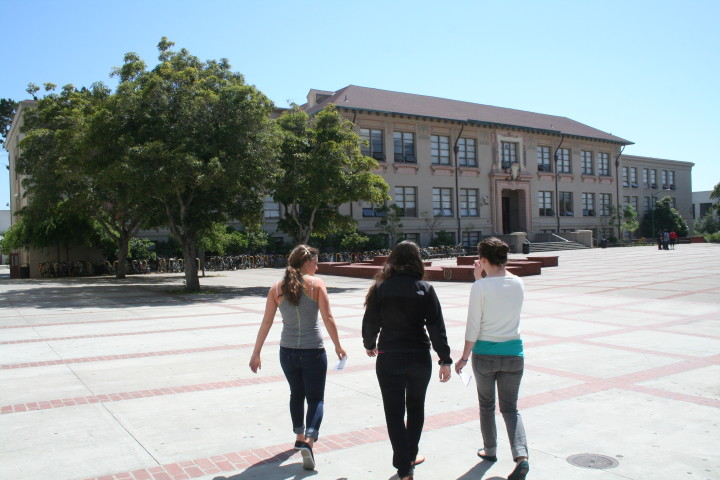
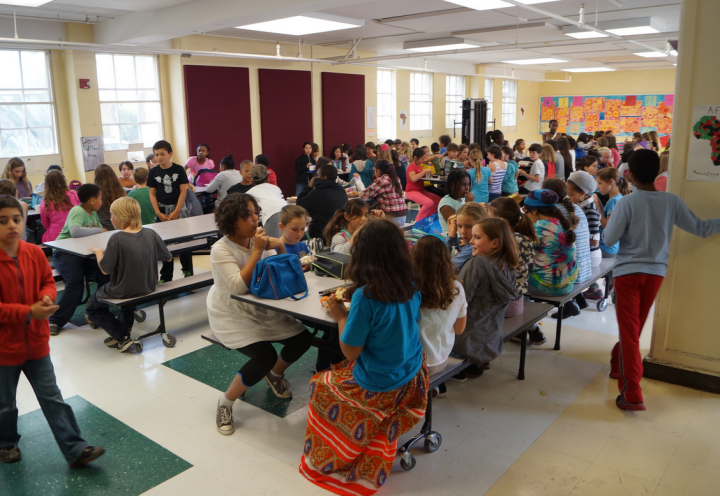
Parents desperate to get their kids into some schools, including Berkeley High School, cheat their way in.(Frances Dinkelspiel/Berkeleyside)
When Sarah James went to the first meeting for her daughter’s freshman crew team at Berkeley High School, she wanted to form a carpool for the 6 a.m. practices.
But James (not her real name) lived in Oakland and had enrolled her daughter using a false address. James did not think she would find any other crew members living near her Rockridge bungalow, but she needn’t have worried. That fall, there were four other girls on the team who lived in Oakland, James said.
The official freshman crew roster, however, showed that everyone had a Berkeley address.
That was nearly 10 years ago, but people haven’t stopped enrolling their kids illegally in Berkeley schools. Everyone seems to know a case: people using relatives’ addresses, friends’ addresses or even rental property owned by the family who lives out of town. One recent gossip item on a local internet site: a man with a boat at the Berkeley marina, using that address to enroll his child, who lives in another city.
Berkeley Unified School District says illegal enrollment is common in many districts across the state. (Kaia Diringer/Berkeleyside)
Illegal enrollment is a problem common to strong school districts around the state, especially those that border districts with underperforming schools. Parents desperate to get their kids into schools with high test scores, clean campuses, and dedicated teachers, will cheat their way in, often rationalizing their actions by saying it really isn’t a burden to anyone.
“This comes up with a lot of districts,” said Neil Smith, an assistant superintendent for the Berkeley Unified School District. “I don’t want Berkeley to think they’re the only ones.”
Nobody knows exactly how many students are illegally enrolled in Berkeley schools, but many agree that they can be a burden to the system. Nine years ago, in the only known comprehensive report made on the subject, a UC Berkeley graduate student estimated illegal enrollment was around 10 percent. A current district administrator says that number has declined, while an outside critic believes it has gone up.
The number of students enrolled in Berkeley schools is at a high: 9,581. On some campuses, there is not enough room to teach all those children, forcing the district to use portable classrooms. This has been a particularly volatile issue at Washington Elementary School this year. Berkeley High School just finished construction on a $46 million building that replaced some portables, and added a new gym and locker room. Overcrowding can make it difficult to get into popular classes. There are wait-lists for after-school care.
“It wouldn’t bother me too much if the schools weren’t so crowded, with elementary enrollment expected to continue to grow over a few more years,” Lauren Rebusi wrote on Berkeleyside’s Facebook page. “Where are all those kids going to go?”
The number of grade-schoolers who don’t use the school bus service is cited as evidence of fraudulent enrollment. (Photo: BUSD)
About a dozen Berkeleyside regulars comment frequently — and angrily — on illegal enrollment. Are others are angry? The Berkeley Accountable Schools Project, an online, anonymous watchdog group, has 75 people who have signed up for email updates, and 55 who have signed a petition to the school board.
But many parents say they have mixed feelings about the problem.
The critics’ concerns come down to money: Berkeley residents pay extra taxes to supplement schools, so it seems unfair to let nonresidents take advantage of that.
But research reveals that the question is more nuanced and difficult than appears at first glance. While illegally enrolled school children may place extra burdens on the district, they also bring in more state funds than they consume in local taxes, according to one analyst. In short, they may make money for the district.
Debate over the situation may soon intensify, as BUSD will be asking Berkeley residents to renew a school tax in two years.
An indication of the sensitivity of this issue is that very few people were willing to talk to Berkeleyside on the record about illegal enrollment. This includes parents, teachers, and community members. They all asked to be anonymous — including the person who runs a website dedicated to BUSD’s enrollment issues.
When contacted about the issue of illegal enrollment, Superintendent Donald Evans declined to talk to Berkeleyside.
There are strong opinions about illegal enrollment in the community, which starts as early as kindergarten, but many parents and officials won’t talk about the issue publicly. (Frances Dinkelspiel/Berkeleyside)
Funding: A Combination of State and Tax Money
California schools receive the bulk of their funding from the state, based on the number of students who attend each day. That number is called the average daily attendance, or ADA. While students are supposed to live in the district, or have a transfer permit, the illegally enrolled students also bring in ADA funds.
Berkeley schools are projected to receive about $7,550 per student for this school year, with a projected ADA of 8,965 students according to Javetta Cleveland, deputy superintendent of business services.
In addition, Berkeley residents pay a parcel tax, called BSEP (Berkeley Schools Excellence Program), to supplement the schools’ budgets. Two-thirds of the BSEP money goes to reducing class sizes, with the rest making libraries, music and other programs possible.
Residents pay nearly 28 cents per square foot on their homes (so a 1,000-square-foot home would be taxed $279), while businesses pay just over 42 cents per square foot. This tax brought in $24.6 million for 2013-14. If that were calculated on a per student basis, it would equal $2,568 each, said BSEP director Natasha Beery.
One 9-year-old study found that illegally enrolled students were a net financial benefit to the district. (Mark Coplan/BUSD
Nearly 10 years ago, a UC Berkeley graduate student looked at this equation of ADA state funding versus BSEPand concluded that illegally enrolled students were a net financial benefit. Even though these students “diffused” the BSEP tax, they also brought in between $1 million and $1.5 million per year in ADA funds, the graduate student, Rinat Fried, calculated.
To arrive at this conclusion, Fried first had to calculate how many “unofficial transfers,” as she put it, were attending Berkeley schools.
How Big is the Problem?
In the 2005 report, Fried wrote that, until then, the district “never attempted to estimate the number of inter-district students attending unofficially.” At the time, there were a total of roughly 9,000 students in the district, down from a peak of about 9,500 in 2000. Enrollment has now surpassed that level.
Fried wrote that the district attendance manager, Francisco Martinez, estimated at that time that “between 7 percent and 12 percent of currently [2005] enrolled students in the district attend unofficially.”
Fried went on to try to verify that estimate, using four methods, and concluded that about 8 percent to 12 percent of students — 720 to 1,075 kids — were illegally enrolled at the time.
She checked 2000 census records for the number of children living in Berkeley (factoring in private school enrollment), which yielded a 7.8 percent unofficial enrollment rate. She also crosschecked addresses for phone numbers with out-of-Berkeley exchanges, and came up with an 8 percent to 14 percent rate. Her look at feeder schools among Berkeley High freshman suggested that 10 percent were illegally enrolled. And, finally, she surveyed teachers in one Berkeley elementary school, asking them to mark names of students who lived elsewhere. Double checking for transfer permits, the results suggested that 16 percent of that school’s students were illegally enrolled. Combining these four methods, she came up with the 8-to-12 percent figures [p. 19 of the report].
Estimates of the number of illegally enrolled students in the district, including at Berkeley High, are hard to pin down. (Frances Dinkelspiel/Berkeleyside)
Fried, who now works for the Oakland School District, declined to comment on her report for this news story.
District administrators initially hesitated to provide Berkeleyside with a current estimate of the number of illegally enrolled students. But, just recently, Martinez, the admissions director, said that he thinks the percent of students attending illegally from out of district is “much lower than it was before (at the time of Fried’s report),” although he declined to actually make an estimate.
In the nine years since Fried’s report appeared, BUSD has taken a number of steps to research and cut down on illegal enrollment, said Martinez. That includes hiring an investigator to make home visits to verify people’s addresses and updating the status of homeless families. “We are doing a much more thorough job now,” Martinez said.
On the other hand, the BASP website author, who insists on anonymity, says he has analyzed recent census data using Fried’s methods, and believes illegal enrollments have gone up: “The number of fraudulently enrolled students in 2009, 2010, 2011-2012 ranges from one to three times what Fried measured in her study,” he said.
Lack of Data Leads to Rampant Speculation
So have illegal enrollments gone up or gone down? The lack of publicly shared data makes for a lot of speculation.
In online forums, and in off-the-record calls to Berkeleyside reporters, residents point to their evidence of enrollment fraud: the number of kids coming into Berkeley on BART every morning, the number of grade-schoolers who don’t use school bus service, the number of families who don’t list addresses in school directories.
Observers point to demographics as well; because the percentage of African-American students in Berkeley schools is higher than the percentage of African-American residents reported in the 2010 census for the city, many of those kids must be from other cities, critics argue. Those claims bring out accusations of racism, and the conversation gets ugly.
BUSD says there is not a particular demographic group enrolling fraudulently, rather it covers the whole spectrum. (Mark Coplan/BUSD)
The problem for parents isn’t just about tax money. Some complain that the out-of-district students, who are presumed to come from low-income families, are creating more discipline problems. Others complain about the “rich Oakland Hills” families that send their kids to Berkeley for a free ride.
“There’s not a particular group (enrolling fraudulently),” Martinez said. “It covers the whole spectrum.”
However, amidst all the speculation, one factor that casual observers need to consider is that more than 1,000 students without permanent Berkeley addresses attend Berkeley schools legally. In addition, a large number of children in joint custody live in two households, and so may appear to be out-of-towners. In other words, the number of “unofficial transfers” may be lower than it appears.
Legal Out-of-Towners Makes the Issue Complicated
“[This enrollment issue] is much more complicated than people would like to think it is,” said School Board President Josh Daniels.
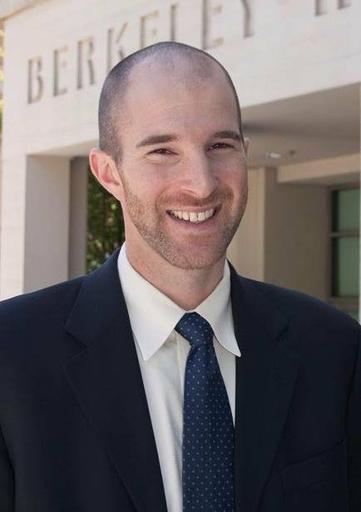
Josh Daniels: He himself sometimes traveled to Berkeley schools from outside the city. (Photo: Josh Daniels)
Daniels pointed to his own case, growing up in Berkeley. When he was 6, his parents divorced and his dad moved to Walnut Creek. Daniels split his time between the two homes, so sometimes he was coming to school from Walnut Creek. The district doesn’t have numbers for how many kids live in more than one household, since only their Berkeley address is required.
Cathy Campbell, president of the Berkeley Federation of Teachers, agreed that residency can be complicated when students have fluctuating home situations.
“They are in and out of Berkeley, living with a grandmother for a while, an aunt for while. There’s a flow of families in and out of Berkeley — that’s part of what makes it complex,” Campbell said.
Then there are the transfer students — meaning they live in another city and have requested to transfer from their local school district to Berkeley. Martinez said there are 599 transfers this year, out of roughly 9,500 students — about 6 percent of the student population. That’s about 46 students per grade. According to Asst. BUSD Superintendent Smith, transfer numbers have gone way down since the era of Superintendent Jack McLaughlin, who believed in boosting revenue by filling empty classroom space with transfers.
This year, 48 transfer students were newly admitted. Of those, 30 are the children of employees. (The union contract gives employees the right to enroll their children in Berkeley schools, regardless of where they live.) Half were admitted to kindergarten, the rest to other grades. About one-third of transfer permit requests were granted; two-thirds were turned down for lack of space.
(Albany appears to have far more transfer students than Berkeley: 12 percent of its 3,850 students last year, compared to Berkeley’s 6 percent of the student body this year. Still, in recent years, said an administrator, Albany has been accepting only employees’ children as transfers.)
Another 5 percent of students in Berkeley schools are listed as homeless — that’s 478 kids at present, according to Susan Craig, director of student services. The majority of homeless families in the district are doubled up in homes with friends or relatives, according to Craig, with a smaller number living in motels, shelters, transitional housing, vehicles and churches.
“If they lack a fixed night-time residence, they are, by federal definition, homeless,” Craig said.
No matter where they land temporarily — Berkeley or elsewhere — they have the right, under the federal McKinney-Vento Homeless Education Act, to stay at the school they were already in, if they choose to do so. The goal is to provide one source of stability in the children’s lives, while their families move around. (See p. 13 of the act.) If families resettle permanently in another community, they are expected to enroll their kids there.
In the recent past, the district did not check in with homeless families to find out if they were still homeless, Craig said. Clearly, this represented an opportunity to stay in Berkeley schools for the formerly homeless. It’s even possible families that were never homeless registered as such in kindergarten in order to get into the district.
And, in fact, the current school year started with 600 students listed as homeless. In the fall of 2013, for the first time, district officials asked the families to verify their status; 122 came forward with the information that they are not homeless now. Those 122 students are allowed to finish out the school year, but, if they no longer live in Berkeley, they will have to request — and be granted — a transfer in order to return next year. Another status check is currently underway, Martinez said.
In summary, that’s 1,077 students — 11 percent of the student population of about 9,500 — who don’t have a permanent home in Berkeley, but attend school here legally. That makes for a lot of kids not on the school bus or perhaps taking BART to school.
Still, no one — neither district administrators, nor school board members — is denying that others are here illegally.
Proof of Residency: Three Proofs Required
Critics say the district should do more to catch people cheating their way into school.
What the school district does now is require three proofs of residency from families entering the district. One must be a utility bill (PG&E, water, garbage, phone, cable, Internet). The other two can include a driver’s license, bank statement or paycheck stub.
What the district doesn’t ask for is a mortgage document or a rental lease.
The Berkeley Accountable Schools Project recommends that the district require a deed or rental lease, and that renters provide a copy of the landlord’s rental license. The idea is that proof of ownership or rental would make enrollment fraud more difficult to pull off.
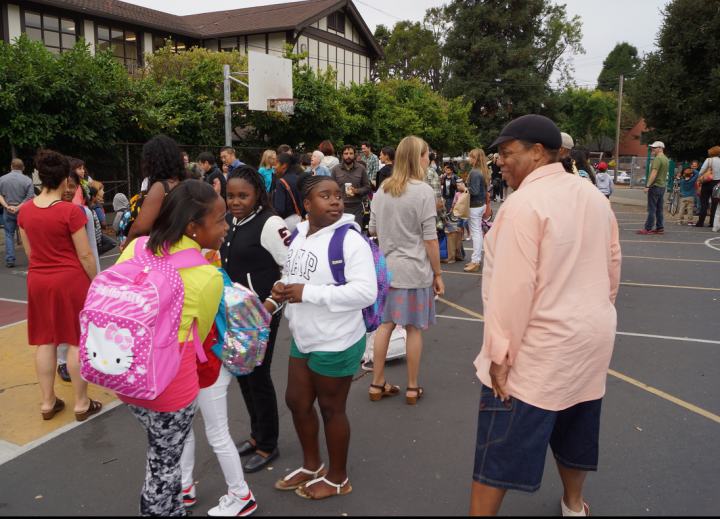
First day of school at John Muir Elementary: BUSD now requires three proofs of residency from families entering the district. (Mark Coplan/BUSD)
But Martinez, who has been admissions manager for 14 years, says that leases can be faked, making them almost worthless.
“It’s easy to find a lease online,” Martinez said. Furthermore, bona fide mortgages can be used falsely, if they are for property in Berkeley that the parents rent out, while they live elsewhere.
The idea is that utility bills are not as easy to fake. However, one parent who spoke to Berkeleyside last fall demonstrated a way around that. An Oakland mom, she used her parents’ Berkeley address to enroll her son at Berkeley High this past year. She took over their bills, set up a bank account at that address, and changed her driver’s license.
Knowing that her parents had paid tax in Berkeley since the 1980s and never sent anyone to public school helped ease her conscience, she said.
“The hardest part about this is asking ‘David’ to lie,” said the mother. She had looked at Oakland Tech for her son, she said, but Berkeley High seemed better organized and less chaotic. They couldn’t afford private school.
So if leases and utility bills can be faked, what can and does the district do?
Enrollment Enforcement: Home Visits Require Respect
Martinez said that when something on an enrollment form seems off — a telephone exchange from outside Berkeley for example — his office checks it. In some cases, a BUSD employee makes a home visit to verify the child lives at the address. Sometimes, Martinez said, when parents are told there could be a home visit, they come forward and admit to using a false address.
Martinez said visits generally occur early in the morning before school or in the evening. The child must be home and is often asked to show the inspector around the house, including where they sleep and where they keep their belongings. It’s an awkward job.
“We have to be respectful and ask for permission,” Martinez said.
District staff members (mainly one employee), conducted 358 home visits for the 2013-2014 school year (mostly in the summer before school began). This year, 290 of those cases were approved for enrollment, while 66 were denied.
“This past summer we really ramped up the home visit process. There were more denials to families,” Craig said.
Of those home visits, 27 of them were to families with caregiver affidavits. Those are cases where the child lives full-time with another adult, often a grandparent, in Berkeley, while the parents live elsewhere. Every caregiver affidavit situation gets a home visit, Martinez said.
The district first hired an investigator in 2005, but the position was empty for a while a few years later. It has since been filled. This year, the district hired another part-time person to help with address verifications.
In addition, every student’s address gets re-checked when they submit their paperwork to enter middle school, Martinez said. Re-verifications don’t happen again for entering high school, but Martinez said it’s being considered.
In a related issue, the district also takes a look at its legal transfer students every year, Martinez said. Each principal is given a list of transfer students, who must have a good record of attendance, no serious discipline problems, and a satisfactory academic performance to continue at the school. If students don’t meet all of those requirements, their transfer permit is not renewed. Students are advised of these conditions when they get their transfer permit, and if they’re not doing well, they receive a warning letter in January. This past summer, the district denied permits to 108 students for these reasons, and kept another 553 students.
What Berkeley’s Neighbors Are Doing
Critics say Berkeley Unified should follow the example of neighboring districts, and do more to verify residency.
Piedmont, one of the most highly regarded school districts in Northern California, has developed a complex set of rules to make sure its students live in Piedmont.
Piedmont requires that both parents, if married, live in town. This is to prevent a family from renting a place in Piedmont to gain access to the school system, while maintaining a primary residence elsewhere.
If divorced parents have joint custody, the student must live 50 percent of the time with the parent in Piedmont (at least during the school year). The district reserves the right to see custody papers.
“If a student had one parent that lived in Berkeley and stayed once in a while with their parent who lived in Piedmont, then that child would be considered a resident of Berkeley for the purposes of school enrollment,” said Constance Hubbard, the superintendent of the Piedmont Unified School District.
As for paperwork, in addition to three proofs of residency — similar to Berkeley’s list of accepted documents — Piedmont also requires a grant deed, a property tax statement, or a rental lease.
To discourage people from assuming the bills of a Piedmont homeowner (like ‘David’’s mother), the school district reserves the right to prosecute anyone who allows their address to be used to register a student falsely, although, Hubbard said that she does not think anyone has ever been prosecuted.
Piedmont also has an on-call, hourly investigator who makes home visits, often early in the morning. The most home visits the investigator has made in a year is five, according to Constance Hubbard, the school superintendent.
In 2011, the Albany Unified School District made a concerted effort to identify fraudulently enrolled students. First the district offered amnesty; if families came forward, those students could finish the school year, and apply for a transfer to stay.
After the amnesty, any student caught would be kicked out of school right away. By October 2011, the district had discovered 35 students enrolled illegally and were scrutinizing another 200.
“Does it act as a deterrent?” Brown said about the annual re-verification. “I believe so. Is it foolproof? No.” Just recently, she said, the district found three families using the same rental address – so clearly attempts at fraud continue. Brown said she thought about 95 percent of Albany parents support the annual re-verification process. Albany residents, like Berkeley, pay a parcel tax to benefit the schools.
The Beverly Hills Unified School District in Southern California also requires families to re-verify their addresses. Officials randomly select one-third of the student body to check every year, according to a BHUSD spokesman. Prior to this re-verification, in 2010, the Los Angeles Times reported an example of enrollment fraud in Beverly Hills that could have come out of a Hollywood script: “One memorable incident involved the parent who went to a Beverly Hills home and placed a mailbox with her name on it in the front yard. The actual owner alerted school officials, who removed the box and expelled the student…”
Illegal Enrollment Not Always Best for the Student
Another problem with students attending illegally, Fried stated in her 2005 report, is that it can put the students at a disadvantage.
In talking to grade-school teachers, who often knew where students lived, Fried found that the unofficially enrolled students had more tardies — often due to commutes and traffic — and so missed more time in school.
In one case, the teacher said of a struggling learner from Concord who missed reading class many days, “We believe [he] would be better off at a [Concord] school.”
Another concern was lack of contact with the families trying to lie low. Sometimes teachers found the phone numbers listed for those families were not correct.
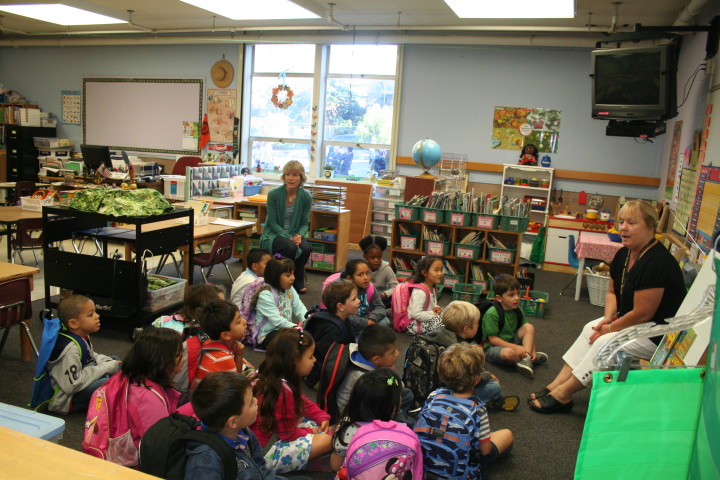
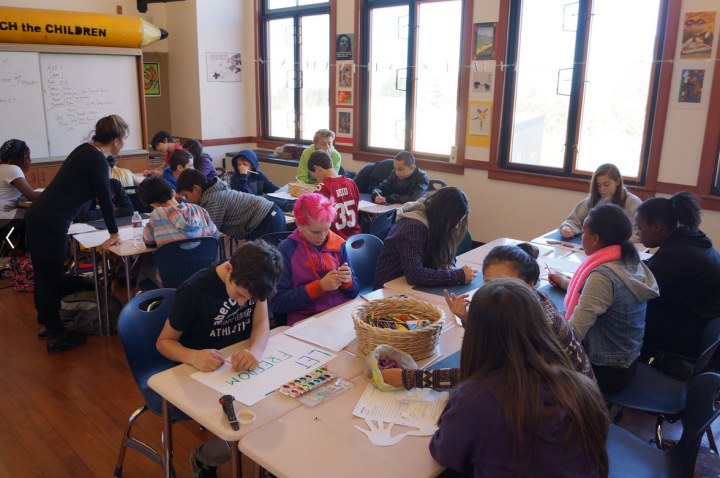
Students at King Middle School: Illegal enrollment is not always the best choice for kids. (Mark Coplan/BUSD)
However, according to one Berkeley High School teacher, that problem has diminished over the past decade, with email, cell phones and PowerSchool, the online student record system accessible to families.
“It’s a lot easier to reach parents now. I can assume there’s a cell phone and I am getting a parent directly,” the teacher said.
The teacher, along with many BUSD officials and school board members, seems to have an unstated belief that Berkeley is a more tolerant, inclusive community that sees the benefit of an educated citizenry. As such, Berkeley has a responsibility to all students — even those who live outside the district. What would happen to those students kicked out? Would the older students transfer to their hometown schools, or would some drop out? What would happen to struggling students if they attended a school with fewer resources?
“If you have an opportunity to educate more students in a more stable environment, at a better school, why would we limit that?” said the teacher. “We don’t see out of district kids as a drawback. In fact, I want to teach as many kids as possible.”
In Rinat Fried’s 2005 report she recommended that Berkeley “regularize” its unofficial transfers because of the financial gain, and try to get them enrolled legally. To do this, she said, the district would have to require “stricter proof of residency rules.”
This recommendation has a flaw though, said board member Josh Daniels. To transfer legally, the students need to get a release from their hometown district — which another district might decline to do as it would rather keep ADA funding than give it away to Berkeley.
The Berkeley Accountable Schools Project website recommends that, in addition to tightening documentation requirements, the district should establish an anonymous tip-line to report illegal enrollments, follow up on those, and offer an amnesty program to lower enforcement costs.
What Does the District Plan to Do?
With the hiring in recent years of home inspectors, the increased number of home visits last summer, and the follow-up last fall on homeless families, the district contends it is taking steps towards reducing unofficial transfers. The district also is working harder to scrutinize incoming enrollments, Martinez said.
“We’re trying to prevent the problem rather than having to deal with it later,” he said.
But it has not taken any of the larger measures called for by critics. With enrollment for kindergarten in the fall already underway, no changes have been made to documentation requirements.
And an annual re-verification of all students, like Albany does, would require more staff.
One anonymous teacher claimed that the teachers union doesn’t support cracking down.
“From my many years as a teacher in Berkeley …. The teachers’ union is very aware of the problem, but their response is they don’t care about enforcing the rules because more students (from wherever) means more jobs for Berkeley teachers (and consequently more dues-paying members),” wrote the commentator who identified himself or herself as “rhuberry.” “I was on the BFT [teachers union] executive board for a few years so I know of what I speak. Complaints would come in from teachers who felt overwhelmed by too many difficult students, many from out of district, and wanted some support from the union. Union wouldn’t take a stand on enforcing enrollment procedures.”
Asst. Superintendent Smith called the issue “important — it’s on our radar — people are aware of it.” But pressed on priorities, Smith said: “Of course, it’s not our number one priority. We have to educate the kids that are here.”
He added: “This year, the transition to Common Core is a major undertaking. And now there’s a new local control funding formula and accountability plan. It’s a major change in how district receives and spends state funding.”
In other words, the district has its hands full.
School Board President Josh Daniels also stressed that the district has a lot of other issues on its plate. And he declined to speak for the whole board, because the board hasn’t discussed the issue, as a group, in quite a while. (“Although I know individually we’ve been thinking about it,” Daniels said.)
Speaking only for himself, Daniels said that he understands that parents want to see the issue as simple when their kids are crowded into classrooms and put on wait-lists. “But the problem is not easily definable. And the solution is even more difficult.”
That said, Daniels indicated that the district and the community will probably be discussing illegal enrollment over the next two years. “We’re going to engage in a pretty robust process in terms of developing next BSEP measure,” he said. “If it appears more attention [to illegal enrollment] is necessary, we can address it through that process.”
Frances Dinkelspiel contributed to the reporting of this article.
KQED News Associate Berkeleyside is an independently owned news website based in Berkeley, Calif. Click here if you would you like to receive the latest Berkeley news in your inbox once a day for free with Berkeleyside's Daily Briefing email.
lower waypointnext waypoint
Player sponsored by
window.__IS_SSR__=true
window.__INITIAL_STATE__={
"attachmentsReducer": {
"audio_0": {
"type": "attachments",
"id": "audio_0",
"imgSizes": {
"kqedFullSize": {
"file": "https://ww2.kqed.org/news/wp-content/themes/KQED-unified/img/audio_bgs/background0.jpg"
}
}
},
"audio_1": {
"type": "attachments",
"id": "audio_1",
"imgSizes": {
"kqedFullSize": {
"file": "https://ww2.kqed.org/news/wp-content/themes/KQED-unified/img/audio_bgs/background1.jpg"
}
}
},
"audio_2": {
"type": "attachments",
"id": "audio_2",
"imgSizes": {
"kqedFullSize": {
"file": "https://ww2.kqed.org/news/wp-content/themes/KQED-unified/img/audio_bgs/background2.jpg"
}
}
},
"audio_3": {
"type": "attachments",
"id": "audio_3",
"imgSizes": {
"kqedFullSize": {
"file": "https://ww2.kqed.org/news/wp-content/themes/KQED-unified/img/audio_bgs/background3.jpg"
}
}
},
"audio_4": {
"type": "attachments",
"id": "audio_4",
"imgSizes": {
"kqedFullSize": {
"file": "https://ww2.kqed.org/news/wp-content/themes/KQED-unified/img/audio_bgs/background4.jpg"
}
}
},
"placeholder": {
"type": "attachments",
"id": "placeholder",
"imgSizes": {
"thumbnail": {
"file": "https://cdn.kqed.org/wp-content/uploads/2024/12/KQED-Default-Image-816638274-2000x1333-1-160x107.jpg",
"width": 160,
"height": 107,
"mimeType": "image/jpeg"
},
"medium": {
"file": "https://cdn.kqed.org/wp-content/uploads/2024/12/KQED-Default-Image-816638274-2000x1333-1-800x533.jpg",
"width": 800,
"height": 533,
"mimeType": "image/jpeg"
},
"medium_large": {
"file": "https://cdn.kqed.org/wp-content/uploads/2024/12/KQED-Default-Image-816638274-2000x1333-1-768x512.jpg",
"width": 768,
"height": 512,
"mimeType": "image/jpeg"
},
"large": {
"file": "https://cdn.kqed.org/wp-content/uploads/2024/12/KQED-Default-Image-816638274-2000x1333-1-1020x680.jpg",
"width": 1020,
"height": 680,
"mimeType": "image/jpeg"
},
"1536x1536": {
"file": "https://cdn.kqed.org/wp-content/uploads/2024/12/KQED-Default-Image-816638274-2000x1333-1-1536x1024.jpg",
"width": 1536,
"height": 1024,
"mimeType": "image/jpeg"
},
"fd-lrg": {
"file": "https://cdn.kqed.org/wp-content/uploads/2024/12/KQED-Default-Image-816638274-2000x1333-1-1536x1024.jpg",
"width": 1536,
"height": 1024,
"mimeType": "image/jpeg"
},
"fd-med": {
"file": "https://cdn.kqed.org/wp-content/uploads/2024/12/KQED-Default-Image-816638274-2000x1333-1-1020x680.jpg",
"width": 1020,
"height": 680,
"mimeType": "image/jpeg"
},
"fd-sm": {
"file": "https://cdn.kqed.org/wp-content/uploads/2024/12/KQED-Default-Image-816638274-2000x1333-1-800x533.jpg",
"width": 800,
"height": 533,
"mimeType": "image/jpeg"
},
"post-thumbnail": {
"file": "https://cdn.kqed.org/wp-content/uploads/2024/12/KQED-Default-Image-816638274-2000x1333-1-672x372.jpg",
"width": 672,
"height": 372,
"mimeType": "image/jpeg"
},
"twentyfourteen-full-width": {
"file": "https://cdn.kqed.org/wp-content/uploads/2024/12/KQED-Default-Image-816638274-2000x1333-1-1038x576.jpg",
"width": 1038,
"height": 576,
"mimeType": "image/jpeg"
},
"xxsmall": {
"file": "https://cdn.kqed.org/wp-content/uploads/2024/12/KQED-Default-Image-816638274-2000x1333-1-160x107.jpg",
"width": 160,
"height": 107,
"mimeType": "image/jpeg"
},
"xsmall": {
"file": "https://cdn.kqed.org/wp-content/uploads/2024/12/KQED-Default-Image-816638274-2000x1333-1-672x372.jpg",
"width": 672,
"height": 372,
"mimeType": "image/jpeg"
},
"small": {
"file": "https://cdn.kqed.org/wp-content/uploads/2024/12/KQED-Default-Image-816638274-2000x1333-1-672x372.jpg",
"width": 672,
"height": 372,
"mimeType": "image/jpeg"
},
"xlarge": {
"file": "https://cdn.kqed.org/wp-content/uploads/2024/12/KQED-Default-Image-816638274-2000x1333-1-1020x680.jpg",
"width": 1020,
"height": 680,
"mimeType": "image/jpeg"
},
"full-width": {
"file": "https://cdn.kqed.org/wp-content/uploads/2024/12/KQED-Default-Image-816638274-2000x1333-1-1920x1280.jpg",
"width": 1920,
"height": 1280,
"mimeType": "image/jpeg"
},
"guest-author-32": {
"file": "https://cdn.kqed.org/wp-content/uploads/2025/01/KQED-Default-Image-816638274-1333x1333-1-160x160.jpg",
"width": 32,
"height": 32,
"mimeType": "image/jpeg"
},
"guest-author-50": {
"file": "https://cdn.kqed.org/wp-content/uploads/2025/01/KQED-Default-Image-816638274-1333x1333-1-160x160.jpg",
"width": 50,
"height": 50,
"mimeType": "image/jpeg"
},
"guest-author-64": {
"file": "https://cdn.kqed.org/wp-content/uploads/2025/01/KQED-Default-Image-816638274-1333x1333-1-160x160.jpg",
"width": 64,
"height": 64,
"mimeType": "image/jpeg"
},
"guest-author-96": {
"file": "https://cdn.kqed.org/wp-content/uploads/2025/01/KQED-Default-Image-816638274-1333x1333-1-160x160.jpg",
"width": 96,
"height": 96,
"mimeType": "image/jpeg"
},
"guest-author-128": {
"file": "https://cdn.kqed.org/wp-content/uploads/2025/01/KQED-Default-Image-816638274-1333x1333-1-160x160.jpg",
"width": 128,
"height": 128,
"mimeType": "image/jpeg"
},
"detail": {
"file": "https://cdn.kqed.org/wp-content/uploads/2025/01/KQED-Default-Image-816638274-1333x1333-1-160x160.jpg",
"width": 160,
"height": 160,
"mimeType": "image/jpeg"
},
"kqedFullSize": {
"file": "https://cdn.kqed.org/wp-content/uploads/2024/12/KQED-Default-Image-816638274-2000x1333-1.jpg",
"width": 2000,
"height": 1333
}
}
},
"news_134419": {
"type": "attachments",
"id": "news_134419",
"meta": {
"index": "attachments_1716263798",
"site": "news",
"id": "134419",
"found": true
},
"parent": 133587,
"imgSizes": {
"kqedFullSize": {
"file": "https://ww2.kqed.org/app/uploads/sites/10/2014/04/enrollment1-640x4261.jpg",
"width": 640,
"height": 426
}
},
"publishDate": 1398478953,
"modified": 1398478953,
"caption": "Parents desperate to get their kids into some schools, including Berkeley High School, cheat their way in.(Frances Dinkelspiel/Berkeleyside)",
"description": "Parents desperate to get their kids into some schools, including Berkeley High School, cheat their way in.(Frances Dinkelspiel/Berkeleyside)",
"title": "enrollment1-640x426",
"credit": null,
"status": "inherit",
"isLoading": false,
"fetchFailed": false
}
},
"audioPlayerReducer": {
"postId": "stream_live",
"isPaused": true,
"isPlaying": false,
"pfsActive": false,
"pledgeModalIsOpen": true,
"playerDrawerIsOpen": false,
"liveAudioPlayStartedAt": 0,
"liveAudioPlayContext": ""
},
"authorsReducer": {
"kqed": {
"type": "authors",
"id": "236",
"meta": {
"index": "authors_1716337520",
"id": "236",
"found": true
},
"name": "KQED News Staff",
"firstName": "KQED News Staff",
"lastName": null,
"slug": "kqed",
"email": "faq@kqed.org",
"display_author_email": false,
"staff_mastheads": [],
"title": null,
"bio": null,
"avatar": "https://secure.gravatar.com/avatar/ef0e801a68c4c54afa9180db14084167?s=600&d=blank&r=g",
"twitter": null,
"facebook": null,
"instagram": null,
"linkedin": null,
"sites": [
{
"site": "arts",
"roles": [
"contributor"
]
},
{
"site": "news",
"roles": [
"editor"
]
},
{
"site": "futureofyou",
"roles": [
"author"
]
}
],
"headData": {
"title": "KQED News Staff | KQED",
"description": null,
"ogImgSrc": "https://secure.gravatar.com/avatar/ef0e801a68c4c54afa9180db14084167?s=600&d=blank&r=g",
"twImgSrc": "https://secure.gravatar.com/avatar/ef0e801a68c4c54afa9180db14084167?s=600&d=blank&r=g"
},
"isLoading": false,
"link": "/author/kqed"
}
},
"pagesReducer": {},
"pfsSessionReducer": {},
"postsReducer": {
"stream_live": {
"type": "live",
"id": "stream_live",
"audioUrl": "https://streams.kqed.org/kqedradio",
"title": "Live Stream",
"excerpt": "Live Stream information currently unavailable.",
"link": "/radio",
"featImg": "",
"label": {
"name": "KQED Live",
"link": "/"
}
},
"stream_kqedNewscast": {
"type": "posts",
"id": "stream_kqedNewscast",
"audioUrl": "https://www.kqed.org/.stream/anon/radio/RDnews/newscast.mp3?_=1",
"title": "KQED Newscast",
"featImg": "",
"label": {
"name": "88.5 FM",
"link": "/"
}
},
"news_133587": {
"type": "posts",
"id": "news_133587",
"meta": {
"index": "posts_1716263798",
"site": "news",
"id": "133587",
"found": true
},
"articlePosition": 0,
"parent": 0,
"labelTerm": {
"site": "news",
"term": 6944
},
"blocks": [],
"publishDate": 1398607229,
"format": "aside",
"disqusTitle": "Berkeley High Struggles With Illegal Student Enrollment ",
"title": "Berkeley High Struggles With Illegal Student Enrollment ",
"headTitle": "News Fix | KQED News",
"content": "\u003cp>\u003cstrong>By Mary Flaherty\u003cbr>\n\u003ca href=\"http://www.berkeleyside.com/2014/04/08/illegal-enrollment-is-boon-and-burden-to-berkeley-schools/\" target=\"_blank\">Berkeleyside\u003c/a>\u003c/strong>\u003c/p>\n\u003cfigure id=\"attachment_133606\" class=\"wp-caption aligncenter\" style=\"max-width: 640px\">\u003ca href=\"http://ww2.kqed.org/news/wp-content/uploads/sites/10/2014/04/enrollment1.jpg\">\u003cimg class=\"size-medium wp-image-133606\" src=\"http://ww2.kqed.org/news/wp-content/uploads/sites/10/2014/04/enrollment1-640x426.jpg\" alt=\"Parents desperate to get their kids into some schools, including Berkeley High School, cheat their way in.(Frances Dinkelspiel/Berkeleyside)\" width=\"640\" height=\"426\">\u003c/a>\u003cfigcaption class=\"wp-caption-text\">Parents desperate to get their kids into some schools, including Berkeley High School, cheat their way in.(Frances Dinkelspiel/Berkeleyside)\u003c/figcaption>\u003c/figure>\n\u003cp>When Sarah James went to the first meeting for her daughter’s freshman crew team at Berkeley High School, she wanted to form a carpool for the 6 a.m. practices.\u003c/p>\n\u003cp>But James (not her real name) lived in Oakland and had enrolled her daughter using a false address. James did not think she would find any other crew members living near her Rockridge bungalow, but she needn’t have worried. That fall, there were four other girls on the team who lived in Oakland, James said.\u003c/p>\n\u003cp>The official freshman crew roster, however, showed that everyone had a Berkeley address.\u003c/p>\n\u003cp>That was nearly 10 years ago, but people haven’t stopped enrolling their kids illegally in Berkeley schools. Everyone seems to know a case: people using relatives’ addresses, friends’ addresses or even rental property owned by the family who lives out of town. One recent gossip item on a local internet site: a man with a boat at the Berkeley marina, using that address to enroll his child, who lives in another city.\u003c/p>\n\u003cfigure id=\"attachment_133609\" class=\"wp-caption alignleft\" style=\"max-width: 300px\">\u003ca href=\"http://ww2.kqed.org/news/wp-content/uploads/sites/10/2014/04/enrollment2.jpg\">\u003cimg class=\"size-thumbnail wp-image-133609\" src=\"http://ww2.kqed.org/news/wp-content/uploads/sites/10/2014/04/enrollment2-300x300.jpg\" alt=\"Berkeley Unified School District says illegal enrollment is common in many districts across the state. (Kaia Diringer/Berkeleyside)\" width=\"300\" height=\"300\">\u003c/a>\u003cfigcaption class=\"wp-caption-text\">Berkeley Unified School District says illegal enrollment is common in many districts across the state. (Kaia Diringer/Berkeleyside)\u003c/figcaption>\u003c/figure>\n\u003cp>Illegal enrollment is a problem common to strong school districts around the state, especially those that border districts with underperforming schools. Parents desperate to get their kids into schools with high test scores, clean campuses, and dedicated teachers, will cheat their way in, often rationalizing their actions by saying it really isn’t a burden to anyone.\u003c/p>\n\u003cp>[ad fullwidth]\u003c/p>\n\u003cp>“This comes up with a lot of districts,” said Neil Smith, an assistant superintendent for the Berkeley Unified School District. “I don’t want Berkeley to think they’re the only ones.”\u003c/p>\n\u003cp>Nobody knows exactly how many students are illegally enrolled in Berkeley schools, but many agree that they can be a burden to the system. Nine years ago, in the only known comprehensive report made on the subject, a UC Berkeley graduate student \u003ca href=\"http://www.berkeleyside.com/wp-content/uploads/2014/04/Attending-to-the-Bottomline-Final.pdf\" target=\"_blank\">estimated illegal enrollment was around 10 percent\u003c/a>. A current district administrator says that number has declined, while an outside critic believes it has gone up.\u003c/p>\n\u003cp>The number of students enrolled in Berkeley schools is at a high: 9,581. On some campuses, there is not enough room to teach all those children, forcing the district to use portable classrooms. This has been a \u003ca href=\"http://www.berkeleyside.com/2013/06/27/portable-classroom-plan-at-berkeley-schools-put-on-hold/\" target=\"_blank\">particularly volatile issue at Washington Elementary School\u003c/a> this year. Berkeley High School just finished construction on a \u003ca href=\"http://www.berkeleyside.com/2014/03/19/berkeley-high-expands-with-opening-of-new-building/\" target=\"_blank\">$46 million building\u003c/a> that replaced some portables, and added a new gym and locker room. Overcrowding can make it difficult to get into popular classes. There are wait-lists for after-school care.\u003c/p>\n\u003cp>“It wouldn’t bother me too much if the schools weren’t so crowded, with elementary enrollment expected to continue to grow over a few more years,” Lauren Rebusi wrote on \u003ca href=\"https://www.facebook.com/photo.php?fbid=10152278392007456&set=a.441014592455.227050.264579842455&type=1&stream_ref=10\" target=\"_blank\">Berkeleyside’s Facebook page\u003c/a>. “Where are all those kids going to go?”\u003c/p>\n\u003cfigure id=\"attachment_133610\" class=\"wp-caption alignright\" style=\"max-width: 300px\">\u003ca href=\"http://ww2.kqed.org/news/wp-content/uploads/sites/10/2014/04/enrollmentbus.jpg\">\u003cimg class=\"size-full wp-image-133610\" src=\"http://ww2.kqed.org/news/wp-content/uploads/sites/10/2014/04/enrollmentbus.jpg\" alt=\"The number of grade-schoolers who don’t use the school bus service is cited as evidence of fraudulent enrollment. (Photo: BUSD)\" width=\"300\" height=\"225\">\u003c/a>\u003cfigcaption class=\"wp-caption-text\">The number of grade-schoolers who don’t use the school bus service is cited as evidence of fraudulent enrollment. (Photo: BUSD)\u003c/figcaption>\u003c/figure>\n\u003cp>About a dozen Berkeleyside regulars comment frequently — and angrily — on illegal enrollment. Are others are angry? The \u003ca href=\"http://berkeley.accountableschools.com/\" target=\"_blank\">Berkeley Accountable Schools Project\u003c/a>, an online, anonymous watchdog group, has 75 people who have signed up for email updates, and 55 who have signed a petition to the school board.\u003c/p>\n\u003cp>But many parents say they have mixed feelings about the problem.\u003c/p>\n\u003cp>The critics’ concerns come down to money: Berkeley residents pay extra taxes to supplement schools, so it seems unfair to let nonresidents take advantage of that.\u003c/p>\n\u003cp>But research reveals that the question is more nuanced and difficult than appears at first glance. While illegally enrolled school children may place extra burdens on the district, they also bring in more state funds than they consume in local taxes, according to one analyst. In short, they may make money for the district.\u003c/p>\n\u003cp>Debate over the situation may soon intensify, as BUSD will be asking Berkeley residents to renew a school tax in two years.\u003c/p>\n\u003cp>“I will not vote for more school taxes unless and until real, consistent address verification is instituted,” \u003ca href=\"https://www.facebook.com/photo.php?fbid=10152278392007456&set=a.441014592455.227050.264579842455&type=1&stream_ref=10\" target=\"_blank\">wrote Fran Haselsteiner on Berkeleyside’s Facebook page\u003c/a>.\u003c/p>\n\u003cp>An indication of the sensitivity of this issue is that very few people were willing to talk to Berkeleyside on the record about illegal enrollment. This includes parents, teachers, and community members. They all asked to be anonymous — including the person who runs a website dedicated to BUSD’s enrollment issues.\u003c/p>\n\u003cp>When contacted about the issue of illegal enrollment, Superintendent Donald Evans declined to talk to Berkeleyside.\u003c/p>\n\u003cfigure id=\"attachment_133611\" class=\"wp-caption aligncenter\" style=\"max-width: 640px\">\u003ca href=\"http://ww2.kqed.org/news/wp-content/uploads/sites/10/2014/04/enrollment3.jpg\">\u003cimg class=\"size-medium wp-image-133611\" src=\"http://ww2.kqed.org/news/wp-content/uploads/sites/10/2014/04/enrollment3-640x426.jpg\" alt=\"There are strong opinions about illegal enrollment in the community, which starts as early as kindergarten, but many parents and officials won’t talk about the issue publicly. (Frances Dinkelspiel/Berkeleyside)\" width=\"640\" height=\"426\">\u003c/a>\u003cfigcaption class=\"wp-caption-text\">There are strong opinions about illegal enrollment in the community, which starts as early as kindergarten, but many parents and officials won’t talk about the issue publicly. (Frances Dinkelspiel/Berkeleyside)\u003c/figcaption>\u003c/figure>\n\u003cp>\u003cstrong>Funding: A Combination of State and Tax Money\u003c/strong>\u003c/p>\n\u003cp>California schools receive the bulk of their funding from the state, based on the number of students who attend each day. That number is called the average daily attendance, or ADA. While students are supposed to live in the district, or have a transfer permit, the illegally enrolled students also bring in ADA funds.\u003c/p>\n\u003cp>Berkeley schools are projected to receive about $7,550 per student for this school year, with a projected ADA of 8,965 students according to Javetta Cleveland, deputy superintendent of business services.\u003c/p>\n\u003cp>In addition, Berkeley residents pay a parcel tax, called BSEP (Berkeley Schools Excellence Program), to supplement the schools’ budgets. \u003ca href=\"http://www.berkeleyschools.net/departments/bsep/\" target=\"_blank\">Two-thirds of the BSEP money goes to reducing class sizes\u003c/a>, with the rest making libraries, music and other programs possible.\u003c/p>\n\u003cp>Residents pay nearly 28 cents per square foot on their homes (so a 1,000-square-foot home would be taxed $279), while businesses pay just over 42 cents per square foot. This tax brought in $24.6 million for 2013-14. If that were calculated on a per student basis, it would equal $2,568 each, said BSEP director Natasha Beery.\u003c/p>\n\u003cfigure id=\"attachment_133614\" class=\"wp-caption alignleft\" style=\"max-width: 300px\">\u003ca href=\"http://ww2.kqed.org/news/wp-content/uploads/sites/10/2014/04/enrollment4.png\">\u003cimg class=\"size-thumbnail wp-image-133614\" src=\"http://ww2.kqed.org/news/wp-content/uploads/sites/10/2014/04/enrollment4-300x300.png\" alt=\"One 9-year-old study found that illegally enrolled students were a net financial benefit to the district. (Mark Coplan/BUSD\" width=\"300\" height=\"300\">\u003c/a>\u003cfigcaption class=\"wp-caption-text\">One 9-year-old study found that illegally enrolled students were a net financial benefit to the district. (Mark Coplan/BUSD\u003c/figcaption>\u003c/figure>\n\u003cp>Nearly 10 years ago, a UC Berkeley graduate student looked at this equation of \u003ca href=\"http://www.berkeleyside.com/wp-content/uploads/2014/04/Attending-to-the-Bottomline-Final.pdf\" target=\"_blank\">ADA state funding versus BSEP\u003c/a>and concluded that illegally enrolled students were a net financial benefit. Even though these students “diffused” the BSEP tax, they also brought in between $1 million and $1.5 million per year in ADA funds, the graduate student, Rinat Fried, calculated.\u003c/p>\n\u003cp>“Larger enrollment means more discretionary revenue for the district, which appears to compensate for BSEP diffusion,” Fried wrote in her 2005 report called \u003ca href=\"http://www.berkeleyside.com/wp-content/uploads/2014/04/Attending-to-the-Bottomline-Final.pdf\" target=\"_blank\">\"Attending to the Bottom Line: Boosting District Revenue and Enhancing Educational Mission Through Interdistrict Enrollment & Attendance Policy\u003c/a>.\" The report was part of her graduate work at the Goldman School of Public Policy.\u003c/p>\n\u003cp>To arrive at this conclusion, Fried first had to calculate how many “unofficial transfers,” as she put it, were attending Berkeley schools.\u003c/p>\n\u003cp>\u003cstrong>How Big is the Problem?\u003c/strong>\u003c/p>\n\u003cp>In the 2005 report, Fried wrote that, until then, the district “never attempted to estimate the number of inter-district students attending unofficially.” At the time, there were a total of roughly 9,000 students in the district, down from a peak of about 9,500 in 2000. Enrollment has now surpassed that level.\u003c/p>\n\u003cp>Fried wrote that the district attendance manager, Francisco Martinez, estimated at that time that “between 7 percent and 12 percent of currently [2005] enrolled students in the district attend unofficially.”\u003c/p>\n\u003cp>Fried went on to try to verify that estimate, using four methods, and concluded that about 8 percent to 12 percent of students — 720 to 1,075 kids — were illegally enrolled at the time.\u003c/p>\n\u003cp>She checked 2000 census records for the number of children living in Berkeley (factoring in private school enrollment), which yielded a 7.8 percent unofficial enrollment rate. She also crosschecked addresses for phone numbers with out-of-Berkeley exchanges, and came up with an 8 percent to 14 percent rate. Her look at feeder schools among Berkeley High freshman suggested that 10 percent were illegally enrolled. And, finally, she surveyed teachers in one Berkeley elementary school, asking them to mark names of students who lived elsewhere. Double checking for transfer permits, the results suggested that 16 percent of that school’s students were illegally enrolled. Combining these four methods, she came up with the 8-to-12 percent figures [\u003ca href=\"http://www.berkeleyside.com/wp-content/uploads/2014/04/Attending-to-the-Bottomline-Final.pdf\" target=\"_blank\">p. 19 of the report\u003c/a>].\u003c/p>\n\u003cfigure id=\"attachment_133615\" class=\"wp-caption aligncenter\" style=\"max-width: 640px\">\u003ca href=\"http://ww2.kqed.org/news/wp-content/uploads/sites/10/2014/04/enrollment5.jpg\">\u003cimg class=\"size-medium wp-image-133615\" src=\"http://ww2.kqed.org/news/wp-content/uploads/sites/10/2014/04/enrollment5-640x480.jpg\" alt=\"Estimates of the number of illegally enrolled students in the district, including at Berkeley High, are hard to pin down. (Frances Dinkelspiel/Berkeleyside)\" width=\"640\" height=\"480\">\u003c/a>\u003cfigcaption class=\"wp-caption-text\">Estimates of the number of illegally enrolled students in the district, including at Berkeley High, are hard to pin down. (Frances Dinkelspiel/Berkeleyside)\u003c/figcaption>\u003c/figure>\n\u003cp>Fried, who now works for the Oakland School District, declined to comment on her report for this news story.\u003c/p>\n\u003cp>District administrators initially hesitated to provide Berkeleyside with a current estimate of the number of illegally enrolled students. But, just recently, Martinez, the admissions director, said that he thinks the percent of students attending illegally from out of district is “much lower than it was before (at the time of Fried’s report),” although he declined to actually make an estimate.\u003c/p>\n\u003cp>In the nine years since Fried’s report appeared, BUSD has taken a number of steps to research and cut down on illegal enrollment, said Martinez. That includes hiring an investigator to make home visits to verify people’s addresses and updating the status of homeless families. “We are doing a much more thorough job now,” Martinez said.\u003c/p>\n\u003cp>On the other hand, the BASP website author, who insists on anonymity, says he has analyzed recent census data using Fried’s methods, and believes illegal enrollments have gone up: “The number of fraudulently enrolled students in 2009, 2010, 2011-2012 ranges from one to three times what Fried measured in her study,” he said.\u003c/p>\n\u003cp>\u003cstrong>Lack of Data Leads to Rampant Speculation\u003c/strong>\u003c/p>\n\u003cp>So have illegal enrollments gone up or gone down? The lack of publicly shared data makes for a lot of speculation.\u003c/p>\n\u003cp>In online forums, and in off-the-record calls to Berkeleyside reporters, residents point to their evidence of enrollment fraud: the number of kids coming into Berkeley on BART every morning, the number of grade-schoolers who don’t use school bus service, the number of families who don’t list addresses in school directories.\u003c/p>\n\u003cp>Observers point to demographics as well; because the percentage of African-American students in Berkeley schools is higher than the percentage of African-American residents reported in the 2010 census for the city, many of those kids must be from other cities, critics argue. Those claims bring out accusations of racism, and the conversation gets ugly.\u003c/p>\n\u003cfigure id=\"attachment_133616\" class=\"wp-caption alignright\" style=\"max-width: 300px\">\u003ca href=\"http://ww2.kqed.org/news/wp-content/uploads/sites/10/2014/04/enrollment6.png\">\u003cimg class=\"size-thumbnail wp-image-133616\" src=\"http://ww2.kqed.org/news/wp-content/uploads/sites/10/2014/04/enrollment6-300x300.png\" alt=\"BUSD says there is not a particular demographic group enrolling fraudulently, rather it covers the whole spectrum. (Mark Coplan/BUSD)\" width=\"300\" height=\"300\">\u003c/a>\u003cfigcaption class=\"wp-caption-text\">BUSD says there is not a particular demographic group enrolling fraudulently, rather it covers the whole spectrum. (Mark Coplan/BUSD)\u003c/figcaption>\u003c/figure>\n\u003cp>The problem for parents isn’t just about tax money. Some complain that the out-of-district students, who are presumed to come from low-income families, are creating more discipline problems. Others complain about the “rich Oakland Hills” families that send their kids to Berkeley for a free ride.\u003c/p>\n\u003cp>“There’s not a particular group (enrolling fraudulently),” Martinez said. “It covers the whole spectrum.”\u003c/p>\n\u003cp>However, amidst all the speculation, one factor that casual observers need to consider is that more than 1,000 students without permanent Berkeley addresses attend Berkeley schools legally. In addition, a large number of children in joint custody live in two households, and so may appear to be out-of-towners. In other words, the number of “unofficial transfers” may be lower than it appears.\u003c/p>\n\u003cp>\u003cstrong>Legal Out-of-Towners Makes the Issue Complicated\u003c/strong>\u003c/p>\n\u003cp>“[This enrollment issue] is much more complicated than people would like to think it is,” said School Board President Josh Daniels.\u003c/p>\n\u003cfigure id=\"attachment_133617\" class=\"wp-caption alignleft\" style=\"max-width: 300px\">\u003ca href=\"http://ww2.kqed.org/news/wp-content/uploads/sites/10/2014/04/joshdaniels.jpg\">\u003cimg class=\"size-thumbnail wp-image-133617\" src=\"http://ww2.kqed.org/news/wp-content/uploads/sites/10/2014/04/joshdaniels-300x300.jpg\" alt=\"Josh Daniels: He himself sometimes traveled to Berkeley schools from outside the city. (Photo: Josh Daniels)\" width=\"300\" height=\"300\">\u003c/a>\u003cfigcaption class=\"wp-caption-text\">Josh Daniels: He himself sometimes traveled to Berkeley schools from outside the city. (Photo: Josh Daniels)\u003c/figcaption>\u003c/figure>\n\u003cp>Daniels pointed to his own case, growing up in Berkeley. When he was 6, his parents divorced and his dad moved to Walnut Creek. Daniels split his time between the two homes, so sometimes he was coming to school from Walnut Creek. The district doesn’t have numbers for how many kids live in more than one household, since only their Berkeley address is required.\u003c/p>\n\u003cp>Cathy Campbell, president of the Berkeley Federation of Teachers, agreed that residency can be complicated when students have fluctuating home situations.\u003c/p>\n\u003cp>“They are in and out of Berkeley, living with a grandmother for a while, an aunt for while. There’s a flow of families in and out of Berkeley — that’s part of what makes it complex,” Campbell said.\u003c/p>\n\u003cp>Then there are the transfer students — meaning they live in another city and have requested to transfer from their local school district to Berkeley. Martinez said there are 599 transfers this year, out of roughly 9,500 students — about 6 percent of the student population. That’s about 46 students per grade. According to Asst. BUSD Superintendent Smith, transfer numbers have gone way down since the era of Superintendent Jack McLaughlin, who believed in boosting revenue by filling empty classroom space with transfers.\u003c/p>\n\u003cp>This year, 48 transfer students were newly admitted. Of those, 30 are the children of employees. (The union contract gives employees the right to enroll their children in Berkeley schools, regardless of where they live.) Half were admitted to kindergarten, the rest to other grades. About one-third of transfer permit requests were granted; two-thirds were turned down for lack of space.\u003c/p>\n\u003cp>(Albany appears to have far more transfer students than Berkeley: 12 percent of its 3,850 students last year, compared to Berkeley’s 6 percent of the student body this year. Still, in recent years, said an administrator, Albany has been accepting only employees’ children as transfers.)\u003c/p>\n\u003cp>Another 5 percent of students in Berkeley schools are listed as homeless — that’s 478 kids at present, according to Susan Craig, director of student services. The majority of homeless families in the district are doubled up in homes with friends or relatives, according to Craig, with a smaller number living in motels, shelters, transitional housing, vehicles and churches.\u003c/p>\n\u003cp>“If they lack a fixed night-time residence, they are, by federal definition, homeless,” Craig said.\u003c/p>\n\u003cp>No matter where they land temporarily — Berkeley or elsewhere — they have the right, under the federal \u003ca href=\"https://www2.ed.gov/programs/homeless/guidance.pdf\" target=\"_blank\">McKinney-Vento Homeless Education Act\u003c/a>, to stay at the school they were already in, if they choose to do so. The goal is to provide one source of stability in the children’s lives, while their families move around. (See p. 13 of the \u003ca href=\"https://www2.ed.gov/programs/homeless/guidance.pdf\" target=\"_blank\">act\u003c/a>.) If families resettle permanently in another community, they are expected to enroll their kids there.\u003c/p>\n\u003cp>In the recent past, the district did not check in with homeless families to find out if they were still homeless, Craig said. Clearly, this represented an opportunity to stay in Berkeley schools for the formerly homeless. It’s even possible families that were never homeless registered as such in kindergarten in order to get into the district.\u003c/p>\n\u003cp>And, in fact, the current school year started with 600 students listed as homeless. In the fall of 2013, for the first time, district officials asked the families to verify their status; 122 came forward with the information that they are not homeless now. Those 122 students are allowed to finish out the school year, but, if they no longer live in Berkeley, they will have to request — and be granted — a transfer in order to return next year. Another status check is currently underway, Martinez said.\u003c/p>\n\u003cp>In summary, that’s 1,077 students — 11 percent of the student population of about 9,500 — who don’t have a permanent home in Berkeley, but attend school here legally. That makes for a lot of kids not on the school bus or perhaps taking BART to school.\u003c/p>\n\u003cp>Still, no one — neither district administrators, nor school board members — is denying that others are here illegally.\u003c/p>\n\u003cp>\u003cstrong>Proof of Residency: Three Proofs Required\u003c/strong>\u003c/p>\n\u003cp>Critics say the district should do more to catch people cheating their way into school.\u003c/p>\n\u003cp>What the school district does now is require \u003ca href=\"http://www.berkeleyschools.net/departments/berkeley-school-admissions/required-enrollment-documentation/\" target=\"_blank\">three proofs of residency\u003c/a> from families entering the district. One must be a utility bill (PG&E, water, garbage, phone, cable, Internet). The other two can include a driver’s license, bank statement or paycheck stub.\u003c/p>\n\u003cp>What the district doesn’t ask for is a mortgage document or a rental lease.\u003c/p>\n\u003cp>The Berkeley Accountable Schools Project \u003ca href=\"http://berkeley.accountableschools.com/index.php/how-to-combat-fraudulent-enrollment/\" target=\"_blank\">recommends that the district require a deed \u003c/a>or rental lease, and that renters provide a copy of the landlord’s rental license. The idea is that proof of ownership or rental would make enrollment fraud more difficult to pull off.\u003c/p>\n\u003cfigure id=\"attachment_133618\" class=\"wp-caption aligncenter\" style=\"max-width: 640px\">\u003ca href=\"http://ww2.kqed.org/news/wp-content/uploads/sites/10/2014/04/enrollment7.png\">\u003cimg class=\"size-medium wp-image-133618\" src=\"http://ww2.kqed.org/news/wp-content/uploads/sites/10/2014/04/enrollment7-640x461.png\" alt=\"First day of school at John Muir Elementary: BUSD now requires three proofs of residency from families entering the district. (Mark Coplan/BUSD)\" width=\"640\" height=\"461\">\u003c/a>\u003cfigcaption class=\"wp-caption-text\">First day of school at John Muir Elementary: BUSD now requires three proofs of residency from families entering the district. (Mark Coplan/BUSD)\u003c/figcaption>\u003c/figure>\n\u003cp>But Martinez, who has been admissions manager for 14 years, says that leases can be faked, making them almost worthless.\u003c/p>\n\u003cp>“It’s easy to find a lease online,” Martinez said. Furthermore, bona fide mortgages can be used falsely, if they are for property in Berkeley that the parents rent out, while they live elsewhere.\u003c/p>\n\u003cp>The idea is that utility bills are not as easy to fake. However, one parent who spoke to Berkeleyside last fall demonstrated a way around that. An Oakland mom, she used her parents’ Berkeley address to enroll her son at Berkeley High this past year. She took over their bills, set up a bank account at that address, and changed her driver’s license.\u003c/p>\n\u003cp>Knowing that her parents had paid tax in Berkeley since the 1980s and never sent anyone to public school helped ease her conscience, she said.\u003c/p>\n\u003cp>“The hardest part about this is asking ‘David’ to lie,” said the mother. She had looked at Oakland Tech for her son, she said, but Berkeley High seemed better organized and less chaotic. They couldn’t afford private school.\u003c/p>\n\u003cp>So if leases and utility bills can be faked, what can and does the district do?\u003c/p>\n\u003cp>\u003cstrong>Enrollment Enforcement: Home Visits Require Respect\u003c/strong>\u003c/p>\n\u003cp>Martinez said that when something on an enrollment form seems off — a telephone exchange from outside Berkeley for example — his office checks it. In some cases, a BUSD employee makes a home visit to verify the child lives at the address. Sometimes, Martinez said, when parents are told there could be a home visit, they come forward and admit to using a false address.\u003c/p>\n\u003caside class=\"pullquote alignleft\">In 2013-2014 the district conducted 358 home visits, approved 290 of them and denied 66.\u003c/aside>\n\u003cp>Martinez said visits generally occur early in the morning before school or in the evening. The child must be home and is often asked to show the inspector around the house, including where they sleep and where they keep their belongings. It’s an awkward job.\u003c/p>\n\u003cp>“We have to be respectful and ask for permission,” Martinez said.\u003c/p>\n\u003cp>District staff members (mainly one employee), conducted 358 home visits for the 2013-2014 school year (mostly in the summer before school began). This year, 290 of those cases were approved for enrollment, while 66 were denied.\u003c/p>\n\u003cp>“This past summer we really ramped up the home visit process. There were more denials to families,” Craig said.\u003c/p>\n\u003cp>Of those home visits, 27 of them were to families with caregiver affidavits. Those are cases where the child lives full-time with another adult, often a grandparent, in Berkeley, while the parents live elsewhere. Every caregiver affidavit situation gets a home visit, Martinez said.\u003c/p>\n\u003cp>The district first hired an investigator in 2005, but the position was empty for a while a few years later. It has since been filled. This year, the district hired another part-time person to help with address verifications.\u003c/p>\n\u003cp>In addition, every student’s address gets re-checked when they submit their paperwork to enter middle school, Martinez said. Re-verifications don’t happen again for entering high school, but Martinez said it’s being considered.\u003c/p>\n\u003cp>In a related issue, the district also takes a look at its legal transfer students every year, Martinez said. Each principal is given a list of transfer students, who must have a good record of attendance, no serious discipline problems, and a satisfactory academic performance to continue at the school. If students don’t meet all of those requirements, their transfer permit is not renewed. Students are advised of these conditions when they get their transfer permit, and if they’re not doing well, they receive a warning letter in January. This past summer, the district denied permits to 108 students for these reasons, and kept another 553 students.\u003c/p>\n\u003cp>\u003cstrong>What Berkeley’s Neighbors Are Doing\u003c/strong>\u003c/p>\n\u003cp>Critics say Berkeley Unified should follow the example of neighboring districts, and do more to verify residency.\u003c/p>\n\u003cp>Piedmont, one of the most highly regarded school districts in Northern California, has developed a complex set of rules to make sure its students live in Piedmont.\u003c/p>\n\u003caside class=\"pullquote alignleft\">\"We don’t see out-of-district kids as a drawback. In fact, I want to teach as many kids as possible.”\u003c/aside>\n\u003cp>Piedmont requires that both parents, if married, live in town. This is to prevent a family from renting a place in Piedmont to gain access to the school system, while maintaining a primary residence elsewhere.\u003c/p>\n\u003cp>If divorced parents have joint custody, the student must live 50 percent of the time with the parent in Piedmont (at least during the school year). The district reserves the right to see custody papers.\u003c/p>\n\u003cp>“If a student had one parent that lived in Berkeley and stayed once in a while with their parent who lived in Piedmont, then that child would be considered a resident of Berkeley for the purposes of school enrollment,” said Constance Hubbard, the superintendent of the Piedmont Unified School District.\u003c/p>\n\u003cp>As for paperwork, in addition to three proofs of residency — similar to Berkeley’s list of accepted documents — Piedmont also requires a grant deed, a property tax statement, or a rental lease.\u003c/p>\n\u003cp>To discourage people from assuming the bills of a Piedmont homeowner (like ‘David’’s mother), the school district reserves the right to prosecute anyone who allows their address to be used to register a student falsely, although, Hubbard said that she does not think anyone has ever been prosecuted.\u003c/p>\n\u003cp>Piedmont also has an on-call, hourly investigator who makes home visits, often early in the morning. The most home visits the investigator has made in a year is five, according to Constance Hubbard, the school superintendent.\u003c/p>\n\u003cp>In 2011, the Albany Unified School District made a concerted effort to identify fraudulently enrolled students. First the district offered amnesty; if families came forward, those students could finish the school year, and apply for a transfer to stay.\u003c/p>\n\u003cp>After the amnesty, any student caught would be kicked out of school right away. By October 2011, the district had discovered 35 students enrolled illegally and were scrutinizing another 200.\u003c/p>\n\u003cp>Since 2011, \u003ca href=\"http://www.ausdk12.org/apps/pages/index.jsp?uREC_ID=92418&type=d&pREC_ID=173228\" target=\"_blank\">Albany has required all families to verify their residency every year\u003c/a>, according to Marsha Brown, director of student services, and, like in Piedmont, a mortgage or lease document is required.\u003c/p>\n\u003cp>“Does it act as a deterrent?” Brown said about the annual re-verification. “I believe so. Is it foolproof? No.” Just recently, she said, the district found three families using the same rental address – so clearly attempts at fraud continue. Brown said she thought about 95 percent of Albany parents support the annual re-verification process. Albany residents, like Berkeley, pay a parcel tax to benefit the schools.\u003c/p>\n\u003cp>The Beverly Hills Unified School District in Southern California also requires families to re-verify their addresses. Officials randomly select one-third of the student body to check every year, according to a BHUSD spokesman. Prior to this re-verification, in 2010, the Los Angeles Times reported an \u003ca href=\"http://articles.latimes.com/2010/jan/17/local/la-me-bevhills17-2010jan17\" target=\"_blank\">example of enrollment fraud in Beverly Hills\u003c/a> that could have come out of a Hollywood script: “One memorable incident involved the parent who went to a Beverly Hills home and placed a mailbox with her name on it in the front yard. The actual owner alerted school officials, who removed the box and expelled the student…”\u003c/p>\n\u003cp>\u003cstrong>Illegal Enrollment Not Always Best for the Student\u003c/strong>\u003c/p>\n\u003cp>Another problem with students attending illegally, Fried stated in her 2005 report, is that it can put the students at a disadvantage.\u003c/p>\n\u003cp>In talking to grade-school teachers, who often knew where students lived, Fried found that the unofficially enrolled students had more tardies — often due to commutes and traffic — and so missed more time in school.\u003c/p>\n\u003cp>In one case, the teacher said of a struggling learner from Concord who missed reading class many days, “We believe [he] would be better off at a [Concord] school.”\u003c/p>\n\u003cp>Another concern was lack of contact with the families trying to lie low. Sometimes teachers found the phone numbers listed for those families were not correct.\u003c/p>\n\u003cfigure id=\"attachment_133619\" class=\"wp-caption aligncenter\" style=\"max-width: 640px\">\u003ca href=\"http://ww2.kqed.org/news/wp-content/uploads/sites/10/2014/04/enrollment8.png\">\u003cimg class=\"size-medium wp-image-133619\" src=\"http://ww2.kqed.org/news/wp-content/uploads/sites/10/2014/04/enrollment8-640x424.png\" alt=\"Students at King Middle School: Illegal enrollment is not always the best choice for kids. (Mark Coplan/BUSD)\" width=\"640\" height=\"424\">\u003c/a>\u003cfigcaption class=\"wp-caption-text\">Students at King Middle School: Illegal enrollment is not always the best choice for kids. (Mark Coplan/BUSD)\u003c/figcaption>\u003c/figure>\n\u003cp>However, according to one Berkeley High School teacher, that problem has diminished over the past decade, with email, cell phones and PowerSchool, the online student record system accessible to families.\u003c/p>\n\u003cp>“It’s a lot easier to reach parents now. I can assume there’s a cell phone and I am getting a parent directly,” the teacher said.\u003c/p>\n\u003cp>The teacher, along with many BUSD officials and school board members, seems to have an unstated belief that Berkeley is a more tolerant, inclusive community that sees the benefit of an educated citizenry. As such, Berkeley has a responsibility to all students — even those who live outside the district. What would happen to those students kicked out? Would the older students transfer to their hometown schools, or would some drop out? What would happen to struggling students if they attended a school with fewer resources?\u003c/p>\n\u003cp>“If you have an opportunity to educate more students in a more stable environment, at a better school, why would we limit that?” said the teacher. “We don’t see out of district kids as a drawback. In fact, I want to teach as many kids as possible.”\u003c/p>\n\u003cp>\u003cstrong>Report Recommended ‘Regularizing’ Unofficial Transfers\u003c/strong>\u003c/p>\n\u003cp>In Rinat Fried’s 2005 report she recommended that Berkeley “regularize” its unofficial transfers because of the financial gain, and try to get them enrolled legally. To do this, she said, the district would have to require “stricter proof of residency rules.”\u003c/p>\n\u003cp>This recommendation has a flaw though, said board member Josh Daniels. To transfer legally, the students need to get a release from their hometown district — which another district might decline to do as it would rather keep ADA funding than give it away to Berkeley.\u003c/p>\n\u003cp>The Berkeley Accountable Schools Project website recommends that, in addition to tightening documentation requirements, the district should establish an anonymous tip-line to report illegal enrollments, follow up on those, and offer an amnesty program to lower enforcement costs.\u003c/p>\n\u003cp>\u003cstrong>What Does the District Plan to Do?\u003c/strong>\u003c/p>\n\u003cp>With the hiring in recent years of home inspectors, the increased number of home visits last summer, and the follow-up last fall on homeless families, the district contends it is taking steps towards reducing unofficial transfers. The district also is working harder to scrutinize incoming enrollments, Martinez said.\u003c/p>\n\u003cp>“We’re trying to prevent the problem rather than having to deal with it later,” he said.\u003c/p>\n\u003cp>But it has not taken any of the larger measures called for by critics. With enrollment for kindergarten in the fall already underway, no changes have been made to documentation requirements.\u003c/p>\n\u003cp>And an annual re-verification of all students, like Albany does, would require more staff.\u003c/p>\n\u003cp>One anonymous teacher claimed that the teachers union doesn’t support cracking down.\u003c/p>\n\u003cp>“From my many years as a teacher in Berkeley …. The teachers’ union is very aware of the problem, but their response is they don’t care about enforcing the rules because more students (from wherever) means more jobs for Berkeley teachers (and consequently more dues-paying members),” wrote the commentator who identified himself or herself as “rhuberry.” “I was on the BFT [teachers union] executive board for a few years so I know of what I speak. Complaints would come in from teachers who felt overwhelmed by too many difficult students, many from out of district, and wanted some support from the union. Union wouldn’t take a stand on enforcing enrollment procedures.”\u003c/p>\n\u003cp>Asst. Superintendent Smith called the issue “important — it’s on our radar — people are aware of it.” But pressed on priorities, Smith said: “Of course, it’s not our number one priority. We have to educate the kids that are here.”\u003c/p>\n\u003cp>He added: “This year, the transition to Common Core is a major undertaking. And now there’s a new local control funding formula and accountability plan. It’s a major change in how district receives and spends state funding.”\u003c/p>\n\u003cp>In other words, the district has its hands full.\u003c/p>\n\u003cp>School Board President Josh Daniels also stressed that the district has a lot of other issues on its plate. And he declined to speak for the whole board, because the board hasn’t discussed the issue, as a group, in quite a while. (“Although I know individually we’ve been thinking about it,” Daniels said.)\u003c/p>\n\u003cp>Speaking only for himself, Daniels said that he understands that parents want to see the issue as simple when their kids are crowded into classrooms and put on wait-lists. “But the problem is not easily definable. And the solution is even more difficult.”\u003c/p>\n\u003cp>That said, Daniels indicated that the district and the community will probably be discussing illegal enrollment over the next two years. “We’re going to engage in a pretty robust process in terms of developing next BSEP measure,” he said. “If it appears more attention [to illegal enrollment] is necessary, we can address it through that process.”\u003c/p>\n\u003cp>\u003cem>Frances Dinkelspiel contributed to the reporting of this article.\u003c/em>\u003c/p>\n\u003cp>[ad floatright]\u003c/p>\n\u003cp>\u003cem>KQED News Associate \u003ca href=\"http://www.berkeleyside.com/\">Berkeleyside\u003c/a> is an independently owned news website based in Berkeley, Calif. \u003ca href=\"http://eepurl.com/lh_3b\">Click here\u003c/a> if you would you like to receive the latest Berkeley news in your inbox once a day for free with Berkeleyside's Daily Briefing email.\u003c/em>\u003c/p>\n\n",
"disqusIdentifier": "133587 http://ww2.kqed.org/news/?p=133587",
"disqusUrl": "https://ww2.kqed.org/news/2014/04/27/berkeley-high-struggles-with-illegal-student-enrollment/",
"stats": {
"hasVideo": false,
"hasChartOrMap": false,
"hasAudio": false,
"hasPolis": false,
"wordCount": 5199,
"hasGoogleForm": false,
"hasGallery": false,
"hasHearkenModule": false,
"iframeSrcs": [],
"paragraphCount": 122
},
"modified": 1398536251,
"excerpt": "Berkeley struggles to deal with students sneaking into the district using false addresses.",
"headData": {
"twImgId": "",
"twTitle": "",
"ogTitle": "",
"ogImgId": "",
"twDescription": "",
"description": "Berkeley struggles to deal with students sneaking into the district using false addresses.",
"title": "Berkeley High Struggles With Illegal Student Enrollment | KQED",
"ogDescription": "",
"schema": {
"@context": "https://schema.org",
"@type": "NewsArticle",
"headline": "Berkeley High Struggles With Illegal Student Enrollment ",
"datePublished": "2014-04-27T07:00:29-07:00",
"dateModified": "2014-04-26T11:17:31-07:00",
"image": "https://cdn.kqed.org/wp-content/uploads/2020/02/KQED-OG-Image@1x.png",
"isAccessibleForFree": "True",
"publisher": {
"@type": "NewsMediaOrganization",
"@id": "https://www.kqed.org/#organization",
"name": "KQED",
"logo": "https://cdn.kqed.org/wp-content/uploads/2020/02/KQED-OG-Image@1x.png",
"url": "https://www.kqed.org",
"sameAs": [
"https://www.facebook.com/KQED",
"https://twitter.com/KQED",
"https://www.instagram.com/kqed/",
"https://www.tiktok.com/@kqedofficial",
"https://www.linkedin.com/company/kqed",
"https://www.youtube.com/channel/UCeC0IOo7i1P_61zVUWbJ4nw"
]
},
"author": {
"@type": "Person",
"name": "KQED News Staff",
"jobTitle": "Journalist",
"url": "https://www.kqed.org/author/kqed"
}
},
"authorsData": [],
"tagData": []
},
"guestAuthors": [],
"slug": "berkeley-high-struggles-with-illegal-student-enrollment",
"status": "publish",
"customPermalink": "2014/04/23/berkeley-high-struggles-with-illegal-enrollment-by-students-not-living-in-the-distric/",
"path": "/news/133587/berkeley-high-struggles-with-illegal-student-enrollment",
"audioTrackLength": null,
"parsedContent": [
{
"type": "contentString",
"content": "\u003cdiv class=\"post-body\">\u003cp>\u003cp>\u003cstrong>By Mary Flaherty\u003cbr>\n\u003ca href=\"http://www.berkeleyside.com/2014/04/08/illegal-enrollment-is-boon-and-burden-to-berkeley-schools/\" target=\"_blank\">Berkeleyside\u003c/a>\u003c/strong>\u003c/p>\n\u003cfigure id=\"attachment_133606\" class=\"wp-caption aligncenter\" style=\"max-width: 640px\">\u003ca href=\"http://ww2.kqed.org/news/wp-content/uploads/sites/10/2014/04/enrollment1.jpg\">\u003cimg class=\"size-medium wp-image-133606\" src=\"http://ww2.kqed.org/news/wp-content/uploads/sites/10/2014/04/enrollment1-640x426.jpg\" alt=\"Parents desperate to get their kids into some schools, including Berkeley High School, cheat their way in.(Frances Dinkelspiel/Berkeleyside)\" width=\"640\" height=\"426\">\u003c/a>\u003cfigcaption class=\"wp-caption-text\">Parents desperate to get their kids into some schools, including Berkeley High School, cheat their way in.(Frances Dinkelspiel/Berkeleyside)\u003c/figcaption>\u003c/figure>\n\u003cp>When Sarah James went to the first meeting for her daughter’s freshman crew team at Berkeley High School, she wanted to form a carpool for the 6 a.m. practices.\u003c/p>\n\u003cp>But James (not her real name) lived in Oakland and had enrolled her daughter using a false address. James did not think she would find any other crew members living near her Rockridge bungalow, but she needn’t have worried. That fall, there were four other girls on the team who lived in Oakland, James said.\u003c/p>\n\u003cp>The official freshman crew roster, however, showed that everyone had a Berkeley address.\u003c/p>\n\u003cp>That was nearly 10 years ago, but people haven’t stopped enrolling their kids illegally in Berkeley schools. Everyone seems to know a case: people using relatives’ addresses, friends’ addresses or even rental property owned by the family who lives out of town. One recent gossip item on a local internet site: a man with a boat at the Berkeley marina, using that address to enroll his child, who lives in another city.\u003c/p>\n\u003cfigure id=\"attachment_133609\" class=\"wp-caption alignleft\" style=\"max-width: 300px\">\u003ca href=\"http://ww2.kqed.org/news/wp-content/uploads/sites/10/2014/04/enrollment2.jpg\">\u003cimg class=\"size-thumbnail wp-image-133609\" src=\"http://ww2.kqed.org/news/wp-content/uploads/sites/10/2014/04/enrollment2-300x300.jpg\" alt=\"Berkeley Unified School District says illegal enrollment is common in many districts across the state. (Kaia Diringer/Berkeleyside)\" width=\"300\" height=\"300\">\u003c/a>\u003cfigcaption class=\"wp-caption-text\">Berkeley Unified School District says illegal enrollment is common in many districts across the state. (Kaia Diringer/Berkeleyside)\u003c/figcaption>\u003c/figure>\n\u003cp>Illegal enrollment is a problem common to strong school districts around the state, especially those that border districts with underperforming schools. Parents desperate to get their kids into schools with high test scores, clean campuses, and dedicated teachers, will cheat their way in, often rationalizing their actions by saying it really isn’t a burden to anyone.\u003c/p>\n\u003cp>\u003c/p>\u003c/div>",
"attributes": {
"named": {},
"numeric": []
}
},
{
"type": "component",
"content": "",
"name": "ad",
"attributes": {
"named": {
"label": "fullwidth"
},
"numeric": [
"fullwidth"
]
}
},
{
"type": "contentString",
"content": "\u003cdiv class=\"post-body\">\u003cp>\u003c/p>\n\u003cp>“This comes up with a lot of districts,” said Neil Smith, an assistant superintendent for the Berkeley Unified School District. “I don’t want Berkeley to think they’re the only ones.”\u003c/p>\n\u003cp>Nobody knows exactly how many students are illegally enrolled in Berkeley schools, but many agree that they can be a burden to the system. Nine years ago, in the only known comprehensive report made on the subject, a UC Berkeley graduate student \u003ca href=\"http://www.berkeleyside.com/wp-content/uploads/2014/04/Attending-to-the-Bottomline-Final.pdf\" target=\"_blank\">estimated illegal enrollment was around 10 percent\u003c/a>. A current district administrator says that number has declined, while an outside critic believes it has gone up.\u003c/p>\n\u003cp>The number of students enrolled in Berkeley schools is at a high: 9,581. On some campuses, there is not enough room to teach all those children, forcing the district to use portable classrooms. This has been a \u003ca href=\"http://www.berkeleyside.com/2013/06/27/portable-classroom-plan-at-berkeley-schools-put-on-hold/\" target=\"_blank\">particularly volatile issue at Washington Elementary School\u003c/a> this year. Berkeley High School just finished construction on a \u003ca href=\"http://www.berkeleyside.com/2014/03/19/berkeley-high-expands-with-opening-of-new-building/\" target=\"_blank\">$46 million building\u003c/a> that replaced some portables, and added a new gym and locker room. Overcrowding can make it difficult to get into popular classes. There are wait-lists for after-school care.\u003c/p>\n\u003cp>“It wouldn’t bother me too much if the schools weren’t so crowded, with elementary enrollment expected to continue to grow over a few more years,” Lauren Rebusi wrote on \u003ca href=\"https://www.facebook.com/photo.php?fbid=10152278392007456&set=a.441014592455.227050.264579842455&type=1&stream_ref=10\" target=\"_blank\">Berkeleyside’s Facebook page\u003c/a>. “Where are all those kids going to go?”\u003c/p>\n\u003cfigure id=\"attachment_133610\" class=\"wp-caption alignright\" style=\"max-width: 300px\">\u003ca href=\"http://ww2.kqed.org/news/wp-content/uploads/sites/10/2014/04/enrollmentbus.jpg\">\u003cimg class=\"size-full wp-image-133610\" src=\"http://ww2.kqed.org/news/wp-content/uploads/sites/10/2014/04/enrollmentbus.jpg\" alt=\"The number of grade-schoolers who don’t use the school bus service is cited as evidence of fraudulent enrollment. (Photo: BUSD)\" width=\"300\" height=\"225\">\u003c/a>\u003cfigcaption class=\"wp-caption-text\">The number of grade-schoolers who don’t use the school bus service is cited as evidence of fraudulent enrollment. (Photo: BUSD)\u003c/figcaption>\u003c/figure>\n\u003cp>About a dozen Berkeleyside regulars comment frequently — and angrily — on illegal enrollment. Are others are angry? The \u003ca href=\"http://berkeley.accountableschools.com/\" target=\"_blank\">Berkeley Accountable Schools Project\u003c/a>, an online, anonymous watchdog group, has 75 people who have signed up for email updates, and 55 who have signed a petition to the school board.\u003c/p>\n\u003cp>But many parents say they have mixed feelings about the problem.\u003c/p>\n\u003cp>The critics’ concerns come down to money: Berkeley residents pay extra taxes to supplement schools, so it seems unfair to let nonresidents take advantage of that.\u003c/p>\n\u003cp>But research reveals that the question is more nuanced and difficult than appears at first glance. While illegally enrolled school children may place extra burdens on the district, they also bring in more state funds than they consume in local taxes, according to one analyst. In short, they may make money for the district.\u003c/p>\n\u003cp>Debate over the situation may soon intensify, as BUSD will be asking Berkeley residents to renew a school tax in two years.\u003c/p>\n\u003cp>“I will not vote for more school taxes unless and until real, consistent address verification is instituted,” \u003ca href=\"https://www.facebook.com/photo.php?fbid=10152278392007456&set=a.441014592455.227050.264579842455&type=1&stream_ref=10\" target=\"_blank\">wrote Fran Haselsteiner on Berkeleyside’s Facebook page\u003c/a>.\u003c/p>\n\u003cp>An indication of the sensitivity of this issue is that very few people were willing to talk to Berkeleyside on the record about illegal enrollment. This includes parents, teachers, and community members. They all asked to be anonymous — including the person who runs a website dedicated to BUSD’s enrollment issues.\u003c/p>\n\u003cp>When contacted about the issue of illegal enrollment, Superintendent Donald Evans declined to talk to Berkeleyside.\u003c/p>\n\u003cfigure id=\"attachment_133611\" class=\"wp-caption aligncenter\" style=\"max-width: 640px\">\u003ca href=\"http://ww2.kqed.org/news/wp-content/uploads/sites/10/2014/04/enrollment3.jpg\">\u003cimg class=\"size-medium wp-image-133611\" src=\"http://ww2.kqed.org/news/wp-content/uploads/sites/10/2014/04/enrollment3-640x426.jpg\" alt=\"There are strong opinions about illegal enrollment in the community, which starts as early as kindergarten, but many parents and officials won’t talk about the issue publicly. (Frances Dinkelspiel/Berkeleyside)\" width=\"640\" height=\"426\">\u003c/a>\u003cfigcaption class=\"wp-caption-text\">There are strong opinions about illegal enrollment in the community, which starts as early as kindergarten, but many parents and officials won’t talk about the issue publicly. (Frances Dinkelspiel/Berkeleyside)\u003c/figcaption>\u003c/figure>\n\u003cp>\u003cstrong>Funding: A Combination of State and Tax Money\u003c/strong>\u003c/p>\n\u003cp>California schools receive the bulk of their funding from the state, based on the number of students who attend each day. That number is called the average daily attendance, or ADA. While students are supposed to live in the district, or have a transfer permit, the illegally enrolled students also bring in ADA funds.\u003c/p>\n\u003cp>Berkeley schools are projected to receive about $7,550 per student for this school year, with a projected ADA of 8,965 students according to Javetta Cleveland, deputy superintendent of business services.\u003c/p>\n\u003cp>In addition, Berkeley residents pay a parcel tax, called BSEP (Berkeley Schools Excellence Program), to supplement the schools’ budgets. \u003ca href=\"http://www.berkeleyschools.net/departments/bsep/\" target=\"_blank\">Two-thirds of the BSEP money goes to reducing class sizes\u003c/a>, with the rest making libraries, music and other programs possible.\u003c/p>\n\u003cp>Residents pay nearly 28 cents per square foot on their homes (so a 1,000-square-foot home would be taxed $279), while businesses pay just over 42 cents per square foot. This tax brought in $24.6 million for 2013-14. If that were calculated on a per student basis, it would equal $2,568 each, said BSEP director Natasha Beery.\u003c/p>\n\u003cfigure id=\"attachment_133614\" class=\"wp-caption alignleft\" style=\"max-width: 300px\">\u003ca href=\"http://ww2.kqed.org/news/wp-content/uploads/sites/10/2014/04/enrollment4.png\">\u003cimg class=\"size-thumbnail wp-image-133614\" src=\"http://ww2.kqed.org/news/wp-content/uploads/sites/10/2014/04/enrollment4-300x300.png\" alt=\"One 9-year-old study found that illegally enrolled students were a net financial benefit to the district. (Mark Coplan/BUSD\" width=\"300\" height=\"300\">\u003c/a>\u003cfigcaption class=\"wp-caption-text\">One 9-year-old study found that illegally enrolled students were a net financial benefit to the district. (Mark Coplan/BUSD\u003c/figcaption>\u003c/figure>\n\u003cp>Nearly 10 years ago, a UC Berkeley graduate student looked at this equation of \u003ca href=\"http://www.berkeleyside.com/wp-content/uploads/2014/04/Attending-to-the-Bottomline-Final.pdf\" target=\"_blank\">ADA state funding versus BSEP\u003c/a>and concluded that illegally enrolled students were a net financial benefit. Even though these students “diffused” the BSEP tax, they also brought in between $1 million and $1.5 million per year in ADA funds, the graduate student, Rinat Fried, calculated.\u003c/p>\n\u003cp>“Larger enrollment means more discretionary revenue for the district, which appears to compensate for BSEP diffusion,” Fried wrote in her 2005 report called \u003ca href=\"http://www.berkeleyside.com/wp-content/uploads/2014/04/Attending-to-the-Bottomline-Final.pdf\" target=\"_blank\">\"Attending to the Bottom Line: Boosting District Revenue and Enhancing Educational Mission Through Interdistrict Enrollment & Attendance Policy\u003c/a>.\" The report was part of her graduate work at the Goldman School of Public Policy.\u003c/p>\n\u003cp>To arrive at this conclusion, Fried first had to calculate how many “unofficial transfers,” as she put it, were attending Berkeley schools.\u003c/p>\n\u003cp>\u003cstrong>How Big is the Problem?\u003c/strong>\u003c/p>\n\u003cp>In the 2005 report, Fried wrote that, until then, the district “never attempted to estimate the number of inter-district students attending unofficially.” At the time, there were a total of roughly 9,000 students in the district, down from a peak of about 9,500 in 2000. Enrollment has now surpassed that level.\u003c/p>\n\u003cp>Fried wrote that the district attendance manager, Francisco Martinez, estimated at that time that “between 7 percent and 12 percent of currently [2005] enrolled students in the district attend unofficially.”\u003c/p>\n\u003cp>Fried went on to try to verify that estimate, using four methods, and concluded that about 8 percent to 12 percent of students — 720 to 1,075 kids — were illegally enrolled at the time.\u003c/p>\n\u003cp>She checked 2000 census records for the number of children living in Berkeley (factoring in private school enrollment), which yielded a 7.8 percent unofficial enrollment rate. She also crosschecked addresses for phone numbers with out-of-Berkeley exchanges, and came up with an 8 percent to 14 percent rate. Her look at feeder schools among Berkeley High freshman suggested that 10 percent were illegally enrolled. And, finally, she surveyed teachers in one Berkeley elementary school, asking them to mark names of students who lived elsewhere. Double checking for transfer permits, the results suggested that 16 percent of that school’s students were illegally enrolled. Combining these four methods, she came up with the 8-to-12 percent figures [\u003ca href=\"http://www.berkeleyside.com/wp-content/uploads/2014/04/Attending-to-the-Bottomline-Final.pdf\" target=\"_blank\">p. 19 of the report\u003c/a>].\u003c/p>\n\u003cfigure id=\"attachment_133615\" class=\"wp-caption aligncenter\" style=\"max-width: 640px\">\u003ca href=\"http://ww2.kqed.org/news/wp-content/uploads/sites/10/2014/04/enrollment5.jpg\">\u003cimg class=\"size-medium wp-image-133615\" src=\"http://ww2.kqed.org/news/wp-content/uploads/sites/10/2014/04/enrollment5-640x480.jpg\" alt=\"Estimates of the number of illegally enrolled students in the district, including at Berkeley High, are hard to pin down. (Frances Dinkelspiel/Berkeleyside)\" width=\"640\" height=\"480\">\u003c/a>\u003cfigcaption class=\"wp-caption-text\">Estimates of the number of illegally enrolled students in the district, including at Berkeley High, are hard to pin down. (Frances Dinkelspiel/Berkeleyside)\u003c/figcaption>\u003c/figure>\n\u003cp>Fried, who now works for the Oakland School District, declined to comment on her report for this news story.\u003c/p>\n\u003cp>District administrators initially hesitated to provide Berkeleyside with a current estimate of the number of illegally enrolled students. But, just recently, Martinez, the admissions director, said that he thinks the percent of students attending illegally from out of district is “much lower than it was before (at the time of Fried’s report),” although he declined to actually make an estimate.\u003c/p>\n\u003cp>In the nine years since Fried’s report appeared, BUSD has taken a number of steps to research and cut down on illegal enrollment, said Martinez. That includes hiring an investigator to make home visits to verify people’s addresses and updating the status of homeless families. “We are doing a much more thorough job now,” Martinez said.\u003c/p>\n\u003cp>On the other hand, the BASP website author, who insists on anonymity, says he has analyzed recent census data using Fried’s methods, and believes illegal enrollments have gone up: “The number of fraudulently enrolled students in 2009, 2010, 2011-2012 ranges from one to three times what Fried measured in her study,” he said.\u003c/p>\n\u003cp>\u003cstrong>Lack of Data Leads to Rampant Speculation\u003c/strong>\u003c/p>\n\u003cp>So have illegal enrollments gone up or gone down? The lack of publicly shared data makes for a lot of speculation.\u003c/p>\n\u003cp>In online forums, and in off-the-record calls to Berkeleyside reporters, residents point to their evidence of enrollment fraud: the number of kids coming into Berkeley on BART every morning, the number of grade-schoolers who don’t use school bus service, the number of families who don’t list addresses in school directories.\u003c/p>\n\u003cp>Observers point to demographics as well; because the percentage of African-American students in Berkeley schools is higher than the percentage of African-American residents reported in the 2010 census for the city, many of those kids must be from other cities, critics argue. Those claims bring out accusations of racism, and the conversation gets ugly.\u003c/p>\n\u003cfigure id=\"attachment_133616\" class=\"wp-caption alignright\" style=\"max-width: 300px\">\u003ca href=\"http://ww2.kqed.org/news/wp-content/uploads/sites/10/2014/04/enrollment6.png\">\u003cimg class=\"size-thumbnail wp-image-133616\" src=\"http://ww2.kqed.org/news/wp-content/uploads/sites/10/2014/04/enrollment6-300x300.png\" alt=\"BUSD says there is not a particular demographic group enrolling fraudulently, rather it covers the whole spectrum. (Mark Coplan/BUSD)\" width=\"300\" height=\"300\">\u003c/a>\u003cfigcaption class=\"wp-caption-text\">BUSD says there is not a particular demographic group enrolling fraudulently, rather it covers the whole spectrum. (Mark Coplan/BUSD)\u003c/figcaption>\u003c/figure>\n\u003cp>The problem for parents isn’t just about tax money. Some complain that the out-of-district students, who are presumed to come from low-income families, are creating more discipline problems. Others complain about the “rich Oakland Hills” families that send their kids to Berkeley for a free ride.\u003c/p>\n\u003cp>“There’s not a particular group (enrolling fraudulently),” Martinez said. “It covers the whole spectrum.”\u003c/p>\n\u003cp>However, amidst all the speculation, one factor that casual observers need to consider is that more than 1,000 students without permanent Berkeley addresses attend Berkeley schools legally. In addition, a large number of children in joint custody live in two households, and so may appear to be out-of-towners. In other words, the number of “unofficial transfers” may be lower than it appears.\u003c/p>\n\u003cp>\u003cstrong>Legal Out-of-Towners Makes the Issue Complicated\u003c/strong>\u003c/p>\n\u003cp>“[This enrollment issue] is much more complicated than people would like to think it is,” said School Board President Josh Daniels.\u003c/p>\n\u003cfigure id=\"attachment_133617\" class=\"wp-caption alignleft\" style=\"max-width: 300px\">\u003ca href=\"http://ww2.kqed.org/news/wp-content/uploads/sites/10/2014/04/joshdaniels.jpg\">\u003cimg class=\"size-thumbnail wp-image-133617\" src=\"http://ww2.kqed.org/news/wp-content/uploads/sites/10/2014/04/joshdaniels-300x300.jpg\" alt=\"Josh Daniels: He himself sometimes traveled to Berkeley schools from outside the city. (Photo: Josh Daniels)\" width=\"300\" height=\"300\">\u003c/a>\u003cfigcaption class=\"wp-caption-text\">Josh Daniels: He himself sometimes traveled to Berkeley schools from outside the city. (Photo: Josh Daniels)\u003c/figcaption>\u003c/figure>\n\u003cp>Daniels pointed to his own case, growing up in Berkeley. When he was 6, his parents divorced and his dad moved to Walnut Creek. Daniels split his time between the two homes, so sometimes he was coming to school from Walnut Creek. The district doesn’t have numbers for how many kids live in more than one household, since only their Berkeley address is required.\u003c/p>\n\u003cp>Cathy Campbell, president of the Berkeley Federation of Teachers, agreed that residency can be complicated when students have fluctuating home situations.\u003c/p>\n\u003cp>“They are in and out of Berkeley, living with a grandmother for a while, an aunt for while. There’s a flow of families in and out of Berkeley — that’s part of what makes it complex,” Campbell said.\u003c/p>\n\u003cp>Then there are the transfer students — meaning they live in another city and have requested to transfer from their local school district to Berkeley. Martinez said there are 599 transfers this year, out of roughly 9,500 students — about 6 percent of the student population. That’s about 46 students per grade. According to Asst. BUSD Superintendent Smith, transfer numbers have gone way down since the era of Superintendent Jack McLaughlin, who believed in boosting revenue by filling empty classroom space with transfers.\u003c/p>\n\u003cp>This year, 48 transfer students were newly admitted. Of those, 30 are the children of employees. (The union contract gives employees the right to enroll their children in Berkeley schools, regardless of where they live.) Half were admitted to kindergarten, the rest to other grades. About one-third of transfer permit requests were granted; two-thirds were turned down for lack of space.\u003c/p>\n\u003cp>(Albany appears to have far more transfer students than Berkeley: 12 percent of its 3,850 students last year, compared to Berkeley’s 6 percent of the student body this year. Still, in recent years, said an administrator, Albany has been accepting only employees’ children as transfers.)\u003c/p>\n\u003cp>Another 5 percent of students in Berkeley schools are listed as homeless — that’s 478 kids at present, according to Susan Craig, director of student services. The majority of homeless families in the district are doubled up in homes with friends or relatives, according to Craig, with a smaller number living in motels, shelters, transitional housing, vehicles and churches.\u003c/p>\n\u003cp>“If they lack a fixed night-time residence, they are, by federal definition, homeless,” Craig said.\u003c/p>\n\u003cp>No matter where they land temporarily — Berkeley or elsewhere — they have the right, under the federal \u003ca href=\"https://www2.ed.gov/programs/homeless/guidance.pdf\" target=\"_blank\">McKinney-Vento Homeless Education Act\u003c/a>, to stay at the school they were already in, if they choose to do so. The goal is to provide one source of stability in the children’s lives, while their families move around. (See p. 13 of the \u003ca href=\"https://www2.ed.gov/programs/homeless/guidance.pdf\" target=\"_blank\">act\u003c/a>.) If families resettle permanently in another community, they are expected to enroll their kids there.\u003c/p>\n\u003cp>In the recent past, the district did not check in with homeless families to find out if they were still homeless, Craig said. Clearly, this represented an opportunity to stay in Berkeley schools for the formerly homeless. It’s even possible families that were never homeless registered as such in kindergarten in order to get into the district.\u003c/p>\n\u003cp>And, in fact, the current school year started with 600 students listed as homeless. In the fall of 2013, for the first time, district officials asked the families to verify their status; 122 came forward with the information that they are not homeless now. Those 122 students are allowed to finish out the school year, but, if they no longer live in Berkeley, they will have to request — and be granted — a transfer in order to return next year. Another status check is currently underway, Martinez said.\u003c/p>\n\u003cp>In summary, that’s 1,077 students — 11 percent of the student population of about 9,500 — who don’t have a permanent home in Berkeley, but attend school here legally. That makes for a lot of kids not on the school bus or perhaps taking BART to school.\u003c/p>\n\u003cp>Still, no one — neither district administrators, nor school board members — is denying that others are here illegally.\u003c/p>\n\u003cp>\u003cstrong>Proof of Residency: Three Proofs Required\u003c/strong>\u003c/p>\n\u003cp>Critics say the district should do more to catch people cheating their way into school.\u003c/p>\n\u003cp>What the school district does now is require \u003ca href=\"http://www.berkeleyschools.net/departments/berkeley-school-admissions/required-enrollment-documentation/\" target=\"_blank\">three proofs of residency\u003c/a> from families entering the district. One must be a utility bill (PG&E, water, garbage, phone, cable, Internet). The other two can include a driver’s license, bank statement or paycheck stub.\u003c/p>\n\u003cp>What the district doesn’t ask for is a mortgage document or a rental lease.\u003c/p>\n\u003cp>The Berkeley Accountable Schools Project \u003ca href=\"http://berkeley.accountableschools.com/index.php/how-to-combat-fraudulent-enrollment/\" target=\"_blank\">recommends that the district require a deed \u003c/a>or rental lease, and that renters provide a copy of the landlord’s rental license. The idea is that proof of ownership or rental would make enrollment fraud more difficult to pull off.\u003c/p>\n\u003cfigure id=\"attachment_133618\" class=\"wp-caption aligncenter\" style=\"max-width: 640px\">\u003ca href=\"http://ww2.kqed.org/news/wp-content/uploads/sites/10/2014/04/enrollment7.png\">\u003cimg class=\"size-medium wp-image-133618\" src=\"http://ww2.kqed.org/news/wp-content/uploads/sites/10/2014/04/enrollment7-640x461.png\" alt=\"First day of school at John Muir Elementary: BUSD now requires three proofs of residency from families entering the district. (Mark Coplan/BUSD)\" width=\"640\" height=\"461\">\u003c/a>\u003cfigcaption class=\"wp-caption-text\">First day of school at John Muir Elementary: BUSD now requires three proofs of residency from families entering the district. (Mark Coplan/BUSD)\u003c/figcaption>\u003c/figure>\n\u003cp>But Martinez, who has been admissions manager for 14 years, says that leases can be faked, making them almost worthless.\u003c/p>\n\u003cp>“It’s easy to find a lease online,” Martinez said. Furthermore, bona fide mortgages can be used falsely, if they are for property in Berkeley that the parents rent out, while they live elsewhere.\u003c/p>\n\u003cp>The idea is that utility bills are not as easy to fake. However, one parent who spoke to Berkeleyside last fall demonstrated a way around that. An Oakland mom, she used her parents’ Berkeley address to enroll her son at Berkeley High this past year. She took over their bills, set up a bank account at that address, and changed her driver’s license.\u003c/p>\n\u003cp>Knowing that her parents had paid tax in Berkeley since the 1980s and never sent anyone to public school helped ease her conscience, she said.\u003c/p>\n\u003cp>“The hardest part about this is asking ‘David’ to lie,” said the mother. She had looked at Oakland Tech for her son, she said, but Berkeley High seemed better organized and less chaotic. They couldn’t afford private school.\u003c/p>\n\u003cp>So if leases and utility bills can be faked, what can and does the district do?\u003c/p>\n\u003cp>\u003cstrong>Enrollment Enforcement: Home Visits Require Respect\u003c/strong>\u003c/p>\n\u003cp>Martinez said that when something on an enrollment form seems off — a telephone exchange from outside Berkeley for example — his office checks it. In some cases, a BUSD employee makes a home visit to verify the child lives at the address. Sometimes, Martinez said, when parents are told there could be a home visit, they come forward and admit to using a false address.\u003c/p>\n\u003caside class=\"pullquote alignleft\">In 2013-2014 the district conducted 358 home visits, approved 290 of them and denied 66.\u003c/aside>\n\u003cp>Martinez said visits generally occur early in the morning before school or in the evening. The child must be home and is often asked to show the inspector around the house, including where they sleep and where they keep their belongings. It’s an awkward job.\u003c/p>\n\u003cp>“We have to be respectful and ask for permission,” Martinez said.\u003c/p>\n\u003cp>District staff members (mainly one employee), conducted 358 home visits for the 2013-2014 school year (mostly in the summer before school began). This year, 290 of those cases were approved for enrollment, while 66 were denied.\u003c/p>\n\u003cp>“This past summer we really ramped up the home visit process. There were more denials to families,” Craig said.\u003c/p>\n\u003cp>Of those home visits, 27 of them were to families with caregiver affidavits. Those are cases where the child lives full-time with another adult, often a grandparent, in Berkeley, while the parents live elsewhere. Every caregiver affidavit situation gets a home visit, Martinez said.\u003c/p>\n\u003cp>The district first hired an investigator in 2005, but the position was empty for a while a few years later. It has since been filled. This year, the district hired another part-time person to help with address verifications.\u003c/p>\n\u003cp>In addition, every student’s address gets re-checked when they submit their paperwork to enter middle school, Martinez said. Re-verifications don’t happen again for entering high school, but Martinez said it’s being considered.\u003c/p>\n\u003cp>In a related issue, the district also takes a look at its legal transfer students every year, Martinez said. Each principal is given a list of transfer students, who must have a good record of attendance, no serious discipline problems, and a satisfactory academic performance to continue at the school. If students don’t meet all of those requirements, their transfer permit is not renewed. Students are advised of these conditions when they get their transfer permit, and if they’re not doing well, they receive a warning letter in January. This past summer, the district denied permits to 108 students for these reasons, and kept another 553 students.\u003c/p>\n\u003cp>\u003cstrong>What Berkeley’s Neighbors Are Doing\u003c/strong>\u003c/p>\n\u003cp>Critics say Berkeley Unified should follow the example of neighboring districts, and do more to verify residency.\u003c/p>\n\u003cp>Piedmont, one of the most highly regarded school districts in Northern California, has developed a complex set of rules to make sure its students live in Piedmont.\u003c/p>\n\u003caside class=\"pullquote alignleft\">\"We don’t see out-of-district kids as a drawback. In fact, I want to teach as many kids as possible.”\u003c/aside>\n\u003cp>Piedmont requires that both parents, if married, live in town. This is to prevent a family from renting a place in Piedmont to gain access to the school system, while maintaining a primary residence elsewhere.\u003c/p>\n\u003cp>If divorced parents have joint custody, the student must live 50 percent of the time with the parent in Piedmont (at least during the school year). The district reserves the right to see custody papers.\u003c/p>\n\u003cp>“If a student had one parent that lived in Berkeley and stayed once in a while with their parent who lived in Piedmont, then that child would be considered a resident of Berkeley for the purposes of school enrollment,” said Constance Hubbard, the superintendent of the Piedmont Unified School District.\u003c/p>\n\u003cp>As for paperwork, in addition to three proofs of residency — similar to Berkeley’s list of accepted documents — Piedmont also requires a grant deed, a property tax statement, or a rental lease.\u003c/p>\n\u003cp>To discourage people from assuming the bills of a Piedmont homeowner (like ‘David’’s mother), the school district reserves the right to prosecute anyone who allows their address to be used to register a student falsely, although, Hubbard said that she does not think anyone has ever been prosecuted.\u003c/p>\n\u003cp>Piedmont also has an on-call, hourly investigator who makes home visits, often early in the morning. The most home visits the investigator has made in a year is five, according to Constance Hubbard, the school superintendent.\u003c/p>\n\u003cp>In 2011, the Albany Unified School District made a concerted effort to identify fraudulently enrolled students. First the district offered amnesty; if families came forward, those students could finish the school year, and apply for a transfer to stay.\u003c/p>\n\u003cp>After the amnesty, any student caught would be kicked out of school right away. By October 2011, the district had discovered 35 students enrolled illegally and were scrutinizing another 200.\u003c/p>\n\u003cp>Since 2011, \u003ca href=\"http://www.ausdk12.org/apps/pages/index.jsp?uREC_ID=92418&type=d&pREC_ID=173228\" target=\"_blank\">Albany has required all families to verify their residency every year\u003c/a>, according to Marsha Brown, director of student services, and, like in Piedmont, a mortgage or lease document is required.\u003c/p>\n\u003cp>“Does it act as a deterrent?” Brown said about the annual re-verification. “I believe so. Is it foolproof? No.” Just recently, she said, the district found three families using the same rental address – so clearly attempts at fraud continue. Brown said she thought about 95 percent of Albany parents support the annual re-verification process. Albany residents, like Berkeley, pay a parcel tax to benefit the schools.\u003c/p>\n\u003cp>The Beverly Hills Unified School District in Southern California also requires families to re-verify their addresses. Officials randomly select one-third of the student body to check every year, according to a BHUSD spokesman. Prior to this re-verification, in 2010, the Los Angeles Times reported an \u003ca href=\"http://articles.latimes.com/2010/jan/17/local/la-me-bevhills17-2010jan17\" target=\"_blank\">example of enrollment fraud in Beverly Hills\u003c/a> that could have come out of a Hollywood script: “One memorable incident involved the parent who went to a Beverly Hills home and placed a mailbox with her name on it in the front yard. The actual owner alerted school officials, who removed the box and expelled the student…”\u003c/p>\n\u003cp>\u003cstrong>Illegal Enrollment Not Always Best for the Student\u003c/strong>\u003c/p>\n\u003cp>Another problem with students attending illegally, Fried stated in her 2005 report, is that it can put the students at a disadvantage.\u003c/p>\n\u003cp>In talking to grade-school teachers, who often knew where students lived, Fried found that the unofficially enrolled students had more tardies — often due to commutes and traffic — and so missed more time in school.\u003c/p>\n\u003cp>In one case, the teacher said of a struggling learner from Concord who missed reading class many days, “We believe [he] would be better off at a [Concord] school.”\u003c/p>\n\u003cp>Another concern was lack of contact with the families trying to lie low. Sometimes teachers found the phone numbers listed for those families were not correct.\u003c/p>\n\u003cfigure id=\"attachment_133619\" class=\"wp-caption aligncenter\" style=\"max-width: 640px\">\u003ca href=\"http://ww2.kqed.org/news/wp-content/uploads/sites/10/2014/04/enrollment8.png\">\u003cimg class=\"size-medium wp-image-133619\" src=\"http://ww2.kqed.org/news/wp-content/uploads/sites/10/2014/04/enrollment8-640x424.png\" alt=\"Students at King Middle School: Illegal enrollment is not always the best choice for kids. (Mark Coplan/BUSD)\" width=\"640\" height=\"424\">\u003c/a>\u003cfigcaption class=\"wp-caption-text\">Students at King Middle School: Illegal enrollment is not always the best choice for kids. (Mark Coplan/BUSD)\u003c/figcaption>\u003c/figure>\n\u003cp>However, according to one Berkeley High School teacher, that problem has diminished over the past decade, with email, cell phones and PowerSchool, the online student record system accessible to families.\u003c/p>\n\u003cp>“It’s a lot easier to reach parents now. I can assume there’s a cell phone and I am getting a parent directly,” the teacher said.\u003c/p>\n\u003cp>The teacher, along with many BUSD officials and school board members, seems to have an unstated belief that Berkeley is a more tolerant, inclusive community that sees the benefit of an educated citizenry. As such, Berkeley has a responsibility to all students — even those who live outside the district. What would happen to those students kicked out? Would the older students transfer to their hometown schools, or would some drop out? What would happen to struggling students if they attended a school with fewer resources?\u003c/p>\n\u003cp>“If you have an opportunity to educate more students in a more stable environment, at a better school, why would we limit that?” said the teacher. “We don’t see out of district kids as a drawback. In fact, I want to teach as many kids as possible.”\u003c/p>\n\u003cp>\u003cstrong>Report Recommended ‘Regularizing’ Unofficial Transfers\u003c/strong>\u003c/p>\n\u003cp>In Rinat Fried’s 2005 report she recommended that Berkeley “regularize” its unofficial transfers because of the financial gain, and try to get them enrolled legally. To do this, she said, the district would have to require “stricter proof of residency rules.”\u003c/p>\n\u003cp>This recommendation has a flaw though, said board member Josh Daniels. To transfer legally, the students need to get a release from their hometown district — which another district might decline to do as it would rather keep ADA funding than give it away to Berkeley.\u003c/p>\n\u003cp>The Berkeley Accountable Schools Project website recommends that, in addition to tightening documentation requirements, the district should establish an anonymous tip-line to report illegal enrollments, follow up on those, and offer an amnesty program to lower enforcement costs.\u003c/p>\n\u003cp>\u003cstrong>What Does the District Plan to Do?\u003c/strong>\u003c/p>\n\u003cp>With the hiring in recent years of home inspectors, the increased number of home visits last summer, and the follow-up last fall on homeless families, the district contends it is taking steps towards reducing unofficial transfers. The district also is working harder to scrutinize incoming enrollments, Martinez said.\u003c/p>\n\u003cp>“We’re trying to prevent the problem rather than having to deal with it later,” he said.\u003c/p>\n\u003cp>But it has not taken any of the larger measures called for by critics. With enrollment for kindergarten in the fall already underway, no changes have been made to documentation requirements.\u003c/p>\n\u003cp>And an annual re-verification of all students, like Albany does, would require more staff.\u003c/p>\n\u003cp>One anonymous teacher claimed that the teachers union doesn’t support cracking down.\u003c/p>\n\u003cp>“From my many years as a teacher in Berkeley …. The teachers’ union is very aware of the problem, but their response is they don’t care about enforcing the rules because more students (from wherever) means more jobs for Berkeley teachers (and consequently more dues-paying members),” wrote the commentator who identified himself or herself as “rhuberry.” “I was on the BFT [teachers union] executive board for a few years so I know of what I speak. Complaints would come in from teachers who felt overwhelmed by too many difficult students, many from out of district, and wanted some support from the union. Union wouldn’t take a stand on enforcing enrollment procedures.”\u003c/p>\n\u003cp>Asst. Superintendent Smith called the issue “important — it’s on our radar — people are aware of it.” But pressed on priorities, Smith said: “Of course, it’s not our number one priority. We have to educate the kids that are here.”\u003c/p>\n\u003cp>He added: “This year, the transition to Common Core is a major undertaking. And now there’s a new local control funding formula and accountability plan. It’s a major change in how district receives and spends state funding.”\u003c/p>\n\u003cp>In other words, the district has its hands full.\u003c/p>\n\u003cp>School Board President Josh Daniels also stressed that the district has a lot of other issues on its plate. And he declined to speak for the whole board, because the board hasn’t discussed the issue, as a group, in quite a while. (“Although I know individually we’ve been thinking about it,” Daniels said.)\u003c/p>\n\u003cp>Speaking only for himself, Daniels said that he understands that parents want to see the issue as simple when their kids are crowded into classrooms and put on wait-lists. “But the problem is not easily definable. And the solution is even more difficult.”\u003c/p>\n\u003cp>That said, Daniels indicated that the district and the community will probably be discussing illegal enrollment over the next two years. “We’re going to engage in a pretty robust process in terms of developing next BSEP measure,” he said. “If it appears more attention [to illegal enrollment] is necessary, we can address it through that process.”\u003c/p>\n\u003cp>\u003cem>Frances Dinkelspiel contributed to the reporting of this article.\u003c/em>\u003c/p>\n\u003cp>\u003c/p>\u003c/div>",
"attributes": {
"named": {},
"numeric": []
}
},
{
"type": "component",
"content": "",
"name": "ad",
"attributes": {
"named": {
"label": "floatright"
},
"numeric": [
"floatright"
]
}
},
{
"type": "contentString",
"content": "\u003cdiv class=\"post-body\">\u003cp>\u003c/p>\n\u003cp>\u003cem>KQED News Associate \u003ca href=\"http://www.berkeleyside.com/\">Berkeleyside\u003c/a> is an independently owned news website based in Berkeley, Calif. \u003ca href=\"http://eepurl.com/lh_3b\">Click here\u003c/a> if you would you like to receive the latest Berkeley news in your inbox once a day for free with Berkeleyside's Daily Briefing email.\u003c/em>\u003c/p>\n\n\u003c/div>\u003c/p>",
"attributes": {
"named": {},
"numeric": []
}
}
],
"link": "/news/133587/berkeley-high-struggles-with-illegal-student-enrollment",
"authors": [
"236"
],
"programs": [
"news_6944"
],
"categories": [
"news_18540",
"news_8"
],
"affiliates": [
"news_5078"
],
"featImg": "news_134419",
"label": "news_6944",
"isLoading": false,
"hasAllInfo": true
}
},
"podcastsReducer": {
"isFetching": false,
"fetchFailed": false,
"hasFetched": false,
"podcasts": {}
},
"radioProgramsReducer": {
"isFetching": false,
"fetchFailed": false,
"hasFetched": false,
"radioPrograms": {}
},
"radioSearchSegmentsReducer": {},
"programsReducer": {
"all-things-considered": {
"id": "all-things-considered",
"title": "All Things Considered",
"info": "Every weekday, \u003cem>All Things Considered\u003c/em> hosts Robert Siegel, Audie Cornish, Ari Shapiro, and Kelly McEvers present the program's trademark mix of news, interviews, commentaries, reviews, and offbeat features. Michel Martin hosts on the weekends.",
"airtime": "MON-FRI 1pm-2pm, 4:30pm-6:30pm\u003cbr />SAT-SUN 5pm-6pm",
"imageSrc": "https://cdn.kqed.org/wp-content/uploads/2024/04/All-Things-Considered-Podcast-Tile-360x360-1.jpg",
"officialWebsiteLink": "https://www.npr.org/programs/all-things-considered/",
"meta": {
"site": "news",
"source": "npr"
},
"link": "/radio/program/all-things-considered"
},
"american-suburb-podcast": {
"id": "american-suburb-podcast",
"title": "American Suburb: The Podcast",
"tagline": "The flip side of gentrification, told through one town",
"info": "Gentrification is changing cities across America, forcing people from neighborhoods they have long called home. Call them the displaced. Now those priced out of the Bay Area are looking for a better life in an unlikely place. American Suburb follows this migration to one California town along the Delta, 45 miles from San Francisco. But is this once sleepy suburb ready for them?",
"imageSrc": "https://cdn.kqed.org/wp-content/uploads/2024/04/American-Suburb-Podcast-Tile-703x703-1.jpg",
"officialWebsiteLink": "/news/series/american-suburb-podcast",
"meta": {
"site": "news",
"source": "kqed",
"order": 19
},
"link": "/news/series/american-suburb-podcast/",
"subscribe": {
"npr": "https://rpb3r.app.goo.gl/RBrW",
"apple": "https://itunes.apple.com/WebObjects/MZStore.woa/wa/viewPodcast?mt=2&id=1287748328",
"tuneIn": "https://tunein.com/radio/American-Suburb-p1086805/",
"rss": "https://ww2.kqed.org/news/series/american-suburb-podcast/feed/podcast",
"google": "https://podcasts.google.com/feed/aHR0cHM6Ly9mZWVkcy5tZWdhcGhvbmUuZm0vS1FJTkMzMDExODgxNjA5"
}
},
"baycurious": {
"id": "baycurious",
"title": "Bay Curious",
"tagline": "Exploring the Bay Area, one question at a time",
"info": "KQED’s new podcast, Bay Curious, gets to the bottom of the mysteries — both profound and peculiar — that give the Bay Area its unique identity. And we’ll do it with your help! You ask the questions. You decide what Bay Curious investigates. And you join us on the journey to find the answers.",
"imageSrc": "https://cdn.kqed.org/wp-content/uploads/2024/04/Bay-Curious-Podcast-Tile-703x703-1.jpg",
"imageAlt": "KQED Bay Curious",
"officialWebsiteLink": "/news/series/baycurious",
"meta": {
"site": "news",
"source": "kqed",
"order": 3
},
"link": "/podcasts/baycurious",
"subscribe": {
"apple": "https://podcasts.apple.com/us/podcast/bay-curious/id1172473406",
"npr": "https://www.npr.org/podcasts/500557090/bay-curious",
"rss": "https://ww2.kqed.org/news/category/bay-curious-podcast/feed/podcast",
"amazon": "https://music.amazon.com/podcasts/9a90d476-aa04-455d-9a4c-0871ed6216d4/bay-curious",
"stitcher": "https://www.stitcher.com/podcast/kqed/bay-curious",
"spotify": "https://open.spotify.com/show/6O76IdmhixfijmhTZLIJ8k"
}
},
"bbc-world-service": {
"id": "bbc-world-service",
"title": "BBC World Service",
"info": "The day's top stories from BBC News compiled twice daily in the week, once at weekends.",
"airtime": "MON-FRI 9pm-10pm, TUE-FRI 1am-2am",
"imageSrc": "https://cdn.kqed.org/wp-content/uploads/2024/04/BBC-World-Service-Podcast-Tile-360x360-1.jpg",
"officialWebsiteLink": "https://www.bbc.co.uk/sounds/play/live:bbc_world_service",
"meta": {
"site": "news",
"source": "BBC World Service"
},
"link": "/radio/program/bbc-world-service",
"subscribe": {
"apple": "https://itunes.apple.com/us/podcast/global-news-podcast/id135067274?mt=2",
"tuneIn": "https://tunein.com/radio/BBC-World-Service-p455581/",
"rss": "https://podcasts.files.bbci.co.uk/p02nq0gn.rss"
}
},
"californiareport": {
"id": "californiareport",
"title": "The California Report",
"tagline": "California, day by day",
"info": "KQED’s statewide radio news program providing daily coverage of issues, trends and public policy decisions.",
"imageSrc": "https://cdn.kqed.org/wp-content/uploads/2024/04/The-California-Report-Podcast-Tile-703x703-1.jpg",
"imageAlt": "KQED The California Report",
"officialWebsiteLink": "/californiareport",
"meta": {
"site": "news",
"source": "kqed",
"order": 8
},
"link": "/californiareport",
"subscribe": {
"apple": "https://podcasts.apple.com/us/podcast/kqeds-the-california-report/id79681292",
"amazon": "https://music.amazon.com/podcasts/26099305-72af-4542-9dde-ac1807fe36d5/kqed-s-the-california-report",
"npr": "https://www.npr.org/podcasts/432285393/the-california-report",
"stitcher": "https://www.stitcher.com/podcast/kqedfm-kqeds-the-california-report-podcast-8838",
"rss": "https://ww2.kqed.org/news/tag/tcram/feed/podcast"
}
},
"californiareportmagazine": {
"id": "californiareportmagazine",
"title": "The California Report Magazine",
"tagline": "Your state, your stories",
"info": "Every week, The California Report Magazine takes you on a road trip for the ears: to visit the places and meet the people who make California unique. The in-depth storytelling podcast from the California Report.",
"airtime": "FRI 4:30pm-5pm, 6:30pm-7pm, 11pm-11:30pm",
"imageSrc": "https://cdn.kqed.org/wp-content/uploads/2024/04/The-California-Report-Magazine-Podcast-Tile-703x703-1.jpg",
"imageAlt": "KQED The California Report Magazine",
"officialWebsiteLink": "/californiareportmagazine",
"meta": {
"site": "news",
"source": "kqed",
"order": 10
},
"link": "/californiareportmagazine",
"subscribe": {
"apple": "https://podcasts.apple.com/us/podcast/the-california-report-magazine/id1314750545",
"google": "https://podcasts.google.com/feed/aHR0cHM6Ly9mZWVkcy5tZWdhcGhvbmUuZm0vS1FJTkM3NjkwNjk1OTAz",
"npr": "https://www.npr.org/podcasts/564733126/the-california-report-magazine",
"stitcher": "https://www.stitcher.com/podcast/kqed/the-california-report-magazine",
"rss": "https://ww2.kqed.org/news/tag/tcrmag/feed/podcast"
}
},
"city-arts": {
"id": "city-arts",
"title": "City Arts & Lectures",
"info": "A one-hour radio program to hear celebrated writers, artists and thinkers address contemporary ideas and values, often discussing the creative process. Please note: tapes or transcripts are not available",
"imageSrc": "https://ww2.kqed.org/radio/wp-content/uploads/sites/50/2018/05/cityartsandlecture-300x300.jpg",
"officialWebsiteLink": "https://www.cityarts.net/",
"airtime": "SUN 1pm-2pm, TUE 10pm, WED 1am",
"meta": {
"site": "news",
"source": "City Arts & Lectures"
},
"link": "https://www.cityarts.net",
"subscribe": {
"tuneIn": "https://tunein.com/radio/City-Arts-and-Lectures-p692/",
"rss": "https://www.cityarts.net/feed/"
}
},
"closealltabs": {
"id": "closealltabs",
"title": "Close All Tabs",
"tagline": "Your irreverent guide to the trends redefining our world",
"info": "Close All Tabs breaks down how digital culture shapes our world through thoughtful insights and irreverent humor.",
"imageSrc": "https://cdn.kqed.org/wp-content/uploads/2025/02/CAT_2_Tile-scaled.jpg",
"imageAlt": "KQED Close All Tabs",
"officialWebsiteLink": "/podcasts/closealltabs",
"meta": {
"site": "news",
"source": "kqed",
"order": 1
},
"link": "/podcasts/closealltabs",
"subscribe": {
"apple": "https://podcasts.apple.com/us/podcast/close-all-tabs/id214663465",
"rss": "https://feeds.megaphone.fm/KQINC6993880386",
"amazon": "https://music.amazon.com/podcasts/92d9d4ac-67a3-4eed-b10a-fb45d45b1ef2/close-all-tabs",
"spotify": "https://open.spotify.com/show/6LAJFHnGK1pYXYzv6SIol6?si=deb0cae19813417c"
}
},
"code-switch-life-kit": {
"id": "code-switch-life-kit",
"title": "Code Switch / Life Kit",
"info": "\u003cem>Code Switch\u003c/em>, which listeners will hear in the first part of the hour, has fearless and much-needed conversations about race. Hosted by journalists of color, the show tackles the subject of race head-on, exploring how it impacts every part of society — from politics and pop culture to history, sports and more.\u003cbr />\u003cbr />\u003cem>Life Kit\u003c/em>, which will be in the second part of the hour, guides you through spaces and feelings no one prepares you for — from finances to mental health, from workplace microaggressions to imposter syndrome, from relationships to parenting. The show features experts with real world experience and shares their knowledge. Because everyone needs a little help being human.\u003cbr />\u003cbr />\u003ca href=\"https://www.npr.org/podcasts/510312/codeswitch\">\u003cem>Code Switch\u003c/em> offical site and podcast\u003c/a>\u003cbr />\u003ca href=\"https://www.npr.org/lifekit\">\u003cem>Life Kit\u003c/em> offical site and podcast\u003c/a>\u003cbr />",
"airtime": "SUN 9pm-10pm",
"imageSrc": "https://cdn.kqed.org/wp-content/uploads/2024/04/Code-Switch-Life-Kit-Podcast-Tile-360x360-1.jpg",
"meta": {
"site": "radio",
"source": "npr"
},
"link": "/radio/program/code-switch-life-kit",
"subscribe": {
"apple": "https://podcasts.apple.com/podcast/1112190608?mt=2&at=11l79Y&ct=nprdirectory",
"google": "https://podcasts.google.com/feed/aHR0cHM6Ly93d3cubnByLm9yZy9yc3MvcG9kY2FzdC5waHA_aWQ9NTEwMzEy",
"spotify": "https://open.spotify.com/show/3bExJ9JQpkwNhoHvaIIuyV",
"rss": "https://feeds.npr.org/510312/podcast.xml"
}
},
"commonwealth-club": {
"id": "commonwealth-club",
"title": "Commonwealth Club of California Podcast",
"info": "The Commonwealth Club of California is the nation's oldest and largest public affairs forum. As a non-partisan forum, The Club brings to the public airwaves diverse viewpoints on important topics. The Club's weekly radio broadcast - the oldest in the U.S., dating back to 1924 - is carried across the nation on public radio stations and is now podcasting. Our website archive features audio of our recent programs, as well as selected speeches from our long and distinguished history. This podcast feed is usually updated twice a week and is always un-edited.",
"airtime": "THU 10pm, FRI 1am",
"imageSrc": "https://cdn.kqed.org/wp-content/uploads/2024/04/Commonwealth-Club-Podcast-Tile-360x360-1.jpg",
"officialWebsiteLink": "https://www.commonwealthclub.org/podcasts",
"meta": {
"site": "news",
"source": "Commonwealth Club of California"
},
"link": "/radio/program/commonwealth-club",
"subscribe": {
"apple": "https://itunes.apple.com/us/podcast/commonwealth-club-of-california-podcast/id976334034?mt=2",
"google": "https://podcasts.google.com/feed/aHR0cDovL3d3dy5jb21tb253ZWFsdGhjbHViLm9yZy9hdWRpby9wb2RjYXN0L3dlZWtseS54bWw",
"tuneIn": "https://tunein.com/radio/Commonwealth-Club-of-California-p1060/"
}
},
"forum": {
"id": "forum",
"title": "Forum",
"tagline": "The conversation starts here",
"info": "KQED’s live call-in program discussing local, state, national and international issues, as well as in-depth interviews.",
"airtime": "MON-FRI 9am-11am, 10pm-11pm",
"imageSrc": "https://cdn.kqed.org/wp-content/uploads/2024/04/Forum-Podcast-Tile-703x703-1.jpg",
"imageAlt": "KQED Forum with Mina Kim and Alexis Madrigal",
"officialWebsiteLink": "/forum",
"meta": {
"site": "news",
"source": "kqed",
"order": 9
},
"link": "/forum",
"subscribe": {
"apple": "https://podcasts.apple.com/us/podcast/kqeds-forum/id73329719",
"google": "https://podcasts.google.com/feed/aHR0cHM6Ly9mZWVkcy5tZWdhcGhvbmUuZm0vS1FJTkM5NTU3MzgxNjMz",
"npr": "https://www.npr.org/podcasts/432307980/forum",
"stitcher": "https://www.stitcher.com/podcast/kqedfm-kqeds-forum-podcast",
"rss": "https://feeds.megaphone.fm/KQINC9557381633"
}
},
"freakonomics-radio": {
"id": "freakonomics-radio",
"title": "Freakonomics Radio",
"info": "Freakonomics Radio is a one-hour award-winning podcast and public-radio project hosted by Stephen Dubner, with co-author Steve Levitt as a regular guest. It is produced in partnership with WNYC.",
"imageSrc": "https://ww2.kqed.org/news/wp-content/uploads/sites/10/2018/05/freakonomicsRadio.png",
"officialWebsiteLink": "http://freakonomics.com/",
"airtime": "SUN 1am-2am, SAT 3pm-4pm",
"meta": {
"site": "radio",
"source": "WNYC"
},
"link": "/radio/program/freakonomics-radio",
"subscribe": {
"npr": "https://rpb3r.app.goo.gl/4s8b",
"apple": "https://itunes.apple.com/us/podcast/freakonomics-radio/id354668519",
"tuneIn": "https://tunein.com/podcasts/WNYC-Podcasts/Freakonomics-Radio-p272293/",
"rss": "https://feeds.feedburner.com/freakonomicsradio"
}
},
"fresh-air": {
"id": "fresh-air",
"title": "Fresh Air",
"info": "Hosted by Terry Gross, \u003cem>Fresh Air from WHYY\u003c/em> is the Peabody Award-winning weekday magazine of contemporary arts and issues. One of public radio's most popular programs, Fresh Air features intimate conversations with today's biggest luminaries.",
"airtime": "MON-FRI 7pm-8pm",
"imageSrc": "https://cdn.kqed.org/wp-content/uploads/2024/04/Fresh-Air-Podcast-Tile-360x360-1.jpg",
"officialWebsiteLink": "https://www.npr.org/programs/fresh-air/",
"meta": {
"site": "radio",
"source": "npr"
},
"link": "/radio/program/fresh-air",
"subscribe": {
"npr": "https://rpb3r.app.goo.gl/4s8b",
"apple": "https://itunes.apple.com/WebObjects/MZStore.woa/wa/viewPodcast?s=143441&mt=2&id=214089682&at=11l79Y&ct=nprdirectory",
"tuneIn": "https://tunein.com/radio/Fresh-Air-p17/",
"rss": "https://feeds.npr.org/381444908/podcast.xml"
}
},
"here-and-now": {
"id": "here-and-now",
"title": "Here & Now",
"info": "A live production of NPR and WBUR Boston, in collaboration with stations across the country, Here & Now reflects the fluid world of news as it's happening in the middle of the day, with timely, in-depth news, interviews and conversation. Hosted by Robin Young, Jeremy Hobson and Tonya Mosley.",
"airtime": "MON-THU 11am-12pm",
"imageSrc": "https://cdn.kqed.org/wp-content/uploads/2024/04/Here-And-Now-Podcast-Tile-360x360-1.jpg",
"officialWebsiteLink": "http://www.wbur.org/hereandnow",
"meta": {
"site": "news",
"source": "npr"
},
"link": "/radio/program/here-and-now",
"subsdcribe": {
"apple": "https://itunes.apple.com/WebObjects/MZStore.woa/wa/viewPodcast?mt=2&id=426698661",
"tuneIn": "https://tunein.com/radio/Here--Now-p211/",
"rss": "https://feeds.npr.org/510051/podcast.xml"
}
},
"hidden-brain": {
"id": "hidden-brain",
"title": "Hidden Brain",
"info": "Shankar Vedantam uses science and storytelling to reveal the unconscious patterns that drive human behavior, shape our choices and direct our relationships.",
"imageSrc": "https://ww2.kqed.org/radio/wp-content/uploads/sites/50/2018/05/hiddenbrain.jpg",
"officialWebsiteLink": "https://www.npr.org/series/423302056/hidden-brain",
"airtime": "SUN 7pm-8pm",
"meta": {
"site": "news",
"source": "NPR"
},
"link": "/radio/program/hidden-brain",
"subscribe": {
"apple": "https://itunes.apple.com/us/podcast/hidden-brain/id1028908750?mt=2",
"tuneIn": "https://tunein.com/podcasts/Science-Podcasts/Hidden-Brain-p787503/",
"rss": "https://feeds.npr.org/510308/podcast.xml"
}
},
"how-i-built-this": {
"id": "how-i-built-this",
"title": "How I Built This with Guy Raz",
"info": "Guy Raz dives into the stories behind some of the world's best known companies. How I Built This weaves a narrative journey about innovators, entrepreneurs and idealists—and the movements they built.",
"imageSrc": "https://ww2.kqed.org/news/wp-content/uploads/sites/10/2018/05/howIBuiltThis.png",
"officialWebsiteLink": "https://www.npr.org/podcasts/510313/how-i-built-this",
"airtime": "SUN 7:30pm-8pm",
"meta": {
"site": "news",
"source": "npr"
},
"link": "/radio/program/how-i-built-this",
"subscribe": {
"npr": "https://rpb3r.app.goo.gl/3zxy",
"apple": "https://itunes.apple.com/us/podcast/how-i-built-this-with-guy-raz/id1150510297?mt=2",
"tuneIn": "https://tunein.com/podcasts/Arts--Culture-Podcasts/How-I-Built-This-p910896/",
"rss": "https://feeds.npr.org/510313/podcast.xml"
}
},
"hyphenacion": {
"id": "hyphenacion",
"title": "Hyphenación",
"tagline": "Where conversation and cultura meet",
"info": "What kind of no sabo word is Hyphenación? For us, it’s about living within a hyphenation. Like being a third-gen Mexican-American from the Texas border now living that Bay Area Chicano life. Like Xorje! Each week we bring together a couple of hyphenated Latinos to talk all about personal life choices: family, careers, relationships, belonging … everything is on the table. ",
"imageSrc": "https://cdn.kqed.org/wp-content/uploads/2025/03/Hyphenacion_FinalAssets_PodcastTile.png",
"imageAlt": "KQED Hyphenación",
"officialWebsiteLink": "/podcasts/hyphenacion",
"meta": {
"site": "news",
"source": "kqed",
"order": 15
},
"link": "/podcasts/hyphenacion",
"subscribe": {
"apple": "https://podcasts.apple.com/us/podcast/hyphenaci%C3%B3n/id1191591838",
"spotify": "https://open.spotify.com/show/2p3Fifq96nw9BPcmFdIq0o?si=39209f7b25774f38",
"youtube": "https://www.youtube.com/c/kqedarts",
"amazon": "https://music.amazon.com/podcasts/6c3dd23c-93fb-4aab-97ba-1725fa6315f1/hyphenaci%C3%B3n",
"rss": "https://feeds.megaphone.fm/KQINC2275451163"
}
},
"jerrybrown": {
"id": "jerrybrown",
"title": "The Political Mind of Jerry Brown",
"tagline": "Lessons from a lifetime in politics",
"info": "The Political Mind of Jerry Brown brings listeners the wisdom of the former Governor, Mayor, and presidential candidate. Scott Shafer interviewed Brown for more than 40 hours, covering the former governor's life and half-century in the political game – and Brown has some lessons he'd like to share. ",
"imageSrc": "https://cdn.kqed.org/wp-content/uploads/2024/04/The-Political-Mind-of-Jerry-Brown-Podcast-Tile-703x703-1.jpg",
"imageAlt": "KQED The Political Mind of Jerry Brown",
"officialWebsiteLink": "/podcasts/jerrybrown",
"meta": {
"site": "news",
"source": "kqed",
"order": 18
},
"link": "/podcasts/jerrybrown",
"subscribe": {
"npr": "https://www.npr.org/podcasts/790253322/the-political-mind-of-jerry-brown",
"apple": "https://itunes.apple.com/us/podcast/id1492194549",
"rss": "https://ww2.kqed.org/news/series/jerrybrown/feed/podcast/",
"tuneIn": "http://tun.in/pjGcK",
"stitcher": "https://www.stitcher.com/podcast/kqed/the-political-mind-of-jerry-brown",
"spotify": "https://open.spotify.com/show/54C1dmuyFyKMFttY6X2j6r?si=K8SgRCoISNK6ZbjpXrX5-w",
"amazon": "https://music.amazon.com/podcasts/44420f75-3b0e-4301-ab3b-16da6b09e543/the-political-mind-of-jerry-brown"
}
},
"latino-usa": {
"id": "latino-usa",
"title": "Latino USA",
"airtime": "MON 1am-2am, SUN 6pm-7pm",
"info": "Latino USA, the radio journal of news and culture, is the only national, English-language radio program produced from a Latino perspective.",
"imageSrc": "https://ww2.kqed.org/radio/wp-content/uploads/sites/50/2018/04/latinoUsa.jpg",
"officialWebsiteLink": "http://latinousa.org/",
"meta": {
"site": "news",
"source": "npr"
},
"link": "/radio/program/latino-usa",
"subscribe": {
"npr": "https://rpb3r.app.goo.gl/xtTd",
"apple": "https://itunes.apple.com/WebObjects/MZStore.woa/wa/viewPodcast?s=143441&mt=2&id=79681317&at=11l79Y&ct=nprdirectory",
"tuneIn": "https://tunein.com/radio/Latino-USA-p621/",
"rss": "https://feeds.npr.org/510016/podcast.xml"
}
},
"marketplace": {
"id": "marketplace",
"title": "Marketplace",
"info": "Our flagship program, helmed by Kai Ryssdal, examines what the day in money delivered, through stories, conversations, newsworthy numbers and more. Updated Monday through Friday at about 3:30 p.m. PT.",
"airtime": "MON-FRI 4pm-4:30pm, MON-WED 6:30pm-7pm",
"imageSrc": "https://cdn.kqed.org/wp-content/uploads/2024/04/Marketplace-Podcast-Tile-360x360-1.jpg",
"officialWebsiteLink": "https://www.marketplace.org/",
"meta": {
"site": "news",
"source": "American Public Media"
},
"link": "/radio/program/marketplace",
"subscribe": {
"apple": "https://itunes.apple.com/WebObjects/MZStore.woa/wa/viewPodcast?s=143441&mt=2&id=201853034&at=11l79Y&ct=nprdirectory",
"tuneIn": "https://tunein.com/radio/APM-Marketplace-p88/",
"rss": "https://feeds.publicradio.org/public_feeds/marketplace-pm/rss/rss"
}
},
"masters-of-scale": {
"id": "masters-of-scale",
"title": "Masters of Scale",
"info": "Masters of Scale is an original podcast in which LinkedIn co-founder and Greylock Partner Reid Hoffman sets out to describe and prove theories that explain how great entrepreneurs take their companies from zero to a gazillion in ingenious fashion.",
"airtime": "Every other Wednesday June 12 through October 16 at 8pm (repeats Thursdays at 2am)",
"imageSrc": "https://cdn.kqed.org/wp-content/uploads/2024/04/Masters-of-Scale-Podcast-Tile-360x360-1.jpg",
"officialWebsiteLink": "https://mastersofscale.com/",
"meta": {
"site": "radio",
"source": "WaitWhat"
},
"link": "/radio/program/masters-of-scale",
"subscribe": {
"apple": "http://mastersofscale.app.link/",
"rss": "https://rss.art19.com/masters-of-scale"
}
},
"mindshift": {
"id": "mindshift",
"title": "MindShift",
"tagline": "A podcast about the future of learning and how we raise our kids",
"info": "The MindShift podcast explores the innovations in education that are shaping how kids learn. Hosts Ki Sung and Katrina Schwartz introduce listeners to educators, researchers, parents and students who are developing effective ways to improve how kids learn. We cover topics like how fed-up administrators are developing surprising tactics to deal with classroom disruptions; how listening to podcasts are helping kids develop reading skills; the consequences of overparenting; and why interdisciplinary learning can engage students on all ends of the traditional achievement spectrum. This podcast is part of the MindShift education site, a division of KQED News. KQED is an NPR/PBS member station based in San Francisco. You can also visit the MindShift website for episodes and supplemental blog posts or tweet us \u003ca href=\"https://twitter.com/MindShiftKQED\">@MindShiftKQED\u003c/a> or visit us at \u003ca href=\"/mindshift\">MindShift.KQED.org\u003c/a>",
"imageSrc": "https://cdn.kqed.org/wp-content/uploads/2024/04/Mindshift-Podcast-Tile-703x703-1.jpg",
"imageAlt": "KQED MindShift: How We Will Learn",
"officialWebsiteLink": "/mindshift/",
"meta": {
"site": "news",
"source": "kqed",
"order": 12
},
"link": "/podcasts/mindshift",
"subscribe": {
"apple": "https://podcasts.apple.com/us/podcast/mindshift-podcast/id1078765985",
"google": "https://podcasts.google.com/feed/aHR0cHM6Ly9mZWVkcy5tZWdhcGhvbmUuZm0vS1FJTkM1NzY0NjAwNDI5",
"npr": "https://www.npr.org/podcasts/464615685/mind-shift-podcast",
"stitcher": "https://www.stitcher.com/podcast/kqed/stories-teachers-share",
"spotify": "https://open.spotify.com/show/0MxSpNYZKNprFLCl7eEtyx"
}
},
"morning-edition": {
"id": "morning-edition",
"title": "Morning Edition",
"info": "\u003cem>Morning Edition\u003c/em> takes listeners around the country and the world with multi-faceted stories and commentaries every weekday. Hosts Steve Inskeep, David Greene and Rachel Martin bring you the latest breaking news and features to prepare you for the day.",
"airtime": "MON-FRI 3am-9am",
"imageSrc": "https://cdn.kqed.org/wp-content/uploads/2024/04/Morning-Edition-Podcast-Tile-360x360-1.jpg",
"officialWebsiteLink": "https://www.npr.org/programs/morning-edition/",
"meta": {
"site": "news",
"source": "npr"
},
"link": "/radio/program/morning-edition"
},
"onourwatch": {
"id": "onourwatch",
"title": "On Our Watch",
"tagline": "Deeply-reported investigative journalism",
"info": "For decades, the process for how police police themselves has been inconsistent – if not opaque. In some states, like California, these proceedings were completely hidden. After a new police transparency law unsealed scores of internal affairs files, our reporters set out to examine these cases and the shadow world of police discipline. On Our Watch brings listeners into the rooms where officers are questioned and witnesses are interrogated to find out who this system is really protecting. Is it the officers, or the public they've sworn to serve?",
"imageSrc": "https://cdn.kqed.org/wp-content/uploads/2024/04/On-Our-Watch-Podcast-Tile-703x703-1.jpg",
"imageAlt": "On Our Watch from NPR and KQED",
"officialWebsiteLink": "/podcasts/onourwatch",
"meta": {
"site": "news",
"source": "kqed",
"order": 11
},
"link": "/podcasts/onourwatch",
"subscribe": {
"apple": "https://podcasts.apple.com/podcast/id1567098962",
"google": "https://podcasts.google.com/feed/aHR0cHM6Ly9mZWVkcy5ucHIub3JnLzUxMDM2MC9wb2RjYXN0LnhtbD9zYz1nb29nbGVwb2RjYXN0cw",
"npr": "https://rpb3r.app.goo.gl/onourwatch",
"spotify": "https://open.spotify.com/show/0OLWoyizopu6tY1XiuX70x",
"tuneIn": "https://tunein.com/radio/On-Our-Watch-p1436229/",
"stitcher": "https://www.stitcher.com/show/on-our-watch",
"rss": "https://feeds.npr.org/510360/podcast.xml"
}
},
"on-the-media": {
"id": "on-the-media",
"title": "On The Media",
"info": "Our weekly podcast explores how the media 'sausage' is made, casts an incisive eye on fluctuations in the marketplace of ideas, and examines threats to the freedom of information and expression in America and abroad. For one hour a week, the show tries to lift the veil from the process of \"making media,\" especially news media, because it's through that lens that we see the world and the world sees us",
"airtime": "SUN 2pm-3pm, MON 12am-1am",
"imageSrc": "https://ww2.kqed.org/radio/wp-content/uploads/sites/50/2018/04/onTheMedia.png",
"officialWebsiteLink": "https://www.wnycstudios.org/shows/otm",
"meta": {
"site": "news",
"source": "wnyc"
},
"link": "/radio/program/on-the-media",
"subscribe": {
"apple": "https://itunes.apple.com/us/podcast/on-the-media/id73330715?mt=2",
"tuneIn": "https://tunein.com/radio/On-the-Media-p69/",
"rss": "http://feeds.wnyc.org/onthemedia"
}
},
"pbs-newshour": {
"id": "pbs-newshour",
"title": "PBS NewsHour",
"info": "Analysis, background reports and updates from the PBS NewsHour putting today's news in context.",
"airtime": "MON-FRI 3pm-4pm",
"imageSrc": "https://cdn.kqed.org/wp-content/uploads/2024/04/PBS-News-Hour-Podcast-Tile-360x360-1.jpg",
"officialWebsiteLink": "https://www.pbs.org/newshour/",
"meta": {
"site": "news",
"source": "pbs"
},
"link": "/radio/program/pbs-newshour",
"subscribe": {
"apple": "https://itunes.apple.com/us/podcast/pbs-newshour-full-show/id394432287?mt=2",
"tuneIn": "https://tunein.com/radio/PBS-NewsHour---Full-Show-p425698/",
"rss": "https://www.pbs.org/newshour/feeds/rss/podcasts/show"
}
},
"perspectives": {
"id": "perspectives",
"title": "Perspectives",
"tagline": "KQED's series of daily listener commentaries since 1991",
"info": "KQED's series of daily listener commentaries since 1991.",
"imageSrc": "https://cdn.kqed.org/wp-content/uploads/2025/01/Perspectives_Tile_Final.jpg",
"imageAlt": "KQED Perspectives",
"officialWebsiteLink": "/perspectives/",
"meta": {
"site": "radio",
"source": "kqed",
"order": 14
},
"link": "/perspectives",
"subscribe": {
"apple": "https://podcasts.apple.com/us/podcast/id73801135",
"npr": "https://www.npr.org/podcasts/432309616/perspectives",
"rss": "https://ww2.kqed.org/perspectives/category/perspectives/feed/",
"google": "https://podcasts.google.com/feed/aHR0cHM6Ly93dzIua3FlZC5vcmcvcGVyc3BlY3RpdmVzL2NhdGVnb3J5L3BlcnNwZWN0aXZlcy9mZWVkLw"
}
},
"planet-money": {
"id": "planet-money",
"title": "Planet Money",
"info": "The economy explained. Imagine you could call up a friend and say, Meet me at the bar and tell me what's going on with the economy. Now imagine that's actually a fun evening.",
"airtime": "SUN 3pm-4pm",
"imageSrc": "https://ww2.kqed.org/radio/wp-content/uploads/sites/50/2018/04/planetmoney.jpg",
"officialWebsiteLink": "https://www.npr.org/sections/money/",
"meta": {
"site": "news",
"source": "npr"
},
"link": "/radio/program/planet-money",
"subscribe": {
"npr": "https://rpb3r.app.goo.gl/M4f5",
"apple": "https://itunes.apple.com/us/podcast/planet-money/id290783428?mt=2",
"tuneIn": "https://tunein.com/podcasts/Business--Economics-Podcasts/Planet-Money-p164680/",
"rss": "https://feeds.npr.org/510289/podcast.xml"
}
},
"politicalbreakdown": {
"id": "politicalbreakdown",
"title": "Political Breakdown",
"tagline": "Politics from a personal perspective",
"info": "Political Breakdown is a new series that explores the political intersection of California and the nation. Each week hosts Scott Shafer and Marisa Lagos are joined with a new special guest to unpack politics -- with personality — and offer an insider’s glimpse at how politics happens.",
"airtime": "THU 6:30pm-7pm",
"imageSrc": "https://cdn.kqed.org/wp-content/uploads/2024/04/Political-Breakdown-2024-Podcast-Tile-703x703-1.jpg",
"imageAlt": "KQED Political Breakdown",
"officialWebsiteLink": "/podcasts/politicalbreakdown",
"meta": {
"site": "radio",
"source": "kqed",
"order": 5
},
"link": "/podcasts/politicalbreakdown",
"subscribe": {
"apple": "https://podcasts.apple.com/us/podcast/political-breakdown/id1327641087",
"amazon": "https://music.amazon.com/podcasts/e0c2d153-ad36-4c8d-901d-f1da6a724824/political-breakdown",
"npr": "https://www.npr.org/podcasts/572155894/political-breakdown",
"stitcher": "https://www.stitcher.com/podcast/kqed/political-breakdown",
"spotify": "https://open.spotify.com/show/07RVyIjIdk2WDuVehvBMoN",
"rss": "https://ww2.kqed.org/news/tag/political-breakdown/feed/podcast"
}
},
"possible": {
"id": "possible",
"title": "Possible",
"info": "Possible is hosted by entrepreneur Reid Hoffman and writer Aria Finger. Together in Possible, Hoffman and Finger lead enlightening discussions about building a brighter collective future. The show features interviews with visionary guests like Trevor Noah, Sam Altman and Janette Sadik-Khan. Possible paints an optimistic portrait of the world we can create through science, policy, business, art and our shared humanity. It asks: What if everything goes right for once? How can we get there? Each episode also includes a short fiction story generated by advanced AI GPT-4, serving as a thought-provoking springboard to speculate how humanity could leverage technology for good.",
"airtime": "SUN 2pm",
"imageSrc": "https://cdn.kqed.org/wp-content/uploads/2024/04/Possible-Podcast-Tile-360x360-1.jpg",
"officialWebsiteLink": "https://www.possible.fm/",
"meta": {
"site": "news",
"source": "Possible"
},
"link": "/radio/program/possible",
"subscribe": {
"apple": "https://podcasts.apple.com/us/podcast/possible/id1677184070",
"spotify": "https://open.spotify.com/show/730YpdUSNlMyPQwNnyjp4k"
}
},
"pri-the-world": {
"id": "pri-the-world",
"title": "PRI's The World: Latest Edition",
"info": "Each weekday, host Marco Werman and his team of producers bring you the world's most interesting stories in an hour of radio that reminds us just how small our planet really is.",
"airtime": "MON-FRI 2pm-3pm",
"imageSrc": "https://cdn.kqed.org/wp-content/uploads/2024/04/The-World-Podcast-Tile-360x360-1.jpg",
"officialWebsiteLink": "https://www.pri.org/programs/the-world",
"meta": {
"site": "news",
"source": "PRI"
},
"link": "/radio/program/pri-the-world",
"subscribe": {
"apple": "https://itunes.apple.com/us/podcast/pris-the-world-latest-edition/id278196007?mt=2",
"tuneIn": "https://tunein.com/podcasts/News--Politics-Podcasts/PRIs-The-World-p24/",
"rss": "http://feeds.feedburner.com/pri/theworld"
}
},
"radiolab": {
"id": "radiolab",
"title": "Radiolab",
"info": "A two-time Peabody Award-winner, Radiolab is an investigation told through sounds and stories, and centered around one big idea. In the Radiolab world, information sounds like music and science and culture collide. Hosted by Jad Abumrad and Robert Krulwich, the show is designed for listeners who demand skepticism, but appreciate wonder. WNYC Studios is the producer of other leading podcasts including Freakonomics Radio, Death, Sex & Money, On the Media and many more.",
"airtime": "SUN 12am-1am, SAT 2pm-3pm",
"imageSrc": "https://ww2.kqed.org/radio/wp-content/uploads/sites/50/2018/04/radiolab1400.png",
"officialWebsiteLink": "https://www.wnycstudios.org/shows/radiolab/",
"meta": {
"site": "science",
"source": "WNYC"
},
"link": "/radio/program/radiolab",
"subscribe": {
"apple": "https://itunes.apple.com/us/podcast/radiolab/id152249110?mt=2",
"tuneIn": "https://tunein.com/radio/RadioLab-p68032/",
"rss": "https://feeds.wnyc.org/radiolab"
}
},
"reveal": {
"id": "reveal",
"title": "Reveal",
"info": "Created by The Center for Investigative Reporting and PRX, Reveal is public radios first one-hour weekly radio show and podcast dedicated to investigative reporting. Credible, fact based and without a partisan agenda, Reveal combines the power and artistry of driveway moment storytelling with data-rich reporting on critically important issues. The result is stories that inform and inspire, arming our listeners with information to right injustices, hold the powerful accountable and improve lives.Reveal is hosted by Al Letson and showcases the award-winning work of CIR and newsrooms large and small across the nation. In a radio and podcast market crowded with choices, Reveal focuses on important and often surprising stories that illuminate the world for our listeners.",
"airtime": "SAT 4pm-5pm",
"imageSrc": "https://ww2.kqed.org/radio/wp-content/uploads/sites/50/2018/04/reveal300px.png",
"officialWebsiteLink": "https://www.revealnews.org/episodes/",
"meta": {
"site": "news",
"source": "npr"
},
"link": "/radio/program/reveal",
"subscribe": {
"apple": "https://itunes.apple.com/us/podcast/reveal/id886009669",
"tuneIn": "https://tunein.com/radio/Reveal-p679597/",
"rss": "http://feeds.revealradio.org/revealpodcast"
}
},
"rightnowish": {
"id": "rightnowish",
"title": "Rightnowish",
"tagline": "Art is where you find it",
"info": "Rightnowish digs into life in the Bay Area right now… ish. Journalist Pendarvis Harshaw takes us to galleries painted on the sides of liquor stores in West Oakland. We'll dance in warehouses in the Bayview, make smoothies with kids in South Berkeley, and listen to classical music in a 1984 Cutlass Supreme in Richmond. Every week, Pen talks to movers and shakers about how the Bay Area shapes what they create, and how they shape the place we call home.",
"imageSrc": "https://cdn.kqed.org/wp-content/uploads/2024/04/Rightnowish-Podcast-Tile-500x500-1.jpg",
"imageAlt": "KQED Rightnowish with Pendarvis Harshaw",
"officialWebsiteLink": "/podcasts/rightnowish",
"meta": {
"site": "arts",
"source": "kqed",
"order": 16
},
"link": "/podcasts/rightnowish",
"subscribe": {
"npr": "https://www.npr.org/podcasts/721590300/rightnowish",
"rss": "https://ww2.kqed.org/arts/programs/rightnowish/feed/podcast",
"apple": "https://podcasts.apple.com/us/podcast/rightnowish/id1482187648",
"stitcher": "https://www.stitcher.com/podcast/kqed/rightnowish",
"google": "https://podcasts.google.com/feed/aHR0cHM6Ly9mZWVkcy5tZWdhcGhvbmUuZm0vS1FJTkMxMjU5MTY3NDc4",
"spotify": "https://open.spotify.com/show/7kEJuafTzTVan7B78ttz1I"
}
},
"science-friday": {
"id": "science-friday",
"title": "Science Friday",
"info": "Science Friday is a weekly science talk show, broadcast live over public radio stations nationwide. Each week, the show focuses on science topics that are in the news and tries to bring an educated, balanced discussion to bear on the scientific issues at hand. Panels of expert guests join host Ira Flatow, a veteran science journalist, to discuss science and to take questions from listeners during the call-in portion of the program.",
"airtime": "FRI 11am-1pm",
"imageSrc": "https://cdn.kqed.org/wp-content/uploads/2024/04/Science-Friday-Podcast-Tile-360x360-1.jpg",
"officialWebsiteLink": "https://www.wnycstudios.org/shows/science-friday",
"meta": {
"site": "news",
"source": "npr"
},
"link": "/radio/program/science-friday",
"subscribe": {
"apple": "https://itunes.apple.com/WebObjects/MZStore.woa/wa/viewPodcast?s=143441&mt=2&id=73329284&at=11l79Y&ct=nprdirectory",
"tuneIn": "https://tunein.com/radio/Science-Friday-p394/",
"rss": "http://feeds.wnyc.org/science-friday"
}
},
"snap-judgment": {
"id": "snap-judgment",
"title": "Snap Judgment",
"tagline": "Real stories with killer beats",
"info": "The Snap Judgment radio show and podcast mixes real stories with killer beats to produce cinematic, dramatic radio. Snap's musical brand of storytelling dares listeners to see the world through the eyes of another. This is storytelling... with a BEAT!! Snap first aired on public radio stations nationwide in July 2010. Today, Snap Judgment airs on over 450 public radio stations and is brought to the airwaves by KQED & PRX.",
"airtime": "SAT 1pm-2pm, 9pm-10pm",
"imageSrc": "https://cdn.kqed.org/wp-content/uploads/2024/05/Snap-Judgment-Podcast-Tile-703x703-1.jpg",
"imageAlt": "KQED Snap Judgment",
"officialWebsiteLink": "https://snapjudgment.org",
"meta": {
"site": "arts",
"source": "kqed",
"order": 4
},
"link": "https://snapjudgment.org",
"subscribe": {
"apple": "https://podcasts.apple.com/us/podcast/snap-judgment/id283657561",
"npr": "https://www.npr.org/podcasts/449018144/snap-judgment",
"stitcher": "https://www.pandora.com/podcast/snap-judgment/PC:241?source=stitcher-sunset",
"spotify": "https://open.spotify.com/show/3Cct7ZWmxHNAtLgBTqjC5v",
"rss": "https://snap.feed.snapjudgment.org/"
}
},
"soldout": {
"id": "soldout",
"title": "SOLD OUT: Rethinking Housing in America",
"tagline": "A new future for housing",
"info": "Sold Out: Rethinking Housing in America",
"imageSrc": "https://cdn.kqed.org/wp-content/uploads/2024/04/Sold-Out-Podcast-Tile-703x703-1.jpg",
"imageAlt": "KQED Sold Out: Rethinking Housing in America",
"officialWebsiteLink": "/podcasts/soldout",
"meta": {
"site": "news",
"source": "kqed",
"order": 13
},
"link": "/podcasts/soldout",
"subscribe": {
"npr": "https://www.npr.org/podcasts/911586047/s-o-l-d-o-u-t-a-new-future-for-housing",
"apple": "https://podcasts.apple.com/us/podcast/introducing-sold-out-rethinking-housing-in-america/id1531354937",
"rss": "https://feeds.megaphone.fm/soldout",
"spotify": "https://open.spotify.com/show/38dTBSk2ISFoPiyYNoKn1X",
"stitcher": "https://www.stitcher.com/podcast/kqed/sold-out-rethinking-housing-in-america",
"tunein": "https://tunein.com/radio/SOLD-OUT-Rethinking-Housing-in-America-p1365871/"
}
},
"spooked": {
"id": "spooked",
"title": "Spooked",
"tagline": "True-life supernatural stories",
"info": "",
"imageSrc": "https://cdn.kqed.org/wp-content/uploads/2024/10/Spooked-Podcast-Tile-703x703-1.jpg",
"imageAlt": "KQED Spooked",
"officialWebsiteLink": "https://spookedpodcast.org/",
"meta": {
"site": "news",
"source": "kqed",
"order": 7
},
"link": "https://spookedpodcast.org/",
"subscribe": {
"apple": "https://podcasts.apple.com/us/podcast/spooked/id1279361017",
"npr": "https://www.npr.org/podcasts/549547848/snap-judgment-presents-spooked",
"spotify": "https://open.spotify.com/show/76571Rfl3m7PLJQZKQIGCT",
"rss": "https://feeds.simplecast.com/TBotaapn"
}
},
"tech-nation": {
"id": "tech-nation",
"title": "Tech Nation Radio Podcast",
"info": "Tech Nation is a weekly public radio program, hosted by Dr. Moira Gunn. Founded in 1993, it has grown from a simple interview show to a multi-faceted production, featuring conversations with noted technology and science leaders, and a weekly science and technology-related commentary.",
"airtime": "FRI 10pm",
"imageSrc": "https://cdn.kqed.org/wp-content/uploads/2024/04/Tech-Nation-Radio-Podcast-Tile-360x360-1.jpg",
"officialWebsiteLink": "http://technation.podomatic.com/",
"meta": {
"site": "science",
"source": "Tech Nation Media"
},
"link": "/radio/program/tech-nation",
"subscribe": {
"rss": "https://technation.podomatic.com/rss2.xml"
}
},
"ted-radio-hour": {
"id": "ted-radio-hour",
"title": "TED Radio Hour",
"info": "The TED Radio Hour is a journey through fascinating ideas, astonishing inventions, fresh approaches to old problems, and new ways to think and create.",
"airtime": "SUN 3pm-4pm, SAT 10pm-11pm",
"imageSrc": "https://ww2.kqed.org/radio/wp-content/uploads/sites/50/2018/04/tedRadioHour.jpg",
"officialWebsiteLink": "https://www.npr.org/programs/ted-radio-hour/?showDate=2018-06-22",
"meta": {
"site": "news",
"source": "npr"
},
"link": "/radio/program/ted-radio-hour",
"subscribe": {
"npr": "https://rpb3r.app.goo.gl/8vsS",
"apple": "https://itunes.apple.com/WebObjects/MZStore.woa/wa/viewPodcast?s=143441&mt=2&id=523121474&at=11l79Y&ct=nprdirectory",
"tuneIn": "https://tunein.com/radio/TED-Radio-Hour-p418021/",
"rss": "https://feeds.npr.org/510298/podcast.xml"
}
},
"thebay": {
"id": "thebay",
"title": "The Bay",
"tagline": "Local news to keep you rooted",
"info": "Host Devin Katayama walks you through the biggest story of the day with reporters and newsmakers.",
"imageSrc": "https://cdn.kqed.org/wp-content/uploads/2024/04/The-Bay-Podcast-Tile-703x703-1.jpg",
"imageAlt": "KQED The Bay",
"officialWebsiteLink": "/podcasts/thebay",
"meta": {
"site": "radio",
"source": "kqed",
"order": 2
},
"link": "/podcasts/thebay",
"subscribe": {
"apple": "https://podcasts.apple.com/us/podcast/the-bay/id1350043452",
"amazon": "https://music.amazon.com/podcasts/d800ea4c-7a2c-42f2-b861-edaf78a5db0b/the-bay",
"npr": "https://www.npr.org/podcasts/586725995/the-bay",
"stitcher": "https://www.stitcher.com/podcast/kqed/the-bay",
"spotify": "https://open.spotify.com/show/4BIKBKIujizLHlIlBNaAqQ",
"rss": "https://feeds.megaphone.fm/KQINC8259786327"
}
},
"thelatest": {
"id": "thelatest",
"title": "The Latest",
"tagline": "Trusted local news in real time",
"info": "",
"imageSrc": "https://cdn.kqed.org/wp-content/uploads/2025/05/The-Latest-2025-Podcast-Tile-703x703-1.jpg",
"imageAlt": "KQED The Latest",
"officialWebsiteLink": "/thelatest",
"meta": {
"site": "news",
"source": "kqed",
"order": 6
},
"link": "/thelatest",
"subscribe": {
"apple": "https://podcasts.apple.com/us/podcast/the-latest-from-kqed/id1197721799",
"npr": "https://www.npr.org/podcasts/1257949365/the-latest-from-k-q-e-d",
"spotify": "https://open.spotify.com/show/5KIIXMgM9GTi5AepwOYvIZ?si=bd3053fec7244dba",
"rss": "https://feeds.megaphone.fm/KQINC9137121918"
}
},
"theleap": {
"id": "theleap",
"title": "The Leap",
"tagline": "What if you closed your eyes, and jumped?",
"info": "Stories about people making dramatic, risky changes, told by award-winning public radio reporter Judy Campbell.",
"imageSrc": "https://cdn.kqed.org/wp-content/uploads/2024/04/The-Leap-Podcast-Tile-703x703-1.jpg",
"imageAlt": "KQED The Leap",
"officialWebsiteLink": "/podcasts/theleap",
"meta": {
"site": "news",
"source": "kqed",
"order": 17
},
"link": "/podcasts/theleap",
"subscribe": {
"apple": "https://podcasts.apple.com/us/podcast/the-leap/id1046668171",
"npr": "https://www.npr.org/podcasts/447248267/the-leap",
"stitcher": "https://www.stitcher.com/podcast/kqed/the-leap",
"spotify": "https://open.spotify.com/show/3sSlVHHzU0ytLwuGs1SD1U",
"rss": "https://ww2.kqed.org/news/programs/the-leap/feed/podcast"
}
},
"the-moth-radio-hour": {
"id": "the-moth-radio-hour",
"title": "The Moth Radio Hour",
"info": "Since its launch in 1997, The Moth has presented thousands of true stories, told live and without notes, to standing-room-only crowds worldwide. Moth storytellers stand alone, under a spotlight, with only a microphone and a roomful of strangers. The storyteller and the audience embark on a high-wire act of shared experience which is both terrifying and exhilarating. Since 2008, The Moth podcast has featured many of our favorite stories told live on Moth stages around the country. For information on all of our programs and live events, visit themoth.org.",
"airtime": "SAT 8pm-9pm and SUN 11am-12pm",
"imageSrc": "https://ww2.kqed.org/radio/wp-content/uploads/sites/50/2018/04/theMoth.jpg",
"officialWebsiteLink": "https://themoth.org/",
"meta": {
"site": "arts",
"source": "prx"
},
"link": "/radio/program/the-moth-radio-hour",
"subscribe": {
"apple": "https://itunes.apple.com/us/podcast/the-moth-podcast/id275699983?mt=2",
"tuneIn": "https://tunein.com/radio/The-Moth-p273888/",
"rss": "http://feeds.themoth.org/themothpodcast"
}
},
"the-new-yorker-radio-hour": {
"id": "the-new-yorker-radio-hour",
"title": "The New Yorker Radio Hour",
"info": "The New Yorker Radio Hour is a weekly program presented by the magazine's editor, David Remnick, and produced by WNYC Studios and The New Yorker. Each episode features a diverse mix of interviews, profiles, storytelling, and an occasional burst of humor inspired by the magazine, and shaped by its writers, artists, and editors. This isn't a radio version of a magazine, but something all its own, reflecting the rich possibilities of audio storytelling and conversation. Theme music for the show was composed and performed by Merrill Garbus of tUnE-YArDs.",
"airtime": "SAT 10am-11am",
"imageSrc": "https://cdn.kqed.org/wp-content/uploads/2024/04/The-New-Yorker-Podcast-Tile-360x360-1.jpg",
"officialWebsiteLink": "https://www.wnycstudios.org/shows/tnyradiohour",
"meta": {
"site": "arts",
"source": "WNYC"
},
"link": "/radio/program/the-new-yorker-radio-hour",
"subscribe": {
"apple": "https://itunes.apple.com/us/podcast/id1050430296",
"tuneIn": "https://tunein.com/podcasts/WNYC-Podcasts/New-Yorker-Radio-Hour-p803804/",
"rss": "https://feeds.feedburner.com/newyorkerradiohour"
}
},
"the-sam-sanders-show": {
"id": "the-sam-sanders-show",
"title": "The Sam Sanders Show",
"info": "One of public radio's most dynamic voices, Sam Sanders helped launch The NPR Politics Podcast and hosted NPR's hit show It's Been A Minute. Now, the award-winning host returns with something brand new, The Sam Sanders Show. Every week, Sam Sanders and friends dig into the culture that shapes our lives: what's driving the biggest trends, how artists really think, and even the memes you can't stop scrolling past. Sam is beloved for his way of unpacking the world and bringing you up close to fresh currents and engaging conversations. The Sam Sanders Show is smart, funny and always a good time.",
"airtime": "FRI 12-1pm AND SAT 11am-12pm",
"imageSrc": "https://cdn.kqed.org/wp-content/uploads/2025/11/The-Sam-Sanders-Show-Podcast-Tile-400x400-1.jpg",
"officialWebsiteLink": "https://www.kcrw.com/shows/the-sam-sanders-show/latest",
"meta": {
"site": "arts",
"source": "KCRW"
},
"link": "https://www.kcrw.com/shows/the-sam-sanders-show/latest",
"subscribe": {
"rss": "https://feed.cdnstream1.com/zjb/feed/download/ac/28/59/ac28594c-e1d0-4231-8728-61865cdc80e8.xml"
}
},
"the-splendid-table": {
"id": "the-splendid-table",
"title": "The Splendid Table",
"info": "\u003cem>The Splendid Table\u003c/em> hosts our nation's conversations about cooking, sustainability and food culture.",
"imageSrc": "https://cdn.kqed.org/wp-content/uploads/2024/04/The-Splendid-Table-Podcast-Tile-360x360-1.jpg",
"officialWebsiteLink": "https://www.splendidtable.org/",
"airtime": "SUN 10-11 pm",
"meta": {
"site": "radio",
"source": "npr"
},
"link": "/radio/program/the-splendid-table"
},
"this-american-life": {
"id": "this-american-life",
"title": "This American Life",
"info": "This American Life is a weekly public radio show, heard by 2.2 million people on more than 500 stations. Another 2.5 million people download the weekly podcast. It is hosted by Ira Glass, produced in collaboration with Chicago Public Media, delivered to stations by PRX The Public Radio Exchange, and has won all of the major broadcasting awards.",
"airtime": "SAT 12pm-1pm, 7pm-8pm",
"imageSrc": "https://ww2.kqed.org/radio/wp-content/uploads/sites/50/2018/04/thisAmericanLife.png",
"officialWebsiteLink": "https://www.thisamericanlife.org/",
"meta": {
"site": "news",
"source": "wbez"
},
"link": "/radio/program/this-american-life",
"subscribe": {
"apple": "https://itunes.apple.com/WebObjects/MZStore.woa/wa/viewPodcast?s=143441&mt=2&id=201671138&at=11l79Y&ct=nprdirectory",
"rss": "https://www.thisamericanlife.org/podcast/rss.xml"
}
},
"tinydeskradio": {
"id": "tinydeskradio",
"title": "Tiny Desk Radio",
"info": "We're bringing the best of Tiny Desk to the airwaves, only on public radio.",
"airtime": "SUN 8pm and SAT 9pm",
"imageSrc": "https://cdn.kqed.org/wp-content/uploads/2025/04/300x300-For-Member-Station-Logo-Tiny-Desk-Radio-@2x.png",
"officialWebsiteLink": "https://www.npr.org/series/g-s1-52030/tiny-desk-radio",
"meta": {
"site": "news",
"source": "npr"
},
"link": "/radio/program/tinydeskradio",
"subscribe": {
"rss": "https://feeds.npr.org/g-s1-52030/rss.xml"
}
},
"wait-wait-dont-tell-me": {
"id": "wait-wait-dont-tell-me",
"title": "Wait Wait... Don't Tell Me!",
"info": "Peter Sagal and Bill Kurtis host the weekly NPR News quiz show alongside some of the best and brightest news and entertainment personalities.",
"airtime": "SUN 10am-11am, SAT 11am-12pm, SAT 6pm-7pm",
"imageSrc": "https://cdn.kqed.org/wp-content/uploads/2024/04/Wait-Wait-Podcast-Tile-300x300-1.jpg",
"officialWebsiteLink": "https://www.npr.org/programs/wait-wait-dont-tell-me/",
"meta": {
"site": "news",
"source": "npr"
},
"link": "/radio/program/wait-wait-dont-tell-me",
"subscribe": {
"npr": "https://rpb3r.app.goo.gl/Xogv",
"apple": "https://itunes.apple.com/WebObjects/MZStore.woa/wa/viewPodcast?s=143441&mt=2&id=121493804&at=11l79Y&ct=nprdirectory",
"tuneIn": "https://tunein.com/radio/Wait-Wait-Dont-Tell-Me-p46/",
"rss": "https://feeds.npr.org/344098539/podcast.xml"
}
},
"weekend-edition-saturday": {
"id": "weekend-edition-saturday",
"title": "Weekend Edition Saturday",
"info": "Weekend Edition Saturday wraps up the week's news and offers a mix of analysis and features on a wide range of topics, including arts, sports, entertainment, and human interest stories. The two-hour program is hosted by NPR's Peabody Award-winning Scott Simon.",
"airtime": "SAT 5am-10am",
"imageSrc": "https://cdn.kqed.org/wp-content/uploads/2024/04/Weekend-Edition-Podcast-Tile-360x360-1.jpg",
"officialWebsiteLink": "https://www.npr.org/programs/weekend-edition-saturday/",
"meta": {
"site": "news",
"source": "npr"
},
"link": "/radio/program/weekend-edition-saturday"
},
"weekend-edition-sunday": {
"id": "weekend-edition-sunday",
"title": "Weekend Edition Sunday",
"info": "Weekend Edition Sunday features interviews with newsmakers, artists, scientists, politicians, musicians, writers, theologians and historians. The program has covered news events from Nelson Mandela's 1990 release from a South African prison to the capture of Saddam Hussein.",
"airtime": "SUN 5am-10am",
"imageSrc": "https://cdn.kqed.org/wp-content/uploads/2024/04/Weekend-Edition-Podcast-Tile-360x360-1.jpg",
"officialWebsiteLink": "https://www.npr.org/programs/weekend-edition-sunday/",
"meta": {
"site": "news",
"source": "npr"
},
"link": "/radio/program/weekend-edition-sunday"
}
},
"racesReducer": {},
"racesGenElectionReducer": {},
"racesGenElection2026Reducer": {},
"racesGenElection2026PresidentialReducer": {},
"radioSchedulesReducer": {},
"listsReducer": {},
"recallGuideReducer": {
"intros": {},
"policy": {},
"candidates": {}
},
"savedArticleReducer": {
"articles": [],
"status": {}
},
"newslettersReducer": {
"isFetching": false,
"fetchFailed": false,
"hasFetched": false,
"newsletters": {},
"isSubscribing": false,
"isUnsubscribing": false,
"subscribedNewsletters": {}
},
"termsReducer": {
"about": {
"name": "About",
"type": "terms",
"id": "about",
"slug": "about",
"link": "/about",
"taxonomy": "site"
},
"arts": {
"name": "Arts & Culture",
"grouping": [
"arts",
"pop",
"trulyca"
],
"description": "KQED Arts provides daily in-depth coverage of the Bay Area's music, art, film, performing arts, literature and arts news, as well as cultural commentary and criticism.",
"type": "terms",
"id": "arts",
"slug": "arts",
"link": "/arts",
"taxonomy": "site"
},
"artschool": {
"name": "Art School",
"parent": "arts",
"type": "terms",
"id": "artschool",
"slug": "artschool",
"link": "/artschool",
"taxonomy": "site"
},
"bayareabites": {
"name": "KQED food",
"grouping": [
"food",
"bayareabites",
"checkplease"
],
"parent": "food",
"type": "terms",
"id": "bayareabites",
"slug": "bayareabites",
"link": "/food",
"taxonomy": "site"
},
"bayareahiphop": {
"name": "Bay Area Hiphop",
"type": "terms",
"id": "bayareahiphop",
"slug": "bayareahiphop",
"link": "/bayareahiphop",
"taxonomy": "site"
},
"campaign21": {
"name": "Campaign 21",
"type": "terms",
"id": "campaign21",
"slug": "campaign21",
"link": "/campaign21",
"taxonomy": "site"
},
"careers": {
"name": "Careers",
"type": "terms",
"id": "careers",
"slug": "careers",
"link": "/careers",
"taxonomy": "site"
},
"checkplease": {
"name": "KQED food",
"grouping": [
"food",
"bayareabites",
"checkplease"
],
"parent": "food",
"type": "terms",
"id": "checkplease",
"slug": "checkplease",
"link": "/food",
"taxonomy": "site"
},
"education": {
"name": "Education",
"grouping": [
"education"
],
"type": "terms",
"id": "education",
"slug": "education",
"link": "/education",
"taxonomy": "site"
},
"elections": {
"name": "Elections",
"type": "terms",
"id": "elections",
"slug": "elections",
"link": "/elections",
"taxonomy": "site"
},
"events": {
"name": "Events",
"type": "terms",
"id": "events",
"slug": "events",
"link": "/events",
"taxonomy": "site"
},
"event": {
"name": "Event",
"alias": "events",
"type": "terms",
"id": "event",
"slug": "event",
"link": "/event",
"taxonomy": "site"
},
"filmschoolshorts": {
"name": "Film School Shorts",
"type": "terms",
"id": "filmschoolshorts",
"slug": "filmschoolshorts",
"link": "/filmschoolshorts",
"taxonomy": "site"
},
"food": {
"name": "KQED food",
"grouping": [
"food",
"bayareabites",
"checkplease"
],
"type": "terms",
"id": "food",
"slug": "food",
"link": "/food",
"taxonomy": "site"
},
"forum": {
"name": "Forum",
"relatedContentQuery": "posts/forum?",
"parent": "news",
"type": "terms",
"id": "forum",
"slug": "forum",
"link": "/forum",
"taxonomy": "site"
},
"futureofyou": {
"name": "Future of You",
"grouping": [
"science",
"futureofyou"
],
"parent": "science",
"type": "terms",
"id": "futureofyou",
"slug": "futureofyou",
"link": "/futureofyou",
"taxonomy": "site"
},
"jpepinheart": {
"name": "KQED food",
"relatedContentQuery": "posts/food,bayareabites,checkplease",
"parent": "food",
"type": "terms",
"id": "jpepinheart",
"slug": "jpepinheart",
"link": "/food",
"taxonomy": "site"
},
"liveblog": {
"name": "Live Blog",
"type": "terms",
"id": "liveblog",
"slug": "liveblog",
"link": "/liveblog",
"taxonomy": "site"
},
"livetv": {
"name": "Live TV",
"parent": "tv",
"type": "terms",
"id": "livetv",
"slug": "livetv",
"link": "/livetv",
"taxonomy": "site"
},
"lowdown": {
"name": "The Lowdown",
"relatedContentQuery": "posts/lowdown?",
"parent": "news",
"type": "terms",
"id": "lowdown",
"slug": "lowdown",
"link": "/lowdown",
"taxonomy": "site"
},
"mindshift": {
"name": "Mindshift",
"parent": "news",
"description": "MindShift explores the future of education by highlighting the innovative – and sometimes counterintuitive – ways educators and parents are helping all children succeed.",
"type": "terms",
"id": "mindshift",
"slug": "mindshift",
"link": "/mindshift",
"taxonomy": "site"
},
"news": {
"name": "News",
"grouping": [
"news",
"forum"
],
"type": "terms",
"id": "news",
"slug": "news",
"link": "/news",
"taxonomy": "site"
},
"newsletters": {
"name": "newsletters",
"type": "terms",
"id": "newsletters",
"slug": "newsletters",
"link": "/newsletters",
"taxonomy": "site"
},
"perspectives": {
"name": "Perspectives",
"parent": "radio",
"type": "terms",
"id": "perspectives",
"slug": "perspectives",
"link": "/perspectives",
"taxonomy": "site"
},
"podcasts": {
"name": "Podcasts",
"type": "terms",
"id": "podcasts",
"slug": "podcasts",
"link": "/podcasts",
"taxonomy": "site"
},
"pop": {
"name": "Pop",
"parent": "arts",
"type": "terms",
"id": "pop",
"slug": "pop",
"link": "/pop",
"taxonomy": "site"
},
"pressroom": {
"name": "Pressroom",
"type": "terms",
"id": "pressroom",
"slug": "pressroom",
"link": "/pressroom",
"taxonomy": "site"
},
"quest": {
"name": "Quest",
"parent": "science",
"type": "terms",
"id": "quest",
"slug": "quest",
"link": "/quest",
"taxonomy": "site"
},
"radio": {
"name": "Radio",
"grouping": [
"forum",
"perspectives"
],
"description": "Listen to KQED Public Radio – home of Forum and The California Report – on 88.5 FM in San Francisco, 89.3 FM in Sacramento, 88.3 FM in Santa Rosa and 88.1 FM in Martinez.",
"type": "terms",
"id": "radio",
"slug": "radio",
"link": "/radio",
"taxonomy": "site"
},
"root": {
"name": "KQED",
"image": "https://ww2.kqed.org/app/uploads/2020/02/KQED-OG-Image@1x.png",
"imageWidth": 1200,
"imageHeight": 630,
"headData": {
"title": "KQED | News, Radio, Podcasts, TV | Public Media for Northern California",
"description": "KQED provides public radio, television, and independent reporting on issues that matter to the Bay Area. We’re the NPR and PBS member station for Northern California."
},
"type": "terms",
"id": "root",
"slug": "root",
"link": "/root",
"taxonomy": "site"
},
"science": {
"name": "Science",
"grouping": [
"science",
"futureofyou"
],
"description": "KQED Science brings you award-winning science and environment coverage from the Bay Area and beyond.",
"type": "terms",
"id": "science",
"slug": "science",
"link": "/science",
"taxonomy": "site"
},
"stateofhealth": {
"name": "State of Health",
"parent": "science",
"type": "terms",
"id": "stateofhealth",
"slug": "stateofhealth",
"link": "/stateofhealth",
"taxonomy": "site"
},
"support": {
"name": "Support",
"type": "terms",
"id": "support",
"slug": "support",
"link": "/support",
"taxonomy": "site"
},
"thedolist": {
"name": "The Do List",
"parent": "arts",
"type": "terms",
"id": "thedolist",
"slug": "thedolist",
"link": "/thedolist",
"taxonomy": "site"
},
"trulyca": {
"name": "Truly CA",
"grouping": [
"arts",
"pop",
"trulyca"
],
"parent": "arts",
"type": "terms",
"id": "trulyca",
"slug": "trulyca",
"link": "/trulyca",
"taxonomy": "site"
},
"tv": {
"name": "TV",
"type": "terms",
"id": "tv",
"slug": "tv",
"link": "/tv",
"taxonomy": "site"
},
"voterguide": {
"name": "Voter Guide",
"parent": "elections",
"alias": "elections",
"type": "terms",
"id": "voterguide",
"slug": "voterguide",
"link": "/voterguide",
"taxonomy": "site"
},
"guiaelectoral": {
"name": "Guia Electoral",
"parent": "elections",
"alias": "elections",
"type": "terms",
"id": "guiaelectoral",
"slug": "guiaelectoral",
"link": "/guiaelectoral",
"taxonomy": "site"
},
"news_6944": {
"type": "terms",
"id": "news_6944",
"meta": {
"index": "terms_1716263798",
"site": "news",
"id": "6944",
"found": true
},
"relationships": {},
"featImg": "https://ww2.kqed.org/app/uploads/sites/10/2014/10/News-Fix-Logo-Web-Banners-04.png",
"name": "News Fix",
"description": null,
"taxonomy": "program",
"headData": {
"twImgId": null,
"twTitle": null,
"ogTitle": null,
"ogImgId": null,
"twDescription": null,
"description": "The News Fix is a daily news podcast from KQED that breaks down the latest headlines and provides in-depth analysis of the stories that matter to the Bay Area.",
"title": "News Fix - Daily Dose of Bay Area News | KQED",
"ogDescription": null
},
"ttid": 6968,
"slug": "news-fix",
"isLoading": false,
"link": "/news/program/news-fix"
},
"news_18540": {
"type": "terms",
"id": "news_18540",
"meta": {
"index": "terms_1716263798",
"site": "news",
"id": "18540",
"found": true
},
"relationships": {},
"featImg": null,
"name": "Education",
"description": null,
"taxonomy": "category",
"headData": {
"twImgId": null,
"twTitle": null,
"ogTitle": null,
"ogImgId": null,
"twDescription": null,
"description": null,
"title": "Education Archives | KQED News",
"ogDescription": null
},
"ttid": 2595,
"slug": "education",
"isLoading": false,
"link": "/news/category/education"
},
"news_8": {
"type": "terms",
"id": "news_8",
"meta": {
"index": "terms_1716263798",
"site": "news",
"id": "8",
"found": true
},
"relationships": {},
"featImg": null,
"name": "News",
"description": null,
"taxonomy": "category",
"headData": {
"twImgId": null,
"twTitle": null,
"ogTitle": null,
"ogImgId": null,
"twDescription": null,
"description": null,
"title": "News Archives | KQED News",
"ogDescription": null
},
"ttid": 8,
"slug": "news",
"isLoading": false,
"link": "/news/category/news"
},
"news_5078": {
"type": "terms",
"id": "news_5078",
"meta": {
"index": "terms_1716263798",
"site": "news",
"id": "5078",
"found": true
},
"relationships": {},
"featImg": null,
"name": "Berkeleyside",
"description": "Berkeleyside is Berkeley, California’s independently owned local news site. We report on the extraordinary diversity of people, issues, events, food and environment in our city on the Bay.",
"taxonomy": "affiliate",
"headData": {
"twImgId": null,
"twTitle": null,
"ogTitle": null,
"ogImgId": null,
"twDescription": null,
"description": "Berkeleyside is Berkeley, California’s independently owned local news site. We report on the extraordinary diversity of people, issues, events, food and environment in our city on the Bay.",
"title": "Berkeleyside Archives | KQED Arts",
"ogDescription": null
},
"ttid": 5099,
"slug": "berkeleyside-2",
"isLoading": false,
"link": "/news/affiliate/berkeleyside-2"
}
},
"userPermissionsReducer": {
"wpLoggedIn": false
},
"eventsReducer": {},
"fssReducer": {},
"tvDailyScheduleReducer": {},
"tvWeeklyScheduleReducer": {},
"tvPrimetimeScheduleReducer": {},
"tvMonthlyScheduleReducer": {},
"userAccountReducer": {
"user": {
"email": null,
"emailStatus": "EMAIL_UNVALIDATED",
"loggedStatus": "LOGGED_OUT",
"loggingChecked": false,
"articles": [],
"firstName": null,
"lastName": null,
"phoneNumber": null,
"fetchingMembership": false,
"membershipError": false,
"memberships": [
{
"id": null,
"startDate": null,
"firstName": null,
"lastName": null,
"familyNumber": null,
"memberNumber": null,
"memberSince": null,
"expirationDate": null,
"pfsEligible": false,
"isSustaining": false,
"membershipLevel": "Prospect",
"membershipStatus": "Non Member",
"lastGiftDate": null,
"renewalDate": null,
"lastDonationAmount": null
}
]
},
"authModal": {
"isOpen": false,
"view": "LANDING_VIEW"
},
"error": null
},
"youthMediaReducer": {},
"checkPleaseReducer": {
"filterData": {
"region": {
"key": "Restaurant Region",
"filters": [
"Any Region"
]
},
"cuisine": {
"key": "Restaurant Cuisine",
"filters": [
"Any Cuisine"
]
}
},
"restaurantDataById": {},
"restaurantIdsSorted": [],
"error": null
},
"userAgentReducer": {
"userAgent": "Mozilla/5.0 AppleWebKit/537.36 (KHTML, like Gecko; compatible; ClaudeBot/1.0; +claudebot@anthropic.com)",
"isBot": true
},
"requestOutcomesReducer": {
"notFound": []
},
"navPromosReducer": {
"isFetching": false,
"fetchFailed": false,
"hasFetched": true,
"promos": {
"news": {
"name": "2026 Voter Guide",
"link": "/voterguide",
"imageURL": "https://cdn.kqed.org/wp-content/uploads/2026/10/Nav-News-Nov2026ElectionCoverage@2x-7bd4aad4.png",
"description": "Get informed in minutes with our Voter Guide for California’s November 3 election."
},
"podcasts-radio": {},
"video-tv": {},
"events": {},
"support": {}
}
}
}