upper waypoint

Investigation Leads to More Transparency From College Campuses About Military-Grade Weapons

According to state law, campus police can own military weapons as long as they report it to the public.
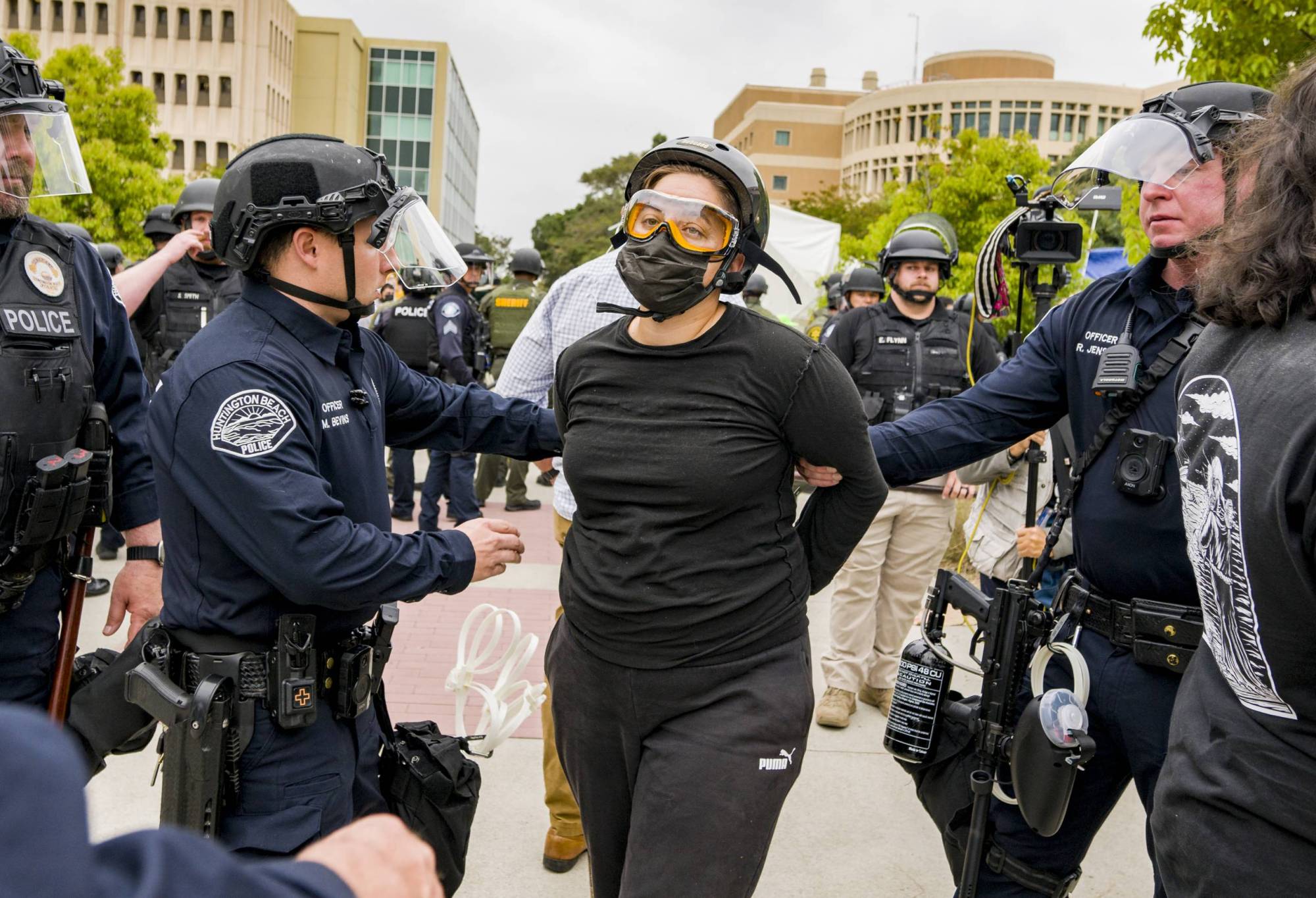
Police detain a supporter of the pro-Palestinian encampment at UC Irvine in Irvine on Wednesday, May 15, 2024.  (Leonard Ortiz/MediaNews Group/Orange County Register via Getty Images)

Here are the morning’s top stories on Friday, July 10, 2026

  • At colleges across California, many campus police departments have AR-15s, stun grenades and sonic weapons. This military-grade gear is supposed to be catalogued and open to public scrutiny. But according to recent reporting from CalMatters’ College Journalism Network, the law meant to sunshine that information isn’t really being followed. 
  • New research from UC Davis shows California gray wolves are eating cattle more than anything else, and their presence is causing significant stress among livestock.

California colleges reveal their military weapons stockpile after CalMatters investigation

For many public colleges and universities in California, keeping their campuses safe includes owning military-grade weaponry — AR-15s, stun grenades designed to cause temporary blindness and sonic weapons that resonate so loudly they are known in the armed forces as the voice of God.

According to state law, campus police can only own military equipment if the college believes there is no other way to uphold civilian safety. That law, which passed in 2021, also requires police to make all their equipment dealings exceedingly clear to the public. However, not every college follows every part of the law, according to an investigation by CalMatters into all 148 public campuses in the California Community Colleges, University of California, and California State University systems.

Each campus’s state or district governing board — which gives permission for police to procure such items — has to annually re-approve a use policy, a chronicle of when the equipment has been used and an inventory. Once the report is approved and published online, campus police have 30 days to hold a conveniently located and “well-publicized” forum for the public to learn about and give feedback on the equipment, according to state law.

CalMatters attempted to compile the 2025 annual reports and use policies from every public higher education police department in the state that owns military equipment. Several campus police departments created reports after CalMatters’ inquiries, though the law requires the documents to be posted online as long as the equipment is usable. Not all reports or policies contained the details mandated by the 2021 law; in many cases campuses left out information, including manufacturers’ product descriptions, up-to-date inventories and equipment quantities. The University of California Board of Regents approved UC Berkeley’s annual report last September, but university police only published their equipment list on April 7, after four CalMatters inquiries.

According to their own reports, San Jose State University and San Francisco State University own AR-15s even though Cal State’s policy does not authorize it. Cal State spokesperson Amy Bentley-Smith said these AR-15s are standard issue, which would exempt them from the reporting requirement, even though San Jose’s report classifies them as specialized firearms and university police departments determine what equipment is standard issue. San Francisco’s semi automatic rifles are standard issue and won’t be listed in the annual report going forward, university spokesperson Robert King said. Campus police also must submit their yearly report to their district or state governing boards. Chico State and Cal State Northridge police said their reports are sent to the Cal State chancellor’s office, which the systemwide policy requires. But Klarissa Garcia, executive assistant to the chief of police at Cal State Dominguez Hills, said her department does not submit its report to any governing body.

Multiple police departments said they did not hold a campus forum in 2025, including Cal Poly Humboldt and Cal State Sonoma, nor did they respond to inquiries about when the required public meeting was held. Many departments said they held meetings, but did not answer questions about how they publicized them, or said they posted announcements on social media without any record of it on their accounts.

But following CalMatters’ inquiries, several campuses — as well as the Cal State system — said they are hereafter committed to following the military equipment transparency law in its entirety. In addition, some are downsizing their inventory.

New research examines what California gray wolves are eating

New research from UC Davis shows California gray wolves are eating cattle more than anything else, and their presence is causing significant stress among livestock.

Researchers examined wolf scat samples collected from members of the Lassen and Harvey packs in northeastern California. They found 72% of scat contained cattle DNA either through predation or scavenging.

UC Davis Professor Tina Saitone, who led the study, said it’s unusual and more in line with wolf diets in Europe. One driving factor is the scarcity of wild prey in California compared to other parts of North America that have elk, moose, or bison. “Mule deer populations have been in decline since the 1960s for a variety of reasons, right? Vehicle collisions, wildfire, predators including bears and mountain lions and now wolves,” she said. “And so obviously that deer population is under a lot of pressure.”

Saitone said wolf conservation is in part successful because of livestock producers

A second study measured the levels of cortisol, the stress hormone, present in tail hair samples of livestock. “Mammals as they have higher levels of stress, they actually deposit cortisol in their hair follicles. So, as hair grows on a continuous basis, we get a picture of their stress-related experience over time,” Saitone said.

It marks one of the first times that’s been done to study how reintroduced predators reshape livestock physiology. It found herds living among wolves had cortisol levels nearly 60% higher than those in control herds.


lower waypoint
next waypoint
Player sponsored by