upper waypoint

Family Medicine Doctors Help Provide Maternity Care in South Monterey County

Over the past decade, dozens of maternity wards have shut down across California.
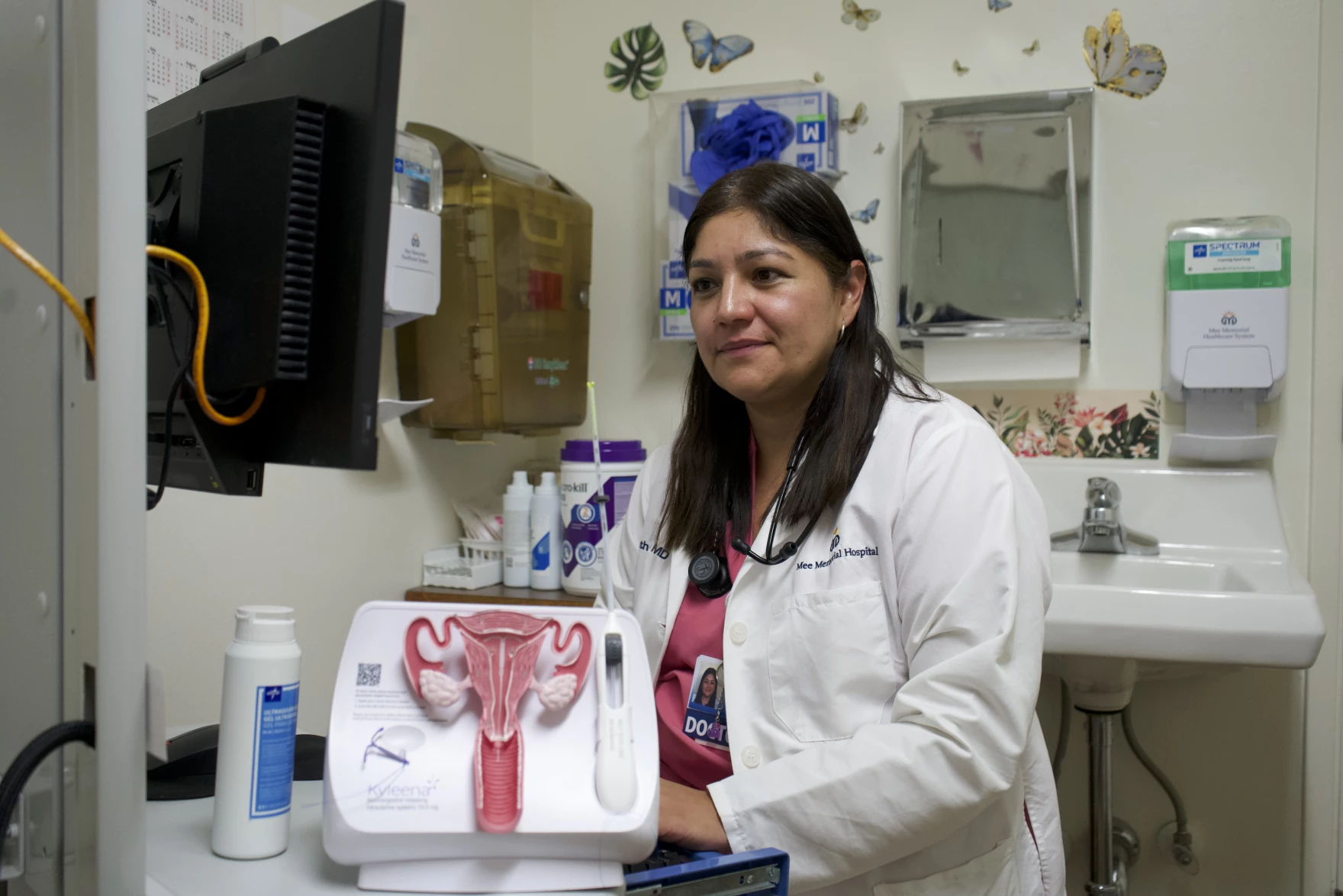
Dr. Ruth Pedraza, a family medicine physician at Mee Memorial Hospital in King City, did an obstetrics fellowship at the county’s public hospital, Natividad, in Salinas. She now provides prenatal care to expectant moms in South Monterey County. (Ngozi Cole/KAZU)

Here are the morning’s top stories on Thursday, June 18, 2026

Monterey County patients get assistance with maternal care

Mee Memorial Hospital, the only hospital in southern Monterey County, serves a largely rural and farmworker population of about 80,000. It’s located in King City, a small town in the Salinas Valley. That’s where Dr. Ruth Pedraza sees about 25 patients a day. As a family medicine physician, she treats people of all ages, from babies to the elderly. And that pool includes some who are pregnant.

“We follow up with them after their regular screenings, but also see their child too (when they’re born),” Pedraza said. Mee Memorial hasn’t had a labor and delivery unit for six years. But since then, family medicine doctors like Pedraza, with additional training in obstetrics, have stepped in to help pregnant patients get prenatal care.

Babies in South Monterey County still have to be delivered about an hour away at major hospitals in Salinas. But during consultations, Pedraza makes sure expectant moms know that pre-natal testing, which helps prevent stillbirths, is also available at Mee Memorial. “I sometimes tell patients, ‘Why don’t we do (pre-natal testing) once here and once over there?'” she said. “They’re like, ‘I have no transportation.’ Great, we can do it here in the clinic.”

Pedraza did an obstetrics fellowship at the county’s public hospital, Natividad in Salinas, where she trained to do vaginal deliveries and C-sections, and to manage high-risk pregnancies. Natividad is one of the seven hospitals in California offering obstetrics fellowships to family medicine physicians. This level of care is important in rural areas, where hospitals like Mee Memorial have been hit hardest by financial challenges and staffing shortages.

Data from the California Hospital Association show that more than 50 maternity care units have closed or been suspended over the last decade. Association president Carmela Coyle said hospitals have to think creatively about filling these gaps. This includes integrating other providers like family medicine physicians, into the labor and delivery team to lessen dependency on OB-GYN expertise. “Of course, OB-GYNs are central to the team, but can we think about how we can use our healthcare workforce more flexibly?” Coyle said.

But some experts say this doesn’t fully serve pregnant patients, especially those who do not live near a major hospital. Alecia McGregor, a maternal health researcher at Harvard University, has studied the impact of maternity ward closures across the U.S.

Her research found that  patients who gave birth when their nearest labor and delivery unit closed had a higher risk of having complications during childbirth than those who gave birth at a hospital closer to home. McGregor argues that what family physicians can do to help pregnant patients is limited in addressing this disparity. “Just having a family medicine doctor available for prenatal care or outpatient care doesn’t solve the problem of not having a place available for a safe delivery,” she said.

A tax on billionaires qualifies for the November ballot

A union wants California’s billionaires to rescue the state’s healthcare system. The billionaires have other ideas.

On June 17, an initiative to tax the state’s wealthiest residents qualified for the ballot, according to the secretary of state’s office, which verifies petition signatures.

The proposed initiative would levy a one-time 5% tax on California residents whose net worth exceeded $1 billion at the start of this year. The tax would hit roughly 200 people, and billionaires could pay in installments over five years. Proponents of the measure estimate it would generate $100 billion for the state. The revenue would go into a special fund with 90% reserved for healthcare spending and 10% for education and food assistance programs.

Gov. Gavin Newsom, who has consistently swatted down the idea of tax increases throughout his tenure, emerged early as an opponent of the proposed tax. Wealthy allies in Silicon Valley joined the fray armed with deep pockets and threats to leave the state, which depends disproportionately on high earners for revenue.

The union funding the measure, Service Employees International Union-United Healthcare Workers West, says California needs the revenue that would be generated by the measure to rescue the healthcare system from deep cuts that the Trump administration made last year in the president’s tax reform package. Newsom is reportedly trying to negotiate a last-minute deal that would pull the initiative before the ballot is finalized on June 25.

In Orange County, six-figure salaries now qualify as ‘low income’

In much of the country, a six-figure salary is a benchmark for success. That sixth digit tends to symbolize professional achievement and a degree of financial security.

But in Orange County, individuals earning up to $104,200 now qualify as “low income.” California’s Department of Housing and Community Development released its official state income limits for 2026 on May 29. These thresholds determine who is eligible for income-restricted apartments and other housing assistance programs.

Under the new limits, one-person households in Orange County earning $104,200 per year or less qualify for low-income housing. Last year, the cut-off was $94,750. “It just feels so crazy to me,” said Megan Junanto, a 23-year-old actuary living in Irvine. She recently received a raise putting her above the low-income threshold. But last year, she would have qualified. “I felt like one of the most well off compared to people in my age group, and I am near low income, and last year I was low income.”

Housing policy experts say the ever-rising goalposts for financial stability make it hard for Orange County to retain teachers, nurses and other middle-income workers, who are needed to make a local economy function. Despite earning relatively high incomes, some young residents feel they need to give up on the idea of buying a home in Orange County.

lower waypoint
next waypoint
Player sponsored by