Episode transcript
Olivia Allen-Price: Hey everyone! This is Bay Curious. I’m Olivia Allen-Price. Crossing bridges can be essential to getting around the Bay Area. No matter what side of the water you live on, odds are, you’re probably going to use a bridge sooner than later.
And for the people who live, work or just hang out in the City of Alameda, crossing a bridge is almost non-negotiable. The island is connected to the rest of the Bay by six drawbridges, as well as two underwater tunnels, that span the Oakland Estuary.
When those bridges open to let a boat pass, everybody has to wait. One day, Sarah Reid was in her car, watching the Park Street bridge open, when she noticed a little room attached to one of the bridges.
Sarah Reid: And I remember looking up at those little rooms wondering, does someone just sit up there all day? And what is that like,
Olivia Allen-Price: She also wants to hear some stories …
Sarah Reid: What’s a good day look like? What’s a bad da y? What’s the weirdest thing that’s ever happened
Olivia Allen-Price: Turns out – yeah! There’s a bridge tender sitting in that little room 24/7. And they’ve seen a lot! KQED’s Azul Dahlstrom-Eckman has the story.
Cars on Bridge Noise
Azul Dahlstrom-Eckman: Car tires hum against the steel deck of the Park Street Bridge. This hypnotic drone is the bridge’s soundtrack.
Damon Wallace: I grew up on these bridges. Um, the sound of the cars going overhead is, is soothing to me. It’s like a, it’s a comfort thing.
Azul Dahlstrom-Eckman: That’s Damon Wallace, he’s a bridge utility worker for Alameda County’s Public Works Agency.
Damon Wallace: I’ve been doing that for about two years, and prior to that I was a bridge tender.
Azul Dahlstrom-Eckman: Bridge tenders are the people that operate Alameda’s drawbridges. It runs in his family, his father and his uncle both held the job when he was a kid.
Damon Wallace: My dad 25 years. Uh, my uncle, uh, a little bit less than that.
Azul Dahlstrom-Eckman: We’re standing in the machinery room underneath the Park Street Bridge…its a large concrete bunker full of tools and the giant electrical motor that opens and closes the bridge
It’s like a little Home Depot in here, just for the bridge, they’ve got everything they need to keep the bridge running which is essential because The Park Street Bridge is the busiest of Alameda’s bridges. Around 40,000 vehicles travel across its four lanes on an average weekday.
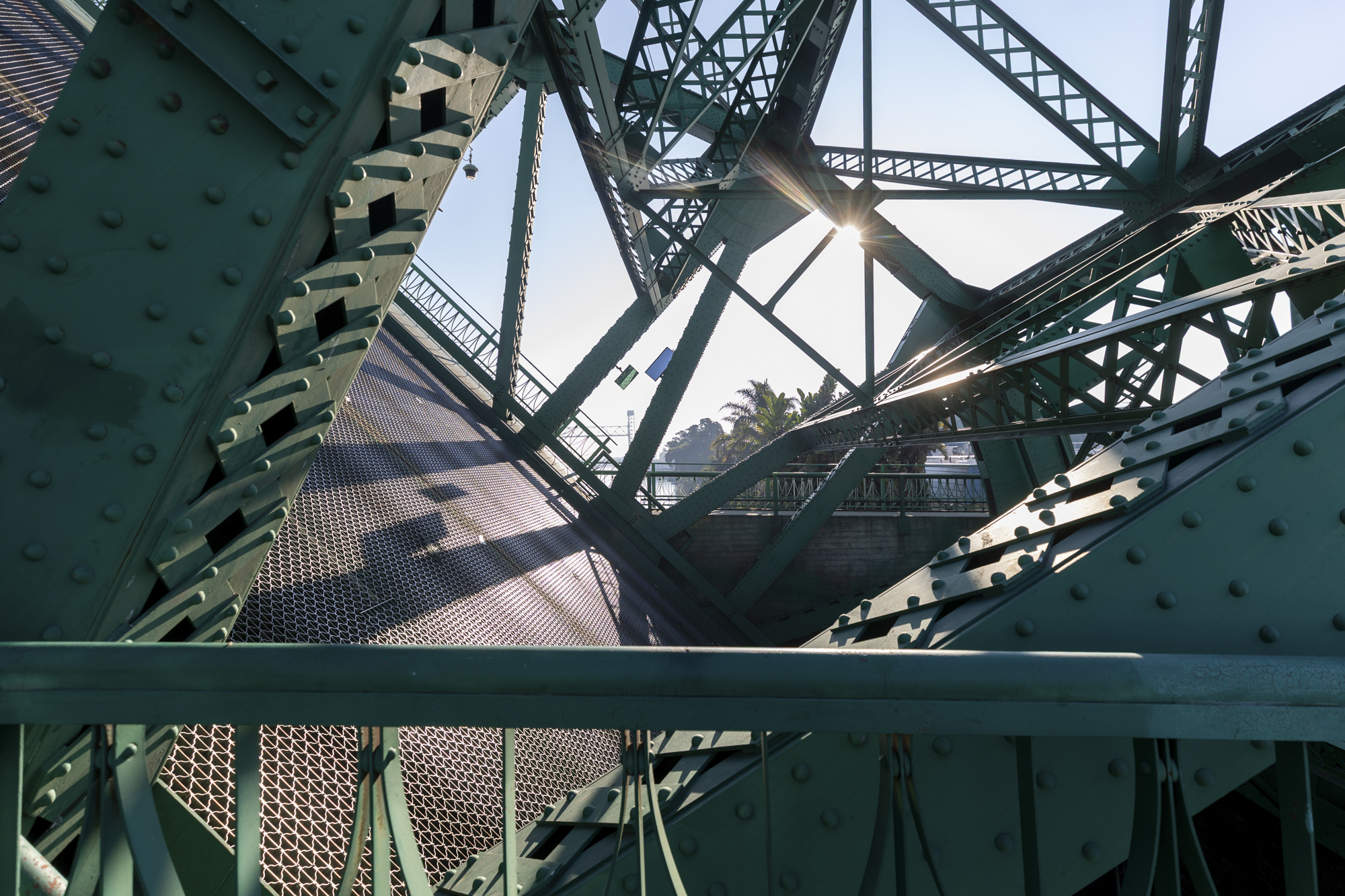
Up on the deck of the bridge, which is about the length of a football field we can see Berkeley, downtown Oakland, and ships at the Port of Oakland. We walk up to the bridge tower. It’s fixed on the Alameda side of the bridge, and almost looks like a little miniature clock tower.
Carl Speaker: Knock, knock. Hello.
John Williams: Come on up.
Carl Speaker: How you doing, John?
John Williams: Good.
Azul Dahlstrom-Eckman: We head up a spiral staircase to the top floor.
John Williams: Welcome to Park Street Bridge, uh, Alameda County Public Works Agency. How you doing?
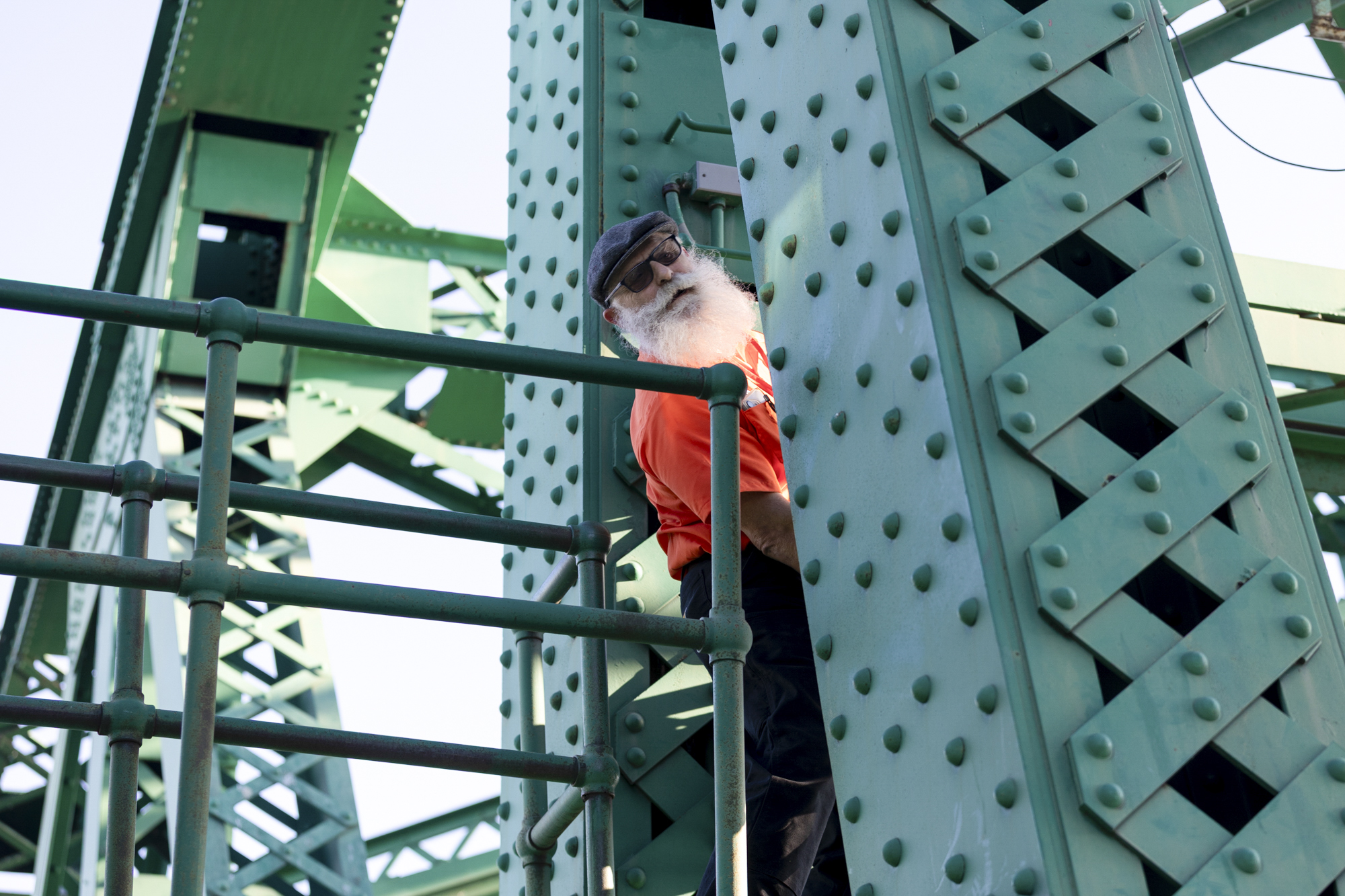
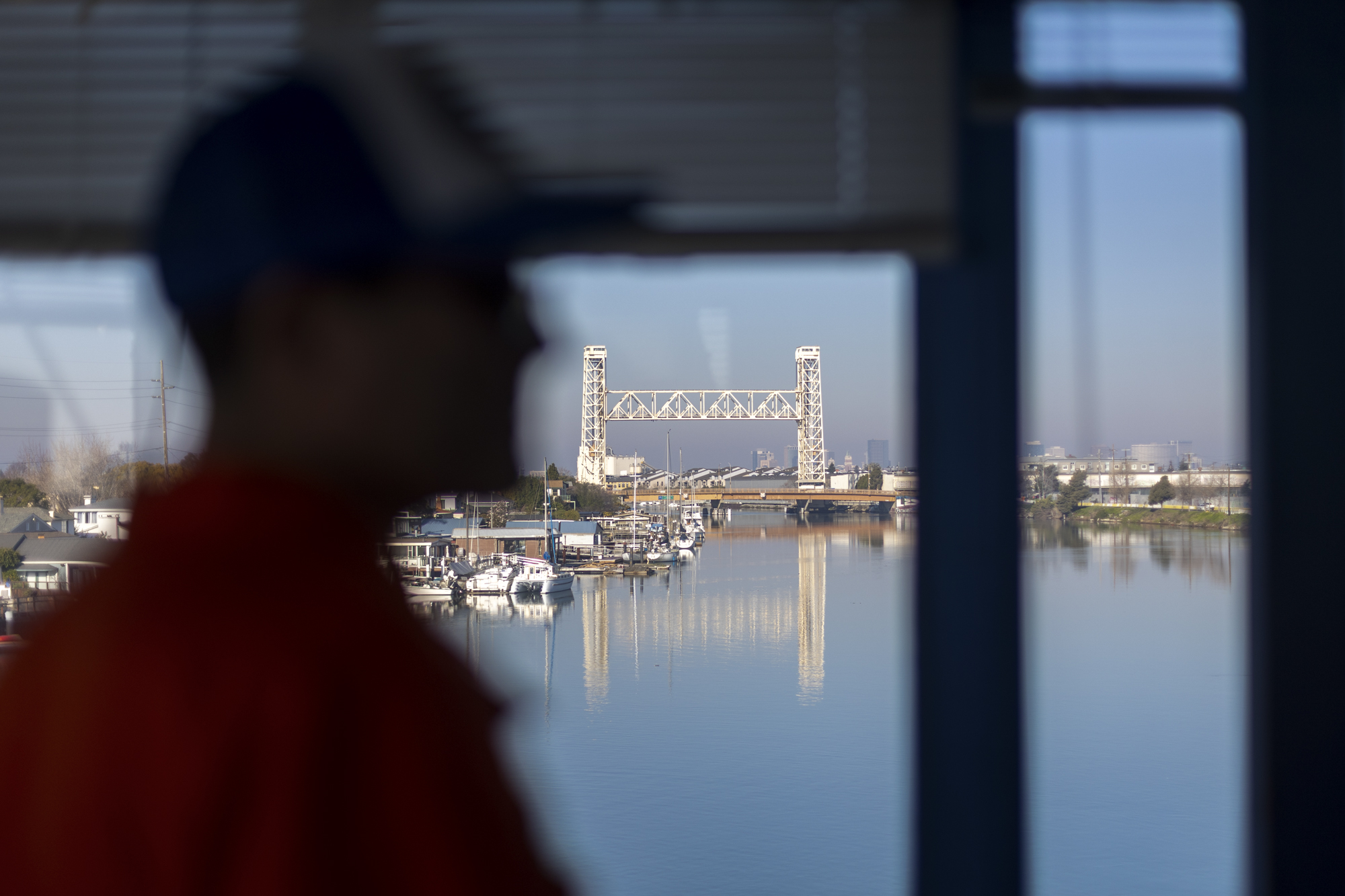
Azul Dahlstrom-Eckman: John Williams is the bridge tender on duty right now. He’s got a big white beard and his orange public works shirt tucked into his work pants.
John Williams: It’s the best job in the world, you know, I mean, I, it’s really an excellent job
Azul Dahlstrom-Eckman: The top floor is just one room with windows all around, giving the operator a 360 degree view of the bridge and the Oakland estuary. One end is all business: with a control panel for operating the drawbridge,
Azul Dahlstrom-Eckman (in scene): Wow. There are a lot of big red buttons there,
John Williams: right? There are. And you don’t just randomly push them either.
Azul Dahlstrom-Eckman (in scene): Oh, that’s too bad.
Azul Dahlstrom-Eckman: There’s also a maritime radio, security cameras, a log book and a laptop. In a corner of the other side of the room is a little kitchenette, there’s a french press and an avocado sitting on the counter.
John Williams: I’ve seen a lot of wildlife out here over, over the years. You know, way l one time, lot of otters now and then, um, a lot of seabirds.
Azul Dahlstrom-Eckman: Some great sunsets too. John says he found the job on Craigslist. Besides the perks, he says this job has some big responsibilities. Public safety is their number one concern.
John Williams: Our first job is to make sure no one gets hurt while we’re operating these massive machines.
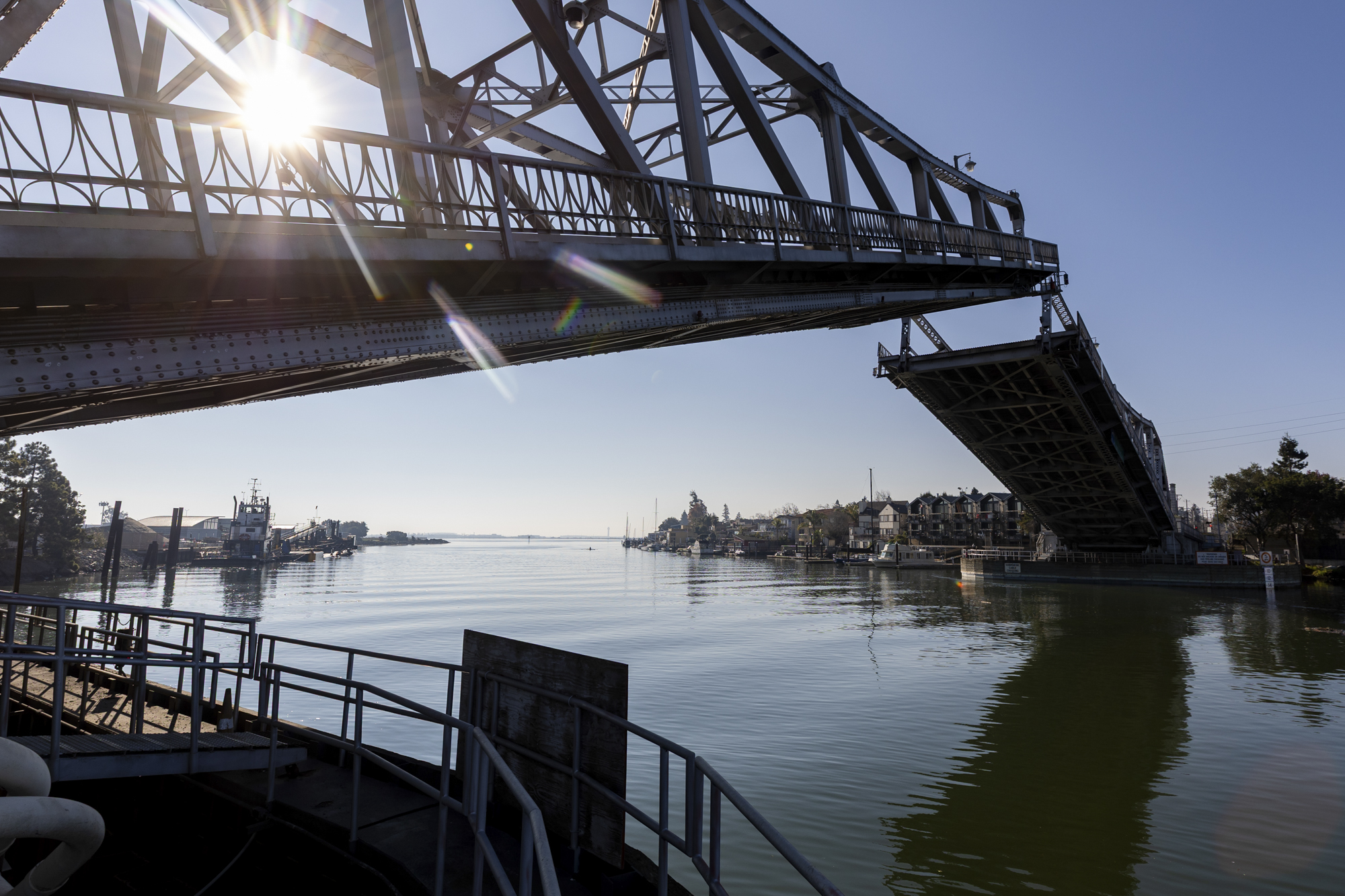
Azul Dahlstrom-Eckman: A normal opening of the bridge splits the road deck in half, tons of concrete and steel lift into the sky at a 70 degree angle, about 143 feet in the air. The process requires constant vigilance and double, triple checking.
John Williams: Cause people will run on the bridge while it’s moving. They’ll go underneath the barriers. I think twice we’ve had people run their cars through the barrier.
Azul Dahlstrom-Eckman: And that’s just keeping the PEOPLE safe. The bridge also needs to be opened in a timely manner so that a boat doesn’t hit it.
John Williams: You get a call and tug and barge is coming in with like, you know whatever, 20 tons of gravel, you know, with a, a fat tide behind them pushing ’em in, in wind, and you have to open the bridge. You can’t not open the bridge. It’s very hard for ’em to stop. Really hard for ’em to stop.
Azul Dahlstrom-Eckman: All but two of Alameda’s drawbridges are staffed around the clock because ships, including the nearby Coast Guard base, need to be able to travel up and down the estuary at all hours. On a busy day, the Park Street bridge might open and close 14 different times.
John Williams: I could be in a crowd of a thousand people and if somebody on the other side of that crowd said Park Street Bridge, I would hear them. Because I’m trained to hear it, you know, the radio call.
Azul Dahlstrom-Eckman: Boats can schedule openings ahead of time, or just call to request one. The bridges don’t open during the morning and afternoon rush hour unless a boat makes an appointment
Azul Dahlstrom-Eckman: John comes off pretty relaxed and friendly, but when it comes time to open the bridge, he gets intensely focused.
Azul Dahlstrom-Eckman: Right now, there isn’t a ship passing, this is an operational check, that the tenders do from time to time, to make sure everything is working as it should. John starts by opening all the blinds in the little tower room. He wants full visibility. And he stops talking to me. He says he needs to concentrate.
John Williams (in scene): St and clear for bridge opening. Please stand clear for Park Street Bridge opening
Azul Dahlstrom-Eckman: First he drops the gates and barriers to keep cars and pedestrians off the bridge, and makes sure all the traffic is stopped. Then he walks out on a little catwalk extending out from the tower, and double checks that nobody is in harms way.
Sounds of birds
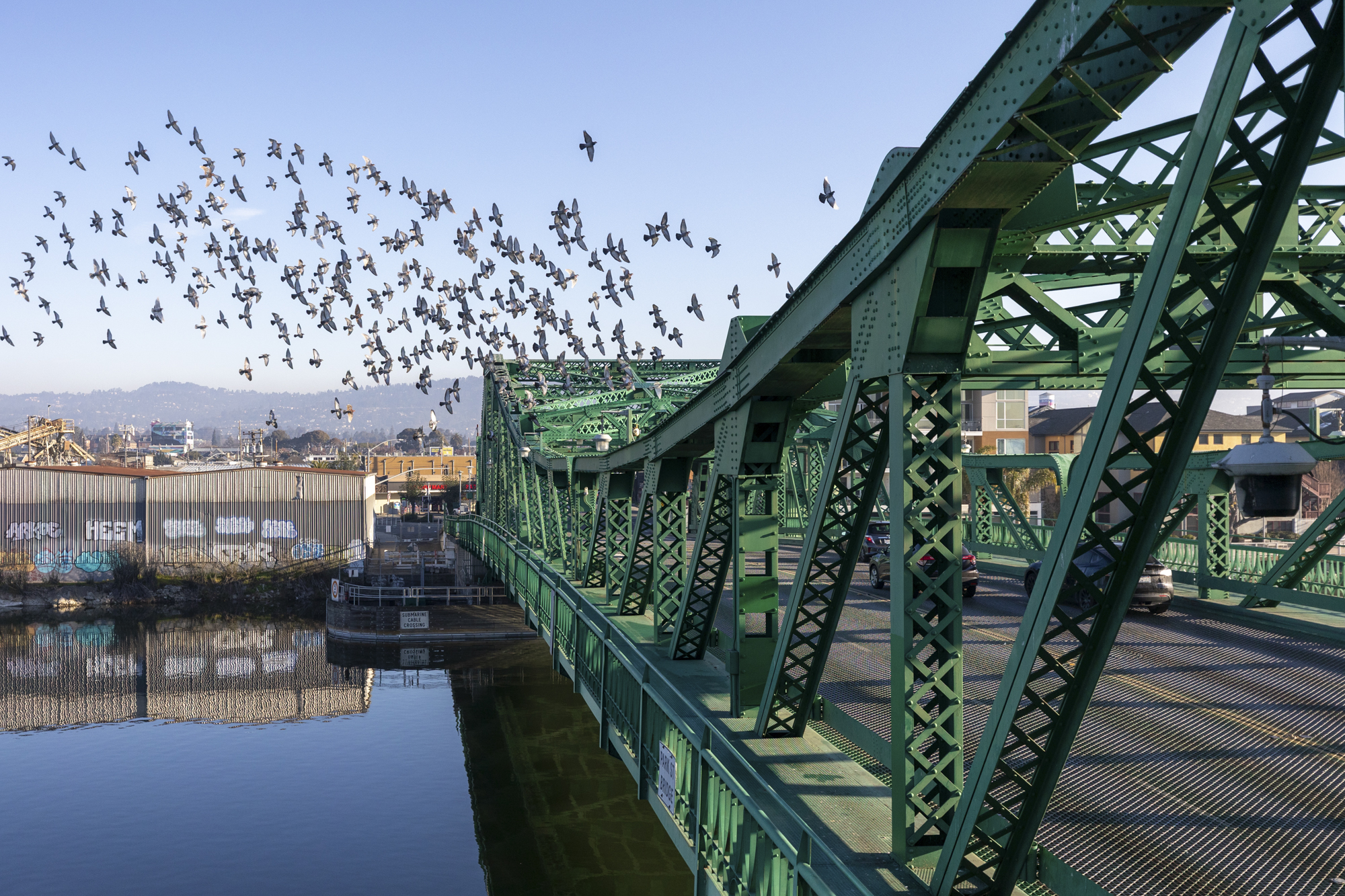
Azul Dahlstrom-Eckman: Just then, recordings of birds play underneath the bridge, in an attempt to shoo nesting pigeons away.
Azul Dahlstrom-Eckman: And then it gets pretty quiet. The hum of traffic stops, and the bridge begins to rise. You can hear the electrical motors whirring. For Damon, the second generation bridge worker, it’s a special moment.
Damon Wallace: It’s these giant machines, and you don’t realize they’re machines until you’re up in the tower the first time and you press that button and the your world starts to tilt sideways.
Azul Dahlstrom-Eckman: He says there’s something magical about it.
Damon Wallace: For a minute you get to just sit there and watch this amazing, surreal thing happened right in front of you. And it’s, it’s, it’s one of my favorite things, you know? It always has been.
Azul Dahlstrom-Eckman: With the bridge sticking straight up in the air, John checks again before letting it down.
John Williams: Okay, you guys. All right?
Voices: good!
John Williams: Coming down.
Azul Dahlstrom-Eckman: And then, John guides the bridge slowly back down, metal locks click back together underneath the road deck, and the traffic starts again.
It’s clear the bridge tenders are essential. But in this world of technological innovation, especially artificial intelligence, I wonder, how much longer will these jobs be around? I put that question to John Medlock, he’s the Deputy Director of Maintenance Operation for Alameda County, PublicWorks Agency.
John Medlock: At some point in time, you know, maybe, maybe everything needs to be replaced. We’ll probably find new technology or, or new way of spanning the, uh, the estuary. But right now that’s what we have and love it or hate it. If that’s what we have.
Azul Dahlstrom-Eckman: He thinks the bridge tenders, will be around for the foreseeable future.
Olivia Allen-Price: When we return – some history of these drawbridges. And the unique ways bridge tenders pass the time. Stay with us.
SPONSOR MESSAGE
Olivia Allen-Price: Nowadays Alameda’s bridges are a reliable way to get on and off the island. But it wasn’t always that way. Here’s Azul again…
Azul Dahlstrom-Eckman: Ever since early European settlers founded the city of Alameda, its residents have had to navigate getting across the strip of water and marshland … separating it from Oakland. And bridge tenders have been part of that history.
Dennis Evanosky: The problem started in, in the, in the 1870s when people on the west end of Alameda complained, ‘Boy Oakland’s right over there. We’d like to get over there.’
Azul Dahlstrom-Eckman: That’s historian Dennis Evanosky. The first bridge to connect Alameda to what’s now Oakland was the Webster Street bridge, built by Alameda County in 1871. It’s now long gone. And pretty much from the get go, it had its fair share of tragedies.
Dennis Evanosky: The Webster Street Bridge was a disaster.
Azul Dahlstrom-Eckman: It wasn’t a drawbridge, but rather a swing bridge, that could turn 90 degrees, out of the way of ship traffic. This was the design of most early Alameda bridges. But Evanosky says it was hit by ships multiple times, and in 1900 was the site of a tragic train accident.
Dennis Evanosky: They misunderstood a signal and, and the, the whole train dumped into the estuary.
Azul Dahlstrom-Eckman: Thirteen people were killed. The Webster Street bridge couldn’t catch a break. It was destroyed and rebuilt 3 more times, and its successors were the site of more ship collisions, a fire, and an attempted bombing. The bridge was dismantled for the last time, shortly after the construction of the Webster Street Tube in 1928., the tube is an underwater tunnel connecting Oakland and Alameda.
And that’s kind of the story of all of Alameda’s bridges. Some don’t exist anymore, but the ones that do have been rebuilt, at least once.
Dennis Evanosky: So each of the bridges has two lives.
Azul Dahlstrom-Eckman: And it hasn’t been all ship strikes and disasters. Alameda residents have had some fun along the way.
Dennis Evanosky: And then the people, uh, who, who were really close by when they heard the boat toot for permission, they’d all run down there and they’d ride the bridge.
Azul Dahlstrom-Eckman: …Climbing on the bridge as it swung open and taking it for a ride. People even did this on the current version of the park street bridge. Clinging on as the drawbridge raised open.
Dennis Evanosky: That’s pretty dangerous. So they, they, they put a stop to that.
Azul Dahlstrom-Eckman: The cities of Alameda and Oakland commemorated the opening of the latest Park Street Bridge in 1935, with a wedding between a woman from Alameda and a man from Oakland.
Voice over reading newspaper clip: Miss Edith Bird of Alameda became Mrs. Edward M. Drotloff of Oakland yesterday afternoon. The ceremony that united them as they stood at the site of the newly-completed Park Street Bridge symbolized the uniting of the two cities by the huge structure.
Azul Dahlstrom-Eckman: It was a huge party. There was a parade, marathon runners from oakland, and the mayors of the two towns clasped hands as hundreds came out to see the new bridge. The same one that stands today.
Today, there are 14 bridge tenders that work the Alameda bridges, and they switch between all 6 of the bridges.
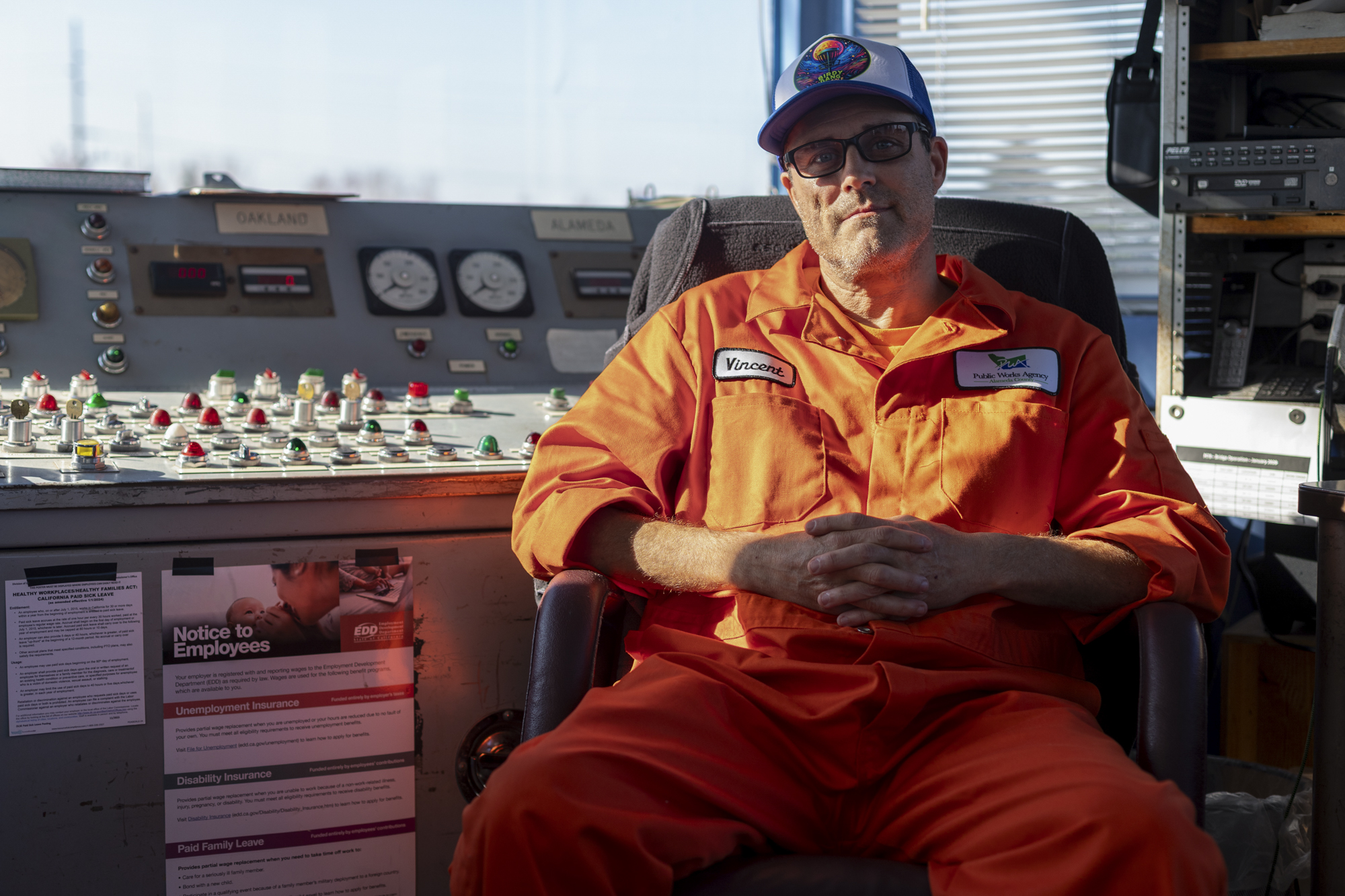
Azul Dahlstrom-Eckman: When I go to visit the High Street Bridge, Vincent Cerletti is the bridge tender on duty. He’s wearing orange alameda county coveralls, and a psychedelic trucker hat for a disc golf supply company. This bridge sees less traffic, so has a calmer vibe.. Across the water I can see houseboats bobbing up and down.
Vincent Cerletti: There’s a lot going on out there. It’s peaceful. The birds. Oh man. When you get these huge flocks that come flying in here and settle into the estuary, it’s like a, like a painting.
Azul Dahlstrom-Eckman: Vincent has been a bridge tender for more than ten years.
Vincent Cerletti: It’s the first regular thing that I got into that gave me a stability working for the county, which has been awesome.
Azul Dahlstrom-Eckman: And he’s seen some things.
Vincent Cerletti: Like a guy with a couch once came down with a, a, you know, like the small little trolling motor on the back? I think he was floating on, on a piece of a dock with a couch on it. A little motor. He’s fishing. He was having a good time.
Azul Dahlstrom-Eckman: He says that in order to be a bridge tender, you have to be ok with spending a lot of time by yourself.
Vincent Cerletti: Some guys paint, paint, little, uh, pictures, you know, watercolors of the boats and stuff.
Azul Dahlstrom-Eckman: He says one bridge tender fixes electronics to pass the time. Vincent, likes to bring his Ukelele.
Vincent Cerletti: Yeah. So I just, uh, yeah. Sit here and.
(Ukelele Music)
Vincent Cerletti: And when you’re here on like, you know, Christmas Day and New Year’s Eve and Thanksgiving, I worked all those holidays this year. I dunno, you gotta have somewhat of a little hobby to pass the time.
Azul Dahlstrom-Eckman: Do you ever feel lonely?
Vincent Cerletti: Sure. Yeah, it’s kind of hard to have a relationship if you’re doing graveyards, you know, seven nights of the month and you’re on swing shift. So you take off at two o’clock and get home at 11.
Azul Dahlstrom-Eckman: Being a bridge tender can be tough, but its also rewarding. Here’s Damon, the bridge tender we heard from in the beginning.
Damon Wallace: It’s honest work. It’s, uh, and it’s kind of a special thing, these sort of infrastructure, this kind of machinery, this sort of job. It, it does. There’s not a lot of it left, and, uh, I’m proud to be part of it. I am.
Azul Dahlstrom-Eckman: He says he’s started to bring his kids to work.
Olivia Allen-Price: That was KQED’s Azul Dahlstrom-Eckman.
If you want to learn more about Alameda, including how it isn’t actually a natural island – hit up our show notes where we’ve linked some other Bay Curious episodes you might enjoy.
Bay Curious is gearing up for KQED Fest – an all-day open house at KQED’s headquarters in San Francisco. It’s a block party with educational activities, live music, food, and more! I’ll be doing a fireside chat about how we make Bay Curious at 11:15 a.m. Tickets are free, but you do need to register. You can do it at KQED.org/live.
Bay Curious is made by Christopher Beale, Katrina Schwartz and me Olivia Allen-Price.
We get extra support from Katie Sprenger, Maha Sanad, Jen Chien, Ethan Toven-Lindsey and everyone on Team KQED.
Our show is made in San Francisco at member-supported KQED. Big thanks to all our members out there who help keep Bay Curious going. If you aren’t a member yet – please consider joining at KQED.org/donate.
I’m Olivia Allen-Price. Have a good one.