Episode transcript
Olivia Allen-Price: Sometimes questions come from the most random places.
Connie Young: I volunteer for a San José-based kitten rescue and it’s called Itty Bitty Orphan Kitty Cafe.
Olivia Allen-Price: This is Connie Young, from Mountain View.
Connie Young: So we have adoptable foster kittens that come every weekend. And there’s two playrooms. And you can book a 50-minute slot.
Olivia Allen-Price: The kitten cafe where she volunteers is located in Cambrian Park Plaza on the west side of San José.
Connie Young: So I went there to volunteer and I saw that plaza and it was kind of different than the other strip mall plazas in the area.
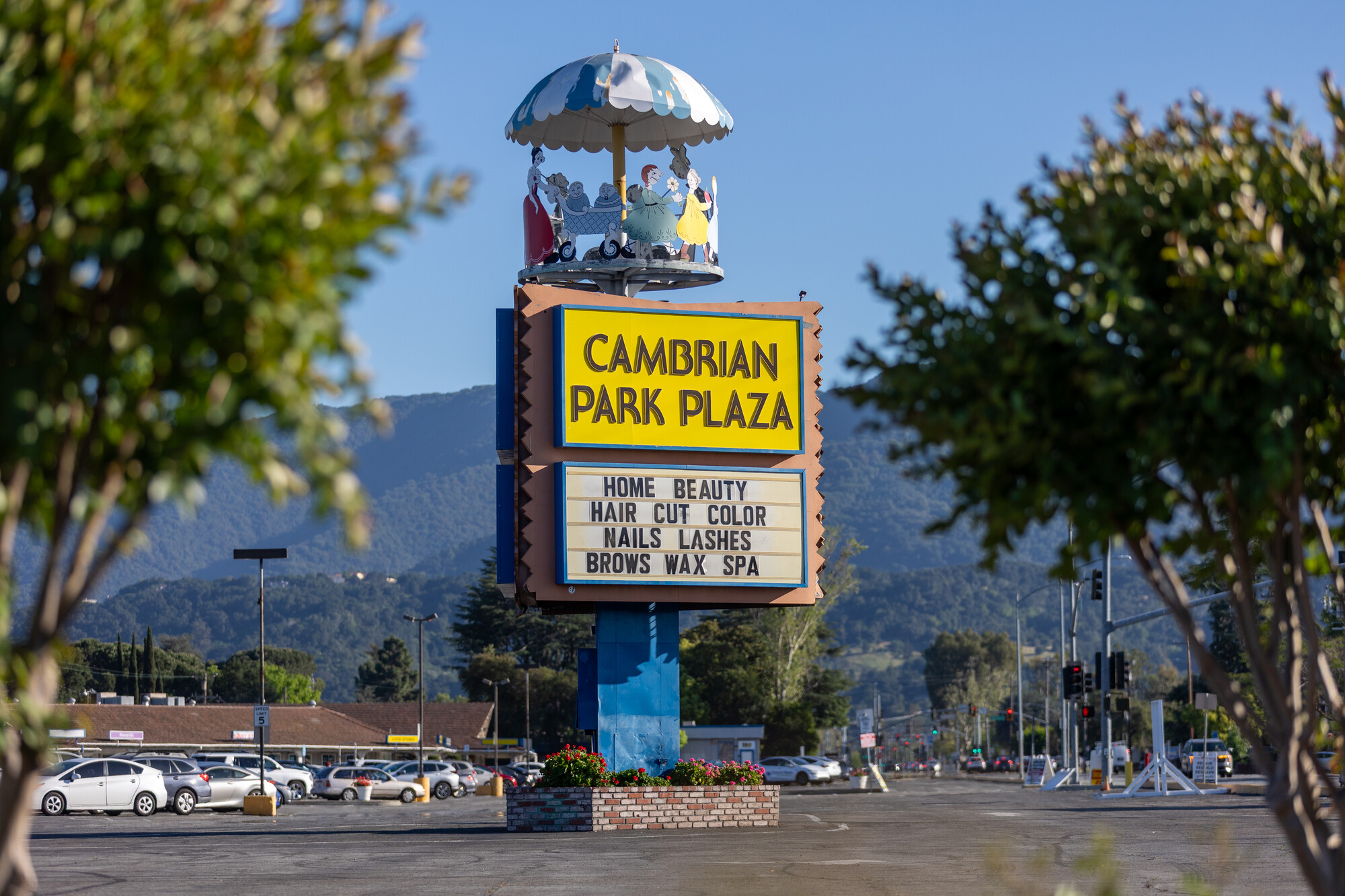
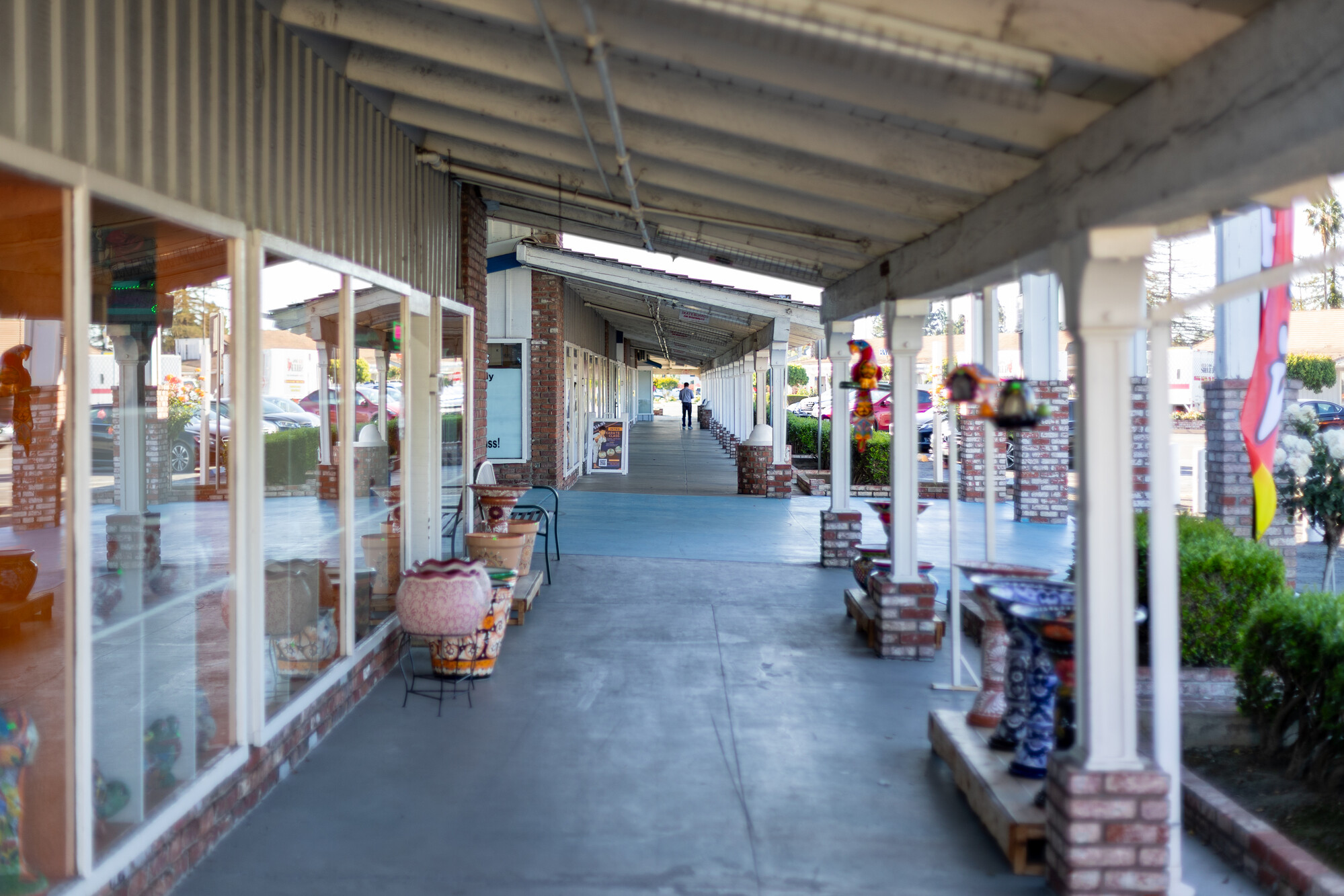
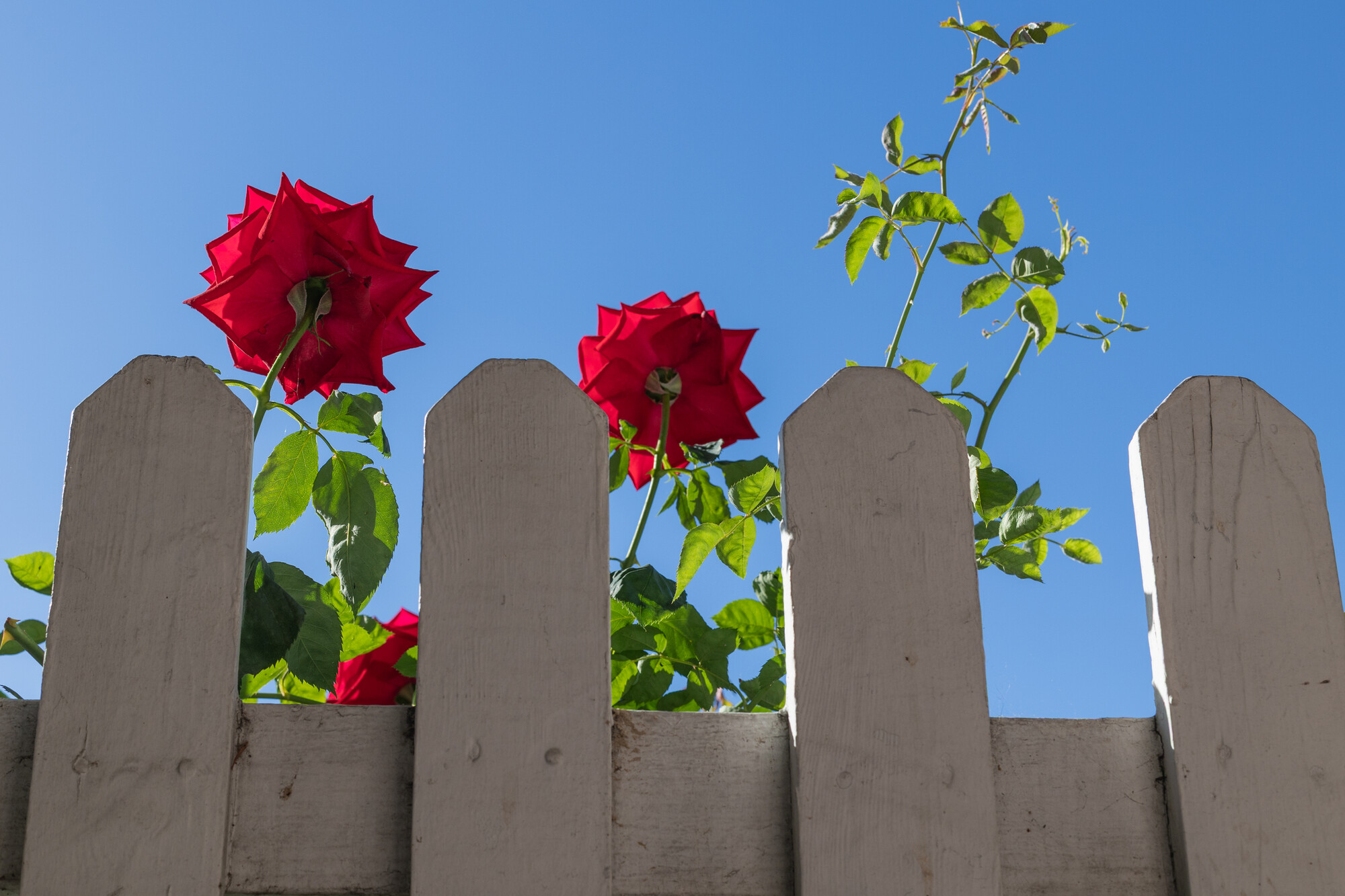
Olivia Allen-Price: Cambrian Park Plaza isn’t one long flat fronted building like a typical strip mall. It was built to mimic the experience of a town’s main street, so the facade turns often, creating little plazas with white picket fences and brickwork. There are window boxes and roses.
Connie Young: It has kind of like a circus slash like English garden theme, cottage theme.
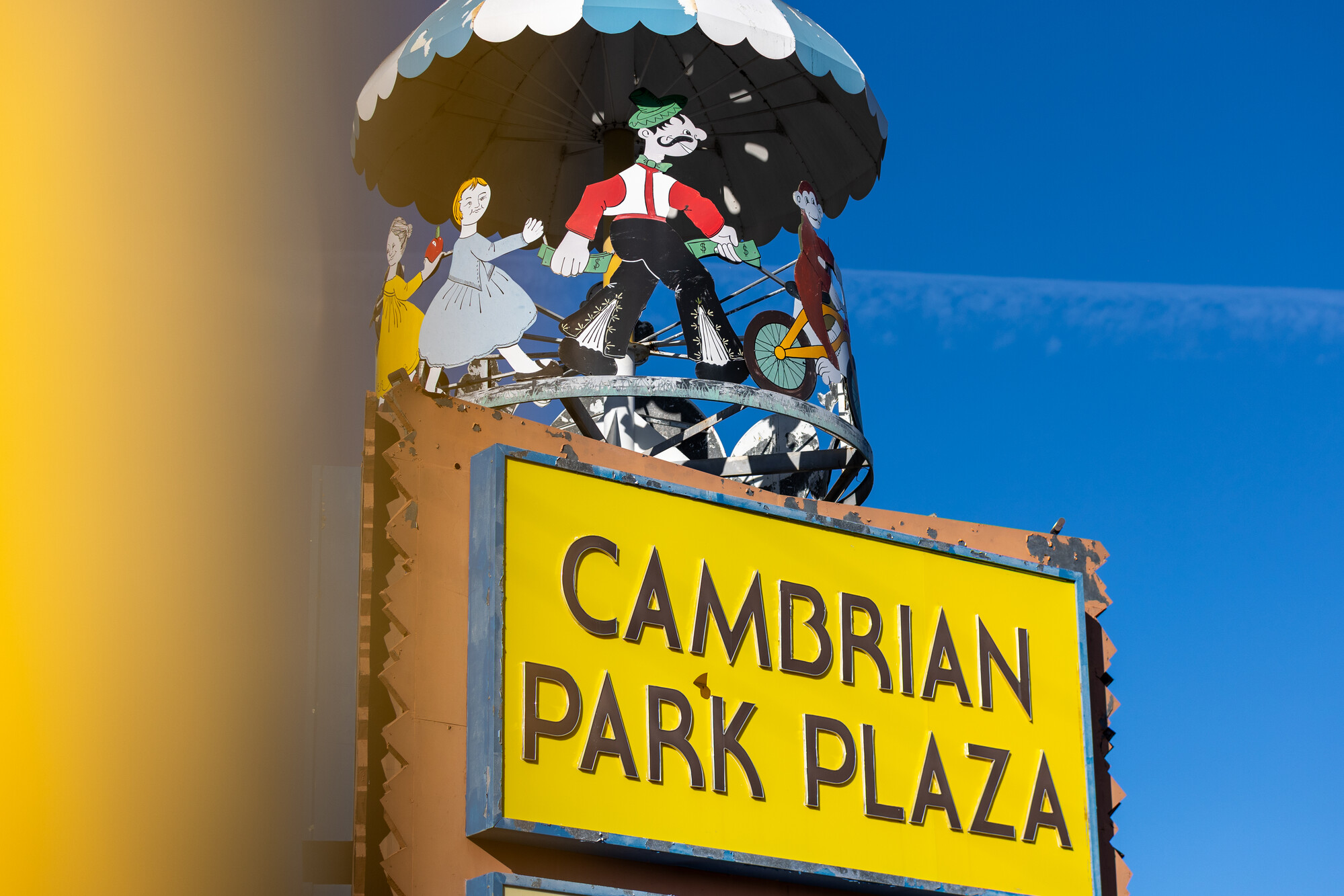
Olivia Allen-Price: Circus because one of the defining features of this plaza is a huge yellow sign with a carousel on top. The figures used to rotate, although like many things in this plaza, it has seen better days.
Connie Young: I was like, this seems like an interesting place and a place that has a lot of history.
Olivia Allen-Price: This shopping mall is slated for redevelopment, and Connie wants to know more about its history and what it could become. Connie also noticed that online many people have shared fond memories of this plaza’s heyday in the 1960s, 70s and 80s. Let’s hear a few…
Jaime Portillo: I remember driving by Cambrian Plaza and seeing the carousel from when we first arrived in San José.
Carolyn Robinson: There was always a grocery store there when I was a little kid. So we’d walk up to the grocery store to do our shopping for the day.
Jaime Portillo: It was a go-to. I mean, you could do everything there. You could go to a delicatessen and get your meats and cheeses,
Carolyn Robinson: There was Ben Franklin, which was the coolest store on the face of the planet. It was like a dime store and you could get anything there.
Janet Gillis: There were hardware stores there. There were pet shops, as I said, the clothing stores, very lot of practical things that, you know, people would need.
Jaime Portillo: And it was in walking distance.
Carolyn Robinson: The minute I think of the smell of bubblegum ice cream, which for a four-year-old that was like Nirvana, I picture myself inside that ice cream parlor.
Jaime Portillo: I remember going to the bowling alley. We used to go there a lot during high school and hang out with the other teenagers.
Carolyn Robinson: To this day remember the sound of the pins hitting the the back wall and the balls striking and people laughing and having a good time.
Janet Gillis: We’d go down in a little group of you know five or six or eight kids and be back before dinner.
Carolyn Robinson: There were so many things that, that as a kid, it made my life feel a little bit bigger and richer.
Olivia Allen-Price: Those were nearby residents Jaime Portillo, Carolyn Robinson and Janet Gillis sharing their memories.
Olivia Allen-Price: Bay Curious editor and producer Katrina Schwartz headed to San José to find out more about the fate of Cambrian Park Plaza.
Katrina Schwartz: The first Cambrian Park neighbors I meet are characters…they’ve been attending city meetings and organizing their neighbors to influence what gets built here for years. And they aren’t shy about some of the tactics they used..
Bob Burres: I’m the guy who kicked over the apple cart, repeatedly.
Katrina Schwartz: This is Bob Burres — a proud instigator. His friend and neighbor, Peter Clarke, has a different approach he says…
Bob Burres: He’s nice, he’s polite, he’s a proper English gentleman.
Peter Clarke: I am the Brit, which is the funny accent.
Katrina Schwartz: Bob and Peter like this neighborhood for its views of the mountains and quiet, neighborly charm.
Peter Clarke: This area was originally all farmland. Then the farmers decided they could make more money by essentially selling up and having housing developed on the periphery.
Katrina Schwartz: The guy who owned all the land that became the neighborhood of Cambrian Park was named Paul Schaeffer.
Peter Clarke: But then he recognized, you know, people need to buy stuff.
Bob Burres: This area was the heart of Cambrian Park. This was the downtown. There is no main street in Cambrian park area. This was it.
Katrina Schwartz: As Peter and Bob are showing me around it’s clear this mall is no longer the heart of the neighborhood. But the neighbors hope it could be again.
Bob Burres: As you go through you see there’s numerous little plazas and sitting spaces all around.
Katrina Schwartz: The plaza has a faded quality. We walk down the outside of the building, which has covered walkways that protect us from the rain that’s falling. Many storefronts are empty and I hear just as much about what it used to be as what it is now.
Bob Burres: This used to be the Cambrian Post office for years.
Peter Clarke: That used to be a Mexican restaurant, but closed down.
Katrina Schwartz: The things that are left… a boxing gym, a pet adoption agency, a store for kids baseball gear…are on short term leases.
Bob Burres: You can’t put a lot of investment into a retail space for a six month lease.
Katrina Schwartz: Peter and Bob have both lived in Cambrian Park for 30 years… but even back in the late 80s and early 90s the plaza was already in slow decline. The Schaeffer family owned it for most of its existence, but stopped keeping it up in later years. When Paul Schaffer and his wife died, their children sold it to a developer.
Peter Clarke: When it was bought and people said we’re going to redevelop it, we were in favor.
Katrina Schwartz: Peter and Bob are part of a group called the Friends of Cambrian Park Plaza. They’ve been pushing the city and developers to create a vibrant place to live, shop and gather.
Peter Clarke: We have hopes that something beautiful will come out.
Katrina Schwartz: They look to a place like The Pruneyard in Campbell as their model. It’s got local businesses alongside chains..and is a pleasant place to hang out.We’ll dig into the details of what could be built here and explore why achieving that vision could be a tough sell in San José right now. All that, coming up.
SPONSOR MESSAGE
Katrina Schwartz: Almost a million people live in San José. It’s the largest city in Northern California, but its development hasn’t followed the pattern of a typical big city. That’s why despite being dubbed the Heart of Silicon Valley…many people think a more apt term would be “the bedroom” of Silicon Valley.
Michael Brilliot: If you look at San José, it very much feels like you’re in the San Fernando Valley or somewhere in Los Angeles, not the old urban part, but the more auto suburban track housing part of LA.
Katrina Schwartz: Michel Brilliot worked for the city of San José for 27 years…retiring as the deputy director of long range projects. He says the sprawling, residential character of the city can be traced back to one man
Michalel Brilliot: Dutch Hammond.
Katrina Schwartz: Like Cambrian Park, the rest of San José was mostly agricultural. Before Dutch Hammond came along, there were fruit trees as far as the eye could see. But after World War II, the defense industry was booming and Hammond understood its workers needed somewhere to live.
Michael Brilliot: Largely what got developed here was track housing which was very cheap to build you just knock down the cherry orchard or the apricot and prune orchard and you just you plop in houses like you build model t fords on an assembly line except the workers move as opposed to the product.
Katrina Schwartz: The Cambrian Park neighborhood was part of this era…built in the late 1950s. The homes are largely ranch style with yards and garages.
Michael Brilliot: People historically would have a family and settle down and work and they would drive north for their job in what became and is now Silicon Valley. And that to a large extent has not changed.
Katrina Schwartz: The problem with that, Michael says, is that running a city that is mostly residential, with few big businesses, is expensive. Residents want services.
Michael Brilliot: They want code enforcement to deal with the RV that someone’s living in down the street or parks and maintaining the parks and they want libraries and. So they want all these things which cost money. Businesses generally don’t want as much services from the city.
Katrina Schwartz: As early as the 1970s, San José city leaders realized it needed a better balance of businesses and homes. The goal was to bring more jobs into the city itself, to increase the tax base and to reduce congestion on the roads. Those are still the goals of city planners, says Michael.
Michael Brilliot: And the idea now is really to, instead of growing out, growing up, and growing up really along transit corridors and transit stations and in the downtown and create these places that are called urban villages.
Katrina Schwartz: The proposed plan for Cambrian Park Plaza is one of these urban villages – a cluster of amenities, housing and jobs near a transit corridor.
Music to emphasize back and forth
Katrina Schwartz: It would have underground parking with retail above.
Peter Clarke: A six-story apartment block on top of retail.
Katrina Schwartz: Shops would be built around a central plaza for families and neighbors to gather. Then there’d be…
Peter Clarke: An assisted living building
Katrina Schwartz: 48 single family homes, 25 townhouses, and…
Peter Clarke: A hotel.
Music ends
Katrina Schwartz: But nothing has actually been built by the developer, Kimco Realty.
Michael Brilliot: So we’ve seen very little higher density projects break ground.
Kelly Snider: The plan that you can look through on the city’s website is not economically feasible to build.
Katrina Schwartz: Kelly Snider is an adjunct professor at San José State and a development consultant.
Kelly Snider: There’s just a lot going on in a very small parcel. It’s a little bit of a Frankenstein.
Katrina Schwartz: Kelly says there’s no one developer who specializes in so many different types of buildings…hotels, assisted living, single family homes… retail..they’re all very different. And the economic picture right now makes it even less likely this project will be completed anytime soon. It’s a story we see around the Bay Area. Labor is expensive. Construction materials cost more than ever… and interest rates aren’t favorable. Plus, Michael Brilliot says, the population of San José is now shrinking, not growing. So, will the Cambrian Park urban village ever get built?
Michael Brilliot: I think that when the interest rates, at some point, they’ll come down. And I think some projects will come back.
But I think it’s gonna be a slower, more flat growth and because of that, I don’t think you’re gonna see masses of amount of development like you did in the dot-com boom when things were just going crazy.
Katrina Schwartz: In a post-COVID world, it may not make sense to build hotels and offices. Brick and mortar stores have to compete with online retailers. It’s a different real estate picture now than when this plan was conceived a few years ago.
Katrina Schwartz: Bob Burres, Peter Clarke and the other Friends of Cambrian Park are watching this play out nervously. They worry the only economically feasible thing to do with the property is to build townhouses…after all, in the Bay Area, housing is always in high demand.
Bob Burres: One of the things that we have heard over and over from the folks in the city is developers come in with fairly grand plans. And they’re gonna do some housing, and they’re going to do some sort of commercial, and they are going to something else. Well, housing is the only thing that’s profitable. And so they decide to build, we’re going to build the housing first. And then phase two and phase three will have these other things. They build the housing and then they say, sorry, it doesn’t pencil and they abandon the project.
Peter Clarke: Once you put up housing on any piece of commercial land it’s never going to be commercial again.
Katrina Schwartz: And if that happens, their dream of a gathering spot like the one in Campbell…the Pruneyard…will never become a reality.
Katrina Schwartz: I brought all this back to Connie Young, our question asker.
Connie Young: I can see why they would want to kind of redevelop it into something more community focused.
Katrina Schwartz: Connie grew up in the South Bay and remembers wishing there was more to do…more places she could go without a ride from her parents. Now she’s living in Mountain View and has enjoyed the way streets have been closed downtown to make space for dining and gathering.
Connie Young: I feel like that’s what the South Bay is missing in a lot of the cities, especially San José, like a central plaza or the neighborhood where everybody gathers in the evening and their kids run around and play.
Katrina Schwartz: The permit for the current Cambrian Park Urban Village plan will expire in 2028. Getting new ones would be expensive for the developer…maybe that’s why the company recently applied to alter the permit so they can build the housing part of the plan first and extend the permit up to 4 years in the process. The city is currently reviewing the proposal.
Olivia Allen-Price: That was Bay Curious editor and producer, Katrina Schwartz. Thanks to Connie Young for asking this week’s question. It was selected by you in a monthly voting round on Bay Curious.org. That’s one of the things I think makes Bay Curious unique… it is driven by you – your questions, about your community. And, it’s funded by you too. We need your support to keep things going, so please consider making a donation to KQED today. It only takes a few minutes. You can do it right from your phone. KQED.org/donate is the place to do it. Thanks!
Bay Curious is made in San Francisco at member-supported KQED.
Our show is produced by Christopher Beale, Katrina Schwartz and Olivia Allen-Price.
With extra support from Maha Sanad, Jen Chien, Katie Sprenger, Ethan Toven-Lindsey and everyone on team KQED.
Some members of the KQED podcast team are represented by The Screen Actors Guild, American Federation of Television and Radio Artists, San Francisco Northern California Local.
I’m Olivia Allen-Price. Have a great week!