Episode Transcript
This is a computer-generated transcript. While our team has reviewed it, there may be errors.
Morgan Sung: Hey it’s Morgan. We just celebrated the show’s first birthday. That’s right Close All Tabs is a pisces. Wanna celebrate with us? It would be so, so helpful if you could rate and review us on Spotify, Apple or wherever you listen to the show. And tell your friends about us, too! Ok, let’s get to the episode.
Morgan Sung: Have you been keeping up with the Secret Lives of Mormon Wives?
Fortesa Latifi : Oh, have I, yes.
Morgan Sung: Fortesa Latifi is a journalist who covers the thorny world of child influencers, family vlogs, and parenting content.
Fortesa Latifi : You’ve seen my bylines in Rolling Stone, The New York Times, Teen Vogue, and many more.
Morgan Sung: Fortesa was on Close All Tabs last year in our episode, Children of the Vlog. She just published a book called Like, Follow, Subscribe: Influencer Kids, and the Cost of a Childhood Online. And like me, Fortesa also loves watching the Secret Lives of Mormon Wives.
[Audio Promo for Secret Lives of Mormon Wives]
Come ye saints and come ye sinners! Ahhh…
Fortesa Latifi : My mom is visiting right now and she’s just like, are you seriously watching this? And I’m like, mom, shh. It’s like what my sister calls TV Xanax, like it just is like, just quiets the mind.
Morgan Sung: I know, I’m like, this is my temporary lobotomy for the night.
Fortesa Latifi : 100 percent.
Morgan Sung: I put it on and I don’t think for like 40 minutes. It’s beautiful.
Fortesa Latifi : It’s a blessed experience.
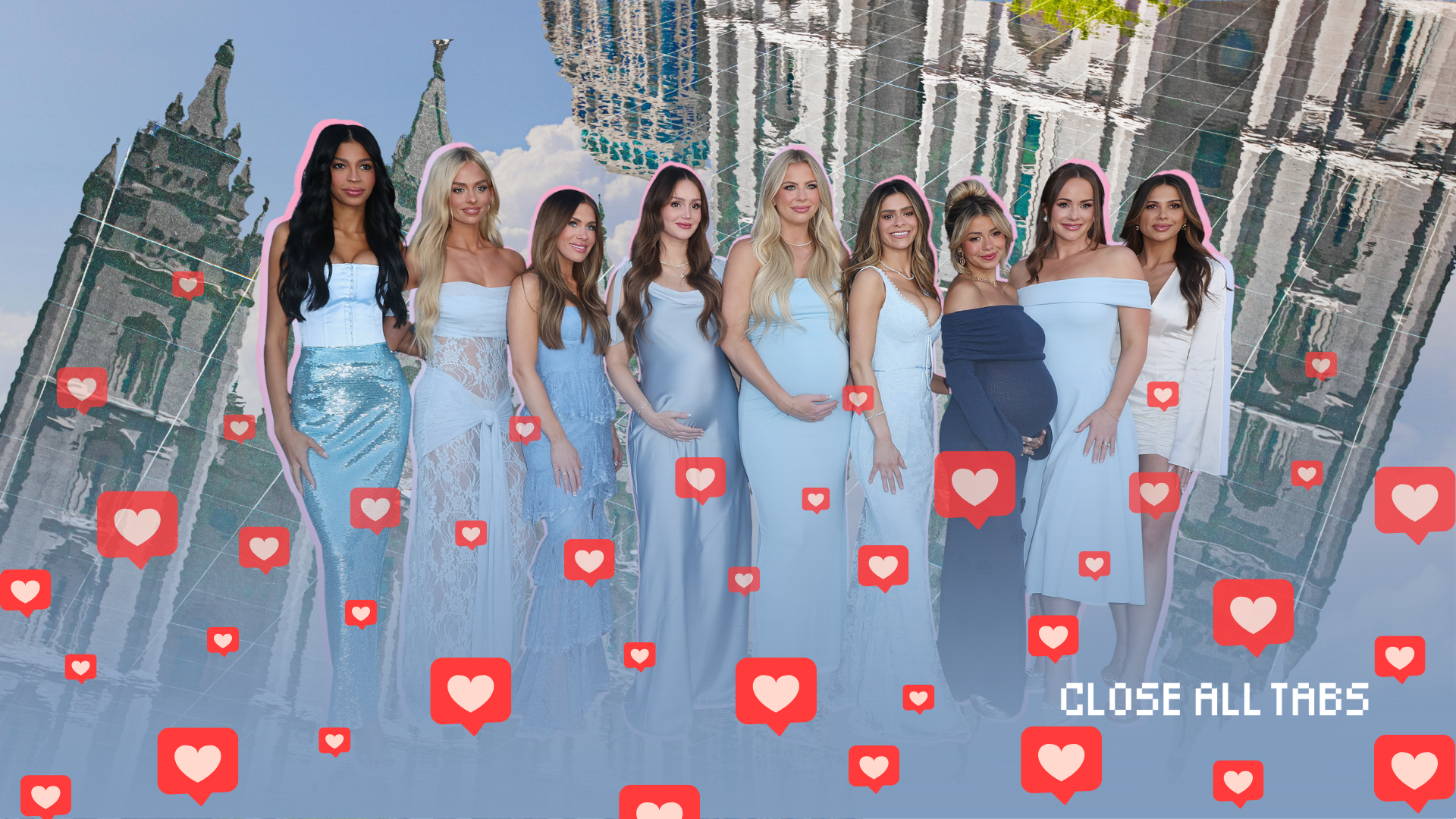
Morgan Sung: Okay, so for the uninitiated, The Secret Lives Of Mormon Wives is a reality TV show on Hulu, which follows a group of Utah-based mom influencers known as “MomTok.” They’re infamous for the so-called Mormon swinging scandal.
[Audio from Youtube User Spill Sesh]
You guys buckle up because we are talking about “Mom Tok.”.
[Audio from TikTok]
Now in both her confessionals and conversations with the other wives, Miranda denied doing anything other than kissing at these swinging parties.
[Audio from Youtube User Spill Sesh]
The drama is insane. It played out all online and now they’ve landed themselves a reality show for just how dramatic they have been and of course there’s more drama now.
Morgan Sung: To be clear, when we say “momfluencers”, we’re talking about this category of creators whose content revolves around motherhood and family. Like the ones who post the elaborate meals that they pack their kids for lunch, or post about the baby supplies that you, a new mom, actually need, which may or may not be sponsored. The name “MomTok” refers to a group of momfluencers from the show, The Secret Lives of Mormon Wives. Think of it as a friend group, well really, frenemy group. Many of them had started out on TikTok, making videos about their lives as stay-at-home mothers. Since then, they’ve built massive followings online and leverage that to launch their own businesses.
[Audio Clip from Secret Lives of Mormon Wives] J
en: I’m currently the breadwinner in my relationship. I’m providing for my kids, my husband.
[Audio Clip from Secret Lives of Mormon Wives]
Jessi: Being known as a successful businesswoman means everything to me.
[Audio Clip from Secret Lives of Mormon Wives]
Mayci: We’re just powerful women trying to change the stigma of gender roles in the Mormon culture. And I’m a bad b*tch.
Morgan Sung: I’m talking a prenatal supplement brand, a hair extension salon empire, a Broadway debut, brand deals worth hundreds of thousands of dollars, and one of them was supposed to be the next Bachelorette, and that’s been a whole thing. What I’m getting to is that these women are girl bosses, ambitious, entrepreneurial hustlers.
[Audio Clip from Secret Lives of Mormon Wives]
Jen: My goal was really just to be able to provide for my family.
[Audio Clip from Secret Lives of Mormon Wives]
Mayci, I need you to twerk your ass off!
Morgan Sung: On the show, they joke about being tradwives, the archetype of a homemaker who embraces traditional gender roles and doesn’t bother herself with affairs outside of her domestic sphere. But they’re upfront about the fact that they aren’t really tradwives. However, there is a faction of influencers who portray themselves as ideal, conservative, religious homemakers, while also running massive businesses. This is the tradwife girlboss.
Fortesa Latifi : Well, it’s so fascinating because the entire idea of a tradwife is predicated upon a woman staying at home, taking care of her babies, taking care of our house and her husband, and not working outside the house. But it’s a complete contradiction because the tradwives that we know about are all girl bosses. Like you said, I mean, some of them have multimillion dollar empires. So if I think about like a true tradwife, we would never hear about because she’s doing her work quietly and on her own.
Morgan Sung: We are not getting that deep into the current drama with mom talk and the secret lives of Mormon wives. Honestly, we need like another 15 episodes just to cover all of that. Today we’re digging into the industry of momfluencers, the women whose content revolves around parenting and family and their children. Not all creators who make this kind of content are religious, and not all of them identify as tradwives. But here’s something interesting. A lot of mom flensers are Mormon. We’re going to get into why that is and unpack how the Mormon church played a role in carving out an entire genre of content.
Morgan Sung: Ready? This is Close All Tabs. I’m Morgan Sung, tech journalist, and your chronically online friend, here to open as many browser tabs as it takes to help you understand how the digital world affects our real lives. Let’s get into it.
Morgan Sung: Let’s open our first tab. Why are so many momfluencers Mormon?
Fortesa Latifi : Only 2% of Americans identify as from the Church of Latter-day Saints, which is colloquially called Mormons, but they are so overrepresented in influencer culture. Like almost all of the top mom influencers and family vloggers are Mormon or Mormon adjacent. And it’s just like, how did this happen?
Morgan Sung: To answer that question, we need to go back to 2007.
Fortesa Latifi : There was the commencement speech given at Brigham Young University, Hawaii, in which an elder of the church told the Mormons who were listening, please use the internet to your advantage basically. Like, use it to blog, use it share your beautiful life, use it to share positive things about the church.
[Elder Ballard in commencement speech] And as you graduate from this wonderful university, may I ask you to join the conversation by participating on the internet, particularly the new media, to share the gospel and explain in simple, clear terms the message of the restoration.
Morgan Sung: That’s Elder M. Russell Ballard speaking to graduates at Brigham Young University almost 20 years ago. Let’s lay out some historical context for this. So, back in the 1800s, this guy, Joseph Smith, had a revelation and said that an angel told him to dig up a set of golden plates. These plates, according to Joseph Smith were engraved with a kind of companion text to the existing Christian Bible and contained guidance for establishing a new church. In 1830, Joseph Smith published what he said was a translation of the Golden Plates and called it the Book of Mormon, basically establishing the Mormon religion. He gained a following and started converting people. Local communities were not thrilled. The Mormon theology was considered blasphemous and they also practiced polygamy, a big no-no. They were seen as un-American and chased west to what is now Utah. The Mormon Church eventually denounced polygamy, but still faced a generational PR crisis.
Fortesa Latifi : They were so maligned for so many years by Americans and they were considered not even to be Christian and barely to be American. And so perfection became a doctrine of the Mormon church because once they did away with polygamy, they basically swung kind of in the other direction where they were like, we have to have the most perfect families on earth so that people can’t malign us anymore as un-American and not Christian.
Morgan Sung: The church encouraged Mormons to become the perfect, all-American, heterosexual, monogamous nuclear family unit, and not just live it, but also be seen living it, and share their faith while they’re at it. A century and a half later, the internet turned out to be the perfect medium for broadcasting both family and faith. Fortesa, said the church quickly realized how effective the internet could be for proselytizing. I mean, Elder Ballard speaking to new grads? That was in 2007. YouTube was brand new.
[Elder Ballard in commencement speech]
You can start a blog in minutes and begin sharing what you know to be true.
Fortesa Latifi : And it seems like Mormons above any other religion in the U.S., or really any other subculture in the US, really took to heart the idea of the early internet as a connector. And so many early mom bloggers were Mormon. I mean, when you think about early mom bloggers, you think of about Natalie Jean Lovin and people like that, and they were Mormon, or you think about Amber Fillerup Clark, also Mormon.
Morgan Sung: Why were Mormon women so effective as like the early proto-influencer?
Fortesa Latifi : So there are several reasons. One is that in Mormon culture, you usually get married young and you have a lot of babies, both of which are really good for the algorithm. The algorithm loves young mothers and it loves tons of babies. Another thing is that Mormons from a very young age, especially Mormon women, are taught to keep a record. So it’s actually part of their scripture is to keep a record of their lives and to do this kind of intense journaling practice. Like scrapbooking came from Mormons, which is wild.
Morgan Sung: What?
Fortesa Latifi : Yeah, I know. It’s crazy. When I looked into it, I was like, wait, this makes so much sense. But they’re taught to keep these intricate records and to do beautiful scrapbooks and like what is influencing if not a journal and a scrapbook.
Another reason is that beauty is highly prized in Mormon culture. So making yourself beautiful, being perceived as beautiful is considered to be godly. And so it’s really interesting because in other religions, vanity is a sin. Right? And I don’t think that the Mormons would say that they’re vain, but they do consider beauty to be godly. On top of beauty being considered godly, prosperity is considered godly, and so they have this thing called the prosperity doctrine, Which is basically the more godly and the more devoted you are to your faith, the more money you’re going to make. And so making money in that way is considered almost holy. And so when you take all these factors together, it’s like, duh.
Morgan Sung: Yeah, it’s like the formula for the perfect influencer. So, Mormon influencers have used content creation as a means of proselytizing. Like that elder told BYU grads, use the new media to share the gospel. Was it effective?
Fortesa Latifi : I think so, I mean, I think it’s interesting because many Mormons in their proselytizing online, it’s not explicit, right? Like they’re not getting on and saying, go read the Book of Mormon or go join the church. But what they are doing is they’re showing their perfect, beautiful families, their perfect beautiful lives, and then you know they’re Mormon and so you’re like, oh, well, there’s a connection between the Mormonism and the perfection. Right?
Morgan Sung: Fortessa interviewed one former child influencer who grew up in a Mormon vlogging family. And they told her that during their family’s run as popular YouTubers, at least 50 families joined the church and cited their family as the reason why. This strategy was clearly effective and the Mormon church was invested, literally. More on that after the break.
Morgan Sung: Welcome back. So as Mormon family influencers spread across the internet, what role did the church play in all of this? Time to open a new tab. The Mormon Influencer Industrial Complex. While working on her book, Fortesla went deep into researching the Church of Latter-day Saints and its outreach strategy. And she uncovered a major detail: The church was paying influencers.
Fortesa Latifi : I had for a long time wondered why so many Mormons are influencers. And it’s like the church, which is the richest church on earth (it’s worth hundreds of billions of dollars, the Mormon church) they actually, specifically, give resources and brand deals and help with sponsorships with their influencers. And there’s like this thing where if you’re a big enough Mormon influencer, you’re invited to this like special influencer dinner and they all kind of network and figure things out together. It’s hard to say exactly when it started, but I would say once they saw the power of those early mom bloggers, it was clear that they could have a hand in it, and it worked. I mean, look, like you think of Nara Smith. I don’t know if she still considers herself Mormon, but her husband was raised Mormon.
Yeah, it is so wild. Can you walk us through the process of getting sponsored by the church? Like how do they pick the influencers to sponsor? How much do they pay?
Fortesa Latifi : Yeah, so it’s really interesting because one of the influencers who confirmed this to me, her name is Shannon Bird and she was one of the original mom bloggers and now she’s on Instagram, but she really had her heyday in mom blogging. And she said that the church just reached out to her and they said, we love your work. We want to have a hand in it. And they said how much is your rate for a post? And in my book, she tells me, “You know, I felt weird like charging my church a rate,” you know? So her normal rate for a post was like eight to ten thousand dollars for like a static post. But she was like, this is my church, like, that feels really weird and so she, I think she charged them like a thousand dollars.
But then at one point, the church accidentally copied her on an email that listed what other influencers were being paid. I know, I know. And she saw that those influencers were charging their market rate. They were charging tens of thousands of dollars for a post. And it was really interesting because the posts weren’t like, come to church with us on Sunday, hashtag Mormon, hashtag LDS or whatever.
Like, it was like a little bit more subtle than that, where one of the sponsored posts that Shannon told me about was she was given rotisserie chickens and she was giving them out to unhoused people. And her blonde, perfect, beautiful children were like around her and it was basically like a photo of her with the supplies going out. And it was like, you know, give back this season or whatever but there was no explicit mention of Mormonism or the LDS church.
And so I asked Shannon, like, what do you think was in it for the church? And she’s like, okay, so this is what I think and then this is she said, so what I think is people saw her post and they’re like this beautiful blonde mother with all her beautiful blonde children going out and like, giving back and then they know she’s Mormon and so there’s that connection there.
And Shannon told me, well, “One influencer can do a lot more when it comes to proselytizing than, you know, one missionary.” She’s like, “at my height, I had a million viewers of my blog a month. And so what makes more sense putting out missionaries and people don’t even open their door, or getting the beautiful blonde mother to give rotisserie chickens to unhoused people and people make the connection that she’s Mormon.”
Morgan Sung: That is so wild.
Fortesa Latifi : And Shannon made such a good point. Like, she has a million viewers a month. What missionary can talk to a million people a month? Like, nobody.
Morgan Sung: So legally, influencers do have to disclose when they’re posts are sponsored, according to the FTC.
Fortesa Latifi : Yeah.
Morgan Sung: Aren’t the Mormon influencers doing that? Do they have to? Does it still apply?
Fortesa Latifi : I would think it would still apply. I don’t think they’re doing it because otherwise it would have been much clearer to people beforehand that the Mormon church was paying its influencers because no one has written about this before I had. So I don’t think that they’re following it to the letter of the law.
Morgan Sung: Regardless of the legal implications of these undisclosed church sponsorships, there’s a broader social shift going on here. Many of these women were raised to be wives and mothers. Momfluencing has opened doors that didn’t even exist for many women. Like we talked about earlier, they’re girl bossing. That’s huge, right? But is this a conscious act of reclaiming power? Time to open a new tab. Is mom-fluencing actually feminist? You made a really good point in your book about how, for a lot of these women, influencing and content creation is very lucrative, but it’s also one of the only ways that they’re allowed to exercise any kind of ambition or agency without threatening the patriarchy they live in.
Fortesa Latifi : Within the Mormon culture, which is heavily patriarchal, women are not supposed to work outside the home. And I think that’s slowly changing, but generally they’re not really supposed to have ambitions beyond being a perfect wife and a perfect mother and having nine children, but looking like they haven’t even had one child. And so, I consider influencing to be like this genius kind of loophole because it’s a way for them to exercise their ambition within the confines of the patriarchy because their job is predicated upon being a perfect mother and a perfect wife. And so it’s like, well, I’m still doing everything perfectly. I’m just showing other people about it and making a ton of money. So it’s, like, who can really have a problem with that? And influencing is largely done within the home. And so it’s kind of the perfect career for women who are in this patriarchal society that says, ‘no, you don’t go out and make the money, I go out to make the the money.’
Morgan Sung: Fortessa pointed out this one scene in one of the earlier seasons of The Secret Lives of Mormon Wives. They’re gathered in someone’s kitchen, complaining about their husbands.
[Audio Clip from Secret Lives of Mormon Wives]
I know you don’t want to make a TikTok, but we’ve got to pay the bills. I mean, who else is going to pay the bills, right?
[Audio Clip from Secret Lives of Mormon Wives]
Who is currently like the breadwinner at home? I think all of us. Really? Yeah. We all are. Look at us.
Fortesa Latifi : It’s kind of genius, like I really, as a concept, I think it’s really fascinating and I think its really cool that they found a way to exercise their ambition and agency within the confines of a patriarchal society.
Morgan Sung: Yes, I mean the new season is all about how Dad Tok, the like, husbands and boyfriends of Mormon wives are all like upset.
Fortesa Latifi : Boo, Dad Tok !
Fortesa Latifi : I’m such a dad talk hater, but they’re all like, upset and they’re trying to find themselves because they’re like, they only know us as our wives’ husbands and not as our own people.
[Audio Clip from Secret Lives of Mormon Wives]
Dad Tok’s a lot funnier than Mom Tok, and we have our own place on social media. I think this is gonna be a great opportunity for Dad Tok. I think it shows that our wives don’t have a monopoly on social media.
Morgan Sung: And it’s fascinating to see that they are in the position that Mormon women have been in for generations.
Fortesa Latifi : But they’re not realizing that. Like, they’re not thinking like, oh, for the last five or seven years before Mom Tok, this is how my wife felt while I went out and made money and had a life outside of the home and she was home with our several young children. It’s fascinating to me, especially as a mom myself, to see men have a taste of what it’s like to be a mom and they’re like, ‘Oh, this sh*t sucks.’ Like, okay, let me be clear, being a mother is incredible. Being a mother and having the mental load and being in charge of everything is very difficult. And being the one who’s at home is very difficult.
Morgan Sung: So, Mom Tok and Dad Tok drama aside, forging careers through social media has been so empowering for many women who grew up in conservative, religious communities. The Secret Lives of Mormon Wives is so interesting to me, because over the course of a few seasons, the women start to understand their own agency. They joke that the group is split between the saints and the sinners. The sinners are the ones who are no longer religious. While the saints still adhere to Mormon values and, more or less, the lifestyle. No drinking, no caffeine, and no divorce.
But throughout the show, even for the saints, you’re watching them deconstruct their upbringings in real time and actually get to exercise their own ambition. These are women who married and got pregnant as teenagers. If they did get to go to college, they were married and get pregnant right after graduation. They didn’t get to experience much of adulthood before they became mothers.
And now, through the armies of followers they’ve built online, they’ve girlbossed their way into very successful careers. So they are making so much money. They are like the breadwinners of their family, which is so counter to the values that they preach. Which brings me to my next question. Is mommy blogging actually feminist?
Fortesa Latifi : I really grapple with this, because on one hand, taking the unseen and unpaid labor of motherhood and making it seen and paid, I do think is a feminist act. But then again, you’re making it paid on the backs of selling this false vision to other women, which I don’t think can be considered feminist. So it’s like that tweet that’s like, is MasterCard an ally?
Morgan Sung: [Laughter] yeah.
Fortesa Latifi : Is this pop singer your friend? Like, it’s like… I don’t know, I don’t think that selling this vision of perfect motherhood to other mothers can be considered feminist, I just don’t think it can.
Morgan Sung: For the last two decades, mom-fluencing has revolved around performing domestic labor. But let’s talk about what it means to portray the fantasy of motherhood. What’s going on behind the scenes? What don’t viewers see? Let’s open one last tab: the trad wife illusion. Time for a case study. We’re going to talk about Ballerina Farm.
Fortesa Latifi : Oh my gosh, Ballerina Farm. I could write a thesis on her.
Morgan Sung: You may have seen one of her videos on your feed before. She’s this beautiful blonde woman, usually wearing a linen apron over a gauzy, puff-sleeved dress. She posts these videos of her preparing a meal from scratch, usually no narration, just the sounds of her sprinkling salt on freshly churned butter while her kids run around off camera. Sometimes, a cow in the distance.
[Audio Clip from Hannah Neeleman Instagram Account]
When we started to farm, I was swept up in the beauty of learning to make food from scratch. It makes sense why I soon fell in love with the idea of a family milk cow.
Fortesa Latifi : So her name is Hannah Neeleman. She is the foremost mom influencer, trad wife, blogger in the world. She lives in Utah. She’s Mormon. She’s married to a Mormon man who actually is the heir to the JetBlue fortune…
Morgan Sung: Wild.
Fortesa Latifi : …which they don’t ever talk about, which is interesting because it’s very like, we pulled ourselves up by our bootstraps and started this farm. And it’s like, your father-in-law is a billionaire. So that’s really interesting.
Morgan Sung: What’s especially tragic about her story is that she was a Mormon woman who did have a really promising career as a ballet dancer. Like, she was in Juilliard…
Fortesa Latifi : at Juilliard.
Morgan Sung: Which is wild.
Fortesa Latifi : There was a profile of her where they talk about how it’s called Ballerina Farm, but on the entire farm, there’s no dance studio. But I mean, that that Times profile was really wild because she’s like in her senior year at Julliard and her soon to be husband, like, meets her and decides like we’re going to get married. And then like, she’s flying back from New York to Utah and she’s flying JetBlue, which his dad owns. And so he pulls some strings, and gets the seat next to her on the flight. And basically, the way that I read it in the story was, like, she wanted to take her time and like, finish school, whatever, and then it turned out she was married and pregnant by graduation.
But she just had her ninth child. She looks like she hasn’t had any children. She is very beautiful in like, a very toned down way. She looks she has that no makeup makeup look, and like, she’s always wearing, like, flowy dresses and like, making sourdough from scratch and making like, butter for sandwiches. She makes everything herself. But now it’s turned into this entire empire. Like there’s the Ballerina Farm store, there’s the Ballerina Farm brand. I mean, they make protein powder and hydration powder and sourdough starter and it’s a huge thing.
Morgan Sung: What is the appeal of this kind of this genre of content right now?
Fortesa Latifi : I think it makes a lot of sense that as so much of the country is in such a fragile financial situation. I mean, the promise of a one income household broke decades ago, but we used to, you know, when we grew up, it was like, yeah, one person could have a job and support an entire family and like, that’s gone. The middle class is shrinking, like upward mobility is basically non-existent unless you like hit the viral lottery. And so it makes sense that people are like, we want to slow down and like go back to basics. And whether or not this is actually true, they’re looking at a trad wife life as going back to basics. But I also think it can’t be disentangled from the way that culture generally is just shifting rightward. Like the zeitgeist is just becoming so much more conservative. And it’s like, of course, tradwives are surging at this time.
Yeah, this trad wife content just depicts this really beautiful, idyllic life. What was it like for you to watch this content as a journalist before you became a mother and then after you became mother?
Fortesa Latifi : Before I became a mother, I was like, oh, I can kind of see the appeal. It does seem like kind of beautiful to just be like in charge of the home and just having to make bread and take care of your babies and like look beautiful. And I could kind of understand it. And then after I became mother, I was, like, this is not real life at all.
I have one child, I’m pregnant with my second and like, I have never made sourdough in my life. I don’t make my kids baby food from scratch. Like, my hair is usually not done. I’m never in a dress. It’s just the actual blood and guts and effort of motherhood are so disparate from this tradwife life that is shown online.
And I think, you know, tradwives never talk about the loneliness of mother hood. And that’s something that really hit me when I became a mother myself, because I have lots of family around. My husband is great. We have a part-time nanny. Like I have help, but it’s still like so lonely, especially in those first few months. And, like, if you watch these women, you would never think that anything was difficult ever. Like, all you have to do, mama, is cuddle your baby and co-sleep with them and breastfeed them on demand and make all their food from scratch and, like it just, it really shattered the illusion for me once I became a mother myself.
Morgan Sung: Yeah, you aren’t out there hand-picking berries to, like feed your kids.
Fortesa Latifi : No, dude, no. Like, maybe I should once in a while, but no, there’s no time. It just doesn’t make sense. It’s a fantasy, and that’s what made me realize these women aren’t being paid for the labor of motherhood, they’re getting paid for the performance of the laborer of mother hood. Because the labor motherhood is by definition unpaid and it’s often unseen.
Morgan Sung: What’s going on behind the scenes of this trad wife content that viewers don’t see?
Fortesa Latifi : I found out that many of your favorite mom influencers and family vloggers have full-time nannies, they have around the clock help, they have housekeepers, they have house managers, they have videographers, they have editors. I mean, this is an empire. This is a business. And I’ve said this before, there’s nothing wrong with having help. We have a once-monthly house cleaner. We have a part-time nanny. And I would be less sane than I already am without those people helping us. But I think what is troubling to me is selling this idea of self-reliance and saying, ‘I do it all myself.’ And by the way, if you buy this commissioned protein powder, you can be strong enough to do it yourself too, when secretly they have so much help behind the scenes.
Morgan Sung: Beyond the impact that momfluencers have on their audiences, the biggest consequences may fall on the people at the center of it all, their kids. The last time Fortesa was on Close All Tabs, we talked about how children are affected when they’re forced to be part of their parents’ content. Now, the internet is starting to reckon with a reality of sharenting, a portmanteau of share and parenting. Momfluencers have gotten some heat lately over exploiting their children and their content. There’s a vibe shift afoot. And while there will probably always be a demand for this type of parenting content, a growing faction of brands and creators are moving away from showing kids in videos. In an industry that has opened doors for so many women, is there still space for momfluencers who don’t engage in sharenting? A refreshing part of the secret lives of Mormon wives is that their children rarely appear in the show. There’s the occasional shot of someone holding a newborn baby. But the children who can walk and talk are barely in the show at all. In fact, some members of MomTalk have stopped showing their kids in their online content too.
Fortesa Latifi : I think they’ve kind of shifted from showing their kids to showing their experience as mothers and especially as working mothers. Well, that’s the thing is I don’t think there is a right way to be a mother on the internet because if you show your kids, people are like, you’re exploiting them. And if you take them off, then it’s like, oh, you just showboating and trying to act like you’re, like, so above this. And also if you’re gonna take them off, why did you ever put them on in the first place? There’s no way to win. People will hate you no matter what you do.
Morgan Sung: In many cases, these women are walking a tightrope, balancing audience expectations, traditional gender norms, and the realities of raising children. Fortesa tries to avoid thinking about momfluencers in simple black and white terms.
Morgan Sung: For someone who’s reported on the horrors and exploitation involved in family vlogging, you did take a very compassionate approach to writing about the Mormon mommy vloggers and, like, this world of influencers. How do you balance what you know about the momfluencing industry with maintaining empathy for the women involved?
Fortesa Latifi : I mean I really do genuinely feel a lot of empathy for these women and I think especially becoming a mother myself has shown me you know to what lengths I would go to give my daughter a great life. A lot of times these women started mommy blogging in a vulnerable situation. They didn’t go to college or they started having kids really young or they were in some kind of financial instability. And so when I look around at my life and the stability that I have, and then I look at other women and the limited choices they have, I think it’s just dishonest to say that I would never make that decision. Like, I wouldn’t make that decision as myself in my experience, but I could see how you could make it in a different situation. And I’m not one of those people who thinks family vlogging and mom influencing is evil and immoral and bad across the board. I just don’t think that. I think it’s much more nuanced than that.
Morgan Sung: Mom Tok is on the verge of collapse, all the time. These women have some very fraught friendships. Will Mom Tok survive this? Has kind of become a mantra on the show. The cultural appetite for family vlogs may fade, especially as the debate over child influencers continues and more viewers become disillusioned with the fantasy of trad wives. But the recent seasons of The Secret Lives of Mormon Wives have proven that people don’t necessarily watch these creators for the content about their kids and not really for the husbands either. Dad Tok is just not it. People watch because they’re interested in the lives of these women, even the messy uncurated versions.
The performance of the perfect mother who feeds her kids freshly baked sourdough topped off with hand-churned butter is not always as compelling as the working mother who’s open about the struggles of juggling a career and her kids. As much as there’s still an audience for the tradwife, there’s also growing demand for creators who are honest with their viewers, both about who’s sponsoring their content and about the reality of motherhood. So as mindful sharenting takes more of a hold on internet culture, will mom-fluencing survive this? Probably. But it may have to change. Let’s close all these tabs.
Close All Tabs is a production of KQED studios and is reported and hosted by me, Morgan Sung. This episode was produced by Maya Cueva and edited by Chris Egusa, who also composed our theme song and credits music. The Close All Tabs team also includes editor, Chris Hambrick, and audio engineer, Brendan Willard. Additional music from APM, audience engagement support from Maha Sanad. Jen Chien is our director of podcasts and Ethan Toven-Lindsey is our editor in chief. Some members of the KQED podcast team are represented by the Screen Actors Guild, American Federation of Television and Radio Artists, San Francisco, Northern California, Local. This episode’s keyboard sounds were submitted by Alex Tran and recorded on his white Epomaker Hi75 keyboard with Fogruaden red samurai keycaps and Gateron milky yellow pro v2 switches. Thanks for listening.