Episode Transcript
This is a computer-generated transcript. While our team has reviewed it, there may be errors.
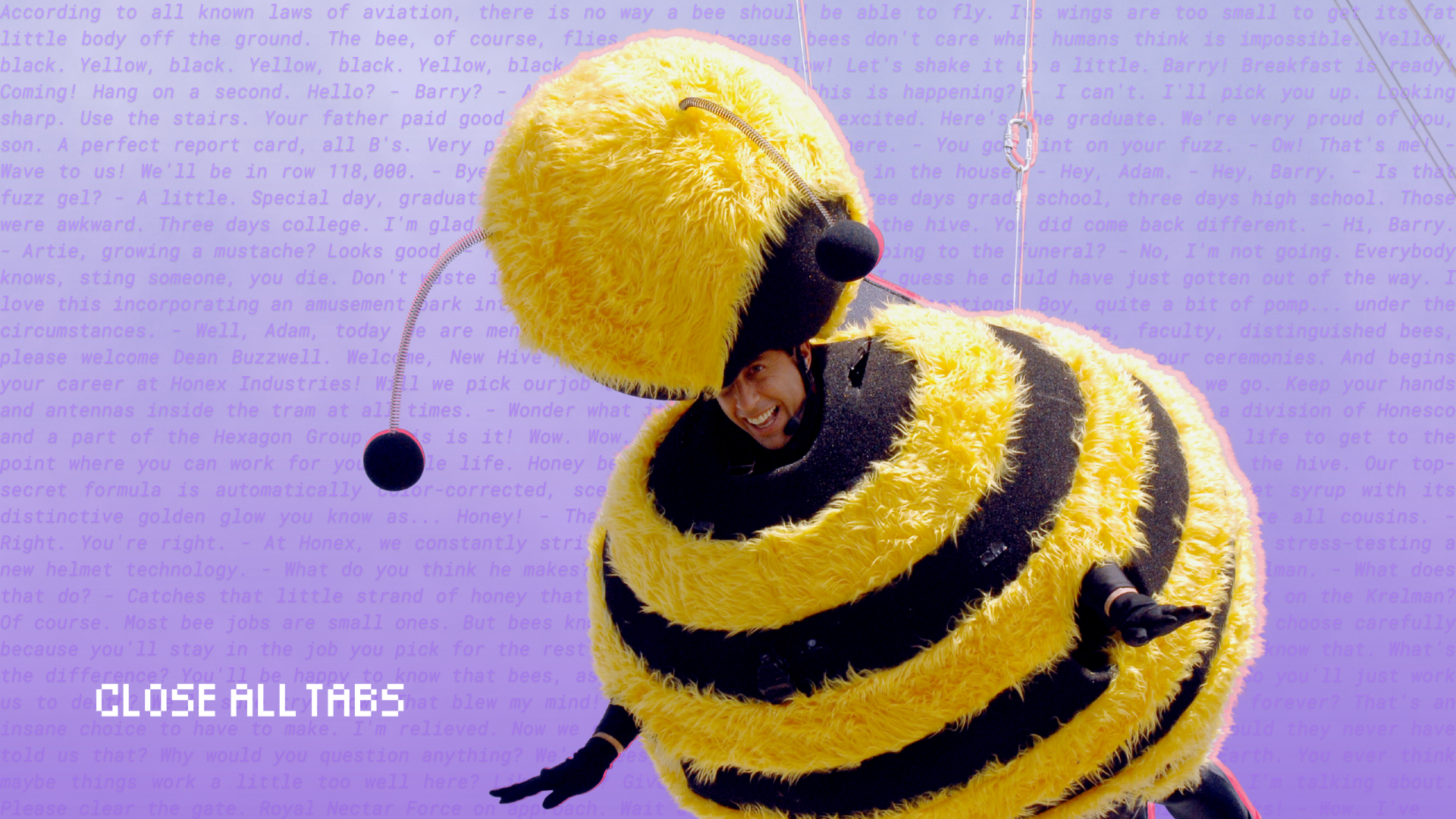
Spike Feresten: According to all known laws of aviation, there is no way a bee should be able to fly. Its wings are too small to get its fat little body off the ground. The bee, of course, flies anyway because bees don’t care what humans think is impossible.
Morgan Sung: Those are the iconic opening lines of the 2007 film Bee Movie. And the voice you heard reading those lines.
Spike Feresten: My name is Spike Feresten. Is that really it? Is that what we wrote?
Morgan Sung: Spike is a comedian and screenwriter who’s worked on Seinfeld, written for David Letterman, hosted his own show, and co-wrote the one and only Bee Movie. You know, the one starring Jerry Seinfelt as a talking Bee.
[Audio clip from Bee Movie]
Barry: I’m going out.
Adam: Out? Out where?
Barry: Outside the hive.
Crowd: *Gasps*
Spike Feresten: What if the bees discovered the humans were taking their honey? That was one big idea that kind of unlocked a little bit of the plot, but the kind of larger idea was, what would happen if a bee didn’t want to just go into the honey business? Isn’t there, is there something more?
Morgan Sung: Hijinks ensue. Bee Movie is a surprisingly deep story about exploitation, uncompensated labor, the vital environmental role that bees play as pollinators, and what it takes to break out of society’s mold. That is, if society is a honeybee hive in Manhattan. Oh, and the bee kind of falls in love with a human woman. It’s a whole thing. Spike said that Steven Spielberg asked Jerry Seinfeld if he wanted to do an animated movie. And Jerry Seinfeld said,
Spike Feresten: “What about a movie about bees and we’ll call it Bee Movie.” And he went, “Sold!” It’s the shortest pitch in like film history. And then Jerry called us up the next day and said, I just sold a movie to Spielberg/Dreamworks Animation about bees. And we were like, what is it about? And he goes, that’s what we have to figure out. The very first thing we did was start reading about bees and we came across this fact. It was like, oh, this is kind of remarkable that these guys can’t fly in rain and that their bodies aren’t right and it’s hard for them to fly and everything in kind of fodder for, you know, the world of Bee Movie.
Morgan Sung: This was Jerry’s big comeback after Seinfeld, which had wrapped up about five years before development on Bee Movie started. And the movie did well at the box office, but among film critics, it was a flop. Kids loved it, but it didn’t compare to the Shrek franchise or Ratatouille, which dominated early 2000s animation. The plot was weird. The jokes skewed more adult, and the whole romantic vibe between a human woman and a honeybee, maybe a bit too out there for the general public. Jerry even joked about it a couple years ago. Here he is on the Tonight Show:
[Clip of Jerry Seinfeld on the Tonight Show]
And I apologize for what seems to be a certain, uncomfortable, subtle, sexual aspect of the Bee Movie which really was not intentional. But after it came out, I realized, this is really not appropriate for children.
Morgan Sung: The world moved on. But today, almost 20 years later, Bee Movie is a cult classic. Because the Bee Movie script itself has become one of the quintessential internet pranks. Annoyed with someone? Dump the Bee Movie script in their comments. Protesting against the government’s anti-trans bathroom complaint forms? Spam the tip line with the Bee Movie script. Here’s Spike again.
Spike Feresten: We couldn’t quite understand, are they making fun of us, which is fine, or are they really celebrating us, or is it are they just taking our weird thing and doing weird things with it? There’s simple ideas like weaponized absurdity, you know, so when some horrible right-winger has got some sort of hotline to expose the trans community or something, and people just load in the Bee Movie script. To us, like, that’s fantastic. We’re not even gonna engage you in conversation. We’re just gonna drop an absurdity bomb in there and just stop it.
Morgan Sung: The Bee Movie script remains a top-tier internet prank. It’s up there with Rickrolling. This is a genre known as bait-and-switch memes. The internet has changed drastically since the days of pranking people with “Never Gonna Give You Up.” And memes have changed, too. Imagine trying to explain today’s trends to someone in 2007. But what hasn’t changed about internet culture is the love of a good prank. The art of the bait-and-switch meme endures. It’s April Fool’s Day, so today, we’re diving into the evolution of these memes. And what makes a meme prank actually stick around. Ready?
Morgan Sung: This is Close All Tabs. I’m Morgan Sung, tech journalist, and your chronically online friend, here to open as many browser tabs as it takes to help you understand how the digital world affects our real lives.
Let’s get into it. Before we talk about what makes a good bait-and-switch meme, let’s get into where they even came from. For today’s internet history lesson, we’re going back in time, before TikTok, before Vine, may she rest in peace, and before YouTube, to an era when the internet was simpler and darker. Let’s open a new tab: the internet forum wild west. Dr. Bret Strauch teaches at the University of Colorado in Boulder, where he studies digital genres and digital writing, also known as the rhetoric of memes. He’s gonna break down what a bait-and-switch meme is at its core.
Bret Strauch: Bait-and-switch memes are fairly simple, like when you look at it from a genre perspective, usually you have some sort of setup that is directing your expectation towards one thing and then it flips and subverts that expectation, once we either scroll down or click on something or jump to a new video, something to that effect.
Morgan Sung: What were the proto bait-and-switch memes like? Like before the Rickroll, where were they taking place? How did they work?
Bret Strauch: In the analog era, before we get to our digital internet era, we have culture jammers and all they’re doing is taking a traditional sort of company advertisements and subverting them. So you would see something like, uh, Joe Camel, um, from the Camel cigarettes, but they would subvert the messaging, sort of pointing out some ideological problem or ethical problem. And so instead of Joe Camel they get an image using the camel likeness, but as Joe Chemo sort of pointing out the health effects of cigarettes.
Morgan Sung: The first internet forums have been around since the 70s and 80s. This culture of posting and messaging didn’t become widespread until the 90s. The early forums and chat rooms didn’t have anything close to the moderation and rules that we have on social media today. That’s when we started to see the first bait-and-switch memes.
Morgan Sung: I’ve seen people talk about the early internet forums of the late 90s, early 2000s as almost like. This unmoderated last frontier. We had an episode on political online history where we referred to that time period as “the bronze age of the internet.” Can you describe what this era of forums was like and what that meant for meme culture?
Bret Strauch: I feel this early era so like we get like 4chan but there’s also other sites like somethingawful.com, rotten.com, (please don’t go to those sites) where a lot of this sort of proto-internet meme behavior is happening. And one of the things that we see in this early era is that it’s largely gate-kept in a way. We have a much smaller, more niche audience for these memes. And it’s usually driven through more, obviously, masculine sensibilities and sort of this gross-out culture. And there’s a little bit of a prank culture thing going on as well. We see a lot of shock sites. This is like earlier internet, like 2002, where people would send links to what essentially were just pornographic images as a form of hazing. And a lot people found this funny, but some people were also found it disturbing as well.
Morgan Sung: One of these shock images, which we will not name here, involves…
Bret Strauch: …a human orifice that is enlarged, so to speak, and usually we get sent like this file and people would click on it and then they would see this sort of grotesque image. Now, some people might laugh at that, but I think the people that found it funny were the people sending it, not necessarily the people receiving it in all cases. But also we see how like This fits this sort of frat boy gross out. Sort of community building, so to speak. I wouldn’t necessarily, it’s a community I’d want to be in, but it definitely has this sort of social function in those groups.
Morgan Sung: So how do we go from that horrific image macro that Brett tactfully described to the family-friendly wholesome rickroll? Let’s open a new tab: pranks in the age of YouTube.
Morgan Sung: Picture this, it’s 2007. You’re dressed in your most obscure band tee and skinniest skinny jeans, brand new Blackberry tucked in your back pocket. You’re on the family desktop, just made your first Facebook account. You’re scrolling through your feed, poking your friends, and you come across a post that says, “Grand Theft Auto 4 trailer just dropped, watch here.” You love GTA. You’ve been waiting for this. So you click it and…
[Clip of “Never Gonna Give You Up” song]
Never gonna give you up.
Never gonna let you down.
Never gonna run around and desert you.
Morgan Sung: You just got rickrolled. That’s exactly what happened to countless people that year. A teenager posted a link on 4chan claiming that it was a link to the highly anticipated trailer. When unsuspecting digital bystanders clicked it, they were surprised with a video of Rick Astley’s 1987 banger, “Never Gonna Give You Up.”
[Clip of “Never Gonna Give You Up” song]
Never gonna make you cry…
Morgan Sung: And so the rickroll was born.
Bret Strauch: The change from sort of this gross out humor meme into something that’s more family friendly, I think comes along with the fact that internet platforms and social media platforms became much more accessible beyond sort of that initial niche computer nerd culture that we see. And so as part of ways in which the community functions, they wanna share. Like, if you receive it, it might be annoying, but I think at some point we find it funny. Where something that’s more gross out, that’s not going to have as much wide appeal.
Morgan Sung: And rickrolling really took off. The hacktivist collective Anonymous protested against the Church of Scientology by blasting “Never Gonna Give You Up” on boomboxes outside of their headquarters. Radiohead announced their new album and posted the download link, only to rickroll everyone. For April Fool’s Day in 2008, YouTube made all of the links on the site’s page lead to “Never Gonna Give You Up,” rickrolling the world. And then for the annual Macy’s Thanksgiving Parade that year, Rick Astley himself appeared on a float and performed what was, at the time, possibly the most widely televised rickroll in the world. Rickrolling was a cultural phenomenon. It was also the last time everyone was on the same internet, before we were siloed by algorithms.
Bret Strauch: We’re still at a moment in our media landscape where we’re still sharing media. We have TV shows we’re all watching. We have broadcast television. And even though people can create and share their own content, we don’t see as many content creators and so a lot of the shared cultural texts we have helps build toward this moment where, hey, we can share this meme because people know the reference. We’re not all listening to our own Spotify playlists, right? We’re all consuming the shows that we want on Netflix. We have the shared culture, which helps sort of propagate the fact that we have a meme that’s sort of ubiquitous, at least in the Western hemisphere.
Morgan Sung: What was so appealing about the rickroll? Like, why did that work so well?
Bret Strauch: Coming out of the 90s, there was a little bit of this 80s nostalgia, which we see building up in which now we see huge 80s nostalgia. There’s this sort of absurdity of the 80s era and its music that sort of plays into the absurdity of this internet prank, essentially.
Morgan Sung: And no other bait-and-switch meme from that early YouTube era took off the same way. There was the Trololo guy.
[Singing]
Morgan Sung: It’s a clip of a Russian singer performing in the 70s. There was also You’ve Been Gnomed.
[Audio of animated gnome character]
I’m gnot a gnelf!
I’m gnot a gnoblin!
I’m a gnome!
Morgan Sung: Which was this video of an animated gnome laughing at the viewer while text flashes across the screen. It says, predictably…
[Audio of animated gnome character]
And you’ve been gnomed!
Morgan Sung: Both of these memes functioned like a rickroll. You click a link expecting one thing and, instead, you get another. But there was a historical framework for rickrolling. It was a huge 80s bop coming back around. The other memes lacked that, so they didn’t have the same cultural impact as rickrolling. By the early 2010s, a new challenger had arisen. This underlying media, as Bret put it, was ripe with meme material. Let’s talk about Bee Movie after this break.
Morgan Sung: So what makes a good bait-and-switch meme? What makes that prank work so well? Obviously, we’re opening a new tab: Bee Movie and meme dada-ism. Memes were getting weirder, more absurd, and few memes defined the 2010s like Bee Movie.
[Audio clip from Bee Movie]
Barry: How should I start it? You like jazz? No, that’s no good. Here she comes. Speak, you fool!
[Clip of Jerry Seinfeld on the Tonight Show]
Jerry Seinfeld: The bee seemed to have a thing for the girl.
Jimmy Fallon: Yeah
Jerry Seinfeld: And we don’t really want to pursue that as an idea in children’s entertainment.
Morgan Sung: That was Jerry Seinfeld on The Tonight Show, acknowledging the taboo interspecies romantic undertones in Bee Movie. Spike Feresten, the screenwriter who co-wrote the movie, got a kick out of writing the pairing.
Spike Feresten: Here’s a funny anecdote from the room: so we were writing this in New York. You know, I was, I was doing a show in LA, but I would fly, you know, to New York every couple of weeks and we’d sit in this big room, Jerry’s office, and work on this. And to us, these characters were just two characters, it was just Barry and Vanessa. And then every once in a while we’d go, hey, that Barry’s a bee. He’s this big. So when you say they shake hands or they walk, you can’t, we can’t keep treating them like two characters who are friends, like Jerry and Elaine, which is kind of how we treated them. We were writing them like Jerry and Elaine forgetting about the size disparity and the species disparity. Yeah, and that’s kind of why it came out the way it came out.
Morgan Sung: The romance is just one of many absurd plot lines in the movie. Like, we’ve got bees going to human court to sue humanity for the exploitation of their labor. But the movie was way too ahead of its time. Critics hated it. It was marketed as a kids’ movie. And instead, it was this story about freeing the bees and seizing the means of production of honey and also toeing the line of bee-stiality. But that’s why it was such good meme material. Here’s Bret Strauch again.
Bret Strauch: People, when they originally went to see the Bee Movie, were expecting a kid’s Bug’s Life or Ants movie, and they got something much more serious. And so in a way, like the Bee Movie is a bait and switch by itself. The trailers are selling it as sort of like a kid’s movie, but really there’s a lot more adult oriented content that people were not expecting. And so the fact that it sort of functioned as a bait-and-switch by itself made sense that people started using it as just a way to troll people.
Morgan Sung: Tumblr latched onto the movie starting in 2011, fawning over the film’s poetic opening lines.
[Audio clip from Bee Movie]
Narrator: According to all known laws of aviation, there is no way that a bee should be able to fly. Its wings are too small to get its fat little body off the ground. The bee, of course, flies anyway, because bees don’t care what humans think is impossible.
Morgan Sung: Tumblr users were totally sincere about it, calling the lines inspirational. By 2013, the meme exploded. People were starting to realize how absurd the movie really was. Screenshots from the film became reaction memes. Edits of Seinfeld but with characters from Bee Movie went super viral. And then there’s the fan fiction, which is still going today. I told Spike about it.
Morgan Sung: So, there is a real moment on Tumblr with people kind of sincerely appreciating the dialog in Bee Movie and the narration. Then people kind-of ironically started posting the memes, which I’m sure you’ve seen. It broke containment, moved to Twitter, and then it reached the peak of virality, which is sexy fan fiction.
Spike Feresten: Oh, it did.
Morgan Sung: Oh, I’m sorry I’m breaking this to you.
Spike Feresten: I don’t know about that. This is good.
Morgan Sung: Well, I am just going to read you a few tags from Archive of Our Own, from Bee Movie fanfics that were written this like this year.
Spike Feresten: Okay.
Morgan Sung: The tags include Vanessa X Barry, typical, Mega Mind X Barry Benson, Top Barry -Bottom Mega Mind, inter-species relationships, hive worship, and improper use of honey drizzler.
Spike Feresten: [Laughter]
Morgan Sung: What do you make of the Bee Movie smut?
Spike Feresten: Well, smut is a funny, funny word to use from the 50s: smut. Um, it, it kind of plays into what I would love to do. I mean, like, hypothetically, and this will never happen, but I want to do, uh, six sequels to Bee Movie all as a series on Netflix or wherever, 40 minutes apiece, Bee 2, Bee 3, Bee 4 , Bee 5, Bee 6, Bee 7. A lot of time has gone by and we’re going to do our six sequels now. What you just described is one of the areas I really want to dive into, which is that relationship, not the smut, but the fun you could have with a bee dating a woman. I think there’s a lot of comedy there and I think the world has changed and I think you could write that in a way that’s not smut but it also kind of celebrates what the world has done with this and, you know, I don’t think we would go as far as South Park, but kind of do our version of maybe a South Parkian take on Bee Movie, because I love their relationship. I love that friendship. And I wonder what those conversations would be like should they explore the idea of dating.
Morgan Sung: Yeah. I mean, look, if you ever need a writer’s room, there’s a bunch of people in Archive of Our Own who have already written some scenarios.
Spike Feresten: I think that’s cool. No, that’s great. I mean, like any other stuff, you know, you put it out into the world and the world can do with it what it wants. That’s what’s nice about it.
Morgan Sung: In 2013, a Facebook user posted the entire script on someone else’s Facebook wall. That was the start of the bait-and-switch Bee Movie script. For the next few years, you might unwittingly open a link to a comment or post only for your phone to freeze and crash because it’s trying to load the entire Bee Movie script. It was like a more devious Rickroll. It wreaked havoc across the internet.
Group chats were bombarded with the 9,000-word wall of text. Any email with an urgent subject line could just contain the Bee Movie script. It even moved offline. One college student pranked his classmates by spending 12 hours writing out the entire script on a chalkboard. The coolest kids in 2016 wore T-shirts printed with the entire strip.
The meme did eventually slow down though. Phones got better and became capable of loading the whole script. Like rickrolling, surprising your friends with 131 pages of dialogue got old. But then the script was weaponized, again, as a form of protest.
In 2021, Texas passed the Heartbeat Act, which effectively banned abortion after six weeks. The law allowed anyone to sue abortion providers and individuals who sought abortions after the six-week limit. The organization, Texas Right to Life, set up an anonymous tip site to report anyone who violated the Heart Beat Act. To protest TikTok users spammed the site with Shrek porn, lurid fan fiction, and the one and only Bee Movie script. Protesters did it again when Missouri opened an online forum to report clinics that provide gender-affirming care. And then, again, when Indiana’s attorney general launched a forum to support schools that teach gender ideology. And then again, when the Trump administration partnered with a far-right group to report schools that had DEI efforts. Any time the government or an organization working with it opens some kind of citizen surveillance tool, it’s a target for Bee Movie script dumps. Spike and other Bee Movie writers are big fans of this practice.
Spike Feresten: Oh, we love it, absolutely love it. It gets passed around, you know, that it’s doing something good for the world, it always makes you feel good. And that we don’t have to be any part of it, that someone’s taking it and just disrupting, like I said, dropping an absurdity bomb on some bad cause. That just makes you feel good. Do it as much as you want. If I can help you, I will help in whatever way, but you’re doing a fine job by yourself.
Morgan Sung: It’s funny because back in 2017, for the 10-year anniversary of Bee Movie, New York Mag wrote this extensive history of the meme and traced the rise and fall of it. And back then, it was like, okay, there was a good year of no Bee Movie memes. And they questioned whether the meme was dead. That was almost 10 years ago. And the Bee Movie script keeps coming back. The meme has evolved so much, but the core of it is still the script, the dialogue. Why do you think it survives?
Spike Feresten: I think it’s the writing. I think its the weirdness. You know, it’s funny. That movie was out of sync with culture in 2006 and I think still is out of synch with kind of cultural norms in a way.
Morgan Sung: uh bee- human, you know…
Yeah, I know, but it’s still kind of hard to wrap your head around that. You know what I mean? I mean i don’t think anybody really thinks about dating a bee, so I don’t think there has been… and we like bees. To us, the bees are, you know, when you think about the planet, keeping the planet healthy, the bees are one of our canaries in the coal mine, if you will, like, how the bee is doing? I don’t know if you do this, but when you see a bee, kind of, dying on the sidewalk, don’t you get nervous.
Morgan Sung: Oh yeah I’m like, let me help it, yeah.
Spike Feresten: Well, is this global warming? What is doing this? So we have this special reverence for this insect that stings us occasionally, but still we like them a lot because they make this very sweet, gooey substance that we enjoy putting in our teas. But again, it’s not for me or us to say, it’s you’d have to ask the people who love this movie what they love about it. We’re just the people that put it out.
Morgan Sung: The Bee Movie script is the gift that keeps on giving. But other bait-and-switch memes have also blown up. And unlike the trusty rickroll or the evergreen Bee Movie, this new generation of internet pranks blow up fast and burn out quickly. They don’t last. Let’s get into that in one last tab: the short form vertical video revolution. Before the Bee Movie script was weaponized for protest the way that it is today, it had kind of peaked by 2016. And a slew of bait-and-switch memes cycled in and out of relevance. The primary force behind this rapid-fire meme lifespan? TikTok. In 2020, we had Get Stick Bugged. Watching a Minecraft compilation? Surprise, it cuts to a clip of a dancing stick bug.
[Funky music playing]
Morgan Sung: But that fizzled out by the end of the year. In 2022, TikTok users lured viewers in with videos about juicy celebrity gossip. And then…
[Audio from Moulin Rouge movie]
Gitchi Gitchi ya ya da da
Morgan Sung: …you got krissed! It’s a clip of Kris Jenner shimmying in this sequined shirt and bow tie set to a sped up version of “Lady Marmalade” from Moulin Rouge. The Cut said that “getting krissed” is the natural evolution of rickrolling. And then in 2023, we had the Josh Hutcherson whistle edits. Here’s one of my favorite ones. It’s video from inside a plane. The caption says, “Guys, the view is incredible!” The video pans to the closed window, and a hand reaches out to open the shade. And then…[music playing] The view through the window is just a closeup of Josh Hutcherson’s face from a 2014 fan edit set to a cover of Flo Rida’s “Whistle.” Polygon said that this trend was TikTok’s rickroll. And then at the end of last year, another rickroll successor blew up.
[Clip of “We Are Charlie Kirk Song”]
We are Charlie Kirk, we carry…
Morgan Sung: That is an AI-generated ballad about Charlie Kirk, which was first posted to YouTube and streaming platforms days after his death. It’s total AI slop, but unfortunately, very catchy. Like the Bee Movie script, it went viral at first out of sincerity. People listened to it as a tribute to Charlie Kirk. And then it became a meme. We’re talking remixes, Mongolian throat singing covers.
[Clip of “We Are Charlie Kirk Song”]
We are Charlie Kirk. We carry the flame. We fight for the…
Morgan Sung: And of course, pranks, like connecting to public bluetooth speakers and blasting cowbell dance remixes of “We Are Charlie Kirk.”
[Audio of “We Are Charlie Kirk” playing over loud speaker]
Morgan Sung: Here’s Bret’s take.
Bret Strauch: All of them, it’s clear that there’s some sort of musical component people can latch onto and all the music itself is sort of absurd or ridiculous in a way. Whether it’s been altered and sped up like the we-are-krissed” or just sort of that funky beat that you’ve-been-stick-bugged has, especially like with the “We are Charlie Kirk.” There’s more levels of absurdity being that it was AI written. So this pathos is literally being manufactured. It’s not something that’s like, necessarily human-generated like emotion being generated, and so it just makes it rife for this type of inversion or subversion.
Morgan Sung: Yeah. We just speed ran so many trends, and none of them really lasted more than six months. Maybe the Charlie Kirk one will last longer because of the current state of the world, but generally, why is the turnover rate for memes so high now?
Bret Strauch: I think there’s a few reasons for this. The first is just the media context and media environment. We’re not sharing the same stuff that we did as a culture. It’s much more small niche cultures where these things are spreading. Another element to this that I believe is important is that it’s easier to create these than it was 15, 20 years ago. And so now more are being created. And so they’re essentially eating themselves out of existence. Um, so as soon as a new mean comes out, um, at least in the early mid 2000s, it stuck around because it took a little bit more technological know-how. You didn’t have the production software and access to it that you do now.
Morgan Sung: I noticed that almost all bait-and-switch meme trends are on TikTok now, maybe Reels. But no one is pulling off a rickroll with YouTube anymore. I saw a video of someone rickrolling their friend by sending a TikTok link, which me makes me wonder, did YouTube ads ruin the rickroll? Kind of spoils the surprise.
Bret Strauch: I mean, YouTube ads ruin everything. For humor to work, timing is critical, right? And so those ads really disrupt like the genre of humor that’s happening.
Morgan Sung: Would the original rickroll work with modern content consumption habits? When we consume content, it’s a lot of times happening passively to us, algorithmically served, instead of us like actively seeking it out or actually clicking links.
Bret Strauch: I don’t think so. We need that interaction, I think, for the rickroll to be successful. And it feels like at least it was another person presenting this to us. And now it’s sort of the algorithm is serving it up to a plate on us and we’re not finding these things. And so I think what makes a lot of media content special, whether it’s memes, movies, songs, is it’s stuff that we find, not that someone else or something else finds for us. And so… innately, there’s going to be less meaning for a lot of that.
Morgan Sung: The meme turnover rate is so high that no internet prank really sticks around long enough to rival or recreate the magic of the rickroll. The very format of the rickroll is limiting, especially in today’s digital landscape. Even rickrolling itself is difficult to pull off today because internet habits have changed. But what has endured as a prank is the Bee Movie script.
I have this take and it’s that the Bee Movie script is the ultimate bait-and-switch because it’s purely text. There’s no image macro, there’s no video lead-in with ads or that you have to wait to load to ruin the prank. The joke itself is so malleable. It can be dumped in comment sections, in government tip lines or turned into an image macro and then deep fried, or just read by that TikTok AI voice in 2X speed, which makes it funnier. Do you have any thoughts on this, the flexibility of this meme?
Bret Strauch: Well, that’s why I think we see certain memes that at least are being iterated and changed upon more, and some that don’t seem to change as much. And so with it being all text, it’s really easy to adapt all text to different formats. I think my favorite of the Bee Movie script ones is where they do the crawl from Star Wars, and we get the intro to the Bee Movie. And so the easier that it is to manipulate that initial form of media, like, so text is super easy, makes it much easier to put it into different places, different platforms and distribute it.
Morgan Sung: Bee Movie came out nearly 20 years ago. Script dumping started in 2013. Last year, 12 years after that Facebook user posted the entire script on someone else’s wall, the DOGE-led government HR email was pelted with Bee Movie scripts. At the request of Elon Musk, all federal employees were asked to email the Office of Personnel Management with five tasks they accomplished that week. On x, Musk posted, “Failure to respond will be taken as a resignation.” The email leaked online, and internet users responded on behalf of federal employees with pages and pages of Bee Movie dialog. Spike was thrilled.
Spike Feresten: It’s pretty exciting that anybody’s even talking about it. Really! I mean, you have to look at it, we look at that way. I think that people are still talking about this movie from what 2006 that we made, you know, in that way and that it, that it has these second and third lives. You know, we get excited that people still watching that movie and enjoying it. Like, it’s flattering. That’s the only way to really put it that this movie hasn’t been forgotten. It hasn’t disappeared into a canyon of content and gone forever, that it comes up over and over again in generally a good way. And, you know, if people are making fun of it, that’s fine, too. That’s what we do. We make fun of things you can make fun of us. Go ahead.
Morgan Sung: You heard Spike, go forth and prank. Let’s close all these tabs.
Morgan Sung: Close All Tabs is a production of KQED Studios and is reported and hosted by me, Morgan Sung.
This episode was produced by our senior editor, Chris Egusa, who also composed our theme song and credits music. It was edited by Chris Hambrick. Our team includes producer Maya Cueva, additional music by APM. Brendan Willard is our audio engineer, audience engagement support from Maha Sanad. Jen Chien is KQED’s Director of Podcasts and Ethan Toven-Lindsey is our Editor-in-Chief.
Some members of the KQED podcast team are represented by the Screen Actors Guild, American Federation of Television and Radio Artists, San Francisco Northern California Local.
Keyboard sounds were recorded on my purple and pink dust silver K84 wired mechanical keyboard with Gateron red switches. Okay, and I know it’s a podcast cliche, but if you like these deep dives and want us to keep making more, it would really help us out if you could rate and review us on Spotify, Apple Podcasts, or wherever you listen to the show.
Email us at [email protected]. Follow us on Instagram @CloseAllTabsPod or TikTok @CloseallTabs. And join our Discord. We’re in the Close All tabs channel at discord.gg/kqed.
Thanks for listening.