San Francisco RV Permit Program Leaves Some Residents Homeless Despite Promises
A San Francisco policy aimed at reducing RV homelessness is displacing vulnerable residents, as enforcement data shows hundreds of vehicle tows far outpacing housing placements, exposing gaps in outreach, eligibility rules and support for people living in vehicles they do not own.
By Pablo Unzueta and Yesica Prado, El Tecolote
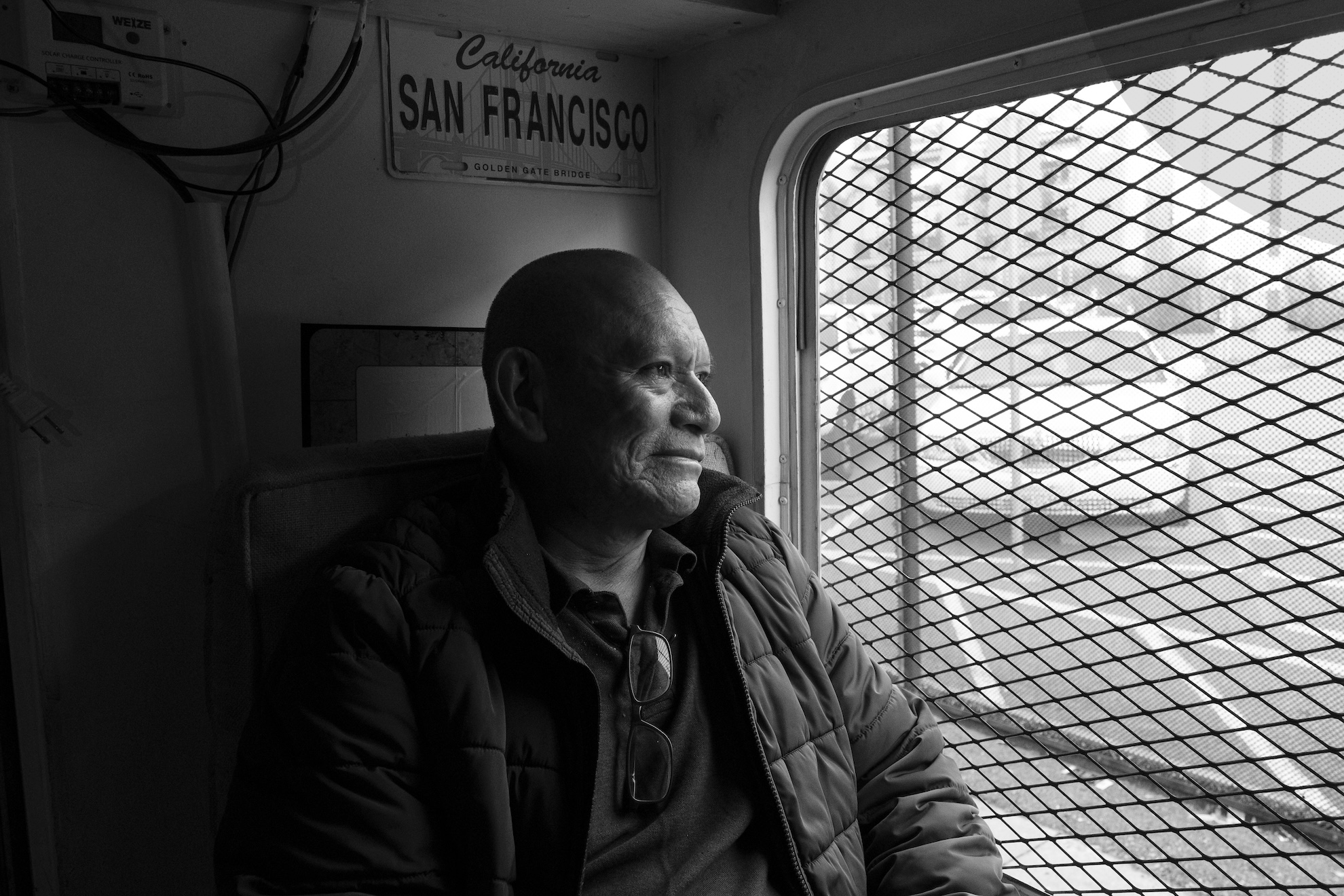
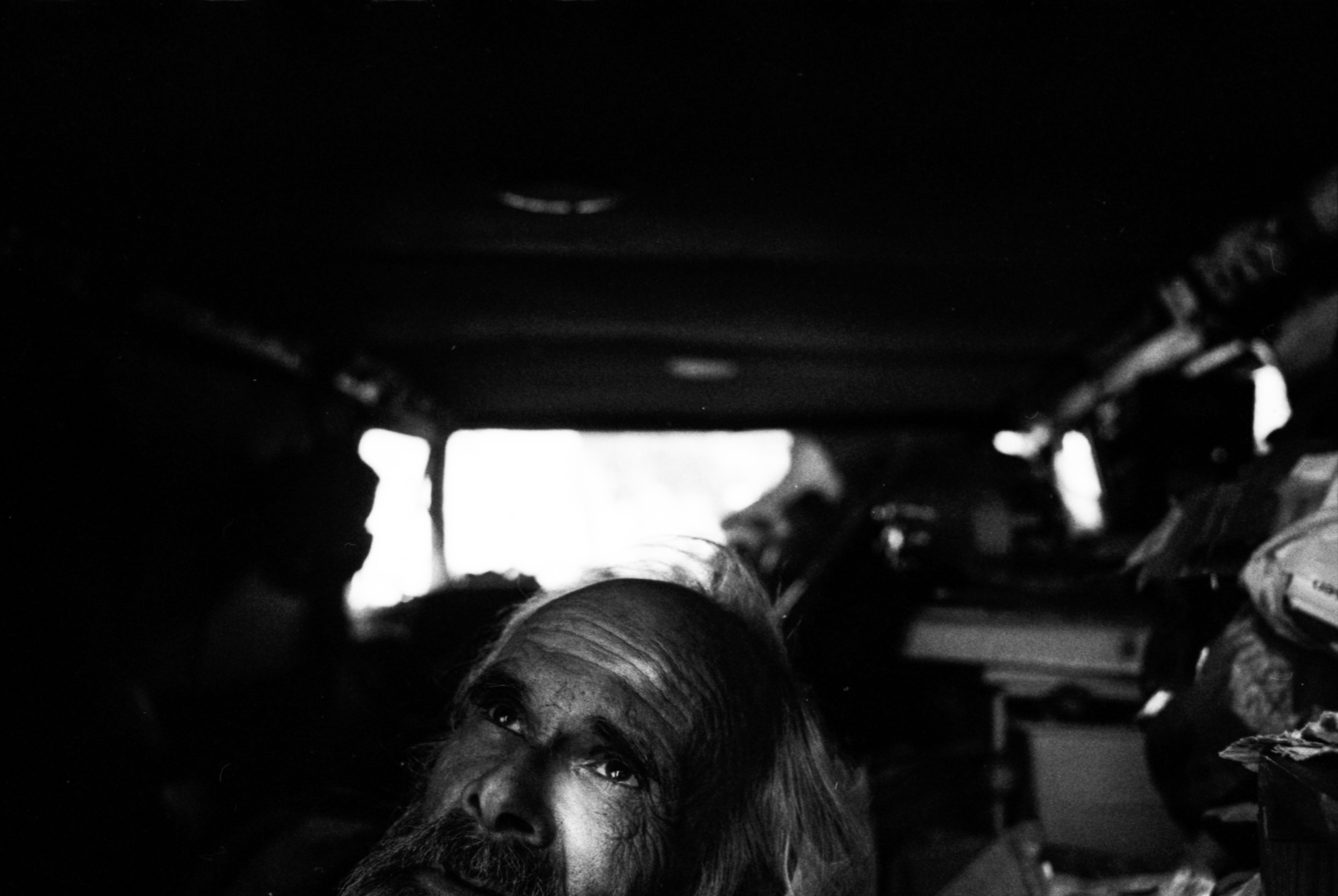
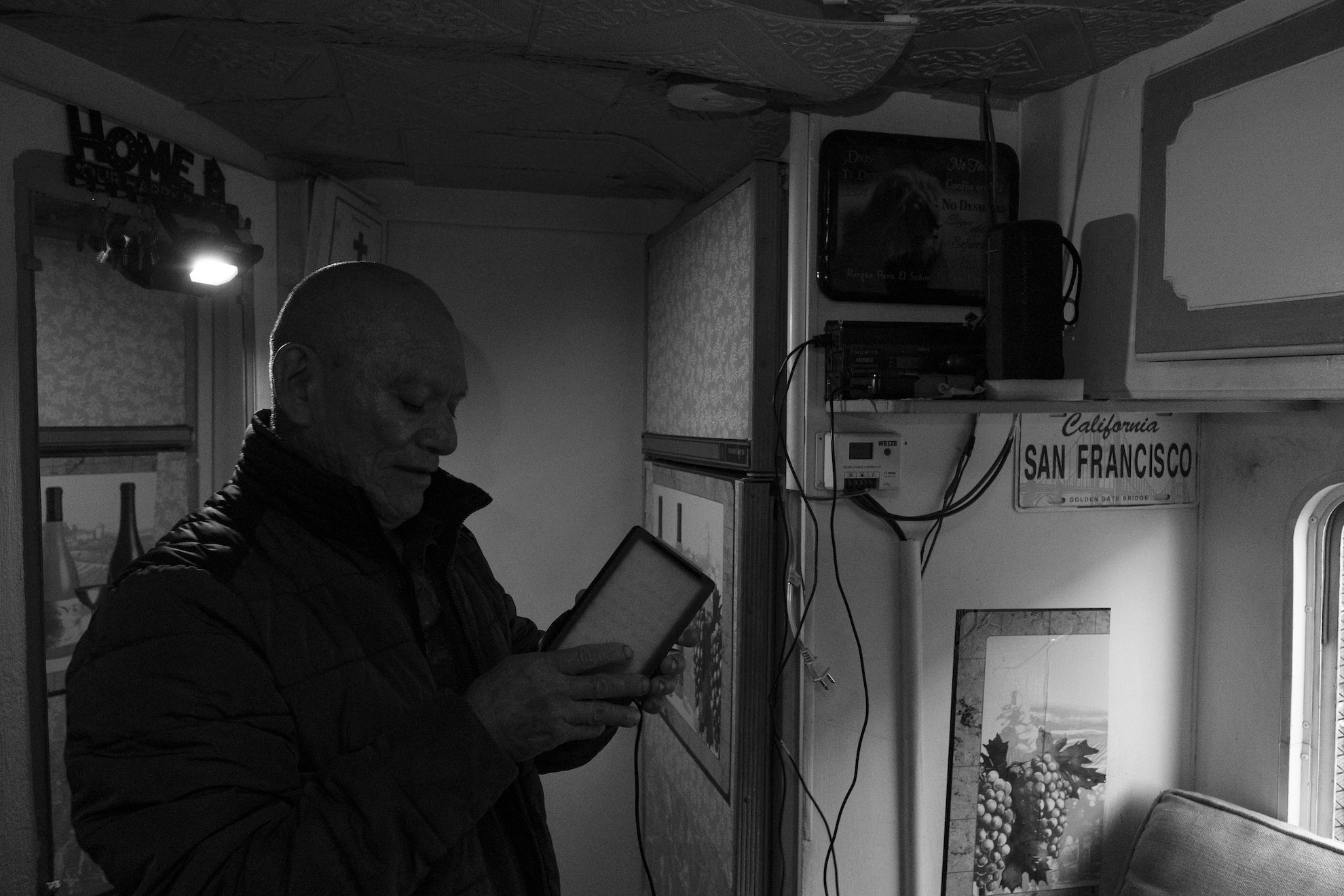
Miguel Mercado sits inside the RV he has called home for two years in the Mission District on Feb. 12, 2026. With the Large Vehicle Refuge Program ending in April, he faces an uncertain future and doesn't know where he'll go. A San Francisco policy aimed at reducing RV homelessness is displacing vulnerable residents, as enforcement data shows hundreds of vehicle tows far outpacing housing placements, exposing gaps in outreach, eligibility rules and support for people living in vehicles they do not own.
(Yesica Prado/El Tecolote)
This story was originally published by El Tecolote.
San Francisco’s RV permit promised stability. For Miguel Mercado, it delivered the opposite. Last week, after the RV was turned over to the city, Mercado started sleeping on the streets.
For almost three years, the 58-year-old Nicaraguan immigrant had lived inside a friend’s RV without paying rent. In exchange, he helped with repairs, kept it clean and pushed it down the block at midnight each Sunday to avoid street-sweeping tickets.
That fragile arrangement has now unraveled.
Last fall, San Francisco imposed a two-hour parking limit citywide for oversized vehicles in an effort to reduce the number of RVs used as shelters. Residents who could prove they had been living in the city in May 2025 were granted temporary exemptions through the Large Vehicle Refuge Permit Program.
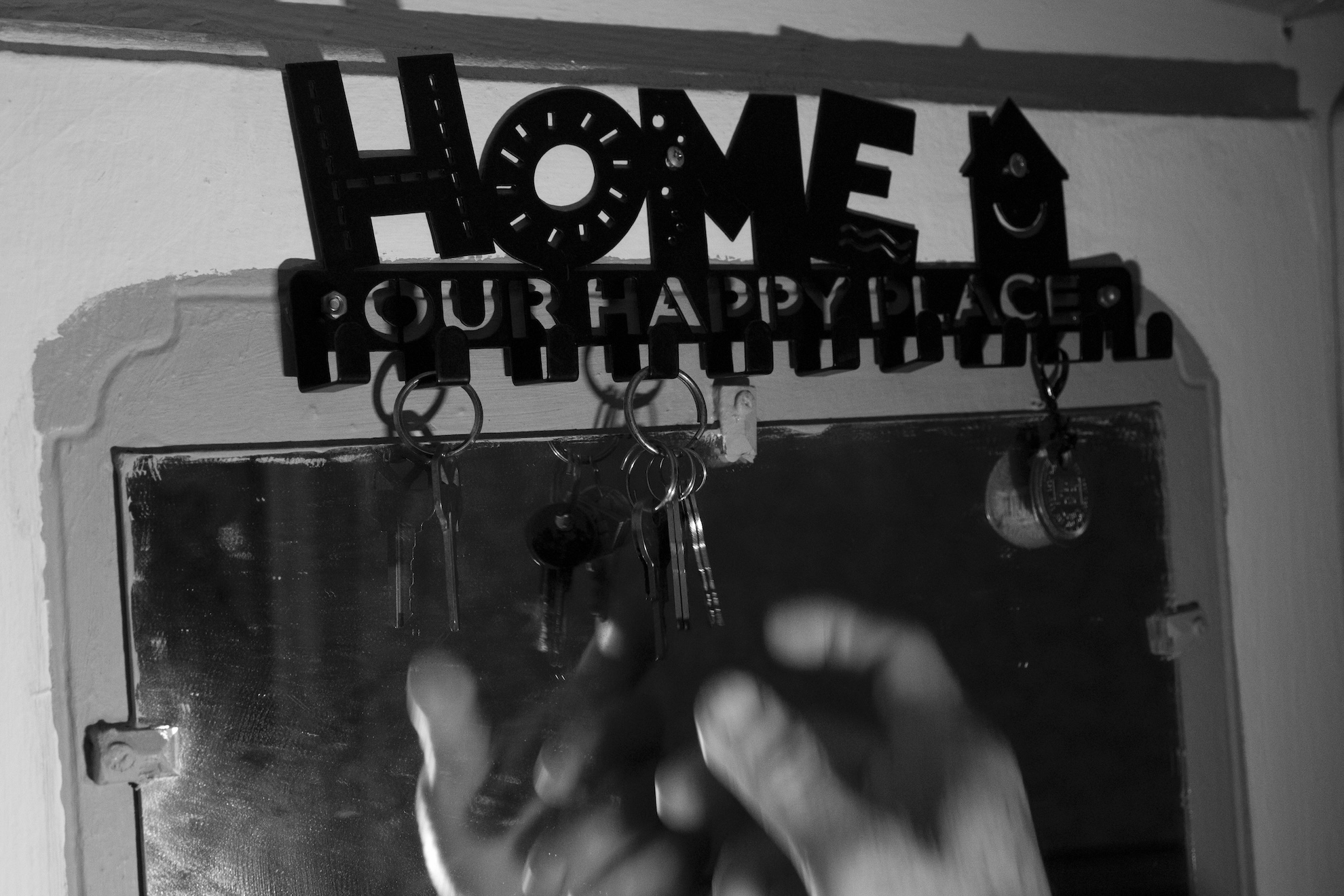
Miguel Mercado hangs the keys to his home on a key holder inside his RV in the Mission District on Feb. 12, 2026. He has lived here for two years, but now faces eviction after his housemate enrolled their RV in the city’s vehicle buyback program, meaning it will be sold and destroyed. (Yesica Prado/El Tecolote)
City officials said the program would stabilize vehicle residents while restoring public space.
Mayor Daniel Lurie claims it is producing results. He recently announced that the number of RVs in San Francisco has dropped about 20% since December, falling from 462 vehicles to 374 in February, while 67 vehicle households have moved from RVs into housing or shelter.
But early results show a stark imbalance: since enforcement began in November 2025, the city has towed 159 RVs under the ordinance and another 194 for other reasons — more than five times the number of households placed into housing through the permit program.
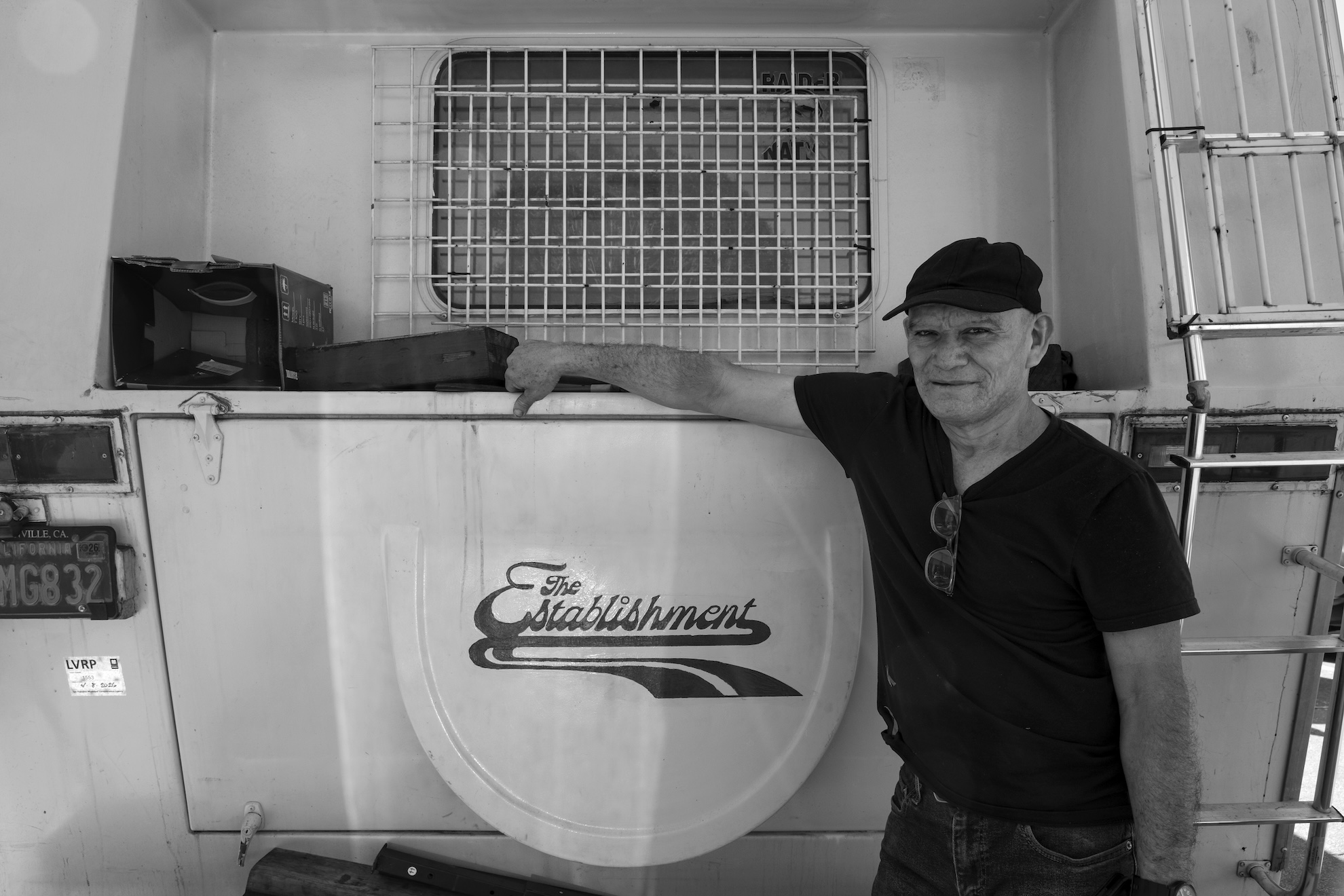
Miguel Mercado poses for a portrait in front of the RV he called home for nearly three years, moments before city staff arrived to tow and destroy it on March 9, 2026. He moved into the RV after finding no other refuge as an immigrant with an asylum case. (Yesica Prado/El Tecolote)
Months into enforcement, residents say that while the program offers relief to some, it is pushing others into deeper instability through denials, displacement and mounting fines.
Collateral displacement
Without the RV, Mercado said, he has nowhere left to sleep.
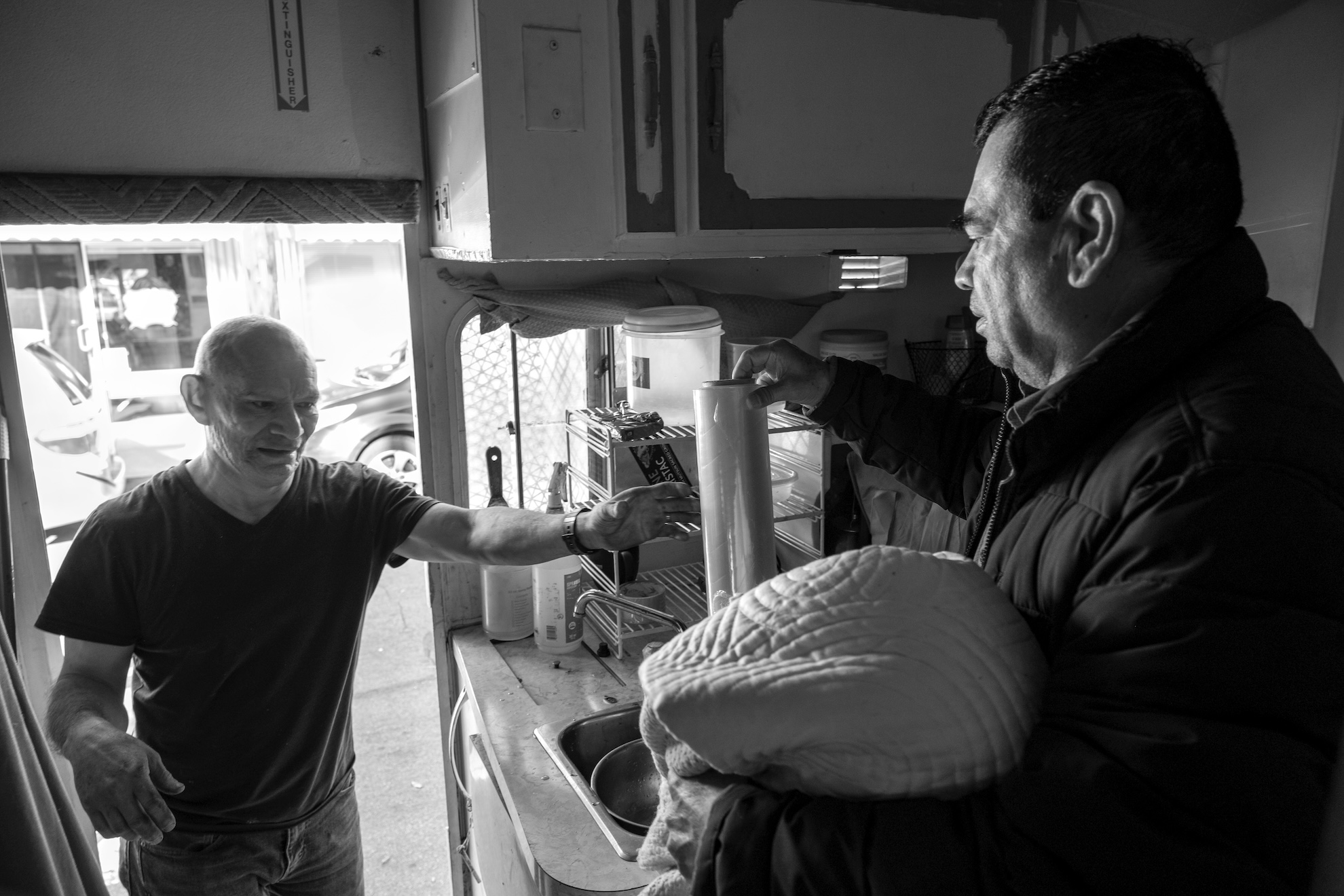
The RV’s owner, who lives in the vehicle with him, qualified for housing through the LVRP permit and opted into the city’s large vehicle buyback program. Mercado said outreach workers communicated only with the registered owner during the permit rollout, and they never contacted him or offered him housing.
The result: his friend got a studio apartment with his wife. Mercado got the street.
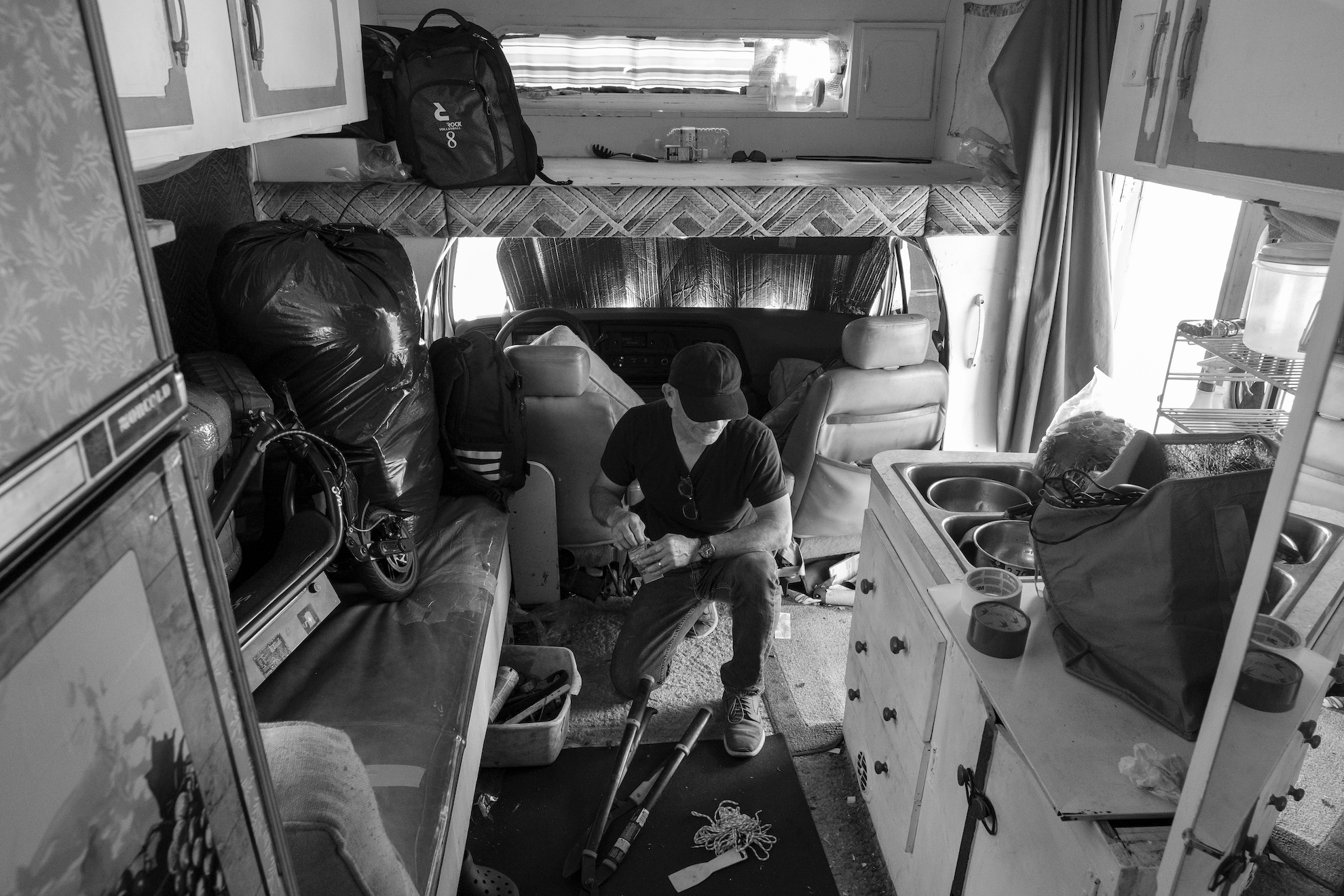
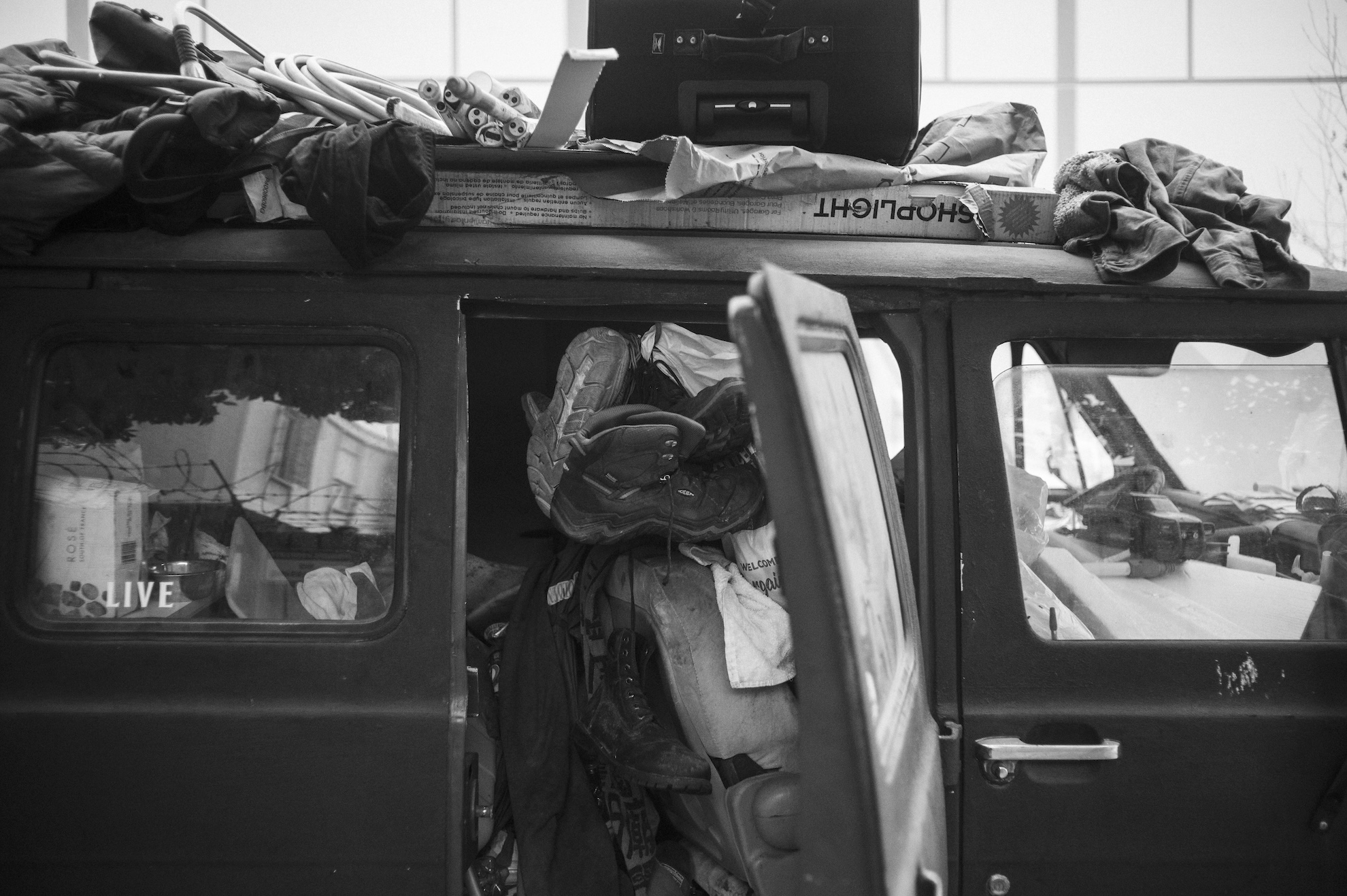
Miguel Mercado packs his belongings before city staff arrives to tow his RV on March 9, 2026. Not knowing where he will sleep next, he gets rid of most of his things, even giving his bed to a neighbor who sleeps in a van. (Yesica Prado/El Tecolote)
“I don’t know what I can do. That’s the concern of the immigrant,” Mercado said. “I’ll figure it out. I do wish him the best.”
The permit system is largely tied to vehicle registration, meaning assistance often goes to the person who appears on the title, not necessarily the person sleeping inside the RV.
Applicants were required to provide documents such as vehicle registration in their name, insurance, towing records and vehicle purchase, requirements that can exclude secondary occupants like Mercado.
Related Article
A city official, speaking on background, said permits are intended for the people living in the RV but acknowledged that assistance depends on outreach teams knowing those occupants exist.
“If they’re not known to city outreach teams… that is going to have an effect on them,” the official said. Mercado’s case illustrates this program gap.
The official added that the purpose of the buyback program is to buy RVs that people are living in, “not to buy back RVs from owners who are not living in them.” But without a system to track who actually sleeps inside, that distinction can be lost.
The Department of Emergency Management did not provide data on how many people may be living in vehicles they do not own, nor did they clarify what options exist for secondary occupants once a registered owner exits the program.
For Mercado, the consequence is immediate: he has no roof over his head.
Without the RV, he said, memories of his early days in the U.S. resurface: standing in the rain with only his passport after his belongings were confiscated at the border and sleeping on the streets after exiting the immigration detention center, while battling pneumonia.
Miguel Mercado helps his housemate, Armando, clear out the RV they shared for years on March 9, 2026. Armando qualified for housing through the city’s LVRP program. Mercado did not. (Yesica Prado/El Tecolote)
Now, as the program has ended for him, he fears reliving it all over again.
“They make it difficult, even when one wants to better oneself and not be a burden,” Mercado said. “The immigrant doesn’t want to be a burden. But they become a burden. Why?”
For now, he sleeps in a broken-down car borrowed from a friend in El Sobrante — in another city and county, another life he didn’t choose.
A promise of housing, a return to temporary shelter
Katia S., who recently gave birth to her first child, believed the permit program would provide her family with a lasting housing opportunity.
After repeatedly being denied a Large Vehicle Refuge Permit despite submitting documentation, she and her husband were later placed in a hotel for 90 days in December, after El Tecolote’s reporting on allegations that a Homeless Outreach Team worker sold permits for cash.
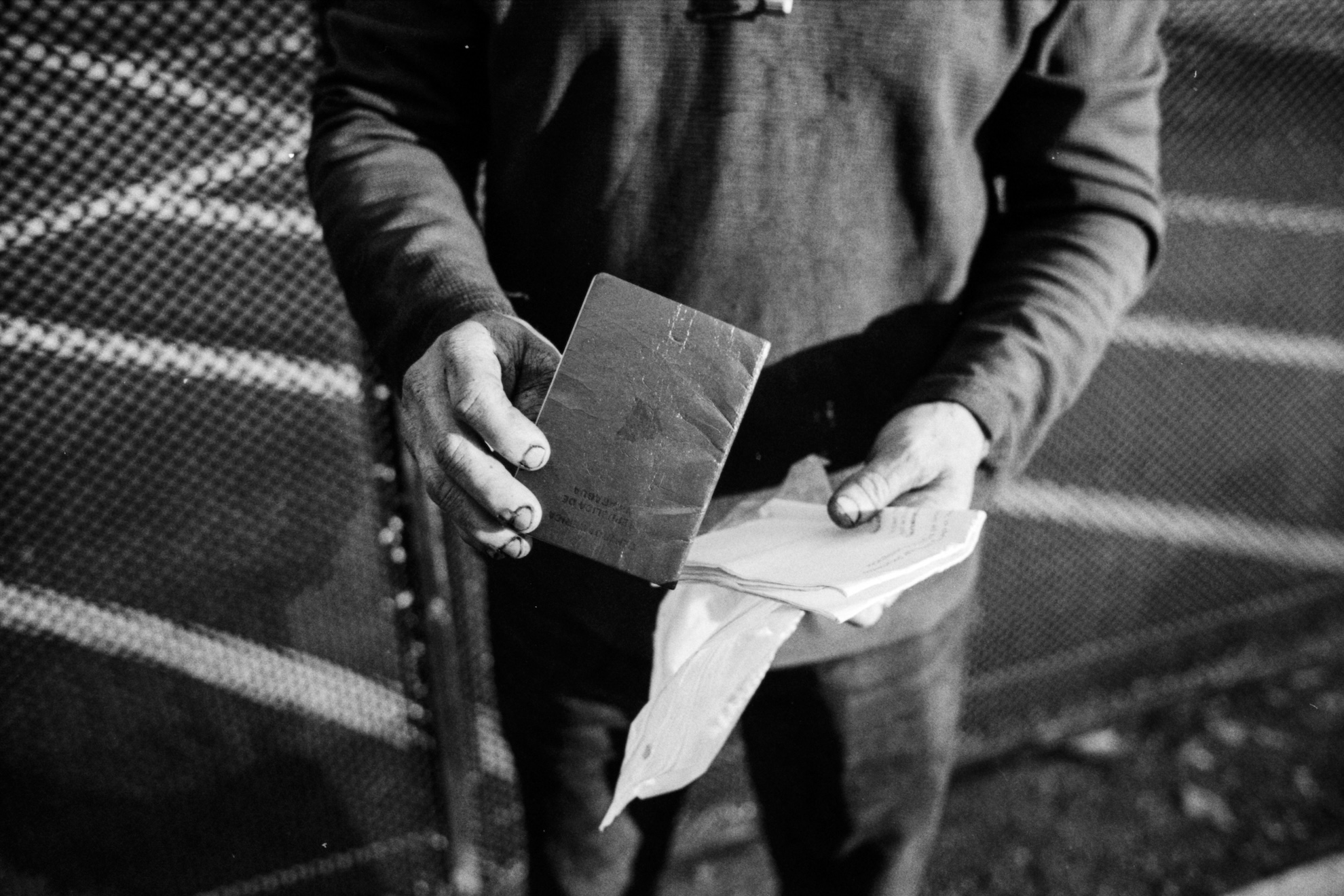
Miguel Mercado, 58, holds his Nicaraguan passport, one of the few things that he carried throughout his migration journey, in San Francisco, Calif., on Dec. 8, 2025. Mercado, who has lived in a friend’s RV, will once again be out on the street with very few resources available to him. (Pablo Unzueta for El Tecolote/CatchLight Local)
Katia said an outreach worker named Alejandra made her a clear promise: stay at the hotel, and then you will qualify for an apartment. “When two or three months pass, we’re going to place you in a permanent place,” she recalled.
Katia said she was also told that giving up the RV would help her qualify for permanent housing through the LVRP program and its buyback option. Instead, the same day they moved into the hotel — Dec. 19 — the vehicle was towed. The family has since been unable to locate it and retrieve all their personal belongings.
Three days later, on Dec. 23, Katia gave birth to her son via emergency C-section. “The baby was tangled in the cord,” she said.
Kathia Z., 30, who was eight months pregnant, holds Yerservi M.’s hand on her belly outside their RV in San Francisco’s Bayview–Hunters Point neighborhood on Nov. 7, 2025. (Pablo Unzueta for El Tecolote/CatchLight Local)
On Feb. 19, Katia, her husband and their newborn were moved into another shelter run by Compass, where they could remain for another 90 days.
When Katia recently asked her social worker about transitioning to permanent housing, the answer was bleak. She was told that permanent placements are now largely reserved for people with disabilities, serious illnesses, or addictions. For her family, a permanent home was “very unlikely.”
The contrast with other RV families is stark. Katia said she knows of another family who, through the program, had their RV paid off and were placed in a home for two years.
“Why not us?” she asked.
The answer, she was told, lies in the scam she never asked to be part of. When Katia pressed for more help from the city, her outreach worker told her they no longer qualified for certain programs because they had obtained an “illegal sticker.”
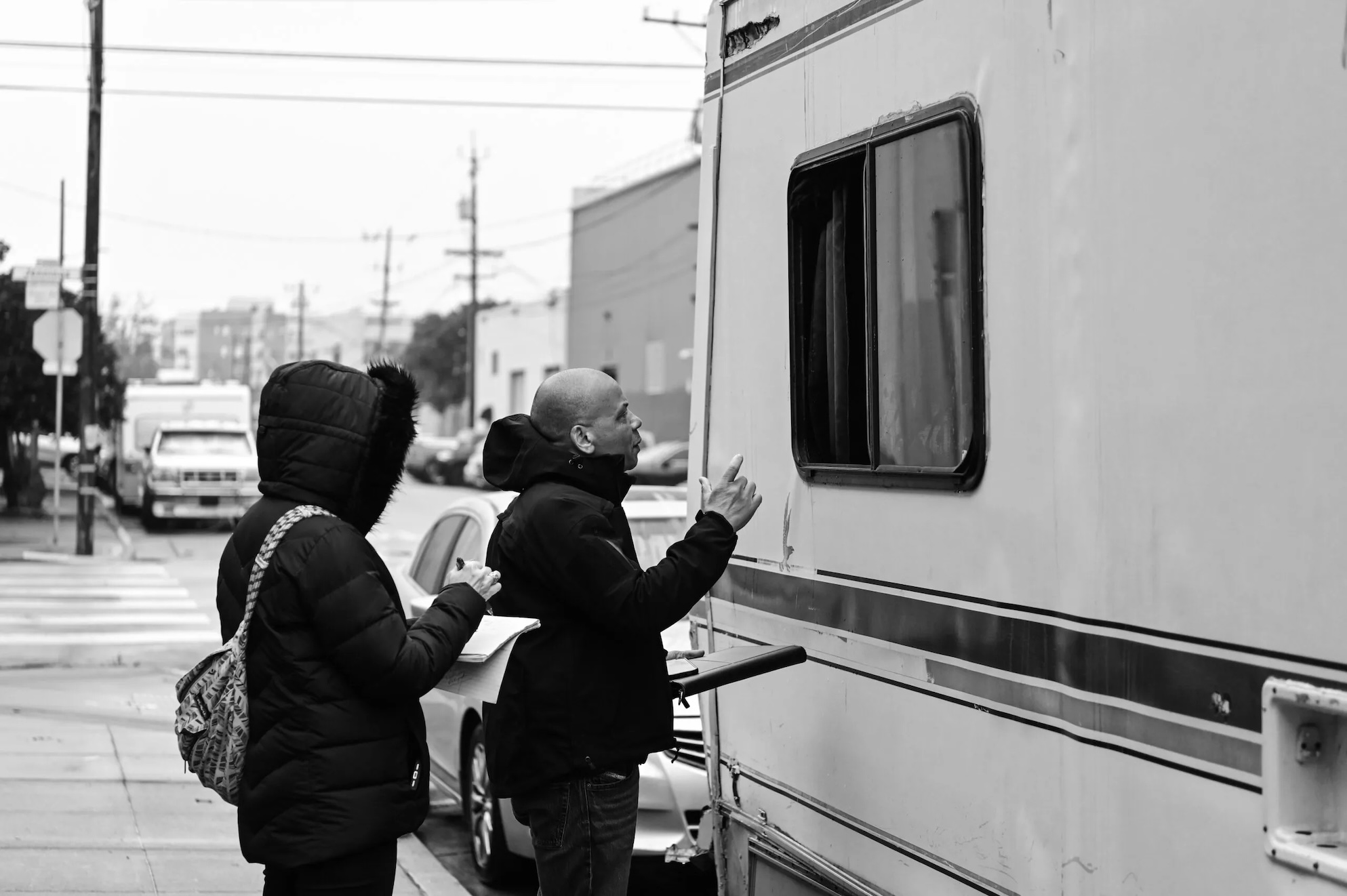
Melissa Millsaps, an investigator with the City Attorney’s Office, and Eric Karsseboom, an inspector with the District Attorney’s Office, speak with Yerservi M. about a Homeless Outreach Team worker accused of illegally selling him a Large Vehicle Refuge Permit in San Francisco on Dec. 17, 2025. (Pablo Unzueta for El Tecolote/CatchLight Local)
And the scams continue. The Coalition on Homelessness said it recently received another call from an RV resident, reporting that a permit was offered to him for cash. While the Homeless Outreach Team worker was fired, it appears concerns about fraud persist.
In a statement, the Department of Homelessness and Supportive Housing acknowledged the allegation against the HOT outreach worker and said it is “committed to maintaining the utmost integrity” of the permitting process. However, the department did not respond to questions about the most recent scam report.
For Katia’s family, reporting the fraud changed nothing. They remain in limbo, caught in the fallout of the alleged scam, still waiting for the stability that they were promised.
“I asked to at least return the RV, or help me find something stable,” Katia said to her outreach worker. “I’m thinking, ‘do we have to leave San Francisco?’”
Her family’s case highlights one of the key tensions in the rollout: while the permit program is designed to transition residents out of vehicular homelessness, some families say they have instead cycled through temporary placements without securing long-term stability.
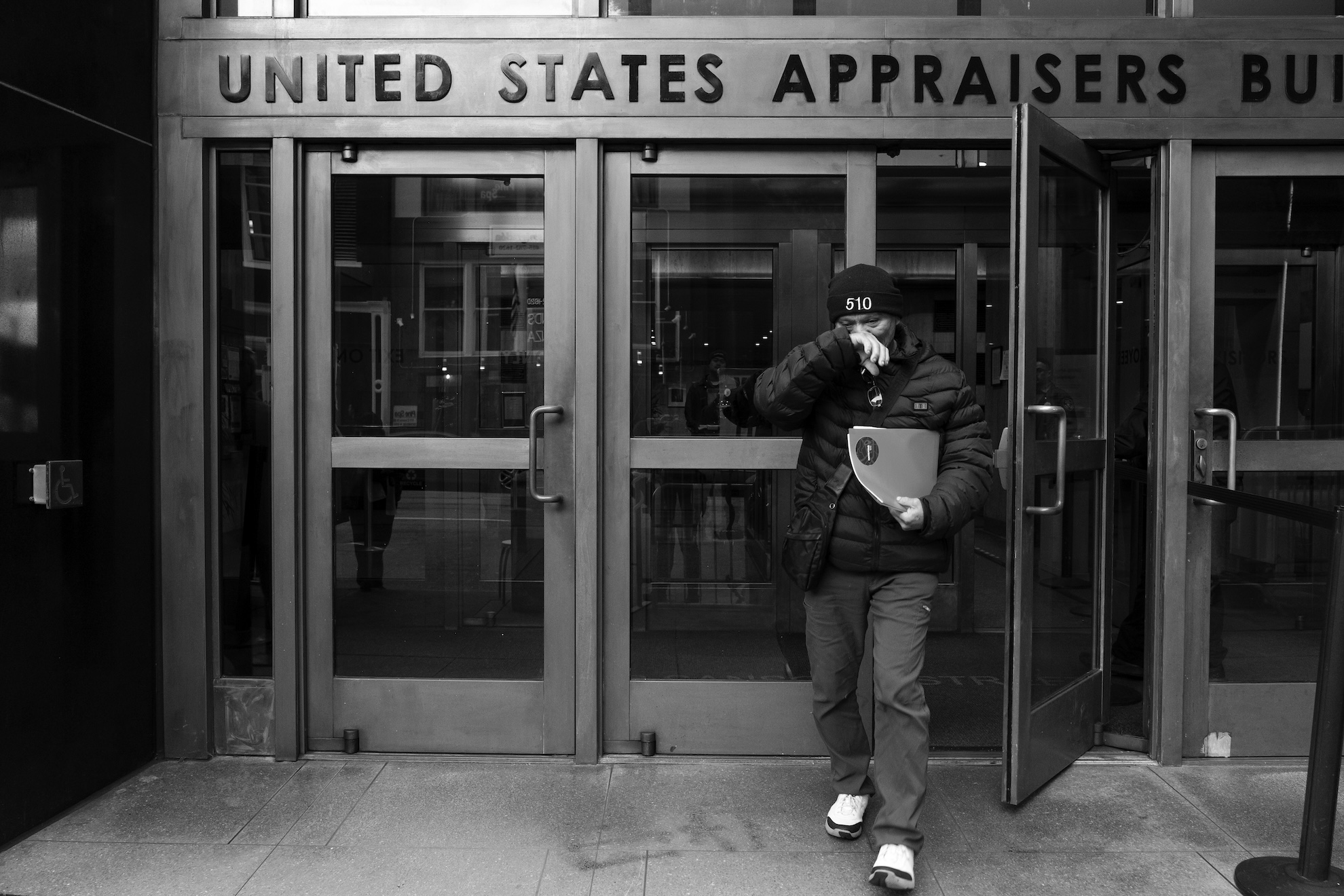
Miguel Mercado walks out of the United States Appraisers Building at 630 Sansome Street, after his annual immigration check-in on Jan. 27, 2026. Fearful that he was going to be detained, Mercado becomes emotional and wipes away his tears after walking out of his appointment. (Yesica Prado/El Tecolote)
City officials stress that the permit program is not the only gateway to assistance. “The permit is not a prerequisite to receive services,” said Jackie Thornhill, communications manager for the Department of Emergency Management. Anyone experiencing homelessness is “still eligible to engage with city outreach workers,” receive problem-solving assistance, and potentially shelter or housing placement.
But as El Tecolote’sreporting has documented, eligibility is far from a guarantee. According to city data, from July 2024 to May 2025, 1,826 families were assessed for rental support. Only 30 — less than 1.6% — were placed into housing.
For Katia’s family, that math means the promise of stability remains just out of reach.
Mounting fines and towing push residents to the brink
For residents who remain outside the permit system, the two-hour rule has translated into mounting fines and repeated towing.
Bob Kauffman, 70, vividly remembers a parking control officer telling him, “We’re going to come get you tomorrow.”
Bob Kauffman, 70, keeps his belongings in his van where he sleeps, in San Francisco, Calif., on Jan. 21, 2026. Kauffman has been towed three times since the city’s Large Vehicle Refuge Permit Program, and has been navigating new parking restrictions that aim to eliminate RVs in the city. Since his RV is inoperable, he’s had to pay $700 to tow it out of the city’s tow-yard and pay $107 in San Francisco Municipal Transportation Authority fees. (Pablo Unzueta for El Tecolote/CatchLight Local)
The next day, his RV was towed, requiring two trucks to haul it away.
Kauffman has three vehicles: two RVs and a shuttle bus. All have mechanical issues except the bus, but all are registered under his name and paid off, he said. Thieves have repeatedly tried breaking into the vehicles, damaging ignition systems.
Since enforcement began, Kauffman said he spent roughly $4,000 on impound and towing fees. Even with a low-income waiver, he pays just over $100 per impound, plus approximately $700 to transport the vehicle back to its parking spot.
Citywide, the two-hour ordinance has generated 599 citations at $108 each, which is worth $64,692, according to the public dashboard. But that figure captures only one slice of enforcement.
Related Article
From November to Feb. 12, San Francisco towed 194 RVs for expired registration and violation of the 72-hour rule. Nearly 40% of all tows were for registration issues alone, paving another way for the city to clear RVs from its streets.
Kauffman said he was only able to secure one permit sticker. Because the city issues one permit per vehicle and does not allow multiple permits for one person, his friend, an 80-year-old mechanic with memory issues, was displaced from one of the unpermitted RVs.
“He’s sleeping in his car now,” Kauffman said. “He’s old — very old.”
In response, DEM’s Jackie Thornhill said, ”One individual cannot occupy multiple vehicles, and therefore should not be issued multiple permits.” Thornhill did not comment on how the city addresses situations where vehicles are used as shared shelter among friends or relatives.
In the meantime, the 70-year-old has adapted to enforcement by changing his strategy on where he parks his other RV. In early February, someone smashed the windows and ransacked the RV. He then had it towed across the city line to Daly City, hoping to avoid more problems.
He implores the city to reform the LVRP rules so more people can be met where they are.
“How has anything changed since that program? We’re just paying the costs,” Kauffman said.
Kauffman is not the only one. The Coalition on Homelessness often hears from people getting towed.
Jennifer Friedenbach, the coalition’s director, described one recent case: an in-home care worker who was at his job — caring for someone else’s home — when his own home was towed away. His dog was inside.
Bob Kauffman, 70, who’s been towed three times since the city’s Large Vehicle Refuge Permit Program, rests inside his van where he sleeps in San Francisco, Calif., on Jan. 20, 2026. Kauffman has been navigating new parking restrictions that aim to eliminate RVs in the city. Since his RV is inoperable, he’s had to pay $700 to tow it out of the city’s tow-yard and pay $107 in San Francisco Municipal Transportation Authority fees. (Pablo Unzueta for El Tecolote/CatchLight Local)
“The dog didn’t get hurt, but that’s very dangerous because all the stuff falls down,” she said.
The man, who had $60 to his name, needed $107 to get his RV back. He asked the Coalition about shelter options, but with shelter waitlists stretching months long, there was nothing they could offer.
José Arámbula, 48, experienced a similar loss.
On March 18, the trailer he had been sleeping in was towed in the Mission District. He had been visiting a friend nearby when neighbors called to warn him that a tow truck had arrived. Arámbula said he rushed over.
“When I got there, it was gone,” he said.
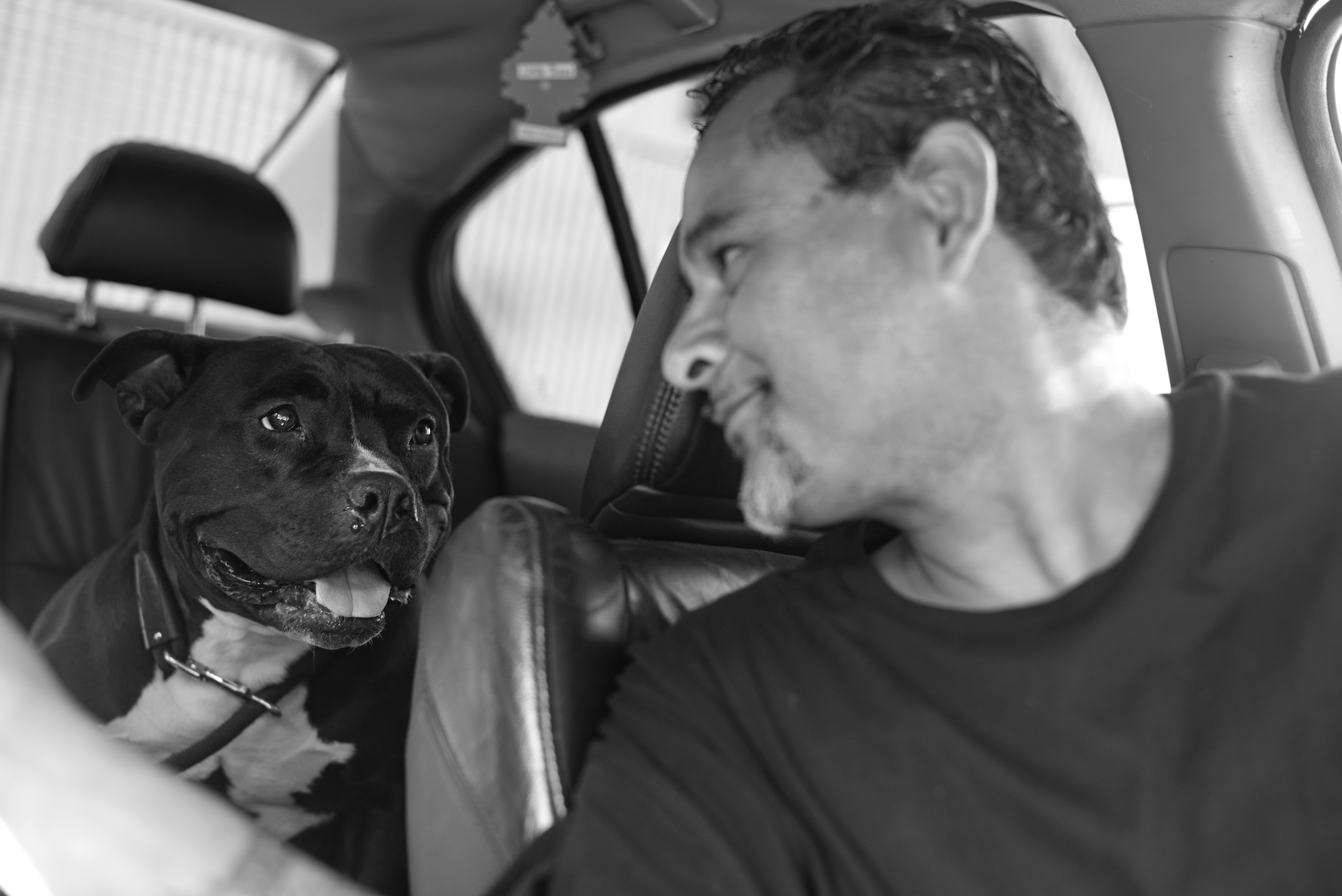
José Arámbula smiles at his pitbull, Kira, who sleeps in the car with him on March 6, 2026. Days earlier, the RV he had been living in was towed from the Mission District with Kira still inside. He retrieved his dog, but lost his IDs, clothes and everything he owned. (Erika Carlos/El Tecolote)
His beloved pitbull, Kira, had been inside the vehicle.
“Every time they take one, they take everything,” Arámbula said. “They give you a phone number to recover your things, but nobody ever answers.”
He said losing documents during previous tows has made it difficult to replace his identification or recover his belongings.
“My IDs were in there. My clothes. Everything,” he said. “You lose it all.”
Arámbula said he was able to retrieve Kira, but not his belongings. He now has only the clothes he was wearing and is sleeping in his small car with his dog. He said he plans to sell the vehicle in hopes of saving enough money to buy another RV.
“They promise help when everything is happening,” he said. “But once things calm down, they forget about the people.”
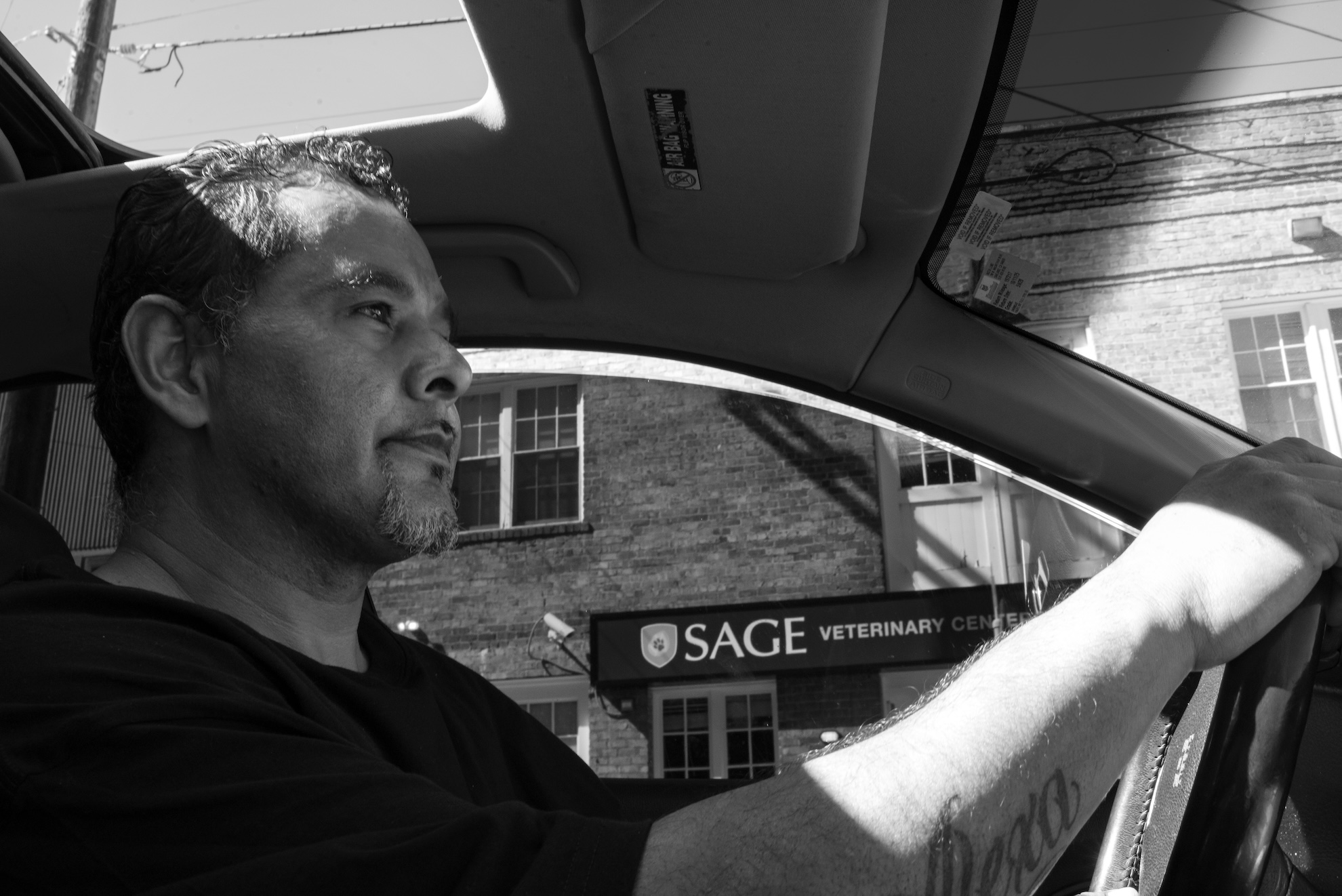
José Arámbula drives through the Mission District looking for a place to safely park and sleep for the night on March 6, 2026. (Erika Carlos/El Tecolote)
Friedenbach also noted that despite the program budgeting funds for parking signage, many warning signs have yet to appear.
The ordinance states the city intended to install 400 signs warning drivers of the new enforcement zones. But parking control officers no longer chalk tires to warn residents of time limits, she said, meaning many people don’t know they’re at risk of being towed until it’s too late.
“This idea that they needed to hammer people and scare them in order to push them into housing is silly,” she said. “There’s nothing positive about the rest of the program.”
Gap to widen as permits begin to expire
LVRP permits are set to expire by April, but could be extended for up to six additional months for eligible residents.
“The city is currently making arrangements for extensions for those vehicles and will work directly with permitted occupants on the process,” wrote DEM’s Jackie Thornhill in an email.
Advocates say that’s not enough.
Miguel Mercado charges his LED lamp inside his RV in the Mission District on Feb. 12, 2026. The solar system in the RV barely holds enough power to get through the night, just enough for his phone and lights. (Yesica Prado/El Tecolote)
The Coalition on Homelessness is calling on the city to follow the Large Vehicle legislation’s requirement for “automatic renewal” without a new application process — and to keep renewing permits every six months until residents secure housing.
They also want the city to reopen the permit process for people who were left out and people who have become homeless after the qualifying date.
“Our affordability crisis is going nowhere,” Friedenbach said. “We’re going to continue having folks who rely on RVs to shelter themselves. The city needs to plan for that.”
For Latino residents, she said, additional barriers compounded the problem: few Spanish-speaking outreach workers, schedules that conflicted with work, and heightened fear of Immigration Customs Enforcement after recent federal raids. “Folks are nervous about answering their doors,” she said.
Bob Kauffman, 70, inspects his RV on the side of the road after retrieving it from the City & County of San Francisco Impound in Daly City, Calif., on Jan. 21, 2026. Kauffman has been towed three times since the city’s Large Vehicle Refuge Permit Program, and has been navigating new parking restrictions that aim to eliminate RVs in the city. Since his RV is inoperable, he’s had to pay $700 to tow it out of the city’s tow-yard and pay $107 in San Francisco Municipal Transportation Authority fees. (Pablo Unzueta for El Tecolote/CatchLight Local)
As permits begin to expire this spring, the uneven outcomes of the rollout are likely to become more visible.
For Mercado, the stakes could not be higher. His asylum case hangs in the balance. He is required to check in with ICE in June, but with no stable place to live and no money for a lawyer, he doesn’t know how he will manage it. One misstep could mean deportation to a country he fled.
“There is no one who advocates for the immigrants who are on the streets, who are surviving — not at the government’s expense,” he said. “But through their own survival.”
Erika Carlos contributed to this report.
lower waypointnext waypoint
Player sponsored by
window.__IS_SSR__=true
window.__INITIAL_STATE__={
"attachmentsReducer": {
"audio_0": {
"type": "attachments",
"id": "audio_0",
"imgSizes": {
"kqedFullSize": {
"file": "https://ww2.kqed.org/news/wp-content/themes/KQED-unified/img/audio_bgs/background0.jpg"
}
}
},
"audio_1": {
"type": "attachments",
"id": "audio_1",
"imgSizes": {
"kqedFullSize": {
"file": "https://ww2.kqed.org/news/wp-content/themes/KQED-unified/img/audio_bgs/background1.jpg"
}
}
},
"audio_2": {
"type": "attachments",
"id": "audio_2",
"imgSizes": {
"kqedFullSize": {
"file": "https://ww2.kqed.org/news/wp-content/themes/KQED-unified/img/audio_bgs/background2.jpg"
}
}
},
"audio_3": {
"type": "attachments",
"id": "audio_3",
"imgSizes": {
"kqedFullSize": {
"file": "https://ww2.kqed.org/news/wp-content/themes/KQED-unified/img/audio_bgs/background3.jpg"
}
}
},
"audio_4": {
"type": "attachments",
"id": "audio_4",
"imgSizes": {
"kqedFullSize": {
"file": "https://ww2.kqed.org/news/wp-content/themes/KQED-unified/img/audio_bgs/background4.jpg"
}
}
},
"placeholder": {
"type": "attachments",
"id": "placeholder",
"imgSizes": {
"thumbnail": {
"file": "https://cdn.kqed.org/wp-content/uploads/2024/12/KQED-Default-Image-816638274-2000x1333-1-160x107.jpg",
"width": 160,
"height": 107,
"mimeType": "image/jpeg"
},
"medium": {
"file": "https://cdn.kqed.org/wp-content/uploads/2024/12/KQED-Default-Image-816638274-2000x1333-1-800x533.jpg",
"width": 800,
"height": 533,
"mimeType": "image/jpeg"
},
"medium_large": {
"file": "https://cdn.kqed.org/wp-content/uploads/2024/12/KQED-Default-Image-816638274-2000x1333-1-768x512.jpg",
"width": 768,
"height": 512,
"mimeType": "image/jpeg"
},
"large": {
"file": "https://cdn.kqed.org/wp-content/uploads/2024/12/KQED-Default-Image-816638274-2000x1333-1-1020x680.jpg",
"width": 1020,
"height": 680,
"mimeType": "image/jpeg"
},
"1536x1536": {
"file": "https://cdn.kqed.org/wp-content/uploads/2024/12/KQED-Default-Image-816638274-2000x1333-1-1536x1024.jpg",
"width": 1536,
"height": 1024,
"mimeType": "image/jpeg"
},
"fd-lrg": {
"file": "https://cdn.kqed.org/wp-content/uploads/2024/12/KQED-Default-Image-816638274-2000x1333-1-1536x1024.jpg",
"width": 1536,
"height": 1024,
"mimeType": "image/jpeg"
},
"fd-med": {
"file": "https://cdn.kqed.org/wp-content/uploads/2024/12/KQED-Default-Image-816638274-2000x1333-1-1020x680.jpg",
"width": 1020,
"height": 680,
"mimeType": "image/jpeg"
},
"fd-sm": {
"file": "https://cdn.kqed.org/wp-content/uploads/2024/12/KQED-Default-Image-816638274-2000x1333-1-800x533.jpg",
"width": 800,
"height": 533,
"mimeType": "image/jpeg"
},
"post-thumbnail": {
"file": "https://cdn.kqed.org/wp-content/uploads/2024/12/KQED-Default-Image-816638274-2000x1333-1-672x372.jpg",
"width": 672,
"height": 372,
"mimeType": "image/jpeg"
},
"twentyfourteen-full-width": {
"file": "https://cdn.kqed.org/wp-content/uploads/2024/12/KQED-Default-Image-816638274-2000x1333-1-1038x576.jpg",
"width": 1038,
"height": 576,
"mimeType": "image/jpeg"
},
"xxsmall": {
"file": "https://cdn.kqed.org/wp-content/uploads/2024/12/KQED-Default-Image-816638274-2000x1333-1-160x107.jpg",
"width": 160,
"height": 107,
"mimeType": "image/jpeg"
},
"xsmall": {
"file": "https://cdn.kqed.org/wp-content/uploads/2024/12/KQED-Default-Image-816638274-2000x1333-1-672x372.jpg",
"width": 672,
"height": 372,
"mimeType": "image/jpeg"
},
"small": {
"file": "https://cdn.kqed.org/wp-content/uploads/2024/12/KQED-Default-Image-816638274-2000x1333-1-672x372.jpg",
"width": 672,
"height": 372,
"mimeType": "image/jpeg"
},
"xlarge": {
"file": "https://cdn.kqed.org/wp-content/uploads/2024/12/KQED-Default-Image-816638274-2000x1333-1-1020x680.jpg",
"width": 1020,
"height": 680,
"mimeType": "image/jpeg"
},
"full-width": {
"file": "https://cdn.kqed.org/wp-content/uploads/2024/12/KQED-Default-Image-816638274-2000x1333-1-1920x1280.jpg",
"width": 1920,
"height": 1280,
"mimeType": "image/jpeg"
},
"guest-author-32": {
"file": "https://cdn.kqed.org/wp-content/uploads/2025/01/KQED-Default-Image-816638274-1333x1333-1-160x160.jpg",
"width": 32,
"height": 32,
"mimeType": "image/jpeg"
},
"guest-author-50": {
"file": "https://cdn.kqed.org/wp-content/uploads/2025/01/KQED-Default-Image-816638274-1333x1333-1-160x160.jpg",
"width": 50,
"height": 50,
"mimeType": "image/jpeg"
},
"guest-author-64": {
"file": "https://cdn.kqed.org/wp-content/uploads/2025/01/KQED-Default-Image-816638274-1333x1333-1-160x160.jpg",
"width": 64,
"height": 64,
"mimeType": "image/jpeg"
},
"guest-author-96": {
"file": "https://cdn.kqed.org/wp-content/uploads/2025/01/KQED-Default-Image-816638274-1333x1333-1-160x160.jpg",
"width": 96,
"height": 96,
"mimeType": "image/jpeg"
},
"guest-author-128": {
"file": "https://cdn.kqed.org/wp-content/uploads/2025/01/KQED-Default-Image-816638274-1333x1333-1-160x160.jpg",
"width": 128,
"height": 128,
"mimeType": "image/jpeg"
},
"detail": {
"file": "https://cdn.kqed.org/wp-content/uploads/2025/01/KQED-Default-Image-816638274-1333x1333-1-160x160.jpg",
"width": 160,
"height": 160,
"mimeType": "image/jpeg"
},
"kqedFullSize": {
"file": "https://cdn.kqed.org/wp-content/uploads/2024/12/KQED-Default-Image-816638274-2000x1333-1.jpg",
"width": 2000,
"height": 1333
}
}
},
"news_12077849": {
"type": "attachments",
"id": "news_12077849",
"meta": {
"index": "attachments_1716263798",
"site": "news",
"id": "12077849",
"found": true
},
"title": "Mercado_8",
"publishDate": 1774638047,
"status": "inherit",
"parent": 12077837,
"modified": 1774638073,
"caption": "Miguel Mercado sits inside the RV he has called home for two years in the Mission District on Feb. 12, 2026. With the Large Vehicle Refuge Program ending in April, he faces an uncertain future and doesn't know where he'll go. A San Francisco policy aimed at reducing RV homelessness is displacing vulnerable residents, as enforcement data shows hundreds of vehicle tows far outpacing housing placements, exposing gaps in outreach, eligibility rules and support for people living in vehicles they do not own.\r\n",
"credit": "Yesica Prado/El Tecolote",
"altTag": null,
"description": null,
"imgSizes": {
"thumbnail": {
"file": "https://cdn.kqed.org/wp-content/uploads/sites/10/2026/03/Mercado_8-160x107.jpg",
"width": 160,
"height": 107,
"mimeType": "image/jpeg"
},
"1536x1536": {
"file": "https://cdn.kqed.org/wp-content/uploads/sites/10/2026/03/Mercado_8-1536x1024.jpg",
"width": 1536,
"height": 1024,
"mimeType": "image/jpeg"
},
"post-thumbnail": {
"file": "https://cdn.kqed.org/wp-content/uploads/sites/10/2026/03/Mercado_8-672x372.jpg",
"width": 672,
"height": 372,
"mimeType": "image/jpeg"
},
"twentyfourteen-full-width": {
"file": "https://cdn.kqed.org/wp-content/uploads/sites/10/2026/03/Mercado_8-1038x576.jpg",
"width": 1038,
"height": 576,
"mimeType": "image/jpeg"
},
"npr-cds-wide": {
"file": "https://cdn.kqed.org/wp-content/uploads/sites/10/2026/03/Mercado_8-1200x675.jpg",
"width": 1200,
"height": 675,
"mimeType": "image/jpeg"
},
"npr-cds-square": {
"file": "https://cdn.kqed.org/wp-content/uploads/sites/10/2026/03/Mercado_8-600x600.jpg",
"width": 600,
"height": 600,
"mimeType": "image/jpeg"
},
"kqedFullSize": {
"file": "https://cdn.kqed.org/wp-content/uploads/sites/10/2026/03/Mercado_8.jpg",
"width": 1980,
"height": 1320
}
},
"isLoading": false,
"fetchFailed": false
}
},
"audioPlayerReducer": {
"postId": "stream_live",
"isPaused": true,
"isPlaying": false,
"pfsActive": false,
"pledgeModalIsOpen": true,
"playerDrawerIsOpen": false,
"liveAudioPlayStartedAt": 0,
"liveAudioPlayContext": ""
},
"authorsReducer": {
"byline_news_12077837": {
"type": "authors",
"id": "byline_news_12077837",
"meta": {
"override": true
},
"slug": "byline_news_12077837",
"name": "By Pablo Unzueta and Yesica Prado, El Tecolote",
"isLoading": false
}
},
"pagesReducer": {},
"pfsSessionReducer": {},
"postsReducer": {
"stream_live": {
"type": "live",
"id": "stream_live",
"audioUrl": "https://streams.kqed.org/kqedradio",
"title": "Live Stream",
"excerpt": "Live Stream information currently unavailable.",
"link": "/radio",
"featImg": "",
"label": {
"name": "KQED Live",
"link": "/"
}
},
"stream_kqedNewscast": {
"type": "posts",
"id": "stream_kqedNewscast",
"audioUrl": "https://www.kqed.org/.stream/anon/radio/RDnews/newscast.mp3?_=1",
"title": "KQED Newscast",
"featImg": "",
"label": {
"name": "88.5 FM",
"link": "/"
}
},
"news_12077837": {
"type": "posts",
"id": "news_12077837",
"meta": {
"index": "posts_1716263798",
"site": "news",
"id": "12077837",
"found": true
},
"articlePosition": 0,
"guestAuthors": [],
"slug": "san-francisco-rv-permit-program-leaves-some-residents-homeless-despite-promises",
"title": "San Francisco RV Permit Program Leaves Some Residents Homeless Despite Promises",
"publishDate": 1774803652,
"format": "standard",
"headTitle": "San Francisco RV Permit Program Leaves Some Residents Homeless Despite Promises | KQED",
"labelTerm": {},
"content": "\u003cp>\u003cem>This story was originally \u003c/em>\u003ca href=\"https://eltecolote.org/content/en/sf-rv-permit-homelessness-impacts/\">\u003cem>published\u003c/em>\u003c/a>\u003cem> by El Tecolote.\u003c/em>\u003c/p>\n\u003cp>\u003ca href=\"https://www.kqed.org/news/tag/rvs\">San Francisco’s RV permit\u003c/a> promised stability. For Miguel Mercado, it delivered the opposite. Last week, after the RV was turned over to the city, Mercado started sleeping on the streets.\u003c/p>\n\u003cp>For almost three years, the 58-year-old Nicaraguan immigrant had lived inside a friend’s RV without paying rent. In exchange, he helped with repairs, kept it clean and pushed it down the block at midnight each Sunday to avoid street-sweeping tickets.\u003c/p>\n\u003cp>[ad fullwidth]\u003c/p>\n\u003cp>That fragile arrangement has now unraveled.\u003c/p>\n\u003cp>Last fall, San Francisco \u003ca href=\"https://eltecolote.org/content/en/rv-permit-large-vehicles-san-francisco/\">imposed\u003c/a> a two-hour parking limit citywide for oversized vehicles in an effort to reduce the number of RVs used as shelters. Residents who could prove they had been living in the city in May 2025 were granted temporary exemptions through the Large Vehicle Refuge Permit Program.\u003c/p>\n\u003cfigure id=\"attachment_12077851\" class=\"wp-caption aligncenter\" style=\"max-width: 1980px\">\u003cimg loading=\"lazy\" decoding=\"async\" class=\"wp-image-12077851 size-full\" src=\"https://cdn.kqed.org/wp-content/uploads/sites/10/2026/03/Mercado_5.jpg\" alt=\"\" width=\"1980\" height=\"1320\" srcset=\"https://cdn.kqed.org/wp-content/uploads/sites/10/2026/03/Mercado_5.jpg 1980w, https://cdn.kqed.org/wp-content/uploads/sites/10/2026/03/Mercado_5-160x107.jpg 160w, https://cdn.kqed.org/wp-content/uploads/sites/10/2026/03/Mercado_5-1536x1024.jpg 1536w\" sizes=\"auto, (max-width: 1980px) 100vw, 1980px\">\u003cfigcaption class=\"wp-caption-text\">Miguel Mercado hangs the keys to his home on a key holder inside his RV in the Mission District on Feb. 12, 2026. He has lived here for two years, but now faces eviction after his housemate enrolled their RV in the city’s vehicle buyback program, meaning it will be sold and destroyed. \u003ccite>(Yesica Prado/El Tecolote)\u003c/cite>\u003c/figcaption>\u003c/figure>\n\u003cp>\u003ca href=\"https://www.sf.gov/strategy-to-address-vehicular-homelessness-and-restore-public-spaces\">City officials said\u003c/a> the program would stabilize vehicle residents while restoring public space.\u003c/p>\n\u003cp>Mayor Daniel Lurie claims it is producing results. He recently \u003ca href=\"https://abc7news.com/post/san-franciscos-quarterly-homelessness-data-shows-record-lows-3rd-time-daniel-lurie-took-office/18675815/\">announced\u003c/a> that the number of RVs in San Francisco has dropped about 20% since December, falling from 462 vehicles to 374 in February, while 67 vehicle households have moved from RVs into housing or shelter.\u003c/p>\n\u003cp>But early results show a stark imbalance: since enforcement began in November 2025, the city has \u003ca href=\"https://www.sf.gov/large--vehicle--program--outcomes\">towed 159 RVs\u003c/a> under the ordinance and another 194 for other reasons — more than five times the number of households placed into housing through the permit program.\u003c/p>\n\u003cfigure id=\"attachment_12077852\" class=\"wp-caption aligncenter\" style=\"max-width: 1980px\">\u003cimg loading=\"lazy\" decoding=\"async\" class=\"size-full wp-image-12077852\" src=\"https://cdn.kqed.org/wp-content/uploads/sites/10/2026/03/Mercado_15.jpg\" alt=\"\" width=\"1980\" height=\"1320\" srcset=\"https://cdn.kqed.org/wp-content/uploads/sites/10/2026/03/Mercado_15.jpg 1980w, https://cdn.kqed.org/wp-content/uploads/sites/10/2026/03/Mercado_15-160x107.jpg 160w, https://cdn.kqed.org/wp-content/uploads/sites/10/2026/03/Mercado_15-1536x1024.jpg 1536w\" sizes=\"auto, (max-width: 1980px) 100vw, 1980px\">\u003cfigcaption class=\"wp-caption-text\">Miguel Mercado poses for a portrait in front of the RV he called home for nearly three years, moments before city staff arrived to tow and destroy it on March 9, 2026. He moved into the RV after finding no other refuge as an immigrant with an asylum case. \u003ccite>(Yesica Prado/El Tecolote)\u003c/cite>\u003c/figcaption>\u003c/figure>\n\u003cp>Months into enforcement, residents say that while the program offers relief to some, it is pushing others into deeper instability through denials, displacement and mounting fines.\u003c/p>\n\u003ch2>Collateral displacement\u003c/h2>\n\u003cp>Without the RV, Mercado said, he has nowhere left to sleep.\u003c/p>\n\u003cp>The RV’s owner, who lives in the vehicle with him, qualified for housing through the LVRP permit and opted into the city’s large vehicle buyback program. Mercado said outreach workers communicated only with the registered owner during the permit rollout, and they never contacted him or offered him housing.\u003c/p>\n\u003cp>The result: his friend got a studio apartment with his wife. Mercado got the street.\u003c/p>\n\u003cfigure id=\"attachment_12077853\" class=\"wp-caption aligncenter\" style=\"max-width: 1980px\">\u003cimg loading=\"lazy\" decoding=\"async\" class=\"size-full wp-image-12077853\" src=\"https://cdn.kqed.org/wp-content/uploads/sites/10/2026/03/Mercado_13.jpg\" alt=\"\" width=\"1980\" height=\"1320\" srcset=\"https://cdn.kqed.org/wp-content/uploads/sites/10/2026/03/Mercado_13.jpg 1980w, https://cdn.kqed.org/wp-content/uploads/sites/10/2026/03/Mercado_13-160x107.jpg 160w, https://cdn.kqed.org/wp-content/uploads/sites/10/2026/03/Mercado_13-1536x1024.jpg 1536w\" sizes=\"auto, (max-width: 1980px) 100vw, 1980px\">\u003cfigcaption class=\"wp-caption-text\">Miguel Mercado packs his belongings before city staff arrives to tow his RV on March 9, 2026. Not knowing where he will sleep next, he gets rid of most of his things, even giving his bed to a neighbor who sleeps in a van. \u003ccite>(Yesica Prado/El Tecolote)\u003c/cite>\u003c/figcaption>\u003c/figure>\n\u003cp>“I don’t know what I can do. That’s the concern of the immigrant,” Mercado said. “I’ll figure it out. I do wish him the best.”\u003c/p>\n\u003cp>The permit system is largely tied to vehicle registration, meaning assistance often goes to the person who appears on the title, not necessarily the person sleeping inside the RV.\u003c/p>\n\u003cp>Applicants were required to provide documents such as vehicle registration in their name, insurance, towing records and vehicle purchase, requirements that can exclude secondary occupants like Mercado.[aside postID=news_12043940 hero='https://cdn.kqed.org/wp-content/uploads/sites/10/2025/06/07312024-RVRESIDENTSWINSTON-ET-PU-22-KQED.jpg']A city official, speaking on background, said permits are intended for the people living in the RV but acknowledged that assistance depends on outreach teams knowing those occupants exist.\u003c/p>\n\u003cp>“If they’re not known to city outreach teams… that is going to have an effect on them,” the official said. Mercado’s case illustrates this program gap.\u003c/p>\n\u003cp>The official added that the purpose of the buyback program is to buy RVs that people are living in, “not to buy back RVs from owners who are not living in them.” But without a system to track who actually sleeps inside, that distinction can be lost.\u003c/p>\n\u003cp>The Department of Emergency Management did not provide data on how many people may be living in vehicles they do not own, nor did they clarify what options exist for secondary occupants once a registered owner exits the program.\u003c/p>\n\u003cp>For Mercado, the consequence is immediate: he has no roof over his head.\u003c/p>\n\u003cp>Without the RV, he said, memories of his early days in the U.S. resurface: standing in the rain with only his passport after his belongings were confiscated at the border and sleeping on the streets after exiting the immigration detention center, while battling pneumonia.\u003c/p>\n\u003cfigure id=\"attachment_12077854\" class=\"wp-caption aligncenter\" style=\"max-width: 1980px\">\u003cimg loading=\"lazy\" decoding=\"async\" class=\"size-full wp-image-12077854\" src=\"https://cdn.kqed.org/wp-content/uploads/sites/10/2026/03/Mercado_12.jpg\" alt=\"\" width=\"1980\" height=\"1320\" srcset=\"https://cdn.kqed.org/wp-content/uploads/sites/10/2026/03/Mercado_12.jpg 1980w, https://cdn.kqed.org/wp-content/uploads/sites/10/2026/03/Mercado_12-160x107.jpg 160w, https://cdn.kqed.org/wp-content/uploads/sites/10/2026/03/Mercado_12-1536x1024.jpg 1536w\" sizes=\"auto, (max-width: 1980px) 100vw, 1980px\">\u003cfigcaption class=\"wp-caption-text\">Miguel Mercado helps his housemate, Armando, clear out the RV they shared for years on March 9, 2026. Armando qualified for housing through the city’s LVRP program. Mercado did not. \u003ccite>(Yesica Prado/El Tecolote)\u003c/cite>\u003c/figcaption>\u003c/figure>\n\u003cp>Now, as the program has ended for him, he fears reliving it all over again.\u003c/p>\n\u003cp>“They make it difficult, even when one wants to better oneself and not be a burden,” Mercado said. “The immigrant doesn’t want to be a burden. But they become a burden. Why?”\u003c/p>\n\u003cp>For now, he sleeps in a broken-down car borrowed from a friend in El Sobrante — in another city and county, another life he didn’t choose.\u003c/p>\n\u003ch2>A promise of housing, a return to temporary shelter\u003c/h2>\n\u003cp>Katia S., who recently gave birth to her first child, believed the permit program would provide her family with a lasting housing opportunity.\u003c/p>\n\u003cp>After repeatedly being \u003ca href=\"https://eltecolote.org/content/en/sf-rv-permit-denied/\">denied\u003c/a> a Large Vehicle Refuge Permit despite submitting documentation, she and her husband were later placed in a hotel for 90 days in December, after\u003cem> El Tecolote\u003c/em>’s reporting on allegations that a Homeless Outreach Team worker sold \u003ca href=\"https://eltecolote.org/content/en/rv-permit-cash-scam/\">permits for cash\u003c/a>.\u003c/p>\n\u003cfigure id=\"attachment_12077856\" class=\"wp-caption aligncenter\" style=\"max-width: 1980px\">\u003cimg loading=\"lazy\" decoding=\"async\" class=\"size-full wp-image-12077856\" src=\"https://cdn.kqed.org/wp-content/uploads/sites/10/2026/03/2025-2026-RVMIGUELMERCADO-ET-PU-01.jpg\" alt=\"\" width=\"1980\" height=\"1320\" srcset=\"https://cdn.kqed.org/wp-content/uploads/sites/10/2026/03/2025-2026-RVMIGUELMERCADO-ET-PU-01.jpg 1980w, https://cdn.kqed.org/wp-content/uploads/sites/10/2026/03/2025-2026-RVMIGUELMERCADO-ET-PU-01-160x107.jpg 160w, https://cdn.kqed.org/wp-content/uploads/sites/10/2026/03/2025-2026-RVMIGUELMERCADO-ET-PU-01-1536x1024.jpg 1536w\" sizes=\"auto, (max-width: 1980px) 100vw, 1980px\">\u003cfigcaption class=\"wp-caption-text\">Miguel Mercado, 58, holds his Nicaraguan passport, one of the few things that he carried throughout his migration journey, in San Francisco, Calif., on Dec. 8, 2025. Mercado, who has lived in a friend’s RV, will once again be out on the street with very few resources available to him. \u003ccite>(Pablo Unzueta for El Tecolote/CatchLight Local)\u003c/cite>\u003c/figcaption>\u003c/figure>\n\u003cp>Katia said an outreach worker named Alejandra made her a clear promise: stay at the hotel, and then you will qualify for an apartment. “When two or three months pass, we’re going to place you in a permanent place,” she recalled.\u003c/p>\n\u003cp>Katia said she was also told that giving up the RV would help her qualify for permanent housing through the LVRP program and its buyback option. Instead, the same day they moved into the hotel — Dec. 19 — the vehicle was towed. The family has since been unable to locate it and retrieve all their personal belongings.\u003c/p>\n\u003cp>Three days later, on Dec. 23, Katia gave birth to her son via emergency C-section. “The baby was tangled in the cord,” she said.\u003c/p>\n\u003cfigure id=\"attachment_12077858\" class=\"wp-caption aligncenter\" style=\"max-width: 1973px\">\u003cimg loading=\"lazy\" decoding=\"async\" class=\"size-full wp-image-12077858\" src=\"https://cdn.kqed.org/wp-content/uploads/sites/10/2026/03/112025-UNPERMITTEDRVS-ET-PU-14-BW-scaled-1.jpeg\" alt=\"\" width=\"1973\" height=\"1316\" srcset=\"https://cdn.kqed.org/wp-content/uploads/sites/10/2026/03/112025-UNPERMITTEDRVS-ET-PU-14-BW-scaled-1.jpeg 1973w, https://cdn.kqed.org/wp-content/uploads/sites/10/2026/03/112025-UNPERMITTEDRVS-ET-PU-14-BW-scaled-1-160x107.jpeg 160w, https://cdn.kqed.org/wp-content/uploads/sites/10/2026/03/112025-UNPERMITTEDRVS-ET-PU-14-BW-scaled-1-1536x1025.jpeg 1536w\" sizes=\"auto, (max-width: 1973px) 100vw, 1973px\">\u003cfigcaption class=\"wp-caption-text\">Kathia Z., 30, who was eight months pregnant, holds Yerservi M.’s hand on her belly outside their RV in San Francisco’s Bayview–Hunters Point neighborhood on Nov. 7, 2025. \u003ccite>(Pablo Unzueta for El Tecolote/CatchLight Local)\u003c/cite>\u003c/figcaption>\u003c/figure>\n\u003cp>On Feb. 19, Katia, her husband and their newborn were moved into another shelter run by Compass, where they could remain for another 90 days.\u003c/p>\n\u003cp>When Katia recently asked her social worker about transitioning to permanent housing, the answer was bleak. She was told that permanent placements are now largely reserved for people with disabilities, serious illnesses, or addictions. For her family, a permanent home was “very unlikely.”\u003c/p>\n\u003cp>The contrast with other RV families is stark. Katia said she knows of another family who, through the program, had their RV paid off and were placed in a home for two years.\u003c/p>\n\u003cp>“Why not us?” she asked.\u003c/p>\n\u003cp>The answer, she was told, lies in the scam she never asked to be part of. When Katia pressed for more help from the city, her outreach worker told her they no longer qualified for certain programs because they had obtained an “illegal sticker.”\u003c/p>\n\u003cfigure id=\"attachment_12077879\" class=\"wp-caption aligncenter\" style=\"max-width: 1987px\">\u003cimg loading=\"lazy\" decoding=\"async\" class=\"size-full wp-image-12077879\" src=\"https://cdn.kqed.org/wp-content/uploads/sites/10/2026/03/121725-UNPERMITTEDRVS-ET-PU-12-BW-1-scaled-1.jpeg\" alt=\"\" width=\"1987\" height=\"1322\" srcset=\"https://cdn.kqed.org/wp-content/uploads/sites/10/2026/03/121725-UNPERMITTEDRVS-ET-PU-12-BW-1-scaled-1.jpeg 1987w, https://cdn.kqed.org/wp-content/uploads/sites/10/2026/03/121725-UNPERMITTEDRVS-ET-PU-12-BW-1-scaled-1-160x106.jpeg 160w, https://cdn.kqed.org/wp-content/uploads/sites/10/2026/03/121725-UNPERMITTEDRVS-ET-PU-12-BW-1-scaled-1-1536x1022.jpeg 1536w\" sizes=\"auto, (max-width: 1987px) 100vw, 1987px\">\u003cfigcaption class=\"wp-caption-text\">Melissa Millsaps, an investigator with the City Attorney’s Office, and Eric Karsseboom, an inspector with the District Attorney’s Office, speak with Yerservi M. about a Homeless Outreach Team worker accused of illegally selling him a Large Vehicle Refuge Permit in San Francisco on Dec. 17, 2025. \u003ccite>(Pablo Unzueta for El Tecolote/CatchLight Local)\u003c/cite>\u003c/figcaption>\u003c/figure>\n\u003cp>And the scams continue. The Coalition on Homelessness said it recently received another call from an RV resident, reporting that a permit was offered to him for cash. While the Homeless Outreach Team worker was fired, it appears concerns about fraud persist.\u003c/p>\n\u003cp>In a statement, the Department of Homelessness and Supportive Housing acknowledged the allegation against the HOT outreach worker and said it is “committed to maintaining the utmost integrity” of the permitting process. However, the department did not respond to questions about the most recent scam report.\u003c/p>\n\u003cp>For Katia’s family, reporting the fraud changed nothing. They remain in limbo, caught in the fallout of the alleged scam, still waiting for the stability that they were promised.\u003c/p>\n\u003cp>“I asked to at least return the RV, or help me find something stable,” Katia said to her outreach worker. “I’m thinking, ‘do we have to leave San Francisco?’”\u003c/p>\n\u003cp>Her family’s case highlights one of the key tensions in the rollout: while the permit program is designed to transition residents out of vehicular homelessness, some families say they have instead cycled through temporary placements without securing long-term stability.\u003c/p>\n\u003cfigure id=\"attachment_12077883\" class=\"wp-caption aligncenter\" style=\"max-width: 1980px\">\u003cimg loading=\"lazy\" decoding=\"async\" class=\"wp-image-12077883 size-full\" src=\"https://cdn.kqed.org/wp-content/uploads/sites/10/2026/03/Mercado_1.jpg\" alt=\"\" width=\"1980\" height=\"1320\" srcset=\"https://cdn.kqed.org/wp-content/uploads/sites/10/2026/03/Mercado_1.jpg 1980w, https://cdn.kqed.org/wp-content/uploads/sites/10/2026/03/Mercado_1-160x107.jpg 160w, https://cdn.kqed.org/wp-content/uploads/sites/10/2026/03/Mercado_1-1536x1024.jpg 1536w\" sizes=\"auto, (max-width: 1980px) 100vw, 1980px\">\u003cfigcaption class=\"wp-caption-text\">Miguel Mercado walks out of the United States Appraisers Building at 630 Sansome Street, after his annual immigration check-in on Jan. 27, 2026. Fearful that he was going to be detained, Mercado becomes emotional and wipes away his tears after walking out of his appointment. \u003ccite>(Yesica Prado/El Tecolote)\u003c/cite>\u003c/figcaption>\u003c/figure>\n\u003cp>City officials stress that the permit program is not the only gateway to assistance. “The permit is not a prerequisite to receive services,” said Jackie Thornhill, communications manager for the Department of Emergency Management. Anyone experiencing homelessness is “still eligible to engage with city outreach workers,” receive problem-solving assistance, and potentially shelter or housing placement.\u003c/p>\n\u003cp>But as \u003cem>El Tecolote’s\u003c/em> \u003ca href=\"https://eltecolote.org/content/en/sf-housing-homeless-families/\">reporting\u003c/a> has documented, eligibility is far from a guarantee. According to city data, from July 2024 to May 2025, 1,826 families were assessed for rental support. Only 30 — less than 1.6% — were placed into housing.\u003c/p>\n\u003cp>For Katia’s family, that math means the promise of stability remains just out of reach.\u003c/p>\n\u003ch2>Mounting fines and towing push residents to the brink\u003c/h2>\n\u003cp>For residents who remain outside the permit system, the two-hour rule has translated into mounting fines and repeated towing.\u003c/p>\n\u003cp>Bob Kauffman, 70, vividly remembers a parking control officer telling him, “We’re going to come get you tomorrow.”\u003c/p>\n\u003cfigure id=\"attachment_12077862\" class=\"wp-caption aligncenter\" style=\"max-width: 1980px\">\u003cimg loading=\"lazy\" decoding=\"async\" class=\"size-full wp-image-12077862\" src=\"https://cdn.kqed.org/wp-content/uploads/sites/10/2026/03/01212026-BOBRVTOW-ET-PU-03.jpg\" alt=\"\" width=\"1980\" height=\"1317\" srcset=\"https://cdn.kqed.org/wp-content/uploads/sites/10/2026/03/01212026-BOBRVTOW-ET-PU-03.jpg 1980w, https://cdn.kqed.org/wp-content/uploads/sites/10/2026/03/01212026-BOBRVTOW-ET-PU-03-160x106.jpg 160w, https://cdn.kqed.org/wp-content/uploads/sites/10/2026/03/01212026-BOBRVTOW-ET-PU-03-1536x1022.jpg 1536w\" sizes=\"auto, (max-width: 1980px) 100vw, 1980px\">\u003cfigcaption class=\"wp-caption-text\">Bob Kauffman, 70, keeps his belongings in his van where he sleeps, in San Francisco, Calif., on Jan. 21, 2026. Kauffman has been towed three times since the city’s Large Vehicle Refuge Permit Program, and has been navigating new parking restrictions that aim to eliminate RVs in the city. Since his RV is inoperable, he’s had to pay $700 to tow it out of the city’s tow-yard and pay $107 in San Francisco Municipal Transportation Authority fees. \u003ccite>(Pablo Unzueta for El Tecolote/CatchLight Local)\u003c/cite>\u003c/figcaption>\u003c/figure>\n\u003cp>The next day, his RV was towed, requiring two trucks to haul it away.\u003c/p>\n\u003cp>Kauffman has three vehicles: two RVs and a shuttle bus. All have mechanical issues except the bus, but all are registered under his name and paid off, he said. Thieves have repeatedly tried breaking into the vehicles, damaging ignition systems.\u003c/p>\n\u003cp>Since enforcement began, Kauffman said he spent roughly $4,000 on impound and towing fees. Even with a low-income waiver, he pays just over $100 per impound, plus approximately $700 to transport the vehicle back to its parking spot.\u003c/p>\n\u003cp>Citywide, the two-hour ordinance has generated 599 citations at $108 each, which is worth $64,692, according to the \u003ca href=\"https://www.sf.gov/large--vehicle--program--outcomes\">public dashboard.\u003c/a> But that figure captures only one slice of enforcement.[aside postID=news_12062202 hero='https://cdn.kqed.org/wp-content/uploads/sites/10/2025/10/RV1-scaled.jpg']From November to Feb. 12, San Francisco towed 194 RVs for expired registration and violation of the 72-hour rule. Nearly 40% of all tows were for registration issues alone, paving another way for the city to clear RVs from its streets.\u003c/p>\n\u003cp>Kauffman said he was only able to secure one permit sticker. Because the city issues one permit per vehicle and does not allow multiple permits for one person, his friend, an 80-year-old mechanic with memory issues, was displaced from one of the unpermitted RVs.\u003c/p>\n\u003cp>“He’s sleeping in his car now,” Kauffman said. “He’s old — very old.”\u003c/p>\n\u003cp>In response, DEM’s Jackie Thornhill said, ”One individual cannot occupy multiple vehicles, and therefore should not be issued multiple permits.” Thornhill did not comment on how the city addresses situations where vehicles are used as shared shelter among friends or relatives.\u003c/p>\n\u003cp>In the meantime, the 70-year-old has adapted to enforcement by changing his strategy on where he parks his other RV. In early February, someone smashed the windows and ransacked the RV. He then had it towed across the city line to Daly City, hoping to avoid more problems.\u003c/p>\n\u003cp>He implores the city to reform the LVRP rules so more people can be met where they are.\u003c/p>\n\u003cp>“How has anything changed since that program? We’re just paying the costs,” Kauffman said.\u003c/p>\n\u003cp>Kauffman is not the only one. The Coalition on Homelessness often hears from people getting towed.\u003c/p>\n\u003cp>Jennifer Friedenbach, the coalition’s director, described one recent case: an in-home care worker who was at his job — caring for someone else’s home — when his own home was towed away. His dog was inside.\u003c/p>\n\u003cfigure id=\"attachment_12077868\" class=\"wp-caption aligncenter\" style=\"max-width: 1980px\">\u003cimg loading=\"lazy\" decoding=\"async\" class=\"size-full wp-image-12077868\" src=\"https://cdn.kqed.org/wp-content/uploads/sites/10/2026/03/01212026-BOBRVTOW-ET-PU-01.jpg\" alt=\"\" width=\"1980\" height=\"1326\" srcset=\"https://cdn.kqed.org/wp-content/uploads/sites/10/2026/03/01212026-BOBRVTOW-ET-PU-01.jpg 1980w, https://cdn.kqed.org/wp-content/uploads/sites/10/2026/03/01212026-BOBRVTOW-ET-PU-01-160x107.jpg 160w, https://cdn.kqed.org/wp-content/uploads/sites/10/2026/03/01212026-BOBRVTOW-ET-PU-01-1536x1029.jpg 1536w\" sizes=\"auto, (max-width: 1980px) 100vw, 1980px\">\u003cfigcaption class=\"wp-caption-text\">Bob Kauffman, 70, who’s been towed three times since the city’s Large Vehicle Refuge Permit Program, rests inside his van where he sleeps in San Francisco, Calif., on Jan. 20, 2026. Kauffman has been navigating new parking restrictions that aim to eliminate RVs in the city. Since his RV is inoperable, he’s had to pay $700 to tow it out of the city’s tow-yard and pay $107 in San Francisco Municipal Transportation Authority fees. \u003ccite>(Pablo Unzueta for El Tecolote/CatchLight Local)\u003c/cite>\u003c/figcaption>\u003c/figure>\n\u003cp>“The dog didn’t get hurt, but that’s very dangerous because all the stuff falls down,” she said.\u003c/p>\n\u003cp>The man, who had $60 to his name, needed $107 to get his RV back. He asked the Coalition about shelter options, but with shelter waitlists stretching months long, there was nothing they could offer.\u003c/p>\n\u003cp>José Arámbula, 48, experienced a similar loss.\u003c/p>\n\u003cp>On March 18, the trailer he had been sleeping in was towed in the Mission District. He had been visiting a friend nearby when neighbors called to warn him that a tow truck had arrived. Arámbula said he rushed over.\u003c/p>\n\u003cp>“When I got there, it was gone,” he said.\u003c/p>\n\u003cfigure id=\"attachment_12077871\" class=\"wp-caption aligncenter\" style=\"max-width: 1980px\">\u003cimg loading=\"lazy\" decoding=\"async\" class=\"size-full wp-image-12077871\" src=\"https://cdn.kqed.org/wp-content/uploads/sites/10/2026/03/EBC_9799.jpg\" alt=\"\" width=\"1980\" height=\"1322\" srcset=\"https://cdn.kqed.org/wp-content/uploads/sites/10/2026/03/EBC_9799.jpg 1980w, https://cdn.kqed.org/wp-content/uploads/sites/10/2026/03/EBC_9799-160x107.jpg 160w, https://cdn.kqed.org/wp-content/uploads/sites/10/2026/03/EBC_9799-1536x1026.jpg 1536w\" sizes=\"auto, (max-width: 1980px) 100vw, 1980px\">\u003cfigcaption class=\"wp-caption-text\">José Arámbula smiles at his pitbull, Kira, who sleeps in the car with him on March 6, 2026. Days earlier, the RV he had been living in was towed from the Mission District with Kira still inside. He retrieved his dog, but lost his IDs, clothes and everything he owned. \u003ccite>(Erika Carlos/El Tecolote)\u003c/cite>\u003c/figcaption>\u003c/figure>\n\u003cp>His beloved pitbull, Kira, had been inside the vehicle.\u003c/p>\n\u003cp>“Every time they take one, they take everything,” Arámbula said. “They give you a phone number to recover your things, but nobody ever answers.”\u003c/p>\n\u003cp>He said losing documents during previous tows has made it difficult to replace his identification or recover his belongings.\u003c/p>\n\u003cp>“My IDs were in there. My clothes. Everything,” he said. “You lose it all.”\u003c/p>\n\u003cp>Arámbula said he was able to retrieve Kira, but not his belongings. He now has only the clothes he was wearing and is sleeping in his small car with his dog. He said he plans to sell the vehicle in hopes of saving enough money to buy another RV.\u003c/p>\n\u003cp>“They promise help when everything is happening,” he said. “But once things calm down, they forget about the people.”\u003c/p>\n\u003cfigure id=\"attachment_12077872\" class=\"wp-caption aligncenter\" style=\"max-width: 1980px\">\u003cimg loading=\"lazy\" decoding=\"async\" class=\"size-full wp-image-12077872\" src=\"https://cdn.kqed.org/wp-content/uploads/sites/10/2026/03/EBC_9825.jpg\" alt=\"\" width=\"1980\" height=\"1322\" srcset=\"https://cdn.kqed.org/wp-content/uploads/sites/10/2026/03/EBC_9825.jpg 1980w, https://cdn.kqed.org/wp-content/uploads/sites/10/2026/03/EBC_9825-160x107.jpg 160w, https://cdn.kqed.org/wp-content/uploads/sites/10/2026/03/EBC_9825-1536x1026.jpg 1536w\" sizes=\"auto, (max-width: 1980px) 100vw, 1980px\">\u003cfigcaption class=\"wp-caption-text\">José Arámbula drives through the Mission District looking for a place to safely park and sleep for the night on March 6, 2026. \u003ccite>(Erika Carlos/El Tecolote)\u003c/cite>\u003c/figcaption>\u003c/figure>\n\u003cp>Friedenbach also noted that despite the program budgeting funds for parking signage, many warning signs have yet to appear.\u003c/p>\n\u003cp>The \u003ca href=\"https://sfbos.org/sites/default/files/o0122-25.pdf\">ordinance\u003c/a> states the city intended to install 400 signs warning drivers of the new enforcement zones. But parking control officers no longer chalk tires to warn residents of time limits, she said, meaning many people don’t know they’re at risk of being towed until it’s too late.\u003c/p>\n\u003cp>“This idea that they needed to hammer people and scare them in order to push them into housing is silly,” she said. “There’s nothing positive about the rest of the program.”\u003c/p>\n\u003ch2>Gap to widen as permits begin to expire\u003c/h2>\n\u003cp>LVRP permits are set to expire by April, but could be extended for up to six additional months for eligible residents.\u003c/p>\n\u003cp>“The city is currently making arrangements for extensions for those vehicles and will work directly with permitted occupants on the process,” wrote DEM’s Jackie Thornhill in an email.\u003c/p>\n\u003cp>Advocates say that’s not enough.\u003c/p>\n\u003cfigure id=\"attachment_12077874\" class=\"wp-caption aligncenter\" style=\"max-width: 1980px\">\u003cimg loading=\"lazy\" decoding=\"async\" class=\"size-full wp-image-12077874\" src=\"https://cdn.kqed.org/wp-content/uploads/sites/10/2026/03/Mercado_3.jpg\" alt=\"\" width=\"1980\" height=\"1320\" srcset=\"https://cdn.kqed.org/wp-content/uploads/sites/10/2026/03/Mercado_3.jpg 1980w, https://cdn.kqed.org/wp-content/uploads/sites/10/2026/03/Mercado_3-160x107.jpg 160w, https://cdn.kqed.org/wp-content/uploads/sites/10/2026/03/Mercado_3-1536x1024.jpg 1536w\" sizes=\"auto, (max-width: 1980px) 100vw, 1980px\">\u003cfigcaption class=\"wp-caption-text\">Miguel Mercado charges his LED lamp inside his RV in the Mission District on Feb. 12, 2026. The solar system in the RV barely holds enough power to get through the night, just enough for his phone and lights. \u003ccite>(Yesica Prado/El Tecolote)\u003c/cite>\u003c/figcaption>\u003c/figure>\n\u003cp>The Coalition on Homelessness is calling on the city to follow the Large Vehicle legislation’s requirement for “automatic renewal” without a new application process — and to keep renewing permits every six months until residents secure housing.\u003c/p>\n\u003cp>They also want the city to reopen the permit process for people who were left out and people who have become homeless after the qualifying date.\u003c/p>\n\u003cp>“Our affordability crisis is going nowhere,” Friedenbach said. “We’re going to continue having folks who rely on RVs to shelter themselves. The city needs to plan for that.”\u003c/p>\n\u003cp>For Latino residents, she said, additional barriers compounded the problem: few Spanish-speaking outreach workers, schedules that conflicted with work, and heightened fear of Immigration Customs Enforcement after recent federal raids. “Folks are nervous about answering their doors,” she said.\u003c/p>\n\u003cfigure id=\"attachment_12077876\" class=\"wp-caption aligncenter\" style=\"max-width: 1980px\">\u003cimg loading=\"lazy\" decoding=\"async\" class=\"size-full wp-image-12077876\" src=\"https://cdn.kqed.org/wp-content/uploads/sites/10/2026/03/01212026-BOBRVTOW-ET-PU-14.jpg\" alt=\"\" width=\"1980\" height=\"1317\" srcset=\"https://cdn.kqed.org/wp-content/uploads/sites/10/2026/03/01212026-BOBRVTOW-ET-PU-14.jpg 1980w, https://cdn.kqed.org/wp-content/uploads/sites/10/2026/03/01212026-BOBRVTOW-ET-PU-14-160x106.jpg 160w, https://cdn.kqed.org/wp-content/uploads/sites/10/2026/03/01212026-BOBRVTOW-ET-PU-14-1536x1022.jpg 1536w\" sizes=\"auto, (max-width: 1980px) 100vw, 1980px\">\u003cfigcaption class=\"wp-caption-text\">Bob Kauffman, 70, inspects his RV on the side of the road after retrieving it from the City & County of San Francisco Impound in Daly City, Calif., on Jan. 21, 2026. Kauffman has been towed three times since the city’s Large Vehicle Refuge Permit Program, and has been navigating new parking restrictions that aim to eliminate RVs in the city. Since his RV is inoperable, he’s had to pay $700 to tow it out of the city’s tow-yard and pay $107 in San Francisco Municipal Transportation Authority fees. \u003ccite>(Pablo Unzueta for El Tecolote/CatchLight Local)\u003c/cite>\u003c/figcaption>\u003c/figure>\n\u003cp>As permits begin to expire this spring, the uneven outcomes of the rollout are likely to become more visible.\u003c/p>\n\u003cp>For Mercado, the stakes could not be higher. His asylum case hangs in the balance. He is required to check in with ICE in June, but with no stable place to live and no money for a lawyer, he doesn’t know how he will manage it. One misstep could mean deportation to a country he fled.\u003c/p>\n\u003cp>“There is no one who advocates for the immigrants who are on the streets, who are surviving — not at the government’s expense,” he said. “But through their own survival.”\u003c/p>\n\u003cp>\u003cem>Erika Carlos contributed to this report\u003c/em>.\u003c/p>\n\u003cp>[ad floatright]\u003c/p>\n",
"blocks": [],
"excerpt": "A San Francisco policy aimed at reducing RV homelessness is displacing vulnerable residents, as enforcement data shows hundreds of vehicle tows far outpacing housing placements, exposing gaps in outreach, eligibility rules and support for people living in vehicles they do not own.",
"status": "publish",
"parent": 0,
"modified": 1774808902,
"stats": {
"hasAudio": false,
"hasVideo": false,
"hasChartOrMap": false,
"iframeSrcs": [],
"hasGoogleForm": false,
"hasGallery": false,
"hasHearkenModule": false,
"hasPolis": false,
"paragraphCount": 82,
"wordCount": 3462
},
"headData": {
"title": "San Francisco RV Permit Program Leaves Some Residents Homeless Despite Promises | KQED",
"description": "A San Francisco policy aimed at reducing RV homelessness is displacing vulnerable residents, as enforcement data shows hundreds of vehicle tows far outpacing housing placements, exposing gaps in outreach, eligibility rules and support for people living in vehicles they do not own.",
"ogTitle": "",
"ogDescription": "",
"ogImgId": "",
"twTitle": "",
"twDescription": "",
"twImgId": "",
"schema": {
"@context": "https://schema.org",
"@type": "NewsArticle",
"headline": "San Francisco RV Permit Program Leaves Some Residents Homeless Despite Promises",
"datePublished": "2026-03-29T10:00:52-07:00",
"dateModified": "2026-03-29T11:28:22-07:00",
"image": "https://cdn.kqed.org/wp-content/uploads/2020/02/KQED-OG-Image@1x.png",
"isAccessibleForFree": "True",
"publisher": {
"@type": "NewsMediaOrganization",
"@id": "https://www.kqed.org/#organization",
"name": "KQED",
"logo": "https://cdn.kqed.org/wp-content/uploads/2020/02/KQED-OG-Image@1x.png",
"url": "https://www.kqed.org",
"sameAs": [
"https://www.facebook.com/KQED",
"https://twitter.com/KQED",
"https://www.instagram.com/kqed/",
"https://www.tiktok.com/@kqedofficial",
"https://www.linkedin.com/company/kqed",
"https://www.youtube.com/channel/UCeC0IOo7i1P_61zVUWbJ4nw"
]
}
},
"authorsData": [],
"tagData": []
},
"primaryCategory": {
"termId": 6266,
"slug": "housing",
"name": "Housing"
},
"source": "El Tecolote",
"sourceUrl": "https://eltecolote.org/",
"sticky": false,
"nprByline": "By Pablo Unzueta and Yesica Prado, El Tecolote",
"templateType": "standard",
"featuredImageType": "standard",
"excludeFromSiteSearch": "Include",
"showOnAuthorArchivePages": "No",
"articleAge": "0",
"path": "/news/12077837/san-francisco-rv-permit-program-leaves-some-residents-homeless-despite-promises",
"audioTrackLength": null,
"parsedContent": [
{
"type": "contentString",
"content": "\u003cdiv class=\"post-body\">\u003cp>\u003cp>\u003cem>This story was originally \u003c/em>\u003ca href=\"https://eltecolote.org/content/en/sf-rv-permit-homelessness-impacts/\">\u003cem>published\u003c/em>\u003c/a>\u003cem> by El Tecolote.\u003c/em>\u003c/p>\n\u003cp>\u003ca href=\"https://www.kqed.org/news/tag/rvs\">San Francisco’s RV permit\u003c/a> promised stability. For Miguel Mercado, it delivered the opposite. Last week, after the RV was turned over to the city, Mercado started sleeping on the streets.\u003c/p>\n\u003cp>For almost three years, the 58-year-old Nicaraguan immigrant had lived inside a friend’s RV without paying rent. In exchange, he helped with repairs, kept it clean and pushed it down the block at midnight each Sunday to avoid street-sweeping tickets.\u003c/p>\n\u003cp>\u003c/p>\u003c/div>",
"attributes": {
"named": {},
"numeric": []
}
},
{
"type": "component",
"content": "",
"name": "ad",
"attributes": {
"named": {
"label": "fullwidth"
},
"numeric": [
"fullwidth"
]
}
},
{
"type": "contentString",
"content": "\u003cdiv class=\"post-body\">\u003cp>\u003c/p>\n\u003cp>That fragile arrangement has now unraveled.\u003c/p>\n\u003cp>Last fall, San Francisco \u003ca href=\"https://eltecolote.org/content/en/rv-permit-large-vehicles-san-francisco/\">imposed\u003c/a> a two-hour parking limit citywide for oversized vehicles in an effort to reduce the number of RVs used as shelters. Residents who could prove they had been living in the city in May 2025 were granted temporary exemptions through the Large Vehicle Refuge Permit Program.\u003c/p>\n\u003cfigure id=\"attachment_12077851\" class=\"wp-caption aligncenter\" style=\"max-width: 1980px\">\u003cimg loading=\"lazy\" decoding=\"async\" class=\"wp-image-12077851 size-full\" src=\"https://cdn.kqed.org/wp-content/uploads/sites/10/2026/03/Mercado_5.jpg\" alt=\"\" width=\"1980\" height=\"1320\" srcset=\"https://cdn.kqed.org/wp-content/uploads/sites/10/2026/03/Mercado_5.jpg 1980w, https://cdn.kqed.org/wp-content/uploads/sites/10/2026/03/Mercado_5-160x107.jpg 160w, https://cdn.kqed.org/wp-content/uploads/sites/10/2026/03/Mercado_5-1536x1024.jpg 1536w\" sizes=\"auto, (max-width: 1980px) 100vw, 1980px\">\u003cfigcaption class=\"wp-caption-text\">Miguel Mercado hangs the keys to his home on a key holder inside his RV in the Mission District on Feb. 12, 2026. He has lived here for two years, but now faces eviction after his housemate enrolled their RV in the city’s vehicle buyback program, meaning it will be sold and destroyed. \u003ccite>(Yesica Prado/El Tecolote)\u003c/cite>\u003c/figcaption>\u003c/figure>\n\u003cp>\u003ca href=\"https://www.sf.gov/strategy-to-address-vehicular-homelessness-and-restore-public-spaces\">City officials said\u003c/a> the program would stabilize vehicle residents while restoring public space.\u003c/p>\n\u003cp>Mayor Daniel Lurie claims it is producing results. He recently \u003ca href=\"https://abc7news.com/post/san-franciscos-quarterly-homelessness-data-shows-record-lows-3rd-time-daniel-lurie-took-office/18675815/\">announced\u003c/a> that the number of RVs in San Francisco has dropped about 20% since December, falling from 462 vehicles to 374 in February, while 67 vehicle households have moved from RVs into housing or shelter.\u003c/p>\n\u003cp>But early results show a stark imbalance: since enforcement began in November 2025, the city has \u003ca href=\"https://www.sf.gov/large--vehicle--program--outcomes\">towed 159 RVs\u003c/a> under the ordinance and another 194 for other reasons — more than five times the number of households placed into housing through the permit program.\u003c/p>\n\u003cfigure id=\"attachment_12077852\" class=\"wp-caption aligncenter\" style=\"max-width: 1980px\">\u003cimg loading=\"lazy\" decoding=\"async\" class=\"size-full wp-image-12077852\" src=\"https://cdn.kqed.org/wp-content/uploads/sites/10/2026/03/Mercado_15.jpg\" alt=\"\" width=\"1980\" height=\"1320\" srcset=\"https://cdn.kqed.org/wp-content/uploads/sites/10/2026/03/Mercado_15.jpg 1980w, https://cdn.kqed.org/wp-content/uploads/sites/10/2026/03/Mercado_15-160x107.jpg 160w, https://cdn.kqed.org/wp-content/uploads/sites/10/2026/03/Mercado_15-1536x1024.jpg 1536w\" sizes=\"auto, (max-width: 1980px) 100vw, 1980px\">\u003cfigcaption class=\"wp-caption-text\">Miguel Mercado poses for a portrait in front of the RV he called home for nearly three years, moments before city staff arrived to tow and destroy it on March 9, 2026. He moved into the RV after finding no other refuge as an immigrant with an asylum case. \u003ccite>(Yesica Prado/El Tecolote)\u003c/cite>\u003c/figcaption>\u003c/figure>\n\u003cp>Months into enforcement, residents say that while the program offers relief to some, it is pushing others into deeper instability through denials, displacement and mounting fines.\u003c/p>\n\u003ch2>Collateral displacement\u003c/h2>\n\u003cp>Without the RV, Mercado said, he has nowhere left to sleep.\u003c/p>\n\u003cp>The RV’s owner, who lives in the vehicle with him, qualified for housing through the LVRP permit and opted into the city’s large vehicle buyback program. Mercado said outreach workers communicated only with the registered owner during the permit rollout, and they never contacted him or offered him housing.\u003c/p>\n\u003cp>The result: his friend got a studio apartment with his wife. Mercado got the street.\u003c/p>\n\u003cfigure id=\"attachment_12077853\" class=\"wp-caption aligncenter\" style=\"max-width: 1980px\">\u003cimg loading=\"lazy\" decoding=\"async\" class=\"size-full wp-image-12077853\" src=\"https://cdn.kqed.org/wp-content/uploads/sites/10/2026/03/Mercado_13.jpg\" alt=\"\" width=\"1980\" height=\"1320\" srcset=\"https://cdn.kqed.org/wp-content/uploads/sites/10/2026/03/Mercado_13.jpg 1980w, https://cdn.kqed.org/wp-content/uploads/sites/10/2026/03/Mercado_13-160x107.jpg 160w, https://cdn.kqed.org/wp-content/uploads/sites/10/2026/03/Mercado_13-1536x1024.jpg 1536w\" sizes=\"auto, (max-width: 1980px) 100vw, 1980px\">\u003cfigcaption class=\"wp-caption-text\">Miguel Mercado packs his belongings before city staff arrives to tow his RV on March 9, 2026. Not knowing where he will sleep next, he gets rid of most of his things, even giving his bed to a neighbor who sleeps in a van. \u003ccite>(Yesica Prado/El Tecolote)\u003c/cite>\u003c/figcaption>\u003c/figure>\n\u003cp>“I don’t know what I can do. That’s the concern of the immigrant,” Mercado said. “I’ll figure it out. I do wish him the best.”\u003c/p>\n\u003cp>The permit system is largely tied to vehicle registration, meaning assistance often goes to the person who appears on the title, not necessarily the person sleeping inside the RV.\u003c/p>\n\u003cp>Applicants were required to provide documents such as vehicle registration in their name, insurance, towing records and vehicle purchase, requirements that can exclude secondary occupants like Mercado.\u003c/p>\u003c/div>",
"attributes": {
"named": {},
"numeric": []
}
},
{
"type": "component",
"content": "",
"name": "aside",
"attributes": {
"named": {
"postid": "news_12043940",
"hero": "https://cdn.kqed.org/wp-content/uploads/sites/10/2025/06/07312024-RVRESIDENTSWINSTON-ET-PU-22-KQED.jpg",
"label": ""
},
"numeric": []
}
},
{
"type": "contentString",
"content": "\u003cdiv class=\"post-body\">\u003cp>A city official, speaking on background, said permits are intended for the people living in the RV but acknowledged that assistance depends on outreach teams knowing those occupants exist.\u003c/p>\n\u003cp>“If they’re not known to city outreach teams… that is going to have an effect on them,” the official said. Mercado’s case illustrates this program gap.\u003c/p>\n\u003cp>The official added that the purpose of the buyback program is to buy RVs that people are living in, “not to buy back RVs from owners who are not living in them.” But without a system to track who actually sleeps inside, that distinction can be lost.\u003c/p>\n\u003cp>The Department of Emergency Management did not provide data on how many people may be living in vehicles they do not own, nor did they clarify what options exist for secondary occupants once a registered owner exits the program.\u003c/p>\n\u003cp>For Mercado, the consequence is immediate: he has no roof over his head.\u003c/p>\n\u003cp>Without the RV, he said, memories of his early days in the U.S. resurface: standing in the rain with only his passport after his belongings were confiscated at the border and sleeping on the streets after exiting the immigration detention center, while battling pneumonia.\u003c/p>\n\u003cfigure id=\"attachment_12077854\" class=\"wp-caption aligncenter\" style=\"max-width: 1980px\">\u003cimg loading=\"lazy\" decoding=\"async\" class=\"size-full wp-image-12077854\" src=\"https://cdn.kqed.org/wp-content/uploads/sites/10/2026/03/Mercado_12.jpg\" alt=\"\" width=\"1980\" height=\"1320\" srcset=\"https://cdn.kqed.org/wp-content/uploads/sites/10/2026/03/Mercado_12.jpg 1980w, https://cdn.kqed.org/wp-content/uploads/sites/10/2026/03/Mercado_12-160x107.jpg 160w, https://cdn.kqed.org/wp-content/uploads/sites/10/2026/03/Mercado_12-1536x1024.jpg 1536w\" sizes=\"auto, (max-width: 1980px) 100vw, 1980px\">\u003cfigcaption class=\"wp-caption-text\">Miguel Mercado helps his housemate, Armando, clear out the RV they shared for years on March 9, 2026. Armando qualified for housing through the city’s LVRP program. Mercado did not. \u003ccite>(Yesica Prado/El Tecolote)\u003c/cite>\u003c/figcaption>\u003c/figure>\n\u003cp>Now, as the program has ended for him, he fears reliving it all over again.\u003c/p>\n\u003cp>“They make it difficult, even when one wants to better oneself and not be a burden,” Mercado said. “The immigrant doesn’t want to be a burden. But they become a burden. Why?”\u003c/p>\n\u003cp>For now, he sleeps in a broken-down car borrowed from a friend in El Sobrante — in another city and county, another life he didn’t choose.\u003c/p>\n\u003ch2>A promise of housing, a return to temporary shelter\u003c/h2>\n\u003cp>Katia S., who recently gave birth to her first child, believed the permit program would provide her family with a lasting housing opportunity.\u003c/p>\n\u003cp>After repeatedly being \u003ca href=\"https://eltecolote.org/content/en/sf-rv-permit-denied/\">denied\u003c/a> a Large Vehicle Refuge Permit despite submitting documentation, she and her husband were later placed in a hotel for 90 days in December, after\u003cem> El Tecolote\u003c/em>’s reporting on allegations that a Homeless Outreach Team worker sold \u003ca href=\"https://eltecolote.org/content/en/rv-permit-cash-scam/\">permits for cash\u003c/a>.\u003c/p>\n\u003cfigure id=\"attachment_12077856\" class=\"wp-caption aligncenter\" style=\"max-width: 1980px\">\u003cimg loading=\"lazy\" decoding=\"async\" class=\"size-full wp-image-12077856\" src=\"https://cdn.kqed.org/wp-content/uploads/sites/10/2026/03/2025-2026-RVMIGUELMERCADO-ET-PU-01.jpg\" alt=\"\" width=\"1980\" height=\"1320\" srcset=\"https://cdn.kqed.org/wp-content/uploads/sites/10/2026/03/2025-2026-RVMIGUELMERCADO-ET-PU-01.jpg 1980w, https://cdn.kqed.org/wp-content/uploads/sites/10/2026/03/2025-2026-RVMIGUELMERCADO-ET-PU-01-160x107.jpg 160w, https://cdn.kqed.org/wp-content/uploads/sites/10/2026/03/2025-2026-RVMIGUELMERCADO-ET-PU-01-1536x1024.jpg 1536w\" sizes=\"auto, (max-width: 1980px) 100vw, 1980px\">\u003cfigcaption class=\"wp-caption-text\">Miguel Mercado, 58, holds his Nicaraguan passport, one of the few things that he carried throughout his migration journey, in San Francisco, Calif., on Dec. 8, 2025. Mercado, who has lived in a friend’s RV, will once again be out on the street with very few resources available to him. \u003ccite>(Pablo Unzueta for El Tecolote/CatchLight Local)\u003c/cite>\u003c/figcaption>\u003c/figure>\n\u003cp>Katia said an outreach worker named Alejandra made her a clear promise: stay at the hotel, and then you will qualify for an apartment. “When two or three months pass, we’re going to place you in a permanent place,” she recalled.\u003c/p>\n\u003cp>Katia said she was also told that giving up the RV would help her qualify for permanent housing through the LVRP program and its buyback option. Instead, the same day they moved into the hotel — Dec. 19 — the vehicle was towed. The family has since been unable to locate it and retrieve all their personal belongings.\u003c/p>\n\u003cp>Three days later, on Dec. 23, Katia gave birth to her son via emergency C-section. “The baby was tangled in the cord,” she said.\u003c/p>\n\u003cfigure id=\"attachment_12077858\" class=\"wp-caption aligncenter\" style=\"max-width: 1973px\">\u003cimg loading=\"lazy\" decoding=\"async\" class=\"size-full wp-image-12077858\" src=\"https://cdn.kqed.org/wp-content/uploads/sites/10/2026/03/112025-UNPERMITTEDRVS-ET-PU-14-BW-scaled-1.jpeg\" alt=\"\" width=\"1973\" height=\"1316\" srcset=\"https://cdn.kqed.org/wp-content/uploads/sites/10/2026/03/112025-UNPERMITTEDRVS-ET-PU-14-BW-scaled-1.jpeg 1973w, https://cdn.kqed.org/wp-content/uploads/sites/10/2026/03/112025-UNPERMITTEDRVS-ET-PU-14-BW-scaled-1-160x107.jpeg 160w, https://cdn.kqed.org/wp-content/uploads/sites/10/2026/03/112025-UNPERMITTEDRVS-ET-PU-14-BW-scaled-1-1536x1025.jpeg 1536w\" sizes=\"auto, (max-width: 1973px) 100vw, 1973px\">\u003cfigcaption class=\"wp-caption-text\">Kathia Z., 30, who was eight months pregnant, holds Yerservi M.’s hand on her belly outside their RV in San Francisco’s Bayview–Hunters Point neighborhood on Nov. 7, 2025. \u003ccite>(Pablo Unzueta for El Tecolote/CatchLight Local)\u003c/cite>\u003c/figcaption>\u003c/figure>\n\u003cp>On Feb. 19, Katia, her husband and their newborn were moved into another shelter run by Compass, where they could remain for another 90 days.\u003c/p>\n\u003cp>When Katia recently asked her social worker about transitioning to permanent housing, the answer was bleak. She was told that permanent placements are now largely reserved for people with disabilities, serious illnesses, or addictions. For her family, a permanent home was “very unlikely.”\u003c/p>\n\u003cp>The contrast with other RV families is stark. Katia said she knows of another family who, through the program, had their RV paid off and were placed in a home for two years.\u003c/p>\n\u003cp>“Why not us?” she asked.\u003c/p>\n\u003cp>The answer, she was told, lies in the scam she never asked to be part of. When Katia pressed for more help from the city, her outreach worker told her they no longer qualified for certain programs because they had obtained an “illegal sticker.”\u003c/p>\n\u003cfigure id=\"attachment_12077879\" class=\"wp-caption aligncenter\" style=\"max-width: 1987px\">\u003cimg loading=\"lazy\" decoding=\"async\" class=\"size-full wp-image-12077879\" src=\"https://cdn.kqed.org/wp-content/uploads/sites/10/2026/03/121725-UNPERMITTEDRVS-ET-PU-12-BW-1-scaled-1.jpeg\" alt=\"\" width=\"1987\" height=\"1322\" srcset=\"https://cdn.kqed.org/wp-content/uploads/sites/10/2026/03/121725-UNPERMITTEDRVS-ET-PU-12-BW-1-scaled-1.jpeg 1987w, https://cdn.kqed.org/wp-content/uploads/sites/10/2026/03/121725-UNPERMITTEDRVS-ET-PU-12-BW-1-scaled-1-160x106.jpeg 160w, https://cdn.kqed.org/wp-content/uploads/sites/10/2026/03/121725-UNPERMITTEDRVS-ET-PU-12-BW-1-scaled-1-1536x1022.jpeg 1536w\" sizes=\"auto, (max-width: 1987px) 100vw, 1987px\">\u003cfigcaption class=\"wp-caption-text\">Melissa Millsaps, an investigator with the City Attorney’s Office, and Eric Karsseboom, an inspector with the District Attorney’s Office, speak with Yerservi M. about a Homeless Outreach Team worker accused of illegally selling him a Large Vehicle Refuge Permit in San Francisco on Dec. 17, 2025. \u003ccite>(Pablo Unzueta for El Tecolote/CatchLight Local)\u003c/cite>\u003c/figcaption>\u003c/figure>\n\u003cp>And the scams continue. The Coalition on Homelessness said it recently received another call from an RV resident, reporting that a permit was offered to him for cash. While the Homeless Outreach Team worker was fired, it appears concerns about fraud persist.\u003c/p>\n\u003cp>In a statement, the Department of Homelessness and Supportive Housing acknowledged the allegation against the HOT outreach worker and said it is “committed to maintaining the utmost integrity” of the permitting process. However, the department did not respond to questions about the most recent scam report.\u003c/p>\n\u003cp>For Katia’s family, reporting the fraud changed nothing. They remain in limbo, caught in the fallout of the alleged scam, still waiting for the stability that they were promised.\u003c/p>\n\u003cp>“I asked to at least return the RV, or help me find something stable,” Katia said to her outreach worker. “I’m thinking, ‘do we have to leave San Francisco?’”\u003c/p>\n\u003cp>Her family’s case highlights one of the key tensions in the rollout: while the permit program is designed to transition residents out of vehicular homelessness, some families say they have instead cycled through temporary placements without securing long-term stability.\u003c/p>\n\u003cfigure id=\"attachment_12077883\" class=\"wp-caption aligncenter\" style=\"max-width: 1980px\">\u003cimg loading=\"lazy\" decoding=\"async\" class=\"wp-image-12077883 size-full\" src=\"https://cdn.kqed.org/wp-content/uploads/sites/10/2026/03/Mercado_1.jpg\" alt=\"\" width=\"1980\" height=\"1320\" srcset=\"https://cdn.kqed.org/wp-content/uploads/sites/10/2026/03/Mercado_1.jpg 1980w, https://cdn.kqed.org/wp-content/uploads/sites/10/2026/03/Mercado_1-160x107.jpg 160w, https://cdn.kqed.org/wp-content/uploads/sites/10/2026/03/Mercado_1-1536x1024.jpg 1536w\" sizes=\"auto, (max-width: 1980px) 100vw, 1980px\">\u003cfigcaption class=\"wp-caption-text\">Miguel Mercado walks out of the United States Appraisers Building at 630 Sansome Street, after his annual immigration check-in on Jan. 27, 2026. Fearful that he was going to be detained, Mercado becomes emotional and wipes away his tears after walking out of his appointment. \u003ccite>(Yesica Prado/El Tecolote)\u003c/cite>\u003c/figcaption>\u003c/figure>\n\u003cp>City officials stress that the permit program is not the only gateway to assistance. “The permit is not a prerequisite to receive services,” said Jackie Thornhill, communications manager for the Department of Emergency Management. Anyone experiencing homelessness is “still eligible to engage with city outreach workers,” receive problem-solving assistance, and potentially shelter or housing placement.\u003c/p>\n\u003cp>But as \u003cem>El Tecolote’s\u003c/em> \u003ca href=\"https://eltecolote.org/content/en/sf-housing-homeless-families/\">reporting\u003c/a> has documented, eligibility is far from a guarantee. According to city data, from July 2024 to May 2025, 1,826 families were assessed for rental support. Only 30 — less than 1.6% — were placed into housing.\u003c/p>\n\u003cp>For Katia’s family, that math means the promise of stability remains just out of reach.\u003c/p>\n\u003ch2>Mounting fines and towing push residents to the brink\u003c/h2>\n\u003cp>For residents who remain outside the permit system, the two-hour rule has translated into mounting fines and repeated towing.\u003c/p>\n\u003cp>Bob Kauffman, 70, vividly remembers a parking control officer telling him, “We’re going to come get you tomorrow.”\u003c/p>\n\u003cfigure id=\"attachment_12077862\" class=\"wp-caption aligncenter\" style=\"max-width: 1980px\">\u003cimg loading=\"lazy\" decoding=\"async\" class=\"size-full wp-image-12077862\" src=\"https://cdn.kqed.org/wp-content/uploads/sites/10/2026/03/01212026-BOBRVTOW-ET-PU-03.jpg\" alt=\"\" width=\"1980\" height=\"1317\" srcset=\"https://cdn.kqed.org/wp-content/uploads/sites/10/2026/03/01212026-BOBRVTOW-ET-PU-03.jpg 1980w, https://cdn.kqed.org/wp-content/uploads/sites/10/2026/03/01212026-BOBRVTOW-ET-PU-03-160x106.jpg 160w, https://cdn.kqed.org/wp-content/uploads/sites/10/2026/03/01212026-BOBRVTOW-ET-PU-03-1536x1022.jpg 1536w\" sizes=\"auto, (max-width: 1980px) 100vw, 1980px\">\u003cfigcaption class=\"wp-caption-text\">Bob Kauffman, 70, keeps his belongings in his van where he sleeps, in San Francisco, Calif., on Jan. 21, 2026. Kauffman has been towed three times since the city’s Large Vehicle Refuge Permit Program, and has been navigating new parking restrictions that aim to eliminate RVs in the city. Since his RV is inoperable, he’s had to pay $700 to tow it out of the city’s tow-yard and pay $107 in San Francisco Municipal Transportation Authority fees. \u003ccite>(Pablo Unzueta for El Tecolote/CatchLight Local)\u003c/cite>\u003c/figcaption>\u003c/figure>\n\u003cp>The next day, his RV was towed, requiring two trucks to haul it away.\u003c/p>\n\u003cp>Kauffman has three vehicles: two RVs and a shuttle bus. All have mechanical issues except the bus, but all are registered under his name and paid off, he said. Thieves have repeatedly tried breaking into the vehicles, damaging ignition systems.\u003c/p>\n\u003cp>Since enforcement began, Kauffman said he spent roughly $4,000 on impound and towing fees. Even with a low-income waiver, he pays just over $100 per impound, plus approximately $700 to transport the vehicle back to its parking spot.\u003c/p>\n\u003cp>Citywide, the two-hour ordinance has generated 599 citations at $108 each, which is worth $64,692, according to the \u003ca href=\"https://www.sf.gov/large--vehicle--program--outcomes\">public dashboard.\u003c/a> But that figure captures only one slice of enforcement.\u003c/p>\u003c/div>",
"attributes": {
"named": {},
"numeric": []
}
},
{
"type": "component",
"content": "",
"name": "aside",
"attributes": {
"named": {
"postid": "news_12062202",
"hero": "https://cdn.kqed.org/wp-content/uploads/sites/10/2025/10/RV1-scaled.jpg",
"label": ""
},
"numeric": []
}
},
{
"type": "contentString",
"content": "\u003cdiv class=\"post-body\">\u003cp>From November to Feb. 12, San Francisco towed 194 RVs for expired registration and violation of the 72-hour rule. Nearly 40% of all tows were for registration issues alone, paving another way for the city to clear RVs from its streets.\u003c/p>\n\u003cp>Kauffman said he was only able to secure one permit sticker. Because the city issues one permit per vehicle and does not allow multiple permits for one person, his friend, an 80-year-old mechanic with memory issues, was displaced from one of the unpermitted RVs.\u003c/p>\n\u003cp>“He’s sleeping in his car now,” Kauffman said. “He’s old — very old.”\u003c/p>\n\u003cp>In response, DEM’s Jackie Thornhill said, ”One individual cannot occupy multiple vehicles, and therefore should not be issued multiple permits.” Thornhill did not comment on how the city addresses situations where vehicles are used as shared shelter among friends or relatives.\u003c/p>\n\u003cp>In the meantime, the 70-year-old has adapted to enforcement by changing his strategy on where he parks his other RV. In early February, someone smashed the windows and ransacked the RV. He then had it towed across the city line to Daly City, hoping to avoid more problems.\u003c/p>\n\u003cp>He implores the city to reform the LVRP rules so more people can be met where they are.\u003c/p>\n\u003cp>“How has anything changed since that program? We’re just paying the costs,” Kauffman said.\u003c/p>\n\u003cp>Kauffman is not the only one. The Coalition on Homelessness often hears from people getting towed.\u003c/p>\n\u003cp>Jennifer Friedenbach, the coalition’s director, described one recent case: an in-home care worker who was at his job — caring for someone else’s home — when his own home was towed away. His dog was inside.\u003c/p>\n\u003cfigure id=\"attachment_12077868\" class=\"wp-caption aligncenter\" style=\"max-width: 1980px\">\u003cimg loading=\"lazy\" decoding=\"async\" class=\"size-full wp-image-12077868\" src=\"https://cdn.kqed.org/wp-content/uploads/sites/10/2026/03/01212026-BOBRVTOW-ET-PU-01.jpg\" alt=\"\" width=\"1980\" height=\"1326\" srcset=\"https://cdn.kqed.org/wp-content/uploads/sites/10/2026/03/01212026-BOBRVTOW-ET-PU-01.jpg 1980w, https://cdn.kqed.org/wp-content/uploads/sites/10/2026/03/01212026-BOBRVTOW-ET-PU-01-160x107.jpg 160w, https://cdn.kqed.org/wp-content/uploads/sites/10/2026/03/01212026-BOBRVTOW-ET-PU-01-1536x1029.jpg 1536w\" sizes=\"auto, (max-width: 1980px) 100vw, 1980px\">\u003cfigcaption class=\"wp-caption-text\">Bob Kauffman, 70, who’s been towed three times since the city’s Large Vehicle Refuge Permit Program, rests inside his van where he sleeps in San Francisco, Calif., on Jan. 20, 2026. Kauffman has been navigating new parking restrictions that aim to eliminate RVs in the city. Since his RV is inoperable, he’s had to pay $700 to tow it out of the city’s tow-yard and pay $107 in San Francisco Municipal Transportation Authority fees. \u003ccite>(Pablo Unzueta for El Tecolote/CatchLight Local)\u003c/cite>\u003c/figcaption>\u003c/figure>\n\u003cp>“The dog didn’t get hurt, but that’s very dangerous because all the stuff falls down,” she said.\u003c/p>\n\u003cp>The man, who had $60 to his name, needed $107 to get his RV back. He asked the Coalition about shelter options, but with shelter waitlists stretching months long, there was nothing they could offer.\u003c/p>\n\u003cp>José Arámbula, 48, experienced a similar loss.\u003c/p>\n\u003cp>On March 18, the trailer he had been sleeping in was towed in the Mission District. He had been visiting a friend nearby when neighbors called to warn him that a tow truck had arrived. Arámbula said he rushed over.\u003c/p>\n\u003cp>“When I got there, it was gone,” he said.\u003c/p>\n\u003cfigure id=\"attachment_12077871\" class=\"wp-caption aligncenter\" style=\"max-width: 1980px\">\u003cimg loading=\"lazy\" decoding=\"async\" class=\"size-full wp-image-12077871\" src=\"https://cdn.kqed.org/wp-content/uploads/sites/10/2026/03/EBC_9799.jpg\" alt=\"\" width=\"1980\" height=\"1322\" srcset=\"https://cdn.kqed.org/wp-content/uploads/sites/10/2026/03/EBC_9799.jpg 1980w, https://cdn.kqed.org/wp-content/uploads/sites/10/2026/03/EBC_9799-160x107.jpg 160w, https://cdn.kqed.org/wp-content/uploads/sites/10/2026/03/EBC_9799-1536x1026.jpg 1536w\" sizes=\"auto, (max-width: 1980px) 100vw, 1980px\">\u003cfigcaption class=\"wp-caption-text\">José Arámbula smiles at his pitbull, Kira, who sleeps in the car with him on March 6, 2026. Days earlier, the RV he had been living in was towed from the Mission District with Kira still inside. He retrieved his dog, but lost his IDs, clothes and everything he owned. \u003ccite>(Erika Carlos/El Tecolote)\u003c/cite>\u003c/figcaption>\u003c/figure>\n\u003cp>His beloved pitbull, Kira, had been inside the vehicle.\u003c/p>\n\u003cp>“Every time they take one, they take everything,” Arámbula said. “They give you a phone number to recover your things, but nobody ever answers.”\u003c/p>\n\u003cp>He said losing documents during previous tows has made it difficult to replace his identification or recover his belongings.\u003c/p>\n\u003cp>“My IDs were in there. My clothes. Everything,” he said. “You lose it all.”\u003c/p>\n\u003cp>Arámbula said he was able to retrieve Kira, but not his belongings. He now has only the clothes he was wearing and is sleeping in his small car with his dog. He said he plans to sell the vehicle in hopes of saving enough money to buy another RV.\u003c/p>\n\u003cp>“They promise help when everything is happening,” he said. “But once things calm down, they forget about the people.”\u003c/p>\n\u003cfigure id=\"attachment_12077872\" class=\"wp-caption aligncenter\" style=\"max-width: 1980px\">\u003cimg loading=\"lazy\" decoding=\"async\" class=\"size-full wp-image-12077872\" src=\"https://cdn.kqed.org/wp-content/uploads/sites/10/2026/03/EBC_9825.jpg\" alt=\"\" width=\"1980\" height=\"1322\" srcset=\"https://cdn.kqed.org/wp-content/uploads/sites/10/2026/03/EBC_9825.jpg 1980w, https://cdn.kqed.org/wp-content/uploads/sites/10/2026/03/EBC_9825-160x107.jpg 160w, https://cdn.kqed.org/wp-content/uploads/sites/10/2026/03/EBC_9825-1536x1026.jpg 1536w\" sizes=\"auto, (max-width: 1980px) 100vw, 1980px\">\u003cfigcaption class=\"wp-caption-text\">José Arámbula drives through the Mission District looking for a place to safely park and sleep for the night on March 6, 2026. \u003ccite>(Erika Carlos/El Tecolote)\u003c/cite>\u003c/figcaption>\u003c/figure>\n\u003cp>Friedenbach also noted that despite the program budgeting funds for parking signage, many warning signs have yet to appear.\u003c/p>\n\u003cp>The \u003ca href=\"https://sfbos.org/sites/default/files/o0122-25.pdf\">ordinance\u003c/a> states the city intended to install 400 signs warning drivers of the new enforcement zones. But parking control officers no longer chalk tires to warn residents of time limits, she said, meaning many people don’t know they’re at risk of being towed until it’s too late.\u003c/p>\n\u003cp>“This idea that they needed to hammer people and scare them in order to push them into housing is silly,” she said. “There’s nothing positive about the rest of the program.”\u003c/p>\n\u003ch2>Gap to widen as permits begin to expire\u003c/h2>\n\u003cp>LVRP permits are set to expire by April, but could be extended for up to six additional months for eligible residents.\u003c/p>\n\u003cp>“The city is currently making arrangements for extensions for those vehicles and will work directly with permitted occupants on the process,” wrote DEM’s Jackie Thornhill in an email.\u003c/p>\n\u003cp>Advocates say that’s not enough.\u003c/p>\n\u003cfigure id=\"attachment_12077874\" class=\"wp-caption aligncenter\" style=\"max-width: 1980px\">\u003cimg loading=\"lazy\" decoding=\"async\" class=\"size-full wp-image-12077874\" src=\"https://cdn.kqed.org/wp-content/uploads/sites/10/2026/03/Mercado_3.jpg\" alt=\"\" width=\"1980\" height=\"1320\" srcset=\"https://cdn.kqed.org/wp-content/uploads/sites/10/2026/03/Mercado_3.jpg 1980w, https://cdn.kqed.org/wp-content/uploads/sites/10/2026/03/Mercado_3-160x107.jpg 160w, https://cdn.kqed.org/wp-content/uploads/sites/10/2026/03/Mercado_3-1536x1024.jpg 1536w\" sizes=\"auto, (max-width: 1980px) 100vw, 1980px\">\u003cfigcaption class=\"wp-caption-text\">Miguel Mercado charges his LED lamp inside his RV in the Mission District on Feb. 12, 2026. The solar system in the RV barely holds enough power to get through the night, just enough for his phone and lights. \u003ccite>(Yesica Prado/El Tecolote)\u003c/cite>\u003c/figcaption>\u003c/figure>\n\u003cp>The Coalition on Homelessness is calling on the city to follow the Large Vehicle legislation’s requirement for “automatic renewal” without a new application process — and to keep renewing permits every six months until residents secure housing.\u003c/p>\n\u003cp>They also want the city to reopen the permit process for people who were left out and people who have become homeless after the qualifying date.\u003c/p>\n\u003cp>“Our affordability crisis is going nowhere,” Friedenbach said. “We’re going to continue having folks who rely on RVs to shelter themselves. The city needs to plan for that.”\u003c/p>\n\u003cp>For Latino residents, she said, additional barriers compounded the problem: few Spanish-speaking outreach workers, schedules that conflicted with work, and heightened fear of Immigration Customs Enforcement after recent federal raids. “Folks are nervous about answering their doors,” she said.\u003c/p>\n\u003cfigure id=\"attachment_12077876\" class=\"wp-caption aligncenter\" style=\"max-width: 1980px\">\u003cimg loading=\"lazy\" decoding=\"async\" class=\"size-full wp-image-12077876\" src=\"https://cdn.kqed.org/wp-content/uploads/sites/10/2026/03/01212026-BOBRVTOW-ET-PU-14.jpg\" alt=\"\" width=\"1980\" height=\"1317\" srcset=\"https://cdn.kqed.org/wp-content/uploads/sites/10/2026/03/01212026-BOBRVTOW-ET-PU-14.jpg 1980w, https://cdn.kqed.org/wp-content/uploads/sites/10/2026/03/01212026-BOBRVTOW-ET-PU-14-160x106.jpg 160w, https://cdn.kqed.org/wp-content/uploads/sites/10/2026/03/01212026-BOBRVTOW-ET-PU-14-1536x1022.jpg 1536w\" sizes=\"auto, (max-width: 1980px) 100vw, 1980px\">\u003cfigcaption class=\"wp-caption-text\">Bob Kauffman, 70, inspects his RV on the side of the road after retrieving it from the City & County of San Francisco Impound in Daly City, Calif., on Jan. 21, 2026. Kauffman has been towed three times since the city’s Large Vehicle Refuge Permit Program, and has been navigating new parking restrictions that aim to eliminate RVs in the city. Since his RV is inoperable, he’s had to pay $700 to tow it out of the city’s tow-yard and pay $107 in San Francisco Municipal Transportation Authority fees. \u003ccite>(Pablo Unzueta for El Tecolote/CatchLight Local)\u003c/cite>\u003c/figcaption>\u003c/figure>\n\u003cp>As permits begin to expire this spring, the uneven outcomes of the rollout are likely to become more visible.\u003c/p>\n\u003cp>For Mercado, the stakes could not be higher. His asylum case hangs in the balance. He is required to check in with ICE in June, but with no stable place to live and no money for a lawyer, he doesn’t know how he will manage it. One misstep could mean deportation to a country he fled.\u003c/p>\n\u003cp>“There is no one who advocates for the immigrants who are on the streets, who are surviving — not at the government’s expense,” he said. “But through their own survival.”\u003c/p>\n\u003cp>\u003cem>Erika Carlos contributed to this report\u003c/em>.\u003c/p>\n\u003cp>\u003c/p>\u003c/div>",
"attributes": {
"named": {},
"numeric": []
}
},
{
"type": "component",
"content": "",
"name": "ad",
"attributes": {
"named": {
"label": "floatright"
},
"numeric": [
"floatright"
]
}
},
{
"type": "contentString",
"content": "\u003cdiv class=\"post-body\">\u003cp>\u003c/p>\n\u003c/div>\u003c/p>",
"attributes": {
"named": {},
"numeric": []
}
}
],
"link": "/news/12077837/san-francisco-rv-permit-program-leaves-some-residents-homeless-despite-promises",
"authors": [
"byline_news_12077837"
],
"categories": [
"news_6266",
"news_28250",
"news_8"
],
"tags": [
"news_34055",
"news_27626",
"news_20265",
"news_17708",
"news_17996",
"news_36339",
"news_2672",
"news_24635",
"news_38",
"news_18173"
],
"affiliates": [
"news_28184"
],
"featImg": "news_12077849",
"label": "source_news_12077837",
"isLoading": false,
"hasAllInfo": true
}
},
"podcastsReducer": {
"isFetching": false,
"fetchFailed": false,
"hasFetched": false,
"podcasts": {}
},
"radioProgramsReducer": {
"isFetching": false,
"fetchFailed": false,
"hasFetched": false,
"radioPrograms": {}
},
"radioSearchSegmentsReducer": {},
"programsReducer": {
"all-things-considered": {
"id": "all-things-considered",
"title": "All Things Considered",
"info": "Every weekday, \u003cem>All Things Considered\u003c/em> hosts Robert Siegel, Audie Cornish, Ari Shapiro, and Kelly McEvers present the program's trademark mix of news, interviews, commentaries, reviews, and offbeat features. Michel Martin hosts on the weekends.",
"airtime": "MON-FRI 1pm-2pm, 4:30pm-6:30pm\u003cbr />SAT-SUN 5pm-6pm",
"imageSrc": "https://cdn.kqed.org/wp-content/uploads/2024/04/All-Things-Considered-Podcast-Tile-360x360-1.jpg",
"officialWebsiteLink": "https://www.npr.org/programs/all-things-considered/",
"meta": {
"site": "news",
"source": "npr"
},
"link": "/radio/program/all-things-considered"
},
"american-suburb-podcast": {
"id": "american-suburb-podcast",
"title": "American Suburb: The Podcast",
"tagline": "The flip side of gentrification, told through one town",
"info": "Gentrification is changing cities across America, forcing people from neighborhoods they have long called home. Call them the displaced. Now those priced out of the Bay Area are looking for a better life in an unlikely place. American Suburb follows this migration to one California town along the Delta, 45 miles from San Francisco. But is this once sleepy suburb ready for them?",
"imageSrc": "https://cdn.kqed.org/wp-content/uploads/2024/04/American-Suburb-Podcast-Tile-703x703-1.jpg",
"officialWebsiteLink": "/news/series/american-suburb-podcast",
"meta": {
"site": "news",
"source": "kqed",
"order": 19
},
"link": "/news/series/american-suburb-podcast/",
"subscribe": {
"npr": "https://rpb3r.app.goo.gl/RBrW",
"apple": "https://itunes.apple.com/WebObjects/MZStore.woa/wa/viewPodcast?mt=2&id=1287748328",
"tuneIn": "https://tunein.com/radio/American-Suburb-p1086805/",
"rss": "https://ww2.kqed.org/news/series/american-suburb-podcast/feed/podcast",
"google": "https://podcasts.google.com/feed/aHR0cHM6Ly9mZWVkcy5tZWdhcGhvbmUuZm0vS1FJTkMzMDExODgxNjA5"
}
},
"baycurious": {
"id": "baycurious",
"title": "Bay Curious",
"tagline": "Exploring the Bay Area, one question at a time",
"info": "KQED’s new podcast, Bay Curious, gets to the bottom of the mysteries — both profound and peculiar — that give the Bay Area its unique identity. And we’ll do it with your help! You ask the questions. You decide what Bay Curious investigates. And you join us on the journey to find the answers.",
"imageSrc": "https://cdn.kqed.org/wp-content/uploads/2024/04/Bay-Curious-Podcast-Tile-703x703-1.jpg",
"imageAlt": "KQED Bay Curious",
"officialWebsiteLink": "/news/series/baycurious",
"meta": {
"site": "news",
"source": "kqed",
"order": 3
},
"link": "/podcasts/baycurious",
"subscribe": {
"apple": "https://podcasts.apple.com/us/podcast/bay-curious/id1172473406",
"npr": "https://www.npr.org/podcasts/500557090/bay-curious",
"rss": "https://ww2.kqed.org/news/category/bay-curious-podcast/feed/podcast",
"amazon": "https://music.amazon.com/podcasts/9a90d476-aa04-455d-9a4c-0871ed6216d4/bay-curious",
"stitcher": "https://www.stitcher.com/podcast/kqed/bay-curious",
"spotify": "https://open.spotify.com/show/6O76IdmhixfijmhTZLIJ8k"
}
},
"bbc-world-service": {
"id": "bbc-world-service",
"title": "BBC World Service",
"info": "The day's top stories from BBC News compiled twice daily in the week, once at weekends.",
"airtime": "MON-FRI 9pm-10pm, TUE-FRI 1am-2am",
"imageSrc": "https://cdn.kqed.org/wp-content/uploads/2024/04/BBC-World-Service-Podcast-Tile-360x360-1.jpg",
"officialWebsiteLink": "https://www.bbc.co.uk/sounds/play/live:bbc_world_service",
"meta": {
"site": "news",
"source": "BBC World Service"
},
"link": "/radio/program/bbc-world-service",
"subscribe": {
"apple": "https://itunes.apple.com/us/podcast/global-news-podcast/id135067274?mt=2",
"tuneIn": "https://tunein.com/radio/BBC-World-Service-p455581/",
"rss": "https://podcasts.files.bbci.co.uk/p02nq0gn.rss"
}
},
"californiareport": {
"id": "californiareport",
"title": "The California Report",
"tagline": "California, day by day",
"info": "KQED’s statewide radio news program providing daily coverage of issues, trends and public policy decisions.",
"imageSrc": "https://cdn.kqed.org/wp-content/uploads/2024/04/The-California-Report-Podcast-Tile-703x703-1.jpg",
"imageAlt": "KQED The California Report",
"officialWebsiteLink": "/californiareport",
"meta": {
"site": "news",
"source": "kqed",
"order": 8
},
"link": "/californiareport",
"subscribe": {
"apple": "https://podcasts.apple.com/us/podcast/kqeds-the-california-report/id79681292",
"amazon": "https://music.amazon.com/podcasts/26099305-72af-4542-9dde-ac1807fe36d5/kqed-s-the-california-report",
"npr": "https://www.npr.org/podcasts/432285393/the-california-report",
"stitcher": "https://www.stitcher.com/podcast/kqedfm-kqeds-the-california-report-podcast-8838",
"rss": "https://ww2.kqed.org/news/tag/tcram/feed/podcast"
}
},
"californiareportmagazine": {
"id": "californiareportmagazine",
"title": "The California Report Magazine",
"tagline": "Your state, your stories",
"info": "Every week, The California Report Magazine takes you on a road trip for the ears: to visit the places and meet the people who make California unique. The in-depth storytelling podcast from the California Report.",
"airtime": "FRI 4:30pm-5pm, 6:30pm-7pm, 11pm-11:30pm",
"imageSrc": "https://cdn.kqed.org/wp-content/uploads/2024/04/The-California-Report-Magazine-Podcast-Tile-703x703-1.jpg",
"imageAlt": "KQED The California Report Magazine",
"officialWebsiteLink": "/californiareportmagazine",
"meta": {
"site": "news",
"source": "kqed",
"order": 10
},
"link": "/californiareportmagazine",
"subscribe": {
"apple": "https://podcasts.apple.com/us/podcast/the-california-report-magazine/id1314750545",
"google": "https://podcasts.google.com/feed/aHR0cHM6Ly9mZWVkcy5tZWdhcGhvbmUuZm0vS1FJTkM3NjkwNjk1OTAz",
"npr": "https://www.npr.org/podcasts/564733126/the-california-report-magazine",
"stitcher": "https://www.stitcher.com/podcast/kqed/the-california-report-magazine",
"rss": "https://ww2.kqed.org/news/tag/tcrmag/feed/podcast"
}
},
"city-arts": {
"id": "city-arts",
"title": "City Arts & Lectures",
"info": "A one-hour radio program to hear celebrated writers, artists and thinkers address contemporary ideas and values, often discussing the creative process. Please note: tapes or transcripts are not available",
"imageSrc": "https://ww2.kqed.org/radio/wp-content/uploads/sites/50/2018/05/cityartsandlecture-300x300.jpg",
"officialWebsiteLink": "https://www.cityarts.net/",
"airtime": "SUN 1pm-2pm, TUE 10pm, WED 1am",
"meta": {
"site": "news",
"source": "City Arts & Lectures"
},
"link": "https://www.cityarts.net",
"subscribe": {
"tuneIn": "https://tunein.com/radio/City-Arts-and-Lectures-p692/",
"rss": "https://www.cityarts.net/feed/"
}
},
"closealltabs": {
"id": "closealltabs",
"title": "Close All Tabs",
"tagline": "Your irreverent guide to the trends redefining our world",
"info": "Close All Tabs breaks down how digital culture shapes our world through thoughtful insights and irreverent humor.",
"imageSrc": "https://cdn.kqed.org/wp-content/uploads/2025/02/CAT_2_Tile-scaled.jpg",
"imageAlt": "KQED Close All Tabs",
"officialWebsiteLink": "/podcasts/closealltabs",
"meta": {
"site": "news",
"source": "kqed",
"order": 1
},
"link": "/podcasts/closealltabs",
"subscribe": {
"apple": "https://podcasts.apple.com/us/podcast/close-all-tabs/id214663465",
"rss": "https://feeds.megaphone.fm/KQINC6993880386",
"amazon": "https://music.amazon.com/podcasts/92d9d4ac-67a3-4eed-b10a-fb45d45b1ef2/close-all-tabs",
"spotify": "https://open.spotify.com/show/6LAJFHnGK1pYXYzv6SIol6?si=deb0cae19813417c"
}
},
"code-switch-life-kit": {
"id": "code-switch-life-kit",
"title": "Code Switch / Life Kit",
"info": "\u003cem>Code Switch\u003c/em>, which listeners will hear in the first part of the hour, has fearless and much-needed conversations about race. Hosted by journalists of color, the show tackles the subject of race head-on, exploring how it impacts every part of society — from politics and pop culture to history, sports and more.\u003cbr />\u003cbr />\u003cem>Life Kit\u003c/em>, which will be in the second part of the hour, guides you through spaces and feelings no one prepares you for — from finances to mental health, from workplace microaggressions to imposter syndrome, from relationships to parenting. The show features experts with real world experience and shares their knowledge. Because everyone needs a little help being human.\u003cbr />\u003cbr />\u003ca href=\"https://www.npr.org/podcasts/510312/codeswitch\">\u003cem>Code Switch\u003c/em> offical site and podcast\u003c/a>\u003cbr />\u003ca href=\"https://www.npr.org/lifekit\">\u003cem>Life Kit\u003c/em> offical site and podcast\u003c/a>\u003cbr />",
"airtime": "SUN 9pm-10pm",
"imageSrc": "https://cdn.kqed.org/wp-content/uploads/2024/04/Code-Switch-Life-Kit-Podcast-Tile-360x360-1.jpg",
"meta": {
"site": "radio",
"source": "npr"
},
"link": "/radio/program/code-switch-life-kit",
"subscribe": {
"apple": "https://podcasts.apple.com/podcast/1112190608?mt=2&at=11l79Y&ct=nprdirectory",
"google": "https://podcasts.google.com/feed/aHR0cHM6Ly93d3cubnByLm9yZy9yc3MvcG9kY2FzdC5waHA_aWQ9NTEwMzEy",
"spotify": "https://open.spotify.com/show/3bExJ9JQpkwNhoHvaIIuyV",
"rss": "https://feeds.npr.org/510312/podcast.xml"
}
},
"commonwealth-club": {
"id": "commonwealth-club",
"title": "Commonwealth Club of California Podcast",
"info": "The Commonwealth Club of California is the nation's oldest and largest public affairs forum. As a non-partisan forum, The Club brings to the public airwaves diverse viewpoints on important topics. The Club's weekly radio broadcast - the oldest in the U.S., dating back to 1924 - is carried across the nation on public radio stations and is now podcasting. Our website archive features audio of our recent programs, as well as selected speeches from our long and distinguished history. This podcast feed is usually updated twice a week and is always un-edited.",
"airtime": "THU 10pm, FRI 1am",
"imageSrc": "https://cdn.kqed.org/wp-content/uploads/2024/04/Commonwealth-Club-Podcast-Tile-360x360-1.jpg",
"officialWebsiteLink": "https://www.commonwealthclub.org/podcasts",
"meta": {
"site": "news",
"source": "Commonwealth Club of California"
},
"link": "/radio/program/commonwealth-club",
"subscribe": {
"apple": "https://itunes.apple.com/us/podcast/commonwealth-club-of-california-podcast/id976334034?mt=2",
"google": "https://podcasts.google.com/feed/aHR0cDovL3d3dy5jb21tb253ZWFsdGhjbHViLm9yZy9hdWRpby9wb2RjYXN0L3dlZWtseS54bWw",
"tuneIn": "https://tunein.com/radio/Commonwealth-Club-of-California-p1060/"
}
},
"forum": {
"id": "forum",
"title": "Forum",
"tagline": "The conversation starts here",
"info": "KQED’s live call-in program discussing local, state, national and international issues, as well as in-depth interviews.",
"airtime": "MON-FRI 9am-11am, 10pm-11pm",
"imageSrc": "https://cdn.kqed.org/wp-content/uploads/2024/04/Forum-Podcast-Tile-703x703-1.jpg",
"imageAlt": "KQED Forum with Mina Kim and Alexis Madrigal",
"officialWebsiteLink": "/forum",
"meta": {
"site": "news",
"source": "kqed",
"order": 9
},
"link": "/forum",
"subscribe": {
"apple": "https://podcasts.apple.com/us/podcast/kqeds-forum/id73329719",
"google": "https://podcasts.google.com/feed/aHR0cHM6Ly9mZWVkcy5tZWdhcGhvbmUuZm0vS1FJTkM5NTU3MzgxNjMz",
"npr": "https://www.npr.org/podcasts/432307980/forum",
"stitcher": "https://www.stitcher.com/podcast/kqedfm-kqeds-forum-podcast",
"rss": "https://feeds.megaphone.fm/KQINC9557381633"
}
},
"freakonomics-radio": {
"id": "freakonomics-radio",
"title": "Freakonomics Radio",
"info": "Freakonomics Radio is a one-hour award-winning podcast and public-radio project hosted by Stephen Dubner, with co-author Steve Levitt as a regular guest. It is produced in partnership with WNYC.",
"imageSrc": "https://ww2.kqed.org/news/wp-content/uploads/sites/10/2018/05/freakonomicsRadio.png",
"officialWebsiteLink": "http://freakonomics.com/",
"airtime": "SUN 1am-2am, SAT 3pm-4pm",
"meta": {
"site": "radio",
"source": "WNYC"
},
"link": "/radio/program/freakonomics-radio",
"subscribe": {
"npr": "https://rpb3r.app.goo.gl/4s8b",
"apple": "https://itunes.apple.com/us/podcast/freakonomics-radio/id354668519",
"tuneIn": "https://tunein.com/podcasts/WNYC-Podcasts/Freakonomics-Radio-p272293/",
"rss": "https://feeds.feedburner.com/freakonomicsradio"
}
},
"fresh-air": {
"id": "fresh-air",
"title": "Fresh Air",
"info": "Hosted by Terry Gross, \u003cem>Fresh Air from WHYY\u003c/em> is the Peabody Award-winning weekday magazine of contemporary arts and issues. One of public radio's most popular programs, Fresh Air features intimate conversations with today's biggest luminaries.",
"airtime": "MON-FRI 7pm-8pm",
"imageSrc": "https://cdn.kqed.org/wp-content/uploads/2024/04/Fresh-Air-Podcast-Tile-360x360-1.jpg",
"officialWebsiteLink": "https://www.npr.org/programs/fresh-air/",
"meta": {
"site": "radio",
"source": "npr"
},
"link": "/radio/program/fresh-air",
"subscribe": {
"npr": "https://rpb3r.app.goo.gl/4s8b",
"apple": "https://itunes.apple.com/WebObjects/MZStore.woa/wa/viewPodcast?s=143441&mt=2&id=214089682&at=11l79Y&ct=nprdirectory",
"tuneIn": "https://tunein.com/radio/Fresh-Air-p17/",
"rss": "https://feeds.npr.org/381444908/podcast.xml"
}
},
"here-and-now": {
"id": "here-and-now",
"title": "Here & Now",
"info": "A live production of NPR and WBUR Boston, in collaboration with stations across the country, Here & Now reflects the fluid world of news as it's happening in the middle of the day, with timely, in-depth news, interviews and conversation. Hosted by Robin Young, Jeremy Hobson and Tonya Mosley.",
"airtime": "MON-THU 11am-12pm",
"imageSrc": "https://cdn.kqed.org/wp-content/uploads/2024/04/Here-And-Now-Podcast-Tile-360x360-1.jpg",
"officialWebsiteLink": "http://www.wbur.org/hereandnow",
"meta": {
"site": "news",
"source": "npr"
},
"link": "/radio/program/here-and-now",
"subsdcribe": {
"apple": "https://itunes.apple.com/WebObjects/MZStore.woa/wa/viewPodcast?mt=2&id=426698661",
"tuneIn": "https://tunein.com/radio/Here--Now-p211/",
"rss": "https://feeds.npr.org/510051/podcast.xml"
}
},
"hidden-brain": {
"id": "hidden-brain",
"title": "Hidden Brain",
"info": "Shankar Vedantam uses science and storytelling to reveal the unconscious patterns that drive human behavior, shape our choices and direct our relationships.",
"imageSrc": "https://ww2.kqed.org/radio/wp-content/uploads/sites/50/2018/05/hiddenbrain.jpg",
"officialWebsiteLink": "https://www.npr.org/series/423302056/hidden-brain",
"airtime": "SUN 7pm-8pm",
"meta": {
"site": "news",
"source": "NPR"
},
"link": "/radio/program/hidden-brain",
"subscribe": {
"apple": "https://itunes.apple.com/us/podcast/hidden-brain/id1028908750?mt=2",
"tuneIn": "https://tunein.com/podcasts/Science-Podcasts/Hidden-Brain-p787503/",
"rss": "https://feeds.npr.org/510308/podcast.xml"
}
},
"how-i-built-this": {
"id": "how-i-built-this",
"title": "How I Built This with Guy Raz",
"info": "Guy Raz dives into the stories behind some of the world's best known companies. How I Built This weaves a narrative journey about innovators, entrepreneurs and idealists—and the movements they built.",
"imageSrc": "https://ww2.kqed.org/news/wp-content/uploads/sites/10/2018/05/howIBuiltThis.png",
"officialWebsiteLink": "https://www.npr.org/podcasts/510313/how-i-built-this",
"airtime": "SUN 7:30pm-8pm",
"meta": {
"site": "news",
"source": "npr"
},
"link": "/radio/program/how-i-built-this",
"subscribe": {
"npr": "https://rpb3r.app.goo.gl/3zxy",
"apple": "https://itunes.apple.com/us/podcast/how-i-built-this-with-guy-raz/id1150510297?mt=2",
"tuneIn": "https://tunein.com/podcasts/Arts--Culture-Podcasts/How-I-Built-This-p910896/",
"rss": "https://feeds.npr.org/510313/podcast.xml"
}
},
"hyphenacion": {
"id": "hyphenacion",
"title": "Hyphenación",
"tagline": "Where conversation and cultura meet",
"info": "What kind of no sabo word is Hyphenación? For us, it’s about living within a hyphenation. Like being a third-gen Mexican-American from the Texas border now living that Bay Area Chicano life. Like Xorje! Each week we bring together a couple of hyphenated Latinos to talk all about personal life choices: family, careers, relationships, belonging … everything is on the table. ",
"imageSrc": "https://cdn.kqed.org/wp-content/uploads/2025/03/Hyphenacion_FinalAssets_PodcastTile.png",
"imageAlt": "KQED Hyphenación",
"officialWebsiteLink": "/podcasts/hyphenacion",
"meta": {
"site": "news",
"source": "kqed",
"order": 15
},
"link": "/podcasts/hyphenacion",
"subscribe": {
"apple": "https://podcasts.apple.com/us/podcast/hyphenaci%C3%B3n/id1191591838",
"spotify": "https://open.spotify.com/show/2p3Fifq96nw9BPcmFdIq0o?si=39209f7b25774f38",
"youtube": "https://www.youtube.com/c/kqedarts",
"amazon": "https://music.amazon.com/podcasts/6c3dd23c-93fb-4aab-97ba-1725fa6315f1/hyphenaci%C3%B3n",
"rss": "https://feeds.megaphone.fm/KQINC2275451163"
}
},
"jerrybrown": {
"id": "jerrybrown",
"title": "The Political Mind of Jerry Brown",
"tagline": "Lessons from a lifetime in politics",
"info": "The Political Mind of Jerry Brown brings listeners the wisdom of the former Governor, Mayor, and presidential candidate. Scott Shafer interviewed Brown for more than 40 hours, covering the former governor's life and half-century in the political game – and Brown has some lessons he'd like to share. ",
"imageSrc": "https://cdn.kqed.org/wp-content/uploads/2024/04/The-Political-Mind-of-Jerry-Brown-Podcast-Tile-703x703-1.jpg",
"imageAlt": "KQED The Political Mind of Jerry Brown",
"officialWebsiteLink": "/podcasts/jerrybrown",
"meta": {
"site": "news",
"source": "kqed",
"order": 18
},
"link": "/podcasts/jerrybrown",
"subscribe": {
"npr": "https://www.npr.org/podcasts/790253322/the-political-mind-of-jerry-brown",
"apple": "https://itunes.apple.com/us/podcast/id1492194549",
"rss": "https://ww2.kqed.org/news/series/jerrybrown/feed/podcast/",
"tuneIn": "http://tun.in/pjGcK",
"stitcher": "https://www.stitcher.com/podcast/kqed/the-political-mind-of-jerry-brown",
"spotify": "https://open.spotify.com/show/54C1dmuyFyKMFttY6X2j6r?si=K8SgRCoISNK6ZbjpXrX5-w",
"amazon": "https://music.amazon.com/podcasts/44420f75-3b0e-4301-ab3b-16da6b09e543/the-political-mind-of-jerry-brown"
}
},
"latino-usa": {
"id": "latino-usa",
"title": "Latino USA",
"airtime": "MON 1am-2am, SUN 6pm-7pm",
"info": "Latino USA, the radio journal of news and culture, is the only national, English-language radio program produced from a Latino perspective.",
"imageSrc": "https://ww2.kqed.org/radio/wp-content/uploads/sites/50/2018/04/latinoUsa.jpg",
"officialWebsiteLink": "http://latinousa.org/",
"meta": {
"site": "news",
"source": "npr"
},
"link": "/radio/program/latino-usa",
"subscribe": {
"npr": "https://rpb3r.app.goo.gl/xtTd",
"apple": "https://itunes.apple.com/WebObjects/MZStore.woa/wa/viewPodcast?s=143441&mt=2&id=79681317&at=11l79Y&ct=nprdirectory",
"tuneIn": "https://tunein.com/radio/Latino-USA-p621/",
"rss": "https://feeds.npr.org/510016/podcast.xml"
}
},
"marketplace": {
"id": "marketplace",
"title": "Marketplace",
"info": "Our flagship program, helmed by Kai Ryssdal, examines what the day in money delivered, through stories, conversations, newsworthy numbers and more. Updated Monday through Friday at about 3:30 p.m. PT.",
"airtime": "MON-FRI 4pm-4:30pm, MON-WED 6:30pm-7pm",
"imageSrc": "https://cdn.kqed.org/wp-content/uploads/2024/04/Marketplace-Podcast-Tile-360x360-1.jpg",
"officialWebsiteLink": "https://www.marketplace.org/",
"meta": {
"site": "news",
"source": "American Public Media"
},
"link": "/radio/program/marketplace",
"subscribe": {
"apple": "https://itunes.apple.com/WebObjects/MZStore.woa/wa/viewPodcast?s=143441&mt=2&id=201853034&at=11l79Y&ct=nprdirectory",
"tuneIn": "https://tunein.com/radio/APM-Marketplace-p88/",
"rss": "https://feeds.publicradio.org/public_feeds/marketplace-pm/rss/rss"
}
},
"masters-of-scale": {
"id": "masters-of-scale",
"title": "Masters of Scale",
"info": "Masters of Scale is an original podcast in which LinkedIn co-founder and Greylock Partner Reid Hoffman sets out to describe and prove theories that explain how great entrepreneurs take their companies from zero to a gazillion in ingenious fashion.",
"airtime": "Every other Wednesday June 12 through October 16 at 8pm (repeats Thursdays at 2am)",
"imageSrc": "https://cdn.kqed.org/wp-content/uploads/2024/04/Masters-of-Scale-Podcast-Tile-360x360-1.jpg",
"officialWebsiteLink": "https://mastersofscale.com/",
"meta": {
"site": "radio",
"source": "WaitWhat"
},
"link": "/radio/program/masters-of-scale",
"subscribe": {
"apple": "http://mastersofscale.app.link/",
"rss": "https://rss.art19.com/masters-of-scale"
}
},
"mindshift": {
"id": "mindshift",
"title": "MindShift",
"tagline": "A podcast about the future of learning and how we raise our kids",
"info": "The MindShift podcast explores the innovations in education that are shaping how kids learn. Hosts Ki Sung and Katrina Schwartz introduce listeners to educators, researchers, parents and students who are developing effective ways to improve how kids learn. We cover topics like how fed-up administrators are developing surprising tactics to deal with classroom disruptions; how listening to podcasts are helping kids develop reading skills; the consequences of overparenting; and why interdisciplinary learning can engage students on all ends of the traditional achievement spectrum. This podcast is part of the MindShift education site, a division of KQED News. KQED is an NPR/PBS member station based in San Francisco. You can also visit the MindShift website for episodes and supplemental blog posts or tweet us \u003ca href=\"https://twitter.com/MindShiftKQED\">@MindShiftKQED\u003c/a> or visit us at \u003ca href=\"/mindshift\">MindShift.KQED.org\u003c/a>",
"imageSrc": "https://cdn.kqed.org/wp-content/uploads/2024/04/Mindshift-Podcast-Tile-703x703-1.jpg",
"imageAlt": "KQED MindShift: How We Will Learn",
"officialWebsiteLink": "/mindshift/",
"meta": {
"site": "news",
"source": "kqed",
"order": 12
},
"link": "/podcasts/mindshift",
"subscribe": {
"apple": "https://podcasts.apple.com/us/podcast/mindshift-podcast/id1078765985",
"google": "https://podcasts.google.com/feed/aHR0cHM6Ly9mZWVkcy5tZWdhcGhvbmUuZm0vS1FJTkM1NzY0NjAwNDI5",
"npr": "https://www.npr.org/podcasts/464615685/mind-shift-podcast",
"stitcher": "https://www.stitcher.com/podcast/kqed/stories-teachers-share",
"spotify": "https://open.spotify.com/show/0MxSpNYZKNprFLCl7eEtyx"
}
},
"morning-edition": {
"id": "morning-edition",
"title": "Morning Edition",
"info": "\u003cem>Morning Edition\u003c/em> takes listeners around the country and the world with multi-faceted stories and commentaries every weekday. Hosts Steve Inskeep, David Greene and Rachel Martin bring you the latest breaking news and features to prepare you for the day.",
"airtime": "MON-FRI 3am-9am",
"imageSrc": "https://cdn.kqed.org/wp-content/uploads/2024/04/Morning-Edition-Podcast-Tile-360x360-1.jpg",
"officialWebsiteLink": "https://www.npr.org/programs/morning-edition/",
"meta": {
"site": "news",
"source": "npr"
},
"link": "/radio/program/morning-edition"
},
"onourwatch": {
"id": "onourwatch",
"title": "On Our Watch",
"tagline": "Deeply-reported investigative journalism",
"info": "For decades, the process for how police police themselves has been inconsistent – if not opaque. In some states, like California, these proceedings were completely hidden. After a new police transparency law unsealed scores of internal affairs files, our reporters set out to examine these cases and the shadow world of police discipline. On Our Watch brings listeners into the rooms where officers are questioned and witnesses are interrogated to find out who this system is really protecting. Is it the officers, or the public they've sworn to serve?",
"imageSrc": "https://cdn.kqed.org/wp-content/uploads/2024/04/On-Our-Watch-Podcast-Tile-703x703-1.jpg",
"imageAlt": "On Our Watch from NPR and KQED",
"officialWebsiteLink": "/podcasts/onourwatch",
"meta": {
"site": "news",
"source": "kqed",
"order": 11
},
"link": "/podcasts/onourwatch",
"subscribe": {
"apple": "https://podcasts.apple.com/podcast/id1567098962",
"google": "https://podcasts.google.com/feed/aHR0cHM6Ly9mZWVkcy5ucHIub3JnLzUxMDM2MC9wb2RjYXN0LnhtbD9zYz1nb29nbGVwb2RjYXN0cw",
"npr": "https://rpb3r.app.goo.gl/onourwatch",
"spotify": "https://open.spotify.com/show/0OLWoyizopu6tY1XiuX70x",
"tuneIn": "https://tunein.com/radio/On-Our-Watch-p1436229/",
"stitcher": "https://www.stitcher.com/show/on-our-watch",
"rss": "https://feeds.npr.org/510360/podcast.xml"
}
},
"on-the-media": {
"id": "on-the-media",
"title": "On The Media",
"info": "Our weekly podcast explores how the media 'sausage' is made, casts an incisive eye on fluctuations in the marketplace of ideas, and examines threats to the freedom of information and expression in America and abroad. For one hour a week, the show tries to lift the veil from the process of \"making media,\" especially news media, because it's through that lens that we see the world and the world sees us",
"airtime": "SUN 2pm-3pm, MON 12am-1am",
"imageSrc": "https://ww2.kqed.org/radio/wp-content/uploads/sites/50/2018/04/onTheMedia.png",
"officialWebsiteLink": "https://www.wnycstudios.org/shows/otm",
"meta": {
"site": "news",
"source": "wnyc"
},
"link": "/radio/program/on-the-media",
"subscribe": {
"apple": "https://itunes.apple.com/us/podcast/on-the-media/id73330715?mt=2",
"tuneIn": "https://tunein.com/radio/On-the-Media-p69/",
"rss": "http://feeds.wnyc.org/onthemedia"
}
},
"pbs-newshour": {
"id": "pbs-newshour",
"title": "PBS NewsHour",
"info": "Analysis, background reports and updates from the PBS NewsHour putting today's news in context.",
"airtime": "MON-FRI 3pm-4pm",
"imageSrc": "https://cdn.kqed.org/wp-content/uploads/2024/04/PBS-News-Hour-Podcast-Tile-360x360-1.jpg",
"officialWebsiteLink": "https://www.pbs.org/newshour/",
"meta": {
"site": "news",
"source": "pbs"
},
"link": "/radio/program/pbs-newshour",
"subscribe": {
"apple": "https://itunes.apple.com/us/podcast/pbs-newshour-full-show/id394432287?mt=2",
"tuneIn": "https://tunein.com/radio/PBS-NewsHour---Full-Show-p425698/",
"rss": "https://www.pbs.org/newshour/feeds/rss/podcasts/show"
}
},
"perspectives": {
"id": "perspectives",
"title": "Perspectives",
"tagline": "KQED's series of daily listener commentaries since 1991",
"info": "KQED's series of daily listener commentaries since 1991.",
"imageSrc": "https://cdn.kqed.org/wp-content/uploads/2025/01/Perspectives_Tile_Final.jpg",
"imageAlt": "KQED Perspectives",
"officialWebsiteLink": "/perspectives/",
"meta": {
"site": "radio",
"source": "kqed",
"order": 14
},
"link": "/perspectives",
"subscribe": {
"apple": "https://podcasts.apple.com/us/podcast/id73801135",
"npr": "https://www.npr.org/podcasts/432309616/perspectives",
"rss": "https://ww2.kqed.org/perspectives/category/perspectives/feed/",
"google": "https://podcasts.google.com/feed/aHR0cHM6Ly93dzIua3FlZC5vcmcvcGVyc3BlY3RpdmVzL2NhdGVnb3J5L3BlcnNwZWN0aXZlcy9mZWVkLw"
}
},
"planet-money": {
"id": "planet-money",
"title": "Planet Money",
"info": "The economy explained. Imagine you could call up a friend and say, Meet me at the bar and tell me what's going on with the economy. Now imagine that's actually a fun evening.",
"airtime": "SUN 3pm-4pm",
"imageSrc": "https://ww2.kqed.org/radio/wp-content/uploads/sites/50/2018/04/planetmoney.jpg",
"officialWebsiteLink": "https://www.npr.org/sections/money/",
"meta": {
"site": "news",
"source": "npr"
},
"link": "/radio/program/planet-money",
"subscribe": {
"npr": "https://rpb3r.app.goo.gl/M4f5",
"apple": "https://itunes.apple.com/us/podcast/planet-money/id290783428?mt=2",
"tuneIn": "https://tunein.com/podcasts/Business--Economics-Podcasts/Planet-Money-p164680/",
"rss": "https://feeds.npr.org/510289/podcast.xml"
}
},
"politicalbreakdown": {
"id": "politicalbreakdown",
"title": "Political Breakdown",
"tagline": "Politics from a personal perspective",
"info": "Political Breakdown is a new series that explores the political intersection of California and the nation. Each week hosts Scott Shafer and Marisa Lagos are joined with a new special guest to unpack politics -- with personality — and offer an insider’s glimpse at how politics happens.",
"airtime": "THU 6:30pm-7pm",
"imageSrc": "https://cdn.kqed.org/wp-content/uploads/2024/04/Political-Breakdown-2024-Podcast-Tile-703x703-1.jpg",
"imageAlt": "KQED Political Breakdown",
"officialWebsiteLink": "/podcasts/politicalbreakdown",
"meta": {
"site": "radio",
"source": "kqed",
"order": 5
},
"link": "/podcasts/politicalbreakdown",
"subscribe": {
"apple": "https://podcasts.apple.com/us/podcast/political-breakdown/id1327641087",
"amazon": "https://music.amazon.com/podcasts/e0c2d153-ad36-4c8d-901d-f1da6a724824/political-breakdown",
"npr": "https://www.npr.org/podcasts/572155894/political-breakdown",
"stitcher": "https://www.stitcher.com/podcast/kqed/political-breakdown",
"spotify": "https://open.spotify.com/show/07RVyIjIdk2WDuVehvBMoN",
"rss": "https://ww2.kqed.org/news/tag/political-breakdown/feed/podcast"
}
},
"possible": {
"id": "possible",
"title": "Possible",
"info": "Possible is hosted by entrepreneur Reid Hoffman and writer Aria Finger. Together in Possible, Hoffman and Finger lead enlightening discussions about building a brighter collective future. The show features interviews with visionary guests like Trevor Noah, Sam Altman and Janette Sadik-Khan. Possible paints an optimistic portrait of the world we can create through science, policy, business, art and our shared humanity. It asks: What if everything goes right for once? How can we get there? Each episode also includes a short fiction story generated by advanced AI GPT-4, serving as a thought-provoking springboard to speculate how humanity could leverage technology for good.",
"airtime": "SUN 2pm",
"imageSrc": "https://cdn.kqed.org/wp-content/uploads/2024/04/Possible-Podcast-Tile-360x360-1.jpg",
"officialWebsiteLink": "https://www.possible.fm/",
"meta": {
"site": "news",
"source": "Possible"
},
"link": "/radio/program/possible",
"subscribe": {
"apple": "https://podcasts.apple.com/us/podcast/possible/id1677184070",
"spotify": "https://open.spotify.com/show/730YpdUSNlMyPQwNnyjp4k"
}
},
"pri-the-world": {
"id": "pri-the-world",
"title": "PRI's The World: Latest Edition",
"info": "Each weekday, host Marco Werman and his team of producers bring you the world's most interesting stories in an hour of radio that reminds us just how small our planet really is.",
"airtime": "MON-FRI 2pm-3pm",
"imageSrc": "https://cdn.kqed.org/wp-content/uploads/2024/04/The-World-Podcast-Tile-360x360-1.jpg",
"officialWebsiteLink": "https://www.pri.org/programs/the-world",
"meta": {
"site": "news",
"source": "PRI"
},
"link": "/radio/program/pri-the-world",
"subscribe": {
"apple": "https://itunes.apple.com/us/podcast/pris-the-world-latest-edition/id278196007?mt=2",
"tuneIn": "https://tunein.com/podcasts/News--Politics-Podcasts/PRIs-The-World-p24/",
"rss": "http://feeds.feedburner.com/pri/theworld"
}
},
"radiolab": {
"id": "radiolab",
"title": "Radiolab",
"info": "A two-time Peabody Award-winner, Radiolab is an investigation told through sounds and stories, and centered around one big idea. In the Radiolab world, information sounds like music and science and culture collide. Hosted by Jad Abumrad and Robert Krulwich, the show is designed for listeners who demand skepticism, but appreciate wonder. WNYC Studios is the producer of other leading podcasts including Freakonomics Radio, Death, Sex & Money, On the Media and many more.",
"airtime": "SUN 12am-1am, SAT 2pm-3pm",
"imageSrc": "https://ww2.kqed.org/radio/wp-content/uploads/sites/50/2018/04/radiolab1400.png",
"officialWebsiteLink": "https://www.wnycstudios.org/shows/radiolab/",
"meta": {
"site": "science",
"source": "WNYC"
},
"link": "/radio/program/radiolab",
"subscribe": {
"apple": "https://itunes.apple.com/us/podcast/radiolab/id152249110?mt=2",
"tuneIn": "https://tunein.com/radio/RadioLab-p68032/",
"rss": "https://feeds.wnyc.org/radiolab"
}
},
"reveal": {
"id": "reveal",
"title": "Reveal",
"info": "Created by The Center for Investigative Reporting and PRX, Reveal is public radios first one-hour weekly radio show and podcast dedicated to investigative reporting. Credible, fact based and without a partisan agenda, Reveal combines the power and artistry of driveway moment storytelling with data-rich reporting on critically important issues. The result is stories that inform and inspire, arming our listeners with information to right injustices, hold the powerful accountable and improve lives.Reveal is hosted by Al Letson and showcases the award-winning work of CIR and newsrooms large and small across the nation. In a radio and podcast market crowded with choices, Reveal focuses on important and often surprising stories that illuminate the world for our listeners.",
"airtime": "SAT 4pm-5pm",
"imageSrc": "https://ww2.kqed.org/radio/wp-content/uploads/sites/50/2018/04/reveal300px.png",
"officialWebsiteLink": "https://www.revealnews.org/episodes/",
"meta": {
"site": "news",
"source": "npr"
},
"link": "/radio/program/reveal",
"subscribe": {
"apple": "https://itunes.apple.com/us/podcast/reveal/id886009669",
"tuneIn": "https://tunein.com/radio/Reveal-p679597/",
"rss": "http://feeds.revealradio.org/revealpodcast"
}
},
"rightnowish": {
"id": "rightnowish",
"title": "Rightnowish",
"tagline": "Art is where you find it",
"info": "Rightnowish digs into life in the Bay Area right now… ish. Journalist Pendarvis Harshaw takes us to galleries painted on the sides of liquor stores in West Oakland. We'll dance in warehouses in the Bayview, make smoothies with kids in South Berkeley, and listen to classical music in a 1984 Cutlass Supreme in Richmond. Every week, Pen talks to movers and shakers about how the Bay Area shapes what they create, and how they shape the place we call home.",
"imageSrc": "https://cdn.kqed.org/wp-content/uploads/2024/04/Rightnowish-Podcast-Tile-500x500-1.jpg",
"imageAlt": "KQED Rightnowish with Pendarvis Harshaw",
"officialWebsiteLink": "/podcasts/rightnowish",
"meta": {
"site": "arts",
"source": "kqed",
"order": 16
},
"link": "/podcasts/rightnowish",
"subscribe": {
"npr": "https://www.npr.org/podcasts/721590300/rightnowish",
"rss": "https://ww2.kqed.org/arts/programs/rightnowish/feed/podcast",
"apple": "https://podcasts.apple.com/us/podcast/rightnowish/id1482187648",
"stitcher": "https://www.stitcher.com/podcast/kqed/rightnowish",
"google": "https://podcasts.google.com/feed/aHR0cHM6Ly9mZWVkcy5tZWdhcGhvbmUuZm0vS1FJTkMxMjU5MTY3NDc4",
"spotify": "https://open.spotify.com/show/7kEJuafTzTVan7B78ttz1I"
}
},
"science-friday": {
"id": "science-friday",
"title": "Science Friday",
"info": "Science Friday is a weekly science talk show, broadcast live over public radio stations nationwide. Each week, the show focuses on science topics that are in the news and tries to bring an educated, balanced discussion to bear on the scientific issues at hand. Panels of expert guests join host Ira Flatow, a veteran science journalist, to discuss science and to take questions from listeners during the call-in portion of the program.",
"airtime": "FRI 11am-1pm",
"imageSrc": "https://cdn.kqed.org/wp-content/uploads/2024/04/Science-Friday-Podcast-Tile-360x360-1.jpg",
"officialWebsiteLink": "https://www.wnycstudios.org/shows/science-friday",
"meta": {
"site": "news",
"source": "npr"
},
"link": "/radio/program/science-friday",
"subscribe": {
"apple": "https://itunes.apple.com/WebObjects/MZStore.woa/wa/viewPodcast?s=143441&mt=2&id=73329284&at=11l79Y&ct=nprdirectory",
"tuneIn": "https://tunein.com/radio/Science-Friday-p394/",
"rss": "http://feeds.wnyc.org/science-friday"
}
},
"snap-judgment": {
"id": "snap-judgment",
"title": "Snap Judgment",
"tagline": "Real stories with killer beats",
"info": "The Snap Judgment radio show and podcast mixes real stories with killer beats to produce cinematic, dramatic radio. Snap's musical brand of storytelling dares listeners to see the world through the eyes of another. This is storytelling... with a BEAT!! Snap first aired on public radio stations nationwide in July 2010. Today, Snap Judgment airs on over 450 public radio stations and is brought to the airwaves by KQED & PRX.",
"airtime": "SAT 1pm-2pm, 9pm-10pm",
"imageSrc": "https://cdn.kqed.org/wp-content/uploads/2024/05/Snap-Judgment-Podcast-Tile-703x703-1.jpg",
"imageAlt": "KQED Snap Judgment",
"officialWebsiteLink": "https://snapjudgment.org",
"meta": {
"site": "arts",
"source": "kqed",
"order": 4
},
"link": "https://snapjudgment.org",
"subscribe": {
"apple": "https://podcasts.apple.com/us/podcast/snap-judgment/id283657561",
"npr": "https://www.npr.org/podcasts/449018144/snap-judgment",
"stitcher": "https://www.pandora.com/podcast/snap-judgment/PC:241?source=stitcher-sunset",
"spotify": "https://open.spotify.com/show/3Cct7ZWmxHNAtLgBTqjC5v",
"rss": "https://snap.feed.snapjudgment.org/"
}
},
"soldout": {
"id": "soldout",
"title": "SOLD OUT: Rethinking Housing in America",
"tagline": "A new future for housing",
"info": "Sold Out: Rethinking Housing in America",
"imageSrc": "https://cdn.kqed.org/wp-content/uploads/2024/04/Sold-Out-Podcast-Tile-703x703-1.jpg",
"imageAlt": "KQED Sold Out: Rethinking Housing in America",
"officialWebsiteLink": "/podcasts/soldout",
"meta": {
"site": "news",
"source": "kqed",
"order": 13
},
"link": "/podcasts/soldout",
"subscribe": {
"npr": "https://www.npr.org/podcasts/911586047/s-o-l-d-o-u-t-a-new-future-for-housing",
"apple": "https://podcasts.apple.com/us/podcast/introducing-sold-out-rethinking-housing-in-america/id1531354937",
"rss": "https://feeds.megaphone.fm/soldout",
"spotify": "https://open.spotify.com/show/38dTBSk2ISFoPiyYNoKn1X",
"stitcher": "https://www.stitcher.com/podcast/kqed/sold-out-rethinking-housing-in-america",
"tunein": "https://tunein.com/radio/SOLD-OUT-Rethinking-Housing-in-America-p1365871/"
}
},
"spooked": {
"id": "spooked",
"title": "Spooked",
"tagline": "True-life supernatural stories",
"info": "",
"imageSrc": "https://cdn.kqed.org/wp-content/uploads/2024/10/Spooked-Podcast-Tile-703x703-1.jpg",
"imageAlt": "KQED Spooked",
"officialWebsiteLink": "https://spookedpodcast.org/",
"meta": {
"site": "news",
"source": "kqed",
"order": 7
},
"link": "https://spookedpodcast.org/",
"subscribe": {
"apple": "https://podcasts.apple.com/us/podcast/spooked/id1279361017",
"npr": "https://www.npr.org/podcasts/549547848/snap-judgment-presents-spooked",
"spotify": "https://open.spotify.com/show/76571Rfl3m7PLJQZKQIGCT",
"rss": "https://feeds.simplecast.com/TBotaapn"
}
},
"tech-nation": {
"id": "tech-nation",
"title": "Tech Nation Radio Podcast",
"info": "Tech Nation is a weekly public radio program, hosted by Dr. Moira Gunn. Founded in 1993, it has grown from a simple interview show to a multi-faceted production, featuring conversations with noted technology and science leaders, and a weekly science and technology-related commentary.",
"airtime": "FRI 10pm",
"imageSrc": "https://cdn.kqed.org/wp-content/uploads/2024/04/Tech-Nation-Radio-Podcast-Tile-360x360-1.jpg",
"officialWebsiteLink": "http://technation.podomatic.com/",
"meta": {
"site": "science",
"source": "Tech Nation Media"
},
"link": "/radio/program/tech-nation",
"subscribe": {
"rss": "https://technation.podomatic.com/rss2.xml"
}
},
"ted-radio-hour": {
"id": "ted-radio-hour",
"title": "TED Radio Hour",
"info": "The TED Radio Hour is a journey through fascinating ideas, astonishing inventions, fresh approaches to old problems, and new ways to think and create.",
"airtime": "SUN 3pm-4pm, SAT 10pm-11pm",
"imageSrc": "https://ww2.kqed.org/radio/wp-content/uploads/sites/50/2018/04/tedRadioHour.jpg",
"officialWebsiteLink": "https://www.npr.org/programs/ted-radio-hour/?showDate=2018-06-22",
"meta": {
"site": "news",
"source": "npr"
},
"link": "/radio/program/ted-radio-hour",
"subscribe": {
"npr": "https://rpb3r.app.goo.gl/8vsS",
"apple": "https://itunes.apple.com/WebObjects/MZStore.woa/wa/viewPodcast?s=143441&mt=2&id=523121474&at=11l79Y&ct=nprdirectory",
"tuneIn": "https://tunein.com/radio/TED-Radio-Hour-p418021/",
"rss": "https://feeds.npr.org/510298/podcast.xml"
}
},
"thebay": {
"id": "thebay",
"title": "The Bay",
"tagline": "Local news to keep you rooted",
"info": "Host Devin Katayama walks you through the biggest story of the day with reporters and newsmakers.",
"imageSrc": "https://cdn.kqed.org/wp-content/uploads/2024/04/The-Bay-Podcast-Tile-703x703-1.jpg",
"imageAlt": "KQED The Bay",
"officialWebsiteLink": "/podcasts/thebay",
"meta": {
"site": "radio",
"source": "kqed",
"order": 2
},
"link": "/podcasts/thebay",
"subscribe": {
"apple": "https://podcasts.apple.com/us/podcast/the-bay/id1350043452",
"amazon": "https://music.amazon.com/podcasts/d800ea4c-7a2c-42f2-b861-edaf78a5db0b/the-bay",
"npr": "https://www.npr.org/podcasts/586725995/the-bay",
"stitcher": "https://www.stitcher.com/podcast/kqed/the-bay",
"spotify": "https://open.spotify.com/show/4BIKBKIujizLHlIlBNaAqQ",
"rss": "https://feeds.megaphone.fm/KQINC8259786327"
}
},
"thelatest": {
"id": "thelatest",
"title": "The Latest",
"tagline": "Trusted local news in real time",
"info": "",
"imageSrc": "https://cdn.kqed.org/wp-content/uploads/2025/05/The-Latest-2025-Podcast-Tile-703x703-1.jpg",
"imageAlt": "KQED The Latest",
"officialWebsiteLink": "/thelatest",
"meta": {
"site": "news",
"source": "kqed",
"order": 6
},
"link": "/thelatest",
"subscribe": {
"apple": "https://podcasts.apple.com/us/podcast/the-latest-from-kqed/id1197721799",
"npr": "https://www.npr.org/podcasts/1257949365/the-latest-from-k-q-e-d",
"spotify": "https://open.spotify.com/show/5KIIXMgM9GTi5AepwOYvIZ?si=bd3053fec7244dba",
"rss": "https://feeds.megaphone.fm/KQINC9137121918"
}
},
"theleap": {
"id": "theleap",
"title": "The Leap",
"tagline": "What if you closed your eyes, and jumped?",
"info": "Stories about people making dramatic, risky changes, told by award-winning public radio reporter Judy Campbell.",
"imageSrc": "https://cdn.kqed.org/wp-content/uploads/2024/04/The-Leap-Podcast-Tile-703x703-1.jpg",
"imageAlt": "KQED The Leap",
"officialWebsiteLink": "/podcasts/theleap",
"meta": {
"site": "news",
"source": "kqed",
"order": 17
},
"link": "/podcasts/theleap",
"subscribe": {
"apple": "https://podcasts.apple.com/us/podcast/the-leap/id1046668171",
"npr": "https://www.npr.org/podcasts/447248267/the-leap",
"stitcher": "https://www.stitcher.com/podcast/kqed/the-leap",
"spotify": "https://open.spotify.com/show/3sSlVHHzU0ytLwuGs1SD1U",
"rss": "https://ww2.kqed.org/news/programs/the-leap/feed/podcast"
}
},
"the-moth-radio-hour": {
"id": "the-moth-radio-hour",
"title": "The Moth Radio Hour",
"info": "Since its launch in 1997, The Moth has presented thousands of true stories, told live and without notes, to standing-room-only crowds worldwide. Moth storytellers stand alone, under a spotlight, with only a microphone and a roomful of strangers. The storyteller and the audience embark on a high-wire act of shared experience which is both terrifying and exhilarating. Since 2008, The Moth podcast has featured many of our favorite stories told live on Moth stages around the country. For information on all of our programs and live events, visit themoth.org.",
"airtime": "SAT 8pm-9pm and SUN 11am-12pm",
"imageSrc": "https://ww2.kqed.org/radio/wp-content/uploads/sites/50/2018/04/theMoth.jpg",
"officialWebsiteLink": "https://themoth.org/",
"meta": {
"site": "arts",
"source": "prx"
},
"link": "/radio/program/the-moth-radio-hour",
"subscribe": {
"apple": "https://itunes.apple.com/us/podcast/the-moth-podcast/id275699983?mt=2",
"tuneIn": "https://tunein.com/radio/The-Moth-p273888/",
"rss": "http://feeds.themoth.org/themothpodcast"
}
},
"the-new-yorker-radio-hour": {
"id": "the-new-yorker-radio-hour",
"title": "The New Yorker Radio Hour",
"info": "The New Yorker Radio Hour is a weekly program presented by the magazine's editor, David Remnick, and produced by WNYC Studios and The New Yorker. Each episode features a diverse mix of interviews, profiles, storytelling, and an occasional burst of humor inspired by the magazine, and shaped by its writers, artists, and editors. This isn't a radio version of a magazine, but something all its own, reflecting the rich possibilities of audio storytelling and conversation. Theme music for the show was composed and performed by Merrill Garbus of tUnE-YArDs.",
"airtime": "SAT 10am-11am",
"imageSrc": "https://cdn.kqed.org/wp-content/uploads/2024/04/The-New-Yorker-Podcast-Tile-360x360-1.jpg",
"officialWebsiteLink": "https://www.wnycstudios.org/shows/tnyradiohour",
"meta": {
"site": "arts",
"source": "WNYC"
},
"link": "/radio/program/the-new-yorker-radio-hour",
"subscribe": {
"apple": "https://itunes.apple.com/us/podcast/id1050430296",
"tuneIn": "https://tunein.com/podcasts/WNYC-Podcasts/New-Yorker-Radio-Hour-p803804/",
"rss": "https://feeds.feedburner.com/newyorkerradiohour"
}
},
"the-sam-sanders-show": {
"id": "the-sam-sanders-show",
"title": "The Sam Sanders Show",
"info": "One of public radio's most dynamic voices, Sam Sanders helped launch The NPR Politics Podcast and hosted NPR's hit show It's Been A Minute. Now, the award-winning host returns with something brand new, The Sam Sanders Show. Every week, Sam Sanders and friends dig into the culture that shapes our lives: what's driving the biggest trends, how artists really think, and even the memes you can't stop scrolling past. Sam is beloved for his way of unpacking the world and bringing you up close to fresh currents and engaging conversations. The Sam Sanders Show is smart, funny and always a good time.",
"airtime": "FRI 12-1pm AND SAT 11am-12pm",
"imageSrc": "https://cdn.kqed.org/wp-content/uploads/2025/11/The-Sam-Sanders-Show-Podcast-Tile-400x400-1.jpg",
"officialWebsiteLink": "https://www.kcrw.com/shows/the-sam-sanders-show/latest",
"meta": {
"site": "arts",
"source": "KCRW"
},
"link": "https://www.kcrw.com/shows/the-sam-sanders-show/latest",
"subscribe": {
"rss": "https://feed.cdnstream1.com/zjb/feed/download/ac/28/59/ac28594c-e1d0-4231-8728-61865cdc80e8.xml"
}
},
"the-splendid-table": {
"id": "the-splendid-table",
"title": "The Splendid Table",
"info": "\u003cem>The Splendid Table\u003c/em> hosts our nation's conversations about cooking, sustainability and food culture.",
"imageSrc": "https://cdn.kqed.org/wp-content/uploads/2024/04/The-Splendid-Table-Podcast-Tile-360x360-1.jpg",
"officialWebsiteLink": "https://www.splendidtable.org/",
"airtime": "SUN 10-11 pm",
"meta": {
"site": "radio",
"source": "npr"
},
"link": "/radio/program/the-splendid-table"
},
"this-american-life": {
"id": "this-american-life",
"title": "This American Life",
"info": "This American Life is a weekly public radio show, heard by 2.2 million people on more than 500 stations. Another 2.5 million people download the weekly podcast. It is hosted by Ira Glass, produced in collaboration with Chicago Public Media, delivered to stations by PRX The Public Radio Exchange, and has won all of the major broadcasting awards.",
"airtime": "SAT 12pm-1pm, 7pm-8pm",
"imageSrc": "https://ww2.kqed.org/radio/wp-content/uploads/sites/50/2018/04/thisAmericanLife.png",
"officialWebsiteLink": "https://www.thisamericanlife.org/",
"meta": {
"site": "news",
"source": "wbez"
},
"link": "/radio/program/this-american-life",
"subscribe": {
"apple": "https://itunes.apple.com/WebObjects/MZStore.woa/wa/viewPodcast?s=143441&mt=2&id=201671138&at=11l79Y&ct=nprdirectory",
"rss": "https://www.thisamericanlife.org/podcast/rss.xml"
}
},
"tinydeskradio": {
"id": "tinydeskradio",
"title": "Tiny Desk Radio",
"info": "We're bringing the best of Tiny Desk to the airwaves, only on public radio.",
"airtime": "SUN 8pm and SAT 9pm",
"imageSrc": "https://cdn.kqed.org/wp-content/uploads/2025/04/300x300-For-Member-Station-Logo-Tiny-Desk-Radio-@2x.png",
"officialWebsiteLink": "https://www.npr.org/series/g-s1-52030/tiny-desk-radio",
"meta": {
"site": "news",
"source": "npr"
},
"link": "/radio/program/tinydeskradio",
"subscribe": {
"rss": "https://feeds.npr.org/g-s1-52030/rss.xml"
}
},
"wait-wait-dont-tell-me": {
"id": "wait-wait-dont-tell-me",
"title": "Wait Wait... Don't Tell Me!",
"info": "Peter Sagal and Bill Kurtis host the weekly NPR News quiz show alongside some of the best and brightest news and entertainment personalities.",
"airtime": "SUN 10am-11am, SAT 11am-12pm, SAT 6pm-7pm",
"imageSrc": "https://cdn.kqed.org/wp-content/uploads/2024/04/Wait-Wait-Podcast-Tile-300x300-1.jpg",
"officialWebsiteLink": "https://www.npr.org/programs/wait-wait-dont-tell-me/",
"meta": {
"site": "news",
"source": "npr"
},
"link": "/radio/program/wait-wait-dont-tell-me",
"subscribe": {
"npr": "https://rpb3r.app.goo.gl/Xogv",
"apple": "https://itunes.apple.com/WebObjects/MZStore.woa/wa/viewPodcast?s=143441&mt=2&id=121493804&at=11l79Y&ct=nprdirectory",
"tuneIn": "https://tunein.com/radio/Wait-Wait-Dont-Tell-Me-p46/",
"rss": "https://feeds.npr.org/344098539/podcast.xml"
}
},
"weekend-edition-saturday": {
"id": "weekend-edition-saturday",
"title": "Weekend Edition Saturday",
"info": "Weekend Edition Saturday wraps up the week's news and offers a mix of analysis and features on a wide range of topics, including arts, sports, entertainment, and human interest stories. The two-hour program is hosted by NPR's Peabody Award-winning Scott Simon.",
"airtime": "SAT 5am-10am",
"imageSrc": "https://cdn.kqed.org/wp-content/uploads/2024/04/Weekend-Edition-Podcast-Tile-360x360-1.jpg",
"officialWebsiteLink": "https://www.npr.org/programs/weekend-edition-saturday/",
"meta": {
"site": "news",
"source": "npr"
},
"link": "/radio/program/weekend-edition-saturday"
},
"weekend-edition-sunday": {
"id": "weekend-edition-sunday",
"title": "Weekend Edition Sunday",
"info": "Weekend Edition Sunday features interviews with newsmakers, artists, scientists, politicians, musicians, writers, theologians and historians. The program has covered news events from Nelson Mandela's 1990 release from a South African prison to the capture of Saddam Hussein.",
"airtime": "SUN 5am-10am",
"imageSrc": "https://cdn.kqed.org/wp-content/uploads/2024/04/Weekend-Edition-Podcast-Tile-360x360-1.jpg",
"officialWebsiteLink": "https://www.npr.org/programs/weekend-edition-sunday/",
"meta": {
"site": "news",
"source": "npr"
},
"link": "/radio/program/weekend-edition-sunday"
}
},
"racesReducer": {},
"racesGenElectionReducer": {},
"racesGenElection2026Reducer": {},
"racesGenElection2026PresidentialReducer": {},
"radioSchedulesReducer": {},
"listsReducer": {},
"recallGuideReducer": {
"intros": {},
"policy": {},
"candidates": {}
},
"savedArticleReducer": {
"articles": [],
"status": {}
},
"newslettersReducer": {
"isFetching": false,
"fetchFailed": false,
"hasFetched": false,
"newsletters": {},
"isSubscribing": false,
"isUnsubscribing": false,
"subscribedNewsletters": {}
},
"termsReducer": {
"about": {
"name": "About",
"type": "terms",
"id": "about",
"slug": "about",
"link": "/about",
"taxonomy": "site"
},
"arts": {
"name": "Arts & Culture",
"grouping": [
"arts",
"pop",
"trulyca"
],
"description": "KQED Arts provides daily in-depth coverage of the Bay Area's music, art, film, performing arts, literature and arts news, as well as cultural commentary and criticism.",
"type": "terms",
"id": "arts",
"slug": "arts",
"link": "/arts",
"taxonomy": "site"
},
"artschool": {
"name": "Art School",
"parent": "arts",
"type": "terms",
"id": "artschool",
"slug": "artschool",
"link": "/artschool",
"taxonomy": "site"
},
"bayareabites": {
"name": "KQED food",
"grouping": [
"food",
"bayareabites",
"checkplease"
],
"parent": "food",
"type": "terms",
"id": "bayareabites",
"slug": "bayareabites",
"link": "/food",
"taxonomy": "site"
},
"bayareahiphop": {
"name": "Bay Area Hiphop",
"type": "terms",
"id": "bayareahiphop",
"slug": "bayareahiphop",
"link": "/bayareahiphop",
"taxonomy": "site"
},
"campaign21": {
"name": "Campaign 21",
"type": "terms",
"id": "campaign21",
"slug": "campaign21",
"link": "/campaign21",
"taxonomy": "site"
},
"careers": {
"name": "Careers",
"type": "terms",
"id": "careers",
"slug": "careers",
"link": "/careers",
"taxonomy": "site"
},
"checkplease": {
"name": "KQED food",
"grouping": [
"food",
"bayareabites",
"checkplease"
],
"parent": "food",
"type": "terms",
"id": "checkplease",
"slug": "checkplease",
"link": "/food",
"taxonomy": "site"
},
"education": {
"name": "Education",
"grouping": [
"education"
],
"type": "terms",
"id": "education",
"slug": "education",
"link": "/education",
"taxonomy": "site"
},
"elections": {
"name": "Elections",
"type": "terms",
"id": "elections",
"slug": "elections",
"link": "/elections",
"taxonomy": "site"
},
"events": {
"name": "Events",
"type": "terms",
"id": "events",
"slug": "events",
"link": "/events",
"taxonomy": "site"
},
"event": {
"name": "Event",
"alias": "events",
"type": "terms",
"id": "event",
"slug": "event",
"link": "/event",
"taxonomy": "site"
},
"filmschoolshorts": {
"name": "Film School Shorts",
"type": "terms",
"id": "filmschoolshorts",
"slug": "filmschoolshorts",
"link": "/filmschoolshorts",
"taxonomy": "site"
},
"food": {
"name": "KQED food",
"grouping": [
"food",
"bayareabites",
"checkplease"
],
"type": "terms",
"id": "food",
"slug": "food",
"link": "/food",
"taxonomy": "site"
},
"forum": {
"name": "Forum",
"relatedContentQuery": "posts/forum?",
"parent": "news",
"type": "terms",
"id": "forum",
"slug": "forum",
"link": "/forum",
"taxonomy": "site"
},
"futureofyou": {
"name": "Future of You",
"grouping": [
"science",
"futureofyou"
],
"parent": "science",
"type": "terms",
"id": "futureofyou",
"slug": "futureofyou",
"link": "/futureofyou",
"taxonomy": "site"
},
"jpepinheart": {
"name": "KQED food",
"relatedContentQuery": "posts/food,bayareabites,checkplease",
"parent": "food",
"type": "terms",
"id": "jpepinheart",
"slug": "jpepinheart",
"link": "/food",
"taxonomy": "site"
},
"liveblog": {
"name": "Live Blog",
"type": "terms",
"id": "liveblog",
"slug": "liveblog",
"link": "/liveblog",
"taxonomy": "site"
},
"livetv": {
"name": "Live TV",
"parent": "tv",
"type": "terms",
"id": "livetv",
"slug": "livetv",
"link": "/livetv",
"taxonomy": "site"
},
"lowdown": {
"name": "The Lowdown",
"relatedContentQuery": "posts/lowdown?",
"parent": "news",
"type": "terms",
"id": "lowdown",
"slug": "lowdown",
"link": "/lowdown",
"taxonomy": "site"
},
"mindshift": {
"name": "Mindshift",
"parent": "news",
"description": "MindShift explores the future of education by highlighting the innovative – and sometimes counterintuitive – ways educators and parents are helping all children succeed.",
"type": "terms",
"id": "mindshift",
"slug": "mindshift",
"link": "/mindshift",
"taxonomy": "site"
},
"news": {
"name": "News",
"grouping": [
"news",
"forum"
],
"type": "terms",
"id": "news",
"slug": "news",
"link": "/news",
"taxonomy": "site"
},
"newsletters": {
"name": "newsletters",
"type": "terms",
"id": "newsletters",
"slug": "newsletters",
"link": "/newsletters",
"taxonomy": "site"
},
"perspectives": {
"name": "Perspectives",
"parent": "radio",
"type": "terms",
"id": "perspectives",
"slug": "perspectives",
"link": "/perspectives",
"taxonomy": "site"
},
"podcasts": {
"name": "Podcasts",
"type": "terms",
"id": "podcasts",
"slug": "podcasts",
"link": "/podcasts",
"taxonomy": "site"
},
"pop": {
"name": "Pop",
"parent": "arts",
"type": "terms",
"id": "pop",
"slug": "pop",
"link": "/pop",
"taxonomy": "site"
},
"pressroom": {
"name": "Pressroom",
"type": "terms",
"id": "pressroom",
"slug": "pressroom",
"link": "/pressroom",
"taxonomy": "site"
},
"quest": {
"name": "Quest",
"parent": "science",
"type": "terms",
"id": "quest",
"slug": "quest",
"link": "/quest",
"taxonomy": "site"
},
"radio": {
"name": "Radio",
"grouping": [
"forum",
"perspectives"
],
"description": "Listen to KQED Public Radio – home of Forum and The California Report – on 88.5 FM in San Francisco, 89.3 FM in Sacramento, 88.3 FM in Santa Rosa and 88.1 FM in Martinez.",
"type": "terms",
"id": "radio",
"slug": "radio",
"link": "/radio",
"taxonomy": "site"
},
"root": {
"name": "KQED",
"image": "https://ww2.kqed.org/app/uploads/2020/02/KQED-OG-Image@1x.png",
"imageWidth": 1200,
"imageHeight": 630,
"headData": {
"title": "KQED | News, Radio, Podcasts, TV | Public Media for Northern California",
"description": "KQED provides public radio, television, and independent reporting on issues that matter to the Bay Area. We’re the NPR and PBS member station for Northern California."
},
"type": "terms",
"id": "root",
"slug": "root",
"link": "/root",
"taxonomy": "site"
},
"science": {
"name": "Science",
"grouping": [
"science",
"futureofyou"
],
"description": "KQED Science brings you award-winning science and environment coverage from the Bay Area and beyond.",
"type": "terms",
"id": "science",
"slug": "science",
"link": "/science",
"taxonomy": "site"
},
"stateofhealth": {
"name": "State of Health",
"parent": "science",
"type": "terms",
"id": "stateofhealth",
"slug": "stateofhealth",
"link": "/stateofhealth",
"taxonomy": "site"
},
"support": {
"name": "Support",
"type": "terms",
"id": "support",
"slug": "support",
"link": "/support",
"taxonomy": "site"
},
"thedolist": {
"name": "The Do List",
"parent": "arts",
"type": "terms",
"id": "thedolist",
"slug": "thedolist",
"link": "/thedolist",
"taxonomy": "site"
},
"trulyca": {
"name": "Truly CA",
"grouping": [
"arts",
"pop",
"trulyca"
],
"parent": "arts",
"type": "terms",
"id": "trulyca",
"slug": "trulyca",
"link": "/trulyca",
"taxonomy": "site"
},
"tv": {
"name": "TV",
"type": "terms",
"id": "tv",
"slug": "tv",
"link": "/tv",
"taxonomy": "site"
},
"voterguide": {
"name": "Voter Guide",
"parent": "elections",
"alias": "elections",
"type": "terms",
"id": "voterguide",
"slug": "voterguide",
"link": "/voterguide",
"taxonomy": "site"
},
"guiaelectoral": {
"name": "Guia Electoral",
"parent": "elections",
"alias": "elections",
"type": "terms",
"id": "guiaelectoral",
"slug": "guiaelectoral",
"link": "/guiaelectoral",
"taxonomy": "site"
},
"source_news_12077837": {
"type": "terms",
"id": "source_news_12077837",
"meta": {
"override": true
},
"name": "El Tecolote",
"link": "https://eltecolote.org/",
"isLoading": false
},
"news_6266": {
"type": "terms",
"id": "news_6266",
"meta": {
"index": "terms_1716263798",
"site": "news",
"id": "6266",
"found": true
},
"relationships": {},
"featImg": null,
"name": "Housing",
"description": null,
"taxonomy": "category",
"headData": {
"twImgId": null,
"twTitle": null,
"ogTitle": null,
"ogImgId": null,
"twDescription": null,
"description": null,
"title": "Housing Archives | KQED News",
"ogDescription": null
},
"ttid": 6290,
"slug": "housing",
"isLoading": false,
"link": "/news/category/housing"
},
"news_28250": {
"type": "terms",
"id": "news_28250",
"meta": {
"index": "terms_1716263798",
"site": "news",
"id": "28250",
"found": true
},
"relationships": {},
"featImg": null,
"name": "Local",
"description": null,
"taxonomy": "category",
"headData": {
"twImgId": null,
"twTitle": null,
"ogTitle": null,
"ogImgId": null,
"twDescription": null,
"description": null,
"title": "Local Archives | KQED News",
"ogDescription": null
},
"ttid": 28267,
"slug": "local",
"isLoading": false,
"link": "/news/category/local"
},
"news_8": {
"type": "terms",
"id": "news_8",
"meta": {
"index": "terms_1716263798",
"site": "news",
"id": "8",
"found": true
},
"relationships": {},
"featImg": null,
"name": "News",
"description": null,
"taxonomy": "category",
"headData": {
"twImgId": null,
"twTitle": null,
"ogTitle": null,
"ogImgId": null,
"twDescription": null,
"description": null,
"title": "News Archives | KQED News",
"ogDescription": null
},
"ttid": 8,
"slug": "news",
"isLoading": false,
"link": "/news/category/news"
},
"news_34055": {
"type": "terms",
"id": "news_34055",
"meta": {
"index": "terms_1716263798",
"site": "news",
"id": "34055",
"found": true
},
"relationships": {},
"name": "Daniel Lurie",
"slug": "daniel-lurie",
"taxonomy": "tag",
"description": null,
"featImg": null,
"headData": {
"title": "Daniel Lurie | KQED News",
"description": null,
"ogTitle": null,
"ogDescription": null,
"ogImgId": null,
"twTitle": null,
"twDescription": null,
"twImgId": null
},
"ttid": 34072,
"isLoading": false,
"link": "/news/tag/daniel-lurie"
},
"news_27626": {
"type": "terms",
"id": "news_27626",
"meta": {
"index": "terms_1716263798",
"site": "news",
"id": "27626",
"found": true
},
"relationships": {},
"featImg": null,
"name": "featured-news",
"description": null,
"taxonomy": "tag",
"headData": {
"twImgId": null,
"twTitle": null,
"ogTitle": null,
"ogImgId": null,
"twDescription": null,
"description": null,
"title": "featured-news Archives | KQED News",
"ogDescription": null
},
"ttid": 27643,
"slug": "featured-news",
"isLoading": false,
"link": "/news/tag/featured-news"
},
"news_20265": {
"type": "terms",
"id": "news_20265",
"meta": {
"index": "terms_1716263798",
"site": "news",
"id": "20265",
"found": true
},
"relationships": {},
"featImg": null,
"name": "housing insecurity",
"description": null,
"taxonomy": "tag",
"headData": {
"twImgId": null,
"twTitle": null,
"ogTitle": null,
"ogImgId": null,
"twDescription": null,
"description": null,
"title": "housing insecurity Archives | KQED News",
"ogDescription": null
},
"ttid": 20282,
"slug": "housing-insecurity",
"isLoading": false,
"link": "/news/tag/housing-insecurity"
},
"news_17708": {
"type": "terms",
"id": "news_17708",
"meta": {
"index": "terms_1716263798",
"site": "news",
"id": "17708",
"found": true
},
"relationships": {},
"featImg": null,
"name": "immigrants",
"description": null,
"taxonomy": "tag",
"headData": {
"twImgId": null,
"twTitle": null,
"ogTitle": null,
"ogImgId": null,
"twDescription": null,
"description": null,
"title": "immigrants Archives | KQED News",
"ogDescription": null
},
"ttid": 17742,
"slug": "immigrants",
"isLoading": false,
"link": "/news/tag/immigrants"
},
"news_17996": {
"type": "terms",
"id": "news_17996",
"meta": {
"index": "terms_1716263798",
"site": "news",
"id": "17996",
"found": true
},
"relationships": {},
"featImg": null,
"name": "News",
"description": null,
"taxonomy": "tag",
"headData": {
"twImgId": null,
"twTitle": null,
"ogTitle": null,
"ogImgId": null,
"twDescription": null,
"description": null,
"title": "News Archives | KQED News",
"ogDescription": null
},
"ttid": 18030,
"slug": "news",
"isLoading": false,
"link": "/news/tag/news"
},
"news_36339": {
"type": "terms",
"id": "news_36339",
"meta": {
"index": "terms_1716263798",
"site": "news",
"id": "36339",
"found": true
},
"relationships": {},
"name": "permits",
"slug": "permits",
"taxonomy": "tag",
"description": null,
"featImg": null,
"headData": {
"title": "permits | KQED News",
"description": null,
"ogTitle": null,
"ogDescription": null,
"ogImgId": null,
"twTitle": null,
"twDescription": null,
"twImgId": null
},
"ttid": 36356,
"isLoading": false,
"link": "/news/tag/permits"
},
"news_2672": {
"type": "terms",
"id": "news_2672",
"meta": {
"index": "terms_1716263798",
"site": "news",
"id": "2672",
"found": true
},
"relationships": {},
"featImg": null,
"name": "Photography",
"description": "Witness the Bay Area through captivating images and compelling narratives. Explore the latest visually-driven storytelling by KQED and immerse yourself in the heart of our community.",
"taxonomy": "tag",
"headData": {
"twImgId": null,
"twTitle": null,
"ogTitle": null,
"ogImgId": null,
"twDescription": null,
"description": "Witness the Bay Area through captivating images and compelling narratives. Explore the latest visually-driven storytelling by KQED and immerse yourself in the heart of our community.",
"title": "Photography Archives | KQED News",
"ogDescription": null
},
"ttid": 2689,
"slug": "photography",
"isLoading": false,
"link": "/news/tag/photography"
},
"news_24635": {
"type": "terms",
"id": "news_24635",
"meta": {
"index": "terms_1716263798",
"site": "news",
"id": "24635",
"found": true
},
"relationships": {},
"featImg": null,
"name": "RVs",
"description": null,
"taxonomy": "tag",
"headData": {
"twImgId": null,
"twTitle": null,
"ogTitle": null,
"ogImgId": null,
"twDescription": null,
"description": null,
"title": "RVs Archives | KQED News",
"ogDescription": null
},
"ttid": 24652,
"slug": "rvs",
"isLoading": false,
"link": "/news/tag/rvs"
},
"news_38": {
"type": "terms",
"id": "news_38",
"meta": {
"index": "terms_1716263798",
"site": "news",
"id": "38",
"found": true
},
"relationships": {},
"featImg": null,
"name": "San Francisco",
"description": null,
"taxonomy": "tag",
"headData": {
"twImgId": null,
"twTitle": null,
"ogTitle": null,
"ogImgId": null,
"twDescription": null,
"description": null,
"title": "San Francisco Archives | KQED News",
"ogDescription": null
},
"ttid": 58,
"slug": "san-francisco",
"isLoading": false,
"link": "/news/tag/san-francisco"
},
"news_18173": {
"type": "terms",
"id": "news_18173",
"meta": {
"index": "terms_1716263798",
"site": "news",
"id": "18173",
"found": true
},
"relationships": {},
"featImg": null,
"name": "towing",
"description": null,
"taxonomy": "tag",
"headData": {
"twImgId": null,
"twTitle": null,
"ogTitle": null,
"ogImgId": null,
"twDescription": null,
"description": null,
"title": "towing Archives | KQED News",
"ogDescription": null
},
"ttid": 18207,
"slug": "towing",
"isLoading": false,
"link": "/news/tag/towing"
},
"news_28184": {
"type": "terms",
"id": "news_28184",
"meta": {
"index": "terms_1716263798",
"site": "news",
"id": "28184",
"found": true
},
"relationships": {},
"featImg": null,
"name": "El Tecolote",
"description": null,
"taxonomy": "affiliate",
"headData": {
"twImgId": null,
"twTitle": null,
"ogTitle": null,
"ogImgId": null,
"twDescription": null,
"description": null,
"title": "El Tecolote Archives | KQED Arts",
"ogDescription": null
},
"ttid": 28201,
"slug": "el-tecolote",
"isLoading": false,
"link": "/news/affiliate/el-tecolote"
},
"news_33738": {
"type": "terms",
"id": "news_33738",
"meta": {
"index": "terms_1716263798",
"site": "news",
"id": "33738",
"found": true
},
"relationships": {},
"featImg": null,
"name": "California",
"description": null,
"taxonomy": "interest",
"headData": {
"twImgId": null,
"twTitle": null,
"ogTitle": null,
"ogImgId": null,
"twDescription": null,
"description": null,
"title": "California Archives | KQED News",
"ogDescription": null
},
"ttid": 33755,
"slug": "california",
"isLoading": false,
"link": "/news/interest/california"
},
"news_33748": {
"type": "terms",
"id": "news_33748",
"meta": {
"index": "terms_1716263798",
"site": "news",
"id": "33748",
"found": true
},
"relationships": {},
"featImg": null,
"name": "Immigration",
"description": null,
"taxonomy": "interest",
"headData": {
"twImgId": null,
"twTitle": null,
"ogTitle": null,
"ogImgId": null,
"twDescription": null,
"description": null,
"title": "Immigration Archives | KQED News",
"ogDescription": null
},
"ttid": 33765,
"slug": "immigration",
"isLoading": false,
"link": "/news/interest/immigration"
}
},
"userPermissionsReducer": {
"wpLoggedIn": false
},
"eventsReducer": {},
"fssReducer": {},
"tvDailyScheduleReducer": {},
"tvWeeklyScheduleReducer": {},
"tvPrimetimeScheduleReducer": {},
"tvMonthlyScheduleReducer": {},
"userAccountReducer": {
"user": {
"email": null,
"emailStatus": "EMAIL_UNVALIDATED",
"loggedStatus": "LOGGED_OUT",
"loggingChecked": false,
"articles": [],
"firstName": null,
"lastName": null,
"phoneNumber": null,
"fetchingMembership": false,
"membershipError": false,
"memberships": [
{
"id": null,
"startDate": null,
"firstName": null,
"lastName": null,
"familyNumber": null,
"memberNumber": null,
"memberSince": null,
"expirationDate": null,
"pfsEligible": false,
"isSustaining": false,
"membershipLevel": "Prospect",
"membershipStatus": "Non Member",
"lastGiftDate": null,
"renewalDate": null,
"lastDonationAmount": null
}
]
},
"authModal": {
"isOpen": false,
"view": "LANDING_VIEW"
},
"error": null
},
"youthMediaReducer": {},
"checkPleaseReducer": {
"filterData": {
"region": {
"key": "Restaurant Region",
"filters": [
"Any Region"
]
},
"cuisine": {
"key": "Restaurant Cuisine",
"filters": [
"Any Cuisine"
]
}
},
"restaurantDataById": {},
"restaurantIdsSorted": [],
"error": null
},
"userAgentReducer": {
"userAgent": "Mozilla/5.0 AppleWebKit/537.36 (KHTML, like Gecko; compatible; ClaudeBot/1.0; +claudebot@anthropic.com)",
"isBot": true
},
"requestOutcomesReducer": {
"notFound": []
},
"navPromosReducer": {
"isFetching": false,
"fetchFailed": false,
"hasFetched": true,
"promos": {
"news": {
"name": "2026 Voter Guide",
"link": "/voterguide",
"imageURL": "https://cdn.kqed.org/wp-content/uploads/2026/10/Nav-News-Nov2026ElectionCoverage@2x-7bd4aad4.png",
"description": "Get informed in minutes with our Voter Guide for California’s November 3 election."
},
"podcasts-radio": {},
"video-tv": {},
"events": {},
"support": {}
}
}
}