Liz Mair, a Republican consultant who has advised three presidential candidates — the late Arizona Sen. John McCain, former Wisconsin Gov. Scott Walker and former Texas Gov. Rick Perry — said it’s not always an easy transition. “McCain already had much more of a national profile, largely because of having been a POW,” Mair said. “But for everybody else, they have to somehow translate from the state level up to national. And it’s a really big leap. There’s a huge learning curve there. I think even (for) governors of big states … it’s not something that is automatically easy.” That could be particularly true, Mair said, coming from California, which many voters view “as so far off in left field.”
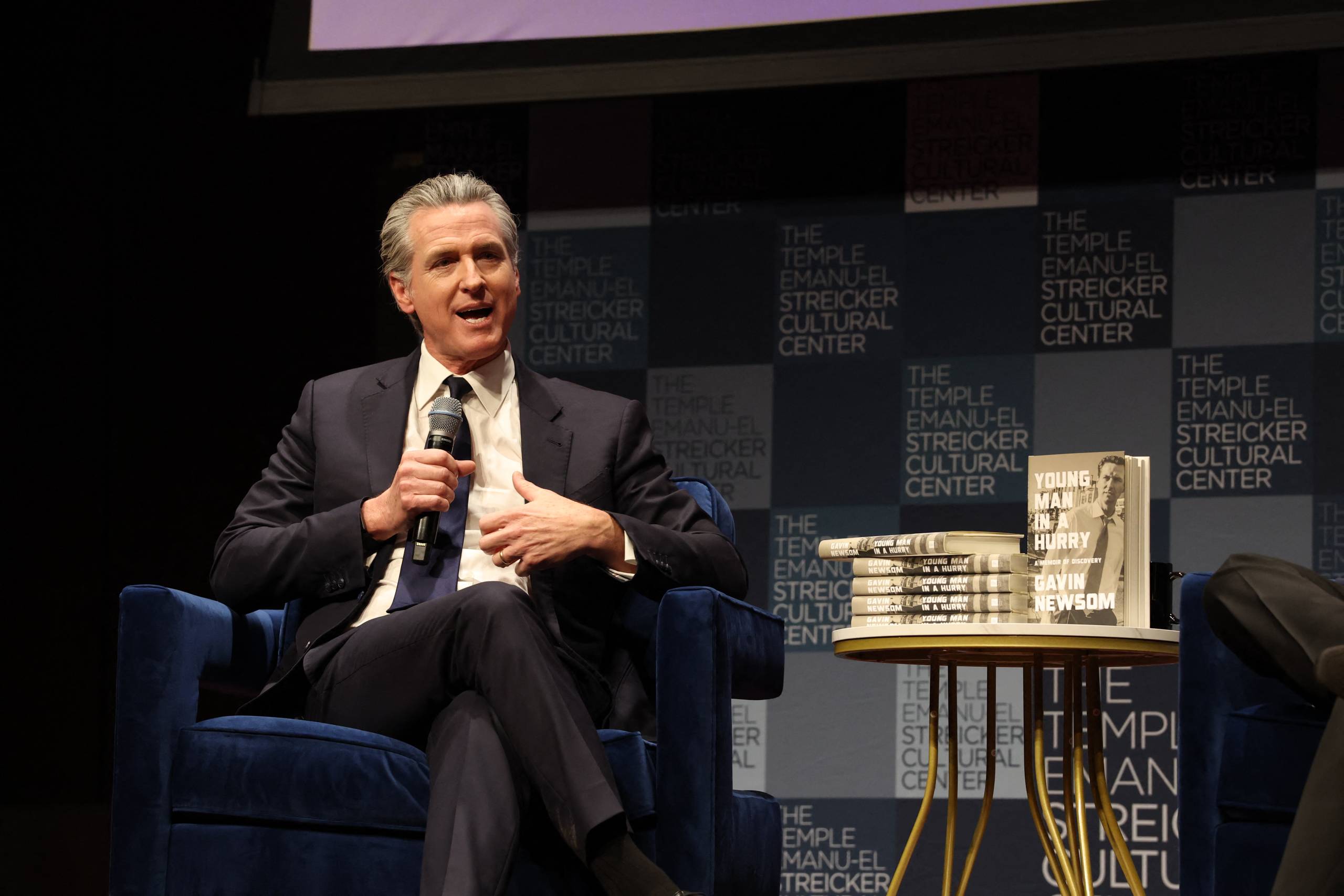
That means minefields ahead — for Newsom and the many other Democratic governors looking at a 2028 run. Take Newsom’s recent comments on Israel during his book tour for his memoir, Young Man in a Hurry. At an onstage interview in Los Angeles with Pod Save America, Newsom was asked whether Israel pushed the U.S. into war with Iran. “The issue of Bibi (Netanyahu) is interesting because he’s got his own domestic issues. He’s trying to stay out of jail. He’s got an election coming up,” he said, adding that Israel Prime Minister Benjamin Netanyahu faces pressure from hard-line allies who want to annex the West Bank. “I mean, (New York Times columnist Thomas) Friedman and others are talking about it appropriately, sort of an apartheid state.”
Then in the same interview, he responded this way when pressed on whether the U.S. should reconsider its military support for Israel: “It breaks my heart because leadership in Israel is walking us down that path, where I don’t think you have a choice but that consideration,” he said. Those comments, particularly his use of the word apartheid, prompted outrage from some Democrats. One member of Congress asked if it’s “really worth throwing Jews under the bus to advance your political ambitions?”
But for Democratic critics of Israel’s war in Gaza, Newsom’s comments reflect what they see as a moral and necessary political pivot. Tariq Habash resigned from the Biden administration’s Department of Education over its unwavering support for Israel and co-founded A New Policy, a nonprofit lobbying organization aimed at changing U.S. policy toward Israel. Habash noted public opinion on Israel has shifted to be more critical of Israel’s government and more sympathetic to Palestinians, particularly among the Democratic base. There’s also evidence that Biden’s support of Israel cost Kamala Harris votes in the 2024 election. (We dug into this shift on last week’s Political Breakdown podcast roundtable.)
Since last summer, the Trump administration has been arresting undocumented immigrants as they try to claim their children from federal custody, stranding the kids in government shelters and foster care. The practice violates the government’s own regulations, according to an informal network of immigration attorneys across the country, who suspected for months that the arrests were the result of a formal policy.
Now, a document unearthed in a federal district court case in Texas appears to confirm that suspicion. “Operation Guardian Trace,” as it’s called in the document, requires Immigration and Customs Enforcement to conduct in-person interviews with the relatives of undocumented children in federal custody, and detain and deport those adults who are “illegally present in the United States.”
Immigration attorneys say the policy represents a dramatic reversal in how the government handles the release of unaccompanied minors and treats their undocumented relatives, who were previously allowed to get their children back regardless of their immigration status. “This confirms what we’ve known for months,” said Mishan Wroe, directing attorney for immigration at the National Center for Youth Law in Oakland. “The government is explicitly and deliberately using children as bait to achieve their political goals.”
The children, who entered the U.S. alone and without authorization and have usually come to join family, are in the custody of the Office of Refugee Resettlement, part of the U.S. Department of Health and Human Services. They’ve often fled violence or persecution in their home countries, Wroe said, and most apply for asylum or other legal status. They’re detained until the government can vet their relatives, or sponsors, to make sure the adults can “provide for the physical and mental well-being of children.” When a sponsor is detained, their application to claim the child is invalidated. If no other potential sponsors come forward, the child remains in ORR custody until they can be placed in foster care or they turn 18. Largely due to stricter sponsor vetting requirements put in place by the current Trump administration, the average number of days that children remained in ORR custody increased to 117 in 2025 from 30 the year before, according to the agency’s website. The data does not make clear how sponsor arrests have impacted that increase.