Episode Transcript
This is a computer-generated transcript. While our team has reviewed it, there may be errors
[Audio From Repair Cafe Silicon Valley]
A vacuum is it.. Oh, we need to ring the bell, let’s ring the bell. All right everybody, pay attention, uh, we’re going to ring the bell here.
Morgan Sung,Host: We’re at a repair cafe. These days, it’s one of the hottest spots in town.
[Audio From Repair Cafe Silicon Valley]
We just repaired, what did we repair? A vacuum! Alright, ring the bell now, let’s go! Woohoo! We fixed the vacuum! Thank you! Thank you all the lovely repair people!
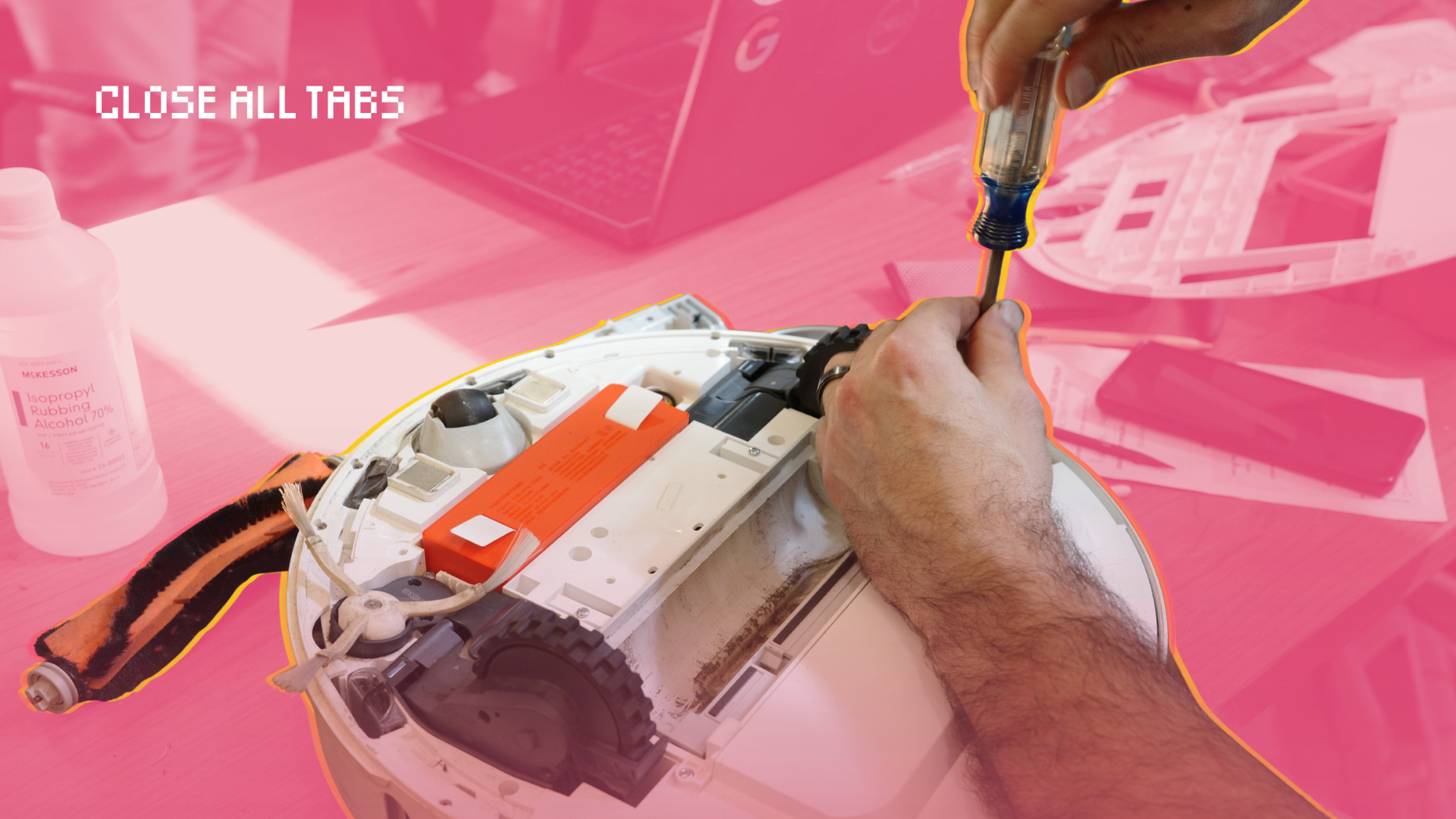
Morgan Sung: Repair cafes are community events, where people bring in their faulty espresso machines, vacuums on the fritz, and other broken items. Volunteers help with repairs, to the best of their abilities, like soldering wires or replacing errant bike chains. The whole point is to encourage people to repair and reuse their stuff, instead of tossing them into a landfill as soon as they stop functioning. Last month, Close All Tabs senior editor Chris Egusa popped into the library in Milpitas, California for Repair Cafe, Silicon Valley.
Chris Egusa How many of these repair cafes do you think that you’ve done or the organization is running?
Jesse Kornblum: Oh, my God! We’ve certainly ramped up over the past few years. It used to be about one a month, now it’s two, sometimes three a month.
Morgan Sung: Jessie Kornblum is one of the organizers for this repair cafe.
Jesse Kornblum: The one thing I do know is between now and the end of May, we have 12 events planned.
Morgan Sung: Here’s how it works: members of the community bring in their broken stuff, fill out a form, and then get paired with a volunteer who might have the skills to fix that specific item.
Jesse Kornblum: We have volunteers who sign up ahead of time. They specialize in things like sewing or bikes, and we have a lot of general fixers who can work on electronic devices, some mechanical devices, and we’ve a few people with special skills for things like microwaves.
Morgan Sung: At this repair cafe, a volunteer with a shock of red hair helps a woman with her tower fan. The fan only spun for a few seconds before shutting off.
Kay, Volunteer at Repair Cafe Silicon Valley Usually that means that there’s like a dead capacitor somewhere on the power supply. So operating on that assumption, we opened it up and we found a capacitor and we found a whole bunch of brown gunk around it, which means that the capacitor’s electrolyte has probably leaked out and the capacitor has gone dead.
Morgan Sung: Kay, the volunteer, takes a closer look inside the fan.
Kay, Volunteer at Repair Cafe Silicon Valley: So this capacitor is probably good. I think this capacitor is fine, which is upsetting because now we don’t know what’s wrong with it. [laughs]
Morgan Sung: At a nearby table, another volunteer, Sofia, hunches over a disassembled device, wielding a soldering iron with surgical precision. Tragedy had struck.
Sofia, Volunteer at Repair Cafe Silicon Valley: We have a Dyson hairdryer right now that has been chewed up by a German shepherd. And since there’s some warranty issues with it, they weren’t able to get it repaired by Dyson. So we are here doing some re-soldering on some wires that have been chewed up.
Morgan Sung: Dyson hairdryers are pricey. They’re like top of the line. We’re talking hundreds of dollars. For the person who brought it in, this repair cafe is her last resort.
Repair Cafe Silicon Valley Attendee : I also checked the appliance repair shop. They say they don’t fix those small appliance. And my last hope is here, and it’s also my first time here. And I’m super happy to have this helped by somebody.
Morgan Sung: This is part of the reason repair cafes are taking off. They’ll try to fix things that manufacturers like Dyson or authorized repair shops won’t touch. For many, the biggest draw is a shift in mindset, feeling empowered by fixing what they own, even if the companies that made them discourage repair. Shonu Sen first came to one of these events with a pair of jeans that needed mending. Yes, they fix clothing too. Inspired by the experience, she later joined as a volunteer to learn new skills and to give back.
Shonu Sen, Attendee Repair Cafe Silicon Valley: It doesn’t matter if you want to save something, if you don’t have a way to learn how to maintain and repair your things, then there’s no one to teach you.
Morgan Sung: This repair cafe, and the many others popping up around the country, represent a bigger shift from consumers across industries, but especially in electronics. Do you really own what you bought if you can’t fix it? I mean, even the word consumer suggests a lack of ownership. Today, we’re talking about the Right to Repair movement, what it is, how big tech companies have responded, and why this movement is changing our relationship to our stuff.
Morgan Sung: This is Close All Tabs. I’m Morgan Sung, tech journalist and your chronically online friend, here to open as many browser tabs as it takes to help you understand how the digital world affects our real lives. Let’s get into it.
Leading us through this deep dive is one of the key voices in the movement. He started out as a DIY guy, flipping broken laptops as a side hustle, and went on to build a massive YouTube following and push for actual legislation. Ready? Let’s open a new tab. What is the right to repair?
Louis Rossmann: Right to repair to me is the idea that you should have the ability to fix what you bought and paid for. It doesn’t mean that you have to fix everything that you own. It doesn’t mean that the manufacturer has to make it easy. It simply means not putting intentional barriers in place to you being able to repair what you bought and paid for.
Morgan Sung: This is Louis Rossman. He owns a data recovery and laptop repair company, and he’s been fighting for the right to repair across the United States. If his voice sounds familiar, it might be because he followed one of his repair tutorials on YouTube. Also, he’s a pretty fast talker, especially today. He isn’t a regular coffee drinker, but told me he had some caffeine before this interview. So try to keep up.
Louis Rossmann: If you are unable to fix what you own, do you really own it? Is it yours or are you just leasing it from the manufacturer? Who has control over your product, the manufacturer or you?
Morgan Sung: Back in the 2000s, Louis started working at a recording studio in Manhattan. As an aspiring recording engineer, he needed a demo reel. To make that, he need a program called Logic, what some of you might know as a DAW, or Digital Audio Workstation. The thing with Logic is that it’s owned by Apple and will only run on Apple products. The problem, MacBooks were super expensive. Louis didn’t have that kind of money.
Louis Rossmann: So I’ve got a used one on eBay. It showed up broken. I got a partial refund for it. And when I finished the session, I sold it and I made $250. And I thought I’ve never made more than $400 to $600 a month in my life at that point. And here I just made $200 for what was about 15 to 20 minutes of work. Let me try that again. And it has kind of snowballed into the repair company that I have today.
Morgan Sung: This started as his side hustle. Louis doesn’t have any formal training in tech repair, but working at the recording studio, he started to think like a technician. He got into the mindset of troubleshooting, learning to problem solve the way other engineers did.
Louis Rossmann: And as time went on, I started adding to the services I offered. So instead of just basic screen repairs, here, we’ll do component-level motherboard repairs. So if Apple says it’s $1,200 to fix, we will fix it for a few hundred dollars by just replacing the one thing that’s broken, rather than replacing everything. I started hiring more people, I got a real store, and I showed people how to do these repairs on YouTube because my customers would tell me, Apple has told me if somebody says they can fix the motherboard instead of replacing it, they’re probably scamming you. So I thought, oh, really? Okay, cool. You’re calling me a scammer? Let’s go.
Morgan Sung: Louis had started a second business that sold replacement parts, but was struggling to keep it afloat. He found it really therapeutic to talk about what he was dealing with on camera, on YouTube, like a video diary. Then he started making repair videos.
Louis Rossmann: Originally it was just for my own customers to show like, I’m not scamming you and I didn’t expect the channel to explode into like millions of subscribers. Anybody that looks at my early content probably sees this and just thinks like why would anybody watch this? I had no idea why anybody would watch it, but it just kind of exploded and went from there.
Morgan Sung: Right, I was going to ask like how did you learn how to fix a laptop, right? If your background was in fixing like recording equipment.
Louis Rossmann: You don’t learn how to fix it, you learn how not to break it by virtue of breaking it. So usually there’s two types of technicians, and I’ll fully admit to being the second type. There are technicians that can open something and follow instructions and go, oh, here’s exactly what I do to do a good job. I’m not that person. What I’m good at is messing with something like, how hard can I pull on this tab before it breaks? Oh, okay. So once you break it, you know how to not break it. I would go through all the excuses I had. Well, I would fix this, but I don’t know what chip is which. Okay, why don’t I know that? I don’t have a schematic. Okay, now I have the schematic, but I don’t know how to read this, so, uh, I don’t know what the components do. Okay, I know what components do, but I don’t what the circuit does. And now I would just go through all the excuses that I had in my head for why I didn’t know how something worked, and then use those to try and figure it out. And I would tell myself, well, I’m a tech. Not, I, I dunno what I’m doing, I’d say, I am a tech, and a tech would say, if they don’t now what this is, they’d probably ask for somebody’s opinion, and they’d read a book. And if the book didn’t make sense, they’d ask somebody else. If they asked somebody else and it didn’t makes sense, then they’d try to find a video on it. I just kept going through all the things that were excuses to me for five years and… I would have students when I was teaching a class on this that would feel really bad if they made a mistake three or four days in and then they corrected themselves and I would always have to remind them, you corrected yourself four days, I corrected myself like after two or three years of making that same mistake, so don’t feel bad.
Morgan Sung: As Louis honed his own skills, his client base grew. And that’s when he started to notice the barriers to actually repairing phones and laptops. A few years in, another repair shop owner told him about their spot getting raided by law enforcement. Because they weren’t authorized Apple repair providers, the police assumed that the shop’s replacement parts were stolen. It didn’t help that a lot of these parts, from iPhone screens to laptop motherboards, were recycled. Louis remembers being frustrated that even back then, it was nearly impossible to get individual parts from Apple. They only sold pre-assembled replacements.
Louis Rossmann: If I go to Apple, they’re gonna want me to pay almost $400 to buy this entire assembly when all I need is this $30 or $50 screen. I don’t need your hinges. I don’t need your camera. I don’t need the Wi-Fi antenna, the invertible, all this other extra stuff that’s showing up there.
Morgan Sung: That was just one of dozens of hurdles he faced as a repair tech. His suppliers would get shut down and Louis would have to scramble to find new parts. Apple, for one, would force authorized recyclers to shred old MacBooks and iPhones so that their parts couldn’t be reused. Companies would release new laptop models, but wouldn’t make the new schematics available to even authorized service providers. So fixing a faulty motherboard was a process of trial and error, which took a lot longer.
Louis Rossmann: So I’ve never really asked the question of, why is this entire business based on dumpster diving? Why is it based on Alibaba and eBay and random people, like random suppliers that go in business and go out of business? I never really ask that question. I never even had the consciousness to ask that question until around 2013 to 2015. And then when I heard about right to repair in the automotive field, where in 2012, I believe there was a law or a memorandum of understanding in Massachusetts where it was, yeah, the manufacturer should make available to the people fixing vehicles, the parts and diagnostics software, everything else needed to fix a vehicle. Why don’t we have that? Why do I need to buy a donor board and then pray that the chip on the donor board, that was in a garbage somewhere, is good? Why can’t I just go to any vendor and just buy the chip? It never really occurred to me. And then when I started asking that question, it was impossible to unring that bell. And once I started unraveling that and asking about it, it kind of took on a life of its own.
Morgan Sung: All he wanted to do was fix laptops. It didn’t have to be this hard. And that’s when he started speaking out about it on his YouTube channel and got involved in the Right to Repair movement. We’ll hear more of his story in a new tab after this break.
Morgan Sung: We’re back with Louis Rossman, data recovery technician, right to repair activist and YouTuber. Let’s open a new tab: The Fight for the Right to Repair. Let’s talk about the history of the right to repair movement. Like you said, this affects almost every person, tech people, farmers, people who work in the medical field. Can you give us a little history of the Right to Repair movement? When did people start to push back?
Louis Rossmann: I think 2012 in Massachusetts with the Memorandum of Understanding for Motor Vehicle Repair. Most of the right to repair legislation that you see coming out around 2015 was a copy and paste of that and they just crossed out motor vehicles and put in consumer electronics.
Morgan Sung: As these legal efforts spread, more and more states held hearings to consider repair protections for consumers. Right to Repair advocates showed up to make their case, but so did tech industry lobbyists.
Louis Rossmann: I started showing up to these hearings and I would bring my camera and the idea is if I win, I win and if I lose, I’m hoping that people will see this and just understand how frustrating it is for me. When I sit in front of a politician and I bring up my argument, and my opposition says something like, these people stand to make a lot of money being here today. And it’s just like, you’re getting paid $200,000 to $300,000 a year as a lobbyist to be here today. I paid $250 for my hotel and my plane ticket and I gave up on income to be here today. Yeah, who’s making money to be here, motherf*cker? I wanted people to hear this and like, instead of me making the argument as to why you should care about rights of repair because then I’m putting a thought in your head and it’s not my place to tell you what to think. I want you to listen to what I said and listen to they said and tell me what you think. And people would listen to this and go, my God, that is the biggest bunch of b*llshit I’ve ever heard in my life. And the thing is, a lot of these rooms that I was going into to record these hearings, they were set up for newscasters. They had a good position to put a camera. They had an XLR patch panel, so you’d have the microphones for all the different people testifying. It was all set up, but nobody was taking the time to do this. The news was covering something else because, again, when you look at even just the news right now, you’re talking about invading Greenland, the Epstein files, ICE. Regardless of where anybody watching this is on any of these issues, whether or not somebody can clear an error code in their tractor just kind of falls to the bottom of the list of priorities for CBS and Fox and MSNBC. They’re not showing up. To these local hearings to hear Louis talk about not being able to get a charging chip to somebody’s luxury Facebook machine. They just don’t care. It was simply having these people that have been lying and saying crazy, messed up sh*t for years. The one that was the biggest to me was in 2015, where this one politician, assemblyperson in New York said, “the opposition lobbyist for Apple said that when you work on a MacBook motherboard, you actually have converted it to a PC. You’re converting it to PC, but then you don’t tell your customer that you’ve converted it into a PC, and you misrepresent it to them as if it’s still a MacBook, which is fraud.” And I just had steam coming out of my ears.
Morgan Sung: What does that mean?
Louis Rossmann: It’s kind of like, well, if you have a Ford F-150 truck, and if you change the tires from Goodyear to Michelin, now it’s not an F- 150. You have to rip the Ford badge off of it. Like really? And I tried to explain this to him, and I brought the broken device with a wire on it that fixed it, and I purposely disconnected it. I showed him the schematic and I said, ‘here’s why this wire is important. See when I reattached the fan spins? This is what I do. I teach people how to do this. Explain to me how this is no longer a MacBook and explain to me how this analogy would work if we were talking about your truck changing from Goodyear to Michelin.’ And then he just starts writing and I’m like, ‘are you even listening to me? What are you doing? I spent all this time to show up here…’ He’s like, I’m co-sponsoring your bill, *sshole, and then he hands it back to me. He says…he shows me, and I realized it was that simple. And I wished I had a camera in the room. I was so mad to this day, 11 years later, that I did not have a camera in that room so that I could have on record that that’s what somebody who was Apple lobbyist said. It pisses me off. So I said, I’m gonna show up with a camera to every single one of these. Because the reason that all these people have been getting away with this is because there hasn’t been any sunlight. Nobody looks at it. Nobody listens and watches. And if they did watch it, they would realize. That they can’t make things up like this anymore. They’re getting away with these lies because they’re talking to legislators that don’t understand technology and there’s nobody calling them out on it.
Morgan Sung: From 2017 to 2020, Louis was posting right to repair updates on YouTube, traveling across the country to show up to state hearings, rallying his viewers to urge their representatives to sponsor consumer rights bills, all while still running his repair shop. In 2020, Louis got a phone call from an unknown number. He picked up. There was a mysterious voice on the other end…
Louis Rossmann: …who asked, what would I do if I had, let’s say, a million dollars to help push forward right to repair? I’m like, yeah, this is a scam. Never mind, what do I have to do? Let me guess, I have the wire you 5,000 first.
Morgan Sung: He thought it was “total b*llshit,” his words, and hung up. But then the number called again. As it turned out, that voice on the other end was calling on behalf of a billionaire, Eron Jokipii, the founder of Yahoo Games and one of the first investors in WhatsApp. He’s big into tech freedom and consumer ownership. Eron offered initial funding for Louis to start Repair Preservation Group, a nonprofit organization dedicated to repair education. The group launched RepairWiki, a massive online repository for repairing all kinds of consumer electronics, from printers to e-bikes. But as a 501c3 organization, Repair Preservation Group is limited in how much it can spend on lobbying efforts. So, Louis started a second nonprofit, Repair Preservation Group Action Fund, specifically for pushing for Right to Repair laws. With the help of his viewers, he crowdfunded nearly $800,000.
Louis Rossmann: Instead of just me showing up with my camera and giving my testimony, I was able to actually help work with grassroots organizations. I was about to hire lobbyists to do that job. And after that happened, you started seeing Right to Repair get talked about a lot more. It wasn’t just me anymore. It was a lot of people organizing at the local level to try to get things pushed forward.
Morgan Sung: Louis even got Steve Wozniak to respond to a cameo request about it. Yes, that Steve Wozniak, as in the co-founder of Apple.
[Audio clip from Steve Wosniak Cameo]
Hi Louis, Steve Wozniak here. I’ve read a lot of articles about the right to repair issue. I’m always totally supportive and I totally think the people behind it are doing the right thing. We wouldn’t have had an Apple had I not grown up in a very open technology world, an open electronics world. Back then when you bought electronic things like TVs and radios, every bit of the circuits and designs were included on paper, total open source. Someone with skill could get in and modify things to fix broken radios or televisions or to improve them or to even replace destroyed parts. Very motivating for creative minds. Believe me, that’s how I grew up. Anyway, it’s time to recognize the right to repair more fully.
Morgan Sung: So far, all 50 states have introduced right to repair legislation. Seven states have passed actual laws: California, Colorado, Minnesota, Maine, New York, Oregon, and Washington. It’s a huge win for the movement, but there’s a catch, several actually.
Louis Rossmann: Most of those laws have loopholes that make them not very worthwhile. So like culturally, there’s been a lot of progress. A lot of people know what Right to Repair is that didn’t before. They know how their rights are being violated. They know ownership is going away every single day, but the law has not really kept up or had any teeth to push back against it.
Morgan Sung: Which means that the fight for the right to repair is far from over. Each state’s laws are different, and this patchwork of right to prepare requirements leaves many gaps in actual consumer protection. What does the right-to-repair landscape look like now? We’re getting into that in a new tab: Right to Repair loopholes. The existing right to repair laws vary state by state. California covers consumer electronics, wheelchairs, and appliances, but not farm equipment. Maine and Massachusetts only cover car data, like access to diagnostic information. New York only covers personal electronics. Minnesota doesn’t cover wheelchairs, but does cover business equipment. And so far, of all of the state right to prepare laws, only Colorado, Oregon, and Washington banned this tricky practice called “parts pairing.” That practice has become increasingly common among tech manufacturers, and it makes it much harder to actually repair products.
Louis Rossmann: Parts pairing is the idea that even if I take a new part from a new device and put it in my device, it will not work because that part has a serial number on it. And when the device senses that even if it’s an OEM part, it’s not my original OEM part, It won’t work properly.
Morgan Sung: OEM stands for Original Equipment Manufacturer.
Louis Rossmann: Versus some random other person making it. So there’s aftermarket parts, there’s knockoff parts, there’s used originals, and then there’s OEM, which is this part is what the original equipment manufacturer used and the same grade and quality. Starting maybe five to seven years ago, this started to become more popular where you would change a part and it wouldn’t work. And people would say, “well, you must have put a knockoff.” And you say, no, I took this out of a new device. And then they would buy a new device just to see if they were going insane, put the part in to their device and it would work. Because the device could sense that it wasn’t my original one. And that’s a problem because it makes the whole concept of recycling go away. If I have a device where everything is broken on it, it’s not economically viable to repair, but this thing still works, I want to be able to use this part to fix this thing. It destroys that in a very bad way.
Morgan Sung: But how else has Big Tech responded to the right to repair movement? Are companies behind it? Are they pushing against it? What’s your read?
Louis Rossmann: Fake programs. They say, look, we released our right to repair program. Here’s our parts list on our website. And I don’t blame the press for this. The press covers thousands of different news items across thousands of things every day. So if I see, look, a repair program. I see pictures of parts, I see in stock, I see it’s not $10,000, I’ll think it’s okay. But when a repair person looks at this, they see you want $206 for a smartphone battery because you say that it is glued to the screen. A lot of these programs are put together in a way where it makes no economic sense whatsoever. Now, when I say no economic sense, I don’t mean that it’s just the repair person says, I wanna make 100,000 a year and I can only make 50,000 year. No, I mean that when I buy that part, if I were to charge my customer for the repair, just the cost of the part by itself, my customer would look at me and give me the middle finger and say, that’s a ripoff. And that’s the problem with a lot of these programs is they were made to appease legislators and the press, they weren’t actually made to be viable repair programs that repair technicians actually wanna use.
Morgan Sung: Yeah, I was also going to ask like, you know, what does the current landscape of Right to Repair laws look like in the United States right now? Do some states have better laws than others? What are these laws missing?
Louis Rossmann: Every law has something missing, like in New York, there’s an exemption for trade secrets and safety. Now, when you have people showing up to legislative hearings and saying that if independent technicians fix your microwave, a magtrometer will explode, that’s a safety issue. What is a magtrometer? A magtrometer doesn’t exist. So I don’t want there to be something in the bill that says, you know, we can have exemptions if the manufacturer says there’s a safety issue, because they’ve made up safety issues. They’ve made names of parts that don’t exist and testified in front of state legislatures numerous times to fear monger politicians into believing that everything’s gonna blow up if people can fix things. So I don’t like the idea of a safety exemption because they’re just gonna say anything. Like what if a replacement screen, man, you could get glass, you could get a paper cut. What if that person has like a blood clotting disorder? Maybe they’ll bleed out and die. I wouldn’t be surprised if a manufacturer tried to say something silly like that. A lithium-ion battery could explode. And true, a lithium- ion battery could explore. Your car could also not stop when going 80 miles down the highway and kill 30 people. We don’t say that you can’t replace your brakes. The other is that in Minnesota, there is Right to Repair that was pushed through a budget process, and that excludes game consoles. So I mean, game consoles are a really big field of consumer electronics. So when you have a bill that says it excludes this, it excluds that, there are so many exemptions in many of these laws and carve-outs for all these industries. Like you can’t repair medical equipment, you can’t repair farm equipment, you can’t prepare this, that, and the other. And even if you didn’t have those carve-out at all, when it says make available what you make available to your authorized service centers. The entire reason that people are coming to repair shops like mine to begin with is because the authorized repair center doesn’t fix anything. It’s easy to legislate, you must have a one year warranty on your product. When it comes to repair, you’re really trying to legislate, don’t be a dick. And that’s why the battle, as I see it, is the cultural one. I want people that have watched my channel or got into engineering and electronics who become designers and engineers of these businesses because they grew up watching me live streaming in 2016 at two in the morning, cursing as I’m trying to figure out where this trace goes without a schematic. When they get into this field and they’re asked to do something that’s anti-repair, when they’re asked to send that email, oh, by the way, make sure that this part is only available to our authorized people and nobody else can buy that charging chip. I want them to remember what got them into this and then say, ‘you know what, I’m not doing that. And if you want to make me do that, I quit.’ And I want to live in a society where everybody is open to doing that. So I realize that a lot of what I’m pushing for, very likely, I will be dead or long dead by the time we actually get it. All of these seeds that I’m planting are cultural seeds that will take a few generations to actually change. Hopefully there’s some success there.
Morgan Sung: But like you said, in the past, people did just fix their stuff, it was the norm to just fix your stuff. It seems like we can still go back to that, hopefully.
Louis Rossmann: I would like to see things go back to that and I’d like to see more people across more industries become aware of this. And the biggest pushback that I’ve seen is not even what companies do, it’s what people accept. And I would to see people be more open to sticking together rather than saying, you deserve it. This happens in my comment section all the time and I always point it out. What kind of moron would buy a digital picture frame? You should buy something like this. But that person who made fun of that user for that may also have a fridge that they didn’t even realize has ads in it. Or that person may have a smart TV that they didn’t realize was spying on them. It’s like, well, what kind of moron buys a smart tv that has this? And they’re like, you should have bought what I bought.
And I really want to see people coalesce and come together and realize that simping for billion dollar companies that are ripping you off, stealing your data, robbing you blind and trying to take away the rights of ownership is not the thing to do. It’s to band together and say, you know what, I don’t accept this practice. And even if I would not buy the thing my neighbor bought, that may happen to me someday. Let’s work together rather than all sh*t on each other as we get robbed blind.
Morgan Sung: Some companies are featuring repairability as like a key selling point in their marketing. One example is the laptop manufacturer, Framework, which builds laptops that are easily disassembled, upgraded and repaired. What do you think about this trend? What does it signal for the Right to Repair movement?
Louis Rossmann: The fact that they have not gone bankrupt several years in, in a very difficult and wavy economy, like, I think that their products just started to become popular right as interest rates were soaring and all this economic volatility I think it’s very cool. They actually do try to make things repairable and for any of the faults the company has had on like certain issues with certain products, I think their heart is in the right place and I like seeing that. And the fact that there’s actually a market for it is great now the problem is, they’re competing in a very low profit margin industry. Like, companies like Lenovo and Acer, and the companies that are making these products that a lot of people buy, their profit margins are in the single digit percentage, and that’s acting at economies of scale at tens of hundreds of billions of dollars.
So for a new player to come in and do anything here, they’re either gonna have less choices available, which means less people buy the product, or they’re gonna have a higher price. So I love seeing it, I’d love to see more of it. The fact that they exist at all is very validating for the fact that people are actually willing to spend more money just for a company that respects them, and I think that’s a big part of it. It’s not always about the money, it’s about the respect.
Morgan Sung: So what do you want people to take away from the Right to Repair movement? Like, why should, why should they care?
Louis Rossmann: It’s about ownership in general. And right to repair is a very small portion under the ownership umbrella, and that’s where I’ve been focusing more of my work on in the past few years. Everything is moving to the subscription model. So look around at all these different products and take note of the fact that you don’t really own them. The fact that hundreds of thousands of Nest thermostats across the world stopped functioning with the functionality that they were advertised with simply because Google decided we don’t want to support it anymore. If Google can flip a switch and your device has stopped working, if your car manufacturer could flip a switch and your heated seats are no longer activated, do you actually own any of the things that you bought and paid for?
Morgan Sung: It seems like that’s the kind of mentality of a lot of Right to Repair is just like trial and error instead of just giving up and accepting that you have to buy something new.
Louis Rossmann: Yeah, and the thing is the people that are authorized or say you’re not authorized and you don’t know what you’re doing, the way you figure out how to work on it to begin with very often is by tinkering and messing around when you don’t know what you’re, doing. And I hope that people who don’t know what they’re doing feel confident in, in trying to open things. At the very…again, if it doesn’t belong to somebody else. If it belongs to you and you’re not sacrificing, you know, your significant other’s data or something, mess with something that you’re clueless about and constantly learn something. And even if you’ve taken a chip off and you just put the chip back on it still works, celebrate that. Celebrate every time you’ve done something without making the device work. Trying to figure things out as you go is one of the best ways to learn and I hope that more people feel confident in telling themselves, I’m completely clueless and that’s okay, I’m just going to try it anyway.
Morgan Sung: That mentality is exactly what community repair cafes are all about. Back in the Milpitas Library, at the Silicon Valley Repair Cafe, volunteers dissected faulty appliances, rearranging and re-soldering guts of wires in hopes of sparking some life back into them. One of the volunteers, named Tara, recalled the repair cafe’s early days.
Tara, Volunteer at Repair Cafe Silicon Valley: So, yeah, last year, a woman came walking up cradling this beautiful cherry apple red toaster. It looked gorgeous. And so I looked at it and said, I know what it is. It’s a spring, and it can be fixed. And I said, what’s the story with your toaster? And she just beamed, her face lit up, and she’s like, this was the toaster I won on “Price is Right.” This is the only thing I have left over from college. And she said she and a whole bunch of her friends went to the “Price is Right” one morning and she was the first person. Kareen, come on down and she won $25,000.
I said, “Did you get to spin the wheel?” She’s like, “Oh, yes I did,” and she’s like “Well, the only thing left is this toaster and it’s my college toaster.” And so we were able to fix it and she walked away beaming and that was just a great example of the kinds of things that we see here on a regular basis. It’s just a toaster, but it was her college toaster that she won at “Price is Right! ”
Chris Egusa: Irreplaceable.
Tara, Volunteer at Repair Cafe Silicon Valley: Irreplaceable.
Morgan Sung: We’ve heard about the consumer electronic side of the right to repair movement, laptop repair technicians like Louis, who just want to replace hard drives without the headache of everything we drove into today. But did you know that a lot of today’s repairs are only legal because of farmers who were sick of hacking their tractors? That’s next week. For now, let’s close all these tabs.
Morgan Sung: Close All Tabs is a production of KQED Studios, and it’s reported and hosted by me, Morgan Sung. This episode was produced by our senior editor, Chris Egusa, who also composed our theme song and credits music. It was edited by Chris Hambrick, additional production help from Gabriela Glueck. Our team includes producer Maya Cueva. Additional music by APM. Brendan Willard is our audio engineer. Jen Chien is our director of podcasts. Ethan Toven-Lindsey is our editor in chief.
Some members of the KQED podcast team are represented by the Screen Actors Guild, American Federation of Television and Radio Artists, San Francisco, Northern California Local.
This episode’s keyboard sounds were submitted by Alex Tran and recorded on his white Epomaker Hi75 keyboard with Fogruaden red samurai keycaps and gateron milky yellow pro v2 switches.
Do you like these deep dives? Are you closing your tabs? Then don’t forget to rate and review us on Spotify, Apple podcasts, or wherever you listen to the show. Maybe drop a comment too. And if you really like Close All Tabs and want to support public media, go to donate.kqed.org/podcasts. Thanks for listening.