Episode Transcript
Olivia Allen-Price: Hey everyone. I’m Olivia Allen-Price, and this is Bay Curious.
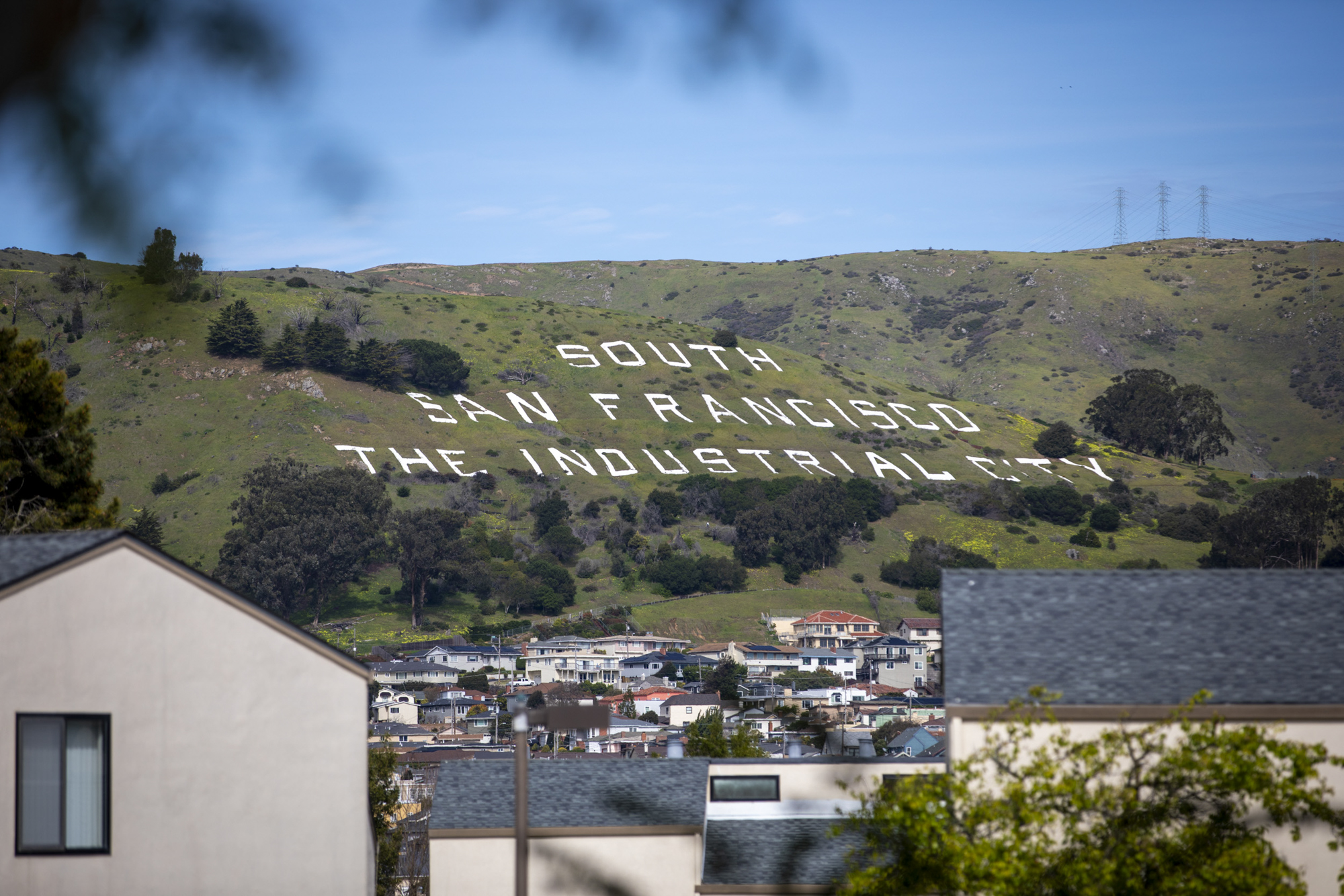
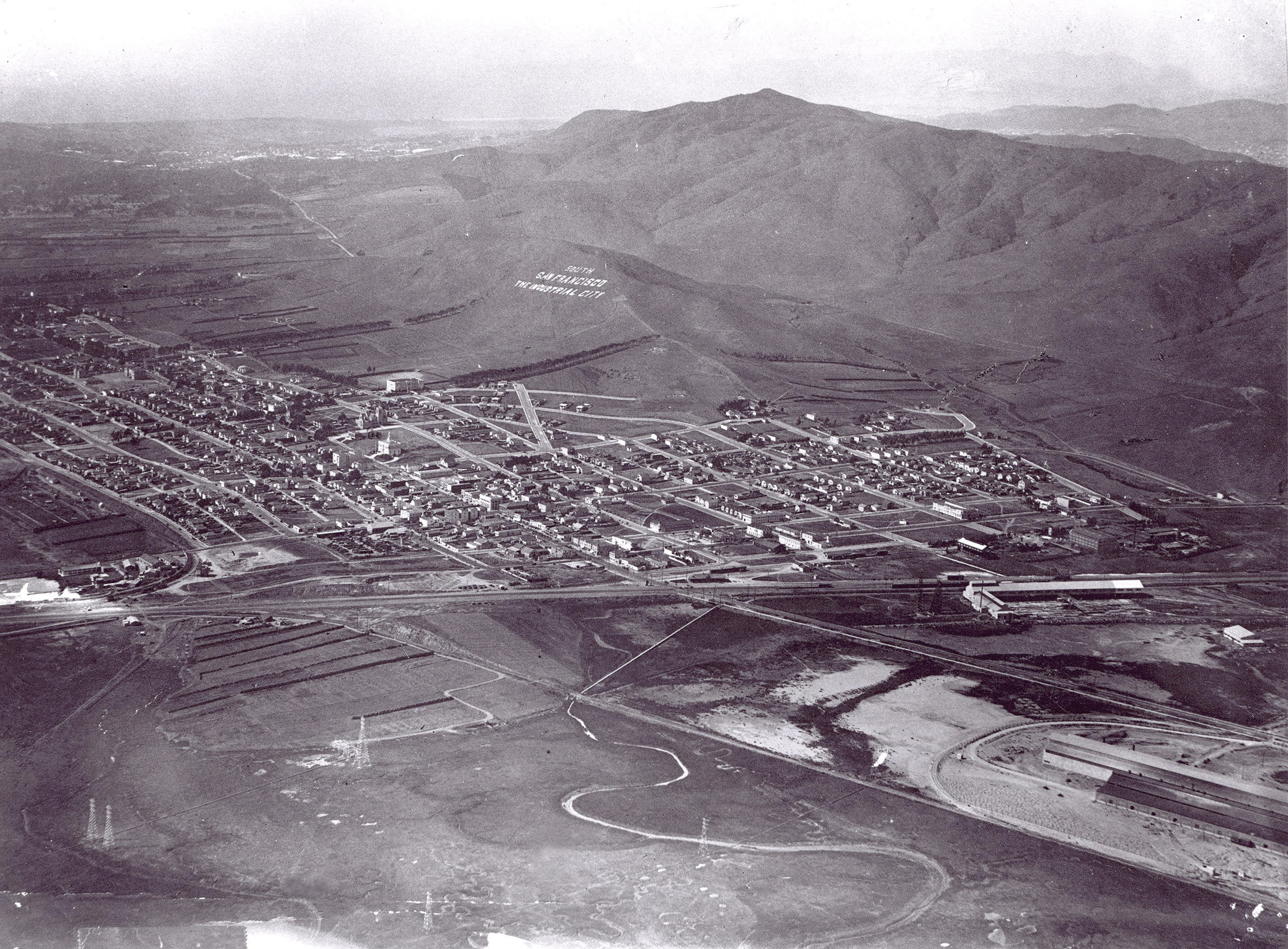
Today we head to South San Francisco. You pass it when you’re driving north from the airport along Highway 101– there are giant white letters carved into a hillside.
They read: “The Industrial City.”
Faris Alikhan: It used to be meatpacking plants and steel foundries.
Olivia Allen-Price: Faris Alikhan grew up in South San Francisco, went to high school there — and about half his graduating class went on to work in biotech. His mom did too.
Faris Alikhan: Why did it become this hub of biotechnology? People move here from all around the world to work in that one industry.
Olivia Allen-Price: Biotechnology is a process. Scientists take a living cell, like yeast or bacteria, and program them to make medicine. They grow those cells in massive tanks — like a brewery — and harvest what the cells produce to make vaccines, antibiotics, and cancer treatments.
Today, there are more than 250 biotech companies in South San Francisco, including Genentech. Faris wondered why South San Francisco and not closer to an educational hub, like Stanford or Berkeley? How and why did this stretch of waterfront become the birthplace of biotechnology?
Turns out he’s not alone in wondering this. Today’s question won a public voting round on BayCurious.org.
KQED health correspondent Lesley McClurg headed to South San Francisco to find out.
Lesley McClurg: When you drive down DNA way in South San Francisco it’s a little like a science fiction set. Shuttle buses glide between glass towers. Doctoral students sip matcha with CEOs. Researchers slip in workouts between experiments. Every amenity is available inside a self-contained city.
Low rumble of a freight train
But 100 years ago this stretch of land was nicknamed the smokestack capital of the Peninsula… Freight terminals. Shipyards.
Archival clip: By July 1944 nearly 16,000 men and women were employed in the shipyards all playing a role in the country’s victory.
Lesley McClurg: It was a dirty, loud, industrial area.
Richard Walker: South San Francisco, like Emeryville, they were industrial suburbs.
Lesley McClurg: Richard Walker is a professor emeritus of economic and urban geography at UC Berkeley.
Richard Walker: These were these were set up expressly to shelter industry from taxes, from protest, from labor and they worked very effectively.
Lesley McClurg: In the early and mid-20th century, local governments actively steered factories, warehouses, and refineries into these fringe cities. Town councils zoned big swaths of land for heavy industry. They limited housing, and kept taxes and rules light. The idea was to park the loud, dirty stuff far from residential neighborhoods — and make it easy for companies to operate.
Beyond the town’s borders, Walker says the Bay Area as a region was also unusually comfortable with risk and experimentation, a mindset that goes all the way back to the Gold Rush.
Richard Walker: You had a lot of young people, a lot of skilled workers, and a lot of capital. So this was an intellectual center, an industrial center, a capitalist center because of Bank of America, lots of capital available through San Francisco.
Lesley McClurg: All of that mattered when a new science came along in the 70s. Biotech needed smart people and money — AND it needed places willing to tolerate risk. And that’s where South San Francisco stood apart.
Robin Wolfe Scheffler is a historian of biology and medicine at the Massachusetts Institute of Technology or MIT.
Robin Wolfe Scheffler: A community that was very used to dealing with potentially hazardous or unpleasant and industrial neighbors.
Lesley McClurg: And those industries were already in flux. The steel mills were mostly gone. Meatpacking was shrinking. Shipping was slowing. South San Francisco had space, infrastructure that was up for grabs.
Robin Wolfe Scheffler: For people seeking to work with recombinant DNA in the late 1970s, that was actually perfect. Because many of the cities next to academic centers of molecular biology research were very concerned about its potential health hazards.
Lesley McClurg: Genetic research was controversial. And in some cities, like Berkely or Palo Alto, very unwelcome.
NewsHour clip: The hottest scientific controversy since man learned to split the atom is now raging over a new branch of biology called genetic engineering. This tampering with the most basic ingredients of life raises moral and ethical problems as grave as nuclear fission did.
Lesley McClurg: Scientists had just learned how to cut and paste genes — kind of like editing code, but for living things. This technique, called recombinant DNA, allows researchers to use special enzymes to slip pieces of genetic material into bacteria. Suddenly it seemed possible to rewrite the instructions inside living things.
It was both exciting and terrifying.
NewsHour clip: It might be a new drug of tremendous value in fighting disease, or it might be a new virus terribly dangerous to man. Some scientists want the research banned, and a large number want it controlled.
Lesley McClurg: Even molecular biologists were spooked by the possibilities.
Robin Wolfe Scheffler: The scientific community was divided over how hazardous this potential technique was.
Lesley McClurg: They were so worried that they called a halt to their own work – and decided to convene a meeting. In 1975, about 150 scientists gathered in California at an oceanside retreat in Pacific Grove called Asilomar. For four days they argued, negotiated, and finally agreed on a set of guidelines for doing recombinant DNA research safely.
But then the public learned about what was happening inside labs.
Robin Wolfe Scheffler: This is the era of the Andromeda strain, this is the era of Three Mile Island, this is a a moment when overall there’s a huge amount of social concern over the impact of technology and science on the environment. and trust in the institutions of science and technology to regulate themselves is at a low ebb.
Lesley McClurg: Americans had learned that the government had secretly let Black men suffer and die in the Tuskegee syphilis study. They were also just beginning to reckon with the health fallout of Agent Orange from the Vietnam War.
To some, tinkering with DNA felt apocalyptic. People worried engineered bacteria could escape the lab — through the air, water, or sewers — and make people sick. Others feared scientists were crossing an ethical line, creating new life they couldn’t control. Headlines leaned into worst-case scenarios: superbugs and lab accidents.
Robin Wolfe Scheffler: By 1975, there is a national conversation about what regulations should be placed on the use of recombinant DNA technology, and individual municipalities begin to consider whether or not they can regulate it as well.
Lesley McClurg: In Cambridge, Massachusetts, city officials considered banning the new technology altogether.
News clip: The debate over the new experiments has filled over into the streets. “We science for the people are here to try to bring the issues of this controversy to the public. To the people. Because the people are at risk and will benefit from the experiments that are being done with recombinant DNA.”
Lesley McClurg: The same was true in San Francisco and Berkeley.
Robin Wolfe Scheffler: People marching down the street chanting, we will not be cloned. And so this is a concern for anybody seeking to move outside of an academic laboratory to set up a fledgling biotechnology company because these companies need laboratories, they need space to work. They want to connect to sewers, they want to have the assurance that they’re going to be able to sort of operate on a stable basis.
Lesley McClurg: Cue South San Francisco. It’s a community that was very used to dealing with potentially hazardous or unpleasant products. Plus, the 1970s were a time of deindustrialization and so…
Robin Wolfe Scheffler: The city leaders were very concerned to find a new economic base.
Lesley McClurg: So when a young venture capitalist came knocking with an idea that could revive South San Francisco – city leaders welcomed him.
Music starts
Olivia Allen-Price: When we return – a behemoth is born. Stay with us.
Sponsor message
Olivia Allen-Price: In the 1970s, South San Francisco leaders were concerned about the dwindling industries that propped up its tax base. Little did they know the next big thing was waiting at their doorstep. KQED’s Lesley McClurg.
Lesley McClurg: At the time Bob Swanson was an unemployed MIT graduate living in San Francisco. He’d just been laid off by the venture capital firm Kleiner and Perkins. According to his wife Judy he was living on peanut butter and jelly sandwiches.
Judy Swanson: He had no extra money, and he was really scared that what am I going to do next? I don’t want to be a failure in life.
Lesley McClurg: He started reading about biotechnology. And was quickly convinced this was the moment it could take off. So, he called a scruffy long haired biochemist named Herb Boyer at UCSF, who agreed to a 20 minute meeting on a Friday afternoon.
Judy Swanson: Bob showed up in his you know three piece vests outfit and and they hit it off. They decided to go get a beer afterwards. So the two of them decided to put what money they had which was five hundred dollars each to create a company.
Lesley McClurg: Bob wanted to call it Herbob. For Herb and Bob. Herb thought that was a terrible idea. His suggestion was Genentech for Genetic Engineering and Technology. They couldn’t afford office space in San Francisco.
And keeping a private company inside UCSF’s public labs raised thorny questions about who owned the science. Those tensions would later surface in a long-running patent dispute between UCSF and Genentech tied to some of the earliest recombinant DNA research, a case the two sides settled in 1999.
Long before the lawyers got involved, Bob looked south of the city.
Judy Swanson: He rented the most inexpensive office space that he could rent, which was in South San Francisco.
Lesley McClurg: The offices were in a nondescript building off East Grand Avenue.
Judy Swanson: South San Francisco was nothing then really, and they were welcoming, you know, of any idea.
Lesley McClurg: Genentech’s new office was next door to a pornography studio. Because there were so few residential areas – nobody griped about what was in their backyard. And most importantly — there were plenty of empty warehouses large enough to handle vats, pipes, and fermentation columns that are key to biotechnology.
So, as the nation argued over the risks of genetic engineering. Scientists at Genentech were quietly at work in South San Francisco, on the verge of transforming diabetes care.
NBC News clip from 1977: Scientists around the country today were paying close attention to reports from California that genetic engineering in a laboratory may be able to produce an insulin gene that could have all kinds of effects.
Lesley McClurg: Until then, people with diabetes relied on insulin taken from cow and pig pancreases. It kept them alive, but it wasn’t an exact match for human insulin and could trigger immune reactions. Genentech made the first synthetic human insulin — identical to what our bodies produce, using genetically engineered bacteria. Production began in 1978.
NBC News, 1977: Genetic engineering has become big business
Lesley McClurg: Within a decade, companies founded by former Genentech scientists began filling nearby warehouses.
NBC News, 1977: And entirely new firms have emerged solely devoted to genetic engineering.
Lesley McClurg: A cluster formed.
And over time, South San Francisco became one of the most valuable square miles in American science.
In the years that followed, work done here led to HIV drugs that changed the course of the AIDS epidemic. And cancer treatments were developed that are now standard care.
While much of the country hesitated, South San Francisco made room. What had been noisy, polluted, and overlooked proved well suited for a risky new science — one that grew into a multibillion-dollar industry.
Olivia Allen-Price: That was KQED Health Correspondent Lesley McClurg.
This question was part of a Bay Curious voting round. Did you know we have a new one up on our website every month? This month, here’s what’s up for consideration…
Question 1: Why is there truly a taco truck on every corner in San Francisco and San Mateo?
Question 2: Why are there huge fans over the tunnels near the Golden Gate Bridge?
Question 3: What’s the story with the abandoned cop car in front of the airport off of 101? Everyone knows no actual cop is in it, so what’s the scoop with leaving there?
Olivia Allen-Price: Voting takes just a click — no registering or drama, I promise. Do it at BayCurious.org.
Bay Curious is made in San Francisco at member-supported KQED. You can become a member today, and enjoy all sorts of nice benefits — the biggest one though. Those warm fuzzies you get knowing you support shows like ours. Thanks!
Bay Curious is made by Katrina Schwartz, Christopher Beale and me, Olivia Allen-Price.
Extra support from Maha Sanad, Katie Sprenger, Jen Chien, Ethan Toven-Lindsey, Katherine Monahan, and everyone on Team KQED.
Some members of the KQED podcast team are represented by The Screen Actors Guild, American Federation of Television and Radio Artists. San Francisco Northern California Local.