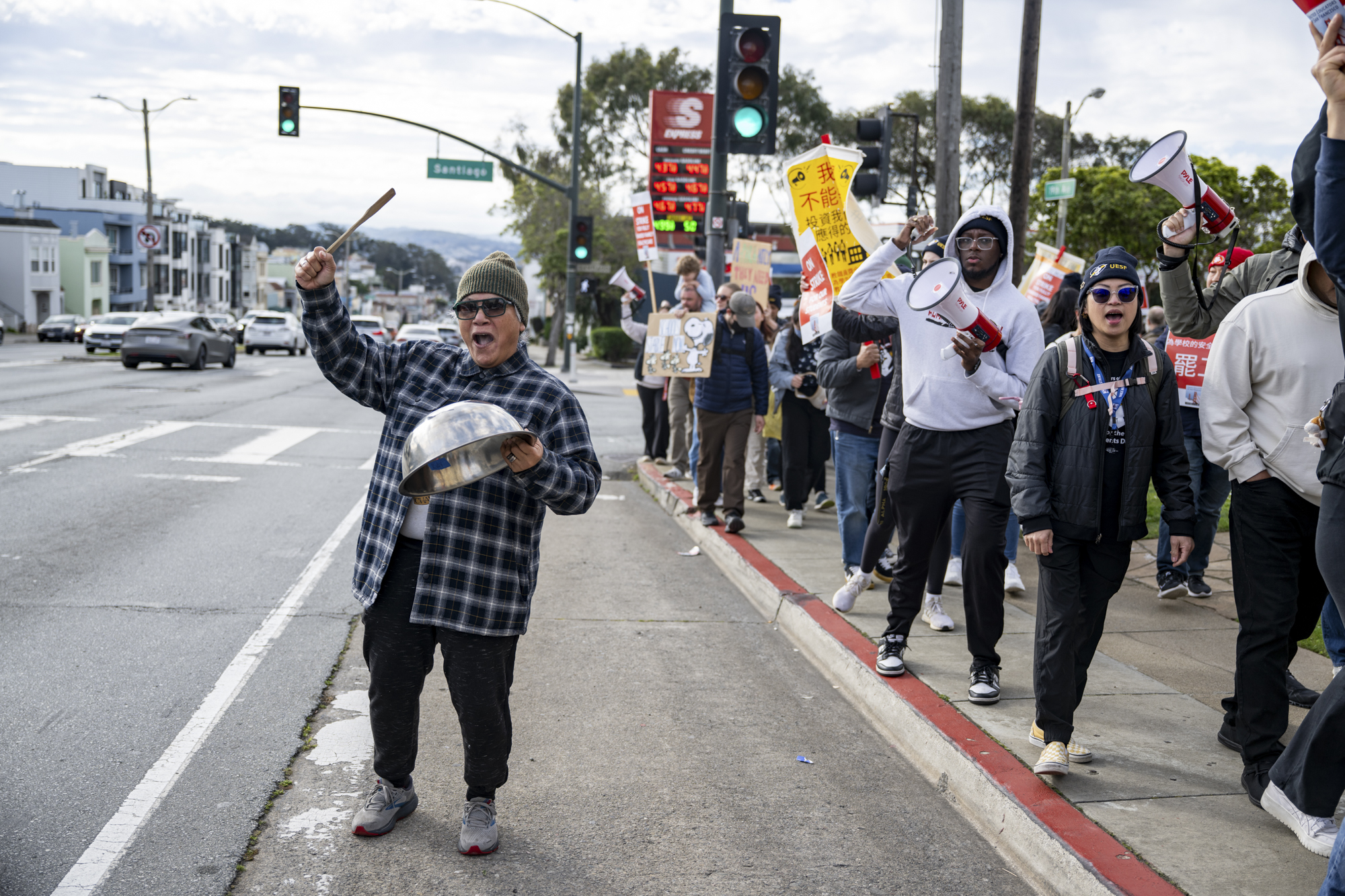
Logan Crawford [00:01:45] Please pay our teachers fairly so that they can keep up with the cost of living in San Francisco.
Ericka Cruz Guevarra [00:01:52] The strike has left the city with a huge childcare gap, but many students and parents are out on the picket lines too.
Charlie Macias [00:02:01] We are protesting for teachers to get fair pay.
Ericka Cruz Guevarra [00:02:08] Today, I sit down with the San Francisco Chronicle’s education reporter, Jill Tucker, to discuss the San Fransisco Unified Teacher Strike and why teacher strikes are happening across California.
Ericka Cruz Guevarra [00:02:31] So I’m talking to you on Tuesday morning here. What is the vibe with the strike so far, would you say? Well, what have you seen so far?
Jill Tucker [00:02:39] Well, I think, like most strikes, it’s tense. There’s a lot of frustration among families. I think there’s frustration at the bargaining table.
Cassandra Curiel [00:03:00] What this contract represents is stability for San Francisco Unified for years to come. And its commitment to us in coming to an agreement immediately will secure the schools that San Franciscans deserve.
Jill Tucker [00:03:13] Strikes in general are angry things. It’s very emotional. And I think that that’s what we have seen across this.
Alexis Panzer [00:03:22] And so I’m upset that people who work twice as hard as my husband or I do, can’t have their health insurance covered, period. So yeah, give them what they deserve, man. That’s all I gotta say right now.
Ericka Cruz Guevarra [00:03:36] And this is, as I understand it, the first time that San Francisco teachers are striking in nearly 50 years, which sounds like a pretty big deal. You’ve been covering schools and education for a long time. Were you surprised when this happened?
Jill Tucker [00:03:52] Yes and no. You know, the first strike since 1979 is pretty historic. That was right after Prop 13 passed and I was a little kid. So that is a long time. But I will say that the trend in the state is definitely teacher strikes and impasses and things like that. So we’re definitely seeing trends. So in one way, yes, having a strike in San Francisco with teachers is something that hasn’t happened in a long and not really expected. That said, we are seeing strikes. We saw one in West Contra Costa. We’ll likely see more in the future.
Ericka Cruz Guevarra [00:04:30] So let’s talk a little bit more about the mechanics of the strike in San Francisco, because as I understand it, it’s not just teachers who are on strike, right? Who exactly is on strike in this city?
Jill Tucker [00:04:42] Yeah, so it is the teacher’s union, but they represent more than just teachers. It is counselors, social workers, nurses, para-educators or teachers’ aides, security guards. So there is a lot of people that are in that union, which represents almost 6,000, what we call educators. But also the administrator’s union joined in a sympathy strike. So that’s principals and assistant principals and some other folks like that. So there is an awful lot of different types of people that are in the schools, mostly at school sites that are on the picket lines.
Ericka Cruz Guevarra [00:05:22] I mean, I have to ask why now? What is this about exactly?
Jill Tucker [00:05:26] On paper, it is about raises, as it always is, you know, it’s about money, it s about services for special education teachers, it s about class sizes, it s about a lot of things that are typically in teachers’ contracts. There are some other things that they actually have settled already, so they have inched closer to an agreement like AI policies, things like that, student housing. But the really biggest sticking point is family health care. They want 100% paid for family health care. Currently, employees get free health care, but if they have a family, they pay, I think it was about $1,200. I think just went up to about $1500 a month. So that’s really expensive, especially if you are a single parent, for example, with two dependents, that’s a significant portion of your salary.
Cassandra Curiel [00:06:25] We get paid once a month. So if we just got our paychecks just a couple days ago, $1,550 just went straight out of that to make sure that our kiddo can go to the doctor.
Jill Tucker [00:06:35] Cassandra Curiel, president of the United Educators of San Francisco has said that educators in San Francisco must have fully paid family health care. And that is something that they have not wavered on.
Cassandra Curiel [00:06:51] It’s been tough, but folks are really motivated to make sure that we are able to stabilize our schools and our classrooms with the kind of proposals that we’ve put forward for our members and then also for our students.
Jill Tucker [00:07:08] The district at one point offered that, but it would have been paid for with sort of a temporary buyer that would run out. And so there would be no guarantees after three years and the union wants it to be a permanent part of the contract. But there is no funding mechanism for that for the district. They don’t believe they have the ability to cover that cost over the long term. So they’re looking for ways to cover that without having to make additional cuts.
Ericka Cruz Guevarra [00:07:36] Yeah, and of course the district is saying, you know, its hands are tied. What about the district at this point in negotiations, what are they saying?
Jill Tucker [00:07:44] Superintendent Maria Su has said repeatedly that she wants to honor the educators while being fiscally responsible.
Maria Su [00:07:54] We always want to make sure that we continue to build a school district that will be sustainable and that is set up to serve many more generations to come.
Jill Tucker [00:08:10] She wants to make sure that the district does not become fiscally insolvent.
Maria Su [00:08:15] We do not have enough funding to cover our current year expenses plus the next two years of expenses. And 85% of our budget pays for staff. And so it’s really, really difficult when we’re talking about trying to close a huge budget deficit.
Jill Tucker [00:08:41] The district remains under a state advisor who has the ability to veto any school board spending because of the budget deficit that the district has had for many years. They’ve been overspending for many, many years, and while there is disagreement between the union and the district over what money they have or don’t have, the reality is they’ve been overspending. And they do have a deficit and the state has a watchdog there to make sure that they do not need a state bailout loan in the future. The state trustee has been involved behind the scenes with the district, advising them on what is affordable or not, according to Superintendent Su. And if they go past spending me on their means, he could veto the agreement that the district makes with the union.
Ericka Cruz Guevarra [00:09:37] What does this mean right now for SFUSD students? I mean, are there places for students to go at this point?
Jill Tucker [00:09:46] Yes and no. There are many community organizations and the city parks and rec department, YMCA, Boys and Girls Club, all of these organizations have really stepped up to try to say take after school programs and make them full day programs during the strike. But the reality is the district has 49,000 students and there are a lot of families that have difficulty finding child care, they can’t afford camps or they can get their kids. To the YMCA. So there are a lot of families that are really hurting. A lot of folks have told me they’re having COVID flashbacks when schools closed and they have no idea how long they would be closed for that not knowing and has just really triggered them.
Ericka Cruz Guevarra [00:10:41] At the same time, I’ve heard a lot of parents also expressing a lot of support for the teachers at the same time. I mean, what is your sense of public opinion, despite the sort of inconveniences that the strike is having on on parents and families?
Jill Tucker [00:10:57] You know, I mean, you would be hard-pressed to find a parent or a family that doesn’t love their teacher. I think, you know, there’s mixed feelings about the strike, but that’s very different than the love of their teachers and the support of their teacher’s. I talked to one parent who has mixed feelings about the strike, but was bringing food to the strike line, bringing, you know, for the teachers. Everyone wants the strike and nobody wants to be on strike. It’s it’s you know it’s very emotional though. You like I said at the start.
Ericka Cruz Guevarra [00:11:31] I wanna zoom out, Jill, because there was just a strike at the West Contra Costa Unified School District. Berkeley teachers are in labor negotiations that have stalled. Oakland teachers were negotiating a contract last year. And the story just seems similar. And I just have to ask, why does this keep happening?
Jill Tucker [00:11:54] To a certain degree, what we’re seeing right now is a bit of a coordinated effort with the State Teachers Union, the California Teachers Association that have gotten many districts, a few dozen districts to sign on to their We Can’t Wait campaign. San Francisco, Oakland, West Contra Costa, Los Angeles, and Berkeley, a lot of these districts are all part of that. In general, the goal of the CTA is to demonstrate sort of the widespread issues of education funding and how the state’s funding of education and other issues are having an impact on the schools. So I think there’s a political movement that is part of this, but it is also a district issue in each of those individual communities. What teachers are paid or what their benefits are. I mean, certainly $1,500 a month for health care is a difficult thing for many people. The reality is our schools have, with declining enrollment, with state funding and state budgets strapped as well, with a federal government that has made cutbacks in terms of funding for schools, the Department of Education is slowly whittling away, we’re really reaching sort of that crisis point. And I think all of that is sort of coming together for education, not just in California, but across the country. It just feels more fraught now than it has in the past. It doesn’t feel just localized. It feels bigger.
Ericka Cruz Guevarra [00:13:38] I mean, I have to imagine it’s probably hard to say how long this strike in San Francisco will last at this point.