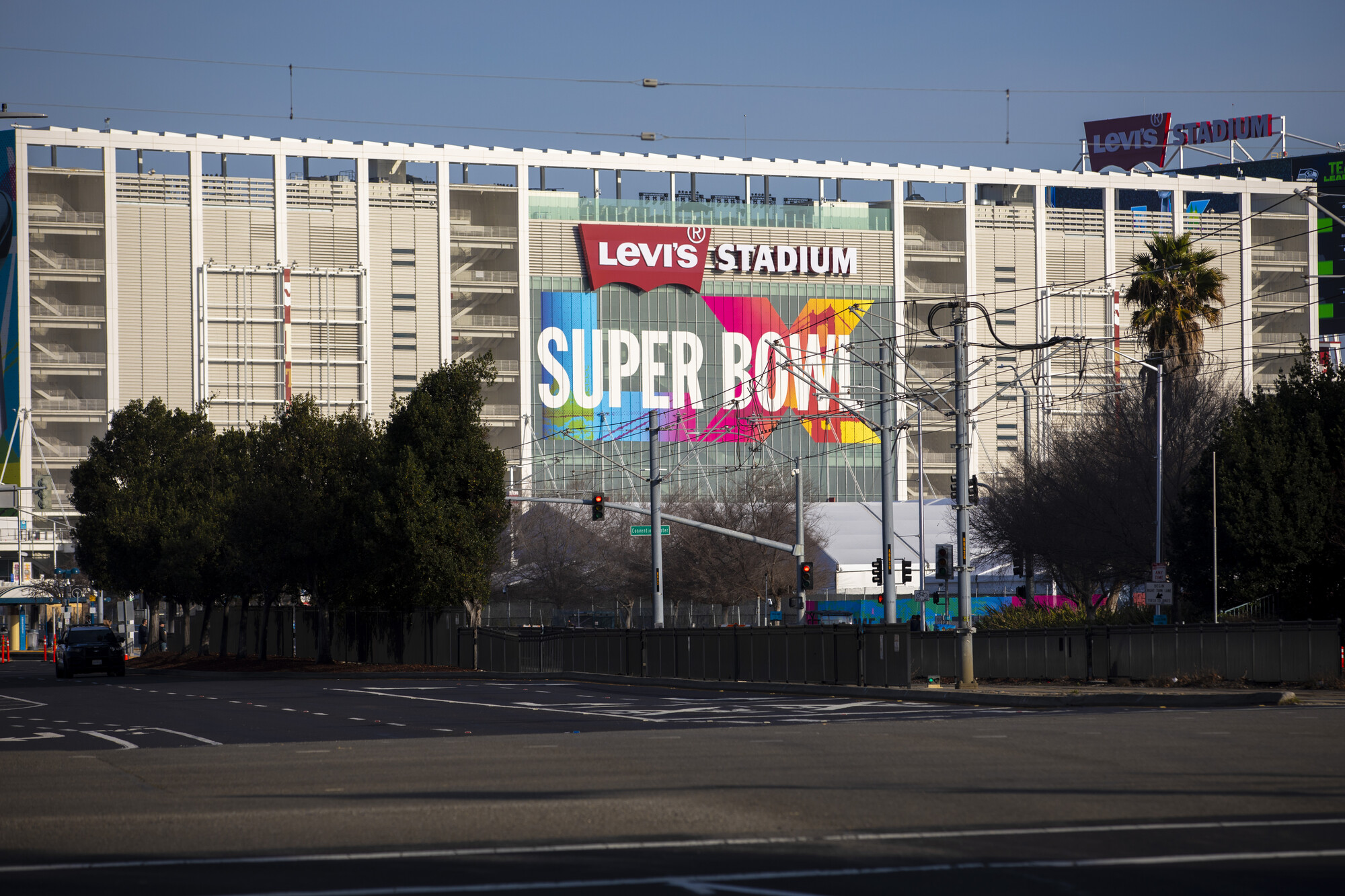
Joseph Geha: [00:01:57] So even if you’re just a person like taking VTA and has no interest in the Super Bowl, you’re gonna be exposed to it. And folks, you know, walking on the streets are gonna see it.
Ericka Cruz Guevarra: [00:02:07] So today, we’re gonna sit down with KQED’s South Bay digital editor and reporter, Joseph Jeha, to talk about how Super Bowl 60 will affect daily life in the South Bay.
Ericka Cruz Guevarra: [00:02:58] You live in the South Bay, Joseph. Are you already starting to feel and see the presence of the Super Bowl where you live?
Joseph Geha: [00:03:07] Absolutely. It was a big day a couple weeks ago when they actually hung the Super Bowl sign on Levi’s Stadium, right? It’s a massive banner, essentially. The City Hall Rotunda in San Jose has an SJ-26 logo on it and that’s kind of celebrating the Super Bowl, the World Cup. So yeah, so that has been a big part of it, just like the visuals are changing. And even the VTA trains and busses have extensive, you know, wraps, especially in the Santa Clara area that say, like, take VTA to the game and have these very, like you know detailed NFL graphics in a lot of different colors kind of grabbing the eye. Even if the 49ers are not in the Super Bowl, you’ve got locals in San Jose and the South Bay who want to see what this is all going to be like.
Ericka Cruz Guevarra: [00:04:01] Yeah, lots of hyping up for the main event on Sunday, it feels like, and I guess like being in the center sort of of all of the action, Joseph, what’s your sense so far of how people are feeling? Like, what is the vibe? It seems sort of like a lot of people really wanna get in on the action.
Joseph Geha: [00:04:20] It’s something that can’t be ignored, right? If you run a city, if you run to a tourism bureau, if you are trying to be in the business of making sure your city is well promoted and well seen during this week, this is the event to take advantage of.
Christine Lawson: [00:04:35] This is a historic moment for us in Santa Clara, being first to host the Super Bowl and FIFA in the same year.
Joseph Geha: [00:04:43] My colleague Sydney Johnson spoke with Christine Lawson. She’s the CEO of Discover Santa Clara. And that’s basically the city’s marketing organization. And she told us about their efforts.
Christine Lawson: [00:04:54] We want a bigger slice of the pie. There’s so much to do before the game and after the game. Most people are coming in on Friday and not leaving till Monday after the games. So we really wanna make sure that we get them in and out of the stadium to explore.
Joseph Geha: [00:05:14] San Francisco garners a lot of the attention, but I think South Bay cities and maybe other cities in the region have done a more intentional job this time around of hoping to make themselves kind of a more of a centerpiece of the action.
Ericka Cruz Guevarra: [00:05:33] Joseph, one of the reasons why we wanted to talk to you about the Super Bowl is because there’s going to be just a lot of impacts in the South Bay if you live there, whether or not you care about the super bowl and whether or you plan to watch the game itself. What are the different ways that the Superbowl is going to impact daily life for people in the south bay?
Joseph Geha: [00:05:58] Certainly you’re going to see more people in the urban core areas. Even though San Francisco might have many more hotels and bigger convention spaces than the South Bay, certainly all of downtown San Jose is gonna be booked up. We’re also seeing musical events coming to the South Bay, obviously San Jose has made a big deal of promoting Kehlani as its headlining performer, a local Grammy award-winning artist, expected to bring thousands to downtown San Jose, with the convention center activated, you might see more traffic. And more delays just kind of getting around into the core business areas where people might work or need to go after school or need to go shopping. Increased transit ridership is expected. So if you’re a person who normally takes a VTA bus or train, like a light rail train or even a Cal train, right, to and from San Francisco and the peninsula spots, you’re probably going to see more people. You might even start seeing some folks wearing some NFL badges walking around your city.
Ericka Cruz Guevarra: [00:07:02] And definitely more security and police presence, I imagine.
Joseph Geha: [00:07:07] Yeah, certainly you would see more law enforcement, especially in Santa Clara. We saw the Santa Clara County Sheriff’s Office putting out video clips and media, kind of doing the promotional work on their own and saying, like, look out for more people in uniform. Look out for bomb-sniffing dogs. Look out, all of our officers are gonna be out there. They’re gonna be clearly identified and we’re doing this work for the people of the South Bay and the Bay Area to make sure that this event goes off without a hitch.
Ericka Cruz Guevarra: [00:07:36] I do want to zoom in to some of these impacts to the local community, especially around tourism and these financial opportunities that a lot of locals see in the Super Bowl. Are there any efforts, Joseph, to help local businesses really tap into the potential benefits of the Super Bowl’s presence here.
Joseph Geha: [00:08:00] I think yes and no. Around Levi’s Stadium, there’s this like four-mile radius clean zone. That’s what the NFL calls it. They put it into place the last time there was a Super Bowl there. And that is affecting, you know, vendors and business owners, quote unquote, unauthorized. Vendors and businesses can’t sell there. Even if they have permits from the cities and they’re like totally like vetted normally, They’re not going to be allowed for the NFL So even people’s community in Santa Clara is changing, especially if you’re in that area closest to the stadium. I have attended business meetings put on by the city of San Jose, get your questions answered type of event, but I also heard some frustration at that meeting. We heard frustrations from people who speak English as a second language, folks who are older, who say they don’t really know how to use some of these internet signups as well.
Alma Gonzales: [00:08:52] It’s a family business. My dad started 15 years ago.
Joseph Geha: [00:08:58] I spoke with Israel Garcia and Alma Gonzalez and they run a food truck in San Jose’s Spartan Keys neighborhood. What’s some of your most popular items?
Israel Garcia: [00:09:09] Tacos de birria, el consomé y las quesavirias que también se hicieron muy populares
Joseph Geha: [00:09:15] They’ve been running it for almost 15 years. They’re very well-liked in their neighborhood. They had considered maybe moving their truck or getting closer to Santa Clara to the stadium to sell their food on the day of. But because of that clean zone I mentioned, because of the four-mile radius, they had told me, well, we actually think we’d be so far from the stadium it probably wouldn’t actually be an economic benefit for us to go there.
Alma Gonzales: [00:09:40] No, we are not moving. We went to a meeting with City Hall and everything and they are asking for a lot of requirements and it’s going to be kind of far from the place of the Super Bowl. So I think for us it won’t be any change.
Ericka Cruz Guevarra: [00:10:03] It seems like from the conversations you’ve had with local business owners, immigrant business owners in the South Bay, it doesn’t totally feel like they have been given a ton of opportunity to really tap into and participate in all of the action, at least easily.
Joseph Geha: [00:10:23] Yeah, I think you’re kind of hitting on a really important, I think, like storyline and maybe a sensitive nerve here in the South Bay, which is just the San Jose apparatus is working hard to bring a lot of activity and engagement. And then of course, they want to draw people to their well established entertainment zones like San Pedro Square, which has also in downtown just down the street from City Hall. But we’ve heard from some folks that, you know, this benefit that the city is working so hard for in San Jose, for example, they’re not seeing an effort to spread that goodwill and that attention and that promotion kind of beyond the confines of downtown.
Ericka Cruz Guevarra: [00:11:08] I want to also talk, Joseph, of course, about security and the potential of a federal law enforcement presence. Obviously, we know the South Bay is a huge immigrant community. ICE is very much on people’s minds, given what’s been going on in Minnesota. What do we know about federal immigration enforcement at the Super Bowl?
Joseph Geha: [00:11:31] All kinds of officials who we’ve all been asking the same questions, they’re telling us that as far as they know, they don’t expect there to be a big surge or any kind of over-the-top presence of these federal agents. But they’re making it clear that federal agents like ICE, like Customs and Border Patrol, they are generally and usually a part of the security plan for an event like the Super Bowl.
Cory Morgan: [00:11:58] I dont expect an ice enforcement at the game.
Joseph Geha: [00:12:01] My colleague Brian Watt, you know, spoke directly with Cory Morgan, who’s the police chief in the city of Santa Clara.
Cory Morgan: [00:12:09] So my expectation is we will see the standard deployment for public safety that we see every year at every Super Bowl. And we’re going to do it this year with tremendous federal partnerships.
Joseph Geha: [00:12:21] I think it’s important to note though, federal agencies like DHS, they do not share, typically, their operation plans with local police, local county sheriffs, et cetera. So I don’t want to be spreading any kind of fear or anything like that or making things up. It’s just, it’s clear that when these operations have happened elsewhere, even when there’s not a Super Bowl, locals are not really getting like a significant heads up.
Ericka Cruz Guevarra: [00:12:47] So the Super Bowl is on Sunday, what will you be watching till then, especially in the South Bay?
Joseph Geha: [00:12:55] I am very interested to see what the South Bay community wants to say to Donald Trump and to the federal administration. In the ramp up to this week, there’s also been a series of events to protest his aggressive immigration and customs enforcement pushes in cities around the country, of course, most notably in Minneapolis. Locals here are trying to use this event to bring attention to what they believe is a horrendous, inhumane approach to immigration enforcement and one that is causing havoc across the country. So, I am interested to see what local response is organized and how that is received. Separately, when I’m out and about in downtown San Jose, when I am near the stadium on the day of, when I’ll be around the stadium area and talking to folks that day, I am looking to see how well this all goes off. Will it go off without a hitch in terms of moving thousands of people around? Will it off as an event that just goes smoothly?
Ericka Cruz Guevarra: [00:14:03] I know, Joseph, you grew up as an Oakland Raiders fan, but do you have any stake at all in who wins, New England or Seattle?
Joseph Geha: [00:14:12] Yeah, I did grow up as an Oakland Raiders fan, and that means I’m contractually obligated to not root for the Patriots. So I’ll kind of be pulling for the Seahawks, but yeah, I don’t have a dog in this fight. But certainly I’m not rooting for the patriots.
Ericka Cruz Guevarra: [00:14:31] Thank you so much, Joseph, for breaking this all down for us. Yeah, hope things go smoothly for you all in the South Bay this weekend.
Joseph Geha: [00:14:39] Thanks Ericka, it’s been fun talking to you about it.