Ericka Cruz Guevarra: [00:00:01] From KQED. I’m EricKa Cruz Guevara and welcome to The Bay, local news to keep you rooted. Earlier this month, my cousin was looking for a new apartment in Oakland. And as we were sending each other apartments to look at, there’d been news of a fatal shooting at the Oakland Coliseum and a hit and run somewhere else in the city. They were stories that made her ears perk up because safety was top of mind when picking exactly where to live.
Roselyn Romero: [00:00:39] When you’re able to easily recall crime in Oakland, say the last shooting that happened, then you’re more likely to say, hey, shootings and crime are actually a lot more common than what the data is showing us.
Ericka Cruz Guevarra: [00:00:52] Violent crimes, everything from robberies, assaults, and homicides are way down in 2025 compared to the year before. But perhaps more than any statistics that I could share, that video of the hit and run in Oakland sticks a little more clearly in someone’s head than a spreadsheet of numbers because lower crime statistics don’t always mean that people feel safe.
Holly Joshi: [00:01:22] The city can still not feel safe enough and the numbers can be real.
Ericka Cruz Guevarra: [00:01:30] Today, Oakland’s drop in violent crime. So Rosalyn, I feel like the big headline is violent crime down in Oakland. How much lower are we talking?
Roselyn Romero: [00:01:56] We’re talking about some pretty significant improvements here.
Ericka Cruz Guevarra: [00:02:02] Roselyn Romero is a reporter covering public safety for The Oaklandside.
Roselyn Romero: [00:02:08] If we’re looking at violent crime in total, which includes homicides, aggravated assaults, rape, and robbery, that was down 25% in 2025 compared to 2024, the previous year. When we look at homicides specifically, the number is 22% lower from the year prior. So there were 67 homicides last year in Oakland. And in 2024, that number was 86. One homicide is one too many, of course. But when we look at the numbers overall, that’s still a pretty major improvement. Other categories of crime like property crime are also down significantly. Robberies are down 43%, burglaries 14%. Across the board, there are some pretty significant reductions in crime.
Ericka Cruz Guevarra: [00:03:11] And I know that Oakland City leaders held a big press conference about this. Tell me a little bit more about this press conference. Who was there and what were they saying about this news?
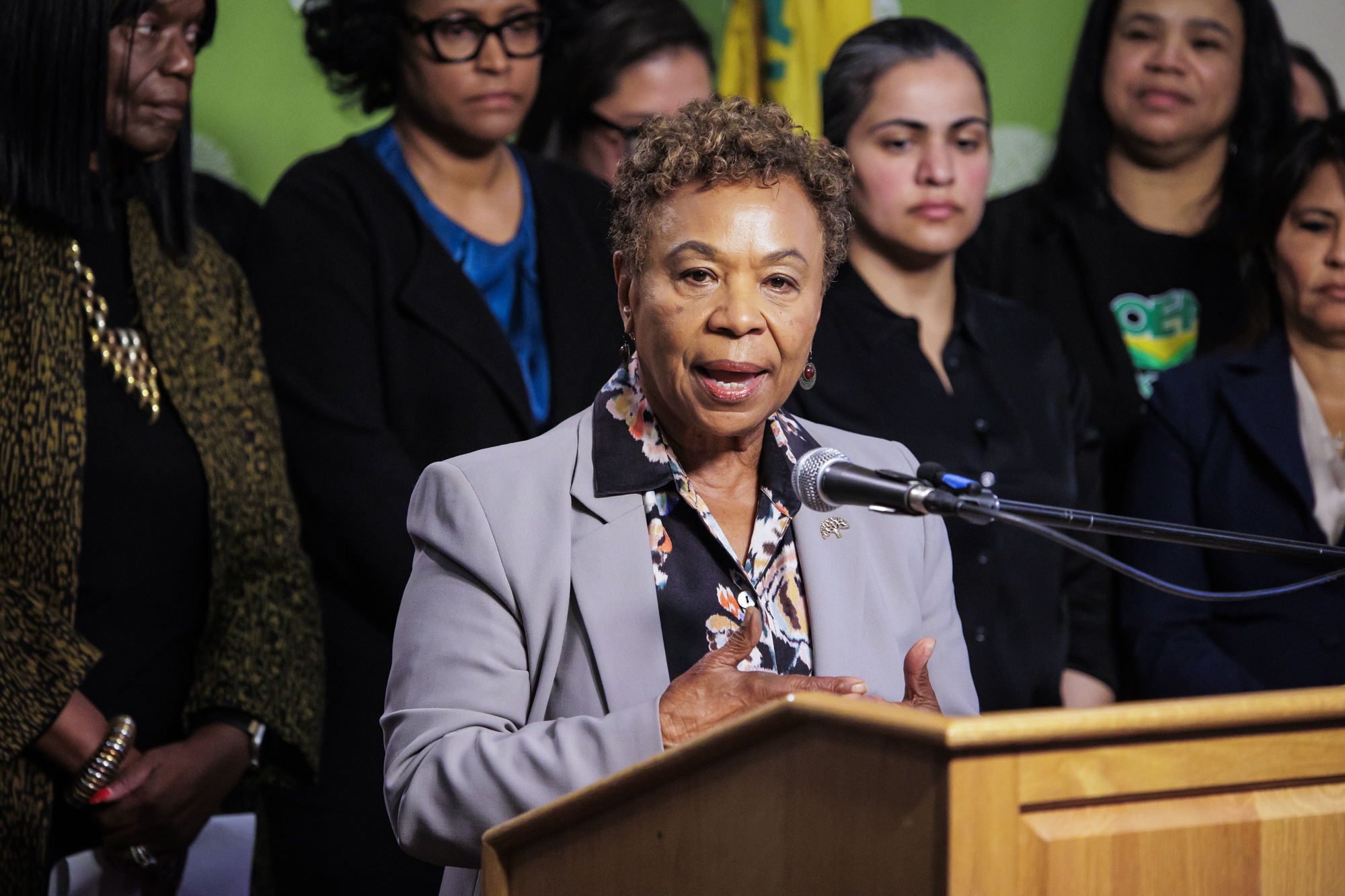
Barbara Lee: [00:03:22] Well, thank you very much, good morning, and thank you all for being here again. I want to thank the press for coming to cover what is a good news story today.
Roselyn Romero: [00:03:32] Yeah, so Mayor Barbara Lee held a press conference earlier in January. Other speakers there were Interim Police Chief James Beer, the Chief of the City of Oakland’s Department of Violence Prevention, Holly Joshi, as well as some other public safety lead.
Barbara Lee: [00:03:50] This progress, let me tell you, did not happen by accident. It reflects an all-hands-on-deck approach to public safety that focuses on prevention, accountability, and partnership.
Roselyn Romero: [00:04:05] They touted the progress that the city has made in reducing violent crime and property crime, but they were cautious about celebrating.
Barbara Lee: [00:04:18] Even with the historic progress, gun violence remains a challenge, and we’re continuing our work with all of our partners to address it and to reduce it, and yes, of course, I would like to eliminate it, like all of you.
Ericka Cruz Guevarra: [00:04:40] Do we have any idea what is behind this decrease in violent crime in Oakland? Like, can we point to anything in particular that explains why violent crime is going down?
Roselyn Romero: [00:04:53] There is no one silver bullet that could explain these reductions in crime in Oakland. However, there are multiple factors at play that could play a role. One strategy that city leaders spoke about during this press conference was the ceasefire strategy. Ceasefire is a collaborative strategy involving the city’s Department of Violence Prevention, the police department, and other community-based organizations that work specifically in violence prevention. So the idea is to reach the small group of people at risk of picking up a gun within the next 90 days or being shot within the 90 days and offering them a path out of violence, which could mean helping them relocate to a different city. It could mean, helping them find a job if they may have been pressured to engage in gun violence because of economic reasons, just trying to provide different social services for these folks to incentivize them to get off that cycle of violence. And beyond ceasefire, of course, there’s the resuming of social services and jobs and other parts of everyday life several years after the COVID pandemic of course. Unique thing about Oakland is that in 2023, actually, there was an increase in homicides. And we don’t know exactly why, but from 2023 onwards, we started to see this rapid acceleration in the decline in violent crime. So it could be that Oakland just caught up with the rest of California and the United States in general, where we’re seeing crime go down all across the board. But definitely several years after the COVID pandemic, that distance in terms of time has definitely probably helped play a role.
Ericka Cruz Guevarra: [00:07:29] Yeah, because I know violent crime is down everywhere, right? Not just in Oakland. And I know that many experts attribute these spikes in violence during COVID to the ending of many of these social services programs, kids not being in school, many folks out of work. How about local law enforcement and the role that they’ve played in the last couple of years? Are there leaders in the city of Oakland who are saying that. Increased policing has helped drive down violent crime at all.
Roselyn Romero: [00:08:02] Yes, so Interim Chief James Beere has pointed to the California Highway Patrol’s quote-unquote surge operations in the East Bay.
James Beere: [00:08:14] We are grateful for the collaboration with our local, state, and federal law enforcement partners, as well as all the other city departments, because this does take the entire family of Oakland.
Roselyn Romero: [00:08:25] He says that having more CHP presence in Oakland has helped reduce crime, helped police officers respond to crimes quicker.
James Beere: [00:08:36] Last year, our officers cleared, or answered, or followed up on over 203,000 calls, demonstrating their commitment to our community around the clock, 24-7, seven days a week.
Roselyn Romero: [00:08:50] Chief James Beere at this press conference also credited Flock. Flock Safety has cameras throughout Oakland, and he says that those cameras have helped police officers seize vehicles that were involved in sideshows and has helped officers track down suspects to eventually, he says, make arrests.
James Beere: [00:09:23] We’re utilizing the technology to report crimes that in the past have not been reported. We’re utilizing the automated license plate reader to proactively investigate robberies, assaults, as well as burglaries and the sideshow. So that’s a message for everyone out there. If you engage in violent crime, we will catch you and we will bring you to justice and you will be charged.
Ericka Cruz Guevarra: [00:09:53] Coming up, why lower rates of violent crime don’t necessarily mean people feel safer. We’ll be right back.
Ericka Cruz Guevarra: [00:10:38] It’s great news. But I still had a conversation with someone the other day who was like, I don’t wanna go to that part of Oakland because I heard there was a shooting there the other day and it sort of feels like the numbers haven’t quite caught up with people’s feelings and that perception piece and I wonder if you could talk about that a little bit because this perception of safety still feels. Very significant no matter what the numbers say.
[00:11:08] Yeah. No, I mean whenever I talk to community members, city leaders, people all throughout Oakland, they tell me the same thing. A lot of folks, whether it’s because they know someone who was robbed the other day, or maybe they themselves were bipped, or their car was broken into recently, they have these strong opinions about how safe they feel in Oakland, which is totally valid. Last year I spoke to Justin Pickett, who’s a criminal justice professor at the State University of New York at Albany. And he mentioned something that psychologists call the availability heuristic. When you’re able to recall something quickly or easily, you’re more likely to believe that that thing is more common than it actually is.
Ericka Cruz Guevarra: [00:12:09] So like a video on Instagram of someone getting a car bibbed on Broadway.
Roselyn Romero: [00:12:15] Yes, exactly. The example he gave me was, you know, if I were to ask you how common you think a certain type of cancer is, you’re going to try to recall someone you know or someone you may have heard say that they were diagnosed with that type of cancer. And you’re gonna use that as basis for, okay, well, it’s actually pretty common because I know someone who has that type of cancer. And that availability heuristic applies to crime as well. When you’re able to easily recall crime in Oakland, say the last shooting that happened in Oakland then you’re more likely to say, hey, shootings and crime are actually a lot more common than what the data is showing us. I’ve heard some people tell me we shouldn’t trust these numbers because people aren’t reporting crime anymore. They don’t trust the police department or they don’t think that. The police are going to investigate if they report a crime, which, of course, that frustration is completely valid. But violent crime data we’re seeing is a lot more reliable, according to criminologists I’ve spoken to, because there are fewer homicides to count than, say, burglaries. People don’t really hide dead bodies in the same way that, you know it’s I mean it sounds really bleak, but it’s true.
Ericka Cruz Guevarra: [00:13:43] Yeah, like you might not report that your backpack got stolen out of your car or something, but police are going to count when someone was shot and killed on the street.
Roselyn Romero: [00:13:56] Yes, exactly.
[00:13:57] And people hear gunshots.
Roselyn Romero: [00:13:58] Exactly.
Ericka Cruz Guevarra: [00:14:05] I mean, what do city leaders in Oakland say about that perception piece? Because I just have to imagine it must be like just a little bit frustrating to see these numbers, but to still have to battle that, which has a big impact.
Roselyn Romero: [00:14:20] Dr. Joshi, the chief of the Department of Violence Prevention was pretty clear during the press conference to say that two truths can be true
Holly Joshi: [00:14:32] The city can still not feel safe enough and the numbers can be real.
Roselyn Romero: [00:14:38] You know, do you feel safe leaving your house? At eight o’clock at night? Until that answer is yes, we still have a lot more work to do but we can celebrate the progress.
Holly Joshi: [00:14:51] In the meantime. Of course we are not here to wave a victory flag but instead here to remain accountable to effective strategies knowing that it is our responsibility to make Oakland a safe and thriving city.
Roselyn Romero: [00:15:06] A lot of efforts by city officials to improve the perception of Oakland in general, not just crime in Oakland, but Oakland in general.
Ericka Cruz Guevarra: [00:15:16] What is the city doing to try and continue this trend? I mean, I imagine more investment perhaps into ceasefire, which they seem to believe is really helping. What else?
Roselyn Romero: [00:15:30] City leaders are also trying to put more investment in specifically the community-based organizations that work with ceasefire and the Department of Violence Prevention to offer these social services to ceasefire clients, as they’re called. And in general, there has been a robust debate about staffing the Oakland Police Department. Right now, Oakland Police Department is currently budgeted for 678 officers, but its operational strength, which refers to the number of officers that can work and who aren’t on some sort of administrative leave, the operational strength is around 500 officers. So that’s a lot fewer officers than what the department is budgeted. And so as we get into the mid cycle budget for the city of people are gonna be talking about, you know, how much should we allocate to the police department?
Ericka Cruz Guevarra: [00:16:38] And I have to ask too, were these numbers surprising to you at all?
Roselyn Romero: [00:16:42] That’s a, oh man, I mean, not really. For as much negativity that Oakland receives, personally, I still feel relatively safe, going on a run around Lake Merritt. I still, feel pretty safe going out and hiking in Reinhardt Regional Redwood Forest. But of course, I still think about, you know, the people I’ve interviewed who maybe they lost their son to gun violence or maybe they themselves have been victims of crime. I’ve been a victim of crime There was a time, maybe in early 2025, when I was driving on MacArthur Boulevard in Oakland. And several men jumped out of a car right next to me, broke my passenger window, took my purse from my passenger seat, and took off with that. And- Oh, that’s scary. Yeah, no, it was scary, but- One thing that really stuck out to me about that experience was it was neighbors who posted on Facebook, hey, this person’s purse and these other people’s purses were dropped off at this one street in East Oakland. If you know any of these people, please reach out to them. And my colleague just happened to come across that post, sent it to me. I was able to recover. All my belongings. Wow. And to me that showed the community in Oakland is pretty powerful. You know, neighbors are willing to help each other and look out for one another in a way that I feel much safer living in Oakland for.
Ericka Cruz Guevarra: [00:18:53] Well, Roselyn, thank you so much for sharing your reporting with us. I appreciate it.