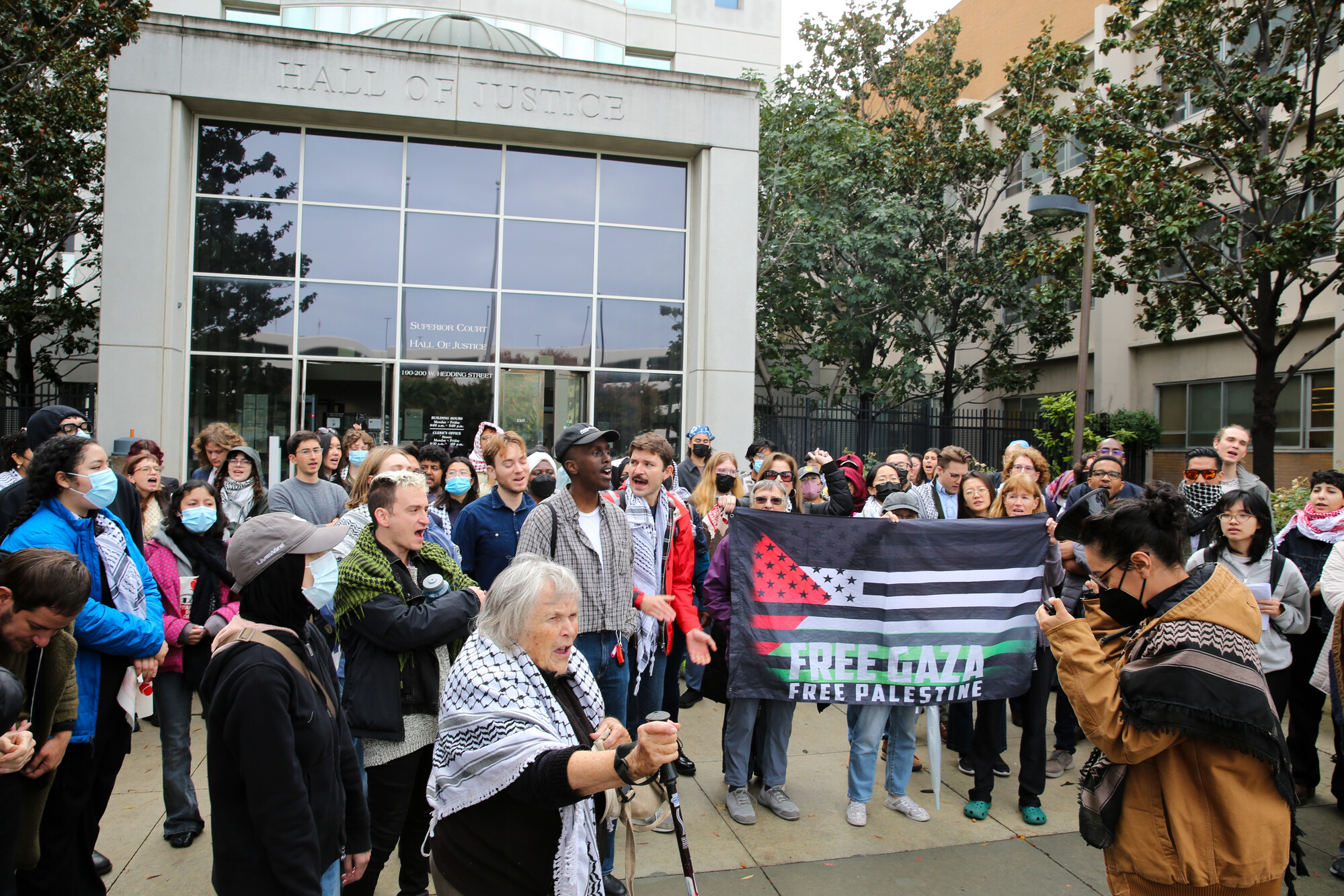
Protests: [00:00:23] Peace, peace, peace Palestine! Peace, Peace,peace Palestine! Peace!
Alan Montecillo: [00:00:28] Student protesters called for a ceasefire, but also for their schools to divest from companies that benefited from Israel’s bombing and invasion, including at Stanford, where 12 protesters barricaded themselves inside the office of the university president.
Protester: [00:00:46] An autonomous group of Stanford students are occupying President Richard Saller’s office in light of the ongoing genocide in Gaza, carried out by the Israeli government and supported by allies like the American government and institutions like Stanford University.
Alan Montecillo: [00:01:03] Now, over a year and a half later, five of those protesters are standing trial in Santa Clara County Superior Court and have been charged with felonies. Prosecutors say that these protesters crossed a line by breaking and entering and causing property damage to the university.
Jeff Rosen: [00:01:23] We are here today because I will not allow people hiding behind masks to commit crimes. The conspirators plan to break into Building 10 and they broke in. They then plan to commit vandalism and they committed hundreds of thousands of dollars of damage.
Alan Montecillo: [00:01:44] The trial of five Stanford student protesters. Joseph, we’re talking about a specific action that happened on June 5th, 2024. What happened on Stanford’s campus?
Joseph Geha: [00:02:01] It was early in the morning and a group of students, mostly current and former Stanford students at the time, but also another student from a different school, essentially broke into the president’s office.
Alan Montecillo: [00:02:16] Joseph Geha is the South Bay Editor for KQED.
Joseph Geha: [00:02:20] It’s in building 10 on campus. It’s right off of kind of a main quad area, and they barricaded themselves inside the building. They blocked doors off, they sealed off entrances, and they started posting on social media about their demands, about what they were asking the school to do, which was to consider divestment from companies and industries that are supporting Israel’s military campaign in Gaza. They spilled fake blood on furniture and items in the offices, and they also broke or damaged some portions of the door frames and stuff where they were using ladders and cable ties to seal off the doors to make their protest known. It was all just a few hours in total, from the time they were in the building to the time that they were eventually arrested by Stanford police and Santa Clara County Sheriff’s deputies and pulled out of that building.
Alan Montecillo: [00:03:25] Was this action unique compared to other protest actions on campus, whether at Stanford or elsewhere?
Joseph Geha: [00:03:33] Yeah, absolutely. So this action, the breaking into Building 10, going into the lobby of the president’s office and essentially taking it over, and even ceremonially renaming it in honor of a late Palestinian doctor who was killed, I think what the protesters were trying to do there is differentiate their protest from the ones that they had participated in and others had participated in leading up to this. By making a statement that couldn’t be ignored. So certainly it came amongst a wave of other protests on campus and across the country, but it did take things a little bit further than other protests had.
Alan Montecillo: [00:04:15] What was the reaction from Stanford and from local authorities?
Joseph Geha: [00:04:19] You know, the response was initially swift, and I would say pretty stern. These students were arrested, they were booked in jail. You know, they had to deal with the university’s own disciplinary systems. Many of them were suspended for two quarters, banned from campus. The president’s office had put out statements about how this had gone too far and how it was definitely not acceptable conduct. It would ultimately take until April of 2025, however, for the Santa Clara County District Attorney Jeff Rosen to issue felony charges for all 12 people who were involved. Seven of the original 12 people involved have taken youth diversion programs or mental health diversion programs. So they are working through the court system to eventually maybe have their charges dismissed. And we have these five remaining protesters who have chosen to go to trial. They chose not to take deals from the court. And starting just, you know, earlier this month, we had the trial actually beginning for these five.
Alan Montecillo: [00:05:29] One reason this story has gotten a lot of attention is because of the fact that the Santa Clara County DA’s office filed felony charges against these protesters. What specifically are they being charged with?
Joseph Geha: [00:05:42] Those five people are all on trial and they’re facing two felony counts each. The felonies are a conspiracy to commit a crime and vandalism. So the, you know, the DA’s office is alleging that these people conspired and planned to commit this crime and then went ahead and did that as well. And in the course of trespassing and breaking into this building 10 in this president’s office. The DA’s office is also alleging that they committed vandalism and did at least $400 worth of damage, which is the threshold.
Alan Montecillo: [00:06:17] Is this unusual, Joseph? And why a felony? Has the DA’s office said anything about that or about this case?
Joseph Geha: [00:06:24] Yeah. You’re right to note that the felony charges are rare. We saw thousands of people arrested across the country during this wave of protests in 2024 for this very issue. But overall, out of these thousands of arrests, it’s been shown that there are very few of them. That are dealing with felony charges, and more specifically, charges that have really gone this far. Even other cases across the country where people were facing felony charges didn’t make it to a trial. There was a deal or a dismissal.
Jeff Rosen: [00:06:59] Dissent is American. Vandalism is criminal.
Joseph Geha: [00:07:03] You know, the DA, Jeff Rosen, had said very publicly when he announced the charges that he felt that these students and these protesters crossed a bright line.
Jeff Rosen: [00:07:13] Stanford estimated that the perpetrators caused hundreds of thousands of dollars of damage to the building’s interior. As district attorney, my job, alongside law enforcement, is to protect the people and property of Santa Clara County, which includes Stanford University.
Alan Montecillo: [00:07:32] When I hear felony, I mean, I’m not a criminal justice expert, but when I hear felony I think prison time, I know it’s early, but what kind of penalties could there be for these five people? Has the DA’s office given any signal about that, what they think the penalty should be?
Joseph Geha: [00:07:48] Yeah, theoretically, if convicted and, you know, the maximum penalty was thrown at these protestors, they could all be facing multiple years in prison, up to four years in prison over these crimes, but D.A. Rosen did say when he announced the charges that he doesn’t view this as a prison case, essentially.
Jeff Rosen: [00:08:06] I would like these individuals to plead guilty, accept responsibility for what they did. I don’t know that it’s a case where I would want these individuals sitting in jail for these actions.
Joseph Geha: [00:08:21] He thinks the punishment should be somewhere in the realm of paying restitution to Stanford, essentially making the school whole for what they’re alleged to have damaged or broken or ruined, and community service and other types of payback that has not involved time behind bars essentially.
Jeff Rosen: [00:08:41] Because the way I see it is they damaged and destroyed all of this property and caused all this vandalism and I think that their punishment should be cleaning things up.
Alan Montecillo: [00:09:00] Coming up, How the defense plans to argue its case in court. Stay with us.
Alan Montecillo: [00:09:45] What have the defendants, you know, these five people and their lawyers said about this?
Joseph Geha: [00:09:52] Yeah, the defendants, you know, these protesters who are on trial, they’ve been very clear about, you know what their focus was at the time and what it is to this day.
Herman Gonzalez: [00:10:03] Nothing that happens in court room or what happened to me is as severe as what’s happening to the Palestinians, you know, who are facing genocide.
Joseph Geha: [00:10:12] I spoke with Herman Gonzalez after a pre-trial hearing last month, and they were very clear with me that this is about raising awareness and attention to Stanford’s involvement financially in supporting companies and industries that are benefiting Israel’s military campaign in Gaza and, in their view, resulting in an ongoing genocide.
Herman Gonzalez: [00:10:36] We’re advocates for Palestine because we believe in the Palestinian cause. We believe that innocent people shouldn’t be slaughtered simply because of their ethnicity, where they were born, or for wanting to live in their own homeland in peace.
Joseph Geha: [00:10:48] And Hunter Taylor Black told me directly, as other protesters have also mentioned, that they believe the case is intended to chill further political speech. They think it’s aimed at making an example out of them so that other people who want to share a similar opinion in the future will not do it.
Hunter Taylor Black: [00:11:11] I think that in this trial, the DA has been pretty transparent in his aims that he sees this as a case that is meant to discourage future student activists from acting on the things they believe in, in the ways that student activists have acted in the past. And so I hope that the outcome of this case is that, you know, that legacy of advocacy to come out of students for what is right and what history has proven is just continues.
Alan Montecillo: [00:11:43] Has D.A. Rosen responded to the, basically the accusations that he’s putting his thumb on the scale and targeting pro-Palestinian speech?
Joseph Geha: [00:11:50] In talking to folks from the DA’s office, they have denied that there is any kind of attempt to quell speech, and instead they have said, you know, this is a very simple case. They’ve tried to focus on that there’s a line in the sand that you are not allowed to cross, even if you feel very passionately about your beliefs that you’re protesting, and that this group of people crossed it. Even in the pretrial motions, the DAs office, you now, asked the judge and was successful in getting a ruling that The defense can’t use the argument that the DA’s office is quelling political speech with this prosecution. So within the walls of the courtroom, that argument’s not gonna fly, and the DAs office has been vocal that this is for them just about enforcing the law.
Alan Montecillo: [00:12:36] How is the defense talking about this? What have they said about the case publicly? I mean, I assume based on what you’re saying, no one’s disputing whether these students broke into the president’s office and occupied it. So what’s the defense then?
Joseph Geha: [00:12:50] Yeah, one of the attorneys even told me, you know, earlier in the case that it’s not so much a who done it as a why done it. These protesters aren’t trying to beat the rap, so to speak. And instead, what the defense has tried to highlight is a little bit what we’ve been talking about, which is just the motivations.
Tony Brass: [00:13:09] Is this malice or is this done for a greater good? That’s the issue. I mean, these students who are acting for a great or good, and they’re inaction was something they, out of a sense of conscience, couldn’t live with.
Joseph Geha: [00:13:23] Tony Brass is one of the defense attorneys involved, and he told me that, you know, while the charge of vandalism requires malice, he’s saying these students that he’s representing were motivated by what he said was a humanitarian concern.
Tony Brass: [00:13:38] They want to present this trial completely sanitized. Just people who’ve analyzed for the sake of analyzing, just to be malicious. And that’s unfair. It’s both intellectually unfair and I hope a judge agrees, legally unfair
Alan Montecillo: [00:13:58] How present is Israel’s actual bombing and invasion of Gaza in this trial? Because on the one hand, you could say, well, this is about property damage at Stanford, but it also seems difficult for that not to come up.
Joseph Geha: [00:14:13] Yeah, there have been some pretty heated arguments about this very question. The judge and the defense attorney and the DA even had to spend, you know, multiple hours in December in a pre-trial hearing hashing out what the ground rules were going to be because the DA’s office thinks the defense attorneys should not even be allowed to use the word genocide or should not be able to talk extensively about the motivations of their defendants. The defense attorneys, for their part, say, you can’t separate these issues. The reason these students did this is because of this issue. Because they view this as a genocide, because they were trying to stop human suffering. And so, ultimately, Santa Clara County Superior Court Judge Hanley Chu, in December, kind of laid like a middle ground and said, you know, I’m going to allow limited discussion about genocide and talk about the motivations of the defendants. But if he feels it was going to go too far, then he would take action in the of the trial to limit it.
Alan Montecillo: [00:15:16] Has Stanford said anything about this trial? I mean, I understand they had their own disciplinary process earlier, but this trial is about something that happened on their campus. So what have they said about it?
Joseph Geha: [00:15:29] At this point, Stanford has mostly stayed out of the public fray, and anytime we’ve done reporting on it, you know, we’re of course asking Stanford almost every time for comment or if they have an opinion on this, but they mostly have stayed out it publicly. The defense attorneys have said they believe Stanford has been behind the scenes pushing for an aggressive prosecution, but there’s no public proof of that.
Alan Montecillo: [00:15:54] So Joseph, the trial started last Friday and you were in the courtroom. What was it like?
Joseph Geha: [00:16:02] Well, first of all, the courtroom, you know, was full. And it was full of almost completely, as far as I could tell, supporters of the defendants, supporters of protesters. A lot of them are wearing pattern scarves, which are known as kafiyas, which are, you know, a Middle Eastern or an Arab scarf that has become a very, you know, visual signifier of support with Palestinians and Palestinian solidarity. There’s also a lot of folks who have actual, you know, written signs or pieces of paper attached to their clothing that say, you know Stanford, drop the charges. And these folks are filling the courtroom to show solidarity with these students and solidarity with, you they are trying to bring attention to.
Alan Montecillo: [00:16:46] So, I mean, we’re basically at the beginning of the trial, right, and it’s gonna be quite some time before there’s a verdict, sentencing, things like that.
Joseph Geha: [00:16:53] Yes, absolutely. We’re in the early days here, and this could take several weeks to complete. It’s very tough to predict because sometimes an examination of a witness and a cross-examination can take longer than expected, or there can be objections that slow things down. But yeah, we’re at the beginning of what could be a several-week-long case.
Alan Montecillo: [00:17:17] Joseph, thanks so much.