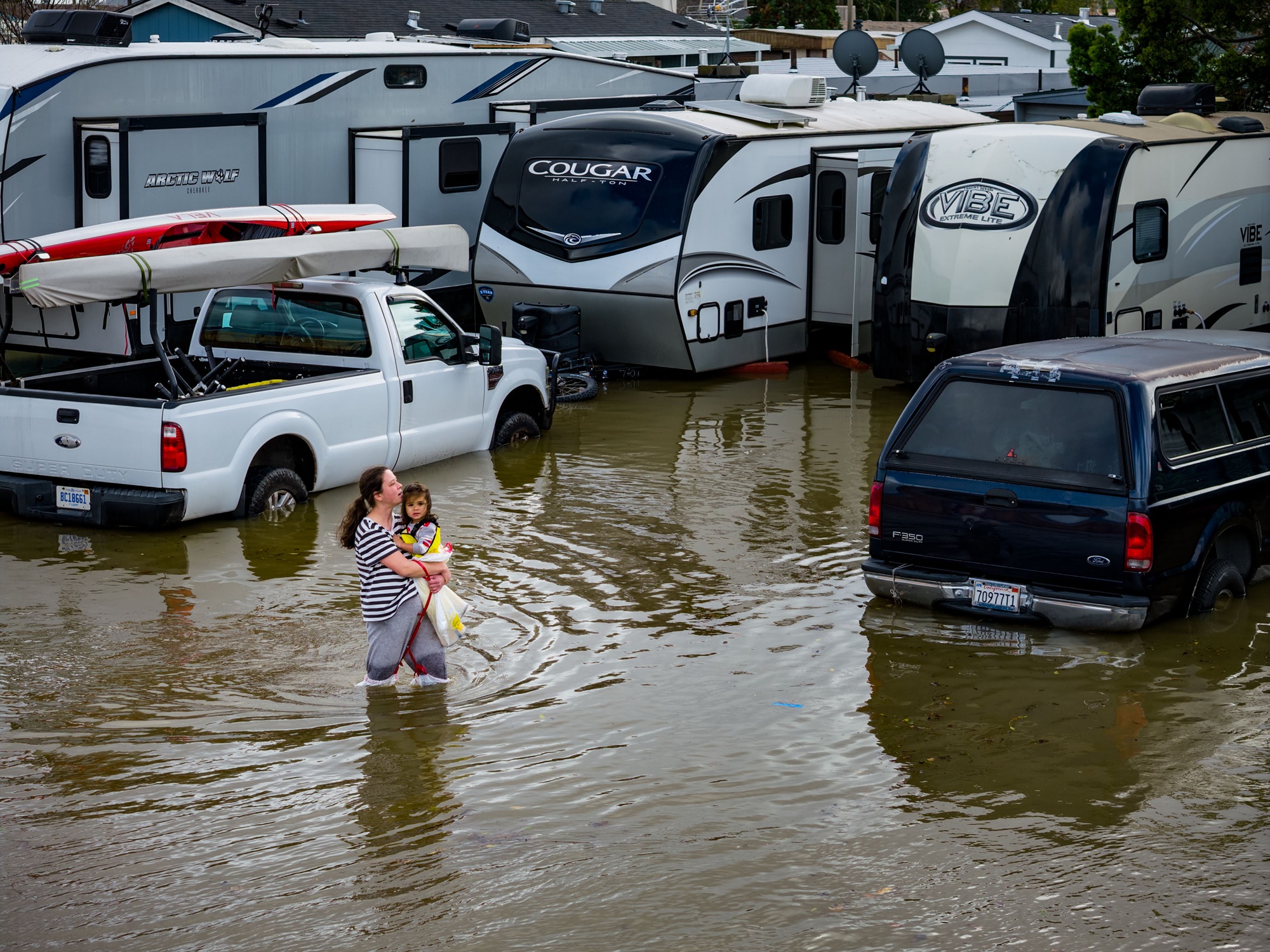
TV newscast [00:00:24] Tides we had for the Bay Area many locations the highest we’ve seen since 1998. Business owners in Marin County who dealt with feet of standing water over the weekend.
TV newscast [00:00:34] King tides and heavy rain once again flooding low-lying areas across the Bay Area.
TV newscast [00:00:39] And for the fourth straight day, Marin County is getting the worst of it.
Alan Montecillo [00:00:44] Cities like Corte Madera, Sausalito, and San Rafael were caught off guard by the intensity of the storms coupled with king tides. Floodwaters spilled over levees, covered bike trails, and surrounded homes and businesses. For residents and officials like Corte Madera Mayor Rosa Thomas, the flooding was a reminder of how everyone needs to be ready.
Rosa Thomas [00:01:11] It’s not just the person who has the property facing the bay, but it will tie up the entire town. And I think that that is a call for us to be united in tackling this.
Alan Montecillo [00:01:28] Today, the flooding in Marin and what can be done to get us ready for the next storm.
Ezra David Romero [00:01:44] We were very dry for a long time this winter, right? I think we had a couple weeks of like very little rain and then there was like a bunch of rain around Christmas, right? And then like another set of storms this past weekend, Friday, Saturday, Sunday.
Alan Montecillo [00:01:58] Ezra David Romero is a climate reporter for KQED.
Ezra David Romero [00:02:02] And so the ground was really saturated and then we had a king tide and then a low pressure system just a regular a storm all happening at the same time. So it created like the perfect conditions you know for extra flooding.
Alan Montecillo [00:02:18] Well, and you went with local and federal leaders in Marin earlier in the week to assess the damage. Where did you go? What did you see?
Ezra David Romero [00:02:27] We started off in San Rafael, just north of there, in an uncorporated community. And then we went to Marin City, we went to Sausalito, we just basically started north and then made our way down.
Ryan Davis [00:02:42] Everybody got their rain gear?
Ezra David Romero [00:02:46] This was a group of like many elected leaders and reporters and one of them was Supervisor Mary Sackett from Marin County.
Mary Sackett [00:02:54] The tide is out, but you can see here where the docks are, show you.
Ezra David Romero [00:03:00] On this tour, Supervisor Mary Sackett brought us to multiple places across the county, you know, where places had been flooded, or like a levee had broke, or, you know, a business was underwater, things like that.
Mary Sackett [00:03:13] And you can tell by looking at some of these homes that they are under the water level. If you walk out on that island in particular, you look and you’re like, they’re really under sea level.
Ezra David Romero [00:03:28] One thing that’s interesting about Marin County is if you’re driving over the Golden Gate Bridge, you’re like in the mountains, right? And then you come down Highway 101 and you’re pretty close to the bay and then it shoots up to the mountains. So we’re not talking about a huge area. It’s like the sliver of land that’s rather low-lying, but it’s very populated.
Mary Sackett [00:03:49] There’s a lot of young families here. There’s lot of older families here, this is not the most affluent part of Marin. It’s lower than the average median income for the county and the cost of flood insurance is significant. In.
Ezra David Romero [00:04:03] And the big issue there is that a lot of that flatland area is land that wasn’t there before. Land we filled in as people, it’s called fill. You know, some of that was marshland, or it was like soggy, or it like physically the bay. And we built land there, we put sand and dirt there, and then we built on top of that.
Alan Montecillo [00:04:23] Oh, is that what reclaimed land is?
Ezra David Romero [00:04:24] That’s what reclaimed land is, yeah. So in some way, it makes sense that these areas would want to flood again, right? And especially over time, they’re also sinking because buildings are heavy, the land is settling. So at the same time, the king tides are happening, there’s storms. All that together makes this like perfect storm of like flood proneness.
Alan Montecillo [00:04:47] Was there damage to roads, buildings, was anyone hurt?
Ezra David Romero [00:04:51] I haven’t heard of any reports of anyone hurt so far, but I have talked to a number of people that said their cars have been flooded, homes and businesses have also been flooded. Mary Sackett says that there’s about a couple hundred places across Marin County that have flooded.
Mary Sackett [00:05:07] And so the streets were very flooded during that King Tide event. And many of the yards, homes, etc. Thank you very much. Thank you.
Alan Montecillo [00:05:20] Well, I can’t imagine what it was like for local businesses during this intense flooding. I know you met the manager of a local gym. Tell me what happened to their business.
Ezra David Romero [00:05:35] I met a lot of business owners in my reporting, but on my first reporting trip, I met Ryan Davis. He’s the general manager of FitnessSF in Corte Madera.
Ryan Davis [00:05:44] So we’ve had events like this in 2005, about 20 years ago, and then in 98. So we’ll remember those, so we’ve tried to be as ready as possible. But we weren’t ready for the scale that ended up coming.
Ezra David Romero [00:06:00] It’s actually a place I’ve worked out before. When I’ve been reporting out there, I just go there because I’m a member there. It was interesting to go there with a three-foot line of sandbags and tarps. He said that the lagoon right behind their business was overflowing like a waterfall into their parking lot, and the water was trying to get in.
Ryan Davis [00:06:23] The exits and entrances, the water got up so high around the edge of the building probably I would say at least three feet of standing water surrounding the entire building that even with sandbags and plywood and tarps it was still coming through.
Ezra David Romero [00:06:37] They were pretty proactive. They were like shop vacing the water out. He said they built one row of sandbags and they built another one because water was getting in. So they were like fighting to make sure the gym, you know, was going to be there for the gym rats.
Alan Montecillo [00:06:52] Well, I mean, that does sound like a lot of adrenaline, but like not the kind you’re hoping for when you go to the gym. So I want to talk about the cause of this round of flooding. So it seems like thankfully no one was hurt. The amount of damage is still being assessed, but, but that it was, you know, really scary and intense for a lot of residents. What actually caused all of this damage and all of his flooding? It was the heavy rain, sea level rise, help me understand it.
Ezra David Romero [00:07:21] A bit of it all, honestly. King tides are natural. It happens when the sun and moon are both at their closest to the earth, that pulls on the ocean with their strongest gravitational force. So basically, the high tide and the low tides, are going to be the biggest and lowest in that day. King Kong tides happen multiple times a year, usually in the winter. And there are other high tides at other times of the year. But what was different this time was that there was a king tide, there was storm, things were already over saturated and it was windy. So all these things together made that flooding worse.
Alan Montecillo [00:08:09] Ezra, how prepared was the county for this flooding? I mean, is there any kind of warning system, like, hey, there’s a high risk of flooding today or this week?
Ezra David Romero [00:08:21] The thing I heard over and over in my reporting this week, whether it was on Monday or in interviews on Tuesday or yesterday when I was out in San Rafael, is everyone was saying this caught them by surprise. We knew that King Tides were happening. The Weather Service puts out reports every single day. They send out to the cities, counties, journalists. We get those every single. So we knew the King Tide’s were happening, but the Weather Service did say is that You know, the storm outperformed their own forecast.
Alan Montecillo [00:08:49] Where does climate change factor in here?
Ezra David Romero [00:08:51] When it comes to storms, it’s hard to say how much in each storm human-caused climate change is infusing into that storm. But scientists have said that all storms are getting wetter because of climate change. Scientists often think of king tides as like the foreshadowing of the future when it comes to sea level rise in California the state is preparing for about like a foot of sea level rise by 2050 and like as many as six feet by 2100 and that’s basically like no ice sheets are melting You know filling up the ocean and then the oceans also expanding as it warms You know, as a byproduct, seas rise, and that will have an effect all over the world. Places like the Bay Area, right, where we have like 400 plus miles of shoreline.
Alan Montecillo [00:09:43] Yeah, there’s a line in your story that reads, “the high tides of today will become the daily tides of the future.” So king tides, normal thing that happens, but sea level rise plus wetter storms equals higher risk of dangerous flooding.
Ezra David Romero [00:10:00] Yeah, when I talked to even to the Weather Service person who was out there on Monday, he was telling me that, you know, like, yeah, we think of these tides as what’s going to happen maybe regularly in the future. It won’t be just like a once in occurrence in 20 years type of thing. Basically, the message that I heard on Monday was like, we got to take this seriously, because like, Yeah, we this is like one time in a long time. This has flooded this badly, but we’re not very prepared in the long if this is going to happen. All the time.
Alan Montecillo [00:10:37] So let’s talk a little more about what can be done here. I mean, what safeguards are there, what needs to be done to prepare for this kind of thing in the future.
Ezra David Romero [00:10:47] Yeah, I can’t quite answer what’s gonna be best for each community, but like there are things that people have done across the region, around the world. Done everything from like put in pumps to pump water out, they’ve built seawalls, they’ve like created these levees to soak up water, they’ve raised homes. In other parts of the world, they actually like have houses and buildings floating, right, so they’re going up and down with the tides. There’s like many things that can be done as like an immediate solution or a long-term one. Regionally, we have something called the Bay Conservation Development Commission that’s like a state agency. They have tasked every city, Every county in the Bay Area that’s touching the Bay and the coast to come up with a sea level rise plan by like 2034. And each city is sort of thinking about that, like how do we deal with this? But there are some big issues in the future for this. A lot of this is private land, you know, homes, businesses. Then you have this like pea soup of highways, right? You have the bridge coming from Richmond, you have Highway 101. So there’s lots to think about here, and it’s not an easy thing of like, let’s just build a seawall. It’s gonna take lots of going back and forth. There’s no real easy answer.
Alan Montecillo [00:12:13] Right, and I imagine there are so many agencies and municipalities and different economic political interests that might make a region-wide approach challenging. Is there money for these kinds of plans? Is that also going to be a challenge?
Ezra David Romero [00:12:30] Money is probably the biggest issue here. There was a lot of hope under the past administration that was heavily funding climate things, that we could get some of these projects built.
Mary Sackett [00:12:41] We have a plan that is shovel ready to build a sheet pile wall, which would replace this timber reinforced berm, which is about over 40 years old, and we applied for the brick and the FMA grants for some federal dollars for this, and both of those grants were canceled under this administration.
Ezra David Romero [00:13:00] These funding challengers are really real for a lot of these communities. And Supervisor Mary Sackett talked about that.
Mary Sackett [00:13:06] The neighborhood hopes we do not give up on funding that. We’ve just got too many people living in this neighborhood that with any overtopping, not only would the homes right on Vendola be flooded, but the network of roads for everyone who’s out here.
Ezra David Romero [00:13:22] We’re not talking about like a million dollars, right? We’re talking about tens of millions of dollars, maybe even hundreds of millions of dollars just to have these solutions in place because it takes a lot of time and a lot of money buying land, raising highways, re-imagining how communities work all in a small area.
Mary Sackett [00:13:41] You know, one of my frustrations is do we have to wait until there’s a disaster, or can we prevent the disaster from happening? And you know, we’ve really been focused on how do we prevent a significant disaster from happening here? How are we ready if dollars become available?
Alan Montecillo [00:14:04] So lots of work to be done to beef up protection against floods, not just in Marin, but all over the Bay Area. I also feel like as an individual, I’ve had to think a lot more about how I myself am prepared for various incoming natural disasters, whether it’s a fire or power outages or an earthquake. What does this mean for people in the meantime? Like, should I be going to Home Depot ASAP to buy sandbags?
Ezra David Romero [00:14:35] Yes, I think so, right? If I lived next to the bay, right across the street or something, or even relatively close, I would probably have sandbags ready to go. This is an interesting moment where people are thinking about this because the water was just here. But I think with wildfire and other things, or drought, we often forget about it, that You know, we live in a flood-prone area. When the waters go away and it’s summertime and it is warm and we’re out on the water surfing or whatever. So I think the time now is to actually get prepared before you forget about it.
Alan Montecillo [00:15:17] Well, that’s a solid New Year’s resolution, Ezra. Thank you for coming on the show. Appreciate it.