This is a computer-generated transcript. While our team has reviewed it, there may be errors.
Ericka Cruz Guevarra: [00:00:51] I’m Ericka Cruz-Guevarra and welcome to The Bay, local news to keep you rooted.
Laura Klivans: [00:00:56] All right, so what are you holding in your hand?
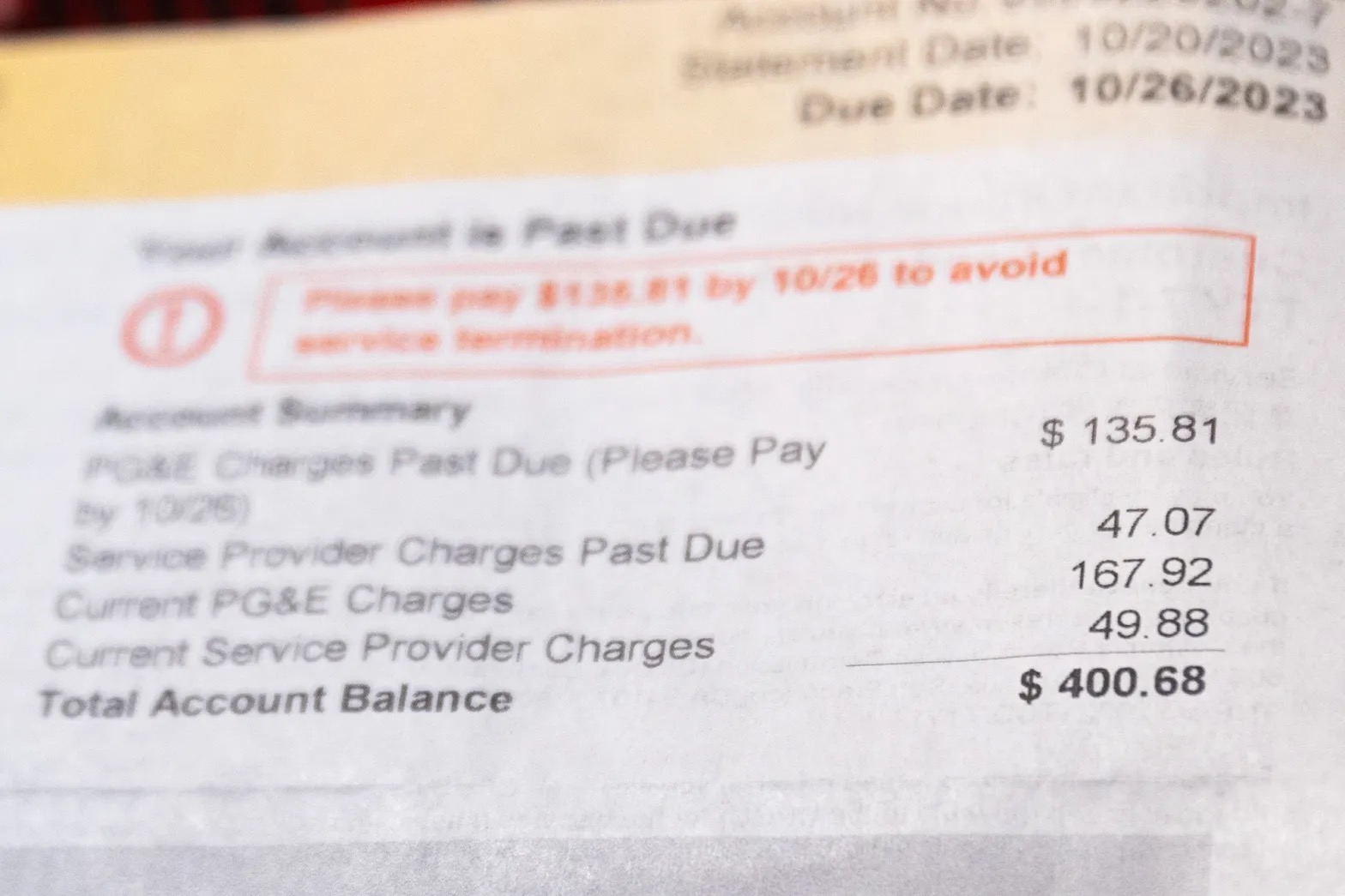
Kenya Brown: [00:00:58] I am holding my PG&E bill.
Ericka Cruz Guevarra: [00:01:01] This is Kenya Brown, she’s a mom of five and she lives in a one story house in the East Bay city of Bay Point. And she’s tried a bunch of things to try and lower her Pacific gas and electric bill. Weatherizing her home, asking the kids to turn off the lights and turn down the heat. But she’s never had to pay this much for her utilities.
Laura Klivans: [00:01:26] Can you read it for me? What does it say? What’s the grand total?
Kenya Brown: [00:01:30] $648 for one month.
Kenya Brown: [00:01:35] Like, I have to decide, like, am I going to pay this bill, or am I gonna eat food? And I have choose food.
Ericka Cruz Guevarra: [00:01:46] A lot of people are in this situation in California because you aren’t just imagining it. Utility bills are going up. But where does any of that money actually go? And why are bills skyrocketing in the first place?
Laura Klivans: [00:02:05] And so then I thought, it’d be fun to do a story where I just dive into someone’s bill and try to really understand this. And for me as a climate reporter, it took a long time.
Ericka Cruz Guevarra: [00:02:17] Today, KQED’s climate reporter Laura Klivens sits down with me and my PG&E bill to help me decode it and understand where exactly my money is going.
Ericka Cruz Guevarra: [00:03:24] Part of the reason why we wanted to do this is because, to be honest, this is the first time I’m actually looking at my energy bill.
Laura Klivans: [00:03:30] You and everyone else. Yeah. Nobody like looks at this gobbledyguck.
Ericka Cruz Guevarra: [00:03:37] Laura Klivens is a climate reporter for KQED.
Laura Klivans: [00:03:43] I had been doing reporting and I’d heard here and there people being like, you know, only a quarter of your bill is actually for the making of energy, which sounded so crazy to me. And that is accurate. That’s on one end of the spectrum. It’s like a quarter to 40%. But I was just like, what else is in the bill? And so then I thought it’d be fun to do a story where I just dive into someone’s Bill and try to really understand this.
Ericka Cruz Guevarra: [00:04:12] So Laura, we’re gonna be looking through my PG&E bill here. And I think I just wanna start at the top here. I paid $56.11 on my energy bill in October. Is that… expensive?
Laura Klivans: [00:04:31] No, you are paying a super cheap amount. So it’s like, it tells me that you are not using a lot of electricity and you’re not using a lot of gas. Average bill is around $300 a month. This was from an analysis that our old colleague, Matthew Green, did in March. And that’s up from 179 a month in 2020. So yeah, you’re getting a good deal. I mean, you not getting a better deal than anyone else. You just don’t use as much.
Ericka Cruz Guevarra: [00:04:56] I also want to mention that I have time of use peak pricing plan, which basically means that my, as I understand it, energy is charged based on peak usage time. So I try not to use my laundry from 4-9pm at peak pricing times because it’s more expensive.
Laura Klivans: [00:05:23] And the reason why energy providers have these is because we experience an increase in demand during those times. That’s when most people are coming back from an office or whatever kind of job and going home and cooking and washing and whatever. And so there’s a bit of a strain on the grid. And also at that time in California, the sun is setting, right? And so we have a bunch of solar, but the curve of solar goes down at that time and then the demand either remains the same or goes up a little bit. And so then you have this sort of strain at that time. So that’s why they’re trying to incentivize people to not use as much.
Ericka Cruz Guevarra: [00:06:02] So you’ve got my bill printed out in front of me. I feel very exposed a little bit.
Laura Klivans: [00:06:10] I know, doesn’t it feel a little weird?
Ericka Cruz Guevarra: [00:06:11] It does. And I’ve got my bill in front of me as well. So let’s go through this thing. So it is eight pages, but I want to start on the first page because it looks like there are three main things that I’m really being charged for at the top here. PG&E and electric delivery charges, electric generation charges, and current gas charges. So what is going up for most people in their bills, and why is that?
Laura Klivans: [00:06:40] There’s different reasons why our energy bills increase at different times. Right now, in the past like five years-ish, we’ve been paying largely for wildfires. What we’re seeing is an increase in one section of the bill, which we will talk about. And it’s called transmission and distribution. And this includes things like towers and huge wires, and then the local wires and poles that we see in our neighborhoods. And that’s increasing because we have to prepare those things to be ready for more wildfire so that if fire comes towards them, that they don’t just sort of melt and cause issues, but also that they don’t spark wildfires, and we’re also paying for the liabilities of past wildfires.
Ericka Cruz Guevarra: [00:07:33] Because they have sparked wildfires in the past.
Laura Klivans: [00:07:35] Yeah, mhm.
Severin Bornstein: [00:07:37] So if you went back 30 years, it was basically putting up wires around neighborhoods and then maintaining them.
Laura Klivans: [00:07:46] I spoke to UC Berkeley professor of energy and economics, Severin Bornstein, and he said that 30 years ago, transmission and distribution was just cents out of your entire bill. And now it’s just, it’s a much larger percentage of it.
Severin Bornstein: [00:08:01] Now because it’s much more likely that when that wire falls, it will hit dry tinder and it will happen on a windy day when there’s just a lot more fire risk, we’re spending an enormous amount of money to avoid that risk.
Ericka Cruz Guevarra: [00:08:18] Basically, people’s electric delivery charges are going up because of wildfires.
Laura Klivans: [00:08:23] Yes, made worse by climate change, not being able to be managed easily.
Ericka Cruz Guevarra: [00:08:28] I’m paying $29.97 for these electric delivery charges.
Laura Klivans: [00:08:35] Yeah, and that’s out of your bill of $56.
Ericka Cruz Guevarra: [00:08:38] Right.
Laura Klivans: [00:08:38] So the majority of your bills going into that. One thing I do want to mention about the first page, this is also where you would see if you are in a low income program like CARE, you would seek CARE discounts here. They’re at least going to be 20% of pretty much around your overall bill, 20% off.
Ericka Cruz Guevarra: [00:08:58] What’s CARE?
Laura Klivans [00:08:58] It’s a program for if you qualify for a low-income program.
Laura Klivans: [00:09:04] Should we flip the page?
Ericka Cruz Guevarra: [00:09:05] Yeah, let’s do it. Let’s go to the next page here. Okay. It says details of MCE electric generation charges. So what is MCE, electric generation charges?
Laura Klivans: [00:09:19] Okay, so this is where your bill is different than than other people’s and the same as other people. Okay. So generation is like, that’s the cost of producing energy. In California, we see it coming from natural gas, solar, wind, hydro, nuclear, and it includes the expense of the upkeep of these facilities. MCE is something called a community choice aggregator. Just rolls off the tongue, right? These are community power providers. That means that your electricity generation comes from them. You’re automatically enrolled in the community choice aggregator, in your case, MCEs, for your area. But if you’re here in the Bay Area region, you’re going to see different ones. There’s Clean Power SF, AVA, Community Energy is East Bay. So you’re enrolled in that program.
Ericka Cruz Guevarra: [00:10:11] And I am paying 17 and 68 cents on my electric generation charges
Laura Klivans: [00:10:17] So you’re paying some money to your community choice aggregator, and you’re also still paying PG&E. The reason why, when you’re part of one of these community choice aggregators, you also see that you’re paying PG& E is because PG& E still owns the poles and wires. They own the system, and so MCE uses their system, but they push their energy through it to you.
Ericka Cruz Guevarra: [00:10:45] I mean it is really complicated to really sort through this, but it does seem like there are some high level things that we can do to really understand and decode this a little bit, which I feel like you’ve really helped me with.
Laura Klivans: [00:10:58] That’s good.
Ericka Cruz Guevarra: [00:10:59] Why is it so complicated?
Laura Klivans: [00:11:02] I don’t know why it is this way right now. I ended up profiling someone with a high bill and part of the reason why her bill was high was because there was an error in her bill. But because all the bills are high right now and that’s sort of the conversation, she didn’t think to question it. Moving forward, she’ll probably be paying $150 to $200 less monthly. She’s just received $1,300 of a credit. There are hotlines you can call for assistance or to help you with a variety of your bills. But I will say that sometimes, and as much as you can go to PG&E, they have a website or a page with all the resources, it’s still hard to advocate for yourself for your bill because when you call some of these resources, maybe you get somebody who’s not particularly friendly as your customer service representative. It’s confusing to read your bills and understand them. You might. Have limited English ability, these are some of the barriers that face people who have high utility bills and wanna sort of ask some questions about it.
Mohit Chhabra: [00:12:10] It takes like multiple experts, maybe some PhDs, a bunch of phone calls to understand one electricity bill in California.
Laura Klivans: [00:12:19] I spoke to Mohit Chhabra at the Natural Resources Defense Council, and he said something funny to me, which was, you know, it’s just, it says something that you have to talk to like eight PhDs to decipher something like this
Mohit Chhabra: [00:12:35] And if you want people to actually like understand and take action, maybe like having a simplifying like front end or something would be useful. And if they want these details, they can like access it.
Laura Klivans: [00:12:47] I don’t think it’s high on anyone’s agenda right now, but reforming this to make it user-friendly would be so neat.
Ericka Cruz Guevarra: [00:12:53] Well, Laura, thank you so much for looking at my energy bill with me.
Laura Klivans: [00:12:58] Thank you for being so vulnerable.
Ericka Cruz Guevarra: [00:13:00] I do feel very vulnerable, but I’m also proud that I guess my energy is not as high as it could be.
Laura Klivans: [00:13:08] I know maybe you can give tips. Yeah. What are your tips?
Ericka Cruz Guevarra: [00:13:12] You know, what I do, I do have a tip. OK. I load my laundry the night before. Like I put the soap in, I put clothes in. And then I first thing in the morning during off-peak hours I run that thing. So by like peak hours, I’m folding the laundry. I’m not doing the laundry.”