Ericka Cruz Guevarra [00:00:00] I’m Ericka Cruz Guevarra and welcome to the Bay, local news to keep you rooted.
Chanting [00:00:09] When I say union, you say power, union.
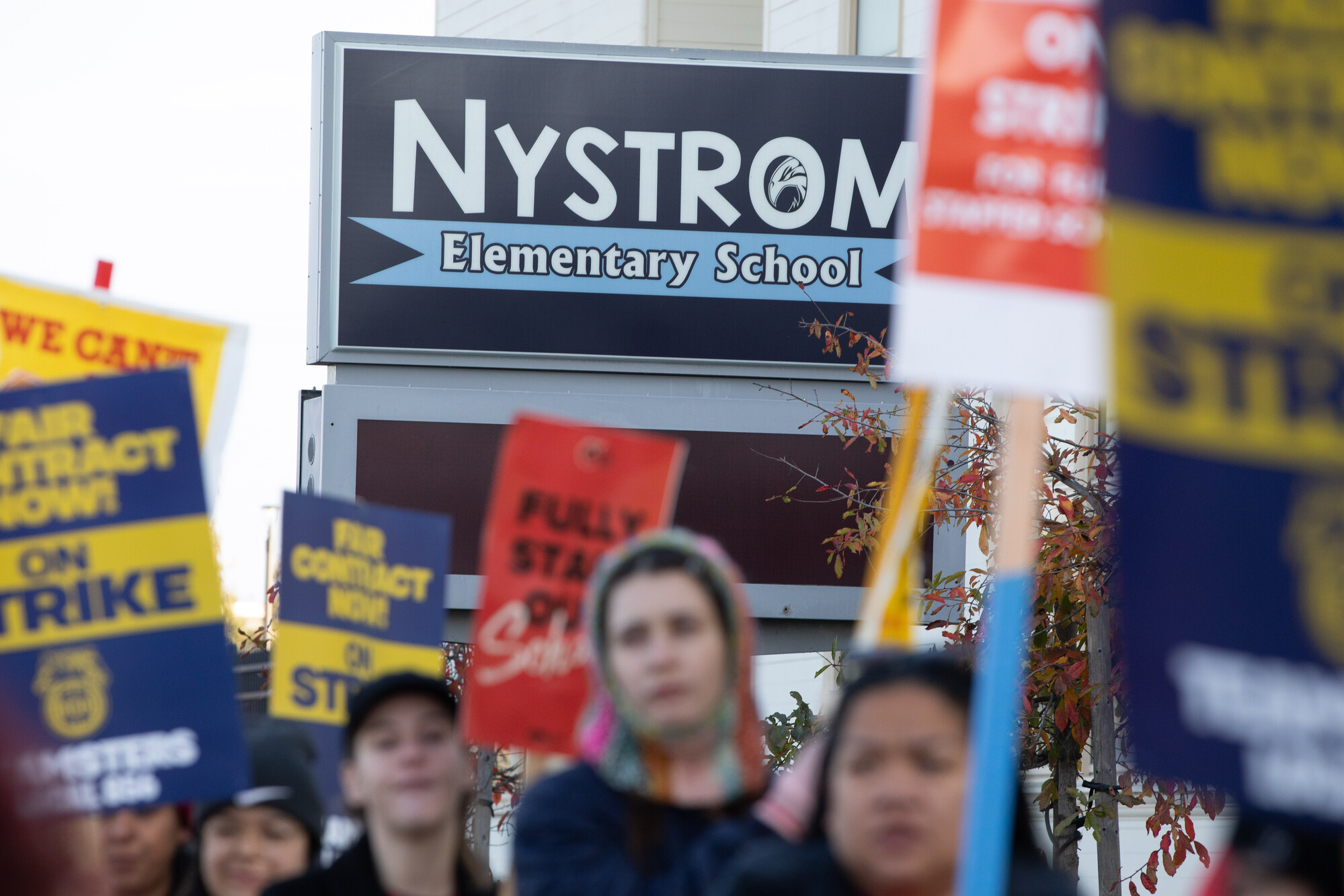
Ericka Cruz Guevarra [00:00:14] Three thousand teachers and school staff began a strike at the West Contra Costa Unified School District yesterday morning. And it’s the first time that teachers at this district have gone on strike.
Teacher [00:00:30] We are united, we are strong when we’re together, and we’re gonna get this.
Ericka Cruz Guevarra [00:00:36] West Contra Costa has struggled for years with its budget, and teachers say they’ve been sounding the alarm about a staffing crisis made worse by low wages. Today, why West Contra Costa teachers are on strike and what it means for the district’s roughly 25,000 students.
Ericka Cruz Guevarra [00:01:08] Jana, can you tell us where you are right now?
Jana Kadah [00:01:11] Yeah, I’m standing right outside of El Cerrito High School, where there are more than 150 people picketing from staff, educators to a lot of students and parents.
Ericka Cruz Guevarra [00:01:25] Jana Kadah, she’s an education reporter for Richmondside.
Jana Kadah [00:01:30] It is very lively. It is loud. People are chanting. It has a really kind of community neighborhood feel. There are kids in the neighborhood coming, passing out snacks to those who are picketing. Overall, I think like a excited, passionate energy from the people there.
Ericka Cruz Guevarra [00:01:49] Jana, you cover this district. Can you tell me a little bit more about it? I mean, it it covers quite a a range of cities. Tell me a little bit more about this district that you cover.
Jana Kadah [00:02:00] Yeah, West Contra Costa is a pretty big district, 56 different campuses, around 25,000 students all across West Contra Costa. So Richmond, El Sobrante, all the way to Hercules, Pinol, and El Cerrito. So it’s a pretty diverse community from ethnicity to languages and income levels. But what seems to be consistent are the frustrations from the community around the quality of education that they are receiving. The teachers and the Teamsters are striking right now because of pay concerns, but it’s not just about whether or not they can afford to live here. It’s about if they can re recruit and retain teachers. They say the pay is just too low for people to stay in the district.
Ericka Cruz Guevarra [00:03:00] And give me a brief timeline, Jana. They’ve been in negotiations for several months now. When did things really break down?
Jana Kadah [00:03:07] From my understanding, actually, this has been a years long issue. I mean, in 2022, the teachers union did authorize a strike and the district came back with an offer, so it they averted a strike. But the bigger issues that they’ve been trying to resolve have not been sorted out in in their perspective.
Ericka Cruz Guevarra [00:03:30] And what have the biggest sticking points been leading up to this strike? I understand that these two sides are pretty far apart on wages.
Jana Kadah [00:03:40] The teachers were originally asking for 10% over two years. The district in October offered them two percent. They declined it. The state recommended that the district offer them six percent over two years. After that, the district came back and offered them three percent. 99% of the teachers’ union voted, more than 98% basically said yes, we’re ready to strike. Aside from salary increases, some of the biggest concerns are reducing class sizes, addressing the issues in special education staffing. There’s also facility upgrades and security for their international educators.
Ericka Cruz Guevarra [00:04:32] I mean, what does the school district say about all of this and w and where things stand right now?
Jana Kadah [00:04:37] They have gone on a tour throughout the community to basically break down their finances and show that they cannot afford to meet the union’s demands. The superintendent has repeatedly said that she understands the concerns of the teachers and the community members, but that the financial situation that the district is in makes it impossible. This year alone they have to make seven point seven million dollars of cuts and there are more cuts coming in the years ahead to try to balance their budget. And so she has kind of centered this message of like we are one, let’s stick together, let’s unify, let’s let’s solve these problems together.
Ericka Cruz Guevarra [00:05:23] I I mean, it’s interesting, you say that the the superintendent is on a a sort of tour to to really show the financial situation that the district is in. Why is the district in such financial trouble right now?
Jana Kadah [00:05:37] That’s a great question. And a lot of people would tell you a lot of different things. One is that the state funding is not enough. West Contra Costa is a district that does serve a lot more students with special education needs. And they also have a huge immigrant community. At Richmond High School, for example, 50% of the students are English language learners. And so you can imagine that this requires more resources. On the other hand, you know, some would point to mismanagement of funds. The district has contracted out a lot of its services. It has contracted out a lot of special education positions, primarily. And it comes at a higher cost to the district. So it’s issues like that where the money in the in the teachers union’s perspective, it’s not used properly.
Ericka Cruz Guevarra [00:06:36] And as I understand it as well, this is a district that is also, like many others across the state, dealing with under enrollment, which also has an impact on on its budget.
Jana Kadah [00:06:48] Yeah, thanks for bringing that up. I think in the last three years the enrollment has gone down from 28,000 to 25,000. And a lot of families are choosing to go to charter schools and there are a lot nearby.
Ericka Cruz Guevarra [00:07:06] Well I do want to ask you, Jenna, what this means for families and students. Are people still sending their kids to school? I mean, what are you hearing from the school communities out there right now?
Jana Kadah [00:07:18] Yeah. So I went to two high schools so far. And the students are telling me that the only kids who are in school are there because their families are forcing them to be there, right? They’re worried about what this means for their education. But at El Cerrito, for example, a student told me that there were only 20 seniors who showed up, 20 juniors who showed up, and then couldn’t give a number for freshmen and sophomores. But the last update I got, the district was able to hire 200 substitute teachers, but there are 1500 teachers going on strike.
Ericka Cruz Guevarra [00:07:53] Right. And what about school services? Are are those still running?
Jana Kadah [00:07:59] The district did hire a company to provide meals. Students have access to free breakfast and lunch. And so the district is trying to maintain that. Special education transportation is still going. The district has also hired companies for security.
Ericka Cruz Guevarra [00:08:16] I mean, is this ending any time soon, you think, or or what do you think it’s gonna take for this strike to end?
Jana Kadah [00:08:22] It’s hard to say how long it’s going to last. The the sense from the teachers is they are willing to go as long as they need to. One teacher is hopeful that, you know, the district and the union will meet over the weekend and the strike can be called off by next week. But really, it needs to be an offer that addresses their compensation concerns and moves the needle to address the issues that they’re they’re bringing up. And the primarily it is recruiting and retaining educators. I think it’s been really interesting to be to be where the picket lines are happening and seeing the community support. People are driving by, everyone is honking, they’re cheering. The students at Kennedy High School walked out on Tuesday in support of their teachers in solidarity to the district office, a two mile walk that they did. Every single person along the way cheered them on, right? Whether it’s people standing at a gas station or a fire truck passing them by.
Ericka Cruz Guevarra [00:09:29] I mean, West Contra Costa is not the only school district that has been struggling in the Bay Area in the last year. I mean, you know, there’s news of San Francisco unified teachers possibly walking out soon. Berkeley Unified District as well just announced an impasse. I mean, how do you think what’s happening in West Contra Costa, how does that fit into to what’s happening just across the region when it comes to schools and and even the state?
Jana Kadah [00:09:57] Yeah, I mean it’s expensive to live here and the cost of living has increased far more than salaries have increased. This represents a larger issue. We were seeing this across the state, but it seems like the Bay Area is feeling it more. And it’s I think it’s just because it’s so expensive.
Ericka Cruz Guevarra [00:10:18] Well, Jana, thank you so so much for stepping aside for a little bit. I know you’ve had a really, really busy morning, so thank you so much for your time.