Episode Transcript
This is a computer-generated transcript. While our team has reviewed it, there may be errors.
Morgan Sung: Fighting over access to the family computer is a core childhood memory for Zillennials. Millennials too. I would spend hours on the living room PC playing games like Neopets and Club Penguin and Toontown. In the 90s and early 2000s, computer games from Oregon Trail to The Sims were super popular. But a lot of computer games were targeted toward young boys, while girls were largely left out of the conversation. That is, until Purple Moon.
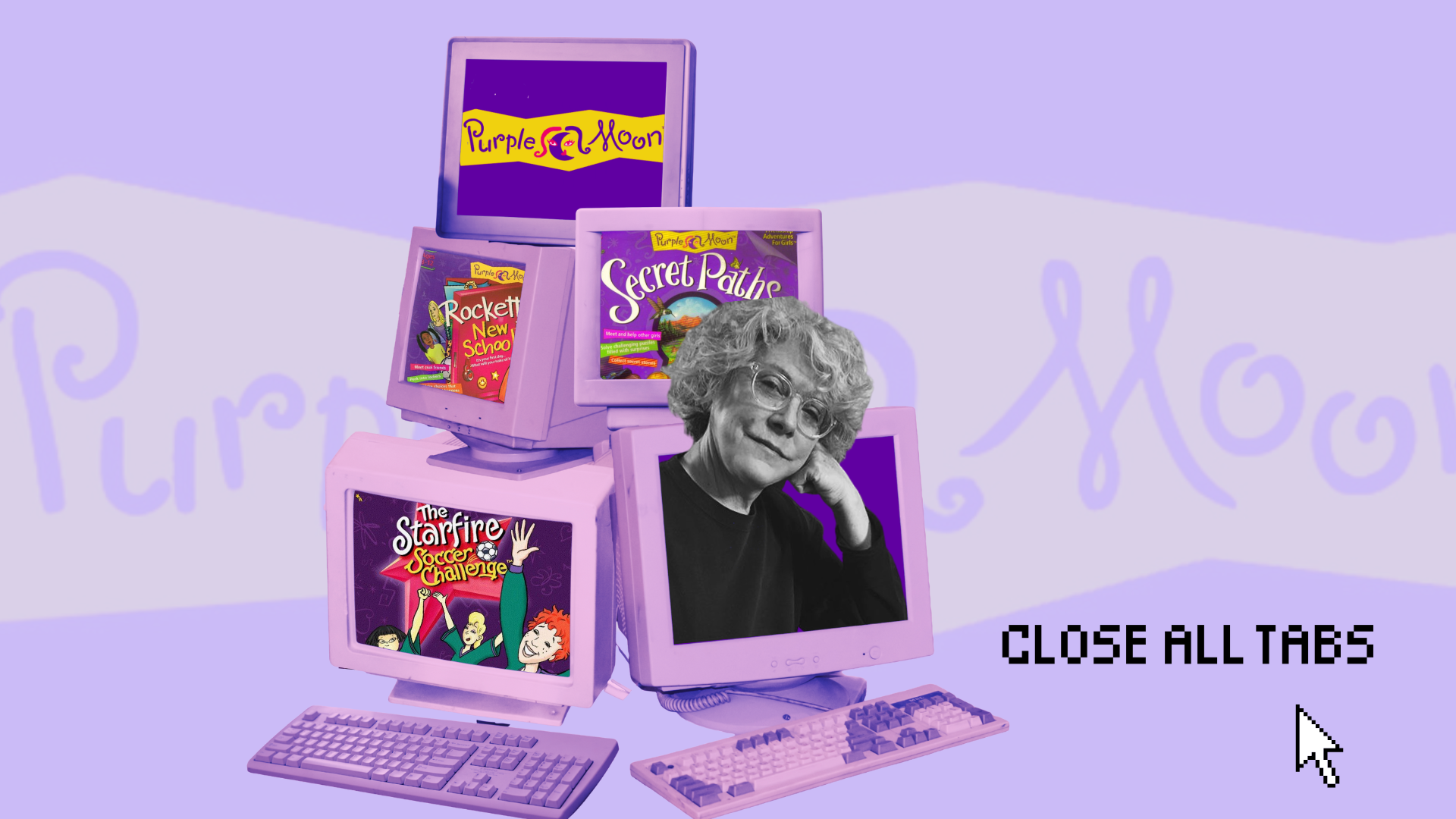
Purple Moon was an American developer of girls’ computer games based in Mountain View, California. The company was created in the 90s to disrupt the assumption that girls aren’t gamers. And it was really successful. In fact, Close All Tabs producer Maya Cueva played Purple Moon computer games all the time as a little girl. Until the company vanished completely.
So, I’m passing this episode off to our producer Maya, who’s gonna take us back to the 90s, before the whole girls and stem push was a thing. We’re gonna check out Purple Moon when it was an upstart little game studio, when its founder had an entirely new vision for what computer games could be. And we’ll try to get to the bottom of what really happened to Purple Moon.
This is Close All Tabs. I’m Morgan Sung, tech journalist, and your chronically online friend, here to open as many browser tabs as it takes to help you understand how the digital world affects our real lives. Let’s get into it.
Purple Moon Intro: Mm-hmm.
Olivia Cueva: Purple Moon
Maya Cueva: Do it again.
Maya Cueva: My sister Olivia and I are watching a video on Youtube of our favorite computer game that we used to love as kids. From the 90s. This one is called the Starfire Soccer challenge.
The Starfire Soccer Challenge: Pass the ball, Fireflies! Please! Look, I’m begging you, pass! Would you please pass?
Maya Cueva: Do you remember any of this?
Olivia Cueva: Yeah.
Maya Cueva: Yeah.
Maya Cueva: We tried to find a way to actually play the games, but no luck.
Olivia Cueva: So we can’t play them, but we can watch the videos. We can watch the YouTube replays.
Maya Cueva: Unfortunately, like most old computer games, we’re stuck experiencing them vicariously through someone else.
The Starfire Soccer Challenge:: She’s out of the center. Pass it here. Pass it over here. I’m open. That means you Dana, pass the ball.
Maya Cueva: The computer game follows the character Ginger and her teammates of the Fireflies soccer team as they prepare for the end-of-the-season game against their rival team, the Bulldogs.
The Starfire Soccer Challenge: Fireflies, Fireflies, go team!
Maya Cueva: When I was younger, the game’s animation seems so advanced. But visually, it’s actually pretty basic. It looks like an interactive comic. The images flip like a storybook, and the characters’ mouths don’t move when they talk. It is effective though. Animated soccer players rush towards each other, dashing down a green field surrounded by rowdy fans. The sound design is really immersive too.
The Starfire Soccer Challenge: Hey Charla, you played really well today.
Maya Cueva: Oh she’s so nice. So you learn how to be a good friend.
Olivia Cueva: Yeah.
Maya Cueva: The Starfire Soccer Challenge was just one of the games from Purple Moon. Purple Moon was a company that developed games targeted at young girls. They wanted to get girls into tech. And as a kid, I was obsessed with these games. They’re what got me into computer games in the first place. I still remember turning on my family’s PC in the basement, the humming sound of the computer starting up, and the excitement I felt putting the Purple Moon disk into the CD drive. Then the logo would play.
Purple Moon: Purple Moon.
Maya Cueva: Just hearing that intro gets me excited. These games shaped how I connected with computers and gaming. They expanded my imagination and put me in scenarios where I could choose my own adventure, from competing to win the Starfire Soccer Championship.
The Starfire Soccer Challenge: Starfire soccer challenge!
Maya Cueva: To exploring trails and a magical forest. There was even a game called Adventure Maker, which allowed you to make up your own scenarios and scenes in the game. For that era, it was kind of a revolutionary idea, especially to have that kind of decision making geared towards young girls. In the 90s, gaming was definitely seen as a space for boys.
Super Nintendo Commercial: When you decide to step up to this kind of power, this kind of challenge, there’s only one place to come. The games of Super Nintendo.
Sega Genesis Commercial: Young Bobby Angles has a problem. He needs to earn the respect of his peers. So he gets Sega Genesis, the ultimate action system.
Maya Cueva: While young girls were primarily marketed Barbie games. Although I can’t lie, I did love this one Barbie fashion game.
Barbie Fashion Designer: Making clothes for me is really easy and fun. Let me show you around.
Maya Cueva: And another Barbie detective.
Detective Barbie: We’re glad you’re here. You can help us find Ken. We’ve got a few tools that will help us do some super sleuthing.
Maya Cueva: But mostly, these Barbie games felt like they were teaching us that girls should just love to dress up and to ride horses. With the Purple Moon computer games, I had a universe to play in that actually felt like it was for young girls. In one of the games, Secret Paths in the Forest, you learn about each character’s life and the insecurities and real traumas they were going through as teenage girls.
Secret Paths in The Forest: My mom’s gone, and now birthdays just aren’t the same anymore.
Maya Cueva: I loved these games as a kid. And then, Purple Moon just stopped making new games. And without more games I could relate to, my love for gaming faded as I got older. So now, in my 30s and often nostalgic for my childhood, I got curious what happened to these games that had such an impact on me? And what did Purple Moon do for girl gamers?
Maya Cueva: So I did a little research. Let’s start with the first tab. Who created Purple Moon and where are they now?
Maya Cueva: After some Googling, I was able to track down the creator of the Purple Moon computer games, Brenda Laurel.
Brenda Laurel: It’s always thrilling to meet someone whose lives were touched by the games.
Maya Cueva: Brenda is in her 70s now and was a pioneer in the tech world. I wondered how hard it must have been to work in a male-dominated field in the 90s, especially creating games that weren’t meant for guys. So when she agreed to sit down with me for an interview, I geeked out a little bit.
Maya Cueva: As I’ve mentioned, you know, I’ve been a big fan of the games since I was little, of all the Purple Moon games. Like all of these games were so important to me. I think also just in me becoming like a storyteller, too, because of just how the games were presented. You know, it’s so exciting for me to get to talk to you. I think my inner child is like, “oh my God!” Fan girling.
Brenda Laurel: Yeah, I think it’s great. I think we we did get some things right about narrative and storytelling.
Maya Cueva: Brenda’s introduction to the gaming industry happened completely by chance. In the 70s, before she ever dreamt up Purple Moon, Brenda was studying theater at Ohio State University. That’s when one of her friends decided to start a personal computer company.
Brenda Laurel: I was studying for my PhD generals looking for work and and they said, why don’t you come over and help us do some interactive fairy tales for this little machine with 2K of RAM?
Maya Cueva: This early tech was all new to Brenda, but she fell in love with it immediately. This same friend went on to create computer games through a company called Cybervision. Brenda’s experience in theater made her a perfect candidate for the type of games they were working on.
Brenda Laurel: This was the period of time in the theater where actors were interacting with audiences in in productions like Hair and Dionysus in ’69. I had just directed uh uh pretty improvisational version of Robin Hood where the troupe went around and, you know, and kids would talk to them. And if an audience member suggested something, they would be required to change what they were doing to accommodate it. So it was kind of like a group improv. For me, that was a model that I could immediately and directly use in thinking about how to construct an interactive game.
Maya Cueva: Working at Cybervision felt like a dream for Brenda. She got to combine her theatrical training with a newfound love of technology, all within a supportive workplace.
Brenda Laurel: Everybody was lovely. There wasn’t an a a drop of sexism anywhere. People were incredibly kind and smart and I treasured them all. So I was fortunate in that way.
Maya Cueva: After working at Cybervision, she landed at Atari in the 1980s. Atari was a pioneering video game and computer company. They made some of the OG arcade hits like Pong and Space Invaders. This was the beginning of the tech boom and early tech innovation, and very much a boys club.
Brenda Laurel: It was extremely male dominated and there were subcultures of males inside of that culture that were even harder to deal with. You know, I had to, I remember my first day at Atari, I had to kick the boys out of the women’s room because that’s where they were smoking weed. And I said, you know what? There’s a woman in the house, I need to use the bathroom. Could you guys clear, you know? I learned to be pretty bitchy to great positive effect, I will add. Dropping the occasional F bomb at a at a staff meeting was always good for getting people’s attention in those days.
Maya Cueva: After Atari, Brenda went on to work at various tech companies, including Activision and even Apple. But at almost every stop, Brenda felt like games were targeted for boys, while girls were largely left out of the conversation. So she began to ask herself — how could she get more girls interested in computers? That’s a new tab. How Purple Moon changed the game.
Maya Cueva: In 1992, Brenda got a job at Interval Research, a research and technology incubator. Brenda was able to convince management to do a study on girls and games. At the time, research showed that parents were much more likely to buy computers for boys than for girls, even if girls expressed interest. And female gamers in the 90s were only about 10 to 25% of the gaming population, depending on the country. So there was a large gap in computer literacy for young girls. Brenda wanted to learn why.
Brenda Laurel: Generally speaking, you didn’t see little girls putting their hands on the machine because they would say, “I’m afraid I’ll make a mistake. I don’t want to touch it. It’s for boys.” So there were gender biases built into the way girls thought about how they might relate to technology. And our thinking as we spoke about it was as we move into a more technological world, they’ve got to get comfortable with it so that they have access to the power and help and joy, you know, that they might get from it.
Then, as we went out and started interviewing little girls, what we discovered was we couldn’t ask what’s your favorite computer game because there weren’t any for them, and they weren’t really playing. So we changed the question to how do girls and boys play and how is it different? What we learned in the course of talking with these girls is that it’s a hell of a hard time of life to be a tween girl. There’s all kinds of social stuff coming from the way women and girls relate to each other in same sex groups.
Um, so they had issues, not just about technology, but about life that we were seeing, you know, writ large and everything they said didn’t matter what city we were in, we were hearing the same thing. “I feel like everything happens and I can’t do anything about it. I don’t know who I am yet. I don’t know how to help people. Oh, I wish I hadn’t made that decision.” You know, there’s a lot of negative stuff.
Maya Cueva: So after interviewing over a thousand young girls and about 500 young boys on their real life experiences navigating their pre-teen and teenage years, Brenda had an idea. What if she could develop a game that was entirely meant for young girls through their eyes? One that could have a positive impact on their lives. And so the idea for Purple Moon was born.
Maya Cueva: It wasn’t easy to get into the computer gaming market with games geared for girls.
Brenda Laurel: In those days, these boys games were sold to boys in stores that were frequented by boys and you know, you just weren’t gonna put it in front of a kid unless you could get it into a toy store or some other kind of retail establishment.
Maya Cueva: Many hands helped launch Purple Moon.
Brenda Laurel: For sure it takes a village, when I say my games or I designed this, I mean me and, you know, sixty other people who were sitting in the studio or we had wonderful writers and artists and thinkers and researchers and programmers. Uh so yeah, we worked together like a well-oiled machine, except when we didn’t.
Maya Cueva: Purple Moon eventually became an independent company. The first Purple Moon game was released in 1997 and called Rockett’s New School. Visually, it had the same animated comic strip vibe as the other Purple Moon games that would come later. The game allows you to play as the character, Rockett Movado, on her first day of eighth grade at her new school. A PA announcement greets you as the game begins.
Rockett’s New School: Welcome, students. It’s another fantastic year at Whistling Pines Junior High!
Rockett’s New School: Hi. Listen, I’m sorry to just kind of intrude, but I’m pretty sure you’re new, right? Yeah, I am. My name’s Rockett. Wow, really? Well anyway, I’m Jessie. So you wanna walk in with me, Rockett?
Brenda Laurel: The idea was with Rockett that you could make a choice. Something unfolds and you have a moment. How do I feel about this? We called it emotional navigation. And so you would click on thought bubbles.
Rockett’s New School: Venturing into the cafeteria scene alone could be fun. This is terrible. Not even a single friend to sit with.
Brenda Laurel: And you know, I feel terrible, I want to cry. Why don’t I make up with her? Hey, maybe Charla can help. You pick one of those, the thing plays out. If you don’t like what happens, you can go back and change it and see what happens instead. So this kind of social and emotional flexibility is incredibly important to girls that age. And having a sense of personal agency and a sense that you can make choices that matter and change your mind. These are really important milestones in that hard journey from being a little girl to a teenager.
So my mission sort of changed from a tech equity one to a how can I build something here, design something here that will help little girls have a better time in their lives and achieve greater self-esteem and feel the sense of personal agency coming to life. So that’s really why I did it.
Maya Cueva: Yeah, I love that. I mean, that’s why I really think I love the game so much is because you also were able to choose your own adventure and kind of have autonomy with your choice.
Brenda Laurel: Yeah.
Maya Cueva: Like I think even even though I was so young, I still felt like I felt power you know, I felt empowered by that.
Brenda Laurel: It worked. It worked!
Maya Cueva: Yeah.
Maya Cueva: At the time, I don’t think I realized how the ability to choose my own adventures in the Purple Moon games helped shape some of my decision making as a young girl.
Brenda Laurel: So the idea was not so much choose your own adventure, but choose your own response. Choose your path of navigation through this relatively complex social situation. I’m so proud that just about every scenario you see in any of those games comes from the girls we talk to.
Maya Cueva: Another way Purple Moon was way ahead of its time was with its website. Through it, they found entirely new ways to engage girl gamers.
Brenda Laurel: Tools for making a website were not easily available. So putting that together, Christy Rosenthal led that team inside of Purple Moon and um was an astoundingly successful website. We were beating Disney.com for hits and dwell time for at least the first six months of our lives as a company.
Maya Cueva: Wow. Yeah, I don’t think I ever went on the website. I just always had the CD-ROM games.
Brenda Laurel: It was a whole different world over there. You could write articles for the Whistling Pines newspaper and then we would, you know, incorporate ideas into the storyline. So we were having a kind of narrative conversation with girls on the web, getting ideas for what we might do in the games.
Maya Cueva: The Purple Moon website was pretty popular, and one reporter for Wired described it as an online space where she could make friends and be herself. It was like an early social networking site just for girls, where they could send each other online postcards and learn about new characters. Like I mentioned earlier, the Purple Moon games weren’t exactly visually advanced. I asked Brenda what it was like to design these games with the limited technology of the 90s.
Brenda Laurel: They were pretty much animated comic strips. And the reason for that was that we didn’t have the processing power to do good enough lip sync animation.
Maya Cueva: Mm-hmm.
Brenda Laurel: And uh and the computers that were around that day. And we could never get it right. It would always lag just enough to make you crazy. I mean we really tried it, but we couldn’t get there.
Maya Cueva: While a considerable amount of research went into making the Purple Moon games, not everyone liked the direction the games took. There were definitely some critics at the time.
Brenda Laurel: We got blowback on these games both from men who thought they were stupid and from hardcore feminists who thought girls ought to behave differently.
Maya Cueva: We’ll get into that. After this break.
Maya Cueva: Okay, we’re back. Time for a new tab. Purple moon gets pushback.
Maya Cueva: So after the first Purple Moon game, Rockett’s New School was released, a reporter for the New York Times gave a scathing review.
Brenda Laurel: The guy who reviewed the games in the New York Times thought they were just silly. Like, why would you care about who you’re going to be friends with in high school? You know, boys have a very different way of establishing social status in peer groups, generally speaking, we’re all, you know, we’re talking about averages, not everybody, but there’s a very different method. And so when a man looked at it, it’s like, what? Where’s the competition? You know, nobody’s shooting anybody. There are no monsters, no racing cars. What are you thinking? You know, it was that kind of stuff.
And it just delighted me. I thought, I have alienated the right person. One of our strategies here with the whole branding of the games as it evolved was to make sure that they gave boys cooties. We didn’t want boys to play them. The reason was that if your big brother played it and had the same response as the New York Times critic did and said, “this game is really lame”. You’d probably go, “Oh, I better not play it in front of John. ” You know, “oh, it’s not cool. I guess I shouldn’t do it.” That happens, you know.
So what we wanted was for to present something that girls said, “I own this. You know, I own this. And and you don’t get to tell me whether it’s any good or not.” So, we we made purple packaging, you know, we did all kinds of stuff to to alienate male players from picking it up and buying it because of that business of judgment coming from boys.
Maya Cueva: Male critics of the games didn’t surprise Brenda. What did surprise her was criticism from some women and feminists who didn’t like the games either.
Brenda Laurel: There were silly ones and there were reasonably good ones. You know, there’s an issue about girls behaving in a way that’s considered to be badly. Um, Gossip, exclusion, breaking of affiliations. These are the ways that girls covertly establish their social position, generally speaking. Those are tools that girls and women use. So that was part of it. They didn’t see queer people. Well, in 1995, ’96, we weren’t talking about queer people eleven years old.
Maya Cueva: Mmm hmm.
Brenda Laurel: You know, that that was a step too far. We didn’t have religion in the game either for the same reason. And it was just like stuff you didn’t talk about yet. Today, if I were doing it today, I would certainly deal with gender fluidity, with trans kids. I all of that stuff would come into play. But in in that period of time, that wasn’t possible. And yet, generally speaking, there was nothing but praise from women and educators and coaches and stuff like that. And and the sales were great. We were beating John Madden football for the first quarter that we were out.
Maya Cueva: Critics also had issues with the research conducted to create Purple Moon. Some thought that the girls they interviewed may have already internalized gender stereotypes about what girls should like based on their age. They felt that Brenda and her team were just perpetuating the same gender tropes from their data. There was also criticism surrounding racial stereotypes in the games. One article I found stated that the game used cliches, quote, “such as the snobby popular blonde girl and the smart Asian with glasses.” Brenda felt differently about it.
Brenda Laurel: When I look at the games, I don’t see no racial stereotyping. And it certainly didn’t cause us to make any changes because, you know, we looked at it, we took it seriously, we evaluated it. And we came to the decision that it was incorrect.
Maya Cueva: While watching the replay of my favorite game, the Starfire Soccer Challenge on YouTube, I did notice how Miko, one of the characters in the game who is Asian, is depicted as a Samurai with a sword as she runs down the soccer field.
The Starfire Soccer Challenge: They’re scared now. They’re intimidated. They’re ugh.
Maya Cueva: I’ll be honest, I cringed a bit at first at this image. But I later learned that the “Samurai Miko” character was actually designed by an Asian-American artist named Grace Chen, which definitely adds important context. While I don’t think the games are perfect, I do admire that Brenda and her team did extensive research with real young girls at the time to hear about what they were actually going through. And some articles stated that the Starfire Soccer Challenge game was beneficial. One even called it, quote, “an outstanding example of digital technology supporting positive emotional development.” I wonder what the games could look like now if they were created today. What would young girls, boys, or non-binary players desire to see in the games? And how could developers correct some of the cliches seen in the games in the 90s?
Brenda Laurel: They wouldn’t be the same. We might get to some of the same emotional and ethical places that we did in the original games. It would take a boatload of new research because just as those girls I interviewed weren’t me at 10, um, the girls today aren’t you. And we need to go out and talk to them, learn what their lives are like, you know, figure it out. And I’d be tempted the second time around to build a game for little boys.
Maya Cueva: Brenda never got the opportunity to make a game for boys. In 1999, after only three years, the company folded. But why did this happen? That’s a new tab. What happened to Purple Moon?
Maya Cueva: In 1999, Purple Moon’s biggest funder, Paul Allen, decided to shift his focus to the e-commerce sector, which was beginning to take off at the time. Ultimately, he decided to take his money out of Purple Moon. This had very serious consequences for the company.
Brenda Laurel: We got the news from the board that they were gonna shut us down.
Maya Cueva: Mmm. Wow.
Brenda Laurel: We we had eighty people expecting their paycheck that day. They had frozen our bank accounts. My CEO Nancy Deyo and I got in the car with the CFO. We remembered that we’d made a deposit on our office space with a different bank. So we got in the car, raced over there, took that money out in cash and gave everybody their pay. And they ended up selling the the company to Mattel.
Maya Cueva: After the board decided to shut Purple Moon down, Brenda and others were terminated from the company. Then, once Mattel bought the gaming studio, the Purple Moon games eventually stopped being created for good. Brenda was devastated.
Brenda Laurel: Took me about a year to recover personally from that. After we shut down the website, we put a goodbye message on the on the front so if you logged into it, it would say, “Hi, we’ve had to leave. We’re so sorry we’ll miss you. ” Well, it turns out that if you were already on the site, if you didn’t leave, if you just sort of kept that window open, your friends could come into the site and join. We had like 300 kids joining Purple Moon after it was shut down because they were sneaking into the side door of the website.
Maya Cueva: Even though Purple Moon’s closure was bittersweet, Brenda felt that the company had accomplished what it set out to do.
Brenda Laurel: I absolutely feel like we hit the goal of making games that would enrich and enhance the lives of little girls. I feel like it was, you know, act of love from all of us, um who worked on it creatively. And I feel like we succeeded. I know that because I hear from people like you who tell me this changed my life. That’s what we wanted to do.
And, you know, girls would have ended up getting literate with computers anyway, as soon as the internet became something you could actually get to uh easily. A lot of the “I’m afraid to put my hands on the keyboard” stuff went away. I mean, we probably helped with that transition. And it wasn’t very long until females were at least half, if not more than half, of of the audience on the web for everything.
Maya Cueva: Brenda began envisioning Purple Moon at a time when computer games weren’t designed with girls in mind. Since the 90s, the percentage of female gamers has grown to 47% in the US. Brenda wouldn’t claim credit for that entire change, but it’s hard to deny Purple Moon’s influence on girl gamers.
Maybe my love for gaming started because the Purple Moon games felt accessible. And maybe it ended because CD-ROMs eventually became obsolete, and I never quite felt like the video game universe was meant for me. Whatever the case, the world of Purple Moon was a place I felt like I belonged, where I had agency. And for young Maya, that was everything.
Maya Cueva: Thank you so much, Brenda. This was so great to get to talk to you. I feel like little Maya is so happy right now.
Brenda Laurel: Give little Maya a hug from me.
Maya Cueva: Let’s close all these tabs.
Morgan Sung: Close All Tabs is a production of KQED Studios, and is hosted by me, Morgan Sung. This episode was reported and produced by Maya Cueva and edited by Chris Hambrick. Chris Egusa is our Senior Editor, and composed our theme song and credits music. Additional music by APM. Brendan Willard is our audio engineer.
Audience engagement support from Maha Sanad. Katie Sprenger is our podcast operations manager, and Ethan Toven-Lindsey is our Editor in Chief. Some members of the KQED Podcast team are represented by the Screen Actors Guild, American Federation of Television and Radio Artists, San Francisco, Northern California Local.
Keyboard sounds were recorded on my purple and pink Dustsilver K-84 wired mechanical keyboard with Gateron Red switches. Okay, and I know it’s a podcast cliche, but if you like these deep dives and want us to keep making more, it would really help us out if you could rate and review us on Spotify, Apple Podcasts, or wherever you listen to the show. And if you really like Close All Tabs and want to support public media, go to donate.kqed.org slash podcasts.
Also! We want to hear from you! Email us [email protected]. Follow us on instagram at “close all tabs pod.” Or TikTok at “close all tabs.”
Thanks for listening!