“This really highlights the fact that individual differences matter,” she says.
Another unanswered question centers on who’s being studied.
Most of the people in the Brown trial met the criteria for “cannabis use disorder,” and about 40% for alcohol use disorder. That could indicate their “drug of choice” was not necessarily alcohol in the first place, says Rajita Sinha, a professor of psychiatry at Yale University.
For people with problem drinking, cannabis might be a potential treatment, she says. This approach, on the other hand, “may also be promoting more cannabis use and that would be problematic.”
“Once you’re in the throes of daily cannabis use, it’s very hard to kick that habit,” she says.
Those involved in this work acknowledge the tension in this line of research.
Cannabis doesn’t carry the same risks of extreme harm as alcohol, which is a leading cause of preventable death in the U.S and kills more than 170,000 people a year.
But Wardell says cannabis is clearly “not a harm-free substance,” either.
While research on its effect has not kept up with its surging popularity, studies have shown marijuana can impair cognition and memory, trigger a serious gastrointestinal syndrome that causes nausea and vomiting, increase the risk of psychosis and other psychiatric illness, and impact relationships and social functioning.
And Wardell says this latest study doesn’t actually tell us whether the negative outcomes of alcohol are worse than cannabis in the long run.
“We would have to choose which one for a given individual might be less harmful and make sure that it’s not inadvertently just replacing one problem with another,” he says.
In her role as a clinical psychologist, Metrik at Brown has seen some patients with severe alcoholism who successfully stopped drinking with the help of cannabis, though some have then gone on to develop issues with that drug.
In her mind, the problem right now is that many people are relying on cannabis to treat their alcohol problems, without any guidance.
“We see this all the time, and we don’t know what to tell them,” she says. “There’s no clear messaging,”
Copyright © 2025 NPR
Transcript:
JUANA SUMMERS, HOST:
Americans are drinking less alcohol these days, and more are trying marijuana. Now researchers are asking a provocative question – does cannabis actually help people drink less? NPR’s Will Stone reports.
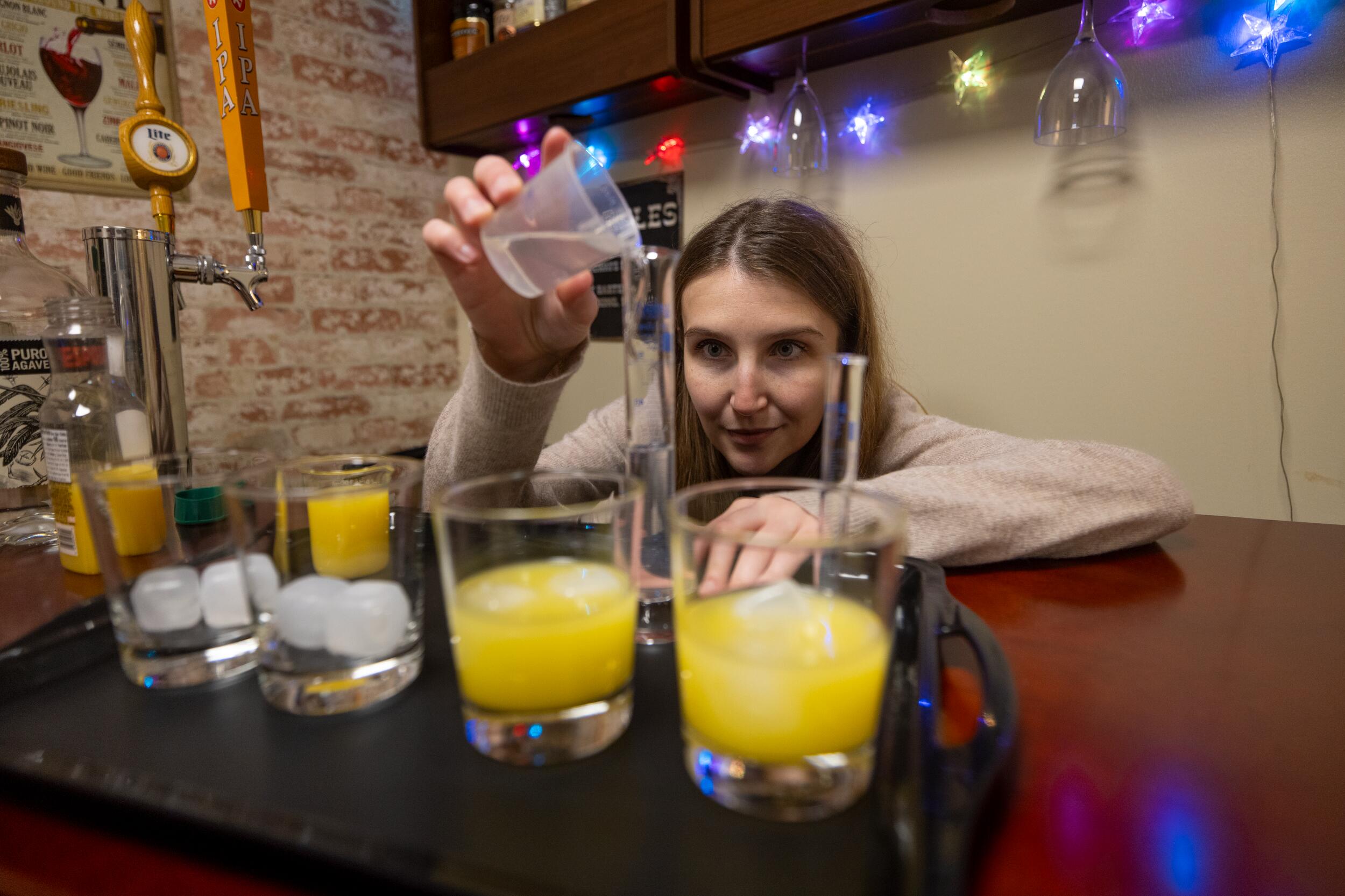
WILL STONE, BYLINE: If you’re envisioning study subjects smoking weed and sipping free booze, then you have a pretty good picture of this experiment. The team at Brown University recruited about 160 people who use cannabis and drink frequently. First, they smoked a joint, and then they had a few hours to drink.
JANE METRIK: Essentially, they’re in our simulated bar lab that we built specifically for the study.
STONE: That’s Jane Metrik, a psychologist at Brown who led the study. This lab bar was complete with beer taps and comfy places to sit.
METRIK: We are watching, we’re observing every time they take a sip.
STONE: In fact, they took pains to make it feel close to real life. Metrik was even running around town to pick up everyone’s beverage of choice.
METRIK: We wanted to make sure that, when given the opportunity, you would be really driven to drink.
STONE: They found people who smoked a cannabis joint that was about 7% THC ended up drinking about a third less afterward compared to when they had a placebo, which didn’t get them high. The results were published today in the American Journal of Psychiatry.
METRIK: It is an important signal that we’re detecting. It is telling us that cannabinoids could play a potential therapeutic role in alcohol use disorder.
STONE: Previous research has suggested cannabis could affect alcohol cravings and consumption. But Jeff Wardell, a psychologist at York University in Canada, says this randomized controlled trial offers some of the strongest data yet.
JEFF WARDELL: This study really moves the field forward by helping to resolve one of the unresolved questions in the literature, which is, can cannabis actually have a real effect on alcohol? And it does look like, yes.
STONE: Of course, there are some limitations here. No. 1, this was not your friend’s party or a real bar where the subjects were getting stoned and drunk.
WARDELL: And they’re probably thinking to themselves, I don’t know how much I really want to drink now because I don’t want to get too, you know, blasted in front of these researchers, right?
STONE: Also, the study was designed to look at the immediate effects. It’s not clear whether this holds true in the long run. And there’s tension here about the implications. Cannabis does not carry the same risk of extreme harm as excessive drinking, which kills more than 170,000 people in the U.S. every year. But Rajita Sinha, an addiction researcher at Yale University, says marijuana comes with its own problem.
RAJITA SINHA: At the end of the day, there are harmful effects of cannabis. You know, it affects cognition, memory. It affects performance.
STONE: It can trigger a GI syndrome with cycles of vomiting and nausea, increase the risk of psychosis, and it can be addictive.
SINHA: Once you’re in the throes of daily use, it’s very hard to kick that habit.
STONE: All that said, the reality is people are doing this. Just Google the term California sober, which has come to describe ditching alcohol in favor of cannabis. Hollis Karoly is a psychologist at the University of Colorado Anschutz, who also does this research. She became interested years ago while doing a study on alcoholism. Some people would tell her marijuana does help them. Others, not so much.
HOLLIS KAROLY: People were reporting that, hey, cannabis gets in the way for me. Cannabis makes me want to drink more. I just find that really fascinating. Like, both can be true, right?
STONE: For her part, Jane Metrik at Brown is cautious about how far to stretch these findings.
METRIK: We’re not quite ready to tell people who have alcohol use disorder, hey, go ahead and substitute cannabis, and, you know, it will work out for you.
STONE: But she worries that many people are already doing this substitution without any clear guidance about whether it even works. Will Stone, NPR News.
(SOUNDBITE OF DR. DRE SONG, “XXPLOSIVE”)