Ericka Cruz Guevarra: [00:00:49] I’m Ericka Cruz Guevara and welcome to the Bay local news to keep you rooted. The Bay Area is no stranger to recalls, but what’s rare is a recall that fails. And this past election, a recall vote took place in the small Marin County town of Fairfax, where a group of residents hoped to boot out the mayor and vice mayor over a six-story apartment building proposed for the edge of downtown. And not only did the recall fail, but it was personal in a way that other Bay Area recalls were.
Mayor Lisel Blash: [00:01:32] People hear about East Bay recalls or recalls in San Francisco, and I’m sure those are painful for the recallees, but this is like a really tiny town. So I see people, my neighbors, people in the supermarket, it just really feels very personal.
Ericka Cruz Guevarra: [00:01:51] Today, the recall in Fairfax and why what happens here over housing is worth watching.
Izzy Bloom: [00:02:12] When I went down to Fairfax, most people said that this has really divided their community.
Ericka Cruz Guevarra: [00:02:17] Izzy Bloom is a politics reporter and producer for KQED’s Political Breakdown Podcast.
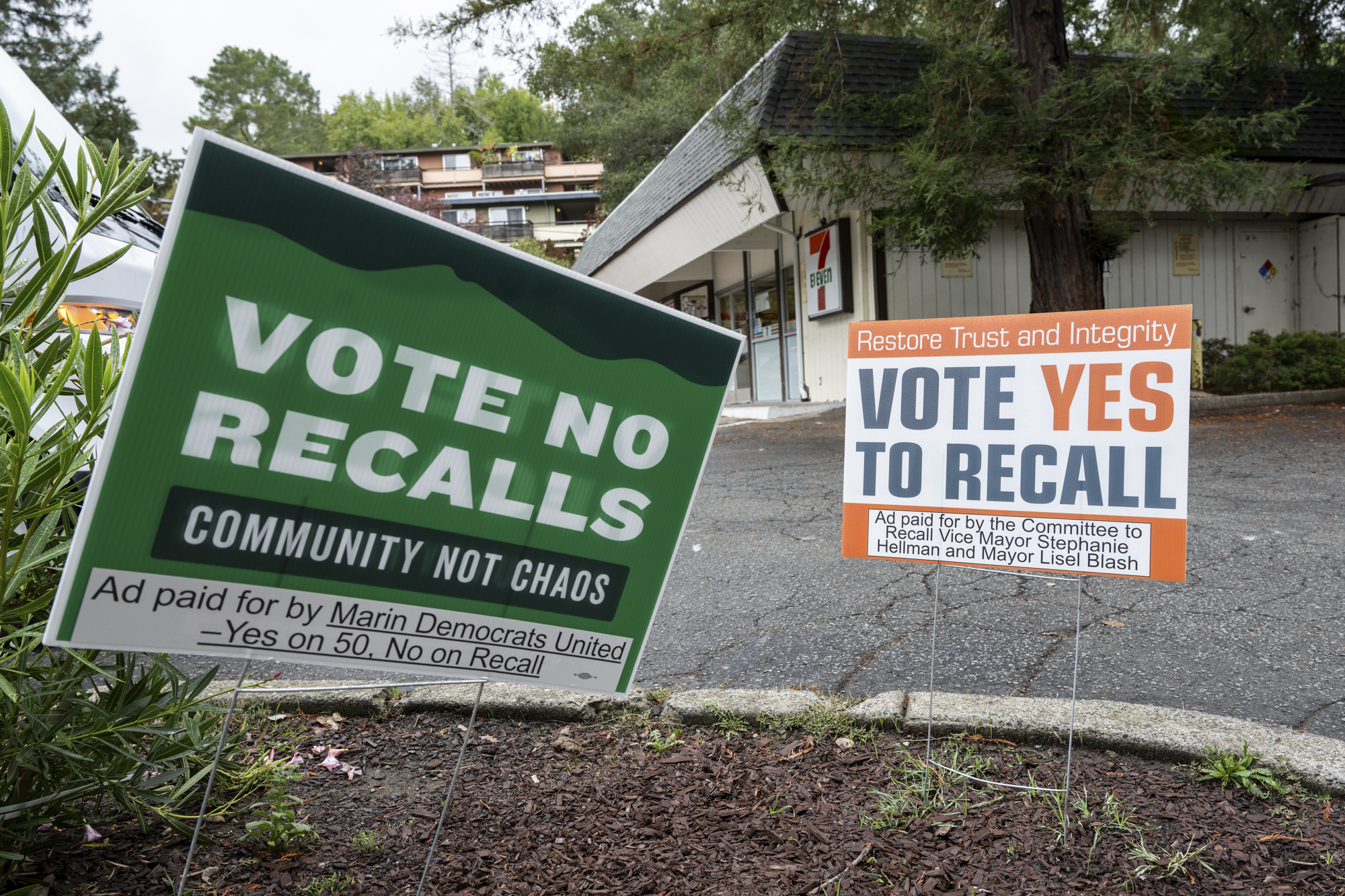
Izzy Bloom: [00:02:24] The recall effort targeted Fairfax Mayor Liesl Blash and its Vice Mayor Stephanie Hellman. I went down a few weeks before the election and along with all of the Halloween decorations and people’s yards, you know, up and down the street, there were all these yes on recall, no recall signs, often at houses right next to each other. And so it’s really pitted neighbors against each other
Ericka Cruz Guevarra: [00:02:50] Izzy, before we get into this recall election that happened a couple of weeks ago, tell me a little bit more about the town of Fairfax.
Izzy Bloom: [00:02:59] You know, Fairfax is this really small, charming town in Marin County. It’s about 7,500 residents. It tends to be a little bit more white, higher income. It’s known also for a lot of artists and musicians who’ve been priced out of town because of the high housing costs. It’s nestled in the foothills of Mount Tamalpais. It’s know as the birthplace for mountain biking and also for its progressive politics. But at the same time, Fairfax, like a lot of Marin County, has really high housing costs. And so I felt like there were some interesting conflicts here where residents say they want affordable housing in their town, but they’re also pushing back against high density housing developments. And I think residents know that they have a bit of a reputation as NIMBY. One of the recall organizers said that he thinks that sort of like stunts the conversation. He says they’re a little bit more MIMBY So ‘maybe in my backyard,’ instead of ‘no in my back yard.’
Ericka Cruz Guevarra: [00:03:58] In other words, it is Marin County.
Izzy Bloom: [00:04:01] It is Marin County, yeah.
Ericka Cruz Guevarra: [00:04:03] A place that is notorious for not building enough housing. Let’s step back a little bit, Izzy, and talk about the rationale behind this recall. As we were just talking about, Marin County has never built enough housing, tell me a little more about why the recall was happening in the first place.
Izzy Bloom: [00:04:23] Last November, developer Mill Creek Residential submitted a preliminary application to build this 243 unit, six story apartment building in downtown Fairfax. And that would include four levels of residential, two levels of parking, and then the ground floor would be commercial space. And then 49 of those units would be marked as affordable, which is about like $1,900 to $2,500 a month for a studio.
Ericka Cruz Guevarra: [00:04:53] Oh, God.
Izzy Bloom: [00:04:53] So, you know, I met recall organizers before the election at this local pub in Fairfax called Naves Bar where the recall leader Candice Neal-Ricker manages
Candace Neal-Ricker: [00:05:08] I am local, ultra-low-income, born-and-raised Fairfaxian that could not afford what they are proposing there. This is serious.
Izzy Bloom: [00:05:17] One of her criticisms is that, first of all, there’s not enough affordable housing included in this development proposal, and also that she doesn’t really think it is affordable like it wouldn’t be affordable to her.
Candace Neal-Ricker: [00:05:28] I couldn’t afford the 2,700 month studio apartment. So this is not affordable housing. This is a shill of
Izzy Bloom: [00:05:36] I think really at the heart of this recall was the high density housing development.
Ericka Cruz Guevarra: [00:05:41] I know a lot of people were actually really, didn’t like how this development would look, right? Tell me a little bit more about how residents were feeling when this housing development was proposed and what were some of the other arguments that you heard about their opposition to it.
Izzy Bloom: [00:06:01] A lot of people definitely said it wouldn’t fit the esthetic of Fairfax. Multiple people referred to it as a monstrosity. And even the vice mayor, Stephanie Hellman, who faced a recall, described the design as cheap and ugly.
Vice Mayor Stephanie Hellman: [00:06:19] There’s problems with it. Design-wise, it’s cookie cutter, doesn’t fit with the design and, you know, esthetic or character of the town.
Izzy Bloom: [00:06:30] This site that it was slated for, it’s called School Street Plaza. It’s this two acre plot of land that’s on a bit of a hill right at the edge of town. And a six story building there really would tower over the town and it would block some residents views of the hills. Other than that, some of the big concerns for the development is that it would cause issues for parking. And the recall petition also said that, it would bring this influx of cars to Fairfax that would create a death trap if there was a wildfire or an earthquake.
Ericka Cruz Guevarra: [00:07:07] When did this opposition to this housing development then spiral into a recall? Like what were the events that sort of triggered the recall?
Izzy Bloom: [00:07:19] Last year, the town council voted to rezone the school street site. The state is putting a lot of pressure on local governments to meet housing demands in order to ease California’s housing crisis, or else they’ll take away some of their permitting and zoning authority or, you know, hit them with fines.
Ericka Cruz Guevarra: [00:07:40] And the council voted to rezone the land in order to move forward with it, and people didn’t like that.
Izzy Bloom: [00:07:47] They didn’t. Another thing that recall organizers were upset about is that the council processed the development under what’s called ministerial review. Ministerial review is a way to fast track housing developments by allowing them to bypass public hearings and review under the California Environmental Quality Act.
Ericka Cruz Guevarra: [00:08:08] So, then this recall is on the ballot. What was Candice’s argument for the recall?
Izzy Bloom: [00:08:17] I think the biggest thing that Candice and other recall organizers were saying is that their elected officials just were out of touch with constituents’ desires.
Candace Neal-Ricker: [00:08:28] As you recall, it was 100% about getting back to basics and listening to the constituents, the voters of Fairfax, the taxpayers. Council members are not gods. And something that has happened here in Fairfax is they’ve forgotten who they work for and what they were elected to represent.
Izzy Bloom: [00:08:47] What I really felt like I kept hearing is that, even though there are these state mandates, they wanted their representatives to push back on the state more than they did and listen to what their constituents wanted. I think they really felt like they just rolled over.
Candace Neal-Ricker: [00:09:05] We can do better here at Fairfax. We can get back to some basics. I believe we can meet the affordable housing needs of the state in a much better way. Again, like as town council members, you’re city planners and city hall and the planning commission, these are your jobs. And to manage them is your elected positions. So it’s a complete sellout to the developers, 100%.
Ericka Cruz Guevarra: [00:09:32] Coming up, the arguments against the recall in Fairfax, and why it ultimately failed. Stay with us.
Ericka Cruz Guevarra: [00:10:37] Well, let’s talk now, Izzy, about the arguments against the recall campaign. What was Liesl Blash and Stephanie Hellman’s main argument against the Recall, like at its core?
Izzy Bloom: [00:10:50] Blash and Hellman really said that their hands were tied. You know, they have this state mandate to permit for 490 new units by 2031. And if they don’t make progress towards that, they could face litigation from the state, fines of up to $600,000 a month, and they could even lose some of their permitting and zoning authority.
Vice Mayor Stephanie Hellman: [00:11:12] All of my actions have been to protect the town from litigation, penalties, and fines. I’m not happy about a lot of these laws, but I didn’t run for office to break the law.
Izzy Bloom: [00:11:26] Vice Mayor Hellman said that she really felt like the state was ready to make an example out of Fairfax for this sort of perception that Marin County has not met up with housing demands and helped contribute to state efforts to resolve California’s housing crisis.
Vice Mayor Stephanie Hellman: [00:11:45] I truly believe that the state and lots of jurisdictions are looking at Fairfax right now as a test case and it’s not about saving me, it’s about saving the town from fiscal ruin.
Ericka Cruz Guevarra: [00:11:58] I also have to ask, the recall was, it seemed like over this new housing development, but the recall wouldn’t have actually stopped the complex from being built, right?
Izzy Bloom: [00:12:12] Yeah, I think that’s something that really interested me about this story. It kind of reminds me of what happened in San Francisco’s Sunset District with Supervisor Joel Engardio, who his recall campaign was about his support for closing part of the Great Highway to create the Sunset Dunes Park. And he ultimately was recalled, but it had no impact on what ultimately happened with the park. And in this situation, recalling the mayor and vice mayor wouldn’t impact whether or not this proposal ultimately gets approved or denied. It’s not really up to them. And so I think the recall was a lot more about residents telling local electeds, hey, we don’t agree with your policy decisions and we want you to listen to us, your constituents, not the state. I do think that we’re seeing more and more recalls that are about residents expressing dissatisfaction rather than a being about some specific malfeasance or corruption.
Ericka Cruz Guevarra: [00:13:13] Yeah, and I mean, if a recall in a place like Fairfax that is so small, I can imagine, has made such a big impact on the town and on the community. But that said, the mayor and the vice mayor seem to have made a pretty convincing argument that they have to build this development, even if people don’t like it, right? And the recall ultimately did not succeed?
Izzy Bloom: [00:13:39] Yeah, I think that message actually really got out to people that recalling them would not change what happens with this housing development. And it actually was a pretty decisive victory for Blash and Hellman. About 55% to 56% of voters said no on the recall.
Vice Mayor Stephanie Hellman: [00:13:58] I’ve already started to reach out to folks who were vocally in support of the recall to just listen and hear their perspectives and start to build bridges.
Izzy Bloom: [00:14:10] Vice Mayor Stephanie Hellman, you know, really said that the No on Recall campaign did a lot of work to educate the residents of Fairfax about basically that, you know, the mayor and vice mayor aren’t supportive of this housing development and that it is just them trying to protect the town.
Vice Mayor Stephanie Hellman: [00:14:29] There was a handful of residents who really did a lot of work to educate the community on how much local control we’ve really lost. We were all about protecting the town from severe penalties, from losing our housing element certification, which basically gives developers free reign with very, very little, if any, local control.
Ericka Cruz Guevarra: [00:14:57] It does seem like when I saw the results of this story, it did feel very surprising and rare. I guess, what do you make of that result?
Izzy Bloom: [00:15:09] Yeah, I actually think in some ways it was pretty surprising. You know, I looked through Ballotpedia’s list of failed recalls in the Bay Area. And in the past decade, this is only the second to fail. Mayor Liesl Blash said that she thinks one thing that made Fairfax different from some of these other recalls in the bay area is just that it’s such a small community. The divisiveness was a lot more visible to residents and it was a little more personal.
Mayor Lisel Blash: [00:15:37] It’s been, like, a huge amount of time and money on all sides. It’s created incredible stress in Fairfax, and it’s really a time for people to come back together, you know, not keep driving this wedge between us.
Izzy Bloom: [00:15:50] Prop 50, she thinks, really helped bring out more voters, and that high turnout really helped them, which I think is possible, you know, that otherwise maybe more motivated people to recall the mayor and vice mayor would have turned out.
Mayor Lisel Blash: [00:16:04] And I think people are weary of the crazy shenanigans and they wanna get back to a more normal environment. You know, it’s been like three solid years of negativity and I think we just have to say this is over. We just need to move on as a community.
Ericka Cruz Guevarra: [00:16:18] Was there any response from the pro-recall campaign? Did they have any thoughts on why they ultimately lost this recall?
Izzy Bloom: [00:16:29] They texted me a written statement saying they were obviously disappointed with the results, but that they do feel the recall forced a real conversation about the future of Fairfax and led the town council to confront issues like high density housing and take meaningful action to address them. And they just said they’ll continue to push for better decisions at town hall that works for the residents of FairFax.
Ericka Cruz Guevarra: [00:16:52] I guess my last question for you, Izzy, how would you explain why, what happens from here on out in Fairfax is relevant to the rest of the region?
Izzy Bloom: [00:17:03] California right now is really grappling with how they’re going to solve the housing crisis. And Marin County tends to be a bit of a poster child for fighting back against that, but we’re seeing this trend of local power shifting away from local governments to the state when it comes to making housing decisions. And I think residents are just sort of becoming aware of that. And we’ll see whether they use recalls as a tool to push back against it. I mean, Blash said that she thinks there will always be. A group of people in Fairfax who don’t want high-density housing, but she does think one of the messages from the election is that there’s a growing consensus among the town that they do need more housing, they just want to have input on what that looks like.
Mayor Lisel Blash: [00:17:58] I think one of the things that really came out of this was that people learned that there are state mandates around housing and that that may not be the decision of their council per se, but that we are all facing, you know, a new environment around housing laws. And I think people really learned that from all of the press coverage.
Ericka Cruz Guevarra: [00:18:21] Well, Izzy, thank you so much for joining me. I appreciate it.