Episode Transcript
Morgan Sung, Host: At the beginning of this year, wildfires ravaged Los Angeles.
Alice Bucknell, Guest: I remember like when the fires broke out, like it was a. At least one of them. Um, the end of the fire was like two miles from my place.
Morgan Sung: Alice Bucknell is an artist, writer, and educator who specializes in video games. Like many LA residents, Alice jumped in to volunteer with mutual aid and cleanup efforts. But before it was safe to leave their home, they were stuck inside … waiting and watching the city burn. So while waiting, they turned to a game they’ve played over and over again: Firewatch. It’s set in the Wyoming wilderness, and, as you might have guessed, deals with wildfires.
Alice Bucknell: Even just the kind of color palettes of the game, like felt sickeningly familiar, um, after and during the whole process of the wildfires, like waking up in the daytime and going outside and the sky being like orange, you know?
Morgan Sung: In the game, you play as a park ranger on fire lookout duty. A lot of the game revolves around exploring the wilderness, which is under threat of being wiped out by wildfire.
While the real fire kept them inside, Alice wandered around this game world, racing time to explore before the fire could take it. And for them, it was a meditative experience.
Alice Bucknell: I mean, I cried a lot playing that game, especially the most recent play through. Um, but the game is so beautiful as well because like what games can do is they can toggle across scales in a way that I don’t think any other medium really can.
Morgan Sung: Firewatch is what’s known as a “walking simulator.” Walking sims are games that revolve around exploring instead of competing or fighting. There’s a lot of focus on character development and maybe the occasional puzzle, instead of flashy combat. In a lot of walking sims, you, the player, have to interact with the world around you to drive the plot forward, like collecting pieces of a scattered puzzle.
Walking sims are pretty controversial. They started getting popular around 2016, after Firewatch came out, and for the last decade, more traditional gamers have decried the genre as tedious and lacking actual gameplay.
Alice Bucknell: The term walking simulator was used as an insult initially. You know, the, the kind of conventional way we think of video games has largely trended towards, um, high grossing games like war simulators or first person shooters, like these are historically the games that have made the most profit. Walking Sims are really different. Like there’s very little that can be done better, faster, harder than anyone else.
Like the game rewards a certain slowing down and paying very close attention to the world around you. Because the nature of their mechanics are so simplistic and paired back, it actually allows them to get into really complex topics like grief or death or dying or mourning or ecological meltdown. Big complex topics can actually be paradoxically easily explored in, in my opinion, through the walking sim.
Morgan Sung: This is the focus of a lot of Alice’s work: unpacking complicated, emotionally charged topics through game worlds. They don’t exclusively make walking sims, but their work usually involves building a world that’s meant to be explored. Like playing as a pack of wolves, roaming what’s left of urban LA after an ecological disaster.
Alice Bucknell: I’m really interested in thinking about the game engine as this space for exploring and play testing the limits of human knowledge, [laughs] where different kinds of intelligence or different kinds of relationships can be experimented with.
Morgan Sung: So how does exploring these virtual spaces make overwhelming concepts, like climate apocalypse, more approachable? In this episode, we explore the art of exploring, what goes into building these game worlds, what they can offer to players that the real world can’t, and why we keep coming back to them. Alice is going to guide us through it and maybe even make the case for walking sims.
This is Close All Tabs. I’m Morgan Sung, tech journalist and your chronically online friend, here to open as many browser tabs as it takes to help you understand how the digital world affects our real lives. Let’s get into it.
Morgan Sung: You know we start off. Let’s open a new tab, building a game world.
Alice’s background is in anthropology and architecture, and they had always been interested in building virtual worlds.
Alice Bucknell: I really came to it through an interest in storytelling and like specifically sci-fi and speculative fiction. I wanted to tell stories around politics, society, culture, non-human intelligence.
Morgan Sung: Before they got into making games, Alice made animated short films. These films centered on dystopian climate disasters. In one, an arctic bird tells the story of humanity fleeing Earth, while flying over a frigid, flooded wasteland of submerged skyscrapers.
[Clip from Earthseed film]
Bird: In 2090, humanity achieved its destiny. I watched from here as the spaceship took off, lighting up the night sky. They were on their way to colonize planet B.
Morgan Sung: Instead of using animation software, Alice built this frozen landscape using a game engine.
Alice Bucknell: The game engine is basically just, you know, a fancy way of saying the software that people use to build video games.
Morgan Sung: Many of their films focused on the idea of agency in an uncertain future, whether the main characters were human or animals or plants. And Alice realized that viewer participation was a significant part of understanding these concepts. So they pivoted from using a game engine to create short films — to actually building games themselves. Letting the audience step into that world.
Alice Bucknell: Something really magical has to happen where the viewer has to become a player. You’re going from a passive audience to an active audience. Like they have to sort of work together. I mean, especially the games I, I make. They’re mostly two player games or multiplayer games. It felt like it, using the medium of gaming, which requires active participation, just felt like the way to go.
Morgan Sung: I mean, exploring is usually so secondary in a lot of games. Um, but can you make the case for exploring these worlds, even if it’s not the focus of the game? Like what can this practice of exploration like offer?
Alice Bucknell: I mean, I love games that are kind of, yeah, like wandering games or open world games. Like I feel like as a kid, uh, these are always the games that I was most attracted to. Um, I think that they become a bit of like a mirror. Like they kind of maybe reflect back to us some of our own desires or ways of like, moving through the world, like offline or offscreen.
I think of these spaces as being really generative, like places to almost like, like rehearse or play test are reality as we know it.
Morgan Sung: I mean, how do you build a space that encourages exploration?
Alice Bucknell: I think by not telling people the rules,
[Laughter]
Alice Bucknell: I think, yeah, having things be kind of freaky and open-ended. I do like creating conditions or, or environments where maybe the player thinks they know what’s going on, but then something will just come out of nowhere and like totally trip them up. Like I like kind of messing with people’s expectations of like the power or like agency they have over the environment.
Morgan Sung: Yeah. There’s something about like encouraging this kind of curiosity we don’t get to really use as adults, you know?
Alice Bucknell: Yeah, exactly. I think failing in games is really important and like a lot of people have written a lot of really cool books around that.
People like Aubrey Anable have written really nicely about failure recently, thinking about games as a place not just for to experience individual failure, but to experience, like, systems collapsing. Like, what if failure isn’t naturally just this like individual shortcoming, but maybe failure could be extended to like an entire political or social system and maybe how we get to explore different kinds of failure in game worlds.
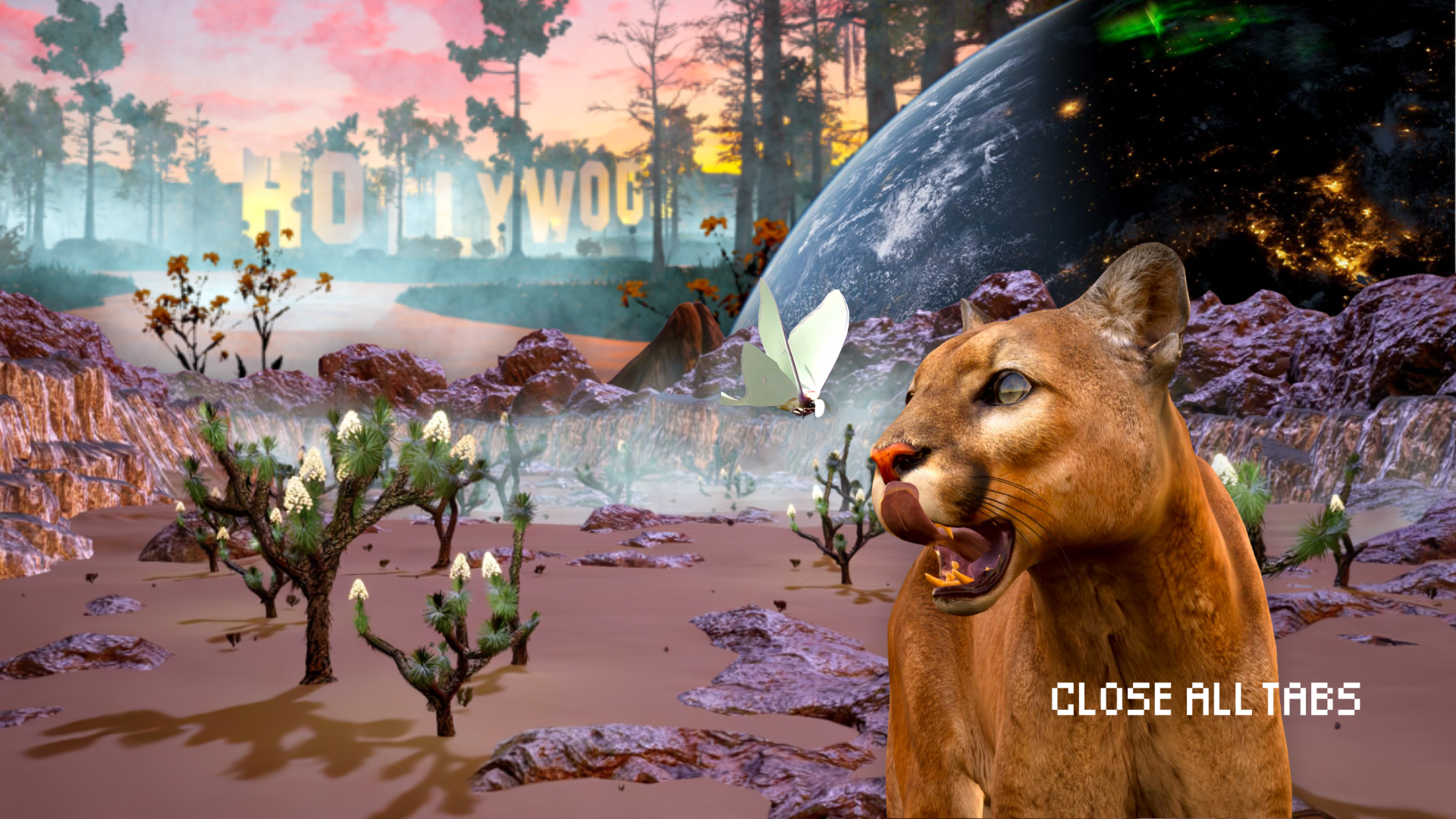
Morgan Sung: Alice tackles systemic failure in their game, The Alluvials. It imagines a version of Los Angeles devastated by the climate apocalypse, once again inhabited by the critters native to Southern California. Even P-22 makes an appearance — he was the beloved mountain lion who settled in Griffith Park after somehow crossing two major freeways. P-22 became a symbol of human encroachment on the natural world.
Alice imagines Los Angeles’ future, without any human perspectives. In The Alluvials, all of the playable characters are non-human. But imagining the world from the perspective of a moth, or the wildfire itself, challenges players to confront difficult feelings of climate anxiety and grief.
Alice Bucknell: I think when people play my games oftentimes they’re like, oh, this is so dystopian. Like, this is so melancholic. Like, this feels like you know, end of the world vibes. But I feel like for me, it’s also about trying to find moments of optimism or resilience or beauty or hope or pleasure. Yes, it’s a game about the politics of drought and water scarcity in LA it’s also trying to maybe get us out of this doom spiral of, like, thinking that like a big wildfire is like the apocalypse.
Um, in fact, one of the levels you actually get to play as wildfire. And in that level I was really interested actually in maybe pushing back against this idea that fire is always necessarily a destructive force.
If you look at forestry and like ecological studies, like there’s all this evidence proving that actually fire kind of has to happen every now and again because it clears the canopy. So it allows like new, uh, species to grow on the ground. It creates biodiversity. It creates resilience. It removes pests. So there’s all these really positive aspects of fire. And largely like California’s relationship to fire is largely a story of like private property ownership and people not wanting to practice controlled burning so then you end up getting the situation where there are these like mega fires because we haven’t practiced controlled burning.
So yeah, I mean, I think the game is trying to get people into a place maybe. Where some of the assumptions they make about the natural world, or how we fear or how we like certain natural events or entities, like maybe make us question why we feel that way.
Um, another one of the levels of the game of The Alluvials is what I call a pollination simulator. Um, and in this level, which is set in like a dried up near future version of the Hoover Dam, actually get to play either as a Joshua tree or a yucca moth. And these are two species in ecology studies, It’s called extreme symbiosis where basically what happens is these two species have evolved in such a way that they’ve become entirely codependent on each other, like, all of their other pollinators have died out.
So I kind of think about the Joshua Tree and yucca moths as these sort of. lovers at the end of the world, you know, like, even if they exist in this incredibly precarious state, like there’s still something so beautiful about the ways that they sort of like support each other and keep each other alive, despite like all the odds.
Morgan Sung: Navigating these virtual landscapes can help us explore deeper relationships. Not just the relationship between two creatures in a desert ecosystem, but complex, messy human relationships too. That’s after the break.
We’re back! And we’re opening a new tab, using game worlds to explore emotions.
Through their game The Alluvials, Alice flipped the human relationship to the environment on its head and they did it playfully. Imagining these devastating outcomes through playful scenarios, like a yucca moth getting love drunk from pollinating Joshua trees, helps players find hope in an uncertain future. But what about when we go into games without the goal of play? These spaces can be powerful tools to experience and make peace with difficult emotions in our human relationships, too.
Alice Bucknell: Video games can be a very productive place for processing grief or processing trauma. There’s a lot of game scholars, uh, people like Aubrey Anable or Bo Ruberg that talk about this notion of difficult gaming games that are kind of enabling us to experience other emotions, than just pleasure or happiness or the delight of sort of beating someone or, or beating a game,
Morgan Sung: Alice said that Firewatch, the game they played while waiting out the LA fires, is a perfect example of “difficult gaming.”
Alice Bucknell: So I mean, Fire Watch for instance, it’s a game about anticipatory grief for the climate. Like, it’s a game where you’re playing as a park ranger and basically decided to leave your wife who has a terminal disease. Uh, but instead of being with her, you’ve decided to go take a job, uh, national forest. so you’re grieving and you’re heartbroken and you’re dealing with yeah, this guilt that you have for abandoning your partner.
But then simultaneously you’re dealing with the grief of an entire planet, like a planet scale, grief. And you’re dealing with a kind of feeling that something bad is gonna happen. Kind of the big fire, right, that’s definitely gonna happen at some point, but you don’t know exactly when. 90% of the game is just waiting, like, waiting for that disaster to happen. And I think that in a way, games can do this thing where, yeah, you’re able to sort of toggle between futures pasts and presents.
Games like Firewatch, you’re like waiting for something bad to happen and that thing is kind of always forever on the horizon. And I think that that was a feeling that everyone had in COVID as well, like knowing this thing was really rough, but not knowing the edges of it, like not knowing when it was going to end, the kind of anticipation of like, the world never being the same again, like, when we do get to go back outside.
Morgan Sung: Yeah.
Alice Bucknell: Games can kind of create that like, it’s almost like a primer or like a way to sort of experience the heaviness and the complexity of those feelings.
Morgan Sung: What is it about exploring these virtual spaces that allow us to access feelings that we maybe won’t have more trouble processing in the real physical world?
Alice Bucknell: I mean, I think about maybe some, some kinds of virtual game space or virtual worlds, like the ones in Roblox or Second Life a sort of, um, non-place. Like, Marc Augé, this French anthropologist had talked about this idea of the non place, and he was kind of referring to it as places like train stations or fast food restaurants or airport terminals, like places that feel kind of dislocated from any physical, like, coordinates.
Like, he’s really talking about this feeling of like, in betweenness. And I think that, you know, for anyone who’s like, been at an airport and, like, struck up a conversation with a stranger, um, maybe like revealed something, look personal, ’cause it’s like, oh, I’m never gonna see this person again, like whatever. Uh, there’s kind like, I feel like sometimes you also get that in like virtual environments. Like I do feel like these virtual worlds open up i’s a bit like a, a role play where you feel like you can kind of be whoever you wanna be, or maybe you, you can, you can try out like a different personality or like a different kind of intimacy maybe than what you’re used to practicing in your quote unquote, like real life. We already kind of know that, that feeling of, like, an airport bar and like maybe how that would also open you up in a way.
Morgan Sung: Alice plays with the concept of non-human entities in their game, Nightcrawlers. They describe it as a pollination simulator. It’s a two-player where one person plays as a flower, and the other plays as a bat. Players have to use echolocation and non-verbal communication to find each other, and when they do, play notes in sync to pollinate. It’s meant to challenge players to deepen their relationships with each other.
Alice Bucknell: I mean, a game, you know, where you’re playing as a bat and you have to like, use sonar to find flower or if you’re playing as flower and you have to sort of dig under the ground and like fling yourself, like a slingshot across your own root system so you can pop up somewhere else in the world. These are very kind of like psychedelic experiences.
It’s asking you to kind of take on a form of intelligence that’s just so different from like how you move about the world in your day-to-day life, like, all the behaviors that you just do automatically walking around planet earth. I love the feeling of like playing a, a new game for the first time, uh, where you basically respond into the world and you’re kind of like a baby. Like you just don’t know anything. Like you’re waiting for the lore to load in. You’re waiting for like, you know, someone to tell you the reason that you’re there, someone to tell you how to move around, someone to tell you like what you should be desiring or what you should be working towards.
Morgan Sung: Then there’s Alice’s game Small Void, a queer dating sim where players work together as matter and antimatter, two halves of the same object. The mechanics of the game are inspired by black hole paradoxes. Alice worked on it during their residency at the European Center for Nuclear Research. The two players have to catch each other, but when they do, they risk opening a black hole and starting the chase from scratch. In a way, it’s also a love story.
Alice Bucknell: Anything is possible and like, um, having to kind of relearn your relationship to the world from scratch. It can be frustrating ’cause sometimes you’re just like, tell me what to do, I don’t know what’s going on, like, help. But it can also be ,like, really joyful and like really, I would say like a bit child, like childlike feeling of this, like, sense of wonder of possibility. And I think it’s even more fun when you’re playing the game with someone because you can both like be tripping up and messing up and being confused and disoriented and, um, playing hide and seek together, you know, inside of a black hole.
Once the feeling of failure is removed, then it kind of opens us up to like all of these different, uh, possible ways of playing together. and what’s really cool for me as well is thinking about how that openness can be carried into real life, like when you put the controller down. Maybe that makes us a little less rigid in like our day-to-day routines and interactions too.
Morgan Sung: Game worlds provide the space for processing, exploring, and relationship building that we can’t always find in the real world. We see this a lot in the sims. Like, how so many sims players — myself included — explored queerness through in-game relationships before they were ready for real-world ones. Or like during the LA wildfires, when Alice confronted their anxiety and grief by replaying Firewatch when they couldn’t go outside. For many, game worlds are a space for community.
Alice Bucknell: One of my favorite examples of that, um was in the pandemic. A lot of people would be meeting up on multiplayer online games, games that nowadays have, like, incredibly sophisticated and beautiful landscapes. Of course, the point of mogs is not to admire the landscape, it’s to kind of engage with other players and maybe collaborate or fight each other.
But in the pandemic, when we were all so nature starved and locked at home, uh, people were really gravitating towards multiplayer online games, not just as a point of social communication but actually as a place to even like, appreciate simulated nature together. So it was not uncommon for people to basically go onto Halo or other games and like basically just use the sort of structure of the game engine itself as a bit of like a national park or a nature watch and like meet up with their friends and go on these long walks together into the sunset.
Morgan Sung: But, just like spaces in the real world, sometimes a once-bustling locale can fizzle out. Its popularity dwindles and it starts feeling.. abandoned. What happens to these virtual worlds when players stop visiting? What’s the appeal of these multiplayer spaces, if the community has moved on?
Time for a new tab, Is Second Life a dead game?
Second Life launched in 2003 as an expansive online world where you could be anyone, and do anything. It was the metaverse before all the tech nerds were obsessed with the metaverse. To this day, you can meet other players, fall in love, get married, buy property, get a job, adopt another player, be adopted by other players, pick up a new hobby … all of course, in game, and through a series of micro-transactions that require real money. You can literally live a second life online.
The world is huge but now, it’s empty. Second Life’s active user base peaked in 2010. But there are still players who are committed to showing up. Alice spent three weeks in the game last year while writing an anthropological report of Second Life for Document Journal. What they found was a digitally crumbling, desolate world.
Alice Bucknell: When I was playing around in Second Life. I think I felt like quite frustrated and I also felt quite alone. Um, because it is like, you get the feeling that it’s just this like gigantic,constellation of thousands of different worlds that are all custom made by someone real. These nightclubs or islands or places you can go and like maybe meet, meet people and talk to, talk to people, but then you, you, you portal into these worlds and there’s just no one there. It’s quite like, I would say almost like melancholic, um, I would say like the feeling of, of being inside of this world that once had such a kind of following I guess, and such a kind of, uh, busy crowd. Um, and now it’s sort of been abandoned.
Maybe it’s not so far from like the non place I was talking about earlier or the, the feeling of being in transit, um, because it feels a bit like you’re in this world that has been like forsaken. Like, it feels a bit like a archeological exercise. Like you’re trying to sort of like, uncover the kind of history of this place and try to find little clues in the landscape.
Morgan Sung: When I think about online games, I assume that most people keep going back to them for the relationships they have with other players. But in games like Second Life, there’s like no one there. And you wrote about running into like one solitary person in this pretty much abandoned, like wasteland of a game. Why do you think people keep coming back to these virtual world if, even if there’s no one else there?
Alice Bucknell: Yes, it’s by and large a wasteland. Yes, it’s like been forsaken, left for dead. Um, but I also think that because the odds of finding someone also exploring this world are so low, um, there is this feeling of like, magic when it does happen, that you do meet someone. And also, like, for some of these users, they really like the idea that they’re able to kind of hang out in this, like, otherwise, like, abandoned space.
Morgan Sung: Yeah. I think when a lot of people talk about the reason they love games is usually like the storyline, or like the relationships they build with other players, the characters. But do you have any thoughts on, like, the relationships we build to the game worlds themselves and like these virtual spaces?
Alice Bucknell: I think people get really attached. I think that’s not something that studios think about a lot either. I guess like, uh, it was one of the expansions of World of Warcraft, in which, um, they scrubbed like a lot of the, uh, areas of the world. Like, they just, they just cut ’em out basically to create more space, I guess, for better, like more optimized level design. Um, and there was this like Reddit forum where everyone was like, mourning. I mean, this is before the upgrade even happened, um, so this is before the levels had, had been erased for good.
Um, but people were like, already, sort of, like, mourning and complaining that like these levels are gonna disappear. And like, people were like, ‘okay, I’m gonna go archive this patch.’ Like, ‘if you go archive that patch, just like take video walkthroughs, like, take, just like record your game, like record your screen. Like we need to like assemble an archive.’
Um, so I feel like, you know, everyone has different reasons for forming attachments to, to anything really. Um, but I do think that these virtual worlds can be almost like time capsules or like diaries. They do kind of reflect back to us like a certain period of our lives, maybe, like a certain moment, um, that we remember or a certain feeling we remember ourselves having in a certain world. And like, when people were mourning the future loss of their favorite World of Warcraft worlds, like, people were, like, ‘this level like reminded me of, like, when I had, like, just had my first, like girlfriend or something.’
Like, I don’t know, like it is like where they were in their like particular point in their life, like when they first encountered that world. I mean this is just such a human factor. We earmark and we tag and we superimpose like our own narratives onto place. And for me, it’s not a surprise that people would have that similar attachment to virtual worlds.
Morgan Sung: What happens when we lose access to these virtual worlds that we come to love? Sometimes, like in the case of Second Life, these spaces are abandoned by their former inhabitants, who’ve moved on to newer and less glitchy metaverses. But that’s not the only way to think about game death.
Some virtual worlds blink out of existence before they have time to be abandoned, when game companies decide to pull the plug. Grieving these games that are suddenly taken offline can be a complicated process. And sometimes, it’s about grieving past lives of a game. Like in the World of Warcraft example Alice mentioned, when players restored a version that still included areas that had been wiped in the update.
Alice Bucknell: I mean, it can be really challenging. It can be really tough. In that specific anecdote, I was curious so I actually, I started, uh, combing through the Reddit thread and like was going to some of the YouTube links and, um, reading some of like the subreddit like discourse. And people were like, you know, ‘thank you so much for preserving this. like, I felt sick to my stomach, like when I woke up with the update and like, I realized my, like, favorite world was gone. I was like having a panic attack. I was crying like, this has like, brought me back, you know, like, this has, like saved me.’
So yeah, this kind of attachment can get really intense for a lot of people. Um, but I think that one of the cool things about that anecdote is like, the element of like collectivity, like, that goes into building these worlds and also maintaining them. But also a sort of, um, how do you say, almost like a death doula for virtual worlds, like, when they do come offline. It’s like, what are the, what’s the kind of rituals or forms of care we need to create together in order to, like, make sure that the memory of this world is defended and like, maintained and held.
I don’t know. I was really moved by the ways in which people were protecting the memories of these worlds for strangers.
Morgan Sung: We’ll explore this idea of game “death” more next week — and hear how a few online game communities have reacted to the loss of their virtual worlds. Some gamers have started a movement, calling on publishers to stop killing games.
But that’s a deep dive for next time. For now, we’re closing all these tabs.
Close All Tabs is a production of KQED Studios and is reported and hosted by me, Morgan Sung. This episode was produced by Francesca Fenzi and Chris Egusa, who is also our Senior Editor. It was edited by Chris Hambrick.
Close All Tabs producer is Maya Cueva. Theme song and credits music by Chris Egusa, with additional music by APM. Brendan Willard is our audio engineer.
Audience engagement support from Maha Sanad. Jen Chien is KQED’s Director of Podcasts. Katie Sprenger is our Podcast Operations Manager, and Ethan Toven-Lindsey is our Editor in Chief.
Some members of the KQED podcast team are represented by the Screen Actors Guild, American Federation of Television and Radio Artists, San Francisco, Northern California local.
Keyboard sounds were recorded on my purple and pink dust silver K84 wired mechanical keyboard with Gatoron red switches.
OK, and I know it’s a podcast cliche, but if you like these deep dives and want us to keep making more, it would really help us out if you could rate and review us on Spotify, Apple Podcasts, or wherever you listen to the show.
Don’t forget to drop a comment and tell your friends to, or even your enemies or frenemies.
And if you really like close all tabs and want to support public media, go to donate.KQED.org/podcasts. Thanks for listening.