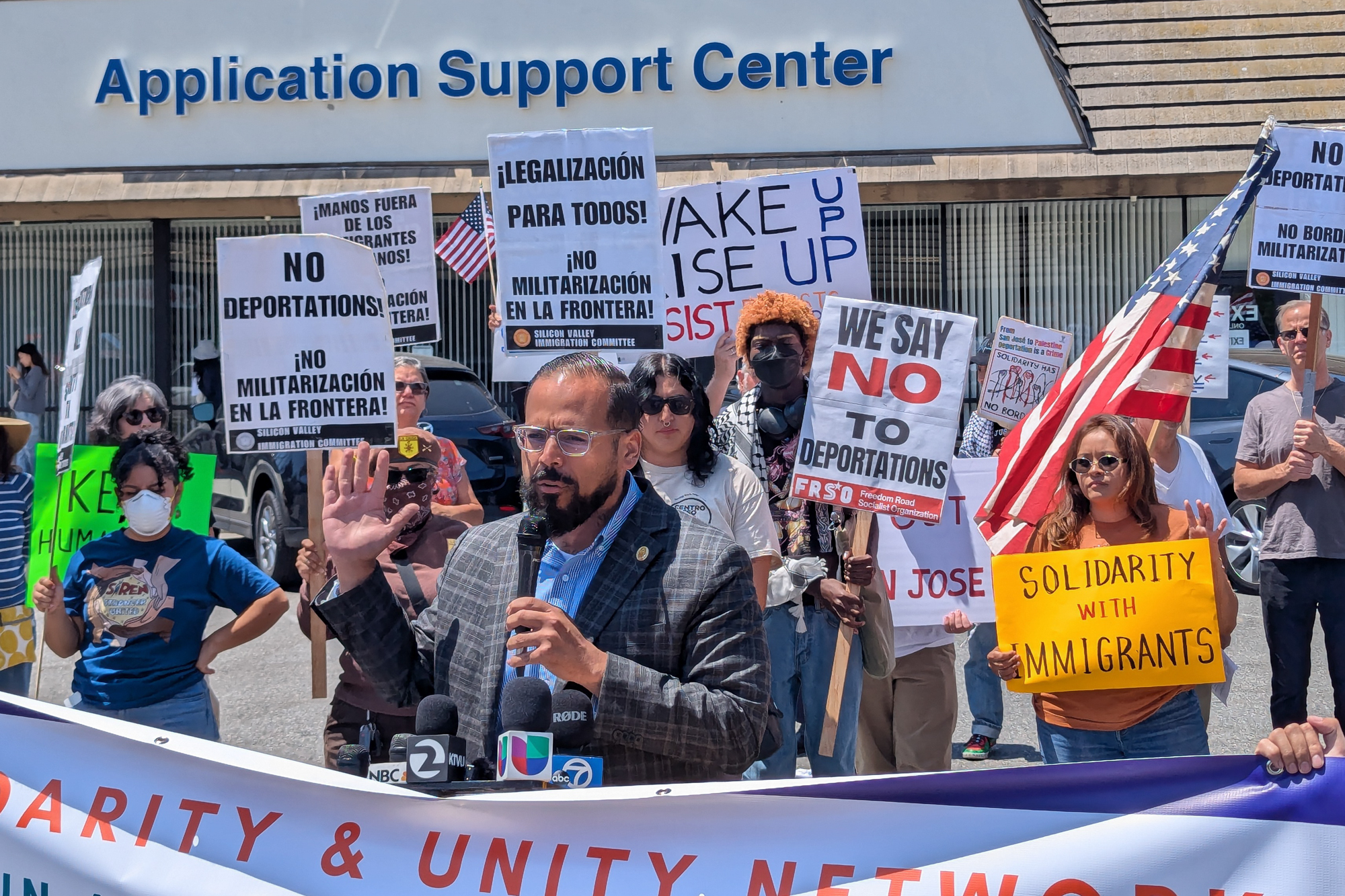
Ericka Cruz Guevarra [00:00:00] I’m Ericka Cruz Guevarra, and welcome to The Bay. Local news to keep you rooted. It was a Tuesday morning at Conexion to Community off Story Road in East San Jose, where for decades, day laborers and immigrants have come here for resources like job training and food assistance. But this wasn’t gonna be like any other Tuesday here. People had been increasingly worried about federal immigration enforcement, And suddenly, it was at… their doorstep.
Joseph Geha [00:00:39] And it was in the classroom space at Connection to Community where a man in plain clothes who, you know, later turned out to be a federal immigration officer, came into the classroom and took out one of the clients by force, basically, and arrested him.
Ericka Cruz Guevarra [00:01:01] This arrest in late September shocked the community. Staff members say they had never seen anything like it before. And as this happened, San Jose City counselors were already working on a plan to ban ICE agents from concealing their identities, which supporters say adds to the climate of fear in the community
Peter Ortiz [00:01:27] They didn’t know who these individuals were or whether they had any authority to be there. That moment of confusion and fear illustrates exactly why this ordinance is necessary.
Ericka Cruz Guevarra [00:01:40] Today, San Jose’s plan to ban masks for ICE.
Joseph Geha [00:01:55] So far, San Jose has not really seen the kind of mass raids and mass arrests that other cities or counties have seen, like we saw in the Los Angeles area and elsewhere.
Ericka Cruz Guevarra [00:02:07] Joseph Geha is a South Bay digital editor for KQED.
Joseph Geha [00:02:12] We’ve heard from local officials and local leaders that it appears most of the arrests and enforcement that are happening in San Jose have kind of been targeted operations, looking for one or several folks at a time, not, you know, dozens and dozens of people indiscriminately being rounded up. But even without those kind of mass raids, there’s still a very real and palpable fear. You know, we’ve heard from city council members, community leaders, county supervisors that people are staying home from their jobs or they’re not sending their kids to school. They are, you know, waiting for off hours to go shopping sometimes. All of this because they are concerned that they might get picked up in one of these arrests.
Ericka Cruz Guevarra [00:03:04] Well I wonder if you can start by telling me about this arrest that happened in San Jose in September and that really shook the community.
Joseph Geha [00:03:14] It was a Tuesday morning at Conexion to Community, which is a long-standing resource center, day laborer center, a trusted place in the community where many have gone for decades. And when staff at the center asked this agent to prove who he was, to show some sort of identification, you know, he flashed potentially some sort of digital badge at them, but nothing really in person, nothing on his person, nothing in his hand. And it was only after they were outside that other immigration agents in uniforms, who, you know, we were told were waiting in an unmarked van, came kind of rushing over to help finish off the arrest, essentially.
Rose Amador [00:03:56] We were concerned that the other clients that were in there would be afraid to come and pick up.
Joseph Geha [00:04:03] We were told by Rose Amador, who’s the retired CEO now of Connection to Community, that the next day after this arrest, there were a lot fewer people coming to the normal programs and coming to take advantage of the services.
Rose Amador [00:04:21] So we assured them that we have new precautions and they’re advised of everything we’re doing now.
Joseph Geha [00:04:29] One thing Rose Amador told us that they did at the center is installed a locking screen door on this classroom space. She worked at that center and led the center for many years but had never seen anything like that. And I don’t think she’d ever seen her staff shook up like that.”
Rose Amador [00:04:48] Just, we were sad that our person got taken like that. You know, we’re a big family, you know, with all of our clients and our programs, so it was just devastating.
Ericka Cruz Guevarra [00:05:03] Well, Joseph, we’re talking now because even before this arrest happened, San Jose city leaders had been looking into creating an ordinance to ban immigration and customs enforcement agents from wearing masks. Tell me a little bit more about what they’re considering.
Joseph Geha [00:05:26] Yeah, the local law that San Jose leaders are considering putting into place would essentially do two things. It would require that all law enforcement officers, and this is from top to bottom, from federal agents down to local police and everybody in between, it would require that they not conceal their identity. So no gators, no balaclavas, no complete face coverings of any kind. And then also it would require all officers working in that he would have clear identification. And clear agency affiliations. Basically, a very simple and easy way for anyone who is on the street, maybe interacting with this officer, to know who they are and who they work for. There would be some exceptions in the law for face coverings and masks for health and safety reasons, for things like potentially medical reasons or gas and fire masks. Those kinds of things could be accepted, but the overall aim is pretty clear.
Ericka Cruz Guevarra [00:06:24] I guess why do this, like why a ban on masks specifically, and how do city councilors talk about the rationale?
Joseph Geha [00:06:34] Yeah, when we talk to Peter Ortiz, he’s the District 5 council member, and he’s kind of been leading the charge on this. You know, the reasons he gives are simple. He says it’s about trust.
Peter Ortiz [00:06:44] I believe people regardless of citizenship deserve to know who is approaching them and whether that person is a legitimate law enforcement officer.
Joseph Geha [00:06:54] He has told us that, you know, nobody should have to fear whether the person coming up to them with handcuffs or questioning them on the street or out of business is legitimate.
Peter Ortiz [00:07:06] It’s a responsibility of this council to make sure that our immigrant community is being protected and that any sort of immigration enforcement, because we can’t stop it, they do have authority to do immigration enforcement. But when it is done, is done in accordance to law and respects the human rights of all residents.
Ericka Cruz Guevarra [00:07:28] Did you get the sense, Joseph, that folks in San Jose feel like a ban on masks for immigration and customs enforcement agents could be really meaningful in the community?
Joseph Geha [00:07:41] Yeah, we’ve heard from a lot of folks at these various rallies and community organization events and also at, you know, the recent council meeting.
Misrayn Mendoza [00:07:50] Okay, so we need to step up. You guys been doing good work, very proud, okay? But our people, especially our Mexican people, is getting wiped out.
Joseph Geha [00:08:01] Some folks we heard from at the council meeting even have asked, you know, the city council to take a step further to do even more for their community. They want folks to come physically take part in these protests and these actions against federal immigration enforcement officials.
Misrayn Mendoza [00:08:21] We need to do something. And I also hope when these creeps come to our city, I wanna see each of every one of you shoulder to shoulder with us.
Joseph Geha [00:08:34] On the other hand though, you know, it’s unclear at this point and it seems unlikely that any federal officers are actually going to abide by these kinds of laws. So the net effect is still kind of up in the air.
Ericka Cruz Guevarra [00:08:52] Coming up, how the mask ban could set San Jose up for a legal fight with the Trump administration. Stay with us. Is there any sense yet of how something like this would be enforced in San Jose?
Joseph Geha [00:09:14] You know, it may be up to local law enforcement to take reports and investigate claims of people impersonating officers, but it’s really not clear, putting aside the mechanics, whether or not the enforcement would work and whether or not, the net effect of having these bills on the books would actually create a situation in which federal agents start removing their masks.
Kristi Noem [00:09:38] I would say that they wear masks at times to protect their identities from dangerous situations.
Joseph Geha [00:09:44] We have heard from the Department of Homeland Security and its leaders, like Secretary Kristi Noem, who said in the past that she thinks ICE agents kind of need to wear masks to protect their agents from being doxed or having any of their personal information, like their addresses and their names and such revealed on the internet for people to take advantage of.
Kristi Noem [00:10:04] It’s making sure that they are safe while they do this job and that they get home to their families at night, too, is incredibly important.
Joseph Geha [00:10:11] And we’ve heard from figures closer to home, like Bill Essayli, who’s the U.S. Attorney for the Central District of California. He said he told federal agencies that they should ignore these types of mandates. So while federal officials haven’t commented specifically on the proposed ban in San Jose, it’s kind of a certainty, really, that they would ignore it if it were to be enacted.
Ericka Cruz Guevarra [00:10:35] I do know that Governor Gavin Newsom has also signed a law last month essentially doing this exact same thing, but at the statewide level. So I guess I wonder why it was so important for city leaders in San Jose to still pursue a local version of this.
Joseph Geha [00:10:56] From what I hear from city leaders, again, it’s about putting a stake in the ground. It’s about saying, this is where we stand on this. And if the state legislature feels the same, that’s great, because we are going to maybe join them in a fight if we need to, like in a court battle, which is where this kind of debate may end up. I would assume that folks in the city, if they could do it without a legal fight, would be quite happy for that to be the case, but I don’t see that happening, and the folks I’ve asked about this, the legal experts, the political science experts, and even Peter Ortiz himself has said this may end up in a court fight.
Peter Ortiz [00:11:37] I believe we have the legal authority to regulate law enforcement activity regardless of the agency because it is taking place in our municipality.
Ericka Cruz Guevarra [00:11:55] Well, Joseph, it sounds like the city is still sort of putting this ordinance together and figuring out the mechanics of it all and how it’s going to work. But do we have a sense yet of the timeline on things and when something like this might actually come to a vote in San Jose City Council?
Joseph Geha [00:12:14] The city council unanimously voted to kind of advance this local law at the beginning of October. The ask of the city council was to have the city attorney bring back a draft law within 60 days, and then that law could be discussed and voted on to head toward an act.
Ericka Cruz Guevarra [00:12:36] As someone who covers San Jose and the South Bay, Joseph, I’m curious what your takeaways are from this story and why it’s significant that San Jose is pursuing something like this.