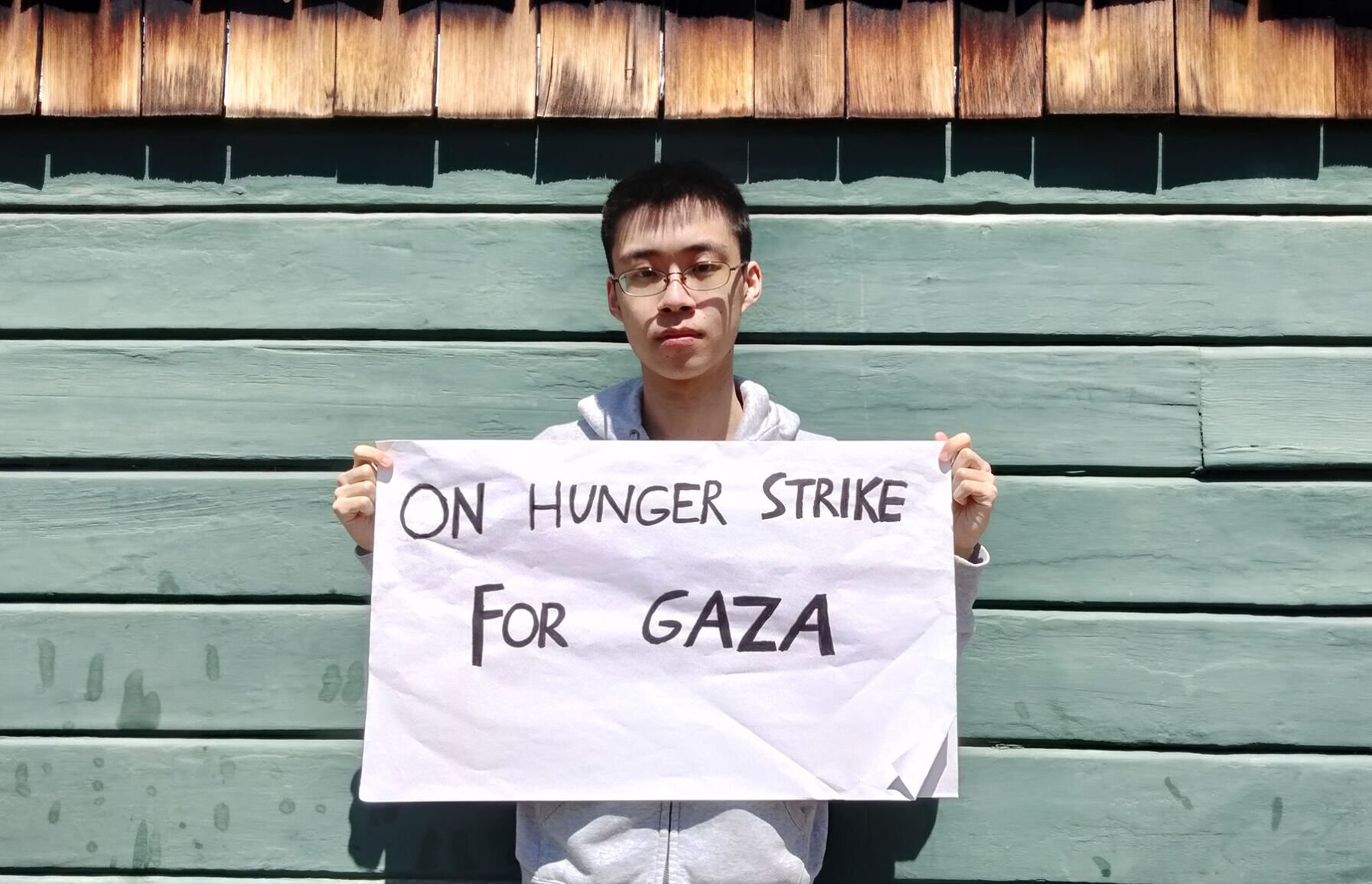
Peyrin Kao [00:02:38] I’ve been teaching for eight years total, but I’ve been a full-time lecturer here for three.
Ericka Cruz Guevarra [00:02:42] And what kind of classes do you have?
Peyrin Kao [00:02:45] Yeah, so like this semester I’m teaching the kind of intro to artificial intelligence class. It’s one of the classes I’m teaching. So just I’ve also taught like the computer security class, the computer networking class. So yeah, you kind of get tossed around a bit as a lecturer.
Ericka Cruz Guevarra [00:02:58] Computer science, it’s not typically the kind of subject that I might imagine typically engaging with subjects like Palestine, the war in Gaza. When did you first feel the need to speak out about what’s happening in Gaza?
Peyrin Kao [00:03:13] To me, the reason why it’s so important to speak out about this topic in particular, and the reason I’m saying this is because sometimes people will say, well, you’re really outspoken about this issue, but why aren’t you outspoking about the crackdown on immigrants or the attempt to erase transgender people? And it’s like, these are also really important issues that we should be talking about. And one of the reasons that I felt the need to speak about Palestine in particular is because this is an issue where the information war angle and the disinformation angle. Is such a big part of the reason why the genocide can go on. Being pumped into our social media feeds, into our conversations here in the United States to try and dehumanize Palestinians to say, well, they’re not starving, that’s fake. Talking about this one issue is important because to me I think it’s one of the biggest moral issues of our time. But then it allows us to open up other conversations about how our tech is being used not just to fuel genocide in Gaza, but how it’s being used. To track and surveil immigrants here in the U.S. And you can start making these connections if you start talking about topics like this. So to me, that’s why it’s so important to speak up.
Ericka Cruz Guevarra [00:04:19] It sounds like you think that this conversation is very much part of what your students in computer science should be learning right now.
Peyrin Kao [00:04:28] Right, exactly, and not only are these things that our students have to reckon with as they go into the workforce, a lot of the companies that our university and our department have close connections with are the companies that are directly complicit in Israeli genocide. Google and Amazon, these are companies that are students often go to work for, or they strive to work for Google or Amazon, and they come to our campus, and they do recruiting and career fairs and things like that. And it’s important to remember that these companies, even if they try to launder their reputation, they’re very much complicit in the genocide. And it is important to have these conversations to say, well, wait a minute, if you go and work for these companies where is your labor going? And when you’re building these things, like what is it being used for?
Ericka Cruz Guevarra [00:05:14] Was there a point in the last two years where you made the decision to really speak out about this?
Peyrin Kao [00:05:21] The first time that I brought it up in the workplace was actually November of 2023, when I talked to students about it after a class and the department wasn’t super happy with me.
Peyrin Kao [00:05:32] Uh, at this point, uh, 61B Electra is over, by the way, like, if you want to go, you can go. But since this is my last chance to talk to you all, and also you all out in the recording in the world, uh, I have a couple things I want to say, and I just want to make it clear that this is, like only on my behalf. So, like nobody on 61B…
Peyrin Kao [00:05:50] They called it political advocacy or something like that. But really what it was, was an acknowledgement that, one, there is a genocide going on, something that has since been validated by… Genocide scholars and by human rights organizations, but also to have students think critically. Like, the U.S. Is the biggest backer of Israel and its current bombing campaign in Gaza, okay? Like, my tax dollars are being used to fund the bombing of children, hospitals, schools, universities, okay, safe zones. And so, as someone who is funding this, I think I have a right to say something against it. If you’re going to learn all these tools to write these programs and train these large AI models, what are those going to be used for? Are they going to used to mass surveil Palestinians in the West Bank and in Gaza? These are things that we have to be thinking critically about and I don’t think it’s necessarily political advocacy or that it’s controversial to say that we should have those conversations.
Ericka Cruz Guevarra [00:06:58] Tell me a little bit more about the reaction that you got from both students and, I mean, I’m also curious your department and also the university at large.
Peyrin Kao [00:07:09] And I would say the student reaction was largely positive. People want to talk about this because it’s such an important thing to talk about and not suppress it and say, Oh, you can’t even talk about it because that’s what the department did. They shut it down and they said, you’re not allowed to talk about this. They told all the students and they. Oh, what your instructor did was inappropriate. And, you know, he’s going to get in trouble for it and you should report him. This was sort of like record now that says, Oh well, you know, this guy got in trouble for a political advocacy. And they basically made it clear in no uncertain terms that if you do it again. You know, we’re not going to be very thrilled about it. And I would also mention that as a lecturer, I’m hired on year to year contracts. So I don’t have the same sort of job security that tenured faculty do.
Ericka Cruz Guevarra [00:07:52] In an email to KQED, UC Berkeley Assistant Vice Chancellor Dan Mogulof said the school always takes a quote, viewpoint neutral approach when it comes to supporting freedom of expression. Mogulof says staff and faculty speaking for themselves and on their own time have every right to voice their beliefs, but that it’s a different story in the classroom. When it came to Peyrin Kao’s lecture in November of 2023, Mogulof pointed to UC policy, which requires its universities to be non-partisan and quote, prohibits faculty from using the classroom or class time as venues or opportunities for political advocacy or indoctrination. One way you really pushed is you decided to go on a hunger strike. What was the goal of the hunger strike and when did you start that?
Peyrin Kao [00:08:57] Yeah, the hunger strike started on the first day of class, which was August 27th, and it lasted until October 3rd or 4th, which was 38 days in. There were lots of different reasons we went into it, but one reason I think is, again, there’s this dehumanization of Palestinians that goes on, and that means that when Palestinians die, it’s written like a statistic. It doesn’t even read like these are people, but they are people. That’s someone’s mother, that’s someone child, that’s someones doctor, that someone’s nurse. One of the goals of launching an action, like a hunger strike specifically, is to bring that starvation to Berkeley.
Peyrin Kao [00:09:32] Effective today to protest this genocide, I am launching an open-ended hunger strike, and I call on all CSTech workers, students, and educators to do everything they can to stop the atrocities happening with our taxpayer dollars.
Peyrin Kao [00:09:47] So that when people interact with me, you know, out on the street, or at a protest, or in the classroom, at office hours. They have to see someone starving in front of them and remember, well, the people that I see starving in Gaza, they’re just like this person that’s right in front of me and I mean, right around the time the hunger strike started, we read that one of the people that starved to death in Gaza. I looked at their job and it said university lecturer and that really hit me and it made me think, well, wait a minute, like that could have been me.
Ericka Cruz Guevarra [00:10:18] During the hunger strike, Kao pledged to live on a starvation diet of 250 calories per day. Organizers say that number mirrors the average amount of food available to Palestinians in Northern Gaza, based on a 2024 report by Oxfam. Kao vowed to remain on strike until the UC Berkeley administration met four demands. Which include acknowledging Israel’s occupation and genocide of Palestinians, as well as the university’s role in developing war technologies. He also asked that the university pledge to avoid any kind of relationship with the military and to create standards and practices around funding that aligned with international human rights law. When asked for comment about Kao’s hunger strike, UC Berkeley reiterated its “viewpoint neutral” approach to issues of free speech.
Ericka Cruz Guevarra [00:11:25] What was the response to your hunger strike, right? I mean, did you get the response that you anticipated?
Peyrin Kao [00:11:35] Well, I’d say the response from the students and the community at large has been very positive. Again, I think people really see that they don’t want to be a part of a mass starvation campaign. From the university, their reaction was no more than sending me a nice letter saying, well, you’ve been reported to the Department of Education as part of the so-called anti-Semitism lawsuit. Have a nice day. And that was basically the only response I ever got from the university.
Ericka Cruz Guevarra [00:12:00] And you’re referring to the story that came out in September about UC Berkeley sending the names of more than 150 students and faculty to the Trump administration as part of its investigation into alleged antisemitism on UC Berkeley’s campus and other universities around the country. Do you remember where you were when you learned that your name was shared
Peyrin Kao [00:12:25] I was somewhere in the hunger strike. I was like day 12 or something like that. I don’t remember exactly where I was, but I do remember that the reaction I had was just not surprised at all. I think it’s very clear to me that the only reason why my name is on there has nothing to do with antisemitism and everything to do with the fact that I’m outspoken about Palestine and that I’ve talked about it before. I mean, with the Trump administration, we already know that they weaponized antisemitism to crack down on pro-Palestinian speech. I’m a lecturer in the CS department at UC Berkeley, I am on day 22 of a hunger strike to protest Israel’s starvation and stage five famine and genocide in Gaza. In the statement that I made to the UC regions where I went and told them that they had just reported me and that I wasn’t very pleased about it, I told them this action that they decided to take, it puts my safety at risk and it puts the safety of my family at risk. My family and I are a word for our safety because my name has been sold out to the Trump administration. And we’ve seen what they’ve done to try and crack down on pro-Palestinian speech. I call on the… You see what the Trump administration does when they want to suppress speech. They will abduct people off the streets. They will try and cancel people’s visas and try and deport them just for speaking out about Palestine. And not even doing any sort of action, just like talking about it is enough to get you deported or abducted or thrown into ice prisons.
Ericka Cruz Guevarra [00:13:44] You decided to stop your hunger strike.
Peyrin Kao [00:13:48] Yeah, well, that was sort of on advice from the people who helped organize the hunger strike behind the scenes, like medical teams and things like that. And they said that if you go any longer, there’s going to be permanent damage to your health. And that’s why we made the difficult decision to stop. But as I stop, I’m very well aware that I have a choice to stop and one of the things we’ve transitioned toward as we sort of left the hunger strike as an action and started to move toward other actions, we launched this fundraiser for someone we found in Gaza. So we threw some organizations we met up with someone in Gaza named Nadal Mohammed, and Nadal Mohammad and his team, they are providing food and water and basic care to these displaced families that are arriving at the camps in central Gaza. So we started this fundraiser because Nadal mentioned, we really just need money right now to afford the astronomical prices of food and Water. And while I had the choice to stop and I had resources to help me recover, people in Gaza don’t have those resources. And the best thing we can do now is to mitigate that by giving them at least some limited resource to find some relief.
Ericka Cruz Guevarra [00:14:55] What do you think your hunger strike accomplished?