Episode Transcript
This is a computer-generated transcript. While our team has reviewed it, there may be errors.
Morgan Sung: Let me tell you an ancient cautionary tale about a man known as West Elm Caleb. Okay, this story is not that ancient. It took place in 2022, but in internet time, that’s eons ago. Caleb was a 20-something-year-old guy who lived in New York City, purportedly worked at the super trendy furniture company, West Elm, and became the poster child of everything wrong with dating app culture. It started on TikTok, when a woman named Mimi posted a video venting about getting ghosted by a man named Caleb.
Mimi Shou: I wasn’t going to make a video about this, but I feel like it’s my duty as your Asian older sister to warn my New York City girls about this Caleb from West Elm.
Morgan Sung: Multiple other women commented, West Elm Caleb?
TikTok Clip: I saw somebody talking about West Elm Caleb. Tall man, works at the same place, same name. This is a little too coincidental.
TikTok Clip: Have you ever been personally victimized by West Elm Caleb? I’ve got the perfect f***ing song for you.
Morgan Sung: As it turned out, Mimi was talking about a completely different man. But those other women realized that they had all briefly dated the same guy, a 20-something mustachioed West Elm designer named Caleb. And they started talking about their unpleasant experiences with so-called West Elm Caleb. So here’s what West Elm Caleb has been accused of. He was a serial ghoster. He allegedly sent an unsolicited nude. He dated several women at once, sometimes seeing them back-to-back on the same day. And he sent multiple women supposedly customized playlists of romantic songs, only for them to find out that he had actually recycled the same one. It’s one of the gravest offenses in dating. For a few weeks, this man was the internet’s public enemy number one.
Tanya Chen: And I believe he lost his job due to this. You know, it was just a few women who dated him who really didn’t like it. And they just were sharing their stories and it grew so out of hand.
Morgan Sung: This is Tanya Chen, an internet and tech reporter and my very online friend.
Tanya Chen: And that was deeply unfortunate for Caleb, for West Elm Caleb. I do often wonder how he’s doing and where he is and how that whole experience shaped him forever. And again, I think we caveat to say, Morgan and I, we’re friends and we’re women and we’ve dated men. This is not to say that men should not be called out and should not have their feet held to the fire for their conduct. But how we do it and how things get out of hand is absolutely, I don’t think it justifies the crime in this case.
Morgan Sung: This culture of public shaming as punishment for bad behavior on dating apps is becoming more and more common. Whisper networks, meant to warn other women about dangerous men, have been twisted to harass people for the smallest offenses, like ghosting or refusing to commit to a relationship.
Tanya Chen: When it comes to dating, there’s so many difficult intimacy gaps and things happening between people. I’m sure we all have done things that we regret. We all have behaved in a way that we did not want to when it come to dating. And so for those extremely vulnerable and embarrassing moments to be then shared on such a public stage. It’s an incredibly unnerving experience, and I think it’s leading to a new host of behavioral and psychological problems, especially with young people.
Morgan Sung: And now, these whisper networks have been infiltrated and turned against the women trying to keep each other safe. Like what happened with the Tea App. Tea Dating Advice, better known as the Tea App, went super viral over the summer as an app that has been described as Yelp for Men. It’s a closed, women-only platform that allows users to post about the red flags in men they’ve dated. The app was already contentious. Some people thought it violated men’s privacy. Then the app was hacked, twice, and user information like their driver’s licenses and private messages were spread online.
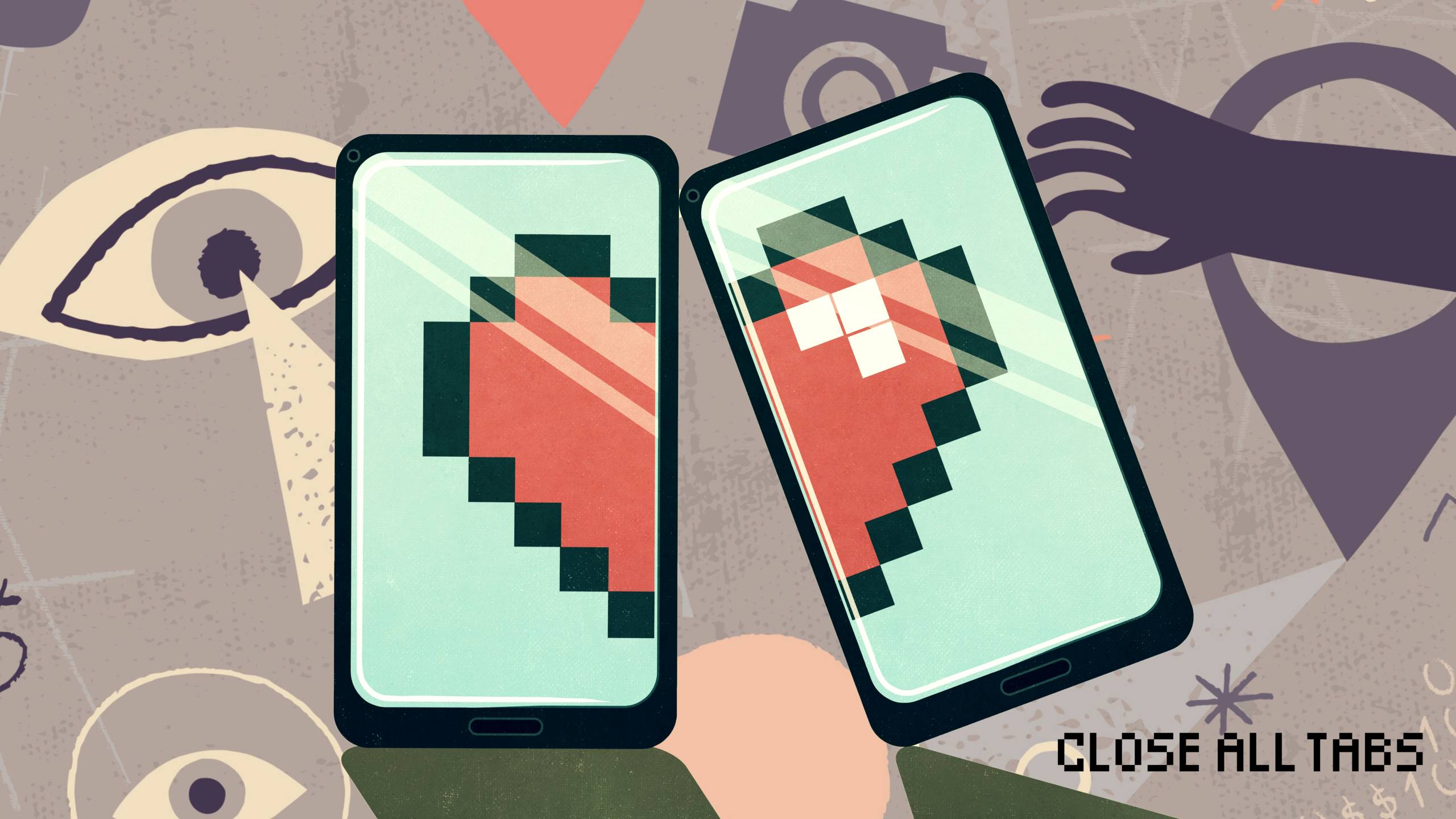
This practice of monitoring and tattling on each other and of turning these intimate experiences into content is really just surveillance. The landscape of modern romance has changed dramatically in recent years, which has had devastating effects on the way people connect with each other. So what do we do about it? Today, we’re diving into the dating panopticon.
This is Close All Tabs. I’m Morgan Sung, tech journalist and your chronically online friend, here to open as many browser tabs as it takes to help you understand how the digital world affects our real lives. Let’s get into it.
We’ll come back to Tanya, West Elm Caleb, and the Tea App later. First, how did we get here anyway? Let’s open our first tab. What is the dating panopticon?
In the 1700s, this philosopher, Jeremy Bentham, came up with a concept of a circular prison. Jail cells line the perimeter of the building, and they all face a single watchtower looming in the center. The design is called a panopticon and comes from the Greek word for all seeing. The idea is that prisoners would behave because they think they’re being watched at all times. Today, the word panopticon is typically used as a metaphor for surveillance. And social media introduces a whole new dimension to the system. So to dive into this, we’re gonna talk to Magdalene Taylor, a sex and culture writer and senior editor at Playboy. Earlier this year, she wrote about the state of surveillance in modern romance in her newsletter, Many Such Cases.
Magdalene Taylor: So to me, the dating panopticon, it’s very much digitally focused, but it’s this pervasive sense that you are constantly being watched in your romantic interactions and that other people are constantly watching you. And with that, there’s a sense of surveillance and even sort of punishment involved. And we see a lot of this play out on dating apps, in Facebook groups, on just regular social media, Twitter, but then also in recent months, it’s really been distilled in apps like the Tea App.
Morgan Sung: Magdalene started thinking about the dating panopticon while watching another dating scandal unfold online. Back in the spring, then 22-year-old political influencer Harry Sisson was accused of leading on multiple women. They all thought they were dating him exclusively, via Snapchat, only to find out that he was allegedly sexting all of them at once.
Magdalene Taylor: While it’s obviously bad behavior on his part to be flirting with multiple women at a time on Snapchat, especially if these women were sending intimate photos and believing that they were the only one doing this, at the same time, I personally don’t find it all that unexpected or really newsworthy that a young 20-something-year-old man would be somewhat sexually active and perhaps even a little bit promiscuous. But something that the dating panopticon does is it distills these moments into a viral moment for everybody else to dissect and engage with and really play into the drama of.
Morgan Sung: When did you notice this shift in this culture of like public shaming and surveillance?
Magdalene Taylor: To me, it really felt like the social media element of it all really blew up post-COVID and the immediate aftermath of being liberated from lockdowns. I think that we sort of momentarily lost touch with what normal human behavior and human interaction looks like, just the general ability to have a conversation with each other. And so going back into the dating world for a lot of people, I think was a very jarring experience. And with that, I think over the period of lockdown, a lot us probably got a lot more online. We probably got lot more hooked to our phones and became far more accustomed to filtering our lives through that lens specifically.
Morgan Sung: Magdalene also pointed to the MeToo movement, which took off in 2017 as survivors came forward with their experiences of sexual violence and harassment in Hollywood. It started with women sharing stories of abuse and mistreatment, offering support and solidarity to each other. When the pandemic shut everything down and TikTok blew up, a lot of human interaction was reduced to content. YouTubers and other influencers have been doing this for years. But with the pandemic? Everyone was online. And everyone could post and consume content.
Magdalene Taylor: I think that it did trickle down in a way where, in addition to sharing crimes that people have committed, it also kind of veered in a different direction for some people in sharing just bad date stories and more misbehavior type things like ghosting somebody or going on a couple of early dates with women at a time or something like that. And so I think that all of these factors kind of converge together in 2021 or so and made for an environment where sharing these stories, whether it be your personal testament or whether it just be gossip, is now a very popular thing to do.
Morgan Sung: I mean, in a lot of these cases, it seems like these incidents of bad behavior, whether it’s ghosting or seeing multiple women at once before any relationship is exclusive, is often conflated with the actual abuse and violence that the Me Too movement was about. Why do these two very different relationship dynamics get conflated in this dating panopticon?
Magdalene Taylor: Well, so I think that at the core of the dating panopticon is the fact that we are constantly looking for new content to consume and new drama to unfold. And a lot of us are on our phones way too much. That’s again our primary source of entertainment and social interaction. I think it’s an entertainment value thing that we’re looking for something else to capture our attention. And periodically that means resorting to kind of high school level romantic drama.
Morgan Sung: How has different tech surveillance made this prominent other than just, you know, like public shaming?
Magdalene Taylor: The dating panopticon exists because the data history of all of our dating lives exists through apps and through social media. But then there’s also this culture of our smartphones have made it so that you can discreetly film somebody anytime, basically, and more than that, share that to Instagram, share that Twitter. But what the dating panopticon has done is that it has transformed all of us into the surveillers and our phones are really the tool through which we’re doing that.
Morgan Sung: What are other ways you’ve seen this kind of surveillance culture manifest in modern dating?
Magdalene Taylor: Well, I think unfortunately there’s a lot of fearfulness in dating right now, and I think it’s possible to argue that something like the sex recession or, you know, any of the various statistics that suggest that people are forming relationships less or dating less or otherwise just spending more time alone. I think that it’s possible to argue that all of that is connected to the dating panopticon. It’s my belief personally that the dating panopticon is causing a portion of the retreat from interpersonal life that we’re seeing among young people.
Morgan Sung: It’s not just content that’s fueling the dating panopticon. The whisper networks are now being twisted for surveillance. That’s what happened with the Tea App. And we’ll break down the story of that privacy nightmare in a new tab. But first, a quick break.
So what’s up with the Tea App? Let’s open a new tab. The Tea App scandal.
The Tea App launched in 2023, but really started gaining traction over the summer when a new wave of users were approved to join. On TikTok, women started posting about their experiences on the app, from realizing that their boyfriends were cheating to warning others about a creepy date they had. As those stories blew up, more people joined the app. Like one person who shared her story with us. To protect her identity, we’re just going to refer to this person as N. She’s a single woman in her 20s, and like a lot of young women, has had some iffy experiences with dating. So, out of curiosity, she went on the Tea App. As she scrolled through the feed, she saw a familiar face.
N: So I click on it, and it is the person that I thought it was. And it turned out to be this guy that I had been talking to for a little bit.
Morgan Sung: Another user had posted about him after he slid into her DMs. She asked other Tea App users if anyone had information about him. So N responded from her anonymous account.
N: So it’s not something where I can say like, oh, he like cheated or oh, it’s nothing like that, you know? But it was just a sign of, I don’t know, it’s just like, dang, like, dude, you could have just, like, we talked about it, like you could’ve just told me to my face, you know, and just been honest about it.
Morgan Sung: They exchanged a few messages and another girl jumped in and said this guy had also tried to hit on her and was pretty bummed out but she moved on. She stopped seeing the guy and then a couple of weeks later she got a text from an unknown number. This was outside of the app, directly to her phone.
N: They were just saying that I’m basically, I’m trying to like paint him out to be this really bad guy and that he’s like the only good guy left in the city. And that I’m trying to mess his reputation up and all this stuff and that I’m trying to like mess up his family and that he’s actually a nice person and all of this stuff.
Morgan Sung: In the thread on the Tea App multiple other users had responded to her, accusing her of lying about this guy. She eventually realized that one of his friends had probably seen the comments, figured out it was her, and sent the post to him.
N: I just deleted the app. I deleted everything. I was like, just leave me out of it. This experience has completely changed my perspective, not just on dating, just even in social media, just as a whole. I guess I’m like a Gen Z-er, so I’ve grown up with social media my whole life, but if I can go back and not post a response to that girl, I 100% would go back and erase that. I would not have posted on the app.
Morgan Sung: And as it turns out, the Tea App itself was riddled with security blind spots. Let’s go back to my friend Tanya. She’s a tech journalist who recently covered the Tea App for The Verge.
Tanya Chen: The M.O. was to create this network online on the app that would essentially help women share stories, cues, protect each other from dating otherwise toxic, red-flaggy men. And we’ve seen this iteration in more unofficial online campaigns, like with, “are we dating the same guy” Facebook groups that sprouted up and gained popularity. So this was like the most official kind of wrangled in-app way that this has been done.
Morgan Sung: The Tea App was supposed to be a giant global version of these local “are we dating the same guy” Facebook groups, like a background check database. Only women were allowed to join the app. And at first, potential users had to submit a photo of a government ID, like their driver’s license. They’ve since phased that out though, and just require selfies. The app says that these images are deleted after the user is verified. However, someone found an unsecured database of about 72,000 user images, including some 13,000 selfies and pictures of IDs. An anonymous user posted this database to 4chan.
Tanya Chen: I think the idea, the intent from these 4chan users was to shame and show how unprotected it was, but mostly to shame women who are posting on there because they felt really threatened by the app’s function. And from that 4chan post, tons of other 4chan users were able to access and download sensitive information and data. And even post them online. It was, I imagine, pretty, pretty stressful for everyone involved.
Morgan Sung: A week later, the Tea App was hacked again. The breach exposed over a million private messages, which included discussions of abortions and the phone numbers users sent each other.
Tanya Chen: So that’s deeply concerning, I think for anyone who is not online. Imagine just someone being able to go through, rummage your stuff and print a picture of your image and staple it to a traffic light or something. It’s very violating. It is so hard to control. It’s so hard wrangle once you have that out there. I think that’s been the big lesson in all of this. Beyond, you know, the kind of social-cultural ramifications of doing this, there’s the deep concerning privacy issue that we’re still litigating out in society, in government. There are no laws, policies that protect anyone, users from protecting their own identities and their own likenesses.
Morgan Sung: In response to the Tea App’s popularity, developers launched TeaOnHer, the men’s version of the Tea App to gossip about women. It turns out that TeaOnHer was also a privacy nightmare and also leaked users’ private information and government IDs. It wasn’t the only so-called Tea App for men.
Tanya Chen: Most of them got pulled down immediately because men resorted to revenge porn and you know incredibly illegal and exploitative and damaging ways that weren’t just to protect their fellow brethren. It was to again shame women, right. In this kind of discourse we do kind of see, you know, the disparities in how men and women date and how they perceive threats and how they respond to criticism, it is deeply fascinating and not at all surprising.
Morgan Sung: A lot of whisper networks meant to keep other people safe, other marginalized people safe, they’re within closed circles, whether it’s a close friend story or text or like a group chat between friends. How does bringing that online suddenly make it a tool of surveillance?
Tanya Chen: I love discussing surveillance culture in the panopticon. I think of all of us who are like extremely weary of the eyes online, the eyes on us. It’s just such a source of anxiety for so many of us when, yeah, how someone perceives you or represents you or their own narrative about you can make you feel seen in kind of a bad way or make you feels seen in a way that doesn’t give you, you know, good feelings or closure or healing. Surveillance culture is typically a destructive and perilous and anxiety-inducing experience. Someone has put you on the stage and you are being seen at 360 around you without your consent. And oftentimes you are muted. You don’t have the platform that you think you do and people are just kind of watching you and sometimes waiting for you to mess up so that they can report you.
Morgan Sung: So what can you do about this constant surveillance? Can you trust modern love when the internet is always watching? We’re going back to Magdalene and opening one last tab, rejecting the dating panopticon. How is this kind of culture of surveillance, this dating panopticon, how is that impacting the way people date and connect to each other and seek out new connections?
Magdalene Taylor: Well, I think that the dating panopticon has jaded a lot of people who are still willing to engage in dating life at all. I think that it has made people fearful and suspicious of each other. I think that made a lot people afraid of each other and suspicious of their intentions and what harms could befall them for pursuing dating. And so I think that there’s all these little points of evidence to suggest that people are trying to get away from this sort of watchful eye of digital life in dating, but we’re not fully there yet.
Morgan Sung: Your essay was titled, Rejecting the Dating Panopticon. What does it mean to you to reject this kind of culture of surveillance?
Magdalene Taylor: I think that it means choosing to not engage with this culture of surveillance, whether that be you yourself decide to not post an awkward message that you received on Tinder or you choose to not comment on the latest TikTok thread of somebody in a state that you’re not in, the people you don’t even know having some kind of dating scandal among them. I hate to really go back to very simple platitudes of, you know, treat others how you want to be treated.
But I think that a lot of us need to think about how we’re engaging with social media and deciding that we shouldn’t be using other people’s vulnerability and romantic pursuits as content. And, you know, it can be difficult to parse these things out because like we’ve been saying this whole time, cheating on women is bad, ghosting is bad. All of these things are examples of bad behavior. But it’s so easy for these things to go back to a much more basic level of we are going to publicly shame a guy for sliding into somebody’s DMs at all. These things can so quickly turn into us embarrassing each other for social media points. We have to be a bit more selective and we have to intentionally decide that that’s not how we want to live our lives.
I think that intentions are important thing to keep in mind here and that the dating panopticon encourages women not just to warn each other about bad behavior, but to make content because your brain likes notifications now because we’ve been hardwired to receive dopamine when our phone lights up. We can all do a little bit of a better job of understanding what our desire is in posting something. And are we posting about somebody because we actually want to warn other women, or are we posting about the shitty dates we went on because TikTok has incentivized us to do that?
Morgan Sung: Remember N? She’s the woman who tried to give other users a heads up about the guy she was seeing, only to be harassed for it. N said that the experience has made her more cautious, not just about dating, but also about trusting what she thought was a safe space online.
N: When I first started using the app, yeah because it was anonymous, I did feel safe and just knowing I can share whatever information I wanted without people knowing that it was me. But after the situation that happened, the world is just a lot smaller than you think and people are a lot more connected than you’d think. I just realized that anything you put out there, is there’s always going to be a chance of it potentially coming back, whether it be good, bad, or whatever.
Morgan Sung: So, maybe keep the whisper networks offline, or at least confined to a very, very trusted group chat. Let’s close all these tabs.
Close All Tabs is a production of KQED Studios and is reported and hosted by me, Morgan Sung. This episode was produced by Maya Cueva and edited by Chris Hambrick. Close All Tabs’ Producer is Maya Cueva. Chris Egusa is our Senior Editor. Additional editing by Chris Hambrick and Jen Chien who is KQED’s Director of Podcasts. Audio engineering by Brendan Willard and Brian Douglas. Original music, including our theme song and credits by Chris Egusa.
Additional music by APM. Audience engagement support from Maha Sanad, Katie Sprenger is our Podcast Operations Manager and Ethan Toven-Lindsey is our Editor-in-Chief. Some members of the KQED podcast team are represented by the Screen Actors Guild, American Federation of Television and Radio Artists, San Francisco, Northern California Local.
Keyboard sounds were recorded on my purple and pink Dust Silver K84 wired mechanical keyboard with Gateron red switches.
Okay, and I know it’s a podcast cliche, but if you like these deep dives and want us to keep making more, it would really help us out if you could rate and review us on Spotify, Apple Podcasts, or wherever you listen to the show. And if you really like Close All Tabs and want to support public media, go to donate.kqed.org/podcasts. Thanks for listening.