This transcript is computer-generated. While our team has reviewed it, there may be errors.
Jessica Kariisa [00:00:00] I’m Jessica Kariisa, in for Ericka Cruz Guevarra, and welcome to The Bay, local news to keep you rooted.
Bilal Mahmood [00:00:07] Thank you all for being here. We’re here to discuss an extremely important issue concerning our neighborhood here in the Tenderloin.
Jessica Kariisa [00:00:15] Back in March, there was a press conference in the Tenderloin neighborhood in San Francisco about young people getting involved in the drug trade. The neighborhood supervisor, Bilal Mahmood, spoke vividly about the dangers facing the children of the Tenderloin.
Bilal Mahmood [00:00:33] I’ve heard disheartening stories of children in our neighborhood who are being pulled into the drug trade, some as young as 13 years old. For the sake of our neighbors, we cannot allow this to become normalized. Every child in San Francisco deserves…
Jessica Kariisa [00:00:48] Reporter Cami Dominguez was covering that press conference, and it made them wonder about the experiences of kids all over the Tenderloin, which has the highest concentration of children in the city. Cami wondered not just about the hard stuff we often hear about in the news, but also what life was like for these kids every day.
Cami Dominguez [00:01:16] They just kept mentioning, like, oh, what about the children, the children in the Tenderloin? Like, the drug usage problem and the unhoused population, it’s like, how are children supposed to navigate this? And then that’s when I realized, what about the kids? I really wanted to hear and see that perspective from them.
Jessica Kariisa [00:01:34] So Cami, alongside the nonprofit 826 Valencia, gave about 20 kids in the neighborhood disposable cameras, and for one week, they documented their lives. Today, what the Tenderloin looks like from a kid’s point of view. I want to talk about the project that you were involved in. What was the idea behind it and how did it work?
Cami Dominguez [00:02:03] So the intent behind my project was to kind of be able to visually illustrate what it’s like to be a kid in the Tenderloin just day to day.
Jessica Kariisa [00:02:15] Cami Dominguez is a California local news fellow with the San Francisco Public Press. They originally reported this story for KQED.
Cami Dominguez [00:02:25] I emailed a bunch of after school programs in the neighborhood. 826 Valencia, which is a local nonprofit that is kind of dedicated towards helping low income community, children kind of develop their creative writing skills, they were super enthusiastic to hear about my project. It was about 20 kids. I gave them all disposable cameras and the week after that, the pictures were printed and developed for them to kind of see and look. And just kind of write about it, tell us more about why you took that picture.
Jessica Kariisa [00:03:00] Could you tell me a bit more about the kids that actually participated in this? Like what, you know, their ages, their backgrounds?
Cami Dominguez [00:03:10] So these were kids specifically that lived in the Tenderloin or that went to the Tenderloin community school. This specific group of kids were second to fifth grade and oh my god they were such a lively group of children. I went into one of their classes and they introduced me as Miss Cami and it was very phasing for me because these kids did not know how to use disposable cameras so I was just trying to give them like a step-to-step guide but they were very receptive.
Cami Dominguez [00:03:50] A lot of the pictures that I got back were so, like, vivid, so, oh my god, I cried when I first got those pictures.
Mohammed Haidar Khaled [00:03:58] This represents me in childhood.
Cami Dominguez [00:04:01] So one of the kids that I met was Mohammed Haidar Khaled, who is now 10 years old. He was the central figure of my story and I think took some of the most impactful images.
Mohammed Haidar Khaled [00:04:13] This is my friend Samira, she’s been with me since kindergarten, she loves my aunt. She’s really fun and playful.
Cami Dominguez [00:04:22] He documented a lot of his family, a lot of school. He took a lot pictures with his friends and when I went through all of his pictures with him and he was very intentional with every picture that he took. It was actually kind of incredible seeing the eye, the photographic eye he has.
Mohammed Haidar Khaled [00:04:43] This is my other parrot, the reason why she’s locked up in a cage is because people stole her two times and she’s 25.
Cami Dominguez [00:04:53] He took a picture of like his pet bird, he took a picture of all of his cousins, him going on like public transit, commuting to school. It was just a very well-rounded group of pictures that represented what it is like to grow up in the Tenderloin.
Mohammed Haidar Khaled [00:05:10] Yeah I took these pictures to remember stuff and like myself and how young I was and when I took this and how creative I was.
Jessica Kariisa [00:05:25] So we’re looking at this photo by Mohammed and I just love it so much. Cami, could you describe it?
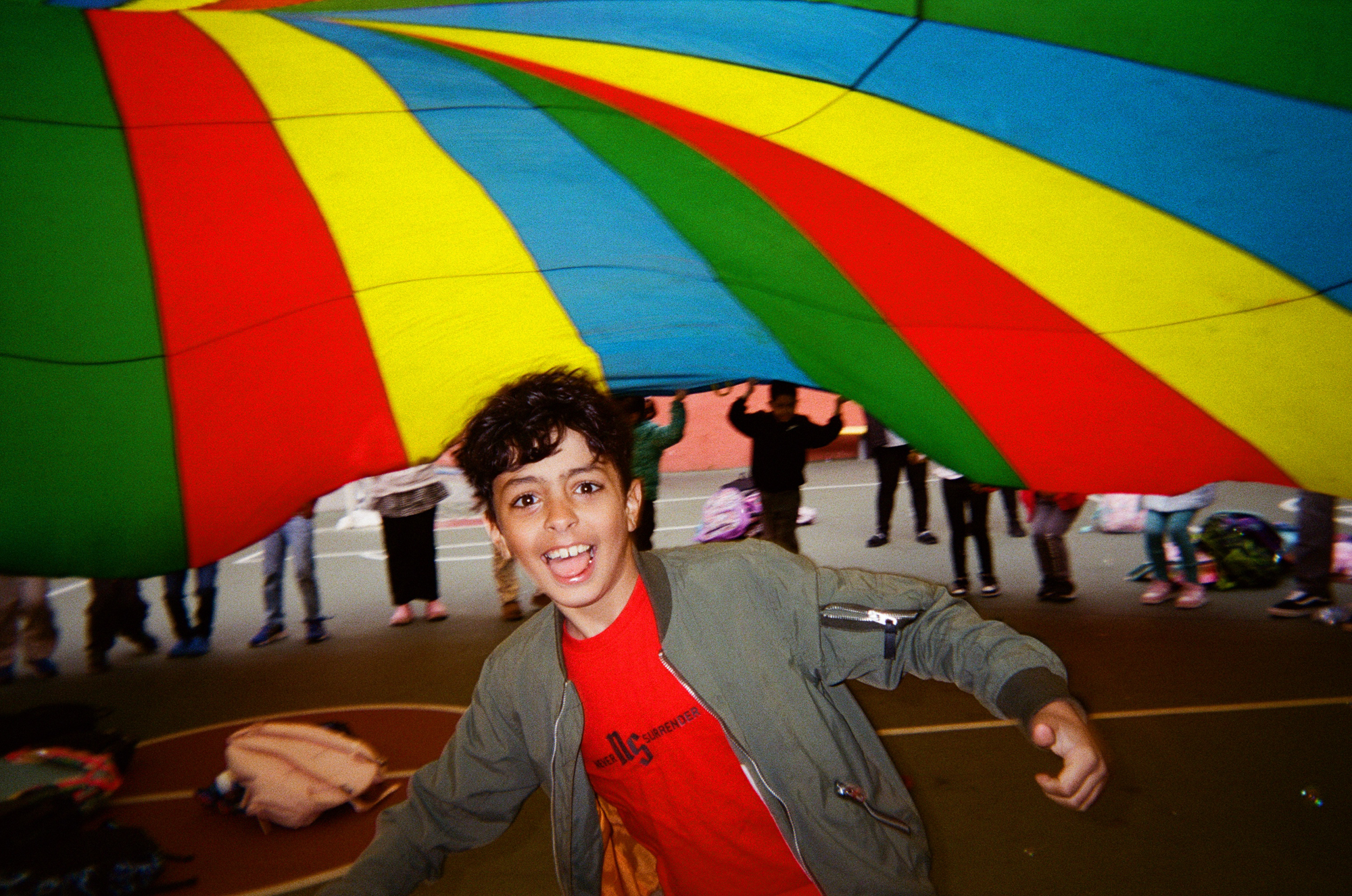
Cami Dominguez [00:05:32] You remember those giant parachutes? That you used to have in like probably elementary where all of the kids kind of line up in a circle and they kind of toss the parachute up and then they all run underneath. I don’t know how Mohammed did this, but this picture is of one of his friends under the parachute. It’s perfectly framed. Where the friend just kind of goes in front of the camera and strikes like a simple smile. But you can see all of the kids kind of holding up the parachute.
Mohammed Haidar Khaled [00:06:04] This is my friend Ahmed. He took a picture when we were inside. And my friends are all around the balloon. And these are my teachers.
Jessica Kariisa [00:06:19] Yeah, I used to love that game so much and I feel like the smile on his friend’s face that he captured is like the exact feeling I had when playing parachute as a kid.
Cami Dominguez [00:06:31] It really is this perfect encapsulation and Mohammed said it himself where it’s this is a moment that only happens in childhood.
Mohammed Haidar Khaled [00:06:38] This is like childhood. Childhood is really fun. So you’re going to miss on childhood when you get older. So I try to take as much pictures of childhood.
Cami Dominguez [00:06:48] His voice was very unique. It felt very meta to talk to such a young child who had such a perspective on life that I definitely did not have as a 10-year-old.
Jessica Kariisa [00:07:05] It’s funny, I mean, there’s so many beautiful photos in this photo essay, you know. There’s photos of flowers and just like beautiful images of like the street being captured from outside a window. But there was a really simple image that really struck me by Miguel Parra. And it was just of like a street sign, just of Turk Street, you now. And then he writes in the accompanying paragraph that people don’t realize how beautiful the Tenderloin is, you know, and it’s like beautiful because it’s his home. Can you talk a little bit more about how the Tenderloin as a neighborhood and just like a neighborhood to be proud of showed up in these photos?
Cami Dominguez [00:07:46] I wanna develop that and frame that. Because it’s so simple yet so effective of what it is literally like to be in an apartment in the Tenderloin. Like, that is uniquely an angle that you would only be able to get from someone who lives in the neighborhood. I think that that was one of the more striking things to see is also the addition of the writing aspect. It was so touching because a lot of kids did include, like, this is my home, this is the Tenderloin. Like, oh, if someone’s new to San Francisco, I want to show them that the Tenderloin is beautiful.
Jessica Kariisa [00:08:18] Yeah, and even just capturing the feeling of being a kid, like I’m thinking of Vianney Campos’ photos. She has some really fun ones of her friends sticking their tongue out and just being really playful. Can you introduce us to her and what she told you about this experience?
Cami Dominguez [00:08:38] Yeah, that was one of the more fun interviews that I had.
Cami Dominguez [00:08:48] So Vianney Campos and her best friend, Zi-Anna Jones, they did the interview together. They were like, we’re sticking through it together. We want to go through these pictures together.
Cami Dominguez [00:08:58] Why did you pick this picture?
Vianney Campos [00:08:59] I picked this picture because it means my friendship with her means a lot. We’ve been friends since TK.
Cami Dominguez [00:09:07] They let me in on all of their, like, friend group, like gossip and everything.
Vianney Campos [00:09:13] She gets jealous sometimes.
Cami Dominguez [00:09:17] A lot of the pictures were on the go. I think the picture that she has of Zi-Anna that we included in the photo essay was them walking.
Vianney Campos [00:09:25] That’s when we were walking to the park on Wednesday.
Cami Dominguez [00:09:30] That kind of ties into this passage programs that they have in the Tenderoloin. So often a lot of time after school program people will kind of guide the kids through the neighborhood and just kind of get them from point A to point B. So yeah a lot of Vianney’s pictures were her and Zi’Anna at the at the park or at like some field trip that they were going to. Regardless of destination, the two of them were for sure interlinked, so it was very sweet.
Vianney Campos [00:10:00] Oh my gosh, I didn’t know you took that.
Jessica Kariisa [00:10:07] What do they say about living in the Tenderloin.
Cami Dominguez [00:10:11] Zi-Anna, at the end of it, you know, we had just finished going through all of their pictures and just a wrap-up question that I wanted to ask them is what does living in the tenderloins mean to you?
Zi-Anna Jones [00:10:23] We’re proud of living in this neighborhood, and there’s a lot of fun places to go to. And when I grew up in this neighborhood, it’s like home to me. And I have a lot family.
Cami Dominguez [00:10:41] That is so easily reflected in the pictures that they took because on top of taking pictures of each other, they were in conjunction of going to these parks together. It really is from a child’s perspective, it’s a certain innocence of, this neighborhood to me is my friends and the parks that I go to.
Jessica Kariisa [00:11:08] Yeah, how does having that experience with the kids, seeing their photos, seeing their reaction to their photos. How does that square with the conversations that we often hear about the Tenderloin, like around homelessness or drug addiction, like how do those two things sort of match up for you?
Cami Dominguez [00:11:28] I don’t deny that the neighborhood has its issues. I wasn’t gonna be surprised if the kids did happen to include some of that like in their pictures. Surprisingly though, none of them did. These were easily probably over like 400 pictures that we got back. None of those depicted those harder parts of the neighborhood, which doesn’t necessarily mean that the kids aren’t aware of it, but I think that that is also a part of just growing up in the neighborhood is that they see those as like, I don’t know, their neighbors. I think one of the more refreshing parts of this story is that it really does differ from that main narrative that we see coming from the Tenderloin. I think the last time I checked, there was over 600,000 views on the KQED Instagram post alone. And yeah, all of the comments, oh my god, the comments. There was, I think, the ones that touched me the most were kids that grew up in the Tenderloin, seeing the ways that people were just like, oh, more of this, we want more of these, or it’s like, yes, people want to hear from the community. And I hope that this is something that other journalists like take into consideration and kind of, you know, letting communities be able to tell their stories.