Ericka Cruz Guevarra [00:02:31] And you went to go visit one such farm out in Morgan Hill. Can you tell me a little bit more about where you went and who you met when you went out there?
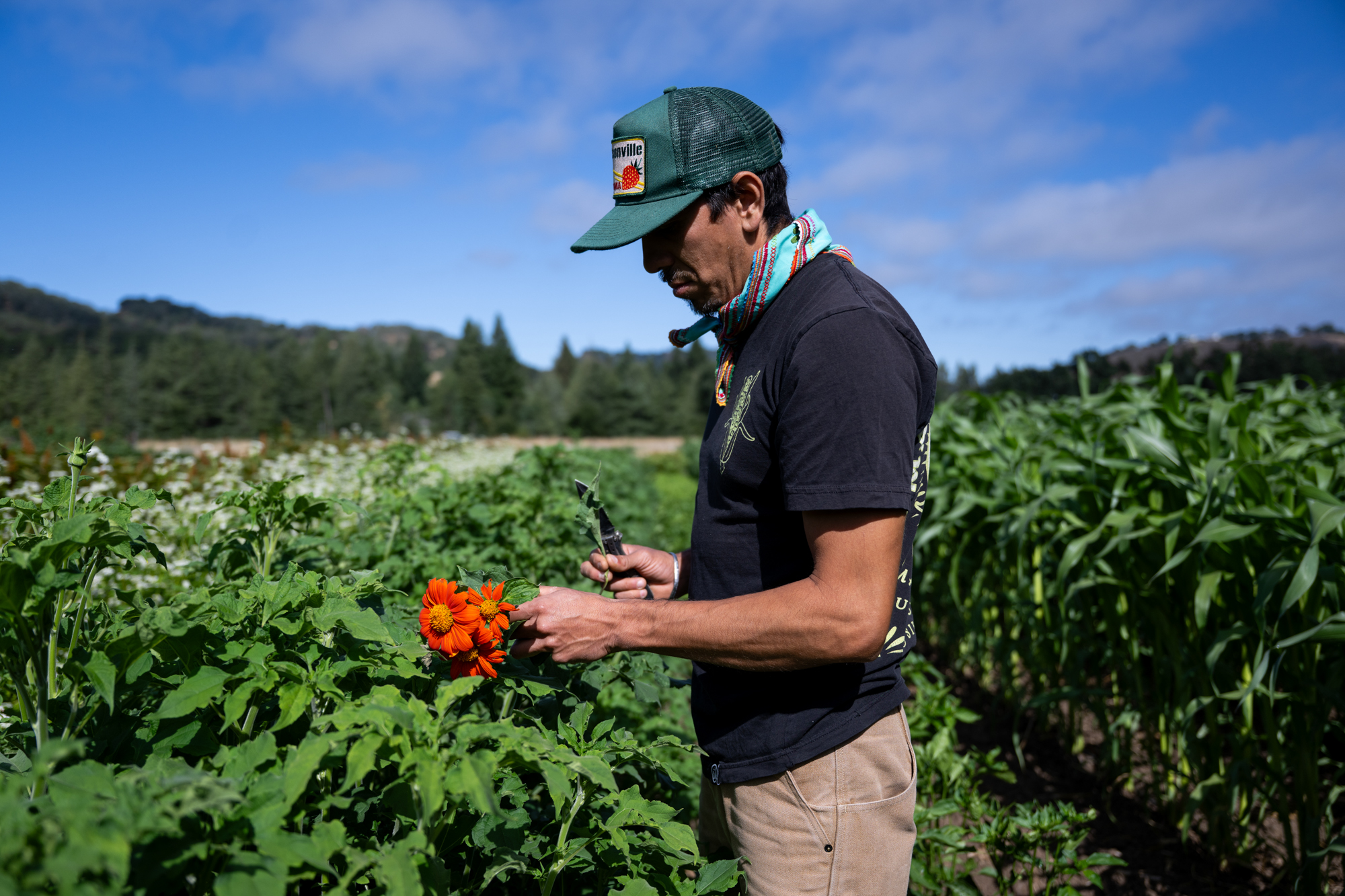
Sarah Mohamad [00:02:43] Yeah, I went to visit a small farm called Three Feathers in Morgan Hill.
Héktor Calderón-Victoria [00:02:49] We’re on about five acres here with the house included, and like I said, we try to utilize this space for several…
Sarah Mohamad [00:02:57] I met the co-owner, Héktor Calderón-Victoria, who’s also a farmer there. He co-founded this farm with his business partner Dilip Sharma, and together they’re growing crops from their Mexican and Indian heritages for communities in the Bay Area.
Héktor Calderón-Victoria [00:03:12] This beautiful corn that we planted this year is a green Oaxacan.
Sarah Mohamad [00:03:20] Beans and squash alongside okra, garlic, tomatoes, cucumbers, flowers.
Sarah Mohamad [00:03:30] Hose sunflowers are really, really beautiful. How long does it take to grow that big, by the way, to keep them seed?
Héktor Calderón-Victoria [00:03:34] I mean, we put those in like a month and a half ago.
Sarah Mohamad [00:03:40] It was really nice, you know, I was there in Morgan Hill early in the day and it was one of those odd days where it was really foggy and I felt like stepping into my grandfather’s garden from my childhood.
Ericka Cruz Guevarra [00:03:54] Tell me a little bit more about Héktor and his story. How did he get to starting Three Feathers Farm? Like, what is his story?
Sarah Mohamad [00:04:05] So Hector actually has about almost a decade experience of farming. He’s never owned a farm before until about three or four years ago, but he’s really inspired by his great grandfather, the main person in his community in Mexico, providing food.
Héktor Calderón-Victoria [00:04:22] He grew corn and had silos of corn that would be provided to the community. He was also the rancher that provided milk and cheese and meat products.
Sarah Mohamad [00:04:34] And so he wants to continue that legacy of farming in his family and sort of provide for the communities he’s living with now.
Ericka Cruz Guevarra [00:04:43] When you say small, give me a sense of like the size of a small form, I guess.
Sarah Mohamad [00:04:51] In regions like where Morgan Hill is in Santa Clara County, like half of all farmland are on parcels of 40 acres or less. And so that’s like the definition of a small farm. Three Feathers in itself was five acres. So we’re talking about a very small space that can grow, you know, just a limited variety of crops.
Ericka Cruz Guevarra [00:05:11] Well, you mentioned that Héktor and his business partner are growing things from their traditional Indian and Mexican heritages. So what is typically done with the food that is grown?
Sarah Mohamad [00:05:27] So like many small farms in the Bay Area, a lot of the food is supporting under-resourced communities through food banks, schools, or food hubs.
Héktor Calderón-Victoria [00:05:39] Normally distribute a lot of our produce to food banks, food hubs, and also unified school districts, which is one that we do here is the Morgan Hill Unified. And yeah, this is, this
Sarah Mohamad [00:05:55] But a lot of these programs are dependent on federal or state level support in order to get them to these underserved communities.
Ericka Cruz Guevarra [00:06:10] For small farms like Héktor’s, federal funding has played a huge role in ensuring that food banks and schools can actually buy his produce at a fair price. But in March, President Trump’s Department of Agriculture canceled more than a billion dollars worth of funding for programs that help schools and food banks buy local produce. One of them is called the Local Food Purchase Assistance Program, or LFPA. And over the last few years, it made a big difference.
Sarah Mohamad [00:06:49] The LFPA program was initiated by the Biden administration in 2021 as part of the American Rescue Plan to really support local farms and food systems impacted by the pandemic. The program which ran through the USDA purchased local foods from small and underserved farmers and then distributed them to food banks, schools and other nutritional assistance programs. So this started in 2021, but it went on. A little bit beyond the height of the pandemic to just make sure that the food system is still stable. The Farms Together program, part of the local food purchasing assistance has supported over 500 farms in California, 35 participating food hubs, and have distributed overall over 8 million pounds of fruit and vegetables through food hubs. So we can really see from these numbers how much of an impact the money has had to really support. Our local small farms and also provide fresh produce to communities that really need it. And so now for farmers like Hector who have relied on this funding to really build those relationships with food banks, the absence of this money will be a loss of income and also market opportunity for them.
Ericka Cruz Guevarra [00:08:08] I mean, Sarah, why is the U.S. Department of Agriculture, which ran this program, why are they no longer choosing to fund it?
Sarah Mohamad [00:08:18] A USDA spokesperson said a few months ago in a statement that these programs created under the former administration no longer effectuate the goals of the agency.
Ericka Cruz Guevarra [00:08:36] I know you talked with a farmer in Pescadero about what the LFPA really allowed small farms to do. Can you introduce me to Veronica and tell me what she says about that?
Sarah Mohamad [00:09:04] Yeah, I spoke with Veronica Mazariegos-Anastassiou. She runs Brisa Ranch in Pescadero, and she told me how precarious it all feels now that that program has been terminated.
Veronica Mazariegos-Anastassiou [00:09:16] It meant a lot to know that the food that we were growing was going to a community that probably would not be able to access the food otherwise.
Sarah Mohamad [00:09:26] The funding she shares allowed them to really work with food banks like SF Marin, Second Harvest of Silicon Valley and other Bay Area food banks.
Veronica Mazariegos-Anastassiou [00:09:37] And so right now there’s a lot of work to try to figure out if there is a way of appropriating funding for this. And I think the institutions having seen the value in working with farms and food hubs like ours are also trying to figure out like if there are alternative sources of funding.
Ericka Cruz Guevarra [00:09:58] I mean, is there any help on the way for small farms, Sarah, either at the state level or at the federal level?
Sarah Mohamad [00:10:07] So, AB 524 is a brand new bill in the state legislature, and it’s called the Farmland Access and Conservation for Thriving Communities Act. The bill basically sets up a program to help small, beginning, and historically underserved farmers get access to long-term farmland leases or ownership. And this is huge, right? One of the biggest barriers we’ve heard about from farmers like Hector and Veronica is land access. So if farm owners don’t know You know, if they can stay on the land for more than a year or two, it’s nearly impossible to invest in infrastructure or build healthy soil. So AB 524 is the first real statewide attempt to fix that. Advocates are hopeful that because of the strong bipartisan support for programs like these that there will be more funding in the future. It all depends on Congress, but it’s hard to tell right now.
Ericka Cruz Guevarra [00:11:00] Well, I wanna go back to Héktor at three feathers here. How does his farm plan to deal with this loss in funding?
Sarah Mohamad [00:11:11] Héktor is really hopeful. He is hoping that in the future, there’s more support on both the federal and state levels for small farms to really grow their business and to flourish in their communities.
Héktor Calderón-Victoria [00:11:25] It’s a public service that farmers provide, and how do we change that paradigm amongst our larger community and our society so that our younger generation will say, yeah, I want to become a farmer. It’s not romanticizing it either, right? It is hard work. Nothing really comes out of doing something that’s easy. It really is out of something that is hard that you gotta keep doing day in, day out.