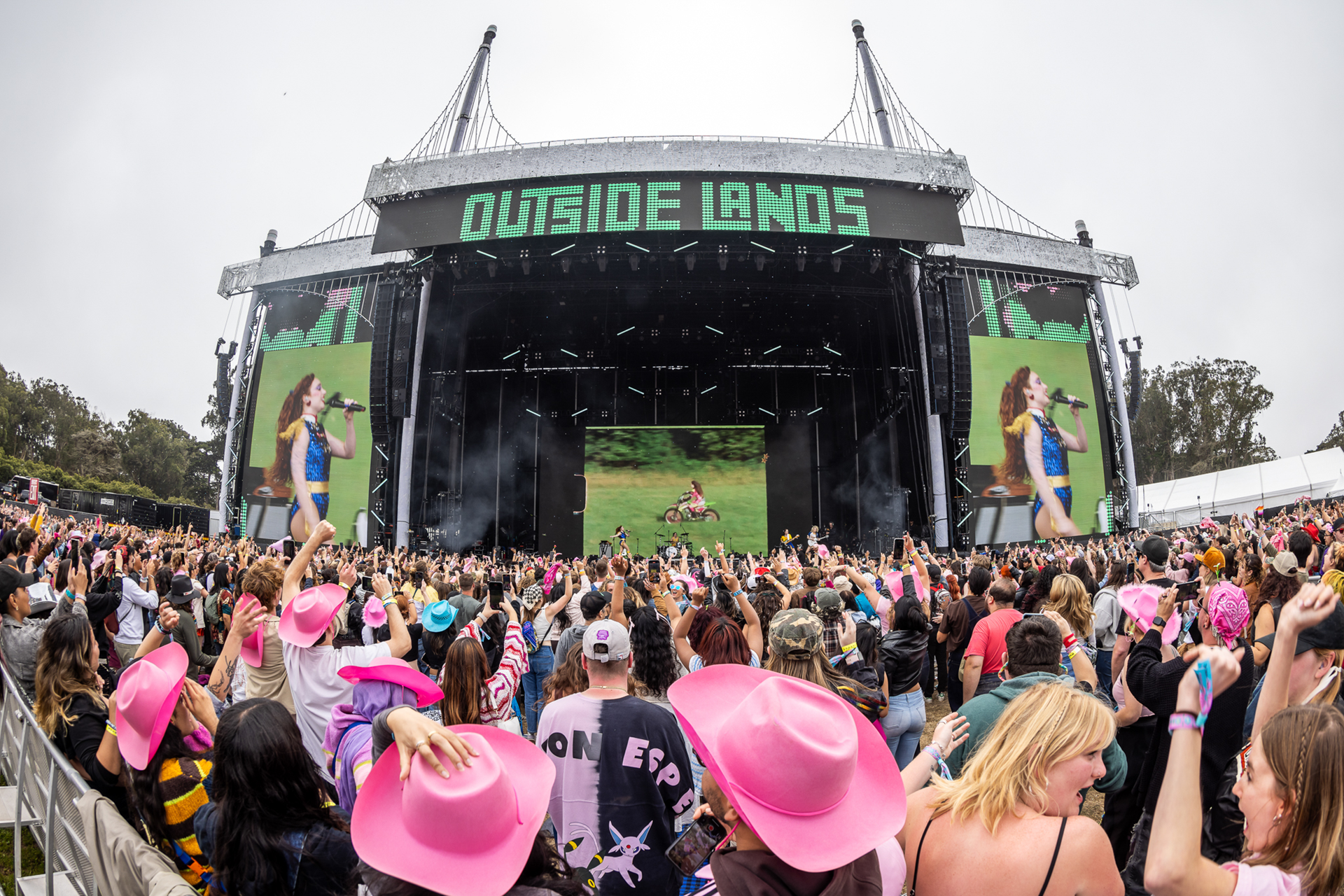
Music festivals in the Bay Area are upon us. And it takes a lot to leave no trace after a 3-day festival like Outside Lands.
As Golden Gate Park prepares for another music event this weekend, SFGate’s Melissa Cho takes us behind the scenes at Outside Lands, where the majority of waste is diverted from landfills.
Some members of the KQED podcast team are represented by The Screen Actors Guild, American Federation of Television and Radio Artists. San Francisco Northern California Local.
Links:
- This is Where Your Trash at Outside Lands Goes
- LaRussell and Good Compenny Present: A Bay Area Music Showcase Tickets!
Ericka Cruz Guevarra [00:01:16] I’m Ericka Cruz-Guevara and welcome to The Bay, local news to keep you rooted. I have this vivid memory of going to a big music festival and watching one of my friends pick up this empty metal water bottle that someone had just tossed on the ground. And she was pretty irritated when she swooped it up. “That’s how people twist their ankles out here,” I remember her saying. And I’m grateful for people like her at music festivals where it’s pretty common to see trash sprinkled on the grounds after the crowds disperse at the end of a performance. And with music festivals upon us here in the Bay Area, it’s easy to take for granted all that it takes to leave no trace after a big event like Outside Lands.
Melissa Cho [00:02:13] By the next morning I come back, the park looks spotless. It’s like it’s day one of the festival again.
Ericka Cruz Guevarra [00:02:21] As Golden Gate Park prepares for yet another big concert this weekend, SFGate’s Melissa Cho takes us behind the scenes at Outside Lands to see what happened to all your waste.
Melissa Cho [00:02:43] From the most recent data that Outside Lands has provided, last year they’ve produced 321,000 pounds of waste.
Ericka Cruz Guevarra [00:02:51] Melissa Cho is a social video producer for SF Gate. She’s also known as SF Gate Girl.
Melissa Cho [00:02:58] Which I’ve done my calculations, and that’s roughly 71,000 chihuahuas. So that’s a lot of little dogs that are going into — I have nothing against them. But just for some simple calculation, that’s lot of dogs.
Ericka Cruz Guevarra [00:03:17] How is that trash generated? I mean, I’ve been to Outside Lands before. There’s a ton of vendors selling food and stuff like that, I imagine. Like, what kinds of trash are we talking about?
Melissa Cho [00:03:28] Lots of different types. So there’s a lot of the compost trash that gets produced by the vendors and the customers buying the food. So all of the utensils, the bowls, the plates, the cups, the food, you know, if you don’t finish your food, all of that goes into compost. And then you’re talking about wood, a lot a wood for the structure of a lot of buildings there, you now, a lot, they use wood material. There’s metal that gets produced. There’s plastic sheeting that gets produced. There’s a lot of cans and bottles and there’s also the waste that people bring into the festival because, you know, sometimes you want to bring your own snack, you know. There are different streams of waste definitely coming from not just inside the festival but outside.
Ericka Cruz Guevarra [00:04:16] And how, over the years, has Outside Lands tried to tackle all of the waste that the festival produces?
Melissa Cho [00:04:26] That’s a great question because Outside Lands has actually tackled the issue of sustainability since its inception in 2008. They from the beginning partnered with a company called Clean Vibes and the first ever festival 2008 for those who attended that first festival the headliners were Tom Petty, Jack Johnson, and Radiohead and back then 64% of the total waste was diverted from landfill. Fast forwarded now, it’s now 89% from our most recent data in 2024.
Ericka Cruz Guevarra [00:04:56] Yeah, and you actually went to see for yourself how this all works. Who did you meet?
Melissa Cho [00:05:03] Yes, I met Anna Barofsky, she is the co-owner of Clean Vibes.
Anna barofsky [00:05:06] We’ve got over 470 volunteers that are part of our waste diversion efforts here at Outside Lands to help make the magic happen.
Melissa Cho [00:05:16] Clean Vibes is responsible for all things trash, compost, recycling at not just Outside Lands but numerous festivals across the country.
Anna Barofsky [00:05:24] So, at night we get all the big stuff up and then in the light of day we get every last little candy wrapper, cigarette butt, every tiny little thing to make sure that when the gates open today it looks just as good as when they opened yesterday.
Melissa Cho [00:05:37] It is certainly peak season for Anna’s team in San Francisco. She’s probably at Golden Gate Park now, still getting ready for the Zach Bryan Golden Gate park festival this weekend. And then there was Outside Lands this past weekend. Before that there was Dead and Co the previous weekend. And then, there was also Lollapalooza, which Clean Vibes was also a part of.
Ericka Cruz Guevarra [00:05:57] Oh, wow, she’s busy.
Melissa Cho [00:05:57] She is busy. So it’s a nationwide operation and she’s not even based here in San Francisco. She’s actually based in North Carolina. So she comes here for the summer.
Ericka Cruz Guevarra [00:06:10] What did you see in terms of, like, how this all works? Like, what exactly are volunteers doing with the waste at Outside Lands?
Melissa Cho [00:06:18] At around, I would say, 11.30 a.m., we golf carted to where all the volunteers were doing their morning debrief session, so that’s when the morning crew comes in.
Anna Barofsky [00:06:29] Yeah, so these guys are checking in for an 1130 shift. They work, I believe, 1130 to five. And then we’ve got another shift that starts at 430, works until 1030. And then, we also have a big group of nightly after show cleanups.
Melissa Cho [00:06:44] The volunteer spots, they fill up in a week or two. So there’s like a high demand for volunteers to want to work at the festival because I think the main pro is that you get to go for free to the festival. But I’ve noticed that there were a lot of repeat volunteers and a lot of them were just really excited.
Lauren Schuck [00:07:00] Awesome to be able to interact with more people in a different way.
Melissa Cho [00:07:04] So I spoke to two veteran volunteers, one of them though, her name is Lauren Schuck, she’s been volunteering for Clean Vibes for five to six years.
Lauren Schuck [00:07:13] Keep the Golden Gate Park really clean and nice and hopefully have Outside Lands continue returning back here.
Melissa Cho [00:07:26] Then after that, we went to the cabanas where they had, where I saw recycled carpet. Then we golf carted to this entire area of Golden Gate Park that’s not available and accessible to the general public.
Anna Barofsky [00:07:43] All right, so here we are at Middle Earth. Here’s some of my team who drive around the site collecting compost toters. And so they’ve just collected these from some of the food vendors on site. Oh, wow. They’re gonna get ready to dump a few.
Melissa Cho [00:07:59] That’s where she took me to Middle Earth. It’s their sorting, their main sorting facility. I saw all the mounds of trash, all the compost, the landfill, the recyclables, the plastic sheeting, these huge dumpster bins, and there’s like a whole team of people. So Clean Vibes, they also partner with another Bay Area organization called Green Mary. Their crews together help sort out all the trash because believe it or not, sometimes people don’t dispose their trash properly in the proper bin. So if you don’t do that, then there are people who have to manually do it for you.
Anna Barofsky [00:08:42] Oddly enough, one of the things people get most confused about in the compost, believe it or not, food. Food is, in fact, compost, and it’s amazing how many people question that.
Melissa Cho [00:08:57] So I see like tables of people, they each have their desk and then below their desk they have the three bins and then they’re sorting through the trash bags to see like okay this one is not compostable I have to fish it out of the compost bag.
Anna Barofsky [00:09:14] That’s the sound of recycling.
Ericka Cruz Guevarra [00:09:19] What’s like the craziest thing they’ve had to like fish out of the bins.
Melissa Cho [00:09:25] I asked Anna that question and I think because she’s worked so many festivals it’s all a blur to her so that’s what she said. She works a lot of like camping festivals and she says that we won’t even go into that like on what she’ll find. But when I asked Lauren on what’s the craziest trash they fished out you know what they said fake IDs, a lot of fake IDs at Outside Lands.
Ericka Cruz Guevarra [00:10:08] Besides trash too, how else has Outside Lands tried to make the festival more sustainable?
Melissa Cho [00:10:14] The artist dressing rooms and the towers are solar powered. Outside Lands, they have a refillable water station, which I see a lot of people using. So I wasn’t able to cover this in my video due to time constraints, but Extra Food is a Bay Area nonprofit. They come in at the end of the festival every night, and they take all the surplus food and distribute it amongst people and communities who are facing food insecurity so that no food goes to waste. So that’s a really neat touch.
Ericka Cruz Guevarra [00:10:45] Just all around the Bay Area? Yeah, yeah. That’s amazing. How does someone like Anna talk about the ultimate goal here? Why put in this much work?
Melissa Cho [00:10:58] She told people at the end of our interviews that we want to leave the park cleaner than when we first found it. What’s interesting is that throughout the parks that there are so little landfill bins. So most of the bins that you see are either recyclables or compostable bins. And because she says that, okay, we should be producing so little waste that, you know, our landfill should certainly be the minority of all the waste.
Anna Barofsky [00:11:26] So obviously as you can see everywhere that we have receptacles, we never put a landfill without a recycling and compost next to it. And we take that actually a step further that a lot of places we don’t put a landfill at all because there should be so little landfill waste out here.
Melissa Cho [00:11:42] I certainly can feel that the work that she’s doing is very meaningful. And when I posted that video, it was, I mean, it was just a 90 second story that I did. The response was so positive. People were just saying like, how could I volunteer for the next one? Or like, thank you guys so much for what you do. So I called Anna about that and she was thrilled.
Ericka Cruz Guevarra [00:12:05] How much of a difference does the work that Clean Vibes is doing, how much of difference does it make?
Melissa Cho [00:12:13] I think it makes a huge difference for the festival goers and for just the image of San Francisco. I mean, even though I was going for work, I was still going. I’m there all three days. And by the next morning I come back and clock in for work. The park looks spotless. It’s like, it’s day one of the festival again. San Francisco, I mean all these festivals, it’s a huge revenue driver. And there’s a lot of traffic coming in from different cities, even different countries. So for people to see that we can put on these wonderful, beautiful festivals and for the park to still be maintained goes to show that Clean Vibes and its team and also the City of San Francisco is truly trying to make a difference to make everyone’s experiences as pleasant as possible.
Ericka Cruz Guevarra [00:12:56] Are you thinking differently now about how you throw away your waste at festivals or big events and all that it takes to like keep them?
Melissa Cho [00:13:07] Well, not to toot my own horn, but I feel like I am generally very, I’m like a goody two shoes when I sort my waste. I think because of how well-received this story was online, I definitely think I want to lean more into this beat because there’s just so many unsung heroes behind huge large-scale operations such as this festival. And I look forward to seeing how they can continue improving and upping that percentage, you know, 89%. That’s pretty high. That is pretty high. Well, it’s a B plus, but let’s see. I’d love to see if they can get to an A minus, maybe next year or maybe when the data comes out this year.