If you want solar power in your home, you usually need to be a homeowner with a good roof and a decent amount of cash to pay up front.
But some Bay Area residents are trying out plug-in solar, which can hang from an apartment balcony, out a window, or be tented in the backyard.
Links:
Laura Klivans [00:01:44] The dream for Plugin Solar is you go to a big box store or you just look online and you click a button or you check out, you set it up and then you plug it into your wall and you start offsetting your electrical bill. The idea here is like, this makes solar available to all kinds of people. You don’t need a roof, or even if you have a roof you could just put it up in your backyard. You could hang it off of a fence or a balcony. You could even drape it out of your window and just sort of set it up according to instructions.
Ericka Cruz Guevarra [00:02:28] I know you went to see someone get some plug-in solar installed. Tell me what that was like and who you went to go meet.
Laura Klivans [00:02:36] Yeah, I went to Berkeley, to the hills, and I met Matt Milner.
Matthew Milner [00:02:42] I’m Matthew Milner, and I’m a scientist.
Laura Klivans [00:02:46] He is interested in reducing his impact on the climate. He’s a father, he has two kids, so he thinks about this.
Matthew Milner [00:02:53] Because the world is changing and so we’re just trying to make the world a better place for our kids and we wanted to get rooftop solar but it’s so expensive this kind of allows us to dip our toe in a little bit without having a huge financial cost.
Laura Klivans [00:03:10] He saw something about Plug& Solar, and he was curious. And he saw one of the organizations that was doing it was based in the Bay Area. And he was like, oh, interesting. That organization turns out to be this nonprofit called Bright Saver.
Rupert Mayer [00:03:23] Do you want a hammer to drive it in? No, I was thinking where I’m getting the shuffle. I’m just digging a little bit of a hole.
Laura Klivans [00:03:28] Two of the co-founders were there. One of them was Rupert Mayer, who was helping to do this installation.
Rupert Mayer [00:03:34] This is all the gear that we’ll be using. Oftentimes, including here, we are mounting a dedicated outlet outside the house because the break-up handle is…
Laura Klivans [00:03:44] And they had an electrician as well to make sure it was, you know, totally fine. And it took like two or three hours.
Rupert Mayer [00:03:51] You know what? I think I’ll grab another of these legs and mount it on this side. Then both sides are standing on a leg and we could fine tune…
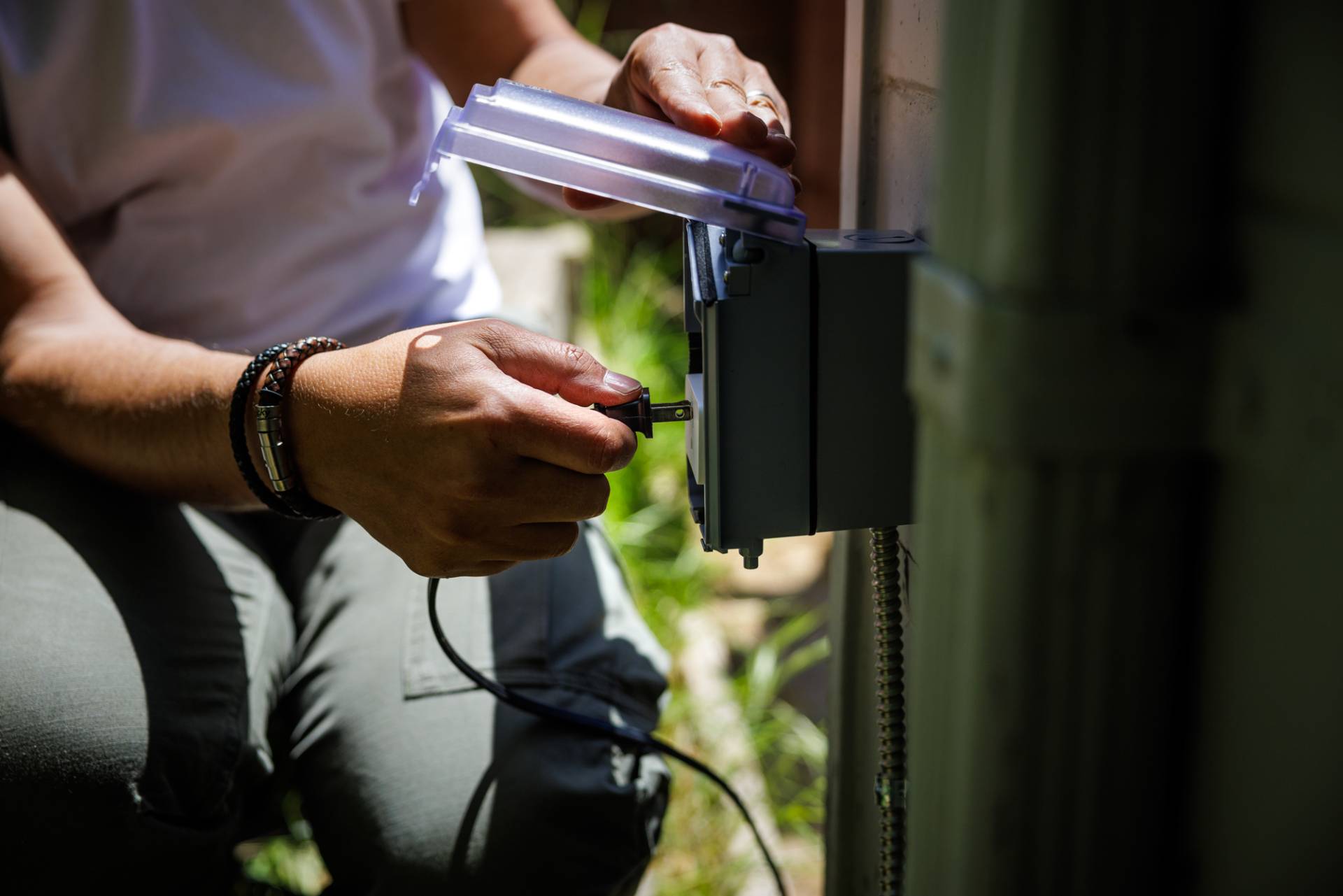
Laura Klivans [00:04:06] What it looks like is just angled solar panels against his wooden fence. They’re secured to the fence. There’s like, they dug a little bit of holes and stuff into the dirt at the bottom. So they’re secured there. And then they ran a cord through something that will convert the power from solar to something we can use in our homes. And then there’s just another cord and goes with a standard plug and they can plug it right in. So they plugged it into an outside outlet.
Rupert Mayer [00:04:32] So we will be plugging in the solar panel, big moment.
Laura Klivans [00:04:39] And then he started offsetting his bill.
Rupert Mayer [00:04:43] Are running your house on clean, free energy from your backyard. The investment aside, the marginal cost is zero.
Ericka Cruz Guevarra [00:04:56] So for Matthew, it took about two to three hours to install this thing. How much did it ultimately cost him? And also how much power is he going to be able to get out of this plugin solar?
Laura Klivans [00:05:07] Yeah, so it cost him $1,700 and that is before he’ll get 30% back from federal rebates. A lot of the cost of solar is in the labor and the installation. It generates at most 800 watts of electricity. So it could offset like a refrigerator, your phones, your laptop, your TV, some, you know, your lights. It’s around a fifth of the amount of energy that a typical California household would use.
Ericka Cruz Guevarra [00:05:40] That $1,700 that Matt Milner paid is much lower than the usual cost of rooftop solar, which can go for anywhere from $8,000 to $30,000. Supporters of Plugin Solar hope that someday, anyone could just go to a store, buy Plugin solar, and set it up themselves. And it turns out that’s not a pipe dream. And there are also other countries where this technology is actually pretty normal, right?
Laura Klivans [00:06:16] Yeah, in Germany, it’s very common. And they have built a movement that’s taken more than a decade to break through some of the barriers that exist right now for this to take off in the United States. But in Germany there are about 4 million arrays, like 4 million people or households with these.
Cora Stryker [00:06:36] We don’t want it to take 10 years like it took in Germany. We feel much more urgency when it comes to climate.
Laura Klivans [00:06:42] Cora Stryker is one of the co-founders of Bright Saver.
Cora Stryker [00:06:46] Here to jumpstart the movement, get more manufacturers into the game, competition will drive down prices, increase ease of use.
Laura Klivans [00:06:53] Their goal is to move this plug-in solar idea forward in the United States. And then there’s a bunch of other companies in this space around the country too.
Ericka Cruz Guevarra [00:07:07] So, I mean, you mentioned barriers in Germany. I imagine that might be the reason why not a lot of people here seem to have plug-in solar or even know about them. I mean why isn’t it sort of more widespread?
Laura Klivans [00:07:24] There are a lot of barriers right now in the United States. So there’s some technical barriers, but those don’t seem to be really the biggest ones. The biggest ones are, this is such a new technology, so we don’t have this written into electrical codes. You know, these codes exist for safety and for utilities to be able to plan. There are also safety standards. Like any appliance, there are risks for plug-in solar. You could overheat a wire and cause a fire or send electricity back to the grid in a way that might harm a utility worker. The companies that I talked to all had mechanisms that prevented those things from happening. There’s also what’s required from state regulators and utilities. So for example, right now in California, our state regulator and PG&E say you have to register a plug-in solar system as if it were a rooftop solar system. That’s just a decent amount of paperwork. It comes with a fee anywhere from 100 ish dollars to 800 dollars depending on how you apply and it can take some time for PG&E They say it often only takes three days But it’s a barrier and and the idea with this thing is like off the shelf plug it in. In Germany for example, the registration form is just four questions. Then you’re legit.
Ericka Cruz Guevarra [00:08:48] All this registration stuff means that plug-in solar is something of a gray area. PG&E says this process is important for safety and reliability, but supporters of plug-ins solar say it puts up unnecessary barriers. For now, Bright Saver, the nonprofit that installed Matt Milner’s plug-In Solar, is shifting its focus to education. And hopes that California and other states will update their rules to make plug-in solar easier to set up.
Ericka Cruz Guevarra [00:09:27] What would it take to make plug-in solar as easy to get as an IKEA table?
Laura Klivans [00:09:35] Just a change in the registration process and updated safety standards, updated state codes, acknowledgement, perhaps legislation. Right now, there is one state that soon this will all be allowed in, and that’s Utah. Utah passed a bill unanimously with bipartisan support. It will allow people to put in plug-in solar without registering them at all. They just have to meet safety, certifications, and electrical.
Ericka Cruz Guevarra [00:10:07] And ultimately, I mean, how much of a dent could this make in our energy consumption in California? Has anyone looked into that?
Laura Klivans [00:10:18] I read that in Germany, despite four million of these, it’s only offsets about 1% of their consumption. So why would you do it? There are a lot of reasons still.
Dan Kammen [00:10:32] Reducing our need for utility scale fossil energy one rooftop at a time or one balcony time matters.
Laura Klivans [00:10:40] Dan Kammen is an energy professor at Johns Hopkins University. He brings up some really great points.
Dan Kammen [00:10:46] I think it’s impactful on two fronts. One is every bit helps, and especially with the turmoil in the markets, finding new markets is a good thing. But more importantly, this is a behavior that’s easy to emulate.
Laura Klivans [00:11:01] You see this hanging off of someone’s window and you start talking to them about it and it signals what matters to you and your values to other people and they start to change their mind a bit.
Dan Kammen [00:11:13] And the more you learn about solar panels and electric vehicles for your home purchases, the more that you can translate that into the business world. And that education is invaluable.
Ericka Cruz Guevarra [00:11:25] Yeah, I do think if I saw a plug-in solar thing leaning on my neighbor’s backyard fence, I would ask some questions.
Laura Klivans [00:11:35] Yeah, and I think one thing that’s neat about this too is we feel so little agency in climate change. We really are feeling the effects already. And it’s just so hard to answer, what can I actually do? And this actually feels like something you can do, and it would help a little bit.