This is a computer-generated transcript. While our team has reviewed it, there may be errors.
Sydney Johnson [00:01:41] I wanted to focus on families because many of them already live in shelters and are not visible on the streets and are are not necessarily part of this population that the city is putting a lot of focus on right now.
Ericka Cruz Guevarra [00:01:56] Sydney Johnson is a reporter for KQED.
Sydney Johnson [00:01:59] They end up getting stuck in shelters and have had time limits for how long that they can stay there. And that can be a really tedious, onerous process to go through that extension while you’re waiting for housing to come through.
Ericka Cruz Guevarra [00:02:16] I know you met a family living in a shelter. Can you tell me a little bit about Maritza Salinas?
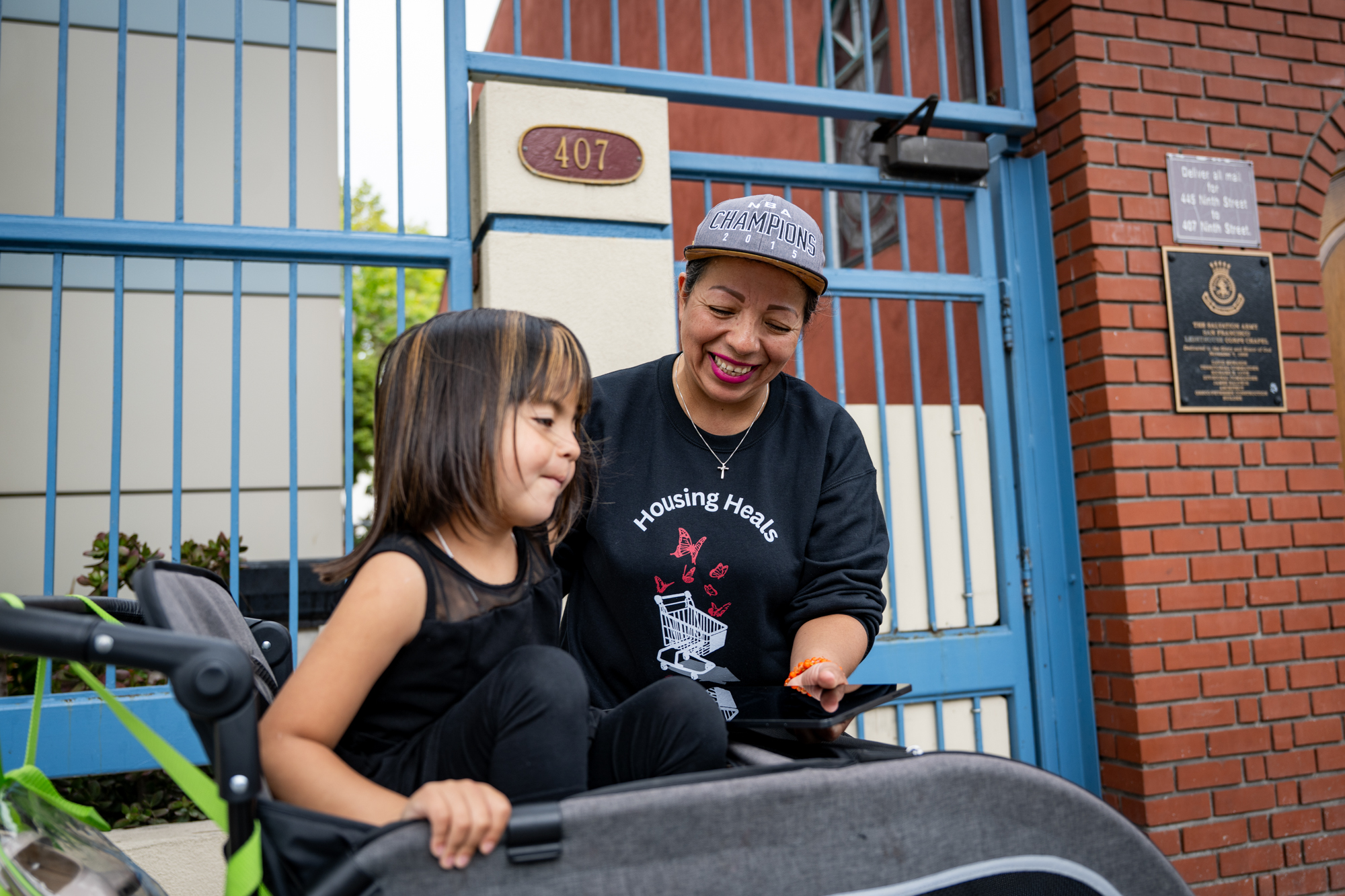
Sydney Johnson [00:02:22] Maritza is a mother of three and she’s living in one of the city’s homeless shelters for families. She’s originally from El Salvador, but moved to the Bay Area when she was 19 and has lived in San Francisco for many years now.
Sydney Johnson [00:02:38] Maritza, I’m curious what a, just like a typical day is like for you and your family.
Maritza Salinas [00:02:45] For me, as a single mom, it’s many things daily. And sometimes I am blessed to accomplish one thing.
Sydney Johnson [00:02:53] I spent some time with her and her two littlest ones, Matthew who’s six and Renee who’s four. And you know, they’re just adorable little kids.
Maritza Salinas [00:03:04] We get up daily, shower first thing, prayer, and we make food. We share kitchen and community so you have to get up very early when nobody else is awake so you can have time to cook.
Ericka Cruz Guevarra [00:03:28] How did she and her kids end up in a shelter?
Sydney Johnson [00:03:33] So Maritza became homeless after leaving an abusive relationship in 2022. And this is unfortunately a pretty common experience for many mothers and families who are in the city’s shelter system. And it’s also a reminder of why shelters are important. People often need a place to go, sometimes immediately, when they know it’s time to leave their situation or if they don’t have a choice and are evicted. So she now lives in a shelter for families in the south of Market. It’s one of several shelters she’s bounced around from, including shelters specifically for domestic violence survivors. But these place often have time limits for how long you can stay. And, you know, she’s grateful to have the shelter and says the staff there are helpful and kind to her kids and that her children have other kids to play with there too. But it’s been a really unstable situation bouncing from shelter to shelter, and they’re really just looking for a home to stay in.
Maritza Salinas [00:04:40] I have two extensions with Harbor House, which that comes to six months. And when those six months ends, that’s the question, right? Where we gonna go? What we gonna do?
Ericka Cruz Guevarra [00:04:57] Shelters aren’t meant to be forever homes, but affordable forever homes are just really hard to come by. At the same time, the city is focusing more on moving people off the streets and into these shelters, and they need more open beds to do that. So in December, San Francisco decided families could only stay in shelters for 90 days. And if they wanted to stay longer, they’d have to apply for it. When this rule was announced, families like Maritza’s pushed back because it felt like they were being punished for a system that just doesn’t move people into permanent housing fast enough.
Sydney Johnson [00:05:42] The shelter she’s staying at right now, she currently has a 90 day limit before she can apply for an extension. But at the last shelter she was at, she did reach that end of the term. And so she was waiting for an expansion to come through. She said it was an extremely confusing process.
Maritza Salinas [00:06:02] When I was being pushed away from Hamilton without an extension and it’s like y’all saying it’s so easy, it sounds so easy but I’m being pushed away, like what I’m supposed to do you know like where do I need to go?
Sydney Johnson [00:06:15] Families and advocates for people who are unhoused said this was incredibly stressful to essentially just be chasing application after application because they essentially were still just waiting for rapid rehousing vouchers or permanent housing placements to come through. For Maritza, she has stayed in shelters, but she has also stayed in cars. She has had her kids stay with family members. She stayed in hotels, and all of that change and disruption can be really taxing and demoralizing as you’re trying to move forward.
Ericka Cruz Guevarra [00:07:03] That said, we are talking about this because changes are coming to these shelter extension rules in San Francisco, right?
Sydney Johnson [00:07:12] Right. So the city recently announced that instead of requiring people who are in shelters to apply for extensions every 30 days, they now get about three months or 90 days at their shelter stay. You know, that still requires going through an application process, but it’s a bit more of a compromise, I think, between people in the city who are trying to deal with a limited number of beds and move people in and out of shelters. But also extending some grace to the families who are there and already stuck waiting for a housing opportunity to come through and don’t necessarily have somewhere else to go besides another shelter if that extension is not approved.
Ericka Cruz Guevarra [00:08:05] Why is this change happening? Like, how did it happen?
Sydney Johnson [00:08:09] The change came about really after a lot of activism and outcry from families themselves. That was actually how I met Maritza. She was one of many mothers who have been showing up to City Hall and telling city officials that this 30-day extension process was extremely taxing and telling them, you know, we don’t want to stay in shelters forever. We want housing. But it’s really stressful to have to go through this extra process week after week, month after month of ensuring that you can just stay where you’re at while you’re waiting for housing to come through.
Maritza Salinas [00:08:50] For my autistic kid. This is a challenge, like transfer from one shelter to the next shelter, there’s no stability. There is a lot of behavior issues because of that. It’s a lot a stress for him and for us.
Sydney Johnson [00:09:11] And the city listened. And they said, okay, we’ll space that out a bit more, give you a little more breathing room while other parts of the homelessness system are hopefully catching up.
Ericka Cruz Guevarra [00:09:41] I want to talk a little more about this instability in shelters for families, because obviously the best case scenario is that when you get sent into a shelter, you then get eventually moved into some sort of permanent, more stable housing. But how often is that even happening for families like Maritza’s in San Francisco?
Sydney Johnson [00:10:07] A report from March of this year found that just 13% of people in the city’s shelters exited to permanent housing. That was overall. And for families specifically, it was a little higher, around 21%. But that’s still, you know, less than a quarter of families who are leaving shelters for housing. Many are moving back into other shelters, or they are deciding to stay in cars or doubling up with friends and family. For the majority, the city just doesn’t know. They might reach the end of their time limit at the shelter and then exit the city’s system of care entirely.
Ericka Cruz Guevarra [00:10:47] Why are these numbers so low? Does it really all just come back down to the fact that there is simply not enough affordable housing in California and in San Francisco?
Sydney Johnson [00:10:58] That’s certainly a big part of it, and that’s what Christin Evans, who is a member of the city’s Homeless Oversight Board, shared with me.
Christin Evans [00:11:07] When people come into shelter, they’re seeking assistance to secure stable housing. They don’t want to remain in the shelter. They actually want to exit to a permanent housing situation. We have limited amount of funds that are going to rapid rehousing vouchers and permanent supportive housing placements and there are very long wait lists for people to get resources.
Sydney Johnson [00:11:28] It’s also some upstream effects too, like the city can also prevent homelessness by helping families who are facing eviction, providing legal aid to folks who maybe are going through a messy divorce that could cause them to lose their housing. You know, there are so many ways that people can become homeless. And so, yes, it’s certainly a deficit of affordable housing, specifically for people who have little to no income.
Christin Evans [00:12:03] I’ve been working with a senior that has three school-age children and he just doesn’t make enough money. So this is the problem. We just have a lack of affordable housing, especially if you had two or more children. It’s really hard to find housing that would be within minimum wage or low wage workers.
Sydney Johnson [00:12:29] There are people who are just living on razor thin margins and that can also be a really powerful place where the city can address homelessness before it reaches that point, before someone needs a shelter bed.
Ericka Cruz Guevarra [00:12:47] Coming back to Maritza here, what does she tell you about how this change to shelter stays and extensions are gonna help her in her daily life?
Sydney Johnson [00:13:00] Yeah, I mean, Maritza, I think is pretty clear-eyed about it. She’s grateful that she has, you know, one less thing that she had to do every four weeks or probably even more frequently than that, you know by not having to apply for a shelter extension so often.
Maritza Salinas [00:13:20] This is a new thing for me, and I’m just gonna follow through. I don’t know yet how is it gonna go.
Sydney Johnson [00:13:31] But she also recognizes that staying at the shelter is not the end goal for the city or for her and her family. Quite simply, she wants a home for her children. She is on the wait list for an apartment right now and has applied for housing vouchers and other support, but she’s still waiting to hear back. And in the meantime, her stay at the shelter is limited. And even though she can request extensions and doesn’t have to do so quite as frequently now, she still doesn’t wanna get caught there and wants to build a stable life for her kids.
Maritza Salinas [00:14:11] It will be nice for people to understand that we are humans, and it’s not that we want to be there. It is a process for us to move forward, and it will be for people to really see the children, our children, and that they have compassion and love for them.
Ericka Cruz Guevarra [00:14:30] I mean, you cover homelessness in San Francisco. You’ve been covering Mayor Daniel Lurie’s approach to homelessness. I’m curious what takeaways you might have on the challenges that families in particular are facing around homelessness in Francisco.
Sydney Johnson [00:14:49] You know, the city has put a lot of emphasis on clearing street homelessness, particularly for people with substance use disorder. And those people do need help, but families like Maritza’s, like we talked about, often go unnoticed. You know, her kids are in the city’s public schools. Her youngest daughter is starting kindergarten this fall. She’s active in her community and you just probably wouldn’t know she’s homeless if you saw her just picking up groceries at your local store. And at the same time, advocates say that families like hers are losing some attention and quite literal like material resources. In the city’s current fight over homeless funding and with this priority on clearing tents and sidewalks. The city is still planning to build more shelters, to be clear. The mayor’s office has said that they have about 1,000 shelter beds that they were planning to open by the end of the year. We’ll see if that actually comes about. It’s worth pointing out that many of these families, the city’s even quote unquote affordable housing doesn’t cut it. Vouchers and subsidized housing are really important and those are also limited resources. Because without places where people can move on to, the city kind of creates this bottleneck in the shelter system and beds become limited too.
Ericka Cruz Guevarra [00:16:28] Well, Sydney, thanks so much for sharing your reporting with us. I appreciate it.