Katrina Schwartz in scene: Wow, you walk in off the street and it’s just incredibly different inside this building, the Berkeley City Club. It’s got these almost gothic-looking arches, it’s a grand feeling.
Katrina Schwartz: The building is an eclectic mix of styles…. designed by one of the most famous female architects ever – Julia Morgan.
Claudia Falconer: Often the question is can you tell right away when you see a Julia Morgan building? And she was so versatile that she basically could design a building in any style the client wanted.
Claudia Falconer: My name is Claudia Falconer. I’m like a Julia Morgan groupie. A fanatic.
Katrina Schwartz: Claudia is also an architect herself, and sits on the board of the Berkeley City Club Conservancy.
Claudia Falconer: Anything about her is just fascinating to me.
Katrina Schwartz: The Berkeley City Club, is one of the more than 700 buildings designed by the famed Bay Area architect.
Claudia Falconer: She was out of her time. She was forging her own path, but in a very dignified way.
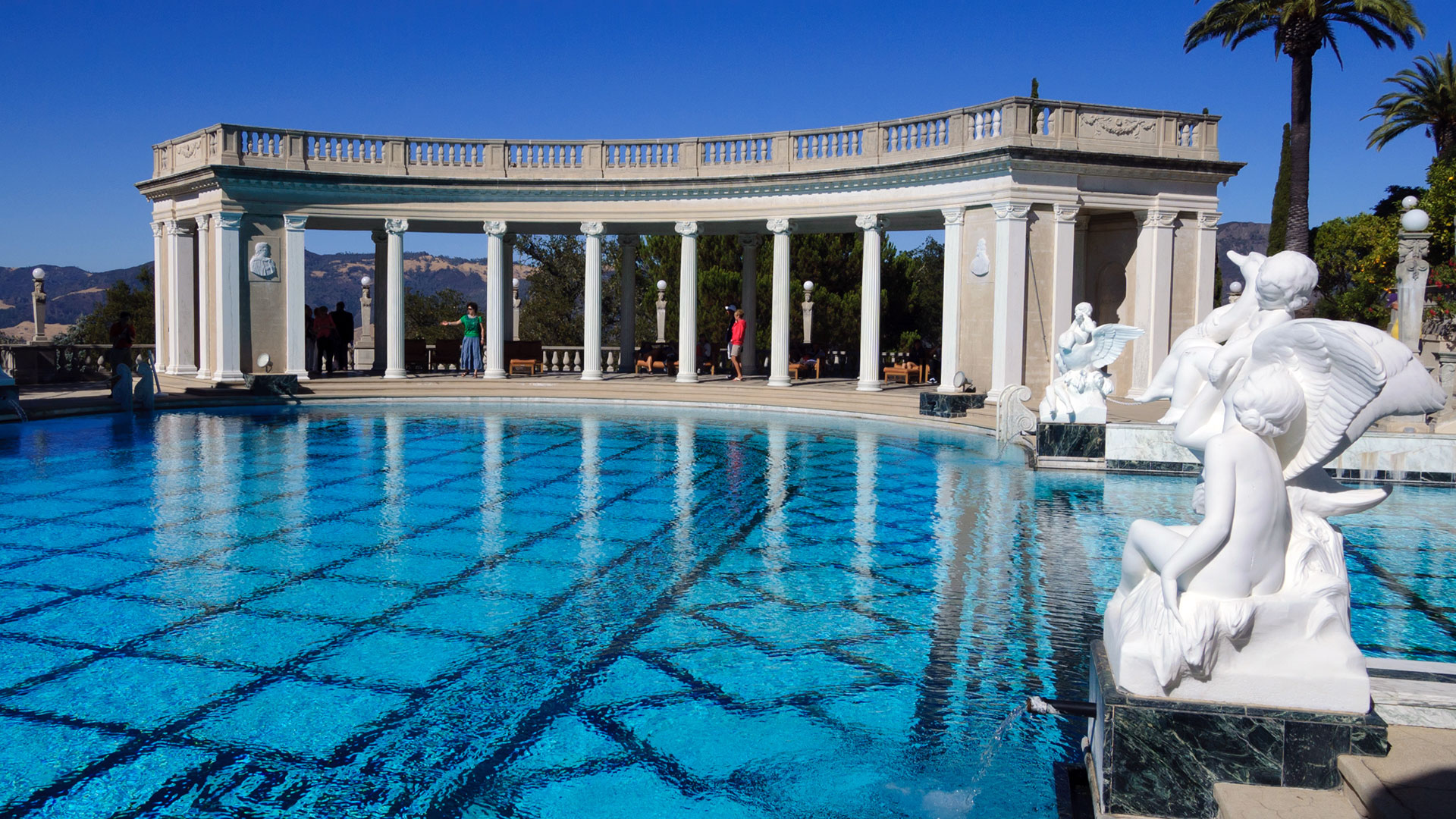
Katrina Schwartz: Julia Morgan started her practice in 1904 and was the first licensed architect in California. Her biggest and most well known project was Hearst castle, but she designed buildings all over the Bay Area. And she had a special spot in her heart for women’s clubs like this one.
Claudia Falconer: There was a big women’s movement in the 20s.
Katrina Schwartz: Women had just won the right to vote and were fired up. Opened in 1930, this building served as a meeting space for 12 different women’s groups…over 4,000 members! It still operates as a social club today…although men are now included. They host lectures, offer exercise classes… one of its biggest draws is the pool.
Katrina Schwartz in scene: Oh wow, it’s so ornate.
Katrina Schwartz: This place is a celebration of teal, with beautiful arched windows, columns and bespoke tilework. While we’re checking it out, a water aerobics class is getting set to start.
Claudia Falconer: She was playing with a lot of whimsey. Like if you study the column capitals at the windows there are little seahorses in them…
Katrina Schwartz: Morgan designed the pool ceiling with large glass blocks …to allow natural light to filter into the pool.
Claudia Falconer: That’s an outdoor terrace above us, but they couldn’t waterproof it, so eventually they just roofed over it. But there would have been more daylight coming in here.
Katrina Schwartz: It’s a remarkable building…designed by a prolific and gifted architect. Today on Bay Curious we’ve got the incredible story of Julia Morgan’s life and career. Born in San Francisco, raised in Oakland, educated at Cal…Morgan is a Bay Area gal through and through…and she made a big impact on the field of architecture. All that coming up after the break. I’m Katrina Schwartz and this is Bay Curious.
Sponsor message
Katrina Schwartz: Julia Morgan’s work is fairly well known in California now, but she was forgotten for a long time. She spent decades working closely with William Randolph Hearst on his “Castle,” but for many years tours of the landmark just said “some woman” designed it. Today, we’re celebrating the life and impact of this legendary Bay Area figure with a story from the New Angle Voice podcast, produced by Brandi Howell.
Julia Donahoe: I studied architecture at Princeton and I’d never heard her name until I came out to Berkeley and my brother says come see the Hearst mining building. My brother and sister in law forced me to go to Hearst Castle. You have to go to Hearst Castle. I thought oh this is gonna be horrible pastiche mishmash of stuff thrown together. When I got down there I was completely delighted.
Victoria Kastner: The first time I heard her name was when I went on a tour of the castle. That was in 1976. Even though I had grown up around her buildings, what they said when we were on the tour, they said a woman built Hearst Castle, but we don’t know anything about her. It was astonishing. That was just too tantalizing a problem. It was at that point that I left my freshman composition students after the end of the quarter and started to work at Hearst Castle. I never dreamed that the story of her life would be as inspiring as it is. And I’ve studied her for 30 years. I’m Victoria Kastner. I was for many decades the official historian at Hearst Castle. I’ve written three books on the history of Hearst castle and I’m coming out with the first personal biography of Julia Morgan. It’s titled, Julia Morgan: An Intimate Biography of the Trailblazing Architect.
Alexandra Lange: In 2018, an editor at the New York Times emailed asking me if I wanted to write an obituary of Julia Morgan, whom he referred to as the Hearst Castle architect. I wrote back immediately and said I would love to. I’d actually checked on some other female architects to see if the Times had covered their deaths, but it never occurred to me to check on Morgan. I’m Alexandra Lange. I’m a design critic, and I wrote the overlooked obituary for Julia Morgan in the New York Times. The overlooked series was initiated by the paper because they realized that their obituary section, like much of published American history, skewed very white and very male. There were a lot of people overlooked the first time through, with Julia Morgan serving as an amazing example of that.
Karen McNeil: There’s a big burden placed on Julia Morgan to be absolutely everything because she was the first in so many things. I’m Karen McNeil. I’m a historian and longtime scholar of Julia Morgan. Julia Morgan graduated with a degree in civil engineering in 1894 from UC Berkeley. And that was the closest she could come. To any sort of architectural training in California.
Around the time she graduated from Berkeley, she met Bernard Maybeck. He was a charismatic character. He’d studied at the École de Beaux-Arts. He wore capes and was vegetarian, very bohemian character. He taught the first architecture courses at Berkeley, beginning in the fall of 1894, just after Morgan graduated. And he invited her to join a group of young men to seminars at his home. And basically all of them went off to Paris to study at the Ecole des Beaux-Arts, which at the time, it was the most important architectural school in the world. Bernard Maybeck, he encouraged her to go to Paris. And she arrived there in June of 1896. This was weeks after the faculty had decided, yes, women, you may attend classes. That decision came about because a group of women unionized. It was the Union of Women Painters and Sculptors, and they fought a seven-year battle against the Ecole just for the right to take courses.
Morgan landed in Paris right when the doors opened. She got to know these women, and they very much supported her. They kept organizing. They kept pressuring the faculty to allow women to take entrance examinations. And finally, the faculty said, okay, ladies, you can take the entrance examinations. Her first opportunity was in July, only five weeks after the examinations had been opened to women. She was actually a figure of fascination. Just as she was taking the exams and it was already in the papers, this young American woman wanted to pursue architecture. How bizarre was that? Long story short, she failed, but she took that in stride. Everybody failed at least once. These entrance examinations, especially for architecture, were extraordinarily difficult. In October of 1898, she took the examinations for a fourth time. She was 13th out of almost 400 applicants. So now she’s 27 years old, and she had until the age of 30 to accomplish whatever she was going to accomplish.
Julia Donahoe: On a rainy day, she would sit inside a church and sketch. On the weekends, she’d travel, paying attention to form, the relationship of buildings, the relationship of light and space and color, and she just got better and better. I’m Julia Donahoe. I’m an architect and an attorney and general contractor, and I served on the National Board of the American Institute of Architects. I was in a position to nominate architects for the gold medal in architecture. And that’s how I got involved with Julia.
Karen McNeil: Morgan met Phoebe Hearst in Paris when Phoebe was visiting Paris to meet all these architects who were competing to design the new campus for the University of California. Phoebe took a shine to Morgan and when she came back to California, Phoebe was ready to employ Morgan and she hired her to remodel her estate out in Pleasanton which is east of San Francisco. And that project went on for years, they must have gotten on like a house on fire. I mean, they just had this enduring working relationship.
Karen Feeney: Looking at now is the bell tower which was built in 1904 and then around the oval from that is the Margaret Carnegie library built in 1906. So to the left of the door it says designed by architect Julia Morgan dedicated by Susan T. Mills April 14th 1904. And then on the other side it says El Campanile is the first concrete reinforced structure built west of the Mississippi. Having a clock on a tower seems pretty mundane now, but back then, that was kind of a big deal. It was kind of like the iPhone of its day, very futuristic, forward-looking thing that we would have a bell tower with a clock. I’m Karen Feeney. I’m the current director of facilities and the campus architect, and we are about to take a tour of Jolie Morgan’s five remaining buildings on campus.
Karen McNeil: Morgan had suffered through a lot of professional abuse during the construction of the Campanile. She was in this battle of wills and egos with the builder, a guy named Bernard Ransom. His father was the leading patent inventor, reinforced concrete guru in the United States, And so, then Bernard Ransom saw himself as sort of the heir apparent. He did not like working for this young woman who wanted to call herself an architect. He had gotten top billing at the ceremonies, at the unveiling of the Campanile. There’s this whole drama behind it. The 1906 earthquake and fires decimated San Francisco, as well as damaged significant portions of surrounding areas. One structure that did not fall and was not damaged in any way, was the campanile at Mills College. When the campanile survived the earthquake without a scratch, it wasn’t Ransom who was remembered. It was Morgan. So, Julian Morgan’s daring reinforced concrete campanile at Mills college survived. Reinforced concrete had been something, as source of debate. It was mostly associated with industrial infrastructure really at the time, but Morgan saw the potential for beauty in it because of its infinite plasticity.
Karen Feeney: Steel does well in tension and the concrete does well in compression. And so the two together make a really strong bond and concrete gets stronger as it ages. It’s still performed remarkably well. And then they would pour the concrete in what they call lifts.
Karen McNeil: When she designed the campanile, she was really breaking some boundaries. So many architects who had been hesitant in using reinforced concrete for pretty buildings, they went to Mills College. It became like this laboratory to understand how reinforced concrete could be used. That then really catapulted Julia Morgan’s reputation. This is not just a novelty act. Julie Morgan is a serious architect and engineer who designs not just pretty buildings, but buildings that will last for generations and an architect who experiments with the most modern construction technologies to achieve these buildings.
Julia Donahoe: She launched her career and shortly after she launched her career, the earthquake happened.
Victoria Kastner: The city first fell down and then burned up. 400,000 people were homeless. Something like 30,000 buildings were destroyed. The fire took off through the whole city.
Julia Donahoe: They said it was like Pompeii. Julia Morgan was determined to bring it back.
Victoria Kastner: There was lots of good work for architects afterwards. And Julia redesigned, re-engineered the Fairmont Hotel, which had been a brand new building, had been open for a month or something before the earthquake.
Julia Donahoe: The whole world was in ruins. And she was the only one who knew anything about reinforced concrete. They tried to bring some East Coast architects who might know reinforcing, but the guy who was supposed to come got killed in a duel. So then they saw the Mills College tower sitting there and they were like, wow, you know, that’s reinforced concrete and it didn’t fall down. She told all of San Francisco, we can rebuild the city. She rebuilt the Fairmont in one year and they had the biggest party. A lot of times I compare her to Frank Lloyd Wright. Frank Lloyd Wright didn’t understand reinforced concrete. If you go to falling water, everything looks like it’s made out of clay because it’s sagging. Concrete is not supposed to sag. Julia Morgan’s concrete does not sag. Frank Lloyd Wright’s concrete sags because he didn’t really understand the engineering, but not hers. Hers is very strong and true to this day. A lot of her buildings are still standing because she really was an engineer. She knew what she was doing.
Victoria Kastner: When J.R. Hearst approached her after he received his inheritance, which was in the spring of 1919, she knew him well and she knew the kind of client he was. She knew that he was going to be involved in absolutely every decision and want to know about every little detail because he loved it. And so when he explained to her that he was tired of camping in tents and thought he was getting a little old for that and he was thinking of building a little something, which is exactly what he said, because it was overheard by one of her employees who was working late and told that story. He said, “Mr. Hearst had a high voice, so it carried. It was the end of the day, and Mr. Hearst said, ‘well, I was browsing through Los Angeles bookstores, as I’m prone to do, and I found these bungalow books. And I saw one that I liked, and he turned the page. It was labeled Japo-Swiss Bungalow,’”. Walter Stalberg said, he laughed at that, and so did she.
Walter Stahlberg, he was an engineer, and he was very involved in the early engineering, particularly at San Simeon. So he would look up at it and say, well, there’s the Japo-Swiss bungalow, you know. It was going to be a modest six months, a single cottage, be over in no time. And then Walter also said, but within a month we were going on the grand scale and that’s the scale at which JR Hearst operated. He met her down at the train station in San Luis Obispo. Steve Zagar was a young man who had a Tin Lizzie and Hearst had hired him. They were just the two of them at dawn. Tin Lizzy had to drive what today is an hour almost, and back then was certainly two or more. They drove through the metropolis of San Simeon which back then in 1919 was two hotels and a couple of stores and that was pretty much it. They got to the end of the road. Where there’s a Victorian ranch house and that was where the road stopped. Julia looked over and sitting at the end, at the start of a dusty trail were two saddled horses. She was 47. She was wearing, I’m sure, what she always wore. She had a very practical wardrobe for her work, and it really was based on something. It was based the French walking suit. It was an eminently practical thing, but not for horseback riding. And, anyway, she looked at him, and she said, I don’t know how to ride. And furthermore, I didn’t intend to learn. And JR had been going up that hill since he was two. In 1865, his father bought that land. So what they did, Zagar saw these cowboys riding by and he called them over. First got on the horse, and Julia stayed in the taxi, in the back seat. And Zagar gunned the engine and drove it up the hill. 1600 foot elevation where rocks, beautiful, enormous, rugged size, you know, burst out of the landscape. It’s steep. And it’s far. The cowboys rode alongside, they roped the bumper and pulled the taxi over the really difficult spots if there were slippery grass or if he was having a hard time getting around there and that was her first trip to San Simeon. Julia Morgan wasn’t just the architect, she was also the interior designer and the landscape architect and essentially the contractor for the entire job and made an astonishing 568 train trips from San Francisco down to San Simeon.
Karen McNeil: Our schedule is completely exhausting. She would get on the train on Friday, take the train down to San Luis Obispo. She’d be notorious for working on the train.
Victoria Kastner: She asked for an upper berth because she was, as you know, diminutive. She was about five foot two, I think, with the assistance of a hat. Maybe even five three with the assistance of a heel. That hat was important. She could sit upright. While the train was heading south. Eight hours one way and a two to two and a half hour drive from the train station in San Luis Obispo to San Simeon by cab.
Karen McNeil: She had a regular driver who would take her to San Simeon, which to this day is still like a 45-minute drive from San Luis Obispo. The roads were smaller. The cars, the wheels, the tires were much smaller then.
Victoria Kastner: She wrote to Hearst, it was one continuous skid. She said, if you want to break every bone in your worst enemy’s body, treat them to the trip after a bad rain.
Karen McNeil: She would get there very late. She would spend the weekend at San Simeon, work out whatever issues needed to be worked out on site there. She’d spend the whole.
Victoria Kastner: Sunday and meet with Hearst. J.R. generally came down one or two times a month. On Sunday night, you should do the whole thing in reverse. One of her draftsmen, he said, I went along with her and we got back to San Francisco on Monday morning and I was exhausted and she walked right into the office and went to work. And that’s how she did it. Hearst Castle, it was a very romantic place. It was the site of a great love story between Hearst and his companion, Marion Davies. It was a love story about his childhood and his parents and California, and they shared that. And she was kind of the on-site color commentator. It might be two in the morning in New York and he’s trying to get an edition out because that’s when he worked. Was it Newspaper Man? He could send a telegram, Dear Miss Morgan, I’ve just bought some columns. Let’s talk about where to put them at the ranch. And she could write to him. About the beautiful sunsets or the alligator pairs, which is what they called avocados back then, and how the sunset was blue beyond imagining. So… One of her employees said she was the only person who never took advantage of him, who never wanted anything from him. And he, of course, was completely and utterly respectful of her and supportive of her authority. This was a collaboration between two remarkable people. They had a long association, and in many ways, I would even say a romantic one, as long as it is clear. That I’m talking about a platonic romance, you know, the romance of two, as Walter Stahlberg, who was one of her top employees, said, two long-distance dreamers. He watched them in the refectory, which is San Simi’s dining room, 72 feet long and 28 feet high and 27 feet wide. He said, the rest of us could have been a million miles away. He was talking and she was talking and they were drawing and he said, and you could almost see the spark. Travel from one to the other of their foreheads. Because these two very different people just clicked. It was remarkable, the closeness that they had.
Karen McNeil: Julia Morgan’s career was as dependent upon the California women’s movement as the California women’s movements benefited from Julia Morgan. By the time Morgan came back to the United States, by the time she got back from Paris, California women were really gearing up into all sorts of organized activities. And her generation. Was leading the way. She was 30, her friends were in their 30s, they had time, money, and education to organize around all different things. Suffrage, women in higher education, urban development and beautification, juvenile delinquency. And so you end up with Julia Morgan designing a landscape for those women. This built evidence of a social history and a Center history. From the early 20th century. She had a lot of friends who were involved with the Young Women’s Christian Association, or the YWCA. YWCAs were essential, and she literally built more than a dozen. It was one of the most important organizations nationwide to create social, educational, recreational, and residential facilities, targeted towards young single women who were moving to the city for the first time to work.
Victoria Kastner: She mentored via her women’s clubs and YWCA’s, which were central to young women leaving their family farms and coming into cities to allow them to work but not have to live in an unsavory boarding house full of traveling salesmen or be in unsafe conditions.
Karen McNeil: There was this moral control, social control element to the YWCA, combined with the growth of women’s opportunities outside of the home to earn money and independence, at least before marriage.
Chorus of women’s voices: San Luis Obispo, San Luis Obispo The best city that I know
Vicky Carroll: I’m Vicki Carroll and I’m the president of the Monday Club and the Monday Clubhouse Conservancy in San Luis Obispo.
Jennifer Alderman: I’m Jennifer Alderman, I am the treasurer of the Monday Club and the Monday Clubhouse Conservancy and also a past president.
Vicky Carroll: It is a Julia Morgan design building built by the women who own the Monday Club.
Victoria Kastner: She would do whatever was best for the club and whatever the club could afford and the club could afford a lot more because she often took no profit whatsoever and donated her services and that’s what she did at the money club in San Luis Obispo.
Vicky Carroll: The president at the time lived next door to Mr. Zagar who was the taxi driver who would pick Ms. Morgan up in San Luis Obispo and take her to the castle. So our president at that time asked Mr. Zagar if he would speak with Julia about perhaps designing a clubhouse for us. And she agreed to do that and had communications with the club members and settled on a fee of $800. And then she decided that if the members of the Monday Club would house her when she came into town, because if you think back to those times in late 20s, it wasn’t really proper for a woman to stay in a hotel by herself. So our Monday Club members housed Miss Morgan before she went to the castle the next day. She’d arrive on the train, so she’d have to spend the night. And she waived the $800 fee. Our membership at one time was over 300. So we have photos of this room packed to the gills. This social space was used a lot because there really wasn’t an opportunity for people to go out and socialize other than in bars. San Luis Obispo was still relatively small. So they would hold concerts here, plays. From the photos, it looks like they had a lot of fun.
Justin Hoover: This historic building designed by renowned architect Julia Morgan first opened its doors to the Chinese Young Women’s Christian Association, YWCA, in 1932. My name is Justin Hoover. I’m the executive director of the Chinese Historical Society of America in San Francisco. We were founded in 1963 as a society dedicated to telling the stories of the Chinese in America. During the 30s, we’re still in the exclusionary period. And so in 1882 was the Exclusion Act. What that meant was the Chinese weren’t allowed in the United States unless they were doing certain vocations and professions. During that period you get this goal for the Chinese in America to fit in. And to do that the Chinese adapted a kind of hybrid model of life where you get these Chinatowns that look Chinese-y, and I’m going to use that word, you know, because it’s kind of the cliché of Chinese that maybe harkens back to the homeland or to architectural details that are commonly understood and recognized as Chinese. Maybe divorcing them from the significance of the original facade or edifice or structure on which they were used. The use of architectural detail in that way, today we see that as a sense of Orientalism, but at the time it was a way for people of the Chinese culture to share their culture with Westerners in America, and in that wave find a place where they could hybridize their culture and be accepted and not fear persecution. The Chinese in America were scared at the times, and they still are in many ways today. Are still facing violence against Chinese and Asians. The space originally was a YWCA. In the 30s, when it was built, there were not a lot of places where women in San Francisco, especially Chinese women, could feel comfortable. And so the space was designed as a residency and a physical location for community and gathering. People could learn English, they could dance, they could have exercise, they can have community. I would imagine this would be a bustling place. Be a place that’s safe for women. I think there’d be a lot of fun at being had here. I like to hope that you’d hear a lot of noises of people laughing and having a good time.
Alexandra Lange: She closed down her office when she was losing clients and slipping into ill health. And then she just lived largely alone in her apartment in Oakland. There are few people who are still alive that knew her personally and said she just lived this quiet life and then kind of slipped out of it. She retired in 1951, but then she didn’t die until 1957. I think a combination of the Great Depression and the war, which really set back the architecture industry for a significant amount of time, then the stylistic changes post-war. There comes a point in the leading edge of American architecture where everyone wants it to be about modern forms, casting off the old, stripping out the ornament. And that was not something that Julia Morgan ever really did. And then her own ill health meant that she spent the last two decades of her life slipping from the center of architecture. When she died, you know, it was written up in the San Francisco Examiner, like she was known in her city, but it wasn’t like her work was in the air. It wasn’t like people were writing about it as if it was exciting. The new interest had shifted elsewhere. There was this whole feminist architecture history moment in the 70s and early 80s that I think Morgan benefited from. Then, like many things, went kind of out of fashion for a while, and I think it’s coming back now. So it’s interesting to look at Morgan as the beneficiary of this early uprising of women’s power that then goes underground, particularly in the post-war era, and then rises again in the seventies. And so… The times in which people are interested in Morgan also go along with the times in which there’s a new interest in women and power and expanding the canon in architecture history. There’s a really famous exhibition that was held at the Brooklyn Museum during this time, and I think that was the first time people said, oh, wait a second, where are the women architects? Yes, we’re trying to increase the number of women in architecture now. But it’s really helpful to know that there are founding mothers. Let’s go find them, let’s go look for their history.
Radio Host: NBR 68. Now, I really want to talk with Sarah Boutel. I mean, I want to talk with her so bad that if we can’t make a connection here, I’m just going to send a limo for you. Hello, Sarah. I’m right here. Oh, good! I’m so glad. Sarah Boutal has written a book, as we just mentioned, if you just turned on the radio, Julia Morgan. Beautiful
Victoria Kastner: There was not very much material. And of course, Sarah Holmes Boutel really was indefatigable. She worked 14 years on her biography, Julia Morgan Architect. She was a one woman marching band. And she’d been, and she was in her middle sixties, so she had kind of Julia Morgan rate energy.
Radio Host: How did your fascination with Julia Morgan begin, Sarah?
Sarah Holmes Boutel: It began as it does with many people. When I went to the Hearst Castle, I had no idea that it was so beautiful. And then I discovered it was by a woman architect, and I went everywhere trying to find a book about her or some material about her. And since there wasn’t any, finally it struck me that I had to ferret it out on my own, finding the buildings and finding the information about Julia Morgan. I’ve been on the job for 14 years. It was like a long time to do any one thing. Great fun the whole time because it’s partly like detective work.
Karen McNeil: She went around, she knocked on doors to find clients. She got in touch with the family. She went to organizations. She did a tremendous amount of work.
Julia Donahoe: She devoted her life to it, $30,000 of her own money, a tremendous amount of effort on her behalf and it has created the way for other people to latch on like I did.
Sarah Holmes Boutel: Her work was very successful while she was working, but then at the period just a little before her death, the modernist or international style took over, and her work, along with that of many other California architects, was sort of in the shade so that it wasn’t only her efforts to remain private, but people’s lack of interest in California architecture that have made her unknown.
Woman speaker: Would you believe that as recently as 1978 when we were discussing the Equal Rights Amendment that the president of the AIA declared to the press that he would never hire a woman architect? On behalf of these women practitioners, I express our collective and respectful anger.
Julia Donahoe: I had met Beverly Willis in 2009 at the first Women’s Leadership Summit in Chicago. She had given a presentation and said, why can’t the AIA give a gold medal to a woman? I remember thinking, well, that’s silly. You don’t just give a goal medal to a person, they earn a gold metal. It’s a process, I’m sure. Then a couple of years in 2012, I was sitting and watching and there’s three men there and I’m like, oh, this is how you do it. This is the room where they vote on the gold medal. I’m like, well, who gets to nominate you to be one of those three people? It’s not like a lottery thing. You know, you say, dear God, give me a gold medal, give me a goal medal and God says, if you want to win the lottery, you have to buy a ticket. So I sat there and said, well how do you buy a ticket to be 1 of those 3 people? You have to make a portfolio and you have to submit the portfolio and the portfolio has to. Demonstrate a body of work that’s of significant stature to be worthy of the gold medal. So how do you do that? You look at the guy who’s winning this year and say, how can I find a woman who has a portfolio like that? I started scouring all the books. I sat there and I read, I was like, I can nominate someone. And I was, like, who could I nominate? I spent two weeks going through this process of calling all my friends and saying, who could we nominate. We’d say, what about this person? And they’d say too young. They’ll get it someday, you know, or what about this person? No, not enough work or whatever. So then I just sat down with some books of women architects and I started going through them. The only one that had a portfolio that was significant enough was Julia Morgan. I said, well, I’ll just call up Helene Combs-Dryling who’s president and her first week in office, I called her up and said, can I bring Julia Morgan forward for the AIA gold medal? She wrote back and said well, that would be fabulous. And I never knew anything about her until this. And I told my daughter for the next six months, she could sit at the kitchen table and do her homework while I would sit at dining table and my homework and that was what we would be doing.
We spent everything from January until June when I got this portfolio done. I went to work, but I came home at night and that’s all I did was Julia Morgan. I just brought her up in every conversation. Oh, they were talking about disaster. Oh, did you know that Julia Morgan saved the city of San Francisco from total disaster by knowing about reinforced concrete? Oh, did you see the water color so-and-so did? Did you know that Julia Morgan was an excellent watercolorist? She learned that at the Cold of Beaux-Arts because none of the guys would work with her. And so she went off into the landscape and drew things like Monet. When I finally left the board. I remember Bruce Kanick said to me, when are you going to stop talking about Julia Morgan? And I said, I will stop talking about Julia and Morgan. And I tried to bring her in every conversation. I will start talking about her when you talk about her more than I do, you know? So I tried bring her into every conversation in that sort of way to really just open the mental thinking. And I really worked the room. By then I understood that I need to have really nice letters from really important people. We wrote to Maria Shriver and asked her to write a letter, and she agreed. Senator Feinstein, she lives across the street from a Julia Morgan building.
Diane Feinstein: At a time when there were few women in the professional world. When we weren’t even allowed to vote, Julia was a real trailblazer.
Julia Donahoe: I went to see Mike Graves. He said, oh yeah, sure, I’ll help you. I got Frank Gehry as well because Maria Shriver, turns out she has this very strong relationship with him and she can call him up and say, Frank, why don’t you help with this?
Diane Feinstein: She paved the path, not just for women architects, but for all women. She faced many challenges in the male-dominated architecture industry. She is a living proof that no matter the obstacles, no matter the status quo, you can achieve.
Julia Donahoe: Portfolio goes to this jury. I was waiting at home and saying, well, maybe she’ll get it. Well, we’ll probably have to do it a couple times, but we’ll see what happens. And then I got this beautiful letter that says, you have been selected for the shortlist. So then I was like, what do we have to? Do we have do another presentation in front of the board? I ended up asking Jeannie Gang to do the presentation. I said, this will be training for you to get your gold medal. And she wrote back and says, I’m going to take this really seriously. And I want to do a good job. The room had started falling like dominoes. People were saying this for this and this for this guy, supportive statements for all these other ones. And gradually it became more and more for Julia Morgan. The votes were cast on secret paper ballots, and then they were taken into a back room and counted. And then we are all sitting there. First they told us who won and then they brought the guests back in. So Jeannie Gang is sitting there and I can’t restrain myself. So I walked over to her and I just, I didn’t tell her what had happened, but I just gave her this huge hug and I had this huge smile on my face and tears were coming down my face. I was so excited about her getting the F-A-I-A. I think I was more excited about that. It’s a very, very quiet ceremony. They have to get everyone across the stage to get their medal and get their handshakes and stuff. So they say, please hold all the applause till the very end. And then they came to Julia Morgan and the whole room erupted in the standing ovation. That’s when I really truly cried because I was just like, wow, this really means something. You know, it’s not just that we finally have a woman whose name is going to be carved in granite, that we’re finally shattering the glass ceiling and getting recognition for all types of people. The whole room recognized it. It was just a beautiful moment.
Announcer: We are very proud to posthumously award the A.I. Gold Medal to Julia Morgan, F.A.I., the early 20th century architect whose copious output of quality work secured her position as the first great female American architect.
Julia Donahoe: All the little quotes that we have of her, they’ve all been ingrained in my brain now. I’ve learned for myself to now pursue things in a more dogged way the way she does. Just pursue excellence in everything that I do.
Victoria Kastner: The form that she filled out for the AIA membership in 1946. The form said, the architect will list what he has done. And she circled the “he” and wrote a giant exclamation point over it.
Julia Donahoe: She’s really been a guidepost for me that she could have an engineer way of thinking and also be an exceptional Beaux Arts architect and live in a modern age and use glass and steel and light and form and really embrace all the things that were changing around her and the social changes that were happening for women and families and how we interact in the world.
Alexandra Lange: She must have been so tough to make it through her attempts to get into the Ecole de Beaux-Arts, to make it through the Ecole de Beaux-Arts, to launch her own business in California when so few women owned their own businesses. So I just see that toughness carrying through and I don’t think she could have been as successful as she was if she wasn’t really, really focused on doing the work.
Katrina Schwartz: The New Angle Voice podcast is a project of the Beverly Willis Architecture Foundation and is produced by Brandi Howell.
Special thanks this week to the Berkeley City Club Conservancy for showing me around. The first two floors of the building are open to the public for tours. Reach out to the Conservancy if you’re interested.
Bay Curious is made in San Francisco at member-supported KQED.
Our show is produced by Gabriela Glueck, Christopher Beale and me Katrina Schwartz.
With extra support from Maha Sanad, Katie Springer, Jen Chien and everyone on team KQED.
Some members of the KQED podcast team are represented by The Screen Actors Guild, American Federation of Television and Radio Artists. San Francisco Northern California Local.