100 Days, 2 Americas: Assessing the Impact of Trump’s Policies on California and Texas
In an hour-long special, the California Newsroom and the Texas Standard team up to examine how the Trump administration is changing life in two of the nation’s largest states.
Megan Larson of The California Newsroom, Vicki Gonzalez of CapRadio and David Brown of the Texas Standard
President Donald Trump speaks with reporters at the White House on Wednesday in Washington. In an hour-long special, the California Newsroom and the Texas Standard team up to examine how the Trump administration is changing life in two of the nation’s largest states.
(Alex Brandon/AP)
The 100-day marker for presidential administrations is really nothing more than that: A marker.
The benchmark was established during Franklin D. Roosevelt’s first term because he got a lot done in those first few months as president.
His moves in a relatively short amount of time — helped by a Congress controlled by Democrats — has since defined a period where presidents are expected to show what they are initially accomplishing in the job.
President Donald Trump arrives to deliver remarks about American energy production during a visit to the Double Eagle Energy Oil Rig on July 29, 2020, in Midland, Texas. (Evan Vucci/AP Photo)
In these first 100 days, we’ve heard a lot from D.C. pundits. Today, we’re looking at how those decisions are hitting home. We’re focusing on two of America’s biggest and most complex states: Texas and California. Two states with enormous economic power, deep diversity and very different politics.
In many cities across both Texas and California, you’ll find plenty of people who share a skepticism — if not scorn — for the second Trump administration. However, in more rural areas of both states, support for Trump’s direction is strong, especially when it comes to issues like immigration or cutting what some see as government waste.
Still, this change is happening so quickly that it can be hard to keep up. The ripple effects of mass layoffs, deportations and trade threats are making many people anxious, and that fear seems to be crossing clear party lines.
Journalists at public radio stations and nonprofit newsrooms in California and Texas spoke with dozens of residents, reporters and political observers to dig into that uncertainty. Not just the economics, but across the board — where it’s coming from and what it means.
California, Texas respond to second Trump administration
California and Texas are similar by size and population metrics, but politically, the two states are opposites. In the 2024 presidential election, for example, roughly 58.5% of Californians voted for Kamala Harris, while 56.14% of Texans voted for Trump.
Richard Pineda is an associate professor of communications with a focus on politics at the University of Texas at El Paso. He said Texas leaders at all levels seem to be in “lockstep” with President Trump. But that’s not the case across the state, he added, especially in areas that tend to vote blue — like El Paso and Travis counties.
“I think that there is a tremendous amount of concern about some of these changes, especially when you see shifts that are happening politically rolling into things like the University of Texas system,” Pineda said.
Related Article
Some traditionally blue counties are starting to see increases in Republican voters, he added. That can be seen in Starr, Hidalgo, Willacy and Cameron counties — all of which are border counties that have historically voted blue.
“It’s not to a point that the county will change anytime soon, but even short shifts means that the state is becoming even redder than before,” he said.
Paul Mitchell is the vice president of Political Data, Inc., a voter data firm in California. He said the state, which was seen as the resistance state during Trump’s first term — filing over 120 lawsuits against his administration — hasn’t had the same “clear point of focus” this time around.
“A lot of what Trump tried to do early on (in his first term) that really galvanized support from Democrats in California was he was trying to undo Obamacare,” Mitchell said. “In this first 100 days, you’ve seen him go after transgender issues, and a lot of Democrats don’t know necessarily what to do with that.”
Many of the Californians polled by journalists working on this project expressed deep concern over the president’s actions, while others said they were “cautiously optimistic.” Some in the latter category suggested that their backing of President Trump had to do with frustration over state and local governments, more than the federal government.
Mitchell said the 2024 election came at the “perfect time” for those frustrated by these issues in California.
“A lot of voters saw what he was proposing as real action, where they look at California policy makers — whether they’re looking at the lack of action on high-speed rail or these other promises that lawmakers have made — and they say, ‘Well, they’re not delivering here in California, this guy is offering to make big real change,’” Mitchell said. “And I think that that was important to his victory.”
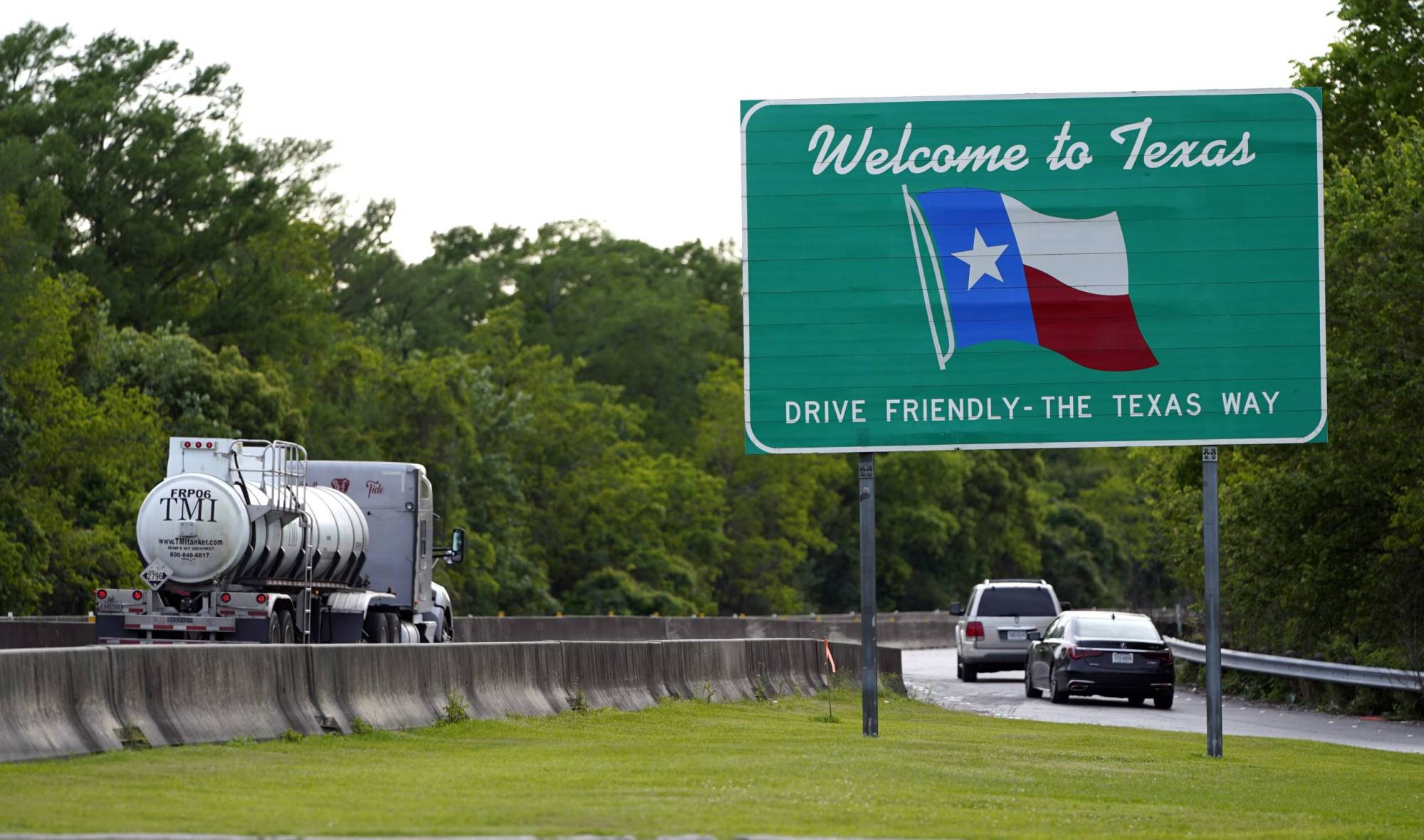
Vehicles merge onto I-10 on Sunday, March 29, 2020, in Orange, Texas, near the Louisiana border. (AP Photo/David J. Phillip)
Pineda said Texas business leaders have been encouraged by state leadership’s support of the Trump administration’s move to dismantle diversity, equity and inclusion initiatives.
“The governor and the lieutenant governor taking an active stance to try to undercut those [DEI practices] has allowed some businesses to move without having to worry about having those policies or maintaining those policies,” he said. “That then comes on top of the president pushing against these things, and that’s a good climate for these particular businesses.”
However, overall, he said, growth hasn’t remained consistent for all regions of Texas.
“What you’re seeing is developments in these sort of core communities, some of the bigger cities,” he said. “There’s still a lot of rural development that has not happened. We’ve looked to try to expand a rail infrastructure that seems to come up every couple of years and die down. I do think that the move to bring some of these companies in dovetails with limitations on previously held restrictions.”
Trade and tariffs
President Trump is no stranger to tariffs — and the battles that come with changing them. During his first term, Trump imposed a number of tariffs on goods imported from China, sparking a trade war in 2018.
And starting on his first day back in the White House, Trump promised immediate action on the price of imported goods. Since then, news about tariffs has moved quickly. Over the last three months, Trump has imposed, rescinded and reinstated tariffs worldwide.
Related Article
Whether tariffs are active or on hold, California and Texas will feel it. Of all the U.S. states, these two do the most trade with other countries — and China, Mexico and Canada are at the top of the list.
Texas and Mexico’s economies are greatly intertwined — in 2023, trade between Texas and Mexico topped $272 billion, ranking Mexico as Texas’ no. 1 trading partner.
Jerry Pacheco, president of the Border Industrial Association, said the first 100 days of the second Trump administration has felt like “chaos” for both himself and the members of his organization.
“I mean, my world has just been… I get up every day and wonder what’s going to happen,” Pacheco said. “Are we going to lose a prospect that we had close to signing the dotted line? Are we going to see businesses in our industrial base, related particularly to the automotive industry, shuttered?”
California has a similar trade relationship with Mexico, with a highly integrated supply chain that sees individual pieces of larger products often travel back and forth across the border.
Tijuana, for example, hosts a number of car manufacturing plants, including one owned by Toyota. But not all pieces of these vehicles are made in Mexico: Individual parts of each vehicle can cross the border multiple times — and there’s a tariff each time it crosses back and forth. Seat leather, for example, could be produced in one country, processed in another, then finished in another.
San Diego business professionals echoed the sentiment of their counterparts in Texas, many of whom said they feel uncertain about the future.
“We have a relationship with Mexico where we’re not just trading together, we’re producing together,” said Jessica Anderson, the interim CEO and president of the San Diego Regional Chamber of Commerce. “This is not a tax on just Mexican companies. This is a tax on U.S. businesses and on U.S. companies directly.”
State legislative leaders say California’s booming economy is the driving force behind their tariff-related lawsuit against the Trump administration. They’ve also said the fluctuating stock market is a risk to California’s budget, which is highly dependent on income tax revenue from capital gains.
Immigration
Within hours after his second inauguration in January, President Trump signed dozens of executive orders, including 10 aimed at the immigration system.
A U.S. Border Patrol agent walks past four men being detained after crossing the border through a gap in the walls separating Mexico and the United States, Jan. 23, 2025, in San Diego. (AP Photo/Gregory Bull)
Among other actions, these orders pledge to detain and deport undocumented immigrants accused of crimes and stop the resettlement of refugees from countries like Afghanistan.
All of it has – or at least promises to have – a deep impact on Texas and California, hugely diverse states with some of the largest undocumented and refugee populations in the U.S.
Response to these orders has been mixed, largely across party lines:
“I mean, I live here on the border and I’ve seen firsthand what happened the last several years with immigration, and now it’s the numbers have plummeted,” said Tim Wilkins of McAllen, Texas. “I mean, it’s almost zero activity.”
“The way that the Trump administration is handling this is frightening — deporting people to El Salvador and some of those people are not the gang members that they say they are and there’s no due process,” said Jane Demian, who lives in Los Angeles.
In California, ICE raids and enforcement actions by federal agents in cities like San Diego, Pomona and Los Angeles have heightened fears in immigrant communities. In Texas, agents from multiple federal agencies began carrying out immigration enforcement operations in late January in a number of cities, including Austin, Dallas-Fort Worth and San Antonio.
Reactions to these operations have mixed — Texans in conservative areas are largely supportive, while Texas immigration advocates and professionals are concerned.
“Many people in the immigrant community, many clients, fear for their future in this country, even lawful permanent residents and naturalized citizens,” said Irving-based immigration attorney Haim Vasquez.
“I would say everybody is scared right now,” Zahra Biloo, director for the Bay Area chapter of the Council on American Islamic Relations, said. “The most challenging types of calls we are receiving are from U.S. citizens, and so I think to myself, if U.S. citizens with as much privilege and safety as they carry are scared, so, too, then are student visa-holders as well as undocumented students.”
The response from Texas leaders has looked a bit different: Texas Attorney General Ken Paxton announced recently that he was opening an investigation into the city of Dallas, accusing it of having “sanctuary city” policies, or policies that would not allow city staff to cooperate with federal law enforcement in arresting or detaining undocumented immigrants.
Agriculture and business
All eyes are on the economy. The Trump administration’s approach to tariffs and other economic policies has a lot of people wondering where things are headed.
For some, that uncertainty brings on a whole lot of anxiety: “Because he enacted a policy that made me lose my job, yeah, I’m anxious, I’m worried, my budget’s completely changed, and, you know, [I’m] living off beans and rice,” said Benjamin Dechard of Austin.
Others are bullish about the president’s actions: “People are willing to start investing again in their businesses, not holding cash back as a reserve, but now using this as an opportunity to make those investments,” said David Stein from Tyler, Texas.
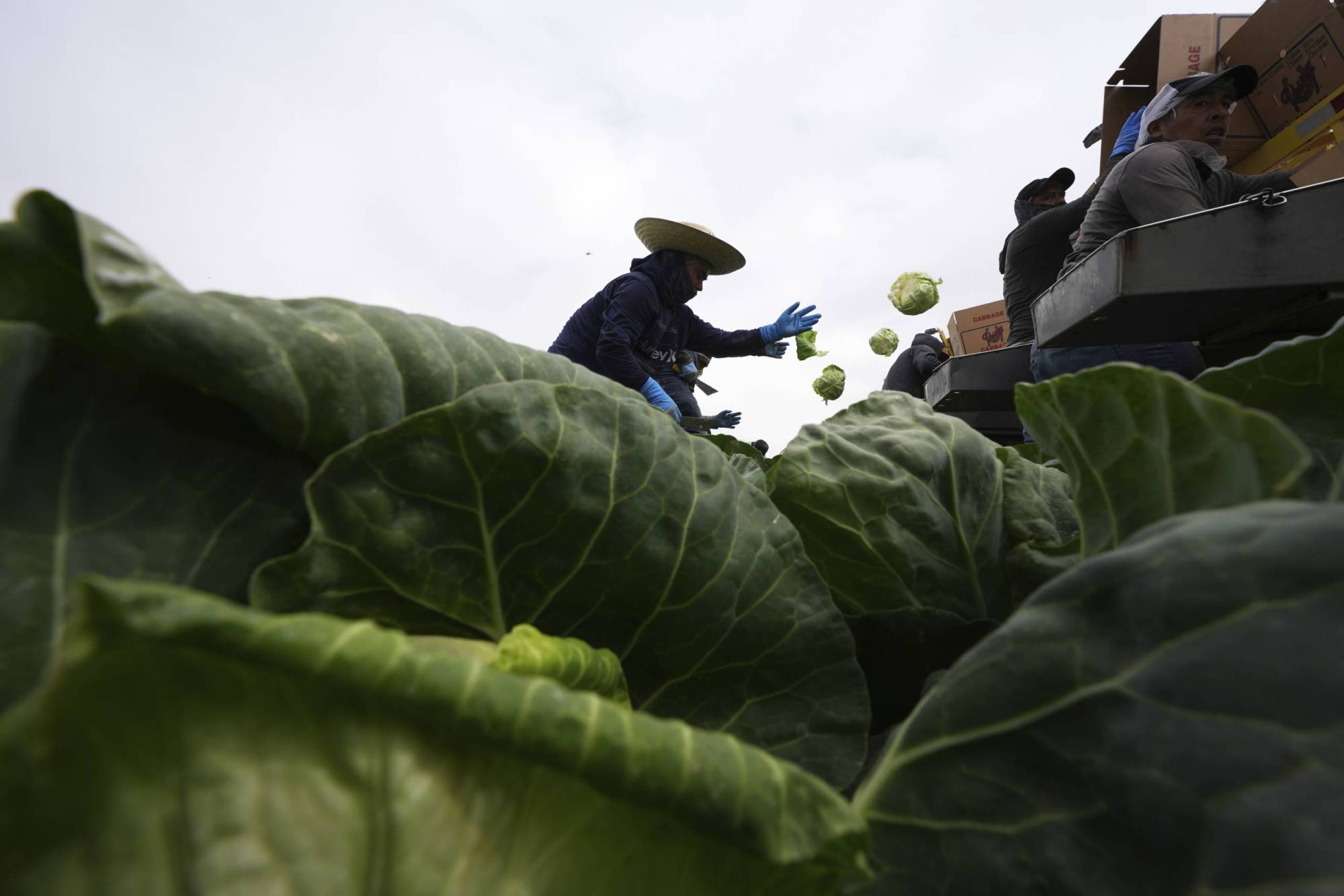
Agriculture is one business sector that’s got some questions. It’s a huge economic driver in both states: Texas sold about $32 billion in agricultural products in 2022, and California, the nation’s largest supplier, sold a little more than $59 billion worth of goods in the same year. A big chunk of that money comes from exports to countries like Mexico, Canada, and China.
The biggest exports coming out of Texas are beef and cotton, amounting to roughly $2.6 billion every year. However, the state also imports and takes in a lot of goods, and farmers are concerned about tariffs affecting the cost to raise their crops.
Workers harvest cabbage on Wednesday, March 5, 2025, on a field less than ten miles from the border with Mexico, in Holtville, Calif. (AP Photo/Gregory Bull)
Materials like fertilizer, insecticides, seeds and parts for farm equipment are imported and have begun to rise in price, he added.
“I apologize, I don’t mean to sound ignorant, but there’s probably more unknowns than known,” said Dale Murden, a citrus farmer in the Rio Grande Valley. “I’m like… ‘Uh, wait a minute, my fertilizer cost just tripled. Where’d that come from?’”
There’s been a lot of back and forth over tariffs. But the ongoing battle is with China, whose leaders responded with their own levies on U.S. goods.
Texas sends a large share of its cotton, beef and rice to China. Market leaders are concerned that these U.S.-made goods may become prohibitively expensive for Chinese consumers, and push other exporting countries to swoop in.
“The last time there was a Trump tariff issue, cotton did get caught up in that, and it just caused this great reshuffle,” said John Robinson, a cotton market specialist with Texas A&M University. “We actually sent more of our cotton to Vietnam, and Brazil took our market share formerly with China. Great big reshuffle. It’s inefficient.”
California’s largest exports are nuts and dairy — the state produces 80% of the world’s almonds — and a lot of that goes to China. Some California farmers share concerns about the state of the industry as tariffs are set to go into effect, though not all of them are sure of what to expect.
Jenny Holtermann, a fourth-generation farmer in Kern County, said she’s “worried and sort of not worried,” though she ultimately supports Trump’s tariffs.
She said that even if her almond farm takes a hit, she’s hoping tariffs will bring business back to the U.S. However, she mentioned she is facing higher costs and she’s already made adjustments in her farm operations because of them. The last time Trump was president and imposed tariffs, exports of California almonds and pistachios fell 20%.
However, Holtermann said she’s in a better place than others because she has another job and doesn’t rely on the farm as her family’s sole income. Almonds are also not as perishable as other crops, so she has a little bit more flexibility.
“Eighty percent of the world’s supply of almonds come from California,” Holtermann said. “At some point, well, if they want almonds, they have to get them from California.”
Ryan Talley, who owns a medium-sized farm that his grandfather started in the 1940s in Arroyo Grande, said he hasn’t seen a big direct impact yet because he sells most of his crops inside the U.S. However, he does sell spinach to Canada — and he’s planning on selling bell peppers in that market, too.
But because the Trump administration is constantly changing its mind about the tariffs, he’s worried because, unlike almond-growers, his crops have a shorter shelf life.
“They’re highly perishable,” Talley said of his produce. “We don’t have the ability to hold our products for a month or two to wait for the tariffs to go away.”
On the flip side, some folks in the agriculture business are seeing positive impacts as a result of tariffs. In Texas, people who harvest shrimp and oysters see the tariffs as a bulwark against overseas competition.
Education
In March, the U.S. Department of Agriculture announced plans to cut a federal program that provides around $660 million for schools to buy fresh food directly from farms.
In California, the Local Food for Schools program served up about $23 million of meals around the state. It was about the same amount of money for Texas.
Related Article
Both were part of a broader set of pandemic-era initiatives designed to address food insecurity and support local agriculture during COVID-19 disruptions. The USDA now said these programs no longer line up with priorities.
These cuts have already begun affecting residents of both states. In California’s San Bernardino and Riverside counties, the program will expire at the end of this school year. More than $600,000 was awarded for the region to provide organic strawberries, citrus fruits, apples, and lettuce that ends up in school salads, along with produce like dragon fruit and bok choy.
California has attempted to recreate the program on its own, but schools have to apply to receive grant funding, while the federal program was opt-in.
In Texas, these federal grants amounted to less than a tenth of what state schools were previously spending for local food. However, if states don’t step in to subsidize these programs, some students could lose an important lifeline.
Many farmers are in a tough situation because they’ve planted their crops with this program in mind. In one case, a California farmer plowed under fields of kale and collard greens because they were no longer contracted and replanted an easier crop to offload. In another case, a local poultry farm that had a contract to provide about 160 cases of chicken wings each month to a school stands to lose $13,000 a month in revenue.
Overall impact on California and Texas? You tell us.
The idea for this joint statewide special developed during a transformative time for our country.
Collectively, it’s difficult — and perhaps even unfair — to find the right words that capture what is unfolding. It’s still too early to tell what the true impact will be.
We know reactions in California and Texas are different — they’re bound to be — different states with different budget demands, different priorities, different cultures and different political views among the majority of voters.
Today, granular polling so far in both states is rather lean.
So, what’s the impact of the first 100 days on California and Texas? You tell us. It’ll help us in our coverage going forward, too.
This story includes reporting from Angela Korcherga of KTEP in El Paso, Michael Marks of the Texas Standard, Levi Sumagaysay and Carolyn Jones of CalMatters in Sacramento, Stella Chávez of the Texas Newsroom, Gustavo Solis of KPBS in San Diego, Tyche Hendricks of KQED in San Francisco, and Jessica Greenwell of KVCR in Riverside, California.
lower waypointnext waypoint
Player sponsored by
window.__IS_SSR__=true
window.__INITIAL_STATE__={
"attachmentsReducer": {
"audio_0": {
"type": "attachments",
"id": "audio_0",
"imgSizes": {
"kqedFullSize": {
"file": "https://ww2.kqed.org/news/wp-content/themes/KQED-unified/img/audio_bgs/background0.jpg"
}
}
},
"audio_1": {
"type": "attachments",
"id": "audio_1",
"imgSizes": {
"kqedFullSize": {
"file": "https://ww2.kqed.org/news/wp-content/themes/KQED-unified/img/audio_bgs/background1.jpg"
}
}
},
"audio_2": {
"type": "attachments",
"id": "audio_2",
"imgSizes": {
"kqedFullSize": {
"file": "https://ww2.kqed.org/news/wp-content/themes/KQED-unified/img/audio_bgs/background2.jpg"
}
}
},
"audio_3": {
"type": "attachments",
"id": "audio_3",
"imgSizes": {
"kqedFullSize": {
"file": "https://ww2.kqed.org/news/wp-content/themes/KQED-unified/img/audio_bgs/background3.jpg"
}
}
},
"audio_4": {
"type": "attachments",
"id": "audio_4",
"imgSizes": {
"kqedFullSize": {
"file": "https://ww2.kqed.org/news/wp-content/themes/KQED-unified/img/audio_bgs/background4.jpg"
}
}
},
"placeholder": {
"type": "attachments",
"id": "placeholder",
"imgSizes": {
"thumbnail": {
"file": "https://cdn.kqed.org/wp-content/uploads/2024/12/KQED-Default-Image-816638274-2000x1333-1-160x107.jpg",
"width": 160,
"height": 107,
"mimeType": "image/jpeg"
},
"medium": {
"file": "https://cdn.kqed.org/wp-content/uploads/2024/12/KQED-Default-Image-816638274-2000x1333-1-800x533.jpg",
"width": 800,
"height": 533,
"mimeType": "image/jpeg"
},
"medium_large": {
"file": "https://cdn.kqed.org/wp-content/uploads/2024/12/KQED-Default-Image-816638274-2000x1333-1-768x512.jpg",
"width": 768,
"height": 512,
"mimeType": "image/jpeg"
},
"large": {
"file": "https://cdn.kqed.org/wp-content/uploads/2024/12/KQED-Default-Image-816638274-2000x1333-1-1020x680.jpg",
"width": 1020,
"height": 680,
"mimeType": "image/jpeg"
},
"1536x1536": {
"file": "https://cdn.kqed.org/wp-content/uploads/2024/12/KQED-Default-Image-816638274-2000x1333-1-1536x1024.jpg",
"width": 1536,
"height": 1024,
"mimeType": "image/jpeg"
},
"fd-lrg": {
"file": "https://cdn.kqed.org/wp-content/uploads/2024/12/KQED-Default-Image-816638274-2000x1333-1-1536x1024.jpg",
"width": 1536,
"height": 1024,
"mimeType": "image/jpeg"
},
"fd-med": {
"file": "https://cdn.kqed.org/wp-content/uploads/2024/12/KQED-Default-Image-816638274-2000x1333-1-1020x680.jpg",
"width": 1020,
"height": 680,
"mimeType": "image/jpeg"
},
"fd-sm": {
"file": "https://cdn.kqed.org/wp-content/uploads/2024/12/KQED-Default-Image-816638274-2000x1333-1-800x533.jpg",
"width": 800,
"height": 533,
"mimeType": "image/jpeg"
},
"post-thumbnail": {
"file": "https://cdn.kqed.org/wp-content/uploads/2024/12/KQED-Default-Image-816638274-2000x1333-1-672x372.jpg",
"width": 672,
"height": 372,
"mimeType": "image/jpeg"
},
"twentyfourteen-full-width": {
"file": "https://cdn.kqed.org/wp-content/uploads/2024/12/KQED-Default-Image-816638274-2000x1333-1-1038x576.jpg",
"width": 1038,
"height": 576,
"mimeType": "image/jpeg"
},
"xxsmall": {
"file": "https://cdn.kqed.org/wp-content/uploads/2024/12/KQED-Default-Image-816638274-2000x1333-1-160x107.jpg",
"width": 160,
"height": 107,
"mimeType": "image/jpeg"
},
"xsmall": {
"file": "https://cdn.kqed.org/wp-content/uploads/2024/12/KQED-Default-Image-816638274-2000x1333-1-672x372.jpg",
"width": 672,
"height": 372,
"mimeType": "image/jpeg"
},
"small": {
"file": "https://cdn.kqed.org/wp-content/uploads/2024/12/KQED-Default-Image-816638274-2000x1333-1-672x372.jpg",
"width": 672,
"height": 372,
"mimeType": "image/jpeg"
},
"xlarge": {
"file": "https://cdn.kqed.org/wp-content/uploads/2024/12/KQED-Default-Image-816638274-2000x1333-1-1020x680.jpg",
"width": 1020,
"height": 680,
"mimeType": "image/jpeg"
},
"full-width": {
"file": "https://cdn.kqed.org/wp-content/uploads/2024/12/KQED-Default-Image-816638274-2000x1333-1-1920x1280.jpg",
"width": 1920,
"height": 1280,
"mimeType": "image/jpeg"
},
"guest-author-32": {
"file": "https://cdn.kqed.org/wp-content/uploads/2025/01/KQED-Default-Image-816638274-1333x1333-1-160x160.jpg",
"width": 32,
"height": 32,
"mimeType": "image/jpeg"
},
"guest-author-50": {
"file": "https://cdn.kqed.org/wp-content/uploads/2025/01/KQED-Default-Image-816638274-1333x1333-1-160x160.jpg",
"width": 50,
"height": 50,
"mimeType": "image/jpeg"
},
"guest-author-64": {
"file": "https://cdn.kqed.org/wp-content/uploads/2025/01/KQED-Default-Image-816638274-1333x1333-1-160x160.jpg",
"width": 64,
"height": 64,
"mimeType": "image/jpeg"
},
"guest-author-96": {
"file": "https://cdn.kqed.org/wp-content/uploads/2025/01/KQED-Default-Image-816638274-1333x1333-1-160x160.jpg",
"width": 96,
"height": 96,
"mimeType": "image/jpeg"
},
"guest-author-128": {
"file": "https://cdn.kqed.org/wp-content/uploads/2025/01/KQED-Default-Image-816638274-1333x1333-1-160x160.jpg",
"width": 128,
"height": 128,
"mimeType": "image/jpeg"
},
"detail": {
"file": "https://cdn.kqed.org/wp-content/uploads/2025/01/KQED-Default-Image-816638274-1333x1333-1-160x160.jpg",
"width": 160,
"height": 160,
"mimeType": "image/jpeg"
},
"kqedFullSize": {
"file": "https://cdn.kqed.org/wp-content/uploads/2024/12/KQED-Default-Image-816638274-2000x1333-1.jpg",
"width": 2000,
"height": 1333
}
}
},
"news_12037556": {
"type": "attachments",
"id": "news_12037556",
"meta": {
"index": "attachments_1716263798",
"site": "news",
"id": "12037556",
"found": true
},
"title": "npr.brightspotcdn copy",
"publishDate": 1745533268,
"status": "inherit",
"parent": 12037553,
"modified": 1745533296,
"caption": "President Donald Trump speaks with reporters at the White House on Wednesday in Washington. In an hour-long special, the California Newsroom and the Texas Standard team up to examine how the Trump administration is changing life in two of the nation’s largest states.\r\n",
"credit": "Alex Brandon/AP",
"altTag": null,
"description": null,
"imgSizes": {
"medium": {
"file": "https://cdn.kqed.org/wp-content/uploads/sites/10/2025/04/npr.brightspotcdn-copy-21-800x534.jpg",
"width": 800,
"height": 534,
"mimeType": "image/jpeg"
},
"large": {
"file": "https://cdn.kqed.org/wp-content/uploads/sites/10/2025/04/npr.brightspotcdn-copy-21-1020x680.jpg",
"width": 1020,
"height": 680,
"mimeType": "image/jpeg"
},
"thumbnail": {
"file": "https://cdn.kqed.org/wp-content/uploads/sites/10/2025/04/npr.brightspotcdn-copy-21-160x107.jpg",
"width": 160,
"height": 107,
"mimeType": "image/jpeg"
},
"1536x1536": {
"file": "https://cdn.kqed.org/wp-content/uploads/sites/10/2025/04/npr.brightspotcdn-copy-21-1536x1024.jpg",
"width": 1536,
"height": 1024,
"mimeType": "image/jpeg"
},
"post-thumbnail": {
"file": "https://cdn.kqed.org/wp-content/uploads/sites/10/2025/04/npr.brightspotcdn-copy-21-672x372.jpg",
"width": 672,
"height": 372,
"mimeType": "image/jpeg"
},
"twentyfourteen-full-width": {
"file": "https://cdn.kqed.org/wp-content/uploads/sites/10/2025/04/npr.brightspotcdn-copy-21-1038x576.jpg",
"width": 1038,
"height": 576,
"mimeType": "image/jpeg"
},
"kqedFullSize": {
"file": "https://cdn.kqed.org/wp-content/uploads/sites/10/2025/04/npr.brightspotcdn-copy-21.jpg",
"width": 1600,
"height": 1067
}
},
"isLoading": false,
"fetchFailed": false
}
},
"audioPlayerReducer": {
"postId": "stream_live",
"isPaused": true,
"isPlaying": false,
"pfsActive": false,
"pledgeModalIsOpen": true,
"playerDrawerIsOpen": false,
"liveAudioPlayStartedAt": 0,
"liveAudioPlayContext": ""
},
"authorsReducer": {
"byline_news_12038128": {
"type": "authors",
"id": "byline_news_12038128",
"meta": {
"override": true
},
"slug": "byline_news_12038128",
"name": "Megan Larson of The California Newsroom, Vicki Gonzalez of CapRadio and David Brown of the Texas Standard",
"isLoading": false
}
},
"pagesReducer": {},
"pfsSessionReducer": {},
"postsReducer": {
"stream_live": {
"type": "live",
"id": "stream_live",
"audioUrl": "https://streams.kqed.org/kqedradio",
"title": "Live Stream",
"excerpt": "Live Stream information currently unavailable.",
"link": "/radio",
"featImg": "",
"label": {
"name": "KQED Live",
"link": "/"
}
},
"stream_kqedNewscast": {
"type": "posts",
"id": "stream_kqedNewscast",
"audioUrl": "https://www.kqed.org/.stream/anon/radio/RDnews/newscast.mp3?_=1",
"title": "KQED Newscast",
"featImg": "",
"label": {
"name": "88.5 FM",
"link": "/"
}
},
"news_12038128": {
"type": "posts",
"id": "news_12038128",
"meta": {
"index": "posts_1716263798",
"site": "news",
"id": "12038128",
"found": true
},
"articlePosition": 0,
"guestAuthors": [],
"slug": "100-days-2-americas-assessing-the-impact-of-trumps-policies-on-california-and-texas",
"title": "100 Days, 2 Americas: Assessing the Impact of Trump’s Policies on California and Texas",
"publishDate": 1746032417,
"format": "standard",
"headTitle": "100 Days, 2 Americas: Assessing the Impact of Trump’s Policies on California and Texas | KQED",
"labelTerm": {
"site": "news"
},
"content": "\u003cp>The 100-day marker for presidential administrations is really nothing more than that: A marker.\u003c/p>\n\u003cp>The benchmark was established during Franklin D. Roosevelt’s first term because \u003ca href=\"https://www.npr.org/2017/04/23/525310208/the-first-100-days-presidential-benchmark-goes-back-to-fdr-and-napoleon\">he got a lot done\u003c/a> in those first few months as president.\u003c/p>\n\u003cp>His moves in a relatively short amount of time — helped by a Congress controlled by Democrats — has since defined a period where presidents are expected to show what they are initially accomplishing in the job.\u003c/p>\n\u003cp>[ad fullwidth]\u003c/p>\n\u003cp>Now it’s Trump’s turn, again.\u003c/p>\n\u003cp>This time around, we’ve witnessed a reshaping of how the United States \u003ca href=\"https://www.npr.org/2025/04/18/nx-s1-5357511/state-department-human-rights-report-cuts\">deals with the world\u003c/a>, a dismantling of \u003ca href=\"https://www.npr.org/2025/03/18/nx-s1-5332274/judge-ruling-usaid-shutdown\">multiple federal agencies\u003c/a>, \u003ca href=\"https://www.npr.org/2025/03/15/nx-s1-5328721/reduction-in-force-rif-federal-workers-job-cuts-musk-doge-layoffs\">mass\u003c/a> \u003ca href=\"https://www.npr.org/sections/shots-health-news/2025/04/18/nx-s1-5364544/fda-inspections-layoffs-food-and-drug-supply-less-safe\">layoffs\u003c/a> of \u003ca href=\"https://www.npr.org/2025/04/17/nx-s1-5349435/us-census-bureau-data-decennial\">government workers\u003c/a>, and \u003ca href=\"https://www.npr.org/2025/04/14/nx-s1-5361461/fentanyl-medicaid-addiction\">deep cuts\u003c/a> to administrative functions and funds that support a \u003ca href=\"https://www.npr.org/2025/03/24/nx-s1-5337999/elon-musk-doge-social-security-cuts\">variety of programs\u003c/a> that serve millions of people.\u003c/p>\n\u003cfigure id=\"attachment_12014668\" class=\"wp-caption aligncenter\" style=\"max-width: 2000px\">\u003ca href=\"https://cdn.kqed.org/wp-content/uploads/sites/10/2024/11/TrumpOilGasRegulationsAP.jpg\">\u003cimg loading=\"lazy\" decoding=\"async\" class=\"size-full wp-image-12014668\" src=\"https://cdn.kqed.org/wp-content/uploads/sites/10/2024/11/TrumpOilGasRegulationsAP.jpg\" alt=\"\" width=\"2000\" height=\"1333\" srcset=\"https://cdn.kqed.org/wp-content/uploads/sites/10/2024/11/TrumpOilGasRegulationsAP.jpg 2000w, https://cdn.kqed.org/wp-content/uploads/sites/10/2024/11/TrumpOilGasRegulationsAP-800x533.jpg 800w, https://cdn.kqed.org/wp-content/uploads/sites/10/2024/11/TrumpOilGasRegulationsAP-1020x680.jpg 1020w, https://cdn.kqed.org/wp-content/uploads/sites/10/2024/11/TrumpOilGasRegulationsAP-160x107.jpg 160w, https://cdn.kqed.org/wp-content/uploads/sites/10/2024/11/TrumpOilGasRegulationsAP-1536x1024.jpg 1536w, https://cdn.kqed.org/wp-content/uploads/sites/10/2024/11/TrumpOilGasRegulationsAP-1920x1280.jpg 1920w\" sizes=\"auto, (max-width: 2000px) 100vw, 2000px\">\u003c/a>\u003cfigcaption class=\"wp-caption-text\">President Donald Trump arrives to deliver remarks about American energy production during a visit to the Double Eagle Energy Oil Rig on July 29, 2020, in Midland, Texas. \u003ccite>(Evan Vucci/AP Photo)\u003c/cite>\u003c/figcaption>\u003c/figure>\n\u003cp>In these first 100 days, we’ve heard a lot from D.C. pundits. Today, we’re looking at how those decisions are hitting home. We’re focusing on two of America’s biggest and most complex states: Texas and California. Two states with enormous economic power, deep diversity and very different politics.\u003c/p>\n\u003cp>In Texas, the Republican leadership controls \u003ca href=\"https://www.texasstandard.org/stories/donald-trump-texas-republicans-future-policy/\">both houses in the Legislature and the governor’s office\u003c/a>, and they’ve largely aligned themselves with President Trump’s second-term agenda. In California, where Democrats hold a supermajority, the \u003ca href=\"https://www.kqed.org/news/12036199/trumps-tariffs-could-wreck-californias-economy-the-state-is-suing\">state’s pushing back\u003c/a>.\u003c/p>\n\u003cp>In many cities across both Texas and California, you’ll find plenty of people who share a skepticism — if not scorn — for the second Trump administration. However, in more rural areas of both states, support for Trump’s direction is strong, especially when it comes to issues like immigration or cutting what some see as government waste.\u003c/p>\n\u003cp>Still, this change is happening so quickly that it can be hard to keep up. The ripple effects of mass layoffs, deportations and trade threats are making many people anxious, and that fear seems to be crossing clear party lines.\u003c/p>\n\u003cp>Journalists at public radio stations and nonprofit newsrooms in California and Texas spoke with dozens of residents, reporters and political observers to dig into that uncertainty. Not just the economics, but across the board — where it’s coming from and what it means.\u003c/p>\n\u003ch2>California, Texas respond to second Trump administration\u003c/h2>\n\u003cp>California and Texas are similar by size and population metrics, but politically, the two states are opposites. In the 2024 presidential election, for example, roughly 58.5% of Californians voted for Kamala Harris, while 56.14% of Texans voted for Trump.\u003c/p>\n\u003cp>Richard Pineda is an associate professor of communications with a focus on politics at the University of Texas at El Paso. He said Texas leaders at all levels seem to be in “lockstep” with President Trump. But that’s not the case across the state, he added, especially in areas that tend to vote blue — like El Paso and Travis counties.\u003c/p>\n\u003cp>“I think that there is a tremendous amount of concern about some of these changes, especially when you see shifts that are happening politically rolling into things like the University of Texas system,” Pineda said.\u003c/p>\n\u003cp>[aside postID=news_12037889 hero='https://cdn.kqed.org/wp-content/uploads/sites/10/2025/04/TravisAirForceBaseGetty-1020x602.jpg']\u003c/p>\n\u003cp>Some traditionally blue counties are starting to see increases in Republican voters, he added. That can be seen in \u003ca href=\"https://www.texastribune.org/2024/11/06/donald-trump-near-sweep-texas-border-counties/\">Starr, Hidalgo, Willacy and Cameron counties\u003c/a> — all of which are border counties that have historically voted blue.\u003c/p>\n\u003cp>“It’s not to a point that the county will change anytime soon, but even short shifts means that the state is becoming even redder than before,” he said.\u003c/p>\n\u003cp>Paul Mitchell is the vice president of \u003ca href=\"https://politicaldata.com/\">Political Data, Inc.\u003c/a>, a voter data firm in California. He said the state, which was seen as the resistance state during Trump’s first term — filing \u003ca href=\"https://calmatters.org/politics/2025/01/california-lawsuits-against-donald-trump/\">over 120 lawsuits against his administration\u003c/a> — hasn’t had the same “clear point of focus” this time around.\u003c/p>\n\u003cp>“A lot of what Trump tried to do early on (in his first term) that really galvanized support from Democrats in California was he was trying to undo Obamacare,” Mitchell said. “In this first 100 days, you’ve seen him \u003ca href=\"https://calmatters.org/politics/2025/03/newsom-transgender-athletes/\">go after transgender issues\u003c/a>, and a lot of Democrats don’t know necessarily what to do with that.”\u003c/p>\n\u003cp>Many of the Californians polled by journalists working on this project expressed deep concern over the president’s actions, while others said they were “cautiously optimistic.” Some in the latter category suggested that their backing of President Trump had to do with frustration over state and local governments, more than the federal government.\u003c/p>\n\u003cp>Mitchell said the 2024 election came at the “perfect time” for those frustrated by these issues in California.\u003c/p>\n\u003cp>“A lot of voters saw what he was proposing as real action, where they look at California policy makers — whether they’re looking at the lack of action on high-speed rail or these other promises that lawmakers have made — and they say, ‘Well, they’re not delivering here in California, this guy is offering to make big real change,’” Mitchell said. “And I think that that was important to his victory.”\u003c/p>\n\u003cp>Texas is booming right now: There’s a huge \u003ca href=\"https://www.tpr.org/government-politics/2023-01-09/texas-has-an-unprecedented-budget-surplus-what-can-be-done-with-the-billions-of-dollars\">budget surplus\u003c/a>, \u003ca href=\"https://www.keranews.org/news/2024-12-02/texas-leads-nation-net-migration-census\">population is growing\u003c/a> and \u003ca href=\"https://www.houstonpublicmedia.org/articles/technology/2025/04/14/518779/nvidia-houston-ai-supercomputer-manufacturing-plant-amid-tariff-concerns/\">business is moving there\u003c/a>. In fact, Elon Musk has picked up \u003ca href=\"https://www.kut.org/business/2024-07-16/elon-musk-twitter-spacex-california-relocate-austin-texas\">most of his operations\u003c/a> and moved them out of California to Texas.\u003c/p>\n\u003cfigure id=\"attachment_12038133\" class=\"wp-caption aligncenter\" style=\"max-width: 2000px\">\u003ca href=\"https://cdn.kqed.org/wp-content/uploads/sites/10/2025/04/AP20089833722736-scaled-e1745962998545.jpg\">\u003cimg loading=\"lazy\" decoding=\"async\" class=\"size-full wp-image-12038133\" src=\"https://cdn.kqed.org/wp-content/uploads/sites/10/2025/04/AP20089833722736-scaled-e1745962998545.jpg\" alt=\"\" width=\"2000\" height=\"1180\">\u003c/a>\u003cfigcaption class=\"wp-caption-text\">Vehicles merge onto I-10 on Sunday, March 29, 2020, in Orange, Texas, near the Louisiana border. \u003ccite>(AP Photo/David J. Phillip)\u003c/cite>\u003c/figcaption>\u003c/figure>\n\u003cp>Pineda said Texas business leaders have been encouraged by state leadership’s support of the Trump administration’s move to dismantle diversity, equity and inclusion initiatives.\u003c/p>\n\u003cp>“The governor and the lieutenant governor taking an active stance to try to undercut those [DEI practices] has allowed some businesses to move without having to worry about having those policies or maintaining those policies,” he said. “That then comes on top of the president pushing against these things, and that’s a good climate for these particular businesses.”\u003c/p>\n\u003cp>However, overall, he said, growth hasn’t remained consistent for all regions of Texas.\u003c/p>\n\u003cp>“What you’re seeing is developments in these sort of core communities, some of the bigger cities,” he said. “There’s still a lot of rural development that has not happened. We’ve looked to try to expand a \u003ca href=\"https://www.texasrailadvocates.org/post/txdots-2024-texas-rail-plan-to-be-released-by-years-end\">rail infrastructure\u003c/a> that seems to come up every couple of years and die down. I do think that the move to bring some of these companies in dovetails with limitations on previously held restrictions.”\u003c/p>\n\u003ch2>Trade and tariffs\u003c/h2>\n\u003cp>President Trump is no stranger to tariffs — and the battles that come with changing them. During his first term, Trump imposed a number of tariffs on goods imported from China, \u003ca href=\"https://www.piie.com/blogs/trade-and-investment-policy-watch/2018/trumps-trade-war-timeline-date-guide\">sparking a trade war in 2018\u003c/a>.\u003c/p>\n\u003cp>And starting on his first day back in the White House, Trump promised immediate action on the price of imported goods. Since then, news about tariffs has moved quickly. Over the last three months, Trump has imposed, rescinded and reinstated tariffs worldwide.\u003c/p>\n\u003cp>[aside postID=news_12037649 hero='https://cdn.kqed.org/wp-content/uploads/sites/10/2025/04/250306-PORT-OF-OAKLAND-MD-02_qed-1020x680.jpg']\u003c/p>\n\u003cp>Whether tariffs are active or on hold, California and Texas will feel it. Of all the U.S. states, these two do the most trade with other countries — and \u003ca href=\"https://www.axios.com/2025/04/09/map-us-exports-to-china-states-agriculture\">China\u003c/a>, \u003ca href=\"https://www.worldatlas.com/economics/which-us-states-trade-the-most-with-mexico.html\">Mexico\u003c/a> and Canada are at the top of the list.\u003c/p>\n\u003cp>Texas and Mexico’s economies are greatly intertwined — in 2023, trade between Texas and Mexico topped $272 billion, ranking \u003ca href=\"https://gov.texas.gov/uploads/files/business/Mexico-Profile.pdf\">Mexico as Texas’ no. 1 trading partner\u003c/a>.\u003c/p>\n\u003cp>\u003ca href=\"https://nmbia.org/about-us/board-of-directors/\">Jerry Pacheco\u003c/a>, president of the Border Industrial Association, said the first 100 days of the second Trump administration has felt like “chaos” for both himself and the members of his organization.\u003c/p>\n\u003cp>“I mean, my world has just been… I get up every day and wonder what’s going to happen,” Pacheco said. “Are we going to lose a prospect that we had close to signing the dotted line? Are we going to see businesses in our industrial base, related particularly to the automotive industry, shuttered?”\u003c/p>\n\u003cp>California has a similar trade relationship with Mexico, with a highly integrated supply chain that sees individual pieces of larger products often travel back and forth across the border.\u003c/p>\n\u003cp>Tijuana, for example, hosts a number of car manufacturing plants, \u003ca href=\"https://www.toyota.com/usa/operations/map/tmmbc\">including one owned by Toyota\u003c/a>. But not all pieces of these vehicles are made in Mexico: Individual parts of each vehicle can cross the border multiple times — and there’s a tariff each time it crosses back and forth. Seat leather, for example, could be produced in one country, processed in another, then finished in another.\u003c/p>\n\u003cp>San Diego business professionals echoed the sentiment of their counterparts in Texas, many of whom said they feel uncertain about the future.\u003c/p>\n\u003cp>“We have a relationship with Mexico where we’re not just trading together, we’re producing together,” said Jessica Anderson, the interim CEO and president of the \u003ca href=\"https://sdchamber.org/about/team/jessica-anderson/\">San Diego Regional Chamber of Commerce\u003c/a>. “This is not a tax on just Mexican companies. This is a tax on U.S. businesses and on U.S. companies directly.”\u003c/p>\n\u003cp>The \u003ca href=\"https://data.imf.org/en/Data-Explorer?datasetUrn=IMF.RES:WEO(6.0.0)\">International Monetary Fund\u003c/a> and the \u003ca href=\"https://www.bea.gov/data/gdp/gdp-state\">U.S. Bureau of Economic Analysis\u003c/a> announced recently that California had surpassed Japan to become the \u003ca href=\"https://www.gov.ca.gov/2025/04/23/california-is-now-the-4th-largest-economy-in-the-world/\">fourth-largest economy\u003c/a> in the world.\u003c/p>\n\u003cp>State legislative leaders say California’s booming economy is the driving force behind their \u003ca href=\"https://www.npr.org/2025/04/23/g-s1-62417/trump-tariff-lawsuits-states\">tariff-related lawsuit\u003c/a> against the Trump administration. They’ve also said the fluctuating stock market is a risk to California’s budget, which is highly dependent on income tax revenue from capital gains.\u003c/p>\n\u003ch2>Immigration\u003c/h2>\n\u003cp>Within hours after his second inauguration in January, President Trump signed dozens of executive orders, including \u003ca href=\"https://www.texastribune.org/2025/02/07/donald-trump-immigration-executive-orders/\">10 aimed at the immigration system\u003c/a>.\u003c/p>\n\u003cfigure id=\"attachment_12038131\" class=\"wp-caption aligncenter\" style=\"max-width: 2000px\">\u003ca href=\"https://cdn.kqed.org/wp-content/uploads/sites/10/2025/04/AP25115031458660-scaled-e1745963102151.jpg\">\u003cimg loading=\"lazy\" decoding=\"async\" class=\"size-full wp-image-12038131\" src=\"https://cdn.kqed.org/wp-content/uploads/sites/10/2025/04/AP25115031458660-scaled-e1745963102151.jpg\" alt=\"\" width=\"2000\" height=\"1334\">\u003c/a>\u003cfigcaption class=\"wp-caption-text\">A U.S. Border Patrol agent walks past four men being detained after crossing the border through a gap in the walls separating Mexico and the United States, Jan. 23, 2025, in San Diego. \u003ccite>(AP Photo/Gregory Bull)\u003c/cite>\u003c/figcaption>\u003c/figure>\n\u003cp>Among other actions, these orders pledge to \u003ca href=\"https://www.nbcnews.com/data-graphics/us-immigration-tracker-follow-arrests-detentions-border-crossings-rcna189148\">detain and deport undocumented immigrants\u003c/a> accused of crimes and stop the resettlement of refugees from countries like Afghanistan.\u003c/p>\n\u003cp>All of it has – or at least promises to have – a deep impact on Texas and California, hugely diverse states with some of the largest undocumented and refugee populations in the U.S.\u003c/p>\n\u003cp>Response to these orders has been mixed, largely across party lines:\u003c/p>\n\u003cp>“I mean, I live here on the border and I’ve seen firsthand what happened the last several years with immigration, and now it’s the numbers have plummeted,” said Tim Wilkins of McAllen, Texas. “I mean, it’s almost zero activity.”\u003c/p>\n\u003cp>“The way that the Trump administration is handling this is frightening — deporting people to El Salvador and some of those people are not the gang members that they say they are and there’s no due process,” said Jane Demian, who lives in Los Angeles.\u003c/p>\n\u003cp>In California, ICE raids and enforcement actions by federal agents in cities like San Diego, Pomona and Los Angeles have heightened fears in immigrant communities. In Texas, agents from multiple federal agencies \u003ca href=\"https://www.texastribune.org/2025/01/26/texas-immigration-deportation-ice-austin-san-antonio/\">began carrying out immigration enforcement operations\u003c/a> in late January in a number of cities, including Austin, Dallas-Fort Worth and San Antonio.\u003c/p>\n\u003cp>Reactions to these operations have mixed — Texans in conservative areas are largely supportive, while Texas immigration advocates and professionals are concerned.\u003c/p>\n\u003cp>“Many people in the immigrant community, many clients, fear for their future in this country, even lawful permanent residents and naturalized citizens,” said Irving-based immigration attorney \u003ca href=\"https://www.haimvasquezlegal.com/\">Haim Vasquez\u003c/a>.\u003c/p>\n\u003cp>Since Inauguration Day, a number of university students have \u003ca href=\"https://www.texastribune.org/2025/04/09/texas-universities-international-students-legal-status/\">had their visas canceled\u003c/a>. Some international students around the country have \u003ca href=\"https://www.nbcnews.com/news/asian-america/international-students-revoked-visas-reasons-why-rcna200313\">even been detained\u003c/a>.\u003c/p>\n\u003cp>A number of these California students are \u003ca href=\"https://www.kqed.org/news/12034742/california-students-visa-cancellations-sue-trump-administration\">suing the Trump administration\u003c/a>. In recent days, a handful \u003ca href=\"https://www.kqed.org/news/12037662/ice-is-reversing-termination-of-legal-status-for-international-students-around-us-lawyer-says\">have won temporary restraining orders\u003c/a> with federal judges saying they must not be detained or deported while their cases are heard.\u003c/p>\n\u003cp>[aside postID=news_12037900 hero='https://cdn.kqed.org/wp-content/uploads/sites/10/2016/01/3527_transform-1440x960.jpg']\u003c/p>\n\u003cp>“I would say everybody is scared right now,” Zahra Biloo, director for the \u003ca href=\"https://ca.cair.com/staff/zahra-billoo/\">Bay Area chapter of the Council on American Islamic Relations,\u003c/a> said. “The most challenging types of calls we are receiving are from U.S. citizens, and so I think to myself, if U.S. citizens with as much privilege and safety as they carry are scared, so, too, then are student visa-holders as well as undocumented students.”\u003c/p>\n\u003cp>California leaders are no strangers to taking action against the Trump administration. This time around, California Attorney General staff \u003ca href=\"https://www.capradio.org/articles/2024/11/07/prepared-for-trumps-comeback-californias-attorney-general-is-ready-to-fight/\">began writing briefs before Inauguration Day\u003c/a>, and in early February, Gov. Gavin Newsom approved \u003ca href=\"https://calmatters.org/politics/2025/02/newsom-lawsuit-fund-california-trump/\">$25 million to sue the Trump administration\u003c/a>.\u003c/p>\n\u003cp>The response from Texas leaders has looked a bit different: Texas Attorney General Ken Paxton announced recently that he was \u003ca href=\"https://www.keranews.org/government/2025-03-13/dallas-sanctuary-city-ken-paxton-investigation\">opening an investigation into the city of Dallas\u003c/a>, accusing it of having “sanctuary city” policies, or policies that would not allow city staff to cooperate with federal law enforcement in arresting or detaining undocumented immigrants.\u003c/p>\n\u003ch2>Agriculture and business\u003c/h2>\n\u003cp>All eyes are on the economy. The Trump administration’s approach to tariffs and other economic policies has a lot of people wondering where things are headed.\u003c/p>\n\u003cp>For some, that uncertainty brings on a whole lot of anxiety: “Because he enacted a policy that made me lose my job, yeah, I’m anxious, I’m worried, my budget’s completely changed, and, you know, [I’m] living off beans and rice,” said Benjamin Dechard of Austin.\u003c/p>\n\u003cp>Others are bullish about the president’s actions: “People are willing to start investing again in their businesses, not holding cash back as a reserve, but now using this as an opportunity to make those investments,” said David Stein from Tyler, Texas.\u003c/p>\n\u003cp>Agriculture is one business sector that’s got some questions. It’s a huge economic driver in both states: Texas sold about \u003ca href=\"https://www.texasstandard.org/stories/texas-farm-ranch-working-dogs/#:~:text=Texas%20livestock%20farms%3F-,Some%20ranchers%20are%20turning%20to%20dogs%20for%20help,work%20with%20sheep%20or%20cattle.\">$32 billion in agricultural products\u003c/a> in 2022, and California, the nation’s largest supplier, sold a little more than \u003ca href=\"https://www.nass.usda.gov/AgCensus/\">$59 billion worth of goods\u003c/a> in the same year. A big chunk of that money comes from exports to countries like Mexico, Canada, and China.\u003c/p>\n\u003cp>The biggest exports coming out of Texas are \u003ca href=\"https://agrilifetoday.tamu.edu/2021/03/18/texas-tops-all-u-s-states-in-exports-for-19th-consecutive-year/\">beef and cotton\u003c/a>, amounting to roughly $2.6 billion every year. However, the state also imports and takes in a lot of goods, and farmers are concerned about tariffs affecting the cost to raise their crops.\u003c/p>\n\u003cfigure id=\"attachment_12038132\" class=\"wp-caption aligncenter\" style=\"max-width: 2000px\">\u003ca href=\"https://cdn.kqed.org/wp-content/uploads/sites/10/2025/04/AP25117835043903-scaled-e1745963195295.jpg\">\u003cimg loading=\"lazy\" decoding=\"async\" class=\"size-full wp-image-12038132\" src=\"https://cdn.kqed.org/wp-content/uploads/sites/10/2025/04/AP25117835043903-scaled-e1745963195295.jpg\" alt=\"\" width=\"2000\" height=\"1334\">\u003c/a>\u003cfigcaption class=\"wp-caption-text\">Workers harvest cabbage on Wednesday, March 5, 2025, on a field less than ten miles from the border with Mexico, in Holtville, Calif. (AP Photo/Gregory Bull)\u003c/figcaption>\u003c/figure>\n\u003cp>Materials like \u003ca href=\"https://www.dtnpf.com/agriculture/web/ag/crops/article/2025/04/09/uan32-continues-lead-higher-prices-8\">fertilizer\u003c/a>, insecticides, seeds and parts for farm equipment are imported and have begun to rise in price, he added.\u003c/p>\n\u003cp>“I apologize, I don’t mean to sound ignorant, but there’s probably more unknowns than known,” said Dale Murden, a citrus farmer in the Rio Grande Valley. “I’m like… ‘Uh, wait a minute, my fertilizer cost just tripled. Where’d that come from?’”\u003c/p>\n\u003cp>There’s been a lot of back and forth over tariffs. But the ongoing battle is with China, whose leaders responded with their own levies on U.S. goods.\u003c/p>\n\u003cp>Texas sends a \u003ca href=\"https://stories.tamu.edu/news/2018/04/12/economist-china-commodities-tariffs-would-hit-texas-cotton-sorghum-hardest/\">large share of its cotton\u003c/a>, beef and rice to China. Market leaders are concerned that these U.S.-made goods may become prohibitively expensive for Chinese consumers, and push other exporting countries to swoop in.\u003c/p>\n\u003cp>“The last time there was a Trump tariff issue, cotton did get caught up in that, and it just caused this great reshuffle,” said \u003ca href=\"https://agecon.tamu.edu/people/robinson-john-r-c/\">John Robinson\u003c/a>, a cotton market specialist with Texas A&M University. “We actually sent more of our cotton to Vietnam, and Brazil took our market share formerly with China. Great big reshuffle. It’s inefficient.”\u003c/p>\n\u003cp>California’s largest exports are nuts and dairy — the state produces 80% of the world’s almonds — and a lot of that goes to China. Some California farmers share concerns about the state of the industry as tariffs are set to go into effect, though not all of them are sure of what to expect.\u003c/p>\n\u003cp>Jenny Holtermann, a fourth-generation farmer in Kern County, said she’s “worried and sort of not worried,” though she ultimately supports Trump’s tariffs.\u003c/p>\n\u003cp>She said that even if her almond farm takes a hit, she’s hoping tariffs will bring business back to the U.S. However, she mentioned she is facing higher costs and she’s already made adjustments in her farm operations because of them. The last time Trump was president and imposed tariffs, \u003ca href=\"https://calmatters.org/economy/2025/04/tariffs-california-agriculture-wine/\">exports of California almonds and pistachios fell 20%\u003c/a>.\u003c/p>\n\u003cp>However, Holtermann said she’s in a better place than others because she has another job and doesn’t rely on the farm as her family’s sole income. Almonds are also not as perishable as other crops, so she has a little bit more flexibility.\u003c/p>\n\u003cp>“Eighty percent of the world’s supply of almonds come from California,” Holtermann said. “At some point, well, if they want almonds, they have to get them from California.”\u003c/p>\n\u003cp>Ryan Talley, who owns a \u003ca href=\"https://talleyfarms.com/\">medium-sized farm\u003c/a> that his grandfather started in the 1940s in Arroyo Grande, said he hasn’t seen a big direct impact yet because he sells most of his crops inside the U.S. However, he does sell spinach to Canada — and he’s planning on selling bell peppers in that market, too.\u003c/p>\n\u003cp>But because the Trump administration is constantly changing its mind about the tariffs, he’s worried because, unlike almond-growers, his crops have a shorter shelf life.\u003c/p>\n\u003cp>“They’re highly perishable,” Talley said of his produce. “We don’t have the ability to hold our products for a month or two to wait for the tariffs to go away.”\u003c/p>\n\u003cp>On the flip side, some folks in the agriculture business are seeing positive impacts as a result of tariffs. In Texas, people who harvest shrimp and oysters see the tariffs as a bulwark against overseas competition.\u003c/p>\n\u003ch2>Education\u003c/h2>\n\u003cp>In March, the U.S. Department of Agriculture announced plans to cut a federal program that provides around \u003ca href=\"https://www.cbsnews.com/news/usda-cancels-local-food-purchasing-food-banks-school-meals/\">$660 million for schools\u003c/a> to buy fresh food directly from farms.\u003c/p>\n\u003cp>In California, the Local Food for Schools program served up about \u003ca href=\"https://www.cde.ca.gov/ls/nu/localfoodforschools.asp\">$23 million\u003c/a> of meals around the state. It was about the same amount of money for Texas.\u003c/p>\n\u003cp>[aside postID=news_12038026 hero='https://cdn.kqed.org/wp-content/uploads/sites/10/2024/08/240815-CITYATTORNEYDEEPFAKES-06-BL-KQED-1020x680.jpg']\u003c/p>\n\u003cp>Both were part of a broader set of pandemic-era initiatives designed to address food insecurity and support local agriculture during COVID-19 disruptions. The USDA now said these programs no longer line up with priorities.\u003c/p>\n\u003cp>These cuts have already begun affecting residents of both states. In California’s San Bernardino and Riverside counties, the program will expire at the end of this school year. More than $600,000 was awarded for the region to provide organic strawberries, citrus fruits, apples, and lettuce that ends up in school salads, along with produce like dragon fruit and bok choy.\u003c/p>\n\u003cp>California has attempted to recreate the program on its own, but schools have to apply to receive grant funding, while the federal program was opt-in.\u003c/p>\n\u003cp>In Texas, these federal grants amounted to less than a tenth of what state schools were previously spending for local food. However, if states don’t step in to subsidize these programs, some students could lose an important lifeline.\u003c/p>\n\u003cp>Many farmers are in a tough situation because they’ve planted their crops with this program in mind. In one case, a California farmer plowed under fields of kale and collard greens because they were no longer contracted and replanted an easier crop to offload. In another case, a local poultry farm that had a contract to provide about 160 cases of chicken wings each month to a school stands to lose $13,000 a month in revenue.\u003c/p>\n\u003ch2>Overall impact on California and Texas? You tell us.\u003c/h2>\n\u003cp>The idea for this joint statewide special developed during a transformative time for our country.\u003c/p>\n\u003cp>Collectively, it’s difficult — and perhaps even unfair — to find the right words that capture what is unfolding. It’s still too early to tell what the true impact will be.\u003c/p>\n\u003cp>We know reactions in California and Texas are different — they’re bound to be — different states with different budget demands, different priorities, different cultures and different political views among the majority of voters.\u003c/p>\n\u003cp>Today, granular polling so far in both states is rather lean.\u003c/p>\n\u003cp>So, what’s the impact of the first 100 days on California and Texas? You tell us. It’ll help us in our coverage going forward, too.\u003c/p>\n\u003cp>You can reach the Texas Standard by emailing \u003ca href=\"mailto:texasstandard@kut.org\">texasstandard@kut.org\u003c/a> and the California Newsroom by emailing \u003ca href=\"mailto:CaliforniaNewsroom@kqed.org\">CaliforniaNewsroom@kqed.org\u003c/a>.\u003c/p>\n\u003cp>\u003cem>This story includes reporting from Angela Korcherga of KTEP in El Paso, Michael Marks of the Texas Standard, Levi Sumagaysay and Carolyn Jones of CalMatters in Sacramento, Stella Chávez of the Texas Newsroom, Gustavo Solis of KPBS in San Diego, Tyche Hendricks of KQED in San Francisco, and Jessica Greenwell of KVCR in Riverside, California.\u003c/em>\u003c/p>\n\u003cp>[ad floatright]\u003c/p>\n",
"blocks": [],
"excerpt": "In an hour-long special, the California Newsroom and the Texas Standard team up to examine how the Trump administration is changing life in two of the nation’s largest states.\r\n",
"status": "publish",
"parent": 0,
"modified": 1746117081,
"stats": {
"hasAudio": false,
"hasVideo": false,
"hasChartOrMap": false,
"iframeSrcs": [],
"hasGoogleForm": false,
"hasGallery": false,
"hasHearkenModule": false,
"hasPolis": false,
"paragraphCount": 90,
"wordCount": 3711
},
"headData": {
"title": "100 Days, 2 Americas: Assessing the Impact of Trump’s Policies on California and Texas | KQED",
"description": "In an hour-long special, the California Newsroom and the Texas Standard team up to examine how the Trump administration is changing life in two of the nation’s largest states.\r\n",
"ogTitle": "",
"ogDescription": "",
"ogImgId": "",
"twTitle": "",
"twDescription": "",
"twImgId": "",
"schema": {
"@context": "https://schema.org",
"@type": "NewsArticle",
"headline": "100 Days, 2 Americas: Assessing the Impact of Trump’s Policies on California and Texas",
"datePublished": "2025-04-30T10:00:17-07:00",
"dateModified": "2025-05-01T09:31:21-07:00",
"image": "https://cdn.kqed.org/wp-content/uploads/sites/10/2025/04/npr.brightspotcdn-copy-21-1020x680.jpg",
"isAccessibleForFree": "True",
"publisher": {
"@type": "NewsMediaOrganization",
"@id": "https://www.kqed.org/#organization",
"name": "KQED",
"logo": "https://cdn.kqed.org/wp-content/uploads/2020/02/KQED-OG-Image@1x.png",
"url": "https://www.kqed.org",
"sameAs": [
"https://www.facebook.com/KQED",
"https://twitter.com/KQED",
"https://www.instagram.com/kqed/",
"https://www.tiktok.com/@kqedofficial",
"https://www.linkedin.com/company/kqed",
"https://www.youtube.com/channel/UCeC0IOo7i1P_61zVUWbJ4nw"
]
}
},
"authorsData": [],
"tagData": []
},
"audioUrl": "https://traffic.omny.fm/d/clips/0af137ef-751e-4b19-a055-aaef00d2d578/ffca7e9f-6831-4[…]f-aaef00f5a073/b0433fb4-3ae1-4f30-a2ee-b2cf015cd406/audio.mp3",
"sticky": false,
"nprByline": "Megan Larson of The California Newsroom, Vicki Gonzalez of CapRadio and David Brown of the Texas Standard",
"nprStoryId": "kqed-12038128",
"templateType": "standard",
"featuredImageType": "standard",
"excludeFromSiteSearch": "Include",
"showOnAuthorArchivePages": "No",
"articleAge": "0",
"path": "/news/12038128/100-days-2-americas-assessing-the-impact-of-trumps-policies-on-california-and-texas",
"audioTrackLength": null,
"parsedContent": [
{
"type": "contentString",
"content": "\u003cdiv class=\"post-body\">\u003cp>\u003cp>The 100-day marker for presidential administrations is really nothing more than that: A marker.\u003c/p>\n\u003cp>The benchmark was established during Franklin D. Roosevelt’s first term because \u003ca href=\"https://www.npr.org/2017/04/23/525310208/the-first-100-days-presidential-benchmark-goes-back-to-fdr-and-napoleon\">he got a lot done\u003c/a> in those first few months as president.\u003c/p>\n\u003cp>His moves in a relatively short amount of time — helped by a Congress controlled by Democrats — has since defined a period where presidents are expected to show what they are initially accomplishing in the job.\u003c/p>\n\u003cp>\u003c/p>\u003c/div>",
"attributes": {
"named": {},
"numeric": []
}
},
{
"type": "component",
"content": "",
"name": "ad",
"attributes": {
"named": {
"label": "fullwidth"
},
"numeric": [
"fullwidth"
]
}
},
{
"type": "contentString",
"content": "\u003cdiv class=\"post-body\">\u003cp>\u003c/p>\n\u003cp>Now it’s Trump’s turn, again.\u003c/p>\n\u003cp>This time around, we’ve witnessed a reshaping of how the United States \u003ca href=\"https://www.npr.org/2025/04/18/nx-s1-5357511/state-department-human-rights-report-cuts\">deals with the world\u003c/a>, a dismantling of \u003ca href=\"https://www.npr.org/2025/03/18/nx-s1-5332274/judge-ruling-usaid-shutdown\">multiple federal agencies\u003c/a>, \u003ca href=\"https://www.npr.org/2025/03/15/nx-s1-5328721/reduction-in-force-rif-federal-workers-job-cuts-musk-doge-layoffs\">mass\u003c/a> \u003ca href=\"https://www.npr.org/sections/shots-health-news/2025/04/18/nx-s1-5364544/fda-inspections-layoffs-food-and-drug-supply-less-safe\">layoffs\u003c/a> of \u003ca href=\"https://www.npr.org/2025/04/17/nx-s1-5349435/us-census-bureau-data-decennial\">government workers\u003c/a>, and \u003ca href=\"https://www.npr.org/2025/04/14/nx-s1-5361461/fentanyl-medicaid-addiction\">deep cuts\u003c/a> to administrative functions and funds that support a \u003ca href=\"https://www.npr.org/2025/03/24/nx-s1-5337999/elon-musk-doge-social-security-cuts\">variety of programs\u003c/a> that serve millions of people.\u003c/p>\n\u003cfigure id=\"attachment_12014668\" class=\"wp-caption aligncenter\" style=\"max-width: 2000px\">\u003ca href=\"https://cdn.kqed.org/wp-content/uploads/sites/10/2024/11/TrumpOilGasRegulationsAP.jpg\">\u003cimg loading=\"lazy\" decoding=\"async\" class=\"size-full wp-image-12014668\" src=\"https://cdn.kqed.org/wp-content/uploads/sites/10/2024/11/TrumpOilGasRegulationsAP.jpg\" alt=\"\" width=\"2000\" height=\"1333\" srcset=\"https://cdn.kqed.org/wp-content/uploads/sites/10/2024/11/TrumpOilGasRegulationsAP.jpg 2000w, https://cdn.kqed.org/wp-content/uploads/sites/10/2024/11/TrumpOilGasRegulationsAP-800x533.jpg 800w, https://cdn.kqed.org/wp-content/uploads/sites/10/2024/11/TrumpOilGasRegulationsAP-1020x680.jpg 1020w, https://cdn.kqed.org/wp-content/uploads/sites/10/2024/11/TrumpOilGasRegulationsAP-160x107.jpg 160w, https://cdn.kqed.org/wp-content/uploads/sites/10/2024/11/TrumpOilGasRegulationsAP-1536x1024.jpg 1536w, https://cdn.kqed.org/wp-content/uploads/sites/10/2024/11/TrumpOilGasRegulationsAP-1920x1280.jpg 1920w\" sizes=\"auto, (max-width: 2000px) 100vw, 2000px\">\u003c/a>\u003cfigcaption class=\"wp-caption-text\">President Donald Trump arrives to deliver remarks about American energy production during a visit to the Double Eagle Energy Oil Rig on July 29, 2020, in Midland, Texas. \u003ccite>(Evan Vucci/AP Photo)\u003c/cite>\u003c/figcaption>\u003c/figure>\n\u003cp>In these first 100 days, we’ve heard a lot from D.C. pundits. Today, we’re looking at how those decisions are hitting home. We’re focusing on two of America’s biggest and most complex states: Texas and California. Two states with enormous economic power, deep diversity and very different politics.\u003c/p>\n\u003cp>In Texas, the Republican leadership controls \u003ca href=\"https://www.texasstandard.org/stories/donald-trump-texas-republicans-future-policy/\">both houses in the Legislature and the governor’s office\u003c/a>, and they’ve largely aligned themselves with President Trump’s second-term agenda. In California, where Democrats hold a supermajority, the \u003ca href=\"https://www.kqed.org/news/12036199/trumps-tariffs-could-wreck-californias-economy-the-state-is-suing\">state’s pushing back\u003c/a>.\u003c/p>\n\u003cp>In many cities across both Texas and California, you’ll find plenty of people who share a skepticism — if not scorn — for the second Trump administration. However, in more rural areas of both states, support for Trump’s direction is strong, especially when it comes to issues like immigration or cutting what some see as government waste.\u003c/p>\n\u003cp>Still, this change is happening so quickly that it can be hard to keep up. The ripple effects of mass layoffs, deportations and trade threats are making many people anxious, and that fear seems to be crossing clear party lines.\u003c/p>\n\u003cp>Journalists at public radio stations and nonprofit newsrooms in California and Texas spoke with dozens of residents, reporters and political observers to dig into that uncertainty. Not just the economics, but across the board — where it’s coming from and what it means.\u003c/p>\n\u003ch2>California, Texas respond to second Trump administration\u003c/h2>\n\u003cp>California and Texas are similar by size and population metrics, but politically, the two states are opposites. In the 2024 presidential election, for example, roughly 58.5% of Californians voted for Kamala Harris, while 56.14% of Texans voted for Trump.\u003c/p>\n\u003cp>Richard Pineda is an associate professor of communications with a focus on politics at the University of Texas at El Paso. He said Texas leaders at all levels seem to be in “lockstep” with President Trump. But that’s not the case across the state, he added, especially in areas that tend to vote blue — like El Paso and Travis counties.\u003c/p>\n\u003cp>“I think that there is a tremendous amount of concern about some of these changes, especially when you see shifts that are happening politically rolling into things like the University of Texas system,” Pineda said.\u003c/p>\n\u003cp>\u003c/p>\u003c/div>",
"attributes": {
"named": {},
"numeric": []
}
},
{
"type": "component",
"content": "",
"name": "aside",
"attributes": {
"named": {
"postid": "news_12037889",
"hero": "https://cdn.kqed.org/wp-content/uploads/sites/10/2025/04/TravisAirForceBaseGetty-1020x602.jpg",
"label": ""
},
"numeric": []
}
},
{
"type": "contentString",
"content": "\u003cdiv class=\"post-body\">\u003cp>\u003c/p>\n\u003cp>Some traditionally blue counties are starting to see increases in Republican voters, he added. That can be seen in \u003ca href=\"https://www.texastribune.org/2024/11/06/donald-trump-near-sweep-texas-border-counties/\">Starr, Hidalgo, Willacy and Cameron counties\u003c/a> — all of which are border counties that have historically voted blue.\u003c/p>\n\u003cp>“It’s not to a point that the county will change anytime soon, but even short shifts means that the state is becoming even redder than before,” he said.\u003c/p>\n\u003cp>Paul Mitchell is the vice president of \u003ca href=\"https://politicaldata.com/\">Political Data, Inc.\u003c/a>, a voter data firm in California. He said the state, which was seen as the resistance state during Trump’s first term — filing \u003ca href=\"https://calmatters.org/politics/2025/01/california-lawsuits-against-donald-trump/\">over 120 lawsuits against his administration\u003c/a> — hasn’t had the same “clear point of focus” this time around.\u003c/p>\n\u003cp>“A lot of what Trump tried to do early on (in his first term) that really galvanized support from Democrats in California was he was trying to undo Obamacare,” Mitchell said. “In this first 100 days, you’ve seen him \u003ca href=\"https://calmatters.org/politics/2025/03/newsom-transgender-athletes/\">go after transgender issues\u003c/a>, and a lot of Democrats don’t know necessarily what to do with that.”\u003c/p>\n\u003cp>Many of the Californians polled by journalists working on this project expressed deep concern over the president’s actions, while others said they were “cautiously optimistic.” Some in the latter category suggested that their backing of President Trump had to do with frustration over state and local governments, more than the federal government.\u003c/p>\n\u003cp>Mitchell said the 2024 election came at the “perfect time” for those frustrated by these issues in California.\u003c/p>\n\u003cp>“A lot of voters saw what he was proposing as real action, where they look at California policy makers — whether they’re looking at the lack of action on high-speed rail or these other promises that lawmakers have made — and they say, ‘Well, they’re not delivering here in California, this guy is offering to make big real change,’” Mitchell said. “And I think that that was important to his victory.”\u003c/p>\n\u003cp>Texas is booming right now: There’s a huge \u003ca href=\"https://www.tpr.org/government-politics/2023-01-09/texas-has-an-unprecedented-budget-surplus-what-can-be-done-with-the-billions-of-dollars\">budget surplus\u003c/a>, \u003ca href=\"https://www.keranews.org/news/2024-12-02/texas-leads-nation-net-migration-census\">population is growing\u003c/a> and \u003ca href=\"https://www.houstonpublicmedia.org/articles/technology/2025/04/14/518779/nvidia-houston-ai-supercomputer-manufacturing-plant-amid-tariff-concerns/\">business is moving there\u003c/a>. In fact, Elon Musk has picked up \u003ca href=\"https://www.kut.org/business/2024-07-16/elon-musk-twitter-spacex-california-relocate-austin-texas\">most of his operations\u003c/a> and moved them out of California to Texas.\u003c/p>\n\u003cfigure id=\"attachment_12038133\" class=\"wp-caption aligncenter\" style=\"max-width: 2000px\">\u003ca href=\"https://cdn.kqed.org/wp-content/uploads/sites/10/2025/04/AP20089833722736-scaled-e1745962998545.jpg\">\u003cimg loading=\"lazy\" decoding=\"async\" class=\"size-full wp-image-12038133\" src=\"https://cdn.kqed.org/wp-content/uploads/sites/10/2025/04/AP20089833722736-scaled-e1745962998545.jpg\" alt=\"\" width=\"2000\" height=\"1180\">\u003c/a>\u003cfigcaption class=\"wp-caption-text\">Vehicles merge onto I-10 on Sunday, March 29, 2020, in Orange, Texas, near the Louisiana border. \u003ccite>(AP Photo/David J. Phillip)\u003c/cite>\u003c/figcaption>\u003c/figure>\n\u003cp>Pineda said Texas business leaders have been encouraged by state leadership’s support of the Trump administration’s move to dismantle diversity, equity and inclusion initiatives.\u003c/p>\n\u003cp>“The governor and the lieutenant governor taking an active stance to try to undercut those [DEI practices] has allowed some businesses to move without having to worry about having those policies or maintaining those policies,” he said. “That then comes on top of the president pushing against these things, and that’s a good climate for these particular businesses.”\u003c/p>\n\u003cp>However, overall, he said, growth hasn’t remained consistent for all regions of Texas.\u003c/p>\n\u003cp>“What you’re seeing is developments in these sort of core communities, some of the bigger cities,” he said. “There’s still a lot of rural development that has not happened. We’ve looked to try to expand a \u003ca href=\"https://www.texasrailadvocates.org/post/txdots-2024-texas-rail-plan-to-be-released-by-years-end\">rail infrastructure\u003c/a> that seems to come up every couple of years and die down. I do think that the move to bring some of these companies in dovetails with limitations on previously held restrictions.”\u003c/p>\n\u003ch2>Trade and tariffs\u003c/h2>\n\u003cp>President Trump is no stranger to tariffs — and the battles that come with changing them. During his first term, Trump imposed a number of tariffs on goods imported from China, \u003ca href=\"https://www.piie.com/blogs/trade-and-investment-policy-watch/2018/trumps-trade-war-timeline-date-guide\">sparking a trade war in 2018\u003c/a>.\u003c/p>\n\u003cp>And starting on his first day back in the White House, Trump promised immediate action on the price of imported goods. Since then, news about tariffs has moved quickly. Over the last three months, Trump has imposed, rescinded and reinstated tariffs worldwide.\u003c/p>\n\u003cp>\u003c/p>\u003c/div>",
"attributes": {
"named": {},
"numeric": []
}
},
{
"type": "component",
"content": "",
"name": "aside",
"attributes": {
"named": {
"postid": "news_12037649",
"hero": "https://cdn.kqed.org/wp-content/uploads/sites/10/2025/04/250306-PORT-OF-OAKLAND-MD-02_qed-1020x680.jpg",
"label": ""
},
"numeric": []
}
},
{
"type": "contentString",
"content": "\u003cdiv class=\"post-body\">\u003cp>\u003c/p>\n\u003cp>Whether tariffs are active or on hold, California and Texas will feel it. Of all the U.S. states, these two do the most trade with other countries — and \u003ca href=\"https://www.axios.com/2025/04/09/map-us-exports-to-china-states-agriculture\">China\u003c/a>, \u003ca href=\"https://www.worldatlas.com/economics/which-us-states-trade-the-most-with-mexico.html\">Mexico\u003c/a> and Canada are at the top of the list.\u003c/p>\n\u003cp>Texas and Mexico’s economies are greatly intertwined — in 2023, trade between Texas and Mexico topped $272 billion, ranking \u003ca href=\"https://gov.texas.gov/uploads/files/business/Mexico-Profile.pdf\">Mexico as Texas’ no. 1 trading partner\u003c/a>.\u003c/p>\n\u003cp>\u003ca href=\"https://nmbia.org/about-us/board-of-directors/\">Jerry Pacheco\u003c/a>, president of the Border Industrial Association, said the first 100 days of the second Trump administration has felt like “chaos” for both himself and the members of his organization.\u003c/p>\n\u003cp>“I mean, my world has just been… I get up every day and wonder what’s going to happen,” Pacheco said. “Are we going to lose a prospect that we had close to signing the dotted line? Are we going to see businesses in our industrial base, related particularly to the automotive industry, shuttered?”\u003c/p>\n\u003cp>California has a similar trade relationship with Mexico, with a highly integrated supply chain that sees individual pieces of larger products often travel back and forth across the border.\u003c/p>\n\u003cp>Tijuana, for example, hosts a number of car manufacturing plants, \u003ca href=\"https://www.toyota.com/usa/operations/map/tmmbc\">including one owned by Toyota\u003c/a>. But not all pieces of these vehicles are made in Mexico: Individual parts of each vehicle can cross the border multiple times — and there’s a tariff each time it crosses back and forth. Seat leather, for example, could be produced in one country, processed in another, then finished in another.\u003c/p>\n\u003cp>San Diego business professionals echoed the sentiment of their counterparts in Texas, many of whom said they feel uncertain about the future.\u003c/p>\n\u003cp>“We have a relationship with Mexico where we’re not just trading together, we’re producing together,” said Jessica Anderson, the interim CEO and president of the \u003ca href=\"https://sdchamber.org/about/team/jessica-anderson/\">San Diego Regional Chamber of Commerce\u003c/a>. “This is not a tax on just Mexican companies. This is a tax on U.S. businesses and on U.S. companies directly.”\u003c/p>\n\u003cp>The \u003ca href=\"https://data.imf.org/en/Data-Explorer?datasetUrn=IMF.RES:WEO(6.0.0)\">International Monetary Fund\u003c/a> and the \u003ca href=\"https://www.bea.gov/data/gdp/gdp-state\">U.S. Bureau of Economic Analysis\u003c/a> announced recently that California had surpassed Japan to become the \u003ca href=\"https://www.gov.ca.gov/2025/04/23/california-is-now-the-4th-largest-economy-in-the-world/\">fourth-largest economy\u003c/a> in the world.\u003c/p>\n\u003cp>State legislative leaders say California’s booming economy is the driving force behind their \u003ca href=\"https://www.npr.org/2025/04/23/g-s1-62417/trump-tariff-lawsuits-states\">tariff-related lawsuit\u003c/a> against the Trump administration. They’ve also said the fluctuating stock market is a risk to California’s budget, which is highly dependent on income tax revenue from capital gains.\u003c/p>\n\u003ch2>Immigration\u003c/h2>\n\u003cp>Within hours after his second inauguration in January, President Trump signed dozens of executive orders, including \u003ca href=\"https://www.texastribune.org/2025/02/07/donald-trump-immigration-executive-orders/\">10 aimed at the immigration system\u003c/a>.\u003c/p>\n\u003cfigure id=\"attachment_12038131\" class=\"wp-caption aligncenter\" style=\"max-width: 2000px\">\u003ca href=\"https://cdn.kqed.org/wp-content/uploads/sites/10/2025/04/AP25115031458660-scaled-e1745963102151.jpg\">\u003cimg loading=\"lazy\" decoding=\"async\" class=\"size-full wp-image-12038131\" src=\"https://cdn.kqed.org/wp-content/uploads/sites/10/2025/04/AP25115031458660-scaled-e1745963102151.jpg\" alt=\"\" width=\"2000\" height=\"1334\">\u003c/a>\u003cfigcaption class=\"wp-caption-text\">A U.S. Border Patrol agent walks past four men being detained after crossing the border through a gap in the walls separating Mexico and the United States, Jan. 23, 2025, in San Diego. \u003ccite>(AP Photo/Gregory Bull)\u003c/cite>\u003c/figcaption>\u003c/figure>\n\u003cp>Among other actions, these orders pledge to \u003ca href=\"https://www.nbcnews.com/data-graphics/us-immigration-tracker-follow-arrests-detentions-border-crossings-rcna189148\">detain and deport undocumented immigrants\u003c/a> accused of crimes and stop the resettlement of refugees from countries like Afghanistan.\u003c/p>\n\u003cp>All of it has – or at least promises to have – a deep impact on Texas and California, hugely diverse states with some of the largest undocumented and refugee populations in the U.S.\u003c/p>\n\u003cp>Response to these orders has been mixed, largely across party lines:\u003c/p>\n\u003cp>“I mean, I live here on the border and I’ve seen firsthand what happened the last several years with immigration, and now it’s the numbers have plummeted,” said Tim Wilkins of McAllen, Texas. “I mean, it’s almost zero activity.”\u003c/p>\n\u003cp>“The way that the Trump administration is handling this is frightening — deporting people to El Salvador and some of those people are not the gang members that they say they are and there’s no due process,” said Jane Demian, who lives in Los Angeles.\u003c/p>\n\u003cp>In California, ICE raids and enforcement actions by federal agents in cities like San Diego, Pomona and Los Angeles have heightened fears in immigrant communities. In Texas, agents from multiple federal agencies \u003ca href=\"https://www.texastribune.org/2025/01/26/texas-immigration-deportation-ice-austin-san-antonio/\">began carrying out immigration enforcement operations\u003c/a> in late January in a number of cities, including Austin, Dallas-Fort Worth and San Antonio.\u003c/p>\n\u003cp>Reactions to these operations have mixed — Texans in conservative areas are largely supportive, while Texas immigration advocates and professionals are concerned.\u003c/p>\n\u003cp>“Many people in the immigrant community, many clients, fear for their future in this country, even lawful permanent residents and naturalized citizens,” said Irving-based immigration attorney \u003ca href=\"https://www.haimvasquezlegal.com/\">Haim Vasquez\u003c/a>.\u003c/p>\n\u003cp>Since Inauguration Day, a number of university students have \u003ca href=\"https://www.texastribune.org/2025/04/09/texas-universities-international-students-legal-status/\">had their visas canceled\u003c/a>. Some international students around the country have \u003ca href=\"https://www.nbcnews.com/news/asian-america/international-students-revoked-visas-reasons-why-rcna200313\">even been detained\u003c/a>.\u003c/p>\n\u003cp>A number of these California students are \u003ca href=\"https://www.kqed.org/news/12034742/california-students-visa-cancellations-sue-trump-administration\">suing the Trump administration\u003c/a>. In recent days, a handful \u003ca href=\"https://www.kqed.org/news/12037662/ice-is-reversing-termination-of-legal-status-for-international-students-around-us-lawyer-says\">have won temporary restraining orders\u003c/a> with federal judges saying they must not be detained or deported while their cases are heard.\u003c/p>\n\u003cp>\u003c/p>\u003c/div>",
"attributes": {
"named": {},
"numeric": []
}
},
{
"type": "component",
"content": "",
"name": "aside",
"attributes": {
"named": {
"postid": "news_12037900",
"hero": "https://cdn.kqed.org/wp-content/uploads/sites/10/2016/01/3527_transform-1440x960.jpg",
"label": ""
},
"numeric": []
}
},
{
"type": "contentString",
"content": "\u003cdiv class=\"post-body\">\u003cp>\u003c/p>\n\u003cp>“I would say everybody is scared right now,” Zahra Biloo, director for the \u003ca href=\"https://ca.cair.com/staff/zahra-billoo/\">Bay Area chapter of the Council on American Islamic Relations,\u003c/a> said. “The most challenging types of calls we are receiving are from U.S. citizens, and so I think to myself, if U.S. citizens with as much privilege and safety as they carry are scared, so, too, then are student visa-holders as well as undocumented students.”\u003c/p>\n\u003cp>California leaders are no strangers to taking action against the Trump administration. This time around, California Attorney General staff \u003ca href=\"https://www.capradio.org/articles/2024/11/07/prepared-for-trumps-comeback-californias-attorney-general-is-ready-to-fight/\">began writing briefs before Inauguration Day\u003c/a>, and in early February, Gov. Gavin Newsom approved \u003ca href=\"https://calmatters.org/politics/2025/02/newsom-lawsuit-fund-california-trump/\">$25 million to sue the Trump administration\u003c/a>.\u003c/p>\n\u003cp>The response from Texas leaders has looked a bit different: Texas Attorney General Ken Paxton announced recently that he was \u003ca href=\"https://www.keranews.org/government/2025-03-13/dallas-sanctuary-city-ken-paxton-investigation\">opening an investigation into the city of Dallas\u003c/a>, accusing it of having “sanctuary city” policies, or policies that would not allow city staff to cooperate with federal law enforcement in arresting or detaining undocumented immigrants.\u003c/p>\n\u003ch2>Agriculture and business\u003c/h2>\n\u003cp>All eyes are on the economy. The Trump administration’s approach to tariffs and other economic policies has a lot of people wondering where things are headed.\u003c/p>\n\u003cp>For some, that uncertainty brings on a whole lot of anxiety: “Because he enacted a policy that made me lose my job, yeah, I’m anxious, I’m worried, my budget’s completely changed, and, you know, [I’m] living off beans and rice,” said Benjamin Dechard of Austin.\u003c/p>\n\u003cp>Others are bullish about the president’s actions: “People are willing to start investing again in their businesses, not holding cash back as a reserve, but now using this as an opportunity to make those investments,” said David Stein from Tyler, Texas.\u003c/p>\n\u003cp>Agriculture is one business sector that’s got some questions. It’s a huge economic driver in both states: Texas sold about \u003ca href=\"https://www.texasstandard.org/stories/texas-farm-ranch-working-dogs/#:~:text=Texas%20livestock%20farms%3F-,Some%20ranchers%20are%20turning%20to%20dogs%20for%20help,work%20with%20sheep%20or%20cattle.\">$32 billion in agricultural products\u003c/a> in 2022, and California, the nation’s largest supplier, sold a little more than \u003ca href=\"https://www.nass.usda.gov/AgCensus/\">$59 billion worth of goods\u003c/a> in the same year. A big chunk of that money comes from exports to countries like Mexico, Canada, and China.\u003c/p>\n\u003cp>The biggest exports coming out of Texas are \u003ca href=\"https://agrilifetoday.tamu.edu/2021/03/18/texas-tops-all-u-s-states-in-exports-for-19th-consecutive-year/\">beef and cotton\u003c/a>, amounting to roughly $2.6 billion every year. However, the state also imports and takes in a lot of goods, and farmers are concerned about tariffs affecting the cost to raise their crops.\u003c/p>\n\u003cfigure id=\"attachment_12038132\" class=\"wp-caption aligncenter\" style=\"max-width: 2000px\">\u003ca href=\"https://cdn.kqed.org/wp-content/uploads/sites/10/2025/04/AP25117835043903-scaled-e1745963195295.jpg\">\u003cimg loading=\"lazy\" decoding=\"async\" class=\"size-full wp-image-12038132\" src=\"https://cdn.kqed.org/wp-content/uploads/sites/10/2025/04/AP25117835043903-scaled-e1745963195295.jpg\" alt=\"\" width=\"2000\" height=\"1334\">\u003c/a>\u003cfigcaption class=\"wp-caption-text\">Workers harvest cabbage on Wednesday, March 5, 2025, on a field less than ten miles from the border with Mexico, in Holtville, Calif. (AP Photo/Gregory Bull)\u003c/figcaption>\u003c/figure>\n\u003cp>Materials like \u003ca href=\"https://www.dtnpf.com/agriculture/web/ag/crops/article/2025/04/09/uan32-continues-lead-higher-prices-8\">fertilizer\u003c/a>, insecticides, seeds and parts for farm equipment are imported and have begun to rise in price, he added.\u003c/p>\n\u003cp>“I apologize, I don’t mean to sound ignorant, but there’s probably more unknowns than known,” said Dale Murden, a citrus farmer in the Rio Grande Valley. “I’m like… ‘Uh, wait a minute, my fertilizer cost just tripled. Where’d that come from?’”\u003c/p>\n\u003cp>There’s been a lot of back and forth over tariffs. But the ongoing battle is with China, whose leaders responded with their own levies on U.S. goods.\u003c/p>\n\u003cp>Texas sends a \u003ca href=\"https://stories.tamu.edu/news/2018/04/12/economist-china-commodities-tariffs-would-hit-texas-cotton-sorghum-hardest/\">large share of its cotton\u003c/a>, beef and rice to China. Market leaders are concerned that these U.S.-made goods may become prohibitively expensive for Chinese consumers, and push other exporting countries to swoop in.\u003c/p>\n\u003cp>“The last time there was a Trump tariff issue, cotton did get caught up in that, and it just caused this great reshuffle,” said \u003ca href=\"https://agecon.tamu.edu/people/robinson-john-r-c/\">John Robinson\u003c/a>, a cotton market specialist with Texas A&M University. “We actually sent more of our cotton to Vietnam, and Brazil took our market share formerly with China. Great big reshuffle. It’s inefficient.”\u003c/p>\n\u003cp>California’s largest exports are nuts and dairy — the state produces 80% of the world’s almonds — and a lot of that goes to China. Some California farmers share concerns about the state of the industry as tariffs are set to go into effect, though not all of them are sure of what to expect.\u003c/p>\n\u003cp>Jenny Holtermann, a fourth-generation farmer in Kern County, said she’s “worried and sort of not worried,” though she ultimately supports Trump’s tariffs.\u003c/p>\n\u003cp>She said that even if her almond farm takes a hit, she’s hoping tariffs will bring business back to the U.S. However, she mentioned she is facing higher costs and she’s already made adjustments in her farm operations because of them. The last time Trump was president and imposed tariffs, \u003ca href=\"https://calmatters.org/economy/2025/04/tariffs-california-agriculture-wine/\">exports of California almonds and pistachios fell 20%\u003c/a>.\u003c/p>\n\u003cp>However, Holtermann said she’s in a better place than others because she has another job and doesn’t rely on the farm as her family’s sole income. Almonds are also not as perishable as other crops, so she has a little bit more flexibility.\u003c/p>\n\u003cp>“Eighty percent of the world’s supply of almonds come from California,” Holtermann said. “At some point, well, if they want almonds, they have to get them from California.”\u003c/p>\n\u003cp>Ryan Talley, who owns a \u003ca href=\"https://talleyfarms.com/\">medium-sized farm\u003c/a> that his grandfather started in the 1940s in Arroyo Grande, said he hasn’t seen a big direct impact yet because he sells most of his crops inside the U.S. However, he does sell spinach to Canada — and he’s planning on selling bell peppers in that market, too.\u003c/p>\n\u003cp>But because the Trump administration is constantly changing its mind about the tariffs, he’s worried because, unlike almond-growers, his crops have a shorter shelf life.\u003c/p>\n\u003cp>“They’re highly perishable,” Talley said of his produce. “We don’t have the ability to hold our products for a month or two to wait for the tariffs to go away.”\u003c/p>\n\u003cp>On the flip side, some folks in the agriculture business are seeing positive impacts as a result of tariffs. In Texas, people who harvest shrimp and oysters see the tariffs as a bulwark against overseas competition.\u003c/p>\n\u003ch2>Education\u003c/h2>\n\u003cp>In March, the U.S. Department of Agriculture announced plans to cut a federal program that provides around \u003ca href=\"https://www.cbsnews.com/news/usda-cancels-local-food-purchasing-food-banks-school-meals/\">$660 million for schools\u003c/a> to buy fresh food directly from farms.\u003c/p>\n\u003cp>In California, the Local Food for Schools program served up about \u003ca href=\"https://www.cde.ca.gov/ls/nu/localfoodforschools.asp\">$23 million\u003c/a> of meals around the state. It was about the same amount of money for Texas.\u003c/p>\n\u003cp>\u003c/p>\u003c/div>",
"attributes": {
"named": {},
"numeric": []
}
},
{
"type": "component",
"content": "",
"name": "aside",
"attributes": {
"named": {
"postid": "news_12038026",
"hero": "https://cdn.kqed.org/wp-content/uploads/sites/10/2024/08/240815-CITYATTORNEYDEEPFAKES-06-BL-KQED-1020x680.jpg",
"label": ""
},
"numeric": []
}
},
{
"type": "contentString",
"content": "\u003cdiv class=\"post-body\">\u003cp>\u003c/p>\n\u003cp>Both were part of a broader set of pandemic-era initiatives designed to address food insecurity and support local agriculture during COVID-19 disruptions. The USDA now said these programs no longer line up with priorities.\u003c/p>\n\u003cp>These cuts have already begun affecting residents of both states. In California’s San Bernardino and Riverside counties, the program will expire at the end of this school year. More than $600,000 was awarded for the region to provide organic strawberries, citrus fruits, apples, and lettuce that ends up in school salads, along with produce like dragon fruit and bok choy.\u003c/p>\n\u003cp>California has attempted to recreate the program on its own, but schools have to apply to receive grant funding, while the federal program was opt-in.\u003c/p>\n\u003cp>In Texas, these federal grants amounted to less than a tenth of what state schools were previously spending for local food. However, if states don’t step in to subsidize these programs, some students could lose an important lifeline.\u003c/p>\n\u003cp>Many farmers are in a tough situation because they’ve planted their crops with this program in mind. In one case, a California farmer plowed under fields of kale and collard greens because they were no longer contracted and replanted an easier crop to offload. In another case, a local poultry farm that had a contract to provide about 160 cases of chicken wings each month to a school stands to lose $13,000 a month in revenue.\u003c/p>\n\u003ch2>Overall impact on California and Texas? You tell us.\u003c/h2>\n\u003cp>The idea for this joint statewide special developed during a transformative time for our country.\u003c/p>\n\u003cp>Collectively, it’s difficult — and perhaps even unfair — to find the right words that capture what is unfolding. It’s still too early to tell what the true impact will be.\u003c/p>\n\u003cp>We know reactions in California and Texas are different — they’re bound to be — different states with different budget demands, different priorities, different cultures and different political views among the majority of voters.\u003c/p>\n\u003cp>Today, granular polling so far in both states is rather lean.\u003c/p>\n\u003cp>So, what’s the impact of the first 100 days on California and Texas? You tell us. It’ll help us in our coverage going forward, too.\u003c/p>\n\u003cp>You can reach the Texas Standard by emailing \u003ca href=\"mailto:texasstandard@kut.org\">texasstandard@kut.org\u003c/a> and the California Newsroom by emailing \u003ca href=\"mailto:CaliforniaNewsroom@kqed.org\">CaliforniaNewsroom@kqed.org\u003c/a>.\u003c/p>\n\u003cp>\u003cem>This story includes reporting from Angela Korcherga of KTEP in El Paso, Michael Marks of the Texas Standard, Levi Sumagaysay and Carolyn Jones of CalMatters in Sacramento, Stella Chávez of the Texas Newsroom, Gustavo Solis of KPBS in San Diego, Tyche Hendricks of KQED in San Francisco, and Jessica Greenwell of KVCR in Riverside, California.\u003c/em>\u003c/p>\n\u003cp>\u003c/p>\u003c/div>",
"attributes": {
"named": {},
"numeric": []
}
},
{
"type": "component",
"content": "",
"name": "ad",
"attributes": {
"named": {
"label": "floatright"
},
"numeric": [
"floatright"
]
}
},
{
"type": "contentString",
"content": "\u003cdiv class=\"post-body\">\u003cp>\u003c/p>\n\u003c/div>\u003c/p>",
"attributes": {
"named": {},
"numeric": []
}
}
],
"link": "/news/12038128/100-days-2-americas-assessing-the-impact-of-trumps-policies-on-california-and-texas",
"authors": [
"byline_news_12038128"
],
"categories": [
"news_31795",
"news_8",
"news_13"
],
"tags": [
"news_18538",
"news_1323",
"news_32839",
"news_27626",
"news_34377",
"news_17996",
"news_35337",
"news_21540"
],
"featImg": "news_12037556",
"label": "news",
"isLoading": false,
"hasAllInfo": true
}
},
"podcastsReducer": {
"isFetching": false,
"fetchFailed": false,
"hasFetched": false,
"podcasts": {}
},
"radioProgramsReducer": {
"isFetching": false,
"fetchFailed": false,
"hasFetched": false,
"radioPrograms": {}
},
"radioSearchSegmentsReducer": {},
"programsReducer": {
"all-things-considered": {
"id": "all-things-considered",
"title": "All Things Considered",
"info": "Every weekday, \u003cem>All Things Considered\u003c/em> hosts Robert Siegel, Audie Cornish, Ari Shapiro, and Kelly McEvers present the program's trademark mix of news, interviews, commentaries, reviews, and offbeat features. Michel Martin hosts on the weekends.",
"airtime": "MON-FRI 1pm-2pm, 4:30pm-6:30pm\u003cbr />SAT-SUN 5pm-6pm",
"imageSrc": "https://cdn.kqed.org/wp-content/uploads/2024/04/All-Things-Considered-Podcast-Tile-360x360-1.jpg",
"officialWebsiteLink": "https://www.npr.org/programs/all-things-considered/",
"meta": {
"site": "news",
"source": "npr"
},
"link": "/radio/program/all-things-considered"
},
"american-suburb-podcast": {
"id": "american-suburb-podcast",
"title": "American Suburb: The Podcast",
"tagline": "The flip side of gentrification, told through one town",
"info": "Gentrification is changing cities across America, forcing people from neighborhoods they have long called home. Call them the displaced. Now those priced out of the Bay Area are looking for a better life in an unlikely place. American Suburb follows this migration to one California town along the Delta, 45 miles from San Francisco. But is this once sleepy suburb ready for them?",
"imageSrc": "https://cdn.kqed.org/wp-content/uploads/2024/04/American-Suburb-Podcast-Tile-703x703-1.jpg",
"officialWebsiteLink": "/news/series/american-suburb-podcast",
"meta": {
"site": "news",
"source": "kqed",
"order": 19
},
"link": "/news/series/american-suburb-podcast/",
"subscribe": {
"npr": "https://rpb3r.app.goo.gl/RBrW",
"apple": "https://itunes.apple.com/WebObjects/MZStore.woa/wa/viewPodcast?mt=2&id=1287748328",
"tuneIn": "https://tunein.com/radio/American-Suburb-p1086805/",
"rss": "https://ww2.kqed.org/news/series/american-suburb-podcast/feed/podcast",
"google": "https://podcasts.google.com/feed/aHR0cHM6Ly9mZWVkcy5tZWdhcGhvbmUuZm0vS1FJTkMzMDExODgxNjA5"
}
},
"baycurious": {
"id": "baycurious",
"title": "Bay Curious",
"tagline": "Exploring the Bay Area, one question at a time",
"info": "KQED’s new podcast, Bay Curious, gets to the bottom of the mysteries — both profound and peculiar — that give the Bay Area its unique identity. And we’ll do it with your help! You ask the questions. You decide what Bay Curious investigates. And you join us on the journey to find the answers.",
"imageSrc": "https://cdn.kqed.org/wp-content/uploads/2024/04/Bay-Curious-Podcast-Tile-703x703-1.jpg",
"imageAlt": "KQED Bay Curious",
"officialWebsiteLink": "/news/series/baycurious",
"meta": {
"site": "news",
"source": "kqed",
"order": 3
},
"link": "/podcasts/baycurious",
"subscribe": {
"apple": "https://podcasts.apple.com/us/podcast/bay-curious/id1172473406",
"npr": "https://www.npr.org/podcasts/500557090/bay-curious",
"rss": "https://ww2.kqed.org/news/category/bay-curious-podcast/feed/podcast",
"amazon": "https://music.amazon.com/podcasts/9a90d476-aa04-455d-9a4c-0871ed6216d4/bay-curious",
"stitcher": "https://www.stitcher.com/podcast/kqed/bay-curious",
"spotify": "https://open.spotify.com/show/6O76IdmhixfijmhTZLIJ8k"
}
},
"bbc-world-service": {
"id": "bbc-world-service",
"title": "BBC World Service",
"info": "The day's top stories from BBC News compiled twice daily in the week, once at weekends.",
"airtime": "MON-FRI 9pm-10pm, TUE-FRI 1am-2am",
"imageSrc": "https://cdn.kqed.org/wp-content/uploads/2024/04/BBC-World-Service-Podcast-Tile-360x360-1.jpg",
"officialWebsiteLink": "https://www.bbc.co.uk/sounds/play/live:bbc_world_service",
"meta": {
"site": "news",
"source": "BBC World Service"
},
"link": "/radio/program/bbc-world-service",
"subscribe": {
"apple": "https://itunes.apple.com/us/podcast/global-news-podcast/id135067274?mt=2",
"tuneIn": "https://tunein.com/radio/BBC-World-Service-p455581/",
"rss": "https://podcasts.files.bbci.co.uk/p02nq0gn.rss"
}
},
"californiareport": {
"id": "californiareport",
"title": "The California Report",
"tagline": "California, day by day",
"info": "KQED’s statewide radio news program providing daily coverage of issues, trends and public policy decisions.",
"imageSrc": "https://cdn.kqed.org/wp-content/uploads/2024/04/The-California-Report-Podcast-Tile-703x703-1.jpg",
"imageAlt": "KQED The California Report",
"officialWebsiteLink": "/californiareport",
"meta": {
"site": "news",
"source": "kqed",
"order": 8
},
"link": "/californiareport",
"subscribe": {
"apple": "https://podcasts.apple.com/us/podcast/kqeds-the-california-report/id79681292",
"amazon": "https://music.amazon.com/podcasts/26099305-72af-4542-9dde-ac1807fe36d5/kqed-s-the-california-report",
"npr": "https://www.npr.org/podcasts/432285393/the-california-report",
"stitcher": "https://www.stitcher.com/podcast/kqedfm-kqeds-the-california-report-podcast-8838",
"rss": "https://ww2.kqed.org/news/tag/tcram/feed/podcast"
}
},
"californiareportmagazine": {
"id": "californiareportmagazine",
"title": "The California Report Magazine",
"tagline": "Your state, your stories",
"info": "Every week, The California Report Magazine takes you on a road trip for the ears: to visit the places and meet the people who make California unique. The in-depth storytelling podcast from the California Report.",
"airtime": "FRI 4:30pm-5pm, 6:30pm-7pm, 11pm-11:30pm",
"imageSrc": "https://cdn.kqed.org/wp-content/uploads/2024/04/The-California-Report-Magazine-Podcast-Tile-703x703-1.jpg",
"imageAlt": "KQED The California Report Magazine",
"officialWebsiteLink": "/californiareportmagazine",
"meta": {
"site": "news",
"source": "kqed",
"order": 10
},
"link": "/californiareportmagazine",
"subscribe": {
"apple": "https://podcasts.apple.com/us/podcast/the-california-report-magazine/id1314750545",
"google": "https://podcasts.google.com/feed/aHR0cHM6Ly9mZWVkcy5tZWdhcGhvbmUuZm0vS1FJTkM3NjkwNjk1OTAz",
"npr": "https://www.npr.org/podcasts/564733126/the-california-report-magazine",
"stitcher": "https://www.stitcher.com/podcast/kqed/the-california-report-magazine",
"rss": "https://ww2.kqed.org/news/tag/tcrmag/feed/podcast"
}
},
"city-arts": {
"id": "city-arts",
"title": "City Arts & Lectures",
"info": "A one-hour radio program to hear celebrated writers, artists and thinkers address contemporary ideas and values, often discussing the creative process. Please note: tapes or transcripts are not available",
"imageSrc": "https://ww2.kqed.org/radio/wp-content/uploads/sites/50/2018/05/cityartsandlecture-300x300.jpg",
"officialWebsiteLink": "https://www.cityarts.net/",
"airtime": "SUN 1pm-2pm, TUE 10pm, WED 1am",
"meta": {
"site": "news",
"source": "City Arts & Lectures"
},
"link": "https://www.cityarts.net",
"subscribe": {
"tuneIn": "https://tunein.com/radio/City-Arts-and-Lectures-p692/",
"rss": "https://www.cityarts.net/feed/"
}
},
"closealltabs": {
"id": "closealltabs",
"title": "Close All Tabs",
"tagline": "Your irreverent guide to the trends redefining our world",
"info": "Close All Tabs breaks down how digital culture shapes our world through thoughtful insights and irreverent humor.",
"imageSrc": "https://cdn.kqed.org/wp-content/uploads/2025/02/CAT_2_Tile-scaled.jpg",
"imageAlt": "KQED Close All Tabs",
"officialWebsiteLink": "/podcasts/closealltabs",
"meta": {
"site": "news",
"source": "kqed",
"order": 1
},
"link": "/podcasts/closealltabs",
"subscribe": {
"apple": "https://podcasts.apple.com/us/podcast/close-all-tabs/id214663465",
"rss": "https://feeds.megaphone.fm/KQINC6993880386",
"amazon": "https://music.amazon.com/podcasts/92d9d4ac-67a3-4eed-b10a-fb45d45b1ef2/close-all-tabs",
"spotify": "https://open.spotify.com/show/6LAJFHnGK1pYXYzv6SIol6?si=deb0cae19813417c"
}
},
"code-switch-life-kit": {
"id": "code-switch-life-kit",
"title": "Code Switch / Life Kit",
"info": "\u003cem>Code Switch\u003c/em>, which listeners will hear in the first part of the hour, has fearless and much-needed conversations about race. Hosted by journalists of color, the show tackles the subject of race head-on, exploring how it impacts every part of society — from politics and pop culture to history, sports and more.\u003cbr />\u003cbr />\u003cem>Life Kit\u003c/em>, which will be in the second part of the hour, guides you through spaces and feelings no one prepares you for — from finances to mental health, from workplace microaggressions to imposter syndrome, from relationships to parenting. The show features experts with real world experience and shares their knowledge. Because everyone needs a little help being human.\u003cbr />\u003cbr />\u003ca href=\"https://www.npr.org/podcasts/510312/codeswitch\">\u003cem>Code Switch\u003c/em> offical site and podcast\u003c/a>\u003cbr />\u003ca href=\"https://www.npr.org/lifekit\">\u003cem>Life Kit\u003c/em> offical site and podcast\u003c/a>\u003cbr />",
"airtime": "SUN 9pm-10pm",
"imageSrc": "https://cdn.kqed.org/wp-content/uploads/2024/04/Code-Switch-Life-Kit-Podcast-Tile-360x360-1.jpg",
"meta": {
"site": "radio",
"source": "npr"
},
"link": "/radio/program/code-switch-life-kit",
"subscribe": {
"apple": "https://podcasts.apple.com/podcast/1112190608?mt=2&at=11l79Y&ct=nprdirectory",
"google": "https://podcasts.google.com/feed/aHR0cHM6Ly93d3cubnByLm9yZy9yc3MvcG9kY2FzdC5waHA_aWQ9NTEwMzEy",
"spotify": "https://open.spotify.com/show/3bExJ9JQpkwNhoHvaIIuyV",
"rss": "https://feeds.npr.org/510312/podcast.xml"
}
},
"commonwealth-club": {
"id": "commonwealth-club",
"title": "Commonwealth Club of California Podcast",
"info": "The Commonwealth Club of California is the nation's oldest and largest public affairs forum. As a non-partisan forum, The Club brings to the public airwaves diverse viewpoints on important topics. The Club's weekly radio broadcast - the oldest in the U.S., dating back to 1924 - is carried across the nation on public radio stations and is now podcasting. Our website archive features audio of our recent programs, as well as selected speeches from our long and distinguished history. This podcast feed is usually updated twice a week and is always un-edited.",
"airtime": "THU 10pm, FRI 1am",
"imageSrc": "https://cdn.kqed.org/wp-content/uploads/2024/04/Commonwealth-Club-Podcast-Tile-360x360-1.jpg",
"officialWebsiteLink": "https://www.commonwealthclub.org/podcasts",
"meta": {
"site": "news",
"source": "Commonwealth Club of California"
},
"link": "/radio/program/commonwealth-club",
"subscribe": {
"apple": "https://itunes.apple.com/us/podcast/commonwealth-club-of-california-podcast/id976334034?mt=2",
"google": "https://podcasts.google.com/feed/aHR0cDovL3d3dy5jb21tb253ZWFsdGhjbHViLm9yZy9hdWRpby9wb2RjYXN0L3dlZWtseS54bWw",
"tuneIn": "https://tunein.com/radio/Commonwealth-Club-of-California-p1060/"
}
},
"forum": {
"id": "forum",
"title": "Forum",
"tagline": "The conversation starts here",
"info": "KQED’s live call-in program discussing local, state, national and international issues, as well as in-depth interviews.",
"airtime": "MON-FRI 9am-11am, 10pm-11pm",
"imageSrc": "https://cdn.kqed.org/wp-content/uploads/2024/04/Forum-Podcast-Tile-703x703-1.jpg",
"imageAlt": "KQED Forum with Mina Kim and Alexis Madrigal",
"officialWebsiteLink": "/forum",
"meta": {
"site": "news",
"source": "kqed",
"order": 9
},
"link": "/forum",
"subscribe": {
"apple": "https://podcasts.apple.com/us/podcast/kqeds-forum/id73329719",
"google": "https://podcasts.google.com/feed/aHR0cHM6Ly9mZWVkcy5tZWdhcGhvbmUuZm0vS1FJTkM5NTU3MzgxNjMz",
"npr": "https://www.npr.org/podcasts/432307980/forum",
"stitcher": "https://www.stitcher.com/podcast/kqedfm-kqeds-forum-podcast",
"rss": "https://feeds.megaphone.fm/KQINC9557381633"
}
},
"freakonomics-radio": {
"id": "freakonomics-radio",
"title": "Freakonomics Radio",
"info": "Freakonomics Radio is a one-hour award-winning podcast and public-radio project hosted by Stephen Dubner, with co-author Steve Levitt as a regular guest. It is produced in partnership with WNYC.",
"imageSrc": "https://ww2.kqed.org/news/wp-content/uploads/sites/10/2018/05/freakonomicsRadio.png",
"officialWebsiteLink": "http://freakonomics.com/",
"airtime": "SUN 1am-2am, SAT 3pm-4pm",
"meta": {
"site": "radio",
"source": "WNYC"
},
"link": "/radio/program/freakonomics-radio",
"subscribe": {
"npr": "https://rpb3r.app.goo.gl/4s8b",
"apple": "https://itunes.apple.com/us/podcast/freakonomics-radio/id354668519",
"tuneIn": "https://tunein.com/podcasts/WNYC-Podcasts/Freakonomics-Radio-p272293/",
"rss": "https://feeds.feedburner.com/freakonomicsradio"
}
},
"fresh-air": {
"id": "fresh-air",
"title": "Fresh Air",
"info": "Hosted by Terry Gross, \u003cem>Fresh Air from WHYY\u003c/em> is the Peabody Award-winning weekday magazine of contemporary arts and issues. One of public radio's most popular programs, Fresh Air features intimate conversations with today's biggest luminaries.",
"airtime": "MON-FRI 7pm-8pm",
"imageSrc": "https://cdn.kqed.org/wp-content/uploads/2024/04/Fresh-Air-Podcast-Tile-360x360-1.jpg",
"officialWebsiteLink": "https://www.npr.org/programs/fresh-air/",
"meta": {
"site": "radio",
"source": "npr"
},
"link": "/radio/program/fresh-air",
"subscribe": {
"npr": "https://rpb3r.app.goo.gl/4s8b",
"apple": "https://itunes.apple.com/WebObjects/MZStore.woa/wa/viewPodcast?s=143441&mt=2&id=214089682&at=11l79Y&ct=nprdirectory",
"tuneIn": "https://tunein.com/radio/Fresh-Air-p17/",
"rss": "https://feeds.npr.org/381444908/podcast.xml"
}
},
"here-and-now": {
"id": "here-and-now",
"title": "Here & Now",
"info": "A live production of NPR and WBUR Boston, in collaboration with stations across the country, Here & Now reflects the fluid world of news as it's happening in the middle of the day, with timely, in-depth news, interviews and conversation. Hosted by Robin Young, Jeremy Hobson and Tonya Mosley.",
"airtime": "MON-THU 11am-12pm",
"imageSrc": "https://cdn.kqed.org/wp-content/uploads/2024/04/Here-And-Now-Podcast-Tile-360x360-1.jpg",
"officialWebsiteLink": "http://www.wbur.org/hereandnow",
"meta": {
"site": "news",
"source": "npr"
},
"link": "/radio/program/here-and-now",
"subsdcribe": {
"apple": "https://itunes.apple.com/WebObjects/MZStore.woa/wa/viewPodcast?mt=2&id=426698661",
"tuneIn": "https://tunein.com/radio/Here--Now-p211/",
"rss": "https://feeds.npr.org/510051/podcast.xml"
}
},
"hidden-brain": {
"id": "hidden-brain",
"title": "Hidden Brain",
"info": "Shankar Vedantam uses science and storytelling to reveal the unconscious patterns that drive human behavior, shape our choices and direct our relationships.",
"imageSrc": "https://ww2.kqed.org/radio/wp-content/uploads/sites/50/2018/05/hiddenbrain.jpg",
"officialWebsiteLink": "https://www.npr.org/series/423302056/hidden-brain",
"airtime": "SUN 7pm-8pm",
"meta": {
"site": "news",
"source": "NPR"
},
"link": "/radio/program/hidden-brain",
"subscribe": {
"apple": "https://itunes.apple.com/us/podcast/hidden-brain/id1028908750?mt=2",
"tuneIn": "https://tunein.com/podcasts/Science-Podcasts/Hidden-Brain-p787503/",
"rss": "https://feeds.npr.org/510308/podcast.xml"
}
},
"how-i-built-this": {
"id": "how-i-built-this",
"title": "How I Built This with Guy Raz",
"info": "Guy Raz dives into the stories behind some of the world's best known companies. How I Built This weaves a narrative journey about innovators, entrepreneurs and idealists—and the movements they built.",
"imageSrc": "https://ww2.kqed.org/news/wp-content/uploads/sites/10/2018/05/howIBuiltThis.png",
"officialWebsiteLink": "https://www.npr.org/podcasts/510313/how-i-built-this",
"airtime": "SUN 7:30pm-8pm",
"meta": {
"site": "news",
"source": "npr"
},
"link": "/radio/program/how-i-built-this",
"subscribe": {
"npr": "https://rpb3r.app.goo.gl/3zxy",
"apple": "https://itunes.apple.com/us/podcast/how-i-built-this-with-guy-raz/id1150510297?mt=2",
"tuneIn": "https://tunein.com/podcasts/Arts--Culture-Podcasts/How-I-Built-This-p910896/",
"rss": "https://feeds.npr.org/510313/podcast.xml"
}
},
"hyphenacion": {
"id": "hyphenacion",
"title": "Hyphenación",
"tagline": "Where conversation and cultura meet",
"info": "What kind of no sabo word is Hyphenación? For us, it’s about living within a hyphenation. Like being a third-gen Mexican-American from the Texas border now living that Bay Area Chicano life. Like Xorje! Each week we bring together a couple of hyphenated Latinos to talk all about personal life choices: family, careers, relationships, belonging … everything is on the table. ",
"imageSrc": "https://cdn.kqed.org/wp-content/uploads/2025/03/Hyphenacion_FinalAssets_PodcastTile.png",
"imageAlt": "KQED Hyphenación",
"officialWebsiteLink": "/podcasts/hyphenacion",
"meta": {
"site": "news",
"source": "kqed",
"order": 15
},
"link": "/podcasts/hyphenacion",
"subscribe": {
"apple": "https://podcasts.apple.com/us/podcast/hyphenaci%C3%B3n/id1191591838",
"spotify": "https://open.spotify.com/show/2p3Fifq96nw9BPcmFdIq0o?si=39209f7b25774f38",
"youtube": "https://www.youtube.com/c/kqedarts",
"amazon": "https://music.amazon.com/podcasts/6c3dd23c-93fb-4aab-97ba-1725fa6315f1/hyphenaci%C3%B3n",
"rss": "https://feeds.megaphone.fm/KQINC2275451163"
}
},
"jerrybrown": {
"id": "jerrybrown",
"title": "The Political Mind of Jerry Brown",
"tagline": "Lessons from a lifetime in politics",
"info": "The Political Mind of Jerry Brown brings listeners the wisdom of the former Governor, Mayor, and presidential candidate. Scott Shafer interviewed Brown for more than 40 hours, covering the former governor's life and half-century in the political game – and Brown has some lessons he'd like to share. ",
"imageSrc": "https://cdn.kqed.org/wp-content/uploads/2024/04/The-Political-Mind-of-Jerry-Brown-Podcast-Tile-703x703-1.jpg",
"imageAlt": "KQED The Political Mind of Jerry Brown",
"officialWebsiteLink": "/podcasts/jerrybrown",
"meta": {
"site": "news",
"source": "kqed",
"order": 18
},
"link": "/podcasts/jerrybrown",
"subscribe": {
"npr": "https://www.npr.org/podcasts/790253322/the-political-mind-of-jerry-brown",
"apple": "https://itunes.apple.com/us/podcast/id1492194549",
"rss": "https://ww2.kqed.org/news/series/jerrybrown/feed/podcast/",
"tuneIn": "http://tun.in/pjGcK",
"stitcher": "https://www.stitcher.com/podcast/kqed/the-political-mind-of-jerry-brown",
"spotify": "https://open.spotify.com/show/54C1dmuyFyKMFttY6X2j6r?si=K8SgRCoISNK6ZbjpXrX5-w",
"amazon": "https://music.amazon.com/podcasts/44420f75-3b0e-4301-ab3b-16da6b09e543/the-political-mind-of-jerry-brown"
}
},
"latino-usa": {
"id": "latino-usa",
"title": "Latino USA",
"airtime": "MON 1am-2am, SUN 6pm-7pm",
"info": "Latino USA, the radio journal of news and culture, is the only national, English-language radio program produced from a Latino perspective.",
"imageSrc": "https://ww2.kqed.org/radio/wp-content/uploads/sites/50/2018/04/latinoUsa.jpg",
"officialWebsiteLink": "http://latinousa.org/",
"meta": {
"site": "news",
"source": "npr"
},
"link": "/radio/program/latino-usa",
"subscribe": {
"npr": "https://rpb3r.app.goo.gl/xtTd",
"apple": "https://itunes.apple.com/WebObjects/MZStore.woa/wa/viewPodcast?s=143441&mt=2&id=79681317&at=11l79Y&ct=nprdirectory",
"tuneIn": "https://tunein.com/radio/Latino-USA-p621/",
"rss": "https://feeds.npr.org/510016/podcast.xml"
}
},
"marketplace": {
"id": "marketplace",
"title": "Marketplace",
"info": "Our flagship program, helmed by Kai Ryssdal, examines what the day in money delivered, through stories, conversations, newsworthy numbers and more. Updated Monday through Friday at about 3:30 p.m. PT.",
"airtime": "MON-FRI 4pm-4:30pm, MON-WED 6:30pm-7pm",
"imageSrc": "https://cdn.kqed.org/wp-content/uploads/2024/04/Marketplace-Podcast-Tile-360x360-1.jpg",
"officialWebsiteLink": "https://www.marketplace.org/",
"meta": {
"site": "news",
"source": "American Public Media"
},
"link": "/radio/program/marketplace",
"subscribe": {
"apple": "https://itunes.apple.com/WebObjects/MZStore.woa/wa/viewPodcast?s=143441&mt=2&id=201853034&at=11l79Y&ct=nprdirectory",
"tuneIn": "https://tunein.com/radio/APM-Marketplace-p88/",
"rss": "https://feeds.publicradio.org/public_feeds/marketplace-pm/rss/rss"
}
},
"masters-of-scale": {
"id": "masters-of-scale",
"title": "Masters of Scale",
"info": "Masters of Scale is an original podcast in which LinkedIn co-founder and Greylock Partner Reid Hoffman sets out to describe and prove theories that explain how great entrepreneurs take their companies from zero to a gazillion in ingenious fashion.",
"airtime": "Every other Wednesday June 12 through October 16 at 8pm (repeats Thursdays at 2am)",
"imageSrc": "https://cdn.kqed.org/wp-content/uploads/2024/04/Masters-of-Scale-Podcast-Tile-360x360-1.jpg",
"officialWebsiteLink": "https://mastersofscale.com/",
"meta": {
"site": "radio",
"source": "WaitWhat"
},
"link": "/radio/program/masters-of-scale",
"subscribe": {
"apple": "http://mastersofscale.app.link/",
"rss": "https://rss.art19.com/masters-of-scale"
}
},
"mindshift": {
"id": "mindshift",
"title": "MindShift",
"tagline": "A podcast about the future of learning and how we raise our kids",
"info": "The MindShift podcast explores the innovations in education that are shaping how kids learn. Hosts Ki Sung and Katrina Schwartz introduce listeners to educators, researchers, parents and students who are developing effective ways to improve how kids learn. We cover topics like how fed-up administrators are developing surprising tactics to deal with classroom disruptions; how listening to podcasts are helping kids develop reading skills; the consequences of overparenting; and why interdisciplinary learning can engage students on all ends of the traditional achievement spectrum. This podcast is part of the MindShift education site, a division of KQED News. KQED is an NPR/PBS member station based in San Francisco. You can also visit the MindShift website for episodes and supplemental blog posts or tweet us \u003ca href=\"https://twitter.com/MindShiftKQED\">@MindShiftKQED\u003c/a> or visit us at \u003ca href=\"/mindshift\">MindShift.KQED.org\u003c/a>",
"imageSrc": "https://cdn.kqed.org/wp-content/uploads/2024/04/Mindshift-Podcast-Tile-703x703-1.jpg",
"imageAlt": "KQED MindShift: How We Will Learn",
"officialWebsiteLink": "/mindshift/",
"meta": {
"site": "news",
"source": "kqed",
"order": 12
},
"link": "/podcasts/mindshift",
"subscribe": {
"apple": "https://podcasts.apple.com/us/podcast/mindshift-podcast/id1078765985",
"google": "https://podcasts.google.com/feed/aHR0cHM6Ly9mZWVkcy5tZWdhcGhvbmUuZm0vS1FJTkM1NzY0NjAwNDI5",
"npr": "https://www.npr.org/podcasts/464615685/mind-shift-podcast",
"stitcher": "https://www.stitcher.com/podcast/kqed/stories-teachers-share",
"spotify": "https://open.spotify.com/show/0MxSpNYZKNprFLCl7eEtyx"
}
},
"morning-edition": {
"id": "morning-edition",
"title": "Morning Edition",
"info": "\u003cem>Morning Edition\u003c/em> takes listeners around the country and the world with multi-faceted stories and commentaries every weekday. Hosts Steve Inskeep, David Greene and Rachel Martin bring you the latest breaking news and features to prepare you for the day.",
"airtime": "MON-FRI 3am-9am",
"imageSrc": "https://cdn.kqed.org/wp-content/uploads/2024/04/Morning-Edition-Podcast-Tile-360x360-1.jpg",
"officialWebsiteLink": "https://www.npr.org/programs/morning-edition/",
"meta": {
"site": "news",
"source": "npr"
},
"link": "/radio/program/morning-edition"
},
"onourwatch": {
"id": "onourwatch",
"title": "On Our Watch",
"tagline": "Deeply-reported investigative journalism",
"info": "For decades, the process for how police police themselves has been inconsistent – if not opaque. In some states, like California, these proceedings were completely hidden. After a new police transparency law unsealed scores of internal affairs files, our reporters set out to examine these cases and the shadow world of police discipline. On Our Watch brings listeners into the rooms where officers are questioned and witnesses are interrogated to find out who this system is really protecting. Is it the officers, or the public they've sworn to serve?",
"imageSrc": "https://cdn.kqed.org/wp-content/uploads/2024/04/On-Our-Watch-Podcast-Tile-703x703-1.jpg",
"imageAlt": "On Our Watch from NPR and KQED",
"officialWebsiteLink": "/podcasts/onourwatch",
"meta": {
"site": "news",
"source": "kqed",
"order": 11
},
"link": "/podcasts/onourwatch",
"subscribe": {
"apple": "https://podcasts.apple.com/podcast/id1567098962",
"google": "https://podcasts.google.com/feed/aHR0cHM6Ly9mZWVkcy5ucHIub3JnLzUxMDM2MC9wb2RjYXN0LnhtbD9zYz1nb29nbGVwb2RjYXN0cw",
"npr": "https://rpb3r.app.goo.gl/onourwatch",
"spotify": "https://open.spotify.com/show/0OLWoyizopu6tY1XiuX70x",
"tuneIn": "https://tunein.com/radio/On-Our-Watch-p1436229/",
"stitcher": "https://www.stitcher.com/show/on-our-watch",
"rss": "https://feeds.npr.org/510360/podcast.xml"
}
},
"on-the-media": {
"id": "on-the-media",
"title": "On The Media",
"info": "Our weekly podcast explores how the media 'sausage' is made, casts an incisive eye on fluctuations in the marketplace of ideas, and examines threats to the freedom of information and expression in America and abroad. For one hour a week, the show tries to lift the veil from the process of \"making media,\" especially news media, because it's through that lens that we see the world and the world sees us",
"airtime": "SUN 2pm-3pm, MON 12am-1am",
"imageSrc": "https://ww2.kqed.org/radio/wp-content/uploads/sites/50/2018/04/onTheMedia.png",
"officialWebsiteLink": "https://www.wnycstudios.org/shows/otm",
"meta": {
"site": "news",
"source": "wnyc"
},
"link": "/radio/program/on-the-media",
"subscribe": {
"apple": "https://itunes.apple.com/us/podcast/on-the-media/id73330715?mt=2",
"tuneIn": "https://tunein.com/radio/On-the-Media-p69/",
"rss": "http://feeds.wnyc.org/onthemedia"
}
},
"pbs-newshour": {
"id": "pbs-newshour",
"title": "PBS NewsHour",
"info": "Analysis, background reports and updates from the PBS NewsHour putting today's news in context.",
"airtime": "MON-FRI 3pm-4pm",
"imageSrc": "https://cdn.kqed.org/wp-content/uploads/2024/04/PBS-News-Hour-Podcast-Tile-360x360-1.jpg",
"officialWebsiteLink": "https://www.pbs.org/newshour/",
"meta": {
"site": "news",
"source": "pbs"
},
"link": "/radio/program/pbs-newshour",
"subscribe": {
"apple": "https://itunes.apple.com/us/podcast/pbs-newshour-full-show/id394432287?mt=2",
"tuneIn": "https://tunein.com/radio/PBS-NewsHour---Full-Show-p425698/",
"rss": "https://www.pbs.org/newshour/feeds/rss/podcasts/show"
}
},
"perspectives": {
"id": "perspectives",
"title": "Perspectives",
"tagline": "KQED's series of daily listener commentaries since 1991",
"info": "KQED's series of daily listener commentaries since 1991.",
"imageSrc": "https://cdn.kqed.org/wp-content/uploads/2025/01/Perspectives_Tile_Final.jpg",
"imageAlt": "KQED Perspectives",
"officialWebsiteLink": "/perspectives/",
"meta": {
"site": "radio",
"source": "kqed",
"order": 14
},
"link": "/perspectives",
"subscribe": {
"apple": "https://podcasts.apple.com/us/podcast/id73801135",
"npr": "https://www.npr.org/podcasts/432309616/perspectives",
"rss": "https://ww2.kqed.org/perspectives/category/perspectives/feed/",
"google": "https://podcasts.google.com/feed/aHR0cHM6Ly93dzIua3FlZC5vcmcvcGVyc3BlY3RpdmVzL2NhdGVnb3J5L3BlcnNwZWN0aXZlcy9mZWVkLw"
}
},
"planet-money": {
"id": "planet-money",
"title": "Planet Money",
"info": "The economy explained. Imagine you could call up a friend and say, Meet me at the bar and tell me what's going on with the economy. Now imagine that's actually a fun evening.",
"airtime": "SUN 3pm-4pm",
"imageSrc": "https://ww2.kqed.org/radio/wp-content/uploads/sites/50/2018/04/planetmoney.jpg",
"officialWebsiteLink": "https://www.npr.org/sections/money/",
"meta": {
"site": "news",
"source": "npr"
},
"link": "/radio/program/planet-money",
"subscribe": {
"npr": "https://rpb3r.app.goo.gl/M4f5",
"apple": "https://itunes.apple.com/us/podcast/planet-money/id290783428?mt=2",
"tuneIn": "https://tunein.com/podcasts/Business--Economics-Podcasts/Planet-Money-p164680/",
"rss": "https://feeds.npr.org/510289/podcast.xml"
}
},
"politicalbreakdown": {
"id": "politicalbreakdown",
"title": "Political Breakdown",
"tagline": "Politics from a personal perspective",
"info": "Political Breakdown is a new series that explores the political intersection of California and the nation. Each week hosts Scott Shafer and Marisa Lagos are joined with a new special guest to unpack politics -- with personality — and offer an insider’s glimpse at how politics happens.",
"airtime": "THU 6:30pm-7pm",
"imageSrc": "https://cdn.kqed.org/wp-content/uploads/2024/04/Political-Breakdown-2024-Podcast-Tile-703x703-1.jpg",
"imageAlt": "KQED Political Breakdown",
"officialWebsiteLink": "/podcasts/politicalbreakdown",
"meta": {
"site": "radio",
"source": "kqed",
"order": 5
},
"link": "/podcasts/politicalbreakdown",
"subscribe": {
"apple": "https://podcasts.apple.com/us/podcast/political-breakdown/id1327641087",
"amazon": "https://music.amazon.com/podcasts/e0c2d153-ad36-4c8d-901d-f1da6a724824/political-breakdown",
"npr": "https://www.npr.org/podcasts/572155894/political-breakdown",
"stitcher": "https://www.stitcher.com/podcast/kqed/political-breakdown",
"spotify": "https://open.spotify.com/show/07RVyIjIdk2WDuVehvBMoN",
"rss": "https://ww2.kqed.org/news/tag/political-breakdown/feed/podcast"
}
},
"possible": {
"id": "possible",
"title": "Possible",
"info": "Possible is hosted by entrepreneur Reid Hoffman and writer Aria Finger. Together in Possible, Hoffman and Finger lead enlightening discussions about building a brighter collective future. The show features interviews with visionary guests like Trevor Noah, Sam Altman and Janette Sadik-Khan. Possible paints an optimistic portrait of the world we can create through science, policy, business, art and our shared humanity. It asks: What if everything goes right for once? How can we get there? Each episode also includes a short fiction story generated by advanced AI GPT-4, serving as a thought-provoking springboard to speculate how humanity could leverage technology for good.",
"airtime": "SUN 2pm",
"imageSrc": "https://cdn.kqed.org/wp-content/uploads/2024/04/Possible-Podcast-Tile-360x360-1.jpg",
"officialWebsiteLink": "https://www.possible.fm/",
"meta": {
"site": "news",
"source": "Possible"
},
"link": "/radio/program/possible",
"subscribe": {
"apple": "https://podcasts.apple.com/us/podcast/possible/id1677184070",
"spotify": "https://open.spotify.com/show/730YpdUSNlMyPQwNnyjp4k"
}
},
"pri-the-world": {
"id": "pri-the-world",
"title": "PRI's The World: Latest Edition",
"info": "Each weekday, host Marco Werman and his team of producers bring you the world's most interesting stories in an hour of radio that reminds us just how small our planet really is.",
"airtime": "MON-FRI 2pm-3pm",
"imageSrc": "https://cdn.kqed.org/wp-content/uploads/2024/04/The-World-Podcast-Tile-360x360-1.jpg",
"officialWebsiteLink": "https://www.pri.org/programs/the-world",
"meta": {
"site": "news",
"source": "PRI"
},
"link": "/radio/program/pri-the-world",
"subscribe": {
"apple": "https://itunes.apple.com/us/podcast/pris-the-world-latest-edition/id278196007?mt=2",
"tuneIn": "https://tunein.com/podcasts/News--Politics-Podcasts/PRIs-The-World-p24/",
"rss": "http://feeds.feedburner.com/pri/theworld"
}
},
"radiolab": {
"id": "radiolab",
"title": "Radiolab",
"info": "A two-time Peabody Award-winner, Radiolab is an investigation told through sounds and stories, and centered around one big idea. In the Radiolab world, information sounds like music and science and culture collide. Hosted by Jad Abumrad and Robert Krulwich, the show is designed for listeners who demand skepticism, but appreciate wonder. WNYC Studios is the producer of other leading podcasts including Freakonomics Radio, Death, Sex & Money, On the Media and many more.",
"airtime": "SUN 12am-1am, SAT 2pm-3pm",
"imageSrc": "https://ww2.kqed.org/radio/wp-content/uploads/sites/50/2018/04/radiolab1400.png",
"officialWebsiteLink": "https://www.wnycstudios.org/shows/radiolab/",
"meta": {
"site": "science",
"source": "WNYC"
},
"link": "/radio/program/radiolab",
"subscribe": {
"apple": "https://itunes.apple.com/us/podcast/radiolab/id152249110?mt=2",
"tuneIn": "https://tunein.com/radio/RadioLab-p68032/",
"rss": "https://feeds.wnyc.org/radiolab"
}
},
"reveal": {
"id": "reveal",
"title": "Reveal",
"info": "Created by The Center for Investigative Reporting and PRX, Reveal is public radios first one-hour weekly radio show and podcast dedicated to investigative reporting. Credible, fact based and without a partisan agenda, Reveal combines the power and artistry of driveway moment storytelling with data-rich reporting on critically important issues. The result is stories that inform and inspire, arming our listeners with information to right injustices, hold the powerful accountable and improve lives.Reveal is hosted by Al Letson and showcases the award-winning work of CIR and newsrooms large and small across the nation. In a radio and podcast market crowded with choices, Reveal focuses on important and often surprising stories that illuminate the world for our listeners.",
"airtime": "SAT 4pm-5pm",
"imageSrc": "https://ww2.kqed.org/radio/wp-content/uploads/sites/50/2018/04/reveal300px.png",
"officialWebsiteLink": "https://www.revealnews.org/episodes/",
"meta": {
"site": "news",
"source": "npr"
},
"link": "/radio/program/reveal",
"subscribe": {
"apple": "https://itunes.apple.com/us/podcast/reveal/id886009669",
"tuneIn": "https://tunein.com/radio/Reveal-p679597/",
"rss": "http://feeds.revealradio.org/revealpodcast"
}
},
"rightnowish": {
"id": "rightnowish",
"title": "Rightnowish",
"tagline": "Art is where you find it",
"info": "Rightnowish digs into life in the Bay Area right now… ish. Journalist Pendarvis Harshaw takes us to galleries painted on the sides of liquor stores in West Oakland. We'll dance in warehouses in the Bayview, make smoothies with kids in South Berkeley, and listen to classical music in a 1984 Cutlass Supreme in Richmond. Every week, Pen talks to movers and shakers about how the Bay Area shapes what they create, and how they shape the place we call home.",
"imageSrc": "https://cdn.kqed.org/wp-content/uploads/2024/04/Rightnowish-Podcast-Tile-500x500-1.jpg",
"imageAlt": "KQED Rightnowish with Pendarvis Harshaw",
"officialWebsiteLink": "/podcasts/rightnowish",
"meta": {
"site": "arts",
"source": "kqed",
"order": 16
},
"link": "/podcasts/rightnowish",
"subscribe": {
"npr": "https://www.npr.org/podcasts/721590300/rightnowish",
"rss": "https://ww2.kqed.org/arts/programs/rightnowish/feed/podcast",
"apple": "https://podcasts.apple.com/us/podcast/rightnowish/id1482187648",
"stitcher": "https://www.stitcher.com/podcast/kqed/rightnowish",
"google": "https://podcasts.google.com/feed/aHR0cHM6Ly9mZWVkcy5tZWdhcGhvbmUuZm0vS1FJTkMxMjU5MTY3NDc4",
"spotify": "https://open.spotify.com/show/7kEJuafTzTVan7B78ttz1I"
}
},
"science-friday": {
"id": "science-friday",
"title": "Science Friday",
"info": "Science Friday is a weekly science talk show, broadcast live over public radio stations nationwide. Each week, the show focuses on science topics that are in the news and tries to bring an educated, balanced discussion to bear on the scientific issues at hand. Panels of expert guests join host Ira Flatow, a veteran science journalist, to discuss science and to take questions from listeners during the call-in portion of the program.",
"airtime": "FRI 11am-1pm",
"imageSrc": "https://cdn.kqed.org/wp-content/uploads/2024/04/Science-Friday-Podcast-Tile-360x360-1.jpg",
"officialWebsiteLink": "https://www.wnycstudios.org/shows/science-friday",
"meta": {
"site": "news",
"source": "npr"
},
"link": "/radio/program/science-friday",
"subscribe": {
"apple": "https://itunes.apple.com/WebObjects/MZStore.woa/wa/viewPodcast?s=143441&mt=2&id=73329284&at=11l79Y&ct=nprdirectory",
"tuneIn": "https://tunein.com/radio/Science-Friday-p394/",
"rss": "http://feeds.wnyc.org/science-friday"
}
},
"snap-judgment": {
"id": "snap-judgment",
"title": "Snap Judgment",
"tagline": "Real stories with killer beats",
"info": "The Snap Judgment radio show and podcast mixes real stories with killer beats to produce cinematic, dramatic radio. Snap's musical brand of storytelling dares listeners to see the world through the eyes of another. This is storytelling... with a BEAT!! Snap first aired on public radio stations nationwide in July 2010. Today, Snap Judgment airs on over 450 public radio stations and is brought to the airwaves by KQED & PRX.",
"airtime": "SAT 1pm-2pm, 9pm-10pm",
"imageSrc": "https://cdn.kqed.org/wp-content/uploads/2024/05/Snap-Judgment-Podcast-Tile-703x703-1.jpg",
"imageAlt": "KQED Snap Judgment",
"officialWebsiteLink": "https://snapjudgment.org",
"meta": {
"site": "arts",
"source": "kqed",
"order": 4
},
"link": "https://snapjudgment.org",
"subscribe": {
"apple": "https://podcasts.apple.com/us/podcast/snap-judgment/id283657561",
"npr": "https://www.npr.org/podcasts/449018144/snap-judgment",
"stitcher": "https://www.pandora.com/podcast/snap-judgment/PC:241?source=stitcher-sunset",
"spotify": "https://open.spotify.com/show/3Cct7ZWmxHNAtLgBTqjC5v",
"rss": "https://snap.feed.snapjudgment.org/"
}
},
"soldout": {
"id": "soldout",
"title": "SOLD OUT: Rethinking Housing in America",
"tagline": "A new future for housing",
"info": "Sold Out: Rethinking Housing in America",
"imageSrc": "https://cdn.kqed.org/wp-content/uploads/2024/04/Sold-Out-Podcast-Tile-703x703-1.jpg",
"imageAlt": "KQED Sold Out: Rethinking Housing in America",
"officialWebsiteLink": "/podcasts/soldout",
"meta": {
"site": "news",
"source": "kqed",
"order": 13
},
"link": "/podcasts/soldout",
"subscribe": {
"npr": "https://www.npr.org/podcasts/911586047/s-o-l-d-o-u-t-a-new-future-for-housing",
"apple": "https://podcasts.apple.com/us/podcast/introducing-sold-out-rethinking-housing-in-america/id1531354937",
"rss": "https://feeds.megaphone.fm/soldout",
"spotify": "https://open.spotify.com/show/38dTBSk2ISFoPiyYNoKn1X",
"stitcher": "https://www.stitcher.com/podcast/kqed/sold-out-rethinking-housing-in-america",
"tunein": "https://tunein.com/radio/SOLD-OUT-Rethinking-Housing-in-America-p1365871/"
}
},
"spooked": {
"id": "spooked",
"title": "Spooked",
"tagline": "True-life supernatural stories",
"info": "",
"imageSrc": "https://cdn.kqed.org/wp-content/uploads/2024/10/Spooked-Podcast-Tile-703x703-1.jpg",
"imageAlt": "KQED Spooked",
"officialWebsiteLink": "https://spookedpodcast.org/",
"meta": {
"site": "news",
"source": "kqed",
"order": 7
},
"link": "https://spookedpodcast.org/",
"subscribe": {
"apple": "https://podcasts.apple.com/us/podcast/spooked/id1279361017",
"npr": "https://www.npr.org/podcasts/549547848/snap-judgment-presents-spooked",
"spotify": "https://open.spotify.com/show/76571Rfl3m7PLJQZKQIGCT",
"rss": "https://feeds.simplecast.com/TBotaapn"
}
},
"tech-nation": {
"id": "tech-nation",
"title": "Tech Nation Radio Podcast",
"info": "Tech Nation is a weekly public radio program, hosted by Dr. Moira Gunn. Founded in 1993, it has grown from a simple interview show to a multi-faceted production, featuring conversations with noted technology and science leaders, and a weekly science and technology-related commentary.",
"airtime": "FRI 10pm",
"imageSrc": "https://cdn.kqed.org/wp-content/uploads/2024/04/Tech-Nation-Radio-Podcast-Tile-360x360-1.jpg",
"officialWebsiteLink": "http://technation.podomatic.com/",
"meta": {
"site": "science",
"source": "Tech Nation Media"
},
"link": "/radio/program/tech-nation",
"subscribe": {
"rss": "https://technation.podomatic.com/rss2.xml"
}
},
"ted-radio-hour": {
"id": "ted-radio-hour",
"title": "TED Radio Hour",
"info": "The TED Radio Hour is a journey through fascinating ideas, astonishing inventions, fresh approaches to old problems, and new ways to think and create.",
"airtime": "SUN 3pm-4pm, SAT 10pm-11pm",
"imageSrc": "https://ww2.kqed.org/radio/wp-content/uploads/sites/50/2018/04/tedRadioHour.jpg",
"officialWebsiteLink": "https://www.npr.org/programs/ted-radio-hour/?showDate=2018-06-22",
"meta": {
"site": "news",
"source": "npr"
},
"link": "/radio/program/ted-radio-hour",
"subscribe": {
"npr": "https://rpb3r.app.goo.gl/8vsS",
"apple": "https://itunes.apple.com/WebObjects/MZStore.woa/wa/viewPodcast?s=143441&mt=2&id=523121474&at=11l79Y&ct=nprdirectory",
"tuneIn": "https://tunein.com/radio/TED-Radio-Hour-p418021/",
"rss": "https://feeds.npr.org/510298/podcast.xml"
}
},
"thebay": {
"id": "thebay",
"title": "The Bay",
"tagline": "Local news to keep you rooted",
"info": "Host Devin Katayama walks you through the biggest story of the day with reporters and newsmakers.",
"imageSrc": "https://cdn.kqed.org/wp-content/uploads/2024/04/The-Bay-Podcast-Tile-703x703-1.jpg",
"imageAlt": "KQED The Bay",
"officialWebsiteLink": "/podcasts/thebay",
"meta": {
"site": "radio",
"source": "kqed",
"order": 2
},
"link": "/podcasts/thebay",
"subscribe": {
"apple": "https://podcasts.apple.com/us/podcast/the-bay/id1350043452",
"amazon": "https://music.amazon.com/podcasts/d800ea4c-7a2c-42f2-b861-edaf78a5db0b/the-bay",
"npr": "https://www.npr.org/podcasts/586725995/the-bay",
"stitcher": "https://www.stitcher.com/podcast/kqed/the-bay",
"spotify": "https://open.spotify.com/show/4BIKBKIujizLHlIlBNaAqQ",
"rss": "https://feeds.megaphone.fm/KQINC8259786327"
}
},
"thelatest": {
"id": "thelatest",
"title": "The Latest",
"tagline": "Trusted local news in real time",
"info": "",
"imageSrc": "https://cdn.kqed.org/wp-content/uploads/2025/05/The-Latest-2025-Podcast-Tile-703x703-1.jpg",
"imageAlt": "KQED The Latest",
"officialWebsiteLink": "/thelatest",
"meta": {
"site": "news",
"source": "kqed",
"order": 6
},
"link": "/thelatest",
"subscribe": {
"apple": "https://podcasts.apple.com/us/podcast/the-latest-from-kqed/id1197721799",
"npr": "https://www.npr.org/podcasts/1257949365/the-latest-from-k-q-e-d",
"spotify": "https://open.spotify.com/show/5KIIXMgM9GTi5AepwOYvIZ?si=bd3053fec7244dba",
"rss": "https://feeds.megaphone.fm/KQINC9137121918"
}
},
"theleap": {
"id": "theleap",
"title": "The Leap",
"tagline": "What if you closed your eyes, and jumped?",
"info": "Stories about people making dramatic, risky changes, told by award-winning public radio reporter Judy Campbell.",
"imageSrc": "https://cdn.kqed.org/wp-content/uploads/2024/04/The-Leap-Podcast-Tile-703x703-1.jpg",
"imageAlt": "KQED The Leap",
"officialWebsiteLink": "/podcasts/theleap",
"meta": {
"site": "news",
"source": "kqed",
"order": 17
},
"link": "/podcasts/theleap",
"subscribe": {
"apple": "https://podcasts.apple.com/us/podcast/the-leap/id1046668171",
"npr": "https://www.npr.org/podcasts/447248267/the-leap",
"stitcher": "https://www.stitcher.com/podcast/kqed/the-leap",
"spotify": "https://open.spotify.com/show/3sSlVHHzU0ytLwuGs1SD1U",
"rss": "https://ww2.kqed.org/news/programs/the-leap/feed/podcast"
}
},
"the-moth-radio-hour": {
"id": "the-moth-radio-hour",
"title": "The Moth Radio Hour",
"info": "Since its launch in 1997, The Moth has presented thousands of true stories, told live and without notes, to standing-room-only crowds worldwide. Moth storytellers stand alone, under a spotlight, with only a microphone and a roomful of strangers. The storyteller and the audience embark on a high-wire act of shared experience which is both terrifying and exhilarating. Since 2008, The Moth podcast has featured many of our favorite stories told live on Moth stages around the country. For information on all of our programs and live events, visit themoth.org.",
"airtime": "SAT 8pm-9pm and SUN 11am-12pm",
"imageSrc": "https://ww2.kqed.org/radio/wp-content/uploads/sites/50/2018/04/theMoth.jpg",
"officialWebsiteLink": "https://themoth.org/",
"meta": {
"site": "arts",
"source": "prx"
},
"link": "/radio/program/the-moth-radio-hour",
"subscribe": {
"apple": "https://itunes.apple.com/us/podcast/the-moth-podcast/id275699983?mt=2",
"tuneIn": "https://tunein.com/radio/The-Moth-p273888/",
"rss": "http://feeds.themoth.org/themothpodcast"
}
},
"the-new-yorker-radio-hour": {
"id": "the-new-yorker-radio-hour",
"title": "The New Yorker Radio Hour",
"info": "The New Yorker Radio Hour is a weekly program presented by the magazine's editor, David Remnick, and produced by WNYC Studios and The New Yorker. Each episode features a diverse mix of interviews, profiles, storytelling, and an occasional burst of humor inspired by the magazine, and shaped by its writers, artists, and editors. This isn't a radio version of a magazine, but something all its own, reflecting the rich possibilities of audio storytelling and conversation. Theme music for the show was composed and performed by Merrill Garbus of tUnE-YArDs.",
"airtime": "SAT 10am-11am",
"imageSrc": "https://cdn.kqed.org/wp-content/uploads/2024/04/The-New-Yorker-Podcast-Tile-360x360-1.jpg",
"officialWebsiteLink": "https://www.wnycstudios.org/shows/tnyradiohour",
"meta": {
"site": "arts",
"source": "WNYC"
},
"link": "/radio/program/the-new-yorker-radio-hour",
"subscribe": {
"apple": "https://itunes.apple.com/us/podcast/id1050430296",
"tuneIn": "https://tunein.com/podcasts/WNYC-Podcasts/New-Yorker-Radio-Hour-p803804/",
"rss": "https://feeds.feedburner.com/newyorkerradiohour"
}
},
"the-sam-sanders-show": {
"id": "the-sam-sanders-show",
"title": "The Sam Sanders Show",
"info": "One of public radio's most dynamic voices, Sam Sanders helped launch The NPR Politics Podcast and hosted NPR's hit show It's Been A Minute. Now, the award-winning host returns with something brand new, The Sam Sanders Show. Every week, Sam Sanders and friends dig into the culture that shapes our lives: what's driving the biggest trends, how artists really think, and even the memes you can't stop scrolling past. Sam is beloved for his way of unpacking the world and bringing you up close to fresh currents and engaging conversations. The Sam Sanders Show is smart, funny and always a good time.",
"airtime": "FRI 12-1pm AND SAT 11am-12pm",
"imageSrc": "https://cdn.kqed.org/wp-content/uploads/2025/11/The-Sam-Sanders-Show-Podcast-Tile-400x400-1.jpg",
"officialWebsiteLink": "https://www.kcrw.com/shows/the-sam-sanders-show/latest",
"meta": {
"site": "arts",
"source": "KCRW"
},
"link": "https://www.kcrw.com/shows/the-sam-sanders-show/latest",
"subscribe": {
"rss": "https://feed.cdnstream1.com/zjb/feed/download/ac/28/59/ac28594c-e1d0-4231-8728-61865cdc80e8.xml"
}
},
"the-splendid-table": {
"id": "the-splendid-table",
"title": "The Splendid Table",
"info": "\u003cem>The Splendid Table\u003c/em> hosts our nation's conversations about cooking, sustainability and food culture.",
"imageSrc": "https://cdn.kqed.org/wp-content/uploads/2024/04/The-Splendid-Table-Podcast-Tile-360x360-1.jpg",
"officialWebsiteLink": "https://www.splendidtable.org/",
"airtime": "SUN 10-11 pm",
"meta": {
"site": "radio",
"source": "npr"
},
"link": "/radio/program/the-splendid-table"
},
"this-american-life": {
"id": "this-american-life",
"title": "This American Life",
"info": "This American Life is a weekly public radio show, heard by 2.2 million people on more than 500 stations. Another 2.5 million people download the weekly podcast. It is hosted by Ira Glass, produced in collaboration with Chicago Public Media, delivered to stations by PRX The Public Radio Exchange, and has won all of the major broadcasting awards.",
"airtime": "SAT 12pm-1pm, 7pm-8pm",
"imageSrc": "https://ww2.kqed.org/radio/wp-content/uploads/sites/50/2018/04/thisAmericanLife.png",
"officialWebsiteLink": "https://www.thisamericanlife.org/",
"meta": {
"site": "news",
"source": "wbez"
},
"link": "/radio/program/this-american-life",
"subscribe": {
"apple": "https://itunes.apple.com/WebObjects/MZStore.woa/wa/viewPodcast?s=143441&mt=2&id=201671138&at=11l79Y&ct=nprdirectory",
"rss": "https://www.thisamericanlife.org/podcast/rss.xml"
}
},
"tinydeskradio": {
"id": "tinydeskradio",
"title": "Tiny Desk Radio",
"info": "We're bringing the best of Tiny Desk to the airwaves, only on public radio.",
"airtime": "SUN 8pm and SAT 9pm",
"imageSrc": "https://cdn.kqed.org/wp-content/uploads/2025/04/300x300-For-Member-Station-Logo-Tiny-Desk-Radio-@2x.png",
"officialWebsiteLink": "https://www.npr.org/series/g-s1-52030/tiny-desk-radio",
"meta": {
"site": "news",
"source": "npr"
},
"link": "/radio/program/tinydeskradio",
"subscribe": {
"rss": "https://feeds.npr.org/g-s1-52030/rss.xml"
}
},
"wait-wait-dont-tell-me": {
"id": "wait-wait-dont-tell-me",
"title": "Wait Wait... Don't Tell Me!",
"info": "Peter Sagal and Bill Kurtis host the weekly NPR News quiz show alongside some of the best and brightest news and entertainment personalities.",
"airtime": "SUN 10am-11am, SAT 11am-12pm, SAT 6pm-7pm",
"imageSrc": "https://cdn.kqed.org/wp-content/uploads/2024/04/Wait-Wait-Podcast-Tile-300x300-1.jpg",
"officialWebsiteLink": "https://www.npr.org/programs/wait-wait-dont-tell-me/",
"meta": {
"site": "news",
"source": "npr"
},
"link": "/radio/program/wait-wait-dont-tell-me",
"subscribe": {
"npr": "https://rpb3r.app.goo.gl/Xogv",
"apple": "https://itunes.apple.com/WebObjects/MZStore.woa/wa/viewPodcast?s=143441&mt=2&id=121493804&at=11l79Y&ct=nprdirectory",
"tuneIn": "https://tunein.com/radio/Wait-Wait-Dont-Tell-Me-p46/",
"rss": "https://feeds.npr.org/344098539/podcast.xml"
}
},
"weekend-edition-saturday": {
"id": "weekend-edition-saturday",
"title": "Weekend Edition Saturday",
"info": "Weekend Edition Saturday wraps up the week's news and offers a mix of analysis and features on a wide range of topics, including arts, sports, entertainment, and human interest stories. The two-hour program is hosted by NPR's Peabody Award-winning Scott Simon.",
"airtime": "SAT 5am-10am",
"imageSrc": "https://cdn.kqed.org/wp-content/uploads/2024/04/Weekend-Edition-Podcast-Tile-360x360-1.jpg",
"officialWebsiteLink": "https://www.npr.org/programs/weekend-edition-saturday/",
"meta": {
"site": "news",
"source": "npr"
},
"link": "/radio/program/weekend-edition-saturday"
},
"weekend-edition-sunday": {
"id": "weekend-edition-sunday",
"title": "Weekend Edition Sunday",
"info": "Weekend Edition Sunday features interviews with newsmakers, artists, scientists, politicians, musicians, writers, theologians and historians. The program has covered news events from Nelson Mandela's 1990 release from a South African prison to the capture of Saddam Hussein.",
"airtime": "SUN 5am-10am",
"imageSrc": "https://cdn.kqed.org/wp-content/uploads/2024/04/Weekend-Edition-Podcast-Tile-360x360-1.jpg",
"officialWebsiteLink": "https://www.npr.org/programs/weekend-edition-sunday/",
"meta": {
"site": "news",
"source": "npr"
},
"link": "/radio/program/weekend-edition-sunday"
}
},
"racesReducer": {},
"racesGenElectionReducer": {},
"racesGenElection2026Reducer": {},
"racesGenElection2026PresidentialReducer": {},
"radioSchedulesReducer": {},
"listsReducer": {},
"recallGuideReducer": {
"intros": {},
"policy": {},
"candidates": {}
},
"savedArticleReducer": {
"articles": [],
"status": {}
},
"newslettersReducer": {
"isFetching": false,
"fetchFailed": false,
"hasFetched": false,
"newsletters": {},
"isSubscribing": false,
"isUnsubscribing": false,
"subscribedNewsletters": {}
},
"termsReducer": {
"about": {
"name": "About",
"type": "terms",
"id": "about",
"slug": "about",
"link": "/about",
"taxonomy": "site"
},
"arts": {
"name": "Arts & Culture",
"grouping": [
"arts",
"pop",
"trulyca"
],
"description": "KQED Arts provides daily in-depth coverage of the Bay Area's music, art, film, performing arts, literature and arts news, as well as cultural commentary and criticism.",
"type": "terms",
"id": "arts",
"slug": "arts",
"link": "/arts",
"taxonomy": "site"
},
"artschool": {
"name": "Art School",
"parent": "arts",
"type": "terms",
"id": "artschool",
"slug": "artschool",
"link": "/artschool",
"taxonomy": "site"
},
"bayareabites": {
"name": "KQED food",
"grouping": [
"food",
"bayareabites",
"checkplease"
],
"parent": "food",
"type": "terms",
"id": "bayareabites",
"slug": "bayareabites",
"link": "/food",
"taxonomy": "site"
},
"bayareahiphop": {
"name": "Bay Area Hiphop",
"type": "terms",
"id": "bayareahiphop",
"slug": "bayareahiphop",
"link": "/bayareahiphop",
"taxonomy": "site"
},
"campaign21": {
"name": "Campaign 21",
"type": "terms",
"id": "campaign21",
"slug": "campaign21",
"link": "/campaign21",
"taxonomy": "site"
},
"careers": {
"name": "Careers",
"type": "terms",
"id": "careers",
"slug": "careers",
"link": "/careers",
"taxonomy": "site"
},
"checkplease": {
"name": "KQED food",
"grouping": [
"food",
"bayareabites",
"checkplease"
],
"parent": "food",
"type": "terms",
"id": "checkplease",
"slug": "checkplease",
"link": "/food",
"taxonomy": "site"
},
"education": {
"name": "Education",
"grouping": [
"education"
],
"type": "terms",
"id": "education",
"slug": "education",
"link": "/education",
"taxonomy": "site"
},
"elections": {
"name": "Elections",
"type": "terms",
"id": "elections",
"slug": "elections",
"link": "/elections",
"taxonomy": "site"
},
"events": {
"name": "Events",
"type": "terms",
"id": "events",
"slug": "events",
"link": "/events",
"taxonomy": "site"
},
"event": {
"name": "Event",
"alias": "events",
"type": "terms",
"id": "event",
"slug": "event",
"link": "/event",
"taxonomy": "site"
},
"filmschoolshorts": {
"name": "Film School Shorts",
"type": "terms",
"id": "filmschoolshorts",
"slug": "filmschoolshorts",
"link": "/filmschoolshorts",
"taxonomy": "site"
},
"food": {
"name": "KQED food",
"grouping": [
"food",
"bayareabites",
"checkplease"
],
"type": "terms",
"id": "food",
"slug": "food",
"link": "/food",
"taxonomy": "site"
},
"forum": {
"name": "Forum",
"relatedContentQuery": "posts/forum?",
"parent": "news",
"type": "terms",
"id": "forum",
"slug": "forum",
"link": "/forum",
"taxonomy": "site"
},
"futureofyou": {
"name": "Future of You",
"grouping": [
"science",
"futureofyou"
],
"parent": "science",
"type": "terms",
"id": "futureofyou",
"slug": "futureofyou",
"link": "/futureofyou",
"taxonomy": "site"
},
"jpepinheart": {
"name": "KQED food",
"relatedContentQuery": "posts/food,bayareabites,checkplease",
"parent": "food",
"type": "terms",
"id": "jpepinheart",
"slug": "jpepinheart",
"link": "/food",
"taxonomy": "site"
},
"liveblog": {
"name": "Live Blog",
"type": "terms",
"id": "liveblog",
"slug": "liveblog",
"link": "/liveblog",
"taxonomy": "site"
},
"livetv": {
"name": "Live TV",
"parent": "tv",
"type": "terms",
"id": "livetv",
"slug": "livetv",
"link": "/livetv",
"taxonomy": "site"
},
"lowdown": {
"name": "The Lowdown",
"relatedContentQuery": "posts/lowdown?",
"parent": "news",
"type": "terms",
"id": "lowdown",
"slug": "lowdown",
"link": "/lowdown",
"taxonomy": "site"
},
"mindshift": {
"name": "Mindshift",
"parent": "news",
"description": "MindShift explores the future of education by highlighting the innovative – and sometimes counterintuitive – ways educators and parents are helping all children succeed.",
"type": "terms",
"id": "mindshift",
"slug": "mindshift",
"link": "/mindshift",
"taxonomy": "site"
},
"news": {
"name": "News",
"grouping": [
"news",
"forum"
],
"type": "terms",
"id": "news",
"slug": "news",
"link": "/news",
"taxonomy": "site"
},
"newsletters": {
"name": "newsletters",
"type": "terms",
"id": "newsletters",
"slug": "newsletters",
"link": "/newsletters",
"taxonomy": "site"
},
"perspectives": {
"name": "Perspectives",
"parent": "radio",
"type": "terms",
"id": "perspectives",
"slug": "perspectives",
"link": "/perspectives",
"taxonomy": "site"
},
"podcasts": {
"name": "Podcasts",
"type": "terms",
"id": "podcasts",
"slug": "podcasts",
"link": "/podcasts",
"taxonomy": "site"
},
"pop": {
"name": "Pop",
"parent": "arts",
"type": "terms",
"id": "pop",
"slug": "pop",
"link": "/pop",
"taxonomy": "site"
},
"pressroom": {
"name": "Pressroom",
"type": "terms",
"id": "pressroom",
"slug": "pressroom",
"link": "/pressroom",
"taxonomy": "site"
},
"quest": {
"name": "Quest",
"parent": "science",
"type": "terms",
"id": "quest",
"slug": "quest",
"link": "/quest",
"taxonomy": "site"
},
"radio": {
"name": "Radio",
"grouping": [
"forum",
"perspectives"
],
"description": "Listen to KQED Public Radio – home of Forum and The California Report – on 88.5 FM in San Francisco, 89.3 FM in Sacramento, 88.3 FM in Santa Rosa and 88.1 FM in Martinez.",
"type": "terms",
"id": "radio",
"slug": "radio",
"link": "/radio",
"taxonomy": "site"
},
"root": {
"name": "KQED",
"image": "https://ww2.kqed.org/app/uploads/2020/02/KQED-OG-Image@1x.png",
"imageWidth": 1200,
"imageHeight": 630,
"headData": {
"title": "KQED | News, Radio, Podcasts, TV | Public Media for Northern California",
"description": "KQED provides public radio, television, and independent reporting on issues that matter to the Bay Area. We’re the NPR and PBS member station for Northern California."
},
"type": "terms",
"id": "root",
"slug": "root",
"link": "/root",
"taxonomy": "site"
},
"science": {
"name": "Science",
"grouping": [
"science",
"futureofyou"
],
"description": "KQED Science brings you award-winning science and environment coverage from the Bay Area and beyond.",
"type": "terms",
"id": "science",
"slug": "science",
"link": "/science",
"taxonomy": "site"
},
"stateofhealth": {
"name": "State of Health",
"parent": "science",
"type": "terms",
"id": "stateofhealth",
"slug": "stateofhealth",
"link": "/stateofhealth",
"taxonomy": "site"
},
"support": {
"name": "Support",
"type": "terms",
"id": "support",
"slug": "support",
"link": "/support",
"taxonomy": "site"
},
"thedolist": {
"name": "The Do List",
"parent": "arts",
"type": "terms",
"id": "thedolist",
"slug": "thedolist",
"link": "/thedolist",
"taxonomy": "site"
},
"trulyca": {
"name": "Truly CA",
"grouping": [
"arts",
"pop",
"trulyca"
],
"parent": "arts",
"type": "terms",
"id": "trulyca",
"slug": "trulyca",
"link": "/trulyca",
"taxonomy": "site"
},
"tv": {
"name": "TV",
"type": "terms",
"id": "tv",
"slug": "tv",
"link": "/tv",
"taxonomy": "site"
},
"voterguide": {
"name": "Voter Guide",
"parent": "elections",
"alias": "elections",
"type": "terms",
"id": "voterguide",
"slug": "voterguide",
"link": "/voterguide",
"taxonomy": "site"
},
"guiaelectoral": {
"name": "Guia Electoral",
"parent": "elections",
"alias": "elections",
"type": "terms",
"id": "guiaelectoral",
"slug": "guiaelectoral",
"link": "/guiaelectoral",
"taxonomy": "site"
},
"news_31795": {
"type": "terms",
"id": "news_31795",
"meta": {
"index": "terms_1716263798",
"site": "news",
"id": "31795",
"found": true
},
"relationships": {},
"featImg": null,
"name": "California",
"description": null,
"taxonomy": "category",
"headData": {
"twImgId": null,
"twTitle": null,
"ogTitle": null,
"ogImgId": null,
"twDescription": null,
"description": null,
"title": "California Archives | KQED News",
"ogDescription": null
},
"ttid": 31812,
"slug": "california",
"isLoading": false,
"link": "/news/category/california"
},
"news_8": {
"type": "terms",
"id": "news_8",
"meta": {
"index": "terms_1716263798",
"site": "news",
"id": "8",
"found": true
},
"relationships": {},
"featImg": null,
"name": "News",
"description": null,
"taxonomy": "category",
"headData": {
"twImgId": null,
"twTitle": null,
"ogTitle": null,
"ogImgId": null,
"twDescription": null,
"description": null,
"title": "News Archives | KQED News",
"ogDescription": null
},
"ttid": 8,
"slug": "news",
"isLoading": false,
"link": "/news/category/news"
},
"news_13": {
"type": "terms",
"id": "news_13",
"meta": {
"index": "terms_1716263798",
"site": "news",
"id": "13",
"found": true
},
"relationships": {},
"name": "Politics",
"slug": "politics",
"taxonomy": "category",
"description": null,
"featImg": null,
"headData": {
"title": "Politics | KQED News",
"description": null,
"ogTitle": null,
"ogDescription": null,
"ogImgId": null,
"twTitle": null,
"twDescription": null,
"twImgId": null
},
"ttid": 13,
"isLoading": false,
"link": "/news/category/politics"
},
"news_18538": {
"type": "terms",
"id": "news_18538",
"meta": {
"index": "terms_1716263798",
"site": "news",
"id": "18538",
"found": true
},
"relationships": {},
"featImg": null,
"name": "California",
"description": null,
"taxonomy": "tag",
"headData": {
"twImgId": null,
"twTitle": null,
"ogTitle": null,
"ogImgId": null,
"twDescription": null,
"description": null,
"title": "California Archives | KQED News",
"ogDescription": null
},
"ttid": 31,
"slug": "california",
"isLoading": false,
"link": "/news/tag/california"
},
"news_1323": {
"type": "terms",
"id": "news_1323",
"meta": {
"index": "terms_1716263798",
"site": "news",
"id": "1323",
"found": true
},
"relationships": {},
"featImg": null,
"name": "Donald Trump",
"description": null,
"taxonomy": "tag",
"headData": {
"twImgId": null,
"twTitle": null,
"ogTitle": null,
"ogImgId": null,
"twDescription": null,
"description": null,
"title": "Donald Trump Archives | KQED News",
"ogDescription": null
},
"ttid": 1335,
"slug": "donald-trump",
"isLoading": false,
"link": "/news/tag/donald-trump"
},
"news_32839": {
"type": "terms",
"id": "news_32839",
"meta": {
"index": "terms_1716263798",
"site": "news",
"id": "32839",
"found": true
},
"relationships": {},
"featImg": null,
"name": "Election 2024",
"description": null,
"taxonomy": "tag",
"headData": {
"twImgId": null,
"twTitle": null,
"ogTitle": null,
"ogImgId": null,
"twDescription": null,
"description": null,
"title": "Election 2024 Archives | KQED News",
"ogDescription": null
},
"ttid": 32856,
"slug": "election-2024",
"isLoading": false,
"link": "/news/tag/election-2024"
},
"news_27626": {
"type": "terms",
"id": "news_27626",
"meta": {
"index": "terms_1716263798",
"site": "news",
"id": "27626",
"found": true
},
"relationships": {},
"featImg": null,
"name": "featured-news",
"description": null,
"taxonomy": "tag",
"headData": {
"twImgId": null,
"twTitle": null,
"ogTitle": null,
"ogImgId": null,
"twDescription": null,
"description": null,
"title": "featured-news Archives | KQED News",
"ogDescription": null
},
"ttid": 27643,
"slug": "featured-news",
"isLoading": false,
"link": "/news/tag/featured-news"
},
"news_34377": {
"type": "terms",
"id": "news_34377",
"meta": {
"index": "terms_1716263798",
"site": "news",
"id": "34377",
"found": true
},
"relationships": {},
"name": "featured-politics",
"slug": "featured-politics",
"taxonomy": "tag",
"description": null,
"featImg": null,
"headData": {
"title": "featured-politics Archives | KQED News",
"description": null,
"ogTitle": null,
"ogDescription": null,
"ogImgId": null,
"twTitle": null,
"twDescription": null,
"twImgId": null
},
"ttid": 34394,
"isLoading": false,
"link": "/news/tag/featured-politics"
},
"news_17996": {
"type": "terms",
"id": "news_17996",
"meta": {
"index": "terms_1716263798",
"site": "news",
"id": "17996",
"found": true
},
"relationships": {},
"featImg": null,
"name": "News",
"description": null,
"taxonomy": "tag",
"headData": {
"twImgId": null,
"twTitle": null,
"ogTitle": null,
"ogImgId": null,
"twDescription": null,
"description": null,
"title": "News Archives | KQED News",
"ogDescription": null
},
"ttid": 18030,
"slug": "news",
"isLoading": false,
"link": "/news/tag/news"
},
"news_35337": {
"type": "terms",
"id": "news_35337",
"meta": {
"index": "terms_1716263798",
"site": "news",
"id": "35337",
"found": true
},
"relationships": {},
"name": "President Donald Trump",
"slug": "president-donald-trump",
"taxonomy": "tag",
"description": null,
"featImg": null,
"headData": {
"title": "President Donald Trump | KQED News",
"description": null,
"ogTitle": null,
"ogDescription": null,
"ogImgId": null,
"twTitle": null,
"twDescription": null,
"twImgId": null
},
"ttid": 35354,
"isLoading": false,
"link": "/news/tag/president-donald-trump"
},
"news_21540": {
"type": "terms",
"id": "news_21540",
"meta": {
"index": "terms_1716263798",
"site": "news",
"id": "21540",
"found": true
},
"relationships": {},
"featImg": null,
"name": "Texas",
"description": null,
"taxonomy": "tag",
"headData": {
"twImgId": null,
"twTitle": null,
"ogTitle": null,
"ogImgId": null,
"twDescription": null,
"description": null,
"title": "Texas Archives | KQED News",
"ogDescription": null
},
"ttid": 21557,
"slug": "texas",
"isLoading": false,
"link": "/news/tag/texas"
},
"news_33738": {
"type": "terms",
"id": "news_33738",
"meta": {
"index": "terms_1716263798",
"site": "news",
"id": "33738",
"found": true
},
"relationships": {},
"featImg": null,
"name": "California",
"description": null,
"taxonomy": "interest",
"headData": {
"twImgId": null,
"twTitle": null,
"ogTitle": null,
"ogImgId": null,
"twDescription": null,
"description": null,
"title": "California Archives | KQED News",
"ogDescription": null
},
"ttid": 33755,
"slug": "california",
"isLoading": false,
"link": "/news/interest/california"
},
"news_33734": {
"type": "terms",
"id": "news_33734",
"meta": {
"index": "terms_1716263798",
"site": "news",
"id": "33734",
"found": true
},
"relationships": {},
"featImg": null,
"name": "Local Politics",
"description": null,
"taxonomy": "interest",
"headData": {
"twImgId": null,
"twTitle": null,
"ogTitle": null,
"ogImgId": null,
"twDescription": null,
"description": null,
"title": "Local Politics Archives | KQED News",
"ogDescription": null
},
"ttid": 33751,
"slug": "local-politics",
"isLoading": false,
"link": "/news/interest/local-politics"
},
"news_33733": {
"type": "terms",
"id": "news_33733",
"meta": {
"index": "terms_1716263798",
"site": "news",
"id": "33733",
"found": true
},
"relationships": {},
"featImg": null,
"name": "News",
"description": null,
"taxonomy": "interest",
"headData": {
"twImgId": null,
"twTitle": null,
"ogTitle": null,
"ogImgId": null,
"twDescription": null,
"description": null,
"title": "News Archives | KQED News",
"ogDescription": null
},
"ttid": 33750,
"slug": "news",
"isLoading": false,
"link": "/news/interest/news"
}
},
"userPermissionsReducer": {
"wpLoggedIn": false
},
"eventsReducer": {},
"fssReducer": {},
"tvDailyScheduleReducer": {},
"tvWeeklyScheduleReducer": {},
"tvPrimetimeScheduleReducer": {},
"tvMonthlyScheduleReducer": {},
"userAccountReducer": {
"user": {
"email": null,
"emailStatus": "EMAIL_UNVALIDATED",
"loggedStatus": "LOGGED_OUT",
"loggingChecked": false,
"articles": [],
"firstName": null,
"lastName": null,
"phoneNumber": null,
"fetchingMembership": false,
"membershipError": false,
"memberships": [
{
"id": null,
"startDate": null,
"firstName": null,
"lastName": null,
"familyNumber": null,
"memberNumber": null,
"memberSince": null,
"expirationDate": null,
"pfsEligible": false,
"isSustaining": false,
"membershipLevel": "Prospect",
"membershipStatus": "Non Member",
"lastGiftDate": null,
"renewalDate": null,
"lastDonationAmount": null
}
]
},
"authModal": {
"isOpen": false,
"view": "LANDING_VIEW"
},
"error": null
},
"youthMediaReducer": {},
"checkPleaseReducer": {
"filterData": {
"region": {
"key": "Restaurant Region",
"filters": [
"Any Region"
]
},
"cuisine": {
"key": "Restaurant Cuisine",
"filters": [
"Any Cuisine"
]
}
},
"restaurantDataById": {},
"restaurantIdsSorted": [],
"error": null
},
"userAgentReducer": {
"userAgent": "Mozilla/5.0 AppleWebKit/537.36 (KHTML, like Gecko; compatible; ClaudeBot/1.0; +claudebot@anthropic.com)",
"isBot": true
},
"requestOutcomesReducer": {
"notFound": []
}
}