Sponsor MessageBecome a KQED sponsor
upper waypoint

‘Recession Indicator’: What Memes Tell Us About How We Experience the Economy

Save ArticleSave Article
Failed to save article

Please try again

 (Illustration by Darren Tu)

Formal wear at the club. Lady Gaga’s pivot back to pop music. The resurgence of the ‘flash mob.’ Dwindling attendance at strip clubs.

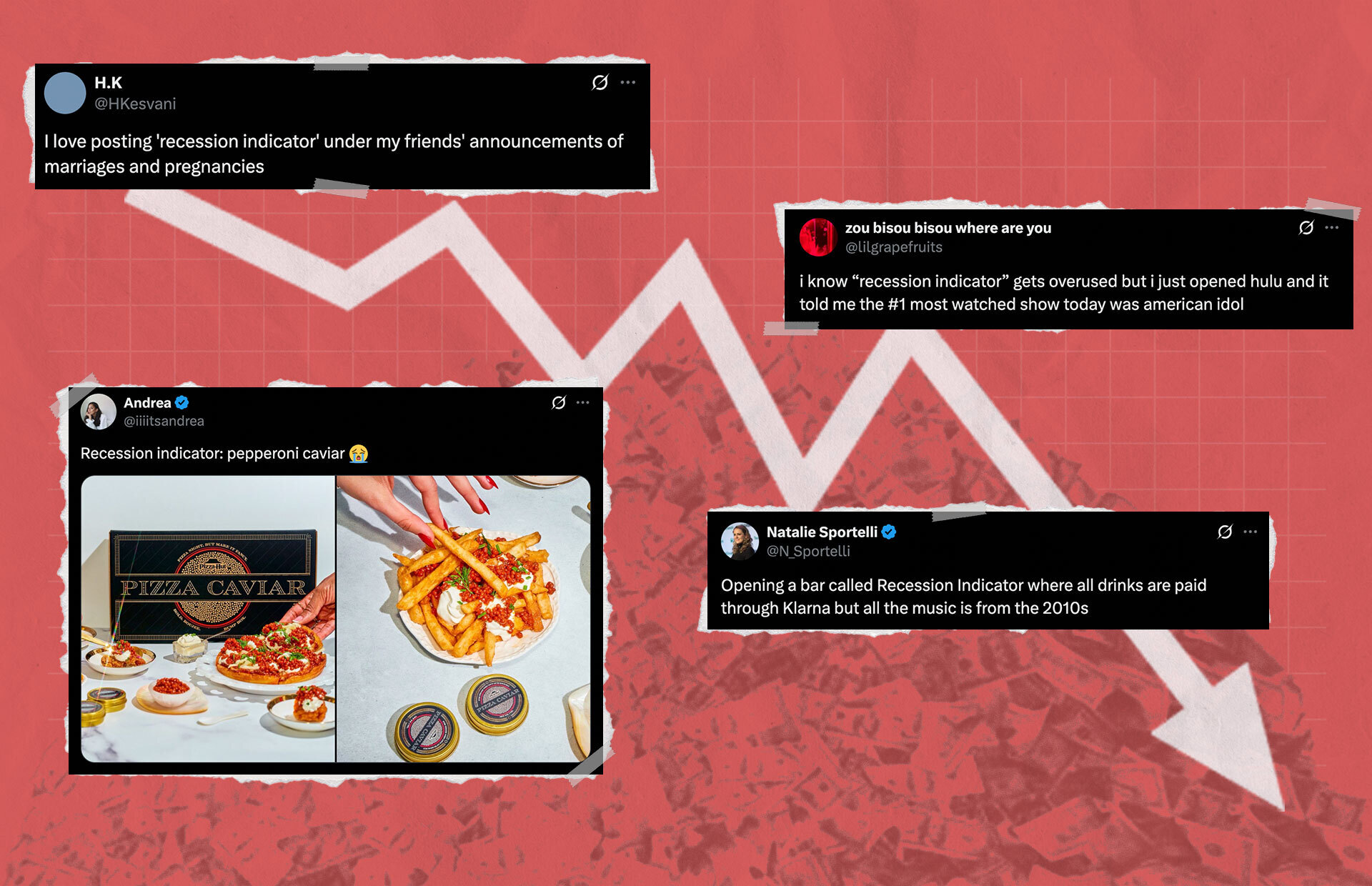
Even before the markets were plunged into chaos by President Donald Trump’s tariffs announcement at the start of the month, a certain genre of meme was spreading across social media: posts labeling a comically wide variety of observations and situations like these as “recession indicators.”

As uncertainty grows in every corner of the U.S. economy — Silicon Valley, manufacturing, housing and retail, to name a few — internet users who might not even have lived through the Great Recession of the late 2000s or the recession of 1981 see signs of imminent recession almost everywhere. Supposed indicators include people exiting the job market in favor of law school, saving money by cooking at home or streaming years-old episodes of American Idol.

While the recession indicator trope is not new — the viral tweet from a dancer linking declining strip club attendance and U.S. economic health was posted in 2022 — the 2025 meme strain specifically focuses on the apparent resurgence of 2000s pop culture as a sign of the economic times, with an increasingly absurdist twist. This is how we get the recession indicator of British singer-songwriter Ed Sheeran, whose debut album was released in 2011, being “cool” again — or a rare public sighting of a child star from TV’s Malcolm in the Middle (which debuted in 2000: the same year that the dot-com bubble burst in U.S. stock markets).

But in other posts, “throwback” leanings are directly linked to financial behavior — the idea that 2010s formal wear-at-the-club style is making a comeback precisely because it allows the wearer to save money by reusing office clothing:

As purposefully goofy as many of these observations are, there’s a serious question here: What can recession indicator memes actually tell us — or even predict — about the national economy? And what do online trends like this communicate about how regular people experience economic uncertainty?

On the hunt for signs of a recession

At the time of writing, the U.S. is not currently in a recession, although experts have warned that the uncertainty stoked by Trump’s tariffs could accelerate one.

The “rule of thumb” definition of a recession is when a country experiences two consecutive quarters of decline in its gross domestic product, or the total value of all goods and services a country produces.

However, for many economists and financial analysts, just looking at GDP is not enough to identify a recession. GDP is “a very high level” signal of economic activity, said Julian Vogel, assistant professor of finance at San José State University and chartered financial analyst. Since the U.S. Department of Commerce only reports this data once the quarter has concluded, it’s also a “lagging indicator,” he said. And by the time economists are reporting six months’ worth of declining GDP and proclaiming a recession, “most people will be like, ‘Yeah, no kidding — I was there, I felt it,’” Vogel said. (They may even have already posted about it.)

Instead, economists and analysts look at multiple metrics at once, which could include employment levels, income levels or investment in industrial production, among others. One piece of data that is key for Vogel is “consumer confidence”: how individual consumers, like you, feel about the overall state of the economy and the direction it’s heading.

And according to the business research group Conference Board, short-term expectations about the economy among Americans last month fell to their lowest levels in 12 years, with consumer confidence falling across all income brackets except for households earning more than $125,000 a year.

“If people are less confident about the future, they’re going to cut back in some shape or form,” Vogel said. “They’re going to either stop certain types of spending … or they are going to substitute [certain goods] for a cheaper product.”

In other words, the stuff of recession indicator memes.

Sponsored

Lipstick: the original ‘recession indicator’ meme?

The “substitution effect” is one way economists measure how consumers feel about the future: if folks want to cut back on expenses, they will replace certain goods with more affordable substitutes. This phenomenon gives us one of the most pervasive “recession indicator” memes from the days of the early internet: the so-called “lipstick index.”

This theory, proposed by Estée Lauder chairman Leonard Lauder amid the post-9/11 downturn, assumes that consumers purchase cheaper products like lipstick as a way to “treat themselves” when they can’t afford more expensive items like clothing or jewelry.

Economists are still researching the accuracy of the “lipstick index.” However, relatable and informal measurements, like falling hair salon profits, stick around in the popular imagination and paved the way for recession indicator memes.

For its part, the Trump administration argues that sinking consumer confidence doesn’t necessarily mean the economy itself is slowing down — contradicting what most economists think. And because consumption is deeply intertwined with production in the U.S. economy, noted San José State’s Vogel, the kind of reduced spending that comes with low consumer confidence can impact how much manufacturers order from their suppliers.

“We are entering a kind of self-reinforcing cycle where less demand leads to less need for workers, which leads to layoffs,” Vogel said. “That leads to less money being available, which leads to less demand, and so on.”

Don’t discount the memes 

The recession indicator meme shows no signs of slowing down right now, finding dark humor in any sign of consumers spending less or dabbling in “recession pop.”

But ultimately, the recession indicator trend might be less about the accuracy of these alleged recession indicators — Kourtney Kardashian spotted in Bushwick, anyone? — and more about how they reflect the anxieties of consumers trying to process an ever-changing economic reality in real-time, said Ellen Evers, associate professor of marketing at UC Berkeley.

“The way the economy works is not necessarily similar to the way consumers experience the economy,” said Evers, whose research focuses on understanding how humans make decisions. “As a consumer, what you see are the very concrete things: ‘Is my rent going up? Is my salary going up? How much is a gallon of milk?’” she said.

Decades of research show that most humans depend on information that they can easily recall — the price of eggs, for example, or what trends were popular the last time they witnessed an economic crisis. Being able to then “report” these observations on social media, however humorously, in the form of recession indicator memes, is just another part of talking about what we see in front of us, Evers said. “You choose your own network,” she said. “And if you want to believe a thing, you choose people in your network that also believe those things.”

All of which might explain how a complicated economic idea like “a drop in GDP” can now be represented through something much more familiar, like a shuttered downtown Dunkin Donuts location — because “the recession indicator memes are just much easier to understand than any of the fundamental economics,” Evers said.

She did caution that these memes could prompt people to feel even more jittery about the economy and adjust their spending accordingly, giving us “a kind of self-fulfilling prophecy.” But San José State’s Vogel, on the other hand, noted the deep economic uncertainty COVID wrought, from price hikes to supply chain disruptions, has left many people “quite scarred” — and memers could be processing their last bout of financial panic by joking that the next one might be around the corner.

Sounds like it’s time to add a lesson on memes to the Economics 101 syllabus.

Sponsored

lower waypoint
next waypoint