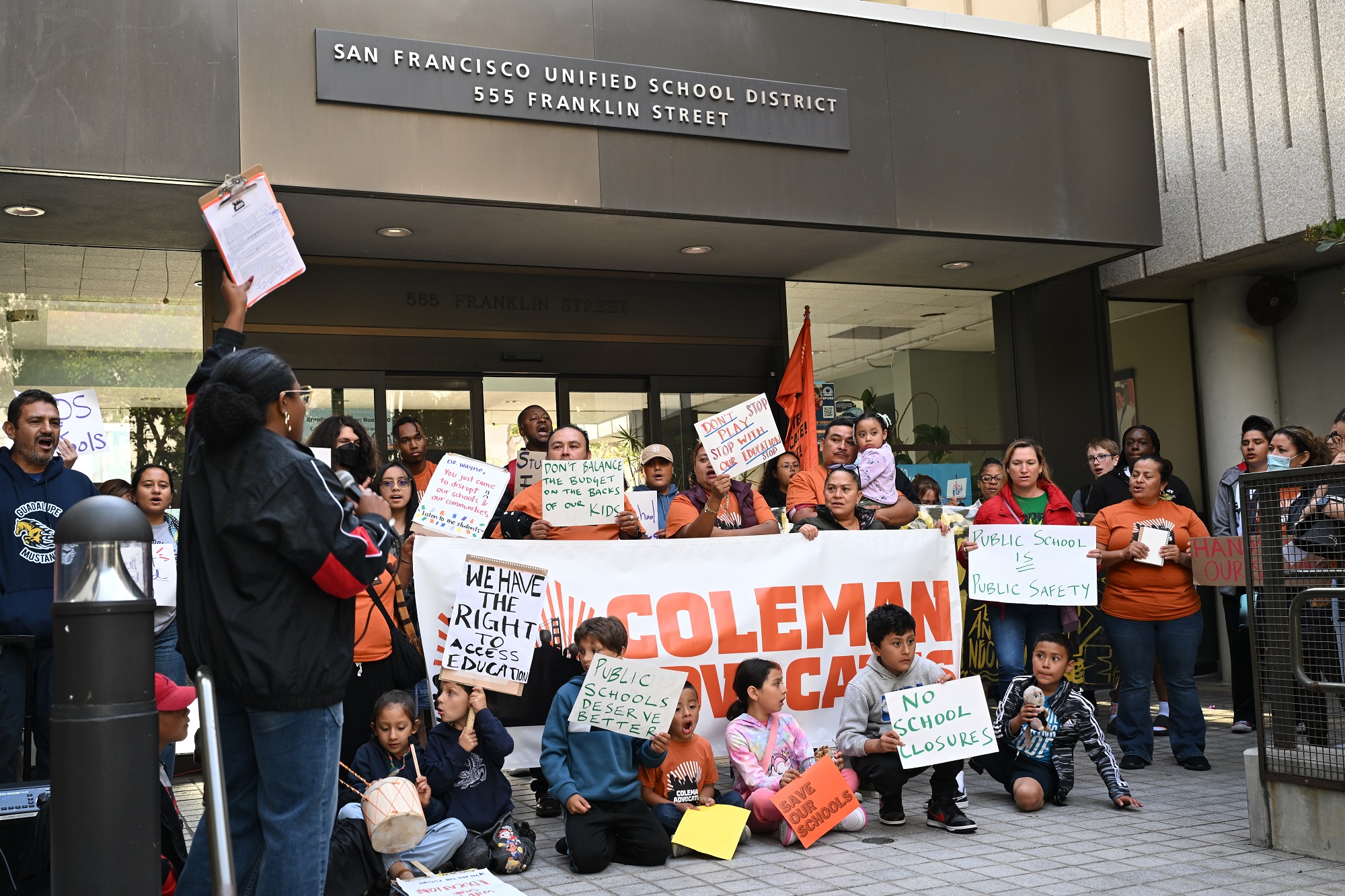
“More older, experienced teachers leaving our schools replaced by new, younger, less experienced teachers will result in poorer learning outcomes for our students,” Cindy Chung, whose first-grader attends Starr King Elementary School, said at Tuesday’s meeting. “We’ve already seen high turnover of [paraeducators] and lower-paid staff who have less financial stability, can’t afford to live in SF and have incredibly long commutes.”
Staff ranging from paraeducators to upper management will be eligible for the Supplemental Employee Retirement Plan so long as they have permanent full-time positions, are over 55, and will have worked within SFUSD for a consecutive five years as of June 2025. The district plans to send notification letters with information for employees who qualify beginning Wednesday.
Many positions will be filled with “lower-paid new hires,” whose starting salaries are $18,000 to $30,000 lower, while an estimated 69 positions could be eliminated. Together, SFUSD said, this could save over $30 million.
Those who agree to the buyout by mid-February will receive a one-time payment equal to 60% of their salary upon their resignation while retaining their retirement benefits. If fewer than 314 employees sign up to participate, though, the offer could be retracted entirely.
Cassondra Curiel, the president of United Educators San Francisco, said that although early retirement could be beneficial to some of the union’s members, it will destabilize overall school staffing.
“We have classrooms right now with students in them who don’t have permanent teachers. They’ve had substitutes since August,” she told KQED. “We feel like that is management and the district’s negligence, and now they’re going to compound that vacancy.”
The early retirement program is one part of the district’s three-pronged fiscal stabilization plan, which it said will help balance its budget and avoid state takeover. That plan was also passed by the board on Tuesday, giving Superintendent Maria Su direction to take any and all steps necessary to present balanced budgets for the next three cycles.
SFUSD is expected to have a $113 million budget shortfall this year and an even larger structural deficit by 2027.
Elliott Duchon, a state-appointed adviser who has veto power over SFUSD’s spending, told school board members on Tuesday that the reductions are crucial.
“I have not attended a board meeting where people are not worried about losing their jobs, where the spend budget hasn’t been an issue, where staffing hasn’t been an issue,” he said.
Since May, Duchon has had the ability to veto SFUSD’s spending decisions because its budget report was negative, indicating it will fail to cover its expenses in coming years. This year’s first budget report, presented Tuesday, was negative as well.
“It’s unhealthy for the district,” Duchon said. “It’s unhealthy for your staff. It’s unhealthy for your children, the community, and for you as board members. It detracts from your goals and your ability to focus.”
In addition to the buyouts, the fiscal stabilization plan includes a review of all budget expenditures and potential layoffs at the end of the academic year. SFUSD needs to cut more than $113.8 million in expenses next fiscal year and $13 million more in 2026-2027 to get back on track.
Teachers and certificated staff will be notified of layoffs by March, and civil staff will find out in mid-May. The district will look at how many people choose to participate in the early retirement program and how much funding SFUSD receives in January’s state budget to determine how many layoffs are necessary, Su said. District staffers have already created a seniority list of employees to share with labor partners ahead of the potential reductions.
At the same time, Michele Huntoon, SFUSD’s associate superintendent of business services, said staff members will review all expenditures based on a few questions: “Are we using them? Are they meeting our purpose? Is it meeting our needs?”
Duchon said that while the changes will be challenging, SFUSD needs to face the reality of its financial situation.
“You are living in a time of declining enrollment, declining revenue,” he said. “You have used one-time revenues to pay for ongoing staffing, and that has put you in a position of staffing in a way that is richer than what your resources allow you to do. We want to be hopeful, but there may be pain to go through before you get there. And if you don’t go through the pain, the pain will continue on and on.”