Can California Build a Million EV Charging Stations to Meet Its Clean Energy Goals?
Public chargers must be built at an unprecedented pace to meet the target in less than seven years and then doubled to 2 million in 2035. The high cost is just one obstacle.
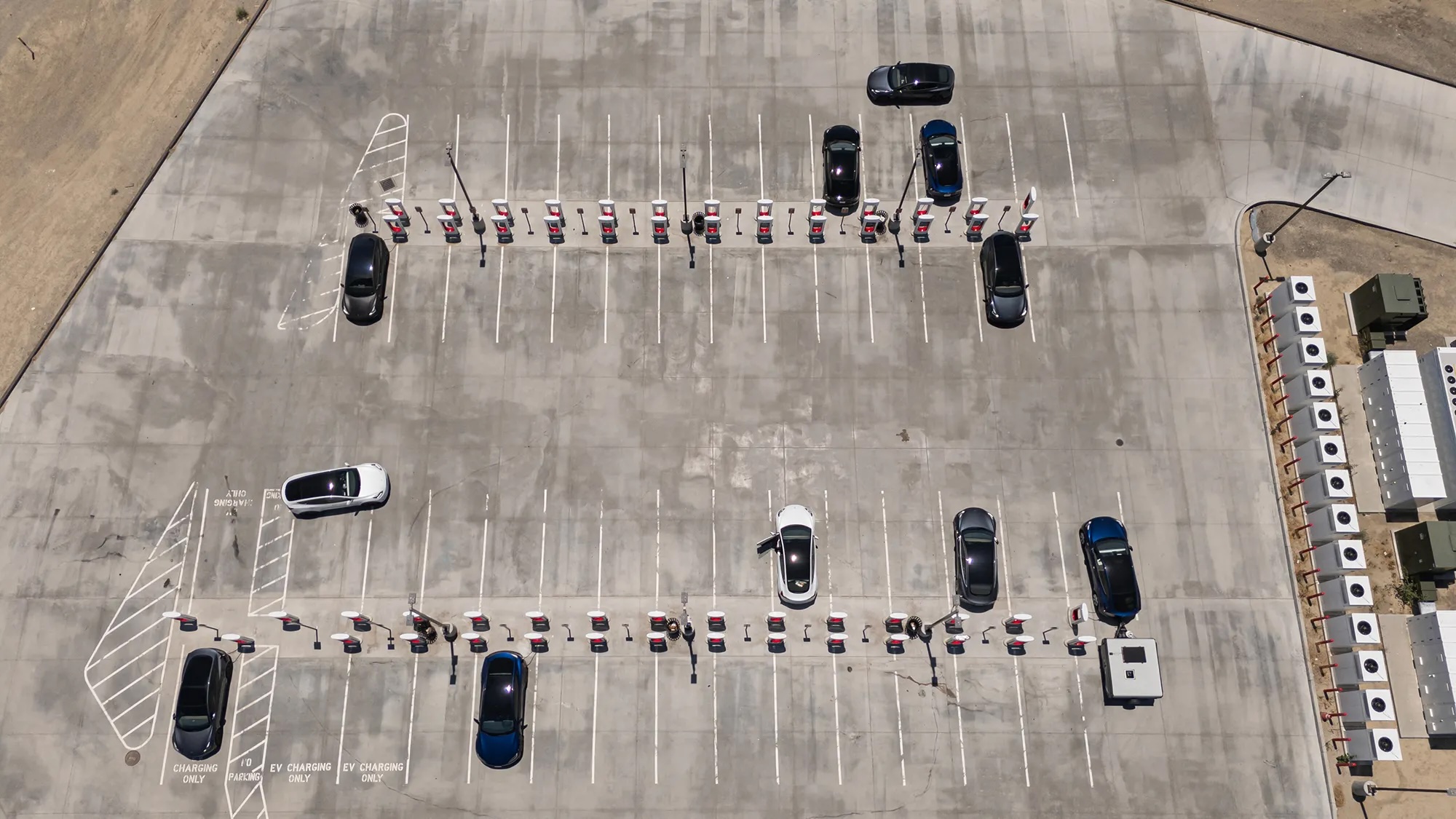
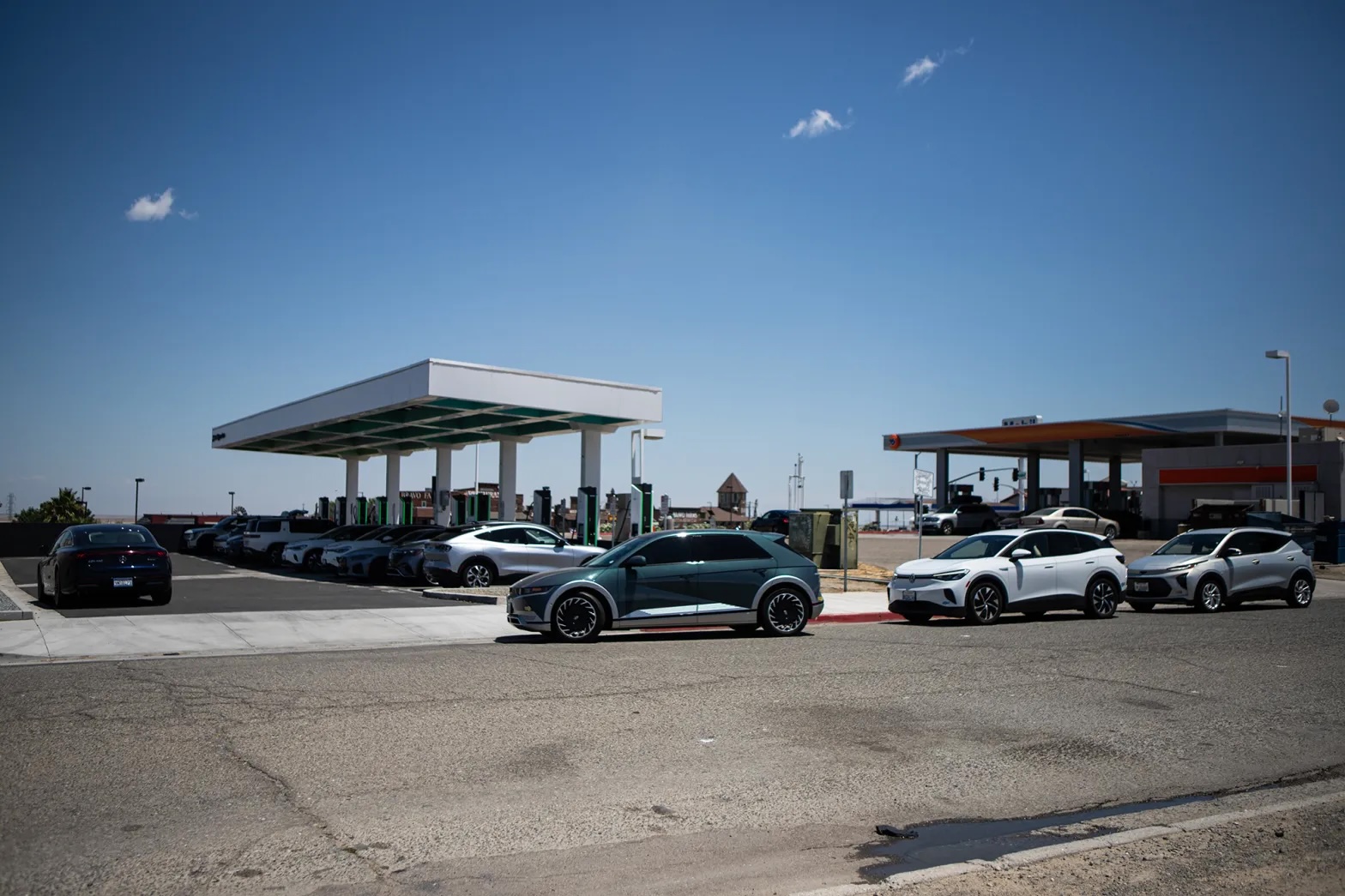
Cars use fast chargers at a Tesla Supercharger lot in Kettleman City. Tesla recently reached agreements with other automakers to give them access to their chargers. (Larry Valenzuela/CalMatters/CatchLight Local)
California will have to build public charging stations at an unprecedented — and some experts say unrealistic — pace to meet the needs of the 7 million electric cars expected on its roads in less than seven years.
The sheer scale of the build-out has alarmed many experts and lawmakers, who fear that the state won’t be prepared as Californians purchase more electric cars.
A million public chargers are needed in California by the end of 2030, according to the state’s projections — almost 10 times more than the number available to drivers in December. To meet that target, 129,000 new stations — more than seven times the current pace — must be built every year for the next seven years. Then, the pace would have to accelerate again to reach a target of 2.1 million chargers in 2035.
A robust network of public chargers — akin to the state’s more than 8,000 gas stations — is essential to ensure that drivers will have the confidence to purchase electric vehicles over the next several years.
“It is very unlikely that we will hit our goals, and to be completely frank, the EV goals are a noble aspiration but unrealistic,” said Stanford professor Bruce Cain, who coauthored a policy briefing detailing California’s electric vehicle charging problems. “This is a wakeup call that we address potential institutional and policy obstacles more seriously before we commit blindly.”
Under California’s landmark electric car mandate, a pillar of Gov. Gavin Newsom’s climate change agenda, 68% of all new 2030 model cars sold in the state must be zero emissions, increasing to 100% by 2035, when 15 million electric cars are expected in California.
“We’re going to look really silly if we are telling people that they can only buy electric vehicles, and we don’t have the charging infrastructure to support that,” said Assemblymember Jesse Gabriel, a Democrat from Encino who introduced a package of unsuccessful bills last year aimed at expanding access to car chargers.
“We are way behind where we need to be,” Gabriel told CalMatters.
Big obstacles stand in the way of amping up the pace of new charging stations in public places. California will need billions of dollars in state, federal and private investments, streamlined city and county permitting processes, major power grid upgrades and accelerated efforts by utilities to connect chargers to the grid.
State officials are also tasked with ensuring that charging stations are available statewide, in rural and less-affluent areas where private companies are reluctant to invest, and that they are reliable and functioning whenever drivers pull up.
In Pacific Gas & Electric’s vast service area, home to 40% of all Californians, electric car purchases are moving twice as fast as the build-out of charging stations, said Lydia Krefta, the utility’s director of clean energy transportation. Californians now own more than 1.5 million battery-powered cars.
Patty Monahan, who’s on the Energy Commission, the state agency responsible for funding and guiding the ramp-up, told CalMatters that she is confident that California can build the chargers its residents need in time.
The agency’s estimate of the current chargers is likely an undercount, she said. In addition, fast-charging stations could play a bigger role than initially projected, meaning hundreds of thousands of fewer chargers might be needed. Also, as the ranges and charging speeds on cars improve, there may be less demand for public chargers.
“California has a history of defying the odds,” Monahan said. “We have a history of advancing clean cars, clean energy, writ-large. We have naysayers left and right saying you can’t do it, and then we do it.”
Barriers to private investments: an uncertain market
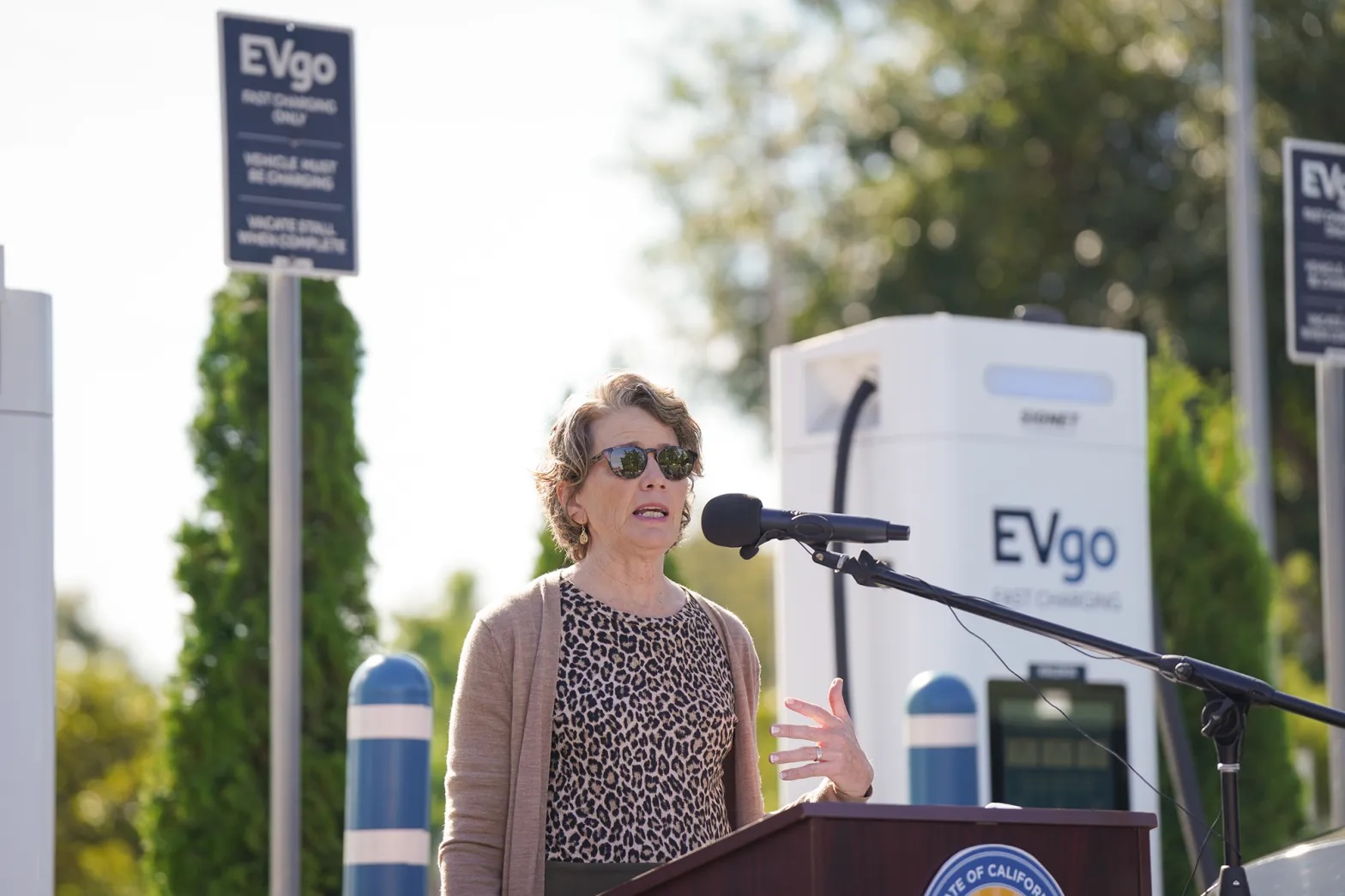
On a September day last year, Monahan spoke behind a podium in the parking lot of a Bay Area grocery store. A row of newly constructed car chargers rose behind her.
“Let’s celebrate for a moment,” she said.
California had met its goal of 10,000 fast electric chargers statewide — two years ahead of the target set in 2018.
California Energy Commissioner Patty Monahan speaks during the launch of an EVgo fast charging station in Union City on Sept. 25, 2023. (Loren Elliott for CalMatters)
Fast chargers, like the new ones at the grocery store, are increasingly seen as critical to meeting the needs of drivers. They can power a car to 80% in 20 minutes to an hour, while the typical charger in use today, a slower Level 2, takes from four to 10 hours.
But installing and operating fast chargers is an expensive business — one that doesn’t easily turn a profit.
Nationwide, each fast charger (PDF) can cost up to $117,000, according to a 2023 study. And in California, it could be even more — between $122,000 and $440,000 each, according to a separate study, although the Energy Commission said the range was $110,000 to $125,000 for one of its programs.
Most of America’s publicly traded charger companies have been forced to seek more financing, lay off workers and slow their network build-outs, analysts said. EVgo, for instance, has seen its share price crater, as has ChargePoint, which specializes in selling the slower Level 2 hardware.
California stands apart from other states — it has by far the most chargers and electric car sales and more incentives and policies encouraging them.
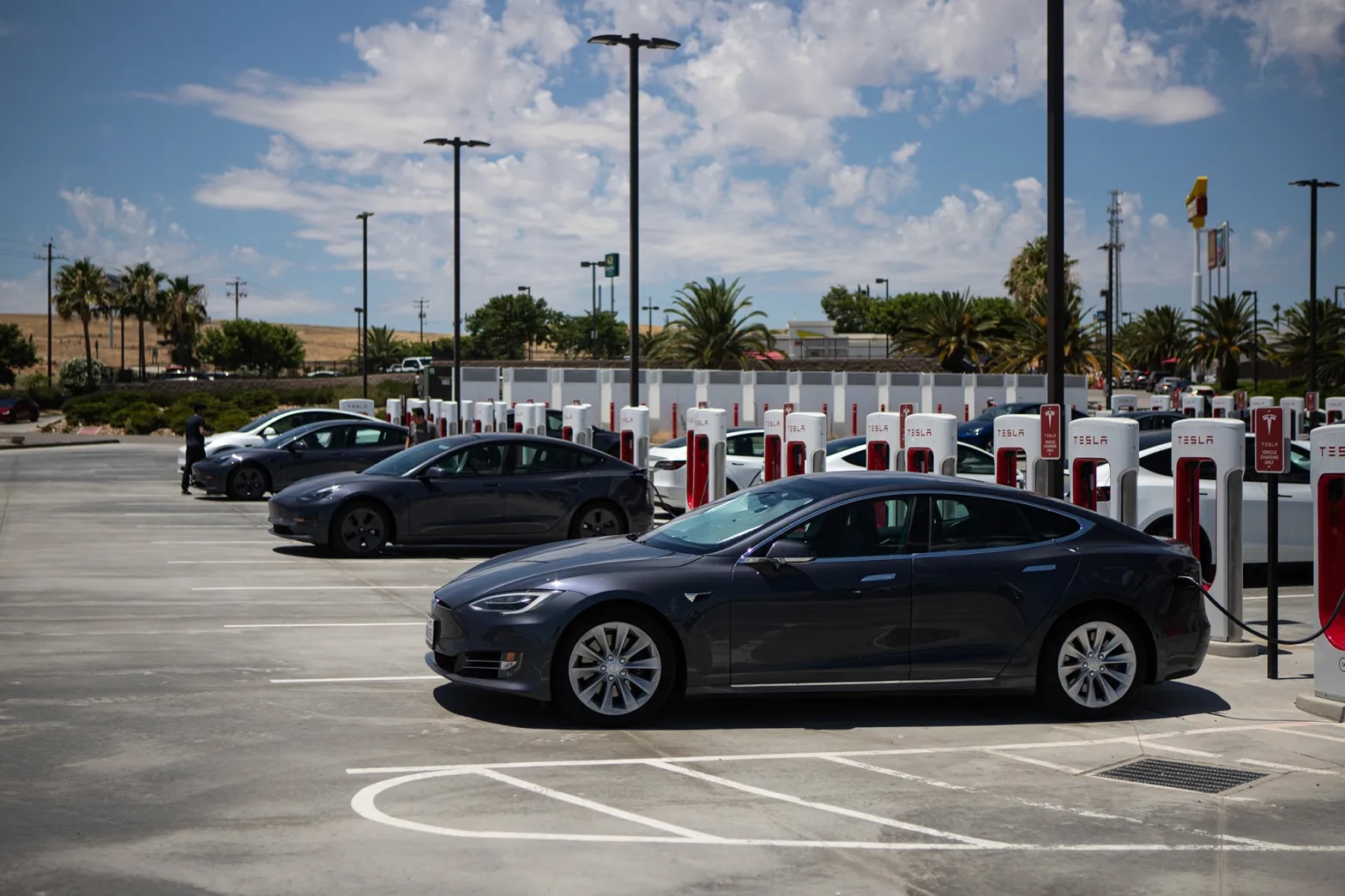
Tesla, America’s top-selling electric car manufacturer, dominates fast-charging in both California and the U.S. — but the company didn’t get into the business to sell charges to drivers; it got into the charger business to sell its electric cars. Initially Tesla Superchargers were exclusive to its drivers, but starting this year other EV drivers can use them after Tesla provided ports to Ford and other automakers.
Tesla’s manufacturing prowess, supply chain dominance and decade-plus of experience with fast chargers have given it an edge over competitors — a coterie of unprofitable, publicly traded startups, as well as private companies that often benefit from public subsidies, according to analysts.
“All the automakers joined forces with their biggest competitor,” said Loren McDonald, chief executive of the consulting firm EVAdoption. “If that doesn’t tell you how bad fast-charging networks and infrastructure were, I don’t know what else does.”
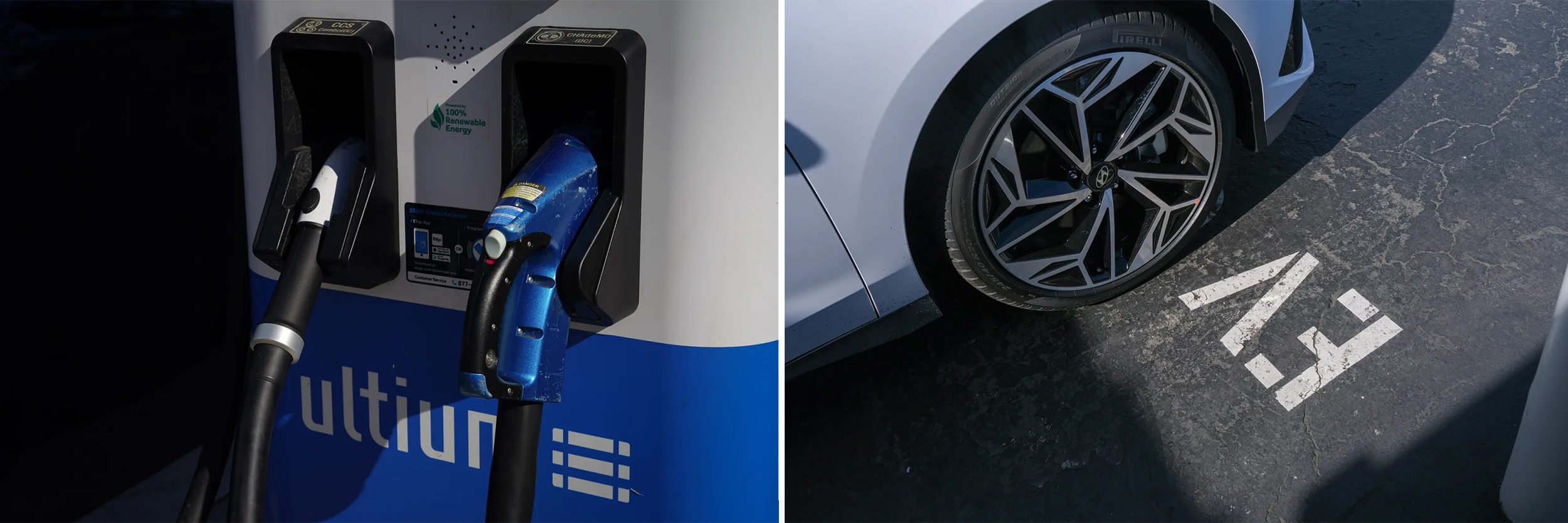
Tesla vehicles charge at a Supercharger lot in Kettleman City on June 23, 2024. (Larry Valenzuela/CalMatters/CatchLight Local)Left: An EVgo fast charger at El Mercado Plaza Shopping Center in Union City. Right: A Hyundai Ioniq 6 charges at an Electrify America station in Oakland. (Loren Elliott and Camille Cohen for CalMatters)
In California, Electrify America, a privately held company, was created by Volkswagen as a settlement for cheating on emissions tests for its gas-powered cars. The company is spending $800 million on California chargers, building a robust network of 260 stations, with more than half in lower-income communities, including the state’s worst charging desert, Imperial County.
The problem is Electrify America was ranked dead last in a consumer survey last year, and reliability problems and customer complaints have plagued its chargers. The California Air Resources Board in January directed Electrify America (PDF) to “strive to achieve charger reliability consistent with the state of the industry.” A company spokesperson said the dissatisfaction showed “an industry in its growth trajectory.” There are signs of improvement, based on consumer data from the first three months of this year.
Startups continue to jump into the charging business, with the number of companies offering fast chargers growing from 14 in 2020 to 41 in 2024, EVAdoption said. Seven carmakers formed a $1 billion venture to build a 30,000-charger network in North America. And gas stations such as Circle K offer more charging because electric car customers spend more time shopping while waiting for their rides to juice up.
But the realization that charging is a costly business has set in on Wall Street, and that doesn’t seem likely to change anytime soon. “Can public EV fast-charging stations be profitable in the United States?” the consultancy McKinsey & Company asked.
“The fervor, the excitement from the investor base, has definitely dwindled quite a bit, given the prospects that EV adoption in the U.S. is going to be slower, revenue growth is really slower, the path to profitability is going to be slower, and they might need more capital than everyone originally expected,” said Christopher Dendrinos, a financial analyst who covers electric car charging companies for the investment bank RBC Capital Markets.
The stakes are high for California when it comes to encouraging investments in expensive fast chargers: If 63,000 additional ones were built, California might need 402,000 fewer slower Level 2 chargers in 2030, according to an alternative forecast (PDF) by the Energy Commission.
Billions of public dollars: Will it be enough?
Nationwide, $53 billion to $127 billion in private investments and public funding is needed by 2030 to build chargers for about 33 million electric cars, according to a federal estimate (PDF). Of that, about half would be for public chargers.
Congress and the Biden administration have set aside $5 billion for a national network of fast chargers. So far, only 33 of the eight locations have been built, but more than 14,000 others are in the works, according to the Federal Highway Administration. California’s share of the federal money totals $384 million; about 500 fast chargers will be built with an initial $40.5 million, Energy Commission spokesperson Lindsay Buckley said.
In addition, the state has spent $584 million to build more than 33,000 electric car chargers (PDF) through its Clean Transportation Program, funded by fees drivers pay when they register cars. The Legislature extended that program for an additional decade last year.
Newsom has committed to spending $1 billion through 2028 on chargers with his “California Climate Commitment (PDF),” Buckley said. But this year, Newsom and the Legislature trimmed $167 million from the charger budget as the state faces a record deficit. A lobbyist for the Electric Vehicle Charging Association said, “The state pullback sends a very challenging message” to the industry.
California’s commitment to charger funding is “solid,” despite the cuts, Buckley said. They have not yet estimated the total investment needed in California to meet the targets.
However, Ted Lamm, a UC Berkeley Law researcher who studies electric car infrastructure, said the magnitude of building what California needs in coming years likely dwarfs the public funding available.
State and federal programs will “only fund a fraction,” and the state needs to spend that money on lower-income communities, he said.
Another possible funding source is California’s Low Carbon Fuel Standard, which is expected to be revised in November. The program requires carbon-intensive fuel companies to pay for cleaner-burning transportation. Utilities get credits and use that money to pay for chargers, rebates to car buyers and grid improvements, said Laura Renger, executive director of the California Electric Transportation Coalition, which represents utilities.
“I think with that, we would have enough money,” Renger said. She said the program’s overhaul could help utilities invest “billions” in chargers and other electric car programs over the next two decades.
Backlogged local permits and grid delays
One of the biggest barriers to more chargers isn’t money. It’s that cities and counties are slow to approve plans for the vast number of stations needed.
State officials only have so much political power to compel local jurisdictions to do what they want — a reality made abundantly clear by the housing crisis, for instance. California relies on grants and persuasion to accomplish its goals, and the slow build-out of chargers shows how those strategies can fall short, said Stanford’s Cain.
“The locals cannot be compelled by regulatory agencies to make land and resources available for what the state wants to achieve,” Cain said.
The same obstacles have marked the state’s broader effort to electrify California and switch to clean energy. Local opposition and environmental reviews sometimes hold up large solar projects and transmission projects for years.
California has created a “culture of regulation that emphasizes the need to be extra careful and extra perfect, but this takes an incredible amount of time,” Steve Bohlen, senior director of government affairs at Lawrence Livermore National Laboratory, said last month at the inaugural hearing of the state Assembly’s Select Committee on Permitting Reform.
“We’re moving into a period of rapid change, and so perfect can’t be the enemy of the good.”
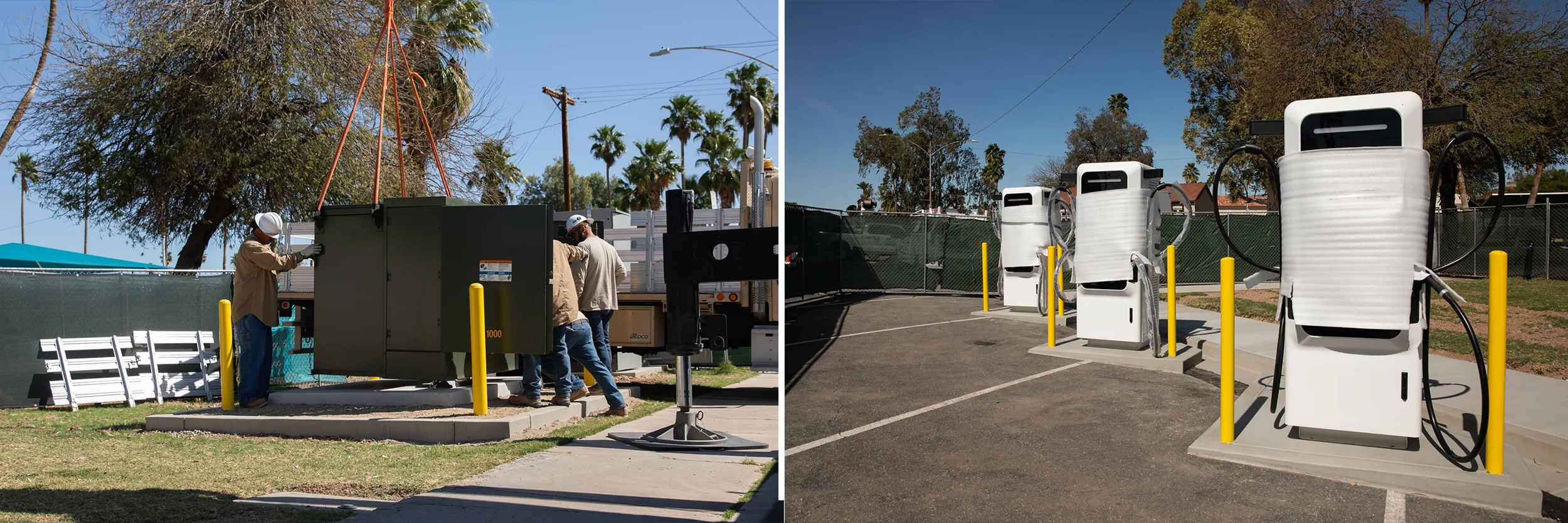
Left: Workers install a transformer to power electric car chargers in Calexico. Right: A row of new public chargers there. (Adriana Heldiz/CalMatters)
Chargers aren’t as complicated as large-scale solar or offshore wind projects. However, most chargers installed in public spaces need a land-use or encroachment permit, among other approvals.California has passed laws requiring local jurisdictions to streamline permits for chargers. What’s more, the Governor’s Office of Business Development now grades cities and counties using a scorecard (PDF) and maintains a map displaying who has or hasn’t made life easier for car charger builders. But these strategies only go so far.
“It doesn’t matter how many requirements you put on [local governments],” Lamm said. “If they just don’t have the time in the day to do it … it’s going to sit in the backlog because that’s how it works.”
The delays have consequences. Getting a station permitted in California, on average, takes 26% longer (PDF) than the national average, Electrify America reported. Designing and constructing a station in California can cost, on average, 37% more (PDF) than in other states because of delays in permitting and grid connections. A utility, on average, takes 17 weeks after work is completed to connect chargers to the grid, Electric America said.
Powering large charging projects often requires grid upgrades, which can take a year or more for approval, said Chanel Parson, a director at Southern California Edison. Supply chain issues also make getting the right equipment a challenge.
Edison, which has a 10-year plan to meet expected demand, has asked the utilities commission for approval to upgrade the grid where it anticipates high charging demand.
“Every EV charging infrastructure project is a major construction project,” Parson said. “There are a number of variables that influence how long it takes to complete the project.”
Impatient with broken chargers, bad service
Inspired to help the nation reduce its dependence on fossil fuels, Zach Schiff-Abrams of Los Angeles bought a Genesis GV60. As a renter, he has relied on public charging, primarily using Electrify America stations — and that’s been his biggest problem about owning an electric car.
Charging speeds have been inconsistent, he said, with half-hour sessions providing only a 15% to 30% charge, and he often encounters broken chargers.
“I believe in electrical, so I’m really actually trying to be a responsible consumer,” Schiff-Abrams said. “I want to report them when they’re down, but the customer service is horrible.”
Electric vehicles line up at a busy Electrify America charging station in Kettleman City, Kings County. (Larry Valenzuela/CalMatters/CatchLight Local)
In January (PDF), the California Air Resources Board approved a final $200 million spending plan for Electrify America — but not before board chair Liane Randolph scolded its CEO.
Randolph — arguably one of America’s top climate regulators — told CEO Robert Barrosa about an exchange she had with his company’s customer service line after finding a broken charger at a station along Interstate 5.
“It didn’t work,” Randolph said during the board meeting. “Called the customer service line, waited like 10-ish minutes. … [The charger] was showing operable on the app and the guy goes, ‘Oh, my data is showing me that it has not had a successful charge in three days.’”
“These issues are not easy,” Barrosa responded. “Our head is not in the sand,” he told board members (PDF) earlier. “We are listening to customers.”
But Randolph, addressing journalists at a conference in Philadelphia, pushed back against the idea that because the transition to electric vehicles is happening gradually that, it’s a failure. Many people will rely on charging at home or work, and batteries are becoming more efficient.
“The infrastructure is continuing to be rolled out at a rapid pace,” Randolph said. “It doesn’t all have to be perfect instantly. It’s a process. And it’s a process that’s continuing to move.”
Data journalists Erica Yee and Arfa Momin contributed to this report.
lower waypointnext waypoint
Player sponsored by
window.__IS_SSR__=true
window.__INITIAL_STATE__={
"attachmentsReducer": {
"audio_0": {
"type": "attachments",
"id": "audio_0",
"imgSizes": {
"kqedFullSize": {
"file": "https://ww2.kqed.org/news/wp-content/themes/KQED-unified/img/audio_bgs/background0.jpg"
}
}
},
"audio_1": {
"type": "attachments",
"id": "audio_1",
"imgSizes": {
"kqedFullSize": {
"file": "https://ww2.kqed.org/news/wp-content/themes/KQED-unified/img/audio_bgs/background1.jpg"
}
}
},
"audio_2": {
"type": "attachments",
"id": "audio_2",
"imgSizes": {
"kqedFullSize": {
"file": "https://ww2.kqed.org/news/wp-content/themes/KQED-unified/img/audio_bgs/background2.jpg"
}
}
},
"audio_3": {
"type": "attachments",
"id": "audio_3",
"imgSizes": {
"kqedFullSize": {
"file": "https://ww2.kqed.org/news/wp-content/themes/KQED-unified/img/audio_bgs/background3.jpg"
}
}
},
"audio_4": {
"type": "attachments",
"id": "audio_4",
"imgSizes": {
"kqedFullSize": {
"file": "https://ww2.kqed.org/news/wp-content/themes/KQED-unified/img/audio_bgs/background4.jpg"
}
}
},
"placeholder": {
"type": "attachments",
"id": "placeholder",
"imgSizes": {
"thumbnail": {
"file": "https://cdn.kqed.org/wp-content/uploads/2024/12/KQED-Default-Image-816638274-2000x1333-1-160x107.jpg",
"width": 160,
"height": 107,
"mimeType": "image/jpeg"
},
"medium": {
"file": "https://cdn.kqed.org/wp-content/uploads/2024/12/KQED-Default-Image-816638274-2000x1333-1-800x533.jpg",
"width": 800,
"height": 533,
"mimeType": "image/jpeg"
},
"medium_large": {
"file": "https://cdn.kqed.org/wp-content/uploads/2024/12/KQED-Default-Image-816638274-2000x1333-1-768x512.jpg",
"width": 768,
"height": 512,
"mimeType": "image/jpeg"
},
"large": {
"file": "https://cdn.kqed.org/wp-content/uploads/2024/12/KQED-Default-Image-816638274-2000x1333-1-1020x680.jpg",
"width": 1020,
"height": 680,
"mimeType": "image/jpeg"
},
"1536x1536": {
"file": "https://cdn.kqed.org/wp-content/uploads/2024/12/KQED-Default-Image-816638274-2000x1333-1-1536x1024.jpg",
"width": 1536,
"height": 1024,
"mimeType": "image/jpeg"
},
"fd-lrg": {
"file": "https://cdn.kqed.org/wp-content/uploads/2024/12/KQED-Default-Image-816638274-2000x1333-1-1536x1024.jpg",
"width": 1536,
"height": 1024,
"mimeType": "image/jpeg"
},
"fd-med": {
"file": "https://cdn.kqed.org/wp-content/uploads/2024/12/KQED-Default-Image-816638274-2000x1333-1-1020x680.jpg",
"width": 1020,
"height": 680,
"mimeType": "image/jpeg"
},
"fd-sm": {
"file": "https://cdn.kqed.org/wp-content/uploads/2024/12/KQED-Default-Image-816638274-2000x1333-1-800x533.jpg",
"width": 800,
"height": 533,
"mimeType": "image/jpeg"
},
"post-thumbnail": {
"file": "https://cdn.kqed.org/wp-content/uploads/2024/12/KQED-Default-Image-816638274-2000x1333-1-672x372.jpg",
"width": 672,
"height": 372,
"mimeType": "image/jpeg"
},
"twentyfourteen-full-width": {
"file": "https://cdn.kqed.org/wp-content/uploads/2024/12/KQED-Default-Image-816638274-2000x1333-1-1038x576.jpg",
"width": 1038,
"height": 576,
"mimeType": "image/jpeg"
},
"xxsmall": {
"file": "https://cdn.kqed.org/wp-content/uploads/2024/12/KQED-Default-Image-816638274-2000x1333-1-160x107.jpg",
"width": 160,
"height": 107,
"mimeType": "image/jpeg"
},
"xsmall": {
"file": "https://cdn.kqed.org/wp-content/uploads/2024/12/KQED-Default-Image-816638274-2000x1333-1-672x372.jpg",
"width": 672,
"height": 372,
"mimeType": "image/jpeg"
},
"small": {
"file": "https://cdn.kqed.org/wp-content/uploads/2024/12/KQED-Default-Image-816638274-2000x1333-1-672x372.jpg",
"width": 672,
"height": 372,
"mimeType": "image/jpeg"
},
"xlarge": {
"file": "https://cdn.kqed.org/wp-content/uploads/2024/12/KQED-Default-Image-816638274-2000x1333-1-1020x680.jpg",
"width": 1020,
"height": 680,
"mimeType": "image/jpeg"
},
"full-width": {
"file": "https://cdn.kqed.org/wp-content/uploads/2024/12/KQED-Default-Image-816638274-2000x1333-1-1920x1280.jpg",
"width": 1920,
"height": 1280,
"mimeType": "image/jpeg"
},
"guest-author-32": {
"file": "https://cdn.kqed.org/wp-content/uploads/2025/01/KQED-Default-Image-816638274-1333x1333-1-160x160.jpg",
"width": 32,
"height": 32,
"mimeType": "image/jpeg"
},
"guest-author-50": {
"file": "https://cdn.kqed.org/wp-content/uploads/2025/01/KQED-Default-Image-816638274-1333x1333-1-160x160.jpg",
"width": 50,
"height": 50,
"mimeType": "image/jpeg"
},
"guest-author-64": {
"file": "https://cdn.kqed.org/wp-content/uploads/2025/01/KQED-Default-Image-816638274-1333x1333-1-160x160.jpg",
"width": 64,
"height": 64,
"mimeType": "image/jpeg"
},
"guest-author-96": {
"file": "https://cdn.kqed.org/wp-content/uploads/2025/01/KQED-Default-Image-816638274-1333x1333-1-160x160.jpg",
"width": 96,
"height": 96,
"mimeType": "image/jpeg"
},
"guest-author-128": {
"file": "https://cdn.kqed.org/wp-content/uploads/2025/01/KQED-Default-Image-816638274-1333x1333-1-160x160.jpg",
"width": 128,
"height": 128,
"mimeType": "image/jpeg"
},
"detail": {
"file": "https://cdn.kqed.org/wp-content/uploads/2025/01/KQED-Default-Image-816638274-1333x1333-1-160x160.jpg",
"width": 160,
"height": 160,
"mimeType": "image/jpeg"
},
"kqedFullSize": {
"file": "https://cdn.kqed.org/wp-content/uploads/2024/12/KQED-Default-Image-816638274-2000x1333-1.jpg",
"width": 2000,
"height": 1333
}
}
},
"news_11995817": {
"type": "attachments",
"id": "news_11995817",
"meta": {
"index": "attachments_1716263798",
"site": "news",
"id": "11995817",
"found": true
},
"title": "062324_WIDE-EV-Charging-LV_CM_08 copy",
"publishDate": 1721154533,
"status": "inherit",
"parent": 11995784,
"modified": 1721171669,
"caption": "Cars use fast chargers at a Tesla Supercharger lot in Kettleman City. Tesla recently reached agreements with other automakers to give them access to their chargers.",
"credit": "Larry Valenzuela/CalMatters/CatchLight Local",
"altTag": null,
"description": null,
"imgSizes": {
"medium": {
"file": "https://cdn.kqed.org/wp-content/uploads/sites/10/2024/07/062324_WIDE-EV-Charging-LV_CM_08-copy-800x450.jpg",
"width": 800,
"height": 450,
"mimeType": "image/jpeg"
},
"large": {
"file": "https://cdn.kqed.org/wp-content/uploads/sites/10/2024/07/062324_WIDE-EV-Charging-LV_CM_08-copy-1020x574.jpg",
"width": 1020,
"height": 574,
"mimeType": "image/jpeg"
},
"thumbnail": {
"file": "https://cdn.kqed.org/wp-content/uploads/sites/10/2024/07/062324_WIDE-EV-Charging-LV_CM_08-copy-160x90.jpg",
"width": 160,
"height": 90,
"mimeType": "image/jpeg"
},
"1536x1536": {
"file": "https://cdn.kqed.org/wp-content/uploads/sites/10/2024/07/062324_WIDE-EV-Charging-LV_CM_08-copy-1536x864.jpg",
"width": 1536,
"height": 864,
"mimeType": "image/jpeg"
},
"post-thumbnail": {
"file": "https://cdn.kqed.org/wp-content/uploads/sites/10/2024/07/062324_WIDE-EV-Charging-LV_CM_08-copy-672x372.jpg",
"width": 672,
"height": 372,
"mimeType": "image/jpeg"
},
"twentyfourteen-full-width": {
"file": "https://cdn.kqed.org/wp-content/uploads/sites/10/2024/07/062324_WIDE-EV-Charging-LV_CM_08-copy-1038x576.jpg",
"width": 1038,
"height": 576,
"mimeType": "image/jpeg"
},
"full-width": {
"file": "https://cdn.kqed.org/wp-content/uploads/sites/10/2024/07/062324_WIDE-EV-Charging-LV_CM_08-copy-1920x1080.jpg",
"width": 1920,
"height": 1080,
"mimeType": "image/jpeg"
},
"kqedFullSize": {
"file": "https://cdn.kqed.org/wp-content/uploads/sites/10/2024/07/062324_WIDE-EV-Charging-LV_CM_08-copy.jpg",
"width": 2000,
"height": 1125
}
},
"isLoading": false,
"fetchFailed": false
}
},
"audioPlayerReducer": {
"postId": "stream_live",
"isPaused": true,
"isPlaying": false,
"pfsActive": false,
"pledgeModalIsOpen": true,
"playerDrawerIsOpen": false,
"liveAudioPlayStartedAt": 0,
"liveAudioPlayContext": ""
},
"authorsReducer": {
"byline_news_11995784": {
"type": "authors",
"id": "byline_news_11995784",
"meta": {
"override": true
},
"slug": "byline_news_11995784",
"name": "\u003ca href=\"https://calmatters.org/author/alejandro-lazo/\">Alejandro Lazo\u003c/a>, CalMatters",
"isLoading": false
}
},
"pagesReducer": {},
"pfsSessionReducer": {},
"postsReducer": {
"stream_live": {
"type": "live",
"id": "stream_live",
"audioUrl": "https://streams.kqed.org/kqedradio",
"title": "Live Stream",
"excerpt": "Live Stream information currently unavailable.",
"link": "/radio",
"featImg": "",
"label": {
"name": "KQED Live",
"link": "/"
}
},
"stream_kqedNewscast": {
"type": "posts",
"id": "stream_kqedNewscast",
"audioUrl": "https://www.kqed.org/.stream/anon/radio/RDnews/newscast.mp3?_=1",
"title": "KQED Newscast",
"featImg": "",
"label": {
"name": "88.5 FM",
"link": "/"
}
},
"news_11995784": {
"type": "posts",
"id": "news_11995784",
"meta": {
"index": "posts_1716263798",
"site": "news",
"id": "11995784",
"found": true
},
"articlePosition": 0,
"guestAuthors": [],
"slug": "california-needs-a-million-ev-charging-stations-but-thats-unlikely-and-unrealistic",
"title": "Can California Build a Million EV Charging Stations to Meet Its Clean Energy Goals?",
"publishDate": 1721214043,
"format": "standard",
"headTitle": "Can California Build a Million EV Charging Stations to Meet Its Clean Energy Goals? | KQED",
"labelTerm": {
"term": 18481,
"site": "news"
},
"content": "\u003cp>California will have to build public charging stations at an unprecedented — and some experts say unrealistic — pace to meet the needs of the 7 million electric cars expected on its roads in less than seven years.\u003c/p>\n\u003cp>The sheer scale of the build-out has alarmed many experts and lawmakers, who fear that the state won’t be prepared as Californians purchase more electric cars.\u003c/p>\n\u003cp>A million public chargers are needed in California by the end of 2030, according to the \u003ca href=\"https://www.energy.ca.gov/data-reports/reports/electric-vehicle-charging-infrastructure-assessment-ab-2127\">state’s projections\u003c/a> — almost 10 times more than the \u003ca href=\"https://www.energy.ca.gov/data-reports/energy-almanac/zero-emission-vehicle-and-infrastructure-statistics-collection/electric\">number available to drivers\u003c/a> in December. To meet that target, 129,000 new stations — more than seven times the current pace — must be built every year for the next seven years. Then, the pace would have to accelerate again to reach a target of 2.1 million chargers in 2035.\u003c/p>\n\u003cp>[ad fullwidth]\u003c/p>\n\u003cp>A robust network of public chargers — akin to the state’s more than \u003ca href=\"https://www.energy.ca.gov/data-reports/energy-almanac/transportation-energy/california-retail-fuel-outlet-annual-reporting\">8,000 gas stations\u003c/a> — is essential to ensure that drivers will have the confidence to purchase electric vehicles over the next several years.\u003c/p>\n\u003cp>“It is very unlikely that we will hit our goals, and to be completely frank, the EV goals are a noble aspiration but unrealistic,” said Stanford professor Bruce Cain, who coauthored a \u003ca href=\"https://siepr.stanford.edu/publications/policy-brief/overcoming-roadblocks-californias-public-ev-charging-infrastructure\">policy briefing\u003c/a> detailing California’s electric vehicle charging problems. “This is a wakeup call that we address potential institutional and policy obstacles more seriously before we commit blindly.”\u003c/p>\n\u003cp>Under California’s landmark \u003ca href=\"https://calmatters.org/environment/2022/08/electric-cars-california-to-phase-out-gas-cars/#:~:text=This%20regulation%20will%20essentially%20end,and%20100%25%20for%202035%20models.\">electric car mandate\u003c/a>, a pillar of Gov. Gavin Newsom’s \u003ca href=\"https://calmatters.org/environment/2020/09/california-ban-gasoline-powered-cars-in-2035/\">climate change agenda\u003c/a>, 68% of all new 2030 model cars sold in the state must be zero emissions, increasing to 100% by 2035, when 15 million electric cars are expected in California.\u003c/p>\n\u003cp>“We’re going to look really silly if we are telling people that they can only buy electric vehicles, and we don’t have the charging infrastructure to support that,” said Assemblymember Jesse Gabriel, a Democrat from Encino \u003ca href=\"https://digitaldemocracy.calmatters.org/hearings/256707?t=787&f=9187f5030274d8f03a4f6e590a116f76\">who introduced\u003c/a> a package of unsuccessful bills last year aimed at expanding access to car chargers.\u003c/p>\n\u003cp>“We are way behind where we need to be,” Gabriel told CalMatters.\u003c/p>\n\u003cp>\u003c!-- iframe plugin v.4.3 wordpress.org/plugins/iframe/ -->\u003cbr>\n\u003ciframe loading=\"lazy\" src=\"https://graphic-ev-chargers.netlify.app/?initialWidth=780&childId=pym_0&parentTitle=CA%20needs%20a%20million%20EV%20chargers%20but%20experts%20say%20that%E2%80%99s%20unlikely%20-%20CalMatters&parentUrl=https%3A%2F%2Fcalmatters.org%2Fenvironment%2Fclimate-change%2F2024%2F07%2Fcalifornia-electric-car-chargers-unrealistic-goals%2F\" width=\"800\" height=\"550\" scrolling=\"yes\" class=\"iframe-class\" frameborder=\"0\">\u003c/iframe>\u003c/p>\n\u003cp>Big obstacles stand in the way of amping up the pace of new charging stations in public places. California will need billions of dollars in state, federal and private investments, streamlined city and county permitting processes, \u003ca href=\"https://calmatters.org/environment/2023/01/california-electric-cars-grid/?series=california-electric-vehicles\">major power grid upgrades\u003c/a> and accelerated efforts by utilities to connect chargers to the grid.\u003c/p>\n\u003cp>State officials are also tasked with ensuring that charging stations are available statewide, in \u003ca href=\"https://calmatters.org/environment/2024/05/electric-car-chargers-california-imperial-county/\">rural and less-affluent areas\u003c/a> where private companies are reluctant to invest, and that they are reliable and functioning whenever drivers pull up.\u003c/p>\n\u003cp>In Pacific Gas & Electric’s vast service area, home to 40% of all Californians, electric car purchases are moving twice as fast as the build-out of charging stations, said Lydia Krefta, the utility’s director of clean energy transportation. Californians now own \u003ca href=\"https://www.energy.ca.gov/data-reports/energy-almanac/zero-emission-vehicle-and-infrastructure-statistics-collection/light\">more than 1.5 million\u003c/a> battery-powered cars.\u003c/p>\n\u003cp>Patty Monahan, who’s on the Energy Commission, the state agency responsible for funding and guiding the ramp-up, told CalMatters that she is confident that California can build the chargers its residents need in time.\u003c/p>\n\u003cp>The agency’s estimate of the current chargers is likely an undercount, she said. In addition, fast-charging stations could play a bigger role than initially projected, meaning hundreds of thousands of fewer chargers might be needed. Also, as the ranges and charging speeds on cars improve, there may be less demand for public chargers.\u003c/p>\n\u003cp>“California has a history of defying the odds,” Monahan said. “We have a history of advancing clean cars, clean energy, writ-large. We have naysayers left and right saying you can’t do it, and then we do it.”\u003c/p>\n\u003ch2>Barriers to private investments: an uncertain market\u003c/h2>\n\u003cp>On a September day last year, Monahan spoke behind a podium in the parking lot of a Bay Area grocery store. A row of newly constructed car chargers rose behind her.\u003c/p>\n\u003cp>“Let’s celebrate for a moment,” she said.\u003c/p>\n\u003cp>California had met its goal of 10,000 fast electric chargers statewide — two years ahead of the \u003ca href=\"https://archive.gov.ca.gov/archive/gov39/2018/01/26/governor-brown-takes-action-to-increase-zero-emission-vehicles-fund-new-climate-investments/index.html\">target\u003c/a> set in 2018.\u003c/p>\n\u003cfigure id=\"attachment_11995800\" class=\"wp-caption alignnone\" style=\"max-width: 1568px\">\u003cimg loading=\"lazy\" decoding=\"async\" class=\"size-full wp-image-11995800\" src=\"https://cdn.kqed.org/wp-content/uploads/sites/10/2024/07/092523_EV-Fast-Charging-Event_LE_CM_10-copy.jpg\" alt=\"\" width=\"1568\" height=\"1045\" srcset=\"https://cdn.kqed.org/wp-content/uploads/sites/10/2024/07/092523_EV-Fast-Charging-Event_LE_CM_10-copy.jpg 1568w, https://cdn.kqed.org/wp-content/uploads/sites/10/2024/07/092523_EV-Fast-Charging-Event_LE_CM_10-copy-800x533.jpg 800w, https://cdn.kqed.org/wp-content/uploads/sites/10/2024/07/092523_EV-Fast-Charging-Event_LE_CM_10-copy-1020x680.jpg 1020w, https://cdn.kqed.org/wp-content/uploads/sites/10/2024/07/092523_EV-Fast-Charging-Event_LE_CM_10-copy-160x107.jpg 160w, https://cdn.kqed.org/wp-content/uploads/sites/10/2024/07/092523_EV-Fast-Charging-Event_LE_CM_10-copy-1536x1024.jpg 1536w\" sizes=\"(max-width: 1568px) 100vw, 1568px\">\u003cfigcaption class=\"wp-caption-text\">California Energy Commissioner Patty Monahan speaks during the launch of an EVgo fast charging station in Union City on Sept. 25, 2023. \u003ccite>(Loren Elliott for CalMatters)\u003c/cite>\u003c/figcaption>\u003c/figure>\n\u003cp>Fast chargers, like the new ones at the grocery store, are increasingly seen as critical to meeting the needs of drivers. They can \u003ca href=\"https://www.transportation.gov/urban-e-mobility-toolkit/e-mobility-basics/charging-speeds\">power a car to 80%\u003c/a> in 20 minutes to an hour, while the typical charger in use today, a slower Level 2, takes from four to 10 hours.\u003c/p>\n\u003cp>But installing and operating fast chargers is an expensive business — one that doesn’t easily turn a profit.\u003c/p>\n\u003cp>\u003ca href=\"https://www.nrel.gov/docs/fy23osti/85654.pdf#page=46\">Nationwide, each fast charger (PDF)\u003c/a> can cost up to $117,000, according to a 2023 study. And in California, it could be even more — between $122,000 and $440,000 each, according to \u003ca href=\"https://www.sciencedirect.com/science/article/pii/S2213624X23000238\">a separate study\u003c/a>, although the Energy Commission said the range was $110,000 to $125,000 for \u003ca href=\"https://calevip.org/\">one of its programs\u003c/a>.\u003c/p>\n\u003cp>Most of America’s publicly traded charger companies have been forced to seek more financing, lay off workers and slow their network build-outs, analysts said. \u003ca href=\"https://www.google.com/finance/quote/EVGO:NASDAQ?window=MAX\">EVgo\u003c/a>, for instance, has seen its share price crater, as has \u003ca href=\"https://www.google.com/finance/quote/CHPT:NYSE?window=MAX\">ChargePoint\u003c/a>, which specializes in selling the slower Level 2 hardware.\u003c/p>\n\u003cp>California stands apart from other states — it has by far the most chargers and electric car sales and more incentives and policies encouraging them.\u003c/p>\n\u003cp>Tesla, America’s top-selling electric car manufacturer, dominates fast-charging in both California and the U.S. — but the company didn’t get into the business to sell charges to drivers; it got into the charger business to sell its electric cars. Initially Tesla Superchargers were exclusive to its drivers, but \u003ca href=\"https://www.tesla.com/support/supercharging-other-evs#charge-if-not-tesla-vehicle\">starting this year\u003c/a> other EV drivers can use them after Tesla \u003ca href=\"https://media.ford.com/content/fordmedia/fna/us/en/news/2023/05/25/ford-ev-customers-to-gain-access-to-12-000-tesla-superchargers--.html\">provided ports to Ford\u003c/a> and other automakers.\u003c/p>\n\u003cp>Tesla’s manufacturing prowess, supply chain dominance and decade-plus of experience with fast chargers have given it an edge over competitors — a coterie of unprofitable, publicly traded startups, as well as private companies that often benefit from public subsidies, according to analysts.\u003c/p>\n\u003cp>“All the automakers joined forces with their biggest competitor,” said Loren McDonald, chief executive of the consulting firm EVAdoption. “If that doesn’t tell you how bad fast-charging networks and infrastructure were, I don’t know what else does.”\u003c/p>\n\u003cfigure id=\"attachment_11995801\" class=\"wp-caption alignnone\" style=\"max-width: 1568px\">\u003cimg loading=\"lazy\" decoding=\"async\" class=\"size-full wp-image-11995801\" src=\"https://cdn.kqed.org/wp-content/uploads/sites/10/2024/07/062324_Kettleman-City-Charging-Stations_LV_CM_16-copy.jpg\" alt=\"\" width=\"1568\" height=\"1045\" srcset=\"https://cdn.kqed.org/wp-content/uploads/sites/10/2024/07/062324_Kettleman-City-Charging-Stations_LV_CM_16-copy.jpg 1568w, https://cdn.kqed.org/wp-content/uploads/sites/10/2024/07/062324_Kettleman-City-Charging-Stations_LV_CM_16-copy-800x533.jpg 800w, https://cdn.kqed.org/wp-content/uploads/sites/10/2024/07/062324_Kettleman-City-Charging-Stations_LV_CM_16-copy-1020x680.jpg 1020w, https://cdn.kqed.org/wp-content/uploads/sites/10/2024/07/062324_Kettleman-City-Charging-Stations_LV_CM_16-copy-160x107.jpg 160w, https://cdn.kqed.org/wp-content/uploads/sites/10/2024/07/062324_Kettleman-City-Charging-Stations_LV_CM_16-copy-1536x1024.jpg 1536w\" sizes=\"(max-width: 1568px) 100vw, 1568px\">\u003cfigcaption class=\"wp-caption-text\">Tesla vehicles charge at a Supercharger lot in Kettleman City on June 23, 2024. \u003ccite>(Larry Valenzuela/CalMatters/CatchLight Local)\u003c/cite>\u003c/figcaption>\u003c/figure>\n\u003cfigure id=\"attachment_11995832\" class=\"wp-caption alignnone\" style=\"max-width: 2500px\">\u003cimg loading=\"lazy\" decoding=\"async\" class=\"size-full wp-image-11995832\" src=\"https://cdn.kqed.org/wp-content/uploads/sites/10/2024/07/EV-DIPTYCH-1-KQED-1.jpg\" alt=\"\" width=\"2500\" height=\"834\" srcset=\"https://cdn.kqed.org/wp-content/uploads/sites/10/2024/07/EV-DIPTYCH-1-KQED-1.jpg 2500w, https://cdn.kqed.org/wp-content/uploads/sites/10/2024/07/EV-DIPTYCH-1-KQED-1-800x267.jpg 800w, https://cdn.kqed.org/wp-content/uploads/sites/10/2024/07/EV-DIPTYCH-1-KQED-1-1020x340.jpg 1020w, https://cdn.kqed.org/wp-content/uploads/sites/10/2024/07/EV-DIPTYCH-1-KQED-1-160x53.jpg 160w, https://cdn.kqed.org/wp-content/uploads/sites/10/2024/07/EV-DIPTYCH-1-KQED-1-1536x512.jpg 1536w, https://cdn.kqed.org/wp-content/uploads/sites/10/2024/07/EV-DIPTYCH-1-KQED-1-2048x683.jpg 2048w, https://cdn.kqed.org/wp-content/uploads/sites/10/2024/07/EV-DIPTYCH-1-KQED-1-1920x641.jpg 1920w\" sizes=\"(max-width: 2500px) 100vw, 2500px\">\u003cfigcaption class=\"wp-caption-text\">Left: An EVgo fast charger at El Mercado Plaza Shopping Center in Union City. Right: A Hyundai Ioniq 6 charges at an Electrify America station in Oakland. \u003ccite>(Loren Elliott and Camille Cohen for CalMatters)\u003c/cite>\u003c/figcaption>\u003c/figure>\n\u003cp>Now, Tesla is showing \u003ca href=\"https://www.reuters.com/business/autos-transportation/inside-story-elon-musks-mass-firings-tesla-supercharger-staff-2024-05-15/\">uncertainty about the future of its charging business\u003c/a> amid slumping car sales and \u003ca href=\"https://www.reuters.com/business/autos-transportation/inside-story-elon-musks-mass-firings-tesla-supercharger-staff-2024-05-15/\">eliminating nearly its entire\u003c/a> 500-member Supercharger team in April. Then chief executive Elon Musk said in May that he would \u003ca href=\"https://x.com/elonmusk/status/1788834859110002716?lang=en\">spend $500 million\u003c/a> to expand the network and \u003ca href=\"https://www.bloomberg.com/news/articles/2024-05-13/tesla-rehires-some-supercharger-workers-weeks-after-musk-s-culling?accessToken=eyJhbGciOiJIUzI1NiIsInR5cCI6IkpXVCJ9.eyJzb3VyY2UiOiJTdWJzY3JpYmVyR2lmdGVkQXJ0aWNsZSIsImlhdCI6MTcxNTYyMjU0MiwiZXhwIjoxNzE2MjI3MzQyLCJhcnRpY2xlSWQiOiJTREVRQjJUMEFGQjQwMCIsImJjb25uZWN0SWQiOiIzNDVFQTA0MjNBMUQ0NTI2QjY1QkNBNUZDRUJGQThGNiJ9.2RNvF37kKk0-xvIIdZ-YnoQY2ND7fdX3l67QJ5XqjBk\">hired back\u003c/a> some fired workers.\u003c/p>\n\u003cp>In California, Electrify America, a privately held company, was created by Volkswagen as a settlement for \u003ca href=\"https://ww2.arb.ca.gov/news/california-receive-153m-final-settlement-volkswagen\">cheating on emissions tests\u003c/a> for its gas-powered cars. The company is spending $800 million on California chargers, building a robust network of 260 stations, with more than half in lower-income communities, including \u003ca href=\"https://calmatters.org/environment/2024/05/electric-car-chargers-california-imperial-county/\">the state’s worst charging desert\u003c/a>, Imperial County.\u003c/p>\n\u003cp>The problem is Electrify America was ranked dead last in a \u003ca href=\"https://www.jdpower.com/business/press-releases/2023-us-electric-vehicle-experience-evx-public-charging-study\">consumer survey\u003c/a> last year, and reliability problems and customer complaints have plagued its chargers. The California Air Resources Board in January \u003ca href=\"https://ww2.arb.ca.gov/sites/default/files/barcu/board/books/2024/012524/prores24-2.pdf#page=5\">directed Electrify America (PDF)\u003c/a> to “strive to achieve charger reliability consistent with the state of the industry.” A company spokesperson said the dissatisfaction showed “an industry in its growth trajectory.” There are signs of improvement, based on \u003ca href=\"https://www.jdpower.com/business/resources/are-recent-improvements-public-ev-charging-infrastructure-enough-reverse\">consumer data from the first three months\u003c/a> of this year.\u003c/p>\n\u003cp>Startups continue to jump into the charging business, with the number of companies offering fast chargers growing from 14 in 2020 to 41 in 2024, EVAdoption said. Seven carmakers formed a \u003ca href=\"https://www.nytimes.com/2023/07/26/business/energy-environment/electric-vehicles-fast-chargers-automakers.html\">$1 billion venture\u003c/a> to build a 30,000-charger network in North America. And \u003ca href=\"https://www.eenews.net/articles/big-winner-in-bidens-ev-charging-revolution-gas-stations/\">gas stations\u003c/a> such as Circle K offer more charging because electric car customers spend more time shopping while waiting for their rides to juice up.\u003c/p>\n\u003cp>But the realization that charging is a costly business has set in on Wall Street, and that doesn’t seem likely to change anytime soon. “Can public EV fast-charging stations be profitable in the United States?” the \u003ca href=\"https://www.mckinsey.com/features/mckinsey-center-for-future-mobility/our-insights/can-public-ev-fast-charging-stations-be-profitable-in-the-united-states\">consultancy McKinsey & Company asked\u003c/a>.\u003c/p>\n\u003cp>“The fervor, the excitement from the investor base, has definitely dwindled quite a bit, given the prospects that EV adoption in the U.S. is going to be slower, revenue growth is really slower, the path to profitability is going to be slower, and they might need more capital than everyone originally expected,” said Christopher Dendrinos, a financial analyst who covers electric car charging companies for the investment bank RBC Capital Markets.\u003c/p>\n\u003cp>The stakes are high for California when it comes to encouraging investments in expensive fast chargers: If 63,000 additional ones were built, California might need 402,000 fewer slower Level 2 chargers in 2030, according to an alternative \u003ca href=\"https://s3.documentcloud.org/documents/24795161/assembly-bill-2127-second-electric-vehicle-charging-infrastructure-second-assessment-revised-staff-report.pdf#page=18\">forecast (PDF)\u003c/a> by the Energy Commission.\u003c/p>\n\u003ch2 class=\"wp-block-heading\">Billions of public dollars: Will it be enough?\u003c/h2>\n\u003cp>Nationwide, $53 billion to $127 billion in private investments and public funding is needed by 2030 to build chargers for about 33 million electric cars, \u003ca href=\"https://www.nrel.gov/docs/fy23osti/85654.pdf#page=7\">according to a federal estimate (PDF)\u003c/a>. Of that, about half would be for public chargers.\u003c/p>\n\u003cp>Congress and the Biden administration have set aside $5 billion for a national network of fast chargers. So far, only 33 of the eight locations have been built, but more than 14,000 others are in the works, according to the Federal Highway Administration. California’s share of the federal money totals $384 million; about 500 fast chargers will be built with an initial $40.5 million, Energy Commission spokesperson Lindsay Buckley said.\u003c/p>\n\u003cp>In addition, the state has spent $584 million to build more than \u003ca href=\"https://calmatters.org/wp-content/uploads/2024/07/Clean-Transportation-Program-Plan.pdf#page=27\">33,000 electric car chargers (PDF)\u003c/a> through its Clean Transportation Program, funded by fees drivers pay when they register cars. The Legislature \u003ca href=\"https://calmatters.org/environment/2023/09/hydrogen-cars-california-funding-legislature/\">extended that program\u003c/a> for an additional decade last year.\u003c/p>\n\u003cp>Newsom has committed to spending $1 billion through 2028 on chargers with his “\u003ca href=\"https://www.gov.ca.gov/wp-content/uploads/2022/09/Fact-Sheet-California-Climate-Commitment.pdf\">California Climate Commitment (PDF)\u003c/a>,” Buckley said. But this year, Newsom and the Legislature trimmed $167 million from the charger budget as the state faces a record deficit. A lobbyist for the Electric Vehicle Charging Association said, “The state pullback sends a very challenging message” to the industry.\u003c/p>\n\u003cp>California’s commitment to charger funding is “solid,” despite the cuts, Buckley said. They have not yet estimated the total investment needed in California to meet the targets.\u003c/p>\n\u003cp>However, Ted Lamm, a UC Berkeley Law researcher who studies electric car infrastructure, said the magnitude of building what California needs in coming years likely dwarfs the public funding available.\u003c/p>\n\u003cp>State and federal programs will “only fund a fraction,” and the state needs to spend that money on lower-income communities, he said.\u003c/p>\n\u003cp>Another possible funding source is California’s \u003ca href=\"https://ww2.arb.ca.gov/our-work/programs/low-carbon-fuel-standard\">Low Carbon Fuel Standard, which is expected to be revised in November\u003c/a>. The program requires carbon-intensive fuel companies to pay for cleaner-burning transportation. Utilities get credits and use that money to pay for chargers, rebates to car buyers and grid improvements, said Laura Renger, executive director of the California Electric Transportation Coalition, which represents utilities.\u003c/p>\n\u003cp>“I think with that, we would have enough money,” Renger said. She said the program’s overhaul could help utilities invest “billions” in chargers and other electric car programs over the next two decades.\u003c/p>\n\u003ch2>Backlogged local permits and grid delays\u003c/h2>\n\u003cp>One of the biggest barriers to more chargers isn’t money. It’s that cities and counties are slow to approve plans for the vast number of stations needed.\u003c/p>\n\u003cp>State officials only have so much political power to compel local jurisdictions to do what they want — a reality made \u003ca href=\"https://calmatters.org/housing/2024/01/california-zoning/\">abundantly clear\u003c/a> by the \u003ca href=\"https://calmatters.org/tag/housing-crisis/\">housing crisis\u003c/a>, for instance. California relies on grants and persuasion to accomplish its goals, and the slow build-out of chargers shows how those strategies can fall short, said Stanford’s Cain.\u003c/p>\n\u003cp>“The locals cannot be compelled by regulatory agencies to make land and resources available for what the state wants to achieve,” Cain said.\u003c/p>\n\u003cp>The same obstacles have marked the state’s broader effort to electrify California and switch to clean energy. Local opposition and environmental reviews sometimes hold up \u003ca href=\"https://calmatters.org/environment/2022/08/renewable-energy-california-counties/\">large solar projects\u003c/a> and \u003ca href=\"https://calmatters.org/politics/2024/07/ceqa-california-energy-grid-state-parks/\">transmission projects\u003c/a> for years.\u003c/p>\n\u003cp>California has created a “culture of regulation that emphasizes the need to be extra careful and extra perfect, but this takes an incredible amount of time,” Steve Bohlen, senior director of government affairs at Lawrence Livermore National Laboratory, said last month at the \u003ca href=\"https://digitaldemocracy.calmatters.org/hearings/258152?t=2513&f=37ff81eefb4f72eb25bbcb88ea60fd30\">inaugural hearing of the state Assembly’s Select Committee on Permitting Reform\u003c/a>.\u003c/p>\n\u003cp>“We’re moving into a period of rapid change, and so perfect can’t be the enemy of the good.”\u003c/p>\n\u003cfigure id=\"attachment_11995836\" class=\"wp-caption alignnone\" style=\"max-width: 2500px\">\u003cimg loading=\"lazy\" decoding=\"async\" class=\"size-full wp-image-11995836\" src=\"https://cdn.kqed.org/wp-content/uploads/sites/10/2024/07/EV-DIPTYCH-2-KQED-1.jpg\" alt=\"\" width=\"2500\" height=\"834\" srcset=\"https://cdn.kqed.org/wp-content/uploads/sites/10/2024/07/EV-DIPTYCH-2-KQED-1.jpg 2500w, https://cdn.kqed.org/wp-content/uploads/sites/10/2024/07/EV-DIPTYCH-2-KQED-1-800x267.jpg 800w, https://cdn.kqed.org/wp-content/uploads/sites/10/2024/07/EV-DIPTYCH-2-KQED-1-1020x340.jpg 1020w, https://cdn.kqed.org/wp-content/uploads/sites/10/2024/07/EV-DIPTYCH-2-KQED-1-160x53.jpg 160w, https://cdn.kqed.org/wp-content/uploads/sites/10/2024/07/EV-DIPTYCH-2-KQED-1-1536x512.jpg 1536w, https://cdn.kqed.org/wp-content/uploads/sites/10/2024/07/EV-DIPTYCH-2-KQED-1-2048x683.jpg 2048w, https://cdn.kqed.org/wp-content/uploads/sites/10/2024/07/EV-DIPTYCH-2-KQED-1-1920x641.jpg 1920w\" sizes=\"(max-width: 2500px) 100vw, 2500px\">\u003cfigcaption class=\"wp-caption-text\">Left: Workers install a transformer to power electric car chargers in Calexico. Right: A row of new public chargers there. \u003ccite>(Adriana Heldiz/CalMatters)\u003c/cite>\u003c/figcaption>\u003c/figure>\n\u003cp>Chargers aren’t as complicated as large-scale solar or \u003ca href=\"https://calmatters.org/environment/2023/10/california-offshore-wind-humboldt/\">offshore wind projects\u003c/a>. However, most chargers installed in public spaces need a land-use or encroachment permit, among other approvals.\u003cstrong> \u003c/strong>California has \u003ca href=\"https://business.ca.gov/industries/zero-emission-vehicles/plug-in-readiness/permitting-electric-vehicle-charging-stations-best-practices/\">passed laws\u003c/a> requiring local jurisdictions to streamline permits for chargers. What’s more, the Governor’s Office of Business Development now grades cities and counties using a \u003ca href=\"https://business.ca.gov/wp-content/uploads/2020/01/Permitting-Electric-Vehicle-Charging-Stations-Scorecard.pdf\">scorecard (PDF)\u003c/a> and \u003ca href=\"https://business.ca.gov/industries/zero-emission-vehicles/plug-in-readiness/\">maintains a map\u003c/a> displaying who has or hasn’t made life easier for car charger builders. But these strategies only go so far.\u003c/p>\n\u003cp>“It doesn’t matter how many requirements you put on [local governments],” Lamm said. “If they just don’t have the time in the day to do it … it’s going to sit in the backlog because that’s how it works.”\u003c/p>\n\u003cp>The delays have consequences. Getting a station permitted in California, on average, \u003ca href=\"https://media.electrifyamerica.com/assets/documents/original/1160-2023CARBAnnualReportFinal43024Public2.pdf#page=19\">takes 26% longer (PDF)\u003c/a> than the national average, Electrify America reported. Designing and constructing a station in California can cost, on average, \u003ca href=\"https://media.electrifyamerica.com/assets/documents/original/1160-2023CARBAnnualReportFinal43024Public2.pdf#page=19\">37% more (PDF)\u003c/a> than in other states because of delays in permitting and grid connections. A utility, on average, takes 17 weeks after work is completed to connect chargers to the grid, Electric America said.\u003c/p>\n\u003cp>Powering large charging projects often requires grid upgrades, which can take a year or more for approval, said Chanel Parson, a director at Southern California Edison. Supply chain issues also make getting the right equipment a challenge.\u003c/p>\n\u003cp>Edison, which has a 10-year plan to meet expected demand, has asked the utilities commission for approval to upgrade the grid where it anticipates high charging demand.\u003c/p>\n\u003cp>“Every EV charging infrastructure project is a major construction project,” Parson said. “There are a number of variables that influence how long it takes to complete the project.”\u003c/p>\n\u003ch2>Impatient with broken chargers, bad service\u003c/h2>\n\u003cp>Inspired to help the nation reduce its dependence on fossil fuels, Zach Schiff-Abrams of Los Angeles bought a Genesis GV60. As a renter, he has relied on public charging, primarily using Electrify America stations — and that’s been his biggest problem about owning an electric car.\u003c/p>\n\u003cp>Charging speeds have been inconsistent, he said, with half-hour sessions providing only a 15% to 30% charge, and he often encounters broken chargers.\u003c/p>\n\u003cp>“I believe in electrical, so I’m really actually trying to be a responsible consumer,” Schiff-Abrams said. “I want to report them when they’re down, but the customer service is horrible.”\u003c/p>\n\u003cfigure id=\"attachment_11995802\" class=\"wp-caption alignnone\" style=\"max-width: 1568px\">\u003cimg loading=\"lazy\" decoding=\"async\" class=\"size-full wp-image-11995802\" src=\"https://cdn.kqed.org/wp-content/uploads/sites/10/2024/07/062324_Kettleman-Charging-Stations_LV_CM_21-copy.jpg\" alt=\"\" width=\"1568\" height=\"1045\" srcset=\"https://cdn.kqed.org/wp-content/uploads/sites/10/2024/07/062324_Kettleman-Charging-Stations_LV_CM_21-copy.jpg 1568w, https://cdn.kqed.org/wp-content/uploads/sites/10/2024/07/062324_Kettleman-Charging-Stations_LV_CM_21-copy-800x533.jpg 800w, https://cdn.kqed.org/wp-content/uploads/sites/10/2024/07/062324_Kettleman-Charging-Stations_LV_CM_21-copy-1020x680.jpg 1020w, https://cdn.kqed.org/wp-content/uploads/sites/10/2024/07/062324_Kettleman-Charging-Stations_LV_CM_21-copy-160x107.jpg 160w, https://cdn.kqed.org/wp-content/uploads/sites/10/2024/07/062324_Kettleman-Charging-Stations_LV_CM_21-copy-1536x1024.jpg 1536w\" sizes=\"(max-width: 1568px) 100vw, 1568px\">\u003cfigcaption class=\"wp-caption-text\">Electric vehicles line up at a busy Electrify America charging station in Kettleman City, Kings County. \u003ccite>(Larry Valenzuela/CalMatters/CatchLight Local)\u003c/cite>\u003c/figcaption>\u003c/figure>\n\u003cp>For years, the reliability of charging networks has been a well-documented problem. Only \u003ca href=\"https://papers.ssrn.com/sol3/papers.cfm?abstract_id=4077554\">73% of fast chargers in the San Francisco Bay Area were functional\u003c/a> in a 2022 study. The growth of the EV market has put increasing strain on public charging stations, \u003ca href=\"https://www.jdpower.com/business/press-releases/2022-us-electric-vehicle-experience-evx-public-charging-study\">a consumer survey found\u003c/a>.\u003c/p>\n\u003cp>In \u003ca href=\"https://ww2.arb.ca.gov/sites/default/files/barcu/board/mt/2024/mt012524.pdf#page=31\">January (PDF)\u003c/a>, the California Air Resources Board approved a final $200 million spending plan for Electrify America — but not before board chair Liane Randolph scolded its CEO.\u003c/p>\n\u003cp>Randolph — arguably one of America’s top climate regulators — told CEO Robert Barrosa about an exchange she had with his company’s customer service line after finding a broken charger at a station along Interstate 5.\u003c/p>\n\u003cp>“It didn’t work,” Randolph said during the board meeting. “Called the customer service line, waited like 10-ish minutes. … [The charger] was showing operable on the app and the guy goes, ‘Oh, my data is showing me that it has not had a successful charge in three days.’”\u003c/p>\n\u003cp>“These issues are not easy,” Barrosa responded. “Our head is not in the sand,” he \u003ca href=\"https://ww2.arb.ca.gov/sites/default/files/barcu/board/mt/2024/mt012524.pdf#page=45\">told board members (PDF)\u003c/a> earlier. “We are listening to customers.”\u003c/p>\n\u003cp>But Randolph, addressing journalists at a \u003ca href=\"https://www.sej.org/initiatives/coverage-sejs-33rd-annual-conference#mini-workshop8-04062024\">conference in Philadelphia\u003c/a>, pushed back against the idea that because the transition to electric vehicles is happening gradually that, it’s a failure. Many people will rely on charging at home or work, and batteries are becoming more efficient.\u003c/p>\n\u003cp>“The infrastructure is continuing to be rolled out at a rapid pace,” Randolph said. “It doesn’t all have to be perfect instantly. It’s a process. And it’s a process that’s continuing to move.”\u003c/p>\n\u003cp>\u003cem>Data journalists Erica Yee and Arfa Momin contributed to this report.\u003c/em>\u003c/p>\n\u003cp>[ad floatright]\u003c/p>\n",
"blocks": [],
"excerpt": "Public chargers must be built at an unprecedented pace to meet the target in less than seven years and then doubled to 2 million in 2035. The high cost is just one obstacle.",
"status": "publish",
"parent": 0,
"modified": 1721185886,
"stats": {
"hasAudio": false,
"hasVideo": false,
"hasChartOrMap": true,
"iframeSrcs": [
"https://graphic-ev-chargers.netlify.app/"
],
"hasGoogleForm": false,
"hasGallery": false,
"hasHearkenModule": false,
"hasPolis": false,
"paragraphCount": 67,
"wordCount": 3099
},
"headData": {
"title": "Can California Build a Million EV Charging Stations to Meet Its Clean Energy Goals? | KQED",
"description": "Public chargers must be built at an unprecedented pace to meet the target in less than seven years and then doubled to 2 million in 2035. The high cost is just one obstacle.",
"ogTitle": "",
"ogDescription": "",
"ogImgId": "",
"twTitle": "",
"twDescription": "",
"twImgId": "",
"schema": {
"@context": "https://schema.org",
"@type": "NewsArticle",
"headline": "Can California Build a Million EV Charging Stations to Meet Its Clean Energy Goals?",
"datePublished": "2024-07-17T04:00:43-07:00",
"dateModified": "2024-07-16T20:11:26-07:00",
"image": "https://cdn.kqed.org/wp-content/uploads/sites/10/2024/07/062324_WIDE-EV-Charging-LV_CM_08-copy-1020x574.jpg",
"isAccessibleForFree": "True",
"publisher": {
"@type": "NewsMediaOrganization",
"@id": "https://www.kqed.org/#organization",
"name": "KQED",
"logo": "https://cdn.kqed.org/wp-content/uploads/2020/02/KQED-OG-Image@1x.png",
"url": "https://www.kqed.org",
"sameAs": [
"https://www.facebook.com/KQED",
"https://twitter.com/KQED",
"https://www.instagram.com/kqed/",
"https://www.tiktok.com/@kqedofficial",
"https://www.linkedin.com/company/kqed",
"https://www.youtube.com/channel/UCeC0IOo7i1P_61zVUWbJ4nw"
]
}
},
"authorsData": [],
"tagData": []
},
"sticky": false,
"nprByline": "\u003ca href=\"https://calmatters.org/author/alejandro-lazo/\">Alejandro Lazo\u003c/a>, CalMatters",
"excludeFromSiteSearch": "Include",
"showOnAuthorArchivePages": "No",
"articleAge": "0",
"path": "/news/11995784/california-needs-a-million-ev-charging-stations-but-thats-unlikely-and-unrealistic",
"audioTrackLength": null,
"parsedContent": [
{
"type": "contentString",
"content": "\u003cdiv class=\"post-body\">\u003cp>\u003cp>California will have to build public charging stations at an unprecedented — and some experts say unrealistic — pace to meet the needs of the 7 million electric cars expected on its roads in less than seven years.\u003c/p>\n\u003cp>The sheer scale of the build-out has alarmed many experts and lawmakers, who fear that the state won’t be prepared as Californians purchase more electric cars.\u003c/p>\n\u003cp>A million public chargers are needed in California by the end of 2030, according to the \u003ca href=\"https://www.energy.ca.gov/data-reports/reports/electric-vehicle-charging-infrastructure-assessment-ab-2127\">state’s projections\u003c/a> — almost 10 times more than the \u003ca href=\"https://www.energy.ca.gov/data-reports/energy-almanac/zero-emission-vehicle-and-infrastructure-statistics-collection/electric\">number available to drivers\u003c/a> in December. To meet that target, 129,000 new stations — more than seven times the current pace — must be built every year for the next seven years. Then, the pace would have to accelerate again to reach a target of 2.1 million chargers in 2035.\u003c/p>\n\u003cp>\u003c/p>\u003c/div>",
"attributes": {
"named": {},
"numeric": []
}
},
{
"type": "component",
"content": "",
"name": "ad",
"attributes": {
"named": {
"label": "fullwidth"
},
"numeric": [
"fullwidth"
]
}
},
{
"type": "contentString",
"content": "\u003cdiv class=\"post-body\">\u003cp>\u003c/p>\n\u003cp>A robust network of public chargers — akin to the state’s more than \u003ca href=\"https://www.energy.ca.gov/data-reports/energy-almanac/transportation-energy/california-retail-fuel-outlet-annual-reporting\">8,000 gas stations\u003c/a> — is essential to ensure that drivers will have the confidence to purchase electric vehicles over the next several years.\u003c/p>\n\u003cp>“It is very unlikely that we will hit our goals, and to be completely frank, the EV goals are a noble aspiration but unrealistic,” said Stanford professor Bruce Cain, who coauthored a \u003ca href=\"https://siepr.stanford.edu/publications/policy-brief/overcoming-roadblocks-californias-public-ev-charging-infrastructure\">policy briefing\u003c/a> detailing California’s electric vehicle charging problems. “This is a wakeup call that we address potential institutional and policy obstacles more seriously before we commit blindly.”\u003c/p>\n\u003cp>Under California’s landmark \u003ca href=\"https://calmatters.org/environment/2022/08/electric-cars-california-to-phase-out-gas-cars/#:~:text=This%20regulation%20will%20essentially%20end,and%20100%25%20for%202035%20models.\">electric car mandate\u003c/a>, a pillar of Gov. Gavin Newsom’s \u003ca href=\"https://calmatters.org/environment/2020/09/california-ban-gasoline-powered-cars-in-2035/\">climate change agenda\u003c/a>, 68% of all new 2030 model cars sold in the state must be zero emissions, increasing to 100% by 2035, when 15 million electric cars are expected in California.\u003c/p>\n\u003cp>“We’re going to look really silly if we are telling people that they can only buy electric vehicles, and we don’t have the charging infrastructure to support that,” said Assemblymember Jesse Gabriel, a Democrat from Encino \u003ca href=\"https://digitaldemocracy.calmatters.org/hearings/256707?t=787&f=9187f5030274d8f03a4f6e590a116f76\">who introduced\u003c/a> a package of unsuccessful bills last year aimed at expanding access to car chargers.\u003c/p>\n\u003cp>“We are way behind where we need to be,” Gabriel told CalMatters.\u003c/p>\n\u003cp>\u003c!-- iframe plugin v.4.3 wordpress.org/plugins/iframe/ -->\u003cbr>\n\u003ciframe loading=\"lazy\" src=\"https://graphic-ev-chargers.netlify.app/?initialWidth=780&childId=pym_0&parentTitle=CA%20needs%20a%20million%20EV%20chargers%20but%20experts%20say%20that%E2%80%99s%20unlikely%20-%20CalMatters&parentUrl=https%3A%2F%2Fcalmatters.org%2Fenvironment%2Fclimate-change%2F2024%2F07%2Fcalifornia-electric-car-chargers-unrealistic-goals%2F\" width=\"800\" height=\"550\" scrolling=\"yes\" class=\"iframe-class\" frameborder=\"0\">\u003c/iframe>\u003c/p>\n\u003cp>Big obstacles stand in the way of amping up the pace of new charging stations in public places. California will need billions of dollars in state, federal and private investments, streamlined city and county permitting processes, \u003ca href=\"https://calmatters.org/environment/2023/01/california-electric-cars-grid/?series=california-electric-vehicles\">major power grid upgrades\u003c/a> and accelerated efforts by utilities to connect chargers to the grid.\u003c/p>\n\u003cp>State officials are also tasked with ensuring that charging stations are available statewide, in \u003ca href=\"https://calmatters.org/environment/2024/05/electric-car-chargers-california-imperial-county/\">rural and less-affluent areas\u003c/a> where private companies are reluctant to invest, and that they are reliable and functioning whenever drivers pull up.\u003c/p>\n\u003cp>In Pacific Gas & Electric’s vast service area, home to 40% of all Californians, electric car purchases are moving twice as fast as the build-out of charging stations, said Lydia Krefta, the utility’s director of clean energy transportation. Californians now own \u003ca href=\"https://www.energy.ca.gov/data-reports/energy-almanac/zero-emission-vehicle-and-infrastructure-statistics-collection/light\">more than 1.5 million\u003c/a> battery-powered cars.\u003c/p>\n\u003cp>Patty Monahan, who’s on the Energy Commission, the state agency responsible for funding and guiding the ramp-up, told CalMatters that she is confident that California can build the chargers its residents need in time.\u003c/p>\n\u003cp>The agency’s estimate of the current chargers is likely an undercount, she said. In addition, fast-charging stations could play a bigger role than initially projected, meaning hundreds of thousands of fewer chargers might be needed. Also, as the ranges and charging speeds on cars improve, there may be less demand for public chargers.\u003c/p>\n\u003cp>“California has a history of defying the odds,” Monahan said. “We have a history of advancing clean cars, clean energy, writ-large. We have naysayers left and right saying you can’t do it, and then we do it.”\u003c/p>\n\u003ch2>Barriers to private investments: an uncertain market\u003c/h2>\n\u003cp>On a September day last year, Monahan spoke behind a podium in the parking lot of a Bay Area grocery store. A row of newly constructed car chargers rose behind her.\u003c/p>\n\u003cp>“Let’s celebrate for a moment,” she said.\u003c/p>\n\u003cp>California had met its goal of 10,000 fast electric chargers statewide — two years ahead of the \u003ca href=\"https://archive.gov.ca.gov/archive/gov39/2018/01/26/governor-brown-takes-action-to-increase-zero-emission-vehicles-fund-new-climate-investments/index.html\">target\u003c/a> set in 2018.\u003c/p>\n\u003cfigure id=\"attachment_11995800\" class=\"wp-caption alignnone\" style=\"max-width: 1568px\">\u003cimg loading=\"lazy\" decoding=\"async\" class=\"size-full wp-image-11995800\" src=\"https://cdn.kqed.org/wp-content/uploads/sites/10/2024/07/092523_EV-Fast-Charging-Event_LE_CM_10-copy.jpg\" alt=\"\" width=\"1568\" height=\"1045\" srcset=\"https://cdn.kqed.org/wp-content/uploads/sites/10/2024/07/092523_EV-Fast-Charging-Event_LE_CM_10-copy.jpg 1568w, https://cdn.kqed.org/wp-content/uploads/sites/10/2024/07/092523_EV-Fast-Charging-Event_LE_CM_10-copy-800x533.jpg 800w, https://cdn.kqed.org/wp-content/uploads/sites/10/2024/07/092523_EV-Fast-Charging-Event_LE_CM_10-copy-1020x680.jpg 1020w, https://cdn.kqed.org/wp-content/uploads/sites/10/2024/07/092523_EV-Fast-Charging-Event_LE_CM_10-copy-160x107.jpg 160w, https://cdn.kqed.org/wp-content/uploads/sites/10/2024/07/092523_EV-Fast-Charging-Event_LE_CM_10-copy-1536x1024.jpg 1536w\" sizes=\"(max-width: 1568px) 100vw, 1568px\">\u003cfigcaption class=\"wp-caption-text\">California Energy Commissioner Patty Monahan speaks during the launch of an EVgo fast charging station in Union City on Sept. 25, 2023. \u003ccite>(Loren Elliott for CalMatters)\u003c/cite>\u003c/figcaption>\u003c/figure>\n\u003cp>Fast chargers, like the new ones at the grocery store, are increasingly seen as critical to meeting the needs of drivers. They can \u003ca href=\"https://www.transportation.gov/urban-e-mobility-toolkit/e-mobility-basics/charging-speeds\">power a car to 80%\u003c/a> in 20 minutes to an hour, while the typical charger in use today, a slower Level 2, takes from four to 10 hours.\u003c/p>\n\u003cp>But installing and operating fast chargers is an expensive business — one that doesn’t easily turn a profit.\u003c/p>\n\u003cp>\u003ca href=\"https://www.nrel.gov/docs/fy23osti/85654.pdf#page=46\">Nationwide, each fast charger (PDF)\u003c/a> can cost up to $117,000, according to a 2023 study. And in California, it could be even more — between $122,000 and $440,000 each, according to \u003ca href=\"https://www.sciencedirect.com/science/article/pii/S2213624X23000238\">a separate study\u003c/a>, although the Energy Commission said the range was $110,000 to $125,000 for \u003ca href=\"https://calevip.org/\">one of its programs\u003c/a>.\u003c/p>\n\u003cp>Most of America’s publicly traded charger companies have been forced to seek more financing, lay off workers and slow their network build-outs, analysts said. \u003ca href=\"https://www.google.com/finance/quote/EVGO:NASDAQ?window=MAX\">EVgo\u003c/a>, for instance, has seen its share price crater, as has \u003ca href=\"https://www.google.com/finance/quote/CHPT:NYSE?window=MAX\">ChargePoint\u003c/a>, which specializes in selling the slower Level 2 hardware.\u003c/p>\n\u003cp>California stands apart from other states — it has by far the most chargers and electric car sales and more incentives and policies encouraging them.\u003c/p>\n\u003cp>Tesla, America’s top-selling electric car manufacturer, dominates fast-charging in both California and the U.S. — but the company didn’t get into the business to sell charges to drivers; it got into the charger business to sell its electric cars. Initially Tesla Superchargers were exclusive to its drivers, but \u003ca href=\"https://www.tesla.com/support/supercharging-other-evs#charge-if-not-tesla-vehicle\">starting this year\u003c/a> other EV drivers can use them after Tesla \u003ca href=\"https://media.ford.com/content/fordmedia/fna/us/en/news/2023/05/25/ford-ev-customers-to-gain-access-to-12-000-tesla-superchargers--.html\">provided ports to Ford\u003c/a> and other automakers.\u003c/p>\n\u003cp>Tesla’s manufacturing prowess, supply chain dominance and decade-plus of experience with fast chargers have given it an edge over competitors — a coterie of unprofitable, publicly traded startups, as well as private companies that often benefit from public subsidies, according to analysts.\u003c/p>\n\u003cp>“All the automakers joined forces with their biggest competitor,” said Loren McDonald, chief executive of the consulting firm EVAdoption. “If that doesn’t tell you how bad fast-charging networks and infrastructure were, I don’t know what else does.”\u003c/p>\n\u003cfigure id=\"attachment_11995801\" class=\"wp-caption alignnone\" style=\"max-width: 1568px\">\u003cimg loading=\"lazy\" decoding=\"async\" class=\"size-full wp-image-11995801\" src=\"https://cdn.kqed.org/wp-content/uploads/sites/10/2024/07/062324_Kettleman-City-Charging-Stations_LV_CM_16-copy.jpg\" alt=\"\" width=\"1568\" height=\"1045\" srcset=\"https://cdn.kqed.org/wp-content/uploads/sites/10/2024/07/062324_Kettleman-City-Charging-Stations_LV_CM_16-copy.jpg 1568w, https://cdn.kqed.org/wp-content/uploads/sites/10/2024/07/062324_Kettleman-City-Charging-Stations_LV_CM_16-copy-800x533.jpg 800w, https://cdn.kqed.org/wp-content/uploads/sites/10/2024/07/062324_Kettleman-City-Charging-Stations_LV_CM_16-copy-1020x680.jpg 1020w, https://cdn.kqed.org/wp-content/uploads/sites/10/2024/07/062324_Kettleman-City-Charging-Stations_LV_CM_16-copy-160x107.jpg 160w, https://cdn.kqed.org/wp-content/uploads/sites/10/2024/07/062324_Kettleman-City-Charging-Stations_LV_CM_16-copy-1536x1024.jpg 1536w\" sizes=\"(max-width: 1568px) 100vw, 1568px\">\u003cfigcaption class=\"wp-caption-text\">Tesla vehicles charge at a Supercharger lot in Kettleman City on June 23, 2024. \u003ccite>(Larry Valenzuela/CalMatters/CatchLight Local)\u003c/cite>\u003c/figcaption>\u003c/figure>\n\u003cfigure id=\"attachment_11995832\" class=\"wp-caption alignnone\" style=\"max-width: 2500px\">\u003cimg loading=\"lazy\" decoding=\"async\" class=\"size-full wp-image-11995832\" src=\"https://cdn.kqed.org/wp-content/uploads/sites/10/2024/07/EV-DIPTYCH-1-KQED-1.jpg\" alt=\"\" width=\"2500\" height=\"834\" srcset=\"https://cdn.kqed.org/wp-content/uploads/sites/10/2024/07/EV-DIPTYCH-1-KQED-1.jpg 2500w, https://cdn.kqed.org/wp-content/uploads/sites/10/2024/07/EV-DIPTYCH-1-KQED-1-800x267.jpg 800w, https://cdn.kqed.org/wp-content/uploads/sites/10/2024/07/EV-DIPTYCH-1-KQED-1-1020x340.jpg 1020w, https://cdn.kqed.org/wp-content/uploads/sites/10/2024/07/EV-DIPTYCH-1-KQED-1-160x53.jpg 160w, https://cdn.kqed.org/wp-content/uploads/sites/10/2024/07/EV-DIPTYCH-1-KQED-1-1536x512.jpg 1536w, https://cdn.kqed.org/wp-content/uploads/sites/10/2024/07/EV-DIPTYCH-1-KQED-1-2048x683.jpg 2048w, https://cdn.kqed.org/wp-content/uploads/sites/10/2024/07/EV-DIPTYCH-1-KQED-1-1920x641.jpg 1920w\" sizes=\"(max-width: 2500px) 100vw, 2500px\">\u003cfigcaption class=\"wp-caption-text\">Left: An EVgo fast charger at El Mercado Plaza Shopping Center in Union City. Right: A Hyundai Ioniq 6 charges at an Electrify America station in Oakland. \u003ccite>(Loren Elliott and Camille Cohen for CalMatters)\u003c/cite>\u003c/figcaption>\u003c/figure>\n\u003cp>Now, Tesla is showing \u003ca href=\"https://www.reuters.com/business/autos-transportation/inside-story-elon-musks-mass-firings-tesla-supercharger-staff-2024-05-15/\">uncertainty about the future of its charging business\u003c/a> amid slumping car sales and \u003ca href=\"https://www.reuters.com/business/autos-transportation/inside-story-elon-musks-mass-firings-tesla-supercharger-staff-2024-05-15/\">eliminating nearly its entire\u003c/a> 500-member Supercharger team in April. Then chief executive Elon Musk said in May that he would \u003ca href=\"https://x.com/elonmusk/status/1788834859110002716?lang=en\">spend $500 million\u003c/a> to expand the network and \u003ca href=\"https://www.bloomberg.com/news/articles/2024-05-13/tesla-rehires-some-supercharger-workers-weeks-after-musk-s-culling?accessToken=eyJhbGciOiJIUzI1NiIsInR5cCI6IkpXVCJ9.eyJzb3VyY2UiOiJTdWJzY3JpYmVyR2lmdGVkQXJ0aWNsZSIsImlhdCI6MTcxNTYyMjU0MiwiZXhwIjoxNzE2MjI3MzQyLCJhcnRpY2xlSWQiOiJTREVRQjJUMEFGQjQwMCIsImJjb25uZWN0SWQiOiIzNDVFQTA0MjNBMUQ0NTI2QjY1QkNBNUZDRUJGQThGNiJ9.2RNvF37kKk0-xvIIdZ-YnoQY2ND7fdX3l67QJ5XqjBk\">hired back\u003c/a> some fired workers.\u003c/p>\n\u003cp>In California, Electrify America, a privately held company, was created by Volkswagen as a settlement for \u003ca href=\"https://ww2.arb.ca.gov/news/california-receive-153m-final-settlement-volkswagen\">cheating on emissions tests\u003c/a> for its gas-powered cars. The company is spending $800 million on California chargers, building a robust network of 260 stations, with more than half in lower-income communities, including \u003ca href=\"https://calmatters.org/environment/2024/05/electric-car-chargers-california-imperial-county/\">the state’s worst charging desert\u003c/a>, Imperial County.\u003c/p>\n\u003cp>The problem is Electrify America was ranked dead last in a \u003ca href=\"https://www.jdpower.com/business/press-releases/2023-us-electric-vehicle-experience-evx-public-charging-study\">consumer survey\u003c/a> last year, and reliability problems and customer complaints have plagued its chargers. The California Air Resources Board in January \u003ca href=\"https://ww2.arb.ca.gov/sites/default/files/barcu/board/books/2024/012524/prores24-2.pdf#page=5\">directed Electrify America (PDF)\u003c/a> to “strive to achieve charger reliability consistent with the state of the industry.” A company spokesperson said the dissatisfaction showed “an industry in its growth trajectory.” There are signs of improvement, based on \u003ca href=\"https://www.jdpower.com/business/resources/are-recent-improvements-public-ev-charging-infrastructure-enough-reverse\">consumer data from the first three months\u003c/a> of this year.\u003c/p>\n\u003cp>Startups continue to jump into the charging business, with the number of companies offering fast chargers growing from 14 in 2020 to 41 in 2024, EVAdoption said. Seven carmakers formed a \u003ca href=\"https://www.nytimes.com/2023/07/26/business/energy-environment/electric-vehicles-fast-chargers-automakers.html\">$1 billion venture\u003c/a> to build a 30,000-charger network in North America. And \u003ca href=\"https://www.eenews.net/articles/big-winner-in-bidens-ev-charging-revolution-gas-stations/\">gas stations\u003c/a> such as Circle K offer more charging because electric car customers spend more time shopping while waiting for their rides to juice up.\u003c/p>\n\u003cp>But the realization that charging is a costly business has set in on Wall Street, and that doesn’t seem likely to change anytime soon. “Can public EV fast-charging stations be profitable in the United States?” the \u003ca href=\"https://www.mckinsey.com/features/mckinsey-center-for-future-mobility/our-insights/can-public-ev-fast-charging-stations-be-profitable-in-the-united-states\">consultancy McKinsey & Company asked\u003c/a>.\u003c/p>\n\u003cp>“The fervor, the excitement from the investor base, has definitely dwindled quite a bit, given the prospects that EV adoption in the U.S. is going to be slower, revenue growth is really slower, the path to profitability is going to be slower, and they might need more capital than everyone originally expected,” said Christopher Dendrinos, a financial analyst who covers electric car charging companies for the investment bank RBC Capital Markets.\u003c/p>\n\u003cp>The stakes are high for California when it comes to encouraging investments in expensive fast chargers: If 63,000 additional ones were built, California might need 402,000 fewer slower Level 2 chargers in 2030, according to an alternative \u003ca href=\"https://s3.documentcloud.org/documents/24795161/assembly-bill-2127-second-electric-vehicle-charging-infrastructure-second-assessment-revised-staff-report.pdf#page=18\">forecast (PDF)\u003c/a> by the Energy Commission.\u003c/p>\n\u003ch2 class=\"wp-block-heading\">Billions of public dollars: Will it be enough?\u003c/h2>\n\u003cp>Nationwide, $53 billion to $127 billion in private investments and public funding is needed by 2030 to build chargers for about 33 million electric cars, \u003ca href=\"https://www.nrel.gov/docs/fy23osti/85654.pdf#page=7\">according to a federal estimate (PDF)\u003c/a>. Of that, about half would be for public chargers.\u003c/p>\n\u003cp>Congress and the Biden administration have set aside $5 billion for a national network of fast chargers. So far, only 33 of the eight locations have been built, but more than 14,000 others are in the works, according to the Federal Highway Administration. California’s share of the federal money totals $384 million; about 500 fast chargers will be built with an initial $40.5 million, Energy Commission spokesperson Lindsay Buckley said.\u003c/p>\n\u003cp>In addition, the state has spent $584 million to build more than \u003ca href=\"https://calmatters.org/wp-content/uploads/2024/07/Clean-Transportation-Program-Plan.pdf#page=27\">33,000 electric car chargers (PDF)\u003c/a> through its Clean Transportation Program, funded by fees drivers pay when they register cars. The Legislature \u003ca href=\"https://calmatters.org/environment/2023/09/hydrogen-cars-california-funding-legislature/\">extended that program\u003c/a> for an additional decade last year.\u003c/p>\n\u003cp>Newsom has committed to spending $1 billion through 2028 on chargers with his “\u003ca href=\"https://www.gov.ca.gov/wp-content/uploads/2022/09/Fact-Sheet-California-Climate-Commitment.pdf\">California Climate Commitment (PDF)\u003c/a>,” Buckley said. But this year, Newsom and the Legislature trimmed $167 million from the charger budget as the state faces a record deficit. A lobbyist for the Electric Vehicle Charging Association said, “The state pullback sends a very challenging message” to the industry.\u003c/p>\n\u003cp>California’s commitment to charger funding is “solid,” despite the cuts, Buckley said. They have not yet estimated the total investment needed in California to meet the targets.\u003c/p>\n\u003cp>However, Ted Lamm, a UC Berkeley Law researcher who studies electric car infrastructure, said the magnitude of building what California needs in coming years likely dwarfs the public funding available.\u003c/p>\n\u003cp>State and federal programs will “only fund a fraction,” and the state needs to spend that money on lower-income communities, he said.\u003c/p>\n\u003cp>Another possible funding source is California’s \u003ca href=\"https://ww2.arb.ca.gov/our-work/programs/low-carbon-fuel-standard\">Low Carbon Fuel Standard, which is expected to be revised in November\u003c/a>. The program requires carbon-intensive fuel companies to pay for cleaner-burning transportation. Utilities get credits and use that money to pay for chargers, rebates to car buyers and grid improvements, said Laura Renger, executive director of the California Electric Transportation Coalition, which represents utilities.\u003c/p>\n\u003cp>“I think with that, we would have enough money,” Renger said. She said the program’s overhaul could help utilities invest “billions” in chargers and other electric car programs over the next two decades.\u003c/p>\n\u003ch2>Backlogged local permits and grid delays\u003c/h2>\n\u003cp>One of the biggest barriers to more chargers isn’t money. It’s that cities and counties are slow to approve plans for the vast number of stations needed.\u003c/p>\n\u003cp>State officials only have so much political power to compel local jurisdictions to do what they want — a reality made \u003ca href=\"https://calmatters.org/housing/2024/01/california-zoning/\">abundantly clear\u003c/a> by the \u003ca href=\"https://calmatters.org/tag/housing-crisis/\">housing crisis\u003c/a>, for instance. California relies on grants and persuasion to accomplish its goals, and the slow build-out of chargers shows how those strategies can fall short, said Stanford’s Cain.\u003c/p>\n\u003cp>“The locals cannot be compelled by regulatory agencies to make land and resources available for what the state wants to achieve,” Cain said.\u003c/p>\n\u003cp>The same obstacles have marked the state’s broader effort to electrify California and switch to clean energy. Local opposition and environmental reviews sometimes hold up \u003ca href=\"https://calmatters.org/environment/2022/08/renewable-energy-california-counties/\">large solar projects\u003c/a> and \u003ca href=\"https://calmatters.org/politics/2024/07/ceqa-california-energy-grid-state-parks/\">transmission projects\u003c/a> for years.\u003c/p>\n\u003cp>California has created a “culture of regulation that emphasizes the need to be extra careful and extra perfect, but this takes an incredible amount of time,” Steve Bohlen, senior director of government affairs at Lawrence Livermore National Laboratory, said last month at the \u003ca href=\"https://digitaldemocracy.calmatters.org/hearings/258152?t=2513&f=37ff81eefb4f72eb25bbcb88ea60fd30\">inaugural hearing of the state Assembly’s Select Committee on Permitting Reform\u003c/a>.\u003c/p>\n\u003cp>“We’re moving into a period of rapid change, and so perfect can’t be the enemy of the good.”\u003c/p>\n\u003cfigure id=\"attachment_11995836\" class=\"wp-caption alignnone\" style=\"max-width: 2500px\">\u003cimg loading=\"lazy\" decoding=\"async\" class=\"size-full wp-image-11995836\" src=\"https://cdn.kqed.org/wp-content/uploads/sites/10/2024/07/EV-DIPTYCH-2-KQED-1.jpg\" alt=\"\" width=\"2500\" height=\"834\" srcset=\"https://cdn.kqed.org/wp-content/uploads/sites/10/2024/07/EV-DIPTYCH-2-KQED-1.jpg 2500w, https://cdn.kqed.org/wp-content/uploads/sites/10/2024/07/EV-DIPTYCH-2-KQED-1-800x267.jpg 800w, https://cdn.kqed.org/wp-content/uploads/sites/10/2024/07/EV-DIPTYCH-2-KQED-1-1020x340.jpg 1020w, https://cdn.kqed.org/wp-content/uploads/sites/10/2024/07/EV-DIPTYCH-2-KQED-1-160x53.jpg 160w, https://cdn.kqed.org/wp-content/uploads/sites/10/2024/07/EV-DIPTYCH-2-KQED-1-1536x512.jpg 1536w, https://cdn.kqed.org/wp-content/uploads/sites/10/2024/07/EV-DIPTYCH-2-KQED-1-2048x683.jpg 2048w, https://cdn.kqed.org/wp-content/uploads/sites/10/2024/07/EV-DIPTYCH-2-KQED-1-1920x641.jpg 1920w\" sizes=\"(max-width: 2500px) 100vw, 2500px\">\u003cfigcaption class=\"wp-caption-text\">Left: Workers install a transformer to power electric car chargers in Calexico. Right: A row of new public chargers there. \u003ccite>(Adriana Heldiz/CalMatters)\u003c/cite>\u003c/figcaption>\u003c/figure>\n\u003cp>Chargers aren’t as complicated as large-scale solar or \u003ca href=\"https://calmatters.org/environment/2023/10/california-offshore-wind-humboldt/\">offshore wind projects\u003c/a>. However, most chargers installed in public spaces need a land-use or encroachment permit, among other approvals.\u003cstrong> \u003c/strong>California has \u003ca href=\"https://business.ca.gov/industries/zero-emission-vehicles/plug-in-readiness/permitting-electric-vehicle-charging-stations-best-practices/\">passed laws\u003c/a> requiring local jurisdictions to streamline permits for chargers. What’s more, the Governor’s Office of Business Development now grades cities and counties using a \u003ca href=\"https://business.ca.gov/wp-content/uploads/2020/01/Permitting-Electric-Vehicle-Charging-Stations-Scorecard.pdf\">scorecard (PDF)\u003c/a> and \u003ca href=\"https://business.ca.gov/industries/zero-emission-vehicles/plug-in-readiness/\">maintains a map\u003c/a> displaying who has or hasn’t made life easier for car charger builders. But these strategies only go so far.\u003c/p>\n\u003cp>“It doesn’t matter how many requirements you put on [local governments],” Lamm said. “If they just don’t have the time in the day to do it … it’s going to sit in the backlog because that’s how it works.”\u003c/p>\n\u003cp>The delays have consequences. Getting a station permitted in California, on average, \u003ca href=\"https://media.electrifyamerica.com/assets/documents/original/1160-2023CARBAnnualReportFinal43024Public2.pdf#page=19\">takes 26% longer (PDF)\u003c/a> than the national average, Electrify America reported. Designing and constructing a station in California can cost, on average, \u003ca href=\"https://media.electrifyamerica.com/assets/documents/original/1160-2023CARBAnnualReportFinal43024Public2.pdf#page=19\">37% more (PDF)\u003c/a> than in other states because of delays in permitting and grid connections. A utility, on average, takes 17 weeks after work is completed to connect chargers to the grid, Electric America said.\u003c/p>\n\u003cp>Powering large charging projects often requires grid upgrades, which can take a year or more for approval, said Chanel Parson, a director at Southern California Edison. Supply chain issues also make getting the right equipment a challenge.\u003c/p>\n\u003cp>Edison, which has a 10-year plan to meet expected demand, has asked the utilities commission for approval to upgrade the grid where it anticipates high charging demand.\u003c/p>\n\u003cp>“Every EV charging infrastructure project is a major construction project,” Parson said. “There are a number of variables that influence how long it takes to complete the project.”\u003c/p>\n\u003ch2>Impatient with broken chargers, bad service\u003c/h2>\n\u003cp>Inspired to help the nation reduce its dependence on fossil fuels, Zach Schiff-Abrams of Los Angeles bought a Genesis GV60. As a renter, he has relied on public charging, primarily using Electrify America stations — and that’s been his biggest problem about owning an electric car.\u003c/p>\n\u003cp>Charging speeds have been inconsistent, he said, with half-hour sessions providing only a 15% to 30% charge, and he often encounters broken chargers.\u003c/p>\n\u003cp>“I believe in electrical, so I’m really actually trying to be a responsible consumer,” Schiff-Abrams said. “I want to report them when they’re down, but the customer service is horrible.”\u003c/p>\n\u003cfigure id=\"attachment_11995802\" class=\"wp-caption alignnone\" style=\"max-width: 1568px\">\u003cimg loading=\"lazy\" decoding=\"async\" class=\"size-full wp-image-11995802\" src=\"https://cdn.kqed.org/wp-content/uploads/sites/10/2024/07/062324_Kettleman-Charging-Stations_LV_CM_21-copy.jpg\" alt=\"\" width=\"1568\" height=\"1045\" srcset=\"https://cdn.kqed.org/wp-content/uploads/sites/10/2024/07/062324_Kettleman-Charging-Stations_LV_CM_21-copy.jpg 1568w, https://cdn.kqed.org/wp-content/uploads/sites/10/2024/07/062324_Kettleman-Charging-Stations_LV_CM_21-copy-800x533.jpg 800w, https://cdn.kqed.org/wp-content/uploads/sites/10/2024/07/062324_Kettleman-Charging-Stations_LV_CM_21-copy-1020x680.jpg 1020w, https://cdn.kqed.org/wp-content/uploads/sites/10/2024/07/062324_Kettleman-Charging-Stations_LV_CM_21-copy-160x107.jpg 160w, https://cdn.kqed.org/wp-content/uploads/sites/10/2024/07/062324_Kettleman-Charging-Stations_LV_CM_21-copy-1536x1024.jpg 1536w\" sizes=\"(max-width: 1568px) 100vw, 1568px\">\u003cfigcaption class=\"wp-caption-text\">Electric vehicles line up at a busy Electrify America charging station in Kettleman City, Kings County. \u003ccite>(Larry Valenzuela/CalMatters/CatchLight Local)\u003c/cite>\u003c/figcaption>\u003c/figure>\n\u003cp>For years, the reliability of charging networks has been a well-documented problem. Only \u003ca href=\"https://papers.ssrn.com/sol3/papers.cfm?abstract_id=4077554\">73% of fast chargers in the San Francisco Bay Area were functional\u003c/a> in a 2022 study. The growth of the EV market has put increasing strain on public charging stations, \u003ca href=\"https://www.jdpower.com/business/press-releases/2022-us-electric-vehicle-experience-evx-public-charging-study\">a consumer survey found\u003c/a>.\u003c/p>\n\u003cp>In \u003ca href=\"https://ww2.arb.ca.gov/sites/default/files/barcu/board/mt/2024/mt012524.pdf#page=31\">January (PDF)\u003c/a>, the California Air Resources Board approved a final $200 million spending plan for Electrify America — but not before board chair Liane Randolph scolded its CEO.\u003c/p>\n\u003cp>Randolph — arguably one of America’s top climate regulators — told CEO Robert Barrosa about an exchange she had with his company’s customer service line after finding a broken charger at a station along Interstate 5.\u003c/p>\n\u003cp>“It didn’t work,” Randolph said during the board meeting. “Called the customer service line, waited like 10-ish minutes. … [The charger] was showing operable on the app and the guy goes, ‘Oh, my data is showing me that it has not had a successful charge in three days.’”\u003c/p>\n\u003cp>“These issues are not easy,” Barrosa responded. “Our head is not in the sand,” he \u003ca href=\"https://ww2.arb.ca.gov/sites/default/files/barcu/board/mt/2024/mt012524.pdf#page=45\">told board members (PDF)\u003c/a> earlier. “We are listening to customers.”\u003c/p>\n\u003cp>But Randolph, addressing journalists at a \u003ca href=\"https://www.sej.org/initiatives/coverage-sejs-33rd-annual-conference#mini-workshop8-04062024\">conference in Philadelphia\u003c/a>, pushed back against the idea that because the transition to electric vehicles is happening gradually that, it’s a failure. Many people will rely on charging at home or work, and batteries are becoming more efficient.\u003c/p>\n\u003cp>“The infrastructure is continuing to be rolled out at a rapid pace,” Randolph said. “It doesn’t all have to be perfect instantly. It’s a process. And it’s a process that’s continuing to move.”\u003c/p>\n\u003cp>\u003cem>Data journalists Erica Yee and Arfa Momin contributed to this report.\u003c/em>\u003c/p>\n\u003cp>\u003c/p>\u003c/div>",
"attributes": {
"named": {},
"numeric": []
}
},
{
"type": "component",
"content": "",
"name": "ad",
"attributes": {
"named": {
"label": "floatright"
},
"numeric": [
"floatright"
]
}
},
{
"type": "contentString",
"content": "\u003cdiv class=\"post-body\">\u003cp>\u003c/p>\n\u003c/div>\u003c/p>",
"attributes": {
"named": {},
"numeric": []
}
}
],
"link": "/news/11995784/california-needs-a-million-ev-charging-stations-but-thats-unlikely-and-unrealistic",
"authors": [
"byline_news_11995784"
],
"categories": [
"news_31795",
"news_8",
"news_356",
"news_248",
"news_1397"
],
"tags": [
"news_22457",
"news_34146",
"news_20517"
],
"affiliates": [
"news_18481"
],
"featImg": "news_11995817",
"label": "news_18481",
"isLoading": false,
"hasAllInfo": true
}
},
"podcastsReducer": {
"isFetching": false,
"fetchFailed": false,
"hasFetched": false,
"podcasts": {}
},
"radioProgramsReducer": {
"isFetching": false,
"fetchFailed": false,
"hasFetched": false,
"radioPrograms": {}
},
"radioSearchSegmentsReducer": {},
"programsReducer": {
"all-things-considered": {
"id": "all-things-considered",
"title": "All Things Considered",
"info": "Every weekday, \u003cem>All Things Considered\u003c/em> hosts Robert Siegel, Audie Cornish, Ari Shapiro, and Kelly McEvers present the program's trademark mix of news, interviews, commentaries, reviews, and offbeat features. Michel Martin hosts on the weekends.",
"airtime": "MON-FRI 1pm-2pm, 4:30pm-6:30pm\u003cbr />SAT-SUN 5pm-6pm",
"imageSrc": "https://cdn.kqed.org/wp-content/uploads/2024/04/All-Things-Considered-Podcast-Tile-360x360-1.jpg",
"officialWebsiteLink": "https://www.npr.org/programs/all-things-considered/",
"meta": {
"site": "news",
"source": "npr"
},
"link": "/radio/program/all-things-considered"
},
"american-suburb-podcast": {
"id": "american-suburb-podcast",
"title": "American Suburb: The Podcast",
"tagline": "The flip side of gentrification, told through one town",
"info": "Gentrification is changing cities across America, forcing people from neighborhoods they have long called home. Call them the displaced. Now those priced out of the Bay Area are looking for a better life in an unlikely place. American Suburb follows this migration to one California town along the Delta, 45 miles from San Francisco. But is this once sleepy suburb ready for them?",
"imageSrc": "https://cdn.kqed.org/wp-content/uploads/2024/04/American-Suburb-Podcast-Tile-703x703-1.jpg",
"officialWebsiteLink": "/news/series/american-suburb-podcast",
"meta": {
"site": "news",
"source": "kqed",
"order": 19
},
"link": "/news/series/american-suburb-podcast/",
"subscribe": {
"npr": "https://rpb3r.app.goo.gl/RBrW",
"apple": "https://itunes.apple.com/WebObjects/MZStore.woa/wa/viewPodcast?mt=2&id=1287748328",
"tuneIn": "https://tunein.com/radio/American-Suburb-p1086805/",
"rss": "https://ww2.kqed.org/news/series/american-suburb-podcast/feed/podcast",
"google": "https://podcasts.google.com/feed/aHR0cHM6Ly9mZWVkcy5tZWdhcGhvbmUuZm0vS1FJTkMzMDExODgxNjA5"
}
},
"baycurious": {
"id": "baycurious",
"title": "Bay Curious",
"tagline": "Exploring the Bay Area, one question at a time",
"info": "KQED’s new podcast, Bay Curious, gets to the bottom of the mysteries — both profound and peculiar — that give the Bay Area its unique identity. And we’ll do it with your help! You ask the questions. You decide what Bay Curious investigates. And you join us on the journey to find the answers.",
"imageSrc": "https://cdn.kqed.org/wp-content/uploads/2024/04/Bay-Curious-Podcast-Tile-703x703-1.jpg",
"imageAlt": "KQED Bay Curious",
"officialWebsiteLink": "/news/series/baycurious",
"meta": {
"site": "news",
"source": "kqed",
"order": 3
},
"link": "/podcasts/baycurious",
"subscribe": {
"apple": "https://podcasts.apple.com/us/podcast/bay-curious/id1172473406",
"npr": "https://www.npr.org/podcasts/500557090/bay-curious",
"rss": "https://ww2.kqed.org/news/category/bay-curious-podcast/feed/podcast",
"amazon": "https://music.amazon.com/podcasts/9a90d476-aa04-455d-9a4c-0871ed6216d4/bay-curious",
"stitcher": "https://www.stitcher.com/podcast/kqed/bay-curious",
"spotify": "https://open.spotify.com/show/6O76IdmhixfijmhTZLIJ8k"
}
},
"bbc-world-service": {
"id": "bbc-world-service",
"title": "BBC World Service",
"info": "The day's top stories from BBC News compiled twice daily in the week, once at weekends.",
"airtime": "MON-FRI 9pm-10pm, TUE-FRI 1am-2am",
"imageSrc": "https://cdn.kqed.org/wp-content/uploads/2024/04/BBC-World-Service-Podcast-Tile-360x360-1.jpg",
"officialWebsiteLink": "https://www.bbc.co.uk/sounds/play/live:bbc_world_service",
"meta": {
"site": "news",
"source": "BBC World Service"
},
"link": "/radio/program/bbc-world-service",
"subscribe": {
"apple": "https://itunes.apple.com/us/podcast/global-news-podcast/id135067274?mt=2",
"tuneIn": "https://tunein.com/radio/BBC-World-Service-p455581/",
"rss": "https://podcasts.files.bbci.co.uk/p02nq0gn.rss"
}
},
"californiareport": {
"id": "californiareport",
"title": "The California Report",
"tagline": "California, day by day",
"info": "KQED’s statewide radio news program providing daily coverage of issues, trends and public policy decisions.",
"imageSrc": "https://cdn.kqed.org/wp-content/uploads/2024/04/The-California-Report-Podcast-Tile-703x703-1.jpg",
"imageAlt": "KQED The California Report",
"officialWebsiteLink": "/californiareport",
"meta": {
"site": "news",
"source": "kqed",
"order": 8
},
"link": "/californiareport",
"subscribe": {
"apple": "https://podcasts.apple.com/us/podcast/kqeds-the-california-report/id79681292",
"amazon": "https://music.amazon.com/podcasts/26099305-72af-4542-9dde-ac1807fe36d5/kqed-s-the-california-report",
"npr": "https://www.npr.org/podcasts/432285393/the-california-report",
"stitcher": "https://www.stitcher.com/podcast/kqedfm-kqeds-the-california-report-podcast-8838",
"rss": "https://ww2.kqed.org/news/tag/tcram/feed/podcast"
}
},
"californiareportmagazine": {
"id": "californiareportmagazine",
"title": "The California Report Magazine",
"tagline": "Your state, your stories",
"info": "Every week, The California Report Magazine takes you on a road trip for the ears: to visit the places and meet the people who make California unique. The in-depth storytelling podcast from the California Report.",
"airtime": "FRI 4:30pm-5pm, 6:30pm-7pm, 11pm-11:30pm",
"imageSrc": "https://cdn.kqed.org/wp-content/uploads/2024/04/The-California-Report-Magazine-Podcast-Tile-703x703-1.jpg",
"imageAlt": "KQED The California Report Magazine",
"officialWebsiteLink": "/californiareportmagazine",
"meta": {
"site": "news",
"source": "kqed",
"order": 10
},
"link": "/californiareportmagazine",
"subscribe": {
"apple": "https://podcasts.apple.com/us/podcast/the-california-report-magazine/id1314750545",
"google": "https://podcasts.google.com/feed/aHR0cHM6Ly9mZWVkcy5tZWdhcGhvbmUuZm0vS1FJTkM3NjkwNjk1OTAz",
"npr": "https://www.npr.org/podcasts/564733126/the-california-report-magazine",
"stitcher": "https://www.stitcher.com/podcast/kqed/the-california-report-magazine",
"rss": "https://ww2.kqed.org/news/tag/tcrmag/feed/podcast"
}
},
"city-arts": {
"id": "city-arts",
"title": "City Arts & Lectures",
"info": "A one-hour radio program to hear celebrated writers, artists and thinkers address contemporary ideas and values, often discussing the creative process. Please note: tapes or transcripts are not available",
"imageSrc": "https://ww2.kqed.org/radio/wp-content/uploads/sites/50/2018/05/cityartsandlecture-300x300.jpg",
"officialWebsiteLink": "https://www.cityarts.net/",
"airtime": "SUN 1pm-2pm, TUE 10pm, WED 1am",
"meta": {
"site": "news",
"source": "City Arts & Lectures"
},
"link": "https://www.cityarts.net",
"subscribe": {
"tuneIn": "https://tunein.com/radio/City-Arts-and-Lectures-p692/",
"rss": "https://www.cityarts.net/feed/"
}
},
"closealltabs": {
"id": "closealltabs",
"title": "Close All Tabs",
"tagline": "Your irreverent guide to the trends redefining our world",
"info": "Close All Tabs breaks down how digital culture shapes our world through thoughtful insights and irreverent humor.",
"imageSrc": "https://cdn.kqed.org/wp-content/uploads/2025/02/CAT_2_Tile-scaled.jpg",
"imageAlt": "KQED Close All Tabs",
"officialWebsiteLink": "/podcasts/closealltabs",
"meta": {
"site": "news",
"source": "kqed",
"order": 1
},
"link": "/podcasts/closealltabs",
"subscribe": {
"apple": "https://podcasts.apple.com/us/podcast/close-all-tabs/id214663465",
"rss": "https://feeds.megaphone.fm/KQINC6993880386",
"amazon": "https://music.amazon.com/podcasts/92d9d4ac-67a3-4eed-b10a-fb45d45b1ef2/close-all-tabs",
"spotify": "https://open.spotify.com/show/6LAJFHnGK1pYXYzv6SIol6?si=deb0cae19813417c"
}
},
"code-switch-life-kit": {
"id": "code-switch-life-kit",
"title": "Code Switch / Life Kit",
"info": "\u003cem>Code Switch\u003c/em>, which listeners will hear in the first part of the hour, has fearless and much-needed conversations about race. Hosted by journalists of color, the show tackles the subject of race head-on, exploring how it impacts every part of society — from politics and pop culture to history, sports and more.\u003cbr />\u003cbr />\u003cem>Life Kit\u003c/em>, which will be in the second part of the hour, guides you through spaces and feelings no one prepares you for — from finances to mental health, from workplace microaggressions to imposter syndrome, from relationships to parenting. The show features experts with real world experience and shares their knowledge. Because everyone needs a little help being human.\u003cbr />\u003cbr />\u003ca href=\"https://www.npr.org/podcasts/510312/codeswitch\">\u003cem>Code Switch\u003c/em> offical site and podcast\u003c/a>\u003cbr />\u003ca href=\"https://www.npr.org/lifekit\">\u003cem>Life Kit\u003c/em> offical site and podcast\u003c/a>\u003cbr />",
"airtime": "SUN 9pm-10pm",
"imageSrc": "https://cdn.kqed.org/wp-content/uploads/2024/04/Code-Switch-Life-Kit-Podcast-Tile-360x360-1.jpg",
"meta": {
"site": "radio",
"source": "npr"
},
"link": "/radio/program/code-switch-life-kit",
"subscribe": {
"apple": "https://podcasts.apple.com/podcast/1112190608?mt=2&at=11l79Y&ct=nprdirectory",
"google": "https://podcasts.google.com/feed/aHR0cHM6Ly93d3cubnByLm9yZy9yc3MvcG9kY2FzdC5waHA_aWQ9NTEwMzEy",
"spotify": "https://open.spotify.com/show/3bExJ9JQpkwNhoHvaIIuyV",
"rss": "https://feeds.npr.org/510312/podcast.xml"
}
},
"commonwealth-club": {
"id": "commonwealth-club",
"title": "Commonwealth Club of California Podcast",
"info": "The Commonwealth Club of California is the nation's oldest and largest public affairs forum. As a non-partisan forum, The Club brings to the public airwaves diverse viewpoints on important topics. The Club's weekly radio broadcast - the oldest in the U.S., dating back to 1924 - is carried across the nation on public radio stations and is now podcasting. Our website archive features audio of our recent programs, as well as selected speeches from our long and distinguished history. This podcast feed is usually updated twice a week and is always un-edited.",
"airtime": "THU 10pm, FRI 1am",
"imageSrc": "https://cdn.kqed.org/wp-content/uploads/2024/04/Commonwealth-Club-Podcast-Tile-360x360-1.jpg",
"officialWebsiteLink": "https://www.commonwealthclub.org/podcasts",
"meta": {
"site": "news",
"source": "Commonwealth Club of California"
},
"link": "/radio/program/commonwealth-club",
"subscribe": {
"apple": "https://itunes.apple.com/us/podcast/commonwealth-club-of-california-podcast/id976334034?mt=2",
"google": "https://podcasts.google.com/feed/aHR0cDovL3d3dy5jb21tb253ZWFsdGhjbHViLm9yZy9hdWRpby9wb2RjYXN0L3dlZWtseS54bWw",
"tuneIn": "https://tunein.com/radio/Commonwealth-Club-of-California-p1060/"
}
},
"forum": {
"id": "forum",
"title": "Forum",
"tagline": "The conversation starts here",
"info": "KQED’s live call-in program discussing local, state, national and international issues, as well as in-depth interviews.",
"airtime": "MON-FRI 9am-11am, 10pm-11pm",
"imageSrc": "https://cdn.kqed.org/wp-content/uploads/2024/04/Forum-Podcast-Tile-703x703-1.jpg",
"imageAlt": "KQED Forum with Mina Kim and Alexis Madrigal",
"officialWebsiteLink": "/forum",
"meta": {
"site": "news",
"source": "kqed",
"order": 9
},
"link": "/forum",
"subscribe": {
"apple": "https://podcasts.apple.com/us/podcast/kqeds-forum/id73329719",
"google": "https://podcasts.google.com/feed/aHR0cHM6Ly9mZWVkcy5tZWdhcGhvbmUuZm0vS1FJTkM5NTU3MzgxNjMz",
"npr": "https://www.npr.org/podcasts/432307980/forum",
"stitcher": "https://www.stitcher.com/podcast/kqedfm-kqeds-forum-podcast",
"rss": "https://feeds.megaphone.fm/KQINC9557381633"
}
},
"freakonomics-radio": {
"id": "freakonomics-radio",
"title": "Freakonomics Radio",
"info": "Freakonomics Radio is a one-hour award-winning podcast and public-radio project hosted by Stephen Dubner, with co-author Steve Levitt as a regular guest. It is produced in partnership with WNYC.",
"imageSrc": "https://ww2.kqed.org/news/wp-content/uploads/sites/10/2018/05/freakonomicsRadio.png",
"officialWebsiteLink": "http://freakonomics.com/",
"airtime": "SUN 1am-2am, SAT 3pm-4pm",
"meta": {
"site": "radio",
"source": "WNYC"
},
"link": "/radio/program/freakonomics-radio",
"subscribe": {
"npr": "https://rpb3r.app.goo.gl/4s8b",
"apple": "https://itunes.apple.com/us/podcast/freakonomics-radio/id354668519",
"tuneIn": "https://tunein.com/podcasts/WNYC-Podcasts/Freakonomics-Radio-p272293/",
"rss": "https://feeds.feedburner.com/freakonomicsradio"
}
},
"fresh-air": {
"id": "fresh-air",
"title": "Fresh Air",
"info": "Hosted by Terry Gross, \u003cem>Fresh Air from WHYY\u003c/em> is the Peabody Award-winning weekday magazine of contemporary arts and issues. One of public radio's most popular programs, Fresh Air features intimate conversations with today's biggest luminaries.",
"airtime": "MON-FRI 7pm-8pm",
"imageSrc": "https://cdn.kqed.org/wp-content/uploads/2024/04/Fresh-Air-Podcast-Tile-360x360-1.jpg",
"officialWebsiteLink": "https://www.npr.org/programs/fresh-air/",
"meta": {
"site": "radio",
"source": "npr"
},
"link": "/radio/program/fresh-air",
"subscribe": {
"npr": "https://rpb3r.app.goo.gl/4s8b",
"apple": "https://itunes.apple.com/WebObjects/MZStore.woa/wa/viewPodcast?s=143441&mt=2&id=214089682&at=11l79Y&ct=nprdirectory",
"tuneIn": "https://tunein.com/radio/Fresh-Air-p17/",
"rss": "https://feeds.npr.org/381444908/podcast.xml"
}
},
"here-and-now": {
"id": "here-and-now",
"title": "Here & Now",
"info": "A live production of NPR and WBUR Boston, in collaboration with stations across the country, Here & Now reflects the fluid world of news as it's happening in the middle of the day, with timely, in-depth news, interviews and conversation. Hosted by Robin Young, Jeremy Hobson and Tonya Mosley.",
"airtime": "MON-THU 11am-12pm",
"imageSrc": "https://cdn.kqed.org/wp-content/uploads/2024/04/Here-And-Now-Podcast-Tile-360x360-1.jpg",
"officialWebsiteLink": "http://www.wbur.org/hereandnow",
"meta": {
"site": "news",
"source": "npr"
},
"link": "/radio/program/here-and-now",
"subsdcribe": {
"apple": "https://itunes.apple.com/WebObjects/MZStore.woa/wa/viewPodcast?mt=2&id=426698661",
"tuneIn": "https://tunein.com/radio/Here--Now-p211/",
"rss": "https://feeds.npr.org/510051/podcast.xml"
}
},
"hidden-brain": {
"id": "hidden-brain",
"title": "Hidden Brain",
"info": "Shankar Vedantam uses science and storytelling to reveal the unconscious patterns that drive human behavior, shape our choices and direct our relationships.",
"imageSrc": "https://ww2.kqed.org/radio/wp-content/uploads/sites/50/2018/05/hiddenbrain.jpg",
"officialWebsiteLink": "https://www.npr.org/series/423302056/hidden-brain",
"airtime": "SUN 7pm-8pm",
"meta": {
"site": "news",
"source": "NPR"
},
"link": "/radio/program/hidden-brain",
"subscribe": {
"apple": "https://itunes.apple.com/us/podcast/hidden-brain/id1028908750?mt=2",
"tuneIn": "https://tunein.com/podcasts/Science-Podcasts/Hidden-Brain-p787503/",
"rss": "https://feeds.npr.org/510308/podcast.xml"
}
},
"how-i-built-this": {
"id": "how-i-built-this",
"title": "How I Built This with Guy Raz",
"info": "Guy Raz dives into the stories behind some of the world's best known companies. How I Built This weaves a narrative journey about innovators, entrepreneurs and idealists—and the movements they built.",
"imageSrc": "https://ww2.kqed.org/news/wp-content/uploads/sites/10/2018/05/howIBuiltThis.png",
"officialWebsiteLink": "https://www.npr.org/podcasts/510313/how-i-built-this",
"airtime": "SUN 7:30pm-8pm",
"meta": {
"site": "news",
"source": "npr"
},
"link": "/radio/program/how-i-built-this",
"subscribe": {
"npr": "https://rpb3r.app.goo.gl/3zxy",
"apple": "https://itunes.apple.com/us/podcast/how-i-built-this-with-guy-raz/id1150510297?mt=2",
"tuneIn": "https://tunein.com/podcasts/Arts--Culture-Podcasts/How-I-Built-This-p910896/",
"rss": "https://feeds.npr.org/510313/podcast.xml"
}
},
"hyphenacion": {
"id": "hyphenacion",
"title": "Hyphenación",
"tagline": "Where conversation and cultura meet",
"info": "What kind of no sabo word is Hyphenación? For us, it’s about living within a hyphenation. Like being a third-gen Mexican-American from the Texas border now living that Bay Area Chicano life. Like Xorje! Each week we bring together a couple of hyphenated Latinos to talk all about personal life choices: family, careers, relationships, belonging … everything is on the table. ",
"imageSrc": "https://cdn.kqed.org/wp-content/uploads/2025/03/Hyphenacion_FinalAssets_PodcastTile.png",
"imageAlt": "KQED Hyphenación",
"officialWebsiteLink": "/podcasts/hyphenacion",
"meta": {
"site": "news",
"source": "kqed",
"order": 15
},
"link": "/podcasts/hyphenacion",
"subscribe": {
"apple": "https://podcasts.apple.com/us/podcast/hyphenaci%C3%B3n/id1191591838",
"spotify": "https://open.spotify.com/show/2p3Fifq96nw9BPcmFdIq0o?si=39209f7b25774f38",
"youtube": "https://www.youtube.com/c/kqedarts",
"amazon": "https://music.amazon.com/podcasts/6c3dd23c-93fb-4aab-97ba-1725fa6315f1/hyphenaci%C3%B3n",
"rss": "https://feeds.megaphone.fm/KQINC2275451163"
}
},
"jerrybrown": {
"id": "jerrybrown",
"title": "The Political Mind of Jerry Brown",
"tagline": "Lessons from a lifetime in politics",
"info": "The Political Mind of Jerry Brown brings listeners the wisdom of the former Governor, Mayor, and presidential candidate. Scott Shafer interviewed Brown for more than 40 hours, covering the former governor's life and half-century in the political game – and Brown has some lessons he'd like to share. ",
"imageSrc": "https://cdn.kqed.org/wp-content/uploads/2024/04/The-Political-Mind-of-Jerry-Brown-Podcast-Tile-703x703-1.jpg",
"imageAlt": "KQED The Political Mind of Jerry Brown",
"officialWebsiteLink": "/podcasts/jerrybrown",
"meta": {
"site": "news",
"source": "kqed",
"order": 18
},
"link": "/podcasts/jerrybrown",
"subscribe": {
"npr": "https://www.npr.org/podcasts/790253322/the-political-mind-of-jerry-brown",
"apple": "https://itunes.apple.com/us/podcast/id1492194549",
"rss": "https://ww2.kqed.org/news/series/jerrybrown/feed/podcast/",
"tuneIn": "http://tun.in/pjGcK",
"stitcher": "https://www.stitcher.com/podcast/kqed/the-political-mind-of-jerry-brown",
"spotify": "https://open.spotify.com/show/54C1dmuyFyKMFttY6X2j6r?si=K8SgRCoISNK6ZbjpXrX5-w",
"amazon": "https://music.amazon.com/podcasts/44420f75-3b0e-4301-ab3b-16da6b09e543/the-political-mind-of-jerry-brown"
}
},
"latino-usa": {
"id": "latino-usa",
"title": "Latino USA",
"airtime": "MON 1am-2am, SUN 6pm-7pm",
"info": "Latino USA, the radio journal of news and culture, is the only national, English-language radio program produced from a Latino perspective.",
"imageSrc": "https://ww2.kqed.org/radio/wp-content/uploads/sites/50/2018/04/latinoUsa.jpg",
"officialWebsiteLink": "http://latinousa.org/",
"meta": {
"site": "news",
"source": "npr"
},
"link": "/radio/program/latino-usa",
"subscribe": {
"npr": "https://rpb3r.app.goo.gl/xtTd",
"apple": "https://itunes.apple.com/WebObjects/MZStore.woa/wa/viewPodcast?s=143441&mt=2&id=79681317&at=11l79Y&ct=nprdirectory",
"tuneIn": "https://tunein.com/radio/Latino-USA-p621/",
"rss": "https://feeds.npr.org/510016/podcast.xml"
}
},
"marketplace": {
"id": "marketplace",
"title": "Marketplace",
"info": "Our flagship program, helmed by Kai Ryssdal, examines what the day in money delivered, through stories, conversations, newsworthy numbers and more. Updated Monday through Friday at about 3:30 p.m. PT.",
"airtime": "MON-FRI 4pm-4:30pm, MON-WED 6:30pm-7pm",
"imageSrc": "https://cdn.kqed.org/wp-content/uploads/2024/04/Marketplace-Podcast-Tile-360x360-1.jpg",
"officialWebsiteLink": "https://www.marketplace.org/",
"meta": {
"site": "news",
"source": "American Public Media"
},
"link": "/radio/program/marketplace",
"subscribe": {
"apple": "https://itunes.apple.com/WebObjects/MZStore.woa/wa/viewPodcast?s=143441&mt=2&id=201853034&at=11l79Y&ct=nprdirectory",
"tuneIn": "https://tunein.com/radio/APM-Marketplace-p88/",
"rss": "https://feeds.publicradio.org/public_feeds/marketplace-pm/rss/rss"
}
},
"masters-of-scale": {
"id": "masters-of-scale",
"title": "Masters of Scale",
"info": "Masters of Scale is an original podcast in which LinkedIn co-founder and Greylock Partner Reid Hoffman sets out to describe and prove theories that explain how great entrepreneurs take their companies from zero to a gazillion in ingenious fashion.",
"airtime": "Every other Wednesday June 12 through October 16 at 8pm (repeats Thursdays at 2am)",
"imageSrc": "https://cdn.kqed.org/wp-content/uploads/2024/04/Masters-of-Scale-Podcast-Tile-360x360-1.jpg",
"officialWebsiteLink": "https://mastersofscale.com/",
"meta": {
"site": "radio",
"source": "WaitWhat"
},
"link": "/radio/program/masters-of-scale",
"subscribe": {
"apple": "http://mastersofscale.app.link/",
"rss": "https://rss.art19.com/masters-of-scale"
}
},
"mindshift": {
"id": "mindshift",
"title": "MindShift",
"tagline": "A podcast about the future of learning and how we raise our kids",
"info": "The MindShift podcast explores the innovations in education that are shaping how kids learn. Hosts Ki Sung and Katrina Schwartz introduce listeners to educators, researchers, parents and students who are developing effective ways to improve how kids learn. We cover topics like how fed-up administrators are developing surprising tactics to deal with classroom disruptions; how listening to podcasts are helping kids develop reading skills; the consequences of overparenting; and why interdisciplinary learning can engage students on all ends of the traditional achievement spectrum. This podcast is part of the MindShift education site, a division of KQED News. KQED is an NPR/PBS member station based in San Francisco. You can also visit the MindShift website for episodes and supplemental blog posts or tweet us \u003ca href=\"https://twitter.com/MindShiftKQED\">@MindShiftKQED\u003c/a> or visit us at \u003ca href=\"/mindshift\">MindShift.KQED.org\u003c/a>",
"imageSrc": "https://cdn.kqed.org/wp-content/uploads/2024/04/Mindshift-Podcast-Tile-703x703-1.jpg",
"imageAlt": "KQED MindShift: How We Will Learn",
"officialWebsiteLink": "/mindshift/",
"meta": {
"site": "news",
"source": "kqed",
"order": 12
},
"link": "/podcasts/mindshift",
"subscribe": {
"apple": "https://podcasts.apple.com/us/podcast/mindshift-podcast/id1078765985",
"google": "https://podcasts.google.com/feed/aHR0cHM6Ly9mZWVkcy5tZWdhcGhvbmUuZm0vS1FJTkM1NzY0NjAwNDI5",
"npr": "https://www.npr.org/podcasts/464615685/mind-shift-podcast",
"stitcher": "https://www.stitcher.com/podcast/kqed/stories-teachers-share",
"spotify": "https://open.spotify.com/show/0MxSpNYZKNprFLCl7eEtyx"
}
},
"morning-edition": {
"id": "morning-edition",
"title": "Morning Edition",
"info": "\u003cem>Morning Edition\u003c/em> takes listeners around the country and the world with multi-faceted stories and commentaries every weekday. Hosts Steve Inskeep, David Greene and Rachel Martin bring you the latest breaking news and features to prepare you for the day.",
"airtime": "MON-FRI 3am-9am",
"imageSrc": "https://cdn.kqed.org/wp-content/uploads/2024/04/Morning-Edition-Podcast-Tile-360x360-1.jpg",
"officialWebsiteLink": "https://www.npr.org/programs/morning-edition/",
"meta": {
"site": "news",
"source": "npr"
},
"link": "/radio/program/morning-edition"
},
"onourwatch": {
"id": "onourwatch",
"title": "On Our Watch",
"tagline": "Deeply-reported investigative journalism",
"info": "For decades, the process for how police police themselves has been inconsistent – if not opaque. In some states, like California, these proceedings were completely hidden. After a new police transparency law unsealed scores of internal affairs files, our reporters set out to examine these cases and the shadow world of police discipline. On Our Watch brings listeners into the rooms where officers are questioned and witnesses are interrogated to find out who this system is really protecting. Is it the officers, or the public they've sworn to serve?",
"imageSrc": "https://cdn.kqed.org/wp-content/uploads/2024/04/On-Our-Watch-Podcast-Tile-703x703-1.jpg",
"imageAlt": "On Our Watch from NPR and KQED",
"officialWebsiteLink": "/podcasts/onourwatch",
"meta": {
"site": "news",
"source": "kqed",
"order": 11
},
"link": "/podcasts/onourwatch",
"subscribe": {
"apple": "https://podcasts.apple.com/podcast/id1567098962",
"google": "https://podcasts.google.com/feed/aHR0cHM6Ly9mZWVkcy5ucHIub3JnLzUxMDM2MC9wb2RjYXN0LnhtbD9zYz1nb29nbGVwb2RjYXN0cw",
"npr": "https://rpb3r.app.goo.gl/onourwatch",
"spotify": "https://open.spotify.com/show/0OLWoyizopu6tY1XiuX70x",
"tuneIn": "https://tunein.com/radio/On-Our-Watch-p1436229/",
"stitcher": "https://www.stitcher.com/show/on-our-watch",
"rss": "https://feeds.npr.org/510360/podcast.xml"
}
},
"on-the-media": {
"id": "on-the-media",
"title": "On The Media",
"info": "Our weekly podcast explores how the media 'sausage' is made, casts an incisive eye on fluctuations in the marketplace of ideas, and examines threats to the freedom of information and expression in America and abroad. For one hour a week, the show tries to lift the veil from the process of \"making media,\" especially news media, because it's through that lens that we see the world and the world sees us",
"airtime": "SUN 2pm-3pm, MON 12am-1am",
"imageSrc": "https://ww2.kqed.org/radio/wp-content/uploads/sites/50/2018/04/onTheMedia.png",
"officialWebsiteLink": "https://www.wnycstudios.org/shows/otm",
"meta": {
"site": "news",
"source": "wnyc"
},
"link": "/radio/program/on-the-media",
"subscribe": {
"apple": "https://itunes.apple.com/us/podcast/on-the-media/id73330715?mt=2",
"tuneIn": "https://tunein.com/radio/On-the-Media-p69/",
"rss": "http://feeds.wnyc.org/onthemedia"
}
},
"pbs-newshour": {
"id": "pbs-newshour",
"title": "PBS NewsHour",
"info": "Analysis, background reports and updates from the PBS NewsHour putting today's news in context.",
"airtime": "MON-FRI 3pm-4pm",
"imageSrc": "https://cdn.kqed.org/wp-content/uploads/2024/04/PBS-News-Hour-Podcast-Tile-360x360-1.jpg",
"officialWebsiteLink": "https://www.pbs.org/newshour/",
"meta": {
"site": "news",
"source": "pbs"
},
"link": "/radio/program/pbs-newshour",
"subscribe": {
"apple": "https://itunes.apple.com/us/podcast/pbs-newshour-full-show/id394432287?mt=2",
"tuneIn": "https://tunein.com/radio/PBS-NewsHour---Full-Show-p425698/",
"rss": "https://www.pbs.org/newshour/feeds/rss/podcasts/show"
}
},
"perspectives": {
"id": "perspectives",
"title": "Perspectives",
"tagline": "KQED's series of daily listener commentaries since 1991",
"info": "KQED's series of daily listener commentaries since 1991.",
"imageSrc": "https://cdn.kqed.org/wp-content/uploads/2025/01/Perspectives_Tile_Final.jpg",
"imageAlt": "KQED Perspectives",
"officialWebsiteLink": "/perspectives/",
"meta": {
"site": "radio",
"source": "kqed",
"order": 14
},
"link": "/perspectives",
"subscribe": {
"apple": "https://podcasts.apple.com/us/podcast/id73801135",
"npr": "https://www.npr.org/podcasts/432309616/perspectives",
"rss": "https://ww2.kqed.org/perspectives/category/perspectives/feed/",
"google": "https://podcasts.google.com/feed/aHR0cHM6Ly93dzIua3FlZC5vcmcvcGVyc3BlY3RpdmVzL2NhdGVnb3J5L3BlcnNwZWN0aXZlcy9mZWVkLw"
}
},
"planet-money": {
"id": "planet-money",
"title": "Planet Money",
"info": "The economy explained. Imagine you could call up a friend and say, Meet me at the bar and tell me what's going on with the economy. Now imagine that's actually a fun evening.",
"airtime": "SUN 3pm-4pm",
"imageSrc": "https://ww2.kqed.org/radio/wp-content/uploads/sites/50/2018/04/planetmoney.jpg",
"officialWebsiteLink": "https://www.npr.org/sections/money/",
"meta": {
"site": "news",
"source": "npr"
},
"link": "/radio/program/planet-money",
"subscribe": {
"npr": "https://rpb3r.app.goo.gl/M4f5",
"apple": "https://itunes.apple.com/us/podcast/planet-money/id290783428?mt=2",
"tuneIn": "https://tunein.com/podcasts/Business--Economics-Podcasts/Planet-Money-p164680/",
"rss": "https://feeds.npr.org/510289/podcast.xml"
}
},
"politicalbreakdown": {
"id": "politicalbreakdown",
"title": "Political Breakdown",
"tagline": "Politics from a personal perspective",
"info": "Political Breakdown is a new series that explores the political intersection of California and the nation. Each week hosts Scott Shafer and Marisa Lagos are joined with a new special guest to unpack politics -- with personality — and offer an insider’s glimpse at how politics happens.",
"airtime": "THU 6:30pm-7pm",
"imageSrc": "https://cdn.kqed.org/wp-content/uploads/2024/04/Political-Breakdown-2024-Podcast-Tile-703x703-1.jpg",
"imageAlt": "KQED Political Breakdown",
"officialWebsiteLink": "/podcasts/politicalbreakdown",
"meta": {
"site": "radio",
"source": "kqed",
"order": 5
},
"link": "/podcasts/politicalbreakdown",
"subscribe": {
"apple": "https://podcasts.apple.com/us/podcast/political-breakdown/id1327641087",
"amazon": "https://music.amazon.com/podcasts/e0c2d153-ad36-4c8d-901d-f1da6a724824/political-breakdown",
"npr": "https://www.npr.org/podcasts/572155894/political-breakdown",
"stitcher": "https://www.stitcher.com/podcast/kqed/political-breakdown",
"spotify": "https://open.spotify.com/show/07RVyIjIdk2WDuVehvBMoN",
"rss": "https://ww2.kqed.org/news/tag/political-breakdown/feed/podcast"
}
},
"possible": {
"id": "possible",
"title": "Possible",
"info": "Possible is hosted by entrepreneur Reid Hoffman and writer Aria Finger. Together in Possible, Hoffman and Finger lead enlightening discussions about building a brighter collective future. The show features interviews with visionary guests like Trevor Noah, Sam Altman and Janette Sadik-Khan. Possible paints an optimistic portrait of the world we can create through science, policy, business, art and our shared humanity. It asks: What if everything goes right for once? How can we get there? Each episode also includes a short fiction story generated by advanced AI GPT-4, serving as a thought-provoking springboard to speculate how humanity could leverage technology for good.",
"airtime": "SUN 2pm",
"imageSrc": "https://cdn.kqed.org/wp-content/uploads/2024/04/Possible-Podcast-Tile-360x360-1.jpg",
"officialWebsiteLink": "https://www.possible.fm/",
"meta": {
"site": "news",
"source": "Possible"
},
"link": "/radio/program/possible",
"subscribe": {
"apple": "https://podcasts.apple.com/us/podcast/possible/id1677184070",
"spotify": "https://open.spotify.com/show/730YpdUSNlMyPQwNnyjp4k"
}
},
"pri-the-world": {
"id": "pri-the-world",
"title": "PRI's The World: Latest Edition",
"info": "Each weekday, host Marco Werman and his team of producers bring you the world's most interesting stories in an hour of radio that reminds us just how small our planet really is.",
"airtime": "MON-FRI 2pm-3pm",
"imageSrc": "https://cdn.kqed.org/wp-content/uploads/2024/04/The-World-Podcast-Tile-360x360-1.jpg",
"officialWebsiteLink": "https://www.pri.org/programs/the-world",
"meta": {
"site": "news",
"source": "PRI"
},
"link": "/radio/program/pri-the-world",
"subscribe": {
"apple": "https://itunes.apple.com/us/podcast/pris-the-world-latest-edition/id278196007?mt=2",
"tuneIn": "https://tunein.com/podcasts/News--Politics-Podcasts/PRIs-The-World-p24/",
"rss": "http://feeds.feedburner.com/pri/theworld"
}
},
"radiolab": {
"id": "radiolab",
"title": "Radiolab",
"info": "A two-time Peabody Award-winner, Radiolab is an investigation told through sounds and stories, and centered around one big idea. In the Radiolab world, information sounds like music and science and culture collide. Hosted by Jad Abumrad and Robert Krulwich, the show is designed for listeners who demand skepticism, but appreciate wonder. WNYC Studios is the producer of other leading podcasts including Freakonomics Radio, Death, Sex & Money, On the Media and many more.",
"airtime": "SUN 12am-1am, SAT 2pm-3pm",
"imageSrc": "https://ww2.kqed.org/radio/wp-content/uploads/sites/50/2018/04/radiolab1400.png",
"officialWebsiteLink": "https://www.wnycstudios.org/shows/radiolab/",
"meta": {
"site": "science",
"source": "WNYC"
},
"link": "/radio/program/radiolab",
"subscribe": {
"apple": "https://itunes.apple.com/us/podcast/radiolab/id152249110?mt=2",
"tuneIn": "https://tunein.com/radio/RadioLab-p68032/",
"rss": "https://feeds.wnyc.org/radiolab"
}
},
"reveal": {
"id": "reveal",
"title": "Reveal",
"info": "Created by The Center for Investigative Reporting and PRX, Reveal is public radios first one-hour weekly radio show and podcast dedicated to investigative reporting. Credible, fact based and without a partisan agenda, Reveal combines the power and artistry of driveway moment storytelling with data-rich reporting on critically important issues. The result is stories that inform and inspire, arming our listeners with information to right injustices, hold the powerful accountable and improve lives.Reveal is hosted by Al Letson and showcases the award-winning work of CIR and newsrooms large and small across the nation. In a radio and podcast market crowded with choices, Reveal focuses on important and often surprising stories that illuminate the world for our listeners.",
"airtime": "SAT 4pm-5pm",
"imageSrc": "https://ww2.kqed.org/radio/wp-content/uploads/sites/50/2018/04/reveal300px.png",
"officialWebsiteLink": "https://www.revealnews.org/episodes/",
"meta": {
"site": "news",
"source": "npr"
},
"link": "/radio/program/reveal",
"subscribe": {
"apple": "https://itunes.apple.com/us/podcast/reveal/id886009669",
"tuneIn": "https://tunein.com/radio/Reveal-p679597/",
"rss": "http://feeds.revealradio.org/revealpodcast"
}
},
"rightnowish": {
"id": "rightnowish",
"title": "Rightnowish",
"tagline": "Art is where you find it",
"info": "Rightnowish digs into life in the Bay Area right now… ish. Journalist Pendarvis Harshaw takes us to galleries painted on the sides of liquor stores in West Oakland. We'll dance in warehouses in the Bayview, make smoothies with kids in South Berkeley, and listen to classical music in a 1984 Cutlass Supreme in Richmond. Every week, Pen talks to movers and shakers about how the Bay Area shapes what they create, and how they shape the place we call home.",
"imageSrc": "https://cdn.kqed.org/wp-content/uploads/2024/04/Rightnowish-Podcast-Tile-500x500-1.jpg",
"imageAlt": "KQED Rightnowish with Pendarvis Harshaw",
"officialWebsiteLink": "/podcasts/rightnowish",
"meta": {
"site": "arts",
"source": "kqed",
"order": 16
},
"link": "/podcasts/rightnowish",
"subscribe": {
"npr": "https://www.npr.org/podcasts/721590300/rightnowish",
"rss": "https://ww2.kqed.org/arts/programs/rightnowish/feed/podcast",
"apple": "https://podcasts.apple.com/us/podcast/rightnowish/id1482187648",
"stitcher": "https://www.stitcher.com/podcast/kqed/rightnowish",
"google": "https://podcasts.google.com/feed/aHR0cHM6Ly9mZWVkcy5tZWdhcGhvbmUuZm0vS1FJTkMxMjU5MTY3NDc4",
"spotify": "https://open.spotify.com/show/7kEJuafTzTVan7B78ttz1I"
}
},
"science-friday": {
"id": "science-friday",
"title": "Science Friday",
"info": "Science Friday is a weekly science talk show, broadcast live over public radio stations nationwide. Each week, the show focuses on science topics that are in the news and tries to bring an educated, balanced discussion to bear on the scientific issues at hand. Panels of expert guests join host Ira Flatow, a veteran science journalist, to discuss science and to take questions from listeners during the call-in portion of the program.",
"airtime": "FRI 11am-1pm",
"imageSrc": "https://cdn.kqed.org/wp-content/uploads/2024/04/Science-Friday-Podcast-Tile-360x360-1.jpg",
"officialWebsiteLink": "https://www.wnycstudios.org/shows/science-friday",
"meta": {
"site": "news",
"source": "npr"
},
"link": "/radio/program/science-friday",
"subscribe": {
"apple": "https://itunes.apple.com/WebObjects/MZStore.woa/wa/viewPodcast?s=143441&mt=2&id=73329284&at=11l79Y&ct=nprdirectory",
"tuneIn": "https://tunein.com/radio/Science-Friday-p394/",
"rss": "http://feeds.wnyc.org/science-friday"
}
},
"snap-judgment": {
"id": "snap-judgment",
"title": "Snap Judgment",
"tagline": "Real stories with killer beats",
"info": "The Snap Judgment radio show and podcast mixes real stories with killer beats to produce cinematic, dramatic radio. Snap's musical brand of storytelling dares listeners to see the world through the eyes of another. This is storytelling... with a BEAT!! Snap first aired on public radio stations nationwide in July 2010. Today, Snap Judgment airs on over 450 public radio stations and is brought to the airwaves by KQED & PRX.",
"airtime": "SAT 1pm-2pm, 9pm-10pm",
"imageSrc": "https://cdn.kqed.org/wp-content/uploads/2024/05/Snap-Judgment-Podcast-Tile-703x703-1.jpg",
"imageAlt": "KQED Snap Judgment",
"officialWebsiteLink": "https://snapjudgment.org",
"meta": {
"site": "arts",
"source": "kqed",
"order": 4
},
"link": "https://snapjudgment.org",
"subscribe": {
"apple": "https://podcasts.apple.com/us/podcast/snap-judgment/id283657561",
"npr": "https://www.npr.org/podcasts/449018144/snap-judgment",
"stitcher": "https://www.pandora.com/podcast/snap-judgment/PC:241?source=stitcher-sunset",
"spotify": "https://open.spotify.com/show/3Cct7ZWmxHNAtLgBTqjC5v",
"rss": "https://snap.feed.snapjudgment.org/"
}
},
"soldout": {
"id": "soldout",
"title": "SOLD OUT: Rethinking Housing in America",
"tagline": "A new future for housing",
"info": "Sold Out: Rethinking Housing in America",
"imageSrc": "https://cdn.kqed.org/wp-content/uploads/2024/04/Sold-Out-Podcast-Tile-703x703-1.jpg",
"imageAlt": "KQED Sold Out: Rethinking Housing in America",
"officialWebsiteLink": "/podcasts/soldout",
"meta": {
"site": "news",
"source": "kqed",
"order": 13
},
"link": "/podcasts/soldout",
"subscribe": {
"npr": "https://www.npr.org/podcasts/911586047/s-o-l-d-o-u-t-a-new-future-for-housing",
"apple": "https://podcasts.apple.com/us/podcast/introducing-sold-out-rethinking-housing-in-america/id1531354937",
"rss": "https://feeds.megaphone.fm/soldout",
"spotify": "https://open.spotify.com/show/38dTBSk2ISFoPiyYNoKn1X",
"stitcher": "https://www.stitcher.com/podcast/kqed/sold-out-rethinking-housing-in-america",
"tunein": "https://tunein.com/radio/SOLD-OUT-Rethinking-Housing-in-America-p1365871/"
}
},
"spooked": {
"id": "spooked",
"title": "Spooked",
"tagline": "True-life supernatural stories",
"info": "",
"imageSrc": "https://cdn.kqed.org/wp-content/uploads/2024/10/Spooked-Podcast-Tile-703x703-1.jpg",
"imageAlt": "KQED Spooked",
"officialWebsiteLink": "https://spookedpodcast.org/",
"meta": {
"site": "news",
"source": "kqed",
"order": 7
},
"link": "https://spookedpodcast.org/",
"subscribe": {
"apple": "https://podcasts.apple.com/us/podcast/spooked/id1279361017",
"npr": "https://www.npr.org/podcasts/549547848/snap-judgment-presents-spooked",
"spotify": "https://open.spotify.com/show/76571Rfl3m7PLJQZKQIGCT",
"rss": "https://feeds.simplecast.com/TBotaapn"
}
},
"tech-nation": {
"id": "tech-nation",
"title": "Tech Nation Radio Podcast",
"info": "Tech Nation is a weekly public radio program, hosted by Dr. Moira Gunn. Founded in 1993, it has grown from a simple interview show to a multi-faceted production, featuring conversations with noted technology and science leaders, and a weekly science and technology-related commentary.",
"airtime": "FRI 10pm",
"imageSrc": "https://cdn.kqed.org/wp-content/uploads/2024/04/Tech-Nation-Radio-Podcast-Tile-360x360-1.jpg",
"officialWebsiteLink": "http://technation.podomatic.com/",
"meta": {
"site": "science",
"source": "Tech Nation Media"
},
"link": "/radio/program/tech-nation",
"subscribe": {
"rss": "https://technation.podomatic.com/rss2.xml"
}
},
"ted-radio-hour": {
"id": "ted-radio-hour",
"title": "TED Radio Hour",
"info": "The TED Radio Hour is a journey through fascinating ideas, astonishing inventions, fresh approaches to old problems, and new ways to think and create.",
"airtime": "SUN 3pm-4pm, SAT 10pm-11pm",
"imageSrc": "https://ww2.kqed.org/radio/wp-content/uploads/sites/50/2018/04/tedRadioHour.jpg",
"officialWebsiteLink": "https://www.npr.org/programs/ted-radio-hour/?showDate=2018-06-22",
"meta": {
"site": "news",
"source": "npr"
},
"link": "/radio/program/ted-radio-hour",
"subscribe": {
"npr": "https://rpb3r.app.goo.gl/8vsS",
"apple": "https://itunes.apple.com/WebObjects/MZStore.woa/wa/viewPodcast?s=143441&mt=2&id=523121474&at=11l79Y&ct=nprdirectory",
"tuneIn": "https://tunein.com/radio/TED-Radio-Hour-p418021/",
"rss": "https://feeds.npr.org/510298/podcast.xml"
}
},
"thebay": {
"id": "thebay",
"title": "The Bay",
"tagline": "Local news to keep you rooted",
"info": "Host Devin Katayama walks you through the biggest story of the day with reporters and newsmakers.",
"imageSrc": "https://cdn.kqed.org/wp-content/uploads/2024/04/The-Bay-Podcast-Tile-703x703-1.jpg",
"imageAlt": "KQED The Bay",
"officialWebsiteLink": "/podcasts/thebay",
"meta": {
"site": "radio",
"source": "kqed",
"order": 2
},
"link": "/podcasts/thebay",
"subscribe": {
"apple": "https://podcasts.apple.com/us/podcast/the-bay/id1350043452",
"amazon": "https://music.amazon.com/podcasts/d800ea4c-7a2c-42f2-b861-edaf78a5db0b/the-bay",
"npr": "https://www.npr.org/podcasts/586725995/the-bay",
"stitcher": "https://www.stitcher.com/podcast/kqed/the-bay",
"spotify": "https://open.spotify.com/show/4BIKBKIujizLHlIlBNaAqQ",
"rss": "https://feeds.megaphone.fm/KQINC8259786327"
}
},
"thelatest": {
"id": "thelatest",
"title": "The Latest",
"tagline": "Trusted local news in real time",
"info": "",
"imageSrc": "https://cdn.kqed.org/wp-content/uploads/2025/05/The-Latest-2025-Podcast-Tile-703x703-1.jpg",
"imageAlt": "KQED The Latest",
"officialWebsiteLink": "/thelatest",
"meta": {
"site": "news",
"source": "kqed",
"order": 6
},
"link": "/thelatest",
"subscribe": {
"apple": "https://podcasts.apple.com/us/podcast/the-latest-from-kqed/id1197721799",
"npr": "https://www.npr.org/podcasts/1257949365/the-latest-from-k-q-e-d",
"spotify": "https://open.spotify.com/show/5KIIXMgM9GTi5AepwOYvIZ?si=bd3053fec7244dba",
"rss": "https://feeds.megaphone.fm/KQINC9137121918"
}
},
"theleap": {
"id": "theleap",
"title": "The Leap",
"tagline": "What if you closed your eyes, and jumped?",
"info": "Stories about people making dramatic, risky changes, told by award-winning public radio reporter Judy Campbell.",
"imageSrc": "https://cdn.kqed.org/wp-content/uploads/2024/04/The-Leap-Podcast-Tile-703x703-1.jpg",
"imageAlt": "KQED The Leap",
"officialWebsiteLink": "/podcasts/theleap",
"meta": {
"site": "news",
"source": "kqed",
"order": 17
},
"link": "/podcasts/theleap",
"subscribe": {
"apple": "https://podcasts.apple.com/us/podcast/the-leap/id1046668171",
"npr": "https://www.npr.org/podcasts/447248267/the-leap",
"stitcher": "https://www.stitcher.com/podcast/kqed/the-leap",
"spotify": "https://open.spotify.com/show/3sSlVHHzU0ytLwuGs1SD1U",
"rss": "https://ww2.kqed.org/news/programs/the-leap/feed/podcast"
}
},
"the-moth-radio-hour": {
"id": "the-moth-radio-hour",
"title": "The Moth Radio Hour",
"info": "Since its launch in 1997, The Moth has presented thousands of true stories, told live and without notes, to standing-room-only crowds worldwide. Moth storytellers stand alone, under a spotlight, with only a microphone and a roomful of strangers. The storyteller and the audience embark on a high-wire act of shared experience which is both terrifying and exhilarating. Since 2008, The Moth podcast has featured many of our favorite stories told live on Moth stages around the country. For information on all of our programs and live events, visit themoth.org.",
"airtime": "SAT 8pm-9pm and SUN 11am-12pm",
"imageSrc": "https://ww2.kqed.org/radio/wp-content/uploads/sites/50/2018/04/theMoth.jpg",
"officialWebsiteLink": "https://themoth.org/",
"meta": {
"site": "arts",
"source": "prx"
},
"link": "/radio/program/the-moth-radio-hour",
"subscribe": {
"apple": "https://itunes.apple.com/us/podcast/the-moth-podcast/id275699983?mt=2",
"tuneIn": "https://tunein.com/radio/The-Moth-p273888/",
"rss": "http://feeds.themoth.org/themothpodcast"
}
},
"the-new-yorker-radio-hour": {
"id": "the-new-yorker-radio-hour",
"title": "The New Yorker Radio Hour",
"info": "The New Yorker Radio Hour is a weekly program presented by the magazine's editor, David Remnick, and produced by WNYC Studios and The New Yorker. Each episode features a diverse mix of interviews, profiles, storytelling, and an occasional burst of humor inspired by the magazine, and shaped by its writers, artists, and editors. This isn't a radio version of a magazine, but something all its own, reflecting the rich possibilities of audio storytelling and conversation. Theme music for the show was composed and performed by Merrill Garbus of tUnE-YArDs.",
"airtime": "SAT 10am-11am",
"imageSrc": "https://cdn.kqed.org/wp-content/uploads/2024/04/The-New-Yorker-Podcast-Tile-360x360-1.jpg",
"officialWebsiteLink": "https://www.wnycstudios.org/shows/tnyradiohour",
"meta": {
"site": "arts",
"source": "WNYC"
},
"link": "/radio/program/the-new-yorker-radio-hour",
"subscribe": {
"apple": "https://itunes.apple.com/us/podcast/id1050430296",
"tuneIn": "https://tunein.com/podcasts/WNYC-Podcasts/New-Yorker-Radio-Hour-p803804/",
"rss": "https://feeds.feedburner.com/newyorkerradiohour"
}
},
"the-sam-sanders-show": {
"id": "the-sam-sanders-show",
"title": "The Sam Sanders Show",
"info": "One of public radio's most dynamic voices, Sam Sanders helped launch The NPR Politics Podcast and hosted NPR's hit show It's Been A Minute. Now, the award-winning host returns with something brand new, The Sam Sanders Show. Every week, Sam Sanders and friends dig into the culture that shapes our lives: what's driving the biggest trends, how artists really think, and even the memes you can't stop scrolling past. Sam is beloved for his way of unpacking the world and bringing you up close to fresh currents and engaging conversations. The Sam Sanders Show is smart, funny and always a good time.",
"airtime": "FRI 12-1pm AND SAT 11am-12pm",
"imageSrc": "https://cdn.kqed.org/wp-content/uploads/2025/11/The-Sam-Sanders-Show-Podcast-Tile-400x400-1.jpg",
"officialWebsiteLink": "https://www.kcrw.com/shows/the-sam-sanders-show/latest",
"meta": {
"site": "arts",
"source": "KCRW"
},
"link": "https://www.kcrw.com/shows/the-sam-sanders-show/latest",
"subscribe": {
"rss": "https://feed.cdnstream1.com/zjb/feed/download/ac/28/59/ac28594c-e1d0-4231-8728-61865cdc80e8.xml"
}
},
"the-splendid-table": {
"id": "the-splendid-table",
"title": "The Splendid Table",
"info": "\u003cem>The Splendid Table\u003c/em> hosts our nation's conversations about cooking, sustainability and food culture.",
"imageSrc": "https://cdn.kqed.org/wp-content/uploads/2024/04/The-Splendid-Table-Podcast-Tile-360x360-1.jpg",
"officialWebsiteLink": "https://www.splendidtable.org/",
"airtime": "SUN 10-11 pm",
"meta": {
"site": "radio",
"source": "npr"
},
"link": "/radio/program/the-splendid-table"
},
"this-american-life": {
"id": "this-american-life",
"title": "This American Life",
"info": "This American Life is a weekly public radio show, heard by 2.2 million people on more than 500 stations. Another 2.5 million people download the weekly podcast. It is hosted by Ira Glass, produced in collaboration with Chicago Public Media, delivered to stations by PRX The Public Radio Exchange, and has won all of the major broadcasting awards.",
"airtime": "SAT 12pm-1pm, 7pm-8pm",
"imageSrc": "https://ww2.kqed.org/radio/wp-content/uploads/sites/50/2018/04/thisAmericanLife.png",
"officialWebsiteLink": "https://www.thisamericanlife.org/",
"meta": {
"site": "news",
"source": "wbez"
},
"link": "/radio/program/this-american-life",
"subscribe": {
"apple": "https://itunes.apple.com/WebObjects/MZStore.woa/wa/viewPodcast?s=143441&mt=2&id=201671138&at=11l79Y&ct=nprdirectory",
"rss": "https://www.thisamericanlife.org/podcast/rss.xml"
}
},
"tinydeskradio": {
"id": "tinydeskradio",
"title": "Tiny Desk Radio",
"info": "We're bringing the best of Tiny Desk to the airwaves, only on public radio.",
"airtime": "SUN 8pm and SAT 9pm",
"imageSrc": "https://cdn.kqed.org/wp-content/uploads/2025/04/300x300-For-Member-Station-Logo-Tiny-Desk-Radio-@2x.png",
"officialWebsiteLink": "https://www.npr.org/series/g-s1-52030/tiny-desk-radio",
"meta": {
"site": "news",
"source": "npr"
},
"link": "/radio/program/tinydeskradio",
"subscribe": {
"rss": "https://feeds.npr.org/g-s1-52030/rss.xml"
}
},
"wait-wait-dont-tell-me": {
"id": "wait-wait-dont-tell-me",
"title": "Wait Wait... Don't Tell Me!",
"info": "Peter Sagal and Bill Kurtis host the weekly NPR News quiz show alongside some of the best and brightest news and entertainment personalities.",
"airtime": "SUN 10am-11am, SAT 11am-12pm, SAT 6pm-7pm",
"imageSrc": "https://cdn.kqed.org/wp-content/uploads/2024/04/Wait-Wait-Podcast-Tile-300x300-1.jpg",
"officialWebsiteLink": "https://www.npr.org/programs/wait-wait-dont-tell-me/",
"meta": {
"site": "news",
"source": "npr"
},
"link": "/radio/program/wait-wait-dont-tell-me",
"subscribe": {
"npr": "https://rpb3r.app.goo.gl/Xogv",
"apple": "https://itunes.apple.com/WebObjects/MZStore.woa/wa/viewPodcast?s=143441&mt=2&id=121493804&at=11l79Y&ct=nprdirectory",
"tuneIn": "https://tunein.com/radio/Wait-Wait-Dont-Tell-Me-p46/",
"rss": "https://feeds.npr.org/344098539/podcast.xml"
}
},
"weekend-edition-saturday": {
"id": "weekend-edition-saturday",
"title": "Weekend Edition Saturday",
"info": "Weekend Edition Saturday wraps up the week's news and offers a mix of analysis and features on a wide range of topics, including arts, sports, entertainment, and human interest stories. The two-hour program is hosted by NPR's Peabody Award-winning Scott Simon.",
"airtime": "SAT 5am-10am",
"imageSrc": "https://cdn.kqed.org/wp-content/uploads/2024/04/Weekend-Edition-Podcast-Tile-360x360-1.jpg",
"officialWebsiteLink": "https://www.npr.org/programs/weekend-edition-saturday/",
"meta": {
"site": "news",
"source": "npr"
},
"link": "/radio/program/weekend-edition-saturday"
},
"weekend-edition-sunday": {
"id": "weekend-edition-sunday",
"title": "Weekend Edition Sunday",
"info": "Weekend Edition Sunday features interviews with newsmakers, artists, scientists, politicians, musicians, writers, theologians and historians. The program has covered news events from Nelson Mandela's 1990 release from a South African prison to the capture of Saddam Hussein.",
"airtime": "SUN 5am-10am",
"imageSrc": "https://cdn.kqed.org/wp-content/uploads/2024/04/Weekend-Edition-Podcast-Tile-360x360-1.jpg",
"officialWebsiteLink": "https://www.npr.org/programs/weekend-edition-sunday/",
"meta": {
"site": "news",
"source": "npr"
},
"link": "/radio/program/weekend-edition-sunday"
}
},
"racesReducer": {},
"racesGenElectionReducer": {},
"racesGenElection2026Reducer": {},
"racesGenElection2026PresidentialReducer": {},
"radioSchedulesReducer": {},
"listsReducer": {},
"recallGuideReducer": {
"intros": {},
"policy": {},
"candidates": {}
},
"savedArticleReducer": {
"articles": [],
"status": {}
},
"newslettersReducer": {
"isFetching": false,
"fetchFailed": false,
"hasFetched": false,
"newsletters": {},
"isSubscribing": false,
"isUnsubscribing": false,
"subscribedNewsletters": {}
},
"termsReducer": {
"about": {
"name": "About",
"type": "terms",
"id": "about",
"slug": "about",
"link": "/about",
"taxonomy": "site"
},
"arts": {
"name": "Arts & Culture",
"grouping": [
"arts",
"pop",
"trulyca"
],
"description": "KQED Arts provides daily in-depth coverage of the Bay Area's music, art, film, performing arts, literature and arts news, as well as cultural commentary and criticism.",
"type": "terms",
"id": "arts",
"slug": "arts",
"link": "/arts",
"taxonomy": "site"
},
"artschool": {
"name": "Art School",
"parent": "arts",
"type": "terms",
"id": "artschool",
"slug": "artschool",
"link": "/artschool",
"taxonomy": "site"
},
"bayareabites": {
"name": "KQED food",
"grouping": [
"food",
"bayareabites",
"checkplease"
],
"parent": "food",
"type": "terms",
"id": "bayareabites",
"slug": "bayareabites",
"link": "/food",
"taxonomy": "site"
},
"bayareahiphop": {
"name": "Bay Area Hiphop",
"type": "terms",
"id": "bayareahiphop",
"slug": "bayareahiphop",
"link": "/bayareahiphop",
"taxonomy": "site"
},
"campaign21": {
"name": "Campaign 21",
"type": "terms",
"id": "campaign21",
"slug": "campaign21",
"link": "/campaign21",
"taxonomy": "site"
},
"careers": {
"name": "Careers",
"type": "terms",
"id": "careers",
"slug": "careers",
"link": "/careers",
"taxonomy": "site"
},
"checkplease": {
"name": "KQED food",
"grouping": [
"food",
"bayareabites",
"checkplease"
],
"parent": "food",
"type": "terms",
"id": "checkplease",
"slug": "checkplease",
"link": "/food",
"taxonomy": "site"
},
"education": {
"name": "Education",
"grouping": [
"education"
],
"type": "terms",
"id": "education",
"slug": "education",
"link": "/education",
"taxonomy": "site"
},
"elections": {
"name": "Elections",
"type": "terms",
"id": "elections",
"slug": "elections",
"link": "/elections",
"taxonomy": "site"
},
"events": {
"name": "Events",
"type": "terms",
"id": "events",
"slug": "events",
"link": "/events",
"taxonomy": "site"
},
"event": {
"name": "Event",
"alias": "events",
"type": "terms",
"id": "event",
"slug": "event",
"link": "/event",
"taxonomy": "site"
},
"filmschoolshorts": {
"name": "Film School Shorts",
"type": "terms",
"id": "filmschoolshorts",
"slug": "filmschoolshorts",
"link": "/filmschoolshorts",
"taxonomy": "site"
},
"food": {
"name": "KQED food",
"grouping": [
"food",
"bayareabites",
"checkplease"
],
"type": "terms",
"id": "food",
"slug": "food",
"link": "/food",
"taxonomy": "site"
},
"forum": {
"name": "Forum",
"relatedContentQuery": "posts/forum?",
"parent": "news",
"type": "terms",
"id": "forum",
"slug": "forum",
"link": "/forum",
"taxonomy": "site"
},
"futureofyou": {
"name": "Future of You",
"grouping": [
"science",
"futureofyou"
],
"parent": "science",
"type": "terms",
"id": "futureofyou",
"slug": "futureofyou",
"link": "/futureofyou",
"taxonomy": "site"
},
"jpepinheart": {
"name": "KQED food",
"relatedContentQuery": "posts/food,bayareabites,checkplease",
"parent": "food",
"type": "terms",
"id": "jpepinheart",
"slug": "jpepinheart",
"link": "/food",
"taxonomy": "site"
},
"liveblog": {
"name": "Live Blog",
"type": "terms",
"id": "liveblog",
"slug": "liveblog",
"link": "/liveblog",
"taxonomy": "site"
},
"livetv": {
"name": "Live TV",
"parent": "tv",
"type": "terms",
"id": "livetv",
"slug": "livetv",
"link": "/livetv",
"taxonomy": "site"
},
"lowdown": {
"name": "The Lowdown",
"relatedContentQuery": "posts/lowdown?",
"parent": "news",
"type": "terms",
"id": "lowdown",
"slug": "lowdown",
"link": "/lowdown",
"taxonomy": "site"
},
"mindshift": {
"name": "Mindshift",
"parent": "news",
"description": "MindShift explores the future of education by highlighting the innovative – and sometimes counterintuitive – ways educators and parents are helping all children succeed.",
"type": "terms",
"id": "mindshift",
"slug": "mindshift",
"link": "/mindshift",
"taxonomy": "site"
},
"news": {
"name": "News",
"grouping": [
"news",
"forum"
],
"type": "terms",
"id": "news",
"slug": "news",
"link": "/news",
"taxonomy": "site"
},
"newsletters": {
"name": "newsletters",
"type": "terms",
"id": "newsletters",
"slug": "newsletters",
"link": "/newsletters",
"taxonomy": "site"
},
"perspectives": {
"name": "Perspectives",
"parent": "radio",
"type": "terms",
"id": "perspectives",
"slug": "perspectives",
"link": "/perspectives",
"taxonomy": "site"
},
"podcasts": {
"name": "Podcasts",
"type": "terms",
"id": "podcasts",
"slug": "podcasts",
"link": "/podcasts",
"taxonomy": "site"
},
"pop": {
"name": "Pop",
"parent": "arts",
"type": "terms",
"id": "pop",
"slug": "pop",
"link": "/pop",
"taxonomy": "site"
},
"pressroom": {
"name": "Pressroom",
"type": "terms",
"id": "pressroom",
"slug": "pressroom",
"link": "/pressroom",
"taxonomy": "site"
},
"quest": {
"name": "Quest",
"parent": "science",
"type": "terms",
"id": "quest",
"slug": "quest",
"link": "/quest",
"taxonomy": "site"
},
"radio": {
"name": "Radio",
"grouping": [
"forum",
"perspectives"
],
"description": "Listen to KQED Public Radio – home of Forum and The California Report – on 88.5 FM in San Francisco, 89.3 FM in Sacramento, 88.3 FM in Santa Rosa and 88.1 FM in Martinez.",
"type": "terms",
"id": "radio",
"slug": "radio",
"link": "/radio",
"taxonomy": "site"
},
"root": {
"name": "KQED",
"image": "https://ww2.kqed.org/app/uploads/2020/02/KQED-OG-Image@1x.png",
"imageWidth": 1200,
"imageHeight": 630,
"headData": {
"title": "KQED | News, Radio, Podcasts, TV | Public Media for Northern California",
"description": "KQED provides public radio, television, and independent reporting on issues that matter to the Bay Area. We’re the NPR and PBS member station for Northern California."
},
"type": "terms",
"id": "root",
"slug": "root",
"link": "/root",
"taxonomy": "site"
},
"science": {
"name": "Science",
"grouping": [
"science",
"futureofyou"
],
"description": "KQED Science brings you award-winning science and environment coverage from the Bay Area and beyond.",
"type": "terms",
"id": "science",
"slug": "science",
"link": "/science",
"taxonomy": "site"
},
"stateofhealth": {
"name": "State of Health",
"parent": "science",
"type": "terms",
"id": "stateofhealth",
"slug": "stateofhealth",
"link": "/stateofhealth",
"taxonomy": "site"
},
"support": {
"name": "Support",
"type": "terms",
"id": "support",
"slug": "support",
"link": "/support",
"taxonomy": "site"
},
"thedolist": {
"name": "The Do List",
"parent": "arts",
"type": "terms",
"id": "thedolist",
"slug": "thedolist",
"link": "/thedolist",
"taxonomy": "site"
},
"trulyca": {
"name": "Truly CA",
"grouping": [
"arts",
"pop",
"trulyca"
],
"parent": "arts",
"type": "terms",
"id": "trulyca",
"slug": "trulyca",
"link": "/trulyca",
"taxonomy": "site"
},
"tv": {
"name": "TV",
"type": "terms",
"id": "tv",
"slug": "tv",
"link": "/tv",
"taxonomy": "site"
},
"voterguide": {
"name": "Voter Guide",
"parent": "elections",
"alias": "elections",
"type": "terms",
"id": "voterguide",
"slug": "voterguide",
"link": "/voterguide",
"taxonomy": "site"
},
"guiaelectoral": {
"name": "Guia Electoral",
"parent": "elections",
"alias": "elections",
"type": "terms",
"id": "guiaelectoral",
"slug": "guiaelectoral",
"link": "/guiaelectoral",
"taxonomy": "site"
},
"news_31795": {
"type": "terms",
"id": "news_31795",
"meta": {
"index": "terms_1716263798",
"site": "news",
"id": "31795",
"found": true
},
"relationships": {},
"featImg": null,
"name": "California",
"description": null,
"taxonomy": "category",
"headData": {
"twImgId": null,
"twTitle": null,
"ogTitle": null,
"ogImgId": null,
"twDescription": null,
"description": null,
"title": "California Archives | KQED News",
"ogDescription": null
},
"ttid": 31812,
"slug": "california",
"isLoading": false,
"link": "/news/category/california"
},
"news_8": {
"type": "terms",
"id": "news_8",
"meta": {
"index": "terms_1716263798",
"site": "news",
"id": "8",
"found": true
},
"relationships": {},
"featImg": null,
"name": "News",
"description": null,
"taxonomy": "category",
"headData": {
"twImgId": null,
"twTitle": null,
"ogTitle": null,
"ogImgId": null,
"twDescription": null,
"description": null,
"title": "News Archives | KQED News",
"ogDescription": null
},
"ttid": 8,
"slug": "news",
"isLoading": false,
"link": "/news/category/news"
},
"news_356": {
"type": "terms",
"id": "news_356",
"meta": {
"index": "terms_1716263798",
"site": "news",
"id": "356",
"found": true
},
"relationships": {},
"featImg": null,
"name": "Science",
"description": null,
"taxonomy": "category",
"headData": {
"twImgId": null,
"twTitle": null,
"ogTitle": null,
"ogImgId": null,
"twDescription": null,
"description": null,
"title": "Science Archives | KQED News",
"ogDescription": null
},
"ttid": 364,
"slug": "science",
"isLoading": false,
"link": "/news/category/science"
},
"news_248": {
"type": "terms",
"id": "news_248",
"meta": {
"index": "terms_1716263798",
"site": "news",
"id": "248",
"found": true
},
"relationships": {},
"featImg": null,
"name": "Technology",
"description": null,
"taxonomy": "category",
"headData": {
"twImgId": null,
"twTitle": null,
"ogTitle": null,
"ogImgId": null,
"twDescription": null,
"description": null,
"title": "Technology Archives | KQED News",
"ogDescription": null
},
"ttid": 256,
"slug": "technology",
"isLoading": false,
"link": "/news/category/technology"
},
"news_1397": {
"type": "terms",
"id": "news_1397",
"meta": {
"index": "terms_1716263798",
"site": "news",
"id": "1397",
"found": true
},
"relationships": {},
"featImg": null,
"name": "Transportation",
"description": null,
"taxonomy": "category",
"headData": {
"twImgId": null,
"twTitle": null,
"ogTitle": null,
"ogImgId": null,
"twDescription": null,
"description": null,
"title": "Transportation Archives | KQED News",
"ogDescription": null
},
"ttid": 1409,
"slug": "transportation",
"isLoading": false,
"link": "/news/category/transportation"
},
"news_22457": {
"type": "terms",
"id": "news_22457",
"meta": {
"index": "terms_1716263798",
"site": "news",
"id": "22457",
"found": true
},
"relationships": {},
"featImg": null,
"name": "electric cars",
"description": null,
"taxonomy": "tag",
"headData": {
"twImgId": null,
"twTitle": null,
"ogTitle": null,
"ogImgId": null,
"twDescription": null,
"description": null,
"title": "electric cars Archives | KQED News",
"ogDescription": null
},
"ttid": 22474,
"slug": "electric-cars",
"isLoading": false,
"link": "/news/tag/electric-cars"
},
"news_34146": {
"type": "terms",
"id": "news_34146",
"meta": {
"index": "terms_1716263798",
"site": "news",
"id": "34146",
"found": true
},
"relationships": {},
"name": "EVs",
"slug": "evs",
"taxonomy": "tag",
"description": null,
"featImg": null,
"headData": {
"title": "EVs Archives | KQED News",
"description": null,
"ogTitle": null,
"ogDescription": null,
"ogImgId": null,
"twTitle": null,
"twDescription": null,
"twImgId": null
},
"ttid": 34163,
"isLoading": false,
"link": "/news/tag/evs"
},
"news_20517": {
"type": "terms",
"id": "news_20517",
"meta": {
"index": "terms_1716263798",
"site": "news",
"id": "20517",
"found": true
},
"relationships": {},
"featImg": null,
"name": "transportation",
"description": null,
"taxonomy": "tag",
"headData": {
"twImgId": null,
"twTitle": null,
"ogTitle": null,
"ogImgId": null,
"twDescription": null,
"description": null,
"title": "transportation Archives | KQED News",
"ogDescription": null
},
"ttid": 20534,
"slug": "transportation",
"isLoading": false,
"link": "/news/tag/transportation"
},
"news_18481": {
"type": "terms",
"id": "news_18481",
"meta": {
"index": "terms_1716263798",
"site": "news",
"id": "18481",
"found": true
},
"relationships": {},
"featImg": null,
"name": "CALmatters",
"description": null,
"taxonomy": "affiliate",
"headData": {
"twImgId": null,
"twTitle": null,
"ogTitle": null,
"ogImgId": null,
"twDescription": null,
"description": null,
"title": "CALmatters Archives | KQED Arts",
"ogDescription": null
},
"ttid": 18515,
"slug": "calmatters",
"isLoading": false,
"link": "/news/affiliate/calmatters"
},
"news_33738": {
"type": "terms",
"id": "news_33738",
"meta": {
"index": "terms_1716263798",
"site": "news",
"id": "33738",
"found": true
},
"relationships": {},
"featImg": null,
"name": "California",
"description": null,
"taxonomy": "interest",
"headData": {
"twImgId": null,
"twTitle": null,
"ogTitle": null,
"ogImgId": null,
"twDescription": null,
"description": null,
"title": "California Archives | KQED News",
"ogDescription": null
},
"ttid": 33755,
"slug": "california",
"isLoading": false,
"link": "/news/interest/california"
},
"news_33733": {
"type": "terms",
"id": "news_33733",
"meta": {
"index": "terms_1716263798",
"site": "news",
"id": "33733",
"found": true
},
"relationships": {},
"featImg": null,
"name": "News",
"description": null,
"taxonomy": "interest",
"headData": {
"twImgId": null,
"twTitle": null,
"ogTitle": null,
"ogImgId": null,
"twDescription": null,
"description": null,
"title": "News Archives | KQED News",
"ogDescription": null
},
"ttid": 33750,
"slug": "news",
"isLoading": false,
"link": "/news/interest/news"
},
"news_33737": {
"type": "terms",
"id": "news_33737",
"meta": {
"index": "terms_1716263798",
"site": "news",
"id": "33737",
"found": true
},
"relationships": {},
"featImg": null,
"name": "Science",
"description": null,
"taxonomy": "interest",
"headData": {
"twImgId": null,
"twTitle": null,
"ogTitle": null,
"ogImgId": null,
"twDescription": null,
"description": null,
"title": "Science Archives | KQED News",
"ogDescription": null
},
"ttid": 33754,
"slug": "science",
"isLoading": false,
"link": "/news/interest/science"
},
"news_33732": {
"type": "terms",
"id": "news_33732",
"meta": {
"index": "terms_1716263798",
"site": "news",
"id": "33732",
"found": true
},
"relationships": {},
"featImg": null,
"name": "Technology",
"description": null,
"taxonomy": "interest",
"headData": {
"twImgId": null,
"twTitle": null,
"ogTitle": null,
"ogImgId": null,
"twDescription": null,
"description": null,
"title": "Technology Archives | KQED News",
"ogDescription": null
},
"ttid": 33749,
"slug": "technology",
"isLoading": false,
"link": "/news/interest/technology"
}
},
"userPermissionsReducer": {
"wpLoggedIn": false
},
"eventsReducer": {},
"fssReducer": {},
"tvDailyScheduleReducer": {},
"tvWeeklyScheduleReducer": {},
"tvPrimetimeScheduleReducer": {},
"tvMonthlyScheduleReducer": {},
"userAccountReducer": {
"user": {
"email": null,
"emailStatus": "EMAIL_UNVALIDATED",
"loggedStatus": "LOGGED_OUT",
"loggingChecked": false,
"articles": [],
"firstName": null,
"lastName": null,
"phoneNumber": null,
"fetchingMembership": false,
"membershipError": false,
"memberships": [
{
"id": null,
"startDate": null,
"firstName": null,
"lastName": null,
"familyNumber": null,
"memberNumber": null,
"memberSince": null,
"expirationDate": null,
"pfsEligible": false,
"isSustaining": false,
"membershipLevel": "Prospect",
"membershipStatus": "Non Member",
"lastGiftDate": null,
"renewalDate": null,
"lastDonationAmount": null
}
]
},
"authModal": {
"isOpen": false,
"view": "LANDING_VIEW"
},
"error": null
},
"youthMediaReducer": {},
"checkPleaseReducer": {
"filterData": {
"region": {
"key": "Restaurant Region",
"filters": [
"Any Region"
]
},
"cuisine": {
"key": "Restaurant Cuisine",
"filters": [
"Any Cuisine"
]
}
},
"restaurantDataById": {},
"restaurantIdsSorted": [],
"error": null
},
"userAgentReducer": {
"userAgent": "Mozilla/5.0 AppleWebKit/537.36 (KHTML, like Gecko; compatible; ClaudeBot/1.0; +claudebot@anthropic.com)",
"isBot": true
},
"requestOutcomesReducer": {
"notFound": []
},
"navPromosReducer": {
"isFetching": false,
"fetchFailed": false,
"hasFetched": true,
"promos": {
"news": {
"name": "2026 Voter Guide",
"link": "/voterguide",
"imageURL": "https://cdn.kqed.org/wp-content/uploads/2026/10/Nav-News-Nov2026ElectionCoverage@2x-7bd4aad4.png",
"description": "Get informed in minutes with our Voter Guide for California’s November 3 election."
},
"podcasts-radio": {},
"video-tv": {},
"events": {},
"support": {}
}
}
}