PTSD Is Common Among Firefighters — but Workers’ Comp for Treatment Is Hard to Get
Even when suicidal, California firefighters struggle to find medical help and navigate the workers’ comp morass to pay for it. A 2021 analysis showed their claims were more likely to involve PTSD — and were denied more often.
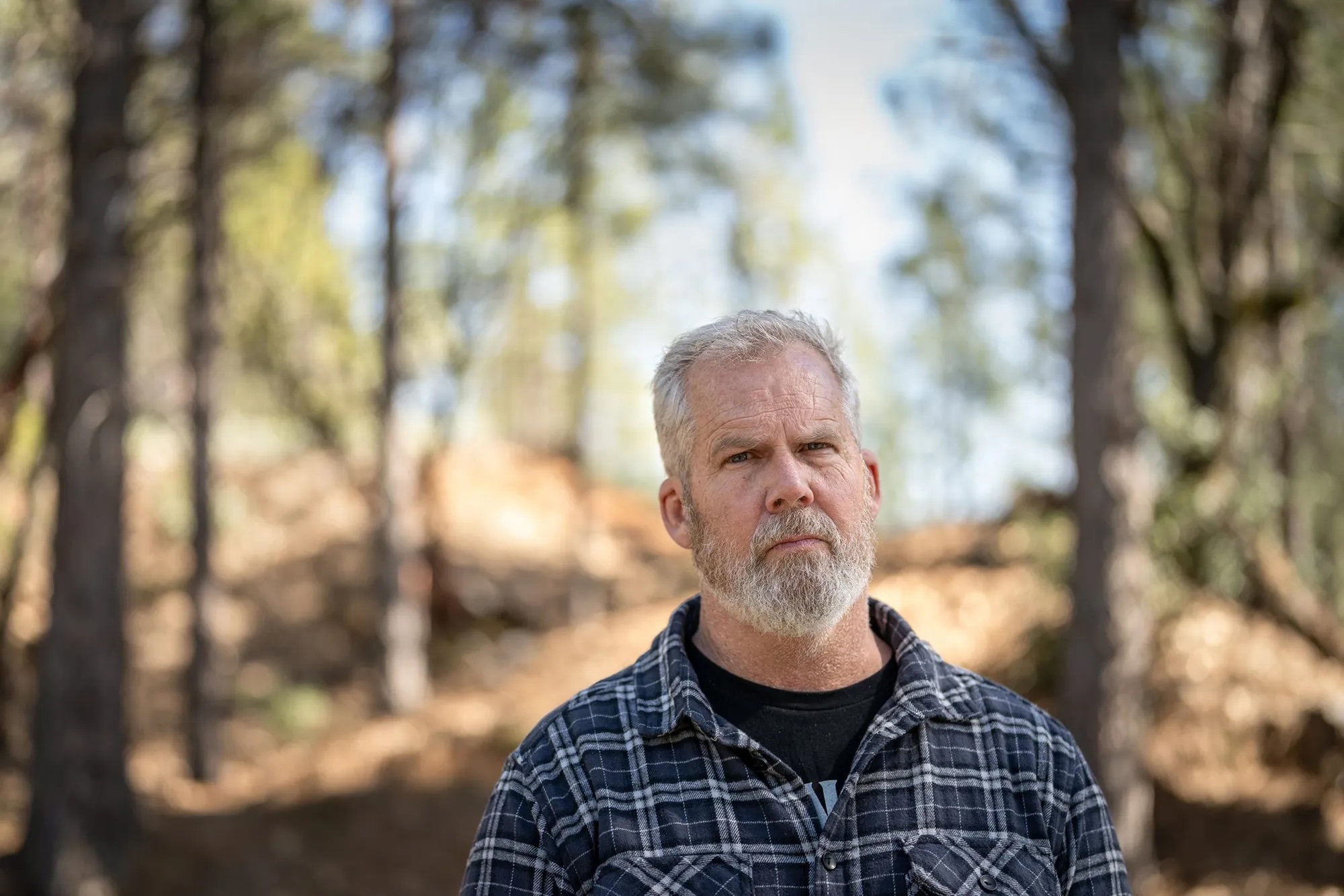
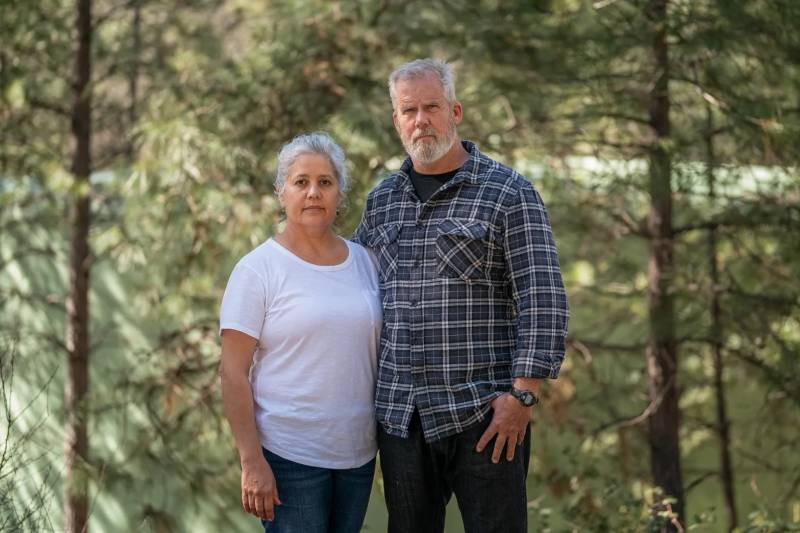
Retired Cal Fire Captain Todd Nelson, shown in Nevada City, suffers from a severe case of post traumatic stress disorder resulting from his 28-year firefighting career. (Loren Elliott for CalMatters)
Todd Nelson could feel it coming on. And he began to run. He was going dark again, retreating to a place where he would curl into a fetal position with his thumb in his mouth, watching from behind closed eyes as his personal reel of horror unspooled. Sights and sounds from three decades of firefighting cued up — shrieks from behind an impenetrable wall of flame, limbs severed in car accidents and the eyes of the terrified and the dead he was meant to save.
Nelson was running on the Foresthill Bridge, the highest in California, fleeing cops and firefighters after his wife reported that he was suicidal. He hurdled a concrete barrier and straddled the railing of the bridge in the Sierra Nevada foothills, staring down at a large rock 730 feet below. As the rescuers closed in, Nelson leaned precariously over the chasm. His strategy — making the fatal plunge appear accidental, allowing his family to collect his life insurance.
It was not Nelson’s first suicide attempt — the former Cal Fire captain had tried to take his life many times before. But after that 2021 ordeal, which led to an involuntary 72-hour psychiatric hold, something in him shifted. He was ready to admit that he had a problem and seek medical help.
The incident began the firefighter’s arduous, years-long journey toward wellness, threaded through a bureaucratic labyrinth strewn with more obstacles than he’d ever encountered on a California wildfire: finding qualified medical help, battling an insurance company to pay for it and navigating the tangled morass of California’s workers’ comp. All without going broke or returning to his dark place.
No one tracks how many of Cal Fire’s 12,000 firefighters and other employees suffer from mental health problems, but department leaders say post-traumatic stress disorder and suicidal thoughts have become a silent epidemicat the agency responsible for fighting California’s increasingly erratic and destructive wildfires. In an online survey of wildland firefighters nationwide, about a third reported considering suicide and nearly 40% said they had colleagues who had committed suicide; many also reported depression and anxiety.
California’s workers’ comp — which is supposed to help people get medical treatment for workplace illnesses and injuries — can be a nightmare for firefighters and other first responders with PTSD.
Claims filed by firefighters and law enforcement officers are more likely to involve PTSD than claims by the average worker in California — and they have been denied more often than claims for other medical conditions (PDF), according to the research institute RAND.
From 2008 to 2019 in California, workers’ comp officials denied PTSD claims filed by firefighters and other first responders at more than twice the rate of their other work-related conditions, such as back injuries and pneumonia, RAND reported. About a quarter of firefighters’ 1,000 PTSD claims were denied, a higher rate than for PTSD claims from other California workers.
“It’s a fail-first system. You have to get a broken leg to show you are in need of support. With mental illness, we are constantly having to prove to everybody why we were ill. You have to get to the point of suicide,” said Jessica Cruz, the California chief executive officer of the National Alliance on Mental Illness.
Jennifer Alexander, Nelson’s therapist, said patients in acute crisis simply don’t have the mental capacity to ride herd on stubborn workers’ comp claims. Alexander said she was once on hold for more than six hours with Cal Fire’s mental health provider attempting to get one of her bills paid, and she has waited years to get paid for treating firefighters.
“People give up. It’s a battle … They are not fully functional,” said Alexander, who for 21 years has specialized in treating first responders with trauma and PTSD and has spent an estimated 25,000 hours treating them. “You are not talking about healthy individuals who can sit on the phone for hours.”
Cal Fire firefighters and other workers also have trouble finding qualified therapists, especially outside major cities in rural areas, where many are based. In 2021, less than half of people with a mental illness in the U.S. were able to access timely care. Therapists are reluctant to take workers’ comp, or sometimes any type of insurance, because they often have to wait months or years to be reimbursed.
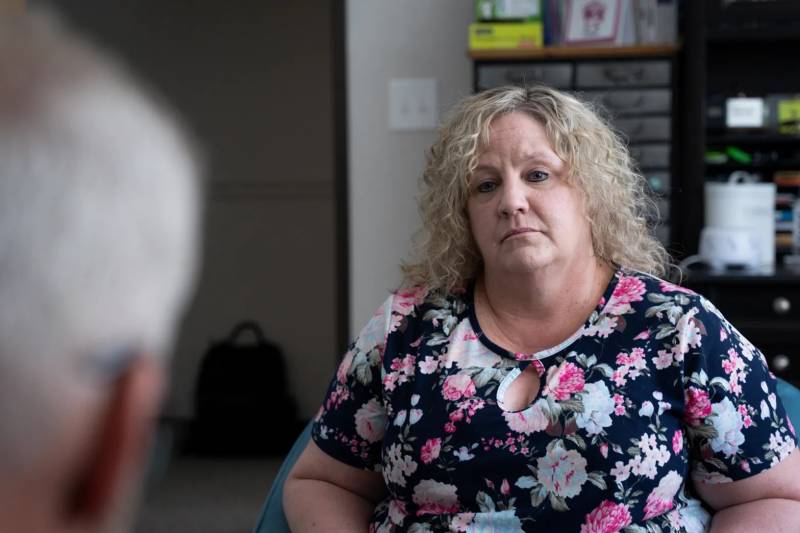
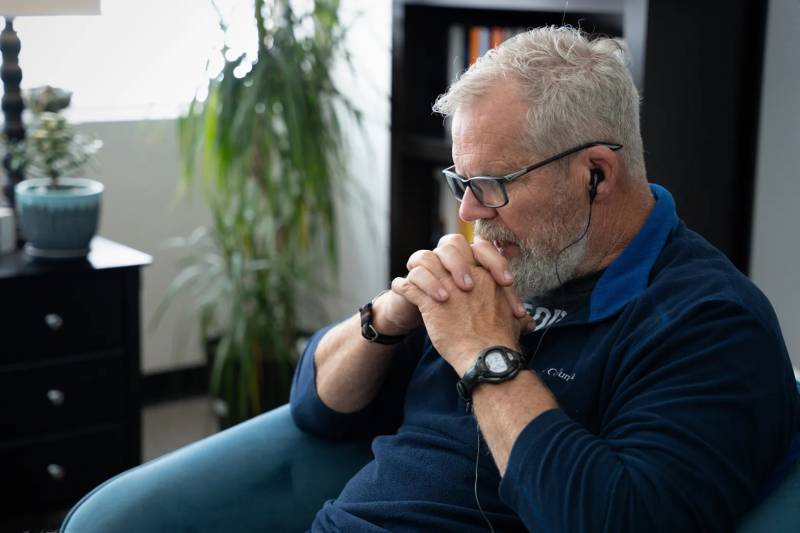
Therapist Jennifer Alexander listens to Nelson during a treatment session. She called workers’ comp a ‘total system breakdown.’ (Cristian Gonzalez for CalMatters)
Michael Dworsky, a senior economist at the research institute RAND and one of the study’s project leaders, called workers’ comp “challenging and bureaucratic.”
“Even if the claim is accepted, there can be disputes about the medical necessity of individual bills. Just because your claim is accepted, doesn’t mean you are done fighting with the insurance company,” he said.
A presumption of pain but still a tangled web
Employers in California must provide workers’ comp insurance that will pay for medical costs when a worker is injured on the job. However, in reality, workers’ comp, which serves 16 million Californians, can be ungainly, confusing and, sometimes, no help at all. The system, administered by the state Department of Industrial Relations, is massive: In 2022, almost 750,000 workers’ comp claims (PDF) were filed statewide.
When a firefighter requests coverage for medical treatment, insurance adjusters review the case to determine if it’s medically necessary. If the claim is denied, delayed or modified, a patient may request an independent medical review by so-called “ghost doctors” who review the case.
Systemwide in California, patients who appeal their denied workers’ comp claims, don’t fare well: Last year 3,238 appeals for mental health claims were filed, but workers’ comp officials rejected three-quarters of them, about the same as the 10-year average, according to data from the Department of Industrial Relations requested by CalMatters. (Agency officials said they could not provide data on claims from first responders.)
For decades, the California Legislature has wrestled with how to fix workers’ comp — in one year alone, lawmakers proposed nearly two dozen bills.
In 2020 lawmakers took a major step, adding a legal shortcut or “presumption” to thestatelabor code, stipulating that firefighters and other first responders are considered at high risk for PTSD in the course of doing their job.
That means first responders no longer carry the burden of proving their illness is work-related. However, a claims adjuster can still question the diagnosis or assert that the trauma was caused by other factors, such as military service or family events. A law enacted last year extended the presumption to 2029.
In practice, experts say that, despite the law, proving a mental health claim is still almost as difficult to overcome as the psychological injury itself. Break an arm while fighting a wildfire, and, backed up by x-rays, claims are approved. But break your mind after decades of exposure to on-the-job trauma? Prepare for battle.
Before enacting the law, state officials asked RAND researchers to report on the scope of the problem. They analyzed nearly 6 million claims filed between 2008 through 2019 and interviewed dozens of experts, including a representative sample of 13 first responders.
The researchers found a consistent and troubling trend among the 13: “Nearly all workers said that they had filed a workers’ compensation claim for their mental health conditions — yet almost none received PTSD care paid for by workers’ compensation.”
Paying out of pocket “caused severe financial strain in some cases. Some were eventually reimbursed by workers’ compensation, but only after litigation and substantial delay. Some who pursued care through workers’ compensation also noted that claim denials led to delays in the start of mental health treatment,” the RAND researchers wrote.
The 13 first responders they surveyed stressed “over and over again about self-pay and barriers,” said Denise D. Quigley, a RAND senior policy researcher who was a project leader on the study. “It’s not like we heard it once or twice, we heard it over and over again. It’s highly unlikely that we talked to the (only) people in California that had this happen.”
Firefighters told of borrowing money from family members and taking out home equity loans to pay for care, Quigley said. The litany of their struggle weighed on her team. “It’s difficult to hear people break down crying while talking to us because of all the things they’ve seen.”
According to the RAND research, for the 12-year period from 2008 through 2019, before the new law took effect:
Firefighters and other first responders were about twice as likely to file PTSD claims as the general workforce — but the numbers are small, under 1% of all workers’ comp claims.
Firefighters’ PTSD claims were denied more often than claims of other workers: About 24% were denied, compared to about 19% of PTSD claims for all workers, including those in high-stress occupations. About a quarter of firefighter claims for all mental health conditions were denied.
Their PTSD claims were denied at more than twice the rate of their other presumptive medical conditions related to their jobs, such as hernias and back injuries. Even their cancer and heart disease claims were accepted at a higher rate than PTSD.
These denial rates were calculated using a sample of only 258 PTSD claims filed by firefighters. But researcher Dworsky said the total number of claims is far higher, about 1,000, with about 230 claims denied, during those 12 years. And countless other firefighters who suffer from PTSD didn’t seek care through workers’ comp.
The RAND report was the most detailed look at the inequities between how physical and mental health are treated among firefighters and how first responders’ claims were handled compared to other workers. However, the researchers struggled with incomplete data and difficulty identifying which claims were from firefighters.
Quigley said she is frustrated that no one since has tracked whether the 4-year-old presumption law — known as the Trauma Treatment Act — has helped patients and improved the system.
Many therapists say they haven’t seen much, if any, improvement. Nelson’s therapist, Alexander, called workers’ comp a “total system breakdown.”
A spokesman for the Department of Industrial Relations refused to grant interview requests from CalMatters or answer questions or provide data about firefighters’ mental health claims.
Navigating the system
During his 28 years with Cal Fire fighting wildfires in combustible regions, such as the Napa Valley and the Sierra Nevada foothills, and responding to other emergencies, Nelson never reported any mental health issues to anyone. Not once. Even as he would regularly pull his truck off the side of the road during wildfires and weep. Even after responding to the scene of traffic accidents, extricating children from crushed cars as their parents fought to get to them. Even after answering a call to a suicide to find a man hanging from the rafters in his barn. Even after the unbidden images began to intrude with greater frequency.
Instead, his mantra became “I’m good.”
That stoicism, common among first responders, short circuits the insurance system designed to help them — a system that works best with prompt reporting and meticulous documentation.
Related Stories
Claims adjusters usually handle clear-cut cases where the date of injury can be pinpointed. More common among PTSD claims, though, is Nelson’s experience with cumulative trauma, with no paper trail of injuries or complaints. He can’t offer a single event as the origin of his trauma and no coherent chronology. Cal Fire folks tend to wait until their dam bursts before asking for the water to be turned off.
One Southern California mental health provider told the RAND researchers that firefighters and police officers typically have severe cases of trauma.
“On the clinical side, as a mental health provider, it is not realistic to expect a firefighter or a police officer to come in and have had a little trauma or some minor stress condition … Most departments have people with a lot of stress and trauma,” the therapist said. “Just because you had something happen recently, the straw that broke the camel’s back, it is really the cumulative stress that is the issue.”
Now retired, Nelson, 54, has been fighting for workers’ compensation for almost three years, since his suicide attempt on the Placer County bridge. He and his wife already have spent more than $10,000 out of pocket for medical care and could face thousands more in legal bills.
Nelson’s case is unusually severe and complex, requiring two extended stays in a facility that specifically treats firefighters to diagnose his conditions and finally set him on a treatment path of therapy and multiple medications.
Cal Fire Battalion Chief Brad Niven said he has more than a dozen firefighter friends who have had similar experiences.
“Talk to anybody that tries to do anything through workers’ comp — it is an absolute nightmare,” he said. “Everybody knows you file your first workers’ comp claim and they will deny it. One guy I worked with went through the works with them. He had to prove beyond a shadow of a doubt that you have problems. You have to relive everything you’ve gone through. It does not make for a friendly system.”
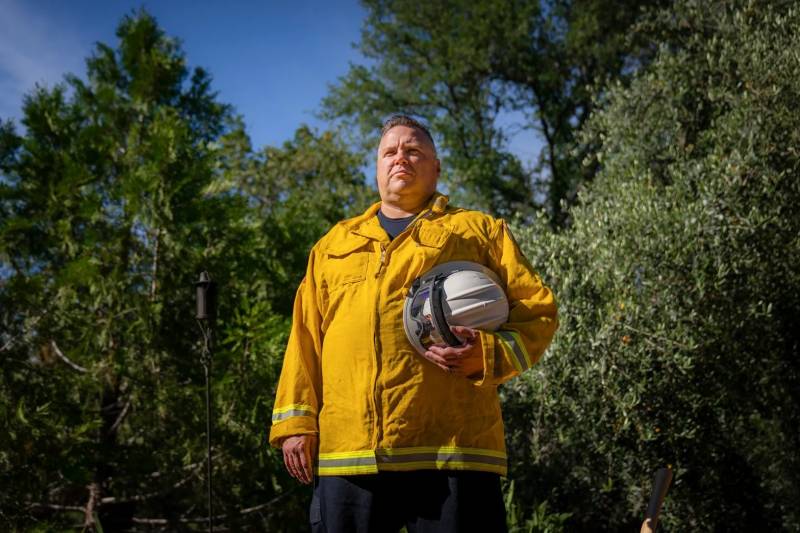
Cal Fire Battalion Chief Brad Niven, shown at his home in Sonora, said he and more than a dozen firefighter friends have had trouble getting workers’ comp to pay their claims for mental health treatment. (Julie Hotz for CalMatters)
Niven considered suicide before Cal Fire’s employee support personnel helped him find a therapist, streamlining what had been a hit-and-miss process.
“They blasted away the stumbling blocks,” he said. But the fire agency does not make the decision to approve or deny a claim or handle the bureaucratic thicket that is workers’ comp.
Scott O’Mara, a San Diego-based lawyer whose firm represents first responders, said adjusters’ training is to look for what they can develop to deny the case. “Their goal is to contain and control cost,” he said. “We do a lot of cases where the compensation is nickels.”
Although California law now considers PTSD for first responders a presumption, it is a “disputable presumption.” That means claims administrators can consider other traumatic events in a firefighter’s life that may play a role in a PTSD case.
“With cumulative trauma, or stress over the course of their entire employment, we need to request more information from the doctor so that we can see it isn’t because they were in the military or they are going through a divorce, etc.,” one claims adjuster told RAND researchers.
The complexity of the system wears down the resistance of injured workers, who need a jungle guide to find their way at a time of profound pain and disorientation.
“They can’t navigate this on their own, they really can’t. They’ve got professional litigators opposing them,” said Richard Elder, a workers’ comp lawyer in Concord who regularly represents state firefighters. “The average claims adjuster on the job for more than a month knows more about the system than the average firefighter. They’ve got lawyers on speed dial. The injured worker is adrift. It’s like a do-it-yourself heart transplant.”
Elder, who has been in practice for 54 years, used to work as an insurance company claims adjuster. The system, he said, has always been adversarial.
“It’s against the law for employers to discriminate against a worker who files a psyche claim. But they do discriminate,” said Elder, who said in the past five decades he has pursued about 500 psychiatric claims.
“I just filed a psychiatric claim and the response was ‘give us a list of every medical facility that treated the claimant in the last 10 years,’” he said. “The workers’ comp medical treatments system is a stain upon the soul of the politicians and officials of California.”
Diagnosing PTSD is ‘a complicated process’
One day in March, Nelson sat next to his wife, Leticia, in a quiet room in a Nevada City library near their rental home. He was in the grips of a seizure, brought on by retelling his firefighting nightmares to a CalMatters reporter. His hands were clenched and his torso taut. He stuttered, his eyelids fluttering. The episode lasted a few minutes.
During the interview, Nelson was fidgety, his thick fingers constantly worrying about the items he had put on the table in front of him. One was a tiny aluminum cylinder containing medication for his seizures, another was a brass medallion, the iconic firefighter symbols of an ax and firehose nozzle stamped on one side and the serenity prayer on the other.
The coin was a kind of talisman given to him after graduating from a specialized rehab clinic for firefighters, where he was given his daunting medical diagnosis: He suffers from complex PTSD, psychogenic non-epileptic seizures and dissociative identity disorder.
Such anxiety-induced seizures are unusual but not rare, his therapist said, and the totality of Nelson’s mental health issues makes his case unusually severe. Weekly therapy sessions and multiple medications have tempered, but not extinguished, his struggle with crippling anxiety.
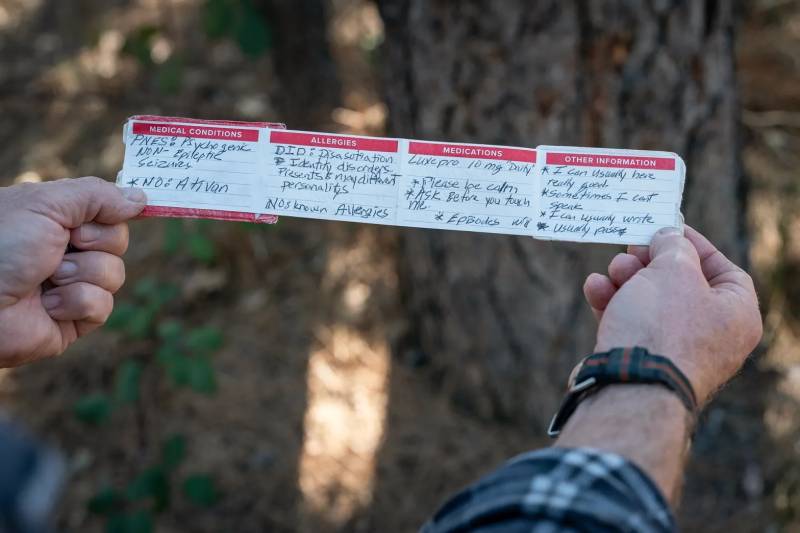
Nelson wears a medical alert wrist bracelet intended to give first responders a bare-bones outline of his conditions and which medications to avoid when he is experiencing an anxiety-induced seizure. In his back pocket, he carries, always, a medical card with his list of red flags, so extensive that it unspools like an accordion.
His seizures may occur several times a day. Some last for hours. Nelson’s usually benign aspect changes: His eyes cross, his hands clench into what he calls “spidey fingers.” He stumbles and stutters through sentences and repeats words, often losing his ability to speak at all. At times he drags his head and face along walls. Leticia Nelson describes the seizures as his body undergoing earthquakes.
The emergency medical ID card that Nelson carries with him. (Loren Elliott for CalMatters)Nelson alongside his wife, Leticia Nelson, near their Nevada City home. She said it’s been agonizing to see him suffer mental health problems related to his job and have to fight the system to get his treatment paid for. ‘We sacrificed our time with him so that he could help the whole state. And nothing has been there for the family since this happened. Nothing.’ (Loren Elliott for CalMatters)
Nelson’s unusual body movements during a seizure, his inability to respond to questions and his propensity to run away when confronted puts Nelson in a precarious place in airport lines or with law enforcement, where his non-response has been misconstrued as defiance.
Even doctors can misunderstand. Diagnosing and treating PTSD and acute trauma like Nelson’s is notoriously difficult.
“Diagnosing PTSD is a complicated process. Diagnostic criteria are complicated,” said Sidra Goldman-Mellor, a UC Merced psychiatric epidemiologist who studies depression and suicidal behavior. “Your average primary care clinician is probably not willing to go down that road.”
For patients like Nelson, any number of stress-related disorders present themselves and muddy a specific diagnosis that would satisfy a claims adjuster or a workers’ comp review.
“That’s the thing with psychiatric disorders, we don’t have a lot of objective measures for a mental health diagnosis. We don’t have blood tests and we don’t have MRIs,” Goldman-Mellor said. “They (mental health issues) are harder to recognize, harder to test for and easier to ignore.”
However, firefighters cannot move easily through the workers’ comp or medical insurance system if they don’t have a diagnosis. Constantly proving your pain becomes its own trauma.
“He has to prove his world is falling apart,” Leticia Nelson said. “It’s hard to explain to someone that you are broken. They look at you, they think that you look fine. They can’t see in your brain. They can’t see in your mind.”
It took four years for Nelson to find the right medical care. One physician’s therapeutic approach was to ask the former firefighter to pray with him.
The problem was much more fundamental than finding a compatible therapist: He could not find one to take his case. Many Cal Fire employees are stationed in rural or remote areas of the state, in communities underserved by health care specialists.
Living in rural Nevada County, Nelson faces a barren mental health desert where it’s difficult to find a competent therapist who might have worked with other first responders and understands the specific challenges of the high-stress job.
“It’s an absolute specialization. There’s not near enough of us,” said Alexander, Nelson’s therapist. (Nelson granted her permission to speak about his case.) “In the larger Sacramento area, there are less than a dozen competent providers.”
Nelson recalls memories of his time as a firefighter during a treatment session. (Cristian Gonzalez for CalMatters)
Cal Fire is self-insured and offers medical coverage through private companies. The agency does not manage medical claims or workers’ comp but does have programs to assist employees in finding care.
Rob Wheatley, staff chief of Cal Fire’s Behavioral Health and Wellness Program, told CalMatters in an email that the agency has expanded support for employees who seek help for mental health issues with peer counseling or referrals for treatment. The agency has a staff of 28 assisting about 12,000 employees.
But Wheatley and other Cal Fire officials refused to grant an interview and did not answer CalMatters’ questions about the problems that their employees face with workers’ comp and mental health issues.
“Any denial of a mental health claim is concerning,” Wheatley said in the email.
Can the system be repaired?
The Nelsons have seen the insurance and workers’ comp system from the inside, been batted around by it and, they would say, abandoned by it. Still, they have few suggestions for fixing it.
They are not alone. Lawyers say that the system is based on how to save money, is too often adversarial and deeply entrenched.
Even the employers who participate in the workers’ comp system say it’s not working well. In a recent survey, more than half of the respondents said the system performs poorly, while 42% described the system as challenged but adequate.
“Nobody believes it’s ideal,” said Jerry Azevedo, a spokesman for the Workers’ Compensation Action Network, a coalition of California insurers, employers and agents advocating to improve the system. “Every constituency has complaints.”
Azevedo said California’s workers’ comp system, which has been in place since 1913, is plagued by persistent problems: high costs to operate, huge claim volume, frequent litigation, slow claim resolution and fraud and abusive practices.
“The fundamental challenge we all contend with is complexity. California’s system is arguably the most complex in the nation,” Azevedo said. The good news, he said, is that 86% of workers’ comp claims overall are accepted, according to the California Workers’ Compensation Institute.
It’s easy to get the sense of a general throwing up of hands. The state Commission on Health & Safety & Workers’ Comp dedicates a webpage to tracking workers’ comp reforms, but the last entry was in 2012.
Sean Cooper, executive vice president and chief actuary of the Workers’ Compensation Insurance Rating Bureau of California, said the system is groaning under its own weight — there are a lot of people filing claims and a lot of lawyers on all sides.
Administrative costs are high in California: The cost to deliver $1 of medical benefit from California’s workers’ comp system is 46 cents, compared to two cents for Medicare, 19 cents for private group health insurance and 25 cents for the national state median for workers’ comp according to the group’s 2023 report.
“There is a disparity about how we treat, respond and react to behavioral health versus physical health,” she said. “Maybe we need to start talking about that disparity in workers’ comp. When you have (a claims) approval rating that is flipped on its backside, that’s an obvious parity issue.”
Legislators, when they turn their gaze to the massive program, chip away at the edges. The law extending the PTSD presumption will be revisited when the state Commission on Health and Safety and Workers’ Compensation presents its report on claims and denials to the Senate Committee on Labor, Public Employment and Retirement and the Assembly Committee on Insurance, by the end of this year.
Cruz said there is more legislative focus on behavioral health than ever, but there are limits, beginning with which groups carry the most influence. Managed health care companies are powerful advocates of the status quo, she said. “We are David and Goliath when we come up against these folks.”
“So many great people want to do wonderful things and they have big ideas, but it gets chopped down to a Band-Aid once everyone gets what they want,” she said.
‘A slap in the face to all of us’
Leticia Nelson refers to herself, with only slight exaggeration, as her husband’s “service dog.”
She’s the keeper of the couple’s appointment schedule; she’s the chauffeur; and the manager of the financial spreadsheet. And it falls to Leticia to devote untold hours on the phone with insurers and medical providers, bird-dogging bills, late payments and coverage lapses.
She has watched her husband humiliated, scared and angry. Their two adult daughters, also have been treated for PTSD, after witnessing their father’s anxiety and mania, and knowing about his suicide attempts.
At times, Leticia Nelson said, “I’m mad at God.”
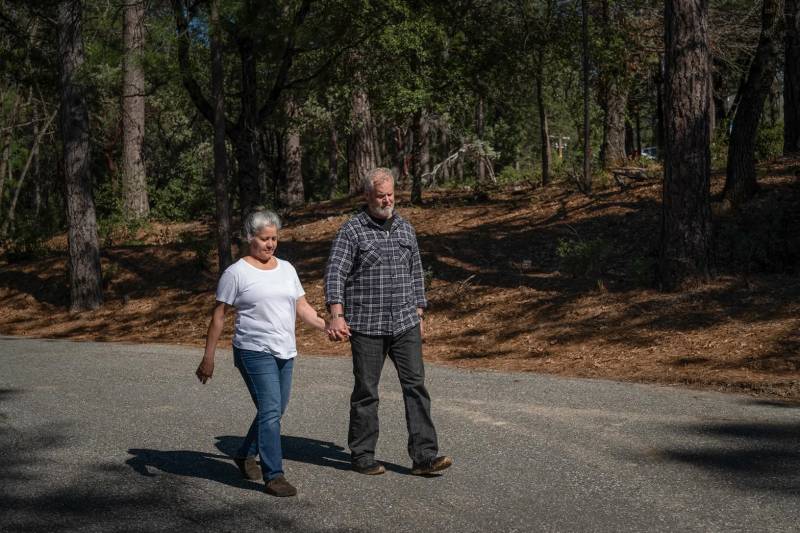
Retired Cal Fire firefighter Todd Nelson walks with his wife in Nevada City. Nelson suffers from post-traumatic stress disorder resulting from the trauma experienced during his firefighting career. (Loren Elliott for CalMatters)
The Nelsons, lifelong Californians, want to leave the state and its frightening tableau of wildfires. They sold their house, changed their mind about moving and now are financially shut out of the real estate market, especially because of the high cost of fire insurance in the foothills where they live. They are nomads, shuttling between Airbnbs with two large dogs and three cats in tow and their possessions in storage.
Money is tight. Leticia would like to go back to work, but she can’t leave Todd alone.
Nelson gave up fighting the state over a disability claim after his attorney told him that an appeal would cost $50,000 — and he would lose because he didn’t claim a disability when he retired.
“It’s a slap in the face to all of us because we sacrificed as a family,” Leticia Nelson said of Todd’s long career with Cal Fire. “We sacrificed our time with him so that he could help the whole state. And nothing has been there for the family since this happened. Nothing.
“I wish that there’s things in place that would guide us that wouldn’t be so hard. But it just seems like we hit every, every obstacle possible. We’re struggling. We need help. We need to be seen. We need to be treated like humans and not criminals.”
For his part, Nelson is coming to terms with the devastation his career wrought. Yet, years after retirement, he still listens to an emergency scanner and shows up at fires in his area, wearing his T-shirt, shorts and Birkenstocks. The pull to serve remains strong.
“The crazy thing is I miss my job. I miss it every day. I would do it all over again,” he said wistfully. “I loved the job but I didn’t realize the damage being done.”
If you are having suicidal thoughts, you can get help from the National Suicide Prevention Lifeline by calling 988 or visiting https://suicidepreventionlifeline.org
This story also was made possible in part by a grant from the A-Mark Foundation.
lower waypointnext waypoint
Player sponsored by
window.__IS_SSR__=true
window.__INITIAL_STATE__={
"attachmentsReducer": {
"audio_0": {
"type": "attachments",
"id": "audio_0",
"imgSizes": {
"kqedFullSize": {
"file": "https://ww2.kqed.org/news/wp-content/themes/KQED-unified/img/audio_bgs/background0.jpg"
}
}
},
"audio_1": {
"type": "attachments",
"id": "audio_1",
"imgSizes": {
"kqedFullSize": {
"file": "https://ww2.kqed.org/news/wp-content/themes/KQED-unified/img/audio_bgs/background1.jpg"
}
}
},
"audio_2": {
"type": "attachments",
"id": "audio_2",
"imgSizes": {
"kqedFullSize": {
"file": "https://ww2.kqed.org/news/wp-content/themes/KQED-unified/img/audio_bgs/background2.jpg"
}
}
},
"audio_3": {
"type": "attachments",
"id": "audio_3",
"imgSizes": {
"kqedFullSize": {
"file": "https://ww2.kqed.org/news/wp-content/themes/KQED-unified/img/audio_bgs/background3.jpg"
}
}
},
"audio_4": {
"type": "attachments",
"id": "audio_4",
"imgSizes": {
"kqedFullSize": {
"file": "https://ww2.kqed.org/news/wp-content/themes/KQED-unified/img/audio_bgs/background4.jpg"
}
}
},
"placeholder": {
"type": "attachments",
"id": "placeholder",
"imgSizes": {
"thumbnail": {
"file": "https://cdn.kqed.org/wp-content/uploads/2024/12/KQED-Default-Image-816638274-2000x1333-1-160x107.jpg",
"width": 160,
"height": 107,
"mimeType": "image/jpeg"
},
"medium": {
"file": "https://cdn.kqed.org/wp-content/uploads/2024/12/KQED-Default-Image-816638274-2000x1333-1-800x533.jpg",
"width": 800,
"height": 533,
"mimeType": "image/jpeg"
},
"medium_large": {
"file": "https://cdn.kqed.org/wp-content/uploads/2024/12/KQED-Default-Image-816638274-2000x1333-1-768x512.jpg",
"width": 768,
"height": 512,
"mimeType": "image/jpeg"
},
"large": {
"file": "https://cdn.kqed.org/wp-content/uploads/2024/12/KQED-Default-Image-816638274-2000x1333-1-1020x680.jpg",
"width": 1020,
"height": 680,
"mimeType": "image/jpeg"
},
"1536x1536": {
"file": "https://cdn.kqed.org/wp-content/uploads/2024/12/KQED-Default-Image-816638274-2000x1333-1-1536x1024.jpg",
"width": 1536,
"height": 1024,
"mimeType": "image/jpeg"
},
"fd-lrg": {
"file": "https://cdn.kqed.org/wp-content/uploads/2024/12/KQED-Default-Image-816638274-2000x1333-1-1536x1024.jpg",
"width": 1536,
"height": 1024,
"mimeType": "image/jpeg"
},
"fd-med": {
"file": "https://cdn.kqed.org/wp-content/uploads/2024/12/KQED-Default-Image-816638274-2000x1333-1-1020x680.jpg",
"width": 1020,
"height": 680,
"mimeType": "image/jpeg"
},
"fd-sm": {
"file": "https://cdn.kqed.org/wp-content/uploads/2024/12/KQED-Default-Image-816638274-2000x1333-1-800x533.jpg",
"width": 800,
"height": 533,
"mimeType": "image/jpeg"
},
"post-thumbnail": {
"file": "https://cdn.kqed.org/wp-content/uploads/2024/12/KQED-Default-Image-816638274-2000x1333-1-672x372.jpg",
"width": 672,
"height": 372,
"mimeType": "image/jpeg"
},
"twentyfourteen-full-width": {
"file": "https://cdn.kqed.org/wp-content/uploads/2024/12/KQED-Default-Image-816638274-2000x1333-1-1038x576.jpg",
"width": 1038,
"height": 576,
"mimeType": "image/jpeg"
},
"xxsmall": {
"file": "https://cdn.kqed.org/wp-content/uploads/2024/12/KQED-Default-Image-816638274-2000x1333-1-160x107.jpg",
"width": 160,
"height": 107,
"mimeType": "image/jpeg"
},
"xsmall": {
"file": "https://cdn.kqed.org/wp-content/uploads/2024/12/KQED-Default-Image-816638274-2000x1333-1-672x372.jpg",
"width": 672,
"height": 372,
"mimeType": "image/jpeg"
},
"small": {
"file": "https://cdn.kqed.org/wp-content/uploads/2024/12/KQED-Default-Image-816638274-2000x1333-1-672x372.jpg",
"width": 672,
"height": 372,
"mimeType": "image/jpeg"
},
"xlarge": {
"file": "https://cdn.kqed.org/wp-content/uploads/2024/12/KQED-Default-Image-816638274-2000x1333-1-1020x680.jpg",
"width": 1020,
"height": 680,
"mimeType": "image/jpeg"
},
"full-width": {
"file": "https://cdn.kqed.org/wp-content/uploads/2024/12/KQED-Default-Image-816638274-2000x1333-1-1920x1280.jpg",
"width": 1920,
"height": 1280,
"mimeType": "image/jpeg"
},
"guest-author-32": {
"file": "https://cdn.kqed.org/wp-content/uploads/2025/01/KQED-Default-Image-816638274-1333x1333-1-160x160.jpg",
"width": 32,
"height": 32,
"mimeType": "image/jpeg"
},
"guest-author-50": {
"file": "https://cdn.kqed.org/wp-content/uploads/2025/01/KQED-Default-Image-816638274-1333x1333-1-160x160.jpg",
"width": 50,
"height": 50,
"mimeType": "image/jpeg"
},
"guest-author-64": {
"file": "https://cdn.kqed.org/wp-content/uploads/2025/01/KQED-Default-Image-816638274-1333x1333-1-160x160.jpg",
"width": 64,
"height": 64,
"mimeType": "image/jpeg"
},
"guest-author-96": {
"file": "https://cdn.kqed.org/wp-content/uploads/2025/01/KQED-Default-Image-816638274-1333x1333-1-160x160.jpg",
"width": 96,
"height": 96,
"mimeType": "image/jpeg"
},
"guest-author-128": {
"file": "https://cdn.kqed.org/wp-content/uploads/2025/01/KQED-Default-Image-816638274-1333x1333-1-160x160.jpg",
"width": 128,
"height": 128,
"mimeType": "image/jpeg"
},
"detail": {
"file": "https://cdn.kqed.org/wp-content/uploads/2025/01/KQED-Default-Image-816638274-1333x1333-1-160x160.jpg",
"width": 160,
"height": 160,
"mimeType": "image/jpeg"
},
"kqedFullSize": {
"file": "https://cdn.kqed.org/wp-content/uploads/2024/12/KQED-Default-Image-816638274-2000x1333-1.jpg",
"width": 2000,
"height": 1333
}
}
},
"news_11992260": {
"type": "attachments",
"id": "news_11992260",
"meta": {
"index": "attachments_1716263798",
"site": "news",
"id": "11992260",
"found": true
},
"title": "031924_Todd-Nelson_LE_CM_10 copy",
"publishDate": 1719511492,
"status": "inherit",
"parent": 11992246,
"modified": 1719511525,
"caption": "Retired Cal Fire Captain Todd Nelson, shown in Nevada City, suffers from a severe case of post traumatic stress disorder resulting from his 28-year firefighting career.",
"credit": "Loren Elliott for CalMatters",
"altTag": null,
"description": null,
"imgSizes": {
"medium": {
"file": "https://cdn.kqed.org/wp-content/uploads/sites/10/2024/06/031924_Todd-Nelson_LE_CM_10-copy-800x534.jpg",
"width": 800,
"height": 534,
"mimeType": "image/jpeg"
},
"large": {
"file": "https://cdn.kqed.org/wp-content/uploads/sites/10/2024/06/031924_Todd-Nelson_LE_CM_10-copy-1020x680.jpg",
"width": 1020,
"height": 680,
"mimeType": "image/jpeg"
},
"thumbnail": {
"file": "https://cdn.kqed.org/wp-content/uploads/sites/10/2024/06/031924_Todd-Nelson_LE_CM_10-copy-160x107.jpg",
"width": 160,
"height": 107,
"mimeType": "image/jpeg"
},
"1536x1536": {
"file": "https://cdn.kqed.org/wp-content/uploads/sites/10/2024/06/031924_Todd-Nelson_LE_CM_10-copy-1536x1025.jpg",
"width": 1536,
"height": 1025,
"mimeType": "image/jpeg"
},
"post-thumbnail": {
"file": "https://cdn.kqed.org/wp-content/uploads/sites/10/2024/06/031924_Todd-Nelson_LE_CM_10-copy-672x372.jpg",
"width": 672,
"height": 372,
"mimeType": "image/jpeg"
},
"twentyfourteen-full-width": {
"file": "https://cdn.kqed.org/wp-content/uploads/sites/10/2024/06/031924_Todd-Nelson_LE_CM_10-copy-1038x576.jpg",
"width": 1038,
"height": 576,
"mimeType": "image/jpeg"
},
"full-width": {
"file": "https://cdn.kqed.org/wp-content/uploads/sites/10/2024/06/031924_Todd-Nelson_LE_CM_10-copy-1920x1281.jpg",
"width": 1920,
"height": 1281,
"mimeType": "image/jpeg"
},
"kqedFullSize": {
"file": "https://cdn.kqed.org/wp-content/uploads/sites/10/2024/06/031924_Todd-Nelson_LE_CM_10-copy.jpg",
"width": 2000,
"height": 1334
}
},
"isLoading": false,
"fetchFailed": false
}
},
"audioPlayerReducer": {
"postId": "stream_live",
"isPaused": true,
"isPlaying": false,
"pfsActive": false,
"pledgeModalIsOpen": true,
"playerDrawerIsOpen": false,
"liveAudioPlayStartedAt": 0,
"liveAudioPlayContext": ""
},
"authorsReducer": {
"byline_news_11992246": {
"type": "authors",
"id": "byline_news_11992246",
"meta": {
"override": true
},
"slug": "byline_news_11992246",
"name": "\u003ca href=\"https://calmatters.org/author/julie-cart/\">Julie Cart\u003c/a>, CalMatters",
"isLoading": false
}
},
"pagesReducer": {},
"pfsSessionReducer": {},
"postsReducer": {
"stream_live": {
"type": "live",
"id": "stream_live",
"audioUrl": "https://hls.kqed.org/hls/kqed_app/playlist.m3u8",
"title": "Live Stream",
"excerpt": "Live Stream information currently unavailable.",
"link": "/radio",
"featImg": "",
"label": {
"name": "KQED Live",
"link": "/"
}
},
"stream_kqedNewscast": {
"type": "posts",
"id": "stream_kqedNewscast",
"audioUrl": "https://www.kqed.org/.stream/anon/radio/RDnews/newscast.mp3?_=1",
"title": "KQED Newscast",
"featImg": "",
"label": {
"name": "88.5 FM",
"link": "/"
}
},
"news_11992246": {
"type": "posts",
"id": "news_11992246",
"meta": {
"index": "posts_1716263798",
"site": "news",
"id": "11992246",
"found": true
},
"articlePosition": 0,
"guestAuthors": [],
"slug": "total-system-breakdown-california-firefighters-with-ptsd-face-a-workers-comp-nightmare",
"title": "PTSD Is Common Among Firefighters — but Workers’ Comp for Treatment Is Hard to Get",
"publishDate": 1719522016,
"format": "standard",
"headTitle": "PTSD Is Common Among Firefighters — but Workers’ Comp for Treatment Is Hard to Get | KQED",
"labelTerm": {
"term": 18481,
"site": "news"
},
"content": "\u003cp>Todd Nelson could feel it coming on. And he began to run. He was going dark again, retreating to a place where he would curl into a fetal position with his thumb in his mouth, watching from behind closed eyes as his personal reel of horror unspooled. Sights and sounds from three decades of firefighting cued up — shrieks from behind an impenetrable wall of flame, limbs severed in car accidents and the eyes of the terrified and the dead he was meant to save.\u003c/p>\n\u003cp>Nelson was running on the Foresthill Bridge, \u003ca href=\"https://sierranevadageotourism.org/entries/foresthill-bridge/4123fc95-8a25-4827-baba-fca9c8e4485a\">the highest in California\u003c/a>, fleeing cops and firefighters after his wife reported that he was suicidal. He hurdled a concrete barrier and straddled the railing of the bridge in the Sierra Nevada foothills, staring down at a large rock 730 feet below. As the rescuers closed in, Nelson leaned precariously over the chasm. His strategy — making the fatal plunge appear accidental, allowing his family to collect his life insurance.\u003c/p>\n\u003cp>It was not Nelson’s first suicide attempt — the former Cal Fire captain had tried to take his life many times before. But after that 2021 ordeal, which led to an involuntary 72-hour psychiatric hold, something in him shifted. He was ready to admit that he had a problem and seek medical help.\u003c/p>\n\u003cp>The incident began the firefighter’s arduous, years-long journey toward wellness, threaded through a bureaucratic labyrinth strewn with more obstacles than he’d ever encountered on a California wildfire: finding qualified medical help, battling an insurance company to pay for it and navigating the tangled morass of California’s workers’ comp. All without going broke or returning to his dark place.\u003c/p>\n\u003cp>[ad fullwidth]\u003c/p>\n\u003cp>No one tracks how many of Cal Fire’s 12,000 firefighters and other employees suffer from mental health problems, but department leaders say post-traumatic stress disorder and suicidal thoughts \u003ca href=\"https://calmatters.org/environment/2022/06/california-firefighter-trauma-ptsd/?series=california-firefighters-trauma-wildfires\">have become a silent epidemic\u003c/a>\u003cstrong> \u003c/strong>at the agency responsible for fighting \u003ca href=\"https://calmatters.org/california-wildfire-map-tracker/\">California’s increasingly erratic and destructive wildfires\u003c/a>. In an \u003ca href=\"https://www.researchgate.net/publication/352466544_Wildland_Firefighter_Psychological_and_Behavioral_Health_Preliminary_Data_from_a_National_Sample_of_Current_and_Former_Wildland_Firefighters_in_the_United_States_Conference_session\">online survey\u003c/a> of wildland firefighters nationwide, about a third reported considering suicide and nearly 40% said they had colleagues who had committed suicide; many also reported depression and anxiety.\u003c/p>\n\u003cp>California’s workers’ comp — which is supposed to help people get medical treatment for workplace illnesses and injuries — can be a nightmare for firefighters and other first responders with PTSD.\u003c/p>\n\u003cp>Claims filed by firefighters and law enforcement officers are more likely to involve PTSD than claims by the average worker in California — and they have been \u003ca href=\"https://calmatters.org/wp-content/uploads/2024/06/RAND-PTSD-REPORT.pdf\">denied more often than claims for other medical conditions (PDF)\u003c/a>, according to the research institute RAND.\u003c/p>\n\u003cp>From 2008 to 2019 in California, workers’ comp officials denied PTSD claims filed by firefighters and other first responders at more than twice the rate of their other work-related conditions, such as back injuries and pneumonia, RAND reported. About a quarter of firefighters’ 1,000 PTSD claims were denied, a higher rate than for PTSD claims from other California workers.\u003c/p>\n\u003cp>“It’s a fail-first system. You have to get a broken leg to show you are in need of support. With mental illness, we are constantly having to prove to everybody why we were ill. You have to get to the point of suicide,” said Jessica Cruz, the California chief executive officer of the \u003ca href=\"https://namica.org/\">National Alliance on Mental Illness\u003c/a>.\u003c/p>\n\u003cp>https://www.youtube.com/watch?v=DLvG2Yy34QM&t=1s\u003c/p>\n\u003cp>Jennifer Alexander, Nelson’s therapist, said patients in acute crisis simply don’t have the mental capacity to ride herd on stubborn workers’ comp claims. Alexander said she was once on hold for more than six hours with Cal Fire’s mental health provider attempting to get one of her bills paid, and she has waited years to get paid for treating firefighters.\u003c/p>\n\u003cp>“People give up. It’s a battle … They are not fully functional,” said Alexander, who for 21 years has specialized in treating first responders with trauma and PTSD and has spent an estimated 25,000 hours treating them. “You are not talking about healthy individuals who can sit on the phone for hours.”\u003c/p>\n\u003cp>Cal Fire firefighters and other workers also have trouble finding qualified therapists, especially outside major cities in rural areas, where many are based. In 2021, less than \u003ca href=\"https://www.commonwealthfund.org/publications/explainer/2023/may/understanding-us-behavioral-health-workforce-shortage\">half of people with a mental illness\u003c/a> in the U.S. were able to access timely care. \u003ca href=\"https://calmatters.org/environment/2024/06/california-workers-comp-firefighters-therapists/\">Therapists are reluctant to take workers’ comp\u003c/a>, or sometimes any type of insurance, because they often have to wait months or years to be reimbursed.\u003c/p>\n\u003cfigure id=\"attachment_11992261\" class=\"wp-caption alignnone\" style=\"max-width: 800px\">\u003cimg loading=\"lazy\" decoding=\"async\" class=\"size-medium wp-image-11992261\" src=\"https://cdn.kqed.org/wp-content/uploads/sites/10/2024/06/042424_Therapy_CG-CM-14-copy-800x533.jpg\" alt=\"\" width=\"800\" height=\"533\" srcset=\"https://cdn.kqed.org/wp-content/uploads/sites/10/2024/06/042424_Therapy_CG-CM-14-copy-800x533.jpg 800w, https://cdn.kqed.org/wp-content/uploads/sites/10/2024/06/042424_Therapy_CG-CM-14-copy-1020x680.jpg 1020w, https://cdn.kqed.org/wp-content/uploads/sites/10/2024/06/042424_Therapy_CG-CM-14-copy-160x107.jpg 160w, https://cdn.kqed.org/wp-content/uploads/sites/10/2024/06/042424_Therapy_CG-CM-14-copy-1536x1024.jpg 1536w, https://cdn.kqed.org/wp-content/uploads/sites/10/2024/06/042424_Therapy_CG-CM-14-copy.jpg 1568w\" sizes=\"(max-width: 800px) 100vw, 800px\">\u003cfigcaption class=\"wp-caption-text\">Therapist Jennifer Alexander listens to Nelson during a treatment session. She called workers’ comp a ‘total system breakdown.’ \u003ccite>(Cristian Gonzalez for CalMatters)\u003c/cite>\u003c/figcaption>\u003c/figure>\n\u003cp>Michael Dworsky, a senior economist at the research institute RAND and one of the study’s project leaders, called workers’ comp “challenging and bureaucratic.”\u003c/p>\n\u003cp>“Even if the claim is accepted, there can be disputes about the medical necessity of individual bills. Just because your claim is accepted, doesn’t mean you are done fighting with the insurance company,” he said.\u003c/p>\n\u003ch2>A presumption of pain but still a tangled web\u003c/h2>\n\u003cp>Employers in California must provide workers’ comp insurance that will pay for medical costs when a worker is injured on the job. However, in reality, workers’ comp, which serves 16 million Californians, can be ungainly, confusing and, sometimes, no help at all. The system, administered by the state Department of Industrial Relations, is massive: In 2022, almost \u003ca href=\"https://www.dir.ca.gov/CHSWC/Reports/2023/CHSWC_AnnualReport2023.pdf\">750,000 workers’ comp claims (PDF)\u003c/a> were filed statewide.\u003c/p>\n\u003cp>When a firefighter requests coverage for medical treatment, insurance adjusters review the case to determine if it’s medically necessary. If the claim is denied, delayed or modified, a patient may request an independent medical review by so-called “ghost doctors” who review the case.\u003c/p>\n\u003cp>Systemwide in California, patients who appeal their denied workers’ comp claims, don’t fare well: Last year 3,238 appeals for mental health claims were filed, but workers’ comp officials rejected three-quarters of them, about the same as the 10-year average, according to data from the Department of Industrial Relations requested by CalMatters. (Agency officials said they could not provide data on claims from first responders.)\u003c/p>\n\u003cp>\u003c!-- iframe plugin v.4.3 wordpress.org/plugins/iframe/ -->\u003cbr>\n\u003ciframe loading=\"lazy\" src=\"https://datawrapper.dwcdn.net/9hnJM/4/\" width=\"800\" height=\"600\" scrolling=\"yes\" class=\"iframe-class\" frameborder=\"0\">\u003c/iframe>\u003c/p>\n\u003cp>For decades, the California Legislature has wrestled with how to fix workers’ comp — in one year alone, lawmakers proposed nearly two dozen bills.\u003c/p>\n\u003cp>In 2020 lawmakers took a major step, adding a \u003ca href=\"https://digitaldemocracy.calmatters.org/hearings/256803?t=1347&f=e8036f39579fee812f324253b5cb224b\">legal \u003c/a>\u003ca href=\"https://digitaldemocracy.calmatters.org/bills/ca_202320240sb623\">shortcut or “presumption”\u003c/a> to the\u003cstrong> \u003c/strong>state\u003cstrong> \u003c/strong>labor code, stipulating that firefighters and other first responders are considered at high risk for PTSD in the course of doing their job.\u003c/p>\n\u003cp>That means first responders no longer carry the burden of proving their illness is work-related. However, a claims adjuster can still question the diagnosis or assert that the trauma was caused by other factors, such as military service or family events. A law enacted last year \u003ca href=\"https://digitaldemocracy.calmatters.org/bills/ca_202320240sb623\">extended the presumption to 2029\u003c/a>.\u003c/p>\n\u003cp>In practice, experts say that, despite the law, proving a mental health claim is still almost as difficult to overcome as the psychological injury itself. Break an arm while fighting a wildfire, and, backed up by x-rays, claims are approved. But break your mind after decades of exposure to on-the-job trauma? Prepare for battle.\u003c/p>\n\u003cp>Before enacting the law, state officials asked RAND researchers to report on the scope of the problem. They analyzed nearly 6 million claims filed between 2008 through 2019 and interviewed dozens of experts, including a representative sample of 13 first responders.\u003c/p>\n\u003cp>The researchers found a consistent and troubling trend among the 13: “Nearly all workers said that they had filed a workers’ compensation claim for their mental health conditions — yet almost none received PTSD care paid for by workers’ compensation.”\u003c/p>\n\u003cp>Paying out of pocket “caused severe financial strain in some cases. Some were eventually reimbursed by workers’ compensation, but only after litigation and substantial delay. Some who pursued care through workers’ compensation also noted that claim denials led to delays in the start of mental health treatment,” the RAND researchers wrote.\u003c/p>\n\u003cp>The 13 first responders they surveyed stressed “over and over again about self-pay and barriers,” said \u003ca href=\"https://www.rand.org/about/people/q/quigley_denise_d.html\">Denise D. Quigley, a RAND senior policy researcher\u003c/a> who was a project leader on the study. “It’s not like we heard it once or twice, we heard it over and over again. It’s highly unlikely that we talked to the (only) people in California that had this happen.”\u003c/p>\n\u003cp>Firefighters told of borrowing money from family members and taking out home equity loans to pay for care, Quigley said. The litany of their struggle weighed on her team. “It’s difficult to hear people break down crying while talking to us because of all the things they’ve seen.”\u003c/p>\n\u003cp>According to the RAND research, for the 12-year period from 2008 through 2019, before the new law took effect:\u003c/p>\n\u003cul>\n\u003cli>Firefighters and other first responders were about twice as likely to file PTSD claims as the general workforce — but the numbers are small, under 1% of all workers’ comp claims.\u003c/li>\n\u003c/ul>\n\u003cul>\n\u003cli>Firefighters’ PTSD claims were denied more often than claims of other workers: About 24% were denied, compared to about 19% of PTSD claims for all workers, including those in high-stress occupations. About a quarter of firefighter claims for all mental health conditions were denied.\u003c/li>\n\u003c/ul>\n\u003cul>\n\u003cli>Their PTSD claims were denied at more than twice the rate of their other presumptive medical conditions related to their jobs, such as hernias and back injuries. Even their cancer and heart disease claims were accepted at a higher rate than PTSD.\u003c/li>\n\u003c/ul>\n\u003cul>\n\u003cli>These denial rates were calculated using a sample of only 258 PTSD claims filed by firefighters. But researcher Dworsky said the total number of claims is far higher, about 1,000, with about 230 claims denied, during those 12 years. And countless other firefighters who suffer from PTSD didn’t seek care through workers’ comp.\u003c/li>\n\u003c/ul>\n\u003cp>The RAND report was the most detailed look at the inequities between how physical and mental health are treated among firefighters and how first responders’ claims were handled compared to other workers. However, the researchers struggled with incomplete data and difficulty identifying which claims were from firefighters.\u003c/p>\n\u003cp>Quigley said she is frustrated that no one since has tracked whether the 4-year-old presumption law — known as the Trauma Treatment Act — has helped patients and improved the system.\u003c/p>\n\u003cp>Many therapists say they haven’t seen much, if any, improvement. Nelson’s therapist, Alexander, called workers’ comp a “total system breakdown.”\u003c/p>\n\u003cp>A spokesman for the Department of Industrial Relations refused to grant interview requests from CalMatters or answer questions or provide data about firefighters’ mental health claims.\u003c/p>\n\u003ch2>Navigating the system\u003c/h2>\n\u003cp>During his 28 years with Cal Fire fighting wildfires in combustible regions, such as the Napa Valley and the Sierra Nevada foothills, and responding to other emergencies, Nelson never reported any mental health issues to anyone. Not once. Even as he would regularly pull his truck off the side of the road during wildfires and weep. Even after responding to the scene of traffic accidents, extricating children from crushed cars as their parents fought to get to them. Even after answering a call to a suicide to find a man hanging from the rafters in his barn. Even after the unbidden images began to intrude with greater frequency.\u003c/p>\n\u003cp>Instead, his mantra became “I’m good.”\u003c/p>\n\u003cp>That stoicism, common among first responders, short circuits the insurance system designed to help them — a system that works best with prompt reporting and meticulous documentation.\u003c/p>\n\u003cp>[aside label=\"Related Stories\" postID=\"news_11991959,science_1993253,science_1991079\"]Claims adjusters usually handle clear-cut cases where the date of injury can be pinpointed. More common among PTSD claims, though, is Nelson’s experience with cumulative trauma, with no paper trail of injuries or complaints. He can’t offer a single event as the origin of his trauma and no coherent chronology. Cal Fire folks tend to wait until their dam bursts before asking for the water to be turned off.\u003c/p>\n\u003cp>One Southern California mental health provider told the RAND researchers that firefighters and police officers typically have severe cases of trauma.\u003c/p>\n\u003cp>“On the clinical side, as a mental health provider, it is not realistic to expect a firefighter or a police officer to come in and have had a little trauma or some minor stress condition … Most departments have people with a lot of stress and trauma,” the therapist said. “Just because you had something happen recently, the straw that broke the camel’s back, it is really the cumulative stress that is the issue.”\u003c/p>\n\u003cp>Now retired, Nelson, 54, has been fighting for workers’ compensation for almost three years, since his suicide attempt on the Placer County bridge. He and his wife already have spent more than $10,000 out of pocket for medical care and could face thousands more in legal bills.\u003c/p>\n\u003cp>Nelson’s case is unusually severe and complex, requiring two extended stays in a facility that specifically treats firefighters to diagnose his conditions and finally set him on a treatment path of therapy and multiple medications.\u003c/p>\n\u003cp>Cal Fire Battalion Chief Brad Niven said he has more than a dozen firefighter friends who have had similar experiences.\u003c/p>\n\u003cp>“Talk to anybody that tries to do anything through workers’ comp — it is an absolute nightmare,” he said. “Everybody knows you file your first workers’ comp claim and they will deny it. One guy I worked with went through the works with them. He had to prove beyond a shadow of a doubt that you have problems. You have to relive everything you’ve gone through. It does not make for a friendly system.”\u003c/p>\n\u003cfigure id=\"attachment_11992262\" class=\"wp-caption alignnone\" style=\"max-width: 800px\">\u003cimg loading=\"lazy\" decoding=\"async\" class=\"size-medium wp-image-11992262\" src=\"https://cdn.kqed.org/wp-content/uploads/sites/10/2024/06/060822_BRAD_NIVEN_CALFIRE_JH_CM_37-copy-800x533.jpg\" alt=\"\" width=\"800\" height=\"533\" srcset=\"https://cdn.kqed.org/wp-content/uploads/sites/10/2024/06/060822_BRAD_NIVEN_CALFIRE_JH_CM_37-copy-800x533.jpg 800w, https://cdn.kqed.org/wp-content/uploads/sites/10/2024/06/060822_BRAD_NIVEN_CALFIRE_JH_CM_37-copy-1020x680.jpg 1020w, https://cdn.kqed.org/wp-content/uploads/sites/10/2024/06/060822_BRAD_NIVEN_CALFIRE_JH_CM_37-copy-160x107.jpg 160w, https://cdn.kqed.org/wp-content/uploads/sites/10/2024/06/060822_BRAD_NIVEN_CALFIRE_JH_CM_37-copy-1536x1024.jpg 1536w, https://cdn.kqed.org/wp-content/uploads/sites/10/2024/06/060822_BRAD_NIVEN_CALFIRE_JH_CM_37-copy.jpg 1568w\" sizes=\"(max-width: 800px) 100vw, 800px\">\u003cfigcaption class=\"wp-caption-text\">Cal Fire Battalion Chief Brad Niven, shown at his home in Sonora, said he and more than a dozen firefighter friends have had trouble getting workers’ comp to pay their claims for mental health treatment. \u003ccite>(Julie Hotz for CalMatters)\u003c/cite>\u003c/figcaption>\u003c/figure>\n\u003cp>Niven considered suicide before Cal Fire’s employee support personnel helped him find a therapist, streamlining what had been a hit-and-miss process.\u003c/p>\n\u003cp>“They blasted away the stumbling blocks,” he said. But the fire agency does not make the decision to approve or deny a claim or handle the bureaucratic thicket that is workers’ comp.\u003c/p>\n\u003cp>Scott O’Mara, a \u003ca href=\"https://law1199.com/\">San Diego-based lawyer\u003c/a> whose firm represents first responders, said adjusters’ training is to look for what they can develop to deny the case. “Their goal is to contain and control cost,” he said. “We do a lot of cases where the compensation is nickels.”\u003c/p>\n\u003cp>Although California law now considers PTSD for first responders a presumption, it is a “disputable presumption.” That means claims administrators can consider other traumatic events in a firefighter’s life that may play a role in a PTSD case.\u003c/p>\n\u003cp>“With cumulative trauma, or stress over the course of their entire employment, we need to request more information from the doctor so that we can see it isn’t because they were in the military or they are going through a divorce, etc.,” one claims adjuster told RAND researchers.\u003c/p>\n\u003cp>The complexity of the system wears down the resistance of injured workers, who need a jungle guide to find their way at a time of profound pain and disorientation.\u003c/p>\n\u003cp>“They can’t navigate this on their own, they really can’t. They’ve got professional litigators opposing them,” said Richard Elder, a \u003ca href=\"https://www.elderandberg.com/attorney/richard-e-elder-jr/\">workers’ comp lawyer\u003c/a> in Concord who regularly represents state firefighters. “The average claims adjuster on the job for more than a month knows more about the system than the average firefighter. They’ve got lawyers on speed dial. The injured worker is adrift. It’s like a do-it-yourself heart transplant.”\u003c/p>\n\u003cp>Elder, who has been in practice for 54 years, used to work as an insurance company claims adjuster. The system, he said, has always been adversarial.\u003c/p>\n\u003cp>“It’s against the law for employers to discriminate against a worker who files a psyche claim. But they do discriminate,” said Elder, who said in the past five decades he has pursued about 500 psychiatric claims.\u003c/p>\n\u003cp>“I just filed a psychiatric claim and the response was ‘give us a list of every medical facility that treated the claimant in the last 10 years,’” he said. “The workers’ comp medical treatments system is a stain upon the soul of the politicians and officials of California.”\u003c/p>\n\u003ch2>Diagnosing PTSD is ‘a complicated process’\u003c/h2>\n\u003cp>One day in March, Nelson sat next to his wife, Leticia, in a quiet room in a Nevada City library near their rental home. He was in the grips of a seizure, brought on by retelling his firefighting nightmares to a CalMatters reporter. His hands were clenched and his torso taut. He stuttered, his eyelids fluttering. The episode lasted a few minutes.\u003c/p>\n\u003cp>During the interview, Nelson was fidgety, his thick fingers constantly worrying about the items he had put on the table in front of him. One was a tiny aluminum cylinder containing medication for his seizures, another was a brass medallion, the iconic firefighter symbols of an ax and firehose nozzle stamped on one side and the serenity prayer on the other.\u003c/p>\n\u003cp>The coin was a kind of talisman given to him after graduating from a \u003ca href=\"https://www.iaffrecoverycenter.com/\">specialized rehab clinic \u003c/a>for firefighters, where he was given his daunting medical diagnosi\u003cem>s: \u003c/em>He suffers from complex PTSD, \u003ca href=\"https://my.clevelandclinic.org/health/diseases/24517-psychogenic-nonepileptic-seizure-pnes\">psychogenic non-epileptic seizures\u003c/a> and dissociative identity disorder.\u003c/p>\n\u003cp>Such anxiety-induced seizures are unusual but not rare, his therapist said, and the totality of Nelson’s mental health issues makes his case unusually severe. Weekly therapy sessions and multiple medications have tempered, but not extinguished, his struggle with crippling anxiety.\u003c/p>\n\u003cp>Nelson wears a medical alert wrist bracelet intended to give first responders a bare-bones outline of his conditions and which medications to avoid when he is experiencing an anxiety-induced seizure. In his back pocket, he carries, always, a medical card with his list of red flags, so extensive that it unspools like an accordion.\u003c/p>\n\u003cp>His seizures may occur several times a day. Some last for hours. Nelson’s usually benign aspect changes: His eyes cross, his hands clench into what he calls “spidey fingers.” He stumbles and stutters through sentences and repeats words, often losing his ability to speak at all. At times he drags his head and face along walls. Leticia Nelson describes the seizures as his body undergoing earthquakes.\u003c/p>\n\u003cfigure id=\"attachment_11992264\" class=\"wp-caption alignnone\" style=\"max-width: 800px\">\u003cimg loading=\"lazy\" decoding=\"async\" class=\"size-medium wp-image-11992264\" src=\"https://cdn.kqed.org/wp-content/uploads/sites/10/2024/06/031924_Todd-Nelson_LE_CM-25-copy-800x533.jpg\" alt=\"\" width=\"800\" height=\"533\" srcset=\"https://cdn.kqed.org/wp-content/uploads/sites/10/2024/06/031924_Todd-Nelson_LE_CM-25-copy-800x533.jpg 800w, https://cdn.kqed.org/wp-content/uploads/sites/10/2024/06/031924_Todd-Nelson_LE_CM-25-copy-1020x680.jpg 1020w, https://cdn.kqed.org/wp-content/uploads/sites/10/2024/06/031924_Todd-Nelson_LE_CM-25-copy-160x107.jpg 160w, https://cdn.kqed.org/wp-content/uploads/sites/10/2024/06/031924_Todd-Nelson_LE_CM-25-copy-1536x1024.jpg 1536w, https://cdn.kqed.org/wp-content/uploads/sites/10/2024/06/031924_Todd-Nelson_LE_CM-25-copy.jpg 1568w\" sizes=\"(max-width: 800px) 100vw, 800px\">\u003cfigcaption class=\"wp-caption-text\">The emergency medical ID card that Nelson carries with him. \u003ccite>(Loren Elliott for CalMatters)\u003c/cite>\u003c/figcaption>\u003c/figure>\n\u003cfigure id=\"attachment_11992266\" class=\"wp-caption alignnone\" style=\"max-width: 800px\">\u003cimg loading=\"lazy\" decoding=\"async\" class=\"size-medium wp-image-11992266\" src=\"https://cdn.kqed.org/wp-content/uploads/sites/10/2024/06/031924_Todd-Nelson_LE_CM-14-copy-800x533.jpg\" alt=\"\" width=\"800\" height=\"533\" srcset=\"https://cdn.kqed.org/wp-content/uploads/sites/10/2024/06/031924_Todd-Nelson_LE_CM-14-copy-800x533.jpg 800w, https://cdn.kqed.org/wp-content/uploads/sites/10/2024/06/031924_Todd-Nelson_LE_CM-14-copy-1020x680.jpg 1020w, https://cdn.kqed.org/wp-content/uploads/sites/10/2024/06/031924_Todd-Nelson_LE_CM-14-copy-160x107.jpg 160w, https://cdn.kqed.org/wp-content/uploads/sites/10/2024/06/031924_Todd-Nelson_LE_CM-14-copy-1536x1024.jpg 1536w, https://cdn.kqed.org/wp-content/uploads/sites/10/2024/06/031924_Todd-Nelson_LE_CM-14-copy.jpg 1568w\" sizes=\"(max-width: 800px) 100vw, 800px\">\u003cfigcaption class=\"wp-caption-text\">Nelson alongside his wife, Leticia Nelson, near their Nevada City home. She said it’s been agonizing to see him suffer mental health problems related to his job and have to fight the system to get his treatment paid for. ‘We sacrificed our time with him so that he could help the whole state. And nothing has been there for the family since this happened. Nothing.’ \u003ccite>(Loren Elliott for CalMatters)\u003c/cite>\u003c/figcaption>\u003c/figure>\n\u003cp>Nelson’s unusual body movements during a seizure, his inability to respond to questions and his propensity to run away when confronted puts Nelson in a precarious place in airport lines or with law enforcement, where his non-response has been misconstrued as defiance.\u003c/p>\n\u003cp>Even doctors can misunderstand. Diagnosing and treating PTSD and acute trauma like Nelson’s is notoriously difficult.\u003c/p>\n\u003cp>“Diagnosing PTSD is a complicated process. Diagnostic criteria are complicated,” said Sidra Goldman-Mellor, a \u003ca href=\"https://publichealth.ucmerced.edu/content/sidra-goldman-mellor\">UC Merced psychiatric epidemiologist\u003c/a> who studies depression and suicidal behavior. “Your average primary care clinician is probably not willing to go down that road.”\u003c/p>\n\u003cp>For patients like Nelson, any number of stress-related disorders present themselves and muddy a specific diagnosis that would satisfy a claims adjuster or a workers’ comp review.\u003c/p>\n\u003cp>“That’s the thing with psychiatric disorders, we don’t have a lot of objective measures for a mental health diagnosis. We don’t have blood tests and we don’t have MRIs,” Goldman-Mellor said. “They (mental health issues) are harder to recognize, harder to test for and easier to ignore.”\u003c/p>\n\u003cp>However, firefighters cannot move easily through the workers’ comp or medical insurance system if they don’t have a diagnosis. Constantly proving your pain becomes its own trauma.\u003c/p>\n\u003cp>“He has to prove his world is falling apart,” Leticia Nelson said. “It’s hard to explain to someone that you are broken. They look at you, they think that you look fine. They can’t see in your brain. They can’t see in your mind.”\u003c/p>\n\u003cp>It took four years for Nelson to find the right medical care. One physician’s therapeutic approach was to ask the former firefighter to pray with him.\u003c/p>\n\u003cp>The problem was much more fundamental than finding a compatible therapist: He could not \u003cem>find\u003c/em> one to take his case. Many Cal Fire employees are stationed in rural or remote areas of the state, in communities underserved by health care specialists.\u003c/p>\n\u003cp>Living in rural Nevada County, Nelson faces a barren mental health desert where it’s difficult to find a competent therapist who might have worked with other first responders and understands the specific challenges of the high-stress job.\u003c/p>\n\u003cp>“It’s an absolute specialization. There’s not near enough of us,” said Alexander, Nelson’s therapist. (Nelson granted her permission to speak about his case.) “In the larger Sacramento area, there are less than a dozen competent providers.”\u003c/p>\n\u003cfigure id=\"attachment_11992268\" class=\"wp-caption alignnone\" style=\"max-width: 800px\">\u003cimg loading=\"lazy\" decoding=\"async\" class=\"size-medium wp-image-11992268\" src=\"https://cdn.kqed.org/wp-content/uploads/sites/10/2024/06/042424_Therapy_CG-CM-09-copy-800x533.jpg\" alt=\"\" width=\"800\" height=\"533\" srcset=\"https://cdn.kqed.org/wp-content/uploads/sites/10/2024/06/042424_Therapy_CG-CM-09-copy-800x533.jpg 800w, https://cdn.kqed.org/wp-content/uploads/sites/10/2024/06/042424_Therapy_CG-CM-09-copy-1020x680.jpg 1020w, https://cdn.kqed.org/wp-content/uploads/sites/10/2024/06/042424_Therapy_CG-CM-09-copy-160x107.jpg 160w, https://cdn.kqed.org/wp-content/uploads/sites/10/2024/06/042424_Therapy_CG-CM-09-copy-1536x1024.jpg 1536w, https://cdn.kqed.org/wp-content/uploads/sites/10/2024/06/042424_Therapy_CG-CM-09-copy.jpg 1568w\" sizes=\"(max-width: 800px) 100vw, 800px\">\u003cfigcaption class=\"wp-caption-text\">Nelson recalls memories of his time as a firefighter during a treatment session. \u003ccite>(Cristian Gonzalez for CalMatters)\u003c/cite>\u003c/figcaption>\u003c/figure>\n\u003cp>Cal Fire is self-insured and offers medical coverage through private companies. The agency does not manage medical claims or workers’ comp but does have programs to assist employees in finding care.\u003c/p>\n\u003cp>Rob Wheatley, staff chief of Cal Fire’s Behavioral Health and Wellness Program, told CalMatters in an email that the agency has expanded support for employees who seek help for mental health issues with peer counseling or referrals for treatment. The agency has a staff of 28 assisting about 12,000 employees.\u003c/p>\n\u003cp>But Wheatley and other Cal Fire officials refused to grant an interview and did not answer CalMatters’ questions about the problems that their employees face with workers’ comp and mental health issues.\u003c/p>\n\u003cp>“Any denial of a mental health claim is concerning,” Wheatley said in the email.\u003c/p>\n\u003ch2> Can the system be repaired?\u003c/h2>\n\u003cp>The Nelsons have seen the insurance and workers’ comp system from the inside, been batted around by it and, they would say, abandoned by it. Still, they have few suggestions for fixing it.\u003c/p>\n\u003cp>They are not alone. Lawyers say that the system is based on how to save money, is too often adversarial and deeply entrenched.\u003c/p>\n\u003cp>Even the employers who participate in the workers’ comp system say it’s not working well. In a recent survey, more than half of the respondents said the system performs poorly, while 42% described the system as challenged but adequate.\u003c/p>\n\u003cp>“Nobody believes it’s ideal,” said Jerry Azevedo, a spokesman for the \u003ca href=\"https://www.workcompaction.org/\">Workers’ Compensation Action Network,\u003c/a> a coalition of California insurers, employers and agents advocating to improve the system. “Every constituency has complaints.”\u003c/p>\n\u003cp>Azevedo said California’s workers’ comp system, which has been in place since 1913, is plagued by \u003ca href=\"https://information.auditor.ca.gov/pdfs/reports/2019-106.pdf\">persistent problems\u003c/a>: high costs to operate, huge claim volume, frequent litigation, slow claim resolution and fraud and abusive practices.\u003c/p>\n\u003cp>“The fundamental challenge we all contend with is complexity. California’s system is arguably the most complex in the nation,” Azevedo said. The good news, he said, is that 86% of workers’ comp claims overall are accepted, according to the California Workers’ Compensation Institute.\u003c/p>\n\u003cp>It’s easy to get the sense of a general throwing up of hands. The state Commission on Health & Safety & Workers’ Comp dedicates a \u003ca href=\"https://www.dir.ca.gov/chswc/WCReformsPage1.htm\">webpage to tracking workers’ comp reforms\u003c/a>, but the last entry was in 2012.\u003c/p>\n\u003cp>Sean Cooper, executive vice president and chief actuary of the \u003ca href=\"https://www.wcirb.com/\">Workers’ Compensation Insurance Rating Bureau of California\u003c/a>, said the system is groaning under its own weight — there are a lot of people filing claims and a lot of lawyers on all sides.\u003c/p>\n\u003cp>Administrative costs are high in California: The cost to deliver $1 of medical benefit from California’s workers’ comp system is 46 cents, compared to two cents for Medicare, 19 cents for private group health insurance and 25 cents for the national state median for workers’ comp according to the group’s 2023 report.\u003c/p>\n\u003cp>One way to fix the inequity is to turn the system on its head, said Cruz of the \u003ca href=\"https://namica.org/\">National Alliance on Mental Illness\u003c/a>.\u003c/p>\n\u003cp>“There is a disparity about how we treat, respond and react to behavioral health versus physical health,” she said. “Maybe we need to start talking about that disparity in workers’ comp. When you have (a claims) approval rating that is flipped on its backside, that’s an obvious parity issue.”\u003c/p>\n\u003cp>Legislators, when they turn their gaze to the massive program, chip away at the edges. The law extending the PTSD presumption will be revisited when the state Commission on Health and Safety and Workers’ Compensation presents its report on claims and denials to the Senate Committee on Labor, Public Employment and Retirement and the Assembly Committee on Insurance, by the end of this year.\u003c/p>\n\u003cp>Cruz said there is more legislative focus on behavioral health than ever, but there are limits, beginning with which groups carry the most influence. Managed health care companies are powerful advocates of the status quo, she said. “We are David and Goliath when we come up against these folks.”\u003c/p>\n\u003cp>“So many great people want to do wonderful things and they have big ideas, but it gets chopped down to a Band-Aid once everyone gets what they want,” she said.\u003c/p>\n\u003ch2>‘A slap in the face to all of us’\u003c/h2>\n\u003cp>Leticia Nelson refers to herself, with only slight exaggeration, as her husband’s “service dog.”\u003c/p>\n\u003cp>She’s the keeper of the couple’s appointment schedule; she’s the chauffeur; and the manager of the financial spreadsheet. And it falls to Leticia to devote untold hours on the phone with insurers and medical providers, bird-dogging bills, late payments and coverage lapses.\u003c/p>\n\u003cp>She has watched her husband humiliated, scared and angry. Their two adult daughters, also have been treated for PTSD, after witnessing their father’s anxiety and mania, and knowing about his suicide attempts.\u003c/p>\n\u003cp>At times, Leticia Nelson said, “I’m mad at God.”\u003c/p>\n\u003cfigure id=\"attachment_11992269\" class=\"wp-caption alignnone\" style=\"max-width: 800px\">\u003cimg loading=\"lazy\" decoding=\"async\" class=\"size-medium wp-image-11992269\" src=\"https://cdn.kqed.org/wp-content/uploads/sites/10/2024/06/031924_Todd-Nelson_LE_CM_21-copy-800x533.jpg\" alt=\"\" width=\"800\" height=\"533\" srcset=\"https://cdn.kqed.org/wp-content/uploads/sites/10/2024/06/031924_Todd-Nelson_LE_CM_21-copy-800x533.jpg 800w, https://cdn.kqed.org/wp-content/uploads/sites/10/2024/06/031924_Todd-Nelson_LE_CM_21-copy-1020x680.jpg 1020w, https://cdn.kqed.org/wp-content/uploads/sites/10/2024/06/031924_Todd-Nelson_LE_CM_21-copy-160x107.jpg 160w, https://cdn.kqed.org/wp-content/uploads/sites/10/2024/06/031924_Todd-Nelson_LE_CM_21-copy-1536x1024.jpg 1536w, https://cdn.kqed.org/wp-content/uploads/sites/10/2024/06/031924_Todd-Nelson_LE_CM_21-copy.jpg 1568w\" sizes=\"(max-width: 800px) 100vw, 800px\">\u003cfigcaption class=\"wp-caption-text\">Retired Cal Fire firefighter Todd Nelson walks with his wife in Nevada City. Nelson suffers from post-traumatic stress disorder resulting from the trauma experienced during his firefighting career. \u003ccite>(Loren Elliott for CalMatters)\u003c/cite>\u003c/figcaption>\u003c/figure>\n\u003cp>The Nelsons, lifelong Californians, want to leave the state and its frightening tableau of wildfires. They sold their house, changed their mind about moving and now are financially shut out of the real estate market, especially because of the high cost of fire insurance in the foothills where they live. They are nomads, shuttling between Airbnbs with two large dogs and three cats in tow and their possessions in storage.\u003c/p>\n\u003cp>Money is tight. Leticia would like to go back to work, but she can’t leave Todd alone.\u003c/p>\n\u003cp>Nelson gave up fighting the state over a disability claim after his attorney told him that an appeal would cost $50,000 — and he would lose because he didn’t claim a disability when he retired.\u003c/p>\n\u003cp>“It’s a slap in the face to all of us because we sacrificed as a family,” Leticia Nelson said of Todd’s long career with Cal Fire. “We sacrificed our time with him so that he could help the whole state. And nothing has been there for the family since this happened. Nothing.\u003c/p>\n\u003cp>“I wish that there’s things in place that would guide us that wouldn’t be so hard. But it just seems like we hit every, every obstacle possible. We’re struggling. We need help. We need to be seen. We need to be treated like humans and not criminals.”\u003c/p>\n\u003cp>For his part, Nelson is coming to terms with the devastation his career wrought. Yet, years after retirement, he still listens to an emergency scanner and shows up at fires in his area, wearing his T-shirt, shorts and Birkenstocks. The pull to serve remains strong.\u003c/p>\n\u003cp>“The crazy thing is I miss my job. I miss it every day. I would do it all over again,” he said wistfully. “I loved the job but I didn’t realize the damage being done.”\u003c/p>\n\u003cp>\u003cem>If you are having suicidal thoughts, you can get help from the National Suicide Prevention Lifeline by calling 988 or visiting \u003c/em>\u003ca href=\"https://suicidepreventionlifeline.org/\">\u003cem>https://suicidepreventionlifeline.org\u003c/em>\u003c/a>\u003c/p>\n\u003cp>\u003cem>This story also was made possible in part by a grant from the \u003ca href=\"https://amarkfoundation.org/\">A-Mark Foundation\u003c/a>.\u003c/em>\u003c/p>\n\u003cp>[ad floatright]\u003c/p>\n",
"blocks": [],
"excerpt": "Even when suicidal, California firefighters struggle to find medical help and navigate the workers’ comp morass to pay for it. A 2021 analysis showed their claims were more likely to involve PTSD — and were denied more often.",
"status": "publish",
"parent": 0,
"modified": 1719528990,
"stats": {
"hasAudio": false,
"hasVideo": true,
"hasChartOrMap": true,
"iframeSrcs": [
"https://datawrapper.dwcdn.net/9hnJM/4/"
],
"hasGoogleForm": false,
"hasGallery": false,
"hasHearkenModule": false,
"hasPolis": false,
"paragraphCount": 102,
"wordCount": 5028
},
"headData": {
"title": "PTSD Is Common Among Firefighters — but Workers’ Comp for Treatment Is Hard to Get | KQED",
"description": "Even when suicidal, California firefighters struggle to find medical help and navigate the workers’ comp morass to pay for it. A 2021 analysis showed their claims were more likely to involve PTSD — and were denied more often.",
"ogTitle": "",
"ogDescription": "",
"ogImgId": "",
"twTitle": "",
"twDescription": "",
"twImgId": "",
"schema": {
"@context": "https://schema.org",
"@type": "NewsArticle",
"headline": "PTSD Is Common Among Firefighters — but Workers’ Comp for Treatment Is Hard to Get",
"datePublished": "2024-06-27T14:00:16-07:00",
"dateModified": "2024-06-27T15:56:30-07:00",
"image": "https://cdn.kqed.org/wp-content/uploads/sites/10/2024/06/031924_Todd-Nelson_LE_CM_10-copy-1020x680.jpg",
"isAccessibleForFree": "True",
"publisher": {
"@type": "NewsMediaOrganization",
"@id": "https://www.kqed.org/#organization",
"name": "KQED",
"logo": "https://cdn.kqed.org/wp-content/uploads/2020/02/KQED-OG-Image@1x.png",
"url": "https://www.kqed.org",
"sameAs": [
"https://www.facebook.com/KQED",
"https://twitter.com/KQED",
"https://www.instagram.com/kqed/",
"https://www.tiktok.com/@kqedofficial",
"https://www.linkedin.com/company/kqed",
"https://www.youtube.com/channel/UCeC0IOo7i1P_61zVUWbJ4nw"
]
}
},
"authorsData": [],
"tagData": []
},
"sticky": false,
"nprByline": "\u003ca href=\"https://calmatters.org/author/julie-cart/\">Julie Cart\u003c/a>, CalMatters",
"nprStoryId": "kqed-11992246",
"excludeFromSiteSearch": "Include",
"showOnAuthorArchivePages": "No",
"articleAge": "0",
"path": "/news/11992246/total-system-breakdown-california-firefighters-with-ptsd-face-a-workers-comp-nightmare",
"audioTrackLength": null,
"parsedContent": [
{
"type": "contentString",
"content": "\u003cdiv class=\"post-body\">\u003cp>\u003cp>Todd Nelson could feel it coming on. And he began to run. He was going dark again, retreating to a place where he would curl into a fetal position with his thumb in his mouth, watching from behind closed eyes as his personal reel of horror unspooled. Sights and sounds from three decades of firefighting cued up — shrieks from behind an impenetrable wall of flame, limbs severed in car accidents and the eyes of the terrified and the dead he was meant to save.\u003c/p>\n\u003cp>Nelson was running on the Foresthill Bridge, \u003ca href=\"https://sierranevadageotourism.org/entries/foresthill-bridge/4123fc95-8a25-4827-baba-fca9c8e4485a\">the highest in California\u003c/a>, fleeing cops and firefighters after his wife reported that he was suicidal. He hurdled a concrete barrier and straddled the railing of the bridge in the Sierra Nevada foothills, staring down at a large rock 730 feet below. As the rescuers closed in, Nelson leaned precariously over the chasm. His strategy — making the fatal plunge appear accidental, allowing his family to collect his life insurance.\u003c/p>\n\u003cp>It was not Nelson’s first suicide attempt — the former Cal Fire captain had tried to take his life many times before. But after that 2021 ordeal, which led to an involuntary 72-hour psychiatric hold, something in him shifted. He was ready to admit that he had a problem and seek medical help.\u003c/p>\n\u003cp>The incident began the firefighter’s arduous, years-long journey toward wellness, threaded through a bureaucratic labyrinth strewn with more obstacles than he’d ever encountered on a California wildfire: finding qualified medical help, battling an insurance company to pay for it and navigating the tangled morass of California’s workers’ comp. All without going broke or returning to his dark place.\u003c/p>\n\u003cp>\u003c/p>\u003c/div>",
"attributes": {
"named": {},
"numeric": []
}
},
{
"type": "component",
"content": "",
"name": "ad",
"attributes": {
"named": {
"label": "fullwidth"
},
"numeric": [
"fullwidth"
]
}
},
{
"type": "contentString",
"content": "\u003cdiv class=\"post-body\">\u003cp>\u003c/p>\n\u003cp>No one tracks how many of Cal Fire’s 12,000 firefighters and other employees suffer from mental health problems, but department leaders say post-traumatic stress disorder and suicidal thoughts \u003ca href=\"https://calmatters.org/environment/2022/06/california-firefighter-trauma-ptsd/?series=california-firefighters-trauma-wildfires\">have become a silent epidemic\u003c/a>\u003cstrong> \u003c/strong>at the agency responsible for fighting \u003ca href=\"https://calmatters.org/california-wildfire-map-tracker/\">California’s increasingly erratic and destructive wildfires\u003c/a>. In an \u003ca href=\"https://www.researchgate.net/publication/352466544_Wildland_Firefighter_Psychological_and_Behavioral_Health_Preliminary_Data_from_a_National_Sample_of_Current_and_Former_Wildland_Firefighters_in_the_United_States_Conference_session\">online survey\u003c/a> of wildland firefighters nationwide, about a third reported considering suicide and nearly 40% said they had colleagues who had committed suicide; many also reported depression and anxiety.\u003c/p>\n\u003cp>California’s workers’ comp — which is supposed to help people get medical treatment for workplace illnesses and injuries — can be a nightmare for firefighters and other first responders with PTSD.\u003c/p>\n\u003cp>Claims filed by firefighters and law enforcement officers are more likely to involve PTSD than claims by the average worker in California — and they have been \u003ca href=\"https://calmatters.org/wp-content/uploads/2024/06/RAND-PTSD-REPORT.pdf\">denied more often than claims for other medical conditions (PDF)\u003c/a>, according to the research institute RAND.\u003c/p>\n\u003cp>From 2008 to 2019 in California, workers’ comp officials denied PTSD claims filed by firefighters and other first responders at more than twice the rate of their other work-related conditions, such as back injuries and pneumonia, RAND reported. About a quarter of firefighters’ 1,000 PTSD claims were denied, a higher rate than for PTSD claims from other California workers.\u003c/p>\n\u003cp>“It’s a fail-first system. You have to get a broken leg to show you are in need of support. With mental illness, we are constantly having to prove to everybody why we were ill. You have to get to the point of suicide,” said Jessica Cruz, the California chief executive officer of the \u003ca href=\"https://namica.org/\">National Alliance on Mental Illness\u003c/a>.\u003c/p>\u003c/p>\u003cp>\u003cspan class='utils-parseShortcode-shortcodes-__youtubeShortcode__embedYoutube'>\n \u003cspan class='utils-parseShortcode-shortcodes-__youtubeShortcode__embedYoutubeInside'>\n \u003ciframe\n loading='lazy'\n class='utils-parseShortcode-shortcodes-__youtubeShortcode__youtubePlayer'\n type='text/html'\n src='//www.youtube.com/embed/DLvG2Yy34QM'\n title='//www.youtube.com/embed/DLvG2Yy34QM'\n allowfullscreen='true'\n style='border:0;'>\u003c/iframe>\n \u003c/span>\n \u003c/span>\u003c/p>\u003cp>\u003cp>Jennifer Alexander, Nelson’s therapist, said patients in acute crisis simply don’t have the mental capacity to ride herd on stubborn workers’ comp claims. Alexander said she was once on hold for more than six hours with Cal Fire’s mental health provider attempting to get one of her bills paid, and she has waited years to get paid for treating firefighters.\u003c/p>\n\u003cp>“People give up. It’s a battle … They are not fully functional,” said Alexander, who for 21 years has specialized in treating first responders with trauma and PTSD and has spent an estimated 25,000 hours treating them. “You are not talking about healthy individuals who can sit on the phone for hours.”\u003c/p>\n\u003cp>Cal Fire firefighters and other workers also have trouble finding qualified therapists, especially outside major cities in rural areas, where many are based. In 2021, less than \u003ca href=\"https://www.commonwealthfund.org/publications/explainer/2023/may/understanding-us-behavioral-health-workforce-shortage\">half of people with a mental illness\u003c/a> in the U.S. were able to access timely care. \u003ca href=\"https://calmatters.org/environment/2024/06/california-workers-comp-firefighters-therapists/\">Therapists are reluctant to take workers’ comp\u003c/a>, or sometimes any type of insurance, because they often have to wait months or years to be reimbursed.\u003c/p>\n\u003cfigure id=\"attachment_11992261\" class=\"wp-caption alignnone\" style=\"max-width: 800px\">\u003cimg loading=\"lazy\" decoding=\"async\" class=\"size-medium wp-image-11992261\" src=\"https://cdn.kqed.org/wp-content/uploads/sites/10/2024/06/042424_Therapy_CG-CM-14-copy-800x533.jpg\" alt=\"\" width=\"800\" height=\"533\" srcset=\"https://cdn.kqed.org/wp-content/uploads/sites/10/2024/06/042424_Therapy_CG-CM-14-copy-800x533.jpg 800w, https://cdn.kqed.org/wp-content/uploads/sites/10/2024/06/042424_Therapy_CG-CM-14-copy-1020x680.jpg 1020w, https://cdn.kqed.org/wp-content/uploads/sites/10/2024/06/042424_Therapy_CG-CM-14-copy-160x107.jpg 160w, https://cdn.kqed.org/wp-content/uploads/sites/10/2024/06/042424_Therapy_CG-CM-14-copy-1536x1024.jpg 1536w, https://cdn.kqed.org/wp-content/uploads/sites/10/2024/06/042424_Therapy_CG-CM-14-copy.jpg 1568w\" sizes=\"(max-width: 800px) 100vw, 800px\">\u003cfigcaption class=\"wp-caption-text\">Therapist Jennifer Alexander listens to Nelson during a treatment session. She called workers’ comp a ‘total system breakdown.’ \u003ccite>(Cristian Gonzalez for CalMatters)\u003c/cite>\u003c/figcaption>\u003c/figure>\n\u003cp>Michael Dworsky, a senior economist at the research institute RAND and one of the study’s project leaders, called workers’ comp “challenging and bureaucratic.”\u003c/p>\n\u003cp>“Even if the claim is accepted, there can be disputes about the medical necessity of individual bills. Just because your claim is accepted, doesn’t mean you are done fighting with the insurance company,” he said.\u003c/p>\n\u003ch2>A presumption of pain but still a tangled web\u003c/h2>\n\u003cp>Employers in California must provide workers’ comp insurance that will pay for medical costs when a worker is injured on the job. However, in reality, workers’ comp, which serves 16 million Californians, can be ungainly, confusing and, sometimes, no help at all. The system, administered by the state Department of Industrial Relations, is massive: In 2022, almost \u003ca href=\"https://www.dir.ca.gov/CHSWC/Reports/2023/CHSWC_AnnualReport2023.pdf\">750,000 workers’ comp claims (PDF)\u003c/a> were filed statewide.\u003c/p>\n\u003cp>When a firefighter requests coverage for medical treatment, insurance adjusters review the case to determine if it’s medically necessary. If the claim is denied, delayed or modified, a patient may request an independent medical review by so-called “ghost doctors” who review the case.\u003c/p>\n\u003cp>Systemwide in California, patients who appeal their denied workers’ comp claims, don’t fare well: Last year 3,238 appeals for mental health claims were filed, but workers’ comp officials rejected three-quarters of them, about the same as the 10-year average, according to data from the Department of Industrial Relations requested by CalMatters. (Agency officials said they could not provide data on claims from first responders.)\u003c/p>\n\u003cp>\u003c!-- iframe plugin v.4.3 wordpress.org/plugins/iframe/ -->\u003cbr>\n\u003ciframe loading=\"lazy\" src=\"https://datawrapper.dwcdn.net/9hnJM/4/\" width=\"800\" height=\"600\" scrolling=\"yes\" class=\"iframe-class\" frameborder=\"0\">\u003c/iframe>\u003c/p>\n\u003cp>For decades, the California Legislature has wrestled with how to fix workers’ comp — in one year alone, lawmakers proposed nearly two dozen bills.\u003c/p>\n\u003cp>In 2020 lawmakers took a major step, adding a \u003ca href=\"https://digitaldemocracy.calmatters.org/hearings/256803?t=1347&f=e8036f39579fee812f324253b5cb224b\">legal \u003c/a>\u003ca href=\"https://digitaldemocracy.calmatters.org/bills/ca_202320240sb623\">shortcut or “presumption”\u003c/a> to the\u003cstrong> \u003c/strong>state\u003cstrong> \u003c/strong>labor code, stipulating that firefighters and other first responders are considered at high risk for PTSD in the course of doing their job.\u003c/p>\n\u003cp>That means first responders no longer carry the burden of proving their illness is work-related. However, a claims adjuster can still question the diagnosis or assert that the trauma was caused by other factors, such as military service or family events. A law enacted last year \u003ca href=\"https://digitaldemocracy.calmatters.org/bills/ca_202320240sb623\">extended the presumption to 2029\u003c/a>.\u003c/p>\n\u003cp>In practice, experts say that, despite the law, proving a mental health claim is still almost as difficult to overcome as the psychological injury itself. Break an arm while fighting a wildfire, and, backed up by x-rays, claims are approved. But break your mind after decades of exposure to on-the-job trauma? Prepare for battle.\u003c/p>\n\u003cp>Before enacting the law, state officials asked RAND researchers to report on the scope of the problem. They analyzed nearly 6 million claims filed between 2008 through 2019 and interviewed dozens of experts, including a representative sample of 13 first responders.\u003c/p>\n\u003cp>The researchers found a consistent and troubling trend among the 13: “Nearly all workers said that they had filed a workers’ compensation claim for their mental health conditions — yet almost none received PTSD care paid for by workers’ compensation.”\u003c/p>\n\u003cp>Paying out of pocket “caused severe financial strain in some cases. Some were eventually reimbursed by workers’ compensation, but only after litigation and substantial delay. Some who pursued care through workers’ compensation also noted that claim denials led to delays in the start of mental health treatment,” the RAND researchers wrote.\u003c/p>\n\u003cp>The 13 first responders they surveyed stressed “over and over again about self-pay and barriers,” said \u003ca href=\"https://www.rand.org/about/people/q/quigley_denise_d.html\">Denise D. Quigley, a RAND senior policy researcher\u003c/a> who was a project leader on the study. “It’s not like we heard it once or twice, we heard it over and over again. It’s highly unlikely that we talked to the (only) people in California that had this happen.”\u003c/p>\n\u003cp>Firefighters told of borrowing money from family members and taking out home equity loans to pay for care, Quigley said. The litany of their struggle weighed on her team. “It’s difficult to hear people break down crying while talking to us because of all the things they’ve seen.”\u003c/p>\n\u003cp>According to the RAND research, for the 12-year period from 2008 through 2019, before the new law took effect:\u003c/p>\n\u003cul>\n\u003cli>Firefighters and other first responders were about twice as likely to file PTSD claims as the general workforce — but the numbers are small, under 1% of all workers’ comp claims.\u003c/li>\n\u003c/ul>\n\u003cul>\n\u003cli>Firefighters’ PTSD claims were denied more often than claims of other workers: About 24% were denied, compared to about 19% of PTSD claims for all workers, including those in high-stress occupations. About a quarter of firefighter claims for all mental health conditions were denied.\u003c/li>\n\u003c/ul>\n\u003cul>\n\u003cli>Their PTSD claims were denied at more than twice the rate of their other presumptive medical conditions related to their jobs, such as hernias and back injuries. Even their cancer and heart disease claims were accepted at a higher rate than PTSD.\u003c/li>\n\u003c/ul>\n\u003cul>\n\u003cli>These denial rates were calculated using a sample of only 258 PTSD claims filed by firefighters. But researcher Dworsky said the total number of claims is far higher, about 1,000, with about 230 claims denied, during those 12 years. And countless other firefighters who suffer from PTSD didn’t seek care through workers’ comp.\u003c/li>\n\u003c/ul>\n\u003cp>The RAND report was the most detailed look at the inequities between how physical and mental health are treated among firefighters and how first responders’ claims were handled compared to other workers. However, the researchers struggled with incomplete data and difficulty identifying which claims were from firefighters.\u003c/p>\n\u003cp>Quigley said she is frustrated that no one since has tracked whether the 4-year-old presumption law — known as the Trauma Treatment Act — has helped patients and improved the system.\u003c/p>\n\u003cp>Many therapists say they haven’t seen much, if any, improvement. Nelson’s therapist, Alexander, called workers’ comp a “total system breakdown.”\u003c/p>\n\u003cp>A spokesman for the Department of Industrial Relations refused to grant interview requests from CalMatters or answer questions or provide data about firefighters’ mental health claims.\u003c/p>\n\u003ch2>Navigating the system\u003c/h2>\n\u003cp>During his 28 years with Cal Fire fighting wildfires in combustible regions, such as the Napa Valley and the Sierra Nevada foothills, and responding to other emergencies, Nelson never reported any mental health issues to anyone. Not once. Even as he would regularly pull his truck off the side of the road during wildfires and weep. Even after responding to the scene of traffic accidents, extricating children from crushed cars as their parents fought to get to them. Even after answering a call to a suicide to find a man hanging from the rafters in his barn. Even after the unbidden images began to intrude with greater frequency.\u003c/p>\n\u003cp>Instead, his mantra became “I’m good.”\u003c/p>\n\u003cp>That stoicism, common among first responders, short circuits the insurance system designed to help them — a system that works best with prompt reporting and meticulous documentation.\u003c/p>\n\u003cp>\u003c/p>\u003c/div>",
"attributes": {
"named": {},
"numeric": []
}
},
{
"type": "component",
"content": "",
"name": "aside",
"attributes": {
"named": {
"label": "Related Stories ",
"postid": "news_11991959,science_1993253,science_1991079"
},
"numeric": []
}
},
{
"type": "contentString",
"content": "\u003cdiv class=\"post-body\">\u003cp>Claims adjusters usually handle clear-cut cases where the date of injury can be pinpointed. More common among PTSD claims, though, is Nelson’s experience with cumulative trauma, with no paper trail of injuries or complaints. He can’t offer a single event as the origin of his trauma and no coherent chronology. Cal Fire folks tend to wait until their dam bursts before asking for the water to be turned off.\u003c/p>\n\u003cp>One Southern California mental health provider told the RAND researchers that firefighters and police officers typically have severe cases of trauma.\u003c/p>\n\u003cp>“On the clinical side, as a mental health provider, it is not realistic to expect a firefighter or a police officer to come in and have had a little trauma or some minor stress condition … Most departments have people with a lot of stress and trauma,” the therapist said. “Just because you had something happen recently, the straw that broke the camel’s back, it is really the cumulative stress that is the issue.”\u003c/p>\n\u003cp>Now retired, Nelson, 54, has been fighting for workers’ compensation for almost three years, since his suicide attempt on the Placer County bridge. He and his wife already have spent more than $10,000 out of pocket for medical care and could face thousands more in legal bills.\u003c/p>\n\u003cp>Nelson’s case is unusually severe and complex, requiring two extended stays in a facility that specifically treats firefighters to diagnose his conditions and finally set him on a treatment path of therapy and multiple medications.\u003c/p>\n\u003cp>Cal Fire Battalion Chief Brad Niven said he has more than a dozen firefighter friends who have had similar experiences.\u003c/p>\n\u003cp>“Talk to anybody that tries to do anything through workers’ comp — it is an absolute nightmare,” he said. “Everybody knows you file your first workers’ comp claim and they will deny it. One guy I worked with went through the works with them. He had to prove beyond a shadow of a doubt that you have problems. You have to relive everything you’ve gone through. It does not make for a friendly system.”\u003c/p>\n\u003cfigure id=\"attachment_11992262\" class=\"wp-caption alignnone\" style=\"max-width: 800px\">\u003cimg loading=\"lazy\" decoding=\"async\" class=\"size-medium wp-image-11992262\" src=\"https://cdn.kqed.org/wp-content/uploads/sites/10/2024/06/060822_BRAD_NIVEN_CALFIRE_JH_CM_37-copy-800x533.jpg\" alt=\"\" width=\"800\" height=\"533\" srcset=\"https://cdn.kqed.org/wp-content/uploads/sites/10/2024/06/060822_BRAD_NIVEN_CALFIRE_JH_CM_37-copy-800x533.jpg 800w, https://cdn.kqed.org/wp-content/uploads/sites/10/2024/06/060822_BRAD_NIVEN_CALFIRE_JH_CM_37-copy-1020x680.jpg 1020w, https://cdn.kqed.org/wp-content/uploads/sites/10/2024/06/060822_BRAD_NIVEN_CALFIRE_JH_CM_37-copy-160x107.jpg 160w, https://cdn.kqed.org/wp-content/uploads/sites/10/2024/06/060822_BRAD_NIVEN_CALFIRE_JH_CM_37-copy-1536x1024.jpg 1536w, https://cdn.kqed.org/wp-content/uploads/sites/10/2024/06/060822_BRAD_NIVEN_CALFIRE_JH_CM_37-copy.jpg 1568w\" sizes=\"(max-width: 800px) 100vw, 800px\">\u003cfigcaption class=\"wp-caption-text\">Cal Fire Battalion Chief Brad Niven, shown at his home in Sonora, said he and more than a dozen firefighter friends have had trouble getting workers’ comp to pay their claims for mental health treatment. \u003ccite>(Julie Hotz for CalMatters)\u003c/cite>\u003c/figcaption>\u003c/figure>\n\u003cp>Niven considered suicide before Cal Fire’s employee support personnel helped him find a therapist, streamlining what had been a hit-and-miss process.\u003c/p>\n\u003cp>“They blasted away the stumbling blocks,” he said. But the fire agency does not make the decision to approve or deny a claim or handle the bureaucratic thicket that is workers’ comp.\u003c/p>\n\u003cp>Scott O’Mara, a \u003ca href=\"https://law1199.com/\">San Diego-based lawyer\u003c/a> whose firm represents first responders, said adjusters’ training is to look for what they can develop to deny the case. “Their goal is to contain and control cost,” he said. “We do a lot of cases where the compensation is nickels.”\u003c/p>\n\u003cp>Although California law now considers PTSD for first responders a presumption, it is a “disputable presumption.” That means claims administrators can consider other traumatic events in a firefighter’s life that may play a role in a PTSD case.\u003c/p>\n\u003cp>“With cumulative trauma, or stress over the course of their entire employment, we need to request more information from the doctor so that we can see it isn’t because they were in the military or they are going through a divorce, etc.,” one claims adjuster told RAND researchers.\u003c/p>\n\u003cp>The complexity of the system wears down the resistance of injured workers, who need a jungle guide to find their way at a time of profound pain and disorientation.\u003c/p>\n\u003cp>“They can’t navigate this on their own, they really can’t. They’ve got professional litigators opposing them,” said Richard Elder, a \u003ca href=\"https://www.elderandberg.com/attorney/richard-e-elder-jr/\">workers’ comp lawyer\u003c/a> in Concord who regularly represents state firefighters. “The average claims adjuster on the job for more than a month knows more about the system than the average firefighter. They’ve got lawyers on speed dial. The injured worker is adrift. It’s like a do-it-yourself heart transplant.”\u003c/p>\n\u003cp>Elder, who has been in practice for 54 years, used to work as an insurance company claims adjuster. The system, he said, has always been adversarial.\u003c/p>\n\u003cp>“It’s against the law for employers to discriminate against a worker who files a psyche claim. But they do discriminate,” said Elder, who said in the past five decades he has pursued about 500 psychiatric claims.\u003c/p>\n\u003cp>“I just filed a psychiatric claim and the response was ‘give us a list of every medical facility that treated the claimant in the last 10 years,’” he said. “The workers’ comp medical treatments system is a stain upon the soul of the politicians and officials of California.”\u003c/p>\n\u003ch2>Diagnosing PTSD is ‘a complicated process’\u003c/h2>\n\u003cp>One day in March, Nelson sat next to his wife, Leticia, in a quiet room in a Nevada City library near their rental home. He was in the grips of a seizure, brought on by retelling his firefighting nightmares to a CalMatters reporter. His hands were clenched and his torso taut. He stuttered, his eyelids fluttering. The episode lasted a few minutes.\u003c/p>\n\u003cp>During the interview, Nelson was fidgety, his thick fingers constantly worrying about the items he had put on the table in front of him. One was a tiny aluminum cylinder containing medication for his seizures, another was a brass medallion, the iconic firefighter symbols of an ax and firehose nozzle stamped on one side and the serenity prayer on the other.\u003c/p>\n\u003cp>The coin was a kind of talisman given to him after graduating from a \u003ca href=\"https://www.iaffrecoverycenter.com/\">specialized rehab clinic \u003c/a>for firefighters, where he was given his daunting medical diagnosi\u003cem>s: \u003c/em>He suffers from complex PTSD, \u003ca href=\"https://my.clevelandclinic.org/health/diseases/24517-psychogenic-nonepileptic-seizure-pnes\">psychogenic non-epileptic seizures\u003c/a> and dissociative identity disorder.\u003c/p>\n\u003cp>Such anxiety-induced seizures are unusual but not rare, his therapist said, and the totality of Nelson’s mental health issues makes his case unusually severe. Weekly therapy sessions and multiple medications have tempered, but not extinguished, his struggle with crippling anxiety.\u003c/p>\n\u003cp>Nelson wears a medical alert wrist bracelet intended to give first responders a bare-bones outline of his conditions and which medications to avoid when he is experiencing an anxiety-induced seizure. In his back pocket, he carries, always, a medical card with his list of red flags, so extensive that it unspools like an accordion.\u003c/p>\n\u003cp>His seizures may occur several times a day. Some last for hours. Nelson’s usually benign aspect changes: His eyes cross, his hands clench into what he calls “spidey fingers.” He stumbles and stutters through sentences and repeats words, often losing his ability to speak at all. At times he drags his head and face along walls. Leticia Nelson describes the seizures as his body undergoing earthquakes.\u003c/p>\n\u003cfigure id=\"attachment_11992264\" class=\"wp-caption alignnone\" style=\"max-width: 800px\">\u003cimg loading=\"lazy\" decoding=\"async\" class=\"size-medium wp-image-11992264\" src=\"https://cdn.kqed.org/wp-content/uploads/sites/10/2024/06/031924_Todd-Nelson_LE_CM-25-copy-800x533.jpg\" alt=\"\" width=\"800\" height=\"533\" srcset=\"https://cdn.kqed.org/wp-content/uploads/sites/10/2024/06/031924_Todd-Nelson_LE_CM-25-copy-800x533.jpg 800w, https://cdn.kqed.org/wp-content/uploads/sites/10/2024/06/031924_Todd-Nelson_LE_CM-25-copy-1020x680.jpg 1020w, https://cdn.kqed.org/wp-content/uploads/sites/10/2024/06/031924_Todd-Nelson_LE_CM-25-copy-160x107.jpg 160w, https://cdn.kqed.org/wp-content/uploads/sites/10/2024/06/031924_Todd-Nelson_LE_CM-25-copy-1536x1024.jpg 1536w, https://cdn.kqed.org/wp-content/uploads/sites/10/2024/06/031924_Todd-Nelson_LE_CM-25-copy.jpg 1568w\" sizes=\"(max-width: 800px) 100vw, 800px\">\u003cfigcaption class=\"wp-caption-text\">The emergency medical ID card that Nelson carries with him. \u003ccite>(Loren Elliott for CalMatters)\u003c/cite>\u003c/figcaption>\u003c/figure>\n\u003cfigure id=\"attachment_11992266\" class=\"wp-caption alignnone\" style=\"max-width: 800px\">\u003cimg loading=\"lazy\" decoding=\"async\" class=\"size-medium wp-image-11992266\" src=\"https://cdn.kqed.org/wp-content/uploads/sites/10/2024/06/031924_Todd-Nelson_LE_CM-14-copy-800x533.jpg\" alt=\"\" width=\"800\" height=\"533\" srcset=\"https://cdn.kqed.org/wp-content/uploads/sites/10/2024/06/031924_Todd-Nelson_LE_CM-14-copy-800x533.jpg 800w, https://cdn.kqed.org/wp-content/uploads/sites/10/2024/06/031924_Todd-Nelson_LE_CM-14-copy-1020x680.jpg 1020w, https://cdn.kqed.org/wp-content/uploads/sites/10/2024/06/031924_Todd-Nelson_LE_CM-14-copy-160x107.jpg 160w, https://cdn.kqed.org/wp-content/uploads/sites/10/2024/06/031924_Todd-Nelson_LE_CM-14-copy-1536x1024.jpg 1536w, https://cdn.kqed.org/wp-content/uploads/sites/10/2024/06/031924_Todd-Nelson_LE_CM-14-copy.jpg 1568w\" sizes=\"(max-width: 800px) 100vw, 800px\">\u003cfigcaption class=\"wp-caption-text\">Nelson alongside his wife, Leticia Nelson, near their Nevada City home. She said it’s been agonizing to see him suffer mental health problems related to his job and have to fight the system to get his treatment paid for. ‘We sacrificed our time with him so that he could help the whole state. And nothing has been there for the family since this happened. Nothing.’ \u003ccite>(Loren Elliott for CalMatters)\u003c/cite>\u003c/figcaption>\u003c/figure>\n\u003cp>Nelson’s unusual body movements during a seizure, his inability to respond to questions and his propensity to run away when confronted puts Nelson in a precarious place in airport lines or with law enforcement, where his non-response has been misconstrued as defiance.\u003c/p>\n\u003cp>Even doctors can misunderstand. Diagnosing and treating PTSD and acute trauma like Nelson’s is notoriously difficult.\u003c/p>\n\u003cp>“Diagnosing PTSD is a complicated process. Diagnostic criteria are complicated,” said Sidra Goldman-Mellor, a \u003ca href=\"https://publichealth.ucmerced.edu/content/sidra-goldman-mellor\">UC Merced psychiatric epidemiologist\u003c/a> who studies depression and suicidal behavior. “Your average primary care clinician is probably not willing to go down that road.”\u003c/p>\n\u003cp>For patients like Nelson, any number of stress-related disorders present themselves and muddy a specific diagnosis that would satisfy a claims adjuster or a workers’ comp review.\u003c/p>\n\u003cp>“That’s the thing with psychiatric disorders, we don’t have a lot of objective measures for a mental health diagnosis. We don’t have blood tests and we don’t have MRIs,” Goldman-Mellor said. “They (mental health issues) are harder to recognize, harder to test for and easier to ignore.”\u003c/p>\n\u003cp>However, firefighters cannot move easily through the workers’ comp or medical insurance system if they don’t have a diagnosis. Constantly proving your pain becomes its own trauma.\u003c/p>\n\u003cp>“He has to prove his world is falling apart,” Leticia Nelson said. “It’s hard to explain to someone that you are broken. They look at you, they think that you look fine. They can’t see in your brain. They can’t see in your mind.”\u003c/p>\n\u003cp>It took four years for Nelson to find the right medical care. One physician’s therapeutic approach was to ask the former firefighter to pray with him.\u003c/p>\n\u003cp>The problem was much more fundamental than finding a compatible therapist: He could not \u003cem>find\u003c/em> one to take his case. Many Cal Fire employees are stationed in rural or remote areas of the state, in communities underserved by health care specialists.\u003c/p>\n\u003cp>Living in rural Nevada County, Nelson faces a barren mental health desert where it’s difficult to find a competent therapist who might have worked with other first responders and understands the specific challenges of the high-stress job.\u003c/p>\n\u003cp>“It’s an absolute specialization. There’s not near enough of us,” said Alexander, Nelson’s therapist. (Nelson granted her permission to speak about his case.) “In the larger Sacramento area, there are less than a dozen competent providers.”\u003c/p>\n\u003cfigure id=\"attachment_11992268\" class=\"wp-caption alignnone\" style=\"max-width: 800px\">\u003cimg loading=\"lazy\" decoding=\"async\" class=\"size-medium wp-image-11992268\" src=\"https://cdn.kqed.org/wp-content/uploads/sites/10/2024/06/042424_Therapy_CG-CM-09-copy-800x533.jpg\" alt=\"\" width=\"800\" height=\"533\" srcset=\"https://cdn.kqed.org/wp-content/uploads/sites/10/2024/06/042424_Therapy_CG-CM-09-copy-800x533.jpg 800w, https://cdn.kqed.org/wp-content/uploads/sites/10/2024/06/042424_Therapy_CG-CM-09-copy-1020x680.jpg 1020w, https://cdn.kqed.org/wp-content/uploads/sites/10/2024/06/042424_Therapy_CG-CM-09-copy-160x107.jpg 160w, https://cdn.kqed.org/wp-content/uploads/sites/10/2024/06/042424_Therapy_CG-CM-09-copy-1536x1024.jpg 1536w, https://cdn.kqed.org/wp-content/uploads/sites/10/2024/06/042424_Therapy_CG-CM-09-copy.jpg 1568w\" sizes=\"(max-width: 800px) 100vw, 800px\">\u003cfigcaption class=\"wp-caption-text\">Nelson recalls memories of his time as a firefighter during a treatment session. \u003ccite>(Cristian Gonzalez for CalMatters)\u003c/cite>\u003c/figcaption>\u003c/figure>\n\u003cp>Cal Fire is self-insured and offers medical coverage through private companies. The agency does not manage medical claims or workers’ comp but does have programs to assist employees in finding care.\u003c/p>\n\u003cp>Rob Wheatley, staff chief of Cal Fire’s Behavioral Health and Wellness Program, told CalMatters in an email that the agency has expanded support for employees who seek help for mental health issues with peer counseling or referrals for treatment. The agency has a staff of 28 assisting about 12,000 employees.\u003c/p>\n\u003cp>But Wheatley and other Cal Fire officials refused to grant an interview and did not answer CalMatters’ questions about the problems that their employees face with workers’ comp and mental health issues.\u003c/p>\n\u003cp>“Any denial of a mental health claim is concerning,” Wheatley said in the email.\u003c/p>\n\u003ch2> Can the system be repaired?\u003c/h2>\n\u003cp>The Nelsons have seen the insurance and workers’ comp system from the inside, been batted around by it and, they would say, abandoned by it. Still, they have few suggestions for fixing it.\u003c/p>\n\u003cp>They are not alone. Lawyers say that the system is based on how to save money, is too often adversarial and deeply entrenched.\u003c/p>\n\u003cp>Even the employers who participate in the workers’ comp system say it’s not working well. In a recent survey, more than half of the respondents said the system performs poorly, while 42% described the system as challenged but adequate.\u003c/p>\n\u003cp>“Nobody believes it’s ideal,” said Jerry Azevedo, a spokesman for the \u003ca href=\"https://www.workcompaction.org/\">Workers’ Compensation Action Network,\u003c/a> a coalition of California insurers, employers and agents advocating to improve the system. “Every constituency has complaints.”\u003c/p>\n\u003cp>Azevedo said California’s workers’ comp system, which has been in place since 1913, is plagued by \u003ca href=\"https://information.auditor.ca.gov/pdfs/reports/2019-106.pdf\">persistent problems\u003c/a>: high costs to operate, huge claim volume, frequent litigation, slow claim resolution and fraud and abusive practices.\u003c/p>\n\u003cp>“The fundamental challenge we all contend with is complexity. California’s system is arguably the most complex in the nation,” Azevedo said. The good news, he said, is that 86% of workers’ comp claims overall are accepted, according to the California Workers’ Compensation Institute.\u003c/p>\n\u003cp>It’s easy to get the sense of a general throwing up of hands. The state Commission on Health & Safety & Workers’ Comp dedicates a \u003ca href=\"https://www.dir.ca.gov/chswc/WCReformsPage1.htm\">webpage to tracking workers’ comp reforms\u003c/a>, but the last entry was in 2012.\u003c/p>\n\u003cp>Sean Cooper, executive vice president and chief actuary of the \u003ca href=\"https://www.wcirb.com/\">Workers’ Compensation Insurance Rating Bureau of California\u003c/a>, said the system is groaning under its own weight — there are a lot of people filing claims and a lot of lawyers on all sides.\u003c/p>\n\u003cp>Administrative costs are high in California: The cost to deliver $1 of medical benefit from California’s workers’ comp system is 46 cents, compared to two cents for Medicare, 19 cents for private group health insurance and 25 cents for the national state median for workers’ comp according to the group’s 2023 report.\u003c/p>\n\u003cp>One way to fix the inequity is to turn the system on its head, said Cruz of the \u003ca href=\"https://namica.org/\">National Alliance on Mental Illness\u003c/a>.\u003c/p>\n\u003cp>“There is a disparity about how we treat, respond and react to behavioral health versus physical health,” she said. “Maybe we need to start talking about that disparity in workers’ comp. When you have (a claims) approval rating that is flipped on its backside, that’s an obvious parity issue.”\u003c/p>\n\u003cp>Legislators, when they turn their gaze to the massive program, chip away at the edges. The law extending the PTSD presumption will be revisited when the state Commission on Health and Safety and Workers’ Compensation presents its report on claims and denials to the Senate Committee on Labor, Public Employment and Retirement and the Assembly Committee on Insurance, by the end of this year.\u003c/p>\n\u003cp>Cruz said there is more legislative focus on behavioral health than ever, but there are limits, beginning with which groups carry the most influence. Managed health care companies are powerful advocates of the status quo, she said. “We are David and Goliath when we come up against these folks.”\u003c/p>\n\u003cp>“So many great people want to do wonderful things and they have big ideas, but it gets chopped down to a Band-Aid once everyone gets what they want,” she said.\u003c/p>\n\u003ch2>‘A slap in the face to all of us’\u003c/h2>\n\u003cp>Leticia Nelson refers to herself, with only slight exaggeration, as her husband’s “service dog.”\u003c/p>\n\u003cp>She’s the keeper of the couple’s appointment schedule; she’s the chauffeur; and the manager of the financial spreadsheet. And it falls to Leticia to devote untold hours on the phone with insurers and medical providers, bird-dogging bills, late payments and coverage lapses.\u003c/p>\n\u003cp>She has watched her husband humiliated, scared and angry. Their two adult daughters, also have been treated for PTSD, after witnessing their father’s anxiety and mania, and knowing about his suicide attempts.\u003c/p>\n\u003cp>At times, Leticia Nelson said, “I’m mad at God.”\u003c/p>\n\u003cfigure id=\"attachment_11992269\" class=\"wp-caption alignnone\" style=\"max-width: 800px\">\u003cimg loading=\"lazy\" decoding=\"async\" class=\"size-medium wp-image-11992269\" src=\"https://cdn.kqed.org/wp-content/uploads/sites/10/2024/06/031924_Todd-Nelson_LE_CM_21-copy-800x533.jpg\" alt=\"\" width=\"800\" height=\"533\" srcset=\"https://cdn.kqed.org/wp-content/uploads/sites/10/2024/06/031924_Todd-Nelson_LE_CM_21-copy-800x533.jpg 800w, https://cdn.kqed.org/wp-content/uploads/sites/10/2024/06/031924_Todd-Nelson_LE_CM_21-copy-1020x680.jpg 1020w, https://cdn.kqed.org/wp-content/uploads/sites/10/2024/06/031924_Todd-Nelson_LE_CM_21-copy-160x107.jpg 160w, https://cdn.kqed.org/wp-content/uploads/sites/10/2024/06/031924_Todd-Nelson_LE_CM_21-copy-1536x1024.jpg 1536w, https://cdn.kqed.org/wp-content/uploads/sites/10/2024/06/031924_Todd-Nelson_LE_CM_21-copy.jpg 1568w\" sizes=\"(max-width: 800px) 100vw, 800px\">\u003cfigcaption class=\"wp-caption-text\">Retired Cal Fire firefighter Todd Nelson walks with his wife in Nevada City. Nelson suffers from post-traumatic stress disorder resulting from the trauma experienced during his firefighting career. \u003ccite>(Loren Elliott for CalMatters)\u003c/cite>\u003c/figcaption>\u003c/figure>\n\u003cp>The Nelsons, lifelong Californians, want to leave the state and its frightening tableau of wildfires. They sold their house, changed their mind about moving and now are financially shut out of the real estate market, especially because of the high cost of fire insurance in the foothills where they live. They are nomads, shuttling between Airbnbs with two large dogs and three cats in tow and their possessions in storage.\u003c/p>\n\u003cp>Money is tight. Leticia would like to go back to work, but she can’t leave Todd alone.\u003c/p>\n\u003cp>Nelson gave up fighting the state over a disability claim after his attorney told him that an appeal would cost $50,000 — and he would lose because he didn’t claim a disability when he retired.\u003c/p>\n\u003cp>“It’s a slap in the face to all of us because we sacrificed as a family,” Leticia Nelson said of Todd’s long career with Cal Fire. “We sacrificed our time with him so that he could help the whole state. And nothing has been there for the family since this happened. Nothing.\u003c/p>\n\u003cp>“I wish that there’s things in place that would guide us that wouldn’t be so hard. But it just seems like we hit every, every obstacle possible. We’re struggling. We need help. We need to be seen. We need to be treated like humans and not criminals.”\u003c/p>\n\u003cp>For his part, Nelson is coming to terms with the devastation his career wrought. Yet, years after retirement, he still listens to an emergency scanner and shows up at fires in his area, wearing his T-shirt, shorts and Birkenstocks. The pull to serve remains strong.\u003c/p>\n\u003cp>“The crazy thing is I miss my job. I miss it every day. I would do it all over again,” he said wistfully. “I loved the job but I didn’t realize the damage being done.”\u003c/p>\n\u003cp>\u003cem>If you are having suicidal thoughts, you can get help from the National Suicide Prevention Lifeline by calling 988 or visiting \u003c/em>\u003ca href=\"https://suicidepreventionlifeline.org/\">\u003cem>https://suicidepreventionlifeline.org\u003c/em>\u003c/a>\u003c/p>\n\u003cp>\u003cem>This story also was made possible in part by a grant from the \u003ca href=\"https://amarkfoundation.org/\">A-Mark Foundation\u003c/a>.\u003c/em>\u003c/p>\n\u003cp>\u003c/p>\u003c/div>",
"attributes": {
"named": {},
"numeric": []
}
},
{
"type": "component",
"content": "",
"name": "ad",
"attributes": {
"named": {
"label": "floatright"
},
"numeric": [
"floatright"
]
}
},
{
"type": "contentString",
"content": "\u003cdiv class=\"post-body\">\u003cp>\u003c/p>\n\u003c/div>\u003c/p>",
"attributes": {
"named": {},
"numeric": []
}
}
],
"link": "/news/11992246/total-system-breakdown-california-firefighters-with-ptsd-face-a-workers-comp-nightmare",
"authors": [
"byline_news_11992246"
],
"categories": [
"news_19906",
"news_457",
"news_8"
],
"tags": [
"news_18512",
"news_2109",
"news_2139",
"news_19377"
],
"affiliates": [
"news_18481"
],
"featImg": "news_11992260",
"label": "news_18481",
"isLoading": false,
"hasAllInfo": true
}
},
"podcastsReducer": {
"isFetching": false,
"fetchFailed": false,
"hasFetched": false,
"podcasts": {}
},
"radioProgramsReducer": {
"isFetching": false,
"fetchFailed": false,
"hasFetched": false,
"radioPrograms": {}
},
"radioSearchSegmentsReducer": {},
"programsReducer": {
"all-things-considered": {
"id": "all-things-considered",
"title": "All Things Considered",
"info": "Every weekday, \u003cem>All Things Considered\u003c/em> hosts Robert Siegel, Audie Cornish, Ari Shapiro, and Kelly McEvers present the program's trademark mix of news, interviews, commentaries, reviews, and offbeat features. Michel Martin hosts on the weekends.",
"airtime": "MON-FRI 1pm-2pm, 4:30pm-6:30pm\u003cbr />SAT-SUN 5pm-6pm",
"imageSrc": "https://cdn.kqed.org/wp-content/uploads/2024/04/All-Things-Considered-Podcast-Tile-360x360-1.jpg",
"officialWebsiteLink": "https://www.npr.org/programs/all-things-considered/",
"meta": {
"site": "news",
"source": "npr"
},
"link": "/radio/program/all-things-considered"
},
"american-suburb-podcast": {
"id": "american-suburb-podcast",
"title": "American Suburb: The Podcast",
"tagline": "The flip side of gentrification, told through one town",
"info": "Gentrification is changing cities across America, forcing people from neighborhoods they have long called home. Call them the displaced. Now those priced out of the Bay Area are looking for a better life in an unlikely place. American Suburb follows this migration to one California town along the Delta, 45 miles from San Francisco. But is this once sleepy suburb ready for them?",
"imageSrc": "https://cdn.kqed.org/wp-content/uploads/2024/04/American-Suburb-Podcast-Tile-703x703-1.jpg",
"officialWebsiteLink": "/news/series/american-suburb-podcast",
"meta": {
"site": "news",
"source": "kqed",
"order": 19
},
"link": "/news/series/american-suburb-podcast/",
"subscribe": {
"npr": "https://rpb3r.app.goo.gl/RBrW",
"apple": "https://itunes.apple.com/WebObjects/MZStore.woa/wa/viewPodcast?mt=2&id=1287748328",
"tuneIn": "https://tunein.com/radio/American-Suburb-p1086805/",
"rss": "https://ww2.kqed.org/news/series/american-suburb-podcast/feed/podcast",
"google": "https://podcasts.google.com/feed/aHR0cHM6Ly9mZWVkcy5tZWdhcGhvbmUuZm0vS1FJTkMzMDExODgxNjA5"
}
},
"baycurious": {
"id": "baycurious",
"title": "Bay Curious",
"tagline": "Exploring the Bay Area, one question at a time",
"info": "KQED’s new podcast, Bay Curious, gets to the bottom of the mysteries — both profound and peculiar — that give the Bay Area its unique identity. And we’ll do it with your help! You ask the questions. You decide what Bay Curious investigates. And you join us on the journey to find the answers.",
"imageSrc": "https://cdn.kqed.org/wp-content/uploads/2024/04/Bay-Curious-Podcast-Tile-703x703-1.jpg",
"imageAlt": "KQED Bay Curious",
"officialWebsiteLink": "/news/series/baycurious",
"meta": {
"site": "news",
"source": "kqed",
"order": 3
},
"link": "/podcasts/baycurious",
"subscribe": {
"apple": "https://podcasts.apple.com/us/podcast/bay-curious/id1172473406",
"npr": "https://www.npr.org/podcasts/500557090/bay-curious",
"rss": "https://ww2.kqed.org/news/category/bay-curious-podcast/feed/podcast",
"amazon": "https://music.amazon.com/podcasts/9a90d476-aa04-455d-9a4c-0871ed6216d4/bay-curious",
"stitcher": "https://www.stitcher.com/podcast/kqed/bay-curious",
"spotify": "https://open.spotify.com/show/6O76IdmhixfijmhTZLIJ8k"
}
},
"bbc-world-service": {
"id": "bbc-world-service",
"title": "BBC World Service",
"info": "The day's top stories from BBC News compiled twice daily in the week, once at weekends.",
"airtime": "MON-FRI 9pm-10pm, TUE-FRI 1am-2am",
"imageSrc": "https://cdn.kqed.org/wp-content/uploads/2024/04/BBC-World-Service-Podcast-Tile-360x360-1.jpg",
"officialWebsiteLink": "https://www.bbc.co.uk/sounds/play/live:bbc_world_service",
"meta": {
"site": "news",
"source": "BBC World Service"
},
"link": "/radio/program/bbc-world-service",
"subscribe": {
"apple": "https://itunes.apple.com/us/podcast/global-news-podcast/id135067274?mt=2",
"tuneIn": "https://tunein.com/radio/BBC-World-Service-p455581/",
"rss": "https://podcasts.files.bbci.co.uk/p02nq0gn.rss"
}
},
"californiareport": {
"id": "californiareport",
"title": "The California Report",
"tagline": "California, day by day",
"info": "KQED’s statewide radio news program providing daily coverage of issues, trends and public policy decisions.",
"imageSrc": "https://cdn.kqed.org/wp-content/uploads/2024/04/The-California-Report-Podcast-Tile-703x703-1.jpg",
"imageAlt": "KQED The California Report",
"officialWebsiteLink": "/californiareport",
"meta": {
"site": "news",
"source": "kqed",
"order": 8
},
"link": "/californiareport",
"subscribe": {
"apple": "https://podcasts.apple.com/us/podcast/kqeds-the-california-report/id79681292",
"amazon": "https://music.amazon.com/podcasts/26099305-72af-4542-9dde-ac1807fe36d5/kqed-s-the-california-report",
"npr": "https://www.npr.org/podcasts/432285393/the-california-report",
"stitcher": "https://www.stitcher.com/podcast/kqedfm-kqeds-the-california-report-podcast-8838",
"rss": "https://ww2.kqed.org/news/tag/tcram/feed/podcast"
}
},
"californiareportmagazine": {
"id": "californiareportmagazine",
"title": "The California Report Magazine",
"tagline": "Your state, your stories",
"info": "Every week, The California Report Magazine takes you on a road trip for the ears: to visit the places and meet the people who make California unique. The in-depth storytelling podcast from the California Report.",
"airtime": "FRI 4:30pm-5pm, 6:30pm-7pm, 11pm-11:30pm",
"imageSrc": "https://cdn.kqed.org/wp-content/uploads/2024/04/The-California-Report-Magazine-Podcast-Tile-703x703-1.jpg",
"imageAlt": "KQED The California Report Magazine",
"officialWebsiteLink": "/californiareportmagazine",
"meta": {
"site": "news",
"source": "kqed",
"order": 10
},
"link": "/californiareportmagazine",
"subscribe": {
"apple": "https://podcasts.apple.com/us/podcast/the-california-report-magazine/id1314750545",
"google": "https://podcasts.google.com/feed/aHR0cHM6Ly9mZWVkcy5tZWdhcGhvbmUuZm0vS1FJTkM3NjkwNjk1OTAz",
"npr": "https://www.npr.org/podcasts/564733126/the-california-report-magazine",
"stitcher": "https://www.stitcher.com/podcast/kqed/the-california-report-magazine",
"rss": "https://ww2.kqed.org/news/tag/tcrmag/feed/podcast"
}
},
"city-arts": {
"id": "city-arts",
"title": "City Arts & Lectures",
"info": "A one-hour radio program to hear celebrated writers, artists and thinkers address contemporary ideas and values, often discussing the creative process. Please note: tapes or transcripts are not available",
"imageSrc": "https://ww2.kqed.org/radio/wp-content/uploads/sites/50/2018/05/cityartsandlecture-300x300.jpg",
"officialWebsiteLink": "https://www.cityarts.net/",
"airtime": "SUN 1pm-2pm, TUE 10pm, WED 1am",
"meta": {
"site": "news",
"source": "City Arts & Lectures"
},
"link": "https://www.cityarts.net",
"subscribe": {
"tuneIn": "https://tunein.com/radio/City-Arts-and-Lectures-p692/",
"rss": "https://www.cityarts.net/feed/"
}
},
"closealltabs": {
"id": "closealltabs",
"title": "Close All Tabs",
"tagline": "Your irreverent guide to the trends redefining our world",
"info": "Close All Tabs breaks down how digital culture shapes our world through thoughtful insights and irreverent humor.",
"imageSrc": "https://cdn.kqed.org/wp-content/uploads/2025/02/CAT_2_Tile-scaled.jpg",
"imageAlt": "KQED Close All Tabs",
"officialWebsiteLink": "/podcasts/closealltabs",
"meta": {
"site": "news",
"source": "kqed",
"order": 1
},
"link": "/podcasts/closealltabs",
"subscribe": {
"apple": "https://podcasts.apple.com/us/podcast/close-all-tabs/id214663465",
"rss": "https://feeds.megaphone.fm/KQINC6993880386",
"amazon": "https://music.amazon.com/podcasts/92d9d4ac-67a3-4eed-b10a-fb45d45b1ef2/close-all-tabs",
"spotify": "https://open.spotify.com/show/6LAJFHnGK1pYXYzv6SIol6?si=deb0cae19813417c"
}
},
"code-switch-life-kit": {
"id": "code-switch-life-kit",
"title": "Code Switch / Life Kit",
"info": "\u003cem>Code Switch\u003c/em>, which listeners will hear in the first part of the hour, has fearless and much-needed conversations about race. Hosted by journalists of color, the show tackles the subject of race head-on, exploring how it impacts every part of society — from politics and pop culture to history, sports and more.\u003cbr />\u003cbr />\u003cem>Life Kit\u003c/em>, which will be in the second part of the hour, guides you through spaces and feelings no one prepares you for — from finances to mental health, from workplace microaggressions to imposter syndrome, from relationships to parenting. The show features experts with real world experience and shares their knowledge. Because everyone needs a little help being human.\u003cbr />\u003cbr />\u003ca href=\"https://www.npr.org/podcasts/510312/codeswitch\">\u003cem>Code Switch\u003c/em> offical site and podcast\u003c/a>\u003cbr />\u003ca href=\"https://www.npr.org/lifekit\">\u003cem>Life Kit\u003c/em> offical site and podcast\u003c/a>\u003cbr />",
"airtime": "SUN 9pm-10pm",
"imageSrc": "https://cdn.kqed.org/wp-content/uploads/2024/04/Code-Switch-Life-Kit-Podcast-Tile-360x360-1.jpg",
"meta": {
"site": "radio",
"source": "npr"
},
"link": "/radio/program/code-switch-life-kit",
"subscribe": {
"apple": "https://podcasts.apple.com/podcast/1112190608?mt=2&at=11l79Y&ct=nprdirectory",
"google": "https://podcasts.google.com/feed/aHR0cHM6Ly93d3cubnByLm9yZy9yc3MvcG9kY2FzdC5waHA_aWQ9NTEwMzEy",
"spotify": "https://open.spotify.com/show/3bExJ9JQpkwNhoHvaIIuyV",
"rss": "https://feeds.npr.org/510312/podcast.xml"
}
},
"commonwealth-club": {
"id": "commonwealth-club",
"title": "Commonwealth Club of California Podcast",
"info": "The Commonwealth Club of California is the nation's oldest and largest public affairs forum. As a non-partisan forum, The Club brings to the public airwaves diverse viewpoints on important topics. The Club's weekly radio broadcast - the oldest in the U.S., dating back to 1924 - is carried across the nation on public radio stations and is now podcasting. Our website archive features audio of our recent programs, as well as selected speeches from our long and distinguished history. This podcast feed is usually updated twice a week and is always un-edited.",
"airtime": "THU 10pm, FRI 1am",
"imageSrc": "https://cdn.kqed.org/wp-content/uploads/2024/04/Commonwealth-Club-Podcast-Tile-360x360-1.jpg",
"officialWebsiteLink": "https://www.commonwealthclub.org/podcasts",
"meta": {
"site": "news",
"source": "Commonwealth Club of California"
},
"link": "/radio/program/commonwealth-club",
"subscribe": {
"apple": "https://itunes.apple.com/us/podcast/commonwealth-club-of-california-podcast/id976334034?mt=2",
"google": "https://podcasts.google.com/feed/aHR0cDovL3d3dy5jb21tb253ZWFsdGhjbHViLm9yZy9hdWRpby9wb2RjYXN0L3dlZWtseS54bWw",
"tuneIn": "https://tunein.com/radio/Commonwealth-Club-of-California-p1060/"
}
},
"forum": {
"id": "forum",
"title": "Forum",
"tagline": "The conversation starts here",
"info": "KQED’s live call-in program discussing local, state, national and international issues, as well as in-depth interviews.",
"airtime": "MON-FRI 9am-11am, 10pm-11pm",
"imageSrc": "https://cdn.kqed.org/wp-content/uploads/2024/04/Forum-Podcast-Tile-703x703-1.jpg",
"imageAlt": "KQED Forum with Mina Kim and Alexis Madrigal",
"officialWebsiteLink": "/forum",
"meta": {
"site": "news",
"source": "kqed",
"order": 9
},
"link": "/forum",
"subscribe": {
"apple": "https://podcasts.apple.com/us/podcast/kqeds-forum/id73329719",
"google": "https://podcasts.google.com/feed/aHR0cHM6Ly9mZWVkcy5tZWdhcGhvbmUuZm0vS1FJTkM5NTU3MzgxNjMz",
"npr": "https://www.npr.org/podcasts/432307980/forum",
"stitcher": "https://www.stitcher.com/podcast/kqedfm-kqeds-forum-podcast",
"rss": "https://feeds.megaphone.fm/KQINC9557381633"
}
},
"freakonomics-radio": {
"id": "freakonomics-radio",
"title": "Freakonomics Radio",
"info": "Freakonomics Radio is a one-hour award-winning podcast and public-radio project hosted by Stephen Dubner, with co-author Steve Levitt as a regular guest. It is produced in partnership with WNYC.",
"imageSrc": "https://ww2.kqed.org/news/wp-content/uploads/sites/10/2018/05/freakonomicsRadio.png",
"officialWebsiteLink": "http://freakonomics.com/",
"airtime": "SUN 1am-2am, SAT 3pm-4pm",
"meta": {
"site": "radio",
"source": "WNYC"
},
"link": "/radio/program/freakonomics-radio",
"subscribe": {
"npr": "https://rpb3r.app.goo.gl/4s8b",
"apple": "https://itunes.apple.com/us/podcast/freakonomics-radio/id354668519",
"tuneIn": "https://tunein.com/podcasts/WNYC-Podcasts/Freakonomics-Radio-p272293/",
"rss": "https://feeds.feedburner.com/freakonomicsradio"
}
},
"fresh-air": {
"id": "fresh-air",
"title": "Fresh Air",
"info": "Hosted by Terry Gross, \u003cem>Fresh Air from WHYY\u003c/em> is the Peabody Award-winning weekday magazine of contemporary arts and issues. One of public radio's most popular programs, Fresh Air features intimate conversations with today's biggest luminaries.",
"airtime": "MON-FRI 7pm-8pm",
"imageSrc": "https://cdn.kqed.org/wp-content/uploads/2024/04/Fresh-Air-Podcast-Tile-360x360-1.jpg",
"officialWebsiteLink": "https://www.npr.org/programs/fresh-air/",
"meta": {
"site": "radio",
"source": "npr"
},
"link": "/radio/program/fresh-air",
"subscribe": {
"npr": "https://rpb3r.app.goo.gl/4s8b",
"apple": "https://itunes.apple.com/WebObjects/MZStore.woa/wa/viewPodcast?s=143441&mt=2&id=214089682&at=11l79Y&ct=nprdirectory",
"tuneIn": "https://tunein.com/radio/Fresh-Air-p17/",
"rss": "https://feeds.npr.org/381444908/podcast.xml"
}
},
"here-and-now": {
"id": "here-and-now",
"title": "Here & Now",
"info": "A live production of NPR and WBUR Boston, in collaboration with stations across the country, Here & Now reflects the fluid world of news as it's happening in the middle of the day, with timely, in-depth news, interviews and conversation. Hosted by Robin Young, Jeremy Hobson and Tonya Mosley.",
"airtime": "MON-THU 11am-12pm",
"imageSrc": "https://cdn.kqed.org/wp-content/uploads/2024/04/Here-And-Now-Podcast-Tile-360x360-1.jpg",
"officialWebsiteLink": "http://www.wbur.org/hereandnow",
"meta": {
"site": "news",
"source": "npr"
},
"link": "/radio/program/here-and-now",
"subsdcribe": {
"apple": "https://itunes.apple.com/WebObjects/MZStore.woa/wa/viewPodcast?mt=2&id=426698661",
"tuneIn": "https://tunein.com/radio/Here--Now-p211/",
"rss": "https://feeds.npr.org/510051/podcast.xml"
}
},
"hidden-brain": {
"id": "hidden-brain",
"title": "Hidden Brain",
"info": "Shankar Vedantam uses science and storytelling to reveal the unconscious patterns that drive human behavior, shape our choices and direct our relationships.",
"imageSrc": "https://ww2.kqed.org/radio/wp-content/uploads/sites/50/2018/05/hiddenbrain.jpg",
"officialWebsiteLink": "https://www.npr.org/series/423302056/hidden-brain",
"airtime": "SUN 7pm-8pm",
"meta": {
"site": "news",
"source": "NPR"
},
"link": "/radio/program/hidden-brain",
"subscribe": {
"apple": "https://itunes.apple.com/us/podcast/hidden-brain/id1028908750?mt=2",
"tuneIn": "https://tunein.com/podcasts/Science-Podcasts/Hidden-Brain-p787503/",
"rss": "https://feeds.npr.org/510308/podcast.xml"
}
},
"how-i-built-this": {
"id": "how-i-built-this",
"title": "How I Built This with Guy Raz",
"info": "Guy Raz dives into the stories behind some of the world's best known companies. How I Built This weaves a narrative journey about innovators, entrepreneurs and idealists—and the movements they built.",
"imageSrc": "https://ww2.kqed.org/news/wp-content/uploads/sites/10/2018/05/howIBuiltThis.png",
"officialWebsiteLink": "https://www.npr.org/podcasts/510313/how-i-built-this",
"airtime": "SUN 7:30pm-8pm",
"meta": {
"site": "news",
"source": "npr"
},
"link": "/radio/program/how-i-built-this",
"subscribe": {
"npr": "https://rpb3r.app.goo.gl/3zxy",
"apple": "https://itunes.apple.com/us/podcast/how-i-built-this-with-guy-raz/id1150510297?mt=2",
"tuneIn": "https://tunein.com/podcasts/Arts--Culture-Podcasts/How-I-Built-This-p910896/",
"rss": "https://feeds.npr.org/510313/podcast.xml"
}
},
"hyphenacion": {
"id": "hyphenacion",
"title": "Hyphenación",
"tagline": "Where conversation and cultura meet",
"info": "What kind of no sabo word is Hyphenación? For us, it’s about living within a hyphenation. Like being a third-gen Mexican-American from the Texas border now living that Bay Area Chicano life. Like Xorje! Each week we bring together a couple of hyphenated Latinos to talk all about personal life choices: family, careers, relationships, belonging … everything is on the table. ",
"imageSrc": "https://cdn.kqed.org/wp-content/uploads/2025/03/Hyphenacion_FinalAssets_PodcastTile.png",
"imageAlt": "KQED Hyphenación",
"officialWebsiteLink": "/podcasts/hyphenacion",
"meta": {
"site": "news",
"source": "kqed",
"order": 15
},
"link": "/podcasts/hyphenacion",
"subscribe": {
"apple": "https://podcasts.apple.com/us/podcast/hyphenaci%C3%B3n/id1191591838",
"spotify": "https://open.spotify.com/show/2p3Fifq96nw9BPcmFdIq0o?si=39209f7b25774f38",
"youtube": "https://www.youtube.com/c/kqedarts",
"amazon": "https://music.amazon.com/podcasts/6c3dd23c-93fb-4aab-97ba-1725fa6315f1/hyphenaci%C3%B3n",
"rss": "https://feeds.megaphone.fm/KQINC2275451163"
}
},
"jerrybrown": {
"id": "jerrybrown",
"title": "The Political Mind of Jerry Brown",
"tagline": "Lessons from a lifetime in politics",
"info": "The Political Mind of Jerry Brown brings listeners the wisdom of the former Governor, Mayor, and presidential candidate. Scott Shafer interviewed Brown for more than 40 hours, covering the former governor's life and half-century in the political game – and Brown has some lessons he'd like to share. ",
"imageSrc": "https://cdn.kqed.org/wp-content/uploads/2024/04/The-Political-Mind-of-Jerry-Brown-Podcast-Tile-703x703-1.jpg",
"imageAlt": "KQED The Political Mind of Jerry Brown",
"officialWebsiteLink": "/podcasts/jerrybrown",
"meta": {
"site": "news",
"source": "kqed",
"order": 18
},
"link": "/podcasts/jerrybrown",
"subscribe": {
"npr": "https://www.npr.org/podcasts/790253322/the-political-mind-of-jerry-brown",
"apple": "https://itunes.apple.com/us/podcast/id1492194549",
"rss": "https://ww2.kqed.org/news/series/jerrybrown/feed/podcast/",
"tuneIn": "http://tun.in/pjGcK",
"stitcher": "https://www.stitcher.com/podcast/kqed/the-political-mind-of-jerry-brown",
"spotify": "https://open.spotify.com/show/54C1dmuyFyKMFttY6X2j6r?si=K8SgRCoISNK6ZbjpXrX5-w",
"amazon": "https://music.amazon.com/podcasts/44420f75-3b0e-4301-ab3b-16da6b09e543/the-political-mind-of-jerry-brown"
}
},
"latino-usa": {
"id": "latino-usa",
"title": "Latino USA",
"airtime": "MON 1am-2am, SUN 6pm-7pm",
"info": "Latino USA, the radio journal of news and culture, is the only national, English-language radio program produced from a Latino perspective.",
"imageSrc": "https://ww2.kqed.org/radio/wp-content/uploads/sites/50/2018/04/latinoUsa.jpg",
"officialWebsiteLink": "http://latinousa.org/",
"meta": {
"site": "news",
"source": "npr"
},
"link": "/radio/program/latino-usa",
"subscribe": {
"npr": "https://rpb3r.app.goo.gl/xtTd",
"apple": "https://itunes.apple.com/WebObjects/MZStore.woa/wa/viewPodcast?s=143441&mt=2&id=79681317&at=11l79Y&ct=nprdirectory",
"tuneIn": "https://tunein.com/radio/Latino-USA-p621/",
"rss": "https://feeds.npr.org/510016/podcast.xml"
}
},
"marketplace": {
"id": "marketplace",
"title": "Marketplace",
"info": "Our flagship program, helmed by Kai Ryssdal, examines what the day in money delivered, through stories, conversations, newsworthy numbers and more. Updated Monday through Friday at about 3:30 p.m. PT.",
"airtime": "MON-FRI 4pm-4:30pm, MON-WED 6:30pm-7pm",
"imageSrc": "https://cdn.kqed.org/wp-content/uploads/2024/04/Marketplace-Podcast-Tile-360x360-1.jpg",
"officialWebsiteLink": "https://www.marketplace.org/",
"meta": {
"site": "news",
"source": "American Public Media"
},
"link": "/radio/program/marketplace",
"subscribe": {
"apple": "https://itunes.apple.com/WebObjects/MZStore.woa/wa/viewPodcast?s=143441&mt=2&id=201853034&at=11l79Y&ct=nprdirectory",
"tuneIn": "https://tunein.com/radio/APM-Marketplace-p88/",
"rss": "https://feeds.publicradio.org/public_feeds/marketplace-pm/rss/rss"
}
},
"masters-of-scale": {
"id": "masters-of-scale",
"title": "Masters of Scale",
"info": "Masters of Scale is an original podcast in which LinkedIn co-founder and Greylock Partner Reid Hoffman sets out to describe and prove theories that explain how great entrepreneurs take their companies from zero to a gazillion in ingenious fashion.",
"airtime": "Every other Wednesday June 12 through October 16 at 8pm (repeats Thursdays at 2am)",
"imageSrc": "https://cdn.kqed.org/wp-content/uploads/2024/04/Masters-of-Scale-Podcast-Tile-360x360-1.jpg",
"officialWebsiteLink": "https://mastersofscale.com/",
"meta": {
"site": "radio",
"source": "WaitWhat"
},
"link": "/radio/program/masters-of-scale",
"subscribe": {
"apple": "http://mastersofscale.app.link/",
"rss": "https://rss.art19.com/masters-of-scale"
}
},
"mindshift": {
"id": "mindshift",
"title": "MindShift",
"tagline": "A podcast about the future of learning and how we raise our kids",
"info": "The MindShift podcast explores the innovations in education that are shaping how kids learn. Hosts Ki Sung and Katrina Schwartz introduce listeners to educators, researchers, parents and students who are developing effective ways to improve how kids learn. We cover topics like how fed-up administrators are developing surprising tactics to deal with classroom disruptions; how listening to podcasts are helping kids develop reading skills; the consequences of overparenting; and why interdisciplinary learning can engage students on all ends of the traditional achievement spectrum. This podcast is part of the MindShift education site, a division of KQED News. KQED is an NPR/PBS member station based in San Francisco. You can also visit the MindShift website for episodes and supplemental blog posts or tweet us \u003ca href=\"https://twitter.com/MindShiftKQED\">@MindShiftKQED\u003c/a> or visit us at \u003ca href=\"/mindshift\">MindShift.KQED.org\u003c/a>",
"imageSrc": "https://cdn.kqed.org/wp-content/uploads/2024/04/Mindshift-Podcast-Tile-703x703-1.jpg",
"imageAlt": "KQED MindShift: How We Will Learn",
"officialWebsiteLink": "/mindshift/",
"meta": {
"site": "news",
"source": "kqed",
"order": 12
},
"link": "/podcasts/mindshift",
"subscribe": {
"apple": "https://podcasts.apple.com/us/podcast/mindshift-podcast/id1078765985",
"google": "https://podcasts.google.com/feed/aHR0cHM6Ly9mZWVkcy5tZWdhcGhvbmUuZm0vS1FJTkM1NzY0NjAwNDI5",
"npr": "https://www.npr.org/podcasts/464615685/mind-shift-podcast",
"stitcher": "https://www.stitcher.com/podcast/kqed/stories-teachers-share",
"spotify": "https://open.spotify.com/show/0MxSpNYZKNprFLCl7eEtyx"
}
},
"morning-edition": {
"id": "morning-edition",
"title": "Morning Edition",
"info": "\u003cem>Morning Edition\u003c/em> takes listeners around the country and the world with multi-faceted stories and commentaries every weekday. Hosts Steve Inskeep, David Greene and Rachel Martin bring you the latest breaking news and features to prepare you for the day.",
"airtime": "MON-FRI 3am-9am",
"imageSrc": "https://cdn.kqed.org/wp-content/uploads/2024/04/Morning-Edition-Podcast-Tile-360x360-1.jpg",
"officialWebsiteLink": "https://www.npr.org/programs/morning-edition/",
"meta": {
"site": "news",
"source": "npr"
},
"link": "/radio/program/morning-edition"
},
"onourwatch": {
"id": "onourwatch",
"title": "On Our Watch",
"tagline": "Deeply-reported investigative journalism",
"info": "For decades, the process for how police police themselves has been inconsistent – if not opaque. In some states, like California, these proceedings were completely hidden. After a new police transparency law unsealed scores of internal affairs files, our reporters set out to examine these cases and the shadow world of police discipline. On Our Watch brings listeners into the rooms where officers are questioned and witnesses are interrogated to find out who this system is really protecting. Is it the officers, or the public they've sworn to serve?",
"imageSrc": "https://cdn.kqed.org/wp-content/uploads/2024/04/On-Our-Watch-Podcast-Tile-703x703-1.jpg",
"imageAlt": "On Our Watch from NPR and KQED",
"officialWebsiteLink": "/podcasts/onourwatch",
"meta": {
"site": "news",
"source": "kqed",
"order": 11
},
"link": "/podcasts/onourwatch",
"subscribe": {
"apple": "https://podcasts.apple.com/podcast/id1567098962",
"google": "https://podcasts.google.com/feed/aHR0cHM6Ly9mZWVkcy5ucHIub3JnLzUxMDM2MC9wb2RjYXN0LnhtbD9zYz1nb29nbGVwb2RjYXN0cw",
"npr": "https://rpb3r.app.goo.gl/onourwatch",
"spotify": "https://open.spotify.com/show/0OLWoyizopu6tY1XiuX70x",
"tuneIn": "https://tunein.com/radio/On-Our-Watch-p1436229/",
"stitcher": "https://www.stitcher.com/show/on-our-watch",
"rss": "https://feeds.npr.org/510360/podcast.xml"
}
},
"on-the-media": {
"id": "on-the-media",
"title": "On The Media",
"info": "Our weekly podcast explores how the media 'sausage' is made, casts an incisive eye on fluctuations in the marketplace of ideas, and examines threats to the freedom of information and expression in America and abroad. For one hour a week, the show tries to lift the veil from the process of \"making media,\" especially news media, because it's through that lens that we see the world and the world sees us",
"airtime": "SUN 2pm-3pm, MON 12am-1am",
"imageSrc": "https://ww2.kqed.org/radio/wp-content/uploads/sites/50/2018/04/onTheMedia.png",
"officialWebsiteLink": "https://www.wnycstudios.org/shows/otm",
"meta": {
"site": "news",
"source": "wnyc"
},
"link": "/radio/program/on-the-media",
"subscribe": {
"apple": "https://itunes.apple.com/us/podcast/on-the-media/id73330715?mt=2",
"tuneIn": "https://tunein.com/radio/On-the-Media-p69/",
"rss": "http://feeds.wnyc.org/onthemedia"
}
},
"pbs-newshour": {
"id": "pbs-newshour",
"title": "PBS NewsHour",
"info": "Analysis, background reports and updates from the PBS NewsHour putting today's news in context.",
"airtime": "MON-FRI 3pm-4pm",
"imageSrc": "https://cdn.kqed.org/wp-content/uploads/2024/04/PBS-News-Hour-Podcast-Tile-360x360-1.jpg",
"officialWebsiteLink": "https://www.pbs.org/newshour/",
"meta": {
"site": "news",
"source": "pbs"
},
"link": "/radio/program/pbs-newshour",
"subscribe": {
"apple": "https://itunes.apple.com/us/podcast/pbs-newshour-full-show/id394432287?mt=2",
"tuneIn": "https://tunein.com/radio/PBS-NewsHour---Full-Show-p425698/",
"rss": "https://www.pbs.org/newshour/feeds/rss/podcasts/show"
}
},
"perspectives": {
"id": "perspectives",
"title": "Perspectives",
"tagline": "KQED's series of daily listener commentaries since 1991",
"info": "KQED's series of daily listener commentaries since 1991.",
"imageSrc": "https://cdn.kqed.org/wp-content/uploads/2025/01/Perspectives_Tile_Final.jpg",
"imageAlt": "KQED Perspectives",
"officialWebsiteLink": "/perspectives/",
"meta": {
"site": "radio",
"source": "kqed",
"order": 14
},
"link": "/perspectives",
"subscribe": {
"apple": "https://podcasts.apple.com/us/podcast/id73801135",
"npr": "https://www.npr.org/podcasts/432309616/perspectives",
"rss": "https://ww2.kqed.org/perspectives/category/perspectives/feed/",
"google": "https://podcasts.google.com/feed/aHR0cHM6Ly93dzIua3FlZC5vcmcvcGVyc3BlY3RpdmVzL2NhdGVnb3J5L3BlcnNwZWN0aXZlcy9mZWVkLw"
}
},
"planet-money": {
"id": "planet-money",
"title": "Planet Money",
"info": "The economy explained. Imagine you could call up a friend and say, Meet me at the bar and tell me what's going on with the economy. Now imagine that's actually a fun evening.",
"airtime": "SUN 3pm-4pm",
"imageSrc": "https://ww2.kqed.org/radio/wp-content/uploads/sites/50/2018/04/planetmoney.jpg",
"officialWebsiteLink": "https://www.npr.org/sections/money/",
"meta": {
"site": "news",
"source": "npr"
},
"link": "/radio/program/planet-money",
"subscribe": {
"npr": "https://rpb3r.app.goo.gl/M4f5",
"apple": "https://itunes.apple.com/us/podcast/planet-money/id290783428?mt=2",
"tuneIn": "https://tunein.com/podcasts/Business--Economics-Podcasts/Planet-Money-p164680/",
"rss": "https://feeds.npr.org/510289/podcast.xml"
}
},
"politicalbreakdown": {
"id": "politicalbreakdown",
"title": "Political Breakdown",
"tagline": "Politics from a personal perspective",
"info": "Political Breakdown is a new series that explores the political intersection of California and the nation. Each week hosts Scott Shafer and Marisa Lagos are joined with a new special guest to unpack politics -- with personality — and offer an insider’s glimpse at how politics happens.",
"airtime": "THU 6:30pm-7pm",
"imageSrc": "https://cdn.kqed.org/wp-content/uploads/2024/04/Political-Breakdown-2024-Podcast-Tile-703x703-1.jpg",
"imageAlt": "KQED Political Breakdown",
"officialWebsiteLink": "/podcasts/politicalbreakdown",
"meta": {
"site": "radio",
"source": "kqed",
"order": 5
},
"link": "/podcasts/politicalbreakdown",
"subscribe": {
"apple": "https://podcasts.apple.com/us/podcast/political-breakdown/id1327641087",
"amazon": "https://music.amazon.com/podcasts/e0c2d153-ad36-4c8d-901d-f1da6a724824/political-breakdown",
"npr": "https://www.npr.org/podcasts/572155894/political-breakdown",
"stitcher": "https://www.stitcher.com/podcast/kqed/political-breakdown",
"spotify": "https://open.spotify.com/show/07RVyIjIdk2WDuVehvBMoN",
"rss": "https://ww2.kqed.org/news/tag/political-breakdown/feed/podcast"
}
},
"possible": {
"id": "possible",
"title": "Possible",
"info": "Possible is hosted by entrepreneur Reid Hoffman and writer Aria Finger. Together in Possible, Hoffman and Finger lead enlightening discussions about building a brighter collective future. The show features interviews with visionary guests like Trevor Noah, Sam Altman and Janette Sadik-Khan. Possible paints an optimistic portrait of the world we can create through science, policy, business, art and our shared humanity. It asks: What if everything goes right for once? How can we get there? Each episode also includes a short fiction story generated by advanced AI GPT-4, serving as a thought-provoking springboard to speculate how humanity could leverage technology for good.",
"airtime": "SUN 2pm",
"imageSrc": "https://cdn.kqed.org/wp-content/uploads/2024/04/Possible-Podcast-Tile-360x360-1.jpg",
"officialWebsiteLink": "https://www.possible.fm/",
"meta": {
"site": "news",
"source": "Possible"
},
"link": "/radio/program/possible",
"subscribe": {
"apple": "https://podcasts.apple.com/us/podcast/possible/id1677184070",
"spotify": "https://open.spotify.com/show/730YpdUSNlMyPQwNnyjp4k"
}
},
"pri-the-world": {
"id": "pri-the-world",
"title": "PRI's The World: Latest Edition",
"info": "Each weekday, host Marco Werman and his team of producers bring you the world's most interesting stories in an hour of radio that reminds us just how small our planet really is.",
"airtime": "MON-FRI 2pm-3pm",
"imageSrc": "https://cdn.kqed.org/wp-content/uploads/2024/04/The-World-Podcast-Tile-360x360-1.jpg",
"officialWebsiteLink": "https://www.pri.org/programs/the-world",
"meta": {
"site": "news",
"source": "PRI"
},
"link": "/radio/program/pri-the-world",
"subscribe": {
"apple": "https://itunes.apple.com/us/podcast/pris-the-world-latest-edition/id278196007?mt=2",
"tuneIn": "https://tunein.com/podcasts/News--Politics-Podcasts/PRIs-The-World-p24/",
"rss": "http://feeds.feedburner.com/pri/theworld"
}
},
"radiolab": {
"id": "radiolab",
"title": "Radiolab",
"info": "A two-time Peabody Award-winner, Radiolab is an investigation told through sounds and stories, and centered around one big idea. In the Radiolab world, information sounds like music and science and culture collide. Hosted by Jad Abumrad and Robert Krulwich, the show is designed for listeners who demand skepticism, but appreciate wonder. WNYC Studios is the producer of other leading podcasts including Freakonomics Radio, Death, Sex & Money, On the Media and many more.",
"airtime": "SUN 12am-1am, SAT 2pm-3pm",
"imageSrc": "https://ww2.kqed.org/radio/wp-content/uploads/sites/50/2018/04/radiolab1400.png",
"officialWebsiteLink": "https://www.wnycstudios.org/shows/radiolab/",
"meta": {
"site": "science",
"source": "WNYC"
},
"link": "/radio/program/radiolab",
"subscribe": {
"apple": "https://itunes.apple.com/us/podcast/radiolab/id152249110?mt=2",
"tuneIn": "https://tunein.com/radio/RadioLab-p68032/",
"rss": "https://feeds.wnyc.org/radiolab"
}
},
"reveal": {
"id": "reveal",
"title": "Reveal",
"info": "Created by The Center for Investigative Reporting and PRX, Reveal is public radios first one-hour weekly radio show and podcast dedicated to investigative reporting. Credible, fact based and without a partisan agenda, Reveal combines the power and artistry of driveway moment storytelling with data-rich reporting on critically important issues. The result is stories that inform and inspire, arming our listeners with information to right injustices, hold the powerful accountable and improve lives.Reveal is hosted by Al Letson and showcases the award-winning work of CIR and newsrooms large and small across the nation. In a radio and podcast market crowded with choices, Reveal focuses on important and often surprising stories that illuminate the world for our listeners.",
"airtime": "SAT 4pm-5pm",
"imageSrc": "https://ww2.kqed.org/radio/wp-content/uploads/sites/50/2018/04/reveal300px.png",
"officialWebsiteLink": "https://www.revealnews.org/episodes/",
"meta": {
"site": "news",
"source": "npr"
},
"link": "/radio/program/reveal",
"subscribe": {
"apple": "https://itunes.apple.com/us/podcast/reveal/id886009669",
"tuneIn": "https://tunein.com/radio/Reveal-p679597/",
"rss": "http://feeds.revealradio.org/revealpodcast"
}
},
"rightnowish": {
"id": "rightnowish",
"title": "Rightnowish",
"tagline": "Art is where you find it",
"info": "Rightnowish digs into life in the Bay Area right now… ish. Journalist Pendarvis Harshaw takes us to galleries painted on the sides of liquor stores in West Oakland. We'll dance in warehouses in the Bayview, make smoothies with kids in South Berkeley, and listen to classical music in a 1984 Cutlass Supreme in Richmond. Every week, Pen talks to movers and shakers about how the Bay Area shapes what they create, and how they shape the place we call home.",
"imageSrc": "https://cdn.kqed.org/wp-content/uploads/2024/04/Rightnowish-Podcast-Tile-500x500-1.jpg",
"imageAlt": "KQED Rightnowish with Pendarvis Harshaw",
"officialWebsiteLink": "/podcasts/rightnowish",
"meta": {
"site": "arts",
"source": "kqed",
"order": 16
},
"link": "/podcasts/rightnowish",
"subscribe": {
"npr": "https://www.npr.org/podcasts/721590300/rightnowish",
"rss": "https://ww2.kqed.org/arts/programs/rightnowish/feed/podcast",
"apple": "https://podcasts.apple.com/us/podcast/rightnowish/id1482187648",
"stitcher": "https://www.stitcher.com/podcast/kqed/rightnowish",
"google": "https://podcasts.google.com/feed/aHR0cHM6Ly9mZWVkcy5tZWdhcGhvbmUuZm0vS1FJTkMxMjU5MTY3NDc4",
"spotify": "https://open.spotify.com/show/7kEJuafTzTVan7B78ttz1I"
}
},
"science-friday": {
"id": "science-friday",
"title": "Science Friday",
"info": "Science Friday is a weekly science talk show, broadcast live over public radio stations nationwide. Each week, the show focuses on science topics that are in the news and tries to bring an educated, balanced discussion to bear on the scientific issues at hand. Panels of expert guests join host Ira Flatow, a veteran science journalist, to discuss science and to take questions from listeners during the call-in portion of the program.",
"airtime": "FRI 11am-1pm",
"imageSrc": "https://cdn.kqed.org/wp-content/uploads/2024/04/Science-Friday-Podcast-Tile-360x360-1.jpg",
"officialWebsiteLink": "https://www.wnycstudios.org/shows/science-friday",
"meta": {
"site": "news",
"source": "npr"
},
"link": "/radio/program/science-friday",
"subscribe": {
"apple": "https://itunes.apple.com/WebObjects/MZStore.woa/wa/viewPodcast?s=143441&mt=2&id=73329284&at=11l79Y&ct=nprdirectory",
"tuneIn": "https://tunein.com/radio/Science-Friday-p394/",
"rss": "http://feeds.wnyc.org/science-friday"
}
},
"snap-judgment": {
"id": "snap-judgment",
"title": "Snap Judgment",
"tagline": "Real stories with killer beats",
"info": "The Snap Judgment radio show and podcast mixes real stories with killer beats to produce cinematic, dramatic radio. Snap's musical brand of storytelling dares listeners to see the world through the eyes of another. This is storytelling... with a BEAT!! Snap first aired on public radio stations nationwide in July 2010. Today, Snap Judgment airs on over 450 public radio stations and is brought to the airwaves by KQED & PRX.",
"airtime": "SAT 1pm-2pm, 9pm-10pm",
"imageSrc": "https://cdn.kqed.org/wp-content/uploads/2024/05/Snap-Judgment-Podcast-Tile-703x703-1.jpg",
"imageAlt": "KQED Snap Judgment",
"officialWebsiteLink": "https://snapjudgment.org",
"meta": {
"site": "arts",
"source": "kqed",
"order": 4
},
"link": "https://snapjudgment.org",
"subscribe": {
"apple": "https://podcasts.apple.com/us/podcast/snap-judgment/id283657561",
"npr": "https://www.npr.org/podcasts/449018144/snap-judgment",
"stitcher": "https://www.pandora.com/podcast/snap-judgment/PC:241?source=stitcher-sunset",
"spotify": "https://open.spotify.com/show/3Cct7ZWmxHNAtLgBTqjC5v",
"rss": "https://snap.feed.snapjudgment.org/"
}
},
"soldout": {
"id": "soldout",
"title": "SOLD OUT: Rethinking Housing in America",
"tagline": "A new future for housing",
"info": "Sold Out: Rethinking Housing in America",
"imageSrc": "https://cdn.kqed.org/wp-content/uploads/2024/04/Sold-Out-Podcast-Tile-703x703-1.jpg",
"imageAlt": "KQED Sold Out: Rethinking Housing in America",
"officialWebsiteLink": "/podcasts/soldout",
"meta": {
"site": "news",
"source": "kqed",
"order": 13
},
"link": "/podcasts/soldout",
"subscribe": {
"npr": "https://www.npr.org/podcasts/911586047/s-o-l-d-o-u-t-a-new-future-for-housing",
"apple": "https://podcasts.apple.com/us/podcast/introducing-sold-out-rethinking-housing-in-america/id1531354937",
"rss": "https://feeds.megaphone.fm/soldout",
"spotify": "https://open.spotify.com/show/38dTBSk2ISFoPiyYNoKn1X",
"stitcher": "https://www.stitcher.com/podcast/kqed/sold-out-rethinking-housing-in-america",
"tunein": "https://tunein.com/radio/SOLD-OUT-Rethinking-Housing-in-America-p1365871/"
}
},
"spooked": {
"id": "spooked",
"title": "Spooked",
"tagline": "True-life supernatural stories",
"info": "",
"imageSrc": "https://cdn.kqed.org/wp-content/uploads/2024/10/Spooked-Podcast-Tile-703x703-1.jpg",
"imageAlt": "KQED Spooked",
"officialWebsiteLink": "https://spookedpodcast.org/",
"meta": {
"site": "news",
"source": "kqed",
"order": 7
},
"link": "https://spookedpodcast.org/",
"subscribe": {
"apple": "https://podcasts.apple.com/us/podcast/spooked/id1279361017",
"npr": "https://www.npr.org/podcasts/549547848/snap-judgment-presents-spooked",
"spotify": "https://open.spotify.com/show/76571Rfl3m7PLJQZKQIGCT",
"rss": "https://feeds.simplecast.com/TBotaapn"
}
},
"tech-nation": {
"id": "tech-nation",
"title": "Tech Nation Radio Podcast",
"info": "Tech Nation is a weekly public radio program, hosted by Dr. Moira Gunn. Founded in 1993, it has grown from a simple interview show to a multi-faceted production, featuring conversations with noted technology and science leaders, and a weekly science and technology-related commentary.",
"airtime": "FRI 10pm",
"imageSrc": "https://cdn.kqed.org/wp-content/uploads/2024/04/Tech-Nation-Radio-Podcast-Tile-360x360-1.jpg",
"officialWebsiteLink": "http://technation.podomatic.com/",
"meta": {
"site": "science",
"source": "Tech Nation Media"
},
"link": "/radio/program/tech-nation",
"subscribe": {
"rss": "https://technation.podomatic.com/rss2.xml"
}
},
"ted-radio-hour": {
"id": "ted-radio-hour",
"title": "TED Radio Hour",
"info": "The TED Radio Hour is a journey through fascinating ideas, astonishing inventions, fresh approaches to old problems, and new ways to think and create.",
"airtime": "SUN 3pm-4pm, SAT 10pm-11pm",
"imageSrc": "https://ww2.kqed.org/radio/wp-content/uploads/sites/50/2018/04/tedRadioHour.jpg",
"officialWebsiteLink": "https://www.npr.org/programs/ted-radio-hour/?showDate=2018-06-22",
"meta": {
"site": "news",
"source": "npr"
},
"link": "/radio/program/ted-radio-hour",
"subscribe": {
"npr": "https://rpb3r.app.goo.gl/8vsS",
"apple": "https://itunes.apple.com/WebObjects/MZStore.woa/wa/viewPodcast?s=143441&mt=2&id=523121474&at=11l79Y&ct=nprdirectory",
"tuneIn": "https://tunein.com/radio/TED-Radio-Hour-p418021/",
"rss": "https://feeds.npr.org/510298/podcast.xml"
}
},
"thebay": {
"id": "thebay",
"title": "The Bay",
"tagline": "Local news to keep you rooted",
"info": "Host Devin Katayama walks you through the biggest story of the day with reporters and newsmakers.",
"imageSrc": "https://cdn.kqed.org/wp-content/uploads/2024/04/The-Bay-Podcast-Tile-703x703-1.jpg",
"imageAlt": "KQED The Bay",
"officialWebsiteLink": "/podcasts/thebay",
"meta": {
"site": "radio",
"source": "kqed",
"order": 2
},
"link": "/podcasts/thebay",
"subscribe": {
"apple": "https://podcasts.apple.com/us/podcast/the-bay/id1350043452",
"amazon": "https://music.amazon.com/podcasts/d800ea4c-7a2c-42f2-b861-edaf78a5db0b/the-bay",
"npr": "https://www.npr.org/podcasts/586725995/the-bay",
"stitcher": "https://www.stitcher.com/podcast/kqed/the-bay",
"spotify": "https://open.spotify.com/show/4BIKBKIujizLHlIlBNaAqQ",
"rss": "https://feeds.megaphone.fm/KQINC8259786327"
}
},
"thelatest": {
"id": "thelatest",
"title": "The Latest",
"tagline": "Trusted local news in real time",
"info": "",
"imageSrc": "https://cdn.kqed.org/wp-content/uploads/2025/05/The-Latest-2025-Podcast-Tile-703x703-1.jpg",
"imageAlt": "KQED The Latest",
"officialWebsiteLink": "/thelatest",
"meta": {
"site": "news",
"source": "kqed",
"order": 6
},
"link": "/thelatest",
"subscribe": {
"apple": "https://podcasts.apple.com/us/podcast/the-latest-from-kqed/id1197721799",
"npr": "https://www.npr.org/podcasts/1257949365/the-latest-from-k-q-e-d",
"spotify": "https://open.spotify.com/show/5KIIXMgM9GTi5AepwOYvIZ?si=bd3053fec7244dba",
"rss": "https://feeds.megaphone.fm/KQINC9137121918"
}
},
"theleap": {
"id": "theleap",
"title": "The Leap",
"tagline": "What if you closed your eyes, and jumped?",
"info": "Stories about people making dramatic, risky changes, told by award-winning public radio reporter Judy Campbell.",
"imageSrc": "https://cdn.kqed.org/wp-content/uploads/2024/04/The-Leap-Podcast-Tile-703x703-1.jpg",
"imageAlt": "KQED The Leap",
"officialWebsiteLink": "/podcasts/theleap",
"meta": {
"site": "news",
"source": "kqed",
"order": 17
},
"link": "/podcasts/theleap",
"subscribe": {
"apple": "https://podcasts.apple.com/us/podcast/the-leap/id1046668171",
"npr": "https://www.npr.org/podcasts/447248267/the-leap",
"stitcher": "https://www.stitcher.com/podcast/kqed/the-leap",
"spotify": "https://open.spotify.com/show/3sSlVHHzU0ytLwuGs1SD1U",
"rss": "https://ww2.kqed.org/news/programs/the-leap/feed/podcast"
}
},
"the-moth-radio-hour": {
"id": "the-moth-radio-hour",
"title": "The Moth Radio Hour",
"info": "Since its launch in 1997, The Moth has presented thousands of true stories, told live and without notes, to standing-room-only crowds worldwide. Moth storytellers stand alone, under a spotlight, with only a microphone and a roomful of strangers. The storyteller and the audience embark on a high-wire act of shared experience which is both terrifying and exhilarating. Since 2008, The Moth podcast has featured many of our favorite stories told live on Moth stages around the country. For information on all of our programs and live events, visit themoth.org.",
"airtime": "SAT 8pm-9pm and SUN 11am-12pm",
"imageSrc": "https://ww2.kqed.org/radio/wp-content/uploads/sites/50/2018/04/theMoth.jpg",
"officialWebsiteLink": "https://themoth.org/",
"meta": {
"site": "arts",
"source": "prx"
},
"link": "/radio/program/the-moth-radio-hour",
"subscribe": {
"apple": "https://itunes.apple.com/us/podcast/the-moth-podcast/id275699983?mt=2",
"tuneIn": "https://tunein.com/radio/The-Moth-p273888/",
"rss": "http://feeds.themoth.org/themothpodcast"
}
},
"the-new-yorker-radio-hour": {
"id": "the-new-yorker-radio-hour",
"title": "The New Yorker Radio Hour",
"info": "The New Yorker Radio Hour is a weekly program presented by the magazine's editor, David Remnick, and produced by WNYC Studios and The New Yorker. Each episode features a diverse mix of interviews, profiles, storytelling, and an occasional burst of humor inspired by the magazine, and shaped by its writers, artists, and editors. This isn't a radio version of a magazine, but something all its own, reflecting the rich possibilities of audio storytelling and conversation. Theme music for the show was composed and performed by Merrill Garbus of tUnE-YArDs.",
"airtime": "SAT 10am-11am",
"imageSrc": "https://cdn.kqed.org/wp-content/uploads/2024/04/The-New-Yorker-Podcast-Tile-360x360-1.jpg",
"officialWebsiteLink": "https://www.wnycstudios.org/shows/tnyradiohour",
"meta": {
"site": "arts",
"source": "WNYC"
},
"link": "/radio/program/the-new-yorker-radio-hour",
"subscribe": {
"apple": "https://itunes.apple.com/us/podcast/id1050430296",
"tuneIn": "https://tunein.com/podcasts/WNYC-Podcasts/New-Yorker-Radio-Hour-p803804/",
"rss": "https://feeds.feedburner.com/newyorkerradiohour"
}
},
"the-sam-sanders-show": {
"id": "the-sam-sanders-show",
"title": "The Sam Sanders Show",
"info": "One of public radio's most dynamic voices, Sam Sanders helped launch The NPR Politics Podcast and hosted NPR's hit show It's Been A Minute. Now, the award-winning host returns with something brand new, The Sam Sanders Show. Every week, Sam Sanders and friends dig into the culture that shapes our lives: what's driving the biggest trends, how artists really think, and even the memes you can't stop scrolling past. Sam is beloved for his way of unpacking the world and bringing you up close to fresh currents and engaging conversations. The Sam Sanders Show is smart, funny and always a good time.",
"airtime": "FRI 12-1pm AND SAT 11am-12pm",
"imageSrc": "https://cdn.kqed.org/wp-content/uploads/2025/11/The-Sam-Sanders-Show-Podcast-Tile-400x400-1.jpg",
"officialWebsiteLink": "https://www.kcrw.com/shows/the-sam-sanders-show/latest",
"meta": {
"site": "arts",
"source": "KCRW"
},
"link": "https://www.kcrw.com/shows/the-sam-sanders-show/latest",
"subscribe": {
"rss": "https://feed.cdnstream1.com/zjb/feed/download/ac/28/59/ac28594c-e1d0-4231-8728-61865cdc80e8.xml"
}
},
"the-splendid-table": {
"id": "the-splendid-table",
"title": "The Splendid Table",
"info": "\u003cem>The Splendid Table\u003c/em> hosts our nation's conversations about cooking, sustainability and food culture.",
"imageSrc": "https://cdn.kqed.org/wp-content/uploads/2024/04/The-Splendid-Table-Podcast-Tile-360x360-1.jpg",
"officialWebsiteLink": "https://www.splendidtable.org/",
"airtime": "SUN 10-11 pm",
"meta": {
"site": "radio",
"source": "npr"
},
"link": "/radio/program/the-splendid-table"
},
"this-american-life": {
"id": "this-american-life",
"title": "This American Life",
"info": "This American Life is a weekly public radio show, heard by 2.2 million people on more than 500 stations. Another 2.5 million people download the weekly podcast. It is hosted by Ira Glass, produced in collaboration with Chicago Public Media, delivered to stations by PRX The Public Radio Exchange, and has won all of the major broadcasting awards.",
"airtime": "SAT 12pm-1pm, 7pm-8pm",
"imageSrc": "https://ww2.kqed.org/radio/wp-content/uploads/sites/50/2018/04/thisAmericanLife.png",
"officialWebsiteLink": "https://www.thisamericanlife.org/",
"meta": {
"site": "news",
"source": "wbez"
},
"link": "/radio/program/this-american-life",
"subscribe": {
"apple": "https://itunes.apple.com/WebObjects/MZStore.woa/wa/viewPodcast?s=143441&mt=2&id=201671138&at=11l79Y&ct=nprdirectory",
"rss": "https://www.thisamericanlife.org/podcast/rss.xml"
}
},
"tinydeskradio": {
"id": "tinydeskradio",
"title": "Tiny Desk Radio",
"info": "We're bringing the best of Tiny Desk to the airwaves, only on public radio.",
"airtime": "SUN 8pm and SAT 9pm",
"imageSrc": "https://cdn.kqed.org/wp-content/uploads/2025/04/300x300-For-Member-Station-Logo-Tiny-Desk-Radio-@2x.png",
"officialWebsiteLink": "https://www.npr.org/series/g-s1-52030/tiny-desk-radio",
"meta": {
"site": "news",
"source": "npr"
},
"link": "/radio/program/tinydeskradio",
"subscribe": {
"rss": "https://feeds.npr.org/g-s1-52030/rss.xml"
}
},
"wait-wait-dont-tell-me": {
"id": "wait-wait-dont-tell-me",
"title": "Wait Wait... Don't Tell Me!",
"info": "Peter Sagal and Bill Kurtis host the weekly NPR News quiz show alongside some of the best and brightest news and entertainment personalities.",
"airtime": "SUN 10am-11am, SAT 11am-12pm, SAT 6pm-7pm",
"imageSrc": "https://cdn.kqed.org/wp-content/uploads/2024/04/Wait-Wait-Podcast-Tile-300x300-1.jpg",
"officialWebsiteLink": "https://www.npr.org/programs/wait-wait-dont-tell-me/",
"meta": {
"site": "news",
"source": "npr"
},
"link": "/radio/program/wait-wait-dont-tell-me",
"subscribe": {
"npr": "https://rpb3r.app.goo.gl/Xogv",
"apple": "https://itunes.apple.com/WebObjects/MZStore.woa/wa/viewPodcast?s=143441&mt=2&id=121493804&at=11l79Y&ct=nprdirectory",
"tuneIn": "https://tunein.com/radio/Wait-Wait-Dont-Tell-Me-p46/",
"rss": "https://feeds.npr.org/344098539/podcast.xml"
}
},
"weekend-edition-saturday": {
"id": "weekend-edition-saturday",
"title": "Weekend Edition Saturday",
"info": "Weekend Edition Saturday wraps up the week's news and offers a mix of analysis and features on a wide range of topics, including arts, sports, entertainment, and human interest stories. The two-hour program is hosted by NPR's Peabody Award-winning Scott Simon.",
"airtime": "SAT 5am-10am",
"imageSrc": "https://cdn.kqed.org/wp-content/uploads/2024/04/Weekend-Edition-Podcast-Tile-360x360-1.jpg",
"officialWebsiteLink": "https://www.npr.org/programs/weekend-edition-saturday/",
"meta": {
"site": "news",
"source": "npr"
},
"link": "/radio/program/weekend-edition-saturday"
},
"weekend-edition-sunday": {
"id": "weekend-edition-sunday",
"title": "Weekend Edition Sunday",
"info": "Weekend Edition Sunday features interviews with newsmakers, artists, scientists, politicians, musicians, writers, theologians and historians. The program has covered news events from Nelson Mandela's 1990 release from a South African prison to the capture of Saddam Hussein.",
"airtime": "SUN 5am-10am",
"imageSrc": "https://cdn.kqed.org/wp-content/uploads/2024/04/Weekend-Edition-Podcast-Tile-360x360-1.jpg",
"officialWebsiteLink": "https://www.npr.org/programs/weekend-edition-sunday/",
"meta": {
"site": "news",
"source": "npr"
},
"link": "/radio/program/weekend-edition-sunday"
}
},
"racesReducer": {},
"racesGenElectionReducer": {},
"racesGenElection2026Reducer": {},
"racesGenElection2026PresidentialReducer": {},
"radioSchedulesReducer": {},
"listsReducer": {},
"recallGuideReducer": {
"intros": {},
"policy": {},
"candidates": {}
},
"savedArticleReducer": {
"articles": [],
"status": {}
},
"newslettersReducer": {
"isFetching": false,
"fetchFailed": false,
"hasFetched": false,
"newsletters": {},
"isSubscribing": false,
"isUnsubscribing": false,
"subscribedNewsletters": {}
},
"termsReducer": {
"about": {
"name": "About",
"type": "terms",
"id": "about",
"slug": "about",
"link": "/about",
"taxonomy": "site"
},
"arts": {
"name": "Arts & Culture",
"grouping": [
"arts",
"pop",
"trulyca"
],
"description": "KQED Arts provides daily in-depth coverage of the Bay Area's music, art, film, performing arts, literature and arts news, as well as cultural commentary and criticism.",
"type": "terms",
"id": "arts",
"slug": "arts",
"link": "/arts",
"taxonomy": "site"
},
"artschool": {
"name": "Art School",
"parent": "arts",
"type": "terms",
"id": "artschool",
"slug": "artschool",
"link": "/artschool",
"taxonomy": "site"
},
"bayareabites": {
"name": "KQED food",
"grouping": [
"food",
"bayareabites",
"checkplease"
],
"parent": "food",
"type": "terms",
"id": "bayareabites",
"slug": "bayareabites",
"link": "/food",
"taxonomy": "site"
},
"bayareahiphop": {
"name": "Bay Area Hiphop",
"type": "terms",
"id": "bayareahiphop",
"slug": "bayareahiphop",
"link": "/bayareahiphop",
"taxonomy": "site"
},
"campaign21": {
"name": "Campaign 21",
"type": "terms",
"id": "campaign21",
"slug": "campaign21",
"link": "/campaign21",
"taxonomy": "site"
},
"careers": {
"name": "Careers",
"type": "terms",
"id": "careers",
"slug": "careers",
"link": "/careers",
"taxonomy": "site"
},
"checkplease": {
"name": "KQED food",
"grouping": [
"food",
"bayareabites",
"checkplease"
],
"parent": "food",
"type": "terms",
"id": "checkplease",
"slug": "checkplease",
"link": "/food",
"taxonomy": "site"
},
"education": {
"name": "Education",
"grouping": [
"education"
],
"type": "terms",
"id": "education",
"slug": "education",
"link": "/education",
"taxonomy": "site"
},
"elections": {
"name": "Elections",
"type": "terms",
"id": "elections",
"slug": "elections",
"link": "/elections",
"taxonomy": "site"
},
"events": {
"name": "Events",
"type": "terms",
"id": "events",
"slug": "events",
"link": "/events",
"taxonomy": "site"
},
"event": {
"name": "Event",
"alias": "events",
"type": "terms",
"id": "event",
"slug": "event",
"link": "/event",
"taxonomy": "site"
},
"filmschoolshorts": {
"name": "Film School Shorts",
"type": "terms",
"id": "filmschoolshorts",
"slug": "filmschoolshorts",
"link": "/filmschoolshorts",
"taxonomy": "site"
},
"food": {
"name": "KQED food",
"grouping": [
"food",
"bayareabites",
"checkplease"
],
"type": "terms",
"id": "food",
"slug": "food",
"link": "/food",
"taxonomy": "site"
},
"forum": {
"name": "Forum",
"relatedContentQuery": "posts/forum?",
"parent": "news",
"type": "terms",
"id": "forum",
"slug": "forum",
"link": "/forum",
"taxonomy": "site"
},
"futureofyou": {
"name": "Future of You",
"grouping": [
"science",
"futureofyou"
],
"parent": "science",
"type": "terms",
"id": "futureofyou",
"slug": "futureofyou",
"link": "/futureofyou",
"taxonomy": "site"
},
"jpepinheart": {
"name": "KQED food",
"relatedContentQuery": "posts/food,bayareabites,checkplease",
"parent": "food",
"type": "terms",
"id": "jpepinheart",
"slug": "jpepinheart",
"link": "/food",
"taxonomy": "site"
},
"liveblog": {
"name": "Live Blog",
"type": "terms",
"id": "liveblog",
"slug": "liveblog",
"link": "/liveblog",
"taxonomy": "site"
},
"livetv": {
"name": "Live TV",
"parent": "tv",
"type": "terms",
"id": "livetv",
"slug": "livetv",
"link": "/livetv",
"taxonomy": "site"
},
"lowdown": {
"name": "The Lowdown",
"relatedContentQuery": "posts/lowdown?",
"parent": "news",
"type": "terms",
"id": "lowdown",
"slug": "lowdown",
"link": "/lowdown",
"taxonomy": "site"
},
"mindshift": {
"name": "Mindshift",
"parent": "news",
"description": "MindShift explores the future of education by highlighting the innovative – and sometimes counterintuitive – ways educators and parents are helping all children succeed.",
"type": "terms",
"id": "mindshift",
"slug": "mindshift",
"link": "/mindshift",
"taxonomy": "site"
},
"news": {
"name": "News",
"grouping": [
"news",
"forum"
],
"type": "terms",
"id": "news",
"slug": "news",
"link": "/news",
"taxonomy": "site"
},
"newsletters": {
"name": "newsletters",
"type": "terms",
"id": "newsletters",
"slug": "newsletters",
"link": "/newsletters",
"taxonomy": "site"
},
"perspectives": {
"name": "Perspectives",
"parent": "radio",
"type": "terms",
"id": "perspectives",
"slug": "perspectives",
"link": "/perspectives",
"taxonomy": "site"
},
"podcasts": {
"name": "Podcasts",
"type": "terms",
"id": "podcasts",
"slug": "podcasts",
"link": "/podcasts",
"taxonomy": "site"
},
"pop": {
"name": "Pop",
"parent": "arts",
"type": "terms",
"id": "pop",
"slug": "pop",
"link": "/pop",
"taxonomy": "site"
},
"pressroom": {
"name": "Pressroom",
"type": "terms",
"id": "pressroom",
"slug": "pressroom",
"link": "/pressroom",
"taxonomy": "site"
},
"quest": {
"name": "Quest",
"parent": "science",
"type": "terms",
"id": "quest",
"slug": "quest",
"link": "/quest",
"taxonomy": "site"
},
"radio": {
"name": "Radio",
"grouping": [
"forum",
"perspectives"
],
"description": "Listen to KQED Public Radio – home of Forum and The California Report – on 88.5 FM in San Francisco, 89.3 FM in Sacramento, 88.3 FM in Santa Rosa and 88.1 FM in Martinez.",
"type": "terms",
"id": "radio",
"slug": "radio",
"link": "/radio",
"taxonomy": "site"
},
"root": {
"name": "KQED",
"image": "https://ww2.kqed.org/app/uploads/2020/02/KQED-OG-Image@1x.png",
"imageWidth": 1200,
"imageHeight": 630,
"headData": {
"title": "KQED | News, Radio, Podcasts, TV | Public Media for Northern California",
"description": "KQED provides public radio, television, and independent reporting on issues that matter to the Bay Area. We’re the NPR and PBS member station for Northern California."
},
"type": "terms",
"id": "root",
"slug": "root",
"link": "/root",
"taxonomy": "site"
},
"science": {
"name": "Science",
"grouping": [
"science",
"futureofyou"
],
"description": "KQED Science brings you award-winning science and environment coverage from the Bay Area and beyond.",
"type": "terms",
"id": "science",
"slug": "science",
"link": "/science",
"taxonomy": "site"
},
"stateofhealth": {
"name": "State of Health",
"parent": "science",
"type": "terms",
"id": "stateofhealth",
"slug": "stateofhealth",
"link": "/stateofhealth",
"taxonomy": "site"
},
"support": {
"name": "Support",
"type": "terms",
"id": "support",
"slug": "support",
"link": "/support",
"taxonomy": "site"
},
"thedolist": {
"name": "The Do List",
"parent": "arts",
"type": "terms",
"id": "thedolist",
"slug": "thedolist",
"link": "/thedolist",
"taxonomy": "site"
},
"trulyca": {
"name": "Truly CA",
"grouping": [
"arts",
"pop",
"trulyca"
],
"parent": "arts",
"type": "terms",
"id": "trulyca",
"slug": "trulyca",
"link": "/trulyca",
"taxonomy": "site"
},
"tv": {
"name": "TV",
"type": "terms",
"id": "tv",
"slug": "tv",
"link": "/tv",
"taxonomy": "site"
},
"voterguide": {
"name": "Voter Guide",
"parent": "elections",
"alias": "elections",
"type": "terms",
"id": "voterguide",
"slug": "voterguide",
"link": "/voterguide",
"taxonomy": "site"
},
"guiaelectoral": {
"name": "Guia Electoral",
"parent": "elections",
"alias": "elections",
"type": "terms",
"id": "guiaelectoral",
"slug": "guiaelectoral",
"link": "/guiaelectoral",
"taxonomy": "site"
},
"news_19906": {
"type": "terms",
"id": "news_19906",
"meta": {
"index": "terms_1716263798",
"site": "news",
"id": "19906",
"found": true
},
"relationships": {},
"featImg": null,
"name": "Environment",
"description": null,
"taxonomy": "category",
"headData": {
"twImgId": null,
"twTitle": null,
"ogTitle": null,
"ogImgId": null,
"twDescription": null,
"description": null,
"title": "Environment Archives | KQED News",
"ogDescription": null
},
"ttid": 19923,
"slug": "environment",
"isLoading": false,
"link": "/news/category/environment"
},
"news_457": {
"type": "terms",
"id": "news_457",
"meta": {
"index": "terms_1716263798",
"site": "news",
"id": "457",
"found": true
},
"relationships": {},
"featImg": null,
"name": "Health",
"description": null,
"taxonomy": "category",
"headData": {
"twImgId": null,
"twTitle": null,
"ogTitle": null,
"ogImgId": null,
"twDescription": null,
"description": null,
"title": "Health Archives | KQED News",
"ogDescription": null
},
"ttid": 16998,
"slug": "health",
"isLoading": false,
"link": "/news/category/health"
},
"news_8": {
"type": "terms",
"id": "news_8",
"meta": {
"index": "terms_1716263798",
"site": "news",
"id": "8",
"found": true
},
"relationships": {},
"featImg": null,
"name": "News",
"description": null,
"taxonomy": "category",
"headData": {
"twImgId": null,
"twTitle": null,
"ogTitle": null,
"ogImgId": null,
"twDescription": null,
"description": null,
"title": "News Archives | KQED News",
"ogDescription": null
},
"ttid": 8,
"slug": "news",
"isLoading": false,
"link": "/news/category/news"
},
"news_18512": {
"type": "terms",
"id": "news_18512",
"meta": {
"index": "terms_1716263798",
"site": "news",
"id": "18512",
"found": true
},
"relationships": {},
"featImg": null,
"name": "firefighters",
"description": null,
"taxonomy": "tag",
"headData": {
"twImgId": null,
"twTitle": null,
"ogTitle": null,
"ogImgId": null,
"twDescription": null,
"description": null,
"title": "firefighters Archives | KQED News",
"ogDescription": null
},
"ttid": 18546,
"slug": "firefighters",
"isLoading": false,
"link": "/news/tag/firefighters"
},
"news_2109": {
"type": "terms",
"id": "news_2109",
"meta": {
"index": "terms_1716263798",
"site": "news",
"id": "2109",
"found": true
},
"relationships": {},
"featImg": null,
"name": "mental health",
"description": null,
"taxonomy": "tag",
"headData": {
"twImgId": null,
"twTitle": null,
"ogTitle": null,
"ogImgId": null,
"twDescription": null,
"description": null,
"title": "mental health Archives | KQED News",
"ogDescription": null
},
"ttid": 2124,
"slug": "mental-health",
"isLoading": false,
"link": "/news/tag/mental-health"
},
"news_2139": {
"type": "terms",
"id": "news_2139",
"meta": {
"index": "terms_1716263798",
"site": "news",
"id": "2139",
"found": true
},
"relationships": {},
"featImg": null,
"name": "ptsd",
"description": null,
"taxonomy": "tag",
"headData": {
"twImgId": null,
"twTitle": null,
"ogTitle": null,
"ogImgId": null,
"twDescription": null,
"description": null,
"title": "ptsd Archives | KQED News",
"ogDescription": null
},
"ttid": 2154,
"slug": "ptsd",
"isLoading": false,
"link": "/news/tag/ptsd"
},
"news_19377": {
"type": "terms",
"id": "news_19377",
"meta": {
"index": "terms_1716263798",
"site": "news",
"id": "19377",
"found": true
},
"relationships": {},
"featImg": null,
"name": "workers comp",
"description": null,
"taxonomy": "tag",
"headData": {
"twImgId": null,
"twTitle": null,
"ogTitle": null,
"ogImgId": null,
"twDescription": null,
"description": null,
"title": "workers comp Archives | KQED News",
"ogDescription": null
},
"ttid": 19394,
"slug": "workers-comp",
"isLoading": false,
"link": "/news/tag/workers-comp"
},
"news_18481": {
"type": "terms",
"id": "news_18481",
"meta": {
"index": "terms_1716263798",
"site": "news",
"id": "18481",
"found": true
},
"relationships": {},
"featImg": null,
"name": "CALmatters",
"description": null,
"taxonomy": "affiliate",
"headData": {
"twImgId": null,
"twTitle": null,
"ogTitle": null,
"ogImgId": null,
"twDescription": null,
"description": null,
"title": "CALmatters Archives | KQED Arts",
"ogDescription": null
},
"ttid": 18515,
"slug": "calmatters",
"isLoading": false,
"link": "/news/affiliate/calmatters"
},
"news_33738": {
"type": "terms",
"id": "news_33738",
"meta": {
"index": "terms_1716263798",
"site": "news",
"id": "33738",
"found": true
},
"relationships": {},
"featImg": null,
"name": "California",
"description": null,
"taxonomy": "interest",
"headData": {
"twImgId": null,
"twTitle": null,
"ogTitle": null,
"ogImgId": null,
"twDescription": null,
"description": null,
"title": "California Archives | KQED News",
"ogDescription": null
},
"ttid": 33755,
"slug": "california",
"isLoading": false,
"link": "/news/interest/california"
},
"news_33750": {
"type": "terms",
"id": "news_33750",
"meta": {
"index": "terms_1716263798",
"site": "news",
"id": "33750",
"found": true
},
"relationships": {},
"featImg": null,
"name": "Climate",
"description": null,
"taxonomy": "interest",
"headData": {
"twImgId": null,
"twTitle": null,
"ogTitle": null,
"ogImgId": null,
"twDescription": null,
"description": null,
"title": "Climate Archives | KQED News",
"ogDescription": null
},
"ttid": 33767,
"slug": "climate",
"isLoading": false,
"link": "/news/interest/climate"
},
"news_33747": {
"type": "terms",
"id": "news_33747",
"meta": {
"index": "terms_1716263798",
"site": "news",
"id": "33747",
"found": true
},
"relationships": {},
"featImg": null,
"name": "Health",
"description": null,
"taxonomy": "interest",
"headData": {
"twImgId": null,
"twTitle": null,
"ogTitle": null,
"ogImgId": null,
"twDescription": null,
"description": null,
"title": "Health Archives | KQED News",
"ogDescription": null
},
"ttid": 33764,
"slug": "health",
"isLoading": false,
"link": "/news/interest/health"
},
"news_33733": {
"type": "terms",
"id": "news_33733",
"meta": {
"index": "terms_1716263798",
"site": "news",
"id": "33733",
"found": true
},
"relationships": {},
"featImg": null,
"name": "News",
"description": null,
"taxonomy": "interest",
"headData": {
"twImgId": null,
"twTitle": null,
"ogTitle": null,
"ogImgId": null,
"twDescription": null,
"description": null,
"title": "News Archives | KQED News",
"ogDescription": null
},
"ttid": 33750,
"slug": "news",
"isLoading": false,
"link": "/news/interest/news"
}
},
"userPermissionsReducer": {
"wpLoggedIn": false
},
"eventsReducer": {},
"fssReducer": {},
"tvDailyScheduleReducer": {},
"tvWeeklyScheduleReducer": {},
"tvPrimetimeScheduleReducer": {},
"tvMonthlyScheduleReducer": {},
"userAccountReducer": {
"user": {
"email": null,
"emailStatus": "EMAIL_UNVALIDATED",
"loggedStatus": "LOGGED_OUT",
"loggingChecked": false,
"articles": [],
"firstName": null,
"lastName": null,
"phoneNumber": null,
"fetchingMembership": false,
"membershipError": false,
"memberships": [
{
"id": null,
"startDate": null,
"firstName": null,
"lastName": null,
"familyNumber": null,
"memberNumber": null,
"memberSince": null,
"expirationDate": null,
"pfsEligible": false,
"isSustaining": false,
"membershipLevel": "Prospect",
"membershipStatus": "Non Member",
"lastGiftDate": null,
"renewalDate": null,
"lastDonationAmount": null
}
]
},
"authModal": {
"isOpen": false,
"view": "LANDING_VIEW"
},
"error": null
},
"youthMediaReducer": {},
"checkPleaseReducer": {
"filterData": {
"region": {
"key": "Restaurant Region",
"filters": [
"Any Region"
]
},
"cuisine": {
"key": "Restaurant Cuisine",
"filters": [
"Any Cuisine"
]
}
},
"restaurantDataById": {},
"restaurantIdsSorted": [],
"error": null
},
"userAgentReducer": {
"userAgent": "Mozilla/5.0 AppleWebKit/537.36 (KHTML, like Gecko; compatible; ClaudeBot/1.0; +claudebot@anthropic.com)",
"isBot": true
},
"requestOutcomesReducer": {
"notFound": []
},
"navPromosReducer": {
"isFetching": false,
"fetchFailed": false,
"hasFetched": true,
"promos": {
"news": {
"name": "2026 Voter Guide",
"link": "/voterguide",
"imageURL": "https://cdn.kqed.org/wp-content/uploads/2026/10/Nav-News-Nov2026ElectionCoverage@2x-7bd4aad4.png",
"description": "Get informed in minutes with our Voter Guide for California’s November 3 election."
},
"podcasts-radio": {},
"video-tv": {},
"events": {},
"support": {}
}
}
}